Carnegie Learning Geometry Student Text 2nd Edition Chapter 15 Section 15.4 Trials
Chapter 15, Section 15.4, Exercise 1 Page 1,190
Step 1
A person has a chance of \(\frac{2}{3}\) shooting a ball.
P(shoot)= \(\frac{2}{3}\)
Chapter 15, Section 15.4, Exercise 2 Page 1,190
Step 1
The task is to find the probability that the basketball player made 1 out of 2 free throws if he is consistently making 2 out of 3 free throws. Also, in the exercise, we are given the solutions of Michael, Julie, and Erica and our task is to determine which is incorrect and which is correct.
Chapter 15, Section 15.4, Exercise 3 Page 1,192
Step 1
To get the probability of independent events, we multiply the probability of events A and B:
P(A and B)=P(A)⋅P(B)
A person shooting chance is \(\frac{2}{3}\) and not shooting the ball is \(\frac{1}{3}\)
P(shoot)=\(\frac{2}{3}\)
P(miss)=\(\frac{1}{3}\)
Chapter 15, Section 15.4, Exercise 4 Page 1,193
Step 1
The task is to find the probability that the basketball player will make 0,1,2, or 3 out of 3 free throws if he is consistently making 2 out of 3 free throws.
Chapter 15, Section 15.4, Exercise 5 Page 1,195
Step 1
The task is to calculate the probability that the player will make 0,1 and 2 out of 2 and 0,1 2, and out of free through using the combinations that determine in how many ways the required event can happen.
Chapter 15, Section 15.4, Exercise 6 Page 1,198
Step 1
The probability of independent events is equal to:
P(A and B)=P(A).P(B)
If there are multiply combinations of the events, we have:
⇒ \({ }_n C_r[P(A) \cdot P(B) \ldots]\)
A person has a shooting chance of \(\frac{2}{3}\) and missing chance of \(\frac{1}{3}\). Let us use the formulas above to solve the followin scenarios.
Chapter 15, Section 15.4, Exercise 7 Page 1,200
Step 1
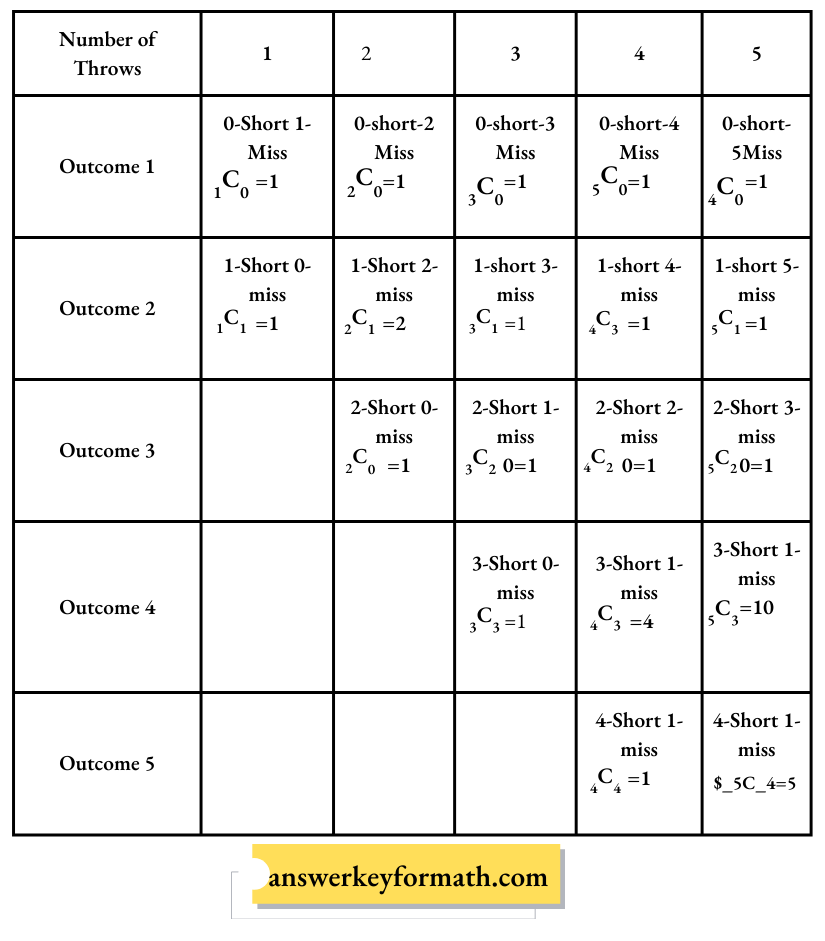
The task is to complete the given table with a corresponding number of combinations that represent the number of ways a certain event can happen.
Chapter 15, Section 15.4, Exercise 8 Page 1,200
Step 1
Chapter 15, Section 15.4, Exercise 9 Page 1,201
Step 1
A person has a shooting chance of \(\frac{2}{3}\)
, and the probability of missing is \(\frac{1}{3}\)
P(shoot)= \(\frac{2}{3}\)
P(miss)= \(\frac{2}{3}\)
Chapter 15, Section 15.4, Exercise 10 Page 1,202
Step 1
A person has a shooting of 2 out of 5 chance, and the probability of missing is \(\frac{3}{5}\)
P(shoot)= \(\frac{2}{5}\)
P(miss)= \(\frac{3}{5}\)
To get the probability of shooting r times in n shoots, we came up with the formula:
⇒ \({ }_n C_r \cdot[P(\text { shoot })]^r \cdot[P(\text { miss })]^{n-r}\)
Chapter 15, Section 15.4, Exercise 11 Page 1,202
Step 1
A person has a shooting of 9 out of 10 chance, and the probability of missing \(\frac{1}{10}\)
P(shoot)= \(\frac{9}{10}\)
P(miss)= \(\frac{1}{10}\)
To get the probability of shooting r times in n shoots, we came up with the formula:
⇒ \({ }_n C_r \cdot[P(\text { shoot })]^r \cdot[P(\text { miss })]^{n-r}\)
Chapter 15, Section 15.4, Exercise 1 Page 1,203
Step 1
Let
R be the event of getting a red face, and B be the event of getting a blue face. A fair cube has
4 red faces and 2 blue faces. We have the following probabilities:
P(R)= \(\frac{4}{6}=\frac{2}{3}\)
P(B)= \(\frac{2}{6}=\frac{1}{3}\)
When we roll the cube multiple times, we are doing multiple trials. To get the probabilities of multiple trials, we have:
⇒ \({ }_n C_r \cdot[P(A)]^r \cdot[P(B)]^{n-r}\)
Chapter 15, Section 15.4, Exercise 2 Page 1,204
Step 1
Let R be the event of getting a red face, and B be the event of getting a blue face. A fair cube has
4 red faces and 2 blue faces. We have the following probabilities:
P(R)= \(\frac{4}{6}=\frac{2}{3}\)
P(B)= \(\frac{2}{6}=\frac{1}{3}\)
When we roll the cube multiple times, we are doing multiple trials. To get the probabilities of multiple trials, we have:
⇒ \({ }_n C_r \cdot[P(A)]^r \cdot[P(B)]^{n-r}\)
Chapter 15, Section 15.4, Exercise 3 Page 1,205
Step 1
A tetrahedron has 3 blue faces and 1 red face. We have the following probabilities:
Chapter 15, Section 15.4, Exercise 4 Page 1,205
Step 1
Let R be the event of getting a red face, and B the event of getting a blue face.
A tetrahedron has 1 red face and 3 blue faces. We have the following probabilities:
P(R)= \(\frac{1}{4}\)
P(B)= \(\frac{3}{4}\)
When we roll the tetrahedron multiple times, we are doing multiple trials. To get the probabilities of multiple trials, we have:
⇒ \({ }_n C_r \cdot[P(A)]^r \cdot[P(B)]^{n-r}\)