
The Sphere Angles Of Intersection Of Spheres, Orthogonal Spheres
Definition Of A Sphere In Geometry With Examples And Proofs
Definition. P is a common point to two spheres ξ1, ξ2. Any angle θ between the tangent planes at P to two spheres is called an angle of intersection of the spheres ξ1, ξ2 at P. The other angle between the spheres π – θ.
If θ = π/2 the spheres are said to interest orthogonally at P and the spheres are called orthogonally spheres.
Theorem.1 ξ1, ξ2 are two intersecting spheres (not touching). r1,r2 are their respective radii and d is the distance between their centres. If P is a common point to ξ1, ξ2 then an angle θ of the intersection of the spheres ξ1, ξ2 at P is given by
⇒ \(\cos \theta=\pm\left(\frac{r_1^2+r_2^2-a^2}{2 r_1 r_2}\right)\)
Proof. Let A, B be the centres of the spheres ξ1, ξ2. The tangent planes at P to ξ1, ξ2 are perpendicular to AP, Bp respectively. Since the angle between the planes is the angle between their normals, ∠APB = θ or π – θ.
Ap =r1, Bp = r2 and AB = d.
From △APB,
AB2 = AP2 + PB2 – 2 AB.PB cos∠APB
i.e.,d2 = r12 + r22 ± 2r1r2cosθ
i.e., \(\cos \theta=\pm \frac{r_1^2+r_2{ }^2-d^2}{2 r_1 r_2}\)
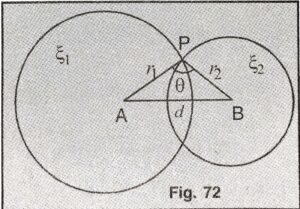
Note 1. Since the value of cosθ is independent of P, then angle between two spheres ξ1, ξ2 can be found to be the same at any point of their intersection.
2. Spheres ξ1, ξ2 cut orthogonally <=> θ = 90° <=> r12 + r22 = d2
In this case, the tangent plane to ξ1 at P passes through the centre of ξ2 and the tangent plane to ξ2 at P passes through the centre of ξ1.
Theorem.2 S ≡ x2 + y2 + z2 + 2ux + 2vy + 2wz + d = 0,s’ ≡ x2 + y2 + z2 + 2u’x + 2v’y + 2w’z + d’ = are two orthogonal spheres <=> 2uu’ + 2ww’ = d + d’.
Proof. Let A, B be the centres and r1, r2 be the radii of the spheres s = 0, s’ = 0.
Spheres s=0, s’=0 cut orthogonally
⇔AB2 = r12 + r22
⇔ (u’-u)2 + (v’-v)2 + (w’-w)2 = u2 + v2 + w2 – d + u’2 + v’2 + w’2 – d’
⇔ -2uu’ – 2vv’ – 2ww’ = d + d’ <=> 2uu’ + 2vv’ + 2ww’ = d + d’
Theorems Related To Spheres With Solved Problems Step-By-Step
Theorem.3 If r1, r2 are the radii of two orthogonal spheres, then the radius of the circle of their intersection is \(\frac{r_1 r_2}{\sqrt{r_1^2+r_2^2}}\)
Proof. A, B are the centres of the two orthogonal spheres. M is the centre and a is the radius of the circle common to the spheres.
∴ A, M, B are colinear and MP ⊥ AB.
P is a common point of intersection of the spheres,
AP = r1, BP = r2, ∠APB = 90° ⇒ AB2 = r12 + r22
⇒ (AM + MB)2 = r12 + r22
⇒ AM2 + MB2 + 2 AM . MB = r12 + r22
⇒ \(r_1^2-a^2+r_2^2-a^2+2 \sqrt{\left(r_1^2-a^2\right)\left(r_2^2-a^2\right)}=r_1^2+r_2^2\)
⇒ 4(r12 – a2)(r22 – a2) = 4a4
⇒\(r_1^2 r_2^2-a^2\left(r_1^2+r_2^2\right)=0 \Rightarrow a=\frac{r_1 r_2}{\sqrt{r_1^2+r_2^2}}\)
Note. If S=0, S’=0 are the equations to the orthogonal spheres with radii r1, r2 then 2uu’+2vv’+ww’=d+d’ and
r12 = u2 + v2 + w2 – d, r22 = u’2 + v’2 + w’2 – d’
∴ r12 + r22 = u2 + v2 + w2 + u’2 + v’2 + w’2 – (2uu’ + 2vv’ + 2ww’)
= (u-u’)2 + (v-v’)2 + (w-w’)2
∴ \(a=\frac{\sqrt{u^2+v^2+w^2-d} \cdot \sqrt{u^{\prime 2}+v^2+w^2-d^{\prime}}}{\left(u-u^{\prime}\right)^2+\left(v-v^{\prime}\right)^2+\left(w-w^{\prime}\right)^2}\)
The Sphere Power Of A Point
Definition. B is a point on a line L intersecting a sphere ξ with centre C and radius = a in P, Q. Then the power of the point B w.r.t. the sphere ξ is
(1) BP. BQ if B is an external point to ξ
(2) -BP.BQ if B is an internal point to ξ
(3) 0 if B is on ξ.
If B = \(\bar{b}\) (x1, y1, z1) and the equation to the sphere ξ is S, then the power of the point B w.r.t ξ is S11.
i.e., x12 + y12 + z12 + 2ux1 + 2vy1 + 2wz1 + d
= \(\overline{\mathrm{CB}}^2-a^2=\mathrm{CB}^2-(\text { radius of } \xi)^2\)
If B is an external point to ξ and \(\overleftrightarrow{\mathrm{BT}}\) is a tangent line to ξ at T, then BT2 = S11 = Power of the point B w.r.t ξ.
Note that: Power of the point B is independent of the d.cs.l,m,n.
Example. If the powers of a point w.r.t two given spheres are in a constant ratio, show that the locus of the point is a sphere.
The Sphere Radical Plane
Definition. The locus of points each of whose powers w.r.t two non-concentric spheres are equal is a plane called the radical plane (R.P.) of the two spheres.
ξ, ξ’ are two non-concentric spheres and π is their radical plane.
P is a point on the radical plane π. <=> power P w.r.t. ξ1= Power of P w.r.t ξ2.
Theorem.4 Equation to the radical plane of spheres S=0, S’=0 is S-S’=0.
Proof. S ≡ x2 + y2 + z2 + 2ux + 2vy + 2wz + d =0
S’ ≡ x2 + y2 + z2 + 2u’x + 2v’y + 2w’z + d’ = 0
∴ (-u, -v, -w) ≠ (-u’, -v’, -w’)
B(x1, y1, z1) is a point whose powers w.r.t the spheres are equal.
⇔ S11 = S’11
⇔ x12 + y12 + z12 + 2ux1 + 2vy1 + 2wz1 + d = x12 + y12 + z12 + 2u’x1 + 2v’y1 + 2w’z1 + d’
⇔ 2(u-u’)x1 + 2(v-v’)y1 + 2(w-w’)z1 + (d-d’) = 0
∴ Locus of B is 2(u-u’)x+2(v-v’)y+2(w-w’)z+(d-d’)=0 Which is a plane.
But the locus of B is the radical plane of the spheres S=0, S’=0.
∴ The radical plane of the spheres S=0, S’=0 is
2(u-u’)x + 2(v-v’)y + 2(w-w’)z + d – d’ = 0 i.e., S-S’=0
Note. D.rs. of the line of centres of the spheres are u-u’, v-v’, w-w’.
∴ Radical plane is perpendicular to the line of centres of the spheres.
Note 1. The line of centres and it is perpendicular to the radical plane.
∴ Radical plane is perpendicular to the line of centres of the spheres.
2. If two spheres interest the plane of their circle of intersection is their radical place.
3. If two spheres touch, their radical plane is the tangent plane at the point of contact to either of the spheres.
The Sphere Radical Line
Definition. If ξ, ξ’, ξ” are three spheres with non-collinear centres then the three radical planes of the spheres taken in pairs pass through a unique line, called the radical line.
Orthogonal Spheres Examples And Their Geometric Properties
Theorem.5 S=0, S’=0, S”=0 are three spheres whose centres are non-collinear, then the three radical planes of the spheres taken in pairs pass through a unique line.
Proof. Let A, B, C be the centres of the spheres S=0, S’=0, S”=0.
The radical plane (π) of S=0, S’=0 is S-S’=0 and is perpendicular to AB.
The radical plane (π’) of S’=0, S”=0 is S’-S”=0 and is perpendicular to BC.
The radical plane (π”) of S”=0, S=0 is S”-S=0 and is perpendicular to AB.
Since lines \(\overleftrightarrow{\mathrm{AB}}, \overleftrightarrow{\mathrm{BC}}\) intersect, the planes π,π’ have a line, say L in common.
All the points on L=0 lie on the plane (S-S’)+1(S’-S”)=0
i.e. S-S” = 0 i.e., S”-S=0 i.e. L lies in the plane S”-S=0
∴ π,π’,π” pass through the line L.
Note. L is the radical line of the spheres S=0, S’=0, S”=0 and its equation is S-S’=0, S’-S”=0 i.e. S=S’=S”.
The Sphere Radical Centre
Definition. The four radical lines of four spheres with non-coplanar centres, taken three by three intersect at a unique point, called the radical centre of the spheres.
Theorem.6 S=0, S’=0, S”=0, S'”=0 are four spheres whose centres are non-coplanar, then the four radical lines of four spheres taken three by three intersect at a unique point.
Proof. The radical plane of S=0, S’=0 is S-S’=0
i.e. 2(u-u’)x + 2(v-v’)y + 2(w-w’)z + (d-d’) = 0 …..(1)
The radical planes of S=0, S”=0 is S-S”=0
i.e. 2(u-u”)x + 2(v-v”)y + 2(w-w”)z + (d-d”) = 0 …..(2)
The radical planes of S=0, S”‘=0 is S-S'”=0
i.e. 2(u-u'”)x + 2(v-v'”)y + 2(w-w'”)z + (d-d'”) = 0 …..(3)
Since the centres (-u, -v, -w), (-u’, -v’, -w’),(-u”, -v”, -w”), (-u'”, -v'”, -w'”) are non-coplanar.
⇒ \(\left|\begin{array}{cccc}
-u & -v & -w & 1 \\
-u^{\prime} & -v^{\prime} & -w^{\prime} & 1 \\
-u^{\prime \prime} & -v^{\prime \prime} & -w^{\prime \prime} & 1 \\
-u^{\prime \prime \prime} & -v^{\prime \prime \prime} & -w^{\prime \prime \prime} & 1
\end{array}\right| \neq 0\)
⇒ \(\left|\begin{array}{cccc}
-u & -v & -w & 1 \\
u-u^{\prime} & v-v^{\prime} & w-w^{\prime} & 0 \\
u-u^{\prime \prime} & v-v^{\prime \prime} & w-w^{\prime \prime} & 0 \\
u-u^{\prime \prime \prime} & v-v^{\prime \prime \prime} & w-w^{\prime \prime \prime} & 0
\end{array}\right| \neq 0\)
⇒ \(\left|\begin{array}{ccc}
u-u^{\prime} & v-v^{\prime} & w-w^{\prime} \\
u-u^{\prime \prime} & v-v^{\prime \prime} & w-w^{\prime \prime} \\
u-u^{\prime \prime \prime} & v-v^{\prime \prime \prime} & w-w^{\prime \prime \prime}
\end{array}\right| \neq 0\)
⇒ Radical planes (1), (2), (3) pass through a unique point P.
∴ P lies on the radical planes of S=0, S’=0, S”=0, S'”=0,
⇒ P lies on the radical line of S=0, S’=0, S”=0
Similarly P lies on the radical line of S=0,S’=0,S”‘=0,
P lies on the radical line of S=0, S”=0, S”‘=0.
P lies on the radical line of S’=0,s”=0,S”‘=0.
∴ The four radical lines of four spheres taken three by three intersect at the unique point P.
Note. P is the radical centre of the spheres S=0, S’=0, S”=0, S'”=0.
Step-By-Step Solutions For Sphere Geometry Problems
Theorem.7 The centre of the sphere ξ which intersects two spheres ξ1, ξ2 orthogonally lies on the radical plane of the sphere ξ1, ξ2.
Proof. Let A, B be the centres and r1, r2 be the radii of the spheres ξ1, ξ2.
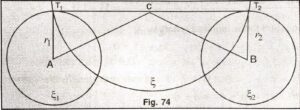
Let C be the centre of the sphere ξ. Let T1, T2 be the respective common points to ξ1, ξ2 and ξ2, ξ.
ξ intersects ξ1 orthogonally
⇒ CT1 ⊥ AT1 ⇒ AC2-AT12 = CT12
⇒ AC2 – (radius of ξ1)2 = CT12 Art.6.32
⇒ Power of the Point C w.r.t ξ1 = CT12 =(radius of ξ)2.
Similarly power of point C w.r.t ξ2 = CT22 =(radius of ξ)2.
∴ Power of the point C w.r.t ξ1 = Power of the point C w.r.t ξ2.
∴ C lies on the radical plane of ξ1, ξ2.
OR
Let S’=0, S”=0 be the equations of the spheres ξ1, ξ2 and S=0 be the equation of ξ.
Radical plane of S’=0, S”=0 is S’-S”=0
i.e. 2(u’-u”)x + 2(v’-v”)y + 2(w’-w”)z + d’-d” = 0
ξ intersects ξ1 orthogonally ⇒ 2uu’ + 2vv’ + 2ww’ = d + d’ …..(1)
ξ intersects ξ1 orthogonally ⇒ 2uu” + 2vv” + 2ww” = d + d” …..(2)
(1)-(2): 2(u’-u”)x + 2(v’-v”)y + 2(w’-w”)z + d’ – d” = 0
⇒ 2(u’-u”)(-u) + 2(v’-v”)(-v) + 2(w’-w”)(-w) + d’ – d” = 0
∴ The centre (-u, -v, -w) of S=0 clearly lies on the radical plane of s’=0, s”=0.
i.e. the centre of ξ lies on the radical plane ξ1, ξ2.
The Sphere Solved Problems
Example.1. Find the equation of the sphere through the circle x2 + y2 + z2 – 2x + 3y -4z +6 = 0 , 3x-4y+5z-15=0 and cutting the sphere x2 + y2 + z2 + 2x + 4y -6z +11 = 0 orthogonally.
Solution:
Given
x2 + y2 + z2 – 2x + 3y -4z +6 = 0 , 3x-4y+5z-15=0
x2 + y2 + z2 + 2x + 4y -6z +11 = 0
Let a sphere through the given circle and cut the sphere
x2 + y2 + z2 + 2x + 4y -6z +11 = 0 …..(1) orthogonally be
x2 + y2 + z2 – 2x + 3y -4z + 6 + λ(3x-4y+5z-15)=0
i.e., x2 + y2 + z2 + (3λ-2)x + (-4λ+3)y + (5λ-4)z + (-15λ+6) = 0
∴ \(\frac{2(3 \lambda-2)}{2}+\frac{4(-4 \lambda+3)}{2}-\frac{6(5 \lambda-4)}{2}=11-15 \lambda+6 \quad \text { i.e. } \lambda=-1 / 5\)
∴ Equations to the required sphere is 5(x2 + y2 + z2 ) – 13x + 19y – 25z + 45 = 0.
Radical Planes Of Spheres Explained With Solved Examples
Example. 2. Find the equation of the sphere which touches the plane 3x + 2y – z + = 0 at (1, -2, 1) and cuts orthogonally the sphere x2 + y2 + z2 – 4x + 6y + 4 = 0.
Solution:
Given
3x + 2y – z + = 0 and (1, -2, 1)
x2 + y2 + z2 – 4x + 6y + 4 = 0
For the sphere x2 + y2 + z2 – 4x + 6y + 4 = 0 …..(1)
centre = (2, -3, 0), radius = \(\sqrt{4+9-4}=3\)
Since the plane, 3x + 2y – z + 2 = 0 at (1, -2, 1) is the tangent plane to the required sphere, equations to the normal at (1, -2, 1) is the tangent plane to the required sphere, equations to the normal at (1, -2, 1) are
⇒ \(\frac{x-1}{3}=\frac{y+2}{2}=\frac{z-1}{-1} \text { (= } t \text { say) }\)
∴ Centre of the required sphere can be taken as (3t+1, 2t-2, -t+1)
and radius = \(\sqrt{(3 t+1-1)^2+(2 t-2+2)^2+(-t+1-1)^2}=\sqrt{14}|t|\)
Since the required sphere cuts orthogonally (1), (3t+1-2)2 + (2t-23)2 + (-t+1-0)2 = 14t2 + 9 i.e., t = -3/2.
∴ Centre of the required sphere \(\left(-\frac{7}{2},-5, \frac{5}{2}\right)\)
∴ Equation to the required sphere is \(\left(x+\frac{7}{2}\right)^2+(y+5)^2+\left(z-\frac{5}{2}\right)^2=\left(\frac{3}{2} \times \sqrt{14}\right)^2\)
i.e. x2 + y2 + z2 + 7x + 10y – 5z + 12 = 0.
Example. 3. Find the radical centre of the sphere
x2 + y2 + z2 + 4y = 0 …..(1)
x2 + y2 + z2 + 2x + 2y + 2z + 2 = 0 ….(2)
x2 + y2 + z2 + 3x – 2y + 8z + 6 = 0 ….(3)
x2 + y2 + z2 – x + 4y – 6z – 2 = 0 ….(4)
Solution: R.P. of (1) and (2) is 2x – 2y + 2z + 2 = 0
i.e., x-y+z+1=0 ……(5)
R.P. of (1) and (3) is 3x-6y+8z+6=0 ……(6)
R.P. of (1) and (4) is x+6z+2 = 0 ……(7)
R.P. of (3) and (4) is 4x-6y+14z+8=0 i.e.,
2x-3y+7z+4=0 ……(8)
∴ Radical line of the spheres (1), (2), (3) is
x – y + z +1 = 0 …..(5)
3x – 6y + 8z + 6 = 0 …..(6)
and radical line of the spheres (1),(3),(4) is x+6z+2=0 …..(7)
2x – 3y + 7z + 4 = 0 …..(8)
The point of the intersection of these radical lines is the radical centre of the spheres.
3 x (5)-(8) : x – 4z -1 = 0 ……(9)
(7)-(9) : 10z + 3 = 0 ⇒ \(z-\frac{3}{10}\)
∴ \(x=-\frac{1}{5}, y=\frac{1}{2}\)
∴ Radical centre of the spheres = \(\left(-\frac{1}{5}, \frac{1}{2},-\frac{3}{10}\right)\).
Solved Exercises On Spheres And Radical Planes In Geometry
Example.4. Show that all spheres through the origin and each set of points where the planes parallel to the plane \(\frac{x}{a}+\frac{y}{b}+\frac{z}{c}=0\) cut the axes, from a system of spheres which are cut orthogonally by the sphere x2 + y2 + z2 + 2fx + 2gy + 2hz = 0 …(1) if af + bg + ch = 0.
Solution:
Given
\(\frac{x}{a}+\frac{y}{b}+\frac{z}{c}=0\)x2 + y2 + z2 + 2fx + 2gy + 2hz = 0 …(1) if af + bg + ch = 0
Let a plane parallel to
⇒ \(\frac{x}{a}+\frac{y}{b}+\frac{z}{c}=0\) be \(\frac{x}{a}+\frac{y}{b}+\frac{z}{c}=\lambda(\lambda \neq 0)\)
Let it meet the axes A, B, C.
∴ A=(λa,0,0), B=(0,λb,0), C=(0,0,λc),
∴ The equation to the sphere through O, A, B, C is x2 + y2 + z2 – λax – λby – λcz = 0
This intersects (1) orthogonally if
⇒ \(2 \cdot f \cdot\left(\frac{-\lambda a}{2}\right)+2 g\left(\frac{-\lambda b y}{2}\right)+2 h\left(\frac{-\lambda c z}{2}\right)=0\)
i.e., af + bg + ch = 0 (∵ λ≠0).
The Sphere Coaxal System Of Spheres
Definition. A system of spheres such that any two spheres of the system have the same radical plane is called a coaxal system of spheres.
S=0 and S’=0 are two spheres of a coaxal system of sphere ξ.
⇒ S-S’=0 is the radical plane of the coaxal system of sphere ξ.
Theorem.8 If S=0 is a sphere and U=0 is a plane, then the equation s+λU=0(λ being real) represents a coaxal system of spheres with radical plane U=0.
Proof. Given that S=0 is a sphere and U=0 is a plane
Consider the equation S+λU=0, A being real ….(1)
Let S + λ1U=0 ……(2) and
S + λ2U=0 ……(3)
(λ1 ≠ λ2) be two spheres of the system (1).
Radical plane of(2) and (3) is (λ1 ≠ λ2), U=0
∴ U=0 (∵ λ1 ≠ λ2), independent of λ.
∴ Every two spheres of the system (1) have the same radical plane U=0.
∴ S+λU=0 is the equation to coaxal system of spheres with radical plane U=0.
Note. S=0, and S’=0 are two non-concentric spheres. Then S-S’=0 is the radical plane of S=0, S’=0.
∴ S+λ(S-S’)=0, being real, is a coaxal system of spheres
i.e. (1+λ)S+(-λ)S’=0 is a coaxal system of spheres
i.e. λ1S+λ2S’=0, (λ1,λ2)≠(0,0) and λ1+λ2≠0 represents a coaxal system of spheres with radical plane S-S’=0.
Theorem.9 The centres of the spheres of a coaxal system of spheres are collinear.
Proof. Let ξ be a coaxal system of spheres with radical plane π.
Let ξ1, ξ2 be two spheres of the system ξ with centres A, B.
∴ AB ⊥ π. …..(1)
Let ξ3 be a sphere of the system ξ distinct from ξ1, ξ2 with centre C.
∴ ξ1, and ξ3 have the same radical plane and AC ⊥ π. …..(2)
∴ From (1) and (2), A, B, C are collinear.
∴ All the centres of the spheres of the system lie on \(\overleftrightarrow{\mathrm{AB}}\)
i.e. all the centres are collinear.
⇒ \(\overleftrightarrow{\mathrm{AB}}\) is called the line of centres of the coaxal system ξ.
Note. The radial plane of a coaxal system of spheres is perpendicular to the line of centres of the system.
The Sphere A Simplified Form Of The Equation To A Coaxal System Of Spheres.
Theorem.10 A Coaxal system of spheres can be reduced to the form x2 + y2 + z2+ 2λx + d = 0 where d is a constant and λ is a parameter.
Proof. The line of centres of a coaxal system of spheres is perpendicular to the radical plane of the system.
Let the point of intersection of the line of centres with the radical plane be origin O, the line of centres be X-axis and the radical plane be YZ plane.
With this frame of reference, let a sphere of the coaxal system be
x2 + y2 + z2 + 2ux + d = 0 ……(1) (∵ centre lies on the x-axis)
where u, and d are parameters. O is a point on the radical plane of the system.
∴ Power of O w.r.t. (1) = 0 + 0 + 02u(0) + d = d.
Since the power of the point O w.r.t. any sphere of the system must be the same, d is a constant.
∴ Equation to the coaxal system of spheres can be taken as x2 + y2 + z2 + 2λx + d = 0 where λ(=u) is a parameter and d is a constant.
Note. The equation x2 + y2 + z2 + 2λx + d = 0 (λ is a parameter and d is a constant) represents a coaxal system with the line of centres as X-axis and the radical plane as YZ plane.
By giving values to λ and taking f as constant, we get spheres of the coaxal system.
Consider a coaxal system of spheres x2 + y2 + z2 + 2λx + d = 0 …….(1)
where d is a constant and λ is a parameter.
The radical plane of the system is the YZ plane i.e. x = 0 …..(2)
∴ (1) and (2) intersect in points given by x = 0, y2 + z2 + d = 0
i.e. y2 + z2 = -d.
(1) d < 0.
All the points of intersection lie on the circle x = 0,\(y^2+z^2=(\sqrt{-d})^2\) and every sphere of the system passes through the circle.
∴ The coaxal system is an intersecting type of coaxal system of spheres.
(2) d = 0.
∴ x=0, y2 + z2= 0 i.e. x = 0, y = 0, z = 0
i.e. (0, 0, 0) is a point common to (1) and (2).
i.e. every pair of spheres of the system touch at (0, 0, 0) and the radical plane of the system is the system is the tangent plane at (0, 0, 0) to every sphere of the system.
∴ The coaxal system is a touching type of coaxal system such that every pair touches at (0,0,0).
(3) d > 0.
∴ There are no points common to (1) and (2)
i.e. there are no points in common to any two spheres of the system.
∴ The coaxal system is a non-intersecting type of coaxal system of spheres.
The Sphere Limiting Points
Definition. Point spheres of a coaxal system of spheres are called limiting points of the system.
Let x2 + y2 + z2 + 2λx + d = 0 where d is a constant and λ is a parameter, represent a coaxal system of spheres.
For any sphere of the system, radius = \(\sqrt{\left(\lambda^2-d\right)}\) and centre = (-λ, 0, 0)
For limiting points of the system, radius = 0
i.e. \(\sqrt{\left(\lambda^2-d\right)}=0\) i.e. λ = ±√d
(1) If d=0 then λ=0 and hence the system has only one limiting point and it is, (0, 0, 0). In this case the system is a touching type of coaxal system of spheres at (0, 0, 0).
(2) If d>0; then λ has two values ±√d and hence the system has two limiting points only. The limiting points are (√d, 0, 0), (-√d, 0, 0). In this case, no two spheres of the system intersect.
(3) If d<0, the system has no limiting points. In this case, the system is intersecting type.
Note 1. The equation to the limiting point (√d, 0, 0) is
⇒ \((x-\sqrt{d})^2+y^2+z^2=0 \text { i.e. } x^2+y^2+z^2-2 \sqrt{d} x+d=0\)
The equation to the limiting point (-√d, 0, 0) is
⇒ \((x+\sqrt{d})^2+y^2+z^2=0 \text { i.e. } x^2+y^2+z^2+2 \sqrt{d} x+d=0\)
2. If there is only one limiting point (0, 0, 0), its equation is x2 + y2 + z2 = 0.
The Sphere Solved Problems
Example. 1. Find the limiting points of the coaxal system defined by spheres x2 + y2 + z2 + 4x – 2y + 2z + 6 = 0 ….(1) and x2 + y2 + z2+ 2x – 4y – 2z + 6 = 0 …..(2)
Solution:
Given
x2 + y2 + z2 + 4x – 2y + 2z + 6 = 0 ….(1) and x2 + y2 + z2+ 2x – 4y – 2z + 6 = 0 …..(2)
The R.P. of the sphere of the coaxal system is 2x + 2y + 4z = 0 i.e., x + y + 2z = 0
∴ The equation to a sphere of the coaxal system is
⇒ x2 + y2 + z2 + 4x – 2y + 2z + 6 + λ(x + y + 2z) = 0
i.e. x2 + y2 + z2 + (4+λ)x + (λ-2)y + (2λ+2)z + 6 = 0
∴ centre = \(\left(-\frac{4+\lambda}{2}, \frac{2-\lambda}{2},-\lambda-1\right)\) and
radius = \(\sqrt{\left[\frac{(4+\lambda)^2}{4}+\frac{(2-\lambda)^2}{4}+(\lambda+1)^2-6\right]}\)
For limiting points of the system, radius = 0.
∴ \(\frac{(4+\lambda)^2}{4}+\frac{(2-\lambda)^2}{4}+(\lambda+1)^2-6=0\) i.e., λ2 + 2λ = 0
i.e. λ = 0, -2
∴ Limiting points are (-2, 1, -1); (-1, 2, 1).
Geometric Interpretation Of Radical Planes And Orthogonal Spheres
Example.2. Find the equation of the sphere belonging to the coaxal system given by x2 + y2 + z2 – 2ax – 2ay – 2az + 4a2 + λ(x + y – z) = 0 and x2 + y2 + z2 – 4ax – 4ay + 4a2 = 0 and which cuts the sphere x2 + y2 + z2 – 2ax = 0 orthogonally.
Solution:
Given
x2 + y2 + z2 – 2ax – 2ay – 2az + 4a2 + λ(x + y – z) = 0 and x2 + y2 + z2 – 4ax – 4ay + 4a2 = 0
x2 + y2 + z2 – 2ax = 0
R.P. of the given spheres is 2ax + 2ay – 2az = 0 i.e., x + y – z =0
∴ The equation to a sphere of the coaxal system is
⇒ x2 + y2 + z2 – 2ax – 2ay – 2az + 4a2 + λ(x + y – z) = 0
If the sphere intersects x2 + y2 + z2 – 2ax – 2ay – 2az = 0 orthogonally, then
⇒ \(2\left(\frac{\lambda-2 a}{2}\right) \cdot a+2\left(\frac{\lambda-2 a}{2}\right) \cdot 0+2\left(\frac{-\lambda-2 a}{2}\right) \cdot 0=4 a^2\) i.e., λ=6a.
∴ Equation to the required sphere is x2 + y2 + z2 – 4ax – 4ay – 8az + 4a2 = 0.
Solved Problems On Equations Of Spheres And Their Radical Planes
Example. 3. Prove that every sphere through the limiting points of a coaxal system intersects every sphere of that system orthogonally.
Solution: Let a coaxal system of spheres be x2 + y2 + z2 + 2λx + d = 0 …..(1)
(d > 0)
∴ Limiting points of the system are (-√d, 0, 0), (√d, 0, 0)
Let a sphere through the limiting points be x2 + y2 + z2 + 2ux + 2vy + 2wz + c = 0 ……(2)
∴ \(d-2 u \sqrt{d}+c=0, d+2 u \sqrt{d}+c=0\)
∴ Solving, u=0, c = -d.
∴ The equation to the system of spheres through the limiting points is x2 + y2 + z2 + 2vy 2wz – d = 0 …..(3)
Since 2.λ.0 + 2.0.v + 2.0.w = d – d is true for any sphere of the system (1), every sphere of the system intersects every sphere of the system through the limiting points orthogonally.