Primary Mathematics Chapter 2 The Four Operations Of Whole Numbers
Chapter 2 The Four Operations Of Whole Numbers Exercise 2.17 Solutions Page 74 Exercise 2.17 Problem 1
Given: Holly’s savings = 312
Leigh’s savings = 998
To find – How much Holly saved more than Leigh.
Here, we have the subtracted Leigh’s savings from Holly’s savings to find how much more was saved by Holly
Amount saved = Holly’s savings – Leigh’s savings
⇒ 10312 − 7998
⇒ 2314
Holly saved more than Leigh.
Page 74 Exercise 2.17 Problem 2
Given: To find the quotient and remainder when 2490 is divided by 4.
Let’s divide 2490 by 4
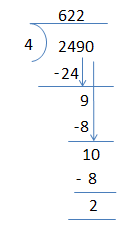
Quotient = 622
Remainder = 2
When 2490 is divided by 4
Quotient = 622
Remainder = 2
Primary Mathematics 4A Chapter 2 Step-By-Step Solutions For Exercise 2.17 Page 74 Exercise 2.17 Problem 3
Given: 1548,397,621
First round off the numbers to its nearest hundred.
Then, add all the numbers.
Rounding off 1548 to its nearest hundred = 1500
Rounding off 397 to its nearest hundred = 400
Rounding off 621 to its nearest hundred = 600
Now, add all the rounded numbers.
⇒ 1500 + 400 + 600
⇒ 2500
Required estimate = 2500
The Four Operations Exercise 2.17 Primary Mathematics Workbook Answers Page 74 Exercise 2.17 Problem 4
Given: 459,24
First, find the product of the given numbers
Then, round it off to the nearest ten.
Product of 459,24:
⇒ 459 × 24
⇒ 11016
Now, rounding off to the nearest ten.
⇒ 11020
Required estimate ⇒ 11020
Page 74 Exercise 2.17 Problem 5
Given: To subtract 238 from the product of 23 and 80
First, find the product of 23 and 80
Then subtract 238 from the product.
Product of 23 and 80 :
⇒ 23 × 80
⇒ 1840
Now, subtract 238 from the product of 23 and 80.
⇒ 1840−238
⇒ 1602
Required answer = 1602
Page 75 Exercise 2.17 Problem 6
Given: Divide the sum of 352 and 698 by 5
First, find the sum of 352 and 698
Then divide by 5
Sum of 352 and 698
⇒ 352 + 698
⇒ 1050
Now, divide by 5
⇒ \(\frac{1050}{5}\)
⇒ 210
Required answer = 210
Common Core Primary Mathematics 4A Chapter 2 Solved Examples For 2.17 Page 75 Exercise 2.17 Problem 7
Given: 4345 + 998 ◯ 5345 − 98
To fill – The circle with either <,> or =.
First, find the left-hand side (LHS) of the circle, and then find the right-hand side (RHS) of the circle.
If LHS is greater than RHS, use >
If LHS is smaller than RHS, use <
If LHS is equal than RHS, use =
LHS:
⇒ 4345 + 998
⇒ 5343
RHS:
⇒ 5345 − 98
⇒ 5247
Here, LHS is greater than RHS. 5343 is greater than 5247
Therefore, 5343>5247
The required solution is 4345+998>5345−98
Solutions for The Four Operations Exercise 2.17 In Primary Mathematics 4A Page 75 Exercise 2.17 Problem 8
Given: (600 × 8) + (5 × 8) + (3 × 8) ◯ 654 × 8
To fill – The circle with either <,> or =.
First, find the left-hand side (LHS) of the circle, and then find the right-hand side (RHS) of the circle.
If LHS is greater than RHS, use >
If LHS is smaller than RHS, use <
If LHS is equal than RHS, use =
LHS:
First, multiply the terms in the bracket and then add.
⇒ (600 × 8) + (5 × 8) + ( 3 × 8)
⇒ (4800) + (5 × 8) + (3 × 8)
⇒ (4800) + (40) + (3 × 8)
⇒ (4800) + (40) + (24)
⇒ 4864
RHS:
⇒ 654 × 8
⇒ 5232
Here, LHS is smaller than RHS.
4864 is smaller than 5232
Therefore, 4864<5232
The required solution is (600 × 8) + (5 × 8) + (3 × 8)< 654 × 8
Detailed Solutions For Exercise 2.17 The Four Operations In 4A Workbook Page 75 Exercise 2.17 Problem 9
Given: 7191 ÷ 9 ◯ 5994 ÷ 6
To fill – The circle with either <,> or =.
First, find the left-hand side (LHS) of the circle, and then find the right-hand side (RHS) of the circle.
If LHS is greater than RHS, use >
If LHS is smaller than RHS, use <
If LHS is equal than RHS, use =
LHS:
⇒ \(\frac{7191}{9}\)
⇒ 799
LHS = 799
RHS:
⇒ 5994 ÷ 6
⇒ 999
RHS = 999
Here, LHS is smaller than RHS.
799 is smaller than 999
Therefore, 799<999
The required solution is 7191 ÷ 9 < 5994 ÷ 6
Step-By-Step Guide For The Four Operations Exercise 2.17 In 4A Workbook Page 75 Exercise 2.17 Problem 10
Given: 605 × 40 ◯ 505 × 30
To fill – The circle with either <,> or =.
First, find the left-hand side (LHS) of the circle, and then find the right-hand side (RHS) of the circle.
If LHS is greater than RHS, use >
If LHS is smaller than RHS, use <
If LHS is equal than RHS, use =
LHS:
⇒ 605 × 40
⇒ 24200
LHS = 24200
RHS:
⇒ 505 × 30
⇒ 15150
RHS = 15150
Here, LHS is greater than RHS.
24200 is greater than 15150
Therefore, 24200>15150
The required solution is 605 × 40 > 505 × 30
Primary Mathematics Workbook 4A Exercise 2.17 The Four Operations Page 75 Exercise 2.17 Problem 11
Given: 1000−750 + 480 ÷ 3 =
To find – The value of the given expression.
By BODMAS, first, divide the expression.
Then add and subtract.
First, divide the expression.
⇒ 1000 − 750 + 480 ÷ 3
⇒ 1000−750 + 160
Now add all the same sign terms.
⇒ 1160 − 750
⇒ 410
The required solution is 1000 − 750 + 480 ÷ 3 = 410
Chapter 2 The Four Operations Exercise 2.17 Breakdown With Solutions Page 75 Exercise 2.17 Problem 12
Given: 9000−(6000−1430)
To find – The value of the given expression.
By BODMAS, first, subtract the expression in the bracket.
Then add and subtract.
First, subtract the expression in the bracket.
⇒ 9000 − (6000 − 1430)
⇒ 9000 − (4570)
Now subtract the terms.
⇒ 9000 − 4570
⇒ 4430
The required solution is 9000 −(6000 −1430) = 4430
Page 75 Exercise 2.17 Problem 13
Given: 1475−(18×21)
To find – The value of the given expression.
By BODMAS, first, multiply the expression inside brackets.
Then subtract.
First, multiply the expression inside brackets.
⇒ 1475 − (18 × 21)
⇒ 1475 − (378)
Now subtract the terms.
⇒ 1475 − 378
⇒ 1097
The required solution is 1475 − (18 × 21) = 1097
Page 75 Exercise 2.17 Problem 14
Given: 40 + 13 × (12 + 6)=
To find – The value of the given expression.
By BODMAS, first, add the expression in the brackets.
Then multiply and add.
First, add the expression in the brackets.
⇒ 40 + 13 × (12 + 6)
⇒ 40 + 13 × (18)
Now multiply the last two terms.
⇒ 40 + 234
⇒ 274
Therefore,40 + 13 × (12 + 6) = 274
Common Core 4A Chapter 2 Exercise 2.17 Solutions Page 75 Exercise 2.17 Problem 15
Given: 30 × (40 + 50)
To match the correct expression.
Here, 30 is multiplied with both 40and50
The above expression can be rewritten as ([30×40]+[30×50])
Therefore, the correct match is the price of forty 30-cent red pencils and fifty 30-cent blue pencils.
(Here ‘and’ indicate addition)
Hence,30×(40+50): The price of forty 30-cent red pencils and fifty 30-cent blue pencils.
Page 75 Exercise 2.17 Problem 16
Given: 30 + 40 × 50
To match the correct expression.
Here, 40 is multiplied 50 and add 30
The above expression can be rewritten as ([1×30]+[40×50])
Therefore, the correct match is the price of one 30-cent pencils and fifty 40-cent erasers. (Here ‘and’ indicates addition)
30+40×50: The price of one 30-cent pencil and fifty 40-cent erasers.
Page 75 Exercise 2.17 Problem 17
Given: 30 × 40 + 50
To match the correct expression.
Here, 30 is multiplied with 40 and then 50 is added.
The above expression can be rewritten as ([30×40]+[50×1])
Therefore, the correct match is the price of forty 30-cent red pencils and a 50-cent eraser. (Here ‘and’ indicate addition)
30+40×50: The price of forty 30-cent red pencils and a 50-cent eraser.
Page 76 Exercise 2.17 Problem 18
Given: Lucas made 1192 muffins. He wants to put them in bags that can hold 6 muffins each.
To find – The least number of bags he needs.
Here, we have to find how 1192 muffins can be divided into 6 muffins in each bag.
Here, divide 1192 by 6
⇒ \(\frac{1192}{6}\)
⇒ 198.67
So, from the above calculation, we can conclude that
Least number of bags needed =198
Therefore, the least number of bags needed = 198
Page 76 Exercise 2.17 Problem 19
Given: A computer costs $1857.
It costs 3 times as much as a printer.
To find – How much the computer and the printer cost altogether.
Let the cost of the printer be x
Here, the cost of the computer $1857 is 3 times the cost of the printer.
∴ 1857 = 3x
Dividing both sides by 3
x = \(\frac{1857}{3}\)
x = 619
Therefore, the cost of the printer is $619
Page 77 Exercise 2.17 Problem 20
Given: Nicole and Tasha have 2000 stickers altogether. Nicole has 600 more stickers than Tasha.
To find – Number of stickers Nicole has.
Let x be the number of stickers Nicole has.
Let y be the number of stickers Tasha has.
Nicole has 600 more stickers than Tasha.
Therefore, the number of Nicole stickers = 600+ number of Tasha stickers.
⇒ x = 600 + y
Nicole and Tasha have 2000 stickers altogether.
Number of Nicole’s stickers + Number of Tasha’s stickers = 2000
x + y = 2000
Substitute x = 600 + y in the above equation.
600 + y + y = 2000
600 + 2y = 2000
2y = 2000 − 600
2y = 1400
y = 700
Therefore, the number of stickers Nicole have x = 600 + 700 = 1300
Therefore, the number of stickers Nicole have are = 1300
Page 77 Exercise 2.17 Problem 21
Given: 2500 people took part in a cross-country race.
The number of adults was 4 times the number of children. There were 1200 men.
To find – The number of women.
Let x be the number of adults.
Let y be the number of children
2500 people took part in a cross-country race. Therefore, number of adults + number of children = 2500
x + y = 2500……. (1)
The number of adults was 4 times the number of children. ⇒ x = 4y ……….(2)
Substitute 2 in (1)
x + y = 2500
4y + y = 2500
5y = 2500
y = 500
Therefore, number of adults ⇒ x = 4y = 4(500) = 2000
Number of men +number of women=number of adults
⇒ 1200 + Number of women = 2000
⇒ Number of women = 2000−1200
⇒ Number of women = 800
Therefore, the number of women are = 800
Page 78 Exercise 2.17 Problem 22
Given: the cost of a stereo set and a television set was shared equally among 4 people.
The television set cost $1980
The stereo set cost $1200 more than the television set.
To find – How much each person should pay.
Let the cost of the stereo set be x
The television set cost = $1980
The stereo set cost $1200 more than the television set.
Therefore, cost of stereo set = $1200 + $1980
⇒ x = 1200 + 1980
⇒ x = 3180
The total cost of stereo set and television:
⇒ 1980 + 3180
⇒ 5160
The cost of a stereo set and a television set was shared equally among 4 people.
∴ Amount each person should pay =\(\frac{5160}{4}\)
= 1290
Therefore the amount each person should pay is = $1290
Page 78 Exercise 2.17 Problem 23
Given: Jared bought a table and 12 chairs for $2400
Each chair cost $165
Let the cost of a table be x
Let the cost of a chair be y
To find – The cost of a table.
Jared bought a table and 12 chairs for $ 2400.
⇒ x + 12y = 2400
Each chair cost
Therefore, y = 165
⇒ x + 12(165) = 2400
⇒ x + 1980 = 2400
⇒ x = 2400−1980
⇒ x = 420
Therefore, the cost of a table is $ 420
Page 79 Exercise 2.17 Problem 24
Given: A shopkeeper has 50 boxes of apples. There were 24 apples in each box.
He sold all the apples for $1.
To find – How much money he received.
A shopkeeper has 50 boxes of apples.
There were 24 apples in each box.
Therefore, the total number of apples = 50 × 24 = 1200
He sold the apples for $1.
Therefore, the money he received = $1200
Therefore, the money he received is = $1200
Page 79 Exercise 2.17 Problem 25
Given: A greengrocer had 25 crates of grapefruit.
There were 36 grapefruit in each crate.
She threw away 28 rotten grapefruit and sold 786 of the rest.
To find – The number of grapefruit left.
First, find the total number of grapefruits.
Then subtract the number of rotten grapefruit and sold fruit from the total to find the number of grapefruit left.
A greengrocer had 25 crates of grapefruit.
There were 36 grapefruit in each crate.
Total number of grapefruit = 25 × 36 = 900
She threw away 28 rotten grapefruit and sold 786 of the rest.
⇒ 900 − 28 − 786
⇒ 900 − 814
⇒ 86
Therefore, the number of grapefruit left is = 86
Page 80 Exercise 2.17 Problem 26
Given: There are 14 blocks of apartments in an estate.
There are 25 floors in each block of apartments. There are 4 apartments on each floor.
To find – The number of apartments altogether.
Using the given information, the total number of apartments is equal to
⇒ 14 × 25 × 4
= 1400
Therefore, the total number of apartments = 1400