
HMH Middle School Grade 7 Practice Fluency Workbook 1st Edition Chapter 3 Rational Numbers
HMH Grade 7 Practice Fluency Workbook Chapter 3 Exercise 3.2 Solutions Page 19 Problem 1 Answer
An expression is given as,−5−4.
It is required to solve the given expression using a number line.

On the number line, start from 0 and move towards 5 intervals left and then again 4 intervals left.
Write the given expression.
−5−4
From 0, move 5 intervals left. Then, again, move 4 intervals left.

The value of −5−4 is −9.
HMH Grade 7 Practice Fluency Workbook Chapter 3 Exercise 3.2 Solutions Page 19 Problem 2 Answer
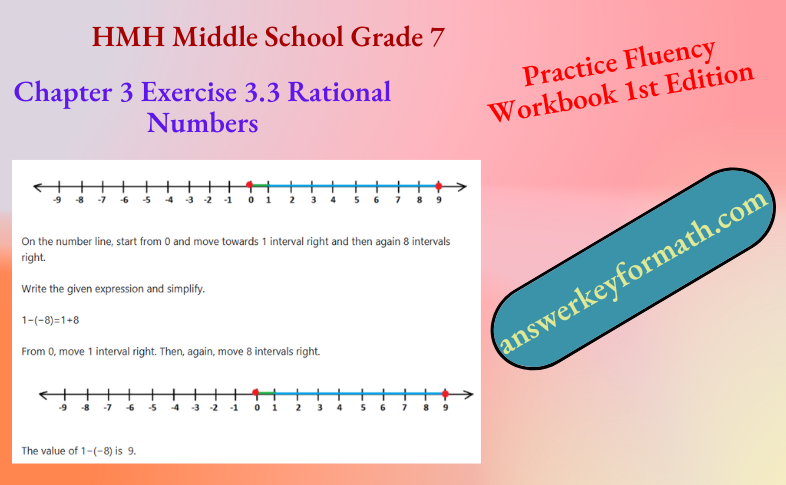
An expression is given as, 1−(−8).
It is required to solve the given expression using a number line.
Read and Learn More HMH Middle School Grade 7 Practice Fluency Workbook 1st Edition Solutions
Rational Numbers Exercise 3.2 Chapter 3 Answers HMH Grade 7 Workbook Page 19 Problem 3 Answer
An expression is given as, 4−(−5).
It is required to find the difference.
To solve the given expression, first, change subtraction by addition with the opposite number and then simplify.
Change subtraction by addition with the opposite number.
4−(−5)=4+5.
As the two numbers have the same sign, the result of the addition is given by the sum between the absolute values, to which the sign of the numbers can be substituted into.
Hence, 4+5=9.
The difference of 4−(−5) is 9.
Step-By-Step Solutions For Exercise 3.2 Rational Numbers HMH Grade 7 Practice Workbook Page 19 Problem 4 Answer
An expression is given as, 1/7−3/7.
It is required to find the difference.
To solve the given expression, first change subtraction by addition with the opposite number and then simplify.
Change subtraction by addition with the opposite number.
Hence, 1/7−3/7=1/7+(−3/7).
As the two numbers have the different signs, the result of the subtraction is given by the difference between the greater absolute values and the smaller absolute values, to which, the sign of the number which produced the greater absolute value can be substituted into.
1/7+(−3/7)=−(3/7−1/7)
1/7+(−3/7)=−(3−1/7)
1/7+(−3/7)=−2/7
Hence,1/7+(−3/7)=−2/7.
The difference of 1/7−3/7 is−2/7.
Exercise 3.2 Rational Numbers solutions for HMH Middle School Grade 7 Workbook Page 19 Problem 5 Answer
An expression is given as, −3.7−(−4.9).
It is required to find the difference.
To solve the given expression, first change subtraction by addition with the opposite number and then simplify.
Change subtraction by addition with the opposite number.
Hence, −3.7−(−4.9)=−3.7+4.9.
As the two numbers have the different sign, the result of the subtraction is given by the difference between the greater absolute values and the smaller absolute values, to which the sign of the number which produced the greater absolute value can be substituted into.
−3.7+4.9=+(4.9−3.7)
−3.7+4.9=+1.2
−3.7+4.9=1.2
Hence, −3.7+4.9=1.2.
The difference of −3.7−(−4.9) is 1.2.
Examples Of Problems From Exercise 3.2 Rational Numbers In HMH Grade 7 Workbook Page 19 Problem 6 Answer
An expression is given as, −21/4−(−3).
It is required to find the difference.
To solve the given expression, first change subtraction by addition with the opposite number and then simplify.
Change subtraction by addition with the opposite number.
Hence, −21/4−(−3)=−21/4+3.
As the two numbers have the different signs, the result of the subtraction is given by the difference between the greater absolute values and the smaller absolute values, to which, the sign of the number which produced the greater absolute value can be substituted into.
−21/4+3=+(3−21/4)
−21/4+3=3/4
Hence,−21/4+3=3/4.
The difference of −21/4−(−3) is 3/4.
Common Core Chapter 3 Exercise 3.2 Rational Numbers Detailed Solutions HMH Grade 7 Workbook” Page 19 Problem 7 Answer
An expression is given as, −1.6−2.1.
It is required to find the difference.
To solve the given expression, first change subtraction by addition with the opposite number and then simplify.
Change subtraction by addition with the opposite number.
−1.6−2.1=−1.6+(−2.1).
As the two numbers have the same sign, the result of the addition is given by the sum between the greater absolute values, to which the sign of the numbers can be substituted into.
−1.6+(−2.1)=−(1.6+2.1)
−1.6+(−2.1)=−3.7
Hence, −1.6+(−2.1)=−3.7.
The difference of −1.6−2.1 is −3.7.
Page 19 Problem 8 Answer
An expression is given as, −43/4−3/4.
It is required to find the difference.
To solve the given expression, first change subtraction by addition with the opposite number and then simplify.
Change subtraction by addition with the opposite number.
Hence, −43/4−3/4=−43/4+(−3/4).
As the two numbers have the same sign, the result of the addition is given by the sum between the greater absolute values, to which the sign of the numbers can be substituted into.
−43/4+(−3/4)=−(43/4+3/4)
−43/4+(−3/4)=−(19/4+3/4)
−43/4+(−3/4)=−22/4
−43/4+(−3/4)=−11/2
Hence, −43/4+(−3/4)=−11/2.
The difference of −1.6−2.1 is −11/2.
Page 19 Problem 9 Answer
It is given, an expression −5.1−(−0.1)−1.2.
It is required in this problem to find the difference of the given expression without using number line.
In order to find in this problem, the difference of the given expression without using number line, apply subtraction operation.
In order to simplify, subtract −0.1 from −5.1 in −5.1−(−0.1)−1.2 and the sign will be of the greater absolute value.
−5.1−(−0.1)−1.2=−5−1.2
Further, subtract 1.2 from −5.
−5−1.2=−3.8
Hence, −5.1−(−0.1)−1.2=−3.8.
Hence, as required in the problem,−5.1−(−0.1)−1.2=−3.8.
Page 19 Problem 10 Answer
An expression is given as, −3/5−7/5−(−2/5).
It is required to find the difference of the given expression without using number line.
In order to find the difference of the given expression without using number line, apply subtraction operation.
In order to simplify, subtract −7/5 from −3/5 in −3/5−7/5−(−2/5) and the sign will be of the greater absolute value.
−3/5−7/5−(−2/5)=−3−7/5−(−2/5)
−3/5−7/5−(−2/5)=−10/5−(−2/5)
Subtract −2/5 from −10/5.
−10/5−(−2/5)=−10−(−2)/5
−10/5−(−2/5)=−8/5
Hence, −3/5−7/5−(−2/5)=−8/5.
The value of −3/5−7/5−(−2/5) is −8/5.
Page 19 Problem 11 Answer
It is given that the temperature on Monday was −1.5∘C and on Tuesday it was 2.6∘C less than that on Monday.
It is required to find the temperature on Tuesday.
In order to find the temperature on Tuesday, make an expression based on the given information and apply subtraction operation.
Form an equation based on the given information.
Since, the temperature on Tuesday was 2.6∘C less than that on Monday and the temperature on Monday was −1.5∘C.
So, the temperature on Tuesday can be evaluated by the expression −1.5∘C−2.6∘C.
In order to simplify, subtract 2.6 from−1.5 and the sign will be of the greater absolute value.
Hence,−1.5∘C−2.6∘C=−4.1∘C.
The temperature on Tuesday was −4.1∘C.
Page 19 Problem 12 Answer
It is given that the diver dove to the location 63/5m below the sea level and then dove to second location 81/5m below the sea level.
It is required to find the meters between the two locations.
In order to find the meters between the two locations, make an expression based on the given information and apply subtraction operation.
Form an equation based on the given information.
Since, as given, the diver dove to the location 63/5m below the sea level and then dove to second location 81/5m below the sea level.
So, the difference in the distance between two locations can be evaluated by the expression 81/5−63/5.
In order to simplify, subtract 63/5 from 81/5 and the sign will be of the greater absolute value.
81/5−63/5=41/5−33/5
81/5−63/5=8/5
Hence, 81/5−63/5=8/5.
Hence, the difference in the distance between two locations is 8/5m or 13/5m.
Page 20 Problem 13 Answer
It is given that the total value of the tree cards with value 7,13, and −8 is 12.
It is required to find the values if 7 , 13 and −8 are taken away.
In order to find the values if 7,13, and −8 are taken away one by one, find the sum of other two cards.
If 7 is taken away, 13 and−8 are left.
Now, find the sum of 13 and −8.
13+(−8)=5
So, 12−7=5.
Hence, the value if 7is taken away, is 5.
If 13 is taken away, 7 and −8 are left.
Now, find the sum of 7 and−8.
7+(−8)=−1
So, 12−13=−1.
Hence, the value if 13 is taken away, is−1.
If −8 is taken away, 7 and 13 are left.
Now, find the sum of 7 and 13.
7+13=20
So, 12−(−8)=20.
Hence, the value if −8 is taken away, is 20.
The values if 7,13 and −8 are taken away are 5,−1 and 20 respectively.
Page 20 Problem 15 Answer
An expression is given as, −4−(−2).
It is required to subtract the given expression and answer some questions.
In order to solve, apply subtraction operation.
Then, answer the questions using the difference.
To begin with, simplify the given expression−4−(−2) and complete the first statement.
In order to simplify, subtract −2 from −4 in −4−(−2) and the sign will be of the greater absolute value.
−4−(−2)=−2
Hence, the completed statement is “−4<−2. So, the answer will be greater number.”
Further, simplify ∣4∣−∣2∣ and apply subtraction operation.
∣4∣−∣2∣=4−2
∣4∣−∣2∣=2
Hence, ∣4∣−∣2∣=2.
The value of −4−(−2) is −2.
Thus, −4−(−2)=−2.
Hence, as required in the problem, “−4<−2. So, the answer will be greater number.”, ∣4∣−∣2∣=2, and −4−(−2)=−2.
Page 20 Problem 16 Answer
An expression is given as, 31−(−9).
It is required to find the difference of the given expression.
In order to find the difference of the given expression, apply subtraction operation.
In order to simplify, subtract −9 from31 in 31−(−9) and the sign will be of the greater absolute value.
31−(−9)=31+9
31−(−9)=40
Hence, 31−(−9)=40.
The value of31−(−9) is 40.
Page 20 Problem 17 Answer
An expression is given as, −9−17.
It is required to find the difference of the given expression.
In order to find the difference of the given expression, apply subtraction operation.
In order to simplify, subtract 17 from −9 in −9−17 and the sign will be of the greater absolute value.
−9−17=−26
Hence, −9−17=−26.
The value of −9−17 is −26.
Page 20 Problem 18 Answer
An expression is given as, 4.5−2.5.
It is required to find the difference of the given expression.
In order to find the difference of the given expression, apply subtraction operation.
In order to simplify, subtract 2.5 from 4.5 in 4.5−2.5 and the sign will be of the greater absolute value.
4.5−2.5=2
Hence, 4.5−2.5=2.
The value of 4.5−2.5 is 2.
Page 20 Problem 19 Answer
An expression is given as, 4/5−(−1/5).
It is required to perform subtraction on the given expression.
To perform subtraction on the given expression, it is necessary to check the signs assigned to the fractions.
Two negative signs appear next to each other in the given expression 4/5−(−1/5).
Change the subtraction by addition with the opposite number.
Then, the given expression can be written as,
4/5−(−1/5)=4/5+1/5
As the two numbers have the same sign, the result of the addition is given by the sum between the absolute values, to which the signs of the numbers are assigned.
Perform addition on the expression 4/5+1/5.
4/5+1/5=5/5
4/5+1/5=1
The result will be a positive number since the both the numbers 4/5 and 1/5 are positive.
Hence, the required result is 1.
The result of subtraction on the given expression 4/5−(−1/5) is 1.
Page 20 Problem 20 Answer
An expression is given as,−21/3−(−1/3).
It is required to perform subtraction on the given expression.
To perform subtraction on the given expression, it is necessary to check the signs assigned to the fractions.
Two negative signs appear next to each other in the given expression−21/3−(−1/3).
Change the subtraction by addition with the opposite number.
Then, the given expression can be written as,
−21/3−(−1/3)=−21/3+1/3
Now, the expression−21/3+1/3 has two numbers with different signs.
The result is given by the difference between the greater absolute value and the smaller absolute value.
Hence, operate subtraction by ignoring the signs.
21/3−1/3=7/3−1/3
21/3−1/3=6/3
21/3−1/3=2
Here, the result thus obtained will get a negative sign since the greater value−21/3 is a negative number.
The required result is −2.
The result of subtraction on the given expression −21/3−(−1/3) is −2.
Page 20 Problem 21 Answer
An expression is given as,−7/8−3/8.
It is required to perform subtraction on the given expression.
To perform subtraction on the given expression, it is necessary to check the signsassigned to the fractions.
The given expression−7/8−3/8 has two negative numbers.
The result of the expression is given by the sum between the absolute values.
Perform the operation addition on the expression ignoring the negative signs.
7/8+3/8=10/8
7/8+3/8=5/4
Since the two numbers −7/8 and −3/8 have the same negative signs, the result will also take the negative sign.
Hence, the required result is−5/4.
The result of subtraction on the given expression −7/8−3/8 is −5/4.