
Introduction to Probability and Statistics Principles and Applications Chapter 2 Some Probability laws
Introduction To Probability And Statistics Chapter 2 Exercises Solutions Page 34 Exercise 1 Problem 1
The blood type distribution to be
A: 41%
B: 9%
AB: 4%
O: 46%
AB: 4%
O: 46%
We have to calculate the probability that the blood of a randomly selected individual will contain the antigen, it will contain the B antigen and it will contain neither the A nor the B antigen.
We have four possibilities for blood type and the probability of each of them is
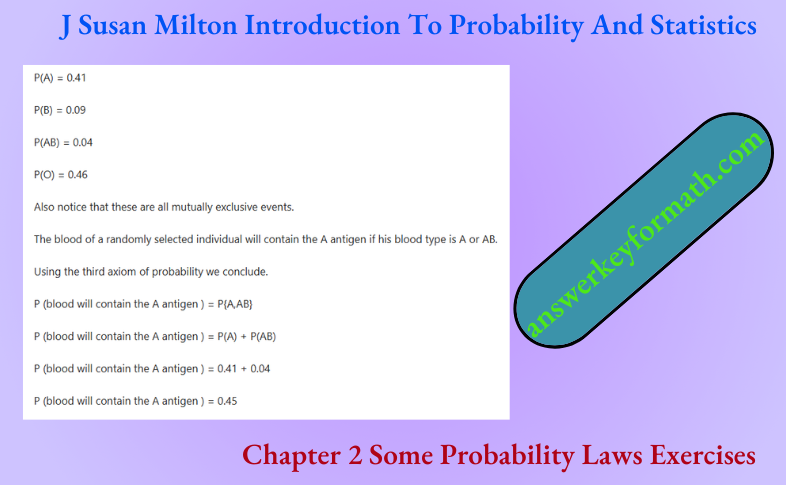
Similarly, the blood of a randomly selected individual will contain the B antigen if his blood type is B or AB
Read and Learn More J Susan Milton Introduction To Probability And Statistics Solutions
Using the third axiom of probability we conclude
P(blood will contain the B antigen ) = P{B,AB}
P(blood will contain the B antigen ) = P(B) + P(AB)
P(blood will contain the B antigen ) = 0.09 + 0.04
P(blood will contain the B antigen ) = 0.13
In the same way, we conclude that the blood of a randomly selected individual will contain neither A nor the B antigen if and only if that person has blood type O Thus, P (blood will contain neither A nor the B antigen ) = P{O} = >0.46
The probability that the blood of a randomly selected individual will contain the A antigen is 0.45, it will contain the B antigen is 0.13 and it will contain neither the A nor the B antigen is 0.46
J. Susan Milton Probability Laws Chapter 2 Answers Page 34 Exercise 2 Problem 2
The engine component of a spacecraft consists of two engines in parallel.
The main engine is 95% reliable.
The backup is 80% reliable.
The engine component as a whole is 99% reliable.
We have to calculate the probability of both engines will be reliable.
We have to find a Venn diagram to find the probability that the main engine will fail but the backup will be operable.
And the probability that the backup engine will fail but the main engine will be operable.
We have to find the probability that the engine component will fail.
First, we define events A1 and A2 as
A1 = The main engine will be operable
A2 = The backup engine will be operable
From the text of exercise, we have
P (the main engine is operable) = P(A1) = 0.95∣
P( the backup engine is operable ) = P(A2) = 0.8
P( engine component is operable ) = P (at least one engine is operable) = P(A1 ∪ A2) = 0.99
Using the general addition rule
We can calculate the probability that both engines will be operable.
Thus, P (both engines will be operable) = P(A1 ∩ A2)
= P(A1) + P(A2) − P(A1 ∪ A2)
= 0.95 + 0.8 − 0.99
From the Venn diagram we conclude
P (the main engine is not operable and the backup is operable) = P(A1 ∩ A2)
P (the main engine is not operable and the backup is operable) = P(A2) − P(A1 ∩ A2)
P (the main engine is not operable and the backup is operable) = 0.8 − 0.76
P (the main engine is not operable and the backup is operable) = 0.04
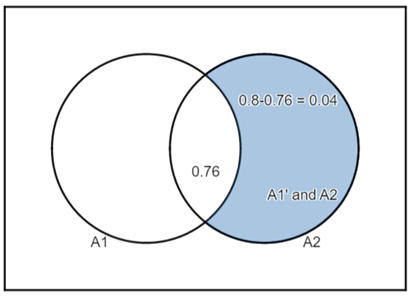
In the same way, we find the probability that the main engine will be operable and the backup engine will not be operable.
Hence, P (the main engine is operable and the backup engine is not operable)
= P(A1) − P(A1 ∩ A2)
= 0.95−0.76
= 0.19
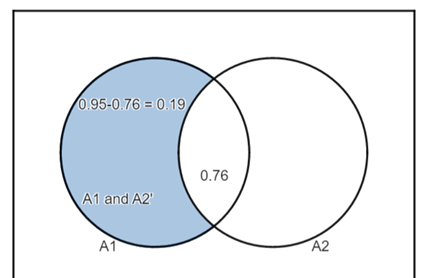
Since events A1∩A2, A′1∩A2, A1∩A2′are mutually exclusive, we can use the third axiom of probability.
Using that and the component rule we conclude
P (Engine component will fail) = P (Both engines will fail)
P (Engine component will fail) ⇒ P(A1∩A2′) = 1 − P(A′1 ∩ A2) − P(A1 ∩ A2′) − P(A1 ∩ A2)
P (Engine component will fail) = 1 − 0.19 − 0.04 − 0.76
P (Engine component will fail) = 0.01
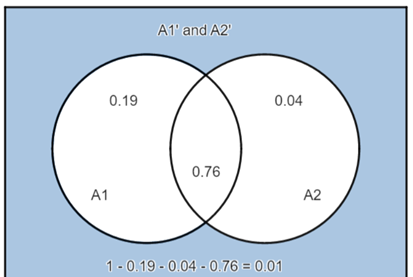
The probability of both engines will be reliable is 0.76.
The probability that the main engine will fail but the backup will be operable from the Venn diagram is 0.04 . And the probability that the backup engine will fail but the main engine will be operable is 0.19.The probability that the engine component will fail is 0.01.
Solutions To Probability Laws Exercises Chapter 2 Susan Milton Page 35 Exercise 3 Problem 3
The axioms of probability are:
1. Let S donate a sample space for an experiment.
Then, P(S) = 1 ………….. (1)
2. For every event A, we have
P(A) ≥ 0 ………… (2)
3. Let A1,A2,A3 ,……. be a finite or an infinite sequence of mutually exclusive events.
Then P(A1 ∪ A2 ∪ A ∪ …) = P(A1) + P(A2) + P(A3) + …………….. (3)
Let A be an arbitrary event.
Since from the definition of complement we have A∩A = θ,
We conclude that A and A ‘are mutually exclusive events.
So we can use axiom 3 for these two events.
Also since A ∪ A′ = S, we obtain
1 = P(S)
= P(A ∪ A)
= P(A) + P(A)
Thus
1 = P(A) + P(A)
⇒ P(A′) = 1 − P(A)
So theorem is derived in the step section.
Chapter 2 Probability Laws Examples And Answers Susan Milton Page 35 Exercise 4 Problem 4
The axioms of probability are:
1. Let S donate a sample space for an experiment.
Then, P(S) = 1 ……….. (1)
2. For every event A, we have
P(A) ≥ 0…………(2)
3. Let A1,A2,A3 ,……. be a finite or an infinite sequence of mutually exclusive events.
Then P(A1∪A2∪A3∪….) = P(A1) + P(A2) + P(A3) + ………… (3)
Let A be an arbitrary event.
Since A⊆S We conclude
P(A) ≤ P(S) = 1
⇒ P(A) ≤ 1
So theorem is derived in the step section.
Probability And Statistics J. Susan Milton Chapter 2 Solved Step-By-Step Page 35 Exercise 5 Problem 5
The axioms of probability are:
1. Let S donate a sample space for an experiment.
Then, P(S) = 1 …………..(1)
2. For every event A
We have P(A) ≥ 0 ….………… (2)
3. Let A1, A2, A3,… be a finite or an infinite sequence of mutually exclusive events.
Then P(A1∪A2∪A3∪….)=P(A1) + P(A2) + P(A3) + …..…….. (3)
Let A1 and A2 be arbitrary events.
Since A1 = A1 ∩ S
We obtain A1 = A1 ∩ S
= A1 ∩ (A2 ∪ A′2)
=(A1 ∩ A2) ∪ (A1 ∩ A′2)
Also, since A2 ∩ A2 = θ, we conclude
(A1 ∩ A2) ∩ (A1 ∩ A′2) = θ
So, (A1 ∩ A2) and (A1 ∩ A′2)are mutually exclusive events and we can apply axiom 3 on these two events.
Similarly, since A2 = A2 ∩ S, we have
A2 = A2 ∩ S = A2 ∩ (A1∪A1′)
= (A2 ∩ A1) ∪ (A2 ∩ A1′)
Also, since A1 ∩ A1′z = θ
We conclude (A2 ∩ A1) ∩ (A2 ∩ A1′) = θ
So A2 ∩ A1 are mutually exclusive events and we can apply axiom 3 on these two events.
Finally, for A1 ∪ A2, using the Venn diagram, we can conclude
A1 ∪A2 = (A1 ∩ A2) ∪ (A1 ∩ A′2)∪(A′1 ∩ A2)
Moreover, events A1 ∩ A2, A1∩ A′2, and A′1 ∩ A2 are mutually exclusive so we can apply axiom 3 on these three events.
From the above we have
P(A1) = P((A1 ∩ A2) ∩ (A1 ∩ A2′))
= P(A1 ∩ A2) + P(A1 ∩ A′2)
P(A2) = P ((A2 ∩ A1) ∩ (A2 ∩ A1))
= P(A2 ∩ A1) + P(A2 ∩ A′1)
P(A1 ∪ A2) = P((A1 ∩ A2) ∪ (A1 ∩ A′2) ∪ (A1 ∩ A2))
= P(A1 ∩ A2) + P(A1 ∩ A′2) + P(A′1 ∩ A2)
Finally we obtain
P(A1) + P(A2) − P(A1∩A2)
P(A1) + P(A2) − P(A1∩A2) = P(A1 ∩ A2) + P(A1 ∩ A′2) + P(A1 ∩ A2) + P(A′1 ∩ A2) − P(A1 ∩ A2)
P(A1) + P(A2) − P(A1∩A2) = P(A1 ∩ A2) + P(A1 ∩ A′2) + P(A1 ∩ A2)
P(A1) + P(A2) − P(A1∩A2) = P(A1 ∪ A2)
The additional rule theorem is derived in the step section.
Online Help for J. Susan Milton Probability Chapter 2 Exercises Page 35 Exercise 6 Problem 6
When an individual is exposed to radiation, death may ensue.
Factors affecting the outcome are the size of the dose, the length and intensity of the exposure, and the biological makeup of the individual.
The term LD50 is used to donate the dose that is usually lethal for 50% of the individuals exposed to it.
In a nuclear accident, 30%workers are exposed to the LD50 and die.
40% of the workers die.
68% are exposed to the LD50 or die.
We have to calculate the probability that a randomly selected worker will die given that he is exposed to the lethal dose of radiation.
First, we define events A and B as
A = Randomly selected worker is exposed to the LD50
B = Randomly selected worker will die
From we have P (A worker is exposed to the LD50 and die)
= P(A∩B) ⇒ 0.3
P( A worker will die ) = P(B) = 0.4
P(A worker is exposed to the LD50 or die) = P(A∪B) ⇒ 0.68
P (A worker is exposed to the LD50) = 0.58
P (A worker is exposed to the LD50 but doesn’t die ) = 0.28P (A worker is not exposed to the LD50 but dies ) = 0.1
We want to calculate P(B:A).
From the definition of conditional probability we conclude
P(B:A) = \(\frac{P(A \cap B)}{P(A)}\)
P(B:A) = \(\frac{0.3}{0.58}\)
P(B:A) = 0.5172
The probability that a randomly selected worker will die given that he is exposed to the lethal dose of radiation is 0.5172.
Step-By-Step Guide To Probability Laws Exercises Chapter 2 Milton Page 35 Exercise 6 Problem 7
When an individual is exposed to radiation, death may ensue.
Factors affecting the outcome are the size of the dose, the length and intensity of the exposure, and the biological makeup of the individual.
The term LD50 is used to donate the dose that is usually lethal for 50% of the individuals exposed to it.
In a nuclear accident, 30% workers are exposed to the LD50 and die.
40%of the workers die.
68% are exposed to the LD50 or die.
We have to calculate the probability that a randomly selected worker will not die given that he is exposed to the lethal dose of radiation
First, we define events A and B as
A = Randomly selected worker is exposed to the LD50
B = Randomly selected worker will die
From we have Page 35 Exercise 13 Problem 6
P(A worker is exposed to the LD 50 and die ) = P(A ∩ B) ⇒ 0.3
P (A worker will die ) = P(B) ⇒ 0.4
P(A worker is exposed to the LD50 or die ) ⇒ P(A ∪ B) ⇒ 0.68
P(A worker is exposed to the LD50 ) = 0.58
P (A worker is not exposed to the LD50 but dies ) = 0.1
We want to calculate P(B’:A)
From the definition of conditional probability we conclude
P(B′: A) = \(\frac{P(A \cap B)}{P(A)}\)
P(B′: A) = \(\frac{0.28}{0.58}\)
P(B′: A) = 0.4828
We could also calculate that the probability in Page 35 Exercise 13 Problem 7 using the complement rule.
Thus
P(B′:A) = 1 − P(B’:A)
P(B′: A) = 1 − 0.5172
P(B′: A) = 0.4828
The probability that a randomly selected worker will not die given that he is exposed to the lethal dose of radiation is 0.4828.
Exercise Solutions For Chapter 2 Susan Milton Probability Laws Page 35 Exercise 6 Problem 8
When an individual is exposed to radiation, death may ensue.
Factors affecting the outcome are the size of the dose, the length and intensity of the exposure, and the biological makeup of the individual.
The term LD50 is used to donate the dose that is usually lethal for 50% of the individuals exposed to it.
In a nuclear accident, 30% workers are exposed to the LD50 and die.
40% of the workers die.
68%are exposed to the LD50 or die.
We have to find the theorem that allows to find the answer of Page 35 Exercise 13 Problem 7 with the knowledge of answer of Page 35 Exercise 13 Problem 6.
First, we define events A and B as
A = Randomly selected worker is exposed to the LD50
B = Randomly selected worker will die
From we have Page 35 Exercise 13 Problem 6
P (A worker is exposed to the LD50 and die) = P(A ∩ B) ⇒ 0.3
P (A worker will die ) = P(B) = 0.4
P(A worker is exposed to the LD50 or die ) = P(A ∪ B) ⇒ 0.68
P(A worker is exposed to the LD50 ) = 0.58
P (A worker is exposed to the LD50 but doesn’t die ) = 0.28
P (A worker is not exposed to the LD50 but dies ) = 0.1
We could also calculate that the probability in Page 35 Exercise 13 Problem 7 using the complement rule.
Thus
P(B′:A) = 1 − P(B:A)
P(B′:A) = 1 − 0.5172
P(B′:A) = 0.4828
So with the help of the complement rule we can calculate the answer of Page 35 Exercise 13 Problem 7 from the knowledge of answer of Page 35 Exercise 13 Problem 6 .
Page 35 Exercise 6 Problem 9
When an individual is exposed to radiation, death may ensue.
Factors affecting the outcome are the size of the dose, the length and intensity of the exposure, and the biological makeup of the individual.
The term LD50 is used to donate the dose that is usually lethal for50%of the individuals exposed to it.
In a nuclear accident, 30%workers are exposed to the LD50 and die.
40% of the workers die.
68%are exposed to the LD50 or die.
First, we define events A and B as
A = Randomly selected worker is exposed to the LD50
B = Randomly selected worker will diel
From , we have Page 35 Exercise 13 Problem 6
P (A worker is exposed to the LD50 and die) = P(A ∩ B) ⇒ 0.3
P (A worker will die) = P(B) = 0.4
P(A worker is exposed to the LD50 or die) = P(A ∪ B) ⇒ 0.68
P (A worker is exposed to the LD50 ) = 0.58
P(A worker is exposed to the LD50 but doesn’t die) = 0.28
P(A worker is not exposed to the LD50 but dies ) = 0.1
We want to calculate P(B:A′)
Hece,P(B:A′)= \(\frac{\left.P(B \cap A)^{\prime}\right)}{P\left(A^{\prime}\right)}\)
P(B:A′) = \(\frac{P(B \cap A)}{1-P(A)}\)
P(B:A′) = \(\frac{0.1}{1-0.58}\)
The probability that a randomly selected worker will die given that he is not exposed to the lethal dose is 0.2381.
Page 35 Exercise 7 Problem 10
The engine component of a spacecraft consists of two engines in parallel.
The main engine is 95% reliable.
The backup is 80% reliable.
The engine component as a whole is 99% reliable.
We have to calculate the probability of both engines will be reliable.
We have to calculate the probability of both engines will be reliable.
We have to find a Venn diagram to find the probability that the main engine will fail but the backup will be operable.
And the probability that the backup engine will fail but the main engine will be operable.
We have to calculate the backup engine will function given that the main engine fails.
First, we define events A1 and A2 as
A1 = the main engine will be operable
A2 = The backup engine will be operable
From the text of exercise we have
P (The main engine is operable) = P(A1) ⇒ 0.95
P( The backup engine is operable) = P(A2) ⇒ 0.8
P( Engine component is operable ) = P( at least one engine is operable) = P(A1 ∪ A2)
= 0.99
P (Both engines will be operable) = P(A1∩A2) ⇒ 0.76
P (The main engine is not operable and the backup is operable) = P(A1 ∩ A2) ⇒ 0.04
P (The main engine is operable and the backup engine is not operable) = P(A1 ∩ A′2)
= 0.19
P( Engine component will fail ) = P (both engines will fail) = P(A1 ∩ A′2)
= 0.01
We have to calculate P(A2:A1′)
From the definition of conditional probability we have
P(A2:A1′)= \(\frac{P\left(A_2 \cap A_1^{\prime}\right)}{P\left(A_1^{\prime}\right)}\)
P(A2:A1′) = \(\frac{P\left(A_2 \cap A_1^{\prime}\right)}{1-P\left(A_1\right)}\)
P(A2:A1′) = \(\frac{0.04}{1-0.95}\)
P(A2:A1′) = 0.8
The probability that, in an engine system such as that described, the backup engine will function given that the main engine fails 0.8
Page 35 Exercise 7 Problem 11
The engine component of a spacecraft consists of two engines in parallel.
The main engine is 95% reliable.
The backup is 80% reliable.
The engine component as a whole is 99% reliable.
We have to calculate the probability of both engines will be reliable.
We have to find a Venn diagram to find the probability that the main engine will fail.willfaiheWe wilfailbutthemai
First, we define events A1 and A2 as
A1 = The main engine will be operable
A2 = The backup engine will be operable
From the text of exercise, we have
P (The main engine is operable)
= P(A1) = > 0.95
P (the backup engine is operable) = P(A2 ) ⇒ 0.8
P( Engine component is operable )= P( At least one engine is operable )
= P(A1∪A2 ) = > 0.99
P (Both engines will be operable) = P(A1∩A2)
= 0.76
P (The main engine is not operable and the backup is operable) = P(A1 ∩ A2 ) ⇒ 0.04
P (The main engine is operable and the backup engine is not operable) = P(A1 ∩ A′2) ⇒ 0.19
P( Engine component will fail )= P( both engines will fail ) = P(A′1 ∩ A2′)
= 0.01
From
P( Backup functions) = P(A2) ⇒ 0.8
On the other side, from Page 35 Exercise 14 Problem 11 we have
P (backup function: main fails) = P(A2:A′1) ⇒ 0.8
So these two probabilities are equal.
This is not unusual because engines are in parallel. That is, they work independently of each other. Thus the probability that the backup engine will be operable does not depend in the working slate of the main engine.
Page 35 Exercise 8 Problem 12
In a study of waters near power plants and other industrial plants that release wastewater into the water system, it was found that 5% showed signs of chemical and thermal pollution 40% showed signs of chemical pollution.
35% Showed evidence of thermal pollution.
We have to calculate the probability that a stream that shows some thermal pollution will also show signs of chemical pollution.
And also the probability that a stream showing chemical pollution will not show signs of thermal pollution.
First, we define events A1 and A2 as
A1= A stream shows signs of chemical pollution
A2 = A stream shows signs of thermal pollution
From the text of exercise, we have
P(A) = 0.4
P(B) = 0.35
P(A∩B) = 0.05 = 0.76
We have to calculate the probability that a stream that shows thermal pollution will also show signs of chemical pollution, that is P(A⋮B).
Using the definition of conditional probability we obtain
P(A:B) = \(\frac{P(A \cap B)}{P(B)}\)
P(A:B) = \(\frac{0.05}{0.35}\)
P(A:B) = \(\frac{1}{7}\)
Now we will calculate the probability that a stream some chemical pollution will not show signs of thermal pollution, that is P(B:A).
Again using the definition of conditional probability we conclude
P(B′:A)= \(\frac{P(A \cap B)}{P(B)}\)
P(B′:A) = \(\frac{0.4}{0.05}\)
P(B′:A) = \(\frac{7}{8}\)
The probability that a stream that shows some thermal pollution will also show signs of chemical pollution \(\frac{7}{8}\). And also the probability that a stream showing chemical pollution will not show signs of thermal pollution \(\frac{7}{8}\)
Page 36 Exercise 9 Problem 13
Given Data – A1 and A2 are independent events.
And P(A1) = .5, P(A1) = .7
To be found – The value of P(A1 ∩ A2)
For Independent events A1 and A2
P(A1∩A2 ) = P(A1) × P(A2)
Therefore = .5 × .7 (Substituting the values)
P(A1∩A2 ) = .35 (After simplification)
“For the given values of P(A1) and P(A2),the value of P(A1 ∩ A2 ) = .35.
Page 36 Exercise 10 Problem 14
Given Data – P(A1) = .6, P(A2) = .4, P(A1 ∪ A2) = .8
To be found – If A1 and A2 are independent events
We know
For two events A1 and A2
P(A1∪A2) = P(A1) + P(A2) − P(A1 ∩ A2)
.8 =.6 + .4 − P(A1 ∩ A2) (Substituting the values)
P(A1 ∩ A2) = .6 + .4 −.8 (After simplification)
P(A1 ∩ A2) = .2 (After simplification)
We know for independent events A1 and A2
Now ⇒ P(A1 ∩ A2) = P(A1) × P(A2)
P(A1 ∩ A2) ≠ P(A1) × P(A2)
= .6 × .4 (Substituting the values)
= 2.4 (After simplification)
Clearly, Therefore, A1 and A2 are not independent events.
For the given values of P(A1) and P(A2), A1 and A2 are not independent events.”
Page 36 Exercise 11 Problem 15
When an individual is exposed to radiation, death may ensue.
Factors affecting the outcome are the size of the dose, the length and intensity of the exposure, and the biological makeup of the individual.
The term LD50 is used to donate the dose that is usually lethal for 50 % of the individuals exposed to it.
In a nuclear accident, 30 % workers are exposed to the LD50 and die.
40% Of the workers die.
68 % Are exposed to the LD50 or die.
First, we define events A and B as
A1 = Randomly selected worker is exposed to the LD50
A2 = Randomly selected worker will die
From Page 35 Exercise 6 Problem 9 , we have
P(A worker will die) = P(A2) = 0.4
P(A worker will die: A worker is exposed to lethaldose) = P(A2:A1) = 0.5172
Events, A1 and A2 are independent if and only if
P(A1 ∩ A2) = P(A1)P(A2)
If A1 and A2 are independent, then
P(A2;A1) = \(\frac{P\left(A_1 \cap A_2\right)}{P\left(A_1\right)}=\frac{P\left(A_1\right) P\left(A_2\right)}{P\left(A_1\right)}\) = P(A2)
Since we have
P(A2⋮A1) = 0.5172 ≠ 0.4 = P(A2)
We conclude that A1 and A2 are not independent.
The events A1: A worker dies and A2:The worker is exposed to a lethal dose of radiation are not independent.
Page 36 Exercise 12 Problem 16
The engine component of a spacecraft consists of two engines in parallel.
The main engine is reliable 95%.
The backup is 80 % reliable.
The engine component as a whole is 99 %reliable.
We have to find that the events
A1: The backup engine functions and
A2: The main engine fails are independent or not.
First, we define events A1 and A2 as
A1 = The main engine will be operable
A2 = The backup engine will be operable
From the text of exercise, we have
P(The backup engine is operable) = P(A2) ⇒ 0.8
P(The main engineis fails: the backup engine functions)
= P(A2⋮A1) ⇒ 0.8
Events A1 and A2 are independent if and only if
P(A1 ∩ A2) = P(A1)P(A2)
From the definition of conditional probability, we have
P(A1 ∩ A2) = P(A2⋮A1)P(A1)
⇒ P(A2)P(A1)
So Events A1 and A2 independent.
The events A1:The backup engine functions and A2: The main engine fails are independent.
Page 36 Exercise 13 Problem 17
In a study of waters near power plants and other industrial plants that release wastewater into the water system, it was found that 5 % showed signs of chemical and thermal pollution 40 % showed signs of chemical pollution.
35 % Showed evidence of thermal pollution.
We have to test for independency of the events
A1 = A stream shows signs of thermal pollution and
A2 = A stream shows signs of chemical pollution.
First, we define events as A1 and A2
P(A stream shows signs of thermal pollution) = P(A1) = 0.35
P(A stream shows signs of chemical pollution) = P(A2) = 0.4
P(A2 ∩ A1 ) = 0.05
Events A1 and A2 are independent if and only if
P(A1 ∩ A2) = P(A1)P(A2)
Since we have
P(A1) P(A2) = 0.35 × 0.4 = 0.14 ≠ 0.05 = P(A1 ∩ A2)
We conclude that events A1 and A2 are not independent.
The events A1: A stream shows signs of thermal pollution and A2: A stream shows signs of chemical pollution are not independent.
Page 36 Exercise 14 Problem 18
Given Data –
1) Probability of the event that the stream has high BOD is 0.35
2) Probability of the event that the stream has high Acidity is 0.1
3) Probability of the event that the stream has both high BOD and high Acidity is 0.04
We have to check if the events, the stream has high BOD and high Acidity are Independent or Not.
Let A be the event that the stream has high BOD.
And let $B$ be the event that the stream has high Acidity.
According to the question
P(A) = 0.35
P(B) = 0.1
P(A ∩ B) = 0.04
Now
P(A) × P(B) = 0.35 × 0.1
P(A) × P(B) = 0.035 (Substituting the values)
Therefore, A and B are not independent.
“For the given values of – probability of the event that the stream has high BOD 0.35 , probability of the event that the stream has high Acidity 0.1 , the stream has both high BOD and high Acidity 0.04, the events, the stream has high BOD and high Acidity are Not independent.
Page 36 Exercise 15 Problem 19
Given Data –
1. Probability of the event that the individual inherited the negative Rh gene from father is 0.39
2. Probability of the event that the individual inherited the negative Rh gene from mother is 0.39
To be found – The probability that a randomly selected individual will have negative Rh blood
Let A be the event that the individual inherited the negative Rh gene from father.
And let B be the event that the individual inherited the negative Rh gene from mother.
According to the question
P(A) = 0.39
P(B) = 0.39
Now, the possibility that a randomly selected individual will have negative Rh blood is possible when the individual will inherit negative Rh gene from both parents.
Therefore, the probability that a randomly selected individual will have negative Rh blood
= P(A) × P(B) ( A and B are independent events)
= 0.39 × 0.39 (Substituting the values)
= 0.1521 (After Multiplication)
= P(A∩B) (Substituting the values)
“For the given values of – probability of the event that the individual inherited the negative Rh gene from father 0.39, probability of the event that the individual inherited the negative Rh gene from mother 0.39, the probability that a randomly selected individual will have negative Rh blood is 0.1521′′
Page 36 Exercise 16 Problem 20
An individual’s blood group (A,B,AB,O)is independent of the Rh classification.
We have to find the probability that a randomly selected individual will have AB negative blood.
First, we define events A1 and A2 as P(a randomly selected individual has AB blood type) = P(AB) ⇒ 0.04
P(a randomly selected individual has Rhnegative blood type) = P(Rh−) ⇒ 0.1521
We want to calculate the probability, that a randomly selected individual will have AB − blood type, that is P(AB∩Rh−).
Also from the text we conclude that AB and Rh− are independent events.
Thus P(AB∩Rh−) = P(AB)P(Rh−)
P(AB∩Rh−) = .04 × 0.1521
P(AB∩Rh−) = 0.006084
The probability that a randomly selected individual will have AB negative blood is 0.006084.
Page 36 Exercise 17 Problem 21
Given Data –
1. Probability of the event that the copper content will be high is 0.3
2. Probability of the event that the mint will be present is 0.23
3. Probability of the event that the mint will be present given copper content is high is 0.7
To be found – The probability that the copper content will be high and the mint will be present
Let A be the event that the copper content will be high.
And let B be the event that the mint will be present.
According to the question
P(A) = 0.3
P(B) = 0.23
P(B/A) = 0.7
Now, the probability that the copper content will be high and the mint will be present
= P(A∩B) (Substitute the values) and (After multiplication)
= P(B/A) P(A)
= 0.7 × 0.3
= 0.21
For the given values of – probability of the event that the copper content will be high 0.3, probability of the event that the mint will be present 0.23 , probability of the event that the mint will be present given copper content is high 0.7, the probability that the copper content will be high and the mint will be present is0.21′′
Page 36 Exercise 17 Problem 22
Given Data –
1. Probability of the event that the copper content will be high is 0.3
2. Probability of the event that the mint will be present is0.23
3. Probability of the event that the mint will be present given copper content is high is 0.7
To be found – The probability that the copper content will be high given that the mint i
Let A be the event that the copper content will be high.
And let B be the event that the mint will be present.
According to the question
P(A) = 0.3
P(B) = 0.23
P(B/A) = 0.7
From P(A ∩ B) = 0.21
Now, the probability that the copper content will be high given that the mint is present
= P(A/B)
P(A/B) = \(\frac{P(A \cap B)}{P(B)}\)
P(A/B) = \(\frac{0.21}{0.23}\) (Substituting the values)
P(A/B) = 0.91304 (After Multiplication)
“For the given values of – probability of the event that the copper content will be high0.3, probability of the event that the mint will be present 0.23, probability of the event that the mint will be present given copper content is high0.7, the probability that the copper content will be high given that mint is present is 0.91304”
Page 36 Exercise 17 Problem 23
Given Data –
1. Probability of the event that the copper content will be high is 0.3
2. Probability of the event that the mint will be present is 0.23
3. Probability of the event that the mint will be present given copper content is high is 0.7
To check if-The events the copper content will be high and the mint will be present are independent or not.
Let A be the event that the copper content will be high.
And let B be the event that the mint will be present.
According to the question
P(A) = 0.3
P(B) = 0.23
P(B/A) =0.7
From P(A∩B) = 0.21
Now P(A) × P(B)
P(A) × P(B) = 0.3 × 0.23
P(A) × P(B) = 0.069
(Substituting the values) and (After Multiplication)
Clearly P(A∩B) ≠ P(A) × P(B)
Therefore A and B are not independent.
“For the given values of – probability of the event that the copper content will be high 0.3, probability of the event that the mint will be present 0.23, probability of the event that the mint will be present given copper content is high 0.7, the events that the copper content will be high and the mint will be present are not independent.”
Page 37 Exercise 18 Problem 24
Given Data –
1. Probability of the event that a randomly chosen person is asked the first question about the barn is 0.5
2. Probability of the event that a randomly chosen person claims to have seen the nonexistent barn was asked the first question about the barn is 0.17
3. Probability of the event that a randomly chosen person claims to have seen the nonexistent barn was not asked the first question about the barn is 0.03
To be found – The non existent barn.
Let A1 be the event that a randomly chosen person is asked the first question about the barn.
So A1c will be the event that a randomly chosen person is not asked the first question about the barn.
And let A2 be the event that a randomly chosen person claims to have seen the nonexistent barn.
Therefore, according to question
P(A1) = 0.5
P(A2/A1) = 0.17
P(A2/A1c ) = 0.03
Since, A1 and A1c are mutually exclusive.
Therefore, A2 ∩ A1 and A2 ∩ A1 care also mutually exclusive.
Therefore ,P(A2) = P(A2 ∩ S)
As Union of a event and its complement forms the entire
Sample Space Therefore
= P( A2 ∩ (A1 ∪ A1c ))
= P((A2 ∩ A1) ∪ (A2 ∩ A1c ))
= P(A2∩A1) + P(A2 ∩ A1c )
= P(A1)P(A2/A1) + P(A1c )(A/A1c )
= 0.5 × 0.17 + (1−0.5) × 0.03 (Substituting the values)
= 0.5 × 0.17 + 0.5 × 0.03 (After Subtraction)
= 0.085 + 0.015 (After Multiplication)
= 0.1 (After Addition)
“For the given values of – Probability of the event that a randomly chosen person is asked the first question about the barn 0.5, Probability of the event that a randomly chosen person claims to have seen the nonexistent barn was asked the first question about the barn 0.17, Probability of the event that a randomly chosen person claims to have seen the nonexistent barn was not asked the first question about the barn 0.03, the probability of the event that a randomly chosen person claims to have seen the nonexistent barn is 0.1”
Page 37 Exercise 19 Problem 25
Given Data –
1. Probability of the event that the donor is paid is 0.67
2. Probability of the event that the patient has received a contracted serum hepatitis from paid donor is 0.0144
3. Probability of the event that the patient has received a contracted serum hepatitis from unpaid donor is 0.0012
To be found the probability of the event that patient has received a contracted serum hepatitis
Let A1 be the event that the donor was paid.
So A1c will be the event that the donor was not paid.
And let A2 is the event that patient has received a contracted serum hepatitis.
Therefore, according to question
P(A1) = 0.67
P(A2/A1) = 0.0144
P(A2/A1c ) = 0.0012
Since, A1 and A1c care mutually exclusive.
Therefore, A2 ∩ A1 and A2 ∩ A1c are also mutually exclusive.
Therefore P(A2) = P(A2∩ S)
As Union of a event and its complement forms the entire
Sample Space
Therefore
= P (A2 ∩ (A1 ∪ A1c ))
= P ((A2 ∩ A1) ∪ (A2 ∩ A1c ))
= P(A2 ∩ A1) + P(A ∩ A1c )
= P(A1)P(A2/A1) + P(A1c )(A/A1c )
= 0.67 × 0.0144 + (1−0.67) × 0.0012 (Substituting the values)
= 0.67 × 0.0144 + 0.33 × 0.0012 (After Subtraction)
= 0.009648 + 0.000396 (After Multiplication)
= 0.010044 (After Addition)
“For the given values of – Probability of the event that the donor is paid 0.67 , Probability of the event that the patient has received a contracted serum hepatitis from paid donor 0.0144,Probability of the event that the patient has received a contracted serum hepatitis fromunpaid donor 0.0012, the probability of the event that patient has received a contracted serum hepatitis is 0.010044”
Page 37 Exercise 20 Problem 26
Given Data – Two events, one of which is impossible, and any other event
To prove that – The impossible event is always independent of any other event
Let the impossible event be A and any other event be B
Therefore
P(A) = 0 (Probability of impossible event is always Zero)
Also, an impossible event can never happen together with any other event.
Therefore, Impossible events are always mutually exclusive with other events.
Therefore, P(A∩B) = 0 (As A and B are mutually exclusive events)
Therefore Now
P(A ∩ B)= 0 (As A and B are mutually exclusive events)
P(A) × P(B) = 0 × P(B) (Substituting the value of P(A))
= 0 (After simplification)
Therefore, P(A∩B) = P(A) × P(B)(Both Zero)
Therefore, A and B are not independent events.
“For the given events, one of which is impossible, and any other event, The events are independent.”
Page 37 Exercise 21 Problem 27
Given
A1 = [A1 ∩ A2] ∪ [A1 ∩ A′2]
We have to show that if A1 and A2 are independent, then A1 and A′2 are also independent
Since A1 and A2 are independent, then P[A1 ∩ A2] = P[A1]⋅P[A2]
It is to be known that A2 and A′2 are mutually exclusive, then A1 ∩ A2 and A1 ∩ A′2 are also mutually exclusive.
Then P[A1] = P[A1 ∩ S]
= P[A1 ∩ (A2 ∪ A′2)]
From the complement rule, we have A′2
= 1 − P[A2]
Hence, P[A1 ∩ (A’2)] = P[A1]
P[A1 ∩ A2] = P[A2]
⇒ P[A1]P[A2]
= P[A1] P[1 − A2]
= P[A1]P[A′2]
Therefore, A1 and A′2 are also independent.
Hence it is proved that A1 and A′2 are also independent.
Page 37 Exercise 22 Problem 28
According to the question, we need to use exercise 31 to show that if A1 and A′2 are independent, then A′1 and A′2 are also independent.
If A1 and A2 are independent, from Page 37 Exercise 21 Problem 27, then we know that A1 and A′2 are also independent
Thus, P (A1 ∩ A′2) = P(A1)P(A′2)……………………………… (1)
Since A′1 and A′2 are mutually exclusive, then A1∩A′2 and A′1 ∩ A′2 are also mutually exclusive so
P(A′2) = P(A′2 ∩ S)…………(2)
= P(A′2 ∩ (A1 ∪ A′1))
=P((A′2 ∩ A1) ∪ (A′2 ∩ A′1))
= P(A′2 ∩ A1) + P(A′2 ∩ A′1)
We use complement rule ………………………(3)
From the above(1),(2),(3)equation, we get:
P(A′2 ∩ A′1) = P( A′2) − P(A1 ∩ A′2)
= P(A′2) − P(A1)P(A′2)
= P(A′2)(1 − P(A1))
= P(A′2) P(A′1)
So, A′1 and A′2 are independent.
With the help of Exercise 31, Mutual exclusive and complement rule we have proved that A′1 and A′2 are also independent.
Page 37 Exercise 23 Problem 29
According to the question, it can be shown that the result of exercise 32 holds for any collection of n independent events.
That is, if A1,A2, ………………An are independent, then A′1,A′2,………………A′n are also independent.
With the help of this result and data of example 2.3.4 we need to find the probability that at least one of the three computers will be operable at the time of the launch.
From example 2.3.4 we have
A1 = The main system is operable
A2 = The first backup is operable
A3 = The second backup is operable.
Also, P(A1) ⇒ P(A2) ⇒ P(A3) ⇒ 0.9
To calculate the probability that at least one system is operable, P(A1 ∪ A2 ∪ A3), we use complement rule:
P(A1 ∪ A2 ∪ A3)
= P (At least one system is operable)
= 1 − P (No system is operable)
= 1−P (A′1 ∩ A′2 ∩ A′3)
Since, A1 ,A2,A3 are independent, we say that A′1,A′2,A′3 are also independent, Thus:
P(A′1 ∩ A′2 ∩ A′3) = P(A′1) ∩ P(A′2) ∩ P(A′3)
The probability that at least one system will be operable is:
P(A1 ∪ A2 ∪ A3) = 1−P(A′1 ∩ A′2 ∩ A′3)
P(A1 ∪ A2 ∪ A3) = 1−P(A′1)(A′2)(A′3)
P(A1 ∪ A2 ∪ A3) = 1−((1 − P(A1)(1 − P(A2)(1 − P(A3))
P(A1 ∪ A2 ∪ A3) = 1 − ((1 − 0.9)(1 − 0.9)(1 − 0.9))
P(A1 ∪ A2 ∪ A3) = 1 − (0.1 × 0.1 × 0.1)
P(A1 ∪ A2 ∪ A3) = 1 − 0.001
P(A1 ∪ A2 ∪ A3) = 0.999
The probability that at least one system will be operable is 0.999
Page 37 Exercise 24 Problem 30
According to the question, let A1 and A2 be mutually exclusive events such that P(A1)P(A2 ) > 0.
We need to show that the events are not independent.
If A1 and A2 be mutually exclusive events such that A1 and A2 be mutually exclusive events such that P(A1 ∩ A2 ) = P(Φ) = 0<P(A1 )P(A2 )
Hence, we see that P(A1∩ A2 ) ≠ P(A1 )P(A2 ) ,events A1 and A2 are not independent.
Events A1 and A2 are not independent as P(A1 ∩A2 )≠ P(A1 )P(A2).
Page 37 Exercise 25 Problem 31
According to the question, let A1 and A2 be independent events such that P(A1)P(A2 )>0.
We need to show that the events are not mutually exclusive.
If A1 and A2 be independent events such that P(A1∩A2) = P(A1) × P(A2)
Given that A1 and A2 be independent events such that 0 < P(A1) P(A2)
Now, we have P(A1 ∩ A2) = P(A1) × P(A2)>0
Hence, we see that P(A1 ∩ A2) > 0 A1 and A2 are can’t be mutually exclusive because to satisfy the mutually exclusive condition we need P(A1 ∩ A2) = 0.
A1 and A1 are can’t be mutually exclusive because to satisfy the mutually exclusive condition we need P(A1∩A2) = 0 but we have P(A1∩A2)>0.
Page 38 Exercise 26 Problem 32
We have to find the probability that who was typed as having type A blood actually had type B blood.
A = Inductee has type A blood
B = Inductee has type B blood
AB = Inductee has type AB blood
O = Inductee has type O blood
TB = Inductee is typed as type B blood
Also given that
P[A] = 0.41
P[TB/A] = 0.88
P[B] = 0.09
P[TB/B] = 0.04
P[AB] = 0.04
P[TB/AB] = 0.10
P[O] = 0.46
P[TB/O] = 0.04
We have to calculate P[B/TB]
∴ P[B/TB] = \(\frac{P[B \cap T B]}{P[T B]}\)
P[B∩TB] = P[TB/B]⋅P[AB]
= (0.04)(0.09)
= 0.0036
P[TB] = m P[TB ∩ A] + P[TB ∩ B] + P[TB ∩ C] + P[TB ∩ D]
= P[TB/A]⋅P[A] + P[TB/B]⋅P[B] + P[TB/C]⋅P[C] + P[TB/D]⋅P[D]
= (0.88)(0.41) + (0.04)(0.09) + (0.10)(0.04) + (0.04)(0.46)
= 0.3608 + 0.0036 + 0.0040.0184
= 0.3868
Thus P[B/TB]= \(\frac{0.0036}{0.3868}\)
= 0.0093071
The probability that who was typed as having type A blood actually had type B blood is 0.0093071
Page 38 Exercise 27 Problem 33
A test has been developed to detect a particular type of arthritis in individual over 50 years.
We have to find the probability that an individual has this disease given that the test indicates his presence.
A = Individual suffers from arthritis
B = Test was positive for arthritis
Also given that
P[A] = 0.1
P[A′] = 0.9
P[B/A] = 0.85
P[B/A′] = 0.04
We have to find the probability that an individual has this disease given that the test indicates his presence.
From the definition of conditional probability, We have to calculate P[A/B]
∴ P[A/B] = \(\frac{P[A \cap B]}{P[B]}\)
P[A∩B] = P[B/A]⋅P[A]
P[A∩B] = (0.85)(0.1)
P[A∩B] = 0.085
Since A and A′ are mutually exclusive, A ∪ A′ = S
P[B] = P[B ∩ A]
= P[B∩(A ∪ A′)]
= P[B ∩ A] ∪ P[B ∩ A′]
= P[B/A] P[A] + P[B/A′]P[A′]
= (0.1)(0.85) + (0.04)(0.9)
= 0.085 + 0.036
= 0.121
Thus P[A/B] = \(\frac{0.085}{0.121}\)
=0.70248
The probability that an individual has this disease given that the test indicates his presence is 0.70248.
Page 38 Exercise 28 Problem 34
A = Chip is defective
B= Chip is stolen
Also given that
P[A] = 0.5
P[B] = 0.01
P[A/B′] = 0.05
We have to find the probability that the given chip is stolen and that is defective.
From the definition of conditional probability, We have to calculate P[B/A]
∴ P[B/A] = \(\frac{P[B \cap A]}{P[A]}\)
Since B and B′ are mutually exclusive, B∪B′= S
P[B] = P[A ∩ S]
P[B] = P[A ∩ (B ∪ B′)]
P[B] = P[A ∩ B] ∪ P[A ∩ B′]
P[B] = P[A ∩ B] + P[A ∩ B′]
So, P[A ∩ B] = P[A] − P[A∩B′]
From the definition of conditional probability
P[A ∩ B′] = P[A/B′] P[B′]
P[A ∩ B′] = P[A/B′][1−P[A]]
P[A ∩ B′] = 0.05(1 − 0.01)
P[A ∩ B′] = 0.05 − 0.0005
P[A ∩ B′] = 0.0495
∴ P[A ∩ B] = 0.5 − 0.0495
= 0.4505
Thus
P[B/A] = \(\frac{0.4505}{0.5}\)
= 0.901
The probability that the given chip is stolen and that is defective is 0.901
Page 38 Exercise 29 Problem 35
We have to find the probability that a randomly selected firm has a mainframe computer or anticipates purchasing one in the near future.
M = Has mainframe computer
B = Anticipates purchasing a mainframe computer in future
Also given that
P[M] = 0.8
P[B] = 0.1
P[M ∩ B] = 0.05
We have to find the probability that a randomly selected firm has a mainframe computer or anticipates purchasing one in the near future.
By general addition rule
P[Mu ∪ B] = P[M] + P[B] − P[Mu ∩ B]
P[Mu ∪ B] = 0.8 + 0.1 − 0.05
P[Mu ∪ B] = 0.9 − 0.05
P[Mu ∪ B] = 0.85
The probability that a randomly selected firm has a mainframe computer or anticipates purchasing one in the near future is 0.85
Page 38 Exercise 29 Problem 36
We have to find the probability that a randomly selected firm does not have a mainframe computer and does not anticipate purchasing one in the near future.
M = Has mainframe computer
B = Anticipates purchasing a mainframe computer in future
Also given that
P[M] = 0.8
P[B] = 0.1
P[M ∩ B] = 0.05
We have to find the probability that a randomly selected firm does not have a mainframe computer and does not anticipate purchasing one in the near future.
We know that
P[A′ ∩ B′] = P[A ∪ B]′
P[A ∪ B]′= 1−P[A ∪ B]
P[A ∪ B]′ = 1−(0.8 + 0.1 − 0.05)
P[A ∪ B]′ = 1 − 0.85
P[A ∪ B]′ = 0.15
The probability that a randomly selected firm does not have a mainframe computer and does not anticipate purchasing one in the near future is 0.15
Page 38 Exercise 29 Problem 37
We have to find the probability that a randomly selected firm anticipates purchasing one in the near future that does not have one currently.
M = Has mainframe computer
B = Aticipates purchasing a mainframe computer in future
Also given that
P[M] = 0.8
P[B] = 0.1
P[M∩B] = 0.05
We have to find the probability that a randomly selected firm anticipates purchasing one in the near future that does not have one currently.
So let’s calculate
P[B/M’] = \(\frac{P[B \cap M u \prime]}{P[M]}\)
P[B/M’] = \(\frac{0.05}{1-0.8}\)
P[B/M’] = \(\frac{0.05}{0.2}\)
P[B/M’] = 0.25
The probability that a randomly selected firm anticipates purchasing one in the near future that does not have one currently is 0.25
Page 38 Exercise 29 Problem 38
We have to find the probability that a randomly selected firm that has a mainframe computer given that it anticipates purchasing one in the near future.
M = Has mainframe computer
B = Anticipates purchasing a mainframe computer in future
Also given that
P[M] = 0.8
P[B] = 0.1
P[M ∩ B] = 0.05
We have to find the probability that a randomly selected firm that has a mainframe computer given that it anticipates purchasing one in the near future.
So let’s calculate
P[M/B] = \(\frac{P[M u \cap B]}{P[B]}\)
P[M/B] = \(\frac{0.05}{0.1}\)
P[M/B] = 0.5
The probability that a randomly selected firm that has a mainframe computer given that it anticipates purchasing one in the near future is 0.5
Page 38 Exercise 30 Problem 39
We have to find the probability that the given number will be less than 50
Since we have100 possible two digit numbers
P[A] = 50
The probability that the given number will be less than 50
= 0.5
The probability that the given number will be less than 50 is 0.5
We have to find the probability that each of three numbers generated will be less than 50
Since we have100 possible two digit numbers
P[A]= 50
When three events are independent to each other then
P[A ∩ B ∩ C] = P[A]⋅P[B]⋅P[C]
The probability that each of the three numbers generated will be less than50,
= \(\frac{50}{100} \cdot \frac{50}{100} \cdot \frac{50}{100}\)
= 0.125
The probability that each of the three numbers generated will be less than 50 is 0.125.
Page 39 Exercise 31 Problem 40
Given:
A computer center has three printers A, B, C with different speeds.
We have to find the probability that printer A is involved, printer B is involved, printer C is involved.
Let A be printer A’
B be printer B
C be printer C
J be jam
P[A] = 0.6
P[B] = 0.3
P[C] = 0.1
P[J/A] = 0.01
P[J/B] = 0.05
P[J/C] = 0.04
Since the question asked is conditional, the first inclination is to try to apply the definition of conditional probability.
\( = \frac{P[A \cap J]}{P[J]}\)Unfortunately neitherP[A∩J]
Nor P[J] is given.
We must compute these quantities for ourselves.
Note that the event P[J] can be portioned into three mutually exclusive events
By axiom 3
P[J] = P[A∩J]∪P[Beta∩J]∪P[C∩J]
Applying the multiplication rule to each of the terms on the right side of this equation we obtain
P[J] = P[JA] P[A] + P[JB] P[B] + P[JC] P[C]
P[J] = (0.01)(0.6) + (0.05)(0.3) +(0.04)(0.1)
P[J] = 0.006 + 0.015 + 0.004
P[J] = 0.025
By multiplication rule
P[A∩J] = P[JA] P[A]
P[A∩J] = (0.01)(0.6)
P[A∩J] = 0.006
P[AJ] = \(\frac{P[A \cap J]}{P[J]}\)
P[AJ] = \(\frac{0.006}{0.025}\)
P[AJ] = 0.24
By multiplication rule
\(\frac{P[B \cap J]}{P[J]}\) = P[JB] P[B]
= (0.05)(0.3)
= 0.015
P[BJ] = \(\frac{P[B \cap J]}{P[J]}\)
= \(\frac{0.015}{0.025}\)
= 0.6
By multiplication rule
P [C ∩ J ] = P [JC] P[C]
= (0.04)(0.1)
= 0.004
P[CJ] = \(\frac{P[C \cap J]}{P[J]}\)
= \(\frac{0.004}{0.025}\)
= 0.16
The probability that printer A is involved is 0.24, The probability that printer B is involved is 0.6, The probability that printer C is involved is 0.16.
Page 39 Exercise 32 Problem 41
Given:
The probability that the air brakes on large trucks will fail on a long downgrade is 0.001
The probability emergency brakes on large trucks can stop at the downgrade is 0.8
We have to find the probability that the air brakes fail but the emergency brakes can stop the truck.
Let A be air brakes and B be emergency brakes can stop the truck.
We know that
P(A) = 0.001
P(E) = 0.8
We have to calculateP[A∩B] considering P(A) and P(E) as independent events.
P[A ∩ B] = P[A].P[B]
P[A ∩ B] = (0.001)(0.8)
P[A ∩ B] = 0.0008
The probability that the air brakes fail but the emergency brakes can stop the 0.0008
Page 39 Exercise 32 Problem 42
Given:
The probability that the air brakes on large trucks will fail on a long downgrade is 0.001
The probability emergency brakes on large trucks can stop at the downgrade is 0.8
We have to find the probability that the air brakes fail but the emergency brakes cannot stop the truck.
Let A be air brakes and B be emergency brakes can stop the truck.
We know that
P(A) = 0.001
P(E) = 0.8
We have to calculate P[A ∩ E′].
Since A and E are independent events, then A and E′ indeed considered as independent events.
P[A ∩ E′] = P[A]⋅P[E′]
P[E′] = 1 − P[E]
= 1−0.8
P[E′] = 0.2
P[A ∩ E′] = P[A]⋅P[E′]
= (0.001)(0.2)
= 0.0002
The probability that the air brakes fail but the emergency brakes cannot stop the truck is 0.0002
Page 39 Exercise 32 Problem 43
Given:
The probability that the air brakes on large trucks will fail on a long downgrade is 0.001
The probability emergency brakes on large trucks can stop at the downgrade is 0.8
We have to find the probability that the emergency brakes cannot stop the truck given that the air brakes fail.
Let A be air brakes and B be emergency brakes can stop the truck.
We know that
P(A) = 0.001
P(E) = 0.8
We have to calculate P\(\left[\frac{E^{\prime}}{A}\right]\)
Using the definition of conditional probability, we conclude
P\(\left[\frac{E^{\prime}}{A}\right]\) = \(\frac{P\left[E^{\prime} \cap A\right]}{P[A]}\)
\(P\left[E^{\prime} \cap \mathrm{A}\right]\) = \(\left[E^{\prime}\right]\).P[A]
\(\left[E^{\prime}\right]\) = 1 P[E]
= 1 − 0.8
\(\left[E^{\prime}\right]\) = 0.2
∴P[E′ ∩ A] = (0.2)(0.001)
= 0.0002
\(P\left[E^{\prime} \cap \mathrm{A}\right]\) = \(\frac{0.0002}{0.001}\)
The probability that the emergency brakes cannot stop the truck given that the air brakes fail is 0.2