Geometry Student Text 2nd Edition Chapter 3 Perimeter and Area
Carnegie Learning Geometry Student Text 2nd Edition Chapter 2 Exercise 2.6 Solution Page 132 Problem 1 Answer
The total length of the fencing is given, that is 20 feet.
We have to describe the shape, location, and dimension of the garden that maximize the area.
For this we will use the formula of the perimeter of the square, that is 4a, where a is the length of the sides of the square.
Length of fencing=20feet.
Let, the side of a square garden be a feet.
∴Perimeter = length of fencing.
Read and learn More Carnegie Learning Geometry Student Text 2nd Edition Solutions
⇒ 4a=20
⇒ a=5feet
∴ Area of garden=a2
=52
=25 feet2
Therefore, the location of the garden is in the front of the house.
Hence, the required shape is square with an area 25 feet2
which is located in front of the house.
Carnegie Learning Geometry Chapter 3 Page 132 Problem 2 Answer
The total length of the fencing is given, that is30feet.
We have to describe the shape, location, and dimension of the garden that maximize the area.
For this we will use the formula of the perimeter of the square, that is 4a, where a is the length of the sides of the square.
Length of the fencing=30
Let, the side of a square garden be a feet.
∴ Perimeter= Length of fencing
⇒4a=30
⇒a=30/4
⇒a=7.5feet
∴ Area of garden=a2
=(7.5)2
=56.25feet2
Therefore, the location of the garden is in the front of the house.
Hence, the required shape is square with an area 56.25 feet2 which is located in front of the house.
Page 132 Problem 3 Answer
The total length of the fencing is given, that is50feet.
We have to describe the shape, location, and dimension of the garden that maximize the area.
For this we will use the formula of the perimeter of the square, that is 4a, where a is the length of the sides of the square.
We have,
Length of the fencing=50 feet
Let, the side of the square garden be a feet.
∴Perimeter= Length of the fencing
⇒4a=50
⇒a=50/4
⇒a=12.5feet
∴Area of a garden=12.5×12.5
=156.25 feet2
Therefore, the location of the garden is in the front of the house.
Hence, the required shape is square with an area 156.25 feet2 which is located in front of the house.
Carnegie Learning Geometry Chapter 3 Page 134 Problem 4 Answer
Each square on the grid represents a square of 1 foot long and 1 foot wide.
We have,
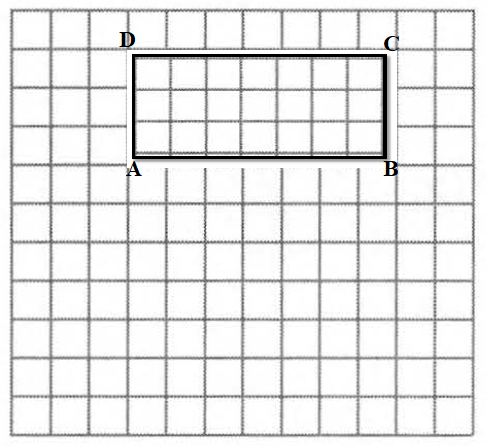
The length of the rug=7 feet
The breadth of the rug=3 feet.
Hence,ABCD is the required model of the rug.
Carnegie Learning Geometry Chapter 3 Page 134 Problem 5 Answer
The length and breadth of the rug is7 feet and 3 feet respectively.
We have to find the area of the rug.
For this, we will use the formula,
Area of a rectangle=Length×Breadth.
We have,
Length=7 feet
Breadth=3 feet
∴Area of rug=7×3
=21feet2
We can see from the grid paper that the number of squares bounded by rug are 21 and the area of 1 square is 1 feet, therefore the area of the rug is=21 feet2.
Hence, the area of the rug is 21 feet 2.
Solutions for Parallel And Perpendicular Lines Exercise 2.6 In Carnegie Learning Geometry Page 134 Problem 6 Answer
The length and breadth of the ring is 7 feet and 3 feet respectively.
We have to find the perimeter of the rug.
For this, we will use the formula,
Perimeter=2(length+breadth).
We have,
Length=7 feet
Breadth=3 feet
∴Perimeter=2(l+b)
=2(7+3)
=20 feet.
We can see from the grid that the boundary of the rug cover 20 square.
Therefore, the perimeter is20 feet.
Hence, the perimeter of the rug is20 feet.
Carnegie Learning Geometry Chapter 3 Page 135 Problem 7 Answer
A rectangle is a quadrilateral with four right angles
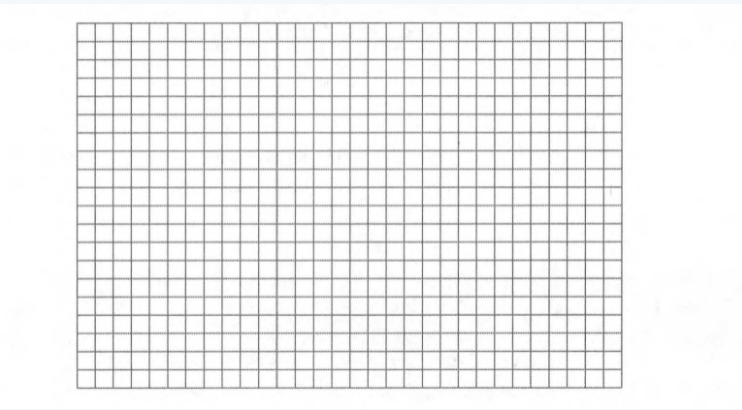
we need to draw six rectangles in this grided figure in the question
So, drawing six rectangles,
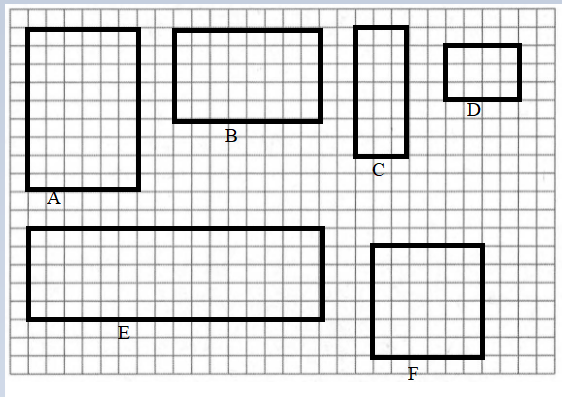
Hence, we have drawn six rectangles on the grid and named them A, B, C, D, E, and F respectively.
Carnegie Learning Geometry Chapter 3 Page 136 Problem 8 Answer
Here the question is: Can you determine the perimeter of a rectangle without drawing it if you know the rectangle’s length and width
Yes, I can determine the perimeter of a rectangle by given width and length without drawing the rectangle.
The perimeter of the rectangle is determined by:2(l+b)
where l= length of rectangle
b=width of rectangle
Yes, I can determine the perimeter of a rectangle by given width and length without drawing the rectangle.
The perimeter of the rectangle is determined by 2(l+b), where l and b are length and width of rectangle.
Carnegie Learning Geometry 2nd Edition Exercise 2.6 Solutions Page 136 Problem 9 Answer
The question is : Can you determine the area of a rectangle without drawing it if you know the rectangle’s length and width?
Yes, we can find the area of the rectangle without drawing it.
We can find the area of the rectangle by multiplying the given length and width of the rectangle.
Yes, we can find the area of the rectangle without drawing it.
We can find the area of the rectangle by multiplying the given length and width of the rectangle.
Carnegie Learning Geometry Chapter 3 Page 136 Problem 10 Answer
Given length of rectangle =e
Width of rectangle =w
Area=A
The formula for the area of the rectangle is written as
A=e×w
A=ew
Formula for the area of the rectangle:A=ew
Page 136 Problem 11 Answer
We have to determine the area of the rectangle if its perimeter is given.
No, we can not find the area of the rectangle if its perimeter is known to us, because as we know for calculating the area we need the length and width of the rectangle,
If we have only perimeter available then we need either length or width to calculate the area of rectangle.
No, we can not find the area of the rectangle if its perimeter is known to us, because as we know for calculating the area we need the length and width of the rectangle,
If we have only perimeter available then we need either length or width to calculate the area of the rectangle.
Carnegie Learning Geometry Chapter 3 Page 136 Problem 12 Answer
We have to determine the perimeter of the rectangle if its area is given.
No, we can not find the perimeter of the rectangle if its area is known to us, because as we know for calculating the perimeter we need the length and width of the rectangle,
If we have only area available then we need either length or width to calculate the perimeter of rectangle.
No, we can not find the perimeter of the rectangle if its area is known to us, because as we know for calculating the perimeter we need the length and width of the rectangle,
If we have only area available then we need either length or width to calculate the perimeter of rectangle.
Parallel And Perpendicular Lines Solutions Chapter 2 Exercise 2.6 Carnegie Learning Geometry Page 137 Problem 13 Answer
Given the length of a rectangle is 11 meters and the width of the rectangle is 5 meters
We have to calculate the area and perimeter of this rectangle.
Use the formula of area and perimeter of the rectangle.
Double the given length and width then calculate the perimeter of the new rectangle using the formula.
Length =11 meters
width =5 meters
Area=11×5=55
The area of the rectangle is 55 square meters
Perimeter of the rectangle is: P=2(11+5)
=2(16)
=32
Perimeter of the rectangle is 32 meters.
When we double the length and width
New length is 2×11=22 meters
New width is 2×5=10 meters
So the perimeter is P=2(22+10)
=2(32)
=64
Perimeter of new rectangle is 64 meters
The area of the rectangle is 55 square meters and Perimeter of the rectangle is 32 meters.Perimeter of new rectangle is 64 meters
Carnegie Learning Geometry Chapter 3 Page 137 Problem 14 Answer
Given that, a rectangle that is 11 meters long and 5 meters wide.
We have to find the effect of doubling the length and width have on the perimeter.
Here, l=11m and w=5m
Then Perimeter of rectangle, P=2(l+w)
⇒ P=2(11+5)=32m
Now, If doubling the length and width of rectangle we get,
Perimeter of rectangle, P=2(2l+2w)
⇒ P=2(22+10)=64m
Therefore, The perimeter of original rectangle is 32m and the perimeter of rectangle after doubling the length and width is 64m.
After doubling the length and width of rectangle the perimeter becomes double.
Page 137 Problem 15 Answer
Given that, a rectangle that is 11 meters long and 5 meters wide.
We have to find the effect on area of rectangle after doubling the length and width of rectangle.
Here, l=11m and w=5m
Then the area of rectangle, A=l×w
=11×5
=55sq.m
Now, If doubling the length and width of rectangle we get,
Area of rectangle, A=2l×2w
=22×10
=220sqm.
⇒Original area of rectangle is 55sqm and are after doubling the length and width of rectangle is 220sqm.
Therefore, If we double the length and width of rectangle the area becomes four times increases.
If we double the length and width of rectangle the area becomes four times increases.
Carnegie Learning Geometry Chapter 3 Page 137 Problem 16 Answer
given that, a rectangle that is 22 meters long and 10 meters wide.
We have to find the area of rectangle.
Here,l=22m and w=10m
Therefore, Area of rectangle is,
A=l×w
=22×10
=220sq.m
Required area of given rectangle is, A=220sqm.
Step-By-Step Solutions For Carnegie Learning Geometry Chapter 2 Exercise 2.6 Page 137 Problem 17 Answer
We have to find What effect of doubling the length and width on the area of rectangle.
Given rectangle have length l
and width w
the its area is given by,
A=l×w . . . . . (1)
Now of we double the length and width of rectangle the we get, area of rectangle is, A=2l×2w=4(l×w). . . . .(2)
So from equation (1) and (2) we can say that,
If we double the length and width of rectangle the area becomes four times increases.
If we double the length and width of rectangle the area becomes four times increases.
Carnegie Learning Geometry Chapter 3 Page 139 Problem 18 Answer
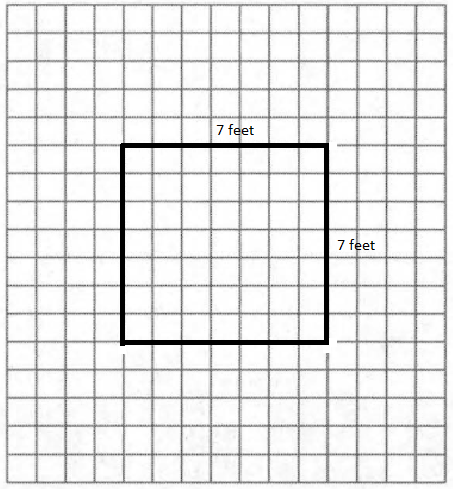
Given that, One square rug is seven feet long and seven feet wide.
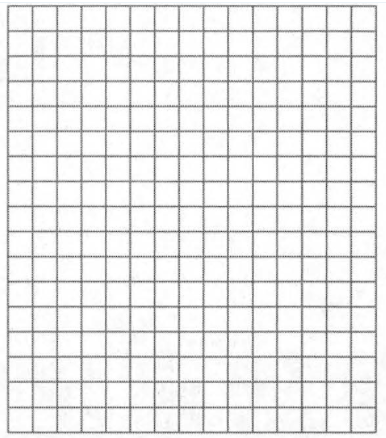
We have to draw a model of this rug on the grid shown having each square on the grid represents a square that is one foot long and one foot wide.
We can draw a 7 feet by 7 feet square rug as shown in figure below,
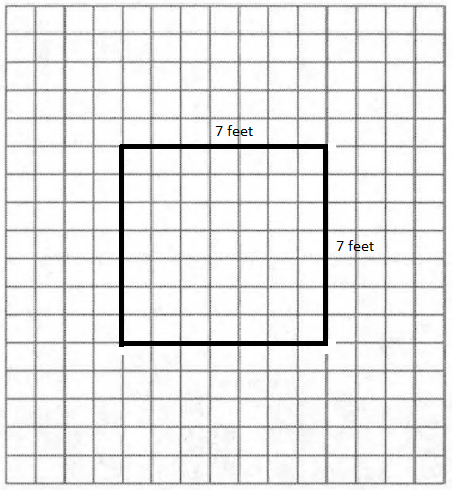
Required drawing of a model of this rug on the grid is
Carnegie Learning Geometry Chapter 3 Page 139 Problem 19 Answer
Given rug is seven feet long and seven feet wide as shown in figure below,
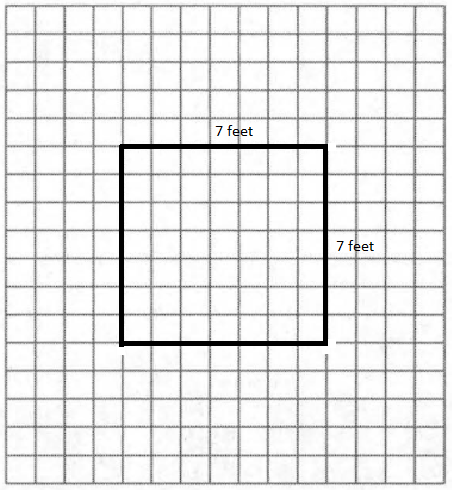
We have to find the area of this rug.
Given rug have a side of length l=7feet
Therefore its area is given by,
Area of square shape rug is,A=l2
=72
=49sq.ft
Required area of given rug is A=49sqft
Carnegie Learning Geometry Chapter 3 Page 140 Problem 20 Answer
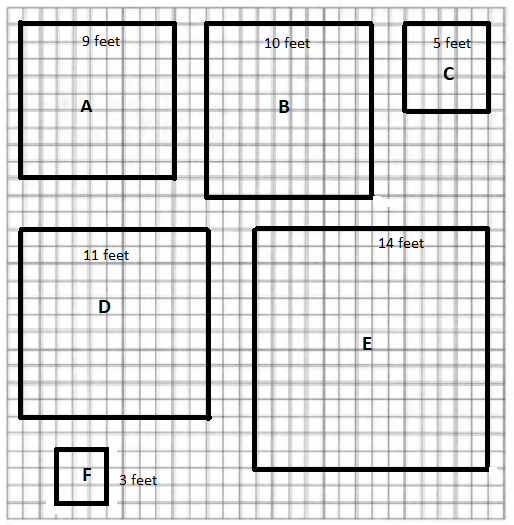
Given that, Each square on the grid represents a square that is one foot long and one foot wide.
We have to draw the six different squares on the grid. Use the letters A through F to name each square.
The six different squares on the grid.
Using the letters A through F to name each square.
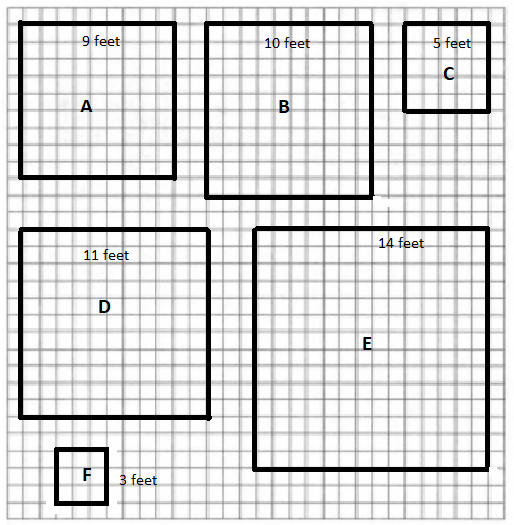
Required drawing is
Carnegie Learning Geometry Chapter 3 Page 141 Problem 21 Answer
Yes, we can determine the perimeter of a square without drawing the square if you know the length of one side of the square.
Because if we know the length of one side is l (say) then,
we have length of each side of square is same.
That means, perimeter of square is sum of length of all sides of square.
So, from that we get,
Perimeter of square=P=l+l+l+l=4l
We are able to find the perimeter of square without drawing the square if you know the length of one side of length l of the square by using formula,
Perimeter of square=P=4l.
Carnegie Learning Geometry Chapter 2 Exercise 2.6 Free Solutions Page 141 Problem 22 Answer
Perimeter is the total length of the boundary . To find perimeter we add all the side lengths of the square .
We know that the side length of the square is s
There are 4 sides in a square. The perimeter of the square is s+s+s+s
P is the perimeter.
P=s+s+s+s=4s
P=4s
Perimeter of square is P=4s
Carnegie Learning Geometry Chapter 3 Page 141 Problem 23 Answer
Let side be the side length of the square
We know that area of square is length times width
For a square side length is side
Area of the square = =side×side=side2
Area of the square =side2
Page 141 Problem 24 Answer
Given : Let s be the side length of square and A is the area of the square
We know that area of the square is side times side that is equal to side2
Lets replace the formula with variables
Are of the square formula
A=side2
A=s2
Area of the square formula is A=s2
Carnegie Learning Geometry Chapter 3 Page 142 Problem 25 Answer
Given : the side length of the square is 5 centimeters.
Use the formula to find the area and perimeter of the square
Side length of the square s=5 cm
Area of the square =s2
=52
=25cm2
Perimeter of the square =4s
=4(5)
=20 cm
Area of the square =25cm2
Perimeter of the square = 20 cm
Carnegie Learning Geometry Exercise 2.6 Student Solutions Page 142 Problem 26 Answer
Given : The area of the square is 169 square feet
Find out the side length and perimeter of the square
Area of the square =169
Area of the square formula =s2
s2=169
Take square root
s=√169
s=13
Side length 13 feet
Perimeter of square =4s
=4(13)
=52 feet
Side length of the square =13 feet
Perimeter of square =52 feet
Carnegie Learning Geometry Chapter 3 Page 143 Problem 27 Answer
Side length of the square is 9 inches
Find the perimeter and area
Double the side length of the square and then calculate the perimeter
side length of the square = 9 inches
Area of the square =s2=92
=81 square inches
Perimeter P=4s
=4(9)
=36 inches
Side length of the square is 9 inches
Double the side length =2×9
=18 inches
Perimeter of square =4s
=4(18)
=72 inches
Area of the square = 81 square inches
Perimeter = 36 inches
Perimeter of square after side length is doubled = 72 inches
Page 143 Problem 28 Answer
we got part (a)
Area of the square = 81 square inches
Perimeter = 36 inches
Perimeter of square after side length is doubled = 72 inches
Now we analyze the perimeter when side length is 9 inches and when side length is doubled
Perimeter of square after side length is doubled is 2 times the perimeter of square with side length 9 inches
72 = 2 ⋅36
72=72
When side length is double then the perimeter is also doubled
Carnegie Learning Geometry Chapter 3 Page 143 Problem 29 Answer
Area of the square with side length is equal to 9 inches
Double the side length of the square and check the effect on the area of the square .
Lets find area of square for side length =9 inches
Area of the square = s2
=92
=81 square inches
Now we double the side length
2s=2(9)
=18 inches
Area of the square after doubling side length =s2
=(18)2
=324
Area of the square after doubling side length =x (area of square )
324=x(81)
x=324/81
x=4
Area of the square after doubling side length = 4 times area of the square
Doubling the side length of a square
Area of the square after doubling side length is four times the area of original square
Page 143 Problem 30 Answer
side length equal to 10 meters we need to find the area of the square
Double the side length and find the area of new square .
Side length = 10 m
Area of the square =s2
=102
=100
Double the side length of the square
2s=2(10)
=20
Now side length of new square is 20 m
Area of the new square =202
=400 square meters
Area of the new square is 400 square meters
Carnegie Learning Geometry Chapter 3 Page 143 Problem 31 Answer
Area of the square with side length 10 meters is 100 square meter
From part (a) we got the area of new square after doubling the side length is 400 square meters
Now compare the areas
400 = 4 ⋅100
Area of new square = 4⋅ Area of old square
Doubling the length of a side of the square gives four times the area of the old square
Parallel And Perpendicular Lines Exercise 2.6 Carnegie Learning 2nd Edition Answers Page 144 Problem 32 Answer
We are given the perimeter of a square

Find the length of side of square then construct the square.
We have to write a paragraph to explain the construction of this square.
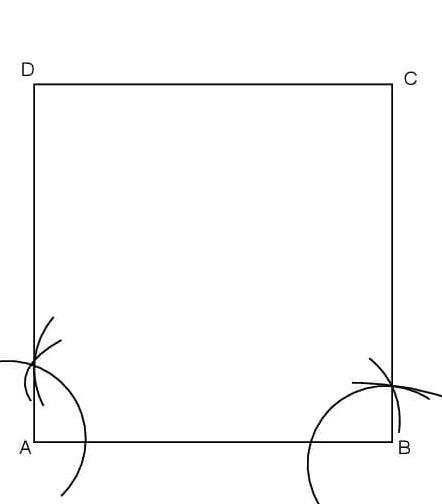
Constructing a Square With a Compass
Draw a reference line AB of 6cm (say) using a ruler.
Draw the 90 degree angle at A with the aid of the compass.
Draw the 90 degree angle at B with the aid of the compass.
Using an open compass 6 cm wide.
Draw an arc with A as the centre; that cuts arms at a 90 degree angle.
And mark the intersection point as C.Using the ruler find length measure of AC.
The AC length should be 6 cm.Using the compass again and take 6 cm width of the compass.
With D as the middle, draw an arc that cuts arms at an angle of 90 degrees.
And mark the junction point as D.Using the ruler and the BD length measurement.
The BD length should be 6 cm and we’ll get: Join CD.Use the CD ruler and calculate its length.
CD should be 6 cm in length and we get the corresponding square ABCD.
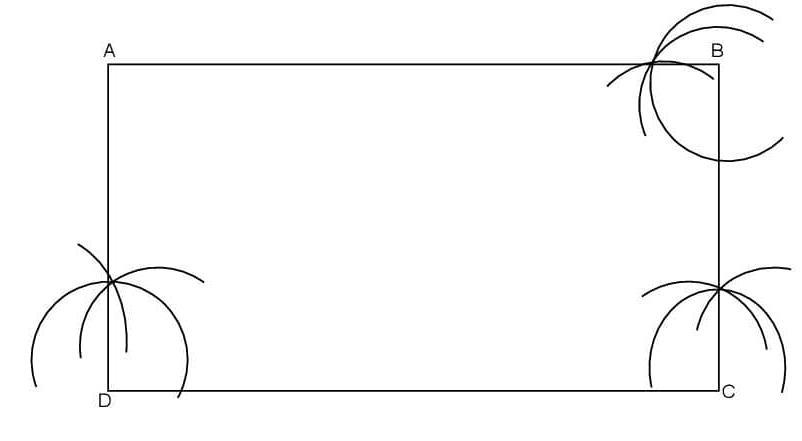
The square is shown in the following figure.
Carnegie Learning Geometry Chapter 3 Page 144 Problem 33 Answer
We are given the perimeter of a square

We have to write a paragraph to explain the construction of this square.
Also, construct the square.
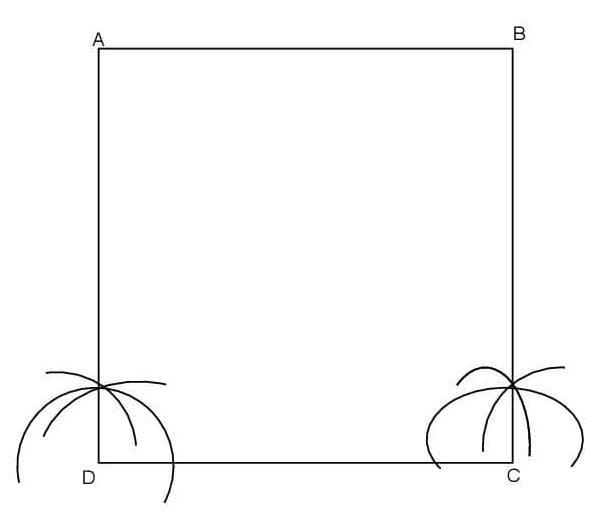
Constructing a Square With a Compass
Draw a reference line AB of 6cm (say) using a ruler.
Draw the 90 degree angle at A with the aid of the compass.
Draw the 90 degree angle at B with the aid of the compass.
Using an open compass 6 cm wide.
Draw an arc with A as the centre; that cuts arms at a 90 degree angle.
And mark the intersection point as C.
Using the ruler find length measure of AC.
The AC length should be 6 cm.
Using the compass again and take 6 cm width of the compass.
With D as the middle, draw an arc that cuts arms at an angle of 90 degrees. And mark the junction point as D.
Using the ruler and the BD length measurement.
The BD length should be 6 cm and we’ll get: Join CD.
Use the CD ruler and calculate its length.
CD should be 6 cm in length and we get the corresponding square ABCD.
Hence, the constructed square as show in the figure.
Carnegie Learning Geometry Chapter 3 Page 145 Problem 34 Answer
We are given the perimeter of a rectangle

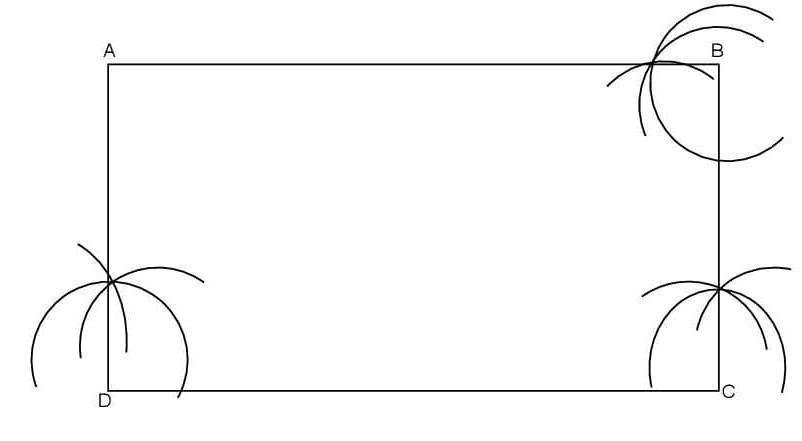
We have to write a paragraph to explain the construction of rectangle that is not a square .
To construct a rectangle, we need to create a quadrilateral that only has right angles.
All rectangles have opposites sides that are parallel to each other and equal in length.
If we are given two line segments, AB and CD, we can construct a rectangle with both AB and CD sides of length.
Suppose CD is the shorter of the two.
First, we create a line AE perpendicular to AB at A.
Then, cut off a segment of AE equal in length to CD.
We will call this point F.
Now, we can create two new perpendicular lines.
The first will meet AF at a right angle at F.
The second will meet AB at a right angle at B.
Call the intersection of these lines G.
Now, ABGF is a rectangle with side lengths AB and CD
Hence, the constructed rectangle as show in the figure.
Carnegie Learning Geometry Chapter 3 Page 145 Problem 35 Answer
We are given the perimeter of a rectangle

We have to construct the rectangle that is not a square.
Hence, the constructed rectangle as show in the figure.