
Savvas Learning Co Geometry Student Edition Chapter 3 Parallel and Perpendicular Lines Exercise
Savvas Learning Co Geometry Student Edition Chapter 3 Parallel And Perpendicular Lines Exercise Answers Page 137 Exercise 1 Problem 1
Given: The following figure is provided.
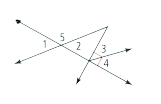
To Find – All the linear pairs in the figure.
We observe the figure and pick out the adjacent angles that together form a straight angle.
The first pair of adjacent angles are ∠1 and ∠5.
The second pair of adjacent angles are ∠2 and ∠5.
The linear pairs in the figure are ∠1,∠5, and ∠2,∠5.
Page 137 Exercise 2 Problem 2
Given: The following figure is provided.
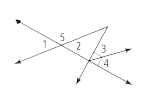
To Find – All the pairs of vertical angles.
We carefully observe the figure and pick out the angles that are opposite to each other in intersecting lines.
There is only one pair of vertical angles, which is ∠1 and ∠2.
The vertical angles in the figure are ∠1 and ∠2.
Read and Learn More Savvas Learning Co Geometry Student Edition Solutions
Chapter 3 Parallel And Perpendicular Lines Solutions Savvas Geometry Page 137 Exercise 3 Problem 3
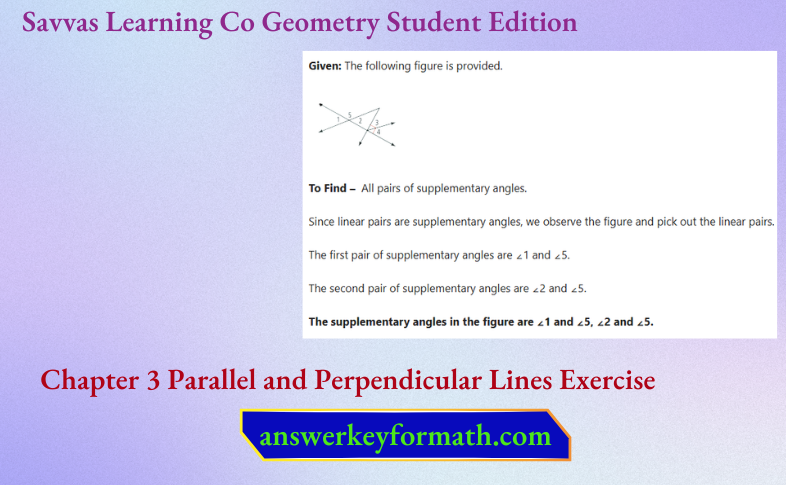
Parallel And Perpendicular Lines Exercises Savvas Geometry Student Edition Solutions Page 137 Exercise 4 Problem 4
Given: The equation 3x + 11 = 7x − 5
To Find – The solution of the given equation.
Using the properties of equality, the given equation can be solved.
Considering the given equation
3x + 11 = 7x − 5
Using the subtraction property of equality
3x + 11 − 11 = 7x − 5 − 11
⇒ 3x = 7x − 16
Using the subtraction property of equality
3x − 7x = 7x − 16 − 7x
⇒ −4x = −16
Using the division property of equality
\(\frac{−4x}{−4}\) =\(\frac{−16}{−4}\)
⇒ x = 4
The solution of the equation 3x + 11 = 7x − 5 is x = 4.
Parallel And Perpendicular Lines Exercises Savvas Geometry Student Edition Solutions Page 137 Exercise 5 Problem 5
Given: The equation (x − 4) + 52 = 109
To Find – The solution of the given equation.
Using the properties of equality, the given equation can be solved.
Considering the given equation
⇒ (x − 4) + 52 = 109
Using the subtraction property of equality
⇒ (x − 4) + 52 − 52 = 109 − 52
⇒ x − 4 = 57
Using the addition property of equality
⇒ x − 4 + 4 = 57 + 4
⇒ x = 61
The solution of the equation (x − 4) + 52 = 109 is x = 61.
Chapter 3 Parallel And Perpendicular Lines Explanation Savvas Geometry Student Edition Page 137 Exercise 6 Problem 6
Given: The equation (2x + 5) + (3x − 10) = 70
To Find – The solution of the given equation.
Using the properties of equality, the given equation can be solved.
Considering the given equation
⇒ (2x + 5) + (3x − 10) = 70
⇒ 2x + 5 + 3x − 10 = 70
Combining like terms
⇒ 5x − 5 = 70
Using the Addition Property of Equality
⇒ 5x − 5 + 5 = 70 + 5
⇒ 5x = 75
Using the Division Property of Equality
\(\frac{5x}{5}\) = \(\frac{75}{5}\)
⇒ x = 15
The solution of the equation (2x + 5) + (3x − 10) = 70 is x = 15.
Chapter 3 Parallel And Perpendicular Lines Explanation Savvas Geometry Student Edition Page 137 Exercise 7 Problem 7
Given: The given points are(−4,2) and (4,4).
To Find – The distance between the two given points.
Use the formula of distance between two points.
We have the given points,(−4,2) and (4,4)
Distance between the two points
= \(\sqrt{\left(x_2-x_1\right)^2+\left(y_2-y_1\right)^2}\)
= \(\sqrt{(4-(-4))^2+(4-2)^2}\)
= \(\sqrt{(4+4)^2+(2)^2}\)
= \(\sqrt{64+4}\)
= \(\sqrt{68}\)
= 8.25
The distance between the two points is 8.25 units.
Solutions For Parallel And Perpendicular Lines Exercises Savvas Geometry Chapter 3 Page 137 Exercise 8 Problem 8
Given: The given points are(3,−1) and (7,−2).
To Find – The distance between the two given points.
Use the formula of the distance between two points.
We have the given points,(3,−1) and (7,−2)
Distance between the two points
= \(\sqrt{\left(x_2-x_1\right)^2+\left(y_2-y_1\right)^2}\)
= \(\sqrt{(7-3)^2+(-2-(-1))^2}\)
= \(\sqrt{4^2+(-2+1)^2}\)
= \(\sqrt{16+1}\)
= \(\sqrt{17}\) ≈ 4.12
The distance between the given two points is 4.12 units.
Solutions For Parallel And Perpendicular Lines Exercises Savvas Geometry Chapter 3 Page 137 Exercise 9 Problem 9
Given: The core of an apple is in the interior of the apple.
The peel is on the exterior.
To Find – The meaning of the terms interior and exterior in the context of geometric figures.
A figure is a shape drawn on a plane or a space that comprises of curves, points, and lines.
When the figure is drawn on the plane or space, the plane or space gets divided into three regions.
The first region is the boundary of the figure, which is the figure itself.
The second region is the space inside the figure which is called the interior of the figure.
The third region is the space outside the figure which is called the exterior of the figure.
A figure divides a plane or a space into three parts – the figure itself, the region inside the figure called the interior, and the region outside the figure called the exterior.
Parallel And Perpendicular Lines Exercises Savvas Geometry Student Edition Detailed Solutions Page 137 Exercise 10 Problem 10
Given: A ship sailing from the United States to Europe makes a transatlantic voyage.
To Find – Meaning of the prefix trans- and what a transversal does.
The words “transatlantic voyage” refer to a voyage that involves crossing the Atlantic Ocean.
So, the prefix trans- means to cross.
A transversal is a special type of line in geometry.
A transversal is a word with the prefix trans- so it means that it is a line that crosses a system of lines.
The prefix trans- means cross and the term transversal refers to a line that crosses other lines.
Parallel And Perpendicular Lines Exercises Savvas Geometry Student Edition Detailed Solutions Page 137 Exercise 11 Problem 11
Given: People in many jobs use flowcharts to describe the logical steps of a particular process.
To Find – How a flow proof can be used in geometry.
A flow proof shows each statement that leads to the conclusion using a diagram.
The sequence of the proof is represented by arrows.
The diagram’s form isn’t crucial, but the arrows should clearly demonstrate how one statement leads to the next.
Each statement is accompanied by an explanation or reason written beneath or beside it.
A flow proof shows the individual steps of the proof and how each step is related to other steps.