
Linear Algebra 5th Edition Chapter 1 Vector Spaces
Page 13 Problem 1 Answer
The given matrix: M3×4(F)
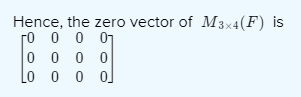
It is required to write the zero vector of M3×4(F).
Solve this by the use of the definition and formula of matrices.
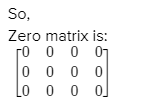
The given matrix will be M3×4(F) i.e.,
M3×4(F) includes 3 rows and 4 columns.
Stephen Friedberg Linear Algebra 5th Edition Solutions Chapter 1 Page 13 Problem 2 Answer
The given matrix is:
M=
(1 4 2 )
(5 3 6 )
To find: M13, M21,M22.
Solve this by using the definition and formula of matrices.
The given matrix is:
M=
(1 4 2)
(5 3 6)
Read and Learn More Stephen Friedberg Linear Algebra 5th Edition Solutions
Mmn is the mn th entry of the matrix M i.e., element of the mth row and nth column.
So,
⇒ M13=3
⇒ M21=4
⇒ M22=5
Hence, M13,M21,M22 is 3,4,5 respectively.
Linear Algebra 5th Edition Chapter 1 Page 13 Problem 3 Answer
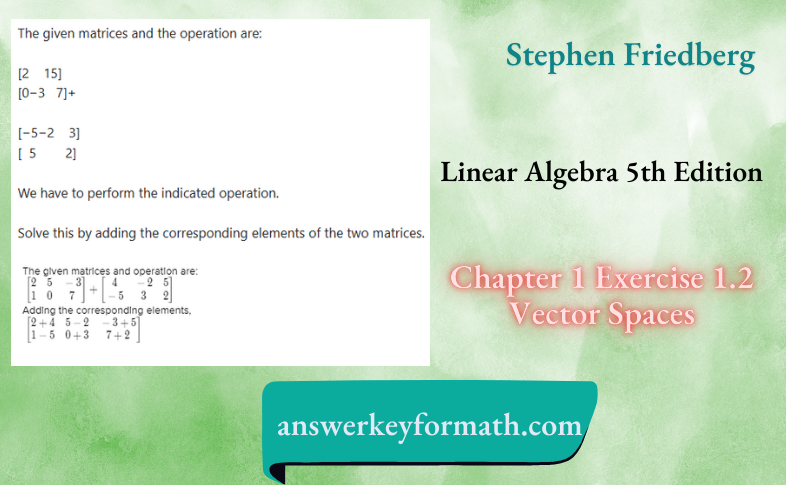
Simplifying,
[6 −43
32 9]

Chapter 1 Exercise 1.2 Vector Spaces Explanation Page 13 Problem 4 Answer
Given matrices and the operation are:
[−6 3 1]
[4 −2 8]+
[7 0 2]
[−5 −3 0]
It is required to perform the indicated operation.
Solve this by adding the corresponding elements of the two matrices.
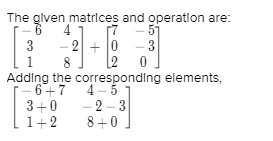
Simplifying,
[1 3 3]
[−1 −5 8]

Linear Algebra 5th Edition Chapter 1 Page 13 Problem 5 Answer
The given matrices and the operation are:
4[2 1 5]
[0−3 7]
It is required to perform the indicated operation.
Solve this by multiplying every element of the matrix by the scalar.
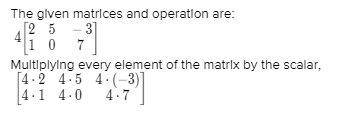
Simplifying,
[8 4 20]
[0−12 28]

Linear Algebra 5th Edition Friedberg Chapter 1 Guide Page 13 Problem 6 Answer
Given matrices and the operation are:
−5[−6 3 1]
[ 4 −2 8]
It is required to perform the indicated operation.
Solve this by multiplying every element of the matrix by the scalar.
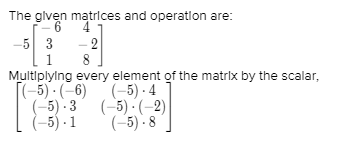
Simplifying,
[30 −15 −5]
[−20 10 −40]

Linear Algebra 5th Edition Chapter 1 Page 13 Problem 7 Answer
The given polynomials and the operation are:
(2×4−7×3+4x+3)+(8×3+2×2−6x+7)
It is required to perform the indicated operation.
Solve this by adding the corresponding coefficients of the two polynomials.
The given polynomials and operation are:
(2×4−7×3+4x+3)+(8×3+2×2−6x+7)
Adding the corresponding coefficients,
(2+0)x4+(−7+8)x3+(0+2)x2+(4−6)x+(3+7)
Simplifying,
2×4+x3+2×2−2x+10
Hence, (2×4−7×3+4x+3)+(8×3+2×2−6x+7) is equal to 2×4+x3+2×2−2x+10 .
Stephen Friedberg Linear Algebra Vector Spaces Notes Chapter 1 Page 13 Problem 8 Answer
The given polynomials and the operation are:
(−3×3+7×2+8x−6)+(2×3−8x+10)
It is required to perform the indicated operation.
Solve this by adding the corresponding coefficients of the two polynomials.
The given polynomials and operation are:
(−3×3+7×2+8x−6)+(2×3−8x+10)
Adding the corresponding coefficients,
(−3+2)x3+(7+0)x2+(8−8)x+(−6+10)
Simplifying,−x3+7×2+4
Hence, (−3×3+7×2+8x−6)+(2×3−8x+10) is equal to −x3+7×2+4 .
Linear Algebra 5th Edition Chapter 1 Page 13 Problem 9 Answer
The given polynomials and the operation are:
5(2×7−6×4+8×2−3x)
It is required to perform the indicated operation.
Solve this by multiplying every coefficient by the scalar.
The given polynomials and operation are:
5(2×7−6×4+8×2−3x)
Multiplying the coefficients by the scalar,
5⋅2×7−5⋅6×4+5⋅8×2−5⋅3x
Simplifying,
10×7−30×4+40×2−15x
Hence, 5(2×7−6×4+8×2−3x) is equal to 10×7−30×4+40×2−15x .
Page 13 Problem 10 Answer
The given polynomials and the operation are:
3(x5−2×3+4x+2)
It is required to perform the indicated operation.
Solve this by multiplying every coefficient by the scalar.
The given polynomials and operation are:
3(x5−2×3+4x+2)
Multiplying the coefficients by the scalar,
3⋅x5−3⋅6×3+3⋅12x+3⋅6
Simplifying,
3×5−6×3+12x+6
Hence, 3(x5−2×3+4x+2) is equal to 3×5−6×3+12x+6 .
Friedberg Linear Algebra Chapter 1 Solved Examples Chapter 1 Page 14 Problem 11 Answer
Given: the table for Upstream and Downstream Crossings.
It is required to record the upstream and downstream crossings in two 3×3
matrices and verify that the sum of these matrices gives the total number of crossings (both upstream and downstream) categorized by trout species and season.
Solve this by adding the corresponding elements of the two matrices.
The data of the upstream crossings can be represented in 3×3matrices, where the row will represent trout and columns, will represent seasons as:
U=
[8 3 3]
[3 0 0]
[1 0 0]
The data of the downstream crossings can be represented in 3×3 matrices, where the row will represent trout and columns, will represent seasons as:
D=
[9 3 1]
[1 0 1]
[4 0 0]
The total number of crossings can be found by adding the upstream and downstream crossings matrices as:
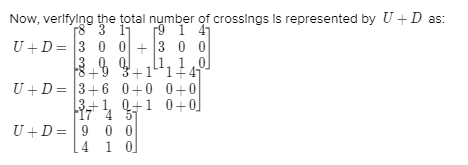
⇒ 8+9=17
⇒ 3+6=9
⇒ 3+1=4
⇒ 3+1=4
⇒ 0+0=0
⇒ 0+1=1
⇒ 1+4=5
⇒ 0+0=0
⇒ 0+0=0
Therefore the upstream and downstream crossings in two 3×3 matrices is recorded as U=
[8 3 3]
[3 0 0]
[1 0 0] and
D=[9 3 1]
[1 0 1]
[ 4 0 0] respectively.
It has been also verified that the sum of these matrices gives the total number of crossings (both upstream and downstream) categorized by trout species and season
Vector Spaces Examples Linear Algebra Friedberg Page 14 Problem 12 Answer
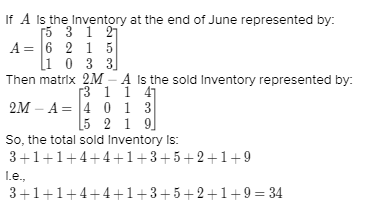
A table for the inventory at the end of May is given. It is also given that the inventory at the end of June is given by the matrix.
A=
[5 6 1]
[3 2 0]
[1 1 3]
[ 2 5 3] interpret 2M−A
It is required to record the data as 3×4 matrix Mand verify that the inventory on hand after the order is filled is described by the matrix 2M.
Solve this by the use of the addition and multiplying with a scalar property of matrices.
Therefore the inventory at the end of May is
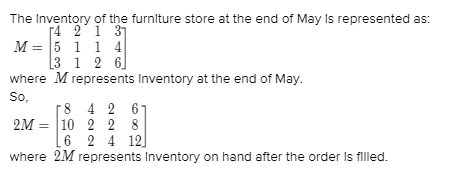
[4 5 3]
[2 1 1]
[1 1 2]
[3 4 6] and it is verified that the inventory on hand after the order is filled is defined by the matrix 2M.
Linear Algebra 5th Edition Chapter 1 Page 15 Problem 13 Answer
Given:
f(t)=2t+1 ,
g(t)=1+4t−2t2 ,
h(t)=5t+1
To prove: f=g and
f+g=h .
Solve this by using the fact that functions f and g are the same if and only if:
Domain of f and domain of g are similar. Codomain of f and codomain of g are similar.
f and g have the same value at each element of domain.
It is given that S={0,1},
F=R andf(t)=2t+1 ,
⇒ g(t)=1+4t−2t2 ,
⇒ h(t)=5t+1
For f=g :
As f,g∈F(S,R) , they have the same domain and codomain.
Checking if f(0)=g(0) and
⇒ f(1)=g(1) ,
⇒ f(0)=2⋅0+1
⇒ f(0)=1
⇒ g(0)=1+4⋅0−02
⇒ g(0)=1
⇒ f(1)=2⋅1+1
⇒ f(1)=3
⇒ g(1)=1+4⋅1−12
⇒ g(1)=3
So, f=g .
For f+g=h :
As f,g,h∈F(S,R) , then f+g∈F(S,R) and they have the same domain and codomain.
Checking if (f+g)(0)=h(0) and
⇒ (f+g)(1)=h(1) ,
⇒ (f+g)(0)=f(0)+g(0)
⇒ (f+g)(0)=1+1
⇒ (f+g)(0)=2
⇒ h(0)=50+1
⇒ h(0)=2
⇒ (f+g)(1)=f(1)+g(1)
⇒ (f+g)(1)=3+3
⇒ (f+g)(1)=6
⇒ h(1)=51+1
⇒ h(1)=6
So, f+g=h
Hence, it is proved that f=g andf+g=h .
Friedberg Chapter 1 Exercise 1.2 Chapter 1 Page 15 Problem 14 Answer
Given: Vector space is V and x,y∈V and a,b∈F .
It is required to prove that (a+b)(x+y)=ax+ay+bx+by .
Solve this by the use of the definition and properties of vector space.
For (VS7) : ∀a∈F∀x,y∈V
⇒ a(x+y)=ax+ay
For (VS8) : ∀b∈F∀x∈V
(a+b)x=ax+bx
Consider V be a vector space over the field F and x,y∈V and a,b∈F arbitrary.
As a and b are scalars, then so is a+b.(a+b∈F)(∗)
(a+b)(x+y)=(a+b)x+(a+b)y
(a+b)(x+y)=ax+bx+ay+by .
Therefore it has been proven that (a+b)(x+y)=ax+bx+ay+by .
Linear Algebra 5th Edition Chapter 1 Page 15 Problem 15 Answer
The given theorems are Theorem 1.1 and Theorem 1.2(c) in the question.
It is required to prove Corollaries 1 and 2 of Theorem 1.1 and Theorem 1.2(c).
Solve this by the use the definition and properties of Vector space.
Assuming the opposite that there are two different vectors 01 and 02
such that
⇒ x+01=x
⇒ x+02=x∀x∈V
⇒x+01
=x+02
So,01=02
The vector 0 in (VS3) is Unique.
Assuming the opposite that there are two different vectors y1 and y2
such that
⇒ x+y1=0
⇒ x+y2=0∀x∈V
⇒x+y1
=x+y2
So,y1=y2
The vector y in (VS4) is Unique.
Hence, vector 0 in (VS3) is unique and vector y in (VS4) is unique.
Linear Algebra 5th Edition Chapter 1 Page 15 Problem 16 Answer
It has been provided in the question that V denotes the set of all differentiable real-valued functions defined on the real line.
To prove that V is a vector space with the operations of addition and scalar multiplication defined.
Solve this by using the definition and properties of Vector space.
Real line is a field. Consider f,g,h∈V be real valued differentiable functions.
Sum of differentiable functions is differentiable and product of a real number with a differentiable function is a differentiable function i.e.,
⇒ (f+g)(s)=f(s)+g(s)∈V
⇒ (cf)(s)=cf(s)∈V
Commutativity and associativity are satisfied as they are real valued function i.e.,
⇒ f+g=g+f
⇒ (f+g)+h=f+(g+h) .
Here,f+0=f
⇒ f+(−f)=0
Here, 0 is the zero function. These properties will be satisfied by the real valued function.
⇒ 1f=f
Here, 1 is the real number 1 . This is also satisfying.
Also,(xy)f=x(yf)
⇒ x(f+g)=xf+xg
⇒ (x+y)f=xf+yf
x,y are real numbers. The given properties are satisfied.
Therefore, the vector space V over field R satisfies all the required properties.
Understanding Vector Spaces With Friedberg Linear Algebra Chapter 1 Page 15 Problem 17 Answer
It has been given that V={0} consists of a single vector 0 and defines 0+0=0 and c0=0 for each scalar c in F .
It is required to prove that V is a vector space over F .
Solve this by the use of the definition and properties of Vector space.
Here it has been given that,
⇒ V={0}
⇒ 0+0=0
⇒ c0=0∀c∈F
V has only one element so we need to check all of the conditions for that element.
⇒ (VS1):∀x,y∈V,x+y=y+x
⇒ 0+0=0+0=0
⇒ (VS2):∀x,y,z∈V,(x+y)+z=x+(y+z)
⇒ (0+0)+0=0+0=0
⇒ 0+(0+0)=0+0=0
(VS3):∀0v∈V such that 0v+x=x∀x∈V
⇒ 0v+0=x
⇒ 0v=0∈V
(VS4):∀x∈V,∃y∈V
such that x+y=0
⇒ 0+y=0
⇒ y=0∈V .
Then,(VS5):∀x∈V,1x=x
⇒ 0=1⋅0=0
(VS6):∀a,b∈F,∀x∈V,(ab)x=a(bx)
⇒ (ab)⋅0=0
⇒ a(b⋅0)=a⋅0=0
And,
(VS7):∀a∈F,∀x,y∈V,a(x+y)=ax+ay
⇒ a(0+0)=a⋅0=0
⇒ a⋅0+a⋅0=0+0=0
Similarly,
(VS8):∀a,b∈F,∀x∈V,(a+b)x=ax+bx
⇒ (a+b)⋅0=0
⇒ a⋅0+b⋅0=0+0=0 .
Hence, V is a vector space over F .
Linear Algebra 5th Edition Chapter 1 Page 15 Problem 18 Answer
Given: (a1,a2) and (b1,b2) are elements of V and c∈R is defined as
(a1,a2)+(b1,b2)=(a1+b1,a2+b2) and c(a1,a2)=(ca1,a2) .
To find: whether V is a vector space over R with the operations.
Solve this by using the definition and properties of vector space.
Assume V=R2
+:(a1,a2)+(b1,b2)=(a1+b1,a2+b2)
:c(a1,a2)=(c⋅a1,a2)
For V to be a vector space, rules (VS1)−(VS8) must hold.
(VS8):
Assume α,β∈R and a=(a1,a2)∈V arbitrary.
(α+β)⋅a=αa+βb .
Now,(α+β)⋅a=(α+β)⋅(a1,a2)
⇒ (α+β)⋅a=((α+β)a1,a2)
⇒ (α+β)⋅a=(αa1+βa1,a2)
Also, αa+βa=α(a1,a2)+β(a1,a2)
⇒ αa+βa=(αa1,a2)+(βa1,a2)
⇒ αa+βa=(αa1+βa1,a22)
So,(α+β)⋅a≠αa+βb .
Hence, V is not a vector space.
Linear Algebra 5th Edition Chapter 1 Page 15 Problem 19 Answer
Given:
V={(a1,a2,…,an):ai∈Rfori=1,2,…,n}
V is a vector space over R.
To find: Whether V is a vector space over the field of complex numbers with the operations of coordinate wise addition and multiplication.
Solve this by using the definition and properties of vector space.
V is a vector space over the field of F if and only if for every x,y∈V and α,β∈F vector αx+βy is an element of V .
Assume V={(a1,a2,…,an):ai∈C∀i=1,2,…,n} ,
⇒ x=(x1,x2,…,xn),
⇒ y=(y1,y2,…,yn)∈V andα,β∈R .
Checking whether αx+βy is an element of V ,
⇒ αx+βy=α(x1,x2,…,xn)+β(y1,y2,…,yn)
⇒ αx+βy=(αx1,x2,…,xn)+(βy1,y2,…,yn)
⇒ αx+βy=(αx1+βy1,αx2+βy2,…,αxn+βyn)
As αxi+βyi∈C∀i , the vector αx+βy is an element of V .
V is a vector space over the field of R .
Therefore, V is a vector space over the field of complex numbers with the operations of coordinate wise addition and multiplication.
Stephen Friedberg Chapter 1 5th Edition Breakdown Chapter 1 Page 16 Problem 20 Answer
Given: V={(a1,a2,…,an):ai∈Rfori=1,2,…,n}
V is a vector space over R.
To find: Whether V is a vector space over the field of complex numbers with the operations of coordinate wise addition and multiplication.
Solve this by using the definition and properties of vector space.
Here, V is a vector space over the field of F if and only if for every x,y∈V and α,β∈F
vector αx+βy is an element of V .
Assume V={(a1,a2,…,an):ai∈R∀i=1,2,…,n} ,
⇒ x=(1,1,…,1),
⇒ y=(2,2,…,2)∈V andα=i,
⇒ β=2i∈C .
Checking whether αx+βy is an element of V,
⇒ αx+βy=i(1,1,…,1)+2i(2,2,…,2)
⇒ αx+βy=(i,i,…,i)+(4i,4i,…,4i)
⇒ αx+βy=(5i,5i,…,5i) .
As 5i∉R , vector αx+βy is not an element of V .
V is not a vector space over the field of C .
Therefore, V is not a vector space over the field of complex numbers with the operations of coordinate wise addition and multiplication.
Linear Algebra 5th Edition Chapter 1 Page 16 Problem 21 Answer
Given that V denotes the set of all m×n matrices with real entries and F is the field of rational numbers.
To find: Whether V is a vector space over the field of rational numbers with the usual definitions of matrix addition and multiplication.
Solve this by using the definition and properties of vector space.
Here,V is a vector space over the field of F if and only if for every x,y∈V and α,β∈F vector αx+βy is an element of V.
Assume V={A=(aij)∈Mm×n:aij∈R} ,x=(xij),
y=(yij)∈V andα,β∈Q .
Checking whether αX+βY is an element of V,
⇒ αx+βy=α(xij)+β(yij)
⇒ αx+βy=(αxij)+(βyij)
⇒ αx+βy=(αxij+βyij)
As αxij+βyij∈R∀i , the vector αX+βY is an element of V.
V is not a vector space over the field of Q .
Therefore, V is a vector space over the field of Q with the usual definitions of matrix addition and multiplication.
Linear Algebra 5th Edition Chapter 1 Page 16 Problem 22 Answer
Given: V={(a1,a2):a1,a2∈F} and c∈F , (a1,a2)∈V and is defined as c(a1,a2)=(a1,0) .
To find: whether V is a vector space over F with the operations.
Solve this by using the definition and properties of vector space.
ConsiderV=F2
+:(a1,a2)+(b1,b2)=(a1+b1,a2+b2)
:c(a1,a2)=(a1,0)
For V to be a vector space, rules (VS1)−(VS8) must hold.
(VS5):
Assume a=(a1,a2)∈V ,
1⋅a=a .
Now,1⋅a=1⋅(a1,a2)
1⋅a=(a1,0)
So,1⋅a≠a.
Therefore, V is not a vector space.
Linear Algebra 5th Edition Chapter 1 Page 16 Problem 23 Answer
Given: V={(a1,a2):a1,a2∈R} and (a1,a2),(b1,b2)∈V , c∈R is defined as
(a1,a2)+(b1,b2)=(a1+2b1,a2+3b2) and
c(a1,a2)=(ca1,ca2) .
To find: whether V is a vector space over R with the operations.
Solve this by using the definition and properties of vector space.
Consider V=R2
+:(a1,a2)+(b1,b2)=(a1+2b1,a2+3b2)
:c(a1,a2)=(ca1,ca2)
For V to be a vector space, rules (VS1)−(VS8) must hold.
(VS2):
Assume a=(a1,a2) ,
b=(b1,b2) ,
c=(c1,c2)∈V ,
(a+b)+c=a+(b+c) .
Now,
⇒ (a+b)+c=((a1,a2)+(b1,b2))+(c1,c2)
⇒ (a+b)+c=(a1+2b1,a2+3b2)+(c1,c2)
⇒ (a+b)+c=(a1+2b1+2c1,a2+3b2+3c2)
Also,
⇒ a+(b+c)=(a1,a2)+((b1,b2)+(c1,c2))
⇒ a+(b+c)=(a1,a2)+(b1+2c1,b2+3c2)
⇒ a+(b+c)=(a1+2b1+4c1,a2+3b2+9c2)
So,
(a+b)+c≠a+(b+c) .
Therefore, V is not a vector space.
Chapter 1 Exercise 1.2 Vector Spaces Explanation Page 16 Problem 24 Answer
Given: V={(a1,a2):a1,a2∈R} and (a1,a2)∈V , c∈R is defined as
c(a1,a2)={(0,0)ifc=0(ca1,a2c)ifc≠0 .
To find: whether V is a vector space over R with the operations.
Solve this by using the definition and properties of vector space.
Consider V=R2+:(a1,a2)+(b1,b2)=(a1+2b1,a2+3b2)
:c(a1,a2)={(0,0)ifc=0(ca1,a2c)ifc≠0
For V to be a vector space, rules (VS1)−(VS8) must hold.
(VS8):
Assume α,β∈R and a=(a1,a2)∈V arbitrary.
(α+β)⋅a=αa+βb
1⋅a≠0,β≠0 .
Now,(α+β)⋅a=(α+β)⋅(a1,a2)
(α+β)⋅a=((α+β)a1,a2
α+β)(α+β)⋅a=(αa1+βa1,a2α+β)
Also,
⇒ αa+βb=α(a1,a2)+β(a1,a2)
⇒ αa+βb=(αa1,a2α)+(βa1,a2β)
⇒ αa+βb=(αa1+βa1,(α+β)a2αβ)
So,
(α+β)⋅a≠αa+βb .
Therefore, V is not a vector space.
Linear Algebra 5th Edition Chapter 1 Page 16 Problem 25 Answer
Given: V denote the set of all real-valued functions f defined on the real line such that f(1)=0.
We need to prove that V is a vector space with the operations of addition and scalar multiplication.
We will use the 8 conditions given in the example 3.
Let f,g∈V and let c∈R be a scalar, therefore, f(1)=g(1)=0. By applying the properties of real values functions , we obtain:
(f+g)(1)=f(1)+g(1)=0∈V
(cf)(1)=c.1=0∈V
Now, let’s show that other conditions are also satisfied. Let f,g,h∈V and let a,b∈R be scalars, therefore,
f(1)=g(1)=h(1)=0. Now, we have:
1.for all t∈R, we have:
⇒ (f+g)(t)=f(t)+g(t)
⇒ g(t)+f(t)=(g+f)(t)
⇒ (g+f)(t)=g+f
2.for all t∈R, we have:
⇒ [f+(g+h)](t)=f(t)+(g+h)(t)
⇒ f(t)+(g+h)(t)=f(t)+g(t)+h(t)
⇒ f(t)+g(t)+h(t)=[(f+g)+h](t)]
⇒ [(f+g)+h](t)]=(f+g)+h
3.Define 0 be the constant function such that 0(t)=0 for all t∈R, then for all t∈R, we have:
⇒ (0+f)(t)=(f+0)(t)
⇒ (f+0)(t)=f(t)+0(t)
⇒ f(t)+0(t)=f(t)
f(t)=f
4.Define −f be the function for all t∈R, then for all t∈R we have:
⇒ (f+(−f))(t)=(−f+f(t))
⇒ (−f+f(t))=f(t)+(−f(t))
⇒ f(t)+(−f(t))=f(t)−f(t)
⇒ f(t)−f(t)=0
⇒f+(−f)=0
5.For all t∈R, we have:
⇒ (1f)(t)=1⋅f(t)
1⋅f(t)=f(t)⇒1f=f
6.For all t∈R , we have:
⇒ [(ab)f]t=(ab)[f(t)]
⇒ (ab)[f(t)]=a[bf(t)]a[(bf)(t)]
⇒(ab)f=a(b)f
7.For all t∈R, we have:
⇒ [a(f+g](t)=a[(f+g)](t)
⇒ a[(f+g)](t)=a[f(t)+g(t)]
⇒ (af)(t)+(ag)(t)=(af+ag)(t)
⇒a(f+g)=af+ag
8.For all t∈R, we have:
⇒ [(a+b)f]t=(a+b)[f(t)]
⇒ (a+b)[f(t)]=a[f(t)]+b[f(t)]
⇒(a+b)f=af+bf
From the above discussion, it is proved that V is a vector space with the operations of addition and scalar multiplication.
Linear Algebra 5th Edition Friedberg Chapter 1 Guide Page 16 Problem 26 Answer
Given matrix: Mm×n(Z2).
To find: calculate the number of matrices present in the vector space.
Solve this by using the definition and properties of vector space.
The field Z2 includes two elements, that is 0 and 1 which means that for each entry of matrix in Mm×n
(F) we have two choices and matrix on its own has mn entries.
Therefore, Mm×n(F) contains 2mn elements.
We obtained that, Mm×n(F) contains 2mn elements.