
Savvas Learning Co Geometry Student Edition Chapter 3 Parallel And Perpendicular Lines Exercise 3.3 Proving Lines Parallel
Savvas Learning Co Geometry Student Edition Chapter 3 Exercise 3.3 Proving Lines Parallel Solutions Page 160 Exercise 1 Problem 1
Given:
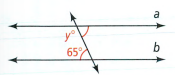
To find – State the theorem to prove a ∥ b.
We can prove a ∥ b, by the converse of the alternate interior angles theorem.
The theorem states, if two lines and a transversal form alternate interior angles that are congruent, then the two lines are parallel.
If two lines and a transversal form alternate interior angles that are congruent, then the two lines are parallel.
Exercise 3.3 Proving Lines Parallel Savvas Geometry Answers Page 160 Exercise 2 Problem 2
Given:
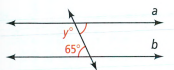
To find – y Use the interior angle theorem.
The interior angle theorem state that, if two parallel lines and a transversal form the same side interior angles, then those angles are supplementary.
In the figure
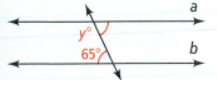
By exterior angle theorem
65° + y = 180°
y = 180° − 65°
y = 115°
The required angle y° is 115°.
Read and Learn More Savvas Learning Co Geometry Student Edition Solutions
Proving Lines Parallel Solutions Chapter 3 Exercise 3.3 Savvas Geometry Page 160 Exercise 3 Problem 3
Given: Alternate interior angle theorem and its converse.
To find – Use of Alternate interior angle theorem and its converse.
When the two lines are given parallel and we have to prove alternate angles are congruent, then the Alternate interior angle theorem is used.
When Alternate angles are given congruent and we have to prove two lines are parallel, then the converse of alternate interior angle theorem is used.
When the two lines are given parallel and we have to prove alternate angles are congruent, then the Alternate interior angle theorem is used and when Alternate interior angles are given congruent and we have to prove two lines are parallel, then the converse of alternate interior angle theorem is used.
Proving Lines Parallel Solutions Chapter 3 Exercise 3.3 Savvas Geometry Page 160 Exercise 4 Problem 4
Given: Flow proofs and two-column proofs.
To find – Similarities and differences of flow proofs and two-column proofs.
Flow proofs are diagrammatic representations of the proofs represented by arrows to reach the conclusion.
Two-column proofs are represented by two columns, one which consists of conclusions and the other consisting of reasons.
The similarity between Flow proofs and Two-column proofs is it is represented by arrows and reaches conclusion step-by-step.
The difference is Flow proof does not include reasons but column proof does include reasons.
The similarity between Flow proofs and Two-column proofs is it is represented by arrows and reach a conclusion step-by-step and the difference is Flow proof does not include reasons but column proof does include reasons.
Savvas Learning Co Geometry Student Edition Chapter 3 Page 160 Exercise 5 Problem 5
Given:
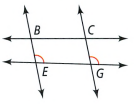
To find – Parallel lines.
Use the converse of the corresponding angle theorem and find parallel lines.
In the figure
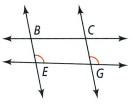
∠E ≅ ∠G
By converse of corresponding angle theorem
Lines BE ∥ CG are parallel and EG is transversal.
The required parallel lines are BE ∥ CG.
Chapter 3 Exercise 3.3 Proving Lines Parallel Savvas Learning Co Geometry Explanation Page 160 Exercise 6 Problem 6
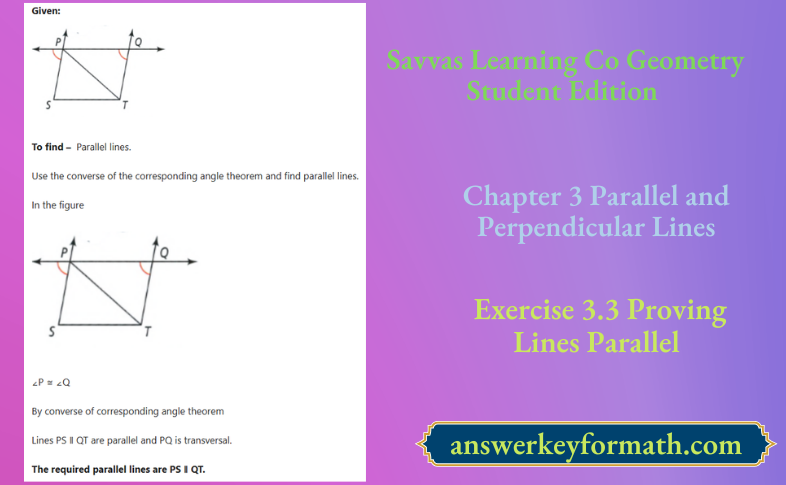
Solutions For Proving Lines Parallel Exercise 3.3 In Savvas Geometry Chapter 3 Student Edition Page 160 Exercise 7 Problem 7
Given:
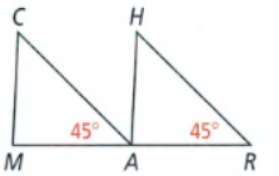
To find – Parallel lines. Use the converse of the corresponding angle theorem and find parallel lines.
In the figure
By converse of corresponding angle theorem
Lines CA ∥ HR are parallel and MR is transversal.
The required parallel lines are CA ∥ HR.
Exercise 3.3 Proving Lines Parallel Savvas Learning Co Geometry Detailed Answers Page 160 Exercise 8 Problem 8
Given:
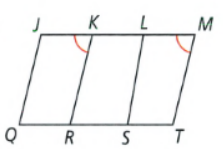
To find – Parallel lines.Use the converse of the corresponding angle theorem and find parallel lines.
In the figure
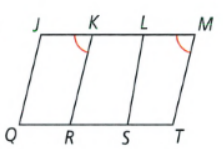
∠ JKR ≅ ∠LMT
By converse of corresponding angle theorem
Lines KR ∥ MT are parallel and JM is transversal.
The required parallel lines are KR ∥ MT.
Exercise 3.3 Proving Lines Parallel Savvas Learning Co Geometry Detailed Answers Page 161 Exercise 9 Problem 9
Given:
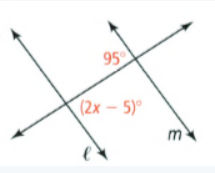
To find – x.
Use the Alternate angle theorem.
In the figure
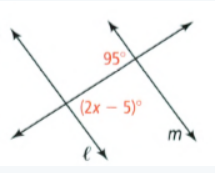
Lines l ∥ m.
By alternate interior angle theorem, 95° = (2x−5)°
⇒ 95 − 5 = 2x
⇒ 90 = 2x
⇒ \(\frac{90}{2}\)= x
⇒ 45 = x or x = 45
The required value of x is 45°.
Geometry Chapter 3 Proving Lines Parallel Savvas Learning Co Explanation Guide Page 161 Exercise 10 Problem 10
Given:
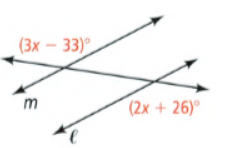
To find – x.
Use the vertical opposite and Alternate angle theorem.
In the figure
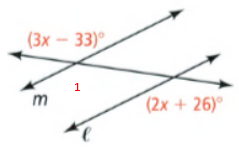
Lines l ∥ m
By vertically opposite angle
∠1 = 3x − 33 ……………………. (1)
By corresponding angle theorem
∠1 = 2x + 26 …………………………. (2)
From equation (1) and (2)
⇒ 3x − 33 = 2x + 26
⇒ 3x − 2x = 26 + 33
⇒ x = 59
The required value of x is 59°.
Geometry Chapter 3 Proving Lines Parallel Savvas Learning Co Explanation Guide Page 161 Exercise 11 Problem 11
Given:
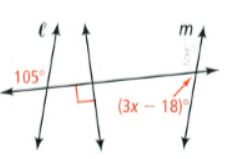
To find – x.
Use the Alternate exterior angle theorem.
In the figure
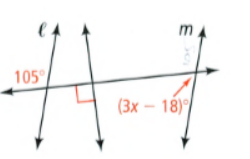
Lines l ∥ m.
By alternate exterior angle theorem
⇒ 105 = 3x − 18
⇒ 105 + 18 = 3x
⇒ 123 = 3x
⇒ \(\frac{123}{3}\) = x
⇒ 41 = x or x = 41
The required value of x is 41°.
Page 161 Exercise 12 Problem 12
Given: ∠2 is supplementary to ∠3.
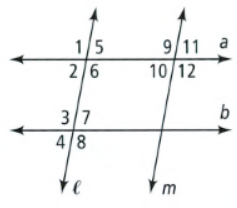
To find – Parallel lines.
Use the converse of the interior angle theorem and find parallel lines.
In figure
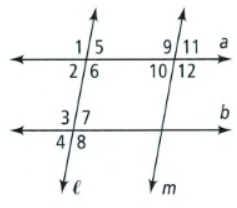
∠2 is supplementary to ∠3
By converse of interior angle theorem
Line a ∥ b are parallel.
The required parallel lines are a ∥ b.
Savvas Learning Co Geometry Student Edition Chapter 3 Page 161 Exercise 13 Problem 13
Given: The given figure is
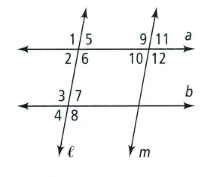
To find – We need to find if ∠1 ≅ ∠3 then proof which lines, if any, are parallel.
When any two parallel lines are intersected by another line called a transversal.
Any two lines are said to be parallel if the Corresponding angles so formed are equal.
Any two lines are said to be parallel if the Alternate interior angles so formed are equal.
Any two lines are said to be parallel if the Alternate exterior angles so formed are equal.
Any two lines are said to be parallel if the Consecutive interior angles on the same side of the transversal are supplementary.
The given information ∠1 ≅ ∠3
If two lines and transversal form corresponding angles that are congruent, then the lines are parallel,∴a and b mare parallel, the line l is the transversal.
∠1 ≅ ∠3 If two lines and transversal form corresponding angles that are congruent, then the lines are parallel So and are parallel, the line is the transversal.
Page 161 Exercise 14 Problem 14
Given: The given figure is
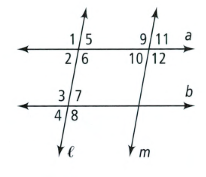
To find – We need to find if ∠6 is supplementary to∠7 then proof which lines, if any, are parallel.
When any two parallel lines are intersected by another line called a transversal.
Any two lines are said to be parallel if the Corresponding angles so formed are equal.
Any two lines are said to be parallel if the Alternate interior angles so formed are equal.
Any two lines are said to be parallel if the Alternate exterior angles so formed are equal.
Any two lines are said to be parallel if the Consecutive interior angles on the same side of the transversal are supplementary.
The given information ∠6 is supplementary to ∠7 if the Consecutive interior angles on the same side of the transversal are supplementary then the two lines are parallel.
∴ a ∥ b
∠6 is supplementary to ∠7 if the Consecutive interior angles on the same side of the transversal are supplementary then the two lines are parallel. so a ∥ b
Savvas Learning Co Geometry Student Edition Chapter 3 Page 161 Exercise 15 Problem 15
Given: The given figure is
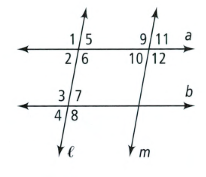
To find – We need to find if ∠9 ≅ ∠12 then proof which lines, if any, are parallel.
When any two parallel lines are intersected by another line called a transversal.
Any two lines are said to be parallel if the Corresponding angles so formed are equal.
Any two lines are said to be parallel if the Alternate interior angles so formed are equal.
Any two lines are said to be parallel if the Alternate exterior angles so formed are equal.
Any two lines are said to be parallel if the Consecutive interior angles on the same side of the transversal are supplementary.
The information given ∠in 9 ≅ ∠12 does not prove that any lines are parallel.
∠9 and ∠12 are vertical angles.
We do not need parallel lines to have vertical angles.
The given information ∠9 ≅ ∠12 does not prove any lines are parallel or not. ∠9 and ∠12 are vertical angles. We do not need parallel lines to have vertical angles.
Page 161 Exercise 16 Problem 16
Given: The given figure is
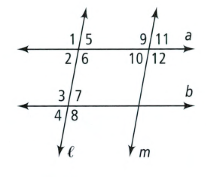
To find – We need to find if m∠7 = 65, m∠9 = 115 then proof which lines, if any, are parallel.
When any two parallel lines are intersected by another line called a transversal.
Any two lines are said to be parallel if the Corresponding angles so formed are equal.
Any two lines are said to be parallel if the Alternate interior angles so formed are equal.
Any two lines are said to be parallel if the Alternate exterior angles so formed are equal.
Any two lines are said to be parallel if the Consecutive interior angles on the same side of the transversal are supplementary.
The given information ∠7 = 65,m∠9 = 115 ∠7 and ∠9 are supplementary, yet they are not any special angle pair of lines.
So no lines are proved to be parallel.
m∠7 = 65,m∠9 = 115 ∠7 and ∠9 are supplementary, yet they are not any special angle pair of lines. So no lines are proved to be parallel.
Savvas Learning Co Geometry Student Edition Chapter 3 Page 161 Exercise 17 Problem 17
Given: The given figure is
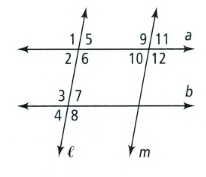
To find – We need to find if ∠2≅∠10 then proof which lines, if any, are parallel.
When any two parallel lines are intersected by another line called a transversal.
Any two lines are said to be parallel if the Corresponding angles so formed are equal.
Any two lines are said to be parallel if the Alternate interior angles so formed are equal.
Any two lines are said to be parallel if the Alternate exterior angles so formed are equal.
Any two lines are said to be parallel if the Consecutive interior angles on the same side of the transversal are supplementary.
The given information ∠2 ≅ ∠10 ∠2 and ∠10 are corresponding angles on the side of the transversal a so the line l is parallel to the line m
∠2 ≅ ∠10, ∠2, and ∠10 are corresponding angles on the side of the transversal so the line is parallel to the line
Page 161 Exercise 18 Problem 18
Given: The given figure is
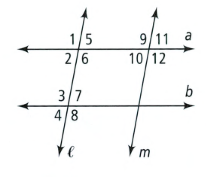
To find – We need to find if ∠1 ≅ ∠8 then proof which lines, if any, are parallel.
When any two parallel lines are intersected by another line called a transversal.
Any two lines are said to be parallel if the Corresponding angles so formed are equal.
Any two lines are said to be parallel if the Alternate interior angles so formed are equal.
Any two lines are said to be parallel if the Alternate exterior angles so formed are equal.
Any two lines are said to be parallel if the Consecutive interior angles on the same side of the transversal are supplementary.
The given information ∠1 ≅ ∠8 ∠1 and ∠8 are alternate exterior angles on the side of the transversal.
Since they are congruent then a ∥ b by the converse of the alternate exterior angles theorem.
∠1 ≅ ∠8 by the converse of the alternate exterior angles theorem a ∥ b
Savvas Learning Co Geometry Student Edition Chapter 3 Page 161 Exercise 19 Problem 19
Given: The given figure is
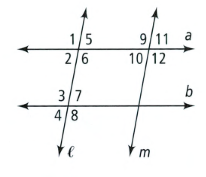
To find – We need to find if ∠8≅∠6 then proof which lines, if any, are parallel.
When any two parallel lines are intersected by another line called a transversal.
Any two lines are said to be parallel if the Corresponding angles so formed are equal.
Any two lines are said to be parallel if the Alternate interior angles so formed are equal.
Any two lines are said to be parallel if the Alternate exterior angles so formed are equal.
Any two lines are said to be parallel if the Consecutive interior angles on the same side of the transversal are supplementary.
The given information ∠8 ≅ ∠6 ∠8 and ∠6 are the corresponding angles on the side of the transversall.
Since they are congruent, then a ∥ b by the converse of the corresponding angles postulate.
∠8 ≅ ∠6, ∠8 and ∠6 are the corresponding angles on the side of the transversal Since they are congruent, then by the converse of the corresponding angles postulate
Page 161 Exercise 20 Problem 20
Given: The given figure is
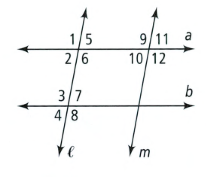
To find – We need to find if ∠11 ≅ ∠7 then proof which lines, if any, are parallel.
When any two parallel lines are intersected by another line called a transversal.
Any two lines are said to be parallel if the Corresponding angles so formed are equal.
Any two lines are said to be parallel if the Alternate interior angles so formed are equal.
Any two lines are said to be parallel if the Alternate exterior angles so formed are equal.
Any two lines are said to be parallel if the Consecutive interior angles on the same side of the transversal are supplementary.
The given information ∠11 ≅ ∠7.
The congruency shown does not follow any theorem or postulate and, therefore, does not prove any lines parallel.
∠11 ≅ ∠7 The congruency shown does not follow any theorem or postulate and, therefore, does not prove any lines parallel.
Savvas Learning Co Geometry Student Edition Chapter 3 Page 161 Exercise 21 Problem 21
Given: The given figure is
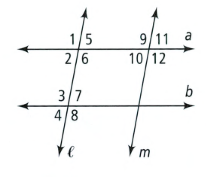
To find – We need to find if ∠5 ≅ ∠10 then proof which lines, if any, are parallel.
When any two parallel lines are intersected by another line called a transversal.
Any two lines are said to be parallel if the Corresponding angles so formed are equal.
Any two lines are said to be parallel if the Alternate interior angles so formed are equal.
Any two lines are said to be parallel if the Alternate exterior angles so formed are equal.
Any two lines are said to be parallel if the Consecutive interior angles on the same side of the transversal are supplementary.
The given information is ∠5 ≅ ∠10 ∠5 and ∠10 are alternate interior angles on the side of the transversal.
Since they are congruent,then l ∥ m by the converse of the alternate interior angles theorem.
∠5 and ∠10 are alternate interior angles on the side of the transversal Since they are congruent, then l ∥ m by the converse of the alternate interior angles theorem.
Page 161 Exercise 22 Problem 22
Given: The given figure is
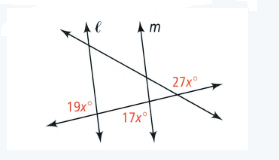
To find – We need to find the value of x for which l ∥ m.
Parallel lines are straight lines that never meet each other no matter how long we extend them.
We know that l ∥ m from the given figure we know that
let ∠1 = 19x
⇒ ∠2 = 17x
⇒ ∠3 = 27x
Now name the angle
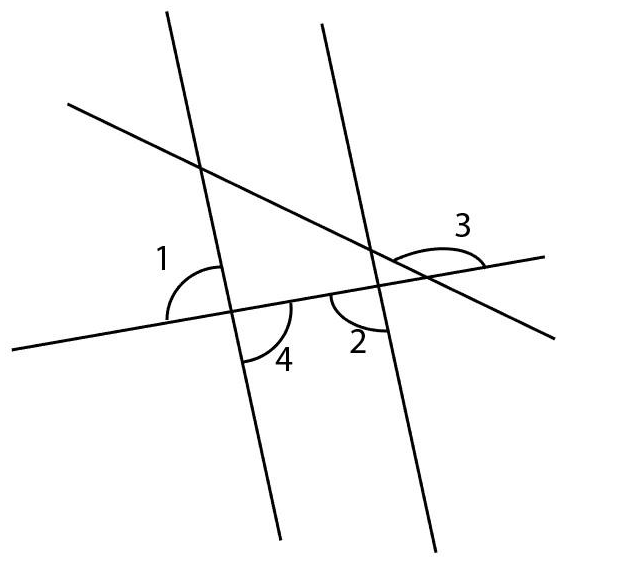
∠4 = ∠1 = 19x
The angle 1 and 4 are vertical.
∴ ∠4 + ∠2 = 180°
⇒ 19x + 17x = 180
⇒ 36x = 180
⇒ x = \(\frac{180}{36}\)
⇒x = 5
The value of x is 5
Savvas Learning Co Geometry Student Edition Chapter 3 Page 161 Exercise 23 Problem 23
Given: The given figure is
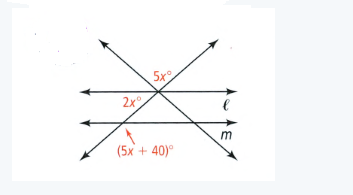
To find – We need to find the value of x for which l ∥ m
Parallel lines are straight lines that never meet each other no matter how long we extend them.
The vertical angles with the (5x + 40)° angle and the 2x° angle are the same side interior angles that must be supplementary so that l ∥ m by the converse of the same side interior angles theorem
So we find that
⇒ (5x + 40) + 2x = 180
⇒ 7x + 40 = 180
⇒ 7x = 140
⇒ x = 20
The value of x is 20
Page 161 Exercise 24 Problem 24
Given: The given figure is
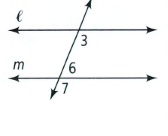
To find – We need to prove the Converse of the Same-Side Interior Angles Theorem, the given value is m∠3 + m∠6 = 180, prove l ∥ m.
Parallel lines are straight lines that never meet each other no matter how long we extend them.
The given condition is m∠3 + m∠6 = 180 ∠3 and ∠6 are supplementary ∠6 and ∠7 are supplementary ∠3 ≅ ∠7
∴ From this condition we know that l ∥ m
∠3 and ∠6 are supplementary ∠6 and ∠7 are supplementary ∠3 ≅ ∠7
∴ From these all conditions we know that l ∥ m
Savvas Learning Co Geometry Student Edition Chapter 3 Page 162 Exercise 25 Problem 25
Given: The given figure and condition is m∠1 = 80−x, m ∠ 2 = 90 − 2x
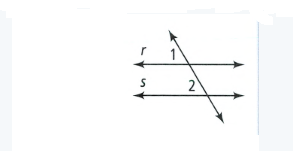
To find – We need to find m∠1 and m∠2
Parallel lines are straight lines that never meet each other no matter how long we extend them.
The given condition is m∠1 = 80 − x, m∠2 = 90 − 2x
∴ 80 − x = 90 − 2x
⇒ −x = 10 − 2x
⇒ x = 10
∴ The angles are
m∠1 = 80 − 10
⇒ m∠1 = 70 and m ∠ 2 = 90 − 2(10)
⇒ m∠2 = 70
The values are x = 10, m ∠ 1 = 70,m ∠ 2 = 70
Page 162 Exercise 26 Problem 26
Given: m∠1 = 60 − 2x, m∠2 = 70 − 4x
To Find – Determine the value of x.
Given
⇒ m∠1 = 60 − 2x
⇒ m∠2 = 70 − 4x
Since corresponding angles are congruent, we have:
⇒ 70 − 40 = 60 − 2x
⇒ 70 − 60 = −2x + 4x
⇒ 10 = 2x
⇒ \(\frac{10}{5}\) = x
⇒ x = 5 or x = 5
Now substitute the value of x to find m:
⇒ m∠1 = 60 − 2(5)
⇒ m∠1 = 60 − 10
⇒ m∠1 = 50
⇒ m∠2 = 70 − 4(5)
⇒ m∠2 = 70 − 20
⇒ m∠2 = 50
The answer is x = 5,m ∠1 = 50 ,m ∠2 = 50
Savvas Learning Co Geometry Student Edition Chapter 3 Page 162 Exercise 27 Problem 27
Given: m∠1 = 40 − 4x , m∠2 = 50 − 8x
To find – Determine value of x and m∠1 and m∠2
Since r ∥ s therefore due to corresponding angles m∠1 = m∠2
Thus, 40 − 4x = 50 − 8x
⇒ 8x − 4x = 50 − 40
⇒ 4x = 10
⇒ x = \(\frac{10}{4}\)
Substituting value of x in m∠1 and m∠2
⇒ m∠1 = 40 − 4x = 40 − 4 × \(\frac{10}{4}\)
= 40 − 10
= 30
m∠2 = 50 − 4x
= 50 − 8 × \(\frac{10}{4}\)
= 50 − 20
= 30
Thus, m∠1 = m∠2 = 30
Thus, value of x = \(\frac{10}{4}\) and m∠1 = m∠2 = 30
Page 162 Exercise 28 Problem 28
Given: m∠1 = 20 − 8x ,m∠2 = 30 − 16x
To find – Determine value of x and m∠1 and m∠2
It is given that r∥s
Thus ,due to corresponding angles m∠1 = m∠2
i.e. 20 − 8x = 30 − 16x
⇒ 16x − 8x = 30 − 20
⇒ 8x = 10
x = \(\frac{10}{8}\)
Substituting value of x in m∠1 and m∠2
m∠1 = 20 − 8x
= 20 − 8 × \(\frac{10}{8}\)
= 20 − 10
= 10
m∠1 = 30 − 16x
= 30 − 16 × \(\frac{10}{8}\)
= 30 − 20
= 10
Thus ,m∠1 = m∠2 = 10
Thus, value of x = \(\frac{10}{8}\) and m∠1 = m∠2 = 10.
Savvas Learning Co Geometry Student Edition Chapter 3 Page 162 Exercise 29 Problem 29
Given: m∠1 ≅ m∠2
To find – Determine which lines will be parallel and why?
Considering the diagram
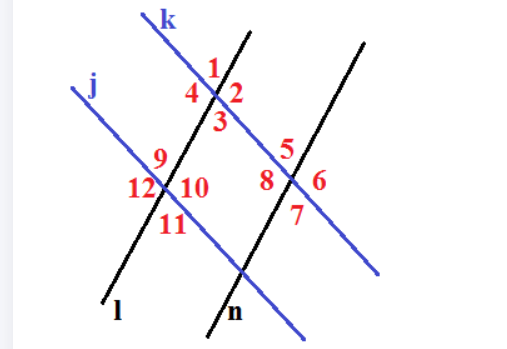
m∠1 = m∠2 ______ (Given)
m∠1 ≅ m∠9 ______ (We add the condition )
According to converse of corresponding angle postulate, the line j and line k are parallel i.e. j ∥ k
m∠1 ≅ m∠5______(We add the condition )
According to converse of corresponding angle postulate, the line l and linen are parallel i.e. l ∥ n
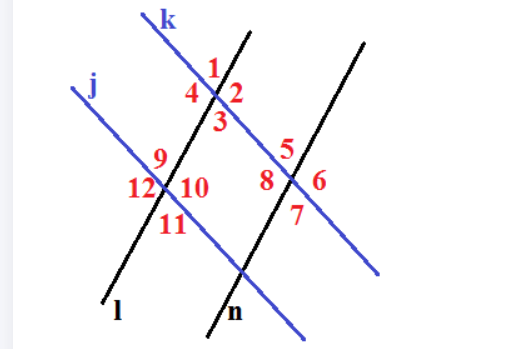
Thus, line j ∥ k and line l ∥ n
Page 162 Exercise 30 Problem 30
Given: m∠8 = 110,m∠9 = 70
To find – Determine which lines will be parallel and why?
Considering the diagram
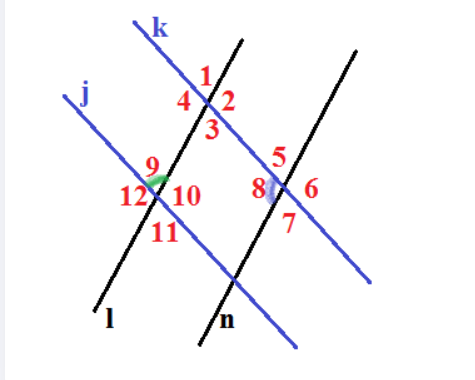
m∠8 = 110, m∠9 = 70 _____ (Given)
m∠9 ≅ m∠3 ________ (We add the condition)
According to converse of alternate angle theorem line k ∥ j
m∠3 + m∠9 = 110 + 70 = 180 so, angle 3 and 8 are supplementary according to converse of same side angle postulate line l and n are parallel i.e. l ∥ n
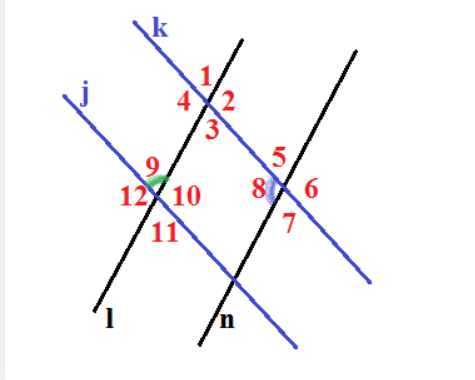
Thus, parallel lines are j ∥ k and l ∥ n
Savvas Learning Co Geometry Student Edition Chapter 3 Page 162 Exercise 31 Problem 31
Given: ∠5 ≅ ∠11
To find – Determine which lines will be parallel
Considering the diagram
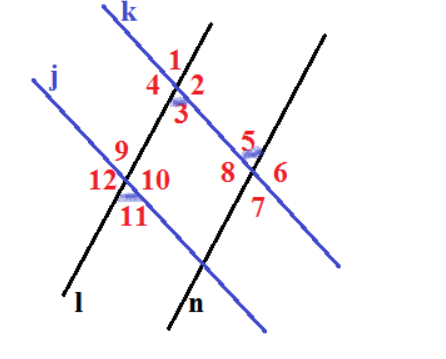
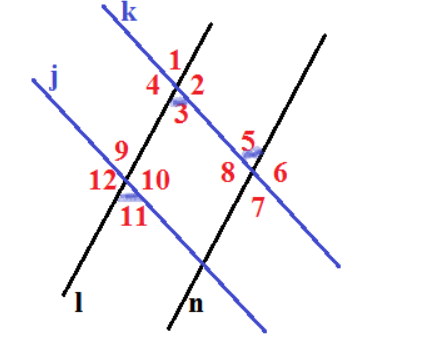
∠5 ≅ ∠11 ______ (Given)
∠11 ≅ ∠3 ______ (We add condition)
∠11 ≅ ∠3
⇒ j ∥ k
According to converse of corresponding angle postulate line j and k are parallel.
Also according to converse of alternate angle postulate line l and n are parallel
i.e.∠5 ≅ ∠3 ⇒ l ∥ n
Thus, line j ∥ k nand line l ∥ n
Page 162 Exercise 32 Problem 32
Given: ∠11 and ∠12 are supplementary.
To find – Determine which lines will be parallel and why?
Considering the diagram
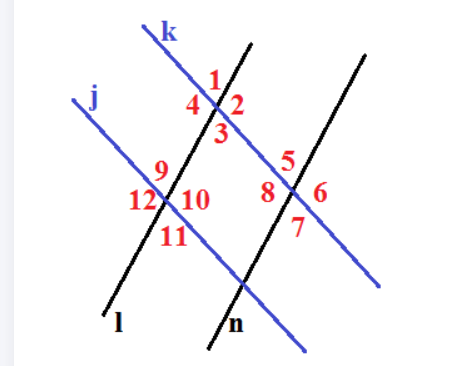
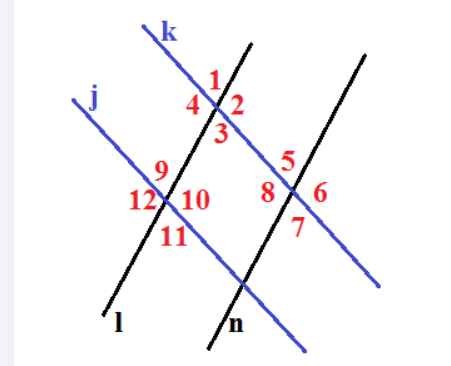
∠11, ∠12 are supplementary _______ (Given)
∠12 ≅ ∠4 ________ (Add condition )
According to converse of corresponding angle postulate line j and k are parallel.
i.e. ∠12 ≅ ∠4
⇒ j ∥ k
Thus, line j and k are parallel
Savvas Learning Co Geometry Student Edition Chapter 3 Page 162 Exercise 33 Problem 33
Given: ∠1 ≅ ∠7
To find – What postulate or theorem can be used to show that l ∥ n.
Since ∠1 and ∠7 are alternate exterior angle on the side of transversal k and since they are congruent then, l ∥ n by converse of exterior angle theorem.
Line l ∥ n by converse of exterior angle theorem.
Page 162 Exercise 34 Problem 34
Given: l ∥ n, ∠12 ≅ ∠8
To find – Draw a flow proof to prove that j∥k
Considering the diagram
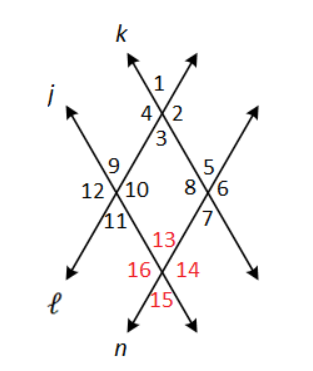
Filling the missing value,we cannot reason ∠12 ≅ ∠4 as the line involved are j and k which are yet to proven parallel.
The flow proof is shown as:
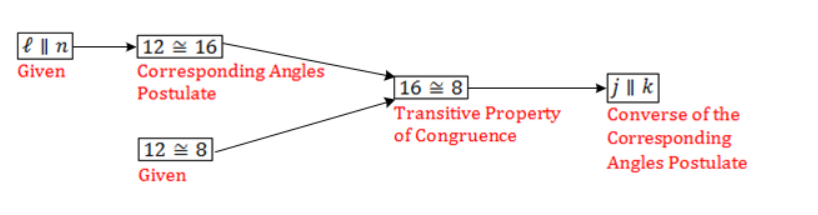
The flow proof that j ∥ k is as follows:
Savvas Learning Co Geometry Student Edition Chapter 3 Page 162 Exercise 35 Problem 35
Given: m ∠P = 72, m∠L = 108, m∠A = 72, m∠N = 108
To find – Sides of the parallelogram that are parallel.
In parallelogram PLAN
m∠P = 72
m∠L = 108
m∠A = 72
m∠N = 108
Here, we observe that m∠P + m∠L = 72 + 108 = 108
I.e. angle P and angle L are supplementary because they are same side interior angle for the transversal PL and the line PN and LA
Hence by converse of same side interior angle theorem side PN ∥ LA
Also,m∠L + m∠A = 72 + 108 = 180
i.e. angle L and angle A are supplementary because they are same side interior angle for the transversal AL and line PL and AN
Hence by converse of same side interior angle theorem side PL ∥ AN
Thus, we got that in parallelogram PLAN PN ∥ LA and PL ∥ AN
Savvas Learning Co Geometry Student Edition Chapter 3 Page 162 Exercise 36 Problem 36
Given: m∠P = 59, m∠L = 37,m∠A = 143, m∠N = 121
To find – Sides of the parallelogram that are parallel.
In parallelogram PLAN
m∠P = 59
m∠L = 37
m∠A = 143
m∠N = 121
Here,m∠P + m∠N = 59 + 121 = 180
Thus, angle P and angle N are supplementary because they are same side interior angle for the transversal PN and lines AN and PL.
Hence by converse of same side interior angle theorem side AL ∥ PL
Also, m∠P + m∠L = 59 + 37 = 96
Thus angle P and angle L are not supplementary i.e. PN ∦ LA
Therefore, AL ∥ PL
Thus, in parallelogram PLAN side AL ∥ PL
Savvas Learning Co Geometry Student Edition Chapter 3 Page 162 Exercise 37 Problem 37
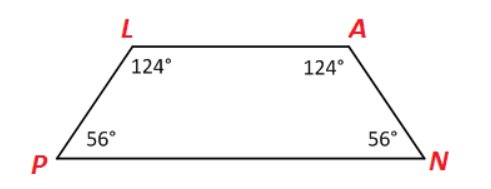
Given: m∠P = 56, m∠L = 124, m∠A = 124, m∠N = 56
To find – Sides of the parallelogram that are parallel.
Parallelogram PLAN can be sketched as:
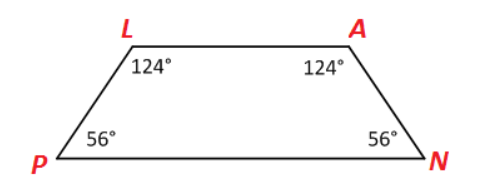
∠P and ∠L are same side interior angle on transversal PL and are supplementary i.e. (124 + 56 = 180)
So, by converse of same side interior angle theorem \(\overline{L A} \| \overline{P N}\) thus \(\overline{L A} \| \overline{P N}\)
Thus, in parallelogram PLAN \(\overline{L A} \| \overline{P N}\) thus \(\overline{L A} \| \overline{P N}\)
Savvas Learning Co Geometry Student Edition Chapter 3 Page 162 Exercise 38 Problem 38
Given: Transversal t, line m ∥ n angle bisector a and b
To find – a ∥ b
Diagram :
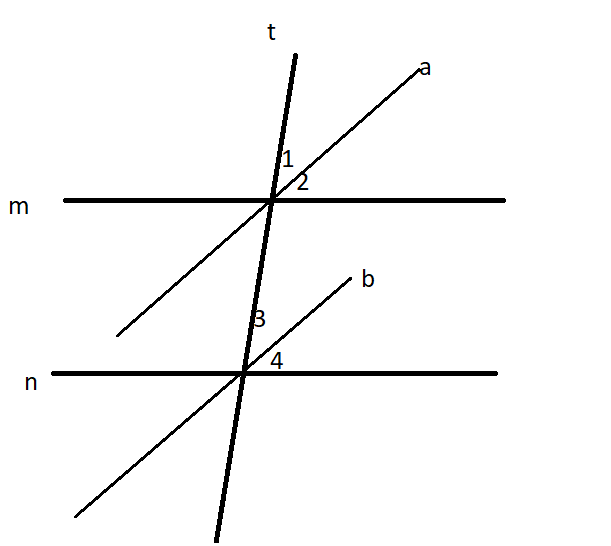
Transversal t ,a ∥ b ∠1 + ∠2 ≅ ∠3 + ∠4 _______ (Corresponding angle postulate)
m∠1 + m∠2 = m∠3 + m∠4 ______ (Definition of congruence angle)
Angle bisector a and b ___________ (Given)
Therefore,m∠1 = m∠2, m∠3 = m∠4
m∠1 + m∠1 = m∠3 + m∠3 __________ (Substitution property)
2m∠1 = 2m∠3
m∠1 = m∠3
Therefore, a ∥ b ________ (Converse of corresponding angle postulate
Thus, a ∥ b
Savvas Learning Co Geometry Student Edition Chapter 3 Page 163 Exercise 39 Problem 39
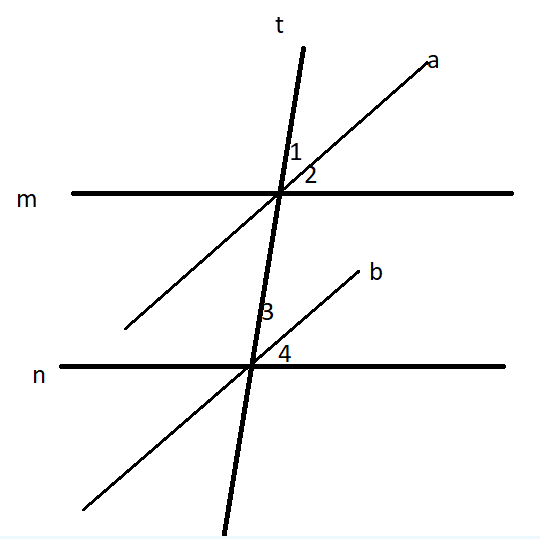
The corresponding angles between the parallel lines have equal measure and the measure of
m∠1 = 180 − 136 = 44 degree
m∠1 = 44 degree
The correct answer is 44 degrees