
Linear Algebra 5th Edition Chapter 1 Vector Spaces Page 20 Problem 1 Answer
Given: V is a vector space and W is a subset of V.
To find: whether the given statement is true or false.
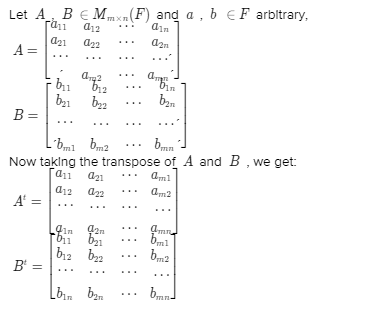
The fields that V and W are vector spaces over are not specified. Those fields need to be equal for the statement to be true.
Assume V=R and W=Q. As W is not a vector space over R , it is not a subspace of V . Therefore, it is false.
Given: V is a vector space and W is a subset of V.
To find: whether the given statement is true or false.
The statement to be true, W must be a vector space over R . But it is not so.
Therefore, the given statement is false as W is not a vector space over R
Read and Learn More Stephen Friedberg Linear Algebra 5th Edition Solutions.
Stephen Friedberg Linear Algebra 5th Edition Solutions For Exercise 1.3 Chapter 1 Page 20 Problem 2 Answer
The given statement is “The empty set is a subspace of every vector space.”
We need to find whether the given statement is true or false.
Let V be any vector space.
According to theorem 1.3, ϕ is a subspace of V if and only if:
⇒ 0∈ϕ
⇒ ∀x,y∈ϕx+y∈ϕ
⇒ ∀c∈F,∀x∈ϕc×xϕ
Since, 0∈ϕ, it is false.
The given statement is “The empty set is a subspace of every vector space.”
We need to tell whether the given statement is true or false.
The statement to be true, the relationship must be 0∉ϕ but it is not so. Thus, it is not true.
Hence, the given statement is false as 0∈ϕ.
Linear Algebra 5th Edition Chapter 1 Page 20 Problem 3 Answer
Given: “If V is a vector space other than the zero-vector space, then V contains a subspace W such that W≠V .”
To find: whether the given statement is true or false.
When V is not the zero-vector space then the zero-vector space is a subspace and we have to prove this statement.
{0} is a subspace of every V and V≠{0} , Therefore it is true.
Given that “If V is a vector space other than the zero-vector space, then V contains a subspace W such that W≠V .”
We have to calculate whether the given statement is true or false.
For the statement to be false, we need to show that {0} is not a subspace of every V . But it is not possible.
Therefore the statement given will be true as {0} is a subspace of every V and V≠{0} .
Linear Algebra 5th Edition Chapter 1 Page 20 Problem 4 Answer
The given statement is “The intersection of any two subsets of V is a subspace of V .”
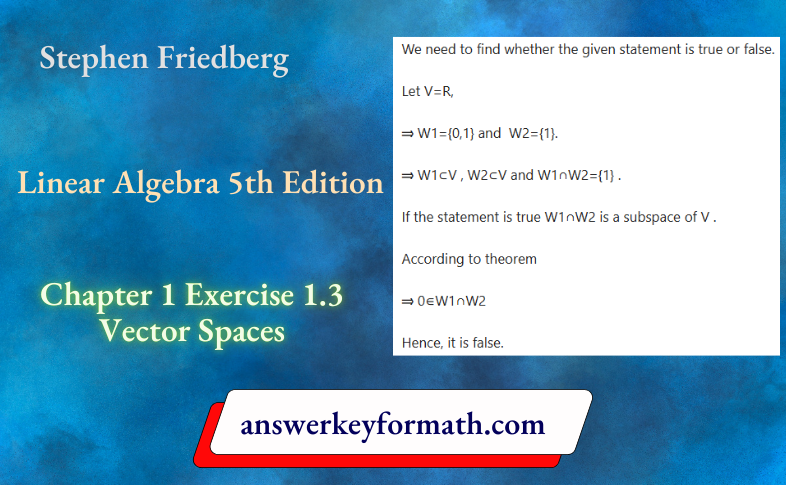
Given: “The intersection of any two subsets of V is a subspace of V .”
To calculate whether the given statement is true or false.
Let V=R ,
⇒ W1={0,1} and W2={1} .
For the statement to be true, we need to represent that 0∉W1∩W2, but we can’t do it. Hence, it is not true.
Therefore, the given statement will be false as 0∈W1∩W2 .
Linear Algebra 5th Edition Chapter 1 Page 20 Problem 5 Answer
Given: “An n×n diagonal matrix can never have more than n nonzero entries.”
To calculate: whether the given statement is true or false.
n×n diagonal matrix has n entries on its diagonal which means it can have less or equal to n non-zero entries. Therefore, the statement is true.
Given: “An n×n diagonal matrix can never have more than n nonzero entries.”
To find whether the given statement is true or false.
For the statement to be false, n×n diagonal matrix has n entries on its diagonal which means it can have more than n non-zero entries, which is not true for a diagonal matrix.
Therefore, the given statement is true as the n×n diagonal matrix has n entries on its diagonal which means it can have less or equal to n non-zero entries.
Chapter 1 Exercise 1.3 Vector Spaces Solved Examples
Linear Algebra 5th Edition Chapter 1 Page 20 Problem 6 Answer
The given statement is “The trace of a square matrix is the product of its diagonal entries.”
We need to find whether the given statement is true or false.
From the tip section, we know that the trace is the sum of the diagonal entries of a square matrix.
Hence, it is false.
The given statement is “The trace of a square matrix is the product of its diagonal entries.”
We need to find whether the given statement is true or false.
For the statement to be true we need to show that the trace of a square matrix is the product of its diagonal entries which is not true.
Hence, the given statement “The trace of a square matrix is the product of its diagonal entries” is false as trace is the sum of the diagonal entries of a square matrix.
Linear Algebra 5th Edition Chapter 1 Page 20 Problem 7 Answer
The given statement is “Let W be the xy− plane R3; that is, W={(a1,a2,0):a1,a2∈R} Then W=R2 .”
We need to find whether the given statement is true or false.
W has elements with 3 coordinates whereas R2 has elements with 2 coordinates so they cannot be the same. Hence it is false.
The given statement is “Let W be the xy− plane R3 ; that is, W={(a1,a2,0):a1,a2∈R} Then W=R2 .”
We need to find whether the given statement is true or false.
For the statement to be true, we need to show that W=R2
but it is not possible as W has elements with 3 coordinates whereas R2 has elements with 2 coordinates.
Hence, the given statement “Let W be the xy− plane R3 ; that is W={(a1,a2,0):a1,a2∈R}
Then W=R2 ” is false as W has element with 3 coordinates whereas R2 has elements with 2 coordinates.
Linear Algebra 5th Edition Chapter 1 Page 20 Problem 8 Answer
We have to prove that (aA+bB)t=aAt+bBt.
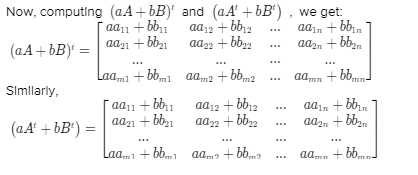
We will use the properties of transpose to prove the given results.
Linear Algebra 5th Edition Chapter 1 Page 20 Problem 9 Answer
It is required to prove that (AT)T=A.
Make use the properties of transpose to prove the given results.
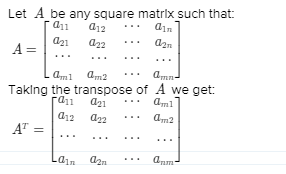
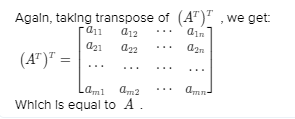
From the above explanation, it is proved that (AT)T=A.
Linear Algebra 5th Edition Chapter 1 Page 20 Problem 10 Answer
It is required to prove that A+AT is a symmetric matrix.
At first take the transpose of A+AT and then check whether it is similar to the matrix or not.
In order to show that A+AT, we need to prove that.
⇒ (A+AT)T=A+AT
Taking transpose of A+AT, we get:
⇒ (A+AT)T.
Using (a+b)T=aT+bT , we get:
⇒ (A+AT)T=AT+(AT)T
Using (AT)T=A
⇒ AT+(AT)T=AT+A .
We know that the addition of the matrix is commutative, so,
⇒ (A+AT)T=A+AT .
Hence, A+AT is a symmetric matrix.
From the above explanation, A+AT is a symmetric matrix.
Friedberg Chapter 1 Vector Spaces Exercise 1.3 Explanation Page 20 Problem 11 Answer
It is required to prove that tr(aA+bB)=atr(A)+btr(B).
Make use of the formula for the trace of a square matrix as mentioned is the tip section.
Let A,B∈Mn×n(F) and a,b∈F.
⇒ tr(aA+bB)=i=1
⇒ ∑n(aAii+bBii)tr(aA+bB)=i=1
⇒ ∑naAii+i=1
⇒ ∑nbBii
Further calculating, we get:
⇒ tr(aA+bB)=ai=1
⇒ ∑nAii+bi=1
⇒ ∑nBii
⇒ tr(aA+bB)=atr(A)+btr(B)
From the above explanation, we proved tr(aA+bB)=atr(A)+btr(B).
Linear Algebra 5th Edition Chapter 1 Page 20 Problem 12 Answer
It is required to prove that diagonal matrices are symmetric matrices.
Make use of the properties of diagonal and symmetric matrices.
Let A∈Mn×n(F) such that
⇒ A={aij
⇒ i = j
⇒ 0 i≠j}
A is symmetric if AT=A .
⇒ AT = AT(ij )
⇒ A = ATji
⇒ AT = {aji j = i
⇒ 0 j ≠ i}
⇒ AT = A
From the above explanation, we proved that diagonal matrices are symmetric matrices.
Linear Algebra 5th Edition Chapter 1 Page 20 Problem 13 Answer
The set, W1={(a1,a2,a3)∈R3:a1=3a2 and a3=−a2} has been given.
We have to determine whether the set is the subspace of R3 under the operations of addition and scalar multiplication defined on R3.
We can let a2=a.
We will verify for addition and multiplication both.
To check for 0,
As we know that, 0∈R , so
⇒ 0R3=(0,0,0)
⇒ 0R3=(3⋅0,0,−0)∈W1
Therefore, W1 isn’t empty.
Now, let a,b∈R, so
⇒ (a,b)R3=(3a,a,−a)+(3b,b,−b)
⇒ (a,b)R3=a(3,1,−1)+b(3,1,−1)
⇒ (a,b)R3=(a+b)⋅(3,1,−1)
⇒ (a,b)R3=(3⋅(a+b),(a+b),−a−b)
As the distributive property is applicable for vectors in R3
⇒ (3a,a,−a)+(3b,b,−b)=(3⋅(a+b),(a+b),−a−b)
This shows that,for all x,y∈W1
⇒ x+y∈W1
It is closed under addition.
Now, let a,b∈R, so
(a,b)R3=b⋅(3a,a,−a)
(a,b)R3=(3(ba),ba,−ba)
This shows that,b⋅x∈W1∀x∈W1,∀b∈R
It is closed under scalar multiplication.
As, W1 is a subset of R3 and it satisfies all the conditions of vector space.
The set W1={(a1,a2,a3)∈R3:a1=3a2 and a3=−a2} is a subspace of R3.
Linear Algebra 5th Edition Chapter 1 Page 20 Problem 14 Answer
The set,
We have to find whether the set is the subspace of R3
under the operations of addition and scalar multiplication defined onR3 .
We will verify for addition and multiplication both.
The given matrix is not a square matrix, that’s why we can’t compute its trace.
Understanding Exercise 1.3 in Friedberg Linear Algebra 5th Edition Chapter 1 Page 20 Problem 15 Answer
The set, W2={(a1,a2,a3)∈R3:a1=a3+2} is given.
We have to find whether the set is the subspace of R3 under the operations of addition and scalar multiplication defined on R3.
We will verify for addition and multiplication both.
We have,W2={(a1,a2,a3)∈R3:a1=a3+2}
{(a1,a2,a3)∈R3:a1=a3+2}={(b+2,a,b)∣∈R3}
Now,(2,0,0)∈W2
Therefore, W2 isn’t empty.
Now, let (a,b),(c,d)∈R , so((a,b),(c,d))R3
=(b+2,a,b),(d+2,c,d)∈W2
⇒ (b+2,a,b),(d+2,c,d)=((d+b)+4,a+c,b+d)
But, (d+b)+4 is not of the form of a1=a3+2 .
Therefore, ((d+b)+4,a+c,b+d)∉W2
⇒ (a,b)R3=(3⋅(a+b),(a+b),−a−b)
So, W2 is not closed under addition.
As, W2 is not closed under addition.
The set W2={(a1,a2,a3)∈R3:a1=a3+2} is not a subspace of R3 .
Linear Algebra 5th Edition Chapter 1 Page 21 Problem 16 Answer
The set, W3={(a1,a2,a3)∈R3:2a1−7a2+a3=0} has been given .
To find if the set is the subspace of R3 under the operations of addition and scalar multiplication explained on R3.
We will verify for addition and multiplication both.
To check for 0 ,
As we know that, 0∈R , so,We have, (2⋅0−7⋅0+0) so (0,0,0)∈W3
Therefore, W3 isn’t empty.
Now, let a1,a2,a3,b1,b2,b3∈R , so2a1−7a2+a3=0∧2b1−7b2+b3=0
Then,(a1,a2,a3)+(b1,b2,b3)=(a1+b1,a2+b2,a3+b3)
So,2(a1+b1)−7(a2+b2)+(a3+b3)=2a1−7a2+a3+2b1−7b2+b3
⇒ 2(a1+b1)−7(a2+b2)+(a3+b3)=0+0
⇒ 2(a1+b1)−7(a2+b2)+(a3+b3)=0
This shows that,∀x,y∈W3,x+y∈W3 and c∈R
It is closed under addition.
Now, let (a1,a2,a3)∈W3 and c∈R , so
⇒ c⋅(a1,a2,a3)=(ca1,ca2,ca3)
⇒ 2ca1−7ca2+ca3=c⋅(2a1−7a2+a3)
⇒ 2ca1−7ca2+ca3=c⋅0
⇒ 2ca1−7ca2+ca3=0
This shows that,c⋅x∈W3∀x∈W3,∀c∈R
It is closed under scalar multiplication.
Since, W3 is a subset of R3 and it satisfies all the conditions of vector space.
The set W3={(a1,a2,a3)∈R3:2a1−7a2+a3=0} is a subspace of R3 .
Linear Algebra 5th Edition Chapter 1 Page 21 Problem 17 Answer
It is given that the set, W4={(a1,a2,a3)∈R3:a1−4a2−a3=0} .
We have to find whether the set is the subspace of R3 under the operations of addition and scalar multiplication defined on R3.
We should check for addition and multiplication both.
To check for 0,
As we know that, 0∈R , so,We have, (0−4⋅0−0)=0 so (0,0,0)∈W4.
Therefore, W4 isn’t empty.
Now, let a1,a2,a3,b1,b2,b3∈R ,
Then,(a1,a2,a3)+(b1,b2,b3)=(a1+b1,a2+b2,a3+b3)
So,(a1+b1)−4(a2+b2)−(a3+b3)=a1−4a2−a3+b1−4b2−b3
⇒ a1−4a2−a3+b1−4b2−b3=0+0
⇒ a1−4a2−a3+b1−4b2−b3=0 .
This shows that,∀x,y∈W4,x+y∈W4 and c∈R
It is closed under addition.
Now, let (a1,a2,a3)∈W3 and c∈R , so c⋅(a1,a2,a3)=(ca1,ca2,ca3)
⇒ ca1−4ca2−ca3=c⋅(a1−4a2−a3)
⇒ ca1−4ca2−ca3=c⋅0
⇒ ca1−4ca2−ca3=0
This shows that,c⋅x∈W4∀x∈W4,∀c∈R
It is closed under scalar multiplication.
As, W4 is a subset of R3 and it satisfies all the conditions of vector space.
The set W4={(a1,a2,a3)∈R3:a1−4a2−a3=0} is a subspace of R3.
Friedberg 5th Edition Chapter 1 Exercise 1.3 Guide Chapter 1 Page 21 Problem 18 Answer
Given: W5={(a1,a2,a3)∈R3:a1+2a2−3a3=1}.To find: verify whether W5 is a subspace of R3 or not.
Analyse whether the zero vector satisfies the condition of W5.
Substitute the value 0 in the equationa1+2a2−3a3=1
⇒ 0+2⋅0−3⋅0=1
As 0≠1, therefore, the zero vector (0,0,0) does not satisfy the condition of W5.
Therefore, the set W5 is not a subspace of R3.
The given subspace W5
={(a1,a2,a3)∈R3:a1+2a2−3a3=1} is not a subspace of R3.
Linear Algebra 5th Edition Chapter 1 Page 21 Problem 19 Answer
Given: W6={(a1,a2,a3)∈R3:5a12−3a22+6a32=0}.
We have to verify whether W6 is a subspace of R3 or not.
Analyse whether the zero vector satisfies the condition of W6.
Analyze whether the zero vector satisfies the given set.
⇒ 5(0)2−3(0)2+6(0)2=0
Therefore, the zero vector (0,0,0) satisfies the condition of W6.
Assume
x=(a1,a2,a3),and y=(b1,b2,b3)be the non-zero vectors in W6
The sum of vectors x+y=(a1,a2,a3)+(b1,b2,b3)
=(a1+b1,a2+b2,a3+b3)
Analyse whether the vector x+y satisfies the conditions of the set W6 or not.
5(a1+b1)2−3(a2+b2)2+6(a3+b3)2
=5(a12+2a1b1+b12)−3(a22+2a2b2+b22)+6(a32+2a3b3+b32)
=5a12+10a1b1+5b12−3a22−6a2b2−b22+6a32+12a3b3+6b32
=(5a12−3a22+6a32)+(5b12−3b22+6b32)+10a1b1−6a2b2+12a3b3
Substitute the given values,
=0+0+10a1b1−6a2b2+12a3b3
=10a1b1−6a2b2+12a3b3≠0
Hence, the set W6 is not a subspace of R3.
The set W6={(a1,a2,a3)∈R3:5a12−3a22+6a32=0} is not a subset of R3.
Linear Algebra 5th Edition Chapter 1 Page 21 Problem 20 Answer
Given that W1={(a1,a2,a3)∈R3:
⇒ a1=3a2 and a3=−a2},
⇒ W3={(a1,a2,a3)∈R3,
⇒ 2a1−7a2+a3=0},
⇒ W4={(a1,a2,a3)∈R3,
⇒ a1−4a2−a3=0}
To find: describe W1∩W3,W1∩W4 and W3∩W4 and observe that each is a surface of R3.
Calculating the representation of W1∩W3={(a1,a2,a3)∈R3:
⇒ a1=3a2,
⇒ a3=−a2,
⇒ 2a1−7a2+a3=0}
⇒ a1−3a2=0,
⇒ a2+a3=0,
⇒ 2a1−7a2+a3=0
Solving the above equations, we get
⇒ a1=0
⇒ a2=0
⇒ a3=0
⇒W1∩W3={0,0,0}
The zero space is a rulespace of every vector space ⇒W1∩W3 is a rulespace of R3.
Calculating the representation of W1∩W3={(a1,a2,a3)∈R3:
⇒ a1=3a2,
⇒ a3=−a2,
⇒ a1−4a2−a3=0}
⇒ a1−3a2=0,
⇒ a2+a3=0,
⇒ a1−4a2−a3=0
⇒a1=3a2,
⇒ −a3=a2
⇒ a1−4a2−a3=0
⇒3a2−4a2+a2=0
⇒0=0
⇒W1∩W3={(a1,a2,a3)∈R3:
⇒ a1=3a2,
⇒ a3=−a2
=W1W1 is a rulespace of R3
⇒W1∩W3 is a rulespace of R3
Calculating the representation of W3∩W4={(a1,a2,a3)∈R3:
⇒ 2a1−7a2+a3=0,
⇒ a1−4a2−a3=0}
⇒ 2a1−7a2+a3=0, ……(1)
⇒ a1−4a2−a3=0 ……(2)
Equation 2−2 equation 1
given a2+3a3=0a1−4a2−a3=0
⇒a2=−3a3,
⇒ a1=−11a3
⇒W3∩W4={(a1,a2,a3)∈R3:
⇒ a2=−3a3,
⇒ a1=−11a3}
We have to show that W3∩W4 is a rulespace of R3.
We know that W3∩W4 is a ruleset of R3
(0,0,0)=0∈W3∩W4…… (if a3=0)
Let x=(x1,x2,x3),
⇒ y=(y1,y2,y3)
⇒ x2=−3×3,
⇒ x1=−11×3,
⇒ y2=−3y3,
⇒ y1=−11y3
⇒ αx+βy=α(x1,x2,x3)+β(y1,y2,y3)
=(αx1+βy1,αx2+βy2,αx3+βy3)
=(−11(αx3+βy3),−3(αx3+βy3),αx3+βy3)
⇒αx+βy∈W3∩W4
⇒W3∩W4 is a rulespace of R3.
We found that all W3∩W4={(0,0,0)},
⇒ W1∩W4=W1,
⇒ W3∩W4={(a1,a2,a3)∈R3:
⇒ a2=−3a3,
⇒ a1=−11a3} are rulespace of R3.
Linear Algebra 5th Edition Stephen Friedberg Exercise 1.3 Walkthrough Chapter 1 Page 21 Problem 21 Answer
Given: W1={(a1,a2,…,an)∈Fn:a1+a2+⋯+an=0} andW2={(a1,a2,…,an)∈Fn:a1+a2+⋯+an=1}
To prove that W1 is a subspace of Fn but W2 is not.
Verify if the set is closed under addition and scalar multiplication.
Check if the given set is closed under addition and scalar multiplication.
Consider (a1,a2,…,an)+c(b1,b2,…,bn)
Since W1 is a subset of V, the scalar multiplication and vector addition holds in W1 also.
Therefore, (a1,a2,…,an)+c(b1,b2,…,bn)=(a1+cb1,a2+cb2,…,an+cbn)
Now, consider (a1+cb1)+(a2+cb2)+…+(an+cbn)
=(a1+a2+…+an)+c(b1+b2+…+bn)
=0+c(0)
=0
(a1+cb1)+(a2+cb2)+…+(an+cbn)=0⇒(a1+cb1,a2+cb2,…,an+cbn)∈W1
Thus, W1 is a subspace of Fn.
Check whether the zero vector satisfies the condition of W2.
⇒ 0+0+⋯+0=1
⇒ 0≠1
Thus, W2 is a subspace of Fn.
As W1 is closed under addition and scalar multiplication and it contains zero vector, hence it is a subset of Fn.
W2 does not satisfy the zero vector condition, therefore, it is not a subset of Fn.
Linear Algebra 5th Edition Chapter 1 Page 21 Problem 22 Answer
It has been given that W={f(x)∈P(F):f(x)=0 or f(x) has degree n}.
We have to find that if W is a subspace of P(F) if n≥1.
Suppose f(x)=xn+xn−1,n−1>0 and g(x)=xn
Therefore, f(x)−g(x)=xn−1.
It is a polynomial of degree neither 0 nor n.
Hence, when a=1,b=−1, it can be concluded that af(x)+bg(x) is not in W but f(x),g(x) are in W.
Thus, the set W is not a subspace.
Whena=1, and b=−1, it can be concluded that af(x)+bg(x) is not in W.
Hence, W is not a subspace.
Linear Algebra 5th Edition Chapter 1 Page 21 Problem 23 Answer
It has been given that W={A:Aij=0 whenever i>j}
We have to prove that W forms a subspace of Mm×n(F).
Show that Rij=0 if i>j.
Assume P and Q be upper triangular m×n matrices with components Pij and Qij respectively.
Also, let R=P+Q
Components of R are given by: Rij=Pij+Qij
Rij={Pij 0
if i≤j
if i>j+{Qij 0
if i≤j if i>j
={Pij+Qij
0 if i≤j if i>j
Hence, Rij=0 if i>j
This show that R is an upper triangular matrix.
As, it has been proved that Rij=0 if i>j, hence R is an upper triangular matrix.
Linear Algebra 5th Edition Chapter 1 Page 21 Problem 24 Answer
It has been given that: S is a non-empty set, therefore, S≠ϕ.To prove: {f∈F(S,F):f(s0)=0}, is a subspace of F(S,F)
for any s0∈S
Verify whether it is closed under addition and scalar multiplication and it contains the zero vector.
As S is a non-empty set, therefore, S≠ϕ.
Suppose Ws 0
={f∈F(S,F)};f(s0)=0
Since 0=0 for all s0∈S
Therefore, one condition is satisfied for proving it to be a subspace of F(S,F).
Calculate if it is closed under addition or not.
Let f,g∈Ws0and c,d∈F.
Thus, f(s0)=g(s0)
g(s0)=0
(cf+dg)(s0)
=(cf)(s0)+(dg)(so)
=c(f(s0))+d(g(s0))
=c(0)+d(0)
=0
Hence, (cf+dg)∈Ws0
Therefore, it can be concluded that it is closed under addition.
Calculate if it is closed under scalar multiplication or not.
Let f∈Ws0 and c∈F.
Hence, f(s0)=0.(cf)(s0)
=c(f(s0))
=c(0)
=0
Thus, it can be concluded that (cf)∈Ws0.
Since all the three conditions are satisfied, therefore,
{f∈F(S,F):f(s0)=0}, is a subspace of F(S,F) for any s0∈S
As it is closed under addition and scalar multiplication and it contains the zero vector, therefore
{f∈F(S,F):f(s0)=0}, is a subspace of F(S,F) for any s0∈S.
Chapter 1 Exercise 1.3 In Stephen Friedberg’s Notes Page 21 Problem 25 Answer
It has been given that: C(S,F) denotes the set of all functions f∈F(S,F) such that f(s)=0 for all but a finite number of element of S.
To prove: C(S,F) is a subspace of f∈F(S,F).
Verify whether it is closed under addition and scalar multiplication and it contains the zero vector.
Suppose f,g∈C(S,F) and c,d∈F
Consider (cf+dg)(s0)
(cf+dg)(s0)=(cf)(s0)+(dg)(se)
=cf(s0)+dg(s0)
=c(0)+d(0) for all but a finite number of elements of S.
=0 for all but a finite number of elements of S.
Thus, cf+dg∈C(S,F) when f,g∈C(S,F) and c,d∈F.
Therefore, C(S,F) is a subspace of F(S,F).
Hence, proved.
Assume (cf+dg)(s0)=(cf)(s0)+(dg)(se)
=cf(s0)+dg(s0)
=c(0)+d(0) for all but a finite number of members of S.
=0 for all but a finite number of members of S.
Thus, cf+dg∈C(S,F)whenf,g∈C(S,F);c,d∈F.
Therefore, C(S,F) is a subspace of F(S,F).
Therefore, proved.
Linear Algebra 5th Edition Chapter 1 Page 21 Problem 26 Answer
It has been given a set of all differentiable real-valued functions defined on R.
To calculate if it is a subspace of C(R) or not.
Verify if it is closed under addition and scalar multiplication and it contains the zero vector to determine if it is a subspace of C(R) or not.
The derivative of a zero function exists, 0′=0
Hence, 0∈D(R).
Thus, one condition is satisfied for proving it to be a subspace of F(S,F).
Calculate if it is closed under addition or not.
Explain the set D(R).
D(R)={f:f is differentiable real valued function on R.
Suppose that f and g are differentiable functions in D(R).
f′ and g′ exists in D(R), therefore, f∈D(R) and g∈D(R).
Therefore, f′+g′=(f+g)′ which implies (f+g)∈D.
Calculate whether it is closed under scalar multiplication or not.
As a constant multiple of a differentiable real valued function is differentiable, hence, c(f′)=(cf)′, thus (cf)∈D.
As all the three conditions are satisfied, therefore, the set of all differentiable real-valued functions defined on R is a subset of C(R).
A set of all differentiable real-valued functions defined on R will be closed under addition and scalar multiplication and it contains the zero vector, hence, it is a subset of C(R).