
Linear Algebra 5th Edition Chapter 1 Vector Spaces
Page 62 Problem 1 Answer
Given statement is: “Every family of sets contains a maximal element.”
Check whether the statement is true or false.
Use the definition and properties of Vector Space.
In the family of open intervals, there are no maximal elements.
Consider the{(0,n)} family, where n≥1. As a result, there are no maximum elements in this family.
Given statement is:
“Every family of sets contains a maximal element.”
Verify whether the statement is true or false.
Use the definition and properties of Vector Space.
It is not possible that in every family set, a maximal element is present. So, the statement cannot be true.
Hence, the statement “Every family of sets contains a maximal element” is FALSE.
Page 62 Problem 2 Answer
The given statement is:
“Every chain contains a maximal element.”
To verify whether the statement is true or false.
We can solve this by using the definition and properties of Vector Space.
In the family of open intervals, there are no maximal elements in terms with real numbers.
Consider the {(0,n)} family, where n≥1. As a result, there are no maximum elements in such a family.
The given statement is:
“Every chain contains a maximal element.”
To verify whether the statement is true or false.
Read and Learn More Stephen Friedberg Linear Algebra 5th Edition Solutions
We can solve this by using the definition and properties of Vector Space.
It is not possible that in every family set, a maximal element is present in terms with real numbers. So the statement can never be true.
Therefore, the given statement “Every chain contains a maximal element” is FALSE.
Stephen Friedberg Linear Algebra 5th Edition Solutions For Exercise 1.7 Page 62 Problem 3 Answer
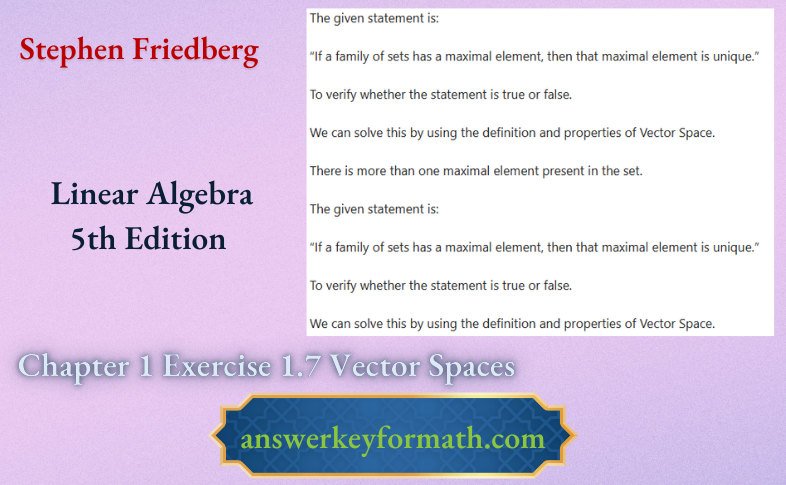
It is not possible that in a family set, a unique maximal element is present as there is more than one maximal element present in the set.
So the statement can never be true.
Therefore, the given statement “If a family of sets has a maximal element, then that maximal element is unique” is FALSE.
Page 62 Problem 4 Answer
The given statement is:
“If a chain of sets has a maximal element, then that maximal element is unique.”
To verify whether the statement is true or false.
We can solve this by using the definition and properties of Vector Space.
Consider there are two maximal elements A and B. As they are in a chain, A⊆B
and B⊂A. So,A=B i.e., A and B are maximal elements.
The given statement is:
“If a chain of sets has a maximal element, then that maximal element is unique.”
To verify whether the statement is true or false.
We can solve this by using the definition and properties of Vector Space.
It is not possible that in a chain, more than one maximal element to be present.
So the statement can never be false.
Therefore, the given statement “If a chain of sets has a maximal element, then that maximal element is unique” is TRUE.
Page 62 Problem 5 Answer
The given statement is:
“A basis for a vector space is a maximal linearly independent subset of that vector space.”
To verify whether the statement is true or false.
We can solve this by using the definition and properties of Vector Space.
Assume there is a basis for an independent set.
The linear combination of vectors is not stated for the purpose of forming a basis.
The given statement is:
“A basis for a vector space is a maximal linearly independent subset of that vector space.”
To verify whether the statement is true or false.
We can solve this by using the definition and properties of Vector Space.
It is not possible that the basis for a vector space is not a subset of that vector space that is maximally linearly independent.
So the statement can never be false.
Therefore, the given statement “A basis for a vector space is a maximal linearly independent subset of that vector space” is TRUE.
Chapter 1 Exercise 1.7 Vector Spaces Solved Problems Page 62 Problem 6 Answer
The given statement is:
“A basis for a vector space is a maximal linearly independent subset of that vector space.”
To verify whether the statement is true or false.
We can solve this by using the definition and properties of Vector Space.
Assume there exist certain elements of a vector space’s basis.
As a result, they create the most linearly independent system.
As a result, a basis is a vector space’s largest linearly independent subset.
The given statement is:
“A basis for a vector space is a maximal linearly independent subset of that vector space.”
To verify whether the statement is true or false.
We can solve this by using the definition and properties of Vector Space.
It is not possible that the basis for a vector space is not a maximal linearly independent subset of that vector space.
So the can never be False.
Therefore, the given statement “A basis for a vector space is a maximal linearly independent subset of that vector space” is TRUE.
Page 62 Problem 7 Answer
Given that the set of sequences is convergent.
To prove that the set of convergent sequences is an infinite-dimensional subspace of the vector space of all sequences of real numbers.
We can solve this by using the definition and properties of vector space.
Consider the sequence {sinn}
From Taylor’s expansion, every real valued function can be written as sum of series of either finite or infinite terms as:
⇒ sinx=0
⇒ ∑∞(−1)0x2n+1
⇒ (2n+1)!
So, this is a polynomial of infinite degree in z. As a result, real-valued convergent sequences can be expressed as polynomials of finite or infinite degree.
Denoting
V={{an}:{an}is a convergent sequence of real numbers}
V is an infinite dimensional set of polynomials as at least one member of V is of infinite degree.
We will prove that V is a vector space using various properties as:
Closure law
If some sequence {an} and {bn} converges to a and b, then {an+bn} converges to a+b.
Scalar multiplication law
By properties of convergent sequences, we know {kan} converges to ka.
Zero{0} is the convergent sequence to 0 such that
{an}+{0}={an}
for every {an} in V.
Associativity
By associativity of real numbers, we know (a+b)+c = a+(b+c). Since ({an}+{bn})+{cn} converges to (a+b)+c, we get
({an}+{bn})+{cn}={an}+({bn}+{cn})
Abelian property
From abelian property for real numbers, we get
{an}+{bn}={bn}+{an}
Inverse
In the case when {an} converges to a, then {−an} converges to −a, hence additive inverse of a convergent sequence is also a convergent sequence.
Distributivity law
We know k{an+bn}
converges to k(a+b). From distributivity of real numbers we have
k(a+b)=ka+kb
On the other hand, k{an}+k{bn} converges to ka+kb. So,k{an+bn}=k{an}+k{bn}
Since (k+l){an} converges to (k+l)a , (k+l)a=ka+k land k{an}+l{an}
converges to ka+la
we have (k+l){an}=k{an}+l{an}
Multiplicative associativity
k(l{an}) converges to k(la). For the real numbers, it is well-known k(la)=(kl)a. We know that kl{an}converges to (kl)a, so
k(l{an}) = kl{an}
We know 1{an} converges to 1a, 1a = aso 1{an}converges to a, hence1{an}={an}
If the sequence {an} converges to a and {bn} converges to b, then for all real numbers x
we have
⇒ {an}+x{bn}={an+xbn}
from linearity of limits. Finally, the convergent sequences from a subspace of V
(real sequence).
We’ll use the fact that any two sequences of differing lengths are linearly independent to demonstrate that the subspace is infinitely dimensional
. There is no finite basis for this space since the number of terms in the sequence has an infinite number of possibilities.
Finally, space is an infinite-dimensional.
Hence, space is infinite-dimensional.
Linear Algebra Friedberg Exercise 1.7 Detailed Explanation Page 62 Problem 8 Answer
Given that π is transcendental and V is a set of real numbers regarded as a vector space over the field of rational numbers.
To prove that V is infinite-dimensional.
We can solve this by using the definition and properties of vector space and basis.
Assume that the elements
√2,√3,√5,… and π,π2,π3,…form a linearly independent set.
Because Q(rational numbers) is countable, the subset R created by the only countable set is also countable.
However, because R(real numbers) is an uncountable set, there is no set that forms a basis of R over Q, hence V is an infinite-dimensional set over a rational field.
Hence, V is an infinite-dimensional set over a field of rational.
Page 62 Problem 9 Answer
Given that W is a subspace of a vector space V.
To prove that any basis for W is a subset of a basis for V.
We can solve this by using the definition and properties of vector space and basis.
Assume
⇒ {α1,α2,…,αn}
be the basis for the finitely generated vector space over a field F.
If we suppose that there exists a linearly independent subspaces W of V, then W is finite-dimensional subset and let
S={β1,β2,…,βm} be its basis. We will prove that we can extend S to the basis for V.
Assume
S1={β1,β2,…,βm,α1,α2,…,αn}
so, we have L(S1)=V. Since β1,β2,…,βm can be express as linear combination α1,α2,…,αn so S1 is linearly independent.
There is one vector from S1 which is a linear combination of preceding vectors.
We will suppose that is αi.
Without that vector we get the set
S2={β1,β2,…,βm,α1,α2,…,αi−1,αi+1,αn}
We now get L(S2)=V, so S2 is a basis for V and it is the required extended set which forms a basis of V
. If S2 isn’t a linearly independent set, continue in the same way. Then V contains S, so S can be extended to the basis for V.
Finally, any basis of W is a subset of the basis for V.
Hence, the basis of W is a subset of the basis for V.
Page 62 Problem 10 Answer
Given that β is subset of an infinite-dimensional vector space V and β is a basis for V
if and only if
⇒ v=c1u1+c2u2+…+cnun
To prove an infinite-dimensional version of Theorem 1.8.
We can solve this by using the definition and properties of vector space and basis.
Assume β be the basis for V and v∈V. So,v∈span(β) from span(β)=V.
Thus, v is a linear combination of the vectors of β.
Suppose that
⇒ v=c1u1+c2u2+…+cnun ..(1)
and v=b1u1+b2u2+…+bnun ..(2)are two representations of v.
Subtracting equation (2) from (1),
⇒ 0=(c1−b1)u1+(c2−b2)u2+…+(cn−bn)un
From linear independence for β,
⇒ c1−b1=c2−b2=…=cn−bn
So,c1=b1,c2=b2,…,cn=bn
So, v is uniquely expressed as a linear combination of the vectors from β.
Hence, β is the basis for Vif and only if each nonzero vector of Vis uniquely expressed as a linear combination of the vectors from β.
Vector Spaces Exercise 1.7 Examples Friedberg Chapter 1 Page 63 Problem 11 Answer
In the problem statement, the given theorem is Theorem 1.9.
To prove the generalization of Theorem 1.9, use the definition and properties of vector space and basis.
Let F be the family of all linearly independent subsets of S2 that contain S1.
Using the well-known theorem:
Let F be the family of all linearly independent subsets of V such that it contains S. To show that F
contains a maximal element, we have to show that if C is a chain in F, then there exists a member U of F that contains each member of C.
In that case, we claim that U, the union of members from C
is the required set.
The set U, as union, contains each member of C and we have only to show that U∈F (it means U is a linearly independent subset of V that contains S).
As each member of C is a subset of V which contains S, we know
S⊆U⊆V
We need to prove the linear independence of U.
Assume the following vectors:
{u1, u2,…, un} ∈Uand scalars {c1, c2,…, cn}
such that
⇒ c1u1 + c2u2 + … + cnun = 0
Since ui∈U for all i = 1,2,…, n there exists Ai, set in C such that ui∈Ai.
As C is in chain, so one of these sets, At contains all others, so ui∈At for all i = 1,2,…, n.
Since At is linearly independent, we have
⇒ c1u1 + c2u2 + … + cnun = 0
⇒ c1 = c2 = … = cn = 0
Finally, U is linearly independent. By the maximal principle, F has a maximal element which is a maximal linearly independent subset of V that contains S.
There is a maximal element β in F by maximal principle. This implies that β generates S2 and so generates V, so β is the basis for V.
Hence, the generalization of Theorem 1.9 is proved.
Page 63 Problem 12 Answer
Given theorem is Replacement Theorem.
Use the definition and properties of vector space and basis.
We need to prove the generalization of the Replacement Theorem.
Assume βto be the basis of some vector space V.
For instance,
S={b1,b2,…,bk}
Is linearly independent subset of V. S1 denotes all elements of β.
Extending $S$ to the basis of $U$ as:
S1={b1,b2,…,bk,a1,a2,…,am}
So, L(S1)=V
Every bi can be expressed as a linear combination of ai, so S1 is linearly independent.
Thus, the vector from V can be written as a linear combination of vectors from S∪S1.
Finally, S∪S1 is linearly independent and it forms the basis of V.
Therefore, the generalization of Replacement Theorem is proved.