
Linear Algebra 5th Edition Chapter 2 Linear Transformations and Matrices
Page 116 Problem 1 Answer
Given:
β={x1,x2,x3,x4,….,xn}
β′={x′1,x′2,x′3,x′4,….,x′n}
To find: The jth column of Q is [xj]β′.
To determine whether the statement is true or false.
Now,
xj′=i=1∑nQijxi,jxj′=1,2,3,….,n
Thus, the jth column of Q is [xj′]β
Since the jth column of Q is [xj′]β, and hence, the given statement is false.
Page 116 Problem 2 Answer
Given Statement: Every change of coordinate matrix is invertible.
To find: Whether the given statement is true or false.
Since the change of matrix can be written as,
⇒ Q=[IV]β′β
As IV is the identity transformation. So, it is invertible.
Since IV is invertible, then Q is also invertible.
Therefore, the given statement is true.
Since IV is invertible, then Q is also invertible and hence, the given statement is true.
Read and Learn More Stephen Friedberg Linear Algebra 5th Edition Solutions
Stephen Friedberg Linear Algebra 5th Edition Solutions For Exercise 2.5 Chapter 2 Page 116 Problem 3 Answer
Given: T be a linear operator on a vector space with finite dimensions V.
Ordered bases for V are β and β′.
The change of coordinate matrix is Q.
To prove: [T]β=Q[T]β′
⇒ Q−1
Let, β and β′ be (x1,x2,x3,x4,….,xn) and (x′1,x′2,x′3,x′4,….,x′n) .
Since the change of matrix can be written as,
⇒ Q=[IV]β′β
As IV is the identity transformation, then use the identity property;
⇒ TI=IT
⇒ TI=T
Now, the matrix [T]β is
⇒ Q[T]β′=[I]−ββ
⇒ [T]−ββ
⇒ Q[T]β′
=Q[T]β
Hence,
⇒ Q[T]β′
=Q[T]β[T]β
=Q[T]β′Q−1
Therefore, the given statement is true.
Since, [T]β=Q[T]β′
Q−1 is proved and hence, the given statement is true.
Linear Algebra 5th Edition Chapter 2 Page 116 Problem 4 Answer
Linear Algebra 5th Edition Chapter 2 Page 116 Problem 5 Answer
Given: Let T be a linear operator on a vector space with finite dimensions V.
To prove: [T]β is similar to [T]γ.
According to similar matrices property,
If T is a linear operator on V then the matrices [T]β and [T]γ. So, it must follow the relation,
⇒ [T]γ=Q−1
⇒ [T]βQ
Therefore, the given statement is true.
Since, [T]γ=Q−1[T]βQ is proved and hence, the given statement is true.
Page 117 Problem 6 Answer
Given in the question are,
⇒ β={e1,e2} and β′={(a1,a2),(b1,b2)}
To find: [IR2]β′β=?
For finding the change of coordinate matrix, find (a1,a2) and (b1,b2), then put the values in [IR2]β′β.
Let, Q=[IR2]β′β
Now, find (a1,a2)
(a1,a2)=a1×(1,0)+a2×(0,1)(a1,a2)=a1×e1+a2×e2
Now, find (b1,b2)
(b1,b2)=b1×(1,0)+b2×(0,1)(b1,b2)=b1×e1+b2×e2
Therefore,
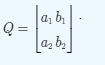
The change of coordinate matrix is,
Chapter 2 Exercise 2.5 Linear Transformations Solved Problems Linear Algebra 5th Edition Page 117 Problem 7 Answer
Given in the question are,
β={(−1,3),(2,−1)} and β′={(0,10),(5,0)}
To find: [IR2]β′β=?
For finding the change of coordinate matrix, find (0,10) and (5,0) , then put the values in [IR2]β′β.
Let, Q=[IR2]β′β
Now, find (0,10)
⇒ (0,10)=A×(−1,3)+B×(2,−1)
⇒ (0,10)=(−A,3A)+(2B,−B)
⇒ (0,10)=(−A+2B,2A−B)
On equating,
⇒ −A+2B=0 .. (1)
⇒ 2A−B=10 .. (2)
Solve the equation (1) and (2), get the results as
⇒ A=4
⇒ B=2
Therefore,
⇒ (0,10)=4×(−1,3)+2×(2,−1)
Now, find (0,10)
⇒ (5,0)=A×(−1,3)+B×(2,−1)
⇒ (5,0)=(−A,3A)+(2B,−B)
⇒ (5,0)=(−A+2B,2A−B)
On equating,
⇒ −A+2B=5 .. (3)
⇒ 2A−B=0 .. (4)
Solve the equation (3) and (4), get the results as
⇒ A=1
⇒ B=3
Therefore,
(5,0)=1×(−1,3)+3×(2,−1)
The change of coordinate matrix is,

Linear Algebra 5th Edition Chapter 2 Page 117 Problem 8 Answer
Given in the question are,
β={(2,5),(−1,−3)} and β′={e1,e2}
To find: [IR2]β′β=?
For finding the change of coordinate matrix, find (1,0) and (0,1), then put the values in [IR2]β′β.
Let, Q=[IR2]β′β
Now, find (1,0)
⇒ (1,0)=A×(2,5)+B×(−1,−3)
⇒ (1,0)=(2A,5A)+(−B,−3B)
⇒ (1,0)=(2A−B,5A−3B)
On equating,
⇒ 2A−B=1 .. (1)
⇒ 5A−3B=0 .. (2)
Solve the equation (1) and (2), get the results as
⇒ A=3
⇒ B=5
Therefore,
(1,0)=3×(2,5)+5×(−1,−3)
Now, find (0,1)
⇒ (0,1)=A×(2,5)+B×(−1,−3)
⇒ (0,1)=(2A,5A)+(−B,−3B)
⇒ (0,1)=(2A−B,5A−3B)
On equating,
⇒ 2A−B=0 .. (3)
⇒ 5A−3B=1 .. (4)
Solve the equation (3) and (4), get the results as
⇒ A=−1
⇒ B=−2
Therefore,
(0,1)=−1×(2,5)−2×(−1,−3)
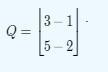
The change of coordinate matrix is,
Linear Algebra 5th Edition Chapter 2 Page 117 Problem 9 Answer
Given in the question are, β={(−4,3),(2,−1)} and β′={(2,1),(−4,1)}
To find: [IR2]β′β=?
For finding the change of coordinate matrix, find (2,1) and (−4,1) , then put the values in [IR2]β′β.
Let, Q=[IR2]β′β
Now, find (2,1)
⇒ (2,1)=A×(−4,3)+B×(2,−1)
⇒ (2,1)=(−4A,3A)+(2B,−B)
⇒ (2,1)=(−4A+2B,3A−B)
On equating,−4A+2B=2 .. (1)
⇒ 3A−B=1 .. (2)
Solve the equation (1) and (2), get the results as
⇒ A=2
⇒ B=5
Therefore,
⇒ (2,1)=2×(−4,3)+5×(2,−1)
Now, find (−4,1)
⇒ (−4,1)=A×(−4,3)+B×(2,−1)
⇒ (−4,1)=(−4A,3A)+(2B,−B)
⇒ (−4,1)=(−4A+2B,3A−B)
On equating,−4A+2B=−4 .. (3)
⇒ 3A−B=1 .. (4)
Solve the equation (3) and (4), get the results as
⇒ A=−1
⇒ B=−4
Therefore,
⇒ (−4,1)=−1×(−4,3)−4×(2,−1)
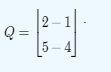
The change of coordinate matrix is,
Linear Algebra Friedberg Exercise 2.5 Step-By-Step Solutions Chapter 2 Page 118 Problem 10 Answer
In the question, Given vector space over field Mn×n(F).
To prove “is similar to” is an equivalence relation on Mn×n(F) or not.
Prove that it is reflexive, symmetric and transitive to prove it equivalence.
Given vector space over field Mn×n(F).
Reflexive relation: Let A∈Mn×n(F)
Clearly, we can say that A is similar to A .
So, it is a reflexive relation.
Symmetric relation: Let A,B∈Mn×n(F) and A is similar to B .
Then, clearly, we can say that, B is similar to A .
So, it is a symmetric relation.
Transitive relation: Let A,B,C∈Mn×n(F) and A is similar to B and B is similar to C.
Then, clearly, we can say that A is similar to C .
So, it is a transitive relation.
Hence, “is similar to” is an equivalence relation on Mn×n(F)
Hence, “is similar to” is an equivalence relation on Mn×n(F) .
Page 118 Problem 11 Answer
Given in question that, A and B are similar n×n matrices.
In this we need to prove tr(A)=tr(B) .
As we know, if A and B are similar n×n matrices, then there exists an invertible matrix P such that B=P−1AP.
Solve by taking traces on both sides.
Given that, A and B are similar n×n matrices.
Consider B=P−1AP
Taking trace on both sides, we get,trB=tr(P−1AP)
Applying tr(A)=tr(B) , we get,
⇒ trB=tr(P−1(AP))
⇒ trB=tr((AP)P−1)
⇒ trB=tr(A(PP−1))
⇒ trB=tr(AI)
⇒ trB=trA
Hence, if A and B are similar n×n matrices, then tr(A)=tr(B).
Linear Algebra 5th Edition Chapter 2 Page 118 Problem 12 Answer
Given data: The given data is a finite-dimensional vector space.
To define: The trace of a linear operator on a finite-dimensional vector space and justify that the definition is well defined.
Observe that the trace of a linear operator T: V→V is tr([T]β) where β is the basis for V.
Now, consider α and β to be the 2 bases of V and consider T: V→V. Using exercise-8 it is clearly known that ∃ matrices P and P−1 as shown below,
Therefore,
⇒ [T]α=P[T]βP−1
And, henceforth by the definition of the similar matrices, it can be clearly obtained that [T]α and [T]β are similar matrices and using part (a), it implies,
⇒ tr([T]α)=tr([T]β)
Thus, it can be clearly the trace of a linear operator on a finite dimensional vector space can be clearly defined and justified that the definition is well defined.