
Linear Algebra 5th Edition Chapter 2 Linear Transformations and Matrices
Page 124 Problem 1 Answer
Given in the question that, All vector spaces are finite-dimensional while the given statement is, Every linear transformation is a linear functional.
To determine whether the given statement is true or false.
It is given that all vector spaces are finite-dimensional.
According to the definition of a linear functional, there is a mapping of linear transformation from a vector space V into its field of scalars F is itself a vector space.
Thus, conclude that every linear transformation is not linear functional since linear transformations into its field of scalars are linear functional.
Hence, the given statement is false.
The given statement “Every linear transformation is a linear functional” is false.
Linear Algebra 5th Edition Chapter 2 Page 124 Problem 2 Answer
Given in the question that, All vector spaces are finite-dimensional while the given statement is, A linear functional defined on a field may be represented as a 1×1 matrix.
To determine whether the given statement is true or false.
It is given that all vector spaces are finite-dimensional.
According to the definition of a linear functional, there is a mapping of linear transformation from a vector space V into its field of scalars F, which is itself a vector space of dimension 1 over F.
Thus, conclude that both domain and codomain of a linear functional on a field F
will have the dimension 1.
Hence, the given statement is true since its domain and codomain have dimension 1.
The given statement “A linear functional defined on a field may be represented as a 1×1 matrix” is true.
Read and Learn More Stephen Friedberg Linear Algebra 5th Edition Solutions
Stephen Friedberg Linear Algebra 5th Edition Solutions For Exercise 2.6 Chapter 2 Page 124 Problem 3 Answer
Given in the question that, All vector spaces are finite-dimensional while the given statement is, Every vector space is isomorphic to its dual space.
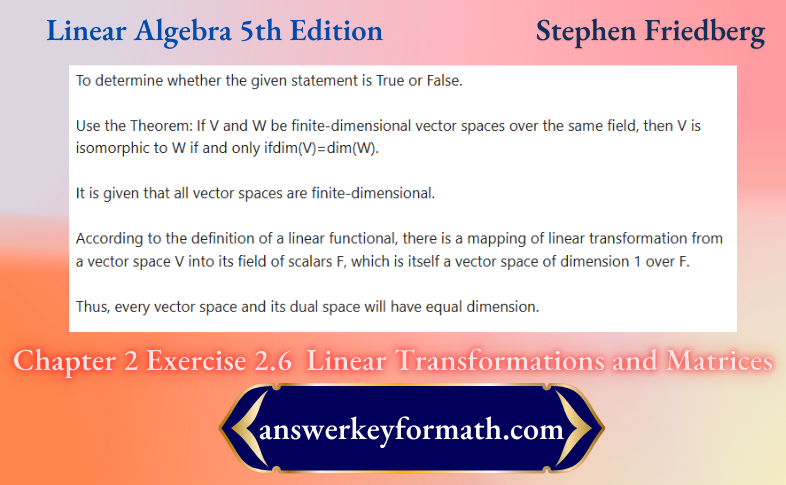
Apply the theorem and conclude that every vector space and its dual space are isomorphic since they have equal dimension.
Hence, the given statement is true.
The given statement “Every vector space is isomorphic to its dual space” is true.
Linear Algebra 5th Edition Chapter 2 Page 124 Problem 4 Answer
Given in the question that, All vector spaces are finite-dimensional while the given statement is, Every vector space is the dual space of some other vector space.
To determine whether the given statement is True or False.
Use the Theorem: If V and W be finite-dimensional vector spaces over the same field, then V is isomorphic to W if and only ifdim(V)=dim(W).
It is given that all vector spaces are finite-dimensional.
According to the definition of a linear functional, there is a mapping of linear transformation from a vector space V into its field of scalars F, which is itself a vector space of dimension 1 over F.
Thus, every vector space and its double dual space will have equal dimension.
Apply the theorem and conclude that every vector space and the dual space of its dual space are isomorphic.
Therefore, every vector space is the dual of its dual space.
Hence, the given statement is true.
The given statement “Every vector space is the dual space of some other vector space” is true.
Linear Algebra 5th Edition Chapter 2 Page 124 Problem 5 Answer
Given in the question that, All vector spaces are finite-dimensional while the given statement is, If T is an isomorphism from V onto V∗ and β is a finite ordered basis for V, then T(β)=β∗.
To determine whether the given statement is true or false.
It is given that all vector spaces are finite-dimensional and T is an isomorphism from V onto V∗.
If β is an ordered basis for V, then β∗ is an ordered basis for V∗ which consists of coordinate functions with respect to β.
Thus, the mapping of an isomorphism from V onto V∗ does not necessarily have to map the vectors from β to β∗.
Hence, the given statement is false.
The given statement “If T is an isomorphism from V onto V∗ and β is a finite ordered basis for V, then T(β)=β∗” is false.
Linear Algebra 5th Edition Chapter 2 Page 124 Problem 6 Answer
Given in the question that, All vector spaces are finite-dimensional while the given statement is, If T is a linear transformation from V onto W, then the domain of (Tt)t is V∗∗.
To determine whether the given statement is True or False.
Use the Theorem: If T is a linear transformation from V to W, then the mapping Tt:W∗→V∗ defined by Tt(g)=gT for all g∈W∗ is a linear transformation.
It is given that all vector spaces are finite-dimensional.
According to the theorem, ff T is a linear transformation from V to W, then Tt is a linear transformation from W∗to V∗.
Thus, it implies that (Tt)t will be a linear transformation from W∗∗to V∗∗.
Therefore, the domain of (Tt)t is V∗∗.
Hence, the given statement is true.
The given statement “If T is a linear transformation from V onto W, then the domain of (Tt)t is V∗∗” is true.
Chapter 2 Exercise 2.6 Linear Transformations Solved Examples Page 124 Problem 7 Answer
Given in th question that, All vector spaces are finite-dimensional while the given statement is, If V
is isomorphic to W, then V∗ is isomorphic to W∗.
To determine whether the given statement is True or False.
Use the Theorem: If V and W be finite-dimensional vector spaces over the same field, then V is isomorphic to W if and only ifdim(V)=dim(W).
Consider V and W as finite-dimensional vector spaces.
If V and W, then according to the theorem, dim(V)=dim(W)…(1).
Since every vector space is isomorphic to its dual space, by theorem dim(V∗)=dim(V).
Also, W is a finite-dimensional vector space. So, dim(W∗)=dim(W).
From equation (1), it is obtained as dim(W∗)=dim(V∗).
It implies that V∗ is isomorphic to W∗.
Hence, the given statement is true.
The given statement “If V is isomorphic to W, then V∗ is isomorphic to W∗” is true.
Linear Algebra 5th Edition Chapter 2 Page 124 Problem 8 Answer
Given in the question that, All vector spaces are finite-dimensional and the statement is, The derivative of a function may be considered as a linear functional on the vector space of differentiable functions.
To determine whether the given statement is true or false.
Since the codomain of the linear functional must be a field, the derivative of a function cannot be considered as a linear functional on the vector space of differentiable functions.
Hence, the given statement is false.
The given statement is false.
Linear Algebra 5th Edition Chapter 2 Page 124 Problem 9 Answer
Given in the question is vector space, V=R3.
The basis is β={(1,0,1),(1,2,1),(0,0,)} .
To determine explicit formulas for vectors of the dual basis β∗ for V∗.
Use the definition of dual basis to find equations for the vectors of dual bases and then solve them to get the coefficients for the linear equations for those vectors.
Let the dual basis for β be given as β∗={f1,f2,f3}.
Then, using the definition of dual basis, the following equations are achieved:
⇒ 1=f1(e1)+f1(e3)
⇒ 0=f1(e1)+2f1(e2)+f1(e3)
⇒ 0=f1(e3)
In the first equation , setting
⇒ 0=f1(e3):f1(e1)=1
Now, from the second equation we have:
⇒ f1(e2)=1/2
Finally, it follows that;
⇒ f1(e1)=1
⇒ f1(e2)=−1/2
⇒ f1(e3)=0
Therefore,
⇒ f1(x,y,z)=x−y/2
Similarly as in Step 1, using the definition of dual basis, the following equations are derived,
⇒ 0=f2(e1)+f2(e3)
⇒ 1=f2(e1)+2f2(e2)+f2(e3)
⇒ 0=f2(e3)
Here, it is obvious that,
⇒ f2(e1)=0
⇒ f2(e3)=0
From the second equation,
⇒ f2(e2)=1/2
Thus,
⇒ f2(x,y,z)=y/2
Finally, it the following equations hold too:
⇒ 0=f3(e1)+f3(e3)
⇒ 0=f3(e1)+2f3(e2)+f3(e3)
⇒ 1=f3(e3)
Setting f3(e3)=1 in the first equation:
⇒ f3(e1)=−1
From the second equation:
⇒ f3(e2)=0
Thus, f3(x,y,z)=−x+z
For the vector space V=R3 and basis,β={(1,0,1),(1,2,1),(0,0,1)}, the explicit formulas for vectors of the dual basis β∗ are:
⇒ {f1(x,y,z)=x−y/2
⇒ {f2(x,y,z)=y/2
⇒ {f3(x,y,x)=−x+z
Linear Algebra 5th Edition Chapter 2 Page 124 Problem 10 Answer
Take
⇒ V=P2®
⇒ β={1,x,x2}
={e1,e2,e3}
Hence,
⇒ 1=f1
⇒ (1)=f1(e1)
⇒ 0=f1(x)
=f1(e2)
⇒ 0=f1(x2)
=f1(e3)
⇒ f1(e1)=1,
⇒ f1(e2)=1,
⇒ f2(e3)=0
Hence,
⇒ 0=f2(1)=f2(e1)
1=f2(x)=f2(e2)
⇒ 0=f2(x2)
=f2(e3)
⇒ f2(e1)=1,
⇒ f2(e2)=1,
⇒ f2(e3)=0
Then
⇒ 0=f3
⇒ (1)=f3(e1)
⇒ 0=f3(x)=f3(e2)
⇒ 1=f3(x2)=f3(e3)
⇒ f3(e1)=1,
⇒ f3(e2)=1,
⇒ f3(e3)=0
And
⇒ f1(a+bx+cx2)=a
⇒ f2(a+bx+cx2)=b
⇒ f3(a+bx+cx2)=c
And then β∗
={f1(a+bx+cx2),f2(a+bx+cx2),f3(a+bx+cx2)}={a,b,c}
Hence, for vector spaces Vand bases β, find explicit formulas for vectors of the dual basis β∗ for V∗, V=P2
(R) and β={1,x,x2}
Linear Algebra Friedberg Exercise 2.6 Step-By-Step Guide Page 124 Problem 11 Answer
In the question,f1,f2,f3∈V∗ are given as :
⇒ f1(x,y,z)=x−2y
⇒ f2(x,y,z)=x+y+z
⇒ f3(x,y,z)=y−3z
To prove that {f1,f2,f3} is a basis for V∗ and to find a basis for V for which it is the dual basis.
To show that it is indeed the basis for V∗ , show linear independence.
Dual basis for V can be find out using properties of dual basis.
To show the linear independency, let a,b,c be real numbers.
Then, from the equations for f1,f2, and f3:
⇒ a(x−2y)+b(x+y+z)+c(y−3z)=0
⇒ (a+b)x+(b+c−2a)y+(b−3c)z=0
As this is true for all (x,y,z)∈R3, one might say that:
⇒ a+b=0
⇒ b+c−2a=0
⇒ b−3c=0
The only solution for these equation:
⇒ a=0
⇒ b=0
⇒ c=0
Thus, the linear independency is proved.
Hence f1,f2,f3 form a basis for V∗.
To find the dual basis, the following must be satisfied for an e1
∈V:
⇒ f1e1=1
⇒ f2e2=0
⇒ f3e3=0
Thus:
⇒ x1−2y1=1
⇒ x1+y1+z1=0
⇒ y1−3z1=0
Setting z1=y1/3 in the second equation:
⇒ 4y1=−3×1
Then it easily follows that:
⇒ x1=2/5
⇒ y1=−3/10
⇒ z1=−1/10
Thus,
⇒ e1=(2/5,−3/10,−1/10)
It was proved that {f1,f2,f3} is a basis for V∗.
The basis vector V which is a dual basis is (2/5,−3/10,−1/10).
Linear Algebra 5th Edition Chapter 2 Page 125 Problem 12 Answer
Given in the question that for f∈(R2)∗ ,
⇒ f(x,y)=2x+y.’
Also,T: R2→R2 is given by,
⇒ T(x,y)=(3x+2y,x).
To compute Tt(f).
Using the definition of the mapping Tt and f, the expression for Tt(f) can be easily computed.
Given:
⇒ f(x,y)=2x+y
⇒ T(x,y)=(3x+2y,x)
Then, it directly follows that:
⇒ Tt(f)=f(T)=f(3x+2y,x)
To compute f(3x+2y,x), use the definition of f:
⇒ f(3x+2y,x)=2(3x+2y)+x
=6x+4y+x
=7x+4y
Thus, Tt(f)=7x+4y
If, f(x,y)=2x+y
⇒ T(x,y)=(3x+2y,x)
Then, Tt(f)=7x+4y
Linear Algebra 5th Edition Chapter 2 Page 125 Problem 13 Answer
Given in the question that for f∈(R2)∗,f(x,y)=2x+y
Also, T:R2→R2 is given as T(x,y)=(3x+2y,x)
To compute [Tt]β∗where β is the standard ordered basis for R2.
First compute the dual bases {f1,f2} from the definition of T,f. From there find out Tt(f1), Tt(f2) and the respective coefficients gives the matrix [Tt]β∗ .
The basis of (R2)∗is {(1,0),(0,1)}
Note that, (x,y)=x(1,0)+y(0,1)
Hence, it simply follows that:
⇒ f1(x,y)=x
⇒ f2(x,y)=y
Now, Tt(f1)may be written as:
⇒ Tt(f1)=f1
⇒ T(x,y)=f1(3x+2y,x)
=3x+2y
=3f1(x,y)+2f2(x,y)
The last expression follows from the fact that,
⇒ f1(x,y)=x
⇒ f2(x,y)=y
Similarly,
⇒ Tt(f2)=f2
⇒ T(x,y)=f2(3x+2y,x)
=x
=1f2(x,y)+0f2(x,y)
Therefore:
⇒ Tt(f1)=3f1(x,y)+2f1(x,y)
⇒ Tt(f2)=1f2(x,y)+0f2(x,y)
The matrix
[Tt]β∗=
(3 2)
(1 0)
The matrix [Tt]β∗ is [Tt]β∗=
(3 2)
(1 0)
Exercise 2.6 Matrices Examples Friedberg Chapter 2 Page 125 Problem 14 Answer
Given in the question that for f∈W∗, f(a,b)=a−2b
Also, T:V→W is given as T(p(x))=(p(0)−2p(1),p(0)+p′(0))
To compute Tt(f)
Using the definition of the mapping Tt and f, the expression for Tt(f) can be easily computed.
If p(x)=a+bx then:
⇒ p(0)=a
⇒ p(1)=a+b
Also, p′
⇒ (0)=b
⇒ T(a+bx)may be written as,
⇒ T(a+bx)=(a−2(a+b),a+b)=(−a−2b,a+b)
From the definition of Tt and f, it directly follows that:
⇒ Tt(f)(a+bx)=fT(a+bx)
=f(−a−2b,a+b)
To compute f(−a−2b,a+b), use the definition of f:
⇒ f(−a−2b,a+b)=(−a−2b)−2(a+b)
=−a−2b−2a−2b
=−3a−4b
Thus, Tt(f)=−3a−4b
For f∈W∗defined by,
f(a,b)=a−2bwe have
⇒ Tt(f)=−3a−4b
Linear Algebra 5th Edition Chapter 2 Page 125 Problem 15 Answer
Given data: Let {u,v} be a linearly independent set in R3.
To show: That the plane {su+tv:s,t∈R} through the origin in R3 may be identified with the null space of a vector in (R3)∗.
It can be observed that every lane passing through the origin in R3 satisfies the equation shown below,
Therefore,
ax+by+cz=0 for any 3 scalars a,b,c
Henceforth the plane, can be represented in the form shown below,
Therefore,
P is {(x,y,z):ax+by+cz=0}
Now, observe that on condiering,
⇒ x=u
⇒ y=v
⇒ c=0
The plane is obtained as,
{(u,v,z):au+bv=0}
Observe that the plane passes through the origin and also the transformation T(u,v,z)=au+bv which is an element of (R3)∗ and its nullspace is actually P, henceforth P=N(T).
Thus, it can be clearly shown that the plane {su+tv:s,t∈R} through the origin in R3 may be identified with the null space of a vector in (R3)∗
if {u,v} be a linearly independent set in R3.
Friedberg 5th Edition Chapter 2 Exercise 2.6 Guide Page 125 Problem 16 Answer
Given data: A function T:Fn→Fm is given
To prove: That function T:Fn→Fm is linear iff there exist f1,f2,……,fm∈(Fn) such that T(x)=(f1
(x),f2(x),……,fm(x))∀x∈Fn.
Consider, x∈Fm and observe as shown below,
Therefore,
⇒ T(x)=a1e1+a2e2+……+amem
Now, observe that,
fi=gi(T(x))
=gi(a1e1+a2e2+……+amem)
=ai
Henceforth, it can be obtained that fi(x)=ai
Again, for the function T:Fn→Fm∃f1,f2,……,fm∈(Fn) and therefore,
⇒ T(x)=(f1(x),f2(x),……,fm(x))∀x∈Fn
Consider as shown below,
Therefore,
⇒ T(ax+by)=(f1(ax+by),f2(ax+by),……,fm(ax+by))
=(af1(x)+bf1(y),af2(x)+bf2(y),……,afm(x)+bfm(y))
=a(f1(x),f2(x),……,fm(x))+b(f1(y),f2(y),……,fm(y))
=aT(x)+bT(y)
Thus, it can be clearly proved that function T: Fn→Fm is linear iff there exist f1,f2,……,fm∈(Fn) such thaT(x)=(f1(x),f2(x),……,fm(x))∀x∈Fn.