COMPLEX DEFINITION
Any subset of a group G is called a complex of G.
Example. 1. The set of integers is a complex of the group (R,+).
Example. 2. The set of even integers is a complex of the group (Z,+).
Example. 3. The set of odd integers is a complex of the group. (R, +).
Example. 4 The set (1, – 1) is a complex of the multiplicative group G = (1, -1, i,-i)
Multiplication Of Two Complexes.
Definition: If M and N are any two complexes of group G then
MN = (mn ∈ G / m ∈ M, n ∈ N)
Clearly, MN ⊆ G and MN is called the product of the complexes M, N of G.
Theorem 1: The multiplication of complexes of a group G is associative.
Proof: Let M, N, and P be any three complexes in a group G.
Let m ∈ M, n ∈ N, p ∈ P so that m, n, p ∈ G.
We have MN = (mn ∈ G / m ∈ M, n ∈ N} so that
(MN) P = ((mn)p ∈ G / mn ∈ MN, p ∈ P) = (m (n p) ∈ G / m ∈ M, np ∈ NP)
= M (NP) (∵ associativity is true in G )
Note. If HK = KH then we cannot imply that hk = kh for all h ∈ H and for all k ∈ K. What we imply is HK ⊆ KH and KH ⊆ HK.
Definition: If M is a complex in a group G, then we define \(\mathbf{M}^{-1}=\left\{m^{-1} \in \mathbf{G} / m \in \mathbf{M}\right\} \text { i.e. } \mathbf{M}^{-1}\) is the set of all inverses of the elements of M.
Clearly \(\mathbf{M}^{-1} \subseteq \mathbf{G}\).
Theorem 2: If M, N are any two complexes in group G then \((\mathbf{M N})^{-1}=\mathbf{N}^{-1} \mathbf{M}^{-1}\)
Proof. We have MN = {mn ∈ G / m ∈ M, n ∈ N)
Now \((\mathbf{M N})^{-1}\) = \(\left\{(m n)^{-1} \in \mathbf{G} / m \in \mathbf{M}, n \in \mathbf{N}\right\}\)
= \(\left\{n^{-1} m^{-1} \in \mathbf{G} / m \in \mathbf{M}, n \in \mathbf{N}\right\}=\mathbf{N}^{-1} \mathbf{M}^{-1}\)
Subgroups
Definition: Let (G,.) be a group. Let H be a non-empty subset of G such that (H,.) be a group. Then H is called a subgroup of G.
It is denoted by H ≤ G or G ≥ H. And H < G or G > H we mean H ≤ G, but H ≠ G.
Note: A complex of group G. is only a subset of G but a subgroup of group G is a group. The binary operations in a group and its subgroup are the same.
Example. 1. (Z,.) is a subgroup of (Q,.). Also (Q+,.) ‘is a subgroup of (R+,.)
Example. 2. The additive group of even integers is a subgroup of the additive group of all integers. •
Example. 3. The multiplicative group {1,-1} is a subgroup of the multiplicative group (1,-1, i,-i}.
For: G = {1,-1,i,-i} is a group under usual multiplication.
The composition table is:
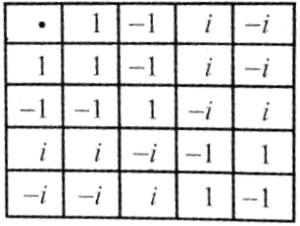
Here 1 is the identity and \((i)^{-1}=-i,(-i)^{-1}=i,(-1)^{-1}=-1\)
Consider H = {1,-1} which is.a subset of a group (G,.).
Clearly (H,.) is a group.
Here 1 is the identity, \((-1)^{-1}=-1\)
∴ H is a subgroup of G.
Similarly ({1},.),({1,-1,i,-i},.) are subgroups of (G,.).
Example. 4. (N,+) is not a subgroup of the group (Z,+) since identity does not exist in N under +.
Note 1: Every group having at least two elements has at least two subgroups. Suppose e is the identity element in a group G. Then \(\{e\} \subseteq \mathbf{G}\) and we have \(e e=e, e^{-1}=e\), etc.
So {e} is a subgroup of G. Also \(\mathbf{G} \subseteq \mathbf{G}\). So G is also a subgroup of G. These two subgroups {e}, G of G are called trivial or improper subgroups of G. All other subgroups, if they exist, are called non-trivial or proper subgroups of G.
Note 2. A complex of a group need not be a subgroup of the group. But a subgroup of a group is always complex of the group.
Note 3. A complex of a group (G,.) need not be a subgroup w.r.t. the binary operation, but it can be a group w.r.t. another binary operation. For example, the complex \(\left\{3^n, n \in z\right\}\) of the group (Z, +) is not a subgroup of (Z, +) w.r.t. binary operation + whereas the same subset is a group under multiplication.
It is clear that every subgroup of an abelian group is abelian. But for the non-abelian group, it may not be true.
⇒ \(\mathbf{P}_3=\left\{f_1, f_2, f_3, f_4, f_5, f_6\right\}\) set of all bisections on three symbols is a non-abelian group.
But \(\mathbf{A}_3=\left\{f_1, f_5, f_6\right\}\) and H = \(\left\{f_1, f_2\right\}\) an abelian subgroup of P3.
Lattice Diagram. Often it is useful to show the subgroups of a group by a Lattice diagram. In this diagram, we show the larger group near the top of the diagram followed by a line running toward a subgroup of the group.
We give below the Lattice Diagram for the multiplicative group \(\{1,-1, i,-i\}\).
Abstract Algebra Subgroups Notes The Identity And Inverse Of An Element Of A Subgroup H Of A Group G.
Theorem 3: The identity of a subgroup H of a group is the same as the G
Proof. Let a ∈ H and e’ be the identity of H.
Since H is a group, ae’ = a ……………(l)
Let e be the identity in G.
Again a ∈ H => a ∈ G
∴ ae = a ………….(2)
Also e’ ∈ H => e’ ∈ G
From (1) and (2), ae’ = ae => e’= e (using left cancellation law).
Theorem 4: The inverse of any element of a subgroup H of group G is the same as the inverse of that element regarded as an element of group G.
Proof. Let e be the identity in -G.
Since H is a subgroup of G, e is also the identity in H.
Let a ∈ H.
∴ a ∈ G.
Let b be the inverse of a in H and c be the inverse of an in G. Then ab = e and ac = e.
=> ab = ac => b – c (using left cancellation law)
Theorem 5. If H is any subgroup of a group G . then \(\mathbf{H}^{-1}=\mathbf{H}\).
Proof. Let H be a subgroup of group G. Let \(h^{-1} \in \mathbf{H}^{-1}\)
By def. of \(\mathbf{H}^{-1}, h \in \mathbf{H}\)
Since H is a subgroup of a group G, \(h^{-1} \in \mathbf{H}\)
∴ \(h^{-1} \in \mathbf{H}^{-1} \Rightarrow h^{-1} \in \mathbf{H}\)
∴ \(\mathbf{H}^{-1} \subseteq \mathbf{H}\)
Again \(h \in \mathbf{H} \Rightarrow h^{-1} \in \mathbf{H} \Rightarrow\left(h^{-1}\right)^{-1} \in \mathbf{H}^{-1} \Rightarrow h \in \mathbf{H}^{-1}\)
∴ \(\mathbf{H} \subseteq \mathbf{H}^{-1} \text {. Hence } \mathbf{H}^{-1}=\mathbf{H}\)
Note. The converse of the above theorem is not true i.e. if H is any complex of a group G such that \(\mathbf{H}^{-1}=\mathbf{H}\), then H need not be a subgroup of G.
e.g. H = {-1} is a complex of the multiplicative group G = (1, – 1}.
Since the inverse of -1 is -1, then \(\mathbf{H}^{-1}=\{-1\}\).
But H = {-1} is not a group under multiplication since (-1)(-1) = 1 ∉ H (Closure is not true) i.e. H is not a subgroup of G.
Hence even if \(\mathbf{H}^{-1}=\mathbf{H}\) , H is not a subgroup of G.
Theorem 6. If H is any subgroup of group G, then HH = H.
Proof. Let x ∈ HH so that x = \(h_1 \cdot h_2\) where \(h_1 \in \mathbf{H}\) and \(h_2 \in \mathbf{H}\). Since H is a subgroup, \(h_1 h_2 \in \mathbf{H}\)
∴ x ∈ H
∴ HH ⊆ H.
Let \(h_3 \in \mathbf{H}\) and e be the identity in H.
Then \(h_3=h_3 e \in \mathbf{H H}\)
∴ H ⊆ HH
∴ HH = H
Abstract Algebra Subgroups Notes Criterion For A Complex To Be A Subgroup
Theorem 7. A non-empty complex H of a group G is a subgroup of G if and only if
(1) \(a \in \mathbf{H}, b \in \mathbf{H} \Rightarrow a b \in \mathbf{H}\)
(2) \(a \in \boldsymbol{H}, a^{-1} \in \mathbf{H}\)
Proof. The conditions are necessary.
Let H be a subgroup of the group G.
• To prove that (1), (2) are true
∴ H is a group.
∴ By closure axiom a, b ∈ H => ab ∈ H and by inverse axiom \(a \in \mathbf{H} \Rightarrow a^{-1} \in \mathbf{H}\)
The conditions are sufficient.
Let (1) and (2) be true.
To prove that H is a subgroup of G.
1. By (1) closure axiom is true in H.
2. The elements of H are also elements of G. Since G is a group, the composition ‘ in G is associative and hence the composition in H is associative.
3. Since H is non-empty, let a ∈ H.
∴ By (2) \(a^{-1} \in \mathbf{H}\)
∴ \(a \in \mathbf{H}, a^{-1} \in \mathbf{H} \Rightarrow a a^{-1} \in \mathbf{H}\).
=> e ∈ H (∵ \(a a^{-1} \in \mathbf{H} \Rightarrow a a^{-1} \in \mathbf{G} \Rightarrow a a^{-1}=e\) where e is the identity in G ).
=> e is the identity in H.
4. Since we have \(a \in \mathbf{H} \Rightarrow a^{-1} \in \mathbf{H}\) and \(a a^{-1}=e\) evety element of H possess inverse in H. Hence H itself is a group for the composition in G. So H is a subgroup of G.
Note 1. If the operation in G is +, then the conditions in the above theorem can be stated as follows :
a, \( b \in \mathrm{H} \Rightarrow a+b \in \mathrm{H}\) , (ii) \(a \in \mathbf{H} \Rightarrow-a \in \mathbf{H}\)
2. It is called a Two-step subgroup Test.
Theorem 8. H is a non-empty complex of a group G. The necessary and sufficient condition for H to be a subgroup of G is \(a, b \in \mathbf{H} \Rightarrow a b^{-1} \in \mathbf{H}\) where \(b^{-1}\) is the inverse of. b in G.
Proof.
Given
H is a non-empty complex of a group G. The necessary and sufficient condition for H to be a subgroup of G is \(a, b \in \mathbf{H} \Rightarrow a b^{-1} \in \mathbf{H}\) where \(b^{-1}\) is the inverse of. b in G.
The condition is necessary.
Since H is a group by itself, \(b \in \mathbf{H} \Rightarrow b^{-1} \in \mathbf{H}\)
∴ \(a \in \mathbf{H}, b \in \mathbf{H} \Rightarrow a \in \mathbf{H}, b^{-1} \in \mathbf{H} \Rightarrow a b^{-1} \in \mathbf{H}\) (by closure axiom).
The condition is sufficient.
1. Since \(\mathbf{H} \neq \phi, \text { let } a \in \mathbf{H}\)
By hyp. \(a \in \mathbf{H}, b \in \mathbf{H} \Rightarrow a b^{-1} \in \mathbf{H}\)
a \(\in \mathbf{H}, a^{-1} \in \mathbf{H} \Rightarrow a a^{-1} \in \mathbf{H} \Rightarrow a a^{-1} \in \mathbf{G}\)
But in G, \(a \in \mathbf{G} \Rightarrow a a^{-1}=e\), e is the identity in G.
∴ e ∈ H
2. We have \(e \in \mathbf{H}, a \in \mathbf{H} \Rightarrow e a^{-1} \in \mathbf{H} \Rightarrow a^{-1} \in \mathbf{H}\)
∴ \(a \in \mathbf{H} \Rightarrow a^{-1} \in \mathbf{H}\)
3. \(b \in \mathbf{H} \Rightarrow b^{-1} \in \mathbf{H}\)
∴ \(a \in \mathbf{H}, b \in \mathbf{H} \Rightarrow a, b^{-1} \in \mathbf{H} \Rightarrow a\left(b^{-1}\right)^{-1} \in \mathbf{H}\)
=> \(a b \in \mathbf{H}\)
4. Since all the elements of H are in G and since the composition is associative in
G, the composition is associative in H.
∴ H is a group for the composition in G and hence H is a subgroup of G.
Note 1. If the operation in G is +, then the condition in the above theorem can be stated as follows :
a\(\in \mathbf{H}, b \in \mathbf{H} \Rightarrow a-b \in \mathbf{H}\)
2. The above theorem can be used to prove that a certain non-empty subset of a given group is a subgroup of the group. It is called the One-step subgroup Test.
Theorem 9. A necessary and sufficient condition for a non-empty complex H of a group G to be a subgroup of G is that \(\).
Proof. The condition is necessary.
Let H be a subgroup of G.
Let \(a b^{-1} \in \mathbf{H H}^{-1}\) so that a ∈ H, b ∈ H
Since H is a group we have \(b^{-1} \in \mathbf{H}\).
∴ \(a \in \mathbf{H} \Rightarrow b^{-1} \in \mathbf{H} \Rightarrow a b^{-1} \in \mathbf{H}\) , (By closure axiom)
∴ \(\mathbf{H H}^{-1} \subseteq \mathbf{H}\)
The condition is sufficient.
Let \(\mathrm{HH}^{-1} \subseteq \mathbf{H}\). Let a, b ∈H.
∴ \(a b^{-1} \in \mathbf{H H}^{-1}\)
Since \(\mathbf{H H}^{-1} \subseteq \mathbf{H}, a b^{-1} \in \mathbf{H}\)
∴ H is a subgroup of G.
Theorem 10. A necessary and sufficient condition for a non-empty subset H of a group G to be a subgroup of G is that \(\mathbf{H H}^{-1}=\mathbf{H}\).
Proof. The condition is necessary.
Let H be a subgroup of G. Then we have \(\mathrm{HH}^{-1} \subseteq \mathrm{H}\).
Let e be the identity in G.
∴ e is the identity in H.
Let h ∈ H
∴ \(h=h e=h e^{-1} \in \mathbf{H H}^{-1}\)
∴ \(\mathbf{H} \subseteq \mathbf{H H}^{-1}\)
∴ \(\mathbf{H H}^{-1} \subseteq \mathbf{H}\)
The condition is sufficient.
Let \(\mathbf{H} \mathbf{H}^{-1}=\mathbf{H}\).
∴ \(\mathbf{H H}^{-1} \subseteq \mathbf{H}\)
∴ H is a subgroup of G.
Theorem 11. The necessary and sufficient condition for a finite complex H of a group G is \(a, b \in \mathbf{H} \Rightarrow a b \in \mathbf{H}\)
OR
Prove that a non-empty finite subset of a group which is closed under multiplication is a subgroup of G.
Proof. The condition is necessary.
H be a subgroup of G. By closure axiom, \(\).
The condition is sufficient.
Let \(a, b \in \mathbf{H} \Rightarrow a b \in \mathbf{H}\) (∵ H ≠ ∅)
Let a ∈ H.
By hyp. we have \(a \in \mathbf{H}, a \in \mathbf{H} \Rightarrow a \cdot a \in \mathbf{H} \Rightarrow a^2 \in \mathbf{H}\)
Again \(a^2 \in \mathbf{H}, a \in \mathbf{H} \Rightarrow a^2, a \in \mathbf{H} \Rightarrow a^3 \in \mathbf{H}\)
By induction, we can prove that \(a^n \in \mathbf{H}\) where n is any positive integer.
Thus all the elements \(a, a^2, a^3, \ldots, a^n, \ldots\) belong to H and they are infinite in number.
But H is a finite subset of G.
But H is a finite subset of G.
Therefore, there must be repetitions in the collection of elements.
Let \(a^r=a^s\) for some positive integers r and s such that r > s
∴ \(a^r \cdot a^{-s}=a^s \cdot a^{-s}=a^{s-s}=a^0=e\) where e is the identity in G.
Since r – s is a positive integer, \(a^{r-s} \in \mathbf{H}^{\prime} \Rightarrow e \in \mathbf{H}\)
∴ \(e=a^0 \in \mathbf{H}\).
Now r > s => r – s ≥ 1
∴ r – s – 1 ≥ 0 and hence \(a^{r-s-1} \in \mathbf{H}\)
Also \(a^{r-s-1} a=a^{r-s}=e=a \cdot a^{r-s-1}\)
∴ We have for \(a \in \mathbf{H}, a^{r-s-1} \in \mathbf{H}\) as the inverse of a.
Thus each element of H is invertible.
Since all the elements of H are elements of G, associativity is satisfied.
H is a group for the composition in G and hence H is a subgroup of G.
Cor. A finite non-empty subset H of a group G is also a subgroup of G if and only if HH = H.
e.g. \(\left(\mathbf{Z}_6,+_6\right)\) is a group and \(\left(\mathbf{H}=\{0,2,4\},+_6\right)\) is a subgroup of it.
For: \(\mathbf{H} \subset \mathbf{Z}_6\). Also \(0+_6 0=0,0+_6 2=2,0+_6 4=4,2+_6 4=0,4+_6 4=2\) etc.
So \(a, b \in \mathbf{H} \Rightarrow a+_6 b \in \mathbf{H}\)
Note. The criterion given in the above theorem is valid only for finite subsets of a group G. It is not valid for an infinite subset of an infinite group G.
e.g. (Z, +) is a group. Let N be the set of all positive integers.
N ⊂ Z. Also (N, +) is not a group even though a, b ∈ N => a + b ∈ N.
∴ (N,+) is not a subgroup of (Z,+). Hence the above theorem is not satisfied.
Theorem 12. A non-empty subset H of a finite group G is a subgroup if \(a \in \mathbf{H}, b \in \mathbf{H} \Rightarrow a b \in \mathbf{H}\)
OR
A necessary and sufficient condition for a complex H of a finite group G to be a subgroup is that \(a \in \mathbf{H}, b \in \mathbf{H} \Rightarrow a b \in \mathbf{H} .\).
Proof. The condition is necessary.
Let H be a subgroup of a finite group G.
Then H is closed w.r.t. the composition in G.
∴ \(a \in \mathbf{H}, b \in \mathbf{H} \Rightarrow a b \in \mathbf{H}\)
The condition is sufficient.
H is a non-empty subset (complex of G ) of a finite group G such that
a \(\in \mathbf{H}, b \in \mathbf{H} \Rightarrow a b \in \mathbf{H}\)
Now we have to prove that H is a subgroup of G.
Associativity. Since H is a subset of G, all the elements of H are the elements of G and hence associativity is true in H w.r.t. the composition in G.
Existence of identity. Let a ∈ H.
a ∈ G. Since G is finite and since every element of a finite group is of finite order, it follows that the order of a is finite.
Let 0 (a) = n
∴ \(a^n=e\) where e is the identity in G.
By closure law in H, we have \(a^2, a^3, \ldots, a^n, \ldots \in \mathbf{H}\). …………..(1)
Since \(a^n=e=a^0\), we have \(a^0=e \in \mathbf{H}\) i.e. identity exists in H.
Existence of inverse. Let a ∈ H Here \(e=a^n=a^0\).
∴ a ∈ G and 0(a) = n => n is the least positive integer such that
=> (n – 1) > 0. \(a^n=e\)
By (1), \(a^{n-1} \in \mathbf{H}\).
Now in G, \(a^{n-1} a=a^n=a a^{n-1}\).
=> \(a^{n-1} a=a a^{n-1}=e\) true in H .
=> \(a^{-1}=a^{n-1}\)
=> Every element of H is invertible.
=> H is a group and hence a subgroup of G.
Abstract Algebra Subgroups Notes Criterion For The Product Of Two Subgroups To Be A Subgroup
Theorem 13. If H and K are two subgroups of a group G, then HK is a subgroup of G iff HK = KH.
Proof. Let H, K be any two subgroups of G.
1st part. Let HK = KH. To prove that HK is a subgroup of G.
So it is sufficient to prove that \((\mathbf{H K})(\mathbf{H K})^{-1}=\mathbf{H K}\)
⇒ \((\mathbf{H K})(\mathbf{H K})^{-1}\)
= \((\mathbf{H K})\left(\mathbf{K}^{-1} \mathbf{H}^{-1}\right)\)(Theorem 2.)
= \(\mathbf{H}\left(\mathbf{K K}^{-1}\right) \mathbf{H}^{-1}\) (∵ Complex multiplication is associative).
= \(\mathbf{H}(\mathbf{K}) \mathbf{H}^{-1}\) (Theorem 10) = \((\mathbf{H K}) \mathbf{H}^{-1}\) (Theorem 1) .
= \(\text { (KH) } \mathbf{H}^{-1}\) (Hyp.) = \(\mathbf{K}\left(\mathbf{H H}^{-1}\right)=\mathbf{K H}=\mathbf{H K}\).
HK = KH => HK is a subgroup of G.
2nd part. Let HK be a subgroup of group G.
∴ \((\mathrm{HK})^{-1}=\mathrm{HK} \Rightarrow \mathrm{K}^{-1} \mathbf{H}^{-1}=\mathrm{HK} \Rightarrow \mathrm{KH}=\mathrm{HK}\)
(∵ K is a subgroup, \(\mathbf{K}^{-1}=\mathbf{K}\) and H is a subgroup, \(\mathbf{H}^{-1}=\mathbf{H}\))
Cor. If H, K are subgroups of an abelian group G, then HK is a subgroup of G.
For: Since G is abelian, HK = KH. By the above theorem, HK is a subgroup of G.
Abstract Algebra Subgroups Notes Solved Problems
Example.1: If Z is the additive group of integers, then prove that the set of all multiples of integers by a fixed integer m is a subgroup of Z.
Solution:
Given
Z is the additive group of integers
We have Z = { ….,3,-2,-1, 0,1,2,3,…}
Let H = {…,- 3m, – 2m, – m, 0, m, 2m, 3m,…} = mz
where m is a fixed integer.
Let a = rm, b = sm be any two elements of H where r, s are integers.
Then a – b = rm – sm = (r – s) m – pm where p is an integer
=> a – b ∈ H.
∴ a, b ∈ H => a – b ∈ H.
∴ H is a subgroup of Z.
Example. 2: Prove that in the dihedral group of order 8, denoted by \(\mathbf{D}_4\), the subset \(\mathbf{H}=\left\{r_{360}, r_{180}, x, y\right\}\) is subgroup of \(\mathbf{D}_4\).
Solution: We can observe from the composition table of \(\mathbf{D}_4\).
(1) Closure is obvious.
(2) Associativity is evident since the composition of maps is associative
(3) The identity element of H is \(r_{360}\).
(4) Each element of H is inverse of itself. I
∴ H is a group. Here H is a subgroup of \(\mathbf{D}_4\).
Example. 3 : \(\mathbf{P}_3\) is a non-abelian group of order 6. \(\mathbf{A}_3\) is a subgroup of \(\mathbf{P}_3\). Also \(\mathbf{A}_3\) is an abelian subgroup of \(\mathbf{P}_3\).
Example. 4: We have \(\mathbf{G}=\left\{r_0, r_1, r_2, f_1, f_2, f_3\right\}\) the set of all symmetries of cm Unilateral triangle, as a non-abelian group.
Consider \(\mathrm{H}=\left\{r_0, r_1, r_2\right\}\) . We can see from the composition table that H is a subgroup of G. Also H is abelian. Hence a non-abelian group can have an abelian subgroup.
Example. 5: S, the set of all ordered pairs (a,b) of real numbers for which a ≠ 0 w.r.t the operation x defined by (a, b) x (c, d) = (ac, be + d) is a non-abelian group.
Let H = {(1, b) | b ∈ R} be a subset of S. Show that H is a subgroup of the group (S, x).
Solution:
Given
S the set of all ordered pairs (a,b) of real numbers for which a ≠ 0 w.r.t the operation x defined by (a, b) x (c, d) = (ac, be + d) is a non-abelian group.
Let H = {(1, b) | b ∈ R} be a subset of S.
Identity in S is (1, 0). Clearly’ (1, 0) ∈ H.
The inverse of (a,b) in S is \(\left(\frac{1}{a},-\frac{b}{a}\right)\) (∵ a ≠ 0)
The inverse of (1, c) in S is \(\left(\frac{1}{1},-\frac{c}{1}\right)\) i.e (1, -c)
Clearly (1 ,c) ∈ H. Let (1,b) ∈ H.
∴ \((1, b)(1, c)^{-1}=(1, b) \times(1,-c)=(1,1, b .1-c)=(1, b-c) \in \mathbf{H} \text { since } b-c \in \mathbf{R}\)
∴ \((1, b),(1, c) \in \mathrm{H} \Rightarrow(1, b) \times(1, c)^{-1} \in \mathrm{H}\)
∴ H is a subgroup of (S, x).
Note. \(\)
H is an abelian subgroup of the non-abelian group (S, x).
Hence a non-abelian group can have an abelian subgroup.
UNION AND INTERSECTION OF SUBGROUPS
Theorem 14. If \(\mathrm{H}_1 \text { and } \mathrm{H}_2\) are two subgroups of a group G then \(\mathrm{H}_1 \cap \mathrm{H}_2\), is also a subgroup of G.
(OR)
If H and K are subgroups of a group G show that \(\mathbf{H} \cap \mathbf{K}\) is also a subgroup of G. )
Proof. Let \(\mathbf{H}_1 \text { and } \mathbf{H}_2\) be two subgroups of G.
Let e be the identity in G.
∴ \(e \in \mathbf{H}_1 \text { and } e \in \mathbf{H}_2 \Rightarrow e \in \mathbf{H}_1 \cap \mathbf{H}_2\)
∴ \(\mathbf{H}_1 \cap \mathbf{H}_2 \neq \phi\)
Let \(a \in \mathbf{H}_1 \cap \mathbf{H}_2, b \in \mathbf{H}_1 \cap \mathbf{H}_2\)
∴ \(a \in \mathbf{H}_1, a \in \mathbf{H}_2 \text { and } b \in \mathbf{H}_1, b \in \mathbf{H}_2\)
Since \(\mathbf{H}_1\) is a subgroup, \(a \in \mathbf{H}_1 \text { and } b \in \mathbf{H}_1 \Rightarrow a b^{-1} \in \mathbf{H}\)
Similarly \(a b^{-1} \in \mathbf{H}_2\).
∴ \(a b^{-1} \in \mathbf{H}_1 \cap \mathbf{H}_2\)
Thus we have \(a \in \mathbf{H}_1 \cap \mathbf{H}_2, b \in \mathbf{H}_1 \cap \mathbf{H}_2 \Rightarrow a b^{-1} \in \mathbf{H}_1 \cap \mathbf{H}_2\).
∴ \(\mathbf{H}_1 \cap \mathbf{H}_2\) is a subgroup of G.
Note 1. The intersection of an arbitrary family of subgroups of a group is a subgroup of the group i.e. if \(\left\{\mathbf{H}_i / i \in \Delta\right\}\) is any set of subgroups of a group G, then \(\bigcap_{i \in \Delta} \mathbf{H}_i\) is a subgroup of G.
2. \(\mathbf{H}_1 \cap \mathbf{H}_2\) is the largest subgroup of G contained in \(\mathbf{H}_1 \cap \mathbf{H}_2\) is the subgroup contained in \(\mathbf{H}_1 \text { and } \mathbf{H}_2\) and is the subgroup that contains every subgroup of G contained in both \(\mathbf{H}_1 \text { and } \mathbf{H}_2\).
3. The union of two subgroups of a group need not be a subgroup of the group.
e.g. Let (Z,+) be the group of all integers.
Let \(\mathbf{H}_1=\{\ldots-6,-4,-2,0,2,4 \ldots\}=2 \mathbf{Z}\) and
⇒ \(\mathbf{H}_2=\{\ldots-12,-9,-6,-3,0,3,6,9 \ldots\}=3 \mathbf{Z}\) be two subgroups of Z.
We have \(\mathbf{H}_1 \cup \mathbf{H}_2=\{\ldots,-12,-9,-6,-4,-3,-2,0,2,3,4,6,9 \ldots\}\).
Since \(4 \in \mathbf{H}_1 \cup \mathbf{H}_2, 3 \in \mathbf{H}_1 \cup \mathbf{H}_2\) does not imply \(4+3 \in
\mathbf{H}_1 \cup \mathbf{H}_2, \mathbf{H}_1 \cup \mathbf{H}_2\) is not closed under +.
∴ \(\mathbf{H}_1 \cup \mathbf{H}_2\) is not a subgroup of (Z,+).
So the intersection of two subgroups of a group is a subgroup of the group whereas the union of two subgroups of a group need not be a subgroup of the group.
Thus we conclude: An arbitrary intersection of subgroups of a group G is a subgroup but the union of subgroups need not be a subgroup.
Theorem 15. The union of two subgroups of a group is a subgroup if one is contained in the other.
(OR)
If H and K are subgroups of a group Q then show that H ∪ K is a subgroup if either H ⊆ K or K ⊆ H
Proof. Let \(\mathbf{H}_1 \text { and } \mathbf{H}_2\) be two subgroups of a group (G,.)
To prove that \(\mathbf{H}_1 \cup \mathbf{H}_2\) is a subgroup ⇔ \(\mathbf{H}_1 \subseteq \mathbf{H}_2 \text { or } \mathbf{H}_2 \subseteq \mathbf{H}_1\).
The condition is necessary.
Let \(\mathbf{H}_1 \subseteq \mathbf{H}_2\)
∴ \(\mathbf{H}_1 \cup \mathbf{H}_2=\mathbf{H}_2\)
Since \(\mathbf{H}_2\) is a subgroup of G, \(\mathbf{H}_1 \cup \mathbf{H}_2\) is a subgroup of G.
Similarly, \(\mathbf{H}_2 \subseteq \mathbf{H}_1\) => \(\mathbf{H}_1 \cup \mathbf{H}_2\) is a subgroup of G.
The condition is sufficient.
Let \(\mathbf{H}_1 \cup \mathbf{H}_2\) be a subgroup of G.
We prove that \(\mathbf{H}_1 \subseteq \mathbf{H}_2 \text { or } \mathbf{H}_2 \subseteq \mathbf{H}_1\)
Suppose that \(\mathbf{H}_1 \not \subset \mathbf{H}_2 \text { and } \mathbf{H}_2 \not \subset \mathbf{H}_1\)
Since \(\mathbf{H}_1 \not \subset \mathbf{H}_2, \exists a \in \mathbf{H}_1 \text { and } a \notin \mathbf{H}_2\).
Again \(\mathrm{H}_2 \subset \mathrm{H}_1 \Rightarrow 3 b \in \mathrm{H}_2 \text { and } b \notin \mathrm{H}_1\).
From (1) and (2) we have that \(a \in \mathbf{H}_1 \cup \mathbf{H}_2 \text { and } b \in \mathbf{H}_1 \cup \mathbf{H}_2\).
Since \(\mathbf{H}_1 \cup \mathbf{H}_2\) is a subgroup, we have \(a b \in \mathrm{H}_1 \cup \mathrm{H}_2\).
∴ \(a b \in \mathbf{H}_1 \text { or } a b \in \mathbf{H}_2 \text { or } a b \in \mathbf{H}_1 \cap \mathbf{H}_2\).
Suppose \(a b \in \mathrm{H}_1\).
Since \(\mathrm{H}_1\) is a subgroup, \(a \in \mathrm{H}_1 \text { and } a b \in \mathrm{H}_1\)
=> \(a^{-1} \in \mathbf{H}_1 \text { and } a b \in \mathbf{H}_1 \Rightarrow a^{-1}(a b) \in \mathbf{H}_1\)
=> \(\left(a^{-1} a\right) b \in \mathbf{H}_1 \Rightarrow c b \in \mathbf{H}_1 \Rightarrow b \in \mathbf{H}_1\) which is absurd by (2).
∴ ab ∉ \(\mathbf{H}_1\)
Similarly, we can show that ab ∉ \(\mathrm{H}_2\).
∴ ab∉ \(\mathbf{H}_1 \cap \mathbf{H}_2\)
∴ ab ∉ \(\mathrm{H}_1 \cup \mathrm{H}_2\) which is a contradiction that \(\mathrm{H}_1 \cup \mathrm{H}_2\) is a group.
∴ we must have \(\mathrm{H}_1 \subseteq \mathrm{H}_2 \text { or } \mathrm{H}_2 \subseteq \mathrm{H}_1\).
Note. \(\left(Z_{16,}+16\right)\) is a group. \(\mathrm{S}=\{0,8\}, \mathrm{T}=\{0,4,8,12\}\) under \(+_{16}\) are two groups. Clearly, they are subgroups of \(Z_{16}\). Since S ∪ T = {0,4,8,12} = T, we have \(\left(S \cup T_{,}+{ }_{16}\right)\)
as a subgroup of \(Z_{16}\). Observe that \(S \subset T\) i.e. S is contained in T.
Example.6. Prove that a set of all multiples of 3 is a subgroup of the group of integers under addition.
Solution: Consider \(3 Z=\{3 n / n \in Z\}\)
3\(Z \neq \phi\) and 3Z is a subset of Z.
Let \(3 m, 3 n \in 3 Z \Rightarrow m, n \in Z\)
3\(m-3 n=3(m-n) \in 3 Z\)
∴ (3Z,+) is a subgroup of (Z, +) (using Th.8)
Example. 7. G & a group of non-zero real numbers under multiplication. Prove that
(1) \(\mathbf{H}=\{x \in \mathbf{G} / x=1 \text { or } x \text { is irrational }\}\)
(2) \(\mathbf{K}=\{x \in \mathbf{G} / x \geq 1\}\) are not subgroups of G
Solution: (1) \(\sqrt{2}, \sqrt{2} \in H\) but \(\sqrt{2} \cdot \sqrt{2}=2 z \mathrm{H}\).
So H is not a subgroup even though H ⊂ G.
(2) 1 is the identity in G and K ⊂ G.
2 ∈ K but \(2^{-1}=(1 / 2) \notin K\) . So K is not a subgroup.
Example. 8. \(\left(Z_6=\{0,1,2,3,4,5\}_{,}+6\right)\) is a group. Prove that S = [0,2,4}, T = {0,3} are subgroups of \(Z_6\) and S ∪ T, not a subgroup of \(\mathrm{z}_6\).
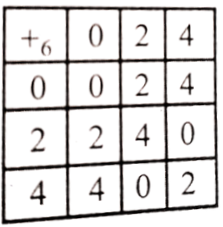
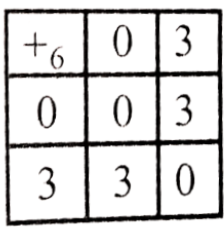
Solution: S = {0,2,4}, T = {0,3} are subsets of \(\mathrm{z}_6\). and From the tables, 0 is the identity
(1) \(0^{-1}=0,2^{-1}=4,4^{-1}=2\)
(2)\(0^{-1}=0,3^{-1}=3\)
Clearly \(\left(\mathbf{S},+_6\right),\left(\mathbf{T},+_6\right)\) are subgroups of \(\mathrm{z}_6\).
Now S ∪ T = {0,2,3,4} is not a subgroup of \(\mathrm{z}_6\) as \(1,5 \notin \mathbf{S} \cup \mathbf{T}\)