McGraw Hill Pre Calculus 11 Student Edition Chapter 3 Exercise 3.1 Quadratic Functions

Pre-Calculus 11 Student Edition Chapter 3 Quadratic Functions

McGraw Hill Pre Calculus 11 Chapter 2 Exercise 2.4 Solutions Page 143 Problem 1 Answer

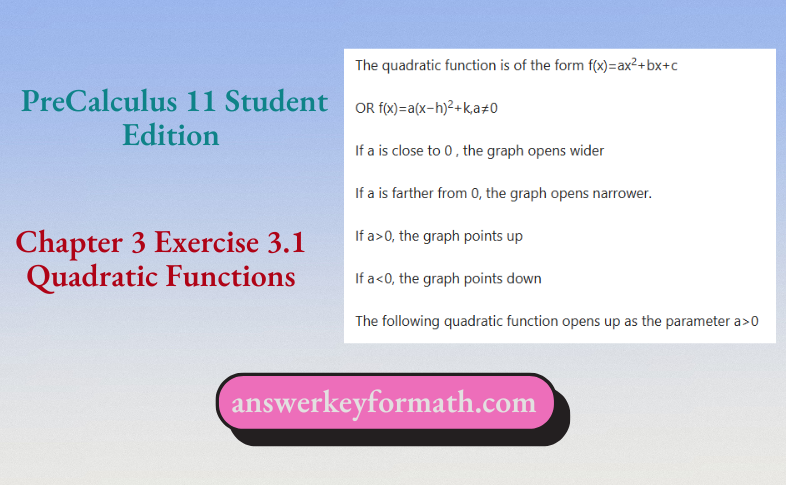
Quadratic function are of the form f(x)=ax2+bx+c

OR f(x)=(a−h)2+k,a≠0.

Form own function by substituting several values of parameter a in the function f(x)=ax2

Given quadratic function is f(x)=ax2.

Mcgraw Hill Precalculus Textbook Answers

Substitute the any values of a, we get several function and they are

f(x)=3x2,a=3

f(x)=3/2

x2,a=3/2

f(x)=10x2,a=10

f(x)=5x2,a=5

f(x)=1/5x2,a=1/5

f(x)=4x2,a=4

​f(x)=−3x2,a=−3

f(x)=−3/2x2,a=−3/2

f(x)=−10x2,a=10

f(x)=−5x2,a=−5

f(x)=−1/5x2,a=−1/5

f(x)=−4x2,a=−4

​own function of the form f(x)=ax2 are

f(x)=3x2

f(x)=3/2x2

f(x)=10x2

f(x)=5x2

f(x)=1/5x2

f(x)=4x2

​f(x)=−3x2

f(x)=−3/2x2

f(x)=−10x2

f(x)=−5x2

f(x)=−1/5x2

f(x)=−4x2

Read and Learn More Precalculus Textbook Mcgraw Hill Answers

McGraw Hill Pre Calculus 11 Chapter 2 Exercise 2.4 Solutions Page 143 Problem 2 Answer
McGraw Hill PreCalculus 11 Student Edition Chapter 3 Exercise 3.1 Quadratic Functions

f(x)=3x2

f(x)=3/2x2

f(x)=10x2

f(x)=5x2

f(x)=1/5x2

f(x)=4x2

The following quadratic functions opens down

f(x)=−3x2

f(x)=−3/2x2

f(x)=−10x2

f(x)=−5x2

f(x)=−1/5x2

f(x)=−4x2

Mcgraw Hill Precalculus Textbook Answers

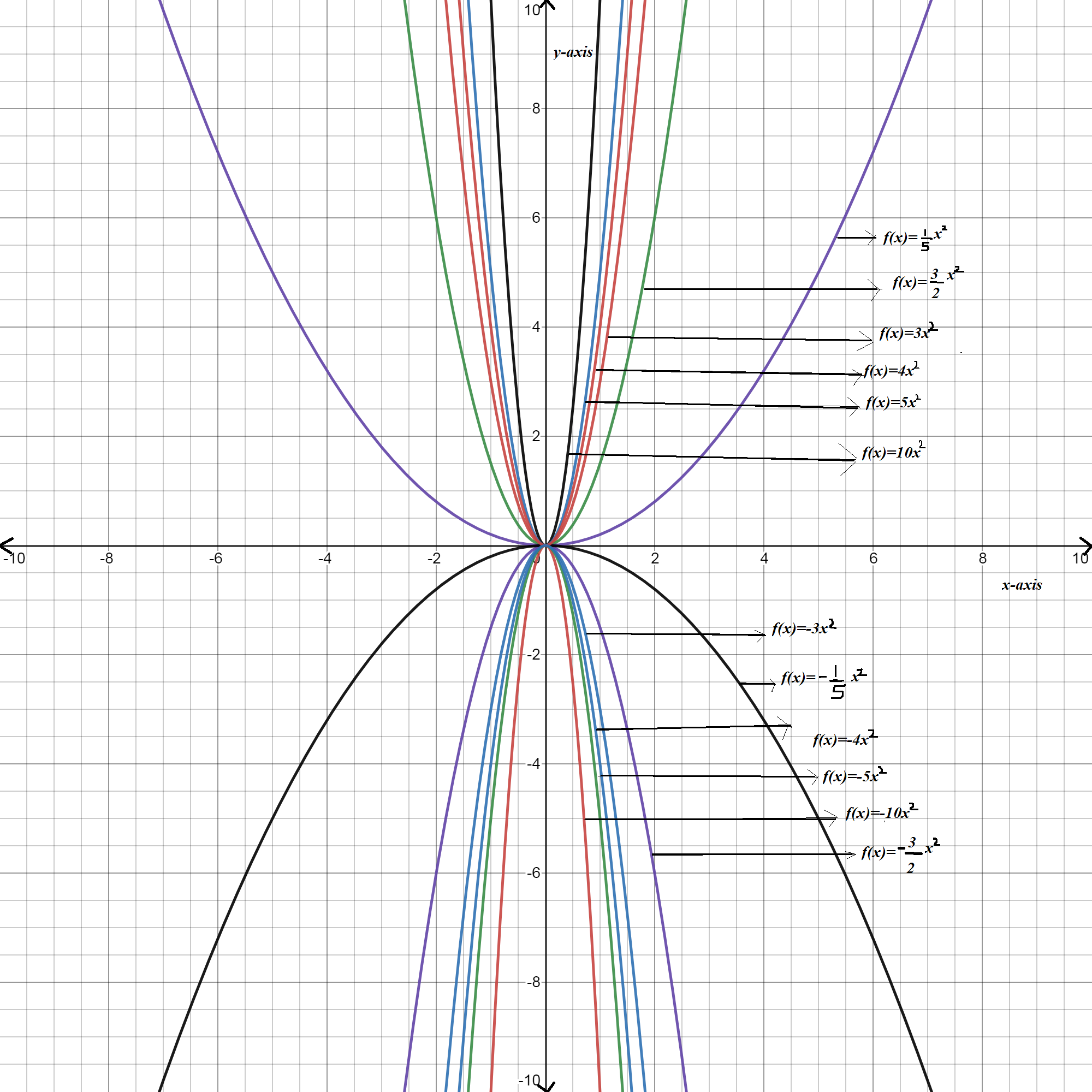
The graph of the above function is shown below
Pre-Calculus 11 Student Edition Chapter 3 Quadratic Functions 2 1

As the value of parameter a increases the curve becomes narrower and when it will be near to 0, curve becomes wider.

In the above graph , the function

f(x)=1/5x2,f(x)=−1/5x2 are wider

f(x)=10x2,f(x)=−10x2 are narrower.

As the value of parameter a increases the curve becomes narrower and when it will be near to 0, curve becomes wider.

In the above graph , the function

f(x)=1/5x2,f(x)=−1/5x2 are wider

f(x)=10x2,f(x)=−10x2 are narrower.

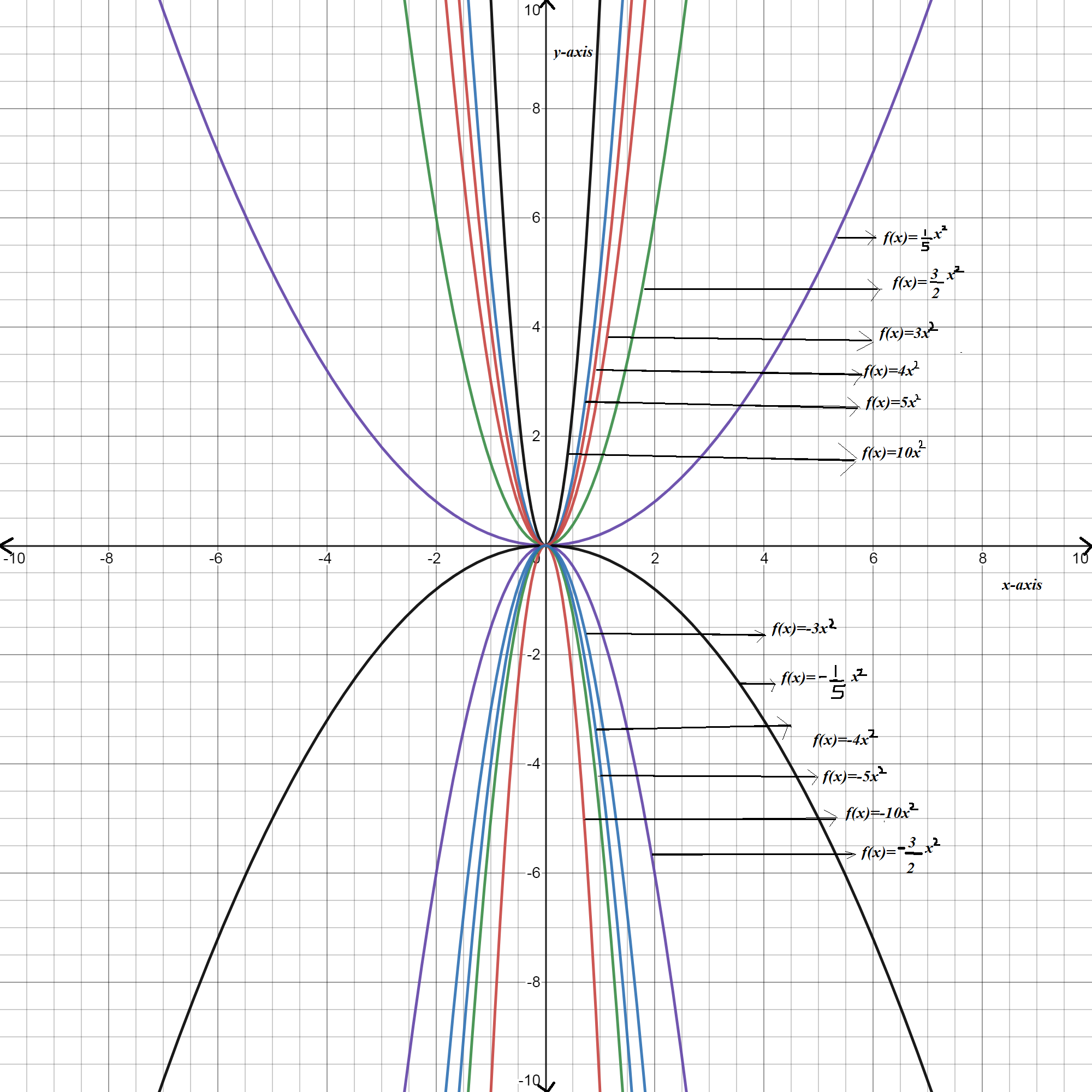
The function f(x)=1/5x2,f(x)=−1/5x2 are wider and the function f(x)=10x2,f(x)=−10x2  are narrower. other function lies in between them
Pre-Calculus 11 Student Edition Chapter 3 Quadratic Functions 2

Pre Calculus 11 Chapter 2 Exercise 2.4 Trigonometry Solved Problems Page 143 Problem 3 Answer

The quadratic function is of the form f(x)=ax2+bx+c OR f(x)=a(x−h)2+k,a≠0

If the parameter a is close to 0, the graph opens wider

If the parameter a is farther from 0, the graph opens narrower

If the parameter a>0, the graph opens up

If the parameter a<0, the graph opens down

The Quadratic function is f(x)=ax2

If a>1>0, the graph opens up.

Mcgraw Hill Precalculus Textbook Answers

As the parameter a is close to 1, the graph opens wider and a

is farther to 1, the graph becomes narrower.

The quadratic function f(x)=ax2 with parameter a>1 opens up.

when a is close to 1 , the graph opens wider

when a is farther to 1, the graph becomes narrower

Pre Calculus 11 Chapter 2 Exercise 2.4 Trigonometry Solved Problems Page 143 Problem 4 Answer

We need to find how the value of a in f(x)=ax2 changes the graph of f(x)=x2 when a is a positive number less than 1.

a is a positive number

a>0 no reflection about x-axis.

a is less than 1

a<1, graph is wider.

when a is a positive number less than 1,

Then f(x)=x2 gets wider with value of a goes from 1→0 to form graph of f(x)=ax2

Pre Calculus 11 Chapter 2 Exercise 2.4 Trigonometry Solved Problems Page 143 Problem 5 Answer

We need to find how the value of a in f(x)=ax2 changes the graph of f(x)=x2 when a is a negative number.

is a negative number

a<0 graph reflected about x-axis.

If a<−1, graph gets narrower.

If −1<a<0, graph gets wider.

when a is a negative number, Then f(x)=x2 gets reflected about x-axis to form graph of f(x)=ax2

If a<−1, graph gets narrower.

−1<a<0, graph gets wider.

Precalculus Textbook Mcgraw Hill Answers

Pre Calculus 11 Chapter 2 Exercise 2.4 Trigonometry Solved Problems Page 143 Problem 6 Answer

Given : f(x)=x2+q

By substituting q=0,2,3,4,−1.4,2,3

we can obtained the different forms of the function f(x)=x2+q.

q= 0 f(x) = x2

q= 2 f(x) = x2 + 2

q = 3 f(x) = x2 + 3

q = 4 f(x) = x2 + 4

q = −1.4 f(x) = x2 − 1.4

q = −2 f(x) = x2 − 2

q = −3

The different forms of the function are f(x)=x2,f(x)=x2+2,f(x)=x2+3,f(x)=x2+4,f(x)=x2−1.4,f(x)=x2−2,f(x)=x2−3

Pre Calculus 11 Exercise 2.4 Step-By-Step Trigonometry Solutions Page 143 Problem 7 Answer

We have to compare the function f(x)=x2+q  with the function f(x)=x2 for different positive and negative values of q.

Use a graphing calculator and draw the graph of the given function for different values of q then compare with the graph of f(x)=x2.

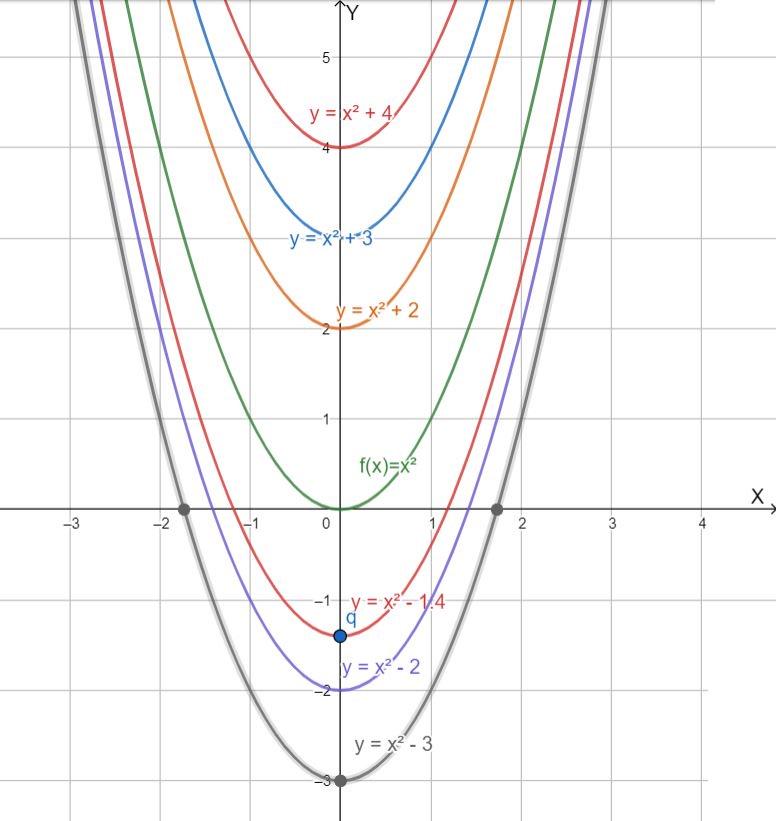
The graph of the function f(x)=x2+q for different values of q and f(x)=x2 is drawn as
Pre-Calculus 11 Student Edition Chapter 3 Quadratic Functions 7 1

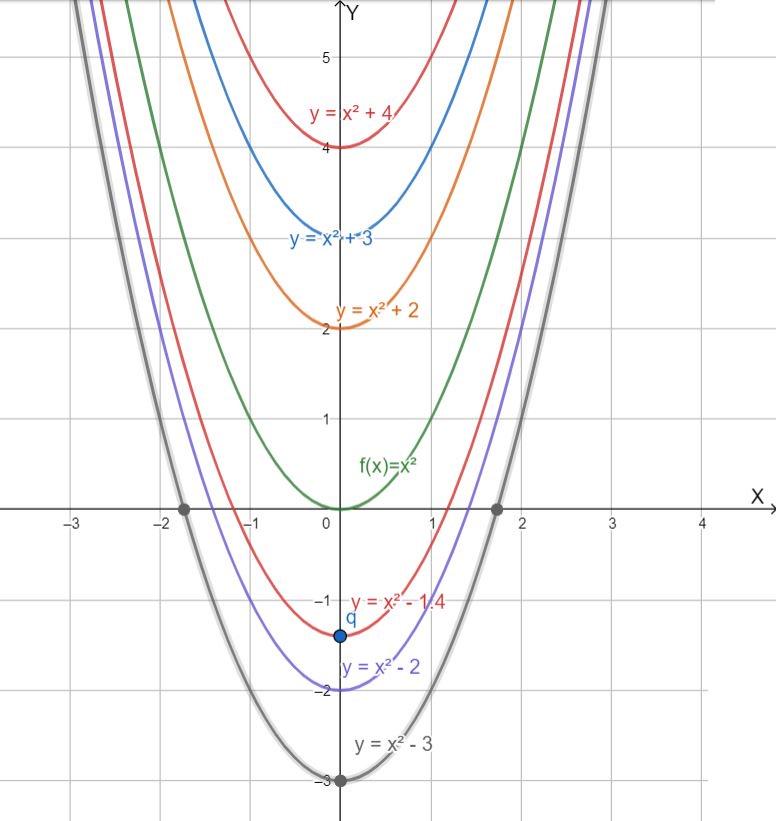
When we compare the graph of the function then we can observe that if the q is positive then the graph of f(x)=x2 translates q units upward along the y-axis and if the q is negative then the graph of f(x)=x2 translates q units downward along y-axis.
Pre-Calculus 11 Student Edition Chapter 3 Quadratic Functions 7

Pre Calculus 11 Exercise 2.4 Step-By-Step Trigonometry Solutions Page 150 Problem 8 Answer

Given: quadratic functiony=1/2(x−2)2−4

To determine: 1. Vertex

2.The domain and range

3.The direction of opening

4.The equation of the axis of symmetry

Use the values of a,p and q to determine these characteristics and sketch the graph.

We have the quadratic function y=1/2(x−2)2−4

Compare this function toy=a(x−p)2+q, we get

a=1/2,p=2 and q=−4

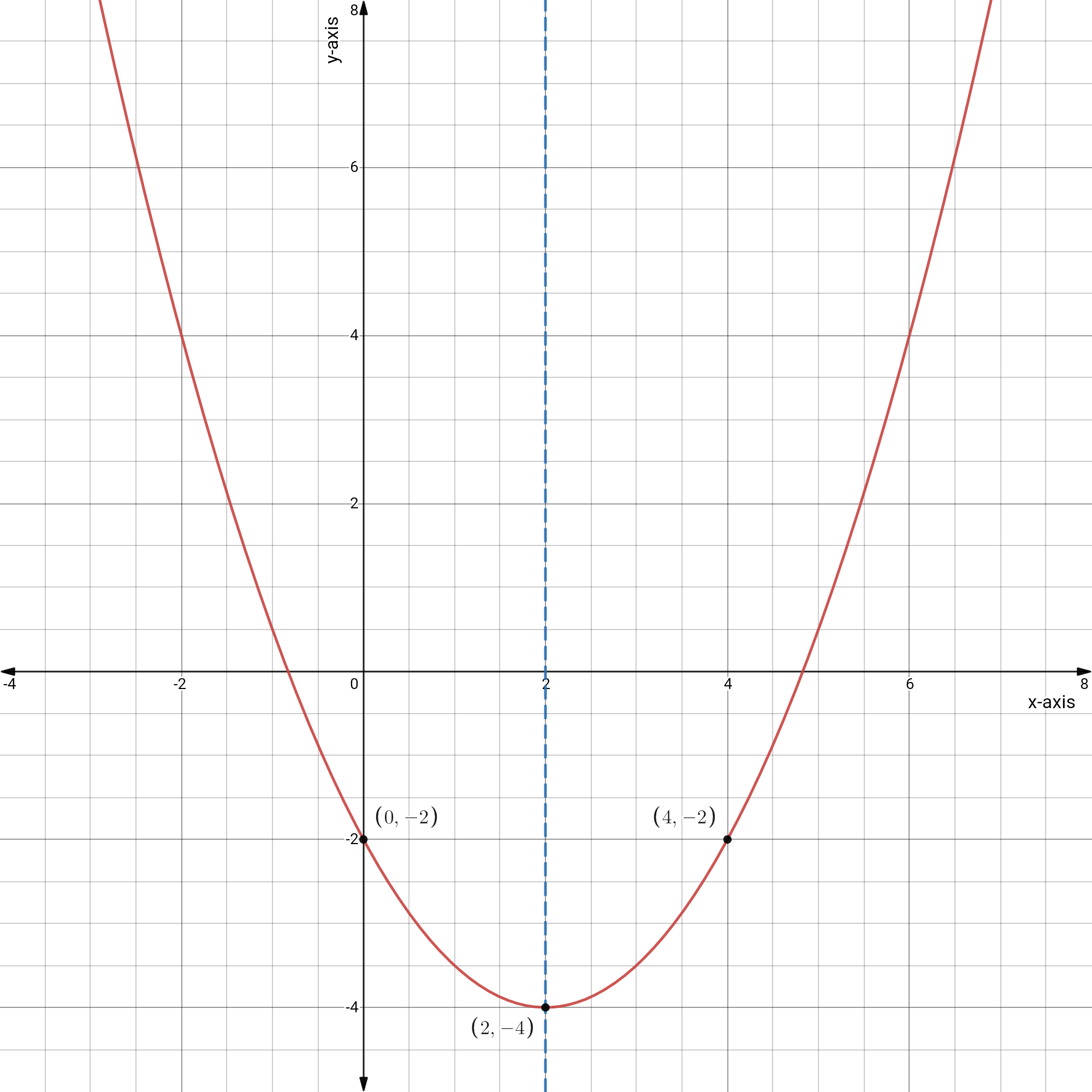
Vertex: Since p=2andq=−4, the vertex is located at(2,−4).

The domain and range: Since q=−4, the range is {y∣y≥−4,y∈R}and the domain is {x∣x∈R}.

The direction of opening: Since a>0, the graph opens upward.

The equation of the axis of symmetry: Since p=2, the equation of the axis of symmetry is x−2=0 or x=2.

Plot the coordinates of the vertex,(2,−4), and draw the axis of symmetry,x=2.

Determine the coordinates of one other point on the parabola.

For example, determine y−intercept by substitutingx=0 into the given function.

y=1/2(0−2)2−4

y=1/2(4)−4

y=2−4

y=−2

The point(0,−2) is on the graph.

Precalculus Textbook Mcgraw Hill Answers
Pre-Calculus 11 Student Edition Chapter 3 Quadratic Functions 8 1

For any point other than the vertex, there is a corresponding point that is equidistant from the axis of symmetry.

In this case, the corresponding point of(0,−2) is(4,−2).

Plot this two additional points and complete the sketch of the parabola.

The graph of given function is:

1.Vertex:(2,−4)

2.The domain:{x∣x∈R} and range:{y≥−4∣y∈R}

3.The direction of opening: Upward

4.The equation of the axis of symmetry: x=2

The graph of a function:

Precalculus Textbook Mcgraw Hill Answers

Pre-Calculus 11 Student Edition Chapter 3 Quadratic Functions 8 1

Pre Calculus 11 Exercise 2.4 Step-By-Step Trigonometry Solutions Page 150 Problem 9 Answer

Given: quadratic functiony=−3(x+1)2+3

To determine: 1. Vertex

2.The domain and range

3.The direction of opening

4.The equation of the axis of symmetry

Use the values of a,p and q to determine these characteristics.

We have the quadratic function y=−3(x+1)2+3.

Compare this function toy=a(x−p)2+q, we get a=−3,p=−1 and q=3

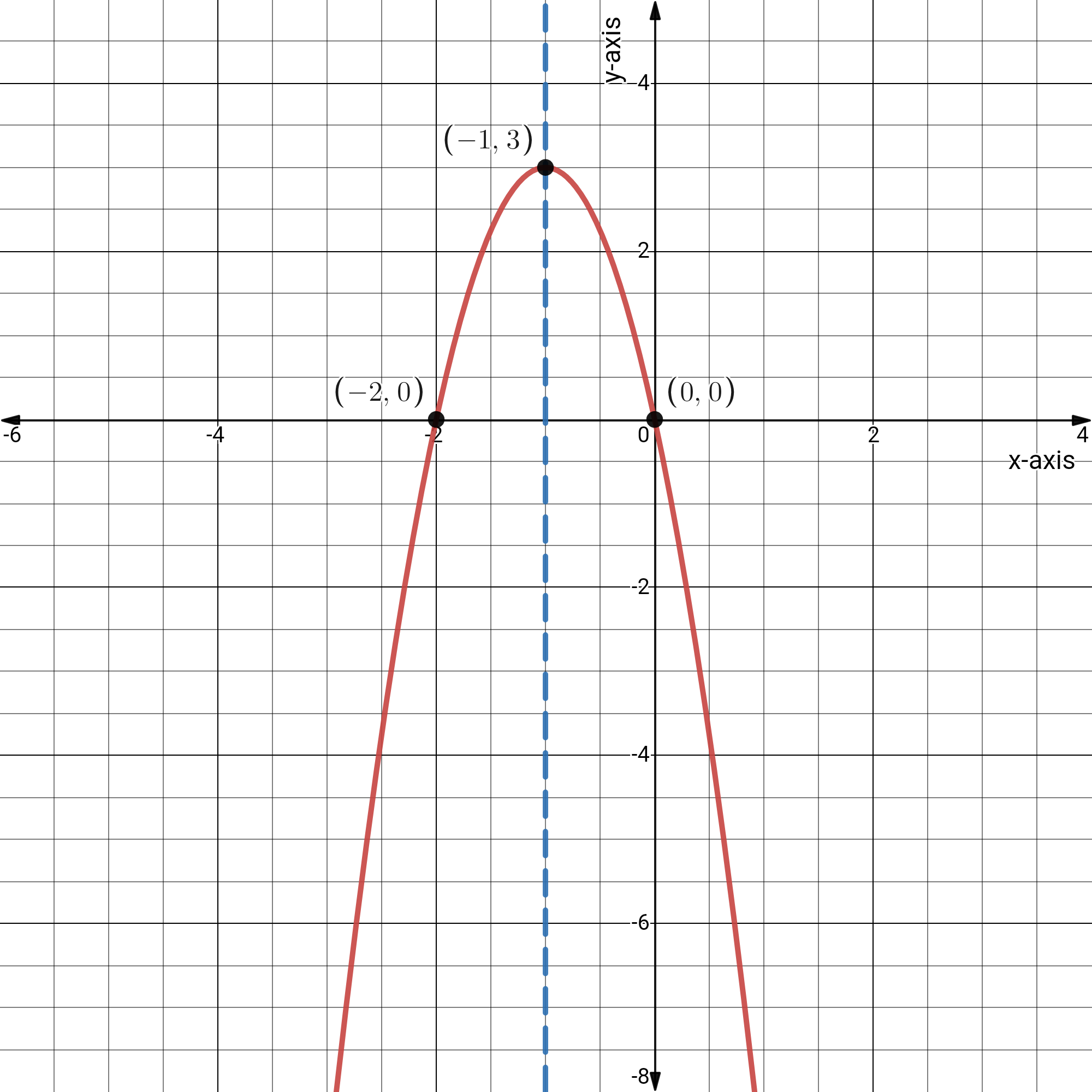
Vertex: Since p=−1 and q=3, the vertex is located at(−1,3).

The domain and range: Since q=3, the range is{y∣y≤3,y∈R} and the domain is{x∣x∈R}.

The direction of opening: Sincea<0, the graph open downward.

The equation of the axis of symmetry: Sincep=−1, the equation of the axis of symmetry is x=−1.

Plot the coordinates of the vertex,(−1,3), and draw the axis of symmetry,x=−1.Determine the coordinates of one other point on the parabola.

For example, determine y−intercept by substituting x=0into the given function.

Mcgraw-Hill Textbook Answers

y=−3(x+1)2+3

y=−3(0+1)2+3

y=−3(1)+3

y=0

The point(0,0) is on the graph.
Pre-Calculus 11 Student Edition Chapter 3 Quadratic Functions 9 1

For any point other than the vertex, there is a corresponding point that is equidistant from the axis of symmetry.

In this case, the corresponding point of(0,0) is(−2,0).

Plot this two additional points and complete the sketch of the parabola.

The graph of given function is:

1 Vertex:(−1,3)

2.The domain:{x∣x∈R} and range:{y∣y≤3,y∈R}

3.The direction of opening: Downward

4.The equation of the axis of symmetry:x=−1

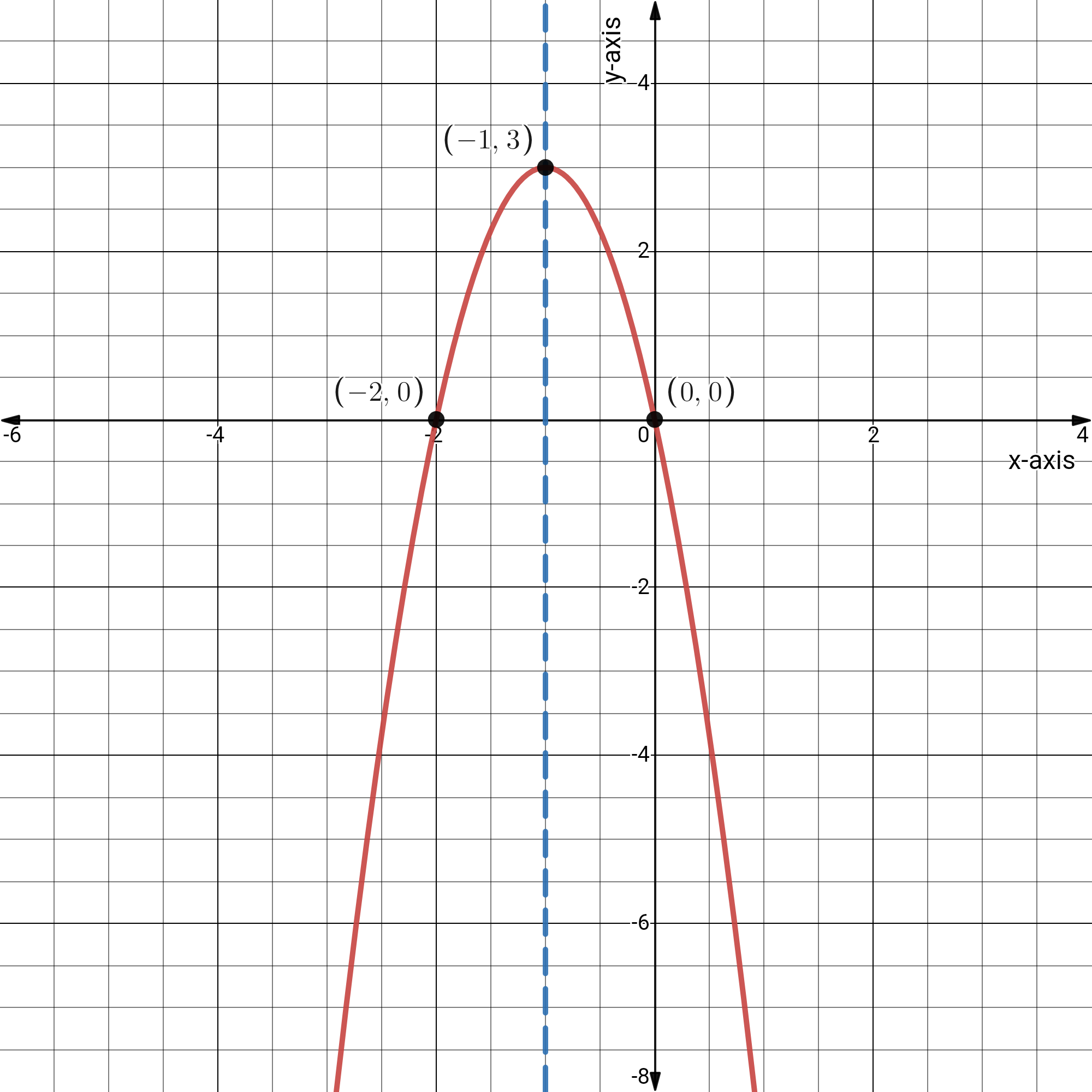
The graph of given function is:
Pre-Calculus 11 Student Edition Chapter 3 Quadratic Functions 9

Pre Calculus 11 Exercise 2.4 Step-By-Step Trigonometry Solutions Page 153 Problem 10 Answer

There is given a graph of a parabola.

It is asked to determine a quadratic function in vertex form.

The quadratic function can be found by finding the vertex and applying the vertex form of the parabola formula.

Firstly, we can find the vertex from the graph

We know that vertex of any parabola is the point where the graph changes its shape.

The graph is changing shape at (−3,0)

so, the vertex is (h,k)=(−3,0)

Apply vertex form of the parabola formula: y=a(x−h)2+k

Plug vertex point into the formula

Mcgraw-Hill Textbook Answers

y=a(x+3)2+0

Now, we can select anyone point and find a

The point is (−1,−2)

Plug this point into the formula−2=a(−1+3)2+0

22a=−2

4a=−2

a=−1/2

Plug this value into the formula

y=−1/2(x+3)2+0

Hence, the quadratic function is y=−1/2(x+3)2+0

Pre Calculus 11 Exercise 2.4 Step-By-Step Trigonometry Solutions Page 153 Problem 11 Answer

There is given a graph of a parabola.

It is asked to determine a quadratic function in vertex form.

The quadratic function can be found by finding the vertex and applying the vertex form of the parabola formula.

Firstly, we can find the vertex from the graph

We know that vertex of any parabola is the point where the graph changes its shape.

The graph is changing shape at (2,1)

so, the vertex is (2,1)

Apply vertex form of the parabola formula: y=a(x−h)2+k

Plug vertex point into the formula

y=a(x−2)2+1

Now, we can select anyone point and find a

The point is (1,5)

Plug this point into the formula

5=a(1−2)2+1

a+1=5

a=4

Plug this value into the formula

y=4(x−2)2+1

Hence, the quadratic function is f(x)=4(x−2)2+1

Mcgraw-Hill Textbook Answers

Solutions For Pre Calculus 11 Chapter 2 Exercise 2.4 Trigonometry Page 154 Problem 12 Answer

The function is given as

f(x)=0.5x2−7

It is asked to find x-intercepts of this function without graphing

It can be found by replacing f(x) as zero and solve for x

The function is f(x)=0.5x2−7

We can set f(x)=0 and solve for x

f(x)=0.5x2−7=0

0.5x2−7=0

Add both sides by 7

0.5x2=7

Divide both sides by 0.5

0.5x2/0.5=7/0.5

x2=14

Take square root on both sides

x=√14,​x=−√14

Hence, x-intercepts are x=√14,x=−√14

Solutions For Pre Calculus 11 Chapter 2 Exercise 2.4 Trigonometry Page 154 Problem 13 Answer

The function is given as f(x)=−2(x+1)2

It is asked to find x−intercepts of this function without graphing

It can be found by replacing f(x) as zero and solve for x

The function is f(x)=−2(x+1)2

We can set  f(x)=0 and solve for x

Mcgraw-Hill Textbook Answers

f(x)=−2(x+1)2=0

−2(x+1)2=0

Divide both sides by −2

−2(x+1)2/−2=0/−2

(x+1)2=0

Take square root on both sides x+1=0

x=−1,x=−1

Hence, x-intercepts are x=−1,x=−1

Solutions For Pre Calculus 11 Chapter 2 Exercise 2.4 Trigonometry Page 154 Problem 14 Answer

The function is given as f(x)=−1/6(x−5)2−11

It is asked to find x− intercepts of this function without graphing.

It can be found by replacing f(x) as zero and solve for x

The function is

f(x)=−1/6(x−5)2−11

We can set f(x)=0 and solve for x

f(x)=−1/6(x−5)2−11=0

−1/6(x−5)2−11=0

−1/6(x−5)2−11+11=0+11

−1/6(x−5)2=11

(−1/6(x−5)2)(−6)=11(−6)

(x−5)2=−66

Take square root on both sides

There is a negative value on the right side

And we know that square root of negative is always imaginary values

So, x-intercepts do not exist for this function.

Hence, x-intercepts do not exist for this function.

Solutions For Pre Calculus 11 Chapter 2 Exercise 2.4 Trigonometry Page 157 Problem 15 Answer

Given :- The equation of parabolay=7x2

To find :- The graph of the parabola and whether it has maximum or minimum value and also we have to find range of the function.

First we will plot the graph by comparing the graph of the parabola y=x2.

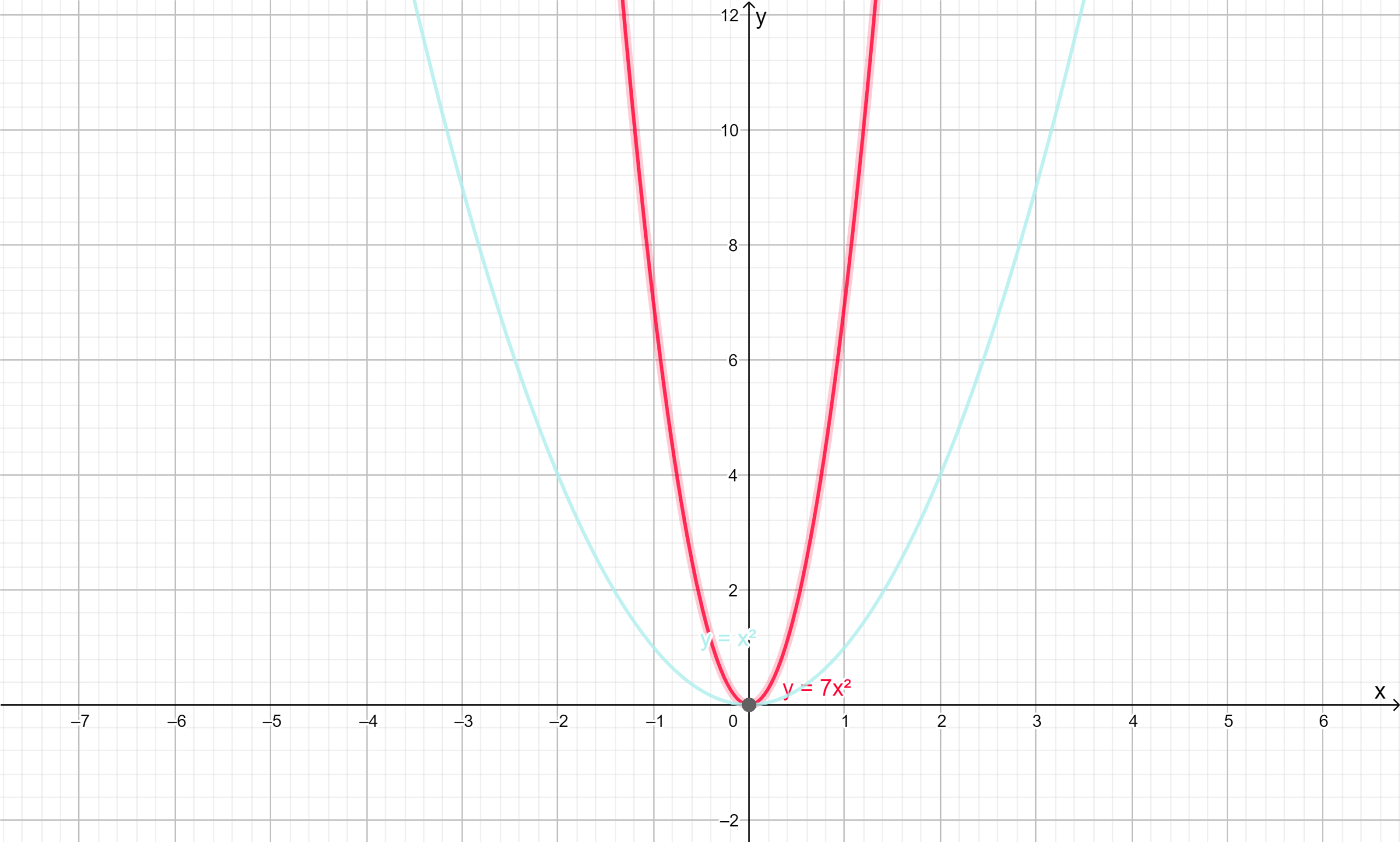
y=x2has vertex at origin because it is of form y=ax2 hence y=7x2 also has vertex at origin i.e.(0,0).

On comparing given parabola with standard equation we will get7>0 and 7>1 so the parabola will be upward and narrow than y=x2.

The required parabola is shown in graph in red color.
Pre-Calculus 11 Student Edition Chapter 3 Quadratic Functions 15

The range of the functiony=7x2 is{y∣y≥0,y∈R}.

To find the maxima or minima we will now differentiatey=7x2w.r.tx.

⇒dy/dx

=14x

⇒d2y/dx2

=14

⇒d2y/dx2>0

This means that function has minimum value.

The range of the parabola y=7x2 is{y∣y≥0,y∈R} and has minimum value.

Pre Calculus 11 Mcgraw Hill Chapter 2.4 Solved Examples Page 157 Problem 16 Answer

Given :-y=1/6x2

To find:- The graph of the parabola and whether it has maximum or minimum value and also we have to find range of the function.

First we will plot the graph by comparing the graph of the parabolay=x2

y=x2 has vertex at origin because it is of form y=ax2 hencey=1/6x2 also has vertex at origin.

On comparing given parabola with standard equation we will get a=1/6>0,1/6<1 therefore the parabola will open upward and wider than y=x2.

Red color curve represent the required parabola.
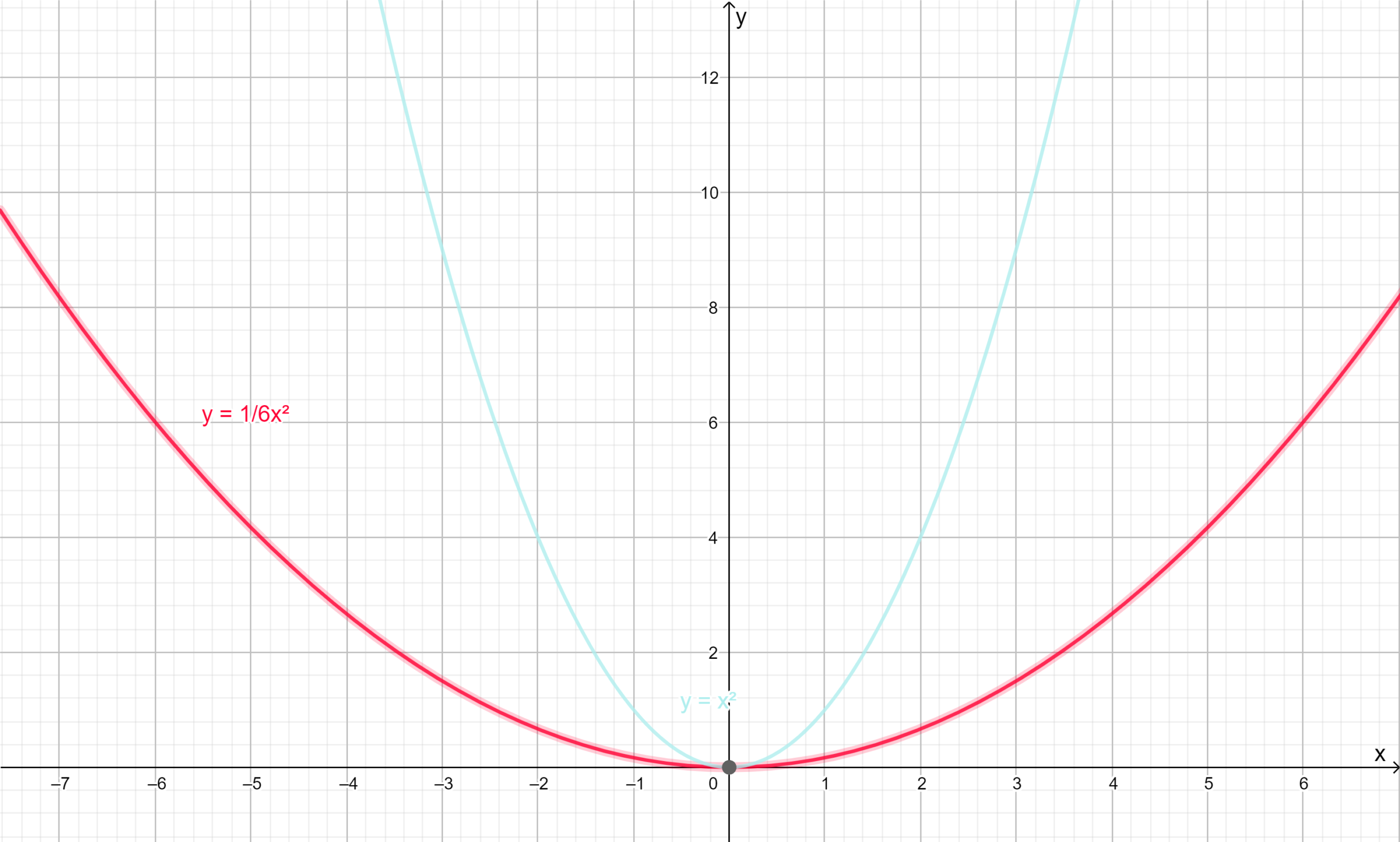
Pre-Calculus 11 Student Edition Chapter 3 Quadratic Functions 16

The range of the parabola is{y∣y≥0,y∈R}.

To find whether the function has minimum or maximum value, we will take derivate of the function twice.

⇒dy/dx=1/3x

⇒d2y/dx2=1/3

⇒d2y/dx2>0

Hence function has minimum value.

The range of y=1/6x2 is{y∣y≥0,y∈R} and function has minimum value.

Pre Calculus 11 Mcgraw Hill Chapter 2.4 Solved Examples Page 157 Problem 17 Answer

Given :-y=−4x2

To find :-State the direction of opening, whether it has a maximum or a minimum value, and the range.

First we will plot the graph by comparing the graph of the parabola y=x2.

y=x2 has vertex at origin since it is of form y=ax2 hencey=−4x2 has vertex at origin and narrower than y=x2 sincea=−4<−1 and it will open downward sincea=−4<0.

The graph is shown below in red color.
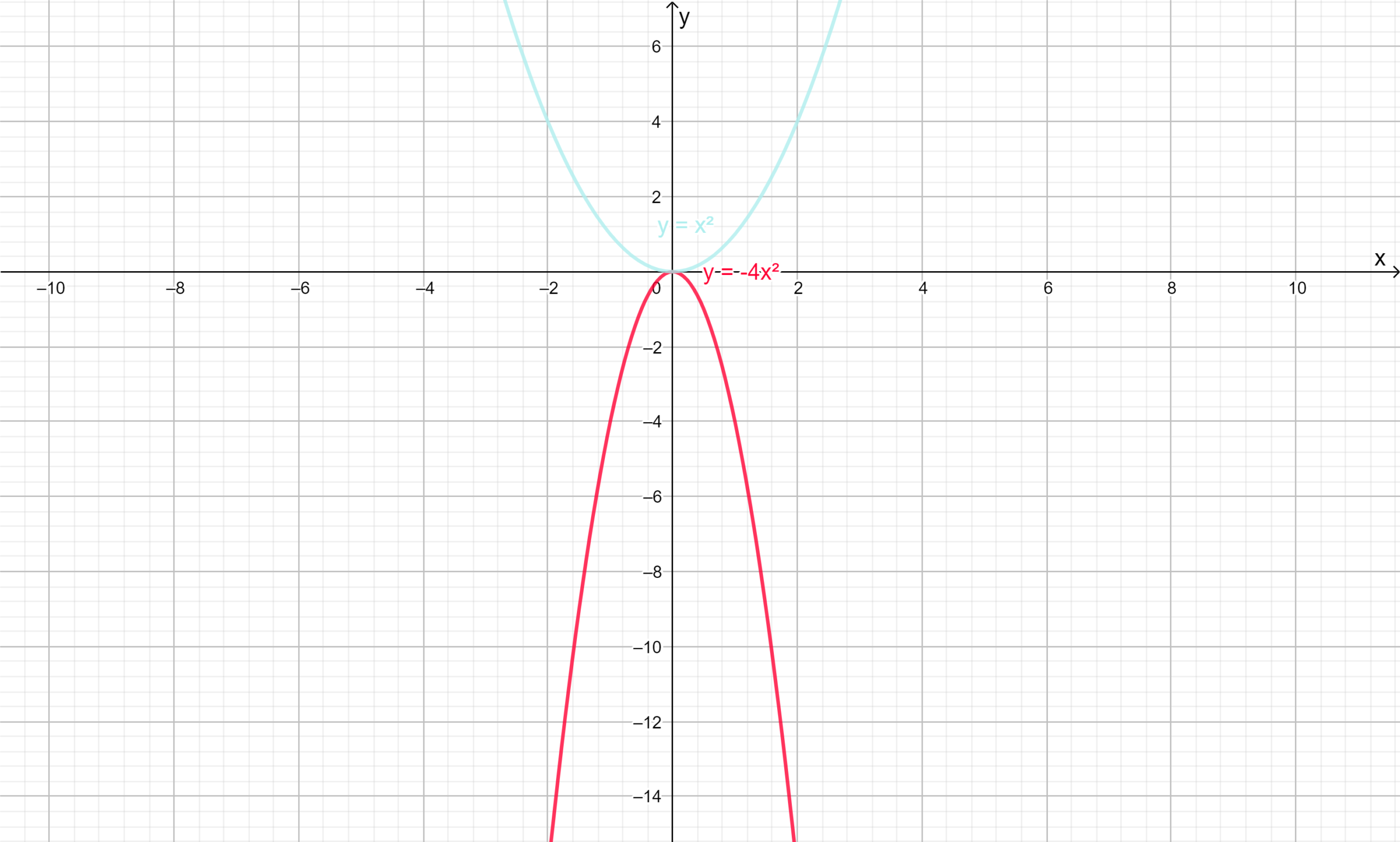
Pre-Calculus 11 Student Edition Chapter 3 Quadratic Functions 17

The range of the function isy=−4x2 is{y∣y≤0,y∈R}.

To find whether the function has minimum or maximum value we will take derivate of the function twice.

⇒dy/dx

=−8x

⇒d2y/dx2

=−8

⇒d2y/dx2<0

Hence function has maximum value.

The parabolay=−4x2 opens in downward and has range {y∣y≥0,y∈R} and also has maximum value.

Pre Calculus 11 Mcgraw Hill Chapter 2.4 Solved Examples Page 157 Problem 18 Answer

Given :- The equation of the parabola isy=−0.2×2

To find :-State the direction of opening, whether it has a maximum or a minimum value, and the range.

First we will plot the graph by comparing the graph of the parabolay=x2

y=−0.2×2 has vertex at origin since it is in the form ofy=ax2 . It will open in downward direction since a=−0.2<0 and wider than the parabolay=x2 because−1<−0.2<1.

The required graph of parabola is shown below in red color.
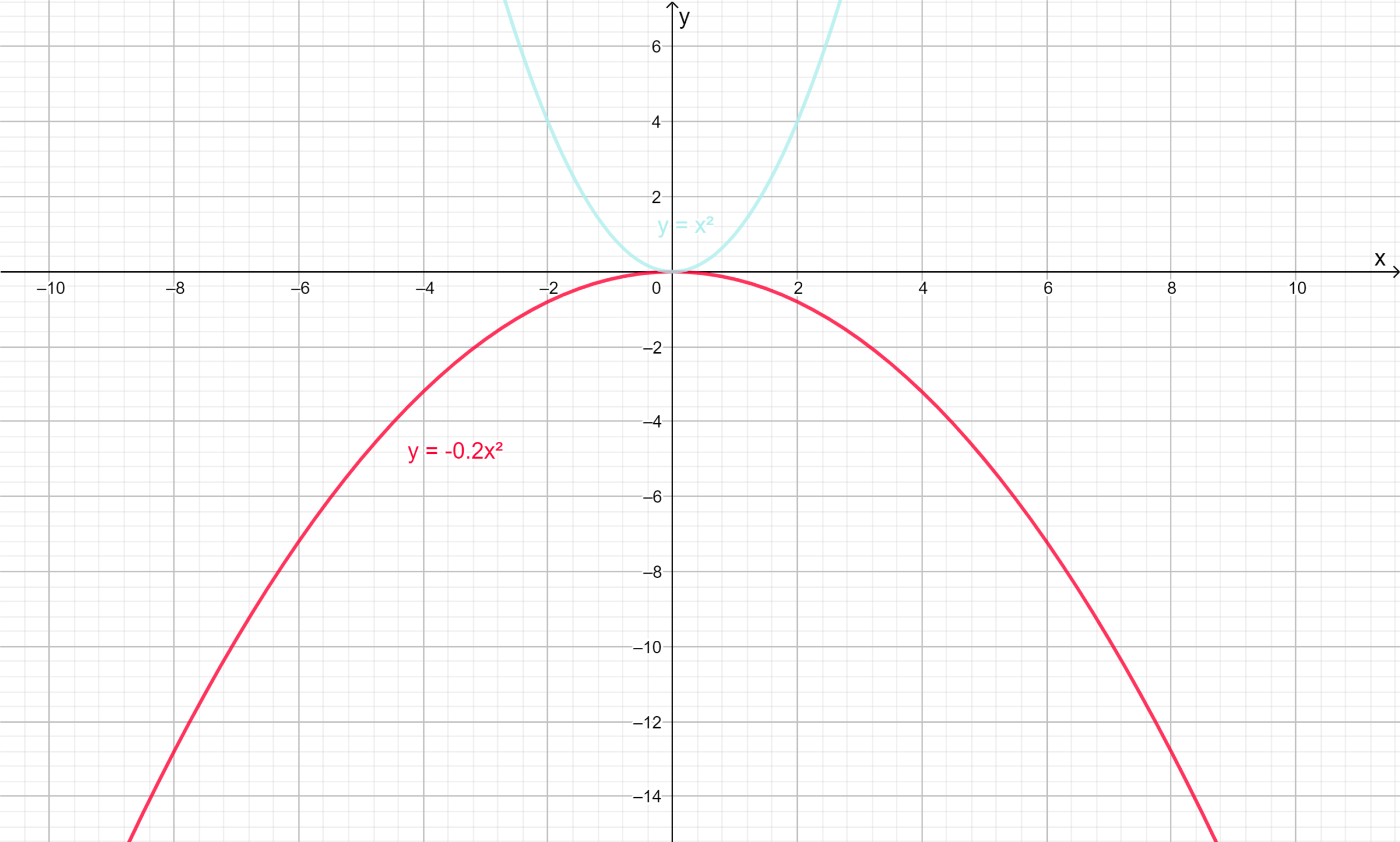
Pre-Calculus 11 Student Edition Chapter 3 Quadratic Functions 18

The range of the functiony=−0.2×2 is{y∣y≤0,y∈R}.

Take derivative of the function twice to determine whether it has maximum value or minimum value.

⇒dy/dx

=−0.4x

⇒d²y/dx²

=−0.4

⇒d²y/dx²<0

​Hence function has maximum value.

F(x)=−0.2x2 which opens downward has range{y∣y≥0,y∈R} and also it has maximum value.

Pre Calculus 11 Chapter 2 Exercise 2.4 Trigonometry Detailed Solutions Page 157 Problem 19 Answer

Given :- The equations of the parabolas are y=x2,y=x2+1

To find :- The relation between given parabolas and sketch the graph of the second function in each pair, and determine the vertex, the equation of the axis of symmetry, the domain and range, and any intercepts.

As the coefficient of x2 is same in both the equation of parabola therefore second parabola i.e.y=x2+1 is as wide as first one.
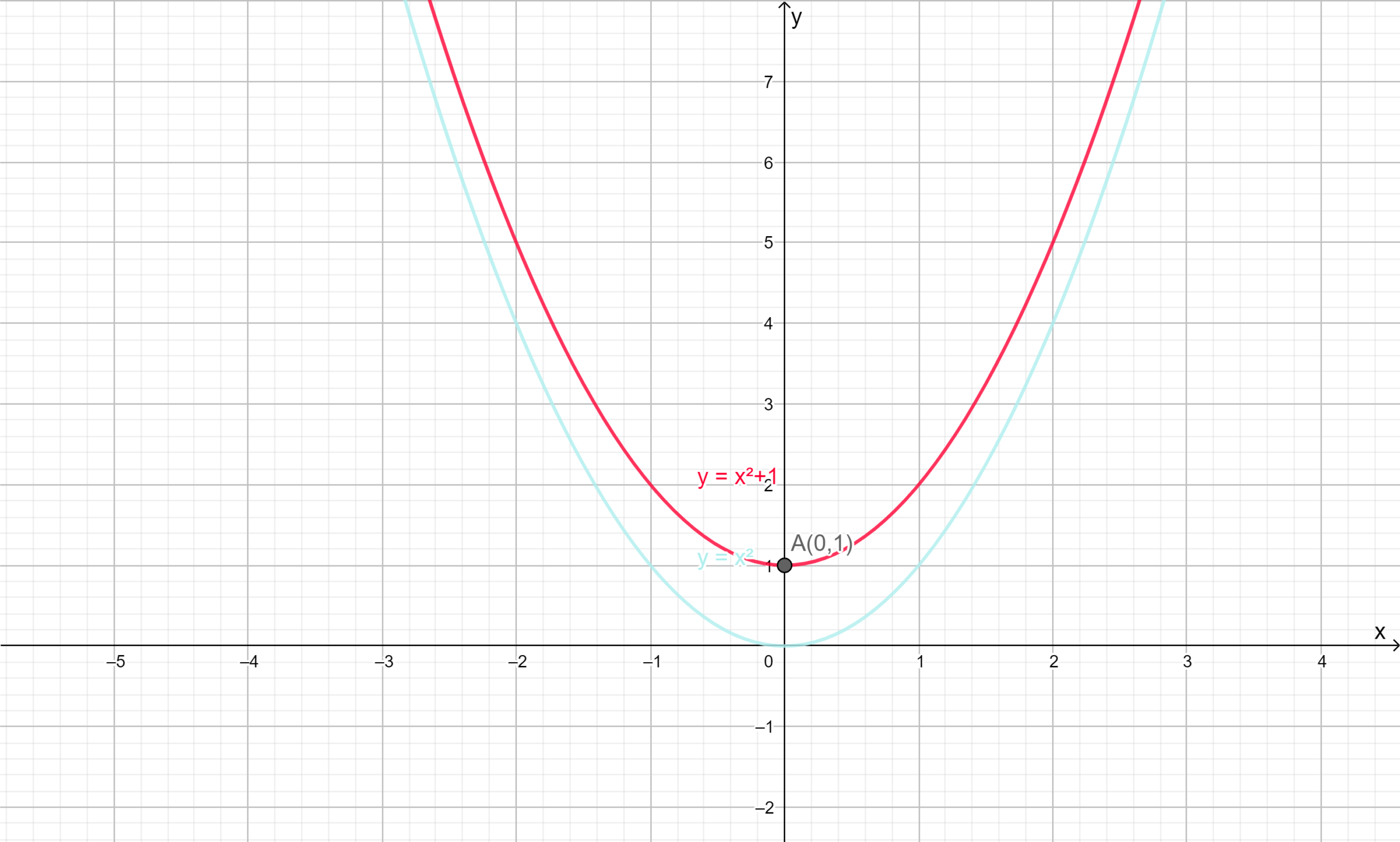
Pre-Calculus 11 Student Edition Chapter 3 Quadratic Functions 19

But it has different vertex which can be determined by comparing the standard equation we will get the vertex of the parabolay=x2+1 as(0,1) so the graph of second parabola can be get by shifting the first parabola upward ony−axis by 1 unit. as shown in figure.

This graph is symmetric about y-axis so the equation of axis of symmetry is x=0.

The domain of the function f(x)=x2+1 is{x∣−∞<x<∞,x∈R} and the range of the function is given by{y∣y≥1,y∈R}.

The y- intercept is calculated by putting x=0 in​y=x2+1⇒y=1 and x-intercept is calculated by putting​y=0⇒x=√−1 which is imaginary so the second parabola does not cut x- axis.

The parabolay=x2+1 has vertex(0,1) ,y-intercept1unit,the domain of the parabola is{x∣−∞<x<∞,x∈R} and range is{y∣y≥1,y∈R} and the parabola is symmetric to the line x=0.

Pre Calculus 11 Chapter 2 Exercise 2.4 Trigonometry Detailed Solutions Page 157 Problem 20 Answer

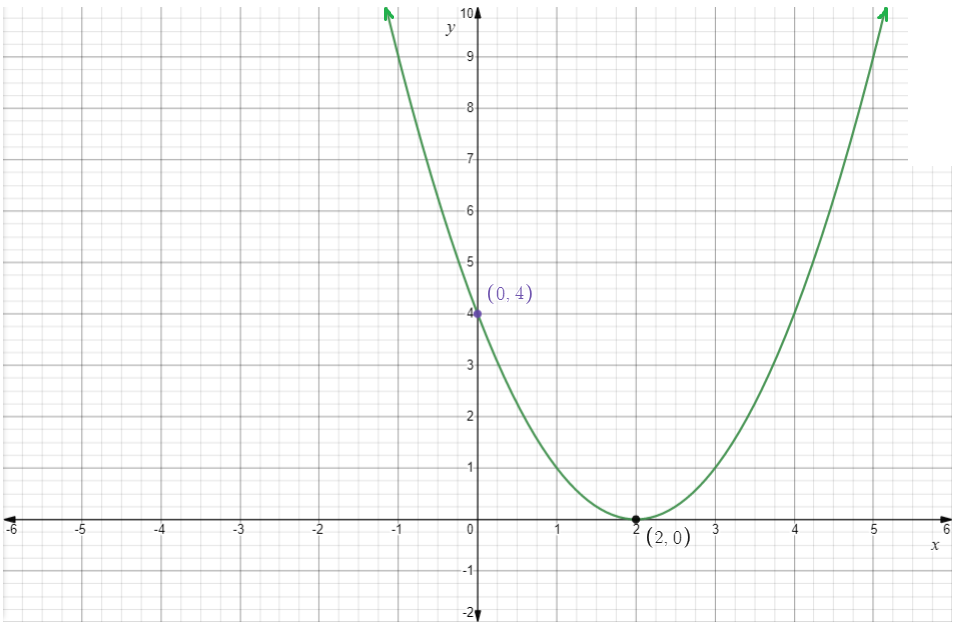
Given pair of functions is y=x2 andy=(x−2)2.

We need to describe the relation between the graphs of given functions and also to find the vertex, equation of axis of symmetry, the domain and range and the intercepts (if any) of the second function.

Comparey=(x−2)2 withy=(x−c)2 and then describe the relation between the graphs of given functions and then draw the graph of second function.

Comparey=(x−2)2 withy=(x−c)2, we get c=2.

Therefore the graph ofy=(x−2)2 is obtained by horizontally shifting the graph of y=x2 to the right side by2 units.

The graph ofy=(x−2)2 is,
Pre-Calculus 11 Student Edition Chapter 3 Quadratic Functions 20 1

The vertex is(2,0).

The equation of axis of symmetry is,

x=c

⇒x=2

The domain is the set of all real numbers.

The range is[0,∞).

x-intercept is 2 and y-intercept is 4.

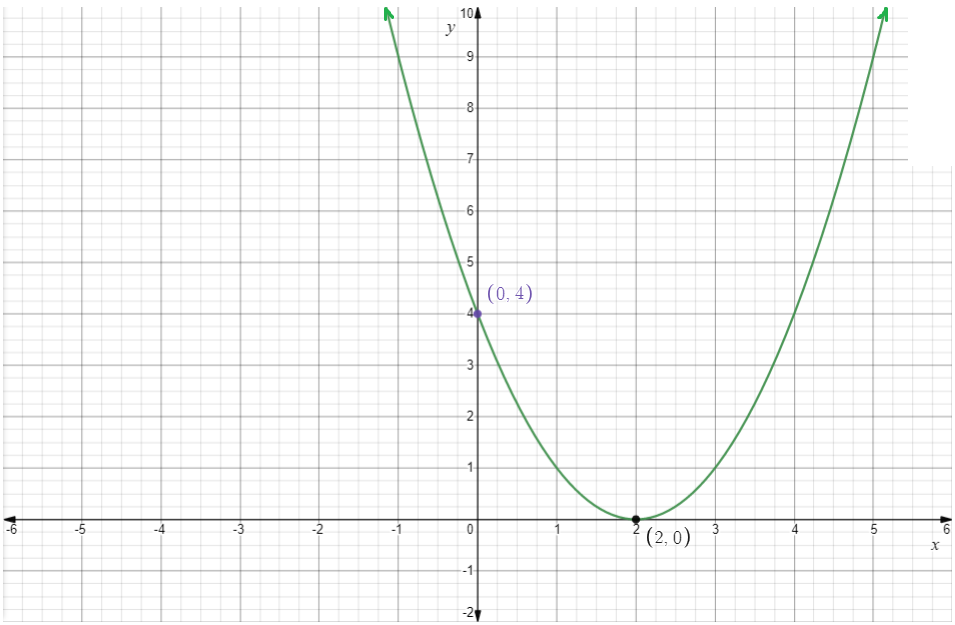
The graph is,
Pre-Calculus 11 Student Edition Chapter 3 Quadratic Functions 20

The vertex is(2,0).

The equation of axis of symmetry is x=2.

The domain is the set of all real numbers.

The range is[0,∞).

x-intercept is 2 and y-intercept is 4.

Pre Calculus 11 Chapter 2 Exercise 2.4 Trigonometry Detailed SolutionsPage 157 Problem 21 Answer

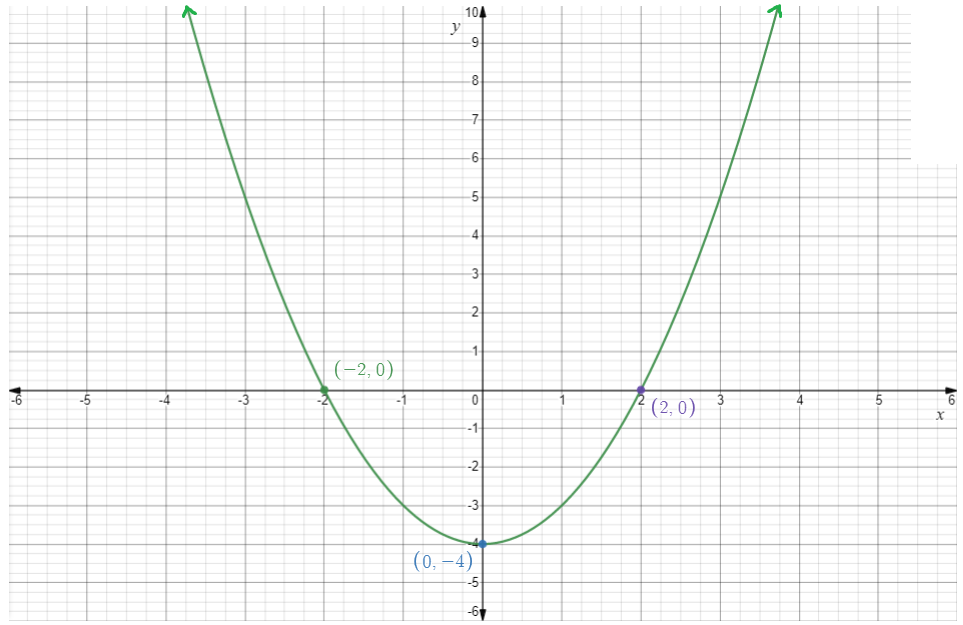
Given pair of functions is y=x2 and y=x2−4.

We need to describe the relation between the graphs of given functions and also to find the vertex, equation of axis of symmetry, the domain and range and the intercepts (if any) of the second function.

Comparey=x2−4 with y=x2−k and then describe the relation between the graphs of given functions and then draw the graph of second function.

Comparey=x2−4 with y=x2−k, we get k=4.

Therefore the graph ofy=x2−4 is obtained by vertically shifting the graph of y=x2 downward by 4 units.

Now the graph ofy=x2−4 is,
Pre-Calculus 11 Student Edition Chapter 3 Quadratic Functions 21 1

The vertex is(0,−4).

The equation of axis of symmetry isy-axis. That is,x=0.

The domain is the set of all real numbers.

The range is[−4,∞).

x-intercepts are−2,2 and y-intercept is−4.

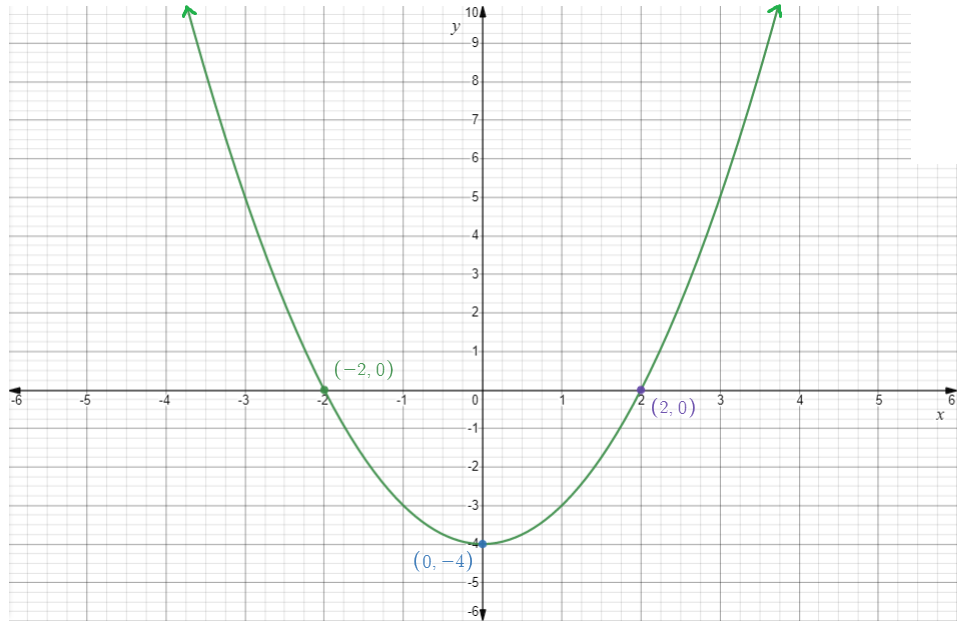
The graph is,
Pre-Calculus 11 Student Edition Chapter 3 Quadratic Functions 21

The vertex is(0,−4).

The equation of axis of symmetry is x=0.

The domain is the set of all real numbers.

The range is[−4,∞).

x-intercepts are−2,2 and they-intercept is−4.

Pre Calculus 11 Chapter 2 Exercise 2.4 Trigonometry Detailed Solutions Page 157 Problem 22 Answer

Given pair of functions is y=x2 and y=(x+3)2.

We need to describe the relation between the graphs of given functions and also to find the vertex, equation of axis of symmetry, the domain and range and the intercepts (if any) of the second function.

Comparey=(x+3)2 with y=(x+c)2 and then describe the relation between the graphs of given functions and then draw the graph of second function.

Comparey=(x+3)2 withy=(x+c)2, we get

c=3.

Therefore the graph ofy=(x+3)2 is obtained by horizontally shifting the graph of y=x2 to the left side by 3 units.

Now the graph ofy=(x+3)2 is,
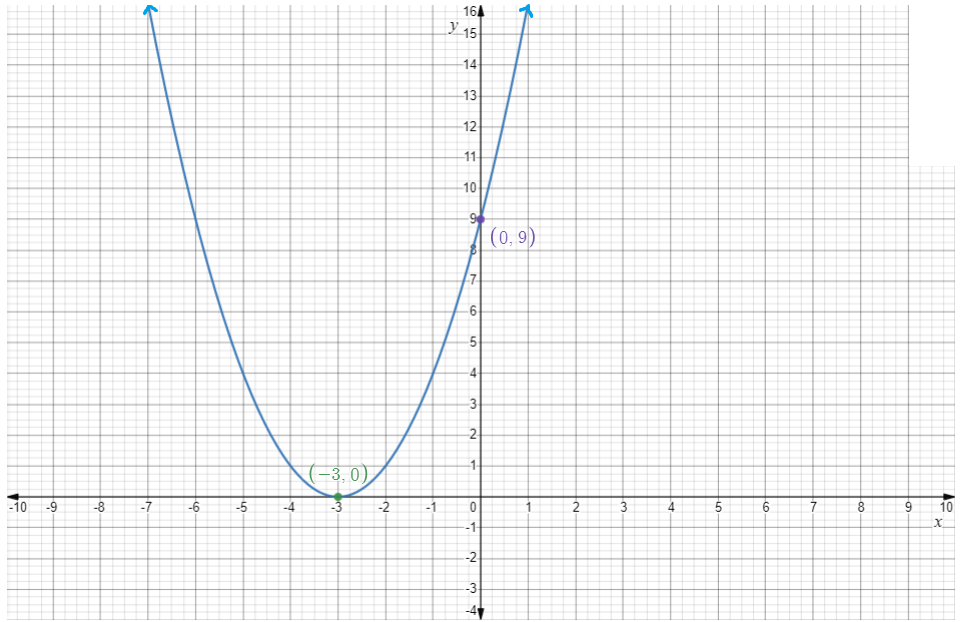
Pre-Calculus 11 Student Edition Chapter 3 Quadratic Functions 22 1

The vertex is(−3,0).

The equation of axis of symmetry is,

x=−c

⇒x=−3

The domain is the set of all real numbers.

The range is[0,∞).

x-intercept is−3 and y-intercept is 9.

The graph is,
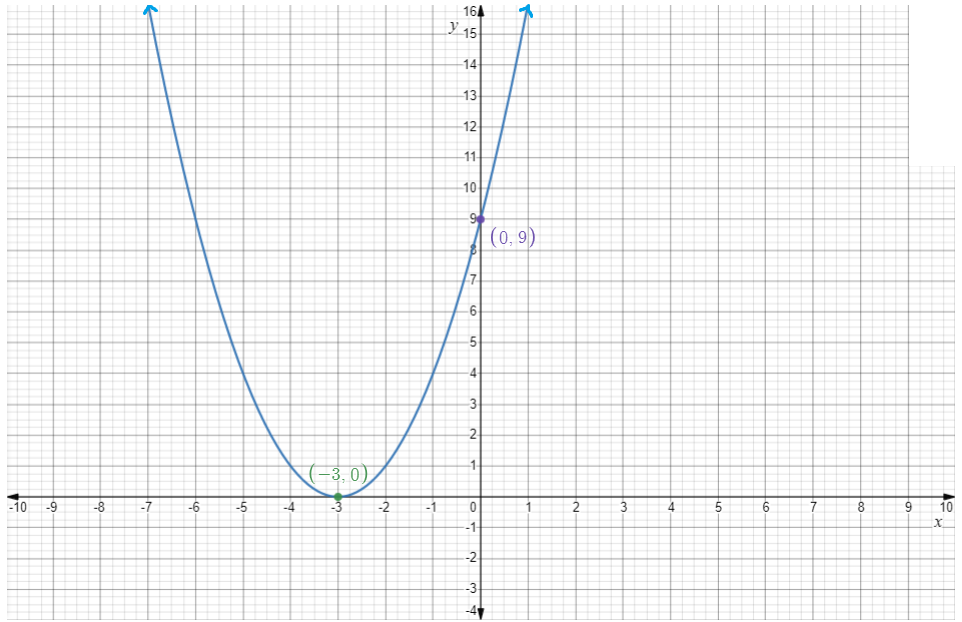
Pre-Calculus 11 Student Edition Chapter 3 Quadratic Functions 22

The vertex is(−3,0).

The equation of axis of symmetry is x=−3.

The domain is the set of all real numbers.

The range is[0,∞).

x-intercept is−3 and y-intercept is 9.

Pre Calculus 11 Chapter 2 Exercise 2.4 Trigonometry Detailed Solutions Page 157 Problem 23 Answer

Given function is f(x)=(x+5)2+11.

We need to describe how to sketch the graph of the given function using transformations.

First consider the graph of f(x)=x2.

Now the graph of(x+5)2 can be obtained by horizontally shifting the graph of x2to the left side by 5 units.

Now the graph of f(x)=(x+5)2+11 can be obtained by vertically shifting the graph of(x+5)2 upward by11 units.

The graph off(x)=(x+5)2+11 can be obtained by horizontally shifting the graph off(x)=x2 to the left side by 5 units and then vertically shifting upward by 11 units.

Understanding Chapter 2 Exercise 2.4 Trigonometry In Pre Calculus Page 157 Problem 24 Answer

Given function isf(x)=−3×2−10.

We need to describe how to sketch the graph of the given function using transformations.

First consider the graph off(x)=x2.

Now the graph of−3×2 can be obtained by reflecting the graph of x2 in the x-axis and narrowing the graph by 3 units.

Now the graph off(x)=−3×2−10 can be obtained by vertically shifting the graph of−3×2 downward by 10 units.

The graph off(x)=−3×2−10 can be obtained by reflecting the graph of f(x)=x2 in the x-axis and narrowing the graph by 3 units and then vertically shifting down by 10 units.

Page 157 Problem 25 Answer

Given function isf(x)=5(x+20)2−21.

We need to describe how to sketch the graph of the given function using transformations.

First consider the graph off(x)=x2.

Now the graph of5(x+20)2 can be obtained by horizontally shifting the graph of x2 to the left side by20 units and then narrowing the graph by5 units.

Now the graph off(x)=5(x+20)2−21 can be obtained by vertically shifting the graph of 5(x+20)2 downward by 21 units.

The graph off(x)=5(x+20)2−21 can be obtained by horizontally shifting the graph of x2 to the left side by 20 units and then narrowing the graph by 5 units and then vertically shifting down by 21units.

Understanding Chapter 2 Exercise 2.4 Trigonometry in Pre Calculus Page 157 Problem 26 Answer

Given: f(x)=−1/8(x−5.6)2+13.8

To  Describe how to sketch the graph of each function using transformations.

We  have the function f(x)=−1/8(x−5.6)2+13.8

The graph of f(x)=−1/8(x−5.6)2+13.8 can be obtained from the graph of f(x)=−x2  by shifting the graph by a factor of 13.8 along the vertical direction also right shift by a factor of 1/8

So the graph of the equation is
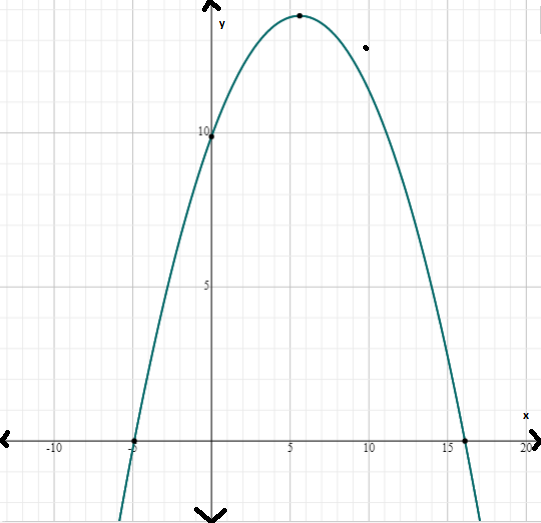
Pre-Calculus 11 Student Edition Chapter 3 Quadratic Functions 26 1

Hence, the graph of the equation can be sketched by transformation as shift the graph by a factor of 13.8 along the vertical direction also right shift by a factor of 1/8 and the graph is
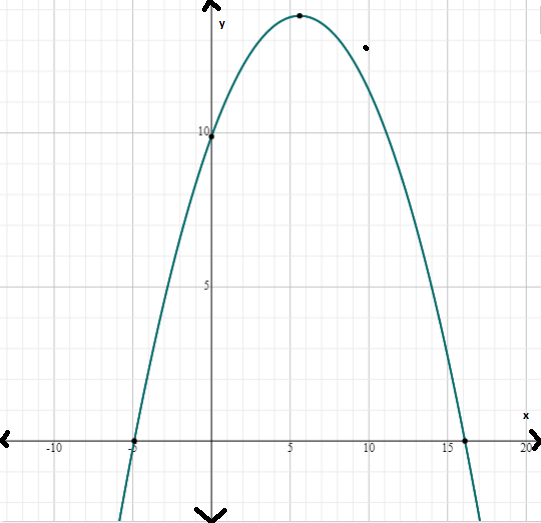
Pre-Calculus 11 Student Edition Chapter 3 Quadratic Functions 26

Page 157 Problem 27 Answer

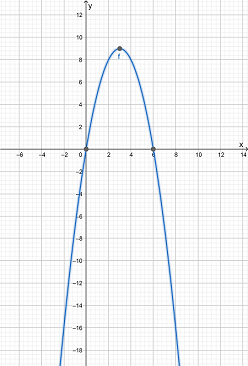
Given:  a) y=−(x−3)2+9

To Sketch the graph of each function. Identify the vertex, the axis of symmetry, the direction of opening, the maximum or minimum value, the domain and range, and any intercepts.

We have the equation y=−(x−3)2+9

The graph of the function is
Pre-Calculus 11 Student Edition Chapter 3 Quadratic Functions 27 1

Vertex of the function is: Maximum (3,9)

Axis interception point of the function is X-intercept:(6,0),(0,0), Y-intercept:(0,0)

The direction of opening is downward

The domain of the function is (−∞,∞)

The Range of the function is (−∞,9)

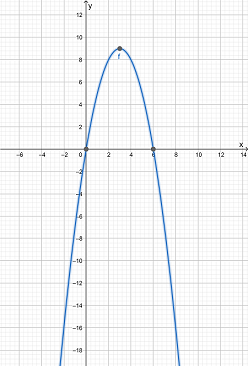
Hence, the graph of the equation is
Pre-Calculus 11 Student Edition Chapter 3 Quadratic Functions 27

Vertex of the function is: Maximum (3,9)

Axis interception point of the function is X-intercept (6,0),(0,0), Y-intercept (0,0)

The direction of opening is downward

The domain of the function is (−∞,∞)

The Range of the function is (−∞,9)

Page 157 Problem 28 Answer

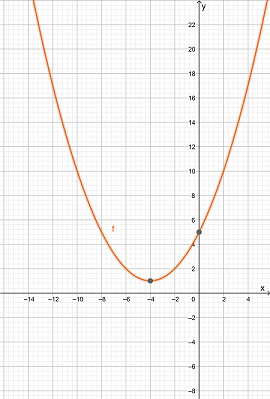
Given: y=0.25(x+4)2+1

To  Sketch the graph of each function.

Identify the vertex, the axis of symmetry, the direction of opening, the maximum or minimum value, the domain and range, and any intercepts.

We have the function y=0.25(x+4)2+1

The graph of the function is
Pre-Calculus 11 Student Edition Chapter 3 Quadratic Functions 28 1

Vertex of the function is: Minimum (-4,1)

Axis interception point of the function is Y-intercept (0,5)

The direction of opening is upward

The domain of the function is (−∞,∞)

The Range of the function is [1,∞)

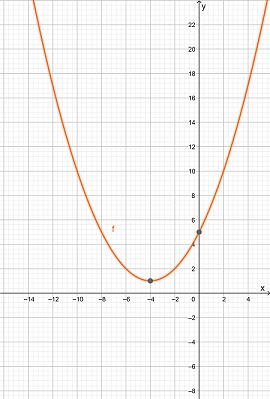
Hence, the graph of the function is
Pre-Calculus 11 Student Edition Chapter 3 Quadratic Functions 28

Vertex of the function is: Minimum (-4,1)

Axis interception point of the function is Y-intercept (0,5)

The direction of opening is upward

The domain of the function is (−∞,∞)

The Range of the function is [1,∞)

Page 157 Problem 29 Answer

Given: y=−3(x−1)2+12

To  Sketch the graph of each function.

Identify the vertex, the axis of symmetry, the direction of opening, the maximum or minimum value, the domain and range, and any intercepts.

We have the function y=−3(x−1)2+12

The graph of the function is
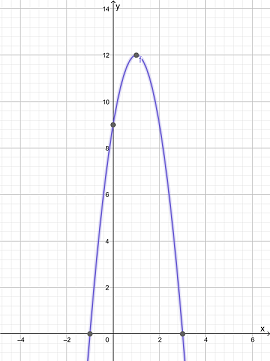
Pre-Calculus 11 Student Edition Chapter 3 Quadratic Functions 29 1

Vertex of the function is: Maximum (1,12)

Axis interception point of the function is X-intercept: (3,0),(-1,0), Y-intercept (0,9)

The direction of opening is downward

The domain of the function is (−∞,∞)

The Range of the function is (−∞,12]

Hence the graph of the equation is
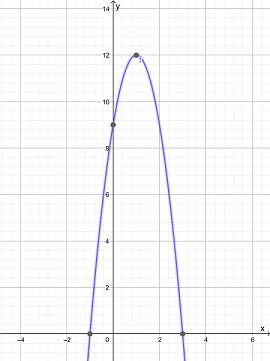
Pre-Calculus 11 Student Edition Chapter 3 Quadratic Functions 29

Vertex of the function is: Maximum (1,12)

Axis interception point of the function is X-intercept: (3,0),(-1,0), Y-intercept (0,9)

The direction of opening is downward

The domain of the function is (−∞,∞)

The Range of the function is (−∞,12]

Page 157 Problem 30 Answer

Given: y=1/2(x−2)2−2

To  Sketch the graph of each function.

Identify the vertex, the axis of symmetry, the direction of opening, the maximum or minimum value, the domain and range, and any intercepts.

We have the function y=1/2(x−2)2−2

The graph of the function is
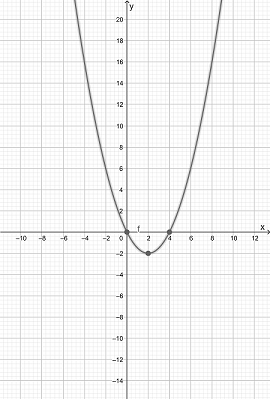
Pre-Calculus 11 Student Edition Chapter 3 Quadratic Functions 30

Vertex of the function is: Minimum (2,-2)

Axis interception point of the function is X-intercept: (4,0),(-1,0), Y-intercept (0,0)

The direction of opening is upward

The domain of the function is (−∞,∞)

The Range of the function is [−2,∞)

Hence, the graph of the function is
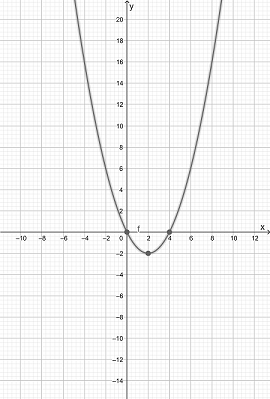
Pre-Calculus 11 Student Edition Chapter 3 Quadratic Functions 30 1

Vertex of the function is: Minimum (2,-2)

Axis interception point of the function is X-intercept: (4,0),(-1,0), Y-intercept (0,0) The direction of opening is upward

The domain of the function is (−∞,∞)

The Range of the function is [−2,∞)
McGraw Hill Pre Calculus 11 Student Edition Chapter 2 Exercise 2.4 Trigonometry

Pre-Calculus 11 Student Edition Chapter 2 Trigonometry

McGraw Hill Pre Calculus 11 Chapter 2 Exercise 2.4 Solutions Page 114 Problem 1 Answer

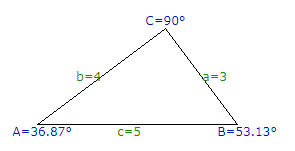
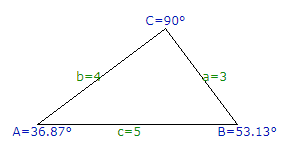
The objective of the problem is to draw △ABC

with a given length of sides:

a=3 cm

b=4 cm

c=5 cm

​The required triangle with given side lengths can be done with a ruler as shown below:

Pre-Calculus 11, Student Edition, Chapter 2 Trigonometry 1 1

Hence, the required triangle with given side values can be shown below:

Pre-Calculus 11, Student Edition, Chapter 2 Trigonometry 1

McGraw Hill Pre Calculus 11 Chapter 2 Exercise 2.4 Solutions Page 114 Problem 2 Answer

The values of a2,b2, and c2.

The given values of a=3,b=4, and c=5

The value of

a2=(3)2=9

b2=(4)2=16

c2=(5)2=25​

The values are :

a2=9,b2=16,c2=25

Precalculus Textbook Mcgraw Hill Answers

McGraw Hill Pre Calculus 11 Chapter 2 Exercise 2.4 Solutions Page 114 Problem 3 Answer

McGraw Hill PreCalculus 11 Student Edition Chapter 2 Exercise 2.4 Trignometry

Read and Learn More Precalculus Textbook Mcgraw Hill Answers

Pre Calculus 11 Chapter 2 Exercise 2.4 Trigonometry Solved Problems Page 114 Problem 4 Answer

The measure of ∠C.

Using Pythagorean Theorem, a2+b2=c2

Here, the given values are a=3,b=4,c=5

This triangle follows the Pythagorean triplet rule,

c2=a2+b2

52=32+42

It is a right-angled triangle at C.

So, ∠C=90˚

The value of ∠C=90˚.

Pre Calculus 11 Chapter 2 Exercise 2.4 Trigonometry Solved Problems Page 114 Problem 5 Answer

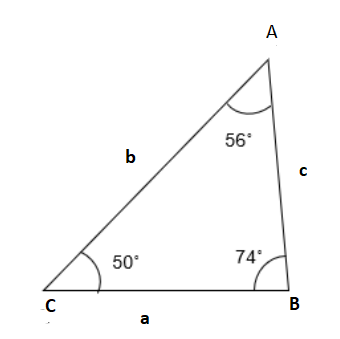
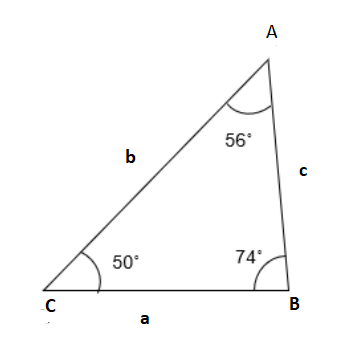
Draw an acute ΔABC, Acute angle is less than 90°

So we make a triangle with all the angles less than 90°

Pre-Calculus 11, Student Edition, Chapter 2 Trigonometry 5

For example , we can make a triangle with angle ∠A=56° and angle∠B=74° and angle ∠C=50°

All angles are less than 90°.

Acute triangle ABC

Pre-Calculus 11, Student Edition, Chapter 2 Trigonometry 5 1

Pre Calculus 11 Chapter 2 Exercise 2.4 Trigonometry Solved Problems Page 114 Problem 6 Answer

From part (a) we got the acute triangle ABC
Make the base that is length of a= 5 cm. Using protractor measure the angle and connect all the vertices.

Now measure the length of b  and c

Length of b=5.8  and c=4.6

Length of sides of triangle ABC

Precalculus Textbook Mcgraw Hill Answers

a=5 cm

b= 5.8 cm

c=4.6 cm

Pre Calculus 11 Chapter 2 Exercise 2.4 Trigonometry Solved Problems Page 114 Problem 7 Answer

Given: a=5,b=5.8,c=4.6

To find: a2,b2,c2

a2=5×5=25

b2=5.8×5.8=33.64

c2=4.6×4.6=21.16

a2=25,b2=33.64,c2=21.16

Pre Calculus 11 Exercise 2.4 Step-By-Step Trigonometry Solutions Page 114 Problem 8 Answer

Given: a2=25,b2=33.64,c2=21.26

To compare: a2+b2and c2

a2+b2=25+33.64=58.64

So: a2+b2>c2 is true.

We do not get the other statement true after calculations.

a2+b2>c2 is true.

Pre Calculus 11 Exercise 2.4 Step-By-Step Trigonometry Solutions Page 115 Problem 9 Answer

Given: a2+b2=25,c2=25

To find: 2abcosC=a2+b2−c2

2abcosC=25-25=0

2ab cos C = 0

Pre Calculus 11 Exercise 2.4 Step-By-Step Trigonometry Solutions Page 115 Problem 10 Answer

Given: a2+b2=58.64,c2=21.26

To find: 2abcosC

2ab cos C = 58.64 − 21.26=37.38

2ab cos C = 37.38

Mcgraw Hill Precalculus Textbook Answers

Solutions For Pre Calculus 11 Chapter 2 Exercise 2.4 Trigonometry Page 115 Problem 11 Answer

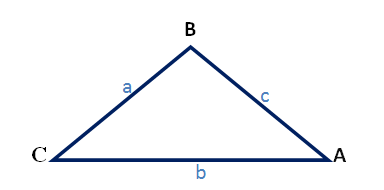
We have given a triangle ΔABC:-

Pre-Calculus 11, Student Edition, Chapter 2 Trigonometry 11

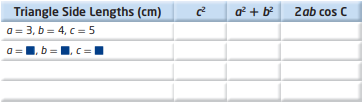
We have to assume different values of a,b,c and complete the following table :-

Pre-Calculus 11, Student Edition, Chapter 2 Trigonometry 11 1

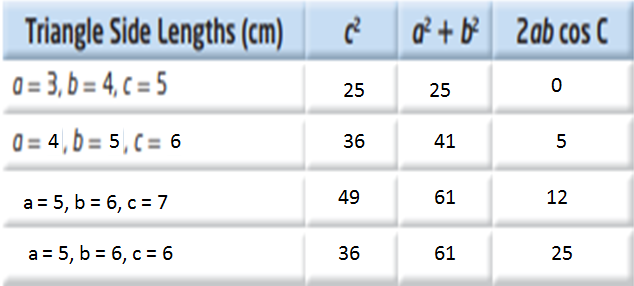
Firstly we have given that a=3,b=4,c=5.

then we have :-

c2=52⇒c2=25 and

a2+b2=32+42

⇒a2+b2=9+16

⇒a2+b2=25

Now using the cosine laws, we have :-

c2=a2+b2−2abcosC

⇒2abcosC=a2+b2−c2

Then by putting the values we have :-

2abcosC=25−25⇒2abcosC=0

​Now assume that :-

a=4,b=5,c=6

Then we have :-

c2=62⇒c2=36 and

a2+b2=42+52

⇒a2+b2=16+25

⇒a2+b2=41 and

2abcosC=a2+b2−c2

⇒2abcosC=41−36

⇒2abcosC=5

​Now assume that:-

a=5,b=6,c=7, then we have :-

c2=72⇒c2=49 and

a2+b2=52+62

⇒a2+b2=25+36

⇒a2+b2=61 and

2abcosC=a2+b2−c2

⇒2abcosC=61−49

⇒2abcosC=12

​Now assume that :-a=5,b=6,c=6

Then we have:-c2=62⇒c2=36 and

a2+b2=52+62⇒a2+b2

=25+36⇒a2+b2=61 and

2abcosC=a2+b2−c2

⇒2abcosC=61−36

⇒2abcosC=25​

Complete the table :-

Mcgraw Hill Precalculus Textbook Answers

Pre-Calculus 11, Student Edition, Chapter 2 Trigonometry 11 2

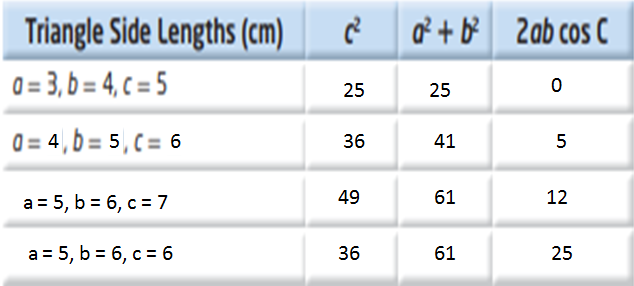
The required completed table is as shown below :-

Pre-Calculus 11, Student Edition, Chapter 2 Trigonometry 11 3

Solutions For Pre Calculus 11 Chapter 2 Exercise 2.4 Trigonometry Page 115 Problem 12 Answer

Draw a triangle ABC  with angle C obtuse.

Let us draw a triangle with angle C= 94 degrees

The sides are a=3, b=5  and c=6

The equation we got from step 4 is

c2=a2+b2−2abcos(C)
Substitute the values

62=32+52−2(3)(5)cos(94)

36=9+25−(−2)

36=36 True

​The equation we got in step 4 hold true for the triangle with angle C= 95, a=3, b=5  and c=6

Pre Calculus 11 McGraw Hill Chapter 2.4 Solved Examples Page 117 Problem 13 Answer

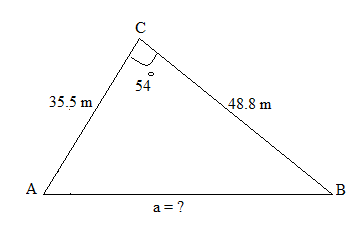
Given: The distance from point C to A is 35.5 m and from C to B is 48.8 m.

Also, the angle at C is 54°.

To find: The distance AB.

Use cosine law to find the required distance.

First, draw the diagram for better understanding.

Pre-Calculus 11, Student Edition, Chapter 2 Trigonometry 13

Use cosine law a2=b2+c2−2bccosA to find the distance AB. Herea=AB,b=35.5,c=48.8 and A=54°.

Substitute all the values in the formula and simplify to find the distance AB.

a2=b2+c2−2bccosA

AB2=35.52+48.82−2(35.5)(48.8)cos54∘

AB2≈1260.25+2381.44−3464.8(0.58778)

AB2≈1260.25+2381.44−2036.5583

AB2≈1605.1316

AB≈√1605.1316

AB≈40.1

​Hence the distance AB is approximately 40.1 m.

Mcgraw Hill Precalculus Textbook Answers

Pre Calculus 11 McGraw Hill Chapter 2.4 Solved Examples Page 119 Problem 14 Answer

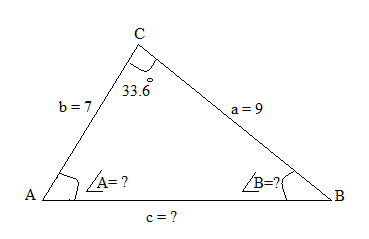
Given: In triangle ABC ,a=9,b=7 and ∠C=33.6°.

To find: The length of the unknown side and the measures of the unknown angles.

Use cosine law to determine the length of the unknown side and the measures of the unknown angles.

First, sketch the diagram of the triangle ABC.

Pre-Calculus 11, Student Edition, Chapter 2 Trigonometry 14

Now find the length of the side c by using cosine law. Substitute a=9,b=7 and ∠C=33.6° in the cosine law and simplify.

c2=a2+b2−2abcosC

c2=92+72−2(9)(7)cos33.6°

c2=81+49−126(0.832…)

c2=81+49−104.948…

c2=25.051…

c=√25.051…

c=5

​Now find the unknown angles of the triangle.

Substitute a=9,b=7 and c=5 in the cosine law and simplify.

cosB=a2+c2−b2

2ac/cosB=92+52−72/2(9)(5)

cosB=81+25−49/90

cosB=57/90

∠B=cos−1(57/90)

∠B=cos−1/(0.633…)

∠B=50.703°…

Thus the measure of∠B is approximately 50.7°.

Use the angle sum property of a triangle to find the measure of angle A

∠A+∠B+∠C=180°

∠A+50.7°+33.6°=180°

∠A=180°−(50.7∘+33.6°)

∠A=180°−84.3°

∠A=95.7°

Thus the measure of∠A is 95.7°.

Hence the length of side c is 5 and the measures of unknown angles are∠A=95.7° and ∠B=50.7°.

Pre Calculus 11 McGraw Hill Chapter 2.4 Solved Examples Page 119 Problem 15 Answer

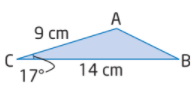
The given figure is:

Pre-Calculus 11, Student Edition, Chapter 2 Trigonometry 15

We need to find the length of the third side of the given triangle.

We will use the Law of Cosine to find the length of the third side of the given triangle.

In the given triangle, we have a=14,b=9 and C=17°.

Using the Law of Cosine, we get

c2=(14)2+(9)2−2(14)(9)cos(17°)

c2=196+81−252(0.9563)

c2=277−240.9876

c2=36.0124

c=√36.0124

c≈6

The length of the third side of the given triangle is about 6 cm.

Mcgraw Hill Precalculus Textbook Answers

Pre Calculus 11 Chapter 2 Exercise 2.4 Trigonometry Detailed Solutions Page 119 Problem 16 Answer

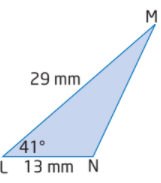
The given figure is:

Pre-Calculus 11, Student Edition, Chapter 2 Trigonometry 16

We need to find the length of the third side of the given triangle, i.e., MN.

We will use the Law of Cosine to find the length of the third side of the given triangle.

In triangle MNL,NL=13,ML=29 and ∠L=41°. So, we have a=13,b=29 and C=41°.

Using the Law of Cosine, we get

c2=(13)2+(29)2−2(13)(29)cos(41°)

c2=169+841−754(0.7547)

c2=1010−569.0438

c2=440.9562

c=√440.9562

c≈21

The length of the third side of the given triangle is about 21 mm.

Pre Calculus 11 Chapter 2 Exercise 2.4 Trigonometry Detailed Solutions Page 119 Problem 17 Answer

The given figure is:

Pre-Calculus 11, Student Edition, Chapter 2 Trigonometry 17

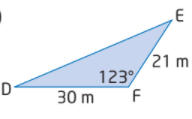
We need to find the length of the third side of the given triangle, i.e., DE.

We will use the Law of Cosine to find the length of the third side of the given triangle.

In the given triangle DEF,EF=21,DF=30,m∠F=123°..So, we have a=21,b=30 and C=123°.

Using the Law of Cosine, we get

c2=(21)2+(30)2−2(21)(30)cos(123°)

c2=441+900−1260(−0.544639)

c2=1341+686.24514

c2=2027.24514

c=√2027.24514

c≈45.02

The length of the third side of the given triangle is about 45.02 m.

Mcgraw Hill Precalculus Textbook Answers

Pre Calculus 11 Chapter 2 Exercise 2.4 Trigonometry Detailed Solutions Page 119 Problem 18 Answer

The given figure is:

Pre-Calculus 11, Student Edition, Chapter 2 Trigonometry 18

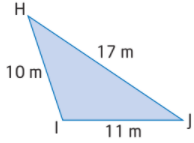
We need to find the measure of ∠J.

We will use the Law of Cosine to find the measure of the required angle.

In the given triangle the opposite side of angle J is IH=10 m. So, we have a=10,b=11,c=17.

Using the Law of Cosine, we get

cosJ=(11)2+(17)2−(10)2/2(11)(17)

cosJ=121+289−100/374

cosJ=310/374

J=cos−1(310/374)

J≈34.02

The measure of angle J is 34.02∘.

Understanding Chapter 2 Exercise 2.4 Trigonometry In Pre Calculus Page 119 Problem 19 Answer

The given figure is:

Pre-Calculus 11, Student Edition, Chapter 2 Trigonometry 19

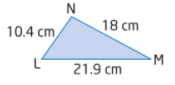
We need to find the measure of the angle L.

We will use the Law of Cosine to find the measure of the required angle.

In the given triangle the opposite side of angle L is MN=18 cm. So, we have a=18, b=10.4, c=21.9.

Using the Law of Cosine, we get

cosL=(10.4)2+(21.9)2−(18)2/2(10.4)(21.9)

cosL=108.16+479.61−324/455.52

cosL=263.77/455.52

L=cos−1/(263.77/455.52)

L≈54.62°

The measure of angle L is 54.62°.

Mcgraw Hill Precalculus Textbook Answers

Understanding Chapter 2 Exercise 2.4 Trigonometry In Pre Calculus Page 119 Problem 20 Answer

The given figure is:

Pre-Calculus 11, Student Edition, Chapter 2 Trigonometry 20

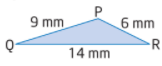
We need to find the measure of angle P.

We will use the Law of Cosine to find the measure of the required angle.

In the given triangle the opposite side of angle P is QR=14 mm. So, we have a=14,b=6,c=9.

Using the Law of Cosine, we get

cosP=(6)2+(9)2−(14)2/2(6)(9)

cosP=36+81−196/108

cosP=−79/108

P=cos−1(−79/108)

P≈137.01°

The measure of angle P is 137.01°.

Understanding Chapter 2 Exercise 2.4 Trigonometry In Pre Calculus Page 119 Problem 21 Answer

The given figure is:

Pre-Calculus 11, Student Edition, Chapter 2 Trigonometry 21

We need to find the measure of angle C.

We will use the Law of Cosine to find the measure of the required angle.

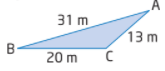
In the given triangle the opposite side of the angle C is AB=31 m. So, we have a=20,b=13,c=31.

Using the Law of Cosine, we get

cosC=(20)2+(13)2−(31)2/2(20)(13)

cosC=400+169−961/520

cosC=−392/520

C=cos−1(−392/520)

C≈138.92°

The measure of angle C is 138.92°.

Understanding Chapter 2 Exercise 2.4 Trigonometry In Pre Calculus Page 120 Problem 22 Answer

Given: In a triangle PQR,PQ=29,PR=28 and ∠P=52°.

To find: The length of the unknown side and the measures of the unknown angles.

Use cosine law to determine the length of the unknown side and the measures of the unknown angles.

For finding the unknown side, we will use the cosine law.

Applying cosine law, the length of p will be,

p2=q2+r2−2qrcosP

⇒p2=282+292−2×28×29×cos520

⇒p2=784+841−1624×0.6157

⇒p2=1625−999.8968

⇒p2=625.1032

⇒p=25.00206

Hence, p=25km (approx)

We will find ∠Q by using formula

cosQ=p2+r2−q2/2pr

⇒cosQ=252+292−282/2×25×29

⇒cosQ=625+841−784/1450

⇒cosQ=682/1450

⇒cosQ=0.470345

⇒Q=cos−1/(0.470345)

⇒∠Q=620

Now, ∠R=1800−∠Q−∠P

∠R=1800−620−520

∠R=660

Hence, The missing angles are 620 and 520

The missing angles are 620 and 520.

The missing side is 25km

Page 120 Problem 23 Answer

Given that : In ΔRST,

Sidesr=5cm,s=9.1cm,t=6.8cm

To Find :∠R,∠S,∠T

Strategy: We will use cosine law to find the angles of triangle.

or ∠R, we have

cosR=s2+t2−r2/2st

⇒cosR=9.12+6.82−52/2×9.1×6.8

⇒cosR=82.81+46.24−25/123.76

⇒cosR=104.05/123.76

⇒cosR=0.84074

⇒R=cos−1/(0.84074)


⇒R=32.78  (approx)                  Using cosine inverse table

⇒∠R=330

For ∠S, we have

cosS=r2+t2−s2/2rt

⇒cosS=52+6.82−9.12/2×5×6.8

⇒cosS=25+46.24−82.81/2×5×6.8

⇒cosS=−11.57/68

⇒cosS=−0.17015

⇒S=cos−1(−0.170150)

⇒S=99.796 (approx)                    using cosine inverse table

Hence, ∠S=1000

We will use the following relation to find ∠T:∠R+∠S+∠T=1800

⇒330+1000+∠T=1800

⇒1330+∠T=1800

⇒∠T=1800−1330

⇒∠T=470

Hence, ∠T=470

he measure of angles of ΔRST is∠R=330,∠S=1000,∠T=470.

Page 120 Problem 24 Answer

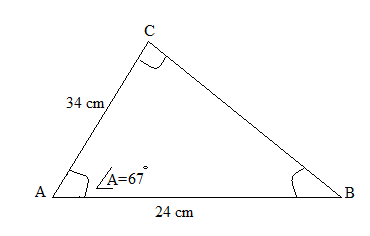
Given: In a triangle ABC, AB=24, AC=34 and ∠A=67°.

To find: The length of BC.

Use cosine law to determine the required length.

First sketch the triangle ABC.

Pre-Calculus 11, Student Edition, Chapter 2 Trigonometry 24

SubstituteAB=24, AC=34 and ∠A=67°in the cosine law and simplify.

BC2=AB2+AC2−2(AB)(AC)cosA

BC2=242+342−2(24)(34)cos67°

BC2=576+1156−1632(0.390…)

BC2=576+1156−637.673…

BC2=1094.326…

BC=√1094.326…

BC=33

​Hence the length of BC is approximately33 m.

Page 120 Problem 25 Answer

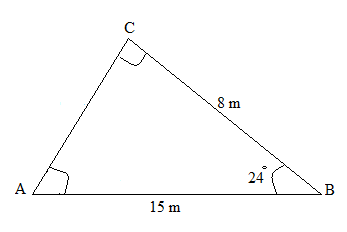
Given: In a triangle ABC, AB=15,BC=8 and ∠B=24°.

To find: The length ofAC.

Use cosine law to determine the required length.

First sketch the triangle ABC.

Pre-Calculus 11, Student Edition, Chapter 2 Trigonometry 25

SubstituteAB=15,BC=8 and ∠B=24∘in the cosine law and simplify to find the length of AC.

AC2=AB2+BC2−2(AB)(BC)cosB

AC2=152+82−2(15)(8)cos24°

AC2=225+64−240(0.913…)

AC2=225+64−219.250…

AC2=69.749…

AC=√69.749…

AC=8.4

​Hence the length of AC is approximately 8.4 m.

Page 120 Problem 26 Answer

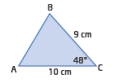
Given: AC  = 10 cm, BC = 9 cm, and ∠C = 48°. To Determine the length of AB.By using cosine law

We have triangle ABC with  AC  = 10 cm, BC = 9 cm, and ∠C = 48°

So according to the cosine law

Pre-Calculus 11, Student Edition, Chapter 2 Trigonometry 26

​AB2=102+92−2(10)(9)cos48∘

AB2=60.556…

AB2=√60.556…

AB=7.781…

AB=7.8 cm , to the nearest tenth of a centimetre

​Hence, the length of AB. is 7.8 cm

Page 120 Problem 27 Answer

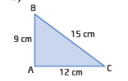
Given:  AB  = 9 m, AC = 12 m, and BC = 15 m.To  Determine the measure of ∠B.By using sine ratio

We have AB  = 9 m, AC = 12 m, and BC = 15 m.

△ABC is a right triangle, because 152=92+122

Pre-Calculus 11, Student Edition, Chapter 2 Trigonometry 27

Use the sine ratio.

sin ∠B∠B

=12/15

=sin−1(12/15)

=53.130…

R=53°

∠B=53°, to the nearest degree.

Hence, the measure of ∠B is 53°

Page 120 Problem 28 Answer

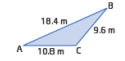
Given: AB  = 18.4 m, BC = 9.6 m, and AC = 10.8 m. To Determine the measure of ∠A.By using cosine law

We have AB  = 18.4 m, BC = 9.6 m, and AC = 10.8 m.

using the cosine law

​​Pre-Calculus 11, Student Edition, Chapter 2 Trigonometry 28

9.62=10.82+18.42−2(10.8)(18.4)cosA

92.19=116.64+338.56−397.44cosA

397.44cosA=455.2−92.19

cosA=363.01/397.44

∠A=cos−1(363.01/397.44)

∠A=24.024…​

∠A=24°, to the nearest degree.

Hence, the measure of ∠A  is 24°

Page 120 Problem 29 Answer

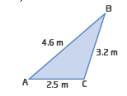
Given: AB  = 4.6 m, BC = 3.2 m, and AC = 2.5 m. Determine the measure of ∠C.

To Determine the measure of ∠C.By using cosine law

We have AB  = 4.6 m, BC = 3.2 m, and AC = 2.5 m.

Using cosine law

4.62=3.22+2.52−2(3.2)(2.5)cosC

21.16=10.24+6.25−16cosC

16cosC=16.49−21.16

cosC=−4.67/16

∠C=cos−1(−4.67/16)

∠C=106.970…

∠C=107°, to the nearest degree.

​Hence, measure of ∠C is  ∠C=107,

Pre-Calculus 11, Student Edition, Chapter 2 Trigonometry 29

McGraw Hill Pre Calculus 11 Student Edition Chapter 2 Exercise 2.3 Trigonometry

Pre-Calculus 11 Student Edition Chapter 2 Trigonometry

McGraw Hill Pre Calculus 11 Chapter 2 Exercise 2.2 Solutions Page 100 Problem 1 Answer

Given: the ratio of the sine of an angle to the length of its opposite side is constant.

To determine: that the statement is true by drawing an oblique triangle.

Summary: we will first sketch the triangle and then determine the ratio of any two sides of the triangle.

Pre-Calculus 11, Student Edition, Chapter 2 Trigonometry 1

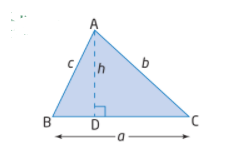
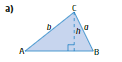
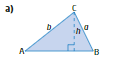
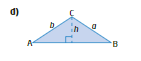
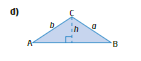
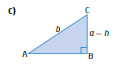
Consider an oblique triangle ABC, draw an altitude AD⊥BC and let AD=h.

Now, in △ABD, sinB=h/c⇒h=csinB

And in △ACD, sinC=h/b⇒h=bsinC

From the above equations, we can say that the given statement is true as the ratio of sine of an angle to the length of its opposite side is constant.

Thus, we can conclude that the given statement is true as the ratio of sine of an angle to the length of its opposite side is constant.

Read and Learn More Precalculus Textbook Mcgraw Hill Answers

McGraw Hill Pre Calculus 11 Chapter 2 Exercise 2.2 Solutions Page 100 Problem 2 Answer

To draw: an oblique triangle and label them.

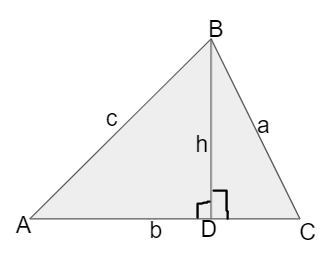
Draw a triangle which is not a right triangle and name it as △ABC with sides as a,b,c. Then draw an altitude from B to AC and let its height be h.

McGraw Hill PreCalculus 11 Student Edition Chapter 2 Exercise 2.3 Trignometry

McGraw Hill Pre Calculus 11 Chapter 2 Exercise 2.2 Solutions Page 101 Problem 3 Answer

To write: the trignometric ratio for sinA and sinC and determine how are two equations are same.

Summary: we will first consider two right triangles in one oblique triangle and then write the trignometric ratio.

Precalculus Textbook Mcgraw Hill Answers

Consider the figure as,

Pre-Calculus 11, Student Edition, Chapter 2 Trigonometry 3

Now, in △BAD,sinA=h/c

And in △BCD,sinC=h/a

Thus, we can say that both the equations for sinA and sinC are equal to the ratio of length of the opposite side that is altitude and the hypotenuse.

Hence, we can conclude that both the equations are equal to the ratio of length of the opposite side that is altitude and the hypotenuse.

McGraw Hill Pre Calculus 11 Chapter 2 Exercise 2.2 Solutions Page 101 Problem 4 Answer

To eliminate: h from both the equations and form one equation.

From step 4, we have, h=c sin A and h=asinC.

We can relate both the above equations as they are equal to h as follows,

C sin A =a sin C

Thus, the required equation is csin A=asinC.

Pre Calculus 11 Chapter 2 Exercise 2.2 Trigonometry Solved Problems Page 101 Problem 5 Answer

To divide: the equation in step 5(a) by ac.

The equation obtained in step 5(a) is c sinA=asinC.

On dividing both the sides of the equation by ac, we get,

⇒csinA

⇒csinA

ac⇒sinA

a=asinC

sinA/a =asinC/ac

sinA/a =sinC/c

Hence, the equation becomes sinA/a=sinC/c.

Pre Calculus 11 Chapter 2 Exercise 2.2 Trigonometry Solved Problems Page 104 Problem 6 Answer

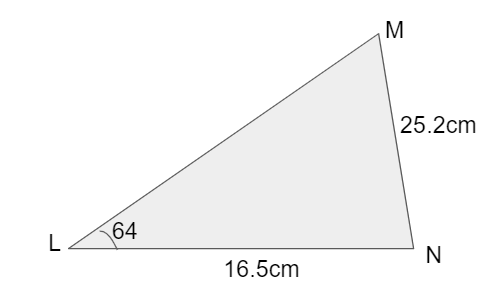
Given: The measures of ∠L=64°,l=25.2cm,m=16.5cm.

To determine: the measure of ∠N.

Summary: WE will first sketch the diagram of the triangle LMN and then we will use the sine law to find the measure of the ∠M and then we will use the angle sum property to find the remaining angle.

Precalculus Textbook Mcgraw Hill Answers

Consider the diagram of the △LMN,

Pre-Calculus 11, Student Edition, Chapter 2 Trigonometry 6

Use the sine law to determine the measure of ∠M

⇒sinM/m

⇒sinM

⇒sinM

⇒M

⇒M

=sinL/l=sin(64∘)(16.5)/25.2

=0.5884

=sin−1/(0.5884)≈36∘

Use the angle sum property to find the measure of the ∠N

⇒∠N

∠N =180°−(36°+64°)

∠N =180°−100°

∠N =80°

Hence, therequired measure of the ∠N=80°.

Pre Calculus 11 Chapter 2 Exercise 2.2 Trigonometry Solved Problems Page 107 Problem 7 Answer

Given:∠A=39∘ and sides a=14cm , b=10cm

We have to find the value of ∠B,∠C and side c.

Apply sine law to find the remaining angles and sides of ΔABC.

First find the value of ∠B with the help of sinA/a=sinB/b.

Substitute 14 for a, 10 for b and 39°

for A into sinA/a=sinB/b.

sin39∘/14 =sinB/10

Simplify further by multiplying 10 both side.

sin39∘/14×10=sinB/0.63

14×10=sinB

0.4495≈sinB

Simplify further to find the value of B.

Precalculus Textbook Mcgraw Hill Answers

sin−1/(0.4495)=B

26.71≈B

So ∠B=27°, to the nearest degree.

Now use angle sum property to find the value of ∠C.

∠A+∠B+∠C=180°

39∘+27°+∠C=180°

∠C=180°−39°−27°

∠C=114°

Substitute ∠A=39°,∠C=114° and a=14 into sinA

a=sinC/c.

sin39∘/14=sin114°/c

Simplify further to find the value of c.

c=sin114/sin39°/14

c≈20.32

So, c=20,to the nearest unit.

Therefore, the values of remaining angles and sides of ΔABC are ∠B=27°,∠C=114° and c=20cm.

Pre Calculus 11 Chapter 2 Exercise 2.2 Trigonometry Solved Problems Page 108 Problem 8 Answer

Given:a/sin35°=10/sin40°

we have to find the value of side a.

Multiply sin35° both side of a/sin35°=10/sin40°.

A/sin35°×sin35°=10

sin40°×sin35°/a=10

sin40°×sin35°/a≈8.92

​So, a=8.9, to the nearest number.

Therefore, the value of side a=8.9.

Pre Calculus 11 Exercise 2.2 Step-By-Step Trigonometry Solutions  Page 108 Problem 9 Answer

Given: b/sin48°=65/sin75°

We have to find the value of side b.

Multiply sin48°both side of b/sin48°=65/sin75°.

B/sin48∘×sin48°=65

sin75°×sin48°b=65

sin75°×sin48°b=50.0 therefore, the value of side b=50.0.

Precalculus Textbook Mcgraw Hill Answers

Pre Calculus 11 Exercise 2.2 Step-By-Step Trigonometry Solutions  Page 108 Problem 10 Answer

Given: sinθ/12=sin50∘/65

we have to find the value of θ.

Multiply 12 both side of sinθ12=sin50°/65.

Sinθ/12×12=sin50°

65×12sinθ=sin50°×12

65/sinθ=0.1414

θ=sin−1/(0.1414)

θ=8.13°

So, θ=8°, to the nearest unit.

Therefore, the value of θ=8°.

Solutions For Pre Calculus 11 Chapter 2 Exercise 2.2 Trigonometry Page 108 Problem 11 Answer

Given: sinA/25=sin62°/32

we have to find the value of angle A.

Multiply 25 both side of sinA/25=sin62°/32.

sinA/25×25=sin62°/32×25

sinA=sin62°/32×25

A=sin−1/(sin62°32×25)

A=43.6°

So, A=44°, to the nearest number.

Therefore, the value of angle A=44∘.

Solutions For Pre Calculus 11 Chapter 2 Exercise 2.2 Trigonometry Page 108 Problem 12 Answer

Given triangle ABC with ∠A=35o ,∠B=88o, AC=44 m

We have to find the length of side AB.

In given triangle ∠A=35∘ ,∠B=88∘.Subtract given angles from the sum of all angles of triangle, 180° to obtain the ∠C.

∠C=180°−35°−88°

∠C=57°

Using sine formula a/sin A=b/sin B=c/sin C

Substitute 88∘ for B, 57∘ for C and 44 for b into last two fractions, that is b/sinB=c/sinC.

44/sin88∘=c/sin57°

c=sin57°×44/sin88

c=0.838×44/0.999

c=36.90m

​Hence length of side AB = 30.90m

Precalculus Textbook Mcgraw Hill Answers

Solutions For Pre Calculus 11 Chapter 2 Exercise 2.2 Trigonometry Page 108 Problem 13 Answer

Given triangle ABC with ∠A=52° ,∠C=118°, CB=45 m

We have to find the length of side AB.

In given triangle, ∠A=52° ,∠C=118°, CB=45 m

Using sine formula a/sin A=b/sin B=c/sin C

Substitute 52° for A, 118° for C and 45 for a into last two fractions, that is a/sin A=c/sin C.

45/sin52°=c/sin118°

c=sin118°×45sin52°

c=0.882×45/0.788

c=50.36m​

Hence length of side AB = 50.36m

Solutions For Pre Calculus 11 Chapter 2 Exercise 2.2 Trigonometry Page 108 Problem 14 Answer

In the given triangle ABC,∠B=62°, AB=28 m, AC=31 m.We have to find the angle of ∠C .

Given triangle ABC with ∠B=62°, AB=28 m, AC=31 m .Using sine formula a/sinA=b/sinB=c/sinC.

Substitute 62° for B, 28 for c and 31 for b into last two fractions, that is b/sin B=c/sin C and solve to get the result.

31/sin62°=28/sinC

sinC=sin62°×28/31

sinC=0.882×28/31

sinC=0.796

C=sin−1/(0.796)

C=52.75°

So, C=53°to the nearest unit.

Therefore, the value of ∠C=53°

Solutions For Pre Calculus 11 Chapter 2 Exercise 2.2 Trigonometry Page 108 Problem 15 Answer

In the given triangle ABC, ∠B=98°, AC=17.5 m, BC=15 m.We have to find the angle of ∠A.

In the given triangle ABC, ∠B=98°, AC=17.5 m, BC=15 m.Using sine formula, a/sinA=b/sinB=c/sinC.Substitute 98°

for B, 17.5 for b and 15 for a into first two fractions, that is a

sinA=b/sinB.

15/sinA=17.5/sin98°

sinA=sin98°×15/17.5

sinA=0.99×15/17.5

sinA=0.848

A=sin−1/(0.848)

A=57.994°

So, A=58° to the nearest unit.

Therefore, the value of ∠A=58°

Precalculus Textbook Mcgraw Hill Answers

Pre Calculus 11 McGraw Hill Chapter 2.2 Solved Examples Page 108 Problem 16 Answer

In the given triangle ABC, ∠B=67°, AB=13 m, AC=12 m

We have to find ∠A, ∠C and BC.

In the given triangle ABC, ∠B=67°, AB=13 m, AC=12 m.

Using sine formula, a/sinA=b/sinB=c/sinC.Substitute 67°

for B, 13 for c and 12 for b into last two fractions, that is b/sinB=c/sinC  and solve to get ∠C.

12/sin67°=13/sinC

sinC=13×sin67°/12

sinC=13×0.92/12

sinC=0.996

C=sin−1/(0.996)

C=84.873°

So, ∠C=85° to the nearest unit.

Use the total sum of all angles of a triangle are equal to 180°, that is ∠A+∠B+∠C=180°.Substitute 67°

for ∠B and 85° for ∠C into ∠A+∠B+∠C=180° and solve to obtain ∠A.

∠A+67°+85°=180°

∠A=180°−67°−85°

∠A=28°

Use sine formula, a/sinA=b/sinB=c/sinC to determine the length of BC.Substitute 28°

for A, 67° for B and 12 for b into first two fractions, that is a/sinA=b/sinB.

A/sin28°=12/sin67°

a=12×sin28°

sin67°a=12×0.469/0.92

a=6.117

​So, a=6.1 m to the nearest unit.

Hence , ∠A=28°, ∠C=85° and the length of side BC=6.1 m.

Pre Calculus 11 McGraw Hill Chapter 2.2 Solved Examples Page 108 Problem 17 Answer

In given figure ∇ABC, ∠A=42˚ , ∠B=84˚ , AC = 50m

we have to find ∠C , AB and BC.

Let   BC = a , AC = b and AB = c

∵ ∠A+∠B+∠C=180˚

⇒42˚+84˚+∠C=180˚

⇒∠C=180˚−42˚−84˚

⇒∠C=180˚−126˚

⇒ ∠C=54˚

Using sine law ,A/sinA=b/sinB

⇒a/sin42˚

=50/sin84˚

⇒a=50×sin42˚

sin84˚⇒a=50×0.6691/0.9945

⇒a = 33.6 m

Again , using sine law ,

B/sinB=c/sinC ⇒50

sin84˚=c

sin54˚ ⇒c=50×sin54˚

sin84˚⇒c=50×0.8090/0.9945

⇒c=40.67 or , c = 40.7 m

Hence ,  ∠C=54˚ and the length of sides AB = 40.7 m and BC = 33.6 m

Pre Calculus 11 McGraw Hill Chapter 2.2 Solved Examples Page 108 Problem 18 Answer

In given figure ΔABC,∠A=22˚ , ∠C=39˚ and side AC = 29mm

we have to find ∠B and sides AB and BC.

Let  ,  BC = a , AC = b and AB = c

∵∠A+∠B+∠C=180˚

⇒22˚+∠B+39˚=180˚

⇒∠B=180˚−22˚−39˚

⇒∠B=180˚−61˚

∠B=119˚

By using sine law , A/sinA=b/sinB ⇒a/sin22˚

=29/sin119˚

⇒a=29×sin22˚/sin119˚

⇒a=29×sin22˚/sin(180˚−61˚)

⇒a=29×sin22˚/sin61˚

⇒a=29×0.3746/0.8746

⇒a=12.42 or ,  a = 12.4 mm

Again , by using sine law,

A/sinA=c/sinC

⇒12.4/sin22˚

=c/sin39˚

⇒c=12.4×sin39˚/sin22˚

⇒c=12.4×0.6293/0.3746

⇒c=20.83 or  ,  c = 20.8 mm

Hence , ∠B=119˚ and the length of sides AB = 20.8 mm and  BC = 12.4 mm.

Precalculus Textbook Mcgraw Hill Answers

Pre Calculus 11 Chapter 2 Exercise 2.2 Trigonometry Detailed Solutions Page 108 Problem 19 Answer

In give figure ΔABC ,∠A=48˚ ,∠C=61˚ and AC = 21cm

we have to find ∠B , AB and BC.

Let ,  BC = a , AC = b and AB = c

∵∠A+∠B+∠C=180˚

⇒48˚+∠B+61˚=180˚

⇒∠B=180˚−48˚−61˚

⇒∠B=180˚−109˚

⇒∠B=71˚

By using sine law ,

A/sinA=b/sinB ⇒a/sin48˚

=21/sin71˚⇒a=21×sin48˚

sin71˚    ⇒a=21×0.7431/0.9455

⇒a=16.5cm

Again , by using sine law ,

B/sinB=c/sinC    ⇒21

sin71˚=c/sin61˚   ⇒c=21×sin61˚

sin71˚  ⇒c=21×0.8746/0.9455

⇒c=19.4cm

Hence , ∠B=71˚and length of sides BC = 16.5 cm and AB = 19.4 cm.

Pre Calculus 11 Chapter 2 Exercise 2.2 Trigonometry Detailed Solutions Page 108 Problem 20 Answer

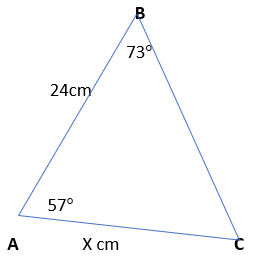
In given ∇ABC , ∠A=57˚ ,∠B=73˚ and AB = 24 cm

firstly, sketch triangle ABC then, we will find the length of AC.

Pre-Calculus 11, Student Edition, Chapter 2 Trigonometry 20

Sketching triangle ABC with ∠A=57˚ , ∠B=73˚ and AB = 24cm and AC =x cm

∵ ∠A+∠B+∠C=180˚

⇒57˚+73˚+∠C=180˚

⇒∠C=180˚−57˚−73˚

⇒∠C=180˚−130˚

∠C=50˚

Now , by using sine law

B/sinB=c/sinC   ⇒x/sin73˚=24

sin50˚  ⇒x=24×sin73˚

sin50˚  ⇒x=24×0.9563/0.7660

⇒x=29.96

or   x = 30cm

or    AC = 30 cm

Hence , length of side AC = 30 cm

Pre Calculus 11 Chapter 2 Exercise 2.2 Trigonometry Detailed Solutions Page 108 Problem 21 Answer

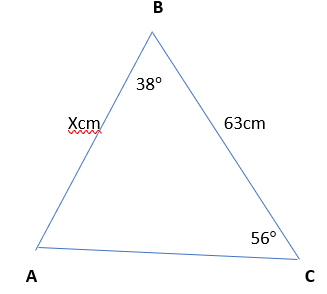
In given ΔABC , ∠B=38˚ ,∠C=56˚ and BC = 63cm

firstly , sketch triangle ABC then , we have to find the length of AB .

Sketching triangle ABC with ∠B=38˚ , ∠C=56˚ and BC =63cm and AB = x cm

Pre-Calculus 11, Student Edition, Chapter 2 Trigonometry 21

∵∠A+∠B+∠C=180˚    ⇒∠A+38˚+56˚=180˚

⇒∠A=180˚−94˚

⇒∠A=86˚

Now , by using sine law ,

A/sinA=c/sinC  ⇒63

sin86˚=x/sin56˚  ⇒x=63×sin56˚

sin86˚   ⇒x=63×0.8290/0.9976

⇒x=52.35 or ,    x = 52.4 cm

Hence , length of side AB= 52.4 cm

Precalculus Textbook Mcgraw Hill Answers

Pre Calculus 11 Chapter 2 Exercise 2.2 Trigonometry Detailed Solutions Page 108 Problem 22 Answer

Given  triangle ABC with ∠A=50 ,∠B=50 , AC=27m

We have to find the length of side AB.

In given triangle ∠A=500 ,∠B=500

Pre-Calculus 11, Student Edition, Chapter 2 Trigonometry 23

Then ∠C=180°−50°−50°

=800

Using sine formula A/sinA=b/sin B=c/sin C

From last two fractions

B/sinB=c/sin C

27/sin500=c/sin800

c= sin800×27/sin500

c= 0.984 ×27/0.766

c=34.68m​

Hence length of side AB = 34.68m

Pre-Calculus 11, Student Edition, Chapter 2 Trigonometry 21

Understanding Chapter 2 Exercise 2.2 Trigonometry In Pre Calculus Page 108 Problem 23 Answer

Given triangle ABC with ∠A=230, ∠C=780 , and AB =15 cm.

We have to find the length of side BC.

Pre-Calculus 11, Student Edition, Chapter 2 Trigonometry 23

Since sum of all angles of triangle = 180

So ∠A+∠B+∠C=180

23+∠B+78 = 180

∠B= 180−101

∠B=790

Now using sine formula

A/sin A=b/sin B=c/sin C

Now using first and third fraction

A/sin230=15/sin780

a= 15×sin230/sin780

a= 15×0.390/0.978

a= 5.98cm

​Hence a= length of side BC =5.98cm

Pre-Calculus 11, Student Edition, Chapter 2 Trigonometry 23 1

Understanding Chapter 2 Exercise 2.2 Trigonometry In Pre Calculus Page 108 Problem 24 Answer

Given triangle ABC ∠A=390 ,a= 10cm , b=14cm

We have to determine whether there is no solution, one solution, or two solutions.

Given ∠A=39° ,a= 10 , b=14

h= b sin A =14×sin390

=14×0.629

=8.810cm

Here angle A is acute angle and h<a<b

So according to result this triangle has two solutions .

Hence given triangle has two solutions .

Understanding Chapter 2 Exercise 2.2 Trigonometry In Pre Calculus Page 108 Problem 25 Answer

Given a triangle ABC with ∠A = 123,a =23 cm ,b= 12cm

We have to determine whether there is no solution, one solution, or two solutions.

Since here angle A is =123 which is obtuse angle and a>b

So according to result given triangle has one solution .

Hence given triangle has one solution .

Understanding Chapter 2 Exercise 2.2 Trigonometry In Pre Calculus Page 108 Problem 26 Answer

Given triangle ABC with ∠A=145° , a =18 cm , b= 10 cm.

We have to determine whether there is no solution, one solution, or two solutions.

Since here angle∠A=145° is obtuse angle and a>b i.e 18>10

So according to result given relation has one solution .

Hence given triangle has one solution .

Understanding Chapter 2 Exercise 2.2 Trigonometry In Pre Calculus Page 108 Problem 27 Answer

Given triangle ABC with ∠A=124°, a=1,b=2

We have to determine whether there is no solution, one solution, or two solutions.

Here the angle ∠A=124 is obtuse and a<b i.e, 1<2

So according to result given relation has no solution .

Hence given triangle has no solution.

Page 108 Problem 28 Answer

Given:

Pre-Calculus 11, Student Edition, Chapter 2 Trigonometry 28 1

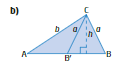
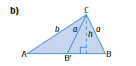
If  h is an altitude. then  how ∠A, sides a and b, and h are related

We have the diagram.

Pre-Calculus 11, Student Edition, Chapter 2 Trigonometry 28 2

sinA=h/b

h=bsinA

Then, from the diagram, bsinA<a<b

Pre-Calculus 11, Student Edition, Chapter 2 Trigonometry 28

Then, from the diagram, bsinA<a<b

Page 108 Problem 29 Answer

Given: In the diagram h is an altitude

Pre-Calculus 11, Student Edition, Chapter 2 Trigonometry 29 1

To  Describe how ∠A, sides a and b, and h are related in each diagram.

We have the diagram

Pre-Calculus 11, Student Edition, Chapter 2 Trigonometry 29 2

sinA=h/b

h=bsinA

Then, from the diagram, bsinA<a<b.

Pre-Calculus 11, Student Edition, Chapter 2 Trigonometry 29

Hence, from the diagram, bsinA<a<b.

Page 108 Problem 30 Answer

Given: In the  diagram, h is an altitude

Pre-Calculus 11, Student Edition, Chapter 2 Trigonometry 30 1

To Describe how ∠A, sides a and b, and h are related in each diagram.

We have the triangle

Pre-Calculus 11, Student Edition, Chapter 2 Trigonometry 30 2

sinA=h/b

h=bsinA

Also, from the diagram, a=bsinA.

Hence, the  ∠A, sides a and b, and h are related in the diagram  as from the diagram, a=bsinA.

Pre-Calculus 11, Student Edition, Chapter 2 Trigonometry 30

Page 108 Problem 31 Answer

Given:  In each diagram, h is an altitude

To  Describe how ∠A, sides a and b, and h are related in each diagram.

We have the triangle

Pre-Calculus 11, Student Edition, Chapter 2 Trigonometry 31

So, ​sinA/h=h/b=bsinA​

From the diagram, a≥b>bsinA

Pre-Calculus 11, Student Edition, Chapter 2 Trigonometry 31 2

Hence,  the  ∠A, sides a and b, and h are related in the diagram as From the diagram, a≥b>bsinA

Pre-Calculus 11, Student Edition, Chapter 2 Trigonometry 31 1

McGraw Hill Pre Calculus 11 Student Edition Chapter 2 Exercise 2.2 Trigonometry

Precalculus Textbook Mcgraw Hill Answers

Pre-Calculus 11 Student Edition Chapter 2 Trigonometry

McGraw Hill Pre Calculus 11 Chapter 2 Exercise 2.2 Solutions Page 88 Problem 1 Answer

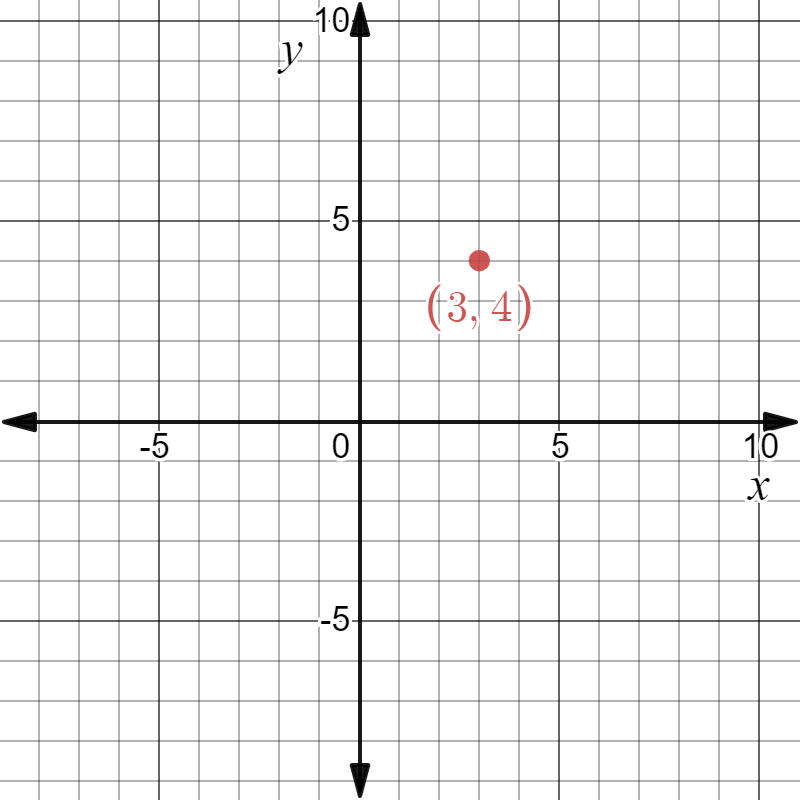
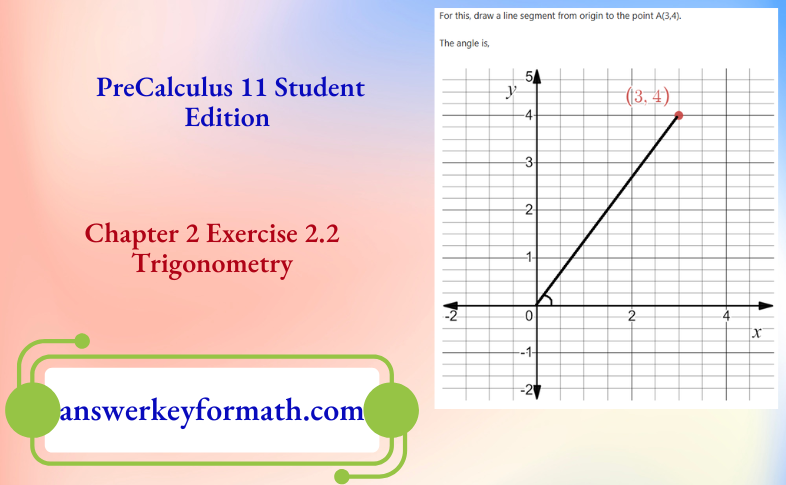
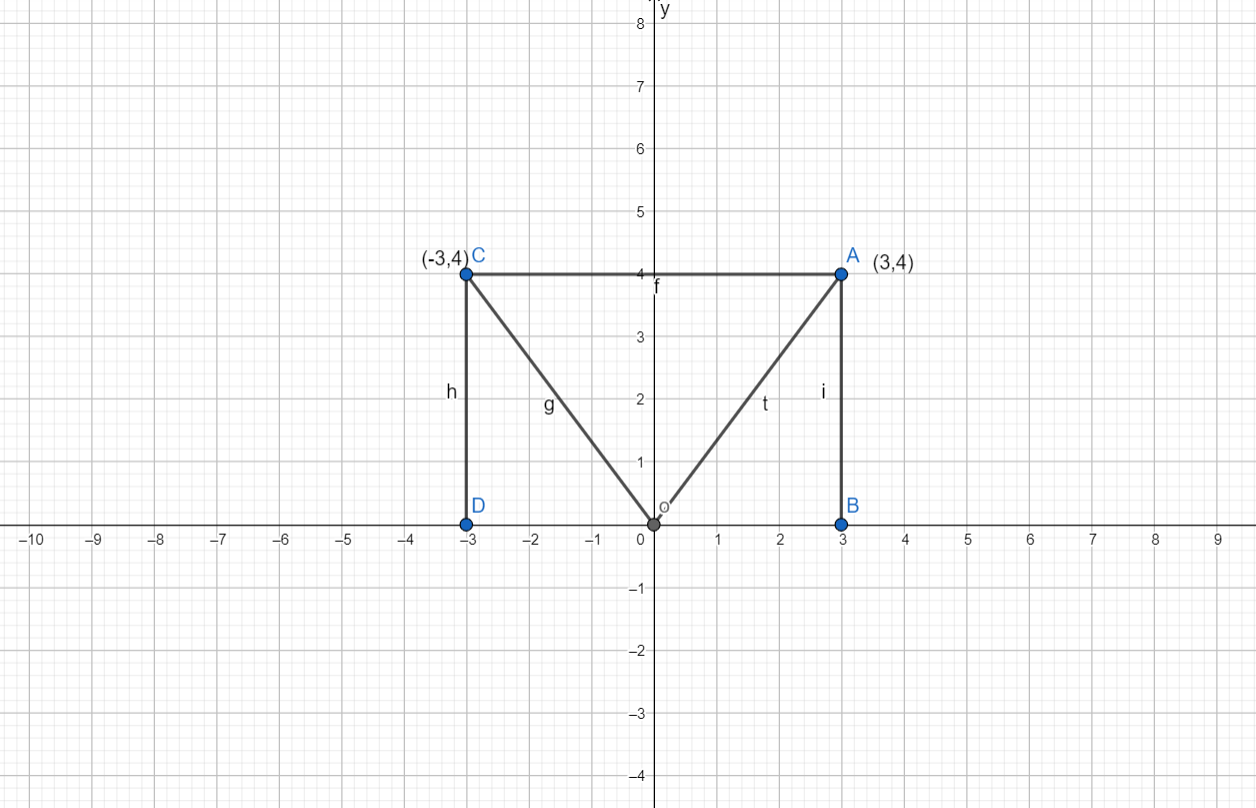
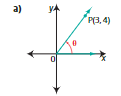
Given: Point A(3,4)

To find in which quadrant A lies

Pre-Calculus 11, Student Edition, Chapter 2 Trigonometry 1

The point A(3,4) has the sign +ve for both abscissa  and ordinate. Therefore, point  lies in first Quadrant.

Therefore, the point A(3,4) lies in 1st quadrant.

McGraw Hill Pre Calculus 11 Chapter 2 Exercise 2.2 Solutions Page 88 Problem 2 Answer

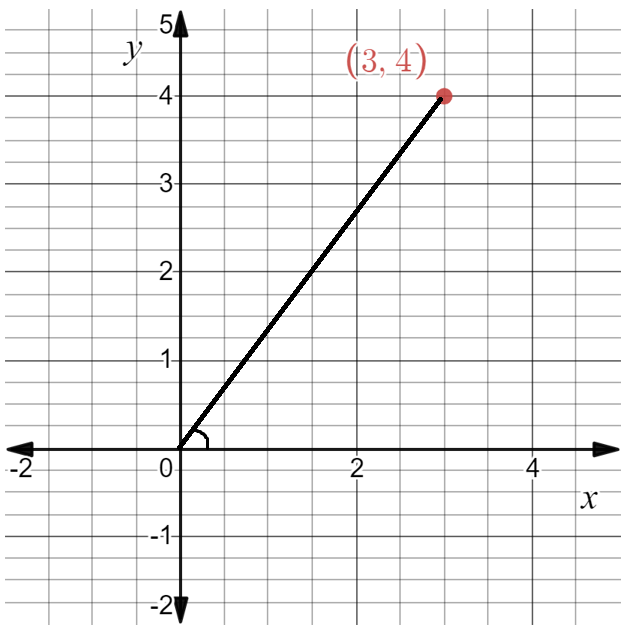
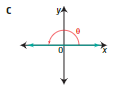
We need to draw the angle in standard position with terminal arm passing through point A(3,4).

Pre-Calculus 11, Student Edition, Chapter 2 Trigonometry 2 1

McGraw Hill PreCalculus 11 Student Edition Chapter 2 Exercise 2.2 Trignometry

McGraw Hill Pre Calculus 11 Chapter 2 Exercise 2.2 Solutions Page 89 Problem 3 Answer

Given that,

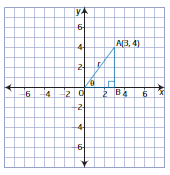
Pre-Calculus 11, Student Edition, Chapter 2 Trigonometry 3

We need to describe how is each primary trigonometric ratio related to the coordinates of point A and the radius r.

For this, use the definition of primary trigonometric ratios in the right triangle.

Here,sinθ=4/5, cosθ=3/5 and tanθ=4/3.

So sine function is the ratio of y-coordinate of point A and r.

Cosine function is the ratio of x -coordinate of point A and r.

Read and Learn More Precalculus Textbook Mcgraw Hill Answers

Precalculus Textbook Mcgraw Hill Answers

Tangent function is the ratio of y-coordinate of point A and x-coordinate of point A.

Sine function is the ratio of y-coordinate of point A and r.

Cosine function is the ratio of x-coordinate of point A and r.

Tangent function is the ratio of y-coordinate of point A and x-coordinate of point A.

McGraw Hill Pre Calculus 11 Chapter 2 Exercise 2.2 Solutions Page 89 Problem 4 Answer

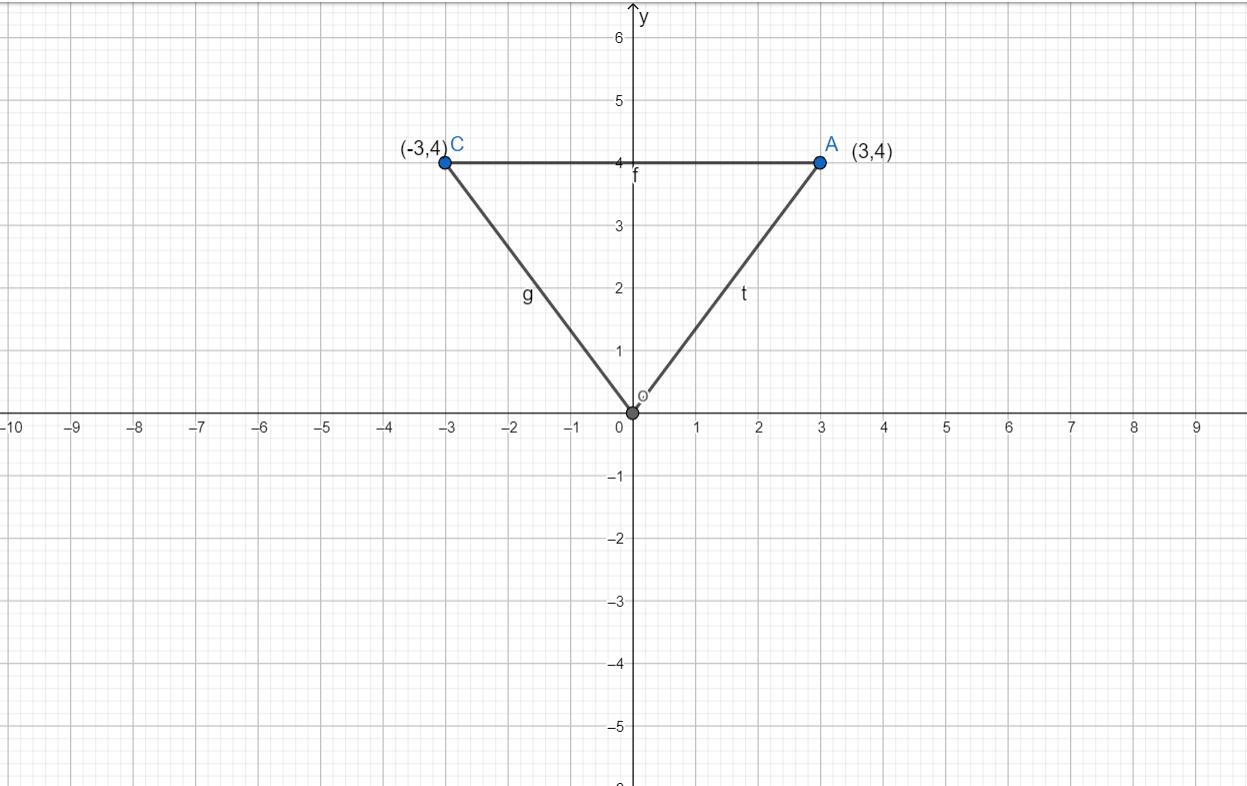
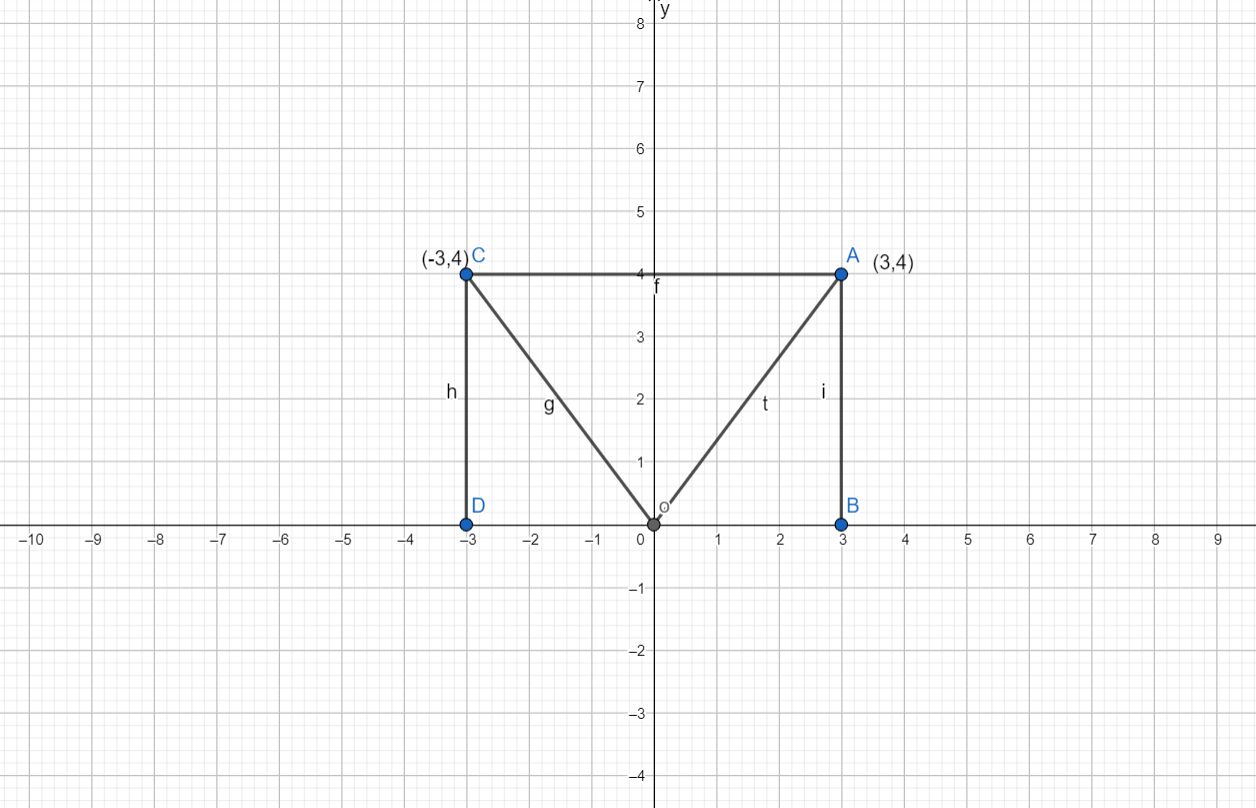
Given point A has coordinates (3,4) and y-axis is the axis to be considered as mirror.

To find the reflection of the point A that means coordinates of point C.

The graph which reflect point A is as follows:

Pre-Calculus 11, Student Edition, Chapter 2 Trigonometry 4 1

The coordinates of the point C considering Y-axis as a mirror will be(−3,4) as in 2nd quadrant x-coordinate is negative but y-coordinate is positive.

Therefore, the coordinates of point C are(−3,4)

Precalculus Textbook Mcgraw Hill Answers

Pre-Calculus 11, Student Edition, Chapter 2 Trigonometry 4

Pre Calculus 11 Chapter 2 Exercise 2.2 Trigonometry Solved Problems Page 89 Problem 5 Answer

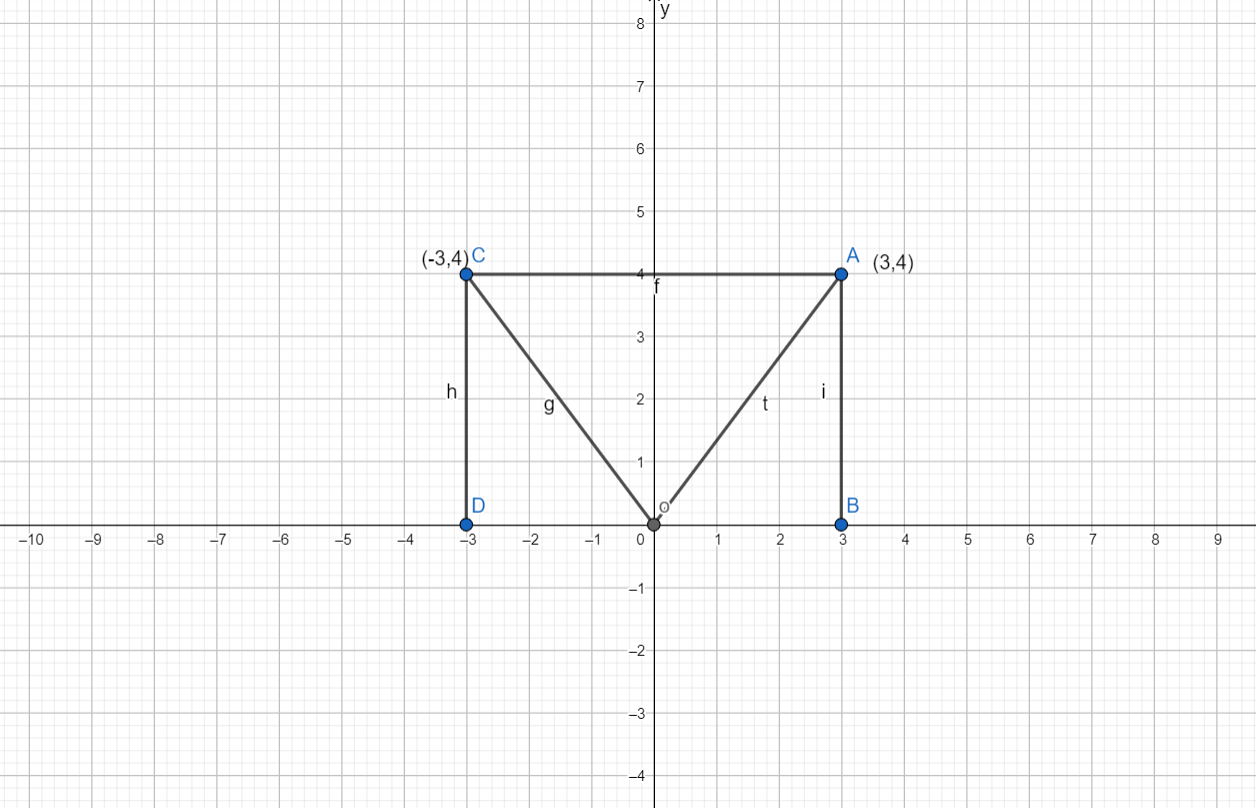
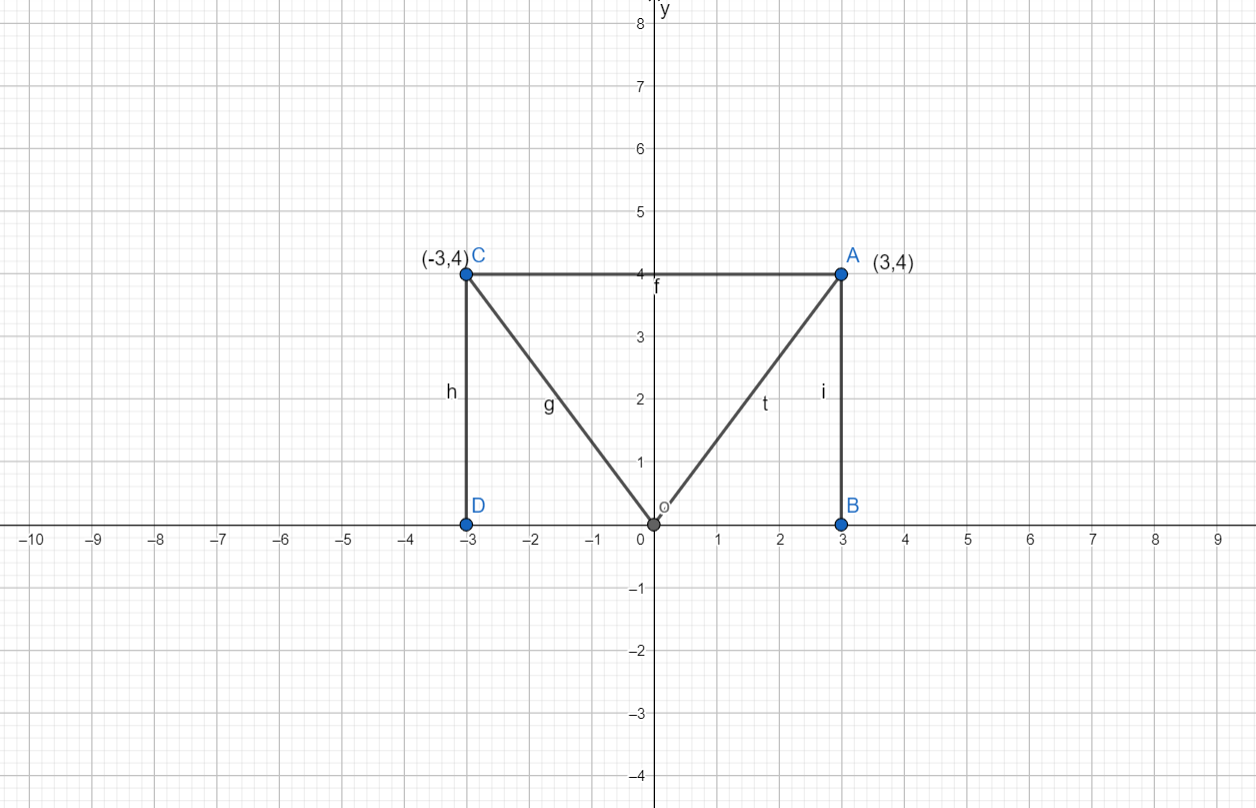
Given Point A has coordinates (3,4) and point C has coordinate(−3,4).

Firstly we have to draw a perpendicular from point C to x-axis.

Then we have to find the trigonometric ratios for ∠COB

Primary Trigonometric ratios aresinθ=Perpendicular

Pre-Calculus 11, Student Edition, Chapter 2 Trigonometry 5 1

Hypotenuse=4/√52:cos θ=Base/Hypotenuse=−6/√52:tanθ=Perpendicular/Base=−4/6=−2/3

Therefore, the trigonometric ratios are 4/√52,−6/√52,−2/3

Pre-Calculus 11, Student Edition, Chapter 2 Trigonometry 5

Pre Calculus 11 Chapter 2 Exercise 2.2 Trigonometry Solved Problems Page 89 Problem 6 Answer

We know that the x-axis has a total angle of 180°.

Now, COD clearly forms a right angle triangle that means ∠COD=45°

So,∠COD+∠COB=180⟹45°+∠COB=180

Pre-Calculus 11, Student Edition, Chapter 2 Trigonometry 6

∠COB=180°−45°=135°

Therefore, measure of ∠COB is 135°.

Pre Calculus 11 Chapter 2 Exercise 2.2 Trigonometry Solved Problems Page 89 Problem 7 Answer

The angles∠COB and∠COD lie on the same axis( x-axis) and their sum is 180°.

The angles represent linear pair angles.

Precalculus Textbook Mcgraw Hill Answers

Pre-Calculus 11, Student Edition, Chapter 2 Trigonometry 7

Therefore, the angles COB AND COD are Linear pair angles.

Pre Calculus 11 Chapter 2 Exercise 2.2 Trigonometry Solved Problems Page 91 Problem 8 Answer

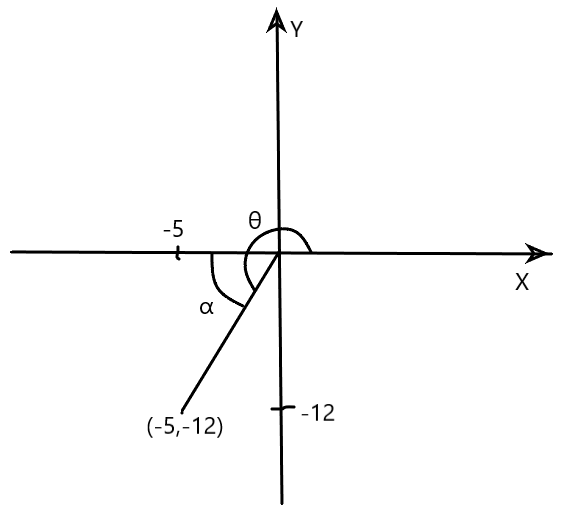
Given: The point P(−5,−12)  lies on the terminal arm of an angle, θ, in standard position

To find: The exact trigonometric ratios for sinθ,cosθ,tanθ

Plot the given point on a graphJoin the point with the origin to get the terminal arm of the required angle

Get the reference angleEvaluate the trigonometric ratios using the sides of the right-angled triangle formed

The given situation can be modelled as,

Pre-Calculus 11, Student Edition, Chapter 2 Trigonometry 8

Now, consider the right-angled triangle formed by the origin, the given point and the point (−5,0).

Using the definitions of the trigonometric ratios in a right-angled triangle, we have,

sinα=perpendicular/hypotenuse

sinα =12/√122+52

sinα =12/√144+25

sinα =12/√169

sinα=12/13

cosα=base/hypotenuse=5/√122+52

cosα =5/√144+25

cosα =5/√169

cosα =5/13

tanα=perpendicular/base

tanα =12/5

Mcgraw Hill Precalculus Textbook Answers

Now, from the figure, it is clear, θ=π+α

Then,

sinθ=sin(π+α)=−sinα=−12/13

cosθ=cos(π+α)=−cosα=−5/13

tanθ=tan(π+α)=tanα=12/5

So, sin θ=−12/13,cos θ=−5/13,tanθ=12/5

It has been found that sin θ=−12/13,cos θ=−5/13,tanθ=12/5

Pre Calculus 11 Exercise 2.2 Step-By-Step Trigonometry Solutions Page 92 Problem 9 Answer

Given: θ is an angle in quadrant III and tanθ=1/5

To find: The exact values of sin θ, cos θ

Since θ is an angle in quadrant III, sin θ<0, cos θ<0

Use the trigonometric identities to find the exact value of sinθ,cosθ

Given: tanθ=1/5

We have, the trigonometric identity,

sec2 θ=1+tan2θ

Put tanθ=1/5 in the above identity to get,

sec2θ=1+(1/5)2 ⇒sec2

θ=1+1/25⇒sec2

θ=26/25⇒1/cos2θ

θ =26/25

⇒cos2θ=25/26

⇒cos θ=−5/√26 (Since cos θ<0)

Now, we have the identity,

Mcgraw Hill Precalculus Textbook Answers

sin2θ+cos2θ=1

Put cos2θ=25/26 in the above identity to get,

sin2θ+25/26=1

⇒sin2θ=1−25/26

⇒sin2θ=1/26

⇒sin θ=−1/√26 (Since sin θ<0)

So, sin θ=−1/√26  ,cos θ=−5/√26

It has been found that sin θ=−1/√26,cos θ=−5/√26

Pre Calculus 11 Exercise 2.2 Step-By-Step Trigonometry Solutions Page 93 Problem 10 Answer

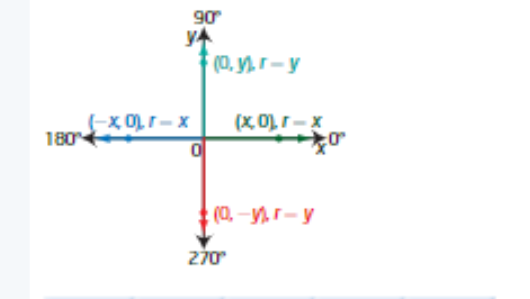
Given: A figure representing the angles 0°,90°,180°,270°

To find the sine, cosine and tangent values of these angles from the given figureIn a right angled triangle, the trigonometric ratios are ratios of lengths of its sides

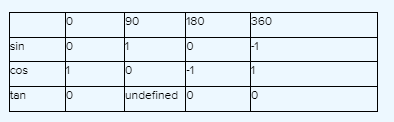
For sin:  sin0°=0,sin180°=0,sin270°=−1

Pre-Calculus 11, Student Edition, Chapter 2 Trigonometry 10

For cos:cos0°=1,cos180°=−1,cos360°=1

For tan:tan0°=0:tan180°=0:tan360°=0

Pre-Calculus 11, Student Edition, Chapter 2 Trigonometry 10

Pre Calculus 11 Exercise 2.2 Step-By-Step Trigonometry Solutions Page 94 Problem 11 Answer

Given,sin θ=−1/√2,0°<θ<360°

To find the value of θ which satisfies the equation.

We know that the value of sin is negative in 3rd and 4th quadrant.

Also,sin45°=1/√2

So, sin(180+45)°=−1/√2=sin225° and sin(360−45)°=−1/√2=sin315°

Therefore,θ=225°,315° considering 0°<θ<360°

Therefore the value of θ is 225°,315°.

Mcgraw Hill Precalculus Textbook Answers

Pre Calculus 11 Exercise 2.2 Step-By-Step Trigonometry Solutions Page 96 Problem 12 Answer

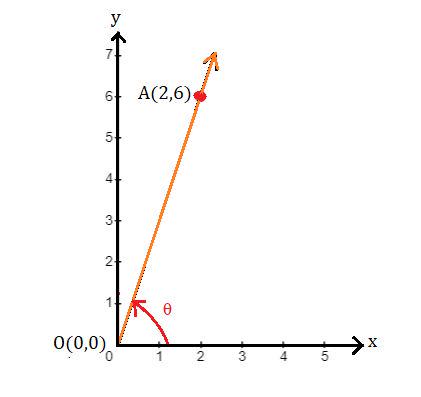
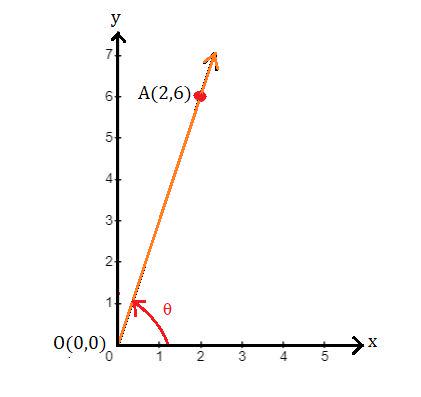
We need to sketch the angle in standard position so that the terminal arm passes through the point (2,6).

The point (2,6)  lies in first quadrant so that the terminal arm is in first quadrant.

Plot the point A(2,6) on the graph.

Draw the line joining the point A(2,6) to the origin O. This is the terminal arm.

The line from origin to the positive x-axis the initial arm.

The sketch of the angle in standard position is:

Pre-Calculus 11, Student Edition, Chapter 2 Trigonometry 12 1

The sketch of angle in standard position so that the terminal arm passes through the point (2,6) is –

Pre-Calculus 11, Student Edition, Chapter 2 Trigonometry 12

Pre Calculus 11 Exercise 2.2 Step-By-Step Trigonometry Solutions Page 96 Problem 13 Answer

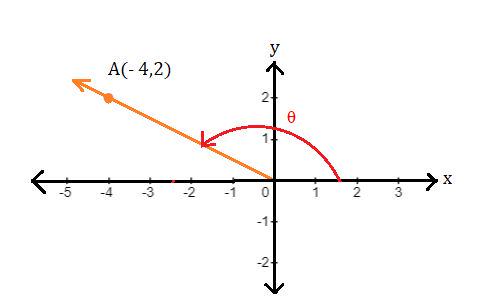
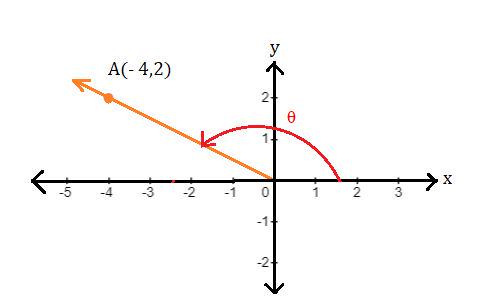
We need to sketch the angle in standard position so that the terminal arm passes through the point (−4,2).

The point (−4,2) lies in second quadrant, so that the terminal arm will be in second quadrant.

Plot the point A(−4,2) on the graph.

Mcgraw Hill Precalculus Textbook Answers

Join point (−4,2) with the origin, so that the line obtained will be the terminal arm.

The line from origin to the positive x-axis is the initial arm.

The sketch of angle in standard position is:

Pre-Calculus 11, Student Edition, Chapter 2 Trigonometry 13 1

The sketch of angle in standard position so that the terminal arm passes through the point (−4,2) is:

Pre-Calculus 11, Student Edition, Chapter 2 Trigonometry 13

Pre Calculus 11 Exercise 2.2 Step-By-Step Trigonometry Solutions Page 96 Problem 14 Answer

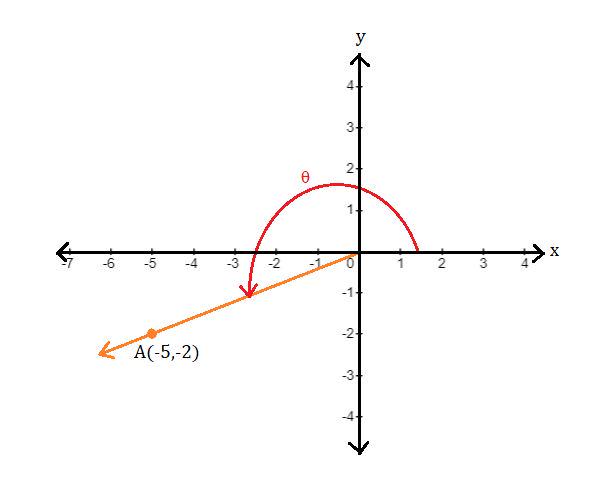
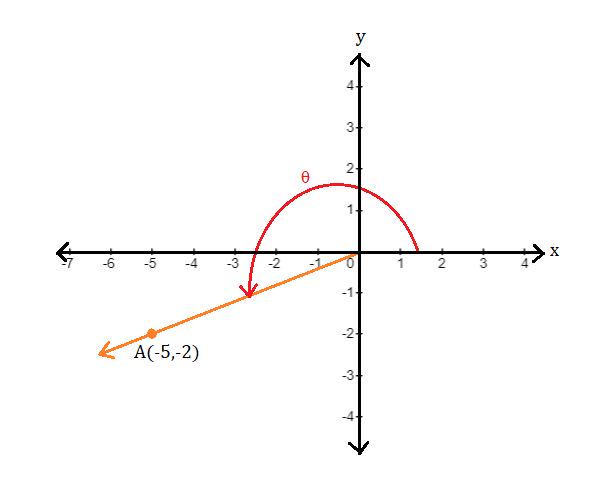
We need to sketch the angle in standard position so that the terminal arm passes through the point (−5,−2).

The point (−5,−2) lies in third quadrant, so that the terminal arm will be in third quadrant.

Plot the point A(−5,−2) on the graph.

Join the point(−5,−2) with the origin, so that the line obtained will be the terminal arm.

The line from origin to the positive x-axis is the initial arm.

Mcgraw-Hill Textbook Answers

The sketch of angle in standard position is:

Pre-Calculus 11, Student Edition, Chapter 2 Trigonometry 14 1

The sketch of angle in standard position so that the terminal arm passes through (−5,−2) is:

Pre-Calculus 11, Student Edition, Chapter 2 Trigonometry 14

Solutions For Pre Calculus 11 Chapter 2 Exercise 2.2 Trigonometry Page 96 Problem 15 Answer

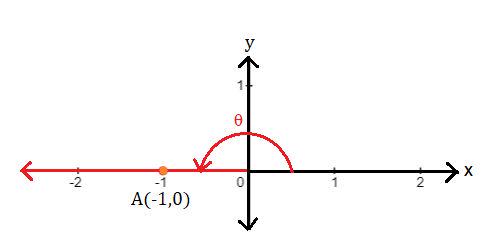
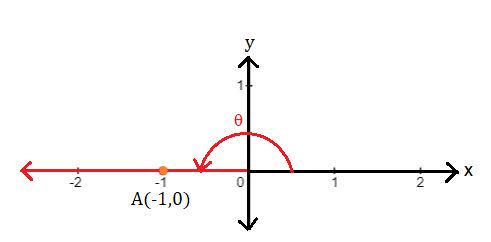
We need to sketch the angle in standard position so that the terminal arm passes through the point (−1,0).

The point (−1,0) lies on negative x-axis, so that the terminal arm will be on negative x-axis.

Plot the point A(−1,0) on the graph, so that we get the terminal line through A(−1,0).

The line from origin to the positive x-axis is the initial arm.

Mcgraw-Hill Textbook Answers

The sketch of angle in standard position is:

Pre-Calculus 11, Student Edition, Chapter 2 Trigonometry 15 1

The sketch of angle in standard position so that the terminal arm passes through the point (−1,0) is:

Pre-Calculus 11, Student Edition, Chapter 2 Trigonometry 15

Solutions For Pre Calculus 11 Chapter 2 Exercise 2.2 Trigonometry Page 96 Problem 16 Answer

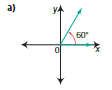
Given figure is as follows –

Pre-Calculus 11, Student Edition, Chapter 2 Trigonometry 16

We have to find out the sine, cosine, and tangent of the given angles.

Given angle is as follows –

Θ=60°,cos(60°)=1/2, =0.5,sin(60°)=√3/2, =0.866,

tan(60°)=√3, =1.73210,

Mcgraw-Hill Textbook Answers

​So, the exact values of the sine, cosine, and tangent ratios are 0.866,0.5, and, 1.73210.

Solutions For Pre Calculus 11 Chapter 2 Exercise 2.2 Trigonometry Page 96 Problem 17 Answer

Given figure is as follows –

Pre-Calculus 11, Student Edition, Chapter 2 Trigonometry 17

We have to find out the sine, cosine, and tangent of the given angles.

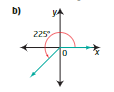
Given angle is as follows –

θ=225°,cos(225°)=cos(180°+45°), =−cos(45°),  =−1/√2, =−0.707,

sin(225°)=sin(180°+45°), =−sin(45°),  =−1/√2, =−0.707,

tan(225°)=tan(180°+45°), =tan(45°), =1.

​So, the exact values of the sine, cosine, and the tangent of the given angle is −0.707,−0.707, and, 1 respectively.

Page 96 Problem 18 Answer

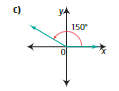
Given figure is as follows –

Pre-Calculus 11, Student Edition, Chapter 2 Trigonometry 18

We have to find out the sine, cosine, and tangent of the given angles.

Given angle is as follows –

Θ=150°,cos(150°)=cos(180°−30°), =−cos(30°),  =−√3/2, =−0.866,

sin(150°)=sin(180°−30°), =sin(30°),  =1/2, =0.5,

tan(150°)=tan(180∘−30°), =−tan(30°),  =−1/√3, =−0.577.

​So, the sine, cosine, and, the tangent of the given angle is 0.5,−0.866, and, −0.577.

Pre Calculus 11 McGraw Hill Chapter 2.2 Solved Examples Page 96 Problem 19 Answer

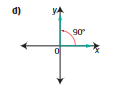
Given figure is as follows –

Pre-Calculus 11, Student Edition, Chapter 2 Trigonometry 19

We have to find out the sine, cosine, and tangent of the given angles.

Given angle is as follows –

θ=90°,

cos(90°)=0,

sin(90°)=1,

tan(90°)=∞.

​So, the sine, cosine, and the tangent of the given angle is 1,0, and, ∞.

Precalculus Glencoe Answers

Pre Calculus 11 McGraw Hill Chapter 2.2 Solved Examples Page 96 Problem 20 Answer

Given figure is as follows –

Pre-Calculus 11, Student Edition, Chapter 2 Trigonometry 20

We have to find out the sine, cosine, and tangent of the given angles.

Given angle is as follows –

sinθ=Perpendicular/ Hypotenuse,

sinθ =4/√32+42,

sinθ =4/5,

sinθ =0.8,

cosθ=Base/Hypotenuse,

cosθ =3/√32+42,

cosθ =3/5,

cosθ =0.6.

tanθ=Perpendicular/Base,

tanθ =3/4,

tanθ=0.75.

So, the sine, cosine, and, the tangent of the given angle is 0.8,0.6, and, 0.75.

Pre Calculus 11 McGraw Hill Chapter 2.2 Solved Examples Page 96 Problem 21 Answer

It is given that

Pre-Calculus 11, Student Edition, Chapter 2 Trigonometry 21 1

Then we need to find exact trigonometric ratios sin θ,cos θ&tanθ for each.

Sketch the reference triangle by drawing a line perpendicular to the x-axis through the point (-12, -5).

The point P(-12, -5) is in quadrant III, so the terminal arm is in quadrant III.

Precalculus Glencoe Answers

Use the Pythagorean Theorem to determine the distance,r, from P(-12, -5) to the origin, (0, 0).

Pre-Calculus 11, Student Edition, Chapter 2 Trigonometry 21

Pythagorean Theorem

r=√x2+y2

r=√(−12)2+(−5)2

r=√144+25

r=√169

r=13

The trigonometric ratios for θ can be written as follows:

Sin θ=opposite/hypotenuse

Sin θ =−5/13

Cos θ=adjacent/hypotenuse

Cos θ =−12/13

Cos θ =−12/13

tanθ=opposite/adjacent

tanθ =−5/−12

tanθ =5/12

The answer is sin θ=−5/13 cos θ=−12/13 tanθ=5/12

Precalculus Glencoe Answers

Understanding Chapter 2 Exercise 2.2 Trigonometry In Pre Calculus Page 96 Problem 22 Answer

It is given that

Pre-Calculus 11, Student Edition, Chapter 2 Trigonometry 22 1

Then we need to find exact trigonometric ratios sin θ,cos θ&tan θ for each.

Sketch the reference triangle by drawing a line perpendicular to the x-axis through the point (8, -15).

The point P(8, -15) is in quadrant IV, so the terminal arm is in quadrant IV.

Use the Pythagorean Theorem to determine the distance,r, from P(-12, -5) to the origin, (0, 0).

Pre-Calculus 11, Student Edition, Chapter 2 Trigonometry 22

Pythagorean theorem

r=√x2+y2

r=√(8)2+(−15)2

r=√64+225

r=√289

r=17

​The trigonometric ratios for θ can be written as follows:

Sin θ=opposite/hypotenuse

Sin θ =−15/17

Sin θ =−15/17

Cos θ=adjacent/hypotenuse

Cos θ =8/17

tanθ=opposite/adjacent

tanθ =−15/8

tanθ =−15/8

The answer is sin θ=−15/17

Precalculus Glencoe Answers

Cos θ=8/17

tanθ=−15/8

Understanding Chapter 2 Exercise 2.2 Trigonometry In Pre Calculus Page 96 Problem 23 Answer

It is given that

Pre-Calculus 11, Student Edition, Chapter 2 Trigonometry 23 1

Then we need to find exact trigonometric ratios sin θ,cos θ & tan θ for each.

Sketch the reference triangle by drawing a line perpendicular to the x-axis through the point (1, -1).

The point P(1, -1) is in quadrant IV, so the terminal arm is in quadrant IV.

Use the Pythagorean Theorem to determine the distance,r, from P(1, -1) to the origin, (0, 0).

Pre-Calculus 11, Student Edition, Chapter 2 Trigonometry 23

Pythagorean theorem

r=√x2+y2

r=√(1)2+(−1)2

r=√1+1

r=√2

The trigonometric ratios for θ can be written as follows:

Sin θ=opposite/hypotenuse

Sin θ =−1/√2

Sin θ =−1/√2

Cos θ=adjacent/hypotenuse

Cos θ=1/√2

tanθ=opposite/adjacent

Precalculus Glencoe Answers

tanθ =−1/1

tanθ =−1​

The answer is

Sin θ=−1/√2

Cos θ=1/√2

tanθ=−1

Understanding Chapter 2 Exercise 2.2 Trigonometry In Pre Calculus Page 96 Problem 24 Answer

It is given that cos θ<0 and sin θ>0.

Then we need to find the quadrant in which the terminal arm of angle θ lie.

We know that

Pre-Calculus 11, Student Edition, Chapter 2 Trigonometry 24

Sin θ=opposite/hypotenuse=y/r>0

Cos θ=adjacent/hypotenuse=−x/r=−x/r<0

Hence terminal arm will lie in second (II) quadrant.

The terminal arm will lie in the second (II) quadrant.

Understanding Chapter 2 Exercise 2.2 Trigonometry In Pre Calculus Page 96 Problem 25 Answer

It is given that cos θ>0 and tan θ>0.

Then we need to find the quadrant in which the terminal arm of angle θ lie.

We know that

Pre-Calculus 11, Student Edition, Chapter 2 Trigonometry 25

Cos θ=adjacent/hypotenuse=x/r=x/r>0

tanθ=opposite/adjacent=y/x>0

Hence terminal arm will lie in first (I) quadrant.

The terminal arm will lie in the first (I) quadrant.

Understanding Chapter 2 Exercise 2.2 Trigonometry In Pre Calculus Page 96 Problem 26 Answer

Given: sin θ<0 and cos θ<0

To specify that  For each description, in which quadrant does the terminal arm of angle θ lie

We have sin θ<0 and cos θ<0

So the sine ratio and the cosine ratio are both negative in quadrant III.

Hence, the terminal arm of angle θ lie in quadrant III

Page 96 Problem 27 Answer

Given:  tan θ<0 and cosθ>0

To specify that  For each description, in which quadrant does the terminal arm of angle θ lie.

We have  tan θ<0 and cos θ>0

So the tangent ratio is negative and the cosine ratio is positive in quadrant IV.

Hence, the terminal arm of angle θ lie in quadrant IV

McGraw Hill Pre Calculus 11 Student Edition Chapter 2 Exercise 2.1 Trigonometry

Pre-Calculus 11 Student Edition Chapter 2 Trigonometry

McGraw Hill Pre Calculus 11 Chapter 2 Exercise 2.1 Solutions Page 75 Problem 1 Answer

Given that: Group A angles are in Standard Position.

Whereas, Group B angles are not in Standard Position.

Difference between Group A and Group B angles is as follows :

  1. All angles of Group A have their vertex located at the origin and one ray is on the positive x-axis.
  2. Whereas, no angle in Group B have their one ray on positive x-axis.

Characteristics of angles in Standard Position are :

1. An angle is in standard position if its vertex is located at the origin. And

  1. one ray is on the positive x-axis.

An angle which satisfies both the conditions is known as angle in Standard Position.

Difference between Group A and Group B angles is as follows :

  1. All angles of Group A have their vertex located at the origin and one ray is on the positive x-axis.
  2. Whereas, no angle in Group B have their one ray on positive x-axis.

Characteristics of angles in Standard Position are :

1. An angle is in standard position if its vertex is located at the origin. And

  1. one ray is on the positive x-axis.

An angle which satisfies both the conditions is known as angle in Standard Position.

Read and Learn More Precalculus Textbook Mcgraw Hill Answers

McGraw Hill Pre Calculus 11 Chapter 2 Exercise 2.1 Solutions Page 75 Problem 2 Answer

The correct option is option B

The reason for the same is :

  1. The vertex is located at origin.
  2. One ray is on positive x-axis.

For other options, we have

Option A: The vertex is not located at origin.

Option C: no ray lies on positive x-axis.

The correct option is Option B as it satisfies all the conditions of angle in standard position.

Mcgraw Hill Precalculus Textbook Answers

McGraw Hill Pre Calculus 11 Chapter 2 Exercise 2.1 Solutions Page 75 Problem 3 Answer

McGraw Hill PreCalculus 11 Student Edition Chapter 2 Exercise 2.1 Trignometry

Steps to draw:

  1. Create a line segment on x-axis.
  2. Put a proctor with center on (0,0)and aligned to the x-axis and see where the angle of 750lies.
  3. The terminal arm of angle lies in first quadrant as the angle is an acute angle.

The graph for the same looks as follows:

Pre-Calculus 11, Student Edition, Chapter 2 Trigonometry 3 1

Given Angle to be drawn 1050

Steps to draw:

  1. Create a line segment on x-axis.
  2. Put a proctor with center on (0,0),and aligned to the x-axis and see where the angle of lies.
  3. The terminal arm of angle lies in second quadrant.

The graph for the same looks as follows:

Pre-Calculus 11, Student Edition, Chapter 2 Trigonometry 3 2

Given Angle to be drawn 2250

Steps to draw:

  1. Create a line segment on x-axis.
  2. Put a proctor with center on (0,0),and aligned to the x-axis and see where the angle of lies.
  3. We will put the proctor upside down and mark at 450starting from third quadrant
  4. The terminal arm of angle lies in third quadrant .

Mcgraw Hill Precalculus Textbook Answers

The graph for the same looks as follows:

Pre-Calculus 11, Student Edition, Chapter 2 Trigonometry 3 3

Given Angle to be drawn 3200

Steps to draw:

  1. Create a line segment on x-axis.
  2. Put a proctor with center on (0,0),and aligned to the x-axis and see where the angle of lies.
  3. We will put the proctor upside down and mark at 400starting from fourth quadrant.
  4. The terminal arm of angle lies in fourth quadrant.

The graph for the same looks as follows:

Pre-Calculus 11, Student Edition, Chapter 2 Trigonometry 3 6

a)750: The terminal arm lies in first quadrant

The graph looks like

Pre-Calculus 11, Student Edition, Chapter 2 Trigonometry 3 4

  1. b) 1050: The terminal arm lies in second quadrant

The graph looks like

Pre-Calculus 11, Student Edition, Chapter 2 Trigonometry 3 5

  1. c) 2250: The terminal arm lies in third quadrant

The graph looks like

Pre-Calculus 11, Student Edition, Chapter 2 Trigonometry 3 7

d)3200: The terminal arm lies in third quadrant

The graph looks like

Pre-Calculus 11, Student Edition, Chapter 2 Trigonometry 3 8

McGraw Hill Pre Calculus 11 Chapter 2 Exercise 2.1 Solutions Page 75 Problem 4 Answer

Given: The measurement of Angle is 2900

We need to draw angles in standard position on XY Plane.

Given Angle to be drawn2900

Steps to draw:

  1. Create a line segment on x-axis.
  2. Put a proctor with center on (0,0),and aligned to the x-axis and see where the angle of lies.

3.We will put the proctor upside down and will mark at 1100 starting from third quadrant.

Mcgraw Hill Precalculus Textbook Answers

OR

3.We will put the proctor upside down and will mark at 700 starting from third quadrant.

The graph for the same looks as follows:

Pre-Calculus 11, Student Edition, Chapter 2 Trigonometry 4 1

The graph of angle of 2900 looks like

Pre-Calculus 11, Student Edition, Chapter 2 Trigonometry 4

Pre Calculus 11 Chapter 2 Exercise 2.1 Trigonometry Solved Problems Page 75 Problem 5 Answer

Given- The angle 200 degrees.

To find- The drawing of the angle.

Explanation- The angle between the rays is on the common point that is called the vertex of the angle.

Make use of the protector to draw the required angle.

Draw the horizontal line first, which is called the arm of the angle.

Mark the dot at the angle of 200 degrees on the protector.

Now join the initial point of the arm with the dot to draw the required angle.

Mark the drawn angle.

Pre-Calculus 11, Student Edition, Chapter 2 Trigonometry 5 1

The required drawn angle is

Pre-Calculus 11, Student Edition, Chapter 2 Trigonometry 5

Pre Calculus 11 Chapter 2 Exercise 2.1 Trigonometry Solved Problems Page 75 Problem 6 Answer

Given- The angle is 130 degrees.

To find- The drawing of the angle.

Explanation- The angle between the rays is on the common point that is called the vertex of the angle.

Make use of the protector to draw the required angle.

Draw the horizontal line first, which is called the arm of the angle.

Precalculus Textbook Mcgraw Hill Answers

Mark the dot at the angle of 130 degrees on the protector.

Now join the initial point of the arm with the dot to draw the required angle.

Mark the drawn angle.

Pre-Calculus 11, Student Edition, Chapter 2 Trigonometry 6 1

The required drawn angle is

Pre-Calculus 11, Student Edition, Chapter 2 Trigonometry 6

Pre Calculus 11 Chapter 2 Exercise 2.1 Trigonometry Solved Problems Page 75 Problem 7 Answer

Given- The angle is 325 degrees.

To find- The drawing of the angle.

Explanation- The angle between the rays is on the common point that is called the vertex of the angle.

Make use of the protector to draw the required angle.

Since the angle, 325 degrees is greater than 180 degrees and 325 degrees less than 360 degrees.

Draw the horizontal line first, which is called the arm of the angle.

Mark the dot at the angle of 35 degrees on the protector from the opposite side.

Now join the initial point of the arm with the dot to draw the required angle.

Mark the drawn angle.

Pre-Calculus 11, Student Edition, Chapter 2 Trigonometry 7 1

The required drawn angle is

Pre-Calculus 11, Student Edition, Chapter 2 Trigonometry 7

Pre Calculus 11 Chapter 2 Exercise 2.1 Trigonometry Solved Problems Page 81 Problem 8 Answer

Given: an angle of 60 degrees.

To determine: the angle when the given angle is reflected in the y-axis.

Summary: We will reflect the angle of 60 degrees in y-axis that is we will subtract 60 degrees from 180 degrees and get the required angle.

On subtracting 60 degrees from 180 degrees, we have, 180−60=120.

Thus, the required angle when an angle of 60 degrees is reflected in y-axis is 120 degrees.

Hence, the required angle in standard position is 120 degrees.

Precalculus Textbook Mcgraw Hill Answers

Pre Calculus 11 Exercise 2.1 Step-By-Step Trigonometry Solutions Page 81 Problem 9 Answer

Given: an angle of 60 degrees.

To determine: the angle in standard position when the given angle is reflected in the x-axis.

Summary: We will reflect the angle of 60 degrees in x-axis that is we will subtract 60 degrees from 360 degrees and get the required angle.

On subtracting 60 degrees from 360 degrees, we have, 360−60=300.

Thus, the required angle when an angle of 60 degrees is reflected in x-axis is 300 degrees.

Hence, the required angle in standard position is 300 degrees.

Pre Calculus 11 Exercise 2.1 Step-By-Step Trigonometry Solutions Page 81 Problem 10 Answer

We are given the angle θ=60∘

We have to find standard angle in the y-axis and then in the x-axis after reflection.

Reflecting an angle of 60∘in the y-axis and then in the x-axis will result in a reference angle of 60∘in quadrant III.

The measure of an angle in standard position for quadrant III is 180∘+60∘=240∘

The measure of an angle in standard position for quadrant III is 240∘.

Pre Calculus 11 Exercise 2.1 Step-By-Step Trigonometry Solutions Page 82 Problem 11 Answer

Given that the tempo is adjusted so that the arm of the metronome swings from 45° to 135°.

We have to find what exact horizontal distance does the tip of the arm travel in one beat.

Find the horizontal distance a.

cos45°=adjacent/hypotenuse

1/√2=a/10

a=10/√2

a=5√2

Because the reference angle for 135° is 45°, the tip moves the same horizontal distance past the vertical position to reach B.

The exact horizontal distance travelled by the tip of the arm in one beat is 2(√5)×2=4√5  cm.

The exact horizontal distance travelled by the tip of the arm in one beat is 4√5 cm.

Solutions For Pre Calculus 11 Chapter 2 Exercise 2.1 Trigonometry Page 83 Problem 12 Answer

Given : an angle = 150°

With the help of the figure given below we can easily match the given angle with its diagram.

Thus the correct diagram of given angle is

Pre-Calculus 11, Student Edition, Chapter 2 Trigonometry 12

Hence the given angle is matched with the correct diagram.

Pre-Calculus 11, Student Edition, Chapter 2 Trigonometry 12 1

Solutions For Pre Calculus 11 Chapter 2 Exercise 2.1 Trigonometry Page 83 Problem 13 Answer

Given : an angle = 180°

With the help of the figure given below we can easily match the given angle with its diagram.

Pre-Calculus 11, Student Edition, Chapter 2 Trigonometry 13

Hence the given angle is matched with the correct diagram.

Pre-Calculus 11, Student Edition, Chapter 2 Trigonometry 13 1

Solutions For Pre Calculus 11 Chapter 2 Exercise 2.1 Trigonometry Page 83 Problem 14 Answer

Given : an angle = 45°

With the help of the figure given below we can easily match the given angle with its diagram.

Pre-Calculus 11, Student Edition, Chapter 2 Trigonometry 14

Hence the given angle is matched with the correct diagram.

Pre-Calculus 11, Student Edition, Chapter 2 Trigonometry 14 1

Pre Calculus 11 Mcgraw Hill Chapter 2.1 Solved Examples Page 83 Problem 15 Answer

Given : an angle = 320°

With the help of the figure given below we can easily match the given angle with its diagram.

Pre-Calculus 11, Student Edition, Chapter 2 Trigonometry 15

Hence the given angle is matched with the correct diagram.

Pre-Calculus 11, Student Edition, Chapter 2 Trigonometry 15 1

Pre Calculus 11 Mcgraw Hill Chapter 2.1 Solved Examples Page 83 Problem 16 Answer

Given: An angle is given as 215°.

With the help of the figure given below, the given angle can be matched easily with its diagram.

Pre-Calculus 11, Student Edition, Chapter 2 Trigonometry 16 1

Observe the position of the angle 215∘

Pre-Calculus 11, Student Edition, Chapter 2 Trigonometry 16 2

from the diagram of the cartesian plane.

It is observed that 215° is in the range of 180°<θ<270°, thus the angle215°

Pre-Calculus 11, Student Edition, Chapter 2 Trigonometry 16 3

lies in the third quadrant. Therefore the correct option is B.

Pre-Calculus 11, Student Edition, Chapter 2 Trigonometry 16

Hence the angle 215° matches with diagram B of the angle in standard position.

Pre Calculus 11 Mcgraw Hill Chapter 2.1 Solved Examples Page 83 Problem 17 Answer

Given: An angle is given as 270°.

Precalculus Textbook Mcgraw Hill Answers

With the help of the figure given below, the given angle can be matched easily with its diagram.

Pre-Calculus 11, Student Edition, Chapter 2 Trigonometry 17 1

Observe the position of the angle270°

Pre-Calculus 11, Student Edition, Chapter 2 Trigonometry 17 2

from the diagram of the cartesian plane.

Pre-Calculus 11, Student Edition, Chapter 2 Trigonometry 17 3

Thus the correct option is E.

Pre-Calculus 11, Student Edition, Chapter 2 Trigonometry 17

Hence the angle270° matches with diagram E of the angle in standard position.

Pre Calculus 11 Chapter 2 Exercise 2.1 Trigonometry Detailed Solutions Page 83 Problem 18 Answer

Given: Measure of angles are given.

To find: The quadrant in which the terminal arm of each angle lies in standard position.

Observe the diagram of the cartesian plane to find the quadrant in which the terminal arm of each angle lies in standard position.

The diagram of the cartesian plane is shown below:

Pre-Calculus 11, Student Edition, Chapter 2 Trigonometry 18

(a)From the diagram is observed that the angle 48∘is in the range of 0∘<θ<90∘, hence the angle lies in the first quadrant.

(b)From the diagram is observed that the angle300∘is in the range of 270∘<θ<360∘

hence the angle lies in the fourth quadrant.

From the diagram is observed that the angle185° is in the range of 180∘<θ<270° hence the angle lies in the third quadrant.

From the diagram is observed that the angle 75° is in the range of 0∘<θ<90° hence the angle lies in the first quadrant.

From the diagram is observed that angle 220° is in the range of180∘<θ<270°

hence the angle lies in the third quadrant.

From the diagram is observed that the angle 160°is in the range of 90°<θ<180°

hence the angle lies in the second quadrant.

Hence the terminal arm of the angles in standard position lie:

(a)48° in the first quadrant.

(b)300° in the fourth quadrant.

(c) 185° in the third quadrant.

(d)75° in the first quadrant.

(e)220° in the third quadrant.

(f)160° in the second quadrant.

Precalculus Textbook Mcgraw Hill Answers

Pre Calculus 11 Chapter 2 Exercise 2.1 Trigonometry Detailed Solutions Page 83 Problem 19 Answer

Given: An angle is given as 70°.

To sketch: An angle in standard position of the angle 70°.

Sketch the angle 70°in standard position.

Since 70° is in the range of 0°<θ<90°, so the angle 70° lies in the first quadrant.

Pre-Calculus 11, Student Edition, Chapter 2 Trigonometry 19 1

Hence the sketch of the angle 70∘in standard position is

Pre-Calculus 11, Student Edition, Chapter 2 Trigonometry 19

Understanding Chapter 2 Exercise 2.1 Trigonometry In Pre Calculus Page 83 Problem 20 Answer

Given: An angle is given as 310°.

To sketch An angle 310° in standard position.

Sketch the angle 310° in standard position.

Since310∘is in the range of 270°<θ<360°, so 310°

lies in the fourth quadrant.

Pre-Calculus 11, Student Edition, Chapter 2 Trigonometry 20 1

Hence the sketch of 310° in standard position is

Pre-Calculus 11, Student Edition, Chapter 2 Trigonometry 20

Understanding Chapter 2 Exercise 2.1 Trigonometry In Pre Calculus Page 83 Problem 21 Answer

Given: An angle 225°

To sketch: An angle in standard position of the angle 225°.

Now, let us sketch the angle in standard position.

Since,180<θ<270,the terminal arm of θ the lies in the third quadrant.

Pre-Calculus 11, Student Edition, Chapter 2 Trigonometry 21 1

Hence, The sketch an angle of 225° in standard position is

Pre-Calculus 11, Student Edition, Chapter 2 Trigonometry 21

Understanding Chapter 2 Exercise 2.1 Trigonometry In Pre Calculus Page 83 Problem 22 Answer

Given: An angle 165°

To sketch: An angle in standard position of the angle 165°.

Now, let us sketch the angle in standard position.

Since,90<θ<180,the terminal arm of the θ lies in the second quadrant.

Pre-Calculus 11, Student Edition, Chapter 2 Trigonometry 22 1

Hence, The sketch an angle of 165° in standard position is

Pre-Calculus 11, Student Edition, Chapter 2 Trigonometry 22

Understanding Chapter 2 Exercise 2.1 Trigonometry In Pre Calculus Page 83 Problem 23 Answer

Given:  An angle 170°

To find: The reference angle for the angle in standard position.

For every, angle in standard position there exist an acute angle called reference angle.

The reference angle is formed between the terminal angle and x axis.

Given:  An angle 170°

To find: The reference angle for the angle in standard position.

First, let us sketch the angle in standard position.

Pre-Calculus 11, Student Edition, Chapter 2 Trigonometry 23

The reference angle​ θR

θR =180−170

θR =10

​Hence,the reference angle for each angle in standard position 170° is 10°.

Page 83 Problem 24 Answer

Given:  An angle 345°

To find: The reference angle for the angle in standard position.

For every, angle in standard position there exist an acute angle called reference angle.

The reference angle is formed between the terminal angle and x axis.

Given:  An angle 345°

To find: The reference angle for the angle in standard position.

First, let us sketch the angle in standard position.

Pre-Calculus 11, Student Edition, Chapter 2 Trigonometry 24

The reference angle ​θR

θR=360−345

θR =15.​

Hence,the reference angle for each angle in standard position 345° is 15°.

Page 83 Problem 25 Answer

Given:  An angle 72°

To find: The reference angle for the angle in standard position.

For every, angle in standard position there exist an acute angle called reference angle.

The reference angle is formed between the terminal angle and xaxis.

Given:  An angle 72°

To find: The reference angle for the angle in standard position.

First, let us sketch the angle in standard position.

Pre-Calculus 11, Student Edition, Chapter 2 Trigonometry 25

The reference angle θR=72

The value of the reference angle and the value of the angle is same if the angle lies on the first quadrant.

Hence,the reference angle for each angle in standard position 72° is 72°.

Page 83 Problem 26 Answer

Given:  An angle 215°

To find: The reference angle for the angle in standard position.

For every, angle in standard position there exist an acute angle called reference angle.

The reference angle is formed between the terminal angle and x-axis.

First, let us sketch the angle in standard position.

Pre-Calculus 11, Student Edition, Chapter 2 Trigonometry 26

The reference angle θR=215°−180°

θR=35∘

Hence,the reference angle for an angle 215∘ in standard position is 35°

Page 83 Problem 27 Answer

Given: θR=45°

On adding and subtracting the reference angle from 180∘or 360∘

we get the required standard angles.

First angle is 180°−45°=135°

Second angle is 180°+45∘=225°

Third angle is 360°−45∘=315°

Hence the three other angles in standard position of the given reference angle are 135∘,255∘,315∘

Page 83 Problem 28 Answer

Given : θR=60°

On adding and subtracting the reference angle from 180∘or 360∘

we get the required standard angles.

First angle is 180°−60°=120°

Second angle is 180°+60°=240°

Third angle is 360°−60°=300°

Hence the three other angles in standard position of the given reference angle are 120°.240°,300°

Page 83 Problem 29 Answer

Given : θR=30°

On adding and subtracting the reference angle from 180∘or 360∘

we get the required standard angles.

First angle is 180°−30°=150°

Second angle is 180°+30°=210°

Third angle is 360°−30°=330°

Hence the three other angles in standard position of the given reference angle are 150∘,210∘,330∘.

Page 83 Problem 30 Answer

Given : θR=75°

On adding and subtracting the reference angle from 180∘or 360∘

we get the required standard angles.

First angle is 180°−75°=105°

Second angle is 180°+75°=255°

Third angle is 360°−75°=285°

Hence the three other angles in standard position of the given reference angle are 105°,255°,285°

McGraw Hill Pre Calculus 11 Student Edition Chapter 1 Practice Test Exercise Sequences and Series

Pre Calculus 11 Student Edition Chapter 1 Sequences and Series

Mcgraw Hill Pre Calculus 11 Chapter 1 Practice Test Solutions Page 69 Problem 1 Answer

From the given incomplete arithmetic series, we see that the common difference is

d=9−3⇒d=6

So, the first term of the series will be a=3−6

⇒a=−3​

The term after 9 will be 9+d=15

Similarly, the term after 15 will be 15+d=21

Hence, the sequence will be −3,3,9,15,21

Therefore, D.−3,15,21 will be the correct option.

We need to find the missing terms of the following arithmetic sequence:

The other options are not matching with the correct series.

Hence, D.−3,15,21 will be the correct option.

Mcgraw Hill Precalculus Textbook Answers

Mcgraw Hill Pre Calculus 11 Chapter 1 Practice Test Solutions Page 69 Problem 2 Answer

According to the given question, the number of cans in a row follows an arithmetic sequence with the first term a=1 and the common difference d=3.

Read and Learn More Precalculus Textbook Mcgraw Hill Answers

So, the number of cans in row n will be 1+(n−1)×3=3n−2

Hence, B.tn=3n−2 will be the correct option.

McGraw Hill PreCalculus 11 Student Edition Practice Test Exercise Sequences And Series

Mcgraw Hill Pre Calculus 11 Chapter 1 Practice Test Solutions Page 69 Problem 3 Answer

To find the sum of the geometric series 16807 − 2401 + 343 −…

t1 = 16807

n = 5

r = −2401/ 16807= − 1/7

Hence,

Sn=S5 = t1

( (r5 − 1 )/r − 1

S5 = 16807 ( (− 1/7 )5 − 1 )/(−1/7 − 1 )

S5= 16807 (−1/16807  − 1 )/−1−7/7

S5 = 16807 (− 1 − 16807 )/16807/−8 /7

S5 = −16808 × 7/− 8

S5 = 2101 × 7

S5 = 14707

We have to find  the sum of first five terms of geometric series 16807 − 2401 + 343

For option A. 19607 the sum we calculate does not match this option.

For option C. 16807.29 the sum we calculate does not match this option.

For option D. 14706.25 the sum we calculate does not match this option.

Hence the sum of first five terms of geometric series is 14707 which is

Option  B 14707

Mcgraw Hill Precalculus Textbook Answers

Pre Calculus 11 Chapter 1 Practice Test Sequences And Series Answers Page 69 Problem 4 Answer

Given sequence is arithmetic sequence whose first three terms are a,b and c.

We have to find third term i.e. c in terms of a and b.

For that we use formula for general term .

Given sequence is arithmetic sequence whose first three terms are a,b and c.

We have to find third term i.e. c in terms of a and b.

For that we use formula for general term .

For option A. a + b, it does not match answer calculated by general term formula.

For option C. a + ( n − 1 ) b, it does not match answer calculated by general term formula.

For option D.  2 a + b, it does not match answer calculated by general term formula.

Hence the third term c in terms of a and b is 2b −a which is Option B 2b − a

Pre Calculus 11 Chapter 1 Practice Test Sequences And Series Answers Page 69 Problem 5 Answer

We have to find the third term of the series and  20th term is given as 524288 and 14th term is 8192.

We apply the general term formula for 20th and 14th term and find the values of r and t1 and then we get the value of third term.

Given that 20th term i.e. t20 = 524288

14th term i.e. t14= 8192

We use the formula for general term

For 20th term,  n = 20

tn =t1 /rn−1

524288 =t1/r20−1

524288 =t1/r19

solve for t1

we get t1 = 524288

r19…………..(1)

For 14th term, n = 14

tn =t1 /rn−1

8192 = t1 /r14−1

8192 =t1/r13 ……………(2)

put the value of t1

from ( 1 ) in ( 2 )

8192 = 524288

Mcgraw Hill Precalculus Textbook Answers

r19 ×r13

8192 = 524288/r6

r6= 524288/8192

r6 = 64

r = 6/√64

r = 2

Substitute value of r in equation (1)

t1 = 524288/219

t1 =524288/524288

t1 = 1

Hence for finding third term we put n= 3, t1 =1 and r =2 in general term we get,

t3 =t1

r3−1

t3 = 1 ×22

t3= 4

We have to find third term of the geometric sequence whose 20th term is 524288 and 14th term is 8192.

We find 3rd term by applying general term formula.

For option B. 8 only , it does not match the answer calculated by general term formula.

For option C. + 4 or − 4,  it does not match the answer calculated by general term formula.

For option D. + 8 or − 8,  it does not match the answer calculated by general term formula.

Hence 3rd term of the sequence is 4 which is Option A. 4 only

Pre Calculus 11 Chapter 1 Practice Test Sequences And Series Answers Page 69 Problem 6 Answer

We have given the radius of the largest bowl i.e. 30 cm and for each successive bowl radius decreases by 90% and we have to find the radius of tenth bowl.

So we use formula for general term for n = 10 and r =0.90 and find the value of t10

i.e. radius of tenth bowl.

To find radius of tenth bowl, we use formula for general term.

Mcgraw Hill Precalculus Textbook Answers

We have n = 10 , r =0.90,t1 = 30

tn=t1/rn−1

∴ t10

=30 × (0.90)10−1

t10= 30 × (0.90)9

t10 = 30 × 0.3874

t10 = 11.62

Radius of tenth bowl is 11.62

Pre Calculus 11 Chapter 1 Practice Test Sequences And Series Answers Page 69 Problem 7 Answer

We have to compare the graph of arithmetic and geometric sequence.

Graphs are given to us and we have to find difference between two graphs.

By seeing above graphs

In the graph of arithmetic sequence all points are equally spaced while in geometric progression distance between two points is not same.

The difference between arithmetic and geometric sequence is that an arithmetic sequence has the difference between its two consecutive terms remains constant while a geometric sequence has the ratio between its two consecutive terms remains constant.

In the graph of arithmetic sequence all points are equally spaced while in geometric progression distance between two points is not same.

The difference between arithmetic and geometric sequence is that an arithmetic sequence has the difference between its two consecutive terms remains constant while a geometric sequence has the ratio between its two consecutive terms remains constant.

Pre Calculus 11 Chapter 1 Practice Test Sequences And Series Answers Page 70 Problem 8 Answer

Given: An arithmetic sequence,3, A,27.

A geometric sequence,3,B,27.

And, B>0.

To find: the values of A and B.

Since3, A,27 is an arithmetic sequence.

Mcgraw Hill Precalculus Textbook Answers

Then,27−A=A−3

27+3=A+A

30=2A

2A=30

A=30/2

A=15

And,

When3,B,27 is a geometric sequence.

Then,27/B=B/3

By cross multiplication.

B2=27×3

B2=81

B=√81

B=±9

But,B>0

So,B=9

A=15,B=9

Solutions For Chapter 1 Practice Test Pre Calculus 11 McGraw Hill Page 70 Problem 9 Answer

Given that she walked 1700 km in 6  years and the percentage increase in the number of kilometers walked every week was 2%.

To find how many kilometeres does she walked in the first week.

Formula for sum of finite series is Sn=a1(rn−1)/r−1

Now, there are 52 weeks in a year this means there are312

weeks in 6 years.

Therefore, a1=?;r=100%+2%=1.02;n=312

17000=a1(1.02312−1)/1.02−1

17000⋅0.02=a1(1.02312−1)/340

(1.02312−1)=a1⋅(1.02312−1)/(1.02312−1)

a1=0.7065=0.71

Therefore, she walked around 0.71 km in the first week.

Solutions For Chapter 1 Practice Test Pre Calculus 11 McGraw Hill Page 70 Problem 10 Answer

Given: An arithmetic sequence,5,_, _, _,_,160.

To find: the unknown terms of the sequence.

From the sequence, it is obtained that.

n=6

a6=160

a1=5

Then,

an=a1+(n−1)d

a6=5+(6−1)d

160=5+5d

5d=160−5

5d=155

d=155/5

d=31

Hence,

Mcgraw Hill Precalculus Textbook Answers

a2=a1+(2−1)31=5+(1×31)=5+31=36

a3=a1+(3−1)31=5+(2×31)=5+62=67

a4=a1+(4−1)31=5+(3×31)=5+93=98

a5=a1+(5−1)31=5+(4×31)=5+124=129

​The complete sequence is 5,36,67,98,129,160.

Solutions For Chapter 1 Practice Test Pre Calculus 11 McGraw Hill Page 70 Problem 11 Answer

Given: An arithmetic sequence,5,_,_,_,_,160.

To find: the general term of the arithmetic sequence.

Note: From the solution of10(a),

the difference of the given sequence,d=31.

From the given sequence it is obtained that.

a1=5

Also,d=31

Then, the general terms of the given sequence are.

an=a1+(n−1)d=5+(n−1)31

The general terms of the given sequence are,an=5+(n−1)31.

Solutions For Chapter 1 Practice Test Pre Calculus 11 McGraw Hill Page 70 Problem 12 Answer

Given: a geometric sequence,5,_,_,_,_,160.

To find: the unknown terms of the sequence.

From the sequence, it is obtained that.

n=6

a6=160

a1=5

Then, an=a1.rn−1

a6=a1.r6−1

160=5×(r)5

r5=160/5

r5=32

r5=25

r=2

Hence,

a2=a1.(2)2−1

=5×(2)1

a2=5×2=10

a3=a1.(2)3−1

=5×(2)2

a3=5×4=20

a4=a1.(2)4−1

=5×(2)3

a4=5×8=40

a5=a1.(2)5−1

=5×(2)4

a5=5×16=80​

The complete sequence is5,10,20,40,80,160.

Precalculus Textbook Mcgraw Hill Answers

McGraw Hill Pre Calculus 11 Practice Test Detailed Solutions Page 70 Problem 13 Answer

the Given: First and last term of the geometric sequence is 5 and 160 respectively.

The first term of the geometric sequence is 5, so the value of a is 5.

From part d, the value of the common ratio, r is 2.

Determine the general term of the given geometric sequence.

an=5⋅2n−1

The general term of the geometric sequence is an=5⋅2n−1.

McGraw Hill Pre Calculus 11 Practice Test Detailed Solutions Page 70 Problem 14 Answer

Since the exposure time has a constant increment, the given problem can be solved by Arithmetic Progression.

The exposure time for the first day is 30s, therefore the first term of the series is a=30

The exposure increases by 30s each day. Therefore, the common difference of the terms is d=30.

Obtain first five terms by following the mentioned formula.

The second term is 30+30=60

The third term is 60+30=90

The fourth term is 90+30=120

The fifth term is 120+30=150.

Therefore the first five term of the sequence are 30,60,90,120,150.

The first five terms of the sequence are 30,60,90,120,150.

McGraw Hill Pre Calculus 11 Practice Test Detailed Solutions Page 70 Problem 15 Answer

For the given problem, the exposure increases at a constant rate of 30s each day.

Since the increment is constant, the given problem follows the Arithmetic progression.

The given sequence is Arithmetic.

McGraw Hill Pre Calculus 11 Practice Test Detailed Solutions Page 70 Problem 16 Answer

To reach the goal of 30 minutes, that is of 30×60=1800 seconds means to obtain the term with the term 1800.

For this problem, the first term a is 30

The common difference d is 30 the nth term tn is 1800

Substitute these values in the mentioned formula and simplify to obtain the value of the number of days a patient take to reach the goal that is the value of n

1800=30+(n−1)30

1800=30+30n−30

30n=1800

n=60

Therefore, on the 60 th day, the goal will be reached.

60 days are required to reach the goal.

Precalculus Textbook Mcgraw Hill Answers

Understanding Chapter 1 Practice Test In McGraw Hill Pre Calculus Page 70 Problem 17 Answer

To  find the total number of minutes of the Sun exposure we have to find the sum of the sequence converted in seconds.

The first element is a=30

The common difference is d=30

The number of days are n=60

Substitute these values in the mentioned formula to obtain the final sum.

Sn=60/2(2⋅30+(60−1)30)

Sn=30(60+59⋅30)

Sn=30⋅30(2+59)

Sn=900⋅61

Sn=54900

Therefore the patient spends total 54900 seconds to reach the goal.

54900 seconds = 54900/60

=915minutes

The total number of Sun exposure is 915 when a patient reaches the goal.

Understanding Chapter 1 Practice Test In McGraw Hill Pre Calculus Page 71 Problem 18 Answer

Gold can be an interesting natural resource that can be researched on.

In 1850’s British Columbia had a discovery of Gold. Later in 1896 the Klondike district of now known Yukon territory had a discovery of Gold which created a world wide rush in the demand and the industry of Gold.

The sequence of times when gold mines were discovered had a gap of on and average of 40 years.

The first term of this sequence can be assumed as 1856.

As the difference of the first and the second discoveries were about 40 years, assuming the discoveries in an Arithmetic Progression, we can assume that in next ten years, there might not be a great inventory of the production of Gold.Production of Gold has a big effect on the community as well as on the business, specially on the jewellery industry.

Gold is used in a huge amount to make fine ornaments as well as in recent days in clothings also.

Gold can be an interesting natural resource that can be researched on. In 1850’s British Columbia had a discovery of Gold.

Later in 1896 the Klondike district of now known Yukon territory had a discovery of Gold which created a world wide rush in the demand and the industry of Gold.

The sequence of times when gold mines were discovered had a gap of on and average of 40 years.

The first term of this sequence can be assumed as 1856.

As the difference of the first and the second discoveries were about 40 years, assuming the discoveries in an Arithmetic Progression, we can assume that in next ten years, there might not be a great inventory of the production of Gold.

Production of Gold has a big effect on the community as well as on the business, specially on the jewellery industry.

Gold is used in a huge amount to make fine ornaments as well as in recent days in clothings also.

McGraw Hill Pre Calculus 11 Student Edition Chapter 1 Review Exercise Sequences and Series

Pre-Calculus 11 Student Edition Chapter 1 Sequences and Series

McGraw Hill Pre Calculus 11 Chapter 1 Review Solutions Page 66 Problem 1 Answer

First determine 36,40,44,48,……. sequence is in arithmetic or not. If in arithmetic, find the common difference.

The given sequence is

36,40,44,48,……..

Here,

First term(t1)=36

Second term(t2)=40

Third term (t3)=44

fourth term(t4)=48

Now,

t2−t1 =40−36=4

t3−t2=44−40=4

t4−t3=48−44=4

​Sequence has the constant common difference. So, the given sequence is in arithmetic progression. The common difference is 4.

The sequence 36,40,44,48 is in arithmetic and common difference is 4.

Precalculus Textbook Mcgraw Hill Answers

McGraw Hill Pre Calculus 11 Chapter 1 Review Solutions Page 66 Problem 2 Answer

Given: −35,−40,−45,−50,…..

To find: To check whether the given sequence is arithmetic or not

Consider the sequence −35,−40,−45,−50

The above sequence will be arithmetic sequence if the difference between the consecutive terms is equal hence we have

−40+35=−5

−45+40=−5

−50+45=−5

​The common difference of consecutive terms is equal

Hence the given sequence is arithmetic sequence

The given sequence is an arithmetic sequence.

Read and Learn More Precalculus Textbook Mcgraw Hill Answers

McGraw Hill Pre Calculus 11 Chapter 1 Review Solutions Page 66 Problem 3 Answer

McGraw Hill PreCalculus 11 Student Edition Chapter 1 Practice Test Exercise Sequences And Series

Pre Calculus 11 Chapter 1 Review Sequences And Series Answers Page 66 Problem 4 Answer

Given: 8.3,4.3,0.3,−3.7

To find: To check whether the given sequence is arithmetic or not

Consider the sequence 8.3,4.3,0.3,−3.7

The above sequence will be arithmetic sequence if the difference between the consecutive terms is equal

hence we have

4.3−8.3=−4

0.3−4.3=−4

−3.7−0.3=4

The common difference of consecutive terms is equal

Hence the given sequence is arithmetic sequence

Hence the given sequence is a arithmetic sequence

Precalculus Textbook Mcgraw Hill Answers

Pre Calculus 11 Chapter 1 Review Sequences And Series Answers Page 66 Problem 5 Answer

Given: ​a)18,30,42,54,66,…

b)7,12,17,22,….

c)2,4,6,8,…

d)−8,−12,−16,−20,…

e)4,7,10,13,….

​A)tn=3n+1

B)tn=−4(n+1)

C)tn=12n+6

D)tn=5n+2

E)tn=2n​

To find: match the sequence to its nth terms.

Consider the sequence 18,30,42,54,66

These are arithmetic sequence

Hence they have equal common difference

Hence the common difference-30−18=12

And the first term(a)=18

The nth terms of sequence is- a+(n−1)d

a+(n−1)d =18+(n−1)12

=18+12n−12

=12n+6​

Consider the sequence 7,12,17,22,…

These are arithmetic sequence

Hence they have equal common difference

Hence the common difference-12−7=5

The first term of the sequence (a)=7

The nth of the sequence is=a+(n−1)d

=7+(n−1)5

=7+5n−5

=5n+2

​Consider the sequence 2,4,6,8,…

These are arithmetic sequence

Hence they have equal common difference

Hence the common difference-4−2=2

The first term of the sequence is (a)=2

The nth term of the sequence is​=a+(n−1)d

=2+(n−1)2

=2+2n−2​

=2n

Precalculus Textbook Mcgraw Hill Answers

​Consider the sequence −8,−12,−16,−20,….

These are arithmetic sequence

Hence they have equal common difference

Hence the common difference-=−12+8=−4

The first term of the sequence (a)=−8

The nth term of the sequence is​=a+(n−1)d

=−8+(n−1)(−4)

=−8−4n+4

=−4n−4

​Consider the sequence 4,7,10,13,….

These are arithmetic sequence

Hence they have equal common difference

Hence the common difference-7−4=3

The first term of the sequence is (a)=7

The nth term of the sequence is=a+(n−1)d

=7+(n−1)3

=7+3n−3

=3n+4

​Hence the correct match of sequence and their nth term is

a)18,30,42,54,66,…

b)7,12,17,22,….

c)2,4,6,8,…

d)−8,−12,−16,−20,…

e)4,7,10,13,….

​C)tn=12n+6

D)tn=5n+2

E)tn=2n

B)tn=−4(n+1)

A)tn=3n+1

Precalculus Textbook Mcgraw Hill Answers

Pre Calculus 11 Chapter 1 Review Solved ProblemsPage 66 Problem 6 Answer

Given: 98 and a sequence 7,14,21,28,…

To find: Whether the given number belongs to the given sequence and if it does find the corresponding value of n.

Consider the sequence 7,14,21,28

This is an arithmetic sequence hence it has equal common difference

Hence the common difference is 14−7=7

The first term of the sequence is (a)=7

Hence the nth term of the sequence is =a+(n−1)d

=7+(n−1)7

=7+7n−7

=7n

​Consider tn=98

Hence 98=7n

∴n=14​

Hence 98 does belong to the given sequence and the value of n=14.

Pre Calculus 11 Chapter 1 Review Solved Problems Page 66 Problem 7 Answer

Given: 110 and a  sequence 7,14,21,…

To find : whether the given number belongs to the sequence and if it does find the corresponding value of n

Given: Consider the sequence 7,14,21,…

t1=7

t2=14

Common difference:t2−t1

=14−7

=7

The general term of the arithmetic sequence is tn=t1+(n−1)d…(1)

Substitute the values t1=7,d=7 in equation (1)

tn=7+(n−1)7…(2)

Substitute tn=110 in equation(2)

110=7+7n−7

110=7n

n=110/7

n=15.71

Therefore, 110 does not belong to the given sequence.

Therefore, 110 does not belong to the given sequence.

Mcgraw Hill Precalculus Textbook Answers

Pre Calculus 11 Chapter 1 Review Solved Problems Page 66 Problem 8 Answer

Given: tn=378 and the sequence 7,14,21,…

To find: whether the given number belongs to the sequence and if it does find the corresponding value of n

Given: Consider the sequence 7,14,21,…

The given sequence is arithmetic sequence.

t1=7 , t2=14

Common difference: t2−t1

=t2−t1

=14−7

The general term of an arithmetic sequence is tn=t1+(n−1)d…(1)

Putting these values d=7,t1=7,tn=378 in equation (1)

378=7+(n−1)7

378=7+7n−7

378=7n

n=378/7

n=54

Therefore, 378 does belong to the given sequence and the value of n is 54

Therefore, 378 does belong to the given sequence and the value of n is 54

Solutions For Chapter 1 Review Pre Calculus 11 McGraw Hill Page 66 Problem 9 Answer

Given: tn=575 and the sequence is 7,14,21,…

To find: whether the given number belongs to the sequence and if it does find the corresponding value of n

Given: Consider the sequence 7,14,21,…

The given sequence is arithmetic sequence.

t1=7,t2=14

Common difference:t2−t1

=14−7

=7

The general term of an arithmetic sequence is

tn=t1+(n−1)d…(1)

Putting these values d=7,t1=7,tn=575 in equation (1)

Mcgraw Hill Precalculus Textbook Answers

575=7+(n−1)7

575=7+7n−7

575=7n

n=575/7

n=82.14

Therefore, 575 does not belong to the given sequence.

Therefore, 575 does not belong to the given sequence.

Solutions For Chapter 1 Review Pre Calculus 11 McGraw Hill Page 66 Problem 10 Answer

Given: Sequence 1: 2,9,16,23

t1=2,t2=9

Common difference: d=t2−t1

=9−2

=7

General term of an arithmetic sequence is tn=t1+(n−1)d…(1)

Putting these values  d=7,t1=2,n=17 in equation (1)

t17=2+(17−1)7

t17=2+16×7

t17=2+112

t17=114

Sequence2: 4,10,16,22

t1=4,t2=10

Common difference:d=t2−t1

=10−4

=6​

General term of an arithmetic sequence is tn=t1+(n−1)d….(2)

Putting the values n=17,d=6,t1=4 in equation(2)

t17=4+(17−1)6

t17 =4+16×6

t17 =4+96

t17=100

​Since, 114>110

t17 is greater in sequence 1

Solutions For Chapter 1 Review Pre Calculus 11 McGraw Hill Mcgraw Hill Precalculus Textbook Answers

So, the option A is correct.

114>100

t17 is greater in sequence 2

So, the option B is not correct .

114>100

t17 is equal in sequences.

So, the option C is not correct.

The option A  is correct.

t17 is greater in sequence 1.

Solutions For Chapter 1 Review Pre Calculus 11 McGraw Hill Page 66 Problem 11 Answer

In the graph , sequence 1 has a larger positive slope than sequence 2.

Pre-Calculus 11, Student Edition, Chapter 1 Sequences and Series 11 1

The value of term 17 is greater in sequence 1 than in sequence 2.

So, the option A is correct.

The value of term 17 is  greater in sequence 1 than not in sequence 2

So, the option B is not correct.

The value of term 17  is not equal to both the sequences1 and sequence2.

So, the option C is not correct.

In the graph, sequence 1 has a larger positive slope than the sequence 2.

Pre-Calculus 11, Student Edition, Chapter 1 Sequences and Series 11

The value of term 17 is greater in sequence 1 than in sequence 2.

So, the option A is correct.

McGraw Hill Pre Calculus 11 Review Exercise Detailed Solutions Page 66 Problem 12 Answer

Given : The first term of the A.P. is 5.

The fourth term of the A.P. is 17.

At first , we have to assume the common difference of the A.P. be d.

Then we have to find the fourth term in terms of the first term and d and after that we have to equate this fourth term to the given fourth term to find d.

Lastly , after finding the value of d, we will be able to find the tenth term.

First term of the A.P. = 5

Let the common difference of the A.P. be d.

Then the fourth term of the A.P. is

5+(4−1)d=17

=>5+3d=17

=>3d=17−5

=>3d=12

=>d=12/3

=>d=4

Then , the tenth term is 5+(10−1)4=5+36=41

​Hence, the tenth term of the Arithmetic sequence is 41.

Mcgraw Hill Precalculus Textbook Answers

McGraw Hill Pre Calculus 11 Review Exercise Detailed Solutions Page 66 Problem 13 Answer

The given arithmetic series is 6+9+12+⋯(S10).

We have to find out the sum of the series for 10th term.

Here t1=6

n=10

d=3​

Using the above formula we will calculate the sum of the series.

Sn =n/2 [2t1 + (n − 1)d]

⇒ S10 =10/2 [2(6) + (10 − 1)3] [∵ t1 = 6, n = 10, d = 3]

⇒ S10 = 5[12 + 27]

⇒ S10 = 195

The indicated sum 6+9+12+⋯(S10 ) is 195.

McGraw Hill Pre Calculus 11 Review Exercise Detailed Solutions Page 66 Problem 14 Answer

The given arithmetic series is 4.5+8+11.5+⋯(S12).

We have to find out the sum of the series for 12th term.

Here  t1=4.5

n=12

d=3.5

Using the above formula we will calculate the sum of the series.

Sn =n/2[2t1 + (n − 1)d]

⇒ S12 =12/2 [2(4.5) + (12 − 1)3.5] [∵ t1 = 4.5, n = 12, d = 3.5]

⇒ S12 = 6[9 + 38.5]

⇒ S12 = 285

The indicated sum of 4.5+8+11.5+⋯(S12 ) is 285.

McGraw Hill Pre Calculus 11 Review Exercise Detailed Solutions Page 66 Problem 15 Answer

The given arithmetic series is 6+3+0+⋯(S10 ).

We have to find out the sum of the series for 10th term.

Here t1=6

n=10

d=−3

Using the above formula we will calculate the sum of the series.

Sn =n/2[2t1 + (n − 1)d]

⇒ S10 =10/2[2(6) + (10 − 1)(−3)] [∵ t1 = 6, n = 10, d = −3]

⇒ S10 = 5[12 − 27]

⇒ S10 = −75

The indicated sum 6+3+0+⋯(S10 ). is −75.

Mcgraw Hill Precalculus Textbook Answers

Understanding Chapter 1 Review Exercise In McGraw Hill Pre Calculus Page 66 Problem 16 Answer

The given arithmetic series is 60+70+80+⋯(S20).

We have to find out the sum of the series for 20th term.

Here t1=60

n=20

d=10

Using the above formula we will calculate the sum of the series.

Sn =n/2 [2t1 + (n − 1)d]

⇒ S20 =20/2 [2(60) + (20 − 1)10] [∵ t1= 60, n = 20, d = 10]

⇒ S20 = 10[120 + 190]

⇒ S20 = 3100

The sum of the given series for 20th term is 3100.

Understanding Chapter 1 Review Exercise In McGraw Hill Pre Calculus Page 66 Problem 17 Answer

Given : The sum of first 12 terms of an arithmetic series is 186.

The 20th term is 83.

To find the sum of first 40 terms , at first we have to find the first term a1 and the common differenced with the given information.

Lastly , by putting the values of n,a1,d in the given formula, we will get the required answer.

Since the 20th term is 83,we have :

a1+(20−1)d=83=>a1+19d=83

∴a1=83−19d

Sum of 1st 12 terms is 186, so :186=(12/2)[2(83−19d)+(12−1)d]

=>186=6[2(83−19d)+11d]

=>186/6

=166−38d+11d

=>31=166−27d

=>27d=166−31

=>27d=135

=>d=135/27

=>d=5

a1 = 83 − 19(5) = 83 − 95 = −12

a40 = −12 + (40 − 1)(5)

=> a40 = −12 + 39(5)

=> a40 = −12 + 195

∴ a40 = 183

S40 = (40/2)[2(−12) + (40 − 1)(5)]

S40 = 20[−24 + 195]

S40 = 20(171)

S40 = 3420

Hence, the indicated sum is 3420.

Understanding Chapter 1 Review Exercise In McGraw Hill Pre Calculus Page 66 Problem 18 Answer

Here on the first day, I am able to contact only one person.

So a1=1

As each day progresses, I am able to contact two more people than the previous day.

So, the common difference d=2

To find the number of people I would contact on the 15th day, we have to find a15

We know

a15=a1+(15−1)d

as a1=1 and d=2,

a15=1+(15−1)2

⇒a15=1+14.2

⇒a15=1+28

⇒a15=29

If You have taken a job that requires being in contact with all the people in your neighbourhood.

On the first day, you are able to contact only one person.

On the second day, you contact two more people than you did on the first day.

On day three, you contact two more people than you did on the previous day.

Assume that the pattern continues then you would contact 29 people on 15 th day.

Understanding Chapter 1 Review Exercise In McGraw Hill Pre Calculus Page 66 Problem 19 Answer

Here on the first day, I am able to contact only one person. So a1=1

As each day progresses, I am able to contact two more people than the previous day. So, the common difference d=2

To find the total number of people I would have been in contact with by the end of the 15th day, we have to find S15.

Here n=15

We know,

S15=(15/2)(2a1+(15−1)d) as a1=1,d=2,

S15=(15/2)(2.1+(15−1)2)⇒S15

=(15/2)(2+14.2)⇒S15

=(15/2)(2+28)⇒S15

=(15/2).30⇒S15

=15.15⇒S15

S15 =225

You have taken a job that requires being in contact with all the people in you neighbourhood.

On the first day, you are able to contact only one person.

On the second day, you contact two more people than you did on the first day.

On day three, you contact two more people than you did on the previous day.

Assume that the pattern continues then the total number of people you would be in contact with by the end of the 15th day is 225

Understanding Chapter 1 Review Exercise In McGraw Hill Pre Calculus Page 66 Problem 20 Answer

We consider the number of people I am able to meet every day as the individual term of the series.

Given that, on the first day the man is able to contact with one person, so the first term of the series, i.e. a=1.

We observe that as days pass, the number of people I am able to interact increases constantly by 2. Hence d=2

At the end, I am supposed to meet with a sum of 625 people. Hence Sn=625.

We need to find the number of days required to meet the sum of 625 people, i.e. n.

We know that,

Sn=n/2{2a+(n−1)d}⇒625=n/2

{2.1+(n−1).2}

(Given)

⇒625=n/2.2(1+n−1)

⇒625=n.n

⇒625=n2

⇒n=25

Hence it will take 25days to know 625 people.

It will take 25 days to know 625 people in the neighbourhood.

Understanding Chapter 1 Review Exercise In McGraw Hill Pre Calculus Page 67 Problem 21 Answer

The objective of the problem is to find the number of seats in the entire concert hall.

Given: The first row has 10 seats

The second row has 12 seats

Total 30 rows of seats.

Here, the first row has 10 seats and the second row has 12 seats.

Also, each row has 2 seats more than the previous row.

Therefore,

a=10

d=2

n=30

By using the formula of the sum of the first n terms of A.P.:

S30=30/2[2(10)+(30−1)2]

S30=15[20+(29)2]

S30=15[78]

S30=1170

So, a total 1170 seats are there in concert hall.

Hence, a total 1170 seats are there in a concert hall.

Page 67 Problem 22 Answer

The objective of the problem is to check whether the given series is geometric or not.

If yes, then find the first term, common ratio, and general term of a sequence.

Given:3,6,10,15,…

Taking common ratio between terms,

6/3=2

10/6

=1.67

​As the ratio between the consecutive terms is not constant, the given series is not geometric.

Hence, given series is not geometric as consecutive term ratio is not constant.

Page 67 Problem 23 Answer

Given:

1,−2,4,−8,…

The objective of the problem is to check whether the given series is geometric or not.

If yes, then find the first term, common ratio, and general term of a sequence

Taking the common ratio of consecutive terms,−2/1=−2/4

−2=−2/−8

4=−2

As this ratio is the same, the given sequence is geometric series.

As seen common ratio is −2, i.e., r=2.

By analyzing the given sequence, the first term is t1=1

Nth term of a geometric sequence is:tn=t1/rn−1

Therefore, the general term of a sequence,

tn=1⋅(−2)n−1

tn=(−2)n−1

Hence, the given sequence is a geometric sequence.

The first term is t1=1

Common ratio is r=−2

General term is tn=(−2)n−1

Page 67 Problem 24 Answer

Given sequence: 1,1/2,1/4,1/8,………..

Determine whether each of the following sequences is geometric.

If it is geometric, determine the common ratio, r, the first term, t1, and the general term of the sequence.

Determine ratio between consecutive terms

t2/t1=1/2

1→r=1/2

t3/t2=1/4

1/2→r=1/2

t4/t3=1/8

1/4→r=1/2

Ratio is same between consecutive terms

So, sequence is geometric.

common ratio: r=1/2

The first term: t1=1

General term of the sequence: tn=t1/rn−1

tn=1(1/2)n−1

tn=1/2n−1

common ratio: r=1/2

The first term: t1=1

General term of the sequence: tn=1/2n−1

Page 67 Problem 25 Answer

Given sequence: 16/9,−3/4,1,………..

Determine whether each of the following sequences is geometric.

If it is geometric, determine the common ratio, r, the first term, t1, and the general term of the sequence.

Determine ratio between consecutive terms

t2/t1=−3/4

16/9→r=−27/4

t3/t2=1−3/4

→r=−4/3

Ratio is not same between consecutive terms

So, the sequence is not geometric.

The sequence 16/9,−3/4,1,……….. is not geometric.

Page 67 Problem 26 Answer

Given: Initial number of bacteria:

P0=5000

Growth rate r=8%

r=0.08​

To find number of bacteria at end of n=5 hours.

P = P0(1 + r)n

P = 5000(1 + 0.08)5

P = 5000(1.08)5

P = 5000(1.4693280768)

P = 7346

Number of bacteria present at end of 5 hours is 7346

Page 67 Problem 27 Answer

Given: Initial number of bacteria: P0=5000

Growth rate r=8%

r=0.08​

Determine a formula for the number of bacteria present after n hours.

P=P0/(1+r)n

P=5000(1+0.08)n

P=5000(1.08)n

Formula for the number of bacteria present after n hours:

P=5000(1.08)n

Page 67 Problem 28 Answer

Given: Radius of circle in original diagram 81cm

To find circumference of the smallest circle in the 4th stage.

Original radius: 81

Smallest circle radius in stage1:1/3

(81)=27

Smallest circle radius in stage 2:1/3

(27)=9

Smallest circle radius in stage 3:1/3

(9)=3

Smallest circle radius in stage 4:1/3

(3)=1

Circumference of the smallest circle in the 4th

stage is: =2πr

=2π(1)

=2π​

Circumference of the smallest circle in the 4th stage is: 2πcm

Page 67 Problem 29 Answer

Arithmetic Sequence

Definition: The difference between two consecutive terms in an arithmetic sequence is constant.

This difference is known as a common difference.

Formula: The formula to find the general term of an arithmetic sequence is:

tn=t1/+(n−1)d

Here, n is the number of terms, d is a common difference, tn is the general term and t1 is the first term.

Example: Consider the sequence: 4,8,12,16,20,…

We can observe that the difference between two consecutive terms in the above sequence is constant, 4.

Geometric Sequence

Definition: The ratio of consecutive terms in a geometric sequence is constant.

Formula: The formula to find the general term of a geometric sequence is:

tn=t1/rn−1

Here, n is the number of terms, r is the common ratio, t1 is the first term and tn is the general term.

Example: Consider the sequence: 3,9,27,81,…

We can observe that the ratio of consecutive terms in the above sequence is constant, 3.

Therefore, the definition, formula and example of arithmetic and geometric sequence are explained as;

Arithmetic Sequence

Definition: The difference between two consecutive terms in an arithmetic sequence is constant. This difference is known as a common difference.

Geometric Sequence

Definition: The ratio of consecutive terms in a geometric sequence is constant.

McGraw Hill Pre Calculus 11 Student Edition Chapter 1 Exercise 1.5 Sequences and Series

Pre-Calculus 11 Student Edition Chapter 1 Sequences and Series

McGraw Hill Pre Calculus 11 Chapter 1 Exercise 1.5 Solutions Page 58 Problem 1 Answer

Given that a big square is given (as shown in the following figure) it is divided into two equal parts and one of the portions is shaded.

Then the unshaded portion is again divided in half and one of the halves is shaded.

This process is continued.

Pre-Calculus 11, Student Edition, Chapter 1 Sequences and Series

To find: A sequence that represents the area of the newly shaded region as a fraction of the entire region.

Let the total area be A square units.

The area of first shaded region = A/2

A=1/2.

Now, this half region is again divided into two halves, and one half is shaded, therefore area of 2nd shaded region is:

A/4

A=1/4

Similarly area of the third shaded region = 1/8

Area of fourth shaded region = 1/16

Area of fifth shaded region = 1/32

Therefore, the sequence is 1/2,1/4,1/8,1/16,1/32.

The answer is 1/2,1/4,1/8,1/16,1/32.

Read and Learn More Precalculus Textbook Mcgraw Hill Answers

McGraw Hill Pre Calculus 11 Chapter 1 Exercise 1.5 Solutions Page 58 Problem 2 Answer

McGraw Hill PreCalculus 11 Student Edition Chapter 1 Exercise 1.5 Sequences and Series

Precalculus Textbook Mcgraw Hill Answers

Sixth term:

t6=1/2⋅(1/2)6−1⇒t6

t6 =1/2⋅(1/2)5⇒t6

t6 =1/64

Seventh term:

t7=1/2⋅(1/2)7−1

⇒t7 =1/2⋅(1/2) 6

⇒ t7 =1/128

The answer is 1/64,1/128.

Pre Calculus 11 Sequences And Series Exercise 1.5 Solved Problems Page 59 Problem 3 Answer

Given that, start with a square piece of paper draw a line dividing it in half, and shade one of the halves.

In the unshaded half of the square, draw a line to divide it in half, and shade one of the halves. Repeat this process.

We need to verify whether the sequence of these shaded regions is arithmetic, geometric, or neither.

For this, check whether a constant is added or multiplied to get the successive terms of the sequence.

Since we draw a line that divides the square as two equal parts, therefore each shaded region is half of its previous shaded region.

So 1/2 is multiplied by each term of the sequence to get the successive terms of the sequence.

Hence the sequence is geometric.

The sequence is geometric.

Pre Calculus 11 Sequences And Series Exercise 1.5 Solved Problems Page 59 Problem 4 Answer

Given that, start with a square piece of paper draw a line dividing it in half, and shade one of the halves. In the unshaded half of the square, draw a line to divide it in half, and shade one of the halves. Repeat this process.

We need to verify whether it is an infinite sequence.

By ignoring physical conditions, we can continuously divide the square into two equal parts indefinitely.

As we repeat the process continuously again and again, the area of the resulting square approaches zero.

Hence the given sequence can be an infinite sequence.

The given sequence can be an infinite sequence.

Precalculus Textbook Mcgraw Hill Answers

Pre Calculus 11 Sequences And Series Exercise 1.5 Solved Problems Page 59 Problem 5 Answer

Given that, start with a square piece of paper draw a line dividing it in half, and shade one of the halves. In the unshaded half of the square, draw a line to divide it in half, shade one of the halves. Repeat this process.

We need to write the conclusion that can be made about the area of the square that would remain unshaded as the number of terms in the sequence approaches infinity.

As we repeat the process of dividing the square into two equal parts by drawing a line continuously again and again, the resulting squares will get smaller and smaller and the area of the square that would remain unshaded approaches zero.

The area of the square that would remain unshaded approaches to zero.

Pre Calculus 11 Sequences And Series Exercise 1.5 Solved Problems Page 59 Problem 6 Answer

Given function is y=(1/2)x.

We need to draw the graph of a given function using a graphing calculator and make a conclusion about the value of y=(1/2)x as x gets larger and larger.

For this, use the graphing calculator and input the given function.

The graph and the table of values is,

Pre-Calculus 11, Student Edition, Chapter 1 Sequences and Series 6 1

From the above table of values and graph, we can conclude that the value of y=(1/2)x

approaches to zero as x gets larger and larger.

The value of y=(1/2)x approaches to zero as x gets larger and larger.

Pre-Calculus 11, Student Edition, Chapter 1 Sequences and Series 6

Pre Calculus 11 Exercise 1.5 Step-By-Step Solutions Page 59 Problem 7 Answer

 We need to find if the value of (1/2)x can become equal to zero.

Assume that there exists some value at which the value (1/2)x equals zero and then show that the consequences of this are not possible.

This would imply that there exists no x where(1/2)x equals zero.

Precalculus Textbook Mcgraw Hill Answers

The graph of the functiony=(1/2)x is:

Pre-Calculus 11, Student Edition, Chapter 1 Sequences and Series 7

From the graph, we observe that the value (1/2)x approaches zero for greater values of x.

Suppose there exists a point say x1 at which the value of the function y=(1/2)x equals zero.

Then, x1 ≠ 0.

For if, x1=0, then,(1/2) 0=1, which is not equal to 0.

Therefore, x1>0 or x1<0.

Now,(1/2)x​1=0, where x1≠0

Raising both sides to the power of 1/x1, we get,

((1/2)x1)​1/​x​1=0​1/​x1

1/2=0, which is not possible.

Therefore, there exists no x where the value of (1/2)x equals zero.

Therefore, it is not possible for the value of (1/2)x to equal zero.

Pre Calculus 11 Exercise 1.5 Step-By-Step Solutions Page 59 Problem 8 Answer

Given infinite geometric series is 1/2+1/4+1/8+1/16+….. and the formula to determine the sum of this series is given to be Sx=1−(1/2)x.

We need to observe the behavior of the function Sx=1−(1)x as x gets larger.

Precalculus Textbook Mcgraw Hill Answers

\(\begin{array}{|l|l|}
\hline x & S_x=1-\left(\frac{1}{2}\right)^x \\
\hline 2 & 0.75 \\
\hline 5 & 0.96875 \\
\hline 10 & 0.999023 \\
\hline 15 & 0.999969 \\
\hline 20 & 0.999999046 \\
\hline 30 & 0.999999999068 \\
\hline
\end{array}\)


Enter the function into the calculator and use the table feature to find the sum Sx =1−(1/2)x for increasing values of x.

The value of the function Sx = 1−(1/2)x for increasing values of x is shown in the table below:

We observe that as x gets larger, the value of Sx approaches 1.

Therefore, as x gets larger, the sum Sx = 1−(1/2)x goes closer and closer to 1.

Pre Calculus 11 Exercise 1.5 Step-By-Step Solutions Page 59 Problem 9 Answer

Given that the geometric series is 1/2+1/4+1/8+1/16+.… and the formula to determine the sum of this series is Sx =1−(1/2)x.

We need to find if the sum increases without limit.

The formula to find the sum of the geometric series

2+1/4+1/8+1/16+.…is S1 =1−(1/2)x.

The sum Sx=1+(−(1/2)x) increases without limit provided the amount being added to 1 which is−(1/2)x increases without limit.

Now, −(1/2)x increases without limit, provided (1/2)x decreases without limit.

Now, as x increases, the denominator of (1/2)x increases, as a result, the value of(1/2)x decreases below 1 but never becomes negative.

Therefore,(1/2)x does not decrease without limit.

Therefore, it is not possible for the sum to increase without limit.

Therefore, it is not possible for the sum Sx

=1−(1/2)x  to increase without limit.

Pre Calculus 11 Exercise 1.5 Step-By-Step Solutions Page 59 Problem 10 Answer

Given an expression rx

\(\begin{array}{|l|ll|}
\hline x & r^x \\
\hline 1 & \frac{1}{2} \\
\hline 2 & \frac{1}{4} & \\
\hline 5 & \frac{1}{64}=0.015625 & \\
\hline 10 & \frac{1}{1024}=0.000976 & \\
\hline
\end{array}\)


To find as the value of x gets very large, what value does rx come close to.

When−1<r<1, say when r=1/2.

We observe that as x increases, the value of(1/2)x approaches 0.

Therefore, based on this, we assume that when −1<r<1, the value of rx Approaches 0.

Mcgraw Hill Precalculus Textbook Answers

If, r>1,say when r=10

We observe that as the value of x increases, the value of (10)x approaches infinity.

Therefore, based on this we conclude that when r >1, the value of rx approaches∞.

As the value of x gets very large, the value of rx

for −1<r<1 becomes close to 0 and for r>1 the value of rx comes close to ∞

\(\begin{array}{|l|l|}
\hline x & r^x \\
\hline 1 & 10 \\
\hline 2 & 100 \\
\hline 5 & 100000 \\
\hline 10 & 10000000000 \\
\hline
\end{array}\)


Solutions For Pre Calculus 11 Chapter 1 Exercise 1.5 Sequences Page 59 Problem 11 Answer

We need to find the formula for the sum of an infinite geometric series, using the answer from parta.

The formula to determine the sum of a geometric series is Sx=a(1−rx)/1−r

Where a is the first term and r is the common ratio.

In an infinite geometric series,−1<r<1.

Now from part a, we have,rx approaches 0 as x becomes large when−1<r<1.

Therefore, as x gets large, the partial sum Sx

Approaches a/1−r.

Therefore, the sum of an infinite geometric series is S=a/1−r, where−1<r<1.

The sum of an infinite geometric series is,S=a/1−r, where−1<r<1.

Pre Calculus 11 McGraw Hill Chapter 1 Solved Examples Page 59 Problem 12 Answer

The sum of an infinite geometric series is S=a/1−r,where−1<r<1

We need to find the sum of the given infinite series.

Given geometric series;1/2+(1/2)2+(1/2)3+(1/2)4….

Now,r=(1/2)2

1/2=1/2 and a=1/2

Therefore,

S=a/1−r=1/2

1−1/2

S=1/2

2−1/2=1/2⋅2/1=1

Therefore, the sum of the infinite geometric series is 1.

Pre Calculus 11 McGraw Hill Chapter 1 Solved Examples Page 61 Problem 13 Answer

The objective of the problem is to determine whether the given geometric series converges or diverges and calculate the sum if it exists.

Given: 1+1/5+1/25+…

Given series is 1+1/5+1/25+…

Here,

t1=1

r=1/5

As −1<r<1, the series is convergent.

Mcgraw Hill Precalculus Textbook Answers

Using the formula for the sum of an infinite geometric series,

S=t1/1−r

S=1/1−1/5

S= 5/5−1

S= 5/4

Hence, the given series is convergent and a sum of the given infinite geometric series is 5/4.

Pre Calculus 11 McGraw Hill Chapter 1 Solved Examples Page 61 Problem 14 Answer

The objective of the problem is to determine whether the given geometric series converges or diverges and calculate the sum if it exists.

Given: 4+8+16+…

Given: 4+8+16+…

Here, t1=4 and r=2

As r>1, the series is divergent and has no sum.

Hence, the given series is divergent and there is no sum exists.

Pre Calculus 11 Chapter 1 Exercise 1.5 Detailed Solutions Page 63 Problem 15 Answer

The given values are:

t1 = 8

r=−1/4

First, we need to find whether the infinite geometric series is convergent or divergent.

If it is convergent, then we will use the formula of the sum of an infinite geometric series.

We know that, −1/4=−0.25 and −1<−0.25<1.

Since −1<r<1, therefore the series is convergent and the sum of infinite geometric series exists.

Using the formula of the sum of an infinite geometric series, we get

S=8/1−(−1/4)

S=8/1+1/4

S=8/4+1/4

S=8×4/5

S∞=32/5

The sum of infinite geometric series is 32/5.

Mcgraw Hill Precalculus Textbook Answers

Pre Calculus 11 Chapter 1 Exercise 1.5 Detailed Solutions Page 63 Problem 16 Answer

Given: t1=3 and r=4/3

To find: The sum of an infinite geometric series.

First, we need to check whether an infinite geometric series is convergent or divergent.

If it is convergent, then we will use the formula of the sum of an infinite geometric series.

We have t1=3 and r=4/3

First, we will check that the value of ris lies between −1/ to 1 or not :

Since r=4/3=1.3333

Thus,1.3333>1

So the value of r doesn’t lie between −1 to 1.

Therefore, the series is divergent and it has no sum.

Sincer>1, the series is divergent and it has no sum.

Pre Calculus 11 Chapter 1 Exercise 1.5 Detailed Solutions Page 63 Problem 17 Answer

Given: t1=5 and r=1

To find: The sum of an infinite geometric series.

First, we need to check whether an infinite geometric series is convergent or divergent.

If it is convergent, then we will use the formula of the sum of an infinite geometric series.

We have t1=5 and r=1.

First, we will check that the value of r is lies between −1 to 1 or not :

Since r=1

Then all of the terms of the series are the same and the series is infinite.

Thus, if r=1 then the series does not converge.

Since r=1, the series is divergent and it has no sum.

Mcgraw Hill Precalculus Textbook Answers

Understanding Chapter 1 Exercise 1.5 In McGraw Hill Pre Calculus Page 63 Problem 18 Answer

Given: The series 1+0.5+0.25+⋯

To find: The sum of an infinite geometric series.

First, we need to find the value of rand and then check whether an infinite geometric series is convergent or divergent.

If it is convergent, then we will use the formula of the sum of an infinite geometric series.

We have the series1+0.5+0.25+⋯

First, find r:

r=0.5

1 =0.5

Now we have t1=1 andr=0.5and we know that−1<0.5<1

Since −1<r<1, the series is convergent and the sum of an infinite geometric series exists.

Using the formula for the sum of an infinite geometric series, we get

S= t1/1−r

S=1/1−0.5

S=1/0.5

S=2

∴S∞=2

Thus, the sum of an infinite geometric series is 2.

Understanding Chapter 1 Exercise 1.5 In McGraw Hill Pre Calculus Page 63 Problem 19 Answer

Given: The series 4−12/5+36/25−108/125+⋯

To find: The sum of an infinite geometric series.

First we need to find the value of r and then check whether an infinite geometric series is convergent or divergent.

If it is convergent, then we will use the formula of the sum of an infinite geometric series.

We have the series 4−12/5+36/25−108/125+⋯

First, find r:

r=−12/5

4  =−12/5×1

4  =−3/5

=−0.6

Now we have t1 = 4 and r=−0.6 and we know that −1<−0.6<1.

Since −1<r<1, the series is convergent and the sum of an infinite geometric series exists.

Using the formula for the sum of an infinite geometric series, we get

S=t1/1−r

S=4/1−(−0.6)

S=4/1+0.6

S=4/1.6

S=2.5

∴ S=2.5

Thus, the sum of an infinite geometric series is 2.5.

Understanding Chapter 1 Exercise 1.5 In McGraw Hill Pre Calculus Page 63 Problem 20 Answer

Given: 0.87

0.87 can be expressed as an infinite geometric series.

i.e.,0.87 =0.87878787…

=0.87+0.0087+0.000087+0.00000087+⋯

To find: The sum of an infinite geometric series.

First, we need to find the value of r and then check whether an infinite geometric series is convergent or divergent.

If it is convergent, then we will use the formula of the sum of an infinite geometric series.

We have the series0.87+0.0087+0.000087+0.00000087+⋯

By rewriting each term as a fraction,

87/100+87/10000+87/1000000+87/100000000+⋯

=87/100+87/100(1/100)+87/100(1/10000)+87/100(1/1000000)+…

=87/100+87/100(1/100)+87/100(1/100)2+87/100(1/100)3+⋯

So herer=1/100

=0.01

Now we have t1=87/100 and r=0.01 and w know that −1<0.01<1.

Since −1<r<1, the series is convergent and the sum of an infinite geometric series exists.

Using the formula for the sum of an infinite geometric series, we get

S=t1/1−r

S=87/100/1−1/100

S=87/100/99/100

S=87/99

∴ S=87/99

Thus, the sum of an infinite geometric series is 87/99.

Mcgraw Hill Precalculus Textbook Answers

Understanding Chapter 1 Exercise 1.5 In McGraw Hill Pre Calculus Page 63 Problem 21 Answer

0.437 can be written as a geometric progression of an infinite series

0.437 =0.437+0.000437+0.000000437+−−−−−−

t1=0.437

r=1/103

find the sum of this given series

0.437 =0.437+0.000437+0.000000437+−−−−−−

437 =0.437/1 − 0.001

0.437 =0.437/0.999

0.437 = 437/999

hence,the sum of the infinite geometric series is 437/999

Understanding Chapter 1 Exercise 1.5 In McGraw Hill Pre Calculus Page 63 Problem 22 Answer

Given statement: 0.9999=1 this is absolutely wrong because when we extend this number to infinite then also 0.9999 will tend to 1 that doesn’t mean that it is equal to 1.

hence we can say clearly that0.999≠1

Page 63 Problem 23 Answer

Given:S∞=5+5(2/3)+5(2/3)2+5(2/3)3−−−−∞

t1 = 5

r=2/3​

find the sum of this given series.

S = 5 + 5(2/3 ) + 5(2/3 )2  + 5(2/3 )3 −−−− ∞

S =5/1 −2/3

S = 15

hence the sum of an infinite given geometric series is 15.

Page 63 Problem 24 Answer

Given:

S= 1+(−1/4)+(−1/4)2+5(−1/4)3−−−−∞

t1=1

r = −1/4

find the sum of the given series.

S = 1 + (−1/4 ) + (−1/4 )2 + 5(−1/4 )3 −−−− ∞

S =1/1 − (−1/4 )

S =4/5

hence the sum of infinite geometric series is 4/5

Page 63 Problem 25 Answer

Given: S=7+7(1/2)+7(1/2)2+7(1/2)3−−−−∞

Where t1=7 r=1/2 find S

S = 7 + 7(1/2 ) + 7(1/2 )2 + 7(1/2 )3 −−−− ∞

S =7/1 − 1/2

S = 14

hence the sum of this infinite geometric series is 14.

McGraw Hill PreCalculus 11 Student Edition Chapter 1 Exercise 1.4 Sequences and Series

Pre-Calculus 11 Student Edition Chapter 1 Sequences and Series

McGraw Hill PreCalculus 11 Chapter 1 Exercise 1.4 Solutions Page 46 Problem 1 Answer

Given:

Pre-Calculus 11, Student Edition, Chapter 1 Sequences and Series 1

To do: Complete the table.

In a fractal tree, every branch in each stage has two new branches.

In a fractal tree, every branch in each stage has two new branches.

Stage1 has one branch.Draw two line segments at the top of the segment in such a way that they are splitting away from each other.

Thus Stage 2 has two branches.

Read and Learn More Precalculus Textbook Mcgraw Hill Answers

Draw two line segments at the top of each segment of Stage 2 in such a way that they are splitting away from each other.

Since there are 2 branches in Stage 2, hence there will be 4 branches in Stage 3.

Similarly, Stage 4 has 8 branches and Stage 5 has 16 branches.

Now complete the table.

Pre-Calculus 11, Student Edition, Chapter 1 Sequences and Series 1 1

Hence the complete table is

Pre-Calculus 11, Student Edition, Chapter 1 Sequences and Series 1 2

McGraw Hill PreCalculus 11 Chapter 1 Exercise 1.4 Solutions Page 47 Problem 2 Answer

Definition: A geometric sequence is generated at each stage, after the first stage, is found by multiplying with the previous stage by a non-zero constant r, called the common ratio.

The general geometric sequence is t1 ,t1/r,t1/r2,t1/r3,………..

Mcgraw Hill Precalculus Textbook Answers

McGraw Hill PreCalculus 11 Student Edition Chapter 1 Exercise 1.4 Sequences and Series

PreCalculus 11 Chapter 1 Exercise 1.4 Sequences And Series Solved Problems Page 47 Problem 3 Answer

To find: Determine whether the geometric sequence is used to find the total number of branches formed at the end of stage 5.

Given: The number of stages the branches formed is 5 (i.e)n=5.

The general term of the geometric sequences is tn=t1/rn−1

Yes, A geometric sequence can be generated.

By given t 5 be the total number of branches formed at the end of stage 5.

Let a be the initial number of branches (i.e) t1=a.

Let r be the common ratio.

Substituting in the  geometric sequences we get,

​t5=ar5−1

t5=ar4

Thus, The total number of branches formed at the end of stage 5 is t5=ar4.

PreCalculus 11 Chapter 1 Exercise 1.4 Sequences And Series Solved Problems Page 47 Problem 4 Answer

To find: Determine whether the geometric sequence is used to find the total number of branches formed at the end of stage 100.

Given: The number of stages the branches formed is 100 (i.e)n=100.

The general term of the geometric sequences is tn=t1/rn−1

Yes, A geometric sequence can be generated.

By given t100 be the total number of branches formed at the end of stage 100.

Let a be the initial number of branches (i.e) t1=a

Let r be the common ratio.

Substituting in the  geometric sequences we get,

t100 =ar100−1

t100 =ar99

Thus, The total number of branches formed at the end of stage 100 is t100=ar99.

Mcgraw Hill Precalculus Textbook Answers

PreCalculus 11 Chapter 1 Exercise 1.4 Sequences And Series Solved Problems Page 50 Problem 5 Answer

Sequence given in the question is,5+15+45+⋯

We will use the expression for the sum of 8 terms of the given geometric sequence.

Sn=a(rn−1)/r−1

For the given sequence,a=5

r=15/5=3

n=5

By substituting the values of a=5,r=3 and n=8 in the given expression,

Sn=a(rn−1)/r−1

S8=5(38−1)/3−1

S8=5(6561−1)/3−1

S8=5(6560)/2

S8 =16400

Sum of 8 terms of the given geometric sequence (5+15+45+⋯) will be 16400.

PreCalculus 11 Chapter 1 Exercise 1.4 Sequences And Series Solved Problems Page 50 Problem 6 Answer

Expression for the sum of n terms of a geometric series → Sn=a(1−rn/)1−r

By substituting the values,

a=64,n=8,r=1/4

S8=64[1−(1/4)8]/1−1/4

S8=64[1−1/65536]/1−1/4

S8=64(65535/65536)/3/4

S8=64(65535)/65536×4/3

S8=5592320/65536

S8=21845/256

Sum of the 8 terms of the series with the first term 64,common ratio 1/4 will be 21845/256.

Mcgraw Hill Precalculus Textbook Answers

PreCalculus 11 Exercise 1.4 Step-By-Step Sequences And Series Solutions Page 51 Problem 7 Answer

Series given in the question is, 1/64+1/16+1/4,…+1024

We will find the number of terms in the series with the expression,

Tn=arn−1 Where, Tn= nth term

a= First term

r= Common ratio

n= Number of term

Then we will use the expression for the sum of n terms of the series,

Sn=a(rn−1)/r−1

Where r>1

Given geometric series,

1/64+1/16+1/4+….+1024

Here, nth term of the series=1024

First terma=1/64

r=1/16

1/64  =64/16

=4

Substitute the values in the expression for nth term,

Tn=arn−1

1024=1/64(4n−1)/4n−1

=65536/4n−1

=48

n−1=8

n=9

Therefore, we have to find the sum of 9 terms of the given series.

Substitute the values in the expression for the sum of 9 terms of the given series,

Mcgraw Hill Precalculus Textbook Answers

Sn=a(rn−1)/r−1

Sn=1/64(49−1)/4−1

Sn=(262144−1)/64×3

Sn=262143/192

Sn=87381/64

Sum of the given series (1/64+1/16+1/4+⋯+1024) will be 87381/64.

PreCalculus 11 Exercise 1.4 Step-By-Step Sequences And Series Solutions Page 51 Problem 8 Answer

Geometric series given in the question is,−2+4−8+….−8192

We will find the number of terms in the given series first.

Expression to get the number of terms in the series,

Tn=arn−1

Then we will find the sum of n terms by substituting the values of a,r and n in the expression,

Sn=a(1−rn)/1−r

where r<1

Given series in the question,−2+4−8+.…−8192

First terma=−2

r=4/−2

=−2 nth term of the series =−8192

Expression for the nth term of the given series,

Tn=arn−1

Substitute the values in the expression,−8192=(−2)(−2)n−1

4096=(−2)n−1/(−2)12

=(−2)n−1

12=n−1

n=13

We have to find the sum of 13 terms of the given series.

By using the expression,

Sn=a(1−rn)/1−r

Bu substituting the values a=(−2),r=−2,n=13,

S13=(−2)[1−(−2)13]/1−(−2)

S13=−2(1+8192)/1+2

S13=(−2)(8193)/3

S13=−5462

Sum of given series in the question in the question(−2+4−8+.…−8192) will be−5462.

PreCalculus 11 Exercise 1.4 Step-By-Step Sequences And Series Solutions Page 52 Problem 9 Answer

Number of participants in a tournament = 512

Therefore, in first round number of matches playedt1

=512/2

=256

In each round half the payers are eliminated, so the common ratio r=1/2

And the last term of the series will be final match, tn=1

By substituting these values in the expression, we can get the total matches played.

Expression for the sum of n terms of the geometric series,

Sn =rtn−t1/r−1

Here, tn=nth term of the series=1

t1=Matches played in first round=256

r=Common ratio=1/2

Substitute these values in the expression,

Sn=1/2(1)−256/1/2−1

Sn=−511/2−1/2

Sn=511

Total matches to be played with 512  participants will be 511.

Precalculus Textbook Mcgraw Hill Answers

Solutions For PreCalculus 11 Chapter 1 Exercise 1.4 Sequences And Series Page 53 Problem 10 Answer

The given series is 4+24+144+864+.………

We have to check whether the series is geometric or not.

Find the ratio of all terms to their preceding terms and check if the ratios are equal or not, if the ratio is equal then the given series will be a geometric series.

The given series is 4+24+144+864+.……….

The ratios are calculated as:

24/4=6/144

24=6/864

144=6​

Since, the ratio  of the term and their preceding term is constant  throughout the series

Hence the given series is a geometric series.

The common ratio of the given series is 6, thus the given series is a geometric series.

Solutions For PreCalculus 11 Chapter 1 Exercise 1.4 Sequences And Series Page 53 Problem 11 Answer

The given series is −40+20−10+5−.…

We have to check whether the series is geometric or not.

Find the ratio of all terms to their preceding terms and check if the ratios are equal or not, if the ratio is equal then the given series will be a geometric series.

The given series is −40+20−10+5−.……….

The ratios are calculated as:

20/(−40)=−1/2

(−10)/20=−1/2

5/(−10)=−1/2​

Since, the ratio  of the term and their preceding term is constant  throughout the series.

Hence the given series is a geometric series.

The common ratio of the given series is −1/2, thus the given series is a geometric series.

Solutions For PreCalculus 11 Chapter 1 Exercise 1.4 Sequences And Series Page 53 Problem 12 Answer

The given series is 3+9+18+54+.…..

We have to check whether the series is geometric or not.

Find the ratio of all terms to their preceding terms and check if the ratios are equal or not, if the ratio is equal then the given series will be a geometric series.

The given series is 3+9+18+54+.…

The ratios:​9/3=3

18/9=2

54/18=3​

Since the ratio of the term and their preceding term is not constant throughout the series.

Hence the given series is not a geometric series.

The ratio of the terms and their preceding terms are not constant in the given series, thus the given series is not a geometric series.

PreCalculus 11 Mcgraw Hill Chapter 1.4 Solved Examples Page 53 Problem 13 Answer

The given series is 10+11+12.1+13.31+.…

We have to check whether the series is geometric or not.

Find the ratio of all terms to their preceding terms and check if the ratios are equal or not, if the ratio is equal then the given series will be a geometric series.

The given series is 10+11+12.1+13.31+⋯

Now the ratios are calculated as,

11/10=1.1

12.1/11=1.1

13.31/12.1=1.1​

Since the ratio of the term and its preceding term is constant throughout the series.

Hence the given series is a geometric series.

The common ratio of the series is 1.1  so the given series is a geometric series.

Precalculus Textbook Mcgraw Hill Answers

PreCalculus 11 Mcgraw Hill Chapter 1.4 Solved Examples Page 53 Problem 14 Answer

We need to find sum of 10 terms if t1=12,r=2,n=10

Substitute these values in formula of sum of geometric series and solve.

S10= 12(210 − 1)/2 − 1

S10=12(1024 − 1)/1

S10 = 12(1023)

S10 = 12276

The sum Sn for given geometric series is 12276

PreCalculus 11 Mcgraw Hill Chapter 1.4 Solved Examples Page 53 Problem 15 Answer

We need to find sum Sn If t1=27,r=1/3,n=8

Substitute these values in formula of sum of geometric series and solve.

Sn=27[(1/3 )8 − 1]/1/3− 1

Sn=27(1/6561 − 1)/−2/3

Sn= −81(−6560)/2(6561)

Sn=3280/81

The sum Sn for given geometric series is 3280/81.

PreCalculus 11 Chapter 1 Exercise 1.4 Sequences And Series Detailed Solutions Page 53 Problem 16 Answer

We are given

t1=1/256,r=−4,n=10

It is asked to find the Sn as exact values in fraction form.

The sum of the geometric series can be found by applying nth term sum formula.

We have

t1=1/256,r=−4,n=10

Apply the sum formula: Sn=t1(rn−1)/r−1

Plug values into the sum formula

S10=1/256((−4)10−1)/−4−1

S10=−209715/256

Hence, the sum in exact values is in fraction form S10=−209715/256

Precalculus Textbook Mcgraw Hill Answers

PreCalculus 11 Chapter 1 Exercise 1.4 Sequences And Series Detailed Solutions Page 53 Problem 17 Answer

We are given t1=72,r=1/2,n=12

It is asked to find the Sn as exact values in fraction form.

The sum of the geometric series can be found by applying nth term sum formula.

We have t1=72,r=1/2,n=12

Apply the sum formula: Sn=t1(rn−1)/r−1

Plug values into the sum formula

S12=72((1/2)12−1)/1/2−1

S12=36855/256

Hence, the sum in exact values is in fraction form S12=36855/256

PreCalculus 11 Chapter 1 Exercise 1.4 Sequences And Series Detailed Solutions Page 53 Problem 18 Answer

We are given a geometric series 27+9+3+…..+1/243

It is asked to find the Sn in  nearest hundredth

It can be found by finding the first term, common ratio, and the number of terms into the sum formula.

The series is 27+9+3+…..+1/243

Firstly, find the first term t1=27

Now, we can find the common ratio

The common ratio is the ratio of the second term and first term

r=9/27

r=1/3

Now, we can find the n

Apply general terms formula: tn

=t1(r)n−1

Plug these values into the formula

1/243=27(1/3)n−1

Solve for n(1/3)n−1=1/27×243(1/3)n−1

n(1/3)n−1=1/33×35/(1/3)n−1

n(1/3)n−1 =1/38/(1/3)n−1

n(1/3)n−1 =(1/3)8

Compare exponent on both sides because bases are the same.

n−1=8

n=9

We have got

t1=27,r=1/3,n=9

Apply the sum formula: Sn=t1(rn−1)/r−1

Plug these values into the formula

S9=27((1/3)9−1)1/3−1

S9=9841/243

S9=40.50

Hence, the sum of geometric series is S9=40.50

Understanding Chapter 1 Exercise 1.4 Sequences And Series In Precalculus Page 53 Problem 19 Answer

We are given a geometric series 1/3+2/9+4/27+……+128/6561

It is asked to find the Sn in  nearest hundredth

It can be found by finding the first term, common ratio, and the number of terms into the sum formula.

The series is

1/3+2/9+4/27+……+128/6561

Firstly, find the first term

t1=1/3

Now, we can find the common ratio

The common ratio is the ratio of the second term and first term

r=2/9

1/3

r=2/3

Now, we can find the n

Apply general terms formula: tn

=t1(r){n−1}

Plug these values into the formula

128/6561=1/3(2/3)n−1

Solve for n(2/3)n−1

=3×128/6561(2/3)n−1

=128/2187(2/3)n−1

=27/37(2/3)n−1=(2/3)7

Compare exponent on both sides

n−1=7

n=8

We have got

t1=1/3,r=2/3,n=8

Apply the sum formula: Sn=t1(rn−1)/r−1

Plug these values into the formula

S8=1/3((2/3)8−1)/2/3−1

S8=6305/6561

S8=0.96

Hence, the sum is S8=0.96

Precalculus Textbook Mcgraw Hill Answers

Understanding Chapter 1 Exercise 1.4 Sequences And Series In Precalculus Page 53 Problem 20 Answer

We are given t1=5,tn=81920,r=4

It is asked to find the value of Sn

to the nearest hundred th The sum of the geometric series can be found by applying nth term sum formula.

We have

t1=5,tn=81920,r=4

Firstly, find the value of n

Apply general terms formula: tn=t1/(r){n−1}

Plug these values

81920=5(4){n−1}

5⋅​4{n−1}=81920

5⋅​4{n−1}

5=81920/5

4{n−1}=16384

4{n−1}=47Compare

exponent on both sides n−1=7

n=8

We have t1=5,tn

=81920,r=4,n=8

Apply the sum formula:  Sn=t1(rn−1)/r−1

Plug these values into the formula

S8=5((4)8−1)/4−1

S8=109225

Hence, the sum of geometric series is S8=109225

Understanding Chapter 1 Exercise 1.4 Sequences And Series In Precalculus Page 53 Problem 21 Answer

Given :-t1=3,tn=46875,r=−5

To find :- The sum of the series i.e.Sn.

To find the sum we have to first find number of terms in the series then put it in in formula of sum.

Put the given values in formula tn=t1/rn−1

46875=3(−5)n−1

⇒15625=(−5)n−1

⇒(−5)6

=(−5)n−1

having the same base so the power must be same

⇒n−1=6

n=7

​So the number of term in the series are 7 put this value in second formula to obtain the sum.

Sn = t1(rn − 1)/r − 1

⇒ Sn = 3[(−5)7 − 1]/−5 − 1

⇒ Sn = 3[−78126]/−6

⇒ Sn = 39063

The sum of the given series is 39063

The sum of the given series is 39063.

Page 54 Problem 22 Answer

Given :-Sn=33,tn=48,r=−2

To find :- The first term of the given geometric series.

By using both formulas we will calculate the first term and number of terms in series.

First we will find out number of terms by dividing both the given formula.

Sn/an=a(rn−1)/r−1

a(rn−1)⇒sn

tn=(rn−1)

(r−1)(rn−1)⇒33

48=(−2)n−1−3(−2)n−1⇒33/16

=−(−2−1/(−2)n−1)⇒33/16

=2+1/(−2)n−1⇒33/16

−2=1/(−2)n−1⇒1/(−2)4

=1/(−2)n−1

⇒n−1=4

⇒n=5

​Put this value of n in the formula we will get first term of the series.

tn=t1(rn−1)⇒48=t1/(−2)n−1

⇒48=t1(−2)5−1

⇒48=16t1

⇒t1=3​

Hence we get the first term of the series is 3

The first term of the series is 3

Page 54 Problem 23 Answer

Given :-Sn=443,n=6,r=1/3

To find :- The first term of the series.

As the common ratio of the series is less than 1 and greater than -1 so we will use the given formula as in tip.

443 = t1(1 − (1/3 )6 )/1 − 1/3

⇒ 443 = t1(1 −1/729 )/2/3

⇒ 443 = t1x728 × 3/2 × 729

⇒ t1 =443 × 243/364

⇒ t1 = 295.73

⇒ t1 ≈ 296

The first term  of the geometric series is 296

Page 54 Problem 24 Answer

Given :- The first term of the series is 4 and the common ratio of the series is 3 and also we have the sum of the series is 4372.

To find :- The number of the term of the series.

Put all the value in the formula 4372=4(3n−1)/3−1

⇒2186=3n−1

⇒3n

=2187

⇒3n

=37

We will compare the power since same base⇒n=7​

The number of term in the geometric series are 7.

The number of term in the geometric series are 7.

McGraw Hill Pre Calculus 11 Student Edition Chapter 1 Exercise 1.3 Sequences and Series

Pre-Calculus 11 Student Edition Chapter 1 Sequences and Series

McGraw Hill Pre Calculus 11 Chapter 1 Exercise 1.3 Solutions Page 33 Problem 1 Answer

When three coins are tossed, total outcomes is 8 ,expanded form is (2)(2)(2) and the exponents is 23.

When four coins are tossed, total outcomes is 16, expanded form is (2)(2)(2)(2) and exponents is 24.

\(\begin{array}{c|c|c|c}
\hline \begin{array}{c}
\text { Number of } \\
\text { Coins, } \boldsymbol{n}
\end{array} & \begin{array}{c}
\text { Number of } \\
\text { Outcomes, } \boldsymbol{n}_{\boldsymbol{n}}
\end{array} & \begin{array}{c}
\text { Expanded } \\
\text { Form }
\end{array} & \begin{array}{c}
\text { Using } \\
\text { Exponents }
\end{array} \\
\hline 1 & 2 & (2) & 2^1 \\
\hline 2 & 4 & (2)(2) & 2^2 \\
\hline 3 & & & \\
\hline 4 & & & \\
\hline \vdots & \vdots & \vdots & \\
\hline n & & & \\
\hline
\end{array}\)


Hence, the three , four coins are tossed the total outcomes will become 8 and 16.

McGraw Hill Pre Calculus 11 Chapter 1 Exercise 1.3 Solutions Page 33 Problem 2 Answer

Given,

As the number of coins increases, a sequence is formed by the number of outcomes.

To find =  What are the first four terms of this sequence?

If 1 coins is tossed, the total outcomes will become 2.

If 2 coins is tossed, the total outcomes will become 4.

If 3 coins is tossed, the total outcomes will become 8.

If 4 coins is tossed, the total outcomes will become 16.

So, the first four terms of this sequence is 2,4,8,16

Hence, the first four terms of this sequence is 2,4,8,16.

Read and Learn More Precalculus Textbook Mcgraw Hill Answers

Pre Calculus 11 Sequences And Series Exercise 1.3 Solved Problems Page 33 Problem 3 Answer

To find = Describe how the terms of the sequence are related. Is this relationship different from an arithmetic sequence? Explain.

An arithmetic sequence is a sequence where the difference d between successive terms is constant. …

An arithmetic series is the sum of the terms of an arithmetic sequence.

The nth partial sum of an arithmetic sequence can be calculated using the first and last terms.

An arithmetic sequence can be defined by an explicit formula in which an=a+(n−1)d, where d is the common difference between consecutive terms.

So, a sequence is an enumerated collection of objects in which repetitions are allowed and order matters. An arithmetic sequence is a list of numbers with a definite pattern.

Precalculus Textbook Mcgraw Hill Answers

McGraw Hill Pre Calculus 11 Chapter 1 Exercise 1.3 Solutions Page 33 Problem 4 Answer

Given, As the number of coins increases, a sequence is formed by the number of outcomes.

To find=  Predict the next two terms of the sequence. Describe the method you used to make your prediction.

If 5 coins is tossed, the total outcomes will become 32.

If 6 coins is tossed, the total outcomes will become 64.

So, the next two terms of the sequence is 32 and 64.

The method is to first, find the common difference for the sequence.

Subtract the first term from the second term.

Subtract the second term from the third term.

To find the next value, add to the last given number.

Hence,  the next two terms of the sequence is 32 and 64.

Pre Calculus 11 Sequences And Series Exercise 1.3 Solved Problems Page 33 Problem 5 Answer

Given:  n coins are tossed.

To find: The method you could use to generate one term from the previous term.

For 2 coins, the outcomes are 22=4 and for 3 coins the total number of outcomes is 23=8.

Just need to multiply 2 with the total number of outcomes of the previous outcomes.

Need to multiply 2 to the previous term to get the term.

Precalculus Textbook Mcgraw Hill Answers

Pre Calculus 11 Exercise 1.3 Step-By-Step Solutions Page 33 Problem 6 Answer

McGraw Hill PreCalculus 11 Student Edition Chapter 1 Exercise 1.3 Sequences and Series

Pre Calculus 11 Exercise 1.3 Step-By-Step Solutions Page 33 Problem 7 Answer

Given: n coins are tossed

To discuss: The prediction of the terms.

All we need to do is to multiply 2 by the previous term to get the term.

All we need to do is to multiply 2 by the previous term to get the term.

Solutions For Pre Calculus 11 Chapter 1 Exercise 1.3 Sequences Page 35 Problem 8 Answer

Given: n coins are tossed

To find: divide the second term by the preceding term.

N coins are tossed, and the total number of outcomes is 2n

n−1 coins are tossed, the total number of outcomes are 2n−1

Divide the terms: 2n/2n-1=2

Dividing the term with the previous term, we get 2.

Solutions For Pre Calculus 11 Chapter 1 Exercise 1.3 Sequences Page 33 Problem 9 Answer

Given: n coins are tossed

To discuss: About the prediction of the terms.

All we need to do is to multiply 2 to the previous term to get the trem.

All we need to do is to multiply 2 to the previous term to get the term.

Precalculus Textbook Mcgraw Hill Answers

Pre Calculus 11 Mcgraw Hill Chapter 1 Solved Examples Page 35 Problem 10 Answer

Given, t1 = 10

t2 = 20

t3 = 40

To find = General term of the sequence.

Common ratio= 20/10=2

40/20=2

The common ratios is 2.

Use the geometric sequence

tn=t1/rn−1

tn =10(2)n−1

The general term of the sequence is tn

=10(2)n−1.

Pre Calculus 11 Mcgraw Hill Chapter 1 Solved Examples Page 35 Problem 11 Answer

Given,

First term= 42

Common ratio= 0.60

Number of terms= 9

Because you need to find the eighth term of the sequence.

tn =t1/rn−1

t9=42(0.60)9−1

t9=42(0.60)8

t9=0.705

Hence, after 8 reductions, the shortest possible length of a photograph is approximately 0.7cm.

Precalculus Textbook Mcgraw Hill Answers

Pre Calculus 11 Chapter 1 Exercise 1.3 Detailed Solutions Page 37 Problem 12 Answer

Given, In a geometric sequence, the second term is 28 and the fifth term is 1792.

To find= t, r, and the first three terms of the sequence.

t2=28

t5=1792

t5=t2/r3

1792=28r3

1792/28=r3

r=4

t1=28/4= 7

tn =7(4)n−1

tn =28n−1

7,28,112….. is the first three terms of sequence.

Hence, the common ratio is 4 , the first number is 7 and the first three terms of sequence are 7, 28,112.

Understanding Chapter 1 Exercise 1.3 In McGraw Hill Pre Calculus Page 39 Problem 13 Answer

Given, 1, 2, 4, 8, …

To find=.Determine if the sequence is geometric. If it is, state the common ratio and the general term in the form tn

=t1/rn−1

Common ratio: 2/1=2

4/2=2

8/4=2

Here, 2 is a common ratio.

Use the general term of a geometric sequence.

tn=t1/rn−1

tn=1(2)n−1

tn = 2n−1

Hence, the common ratio is 2 and general term of the sequence is tn =2n−1.

Mcgraw Hill Precalculus Textbook Answers

Understanding Chapter 1 Exercise 1.3 In McGraw Hill Pre Calculus Page 39 Problem 14 Answer

Given, 2,4,6,8

To find=.Determine if the sequence is geometric. If it is, state the common ratio and the general term in the form tn=t1/rn−1

The sequence is not geometric or arithmetic because there is no common difference or common ratio between each term.

Common ratios are = 4/2=2

6/4=3/2

8/6=4/3

Here, common ratios are different.

So this sequence is not geometric.

Hence, the sequence is not geometric or arithmetic.

Understanding Chapter 1 Exercise 1.3 In McGraw Hill Pre Calculus Page 39 Problem 15 Answer

Given, 3, -9, 27, -81, …

To find= Determine if the sequence is geometric.

If it is, state the common ratio and the general term in the form

tn=t1/rn−1

Common ratio= −9/3=−3

= 27/−9=−3

=−81/27=−3

Here, common ratios is -3.

So, this sequence is geometric.

Use the general form

tn=t1/rn−1

tn=3(−3)n−1

tn =−9n−1

Hence, the common ratio is -3 and the general term is tn=−9n−1.

Page 39 Problem 16 Answer

Given, 1, 1, 2, 4, 8, …

To find =  Determine if the sequence is geometric.

If it is, state the common ratio and the general term in the form

tn = t1/rn−1

Common ratio= 1/1=1

=2/1=2

4/2=2

8/4=2

Here, the common ratios are different.

The sequence is not geometric or arithmetic because there is no common difference or common ratio between each term.

Hence, the sequence is not a geometric sequence.

Mcgraw Hill Precalculus Textbook Answers

Page 39 Problem 17 Answer

Given,

10, 15, 22.5, 33.75, …

To find =  Determine if the sequence is geometric.

If it is, state the common ratio and the general

Look at the ratios between successive terms. If the ratios are all the same, the sequence is geometric. If not, it isn’t.

Common ratio = 15/10=1.5

22.5/15=1.5

33.75/22.5=1.5

Here, common ratios are 1.5.

The ratios are all the same, so this is a geometric sequence.

Use the general term,

tn =t1/rn−1

tn=10(1.5)n−1

tn =15n−1

Hence, the common ratios is 1.5 and the general term is tn=15n−1.

Page 39 Problem 18 Answer

Given, -1, -5, -25, -125, …

To find =  Determine if the sequence is geometric. If it is, state the common ratio and the general form

Common ratio= −5/−1=5

−25/−5=5

−125/−25=5

Here, common ratio is 5.

So, this sequence is geometric.

Use the general form

tn =t1/rn−1

tn=−1(5)n−1

Hence, the common ratios is 5 and the general term is tn=−5n−1

Mcgraw Hill Precalculus Textbook Answers

Page 39 Problem 19 Answer

Given; The table showing the first term.

\(\begin{array}{|c|c|c|c|}
\hline \begin{array}{c}
\text { Geometric } \\
\text { Sequence }
\end{array} & \begin{array}{c}
\text { Common } \\
\text { Ratio }
\end{array} & \begin{array}{c}
\text { 6th } \\
\text { Term }
\end{array} & \begin{array}{c}
10 \text { th } \\
\text { Term }
\end{array} \\
\hline 6,18,54, \ldots & & & \\
\hline 1.28,0.64,0.32,- & & & \\
\hline \frac{1}{5}, \frac{3}{5}, \frac{9}{5},- & & & \\
\hline
\end{array}\)


We have to find the common ratio,6th term and 10 term.

Therefore the following table for the given geometric sequences.

\(\begin{array}{|c|c|c|c|}
\hline \begin{array}{l}
\text { Ceometric } \\
\text { Sequence }
\end{array} & \begin{array}{l}
\text { Common } \\
\text { Ratio }
\end{array} & \begin{array}{l}
\text { 6th } \\
\text { Term }
\end{array} & \begin{array}{l}
\text { 10th } \\
\text { Term }
\end{array} \\
\hline 6,18,54, \ldots & 2 & 192 & 3,072 \\
\hline 1.28,0.64,0.32 \ldots & 0.5 & 0.04 & 0.0025 \\
\hline \begin{array}{l}
\frac{1}{5}, \frac{3}{5} \frac{9}{5},
\end{array} & 0.4 & 0.0020 & 5.2428 \\
\hline
\end{array}\)


Hence,Therefore the  following table for the given geometric sequences.

Page 39 Problem 20 Answer

Given ; t1=2,r=3

To find the first four terms of each geometric sequence.

To find first four terms take n = 1,2,3 and 4 respectively.

​⇒first term =2⋅31−1

=2⋅30

first term  =2

⇒Second term =2⋅32−1

=2⋅31

Second term  =6

⇒Third term =2⋅33−1

=2⋅32

=2⋅9

Third term  =18

⇒ Fourth term =2⋅34−1

=2⋅27

Fourth term =54​

Hence , the first four terms of each geometric sequence are 2,6,18 and 54.

Page 39 Problem 21 Answer

Given ; t1=−3,r=−4

Determine the first four terms of each geometric sequence.

To find first four terms take n = 1,2,3 and 4 respectively.

⇒ First term =−3(−4)1−1

=−3(−4)0

First term =−3

⇒Second term =−3(−4)2-1

=−3(−4)

Second term=12

⇒Third term =−3(−4)3−1

=−3(−4)2

=−3(16)

Third term=−48

⇒Fourth term =−3(−4)4−1

=−3(−4)3

=−3(−64)

Fourth term=192

​Hence, the first four terms of each geometric sequence are −3,12,−48 and 192.

Mcgraw Hill Precalculus Textbook Answers

Page 39 Problem 22 Answer

Given ; t1=4,r=−3

To Determine the first four terms of each geometric sequence.

To find the first four terms take n = 1,2,3 and 4 respectively.

⇒First term =4⋅(−3)1-1

=4⋅(−3)0

First term =4

⇒Second term =4⋅(−3)2-1

=4⋅(−3)

Second term=−12

⇒Third term =4⋅(−3)3-1

=4⋅(−3)2

Third term =36

⇒Fourth term =4⋅(−3)4-1

=4(−3)3

=4⋅(−27)

Fourth term=−108

​Hence, the first four terms of each geometric sequence are 4,−12,36 and −108.

Page 39 Problem 23 Answer

Given ; t1 =2, r=0.5

To find the first four terms of each geometric sequence.

To find the first four terms take n = 1,2,3 and 4 respectively.

⇒First term = 2⋅(0.5)1-1

First term=2⋅(0.5)0

First term=2

⇒Second term =2.(0.5)2-1

=2⋅(0.5)

⇒Second term=1

⇒Third term =2⋅(0.5)3-1

=2⋅(0.5)2

=2⋅0.25

Third term=0.5

⇒Fourth term =2⋅(0.5)4-1

=2⋅(0.5)3

=2⋅(0.125)

Fourth term=0.25

​Hence, the first four terms of each geometric sequence are 2,1,0.5 and 0.25.

Page 39 Problem 24 Answer

Given; t1,t2,t3,t4,t5 in the geometric sequence.

⇒t1=8.1,t5

=240.1

To find the missing term: tn,t3,t4.

⇒ t4 = 240.1

⇒ 240.1 = 8.1(r)5-1

⇒ 240.1 = 8.1(r)4

⇒ 240.1/8.1= r4

⇒ 29.64 = r4

⇒ 2.3 = r

⇒ t2 = 8.1(2.3)2-1

= 8.1(2.3)

= 18.63

⇒ t3 = 8.1(2.3)3-1

= 8.1(2.3)2

= 8.1(5.29)

= 42.849

⇒ t4 = 8.1(2.3)4−1

= 8.1(2.3)3

= 8.1(12.16)

= 98.55

Hence, the missing terms are:t2

=18.63,t3

=42.849,t4

=98.55.

Page 39 Problem 25 Answer

Given ; r=2,t1=3

To Determine a formula for the nth term of each geometric sequence.

For the given sequence,t1=3, r=2

Use the general term of a geometric sequence.

⇒ tn =t1/rn−1

⇒ tn =(3)(2)n−1

=3(2)n−1

The general term of the sequence is tn=3(2)n−1.

Hence, formula for the nth term of each geometric sequence:tn

=3(2)n−1.

Page 39 Problem 26 Answer

Given ; 192, -48, 12, -3, …

Determine a formula for the nth term of each geometric sequence.

Common difference of the geometric progression is −48/192=−1/ 4

Use the general term of a geometric sequence.

⇒tn =t1/rn−1

⇒tn=192(−1/4)n−1

Hence, the general term of a geometric sequence is 192(−1/ 4)n−1.

Mcgraw Hill Precalculus Textbook Answers

Page 39 Problem 27 Answer

Given :t3=5,t6=135

To Determine a formula for the nth term of each geometric sequence.

The third term of the sequence is 5 and sixth term is 135.

Since the sequence is geometric .

⇒ t4 =t3

r ⇒ t5

=t3/r⋅r

⇒ t6⋅r⋅r⋅r=t3

⇒ 135=5⋅r3

⇒ 135/5=r3

⇒ 27=r3

​We have to find first term

⇒t3=t1/(3)3−1

⇒ 5=t1⋅9

⇒ t1 =5/9​

The general formula for nth term is 5/9(3)n−1

Hence, the general formula for nth term is 5/9(3)n−1.

Page 39 Problem 28 Answer

For the given sequence, t1= 4, t131 = 16384

Determine a formula for the nth term of each geometric sequence.

⇒ t13 = t ⋅ r n−1

⇒ 16384 = 4 ⋅ r13−1

⇒16384/4= r12

⇒ 2.2 = r

Use general term for geometric sequence

⇒ tn = t1rn−1

⇒ tn = 4(2.2)n−1

Hence, the general formula  for the nth term of each geometric sequence is:tn

=4(2.2)n−1.

Page 39 Problem 29 Answer

Given the following geometric sequences, determine the number of terms, n.

\(\begin{array}{c|c|c|c|}
\hline \begin{array}{c}
\text { First } \\
\text { Term, } \\
\boldsymbol{t}_1
\end{array} & \begin{array}{c}
\text { Common } \\
\text { Ratio, } \boldsymbol{r}
\end{array} & \begin{array}{c}
\text { Term, } \\
\boldsymbol{t}_{\boldsymbol{n}}
\end{array} & \begin{array}{c}
\text { Number } \\
\text { of } \\
\text { Terms, } \boldsymbol{n}
\end{array} \\
\hline 5 & 3 & 135 & \\
\hline-2 & -3 & -1458 & \\
\hline \frac{1}{3} & \frac{1}{2} & \frac{1}{48} & \\
\hline 4 & 4 & 4096 & \\
\hline-\frac{1}{6} & 2 & -\frac{128}{3} & \\
\hline \frac{p^2}{2} & \frac{p}{2} & \frac{p^2}{256} & \\
\hline
\end{array}\)


Therefore the complete value of n;

\(\begin{array}{|c|c|c|c|}
\hline \begin{array}{c}
\text { First } \\
\text { Term, } \\
\boldsymbol{t}_1
\end{array} & \begin{array}{c}
\text { Common } \\
\text { Ratio, } \boldsymbol{r}
\end{array} & \begin{array}{c}
\text { Term, } \\
\boldsymbol{t}_{\boldsymbol{n}}
\end{array} & \begin{array}{c}
\text { Number } \\
\text { of } \\
\text { Terms, } \boldsymbol{n}
\end{array} \\
\hline 5 & 3 & 135\\
\hline-2 & -3 & -1458\\
\hline \frac{1}{3} & \frac{1}{2} & \frac{1}{48}\\
\hline 4 & 4 & 4096\\
\hline-\frac{1}{6} & 2 & -\frac{128}{3}\\
\hline \frac{p^2}{2} & \frac{p}{2} & \frac{p^2}{256}\\
\hline
\end{array}\)