Core Connections Course 1 Student 1st Edition Chapter 2 Closure Exercise Arithmetic Strategies and Area

Core Connections Course 1 Student 1st Edition Chapter 2 Arithmetic Strategies and Area

Core Connections Course 1 Student 1st Edition Chapter 2 Closure Exercise solutions Page 91 Problem 1 Answer

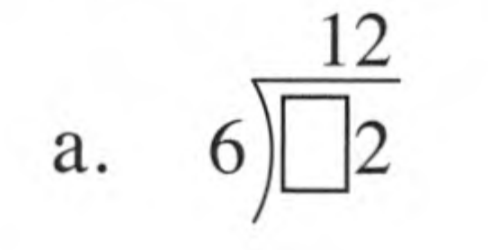
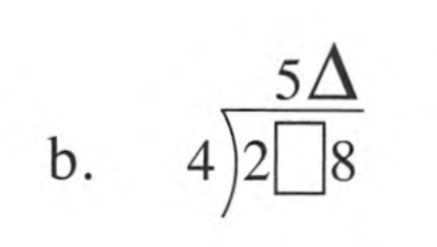
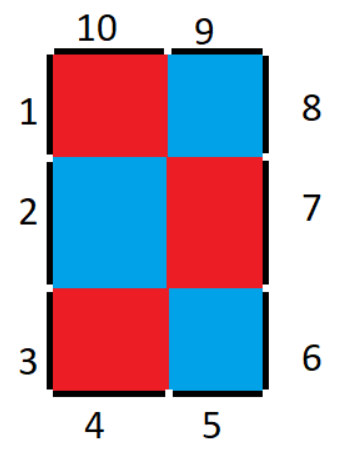
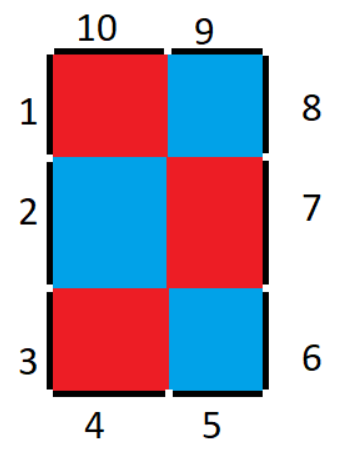
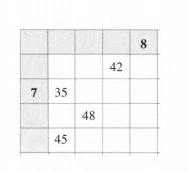
The given figure is
Core Connections, Course 1, Student 1st Edition, Chapter 2 Arithmetic Strategies and Area 1'

It is required to fill up the blanks.

We will fill-up the blanks according to the property of the multiplication table puzzle.

You might be able to notice (and remember) the multiples by looking for patterns in the numbers that make up the times table in question.

Read and learn More Core Connections Course 1 Student 1st Edition Solutions

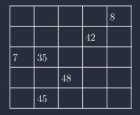
Aruni found an incomplete multiplication table puzzle as shown below.
Core Connections, Course 1, Student 1st Edition, Chapter 2 Arithmetic Strategies and Area 1 1

We start by third row with numbers 7 and 35.

Since five times 7 is 35, we can find out the remaining numbers in that row

7×6=42,7×7=49 and 7×8=56

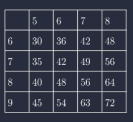
Now using fourth column with numbers 42 and 49 whose common factor is only 7 which will come on the top.

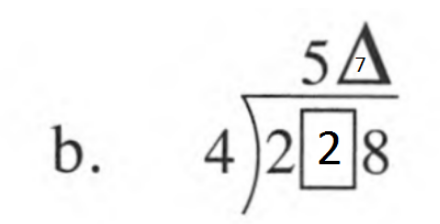
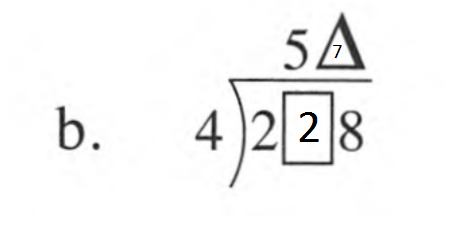
Similarly, we can find out the remaining pieces of the puzzle as shown below.
Core Connections, Course 1, Student 1st Edition, Chapter 2 Arithmetic Strategies and Area 1 2

Now using fourth column with numbers 42 and 49 whose common factor is only 7 which will come on the top.

Similarly, we can find out the remaining pieces of the puzzle as shown below.
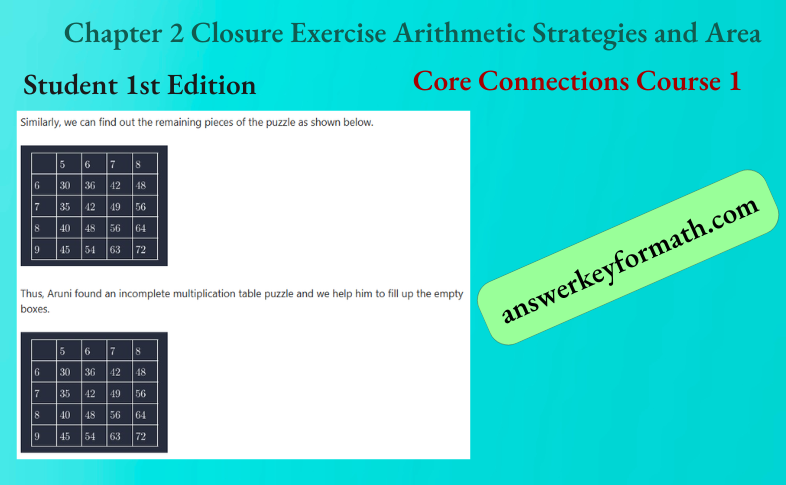
Core Connections Course 1 Student 1st Edition Chapter 2 Closure Exercise Arithmetic Strategies and Area

Core Connections Course 1 Student 1st Edition Chapter 2 Closure Exercise solutions Page 91 Problem 2 Answer

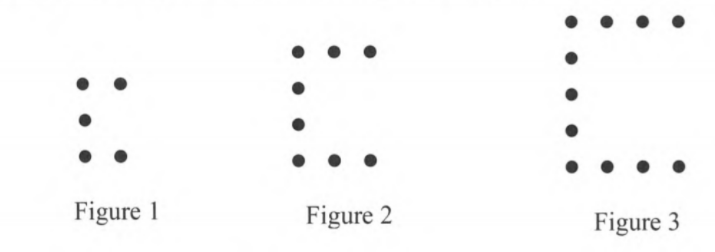
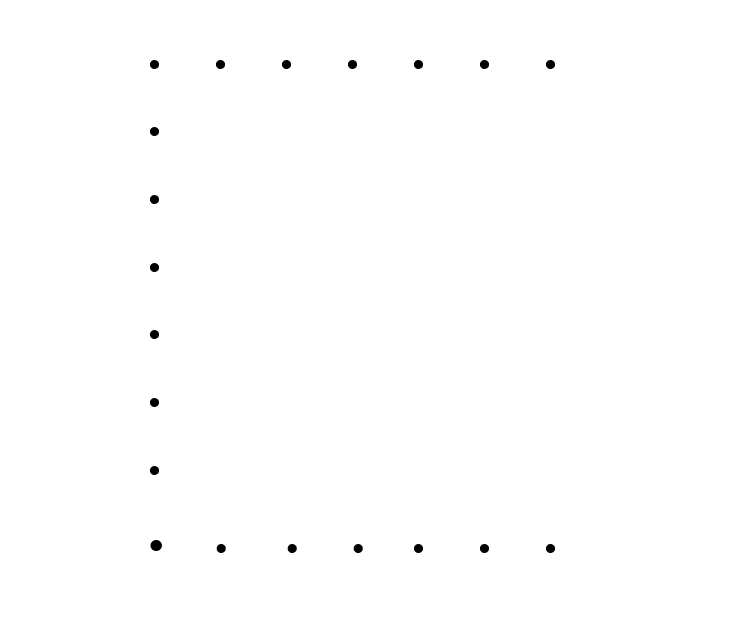
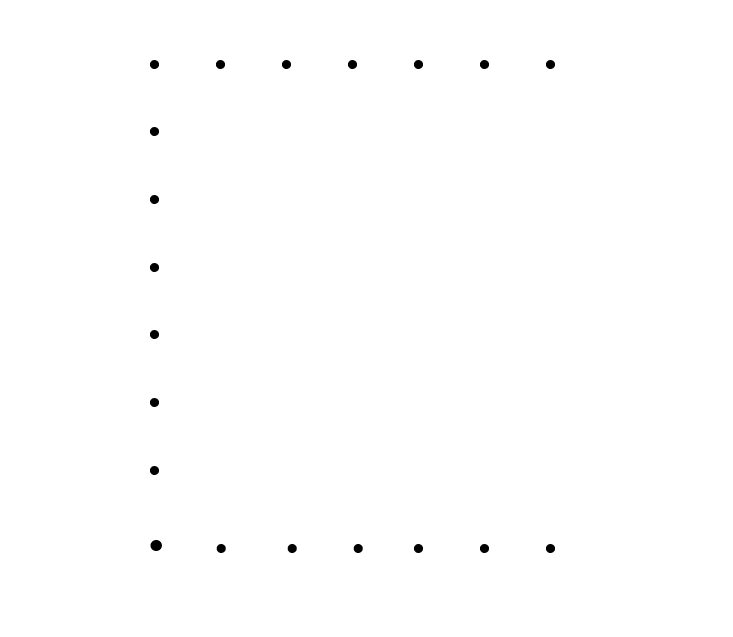
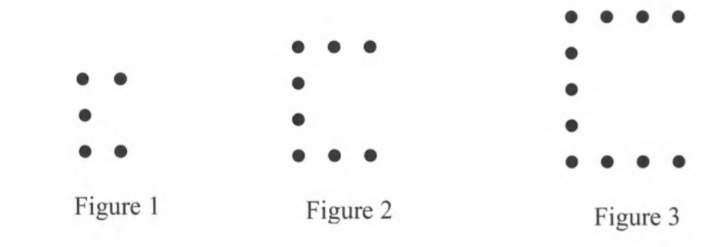
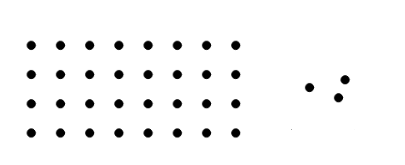
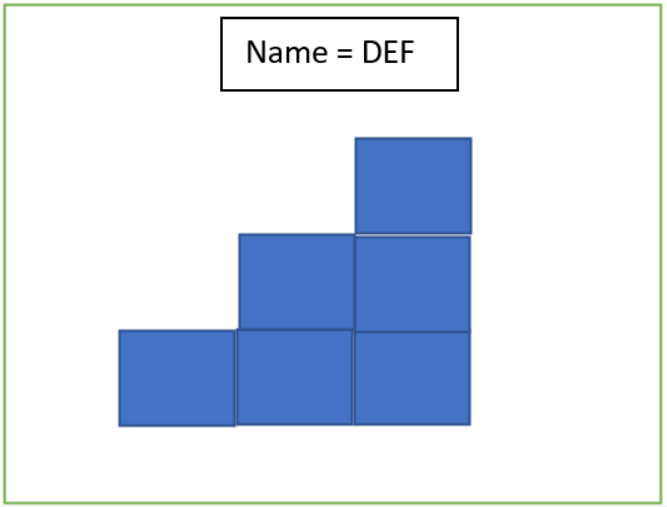
The given figure is
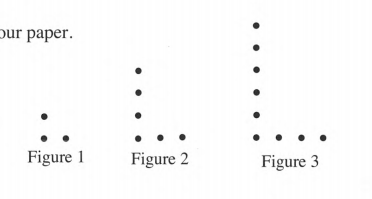
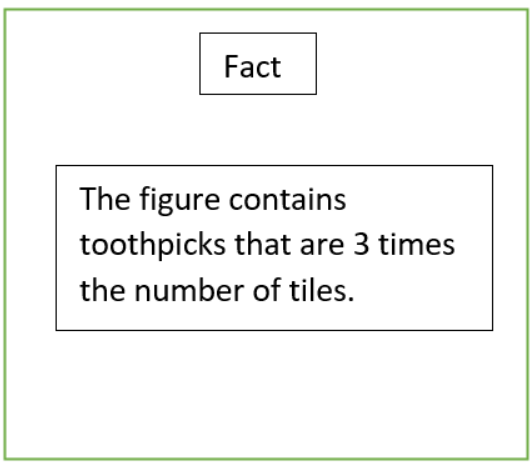
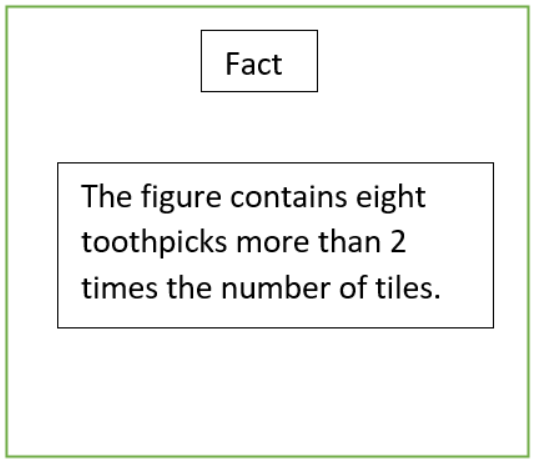
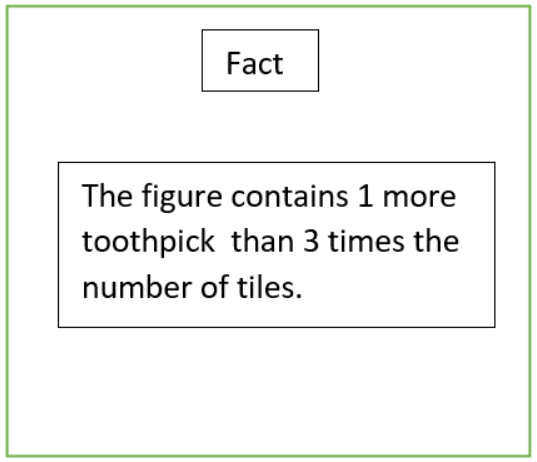
Core Connections, Course 1, Student 1st Edition, Chapter 2 Arithmetic Strategies and Area 2

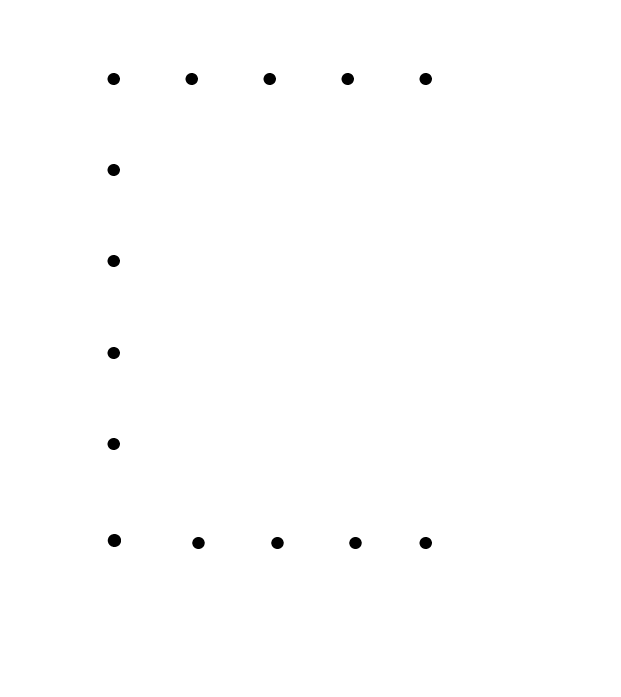
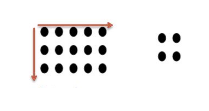
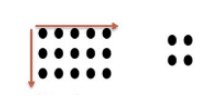
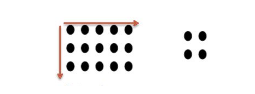
It is required to draw the 4th and 5th figures.

We will draw the 4th and 5th figure according to the property of the dot pattern.

The dots on the horizontal line=1+ number of figures and the dots on the vertical line=2×number of figures.

Dots on the vertical line and horizontal line follow the following pattern

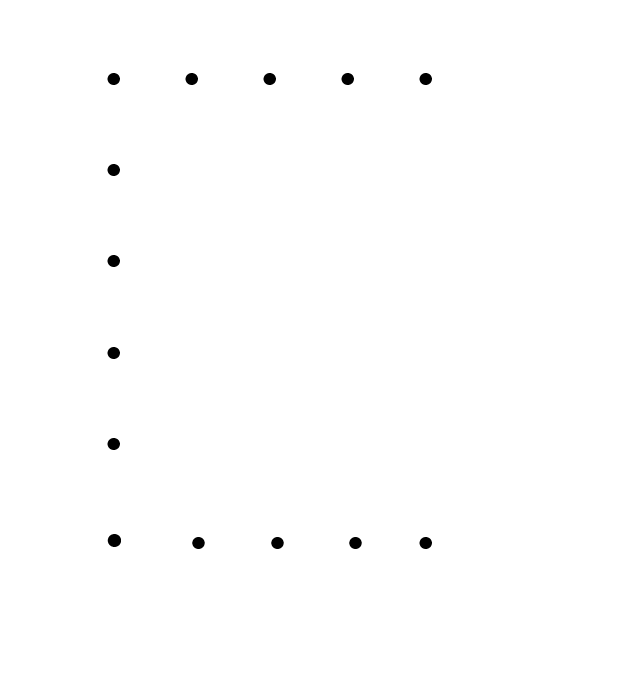
For figure 4

The dots on the horizontal line are

=1+4

=5,

And the dots on the vertical line are

=2×4

=8

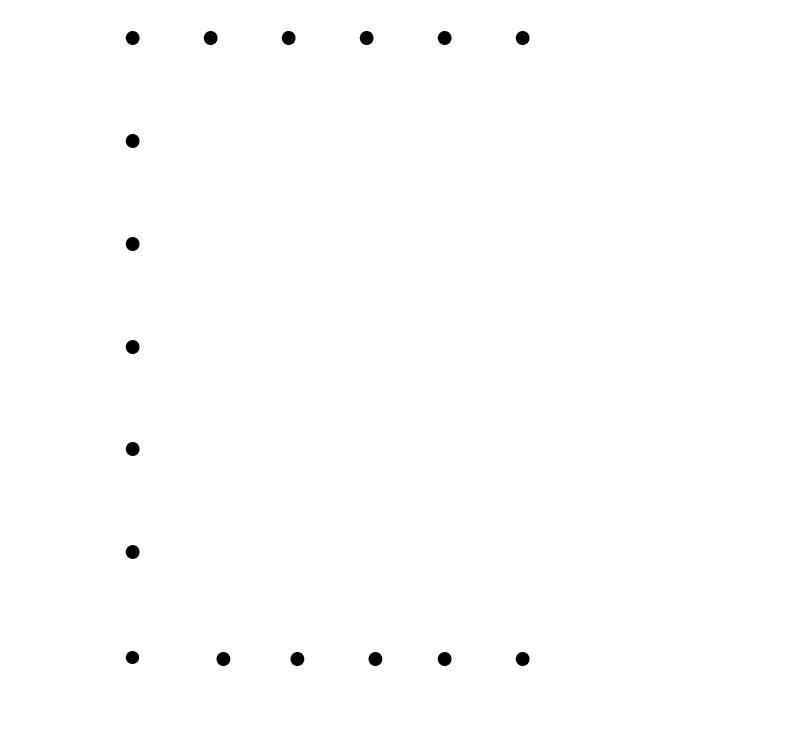
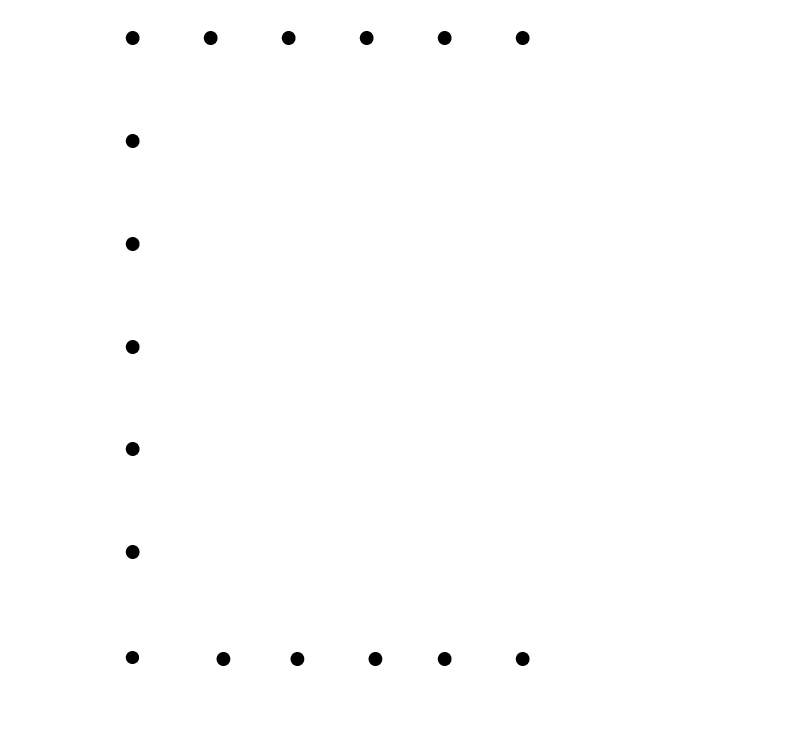
Similarly,

for figure 5 the dots on the horizontal line are

=1+5

=6

And the dots on the vertical line are

=2×5

=10

Figure 4 and 5 are shown as below.
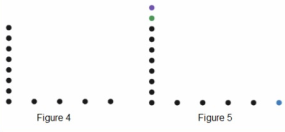
Core Connections, Course 1, Student 1st Edition, Chapter 2 Arithmetic Strategies and Area 2 1

Thus, we draw the 4th and 5th figures
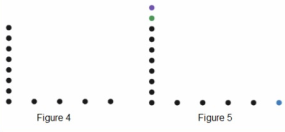
Core Connections, Course 1, Student 1st Edition, Chapter 2 Arithmetic Strategies and Area 2 2

Chapter 2 Closure Exercise Arithmetic Strategies and Area solutions Core Connections Course 1 Page 91 Problem 3 Answer

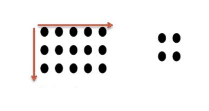
The given figure is
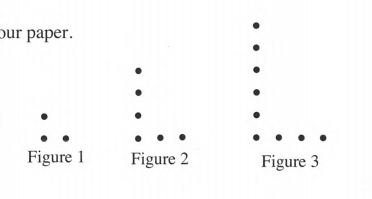
Core Connections, Course 1, Student 1st Edition, Chapter 2 Arithmetic Strategies and Area 3

It is required to determine the number of dots in 30thfigure.

We will determine the number of dots according to the property of the dot pattern.

The dots on the horizontal line = number of figures and The dots on the vertical line =2×number of figures.

Dots on the vertical line and Horizontal line follow the following pattern

The dots on the horizontal line = number of figures

So, the dots of the horizontal line=30 and

The dots on vertical line=2×number of figures.

So, there will be total of 60 dots in vertical line in 30th  Figure.

Thus,  there will be 60 dots in the vertical line and 30 dots in the horizontal line in 30th figure.

Core Connections Course 1 Chapter 2 Page 91 Problem 4 Answer

The given figure is

Core Connections, Course 1, Student 1st Edition, Chapter 2 Arithmetic Strategies and Area 4 1

It is required to determine the oldest president at the time of inauguration.

We will determine the oldest president according to the property of the stem-and-leaf plot.

The initial digit or digits of a value are the stem; the last digit of a value is the leaf.

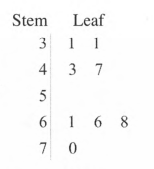
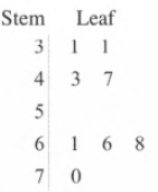
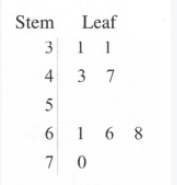
The stem and leaf plot is given below.

Core Connections, Course 1, Student 1st Edition, Chapter 2 Arithmetic Strategies and Area 4

To find the oldest president, we have to look for the last leaf of the last stem.

A stem and leaf table is a data display table.

The initial digit or digits are displayed in the ‘stem’ on the left The ‘leaf,’ which is on the right, shows the last digit.

In this problem, we need to go to the last stem which is the initial digit of the number that is the age of the oldest president, and secondly, we have to check the last leaf which is displayed the last digit of the number which is the age of the oldest president.

Finally, we get:

The last stem is 6 and the last leaf is 9. The oldest president is 69 years old.

Thus, the age of the oldest president at the time of the inauguration was 69 years.

Chapter 2 Closure Exercise Arithmetic Strategies and Area solutions Core Connections Course 1 Page 91 Problem 5 Answer

The given figure is

Core Connections, Course 1, Student 1st Edition, Chapter 2 Arithmetic Strategies and Area 5 1

It is required to determine the youngest president at the time of inauguration.

We will determine the youngest president according to the property of the stem-and-leaf plot.

The initial digit or digits of a value are the stem; the last digit of a value is the leaf.

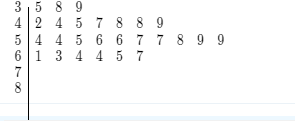
The stem and leaf plot is given below.

Core Connections, Course 1, Student 1st Edition, Chapter 2 Arithmetic Strategies and Area 5

To find the youngest president we have to look for the first leaf of the first stem.

The youngest president is 42 years old.

Thus, the age of the youngest president at the time of the inauguration was 42 years.

Core Connections Course 1 Chapter 2 Page 92 Problem 6 Answer

The given figure is
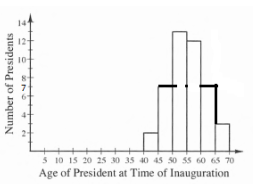
Core Connections, Course 1, Student 1st Edition, Chapter 2 Arithmetic Strategies and Area 6 1

It is necessary to complete the missing bar.

We will fill up the missing bar according to the property of the histogram.

At first, we have to find a bin that represents a given range of values (class interval).

The range refers to the specific values of the minimum and maximum values.

You want to see the form of the data distribution when deciding if the output of a process is distributed almost normally.

Examining if a technique can suit a customer’s needs.

A histogram’s shape might lead to important inferences regarding the data’s trend(s).
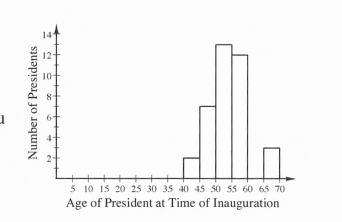
Core Connections, Course 1, Student 1st Edition, Chapter 2 Arithmetic Strategies and Area 6

On the horizontal axis, place the range of the empty space.
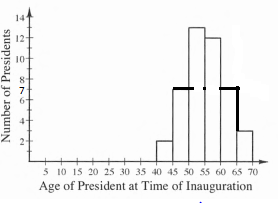
Core Connections, Course 1, Student 1st Edition, Chapter 2 Arithmetic Strategies and Area 6 2

From the diagram, it is cleared that the range is the number of presidents between the age 60−64.

On the vertical axis, place frequencies, by calculating the last stem and last leaf and we get the number of presidents(height) 7.

Their ages are 60,61,61,61,62,64, and 64 years

The number of presidents between the age of 60 to 64 , when inaugurated, are 7

So the missing graph is between 60−65

The height of the bar will be 7 as that is the number of presidents of that age.

Thus, the height of the bar will be 7 as that is the number of presidents of that age.

Core Connections Course 1 Chapter 2 Page 92 Problem 7 Answer

The given figure is
Core Connections, Course 1, Student 1st Edition, Chapter 2 Arithmetic Strategies and Area 7 1

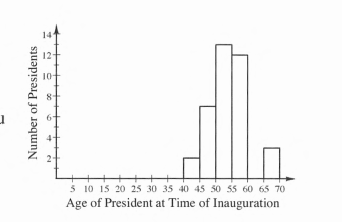
It is required to determine the number of  U.S. presidents who were younger than 50 years old at the time of their inauguration.

We will determine the number of U.S presidents according to the property of the histogram.

At first, we have to find a bin that represents a given range of values (class interval).

The range refers to the specific values of the minimum and maximum values.

You want to see the form of the data distribution when deciding if the output of a process is distributed almost normally.

Examining if a technique can suit a customer’s needs.

A histogram’s shape might lead to important inferences regarding the data’s trend(s).

Given histogram is
Core Connections, Course 1, Student 1st Edition, Chapter 2 Arithmetic Strategies and Area 7

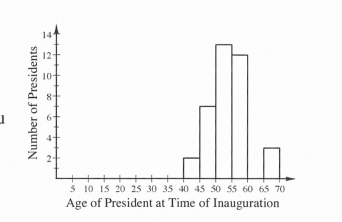
The range of age less than 50 are 40−45 and 45−50.

So we measure the height of the bars, height for age 40-45=2,height for age 45-50=7.

So, the number of presidents younger than 50 years old at the time of inauguration2+7=9.

Thus, the number of presidents younger than 50 years old at the time of inauguration is 9.

Core Connections Course 1 Chapter 2 Closure Exercise step-by-step solutions Page 92 Problem 8 Answer

The given figure is
Core Connections, Course 1, Student 1st Edition, Chapter 2 Arithmetic Strategies and Area 8 1

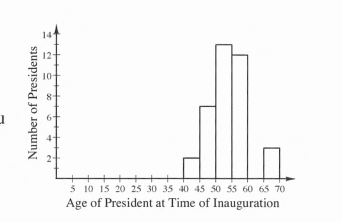
It is required to determine the number of U.S. presidents that are represented by this data.

We will determine the number of U.S presidents according to the property of the histogram.

At first, we have to find a bin that represents a given range of values (class interval).

The range refers to the specific values of the minimum and maximum values.

You want to see the form of the data distribution when deciding if the output of a process is distributed almost normally.

Examining if a technique can suit a customer’s needs.
Core Connections, Course 1, Student 1st Edition, Chapter 2 Arithmetic Strategies and Area 8

A histogram’s shape might lead to important inferences regarding the data’s trend(s).

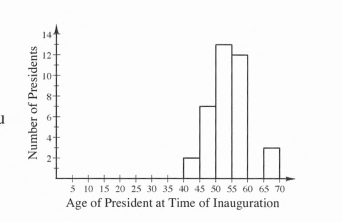
The height of all the bars represents the number of presidents represented by this data.

The height is 2 in range between 40−45, the height is 7 in the range between 45−50, the height is 13 in the range between 50−55, the height is 12 in the range between 55−60 and the height is 3 in the range between 65−70.

Total height =2+7+13+12+3=37.

Thus, the height of all the bars represents the number of presidents represented by this data and the total height is 37.

Core Connections Course 1 Chapter 2 Page 92 Problem 9 Answer

Given: The factorization of 16.

It is required to list all of the factors of 16.

We will list all the factors according to the property of the factorizations.

The factorization approach employs the basic factorization formula to simplify any algebraic or quadratic problem by representing the equations as the product of factors rather than expanding the brackets.

A number, a variable, or an algebraic expression can all be factored in an equation.

All the factors of 16 are :

Factors of 16 are 2,4,8.

2,4 and 8 are  factors of 16 because 16÷2=8 exactly, 16÷4=4 exactly and, 16÷8=2 exactly.

Thus, we list all the factors of 16 and they are 2,4,8

Core Connections Course 1 Chapter 2 Closure Exercise step-by-step solutions Page 92 Problem 10 Answer

Given: The factorization of 18.It is required to list all of the factors of 18.

We will list all the factors according to the property of the factorizations.

The factorization approach employs the basic factorization formula to simplify any algebraic or quadratic problem by representing the equations as the product of factors rather than expanding the brackets.

A number, a variable, or an algebraic expression can all be factored in an equation.

All the factors of 18 are :Factors of18=2,3,6,9.

Because 18÷2=9 exactly,

18÷3=6 exactly,

18÷6=3 exactly and,

18÷9=2 exactly.

Thus,  we list all the factors of 18 and they are 2,3,6,9.

Core Connections Course 1 Chapter 2 Page 92 Problem 11 Answer

The given digits 4,7,5,6, and 8 and the given figure is
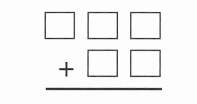
Core Connections, Course 1, Student 1st Edition, Chapter 2 Arithmetic Strategies and Area 11

It is required to make the largest and smallest sums.

We will make sums according to the property of the sums.

We arrange the digits in descending order.

The result or answer we get when we add two or more numbers is known as sums then we arrange the digits in ascending order.

The result or answer we get when we add two or more numbers is known as sums.
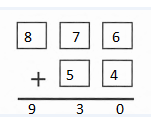
Core Connections, Course 1, Student 1st Edition, Chapter 2 Arithmetic Strategies and Area 11 1

To find the maximum sum from digits 4,7,5,6 and 8. we have to find two biggest numbers from the given numbers.

We can arrange the numbers in descending order :8,7,6,5,4

The maximum sum will be 876+54=930

To find the minimum sum from digits 4,7,5,6 and 8. we have to find two smallest numbers from the given numbers.

We can arrange the numbers in ascending order : 4,5,6,7,8

The minimum sum will be 456+78=534
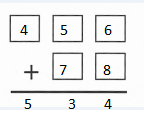
Core Connections, Course 1, Student 1st Edition, Chapter 2 Arithmetic Strategies and Area 11 2

Thus, we place the digits4,7,5,6,  and 8  in the boxes to make the largest and smallest sums possible and we get the maximum sum is 930 and the minimum sum is 534.

the boxes are shown below
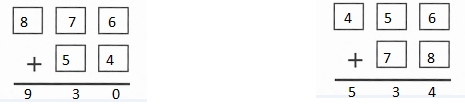
Core Connections, Course 1, Student 1st Edition, Chapter 2 Arithmetic Strategies and Area 11 3

Core Connections Course 1 Chapter 2 Page 92 Problem 12 Answer

Given: Out of 50 students, 15 are taking English and 30 are taking chemistry.

Of those students taking English and chemistry, 6 are in both classes.

It is required to determine the number of students who are taking chemistry and not English.

We will determine the number of students, according to the property of the Venn diagram.

Draw three circles that overlap to make an intersecting Venn diagram.

You’ll be able to demonstrate which qualities are unique to each circle, which overlap between two circles, and which are shared by all three groups.

To read a Venn diagram, look at all of the circles that make up the whole thing.

Each circle represents a separate item or data set.

There are total 50 students, 15 students are taking English, 30 students are taking chemistry, and 6 are taking both courses.

The Venn diagram is drawn below:
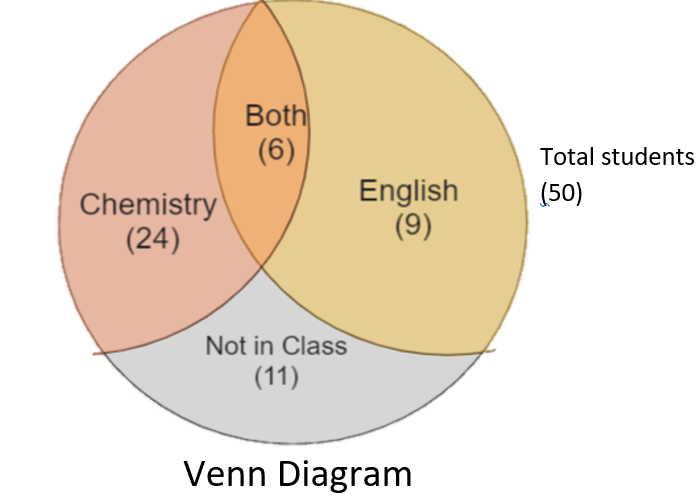
Core Connections, Course 1, Student 1st Edition, Chapter 2 Arithmetic Strategies and Area 12 1

The number of students taking chemistry and not English =Students taking chemistry −Students taking both.

30−6=24

24 students are taking chemistry and not English.

Thus, the Venn diagram is and 24 students are taking chemistry and not English.
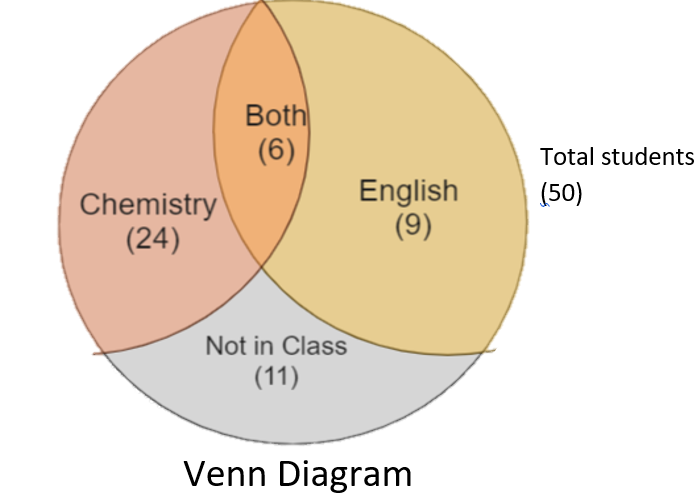
Core Connections, Course 1, Student 1st Edition, Chapter 2 Arithmetic Strategies and Area 12

Core Connections Course 1 Chapter 2 Page 92 Problem 13 Answer

Given: Out of 50 students,15 are taking English and 30 are taking chemistry.

Of those students taking English and chemistry,6 are in both classes.

It is required to determine the number of students who are taking English and not chemistry.

We will determine the number of students according to the property of the Venn diagram.

Draw three circles that overlap to make an intersecting Venn diagram.

You’ll be able to demonstrate which qualities are unique to each circle, which overlap between two circles, and which are shared by all three groups.

To read a Venn diagram, look at all of the circles that make up the whole thing.

Each circle represents a separate item or data set.

There are total 50 students, 15 students are taking English, 30 students are taking chemistry, and 6 are taking both courses.

The Venn diagram is drawn below:
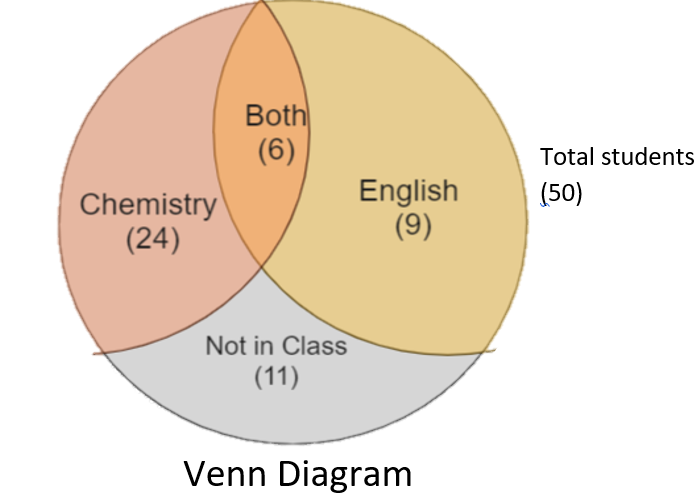
Core Connections, Course 1, Student 1st Edition, Chapter 2 Arithmetic Strategies and Area 13 1

The number of students taking English and not chemistry= students taking English−students taking both.

15−6=9

Thus,  the Venn diagram is
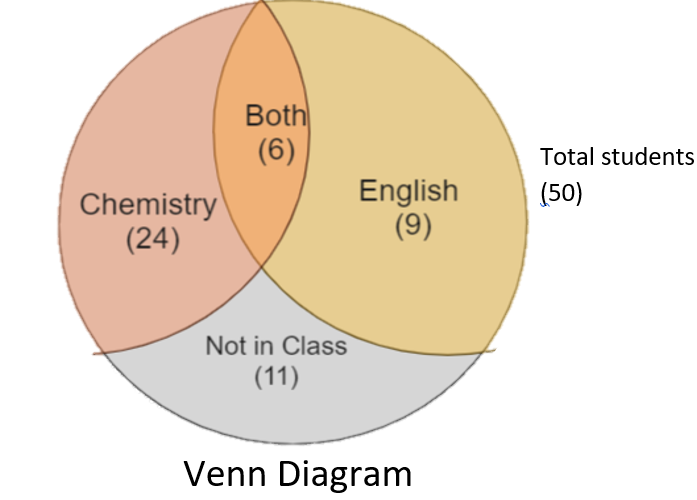
Core Connections, Course 1, Student 1st Edition, Chapter 2 Arithmetic Strategies and Area 13

And 9 students are taking English and not chemistry.

Chapter 2 Closure Arithmetic Strategies and Area explained Core Connections Course 1 Page 92 Problem 14 Answer

Given: Out of 50 students,15 are taking English and 30 are taking chemistry.

Of those students taking English and chemistry, 6 are in both classes.

It is required to determine the number of students who are taking neither of the classes we will determine the number of students, according to the property of the Venn diagram.

Draw three circles that overlap to make an intersecting Venn diagram.

You’ll be able to demonstrate which qualities are unique to each circle, which overlap between two circles, and which are shared by all three groups.

To read a Venn diagram, look at all of the circles that make up the whole thing.

Each circle represents a separate item or data set.

There are total 50 students, 15 students are taking English, 30 students are taking chemistry, and 6 are taking both courses.

The Venn diagram is drawn below:
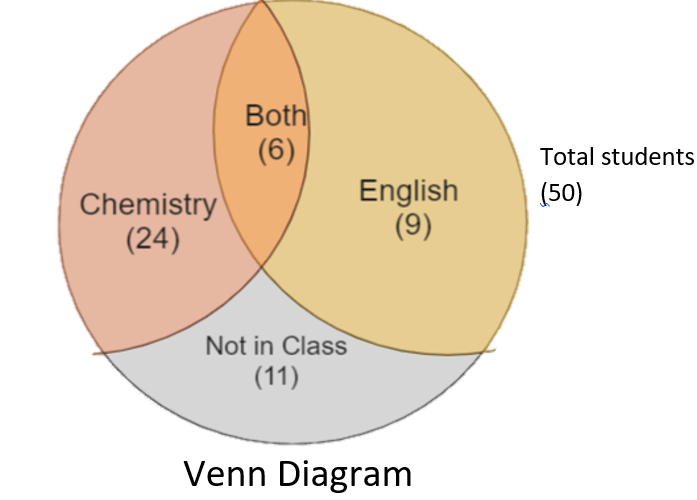
Core Connections, Course 1, Student 1st Edition, Chapter 2 Arithmetic Strategies and Area 14 1

The number of students taking neither of the classes= Total students−Students taking English−

Students taking chemistry +Students taking both.

50−30−15+6=11

Thus, the Venn diagram is
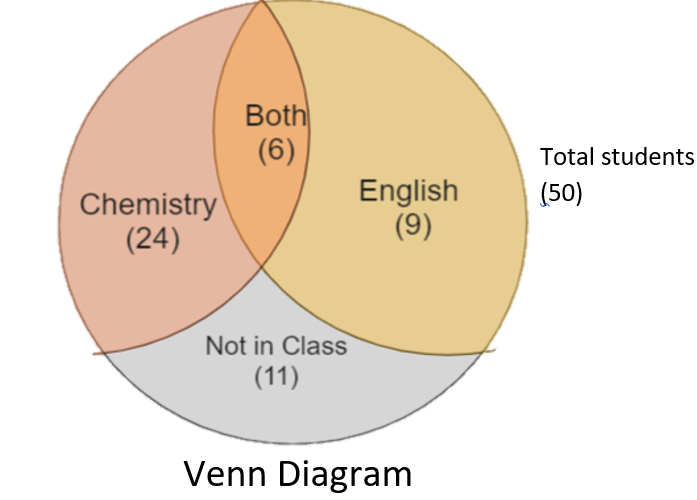
Core Connections, Course 1, Student 1st Edition, Chapter 2 Arithmetic Strategies and Area 14

And 11 students are taking neither of the classes.

Chapter 2 Closure Arithmetic Strategies and Area explained Core Connections Course 1 Page 92 Problem 15 Answer

The given figure is
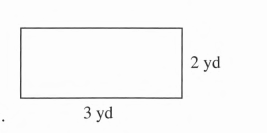
Core Connections, Course 1, Student 1st Edition, Chapter 2 Arithmetic Strategies and Area 15

It is required to determine the area of the rectangle.

We will determine the area according to the formula of the area of a rectangle.

The basic formula of the area of the rectangle is length × width.

In this question, the length is 3 yards and width is 2 yards.

We need to put the values of length and width in the formula of the area of the rectangle and we get the result.

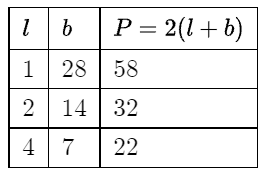
The given rectangle has length 3 yard and width 2 yard. Since area of the rectangle is Area = length × width

The area of the given rectangle is Area

=3×2

=6 square yards ​

=(3×3)×(2×3)

Multiplying 3 by 3, we know that​1 yards=3 feet

∴3 yard=9 feet

​=54 square feet

Thus,  the area of the rectangle is 6 square yards and 54 square feet in square yards and square feet, respectively.
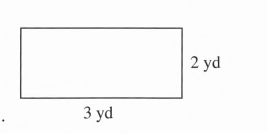
Core Connections, Course 1, Student 1st Edition, Chapter 2 Arithmetic Strategies and Area 15 1

worked examples for Core Connections Course 1 Chapter 2 Closure Exercise Arithmetic Strategies and Area Page 92 Problem 16 Answer

The given figure is
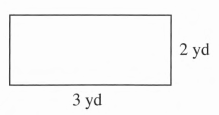
Core Connections, Course 1, Student 1st Edition, Chapter 2 Arithmetic Strategies and Area 16 1

It is required to determine the perimeter of the rectangle.

We will determine the perimeter according to the formula of the perimeter of the rectangle.

The basic formula of the perimeter is2(length+width).

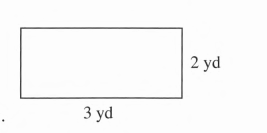
In this question, the length is 3 yards and the width is 2 yards We need to put the values of length and width in the formula of the perimeter of the rectangle and we get the result.

The given rectangle has length 3 yard and width 2 yard. Since the perimeter of the rectangle is

Perimeter =2×( length + width )

The perimeter of the given rectangle is Perimeter

=2×(3+2)

​=10 yards

=2×(3×3+2×3)

Multiplying by 3 and  3, we know that 1 yard =3 feet

∴3 yards=9 feet

=2×15

=30 feet

Thus, the perimeter of the rectangle is 10 yards and 30 feet in yards and feet, respectively.
Core Connections, Course 1, Student 1st Edition, Chapter 2 Arithmetic Strategies and Area 16

Core Connections Course 1 Chapter 2 Page 93 Problem 17 Answer

The given figure is
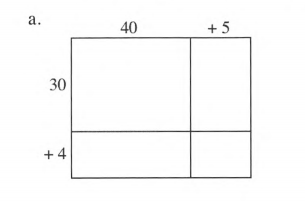
Core Connections, Course 1, Student 1st Edition, Chapter 2 Arithmetic Strategies and Area 17

It is required to complete these generic rectangles.

We will complete these generic rectangles according to the property of the generic rectangles.

Multiplication with generic rectangles is based on the principle of breaking down a product into parts.

Because the measurements are not to scale, we use the term “generic.”

The multiplication algorithm is reinforced when rectangular models are used.

Multiply the outside term by the inner terms, or distribute the outer term to the inner terms.

Combine phrases that are similar.

Arrange the phrases such that the variables and constants are on different sides of the equals sign.

Solve the problem and, if necessary, simplify it.

The Distributive Property states that the multiplier of a sum or difference can be “distributed” to multiply each term.

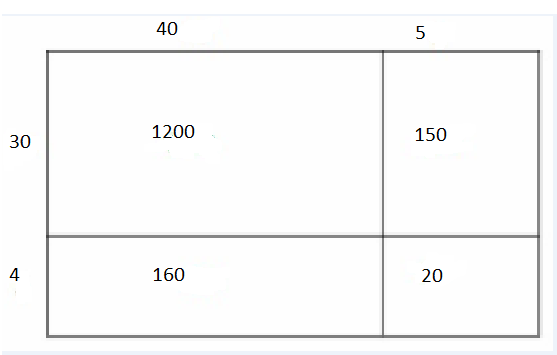
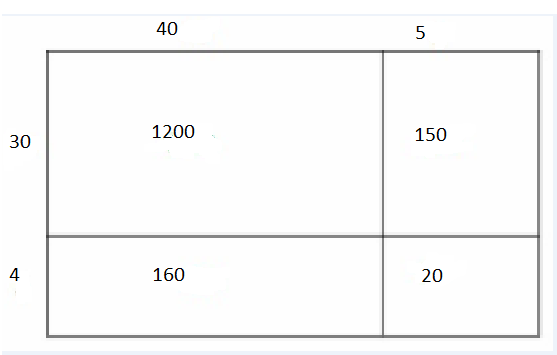
To multiply,30×40,30×5,4×40, and 4×5, written as 30⋅(40+5), and 4⋅(40+5), you can use the generic rectangle model.

34×45

(30+4)⋅(40+5)

=30⋅(40+5)+4⋅(40+5)

=30×40+30×5+4×40+4×5

=1200+150+160+20

=1350+180

=1530

​The completed generic rectangles are:

Core Connections, Course 1, Student 1st Edition, Chapter 2 Arithmetic Strategies and Area 17 1

Thus, we complete these generic rectangles.
Core Connections, Course 1, Student 1st Edition, Chapter 2 Arithmetic Strategies and Area 17 2

Core Connections Course 1 Chapter 2 Page 93 Problem 18 Answer

The given figure is
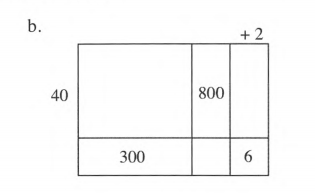
Core Connections, Course 1, Student 1st Edition, Chapter 2 Arithmetic Strategies and Area 18

It is required to complete these generic rectangles.

We will complete these generic rectangles according to the property of the generic rectangles.

Multiplication with generic rectangles is based on the principle of breaking down a product into parts.

Because the measurements are not to scale, we use the term “generic.”

The multiplication algorithm is reinforced when rectangular models are used.

Multiply the outside term by the inner terms, or distribute the outer term to the inner terms.

Combine phrases that are similar.

rrange the phrases such that the variables and constants are on different sides of the equals sign.

Solve the problem and, if necessary, simplify it.

The Distributive Property states that the multiplier of a sum or difference can be “distributed” to multiply each term.

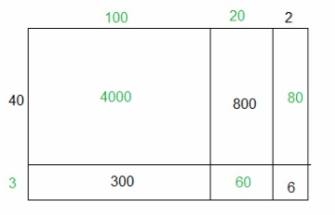
To multiply, 40×100,40×20,40×2,3×100,3×20, and 3×2, written as 40⋅(100+20+2) and 3⋅(100+20+2), you can use the generic rectangle model.

43×122

(40+3)⋅(100+20+2)

=40⋅(100+20+2)+3⋅(100+20+2)

=40×100+40×20+40×2+3×100+3×20+3×2

=4000+800+80+300+60+6

=4880+366

=5246

​Complete these generic rectangles

Core Connections, Course 1, Student 1st Edition, Chapter 2 Arithmetic Strategies and Area 18 1

Thus, we complete these generic rectangles
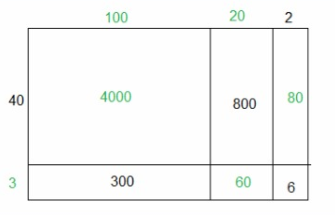
Core Connections, Course 1, Student 1st Edition, Chapter 2 Arithmetic Strategies and Area 18 2

worked examples for Core Connections Course 1 Chapter 2 Closure Exercise Arithmetic Strategies and Area Page 93 Problem 19 Answer

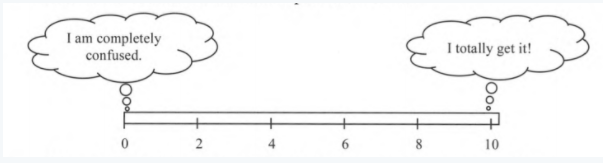
Given:  A bar or number line.
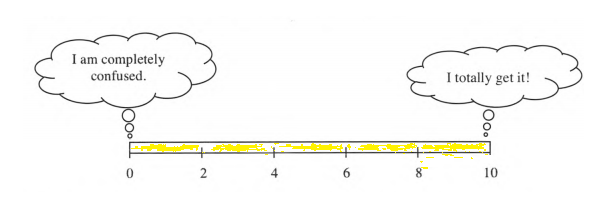
Core Connections, Course 1, Student 1st Edition, Chapter 2 Arithmetic Strategies and Area 19 2

It is asked that we use the bar or number line to convey my comprehension.

We convey my comprehension according to the theory of the given book.

We will use the theories.

They are the generic rectangle, dot plot, the stem, and leaf, histogram, factors, a Venn diagram, the formula of the area and perimeter of the rectangle, etc.

The bars will be
Core Connections, Course 1, Student 1st Edition, Chapter 2 Arithmetic Strategies and Area 19 1

The yellow color of the bar represents my level of understanding and comfort with completing all problems on my own.

For each of the problems above, all of the bars are a 10.

For example, we choose a problem CL2−91.

We would like to ask about that problem

Can I solve the given problem using the method of the generic rectangle?Which multiplication table do I need to use?

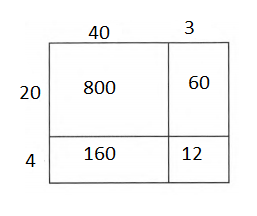
A  new problem is: Ben found an incomplete multiplication table puzzle. Help him fill in the empty boxes.

A grocery store owner ordered 43 boxes of donuts to sell in her bakery section. There are 24 donuts in each box. How many donuts will she receive in total?

The Distributive Property states that the multiplier of a sum or difference can be “distributed” to multiply each term.

To multiply, 20×40,20×3,4×40 and 4×3 written as 20.(40+3) and 4⋅(40+3), you can use the generic rectangle model.

Complete these generic rectangles

Thus, she will receive 1032 donuts.

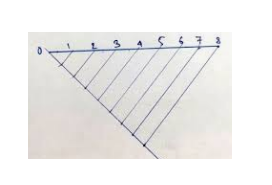
Thus, the number line is as follows:
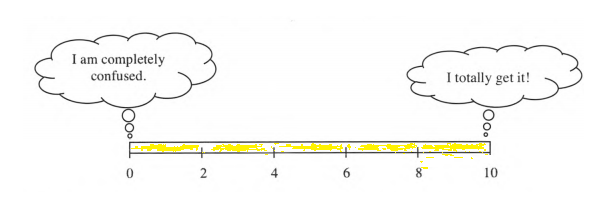
Core Connections, Course 1, Student 1st Edition, Chapter 2 Arithmetic Strategies and Area 19

Core Connections Course 1 Student 1st Edition Chapter 2 Exercise 2.3 Arithmetic Strategies and Area

Core Connections Course 1 Student 1st Edition Chapter 2 Arithmetic Strategies and Area

Core Connections Course 1 Student 1st Edition Chapter 2 Exercise 2.3 Solutions Page 77 Problem 1 Answer

Given : There are (1×100)+(5×10)+(6×1)=156 blocks.

We need to come up with examples of various rectangles that can be constructed from the above blocks.

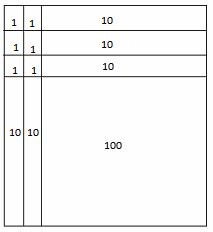
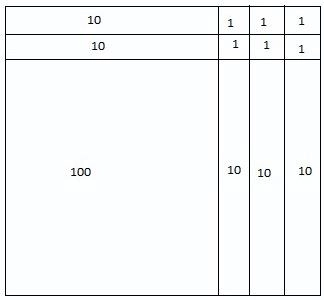
Each block can be thought of as a one square unit as the rectangles made by this set will have exactly 156 square units of area and we have 1 hundreds block, 5 tens blocks and 6 ones blocks.

To construct the rectangle using these blocks we have to take care that its opposite side must have the same lengths.

We should start with one hundred blocks and try to cover it in as many ways as we can.

For example, we have taken a hundred blocks and placed 2 ten blocks on either of its sides and then place the remaining two ten blocks above it, then to make the length of opposite sides equal we must put all the 6 one blocks above the two ten blocks piled in the pairs of 2.

Read and learn More Core Connections Course 1 Student 1st Edition Solutions

The first rectangle that can be constructed is:
Core Connections, Course 1, Student 1st Edition, Chapter 2 Arithmetic Strategies and Area 1

The second rectangle can be constructed as:
Core Connections, Course 1, Student 1st Edition, Chapter 2 Arithmetic Strategies and Area 1 1

They can be represented as this also

graphics 3 for exercise 2-53 page 77 pre-algebra part (a)

The obtained rectangles by arranging the blocks are

Yes, there are more than one ways to make a rectangle from the given blocks.

Core Connections Course 1 Student 1st Edition Chapter 2 Exercise 2.3 Solutions Page 77 Problem 2 Answer

We already have gotten two rectangles from the previous question 2-53(a) as:
We have to measure the length and width of the larger rectangle formed in both the cases.

Core Connections Course 1 Student 1st Edition Chapter 2 Exercise 2.3 Arithmetic Strategies and Area

The calculated dimensions of both the rectangles are shown in the below figure:
The sketch of the rectangles are

The dimensions are both the rectangles are different. 1st rectangle is taller than the second rectangle while the second one is wider, But the perimeter and areas of both the rectangles are same.

Chapter 2 Exercise 2.3 Arithmetic Strategies And Area Solutions Core Connections Course 1 Page 77 Problem 3 Answer

Given: We have got two rectangles from our answered previous question(2-53-Part(a))

We have to check whether the given labels of dimensions make sense or not.

Each block can be thought of as a one square unit as the rectangles made by this set will have exactly 156 square units of area and we have 1 hundreds block, 5 tens blocks and 6 ones blocks.

The dimensions 10+3 and 10+2 make sense as:

It equals 12 and 13 which are the dimensions of our obtained rectangles.10 plus 2 or 10 plus three mean there are 10 units (1 block) and 2 units (2 blocks of 1 unit each) in the first case and 3 units (3 blocks of 1 unit each).

These represent how the rectangles were constructed.Our explanation is shown in the figure as following :

10+2 and 10+3 make good enough labels for rectangles as they represent the dimensions as well the construction of the rectangles obtained by the arrangement of the blocks as

Core Connections Course 1 Chapter 2 Page 77 Problem 4 Answer

We have the two rectangles with us from question 2-53(@) as:

We have to analysis both the rectangles and answer that which arrangement is the easiest to see.

We have anaylse them and have to answer them by symmetric visualization and balance.

Since both the rectangles are the same as the second one can be obtained by rotating the first rectangle by 90 degrees in either direction.

We can calculate the length and width by counting the number of square unit blocks in the entire length and width of the rectangles formed.

The area can be calculated by counting the number of square unit blocks in the total figure as shown in the figure.

Since both the rectangles are roughly the same, either of the rectangle can be used to calculate the area and perimeter.

The figure I’d choose which is easiest to calculate the dimensions and perimeter is

Area of the given rectangle is Area=13×12

=156 sq. units.

According to the visual symmetry and balance the most easiest rectangle to measure its dimensions and area is

Chapter 2 Exercise 2.3 Arithmetic Strategies And Area Solutions Core Connections Course 1 Page 77 Problem 5 Answer

We have given two rectangles obtained by arranging the blocks as :

We have to find the relation between the total value of each block and the dimensions of the rectangle and have to calculate its total area in at least two ways.

We can find the area by the formula Area of the rectangle=Length×Breadth and as we know that the area of each one block is 1 sq.units.

We can find the area of Alan’s rectangle in the following two ways:

Way 1:You can use the formula to calculate area of the rectangle; area=length×width.

Solving it, area=(12×13)

=156 sq.units.

Way 2; You can calculate the number of blocks of 1 unit square that are required to fill the space completely without gaps or overlaps.

(1×100)+(5×10)+(6×1)=156 sq.units.

So they are related as the dimension is (number of blocks placed along the dimension of the rectangle) times the dimension of each one block.

Using both the methods, we come to see that the area of the rectangle comes out to be 156 square units.

Core Connections Course 1 Chapter 2 Page 77 Problem 6 Answer

Given that Alan is trying to multiply 12⋅13 and get an exact answer without having to build the product with Base Ten Blocks:

Core Connections, Course 1, Student 1st Edition, Chapter 2 Arithmetic Strategies and Area 6

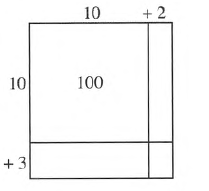
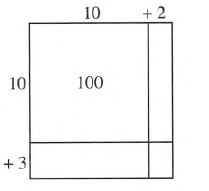
It is asked to examine  Alan’s diagram and discuss with your team how it relates to the shape he built with blocks and why did he label the sides “10+3” and “10+2”.

Alan wanted to find the product of 13 and 12 but instead of using Base-10 Blocks Alan drew a figure and labelled its sides as 10,3,10,2, this is because Alan has divided number 13 and number 12 into two parts 10+2 and 10+3 so that the diagram may resemble the Base-10 Block arrangement he made earlier, this will simplify the problem as he already knows the area of Base-10 blocks, so he is dividing his figure such that he can make use of that information to find out the product.

Thus, Alan drew a figure and labelled its sides as 10,3,10,2, this is because Alan has divided number 13 and number 12 into two parts “10+2” and “10+3” so that the diagram may resemble the Base-10 Block arrangement he made earlier.

Core Connections Course 1 Chapter 2 Exercise 2.3 Step-By-Step Solutions Page 77 Problem 7 Answer

Given that Alan is trying to multiply 12⋅13 and get an exact answer without having to build the product with Base Ten Blocks:

Core Connections, Course 1, Student 1st Edition, Chapter 2 Arithmetic Strategies and Area 7

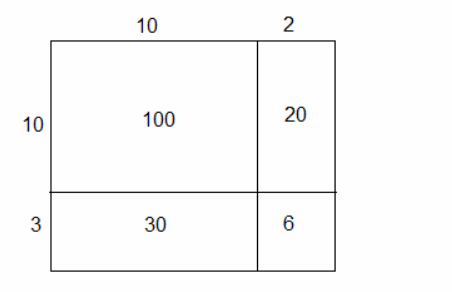
It is asked to show how Alan got “100” and what does the “100” represent, then fill in the other three smaller rectangles the same way.

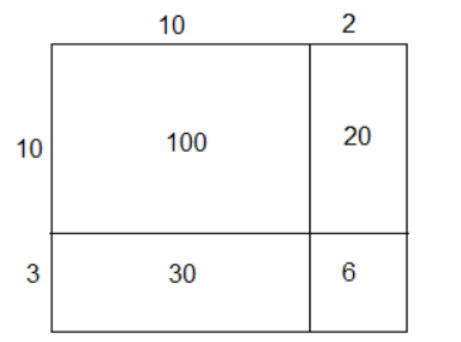
Now by using generic rectangle definition we will solve given problem.

For the problem 13⋅12, think of 13 as 10+3 and 12 as 10+2. Use these numbers as the dimensions of a large rectangle, as shown below.

Now we will determine the area of each of the smaller rectangles and then find the sum of the four smaller areas. So, the area of each block are:

10×10=100.

10×2=20.

10×3=30.

3×2=6.

The number 100 represents the area of that portion of figure because in the given generic rectangle the length of the square present in the upper left corner is 10, it is similar to the Base-10 Block arrangement in which the area of block is known.

The remaining figure can be completed as below;

Core Connections, Course 1, Student 1st Edition, Chapter 2 Arithmetic Strategies and Area 7 2

Thus, the number 100 represents the area of an upper-left portion of the figure(with dimensions:10×10), and the completed figure is shown below:

Core Connections, Course 1, Student 1st Edition, Chapter 2 Arithmetic Strategies and Area 7 1

Core Connections Course 1 Chapter 2 Page 77 Problem 8 Answer

Given that Alan is trying to multiply 12⋅13 and make a diagram:

We have to find the total area represented by the entire rectangle, using 2 different methods.

The area of the figure can be found out using two following methods:

Method 1: To Add up the area of individual blocks.

Method 2: To find the area using mathematical formula

Area =length×width.

Method 1:  Add up the area of individual blocks.

From the given generic rectangle figure, it has 4 blocks and each has length and width. So, each block area is:

Area of first block:10×10=100

Area of second block:10×3=30

Area of third block:10×2=20

Area of fourth block: 3×2=6

​Total area= sum of area of each block

=100+30+20+6

=156.

Method 2:  Find the area using a mathematical formula i.e.

Area of a rectangle = length ×width.

In the given figure, length is 13 and width is 12 then area will be

Area=13⋅12

=156.

Thus, the area of the figure can be found by following two methods:

  1. Add up the area of individual blocks
  2. Find the area using a mathematical formula, Area=length×width.

Core Connections Course 1 Chapter 2 Exercise 2.3 Step-By-Step Solutions Page 77 Problem 9 Answer

Given that  Alan is trying to multiply 12⋅13 and get an exact answer without having to build the product with Base Ten Blocks:

It is asked Alan would like to use the generic-rectangle strategy to do more complex multiplication problems.

Work with your team to help Alan draw a generic rectangle to multiply 59⋅46 and find the product.

Now we will draw the generic rectangle for 59×46 and calculate the area to solve given problem.

The generic rectangle will be:

To find the product we need to add up the individual area marked in the figure, 59⋅46

=2000+300+360+54

​ =2300+414

=2714.​

Thus, the product is 59⋅46=2714.

Core Connections Course 1 Chapter 2 Page 78 Problem 10 Answer

Given that Riley is looking at the diagram at right in his maths book:

Core Connections, Course 1, Student 1st Edition, Chapter 2 Arithmetic Strategies and Area 10

It is asked to identify the factors and product represented by the rectangle.

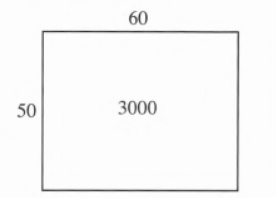
The given diagram shows the two sides of the rectangle 50 (width) and 60 (length) representing the two numbers (factors) to be multiplied and the value written in the middle 3000 represents the area of the rectangle which is equal to the product of those numbers.

Thus, in the given  diagram 50 and 60 are the factors with 3000 as the product.

Solutions For Core Connections Course 1 Chapter 2 Exercise 2.3 Arithmetic Strategies And Area Page 78 Problem 11 Answer

Given fraction is: 1/2.

It is asked to find the two fractions that are equivalent to the given fraction.

Two equivalent fraction of 1/2 are 2/4,4/8.

Thus, two equivalent fraction of 1/2 are 2/4,4/8.

Core Connections Course 1 Chapter 2 Page 78 Problem 12 Answer

Given fraction is: 3/5.

It is asked to find the two fractions that are equivalent to the given fraction.

Two equivalent fraction of 3/5 are:  3×3/5×3=9/15,3×4/5×4=12/20.

Thus, two equivalent fraction of 3/5 are 9/15,12/20.

Solutions For Core Connections Course 1 Chapter 2 Exercise 2.3 Arithmetic Strategies And Area Page 78 Problem 13 Answer

Given fraction is: 4/7.

It is asked to find the two fractions that are equivalent to the given fraction.

Two equivalent fraction of 4/7 are 8/14,12/21.

Thus, two equivalent fraction of 4/7 are 8/14,12/21.

Core Connections Course 1 Chapter 2 Page 78 Problem 14 Answer

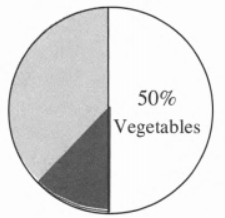
Given: Ethan planted seeds for vegetables in 50% of the garden and flowers and herbs in other parts of the garden.

It is asked if the lightly shaded portion represents flowers, find what percentage of the garden could be herbs.

The entire circle is divided into three portions: vegetables, herbs and flowers.

Core Connections, Course 1, Student 1st Edition, Chapter 2 Arithmetic Strategies and Area 14

Since 50% is allocated for vegetables, it means that the other 50%  is allocated for herbs and flowers.

If we draw a line in the middle of the portion having flowers and herbs, we can see that the herb portion is less than 1/4 of the total portion.

So, the herb garden covers approximately less than 25% of the total portion.

Thus, the herb garden covers approximately less than 25% of the total portion.

Core Connections Course 1 Student 1st Edition Chapter 2 Exercise 2.3 Guide Page 78 Problem 15 Answer

Given: 34.62+74.8.

It is asked to add given expression.

Now we will use the definition of addition to solve given problem.

We will separate given decimal digits and then add like decimal digits separately.

⇒34.62+74.8

⇒34+74+0.62+0.80

⇒108+1.42

⇒109.42.

​Thus, the solution is; 34.62+74.8=109.42.

Core Connections Course 1 Chapter 2 Page 78 Problem 16 Answer

Given: 213.09−37.2.

It is asked to subtract given expression.

Now we will use the definition of subtraction to solve given problem.

First, we will separate like decimal digit and number then subtract it.

⇒213.09−37.2

⇒213+0.09−37−0.20

​⇒213−37+0.09−0.20

⇒176.00−0.11

⇒175.89.

Thus, the solution is: 213.09−37.2=175.89.

Core Connections Course 1 Student 1st Edition Chapter 2 Exercise 2.3 Guide Page 78 Problem 17 Answer

Given: 3.15+36.8+7.

It is asked to add given expression.

Now we will use the definition of addition to solve given problem.

So, 3.15+36.8+7=46.95.

Thus, the solution is: 3.15+36.8+7=46.95.

Core Connections Course 1 Chapter 2 Page 80 Problem 18 Answer

Given: 25⋅18.

It is asked to draw generic rectangles to help you multiply the given numbers without a calculator and also show the place value of each part of the rectangle, the area of each part, and the area of the whole rectangle.

Now we will make a generic rectangle diagram and by using it we solve given problem.

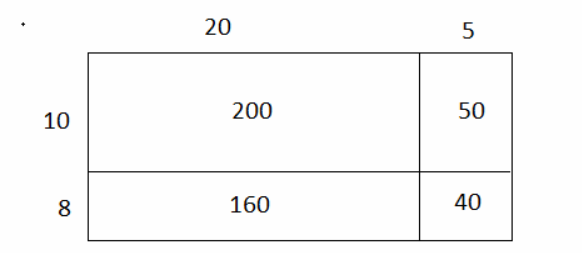
For the problem 25⋅18, think of 25 as 20+5 and 18 as 10+8.

We will use these numbers as the dimensions of a large rectangle, as shown in the figure below.

Core Connections, Course 1, Student 1st Edition, Chapter 2 Arithmetic Strategies and Area 18

A generic rectangle diagram of 25⋅18 is:

Now we will determine the area of each of the smaller rectangles to find the sum of the four smaller areas, which gives the total area of the generic rectangle.

Area=10⋅20+20⋅8+10⋅5+8⋅5

=200+160+50+40

=360+90

=450.

Thus, the equation for a generic rectangle that shows the total area is:  (25⋅18)=200+160+50+40=450 thus 25⋅18=450.

Chapter 2 Exercise 2.3 Arithmetic Strategies And Area Explained Core Connections Course 1 Page 80 Problem 19 Answer

Given: 153⋅25.

It is asked to draw generic rectangles to help you multiply the following numbers without a calculator.

Show the place value of each part of the rectangle, the area of each part, and the area of the whole rectangle.

Now we will make a generic rectangle diagram and by using it we solve given problem.

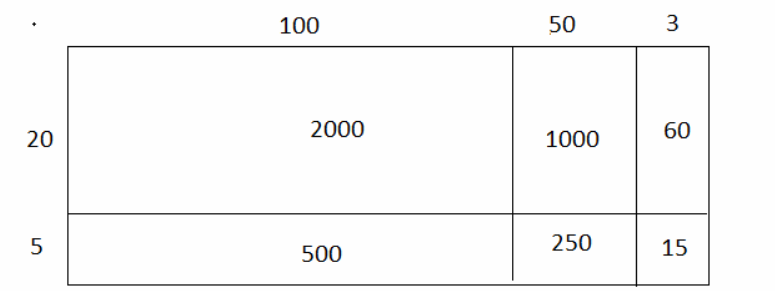
A generic rectangle diagram of 153⋅25 is:

Core Connections, Course 1, Student 1st Edition, Chapter 2 Arithmetic Strategies and Area 19

Area=2000+1000+60+500+250+15

=3500+325

=3825.

Thus, the solution is: 153⋅25=3825.

Core Connections Course 1 Chapter 2 Page 80 Problem 20 Answer

Given: 472⋅57.

It is asked to draw generic rectangles to help you multiply the following numbers without a calculator.

Show the place value of each part of the rectangle, the area of each part, and the area of the whole rectangle.

Now we will make a generic rectangle diagram and by using it we solve given problem.

A generic rectangle diagram of 472⋅57 is:

Area=20000+2800+3500+490+100+14

=20000+6300+604

=20000+6904

=26904.

Thus, the solution is: 472⋅57=26904.

Chapter 2 Exercise 2.3 Arithmetic Strategies And Area Explained Core Connections Course 1 Page 80 Problem 21 Answer

Given: 289⋅77.

It is asked to draw generic rectangles to help you multiply the given numbers without a calculator and also show the place value of each part of the rectangle, the area of each part, and the area of the whole rectangle.

Now we will make a generic rectangle diagram and by using it we solve given problem.

For the problem289⋅77,  think of 289 as 200+80+9 and 77 as 70+7.

We will use these numbers as the dimensions of a large rectangle, as shown in the figure.

A generic rectangle diagram of 289⋅77 is:

Now we will determine the area of each of the smaller rectangles to find the sum of the four smaller areas, which gives the total area of generic rectangle.

Area=200⋅70+200⋅7+70⋅80+7⋅80+70⋅9+7⋅9

=14000+5600+1400+560+630+63

=14000+7000+1190+63

=14000+7000+1253

=14000+8253

=22253.

​Thus, the equation for generic rectangle that shows the total area is: (289)(77)=14000+5600+1400+560+630+63=22253.

Core Connections Course 1 Chapter 2 Page 80 Problem 22 Answer

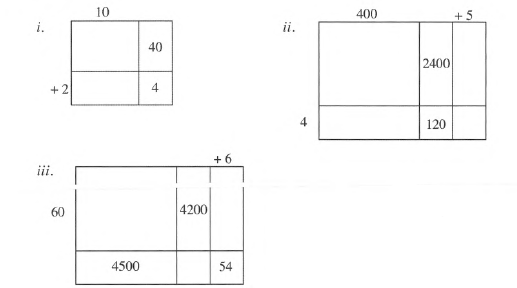
Given that the  three generic rectangles below have been partially labelled with dimensions and area s:

It is asked work with your team to fill in the missing values in each rectangle, then, for each whole rectangle, write the product as a numerical sentence in the form (total length)(total width).

Now we will use the definition of multiplication by using generic rectangle and solve given problem.

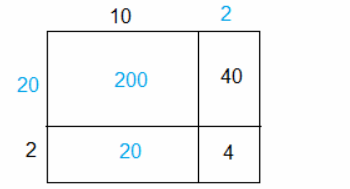
(1) Given generic rectangle has four blocks, each block area will be: 2×2=4

In this block area is 4 and side length 2 is given, so the other side will be 2.

20×2=40

In this block the area 40 and side length 2 is given, so the other side will be 20.

20×10=200

In this block side are calculated by previous block’s area, which are 20 and 10.

10×2=20

In this block one side is 2 given and other side is calculated by given area block.

So, the complete figure will be:

Core Connections, Course 1, Student 1st Edition, Chapter 2 Arithmetic Strategies and Area 22

From the above figure, we can say that the generic rectangle one length is 22 and other is 12.

So, the product will be:

22⋅12=(20+2)⋅(10+2)

(20+2)⋅(10+2)=20⋅10+20⋅2+2⋅10+2⋅2

=200+40+20+4

=264

​Thus the total area is 264.

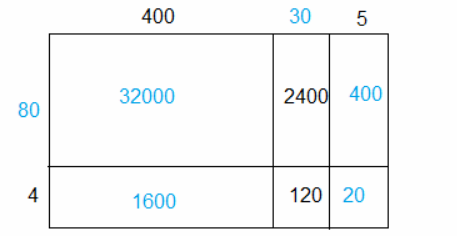
(2). Given generic rectangle has six blocks, each block area will be: 30×4=120

In this block area is 120 and side length 4 is given, so the other side of this block will be 30.

80×30=2400

In this block, area is 2400 and side is 30 ( from previous block area) is given, so the other side will be 80.

400×80=32000

In this block, one side  is 400 given and other side is calculated in previous block.

80×5=400

In this block, one side is 5 given and other side is calculated in previous block.

400×4=1600

In this block, one side is 4 given and other side is calculated in previous block.

4×5=20

In this block both side length  4 and 5 is given.

So, the complete figure will be:

Core Connections, Course 1, Student 1st Edition, Chapter 2 Arithmetic Strategies and Area 22 1

From the above figure, we can say that the generic rectangle one length is 435 and other is 84.

So, the product will be:

435⋅84=(400+30+5)⋅(80+4)

=400⋅80+400⋅4+30⋅80+30⋅4+5⋅80+5⋅4

=32000+1600+2400+120+400+20

=36540.

Thus the total area=36540.

(3). Given generic rectangle has six blocks, each block area will be: 9×6=54

In this block, one side is 6 and area is 54 given, so other side will be 9.

9×500=4500

In this block, the area is 4500 given and one side  is 9 (from previous block) then the other side will be 500.

500×60=30000

In this block, one side is 60 given and other side is calculated in previous block.

60×70=4200

In this block, area is 4200 and one side 60 is given, and other side will be 70.

60×6=360

In this block, both sides 60 and 6 are given.

9×70=630

In this block, both sides are 9 and 70 are calculated in previous block.

So, the complete figure will be:

Core Connections, Course 1, Student 1st Edition, Chapter 2 Arithmetic Strategies and Area 22 2

From the above figure, we can say that the generic rectangle one length is 576 and other is 69.

So, the product will be:

576⋅69=(500+70+6)⋅(60+9)

=500⋅60+500⋅9+70⋅60+70⋅9+6⋅60+6⋅9

=30000+4500+4200+630+360+54

=39744

Thus the total area is 39744.

Thus, the numerical product sentence for each generic rectangle  is:

22⋅12=200+40+20+4=264

435⋅84=32000+1600+2400+120+400+20=36540

576⋅69=30000+4500+4200+630+360+54=39744

Core Connections Course 1 Chapter 2 Page 80 Problem 23 Answer

Given that the  three generic rectangles below have been partially labelled with dimensions and areas:

It is asked whether you can find more than one possibility for any of these rectangles or not.

No, there is no other possibilities for the rectangles other than these because by definition generic rectangle is a type of diagram used to visualize multiplying expressions without algebra tiles, and each expression is multiplied to forms a side length of the rectangle, and the product is the sum of the areas of the sections of the rectangle i.e. given area is satisfied for only one factor of multiplication and no other multiplication is possible.

Thus, there is no other possibilities for the rectangles other than these.

Worked Examples For Core Connections Course 1 Chapter 2 Exercise 2.3 Arithmetic Strategies And Area Page 80 Problem 24 Answer

Given: The three generic rectangles below are partially labelled with dimensions and areas:

It is asked to discuss how to find the missing factor when we have the product and one of the factors.

We know that the area written inside the box is equal to the product of number corresponding to that row and column.

The other number can be found out by dividing the value in the box with the given number.

For example we take first given generic rectangle:

It has four blocks. Block 2 and 4 area is given which is 40 and 4 respectively.

4=2×2

for block 4 area only this is possibility because one of side of this block is 2 given.

40=20×2

for block 2 area only this is possibility because one of it side is 2 which is coming from block 2 area.

Now we all have all sides of the given rectangle, which is 10+2=12 and 20+2=22.

So, the complete product will be: 22⋅12.

In this way, we can find other figures complete product.

Thus, in the given generic rectangles figure, the other number can be found out by dividing the value in the box with the number available.

Core Connections Course 1 Chapter 2 Page 81 Problem 25 Answer

Given: 22⋅35.

It is asked to to use a generic rectangle to find the product of 22⋅35, then explain to Martin why his method will not give exact products and what should Martin have done to find the correct product.

Using generic rectangle method we will find the product.

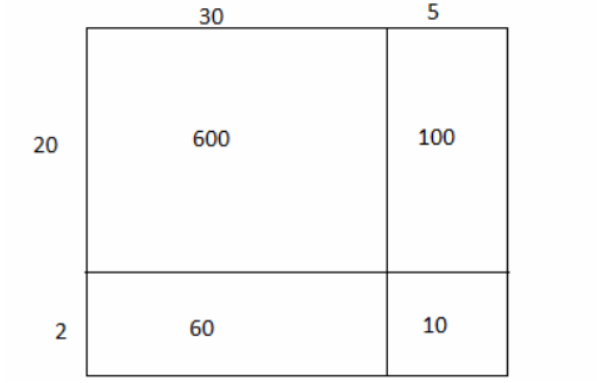
The product can be found out by drawing the rectangle as below:

Core Connections, Course 1, Student 1st Edition, Chapter 2 Arithmetic Strategies and Area 25

Now, adding up the area of the individual rectangles:

Area =600+100+60+10

=770 sq. units.

Martin multiplied the tens together (20⋅30=600) and the ones together (2⋅5=10), and added the results

600+10=610.

This will not give the exact answer, as we can see from the figure that Martin did not considered two other side rectangles which will come by multiplying tens and ones together.

To find the correct product martin could have multiplied tens and ones along with the other products of tens and ones giving him:

20⋅30​=600

2⋅5 =10

20⋅5  =100

2⋅30 =60

And after adding the results he would have got 600+10+100+60=770.

which is the required answer.

Thus, Martin’s method did not give him exact product because he did not consider two other side rectangles which will come by multiplying tens and ones together.

To find the correct product Martin should have multiplied tens and ones along with the other products of tens and ones.

Core Connections Course 1 Student 1st Edition Chapter 2 Exercise 2.2 Arithmetic Strategies and Area

Core Connections Course 1 Student 1st Edition Chapter 2 Arithmetic Strategies and Area

Core Connections Course 1 Student 1st Edition Chapter 2 Exercise 2.2 Solutions Page 62 Problem 1 Answer

Given- The top of the desk is a flat space. We have to determine the units that can be used to measure the area without gaps or overlaps.

We will use square units to determine the area.

As two quantities measured in the same units have been multiplied together gives square units that help us to find the area that helps in accurately without leaving gaps.

Hence we would use square units to determine the area of the top of the desk.

Core Connections Course 1 Student 1st Edition Chapter 2 Exercise 2.2 Solutions Page 62 Problem 2 Answer

Given- The top of the desk is a flat space.

We have to determine the number of units to cover the area of the desk.space.

We will use the concept of the area of the square which is side × side.

Let’s assume that our desk is in a square shape.

The area of my table as measured with the squares is 3×3, i.e. 9 square units are needed to cover the area of my desk because area of the square is equal to side ×side

Read and learn More Core Connections Course 1 Student 1st Edition Solutions

For 3×3 square units desk, a total of 9 units are needed to cover the area of the desk.

Core Connections Course 1 Chapter 2 Page 63 Problem 3 Answer

Given-

Core Connections Course 1 Student 1st Edition Chapter 2 Exercise 2.2 Arithmetic Strategies and Area

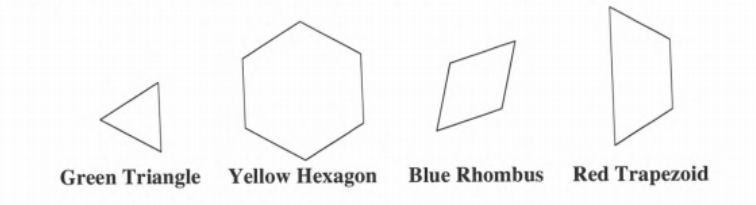
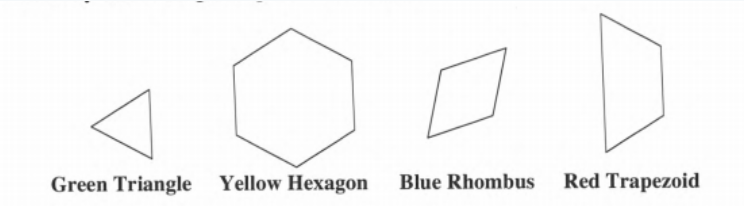
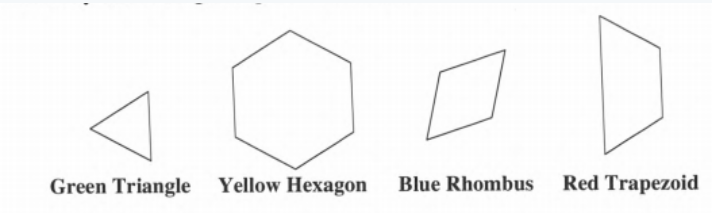
Maureen decides that the green triangle represents one unit of area.

We need to determine the area of the blue rhombus, red trapezoid and yellow hexagon.

We divide each figure into equal parts to find out the area.

If Green Triangle represents one unit area, then,

The Area of Blue Rhombus will be 2 unit areas because Rhombus is equal to two triangles.

The Area of the Red Trapezoid will be 3 unit areas because Trapezoid is equal to 3 triangles.

The Area of the Yellow Hexagon will be 6 unit areas because the hexagon is equal to 6 triangles.

Hence

Area of rhombus =2 units,

Area of Trapezoid = 3 units ,

Area of Hexagon =6 units.

Chapter 2 Exercise 2.2 Arithmetic Strategies And Area Solutions Core Connections Course 1 Page 63 Problem 4 Answer

Given-

Core Connections, Course 1, Student 1st Edition, Chapter 2 Arithmetic Strategies and Area 4

We have to explain what if, instead of the green triangle, Maureen decides the blue rhombus represents one unit of area. What would the area of the green triangle be? The red trapezoid?

The yellow hexagon? We will use the concepts of triangle, trapezoid and hexagon.

If Blue Rhombus represents one unit area, then,

The Area of Green Triangle will be 1/2 unit areas.

The Area of Red Trapezoid will be 11/2 unit areas.

The Area of Yellow Hexagon will be 3 unit areas.

Area of triangle =1/2 units, Area of trapezoid =3/2 units and area of hexagon =3 units

Core Connections Course 1 Chapter 2 Page 63 Problem 5 Answer

Given-

Core Connections, Course 1, Student 1st Edition, Chapter 2 Arithmetic Strategies and Area 5

Maureen decides that the red trapezoid represents an area of one unit.

We have to determine the area of the green triangle, blue rhombus and yellow hexagon.

We divide each figure into equal parts to find out the area.

If Red Trapezoid represents one unit area, then,

The Area of Green Triangle will be 1/3 of unit area because Trapezoid is equal to three triangles.

The Area of Blue Rhombus will be 2/3 unit area  because Rhombus is equal to two triangles and Trapezoid is equal to three triangles.

The Area of Yellow Hexagon will be 2 unit areas because Hexagon is equal to two trapezoids.

Area of triangle =1/3 units,

Area of rhombus =2/3 units and

Area of hexagon =2 units

Core Connections Course 1 Chapter 2 Exercise 2.2 Step-By-Step Solutions Page 63 Problem 6 Answer

Given-

Core Connections, Course 1, Student 1st Edition, Chapter 2 Arithmetic Strategies and Area 6

Maureen has finally decided that she should use the biggest block and will make the yellow hexagon represent an area of one unit.

We need to determine the area of the green triangle, The blue rhombus and the red trapezoid.

We divide each figure into equal parts to find out the area.

If Yellow Hexagon represents one unit area, then,

The Area of Green Triangle will be 1/6 of unit area because Hexagon is equal to six triangles.

The Area of Blue Rhombus will be 1/3 unit area because Rhombus is equal to two triangles.

The Area of Trapezoid will be 1/2 unit areas because Trapezoid is equal to three triangles.

Area of triangle =1/6 units,

Area of rhombus=1/3 units and

Area of hexagon =1/2 units

Core Connections Course 1 Chapter 2 Page 63 Problem 7 Answer

Given-:

Core Connections, Course 1, Student 1st Edition, Chapter 2 Arithmetic Strategies and Area 7

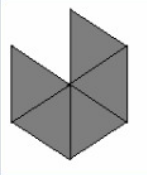
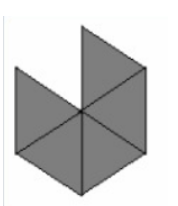
Assume that the area of the blue rhombus is 1/4 unit

We have to  Build a shape that has an area of 5/8

What would be the area of a shape built using one of each color of block?

we see from the above figure that rhombus is a combination of two triangles and so the triangle must have an area of 1/8।

Given that the area of the blue rhombus is 1/4 unit Also we see from the above figure that rhombus is a combination of two triangles and so the triangle must have an area of 1/8.

Now we need to build a shape that has an area of5/8. We can see that

5/8=1/4+1/4+1/8

So, we basically need two rhombus and a triangle shaped figure or five triangles for an area of 5/8.

It can be the one as shown below.

Core Connections, Course 1, Student 1st Edition, Chapter 2 Arithmetic Strategies and Area 6

Since blue rhombus is a combination of two triangles, area of one triangle is1/8units as mentioned in the above part

From the above figures, we saw that a hexagon has 6 triangles and a trapezoid has 3 triangles.

So, if a shape is built using one of each color of block, there will be a total of 12 triangles, i.e.

6 from hexagon, 2 from rhombus, 3 from trapezoid and 1 triangle itself.

Thus the total area of that shape will be 12 times the area of one triangle, i.e.

12×1/8=3/2 units

The shape having an area of 5/8 is shown below

Core Connections, Course 1, Student 1st Edition, Chapter 2 Arithmetic Strategies and Area 7 2

The area of the shape built using one of each color of block  is 3/2 units .

Core Connections Course 1 Chapter 2 Page 63 Problem 8 Answer

In our Learning Log, we need to describe area. What makes area different from length ?

What can you use to measure area? Label this entry “Area” and include today’s date.

29/09/2021 Area

An area is a space enclosed within a curve forming a closed shape.

Line is a linear object, that is we can move only in two directions on a line, whereas area is a two-dimensional object and allows movement in all six directions.

Area can be measured using another piece of object taken as a reference for unit area.

Hence , An area is a space enclosed within a curve forming a closed shape.

Solutions for Core Connections Course 1 Chapter 2 Exercise 2.2 Arithmetic Strategies And Area Page 65 Problem 9 Answer

Given-

Core Connections, Course 1, Student 1st Edition, Chapter 2 Arithmetic Strategies and Area 9

We have to find  the area of the shape at right that was cut from graph paper.

We will use the area of rectangle which is l×b and area of the square which is (side)2

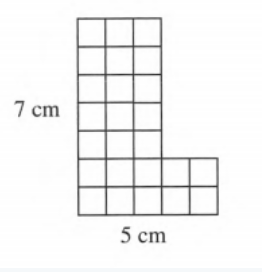
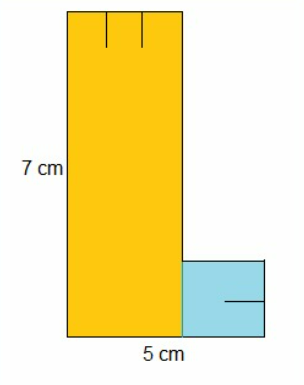
The shape can be divided into two parts with one part (yellow) covered by using 21 squares of 1×1 centimeters and the other part (blue) by using 4 squares of 1×1centimeters.

Core Connections, Course 1, Student 1st Edition, Chapter 2 Arithmetic Strategies and Area 9 1

So the area of the shape is 25 square centimeters.

Core Connections Course 1 Chapter 2 Page 65 Problem 10 Answer

Given-

Core Connections, Course 1, Student 1st Edition, Chapter 2 Arithmetic Strategies and Area 10 1

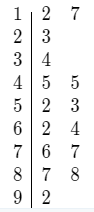
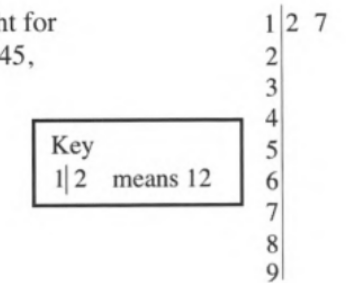
We have to copy and complete the stem-and-leaf plot at right for the following set of data:64,87,52,12,17,23,45,88,45,92,62,76,77,34,and53.

We will make the table of stem and leaf plot.

We will make the stem and leaf plot by using the following steps

(1) On the left hand side of the page, write down the thousands, hundreds or tens (all digits but the last one). These will be your stems.

(2) Draw a line to the right of these stems.

(3) On the other side of the line, write down the ones (the last digit of a number)

The Stem and Leaf Plot

The stem-and-leaf plot at right for the following set of data: 64,87,52,12,17,23,45,88,45,92,62,76,77,34,and 53 is

Core Connections, Course 1, Student 1st Edition, Chapter 2 Arithmetic Strategies and Area 10

Solutions For Core Connections Course 1 Chapter 2 Exercise 2.2 Arithmetic Strategies And Area Page 65 Problem 11 Answer

Given-9.67+49.7+5.22

We have to add the given expression.

We will convert unlike decimal numbers into like numbers.

We will arrange the given terms according to the decimals and then add them.

The given expression is 9.67+49.7+5.22

Converting then to like decimals, we get

49.7=49.70

Thus, now all digits are having equal numbers on the right side of the decimal.

Thus, the additions of given numbers can be performed as,

49.70

9.67

+ 5.22

−−−−−−−−−−−−−

= 64.59

​Hence , value of 9.67+49.7+5.22 is 64.59

Core Connections Course 1 Chapter 2 Page 65 Problem 12 Answer

Given-4.2+1.903

We have to add the given expression.

We will convert unlike decimal numbers into like numbers and then add them

The given expression is 4.2+1.903

Converting then to a like decimals, we get

4.2=4.200

Thus, now both digits have equal numbers in the right side of decimal.

Thus, to additions of given numbers can be perform as,

​ 4.200

+ 1.903

​ −−−−−−−−−−−−

=6.103

​The solution is 6.103.

Hence, the value of 4.2+1.903 is 6.103

Core Connections Course 1 Student 1st Edition Chapter 2 Exercise 2.2 Guide Page 65 Problem 13 Answer

Given-97.1−35.04

We have to subtract the given expression.

97.1 − 35.04

= 62.06

97.10

−35.04

Hence , the value of 97.1−35.04 is 62.06

Core Connections Course 1 Chapter 2 Page 67 Problem 14 Answer

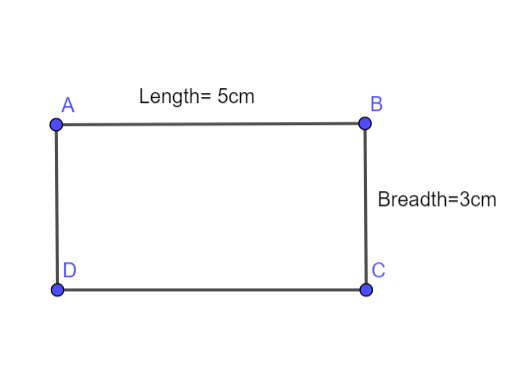
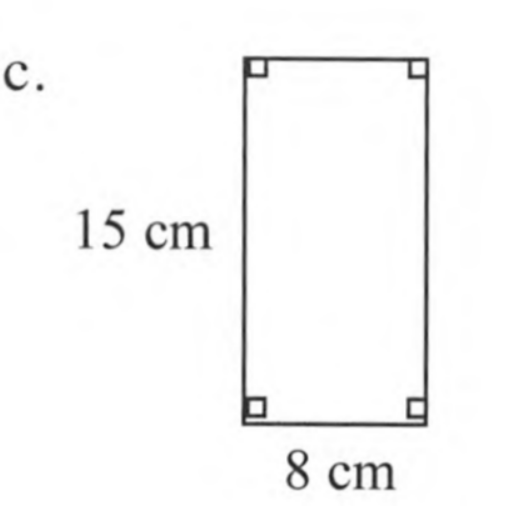
We have given a rectangle that is 5 centimeters by 3 centimeter.

We need to find how many square centimeter will this rectangle will fill.

Core Connections, Course 1, Student 1st Edition, Chapter 2 Arithmetic Strategies and Area14

We will use formula of area of rectangle to find the answer.

Given rectangle that is 5 centimeters by 3 centimeters can be drawn as following

Area of rectangle = product of length and breadth

=l∗b

=5cm∗3cm

=15 square centimeters

So the area of rectangle is 15 square centimeters.

The area filled by rectangle is 15 square centimeters.

Chapter 2 Exercise 2.2 Arithmetic Strategies And Area Explained Core Connections Course 1 Page 67 Problem 15 Answer

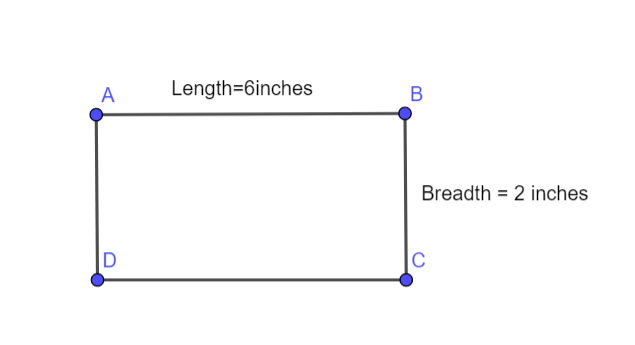
We have given a rectangle that is 6 inches by  2 inches.

We need to find how many square inches will this rectangle will fill.

We will use formula of area of rectangle to find the answer.

Core Connections, Course 1, Student 1st Edition, Chapter 2 Arithmetic Strategies and Area15

Given rectangle is 6inches by 2 inches that can be drawn as following

Area of rectangle = product of length and breadth

Area of given rectangle =l∗b =6inches ∗2inches

=12 square inches​

So, the area of rectangle is 12 square inches.

Area of given rectangle is 12 square inches.

Core Connections Course 1 Chapter 2 Page 67 Problem 16 Answer

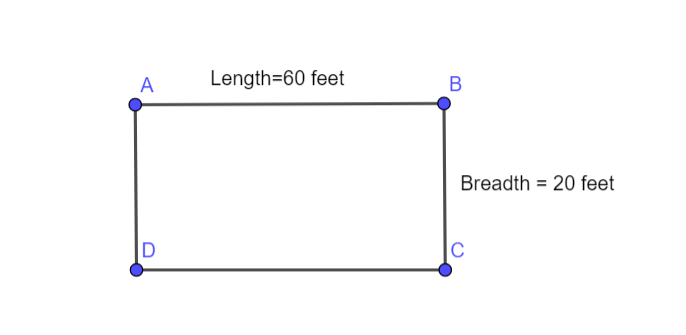
We have given a rectangle that is 60 feet by 20 feet.

We need to find how many square inches will this rectangle will fill.

We will use formula of area of rectangle to find the answer.

Core Connections, Course 1, Student 1st Edition, Chapter 2 Arithmetic Strategies and Area16

Given rectangle is 60 feet  by  20 feet, which can be drawn as following.

Area of rectangle = product of length and breadth

Area of given Rectangle =l∗b

=60 feet ∗20 feet

=1200 square feet

​So, Area of given rectangle is 1200 square feet.

Area of the given rectangle is 1200 square feet.

Chapter 2 Exercise 2.2 Arithmetic Strategies And Area Explained Core Connections Course 1 Page 67 Problem 17 Answer

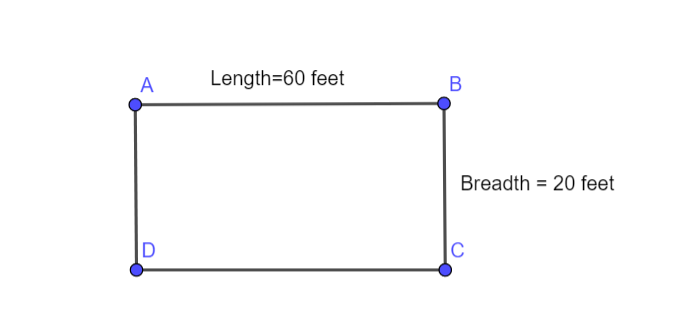
We need to find Area of rectangular garden whose length is 60 feet, breadth is 40 feet.

We will use formula of area of rectangle to find answer.

Given rectangular  garden will be as follows

Core Connections, Course 1, Student 1st Edition, Chapter 2 Arithmetic Strategies and Area17

Area of rectangular garden=Length∗Breadth

=l∗b⇒60 feet∗20 feet

=1200 square feet

​so , the Area is 1200 square feet.

Area of given Rectangular garden is 1200 square feet.

Core Connections Course 1 Chapter 2 Page 68 Problem 18 Answer

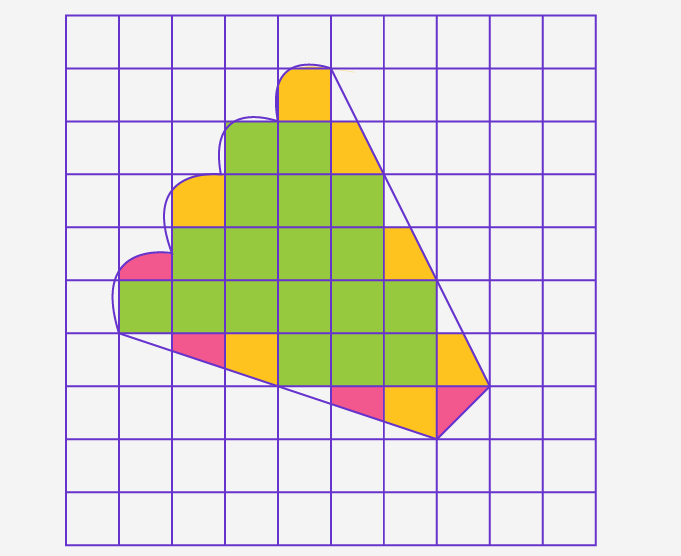
Given: Frank’s pattern for the desktops is on the Lesson 2.2.2C Resource Page that our teacher will provide.

It is asked to find the area of the kidney-bean desktop pattern twice, using each of the two different square units once.

We will calculate the figure with the help of a Square Grip Paper.

At first, we will take a Square Grip Paper, which have the area of one square be 1 sq. cm.

After, placing the paper on the table, we count the complete squares as 1 and colour the complete squares green.

Then, count the squares which are exactly covered half as 1/2 and colour them pink.

After that, count the squares which are covered more than half as 1 and colour them yellow.

Core Connections, Course 1, Student 1st Edition, Chapter 2 Arithmetic Strategies and Area18

Lastly, ignore the squares that are covered less than half.

Let, take a irregular figure to give a example of this method-

Now, let this irregular figure be the kidney-bean desktop, which covered 18 full squares, 4 half squares and 7 more than a half squares.

Then the area will be (18⋅1+4⋅1/2+7⋅1)=27 unit sq.cm(approx.)

Again, we will take a Square Grip Paper, which have the area of one square be 1 sq. m. and follow the above method to find the area.

Let, the desktop covered x full squares, y half squares and z more than a half squares.

Then the area will be (x⋅1+y⋅1/2+z⋅1)=(x+y/2+z) unit sq.m(approx.)

Hence, from the above step, the area of kidney bean bag will be-

(x+y/2+z) unit sq.m(approx.) and 27 unit sq.cm(approx.)

Core Connections Course 1 Chapter 2 Page 68 Problem 19 Answer

Given: Frank’s pattern for the desktops is on the Lesson 2.2.2C Resource Page that our teacher will provide.

It is asked to compare the two areas from part(a).

From part (a), we know that, the area of kidney bean bag are (x+y/2+z) unit sq.m(approx.) and 27 unit sq.cm(approx.).

Since the area of kidney-bean desktop is constant, so the above two areas will also be same.

They look different because they are in the form of two different square units.

As, we know that, 1 unit sq.cm.=0.0001 unit sq.m.; That’s why they looks different.

Hence, from the above explanation, we can conclude that, the area of kidney-bean desktop is constant, so the two areas from part(a) will also be same.

They look different because they are in the form of two different square units.

As, we know that, 1 unit sq.cm.=0.0001 unit sq.m.; That’s why they looks different.

Worked Examples for Core Connections Course 1 Chapter 2 Exercise 2.2 Arithmetic Strategies And Area Page 68 Problem 20 Answer

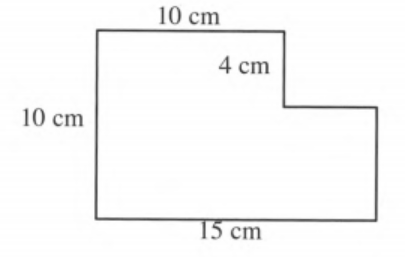
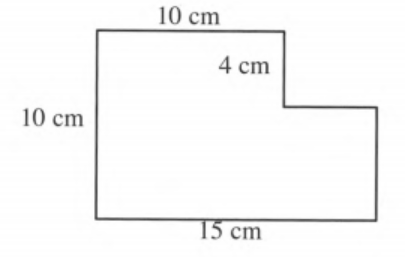
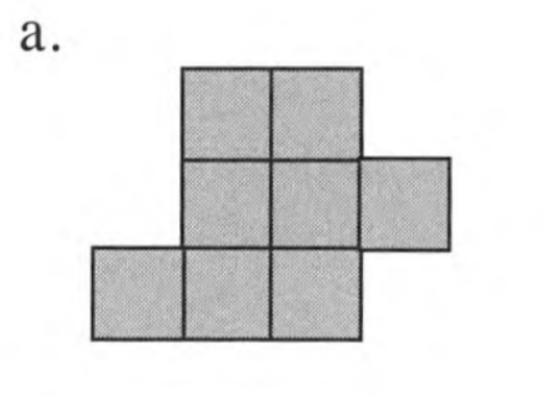
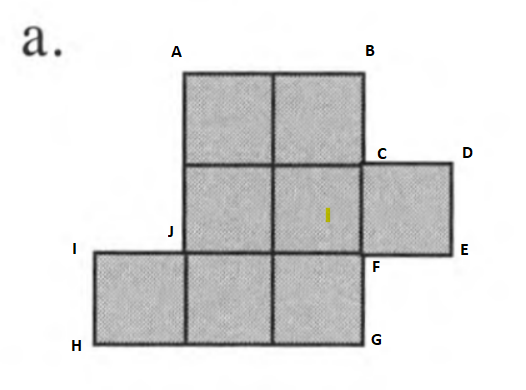
Given a figure where all corner angles are right angles:

To find the area of the above figure in at least two different ways.

Since all corner angles are right angles, we will use formula for area of a rectangle.

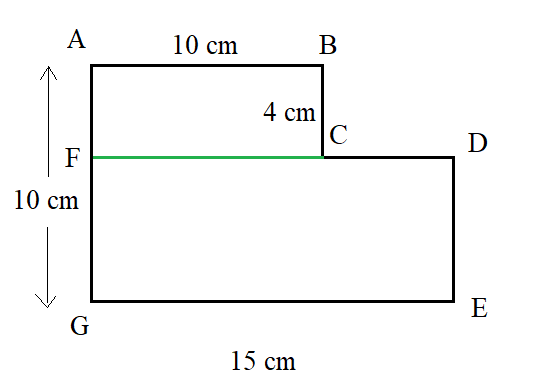
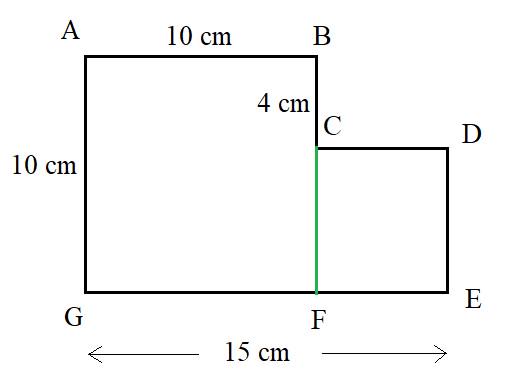
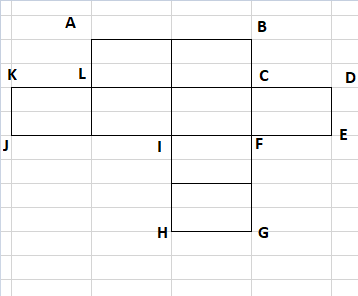
Let’s first label the figure and join CF as below.

Core Connections, Course 1, Student 1st Edition, Chapter 2 Arithmetic Strategies and Area20

We have, AB=AG=10 cm,

BC=4 cm and GE=15 cm.

Since all corner angles are right angles, ABFG and CDEF are two rectangles.

Therefore, in rectangle ABFG, BF=GF=10 cm and in rectangle CDEF, CD=FE=(15−10) cm

i.e., CD=FE=5 cmand CF= DE=(10−4) cm

i.e., CF=DE=6 cm.

Area of rectangle ABFG ​= AB×AG

=10×10

=100cm2

Area of rectangle CDEF​= CD×CF

=5×6

=30cm2

Area of the given figure= Area of rectangle ABFG + Area of rectangle CDEF

i.e., are of the given figure​=(100+30)

=130cm2

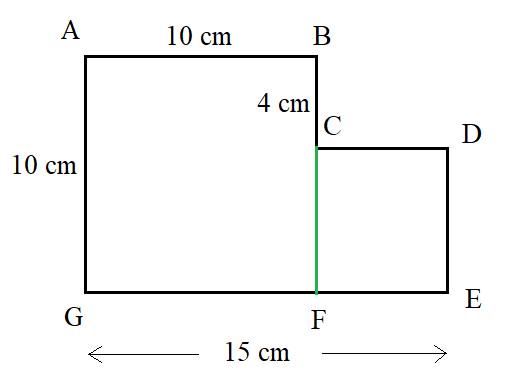
Consider the figure below:

Core Connections, Course 1, Student 1st Edition, Chapter 2 Arithmetic Strategies and Area20 2

Since all corner angles are right angles, ABCF and GEDF are two rectangles.

In rectangle GEDF, FG​= AG − AF

= AG − BC

=(10−4) cm

=6 cm

​Area of rectangle ABCF​= AB×BC

=10×4

=40cm2

Area of rectangle GEDF​=GE×FG

=15×6

=90cm2

Area of the given figure= Area of rectangle ABCF + Area of rectangle GEDF

i.e., are of the given figure​=(40+90)cm2

=130cm2

​The area of the given figure is 130cm2.

Core Connections, Course 1, Student 1st Edition, Chapter 2 Arithmetic Strategies and Area20 1

Core Connections Course 1 Chapter 2 Page 68 Problem 21 Answer

Given a figure where all corner angles are right angles.

Core Connections, Course 1, Student 1st Edition, Chapter 2 Arithmetic Strategies and Area21

To find the perimeter of the figure.

We will calculate the distance around the figure or length of the boundary of the given figure.

Let’s first label the figure and join CF as below.

Perimeter of the given figure= AB+BC+CD+DE+EG+GA

Since all corner angles are right angles, ABFG and CDEF are two rectangles.

Hence, AB=GF, AG=

BF, CD=

FE and DE=CF.

Thus, GF=10 cm

Therefore, CD=FE

⇒ CD = GE − GF

⇒ CD =(15−10) cm

or, CD=5 cm

Similarly,​DE=CF

⇒ DE=BF−BC

= AG−BC

=(10−4) cm

⇒ DE =6 cm.

​So, perimeter of the given figure​=10+4+5+6+15+10

=50 cm.

​The perimeter of the figure is 50 cm.

Core Connections, Course 1, Student 1st Edition, Chapter 2 Arithmetic Strategies and Area21 1

Core Connections Course 1 Chapter 2 Page 70 Problem 22 Answer

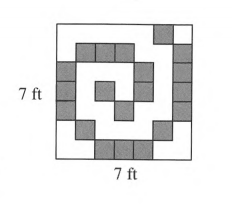
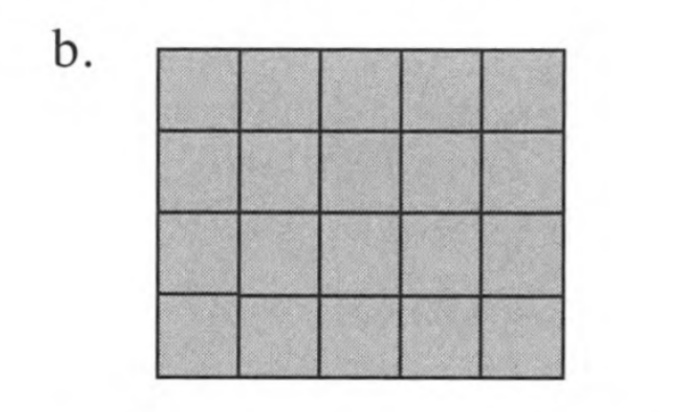
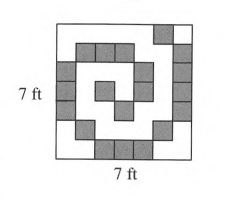
The shaded tiles in the large square each have an area of one square foot.

To find the total area of the shaded squares.

We will count the number of shaded squares in the big square and then multiply by the area of 1 shaded square.

Core Connections, Course 1, Student 1st Edition, Chapter 2 Arithmetic Strategies and Area22

Area of 1 shaded square=1 square foot.

Number of shaded squares=20.

Total area of the shaded squares=20×1 square foot

=20 square foot

​Total area of the shaded squares=20 square foot.

Core Connections Course 1 Chapter 2 Exercise 2.2 Detailed Answers Page 70 Problem 23 Answer

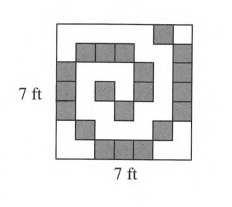
The shaded tiles in the large square each have an area of one square foot and side of the big square is 7 ft.

To find the total area of the un-shaded squares.

We will subtract the total area of shaded squares from the area of the big square.

Core Connections, Course 1, Student 1st Edition, Chapter 2 Arithmetic Strategies and Area23

Total area of the shaded squares=20 square foot

Side of the big square=7 ft

Area of the big square​=side× side

=7×7 square foot

=49 square foot​

Now, total area of the un-shaded squares= area of the big square−total area of the shaded squares

Hence, total area of the un-shaded squares​=49−20 =29 square foot

​The total area of the un-shaded squares is 29 square foot.

Core Connections Course 1 Chapter 2 Page 70 Problem 24 Answer

The shaded tiles in the large square each have an area of one square foot and side of the big square is 7 ft.

To find the total number of square feet of area in the figure in two different ways.

Core Connections, Course 1, Student 1st Edition, Chapter 2 Arithmetic Strategies and Area24

We can find the total number of square feet of area in the figure by following ways: Add the answers from part (a) and part (b). Multiply the dimensions of the big square.

From part (a) and (b),

Total area of the shaded squares =20 square foot.

The total area of the un-shaded squares =29  square foot.

Hence, total are of the square​=20+29 =49 square feet.

​Side of the big square=7 ft

Hence, area of the big square​=7×7 =49 square feet.

​Hence, total area of the big square=49 square feet.

Core Connections Course 1 Chapter 2 Exercise 2.2 Detailed Answers Page 70 Problem 25 Answer

We are given that Hector measured the area of his desktop by covering it with quarters ( coins which are circular in shape).

We need to check if he can find the area using these circular units of measure exactly, or will he have to estimate.

A coin is round in shape and he wants to measure the area of his desktop which is rectangular.

So, he will have to estimate the area of his desktop because when the coins are placed side by side, there will be some area that will be left unmeasured.

If Hector uses squares instead of coins, he can exactly measure the area as squares will cover the entire desktop.

Hector cannot use circular units to get an exact answer because when using the coins there will be some gap left in between them.

Core Connections Course 1 Chapter 2 Page 70 Problem 26 Answer

Given the numbers 2,3 and 4.

We need to use the mathematical operations of addition, subtraction, multiplication, or division to create three different numerical expressions with three different values out of which one should have a value of 14.

We will use the four operations on the given numbers.

On using the operations +,×,we get :

2+3⋅4=2+12

=14

​On using the operations ×,+, we get :

2⋅4+3=8+3

=11

​On using the operations ×,−, we get :

2⋅3−4=6−4

=2​

So three different numerical expressions with three different values are :

​​2+3×4=14

2×4+3=11

2×3−4=2

​Core Connections Course 1 Chapter 2 Page 70 Problem 27 Answer

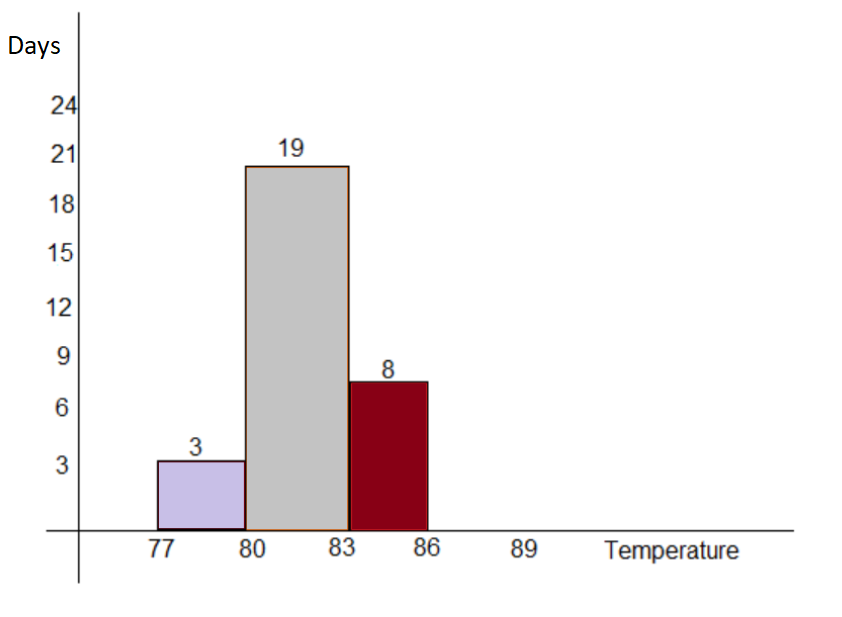
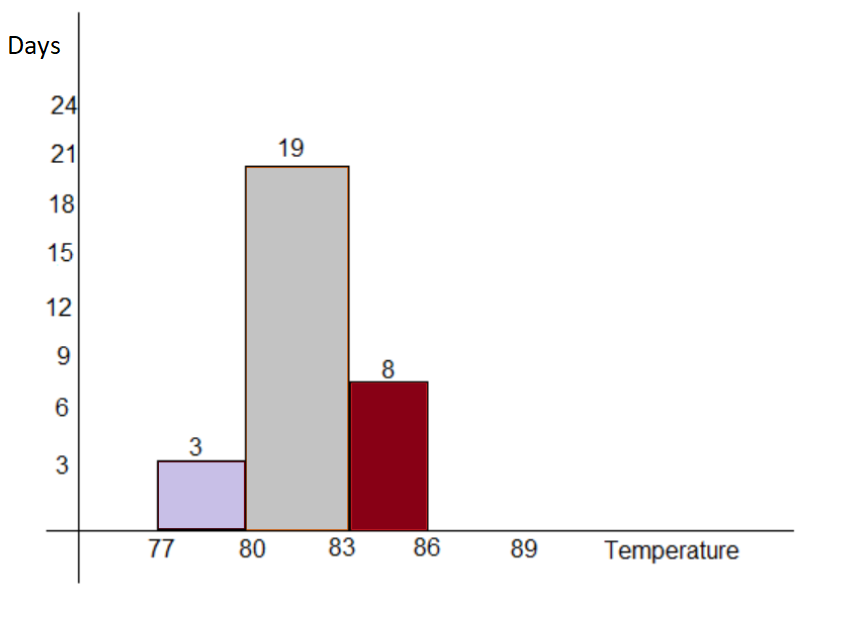
Given: Daily high temperature for Honolulu, Hawaii in December of 2009:​83,83,81,82,80,83,81,82,79,83,84,82,81,81,

80,81,84,80,80,81,81,82,80,79,78,80,84,82,82,81,83

To find the best way to display the data given. We also need to explain the reason behind choosing that way and display the data using the method we chose.

We will plot the given data using histogram.

Core Connections, Course 1, Student 1st Edition, Chapter 2 Arithmetic Strategies and Area 27

Core Connections, Course 1, Student 1st Edition, Chapter 2 Arithmetic Strategies and Area 27 1

We can see that there are 30 values corresponding to each day of the month, and most of the values share a same stem so stem and leaf plot will be very big and single lined for this case, in this case a Histogram will be efficient and since there is not so much variation in data values we can reduce the bin size to make more accurate predictions from the data.

The table and the histogram are shown below:

Core Connections, Course 1, Student 1st Edition, Chapter 2 Arithmetic Strategies and Area 27 2

The best way to display data is using a histogram.

Core Connections Course 1 Student 1st Edition Chapter 2 Exercise 2.1 Arithmetic Strategies and Area

Core Connections Course 1 Student 1st Edition Chapter 2 Arithmetic Strategies and Area

Core Connections Course 1 Student 1st Edition Chapter 2 Exercise 2.1 solutions Page 55 Problem 1 Answer

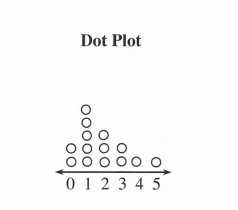
We are given a dot plot representing the number of pets students in a class have.

We have to find which number of pets have to most and least occurrences in the class.

We can do this by analyzing the dot plot.

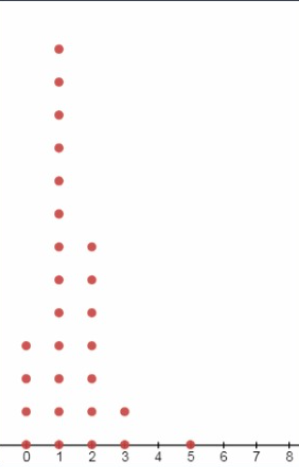
Core Connections, Course 1, Student 1st Edition, Chapter 2 Arithmetic Strategies and Area 1

By observing the dot plot, we can see that the number 1 has the maximum number of dots above it and numbers 4,5 have the least number of dots.

Hence, 1 pet has the most occurrence in my class and 4,5 pets have the least occurrence in my class.

Read and learn More Core Connections Course 1 Student 1st Edition Solutions

1 pet has the most occurrence in my class.

4,5 pets have the least occurrence in my class.

Core Connections Course 1 Chapter 2 Page 55 Problem 2 Answer

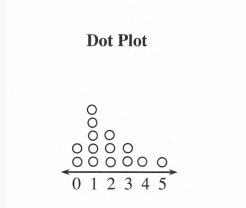
We are given a dot plot representing the number of pets students in a class have.

We have to find how many pets most students have.

We can do this by analyzing the dot plot.

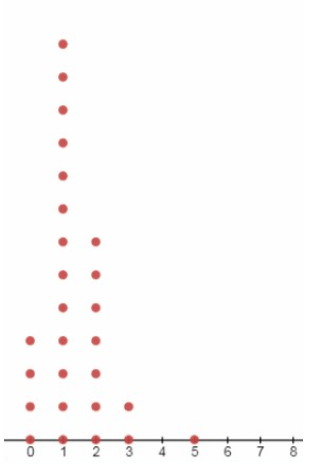
Core Connections, Course 1, Student 1st Edition, Chapter 2 Arithmetic Strategies and Area 2

Most of the students in the class have 1 pet.

We can see this from the dot plot as there are most number of dots on top of 1 on the x axis.

Therefore, most students in class have 1 pet since there are most number of dots on top of 1 number of pets.

Core Connections Course 1 Chapter 2 Page 55 Problem 3 Answer

Core Connections Course 1 Student 1st Edition Chapter 2 Exercise 2.1 Arithmetic Strategies and Area

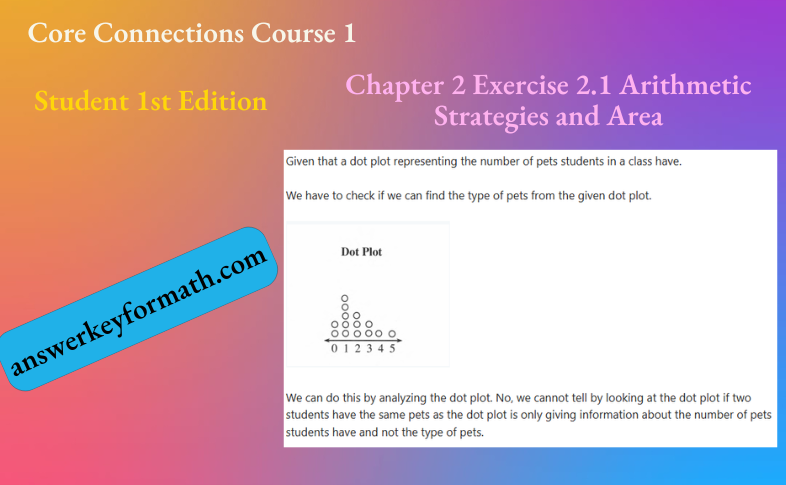
It cannot be detemined if two students have the same pet as the dot plot is only giving information about the number of pets and not the type of pets.

Chapter 2 Exercise 2.1 Arithmetic Strategies and Area solutions Core Connections Course 1 Page 55 Problem 4 Answer

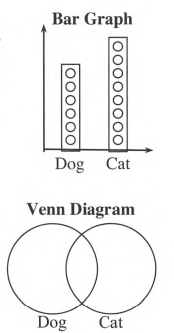
A bar graph and a Venn diagram are made to represent the type of pets students have.

Each student can place only one dot in each of the graphs.

We have to tell if it was easy plotting dots on both graphs.

If I have only one pet either a dog or a cat, I can easily place dot on both graphs.

In the bar graph, I need to place the dot in the dog or cat bar depending on the pet I have and similarly, I can place my dot in the part of the Venn diagram which does not overlap to show that I have only one pet.

If I have both a dog and a cat, I can place a dot in the Venn diagram easily.

I will place the dot in the part of the diagram that overlaps, this shows that I have both a cat and a dog.

Core Connections, Course 1, Student 1st Edition, Chapter 2 Arithmetic Strategies and Area 4

But I will not an able to represent this situation by placing only one dot in the bar graph.

So I cannot place my dot on both graphs easily if I have both a dog and a cat.

So if I have only one pet, I can easily place the dot on both graphs.

But if I have both a cat and a dog, I will not be able to place the dot on both graphs.

Core Connections Course 1 Chapter 2 Page 55 Problem 5 Answer

A bar graph and a venn diagram are made to represent the type of pets students have.

We have to tell what information can be obtained from looking at the graph and the diagram By looking at the bar graph, we can see which pet is more popular among students(cat or dog).

By looking at the venn diagram, we can see how many students have two pets and hoe many students have a single pet.

Therefore, by looking at the bar graph and the venn diagram, we can get information about the type of pets and number of pets.

Core Connections Course 1 Chapter 2 Exercise 2.1 step-by-step solutions Page 55 Problem 6 Answer

A bar graph and a venn diagram are made to represent the type of pets students have.

We have to tell what type information can be represented using bar graph and the venn diagram.

Comparative data is best represented using bar graphs. For example, we are comparing the number of cats and dogs as pets here.

Relative data is best represented using venn diagrams.

For example, number of students with two pets and single pets(cat or dog) is represented here.

Therefore, comparative information is represented using bar graphs and relative information using venn diagrams.

Core Connections Course 1 Chapter 2 Page 55 Problem 7 Answer

A bar graph and a venn diagram are made to represent the type of pets students have.

We have to find out if the order of bars in the bar graph matters.

We can do this by analyzing the bar graph.

No, the order of bars in the bar graph does not matter.

It is because the data is represented in the same manner irrespective of the order of the bars.

For example, the data being conveyed does not change even if cats bar is drawn before dogs bar.

Therefore, the order of bars in a bar graph does not matter.

Core Connections Course 1 Chapter 2 Exercise 2.1 step-by-step solutions Page 56 Problem 8 Answer

Given some tabular data.

We have to find out the best way to represent that data.

We can do this by analyzing the data given.

Core Connections, Course 1, Student 1st Edition, Chapter 2 Arithmetic Strategies and Area 8

For the given data, a bar graph would be best suited as the number of students with that particular favorite color is given and hence each of those colors can be represented as a bar in the bar graph.

Bar graph is best here as the given data is comparative data.

Core Connections, Course 1, Student 1st Edition, Chapter 2 Arithmetic Strategies and Area 8 1

Therefore, a bar graph is the best way to represent the given data among dot plot, bar graph, or Venn diagram.

Core Connections Course 1 Chapter 2 Page 56 Problem 9 Answer

Given some data about the number of siblings the students in a class had.

We have to decide whether if a bar graph or a dot plot will work best and create it.

We can do it using the given data.

Core Connections, Course 1, Student 1st Edition, Chapter 2 Arithmetic Strategies and Area 9

Since the given data only contains values about number of siblings, the best way to describe it would be a dot plot.

Core Connections, Course 1, Student 1st Edition, Chapter 2 Arithmetic Strategies and Area 9 1

After making the dot plot with the given values, the graph would look like –

Core Connections, Course 1, Student 1st Edition, Chapter 2 Arithmetic Strategies and Area 9 2

Therefore, the best way to represent the given data is a dot plot.

Solutions For Core Connections Course 1 Chapter 2 Exercise 2.1 Arithmetic Strategies and Area Page 56 Problem 10 Answer

We have drawn various kinds of graphs like dot plots, bar graphs and venn diagrams.

We have to now compare these graphs.

We can do it by studying all these types of graphs.

Differences between dot plots and bar graphs –

Bar graphs gather data into categories, allowing you to quickly compare values for each category.

A dot plot shows each item of numerical data above a number line or horizontal axis.

Dot plots make it easy to see gaps and clusters in a data set, as well as how the data spreads along the axis.

Bar graphs and venn diagrams –

A bar chart or bar graph is a chart or graph that presents categorical data with rectangular bars with heights or lengths proportional to the values that they represent.

A Venn diagram is an illustration that uses circles to show the relationships among things or finite groups of things.

Circles that overlap have a commonality while circles that do not overlap do not share those traits.

Therefore, different types of graphs have different types of applications and properties.

Core Connections Course 1 Chapter 2 Page 57 Problem 11 Answer

Given data about the appliances sold during the month of September.

We have to decide the best type of graph to represent that data.

We can do this by analyzing the data.

Core Connections, Course 1, Student 1st Edition, Chapter 2 Arithmetic Strategies and Area 11

From the given data, we can see that the the sales numbers are large.

Hence it would be best to use a bar graph since we can use a scale and represent the data clearly.

If we used a dot plot, the number of dots would be a lot and the graph would be really big.

Therefore the graph made will be –

Core Connections, Course 1, Student 1st Edition, Chapter 2 Arithmetic Strategies and Area 11 1

Therefore, the best way to represent the given data is using a bar graph, because the numbers are large and it would not be convenient to use a dot plot.

Core Connections Course 1 Student 1st Edition Chapter 2 Exercise 2.1 guide Page 57 Problem 12 Answer

Number of tiles is given six.

It is required to find a pattern where the number of toothpicks is more than double the number of tiles.

To increase the number of toothpicks more than double the number of tiles we should increase the length of the pattern.

The pattern having the number of toothpicks is more than double the number of tiles is drawn below :

Core Connections, Course 1, Student 1st Edition, Chapter 2 Arithmetic Strategies and Area 12

Notice the pattern,

Number of tiles =6

Number of toothpicks = 14

Thus, the number of toothpicks is more than double the number of tiles

Hence the pattern having the number of toothpicks is more than double the number of tiles is drawn below :

Core Connections, Course 1, Student 1st Edition, Chapter 2 Arithmetic Strategies and Area 12 1

Core Connections Course 1 Chapter 2 Page 57 Problem 13 Answer

Number of tiles is given six.It is required to find a pattern where the number of toothpicks is four more than the number of tiles.

To find a pattern where the number of toothpicks is four more than the number of tiles we should decrease the length of pattern.

The pattern where the number of toothpicks is four more than the number of tiles is drawn below :

Core Connections, Course 1, Student 1st Edition, Chapter 2 Arithmetic Strategies and Area 13

Notice the pattern,

Number of tiles =6

Number of toothpicks = 10

Thus, the number of toothpicks is four more than the number of tiles.

Hence the pattern where the number of toothpicks is four more than the number of tiles is drawn below :

Core Connections, Course 1, Student 1st Edition, Chapter 2 Arithmetic Strategies and Area 13 1

Chapter 2 Exercise 2.1 Arithmetic Strategies and Area Explained Core Connections Course 1 Page 57 Problem 14 Answer

Cost of one fruit kabobs and one smoothie are given$1.75 and $2.50 respectively.

It is required to find total cost of two fruit kabobs and one smoothie.

Find the cost of two fruit kabobs and one smoothie separately and add them to get total cost.

Cost of two fruit kabobs =2⋅1.75

=$3.50

Cost of one smoothie =1⋅2.50

=$2.50

​Total cost=$3.50+$2.50

=$6.00

Hence Leo have to pay $6.00 for ordering two fruit kabobs and one smoothie.

Core Connections Course 1 Chapter 2 Page 57 Problem 15 Answer

Cost of one fruit kabobs and one smoothie are given$1.75 and $2.50 respectively.

It is required to find total cost of three fruit kabobs and four smoothies.

Find the cost of three fruit kabobs and four smoothies separately and add them to get total cost.

Cost of three fruit kabobs=3⋅1.75

=$5.25

Cost of four smoothies=4⋅2.50

=$10.00

Total cost=$5.25+$10.00

=$15.25

Hence Stefano have to pay$15.25 for ordering three fruit kabobs and four smoothies.

Free Core Connections Course 1 Chapter 2 Exercise 2.1 Arithmetic Strategies and Area Solutions Page 57 Problem 16 Answer

Cost of one fruit kabob and one smoothie are given $1.75 and $2.50 respectively.

It is required to show at least three possibilities of spending $9.00 for ordering fruit kabobs and smoothies.

Select the number of kabobs and smoothies such that its total cost doesn’t exceed $9.00.

First possibility :

Arturo can order one fruit kabobs and two smoothies.

Total cost of one fruit kabobs and two smoothies=1⋅1.75+2⋅2.50

=$6.75

Notice total cost of one fruit kabobs and two smoothies is less than $9.00.

Thus, Arturo can afford ordering one fruit kabobs and two smoothies.

Second possibility :

Arturo can order three fruit kabobs and one smoothies.

Total cost of three fruit kabobs and one smoothies=3⋅1.75+1⋅2.50

=$7.75

Notice total cost of three fruit kabobs and one smoothies is less than$9.00.

Thus, Arturo can afford ordering three fruit kabobs and one smoothies.

Third possibility :

Arturo can order two fruit kabobs and two smoothies.

Total cost of two fruit kabobs and two smoothies=2⋅1.75+2⋅2.50

=$8.50

Notice total cost of two fruit kabobs and two smoothies is less than $9.00.

Thus, Arturo can afford ordering two fruit kabobs and two smoothies.

Hence three possible combinations of fruit kabobs and smoothies that Arturo could afford is :

  • One fruit kabobs and two smoothies
  • Three fruit kabobs and one smoothies
  • Two fruit kabobs and two smoothies

Core Connections Course 1 Chapter 2 Page 57 Problem 17 Answer

Given expression 53.199−27.61

It is asked to find the value of the expression We use the decimal rules for addition and subtraction

Given expression ​53.199−27.61

=53.199−27.610

=25.589

​Thus the value after subtracting the two items is 25.589

Thus the value of the expression 53.199−27.61 is 25.589

How To Solve Core Connections Course 1 Chapter 2 Exercise 2.1 problems Page 57 Problem 18 Answer

Given the expression 155.96+56.232

It is asked to find the value of the expressionWe use the rules of decimal point operations to find the value.

Given expression 155.96+56.232

Making the number of digits after the decimal point same we have

155.96+56.232

=155.960+56.232

=212.192

​Thus the value of the expression is 212.192

Thus the value of the expression 155.96+56.232=212.192

Core Connections Course 1 Chapter 2 Page 57 Problem 18 Answer

Given the expression 83.617−36.518

It is asked to find the value of the expression.

We use the  rules of decimal operations to find the value for the same

Given the expression

83.617−36.518

=47.099

Hence the value of the expression is 47.099

Therefore the value of the expression 83.617−36.518 is 47.099

Worked Examples For Core Connections Course 1 Chapter 2 Exercise 2.1 Arithmetic Strategies And Area Page 58 Problem 19 Answer

Given an experiment where we count till 60 with our eyes closedIt is asked to answer a few questions regarding the experiment We use the concepts of data collection and its impacts to answer the questions

The students will be more accurate at estimating a lesser time period aka 10 seconds than 60 seconds or 200 seconds because as the duration increases estimation becomes harder and less accurate.

Any sort of disturbance (like noise etc) will impact the quality of data and make the estimation incorrect.

For a shorter duration, the estimate of the entire class will be more or less the same

Hence we have deduced that for shorter time periods with less disturbance, the estimations will be more accurate.

Core Connections Course 1 Chapter 2 Page 59 Problem 20 Answer

Given an experiment where students estimate how long 60 seconds are without opening their eyes.

We are asked to find ways to organize this data.

We try to find the most effective way such that the data makes sense and is easily readible.

The experiment requires students to count 60 seconds without actually seeing the clock.

The shorter the duration under experimentation the better the results will be given disturbance-free environments.

Now the data collected can be written in tabular form with the correct unit of measurements aka seconds.

Another thing one can ensure is to have the data with the same number of digits after the decimal point and probably in an increasing or decreasing order to make it easily readable

Thus noting the data in a tabular form in an increasing or descending order will make data easily interepretable.

Core Connections Course 1 Chapter 2 Exercise 2.1 Detailed Answers Page 59 Problem 21 Answer

Given data stored in stem leaf format as below

Core Connections, Course 1, Student 1st Edition, Chapter 2 Arithmetic Strategies and Area 21

It is asked to analyze this data plotWe use the understanding behind the stem and leaf plot to analyze.

Step and leaf plot is generally a method of data plotting used in statistics where we digit each data element into a leaf or the ending/last digits and a stem or the beginning or leading digits.

The stem part acts as the key to the table which when combined with the leaf gives us the entire data element.

Example: 31,31,43,47,61,66,68,70

Dividing leaf and stem

​3∣1

3∣1

4∣3

4∣7

6∣1

6∣6

6∣8

7∣0

​Thus if we want to add 42 in it it will be

42=4∣2

And 102 will be

102=10∣2

Now the space after 5 is empty because their is no data item in the dataset that is between 50-59

Thus we observed the stem leaf plot where the stem is the key to the tabular data and leaf the ending digits

Core Connections Course 1 Chapter 2 Page 59 Problem 22 Answer

Given;

Core Connections, Course 1, Student 1st Edition, Chapter 2 Arithmetic Strategies and Area 22


We need to arrange the class data problem 2-11 organized as stem and leaf plot.For this, we use the concept of stem & leaf plot.

Consider the class data for 2-11 as:  35,38,39,42,44,45,47,48,48,49,54,54,55,56,56,57,57,58,58,59,59,61,63,64,64,65,67.

So, here stems are3,4,5,6.

Basically, the leaves are the digits at units place and the stem is the number obtained by removing the units digit.

Corresponding to 3 leaf is5,8,9.

Corresponding to 4 leaf is2,4,5,7,8,8,9

Corresponding to 5 leaf is4,4,5,6,6,7,7,8,8,9,9

Corresponding to 6 leaf is1,3,4,4,5,7

There is no leaf corresponding to 7 & 8 because we only have1−60 min in time.

So, the class data from problem 2-11 is organized as stem and leaf plot as shown below.

Core Connections, Course 1, Student 1st Edition, Chapter 2 Arithmetic Strategies and Area 22 1

So, stem leaf plot is:-​3

Core Connections, Course 1, Student 1st Edition, Chapter 2 Arithmetic Strategies and Area 22 1

Core Connections Course 1 Student 1st Edition Chapter 2 Exercise 2.1 Area Answers Page 59 Problem 23 Answer

Given;

Core Connections, Course 1, Student 1st Edition, Chapter 2 Arithmetic Strategies and Area 23

To determine what do we notice about the class data.

For this we observe the class data.

We can observe the following points about the class data.

(1) None of the students were able to guess exactly when 60 seconds were over.

(2) Three students guessed the data with error of±1 second.

(3) Only three students approximated 60 seconds when it was actually 30−40 seconds.

So, we observe that :

(1) No students guess when 60 seconds were over.

(2) Three students guessed the data with error of±1 second.

(3) When it was actually30−40 seconds only three students approximated 60 seconds .

Core Connections Course 1 Chapter 2 Page 61 Problem 24 Answer

Given: A sequence of numbers; 5, 14, 23, 32, 41, ___, ___, ___

It is asked to find the missing numbers.

We use the concept of Arithmetic Progression to find out the missing terms.

Given the sequence of terms:5, 14, 23, 32, 41, ___, ___, ___

We observe that 14−5=9

23−14=9

32−23=9

41−32=9

​Since all of the terms have a constant difference of ‘9’, they are following an Arithmetic Progression.

Here, a=5(starting term) and d=9(common difference)

Therefore, the next terms would be ​41+9=50, similarly,

50+9=59

59+0=68​

Thus the missing terms are 50, 59, and 68.

Therefore, the sequence is 5, 14, 23, 32, 41, 50, 59, 68

Core Connections Course 1 Student 1st Edition Chapter 2 Exercise 2.1 Area Answers Page 61 Problem 25 Answer

Given: A sequence of numbers; 3, 6, 12, 24, 48, ___, ___, ___

It is asked to find the missing numbers.

We use the concept of Geometric Progression to find out the missing terms.

Given the sequence of terms 3, 6, 12, 24, 48, ___, ___, ___

We observe that ​6/3=2

12/6=2

24/12=2

48/24=2​

Since all of the terms have a constant ratio of ‘2’, they are following a Geometric Progression.

Here, a=3

(starting term) and r=2(common ratio).

Therefore, the next terms would be; 48×2=96

96×2=192

192×2=384

​Thus the missing terms are 96, 192 and 384.

Therefore, the sequence is 3, 6, 12, 24, 48, 96, 192, 384.

Core Connections Course 1 Chapter 2 Page 61 Problem 26 Answer

In the given histogram the data is divided into intervals of 2.

The number of people who eat dinner(the response from students) is plotted on X-axis.

The number of responses is plotted on the Y-axis.

The number of students is nothing but the sum of the number of responses corresponding to their respective class intervals.

Number of responses in class

0−2=2

3−4=3

5−6=5

7−8=5

9−10=1

Thus the total is 2+3+5+5+1=16

Therefore, the number of students who were surveyed is 16.

Core Connections Course 1 Student 1st Edition Chapter 2 Exercise 2.1 Area Answers Page 61 Problem 27 Answer

In the given histogram the data is divided into intervals of 2.

The number of people who eat dinner(the response from students) is plotted on X-axis.

The number of responses is plotted on the Y-axis The interval containing eight or nine people at home for dinner is the last interval i.e., 8-10 interval. The size of this interval is 1.

Therefore, the number of classmates with eight or nine people at home for dinner is 1.

Core Connections Course 1 Chapter 2 Page 61 Problem 28 Answer

In the given histogram the data is divided into intervals of 2.

The number of people who eat dinner(the response from students) is plotted on X-axis.

The number of responses is plotted on the Y-axis.

The highest number of responses i.e., 5, is received for both the intervals 4−6  as well as 6−8

Therefore the most common number of people at home for dinner are 4-8

Core Connections Course 1 Student 1st Edition Chapter 2 Exercise 2.1 Area Answers Page 61 Problem 29 Answer

Given that in each bag, Maria put three small chocolate candies and four hard candies.

It is asked to find the total number of cadies she has in 12 such bagsWe use the unitary method to find the value to this, as she has 7 candies in total in each bag

Hence, the number of candies in a single bag is 3+4=7

If Maria had 12 bags, then the total number of candies would be 12×7=84

Therefore, Maria used a total of 84 candies.

Core Connections Course 1 Chapter 2 Page 61 Problem 30 Answer

We have to explain how many different rectangles can you draw with an area (number of “tiles”) of 28.

We have to determine what is the perimeter (number of “toothpicks”) of each one.

We will use the area of a perimeter = 2(length + width).

Let l be the number of rows and b be the number of columns for the arrangement of tiles.

Then for an area of 28, the below combinations of rows and columns as length and width of rectangles works.

Thus we see that we can draw 3 different rectangles with 28 tiles.

Core Connections, Course 1, Student 1st Edition, Chapter 2 Arithmetic Strategies and Area 30

Core Connections Course 1 Student 1st Edition Chapter 1 Closure Exercise Introduction and Representation

Core Connections Course 1 Student 1st Edition Chapter 1 Introduction and Representation

Core Connections Course 1 Chapter 1 Closure Exercise step-by-step solutions Page 48 Problem 1 Answer

Given the dot pattern,

Core Connections, Course 1, Student 1st Edition, Chapter 1 Introduction and Representation 1

We need to find figure 4th,5th,6th.First,

we will understand the pattern and then move ahead with same pattern to find next figures.

In the given figure we can see it consist vertical and horizontal dot pattern,

In figure 1, Horizontal dots =2, vertical dots =3

In figure 2, Horizontal dots =3,vertical dots =4

In figure 3, Horizontal dots =4, Vertical dots =5

Read and learn More Core Connections Course 1 Student 1st Edition Solutions

So here if we take Figure number =n then number of horizontal dots will be =n+1 and vertical dots will be =n+2.

So In figure4 , Horizontal dots=5 , Vertical dots=6

In figure5 , Horizontal dots=6 , Vertical dots=7

In figure 6 , Horizontal dots =7, Vertical dots=8

Then the Figure 4 will be as given  below

Core Connections, Course 1, Student 1st Edition, Chapter 1 Introduction and Representation 1 1

Figure 5 is given below,

Core Connections, Course 1, Student 1st Edition, Chapter 1 Introduction and Representation 1 2

Figure 6 is given below

Core Connections, Course 1, Student 1st Edition, Chapter 1 Introduction and Representation 1 3

Figure Fourth,

Core Connections, Course 1, Student 1st Edition, Chapter 1 Introduction and Representation 1 4

Figure fifth,

Core Connections, Course 1, Student 1st Edition, Chapter 1 Introduction and Representation 1 5

Figure sixth,

Core Connections, Course 1, Student 1st Edition, Chapter 1 Introduction and Representation 1 6

Core Connections Course 1 Chapter 1 Closure Exercise step-by-step solutions Page 48 Problem 2 Answer

Given Figure show a dot pattern

Core Connections, Course 1, Student 1st Edition, Chapter 1 Introduction and Representation 2

Core Connections Course 1 Student 1st Edition Chapter 1 Closure Exercise Introduction and Representation

So we can say that as the figure number changes each one dot is added to the previous pattern in both ways horizontally as well as vertically.

As the figure number changes an additional dot increases in the previous pattern in both ways horizontally as well as  vertically.

solutions for Core Connections Course 1 Chapter 1 Closure Introduction and Representation Page 48 Problem 3 Answer

We have given situation where Lena’s mother ask her to count number of pennies in the jar.

We need to find out numerical expression which represent Lena’s way of counting.

As per the question when Lena counted she said that she made nine stack of five pennies and two left, which means the numerical expression will be multiplication of nine stack with five pennies and then add two.

Given that  Lena counted she said that she made nine stack of five pennies and two left, which means the numerical expression will be multiplication of nine stack with five pennies and then add two.

So it can be shown as following

=(9∗5)+2

Numerical expression for Lena’s counting =(9∗5)+2

Core Connections Course Chapter 1 Page 48 Problem 4 Answer

We have given situation where Lena’s mother ask her to count number of pennies in the jar.

We need to find out numerical expression which represent Lena’s mother’s way of counting.

As per the question her mother said she made seven stack of six pennies each and four left ,that means the numerical expression will be Multiplication of Seven stack with six pennies and then add four to it.

Given in question that mother said she made seven stacks of six pennies each and four left, that means the numerical expression will be Multiplication of Seven stacks with six pennies and then add four to it.

So, the number of pennies will be calculated as​=( number of stacks∗number of pennies in each stack) + remaining pennies

=(7⋅6)+4

​The numerical expression for Lena’s Mother’s counting is =(7⋅6)+4

Core Connections Course 1 Student 1st Edition Chapter 1 Closure Exercise guide Page 48 Problem 5 Answer

We have given situation where Lena’s mother ask her to count number of pennies in the jar.

We have to verify that  while Lena’ counting is different from her mother’s counting.

First, we will calculate number of pennies as per Lena’s counting and then her mother’s counting and then we can verify whether Lena was wrong or not.

As per Lena’s counting the numerical expression is =(9∗5)+2

That means total  pennies as per Lena’s counting is =45+2⇒47 and as per Lena’s mother’s counting the numerical expression is =(7∗6)+4

That means total pennies as per her mother’s counting is =42+4⇒46

Hence , Lena was correct as her numerical expression is more than her mother’s.

Lena was correct.

Core Connections Course Chapter 1 Page 48 Problem 6 Answer

We have given situation where Lena’s mother ask her to count number of pennies in the jar.

We need to compare counting of both Lena’s and her mother’s.

We earlier found out that total of Lena’s counting is =47

Total of Lena’s Mother’s counting is=46

Hence, Total of Lena’s counting >

Lena’s Mother’s Counting.

Total of Lena’s counting >

Total of Lena’s mother’s counting.

Chapter 1 Closure Introduction and Representation Core Connections Course 1 explained Page 48 Problem 7 Answer

We have given a situation where Amanda’s little brother is learning about even and odd numbers.

Timmy said “Six is both even and odd because 2 is even and goes into 6 and 3 is odd and goes into 6.”

We need to correct Timmy’s statement.

As per Timmy said , six is both even and odd number because it is divisible by both 2,3.

But he is wrong because the number which are divisible by  three are multiple of three not odd numbers.

Even number refers to those numbers which are divisible by two and Odd numbers are the  numbers which are not divisible by two.

So, six is divisible by two that means six is even number . And me always keep in mind that a number can either even or odd, no number can be both.

Even number refers to those numbers which are divisible by two and Odd numbers are the  numbers which are not divisible by two.

Core Connections Course Chapter 1 Page 49 Problem 8 Answer

We have given a figure

Core Connections, Course 1, Student 1st Edition, Chapter 1 Introduction and Representation 8

We need to find out perimeter and area of the given figure.

We will use Sum all the outer length (sum of all sides) to find the perimeter.

To find area we will multiply area of one box with total number of boxes.

First we will name every corner of the image so it will be easy to understand And length of one box is one unit.

Core Connections, Course 1, Student 1st Edition, Chapter 1 Introduction and Representation 8 1

Now to find perimeter we do sum of length of all sides

Perimeter=AB+BC+CD+DE+EF+FG+GH+HI+IJ

Since we can see ​AB=2units

BC=1unit

CD=1unit

DE=1unit

​EF=1unit

FG=1unit

GH=3units

HI=1unit

IJ=1unit

JA=2units

​Now putting values in formula ,

Therefore , Perimeter =2+1+1+1+1+1+3+1+1+2

⇒14 units ​area of one box =side*side =1∗1⇒1sq. unit

Area of given figure = number of boxes *Area of one box

=8∗1sq. unit

⇒8sq. units

​Perimeter of the given figure is =14units and Area is =8sq. units

Core Connections Course Chapter 1 Page 49 Problem 9 Answer

We have given figure

Core Connections, Course 1, Student 1st Edition, Chapter 1 Introduction and Representation 9

We need to find out its perimeter and area.

Since it is a rectangle , the perimeter will be 2(l+b) and area will be =l∗b

In the given figure length =5units,breadth =4units

Perimeter=2(l+b)

=2(5+4)

=2∗9⇒18 units

​Area =l∗b

=5∗4⇒20sq. units

​Perimeter of the given figure =18units, Area=20sq. units

free Core Connections Course 1 Chapter 1 Closure Exercise Introduction and Representation solutions Page 49 Problem 10 Answer

We have given figure

Core Connections, Course 1, Student 1st Edition, Chapter 1 Introduction and Representation 10

We need to find out its perimeter and area.

Since it is a rectangle , the perimeter will be 2(l+b) and area will be =l∗b

Given in the figure, Length of rectangle = 8cm, breadth of rectangle = 15cm

Perimeter of rectangle=2(l+b)

=2(8+15)

=2∗23⇒46cm​

Area of rectangle =l∗b

=8∗15⇒120cm2

Perimeter of given figure=46cm, Area=120cm2

Core Connections Course Chapter 1 Page 49 Problem 11 Answer

Given figure

Core Connections, Course 1, Student 1st Edition, Chapter 1 Introduction and Representation 11

We need to reshape this figure so that the perimeter will be larger.First we will rearrange the boxes and then show that perimeter is larger.

Arranging given  figure in the following manner

We found earlier that the perimeter of figure (a) is =14 units

Now the perimeter of this new arranged figure =AB+BC+CD+DE+EF+FG+GH+HI+IJ+JK+KL+LA

=2+1+1+1+1+2+1+2+2+1+1+1

=16units

​Now perimeter of this new figure is more than given (a) figure.

Core Connections, Course 1, Student 1st Edition, Chapter 1 Introduction and Representation 11 1

The rearranged shape is

Core Connections, Course 1, Student 1st Edition, Chapter 1 Introduction and Representation 11 2

and its perimeter is =16units

Core Connections Course Chapter 1 Page 49 Problem 12 Answer

We are given multiplication sentence in the question.

We have to find the missing number that makes the sentence true.

We can do this by using multiplication and division.

Given, 12⋅x=180

Dividing both sides by 12, (12⋅x)

12 = 180/12

Hence, x = 15.

Therefore, the missing number is 15.

The correct sentence will be 12 ⋅15 = 180

how to solve Core Connections Course 1 Chapter 1 Closure Exercise problems Page 49 Problem 13 Answer

We are given mathematical sentence in the question.

96/?=12

We have to find the missing number that makes the sentence true.We can do this by using multiplication and division.

Given, 96/x = 12

By transposing the equation, 96/12=x

Hence, x = 8

Therefore, the missing number is 8.

The correct sentence will be 96/8 =12

Core Connections Course Chapter 1 Page 49 Problem 14 Answer

We are given a multiplication sentence in the question.

7.?=98

We have to find the missing number that makes the sentence true.We can do this by using multiplication and division.

Given, 7 . x = 98

By transposing the equation, x = 98/7

Hence, x = 14.

Therefore, the missing number is 14 to make the sentence true.

The correct sentence is 7 ⋅ 14 = 98

worked examples for Core Connections Course 1 Chapter 1 Closure Exercise Introduction and Representation Page 49 Problem 15 Answer

We are given mathematical sentence in the question.

We have to find the missing number that makes the sentence true.

We can do this by using multiplication and division.

?/9=11

Given, x/9 = 11

By transposing the equation, we get x = 9 × 11

Hence, x = 99

Therefore, the missing number to make the sentence true is 99.

The correct sentence is 99/11 = 9

Core Connections Course Chapter 1 Page 49 Problem 16 Answer

We were given some mathematical sentences and were asked to find the missing number to make the sentence true.

In this question, depending on how difficult we found those previous questions we are given some tasks.

We can do this by first coloring or shading the bar that represents our level of understanding.

I am the at the level of understanding 8.

Since my level of understanding is more than 5, I have to make a new problem that is similar and more challenging than that problem and solve it.

Core Connections, Course 1, Student 1st Edition, Chapter 1 Introduction and Representation 16

A new problem could be – 100

? + 2 = 27

100/?  = 25

? = 4

Hence, a new problem was created and solved.

Core Connections Course 1 Student 1st Edition Chapter 1 Exercise 1.2 Introduction and Representation

Core Connections Course 1 Student 1st Edition Chapter 1 Introduction and Representation

Core Connections Course 1 Student 1st Edition Chapter 1 Exercise 1.2 solutions Page 27 Problem 1 Answer

Given: Our teacher will bring our team a handful of pennies. It is asked to organize the pennies so that anyone who looks at our arrangement can easily see how many pennies your team has.

We will discuss the above situation in the step part.

From the explanation, Our teacher will bring our team a handful of pennies.

Now, We will make a rectangular array of pennies that is x pennies long and y pennies wide with z leftover pennies. i.e., the area would be the sum of the values of pennies x⋅y+z

(As, in these arrangement the pennies are look like a figure, so, they are easy to see and understand the objects).

The  rectangular array of pennies is look like in the below image:

Core Connections, Course 1, Student 1st Edition, Chapter 1 Introduction and Representation 1

Where, in the above image, there is a rectangular array in the left side and some leftover pennies which are in the right sides.

Hence, the required arrangement is a rectangular array of pennies.

As, in these arrangement the pennies are look like a figure, so, they are easy to see and understand the objects.

solutions for Core Connections Course 1 Chapter 1 Exercise 1.2 Introduction and Representation Page 28 Problem 2 Answer

Given: We can see how other teams have arranged their pennies like stacks and piles of pennies with some left over of pennies.

It is asked to explain how we make our arrangement even clearer.

Read and learn More Core Connections Course 1 Student 1st Edition Solutions

We see some stacks and piles of pennies with some left over of pennies which are good for calculation but it is difficult to see how much penny in every stack or piles.

But, we have a rectangular array of pennies which is easy to see and to calculate the values.

Hence, our arrangement is easier than the others in the Gallery Walk.

So, we don’t need an improvement.

Therefore, from above explanation, we can conclude that, we don’t need an improvement.

Since a rectangular array of pennies is easy to see and to calculate the values than a pile or stack of pennies.

Core Connections Course 1 Student 1st Edition Chapter 1 Exercise 1.2 guide Page 28 Problem 3 Answer

Given: Our teacher will direct us to participate in a Gallery Walk so that we can see how other teams have arranged their pennies.

It is asked to draw a diagram that represents our new arrangement of the pennies without drawing all of the pennies themselves.

We know from the previous part(a), that we see in the Gallery Walk some stacks and piles of pennies with some leftover of pennies which are good for calculation but it is difficult to see how much penny in every stack or piles.

But, we have a rectangular array of pennies which is easy to see and to calculate the values. Hence, our arrangement is easier than the others in the Gallery Walk.

So, we don’t need an improvement.

Therefore, the diagram that represents our arrangement of the pennies without drawing all of the pennies themselves shown in the below:

Core Connections, Course 1, Student 1st Edition, Chapter 1 Introduction and Representation 3

In the rectangular array we have 3 pennies long and 5 pennies width with 4 leftover pennies.

Hence, the required diagram  that represents our arrangement of the pennies:

Core Connections, Course 1, Student 1st Edition, Chapter 1 Introduction and Representation 3 1

In the rectangular array we have 3 pennies long and 5 pennies width with 4 leftover pennies.

Chapter 1 Exercise 1.2 Introduction and Representation explained Core Connections Course 1 Page 28 Problem 4 Answer

Given: Our teacher will direct us to participate in a Gallery Walk so that we can see how other teams have arranged their pennies.

It is asked to compare your diagram with those made by your teammates.

We will analyze my arrangements with my teammates arrangements.

We have the diagram that represents our arrangement of the pennies which is:

Core Connections, Course 1, Student 1st Edition, Chapter 1 Introduction and Representation 4

In the above rectangular array we have 3 pennies long and 5 pennies width with 4 leftover pennies.

Now, one of the diagrams of  others that represent their arrangement of the pennies, which shown in below:

Core Connections Course 1 Student 1st Edition Chapter 1 Exercise 1.2 Introduction and Representation

Therefore, from the above explanation, we can conclude that stacks of pennies with some left over of pennies which are good for calculation but it is difficult to see how much penny in every stack or piles.

But, we have a rectangular array of pennies which is easy to sea and to calculate the values. Hence, our arrangement is easier than the others in the Gallery Walk.

Hence, all team members have agreed on this explanation and draw the best arrangement into our paper which shown in the below:

Core Connections, Course 1, Student 1st Edition, Chapter 1 Introduction and Representation 4 2

Chapter 1 Exercise 1.2 Introduction and Representation explained Core Connections Course 1 Page 28 Problem 5 Answer

Given: Work with our team to represent our arrangement of pennies using words, numbers, and symbols.

It is asked to write three different numerical expressions using words, numbers and symbols of other teams.

We will assume three different numerical expressions of other teams.

Let, the three different numerical expressions using words, numbers and symbols of other teams be like-Team A: 11 piles of 10 pennies with 6 leftover pennies; i.e., the numerical expression will be 11(10)+6

=116

Team B: A rectangular array of pennies that is 9 pennies long and 12 pennies wide with 5 leftover pennies; i.e., the numerical expression will be 9(12)+5=113

Team C: 8 stacks of12 pennies with 7 leftover pennies; i.e., the numerical expression will be 8(12)+7=103

And our team:6 sets of 9 pennies and 4 leftover pennies and numerical expression is 6(9)+4=58

The different arrangements of pennies like piles, stacks and rectangle array of pennies in the above step and the numerical expressions for these are

11(10)+6=116

b.9(12)+5=113

c.6(9)+4=58​

Core Connections Course 1 1st Edition Chapter 1 Exercise 1.2 solutions manual Page 28 Problem 6 Answer

We have 79 pennies.

We need to write numerical expression for number of pennies.

For this we consider 79 pennies & then write expression.

Numerical expression for arrangement of 79 pennies is :

Core Connections, Course 1, Student 1st Edition, Chapter 1 Introduction and Representation 6

40+20+10+5+1+1+1+1

Below is the diagram for arrangement:

So, Numerical arrangement for 79 pennies is 40+20+10+5+1+1+1+1.

Core Connections Course 1 1st Edition Chapter 1 Exercise 1.2 solutions manual Page 29 Problem 7 Answer

Given a set of fill in the blanks.

It is asked to write one whole number or fraction in each blank to make each statement true.

We write 100 in the given blanks, As, from part(e), we have, one penny equals 1 one dollar(s).

Then, One hundred pennies equals100 dollar(s).

Hence, the required solution is, two hundred penny equals 100 dollar(s).

how to solve Core Connections Course 1 Chapter 1 Exercise 1.2 problems Page 29 Problem 8 Answer

Given: A fill in the blanks, Two hundred pennies equals _____ dollar(s).

It is asked to write one whole number or fraction in each blank to make each statement true.

We will find the value with the help of part(e).

As, from part(e), we have, one penny equals one dollar(s).

Then, two hundred  pennies equals =(200⋅1)

=200 dollar(s).

Then, we will write 200 in the given blanks,

Hence, the required solution is, two hundred penny equals  200dollar(s).

how to solve Core Connections Course 1 Chapter 1 Exercise 1.2 problems Page 29 Problem 9 Answer

Given: A fill in the blanks, Fifty pennies equals _____ dollar(s).

It is asked to write one whole number or fraction in each blank to make each statement true.

We will find the value with the help of part(e).

As, from part(e), we have, one penny equals one dollar(s).

Then, fifty  pennies equals =(50⋅1)

=50dollar(s).Then, we will write 50 in the given blanks.

Hence, the required solution is, fifty penny equals 50 dollar(s).

worked examples for Core Connections Course 1 Chapter 1 Exercise 1.2 Introduction and Representation Page 29 Problem 10 Answer

Given: A fill in the blanks, Ten pennies equals _____ dollar(s).

It is asked to write one whole number or fraction in each blank to make each statement true.

We will find the value with the help of part(e).

As, from part(e), we have, one penny equals one dollar(s).

Then, ten pennies equals =(10⋅1)

=10dollar(s).

Then, we will write 10 in the given blanks.

Hence, the required solution is, Ten penny equals 10 dollar(s).

worked examples for Core Connections Course 1 Chapter 1 Exercise 1.2 Introduction and Representation Page 29 Problem 11 Answer

Given a set of fill in blanks.

It is asked to write one whole number or fraction in each blank to make each statement true.

We write 1 in the given fill in the blanks first; then the statement will be, One penny equals 1dollar(s).

Hence, the required solution is, One penny equals 1dollar(s).

Core Connections Course 1 Chapter 1 Exercise 1.2 detailed answers Page 29 Problem 12 Answer

Given: Matthew passes through a certain blocks through out his journey.

It is asked to find the value of total blocks he traveled.

We will just stepwise adding up the blocks, he passes through during his journey to the store and then multiply it by 2 to calculate the value of total blocks he traveled, As he returns in the same path.

Now, from the given question,

On the journey from home to the store, Matthew passes through a total of  (7+13+11/2) blocks.

As, by the question, he walked seven city blocks. He caught the bus and rode 13 blocks.

He got off and walked one and a half blocks to the store.

Therefore, the blocks he traveled from home to store is 20+3/2=43/2

Now, he also returns home from the store.

Therefore, the total blocks he traveled throughout his journey is 43/2⋅2=43 blocks.

Hence, Matthew travels 43 blocks throughout his journey.

Chapter 1 Exercise 1.2 Core Connections Course 1 Student 1st Edition solutions Page 29 Problem 13 Answer

Given: The division problems shown below:

Core Connections, Course 1, Student 1st Edition, Chapter 1 Introduction and Representation 13

It is asked to replace each box and triangle with a single-digit number.

We will replace the box by 7.

As, 6⋅12=72. Hence, the problem looks like-

Core Connections, Course 1, Student 1st Edition, Chapter 1 Introduction and Representation 13 1

Hence, the required solution is 7

Core Connections, Course 1, Student 1st Edition, Chapter 1 Introduction and Representation 13 2

Page 29 Problem 14 Answer

Given: The division problems shown below:

Core Connections, Course 1, Student 1st Edition, Chapter 1 Introduction and Representation 14

It is asked to replace each box and triangle with a single-digit number.

We will do the calculation part in the step section.

Core Connections, Course 1, Student 1st Edition, Chapter 1 Introduction and Representation 14 1


We will replace the box by 2 and the replace the triangle by 7.

As, 4⋅57=228. Hence, the problem looks like-

Hence, the required solution is 2(for the box) and 7(for the triangle)

Core Connections, Course 1, Student 1st Edition, Chapter 1 Introduction and Representation 14 2

Chapter 1 Exercise 1.2 Core Connections Course 1 Student 1st Edition Solutions Page 29 Problem 15 Answer

Given: A line segment is a piece of a straight lineIt is asked to draw marks on the first line segment to show how we can divide it into eight equal lengths.

We will draw marks on the first line segment into eight equal lengths.

So, the required line segment is:

Core Connections, Course 1, Student 1st Edition, Chapter 1 Introduction and Representation 15

In the above diagram we draw marks on the line segment into eight equal lengths.

Hence, the required solution is-

Core Connections, Course 1, Student 1st Edition, Chapter 1 Introduction and Representation 15 1

Where, we draw marks on the line segment into eight equal lengths.

Core Connections Course 1 Student 1st Edition Chapter 1 Exercise 1.2 Representation answers Page 29 Problem 16 Answer

Given: A line segment is a piece of a straight lineIt is asked to draw marks on the second line segment to show how we can divide it into five equal lengths.

We will draw marks on the second line segment into five equal lengths in the step section.

The objective is to draw marks on the second line segment to show how we can divide it into five equal lengths.

We will draw marks on the second line segment into five equal lengths.

So, the required line segment is:

Core Connections, Course 1, Student 1st Edition, Chapter 1 Introduction and Representation 16 1

In the above diagram we draw marks on the line segment into five equal lengths.

Hence, the required solution is-

Core Connections, Course 1, Student 1st Edition, Chapter 1 Introduction and Representation 16 1

Where, we draw marks on the line segment into five equal lengths.

Core Connections Course 1 Student 1st Edition Chapter 1 Exercise 1.2 Representation answersPage 29 Problem 17 Answer

Given: A line segment is a piece of a straight lineIt is asked to explain the easier task and the reason behind it.

We can clearly said that, it is easy to draw marks on the line segment into five equal lengths than dividing a line segment into eight equal lengths; As we have to do the same process for three more time.

Hence, it is easier to draw the second line segment into five equal lengths.

Therefore, from the above explanation, We can clearly said that, it is easy to draw marks on the line segment into five equal lengths than dividing a line segment into eight equal lengths; As, we have to do the same process for three more time.

Hence, it is easier to draw the second line segment into five equal lengths.

Core Connections Course 1 Student 1st Edition Chapter 1 Exercise 1.2 Representation answers Page 31 Problem 18 Answer

Given: As, in the previous problem we have that there is no teams that have same pennies.

It is asked to tell the symbol which used to show that two values are the same.We know that from the previous problem there is no teams that have same pennies.

And we use the symbol ‘=’ (equals) to show that two values are same.

Hence, from the previous question we see that there is no teams that have same pennies and also we use the symbol ‘=’ to show that two values are same.

Therefore, from the problem 1-44, we have, Team A received the greatest number of pennies(116) and our team received the least number of pennies (58).

Core Connections Course 1 Student 1st Edition Chapter 1 Exercise 1.2 Representation answers Page 31 Problem 19 Answer

Given: for example, Team A may have written “5 sets of 25 pennies, or 5(25),’ while Team B may have written “5 sets of 17 pennies and 2 more, or 5(17)+2.

” To compare, you would use the less than < or greater than > symbol to write a number sentence like 5(25)>5(17)+2.

The corresponding word sentence might be, “5 sets of 25 pennies is greater than 5 sets of 17 pennies with two more.”It is asked to compare your team’s value to the values of at least two other teams and express each of your comparisons with both a number and a word sentence.

We take example from problem 1-44.

Now, We take example from problem 1-44,

So, for Team A: 11 piles of 10 pennies with 6 leftover pennies; i.e., the numerical expression will be 11(10)+6 and Team B: A rectangular array of pennies that is 9 pennies long and 12 pennies wide with 5 leftover pennies; i.e., the numerical expression will be 9(12)+5;

Then, for this condition, 11(10)+6>9(12)+5 [As, 116>113]

Again, for Team C: 8 stacks of 12 pennies with 7 leftover pennies; i.e., the numerical expression will be8(12)+7 and our team: 6 sets of 9 pennies and 4 leftover pennies and numerical expression is 6(9)+4

Then, for this condition 6(9)+4<8(12)+7 [As, 58<103]

Hence, from above step we have two comparisons, they are -11(10)+6>9(12)+5 [As, 116>113] and 6(9)+4<8(12)+7 [As, 58<103]

Core Connections Course 1 Student 1st Edition Chapter 1 Exercise 1.2 Representation answers Page 31 Problem 20 Answer

Given: from problem 1-44 we have, the team A has 116(greatest) pennies and the our team has 58(least) pennies.

It is asked to find the amount which will give to our team by team A, so that both of the team have some pennies.

We will calculate the amount by taking the difference of the two amount and divide the difference by 2.

Now, from the given explanation, the difference between Team A and our team is (116−58)=58

After dividing 58 by 2, we have, (58/2)=29

So, after giving 29 pennies to our team, Team A have (116−29)=87 and after taking 29 pennies from Team A, our team have (58+29)=87

Therefore, having greatest number of pennies, Team A have to give 29 pennies to our team(who have least number of pennies), so that  both of the team have some pennies which is 87.

Hence, from the above step, we can conclude that, having greatest number of pennies, Team A have to give 29 pennies to our team(who have least number of pennies), so that both of the team have some pennies which is 87.

Core Connections Course 1 Student 1st Edition Chapter 1 Exercise 1.1 Introduction and Representation

Core Connections Course 1 Student 1st Edition Chapter 1 Introduction And Representation

Core Connections Course 1 Student 1st Edition Chapter 1 Exercise 1.1 solutions Page 3 Problem 1 Answer

A histogram is made after collecting the birthdays of all the students in a class.

We have to find which months have the highest and the fewest birthdays.

We can do this by observing the histogram obtained.

  1. a) From the histogram we can see that –

The month April has the highest number of birthday as it has the longest bar in the histogram.

Core Connections, Course 1, Student 1st Edition, Chapter 1 Introduction and Representation 1

The months January, February, March, May, November all have the fewest birthdays as the length of those bars is the smallest.

Read and learn More Core Connections Course 1 Student 1st Edition Solutions

Therefore, April has the highest number of birthdays and January, February, March, May and November have the fewest birthdays.

Core Connections, Course 1, Student 1st Edition, Chapter 1 Introduction and Representation 1 1

Core Connections Course 1 Student 1st Edition Chapter 1 Exercise 1.1 solutions Page 3 Problem 2 Answer

Core Connections Course 1 Student 1st Edition Chapter 1 Exercise 1.1 Introduction and Representation

Chapter 1 Exercise 1.1 Introduction and Representation solutions Core Connections Course 1 Page 3 Problem 3 Answer

A histogram is made after collecting the birthdays of all the students in a class.

We have to discuss how to find the other students who were born in the same month as me.

We can do this by analyzing the histogram and observing the sticky notes.

From part a, If the length of the bar of a particular month is more than one unit, it means that there are at least 2 students who have their birthdays in that month.

Hence, to find the other students in your class who were born in the same month that you were we can check the length of the bar.

Another approach could be to remove one sticky note from that month and check the remaining sticky notes.

Core Connections, Course 1, Student 1st Edition, Chapter 1 Introduction and Representation 3

Therefore, it is possible to find other students who have the same birthday month as me.

Core Connections Course Chapter 1 Page 3 Problem 4 Answer

A histogram is made after collecting the birthdays of all the students in a class.

After finding all the students who share the same birthday month, we have to see if there are birthday twins.

We can do this with the help of the histogram.

A student will be my birthday twin if he/she has the same birthday date, month and year as me.

After finding all the students with the same birthday month as me using the histogram, we can ask each of them their birthday date and year to verify if they are a birthday twin.

Using the data, I have asked others who have their birthdays in February since my birthday month is February.

After speaking to them, I have found out that I dont have a birthday twin in my class.

Core Connections, Course 1, Student 1st Edition, Chapter 1 Introduction and Representation 4

Therefore, after verifying with each student who shares the same birthday month about their day date and year, we can verify if they are a birthday twin.

Core Connections Course 1 Chapter 1 Exercise 1.1 step-by-step solutions Page 6 Problem 5 Answer

During my freshman year of high school, I started a business designing and making custom prom dresses.

It started with just four or five girls, but by the time I was a senior, everyone wanted to wear one of my gowns.

I had two other girls helping me with the sewing, but I did the design work myself.

I’ve known for a long time that I wanted to go into fashion design, but I also know there’s a lot I still want to learn about the artistic and business sides of the field.

That’s why I really want to attend the Fashion Institute of Technology.

During my freshman year of high school, I started a business designing and making custom prom dresses.

It started with just four or five girls, but by the time I was a senior, everyone wanted to wear one of my gowns.

I had two other girls helping me with the sewing, but I did the design work myself.

I’ve known for a long time that I wanted to go into fashion design, but I also know there’s a lot I still want to learn about the artistic and business sides of the field.

That’s why I really want to attend the Fashion Institute of Technology.

Core Connections Course Chapter 1 Page 6 Problem 6 Answer

In the question, we are asked to describe our kindergarten experience.

An example of it could be –

My kindergarten experience was a time that was very exciting for me.

When my mom told me I was going to kindergarten, I was very excited.

I was excited to learn about numbers, shapes, math, words and anything else I could learn.

My first teacher was named Mrs. Chaney.

In my eyes she was one of the smartest people in the world, besides my mom of course.

She taught me everything I ever dreamed of learning in kindergarten and more! I was always successful in her class.

While everyone else could only count to ten; I learned how to count to twenty.

My teacher was always very fond of me, and that made want to learn even more so I could impress her. I also wanted to impress her because every time I did, I would be happily awarded with either a beautiful sticker, or a mouthwatering piece of candy.

For me, this was the beauty of kindergarten, and it couldn’t get any better.

My kindergarten experience was a time that was very exciting for me.

When my mom told me I was going to kindergarten, I was very excited.

I was excited to learn about numbers, shapes, math, words and anything else I could learn.

My first teacher was named Mrs. Chaney. In my eyes she was one of the smartest people in the world, besides my mom of course.

She taught me everything I ever dreamed of learning in kindergarten and more! I was always successful in her class.

While everyone else could only count to ten; I learned how to count to twenty.

My teacher was always very fond of me, and that made want to learn even more so I could impress her. I also wanted to impress her because every time I did, I would be happily awarded with either a beautiful sticker, or a mouthwatering piece of candy.

For me, this was the beauty of kindergarten, and it couldn’t get any better.

solutions for Core Connections Course 1 Chapter 1 Exercise 1.1 Introduction and Representation Page 6 Problem 7 Answer

Parent is asked to write about the strengths of their kids.

They can list some of the following –

Is honest and trustworthy caring, kind, and empatheticHelps others shows loyalty works hard Shares, takes turns, and can compromisePuts effort into making friends and keeping themIs a good listenerAccepts differences in others asks for help when needed

The described qualities are-

Is honest and trustworthy caring, kind, and empatheticHelps others shows loyalty works hardShares, takes turns, and can compromisePuts effort into making friends and keeping themIs a good listenerAccepts differences in others asks for help when needed

Core Connections Course Chapter 1 Page 6 Problem 8 Answer

Core Connections, Course 1, Student 1st Edition, Chapter 1 Introduction and Representation 8

We are given a resource page from the teacher.

We have to fill out our learning goals in it and mark our progress in given number lines.

Some of the goals can be –

Core Connections, Course 1, Student 1st Edition, Chapter 1 Introduction and Representation 8 1

Maintaining neat not staying up to date with classes and homework.Waking up early to do revisionPlaying sports with friendsRespecting teachers

Core Connections, Course 1, Student 1st Edition, Chapter 1 Introduction and Representation 8 2

Core Connections Course Chapter 1 Page 7 Problem 9 Answer

We have been given that Cruz, Sophia, and Savanna are using toothpicks and tiles to describe the attributes of the shapes below.

Cruz made a pattern and told the girls the number of tiles he used.

Then Sophia and Savanna each tried to be the first to see who could call out how many toothpicks, or units of length, were on the outside.

In this question, we were required to copy the tile pattern on paper and show where Savanna counted the 10 toothpicks.

Core Connections, Course 1, Student 1st Edition, Chapter 1 Introduction and Representation 9

It can be observed in above the diagram that Savanna’s answer is correct.

Core Connections, Course 1, Student 1st Edition, Chapter 1 Introduction and Representation 9 1

Given that tiles are square and have a length equal to the length of the toothpick.

Hence, the diagram shows that Savanna’s answer is correct.

Core Connections, Course 1, Student 1st Edition, Chapter 1 Introduction and Representation 9 2

Core Connections Course 1 Student 1st Edition Chapter 1 Exercise 1.1 guide Page 7 Problem 10 Answer

In this question, we are required to find that how would we describe this shape using toothpicks and tiles.

We are given that Cruz, Sophia, and Savanna are using toothpicks and tiles to describe the attributes of the shapes below.

Cruz made a pattern and told the girls the number of tiles he used.

Then Sophia and Savanna each tried to be the first to see who could call out how many toothpicks, or units of length, were on the outside.

Now the number of toothpicks required is twice the number of tiles plus 2 as each tile will have 2 toothpicks above and below it and after that two more are needed.

One on the left side of the left-most tile and another on the right of the rightmost tile.

Core Connections, Course 1, Student 1st Edition, Chapter 1 Introduction and Representation 10

Hence, the number of toothpicks required are twice the number of tile plus 2 (c) Yes, more than one answers are possible.

Core Connections Course Chapter 1 Page 8 Problem 11 Answer

We need to make few figures and write some random facts about them.

Draw some random figures and some facts about it and then pairing them.

Core Connections, Course 1, Student 1st Edition, Chapter 1 Introduction and Representation 11

Random figures created by some students of class

Figure one

Core Connections, Course 1, Student 1st Edition, Chapter 1 Introduction and Representation 11 2

Figure

Core Connections, Course 1, Student 1st Edition, Chapter 1 Introduction and Representation 11 1

First three


Random facts about these given figures are as follows

Fact one

Core Connections, Course 1, Student 1st Edition, Chapter 1 Introduction and Representation 11 3

Fact two

Core Connections, Course 1, Student 1st Edition, Chapter 1 Introduction and Representation 11 4

Fact three

Core Connections, Course 1, Student 1st Edition, Chapter 1 Introduction and Representation 11 5

Solving Facts we get to know that (x=number of tiles)

Core Connections, Course 1, Student 1st Edition, Chapter 1 Introduction and Representation 11 6

In Fact one number of toothpicks are=3x,

Core Connections, Course 1, Student 1st Edition, Chapter 1 Introduction and Representation 11 7

In Fact two number of toothpicks are=8+2x

Core Connections, Course 1, Student 1st Edition, Chapter 1 Introduction and Representation 11 10

In Fact three number of toothpicks are=3x+1

Core Connections, Course 1, Student 1st Edition, Chapter 1 Introduction and Representation 11 9

And In figure one number of toothpicks =16,x=5

In figure one number of toothpicks =18,x=6

In figure one number of toothpicks=22 ,x=7

Therefore , Figure one matches with fact two,

Figure two matches with fact three,

Figure three matches with fact one.

Pairs are

a)

Core Connections, Course 1, Student 1st Edition, Chapter 1 Introduction and Representation 11 8

Core Connections, Course 1, Student 1st Edition, Chapter 1 Introduction and Representation 11 11

Core Connections Course Chapter 1 Page 9 Problem 12 Answer

We are given that does change the number of toothpicks always changes the number of tiles. Does changing the number of tiles always change the number of toothpicks?

Think about these two questions as you look at the following tile shape.

In this question, we are required to write a fact statement that includes information about the number of tiles and toothpicks that would describe the tile shape at right.

Therefore, the shape has 7 tiles and 12 toothpicks.

Core Connections, Course 1, Student 1st Edition, Chapter 1 Introduction and Representation 12

Hence, the shape has 7 tiles and 12 toothpicks.

Core Connections, Course 1, Student 1st Edition, Chapter 1 Introduction and Representation 12 1

Chapter 1 Exercise 1.1 Introduction and Representation explained Core Connections Course 1 Page 9 Problem 13 Answer

In this question, we are required to describe how can we add a tile to the shape in part (a) but not change the number of toothpicks.

We are given that does change the number of toothpicks always changes the number of tiles.

Does changing the number of tiles always change the number of toothpicks?

Think about these two questions as you look at the following tile shape.

Core Connections, Course 1, Student 1st Edition, Chapter 1 Introduction and Representation 13

Yes, it is possible to add a tile and not change the number of toothpicks as shown below:

Core Connections, Course 1, Student 1st Edition, Chapter 1 Introduction and Representation 13 2

Hence, it is possible to add a tile and not change the number of toothpicks as shown.

Core Connections, Course 1, Student 1st Edition, Chapter 1 Introduction and Representation 13 1

Core Connections Course Chapter 1 Page 9 Problem 14 Answer

We are given a tile pattern.In this question, we are required to write a fact statement describing the perimeter and area of the tile pattern.

Now perimeter is the length of boundary around the shape whereas area is the region covered by the shape.

Core Connections, Course 1, Student 1st Edition, Chapter 1 Introduction and Representation 14

Hence, a fact statement describing the perimeter and area of the tile pattern is that perimeter is the length of boundary around the shape whereas area is the region covered by the shape.

Core Connections, Course 1, Student 1st Edition, Chapter 1 Introduction and Representation 14 1

how to solve Core Connections Course 1 Chapter 1 Exercise 1.1 problems Page 9 Problem 15 Answer

In this question, we were required to build and draw a different shape that could also be described by the fact, for fact statement in pat (a).

Now the different shapes with perimeter and area are,

Core Connections, Course 1, Student 1st Edition, Chapter 1 Introduction and Representation 15

Hence, the different shapes with perimeter and area are,

Core Connections, Course 1, Student 1st Edition, Chapter 1 Introduction and Representation 15 1

Core Connections Course Chapter 1 Page 10 Problem 16 Answer

We are given that Janelle wants to challenge you to a “Toothpick and Tiles” game.

We are required to create a tile pattern where the number of toothpicks is exactly double the number of tiles.

Now the tile pattern is,

Core Connections, Course 1, Student 1st Edition, Chapter 1 Introduction and Representation 16

Now the number of tiles is 4.

So the number of toothpicks is twice the number of tiles.

Number of toothpicks=2×number of tiles

=2×4

=8

Therefore, there are 8 toothpicks.

Hence, when Janelle wants to challenge you to a “Toothpick and Tiles” game, then tile pattern where the number of toothpicks is exactly double the number of tiles is,

Core Connections, Course 1, Student 1st Edition, Chapter 1 Introduction and Representation 16 1

worked examples for Core Connections Course 1 Chapter 1 Exercise 1.1 Introduction and Representation Page 10 Problem 17 Answer

We are given that Janelle wants to challenge you to a “Toothpick and Tiles” game.

We are required to create a tile pattern where the number of toothpicks is more than double the number of tiles.

Now the tile pattern is,

Core Connections, Course 1, Student 1st Edition, Chapter 1 Introduction and Representation 17

Now the number of tiles is 4.

Required number of toothpicks = More than double the number of tiles.

> 8

So the number of toothpicks required for the pattern created is 10.

Hence, when Janelle wants to challenge you to a “Toothpick and Tiles” game then, a tile pattern where the number of toothpicks is more than double the number of tiles is,

Core Connections, Course 1, Student 1st Edition, Chapter 1 Introduction and Representation 17 1

Core Connections Course Chapter 1 Page 11 Problem 18 Answer

We are given 3 figures of the pattern.

Core Connections, Course 1, Student 1st Edition, Chapter 1 Introduction and Representation 18

We are required to draw figure 4 of this pattern.

Core Connections, Course 1, Student 1st Edition, Chapter 1 Introduction and Representation 18 1

Now, figure 1 has 3 edges, figure 2 has 4 edges and figure 3 has 5 edges.

So following this pattern, figure 4 will have 6 edges.Since the figure with 6 edges is,

Core Connections, Course 1, Student 1st Edition, Chapter 1 Introduction and Representation 18 2

Core Connections, Course 1, Student 1st Edition, Chapter 1 Introduction and Representation 18 3

Hence, figure 4 in the pattern will have 6 edges.

Core Connections Course Chapter 1 Page 11 Problem 19 Answer

We are given 3 figures of the pattern.

We are required to find figure 5 and figure 6 of this pattern.

Now, figure 1 has 3 edges, figure 2 has 4 edges and figure 3 has 5 edges.

Core Connections, Course 1, Student 1st Edition, Chapter 1 Introduction and Representation 19

So the next figure has 1 edge more than the previous figure.

Core Connections, Course 1, Student 1st Edition, Chapter 1 Introduction and Representation 19 1 (2)

Then figure 5 will have 7 edges and figure 6 will have 8 edges.

Therefore, figure 5 and 6 is,

Core Connections, Course 1, Student 1st Edition, Chapter 1 Introduction and Representation 19 3

Hence, Figures 5 and 6 in the pattern will have 7 and 8 edges.

Core Connections, Course 1, Student 1st Edition, Chapter 1 Introduction and Representation 19 1

Core Connections Course Chapter 1 Page 11 Problem 20 Answer

We are given three figures of the pattern.

We are required to use words to describe the pattern is changing.

Now when we count the number of sides or edges on each figure of the pattern we can see that the number of edges is increasing by 1 in each figure than the figure before it.

We are given three figures of the pattern.

Core Connections, Course 1, Student 1st Edition, Chapter 1 Introduction and Representation 20

We are required to use words to describe the pattern is changing.

Now when we count the number of sides or edges on each figure of the pattern we can see that the number of edges is increasing by 1 in each figure than the figure before it.

Core Connections, Course 1, Student 1st Edition, Chapter 1 Introduction and Representation 20 1

HMH Middle School Grade 7 Practice Fluency Workbook 1st Edition, Chapter 4 Exercise 4.2 Ratios and Proportionality

HMH Middle School Grade 7 Practice Fluency Workbook 1st Edition Chapter 4 Ratios and Proportionality

HMH Grade 7 Ratios and Proportionality Exercise 4.2 solutions Page 29 Problem 1 Answer

It is given, a table

Go Math!, Middle School Grade 7, Practice Fluency Workbook, 1st Edition, Chapter 4 Ratios and Proportionality 1

It is required to write whether the relationship in the given table is proportional or not.

In order to write whether the relationship in the given table is proportional or not, apply the definition of proportion.

In order to check whether the relationship in the given table is proportional or not, evaluate the ratios and check whether they are equal or not.

For the first ratio,

Divide 4 by 17.40.

4/17.40=20/87

For the second ratio,

Divide 5 by 21.75.

5/21.75=20/87

For the third ratio,

Divide 46 by 200.10.

46/200.10=20/87

Since, the ratios are constant, then, the relationship in the given table is proportional.

The relationship in the given table is proportional.

Read and Learn More HMH Middle School Grade 7 Practice Fluency Workbook 1st Edition Solutions

HMH Middle School Grade 7 Chapter 4 Page 29 Problem 2 Answer

It is given, a table with proportional relationship (refer to a part of this problem)

It is required to write the equation for the given relationship.

Go Math!, Middle School Grade 7, Practice Fluency Workbook, 1st Edition, Chapter 4 Ratios and Proportionality 2

In order to write the equation for the given relationship, form the equation using equation of directly proportional relationship.

To begin with, let x be the weight and y be the total cost.

Since, it is a proportional relationship.

So, the equation is in the form y=kx, where k is the constant of proportionality.

Further, evaluate k, by evaluating the difference of any two consecutive value from the table.

Thus, the cost difference of weights for 5th from 4th value is 21.75−17.40=4.35.

Furthermore, verify it by evaluating cost difference between weights 46 and 5.

​200.10−21.75/46−5=178.35/41

=4.35

Hence, as evaluated, the equation is y=4.35x.

The equation for the given relationship is y=4.35x.

HMH Middle School Grade 7 Chapter 4 Page 29 Problem 3 Answer

It is given, the equation representing the relationship given in the table is y=4.35x (refer to b part of this problem), and a table

Go Math!, Middle School Grade 7, Practice Fluency Workbook, 1st Edition, Chapter 4 Ratios and Proportionality 3

It is required to write the variable to represent weight in the given table.

In order to write the variable to represent weight in the given table, represent weight with any variable.

In order to represent weight with any variable, write which variable represents weight in the given equation y=4.35x.

Thus, the variable x represents the weight.

The variable x represents the weight.

HMH Middle School Grade 7 Chapter 4 Page 29 Problem 4 Answer

It is given, the equation representing the relationship given in the table is y=4.35x (refer to b part of this problem), and a table

Go Math!, Middle School Grade 7, Practice Fluency Workbook, 1st Edition, Chapter 4 Ratios and Proportionality 4

It is required to write the variable to represent total cost in the given table.

In order to write the variable to represent total cost in the given table, represent total cost with any variable.

In order to represent total cost with any variable, write which variable represents total cost in the given equation y=4.35x.

Thus, the variable y represents the total cost.

The variable y represents the total cost.

HMH Middle School Grade 7 Chapter 4 Page 29 Problem 5 Answer

A table as shown below is given.

It is required to check whether the given relationship is proportional or not, if so then write the equation for the relationship.

In order to check whether the given relationship is proportional or not, apply definition of proportional.

In order to check whether the relationship in the given table is proportional or not, evaluate the ratios and check whether they are equal or not.

HMH Middle School Grade 7 Practice Fluency Workbook 1st Edition Chapter 4 Exercise 4.2 Ratios and Proportionality

Since, the ratios are not constant, then, the relationship in the given table is not proportional.

The relationship in the given table is not proportional.

HMH Middle School Grade 7 Chapter 4 Page 29 Problem 6 Answer

A table that shows proportional relationships between two quantities, pens and boxes, is given.

It is required to find the constant of proportionality, k , write an equation to represent the relationship between the two quantities and tell what each variable represents.

First, find whether the two quantities in the table are directly proportional or inversely proportional.

Then, form equation with constant of proportionality k.

Find the value of constant of proportionality.

Finally, substitute the value of k to form the equation that represents the relation between two quantities.

Find the constant of proportionality k.

The table shows the proportionality relationship between two quantities, pens and boxes.

In the table,

Pens=3

Boxes =1

Here, the number of pens is more than the number of boxes. So, the number of pens vary inversely with the boxes.

Let x represent the number of pens and y represent the number of boxes.

For inverse proportion, the equation is,

y=k/x

Where, k is the constant of proportionality.

Solve the equation to represent a relation.

Here,x represents the number of pens and y represents number of the boxes.

So, the value of x is 3 and value of y is 1.

Substitute 3 for x and 1 for y in the equation y=k/x.

1=k/3

Cross multiply.

k=3

The value of k is 3.

To represent the relation in an equation,

Substitute 3 for k.

y=3/x

Hence, y=3/x is the equation that represents the relation.

The value of constant of proportionality k is 3.

The equation that represents the relation between two quantities is y=3/x.

Practice Fluency Workbook Chapter 4 Exercise 4.2 Answers Page 29 Problem 7 Answer

A table that shows proportional relationships between two quantities, pack and muffins, is given.

It is required to find the constant of proportionality,k, write an equation to represent the relationship between the two quantities and tell what each variable represents.

First, find whether the two quantities in the table are directly proportional or inversely proportional.  Then, form equation with constant of proportionality k.

Find the value of constant of proportionality.

Finally, substitute the value of k to form the equation that represents the relation between two quantities.

Find the constant of proportionality k.

The table shows the proportionality relationship between two quantities, pack and muffins.

In the table,

Pack =1

Muffins =6

Here, the number of packs is less than the number of muffins. So, the number of packs varies directly with the muffins.

Let x represent the number of packs and y represent the number of muffins.

For directly proportional, the equation is,

y=kx

Where,k is the constant of proportionality.

Solve the equation to represent a relation.

Here, x represents the number of packs and y represents number of the muffins.

Substitute 1 for x and 6 for y in the equation y=kx.

6=k⋅1 Or,k=6

The value of k is 6.

To represent the relation in an equation,

Substitute 6 for k.

y=6k

Hence, y=6k is the equation that represents the relation.

The value of constant of proportionality k is 6.

The equation that represents the relation between two quantities is y=6k.

HMH Middle School Grade 7 Chapter 4 Page 29 Problem 8 Answer

It is given that the number of days is related to the number of hours.

It is required to create table to show how the number of days is related to the number of hours.

Draw a table that represents two quantities, days and hours.

Table represents two quantities days and hours.

The number of days can be related to number of hours, since 1 day has 24 hours.

So,2 days have 48 hours, 3 days have 72 hours, 4 days have 96 hours and 5 days have 120 hours.

Table representation of days and hours is as follows.

Go Math!, Middle School Grade 7, Practice Fluency Workbook, 1st Edition, Chapter 4 Ratios and Proportionality 8

Table that shows a relationship between days and hours is given as,

Go Math!, Middle School Grade 7, Practice Fluency Workbook, 1st Edition, Chapter 4 Ratios and Proportionality 8 1

Page 29 Problem 9 Answer

A table that shows the number of days and number of hours is given.

It is required to find if the relationship is proportional.

Find the ratio between the hours and days.

If the rate comes out to be the same, the relationship is proportional.

Given, the table that shows number of days and number of hours

To known if this relationship is proportional, find out the rate of change is constant.

Express each rate of change shown in the table as a fraction.

So, 24/1=24

48/2=24

72/2=24

96/2=24

And, 120/2=24

The rate of change for each column is the same. Because the rate of change is constant, the relationship is proportional.

The relationship is proportional.

HMH Middle School Grade 7 Chapter 4 Page 29 Problem 10 Answer

It is given that the number of days is related to the number of hours.

It is required to find the equation to represent the relationship.

Find the value of constant of proportionality, k.

Then, substitute the value of k in the equation to form the equation that represents the relation between two quantities.

Here, the number of days varies directly with the hours.

Let x represent the number of days and y represent the number of hours.

For directly proportional, the equation is,

y=kx

Where, k is the constant of proportionality.

Substitute 1 for x and 24 for y in the equation y=kx.

24=k⋅1 Or, k=24

The value of k is 24.

Represent the relation in an equation.

Substitute 24 for k.

y=24k

Hence, y=24k is the equation that represents the relation.

The equation that represents the relation between the two given quantities is y=24k.

7th Grade HMH Ratios And Proportionality Exercise 4.2 Step-By-Step Page 30 Problem 12 Answer

A table showing the number of texts that Terri received in a certain period of time is given.

An equation for the relationship is required.

As the proportionality constant is obtained as 3, the equation relating the number of texts y and time period x can be written in terms of the proportionality constant k.

When considering the relation between any two quantities, if the rate of change of one quantity with respect to other remains constant, then, such relationship is proportional.

Write the general equation for a proportional relation of y with respect to x in terms of the proportionality constant k.

y=kx

Rewrite in terms of the proportionality constant 3.

y=3x

The relationship can be expressed in the form of an equation as y=3x.

HMH Middle School Grade 7 Chapter 4 Page 30 Problem 13 Answer

A table showing the number of texts that Terri received in a certain period of time is given.

It is required to find the rate of change from the given relation.

Note that the fraction for each column of the table gives the corresponding rate of change of quantities with respect to other.

But, as the relation in the table is proportional, the rate of change remains constant throughout for each value.

First, write the fraction for each column by dividing the number of texts with time as 3

1,​6/2,​9/3, and 12/4.As the result of all the four fraction is 3 , the rate of change is also 3.

The result of all the four fraction is obtained as 3 , which means that the rate of change is also 3.

Ratios Grade 7 Practice Fluency Workbook Help Exercise 4.2 Page 30 Problem 14 Answer

A table is given as shown below where x is the weight.

It is required to write the equation for the given table.

Go Math!, Middle School Grade 7, Practice Fluency Workbook, 1st Edition, Chapter 4 Ratios and Proportionality 14

To write the equation for the given table, it is necessary to check the constant rate of change of each set of data from the given table.

Here, x represents the weight and y represents the cost.

Let k be the constant rate of change between x and y.

The constant rate of change is given by, k=y/x.

For the first set of set of data, the constant rate of change k is given by,

21/3=7.

For the second set of set of data, the constant rate of change k is given by,

28/4=7.

For the third set of set of data, the constant rate of change k is given by,

35/5=7.

For the last set of set of data, the constant rate of change k is given by,

42/6=7.

The rate of change for each column is the same. It can be concluded that the rate of change is constant. It implies that the relationship is proportional.

The proportional relationship is scripted as y=kx.

Here, the value of k is 7 for the given relationship.

Hence, the proportional relationship will be y=7x.

The equation for the given table is y=7x.

HMH Middle School Grade 7 Practice Fluency Workbook 1st Edition, Chapter 4 Exercise 4.1 Ratios and Proportionality

HMH Middle School Grade 7 Practice Fluency Workbook 1st Edition, Chapter 4 Ratios and Proportionality

HMH Grade 7 Ratios and Proportionality Exercise 4.1 solutions Page 27 Problem 1 Answer

It is given that for 2 batches of nut bars, 4 eggs are needed.

It is required to find the number of eggs required to use in each batch of nut bars.

For that, divide both terms.

For 2 batches of nut bars, 4 eggs are used.

So, it can be written as,2 batches of nut bars =4 eggs.

Similarly,1 batch of nut bars =4/2 eggs.

Hence,1 batch of nut bars=2 eggs.

The number of eggs required in each batch of nut bars is 2.

HMH Middle School Grade 7 Chapter 4 Page 27 Problem 2 Answer

It is given that last week, Alexander was paid $56 for 7 hours of work.

It is required to find the pay per hour.

For that, divide both the terms.

Given, the pay last week was $56 for 7hours of work.

So, it can be written as,7 hours= $56

So,1 hour  = $ 56/7

Hence, 1 hour = $8.

Alexander is paid $8 per hour.

Read and Learn More HMH Middle School Grade 7 Practice Fluency Workbook 1st Edition Solutions

HMH Middle School Grade 7 Chapter 4 Page 27 Problem 3 Answer

It is given that Ned has scored 84 points in the first 6 games of the basketball season.

It is required to find that how many points per game Ned has scored.

HMH Middle School Grade 7 Practice Fluency Workbook 1st Edition Chapter 4 Exercise 4.1 Ratios and Proportionality

Practice Fluency Workbook Chapter 4 Exercise 4.1 answers Page 27 Problem 4 Answer

It is given that at the local grocery store, a 16 -ounce bottle of apple juice costs $3.20.

It is required to find the cost of the apple juice per ounce.

To find the cost of the apple juice per ounce, divide $3.20 by 16.

The cost of apple juice per ounce is the value of quotient.

Divide$3.20 by 16.

​3.20÷16=31/5⋅1/16

3.20÷16=16/5⋅1/16

3.20÷16=1/5

Hence,3.20÷16=1/5.

The cost of the apple juice per ounce is $1/5 or $0.20.

HMH Middle School Grade 7 Chapter 4 Page 27 Problem 5 Answer

It is given that after  3/4 of a minute, a sloth has moved just  3/8 of a foot.

It is required to find the sloth’s speed in feet per minute.

To find the sloth’s speed in feet per minute, divide 3/8 by 3/4

The number of feet per minute (the speed) is the value of the quotient.

Divide 3/8 by 3/4.

​3/8÷3/4=3/8⋅4/3

3/8÷3/4=3⋅4/8⋅3

3/8÷3/4=12/24

3/8÷3/4=1/2

Hence, 3/8÷3/4=1/2.

The sloth’s speed is 1/2 feet per minute.

7th Grade HMH Ratios And Proportionality Exercise 4.1 Step-By-Step Page 27 Problem 6 Answer

It is given that food A contains 150 calories in 3/4 of a serving and food B contains 250 calories in 2/3 of a serving.

It is required to find each unit rate and which food has fewer calories per serving

To find each unit rate, divide 150 by 3/4 and 250 by 2/3

Determining unit rate of food A

​=150÷3/4

150÷3/4 =150×4/3

150÷3/4 =150×4/3

150÷3/4 =600/3

150÷3/4 =200

200 calories per serving

Determining unit rate of food B

=250÷2/3

150÷3/4 =250×3/2

150÷3/4 =150×3/2

150÷3/4 =750/2

150÷3/4 =375

375 calories per serving

As 200<375, Food A has fewer calories per serving.

Food A has 200 calories per serving, Food B has 375 calories per serving and Food A has fewer calories per serving

HMH Middle School Grade 7 Chapter 4 Page 28 Problem 7 Answer

A comparison is given as 70 students per 2 teachers.

It is required to express the given comparison as a rate in ratio form.

To express the given comparison as a rate in ratio form, divide 70 by 2.

Determine the rate in ratio form for 70 students per 2 teachers.

=70 students/2 teachers

The rate in ratio form for 70 students per 2 teachers is  70 students/2 teachers.

Ratios Grade 7 Practice Fluency Workbook Help Exercise 4.1 Page 28 Problem 8 Answer

A comparison is given as 3 books in 2 months.

It is required to express the given comparison as a rate in ratio form.

To express the given comparison as a rate in ratio form, divide 3 by 2.

Determine the rate in ratio form for 3 books in 2 months.

=3 books/2 months

The rate in ratio form for 3 books in 2 months is 3 books/2 months.

HMH Middle School Grade 7 Chapter 4 Page 28 Problem 9 Answer

A comparison is given as $52 for 4 hours of work.

It is required to express the given comparison as a rate in ratio form.

To express the given comparison as a rate in ratio form, divide $52 by 4

Determine the rate in ratio form of $52 for 4 hours of work =$52/4hours

The rate in ratio form of $52 for 4 hours of work is $52/4hours

Chapter 4 Ratios and Proportionality Exercise 4.1 HMH Workbook answers Page 28 Problem 10 Answer

A comparison is given as 28 patients for 2 nurses.

It is required to express the given comparison as a unit rate.

To express the given comparison as a rate in ratio form, divide 28 by 2 and then make the denominator  1.

Divide 28 by 2.

28 patients/2 nurses

Make the denominator equal to 1.

Divide both the numerator and the denominator by 2.

28/2

2/2=14/1

Hence.

The unit rate of $52 for 28 patients for 2 nurses is 14 patients/1 nurses.

HMH Middle School Grade 7 Chapter 4 Page 28 Problem 11 Answer

A comparison is given as 5 quarts for every 2 pounds.

It is required to express the given comparison as a unit rate.

To express the given comparison as a rate in ratio form, divide 5 by 2 and then make the denominator 1.

Divide 5 by 2.

5quartz/2pounds

Make the denominator equal to 1.

Divide both the denominator and the numerator by 2.

​5/2=5/2

2/2

5/2=2.5 /1

Hence, 5/2=2.5 /1.

The unit rate of 5 quarts for every 2 pounds is 2.5quarts/1pound.

Step-By-Step Ratios Solutions For 7th Grade Exercise 4.1 Page 28 Problem 12 Answer

It is given, 3 ounces for every 3/4 cup.

It is required to find the unit rate.

In order to find the unit rate, form an expression using the given information and simplify.

To begin with, make an expression using the given information to evaluate unit rate.

So, the expression is 3÷3/4.

Further, find the multiplicative inverse of 3/4.

So, multiplicative inverse of 3/4 is 4/3.

Now, multiply 4/3 to 3.

​3÷3/4=3×4/3

​3÷3/4 =4/1

Hence, as evaluated, the unit rate is 4 ounces per cup.

The unit rate is 4 ounces per cup.

HMH Middle School Grade 7 Chapter 4 Page 28 Problem 13 Answer

It is given, 32/3 feet per 11/60 hour.

It is required to find the unit rate.

In order to find the unit rate, form an expression using the given information and simplify.

To begin with, make an expression using the given information to evaluate unit rate.

So, the expression is 32/3÷11/60=11/3÷11/60.

Further, find the multiplicative inverse of 11/60.

So, multiplicative inverse of 11/60 is 60/11.

Now, multiply 60/11 to 11/3.

11/3÷11/60=11/3×60

11/=20/1

Hence, as evaluated, the unit rate is 20feet per hour.

The unit rate is 20 feet per hour.

HMH Middle School Grade 7 Practice Fluency Workbook 1st Edition Chapter 3 Exercise 3.6 Rational Numbers

HMH Middle School Grade 7 Practice Fluency Workbook 1st Edition Chapter 3 Rational Numbers

HMH Grade 7 Rational Numbers Exercise 3.6 solutions Page 25 Problem 1 Answer

It is given that the measure of each section of fencing is 4×1/3 feet long.

It is required to find the length of 6×1/2 sections placed end to end.

To find the length of 6 x1/2 sections placed end to end, it is necessary to multiply the length of each section to 6×1/2.

Since the length of each section is 4×1/3 feet, hence, the length of 6×1/2 sections placed will be the product of 4×1/3 and 6×1/2.

Compute the product.

​4×1/3⋅6×1/2=1×3/3⋅1×3/2

4×1/3⋅6×1/2=13⋅13/3⋅2

4×1/3⋅6×1/2=169/6

4×1/3⋅6×1/2=281/6

Hence, the required measurement is 281/6 feet.

The 6×1/2 sections when placed end to end are 281/6 feet long.

Read and Learn More HMH Middle School Grade 7 Practice Fluency Workbook 1st Edition Solutions

HMH Middle School Grade 7 Chapter 3 Page 25 Problem 2 Answer

It is given that a rectangle is formed by using two 2×1/2 inch plastics strips and two 5×1/3 inch plastic strips.

It is required to find the perimeter of the rectangle.

To find the perimeter of the rectangle, it is necessary to add all the plastic strips as mentioned.

HMH Middle School Grade 7 Practice Fluency Workbook 1st Edition Chapter 3 Exercise 3.6 Rational Numbers

The perimeter of the rectangle is 152/3 inches.

Practice Fluency Workbook Chapter 3 Exercise 3.6 answers Page 25 Problem 3 Answer

It is given that the average mass of the eggs laid by chickens on Ms. Watson’s farm is 3.5grams.

It is required to find the weight of a dozen eggs.

To find the weight of a dozen eggs, it is necessary to multiply the average mass of eggs to a dozen eggs.

A dozen eggs can be written as 12 eggs.

The mass of a dozen egg is the product of average mass of an egg and 12 eggs.

It implies12⋅3.5.

Compute the value of the product.

12⋅3.5=12⋅31/2

12⋅3.5=12⋅7/2

Expand the term 12 as 2⋅6.

​12⋅3.5=2⋅6⋅7/2

12⋅3.5=6⋅7

12⋅3.5=42

​Hence, the weight is 42 grams.

The weight or mass of a dozen eggs is 42 grams.

HMH Middle School Grade 7 Chapter 3 Page 25 Problem 4 Answer

It is given that an 8.5cm green pod contains peas that average 0.45cm in diameter.

It is required to find the total numbers of peas are present in the pod.

For that, divide the given length of the pods with given

According to the given information,

The total number of peas will be calculated by dividing the length of the pod by the diameter of each pod.

So, Number of peas =8.5/0.45

Number of peas = 18.888888…

Hence the number of peas ≈19.

The total number of peas is 19.

HMH Middle School Grade 7 Chapter 3 Page 25 Problem 5 Answer

It is given that a dropper produces drops of  1/8mm to fill a 30mm test tube.

It is required to find the total numbers of drops needed to fill the test tube.

For that, divide the given length of the test tube with given millimeter.

The dropper produces drops of 1/8mm  to fill a 30mm test tube.

So, 1 drop=1/8mm

Number of drops will be calculated by dividing the total volume to be filled in the test tube by the volume of one drop.

So, Number of drops =30

1/8 Number of drops =30×8

Hence, the number of drops=240

The total numbers of drops needed to fill the test tube is 240.

HMH Middle School Grade 7 Chapter 3 Page 25 Problem 6 Answer

It is given that 3 strips of a 2yard wide outdoor carpet are used to cover a sidewalk.

One is 3.5yard long. Second is 25 percent longer than the first.

The third is 61/4 yard long.

It is required to find length if the three carpets are placed end to end.

For that, find the length of the all three carpets, and then add up the lengths.

As the length of the second carpet is 25 percent longer than the first, it can be written as,

3.5+25

3.5+25

The length of the third strip is 61/4 yard long.

So, 61/4=25/4 yard

61/4=6.25yard

​Hence,61/4=6.25yard.

So, the length, if the three carpets placed end to end, is,

3.5+4.375+6.25=14.125yard

The length, if the three carpets are placed end to end is 14.125 yard.

HMH Middle School Grade 7 Chapter 3 Page 26 Problem 7 Answer

It is given that a cup of dog food weighs 14/5 ounces. It is also given that the dog eats 61/3 cups of food a day.

It is required to find the ounces of food the dog eats each day.

For that, convert the given number of cups into ounces.

A cup of dog food weighs 14/5 ounces.

So, it could be written as,

1 cup =14/5 ounces.

Convert 14/5 into an improper fraction.

14/5=9/5

14/5=1.8ounces

Hence, 14/5=1.8ounces.

Similarly,

6×1/3 cups=6×1/3⋅1.8ounces

Convert 61/3 into an improper fraction.

​6×1/3=1×9/3⋅1.8

6×1/3=11.39ounces

Hence,6×1/3=11.39ounces.

The dog eats 11.39 ounces of food each day.

7th Grade HMH Rational Numbers Exercise 3.6 Step-By-Step Page 26 Problem 8 Answer

It is given that a painter spends 3 hours working on a painting.

It is also given that a sculptor spends 22/3 times as long on a sculpture.

It is required to find how long does the sculpture work.

Convert 22/3  into an improper fraction.

Then, multiply it with 3 to get the required answer.

In one hour, the sculptor spends 22/3 times longer than a painter.

So, it could be written as,1hour =22/3 times.

Convert 22/3  into an improper fraction.

22/3=8/3

So, for 3 hours,

3 hours= 3⋅8/3

Hence, 3 hours =8.

The sculpture works for 8 hours.

HMH Middle School Grade 7 Chapter 3 Page 26 Problem 9 Answer

It is given that meteorite of United States weighs 7/10  as much as one found in Mongolia which weighs 22ton.

It is required to find the weight of meteorite found in the United States.

For that, multiply the both terms.

The given data can be written as,

Weight of meteorite found in the United States =7/10⋅22

Weight of meteorite found in the United States =0.7⋅22

Hence, the weight of meteorite found in the United States =15.4tons.

The weight of meteorite of United State is 15.4tons.

Rational Numbers Grade 7 Practice Fluency Workbook Help Exercise 3.6 Page 26 Problem 10 Answer

It is given that the chicken salad recipe needs 1/8 pounds of chicken per serving.

It is required to find the pounds of chicken needed to make  8×1/2 servings.

For that, multiply both the terms.

The chicken salad recipe needs 1/8 pound of chicken per serving.

So, it can be written as,

Pounds of chicken needed to make 8×1/2 servings=8×1/2⋅1/8

Pounds of chicken needed to make 8×1/2 servings =17/2⋅1/8

Hence, pounds of chicken needed to make 8×1/2 servings =17/16

To make 81/2 servings of chicken are 17/16 pounds are needed.