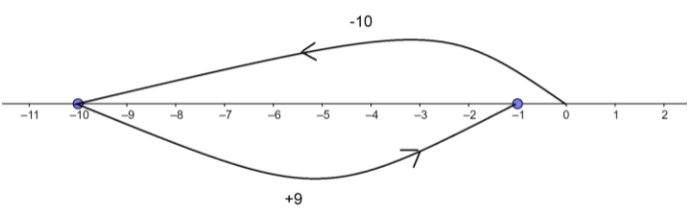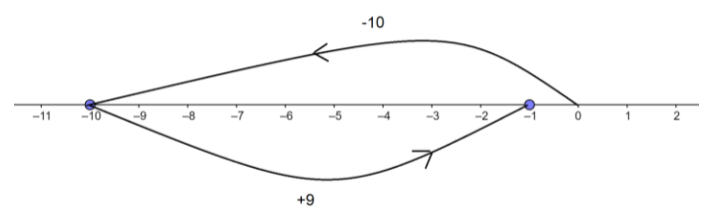
HMH Middle School Grade 7 Practice Fluency Workbook 1st Edition Chapter 3 Exercise 3.5 Rational Numbers

Go Math! Middle School Grade 7 Practice Fluency Workbook 1st Edition Chapter 3 Rational Numbers

HMH Grade 7 Rational Numbers Exercise 3.5 solutions Page 23 Problem 1 Answer

An expression is given as, 1/2÷(−3).

It is required to find the quotient.

To find the quotient, first rewrite the problem and then multiply with the reciprocal.

Rewrite the problem to multiply by the reciprocal.

Hence, 1/2÷(−3)=1/2⋅(−1/3).

Multiply with the reciprocal.

1/2⋅(−1/3)=1⋅(−1)/2⋅3

1/2⋅(−1/3)=−1/6

Hence, 1/2⋅(−1/3)=−1/6.

Check the sign.

A positive divided by a negative is negative.

So, 1/2÷(−3)=−1/6.

The quotient of 1/2÷(−3) is −1/6.

Read and Learn More HMH Middle School Grade 7 Practice Fluency Workbook 1st Edition Solutions

HMH Middle School Grade 7 Chapter 3 Page 23 Problem 2 Answer

An expression is given as,−6÷(−3/4).

It is required to find the quotient.

To find the quotient, first rewrite the problem and then multiply with the reciprocal.

Rewrite the problem to multiply by the reciprocal.

Hence, −6÷(−3/4)=−6⋅(−4/3).

Multiply with the reciprocal.

​−6⋅(−4/3)=(−6)⋅(−4)/3

−6⋅(−4/3)=(−2⋅3)⋅(−4)/3

−6⋅(−4/3)=(−2)⋅(−4)

−6⋅(−4/3)=8

Hence, −6⋅(−4/3)=8.

Check the sign.

A negative divided by a negative is positive.

So, −6÷(−3/4)=9.

The quotient of −6÷(−3/4) is 9.

HMH Middle School Grade 7 Chapter 3 Page 23 Problem 3 Answer
HMH Middle School Grade 7 Practice Fluency Workbook 1st Edition Chapter 3 Exercise 3.5 Rational Numbers

Practice Fluency Workbook Chapter 3 Exercise 3.5 answers Page 23 Problem 4 Answer

An expression is given as, 5.25/15.

It is required to find the quotient.

To find the quotient, first rewrite the problem and then multiply with the reciprocal.

Rewrite the problem to multiply by the reciprocal.

​5.25/15=51/4/15

5.25/15=21/4⋅1/15

Hence, 5.25/15=21/4⋅1/15.

Multiply with the reciprocal.

​21/4⋅1/15=3⋅7/4⋅1/3⋅5

21/4⋅1/15=7⋅1/4⋅5

21/4⋅1/15=7/20

Hence,21/4⋅1/15=7/20.

Check the sign.

A positive divided by a positive is positive.

So, 5.25/15=7/20.

The quotient of 5.25/15 is 7/20.

HMH Middle School Grade 7 Chapter 3 Page 23 Problem 5 Answer

An expression is given as, −0.125÷(−0.5).

It is required to find the quotient.

To find the quotient, first rewrite the problem and then multiply with the reciprocal.

Rewrite the problem to multiply by the reciprocal.

​−0.125÷(−0.5)=−1/8÷(−1/2)

−0.125÷(−0.5)=−1/8⋅(−2)

Hence, −0.125÷(−0.5)=−1/8⋅(−2).

Multiply with the reciprocal.

​1/8⋅(−2)=(−1)⋅(−2)/8

1/8⋅(−2)=2/8

1/8⋅(−2)=1/4

Hence, 1/8⋅(−2)=1/4.

Check the sign.

A positive divided by a negative is positive.

So, −0.125÷(−0.5)=1/4.

The quotient of −0.125÷(−0.5) is 1/4.

HMH Middle School Grade 7 Chapter 3 Page 23 Problem 6 Answer

An expression is given as, −1/7÷(−3/14).

It is required to find the quotient.

To find the quotient, first rewrite the problem and then multiply with the reciprocal.

Rewrite the problem to multiply by the reciprocal.

Hence, −1/7÷−3/14=−1/7⋅(−14/3).

Multiply with the reciprocal.

​−1/7⋅(−14/3)=−1/7⋅−2⋅7/3

−1/7⋅(−14/3)=(−1)⋅(−2)/3

−1/7⋅(−14/3)=2/3​

Hence, −1/7⋅(−14/3)=2/3.

Check the sign.

A positive negative by a negative is positive.

So, −1/7÷(−3/14)=2/3.

The quotient of −1/7÷(−3/14) is 2/3.

7th Grade HMH Rational Numbers Exercise 3.5 step-by-step Page 23 Problem 7 Answer

An expression is given as, (3/2)/(−9/8).

It is required to find the quotient.

In order to find the quotient, find the multiplicative inverse of −9/8 and multiply it with 3/2.

Find the multiplicative inverse of −9/8.

So, the multiplicative inverse of −9/8 is −8/9.

Now, multiply −8/9  with  3/2.

​(3/2)/(−9/8)=3/2⋅(−8/9)

(3/2)/(−9/8)=−4/3

Hence, the quotient for the given expression is−4/3.

The quotient for the given expression is −4/3.

HMH Middle School Grade 7 Chapter 3 Page 23 Problem 8 Answer

An expression is given as, −11/2÷31/3.

It is required to find the quotient.

In order to find the quotient, find the multiplicative inverse of 31/3 and multiply it with−11/2.

Convert the mixed fraction into an improper fraction.

−11/2÷31/3=−3/2÷10/3.

Find the multiplicative inverse of 10/3.

So, the multiplicative inverse of 10/3 is 3/10.

Now, multiply  3/10 with −3/2.

​−3/2÷10/3=−3/2⋅(3/10)

−3/2÷10/3=−3/2⋅(3/10)

−3/2÷10/3=−9/20

Hence, −3/2÷10/3=−9/20.

The quotient for the given expression is −9/20.

Rational Numbers Grade 7 Practice Fluency Workbook help Exercise 3.5 Page 23 Problem 9 Answer

An expression is given as,21/4÷3/8.

It is required to find the quotient.

In order to find the quotient, find the multiplicative inverse of  3/8 and multiply with 21/4.

Convert the mixed fraction into an improper fraction.

21/4÷3/8=9/4÷3/8.

Find the multiplicative inverse of 3/8.

So, the multiplicative inverse of 3/8 is 8/3.

Now, multiply 8/3 with 9/4.

​9/4÷3/8=9/4⋅8/3

9/4÷3/8=72/12

9/4÷3/8=6

Hence, 9/4÷3/8=6.

The quotient for the given expression is 6.

HMH Middle School Grade 7 Chapter 3 Page 23 Problem 10 Answer

An expression is given as, 4.2−2.4.

It is required to find the quotient.

In order to find the quotient, find the multiplicative inverse of −24/10 and multiply it with 42/10.

Given, 4.2−2.4.

Divide both the numerator and the denominator by 10.

4.2−2.4=42/10−24/10.

Find the multiplicative inverse of −24/10.

So, the multiplicative inverse of −24/10 is −10/24.

Now, multiply −10/24 with 42/10.

​42/10−24/10=42/10⋅(−10/24)

42/10−24/10=−420/240

42/10−24/10=−7/4

Hence, 42/10−24/10=−7/4.

The quotient for the given expression is −7/4.

Grade 7 Rational Numbers Exercise 3.5 explained step-by-step Page 23 Problem 11 Answer

An expression is given as, −5/8÷(−5/16).

It is required to find the quotient.

In order to find the quotient, find the multiplicative inverse of −5/16 and multiply it with−5/8.

Find the multiplicative inverse of −5/16.

So, the multiplicative inverse of −5/16 is −16/5.

Now, multiply −16/5 with −5/8.

​−5/8÷(−5/16)=−5/8⋅(−16/5)

−5/8÷(−5/16)=80/40

−5/8÷(−5/16)=2

Hence, −5/8÷(−5/16)==2.

The quotient for the given expression is 2.

HMH Middle School Grade 7 Chapter 3 Page 23 Problem 12 Answer

It is given that, 0.25÷_____=−0.25.

It is required to fill in the blank.

In order to fill in the blank, let the number to be filled in blank be x. Find the multiplicative inverse of x and multiply it with 0.25. Then, simplify further.

Let the number to be filled in the blank be x .

So, the multiplicative inverse of x is 1/x.

Now, multiply 1/x with 0.25.

​0.25÷x=−0.25

0.25⋅1/x=−0.25

0.25/x=−0.25

​Multiply both sides with x.

0.25=−0.25x

Divide both sides by −0.25.

Hence, x=−1.

To make the given statement true, the blank has to be filled with the value −1.         

It is given that, −1/2÷_____=−7/3.

It is required to fill in the blank.

In order to fill in the blank, let the number to be filled in blank be x, find the multiplicative inverse of x and multiply with −1/2.

Then, simplify further.

Let the number to be filled in the blank be x.

Find the multiplicative inverse of x.

So, the multiplicative inverse of x is 1/x.

Now, multiply 1/x by −1/2.

​−1/2÷x=−7/3

−1/2⋅1/x=−7/3

−1/2x=−7/3

Multiply by x on both sides.

Hence, −1/2=−7/3x.

Multiply by −3/7 on both sides of −1/2=−7/3x.

x=−1/2⋅(−3/7)

x=3/14

Hence, x=3/14.

To make the given statement true, the blank has to be filled with the value 3/14.

HMH Chapter 3 Rational Numbers Exercise 3.5 answers Page 23 Problem 14 Answer

It is given that, 1/7÷_____=14.

It is required to fill in the blank.

In order to fill in the blank, let the number to be filled in blank be x, find the multiplicative inverse of x and multiply with 1/7.

Then, simplify further.

Let the number to be filled in the blank be x.

Find the multiplicative inverse of x.

So, the multiplicative inverse of x is 1/x.

Now, multiply  1/x with 1/7.

​1/7÷x=14

1/7⋅1/x=14

1/7x=14

Hence, 1/7x=14.

HMH Middle School Grade 7 Chapter 3 Page 23 Problem 15 Answer

It is given that the total plant food is of 8 pounds.

It is required to find how many quarter-pound (1/4) packets can be made out of the total plant food.

In order to find how many quarter-pound (1/4) packets can be made out of total plant food, make an expression using given information and simplify.

Let the number of packets that can be made out be x.

Make an expression using the given information.

8÷1/4=x

Further, evaluate the multiplicative inverse of 1/4.

So, the multiplicative inverse of 1/4 is 4.

Now, multiply 4 with 8.

​8÷1/4=x

8⋅4=x

32=x

Hence, 32=x.

The number of packets that can be made are 32.

Online help for Rational Numbers Grade 7 Exercise 3.5 Page 23 Problem 16 Answer

It is given that the assembly of a machine takes 3/4 hour and there are 12 steps in total.

It is required to find the average time for each step.

In order to find the average time for each step, make an expression using the given information and simplify.

Let the average time for each step be x.

The assembly takes 3/4 hour and there are 12 steps in total.

Make an expression using given information

3/4÷12=x.

Evaluate the multiplicative inverse of 12.

So, the multiplicative inverse of 12 is 1/12.

Now, multiply 1/12 with 3/4.

​3/4÷12=x

3/4⋅1/12=x

3/48=x

1/16=x

Hence, 1/16=x.

The average time for each step is 1/16 hour.

HMH Middle School Grade 7 Chapter 3 Page 23 Problem 17 Answer

It is given that the total length of a cable is 35m and it is cut into pieces of measure 1.25m.

It is required to find the number of pieces in which the cable is cut.

In order to find the number of pieces, make an expression using the given information and simplify.

Let the number of pieces be x.

The total length of the cable is 35m and it is cut into pieces which measure 1.25m.

Make an expression using given information.

Hence, 35÷1.25=x.

Evaluate the multiplicative inverse of 1.25.

So, the multiplicative inverse of 1.25 is 1/1.25.

Now, multiply 1/1.25 with 35.

​35÷1.25=x

35⋅1/1.25=x

35/1.25=x

x=28

Hence, x=28.

The number of pieces in which the cable is cut are 28.

Step-by-step Rational Numbers solutions for 7th Grade Exercise 3.5 Page 23 Problem 18 Answer

It is given that 41/8 tons of gravel are spread evenly across 21/6 acres.

It is required to find how many tons of gravel is on each acre.

In order to find how many tons of gravel is on each acre, make an expression using the given information and simplify.

Let the tons of gravel that are on each acre be x.

Make an expression using the given information.

Since 41/8 tons of gravel is spread evenly across 21/6 acres,

41/8÷21/6=x

Convert the mixed fraction into an improper fraction.

Hence, 33/8÷13/6=x.

Evaluate the multiplicative inverse of 13/6.

So, the multiplicative inverse of 13/6 is 6/13.

Now, multiply 6/13 with 33/8.

​33/8÷13/6=x

33/8⋅6/13=x

99/52=x

Hence, 99/52=x.

The tons of gravel on each acre are 99

52 tons or 147

52 tons.

HMH Middle School Grade 7 Chapter 3 Page 24 Problem 19 Answer

An expression is given as, 41/4÷31/2.

It is required to determine the sign of the quotient of the given expression.

To determine the sign of the quotient of the given expression, it is necessary to check the signs of the terms in the expression.

The terms in the given expression, 41/4 and 31/2 are both positive.

The quotient of division of two positive terms invariably gives a positive result.

Hence, the required sign of the quotient will be positive.

The sign of the quotient of the given expression 41/4÷31/2 will be positive.

Exercise 3.5 Rational Numbers Practice Workbook Grade 7 explained Page 24 Problem 20 Answer

An expression is given as,−3.5÷0.675.

It is required to determine the sign of the quotient of the given expression.

To determine the sign of quotient of the given expression, it is necessary to check the signs of the terms in the expression.

The terms in the given expression, −3.5 is a negative term and 0.675 is a positive term.

The quotient of division of a positive and a negative term invariably gives a negative result.

Hence, the required sign of the quotient will be negative.

The sign of the quotient of the given expression −3.5÷0.675 will be negative.

HMH Middle School Grade 7 Chapter 3 Page 24 Problem 21 Answer

An expression is given as, −1/7÷(−5/9).

It is required to find the quotient of the given expression by completing each step.

To find the quotient of the given expression by completing each step, it is necessary to reciprocate the second term of the expression.

Rescript the problem to multiply by the reciprocal.

−1/7÷(−5/9)=−1/7⋅(−9/5) Multiply.

−1/7⋅(−9/5)=(−1)⋅(−9)/7⋅5

(−1)⋅(−9)/7⋅5=9/35

Assign a sign to the quotient.

It is known that a negative divided by a negative is positive. Hence, the result is obtained as positive.

−1/7÷(−5/9)=9/35

The required quotient is 9/35.

The quotient of the given expression−1/7÷(−5/9) after completing each step is 9/35.

Page 24 Problem 22 Answer

An expression is given as,7/8÷8/9.

It is required to find the quotient of the given expression by completing each step.

To find the quotient of the given expression by completing each step, it is necessary to reciprocate the second term of the expression.

Re script the problem to multiply by the reciprocal.

7/8÷8/9=7/8⋅9/8 Multiply.

7/8⋅9/8=7⋅9/8⋅8

7⋅9/8⋅8=63/64

Assign a sign to the quotient.

It is known that a positive divided by a positive is positive. Hence, the result is obtained as positive.

7/8÷8/9=63/64

The required quotient is 63/64.

The quotient of the given expression 7/8÷8/9 after completing each step is 63/64.
HMH Middle School Grade 7 Practice Fluency Workbook 1st Edition Chapter 3 Exercise 3.4 Rational Numbers

HMH Middle School Grade 7 Practice Fluency Workbook 1st Edition Chapter 3 Rational Numbers

HMH Grade 7 Rational Numbers Exercise 3.4 Solutions Page 21 Problem 1 Answer

An expression is given as, 4(−1/2).

It is required to find the product of the given expression using a number line.

Go Math!, Middle School Grade 7, Practice Fluency Workbook, 1st Edition, Chapter 3 Rational Numbers 1

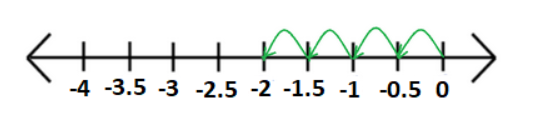
To find the product of the given expression using a number line, it is necessary to represent the expression on a number line.

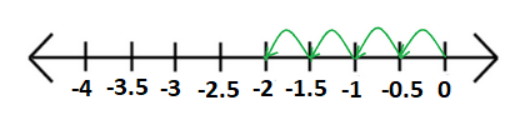
In the given expression,−1/2 is multiplied 4 times.

So, there will be  4 jumps of 1/2 or 0.5unit each along the number line.

Because the two numbers have different signs, hence, there will be a jump from 0 to the left.

The above-mentioned is represented on a number line as shown below.

The numbers where each jump ends are−1/2,−1,−11/2 and −2.

The number where the final jump ends is −2.

Hence, the required result is−2.

The product of the given expression4(−1/2) using a number line is −2. The same is represented on a number line as shown below.

Read and Learn More HMH Middle School Grade 7 Practice Fluency Workbook 1st Edition Solutions

Go Math!, Middle School Grade 7, Practice Fluency Workbook, 1st Edition, Chapter 3 Rational Numbers 1 1

HMH Middle School Grade 7 Chapter 3 Page 21 Problem 2 Answer

HMH Middle School Grade 7 Practice Fluency Workbook 1st Edition Chapter 3 Exercise 3.4 Rational Numbers

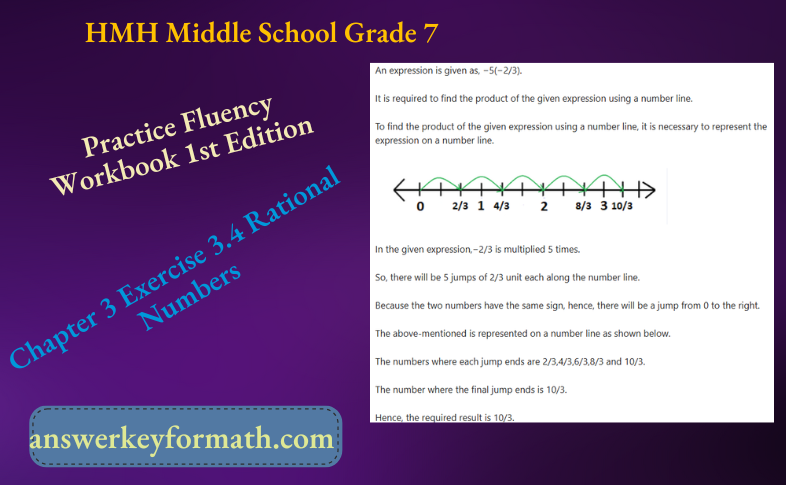
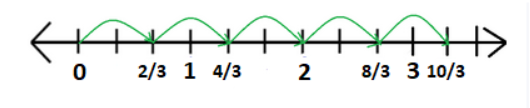
The product of the given expression−5(−2/3) using a number line is 10/3. The same is represented on a number line as shown below.

Go Math!, Middle School Grade 7, Practice Fluency Workbook, 1st Edition, Chapter 3 Rational Numbers 2 1

Practice Fluency Workbook Chapter 3 Rational Numbers Answers Page 21 Problem 3 Answer

An expression is given as, −2(3.1).

It is required to find the product of the given expression.

To find the product of the expression −2(3.1), it is necessary to operate multiplication on the given expression.

Perform multiplication on the expression −2(3.1).

Multiply the numerical values of the two numbers ignoring the negative sign and the decimal point.

​2(31)=2⋅31

2(31)=62

Now, it is known the decimal point is placed in the product in such a way that the number of decimal places in the product is the sum of the decimal places in the factors.

Also, the sign of the product will be negative since the given numbers have different signs.

Hence, the required product is obtained as −6.2.

The product of the given expression −2(3.1) is−6.2.

HMH Middle School Grade 7 Chapter 3 Page 21 Problem 4 Answer

An expression is given as, 4(−5.4).

It is required to find the product of the given expression.

To find the product of the expression 4(−5.4), it is necessary to operate multiplication on the given expression.

Perform multiplication on the expression 4(−5.4).

Multiply the numerical values of the two numbers ignoring the negative sign and the decimal point.

​4(54)=4⋅54

4(54)=216

Now, it is known the decimal point is placed in the product in such a way that the number of decimal places in the product is the sum of the decimal places in the factors.

Also, the sign of the product will be negative since the given numbers have different signs.

Hence, the required product is obtained as −21.6.

The product of the given expression4(−5.4)  is−21.6.

Hmh Middle School Math Workbook Chapter 3 Guide Page 21 Problem 5 Answer

An expression is given as, −3.3(6).

It is required to find the product of the given expression.

To find the product of the expression −3.3(6), it is necessary to operate multiplication on the given expression.

Perform multiplication on the expression −3.3(6).

Multiply the numerical values of the two numbers ignoring the negative sign and the decimal point.

​33(6)=33⋅6

33(6)=198

Now, it is known that the decimal point is placed in the product in such a way that the number of decimal places in the product is the sum of the decimal places in the factors.

Also, the sign of the product will be negative since the given numbers have different signs.

Hence, the required product is obtained as −19.8.

The product of the given expression−3.3(6) is−19.8.

HMH Middle School Grade 7 Chapter 3 Page 21 Problem 6 Answer

An expression is given as, 4.5(8).

It is required to find the product of the given expression.

To find the product of the expression 4.5(8), it is necessary to operate multiplication on the given expression.

Perform multiplication on expression 4.5(8).

Multiply the numerical values of the two numbers ignoring the decimal point.

​45(8)=45⋅8

45(8)=360

Now, it is known that the decimal point is placed in the product in such a way that the number of decimal places in the product is the sum of the decimal places in the factors.

Also, the sign of the product will be positive since the given numbers have the same signs.

Hence, the required product is obtained as 36.0 or 36.

The product of the given expression 4.5(8) is 36.

7th Grade HMH Rational Numbers Exercise 3.4 step-by-step Page 21 Problem 7 Answer

An expression is given as, 2(−1.05).

It is required to find the product of the given expression.

Multiply the given integers, also multiply the sign.

Write the given expression.

2(−1.05)

Now, multiply both the integers, also it is well known that when the(−) sign is multiplied with (+) sign, then, the result gives (−) sign.

So, 2(−1.05)=−2.1

The product of 2(−1.05) is −2.1.

HMH Middle School Grade 7 Chapter 3 Page 21 Problem 8 Answer

An expression is given as, −2.05(4).

It is required to find the product of the given expression.

Multiply the given integers, also multiply the sign

Write the given expression.

−2.05(4)

Now, multiply both the integer, also it is well known that when(+) sign is multiplied with a (−) sign and the result gives a (−)sign.

So,−2.05(4)=−8.2

The product of −2.05(4) is −8.2.

Rational numbers Grade 7 Practice Fluency Workbook help Page 21 Problem 9 Answer

An expression is given as,−3.5(−9).

It is required to find the product of the given expression.

Multiply the given integers, also multiply the sign.

Write the given expression.

−3.5(−9).

Now, multiply both the integers, also it is well known that when the(−) sign is multiplied with(−) sign, then, the result gives (+) sign.

So,−3.5(−9)=31.5

The product of the given integer,−3.5(−9) is 31.5.

HMH Middle School Grade 7 Chapter 3 Page 21 Problem 10 Answer

An expression is given as, (2/3)×(−6)×5.

It is required to find the product of the given expression.

Multiply the given integers, also multiply the sign.

Write the given expression.

(2/3)×(−6)×5.

Now, multiply both the integer, also it is well known that when (+) sign is multiplied with a (−) sign and the result gives a (−) sign.

So,(2/3)×(−6)×5=2(−6)(5)/3

(2/3)×(−6)×5=−60/3

(2/3)×(−6)×5=−20

​The product of the given integer, (2/3)×(−6)×5 is −20.

Grade 7 Math Practice Fluency Workbook Exercise 3.4 explained Page 21 Problem 11 Answer

An expression is given as, (−3/5)(−10/3)(−2/9).

It is required to find the product of the given expression.

Multiply the given integers, also multiply the sign.

Write the given expression.

(−3/5)(−10/3)(−2/9)

Now, multiply both the integers, also it is well known that when the (−) sign is multiplied with (−) sign, then, the result gives (+) sign.

Then, again, (+) sign is multiplied with a (−) sign and the result gives a (−) sign.

Or, the(−) sign can be taken as common from the expression.

​(−3/5)(−10/3)(−2/9)=−(3⋅10⋅2)/5⋅3⋅9

(−3/5)(−10/3)(−2/9)=−60/135

(−3/5)(−10/3)(−2/9)=−12/27

Hence,(−3/5)(−10/3)(−2/9)=−12/27.

The product of the given integer, (−3/5)(−10/3)(−2/9) is−12/27.

HMH Middle School Grade 7 Chapter 3 Page 21 Problem 12 Answer

An expression is given as, −7×(−3/5)(15/7).

It is required to find the product of the given expression.

Multiply the given integers, also multiply the sign.

Write the given expression.

−7×(−3/5)(15/7).

Now, multiply both the integers, also it is well known that when the (−) sign is multiplied with (−) sign, then, the result gives (+) sign.

​−7×(−3/5)(15/7)=−7(−3)(15)/5×7

−7×(−3/5)(15/7)=315/35

−7×(−3/5)(15/7)=9

Hence, −7×(−3/5)(15/7)=9.

The product of the given integer,−7×(−3/5)(15/7) is 9.

Rational Numbers problems explained for 7th Grade Page 21 Problem 13 Answer

An expression is given as, 2(4)(1/16).

It is required to find the product of the given expression.

Multiply the given integers, also multiply the sign.

Write the given expression.

2(4)(1/16).

Now, multiply both the integers.

So, 2(4)(1/16)=2(4)(1)/16

2(4)(1/16)=8/16

2(4)(1//16)=1/2

Hence,2(4)(1/16)=1/2.

The product of the given integer, 2(4)(1/16) is 1/2.

HMH Middle School Grade 7 Chapter 3 Page 21 Problem 14 Answer

It is given that a box-shaped fish trap measures 1/4×2/3×3/4m.

It is required to find the volume of the fish.

Since three dimensions are given of the fish, it is a cuboid.

Multiply the given integers as the volume of a cuboid is given by the product of its length, height and breadth.

Given, a box-shaped fish trap measures 1/4×2/3×3/4m.

The fish is in the shape of a cuboid.

Let V be the volume of the fish.

V=lbh , where, l,b,h are the length, height and breadth respectively.

​V=1/4⋅2/3⋅3/4

V=1⋅2⋅3/4⋅3⋅4

V=6/48

V=1/8m

Hence, V=1/8m.

The volume of the box-shaped fish trap is 1/8m.

Exercise 3.4 Rational Numbers Grade 7 Practice Workbook help Page 21 Problem 15 Answer

It is given that the temperature at noon is 75∘F. The temperature drops every half hour by 3∘F.

It is required to find the temperature at 4PM.

Multiply the given integer with the interval of every half an hour till 4PM.

As, it is given, the temperature at noon is 75∘F. Also, temperature drops at every half hour. It could be written as−3∘F.

So, Since 12 noon to 4PM, it has 8 intervals of every half an hour.

So, the total temperature drop between 12 noon to 4PM is,−3∘F⋅8=−24∘F.

At noon, the temperature was 75∘F and till 4PM it falls by −24∘F.

So, 75−24=51∘F.

The temperature at 4PM will be 51∘F.

HMH Middle School Grade 7 Chapter 3 Page 22 Problem 16 Answer

An expression is given as,6×1/4.

It is required to find that how many times 1/4 is multiplied and in which direction on the number line. It is also required to find the product of the given expression.

To find that how many times 1/4 is multiplied, multiply the number with 1/4.

In the given expression, 1/4 is multiplied six times.

These two numbers have the same sign, so, jump from 0 to the right side of the number line.

Move from 0 six times to 1/4,2/4,3/4,4/4,5/4,6/4.

Find the product of the given expression.

6×1/4=6/4

6×1/4=3/2

6×1/4=11/2

Hence, 6×1/4=11/2.

Go Math!, Middle School Grade 7, Practice Fluency Workbook, 1st Edition, Chapter 3 Rational Numbers 16

In the expression, 1/4 is multiplied six times in the right direction of the number line from 0.

The product of 6×1/4 is 11/2.


HMH Middle School Grade 7 Chapter 3 Page 22 Problem 17 Answer

An expression is given as, −8(−3.3).

It is required to find that how many times 3.3 is multiplied and in which direction on the number line.

It is also required to find the product of the given expression.

To find that how many times 3.3 is multiplied, multiply the number with 3.3.

In the given expression, 3.3 is multiplied eight times.

These two numbers have the same sign, so, jump from 0 to the right side of the number line.

Move eight times from 0 to 3.3, 6.6, 9.9, 13.2, 16.5, 19.8, 23.1, 26.4.

Find the product of the given expression.

−8(−3.3)=26.4

Hence,−8(−3.3)=26.4.

Go Math!, Middle School Grade 7, Practice Fluency Workbook, 1st Edition, Chapter 3 Rational Numbers 17

In the expression, 3.3 is multiplied eight times in the right direction of the number line from 0.

The product of −8(−3.3)

Go Math!, Middle School Grade 7, Practice Fluency Workbook, 1st Edition, Chapter 3 Rational Numbers 17 1

HMH Middle School Grade 7 Chapter 3 Page 22 Problem 18 Answer

An expression is given as, 4.6×5.

It is required to find that how many times 4.6 is multiplied and in which direction on the number line. It is also required to find the product of the given expression.

To find that how many times 4.6 is multiplied, multiply the number with 4.6.

In the given expression, 4.6 is multiplied five times.

Go Math!, Middle School Grade 7, Practice Fluency Workbook, 1st Edition, Chapter 3 Rational Numbers 18

These two numbers have the same sign, so, jump from 0 to the right side of the number line.

Move five times from 0 to 4.6,9.2,13.8,18.4,23.

Find the product of the given expression.

Hence, 4.6×5=23.

Go Math!, Middle School Grade 7, Practice Fluency Workbook, 1st Edition, Chapter 3 Rational Numbers 18 1

In the expression, 4.6 is multiplied six times in the right direction of the number line from 0. The product of 4.6×5 is 23.

HMH Middle School Grade 7 Practice Fluency Workbook 1st Edition Chapter 3 Exercise 3.3 Rational Numbers

HMH Middle School Grade 7 Practice Fluency Workbook 1st Edition Chapter 3 Rational Numbers

HMH Grade 7 Practice Fluency Workbook Chapter 3 Exercise 3.2 Solutions Page 19 Problem 1 Answer

An expression is given as,−5−4.

It is required to solve the given expression using a number line.

Go-Math-Middle-School-Grade-7-Practice-Fluency-Workbook-1st-Edition-Chapter-3-Rational-Numbers-1

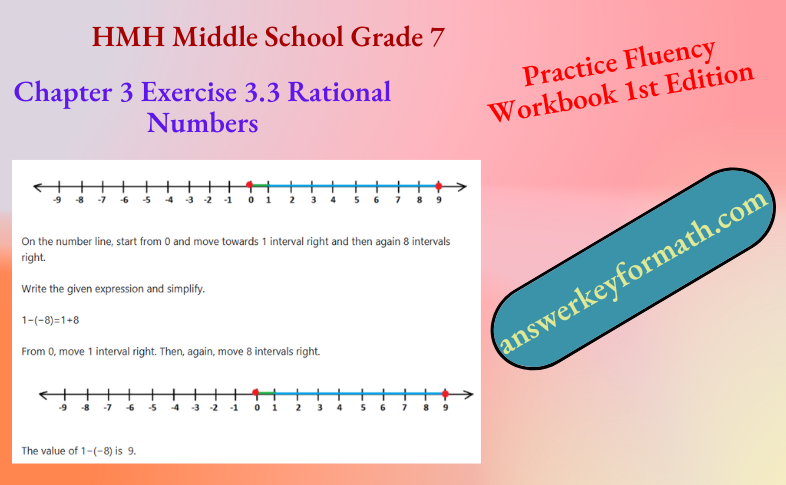
On the number line, start from 0 and move towards 5 intervals left and then again 4 intervals left.

Write the given expression.

−5−4

From 0, move 5 intervals left. Then, again, move 4 intervals left.

Go-Math-Middle-School-Grade-7-Practice-Fluency-Workbook-1st-Edition-Chapter-3-Rational-Numbers-1

The value of −5−4 is −9.

HMH Grade 7 Practice Fluency Workbook Chapter 3 Exercise 3.2 Solutions Page 19 Problem 2 Answer

An expression is given as, 1−(−8).

It is required to solve the given expression using a number line.

Read and Learn More HMH Middle School Grade 7 Practice Fluency Workbook 1st Edition Solutions

HMH Middle School Grade 7 Practice Fluency Workbook 1st Edition Chapter 3 Exercise 3.3 Rational Numbers

Rational Numbers Exercise 3.2 Chapter 3 Answers HMH Grade 7 Workbook Page 19 Problem 3 Answer

An expression is given as, 4−(−5).

It is required to find the difference.

To solve the given expression, first, change subtraction by addition with the opposite number and then simplify.

Change subtraction by addition with the opposite number.

4−(−5)=4+5.

As the two numbers have the same sign, the result of the addition is given by the sum between the absolute values, to which the sign of the numbers can be substituted into.

Hence, 4+5=9.

The difference of 4−(−5) is 9.

Step-By-Step Solutions For Exercise 3.2 Rational Numbers HMH Grade 7 Practice Workbook Page 19 Problem 4 Answer

An expression is given as, 1/7−3/7.

It is required to find the difference.

To solve the given expression, first change subtraction by addition with the opposite number and then simplify.

Change subtraction by addition with the opposite number.

Hence, 1/7−3/7=1/7+(−3/7).

As the two numbers have the different signs, the result of the subtraction is given by the difference between the greater absolute values and the smaller absolute values, to which, the sign of the number which produced the greater absolute value can be substituted into.

​1/7+(−3/7)=−(3/7−1/7)

1/7+(−3/7)=−(3−1/7)

1/7+(−3/7)=−2/7

Hence,1/7+(−3/7)=−2/7.

The difference of 1/7−3/7  is−2/7.

Exercise 3.2 Rational Numbers solutions for HMH Middle School Grade 7 Workbook Page 19 Problem 5 Answer

An expression is given as, −3.7−(−4.9).

It is required to find the difference.

To solve the given expression, first change subtraction by addition with the opposite number and then simplify.

Change subtraction by addition with the opposite number.

Hence, −3.7−(−4.9)=−3.7+4.9.

As the two numbers have the different sign, the result of the subtraction is given by the difference between the greater absolute values and the smaller absolute values, to which the sign of the number which produced the greater absolute value can be substituted into.

​−3.7+4.9=+(4.9−3.7)

−3.7+4.9=+1.2

−3.7+4.9=1.2

​Hence, −3.7+4.9=1.2.

The difference of −3.7−(−4.9) is 1.2.

Examples Of Problems From Exercise 3.2 Rational Numbers In HMH Grade 7 Workbook Page 19 Problem 6 Answer

An expression is given as, −21/4−(−3).

It is required to find the difference.

To solve the given expression, first change subtraction by addition with the opposite number and then simplify.

Change subtraction by addition with the opposite number.

Hence, −21/4−(−3)=−21/4+3.

As the two numbers have the different signs, the result of the subtraction is given by the difference between the greater absolute values and the smaller absolute values, to which, the sign of the number which produced the greater absolute value can be substituted into.

​−21/4+3=+(3−21/4)

−21/4+3=3/4

Hence,−21/4+3=3/4.

The difference of  −21/4−(−3) is 3/4.

Common Core Chapter 3 Exercise 3.2 Rational Numbers Detailed Solutions HMH Grade 7 Workbook” Page 19 Problem 7 Answer

An expression is given as, −1.6−2.1.

It is required to find the difference.

To solve the given expression, first change subtraction by addition with the opposite number and then simplify.

Change subtraction by addition with the opposite number.

−1.6−2.1=−1.6+(−2.1).

As the two numbers have the same sign, the result of the addition is given by the sum between the greater absolute values, to which the sign of the numbers can be substituted into.

​−1.6+(−2.1)=−(1.6+2.1)

−1.6+(−2.1)=−3.7

Hence, −1.6+(−2.1)=−3.7.

The difference of −1.6−2.1 is −3.7.

Page 19 Problem 8 Answer

An expression is given as, −43/4−3/4.

It is required to find the difference.

To solve the given expression, first change subtraction by addition with the opposite number and then simplify.

Change subtraction by addition with the opposite number.

Hence, −43/4−3/4=−43/4+(−3/4).

As the two numbers have the same sign, the result of the addition is given by the sum between the greater absolute values, to which the sign of the numbers can be substituted into.

​−43/4+(−3/4)=−(43/4+3/4)

−43/4+(−3/4)=−(19/4+3/4)

−43/4+(−3/4)=−22/4

−43/4+(−3/4)=−11/2

Hence, −43/4+(−3/4)=−11/2.

The difference of −1.6−2.1 is −11/2.

Page 19 Problem 9 Answer

It is given, an expression −5.1−(−0.1)−1.2.

It is required in this problem to find the difference of the given expression without using number line.

In order to find in this problem, the difference of the given expression without using number line, apply subtraction operation.

In order to simplify, subtract −0.1 from −5.1 in −5.1−(−0.1)−1.2 and the sign will be of the greater absolute value.

−5.1−(−0.1)−1.2=−5−1.2

Further, subtract 1.2 from −5.

−5−1.2=−3.8

Hence, −5.1−(−0.1)−1.2=−3.8.

Hence, as required in the problem,−5.1−(−0.1)−1.2=−3.8.

Page 19 Problem 10 Answer

An expression is given as, −3/5−7/5−(−2/5).

It is required to find the difference of the given expression without using number line.

In order to find the difference of the given expression without using number line, apply subtraction operation.

In order to simplify, subtract −7/5 from −3/5 in −3/5−7/5−(−2/5)  and the sign will be of the greater absolute value.

​−3/5−7/5−(−2/5)=−3−7/5−(−2/5)

−3/5−7/5−(−2/5)=−10/5−(−2/5)

​Subtract −2/5 from −10/5.

​−10/5−(−2/5)=−10−(−2)/5

−10/5−(−2/5)=−8/5

Hence, −3/5−7/5−(−2/5)=−8/5.

The value of −3/5−7/5−(−2/5) is −8/5.

Page 19 Problem 11 Answer

It is given that the temperature on Monday was −1.5∘C and on Tuesday it was 2.6∘C less than that on Monday.

It is required to find the temperature on Tuesday.

In order to find the temperature on Tuesday, make an expression based on the given information and apply subtraction operation.

Form an equation based on the given information.

Since, the temperature on Tuesday was 2.6∘C less than that on Monday and the temperature on Monday was −1.5∘C.

So, the temperature on Tuesday can be evaluated by the expression −1.5∘C−2.6∘C.

In order to simplify, subtract 2.6 from−1.5 and the sign will be of the greater absolute value.

Hence,−1.5∘C−2.6∘C=−4.1∘C.

The temperature on Tuesday was −4.1∘C.

Page 19 Problem 12 Answer

It is given that the diver dove to the location 63/5m below the sea level and then dove to second location 81/5m below the sea level.

It is required to find the meters between the two locations.

In order to find the meters between the two locations, make an expression based on the given information and apply subtraction operation.

Form an equation based on the given information.

Since, as given, the diver dove to the location 63/5m below the sea level and then dove to second location 81/5m below the sea level.

So, the difference in the distance between two locations can be evaluated by the expression 81/5−63/5.

In order to simplify, subtract 63/5 from 81/5  and the sign will be of the greater absolute value.

​81/5−63/5=41/5−33/5

81/5−63/5=8/5

Hence, 81/5−63/5=8/5.

Hence, the difference in the distance between two locations is 8/5m or 13/5m.

Page 20 Problem 13 Answer

It is given that the total value of the tree cards with value 7,13, and −8 is 12.

It is required to find the values if 7 , 13 and −8 are taken away.

In order to find the values if 7,13, and −8 are taken away one by one, find the sum of other two cards.

If 7 is taken away, 13 and−8 are left.

Now, find the sum of 13 and −8.

13+(−8)=5

So, 12−7=5.

Hence, the value if 7is taken away, is 5.

If 13 is taken away, 7 and −8 are left.

Now, find the sum of 7 and−8.

7+(−8)=−1

So, 12−13=−1.

Hence, the value if 13 is taken away, is−1.

If −8 is taken away, 7 and 13 are left.

Now, find the sum of 7 and 13.

7+13=20

So, 12−(−8)=20.

Hence, the value if −8 is taken away, is 20.

The values if 7,13 and −8 are taken away are 5,−1 and 20 respectively.

Page 20 Problem 15 Answer

An expression is given as, −4−(−2).

It is required to subtract the given expression and answer some questions.

In order to solve, apply subtraction operation.

Then, answer the questions using the difference.

To begin with, simplify the given expression−4−(−2) and complete the first statement.

In order to simplify, subtract −2 from −4 in −4−(−2) and the sign will be of the greater absolute value.

−4−(−2)=−2

Hence, the completed statement is “−4<−2. So, the answer will be greater number.”

Further, simplify ∣4∣−∣2∣ and apply subtraction operation.

​∣4∣−∣2∣=4−2

∣4∣−∣2∣=2

Hence, ∣4∣−∣2∣=2.

The value of −4−(−2) is −2.

Thus, −4−(−2)=−2.

Hence, as required in the problem,  “−4<−2. So, the answer will be greater number.”, ∣4∣−∣2∣=2, and −4−(−2)=−2.

Page 20 Problem 16 Answer

An expression is given as, 31−(−9).

It is required to find the difference of the given expression.

In order to find the difference of the given expression, apply subtraction operation.

In order to simplify, subtract −9 from31 in 31−(−9) and the sign will be of the greater absolute value.

31−(−9)=31+9

31−(−9)=40

Hence, 31−(−9)=40.

The value of31−(−9) is 40.

Page 20 Problem 17 Answer

An expression is given as, −9−17.

It is required to find the difference of the given expression.

In order to find the difference of the given expression, apply subtraction operation.

In order to simplify, subtract 17 from −9 in −9−17 and the sign will be of the greater absolute value.

−9−17=−26

Hence, −9−17=−26.

The value of −9−17 is −26.

Page 20 Problem 18 Answer

An expression is given as, 4.5−2.5.

It is required to find the difference of the given expression.

In order to find the difference of the given expression, apply subtraction operation.

In order to simplify, subtract 2.5 from 4.5 in 4.5−2.5 and the sign will be of the greater absolute value.

4.5−2.5=2

Hence, 4.5−2.5=2.

The value of 4.5−2.5 is 2.

Page 20 Problem 19 Answer

An expression is given as, 4/5−(−1/5).

It is required to perform subtraction on the given expression.

To perform subtraction on the given expression, it is necessary to check the signs assigned to the fractions.

Two negative signs appear next to each other in the given expression 4/5−(−1/5).

Change the subtraction by addition with the opposite number.

Then, the given expression can be written as,

4/5−(−1/5)=4/5+1/5

As the two numbers have the same sign, the result of the addition is given by the sum between the absolute values, to which the signs of the numbers are assigned.

Perform addition on the expression 4/5+1/5.

​4/5+1/5=5/5

4/5+1/5=1

The result will be a positive number since the both the numbers 4/5 and 1/5 are positive.

Hence, the required result is 1.

The result of subtraction on the given expression 4/5−(−1/5) is  1.

Page 20 Problem 20 Answer

An expression is given as,−21/3−(−1/3).

It is required to perform subtraction on the given expression.

To perform subtraction on the given expression, it is necessary to check the signs assigned to the fractions.

Two negative signs appear next to each other in the given expression−21/3−(−1/3).

Change the subtraction by addition with the opposite number.

Then, the given expression can be written as,

−21/3−(−1/3)=−21/3+1/3

Now, the expression−21/3+1/3 has two numbers with different signs.

The result is given by the difference between the greater absolute value and the smaller absolute value.

Hence, operate subtraction by ignoring the signs.

​21/3−1/3=7/3−1/3

21/3−1/3=6/3

21/3−1/3=2

Here, the result thus obtained will get a negative sign since the greater value−21/3 is a negative number.

The required result is −2.

The result of subtraction on the given expression −21/3−(−1/3) is −2.

Page 20 Problem 21 Answer

An expression is given as,−7/8−3/8.

It is required to perform subtraction on the given expression.

To perform subtraction on the given expression, it is necessary to check the signsassigned to the fractions.

The given expression−7/8−3/8  has two negative numbers.

The result of the expression is given by the sum between the absolute values.

Perform the operation addition on the expression ignoring the negative signs.

​7/8+3/8=10/8

7/8+3/8=5/4

Since the two numbers −7/8 and −3/8 have the same negative signs, the result will also take the negative sign.

Hence, the required result is−5/4.

The result of subtraction on the given expression −7/8−3/8  is −5/4.

HMH Middle School Grade 7 Practice Fluency Workbook 1st Edition Chapter 3 Exercise 3.2 Rational Numbers

HMH Middle School Grade 7 Practice Fluency Workbook 1st Edition Chapter 3 Rational Numbers

HMH Grade 7 Practice Fluency Workbook Chapter 3 Exercise 3.2 Solutions Page 17 Problem 1 Answer

An expression is given as, −3+4.

An expression is required to solve the given expression using a number line.

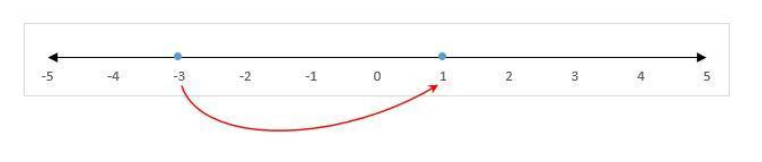
Go Math!, Middle School Grade 7, Practice Fluency Workbook, 1st Edition, Chapter 3 Rational Numbers 1

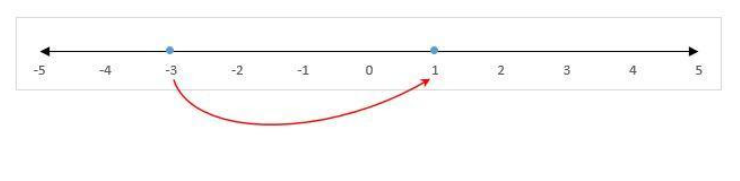
On the number line, start from −3 and move towards 4 intervals to the right because the number 4 is positive.

Start from −3 and move 4 intervals to the right because the number 4 is positive.

And, the result is 1.

Go Math!, Middle School Grade 7, Practice Fluency Workbook, 1st Edition, Chapter 3 Rational Numbers 1 1

The sum of −3+4 is 1.

HMH Middle School Grade 7 Chapter 3 Page 17 Problem 2 Answer

An expression is given as, 1+(−8).

An expression is required to solve the given expression using a number line.

Read and Learn More HMH Middle School Grade 7 Practice Fluency Workbook 1st Edition Solutions

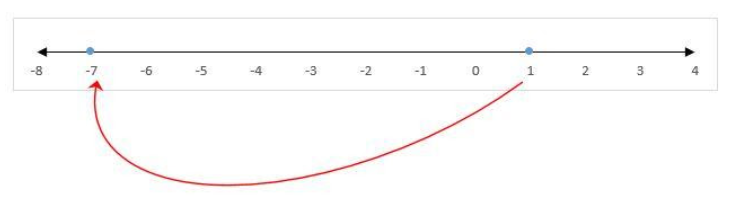
Go Math!, Middle School Grade 7, Practice Fluency Workbook, 1st Edition, Chapter 3 Rational Numbers 2

HMH Middle School Grade 7 Practice Fluency Workbook 1st Edition Chapter 3 Exercise 3.2 Rational Numbers

Rational Numbers Exercise 3.2 Chapter 3 Answers HMH Grade 7 Workbook Page 17 Problem 3 Answer

An expression is given as, 4+5.

An expression is required to solve the given expression.

To solve the given expression, first, determine the absolute values of the terms and then add both the numbers.

Determine the absolute values of the terms.∣4∣=4

∣5∣=5

Because the terms have the same sign, the sum has the sign of the terms, hence, the sum is positive.

Determine the sum.

​4+5=+(∣4∣+∣5∣)

4+5=+9

4+5=9

Hence, 4+5=9.

The sum of 4+5 is 9.

HMH Middle School Grade 7 Chapter 3 Page 17 Problem 4 Answer

An expression is given as, −3+1/2.

An expression is required to solve the given expression.

To solve the given expression, first determine the absolute values of the terms and then add both the numbers.

Determine the absolute values of the terms.

∣−3∣=3

∣1/2∣

=1/2

The terms have different signs.

The sign of the sum is the sign of the term with the greater absolute value.

Since, ∣3∣>∣1/2∣, the sum is negative.

Determine the sum.

−3+1/2=−(∣3∣−∣1/2∣)

−3+1/2=−(3−1/2)

−3+1/2=−5/2

Hence, −3+1/2=−5/2.

The sum of−3+1/2  is −5/2.

Step-By-Step Solutions For Exercise 3.2 Rational Numbers Hmh Grade 7 Practice Workbook Page 17 Problem 5 Answer

An expression is given as, −2/9+3/9.

An expression is required to solve the given expression.

To solve the given expression, first, determine the absolute values of the terms and then add both the numbers.

Determine the absolute values of the terms.

∣−2/9∣=2/9

∣3/9∣=3/9

The terms have different signs.

The sign of the sum is the sign of the term with the greater absolute value.

Since, ∣3/9∣>∣−2/9∣ , the sum is positive.

Determine the sum.

​−2/9+3/9=+(∣3/9∣−∣−2/9∣)

−2/9+3/9=+1/9

−2/9+3/9=1/9

Hence, −2/9+3/9=1/9.

The sum of−2/9+3/9 is 1/9.

HMH Middle School Grade 7 Chapter 3 Page 17 Problem 6 Answer

An expression is given as, −3.5+(−4.9).

An expression is required to solve the given expression.

To solve the given expression, first, determine the absolute values of the terms and then add both the numbers.

Determine the absolute values of the terms.

∣−3.5∣=∣3.5∣

∣−4.9∣=4.9

Because the terms have the same sign, the sum has the sign of the terms, hence, the sum is negative.

Determine the sum.

​−3.5+(−4.9)=−(∣−3.5∣+∣−4..9∣)

−3.5+(−4.9)=−(3.5+4.9)

−3.5+(−4.9)=−8.4

​Hence, −3.5+(−4.9)=−8.4.

The sum of−3.5+(−4.9) is −8.4.

Exercise 3.2 Rational Numbers Solutions For HMH Middle School Grade 7 Workbook Page 17 Problem 7 Answer

An expression is given as, −21/4+(−31/4).

An expression is required to solve the given expression.

To solve the given expression, first, determine the absolute values of the terms and then add both the numbers.

Determine the absolute values of the terms.

∣−21/4∣

∣=21/4∣

∣−31/4∣

=31/4

Because the terms have the same sign, the sum has the sign of the terms, hence, the sum is negative.

Determine the sum.

−21/4+(−31/4)=−(−21/4−31/4)

−21/4+(−31/4)=−(21/4+31/4)

−21/4+(−31/4)=−(9/4+13/4)

−21/4+(−31/4)=−(13+9/4)

​Simplify further.

−21/4+(−31/4)=−(22/4)−21/4+(−31/4)=−11/2

Hence, −21/4+(−31/4)=−11/2.

The sum of −21/4+(−31/4) is−11/2.

HMH Middle School Grade 7 Chapter 3 Page 17 Problem 8 Answer

An expression is given as, −0.6+(−2.5).

An expression is required to solve the given expression.

To solve the given expression, first, determine the absolute values of the terms and then add both the numbers.

Determine the absolute values of the terms.

∣−0.6∣=0.6

∣−2.5∣=2.5

Because the terms have the same sign, the sum has the sign of the terms, hence, the sum is negative.

Determine the sum.

​−0.6+(−2.5)=−(∣−0.6∣+∣−2.5∣)

−0.6+(−2.5)=−(0.6+2.5)

−0.6+(−2.5)=−3.1

Hence, −0.6+(−2.5)=−3.1.

The sum of −0.6+(−2.5) is −3.1.

Examples Of Problems From Exercise 3.2 Rational Numbers In HMH Grade 7 Workbook Page 17 Problem 9 Answer

An expression is given as, −3/4+1/5.

An expression is required to solve the given expression.

To solve the given expression, first determine the absolute values of the terms and then add both the numbers.

Determine the absolute values of the terms.

∣−3/4∣=3/4

∣1/5∣=1/5

The terms have different signs.

The sign of the sum is the sign of the term with the greater absolute value.

Here, ∣−3/4∣>∣1/5∣.

Determine the sum.

​−3/4+1/5=−(∣−3/4∣−1/5)−3/4+1/5

​−3/4+1/5 =−(3/4−1/5)−3/4+1/5

​−3/4+1/5 =−(15−4/20)−3/4+1/5

​−3/4+1/5 =−11/20

Hence, −3/4+1/5=−11/20.

The sum of−3/4+1/5  is −11/20.

HMH Middle School Grade 7 Chapter 3 Page 17 Problem 10 Answer

An expression is given as, 3+(−7.5)+1.2.

An expression is required to find the sum of the given expression without using a number line.

To find the sum of the given expression without using a number line, it is necessary to group the terms according to their signs.

Group the terms of the given expression in accordance with their signs.

The given expression will become (3+1.2)+(−7.5).

Now, perform the operation inside the parentheses.

(3+1.2)+(−7.5)=4.2+(−7.5)

Here, in the expression 4.2+ (−7.5), two different signs appear next to each other, hence, perform the operation subtraction.

Ignore the signs, subtract 4.2 from 7.5.

7.5−4.2=3.3

In the two numbers 4.2 and −7.5 one is positive and the other is a negative number and the larger number has a negative sign, the result will use the sign of the negative number.

Hence, the required result will be −3.3.

The sum of the given expression 3+(−7.5)+1.2 is −3.3.

Common Core Chapter 3 Exercise 3.2 Rational Numbers Detailed Solutions HMH Grade 7 Workbook Page 17 Problem 11 Answer

An expression is given as,−3+(−1.35)+2.5.

An expression is required to find the sum of the given expression without using a number line.

To find the sum of the given expression without using a number line, it is necessary to group the terms according to their signs.

Group the terms of the given expression in accordance with their signs.

The given expression will become [(−3)+(−1.35)]+2.5.

Now, perform the operation inside the parentheses.

Add the numbers 3 and 1.35 ignoring the negative signs and assign a negative sign to the result.

[(−3)+(−1.35)]+2.5=−4.35+2.5

An expression is known that the addition of a positive and negative number would imply the subtracting of the two numbers.

Ignore the signs, subtract 4.35 from 2.5.

4.35−2.5=1.85

In the two numbers −4.35 and2.5 one is positive and the other is a negative number and the larger number has a negative sign, the result will use the sign of the negative number.

Hence, the required result will be −1.85.

The sum of the given expression −3+(−1.35)+2.5 is −1.85.

HMH Middle School Grade 7 Chapter 3 Page 17 Problem 12 Answer

An expression is given as,  −6.5+(−0.15)+(−0.2).

An expression is required to find the sum of the given expression without using a number line.

To find the sum of the given expression without using a number line, it is necessary to group the terms according to their signs.

Group the terms of the given expression in accordance with their signs.

An expression is known that the addition of negative numbers would imply the adding of the numbers.

Ignoring the signs, add 6.5,0.15 and 7.5.

6.5+0.15+0.2=6.85

Since, the numbers −6.5,−0.15 and −7.5 are negative numbers, and the larger number −6.5 has a negative sign, the result will use the sign of the negative number.

Hence, the required result will be −6.85.

The sum of the given expression −6.5+(−0.15)+(−0.2) is−6.85.

Student Edition Chapter 3 Exercise 3.2 Rational Numbers HMH Grade 7 Workbook guide Page 17 Problem 13 Answer

An expression is given as, −3/2−7/4+1/8.

An expression is required to find the sum of the given expression without using a number line.

To find the sum of the given expression without using a number line, it is necessary to group the terms according to their signs.

Perform the operations from left to right side of the given expression.

Add −3/2 and −7/4 as the both the fractions have a negative sign.

​3/2+7/4=6/4+7/4

3/2+7/4=13/4

The result will have a negative sign.

Hence,−3

2−7/4=−13/4.

Now, the given expression −3/2−7/4+1/8 can be written as, −13/4+1/8.

The above expression has a positive and a negative fraction, so, subtract by ignoring the sign.

​13/4−1/8=26/8−1/8

13/4−1/8=25/8

The result will have a negative sign since the sign of the larger fraction, −13/4, is negative.

Hence, the required result is −25/8.

The sum of the given expression−3/2−7/4+1/8 is −25/8.

HMH Middle School Grade 7 Chapter 3 Page 17 Problem 14 Answer

An expression is given that Alex borrowed$12.50 and paid back $8.75.

An expression is required to find the amount of money he owes after paying back.

To find the amount of money he owes after paying back, it is necessary to assign signs to the given values.

And then, use the required operations.

Consider the amount of money Alex borrowed is represented by negative numbers and the amount of money he pays back is represented by positive numbers.

Establish an expression for the given situation considering the above mentioned.

−12.50+8.75

Now, solve the above expression.

Since the numbers have a positive and a negative sign, hence, operate subtraction.

Ignore the signs and subtract 8.75 from 12.50.

12.50−8.75=3.75

The result will have a negative sign, since, the larger number −12.50 is negative.

Hence, −12.50+8.75=−3.75.

The required amount of money is$3.75.

The amount of money Alex owes after paying back is $3.75.

Step-by-step answers for Exercise 3.2 Rational Numbers HMH Grade 7 Practice Workbook Page 17 Problem 15 Answer

An expression is given that a football team gains 18 yards and then losses 12 yards in the next.

An expression is required to find the total yardage of the team.

To find the total yardage of the team, it is necessary to assign signs to the given values.

Consider the number of yards the team gains is represented by positive numbers and the number of yards it loses by negative numbers.

Establish an expression for the given situation considering the above-mentioned.

18+(−12)

Now, solve the above expression.

Since the numbers have a positive and a negative sign, hence, operate subtraction.

Ignore the signs and subtract  12 from 18.

18−12=6

The result will have a positive sign since the larger number 18 is positive.

Hence, 18+(−12)=6.

The required number of yardage is 6.

The total yardage of the team is 6.

HMH Middle School Grade 7 Chapter 3 Page 17 Problem 16 Answer

An expression is given that Dee Dee spends $0.85,$4.50 and $1.50 individually on various items.

An expression is required to find the total amount of the money spent by Dee Dee.

To find the total amount of money Dee Dee spend, it is necessary to add the given individual amounts.

The amount of money spent by Dee Dee will be the addition of the money he spent on various items.

Establish an expression for the given situation.

0.85+4.50+1.50

Now, solve the above expression.

​0.85+4.50+1.50=5.35+1.50

0.85+4.50+1.50=6.85

The required amount of money is$6.85.

The total amount of money that Dee Dee spent is $6.85.

Page 18 Problem 17 Answer

An expression is given that Andre first hiked 4.5mi away from his house, then, hiked 2.4mi closer to his house, and lastly, hiked 1.7mi away from his house.

An expression is required to find the distance between Andre and his house.

To find the distance between Andre and his house,it is necessary to assign signs to the given values.

Then, add all the values.

Consider the distance Andre hikes away is represented by positive numbers and the distances he hikes closer to the house with negative numbers.

Establish an expression for the given situation considering the above mentioned.

4.5+(−2.4)+1.7

Now, solve the above expression from left to right.

Group the terms of the given expression in accordance with their signs.

4.5+1.7+(−2.4)

Add 4.5 and 1.7.

4.5+1.7=6.2

Since the two numbers, 4.5 and 1.7 are positive numbers, hence, the result will use the sign of the positive number.

Now, the expression4.5+(−2.4)+1.7 can be written as, 6.2+(−2.4).

Here, two different signs appear next to each other, hence, perform the operation subtraction.

Ignore the signs and subtract 6.2 from −2.4.

6.2−2.4=3.8

In the two numbers 6.2 and−2.4 one is positive and the other is a negative number and the larger number has a negative sign, the result will use the sign of the negative number.

Hence, the required result will be 3.8.

Andre is 3.8 mi away from his house.

HMH Middle School Grade 7 Chapter 3 Page 18 Problem 18 Answer

An expression is given as, 3+(−8).

An expression is required to find the sum.

Apply bodmas rule to find the sum.

Write the given expression.

3+(−8)

Subtract the expression.

3+(−8)=3−8

3+(−8)=−5

Hence, 3+(−8)=−5.

The value of 3+(−8) is −5.

Page 18 Problem 19 Answer

An expression is given as, 2.4+(−1.8).

An expression is required to find the sum.

Apply bodmas rule to find the sum.

Write the given expression.

2.4+(−1.8)

Subtract the expression.

​2.4+(−1.8)=2.4−1.8

2.4+(−1.8)=0.6

Hence, 2.4+(−1.8)=0.6.

The value of 2.4+(−1.8) is 0.6.

HMH Middle School Grade 7 Chapter 3 Page 18 Problem 20 Answer

An expression is given as, 1.1+3.6.

An expression is required to find the sum.

Apply bodmas rule to find the sum.

Write the given expression.

1.1+3.6

Add the expression.

Hence, 1.1+3.6=4.7.

The value of 1.1+3.6 is 4.7.

Page 18 Problem 21 Answer

An expression is given as, −2.1+(−3.9).

An expression is required to find the sum.

Apply bodmas rule to find the sum.

Write the given expression.

−2.1+(−3.9)

Solve the expression.

​−2.1+(−3.9)=−2.1−3.9

−2.1+(−3.9)=−6.0

Hence,−2.1+(−3.9)=−6.0.

The value of −3.9 is −6.

HMH Middle School Grade 7 Chapter 3 Page 18 Problem 22 Answer

An expression is given as, 4/5+(−1/5).

An expression is required to find the sum.

Apply bodmas rule to find the sum.

Write the given expression.

4/5+(−1/5)

Solve the expression.

4/5+(−1/5)=4/5−1/5

4/5+(−1/5)=4−1/5

4/5+(−1/5)=3/5

Hence, 4/5+(−1/5)=3/5.

The value of  4/5+(−1/5) is  3/5.

Page 18 Problem 23 Answer

An expression is given as, −11/3+(−1/3).

An expression is required to find the sum.

Apply bodmas rule to find the sum.

Write the given expression.

Write the given expression.

−11/3+(−1/3)

Solve the expression.

​−11/3+(−1/3)=−4/3−1/3

−11/3+(−1/3)=−4−1/3

−11/3+(−1/3)=−5/3

Hence, −11/3+(−1/3)=−5/3.

The value of −11/3+(−1/3) is −5/3.

HMH Middle School Grade 7 Chapter 3 Page 18 Problem 24 Answer

An expression is given as, −7/8+1/3.

An expression is required to find the sum.

Apply bodmas rule to find the sum.

Write the given expression.

−7/8+1/3

Solve the expression.

−7/8+1/3 =−7(3)+1(8)/8⋅3

−7/8+1/3 =−21+8/24

−7/8+1/3 =−13/24

Hence, −7/8+1/3 =−13/24.

The value of −7/8+1/3 is −13/24.

HMH Middle School Grade 7 Practice Fluency Workbook 1st Edition Chapter 3 Exercise 3.1 Rational Numbers

HMH Middle School Grade 7 Practice Fluency Workbook 1st Edition Chapter 3 Rational Numbers

HMH Grade 7 Practice Fluency Workbook Chapter 3 Exercise 3.1 Solutions Page 15 Problem 1 Answer

A rational number is given as,19/20.

A rational number is required to write the given rational number as a terminating decimal.

To write the given rational number as a terminating decimal, it is necessary to convert the given rational number into a decimal fraction.

Multiply the numerator and denominator of the given rational number 19/20 by 5 to obtain a decimal fraction.

19⋅5/20⋅5

19⋅5/20⋅5 =95/100

The decimal fraction 95/100 can be written as 0.95.

The required terminating decimal is 0.95.

The terminating decimal of the given rational number 19/20 is 0.95.

Read and Learn More HMH Middle School Grade 7 Practice Fluency Workbook 1st Edition Solutions

HMH Middle School Grade 7 Chapter 3 Page 15 Problem 2 Answer

A rational number is given as, −1/8.

A rational number is required to write the given rational number as a terminating decimal.

To write the given rational number as a terminating decimal, it is necessary to convert the given rational number into a decimal fraction.

Multiply the numerator and denominator of the given rational number −1/8 by 125 to obtain a decimal fraction.

−1⋅125/8⋅125

−1⋅125/8⋅125 =−125/1000

The decimal fraction −125/1000 can be written as,−0.125.

The required terminating decimal is −0.125.

The terminating decimal of the given rational number −1/8 is −0.125.

HMH Middle School Grade 7 Chapter 3 Page 15 Problem 3 Answer

HMH Middle School Grade 7 Practice Fluency Workbook 1st Edition Chapter 3 Exercise 3.1 Rational Numbers

Rational Numbers Exercise 3.1 Chapter 3 Answers HMH Grade 7 Workbook Page 15 Problem 4 Answer

A rational number is given as, −7/9.

A rational number is required to write the given rational number as a terminating decimal.

To write the given rational number as a terminating decimal, it is necessary to convert the given rational number into a decimal fraction.

Ignore the negative sign, and divide 7 by 9.

Here, 7 will be the dividend and 9 will be the divisor.

Since, 9 is larger than 7, the first number of the quotient will be 0 and the remainder 7.

As the division continues to go forever, the quotient and the remainder always gives the value 7.

Hence, −7/9=−0.7777777.

The value −0.7777777 can be written as−0.7.

Hence, the required repeating decimal is −0.7.

The repeating decimal of the given rational number −7/9 is −0.7.

HMH Middle School Grade 7 Chapter 3 Page 15 Problem 5 Answer

A rational number is given as,11/15.

A rational number is required to write the given rational number as a terminating decimal.

To write the given rational number as a terminating decimal, it is necessary to convert the given rational number into a decimal fraction.

Divide 11 by 5.

Here, 11 will be the dividend and 5 will be the divisor.

Since 11 is larger than 5, the first number of the quotient will be 0 and the remainder 11.

The next number of the quotient will be 7 and the remainder 5.

Similarly, the third number of the quotient will be 3 and the remainder 5.

As the division continues to go forever, the quotient always gives the value 3 and the remainder always gives the value 5.

Hence, 11/15

11/15 =0.733333.

The value 0.733333 can be written as 0.73.

Hence, the required repeating decimal is 0.73.

The repeating decimal of the given rational number 11/15 is 0.73.

Step-By-Step Solutions For Exercise 3.1 Rational Numbers HMH Grade 7 Practice Workbook Page 15 Problem 6 Answer

A rational number is given as, 8/3.

A rational number is required to write the given rational number as a terminating decimal.

To write the given rational number as a terminating decimal, it is necessary to convert the given rational number into a decimal fraction.

Divide 8 by 3.

Here, 8 will be the dividend and 3 will be the divisor.

Here, 8 is larger than 3. When 3 is multiplied by 2, it gives results 6. The value 6 is smaller than 8.

Hence, the first number of the quotient will be 2 and the remainder 2.

The next number of the quotient will be 6 and the remainder 2.

As the division continues to go forever, the quotient always gives the value 6

and the remainder always gives the value 2.

Hence, 8/3=2.666666.

The value 2.666666 can be written as 2.6.

Hence, the required repeating decimal is 2.6.

The repeating decimal of the given rational number 8/3 is 2.6.

HMH Middle School Grade 7 Chapter 3 Page 15 Problem 7 Answer

Three digits 2,3 and 4 are given.

A rational number is required to write a mixed number that has a terminating decimal, and write the decimal.

A rational number is also required to write a mixed number that has a repeating decimal, and write the decimal.

Form fractions using the given numbers and then find whether they terminating or repeating.

Form possible improper fractions that can be formed with the use of the given numbers.

First, take 2 as the denominator.

Hence, two improper fractions are formed as, 4×3/2  and 3×4/2.

Take 3 as the denominator.

Hence, two improper fractions are formed as, 4×2/3 and 2×4/3.

Take 4 as the denominator.

Hence, two improper fractions are formed as, 3×2/4 and 2×3/4.

The required improper fractions are 4×3/2,3×4/2,4×2/3,2×4/3,3×2/4 and 2×3/4.

Solve the improper fractions one by one.

For 4×3/2,4×3/2=1×1/2

4×3/2=5.5

Now, for 3×4/2,3×4/2=10/2

3×4/2=5

Hence, 3×4/2=5.

For 4×2/3,

​4×2/3=1×4/3

4×2/3=4.6

Now, for 2×4/3,

2×4/3=10/3

2×4/3=3.3

Hence, 2×4/3=3.3.

For 3×2/4,

​3×2/4=14/4

3×2/4=3.5

​Now, for 2×3/4,

2×3/4=11/4

2×3/4=2.75

​Hence, mixed numbers with terminating decimals are 4×2/3 and 2×4/3.

And, mixed numbers with repeating decimals are 4×3/2,3×4/2,3×2/4 and 2×3/4.

The mixed numbers that have terminating decimals are 4×2/3 and 2×4/3.

The mixed numbers that have repeating decimals are 4×3/2,3×4/2,3×2/4 and 2×3/4.

HMH Middle School Grade 7 Chapter 3 Page 15 Problem 8 Answer

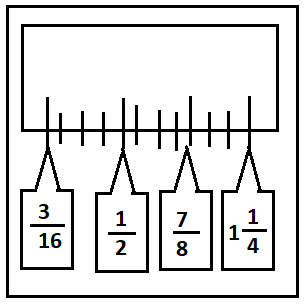
A rational number is given that a ruler is marked at every 1/16 inch.

A rational number is required to convert the improper fraction into decimal and tell whether it is terminating or repeating.

Simplify the given fraction and then find whether it is terminating or repeating.

Given,

Go Math!, Middle School Grade 7, Practice Fluency Workbook, 1st Edition, Chapter 3 Rational Numbers 8

Simplify the given improper fractions.

For 3/16,

3/16=0.1875

As 0.1875 is not repeating, it shows that it is a terminating decimal.

For 1/2,

1/2=0.5

As 0.5 is not repeating, it shows that it is a terminating decimal.

For 7/8,

7/8=0.875

As 0.875 is not repeating, it shows that it is a terminating decimal.

For 11/4,

11/4=5/4

11/4=1.25

​As, 1.25 is not repeating, it shows that it is a terminating decimal.

All the given improper fractions are not repeating, so, they are terminating decimals.

Exercise 3.1 Rational Numbers Solutions For HMH Middle School Grade 7 Workbook Page 16 Problem 9 Answer

An improper fraction is given as, 11×5/6.

A rational number is required to find the decimal for the fraction part and then write the whole improper number as a decimal.

Simplify the improper fraction and convert it into decimal form.

First, separate the whole number part and the fraction part, that is, 11 and 5/6 respectively.

Solve the value for 5/6.

5/6=0.83.

Now, add up the whole number part with the decimal value.

Hence, 11+0.83

11+0.83 =11.83.

The decimal value of the given improper fraction is 11.83.

HMH Middle School Grade 7 Chapter 3 Page 16 Problem 10 Answer

An improper fraction is given as,9×2/9.

A rational number is required to find the decimal for the fraction part and then write the whole improper number as a decimal.

Simplify the improper fraction and convert it into decimal form.

First, separate the whole number part and the fraction part, that is, 9 and 2/9respectively.

Solve the value for 2/9.

2/9=0.2

Now, add up the whole number part with the decimal value.

Hence, 9+0.2=9.2.

Use direct method to solve 9×2/9.

​9×2/9=8×3/9

9×2/9=9.2

Hence, 9×2/9=9.2.

The decimal value of the given improper fraction is 9.2.

Examples Of Problems From Exercise 3.1 Rational Numbers In HMH Grade 7 Workbook Page 16 Problem 11 Answer

A mixed number is given as, 9×2/9.

A rational number is required to use two methods to write the given mixed number as a decimal.

To write the given mixed number as a decimal, in first method rewrite the number and then find decimal for fraction part, in second part write the number as improper fraction and then write the given mixed number as a decimal.

Rewrite the number.

21×5/8=21+5/8

Find decimal for the fraction part.

​5/8=5⋅125/8⋅125

5/8=625/1000

5/8=0.625

​Hence, 5/8=0.625.

Now,

21×5/8=21+5/8

21×5/8=21+0.625

21×5/8=21.625

Hence, 21×5/8=21.625.

Write the number as an improper fraction.

21×5/8=17×3/8

Write the given mixed number as a decimal.

​17×3/8=173⋅125/8⋅125

17×3/8=21625/1000

17×3/8=21.625

​Hence, 17×3/8=21.625.

The mixed number 9×2/9 as a decimal is 21.625.

HMH Middle School Grade 7 Practice Fluency Workbook 1st Edition Chapter 2 Exercise 2.3 Multiplying and Dividing Integers

HMH Middle School Grade 7 Practice Fluency Workbook 1st Edition Chapter 2 Multiplying and Dividing Integers

HMH Grade 7 Practice Fluency Workbook Chapter 2 Exercise 2.3 Solutions Page 13 Problem 1 Answer

It is given the expression (−3)(−2)+8.

It is required to simplify the given expression.

To simplify the given expression, first solve the brackets by using multiplication and then use division to get the required answer.

Solving the brackets by using multiplication and then using division.

(−3)(−2)+8=6+8​

(−3)(−2)+8 =14

So, the value of the expression turns out to be 14.

HMH Grade 7 Practice Fluency Workbook Chapter 2 Exercise 2.3 Solutions Page 13 Problem 2 Answer

The given expression is (−18)÷3+(5)(−2).

It is required to simplify the given expression

To do this apply the BODMAS rule and simplify the expression.

The given expression is (−18)÷3+(5)(−2).

First simplifying the brackets by multiplying and dividing the terms in the above expression.

(−18)÷3+(5)(−2)=−6−10

So, the solution will become−16.

The value after simplifying the expression is−16.

Read and Learn More HMH Middle School Grade 7 Practice Fluency Workbook 1st Edition Solutions

Multiplying And Dividing Integers Exercise 2.3 Chapter 2 Answers HMH Grade 7 Workbook Page 13 Problem 1 Answer

HMH Middle School Grade 7 Practice Fluency Workbook 1st Edition Chapter 2 Exercise 2.3 Multiplying and Dividing Integers

Multiplying And Dividing Integers Exercise 2.3 Chapter 2 Answers HMH Grade 7 Workbook Page 13 Problem 3 Answer

The given expression is 24÷(−6)(−2)+7.

It is required to simplify the given expression.

To do this apply the BODMAS rule and simplify the expression.

The given expression is 24÷(−6)(−2)+7.

First simplifying the brackets by multiplying the terms:

24÷(−6)(−2)+7=24÷12+7

Now solving the terms for division:

24÷12+7=2+7

So, the solution will become 9.

The value after simplifying the expression is 9.

HMH Middle School Grade 7 Practice Fluency Workbook 1st Edition Chapter 2 Page 13 Problem 4 Answer

The given expression is 4(−8)+3.

It is required to simplify the given expression.

To do this apply the BODMAS rule and simplify the expression.

The given expression is4(−8)+3.

First simplifying the brackets by multiplying the terms.

4(−8)+3=−32+3

So, the solution will become−29.

The value after simplifying the expression is −29.

Step-By-Step Solutions For Exercise 2.3 Multiplying And Dividing Integers Hmh Grade 7 Practice Workbook Page 13 Problem 5 Answer

The given expression is (−9)(0)+(8)(−5).

It is required to simplify the given expression.

To do this apply the BODMAS rule and simplify the expression.

The given expression is (−9)(0)+(8)(−5).

First simplifying the brackets by multiplying the terms.

(−9)(0)+(8)(−5)=0−40

So, the solution will become−40.

The value after simplifying the expression is −40.

Exercise 2.3 Multiplying And Dividing Integers Solutions For HMH Middle School Grade 7 Workbook Page 13 Problem 6 Answer

It is given that a boat would have to be lowered 12 feet at Amsterdam, 11 feet at tribes Hill, and 8 feet at Randall.

It is required to evaluate by how much the elevation of the boat changes between Amsterdam and Randall.

Apply the BODMAS and solve it.

Form the expression 12ft. at Amsterdam, 11ft at Tribes Hill, 8ft at Randall.

So, according to given value, −12+(−11)+(−8).

Solving the operator.

​−12+(−11)+(−8)=−(12+11+18)

​−12+(−11)+(−8) =−31​

Hence, it is lowered by 31ft.

Examples Of Problems From Exercise 2.3 Multiplying And Dividing Integers In HMH Grade 7 Workbook Page 13 Problem 7 Answer

It is given that Mrs. Armour bought 7 pairs of socks for $3 each, and a sweater for $12 each.

She found $5 on the sidewalk.

It is required to evaluate the change in amount of money

Apply the BODMAS and solve it.

From the expression, 7 pairs of socks for $3 each.

A sweater for $12 each. $5 on the sidewalk.

So, according to the given value, 7(−3)+(−12)+5.

Solve the expression.

​7(−3)+(−12)+5

​7(−3)+(−12)+5 =−21−12+5

​7(−3)+(−12)+5 =−33+5

​7(−3)+(−12)+5 =−28​

Hence, the value will be decreased by 28.

HMH Middle School Grade 7 Practice Fluency Workbook 1st Edition Chapter 2 Page 14 Problem 8 Answer

It is given −4+(3)(−8)+7.

It is required to find the order and solve it accordingly.

Apply the bodmas and solve it.

Write the given expression.

−4+(3)(−8)+7

Multiply in order from left to right.

​−4+(3)(−8)+7=−4−24+7

​Add and subtract in order from left to right.

​−4−24+7=−28+7

​−4−24+7 =−21

​The operation that is used first is multiplication. The value of −4+(3)(−8)+7 is −21.

Common Core Chapter 2 Exercise 2.3 Multiplying and Dividing Integers detailed solutions HMH Grade 7 Workbook Page 14 Problem 9 Answer

It is given −3+(−8)−6.

It is required to find the order and solve it accordingly.

Apply the bodmas and solve it.

Write the given expression −3+(−8)−6.

Add and subtract in order from left to right.

​−3+(−8)−6=−11−6

​−3+(−8)−6 =−17

​The operation that is used first is addition. The value of −3+(−8)−6 is −17.

HMH Middle School Grade 7 Practice Fluency Workbook 1st Edition Chapter 2 Page 14 Problem 10 Answer

It is given 16+72÷(−8)+6(−2).

It is required to find the order and solve it accordingly.

Apply the BODMAS and solve it.

Write the given expression.

16+72÷(−8)+6(−2)

Multiply and Divide in order from left to right.

​16+72÷(−8)+6(−2)=16+(−9)+(−12)

​Add and subtract in order from left to right.

16+(−9)+(−12)=16−9−12

16+(−9)+(−12) ​=16−21

16+(−9)+(−12) =−5

The operation that is used first is division. The value of 16+72÷(−8)+6(−2) is−5

Student Edition Chapter 2 Exercise 2.3 Multiplying and Dividing Integers HMH Grade 7 Workbook guide Page 14 Problem 11 Answer

It is given 17+8+(−16)−34.

It is required to find the order and solve it accordingly.

Apply the Bodmas and solve it.

Write the given expression.

17+8+(−16)−34

Add and subtract in order from left to right.

​17+8+(−16)−34=25+(−16)−34

17+8+(−16)−34 =25−16−34

17+8+(−16)−34 =9−34

17+8+(−16)−34 =−25

​The operation that is used first is addition. The value of 17+8+(−16)−34 is −25.

HMH Middle School Grade 7 Practice Fluency Workbook 1st Edition Chapter 2 Page 14 Problem 12 Answer

It is given−8+13+(−24)+6(−4).

It is required in this problem to name the operation that is to be done first.

In order to name this problem, the operation that is to be done first, apply the order of operations.

First, apply the order of operations and perform multiplication from left to right.

−8+13+(−24)+6(−4)=−8+13−24−24

Further, perform addition and subtraction from left to right.

​−8+13−24−24=−56+13

​−8+13−24−24 =−43

Hence, the first operation done is a multiplication operation.

Hence, as required in the problem, multiplication operation is the operation that is done first.

Step-by-step answers for Exercise 2.3 Multiplying and Dividing Integers HMH Grade 7 Practice Workbook Page 14 Problem 13 Answer

It is given 12÷(−3)+7(−7).

It is required in this problem to name the operation that is to be done first.

In order to name this problem, the operation that is to be done first, apply the order of operations.

At first, apply the order of operations, perform division and then multiplication from left to right.

12÷(−3)+7(−7)=−4+(−49)

Further, perform addition and subtraction from left to right.

−4+(−49)=−53

Hence, the first operation done is division operation.

Hence, as required in the problem, division operation is the operation that is done first.

HMH Middle School Grade 7 Practice Fluency Workbook 1st Edition Chapter 2 Page 14 Problem 14 Answer

It is given (−5)6+(−12)−6(9).

It is required in this problem to name the operation that is to be done first.

In order to name this problem, the operation that is to be done first, apply the order of operations.

First, apply the order of operations and perform multiplication from left to right.

(−5)6+(−12)−6(9)=−30+(−12)−54

Further, perform addition and subtraction from left to right.

−30+(−12)−54=−96

Hence, the first operation done is a multiplication operation.

Hence, as required in the problem, multiplication operation is the operation that is done first.

Page 14 Problem 15 Answer

It is given 14−(−9)−6−5.

It is required in this problem to name the operation that is to be done first.

In order to name this problem, the operation that is to be done first, apply the order of operations.

At first, apply the order of operations, perform addition and subtraction from left to right.

​14−(−9)−6−5=14+9−6−5

​14−(−9)−6−5 =23−11

​14−(−9)−6−5 =12

Hence, the first operation done is an addition operation.

Hence, as required in the problem, addition operation is the operation that is done first.

HMH Middle School Grade 7 Practice Fluency Workbook 1st Edition Chapter 2 Page 14 Problem 16 Answer

It is given (−6)+5(−2)+15.

It is required in this problem to find the value of a given expression.

In order to find in this problem the value of a given expression, apply the order of operations.

First, apply the order of operations and perform multiplication from left to right.

(−6)+5(−2)+15=−6−10+15

Further, perform addition and subtraction from left to right.

−6−10+15=−1

Hence, (−6)+5(−2)+15=−1.

Hence, the value of the expression given is (−6)+5(−2)+15=−1.

Hence, as required in the problem, the value of the expression given is (−6)+5(−2)+15=−1.

Page 14 Problem 17 Answer

It is given (−8)+(−19)−4.

It is required in this problem to find the value of a given expression.

In order to find in this problem the value of a given expression, apply the order of operations.

At first, apply the order of operations, perform addition and subtraction from left to right.

​(−8)+(−19)−4=−8−19−4

​(−8)+(−19)−4 =−31

Hence, (−8)+(−19)−4=−31.

Hence, the value of the expression given is (−8)+(−19)−4=−31.

Hence, as required in the problem, the value of the expression given is (−8)+(−19)−4=−31.

HMH Middle School Grade 7 Practice Fluency Workbook 1st Edition Chapter 2 Page 14 Problem 18 Answer

It is given 3+28÷(−7)+5(−6).

It is required in this problem to find the value of a given expression.

In order to find in this problem the value of a given expression, apply the order of operations.

At first, apply the order of operations, perform division first and then multiplication from left to right.

3+28÷(−7)+5(−6)=3+(−4)+(−30)

Further, perform addition and subtraction from left to right.​

3+(−4)+(−30)=3−4−30

3+(−4)+(−30) =−31

Hence, 3+28÷(−7)+5(−6)=−31.

Hence, the value of the expression given is 3+28÷(−7)+5(−6)=−31.

Hence, as required in the problem, the value of the expression given is 3+28÷(−7)+5(−6)=−31.

Page 14 Problem 19 Answer

It is given 15+32+(−8)−6.

It is required in this problem to find the value of a given expression.

In order to find in this problem the value of a given expression, apply the order of operations.

At first, apply the order of operations, perform addition and subtraction from left to right.

​15+32+(−8)−6=15+32−8−6

​15+32+(−8)−6 =47−14

​15+32+(−8)−6 =33

Hence, 15+32+(−8)−6=33.

Hence, the value of the expression given is 15+32+(−8)−6=33.

Hence, as required in the problem, the value of the expression given is 15+32+(−8)−6=33.

HMH Middle School Grade 7 Practice Fluency Workbook 1st Edition Chapter 2 Page 14 Problem 20 Answer

It is given (−5)+22+(−7)+8(−9).

It is required in this problem to find the value of a given expression.

In order to find in this problem the value of a given expression, apply the order of operations.

At first, apply the order of operations, perform multiplication from left to right.

(−5)+22+(−7)+8(−9)=−5+22−7+(−72)

Further, perform addition and subtraction from left to right.

−5+22−7+(−72)=−5−7−72+22

−5+22−7+(−72) =−84+22

−5+22−7+(−72) =−62

Hence, (−5)+22+(−7)+8(−9)=−62.

Hence, the value of the expression given is (−5)+22+(−7)+8(−9)=−62.

Hence, as required in the problem, the value of the expression given is (−5)+22+(−7)+8(−9)=−62.

Page 14 Problem 21 Answer

It is given 21÷(−7)+5(−9).

It is required in this problem to find the value of a given expression.

In order to find in this problem the value of a given expression, apply the order of operations.

At first, apply the order of operations, perform division first and then multiplication from left to right.

21÷(−7)+5(−9)=(−3)+(−45)

Further, perform addition and subtraction from left to right.

​(−3)+(−45)=−3−45

​(−3)+(−45) =−48

Hence, 21÷(−7)+5(−9)=−48.

Hence, the value of the expression given is 21÷(−7)+5(−9)=−48.

Hence, as required in the problem, the value of the expression given is 21÷(−7)+5(−9)=−48.

HMH Middle School Grade 7 Practice Fluency Workbook 1st Edition Chapter 2 Exercise 2.2 Multiplying and Dividing Integers

Go Math! Middle School Grade 7 Practice Fluency Workbook 1st Edition Chapter 2 Multiplying and Dividing Integers

HMH Grade 7 Practice Fluency Workbook Chapter 2 Exercise 2.2 Solutions Page 10 Problem 1 Answer

In the question, it is given the expression which is −38÷2

It is required to find out the quotient of the given expression.

To solve this question divide 2 by −38.

−38÷2 is the given expression.

−38÷(−2)=38÷2=19

​(Divide the absolute values of the two numbers; the sign of the quotient is a plus because the numbers that are going to divide have the same sign)

The quotient of the given expression is 19.

HMH Middle School Grade 7 Practice Fluency Workbook 1st Edition Chapter 2 Page 10 Problem 2 Answer

In the question, it is given the expression which is −28÷7.

It is required to find out the quotient of the given expression.

To solve this question divide 7 by −28.

−28÷7 is the given expression.

​−28÷7=−(28÷7)=−4

​(Divide the absolute values of the two numbers; the sign of the quotient is minus because the numbers that are going to divide have different signs)

The quotient of the given expression is −4.

Read and Learn More HMH Middle School Grade 7 Practice Fluency Workbook 1st Edition Solutions

HMH Middle School Grade 7 Practice Fluency Workbook 1st Edition Chapter 2 Page 10 Problem 3 Answer

HMH Middle School Grade 7 Practice Fluency Workbook 1st Edition Chapter 2 Exercise 2.2 Multiplying and Dividing Integers

​(Divide the absolute values of the two numbers; the sign of the quotient is a plus because the numbers that are going to divide have the same sign)

The quotient of the given expression is 11.

HMH Middle School Grade 7 Practice Fluency Workbook 1st Edition Chapter 2 Page 10 Problem 4 Answer

It is given−35÷4.

It is required to find the quotient of −35÷4.

To find the quotient of −35÷4, it is necessary to solve the given expression.

Perform the division on expression −35÷4.

Divide the numerical values of the two numbers.

−35÷4=−(35÷4)

The sign of the quotient will be minus because the given numbers have different signs .

Hence, the quotient is −(35÷4)=−8.75.

The quotient of −35÷4 is−8.75.

HMH Middle School Grade 7 Practice Fluency Workbook 1st Edition Chapter 2 Page 10 Problem 5 Answer

It is given (−6−4)÷2.

It is required to simplify the given expression (−6−4)÷2.

To simplify the given expression (−6−4)÷2, it is necessary to break the parentheses.

Perform the subtraction inside the parentheses.

(−6−4)÷2=−10÷2

Now, perform the division on expression−10÷2.

Divide the absolute values of the two numbers.

−10÷2=−(10÷2)

The sign of the quotient will be minus because the given numbers have different signs.

Hence, the quotient is−(10÷2)=−5.

The expression (−6−4)÷2 can be simplified into −5.

HMH Middle School Grade 7 Practice Fluency Workbook 1st Edition Chapter 2 Page 10 Problem 6 Answer

It is given 5(−8)÷4.

It is required to simplify the given expression 5(−8)÷4.

To simplify the given expression 5(−8)÷4, it is necessary to perform the multiplication.

Perform the multiplication on expression5(−8)÷4.

Multiply the numerical values of the two numbers.

5(−8)÷4=−(5⋅8)÷4

It is known that the sign of the product will be minus because the given numbers have different signs.

Hence, the product will be −(5⋅8)÷4=−40÷4.

Again, perform the division on expression −40÷4.

Divide the numerical values of the two numbers.

−40÷4=−(40÷4)

The sign of the quotient will be minus because the given numbers have different signs.

Hence, the quotient is −(40÷4)=−10.

The expression 5(−8)÷4 can be simplified into−10.

Multiplying And Dividing Integers Exercise 2.2 Chapter 2 Answers Hmh Grade 7 Workbook Page 10 Problem 7 Answer

It is given a phrase- thirty-two divided by the opposite of 4.

It is required to write a mathematical expression for the given phrase.

To write a mathematical expression for the given phrase, it is necessary to understand the keywords in the phrase.

Here, the opposite of 4 implies the negative integer −4.

Also, thirty-two is divided by the opposite of 4. It implies 32÷(−4).

The mathematical expression for the given phrase- thirty-two divided by the opposite of 4 is 32÷(−4).

HMH Middle School Grade 7 Practice Fluency Workbook 1st Edition Chapter 2 Page 10 Problem 8 Answer

It is given a phrase- the quotient of the opposite of 30 and 6, plus the opposite of 8.

It is required to write a mathematical expression for the given phrase.

To write a mathematical expression for the given phrase, it is necessary to understand the keywords in the phrase.

Here, the opposite of 30  implies the negative integer −30.

The quotient of the opposite of 30 and 6 can be obtained by dividing −30 and 6. It is written as (−30)÷6.

Also, the opposite of 8 is −8.

Now, the quotient of the opposite of 30 and 6, plus the opposite of 8 implies the addition of (−30)÷6 and −8.

It is written as(−30)÷6+(−8).

Hence, the required mathematical expression is (−30)÷6+(−8).

The mathematical expression for the given phrase- the quotient of the opposite of 30 and 6, plus the opposite of 8 is (−30)÷6+(−8).

HMH Middle School Grade 7 Practice Fluency Workbook 1st Edition Chapter 2 Page 10 Problem 9 Answer

It is given a phrase- the quotient of 12 and the opposite of 3 plus the product of the opposite of 14 and 4.

It is required to write a mathematical expression for the given phrase.

To write a mathematical expression for the given phrase, it is necessary to understand the keywords in the phrase.

Here, the opposite of 3 implies the negative integer −3.

The quotient of 12 and the opposite of 3 indicates the division of 12 and −3. It is written as 12÷(−3).

Also, the opposite of 14 implies the negative integer −14.

The product of 14 and the opposite of 4 indicates the multiplication of −14 and 4. It is written as (−14)⋅4.

Now, the quotient of 12 and the opposite of 3 plus the product of the opposite of [14] and 4 implies the addition of 12÷(−3) and (−14)⋅4.

The required mathematical expression is 12÷(−3)+(−14)⋅4

The mathematical expression for the given phrase- the quotient of 12 and the opposite of 3 plus the product of the opposite of 14 and 4 is 12÷(−3)+(−14)⋅4.

Step-By-Step Solutions For Exercise 2.2 Multiplying And Dividing Integers HMH Grade 7 Practice Workbook Page 10 Problem 10 Answer

It is given that an athletic department of a school bought 40 soccer uniforms at a cost of $3000 and they returned some of the uniforms for which they only received $40 per uniform.

It is required to find out the difference between the amount the school paid for each uniform and the amount they got for each return.

To find out the difference between the amount the school paid for each uniform and the amount they got for each return, it is necessary to obtain the amount the school paid for each uniform using division operation.

If the school bought 40 soccer uniforms at a cost of$3000, then the amount the school paid for each uniform will be$3000÷40=$75.

Thus, the amount the school paid for each uniform is $75.

Also, it is given that the school received $40 per uniform for each return.

Hence, the difference between the amount the school paid for each uniform and the amount they got for each return will be $75−$40=$35.

The difference between the amount the school paid for each uniform and the amount they got for each return is$35.

Exercise 2.2 Multiplying And Dividing Integers Solutions For HMH Middle School Grade 7 Workbook Page 10 Problem 11 Answer

It is given that the savings account of a commuter has $245 and it changes by−$15 each week when he buys a ticket.

The account changed by−$240 in one time period.

It is required to find the number of weeks the commuter buys tickets.

To find the number of weeks the commuter buys tickets, it is necessary to form a mathematical expression modeling the given situation.

If the commuter’s account changed by −$240 in one time period and it changes by  −$15 each week, then the number of weeks the commuter buys tickets is given by −240÷(−15).

Solve the expression−240÷(−15).

Divide the values −240and −15. The quotient will be positive since both the integers are negative.

240÷15=16

Hence, the required number of weeks is 16.

The number of weeks the commuter buys tickets is 16.

HMH Middle School Grade 7 Practice Fluency Workbook 1st Edition Chapter 2 Page 10 Problem 12 Answer

It is given that the savings account of a commuter has $245 and it changes by −$15 each week when he buys a ticket. The account changed by−$240 in one time period.

It is required to find the amount he must add to his account if he wants to have 20 weeks worth of tickets in his account.

To find the amount he must add to his account if he wants to have 20 weeks worth of tickets in his account, it is necessary to form a mathematical expression modeling the given situation.

If he spends $15 when he buys a ticket each week, then the number of tickets to buy for 20 weeks will be 20×15.

If the commuter has $245 in his account, then the amount he must add to his account if he wants to have 20 weeks worth of tickets will be 20×15−245.

Solve the expression 20×15−245.

20×15−245=300−245

On calculating,300−245=55

Hence, the required amount is $55.

The amount he must add to his account if he wants to have 20 weeks worth of tickets in his account is $55.

Examples Of Problems From Exercise 2.2 Multiplying And Dividing Integers In HMH Grade 7 Workbook Page 10 Problem 13 Answer

It is given the expression −39/3.

It is required to find in which direction an arrow that represents the dividend point, dividend, sign of divisor and sign of quotient.

To find in which direction an arrow represents the dividend point, draw the number line and draw an arrow to the left from 0 to the value of the dividend,−39.

To find the dividend, see the number which is going to be divided.

To find the sign of the divisor see the sign of divisor given in the question.

To find the sign of quotient see the sign of divisor and dividend.

Drawing the number line and drawing an arrow to the right from 0 to the value of dividend, −39.

Go Math!, Middle School Grade 7, Practice Fluency Workbook, 1st Edition, Chapter 2 Multiplying and Dividing Integers 13

Here, dividend =−39.

Sign of divisor is negative.

Since the sign of dividend and divisor are different, so the sign of quotient is negative.

So, in the left hand side the direction of the arrow represents the dividend point, dividend =−39.

Sign of divisor is equal to negative and sign of quotient is negative.

HMH Middle School Grade 7 Practice Fluency Workbook 1st Edition Chapter 2 Exercise 2.1 Multiplying and Dividing Integers

HMH Middle School Grade 7 Practice Fluency Workbook 1st Edition Chapter 2 Multiplying and Dividing Integers

Page 9 Problem 1 Answer

In this question it is given that the expression is 4(−20).

It is required to calculate the product of the given expression.

The product is in the form (+a)(−b)=−ab

Hence, 4(−20)=−80.

The product is 4(−20)=−80.

HMH Grade 7 Practice Fluency Workbook Chapter 2 Exercise 2.1 Solutions Page 9 Problem 2 Answer

In this question it is given that the expression is −6(12).

It is required to calculate the product of the given expression.

The product is in the form (−a)(+b)=−ab

Hence−6(12)=−72.

The product is −6(12)=−72.

Read and Learn More HMH Middle School Grade 7 Practice Fluency Workbook 1st Edition Solutions

HMH Middle School Grade 7 Practice Fluency Workbook 1st Edition Chapter 2 Page 9 Problem 3 Answer

In this question it is given that the expression is13(−3).

It is required to calculate the product of the given expression.

The product is in the form (+a)(−b)=−ab

Hence 13(−3)=−39.

The product is 13(−3)=−39.

Multiplying And Dividing Integers Exercise 2.1 Chapter 2 Answers HMH Grade 7 Workbook Page 9 Problem 4 Answer

In this question it is given that the expression is −10(0).

It is required to calculate the product of the given expression.

The product is in the form (−a)(+b)=−ab

Hence−10(0)=0.

The product is −10(0)=0

HMH Middle School Grade 7 Practice Fluency Workbook 1st Edition Chapter 2 Page 9 Problem 5 Answer

HMH Middle School Grade 7 Practice Fluency Workbook 1st Edition Chapter 2 Exercise 2.1 Multiplying and Dividing Integers

Step-By-Step Solutions For Exercise 2.1 Multiplying And Dividing Integers HMH Grade 7 Practice Workbook” Page 9 Problem 6 Answer

In this question, it is given that the expression is −9(−21).

It is required to calculate the product of the given expression.

The product is in the form (−a)(−b)=+ab

Hence −9(−21)=189.

The product is −9(−21)=189.

HMH Middle School Grade 7 Practice Fluency Workbook 1st Edition Chapter 2 Page 9 Problem 7 Answer

In this question it is given that the expression is18(−4).

It is required to calculate the product of the given expression.

The product is in the form(+a)(−b)=−ab

Hence 18(−4)=−72.

The product is 18(−4)=−72.

Exercise 2.1 Multiplying And Dividing Integers Solutions For HMH Middle School Grade 7 Workbook Page 9 Problem 8 Answer

In this question , it is given the product10(8).

It is required to evaluate each product.

To solve this , Perform the multiplication. Multiply the absolute values of the two numbers.

If the sign of the two numbers being multiplied is same, then the sign of the result will be + otherwise it will be −.

Write the evaluated number with the appropriate sign.

The given expression is 10(8)

Performing the multiplication.

Multiplying the absolute values of the two numbers.

The sign of the result is because the numbers which are getting multiplied is of same sign.

​10(8)=10⋅8

10(8)=80

​The value of 10(8)  is 80.

HMH Middle School Grade 7 Practice Fluency Workbook 1st Edition Chapter 2 Page 9 Problem 9 Answer

In this question , it is given the product9(−6).

It is required to evaluate each product.

To solve this , Perform the multiplication.

Multiply the absolute values of the two numbers.

If the sign of the two numbers being multiplied is same, then the sign of the result will be + otherwise it will be −.

Write the evaluated number with the appropriate sign.

The given expression is 9(−6)

Performing the multiplication.

Multiplying the absolute values of the two numbers.

The sign of the result is −because the numbers which are getting multiplied is of different sign.

​9(−6)=9⋅−6

9(−6)=−54

​The value of 9(−6) is −54.

Examples Of Problems From Exercise 2.1 Multiplying And Dividing Integers In HMH Grade 7 Workbook Page 9 Problem 10 Answer

In this question, it is given the product −7(−7).

It is required to evaluate each product.

To solve this, Perform the multiplication. Multiply the absolute values of the two numbers.

If the sign of the two numbers being multiplied is the same, then the sign of the result will be + otherwise it will be −.

Write the evaluated number with the appropriate sign.

The given expression is−7(−7)

Performing the multiplication.

Multiplying the absolute values of the two numbers.

The sign of the result is because the numbers that are getting multiplied is of the same sign.

​−7(−7)=−7⋅−7

−7(−7)=49

​The value of −7(−7) is 49.

HMH Middle School Grade 7 Practice Fluency Workbook 1st Edition Chapter 2 Page 9 Problem 11 Answer

In this question, it is given that you play a game where you score −6 for the first turn and on each of the next 3 turns.

It is required to tell what will be the score after those 4 turns.

To solve this, write a mathematical expression to represent the score after 4 turns.

This will be the product of −6 and 4. Perform the multiplication. Multiply the absolute values of the two numbers.

If the sign of the two numbers being multiplied is the same, then the sign of the result will be + otherwise it will be −.

Write the evaluated number with the appropriate sign.

It is given that you play a game where you score −6 for the first turn and on each of the next 3 turns.

That means −6 was scored 4 times.

The total will be 4 times of −6.

This will be the product of −6 and 4.,Perform the multiplication.

−6⋅4=−24

The sign will be − because the numbers being multiplied are of different signs.

The total score after 4 turns is −24.

HMH Middle School Grade 7 Practice Fluency Workbook 1st Edition Chapter 2 Page 9 Problem 12 Answer

In this question it is given that the outdoor temperature declines 3 degrees each hour for 5 hours.

It is required to find the change in temperature at the end of those 5 hours.

To solve this, write a mathematical expression to represent the change in temperature at the end of those 5 hours.

This will be the product of −3 and 5. Perform the multiplication. Multiply the absolute values of the two numbers.

If the sign of the two numbers being multiplied is same, then the sign of the result will be + otherwise it will be −.

Write the evaluated number with the appropriate sign.

It is given that the outdoor temperature declines 3 degrees each hour for 5 hours.

That means the temperature declined −3 degrees 5 times.

This will be the product of −3 and 5.

Perform the multiplication.

−3⋅5=−15

The sign will be − because the numbers being multiplied are of different signs.

The change in temperature at the end of those 5 hours is 15∘.

HMH Middle School Grade 7 Practice Fluency Workbook 1st Edition Chapter 2 Page 9 Problem 13 Answer

In this question it is given you have dollar 200 in a savings account. Each week for 8 weeks, you take out dollar 18 for spending money.

It is required to find how much money will be there in the account at the end of 8 weeks.

To solve this, write a mathematical expression to represent the money that will be there in the account at the end of 8 weeks.

The total money spend from the account will be the product of 18 and 8.

Perform the multiplication. Multiply the absolute values of the two numbers.

If the sign of the two numbers being multiplied is same, then the sign of the result will be + otherwise it will be −.

Write the evaluated number with the appropriate sign.

Subtract this amount from the total money in the account to get the amount of money left in account at the end of 8 weeks.

Write a mathematical expression to represent the money that  will be there in the account at the end of 8 weeks.

The total money spend from the account will be the product of 18 and 8.

Subtract this amount from the total money in the account to get the amount of money left in account at the end of 8 weeks.

200−8(18)

The sign will be − because the numbers being multiplied are of different signs.

200−144=56

Therefore , there will be 56 dollars in the account at the end of 8 weeks.

There will be 56 dollars in the account at the end of 8 weeks.

HMH Middle School Grade 7 Practice Fluency Workbook 1st Edition Chapter 2 Page 9 Problem 14 Answer

In this question it is given that the outdoor temperature was 8 degrees at midnight.

the temperature declined 5 degrees during each of the next 3 hours.

It is required to find the temperature at 3 a.m.

To solve this, write a mathematical expression to represent the temperature at 3 a.m.

This will be the product of 3 and 5. Perform the multiplication.

Multiply the absolute values of the two numbers.

If the sign of the two numbers being multiplied is same, then the sign of the result will be + otherwise it will be −.

Write the evaluated number with the appropriate sign. Subtract this number from 8 to get the temperature at 3 a.m.

It is given that the outdoor temperature was 8 degrees at midnight . The temperature declined 5 degrees during each of the next 3 hours.

Write a mathematical expression to represent the temperature at 3 a.m.

8−3(5)

Perform the multiplication. Multiply the absolute values of the two numbers.

If the sign of the two numbers being multiplied is same, then the sign of the result will be + otherwise it will be −.8−15=−7

The temperature at 3 a.m. is −7∘.

HMH Middle School Grade 7 Practice Fluency Workbook 1st Edition Chapter 2 Page 9 Problem 15 Answer

In this question it is given that the price of the stock was 325 a share. The price of the stock went down 25 each week for 6 weeks.

It is required to find the price of the stock at the end of  6 weeks.

To solve this, write a mathematical expression to represent the price of the stock at the end of  6 weeks.

The price decreased of the stock will be the product of 25 and 6 weeks. Subtract this value from the original value of stock to find the price of the stock at the end of  6 weeks.

It is given that the price of the stock was 325 a share.

The price of the stock went down 25 each week for 6 weeks.

write a mathematical expression to represent the price of the stock at the end of  6 weeks.

The price decreased of the stock will be the product of 25 and 6 weeks.

Subtract this value from the original value of stock to find the price of the stock at the end of  6weeks.

Perform the multiplication. Multiply the absolute values of the two numbers.

If the sign of the two numbers being multiplied is same, then the sign of the result will be +otherwise it will be −.

​325−6(25)=325−150

325−6(25)=175

Therefore, the price of the stock at the end of  6 weeks is 175.

The price of the stock at the end of  6 weeks is 175.

HMH Middle School Grade 7 Practice Fluency Workbook 1st Edition Chapter 2 Page 10 Problem 16 Answer

In this question , it is given the product 1(−2).

It is required to evaluate each product.

To solve this , Perform the multiplication.

Multiply the absolute values of the two numbers.

If the sign of the two numbers being multiplied is same, then the sign of the result will be + otherwise it will be−.

Write the evaluated number with the appropriate sign.

The given expression is 1(−2)

Performing the multiplication.

Multiplying the absolute values of the two numbers.

The sign of the result is −because the numbers which are getting multiplied are of different sign.

​1(−2)=1⋅−2

1(−2)=−2

​The value of 1(−2) is −2.

HMH Middle School Grade 7 Practice Fluency Workbook 1st Edition Chapter 2 Page 10 Problem 17 Answer

In this question, it is given the product −6(−3).

It is required to evaluate each product.

To solve this , Perform the multiplication.

Multiply the absolute values of the two numbers.

If the sign of the two numbers being multiplied is same, then the sign of the result will be+ otherwise it will be −.

Write the evaluated number with the appropriate sign.

The given expression is−6(−3)

Performing the multiplication.

Multiplying the absolute values of the two numbers.

The sign of the result is+because the numbers which are getting multiplied is of same sign.

​−6(−3)=−6⋅−3

−6(−3)=18

​The value of −6(−3) is 18.

HMH Middle School Grade 7 Practice Fluency Workbook 1st Edition Chapter 2 Page 10 Problem 18 Answer

In the question, the expression is given which is (5)(−1).

It is required to find out the product of the given expression.

To solve the question multiply the (5) by (−1).

(5)(−1) is the given expression.

​(5)(−1)=−(5.1) =−5

(Multiply the absolute values of the two numbers, the sign of the product is minus

Because the numbers that are going to multiply have different signs)

The product of the given expression is −5.

HMH Middle School Grade 7 Practice Fluency Workbook 1st Edition Chapter 2 Page 10 Problem 19 Answer

In the question, the expression is given which is (−9)(−6).

It is required to find out the product of the given expression.

To solve the question, multiply the (−9) by (−6).

(−9)(−6) is the given expression.

​(−9)(−6)=9.6​

(−9)(−6)=9.6

​(Multiply the absolute values of the two numbers; the sign of the product =54

​The product of the given expression is  54.

HMH Middle School Grade 7 Practice Fluency Workbook 1st Edition Chapter 2 Page 10 Problem 20 Answer

In the question, the expression is given which is 11(4).

It is required to find out the product of the given expression.

To solve the question, multiply the 11 by (4).

In the question, the expression is given which is 11(4).

It is required to find out the product of the given expression.

To solve the question, multiply the 11 by (4).

The product of the given expression is 44.

HMH Middle School Grade 7 Practice Fluency Workbook 1st Edition Chapter 2 Page 10 Problem 21 Answer

In the question, it is given a situation that you are playing a game and start from 0. Then, score −8 points on each 4 turns.

It is required to write a mathematical expression to represent the situation and then find the score after those 4 turns.

To solve the question understand the situation and then write the mathematical expression.

Let 4(−8) be the mathematical expression to represent the score after 4 turns.

​4(−8)=−(4.8)

​4(−8) =−32

​(Multiply the absolute values of the two numbers; the sign of the product is minus because the numbers that are going to multiply have different signs)

The score after  4 turns is −32 points.

HMH Middle School Grade 7 Practice Fluency Workbook 1st Edition Chapter 2 Page 10 Problem 22 Answer

In the question, it is given that a mountaineer descends a mountain for 5 hours. On average, she climbs down 500 feet each hour.

It is required to write a mathematical expression to represent the situation and find what is her change in elevation after 5 hours.

To solve the question, understand the situation and then write the mathematical expression.

Let 5(−500) be the mathematical expression to represent the change of elevation after 5 hours.

​​5(−500)=−(5.500)

​​5(−500) =−2500

​ (Multiply the absolute values of the two numbers; the sign of the product is minus because the numbers that are going to multiply have different signs)

The change of elevation after 5 hours is −2500 feet.

HMH Middle School Grade 7 Practice Fluency Workbook 1st Edition Chapter 1 Exercise 1.4 Adding and Subtracting Integers

HMH Middle School Grade 7 Practice Fluency Workbook 1st Edition Chapter 1 Adding and Subtracting Integers

HMH Grade 7 Practice Fluency Workbook Chapter 1 Exercise 1.4 Solutions Page 7 Problem 1 Answer

It is given that Owen starts with the bait 2 feet below the surface of the water and reels out the bait 19 feet, then reels it back in 7 feet.

It is required to find the final position of the bait relative to the surface of the water.

To do so write an expression to represent the situation and find the absolute value for the first two numbers and then subtract the smaller absolute value from the higher absolute value and the result will take the sign of the higher absolute value.

Repeat the process for the result obtained and the third number.

As a result, the final position of the bait relative to the surface of the water can be determined.

Represent the situation as an expression and find the absolute value for the first two numbers.

The expression can be represented as −2+19−7.

Read and Learn More HMH Middle School Grade 7 Practice Fluency Workbook 1st Edition Solutions

HMH Middle School Grade 7 Practice Fluency Workbook 1st Edition Chapter 1 Exercise 1.4 Adding and Subtracting Integers

The final position of the bait is 10 feet above the water.

HMH Middle School Grade 7 Practice Fluency Workbook 1st Edition Chapter 1 Page 7 Problem 2 Answer

It is given that Rita earned 45 points on a test, lost 8 points, earned 53 points, and then lost 6 points.

It is required to find Rita’s final score on the test.

To do so write an expression to represent the situation and find the absolute value for the first two numbers and then subtract the smaller absolute value from the higher absolute value and the result will take the sign of the higher absolute value.

Repeat the process for the result obtained and the third number.

Again repeat the process for the result obtained and the fourth number.

As a result, Rita’s final score on the test can be determined.

Represent the situation as an expression and find the absolute value for the first two numbers.

The expression for the given situation can be represented as 45−8+53−6.

The absolute values 45+(−8) are,∣45∣=45 and,∣−8∣=8

Subtract the number with a lower absolute value from the number with a higher absolute value and the answer takes the sign of the higher absolute value.

45−8=37

Therefore the expression 45+(−8) becomes, 45−8=37

Find the absolute values for the numbers in 37+53  and add their absolute values and result takes the sign of the higher absolute values.

∣37∣=37 and,∣53∣=53

Add the absolute values and the answer takes the sign of the higher absolute value.

37+53=90

Find the absolute values for the numbers in 90−6.

The absolute values 90+(−6) are,∣90∣=90 and,∣−6∣=6

Subtract the number with a lower absolute value from the number with a higher absolute value and the answer takes the sign of the higher absolute value.

90−6=84

The expression 90+(−6) becomes,90−6=84

The value of the expression45−8+53−6 is 84.

Rita’s final score on the test is 84.

HMH Middle School Grade 7 Practice Fluency Workbook 1st Edition Chapter 1 Page 7 Problem 3 Answer

Given the expression −7+12+15.

It is required to find the value of the expression.

To do so, find the absolute value for the first two numbers and then subtract the smaller absolute value from the higher absolute value and the result will take the sign of the higher absolute value.

Repeat the process for the result obtained and the third number in the expression.

As a result the value of the expression can be determined.

Find the absolute value for the first two numbers in the expression.

The absolute values are,∣−7∣=7 and,∣12∣=12

Subtract the number with a lower absolute value from the number with a higher absolute value and the answer takes the sign of the higher absolute value.

12−7=5

Therefore the expression −7+12 becomes, −7+12=5

Find the absolute values for the numbers 5 and 15,∣5∣=5 and,∣15∣=15

Add these absolute values and the answer takes the sign of the higher absolute value.

15+5=20

The value of the of the expression is 20.

HMH Middle School Grade 7 Practice Fluency Workbook 1st Edition Chapter 1 Page 7 Problem 4 Answer

Given the expression −5−9−13.

It is required to find the value of the expression.

To do so, find the absolute value for the first two numbers and then add the absolute values of the numbers and the answer takes the same sign as the numbers.

Repeat the process for the result obtained and the third number in the expression.

As a result the value of the expression can be determined.

Find the absolute value for the first two numbers in the expression.

The absolute values of −5+(−9) are,∣−5∣=5 and,∣−9∣=9.

Add these absolute values and the result takes same sign as the numbers.

5+9=14

The expression −5+(−9) becomes,−5−9=−14

Find the absolute values for the numbers in the expression −14−13.

The absolute values for −14+(−13) are,∣−14∣=14 and,∣−13∣=13.

Add these absolute values and answer takes the same sign as the numbers.

14+13=27

The expression −14+(−13) becomes,−14−13=−27

The value of the expression is −27.

HMH Middle School Grade 7 Practice Fluency Workbook 1st Edition Chapter 1 Page 7 Problem 5 Answer

The given expression is −21−17+25+65.

It is required to find the value of the given expression.

To find the value of the given expression, first combine the terms with same sign.

Then add the terms in the parenthesis. Transfer the subtraction into addition by changing the sign of the first number.

Therefore, this will become the addition of two integers with different signs.

To solve that, determine the absolute values of both numbers.

Then subtract the number with a lower absolute value from the number with the higher absolute value.

Finally, assign the sign of the number with the higher absolute value to the answer.

Combine the terms with same sign.

Then add the terms in the parenthesis.

​−21−17+25+65=−(21+17)+25+65

−21−17+25+65=−38+90

​Transfer the subtraction into addition by changing the sign of the first number and determine the absolute values of both numbers.

−21−17+25+65=(−38)+90

∣−38∣=38 and ∣90∣=90

Subtract the number with a lower absolute value from the number with the higher absolute value and assign the sign of the number with the higher absolute value to the answer.

Here, 90>38.

90−38=52

The larger number 90 has positive sign and therefore,

​(−38)+90=52

−21−17+25+65=52

​The value of the given expression is 52.

HMH Middle School Grade 7 Practice Fluency Workbook 1st Edition Chapter 1 Page 7 Problem 6 Answer

The given expression is 12+19+5−2.

It is required to find the value of the given expression.

To find the value of the given expression, first, combine the terms with same sign.

Then add the terms in the parenthesis.

Transfer the subtraction into addition by changing the sign of the second number.

Therefore, this will become the addition of two integers with different signs.

To solve that, determine the absolute values of both numbers.

Then subtract the number with a lower absolute value from the number with the higher absolute value.

Finally, assign the sign of the number with the higher absolute value to the answer.

Combine the terms with same sign. Then add the terms in the parenthesis.

​12+19+5−2=(12+19+5)−2

12+19+5−2=36−2

​Transfer the subtraction into addition by changing the sign of the second number and determine the absolute values of both numbers.

12+19+5−2=36+(−2)

∣36∣=36 and ∣−2∣=2

Subtract the number with a lower absolute value from the number with the higher absolute value and assign the sign of the number with the higher absolute value to the answer.

Here, 36>2.

36−2=34

The larger number 36 has positive sign and therefore,

​36+(−2)=34

12+19+5−2=34

​The value of the given expression is 34.

HMH Middle School Grade 7 Practice Fluency Workbook 1st Edition Chapter 1 Page 7 Problem 7 Answer

The given expression is 31−4+6 ◯ −17+22−5.

It is required to compare the expressions and write <,> or =.

To find the result, solve the expressions on both the sides.

First, combine the terms with same sign.

Then add the terms in the parenthesis.

Transfer the subtraction into addition by changing the sign of the first number.

Therefore, this will become the addition of two integers with different signs.

To solve that, determine the absolute values of both numbers.

Then subtract the number with a lower absolute value from the number with the higher absolute value.

Finally, assign the sign of the number with the higher absolute value to the answer.

Combine the terms with same sign. Then add the terms in the parenthesis.

31−4+6 ◯ −17+22−5

(31+6)−4 ◯ −(17+5)+22

37−4 ◯ −22+22​

Transfer the subtraction into addition by changing the sign of the first number and determine the absolute values of both numbers in the left hand side.

37+(−4) ◯ (−22)+22

∣37∣=37 and ∣−4∣=4

Subtract the number with a lower absolute value from the number with the higher absolute value and assign the sign of the number with the higher absolute value to the answer.

Here, 37>4.

37−4=33

The larger number 37 has positive sign and therefore,37+(−4)=33 (1)

Transfer the subtraction into addition by changing the sign of the first number and determine the absolute values of both numbers in the right hand side.

37+(−4) ◯ (−22)+22

∣−22∣=22 and ∣22∣=22

Subtract the number with a lower absolute value from the number with the higher absolute value and assign the sign of the number with the higher absolute value to the answer.

Here, 22=22.

22−22=0

(−22)+22=0 (2)

From (1) and (2),33>0

The given expression can be written as 31−4+6>−17+22−5.

HMH Middle School Grade 7 Practice Fluency Workbook 1st Edition Chapter 1 Page 7 Problem 8 Answer

It is given that Anna and Maya are competing in a dance tournament where a dancer earns points if a dance move is done correctly and losses points if dance move is done incorrectly.

It is also given that Anna currently has 225 points.

It is also given that before the dance routine ends Anna earns 75 points and losses 30 points.

It is required to find Anna’s final score.

To find Anna’s final score, add the points earned and subtract the points loosed from her current score.

First, combine the terms with same sign. Then add the terms in the parenthesis.

Transfer the subtraction into addition by changing the sign of the first number.

Therefore, this will become the addition of two integers with different signs.

To solve that, determine the absolute values of both numbers.

Then subtract the number with a lower absolute value from the number with the higher absolute value.

Finally, assign the sign of the number with the higher absolute value to the answer.

Add the points earned and subtract the points loosed from Anna’s current score.

P=225+75−30

Combine the terms with same sign. Then add the terms in the parenthesis.

P=(225+75)−30

P=300−30​

Transfer the subtraction into addition by changing the sign of the second number and determine the absolute values of both numbers.

P=300+(−30)

∣300∣=300 and ∣−30∣=30

Subtract the number with a lower absolute value from the number with the higher absolute value and assign the sign of the number with the higher absolute value to the answer.

Here, 30>300.

300−30=270

The larger number 300 has positive sign and therefore,

​300+(−30)=270

P=270

​Anna’s final score is 270.

Adding And Subtracting Integers Exercise 1.4 Chapter 1 Answers HMH Grade 7 Workbook Page 7 Problem 9 Answer

It is given that Anna and Maya are competing in a dance tournament where a dancer earns points if a dance move is done correctly and losses points if dance move is done incorrectly.

It is also given that Anna currently has 225 points.

It is also given that before the dance routine ends Anna earns 75 points and losses 30 points.

It is also given that Maya’s final score is 298.

It is required to find which dancer has greatest final score.

To find Anna’s final score, add the points earned and subtract the points loosed from her current score.

First, combine the terms with same sign.

Then add the terms in the parenthesis.

Transfer the subtraction into addition by changing the sign of the first number.

Therefore, this will become the addition of two integers with different signs.

To solve that, determine the absolute values of both numbers.

Then subtract the number with a lower absolute value from the number with the higher absolute value.

Finally, assign the sign of the number with the higher absolute value to the answer.

Then compare it with Maya’s final score.

Add the points earned and subtract the points loosed from Anna’s current score.

P=225+75−30

Combine the terms with same sign.

Then add the terms in the parenthesis.

​P=(225+75)−30

P=300−30

​Transfer the subtraction into addition by changing the sign of the second number and determine the absolute values of both numbers.

P=300+(−30)

∣300∣=300 and ∣−30∣=30

Subtract the number with a lower absolute value from the number with the higher absolute value and assign the sign of the number with the higher absolute value to the answer.

Here, 30>300.

300−30=270

The larger number 300 has positive sign and therefore,

​300+(−30)=270

P=270

​Therefore, Anna’s final score is 270 which less than Maya’s final score 298.

Maya has greatest final score.

Step-By-Step Solutions For Exercise 1.4 Adding And Subtracting Integers HMH Grade 7 Practice Workbook Page 8 Problem 10 Answer

The given expression is 10−19+5.

It is required to regroup the integers in the given expression.

To do so, regroup the expression and keep the integers of same sign together.

10−19+5=(10+5)−19

The given expression can be regrouped as (10+5)−19.

Page 8 Problem 11 Answer

The given expression is 10−19+5.

It is required to add and subtract the integers in the given expression.

To do so, regroup the integers of same sign.

First, add the terms in the parenthesis.

Transfer the subtraction into addition by changing the sign of the first number.

Therefore, this will become the addition of two integers with different signs.

To solve that, determine the absolute values of both numbers.

Then subtract the number with a lower absolute value from the number with the higher absolute value.

Finally, assign the sign of the number with the higher absolute value to the answer.

Combine the terms with same sign. Then add the terms in the parenthesis.

​10−19+5=(10+5)−19

10−19+5=15−19

Transfer the subtraction into addition by changing the sign of the second number and determine the absolute values of both numbers.

10−19+5=15+(−19)

∣15∣=15 and ∣−19∣=19

Subtract the number with a lower absolute value from the number with the higher absolute value and assign the sign of the number with the higher absolute value to the answer.

Here,19>15.

19−15=4

The larger number 19 has negative sign and therefore,

​15+(−19)=−4

10−19+5=−4

​The value of the given expression is−4.

HMH Middle School Grade 7 Practice Fluency Workbook 1st Edition Chapter 1 Page 8 Problem 12 Answer

Given is the expression 10−19+5.

It is required to find the sum of the given expression.

To solve this question, first regroup the expression and keep the integers with same sign together.

Then add the absolute values of the numbers with same sign and keep the same sign as of the number.

Then to add two integers with different signs, first determine the absolute values of both numbers.

Then subtract the number with a lower absolute value from the number with the higher absolute value.

Finally, assign the sign of the number with the higher absolute value to the answer.

Regroup the same sign numbers together and determine the absolute values of each integer.

10−19+5=10+5−19

∣10∣=10

∣−19∣=19

∣5∣=5

Add the absolute values of the numbers having same sign and keep the same sign as of the numbers.

Here 10 and 5 have same sign. So,

​10+5−19

15−19

​Transfer the subtraction into addition by changing the sign of the second number.

​15−19

15+(−19)

Subtract the number with a lower absolute value from the number with the higher absolute value and assign the sign of the number with the higher absolute value to the answer.

Here 19>15.

The larger absolute value is of 19 having negative sign so,

​= 15+(−19)

= −(19−15)

−(19−15) = −4

So the sum of the given expression is −4.

The value of the given expression 10−19+5 is −4.

Exercise 1.4 Adding And Subtracting Integers Solutions For HMH Middle School Grade 7 Workbook Page 8 Problem 13 Answer

Given is the expression −80+10−6.

It is asked to regroup the integers.

To solve the problem first regroup the numbers having positive sign and then put parenthesis around the integers and put addition sign between them and positive sign outside the parenthesis.

Then regroup the numbers having negative sign and then put parenthesis around the integers and put addition sign between them and negative sign outside the parenthesis.

First regroup the addition signed number but as there is only one number that is 10 having positive sign. So,

−80+10−6

10−80−6

Now regroup the numbers having negative sign that is 80 and 6, and then put parenthesis around the integers and put addition sign between them and negative sign outside the parenthesis.

​10−80−6

10−(80+6)

The regrouped expression is10−(80+6).

The regrouped expression of the given expression −80+10−6 is 10−(80+6).

HMH Middle School Grade 7 Practice Fluency Workbook 1st Edition Chapter 1 Page 8 Problem 14 Answer

It is given the expression−80+10−6.

It is required to add and subtract −80+10−6.

In order to add and subtract −80+10−6, using the final answer from part(a) of this problem, and then simplify the brackets by adding the expression inside the brackets and then subtract the resulting expression with the expression outside.

From part (a) of this problem, −80+10−6=10−(80+6)

Simplify the brackets by adding the expression inside the brackets and then subtract the resulting expression with the expression outside.

​10−(80+6)=10−86=−76​

10−(80+6)=−76

HMH Middle School Grade 7 Practice Fluency Workbook 1st Edition Chapter 1 Page 8 Problem 15 Answer

It is given the expression −80+10−6.

It is required to write the sum of −80+10−6.

In order to write the sum of −80+10−6, rearrange the integers and then take same sign common and then solve the equation.

It is given that −80+10−6.

Rearrange the given expression.

−80+10−6=10−80−6

Take negative common from last two digits.

−80+10−6=10−(80+6)

Solve the bracket.

−80+10−6=10−86

Simplify the resultant expression.

−80+10−6=−76

The sum of−80+10−6

is given by −80+10−6=−76

Student Edition Chapter 1 Exercise 1.4 Adding And Subtracting Integers HMH Grade 7 Workbook Guide Page 8 Problem 16 Answer

It is given the expression 7−21+13.

It is required to regroup the given expression.

In order to regroup the given expression, rearrange the integers and then take same sign common

It is given that 7−21+13.

Re-grouping the given expression by taking same sign integers together.

7−21+13=(7+13)−21

The equation 7−21+13 after re-grouping is given by

7−21+13=(7+13)−21

HMH Middle School Grade 7 Practice Fluency Workbook 1st Edition Chapter 1 Page 8 Problem 17 Answer

It is given the expression 7−21+13.

It is required to add and subtract 7−21+13.

In order to add and subtract 7−21+13, using the final answer from part (a) of this problem, and then simplify the brackets by adding the expression inside the brackets and then subtract the resulting expression with the expression outside.

From part (a) of this problem, (7+13)−21

Simplify the brackets by adding the expression inside the brackets and then subtract the resulting expression with the expression outside.

(7+13)−21=20−21=−1

​(7+13)−21=−1

HMH Middle School Grade 7 Practice Fluency Workbook 1st Edition Chapter 1 Page 8 Problem 18 Answer

It is given the expression 7−21+13.

It is required to write the sum of 7−21+13.

In order to write the sum of 7−21+13, rearrange the integers and then take same sign common and then solve the equation.

It is given that 7−21+13.

Rearrange the given expression.

7−21+13=7+13−21

=(7+13)−21

​Solve the bracket.

(7+13)−21=20−21

Simplify the resultant expression.

20−21=−1

The sum of 7−21+13 is given by 7−21+13=−1

HMH Middle School Grade 7 Practice Fluency Workbook 1st Edition Chapter 1 Page 8 Problem 19 Answer

It is given the expression −5+13−6+2.

It is required to regroup the given expression.

In order to regroup the given expression, rearrange the integers and then take same sign common.

It is given that −5+13−6+2.

Re-grouping the given expression by taking same sign integers together.

−5+13−6+2=(−5−6)+(13+2)

Taking negative sign common from first bracket and rearrange the integers.

−5+13−6+2=(13+2)−(5+6)

The equation −5+13−6+2

after re-grouping is given by

−5+13−6+2=(13+2)−(5+6)

HMH Middle School Grade 7 Practice Fluency Workbook 1st Edition Chapter 1 Page 8 Problem 20 Answer

It is given the expression−5+13−6+2.

It is required to add and subtract −5+13−6+2.

In order to add and subtract 7−21+13, using the final answer from part(a) of this problem, and then simplify the brackets by adding the expression inside the brackets and then subtract the resulting expression with the expression outside.

From part (a) of this problem,

−5+13−6+2=(13+2)−(5+6)

Simplify the brackets by adding the expression inside the first and second brackets and then subtract the resulting expression.

−5+13−6+2=(13+2)−(5+6)

−5+13−6+2 =15−11

−5+13−6+2 =4​

−5+13−6+2=4

HMH Middle School Grade 7 Practice Fluency Workbook 1st Edition Chapter 1 Page 8 Problem 21 Answer

It is given the expression −5+13−6+2.

It is required to write the sum of −5+13−6+2.

In order to write the sum of −5+13−6+2, rearrange the integers and then take same sign common and then solve the equation.

It is given that−5+13−6+2.

Rearrange the given expression.

​−5+13−6+2=(−5−6)+(13+2)

=−(5+6)+(13+2)

​Solve the bracket.

​−(5+6)+(13+2)=−11+15

​−(5+6)+(13+2) =4

​The sum of −5+13−6+2 is given by −5+13−6+2=4

HMH Middle School Grade 7 Practice Fluency Workbook 1st Edition Chapter 1 Page 8 Problem 22 Answer

It is given the expression 18−4+6−30.

It is required to regroup the given expression.

In order to regroup the given expression, rearrange the integers and then take same sign common.

It is given that 18−4+6−30.

Re-grouping the given expression by taking same sign integers together.

18−4+6−30=(18+6)+(−4−30)

Taking negative sign common from second bracket and rearrange the integers.

18−4+6−30=(18+6)−(4+30)

The equation18−4+6−30 after re-grouping is given by

18−4+6−30=(18+6)−(4+30)

HMH Middle School Grade 7 Practice Fluency Workbook 1st Edition Chapter 1 Page 8 Problem 23 Answer

It is given the expression18−4+6−30.

It is required to add and subtract 18−4+6−30.

In order to add and subtract 18−4+6−30, use the final answer from part (a) of this problem, and then simplify the brackets by adding the expression inside the brackets and then subtract the resulting expression with the expression outside.

From part (a) of this problem, 18−4+6−30=(18+6)−(4+30)

Simplify the brackets by adding the expression inside the brackets and then subtract the resulting expression.

​18−4+6−30=(18+6)−(4+30)

​18−4+6−30 =24−34

​18−4+6−30 =−10​

18−4+6−30=−10

HMH Middle School Grade 7 Practice Fluency Workbook 1st Edition Chapter 1 Page 8 Problem 24 Answer

In this question, it is given that the expression is 18−4+6−30.

It is required to write the sum of the given expression.

Solving the given expression

​=18−4+6−30

18−4+6−30 =18+6−30−4

18−4+6−30 =24−34=−10

as the magnitude of −34 is greater than that of 24, hence the answer is negative.

The sum is 18−4+6−30=−10.

HMH Middle School Grade 7 Practice Fluency Workbook 1st Edition Chapter 1 Exercise 1.3 Adding and Subtracting Integers

HMH Middle School Grade 7 Practice Fluency Workbook 1st Edition Chapter 1 Adding and Subtracting Integers

HMH Grade 7 Practice Fluency Workbook Chapter 1 Exercise 1.3 Solutions Page 5 Problem 1 Answer

A number line is given.

Go Math!, Middle School Grade 7, Practice Fluency Workbook, 1st Edition, Chapter 1 Adding and Subtracting Integers 1

It is required to find the solution of  5−(−1). The presence of two minuses will make the second number positive.

In order to do so, first, find 5 on the number line and then move one interval to the right of  5.

On the number line, find  5.

Go Math!, Middle School Grade 7, Practice Fluency Workbook, 1st Edition, Chapter 1 Adding and Subtracting Integers 1 1

It is required to find the solution of 5−(−1), so move one interval to the right of 5.

As 5−(−1)=5+1

Hence, the difference is concluded as 6.

Read and Learn More HMH Middle School Grade 7 Practice Fluency Workbook 1st Edition Solutions

Go Math!, Middle School Grade 7, Practice Fluency Workbook, 1st Edition, Chapter 1 Adding and Subtracting Integers 1 2

The difference is 6.

HMH Middle School Grade 7 Practice Fluency Workbook 1st Edition Chapter 1 Page 5 Problem 2 Answer

It is given an expression, −6−4.

It is required to find the solution of −6−4

The second is a negative number 4 which has to subtracted from a negative number −6.

The difference will take value of the greater number.

The given expression is −6−4.

Subtract 4 from −6

−6−4=−10

Thus, the difference is −10.

The difference is −10.

Adding And Subtracting Integers Exercise 1.3 Chapter 1 Answers HMH Grade 7 Workbook Page 5 Problem 3 Answer

It is given an expression −7−(−12).

It is required to find the solution of −7−(−12).

In order to do so, consider that the second is a negative number −12 which has to subtracted from a negative number −7.

The presence of two minuses will make the second number positive.

The difference will take value of the greater number.

The given expression is −7−(−12).

Subtract −12 from −7.

​−7−(−12)=−7+12=5

​Thus, the difference is 5.

The difference is 5.

HMH Middle School Grade 7 Practice Fluency Workbook 1st Edition Chapter 1 Page 5 Problem 4 Answer

It is given an expression 12−16.

It is required to find the solution of 12−16.

In order to do so, the second number is 16 which has to be subtracted from 12.

The difference will take value of the greater number.

The given expression is 12−16.

Subtract 12 from 16.

​12−16=12−16=−4

​Thus, the difference is −4.

The difference is −4.

Step-By-Step Solutions For Exercise 1.3 Adding and Subtracting Integers HMH Grade 7 Practice Workbook Page 5 Problem 5 Answer

It is given an expression 5−(−19).

It is required to find the solution of 5−(−19).

In order to do so, consider that the second is a negative number −19 which has to be subtracted from 5.

The presence of two minutes will make the second number positive.

The given expression is 5−(−19).

Subtract 5 from −19

​5−(−19)=5+19=24

Thus, the difference is 24.

The difference is 24.

HMH Middle School Grade 7 Practice Fluency Workbook 1st Edition Chapter 1 Page 5 Problem 6 Answer

It is given an expression, −18−(−18).

It is required to find the solution of −18−(−18)

In order to do so,  consider that the second is a negative number −18 which has to be subtracted from a negative number −18.

The presence of two minutes will make the second number positive.

The given expression is −18−(−18).

Subtract −18 from −18

−18−(−18)=−18+18

−18−(−18) =0

Thus, the difference is 0.

The difference is 0.

Exercise 1.3 Adding And Subtracting Integers Solutions For Hmh Middle School Grade 7 Workbook Page 5 Problem 7 Answer

The given statement is 23−(−23).

It is required to show subtraction on number line and find the difference.

To do so, first add the opposite number to the difference to modify it. And then on a number line, simulate the sum.

Add the opposite number to the difference to modify it,23−(−23)=23+23.

Simulate the sum on a number line. Begin at 23 and advance 23 units to the right, as 23 is a positive number.

HMH Middle School Grade 7 Practice Fluency Workbook 1st Edition Chapter 1 Exercise 1.3 Adding and Subtracting

HMH Middle School Grade 7 Practice Fluency Workbook 1st Edition Chapter 1 Page 5 Problem 8 Answer

The given statement is,−10−(−9).

It is required to show subtraction on number line and find the difference.

To do so, first add the opposite number to the difference to modify it. And then on a number line, simulate the sum.

Add the opposite number to the difference to modify it,−10−(−9)=−10+9.

Simulate the sum on a number line. Begin at −10 and advance 9 units to the right, as 9 is a positive number.

This gives,−10+9=−1

Go Math!, Middle School Grade 7, Practice Fluency Workbook, 1st Edition, Chapter 1 Adding and Subtracting Integers 8

Therefore,−10−(−9)=−1.

−10−(−9)=−1 and the representation on number line is as,

Go Math!, Middle School Grade 7, Practice Fluency Workbook, 1st Edition, Chapter 1 Adding and Subtracting Integers 8 1

HMH Middle School Grade 7 Practice Fluency Workbook 1st Edition Chapter 1 Page 5 Problem 9 Answer

The given statement is,29−(−13).

It is required to show subtraction on number line and find the difference.

To do so, first add the opposite number to the difference to modify it.

And then on a number line, simulate the sum.

Add the opposite number to the difference to modify it,29−(−13)=29+13.

Simulate the sum on a number line.

Begin at 29 and advance 13 units to the right, as 13 is a positive number.

This gives,29+13=42

Go Math!, Middle School Grade 7, Practice Fluency Workbook, 1st Edition, Chapter 1 Adding and Subtracting Integers 9

Therefore,29−(−13)=42.

29−(−13)=42 and the representation on number line is as,

Go Math!, Middle School Grade 7, Practice Fluency Workbook, 1st Edition, Chapter 1 Adding and Subtracting Integers 9 1

HMH Middle School Grade 7 Practice Fluency Workbook 1st Edition Chapter 1 Page 5 Problem 10 Answer

It is asked to find a difference 9−15.

To solve this question, first transfer the subtraction into addition by changing the sign of the second number.

Therefore, this will become the addition of two integers with different signs.

To solve that, determine the absolute values of both numbers.

Then subtract the number with a lower absolute value from the number with the higher absolute value.

Finally, assign the sign of the number with the higher absolute value to the answer.

Transfer the subtraction into addition by changing the sign of the second number and determine the absolute values of both numbers.

9−15=9+(−15)

9∣=9 and,∣−15∣=15.

Subtract the number with a lower absolute value from the number with the higher absolute value and assign the sign of the number with the higher absolute value to the answer.

Here, 15>9.

15−9=6

The larger number 15 has a negative sign and therefore,

​9+(−15)=−6

9−15=−6

The value of the difference 9−15 is −6.

HMH Middle School Grade 7 Practice Fluency Workbook 1st Edition Chapter 1 Page 5 Problem 11 Answer

It is asked to find a difference −12−14.

To solve this question, first transfer the subtraction into addition by changing the sign of the second number.

Therefore, this will become the addition of two integers with same signs.

To solve that, determine the absolute values of both numbers.

Then add these absolute values of numbers and keep the same sign as that of both integers.

Transfer the subtraction into addition by changing the sign of the second number and determine the absolute values of both numbers.

−12−14=−12+(−14)

∣−12∣=12 and,∣−14∣=14.

Add these absolute values of numbers and keep the same sign as that of both integers.

12+14=26

Therefore,​

−12+(−14)=−26

−12−14=−26

​The value of the difference −12−14 is −26.

Examples of problems from Exercise 1.3 Adding and Subtracting Integers in HMH Grade 7 Workbook Page 5 Problem 12 Answer

It is asked to find a difference 22−(−8).

To solve this question, first transfer the subtraction into addition by changing the sign of the second number.

Therefore, this will become the addition of two integers with same signs.

To solve that, determine the absolute values of both numbers.

Then add these absolute values of numbers and keep the same sign as that of both integers.

Transfer the subtraction into addition by changing the sign of the second number and determine the absolute values of both numbers.

22−(−8)=22+8

∣22∣=22 and,∣8∣=8.

Add these absolute values of numbers and keep the same sign as that of both integers.

22+8=30

Therefore, 22−(−8)=30

​The value of the difference 22−(−8) is 30.

HMH Middle School Grade 7 Practice Fluency Workbook 1st Edition Chapter 1 Page 5 Problem 13 Answer

It is asked to find a difference −16−(−11).

To solve this question, first transfer the subtraction into addition by changing the sign of the second number.

Therefore, this will become the addition of two integers with different signs.

To solve that, determine the absolute values of both numbers.

Then subtract the number with a lower absolute value from the number with the higher absolute value.

Finally, assign the sign of the number with the higher absolute value to the answer.

Transfer the subtraction into addition by changing the sign of the second number and determine the absolute values of both numbers.

−16−(−11)=−16+11

∣−16∣=16 and,∣11∣=11.

Subtract the number with a lower absolute value from the number with the higher absolute value and assign the sign of the number with the higher absolute value to the answer.

Here, 16>11.

16−11=5

The larger number 16 has a negative sign and therefore,

​−16+11=−5

−16−(−11)=−5

​The value of the difference −16−(−11) is −5.

HMH Middle School Grade 7 Practice Fluency Workbook 1st Edition Chapter 1 Page 5 Problem 14 Answer

It is given that the temperature in Minneapolis changed from −7∘F at 6A.M. to 7∘F at noon.

It is asked to determine the increase in temperature,

To solve this question, determine the difference 7−(−7).

For this, first transfer the subtraction into addition by changing the sign of the second number.

Therefore, this will become the addition of two integers with same signs.

To solve that, determine the absolute values of both numbers.

Then add these absolute values of numbers and keep the same sign as that of both integers.

Transfer the subtraction into addition by changing the sign of the second number and determine the absolute values of both numbers.

7−(−7)=7+7

∣7∣=7

Add these absolute values of numbers and keep the same sign as that of both integers.

7+7=14

Therefore, 7−(−7)=14

Thus, the increase in temperature is 14∘F.

The increase in temperature form 6A.M. to noon is 14∘F.

HMH Middle School Grade 7 Practice Fluency Workbook 1st Edition Chapter 1 Page 5 Problem 15 Answer

It is given that Friday’s high temperature was −1∘C and low temperature was −5∘C.

It is asked to determine the temperature between high and low temperature.

To solve this question, determine the difference −1−(−5).

For this, first transfer the subtraction into addition by changing the sign of the second number.

Therefore, this will become the addition of two integers with different signs.

To solve that, determine the absolute values of both numbers.

Then subtract the number with a lower absolute value from the number with the higher absolute value.

Finally, assign the sign of the number with the higher absolute value to the answer.

Transfer the subtraction into addition by changing the sign of the second number and determine the absolute values of both numbers.

−1−(−5)=−1+5

∣−1∣=1 and,∣5∣=5.

Subtract the number with a lower absolute value from the number with the higher absolute value and assign the sign of the number with the higher absolute value to the answer.

Here, 5>1.

5−1=4

The larger number 5 has a positive sign and therefore,

​−1+5=4

−1−(−5)=4

​Thus, the difference between high and low temperature is 4∘C.

The difference between Friday’s high and low temperature is 4∘C.

HMH Middle School Grade 7 Practice Fluency Workbook 1st Edition Chapter 1 Page 5 Problem 16 Answer

It is given that the temperature changed from 5∘C at 6 A.M to −2∘C at midnight.

It is asked to determine the decrease in the temperature.

To solve this question, determine the difference 5−(−2).

For this, first, transfer the subtraction into addition by changing the sign of the second number.

Therefore, this will become the addition of two integers with same signs.

To solve that, determine the absolute values of both numbers.

Then add these absolute values of numbers and keep the same sign as that of both integers.

Transfer the subtraction into addition by changing the sign of the second number and determine the absolute values of both numbers.

5−(−2)=5+2

∣5∣=5 and,∣2∣=2.

Transfer the subtraction into addition by changing the sign of the second number and determine the absolute values of both numbers.

5−(−2)=5+2

∣5∣=5 and,∣2∣=2.

The decrease in temperature is 7∘C.

HMH Middle School Grade 7 Practice Fluency Workbook 1st Edition Chapter 1 Page 5 Problem 17 Answer

It is given that the day time high temperature on the moon can reach 130∘C and the night time low temperature can get as low as −110∘C.

It is asked to determine the difference between high and low temperature.

To solve this question, determine the difference 130−(−110).

For this, first, transfer the subtraction into addition by changing the sign of the second number.

Therefore, this will become the addition of two integers with same signs.

To solve that, determine the absolute values of both numbers.

Then add these absolute values of numbers and keep the same sign as that of both integers.

Transfer the subtraction into addition by changing the sign of the second number and determine the absolute values of both numbers.

130−(−110)=130+110

∣130∣=130 and,∣110∣=110

Add these absolute values of numbers and keep the same sign as that of both integers.

130+110=240

Therefore,

130−(−110)=240

Thus, the difference in high and low temperature is 240∘C.

The difference in high and low temperature on the moon is 240∘C.

HMH Middle School Grade 7 Practice Fluency Workbook 1st Edition Chapter 1 Page 6 Problem 18 Answer

Three cards 7, 13 and −8 are given and the total value of the cards is 12.

It is asked to determine what happens when the 7 card is taken away.

To solve this question, determine the difference 12−7.

For this, first, transfer the subtraction into addition by changing the sign of the second number.

Therefore, this will become the addition of two integers with different signs.

To solve that, determine the absolute values of both numbers.

Then subtract the number with a lower absolute value from the number with the higher absolute value.

Finally, assign the sign of the number with the higher absolute value to the answer.

Transfer the subtraction into addition by changing the sign of the second number and determine the absolute values of both numbers.

12−7=12+(−7)

12∣=12 and,∣−7∣=7.

Subtract the number with a lower absolute value from the number with the higher absolute value and assign the sign of the number with the higher absolute value to the answer.

Here, 12>7.

12−7=5

The larger number 12 has a positive sign and therefore,

​12+(−7)=5

12−7=5

Thus, when the 7 card is taken away, the new value is 5.

When the 7 card is taken away, the new value is 5.

HMH Middle School Grade 7 Practice Fluency Workbook 1st Edition Chapter 1 Page 6 Problem 19 Answer

Three cards 7, 13 and −8 are given and the total value of the cards is 12.

It is asked to determine what happens when the 13 card is taken away.

To solve this question, determine the difference 12−13.

For this, first transfer the subtraction into addition by changing the sign of the second number.

Therefore, this will become the addition of two integers with different signs.

To solve that, determine the absolute values of both numbers.

Then subtract the number with a lower absolute value from the number with the higher absolute value.

Finally, assign the sign of the number with the higher absolute value to the answer.

Transfer the subtraction into addition by changing the sign of the second number and determine the absolute values of both numbers.

12−13=12+(−13)

12∣=12 and,∣−13∣=13.

Subtract the number with a lower absolute value from the number with the higher absolute value and assign the sign of the number with the higher absolute value to the answer.

Here, 13>12.

13−12=1

The larger number 13 has a negative sign and therefore,

​12+(−13)=−1

12−13=−1

Thus, when the 13 card is taken away, the new value is −1.

When the 13 card is taken away, the new value is −1.

Common Core Chapter 1 Exercise 1.3 Adding and Subtracting Integers detailed solutions HMH Grade 7 Workbook Page 6 Problem 20 Answer

Three cards 7, 13 and −8 are given and the total value of the cards is 12.

It is asked to determine what happens when the −8 card is taken away.

To solve this question, determine the difference 12−(−8).

For this, first, transfer the subtraction into addition by changing the sign of the second number.

Therefore, this will become the addition of two integers with same signs.

To solve that, determine the absolute values of both numbers.

Then add these absolute values of numbers and keep the same sign as that of both integers.

Transfer the subtraction into addition by changing the sign of the second number and determine the absolute values of both numbers.

12−(−8)=12+8

∣12∣=12 and,∣8∣=8.

Add these absolute values of numbers and keep the same sign as that of both integers.

12+8=20

Therefore,12−(−8)=20

Thus, when the −8 card is taken away, the new value is 20.

When the −8 card is taken away, the new value is 20.

HMH Middle School Grade 7 Practice Fluency Workbook 1st Edition Chapter 1 Page 6 Problem 21 Answer

Given the expression −4−(−2).

It is asked if −4<−2, then the answer will be positive or negative.

To do so, find the absolute values of both the numbers.

Subtract the number with a lower absolute value from the number with a higher absolute value and the answer takes the sign of the higher absolute value.

Find the absolute values of the numbers.

∣−4∣=4 and,∣−2∣=2.

Subtract the number with a lower absolute value from the number with a higher absolute value and the answer takes the sign of the higher absolute value.

4−2=0

So, the expression−4−(−2), where −4<−2 becomes,−4+2=−2.

The answer will be negative.

Student Edition Chapter 1 Exercise 1.3 Adding and Subtracting Integers HMH Grade 7 Workbook guide Page 6 Problem 22 Answer

Given the expression −4−(−2).

It is required to find the value of ∣4∣−∣2∣.

To do so, find the absolute values of both the numbers in the integers in the expression.

Subtract the number with a lower absolute value from the number with a higher absolute value.

Find the absolute values of the numbers.

−4∣=4 and,∣−2∣=2.

Subtract the number with a lower absolute value from the number with a higher absolute value.

4−2=2

The expression can be written as ∣4∣−∣2∣=2.

The value of the expression is 2.

HMH Middle School Grade 7 Practice Fluency Workbook 1st Edition Chapter 1 Page 6 Problem 23 Answer

Given the expression−4−(−2).

It is required to find the value of the expression.

To do so, transfer the subtraction into an addition of the second number and find the absolute values for both the numbers.

Subtract the number with a lower absolute value from the number with a higher absolute value and the answer takes the sign of the higher absolute value.

Given the expression−4−(−2).

It is required to find the value of the expression.

To do so, transfer the subtraction into an addition of the second number and find the absolute values for both the numbers.

Subtract the number with a lower absolute value from the number with a higher absolute value and the answer takes the sign of the higher absolute value.

Subtract the number with a lower absolute value from the number with a higher absolute value and the answer takes the sign of the higher absolute value.

4−2=2

The expression −4+2 becomes,−4−(−2)=−2

The value of the expression is −2.

Page 6 Problem 24 Answer

Given the expression 31−(−9).

It is required to find the value of the expression.

To do so, transfer the subtraction into an addition of the second number and find the absolute values for both the numbers.

Then add the absolute values of the numbers and the answer takes the same sign as the numbers.

Transfer the subtraction into an addition of the second number and find the absolute values for both the numbers.

31−(−9)=31+9

The absolute values of the numbers are,∣31∣=31 and,∣9∣=9.

Add the absolute values of the numbers and the answer takes the same sign as the numbers.

31+9=40

The expression becomes,31−(−9)=40

The value of the expression is 40.

HMH Middle School Grade 7 Practice Fluency Workbook 1st Edition Chapter 1 Page 6 Problem 25 Answer

Given the expression 15−18.

It is required to find the value of the expression.

To do so, transfer the subtraction into an addition of the second number and find the absolute values for both the numbers.

Subtract the number with a lower absolute value from the number with a higher absolute value and the answer takes the sign of the higher absolute value.

Transfer the subtraction into an addition of the second number and find the absolute values for both the numbers.

15−18=15+(−18)

The absolute values of the numbers are,

∣15∣=15 and,∣−18∣=18.

Subtract the number with a lower absolute value from the number with a higher absolute value and the answer takes the sign of the higher absolute value.

18−15=3

The expression 15+(−18) becomes,15−18=−3

The value of the expression is −3.

Step-by-step answers for Exercise 1.3 Adding and Subtracting Integers HMH Grade 7 Practice Workbook Page 6 Problem 26 Answer

Given the expression −9−17.

It is required to find the difference given in expression.

To do so, transfer the subtraction into addition by changing the sign of the second number.

Determine the absolute values of both numbers.

Then add these absolute values of numbers and keep the same sign as that of both the integers.

Transfer the subtraction into addition by changing the sign of the second number and find the absolute values of both numbers.

−9−17=−9+(−17)

∣−9∣=9 and,∣−17∣=17.

Add these absolute values of numbers and keep the same sign as that of both numbers.

9+17=26

Therefore the expression −9+(−17) becomes,−9−17=−26

The difference of the given expression is −26.

HMH Middle School Grade 7 Practice Fluency Workbook 1st Edition Chapter 1 Page 6 Problem 27 Answer

Given the expression −8−(−8).

It is required to find the difference in the given expression.

To do so, transfer the subtraction into addition by changing the sign of the second number.

Determine the absolute value of both the numbers and then subtract the number with a lower absolute value from the number with a higher absolute value and the answer takes the sign of the higher absolute value.

Transfer the subtraction into addition by changing the sign of the second number and find the absolute values of both numbers.

−8−(−8)=−8+8

∣−8∣=8 and,∣8∣=8.

Subtract the number with a lower absolute value from the number with a higher absolute value and the answer takes the sign of the higher absolute value.

8−8=0

Therefore the expression −8−(−8) becomes, −8+8=0

The difference of the given expression is 0.

Page 6 Problem 28 Answer

Given the expression 29−(−2).

It is required to find the difference in the given expression.

To do so, transfer the subtraction into addition by changing the sign of the second number.

Determine the absolute value of both the numbers and then subtract the number with a lower absolute value from the number with a higher absolute value and the answer takes the sign of the higher absolute value.

Transfer the subtraction into addition by changing the sign of the second number and find the absolute values of both numbers.

29−(−2)=29+2

29∣=29 and,∣2∣=2.

Subtract the number with a lower absolute value from the number with a higher absolute value and the answer takes the sign of the higher absolute value.

29+2=31

Therefore the expression −29−(−2) becomes, 29+2=31

The difference of the given expression is 31.

HMH Middle School Grade 7 Practice Fluency Workbook 1st Edition Chapter 1 Page 6 Problem 29 Answer

Given the expression 13−18.

It is required to find the difference given in the expression.

To do so, transfer the subtraction into addition by changing the sign of the second number.

Determine the absolute value of both the numbers and then subtract the number with a lower absolute value from the number with a higher absolute value and the answer takes the sign of the higher absolute value.

Transfer the subtraction into addition by changing the sign of the second number and find the absolute values of both numbers.

13−18=13+(−18)

13∣=13 and,∣−18∣=18.

Subtract the number with a lower absolute value from the number with a higher absolute value and the answer takes the sign of the higher absolute value.

18−13=5

Therefore the expression 13+(−18) becomes,

13−18=−5

The difference of the given expression is −5.