Susan Colley Vector Calculus 4th Edition Chapter 1 Exercise 1.4 Vectors

Vector Calculus 4th Edition Chapter 1 Vectors


Page 38 Problem 1 Answer

Given :

|​2       1|
​|  4    3 |

​Evaluate to get the final answer.

Definition  4.2, gives a formula for evaluating determinants.

|2        1|
|4        3|

=(2)(3)−(1)(4)

=6−4

=2.​

Hence, the required solution is 2.

Page 38 Problem 2 Answer

Given :

|0        −1|
|5          6|.

Evaluate to get the final answer.

Definition 4.2,

gives a formula for evaluating determinants.

=|0    −1|
|5      6|

=(0)(6)−(5)(−1)

=0+5

=5​

Hence, the required solution is 5.

Susan Colley Vector Calculus Chapter 1.4 Solutions

Read and Learn More Susan Colley Vector Calculus Solutions

Page 38 Problem 3 Answer

Given :

|1   0   −1|
|3    2    0|
|5     7   3|

​Evaluate to get the final answer.

Definition 4.2, gives a formula for evaluating determinants.

∴ \(\left|\begin{array}{ccc}
1 & 3 & 5 \\
0 & 2 & 7 \\
-1 & 0 & 3
\end{array}\right|=1\left|\begin{array}{ll}
2 & 7 \\
0 & 3
\end{array}\right|-3\left|\begin{array}{cc}
0 & 7 \\
-1 & 3
\end{array}\right|+5\left|\begin{array}{cc}
0 & 2 \\
-1 & 0
\end{array}\right|\)

= 1(6-0) -3(0+7)+5(0+2)

= 6-21+10

= -5

Hence, the required solution is −5.

Page 38 Problem 4 Answer

Given :

|−2       3       4|
|0         6     −8|
|1/2   −1       2|

Evaluate to get the final answer.

Definition 4.2, gives a formula for evaluating determinants.

∴ \(\left|\begin{array}{ccc}
-2 & 0 & 1 / 2 \\
3 & 6 & -1 \\
4 & -8 & 2
\end{array}\right|=-2\left|\begin{array}{cc}
6 & -1 \\
-8 & 2
\end{array}\right|-0\left|\begin{array}{cc}
3 & -1 \\
4 & 2
\end{array}\right|+\frac{1}{2}\left|\begin{array}{cc}
3 & 6 \\
4 & -8
\end{array}\right|\)

= -2(12-8) – 0 + 1/2(-24-24)

= -8-24

= -32

Hence, the required solution is  −32.

Susan Colley Vector Calculus Exercise 1.4 Solved Problems Page 38 Problem 5 Answer

Given : (3i−2j+k)×(i+j+k).

Evaluate to get the final answer.

Let us consider and simplify,

Apply Formula 2:

a×b=(a2b3−a3b2)i+(a3b1−a1b3)j+(a1b2−a2b1)k

Evaluate cross product using formula (2):

=(3,−2,1)×(1,1,1)

=(−2−1)i+(1−3)j+(3+2)k

=−3i−2j+5k

Formula 3:

∴ \(a \times b=\left|\begin{array}{ccc}
i & j & k \\
a_1 & a_2 & a_3 \\
b_1 & b_2 & b_3
\end{array}\right|\)

Evaluate cross-product using formula (3):

= (3, -2, 1) x (1, 1, 1)

= \(\left|\begin{array}{ccc}
i & j & k \\
3 & -2 & 1 \\
1 & 1 & 1
\end{array}\right|\)

= -3i – 2j + 5k

​Hence, the required answer is −3i−2j+5k.

Page 38 Problem 6 Answer

Given : (i+j)×(−3i+2j).

Evaluate to get the final answer.

Let us consider and simplify,

Formula (2):

a×b=(a2b3−a3b2)i+(a3b1−a1b3)j+(a1b2−a2b1)k

Evaluate cross product using formula (2):

=(1,1,0)×(−3,2,0)

=(0−0)i+(0−0)j+(2+3)k

=5k

Apply Formula (3):

∴ \(a \times b=\left|\begin{array}{ccc}
i & j & k \\
a_1 & a_2 & a_3 \\
b_1 & b_2 & b_3
\end{array}\right|\)

Evaluate cross-product using formula (3):

= (1, 1, 0) x (-3, 2, 0)

= \(\begin{gathered}
\left|\begin{array}{ccc}
i & j & k \\
1 & 1 & 0 \\
-3 & 2 & 0
\end{array}\right| \\
\end{gathered}\)

= 5k

Hence, the required solution is 5k.

Solutions To Chapter 1.4 Vector Calculus By Susan Colley Page 38 Problem 7 Answer

To Prove property 3 of cross products.

Using properties 1 and 2

Evaluate to get the final answer.

We have to prove that (a+b)×c=a×c+b×c using properties 1 and 2.

Proof:

⇒ (a+b)×c=(1)−c×(a+b)=(2)−c×a−c×b=(1)a×c+b×c

​Hence using property (1) and (2) we have proved.

Page 38 Problem 8 Answer

Given: If vector a×b=3i−7j−2k.

To find: Value of(a+b)×(a−b).

Evaluate to get the final answer.

For solve this problem, first we find the Cross Product of (a+b)(a−b), and then we put the value of ab=3i−7j−2k into this Cross Product.

First we use the property of Cross Product

(a+b)c=ac+bc(distributivity)…(1)

Hence,(a+b)(a−b)=a(a−b)+b(a−b)

=a(a+(−b))+b(a+(−b))…(1)

Now we use the property of Cross Product

⇒ a(b+c)=ab+ac(distributivity) into (1),

we get,(a+b)(a−b)=a(a+(−b))+b(a+(−b))

=aa+a(−b)+ba+b(−b)

=aa−ab+ba+bb…(2)

Now we use the property of Cross Product

aa=0 into (1), we get (a+b)(a−b)=0−ab+ba+0

=−ab+ba…(3)

Now we use the property of Cross Product

ab=−b a (anticommutativity), into (3),

we get,(a+b)(a−b)=−ab−ab

=−2(ab)…(4)

Now, put the value ofab=3i−7j−2k into (iv), we get (a+b)(a−b)=−2(3i−7j−2k)

=−6i+14j+4k

(a+b)(a−b)=−6i+14j+4k

Hence, the required solution is (a+b)(a−b)=−6i+14j+4k.

Page 38 Problem 9 Answer

Given : The parallelogram have vertices(1,1),(3,2),(1,3),(−1,2).

To calculate: The area of the parallelogram of given vertices.

Evaluate to get the final answer.

We need to form vectors from two adjacent sides.

Drawing a picture, we see that the side with vertices (1,1) and(3,2) and the side with vertices (1,1)and(−1,2) are adjacent.

The vectors corresponding to these sides area=(3,2)−(1,1)=(2,1) and b=(−1,2)−(1,1)=(−2,1).

Now we just need to find the length of the cross product of these.

Except these vectors are in R2, not R3.

No worries, just embed these vectors in R3 by setting their z-components equal to 0 (i.e. a=2i+j+0k=2i+j and similarly for b)Then,

Area of Parallelogram

=∥a×b∥

=∥(2i+j)×(−2i+j)∥

=∥−4i×i+2i×j−2j×i+j×j∥

=∥4i×j∥

=∥4k∥

=4​

The area of the given parallelogram is 4.

Susan Colley Vector Calculus Chapter 1.4 Explanation Page 38 Problem 10 Answer

Given : The parallelogram have vertices(1,2,3),(4,−2,1),(−3,1,0),(0,−3,−2).

To calculate: The area of parallelogram having above vertices.

Evaluate to get the final answer.

We need two adjacent sides to form vectors.

A bit of thought shows that the side with vertices(1,2,3) and(4,−2,1) and the side with vertices(1,2,3) and(−3,1,0) are adjacent.

The vectors corresponding to these sides area=(4,−2,1)−(1,2,3)=(3,−4,−2) and b=(−3,1,0)−(1,2,3)=(−4,−1,−3).

Now we use the fact that the length of the cross product is equal to the area of the parallelogram determined by the vectors:

Area of Parallelogram

=∥a×b∥

=∥(3i−4j−2k)×(−4i−j−3k)∥

=∥−3i×j−9i×k+16j×i+12j×k+8k×i+2k×j∥

=∥−3k+9j−16k+12i+8j−2i∥

=∥10i+17j−19k∥

=√102+172+(−19)2

=5√30

The area of given parallelogram is 5√30.

Page 38 Problem 11 Answer

Given: Vector is perpendicular to indices 2i+j−3k and i+k.

To find: The unit of vector having both indices.

Evaluate to get the final answer.

The cross product will give us the right direction; if we then divide this result by its length we will get a unit vector.

Let, the desired vector,

=(2,1,−3)×(1,0,1)

∥(2,1,−3)×(1,0,1)∥=(1,−5,−1)

∥(1,−5,−1)∥=1/√27(1,−5,−1)

Hence, The desired vector is 1/√27(1,−5,−1).

Page 38 Problem 12 Answer

Given :(a×b)⋅c=0

To determine: The geometric relation between a,b, and c.

Evaluate to get the final answer.

For (a×b)⋅c to be zero either of the following conditions are true:

One or more of the three vectors is 0

a×b=0 which would happen if a=kb for some real k, or c is in the plane determined by a and b.

Hence, For (a×b)⋅c to be zero either of the following conditions are true:

One or more of the three vectors is 0a×b=0 which would happen ifa=kb for some real k, orc is in the plane determined by a and b.

Page 38 Problem 13 Answer

Given: The triangle is determined by vectors a=i+j andb=2i−j.

To Compute: The area of triangle determined by above vectors.

Evaluate to get the final answer.

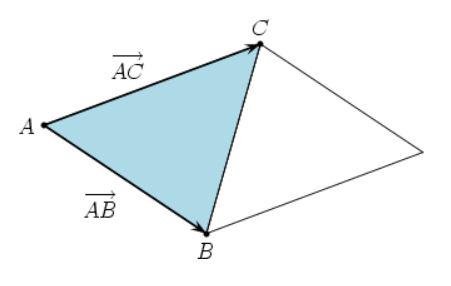
We know that the magnitude of the cross product of these two vectors will give the area of a parallelogram spanned by them as shown in the adjacent figure.
Vector Calculus, 4th Edition, Chapter 1 Vectors 13

It follows that area of the triangle is half of the magnitude of the cross product.

The area is half of the magnitude of the cross product of the two vectors−(1,1,0) and(2,−1,0)

Area of triangle :

=(1/2)∗∥(1,1,0)×(2,−10)∥

=(1/2)∗∥(0,0,−3)∥

=3/2

Hence, we get that the area of triangle is 3/2.

Susan Colley Chapter 1.4 Step-By-Step Solution Guide Page 38 Problem 14 Answer

Given: The triangle is determined by vectors a=i−2j+6k and b=4i+3j−k.

To compute: The area of triangle determined by above vectors.

Evaluate to get the final answer.

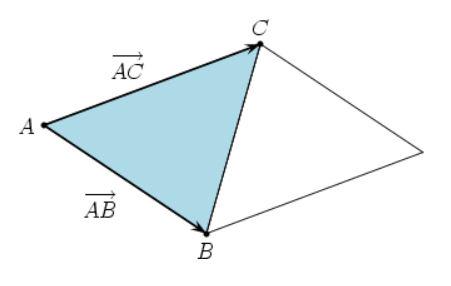
We know that the magnitude of the cross product of these two vectors will give the area of a parallelogram spanned by them as shown in the adjacent figure.
Vector Calculus, 4th Edition, Chapter 1 Vectors 14

It follows that area of the triangle is half of the magnitude of the cross product.

The area is half of the magnitude of the cross product of the two vectors−(1,−2,6) and (2,−1,0)(4, 3, −1)

The area of triangle is :

=(1/2)∗∥(1,−2,6)×(4,3,−1)∥

=(1/2)∥(−16,25,11)∥

=√1002/2

Hence, we get that the area of triangle is =√1002/2.
Susan Colley Vector Calculus 4th Edition Chapter 1 Exercise 1.5 Vectors

Vector Calculus 4th Edition Chapter 1 Vectors

Page 47 Problem 1 Answer

Given: The plane containing the point (3,−1,2) and perpendicular to i−j+2k.

To find: An equation for the plane.E

valuate to get the final answer.

The equation of a plane containing a point P(x0,y0,z0) and a vector perpendicular to the plane given by n=Ai+Bj+Ck is given by the following equation A(x−x0)+B(y−y0)+C(z−z0)=0.

Here point is (3,−1,2) and vector perpendicular is i−j+2k.

Hence using the above equation we get the equation of plane as:

⇒ 1(x−3)−1(y+1)+2(z−2)=0.

Hence, the required solution is  x−y+2z=8.

Page 47 Problem 2 Answer

Given : The point (9,5,−1) and perpendicular to i−2k.

To find: Equation for the plane.

Evaluate to get the final answer.

The equation of a plane containing a point P(x0,y0,z0) and a vector perpendicular to the plane given by n=Ai+Bj+Ck is given by the following equation A(x−x0)+B(y−y0)+C(z−z0)=0.

Here point is (9,5,−1) and vector perpendicular is i−2k.

Hence using the above equation we get the equation of plane as:

⇒ 1(x−9)−2(z+1)=0

Hence, the required solution is  x−2z=11.

Read and Learn More Susan Colley Vector Calculus Solutions

Susan Colley Chapter 1.5 Vectors Problem-Solving Guide Page 47 Problem 3 Answer

Given: Plane containing the points (A,0,0),(0,B,0), and (0,0,C)

at least two of A, B, and C are nonzero.

To find: An equation for the plane containing the given points.

Evaluate the expression to obtain the final answer.

Let’s apply cross product of two vectors on the plane.

⇒ (A−0,0−B,0−0)×(0−0,0−B,C−0)=(−BC,−AC,−AB)

Hence, above vector is perpendicular to the plane containing the three points.

Here, equation of a plane containing a point P(x0,y0, z0)

Vector perpendicular to the given plan is n=Ji+Kj+Lk

⇒ A(x−x0)+B(y−y0)+C(z−z0)=0

By taking points(A,0,0) and vector perpendicular is −BCi−ACj−ABk

Therefore , the equation is BC(x−A)−AC(y−0)−AB(z−0)=0

Hence, equation for the plane containing the given points is BCx+ACy+ABz=ABC

Page 47 Problem 4 Answer

Given:  A plane 5x−4y+z=1 passes through a point (2,−1,−2)

To find:  An equation for the plane that is parallel to the given plan.

Evaluate the expression to obtain the final answer

If two planes are parallel, then the vector perpendicular to the plane is also perpendicular to the desired plan

Therefore,

For a plan 5x−4y+z=1,  perpendicular vector is (5,−4,1)

The above vector is perpendicular to the plane containing the point (2,−1,−2).

Here, the equation of a plane containing a point P(x0,y0, z0)

Vector perpendicular to the given plan is n=Ai+Bj+Ck

⇒ A(x−x0)+B(y−y0)+C(z−z0)=0

By taking points (2,−1,−2) and vector perpendicular is 5i−4j+k

Therefore, the equation is

⇒ 5(x−2)−4(y+1)+(z+2)=0

Hence, 5x−4y+z=12 is an equation for the plane that is parallel to the given plan.

Page 47 Problem 5 Answer

 Given:  A plane 2x−3y+z=5 and  that passes through the point (−1,1,2)

To find: An equation for the plane that is parallel to the given plan.

Evaluate the expression to obtain the final answer.

If two planes are parallel, then the vector perpendicular to the plane is also perpendicular to the desired plan

Therefore,

For a plan 2x−3y+z=5, perpendicular vector is (2,−3,1)

The above vector is perpendicular to the plane containing the point (−1,1,2)

Here, the equation of a plane containing a point P(x0,y0, z0)

Vector perpendicular to the given plan is n=Ai+Bj+Ck

⇒ A(x−x0)+B(y−y0)+C(z−z0)=0

By taking points (−1,1,2) and vector perpendicular is  2i−3j+k

Therefore, The equation is 2(x+1)−3(y−1)+(z−2)=0

Hence, 2x−3y+z=−3 is an equation for the plane that is parallel to the given plan.

Solutions To Chapter 1.5 vectors By Susan Colley Page 47 Problem 6 Answer

Given: A plane x−y+7z=10 and hat passes through the point(−2,0,1)

To Find: An equation for the plane that is parallel to the given plan.

Evaluate the expression to obtain the final answer.

If two planes are parallel, then the vector perpendicular to the plane is also perpendicular to the desired plan.

Therefore, For a plan x−y+7z=10, perpendicular vector is (1,−1,7)

The above vector is perpendicular to the plane containing the point (−2,0.1)

Here, equation of a plane containing a point P(x0,y0, z0)

Vector perpendicular to the given plan is n=Ai+Bj+Ck

⇒ A(x−x0)+B(y−y0)+C(z−z0)=0

By taking points (−2,0.1) and vector perpendicular is i−j+7k

Therefore, The equation is 1(x+2)−1(y−0)+7(z−1)=0

Hence, from the above steps x−y+7z=5 is an equation for the plane that is parallel to the given plan.

Page 47 Problem 7 Answer

Given: A plane 2x+2y+z=5 that contains the line with parametric equations​ x=2−t

⇒ y=2t+1

⇒ z=3−2t

T​o Find: An equation for the plane that is parallel to the given plan.

Evaluate the expression to obtain the final answer.

If two planes are parallel, then the vector perpendicular to the plane is also perpendicular to the desired plan.

Therefore, For a plan 2x+2y+z=5, perpendicular vector is (2,2,1)

The above vector is perpendicular to the plane containing the point is given in an equation format

that is, 2x+2y+z=D……….(1)

Here D is unknown.

From the given, x=2−t

⇒ y=2t+1

⇒ z=3−2t

​substitute in equation 1 to find D i,e 2(2−t)+2(2t+1)+1(3−2t)=D

⇒ 4−2t+4t+2+3−2t=D

⇒ D=9

Hence,  2x+2y+z=9 is an equation for the plane that is parallel to the given plan.

Page 47 Problem 8 Answer

Given: The plan 5x−3y+2z=10 that contains the line with parametric equations​ x=t+4

⇒ y=3t−2

⇒ z=5−2t

​To find: Why there is no plane parallel to the given plane.

Evaluate the expression to obtain the final answer.

If two planes are parallel, then the vector perpendicular to the plane is also perpendicular to the desired plan.

Therefore, For a plan 5x−3y+2z=10, perpendicular vector is (5,−3,2)

The above vector is perpendicular to the plane containing the point given by in an equation format

that is,

⇒ 5x−3y+2z=D

Here D is unknown.

From the given, x=t+4

⇒ y=3t−2

z=5−2t substitute in equation  1 to find D value.

Hence,

⇒ D=5(t+4)−3(3t−2)+2(5−2t)

⇒ D=5t+20−9t+6+10−4t

⇒ D=36−8t

But the value of D  is not constant which suggests that the line will surely intersect the planes parallel to 5x−3y+2z=10

Hence, it concludes that there is no plane parallel to the given plane which can completely contain the line.

Susan Colley Vector Calculus Chapter 1.5 Solved Examples Page 47 Problem 9 Answer

Given: The line ​x=3t−5

⇒ y=7−2t

⇒ z=8−t

​and that passes through the point(1,−1,2).

To find: Find an equation for the plane that is perpendicular to the line.

Evaluate the expression to obtain the final answer.

Assume that,

The vector 3i−2j−k is parallel to the line

Hence, perpendicular to the plan which passes through  (1,−1,2)

Therefore, the perpendicular to that vector is 3(x−1)−2(y+1)−(z−2)=0

Hence, 3(x−1)−2(y+1)−(z−2)=0 is an equation for the plane that is perpendicular to the line.

Page 47 Problem 10 Answer

Given: Equation of two lines l1:x=t+2,y=3t−5,z=5t+1,l2=x=5−t,y=3t−10,z=9−2t.

To Find: Equation of the plane that contains the given lines.

The vector i+3j+5k is parallel to the first line and the vector −i+3j−2k is parallel to the second line.

So the cross product of these two is perpendicular to the plane containing these two lines:

⇒ n=(i+3j+5k)×(−i+3j−2k)

=−21i−3j+6j

Now, find a single point on either line and it is known that point will also be in the plane.

Notice that (2,−5,1) is a point in the first line. So the equation of the plane is then

⇒ −21(x−2)−3(y+5)+6(z−1)=0

⇒7(x−2)+(y+5)−2(z−1)=0

Hence, the required equation of the plane is 7(x−2)+(y+5)−2(z−1)=0.

Page 47 Problem 11 Answer

Given: Equation of two planes x+2y−3z=5,5x+5y−z=1.

To Find: Line of equation of the planes.

A normal vector for the first plane is i+2j−3k and a normal vector for the second plane is 5i+5j−k.

A nonzero vector perpendicular to these will be parallel to the line of intersection.

So, find the cross product as follows:

⇒ (i+2j−3k)×(5i+5j−k)=13i−14j−5k

Now, find a point on the line of intersection.

Let x=0 and then solve the resulting system of equations:

⇒ {​2y−3z}=5

⇒ 5y−z=1

⇒ y =−2/13 and z=−23/13.

Following will be the scalar equations

⇒ {x=13t

⇒ y=−2/13−14t

⇒ z=−23/13−5t​

Hence, the required set of parametric equations:⎧

⇒ {x=13t

⇒ y=−2/13−14t

⇒ z=−23/13−5t

Practice problems for Chapter 1.5 Susan Colley Vector Calculus ​Page 47 Problem 12 Answer

Given: Equation of plane 2x−3y+5z=−1.

To Find: Set of parametric equation for the line perpendicular to the plane.

The fact that the line is perpendicular to the plane 2x−3y+5z=−1

⇒it is parallel to the vector 2i−3j+5k.

So, using the point(5,0,6) on the line, it is obtained:

⇒ {​x=5+2t

⇒ y=−3t

⇒ z=6+5t

​Hence, the required set of parametric equation of lines:{​x=5+2t

⇒ y=−3t

⇒ z=6+5t​

Page 47 Problem 13 Answer

Given: Equations of parallel planes 8x−6y+9Az=6, Ax+y+2z=3

To Find: The value of A.

For the planes to be parallel, they must be perpendicular to the same vectors.

Now, the first plane is perpendicular to every scalar multiple of 8i−6j+9Ak and the second plane is perpendicular to every scalar multiple of Ai+j+2k

It is required to find a solution to 8i−6j+9Ak=K(Ai+j+2k)

The one we obtained should be equal to:

⇒ {8=AK

⇒ −6=K

⇒ 9A=2K

The unique solution to this is A=−4/3, K=−6.

⇒A=−4/3

The value of A=−4/3

Susan Colley Vector Calculus 4th Edition Chapter 1 Exercise 1.3 Vectors

Vector Calculus 4th Edition Chapter 1 Vectors

Page 26 Problem 1 Answer

Given: Two vectors with their coordinates.

To Find: The dot product of both vectors and magnitude of each of the given vectors

⇒ a=(1,5),and b=(−2,3)

The Dot Product of two vectors a and b is given by

⇒ a⋅b=a1b1+a2b2

The Magnitude of a vector is given by

⇒ ∥a∥=√a⋅a

First, find out the dot product i.e., a⋅b

of the two vectors by substituting the respective coordinates in the formula.

⇒ a⋅b=(1)(−2)+(5)(3)

⇒ a⋅b=−2+15

∴a⋅b=13

Magnitude of vector a is,∥a∥=√12+52

⇒ ∥a∥=√26

Magnitude of vector b is,∥b∥=√(−2)2+32

⇒ ∥b∥=√13

Therefore, the required dot product i.e., a⋅b is 13 and the magnitude of the vectors are:

⇒ ∥a∥=√26

⇒ ∥b∥=√13

Read and Learn More Susan Colley Vector Calculus Solutions

Susan Colley Vector Calculus Exercise 1.3 Solved Problems Page 26 Problem 2 Answer

Given: Two vectors a and b with coordinates (4,−1) and (1/2,2) respectively.To Find: The dot product and magnitude of each vectors,

⇒ a=(4,−1),

⇒ b=(1/2,2)

The Dot Product of two vectors is given by,

⇒ a⋅b=a1b1+a2b2

The magnitude of a vector is given by,

⇒ ∥a∥=√a⋅a

First, find out the dot product i.e., a⋅b of the two vectors by substituting the respective coordinates in the formula.

⇒ a⋅b=(4)(1/2)+(−1)(2)

⇒ a⋅b=2−2

∴a⋅b=0

Magnitude of vector a,

⇒ ∥a∥=√42+(−1)2

⇒ ∥a∥=√17

Magnitude of vector b,

⇒ ∥b∥=√(1/2)2+22

⇒ ∥b∥=√17/4

⇒ ∥b∥=√17/2

Therefore, the required dot product i.e., a⋅b is 0 and the magnitude of the vectors are:

⇒ ∥a∥=√17

⇒ ∥b∥=√17/2

Page 26 Problem 3 Answer

Given: Two vectors a and b having coordinates (−1,0,7) and (2,4,−6) respectively.

To Find: We have to compute the dot product i.e., a⋅b of the vectors and magnitude of each vectors i.e.,

∥a∥ and ∥b∥.Substitute the coordinates in the respective formula and compute the result.

The dot product of two vectors is,

⇒ a⋅b=a1b1+a2b2

∴a⋅b=(−1)(2)+(0)(4)+(7)(−6)

⇒ a⋅b=−2+0−42

⇒ a⋅b=−44

The magnitude of a vector,

⇒ ∥a∥=√a⋅a

∴∥a∥=√(−1)2+02+72

⇒ ∥a∥=√50

⇒ ∥a∥=5√2

And ∥b∥=√22+42+(−6)2

⇒ ∥b∥=√4+16+36

⇒ ∥b∥=√56

⇒ ∥b∥=2√14

Therefore, the required dot product i.e., a⋅b is −44 and the magnitude of the vectors are:

⇒ ∥a∥=5√2

⇒ ∥b=2√14

Solutions To Chapter 1.3 Vector Calculus By Susan Colley Page 26 Problem 4 Answer

Given: Two vectors are given as follows:

a=(2,1,0)

b=(1,−2,3).To Find: The dot product and magnitude of each of the vectors a and b with coordinates (2,1,0) and (1,−2,3).

Substitute the coordinates in the respective formula for the dot product and magnitude of the vectors and compute the answer.

The dot product of the vectors a and b,

⇒ a⋅b=a1b1+a2b2

Substitute the coordinates of the respective vectors in the above formula.

⇒ a⋅b=(2)(1)+(1)(−2)+(0)(3)

⇒ a⋅b=2−2+0

∴a⋅b=0

The magnitude of a vector is,∥a∥=√a⋅a

Substitute the coordinates of vector a in the above formula.

⇒ ∥a∥=√22+12+02

∴∥a∥=√5

Substitute the coordinates of vector b in the formula.

⇒ ∥b∥=√12+(−2)2+32

⇒ ∥b∥=√1+4+9

∴∥b∥=√14

Therefore, the required dot product of the given vectors is 0. The magnitude of the vectors are:

⇒ ∥a∥=√5

⇒ ∥b∥=√14

Page 26 Problem 5 Answer

Given: Two vectors,

⇒ a=4i−3j+k

⇒ b=i+j+k

To Find: To find the dot product i.e., a⋅b and the magnitude i.e., ∥a∥ of the vectors a and b.

The vectors are represented by unit vector notation and we can get their coordinates from it.

After that, substitute the coordinates in the respective formulas to compute the dot product and their magnitudes.

The vectors are given in unit vector notation i.e.,

⇒ a=4i​−3j+k

⇒ b=i+j+k

Converting it into their coordinate form we get,

⇒ a=(4,−3,1)

⇒ b=(1,1,1)

Now, the dot product of the vectors are,

a⋅b=a1b1+a2b2

Substitute the respective coordinates to compute it.

Dot Product:

⇒ a⋅b=(4)(1)+(−3)(1)+(1)(1)

⇒ a⋅b=4−3+1

∴a⋅b=2

Magnitude of a vector is given by:

⇒ ∥a∥=√a⋅a

Magnitude of vector a,

⇒ ∥a∥=√42+(−3)2+12

⇒ ∥a∥=√16+9+1

⇒ ∥a∥=√26

Magnitude of vector b,

⇒ ∥b∥=√12+12+12

⇒ ∥b∥=√3

Therefore, the required dot product i.e., a⋅b is 2 and the magnitude of the vectors are:

⇒ ∥a∥=√26

⇒ ∥b∥=√3

Susan Colley Vector Calculus Chapter 1.3 Explained Page 26 Problem 6 Answer

Given: Two vectors a and b in their unit vector notation.To Find The dot product and magnitude of the vectors,

⇒ a=i+2j−k

⇒ b=−3j+2k.

We can find the coordinates from the unit vector representation easily.

After that, substitute the values in the formulas to find their dot product and the magnitude.

From the unit vector representation of the vectors, we found,

⇒ a=(1,2,−1)

⇒ b=(0,−3,2)

Now, the dot product of the vectors:

⇒ a⋅b=a1b1+a2b12

∴a⋅b=(1)(0)+(2)(−3)+(−1)(2)

⇒ a⋅b=0−6−2

⇒ a⋅b=−8

The magnitude of a vector is,

⇒ ∥a∥=√a⋅a

∴∥a∥=√12+22+(−1)2

⇒ ∥a∥=√1+4+1

⇒ ∥a∥=√6

And ∥b∥=√02+(−3)2+22

Therefore, the required dot product i.e., a⋅b is −8 and the magnitude of the vectors are:

⇒ ∥a∥=√6

⇒ ∥b∥=√13

Page 26 Problem 7 Answer

Given: Two vectors a and b in their unit vector notation. To Find The angle between the vectors,

⇒ a=√3i+j, b=−√3i+j

First, find the dot product and the magnitude of the given vectors, then plug them into the formula,

⇒ θ=cos−1a⋅b

∥a∥∥b∥  and calculate the angle.

From the given vectors, we know can find out the coordinates. C

alculate the dot product and the magnitudes of the given vectors.

⇒ a⋅b=(√3)(−√3)+(1)(1)

⇒ a⋅b=−3+1

⇒ a⋅b=−2

And ∥a∥=√√3/2+12

⇒ ∥a∥=√4

⇒ ∥a∥=2,

⇒ ∥b∥=√(−√3)2+12

⇒ ∥b∥=√4

⇒ ∥b∥=2

Plug them into the formula and find the angles between the vectors.

⇒ θ=cos−1−2/(2)(2)

⇒ θ=cos−1(−1/2)

⇒ θ=120∘

Therefore, the required angle between the given vectors is 120∘.

Susan Colley Chapter 1.3 Exercise Solutions Page 26 Problem 8 Answer

Given: Two vectors a and b along with coordinates (−1,2) and (3,1) respectively.

To Find:  The angle between the vectors,

⇒ a=(−1,2)

⇒ b=(3,1)

The angle between two vectors can be calculated as:

⇒ θ=cos−1a⋅b

∥a∥∥b∥

Calculate the dot product and the magnitude of the given vectors and plug them into the above formula to get the angle.

First, compute the dot product and magnitude of the vectors.

⇒ a⋅b=(−1)(3)+(2)(1)

⇒ a⋅b=−3+2

⇒ a⋅b=−1

And ∥a∥=√(−1)2+22

⇒ ∥a∥=√5

⇒ ∥b∥=√32+12

⇒ ∥b∥=√10

Now, plug these values into the formula to calculate the angle between the two vectors.

⇒ θ=cos−1−1(√5)(√10)

⇒ θ=cos−1(−1/√50)

⇒ θ=98.13∘

Thus, the required angle between the given two vectors is 98.13∘.

Page 26 Problem 9 Answer

Given:a=i+j,

⇒ b=i+j+k

To find: Find the angle between each of the pairs of vectors. Evaluate to get the final answer.

By using this formula:θ=cos−1/a⋅b∥a∣∣∣b∣∣

First we finda⋅b,∥a∥,∥b∥:

⇒ a⋅b=(1)(1)+(1)(1)+(0)(1)

=1+1+0

=2∥a∥=√(1)2+12+02

=√2

∣∣b∥=√12+12+12

=√3

Now find angle between vectors:

⇒ ​θ=cos−1/2(√2)(√3)

⇒cos−1(2√6)

⇒ θ=33.26∘

Hence, the angle between the given the pair of vectors isθ=33.26∘

Page 26 Problem 10 Answer

Given:a=i+j−k,

b=−i+2j+2k

To find: Find the angle between each of the pairs of vectors. Evaluate to get the solution.

By using this formula:θ=cos−1/a⋅b

∥a∥∣∣b∣∣

First we find a⋅b,∥a∥,∥b∥:

a⋅b=(1)(−1)+(1)(2)+(−1)(2)

⇒−1+2−2=−1

∣a∥=√12+12+(−1)2=√3

∥b∥=√(−1)2+22+22

⇒√9

=3

Now angle between vectors are:

θ=cos−1−1(√3)(3)

θ=101.10∘

Hence, the angle between the given pair of vectors isθ=101.10∘

Page 26 Problem 11 Answer

Given:a=1,−2,3,

b=3,−6,−5

To find: Find the angle between each of the pairs of vectors. Evaluate to get the final angle.

By using this formula:θ=cos−1/a⋅b

∥a∥∣∣b∥

First we find a⋅b,∥a∥,∥b∥:

⇒ a⋅b=(1)(3)+(−2)(−6)+(3)(−5)

=3+12−15

=0

⇒ ∥a∥=√12+(−2)2+32

=√14

⇒ ∥b∥=√32+(−6)2+(−5)2

=√70

Now find angle between vectors are:

⇒ θ=cos−10(√14)(√70)

​=cos−10

⇒ θ=90∘

Hence, the angle between the given pair of vectors isθ=90∘

Exercise 1.3 Vectors Susan Colley Vector Calculus Examples Page 26 Problem 12 Answer

Given:a=i+j,

⇒ b=2i+3j−k

To find: Calculate the projection ab.

Evaluate to get the final answer.

By using this formula:proj ab=(a⋅b/a⋅a)a

First we find a⋅b,a⋅a:

a⋅b=(1)(2)+(1)(3)+(0)(−1)

⇒2+3=5

a⋅a=12+12+02

=2

Now, we find projection:

projb=(5/2)(1,1,0)

=(5/2,5/2,0)

Hence, the required projection is:(5/2,5/2,0)

Page 26 Problem 13 Answer

Given:a=(i+j)/√2,´

b=2i+3j−k

To find: Calculate the projection a b

Evaluate to get the projection.

By using this formula we get:proj ab=(a⋅b/a⋅a)a

Then first we find a⋅b,a⋅a:

a⋅b=(1/√2)(2)+(1/√2)(3)+(0)(−1)

=5/√2a⋅a=(1/√2)2+(1/√2)2+02

=1/2+1/2 =1

Now find projection:

projb=(5/√21)(1/√2,1/√2,0)

=5/√2(1/√2,1/√2,0)=(5/2,5/2,0)

Hence, the projection a b are(5/2,5/2,0)

Page 26 Problem 14 Answer

Given:a=5k,

b=i−j+2k

To find: Calculate projection of ab.

Evaluate to get the final answer.

By using this formula:proj ab=(a⋅b/a⋅a)a

Then first find a⋅b,a⋅a:

a⋅b=(0)(1)+(0)(−1)+(5)(2)

=0+0+10

=10

a⋅a =02+02+52=25

Now find projection:

Proj b=(10/25)(0,0,5)

=(0,0,2)

Hence, the projection are:(0,0,2)

Page 26 Problem 15 Answer

Given:a=−3k,

b=i−j+2k

To find: Calculate the projection ab.

Evaluate to get the final answer.

By using this formula:proj ab=(a⋅b/a⋅a)a

Then first we find a⋅b,a⋅a:

a⋅b=(0)(1)+(0)(−1)+(−3)(2)

=0+0−6

=−6

a⋅a=02+02+(−3)2

=9

Now find projection:

Proj b=(−6/9)(0,0,−3)

=(0,0,2)

Hence, the projection are :(0,0,2)

Susan Colley Vector Calculus 4th Edition Chapter 1 Exercise 1.2 Vectors

Vector Calculus 4th Edition Chapter 1 Vectors

Page 16 Problem 1 Answer

Given: The vector(2,4)

To write:  The given vector by using the standard basis vectors for R2 and R3.

Evaluate to get the required solution.

Firstly, the standard notation in R2:

⇒ a=(a1,a2)=a1i+12j

In R3:a=(a1,a2,a3)=a1i+a2j+a3k

Given vector in standard notation is: (2,4)=2i+4j

Therefore, we can write the given vector as (2,4)=2i+4j.

Page 16 Problem 2 Answer

Given: The vector (9,−6)

To find:The given vector by using the standard basis vectors for R2 and R3.

Evaluate to get the final result.

The Standard notation in R2:

⇒ a=(a1,a2)=a1i+a2j

In R3: a=(a1,a2,a3)=a1i+a2j+a3k

Given vector in standard notation is:

(9,−6)=9i−6j

Read and Learn More Susan Colley Vector Calculus Solutions

​Therefore, rewriting the given vector we get 9i−6j.

“Vector Calculus Susan Colley Exercise 1.2 Step-By-Step Guide” Page 16 Problem 3 Answer

Given : The vector(3,π,−7)

To find :The given vector by using the standard basis vectors for R2 and R3 .

Evaluate to get the final result.

Standard notation in R2:a=(a1,a2)=a1i+a2j

In R3:

⇒ a=(a1,a2,a3)=a1i+a2j+a3k

Given vector in standard notation is:

⇒ (3,π,−7)=3i+πj−7k

​Therefore, rewriting the given vector we get 3i+πj−7k.

Page 16 Problem 4 Answer

Given : The vector(−1,2,5)

To write: The given vector by using the standard basis vectors for R2 and R3.

Evaluate to get the final result.

Standard notation in R2:

⇒ a=(a1,a2)=a1i+a2j

In R2 :a=(a1,a2,a3)=a1i+a2j+a3k

Given vector in standard notation is: (−1,2,5)=−i+2j+5k

Therefore, we can write the given vector as −i+2j+5k.

Page 16 Problem 5 Answer

Given: The vector (2,4,0)

To write: The given vector by using the standard basis vectors for R2 and R3.

Evaluate to get the required solution.

Standard notation in R2

⇒ a=(a1,a2)=a1i+a2j

In R3: a=(a1,a2,a3)=a1i+a2j+a3k

Given vector in standard notation is: (2,4,0)

=2i+4j+0k

=2i+4j​

Therefore, we can write the given vector by using the standard basis vectors as 2i+4j.

Page 16 Problem 6 Answer

Given: The vector i+j−3k

To write: The given vector without using the standard basis notation.

Evaluate to get the required answer.

Standard notation in R2:

⇒ a=(a1,a2)=a1i+a2j

In R3 : a=(a1,a2,a3)=a1i+a2j+a3k

Given the vector without standard notation is:

⇒ i+j−3k=(1,1,−3)

Therefore, we can write the given vector without using the standard basis notation as(1,1,−3).

Page 16 Problem 7 Answer

Given: The vector 9i−2j+√2k

To write: The given vector without using the standard basis notation.

Evaluate to get the final solution.

Standard notation in R2:

⇒ a=(a1,a2)=a1i+a2j

In R3: a=(a1,a2,a3)=a1i+a2j+a3k

Given vector without standard notation is:

⇒ 9i−2j+√2k=(9,−2,√2)​

Therefore, we can write the given vector without using the standard basis notation as(9,−2,√2).

“Susan Colley Chapter 1 Exercise 1.2 Vector Operations Explained” Page 16 Problem 8 Answer

Given : The vector−3(2i−7k)

To find: The given vector without using the standard basis notation. Evaluate to get the final answer.

The Standard notation in R2:

⇒ a=(a1,a2)=a1i+a2j

In R3 :a=(a1,a2,a3)=a1i+a2j+a3k

Given vector without standard notation is:

⇒ −3(2i−7k)

=−6i+0j+21k

=(−6,0,21)​

Therefore, we can write the given vector without using the standard basis notation as (−6,0,21).

Page 16 Problem 9 Answer

Given: The vector π i−j

To write: The given vector without using the standard basis notation.

Evaluate to get the final answer.

Standard notation in R2:

⇒ a=(a1,a2)=a1i+a2j

​In R3 : a=(a1,a2,a3)=a1i+a2j+a3k

Given vector without standard notation is:

πi−j=(π,−1)

Therefore, we can write the given vector without using the standard basis notation as(π,−1).

Page 16 Problem 10 Answer

Given: πi−j in R3

To write: Without using the standard basis notation.

Evaluate to get the answer.

The standard notation in R2 is a=(a1,a2)

= a1i+a2j In R3:

⇒ a = (a1,a2,a3)=a1i+a2j+a3k

Given vector without standard notation is:

⇒ πi−j=πi−j+0k

=(π,−1,0)

Therefore, the given vector without standard notation is (π,−1,0)

Page 16 Problem 11 Answer

Given: a1=(1,1)  and  a2=(1,−1).

To write : c1a1+c2a2=b for b=(3,1).

Evaluate to get the solution.

First solve system c1a1+c2a2=b.

Substitute the values for a1 and a2.

c1(1,1)+c2(1,−1)=(3,1)

We obtain system:

⇒ c1+cv2=3

⇒ c1−c2=1

On solving these equations we get the value of c1 and c2: c1=2c2=1

Thus, b=2a1+a2.

Therefore, we can write b as b=2a1+a12.

Page 16 Problem 12 Answer

Given: a1=(1,1) and a2=(1,−1)

To write: Vector b=(3,−5) using part a of the question.

Evaluate to get the answer.

Solve system c{1}a{1}+c{2}a{2}=b.

c1(1,1)+c2(1,−1)=(3,−5)

We obtain system:

⇒ c1+c2=3

⇒ c1−c2=−5

Solution:

c1=−1 and c2=4

Thus, b=−a1+4a2

Therefore, we rewrite vector b as b=−a1+4a2.

“Susan Colley Vector Calculus Vector Examples Exercise 1.2” Page 16 Problem 13 Answer

Given: a1=(1,1) and a2=(1,−1)

To show: Vector b=(b1,b2) in R2 in the form c1a1+c2a2

Evaluate to get the answer.

Solving the system c1a1+c2a2=b for an arbitrary vector b=(x,y).

c1(1,1)+c2(1,−1)=(x,y)

We obtain the system:

c1+c2=xc1−c2=y

Solution is

⇒ c1=x+y/2

⇒ c2=x−y/2

Thus, b can be written as a linear combination of a1 and a2.

Therefore, we have shown that b can be written as a linear combination of a1 and a2.

Page 16 Problem 14 Answer

Given: Vector i+3j+6k is parallel to the point (2,−1,5) and the line in R3 passes through the point.

To find:  Give a set of parametric equations for the lines.

Evaluate to get the answer.

By using proposition, we can write:

⇒ r(y)=b+ta

=(2,−1,5)+t(1,3,−6)

The parametric equation is

⇒ x(t)=2+t

⇒ y(t)=−1+3t

⇒ z(t)=5−6t​

Hence, the parametric equations for the given line are

⇒ x(t)=2+t

⇒ y(t)=−1+3t

⇒ z(t)=5−6t

​Page 16 Problem 15 Answer

Given: Vector 5i−12j+k and point (12,−2,0)

To find: Give a set of parametric equations for the described lines.

Evaluate to get the answer.

Let us use a Proposition to write:

⇒ r(y)=b+ta=(12,−2,0)+t(5,−12,1)

The parametric equation is:

⇒ x(t)=12+5t

⇒ y(t)=−2−12t

⇒ z(t)=t

Hence, the set of parametric equations for the lines so described are ​x(t)=12+5t

⇒ y(t)=−2−12t

⇒ z(t)=t​

Page 16 Problem 16 Answer

Given: Vector i−7j and points (2,−1)

To find: Give a set of parametric equations

Evaluate to get the answer.

Using Proposition, we can write:

⇒ r(y)=b+ta

=(2,−1)+t(1,−7)

Parametric equation is:

⇒ x(t)=2+t

⇒ y(t)=−1−7t​

Therefore, the required set of parametric equations for the lines so described is x(t)=2+t

⇒ y(t)=−1−7t

Susan Colley Vector Calculus 4th Edition Chapter 8 Exercise 8.1 Vector Analysis in Higher Dimensions

Vector Calculus 4th Edition Chapter 8 Vector Analysis in Higher Dimensions

Page 535 Problem 1 Answer

Given: 2dx+6dy−5dz;a=(1,−1,−2)

​To determine the values of the following differential forms on the ordered sets of vectors.Using the determination method.

Once again, recall that the 1−form acting on a3 dimensional vector is simply a projection of the i−th coordinate.

Once again use the linearity of the form to obtain the following:

(2dx+6dy−5dz)(1,−1,−2)=2dx(1,−1,2)+6dy(1,−1,−2)−5dz(1,−1,−2)⇒2−6+10=6

The values of the following differential forms on the ordered set of vectors are 6.

Page 535 Problem 2 Answer

Given:​4dx∧dy−7dy∧dz;a=(0,1,−1),b=(1,3,2)

​To determine the values of the following differential forms on the ordered sets of vectors.Using the determination method.

Here, given a 2−form acting on 3 a dimensional object. First, the linearity of the differential forms is used to split the form into two parts.

(4dx∧dy−7dy∧dz)((0,1,−1),(1,3,2))=4dx∧dy((0,1,−1),(1,3,2))−7dy∧dz((0,1,−1),(1,3,2))

​Next, place the vectors into the columns of the matrix but cross out the terms that are not shown in the differential form operator.

For example, we cross out the last row in the matrix in the first case since there is no dx in the form and we cross out the first row in the second matrix since there is no dx.

=4[0 1 1 3]−7[1−1​3 2]

⇒−4−35=−39

The values of the following differential forms on the ordered sets of vectors indicated are −39.

Read and Learn More Susan Colley Vector Calculus Solutions

Solutions To Chapter 8.1 Vector Analysis By Susan Colley Page 535 Problem 3 Answer

Given: ​7dx∧dy∧dz;a=(1,0,3),b=(2,−1,0),c=(5,2,1)

​To determine the values of the following differential forms on the ordered sets of vectors.Using the determination method.

A 3−the form has to act on 3 vectors. Additionally, since we are in 3 dimensions, the 3 forms acting on 3

vectors are equal to the determinant of the matrix formed by given vectors placed into columns:

⇒ 7dx∧dy∧dz((1,0,3),(2,−1,0),(5,2,1))

​=[103​2−10​521]

⇒182

The values of the following differential forms on the ordered sets of vectors are 182.

Page 535 Problem 4 Answer

Given: The differential form dx1

∧dx2+2dx2∧dx3+3dx3∧dx4;​a=(1,2,3,4),b=(4,3,2,1).To determine the values of the differential forms on the ordered sets of vectors.Using the concepts of vectors.

The 2 -form acting on 4-dimensional vectors. Just like in the task, use linearity and cross out the rows in the matrix corresponding to the missing coordinates.

⇒ ​(dx1∧dx2+2dx2∧dx3+3dx3∧dx4)((1,2,3,4),(4,3,2,1))​

=∣12​43∣+2∣∣23​32∣+3∣∣34​21∣

=−5−10−15

=−30

Therefore the value of the differential form is −30.

The value of the differential form is −30.

Page 535 Problem 5 Answer

Given:The differential form 2dx1∧dx3∧dx4+dx2∧dx3∧dx5;​a=(1,0,−1,4,2),b=(0,0,9,1,−1),c=(5,0,0,0,−2).

To determine the values of the differential forms on the ordered sets of vectors indicated.

Using the concepts of vectors.

This is a 3 -form acting on 5 dimensional vector. Once again use the linearity and we place the 3 vectors into the matrices as their columns.

Then cross out the rows that are not present in the form.

For the first part of the form, cross out the second and the fifth row, for the second part cross out first and the fourth row.

Therefore the expression can be obtained as:  2∣1−14​091​500∣∣+∣∣0−12​09−1​00−2∣=−370

The value of the differential form is −370.

Page 535 Problem 6 Answer

Given:  Let ω be the 1 -form on R3 defined by ω=x2ydx+y2zdy+z3xdz.To find ω(3,−1.4)(a), where a=(a1,a2,a3).

Using the concepts of vector.

If the form contains some functional expression (as in this task), specify an additional vector that will be plugged into the functional expression part of the form.

In this case, replace every x

in front of (dx,dy,dz) with 3, every with −1, and every z with 4. Therefore,ω3,−1,4(a)=(32(−1)dx+(−1)2⋅4dy+43⋅3dz)(a1,a2,a3)

Now simply calculate the expression: −9a1+4a2+192a3

The value of ω(3,−1,4)(a) is −9a1+4a2+192a3.

Susan Colley Chapter 8.1 Higher-Dimensional Vector Analysis Solved Problems Page 535 Problem 7 Answer

Given:  Let ω be the 2 -form on R4 given by ω=x1x3dx1∧dx3−x2x4dx2∧dx4.

To findω12,−1,−3,1)(a,b).Using the concepts of vector.

The function is xi where i∈{1,2,3,4}plug in the appropriate coordinates of the vector (2,−1,−3,1).

We have 2 -a form acting on 4-dimensional vectors that cross out even rows in the first matrix and odd rows in the second one before calculating the determinant:

⇒ (−6dx1∧dx3+dx2∧dx4)((a1,a2,a3,a4),(b1,b2,b3,b4))

=6∣a1a3​b1b3∣+∣a2a4​b2b4∣

=−6a1b3+6a3b1+a2b4−a4b2

Therefore ω12,−1,−3,1)(a,b) is −6a1b3+6a3b1+a2b4−a4b2.

The solution of ω12,−1,−3,1)(a,b)is −6a1b3+6a3b1+a2b4−a4b2.

Page 535 Problem 8 Answer

Given: Let ω be the 2 -form on R3 given by ω=cosxdx∧dy−sinzdy∧dz+(y2+3)dx∧dz.To findω(0,−1,π/2)

(a,b), wherea=(a1,a2,a3) and b=(b1,b2,b3).Using the concepts of vector.

Instead of x,y, and z the values of (0,−1,π2) are plugged in inside the differential form.

This is a2 -form so cross the missing coordinate row inside the matrix  (dx∧dy−dy∧dz+4dx∧dz)/((a1,a2,a3),(b1,b2,b3))

=∣a1a2​b1b2∣−∣​a2a3​b2b3∣+4∣a1a3​b1b3∣==a1b2−a2b1−a2b3+a3b2+4a1b3−4a3b1

Therefore ω(0,−1,π/2)(a,b)= a1b2−a2b1−a2b3+a3b2+4a1b3−4a3b1.

The solution of the ω(0,−1,π/2)(a,b)= a1b2−a2b1−a2b3+a3b2+4a1b3−4a3b1.

Page 535 Problem 9 Answer

Given function ω

To findω(x,y,z) ((2,0,−1),(1,7,5)

The method used with determinants.

Given a function ω

Now to find out ω(x,y,z) ((2,0,−1),(1,7,5)

Find out the values using determinants

Also Here, Repeat the same process as in the previous task.

But this time there is no vector to plug in.

So functions in front of the forms remain.

We have ω(x,y,z) ((2,0,−1),(1,7,5)=cosx​20​17​−sinz​0−1​75​+(y2+3)​2−1​15

​=14cosx−7sinz+11y2+33

The solution of ω(x,y,z) ((2,0,−1),(1,7,5) is14cosx−7sinz+11y2+33

Page 535 Problem 10 Answer

Given function ω the 3 form R3

To findω(0,0,0) (a,b,c)

where a=(a1,a2,a3),b=(b1,b2,b3),c=(c1,c2,c3) Method used is determinant.

Given that, Function ω the three form R3

ω=(excos y+(y2+2)e2z)dx∧dy∧dz

To find out ω(0,0,0) (a,b,c)

Where,a=(a1,a2,a3)

⇒ b=(b1,b2,b3)

⇒ c=(c1,c2,c3)

Notice that

We are dealing with the three forms in three-dimensional space.

Hence the resulting form is just a determinant of vectors placed in the matrix as its columns.

We only need to deal with the functional expression in front of the matrix.

But this is easy due to the fact that we plug in x=y=z=0 to obtain 3

Hence the resulting form is three times the determinant of the matrix.

ω(0,0,0)(a,b,c)=3∣a1a3​b1b3​c1c3∣

Or expressed as the total result equal to 3(a1b2c3+b1c2a3+c1a2b3−c1b2a3−b1a2c3−a1c2b3)

The solution of ω(0,0,0) (a,b,c) is 3(a1b2c3+b1c2a3+c1 a2b3−c1b2a3−b1a2c3−a1c2b3)

Vector Analysis In Higher Dimensions Susan Colley Chapter 8.1 Worked Examples Page 535 Problem 11 Answer

Given The given expression is ω=(excosy+(y2+2)e2z)dx∧dy∧dz.

To find The value of the expression ω(x,y,z)((1,0,0),(0,2,0),(0,0,3)).

Method used The method used for this is the concept of determinant.

Given ω=(excosy+(y2+2)e2z)dx∧dy∧dz.

⇒ ω(x,y,z)((1,0,0),(0,2,0),(0,0,3)) can be written as (excosy+(y2+2)e2z)∣100​020​003∣

⇒ ω(x,y,z)((1,0,0),(0,2,0),(0,0,3))= (excosy+(y2+2)e2z)∣​100​020​003∣

Now, solve the determinant.

det[​adg​beh​cfi​]=a⋅det[​eh​fi​]−b⋅det[​dg​fi​]+c⋅det[​dg​eh​]

On solving.

⇒ ω(x,y,z)((1,0,0),(0,2,0),(0,0,3))= 6(excosy+(y2+2)e2z).

The value of ω(x,y,z) ((1,0,0),(0,2,0),(0,0,3)) is equal to 6(excosy+(y2+2)e2z).

Page 535 Problem 12 Answer

Given The given expressions are ω=3dx+2dy−xdz;​η=x2 dx−cosydy+7dz.To find The value of the expression ω∧η.

The method used The method used in this is vector product.

The given expressions are ω=3dx+2dy−xdz

⇒ η=x2 dx−cosydy+7dz

⇒ ω∧η= (3dx+2dy−xdz)∧(x2dx−cosydy+7dz)

Now, do the product

= 3x2dx∧dx+2x2dy∧dx−x3dz∧dx−3cosydx∧dy−2cosydy∧dy+xcosydz∧dy+21dx∧dz+14dy∧dz−7xdz∧dz                [dx∧dx =dy∧dy=dz∧dz= 0]

Simplifying the terms.

= (−2×2−3cosy)dx∧dy+(x3+21)dx∧dz+(14−xcosy)dy∧dz.

The value of the expression ω∧ηis equal to (−2×2−3cosy)dx∧dy+(x3+21)dx∧dz+(14−xcosy)dy∧dz.

Page 535 Problem 13 Answer

Given The given functions are On R3:ω=ydx−xdy;η=zdx∧dy+ydx∧dz+xdy∧dz.To find The value of the expressionω∧η.

Method used Do the wedge product to simplify

Given functions are ω=ydx−xdy

⇒ η=zdx∧dy+ydx∧dz+xdy∧dz

Thus,ω∧η= (ydx−xdy)∧(zdx∧dy+ydx∧dz+xdy∧dz)

Multiply the terms.

= yxdx∧dy∧dz−xydy∧dx∧dz+yzdx∧dx∧dy+yydx∧dx∧dz−xzdy∧dx∧dy−xxdy∧dy∧dz

⇒ [dx∧dx=dy∧dy=dz∧dz=0]

Simplifying the terms.

= 2xydx∧dy∧dz.

By using the property of alternation the terms of the second term are swapped and the sign is flipped.

The value of the expression ω∧η is equal to 2xydx∧dy∧dz.

Susan Colley Vector Calculus Exercise 8.1 Problem Explanations Page 536 Problem 14 Answer

Given The given functions are On R4:ω=2dx1∧dx2−x3dx2∧dx4;η=2x4dx1∧dx3+(x3−x2)dx3∧dx4.

To find The value of the expression ω∧η.

The method used to simplify the given expression is wedge product.

Given ω=2dx1∧dx2−x3dx2∧dx4

⇒ η=2x4dx1∧dx3+(x3−x2)dx3∧dx4

Thus, ω∧η= (2dx1∧dx2−x3dx2∧dx4)∧(2x4dx1∧dx3+(x3−x2)dx3∧dx4)

There are 4 coordinates so the terms obtained in the result are those which have all four coordinates only.

Thus,ω∧η= 2x3x4dx2∧dx4∧d1∧dx3+2(x3−x2)dx1∧dx2∧dx3∧dx4

Using alternating property reorder the terms of the product.

= (2x3x4+2×3−2×2)dx1∧dx2∧dx3∧dx4.

The value of the expression ω∧η is equal to (2x3x4+2×3−2×2)dx1∧dx2∧dx3∧dx4.

Susan Colley Vector Calculus 4th Edition Chapter 7 exercise 7.1 Surface Integrals and Vector Analysis

Vector Calculus 4th Edition Chapter 7 Surface Integrals and Vector Analysis

Page 467 Problem 1 Answer

Given the X(s,t)=(s2−t2,s+t,s2+3t)

To find the a normal vector to this surface at the point(3,1,1)=X(2,−1)

Using the method of cross product of vector.

We have givenX(s,t)=(s2−t2,s+t,s2+3t)

First we calculate

⇒ dX/ds=(2s,1,2s)

⇒ dX/dt=(−2t,1,3)

Now, we have to find the value of these factor for(s,t)=(2,−1)

Two vector we obtain are(4,1,4) and(2,1,3)

Now, normal vector is given as cross product of these two vector:

(4,1,4)×(2,1,3)=(−1,−4,2)

The normal vector to this surface at the point(3,1,1)=X(2,−1) is given by(−1,−4,2).

Solutions To Chapter 7.1 Surface Integrals In Vector Analysis By Susan Colley Page 467 Problem 2 Answer

Given the parametrized surface X(s,t)=(s2−t2,s+t,s2+3t)

To find the an equation for the plane tangent to this surface at the point(3,1,1)

Using the formula for equation of tangent.

The formula for equation of tangent line is given point(a,b,c) is n(x−a,y−b,z−c)=0

Where n denote normal vector.

Hence our equation become

Read and Learn More Susan Colley Vector Calculus Solutions

(−1,−4,2)×(x−3,y−1,z−1)=0 where is(3,1,1)

Expand everything to expand the equation x+4y−2z−5=0

An equation for the plane tangent to this surface at the point (3,1,1) is x+4y−2z−5=0

Page 467 Problem 3 Answer

Given:X(s,t)=(5+2cost)coss,(5+2cost)sins

To find  an equation for the plane tangent to the torus at point

(5−√3/√2,5−√3/√2,1)

Using the method of equation of tangent.

The given parameterization of surface is(5+2cost)coss,(5+2cost)sins,2sint

To find the value of s,t

we have to find the partial derivatives of the given parameterization.

⇒ Dϕ/ds=(−(5+2cost)sins,(5+2cost)coss,0)

⇒ dϕ/dt=(−2sintcoss,−2sintsins,2cost)

Take the cross product of derivatives above to obtain the formula for the normals,t

(−(5+2cost)sins,(5+2cost)coss,0).(−2sintcos,−2sintsins,2cost)

Plugging the value of s,t we get,

⇒ n=√3−5/√2(√3,√3,−√2)

Now we get equation of tangent as

⇒ √3x+√3y−√2z−5√6+4√2=0

The equation of tangent is given by √3x+√3y−√2z−5√6+4√2=0

Page 468 Problem 4 Answer

Given: The parametrized surface X(s,t)=(s,s2+t,t2)

To find the graph for this surface−2≤s≤2,−2≤t≤2

Using the method of graph.

The graph is given by

Vector Calculus, 4th Edition, Chapter 7 Surface Integrals and Vector Analysis 4

The graph is given by

Vector Calculus, 4th Edition, Chapter 7 Surface Integrals and Vector Analysis 4 1

Page 468 Problem 5 Answer

Given: The parametrized surface isX(s,t)=(s,s2+t,t2).To find the is the surface smooth.

Using the method of vector.

We haveX(s,t)=si^+s2+tj^+t2k^

The surface is smooth if and only if N≠0⃗

⇒ Ts=∂x/∂si^+∂y/∂sj^+∂z/∂sk^ And

⇒ Tt=∂x/∂ti^+∂y/∂tj^+∂z/∂tz^ Now,

⇒ ⃗Ts=0i^+1j^+2tk^And

⇒ Tt=1i^+2sj^+0k^

Hence,N=Ts×Tt

⇒ N=4sti^+2tj^−1k^

Since,k component of normal vector never be zero so the surface is smooth.

Yes,the surface is smooth.

Page 468 Problem 6 Answer

Given: The parametrized surface isX(s,t)=(s,s2+t,t2)

To find an equation for the tangent plane at the point(1,0,1) using the method of tangent plane equation.

We have N=4sti^+2tj^−1k^

Put value of s=1andt=−1

We get,N=−4i^−2j^−1k^

Hence the tangent plane equation is given by

⇒ (−4,−2,−1).(x−1,y−0,z−1)=0

⇒ −4(x−1)−2y−1(z−1)=0

The tangent plane equation equation is given by−4(x−1)−2y−1(z−1)=0

Page 468 Problem 7 Answer

Given: Equation of formz=f(x,y)

To find the parametrized surface of Exercise1

Using the method of vector.

We look at the parameterization given to us in exercise 1.

Since,x=s2−t2 andy=s+t

We want to express x overy then and we do this with:

⇒ x=y(s−t)

With this, now the goal is to isolatet and s in term of x,y

We can reform above equation as

⇒ X/y=s−t

From this and second coordinate in parametrized we have

⇒ 2s=y+x/y and 2t=y−x/y

Now, write down z in term of newly expressed s,t

We have,

⇒ z=1/4(y+x/y)2+3/2(y−x/y)

The parametrized surface of Exercise1 is given by 1/4(y+x/y)2+3/2(y−x/y)

Susan Colley Chapter 7.1 Surface Integrals Solved Problems Page 468 Problem 8 Answer

Given: S be the surface parametrized bex=scost,y=ssint,z=s2

To find an equation for the tangent plane at the point(1,√3,4)’Using the method of cross product of vector.

The parametrized surface is given as ϕ(s,t)=(scost,ssint,s2)

Partial derivative of the parametrization

⇒ dϕ/ds=(cost,sint,2s)

⇒ dϕ/dt=(−ssint,−scost,0)

Normal is given with cross product

dϕ/ds×dϕ/dt=(−2s2cost,−2s2sint,s)

Now, recall that surface surface is smooth at every point except origin.

Hence, equation of tangent plane is given as

⇒ (x−1,y−√3,z−4).(−4,−4√3,2)=02x+2√3y−z−4=0

​Yes, the point S is smooth and the equation of tangent plane is given as2x+2√3

⇒ y−z−4=0

Page 468 Problem 9 Answer

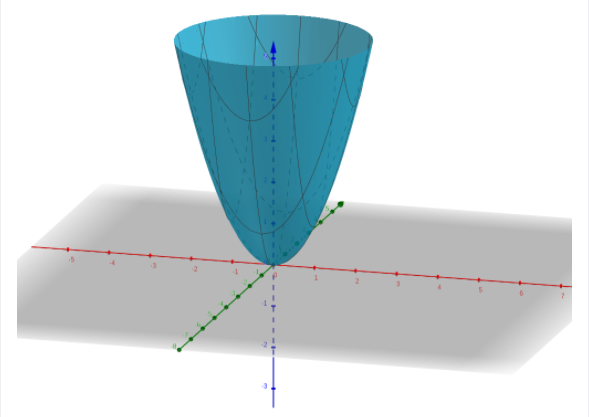
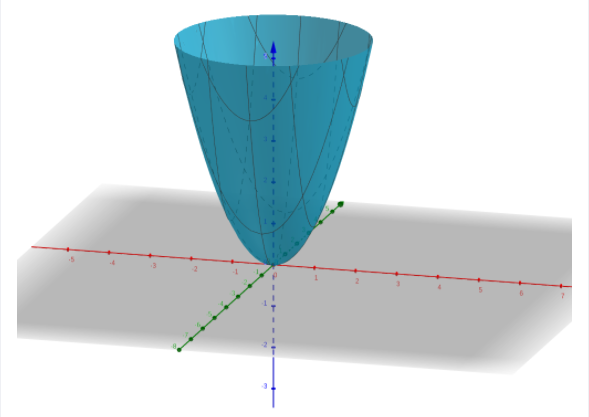
Given: S be the surface parametrizedx=scost,y=ssint,z=s2 wheres≥0,0≤t≤2π

To find the sketch the graph of S and recognize S as a familiar surface.Using the method of graph.

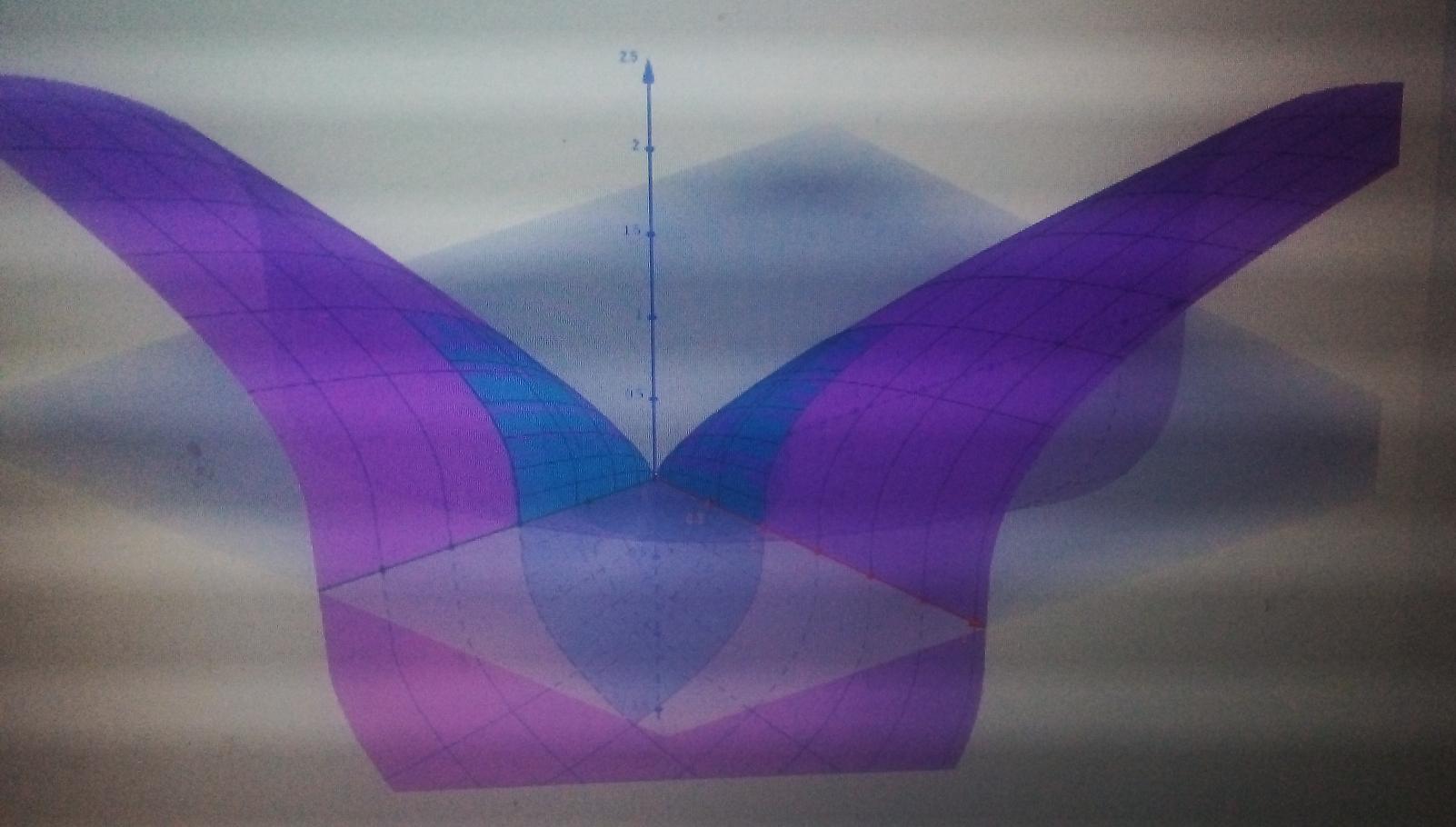
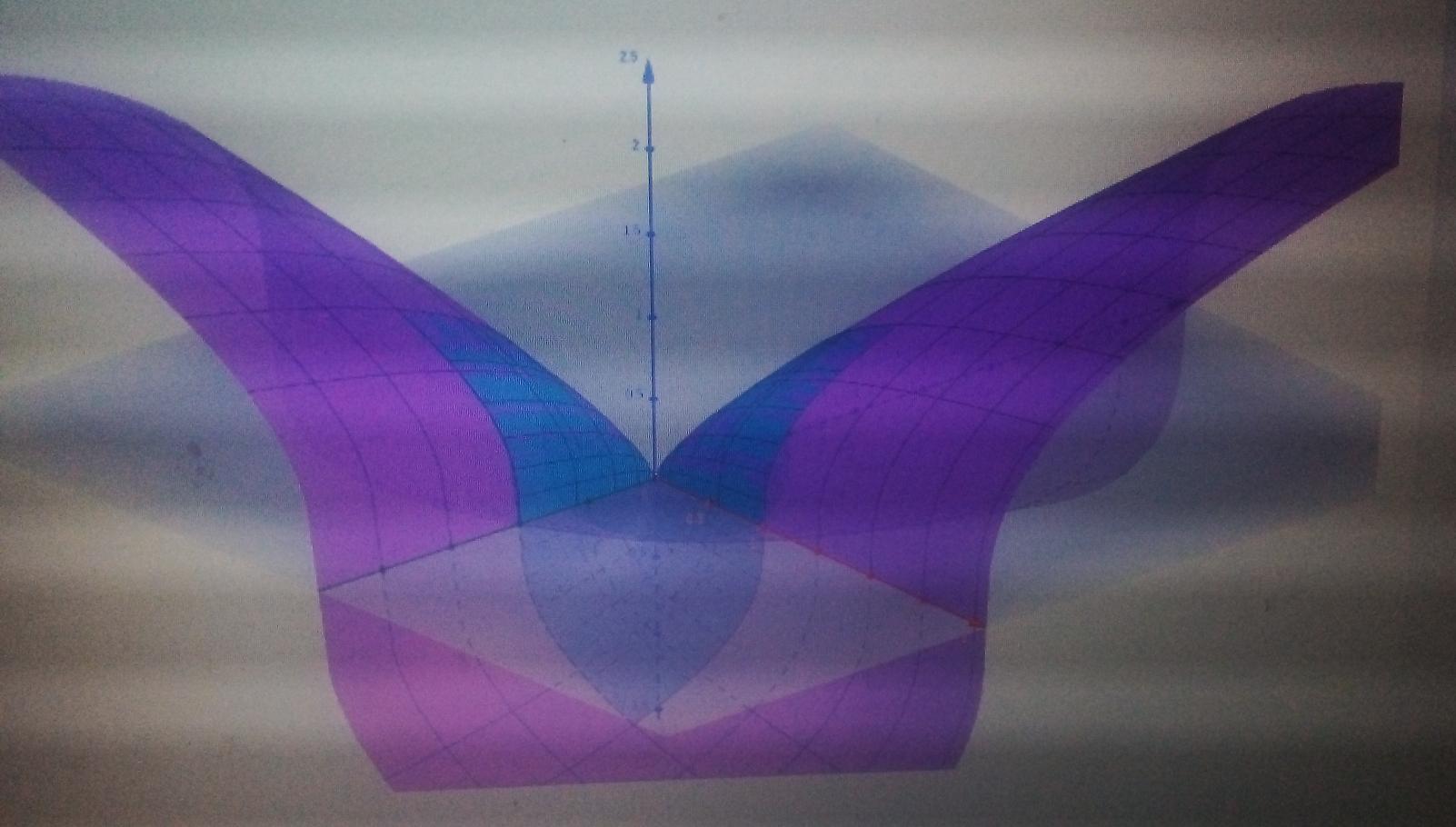
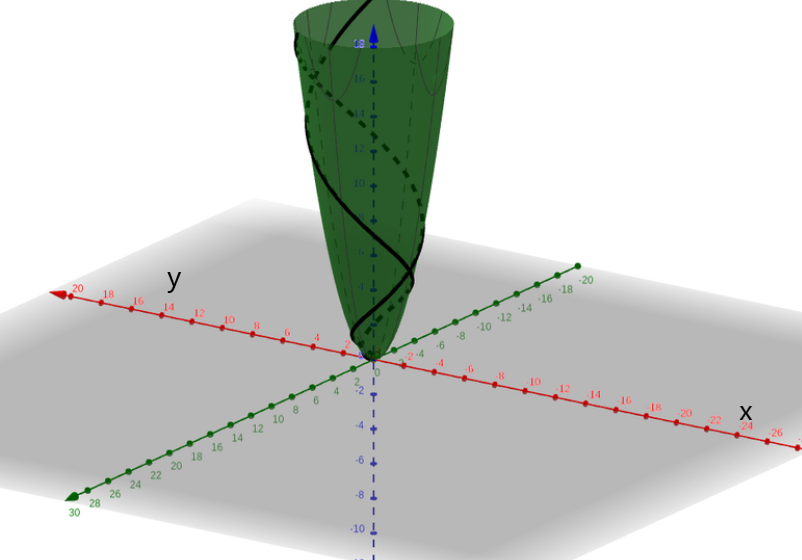
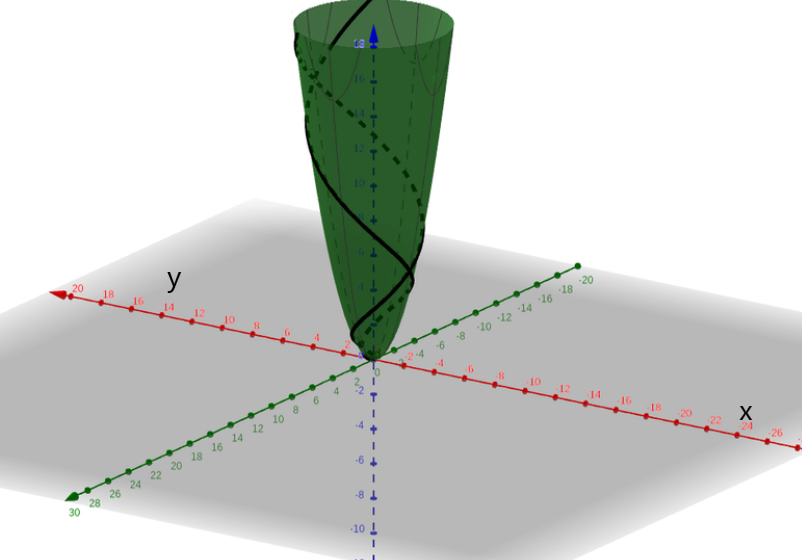
Vector Calculus, 4th Edition, Chapter 7 Surface Integrals and Vector Analysis 9

Using the geogebra and we plot the surface as paraboloid.

The surface is paraboloid.

Vector Calculus, 4th Edition, Chapter 7 Surface Integrals and Vector Analysis 9 1

Page 468 Problem 10 Answer

Given S be the surface parametrized byx=scost,y=ssint,z=s2 wheres≥0,0≤t≤2π

To find equation of formz=f(x,y)

Using the method of normal vector.

From parametrization we conclude that

⇒ z=x²+y²

This due the fact that we easily cancel out the term with sine and cosine once we square them.

The equation of formz=f(x,y) is z=x²+y²

Page 468 Problem 11 Answer

Given: S be the surface of parameterized byx=scost,y=ssint,z=s2

To find the Using answer in part(c), discuss whether S has a tangent plane at every point.

Using the method of vector and surface integral.

It does. For any point on surface expect the origin we can use the same process as in part(a).

At the origin the tangent plane is the planez=0.

Yes,S has a tangent plane at every point.

Page 468 Problem 12 Answer

Given: The parametrized surface is given asX(s,t)=(2sinscost,3sinssint,coss) where0≤s≤π,0≤t≤2π

To find the parametrized surface is ellipsoid.

Using the method of surface integral.

Simply try fitting the parametrized of the given surface into the ellipsoid equation.

The general ellipsoid equation is given by, ax2+by2+cz2=1

Now we simplify to find the value of a,b,c for which the parametrized satisfy.

a(2sinscost)2+b(3sinssint)2+c(coss)2=1

From this we have,a=1/4,b=1/9,c=1

The equation of ellipsoid is given by x2/4+y2/9+z2=1

Page 468 Problem 13 Answer

Given: The coordinate curve, when t=t0, is a circle of radiusa+bcost0

To find the torus of example 5 is a circle.Using the method of surface integral.

When we fixt=t0 the parametrization only depend on s.

Hence the new parametrization is a single variable function.

γ(s)=((a+bcost0)coss,(a+bcost0)sins,bsint0)

You can write this as

γ(s)=((a+bcost0)coss,(a+bcost0)sins,(0,0,bsint0))

This is circle with radiusa+bcost0

displayed from the origin on point(0,0,bsint0)

The parametrized as a function of a single variable to confirm the result.

Surface Integrals Susan Colley Chapter 7.1 worked Examples Page 468 Problem 14 Answer

Given The surface in R3 parametrized byX(r,θ)=(rcosθ,rsinθ,θ),​r≥0,−∞<θ<∞

To find the r-coordinate curve Method used for  vector calculus

(a) When θ=π/3, the r-coordinate curve is given by(r/2,r√3/2,π/3) where r≥0.

This is the ray y=√3/x where x≥0 and z=π/3.

In general, the r-coordinate curve when θ=θ0

0 is a ray in the z=θ0 plane.

The solution is simpler than the following four cases make it seem.

If cosθ0≠0then y=(tanθ0)x

where x≥0

if cosθ0>0and x≤0.

If cosθ0=0,

Then the ray is x=0 with y≥0 if sinθ0>0 and y≤0 if sinθ0<0.

If cosθ0=0 then the ray is x=0

with y≥0 if sinθ0 >0 and y≤0 if sinθ0<0.

Page 468 Problem 15 Answer

Given The surface in R3

parametrized by X(r,θ)=(rcosθ,rsinθ,θ),​r≥0,−∞<θ<∞

To find the θ-coordinate curve Method used for vector calculus

When r=1 the θ-coordinate curve is the helix (cosθ,sinθ,θ).

In general, when r=r0 the θ-coordinate  curve is the helix (r0cosθ,r0sinθ,θ)

The θcoordinate curve in the helix is: (r0cosθ,r0sinθ,θ)

Page 468 Problem 16 Answer

Given The surface in R3

parametrized by X(r,θ)=(rcosθ,rsinθ,θ),​r≥0,−∞<θ<∞

To find  the graph of the helicoidMethod used for vector calculus

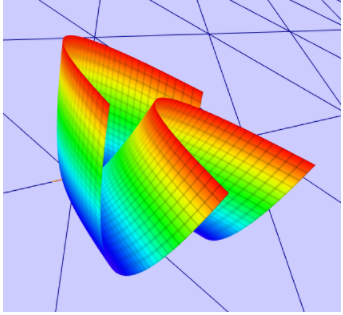
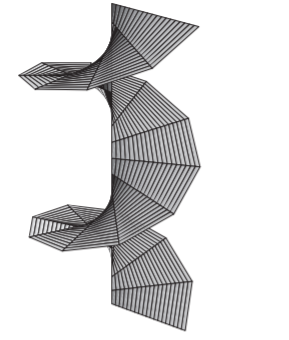
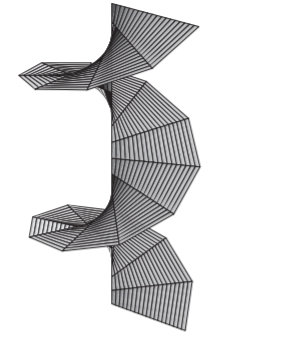
Vector Calculus, 4th Edition, Chapter 7 Surface Integrals and Vector Analysis 16

(c) You can see that the helicoids are made up of the helices that are the θ-coordinate curves

The graph of the helicoid

Vector Calculus, 4th Edition, Chapter 7 Surface Integrals and Vector Analysis 16 1

Page 468 Problem 17 Answer

Given the equation form of f(x,y)=√4−(x−2)2−(y+1)2

To find an equation for the plane tangent to it at the pointMethod used for vector calculus

(a) First we consider the sphere as the graph of the function f(x,y)=√4−(x−2)2−(y+1)2.

The partial derivatives are fx=−(x−2)√4−(x−2)2−(y+1)2,fy=−(y+1)√4−(x−2)2−(y+1)2.

So, fx(1,0,√2)=1/√2 and fy(1,0,√2)=−1/√2.

By Theorem 3.3 of Chapter 2, z=f(a,b)+fx(a,b)(x−a)+fy(a,b)(y−b).

In this case, this is z=√2+(1/√2)(x−1)−(1/√2) y, or equivalently −x+y±√2 z=1

An equation for the plane tangent to it at the point (1,0,√2) by considering the sphere as the graph of the function f(x,y)=√4−(x−2)2−(y+1)2 is: z=√2+(1/√2)(x−1)−(1/√2)y, or equivalently −x+y±√2 z=1

Page 468 Problem 18 Answer

Given the equation form of F(x,y,z)=(x−2)2+(y+1)2+z2

To find an equation for the plane tangent to it at the pointMethod used for vector calculus

(b) Now we look at the sphere as a level surface of F(x,y,z)=(x−2)2+(y+1)2+(z)2.

The gradient ∇F(x,y,z)=2(x−2,y+1,z) and,Therefore, ∇F(1,0,√2)=(−2,2,2,√2).

By formula (5) of Section 2.6, the tangent plane is given by 0=∇F(1,0,√2).(x−(1,0,√2))=(−2,2,2,√2)⋅(x−(1,0,√2).

This too is equivalent to −x+y+√2z=1.

an equation for the plane tangent to it at the point (1,0,√2) by considering the sphere as a level surface of the function ∇F(x,y,z)=2(x−2,y+1,z) is: −x+y+√2 z=1.

Page 468 Problem 19 Answer

Given  the sphere as the surface parametrized by X(s,t)=(2sinscost+2,2sinssint−1,2coss)

To find an equation for the plane tangent to it at the pointMethod used for vector calculus

(c) Now we’ll use the results of this section.

Considering the z-component, We see 2coss=√2

so cos s=√2/2.

Considering the y- and x-components, 2sinssint=1 and sinscost=−1.

Thus we have that s=π/4 and t=3π/4.

Also Ts(s,t)=(2cosscost,2cosssint,−2sins) and

Tt(s,t)=(−2sinssint,2sinscost,0).

A normal vector to the sphere at the specified point is

⇒ N(π/4,3π/4)=Ts (π/4,3π/4)×Tt(π/4,3π4)

⇒ N(π/4,3π/4)=(−1,1,−√2)×(−1,−1,0)

⇒ N(π/4,3π/4)=(−√2,√2,2)

The tangent plane is given by(−√2,√2,2).(x−(1,0,√2))=0

Which is also equivalent to−x+y+√2z=1.

An equation for the plane tangent to it at the point (1,0,√2) by considering the sphere as the surface parametrized by X(s,t)=(2sinscost+2,2sinsint−1,2coss) is: −x+y+√2z=1.

Susan Colley Vector Calculus Exercise 7.1 Problem Explanations Page 468 Problem 20 Answer

Given the cylinder x2+z2=4 lying between y=−1 and y=3

To find represent the given surface as a piecewise smooth parametrized surface.

Method used for vector calculus.

Imagine the cylinder as a trace of the circle which has its origin slid between (0,−1,0) and (0,3,0).

From here, this gives us the idea how to parametrize such object.

If y=0 our cylinder is just a circle in x,z plane.

The radius of the circle is 2 hence the parametrization becomes:

Υ(t)=(2cost,0,2sint),t∈[0,2Π]

We want to allow the circle to slide, so we vary the y coordinate.

Final parametrization of the cylinder is:ϕ(t,s)=(2cost,s,2sint),t∈[0,2Π],s∈[−1,3]

Parametrization of the cylinder is: ϕ(t,s)=(2cost,s,2sint),t∈[0,2Π],s∈[−1,3]

Page 468 Problem 21 Answer

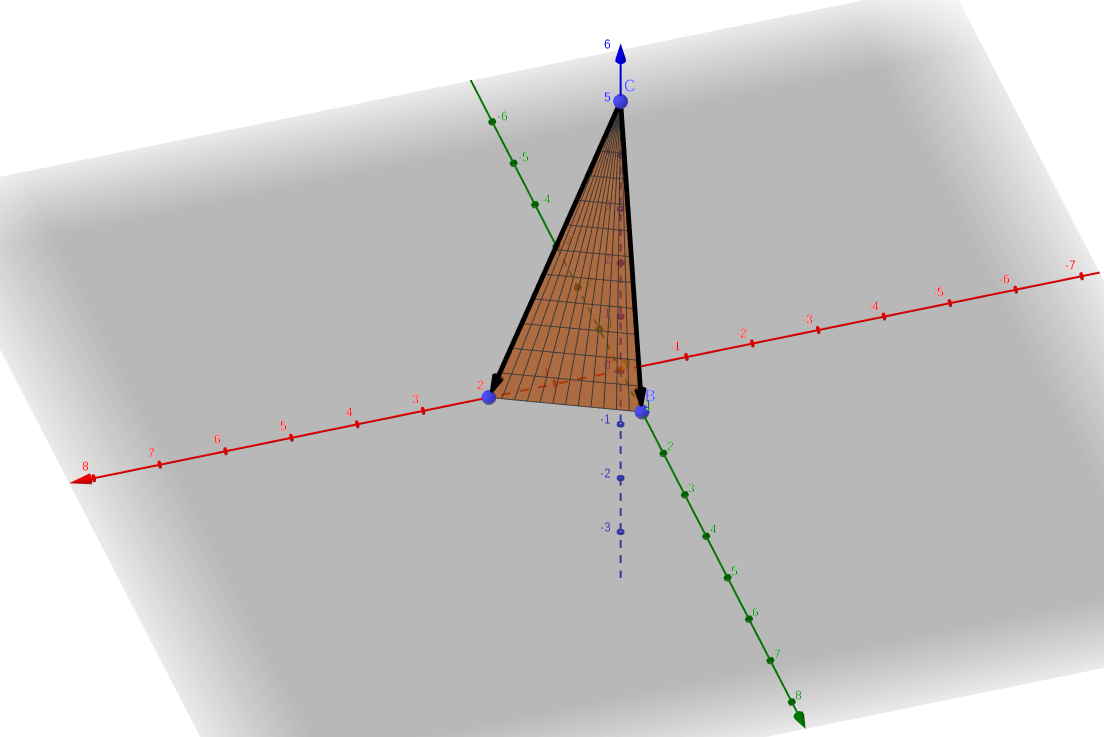
Given The closed triangular region in R3 with vertices (2,0,0),(0,1,0) and (0,0,5)

To find represent the given surface as a piecewise smooth parametrized surface.

Method used for vector calculus.

Easiest way to parametrize the triangle is to consider it as a convex combination of its sides.

To do it, first draw two segments from the point (0,0,5) to the points (2,0,0) and (0,1,0).

Next, we parametrize these segments on such way that they both start at (0,0,5)

and end at their respective end points.

We obtain two curves:

⇒ Υ1(t)=(2t,0,5−5t),t∈[0,1]

⇒ Υ2 (t)=(0,t,5−5t),t∈[0,1]

The triangle can be viewed  as a convex combination of these two curves, hence define the surface parametrization as:

⇒ ϕ(t,s)=(1−s)Υ1(t)+Υ2(t),t,s∈[0,1]

The final parametrization is:

⇒ ϕ(t,s)=(2t−2ts,ts,5−5t−5s+5ts+5s−5ts)

⇒ ϕ(t,s)=(2t−2ts,ts,5−5t)

The image of the area is below.

From there one can see where the idea from the solution comes in.

Every line in the interior of the tringle is a linear combination of its two sides.

Parametrization of triangle is: (2t−2ts,ts,5−5t)

Vector Calculus, 4th Edition, Chapter 7 Surface Integrals and Vector Analysis 21

Page 467 Problem 22 Answer

Given the point (1,−1,−1) and the parametrized surface X(s,t)=(s3,t3,st).To find the equation for the parametric surface on the point (1,−1,−1)

Using the partial derivation.

Partial derivative of X=(s3,t3,st) with respect to s

⇒ dX/ds=(3s2,0,t)

Partial derivative of X=(s3,t3,st) with respect to t

⇒ dX/dt=(0,3t2.s)

Cross multiplication of dX

⇒ Ds and dX/dt

⇒ (3s2,0,t)×(0,3t2,s)=(3,−3,9)

Now, the required equation of the plane

⇒ 3(x−1)+(−3)(y+1)+9(z+1))=0

⇒3x−3y+9z+3=0

⇒x−y+3z=−1

The required equation is x−y+3x=−1

Page 467 Problem 23 Answer

Given the parametric plane X(s,t) on (1,−1,−1)

To find whether the curve was plane or not.Using the normal of the plane

The surface is smooth , if its normal vector is non-zero at origin.

Normal vector

(3s3,−3t3,9st) at t=0 and s=0

⇒(0,0,0)

So the surface is not plane.

The surface is not smooth as its normal vector is zero at origin.

Practice Problems For Surface Integrals And Vector Analysis Chapter 7.1 Susan Colley Page 467 Problem 24 Answer

Given the parametric plane X(s,t) and condition −1≤t≤1 and −1≤s≤1.

To find the surface along the given condition.Using plotting of parametric curves.

The surface made under given conditions is

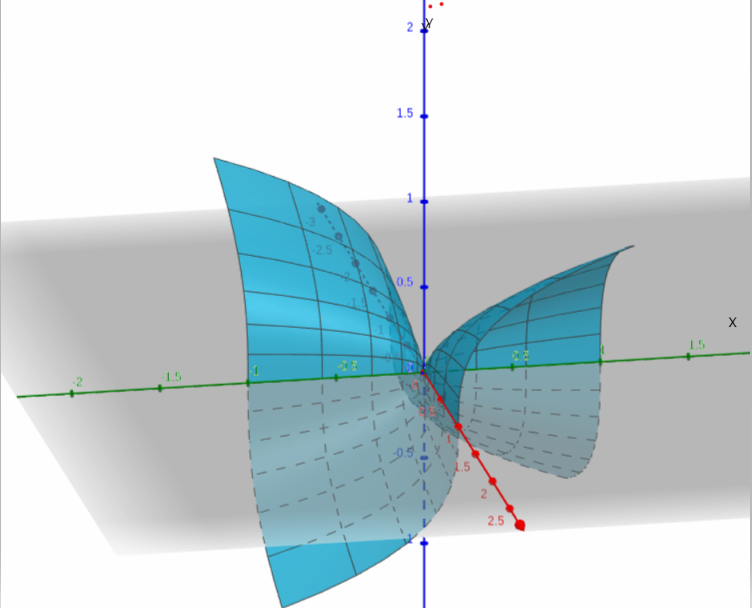
Vector Calculus, 4th Edition, Chapter 7 Surface Integrals and Vector Analysis 24

The required graph is

Vector Calculus, 4th Edition, Chapter 7 Surface Integrals and Vector Analysis 24 1

Page 467 Problem 25 Answer

Given the parametrized surface X(s,t) and the equation z=(xy)​1/3

To find that X(s,t) at t,s∈[−1,1] ,also shows z=(xy)​1/3

Method used for plotting the surfaces on same graph.

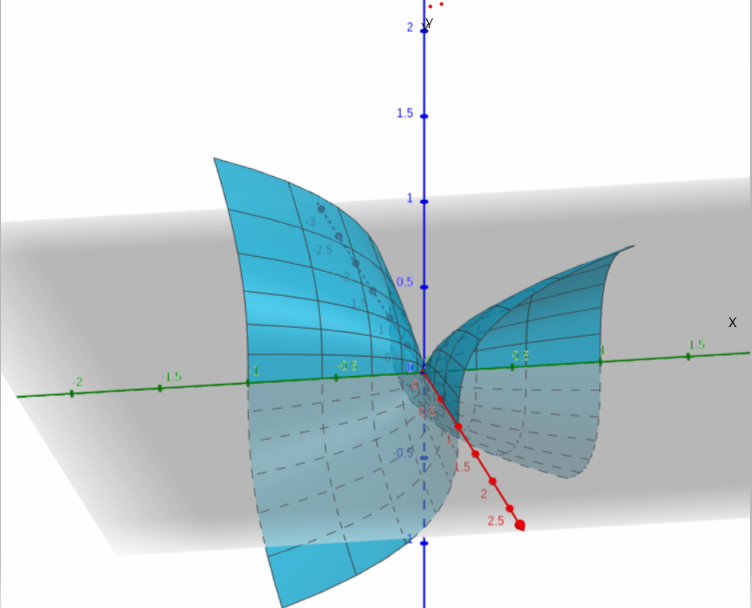
Vector Calculus, 4th Edition, Chapter 7 Surface Integrals and Vector Analysis 25 1

The graph plotted for X(s,t)=(s3,t3,st) at s,t∈[−1,1] and the equationz=(xy)​1/3

Here, numerically if x=s3 and y=t3,

Then z=(s3⋅t3)​1/3z=st

Which satisfies X(s,t)=(s3,t3,st)

The graph of z=(xy)1/3 also include the graph of X(s,t)

Vector Calculus, 4th Edition, Chapter 6 Line Integrals 25

Susan Colley Vector Calculus 4th Edition Chapter 6 Exercise 6.1 Line Integrals

Susan Colley Vector Calculus 4th Edition Chapter 6 Line Integrals

Page 426 Problem 1 Answer

Given: The function f(x,y)=x+2y

To Find: Evaluate scalar line integral of x(t)=2−3t,4t−1,0≤t≤2

Evaluate to get the final result.

Let (x,y) = x + 2y.

Let x(t) = (2-3t, 4t – 1), 0 ≤ t ≤ 2

We have that f(x) = f(2 – 3t, 4t – 1) = (2 – 3t) + 2(4t – 1) = 2 – 3t + 8t – 2 = 5t

for all 0 ≤ t ≤ 2 and

⇒ x'(t) = (-3,4) for all 0 ≤ t ≤ 2

Which gives us that

⇒ \(\left\|\mathbf{x}^{\prime}(t)\right\|=\sqrt{(-3)^2+4^2}=\sqrt{9+16}=\sqrt{25}=5\)

for all. 0 ≤ t ≤ 2

Thus,

⇒ \(\int_{\mathbf{X}} f d s=\int_0^2 f(\mathbf{x}(t))\left\|\mathbf{x}^{\prime}(t)\right\| d t\)

= \(\int_0^2(5 t) \cdot 5 d t=\int_0^2 25 t d t\)

= \(\left.\frac{25 t^2}{2}\right|_0 ^2\)

= \(\frac{25 \cdot 2^2}{2}-\frac{25 \cdot 0^2}{2}\)

= 50 – 0 = 50.

The required solution is 50.

Page 426 Problem 2 Answer

Given: The functionf(x,y)=x+2y.

To Find: Evaluate scalar line integral of x(t)=(cost,sint),0≤t≤π.

Evaluate to get the final result.

Let f(x,y) =x + 2y.

Let x(t) = (cos t, sin t), 0 ≤ t ≤ π.

We have that f(x(t)) = f (cost, sin t) = cos t + 2 sin t for all 0 ≤ t ≤ π and

⇒ x'(t) = (-sint, cos t) for all 0 ≤ t ≤ π which gives us that

⇒ \(\left\|\mathbf{x}^{\prime}(t)\right\|=\sqrt{(-\sin t)^2+(\cos t)^2}=\sqrt{\sin ^2 t+\cos ^2 t}=\sqrt{1}=1 \text { for all } 0 ≤ t ≤ \pi\)

Thus,

⇒ \(\int_{\mathbf{x}} f d s=\int_0^\pi f(\mathbf{x}(t))\left\|\mathbf{x}^{\prime}(t)\right\| d t\)

= \(\int_0^\pi(\cos t+2 \sin t) \cdot 1 d t=\int_0^\pi(\cos t+2 \sin t) d t\)

= \((\sin t-2 \cos t)_0^\pi=(\sin \pi-2 \cos \pi)-(\sin 0-2 \cos 0)\)

= (0-2.(1)) – (0-2.1) = 2 – (-2)

= 4.

The required solution is 4.

Read and Learn More Susan Colley Vector Calculus Solutions

Solutions To Chapter 6.1 Line Integrals By Susan Colley Page 426 Problem 3 Answer

Given: The expressionf(x,y,z)=xyz,x(t)=(t,2t,3t),0≤t≤2

To Find: ∫x fds, where f and x are as indicated.

Evaluate to get the final result.

Recal the way that we evaluate the line integral of a scalar field. First, for the given curve:

x = (t, 2t, 3t), t ∈ [0,2]

we find its derivative x’ = (1,2,3) ⇒ ||x|| = √14

Next, recall that the integral is evaluated by the formula:

⇒ \(\int_{\mathbf{x}} f d s=\int_a^b f(\mathbf{x})\|\mathbf{x}\| d t\)

where [a,b] is the segment on which we are considering the curve.

That is this is the segment on which the curve is, given.

Finally, we evaluate the integral

⇒ \(\int_0^2 \sqrt{14} f(t, 2 t, 3 t) d t=\sqrt{14} \int_0^2 6 t^3 d t\)

= 24√14

The required solution is 24√14

Page 426 Problem 4 Answer

Given : The expression is f(x,y,z)=x+z/y+z,

x(t)=(t,t,t3/2),1≤t≤3

To Find: Calculate the expression .

Evaluate the question to get the answer.

Let us evaluate the line integral of a scalar field.

First, for the given curve: x=(t,t,t​3/​2),t∈[1,3]

We find its derivative x′=(1,1,3/2√t)

⇒∥x∥=1/2√9t+8

Next, recall that the integral is evaluated by the formula:

⇒ \(\int_{\mathbf{x}} f d s=\int_a^b f(\mathbf{x})\|\mathbf{x}\| d t\)

Where [a,b] is the segment on which we are considering the curve, that is the segment on which the curve is given.

Finally, we evaluate the integral:

⇒ \(\int_1^3 f(\mathbf{x}) \frac{1}{2} \sqrt{9 t+8} d t=\frac{1}{2} \int_1^3 \sqrt{9 t+8} d t\)

= \(\frac{35 \sqrt{35}-17 \sqrt{17}}{27}\)

Calculating fx/fds we get 35√35 −17√17/27.

Page 426 Problem 5 Answer

Given : The function is f(x,y,z)=3x+xy+z3,

x(t)=(cos4t,sin4t,3t),​0≤t≤2π

To Find: Calculate the function.

Evaluate the question to get the answer .

Recall the way that we evaluate the line integral of a scalar field.

First, for the given curve:

x(t)=(cos4t,sin4t,3t),t∈[0,2π]

We find its derivative x′(t)=(−4sin4t,4cos4t,3)

⇒∥x(t)∥=5

Next, recall that the integral is evaluated by the formula:

⇒ \(\int_{\mathbf{x}} f d s=\int_a^b f(\mathbf{x})\|\mathbf{x}\| d t\)

where [a,b] is the segment on which we are considering the curve, that is the segment on which the curve is given.

Finally, we evaluate the integral:

⇒ \(\int_{\mathbf{x}} f d s=\int_0^{2 \mathrm{~T}} f(\mathbf{x}(t))\|\mathbf{x}\| d t\)

= \(5 \int_0^{2 \pi}\left(3 \cos 4 t+\frac{\sin 8 t}{2}+27 t^3\right) d t\)

= \(\left.5\left(\frac{3 \sin 4 t}{4}-\frac{\cos 8 t}{16}+\frac{27 t^4}{4}\right)\right|_0 ^{2 \pi}\)

= 540 π4

Calculating the function f{x}fds we get, 540π4.

Page 426 Problem 6 Answer

Given : The function is f(x,y,z)=z x2+y2,

x(t)=(e2tcos3t,e2tsin3t,e2t),​0≤t≤5.

To Find: Calculate the integral.

Evaluate he function to get the answer.

Recall the way that we evaluate the line integral of a scalar field.

First, for the given curve:

x(t)=(e2tcos3t,e2tsin3t,e2t),t∈[0,5]

We find its derivative x′(t)=(2e2tcos3t−3e2tsin3t,2e2tsin3t+3e2tcos3t,2e2t)

From here we find∥x∥:∥x∥=√17e2t

Next, recall that the integral is evaluated by the formula:

⇒ \(\int_{\mathbf{x}} f d s=\int_a^b f(\mathbf{x})\|\mathbf{x}\| d t\)

where [a,b] is the segment on which we are considering the curve, that is the segment on which the curve is given.

Finally, we evaluate the integral:

⇒ \(\int_0^5 \frac{e^{2 t}}{e^{4 t} \cos ^2 3 t+e^{4 t} \sin ^2 3 t} \cdot \sqrt{17} e^{2 t} d t=\int_0^5 \frac{1}{e^{2 t}} \sqrt{17} e^{2 t} d t\)

= 5√17

Calculating the integral∫xfds we get,5√17.

Susan Colley Chapter 6.1 Line Integrals Solved Problems Page 426 Problem 7 Answer

Given : The function is ​​f(x,y,z)=x+y+z,

x(t)={(2t,0,0)if0≤t≤1

(2,3t−3,0)if1≤t≤2

(2,3,2t−4)if2≤t≤3}

To Find: Calculate the function fx fds

Evaluate the question to get the answer .

Let us denote each of the 3 pieces of the curve with γ1,γ2and γ3respectively to ease the calculations.

The integral over the piecewise curve is the sum of integrals over every piece.

The function we are integrating is f(x,y,z)=x+y+z

Now,​γ1′(t)=(2,0,0)

⇒ ||γ1|| = 2

⇒ \(\int_0^1 2 f\left(\gamma_1(t)\right) d t=\int_0^1 2 \cdot(2 t+0+0) d t\)

Next, we move on to the second piece:

||γ2|| = 2

⇒ \(\int_1^2 3 f\left(\gamma_2(t)\right) d t=\int_1^2 3 \cdot(2+3 t-3+0) d t\)

= \(\frac{21}{2}\)

The third piece is:

⇒ ||γ3|| = 2

⇒ \(\int_2^3 2 f\left(\gamma_3(t)\right) d t=\int_2^3 2 \cdot(2+3+2 t-4) d t\)

= 12

Now, adding everything together we get \(\frac{49}{2}\).

​Calculating fxfds we get 49/2.

Page 426 Problem 8 Answer

Given : The function is \text { 7. }f(x,y,z)=2x−y1/2+2z2

​ x(t)={(t,t2,0)if0≤t≤1(1,1,t−1)if1≤t≤3

To Find: Calculate the function.

Evaluate the question to get the answer.

Once again we split the curve into two pieces and evaluate their norm to calculate 2 piecewise integrals.

The sum of the two integrals we will obtain will be the final result,

The first piece of the curve can be parametrized with:

⇒ γ1(t)=(t,t2,0),t∈[0,1]⇒γ1′(t)=(1,2t,0)

From the derivative above we find the norm:

⇒ ∥γ1∥=√1+4t2

Finally, we calculate the integral over the first piece:

⇒ \(\int_0^1 f\left(\gamma_1(t)\right) d t=\int_0^1 t \sqrt{1+4 t^2} d t\)

= \(\left.\frac{\left(1+4 t^2\right)^{3/2}}{12}\right|_0 ^1\)

= \(\frac{5 \sqrt{5}-1}{12}\)

The second piece is given with:

⇒ γ2(t) = (1,1, t-1)

⇒ γ2(t) = (0,0,1)

The norm of the derivative is:

⇒ ||γ2|| = 1

Finally, we calculate:

⇒ \(\int_1^3 2-1+2 t^2-4 t+2 d t=9-\frac{5}{3}\)

Therefore, the final result is 5√5−1/12+9−5/3 =5√5+87/12.

Page 426 Problem 9 Answer

Given: The function isF=xi+yj+zk,

⇒ x(t)=(2t+1,t,3t−1),​0≤t≤1.

To Find: Calculate the function.

Evaluate the question to get the answer.

LetF(x,y,z)=xi+yj+zk and  letx(t)=(2t+1,t,3t−1),0≤t≤1

We have that F(x(t))=(2t+1)i+tj+(3t−1)k and x′(t)=(2,1,3)for all 0≤t≤1

which gives us that F(x(t))⋅x′(t)=(2t+1)⋅2+t⋅1+(3t−1)⋅3

=4t+2+t+9t−3

=14t−1 for all 0≤t≤1

Thus, \(\int_{\mathbf{x}} \mathbf{F} \cdot \mathrm{d} \mathbf{s}=\int_0^1 \mathbf{F}(\mathbf{x}(t)) \cdot \mathbf{x}^{\prime}(t) d t\)

= \(\int_0^1(14 t-1) d t\)

= \(\left.\left(7 t^2-t\right)\right|_0 ^1\)

= (7. 12 – 1) – (7. 02 – 0)

= (7-1) – (0 – 0)

= 6

Calculating the function we get,  ∫xF⋅ds=6.

Line integrals Susan Colley Chapter 6.1 Detailed Solutions Page 426 Problem 10 Answer

Given : The function isF=(y+2)i+xj,x(t) =(sint,− cost t),0≤t≤π/2

To Find: Calculate the function.

Evaluate the question to get the answer.

Recall the way we calculate the path integral of the given vector field.

For the sake of easier notation, if we are given the field.

F=a(x,y,z)i+b(x,y,z)j+c(x,y,z)k

where a,b,c are some scalar functions, we will write it down asF=(a(x,y,z),b(x,y,z),c(x,y,z)).

The path we are integrating over is: x(t)=(sint,−cost),t∈[0,π2]

Its derivate is:

x'(t) = (cos t, sin t)

Finally we use the formula for evaluating the path integral of the second kind:

⇒ \(\int_{\mathbf{x}} \mathbf{F} \cdot d s=\int_a^b \mathbf{F}(\mathbf{x}(t)) \cdot \mathbf{x}^{\prime}(t) d t\)

The field F is given in the task, so plugging everything into the formula we get:

⇒ \(\int_0^{\frac{\pi}{2}}(-\cos t+2) \cos t+\sin t \sin t=\int_0^{\frac{\pi}{2}} 2 \cos t-\cos 2 t d t\)

= 2.

Calculating the function we get ∫0​π2(−cost+2)cost+sintsint=2.

Page 426 Problem 11 Answer

Given : The function isF=xi+yj,x(t)

=(2t+1,t+2),0≤t≤1

To Find: Calculate the function.

Evaluate the question to get the answer.

Recall the way we calculate the path integral of the given vector field.

For the sake of easier notation, if we are given the field

F=a(x,y,z)i+b(x,y,z)j+c(x,y,z)k

where a,b,c are some scalar functions, we will write it down asF=(a(x,y,z),b(x,y,z),c(x,y,z)).

This time the field we are integrating is F(x,y)=(x,y)

The path we are integrating over is: x(t)=(2t+1,t+2),t∈[0,1]

Its derivative is:

x'(t) = (2,1)

Finally we use the formula for evaluating the path integral of the second kind:

⇒ \(\int_{\mathbf{x}} \mathbf{F} \cdot d s=\int_a^b \mathbf{F}(\mathbf{x}(t)) \cdot \mathbf{x}^{\prime}(t) d t\)

The field F is given above, so plugging everything into the formula we get:

⇒ \(\int_0^1((2 t+1) \cdot 2+(t+2) \cdot 1) d t=\int_0^1 5 t+4 d t\)

= \(\frac{13}{2}\)

Calculating the function we get ∫0((2t+1)⋅2+(t+2)⋅1)dt=13/2.
                                                             1

Page 426 Problem 12 Answer

Given : The function is F=(y−x)i+x4y3j,

x(t)=(t2,t3),−1≤t≤1

To Find: Calculate the function.

Evaluate the question to get the answer.

Recall the way we calculate the path integral of the given vector field.

For the sake of easier notation, if we are given the field

F=a(x,y,z)i+b(x,y,z)j+c(x,y,z)k

where a,b,c are some scalar functions, we will write it down as F=(a(x,y,z),b(x,y,z),c(x,y,z)).

This time, the vector field is:F(x,y)=(y−x,x4y3)

The path we are integrating over is:

⇒ x(t) = (t2, t3), t ∈ [-1,1]

Its derivative is:

⇒ x'(t) = (2t, 3t2)

Finally we use formula for evaluating the path integral of the second kind:

⇒ \(\int_{\mathbf{x}} \mathbf{F} \cdot d s=\int_a^b \mathbf{F}(\mathbf{x}(t)) \cdot \mathbf{x}^{\prime}(t) d t\)

The field F is given in the task, so plugging everything into the formula we get:

⇒ \(\int_{-1}^1\left(\left(t^3-t^2\right) \cdot 2 t+\left(t^2\right)^4\left(t^3\right)^3 \cdot 3 t^2\right) d t=\int_{-1}^1 2 t^4-2 t^3+3 t^{19} d t\)

= \(\frac{4}{5}\)

Calculating the function we get ∫−1 ((t3−t2)⋅2t+(t2)4(t3)3⋅3t2)dt=4/5.

Susan Colley Vector Calculus Exercise 6.1 Problem Explanations Page 426 Problem 13 Answer

Given: The function is F=xi+xyj+xyzk,

x(t)=(3cost,2sint,5t),0≤t≤2π

To Find: Calculate the function. Evaluate the question to get the answer.

Recall the way we calculate the path integral of the given vector field.

For the sake of easier notation, if we are given the field

F=a(x,y,z)i+b(x,y,z)j+c(x,y,z)k

where a,b,c are some scalar functions, we will write it down as F=(a(x,y,z),b(x,y,z),c(x,y,z)).

The field we are given is:F(x,y,z)=(x,xy,xyz).

The path we are integrating over is: x(t)=(3cost,2sint,5t),t∈[0,2π]

Its derivative is: x′(t)=(−3sint,2cost,5)

Finally we use the formula for evaluating the path integral of the second kind:

⇒ \(\int_x \mathbf{F} \cdot d s=\int_a^b \mathbf{F}(\mathbf{x}(t)) \cdot \mathbf{x}^{\prime}(t) d t\)

⇒ \(\int_0^2-9 \cos t \sin t+12 \cos t \sin t \cos t+150 t \cos t \sin t d t\)

You can split this integral into 3 integrals, every integral containing a term of the original integral.

In the second term recognize that (-2 cos3 t)’ = 6 sin t cos2 t. and for the first and third one use the double angle formula.

Calculating the function we get∫02π−9

sin2t+12cos2tsint+75tsin2tdt=−75π.

Page 426 Problem 14 Answer

Given : The function is F=−3yi+xj+3z2k,

​x(t)=(2t+1,t2+t,et),​0≤t≤1

To Find : Calculate the function.

Evaluate the question to get the answer.

Recall the way we calculate the path integral of the given vector field.

For the sake of easier notation, if we are given the field

F=a(x,y,z)i+b(x,y,z)j+c(x,y,z)k

where a,b,c are some scalar functions, we will write it down as F=(a(x,y,z),b(x,y,z),c(x,y,z)).

The field we are given is F(x,y,z)=(−3y,x,3z2)

Its derivative is:

x'(t) = (2, 2t + 1, et)

Finally we use the formula for evaluating the path integral of the second kind:

⇒ \(\int_{\mathbf{x}} \mathbf{F} \cdot d s=\int_a^b \mathbf{F}(\mathbf{x}(t)) \cdot \mathbf{x}^{\prime}(t) d t\)

The field F is given in the task, so plugging everying into the formula we get:

⇒ \(\int_0^1\left(-3\left(t^2+t\right), 2 t+1,3 e^{2 t}\right) \cdot\left(2,2 t+1, e^t\right) d t=\int_0^1-2 t^2-2 t+1+3 e^{3 t} d t\)

= \(\frac{3 e^3-5}{3}\)

Calculating the function we get \(\)

The path we are integrating over is; x(t)=(2t+1,t2+t,et),t∈[0,1]

Page 426 Problem 15 Answer

Given : The function isF=xi+yj−zk,

x(t)=(t,3t2,2t3),−1≤t≤1

To Find: Calculate the function.

Evaluate the question to get the answer.

Recall the way we calculate the path integral of the given vector field.

For the sake of easier notation, if we are given the field

⇒ F=a(x,y,z)i+b(x,y,z)j+c(x,y,z)k

wherea,b,c are some scalar functions, we will write it down as F=(a(x,y,z),b(x,y,z),c(x,y,z)).

The field we are given in the task is F(x,y,z)=(x,y,−z).

Its derivate is:

⇒ x'(t) = (1,6t, 6t2)

Finally we use the formula for evaluating the path integral of the second kind:

⇒ \(\int_{\mathbf{x}} \mathbf{F} \cdot d s=\int_a^b \mathbf{F}(\mathbf{x}(t)) \cdot \mathbf{x}^{\prime}(t) d t\)

The field F is given in the task, so plugging everything into the formula we get:

⇒ \(\int_{-1}^1\left(t, 3 t^2,-2 t^3\right) \cdot\left(1,6 t, 6 t^2\right)=\int_{-1}^1 t+18 t^3-12 t^5 d t\)

= 0.

The path we are integrating over is: x(t)=(t,3t2,2t3),t∈[−1,1]

Calculating he function we get ,∫xF⋅ds=0.

Multivariable Calculus Susan Colley Chapter 6.1 Worked Examples Page 426 Problem 16 Answer

Given: The function isF=3zi+y2j+6zk,

⇒ x(t)=(cost,sint,t/3),0≤t≤4π

To Find: Calculate the function.

Evaluate the question to get the answe .

Recall the way we calculate the path integral of the given vector field.

For the sake of easier notation, if we are given the field

⇒ F=a(x,y,z)i+b(x,y,z)j+c(x,y,z)k

where a,b,c are some scalar functions, we will write it down as F=(a(x,y,z),b(x,y,z),c(x,y,z)).

The field we are integrating is: F(x,y,z)=(3z,y2,6z)

The path we are integrating over is:

x(t) = (3 cos t, 2 sin t, 5t), t ∈ [0,2π]

Its derivate is:

⇒ x'(t) = (-3 sin t, 2 cos t, 5)

Finally we use the formula for evaluating the path integral of the second kind:

⇒ \(\int_{\mathbf{x}} \mathbf{F} \cdot d s=\int_a^b \mathbf{F}(\mathbf{x}(t)) \cdot \mathbf{x}^{\prime}(t) d t\)

The field F is given in the task, so plugging everying into the formula we get:

⇒ \(\int_0^{4 \pi}\left(t, \sin ^2 t, 2 t\right) \cdot\left(-\sin t, \cos t, \frac{1}{3}\right)=\int_0^{4 \pi}-t \sin t+\sin ^2 t \cos t+\frac{2 t}{3} d t\)

Recognize the second term as the derivative of \(\frac{\sin ^3 t}{3}\)

The rest of the terms are easily integrated via table.

After the calculations the resulting number should be:

∴ \(\frac{12 \pi+16 \pi^2}{3}\)

Calculating the function we get, 12π+16π23.

Page 426 Problem 17 Answer

Given : The function isF=ycoszi+xsinzj+xysinz2k,x(t)

=(t,t2,t3),0≤t≤1

To Find: Calculate the function.

Evaluate the question to get the answer.

Recall the way we calculate the path integral of the given vector field.

For the sake of easier notation, if we are given the field

F=a(x,y,z)i+b(x,y,z)j+c(x,y,z)k

where a,b,c  are some scalar functions, we will write it down as F=(a(x,y,z),b(x,y,z),c(x,y,z)).

The field we are integrating is: F(x,y,z)=(ycosz,xsinz,xysinz2)

The path we are integrating over is: x(t)=(t,t2,t3),t∈[0,1]

Finally we use the formula for evaluating the path integral of the second kind:

⇒ \(\int_{\mathbf{x}} \mathbf{F} \cdot d s=\int_a^b \mathbf{F}(\mathbf{x}(t)) \cdot \mathbf{x}^{\prime}(t) d t\)

The field F is given in the task, so plugging into the formula we get

⇒ \(\int_0^1 t^2 \cos \left(t^3\right)+2 t^2 \sin \left(t^3\right)+3 t^5 \sin \left(t^6\right) d t=\left.\left(\frac{\sin \left(t^3\right)}{3}-2 \frac{\cos \left(t^3\right)}{3}-\frac{\cos \left(t^6\right)}{2}\right)\right|_0 ^1\)

The final result should be:

∴ \(\frac{7-7 \cos 1+2 \sin 1}{6}\)

Calculating the function we get \(\int_{\boldsymbol{x}} \mathbf{F} \cdot d s=\frac{7-7 \cos 1+2 \sin 1}{6}\)

Its derivative is: x′(t)=(1,2t,3t2).

Susan Colley Vector Calculus 4th Edition Chapter 5 Exercise 5.1 Multiple Integration

Vector Calculus 4th Edition Chapter 5 Multiple Integration

Page 313 Problem 1 Answer

Given: The expression is

0  1   y sin x dy dx.
Π  2

 To find: The iterated integrals of the given expression.Apply the properties of integrals∫sinx=−cosx.

Let us consider the given expression:

⇒ \(\int_0^\pi \int_1^2 y \sin x d y d x\)

Integrate with respect to y,

⇒ \(\int_0^\pi\left[\frac{y^2}{2} \sin x\right]_1^2 d x\)

Evaluate, apply The Fundamental theorem of Calculus,

⇒ \(\int_0^\pi\left[\frac{(2)^2}{2} \sin x-\frac{(1)^2}{2} \sin x\right] d x\)

= \(\int_0^\pi\left(\frac{3}{2} \sin x\right) dx\)

= \(\frac{3}{2}\int_0^\pi sin x dx\)

Integrate and evaluate.

⇒ \(\frac{3}{2} \int_0^\pi \sin x d x=-\frac{3}{2}[\cos x]_0^\pi\)

= \(-\frac{3}{2}\left[\cos x\right]_0^\pi=-\frac{3}{2}[\cos \pi-\cos 0]\)

= \(-\frac{3}{2}[\cos x]_0^\pi=-\frac{3}{2}[-1-1]\)

= \(-\frac{3}{2}[\cos x]_0^\pi=3\)

Evaluate to obtain the final answer.

​The answer of given expression after evaluating is 3.

Solutions To Chapter 5.1 Multiple Integration Problems By Susan Colley Page 313 Problem 2 Answer

Given: The expression is

−20     xey/dydx.
 4     1

To find: The iterated integrals of the given expression.

Apply the properties of integrals∫ex/dx=ex.

Evaluate to obtain the final answer.

Let us consider the given expression;

⇒ \(\int_{-2}^4 \int_0^1 x e^y d y d x\)

Integrate with respect to y,

= \(\int_{-2}^4\left[x e^y\right]_0^1 d x\)

= \(\int_{-2}^4 x\left[e^y\right]_0^1 d x\)

Evaluate.

=\(\int_{-2}^4 x\left[e-e^0\right] d x\)

= \(\int_{-2}^4 x(e-1) d x\)

= \(\int_{-2}^{4^2}(e-1) x d x\)

Integrate and evaluate.

⇒ \(\int_{-2}^4(e-1) x d x=(e-1)\left[\frac{x^2}{2}\right]_{-2}^4\)

= \((e-1)\left[\frac{x^2}{2}\right]_{-2}^4=(e-1)\left[\frac{(4)^2}{2}-\frac{(-2)^2}{2}\right]\)

= \((e-1)\left[\frac{x^2}{2}\right]_{-2}^4=(e-1)(6)\)

= \((e-1)\left[\frac{x^2}{2}\right]_{-2}^4=6 e-6\)

The required result is 6e-6.

Read and Learn More Susan Colley Vector Calculus Solutions

Page 313 Problem 3 Answer

Given: The expression is

10(ex+y+x2+lny) dx.
2     1

To find: The iterated integrals of the given expression. Apply the properties of integrals∫ex/dx=ex.

Evaluate to obtain the final answer.

Let us consider the given expression;

⇒ \(\int_1^2 \int_0^1\left(e^{z+y}+x^2+\ln y\right) d x d y\)

Integrate with respect to x,

⇒ \(\int_1^2\left[e^{x+y}+\frac{x^3}{3}+x \ln y\right]_0^1 d y\)

Estimate,

= \(\int_1^2\left[\left(e^{1+y}+\frac{(1)^3}{3}+(1) \ln y\right)-\left(e^{0+y}+\frac{(0)^3}{3}+(0) \ln y\right)\right] d y\)

= \(\int_1^2\left(e^{1+y}+\frac{1}{3}+\ln y-e^y\right) d y\)

Integrate and evaluate,

= \(\left[e^{1+y}+\frac{1}{3} y+y \ln y-y-e^y\right]^{2}\)

= \(\left[e^{1+y}-\frac{1}{3} y+y \ln y-e^y\right]^\frac{1}{2}\)

= \(\left[e^{1+2}-\frac{1}{3}(2)+2 \ln (2)-e^2\right]-\left[e^{1+1}-\frac{1}{3}(1)+2 \ln (1)-e^1\right]^1\)

= \(e^3-\frac{2}{3}+2 \ln (2)-e^2-e^2+\frac{1}{3}+e\)

= \(e^3-2 e^2+e+2 \ln 2-\frac{1}{3}\)

The required result is e3−2e2+e+2ln2−1/3.

Susan Colley Chapter 5.1 Multiple Integration Solved Problems Page 313 Problem 4 Answer

Given: The expression is

1 1ln√​x/xydxdy.
9   e

To find: The iterated integrals of the given expression.

Apply the properties of integrals ∫2lnx/xdx=(lnx)2.

Evaluate to obtain the final answer.

Let us consider the given expression;

∴ \(\int_1^9 \int_1^e \frac{\ln \sqrt{x}}{x y} d x d y=\int_1^9\left(\int_1^e \frac{\ln x^2}{x y} d x\right) d y\)

= \(\int_1^9\left(\int_1^e \frac{\ln x}{2 x y} d x\right) d y\)

= \(\int_1^9\left(\left.\frac{(\ln x)^2}{4 y}\right|_1 ^e\right) d y\)

= \(\int_1^9\left(\frac{(\ln e)^2}{4 y}-\frac{(\ln 1)^2}{4 y}\right) d y\)

= \(\int_1^9\left(\frac{1^2}{4 y}-\frac{0^2}{4 y}\right) d y\)

Integrate and evaluate.

= \(\int_1^9 \frac{1}{4 y} d y\)

= \(\left.\frac{\ln y}{4}\right|_1 ^9\)

= \(\frac{\ln 9}{4}-\frac{\ln 1}{4}\)

= \(\frac{\ln 9}{4}-\frac{0}{4}\)

= \(\frac{1}{4} \ln 9\)

= In \(9^\frac{1}{4}\)

= In √3.

The required result is ln√3.

Page 313 Problem 5 Answer

Given: The paraboloid z=x2+y2+2 and over the rectangle R={(x,y)∣−1≤x≤2,0≤y≤2}.

To find: The volume of the given region.

Apply Cavalieri’s principle.Evaluate to obtain the final answer.

Let us consider the given expression;

V = \(\int_a^b A(x) d x\)

A (x) = \(\int^d f(x, y) d y\)

V = \(\int_{a}^{b} \int_c^d f(x, y) d y d x\)

V = \(\int_{-1}^2 \int_0^2 x^2+y^2+2 d y d x\)

V = \(\int_{-1}^2 x^2 y+\frac{y^3}{3}+\left.2 y\right|_0 ^2 d x\)

V = \(\frac{x^3}{3}+\left.\frac{20}{3} x\right|_{-1} ^2\)

V = \(\frac{2}{3} \cdot 2^3+\frac{20}{3} \cdot 2+\frac{2}{3} \cdot 1+\frac{20}{3} \cdot 1\)

V = 26

The volume of the given region is 26.

Page 313 Problem 6 Answer

Given: The paraboloid z=x2+y2+2 and over the rectangle R={(x,y)∣−1≤x≤2,0≤y≤2}.

To find: The volume of the given region.Apply Cavalieri’s principle.Evaluate to obtain the final answer.

Let us consider the given expression;

V = \(\int_a^b A(y) d y\)

A (y) = \(\int_c^d f(x, y) d x\)

V = \(\int_c^d \int_a^b f(x, y) d x d y\)

V = \(\int_0^2 \int_{-1}^2 x^2+y^2+2 d x d y\)

V = \(\int_0^2 \frac{x^3}{3}+y^2 x+\left.2 x\right|_{-1} ^2 d y\)

V = \(9 y+\left.y^3\right|_0 ^2\)

V = 26.

The volume of the given region is 26.

Page 313 Problem 7 Answer

Given: The plane is z=x+3y+1.

To find: The volume of the given region.

Apply the formula of volume V=∫acf(x,y) dxdy.
                                                              B  d

Evaluate to obtain the final answer.

Let us consider the given expression

V = \(\int_a^b \int_c^d f(x, y) d x d y\)

V = \(\int_1^2 \int_0^3 x+3 y+1 d x d y\)

V = \(\int_1^2 \frac{x^2}{2}+3 y x+\left.x\right|_0 ^3 d y\)

Integrate and evaluate.

V = \(\int_1^2 \frac{9}{2}+9 y+3 d y\)

V = \(\int_1^2 \frac{15}{2}+9 y d y\)

V = \(\frac{15}{2} y+\left.\frac{9 y^2}{2}\right|_1 ^2\)

V = \(\frac{15}{2} \cdot 2+\frac{9}{2} \cdot 2^2-\frac{15}{2} \cdot 1-\frac{9}{2} \cdot 1^2\)

V = 21

The volume of the given region is 21.

MultipleIntegration Susan Colley Chapter 5.1 worked Examples Page 313 Problem 8 Answer

Given: The function is f(x,y)=2x2+y4sinπx.

To find: The volume of the given region.

Apply the formula of volume V=∫ac f(x,y) dxdy.
                                                              B  d

Evaluate to obtain the final answer.

Let us consider the given expression;

f(x,y) = 2x2 + y4 sin πx,

V = \(\int_a^b \int_c^d f(x, y) d x d y\)

V = \(\int_{-1}^2 \int_0^1 2 x^2+y^4 \sin \pi x d x d y\)

V = \(\int_{-1}^2 \frac{2}{3} x^3-\left.\frac{1}{\pi} y^4 \cos \pi x\right|_0 ^1 d y\)

Integrate and evaluate.

V = \(\int_{-1}^2 \frac{2}{3}(1)^3-\frac{1}{\pi} y^4 \cos \pi(1)-\frac{1}{\pi} y^4 \cos (1) \pi d y\)

V = \(\int_{-1}^2 \frac{2}{3}-\frac{2}{\pi} y^4 d y\)

V = \(\frac{2}{3} y-\left.\frac{2}{5 \pi} y^5\right|_{-1} ^2\)

V = \(\frac{2}{3} \cdot 2+\frac{3}{5 \pi} \cdot 2^5+\frac{2}{3} \cdot 1+\frac{2}{5 \pi} \cdot 2^5\)

V ≈ 6.2.​

The volume of the given region is 6.2.

Page 314 Problem 9 Answer

Given: The expression is

012dxdy.
2    3

To find: The volume of the given region.

Evaluate to get the final answer.

This is the area of the region whose points are determined by (x,y,z) ∈ [1,3] x [0,2] x [0,2]

⇒ \(\int_0^2 \int_1^3 2 d x d y=2 \int_0^2(3-1) d y\)

V = 4(2-0)

V = 8.

The volume of the given region is 8.

Page 314 Problem 10 Answer

Given: The expression is

1−2(16−x2−y2) dydx.
3    2

To find: The volume of the given region.

Evaluate to obtain the final answer.

Let us consider the given expression;

⇒ \(\int_1^3 \int_{-2}^2\left(16-x^2-y^2\right) d y d x\)

This is the volume of the region whose bounded by 1 ≤ x ≤ 3 and -2 ≤ y ≤ 2.

⇒ \(\int_1^3 \int_{-2}^2\left(16-x^2-y^2\right) d y d x=\int_1^3\left[\left(16-x^2\right) y-\frac{y^3}{3}\right]_{y=-2}^{y=2} d x\)

= \(\int_1^3 4\left(16-x^2\right)-\frac{16}{3} d x\)

= \(\left[64 x-\frac{4 x^3}{3}-\frac{16}{3} x\right]_1^3\)

= \(\frac{248}{3}\).

The volume of the given region is 248/3.

Page 314 Problem 11 Answer

Given: The expression is ∫y=−π/2

y=π/2

∫x=0

x=π

sin(x)cos(y)dxdy.

To find: The volume of the given region.

Evaluate to obtain the final answer.

Let us consider the given expression;

⇒ \(\int_{y=-\pi / 2}^{y=\pi / 2} \int_{z=0}^{x=\pi} \sin (x) \cos (y) d x d y .\)

This is the volume of the region whose bounded by z = sin (x) cos (y), 0 ≤ x ≤ π, and -π/2 ≤ y ≤ π/2.

⇒ \(\int_{y=-\pi / 2}^{y=\pi / 2} \int_{x=0}^{x=\pi} \sin (x) \cos (y) d x d y=\int_{y=-\pi / 2}^{y=\pi / 2} \cos (y)\left[\int_{x=0}^{x=\pi} \sin (x) d x\right] d y\)

= \(2 \int_{y=-\pi / 2}^{y=\pi / 2} \cos (y) d y\)

= 4.

The volume of the given region is V=4.

Susan Colley Vector Calculus Exercise 5.1 Integration Problem Explanations Page 314 Problem 12 Answer

Given: The expression is∫y=0

y=5

∫x=−2

x=2

(4−x2) dxdy.

To find: The volume of the given region.

Evaluate to obtain the final answer.

Let us consider the given expression;

⇒ \(\int_{y=0}^{y=5} \int_{x=-2}^{x=2}\left(4-x^2\right) d x d y,\)

This is the volume of the region whose bounded by z = 4-x2, -2 ≤ x ≤ 2,0 ≤ y ≤ 5.

⇒ \(\int_{y=0}^{y=5} \int_{x=-2}^{x=2}\left(4-x^2\right) d x d y=\int_{y=0}^{y=5}\left[\int_{x=-2}^{x-2}\left(4-x^2\right) d x\right] d y\)

= \(\frac{32}{3} \int_{y=0}^{y=5} d y\)

= \(\frac{160}{3}\)

The volume of the given region is 160/3.

Page 314 Problem 13 Answer

Given: The expression is∫x=−2 x=3

∫y=0y=1∣x∣sin(πy)dydx.

To find: The volume of the given region.

Evaluate to obtain the final answer.

Let us consider the given expression;

⇒ \(\int_{x=-2}^{x=3} \int_{y=0}^{y=1}|x| \sin (\pi y) d y d x\)

This is the volume of the region whose bounded by \(z=|x| \sin (\pi y),-2 \leq x \leq 3,0 \leq y \leq 1\)

⇒ \(\int_{x=-2}^{x-3} \int_{y=0}^{y=1}|x| \sin (\pi y) d y d x=\int_{x=-2}^{x=3}|x|\left[\int_{y=0}^{y=1} \sin (\pi y) d y\right] d x\)

= \(\frac{2}{\pi} \int_{x=-2}^{x-3}|x| d x\)

= \(\frac{13}{\pi}\)

The volume of the given region is 13/π.

Page 314 Problem 14 Answer

Given: The expression is ∫y=−5 y=5

∫x=−1x=2 (5−∣y∣) dxdy.

To find: The volume of the given region.

Evaluate to obtain the final answer.

Let us consider the given expression;

⇒ \(\int_{y=-5}^{y=5} \int_{x=-1}^{x=2}(5-|y|) d x d y\)

This is the volume of the region whose bounded by \(z=5-|y|,-1 \leq x \leq 2,-5 \leq y \leq 5\)

⇒ \(\int_{y=-5}^{y=5} \int_{x=-1}^{z=2}(5-|y|) d x d y=\int_{y=-5}^{y=5}(5-|y|)\left[\int_{x=-1}^{z-2} d x\right] d y\)

= \(3 \int_{y=-5}^{y=5}(5-|y|) d y\)

= 75.

The volume of the given region is 75.

Page 314 Problem 15 Answer

Given: The f(x,y) is a non negative-valued, continuous function defined on R={(x,y)∣a≤x≤b,c≤y≤d}.

To find: The Volume under the given region.

Apply the formula of volumeV=∬R f(x,y)dxdy.

Evaluate to obtain the final answer.

The volume under the surface is given by;

V = \(\iint_R f(x, y) d x d y\)

Yet f(x,y) ⩾ M,

Where M is some constant,

V = \(\int_a^b \int_c^d f(x, y) d y d x\)

V = \(\int_a^b \int_c^d M d y d x\)

Integrate and evaluate.

V = \(\left.M \int_a^b y\right|_c ^d d x\)

V = \(\int_a^b(d-c) d x\)

V = \(\left.M(d-c) x\right|_a ^b\)

V = M (d-c)(b-a)

V = \(V ⩾ M(d-c)(b-a)\)

The volume under the given region is V⩾M(d−c)(b−a).

Susan Colley Vector Calculus 4th Edition Chapter 4 Exercise 4.1 Maxima and Minima in Several Variables

Vector Calculus 4th Edition Chapter 4 Maxima and Minima in Several Variables

Page 262 Problem 1 Answer

Given f(x) = e2x

To find the Taylor polynomials.Using the method of polynomial.

To find the Taylor polynomials.

Recall that the Taylor polynomial of the function f at the given point a of the kth order is calculated with:

Tk(x) = f(a)+f′(a)(x−y)+f′′(a)/2!(x−a)2+…+f(k)(a)/k!(x−a)k

So in this task we have f(x) = e2x,k=4 and  a=0.

From there we calculate:

⇒ ​f(a) = f(0) ⇒ 1

⇒ f′(0) = 2

⇒ f′′(0) = 4

⇒ f′′′(0) = 8

⇒ f(iv) = 16

Finally the polynomial is given with:

⇒ T4(x) = 1+2x+2x2+4/3x3+2/3x4

The Taylor polynomials is T4 (x) = 1+2x+2x2+4/3x3+2/3x4

Solutions To Chapter 4.1 Maxima And Minima In Several Variables By Susan Colley Page 262 Problem 2 Answer

Given f(x)= ln(1+x)

To find the Taylor polynomials.Using the method of polynomial.

To find the Taylor polynomials.

Recall that the Taylor polynomial of the function f at the given point a of the k th order is calculated with:

Tk(x) = f(a)+f′(a)(x−y)+f′′(a)/2!(x−a)2+…+f(k)(a)/k!(x−a)k

Read and Learn More Susan Colley Vector Calculus Solutions

So in this task we have f(x)=ln(1+x), k=3 and a=0.

From there we calculate:

⇒ f(a) = f(0) = 0​

⇒ f′(x) = 1/1+x

⇒ f′(0) = 1

⇒ f′′(x) = −1/(1+x)2

⇒ f′′(0) = −1

⇒ f′′′(x) = 2/(1+x)3

⇒ f′′′(0) = 2

Finally the polynomial is given with:

⇒ T3(x) = x−x2/2+x3/3

The Taylor polynomials is T3 (x) = x−x2/2+x3/3

Page 262 Problem 3 Answer

Given f(x) = 1/x2

To find the Taylor polynomials.Using the method of polynomial.

To find the Taylor polynomials.

Recall that the Taylor polynomial of the function f at the given point a of the kth order is calculated with:

Tk(x) = f(a)+f′(a)(x−y)+f′′(a)/2!(x−a)2+…+f(k)(a)/k!(x−a)k

So in this task, we have f(x) = 1/x2, k = 4 and a=1.

From there we calculate:

⇒ f(a) = f(1) = 1

⇒ ​f′(x) = −2/x3

⇒ f′(1) = −2

⇒ f′′(x) = 6/x4

⇒ f′′(1) = 6

⇒ f′′′(x) = −24/x5

⇒ f′′′(1) = −24

⇒ f(iv)(x) = 120/x6

⇒ f{(iv)}(1) = 120

Finally the polynomial is given with:

⇒ T4(x) = 1 − 2(x−1) + 3(x−1)2 − 4(x−1)3 + 5(x−1)4

The Taylor polynomials is T4 (x) = 1 − 2(x−1) + 3(x−1)2 − 4 (x−1)3 + 5(x−1)4

Page 262 Problem 4 Answer

Given f(x)=√x

To find the Taylor polynomials.Using the method of polynomial.

To find the Taylor polynomials.

Recall that the Taylor polynomial of the function f at the given point a of the k th order is calculated with:

Tk (x)=f(a)+f′(a)(x−y)+f′′(a)/2!(x−a)2+…+f(k)(a)/k!(x−a)k

So in this task we have f(x)=√x, k=3 and a=1.

From there we calculate:

⇒ f(a) = 1

⇒ f′(x) = 1/2√x

⇒ f′(1) =1 /2

⇒ f′′(x) = −1/4×3/2

⇒ f′′(1) = −1/4

⇒ f′′′(x) = 3/8×5/2

⇒ f′′′(1) = 3/8

Finally the polynomial is given with:

⇒ T3(x) = 1 + 1/2(x−1 )−1/8 (x−1)2 + 1/16(x−1)3

The Taylor polynomials is T3

⇒ (x) = 1+ 1/2(x−1) − 1/8(x−1)2 + 1/16(x−1)3

Page 262 Problem 5 Answer

Given f(x)=√x

To find the Taylor polynomials.Using the method of polynomial.

To find the Taylor polynomials.

Recall that the Taylor polynomial of the function f at the given point a of the kth order is calculated with:

⇒ Tk(x) = f(a)+f′(a)(x−y)+f′′(a)/2!(x−a)2+…+f(k)(a)/k!(x−a)k

So in this task we have f(x)=√x, k=3 and a=9.

From there we calculate:

⇒ f(a)=f(9)=3​

⇒ f′(x)=1/2√x

⇒ f′(1)=1/6

⇒ f′′(x)=−1/4x​3/2

⇒ f′′(1)=−1/108

⇒ f′′′(x)=3/8x​5/2

⇒ f′′′(1)=1/648

Finally the polynomial is given with:

⇒ T3 (x)=3+1/6(x−9)−1/216(x−9)2+1/3888(x−9)3

The Taylor polynomials is T3 (x)=3+1/6(x−9)−1/216(x−9)2+1/3888(x−9)3

Susan Colley Chapter 4.1 Optimization Solved Problems Page 262 Problem 6 Answer

Given f(x)=sinx

To find the Taylor polynomials.Using the method of polynomial.

To find the Taylor polynomials.

Recall that the Taylor polynomial of the function f at the given point a  of the kth  order is calculated with:

⇒ Tk(x)=f(a)+f′(a)(x−y)+f′′(a)/2!(x−a)2+…+f(k)(a)/k!(x−a)k

So in this task we have f(x)=sin(x),k=5 and a=0.

From there we calculate:

⇒ f(a)=f(0)=0​

⇒ f′(x)=cos(x)

⇒ f′(0)=1

⇒ f′′(x)=−sin(x)

⇒ f′′(0)=0

vf′′′(x)=−cos(x)

⇒ f′′′(0)=−1

⇒ For f(iv) (x)=sin(x)

⇒ f{(iv)} (0)=0

⇒ f(5) (x)=cos(x)

⇒ f{(5)}(0)=1

Finally the polynomial is given with:

⇒ T5(x)=x−x3/6+x5/120

The Taylor polynomials  is T5 (x)=x−x3/6+x5/120

Page 262 Problem 7 Answer

Given: f(x)=sinx

To find the Taylor polynomials pk of given order k at the indicated point a.

Using the method of maxima function method.

Critical points of a function of couple variables denote the points at which both partial derivatives of the function remain zero.

To find the Taylor polynomials pk of given order k at the indicated point a,

Tk (x)=f(a)+f′(a)(x−a)+f′′ (a)/2!(x−a)2+…+f(k)(a)/k!(x−a)k

⇒ f′(x)⇒cos(x)⇒f′(π2)=0

⇒ f′′(x)⇒−sin(x)⇒f′′(π2)=−1

⇒ f′′′(x)⇒−cos(x)⇒f′′′(π2)=0

⇒ f4(x)⇒sin(x)⇒f4(π2)=1

⇒ f(5)(x)⇒cos(x)⇒f(5)(π2)=0

⇒ T5(x)=1−(x−π2)2/2+(x−π2)4/24

The Taylor polynomial is T5

⇒ (x)=1−(x−π/2)2/2+(x−π/2)4/24.

Page 262 Problem 8 Answer

Given: f(x,y)=1/(x2+y2+1)

To find the first- and second-order Taylor polynomials.

Using the method of maxima function method.

Critical points of a function of couple variables denote the points at which both partial derivatives of the function remain zero.

To find the first- and second-order Taylor polynomials,

⇒ f(0,0)=1

∂f/∂x⇒−2x(x2+y2+1)2

⇒∂f/∂x(0,0)=0

⇒ ∂f/∂y⇒−2y

⇒ (x2+y2+1)2⇒∂f/∂y(0,0)=0

⇒ ∂2f/∂x2⇒6x2−2y2−2/(x2+y2+1)3⇒∂2f/∂x2

⇒ (0,0)=−2/∂2f/∂x∂y⇒8xy

⇒ ⇒(x2+y2+1)3⇒∂2f/∂x∂y(0,0)=0

⇒ T1(x)=1

⇒ T2(x)=1−x2−y2

The polynomial is given as T2(x)=1−x2−y2.

Susan Colley Vector Calculus Exercise 4.1 Optimization Problem Explanations Page 262 Problem 9 Answer

Given: f(x,y)=1/(x2+y2+1)

To find the first- and second-order Taylor polynomials.

Using the method of maxima function method.The first-order Taylor Polynomial at a point (a,b)

is given by L(x)=f(a,b)+fx(a,b)⋅(x−a)+fy(a,b)⋅(y−b)

where fx,fy are the partial derivatives with respect to x and y, respectively.

The second-order Taylor Polynomial, given that the first-order polynomial has been calculated, is given by Q(x)=L(x)+fxx(a,b)2(x−a)2+fxy(a,b)2(x−a)(y−b)+fyy(a,b)2(y−b)2

Critical points of a function of couple variables denote the points at which both partial derivatives of the function remain zero.

To find the first- and second-order Taylor polynomials,

f(1,−1)=1/3

∂f/∂x⇒−2x(x2+y2+1)2

⇒∂f/∂x(1,−1)=−2/9

∂f/∂y⇒−2y(x2+y2+1)2

 ⇒∂f/∂y(1,−1)=2/9

2f/∂y2⇒6y2−2x2−2(x2+y2+1)3

⇒∂2f∂y2(1,−1)=2/27

2f/∂x2⇒6x2−2y2−2/(x2+y2+1)3

⇒∂2f/∂x2(1,−1)=2/27

2f/∂x∂y⇒8xy(x2+y2+1)3

⇒∂2f/∂x∂y(1,−1)=−8/27

T1(x)=1/3−2(x−1)/9+2(y+1)/9

T2(x)=1/3−2(x−1)/9+2(y+1)/9+(x−1)2/27−8(x−1)(y+1)/27+(y+1)2/27

The polynomials are given as T1 (x)=1/3−2(x−1)/9+2(y+1) 9

and  T2(x)=1/3−2(x−1)/9+2(y+1)/9+(x−1)2/27−8(x−1)(y+1)/27+(y+1)2/27.

Page 262 Problem 10 Answer

Given: f(x,y)=e2x+y

To find the first- and second-order Taylor polynomials.

Using the method of maxima function method.

Critical points of a function of couple variables denote the points at which both partial derivatives of the function remain zero.

To find the first- and second-order Taylor polynomials,

f(0,0)=1

∂f/∂x⇒2e2x+y⇒∂f/∂x(0,0)=2

∂f/∂y⇒e2x+y⇒∂f/∂y(0,0)=1

2f/∂x2⇒4e2x+y⇒∂2f/∂x2(0,0)=4

2f/∂x∂y⇒2e2x+y ⇒∂2f/∂x∂y(0,0)=2

T1(x)=1+2x+y

T2(x)=1+2x+y+2x2+2xy+y2/2

The polynomial is given as T2(x)=1+2x+y+2x2+2xy+y2/2.

Page 262 Problem 11 Answer

Given: f(x,y)=e2xcos3y

To find the first- and second-order Taylor polynomials.

Using the method of maxima function method.

Critical points of a function of couple variables denote the points at which both partial derivatives of the function remain zero.

To find the first- and second-order Taylor polynomials,

f(0,π)=−1

∂f/∂x⇒2e2xcos3y

⇒∂f/∂x(0,π)=−2

∂f/∂y⇒−3e2x sin3y⇒∂f/∂y(0,π)=0

2f/∂y2⇒−9e2x cos3y⇒∂2f/∂y2(0,π)=9

2f/∂x∂y⇒−6e2xsin3y⇒∂2f/∂x∂y(0,π)=0

T1(x)=−1−2x

T2(x)=−1−2x−2x2+9/2(y−π)2

The polynomial is given as T2(x)=−1−2x−2x2+9/2(y−π)2.

Multivariable Calculus Susan Colley Chapter 4.1 Worked Examples Page 262 Problem 12 Answer

Given: f(x,y,z)=ye3x+ze2y

To find the first- and second-order Taylor polynomials.

Using the method of maxima function method.

Critical points of a function of couple variables denote the points at which both partial derivatives of the function remain zero.

To find the first- and second-order Taylor polynomials,

f(0,0,2)=2

∂f/∂x⇒3ye3x ⇒∂f/∂x(0,0,2)=0

∂f/∂z⇒e2y ⇒∂f/∂z(0,0,2)=1

2f/∂x∂y⇒3e3x ⇒∂2f/∂x∂y(0,0,6i)=3

Simplify,

2f/∂y∂z⇒2e2y⇒∂2f/∂y∂z(0,0,6)=2

2f/∂x∂z⇒0⇒∂2f/∂x∂z(0,0,6)=0

T1(x)=5y+z

T2 (x)=y+z+3xy+4y2+2yz

The polynomial is T2(x)=y+z+3xy+4y2+2yz.

Page 262 Problem 13 Answer

Given: f(x,y,z)=xy−3y2+2xz,a=(2,−1,1)

To find the first- and second-order Taylor polynomials.

Using the method of maxima function method.

Critical points of a function of couple variables denote the points at which both partial derivatives of the function remain zero.

To find the first- and second-order Taylor polynomials,

f(2,−1,1)=−1

∂f/∂x⇒y+2z⇒∂f/∂x(2,−1,1)=1

∂f/∂z⇒2x⇒∂f/∂z(2,−1,1)=4

T1(x)=1+x+8y+4z

T2=f

The polynomial is T2=f

Page 262 Problem 14 Answer

Given: f(x,y,z)=1/(x2+y2+z2+1)

To find the first- and second-order Taylor polynomials.

Using the method of maxima function method.

Critical points of a function of couple variables denote the points at which both partial derivatives of the function remain zero.

To find the first- and second-order Taylor polynomials,

f(0,0,0)=1

∂f/∂x⇒−2x

(x2+y2+z2+1)2

⇒∂f/∂x(0,0,0)=0

2f/∂x2⇒6x2−2y2−2z2−2(x2+y2+z2+1)3

⇒∂2f/∂x2(0,0,0)=−2

2f/∂z2⇒6z2−2x2−2y2−2(x2+y2+z2+1)3

⇒∂2f/∂z2(0,0,0)=−2

2f/∂x∂z⇒8xz(x2+y2+z2+1)3

⇒∂2f/∂x∂z(0,0,0)=0

⇒ T1(x)=1

⇒ T2(x)=1−x2−y2−z2

The polynomial is given as T1(x)=1

⇒ T2(x)=1−x2−y2−z2.

Page 262 Problem 15 Answer

Given: f(x,y,z)=sinxyz,a=(0,0,0)

To find the first- and second-order Taylor polynomials.

Using the method of maxima function method.

Critical points of a function of couple variables denote the points at which both partial derivatives of the function remain zero.

To find the first- and second-order Taylor polynomials,

f(0,0,0)=0

∂f/∂x⇒yzcosxyz

⇒∂f/∂x(0,0,0)=0

2f/∂x2⇒−y2z2sinxyz

⇒∂2f/∂x2(0,0,0)=0

2f/∂x∂y⇒zcosxyz−xyz2/sinxyz

⇒∂2f/∂x∂y(0,0,0)=0

2f/∂x∂z=cosxyz−xy2/zsinxyz

⇒∂2f/∂x∂z(0,0,0)=0

T1(x)=0

T2(x)=0

The polynomial is given as T1(x)=0.

Susan Colley Vector Calculus 4th Edition Chapter 3 Exercise 3.1 Vector-Valued Functions

Vector Calculus 4th Edition Chapter 3 Vector-Valued Functions

Page 200 Problem 1 Answer

Given: {​x=tcost  y=tsint,−6π≤t≤6π }

To sketch the images of the following paths.

Using the method of graphing method.

A condition is an explanation that attests the uniformity of two articulations, which are associated by the equivalents sign.

To sketch the images of the following paths,

Vector Calculus, 4th Edition, Chapter 3 Vector-Valued Functions 1

The path is parametrized to start at the left end and then follows that spiral-ish curve around to the rightmost end point.

The graph of the function,

Susan Colley Vector Calculus 4th Edition Chapter 3 Exercise 3.1 Vector-Valued Functions

Page 200 Problem 2 Answer

Given: {​x=3cost y=2sin2t}​0≤t≤2π

To sketch the images of the following paths.

Using the method of graphing method.

Read and Learn More Susan Colley Vector Calculus Solutions

A condition is an explanation that attests the uniformity of two articulations, which are associated by the equivalents sign.

To sketch the images of the following paths,

Vector Calculus, 4th Edition, Chapter 3 Vector-Valued Functions 2

The path is parametrized to start at (3,0) and head upward from there – – coming back to its starting point after 1 lap.

The graph of the function,

Vector Calculus, 4th Edition, Chapter 3 Vector-Valued Functions 2 1

Solutions To Chapter 3.1 Vector-Valued Functions By Susan Colley Page 200 Problem 3 Answer

Given: x(t) = (t,3t2+1,0)

To sketch the images of the following paths.

Using the method of graphing method.

A condition is an explanation that attests the uniformity of two articulations, which are associated by the equivalents sign.

To sketch the images of the following paths,

Vector Calculus, 4th Edition, Chapter 3 Vector-Valued Functions 3

This is a parabola in the xy-plane parametrizes to go in the direction of increasing x.

The graph of the function,

Vector Calculus, 4th Edition, Chapter 3 Vector-Valued Functions 3 1

Page 200 Problem 4 Answer

Given: x(t) = (3t−5)i+(2t+7)j

To find the velocity, speed, and acceleration of the paths.

Using the method of speed method.

The speed of an article is the pace of progress of its situation regarding an edge of reference, and is a component of time.

To find the velocity, speed, and acceleration of the paths,

⇒ v(t) = x′(t) = 3i+2j

⇒ ∥v(t)∥ = √32+22

=√13

a(t) ⇒ v′(t)=0

The velocity, speed, and acceleration of the paths is 0.

Page 200 Problem 5 Answer

Given: x(t) = 5costi+3sintj

To find the velocity, speed, and acceleration of the paths.

Using the method of speed method.

The speed of an article is the pace of progress of its situation regarding an edge of reference, and is a component of time.

To find the velocity, speed, and acceleration of the paths,

⇒ v(t) ⇒ x′(t) = −5sinti+3costj

⇒ ∥v(t)∥ ⇒ √(5sint)2 + (3cost)2 = √25sin2t + 9cos2t

⇒ a(t) ⇒ v′(t)= −5costi−3sintj= −x(t)

The velocity, speed, and acceleration of the paths is −x(t).

Page 200 Problem 6 Answer

Given: x(t) = (tsint,tcost,t2)

To find the velocity, speed, and acceleration of the paths.

Using the method of speed method.

The speed of an article is the pace of progress of its situation regarding an edge of reference, and is a component of time.

To find the velocity, speed, and acceleration of the paths,

⇒ v(t) ⇒ x′(t) = (sint+tcost,cost−tsint,2t)

⇒ ∥v(t)∥ ⇒ √(sint+tcost)2 + (cost−tsint)2 + (2t)2

= √5t2+1

⇒ a(t) = (cost+cost−tsint,−sint−sint−tcost,2)

= 2(cost,−sint,1)−t(sint,cost,0)

⇒ 2(cost,−sint,1)−t(sint,cost,0) is the velocity, speed, and acceleration of the paths.

Page 200 Problem 7 Answer

Given: x(t)=(et,e2r,2et)

To find the velocity, speed, and acceleration of the paths.

Using the method of speed method.

The speed of an article is the pace of progress of its situation regarding an edge of reference, and is a component of time.

To find the velocity, speed, and acceleration of the paths,

⇒ v(t) = x′(t) ⇒ (et,2e2t,2et)

= x(t) + (0,e2t,0)

⇒ ∥v(t)∥ ⇒ √(et)2+(2e2t)2+(2et)2=et

√5+4e2t

⇒ a(t) ⇒ v′(t)=x′(t)+(0,2e2t,0)

= x(t) + (0,3e2t,0)

⇒ x(t) + (0,3e2t,0) is the velocity, speed, and acceleration of the paths.

Susan Colley Chapter 3.1 Vector-Valued Functions Solved Problems Page 200 Problem 8 Answer

Given: x(t) = (3cosπt,4sinπt,2t),−4≤t≤4

To find the direction in which t increases.

Using the method of speed method.

The speed of an article is the pace of progress of its situation regarding an edge of reference, and is a component of time.

To find the direction in which t increases,

The plotted point is,

Vector Calculus, 4th Edition, Chapter 3 Vector-Valued Functions 8

The graph of the function,

Vector Calculus, 4th Edition, Chapter 3 Vector-Valued Functions 8 1

Page 200 Problem 9 Answer

Given: x(t) = (3cosπt,4sinπt,2t),−4≤t≤4

To find the path lies on the given surface S.

Using the method of equation method.

A condition is an explanation that attests the uniformity of two articulations, which are associated by the equivalents sign.

To find the path lies on the given surface,

⇒ x(t)2

⇒ 9 + y(t)2

⇒ 16 =1,for x(t)=3cosπt, y(t)

= 4sinπt

The points lie on the surface4sinπt.

Page 200 Problem 10 Answer

Given: x(t) = (tcost,tsint,t),−20≤t≤20

To find the direction in which t increases.

Using the method of graphing method.

A condition is an explanation that attests the uniformity of two articulations, which are associated by the equivalents sign.

To find the direction in which t increases,

Vector Calculus, 4th Edition, Chapter 3 Vector-Valued Functions 10

The graph of the function,

Vector Calculus, 4th Edition, Chapter 3 Vector-Valued Functions 10 1

Page 200 Problem 11 Answer

Given: x(t) = (tcost,tsint,t),−20≤ t ≤20

To find the path lies on the given surface S.

Using the method of equation method.

A condition is an explanation that attests the uniformity of two articulations, which are associated by the equivalents sign.

To find the path lies on the given surface,

⇒ z2 = x2 + y2

⇒ t2cos2t + t2sin2t

The path lies on the given surface is t2.

Page 200 Problem 12 Answer

Given: x(t)= (tsin2t,tcos2t,t2),−6≤t≤6

To find the graph of function.

Using the method of graphing method.

A condition is an explanation that attests the uniformity of two articulations, which are associated by the equivalents sign.

To find the graph of function,

Vector Calculus, 4th Edition, Chapter 3 Vector-Valued Functions 12

The graph of the function,

Vector Calculus, 4th Edition, Chapter 3 Vector-Valued Functions 12 1

Susan Colley Vector Calculus Exercise 3.1 Problem Explanations Page 200 Problem 13 Answer

Given: x(t) = (tsin2t, tcos2t,t2), −6≤t≤6

To find the path lies on the given surface.

Using the method of equation method.

A condition is an explanation that attests the uniformity of two articulations, which are associated by the equivalents sign

To find the path lies on the given surface,

⇒ z = x2+y2 ⇒ t2

= t2sin22t + t2cos22t

t2sin22t + t2cos22t is the path lies on the given surface.

Page 201 Problem 14 Answer

Given: x(t)=(2cost, 2sint, 3sin8t), 0≤t≤2π

To find the plotted points.

Using the method of graphing method.

A condition is an explanation that attests the uniformity of two articulations, which are associated by the equivalents sign.

To find the plotted points,

Vector Calculus, 4th Edition, Chapter 3 Vector-Valued Functions 14

The graph of the function,

Vector Calculus, 4th Edition, Chapter 3 Vector-Valued Functions 14 1

Page 200 Problem 15 Answer

Given: x(t) = (2cost, 2sint, 3sin8t), 0≤t≤2π

To find the path lies on the given surface S.

Using the method of equation method.

A condition is an explanation that attests the uniformity of two articulations, which are associated by the equivalents sign.

To find the path lies on the given surface,

To check if the curve lies on the given surface, we once again plug in the coordinate equations of the curve into the equation for the surface:

⇒ x2 + y2= 4 ⇒ 4cos2t + 4sin2t = 4

The path lies on the given surface is 4.

Page 201 Problem 16 Answer

Given: x(t) = 4costi − 3sintj + 5tk, t=π/3

To find the equation for the line tangent to the given path at the indicated value for the parameter.

Using the method of equation method.

A condition is an explanation that attests the uniformity of two articulations, which are associated by the equivalents sign.

To find the equation for the line tangent to the given path at the indicated value for the parameter,

⇒ l(t) = x(π/3) + (t−π/3)x′(π/3)

⇒ l(t) = 2i−3√3/2j + 5π/3k + (t−π/3)(−2√3/i−32j+5k)

⇒ l(t) = 2i−3√3/2j + 5π/3k + (t−π/3)(−2√3/i−32j+5k)

is the equation for the line tangent to the given path at the indicated value for the parameter.

Page 201 Problem 17 Answer

Given: x(t) = (cos(et),3−t2,t)

To find the equation for the line tangent to the given path at the indicated value for the parameter.

Using the method of equation method.

A condition is an explanation that attests the uniformity of two articulations, which are associated by the equivalents sign.

To find the equation for the line tangent to the given path at the indicated value for the parameter,

l(t) = x(1) + (t−1) x ′(1)

= (cos(e), 3−1,1) + (t−1) (−sin(e) e,3−2,1)

= (cos(e)+sin(e)−tsin(e),1+t,t)

(cos(e)+sin(e)−tsin(e),1+ t,t) is the equation for the line tangent to the given path at the indicated value for the parameter.

Multivariable Calculus Susan Colley Chapter 3.1 Worked Examples Page 201 Problem 18 Answer

Given: x(t)=(t,t3−2t+1)

To find the sketch of the path.

Using the method of graphing method.

A condition is an explanation that attests the uniformity of two articulations, which are associated by the equivalents sign.

To find the sketch of the path,

Vector Calculus, 4th Edition, Chapter 3 Vector-Valued Functions 18

The graph of the function,

Vector Calculus, 4th Edition, Chapter 3 Vector-Valued Functions 18 1

Page 201 Problem 19 Answer

Given: t=2

To find the line tangent.

Using the method of vector method.

A vector field in the plane can be visualized as a gathering of indicators with a distributed importance each attached to a point in the plane.

To find the line tangent,

⇒ Xo ⇒ X(2)=2i^+[3⋅(2)3−2⋅(2)+1]j^

⇒ Xo = 2i^+5j^

⇒1

⇒ V ⇒ X′(t)=1i^+(6t−2)j^

⇒ Vo ⇒ X′(2)=1i^+(6⋅2−2)j^

⇒ I(t) = 2i^+5j^+(t−2)(1i^+10j^)

⇒ I(t) = ti^+10t−15j^

⇒ I(t) = ti^+10t−15j^ is the tangent line.

Page 201 Problem 20 Answer

Given: y=f(x)

To find the image of x by an equation of the form.

Using the method of equation method.

A condition is an explanation that attests the uniformity of two articulations, which are associated by the equivalents sign.

To find the image of x by an equation of the form,

Elimination of  text (converting vector valued function to scalar function)

text t=x, y=3t3−2t+1,

⇒ y = 3×3−2x+1

⇒ y = 3×3−2x+1 is the image form for value.

Page 201 Problem 21 Answer

Given: Tangent line.

To find the recalculating the tangent line, using your result in part (c).

Using the method of equation method.

A condition is an explanation that attests the uniformity of two articulations, which are associated by the equivalents sign.

To find the recalculating the tangent line, using your result in part (c),

⇒ Dy/dx=y−yo/x−xo

⇒ 10=y−5/x−2​′′′′′

⇒ 10x−15 which is compatible with I(t) obtained.

y=10x−15 which is compatible.

Page 201 Problem 22 Answer

Given: Roger Ramjet.

To find the Roger Ramjet’s path in Example 6 is indeed a parabola.

Using the method of equation method.

A condition is an explanation that attests the uniformity of two articulations, which are associated by the equivalents sign.

To find the Roger Ramjet’s path in Example 6 is indeed a parabola,

x ⇒ tv0 cosθ ⇒ t=x

⇒ v0 cosθ y=−1/2gx2

⇒ v02cos2θ+sinθ/cosθ

⇒ x=−1/2gx2

⇒ v02cos2θ+xtanθ

The trajectory is indeed a parabola.