Susan Colley Vector Calculus 4th Edition Chapter 2 Exercise 2.1 Differentiation in Several Variables

Vector Calculus 4th Edition Chapter 2 Differentiation in Several Variables

Page 95 Problem 1 Answer

Given : f: R→R be given by f(x)=2x2+1.

To find : The domain and range of function.Evaluate the function to get solution.

Consider given function,

f:R→R be given by f(x)=2x2+1 .

The domain and codomain of f are explicitly R.

Since 0≤x2 for all x∈R we have that 0≤2x2 for all x∈R.

Thus,1≤2x2+1=f(x) for all x∈R and therefore the range of f is {y∈R:y≥1}.

Hence, the domain of function f is R  and range of function is  {y∈R:y≥1}.

Page 95 Problem 2 Answer

Given : f:R→R be given by f(x)=2x2+1

To find : Whether the function is one-one or not .Evaluate the given function to find solution.

Consider above function,

f:R→R be given by f(x)=2x2+1

Observe that f(−1)=3=f(1) which gives us that f  is not one-to-one.

Therefore, the given function f is not one-to-one.

Read and Learn More Susan Colley Vector Calculus Solutions

Page 95 Problem 3 Answer

Given : f:R→R be given by f(x)=2x2+1 .

To find : If the function is onto.Evaluate above function to find solution.

Consider the above function ,

Let f:R→R be given by f(x)=2x2+1 .

By the item (a) we have that the range of f is not R.

Therefore f is not onto.

Therefore, f is not onto.

Solutions To Chapter 2.1 Differentiation Bu Susan Colley Page 95 Problem 4 Answer

Given:f(x,y)=ln(x+y)

To find: Domain and Range of the given function.

Evaluate to get the final answer.

From the given function f(x,y)=ln(x+y).

Observe that the expression,

ln(x+y)  is well defined if and only ifx+y>0.

Thus, the domain of  f is   {(x,y)∈R2:x+y>0}

given x∈R we have that 0<ex=ex+0.

Hence, we get f(ex,0)=ln(ex+0)

=ln(ex)

=x.

Therefore,  range off isR.

Therefore, domain of fis{(x,y)∈R2:x+y>0}.and  range of  f  is R

Page 95 Problem 5 Answer

Given: g(x,y,z)=√x2+(y−2)2+(z+1)2

To find: Domain and range of the function Evaluate to get the final answer.

We Consider the function,

⇒ g(x,y,z)=√x2+(y−2)2+(z+1)2.

From the function we can observe that 0≤x2+(y−2)2+(z+1)2 for all (x,y,z)∈R and therefore the expression,

⇒ √x2+(y−2)2+(z+1)2 is well defined for all(x,y,z)∈R3

Thus, the domain of g is R3.

We now observe that 0≤√x2+(y−2)2+(z+1)2 }  for all (x,y,z)∈R3

Given x∈R we have,

⇒ g(x,2,−1)=√x2+(2−2)2+(−1+1)2

=√x2

=∣x∣.

Thus, the range of g is [0,∞).

Hence, domain of g is R3 and  range of g is [0,∞).

Page 96 Problem 6 Answer

Given: g(x,y,z)=1

⇒ √4−x2−y2−z2

To find: Domain and range of the given function.

Evaluate to get the final result.

From the given function, we observe  that the function is always positive i.e.

√4−x2−y2−z2>0⇒x2+y2+z2<4 as long as the inequality above holds, the function will be well defined.

Hence, the domain of the function is a subset of R3 with the following properties:{(x,y,z)=x2+y2+z2<4}

As for the range of the function, we determine it by assigning y and z on 0.

The smaller the denominator the larger the expression will be, hence the biggest denominator is achieved if we set  x=0.

Therefore, the lowest value we can get in this case is 1/2

Since we can make denominator arbitrary small, we can consider any other real number larger than 1/2 by adjusting x and keeping the other two values intact.

Hence the range of the function is [1/2,∞⟩

Therefore, the given function has following,

Domain:{(x,y,z)=x2+y2+z2<4} and range: [1/2,∞⟩

Susan Colley Chapter 2.1 Partial Differentiation Solved Problems Page 96 Problem 7 Answer

Given:f(x,y)=(x+y,1/y−1,x2+y2)

To Find:  Domain and Range of the given functionEvaluate to get the final answer.

Let us denote the components like below and discuss each of it separately.​​

⇒ f1(x,y)=x+y

⇒ f2(x,y)=1/y−1

⇒ f{3}(x,y)=x{2}+y{2}

The functions f1 and f3 are well defined for every pair  (x,y).

except the entire domain of  f  is the function f2 which is not well defined if  y=1 since we can not divide by zero.

Therefore the range of  f is the following set:

{(x,y)∈R2:y≠1}

We now write the range of f in terms of it’s components.

The first component of range, x, can be any real number.

This is due to the property of the function f1, you can find two real numbers that, when added, yield a fixed real number.

The second component is a typical one variable rational function. It will yield all real number except 0 .

The third component, z, will yield a positive real number or zero if both  x and  y  are zero.

Hence the range of f   is:{(x,y,z):x∈R,y∈R,y≠1,z∈[0,∞⟩}  which is not well defined if y=1  since we can not divide by zero.

Therefore the range of  f  is the following set: {(x,y)∈R2:y≠1}

Therefore, the range of f is :  {(x,y,z):x∈R,y∈R,y≠1,z∈[0,∞⟩}

Page 96 Problem 8 Answer

Given: f:R2→R3  and f(x,y)=(x+y,yex,x2y+7)

To find: Component function of f Evaluate to get the final answer.

Since f is the vector function, it’s components are separated by comma.

We can further simplify the given functions as,

⇒ f1(x,y)=x+y

⇒ ​f2(x,y)=yex

⇒ f3 (x,y)=x2y+7

Hence, component functions of f are:

⇒ f1(x,y)=x+y

⇒ ​f2(x,y)=yex

⇒ f3(x,y)=x2y+7

Page 96 Problem 9 Answer

Given: v(x,y,z,t) = (xy zt ,x2−y2,3z+t)

To find the component function for the given function.Evaluate to get the final answer.

The function in the given example is derived from the following  formula:

⇒ v(x,y,z,t) = (xyzt,x2−y2,3z+t)

Rewriting the components we get:

⇒ v1(x,y,z,t)=xyzt

⇒ ​v2(x,y,z,t)=x2−y2

⇒ v3(x,y,z,t)=(3z+t)

Hence, component functions of the given expression are:

⇒ v1(x,y,z,t)=xyzt

⇒ ​v2(x,y,z,t)=x2−y2

⇒ v3(x,y,z,t)=(3z+t)

Page 96 Problem 10 Answer

Given:- f(x)=x+3j

To find:-  The component functions off in terms of the components of the vector x

Evaluate to get the final answer.

Let us evaluate the vectors

Pay attention to two things.

First, f takes values from R3 and outputs the values in the same set.

This means that a vectorx∈R3 can be written as x=(x1,x2,x3)

Second recall that  j=(0,1,0)

We can rewrite the components of f now like this:​

⇒ f1 (x1,x2,x3)=x1

⇒ f2 (x1,x2,x3)=x2+3

⇒ f3 (x1,x2,x3)=x3

Note that this is in fact equal to the expression given to us in task,

But the only difference is that the f is rewritten in terms of its components.

Hence, the component functions of f in terms of the components of the vector x is f1

(x1,x2,x3)=x1 ,f2(x1,x2,x3)=x2+3 and f3(x1,x2,x3)= x3

Differentiation In Several Variables Susan Colley Chapter 2.1 Examples Page 96 Problem 11 Answer

Given:-  A nonzero vector x in R3 the vector of length 2 that points in the direction opposite to x.

To find:-  An analytic (symbolic) description of  mapping Evaluate to get the final answer.

Let us evaluate the vectors

Analytically, take a vector and then return the vector of the exact same direction with an opposite orientation and the length of two.

Therefore, To turn x into a unit vector and then multiply the unit vector with−2.

The symbolic description of this operation is given below:−2x

⇒ ∥x∥

Hence, the analytic (symbolic) description of  mapping is −2x

⇒ ∥x∥.

Page 96 Problem 12 Answer

Given:- a nonzero vector x in R3 the vector of length 2 that points in the  direction opposite to x.

To find:-  the component functions of x=(x,y,z) mapping.

Let us evaluate the vectors

Apply the analytic explanation given above.

Recall that for vector (x,y,z) a norm function (∥⋅∥) representing it’s length is usually defined like this:

⇒ (x,y,z)∥=√x2+y2+z2

Scale every component by the factor of−2

⇒ √x2+y2+z2

therefore :

⇒ f1(x,y,z)=−2x

⇒ √x2+y2+z2

⇒ f2(x,y,z)=−2y

⇒ √x2+y2+z2

⇒ f3(x,y,z)=−2z

⇒ √x2+y2+z2

Hence, the component function of x is f1

⇒ (x,y,z)=−2x

⇒ √x2+y2+z2, f2(x,y,z)=−2y

⇒ √x2+y2+z2 and f3(x,y,z)=−2z

⇒ √x2+y2+z2

Page 96 Problem 13 Answer

Given:- f(x)=Ax

Where, A=[​2/5 −6​−1 0/3​] and ​x=[​x1/x2​]

To find:-  the component functions of f in terms of the components x1, x2 of the vector x.

Let us evaluate the vectors,

Consider the given function f(x1,x2)=A(x1,x2)

Where A=[​2/5−6​−1 0/3​]

Substitute A in the above function, to get;

⇒ f(x1,x2)&=[​2/5−6​−1/0 3​][​x1/x2​]

=[​2x1−x2/5×1−6×1+3×2​]

Thus, f(x1,x2)=(2×1−x2,5×1,−6×1+3×2)

Hence, the component functions of f in terms of x1,x2 are (2x1−x2,5×1,−6×1+3×2).

Page 96 Problem 14 Answer

Given:- f(x)=Ax

Where, A=[​2/5−6​−1 0/3​] & ​x=[​x1/x2​]

To find:- Range of f

Let us evaluate the vectors

The range of f is ;{(2×1−x2,5×1,−6×1+3×2):x1,x2∈R}

As linear combination of first and third component gives;

3(2x−y)+(−6x+3y)=0.

The range of f  is the plane 3u+w=0.

Hence, the range of f is the plane 3u+w=0.

Page 96 Problem 15 Answer

Given: A=[​2/0 2/0 3/0 −1/0−1/0 1​]

⇒ x=⎣x1 x2 x3 x4

To find: Component functions of f in terms of x1, x2, x3, and x4.Multiply A with x to determine  f1, f2, f3.

Let us simplify the given exercise.

⇒ f1(x1,x2,x3,x4)=2x1−x3+ x4

⇒ f2(x1,x2=2,x3,x4)=3×2

⇒ f3(x1,x2,x3,x4)=f1(x1,x2,x3,x4)

​Hence, the obtained expression is

⇒ f1=2×1−x3+x4,

⇒ f2=3 x 2 and f3=f1(x1,x2,x3,x4)

Susan Colley Vector Calculus Exercise 2.1 Problem Explanations Page 96 Problem 16 Answer

Given:  A=[​2 /0 2/0 3/0​−1/0 −1/1  0/1]

⇒ X =⎣​x1 x2 x3 x4

To describe: The range of f. Evaluate to get the final answer.

Let us solve the given exercise,

The range is the plane in R3

which contains the origin that is said to be parallel to both (1,0,1) (and thus (2,0,2) and (−1,0,−1)

which are both parallel to this vector) and they-axis (hence the vector (0,3,0)).

The range of f is plane in R3

Page 96 Problem 17 Answer

Given: Function f(x,y)=3

To find: Several level curves of the function f

Evaluate to get the final answer.

Let us solve the given exercise.

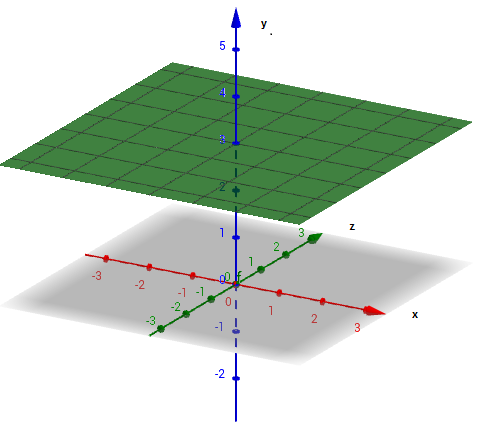
The entire graph is in the contour curve (on the actual contour surface).

This is the plane parallel to xy plane at z=3

Therefore, we can conclude that the entire graph for Function f(x,y)=3  is in the contour curve.

Page 96 Problem 18 Answer

Given: Function f(x,y)=3

To obtain: Sketch of the graph off

Evaluate to get the final answer.

Following is the graph,
Vector Calculus, 4th Edition, Chapter 2 Differentiation in Several Variables 18

Therefore, we conclude that the entire graph for function f(x,y)=3 is in the contour curve.

Page 96 Problem 19 Answer

Given: Function f(x,y)=x2+y2

To find: Several level curves of the given function f

Evaluate to get the final answer.

Let us solve the exercise.

For a fixed z we can observe that the curve is defined by x and y

The function given in the task is zero if and only if both x and y are zero.

Hence, let us pick a height (level) in such a way that the value of the level is positive.

For example,c By rewriting the curve equation, we can see that a level surface in question is in fact a circle of a radius√c.

⇒ x2+y2=c

Hence, the obtained expression is x2+y2=c

Page 96 Problem 20 Answer

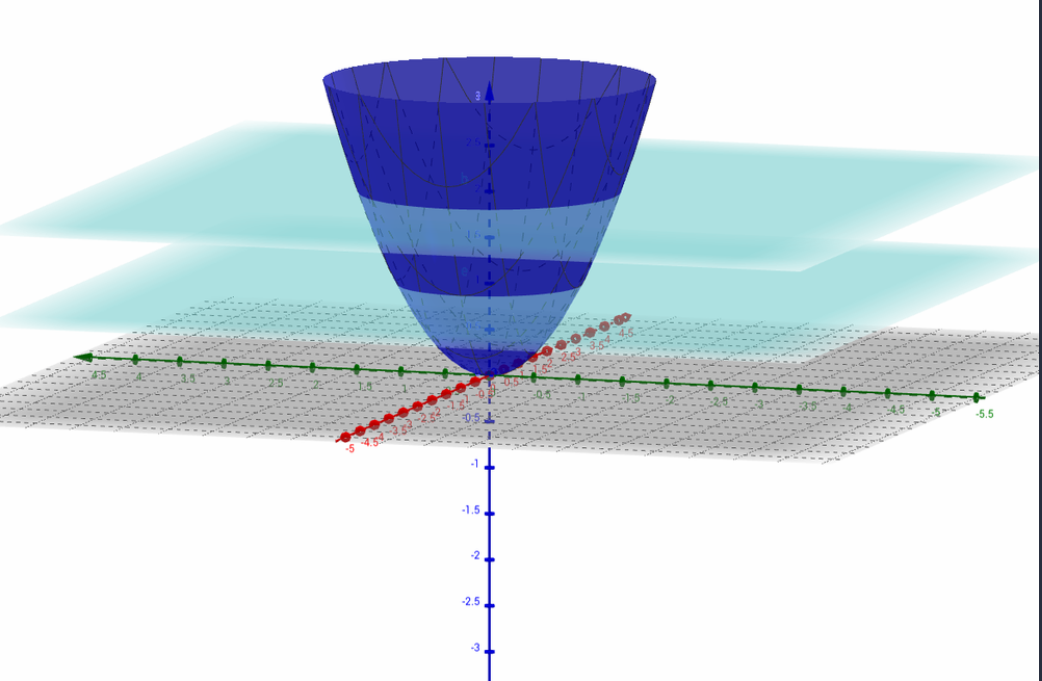
Given: f(x,y)=x2+y2

To Find: sketch the graph of f.Evaluate to get the result.

For a fixed z we observe the curve defined by x and y.

Obviously, the function given in the task is zero if and only if both x and y are zero.

Therefore, let us pick a height (level) such that the value of level is positive, for example c.

By rewriting the curve equation, we can see that a level surface in question is in fact a circle of a radius √c.x2+y2=c

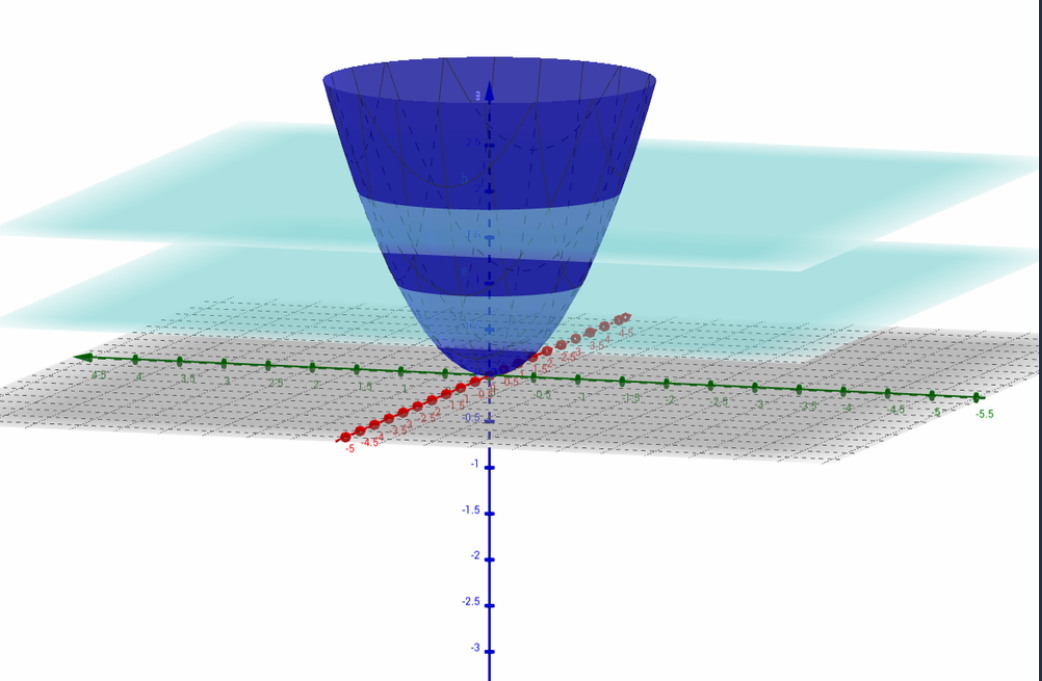
You can imagine a level curve in this case an intersection between the graph of a given surface and the plane z=c.

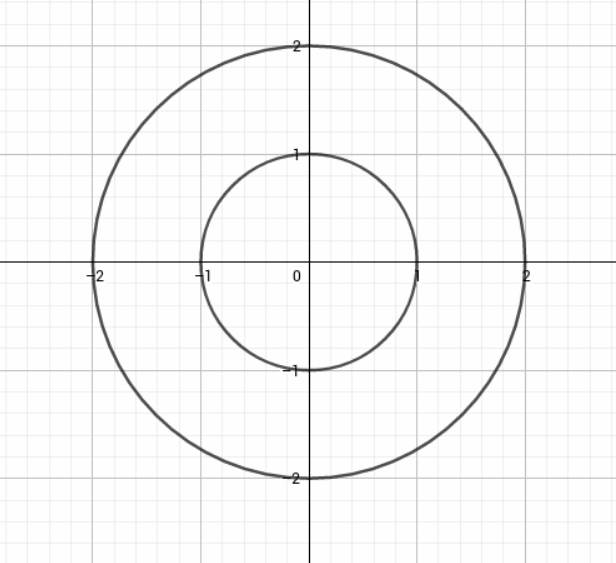
The example is given on the picture for c=1andc=2. The sketches of the level curves are then circles of radius 1 and√2  in the xy plane.

Let us plot a graph :
Vector Calculus, 4th Edition, Chapter 2 Differentiation in Several Variables 20

Hence, the required graph of f is :

Vector Calculus, 4th Edition, Chapter 2 Differentiation in Several Variables 20 1

Practice Problems For Differentiation In Several Variables Chapter 2.1 Page 96 Problem 21 Answer

Given : f(x,y)=x2+y2−9

To find :  Determine several level curves of the given function f (make sure to indicate the height c of each curve).

Evaluate to get the result.

To find the type of the level curve, in this case it is enough to check the condition for the given function to be zero.

In fact one can easily observe that x2+y2−9=0 ⇒ x2+y2=9

The second equation is in fact the equation describing a circle with radius 3 and it’s center at origin.

All of the other level curves will in fact be circles, as shown on the image in step two.

If  set the surface height on z=2,

Let us plot a graph :
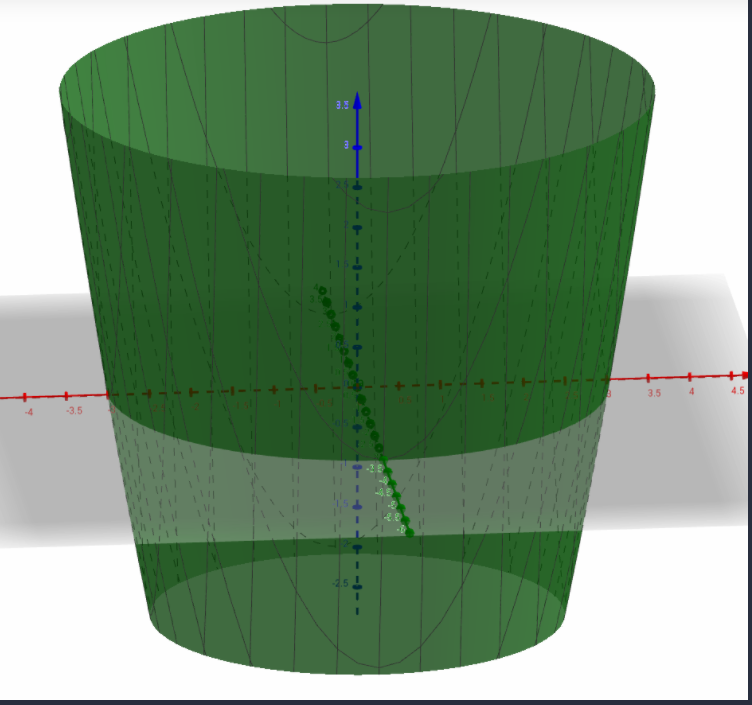
Vector Calculus, 4th Edition, Chapter 2 Differentiation in Several Variables 21

View from the top will in fact show all three circles :
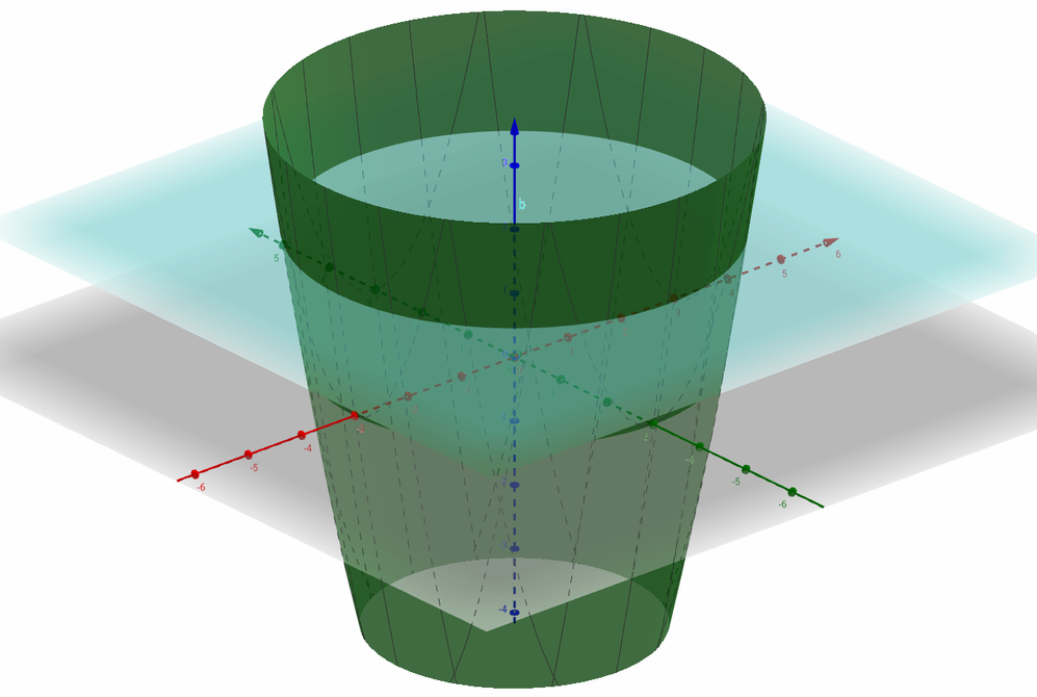
Vector Calculus, 4th Edition, Chapter 2 Differentiation in Several Variables 21 1

Note that there are infinitely many level curves that can be obtained like this and all of them are circles.

The bottom one is, however the smallest circle.

Hence, through the following images we determined several levels of curves of the given function.
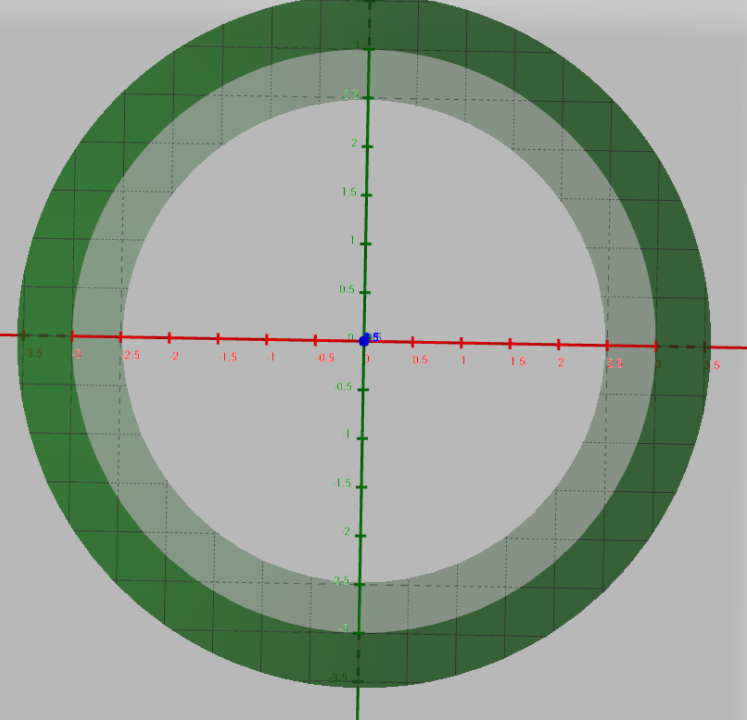
Vector Calculus, 4th Edition, Chapter 2 Differentiation in Several Variables 21 2

Page 96 Problem 22 Answer

Given :f(x,y)=x2+y2−9

To find : Use the information obtained in part (a) to sketch the graph of f.
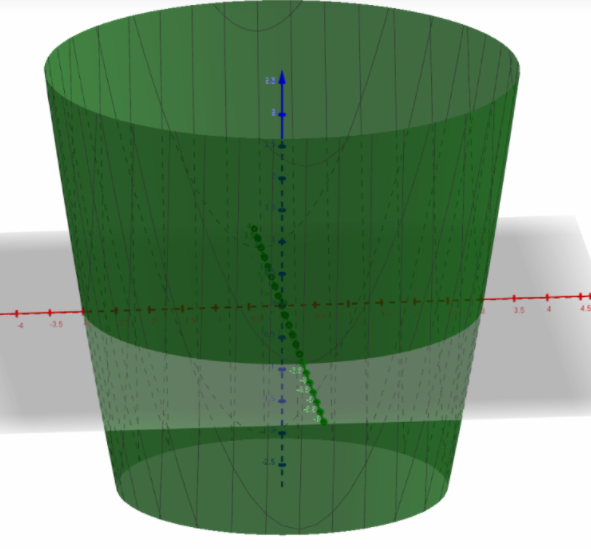
Vector Calculus, 4th Edition, Chapter 2 Differentiation in Several Variables 22

Evaluate to get the result.

Finding the type of the level curve, in this case it is enough to check the condition for the given function to be zero.

In fact one can easily observe that

x2+y2−9=0 ⇒ x2+y2=9

The second equation is in fact the equation describing a circle with radius 3 and it’s center at origin.

All of the other level curves will in fact be circles, as shown on the image in step two.

If  set the surface height on z=2, we get another circle with a larger radius,

Hence, the graph of f is:
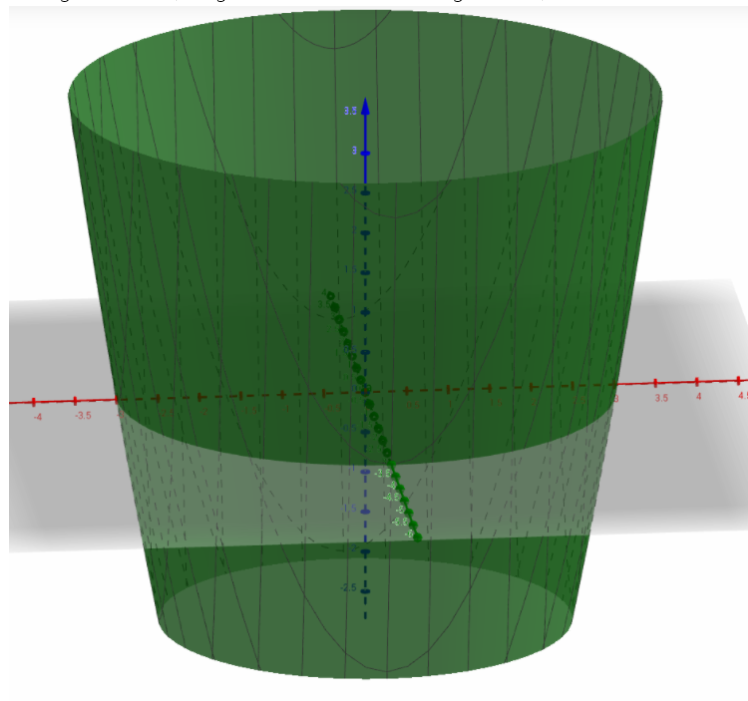
Vector Calculus, 4th Edition, Chapter 2 Differentiation in Several Variables 22 1

Page 96 Problem 23 Answer

Given : f(x,y)=√x2+y2

To find : (a) Determine several level curves of the given function f (make sure to indicate  the height c of each curve).

Evaluate to get the result.

This time, the given surface is a cone.

Intersecting the surface at any level other than zero will again yield the circle.

Let c be a level of a curve.

Then the equation of the curve is given by the following relation:

√x2+y2

=c ⇒ x2+y2

=c2

As you can see, a level curve on any height c is in fact a circle.

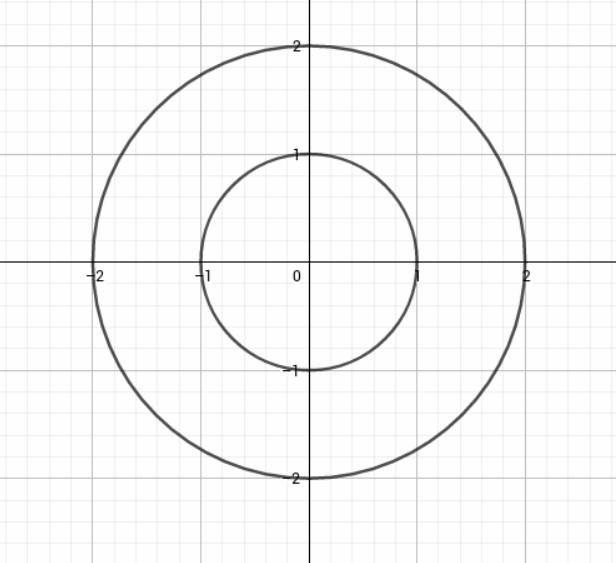
Below are sketches of circles on height 1 and 2.

Let us plot a graph:
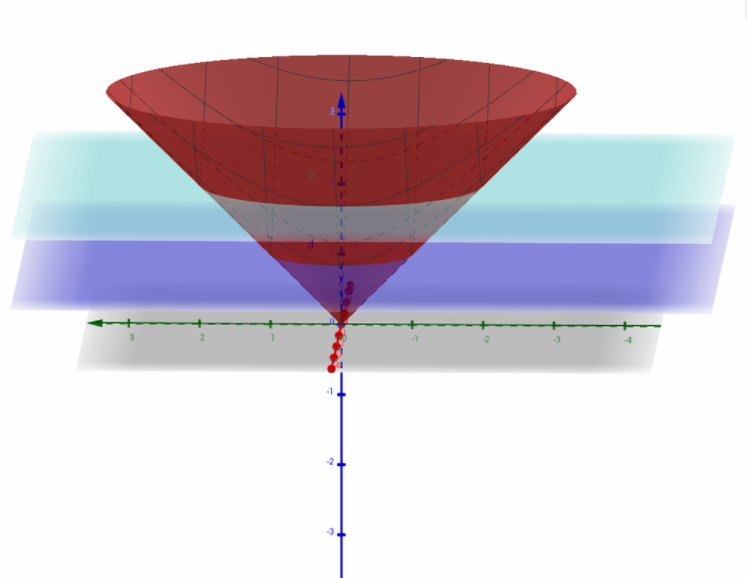
Vector Calculus, 4th Edition, Chapter 2 Differentiation in Several Variables 23

Now

Technically, the correct sketches of the level curves are on picture number two.

Imagine that we fix the height c on a plane z=c. For z=1 in a smaller circle.

For height z=2 is the larger one. This is exactly the situation depicted on a picture one.

So level curves are in fact drawn as a projections on xy plane with assumption that z is fixed.

Hence, Determined several levels of curves of the given function of f
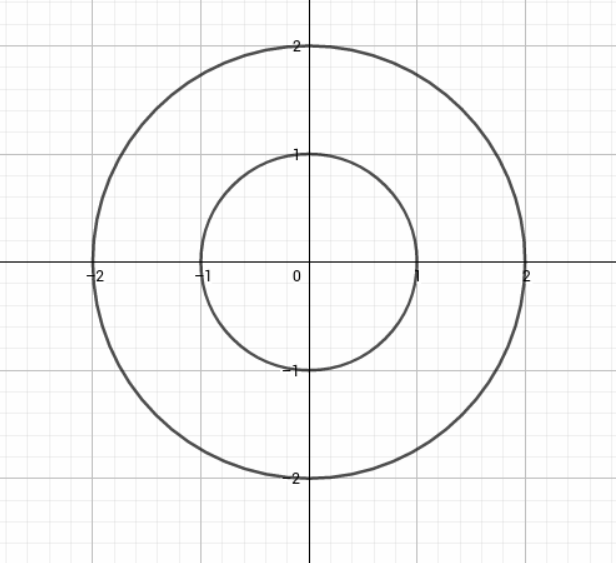
Vector Calculus, 4th Edition, Chapter 2 Differentiation in Several Variables 23 1

Susan Colley Vector Calculus Chapter 2.1 Differentiation Solutions Page 96 Problem 24 Answer

Given :f(x,y)=√x2+y2

To find : (b) use the information obtained in part (a) to sketch the graph off.

Evaluate to get the result

This time, the given surface is a cone.

Intersecting the surface at any level other than zero will again yield the circle Let be a level of a curve.

Then the equation of the curve is given by the following relation:

As you can see, a level curve on any height  is in fact a circle. Below are sketches of circles on height 1 and 2.

Let us plot a graph :
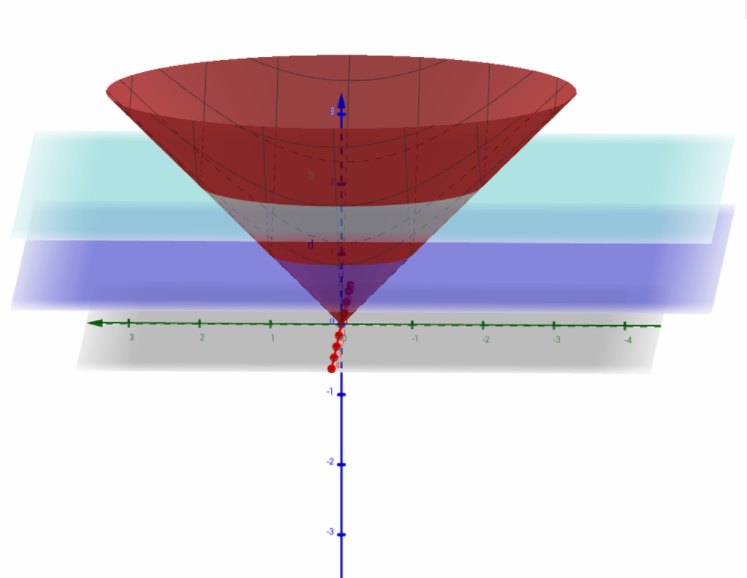
Vector Calculus, 4th Edition, Chapter 2 Differentiation in Several Variables 24

Next,

Vector Calculus, 4th Edition, Chapter 2 Differentiation in Several Variables 24 1

Hence, the graph of f is,
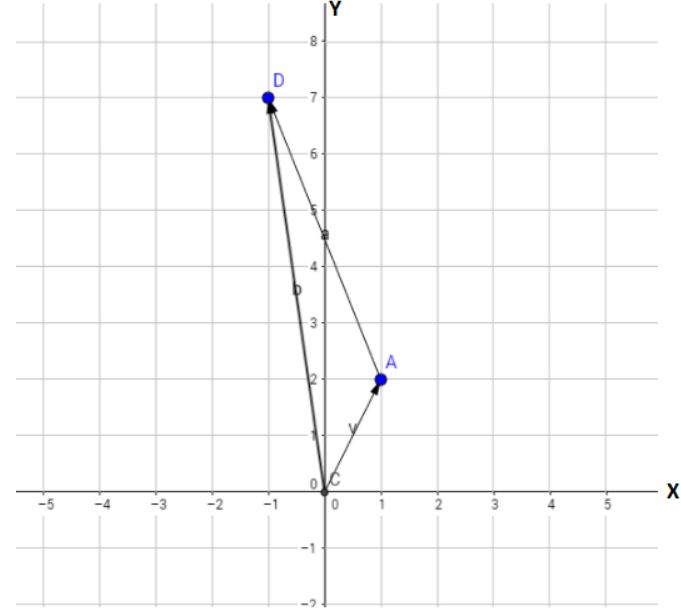
Vector Calculus, 4th Edition, Chapter 2 Differentiation in Several Variables 24 2

Susan Colley Vector Calculus 4th Edition Chapter 1 Exercise 1.1 Vectors

Susan Colley Vector Calculus 4th Edition Chapter 1 Vectors

Page 7 Problem 1 Answer

Given : The vector(2,1)

To sketch : Vectors in R2

Evaluate to get the final answer

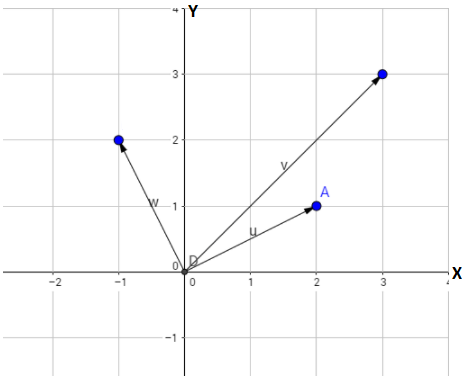
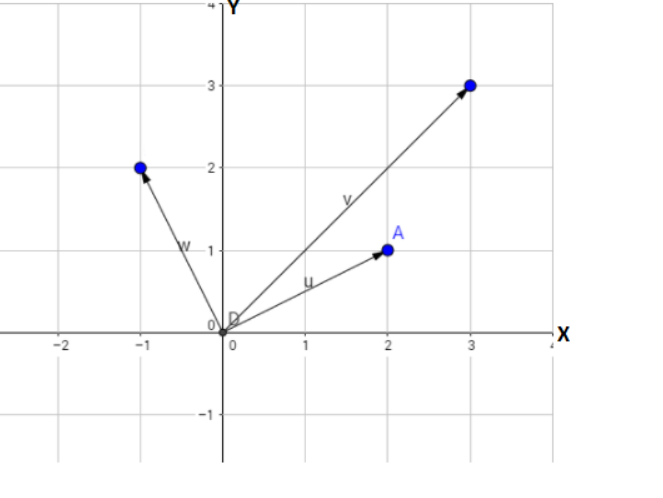
Indicated vectors are shown on the graph below :

Vector Calculus, 4th Edition, Chapter 1 Vectors 1

Therefore, the graph is plotted with the given value.

Vector Calculus, 4th Edition, Chapter 1 Vectors 1 1

Page 7 Problem 2 Answer

Given : (3,3)

To find : Vectors in R2

Evaluate to get the final answer

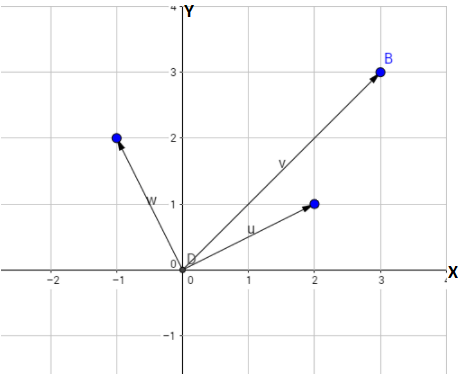
Indicated vectors are shown on the graph below :

Read and Learn More Susan Colley Vector Calculus Solutions

Vector Calculus, 4th Edition, Chapter 1 Vectors 2

Hence, the graph is plotted with given value.

“Vector Calculus Susan Colley Chapter 1 Exercise 1.1 explained”  Page 7 Problem 3 Answer

Given : (−2,1)

To find : Vectors in R2

Evaluate to get the final answer

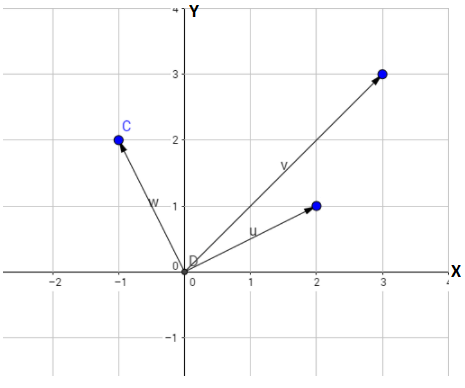
Indicated vectors are shown on the graph below :

Vector Calculus, 4th Edition, Chapter 1 Vectors 3

Hence, the graph is plotted with given value.

Page 7 Problem 4 Answer

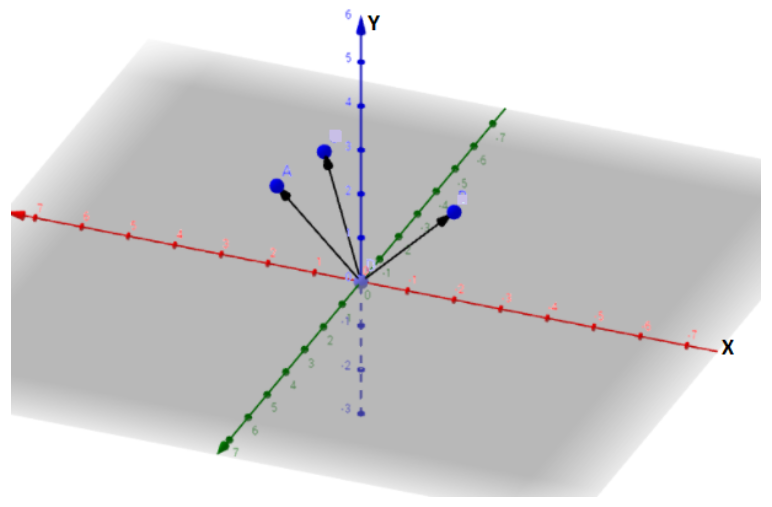
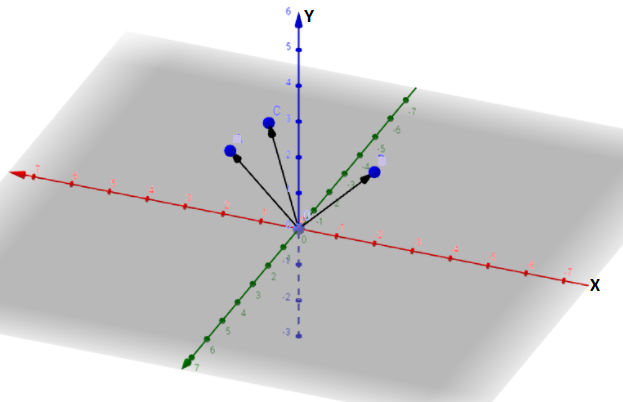
Given : (1,2,3)

To find : Vectors in R3

Evaluate to get the final answer

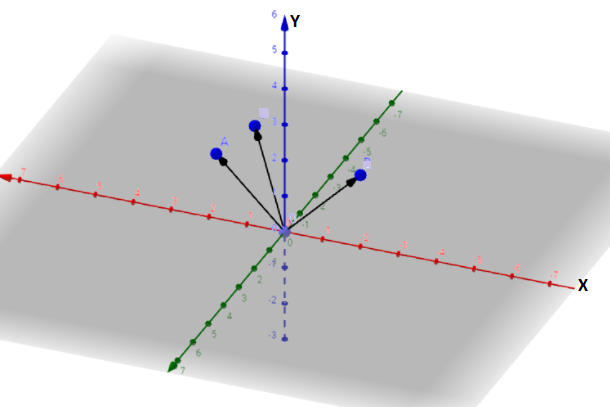
Indicated vectors are shown on the below graph :

Vector Calculus, 4th Edition, Chapter 1 Vectors 4

Hence, the graph is plotted with given values.

Vector Calculus, 4th Edition, Chapter 1 Vectors 4 1

Page 7 Problem 5 Answer

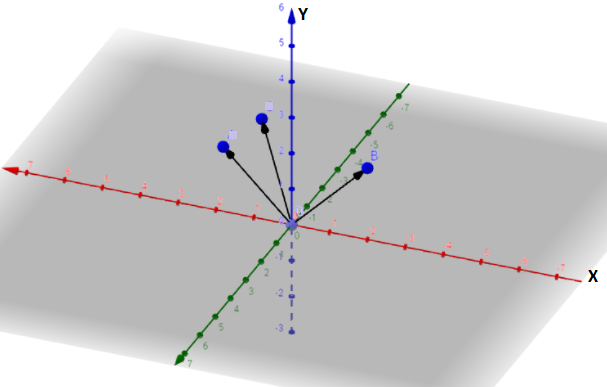
Given : (−2,0,2)

To find: Vectors in R3

Evaluate to get the final answer

Given : (−2,0,2)

To find: Vectors in R3

Evaluate to get the final answer

Vector Calculus, 4th Edition, Chapter 1 Vectors 5

Hence, the graph is plotted with given values.

Vector Calculus, 4th Edition, Chapter 1 Vectors 5 1

“How To Solve Vectors in Susan Colley Vector Calculus”  Page 7 Problem 6 Answer

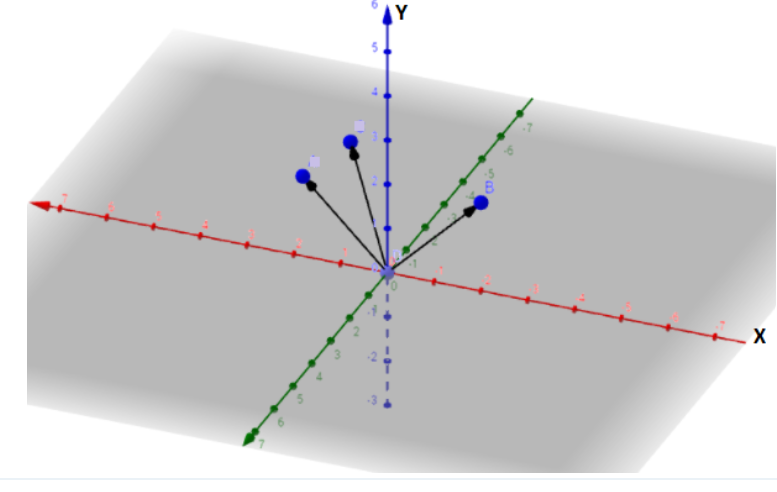
Given : (2,−3,1)

To find : Vectors in R3

Evaluate to get the final answer

Indicated vectors are shown on the below graph :

Vector Calculus, 4th Edition, Chapter 1 Vectors 6

Therefore, the graph is plotted with given values.

Page 7 Problem 7 Answer

Given : (3,1)+(−1,7)

To express: The given expression in single vector a=(a1,a2) in R2

Evaluate to get the required solution

Let us simplify in this way,

⇒ (3,1)+(−1,7)=(3−1,1+7)

=(2,8)

Hence, the required solution is (2,8)

Page 7 Problem 8 Answer

Given : −2(8,12)

To express: in the form of a single vector a=(a1,a2) in R2

Evaluate to get the final answer

Let us simplify in this way,

⇒ −2(8,12)=(−16,−24)

Therefore, the required solution is (−16,−24)

Page 7 Problem 9 Answer

Given : (8,9)+3(−1,2)

To express: In the form of a single vector a=(a1,a2) in R2

Evaluate to get the final answer

Let us simplify in this way,

⇒ (8,9)+3(−1,2)=(8,9)+(−3,6)

=(8−3,9+6)

=(5,15)

Therefore, the required solution is (5,15)

Page 7 Problem 10 Answer

Given : (1,1)+5(2,6)−3(10,2)

To find : Single vector a=(a1,a2) in R2

Evaluate to get the final answer

Let us simplify the equation in this way,

⇒ (1,1)+5(2,6)−3(10,2)=(1,1)+(10,30)−(30,6)

=(1+10−30,1+30−6)

=(−19,25)

Hence, the required solution is (−19,25)

“Susan Colley Vector Calculus Chapter 1 Exercise Answers” Page 7 Problem 11 Answer

Given : (8,10)+3((8,−2)−2(4,5))

To find : Single vector a=(a1,a2) in R2

Evaluate to get the final answer

Let us simplify the equation in this way,

⇒ (8,10)+3((8,−2)−2(4,5))=(8,10)+3((8,−2)−(8,10))

​=(8,10)+3(0,−12)

=(8,10)+(0,−36)

=(8+0,10−36)

=(8,−26)

Hence, the required solution is (8,−26)

Page 7 Problem 12 Answer

Given : (2,1,2)+(−3,9,7)

To find : Single vector a=(a1,a2,a3) in R3

Evaluate to get the final answer

Let us simplify in this way,

⇒ (2,1,2)+(−3,9,7)=(2−3,1+9,2+7)

=(−1,10,9)

Therefore, the required solution is (−1,10,9)

Page 7 Problem 13 Answer

Given : 1/2(8,4,1)+2(5,−7,1/4)

To find : Single vector a=(a1,a2,a3) in R3

Evaluate to get the final answer

Let us simplify in this way,

⇒ ​1/2(8,4,1)+2(5,−7,1/4)=(4,2,1/2)+(10,−14,1/2)

=(14,−12,1)

Therefore, the required solution is (14,−12,1)

Page 7 Problem 14 Answer

Given : −2((2,0,1)−6(1/2,−4,1))

To find : Single vector a=(a1,a2,a3) in R3

Evaluate to get the final answer

Let us simplify in this way,

​⇒ −2((2,0,1)−6(1/2,−4,1))=−2((2,0,1)−(3,−24,6))

​=−2(−1,24,−5)

Therefore, the required solution is (2,−48,10)

Page 7 Problem 15 Answer

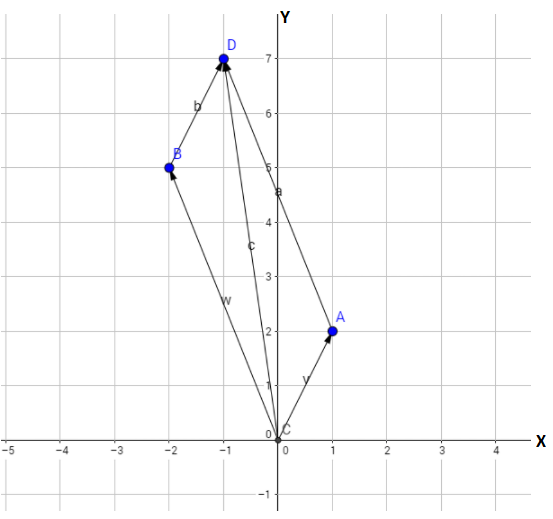
Given : a=(1,2),

⇒ b=(−2,5), and

⇒ a+b=(1,2)+(−2,5)

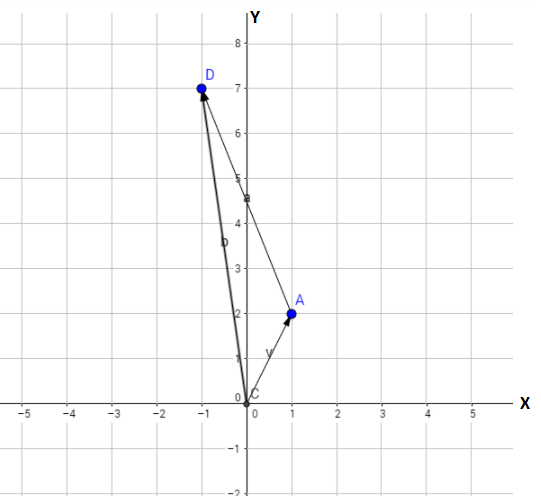
​To find: Parallelogram law and the head-to-tail methodEvaluate to get the final answer

Vector Calculus, 4th Edition, Chapter 1 Vectors 15

Addition of vectors using parallelogram law.

Resultant vector is CD

Addition of vectors using head-to-tail method :

Vector Calculus, 4th Edition, Chapter 1 Vectors 15 1

Therefore, the graph is plotted using parallelogram law and the head-to-tail method.

Vector Calculus, 4th Edition, Chapter 1 Vectors 15 2

“Vector Calculus Textbook Chapter 1 problems Susan Colley” Page 7 Problem 16 Answer

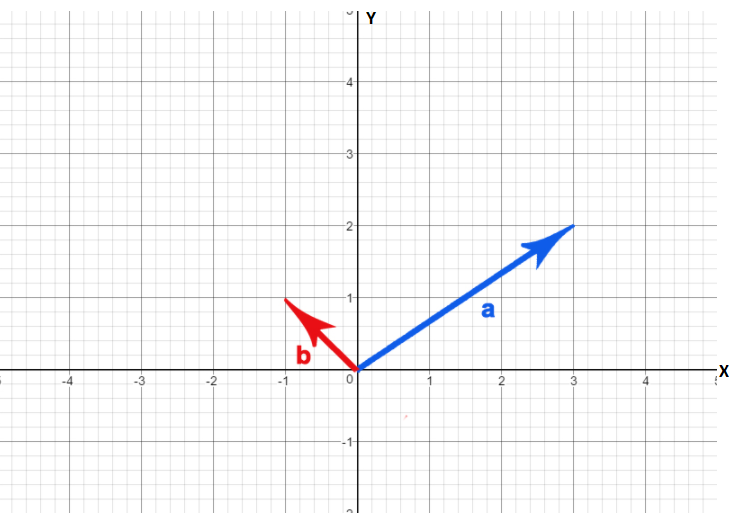
Given : a=(3,2)

b=(−1,1)

Vector Calculus, 4th Edition, Chapter 1 Vectors 16

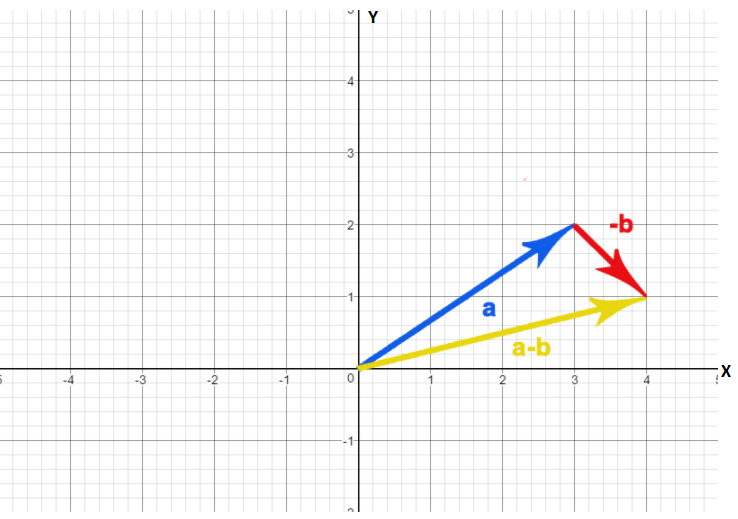
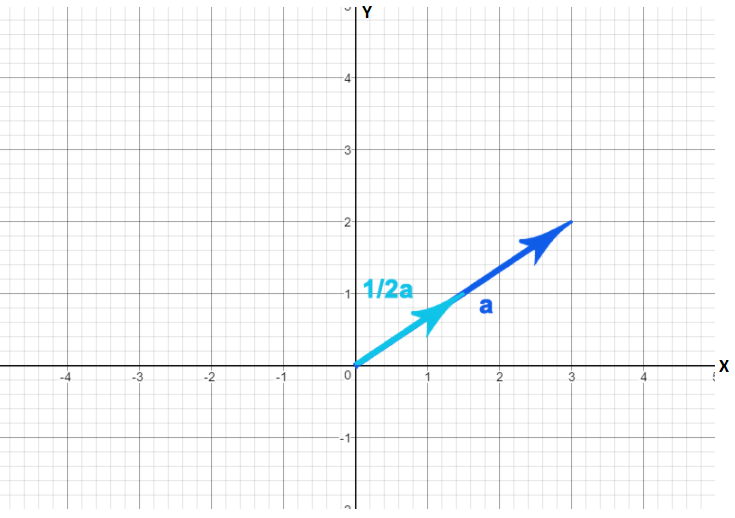
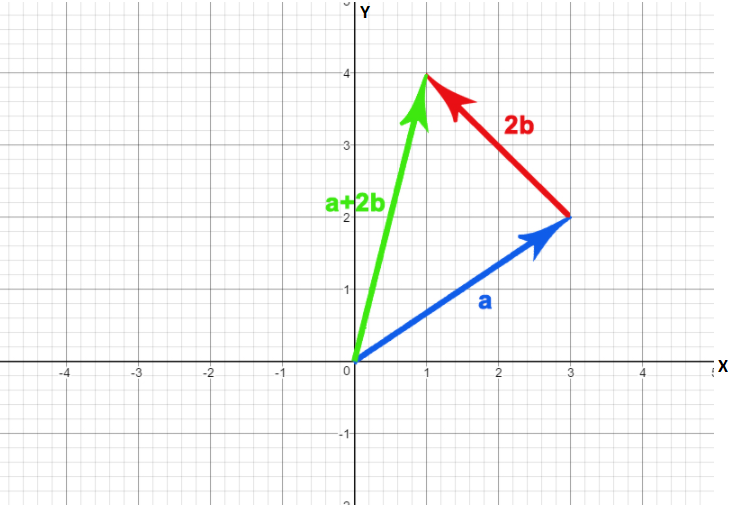
​To find: Calculate and graph a−b,1/2a, and a+2b

Vector Calculus, 4th Edition, Chapter 1 Vectors 16 1

Evaluate to get the final answer

Vector Calculus, 4th Edition, Chapter 1 Vectors 16 2

Hence, all the required graphs has been plotted.

Vector Calculus, 4th Edition, Chapter 1 Vectors 16 3

Page 7 Problem 17 Answer

Given : Let A be the point with coordinates (1,0,2),let B be the point with coordinates (−3,3,1)

and let C be the point with coordinates(2,1,5)

To find : Vectors AB and BA

Evaluate to get the final answer

Each vector is determined with initial and terminal point.

That is, two points – one where it starts and one where it ends.
Vector AB starts at point A and ends at point B

Vector BA starts at point B and ends at point A.

Therefore,

Vector AB starts at point A and ends at point B and,

Vector BA starts at point B and ends at point A

Page 7 Problem 18 Answer

Given : Let A be the point with coordinates (1,0,2),let B be the point with coordinates(−3,3,1) and let C

be the point with coordinates(2,1,5)

To find : Vectors AC,BC, and AC+CB

Evaluate to get the final answer

Let us simplify,Vector AC starts at point A and ends at point C.

Vector BC starts at point B and ends at point C.

Vector AC+CB is sum of two vectors. Notice that first vector ends at point C and second vector starts at point C.

This means that the resulting vector starts at point A and ends at point B

Hence, we have described all the 3 given vectors.

Page 7 Problem 19 Answer

Given :  Let A be the point with coordinates (1,0,2), let B be the point with coordinates (−3,3,1),and let C be the point with coordinates (2,1,5)

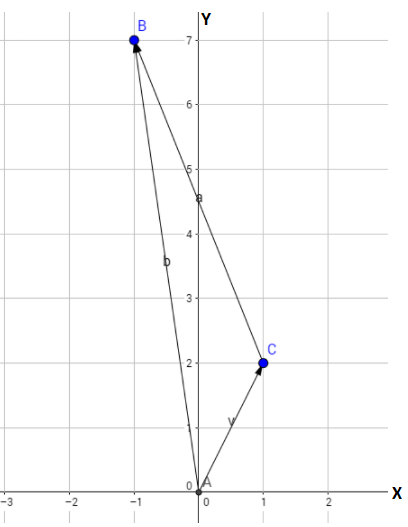
To find : Explain with pictures why AC+CB=AB

Evaluate to get the final answer

Let us plot a graph:

Vector Calculus, 4th Edition, Chapter 1 Vectors 19

Hence, the vector is solved with the help of a picture.

“practice Problems Vectors Susan Colley Vector Calculus”  Page 7 Problem 20 Answer

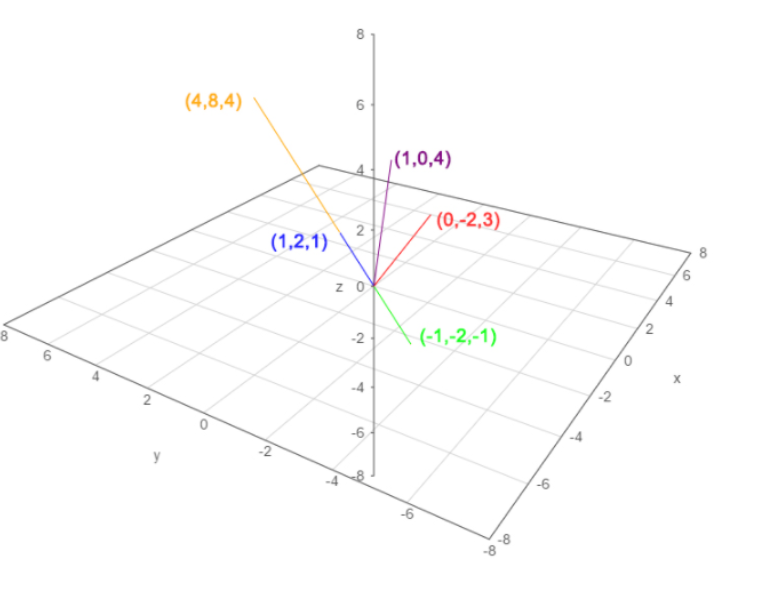
Given : (1,2,1) and (0,−2,3),

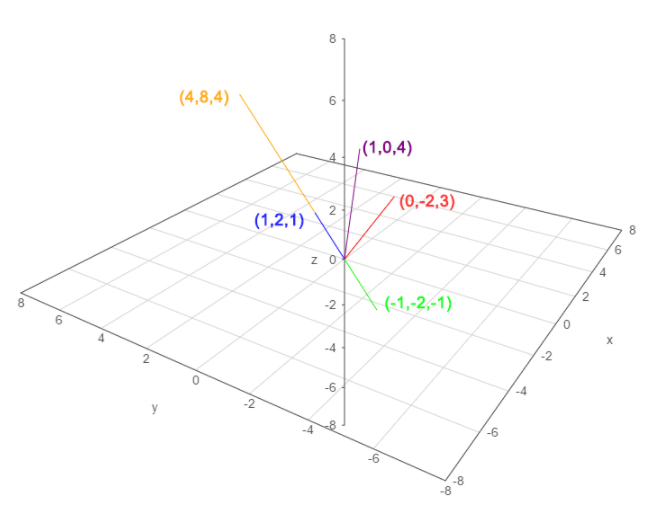
To find : Calculate and graph (1,2,1)+(0,−2,3),−1(1,2,1), and 4(1,2,1)

Evaluate to get the final answer

Vector Calculus, 4th Edition, Chapter 1 Vectors 20

Let us calculate,

⇒ (1,2,1)+(0,−2,3)=(1,0,4)−1(1,2,1)

=(−1,−2,−1)

4(1,2,1)=(4,8,4)

Hence, we have calculated and graphed the given vectors.

Vector Calculus, 4th Edition, Chapter 1 Vectors 20 1

Page 7 Problem 21 Answer

Given: The equation(−12,9,z)+(x,7,−3)=(2,y,5)

To find : Values of X,Y&Z

Apply addition of vectors to get the result.

Let us evaluate the given equation,

⇒ (−12,9,z)+(x,7,−3)=(2,y,5)

⇒ (−12+x,9+7,z−3)=(2,y,5)

⇒ (−12+x,16,z−3)=(2,y,5)

⇒ −12+x=2

So, we get

⇒ x=14

⇒ 16=y

⇒ z−3=5

And, z=8

Therefore, the required values of X,Y and Z are 14,16 and 8.

Page 7 Problem 22 Answer

Given: The vector (3,1)

To find : What is the length (magnitude) of the vector (3,1)

Use Pythagorous theorem to get the length.

Given: The vector (3,1)

Vector Calculus, 4th Edition, Chapter 1 Vectors 22

To find : What is the length (magnitude) of the vector (3,1)

Use Pythagorous theorem to get the length.

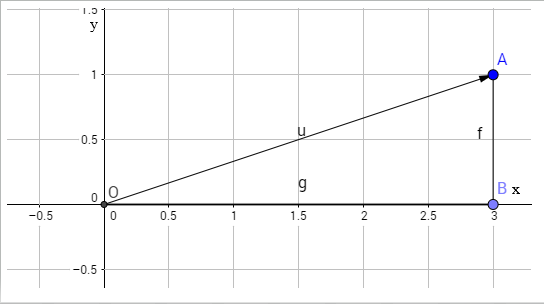
A vector  from a origin to point (3,1)

The length of the vector is d=√32+12=√10

Therefore, the required length of the vector is √10.

Page 7 Problem 23 Answer

Given : The vectors, a=(1,2) and b=(5,10)

To sketch: The vectors and explain why they point in the same direction.

Explain with the help of a graph.

Vector Calculus, 4th Edition, Chapter 1 Vectors 23

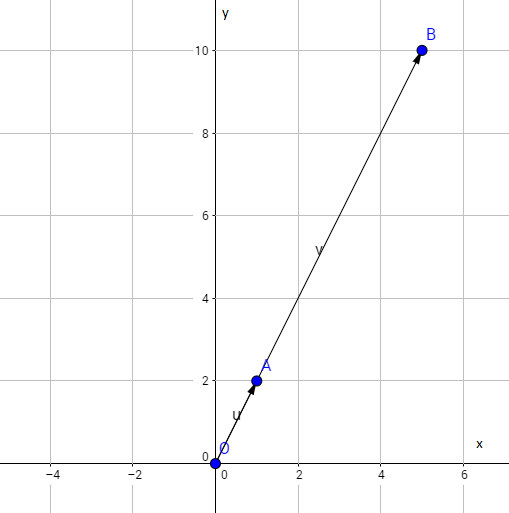
The graph of the given vectors a=(1,2) and  b=(5,10)

As we see in the graph

It is true that a and b point in the same direction, because b is a multiple of a.

So, we can say that : b=5a

Hence, a and b point in the same direction ,because b is a multiple of a.

“Step-By-Step vector solutions Susan Colley book” Page 7 Problem 24 Answer

Given : a=(a1,a2,…,an)

b=(b1,b2,…,bn) are two vectors in  Rn  and k ∈ R is a scalar.To find : Add the vectors (1,2,3,4)

and (5,−1,2,0) in R4 and the value of 2(7,6,−3,1)

Evaluate to get the final solution.

We add vectors in any dimension : (1,2,3,4)+(5,−1,2,0)=(6,1,5,4)

When we multiply with scalar, we multiply each component:

⇒ 2(7,6,−3,1)=(14,12,−6,2)

So,(a1,a2,…,an)+(b1,b2,…,bn)=(a1+b1,a2+b2,…,an+bn)

k(a1,a2,…,an)=(ka1,ka2,…,kan)

Hence, the required solution is(1,2,3,4)+(5,−1,2,0)=(6,1,5,4)

And 2(7,6,−3,1)=(14,12,−6,2)

Page 7 Problem 25 Answer

Given : P1(1,0,2),P2(2,1,7)

To find:  Displacement vectors from P1 to P2

To sketch :  P1,P2, and P1/P2 .

Evaluate to get the final solution.

We can find displacement vector :

P1/P2=(x2−x1,y2−y1,z2−z1)

Where P1(x1,y1,z1) and P2(x2,y2,z2) are two points.

Let us solve now

⇒ P1/P2=(2−1,1−0,7−2)

=(1,1,5)​

Hence, the required solution Is P1/P2=(1,1,5)

Page 7 Problem 26 Answer

Given :  P1 (1,6,−1),P2 (0,4,2)

To find: Displacement vectors P1 to P2

To sketch : P1,P2 , and P1 /P2 .

Evaluate to get the final answer

We can find displacement vector as follows

⇒ P1/P2=(x2−x1,y2−y1,z2−z1)

Where P1(x1,y1,z1) and P2(x2,y2,z2)

Evaluating we get

⇒ P1/P2=(1−0,6−4,−1−2)

=(1,2,−3)

​Hence, the required solution is P1/P2=(1,2,−3)

Page 7 Problem 27 Answer

Given : P1 (0,4,2),P2 (1,6,−1)

To find: The displacement vectors from P1 to P2

Evaluate to get the final answer.

We can find displacement vector :

⇒ P1/P2=(x2−x1,y2−y1,z2−z1)

Where P1(x1,y1,z1) and P2(x2,y2,z2)

We will do the evaluation now

⇒ P1/P2 =(0−1,4−6,2+1)

=(−1,−2,3)​

Hence, the required displacement vector P1/P2

=(−1,−2,3)

“Susan Colley Vector Calculus Problem-Solving Techniques” Page 7 Problem 28 Answer

Given : P1(3,1),P2(2,−1)

To find : The displacement vectors from P1 to P2.

To sketch 😛1,P2 , and P1P2

Evaluate to get the final answer.

We can find displacement vector :

⇒ P1/P2=(x2−x1,y2−y1,z2−z1)

Where P1(x1,y1,z1) and P2(x2,y2,z2)

Evaluating we get

⇒ P1/P2=(3−2,1+1)

=(1,2)​

Hence, the required displacement vector is P1/P2=(1,2)

Page 7 Problem 29 Answer

Given : P1 (2,5,−1,6) and P2 (3,1,−2,7)

To calculate : The displacement vector from P1 to P2

Evaluate to get the final answer.

We can find displacement vector :

⇒ P1/P2=(x2−x1, y2−y1, z2−z1)

Where P1(x1,y1,z1) and P2(x2,y2,z2)

We define displacement the same way as in R3.

So Displacement:

⇒ P1/P2=(3−2,1−5,−2+1,7−6)

=(1,−4,−1,1)

hence, the required displacement is P1/P2

=(1,−4,−1,1)

Page 7 Problem 30 Answer

Given : A is the point in R3 with coordinates (2,5,−6) The displacement vector from A to a second point B is (12,−3,7)

To find : Coordinates of B? Evaluate to get the final answer.

Let us find the coordinates of point B.

We can use displacement vector:

SupposeB=(x,y,z), then (12,−3,7)=(x−2,y−5,z+6)

Thus,

⇒ x−2=12

⇒ x=14

⇒ y−5=−3

⇒ y=2

⇒ z+6=7

⇒ z=1

Coordinates of B are: (14,2,1).

Hence, the coordinates of B are: (14,2,1).

Page 7 Problem 31 Answer

Given : Suppose that you and your friend talking on cellular phones.

You inform each other of your own displacement vectors.

To explain : How to determine the displacement vector from you to your friend.

Evaluate to get the final solution.

Let coordinate system represents origin.

Then, our displacements vectors coincide with our coordinates.

Thus, a⃗=A and   b⃗=B.

Now, we find the displacement vector as

⇒ d⃗=B−A

Hence, the required displacement vector is d⃗=B−A

“Exercise Solutions for Susan Colley 4th Edition Vector Calculus” Page 7 Problem 32 Answer

Given: Properties 2 and 3 of vector addition.

To find : Give the details of the proofs of properties Two vectors can be added together by placing them together.

Let us evaluate

a+(b+c)=

=(a1,a2,a3)+((b1,b2,b3)+(c1,c2,c3))

=(a1,a2,a3)+(b1+c1,b2+c2,b3+c3)

=(a1+b1+c1,a2+b2+c2,a3+b3+c3)

=(a1+b1,a2+b2, =a3+b3)+(c1,c2,c3)

=(a+b)+c​

Further evaluating,a+0=

=(a1,a2,a3)+(0,0,0)

=(a1+0,a2+0,a3+0)

=(a1,a2,a3)

=a

Hence, we have given the details of the proofs of properties 2 and 3 of vector addition(a+b)+c.

Page 7 Problem 33 Answer

Given: Properties of scalar multiplication

To prove : The properties of scalar multiplication Evaluate to get the final answer.

We can prove this as follows

k(la)=k(la1,la2,la3)

=kl(a1,a2,a3)

=(kl)a

=(lk)a

=l(ka)​

Hence, we have proved the properties of scalar multiplication.

Page 7 Problem 34 Answer

Given: A vector a in R2 or R3.To Find: Calculate the value of 0a and prove the answer.

By doing scalar multiplication of vector a, we can calculate the value.

Firstly,0a is zero vector in R2 or R3 depending on where a came from.

A zero vector is a vector having a magnitude of zero.

Now,

⇒ 0a=0(a1,a2,a3)

⇒0a=(0⋅a1,0⋅a2,0⋅a3)

0a=(0,0,0)

Therefore, 0a is a zero vector having magnitude 0.

Page 7 Problem 35 Answer

Given: A vector a in R2 and R3.To Find: The value of 1a

and prove the answer. By doing the scalar multiplication, we can calculate the value.

From Scalar multiplication, we know that the value of 1a is a.

Now,1a=1(a1,a2,a3)

⇒1a=(1⋅a1,1⋅a2,1⋅a3)

⇒1a=(a1,a2,a3)

∴1a=a

Therefore, the required value of 1a is a.

Susan Colley Chapter 1 Exercise 1.1 Key Concepts On Vectors Page 7 Problem 36 Answer

Given: A vector x=sa+tb where 0≤s≤1 and 0≤t≤1,along with the coordinates of a and b.

To Explain: The reason for vector x lying in the parallelogram determined by a and b.

A sketch of the vectors described will help in determining the answer.

Vector Calculus, 4th Edition, Chapter 1 Vectors 36

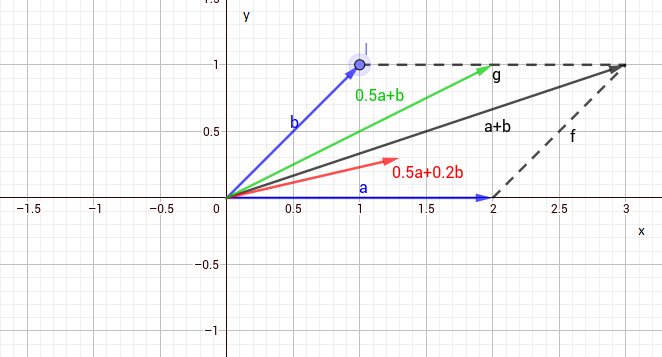
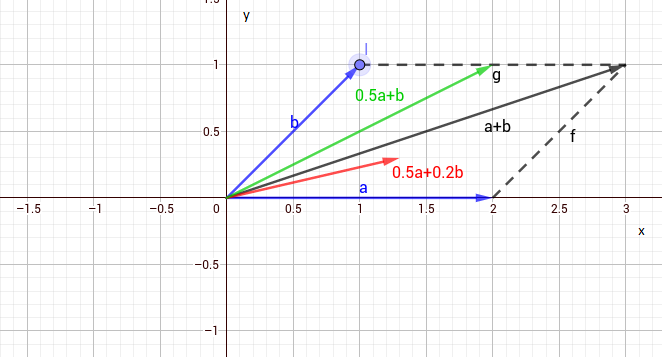
A simple sketch explains why the vectors of the described set are in fact a parallelogram.

The most distant point from (0,0) you can reach with vectors a and b is exactly the end point of vector g=a+b.

On the other hand, using any other, smaller coefficients on a and b will land the new vector somewhere inside or on the edge of parallelogram depending on what coefficients we use.

For example, vector 0.5a+0.2b will be inside of parallelogram since both coefficients in front of a and b are smaller then l.

On the other hand, vector 0.5a+b will have it’s end point on the edge of parallelogram since the coefficient in front of b is equal to 1.

Vector Calculus, 4th Edition, Chapter 1 Vectors 36 1

Therefore, we have explained the reason for x lying in the parallelogram determined by a and b.

Page 7 Problem 37 Answer

Given: A set of vectors, {x=sa+tb∣0≤s≤1,0≤t≤1} along with the coordinates of a and b.

To Describe: The set of vectors, {x=sa+tb∣0≤s≤1,0≤t≤1}.

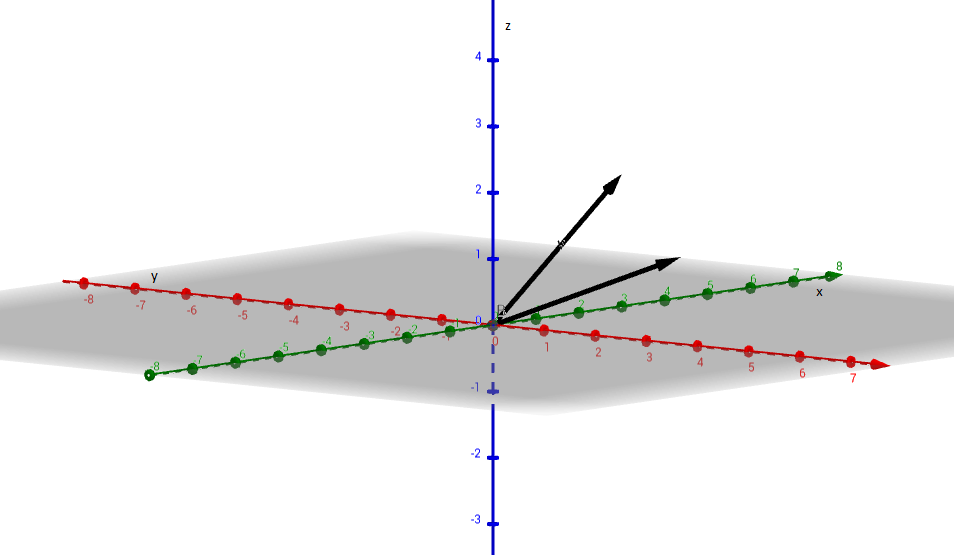
From the coordinates of a and b, we know that the given vector is in 3-D, so we can explain accordingly.

The explanation is similar to the part a) of the task.

Vector Calculus, 4th Edition, Chapter 1 Vectors 37 1

The only difference is that we now have two vectors in 3-D space.

However, any linear combination of these two vectors with the coefficients being between zero and one will again yield a parallelogram, but this time in three dimensional space.

Therefore, we have described the given set of vectors.

Vector Calculus, 4th Edition, Chapter 1 Vectors 37


Carnegie Learning Geometry Student Text 2nd Edition Chapter 3 Exercise 3.3 Perimeter and Area

Geometry Student Text 2nd Edition Chapter 3 Perimeter and Area

Carnegie Learning Geometry Student Text 2nd Edition Chapter 3 Exercise 3.3 Solution Page 161 Problem 1 Answer

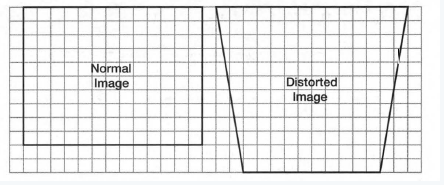
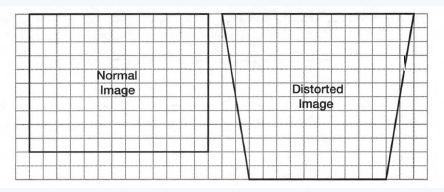
We have to Describe how the normal image has been distorted.

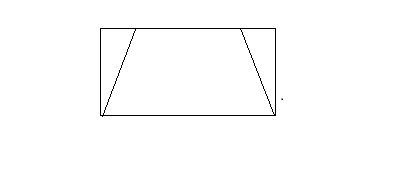
The keystone effect is the apparent distortion of an image caused by projecting it onto an angled surface.

It is the distortion of the image dimensions, such as making a square look like a trapezoid, the shape of an architectural keystone, hence the name of the feature. In the typical case of a projector sitting on a table, and looking upwards to the screen, the image is larger at the top than on the bottom.

Some areas of the screen may not be focused correctly as the projector lens is focused at the average distance only.

The effect is usually corrected for by either using special lenses in Tilt–shift photography or in post-processing using modern image editing software.

Hence, The keystone effect is the apparent distortion of an image caused by projecting it onto an angled surface.

Read and learn More Carnegie Learning Geometry Student Text 2nd Edition Solutions

Solutions For Perimeter And Area Exercise 3.3 In Carnegie Learning Geometry Page 161 Problem 2 Answer

Given: The normal image and distorted image are shown.

To find: Describe the shapes formed by the normal image and the distorted image.

The shape of the normal image is square and the shape of the distorted image is trapezoidal.

Hence the shape of the normal image is square and the shape of the distorted image is trapezoidal.

Page 162 Problem 3 Answer

Given:

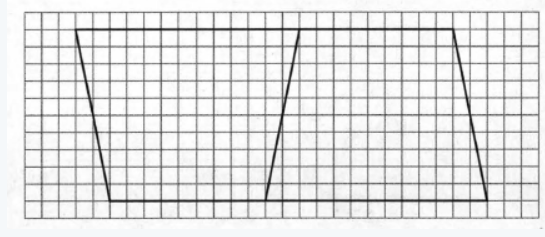
Geometry, Student Text, 2nd Edition, Chapter 3 Perimeter and Area 3

Normal and distorted image.

We have to tell which image has a larger area.

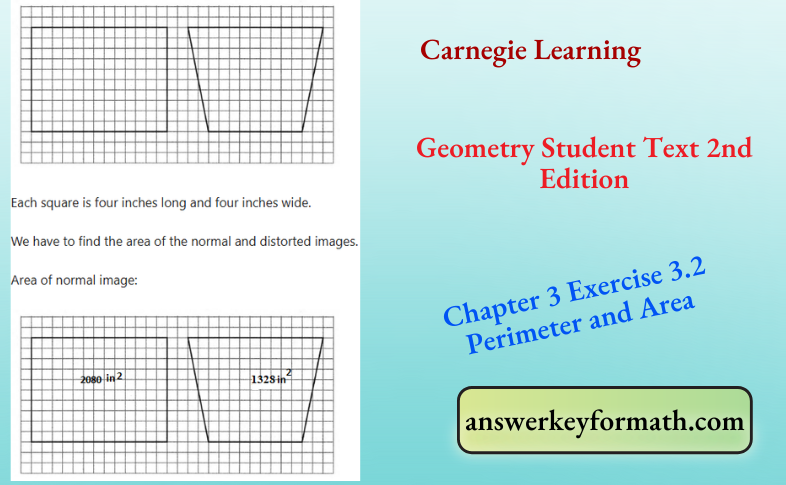
The shape of a normal image is a rectangle while the shape of a distorted image is a trapezoid.

We can see the normal and distorted image has the same big base and height.

A rectangle is divided into a trapezoid and two triangles as shown.

So, the rectangle has a larger area than the trapezoid, or we can say the normal image has a larger area.

Hence, the normal image has a larger area as it can be divided into trapezoid and two triangles.

Carnegie Learning Geometry Chapter 3 Page 162 Problem 4 Answer

Given:

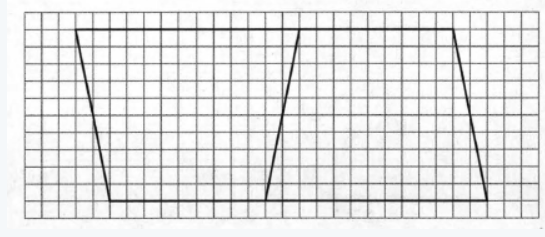
Carnegie Learning Geometry Student Text 2nd Edition Chapter 3 Exercise 3.3 Perimeter And Area

Given Normal image is a rectangle, its area is;

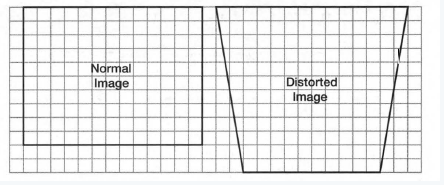
Base is 13×4=52 as it extends across 13 squares on grid.

Height is 10×4=40 as it extends across 10 squares on grid.

Area =40×52=2080 in2

Area of distorted image:

Given distorted image is a trapezoid.

The trapezoid is divided into two triangles and a rectangle.

Base of triangle is 2×4=8 inches

Height of a triangle is 10×4=40 inches

Area of rectangle =l×w

=4(9)×4(10)

=36×40

=1440in2

Area of each triangle=1/2b×h

=1/2[8+40]

=1/2[48]

=24in2

Area of trapezoid =1440+2(24)=1488in2

The area of the normal image is 2080 in2 and area of the distorted image is 1488 in2.

Carnegie Learning Geometry 2nd Edition Exercise 3.3 Solutions Page 162 Problem 5 Answer

Given: From the previous part we have,

Area of the normal image is 2080.in2

Area of distorted image is 1328 in2.

We have to compare the area of images.

The shape of a normal image is a rectangle while the shape of a distorted image is a trapezoid.

A rectangle is divided into a trapezoid and two triangles as shown.

So, the rectangle has a larger area than the trapezoid, or we can say the normal image has a larger area.

Also, it is proved in the previous part as the area of the normal image is 2080 in2 and the area of the distorted image is 1328in2.

Hence, the area of the distorted image is lesser than the area of a normal image.

Hence, We can compare the area of images by comparing the shapes of images.

Carnegie Learning Geometry Chapter 3 Page 162 Problem 6 Answer

Given: Distorted image

We have to find the area of the distorted image.

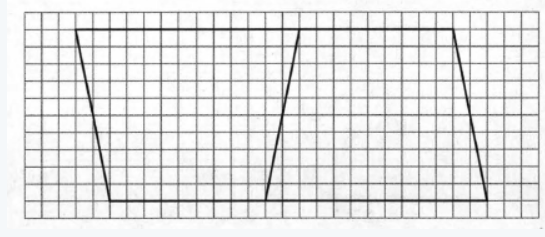
Base b1 extends to 13 squares on grid and each square is four inches long and four inches wide.

So, b1

=13×4=52 and b²

=9×4=36

as it extends across 9 squares on grid.

Height is 10×4=40 as it extends across 10 squares on grid.

Area of distorted image(Trapezoid):

A=1/2(52+36)×40

=1/2(88)×40

=44×40

=1760in2

The exact area of the distorted image using formula is 1760in2.

Perimeter And Area Solutions Chapter 3 Exercise 3.3 Carnegie Learning Geometry Page 163 Problem 7 Answer

Given: Distorted image

We have to find the area of the distorted image.

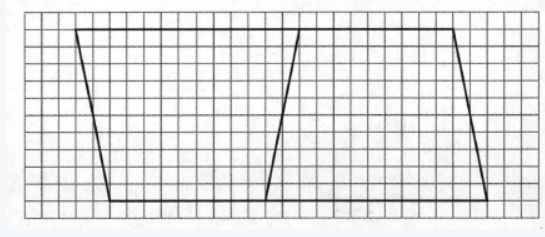
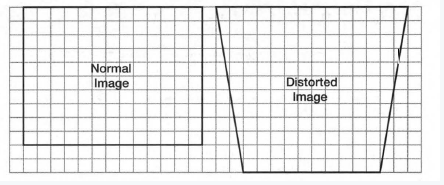
Base b1 extends to 13 squares on grid and each square is four inches long and four inches wide.

So, b1

=13×4

=52 and b2

=9×4

=36 as it extends across 9 squares on grid.

Height is10×4=40 as it extends across 10 squares on grid.

Area of distorted image(Trapezoid):

A=1/2(52+36)×40

=1/2(88)×40

=44×40

=1760in2

The exact area of the distorted image using formula is 1760 in2.

Carnegie Learning Geometry Chapter 3 Page 163 Problem 8 Answer

Given:

Geometry, Student Text, 2nd Edition, Chapter 3 Perimeter and Area 8

We need to write how does the area of the distorted image compares to the area of the normal image.

Here the normal image is a rectangle and the distorted image is a trapezoid.

Therefore, we can calculate the area of the trapezoid by using the formula and compare it with the area of the rectangle.

Therefore, we can calculate the area by using the formula of the area of the trapezoid and rectangle and compare it.

Page 163 Problem 9 Answer

The given image is

Geometry, Student Text, 2nd Edition, Chapter 3 Perimeter and Area 9

We need to flip it vertically and move it. next to the image as shown.

We need to write the geometric figure that is formed from this image.

The given image is

Geometry, Student Text, 2nd Edition, Chapter 3 Perimeter and Area 9 1

When we fit the image it vertically and move it to the next to the image we found that a quadrilateral with no sides parallel.

Therefore, the new figure is a trapezoid.

Hence, the new figure is Trapezoid.

Step-By-Step Solutions For Carnegie Learning Geometry Chapter 3 Exercise 3.3 Page 163 Problem 10 Answer

The given image is.

Geometry, Student Text, 2nd Edition, Chapter 3 Perimeter and Area 10

We need to calculate the area of a geometric figure in question 1.

Also, we need to calculate the area of the distorted image.

The given image is

Geometry, Student Text, 2nd Edition, Chapter 3 Perimeter and Area 10 1

The geometric area in question 1 is a trapezoid.

and the area of a trapezoid is a+b/2h units.

Here a is the base b is the base and h is the height.

The distorted image is a parallelogram and the area of a parallelogram is bh units.

Here b is the base and h is the height.

The area of the geometric figure is a+b/2h units. and the area of the distorted image is b⋅h units.

Carnegie Learning Geometry Chapter 3 Exercise 3.3 Free Solutions Page 164 Problem 11 Answer

the given image is

Geometry, Student Text, 2nd Edition, Chapter 3 Perimeter and Area 11

It is given that the distorted image is a trapezoid. parallel sides of the trapezoid are called the bases of the trapezoid.

non-parallel sides are the legs of the trapezoids.

on the arcade of the trapezoid is a line segment drawn from the vertex perpendicular to a line containing the opposite sides.

We need to calculate the area of a trapezoid.

The given image is

Geometry, Student Text, 2nd Edition, Chapter 3 Perimeter and Area 11 1

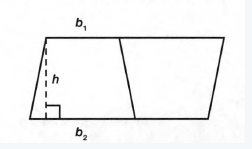
Let b1 is the length of one base,b2 is the length of another base and  h is the length of the altitude.

We know that, area of the trapezoid can be evaluated by multiplying the sum of the bases (parallel sides) by the altitude and then divided by 2.

Hence, the area of the distorted image is 1/2(b1+b2)h units.

Hence, the area of the distorted image is 1/2(b1+b2)h units.

Carnegie Learning Geometry Chapter 3 Page 165 Problem 12 Answer

From the given image

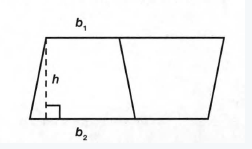
Geometry, Student Text, 2nd Edition, Chapter 3 Perimeter and Area 12

We need to write the formula of the entire figure.

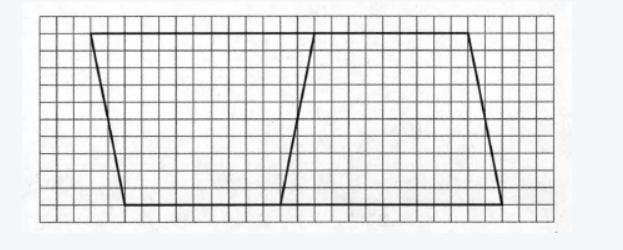
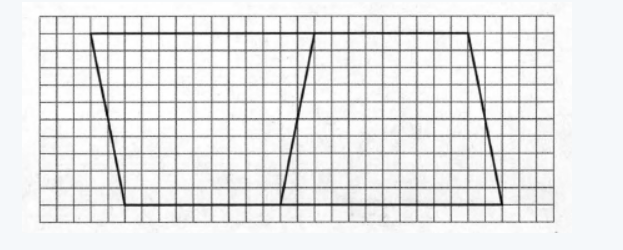
The area of a parallelogram is base on height.

The above figure is a simple quadrilateral with two pairs of parallel sides.

and the opposite or facing sides are equal hence the given figure is a parallelogram.

and we know that area of a parallelogram is base multiplied by the height.

Hence the area of the entire figure is (b1+b2)h units.

Geometry, Student Text, 2nd Edition, Chapter 3 Perimeter and Area 12 1

Hence, the area of the entire figure is (b1+b2)h.

Carnegie Learning Geometry Exercise 3.3 Student Solutions Page 165 Problem 13 Answer

The given image is

Geometry, Student Text, 2nd Edition, Chapter 3 Perimeter and Area 13

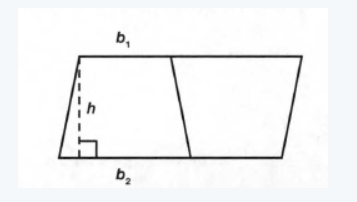
We need to suppose that we make an exact copy of this trapezoid, flip it vertically and move it next to the trapezoid.

We need to write the formula for the area of one of the trapezoid and explain it.

The given image is

Geometry, Student Text, 2nd Edition, Chapter 3 Perimeter and Area 13 1

when we flip it vertically, then we make it a trapezoid.

To find the area of the trapezoid, multiply the sum of the bases (the parallel sides) by the height (the perpendicular distance between the bases) and then double by 2. i.e 1/2(b1+b2)h unit square meter.

Hence, the area of the trapezoid is 1/2(b1+b2)h.

Carnegie Learning Geometry Chapter 3 Page 166 Problem 14 Answer

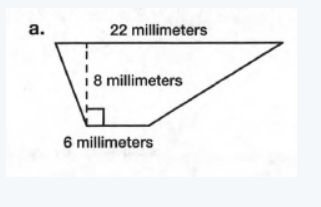
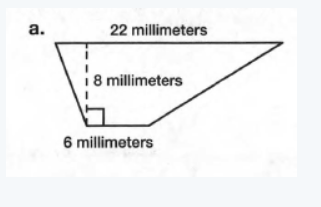
The given trapezoid is

Geometry, Student Text, 2nd Edition, Chapter 3 Perimeter and Area 14

Here either the height, the length of one base, or the area of the trapezoid is unknown.

We need to determine the value of the unknown measure.

The given trapezoid is

Geometry, Student Text, 2nd Edition, Chapter 3 Perimeter and Area 14 1

Here the height h is 8 millimeter.

The length of one base is b1 is 6 millimeter.

The length of another base b2 is  22 millimeter.

Hence we need to determine the area of the trapezoid.

We know that=1/2(b1+b2)h

=1/2(6+22)×8

=1/2(28)×8

=28×4

=112 square milimeter

Hence, the area of the trapezoid is 112 square milimeter.

Page 166 Problem 15 Answer

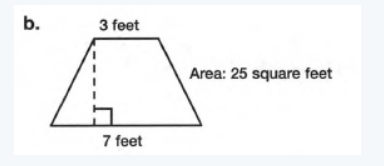
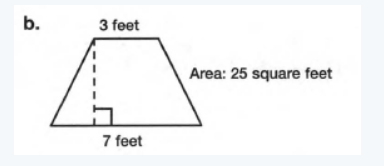
The given figure is

Geometry, Student Text, 2nd Edition, Chapter 3 Perimeter and Area 15

We need to find the value of the unknown measure.

In the given figure height is unknown And the given are is 25 square feet,  b1 and b2 are the length of the bases i.e 7 feet and 3 feet respectively.

We need to determine the length of the given figure

Geometry, Student Text, 2nd Edition, Chapter 3 Perimeter and Area 15 1

The area of the given figure is,
25=1/2(b1+b2)h

25=1/2(7+3)h

25×2=(10)h

50=(10)h

h=5

Hence, the height of the trapezoid is 5 feet.

Carnegie Learning Geometry Chapter 3 Page 166 Problem 16 Answer

Here the length of one base is unknown.

We need to determine the unknown measure.

From the given image,

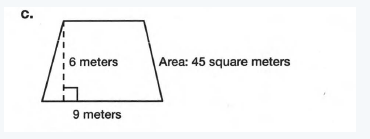
Geometry, Student Text, 2nd Edition, Chapter 3 Perimeter and Area 16

The height, length of one base b1 and area of the trapezoid is 6 meter,9 meters and 45 square meter.

We need to determine the length of another base(b2).

We know that,

Area=1/2(b1+b2)h

⇒45=1/2(b1+b2)h

⇒45=1/2(9+b2)6

⇒90=(9+b2)6

⇒15−9=b2

⇒b2

=6

Hence, the length of another base is 6 meter.

Perimeter And Area Exercise 3.3 Carnegie Learning 2nd Edition Answers Page 167 Problem 17 Answer

Here, the projection in problem 1 was tilted differently to create the distorted image shown.

each square on the grid represents a square that is 4 inches long and 4 inches wide.

We need to determine the area of the distorted image.

from the given image

Geometry, Student Text, 2nd Edition, Chapter 3 Perimeter and Area 17

The distorted image of the figure is a trapezoid.

The area of the trapezoid is 1/2(b1+b2)h square unit.

here, b1 and b2 are the length of the bases and h is the length of the height of the trapezoid.

Hence, the length of the trapezoid is 1/2(b1+b2)h square units.

Carnegie Learning Geometry Chapter 3 Page 167 Problem 18 Answer

From the given image

Geometry, Student Text, 2nd Edition, Chapter 3 Perimeter and Area 18

The projection in problem 1 is tilted differently to create a distorted image.

We need to write how does the area of the distorted image compares to the area of the normal image.

The given image is

Geometry, Student Text, 2nd Edition, Chapter 3 Perimeter and Area 18 1

Here the normal image is a rectangle and the distorted image is a trapezoid.

We know that a trapezoid is composed of two triangles and one rectangle.

therefore, we can calculate the area of the trapezoid by taking the sum of the areas of two triangles and one rectangle.

Therefore, we can calculate the area of the trapezoid by taking the sum of the areas of two triangles and one rectangle.

Page 168 Problem 19 Answer

Given AB is the perimeter of the trapezoid. Hence, fold this line to form a quadrilateral with at least a pair of two opposite sides parallel.

To draw the trapezoid,

Draw two parallel lines of different lengths.Join the corresponding starting points and the finishing points of the parallel lines to obtain the required figure.

The drawn trapezoid is

Geometry, Student Text, 2nd Edition, Chapter 3 Perimeter and Area 19

The drawn trapezoid is

Geometry, Student Text, 2nd Edition, Chapter 3 Perimeter and Area 19 1

Carnegie Learning Geometry Chapter 3 Page 168 Problem 20 Answer

I drew a trapezoid previously with the given perimeter AB.

All classmates drew different trapezoid. Because, as the perimeter is given, it is same for everyone.

The length of the sides differ but are adjusted when the final perimeter that is the sum of the lengths of the sides is constant for individual students.

As a result the trapezoids are different.


All classmates drew different trapezoid. Because, as the perimeter is given, it is same for everyone.

The length of the sides differ but are adjusted when the final perimeter that is the sum of the lengths of the sides is constant for individual students.

As a result the trapezoids are different.

Carnegie Learning Geometry Student Text 2nd Edition Chapter 3 Exercise 3.2 Perimeter and Area

Geometry Student Text 2nd Edition Chapter 3 Perimeter and Area

Carnegie Learning Geometry Student Text 2nd Edition Chapter 3 Exercise 3.2 Solution Page 148 Problem 1 Answer

Area of parallelogram=Base×Height

Area of rectangle=length×width

We have to explain how we can create a rectangle from the parallelogram shown so that the rectangle and the parallelogram have the same area.

Geometry, Student Text, 2nd Edition, Chapter 3 Perimeter and Area 1

We can decompose and rearrange a parallelogram to form a rectangle.

Here are three ways:

Geometry, Student Text, 2nd Edition, Chapter 3 Perimeter and Area 1 1

We can enclose the parallelogram and then subtract the area of the two triangles in the corner.

Area of parallelogram=4×3=12​

Area of rectangle=6×2=12​

Hence, we see that a rectangle can create from the parallelogram and area is equal.

Read and learn More Carnegie Learning Geometry Student Text 2nd Edition Solutions

Carnegie Learning Geometry Chapter 3 Page 148 Problem 2 Answer

We have to find the area of the rectangle.

length of the rectangle=6 unit

width of the rectangle=3 unit

Area of the rectangle=6×3=18

Hence, area of rectangle is 18 sq. unit.

Page 148 Problem 3 Answer

We have to find the area of the rug.

Count the number of square and then add all the square to get the total area of the rug.

Base of the parallelogram=4 square

Height of the parallelogram=3 square

Area of the rug=4×3=12

​Hence, area of the rug=12 sq. unit

Carnegie Learning Geometry Chapter 3 Page 150 Problem 4 Answer

Carnegie Learning Geometry Student Text 2nd Edition Chapter 3 Exercise 3.2 Perimeter And Area

Page 151 Problem 5 Answer

We have to write a formula for the area of a parallelogram.

Use b for the base of the parallelogram,h for the height, and A for the area.

Area of parallelogram=Base×Height

A=b×h

Carnegie Learning Geometry Chapter 3 Page 151 Problem 6 Answer

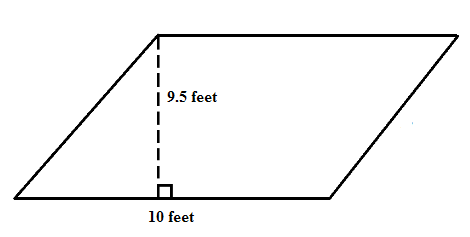
The objective of the problem is to find the area for the given parallelogram.

Given:

Geometry, Student Text, 2nd Edition, Chapter 3 Perimeter and Area 6

By observing the given figure,

b=10 feet

h=9.5 feet

So, the required area of a parallelogram is,
​A=bh

=9.5×10

=95 feet2

Hence, the required area of a parallelogram is 95 feet2.
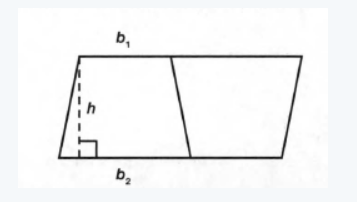
Solutions For Perimeter And Area Exercise 3.2 In Carnegie Learning Geometry Page 151 Problem 7 Answer

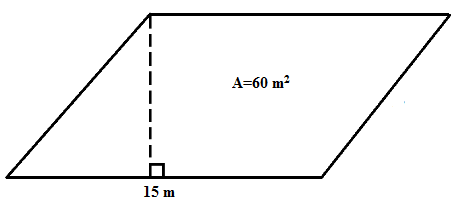
The objective of the problem is to find the height for the given parallelogram.

Given:

Geometry, Student Text, 2nd Edition, Chapter 3 Perimeter and Area 7

By observing the figure,

A=60m2

b=15 m

Therefore, the required width of height is,
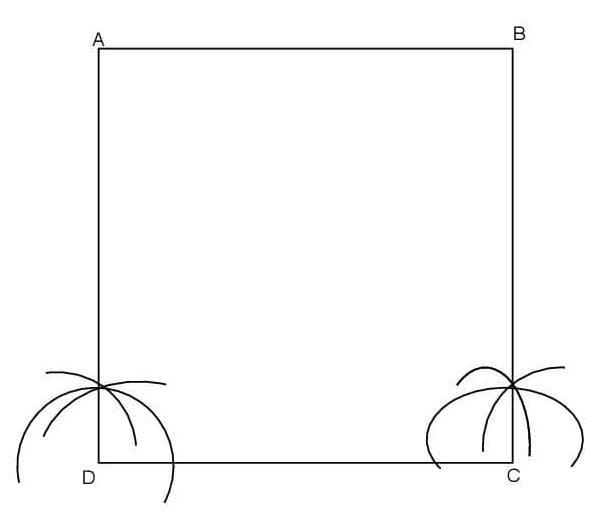
A=bh

60=15⋅h

h=60/15

h=4 m

Hence, the required width of the parallelogram is 4 m.

Carnegie Learning Geometry Chapter 3 Page 151 Problem 8 Answer

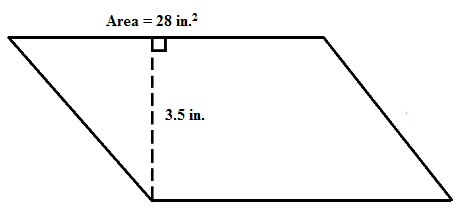
The objective of the problem is to find the base length of a parallelogram,

Geometry, Student Text, 2nd Edition, Chapter 3 Perimeter and Area 8

By observing the figure,

A=28in2

h=3.5 in.

Therefore, the required base length is,

​A=bh

b=A/h

b=28/3.5

b=8 in.

​Hence, the required base length is 8 in.

Carnegie Learning Geometry Chapter 3 Page 151 Problem 9 Answer

The objective of the problem is to find the total cost for the rugs.

Given: For rectangular-shaped rug:

l=6 ft

w=4 ft

For parallelogram-shaped rug:

b=8 ft

h=3 ft

​Area of rectangular shaped rug:

A=lw

A=6⋅4

A=24 ft2

Now, per square foot, the charge is $20, for 24 ft2

rectangular rug, the charge is:

$20⋅24

=$480

​Area of parallelogram-shaped rug:

​A=bh

A=8⋅3

A=24 ft2

So, the charge for 24 ft2 of parallelogram-shaped rug:

$20⋅24

=$480

​Therefore, the total charge is a sum of each cost:

$480+$480=$960

​Hence, the total cost for the rugs is $960.

Carnegie Learning Geometry Chapter 3 Page 152 Problem 10 Answer

Given diagram:

Geometry, Student Text, 2nd Edition, Chapter 3 Perimeter and Area 10

Given, each grid square is one-tenth kilometer wide and one-tenth kilometer long.

We have to find the number of grid squares in a row that creates an area that is one kilometer long and one-tenth of a kilometer wide.

As the length and width of each square on the grid is one-tenth kilometer.i.e 0.1 kilometer.

Since the length of 10 squares in a row=10×0.1=1 kilometer

So 10 squares in a row make the area which is one kilometer long and one-tenth of a kilometer wide.

10 squares in a row make the area which is one kilometer long and one-tenth of a kilometer wide.      

Carnegie Learning Geometry Chapter 3 Page 152 Problem 11 Answer

Given diagram:

Geometry, Student Text, 2nd Edition, Chapter 3 Perimeter and Area 11

Given, each grid square is one-tenth kilometer wide and one-tenth kilometer long.

We have to find the number of grid squares in a row that creates an area that is one kilometer long and one kilometer wide.

As the length and width of each square on the grid is one-tenth kilometer.i.e 0.1 kilometer.

Since the length of 10 squares is 10×0.1=1kilometer

Similarly, the width of 10 squares is 10×0.1=1kilometers

Hence the total number of squares creates an area that is one kilometer long and one kilometer wide=10×10=100

100 squares create an area that is one kilometer long and one kilometer wide.

Carnegie Learning Geometry 2nd Edition Exercise 3.2 Solutions Page 153 Problem 12 Answer

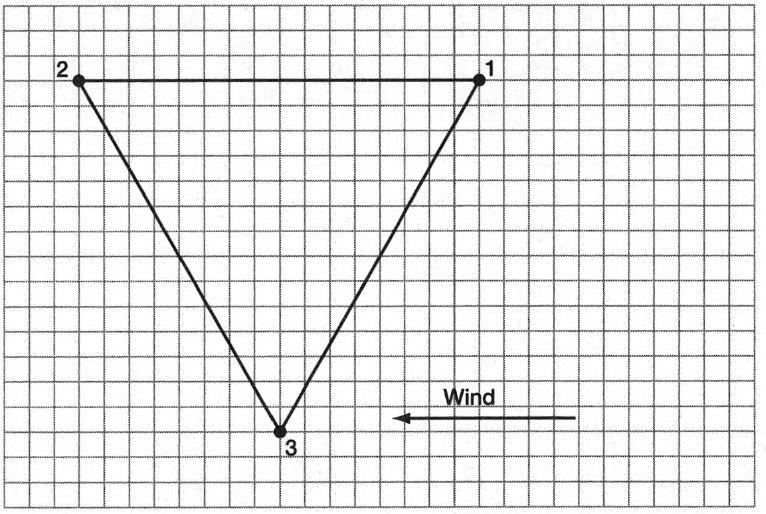
Given diagram:

Geometry, Student Text, 2nd Edition, Chapter 3 Perimeter and Area 12

Given, each grid square is one-tenth kilometer wide and one-tenth kilometer long.

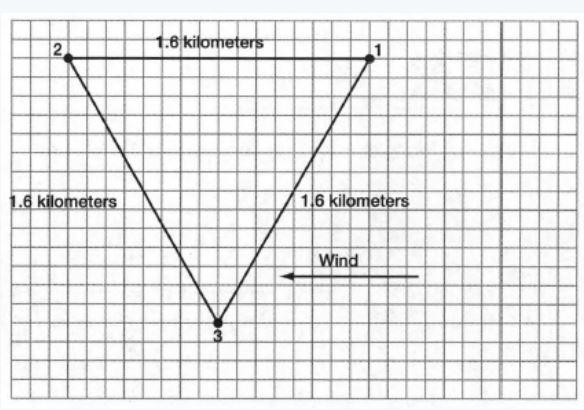
we have to estimate the area enclosed by the course

As the length and width of each square on the grid is one-tenth kilometer.i.e 0.1 kilometer. and course is triangular shaped

Hence we need base and height for this triangle.

Count the squares on the grid and find the base and height to the base by multiplying the number of squares with 0.1

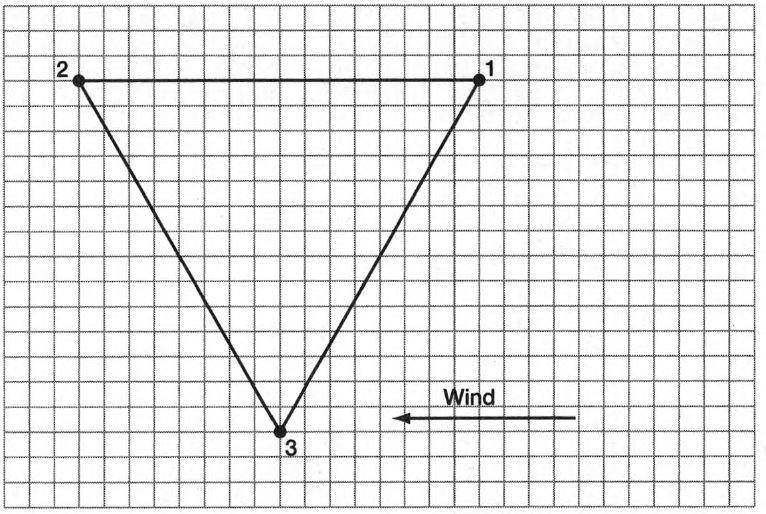
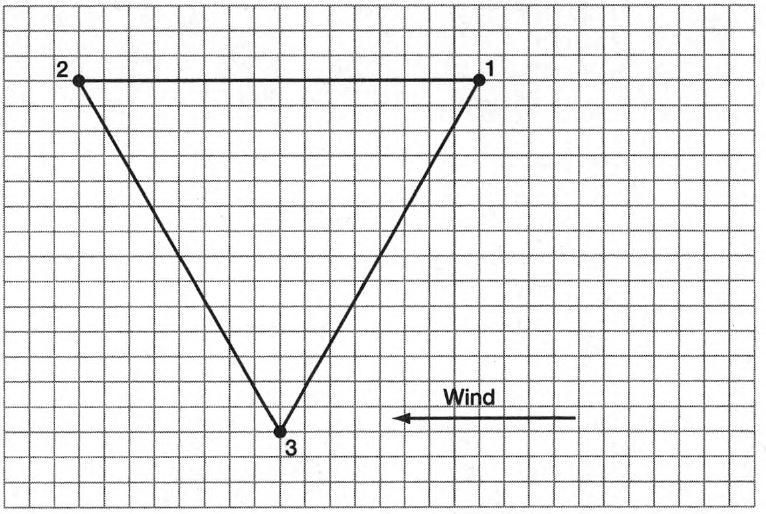
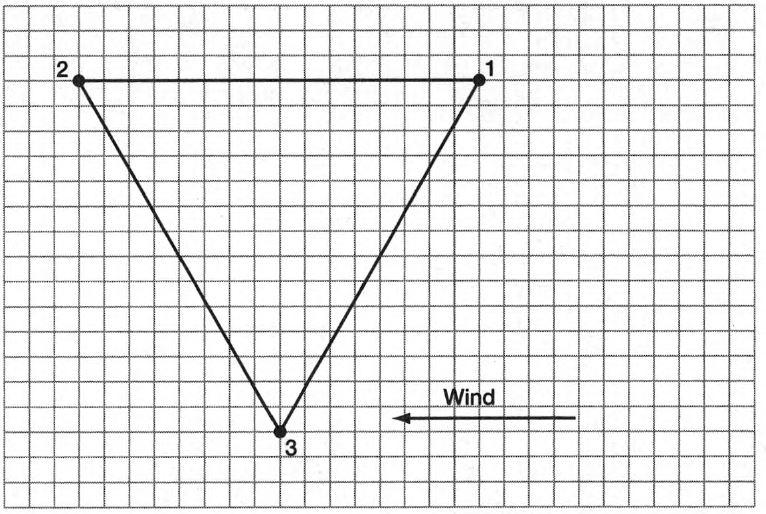
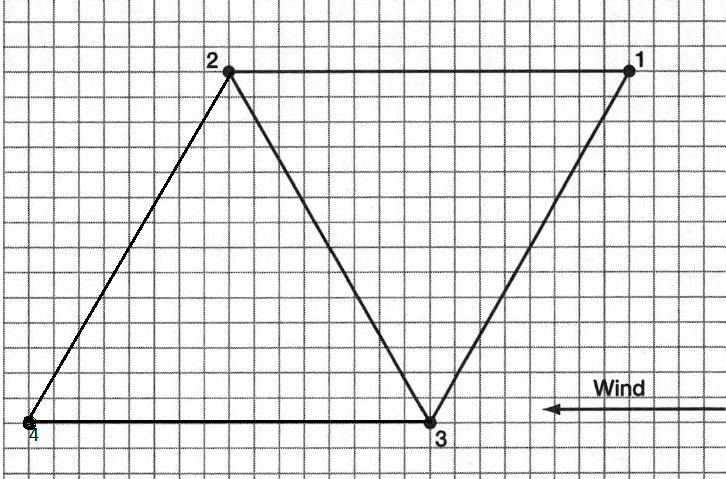
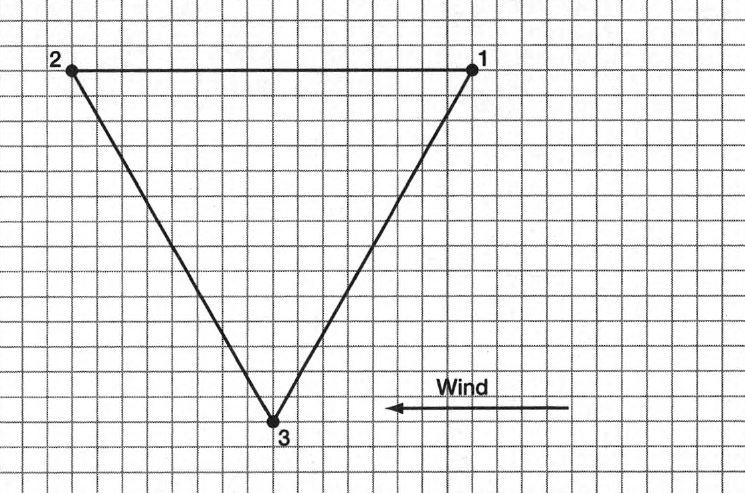
The base of the triangle is from point 2 to point 3 and total of 16 squares between these points

so the length of base  is 16×0.1=1.6 kilometers

Similarly, there are 14 squares lies the perpendicular height to the base from vertex 3

So the height of the triangle is 14×0.1=1.4 kilometers.

Use the formula of the triangle and calculate the required area of the course.

base:b=1.6 kilometers

height: h=1.4 kilometers

Now the area:​A=1/2×1.6×1.4

=1.12

The area of the course is 1.12 square kilometers

The area of the course is 1.12 square kilometers

Carnegie Learning Geometry Chapter 3 Page 153 Problem 13 Answer

Refer to answer of problem 3

Yes, the calculated area in problem 3 is exact, because we have counted the grids very carefully.
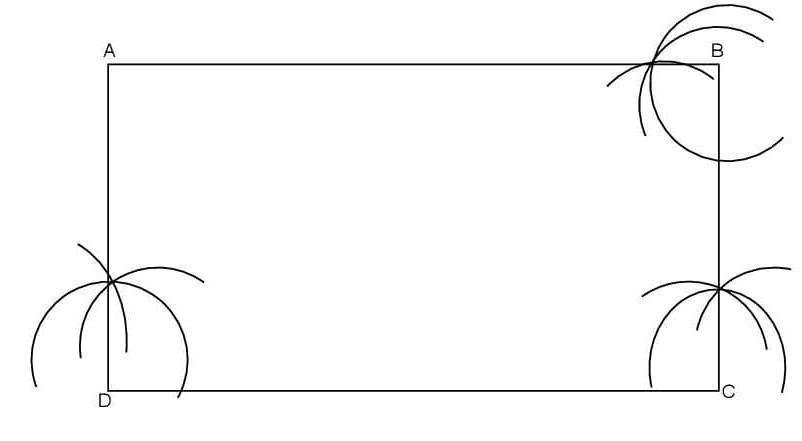

Yes, the calculated area in problem 3 is exact.

Page 153 Problem 14 Answer

Given diagram:

Geometry, Student Text, 2nd Edition, Chapter 3 Perimeter and Area 14

We have to draw a parallelogram by using two sides of the triangle.

Take any two sides of the shown triangle in the diagram and draw the parallel lines having the same length to make a parallelogram.

Geometry, Student Text, 2nd Edition, Chapter 3 Perimeter and Area 14 1

We take one side from vertex 1 to vertex 2 and another side from vertex 1 to vertex 3.

Draw parallel lines opposite to these considered lines and make a parallelogram.

The parallelogram :

Geometry, Student Text, 2nd Edition, Chapter 3 Perimeter and Area 14 2

Carnegie Learning Geometry Chapter 3 Page 153 Problem 15 Answer

Refer to answer to problem 5

The diagram of parallelogram:

Geometry, Student Text, 2nd Edition, Chapter 3 Perimeter and Area 15

We have to find the area of this parallelogram.

As the length and width of each square on the grid is one-tenth kilometer.i.e 0.1 kilometer.

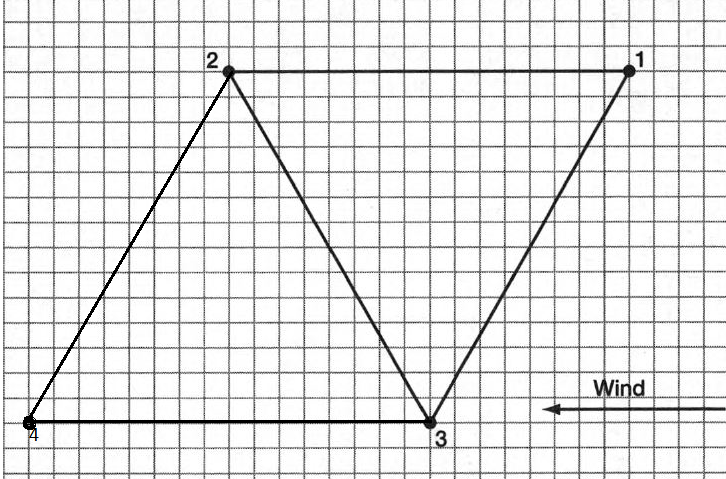
Take base from vertex 3 to 4, there are 16 squares between this vertex

The length of the base is 16×0.1=1.6 kilometers

There are 14 squares between the base and its opposite vertex.

So the height is 14×0.1=1.4 kilometers

Use the formula of the area of the parallelogram and evaluate the area.

The base of parallelogram=1.6 km

Height to the base=1.4 km

Hence, the area of parallelogram is 1.6×1.4=2.24 square kilometers

The area of the parallelogram is 2.24 square kilometers.

Carnegie Learning Geometry Chapter 3 Page 153 Problem 16 Answer

Refer to problem (5)

Given diagram of traingle and parallelogram is :

Geometry, Student Text, 2nd Edition, Chapter 3 Perimeter and Area 16

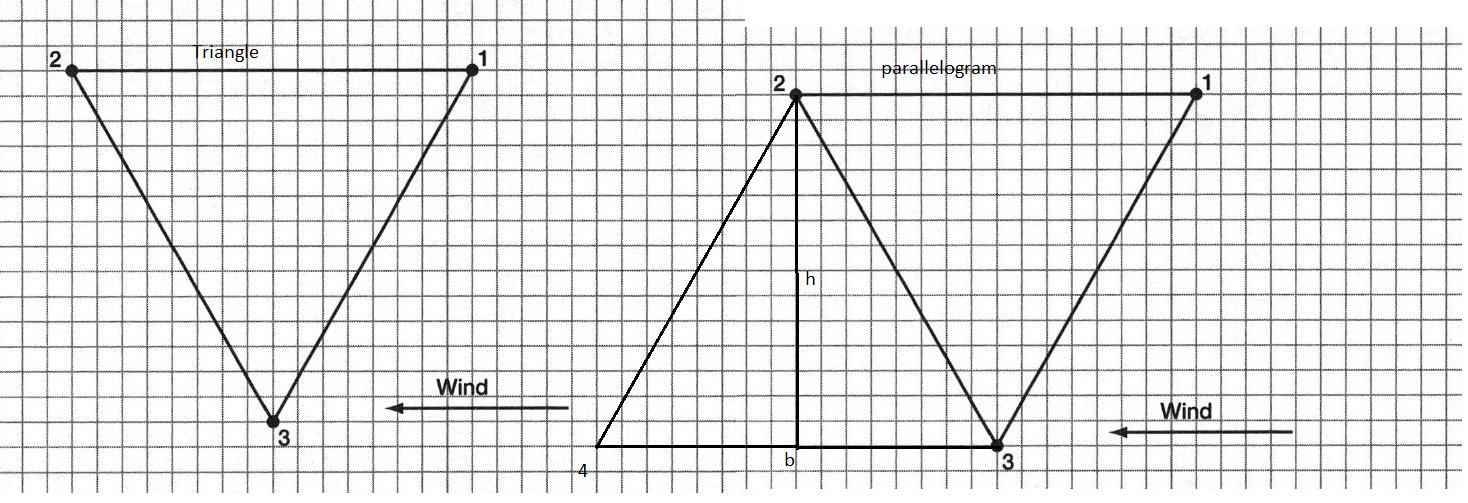
in this diagram we can see that the parallelogram is made up of two inverted given traingle.

So the area of the parallelogram is twice the are of the triangle.

Hence we can calculate the exact area of triangle if the area of the parallelogram is known to us.

Yes,  we can calculate the exact area of the triangle by using the area of the parallelogram, because parallelogram is made up of two inverted given traingle.

Perimeter And Area Solutions Chapter 3 Exercise 3.2 Carnegie Learning Geometry Page 148 Problem 17 Answer

Refer to problem 5 and 6

The given diagram:

Geometry, Student Text, 2nd Edition, Chapter 3 Perimeter and Area 17

The calculated area of parallelogram in problem 6 is 2.24 square kilometers

The area of the traingle is half of the area of the parallelogram calculated in problem 6

The exact area of the triangle=1/2 (area of parallelogram)

=1/2×2.24

=1.12

The exact area of the triangle is 1.12 square kilometers

The exact area of the triangle is 1.12 square kilometers

Step-By-Step Solutions For Carnegie Learning Geometry Chapter 3 Exercise 3.2 Page 154 Problem 18 Answer

The given triangle is

Geometry, Student Text, 2nd Edition, Chapter 3 Perimeter and Area 18

The base of this triangle is 16 blocks and length of one block is 0.1 kilometers

Hence the base will be 16×0.1=1.6 kilometers

Similarly, the perpendicular height to this base is 14 blocks

hence the height is 14×0.1=1.4 kilometers

Use the formula of the area of the triangle and calculate it.

Given b=1.6

h=1.4

hence the area of the triangle is A=1/2×1.6×1.4

=1.12

​The area of the triangle is 1.12 square kilometers

The exact area is same as the estimated area of the triangle.

The area of the triangle is 1.12 square kilometers

The exact area is the same as the estimated area of the triangle.

Carnegie Learning Geometry Chapter 3 Page 154 Problem 19 Answer

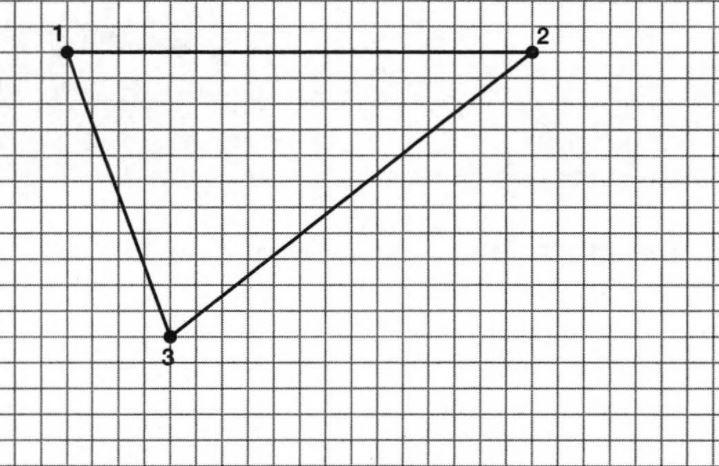
Given diagram:

Geometry, Student Text, 2nd Edition, Chapter 3 Perimeter and Area 19

Given,  Each square on the grid represents a square that is one-tenth of a kilometer long and one tenth of kilometer wide.i.e. 0.1 kilometer length and width of each grid

We have to find the area of this triangle.

Cout the grid and find the base and perpendicular height to the base of the given triangle.

Choose a base of the triangle from vertex 1 to vertex 2 So the length of the base is 18 grid :18×0.1

=1.8 kilometers

So the perpendicular height to this base from vertex 3 is :11×0.1=1.1 kilometers

Calculate area of the triangle by using formula.

b=1.8

h=1.1

The area of this triangle is

A=1/2×1.8×1.1

=0.99

The area enclosed by the course is 0.99 square kilometers.

The area enclosed by the course is 0.99 square kilometers.

Carnegie Learning Geometry Chapter 3 Exercise 3.2 Free Solutions Page 155 Problem 20 Answer

Refer to exercise 11

What information about the triangle did you need to calculate the area in Question 11

In exercise 11 we have seen that we need a base and perpendicular to this base from the opposite vertex of the triangle.to calculate the area of the triangle.

In exercise 11 we have seen that we need a base and perpendicular to this base from the opposite vertex of the triangle.to calculate the area of the triangle.

Carnegie Learning Geometry Chapter 3 Page 155 Problem 21 Answer

Given the base of the triangle is b

height of the triangle is h

The area of the triangle is A

so the formula for the area of this triangle is

A=1/2bh

The formula of area of triangle is A=1/2bh

Page 156 Problem 22 Answer

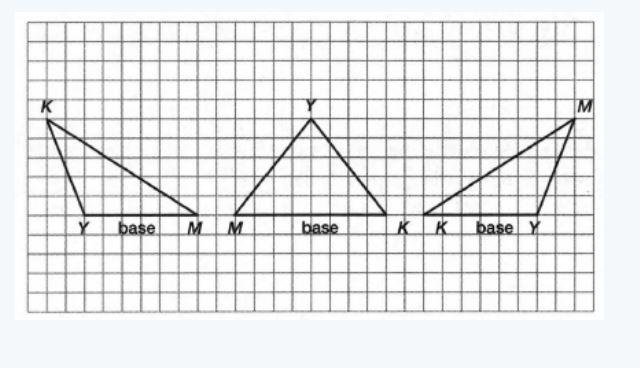
Given triangles:

Geometry, Student Text, 2nd Edition, Chapter 3 Perimeter and Area 22

Given,  Each square on the grid represents a square that is one-tenth of a kilometer long and one tenth of kilometer wide.i.e. 0.1 kilometer length and width of each grid

We have to determine the base and height of triangles KYM, MYK, KMY and then have to calculate the area of each triangle.

count the grid for each triangle and find the base and perpendicular height to the base.

calculate area of the triangles using the formula.

For the first triangle KYM

The base is YM:6×0.1=0.6

kilometers

Height is :5×0.1=0.5

kilometers

The area of triangle KYM is

1/2×0.6×0.5

=0.15

For the 2nd triangle MYK

The base is MK:8×0.1=0.8 kilometers

The height is 5×0.1 kilometers area is 1/2×0.8×0.5=0.2

For the 3rd triangle KYM

The base is KY:6×0.1=0.6 kilometers

the height is 5×0.1=0.5 kilometers

area is:1/2×0.6×0.5=0.15

For the first triangle KYM: base is 0.6 kilometers, height is 0.5 kilometers and the area is 0.15 square kilometers.

For the second triangle YMK: base is 0.8 kilometers, height is 0.5 kilometers and the area is 0.2 square kilometers.For the third triangle MKY: base is 0.6 kilometers, height is 0.5 kilometers and the area is 0.15 square kilometers

Carnegie Learning Geometry Chapter 3 Page 156 Problem 23 Answer

We have to check the effect of changing the length of the base on the height of the triangle when the area remains the same.

Let the base and height of the first triangle are b1 and h1 respectively

Similarly, the base and the height of the second triangle are b2 and h2 respectively.

According to the formula of the area of a triangle,

The area of the first triangle is 1/2b1h1

The area of the second triangle is 1/2b2h2

Since it has given that the area of both triangles is the same

Hence, ​1/2b1h1=1/2b2h2

b1h1=b2h2

Here the product of base and height of both triangles is constant hence increase in base results decrease in height of the triangle and vice-versa.

If the area of two triangles is the same then increases in the base of a triangle will result to decrease in the height and vice-versa

Carnegie Learning Geometry Exercise 3.2 Student Solutions Page 156 Problem 24 Answer

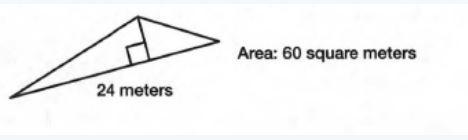
Given:

Geometry, Student Text, 2nd Edition, Chapter 3 Perimeter and Area 24

In the given triangle

The base is 24 meters

The area is 60 square meters

We have to calculate the height for this triangle

Use the formula of the area of the triangle and calculate the height.

Let the height of the triangle is hmeters

Area of triangle =60 square meters

1/2×24×h=60

h=60/12

h=5

The height i of the triangle is 5 meters

The height of the triangle is 5 meters

Carnegie Learning Geometry Chapter 3 Page 156 Problem 25 Answer

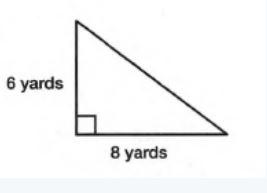
Given diagram:

Geometry, Student Text, 2nd Edition, Chapter 3 Perimeter and Area 25

In the given triangle

The base is 8 yards

The height is 6 yards

We have to calculate the area of this triangle

Use the formula of the area of the triangle and calculate the area.

Area:​1/2×8×6

=24​

The area of this triangle is 24 square yards

The area of this triangle is 24 square yards

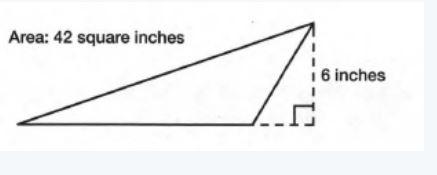
Page 156 Problem 26 Answer

Given triangle is:

Geometry, Student Text, 2nd Edition, Chapter 3 Perimeter and Area 26

In the given triangle

The height is 6 inches

The area of the triangle is 42 square inches.

We have to calculate the base of this triangle

Use the formula of the area of the triangle and calculate the base.

Let the base is b inches

Since, the area of the triangle =42

Hence, ​1/2×b×6=42

b=42/3

b=14

The base of the triangle is 14 inches.

The base of the triangle is 14 inches.

Carnegie Learning Geometry Chapter 3 Page 157 Problem 27 Answer

Refer to problem 17

The geometrical name given to the measurement of the distance to travel in the race is the perimeter.

The geometrical name given to the measurement of the distance to travel in the race is the perimeter.

Page 158 Problem 28 Answer

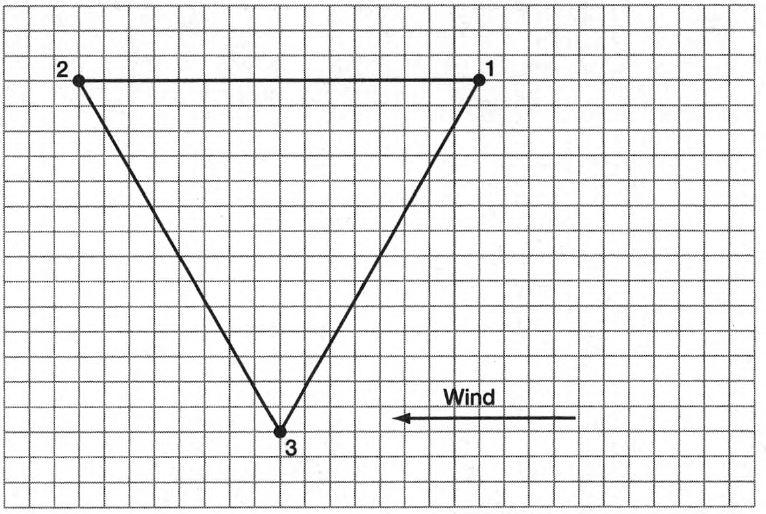
The original race course is shown as:

Geometry, Student Text, 2nd Edition, Chapter 3 Perimeter and Area 28

Given, it is common for a boat to have to go around a course more than once or revisit a leg of the course more than once and to

complete the race, a boat must sail to the marks in the following order: 1, 2, 3, 1, 3, 1, 2, 3, 1, 3.

We have to calculate the distance traveled in this race.

Look at the leg between each node and add the length of the legs of the race.

When boat sail from 1 to 2, length=1.6 kilometers

When boat sail from 2 to 3, length=1.6 kilometers

When boat sail from 3 to 1, length=1.6 kilometers

When boat sail from 1 to 3, length=1.6 kilometers

When boat sail from 3 to 1, length=1.6 kilometers

When boat sail from 1 to 2, length=1.6 kilometers

When boat sail from 2 to 3, length=1.6 kilometers

When boat sail from 3 to 1, length=1.6 kilometers

When boat sail from 1 to 3, length=1.6 kilometers

So total distance traveled by boat in this race is

1.6+1.6+1.6+1.6+1.6+1.6+1.6+1.6+1.6+1.6=16

​Total distance traveled by boat in this race is 16 kilometers

Total distance traveled by boat in this race is 16 kilometers

Carnegie Learning Geometry Chapter 3 Page 158 Problem 29 Answer

Refer to problems 17 and 19

The race length in problem 17 is 4.8 kilometers

The race length in problem 19 is 16 kilometers

We have to compare the race length in both problems

Since 4.8<16

Hence If a boat is competing in a race, then the boat will travel less than the race length calculated in Question 19.

If a boat is competing in a race, then the boat will travel less than the race length calculated in Question 19.

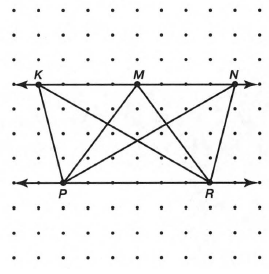
Perimeter And Area Exercise 3.2 Carnegie Learning 2nd Edition Answers Page 158 Problem 30 Answer

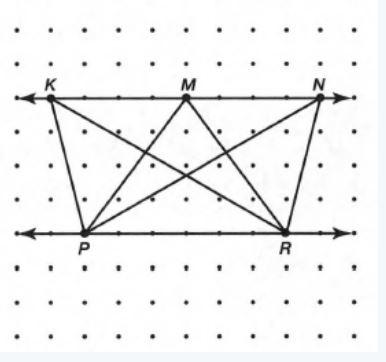
Given diagram :

Geometry, Student Text, 2nd Edition, Chapter 3 Perimeter and Area 30

We have to find the area of triangle KPR in the given diagram

Let the distance between two points in the grid is 1 unit.

Find the base  PR  and perpendicular height to the base opposite of K by counting the grid.

Then use the formula of the area of the triangle to evaluate the area.

The base of the triangle KPR is PR=6 units

height =4 units

The area of triangle KPR =​1/2×6×4=12​

The area of triangle KPR is 12 square units.

The area of triangle KPR is 12 square units.

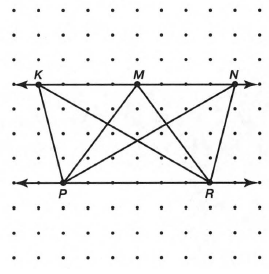
Carnegie Learning Geometry Chapter 3 Page 158 Problem 31 Answer

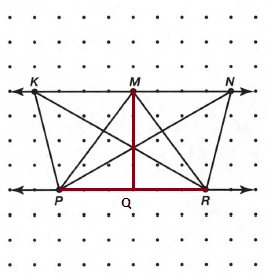
Consider the below updated figure for triangle MPR:

Geometry, Student Text, 2nd Edition, Chapter 3 Perimeter and Area 31

For triangle MPR,

MQ=4

PR=6

Therefore, the required required area is,

A=1/2bh

A=1/2⋅6⋅4

A=12 unit

​Hence, the required solution is 12 unit.

Page 158 Problem 32 Answer

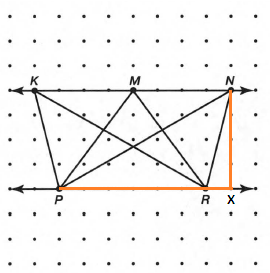
The objective of the problem is to find out the area of NPR.

Consider the given figure in book as reference of solution.

To find the required area let first take perpendicular from the point N:

Geometry, Student Text, 2nd Edition, Chapter 3 Perimeter and Area 32

So, the required area is,

area of △NPX−△NRX

Therefore,

1/2⋅7⋅4−1/2⋅1⋅4

=14−2

=12 unit

​Hence, the required solution is 12 unit.

Carnegie Learning Geometry Chapter 3 Page 158 Problem 33 Answer

Area of MPR:

A=1/2bh

A=1/2⋅6⋅4

A=12 unit​

Area of KPR:

1/2⋅6⋅4

=12 unit​

The area of NPR:

1/2⋅6⋅4

=12 unit

​As it is seen that all three areas are same.

Hence, it is seen that all three area values are same in measure.

Perimeter And Area Exercise 3.2 Carnegie Learning 2nd Edition Answers Page 158 Problem 34 Answer

The objective of the problem is to compare the base of given three triangle.

Given:

Geometry, Student Text, 2nd Edition, Chapter 3 Perimeter and Area 34

By analyzing the figure given as reference, base for three triangle is PR.  As for all three triangle, base is same.

Therefore, these three triangles is sharing same base.

Hence, it is concluded that all three triangles are sharing same base.

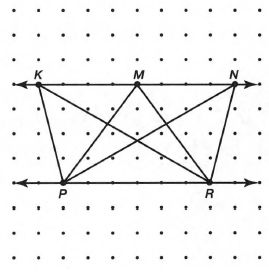
Carnegie Learning Geometry Chapter 3 Page 158 Problem 35 Answer

The objective of the problem is to compare the height of all three triangle.

Consider the given figure:

Geometry, Student Text, 2nd Edition, Chapter 3 Perimeter and Area 35

By analyzing the figure given, one can see that height is distance of triangle is distance between the two parallel lines.

As distance between two parallel lines is 4 units for all three triangle.

Therefore, it is concluded that height of all three triangles is same.

Hence, it is concluded that height of all three triangle is same.

Page 158 Problem 36 Answer

The objective of the problem is to compare the base of given three triangle.

Given:

Geometry, Student Text, 2nd Edition, Chapter 3 Perimeter and Area 36

By analyzing the figure given as reference, base for three triangle is PR. as for all three triangle, base is same.

Therefore, these three triangles is sharing same base.

Hence, it is concluded that all three triangles are sharing same base.

Carnegie Learning Geometry Chapter 3 Page 160 Problem 37 Answer

Given :

Geometry, Student Text, 2nd Edition, Chapter 3 Perimeter and Area 37

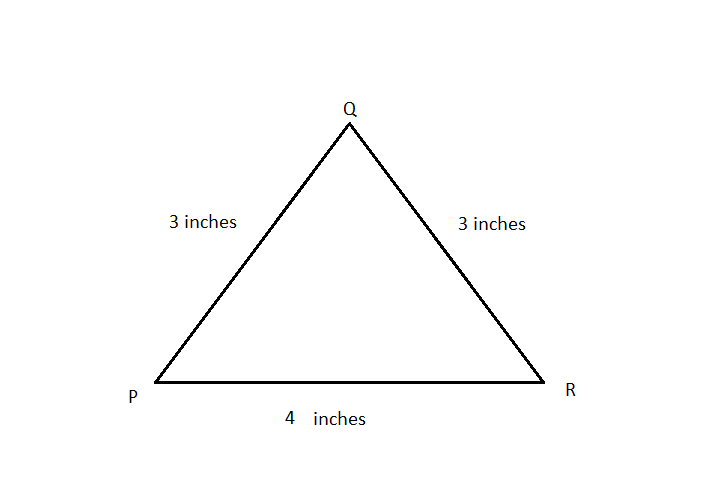
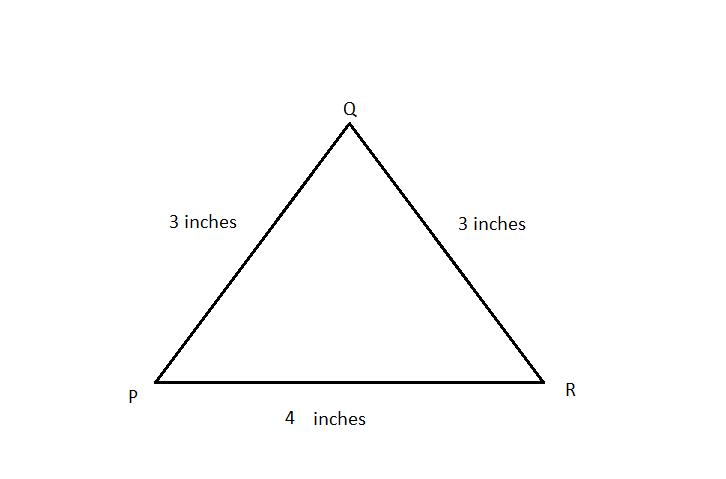
We have to construct an isosceles triangle whose perimeter is of the given length of AB

Measure the length of Line AB with help of measuring scale and divide that length into 3 parts such that 2 parts have the same length and the third has a different.

Draw a triangle using the divided length which is an isosceles triangle.

The length of line AB is 10 inch

Hence, the length of sides of isosceles will be 3 inches, 3 inches, and 4 inches

Now the isosceles triangle can be drawn a

Geometry, Student Text, 2nd Edition, Chapter 3 Perimeter and Area 37 1

The isosceles triangle can be drawn as

Geometry, Student Text, 2nd Edition, Chapter 3 Perimeter and Area 37 2

Perimeter And Area Exercise 3.2 Carnegie Learning 2nd Edition Answers Page 160 Problem 38 Answer

Refer to  problem 1

No, all my classmates do not construct the same isosceles triangle like me.

No, all my classmates do not construct the same isosceles triangle like me.

Carnegie Learning Geometry Student Text 2nd Edition Chapter 3 Exercise 3.1 Perimeter and Area

Geometry Student Text 2nd Edition Chapter 3 Perimeter and Area

Carnegie Learning Geometry Student Text 2nd Edition Chapter 2 Exercise 2.6 Solution Page 132 Problem 1 Answer

The total length of the fencing is given, that is 20 feet.

We have to describe the shape, location, and dimension of the garden that maximize the area.

For this we will use the formula of the perimeter of the square, that is 4a, where a is the length of the sides of the square.

Length of fencing=20feet.

Let, the side of a square garden be a feet.

∴Perimeter = length of fencing.

Read and learn More Carnegie Learning Geometry Student Text 2nd Edition Solutions

⇒ 4a=20

⇒ a=5feet

∴ Area of garden=a2

=52

=25 feet2

Therefore, the location of the garden is in the front of the house.

Hence, the required shape is square with an area 25 feet2

which is located in front of the house.

Carnegie Learning Geometry Chapter 3 Page 132 Problem 2 Answer

The total length of the fencing is given, that is30feet.

We have to describe the shape, location, and dimension of the garden that maximize the area.

For this we will use the formula of the perimeter of the square, that is 4a, where a is the length of the sides of the square.

Length of the fencing=30

Let, the side of a square garden be a feet.

∴ Perimeter= Length of fencing

⇒4a=30

⇒a=30/4

⇒a=7.5feet

∴ Area of garden=a2

=(7.5)2

=56.25feet2

Therefore, the location of the garden is in the front of the house.

Hence, the required shape is square with an area 56.25 feet2 which is located in front of the house.

Page 132 Problem 3 Answer

The total length of the fencing is given, that is50feet.

We have to describe the shape, location, and dimension of the garden that maximize the area.

For this we will use the formula of the perimeter of the square, that is 4a, where a is the length of the sides of the square.

We have,

Length of the fencing=50 feet

Let, the side of the square garden be a feet.

∴Perimeter= Length of the fencing

⇒4a=50

⇒a=50/4

⇒a=12.5feet

∴Area of a garden=12.5×12.5

=156.25 feet2

Therefore, the location of the garden is in the front of the house.

Hence, the required shape is square with an area 156.25 feet2 which is located in front of the house.

Carnegie Learning Geometry Chapter 3 Page 134 Problem 4 Answer

Carnegie Learning Geometry Student Text 2nd Edition Chapter 3 Exercise 3.1 Perimeter And Area

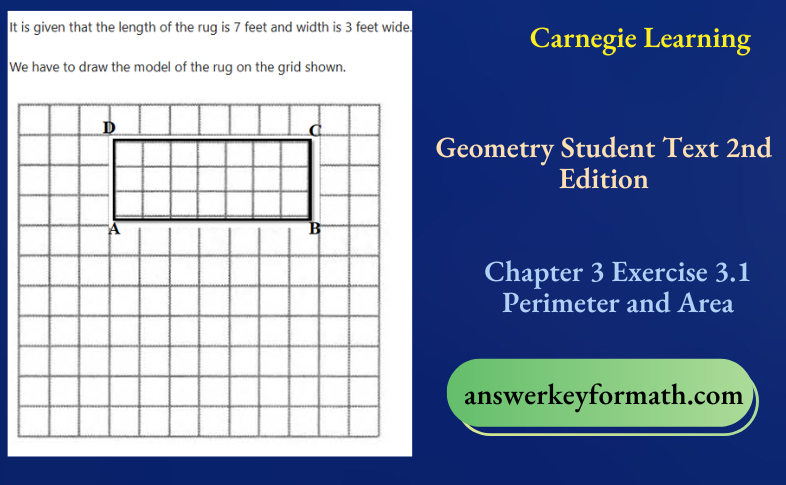
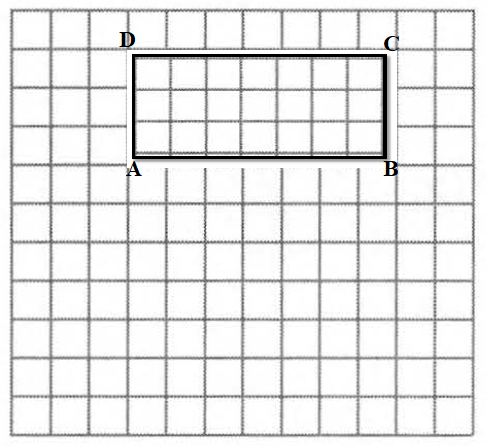
Each square on the grid represents a square of 1 foot long and 1 foot wide.

We have,

Geometry, Student Text, 2nd Edition, Chapter 3 Perimeter and Area 4 1

The length of the rug=7 feet

The breadth of the rug=3 feet.

Hence,ABCD is the required model of the rug.

Carnegie Learning Geometry Chapter 3 Page 134 Problem 5 Answer

The length and breadth of the rug is7 feet and 3 feet respectively.

We have to find the area of the rug.

For this, we will use the formula,

Area of a rectangle=Length×Breadth.

We have,

Length=7 feet

Breadth=3 feet

∴Area of rug=7×3

=21feet2

We can see from the grid paper that the number of squares bounded by rug are 21 and the area of 1 square is 1 feet, therefore the area of the rug is=21 feet2.

Hence, the area of the rug is 21 feet 2.

Solutions for Parallel And Perpendicular Lines Exercise 2.6 In Carnegie Learning Geometry Page 134 Problem 6 Answer

The length and breadth of the ring is 7 feet and 3 feet respectively.

We have to find the perimeter of the rug.

For this, we will use the formula,

Perimeter=2(length+breadth).

We have,

Length=7 feet

Breadth=3 feet

∴Perimeter=2(l+b)

=2(7+3)

=20 feet.

We can see from the grid that the boundary of the rug cover 20 square.

Therefore, the perimeter is20 feet.

Hence, the perimeter of the rug is20 feet.

Carnegie Learning Geometry Chapter 3 Page 135 Problem 7 Answer

A rectangle is a quadrilateral with four right angles

Geometry, Student Text, 2nd Edition, Chapter 3 Perimeter and Area 7

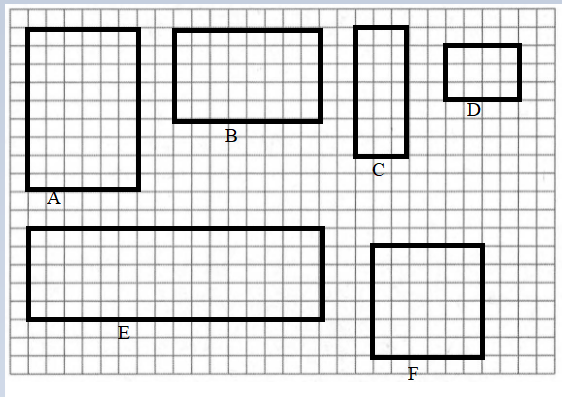
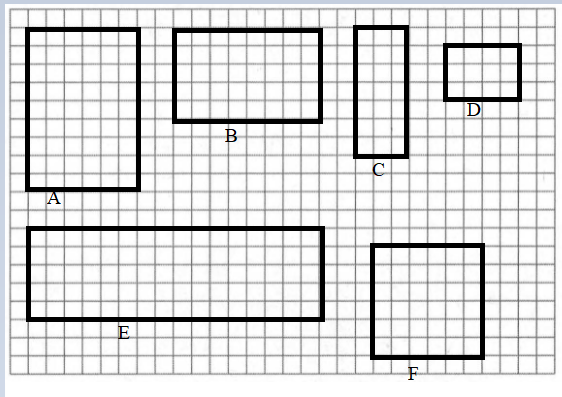
we need to draw six rectangles in this grided figure in the question

So, drawing six rectangles,

Geometry, Student Text, 2nd Edition, Chapter 3 Perimeter and Area 7 2

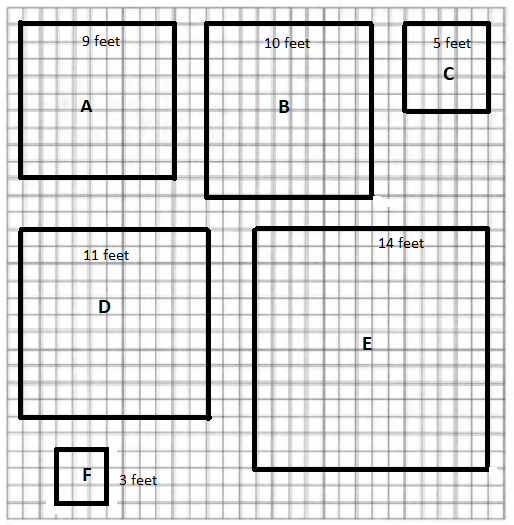
Hence, we have drawn six rectangles on the grid and named them A, B, C, D, E, and F respectively.

Geometry, Student Text, 2nd Edition, Chapter 3 Perimeter and Area 7 1

Carnegie Learning Geometry Chapter 3 Page 136 Problem 8 Answer

Here the question is: Can you determine the perimeter of a rectangle without drawing it if you know the rectangle’s length and width

Yes, I can determine the perimeter of a rectangle by given width and length without drawing the rectangle.

The perimeter of the rectangle is determined by:2(l+b)

where l= length of rectangle

b=width of rectangle

Yes, I can determine the perimeter of a rectangle by given width and length without drawing the rectangle.

The perimeter of the rectangle is determined by 2(l+b), where l and b are length and width of rectangle.

Carnegie Learning Geometry 2nd Edition Exercise 2.6 Solutions Page 136 Problem 9 Answer

The question is : Can you determine the area of a rectangle without drawing it if you know the rectangle’s length and width?

Yes, we can find the area of the rectangle without drawing it.

We can find the area of the rectangle by multiplying the given length and width of the rectangle.

Yes, we can find the area of the rectangle without drawing it.

We can find the area of the rectangle by multiplying the given length and width of the rectangle.

Carnegie Learning Geometry Chapter 3 Page 136 Problem 10 Answer

Given length of rectangle =e

Width of rectangle =w

Area=A

The formula for the area of the rectangle is written as

A=e×w

A=ew

​Formula for the area of the rectangle:A=ew

Page 136 Problem 11 Answer

We have to determine the area of the rectangle if its perimeter is given.

No, we can not find the area of the rectangle if its perimeter is known to us, because as we know for calculating the area we need the length and width of the rectangle,

If we have only perimeter available then we need either length or width to calculate the area of rectangle.

No, we can not find the area of the rectangle if its perimeter is known to us, because as we know for calculating the area we need the length and width of the rectangle,

If we have only perimeter available then we need either length or width to calculate the area of the rectangle.

Carnegie Learning Geometry Chapter 3 Page 136 Problem 12 Answer

We have to determine the perimeter of the rectangle if its area is given.

No, we can not find the perimeter of the rectangle if its area is known to us, because as we know for calculating the perimeter we need the length and width of the rectangle,

If we have only area available then we need either length or width to calculate the perimeter of rectangle.

No, we can not find the perimeter of the rectangle if its area is known to us, because as we know for calculating the perimeter we need the length and width of the rectangle,

If we have only area available then we need either length or width to calculate the perimeter of rectangle.

Parallel And Perpendicular Lines Solutions Chapter 2 Exercise 2.6 Carnegie Learning Geometry Page 137 Problem 13 Answer

Given the length of a rectangle is 11 meters and the width of the rectangle is 5 meters

We have to calculate the area and perimeter of this rectangle.

Use the formula of area and perimeter of the rectangle.

Double the given length and width then calculate the perimeter of the new rectangle using the formula.

Length =11 meters

width =5 meters

Area=11×5=55​

The area of the rectangle is 55 square meters

Perimeter of the rectangle is: P=2(11+5)

=2(16)

=32

Perimeter of the rectangle is 32 meters.

When we double the length and width

New length is 2×11=22 meters

New width is 2×5=10 meters

So the perimeter is P=2(22+10)

=2(32)​

=64

​Perimeter of new rectangle is 64 meters

The area of the rectangle is 55 square meters and Perimeter of the rectangle is 32 meters.Perimeter of new rectangle is 64 meters

Carnegie Learning Geometry Chapter 3 Page 137 Problem 14 Answer

Given that,  a rectangle that is 11 meters long and 5 meters wide.

We have to find the effect of doubling the length and width have on the perimeter.

Here, l=11m and w=5m

Then Perimeter of rectangle, P=2(l+w)

⇒  P=2(11+5)=32m

Now, If doubling the length and width of rectangle we get,

Perimeter of rectangle, P=2(2l+2w)

⇒      P=2(22+10)=64m

Therefore, The perimeter of original rectangle is 32m and the perimeter of rectangle after doubling the length and width is 64m.

After doubling the length and width of rectangle the perimeter becomes double.

Page 137 Problem 15 Answer

Given that, a rectangle that is 11 meters long and 5 meters wide.

We have to find the effect on area of rectangle after doubling the length and width of rectangle.

Here, l=11m and w=5m

Then the area of rectangle, A=l×w

=11×5

=55sq.m​

Now, If doubling the length and width of rectangle we get,

Area of rectangle, A=2l×2w

=22×10

=220sqm.

⇒Original area of rectangle is 55sqm and are after doubling the length and width of rectangle is 220sqm.

Therefore, If we double the length and width of rectangle the area becomes four times increases.

If we double the length and width of rectangle the area becomes four times increases.

Carnegie Learning Geometry Chapter 3 Page 137 Problem 16 Answer

given that, a rectangle that is 22 meters long and 10 meters wide.

We have to find the area of rectangle.

Here,l=22m and w=10m

Therefore, Area of rectangle is,

A=l×w

=22×10

=220sq.m

​Required area of given rectangle is, A=220sqm.

Step-By-Step Solutions For Carnegie Learning Geometry Chapter 2 Exercise 2.6 Page 137 Problem 17 Answer

We have to find What effect of doubling the length and width on the area of rectangle.

Given rectangle have length l

and width w

the its area is given by,

A=l×w     . . . .  . (1)

Now of we double the length and width of rectangle the we get, area of rectangle is,    A=2l×2w=4(l×w). . . .  .(2)

So from equation (1) and (2) we can say that,

If we double the length and width of rectangle the area becomes four times increases.

If we double the length and width of rectangle the area becomes four times increases.

Carnegie Learning Geometry Chapter 3 Page 139 Problem 18 Answer

Given that, One square rug is seven feet long and seven feet wide.

Geometry, Student Text, 2nd Edition, Chapter 3 Perimeter and Area 18

We have to draw a model of this rug on the grid shown having each square on the grid represents a square that is one foot long and one foot wide.

We can draw a 7 feet by 7 feet square rug as shown in figure below,

Geometry, Student Text, 2nd Edition, Chapter 3 Perimeter and Area 18 2

Required drawing of a model of this rug on the grid is

Geometry, Student Text, 2nd Edition, Chapter 3 Perimeter and Area 18 1

Carnegie Learning Geometry Chapter 3 Page 139 Problem 19 Answer

Given  rug is seven feet long and seven feet wide as shown in figure below,

Geometry, Student Text, 2nd Edition, Chapter 3 Perimeter and Area 19

We have to find the area of this rug.

Given rug have a side of length l=7feet

Therefore its area is given by,

Area of square shape rug is,A=l2

=72

=49sq.ft

​Required area of given rug is A=49sqft

Carnegie Learning Geometry Chapter 3 Page 140 Problem 20 Answer

Given that, Each square on the grid represents a square that is one foot long and one foot wide.

Geometry, Student Text, 2nd Edition, Chapter 3 Perimeter and Area 20

We have to draw the six different squares on the grid. Use the letters A through F to name each square.

The six different squares on the grid.

Using the letters A through F to name each square.

Geometry, Student Text, 2nd Edition, Chapter 3 Perimeter and Area 20 1

Required drawing is

Geometry, Student Text, 2nd Edition, Chapter 3 Perimeter and Area 20 2

Carnegie Learning Geometry Chapter 3 Page 141 Problem 21 Answer

Yes, we can determine the perimeter of a square without drawing the square if you know the length of one side of the square.

Because if we know the length of one side is l (say) then,

we have length of each side of square is same.

That means, perimeter of square is sum of length of all sides of square.

So, from that we get,

Perimeter of square=P=l+l+l+l=4l

We are able to find the perimeter of square without drawing the square if you know the length of one side of length l of the square by using formula,

Perimeter of square=P=4l.

Carnegie Learning Geometry Chapter 2 Exercise 2.6 Free Solutions Page 141 Problem 22 Answer

Perimeter is the total length of the boundary . To find perimeter we add all the side lengths  of the square .

We know that the side length of the square is s

There are 4 sides in a square. The perimeter of the square is s+s+s+s

P is the perimeter.

P=s+s+s+s=4s

P=4s

​Perimeter of square is P=4s

Carnegie Learning Geometry Chapter 3 Page 141 Problem 23 Answer

Let side be the side length of the square

We know that area of square is length times width

For a square side length is side

Area of the square =​ =side×side=side2

​Area of the square =side2

Page 141 Problem 24 Answer

Given : Let s be the side length of square and A is the area of the square

We know that area of the square is side times side that is equal to side2

Lets replace the formula with variables

Are of the square formula

A=side2

A=s2

Area of the square formula is A=s2

Carnegie Learning Geometry Chapter 3 Page 142 Problem 25 Answer

Given : the side length of the square is 5 centimeters.

Use the formula to find the area and perimeter of the square

Side length of the square s=5 cm

Area of the square =s2

=52

=25cm2

Perimeter of the square =4s

=4(5)

=20 cm​

Area of the square =25cm2

Perimeter of the square = 20 cm

Carnegie Learning Geometry Exercise 2.6 Student Solutions Page 142 Problem 26 Answer

Given : The area of the square is 169 square feet

Find out the side length and perimeter of the square

Area of the square =169

Area of the square formula =s2

s2=169

Take square root

s=√169

s=13

Side length 13 feet

Perimeter of square =4s

=4(13)

=52 feet​

Side length of the square =13 feet

Perimeter of square =52 feet

Carnegie Learning Geometry Chapter 3 Page 143 Problem 27 Answer

Side length of the square is 9 inches

Find the perimeter and area

Double the side length of the square and then calculate the perimeter

side length of the square = 9 inches

Area of the square =s2=92

=81 square inches​

Perimeter P=4s

=4(9)

=36 inches

​Side length of the square is 9 inches

Double the side length =2×9

=18 inches

​Perimeter of square =4s

=4(18)

=72 inches

​Area of the square = 81 square inches

Perimeter = 36 inches

Perimeter of square after side length is doubled = 72 inches

Page 143 Problem 28 Answer

we got   part (a)

Area of the square = 81 square inches

Perimeter = 36 inches

​Perimeter of square after side length is doubled = 72 inches

Now we analyze the perimeter when side length is 9 inches and when side length is doubled

Perimeter of square after side length is doubled is 2 times the perimeter of square with side length 9 inches

72 = 2 ⋅36

72=72

​When side length is double then the perimeter is also doubled

Carnegie Learning Geometry Chapter 3 Page 143 Problem 29 Answer

Area of the square with side length is equal to 9 inches

Double the side length of the square and check the effect on the area of the square .

Lets find area of square for side length =9 inches

Area of the square = s2

=92

=81 square inches

​Now we double the side length

2s=2(9)

=18 inches

​Area of the square after doubling side length =s2

=(18)2

=324

​Area of the square after doubling side length =x (area of square )

324=x(81)

x=324/81

x=4

Area of the square after doubling side length = 4 times area of the square

Doubling the side length of a square

Area of the square after doubling side length  is four times the area of original square

Page 143 Problem 30 Answer

side length equal to 10 meters we need to find the area of the square

Double the side length and find the area of new square .

Side length = 10 m

Area of the square =s2

=102

=100​

Double the side length of the square

2s=2(10)

=20

Now side length of new square is 20 m

Area of the new square =202

=400 square meters

​Area of the new square is 400 square meters

Carnegie Learning Geometry Chapter 3 Page 143 Problem 31 Answer

Area of the square with side length 10 meters  is 100 square meter

From part (a) we got the area of new square after doubling the side length is 400 square meters

Now compare the areas

400 = 4 ⋅100

Area of new square = 4⋅ Area of old square

Doubling the length of a side of the square gives  four times the area of the old square

Parallel And Perpendicular Lines Exercise 2.6 Carnegie Learning 2nd Edition Answers Page 144 Problem 32 Answer

We are given the perimeter of a square

Geometry, Student Text, 2nd Edition, Chapter 3 Perimeter and Area 32

Find the length of side of square then construct the square.

We have to write a paragraph to explain the construction of this square.

Constructing a Square With a Compass

Draw a reference line AB of 6cm (say) using a ruler.

Draw the 90 degree angle at A with the aid of the compass.

Draw the 90 degree angle at B with the aid of the compass.

Using an open compass 6 cm wide.

Draw an arc with A as the centre; that cuts arms at a 90 degree angle.

And mark the intersection point as C.Using the ruler find length measure of AC.

The AC length should be 6 cm.Using the compass again and take 6 cm width of the compass.

With D as the middle, draw an arc that cuts arms at an angle of 90 degrees.

And mark the junction point as D.Using the ruler and the BD length measurement.

The BD length should be 6 cm and we’ll get: Join CD.Use the CD ruler and calculate its length.

CD should be 6 cm in length and we get the corresponding square ABCD.

The square is shown in the following figure.

Geometry, Student Text, 2nd Edition, Chapter 3 Perimeter and Area 32 1

Carnegie Learning Geometry Chapter 3 Page 144 Problem 33 Answer

We are given the perimeter of a square

Geometry, Student Text, 2nd Edition, Chapter 3 Perimeter and Area 33

We have to write a paragraph to explain the construction of this square.

Also, construct the square.

Constructing a Square With a Compass

Draw a reference line AB of 6cm (say) using a ruler.

Draw the 90 degree angle at A with the aid of the compass.

Draw the 90 degree angle at B with the aid of the compass.

Using an open compass 6 cm wide.

Draw an arc with A as the centre; that cuts arms at a 90 degree angle.

And mark the intersection point as C.

Using the ruler find length measure of AC.

The AC length should be 6 cm.

Using the compass again and take 6 cm width of the compass.

With D as the middle, draw an arc that cuts arms at an angle of 90 degrees. And mark the junction point as D.

Using the ruler and the BD length measurement.

The BD length should be 6 cm and we’ll get: Join CD.

Use the CD ruler and calculate its length.

CD should be 6 cm in length and we get the corresponding square ABCD.

Hence, the constructed square as show in the figure.

Geometry, Student Text, 2nd Edition, Chapter 3 Perimeter and Area 33 1

Carnegie Learning Geometry Chapter 3 Page 145 Problem 34 Answer

We are given the perimeter of a rectangle

Geometry, Student Text, 2nd Edition, Chapter 3 Perimeter and Area 34

We have to write a paragraph to explain the construction of rectangle that is not a square .

To construct a rectangle, we need to create a quadrilateral that only has right angles.

All rectangles have opposites sides that are parallel to each other and equal in length.

If we are given two line segments, AB and CD, we can construct a rectangle with both AB and CD sides of length.

Suppose CD is the shorter of the two.

First, we create a line AE perpendicular to AB at A.

Then, cut off a segment of AE equal in length to CD.

We will call this point F.

Now, we can create two new perpendicular lines.

The first will meet AF at a right angle at F.

The second will meet AB at a right angle at B.

Call the intersection of these lines G.

Now, ABGF is a rectangle with side lengths AB and CD

Hence, the constructed rectangle as show in the figure.

Geometry, Student Text, 2nd Edition, Chapter 3 Perimeter and Area 34 1

Carnegie Learning Geometry Chapter 3 Page 145 Problem 35 Answer

We are given the perimeter of a rectangle

Geometry, Student Text, 2nd Edition, Chapter 3 Perimeter and Area 35

We have to construct the rectangle that is not a square.

Hence, the constructed rectangle as show in the figure.

Geometry, Student Text, 2nd Edition, Chapter 3 Perimeter and Area 35 1

Carnegie Learning Geometry Student Text 2nd Edition Chapter 2 Exercise 2.6 Parallel and Perpendicular Lines

Geometry Student Text 2nd Edition Chapter 2 Parallel and Perpendicular Lines

Carnegie Learning Geometry Student Text 2nd Edition Chapter 2 Exercise 2.5 Solution Page 113 Problem 1 Answer

To construct: An equilateral triangle using the side shown.

Given :

Geometry, Student Text, 2nd Edition, Chapter 2 Parallel and Perpendicular Lines 1

The triangle is

Geometry, Student Text, 2nd Edition, Chapter 2 Parallel and Perpendicular Lines 1 1

The equilateral triangle is

Geometry, Student Text, 2nd Edition, Chapter 2 Parallel and Perpendicular Lines 1 2

Page 113 Problem 2 Answer

To compare: The triangle that you constructed with the triangles that your classmates constructed.

What do you observe, why

Read and learn More Carnegie Learning Geometry Student Text 2nd Edition Solutions

Given :

Geometry, Student Text, 2nd Edition, Chapter 2 Parallel and Perpendicular Lines 2

All the triangles are same, since the triangle is equilateral triangle.

All the sides and angles are same.

All the triangles are same, since the triangle is equilateral triangle.

Carnegie Learning Geometry Student Chapter 2 Page 114 Problem 3 Answer

To construct: An isosceles triangle using one of the congruent sides shown. Indicate the congruent sides.

The isosceles triangle is

Geometry, Student Text, 2nd Edition, Chapter 2 Parallel and Perpendicular Lines 3

The isosceles triangle is

Geometry, Student Text, 2nd Edition, Chapter 2 Parallel and Perpendicular Lines 3 1

Carnegie Learning Geometry Student Chapter 2 Page 114 Problem 4 Answer

To compare: The triangle that you constructed with the triangles that your classmates constructed. What do you observe, why

Given :

Carnegie Learning Geometry Student Text 2nd Edition Chapter 2 Exercise 2.6 Parallel and Perpendicular Lines

Solutions for Parallel And Perpendicular Lines Exercise 2.5 In Carnegie Learning Geometry Page 114 Problem 5 Answer

To draw: Three different scalene triangles.

A scalene triangle is a triangle in which all 3 sides have different lengths.

The triangles are

Geometry, Student Text, 2nd Edition, Chapter 2 Parallel and Perpendicular Lines 5 1

The triangles are

Geometry, Student Text, 2nd Edition, Chapter 2 Parallel and Perpendicular Lines 5 1

Carnegie Learning Geometry Student Chapter 2 Page 114 Problem 6 Answer

To use: Protractor to measure each angle of the triangle you constructed in Question 1. What do you observe

Given :

Geometry, Student Text, 2nd Edition, Chapter 2 Parallel and Perpendicular Lines 6

The angles are measured

Geometry, Student Text, 2nd Edition, Chapter 2 Parallel and Perpendicular Lines 6 1

All the angles are 600

All the angles are 600

Page 114 Problem 7 Answer

To explain: How are equilateral and equiangular triangles related

Both of them are same

If all angles are equal then all sides are also equal Angle is 600

Hence equilateral and equiangular triangles are same

Equilateral and equiangular triangles are same

Carnegie Learning Geometry Student Chapter 2 Page 115 Problem 8 Answer

To draw : Three different acute triangles.

An acute

Geometry, Student Text, 2nd Edition, Chapter 2 Parallel and Perpendicular Lines 8

The acute triangles are

Geometry, Student Text, 2nd Edition, Chapter 2 Parallel and Perpendicular Lines 8 1

Carnegie Learning Geometry 2nd Edition Exercise 2.5 Solutions Page 115 Problem 9 Answer

To construct: Three different right triangles.

Given :

Geometry, Student Text, 2nd Edition, Chapter 2 Parallel and Perpendicular Lines 9

The triangles are

Geometry, Student Text, 2nd Edition, Chapter 2 Parallel and Perpendicular Lines 9 1

The right angled triangles are

Geometry, Student Text, 2nd Edition, Chapter 2 Parallel and Perpendicular Lines 9 2

Carnegie Learning Geometry Student Chapter 2 Page 115 Problem 10 Answer

To compare: The right triangles that you constructed with the right triangles your classmates constructed. What do you observe, Why

Given :

Geometry, Student Text, 2nd Edition, Chapter 2 Parallel and Perpendicular Lines 10

The triangles are different triangles.

Here only one side and one angle is only fixed.

The triangles drawn by different students are not same

Parallel and Perpendicular Lines solutions Chapter 2 Exercise 2.5 Carnegie Learning Geometry Page 115 Problem 11 Answer

To draw : Three different obtuse triangles.

An obtuse-angled triangle is a triangle in which one of the interior angles measures more than 900

The triangles are

Geometry, Student Text, 2nd Edition, Chapter 2 Parallel and Perpendicular Lines 11

The obtuse triangles are

Geometry, Student Text, 2nd Edition, Chapter 2 Parallel and Perpendicular Lines 11 1

Carnegie Learning Geometry Student Chapter 2 Page 116 Problem 12 Answer

To construct: A square using the side shown.

The square is

Geometry, Student Text, 2nd Edition, Chapter 2 Parallel and Perpendicular Lines 12

The square is

Geometry, Student Text, 2nd Edition, Chapter 2 Parallel and Perpendicular Lines 12 1

Page 116 Problem 13 Answer

To compare: The squares that you constructed with the squares that your classmates constructed. What do you observe, Why

Given :

Geometry, Student Text, 2nd Edition, Chapter 2 Parallel and Perpendicular Lines 13

All the squares drawn by students will be same.

Since all the sides and angles are same the figures are same.

All the squares drawn by students will be same.

Carnegie Learning Geometry Student Chapter 2 Page 116 Problem 14 Answer

To construct: A rectangle using the two non-congruent sides shown.

The rectangle is

Geometry, Student Text, 2nd Edition, Chapter 2 Parallel and Perpendicular Lines 14

The rectangle is

Geometry, Student Text, 2nd Edition, Chapter 2 Parallel and Perpendicular Lines 14 1

Page 117 Problem 15 Answer

To construct A rhombus using the side shown.

The rhombus is

Geometry, Student Text, 2nd Edition, Chapter 2 Parallel and Perpendicular Lines 15

The rhombus is

Geometry, Student Text, 2nd Edition, Chapter 2 Parallel and Perpendicular Lines 15 1

Step-By-Step Solutions For Carnegie Learning Geometry Chapter 2 Exercise 2.5 Page 117 Problem 16 Answer

To compare: The rhombus that you constructed with the rhombi that your classmates constructed. What do you observe, Why

Given :

Geometry, Student Text, 2nd Edition, Chapter 2 Parallel and Perpendicular Lines 16

Here all the rhombi will be not be same

The angle of rhombi will be different

The sides will be equal

All the rhombi drawn by students will not be same.

Page 117 Problem 17 Answer

To construct: A parallelogram using the two non-congruent sides shown.

Given :

Geometry, Student Text, 2nd Edition, Chapter 2 Parallel and Perpendicular Lines 17

The parallelogram is

Geometry, Student Text, 2nd Edition, Chapter 2 Parallel and Perpendicular Lines 17 1

The parallelogram is

Geometry, Student Text, 2nd Edition, Chapter 2 Parallel and Perpendicular Lines 17 2

Carnegie Learning Geometry Student Chapter 2 Page 117 Problem 18 Answer

To compare: The parallelograms that you constructed with the parallelograms that your classmates constructed. What do you observe, Why

Given :

Geometry, Student Text, 2nd Edition, Chapter 2 Parallel and Perpendicular Lines 18

The parallelograms drawn by students will be same.

Here two sides are fixed and they are parallel.

Hence all the parallelograms will be same.

All the parallelograms drawn by students will be same.

Carnegie Learning Geometry Exercise 2.5 Student Solutions Page 118 Problem 19 Answer

To compare: The kite that you constructed with the kites that your classmates constructed. What do you observe, Why

Given :

Geometry, Student Text, 2nd Edition, Chapter 2 Parallel and Perpendicular Lines 19

All the kites constructed by students will not be same.

All the sides will be matching

But angles won’t be matching

All the kites constructed by students will not be same.

Carnegie Learning Geometry Student Chapter 2 Page 118 Problem 20 Answer

To construct: A trapezoid using the starter line.

Given :

Geometry, Student Text, 2nd Edition, Chapter 2 Parallel and Perpendicular Lines 20

The trapezoid is

Geometry, Student Text, 2nd Edition, Chapter 2 Parallel and Perpendicular Lines 20 1

The trapezoid is

Geometry, Student Text, 2nd Edition, Chapter 2 Parallel and Perpendicular Lines 20 2

Page 118 Problem 21 Answer

To compare: The trapezoid that you constructed with the trapezoids that your classmates constructed. What do you observe, Why

Given :

Geometry, Student Text, 2nd Edition, Chapter 2 Parallel and Perpendicular Lines 21

All the trapezoids drawn by students will not be same.

Here only starter line is provided.

The angles and sides drawn by students will be different

All the trapezoids drawn by students will not be same.

Carnegie Learning Geometry Student Chapter 2 Page 119 Problem 22 Answer

To decide: Whether each statement about triangles or quadrilaterals is true or false.

Given: ” All equilateral triangles are equiangular triangles. ”

The statement is correct.

All the angle in equilateral triangle is 600

In equiangular triangle also all the angles are 600

All the sides are also same.

All equilateral triangles are equiangular triangles.

Hence the statement cannot be false,

The statement is true

Parallel And Perpendicular Lines Exercise 2.5 Carnegie Learning 2nd Edition Answers Page 119 Problem 23 Answer

To decide: Whether each statement about triangles or quadrilaterals is true or false.

Given: ” An isosceles triangle can be an obtuse, acute, or right triangle. ”

The statement is false

An isosceles triangle is always acute.

In isosceles triangle two angles are same

Hence two angles are less than 900

Thereby all the angles are less than 900

Counterexample is

Geometry, Student Text, 2nd Edition, Chapter 2 Parallel and Perpendicular Lines 23

Only acute triangle satisfy this

The statement is false

Carnegie Learning Geometry Student Chapter 2 Page 119 Problem 24 Answer

To decide: Whether each statement about triangles or quadrilaterals is true or false.

Given: ” A scalene triangle can be an obtuse, acute, or right triangle”

The statement is true

A scalene triangle means all the lengths are different

In this case the triangle can be an obtuse, acute, or right triangle

A scalene triangle can be an obtuse, acute, or right triangle.

The statement cannot be false

The statement is true, a scalene triangle can be an obtuse, acute, or right triangle.

Page 119 Problem 25 Answer

To decide : Whether each statement about triangles or quadrilaterals is true or false.

Given : ” A right triangle can be an obtuse triangle.”

The statement is false

If one angle is right angle the sum of other two angle is 900

Hence the triangle cannot be obtuse.

The counter example is

Geometry, Student Text, 2nd Edition, Chapter 2 Parallel and Perpendicular Lines 25

Here one angle is 900,all other angles are less than 900

The statement is false a right triangle can’t be an obtuse triangle.

Carnegie Learning Geometry Student Chapter 2 Page 119 Problem 26 Answer

To decide: Whether each statement about triangles or quadrilaterals is true or false.

Given: ” All squares are rectangles .”

The statement is correct.

All the squares are rectangles.

Square is a rectangle with equal length and breadth having all angles as right angles.

All squares are rectangles

Hence the statement cannot be false,

The statement is true all squares are rectangles.

Page 120 Problem 27 Answer

To decide : Whether each statement about triangles or quadrilaterals is true or false.

Given : ” All rectangles are squares.”

The statement is false

All rectangles are not squares.

in rectangle length and breadth may be different

In square all lengths are same

Counter example is

Geometry, Student Text, 2nd Edition, Chapter 2 Parallel and Perpendicular Lines 27

The given figure is a rectangle but not a square

The statement is false

Carnegie Learning Geometry Student Chapter 2 Page 120 Problem 28 Answer

To decide : Whether each statement about triangles or quadrilaterals is true or false.

Given : ” All squares are rhombi.”

The statement is correct

In a rhombus all sides are equal angles are not same

In square all sides and angles are same.

All squares are rhombi.

Hence the statement cannot be false,

The statement is true all squares are rhombi.

Page 120 Problem 29 Answer

To decide: Whether each statement about triangles or quadrilaterals is true or false.

Given: ” All rhombi are squares.”

The statement is false

In a rhombus all sides are equal angles are not same

In square all sides and angles are same.

Counter example is

Geometry, Student Text, 2nd Edition, Chapter 2 Parallel and Perpendicular Lines 29

The figure is rhombus not a square

The statement is false

Carnegie Learning Geometry Student Chapter 2 Page 120 Problem 30 Answer

To decide: Whether each statement about triangles or quadrilaterals is true or false.

Given: ” All squares are parallelograms.”

The statement is correct.

In a parallelograms opposite sides are parallel

In a square opposite sides are parallel

All squares are parallelograms.

Hence the statement cannot be false

The statement is true all squares are parallelograms

Page 120 Problem 31 Answer

To decide: Whether each statement about triangles or quadrilaterals is true or false.

Given: ” All rectangles are parallelograms. ”

The statement is correct.

In a parallelograms opposite sides are parallel

In a rectangle opposite sides are parallel

All rectangles are parallelograms.

Hence the statement cannot be false

The statement is true all rectangles are parallelograms.

Carnegie Learning Geometry Student Chapter 2 Page 120 Problem 32 Answer

To decide: Whether each statement about triangles or quadrilaterals is true or false.

Given: ” All rhombi are parallelograms.”

The statement is correct.

In a parallelograms opposite sides are parallel

In a rhombi opposite sides are parallel

All rhombi are parallelograms.

Hence the statement cannot be false

The statement is true

Page 120 Problem 33 Answer

To decide: Whether each statement about triangles or quadrilaterals is true or false.

Given : ” All trapezoids are parallelograms. ”

The statement is false

In a parallelograms opposite sides are parallel

In a trapezoid one side is parallel

Counter example is

Geometry, Student Text, 2nd Edition, Chapter 2 Parallel and Perpendicular Lines 33

The figure is trapezoid not parallelogram

The statement is false all trapezoids are not parallelograms

Carnegie Learning Geometry Student Chapter 2 Page 120 Problem 34 Answer

To find : What you use inductive or deductive reasoning to determine if each statement was true or false.

We used an existing theory in finding true or false

Hence the reasoning used is deductive reasoning

The reasoning used is deductive reasoning

Carnegie Learning Geometry Student Text 2nd Edition Chapter 2 Exercise 2.5 Parallel and Perpendicular Lines

Geometry Student Text 2nd Edition Chapter 2Parallel and Perpendicular Lines

Carnegie Learning Geometry Student Text 2nd Edition Chapter 2 Exercise 2.5 Solution Page 106 Problem 1 Answer

We are given a triangle ΔRAD

Geometry, Student Text, 2nd Edition, Chapter 2 Parallel and Perpendicular Lines 1

we have to explain how many line segments, angles, and vertices are needed to form a triangle.

A line does not have any endpoints.

A ray has only one fixed point.

A line segment is a part of a line that has a fixed length.

Perpendicular lines have a 90∘ angle between them.

Parallel lines do not meet.

Read and learn More Carnegie Learning Geometry Student Text 2nd Edition Solutions

We need three sides, three angles to draw the triangle, without which the triangle is not possible.

A triangle has three sides, three angles, and three vertices.

The sum of all internal angles of a triangle is always equal to180°.

This is called the angle sum property of a triangle.

The sum of the length of any two sides of a triangle is greater than the length of the third side.

Carnegie Learning Geometry Chapter 2 Page 106 Problem 2 Answer

We are given a triangle

Carnegie Learning Geometry Student Text 2nd Edition Chapter 2 Exercise 2.5 Parallel and Perpendicular Lines

We have to label the vertices of the triangles and then use symbols to name each triangle.

We have labeled all the three triangles.

Geometry, Student Text, 2nd Edition, Chapter 2 Parallel and Perpendicular Lines 2 1

ΔLMN is an scalene triangle in which all sides are unequal.

ΔACB is a obtuse triangle in which ∠ACB is an obtuse angle.

ΔPQR is a right triangle in which ∠PQR is right angle.

Hence, ΔLMN is a scalene triangle, ΔACB is obtuse triangle, ΔPQR is right triangle.

Page 106 Problem 3 Answer

We are given a triangle ΔRAD.

Geometry, Student Text, 2nd Edition, Chapter 2 Parallel and Perpendicular Lines 3

We have to shade the interior of ΔRAD.

We need three sides, three angles to draw the triangle, without which the triangle is not possible.

The shaded area lies inside the triangle.

Geometry, Student Text, 2nd Edition, Chapter 2 Parallel and Perpendicular Lines 3 1

Hence, the shaded area is shown in the following tringle.

Geometry, Student Text, 2nd Edition, Chapter 2 Parallel and Perpendicular Lines 3 2

Solutions for Parallel and Perpendicular Lines Exercise 2.5 In Carnegie Learning Geometry Page 106 Problem 4 Answer

A triangle has three line segments and three angles.

We have to name the three sides and the three angles of ΔRAD.

A triangle has three sides, three angles, and three vertices.

The sum of all internal angles of a triangle is always equal to180∘.

This is called the angle sum property of a triangle.

The sum of the length of any two sides of a triangle is greater than the length of the third side.

Three sides of ΔRAD: RA,AD, RD

Three angles ofΔRAD:∠RAD,∠ADR,∠ARD

Carnegie Learning Geometry Chapter 2 Page 106 Problem 5 Answer

We are given

Geometry, Student Text, 2nd Edition, Chapter 2 Parallel and Perpendicular Lines 5

We have to construct a triangle with the three sides shown.

Steps to draw triangle

  1. Draw a straight line.
  2. Span the segment with your compass.
  3. Trace a quarter-circle arc.
  4. Switch the compass around.
  5. Draw a second arc
  6. Mark the point where the two arcs cross
  7. Finish the triangle.

The required figure is,

Geometry, Student Text, 2nd Edition, Chapter 2 Parallel and Perpendicular Lines 5 1

Hence, the triangle figure is,

Geometry, Student Text, 2nd Edition, Chapter 2 Parallel and Perpendicular Lines 5 2

Page 106 Problem 6 Answer

We have to compare the triangle that you constructed with the triangles that your classmates constructed.

The triangle that we constructed,

Geometry, Student Text, 2nd Edition, Chapter 2 Parallel and Perpendicular Lines 6

The triangle that our classmate constructed.

We can see the shape of both triangles is the same but the position of the line is at different places.

Both triangles are congruent to each other.

Both are the same because the length of the sides is the same.

Hence, both triangles are the same because the length of the sides is the same.

Geometry, Student Text, 2nd Edition, Chapter 2 Parallel and Perpendicular Lines 6 1

Carnegie Learning Geometry Chapter 2 Page 107 Problem 7 Answer

To draw : Quadrilateral ABCD.

The drawing is done using MS paint

The quadrilateral is

Geometry, Student Text, 2nd Edition, Chapter 2 Parallel and Perpendicular Lines 7

The drawing is

Geometry, Student Text, 2nd Edition, Chapter 2 Parallel and Perpendicular Lines 7 1

ABCD is a quadrilateral.

Carnegie Learning Geometry 2nd Edition Exercise 2.5 Solutions Page 107 Problem 8 Answer

To explain : How many angles, sides, and vertices are needed to form a quadrilateral

A quadrilateral has 4 sides, 4 angles and 4 vertices.A quadrilateral can be regular or irregular.

The sum of all the interior angles of a quadrilateral is 360°.

Number of Angles=4

Sides=4

Vertices=4

Carnegie Learning Geometry Chapter 2 Page 107 Problem 9 Answer

To name: Two pairs of consecutive sides.

Given :

Geometry, Student Text, 2nd Edition, Chapter 2 Parallel and Perpendicular Lines 9

The pairs of consecutive sides are

AB,BC

CD,BC

The pairs of consecutive sides are

AB,BC

BC,CD

Parallel And Perpendicular Lines Solutions Chapter 2 Exercise 2.5 Carnegie Learning Geometry Page 107 Problem 10 Answer

To name : Two pairs of consecutive angles .

Given :

Geometry, Student Text, 2nd Edition, Chapter 2 Parallel and Perpendicular Lines 10

The pairs of  consecutive angles are

∠ABC,∠BCD

∠ADC,∠BCD

The pairs of  consecutive angles are

∠ABC,∠BCD

∠ADC,∠BCD

Carnegie Learning Geometry Chapter 2 Page 107 Problem 11 Answer

To name: Two pairs of opposite sides.

Given :

Geometry, Student Text, 2nd Edition, Chapter 2 Parallel and Perpendicular Lines 11

Two pairs of opposite sides are

AD,BC

AB,CD

Two pairs of opposite sides are

AD,BC

AB,CD

Page 107 Problem 12 Answer

To name: Two pairs of opposite angles .

Given :

Geometry, Student Text, 2nd Edition, Chapter 2 Parallel and Perpendicular Lines 12

Two pairs of opposite angles are

∠B,∠D

∠A,∠C

Two pairs of opposite angles are

∠B,∠D

∠A,∠C

Carnegie Learning Geometry Chapter 2 Page 108 Problem 13 Answer

To construct: A quadrilateral with the four sides shown. Label and name the quadrilateral.

Given :

Geometry, Student Text, 2nd Edition, Chapter 2 Parallel and Perpendicular Lines 13

The quadrilateral is

Geometry, Student Text, 2nd Edition, Chapter 2 Parallel and Perpendicular Lines 13 1

The quadrilateral is

Geometry, Student Text, 2nd Edition, Chapter 2 Parallel and Perpendicular Lines 13 2

Step-By-Step Solutions For Carnegie Learning Geometry Chapter 2 Exercise 2.5 Page 108 Problem 14 Answer

To compare: The quadrilateral that you constructed with the quadrilaterals that your classmates constructed.

What do you observe, why

Given :

Geometry, Student Text, 2nd Edition, Chapter 2 Parallel and Perpendicular Lines 14

Here only sides is given, angles are not given.

A student can draw this many ways with different angles

Hence the quadrilaterals drawn by student will not be same

The quadrilaterals drawn by student will not be same

Carnegie Learning Geometry Chapter 2 Page 108 Problem 15 Answer

To draw : And name the diagonals in each figure.

Given :

Geometry, Student Text, 2nd Edition, Chapter 2 Parallel and Perpendicular Lines 15

The drawing with diagonals is

Geometry, Student Text, 2nd Edition, Chapter 2 Parallel and Perpendicular Lines 15 1

In first figure diagonals are AC,BD

In second figure diagonals are EG,FH

The drawing with diagonals is

Geometry, Student Text, 2nd Edition, Chapter 2 Parallel and Perpendicular Lines 15 2

Page 109 Problem 16 Answer

To explain: What is the difference between the diagonals of the quadrilaterals

Given :

Geometry, Student Text, 2nd Edition, Chapter 2 Parallel and Perpendicular Lines 16

In first figure both diagonals are inside quadrilateral

In second figure one diagonal is inside and other is outside quadrilateral

In first figure both diagonals are inside quadrilateral, in second figure one diagonal is inside and other is outside quadrilateral

Carnegie Learning Geometry Chapter 2 Page 109 Problem 17 Answer

To classify : Each quadrilateral as convex or concave.

If the quadrilateral is concave, draw a line segment that connects two points in the interior such that the line segment is not completely in the interior of the figure.

Given :

Geometry, Student Text, 2nd Edition, Chapter 2 Parallel and Perpendicular Lines 17

Convex

Geometry, Student Text, 2nd Edition, Chapter 2 Parallel and Perpendicular Lines 17 1

b) Concave

Geometry, Student Text, 2nd Edition, Chapter 2 Parallel and Perpendicular Lines 17 2

c) Convex

Geometry, Student Text, 2nd Edition, Chapter 2 Parallel and Perpendicular Lines 17 3

d) Concave

Geometry, Student Text, 2nd Edition, Chapter 2 Parallel and Perpendicular Lines 17 4

Quadrilaterals are classified

Carnegie Learning Geometry Chapter 2 Exercise 2.5 Free Solutions Page 109 Problem 18 Answer

To sketch A convex pentagon, a concave pentagon, and a regular pentagon.

Geometry, Student Text, 2nd Edition, Chapter 2 Parallel and Perpendicular Lines 18

Convex pentagon

Geometry, Student Text, 2nd Edition, Chapter 2 Parallel and Perpendicular Lines 18 1

Concave pentagon

Geometry, Student Text, 2nd Edition, Chapter 2 Parallel and Perpendicular Lines 18 2

Regular pentagon

Geometry, Student Text, 2nd Edition, Chapter 2 Parallel and Perpendicular Lines 18 3

Convex pentagon

Geometry, Student Text, 2nd Edition, Chapter 2 Parallel and Perpendicular Lines 18 4

Concave pentagon

Geometry, Student Text, 2nd Edition, Chapter 2 Parallel and Perpendicular Lines 18 5

Regular pentagon

Geometry, Student Text, 2nd Edition, Chapter 2 Parallel and Perpendicular Lines 18

Carnegie Learning Geometry Chapter 2 Page 110 Problem 19 Answer

To construct A pentagon with the five sides shown.

Geometry, Student Text, 2nd Edition, Chapter 2 Parallel and Perpendicular Lines 19


Given

Geometry, Student Text, 2nd Edition, Chapter 2 Parallel and Perpendicular Lines 19 1

The pentagon is

Geometry, Student Text, 2nd Edition, Chapter 2 Parallel and Perpendicular Lines 19 2

Page 110 Problem 20 Answer

To compare : The pentagon that you constructed with those that your classmates constructed, What do you observe, why

Some pentagons are similar some are different.

Given :

Geometry, Student Text, 2nd Edition, Chapter 2 Parallel and Perpendicular Lines 20

With above sided students can many polygons

Student 1

Geometry, Student Text, 2nd Edition, Chapter 2 Parallel and Perpendicular Lines 20 1

Student 2

Geometry, Student Text, 2nd Edition, Chapter 2 Parallel and Perpendicular Lines 20 2

We can see both pentagons are not same.

This differs from student to student

The pentagons are not same for all the students.

The order and angle of joining the lines are different in different students. Hence the pentagons are different.

Carnegie Learning Geometry Chapter 2 Page 110 Problem 21 Answer

To name : Two pairs of consecutive sides and two pairs of consecutive angles in pentagon ABCDE.

The pentagons is

Geometry, Student Text, 2nd Edition, Chapter 2 Parallel and Perpendicular Lines 21

Consecutive sides

AE,AB

DE,EA

Consecutive angle

∠DEA,∠EAB

∠ABC∠EAB

Consecutive sides AE,AB and DE,EA

Consecutive angles∠DEA,∠EAB and ∠ABC,∠EAB

Page 111 Problem 22 Answer

To sketch A convex heptagon, a concave heptagon, and a regular heptagon.

Concave heptagon

Geometry, Student Text, 2nd Edition, Chapter 2 Parallel and Perpendicular Lines 22

Convex heptagon

Geometry, Student Text, 2nd Edition, Chapter 2 Parallel and Perpendicular Lines 22 1

Regular heptagon

Geometry, Student Text, 2nd Edition, Chapter 2 Parallel and Perpendicular Lines 22 2

Concave heptagon

Geometry, Student Text, 2nd Edition, Chapter 2 Parallel and Perpendicular Lines 22 3

Convex heptagon

Geometry, Student Text, 2nd Edition, Chapter 2 Parallel and Perpendicular Lines 22 4

Regular heptagon

Geometry, Student Text, 2nd Edition, Chapter 2 Parallel and Perpendicular Lines 22 5

Carnegie Learning Geometry Chapter 2 Page 111 Problem 23 Answer

To sketch A convex octagon, a concave octagon, and a regular octagon.

Convex octagon

Geometry, Student Text, 2nd Edition, Chapter 2 Parallel and Perpendicular Lines 23

Concave octagon

Geometry, Student Text, 2nd Edition, Chapter 2 Parallel and Perpendicular Lines 23 1

Regular octagon

Geometry, Student Text, 2nd Edition, Chapter 2 Parallel and Perpendicular Lines 23 2

Convex octagon

Geometry, Student Text, 2nd Edition, Chapter 2 Parallel and Perpendicular Lines 23 3

Concave octagon

Geometry, Student Text, 2nd Edition, Chapter 2 Parallel and Perpendicular Lines 23 4

Regular octagon

Geometry, Student Text, 2nd Edition, Chapter 2 Parallel and Perpendicular Lines 23 5

Parallel and Perpendicular Lines Exercise 2.5 Carnegie Learning 2nd Edition Answers Page 111 Problem 24 Answer

To sketch : A convex nonagon, a concave nonagon, and a regular nonagon.

Convex nonagon

Geometry, Student Text, 2nd Edition, Chapter 2 Parallel and Perpendicular Lines 24

Concave nonagon

Geometry, Student Text, 2nd Edition, Chapter 2 Parallel and Perpendicular Lines 24 1

Regular nonagon

Geometry, Student Text, 2nd Edition, Chapter 2 Parallel and Perpendicular Lines 24 2

Convex nonagon

Geometry, Student Text, 2nd Edition, Chapter 2 Parallel and Perpendicular Lines 24 3

Concave nonagon

Geometry, Student Text, 2nd Edition, Chapter 2 Parallel and Perpendicular Lines 24 4

Regular nonagon

Geometry, Student Text, 2nd Edition, Chapter 2 Parallel and Perpendicular Lines 24 5

Carnegie Learning Geometry Chapter 2 Page 112 Problem 25 Answer

To classify : Each polygon as regular or irregular, and then classify each polygon as convex or concave.

Explain your reasoning.

Given :

Geometry, Student Text, 2nd Edition, Chapter 2 Parallel and Perpendicular Lines 25

Here all sides are same but all angles are not same

Hence irregular polygon

Here all angles are not less than 1800

Hence concave polygon

Hence the given figure is concave irregular polygon

Page 112 Problem 26 Answer

To classify : Each polygon as regular or irregular, and then classify each polygon as convex or concave. Explain your reasoning.

Given :

Geometry, Student Text, 2nd Edition, Chapter 2 Parallel and Perpendicular Lines 26

Here all angles are same but all sides are not same

Hence irregular polygon

Here all angles are less than900

Hence convex polygon

Hence the given figure is Convex irregular polygon

Carnegie Learning Geometry Chapter 2 Page 112 Problem 27 Answer

To classify : Each polygon as regular or irregular, and then classify each polygon as convex or concave. Explain your reasoning.

Given :

Geometry, Student Text, 2nd Edition, Chapter 2 Parallel and Perpendicular Lines 27

Here all sides and all angles are same

Hence regular polygon

Here all angles are less than1800

Hence convex polygon

Convex regular polygon

Page 112 Problem 28 Answer

To classify: Each polygon as regular or irregular, and then classify each polygon as convex or concave. Explain your reasoning.

Given :

Geometry, Student Text, 2nd Edition, Chapter 2 Parallel and Perpendicular Lines 28

The figure is not a polygon, this figure cannot be formed using lines.

The figure is not a polygon, this figure cannot be formed using lines.

Carnegie Learning Geometry Student Text 2nd Edition Chapter 2 Exercise 2.4 Parallel and Perpendicular Lines

Geometry Student Text 2nd Edition Chapter 2 Parallel and Perpendicular Lines

Carnegie Learning Geometry Student Text 2nd Edition Chapter 2 Exercise 2.4 Solution Page 98 Problem 1 Answer

The statement given is that if two parallel lines are intersected by a transversal, then the alternate interior angles are congruent.

The hypothesis (p) of the statement is that’ If two parallel lines are intersected by a transversal’.

The hypothesis (p) of the statement is that’ If two parallel lines are intersected by a transversal’.

Page 98 Problem 2 Answer

The statement given is that if two parallel lines are intersected by a transversal, then the alternate interior angles are congruent.

The conclusion (q) of the statement is that’ then the alternate interior angles are congruent’.

The conclusion (q) of the given statement is : ‘then the alternate interior angles are congruent’.

Read and learn More Carnegie Learning Geometry Student Text 2nd Edition Solutions

Page 98 Problem 3 Answer

The statement given is that if two parallel lines are intersected by a transversal, then the alternate interior angles are congruent.

The Alternate Interior Angle Converse Conjecture of the statement is that ‘If two lines intersected by a transversal form alternate interior angles, then the lines are parallel.’

The Alternate Interior Angle Converse Conjecture of the given statement is that ‘If two lines intersected by a transversal form alternate interior angles, then the lines are parallel.’

Page 98 Problem 4 Answer

The statement given is that if two parallel lines are intersected by a transversal, then the alternate exterior angles are congruent.

The hypothesis (p) of the statement is that’ If two parallel lines are intersected by a transversal’.

Hence, the hypothesis (p) of the statement is that’ If two parallel lines are intersected by a transversal’.

Page 98 Problem 5 Answer

The statement given is that if two parallel lines are intersected by a transversal, then the alternate exterior angles are congruent.

The conclusion (q) of the statement is that ‘ the alternate exterior angles are congruent ‘.

Hence, the conclusion (q) of the statement is that ‘ the alternate exterior angles are congruent ‘.

Solutions For Parallel And Perpendicular Lines Exercise 2.4 In Carnegie Learning Geometry Page 98 Problem 6 Answer

The statement is given:

Carnegie Learning Geometry Student Text 2nd Edition Chapter 2 Exercise 2.4 Parallel and Perpendicular Lines

Page 98 Problem 7 Answer

The statement is given:

Same-Side Interior Angle Theorem: if two parallel lines are intersected by a transversal, then the same-side interior angles are supplementary.

The hypothesis (p) of the statement is that ‘ if two parallel lines are intersected by a transversal.’

Hence, the hypothesis (p) of the statement is that ‘ if two parallel lines are intersected by a transversal.’

Page 98 Problem 8 Answer

The statement given :

Same-Side Interior Angle Theorem: if two parallel lines are intersected by a transversal, then the same-side interior angles are supplementary.

The conclusion (q) of the statement is that ‘ the same-side interior angles are supplementary.’

Hence, the conclusion (q) of the statement is that ‘ the same-side interior angles are supplementary.’

Page 98 Problem 9 Answer

For a statement: if p then q  the converse of the statement is if q then p

p is the hypothesis and q is the conclusion

Now we analyze the given statement

Same-Side Interior Angle Theorem: If two parallel lines are intersected by a transversal, then the same-side interior angles are supplementary.

The hypothesis  p is ‘two parallel lines are intersected by a transversal ‘

Conclusion (q) is ‘same side interior angles are supplementary ‘

The converse is If a transversal intersects two lines such that same side interior angles are supplementary  then  the two lines are parallel

The hypothesis p is ‘two parallel lines are intersected by a transversal ‘

Conclusion (q) is ‘same side interior angles are supplementary ‘

Same-Side Interior Angle Converse Conjecture:  If a transversal intersects two lines such that same-side interior angles are supplementary  then  the two lines are parallel

Carnegie Learning Geometry 2nd Edition Exercise 2.4 Solutions Page 98 Problem 10 Answer

Given: Same-Side Exterior Angle Theorem: If two parallel lines are intersected by a  transversal, then the same-side exterior angles are supplementary.

For a statement : if p then q  the converse of the statement is if  q then p

p is the hypothesis and q is the conclusion

Now we analyze the given statement

If two parallel lines are intersected by a  transversal, then the same-side exterior angles are supplementary.

The hypothesis p is ‘two parallel lines are intersected by a transversal ‘

Hypothesis p:   ‘two parallel lines are intersected by a transversal ‘

Page 98 Problem 11 Answer

For a statement: if p then q  the converse of the statement is if  q then p

p is the hypothesis and q is the conclusion

Now we analyze the given statement

Same-Side Interior Angle Theorem: If two parallel lines are intersected by a transversal, then the same-side exterior angles are supplementary.

Conclusion (q) is ‘same side exterior angles are supplementary ‘

Conclusion q:  ‘same side exterior angles are supplementary ‘

Page 98 Problem 12 Answer

Given: Same-Side Exterior Angle Theorem: If two parallel lines are intersected by a  transversal, then the same-side exterior angles are supplementary.

For a statement: if p then q  the converse of the statement is if  q then p

p is the hypothesis and q is the conclusion

Now we analyze the given statement

If two parallel lines are intersected by a  transversal, then the same-side exterior angles are supplementary.

The hypothesis p is ‘two parallel lines are intersected by a transversal ‘

Conclusion (q) is ‘the same-side exterior angles are supplementary ‘

The converse is:  If a transversal intersects two lines such that same side exterior angles are supplementary  then  the two lines are parallel

Same-Side Exterior Angle Converse Conjecture:

If a transversal intersects two lines such that same side exterior angles are supplementary  then  the two lines are parallel

Parallel And Perpendicular Lines Solutions Chapter 2 Exercise 2.4 Carnegie Learning Geometry Page 99 Problem 13 Answer

Given:  line r and transversal s the Corresponding Angle Converse Postulate  says If two lines intersected by a transversal

We need two lines that is intersected by a transversal. Here we have only line ‘r’ that is intersected by transversal ‘s’

(1)Construct another line t

(2) The line  t forms congruent corresponding angles

(3) We can say that the lines r and t are parallel

Steps are :

(1)Construct a another line  t

(2) The line  t forms congruent corresponding angles

(3) We can say that the lines  r and t are parallel

Page 99 Problem 14 Answer

Given:  line r and transversal s from first part of the question

the Corresponding Angle Converse Postulate  says If two lines intersected by a transversal

We need two lines that is intersected by a transversal. Here we have only line r that is intersected by transversal s

Construct a another line t . The line t forms congruent corresponding angles. We can say that the lines r and t are parallel

From the we can say that , line s is the transversal  line s is the transversal line

Page 99 Problem 15 Answer

Given :  line r and transversal s from first part of the question

the Corresponding Angle Converse Postulate  says If two lines intersected by a transversal

We need two lines that is intersected by a transversal.

Here we have only line r that is intersected by transversal s

Construct a another line t . The line t forms congruent corresponding angles . We can say that the lines r and t are parallel

From the we can say that , line  s is the transversal

Parallel lines are line r and t

Parallel lines are line r and t

Step-By-Step Solutions For Carnegie Learning Geometry Chapter 2 Exercise 2.4 Page 101 Problem 16 Answer

The Alternate exterior Angle Converse Conjecture states: “If two lines intersected by a transversal form congruent alternate exterior angles, then the lines are parallel.”

To prove this, we need to consider that two lines w  and x form congruent alternate exterior angles

Given: ∠2≅∠7 ( alternate exterior angles 2  and 7  are congruent )

Prove: w∥x   ( line w is parallel to line x)

Given:  ∠2≅∠7 alternate exterior angles are congruent

Prove: w∥x  lines w  and x  are parallel.

Page 101 Problem 17 Answer

If two lines intersected by a transversal form congruent alternate exterior angles, then the lines are parallel.

Given that congruent alternate exterior angles​∠1=∠8

∠2=∠7

We have to show that the Alternate Exterior Angle Converse Conjecture.

We have

Geometry, Student Text, 2nd Edition, Chapter 2 Parallel and Perpendicular Lines 17

Also, alternate exterior angles are congruent. So, ∠1=∠8

∠2=∠7

​But angles∠5 and ∠8 are vertically opposite angles, that is∠5=∠8 and also∠1=∠4 Vertically opposite angles are equal.

We get∠4=∠5 these are alternate interior angles.

When alternate angles are equal, then the lines are parallel.

Geometry, Student Text, 2nd Edition, Chapter 2 Parallel and Perpendicular Lines 17 1

Hence, the statement  “If two lines intersected by a transversal form congruent alternate exterior angles, then the lines are parallel.” is proved.

Carnegie Learning Geometry Chapter 2 Exercise 2.4 Free Solutions Page 102 Problem 18 Answer

Given that If two lines intersect by a transversal form supplementary same-side interior angles, then the lines are parallel.

Supplementary same-side interior angles that is∠4+∠6=180∘ and ∠3+∠5=180∘

We have to prove that statements for the Same Side Interior Angle Converse Conjecture.

We have

Geometry, Student Text, 2nd Edition, Chapter 2 Parallel and Perpendicular Lines 18

Also, given that∠4+∠6=180∘ −−−−−−−−(1) and ∠3+∠5=180∘

If a ray stands on a line, then the angles so formed is linear pair are parallel, then∠2+∠4=180∘−−−−−−−−(2)

Geometry, Student Text, 2nd Edition, Chapter 2 Parallel and Perpendicular Lines 18 1

From(1) and (2)

We get,​∠4+∠6=∠2+∠4

∠6=∠2​

Thus, the lines are intersected by a transversal such that a pair of corresponding angles are equal. Then, the lines are parallel.

Thus, the lines are intersected by a transversal such that a pair of corresponding angles are equal. Then, the lines are parallel.

Hence, the statement “If two lines intersected by a transversal form supplementary same-side interior angles, then the lines are parallel.” is proved.

Page 102 Problem 19 Answer

Given that If two lines intersected by a transversal form supplementary same-side interior angles, then the lines are parallel.

Also∠4+∠6=180∘ and ∠3+∠5=180∘

We have to prove the Same-Side Interior Angle Converse Conjecture.

We have

Geometry, Student Text, 2nd Edition, Chapter 2 Parallel and Perpendicular Lines 19

Also, given that∠4+∠6=180∘ −−−−−−−−(1) and ∠3+∠5=180∘

If a ray stands on a line, then the angles so formed is linear pair ∠2+∠4=180∘−−−−−(2)

Geometry, Student Text, 2nd Edition, Chapter 2 Parallel and Perpendicular Lines 19 1

From(1) and (2), we get​∠4+∠6=∠2+∠4

∠6=∠2​

Thus, the lines are intersected by a transversal such that a pair of corresponding angles are equal.

Then, the lines are parallel.

Thus, the lines are intersected by a transversal such that a pair of corresponding angles are equal.

Then, the lines are parallel.

Hence, the statement “If two lines intersected by a transversal form supplementary same-side interior angles, then the lines are parallel.” is proved.

Carnegie Learning Geometry Exercise 2.4 Student Solutions Page 103 Problem 20 Answer

Given that If two lines intersected by a transversal form supplementary same-side exterior angles, then the lines are parallel.

Also∠1+∠7=180∘ and ∠2+∠8=180∘

We have to prove statements for the Same-Side Exterior Angle Converse Conjecture.

We have∠1+∠7=180∘−−−−−(1) and ∠2+∠8=180∘−−−−−(2)

Geometry, Student Text, 2nd Edition, Chapter 2 Parallel and Perpendicular Lines 20

The angles​∠6, ∠7 and ∠2,∠3 are vertically opposite angles. So they, are equal

∠6=∠7 and ∠2=∠3​

We have​∠4+∠6=180∘ −−−−−−−−(3) and ∠3+∠5=180∘

Geometry, Student Text, 2nd Edition, Chapter 2 Parallel and Perpendicular Lines 20 1

If a ray stands on a line, then the angles so formed is linear pair ∠2+∠4=180∘−−−−−(3)

From (3) and (4), we get

∠4+∠6=∠2+∠4

∠6=∠2​

Thus, the lines are intersected by a transversal such that a pair of corresponding angles are equal.

Then, the lines are parallel.

Thus, the lines are intersected by a transversal such that a pair of corresponding angles are equal.

Then, the lines are parallel.

Hence, the statement “If two lines intersected by a transversal form supplementary same-side exterior angles, then the lines are parallel.” is proved.

Parallel and Perpendicular Lines Exercise 2.4 Carnegie Learning 2nd Edition Answers Page 103 Problem 21 Answer

We are given If two lines intersected by a transversal form supplementary same-side exterior angles, then the lines are parallel.

Given that∠1+∠7=180∘ and ∠2+∠8=180∘

We have to prove the Same-Side Exterior Angle Converse Conjecture.

Geometry, Student Text, 2nd Edition, Chapter 2 Parallel and Perpendicular Lines 21 1

We have​∠4+∠6=180∘ −−−−−−−−(1) and ∠3+∠5=180∘

Geometry, Student Text, 2nd Edition, Chapter 2 Parallel and Perpendicular Lines 21

If a ray stands on a line, then the angles so formed is linear pair ∠2+∠4=180∘−−−−−(2)

From (1) and (2), we get

∠4+∠6=∠2+∠4

∠6=∠2

Thus, the lines are intersected by a transversal such that a pair of corresponding angles are equal.

Then, the lines are parallel.

Thus, the lines are intersected by a transversal such that a pair of corresponding angles are equal.

Then, the lines are parallel.

Hence, the statement “If two lines intersected by a transversal form supplementary same-side exterior angles, then the lines are parallel.” is proved.

Carnegie Learning Geometry Student Text 2nd Edition Chapter 2 Exercise 2.3 Parallel and Perpendicular Lines

Geometry Student Text 2nd Edition Chapter 2 Parallel and Perpendicular Lines

Carnegie Learning Geometry Student Text 2nd Edition Chapter 2 Exercise 2.3 Solution Page 91 Problem 1 Answer

Given: The statement is∠3≅∠6.

The Corresponding Angles Theorem states that the corresponding angles are congruent if the set of parallel lines are cut by a transversal line.

The angles that have the same measure are said to be the congruent angles.

A linear pair can be defined as the two adjacent angles formed by two intersecting lines that add up to 180°.

Prove the given statement for the Alternate Interior Angle Conjecture.

From the figure, observe that w and x are two parallel line which is intersected by a transversal line z.

Sincew∣∣x, conclude that the angle1 and 5 are congruent angles.

So, by congruent angle theorem,∠1≅∠5.

By the definition of congruent theorem, the measures of both angles are equal.

So,m∠1=m∠5…(a)

Read and learn More Carnegie Learning Geometry Student Text 2nd Edition Solutions

The angle 1 and 3 form a linear pair, the angles1 and 3 are supplementary.

Thus,m∠1+m∠3=180∘…(b)

The angles 5 and 6 are supplementary since the angle 5 and the angle 6 form a linear pair.

So,m∠5+m∠6=180∘…(c)

Substituting∠1 form∠5 into the equation(c).

m∠1+m∠6=180∘…(d)

Substitute the value of180∘=m∠1+m∠6 into (b).

m∠1+m∠3=m∠1+m∠6

Cancel∠1 on both sides.

m∠3=m∠6

Hence,∠3≅∠6 proved.

Statement∠3≅∠6 is proved for the Alternate Interior Angle Conjecture.

Page 92 Problem 2 Answer

Given:

Geometry, Student Text, 2nd Edition, Chapter 2 Parallel and Perpendicular Lines 2

To  Complete the flow chart proof of the Alternate Interior Angle Conjecture by writing the reason for each statement in the boxes provided.

Given

Geometry, Student Text, 2nd Edition, Chapter 2 Parallel and Perpendicular Lines 2 1

As per the definition of the Alternate interior angle

∠1=∠4

∠2=∠3

∠5=∠8

∠6=∠7

Also as per the transitive property

∠1=∠5

∠2=∠6

∠3=∠7

∠4=∠8

Because vertical angles are congruent

Hence,  the flow chart proof of the Alternate Interior Angle Conjecture have been completed.

Solutions for Parallel and Perpendicular Lines Exercise 2.3 In Carnegie Learning Geometry Page 92 Problem 3 Answer

Carnegie Learning Geometry Student Text 2nd Edition Chapter 2 Exercise 2.3 Parallel and Perpendicular Lines

Page 93 Problem 4 Answer

The objective of the problem is to draw labelled diagram for alternate exterior angle thoerem.

According to the alternate exterior angle theorem, If two parallel lines are intersected by a transversal, then alternate exterior angles are congruent.

The required labeled diagram for the given theorem is as shown below:

Geometry, Student Text, 2nd Edition, Chapter 2 Parallel and Perpendicular Lines 4

Here, two parallel lines L and M intersected by a transversal line P then,

​∠1≅∠8

∠2≅∠7

​Hence, the required diagram with a label for the alternate exterior angle conjecture is shown below:

Geometry, Student Text, 2nd Edition, Chapter 2 Parallel and Perpendicular Lines 4 1

Page 93 Problem 5 Answer

The objective of the problem is to write the given and prove statements for the alternate exterior angle conjecture.

Given:

Geometry, Student Text, 2nd Edition, Chapter 2 Parallel and Perpendicular Lines 5

According to the alternate exterior angle theorem, If two parallel lines are intersected by a transversal, then alternate exterior angles are congruent.

As it is seen in the given diagram, two parallel lines are given and one transversal line is given.

Therefore,

Given: L∣∣M

Prove: ∠1≅∠8

Hence, the two required statements forgiven and prove is,

Given: L∣∣M

Prove: ∠1≅∠8

Carnegie Learning Geometry 2nd Edition Exercise 2.3 Solutions Page 93 Problem 6 Answer

The objective of the problem is to prove the alternate exterior angle theorem.

According to the alternate exterior angle thoerem, If two parallel lines are intersected by a transversal, then alternate exterior angles are congruent.

The required diagram for the solution:

Geometry, Student Text, 2nd Edition, Chapter 2 Parallel and Perpendicular Lines 6

As two lines L∣∣M, by corresponding angles postulate,

∠1≅∠5

Also by the vertical angles theorem,

∠5≅∠8

Then, by the transitive property of congruence,

∠1≅∠8

Hence, alternate exterior angle theorem, i.e., ∠1≅∠8 is proved.

Page 94 Problem 7 Answer

The objective of the problem is to draw a labeled diagram that illustrates the same side interior angle conjecture.

According to the same side interior angle conjecture, if two parallel lines are intersected by a transversal, then interior angles on the same side of the transversal are supplementary.

The required labeled diagram for the given theorem is as shown below:

Geometry, Student Text, 2nd Edition, Chapter 2 Parallel and Perpendicular Lines 7

Here, two parallel lines are L and M intersected by the transversal line P then,

∠4+∠6=180∘

∠3+∠5=180∘

​Hence, the required diagram with a label for the same side interior angle conjecture is shown below:

Geometry, Student Text, 2nd Edition, Chapter 2 Parallel and Perpendicular Lines 7 1

Parallel And Perpendicular Lines Solutions Chapter 2 Exercise 2.3 Carnegie Learning Geometry Page 94 Problem 8 Answer

The objective of the problem is to prove the same side interior angle conjecture.

When two parallel lines are cut by a transversal line, then a total of 8 angles are formed.

Geometry, Student Text, 2nd Edition, Chapter 2 Parallel and Perpendicular Lines 8

Given: Two parallel lines L and M are cut by the third line called transversal line P.

Prove: ∠3+∠5=180∘

Proof: Consider the below figure where two parallel lines L and M are cut by the transversal line P:

Here, ∠3 and ∠1 form a linear pair and same way ∠2 and ∠4 are also linear pairs.

According to the supplement postulate, the above two pairs are also supplementary,

​∠1+∠3=180∘

∠2+∠4=180∘

By applying corresponding angles,

​∠1≅∠5

∠2≅∠6

Therefore,

​∠5+∠3=180∘

∠6+∠4=180∘

Hence, it is proved that if two parallel lines are intersected by a transversal, then interior angles on the same side of the transversal are supplementary.

Step-By-Step Solutions For Carnegie Learning Geometry Chapter 2 Exercise 2.3 Page 94 Problem 9 Answer

Given: The Same-Side Interior Angle Conjecture states: “If two parallel lines are intersected by a transversal, then interior angles on the same side of the transversal are supplementary.” To Prove the Same-Side Interior Angle Conjecture.

Geometry, Student Text, 2nd Edition, Chapter 2 Parallel and Perpendicular Lines 9

Two column table proof

Geometry, Student Text, 2nd Edition, Chapter 2 Parallel and Perpendicular Lines 9 1

Hence,  the Same-Side Interior Angle Conjecture have been proved

Page 95 Problem 10 Answer

The objective of the problem is to draw and label a diagram that illustrates alternate exterior angle conjecture.

According to the alternate Exterior angle conjecture, if two parallel lines are intersected by a transversal, then the alternate exterior angles on the same side of the transversal are supllymentary.

The required labeled diagram for the given theorem is as shown below:

Geometry, Student Text, 2nd Edition, Chapter 2 Parallel and Perpendicular Lines 10

Here, two parallel lines are L and M intersected by the trasversal line P

The two pairs of alternate exterior angles are:

∠1 + ∠7=180∘

∠2 + ∠8=180∘

Hence, the required labeled diagram for alternate exterior angle conjecture is as shown below:

Geometry, Student Text, 2nd Edition, Chapter 2 Parallel and Perpendicular Lines 10 1

Carnegie Learning Geometry Chapter 2 Exercise 2.3 Free Solutions Page 95 Problem 11 Answer

The objective of the problem is to prove the same side exterior angle conjecture.

When two parallel lines are cut by a transversal line, then total of 8 angles are formed.

Given: two parallel lines L and M are cut by the third line called transversal line P.

Prove: ∠1 +∠7=180∘

Proof: Here, two parallel lines L and M are cut by the transversal line P which is shown below figure:

Geometry, Student Text, 2nd Edition, Chapter 2 Parallel and Perpendicular Lines 11

As two lines L and M are parallel, corresponding angles are congruent, i.e., ∠1 ≅∠5

Also, ∠5 and ∠7 form a straight line, i.e., ∠5 +∠7=180∘

By substitution, ∠1 +∠7=180∘

Hence, it is proved that if two parallel lines are intersected by a transversal, then exterior angles on the same side of transversal are supplymentary.

Page 95 Problem 12 Answer

Given: The diagram shows us a pair of parallel lines intersected by a transversal.

There are two pairs of exterior angles on the same side of the transversal, one pair being ∠2 and ∠8 and another pair being ∠1 and ∠7.

We need to prove that these exterior angles on the same side of the transversal are supplementary, that is m∠2+m∠8=180˚ and m∠1 + m∠7=180˚.

Geometry, Student Text, 2nd Edition, Chapter 2 Parallel and Perpendicular Lines 12

Proof: From the diagram, we see that m∠2+m∠4=180˚ (supplementary angles)

Again, m∠4=m∠8 (corresponding angles)

So, putting the value in the first equation, we have

m∠2+m∠4=180˚

⇒m∠2+m∠8=180˚

Hence, ∠2 and ∠8 are supplementary.

Similarly,​m∠1+m∠3=180˚

⇒m∠1+m∠7=180˚ (m∠3=m∠7 since they are corresponding angles)

​Hence, m∠1 and m∠7 are supplementary angles.

Therefore, exterior angles on the same side of the transversal are supplementary.

Hence proved, that if two parallel lines are intersected by a transversal, then exterior angles on the same side of the transversal are supplementary.

Carnegie Learning Geometry Exercise 2.3 Student Solutions Page 96 Problem 13 Answer

corresponding angles are congruent: The Corresponding Angle Postulate states that if two parallel lines are intersected by a transversal, then corresponding angles are congruent.

We used deductive reasoning to prove the postulate.

alternate interior angles are congruent: The Alternate Interior Angle Theorem states that if two parallel lines are intersected by a transversal, then alternate interior angles are congruent.

We used deductive reasoning to prove the postulate.

alternate exterior angles are congruent: The Alternate Exterior Angle Theorem states that if two parallel lines are intersected by a transversal, then alternate exterior angles are congruent.

We used deductive reasoning to prove the postulate.

same-side interior angles are supplementary: Same-Side Interior Angle Theorem states that if two parallel lines are intersected by a transversal, then interior angles on the same side of the transversal are supplementary.

We used deductive reasoning to prove the postulate.

same-side exterior angles are supplementary: If two parallel lines are intersected by a transversal, then exterior angles on the same side of the transversal are supplementary.

We used deductive reasoning to prove the postulate.

corresponding angles are congruent: We used deductive reasoning to prove the postulate.

alternate interior angles are congruent: We used deductive reasoning to prove the postulate.

alternate exterior angles are congruent: We used deductive reasoning to prove the postulate.

same-side interior angles are supplementary: We used deductive reasoning to prove the postulate.

same-side exterior angles are supplementary: We used deductive reasoning to prove the postulate.

Carnegie Learning Geometry Student Text 2nd Edition Chapter 2 Exercise 2.2 Parallel and Perpendicular Lines

Geometry Student Text 2nd Edition Chapter 2 Parallel and Perpendicular Lines

Carnegie Learning Geometry Student Text 2nd Edition Chapter 2 Exercise 2.2 Solution Page 87 Problem 1 Answer

Given:

Geometry, Student Text, 2nd Edition, Chapter 2 Parallel and Perpendicular Lines 1

To identify: The corresponding angles.

The pair of corresponding angles are

∠1=∠3

∠2=∠4

∠5=∠7

∠6=∠8

The pair of corresponding angles are

∠1=∠3

∠2=∠4

∠5=∠7

∠6=∠8

Read and learn More Carnegie Learning Geometry Student Text 2nd Edition Solutions

Page 88 Problem 2 Answer

Carnegie Learning Geometry Student Text 2nd Edition Chapter 2 Exercise 2.2 Parallel and Perpendicular Lines

Page 88 Problem 3 Answer

Given:

Geometry, Student Text, 2nd Edition, Chapter 2 Parallel and Perpendicular Lines 3

To write: The conjecture about the alternate exterior angles.

The pair of alternate exterior angles are congruent.

∠8=∠6

As they are corresponding angles.

∠1=∠6

As they are vertically opposite angles.

It can be said that:∠1=∠8

The pair of alternate exterior angles are congruent.

Solutions For Parallel And Perpendicular Lines Exercise 2.2 In Carnegie Learning Geometry Page 88 Problem 4 Answer

Given:

Geometry, Student Text, 2nd Edition, Chapter 2 Parallel and Perpendicular Lines 4

To write: A conjecture for same side angles and prove it.

The same side interior angles are supplementary.

The proof is ∠1+∠2=180∘

∠3+∠4=180∘

They are linear pair angles.

As the corresponding angles are equal:

∠1=∠3

∠2=∠4

Substituting the values we can say that:

∠3+∠2=180∘

∠2+∠3=180∘

Adding the equations: 2(∠2+∠3)=360∘

∠2+∠3=180∘

The same side interior angles are supplementary.

Page 88 Problem 5 Answer

Given:

Geometry, Student Text, 2nd Edition, Chapter 2 Parallel and Perpendicular Lines 5

To write: A conjecture about the dame side exterior angles.

The same side exterior angles are supplementary.

Proof: ∠1+∠2=180∘

∠3+∠4=180∘

They are linear pair angles.

Adding the equations: ∠1+∠2+∠3+∠4=360∘

∠2+∠3=180∘

As they are the same side interior angles.

∠1+∠4=180∘

The same side exterior angles are supplementary.

Carnegie Learning Geometry 2nd Edition Exercise 2.2 Solutions Page 88 Problem 6 Answer

To find: Whether the conjectures are inductive or deductive.

The conjectures are inductive as we have the data and we wrote the conjectures.

The conjectures are inductive as we have the data and we wrote the conjectures.

Page 89 Problem 7 Answer

Given: Two parallel lines and transversal, m∠1=38∘

Geometry, Student Text, 2nd Edition, Chapter 2 Parallel and Perpendicular Lines 7

To find: All unknown angles.

m∠1=m∠6=38∘

As they are vertically opposite angles.

38∘+∠2=180∘

∠2=142∘

∠2=∠5=142∘

As they are vertically opposite angles.

∠7=∠5=142∘

As they are corresponding angles

∠7=∠4=142∘

As they are vertically opposite angles.

m∠1=m∠3=38∘

As they are corresponding angles

m∠8=m∠3=38∘

As they are vertically opposite angles.

∠1 = 38∘

∠2 = 142∘

∠3 = 38∘

∠4 = 142∘

∠5 = 142∘

∠6 = 38∘

∠7 = 142∘

∠8 = 38∘

Parallel And Perpendicular Lines Solutions Chapter 2 Exercise 2.2 Carnegie Learning Geometry Page 89 Problem 8 Answer

Given: ∠1=67∘

To find: The unknown angles.

∠1=∠6=67∘

As they are vertically opposite angles.

Geometry, Student Text, 2nd Edition, Chapter 2 Parallel and Perpendicular Lines 8

As the corresponding angles are equal: ∠1=∠3=67∘

∠6=∠8=67∘

Linear pair angles: ∠1+∠2=180∘

∠2=113∘

Vertically opposite angles: ∠2=∠5=113∘

As the corresponding angles are equal: ∠2=∠4=113∘

Vertically opposite angles: ∠7=∠4=113∘

∠1=67∘

∠2=113∘

∠3=67∘

∠4=113∘

∠5=113∘

∠6=67∘

∠7=113∘

∠8=67∘

Step-By-Step Solutions For Carnegie Learning Geometry Chapter 2 Exercise 2.2 Page 90 Problem 9 Answer

Explain the Alternate Interior Angle Conjecture.

The Alternate Interior Angle Conjecture states that the alternate interior angles are congruent if the set of parallel lines are cut by a transversal line.

The Alternate Interior Angle Conjecture states that the alternate interior angles are congruent if the set of parallel lines are cut by a transversal line.

Page 90 Problem 10 Answer

Explain the Alternate Exterior Angle Conjecture.

The Alternate Exterior Angle Conjecture states that the alternate exterior angles are congruent when the set of parallel lines are intersected by a transversal line.

The Alternate Exterior Angle Conjecture states that the alternate exterior angles are congruent when the set of parallel lines are intersected by a transversal line.

Carnegie Learning Geometry Chapter 2 Exercise 2.2 Free Solutions Page 90 Problem 11 Answer

Explain the Same-Side Interior Angle Conjecture.

The Same-Side Interior Angle Conjecture states that the same side interior angles are supplementary if the set of parallel lines are cut by a transversal line.

The Same-Side Interior Angle Conjecture states that the same side interior angles are supplementary if the set of parallel lines are cut by a transversal line.

Carnegie Learning Geometry Exercise 2.2 Student Solutions Page 90 Problem 12 Answer

Explain the Same-Side Exterior Angle Conjecture.

The Same-Side Exterior Angle Conjecture states that the same side exterior angles are supplementary if the set of parallel lines are cut by a transversal line.

The Same-Side Exterior Angle Conjecture states that the same side exterior angles are supplementary if the set of parallel lines are cut by a transversal line.