Laplace Transform – II Exercise Solved Problems

Laplace Transform Exercise 2

1. If F(t) is continuous for all t≥0 and of exponential order a as t→∞ and if ⋅F^’ (t) is of class A, then prove that the Laplace transform of F'(t) exists when p>a and L[F'(t)]=pf(p)-F(0) where L[F(t)]=f(p).

Solution:

If F(t) is continuous for all t≥0 and of exponential order a as t→∞ and if ⋅F^’ (t) is of class A

L\(\left[F^{\prime}(t)\right]=\int_0^{\infty} e^{-p t} F^{\prime}(t) d t=\int_0^{\infty} e^{-p t} d[F(t)]=\left[e^{-p t} F(t)\right]_0^{\infty}+\int_0^{\infty} p e^{-p t} F(t) d t\)

= \(0-F(0)+p \int_0^{\infty} e^{-p t} \cdot F(t) d t\) (because F(t) is exponential order)

∴ \(L\left[F^{\prime}(t)\right]=p L[F(t)]-F(0)=p f(p)-F(0)\)

2. Prove that \(L\left[F^{\prime \prime}(t)\right]=p^2 f(p)-p f(0)-F^{\prime}(0)\).

Solution:

L\(\left[F^{\prime \prime}(t)\right]=L\left[\left(F^{\prime}(t)\right)^{\prime}\right]=p L\left[F^{\prime}(t)\right]-F^{\prime}(0)=p \cdot[p L(F)-F(0)]-F^{\prime}(0)\)

= \(p^2 L F(t)-p f(0)-F^{\prime}(0)\)

3. Prove that \(L\left\{F^{(n)}(t)\right\}=p^n f(p)-p^{n-1} F(0)-p^{n-2} F^{\prime}(0) \cdots F^{(n-1)}(0)\).

Solution:

L\(\left\{F^{\prime}(t)\right\}=\int_0^{\infty} e^{-p t} F^{\prime}(t) d t=e^{-p t} F(t)_0^{\infty}-\int_0^{\infty} F(t) e^{-p t}(-p) d t\)

= \(-F(0)+p \int_0^{\infty} e^{-p t} F(t) d t=p f(p)-F(0)\)

Suppose \(L\left\{F^{(m)}(t)\right\}=p^m f(p)-p^{m-1} F(0)-p^{m-2} F^{\prime}(0) \cdots F^{(m-1)}(0)\)

⇒ \(\left.L\left\{F^{(m+1)}(t)\right\}=\int_0^{\infty} e^{-p t} F^{(m+1)}(t) d t=e^{-p t} F^{(m)}(t)\right]_0^{\infty}-\int_0^{\infty} e^{-p t}(-p) F^{(m)}(t) d t\)

= \(-F^{(m)}(0)+p \int_0^{\infty} e^{-p t} F^{(m)}(t) d t=-F^{(m)}(0)+p L\left\{F^{(m)}(t)\right\}\)

= \(-F^{(m)}(0)+p^{m+1} f(p)-p^m F(0)-p^{m-1} F^{\prime}(0)-\cdots-p F^{(m-1)}(0)\)

= \(p^{m+1} f(p)-p^m F(0)-p^{m-1} F^{\prime}(0) \cdots-p F^{(m-1)}(0)-F^{(m)}(0)\)

∴ If the statement is true for n=m then it is true for n=m+1

Hence by induction, \(L\left\{F^{(n)}(t)\right\}=p^n f(p)-p^{n-1} F(0)-p^{n-2} F^{\prime}(0)-\cdots-F^{(n-1)}(0)\).

Advanced Laplace Transform Solved Examples Step-By-Step

4. State and prove the initial value theorem.

Solution:

Initial value theorem

Statement: If F(t) is peicewise continuous for all \(t \geq 0\) and of exponential order as \(t \rightarrow \infty\) or \(F^{\prime}(t)\) is of class A, then Lt F(t) = \(\underset{p \rightarrow 0}{\text{Lt}} p t\{f(t)\}=\underset{p \rightarrow \infty}{\text{Lt}}[p f(p)]\).

Proof: By the theorem on the Laplace transform of derivatives we have

L \(\left\{F^{\prime}(t)\right\}=\int_0^{\infty} e^{-p t} F^{\prime}(t) d t=p L(F(t)]-F(0) \rightarrow(1)\)

Since \(F^{\prime}(t)\) is piecewise continuous and of exponential order, we have \(\underset{p \rightarrow \infty}{L t} \int_0^{\infty} e^{-p t} F^{\prime}(t) d t=0\)

(because \(\underset{p \rightarrow \infty}{L t} \int_0^{\infty} e_0^{-p t} F^{\prime}(t) d t=\int_0^{\infty}\left(\underset{p \rightarrow \infty}{L t} e^{-p t}\right) F^{\prime}(t) d t=\int_0^{\infty}(0) F^{\prime}(t) d t=0\)

Taking limit as \(p \rightarrow \infty\) in (1), we have \(0=\underset{p \rightarrow \infty}{\text{Lt}} p L\{F(t)\}-F(0)\)

⇒ \(F(0)=\underset{p \rightarrow \infty}{\text{Lt}} p \dot{L}\{F(t)\} \Rightarrow \underset{t \rightarrow 0}{\text{Lt}} F(t)=\underset{p \rightarrow \infty}{\text{Lt}} p L\{F(t)\}=\underset{p \rightarrow \infty}{\text{Lt}} p F(p)\)

5. State and prove the final value theorem.

Solution:

Final value theorem

Statement: If F(t) is continuous for all \(t \geq 0\) and of exponential order as \(t \rightarrow \infty\) or \(F^{\prime}(t)\) is of class A, then

Lt F(t) = \(\underset{p \rightarrow 0}{\text{Lt}} p L\{F(t)\}=\underset{p \rightarrow 0}{\text{Lt}}[p f(p)]\).

Proof: By a theorem of Laplace transform on derivatives, we have

L\(\left\{F^{\prime}(t)\right\}=\int_0^{\infty} e^{-p t} F^{\prime}(t) d t=L_{p \rightarrow 0} p L\{F(t)\}-F(0) \rightarrow(1)\)

Taking limit as \(p \rightarrow 0\) in (1), we have \(\underset{p \rightarrow 0}{L} \int_0^{\infty} e^{-p t} F^{\prime}(t) d t=\underset{p \rightarrow 0}{L t} p L\{F(t)\}-F(0)\)

⇒ \(\int_0^{\infty}\left(L_{p \rightarrow 0}^{L t} e^{-p t}\right) F^{\prime}(t) d t=L_{p \rightarrow 0} p L\{F(t)\}-F(0)\)

⇒ \(\int_0^{\infty} F^{\prime}(t) d t=\mathrm{Lt}_{p \rightarrow 0} p L\{F(t)\}-F(0)\)

⇒ \(F[(t)]_0^{\infty}=\text{Lt}_{p \rightarrow 0} p L\{F(t)\}-F(0) \Rightarrow \underset{t \rightarrow \infty}{\\text{Lt}} F(t)-F(0)\)

= \(\underset{p \rightarrow 0}{\text{Lt}} p L\{F(t)\}-F(0)\)

∴ \(\mathrm{Lt}_{t \rightarrow \infty} F(t)=\underset{p \rightarrow 0}{L t} p L\{F(t)\}=\mathrm{Lt}_{p \rightarrow 0} p f(p)\)

6. Find the Laplace transform of \(e^{a t}\) using the theorem on transforms of derivatives.

Solution:

Let \(F(t)=e^{a t} \text {. Then } F^{\prime}(t)=a e^{a t} \text { and } F(0)=1\)

Now, \(L\left\{F^{\prime}(t)\right\}=p L\{F(t)\}-F(0) \Rightarrow L\left\{a e^{a t}\right\}=p L\left\{e^{a t}\right\}-1\)

⇒ \(a L\left\{e^{a t}\right\}-p L\left\{e^{a t}\right\}=-1 \Rightarrow(a-p) L\left\{e^{a t}\right\}=-1 \Rightarrow L\left\{e^{a t}\right\}=\frac{-1}{a-p}=\frac{1}{p-a}\)

Laplace Transform II Exercise Problems With Solutions

7. Find the Laplace transform of cos⁡ at using the theorem on transforms of derivatives.

Solution:

Let F(t)=cos a t.

Then \(F^{\prime}(t)=-a \sin a t, F^{\prime \prime}(t)=-a^2 \cos a t\)

∴ \(L\left\{F^{\prime \prime}(t)\right\}=p^2 L\{F(t)\}-p F(0)-F^{\prime}(0) \rightarrow(1)\)

Now \(F(0)=\cos 0=1\) and \(F^{\prime}(0)=-a \sin 0=0\).

Substituting in (1), we get \(L\left\{-a^2 \cos a t\right\}=p^2 L\{\cos a t\}-p(1)-0\)

⇒ \(\left(p^2+a^2\right) L\{\cos a t\}=p \Rightarrow L\{\cos a t\}=\frac{p}{p^2+a^2}\)

8. Find the Laplace transform of t sin⁡ at using the theorem on transforms of derivatives.

Solution:

Let F(t) = t sin at.

Then \(F^{\prime}(t)=\sin a t+a t c o s\) at and \(F^{\prime \prime}(t)=a \cos a t+a[\cos a t-a t \sin a t]=2 a \cos a t-a^2 t \sin a t\)

Also \(F(0)=0\) and \(F^{\prime}(0)=0\)

Now\(L\left\{F^{\prime \prime}(t)\right\}=p^2-L\{F(t)\}-p F(0)-F^{\prime}(0)\)

⇒ \(L\left\{2 a \cos a t-a^2 t \sin a t\right\}=p^2 L\{t \sin a t\}-0-0\)

⇒ \(2 a L\{\cos a t\}-a^2 L\{t \sin a t\}-p^2 L\{t \sin a t\}=0\)

⇒ \(2 a L\{\cos a t\}-\left(a^2+p^2\right) L\{t \sin a t\}=0\)

⇒ \(\frac{2 a p}{p^2+a^2}=\left(a^2+p^2\right) L\{t \sin a t\} \Rightarrow L\{t \sin a t\}=\frac{2 a p}{\left(p^2+a^2\right)^2}\)

9. If \(L\left[2 \sqrt{\frac{t}{\pi}}\right]=\frac{1}{p^{3 / 2}}\), then show that \(L\left\{\frac{1}{\sqrt{t \pi}}\right\}=\frac{1}{\sqrt{p}}\).

Solution:

Given

\(L\left[2 \sqrt{\frac{t}{\pi}}\right]=\frac{1}{p^{3 / 2}}\)

Let \(F(t)=2 \sqrt{\frac{t}{\pi}} \text {. Then } F^{\prime}(t)=\frac{2}{\sqrt{\pi}} \cdot \frac{1}{2 \sqrt{t}}=\frac{1}{\sqrt{\pi t}} \text { and } F(0)=0\)

Now, \(L\left\{F^{\prime}(t)\right\}=p L\{F(t)\}-F(0) \Rightarrow L\left\{\frac{1}{\sqrt{\pi} t}\right\}=p L\left\{2 \sqrt{\frac{t}{\pi}}\right\}-0=p\left(\frac{1}{p^{3 / 2}}\right)=\frac{1}{\sqrt{p}}\)

10. If \(L[\sin \sqrt{t}]=\frac{\sqrt{\pi} e^{1 / 4 p}}{2 p^{3 / 2}}\), then find \(L\left\{\frac{\cos \sqrt{t}}{\sqrt{t}}\right\}\).

Solution:

Given

\(L[\sin \sqrt{t}]=\frac{\sqrt{\pi} e^{1 / 4 p}}{2 p^{3 / 2}}\)

Let \(F(t)=\sin \sqrt{t} \text {. Then } F^{\prime}(t)=\frac{1}{2 \sqrt{t}} \cos \sqrt{t} \text {. Also } F(0)=0\)

Now, \(L\left\{F^{\prime}(t)\right\}=p L\{F(t)\}-F(0) \Rightarrow L\left\{\frac{\cos \sqrt{t}}{2 \sqrt{t}}\right\}=p L\{\sin \sqrt{t}\}-0\)

⇒ \(\frac{1}{2} L\left\{\frac{\cos \sqrt{t}}{\sqrt{t}}\right\}=p \frac{\sqrt{\pi} e^{-1 /(4 p)}}{2 p^{3 / 2}}=\frac{\sqrt{\pi} e^{-1 /(4 p)}}{2 p^{1 / 2}} \Rightarrow L\left\{\frac{\cos \sqrt{t}}{\sqrt{t}}\right\}=\sqrt{\frac{\pi}{p}} e^{-1 /(4 p)}\)

11. Find \(L\left\{\frac{\cos \sqrt{t}}{\sqrt{t}}\right\}\).

Solution:

⇒ \(\sin \sqrt{t}=\sqrt{t}-\frac{(\sqrt{t})^3}{3!}+\frac{(\sqrt{t})^5}{5!}-\frac{(\sqrt{t})^7}{7!}+\cdots=t^{1 / 2}-\frac{t^{3 / 2}}{3!}+\frac{t^{5 / 2}}{5!}-\frac{t^{7 / 2}}{7!}+\cdots\)

∴ \(L\{\sin \sqrt{t}\}=L\left\{t^{1 / 2}\right\}-\frac{1}{3!} L\left\{t^{3 / 2}\right\}+\frac{1}{5!} L\left\{t^{5 / 2}\right\}-\frac{1}{7!} L\left\{t^{7 / 2}\right\}+\cdots\)

= \(\frac{\Gamma\left(\frac{3}{2}\right)}{p^{3 / 2}}-\frac{1}{3!} \frac{\Gamma\left(\frac{5}{2}\right)}{p^{5 / 2}}\)

+ \(\frac{1}{5!} \frac{\Gamma\left(\frac{7}{2}\right)}{p^{7 / 2}}-\frac{1}{7!} \frac{\Gamma\left(\frac{9}{2}\right)}{p^{9 / 2}}+\cdots\)

∴ \(L\left\{t^n\right\}=\frac{\Gamma(n+1)}{p^{n+1}}\)

= \(\frac{\frac{1}{2} \Gamma\left(\frac{1}{2}\right)}{p^{3 / 2}}-\frac{1}{3!} \frac{\frac{3}{2} \cdot \frac{1}{2} \Gamma \cdot\left(\frac{1}{2}\right)}{p^{5 / 2}}+\frac{1}{5!} \frac{\frac{5}{2} \cdot \frac{3}{2} \cdot \frac{1}{2} \Gamma\left(\frac{1}{2}\right)}{p^{7 / 2}}\)

–\(\frac{1}{7!} \frac{\frac{7}{2} \cdot \frac{5}{2} \cdot \frac{3}{2} \cdot \frac{1}{2} \Gamma\left(\frac{1}{2}\right)}{p^{9 / 2}}+\cdots\)

= \(\frac{\sqrt{\pi}}{2 p^{3 / 2}}\left[1-\frac{3}{2 \cdot 3!p}+\frac{5 \cdot 3}{2 \cdot 2 \cdot 5!p^2}-\frac{7 \cdot 5 \cdot 3}{2 \cdot 2 \cdot 2 \cdot 7!p^3}+\cdots\right]\)

because \(\Gamma\left(\frac{1}{2}\right)=\sqrt{\pi}\)

= \(\frac{\sqrt{\pi}}{2 p^{3 / 2}}\left[1-\frac{1}{2^2} p+\frac{1}{\left(2^2 p\right)^2 2!}-\frac{1}{\left(2^2 p\right)^3 3!}+\cdots\right]=\frac{\sqrt{\pi}}{2 p^{3 / 2}}\left(e^{\left.-1 / 2^2 p\right)}\right)=\frac{\sqrt{\pi}}{2 p^{3 / 2}} e^{-1 / 4 p} \text {. }\)

Let \(F(t)=\sin \sqrt{t}\). Then \(F^{\prime}(t)=\frac{1}{2 \sqrt{t}} \cos \sqrt{t}\). Also F(0)=0

Now \(L\left\{F^{\prime}(t)\right\}=p L\{F(t)\}-F(0) \Rightarrow L\left\{\frac{\cos \sqrt{t}}{2 \sqrt{t}}\right\}=p L\{\sin \sqrt{t}\}-0\)

⇒ \(\frac{1}{2} L\left\{\frac{\cos \sqrt{t}}{\sqrt{t}}\right\}=p \frac{\sqrt{\pi} e^{-1 /(4 p)}}{2 p^{3 / 2}}=\frac{\sqrt{\pi} e^{-1 /(4 p)}}{2 p^{1 / 2}}\)

⇒ \(L\left\{\frac{\cos \sqrt{t}}{\sqrt{t}}\right\}=\sqrt{\frac{\pi}{p}} e^{-1 /(4 p)}\)

Solved Problems On Laplace Transform For Advanced Exercises

12. If F(t) is piecewise continuous and of exponential order, then show that the Laplace transform of \(\int_0^t F(t) d t \text { is } \frac{1}{p} L[F(t)] \text { i.e., } L\left[\int_0^t F(t) d t\right]=\frac{1}{p} L[F(t)]\)

Solution:

Given

F(t) is piecewise continuous and of exponential order

L\(\left[\int_0^t F(t) d t\right]=\int_0^{\infty}\left[\int_0^t F(t) d t\right] e^{-p t} d t=\int_0^{\infty}\left[\int_0^t F(t) d t\right] d\left(\frac{e^{-p t}}{-p}\right)\)

= \(\left[\frac{e^{-p p t}}{-p} \int_0^t F(t) d t\right]+\frac{1}{p} \int_0^{\infty} e^{-p t} F(t) d t=\frac{1}{p} \int_0^{\infty} e^{-p t} F(t) d t\)

∴ \(L\left[\int_0^t F(t) d t\right]=\frac{1}{p} L[F(t)]\)

13. Find the Laplace transform of \(\int_0^t e^{-t} \cos t d t\).

Solution:

We know that \(L\{\cos t\}=\frac{p}{p^2+1}\)

L\(\left\{e^{-t} \cos t\right\}=\frac{p+1}{(p+1)^2+1}=\frac{p+1}{p^2+2 p+2}\)

∴ \(L\left[\int_0^t e^{-t} \cos t d t\right]=\frac{1}{p} L\left(e^{-t} \cos t\right)=\frac{1}{p} \frac{p+1}{p^2+2 p+2}\)

14. Find the Laplace transform of \(\int_0^t e^{-t} \sinh t d t\)

Solution:

We know that \(L\{\sinh t\}=\frac{1}{p^2-1} \text {. }\)

L\(\left\{e^{-t} \sinh t\right\}=\frac{1}{(p+1)^2-1}=\frac{1}{p^2+2 p}\)

∴ \(L\left[\int_0^t e^{-t} \sinh t d t\right]=\frac{1}{p} L\left(e^{-t} \sinh t\right)=\frac{1}{p} \frac{1}{p^2+2 p}=\frac{1}{p^2(p+2)}\)

15. Find the Laplace transform of \(\int_0^t \int_0^t \cosh a t d t\).

Solution:

We know that \(L\{\cosh a t\}=\frac{p}{p^2-a^2}\)

L\(\left[\int_0^t \cosh a t\right]=\frac{1}{p} f(p)=\frac{1}{p}\left(\frac{p}{p^2-a^2}\right)=\frac{1}{p^2-a^2} .\)

∴ \(\int_0^t \int_0^t \cosh a t d t=\frac{1}{p}\left(\frac{1}{p^2-a^2}\right)=\frac{1}{p\left(p^2-a^2\right)}\)

Inverse Laplace Transform II Examples With Solutions

16. If f(t) is a function of class A and if L{f(t)}=f(p) prove that \(L\{t f(t)\}=-f^{\prime}(p)\).

Solution:

Given

f(t) is a function of class A and if L{f(t)}=f(p)

f(p) = \(L\{F(t)\}=\int_0^{\infty} e^{-p t} F(t) d t\)

⇒ \(\frac{d}{d p}[f(p)]=\frac{d}{d p} \int_0^{\infty} e^{-p t} F(t) d t=\int_0^{\infty} \frac{\partial}{\partial p}\left[e^{-p t} F(t)\right] d t=\int_0^{\infty} e^{-p t}(-t) F(t) d t\)

= \(-\int_0^{\infty} e^{-p t} t F(t) d t=-L\{t F(t)\}\)

∴ \(L\{t F(t)\}=-\frac{d}{d p}[f(p)]\)

17. If L{F(t)}=f(p) then show that \(L\left\{t^n F(t)\right\}=(-1)^n \frac{d^n}{d p^n}[f(p)], n=1,2,3 \ldots\).

Solution:

We prove \(L\left\{t^n F(t)\right\}=(-1)^n \frac{d^n}{d p^n} f(p) \rightarrow(1)\) by Inductic on n.

f(p) = \(\int_0^{\infty} e^{-p t} F(t) d t \Rightarrow \frac{d}{d p}[f(p)]=\frac{d}{d p} \int_0^{\infty} e^{-p t} F(t) d t=\int_0^{\infty} \frac{\partial}{\partial p}\left[e^{-p t} F(t)\right] d t\)

= \(\int_0^{\infty} e^{-p t}(-t) F(t) d t \stackrel{=}{=}-\int_0^{\infty} e^{-p t} t F(t) d t=-L\{t F(t)\}\)

∴ \(L\{t F(t)\}=-\frac{d}{d p}[f(p)] \Rightarrow(1)\) is true for n=1.

Assume that (1) is true for n=m.

Now \(\frac{d}{d p}\left[L\left\{t^m F(t)\right\}\right]=(-1)^m \frac{d^{m+1}}{d p^{m+1}}[f(p)]\)

⇒ \(\frac{d}{d p}\left(\int_0^{\infty} e^{-p t} t^m F(t) d t\right)=(-1)^m \cdot \frac{d^{m+1}}{d p^{m+1}}[f(p)]\)

⇒ \(\int_0^{\infty} \frac{d}{d t}\left(-e^{-p t} t t^m F(t)\right) d t=(-1)^m \frac{d^{m+1}}{d p^{m+1}}[f(p)]\)

⇒ \(\int_0^{\infty} e^{-p t}\left(-t^{m+1}\right) F(t) d t=(-1)^m \frac{d^{m+1}}{d p^{m+1}}[f(p)]\)

⇒ \(-L\left\{t^{m+1} F(t)\right\}=(-1)^m \frac{d^{m+1}}{d p^{m+1}}[f(p)] \Rightarrow L\left\{t^{m+1} f(p)\right\}=(-1)^{m+1} \frac{d^{m+1}}{d p^{m+1}}[f(p)]\)

Thus (1) is ture for n=m+1.

By mathematical induction \(L\left\{t^n F(t)\right\}=(-1)^n \frac{d^n}{d t^n}[f(p)] \forall n \text {. }\)

18. Find \(L[t \sin a t]\).

Solution:

We have \(L[\sin a t]=\frac{a}{p^2+a^2}=f(p) \text { (say) }\)

∴ \(L[t \sin a t]=–\frac{d}{d p}\left[f^{\prime}(p)\right]=-\frac{d}{d p}\left[\frac{a}{p^2+a^2}\right]=\frac{2 a p}{\left(p^2+a^2\right)^2}\)

19. Evaluate \(L\{t \cos a t\}\).

Solution:

Given

\(L\{t \cos a t\}\)

Since \(L\{\cos a t\}=\frac{p}{p^2+a^2}=f(p)\)

∴ \(L\{t \cos a t\}=(-1) \frac{d}{d p}[f(p)]=(-1) \frac{d}{d p}\left\{\frac{p}{p^2+a^2}\right\}=(-1)\left[\frac{\left(p^2+a^2\right) 1-(2 p)}{\left(p^2+a^2\right)^2}\right]\)

= \(\frac{p^2-a^2}{\left(p^2+a^2\right)^2}\)

Applications Of Laplace Transform Ii In Engineering And PhysicsApplications Of Laplace Transform Ii In Engineering And Physics

20. Find \(L\{t \cos t\}\).

Solution:

L\(\{\cos t\}=\frac{p}{p^2+1}=f(p)\)

∴ \(L\{t \cos t\}=(-1) \frac{d}{d p}[f(p)]=(-1) \frac{d}{d p}\left\{\frac{p}{p^2+1}\right\}=(-1)\left[\frac{\left(p^2+1\right) 1-p(2 p)}{\left(p^2+1\right)^2}\right]\)

= \(\frac{p^2-1}{\left(p^2+1\right)^2}\)

21. Evaluate \(L\{\sin a t-a t \cos a t\}\).

Solution:

Given

\(L\{\sin a t-a t \cos a t\}\)

L\(\{\sin a t-a t \cos a t\}=L\{\sin a t\}-a L\{t \cos a t\}=\frac{a}{p^2+a^2}-\frac{a\left(p^2-a^2\right)}{\left(p^2+a^2\right)^2}\)

= \(\frac{a\left(p^2+a^2\right)+a^3-a p^2}{\left(p^2+a^2\right)^2}=\frac{2 a^3}{\left(p^2+a^2\right)^2} .\)

22. Find the Laplace transform of \(L\{t(3 \sin 2 t-2 \cos 2 t)\}\).

Solution:

L\(\{3 \sin 2 t-2 \cos 2 t\}=3 L\{\sin 2 t\}-2 L\{\cos 2 t\}\)

= \(3 \cdot \frac{2}{p^2+4}-2 \cdot \frac{p}{p^2+4}=\frac{6-2 p}{p^2+4}\)

L\(\{t(3 \sin 2 t-2 \cos 2 t)\}=\frac{-d}{d p}\left\{\frac{6-2 p}{p^2+4}\right\}\)

= \(-\frac{\left[\left(p^2+4\right)(-2)-2 p(6-2 p)\right]}{\left(p^2+4\right)^2}=\frac{12 p+8-2 p^2}{\left(p^2+4\right)^2}\)

Laplace Transform II Detailed Examples And Solutions

23. Find \(L\left(t \sin ^2 t\right)\).

Solution:

L\(\left(\sin ^2 t\right)=L\left[\frac{1-\cos 2 t}{2}\right]=\frac{1}{2}[L(1)-L(\cos 2 t)]=\frac{1}{2}\left[\frac{1}{p}-\frac{p}{p^2+4}\right]\)

= \(\frac{4}{2 p\left(p^2+4\right)}=\frac{2}{p\left(p^2+4\right)}\)

∴ \(L\left[t \sin ^2 t\right]=(-1) \frac{d}{d p}\left[\frac{2}{p\left(p^2+4\right)}\right]=-\left[\frac{p\left(p^2+4\right) \cdot 0-2 \cdot\left(3 p^2+4\right)}{\left[p\left(p^2+4\right)\right]^2}\right]=\frac{6 p^2+8}{p^2\left(p^2+4\right)^2}\)

24. Evaluate \(L[t \sin 3 t \cos 2 t]\).

Solution:

Given

\(L[t \sin 3 t \cos 2 t]\)

We have \(L\{\sin 3 t \cos 2 t\}=\frac{1}{2} L\{2 \sin 3 t \cos 2 t\}=\frac{1}{2} L\{\sin 5 t+\sin t\}\)

= \(\frac{1}{2}\left[\frac{5}{p^2+25}+\frac{1}{p^2+1}\right]=f(p)\)

∴ \(L[t \sin 3 t \cos 2 t]=(-1) \frac{d}{d p}[f(p)]=-\frac{1}{2} \frac{d}{d p}\left[\frac{5}{p^2+25}+\frac{1}{p^2+1}\right]\)

= \(-\frac{1}{2}\left[\frac{-10 p}{\left(p^2+25\right)^2}-\frac{2 p}{\left(p^2+1\right)^2}\right]=\frac{5 p}{\left(p^2+25\right)^2}+\frac{p}{\left(p^2+1\right)^2}\)

Worked Examples On Laplace Transform II For Differential Equations

25. Find \(L\left\{t^2 \sin t\right\}\).

Solution:

L\(\{\sin t\}=\frac{1}{p^2+1}\)

L\(L\left\{t^2 \sin t\right\}=(-1)^2 \frac{d^2}{d p^2}[L\{\sin t\}]=\frac{d^2}{d p^2}\left\{\frac{1}{p^2+1}\right\}=\frac{d}{d p}\left\{\frac{-1}{\left(p^2+1\right)^2}(2 p)\right\}\)

= \(-\frac{d}{d p}\left\{\frac{2 p}{\left(p^2+1\right)^2}\right\}=-\left[\frac{\left(p^2+1\right)^2 2-2 p 2\left(p^2+1\right) 2 p}{\left(p^2+1\right)^4}\right]\)

= \(-\left[\frac{2\left(p^2+1\right)-8 p^2}{\left(p^2+1\right)^3}\right]=\frac{6 p^2-2}{\left(p^2+1\right)^3}\)

26. Find \(L\left\{t^2 \cos t\right\}\).

Solution:

L\(\{\cos t\}=\frac{p}{p^2+1}\)

L\(\left\{t^2 \cos t\right\}=(-1)^2 \frac{d^2}{d p^2} L\{\cos t\}=\frac{d^2}{d p^2}\left\{\frac{p}{p^2+1}\right\}=\frac{d}{d p}\left\{\frac{\left(p^2+1\right) 1-p(2 p)}{\left(p^2+1\right)^2}\right\}\)

= \(\frac{d}{d p}\left\{\frac{1-p^2}{\left(p^2+1\right)^2}\right\}=\frac{\left(p^2+1\right)^2(-2 p)-\left(1-p^2\right) 2\left(p^2+1\right) 2 p}{\left(p^2+1\right)^4}\)

= \(\frac{\left(p^2+1\right)(-2 p)-4 p\left(1-p^2\right)}{\left(p^2+1\right)^3}=\frac{2 p^3-6 p}{\left(p^2+1\right)^3} .\)

27. Find \(L\left\{t^2 \cos a t\right\}\).

Solution:

L\(\left\{t^2 \cos a t\right\}=(-1)^2 \frac{d^2}{d p^2}[L\{\cos a t\}]=\frac{d^2}{d p^2}\left[\frac{p}{p^2+a^2}\right]=\frac{d}{d p}\left[\frac{\left(p^2+a^2\right) 1-p(2 p)}{\left(p^2+a^2\right)^2}\right]\)

= \(\frac{d}{d p}\left[\frac{a^2-p^2}{\left(p^2+a^2\right)^2}\right]=\frac{\left(p^2+a^2\right)^2(-2 p)-\left(a^2-p^2\right) 2\left(p^2+a^2\right) 2 p}{\left(p^2+a^2\right)^4}\)

= \(\frac{-2 p^3-2 p a^2-4 p \dot{a}^2+4 p^3}{\left(p^2+a^2\right)^3}=\frac{2 \dot{p}^3-6 p a^2}{\left(p^2+a^2\right)^3}\)

28. Find \(L\left[t^2 \cos 2 t\right]\).

Solution:

We know that \(L[\cos 2 t]=\frac{p}{p^2+4}\)

Hence, \(L\left[t^2 \cos 2 t\right]=(-1)^2 \frac{d^2}{d p^2}\left[\frac{p}{p^2+4}\right]=\frac{d}{d p}\left[\frac{p^2+4-2 p^2}{\left(p^2+4\right)^2}\right]=\frac{d}{d p}\left[\frac{4-p^2}{\left(p^2+4\right)^2}\right]\)

= \(\frac{\left(p^2+4\right)^2(-2 p)-\left(4-p^2\right) 4 p\left(p^2+4\right)}{\left(p^2+4\right)^4}=\frac{-2 p\left(p^2+4\right)-4 p\left(4-p^2\right)}{\left(p^2+4\right)^3}\)

= \(\frac{-2 p\left(p^2+4+8-2 p^2\right)}{\left(p^2+4\right)^3}=\frac{2 p\left(p^2-12\right)}{\left(p^2+4\right)^3}\)

Laplace Transform II Solved Problems In Control Systems

29. Find \(L\left\{t^2 \cos 3 t\right\}\).

Solution:

Since, \( L\{\cos 3 t\}=\frac{p}{p^2+9}=f(p)\)

∴ \(L\left\{t^2 \cos 3 t\right\}=(-1)^2 \frac{d^2}{d p^2}[f(p)]=\frac{d^2}{d p^2}\left[\frac{p}{p^2+9}\right]=\frac{d}{d p}\left[\frac{9-p^2}{\left(p^2+9\right)^2}\right]\)

= \(\frac{\left(p^2+9\right)^2(-2 p)-\left(9-p^2\right) 2\left(p^2+9\right) 2 p}{\left(p^2+9\right)^4} \text {, using Quotient Rule }\)

= \(\frac{\left(p^2+9\right)\left[-2 p\left(p^2+9\right)-4 p\left(9-p^2\right)\right]}{\left(p^2+9\right)^4}=\frac{-2 p^3-18 p-36 p+4 p^3}{\left(p^2+9\right)^3}=\frac{2 p^3-54 p}{\left(p^2+9\right)^3} .\)

30. Find \(L\left\{t^2 \sin 2 t\right\}\).

Solution:

L\(\left\{t^2 \sin 2 t\right\}=(-1)^2 \frac{d^2}{d p^2}[L(\sin 2 t)]=\frac{d}{d p}\left[\frac{d}{d p}\left\{\frac{2}{p^2+4}\right\}\right]\)

= \(2 \frac{d}{d p}\left[\frac{-1}{\left(p^2+4\right)^2} 2 p\right]=(-4) \frac{d}{d p}\left[\frac{p}{\left(p^2+4\right)^2}\right]=(-4) \frac{\left(p^2+4\right)^2-2 p\left(p^2+4\right) 2 p}{\left(p^2+4\right)^4}\)

= \((-4) \frac{\left(p^2+4\right)\left[\left(p^2+4\right)-4 p^2\right]}{\left(p^2+4\right)^4}=(-4) \frac{4-3 p^2}{\left(p^2+4\right)^3}=\frac{4\left(3 p^2-4\right)}{\left(p^2+4\right)^3} \text {. }\)

31. Find \(L\left\{\left(t^2-3 t+2\right) \sin 3 t\right\}\).

Solution:

We have \(L\{\sin 3 t\}=\frac{3}{p^2+9}=f(p)\).

Now \(L\{t \sin 3 t\}=-\frac{d}{d p}\left(\frac{3}{p^2+9}\right)\)

L\(\left\{t^2 \sin 3 t\right\}=(-1)^2 \frac{d^2}{d p^2}\left(\frac{3}{p^2+9}\right)=\frac{d}{d p}\left[\frac{d}{d p}\left(\frac{3}{p^2+9}\right)\right]\)

= \(\frac{d}{d p}\left[3 \frac{-2 p}{\left(p^2+9\right)^2}\right]=\frac{d}{d p}\left[\frac{-6 p}{\left(p^2+9\right)^2}\right]\)

= \(-6\left[\frac{\left(p^2+9\right)^2(1)-p(4 p)\left(p^2+9\right)}{\left(p^2+9^2\right)^4}\right]=-6\left[\frac{\left(p^2+9\right)-4 p^2}{\left(p^2+9\right)^3}\right]=\frac{6\left(3 p^2-9\right)}{\left(p^2+9\right)^3}\)

∴ L \(\left\{\left(t^2-3 t+2\right) \sin 3 t\right\}=\frac{6\left(3 p^2-9\right)}{\left(p^2+9\right)^3}-\frac{18 p}{\left(p^2+9\right)^2}+\frac{6}{p^2+9}=\frac{6 p^4-18 p^3+126 p^2-162 p+432}{\left(p^2+9\right)^3}\)

Complex Laplace Transform II Problems With Solutions

32. Find \(L\left(t^2 \sin a t\right)\).

Solution:

L\(\left\{t^2 \sin a t\right\}=(-1)^2 \frac{d^2}{d p^2}[L\{\sin a t\}]=\frac{d}{d p} \frac{d}{d p}\left\{\frac{a}{p^2+a^2}\right\}=a \frac{d}{d p}\left\{\frac{-2 p}{\left(p^2+a^2\right)^2}\right\}\)

= \(-2 a\left[\frac{\left(p^2+a^2\right)^2-2 p\left(p^2+a^2\right) 2 p}{\left(p^2+a^2\right)^4}\right]=-2 a\left[\frac{\left(p^2+a^2\right)\left(p^2+a^2-4 p^2\right)}{\left(p^2+a^2\right)^4}\right]\)

= \(-2 a\left[\frac{a^2-3 p^2}{\left(p^2+a^2\right)^3}\right]=\frac{2 a\left(3 p^2-a^2\right)}{\left(p^2+a^2\right)^3}\)

33. Find the Laplace transform of \(t^3 \cos a t\).

Solution:

L\(\{\cos a t\}=\frac{p}{p^2+a^2}\)

L\(\left\{t^3 \cos a t\right\}=(-1)^3 \frac{d^3}{d p^3}\left(\frac{p}{p^2+a^2}\right)=-\frac{d^2}{d p^2}\left(\frac{\left(p^2+a^2\right) 1-p(2 p)}{\left(p^2+a^2\right)^2}\right)=\frac{d^2}{d p^2}\left(\frac{p^2-a^2}{\left(p^2+a^2\right)^2}\right)\)

= \(\frac{d}{d p}\left(\frac{\left(p^2+a^2\right)^2(2 p)-\left(p^2-a^2\right) 2\left(p^2+a^2\right) 2 p}{\left(p^2+a^2\right)^4}\right)=\frac{d}{d p}\left(\frac{2 p^3+2 p a^2-4 p^3+4 p a^2}{\left(p^2+a^2\right)^3}\right)\)

= \(\frac{d}{d p}\left(\frac{6 p a^2-2 p^3}{\left(p^2+a^2\right)^3}\right)=\frac{\left(p^2+a^2\right)^3\left(6 a^2-6 p^2\right)-\left(6 p a^2-2 p^3\right) 3\left(p^2+a^2\right)^2 2 p}{\left(p^2+a^2\right)^6}\)

= \(\frac{\left(p^2+a^2\right)\left(6 a^2-6 p^2\right)-6 p\left(6 p a^2-2 p^3\right)}{\left(p^2+a^2\right)^4}=\frac{6 p^2 a^2-6 p^4+6 a^4-6 p^2 a^2-36 p^2 a^2+12 p^4}{\left(p^2+a^2\right)^4}\)

= \(\frac{6 p^4-36 p^2 a^2+6 a^4}{\left(p^2+a^2\right)^4}=\frac{6\left(p^4-6 p^2 a^2+a^4\right)}{\left(p^2+a^2\right)^4}\)

Second method: We know that \(L\left(t^3\right)=\frac{3!}{p^4}=\frac{6}{p^4}\).

L\(\left(t^3 \cos a t\right)=\text { R. P. } L\left(t^3 e^{a i i}\right)=\text { R. P. } \frac{6}{(p+a i)^4}=\text { R.P. } \frac{6(p-a i)^4}{\left(p^2+a^2\right)^4}=\frac{6\left(p^4-6 p^2 a^2+a^4\right)}{\left(p^2+a^2\right)^4}\)

34. Find \(L\left(t^3 \cos t\right)\).

Solution:

L\(\{t \cos t\}=\frac{p}{p^2+1}\)

L\(\left\{t^3 \cos t\right\}=(-1)^2 \frac{d^3}{d p^2}\left\{\frac{p}{p^2+1}\right\}=-\frac{d^2}{d p^2}\left\{\frac{\left(p^2+1\right) 1-p(2 p)}{\left(p^2+1\right)^2}\right\}\)

= \(-\frac{d^2}{d p^2}\left\{\frac{p^2-1}{\left(p^2+1\right)^2}\right\}=\frac{d}{d p}\left\{\frac{\left(p^2+1\right)^2 \cdot 2 p-\left(p^2-1\right) 2\left(p^2+1\right) 2 p}{\left(p^2+1\right)^4}\right\}\)

= \(\frac{d}{d p}\left\{\frac{2 p^3+2 p-4 p^3+4 p}{(p+1)^3}\right\}=\frac{d}{d p}\left\{\frac{6 p-2 p^3}{\left(p^2+1\right)^3}\right\}=\frac{\left(p^2+1\right)^3\left(6-6 p^2\right)-\left(6 p-2 p^3\right) 3\left(p^2+1\right)^2(2 p)}{\left(p^2+1\right)^6}\)

= \(\frac{\left(p^2+1\right)\left(6-6 p^2\right)-6 p\left(6 p-2 p^3\right)}{\left(p^2+1\right)^4}=\frac{6 p^2+6-6 p^4-6 p^2-36 p^2+12 p^4}{\left(p^2+1\right)^4}\)

= \(\frac{6 p^4-30 p^2+6}{\left(p^2+1\right)^4}=\frac{6\left(p^4-5 p^2+1\right)}{\left(p^2+1\right)^4}\)

35. Find the Laplace transform of \(\left(1+t e^{-t}\right)^2\).

Solution:We have to \(\left(1+t e^{-t}\right)^2=1+2 t e^{-t}+t^2 e^{-2 t}\)

∴ \(L\left\{\left(1+t e^{-t}\right)^2\right\}=L(1)+2 L\left\{t e^{-t}\right\}+L\left\{t^2 e^{-2 t}\right\}\)

= \(\frac{1}{p}+2(-1)+(-1) \frac{d}{d p}\left(\frac{1}{p+1}\right)+(-1)^2 \frac{d^2}{d p^2}\left(\frac{1}{p+2}\right)=\frac{1}{p}-\frac{2}{(p+1)^2}+\frac{2}{(p+2)^3}\)

36. Find the Laplace transform of \(t^2 e^{-2 t}\).

Solution:

L\(\left\{e^{-2 t}\right\}=\frac{1}{p+2} \Rightarrow L\left\{t^2 e^{-2 t}\right\}=(-1)^2 \frac{d^2}{d p^2}\left(\frac{1}{p+2}\right)=\frac{d}{d p}\left[\frac{-1}{(p+2)^2}\right]=\frac{2}{(p+2)^3}\)

37. If \(L\left\{t^{1 / 2}\right\}=\frac{\sqrt{\pi}}{2 p^{3 / 2}}\) then find \(L\left\{t^{-1 / 2}\right\}\).

Solution:

Given

\(L\left\{t^{1 / 2}\right\}=\frac{\sqrt{\pi}}{2 p^{3 / 2}}\)

Let \(F(t)=t^{-1 / 2} \text { and } L[F(t)]=f(p) \text {. }\)

We have \(\left.L\{t F(t)\}=(-1) \frac{d}{d p}[f(p)] \Rightarrow L \mid t \cdot t^{-1 / 2}\right\}=(-1) \frac{d}{d p}[f(p)]\)

⇒ \(L\left\{t^{1 / 2}\right\}=(-1) \frac{d}{d p}[f(p)] \Rightarrow \frac{d}{d p}[f(p)]=-L\left\{t^{1 / 2}\right\}=-\frac{\sqrt{\pi}}{2 t^{3 / 2}}\)

⇒ \(L\left\{t^{-1 / 2}\right\}=f(p)=-\frac{\sqrt{\pi}}{2}\left[\frac{t^{-1 / 2}}{-1 / 2}\right]=\frac{\sqrt{\pi}}{\sqrt{t}}\)

38. Find \(L\left(t e^{-t} \sin t\right)\).

Solution:

We know that \(L(\sin t)=\frac{1}{p^2+1} \Rightarrow L\left(e^{-t} \sin t\right)=\frac{1}{(p+1)^2+1}=\frac{1}{p^2+2 p+2}\)

L\(\left(t e^{-t} \sin t\right)=-\frac{d}{d p}\left(\frac{1}{p^2+2 p+2}\right)=\frac{2(p+1)}{\left(p^2+2 p+2\right)^2}\)

39. Find the Laplace transform of the function \(t e^{-t} \sin 2 t\).

Solution:

We have \(L\{\sin 2 t\}=\frac{2}{p^2+2^2}=\frac{2}{p^2+4}=f(p)\)

∴ \(L\{t \sin 2 t\}=(-1) \frac{d}{d p}[f(p)]=(-1) \frac{d}{d p}\left[\frac{2}{p^2+4}\right]=(-2)\left[\frac{-1}{\left(p^2+4\right)^2} 2 p\right]=\frac{4 p}{\left(p^2+4\right)^2}\)

Hence by First Shifting theorem, \(L\left\{t e^{-t} \sin 2 t\right\}=\left[\frac{4 p}{\left(p^2+4\right)^2}\right]_{p \rightarrow p+1}=\frac{4(p+1)}{\left[(p+1)^2+4\right]^2}=\frac{4(p+1)}{\left(p^2+2 p+5\right)^2}\)

40. Find \(L\left[e^{-t} t \sin 3 t\right]\).

Solution:

We have \(L\{\sin 3 t\}=\frac{3}{p^2+9}\)

L\(L\{t \sin 3 t\}=-\frac{d}{d p}[L\{\sin 3 t\}]=-\frac{d}{d p}\left[\frac{3}{p^2+9}\right]=\frac{6 p}{\left(p^2+9\right)^2}\)

By first shifting theorem \(L\left\{e^{-t} t \sin 3 t\right\}=\frac{6(p+1)}{\left[(p+1)^2+9\right]^2}=\frac{6(p+1)}{\left(p^2+2 p+10\right)^2} \text {. }\)

41. Find the Laplace transform of \(t e^{2 t} \sin 3 t\).

Solution:

Since, \( L\{\sin 3 t\}=\frac{3}{p^2+9} \text {. }\)

∴ \(L\left\{e^{2 t} \sin 3 t\right\}=\frac{3}{(p-2)^2+9}=\frac{3}{p^2-4 p+13}\)

Hence \(L\left\{t e^{2 t} \sin 3 t\right\}=(-1) \frac{d}{d p}\left(\frac{3}{p^2-4 p+13}\right)=(-3) \frac{d}{d p}\left[\left(p^2-4 p+13\right)^{-1}\right]\)

= \((-3)(-1)\left(p^2-4 p+13\right)^{-2}(2 p-4)=\frac{6(p-2)}{\left(p^2-4 p+13\right)^2}\)

42. Find \(L\left\{t e^{3 t} \sin 2 t\right\}\).

Solution:

L\(\{\sin 2 t\}=\frac{2}{p^2+4} L\left\{e^{3 t} \sin 2 t\right\}=\left(\frac{2}{p^2+4}\right)_{p \rightarrow p-3}=\frac{2}{(p-3)^2+4}=\frac{2}{p^2-6 p+13}\)

Hence, \(L\left\{t e^{3 t} \sin 2 t\right\}=(-1) \frac{d}{d p}\left(\frac{2}{p^2-6 p+13}\right)=(-2) \frac{-1}{\left(p^2-6 p+13\right)^2}(2 p-6)\)

= \(\frac{4(p-3)}{\left(p^2-6 p+13\right)^2}\)

43. Find \(L\left\{t e^{-2 t} \sin 3 t\right\}\).

Solution:

We have \(L\{\sin 3 t\}=\frac{3}{p^2+9}\)

L\(\{t \sin 3 t\}=-\frac{d}{d p}[L\{\sin 3 t\}]=-\frac{d}{d p}\left[\frac{3}{p^2+9}\right]=\frac{6 p}{\left(p^2+9\right)^2}\)

By first shifting theorem \(L\left\{e^{-2 t} t \sin 3 t\right\}=\frac{6(p+2)}{\left[(p+2)^2+9\right]^2}=\frac{6(p+2)}{\left(p^2+4 p+13\right)^2}\)

44. Find \(L\left[t e^{-2 t} \cdot \cos 3 t\right]\).

Solution:

We have \(L[\cos 3 t]=\frac{p}{p^2+3^2}\)

∴ \(L\left[e^{-2 t} \cos 3 t\right]=\frac{p^2+3^2}{(p+2)^2+3^2}=\frac{p+2}{p^2+4 p+13}\)

∴ \(L\left[t e^{-2 t} \cos 3 t\right]=-\frac{d}{d p}\left[\frac{p+2}{p^2+4 p+13}\right]=-\frac{\left(p^2+4 p+13\right) \cdot 1-(p+2)(2 p+4)}{\left(p^2+4 p+13\right)^2}\)

= \(-\frac{p^2+4 p+13-2 p^2-8 p-8}{\left(p^2+4 p+13\right)^2}=-\frac{-p^2-4 p+5}{\left(p^2+4 p+13\right)^2}=\frac{p^2+4 p-5}{\left(p^2+4 p+13\right)^2}\)

45. Find \(L\left\{t e^{2 t} \sin 3 t\right\}\).

Solution:

We have \(L(\sin 3 t)=\frac{3}{p^2+9}\)

∴ \(L\left(e^{2 t} \sin 3 t\right)=\frac{3}{(p-2)^2+9}=\frac{3}{p^2-4 p+13}\)

∴ \(L\left[t e^{2 t} \sin 3 t\right]=-\frac{d}{d p}\left[\frac{3}{p^2-4 p+13}\right]=-\frac{-3(2 p-4)}{\left(p^2-4 p+13\right)^2}=\frac{6(p-2)}{\left(p^2-4 p+13\right)^2}\)

46. Find \(L\left\{t e^{a t} \sin b t\right\}\).

Solution:

L\(\{\sin b t\}=\frac{b}{p^2+b^2} \Rightarrow L\left\{e^{a t} \sin b t\right\}=\left(\frac{b}{p^2+b^2}\right)_{p \rightarrow p-a}=\frac{b}{(p-a)^2+b^2}\)

Hence \(L\left\{t e^{a t} \sin b t\right\}=(-1) \frac{d}{d p}\left[\frac{b}{(p-a)^2+b^2}\right]=(-b) \frac{-1}{\left[(p-a)^2+b^2\right]^2} 2(p-a)\)

= \(\frac{2 b(p-a)}{\left[(p-a)^2+b^2\right]^2}\)

47. Find \(L\left\{t e^{-t} \cosh t\right\}\).

Solution:

L\(\{\cosh t\}=\frac{p}{p^2-1} \Rightarrow L\{t \cosh t\}=(-1) \frac{d}{d p}\left[\frac{p}{\dot{p}^2-1}\right]=(-1)\left[\frac{\left(p^2-1\right) 1-p \cdot 2 p}{\left(p^2-1\right)^2}\right]=\frac{1+p^2}{\left(p^2-1\right)^2}\)

By First Shifting theorem, \(L\left\{e^{-t} t \cosh t\right\}=\left[\frac{1+p^2}{\left(p^2-1\right)^2}\right]_{p \rightarrow p+1}=\frac{1+(p+1)^2}{\left.\left[(p+1)^2-1\right]^2\right]}=\frac{p^2+2 p+2}{\left(p^2+2 p\right)^2}\)

48. Find \(L\left[t e^{-2 t} \cosh t\right]\).

Solution:

We know that, \(L[\cosh t]=\frac{p}{p^2-1}\)

L\(\left[e^{-2 t} \cosh t\right]=\frac{p+2}{(p+2)^2-1}=\frac{p+2}{p^2+4 p+3}\)

∴ \(L\left[t e^{-2 t} \cosh t\right]=(-1) \frac{d}{d p}\left[\frac{p+2}{p^2+4 p+3}\right]=(-1) \frac{\left[\left(p^2+4 p+3\right) \cdot 1-(p+2)(2 p+4)\right]}{\left(p^2+4 p+3\right)^2}\)

= \(\frac{-\left[p^2+4 p+3-\left(2 p^2+8 p+8\right)\right]}{\left(p^2+4 p-3\right)^2}=\frac{p^2+4 p+5}{\left(p^2+4 p-3\right)^2}\)

49. Find the Laplace transform of \(t^2 e^{-2 t} \cos t\).

Solution:

We know that \(L\{\cos t\}=\frac{p}{p^2+1}\)

L\(\left\{t^2 \cos t\right\}=\frac{d^2}{d p^2}\left\{\frac{p}{p^2+1}\right\}=\frac{d}{d p}\left\{\frac{1-p^2}{\left(p^2+1\right)^2}\right\}\)

= \(\frac{\left(p^2+1\right)^2(-2 p)-\left(1-p^2\right) 2\left(p^2+1\right) 2 p}{\left(p^2+1\right)^4}=\frac{2 p\left(p^2-3\right)}{\left(p^2+1\right)^3}\)

L\(\left\{t^2 e^{-2 t} \cos t\right\}=\frac{2(p+2)\left[(p+2)^2-3\right]}{\left[(p+2)^2+1\right]^3}=\frac{2(p+2) \cdot\left(p^2+4 p+1\right)}{\left(p^2+4 p+5\right)^3}\)

50. Find the Laplace transform of \(t^3 e^{2 t} \sin t\).

Solution:

L\(\left\{t^3 e^{2 t} \sin t\right\}=\text { I.P } L\left\{t^3 e^{2 t} e^{i t}\right\}=\text { I.P } L\left\{t^3 e^{(2+i) t}\right\}\)

L\(\left\{t^3\right\}=\frac{6}{p^4} \Rightarrow L\left[t^3 e^{(2+i) t}\right]=\frac{6}{(p-2-i)^4}\)

L\(\left\{t^3 e^{2 t} \sin t\right\}=\text { I.P } \frac{6}{[(p-2)-i]^4}=\text { I.P } \frac{6[(p-2)+i]^4}{\left[(p-2)^2+1\right]^4}=\frac{6\left[4(p-2)^3-4(p-2)\right]}{\left(p^2-4 p+5\right)^4}\)

= \(\frac{24(p-2)\left(p^2-4 p+3\right)}{\left(p^2-4 p+5\right)^4}\)

51. Find \(L\left\{\int_0^t t e^{-t} \sin 4 t d t\right\}\)

Solution:

L\(\{\sin 4 t\}=\frac{4}{p^2+16} \Rightarrow L\left\{e^{-t} \sin 4 t\right\}=\left(\frac{4}{p^2+16}\right)_{p \rightarrow p+1}=\frac{4}{(p+1)^2+16}=\frac{4}{p^2+2 p+17}\)

∴ \(L\left[t e^{-t} \sin 4 t\right]=(-1) \frac{d}{d p}\left[\frac{4}{p^2+2 p+17}\right]=(-4)\left[-\frac{1}{\left(p^2+2 p+17\right)^2}(2 p+2)\right]\)

= \(\frac{8(p+1)}{\left(p^2+2 p+17\right)^2}=f(p), \text { say }\)

\(L\left\{\int_0^t t e^{-t} \sin 4 t d t\right\}=\frac{1}{p} f(p)=\frac{1}{p} \frac{8(p+1)}{\left(p^2+2 p+17\right)^2}=\frac{8(p+1)}{p\left(p^2+2 p+17\right)^2} \text {. }\)

52. Find \(L\left[\int_0^t t e^{-t} \sin 2 t d t\right]\).

Solution:

L\(\{\sin 2 t\}=\frac{2}{p^2+4} \Rightarrow L\left\{e^{-t} \sin 2 t\right\}=\left(\frac{2}{p^2+4}\right)_{p \rightarrow p+1}=\frac{2}{(p+1)^2+4}=\frac{2}{p^2+2 p+5}\)

∴ \(L\left[t e^{-t} \sin 2 t\right]=(-1) \frac{d}{d p}\left[\frac{2}{p^2+2 p+5}\right]=(-2)\left[-\frac{1}{\left(p^2+2 p+5\right)^2}(2 p+2)\right]\)

= \(\frac{4(p+1)}{\left(p^2+2 p+5\right)^2}=f(p), \text { say }\)

Hence, \(L\left\{\int_0^t t e^{-t} \sin 2 t d t\right\}=\frac{1}{p} f(p)=\frac{1}{p} \frac{4(p+1)}{\left(p^2+2 p+5\right)^2}=\frac{4(p+1)}{p\left(p^2+2 p+5\right)^2}\)

53. Show that \(\int_0^{\infty} t^3 e^{-t} \sin t d t=0\).

Solution:

⇒ \(\int_0^{\infty} t^3 e^{-t} \sin t d t=\int_0^{\infty} e^{-p t}\left(t^3 \sin t\right) d t=L\left\{t^3 \sin t\right\} \text { where } p=1\)

L\(\left\{t^3 \sin t\right\}=(-1)^3 \frac{d^3}{d p^3}[L\{\sin t\}]=-\frac{d^3}{d p^3}\left\{\frac{1}{p^2+1}\right\}=-\frac{d^2}{d p^2}\left[\frac{-2 p}{\left(p^2+1\right)^2}\right]\)

⇒ \(\left.=2 \frac{d^2}{d p^2}\left\{\frac{p}{\left(p^2+1\right)^2}\right\}=2 \frac{d}{d p}\left\{\frac{\left(p^2+1\right)^2-p 2\left(p^2+1\right) 2 p}{\left(p^2+1\right)^4}\right\}=2 \frac{d}{d p}\left\{\frac{\left(p^2+1\right)\left[p^2+1-4 p^2\right]}{\left(p^2+1\right)^4}\right\}\right\}\)

= \(2 \frac{d}{d p}\left\{\frac{1-3 p^2}{\left(p^2+1\right)^3}\right\}=2\left[\frac{\left(p^2+1\right)^3(-6 p)-\left(1-3 p^2\right) 3\left(p^2+1\right)^2 2 p}{\left(p^2+1\right)^6}\right]\)

= \(2\left[\frac{-6 p^3-6 p-6 p+18 p^2}{\left(p^2+1\right)^4}\right]=2\left[\frac{12 p^2-12 p}{\left(p^2+1\right)^4}\right]\)

∴ \(\int_0^{\infty} t^3 e^{-t} \sin t d t=0\)

54. If L[F(t)]=f(p), then show that \(L\left[\frac{F(t)}{t}\right]=\int_p^{\infty} f(p) d p\), provided the integral

Solution:

Given \(f(p)=L[F(t)]=\int_0^{\infty} e^{-p t} F(t) d t\)

Integrating both sides w.r.t ‘ p’ from p to ∞, we get \(\int_p^{\infty} f(p) d p=\int_p^{\infty}\left[\int_0^{\infty} e^{-p t} F(t) d t\right]\)

The order of integration in the double integral can be interchanged since ‘ p ‘ and ‘ t ‘ are independent variables.

∴ \(\int_p^{\infty} f(p) d p=\int_0^{\infty} d t \int_p^{\infty} e^{-p t} F(t) d p=\int_0^{\infty} F(t) d t \int_p^{\infty} e^{-p t} d p=\int_0^{\infty} F(t) d t\left[\frac{e^{-p t}}{-t}\right]_p^{\infty}\)

= \(\int_0^{\infty} \frac{F(t)}{t} \cdot e^{-p t} d t=L\left[\frac{F(t)}{t}\right]\)

55. Find the Laplace transform of \(\frac{1-e^t}{t}\).

Solution:

We know that \(L\left(1-e^{\prime}\right)=\frac{1}{p}-\frac{1}{p-1}\)

∴ \(\left.\left.L\left[\frac{1-e^t}{t}\right]=\int_p^{\infty}\left(\frac{1}{p}-\frac{1}{p-1}\right) d p=\log p-\log (p-1)\right]_p^{\infty}=\log \frac{p}{p-1}\right]_p^{\infty}\)

= \(0-\log \frac{p}{p-1}=\log \left(\frac{p-1}{p}\right)=\log \left(1-\frac{1}{p}\right) .\)

56. Find \(L\left\{\frac{e^{-a t}-e^{-b t}}{t}\right\}\).

Solution:

Let \(F(t)=e^{-a t}-e^{-b t} \text {. Then } L\left\{e^{-a t}-e^{-b t}\right\}=\frac{1}{p+a}-\frac{1}{p+b}=f(p)\)

L\(\left\{\frac{e^{-a t}-e^{-b t}}{t}\right\}=L\left\{\frac{F(t)}{t}\right\}=\int_p^{\infty} f(p) d p=\int_p^{\infty}\left(\frac{1}{p+a}-\frac{1}{p+b}\right) d p\)

= \(\log (p+a)-\log (p+b)]_p^{\infty}=\log \left(\frac{p+a}{p+b}\right)_p^{\infty}=\log \left(\frac{p+b}{p+a}\right) .\)

57. Find \(L\left\{\frac{e^{a t}-e^{-b t}}{t}\right\}\)

Solution:

Let \(F(t)=e^{a t}-e^{-b t} \text { : Then } L\left\{e^{a t}-e^{-b t}\right\}=\frac{1}{p-a}-\frac{1}{p+b}=f(p)\)

L\(\left\{\frac{e^{a t}-e^{-b t}}{t}\right\}=L\left\{\frac{F(t)}{t}\right\}=\int_p^{\infty} f(p) d p=\int_p^{\infty}\left(\frac{1}{p-a}-\frac{1}{p+b}\right) d p\)

= \(\log (p-a)-\log (p+b)]_p^{\infty}=\log \left(\frac{p-a}{p+b}\right)_p^{\infty}=\log \left(\frac{p+b}{p-a}\right) .\)

58. Evaluate \(L\left[\frac{\sin t}{t}\right]\).

Solution:

Given

\(L\left[\frac{\sin t}{t}\right]\).

L\((\sin t)=\frac{1}{p^2+1} \Rightarrow L\left\{\frac{\sin t}{t}\right\}=\int_p^{\infty} \frac{1}{p^2+1} d p=\ Tan^{-1} p_p^{\infty}\)

= \(\frac{\pi}{2}-\ Tan^{-1} p=\ Cot^{-1} p=\ Tan^{-1} \frac{1}{p}\)

59. Evaluate \(L\left[\frac{\sin a t}{t}\right]\).

Solution:

Given

\(L\left[\frac{\sin a t}{t}\right]\)

We know that \(L(\sin a t)=\frac{a}{p^2+a^2}\)

∴ \(L\left(\frac{\sin a t}{t}\right)=\int_p^{\infty} \frac{a}{p^2+a^2} \dot{d p}=\left[\text{Tan}^{-1} \frac{p}{a}\right]_p^{\infty}=\frac{\pi}{2}-\text{Tan}^{-1} \frac{p}{a}=\text{Cot}^{-1} \frac{p}{a}\)

60. Show that \(L\left\{\frac{\cos a t}{t}\right\}\) does not exist.

Solution:

L\(\{\cos a t\}=\frac{p}{p^2+a^2}=f(p)\)

L\(\left\{\frac{\cos a t}{t}\right\}=\int_p^{\infty} \frac{p}{p^2+a^2} d x=\frac{1}{2} \log \left(p^2+a^2\right)_p^{\infty}=\frac{1}{2}\left[\log \infty-\log \left(p^2+a^2\right)\right] \text {, does not exist. }\)

61. Find \(L\left\{\frac{\sinh a t}{t}\right\}\).

Solution:

We have \(L\{\sinh (a t)\}=\frac{a}{p^2-a^2}=f(p)\)

L\(\left\{\frac{\sinh a t}{t}\right\}=\int_n^{\infty} \frac{a}{p^2-a^2} d p=a \frac{1}{2 a} \log \left|\frac{p-a}{p+a}\right|_p^{\infty}=\frac{1}{2} \log \left|\frac{1-a / p}{1+a / p}\right|_p^{\infty}\)

= \(\frac{1}{2}\left[\log \left(\frac{1-10}{1+0}\right)-\log \left(\frac{1-a / p}{1+a / p}\right)\right]=\frac{1}{2}\left[-\log \left(\frac{p-a}{p+a}\right)\right]=\frac{1}{2} \log \left(\frac{p+a}{p-a}\right)\)

62. Show that \(L\left\{\frac{\cosh (a t)}{t}\right\}\) does not exist.

Solution:

We have  \(L\{\cosh (a t)\}=\frac{p}{p^2-a^2}=f(p)\)

L\(\left\{\frac{\cosh a t}{t}\right\}=\int_p^{\infty} \frac{p}{p^2-a^2} d p=\frac{1}{2} \log \left|p^2-a^2\right|_p^{\infty}=\frac{1}{2}\left[\log (\infty)-\log \left(p^2-a^2\right)\right] .\)

This does not exist.

63. Find the Laplace transform of \(\frac{1-\cos t}{t}\).

Solution:

We know that \(L[1-\cos t]=L(1)-L[\cos t]=\frac{1}{p}-\frac{p}{p^2+1}\)

∴ \(\left.\left.L\left[\frac{1-\cos t}{t}\right]=\int_p^{\infty}\left(\frac{1}{p}-\frac{p}{p^2+1}\right) d p=\log p-\frac{1}{2} \log \left(p^2+1\right)\right]_p^{\infty}=\log \frac{p}{\sqrt{p^2+1}}\right]_p^{\infty}\)

= \(0-\log \frac{p}{\sqrt{p^2+1}}=\frac{1}{2} \log \left(\frac{p^2+1}{p^2}\right)\)

64. Evaluate \(L\left\{\frac{1-\cos a t}{t}\right\}\).

Solution:

Given

\(L\left\{\frac{1-\cos a t}{t}\right\}\)

Since \(L\{1-\cos a t\}=\frac{1}{p}-\frac{p}{p^2+a^2}\)

∴ \(L\left\{\frac{1-\cos a t}{t}\right\}=\int_p^{\infty}\left(\frac{1}{p}-\frac{p}{p^2+a^2}\right) d p=\left[\log p-\frac{1}{2} \log \left(p^2+a^2\right)\right]_p^{\infty}\)

= \(\frac{1}{2}\left[2 \log p-\log \left(p^2+a^2\right)\right]_p^{\infty}=\frac{1}{2}\left[\log \left(\frac{p^2}{p^2+a^2}\right)\right]_p^{\infty}=\frac{1}{2}\left[\log 1-\log \frac{p^2}{p^2+a^2}\right]\)

= \(\frac{1}{2}\left[\log \left(\frac{1}{1+\frac{a^2}{p^2}}\right)\right]_p^{\infty}=-\frac{1}{2} \log \left(\frac{p^2}{p^2+a^2}\right)=\log \left(\frac{p^2}{p^2+a^2}\right)^{-1 / 2}=\log \frac{\sqrt{p^2+a^2}}{p^2} .\)

65. Find the Laplace transform of \(\left[\frac{\cos t-\cos 2 t}{t}\right]\).

Solution:

We know that \(L[\cos t-\cos 2 t]=\frac{p}{p^2+1}-\frac{p}{p^2+4}\)

L\(L\left[\frac{\cos t-\cos 2 t}{t}\right]=\int_p^{\infty}\left(\frac{p}{p^2+1}-\frac{p}{p^2+4}\right) d p=\left[\frac{1}{2} \log \left(p^2+1\right)-\frac{1}{2} \log \left(p^2+4\right)\right]\)

= \(\frac{1}{2}\left[\log \frac{\left(1+1 / p^2\right)}{\left(1+4 / p^2\right)}\right]_p^{\infty}=\frac{1}{2}\left[\log 1-\log \left(\frac{p^2+1}{p^2+4}\right)\right]=\frac{1}{2}\left(-\log \frac{p^2+1}{p^2+4}\right)=\frac{1}{2} \log \frac{p^2+4}{p^2+1}\)

66. Find \(L\left\{\frac{\cos 2 t-\cos 3 t}{t}\right\}\).

Solution:

We have \(L\{\cos 2 t-\cos 3 t\}=L\{\cos 2 t\}-L\{\cos 3 t\}\) \(=\frac{p}{p^2+4}-\frac{p}{p^2+9}=f(p), \text { say }\)

∴ \(L\left\{\frac{\cos 2 t-\cos 3 t}{t}\right\}=\int_p^{\infty} f(p) d p=\int_p^{\infty}\left(\frac{p}{p^2+4}-\frac{p}{p^{2+9}}\right) d p=\frac{1}{2} \int_p^{\infty}\left(\frac{2 p}{p^2+4}-\frac{2 p}{p^2+9}\right) d p\)

= \(\frac{1}{2}\left[\log \left(p^2+4\right)-\log \left(p^2+9\right)\right]=\frac{1}{2}\left[\log \left(\frac{p^2+4}{p^2+9}\right)\right]_p^{\infty}=\frac{1}{2}\left[\log \left(\frac{1+4 / p^2}{1+9 / p^2}\right)\right]_p^{\infty}\)

= \(\frac{1}{2}\left[\log \left(\frac{1+0}{1+0}\right)-\log \left(\frac{1+4 / p^2}{1+9 / p^2}\right)\right]=\frac{1}{2}\left[0-\log \left(\frac{p^2+4}{p^2+9}\right)\right]=\frac{1}{2} \log \left(\frac{p^2+9}{p^2+4}\right)\)

= \(\log \left(\frac{p^2+9}{p^2+4}\right)^{1 / 2} L\{\sin 3 t \cos t\}=L\left\{\frac{\sin 4 t+\sin 2 t}{2}\right\}=\frac{1}{2} \frac{1}{p^2+16}+\frac{1}{2} \frac{2}{p^2+4}\)

= \(\frac{2}{p^2+16}+\frac{1}{p^2+4}\)

67. Find the Laplace transform of \(\left[\frac{\cos a t-\cos b t}{t}\right]\).

Solution:

We have \(L\{\cos a t-\cos b t\}=L\{\cos a t\}-L\{\cos b t\}=\frac{p}{p^2+a^2}-\frac{p}{p^2+b^2}=f(p)\), say

L\(\left\{\frac{\cos a t-\cos b t}{t}\right\}=\int_p^{\infty} f(p) d p=\int_p^{\infty}\left(\frac{p}{p^2+a^2}-\frac{p}{p^2+b^2}\right) d p=\frac{1}{2} \int_p^{\infty}\left(\frac{2 p}{p^2+a^2}-\frac{2 p}{p^2+b^2}\right) d p\)

= \(\frac{1}{2}\left[\log \left(p^2+a^2\right)-\log \left(p^2+b^2\right)\right]=\frac{1}{2}\left[\log \left(\frac{p^2+a^2}{p^2+b^2}\right)\right]_p^{\infty}=\frac{1}{2}\left[\log \left(\frac{1+a^2 / p^2}{1+b^2 / p^2}\right)\right]_p^{\infty}\)

= \(\frac{1}{2}\left[\log \left(\frac{1+0}{1+0}\right)-\log \left(\frac{1+a^2 / p^2}{1+b^2 / p^2}\right)\right]=\frac{1}{2}\left[0-\log \left(\frac{p^2+a^2}{p^2+b^2}\right)\right]=\frac{1}{2} \log \left(\frac{p^2+b^2}{p^2+a^2}\right)\)

68. Find \(L\left\{\frac{\sin 3 t \cos t}{t}\right\}\)

Solution:

⇒ \(\left.L\left\{\frac{\sin 3 t \cos t}{t}\right\}=\int_p^{\infty}\left[\frac{2}{p^2+16}+\frac{1}{p^2+4}\right] d p=(2) \frac{1}{4} \ Tan^{-1} \frac{p}{4}+\frac{1}{2} \ Tan^{-1} \frac{p}{2}\right]_p^{\infty}\)

= \(\frac{1}{2}\left(\frac{\pi}{2}\right)-\frac{1}{2} \ Tan^{-1} \frac{p}{4}+\frac{1}{2}\left(\frac{\pi}{2}\right)-\frac{1}{2} \ Tan^{-1} \frac{p}{2}=\frac{\pi}{2}-\frac{1}{2} \ Tan^{-1} \frac{p}{4}-\frac{1}{2} \ Tan^{-1} \frac{p}{2} .\)

69. Find \(L\left[\frac{\cos 4 t \sin 2 t}{t}\right]\).

Solution:

L\(\{\cos 4 t \sin 2 t\}=\frac{1}{2} L\{2 \cos 4 t \sin 2 t\}=\frac{1}{2} L\{\sin 6 t-\sin 2 t\}=\frac{1}{2}\left[\frac{6}{p^2+6^2}-\frac{2}{p^2+2^2}\right]\)

= \(\frac{3}{p^2+6^2}-\frac{1}{p^2+2^2}=f(p)\)

∴ \(L\left\{\frac{\cos 4 t \sin 2 t}{t}\right\}=\int_p^{\infty} f(p) d p=\int_p^{\infty}\left(\frac{3}{p^2+6^2}-\frac{1}{p^2+2^2}\right) d p\)

= \(\left[3 \frac{1}{6} \ Tan^{-1} \frac{p}{6}-\frac{1}{2} \ Tan^{-1} \frac{p}{2}\right]_0^{\infty}=\frac{1}{2}\left(\frac{\pi}{2}-\frac{\pi}{2}\right)-\frac{1}{2}\left(\ Tan^{-1} \frac{p}{6}-\ Tan^{-1} \frac{p}{2}\right)\)

= \(\frac{1}{2}\left(\ Tan^{-1} \cdot \frac{p}{2}-\ Tan^{-1} \frac{p}{6}\right) .\)

70. Solve \(L\left\{\frac{e^t-\cos t}{t}\right\}\).

Solution:L\(\left\{e^t-\cos t\right\}=L\left\{e^t\right\}-L\{\cos t\}=\frac{1}{p-1}-\frac{p}{p^2+1}\)

L\(\left\{\frac{e^t-\cos t}{t}\right\}=\int_p^{\infty}\left[\frac{1}{p-1}-\frac{p}{p^2+1}\right] d p=\left[\log (p-1)-\frac{1}{2} \log \left(p^2+1\right)\right]_p^{\infty}\)

= \(\left[\log \left(\frac{p-1}{\sqrt{p^2+1}}\right)\right]_p^{\infty}=0-\log \left(\frac{p-1}{\sqrt{p^2+1}}\right)=\frac{1}{2} \log \left[\frac{p^2+1}{(p-1)^2}\right]\)

71. Find \(L\left[\frac{e^{-2 t} \sin 2 t}{t}\right]\).

Solution:

L\([\sin 2 t]=\frac{2}{s^2+2^2} \Rightarrow L\left[e^{-2 t} \sin 2 t\right]=\frac{2}{(s+2)^2+2^2}\)

∴ \(\left.L\left[\frac{e^{-2 t} \sin 2 t}{t}\right]=\int_p^{\infty} \frac{2}{(p+2)^2+2^2} d s=\ Tan^{-1} \frac{p+2}{2}\right]_p^{\infty}=\frac{\pi}{2}-\ Tan^{-1} \frac{p+2}{2}=\ Cot^{-1}\left(\frac{p+2}{2}\right)\)

72. Find \(L\left[\frac{e^{-3 t} \sin 2 t}{t}\right]\).

Solution:

L\(\{\sin 2 t\}=\frac{2}{p^2+2^2} \Rightarrow L\left\{e^{-3 t} \sin 2 t\right\}=\left(\frac{2}{p^2+2^2}\right)_{p \rightarrow p+3}=\frac{2}{(p+3)^2+2^2}=f(p), \text { say }\)

∴\(L\left[\frac{e^{-3 t} \sin 2 t}{t}\right]=\int_p^{\infty} f(p) d p=\int_p^{\infty} \frac{2}{(p+3)^2+2^2} d p=2 \frac{1}{2}\left[\ Tan^{-1}\left(\frac{p+3}{2}\right)_p^{\infty}\right.\)

= \(\frac{\pi}{2}-\ Tan^{-1}\left(\frac{p+3}{2}\right)=\ Cot^{-1}\left(\frac{p+3}{2}\right)\)

73. Evaluate \(L\left[e^{-4 t} \frac{\sin 3 t}{t}\right]\).

Solution:

Given

\(L\left[e^{-4 t} \frac{\sin 3 t}{t}\right]\)

L\(\{\sin 3 t\}=\frac{3}{p^2+3^2} \Rightarrow L\left\{e^{-4 t} \sin 3 t\right\}=\left(\frac{3}{p^2+3^2}\right)_{p \rightarrow p+4}=\frac{3}{(p+4)^2+3^2}=f(p) \text {, say }\)

∴ \(L\left[\frac{e^{-4 t} \sin 3 t}{t}\right]=\int_p^{\infty} f(p) d p=\int_p^{\infty} \frac{3}{(p+4)^2+3^2} d p=3 \frac{1}{3}\left[\ Tan^{-1}\left(\frac{p+4}{3}\right)_p^{\infty}\right.\)

= \(\frac{\pi}{2}-\ Tan^{-1}\left(\frac{p+4}{3}\right)=\ Cot^{-1}\left(\frac{p+4}{3}\right)\)

74. Find \(L\left\{\frac{1-\cos t}{t^2}\right\}\).

Solution:

We know that \(L[1-\cos t]=L(1)-L[\cos t]=\frac{1}{p}-\frac{p}{p^2+1}\)

∴ L\(\left[\frac{1-\cos t}{t}\right]=\int_p^{\infty}\left(\frac{1}{p}-\frac{p}{p^2+1}\right) d p=\log p-\frac{1}{2} \log \left(p^2+1\right)_p^{\infty}=\log \frac{p}{\sqrt{p^2+1}}_p^{\infty}\)

= \(0-\log \frac{p}{\sqrt{p^2+1}}=\frac{1}{2} \log \left(\frac{p^2+1}{p^2}\right)\)

∴ \(L\left\{\frac{1-\cos t}{t^2}\right\}=\int_p^{\infty} \frac{1}{2} \log \left(\frac{p^2+1}{p^2}\right) d p=\frac{1}{2} \int_p^{\infty}\left[\log \left(p^2+1\right)-\log p^2\right] d p\)

= \(\frac{1}{2} \int_p^{\infty}\left[\log \left(p^2+1\right)-2 \log p\right] 1 d p\)

= \(\frac{1}{2}\left[\left\{\log \left(p^2+1\right)-2 \log p\right\}_p\right]_p^{\infty}-\frac{1}{2} \int_p^{\infty}\left(\frac{2 p}{p^2+1}-\frac{2}{p}\right) p d p\)

= \(\left[\frac{p}{2} \log \left(\frac{p^2+1}{p^2}\right)\right]_p^{\infty}+\int_p^{\infty} \frac{1}{p^2+1} d p=\left[\frac{p}{2} \log \left(1+\frac{1}{p^2}\right)\right]_p^{\infty}+\left(\text{Tan}^{-1} p\right)_p^{\infty}\)

= \(-\frac{p}{2} \log \left(1+\frac{1}{p^2}\right)+\left(\frac{\pi}{2}-\text{Tan}^{-1} p\right)=\text{Cot}^{-1} p-\frac{p}{2} \log \left(1+\frac{1}{p^2}\right)\)

75. Find the Laplace transform of \(\int_0^t \frac{\sin t}{t} d t\).

Solution:

L\((\sin t)=\frac{1}{p^2+1}\)

∴ \(\left.\Rightarrow L\left\{\frac{\sin t}{t}\right\}=\int_p^{\infty} \frac{1}{p^2+1} d p=\ Tan^{-1} p\right]_p^{\infty}=\frac{\pi}{2}-\ Tan^{-1} p=\ Cot^{-1} p=\ Tan^{-1} \frac{1}{p} .\)

L\(\left\{\int_0^t \frac{\sin t}{t}\right\}=\frac{1}{p} L\left\{\frac{\sin t}{t}\right\}=\frac{1}{p} \ Tan^{-1} \frac{1}{p}\)

76. Find \(L\left[\int_0^t \frac{1-e^{-t}}{t} d t\right]\).

Solution:

Let \(F(t)=1-e^{-t} \text {. Then } f(p)=L\left\{1-e^{-t}\right\}=\frac{1}{p}-\frac{1}{p+1}\)

∴ \(L\left\{\frac{1-e^{-t}}{t}\right\}=\int_p^{\infty}\left(\frac{1}{p}-\frac{1}{p+1}\right) d p=[\log p=\log (p+1)]_p^{\infty}=\left[\log \left(\frac{p}{p+1}\right)\right]_p^{\infty}\)

= \(\left[\log \left(\frac{1}{1+1 / p}\right)\right]_p^{\infty}=\log \left(\frac{1}{1+0}\right)-\log \left(\frac{1}{1+1 / p}\right)=0-\log \left(\frac{p}{p+1}\right)=\log \left(\frac{p+1}{p}\right)=f(p)\)

⇒ \(L\left[\int_0^t \frac{1-e^{-t}}{t} d t\right]=\frac{1}{p} f(p)=\frac{1}{p} \log \left(\frac{p+1}{p}\right)=\frac{1}{p} \log \left(1+\frac{1}{p}\right)\)

77. Find \(L\left\{\int_0^t \frac{e^t \sin t}{t} d t\right\}\)

Solution:

We know that \(L\{\sin t\}=\frac{1}{p^2+1}\)

∴ \(L\left\{\frac{\sin t}{t}\right\}=\int_p^{\infty} \frac{1}{p^2+1} d p=\left(\tan ^{-1} p\right)_p^{\infty}=\tan ^{-1} \infty-\tan ^{-1} p=\frac{\pi}{2}-\tan ^{-1} p=\cot ^{-1} p\)

By First Shifting theorem, \(L\left\{e^t \frac{\sin t}{t}\right\}=\left(\cot ^{-1} p\right)_{p \rightarrow p-1}=\cot ^{-1}(p-1)=f(p)\)

Using the theorem of L.T. of the integral. \(L\left\{\int_0^t \frac{e^t \sin t}{t} d t\right\}=\frac{1}{p} f(p)=\frac{1}{p} \cot ^{-1}(p-1)\).

78. Find \(L\left[e^{-3 t} \int_0^t \frac{\sin t}{t} d t\right]\).

Solution:

Since \(L\{\sin t\}=\frac{1}{p^2+1}=f(p)\)

∴ \(L\left\{\frac{\sin t}{t}\right\}=\int_p^{\infty} f(p) d p=\int_p^{\infty} \frac{1}{p^2+1} d p=\left[\ Tan^{-1} p\right]_p^{\infty}=\frac{\pi}{2}-\ Tan^{-1} p=\text{Cot}^{-1} p\)

Hence \(L\left[\int_0^t \frac{\sin t}{t} d t\right]=\frac{1}{p} \ Cot^{-1} p\) By First Shifting theorem,

L\(\left[e^{-3 t} \int_0^t \frac{\sin t}{t} d t\right]=\left(\frac{1}{p} \ Cot^{-1} p\right)_{p \rightarrow p+3}=\frac{1}{p+3} \ Cot^{-1}(p+3)\)

79. Find the Laplace transform of \(\int_0^t e^{-t} \cosh t d t\).

Solution:

We know that \(L\{\cosh t\}=\frac{p}{p^2-1} \cdot \Rightarrow\left\{e^{-t} \cosh t\right\}=\frac{p+1}{(p+1)^2-1}=\frac{p+1}{p^2+2 p} \text {. }\)

∴ \(L\left[\int_0^t e^{-t} \cosh t d t\right]=\frac{1}{p} L\left(e^{-t} \cosh t\right)=\frac{1}{p} \frac{p+1}{p^2+2 p}=\frac{p+1}{p^2(p+2)}\)

80. Evaluate \(\int_0^{\infty} t e^{-3 t} d t\)

Solution:

Given

\(\int_0^{\infty} t e^{-3 t} d t\)

⇒ \(\int_0^{\infty} t e^{-3 t} d t=\int_0^{\infty} t e^{-p t} d t \text { where } p=3 . \text { But } \int_0^{\infty} t e^{-p t} d t=L\{t\}=\frac{1}{p^2}\)

Putting p=3 , we get \(\int_0^{\infty} t e^{-3 t} d t=\frac{1}{3^2}=\frac{1}{9} \text {. }\)

81. Evaluate \(\int_0^{\infty} e^{-4 t} \sin 3 t d t .\)

Solution:

Given

\(\int_0^{\infty} e^{-4 t} \sin 3 t d t .\)

⇒ \(\int_0^{\infty} e^{-4 t} \sin 3 t d t=\int_0^{\infty} e^{-p t} \sin 3 t d t=L\{\sin 3 t\} \text { where } p=4\)

But \(L\{\sin 3 t\}=\frac{3}{p^2+9} \Rightarrow \int_0^{\infty} e^{-p t} \sin 3 t d t=\frac{3}{p^2+9}\)

Putting p=4, we get \(\int_0^{\infty} e^{-4 t} \sin 3 t d t=\frac{3}{16+9}=\frac{3}{25} \text {. }\)

82. Evaluate \(\int_0^{\infty} t e^{-t} \sin t d t\).

Solution:

Given

⇒ \(\int_0^{\infty} t e^{-t} \sin t d t=\int_0^{\infty} t e^{-p t} \sin t d t=\int_0^{\infty} e^{-p t}(t \sin t) d t=L\{t \sin t\} \text {, where } p=1 \text {. }\)

But \(L\{t \sin t\}=(-1) \frac{d}{d p}[L(\sin t)]=(-1) \frac{d}{d p}\left(\frac{1}{p^2+1}\right)=(-1) \frac{-1}{\left(p^2+1\right)^2} 2 p=\frac{2 p}{\left(p^2+1\right)^2}\)

Putting p=1, we get \(\int_0^{\infty} t e^{-t} \sin t d t=\frac{2}{(1+1)^2}=\frac{1}{2}\).

83. Evaluate \(\int_0^{\infty} t e^{-2 t} \sin t d t\).

Solution:

Given

\(\int_0^{\infty} t e^{-2 t} \sin t d t\)

⇒ \(\int_0^{\infty} t e^{-2 t} \sin t d t=\int_0^{\infty} e^{-p t} t \sin t d t \text { where } p=2\)

But \(\int_0^{\infty} e^{-p t} t \sin t d t=L\{t \sin t\}=(-1) \frac{d}{d p}\left(\frac{1}{p^2+1}\right)=\frac{2 p}{\left(p^2+1\right)^2}\)

⇒ \(\int_0^{\infty} e^{-p t} t \sin t d t=\frac{2 p}{\left(p^2+1\right)^2} \text {. Taking } p=2 \text {, we get } \int_0^{\infty} t e^{-2 t} \sin t d t=\frac{4}{25}\)

84. Prove that \(\int_0^1 t e^{-2 t} \cos t d t=\frac{3}{25} .\).

Solution:

⇒ \(\int_0^{\infty} t e^{-2 t} \cos t d t=\int_0^{\infty} e^{-p t}(t \cos t) d t \text { where } p=2\)

= \(L\{t \cos t\}=(-1)^1 \frac{d}{d p}[L\{\cos t\}]=-\frac{d}{d p}\left\{\frac{p}{p^2+1}\right\}=-\left[\frac{\left(p^2+1\right) 1-p(2 p)}{\left(p^2+1\right)^2}\right]\)

= \(-\frac{1-p^2}{\left(p^2+1\right)^2}=\frac{p^2-1}{\left(p^2+1\right)^2}=\frac{3}{25}\)

85. Show that \(\int_0^{\infty} t e^{-3 t} \sin t d t=\frac{3}{50} .\).

Solution:

⇒ \(\int_0^{\infty} t e^{-3 t} \sin t d t=\int_0^{\infty} e^{-p t} t \sin t d t \text { where } p=3 .\)

But \(\int_0^{\infty} e^{-p t} t \sin t d t=L\{t \sin t\}=(-1) \frac{d}{d p}\left(\frac{1}{p^2+1}\right)=\frac{2 p}{\left(p^2+1\right)^2}\)

⇒ \(\int_0^{\infty} e^{-p t} t \sin t d t=\frac{2 p}{\left(p^2+1\right)^2} \text {. Taking } p=3 \text {, we get } \int_0^{\infty} t e^{-3 t} \sin t d t=\frac{6}{100}=\frac{3}{50}\)

86. Evaluate \(\int_0^{\infty} t e^{-3 t} \cos 4 t d t\).

Solution:

Given

\(\int_0^{\infty} t e^{-3 t} \cos 4 t d t\).

We know that \(L[\cos 4 t]=\frac{p}{p^2+16}\)

L\([t \cos 4 t]=-\frac{d}{d p} L[\cos 4 t]=-\frac{d}{d p}\left[\frac{p}{p^2+16}\right]=-\left[\frac{\left(p^2+16\right) 1-p(2 p)}{\left(p^2+16\right)^2}\right]=\frac{p^2-16}{\left(p^2+16\right)^2}\)

∴ \(\int_0^{\infty} t e^{-3 t} \cos 4 t d t=\int_0^{\infty} e^{-p t} t \cos 4 t d t=\int_0^{-p t} e^{-p}(t \cos 4 t) d t=L[t \cos 4 t] \text { where } p=3\)

⇒ \(\int_0^{\infty} e^{-3 t} t \cos 4 t=\frac{9-16}{(9+16)^2}=-\frac{7}{625}\)

87. Evaluate \(\int_0^{\infty} t e^{-4 t} \cos 2 t d t\).

Solution:

Given

\(\int_0^{\infty} t e^{-4 t} \cos 2 t d t\)

We know that \(L_s[\cos 2 t]=\frac{p}{p^2+4}\)

∴ \(L[t \cos 2 t]=-\frac{d}{d p} L[\cos 2 t]=-\frac{d}{d p}\left[\frac{p}{p^2+4}\right]=-\left[\frac{\left(p^2+4\right) 1-p(2 p)}{\left(p^2+4\right)^2}\right]=\frac{p^2-4}{\left(p^2+4\right)^2}\)

Now \(\int_0^{\infty} t e^{-4 t} \cos 2 t d t=\int_0^{\infty} e^{-p t} t \cos 2 t d t=\int_0 e^{-p t}(t \cos 2 t) d t \doteq \ L[t \cos 2 t] \text { where } p=4\)

∴ \(\int_0^{\infty} e^{-4 t} t \cos 2 t=\frac{16-4}{(16+4)^2}=\frac{12}{400}=\frac{3}{100} .\)

88. Show that \(\int_0^{\infty} t^3 e^{-t} \sin t d t=0\).

Solution:

⇒ \(\int_0^{\infty} t^3 e^{-t} \sin t d t=\int_0^{\infty} e^{-p t} t^3 \sin t d t\), where p=1

But \(\int_0^{\infty} e^{-p t} t^3 \sin t d t=L\left\{t^3 \sin t\right\}\)

Now \(L\left\{t^3 \sin t\right\}=(-1)^3 \frac{d^3}{d s^3}[L\{\sin t\}]=(-1) \frac{d^3}{d p^3}\left(\frac{1}{p^2+1}\right)\)

= \((-1) \frac{d^2}{d p^2}\left(\frac{-2 p}{\left(p^2+1\right)^2}\right)=2 \frac{d}{d p}\left(\frac{1-3 p^2}{\left(1+p^2\right)^3}\right)=\frac{-24 p\left(1-p^2\right)}{\left(1+p^2\right)^4}\)

⇒ \(\int_0^{\infty} e^{-p t} t^3 \sin t d t=\frac{-24 p\left(1-p^2\right)}{\left(1+p^2\right)^4}\)

Putting p=1, we get \(\int_0^{\infty} e^{-t} t^3 \sin t d t=\frac{24(1-1)}{(1+1)^4}=0\)

89. Evaluate \(\int_0^{\infty} \frac{\sin t}{t} d t\)

Solution:

Given

\(\int_0^{\infty} \frac{\sin t}{t} d t\)

⇒ \(\int_0^{\infty} \frac{\sin t}{t} d t=\int_0^{\infty} e^{-p t} \frac{\sin t}{t} d t=L\left[\frac{\sin t}{t}\right] \text { where } p=0\)

L\((\sin t)=\frac{1}{p^2+1}=f(p) \Rightarrow L\left(\frac{\sin t}{t}\right)=\int_p^{\infty} f(p) d p=\int_p^{\infty} \frac{d p}{p^2+1}\)

= \(\left[\ Tan^{-1} p\right]_s^{\infty}=\frac{\pi}{2}-\ Tan^{-1} p\)

Taking p=0, we get \(\int_0^{\infty} \frac{\sin t}{t} d t=\frac{\pi}{2} \text {. }\)

90. Evaluate \(\int_0^{\infty} \frac{\sin 2 t}{t} d t\).

Solution:

Given integral is the Laplace transform of \(\frac{\sin 2 t}{t} \text {. with } p=0\)

∴ \(\int_0^{\infty} e^{-p t} \frac{\sin 2 t}{t} d t=L\left\{\frac{\sin 2 t}{t}\right\}=\int_p^{\infty} L\{\sin 2 t\} d p=\int_p^{\infty} \frac{2}{p^2+4} d p\)

= \(2 \frac{1}{2}\left(\tan ^{-1} \frac{p}{2}\right)_p^{\infty}=\frac{\pi}{2}-\tan ^{-1} \frac{p}{2}\)

Putting p=0, we get \(\int_0^{\infty} \frac{\sin 2 t}{t} d t=\frac{\pi}{2} \text {. }\)

91. Using Laplace transforms show that \(\int_0^{\infty} \frac{\sin ^2 t}{t^2 \cdot} d t=\frac{\pi}{2}\).

Solution:

⇒ \(\int_0^{\infty} \frac{\sin ^2 t}{t^2} d t=\int_0^{\infty} e^{-p t} \frac{\sin ^2 t}{t^2} d t \text { where } p=0\)

= \(L\left\{\frac{\sin ^2 t}{t^2}\right\}=\int_p^{\infty} L\left\{\frac{\sin ^2 t}{t}\right\} d p=\frac{1}{2} \int_0^{\infty} L\left\{\frac{1-\cos 2 t}{t}\right\} d p\)

92. Evaluate \(\int_0^{\infty} \frac{e^{-a t}-e^{-b t}}{t} d t\).

Solution:

Given

\(\int_0^{\infty} \frac{e^{-a t}-e^{-b t}}{t} d t\)

Let \(F(t)=e^{-a t}-e^{-b t} \text {. Then } L\left\{e^{-a t}-e^{-b t}\right\}=\frac{1}{p+a}-\frac{1}{p+b}=f(p)\)

L \(\left\{\frac{e^{-a t}-e^{-b t}}{t}\right\}=L\left\{\frac{F(t)}{t}\right\}=\int_p^{\infty} f(p) d p=\int_p^{\infty}\left(\frac{1}{p+a}-\frac{1}{p+b}\right) d p\)

= \(\log (p+a)-\log (p+b)]_p^{\infty}=\log \left(\frac{p+a}{p+b}\right)_p^{\infty}=\log \left(\frac{p+b}{p+a}\right) .\)

⇒ \(\int_0^{\infty} e^{-p t}\left(\frac{e^{-a t}-e^{-b}}{t}\right) d t=\log \left(\frac{p+b}{p+a}\right)\)

p=0, we get \(\int_0^{\infty} \frac{e^{-a t}-e^{-b t}}{t} d t=\log \left(\frac{b}{a}\right)\)

93. Evaluate \(\int_0^{\infty} \frac{e^{-t}-e^{-3 t}}{t} d t\).

Solution:

Given

\(\int_0^{\infty} \frac{e^{-t}-e^{-3 t}}{t} d t\)

Let \(F(t)=e^{-t}-e^{-3 t} \text {. }\)

Now, \(\int_0^{\infty} \frac{e^{-t}-e^{-3 t}}{t} d t=\int_0^{\infty} \frac{F(t)}{t} d t==\int_0^{\infty} e^{-p t} \frac{F(t)}{t} d t=L\left[\frac{F(t)}{t}\right] \text { where } p=0\)

Then \(L[F(t)]=L\left[e^{-t}-e^{-3 t}\right]=\frac{1}{p+1}-\frac{1}{p+3}=f(p) \text {. }\)

∴ \(L\left[\frac{F(t)}{t}\right]=\int_p^{\infty} f(p) d p=\int_p^{\infty}\left(\frac{1}{p+1}-\frac{1}{p+3}\right) d p=[\log (p+1)-\log (p+3)]_p^{\infty}\)

=  \(\left[\log \left(\frac{1+1 / p}{1+3 / p}\right)\right]_p^{\infty}=\log 1-\log \left(\frac{p+1}{p+3}\right)=0-\log \frac{p+1}{p+3}=\log \left(\frac{p+3}{p+1}\right)\)

Taking p=0, we get \(\int_0^{\infty}\left(\frac{e^{-t}-e^{-3}}{t}\right) d t=\log \frac{3}{1}=\log 3 \text {. }\)

94. Evaluate \(\int_0^{\infty} \frac{e^{-3 t}-e^{-6 t}}{t} d t=\log 2\).

Solution:

Given

\(\int_0^{\infty} \frac{e^{-3 t}-e^{-6 t}}{t} d t=\log 2\)

Let \(F(t)=e^{-3 t}-e^{-6 t} \text {. Then } L\left\{e^{-3 t}-e^{-6 t}\right\}=\frac{1}{p+3}-\frac{1}{p+6}=f(p)\)

L\(\left\{\frac{e^{-3 t}-e^{-6 t}}{t}\right\}=L\left\{\frac{F(t)}{t}\right\}=\int_p^{\infty} f(p) d p=\int_p^{\infty}\left(\frac{1}{p+3}-\frac{1}{p+6}\right) d p\)

= \(=\log (p+3)-\log (p+6)]_p^{\infty}=\log \left(\frac{p+3}{p+6}\right)_p^{\infty}=\log \left(\frac{p+6}{p+3}\right)\)

⇒ \(\int_0^{\infty} e^{-p t}\left(\frac{e^{-3 t}-e^{-6 t}}{t}\right) d t=\log \left(\frac{p+6}{p+3}\right)\)

Putting p=0, we get \(\int_0^{\infty} \frac{e^{-3 t}-e^{-6 t}}{t} d t=\log \left(\frac{6}{3}\right)=\log 2 \text {. }\)

95. Evaluate \(\int_0^{\infty} \frac{e^{-t}-e^{-2 t}}{t} d t\).

Solution:

Given

\(\int_0^{\infty} \frac{e^{-t}-e^{-2 t}}{t} d t\)

Let \(F(t)=e^{-t}-e^{-2 t} \text {. Then } L\left\{e^{-t}-e^{-2 t}\right\}=\frac{1}{p+1}-\frac{1}{p+2}=f(p)\)

⇒ \(L\left\{\frac{e^{-t}-e^{-2 t}}{t}\right\}=L\left\{\frac{F(t)}{t}\right\}=\int_p^{\infty} f(p))^{\infty} d p=\int_p^{\infty}\left(\frac{1}{p+1}-\frac{1}{p+2}\right) d p\)

= \(\log (p+1)-\log (p+2)]_p^{\infty}=\log \left(\frac{p+1}{p+2}\right)_p^{\infty}=\log \left(\frac{p+2}{p+1}\right)\)

⇒ \(\int_0^{\infty} e^{-p t}\left(\frac{e^{-t}-e^{-2 t}}{t}\right) d t=\log \left(\frac{p+2}{p+1}\right)\)

Putting p=0, we get \(\int_0^{\infty} \frac{e^{-t}-e^{-2 t}}{t} d t=\log \left(\frac{2}{1}\right)=\log 2 \text {. }\)

96. Using Laplace transform, evaluate \(\int_0^{\infty} \frac{\cos a t-\cos b t}{t} d t\).

Solution:

⇒ \(\int_0^{\infty} \frac{\cos a t-\cos b t}{t} d t=\int_0^{\infty} e^{-p t}\left(\frac{\cos a t-\cos b t}{t}\right) d t=L\left\{\frac{\cos a t-\cos b t}{t}\right\} \text { where } p=0\)

We know that \(L\{\cos a t-\cos b t\}=\frac{p}{p^2+a^2}-\frac{p}{p^2+b^2}\)

∴ \(L\left[\frac{\cos a t-\cos b t^2}{t}\right]=\int_p^{\infty}\left(\frac{p}{p^2+a^2}-\frac{p}{p^2+b^2}\right) d p=\frac{1}{2} \int_p^{\infty}\left(\frac{2 p}{p^2+a^2}-\frac{2 p}{p^2+b^2}\right) d p\)

= \(\frac{1}{2}\left[\log \left(p^2+a^2\right)-\log \left(p^2+b^2\right)\right]_p^{\infty}=\frac{1}{2}\left[\log \left(\frac{p^2+a^2}{p^2+b^2}\right)\right]_p^{-\infty}=\frac{1}{2}\left[\log \left(\frac{1+a^2 / p^2}{1+b^2 / p^2}\right)\right]_p^{\infty}\)

= \(\frac{1}{2}\left[\log 1-\log \left(\frac{1+a^2 / p^2}{1+b^2 / p^2}\right)\right]=\frac{1}{2}\left[0-\log \left(\frac{p^2+a^2}{p^2+b^2}\right)\right]=\frac{1}{2} \log \left(\frac{p^2+b^2}{p^2+a^2}\right)\)

⇒ \(\int_0^{\infty} e^{-p t}\left(\frac{\cos a t-\cos b t}{t}\right) d t=\frac{1}{2} \log \left(\frac{p^2+b^2}{p^2+a^2}\right) .\)

Take p=0 Then \(\int_0^{\infty} \frac{\cos a t-\cos b t}{t} d t=\frac{1}{2} \log \left(\frac{b}{2}\right)^2=\log \left(\frac{b}{a}\right)\)

97. Using Laplace transform, evaluate \(\int_0^{\infty} \frac{e^{-a t} \sin ^2 t}{t} d t\).

Solution:

⇒ \(\int_0^{\infty} \frac{e^{-a t} \sin ^2 t}{t} d t=L\left[\frac{\sin ^2 t}{t}\right], \text { where } p=a\)

Now, \(L\left\{\frac{\sin ^2 t}{t}\right\}=L\left\{\frac{1-\cos 2 t}{2 t}\right\}=\frac{1}{2} L\left\{\frac{1-\cos 2 t}{t}\right\}=\frac{1}{2} \int_p^{\infty} L\{1-\cos 2 t\} d p\)

= \(\frac{1}{2} \int_p^{\infty}\left(\frac{1}{p}-\frac{p}{p^2+4}\right) d p=\frac{1}{2}\left[\log p-\frac{1}{2} \log \left(p^2+4\right)\right]_p^{\infty}\)

= \(\frac{1}{4}\left[\log \left(\frac{p^2}{p^2+4}\right)\right]_p^{\infty}=\frac{1}{4}\left[\log \left(\frac{p^2+4}{p^2}\right)\right]\)

⇒ \(\int_0^{\infty} e^{-p t} \frac{\sin ^2 t}{t} d t=\frac{1}{4} \log \left(\frac{p^2+4}{p^2}\right)\)

Putting p=a, we get \(\int_0^{\infty} \frac{e^{-a t} \sin ^2 t}{t} d t=\frac{1}{4} \log \left(\frac{a^4+4}{a^2}\right)\)

98. Define error function.

Solution:

The error function is denoted by erf(t) and is defined } erf(t) = \(\frac{2}{\sqrt{\pi}} \int_0^t e^{-x^2} d x\)

99. Prove that \(L[\ erf(\sqrt{t})]=\frac{1}{p \sqrt{p+1}}\) and hence deduce that

1) \(L\{\ erf(2 \sqrt{t})\}=\frac{2}{p \sqrt{p+4}}\)

2) \(L[t \ erf(2 \sqrt{t})]=\frac{3 p+8}{p^2(p+4)^{3 / 2}}\)

Solution:

⇒ \(\ erf(\sqrt{t})=\frac{2}{\sqrt{\pi}} \int_0^{\sqrt{t}} e^{-x^2} d x=\frac{2}{\sqrt{\pi}} \int_0^{\sqrt{t}}\left(1-x^2+\frac{x^4}{2 !}-\frac{x^6}{3 !}+\ldots\right) d x\)

= \(\frac{2}{\sqrt{\pi}}\left[x-\frac{x^3}{3}+\frac{x^5}{5 \cdot 2 !}-\frac{u^7}{7 \cdot 3 !}+\ldots\right]_0^{\sqrt{t}}=\frac{2}{\sqrt{\pi}}\left[t^{1 / 2}-\frac{t^{3 / 2}}{3}+\frac{t^{5 / 2}}{5 \cdot 2 !}-\frac{t^{7 / 2}}{7 \cdot 3 !}+\ldots\right]\)

∴ \(L\{\ erf(\sqrt{t})\}=\frac{2}{\sqrt{\pi}}\left[L\left\{t^{1 / 2}\right\}-\frac{1}{3} L\left\{t^{3 / 2}\right\}+\frac{1}{5 \cdot 2 !} L\left\{t^{5 / 2}\right\}-\frac{1}{7 \cdot 3 !} L\left\{t^{7 / 2}\right\}+\ldots\right]\)

⇒ \(\frac{2}{\sqrt{\pi}}\left[\frac{\Gamma\left(\frac{3}{2}\right)}{p^{3 / 2}}-\frac{1}{3} \frac{\Gamma\left(\frac{5}{2}\right)}{p^{5 / 2}}+\frac{1}{5 \cdot 2 !} \frac{\Gamma\left(\frac{7}{2}\right)}{p^{7 / 2}}-\frac{1}{7 \cdot 3 !} \frac{\Gamma\left(\frac{9}{2}\right)}{p^{9 / 2}}+\ldots\right]\)

= \(\frac{2}{\sqrt{\pi}}[\frac{\sqrt{\pi}}{2} \cdot \frac{1}{p^{3 / 2}}-\frac{\sqrt{\pi}}{2} \cdot \frac{1}{2} \cdot \frac{1}{p^{5 / 2}}+\frac{\sqrt{\pi}}{2} \cdot \frac{1}{2} \cdot \frac{3}{4} \cdot \frac{1}{p^{7 / 2}}\)

–\(\frac{\pi}{2} \cdot \frac{1}{2} \cdot \frac{3}{4} \cdot \frac{5}{6} \cdot \frac{1}{p^{9 / 2}}+\ldots\)

= \(\frac{1}{p^{3 / 2}}\left[1-\frac{1}{2} \cdot \frac{1}{p}+\frac{1}{2} \cdot \frac{3}{4} \cdot \frac{1}{p^2}-\frac{1}{2} \cdot \frac{3}{4} \cdot \frac{5}{6} \cdot \frac{1}{p^3}+\ldots\right]\)

= \(\frac{1}{p^{3 / 2}}\left(\mathfrak{1}+\frac{1}{p}\right)^{-1 / 2}=\frac{1}{p \sqrt{p+1}}\)

Thus \(L\ erf(\sqrt{t})\}=\frac{1}{p \sqrt{p+1}} \text {. }\)

By change of scale property,

L\([\text{erf}(2 \sqrt{t})]=L[\text{erf}(\sqrt{4 t})]=\frac{1}{4} \frac{1}{(p / 4) \sqrt{p / 4+1}}=\frac{2}{p \sqrt{p+4}}\)

∴ \(L[\ t erf(2 \sqrt{t})]=-\frac{d}{d p}\left[\frac{2}{p \sqrt{p+4}}\right]=\frac{3 p+8}{p^2(p+4)^{3 / 2}}\)

100. Prove that \(L\left\{e^{3 t} \ erf(\sqrt{t})\right\}=\frac{1}{(p-3) \sqrt{p-2}}\)

Solution:

⇒ \(\ erf(\sqrt{t})=\frac{2}{\sqrt{\pi}} \int_0^{\sqrt{t}} e^{-x^2} d x=\frac{2}{\sqrt{\pi}} \int_0^{\sqrt{t}}\left(1-x^2+\frac{x^4}{2 !}-\frac{x^6}{3 !}+\ldots\right) d x\)

= \(\frac{2}{\sqrt{\pi}}\left[x-\frac{x^3}{3}+\frac{x^5}{5 \cdot 2 !}-\frac{u^7}{7 \cdot 3 !}+\ldots\right]_0^{\sqrt{t}}=\frac{2}{\sqrt{\pi}}\left[t^{1 / 2}-\frac{t^{3 / 2}}{3}+\frac{t^{5 / 2}}{5 \cdot 2 !}-\frac{t^{7 / 2}}{7 \cdot 3 !}+\ldots\right]\)

∴ \(L\{\ erf(\sqrt{t})\}=\frac{2}{\sqrt{\pi}}\left[L\left\{t^{1 / 2}\right\}-\frac{1}{3} L\left\{t^{3 / 2}\right\}+\frac{1}{5 \cdot 2 !} L\left\{t^{5 / 2}\right\}-\frac{1}{7 \cdot 3 !} L\left\{t^{7 / 2}\right\}+\ldots\right]\)

= \(\frac{2}{\sqrt{\pi}}\left[\frac{\Gamma\left(\frac{3}{2}\right)}{p^{3 / 2}}-\frac{1}{3} \frac{\Gamma\left(\frac{5}{2}\right)}{p^{5 / 2}}+\frac{1}{5 \cdot 2 !} \frac{\Gamma\left(\frac{7}{2}\right)}{p^{7 / 2}}-\frac{1}{7 \cdot 3 !} \frac{\Gamma\left(\frac{9}{2}\right)}{p^{9 / 2}}+\ldots\right]\)

= \(\frac{2}{\sqrt{\pi}}\left[\frac{\sqrt{\pi}}{2} \cdot \frac{1}{p^{3 / 2}}-\frac{\sqrt{\pi}}{2} \cdot \frac{1}{2} \cdot \frac{1}{p^{5 / 2}}+\frac{\sqrt{\pi}}{2} \cdot \frac{1}{2} \cdot \frac{3}{4} \cdot \frac{1}{p^{7 / 2}}-\frac{\pi}{2} \cdot \frac{1}{2} \cdot \frac{3}{4} \cdot \frac{5}{6} \cdot \frac{1}{p^{9 / 2}}+\ldots\right]\)

= \(\frac{1}{p^{3 / 2}}\left[1-\frac{1}{2} \cdot \frac{1}{p}+\frac{1}{2} \cdot \frac{3}{4} \cdot \frac{1}{p^2}-\frac{1}{2} \cdot \frac{3}{4} \cdot \frac{5}{6} \cdot \frac{1}{p^3}+\ldots\right]=\frac{1}{p^{3 / 2}}\left(1+\frac{1}{p}\right)^{-1 / 2}=\frac{1}{p \sqrt{p+1}}\)

Thus \(L\{\ erf(\sqrt{t})\}=\frac{1}{p \sqrt{p+1}}\)By first shifting theorem, \(L\left\{e^{3 t} \text{erf}(\sqrt{t})\right\}=\frac{1}{(p-3) \sqrt{(p-3)+1}}=\frac{1}{\cdot(p-3) \sqrt{p-2}} \text {. }\)

101. If \(E_i(t)=\int_0^{\infty} \frac{e^{-u}}{u}\), then evaluate \(L\left\{E_i(t)\right\}\).

Solution:

We have \(E_i(t)=\int_t^{\infty} \frac{e^{-u}}{u} d u\)

∴ \(L\left\{E_i(t)\right\}=L\left\{\int_t^{\infty} \frac{e^{-u}}{u} d u\right\}=L\left\{\int_1^{\infty} \frac{e^{-t v}}{v} d v\right\} \text {, putting } u=t v \text { so that } d u=t d v\)

= \(\int_0^{\infty} e^{-p t}\left\{\int_1^{\infty} \frac{e^{-t v}}{v} d v\right\} d t=\int_1^{\infty} \frac{1}{v}\left\{\int_0^{\infty} e^{-p t} e^{-t v} d t\right\} d v \text {, changing the order of integration }\)

= \(\int_1^{\infty} \frac{1}{v}\left\{\int_0^{\infty} e^{-(p+v) t} d t\right\} d v=\int_1^{\infty} \frac{1}{v}\left[\frac{e^{-(p+v) t}}{-(p+t)}\right]_0^{\infty} d v=\int_1^{\infty} \frac{1}{v} \frac{1}{p+v} d v=\int_1^{\infty} \frac{1}{p}\left(\frac{1}{v}-\frac{1}{p+v}\right) d v\)

= \(\frac{1}{p}[\log v-\log (p+v)]=\frac{1}{p}\left[-\log \left(\frac{p}{v}+1\right)\right]_1^{\infty}=\frac{1}{p} \log (p+1) .\)

102. Define the Bessel function.

Solution:

Bessel function

The Bessel Function of order n  is denoted by \(J_n(t)\) and defined as \(J_n(t)=\frac{t^n}{2^n \Gamma(n+1)}\left[1-\frac{t^2}{2(2 n+2)}+\frac{t^4}{2 \cdot 4(2 n+2)(2 n+4)}-\ldots\right]\)

= \(\sum_{r=0}^{\infty} \frac{(-1)^r}{r ! \Gamma(n+r+1)}\left(\frac{t}{2}\right)^{n+2 r}\)

103. Prove that \(L\left[\ J_0(t)\right]=\frac{1}{\sqrt{1+p^2}}\)

Solution:

⇒ \(J_n(t)=\sum_{r=0}^{\infty} \frac{(-1) r}{r ! \Gamma(r+n+1)}\left(\frac{t}{2}\right)^{n+2 r}\)

∴ \(J_0(t)=\sum_{r=0}^{\infty} \frac{(-1)^5}{(r !)^2}\left(\frac{t}{2}\right)^{2 r}=1-\frac{t^2}{2^2}+\frac{t^4}{2^2 4^2}-\frac{t^6}{2^2 4^2 6^2}+\ldots\)

∴ \(L\left\{J_0(t)\right\}=L\{1\}-\frac{1}{2^2} \dot{L}\left\{t^2\right\}+\frac{1}{2^2 4^2} L\left\{t^4\right\}-\frac{1}{2^2 4^2 6^2} L\left\{t^6\right\}+\ldots\)

= \(\frac{1}{p}-\frac{1}{2^2} \frac{2 !}{p^3}+\frac{1}{2^2 4^2} \frac{4 !}{p^5}-\frac{!}{2^2 4^2 6^2} \frac{6 !}{p^7}+\ldots\)

= \(\frac{1}{p}\left[1-\frac{1}{2} \frac{1}{p^2}+\frac{1 \cdot 3}{2 \cdot 4}\left(\frac{1}{p^2}\right)^2-\frac{1 \cdot 3 \cdot 5}{2 \cdot 4 \cdot 6}\left(\frac{1}{p^2}\right)^3+\ldots\right]\)

= \(\frac{1}{p}\left(1+\frac{1}{p^2}\right)^{-1 / 2}=\frac{1}{p \sqrt{\left(\frac{1+p^2}{p^2}\right)}}=\frac{1}{\sqrt{1+p^2}}\)

104. Prove that \(L\left[J_0(a t)\right]=\frac{1}{\sqrt{p^2+a^2}}\)⋅

Solution:

Using change of scale of property, \(L\left\{J_0(a t)\right\}=\frac{1}{a} f\left(\frac{p}{a}\right)=\frac{1}{a} \frac{1}{\sqrt{1+p^2 / a^2}}=\frac{1}{\sqrt{a^2+p^2}} \text {. }\)

105. Prove that \(L\left[t J_0(a t)\right]=\frac{p}{\left(p^2+a^2\right)^{3 / 2}}\).

Solution:

L\(\left\{t J_0(a t)\right\}=-\frac{d}{d p} L\left\{J_0(a t)\right\}=-\frac{d}{d p}\left[\frac{1}{\sqrt{a^2+p^2}}\right]=\frac{p}{\left(p^2+a^2\right)^{3 / 2}}\)

106. Prove that \(L\left[e^{-a t} J_0(a t)\right]=\frac{1}{\sqrt{p^2+2 a p+2 a^2}}\).

Solution:

By using the First Shifting theorem,  L\(\left\{e^{-a t} J_0(a t)\right\}=\frac{1}{\sqrt{(p+a)^2+a^2}}=\frac{1}{\sqrt{p^2+2 a p+2 a^2}}\)

107. Prove that \(\int_0^{\infty} J_0(t) d t=1\).

Solution:

We have \(L\left\{J_0(t)\right\}=\frac{1}{\sqrt{1+p^2}} \Rightarrow \int_0^{\infty} J_0(t) e^{-p t} d t=\frac{1}{\sqrt{1+p^2}}\)

Putting p=0, we get \(\int_0^{\infty} J_0(t) d t=1 \text {. }\)

108. Prove that \(L\left\{J_1(t)\right\}=1-\frac{p}{\sqrt{p^2+1}}\).

Solution:

We know that \(J_0^{\prime}(t)=-J_1(t)\)

From theorem on Laplace Transform of Derivative, we have L\(\left\{F^{\prime}(t)\right\}=p L\{F(t)\}-F(0)\)

∴ \(L\left\{J_1(t)\right\}=L\left\{-J_0{ }^{\prime}(t)\right\}=-L\left\{J_0{ }^{\prime}(t)\right\}=-\left[p L\left\{J_0(t)\right\}-J_0(0)\right]\)

= \(-\left[p \frac{1}{\sqrt{p^2+1}}-1\right]=1-\frac{p}{\sqrt{p^2+1}}\)

109. Prove that \(L\left\{t J_1(t)\right\}=\frac{1}{\left(p^2+1\right)^{3 / 2}}\).

Solution:

L\(\left\{t J_1(t)\right\}=-\frac{d}{d p} L\left\{J_1(t)\right\}=-\frac{d}{d p}\left[1-\frac{p}{\sqrt{p^2+1}}\right]=\frac{1}{\left(p^2+1\right)^{3 / 2}}\)

110. Show that \(L\left\{J_0(a \sqrt{t})\right\}=\frac{1}{p} e^{-a^2 / 4 p}\)

Solution:

L\(\left\{J_0(\sqrt{t})\right\}=L\left\{1-\frac{t}{2^2}+\frac{t^2}{2^2 4^2}-\frac{t^3}{2^2 4^2 6^2}+\ldots\right\}\)

= \(L\{1\}-\frac{1}{2^2} L\{t\}+\frac{1}{2^2 4^2} L\left\{t^2\right\}-\frac{1}{2^2 4^2 6^2} L\left\{t^3\right\}+\ldots\)

= \(\frac{1}{p}-\frac{1}{4}\left(\frac{1}{p^2}\right)+\frac{1}{2^2 4^2} \frac{2 !}{p^3}-\frac{1}{2^2 4^2 6^2} \frac{3 !}{p^4}+\ldots=\frac{1}{p}-\frac{1}{4 p^2}+\frac{1}{32 p^3}-\frac{1}{384 p^4}+\ldots\)

= \(\frac{1}{p}\left[1-\frac{1}{4 p}+\frac{1}{32 p^2}-\frac{1}{384 p^3}+\ldots\right]=\frac{1}{p} e^{-1 / 4 p}\)

Using change of scale property, \(L\left\{J_0(a \sqrt{t})\right\}=\frac{1}{a^2} \times \frac{a^2}{p} e^{-a^2 / 4 p}=\frac{1}{p} e^{-a^2 / 4 p} \text {. }\)

111. Evaluate \(L\left\{t^2 u(t-2)\right\}\)

Solution:

Given

\(L\left\{t^2 u(t-2)\right\}\)

The unit step function } u(t-2) is defined by u(t-2)= \(\begin{cases}0, & \text { if } t<2 \\ 1, & \text { if } t>2\end{cases}\)

∴ \(L\{u(t-2)\}=\int_0^{\infty} e^{-p t} u(t-2) d t=\int_0^2 e^{-p t} u(t-2) d t+\int_2^{\infty} e^{-p t} u(t-2) d t\)

= \(\int_0^2 e^{-p t} 0 d t+\int_2^{\infty} e^{-p t} 1 d t=0+\int_2^{\infty} e^{-p t} d t=\left(\frac{e^{-p t}}{-p}\right)_2^{\infty}=\frac{-1}{p}\left(0-e^{-2 p}\right)=\frac{e^{-2 p}}{p}\)

Hence, \(L\left\{t^2 u(t-2)\right\}=(-1)^2 \frac{d^2}{d p^2}[L\{u(t-2)\}]=\frac{d^2}{d p^2}\left\{\frac{e^{-2 p}}{p}\right\}\)

= \(\frac{d}{d p}\left\{\frac{p(-2) e^{-2 p}-e^{-2 p}}{p^2}\right\}=(-1) \frac{d}{d p}\left\{\frac{e^{-2 p}(2 p+1)}{p^2}\right\}\)

= \(\frac{(-1)}{p^4}\left[p^2\left\{(-2) e^{-2 p}(2 p+1)+2 e^{-2 p}\right\}-2 p e^{-2 p}(2 p+1)\right]\)

= \(\frac{2 e^{-2 p}}{p^4}\left[p^2(2 p+1-1)+p(2 p+1)\right]=\frac{2 e^{-2 p}}{p^4}\left[2 p^3+p(2 p+1)\right]=\frac{2 e^{-2 p}}{p^3}\left(1+2 p+2 p^2\right)\)

112. Find \(L\left\{e^{t-3} u(t-3)\right\}\).

Solution:

L\(\{u(t-3)\}=\frac{e^{-3 p}}{p} \Rightarrow L\left\{e^{t-3} u(t-3)\right\}=L\left\{e^{-3} e^t u(t-3)\right\}=e^{-3} L\left\{e^t u(t-3)\right\}\)

= \(e^{-3} \frac{e^{-3(p-1)}}{p-1}=\frac{e^{-3} e^{-3 p} e^3}{p-1}=\frac{e^{-3 p}}{p-1}\)

113. If F(t) is a periodic function with period T then show that \(L[F(t)]=\frac{1}{1-e^{-p T}} \int_0^T e^{-p t} F(t) d t\).

Solution:

L[F(t)] = \(\int_0^{\infty} e^{-p t} F(t) d t=\int_0^T e^{-p t} F(t) d t+\int_T^{2 T} e^{-p t} F(t) d t+\cdots \text { up to } \infty \rightarrow \text { (1) }\)

Put t=u+T in the second integral.

Then d t=d u; when t=T, u=0 and t=2 T, u=T.

⇒ \(\int_T^{2 T} e^{-p t} F(t) d t=\int_0^T e^{-p(u+T)} F(u+T) d u\)

= \(\int_0^T e^{-p T} \cdot e^{-p u} F(u) d u=e^{-p T} \int_0^T e^{-p u} F(u) d u\)

By changing the dummy variable u to ‘ t’, we get \(\int_T^{2 T} e^{-p t} F(t) d t=e^{-p T} \int_0^T e^{-p t} F(t) d t \rightarrow \text { (2) }\)

Similarly in the third integral, butting t=u+2 T, we have \(\int_{2 T}^{3 T} e^{-p t} F(t) d t=\int_0^T e^{-p(u+2 T)} F(u+2 T) d u\)

= \(\int_0^T e^{-p u} \cdot e^{-2 p T} F(u) d u\)

= \(e^{-2 p T} \int_0^T e^{-p t} F(t) d t \rightarrow\)(3)

Repeating the same substitution and replacing the integrals by equations (2). (3) and so on, we get \(L[F(t)]=\int_0^T e^{-p} F(t) d t+e^{-p T} \int_0^T e^{-p t} F(t) d t+e^{-2 p T} \int_0^T e^{-p t} F(t) d t\)

+ \(e^{-3 p T} \int_0^T e^{-p t} F(t) d t+\cdots \text { to } \infty\)

= \(\left(1+e^{-p T}+e^{-2 p T}+e^{-3 p T}+\cdots \infty\right) \int_0^T e^{-p t} F(t) d t=\frac{1}{1-e^{-p T}} \int_0^T e^{-p t} \cdot F(t) d t\)

114. Find the Laplace transform of the triangular wave of period ‘ 2a ‘ given by \(F(t)=\left\{\begin{array}{cl}
t, & 0<t<a \\
2 a-t, & a<t<2 a
\end{array}\right.\)

Solution:

In this case, the period is T=2 a.

L\([F(t)]=\frac{1}{1-e^{-p T}} \int_0^T e^{-p t} F(t) d t=\frac{1}{1-e^{-2 a p}}\left[\int_0^a e^{-p t} F(t) d t+\int_a^{2 a} e^{-p t} F(t) d t\right]\)

= \(\frac{1}{1-e^{-2 a p}}\left[\int_0^a e^{-p t} \cdot t d t+\int_a^{2 a} e^{-p t}(2 a-t) d t\right]\)

= \(\frac{1}{1-e^{-2 a p}}\left[t \cdot\left(\frac{e^{-p t}}{-p}\right)-1\left(\frac{e^{-p t}}{p^2}\right)_0^a+\left\{(2 a-t)\left(\frac{e^{-p t}}{-p^p}\right)-(-1)\left(\frac{e^{-p t}}{-p^2}\right)\right\}_a^{2 a}\right]\)

= \(\frac{1}{1-e^{-2 a p}}\left[\frac{-a e^{-p a}}{p}-\frac{e^{-p a}}{p^2}+\frac{1}{p^2}+\frac{e^{-2 a p}}{p^2}+\frac{a \cdot e^{-a p}}{p}-\frac{e^{-a p}}{p^2}\right]\)

= \(\frac{1}{1-e^{-2 a p}}\left[\frac{1-2 e^{-a p}+e^{-2 a p}}{p^2}\right]=\frac{\left(1-e^{-a p}\right)^2}{p^2\left(1+e^{-a p}\right)\left(1-e^{-a p}\right)}\)

= \(\left[\frac{1-e^{-a p}}{p^2\left(1+e^{-a p}\right)}\right]=\frac{1}{p^2} \cdot \frac{\left(1-e^{-a p}\right) e^{+\frac{a p}{2}}}{\left(1+e^{-a p}\right) e^{+\frac{a p}{2}}}=\frac{1}{p^2} \cdot \frac{e^{a p / 2}-e^{-a p / 2}}{e^{a p / 2}+e^{-a p / 2}}=\frac{1}{p^2} \tanh \left(\frac{a p}{2}\right)\).

115. Find the Laplace transform of the square wave function of the period ‘ a ‘ defined as \(F(t)= \begin{cases}1, & 0<t<a / 2 \\ -1, & a / 2<t<a\end{cases}\)

Solution:

In this case, the period T=a

L\([F(t)]=\frac{1}{1-e^{-a p}} \int_0^a e^{-p t} F(t) d t=\frac{1}{1-e^{-a p}}\left[\int_0^{a / 2} e^{-p t} F(t) d t+\int_{a / 2}^a e^{-p t} F(t) d t\right]\)

= \(\frac{1}{1-e^{-a p}}\left[\int_0^{a / 2} e^{-p t} \cdot 1 \cdot d t+\int_{a / 2}^a e^{-p t} \cdot(-1) d t\right]=\frac{1}{1-e^{-a p}}\left[\frac{e^{-p t}}{-p}\right]_0^{a / 2}-\left[\frac{e^{-p t}}{-p}\right]_{a / 2}^a\)

= \(\frac{1}{1-e^{-a p}}\left[\frac{e^{-p a / 2}}{-p}+\frac{1}{p}+\frac{e^{-a p}}{p}-\frac{e^{-p a / 2}}{p}\right]=\frac{1}{1-e^{-a p}} \cdot \frac{1-2 e^{-\frac{a p}{2}}+e^{-a p}}{p}=\frac{1}{p}\left[\frac{1+2 e^{-\frac{a p}{2}}+e^{-a p}}{1-e^{-a p}}\right]\)

116. Find the Laplace transform of the output of a full sine wave rectifier given as : \(F(t)=\left\{\begin{array}{cc}
\sin w t, & 0<t<\pi / w \\
0, & t>\pi / w
\end{array}\right.\)

Solution:

The period T = \(\frac{\pi}{w}\)

L\([F(t)]=\frac{1}{1-e^{-p \pi / w}} \int_0^{\pi / w} e^{-p t} F(t) d t=\frac{1}{1-e^{-p \pi / w}} \int_0^{\pi / w} e^{-p t} \cdot E \sin w t \cdot d t\)

= \(\frac{E}{1-e^{-p \pi / w}}\left[\frac{e^{-p t}}{p^2+w^2}(-p \sin w t-w \cos w t)\right]_0^{\pi / w}\)

= \(\frac{E}{\left(1-e^{-p \pi / w}\right)\left(p^2+w^2\right)}\left[e^{-p \pi / w} \cdot w+w\right]=\frac{E w}{\left(1-e^{-p \pi / w}\right)\left(p^2+w^2\right)}\left(1+e^{-p \pi / w}\right)\)

= \(\frac{E w}{\left(p^2+w^2\right)} \cdot\left[\frac{e^{p \pi / 2 w}+e^{-p \pi / 2 w}}{e^{p \pi / 2 w}-e^{-p \pi / 2 w}}\right]=\frac{E w}{p^2+w^2} \cosh (p \pi / 2 w)\)

117. Find the Laplace transform of \(F(t)=e^{-t}, 0<t<2, F(t+2)=F(t)\).

Solution:

In this case, the period T=2

∴ \(L[F(t)]=\frac{1}{1-e^{-2 p}} \int_0^2 e^{-p t} F(t) d t=\frac{1}{1-e^{-2 p}} \int_0^2 e^{-p t} e^{-t} d t=\frac{1}{1-e^{-2 p}} \int_0^2 e^{-(p+1) t} d t\)

= \(\frac{1}{1-e^{-2 p}}\left[\frac{e^{-(p+1) t}}{-(p+1)}\right]_0^2=\frac{1}{1-e^{-2 p}}\left[\frac{e^{-2(p+1)}}{-(p+1)}+\frac{1}{p+1}\right]=\frac{1}{1-e^{-2 p}}\left[1-\frac{e^{-2(p+1)}}{p+1}\right]\)

118. Find the Laplace transform of the function F(t)=1,0<t<2; F(t)=2,2<t<4; F(t)=3,4<t<6;F(t)=0, t>6.

Solution:

F(t) = \(1[u(t-0)-u(t-2)]+2[u(t-2)-u(t-4)]+3[u[t-4]-u(t-6)]\)

= \(u(t-0)+u(t-2)+u(t-4)-3 u(t-6)\)

L\(\{F(t)\}=L\{u(t-0)\}+L\{u(t-2)\}+L\{u(t-4)\}-3 L\{u(t-6)\}\)

= \(\frac{1}{p}+\frac{e^{-2 p}}{p}+\frac{e^{-4 p}}{p}-\frac{3 e^{-6 p}}{p}\)

119. Find the Laplace Transform of the square-wave function of period 2a defined as \(F(t)=\left\{\begin{array}{c}
k \text { when } 0<t<a \\
-k \text { when } a<t<2 a
\end{array}\right.\)

Solution:

Since F(t) is a periodic function with period T=2 a

Lf(t)\(=\frac{1}{1-e^{-2 a p}} \int_0^{2 a} e^{-p t} F(t) d t=\frac{1}{1-e^{-2 a p}}\left[\int_0^a k e^{-p t} d t+\int_a^{2 a}(-k) e^{-p t} d t\right]\)

= \(\frac{1}{1-e^{-2 a p}}\left[k\left(\frac{e^{-p t}}{-p}\right)_0^a+k\left(\frac{e^{-p}}{p}\right)_0^{2 a}\right]=\frac{1}{1-e^{-2 a p}} \frac{k}{p}\left(1-e^{-a p}\right)^2=\frac{1}{1-\left(e^{-a p}\right)^2} \frac{k}{p}\left(1-e^{-a p}\right)^2\)

= \(\frac{1}{\left(1+e^{-a p}\right)\left(1-e^{-a p}\right)} \frac{k}{p}\left(1-e^{-a p}\right)^2=\frac{k\left(1-e^{-a p}\right)}{p\left(1+e^{-a p}\right)}\)

120. Find L{F(t)}, where F(t) is a periodic function of period 2π and it is given by \(F(t)=\left\{\begin{array}{cc}
\sin t, & 0<t<\pi \\
0, & \pi<t<2 \pi
\end{array}\right.\)

Solution:

Since F(t) s a periodic function with period \(2 \pi \text {, }\)

∴ \(L\{F(t)\}=\frac{1}{1-e^{-2 \pi p}} \int_0^2 \pi e^{-p t} F(t) d t=\frac{1}{1-e^{-2 \pi p}}\left[\int_0^\pi e^{-p t} F(t) d t+\int_\pi^{2 \pi} e^{-p t} F(t) d t\right]\)

= \(\frac{1}{1-e^{-2 \pi p}}\left[\int_0^\pi e^{-p t} \sin t d t+\int_\pi^{2 \pi} e^{-p t} \cdot 0 d t\right]=\frac{1}{1-e^{-2 \pi p}} \int_0^\pi e^{-p t} \sin t d t\)

= \(\frac{1}{1-e^{-2 \pi p}}\left\{\frac{e^{-p t}}{p^2+1}(-p \sin t-\cos t)\right\}_0^\pi\) \(\left[\int e^{a x} \sin b x=\frac{e^{a x}}{a^2+b^2}(a \sin b x-b \cos b x)\right]\)

= \(\frac{1}{1-e^{-2 \pi \dot{p}}}\left\{\frac{e^{-\pi p}}{p^2+1}(1)-\frac{1}{p^2+1}(-1)\right\}=\frac{e^{-\pi p}+1}{\left(p^2+1\right)\left(1-e^{-2 \pi p}\right)}=\frac{1+e^{-\pi p}}{\left(p^2+1\right)\left(1+e^{-\pi p}\right)\left(1-e^{-\pi p}\right)}\)

Hence, \(L\left\{F^{-}(t)\right\}=\frac{1}{\left(p^2+1\right)\left(1-e^{-\pi p}\right)} \text {. }\)
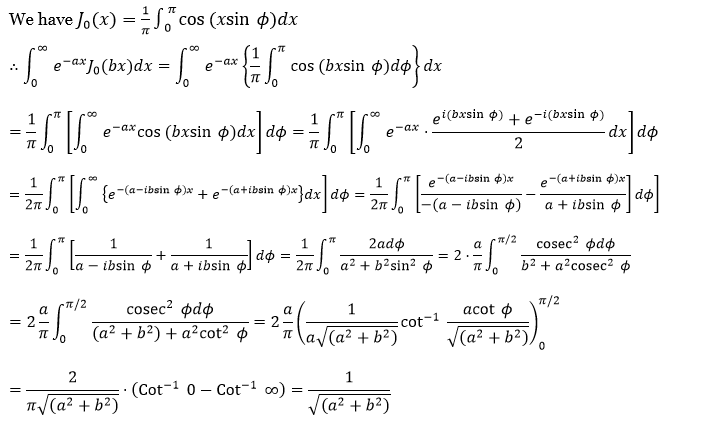
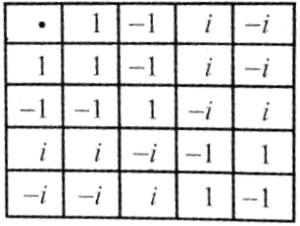


Laplace Transform – 1 Exercise Solved Problems

Laplace Transform – 1 Exercise 1

Laplace Transform Solved Examples Step-By-Step

1. Define Integral transform and Laplace transform.

Solution:

Integral Transform: Let K(p, t) be a function of two variables p and t, where p is a parameter real or complex independent of t. The function f(p) defined by the integral \(\int_{-\infty}^{\infty} K(p, t) F(t) d t\) is called the integral transform of the function F(t) and is denoted by T[F(t)].

The function K(p, t) is called the kernel of the transformation.

Laplace transform: Let a function F(t) be continuous and defined for all positive values of t. The Laplace transformation or Laplace transform of F(t) is defined by \(L[F(t)]=\int_0^{\infty} e^{-p t}. F(t) d t\) where ‘ p’ is a parameter, and the transform is denoted by f(p) or \(\bar{F}(p)\).

2. Define piecewise continuous function.

Solution:

Piecewise continuous function

A function F(t) is said to be piecewise continuous or sectionally continuous in a closed interval [a, b] if it is defined in that interval and is such that the interval can be divided into a finite number of sub-intervals in each of which F(t) is continuous and has finite left and right-hand limits.

3. Define a function of exponential order a.

Solution:

A function of exponential order a

A function F(t) is said to be of exponential order a as t→∞ if there exists a positive real number M, a number a, and a finite number \(t_0\) such that \(\left|e^{-a t} F(t)\right|<M\) i. e., \(|F(t)|<M e^{a t} \forall t \geq t_0\).

Exercise Problems On Laplace Transform With Solutions

4. Define a function of class A.

Solution:

A function of class A

A function F(t) is said to be of class A if F(t) is piecewise continuous on every finite interval in the range t≥0 and is of exponential order as t→∞

5. If a function F(t) is piecewise continuous on every finite interval in the range t≥0 and satisfies \(|F(t)|<M e^{a t} \forall t \geq t_0\) and for some constants a and M, then prove that the Laplace transform of F(t) exists for all p>a.

Solution:

Given

If a function F(t) is piecewise continuous on every finite interval in the range t≥0 and satisfies \(|F(t)|<M e^{a t} \forall t \geq t_0\) and for some constants a and M,

L[F(t)] = \(\int_0^{\infty} e^{-p t} F(t) d t=\int_0^{t_0} e^{-p t} F(t) d t+\int_{t_0}^{\infty} e^{-p t} F(t) d t \rightarrow \text { (1) }\)

Since F(t) is piecewise continuous on \(\left[0, t_0\right]\), the integral \(\int_0^{t_0} e^{-p t} F(t) d t\) exists.

∴ \(\int_{t_0}^{\infty} e^{-p t} F(t) d t|\leq \int_{t_0}^{\infty}| e^{-p t} F(t) d t\)l,< \(\int_{t_0}^{\infty} e^{-p t} M e^{a t} d t\)

= \(\int_{t_0}^{\infty} M e^{-(p-a) t} d t=M [\frac{e^{-(p-a) t}}{-(p-a)}]_{t_0}^{\infty}\)

= \(\frac{M e^{-(p-a) t_0}}{p-a}\) for p>a .

But \(\frac{M e^{-(p-a) t_0}}{p-a}\) can be made as small as we require by taking \(t_0\) sufficiently large. Thus L[F(t)] exists for all p>a.

6. Show that \(L\left(\frac{1}{\sqrt{t}}\right)\) exists for p≥0; even if \(\frac{1}{\sqrt{t}}\)t is not piecewise continuous in the range t≥0. Does this function belong to a function of class A? Justify your answer.

Solution:

The function \(F(t)=\frac{1}{\sqrt{t}}\) is not piecewise continuous on every finite interval in the range t≥0. But

L[F(t)] = \(\int_0^{\infty} e^{-p t} F(t) d t=\int_0^{\infty} e^{-p t} \frac{1}{\sqrt{t}} d t=\int_0^{\infty} e^{-x^2} d x\) where \(\sqrt{p t}=x\)

= \(\frac{2}{\sqrt{p}} \frac{\sqrt{\pi}}{2}=\frac{\sqrt{\pi}}{\sqrt{p}}, p>0\) ∴L[F(t)] exists for p>0.

7. If the Laplace transforms of two functions \(F_1(t), F_2(t)\)) exists then prove that \(L\left[F_1(t)+F_2(t)\right]=L\left[F_1(t)\right]+L\left[F_2(t)\right]\).

Solution:

L\(\left[F_1(t)+F_2(t)\right]=\int_0^{\infty}\left[F_1(t)+F_2(t)\right] e^{-p t} \cdot d t\)

= \(\int_0^{\infty} F_1(t) e^{-p t} d t+\int_0^{\infty} F_2(t) e^{-p t} d t\)

= \(L\left[F_1(t)\right]+L\left[F_2(t)\right]\)

8. If \(k_1, k_2\) are two constants and the Laplace transforms of the functions \(F_1(t), F_2(t)\) exists then prove that \(L\left[k_1 F_1(t)+k_2 F_2(t)\right]=k_1 L\left[F_1(t)\right]+k_2 L\left[F_2(t)\right]\).

Solution:

Given

If \(k_1, k_2\) are two constants and the Laplace transforms of the functions \(F_1(t), F_2(t)\)

L\(\left[k_1 F_1(t)+k_2 F_2(t)\right]=\int_0^{\infty}\left[k_1 F_1(t)+k_2 F_2(t)\right] e^{-p t} \cdot d t\)

= \(\int_0^{\infty} k_1 F_1(t) e^{-p t} d t+\int_0^{\infty} k_2 F_2(t) e^{-p t} d t\)

= \(k_1 \int_0^{\infty} F_1(t) e^{-p t} d t+k_2 \int_0^{\infty} F_2(t) e^{-p t} d t\)

= \(k_{\mathrm{i}} L\left[F_1(t)\right]+k_2 L\left[F_2(t)\right]\)

9. Show that the Laplace transform of the unit function F(t)=1 is 1/p.

Solution:

L[F(t)] = \(\int_0^{\infty} 1 \cdot e^{-p t} d t=\left[\frac{e^{-p t}}{-p}\right]_0^{\infty}=\frac{1}{p}, \text { provided } p>0\)

10. Show that Laplace transforms of \(F(t)=t^n,-1<n<0\) exists although it is not a function of class A.

Solution:

Here F(t) \(\rightarrow \infty\) as \(t \rightarrow 0\) for \(t \geq 0\), i.e. the function is not piecewise continuous on every finite interval in the range \(t \geq 0\).

We have \(\underset{t \rightarrow \infty}{\text{Lt}}\left\{e^{a t} F(t)\right\}=\underset{t \rightarrow \infty}{\text{Lt}}\left(\frac{t^n}{e^{a t}}\right)=\underset{t \rightarrow \infty}{\text{Lt}} \frac{1}{t^n e^{a t}}=\underset{t \rightarrow \infty}{L t} \frac{1}{t^m e^{a t}}\) where 0<m<1 =0, if a>0.

∴ F(t) = \(t^n\) is of exponential order.

Since \(F(t)=t^n\) is not piecewise continuous over every finite interval in the range \(t \geq 0\), hence it is not a function of class A. But \(t^n\) is integrable from o to any positive number \(t_0\).

Now \(L\{F(t)\}=\int_0^{\infty} e^{-p t} F(t) d t=\int_0^{\infty} e^{-p t} t^n d t=\int_0^{\infty} e^{-x}\left(\frac{x}{p}\right)^n \frac{1}{p} d x\)

putting pt=x so that \(d t=\frac{1}{p} d x\) and taking p>0

= \(\frac{1}{p^{n+1}} \int_0^{\infty} e^{-x} x^{(n+1)-1} d x=\frac{\Gamma(n+1)}{p^{n+1}}\), if p>0 and n+1>0 i.e. n>-1.

Hence the Laplace transform of \(t^n, 0>n>-1\) exists, although it is not a function of class A.

Laplace Transform Practice Exercises With Answers

11. If n is a positive integer, then show that \(L\left(t^n\right)=\frac{n !}{p^{n+1}}, p>0\)

Solution:

Given

n is a positive integer

L\(\left(t^n\right)=\int_0^{\infty} t^n e^{-p t} d t=\left[\frac{t^n \cdot e^{-p t}}{-p}\right]_0^{\infty}-\int_0^{\infty} \frac{e^{-p t}}{-p} \cdot n t^{n-1} d t=\frac{n}{p} \int_0^{\infty} e^{-p t} t^{n-1} d t=\frac{n}{p} L\left(t^{n-1}\right)\)

Similarly \(L\left(t^{n-1}\right)=\frac{n-1}{p} \cdot L\left(t^{n-2}\right)\) and so on.

Hence \(L\left(t^n\right)=\frac{n}{p} \cdot \frac{n-1}{p} \cdot \frac{n-2}{p} \cdots \frac{2}{p} \cdot \frac{1}{p} \cdot L\left(t^{n-n}\right)=\frac{n !}{p^n} L\left(t^{\circ}\right)=\frac{n !}{p^n} L(1)=\frac{n !}{p^n} \cdot \frac{1}{p}=\frac{n !}{p^{n+1}}\)

12. If ‘ a ‘ is a constant, then show that \(L\left(e^{a t}\right)=\frac{1}{p-a}\)

Solution:

L\(\left(e^{a t}\right)=\int_0^{\infty} e^{-p t} e^{a t} d t=\int_0^{\infty} e^{-(p-a) t} d t=-\left[\left.\frac{e^{-(p-a) t}}{(p-a)}\right|_0 ^{\infty}=\frac{1}{p-a}, \text { provided } p>a\right.\)

13. Find the Laplace transform of \(e^{-a t}\) by using the basic definition.

Solution:

L\(\left(e^{-a t}\right)=\int_0^{\infty} e^{-p t} e^{-a t} d t=\int_0^{\infty} e^{-(p+a) t} d t=-\left[\left.\frac{e^{-(p+a) t}}{(p+a)}\right|_0 ^{\infty}=\frac{1}{p+a}, \text { provided } p>a\right.\)

14. If ‘ a ‘ is a constant, then show that \(L(\sin a t)=\frac{a}{p^2+a^2}\).

Solution:

L\((\sin a t)=\int_0^{\infty} e^{-p t} \sin a t d t=\left[\frac{e^{-p t}}{p^2+a^2}(-p \sin a t-a \cos a t)\right]_0^{\infty}=\frac{a}{p^2+a^2}\)

15. If ‘ a ‘ is a constant, then show that \(L(\cos a t)=\frac{p}{p^2+a^2}\).

Solution:

L\((\cos a t)=\int_0^{\infty} e^{-p x} \cos a t d t=\left[\frac{e^{-p t}}{p^2+a^2}(-p \cos a t+a \sin a t)\right]_0^{\infty}=\frac{p}{p^2+a^2}\)

16. If ‘ a ‘ is a constant, then show that \(L(\sinh a t)=\frac{a}{p^2-a^2}\).

Solution:

L\((\sinh a t)=\int_0^{\infty} e^{-\not t} \sinh a t d t=\int_0^{\infty} e^{-p t}\left[\frac{e^{a t}-e^{-a t}}{2}\right] d t=\frac{1}{2}\left[\int_0^{\infty} e^{-p t} e^{a t} d t-\int_0^{\infty} e^{-p t} e^{-a t} d t\right]\)

= \(\frac{1}{2}\left[\frac{1}{p-a}-\frac{1}{p+a}\right]=\frac{a}{p^2-a^2}\)

Applications Of Laplace Transform With Solved Examples

17. If ‘ a ‘ is a constant, then show that \(L(\cosh a t)=\frac{p}{p^2-a^2}\).

Solution:

L\((\cosh a t)=\int_0^{\infty} e^{-p t} \cosh a t d t=\int_0^{\infty} e^{-p t}\left[\frac{e^{a t}+e^{-a t}}{2}\right] d t=\frac{1}{2}\left[\int_0^{\infty} e^{-p t} e^{a t} d t+\int_0^{\infty} e^{-p t} e^{-a t} d t\right]\)

= \(\frac{1}{2}\left[\frac{1}{p-a}+\frac{1}{p+a}\right]=\frac{p}{p^2-a^2}\)

18. Define a gamma function.

Solution:

Gamma function

If n>0 then the Gamma function Γ(n) is defined as \(\Gamma(n)=\int_0^{\infty} e^{-x} x^{n-1} d x\).

19. Define Heaviside’s unit step function.

Solution:

Heaviside’s unit step function

The Heavisides unit step function is denoted by U(t-a) or u(t-a) or H(t-a) and is defined as H(t-a)=0 if t<a and H(t-a)=1 if t>a.

20. Show that \(L[H(t-a)]=\frac{e^{-a p}}{p}\).

Solution:

L\(\left[H(t-a)=\int_0^{\infty} e^{-p t} H(t-a) d t=\int_0^a e^{-p t} H(t-a) d t+\int_a^{\infty} e^{-p t} H(t-a) d t\right.\)

= \(\int_0^a e^{-p t}(0) d t+\int_a^{\infty} e^{-p t} 1 d t=\int_a^{\infty} e^{-p t} d t=\left[\frac{e^{-p t}}{-p}\right]_a^{\infty}=\frac{e^{-a p}}{p} .\)

21. Define Unit Impulse Function.

Solution:

Unit Impulse Function

The Unit Impulse Function or Dirac Delta Function at a is denoted by δ(t-a) and is defined as \(\delta(t-a)=\underset{h \rightarrow 0}{L t} I(h, t-a)\), where \(I(h, t-a)=\frac{1}{h}\) if a<t<a+h; I(h,t-a)=0 for t<a or t>a+h.

22. Show that \(L[\delta(t-a)]=e^{-a p}\).

Solution:

We know that I(h, t-a) = \(\frac{1}{h}[H(t-a)-H(t-a-h)]\)

L\([I(h, t-a)]=\frac{1}{h}\{L[H(t-a)]-L[H(t-a-h)]\}=\frac{1}{h}\left[\frac{e^{-a p}}{p}-\frac{e^{-(a+h) p}}{p}\right]=\frac{e^{-a p}}{p}\left[1-e^{-h p}\right]\)

L\(\left[\delta(t-a)=\underset{h \rightarrow 0}{L t} L[I(h, t-a)]={ }_{h \rightarrow 0}^{L t} \frac{e^{-a p}}{p h}\left[1-e^{-h p}\right]=e^{-a p}\right.\)

23. Prove that the function \(F(t)=t^2\) is of exponential order 3 .

Solution:

⇒ \(\ Lim_{t \rightarrow \infty} e^{-3 t} F(t)=\ Lim_{t \rightarrow \infty} e^{-3 t} \cdot t^2=\ Lim_{t \rightarrow \infty} \frac{t^2}{3 t}\left(\text { form } \frac{\infty}{\infty}\right)=\ Lim_{t \rightarrow \infty} \frac{2 t}{3 e^{3 t}}\)

= \(\ Lim_{t \rightarrow \infty} \frac{2}{9 e^{3 t}}=\frac{2}{\infty}=0\)

Hence \(t^2\) is exponential order 3.

Laplace Transform Examples And Detailed Solutions

24. Prove that the Laplace transform of \(e^{t^2}\) does not exist.

Solution:

Let \(F(t)=e^{t^2} \text {. Then } \ Lim e^{-a t} F(t)=\ Lim_{t \rightarrow \infty} e^{-a t} e^{t^2}=\ Lim_{t \rightarrow \infty} e^{\left(t^{t^2}-a t\right)}\)

= \(\infty \text { i.e. } f(t)=e^{t^2}\) is not of exponential order. Hence its Laplace transform does not exist.

25. Find the Laplace transform of \(e^{2 t}+4 t^3-2 \sin 3 t+3 \cos 3 t\)

Solution:

L\(\left\{e^{2 t}+4 t^3-2 \sin 3 t+3 \cos 3 t\right\}\)

= \(\frac{1}{p-2}+4 \cdot \frac{3 !}{p^4}-2 \cdot \frac{3}{p^2+9}+3 \cdot \frac{p}{p^2+9}=\frac{1}{p-2}+\frac{24}{p^4}-\frac{6}{p^2+9}+\frac{3 p}{p^2+9} .\)

Step-By-Step Guide To Solving Laplace Transform Exercises

26. Find \(L\left(t^3+2 t^2-4 t+6\right)\).

Solution:

L\(\left(t^3+2 t^2-4 t+6\right)=L\left(t^3\right)+2 L\left(t^2\right)-4 L(t)+6 L(1)\)

= \(\frac{3 !}{p^4}+2 \cdot \frac{2 !}{p^3}-4 \cdot \frac{1}{p^2}+6 \cdot \frac{1}{p}=\frac{6}{p^4}+\frac{4}{p^3}-\frac{4}{p^2}+\frac{6}{p}\)

27. Find the Laplace transforms of \((t-2)^3\).

Solution:

L\(\left\{(t-2)^3\right\}=L\left\{t^3-6 t^2+12 t-8\right\}=L\left\{t^3\right\}-6 L\left\{t^2\right\}+12 L\{t\}-8 L\{1\}\)

= \(\frac{3 !}{p^4}-6 \frac{2 !}{p^3}+12 \frac{1 !}{p^2}-8 \frac{1}{p}=\frac{6}{p^4}-\frac{12}{p^3}+\frac{12}{p^2}-\frac{8}{p}\)

28. Find the Laplace transform of \(\left(t^2+1\right)^2\).

Solution:

L\(\left\{\left(t^2+1\right)^2\right\}=L\left\{t^4+2 t^2+1\right\}=L\left\{t^4\right\}+2 L\left\{t^2\right\}+L\{1\}\)

= \(\frac{4 !}{p^5}+2 \cdot \frac{2 !}{p^3}+\frac{1}{p}=\frac{24}{p^5}+\frac{4}{p^3}+\frac{1}{p}=\frac{1}{p^5}\left(p^4+4 p^2+24\right), p>0 .\)

29. Find \(L\left\{\left(\sqrt{t}+\frac{1}{\sqrt{t}}\right)^3\right\}\).

Solution:

L\(\left\{\left(\sqrt{t}+\frac{1}{\sqrt{t}}\right)^3\right\}=L\left\{t^{3 / 2}+3 t^{1 / 2}+3 t^{-1 / 2}+t^{-3 / 2}\right\}\)

= \(\frac{\Gamma(5 / 2)}{p^{5 / 2}}+3 \frac{\Gamma(3 / 2)}{p^{3 / 2}}+3 \frac{\Gamma(1 / 2)}{p^{1 / 2}}+\frac{\Gamma(-1 / 2)}{p^{-1 / 2}}\)

= \(\left(\frac{3}{2}\right)\left(\frac{1}{2}\right) \frac{\sqrt{\pi}}{p^{5 / 2}}+(3)\left(\frac{1}{2}\right) \frac{\sqrt{\pi}}{p^{3 / 2}}+(3) \frac{\sqrt{\pi}}{p^{1 / 2}}-\frac{2 \sqrt{\pi}}{p^{-1 / 2}}=\frac{\sqrt{\pi}}{4}\left[\frac{3}{p^{5 / 2}}+\frac{6}{p^{3 / 2}}+\frac{12}{p^{1 / 2}}-8 \sqrt{p}\right] .\)

30. Find the Laplace transform of \(\frac{e^{-a t}-1}{a}\)

Solution:

L\(\left\{\frac{e^{-a t}-1}{a}\right\}=\frac{1}{a} L\left\{e^{-a t}-1\right\}=\frac{1}{a}\left[L\left\{e^{-a t}\right\}-L\{1\}\right]=\frac{1}{a}\left[\frac{1}{p+a}-\frac{1}{p}\right]=-\frac{1}{p(p+a)}\)

31. Find the Laplace transform of \(e^{-t}-t^4+3 \sin (\sqrt{3} t)+4 \cos t\).

Solution:

L\(\left\{e^{-t}-t^4+3 \sin \sqrt{3} t+4 \cos t\right\}=\frac{1}{p+1}-\frac{4 !}{p^5}+3 \cdot \frac{\sqrt{3}}{p^2+3}+4 \cdot \frac{p}{p^2+1} .\)

32. Find \(L\left\{7 e^{2 t}+9 e^{-2 t}+5 \cos t+7 t^3+5 \sin 3 t+2\right\}\).

Solution:

L\(\left\{7 e^{2 t}+9 e^{-2 t}+5 \cos t+7 t^3+5 \sin 3 t+2\right\}\)

= \(7 L\left\{e^{2 t}\right\}+9 L\left\{e^{-2 t}\right\}+5 L\{\cos t\}+7 L\left\{t^3\right\}+5 L\{\sin 3 t\}+2 L\{1\}\)

= \(\frac{7}{p-2}+\frac{9}{p+2}+\frac{5 p}{p^2+1}+\frac{21}{p^4}+\frac{15}{p^2+9}+\frac{2}{p}\)

Solved Problems On Inverse Laplace Transform”

33. Find \(L\left\{e^{-t}+t^4+3 \sin 4 t-3 \sinh 2 t\right\}\).

Solution:

L\(\left\{e^{-t}+t^4+3 \sin 4 t-3 \sinh 2 t\right\}=L\left\{e^{-t}\right\}+L\left\{t^4\right\}+3 L\{\sin 4 t\}\)

–\(3 L\{\sinh 2 t\}\) \(\frac{1}{p+1}+\frac{4 !}{p^5}+3\left(\frac{4}{p^2+16}\right)-3\left(\frac{2}{p^2-4}\right)=\frac{1}{p+1}+\frac{24}{p^5}+\frac{12}{p^2+16}-\frac{6}{p^2-4}\)

34. Find \(L\left\{3 t^4-2 t^3+4 e^{-3 t}-2 \sin 5 t+3 \cos 2 t\right\}\).

Solution:

L\(\left\{3 t^4-2 t^3+4 e^{-3 t}-2 \sin 5 t+3 \cos 2 t\right\}\)

3\(L\left\{t^4\right\}-2 L\left\{t^3\right\}+4 L\left\{e^{-3 t}\right\}-2 L\{\sin 5 t\}+3 L\{\cos 2 t\}\)

= \(\frac{3(4 !)}{p^5}-\frac{2(3 !)}{p^4}+\frac{4}{p+3}-2 \frac{5}{p^2+5^2}+\frac{3 p}{p^2+2^2}\)

= \(\frac{72}{p^5}-\frac{12}{p^4}+\frac{4}{p+3}-\frac{10}{p^2+25}+\frac{3 p}{p^2+4}\)

35. Find \(L\left\{\left(5 e^{2 t}-3\right)^2\right\}\)

Solution:

L\(\left\{\left(5 e^{2 t}-3\right)^2\right\}=L\left\{25 e^{4 t}+9-30 e^{2 t}\right\}=25 L\left\{e^{4 t}\right\}-30 L\left\{e^{2 t}\right\}+9 L\{1\}\)

= \(\frac{25}{p-4}-\frac{30}{p-2}+\frac{9}{p}\).

36. Evaluate L{3 sin⁡ 2t – 5 cos⁡ 2t}.

Solution:

L\(\{3 \sin 2 t-5 \cos 2 t\}=3 L\{\sin 2 t\}-5 L\{\cos 2 t\}\)

= \(3\left(\frac{2}{p^2+2^2}\right)-5\left(\frac{p}{p^2+2^2}\right)=\frac{6-5 p}{p^2+4}\)

37. Find the Laplace transform of sin ⁡2t cos⁡ t.

Solution:

L\(\{\sin 2 t \cos t\}=L\left\{\frac{1}{2}(\sin 3 t+\sin t)\right\}=\frac{1}{2}[L\{\sin 3 t\}+L\{\sin t\}]\)

= \(\frac{1}{2}\left[\frac{3}{p^2+9}+\frac{1}{p^2+1}\right]=\frac{2\left(p^2+3\right)}{\left(p^2+1\right)\left(p^2+9\right)}\)

38. Find L(sin⁡ 2t cos⁡ 3t).

Solution:

L\((\sin 2 t \cos 3 t)=L\left(\frac{\sin 5 t-\sin t}{2}\right)=\frac{1}{2}[L(\sin 5 t)-L(\sin t)]\)

= \(\frac{1}{2}\left[\frac{5}{p^2+25}-\frac{1}{p^2+1}\right]\)

= \(\frac{1}{2}\left[\frac{5 p^2+5-p^2-25}{\left(p^2+25\right)\left(p^2+1\right)}\right]=\frac{1}{2}\left[\frac{4 p^2-20}{\left(p^2+25\right)\left(p^2+1\right)}\right]=\frac{2 p^2-10}{\left(p^2+25\right)\left(p^2+1\right)}\)

Laplace Transform In Differential Equations Solved Problems

39. Find L[sin ⁡3t cos⁡ 2t].

Solution:

⇒ \(\sin 3 t \cos 2 t=\frac{1}{2}(\sin 5 t+\sin t)\)

L\(\{\sin 3 t \cos 2 t\}=\frac{1}{2} L\{\sin 5 t+\sin t\}=\frac{1}{2}[L\{\sin 5 t\}+L\{\sin t\}]\)

= \(\frac{1}{2}\left[\frac{5}{p^2+25}-\frac{1}{p^2+1}\right]=\frac{1}{2}\left[\frac{5 p^2+5-p^2-25}{\left(p^2+25\right)\left(p^2+1\right)}\right]=\frac{1}{2}\left[\frac{4 p^2-20}{\left(p^2+25\right)\left(p^2+1\right)}\right]\)

= \(\frac{2\left(p^2-5\right)}{\left(p^2+25\right)\left(p^2+1\right)}\)

40. Find the Laplace transform of cos⁡ 3t sin⁡ 5t.

Solution:

L\(\{\sin 5 t \cos 3 t\}=L\left\{\frac{1}{2}(\sin 8 t+\sin 2 t)\right\}=\frac{1}{2}[L\{\sin 8 t\}+L\{\sin 2 t\}]\)

= \(\frac{1}{2}[\dot{L}\{\sin 5 t\}+L\{\sin t\}]=\frac{1}{2}\left[\frac{8}{p^2+64}+\frac{2}{p^2+4}\right]\)

= \(\frac{1}{2}\left[\frac{8 p^2+32+2 p^2+128}{\left(p^2+64\right)\left(p^2+4\right)}\right]\)

= \(\frac{1}{2}\left[\frac{10 p^2+160}{\left(p^2+64\right)\left(p^2+4\right)}\right]=\frac{5 p^2+80}{\left(p^2+64\right)\left(p^2+4\right)}\)

41. Find the Laplace transform of cos⁡ t cos⁡ 2t cos⁡ 3t.

Solution:

L\(\{\cos t \cos 2 t \cos 3 t\}=L\left\{\frac{\cos t}{2}(\cos 5 t+\cos t)\right\}\)

= \(L\left\{\frac{1}{4}\left[2 \cos 5 t \cos t+2 \cos ^2 t\right]\right\}\)

= \(\frac{1}{4} L\{\cos 6 t+\cos 4 t+\cos 2 t+1\}=\frac{1}{4}[L\{\cos 6 t\}\) \(+L\{\cos 4 t\}+L\{\cos 2 t\}+L\{1\}]\)

= \(\frac{1}{4}\left[\frac{p}{p^2+6^2}+\frac{p}{p^2+4^2}+\frac{p}{p^2+2^2}+\frac{1}{p}\right]=\frac{1}{4}\left[\frac{1}{p}+\frac{p}{p^2+4}+\frac{p}{p^2+16}+\frac{p}{p^2+36}\right]\)

42. Find the Laplace transform of \((\sin t+\cos t)^2\).

Solution:

⇒ \((\sin t+\cos t)^2=\sin ^2 t+\cos ^2 t+2 \sin t \cos t=1+\sin 2 t\)

∴ \(L\left\{(\sin t+\cos t)^2\right\}=L\{1+\sin 2 t\}=\frac{1}{p}+\frac{2}{p^2+4}=\frac{p^2+2 p+4}{p\left(p^2+4\right)}\)

43. Find \(L\left[(\sin t-\cos t)^2\right]\).

Solution:

⇒ \((\sin t-\cos t)^2=\sin ^2 t+\cos ^2 t-2 \sin t \cos t=1-\sin 2 t\)

∴ \(L\left\{(\sin t-\cos t)^2\right\}=L\{1-\sin 2 t\}=\frac{1}{p}-\frac{2}{p^2+4}=\frac{p^2-2 p+4}{p\left(p^2+4\right)}\)

Worked Examples Of Laplace Transform In Control Systems

44. Find \(L\left(\sin ^2 4 t\right)\).

Solution:

L\(\left(\sin ^2 4 t\right)=L\left[\frac{1-\cos 8 t}{2}\right]=\frac{1}{2} L(1)-\frac{1}{2} L(\cos 8 t)\)

= \(\frac{1}{2} \cdot \frac{1}{p}-\frac{1}{2} \cdot \frac{p}{p^2+64}=\frac{1}{2}\left[\frac{1}{p}-\frac{p}{p^2+64}\right]=\frac{1}{2}\left[\frac{p^2+64-p^2}{p\left(p^2+64\right)}\right]=\frac{32}{p\left(p^2+64\right)}\)

45. Find \(L\left\{\sin ^2 a t\right\}\).

Solution:

L\(\left\{\sin ^2 a t\right\}=L\left\{\frac{1-\cos 2 a t}{2}\right\} \doteq \frac{1}{2} L\{1\}-\frac{1}{2} L\{\cos 2 a t\}\)

=  \(\frac{1}{2} \frac{1}{p}-\frac{1}{2} \frac{p}{p^2+4 a^2}=\frac{1}{2}\left[\frac{1}{p}-\frac{p}{p^2+4 a^2}\right]=\frac{1}{2}\left[\frac{4 a^2}{p\left(p^2+4 a^2\right)}\right]=\frac{2 a^2}{p\left(p^2+4 a^2\right)}\)

46. Find \(L\left\{\sin ^2 a t+\left(t^2+1\right)^2\right\}\).

Solution:

L\(\left\{\sin ^2 a t+\left(t^2+1\right)^2\right\}=L\left\{\frac{1-\cos 2 a t}{2}+t^4+2 t^2+1\right\}=L\left\{\frac{3}{2}-\frac{1}{2} \cos 2 a t+t^4+2 t^2\right\}\)

= \(\frac{3}{2} L\{1\}-\frac{1}{2} L\{\cos 2 a t\}+L\left\{t^4\right\}+2 L\left\{t^2\right\}\)

= \(\frac{3}{2}\left(\frac{1}{p}\right)-\frac{1}{2}\left(\frac{p}{p^2+4 a^2}\right)+\frac{4 !}{p^5}+2\left(\frac{2 !}{p^3}\right)=\frac{3}{2 p}-\frac{p}{2\left(p^2+4 a^2\right)}+\frac{24}{p^5}+\frac{4}{p^3}\)

47. Find the Laplace transform of \(\cos ^3 2 t\).

Solution:

cos 6 t = \(\cos 3(2 t)=4 \cos ^3 2 t-3 \cos 2 t\)

∴ \(\cos ^3 2 t=\frac{1}{4}(3 \cos 2 t+\cos 6 t)\)

Hence \(L\left\{\cos ^3 2 t\right\}=L\left\{\frac{1}{4}(3 \cos 2 t+\cos 6 t)\right\}=\frac{3}{4} L\{\cos 2 t\}+\frac{1}{4} L\{\cos 6 t\}\)

= \(\frac{3}{4} \cdot \frac{p}{p^2+4}+\frac{1}{4} \cdot \frac{p}{p^2+36}=\frac{p}{4}\left(\frac{3}{p^2+4}+\frac{1}{p^2+36}\right)=\frac{p}{4}\left[\frac{4 p^2+112}{\left(p^2+4\right)\left(p^2+36\right)}\right]\)

= \(\frac{p\left(p^2+28\right)}{\left(p^2+4\right)\left(p^2+36\right)}\)

48. Find Laplace Transform of \(\sin ^3 2 t\).

Solution:

L\(\left\{\sin ^3 2 t\right\}=L\left\{\frac{3 \sin 2 t-\sin 6 t}{4}\right\}=\frac{3}{4} L\{\sin 2 t\}-\frac{1}{4} L\{\sin 6 t\}=\frac{3}{4} \frac{2}{p^2+4}-\frac{1}{4} \frac{6}{p^2+36}\)

= \(\frac{3}{2}\left[\frac{1}{p^2+4}-\frac{1}{p^2+36}\right]=\frac{3}{2}\left[\frac{p^2+36-p^2-4}{\left(p^2+4\right)\left(p^2+36\right)}\right]=\frac{48}{\left(p^2+4\right)\left(p^2+36\right)}\)

49. Find \(L\left(\cos ^3 3 t\right)\).

Solution:

We know that \(cos 9 t=\cos 3(3 t)=4 \cos ^3 3 t-3 \cos 3 t\)

Hence  \(\cos ^3 3 t=\frac{1}{4} \cos 9 t+\frac{3}{4} \cos 3 t\)

L\(\left(\cos ^3 3 t\right)=\frac{1}{4} L(\cos 9 t)+\frac{3}{4} L(\cos 3 t)=\frac{1}{4} \frac{p}{p^2+81}+\frac{3}{4} \cdot \frac{p}{p^2+9}\)

= \(\frac{p\left(p^2+9+3 p^2+243\right)}{4\left(p^2+81\right)\left(p^2+9\right)}=\frac{p\left(4 p^2+252\right)}{4\left(p^2+81\right)\left(p^2+9\right)}=\frac{p\left(p^2+63\right)}{\left(p^2+81\right)\left(p^2+9\right)}\)

50. Find the Laplace transform of \((\sin t-\cos t)^3\).

Solution:

(\(sin t-\cos t)^3=\sin ^3 t-3 \sin ^2 t \cos t+3 \sin t \cos ^2 t-\cos ^3 t\)

= \(\sin ^3 t-3 \cos t\left(1-\cos ^2 t\right)+3 \sin t\left(1-\sin ^2 t\right)-\cos ^3 t\)

= \(\sin ^3 t-3 \cos t+3 \cos ^3 t+3 \sin t-3 \sin ^3 t-\cos ^3 \)

= \(2 \cos ^3 t-3 \cos t+3 \sin t-2 \sin ^3 t\)

= \(\frac{3 \cos t+\cos 3 t}{2}-3 \cos t+3 \sin t-\frac{3 \sin t-\sin 3 t}{2}\)

= \(\frac{1}{2} \cos 3 t-\frac{3}{2} \cos t+\frac{3}{2} \sin t+\frac{1}{2} \sin 3 t\)

L\(\left\{(\sin t-\cos t)^3\right\}=\frac{1}{2} L\{3 \sin t-3 \cos t+\sin 3 t+\cos 3 t\}\)

= \(\frac{1}{2}\left[\frac{3}{p^2+1}-\frac{3 p}{p^2+1}+\frac{3}{p^2+9}+\frac{p}{p^2+9}\right]\)

51. Find the Laplace transform of \(\cosh ^2 2 t\).

Solution:

L\(\left\{\cosh ^2 2 t\right\}=L\left\{\frac{1}{2}(1+\cosh 4 t)\right\}=\frac{1}{2}[L\{1\}+L\{\cosh 4 t\}]\)

= \(\frac{1}{2}\left[\frac{1}{p}+\frac{p}{p^2-16}\right]=\frac{p^2-8}{p\left(p^2-16\right)}\)

52. Find the Laplace transform of \(L\left\{\sinh ^2 3 t\right\}\).

Solution:

⇒ \(\sinh ^2(3 t)=\left(\frac{e^{3 t}-e^{-3 t}}{2}\right)^2=\frac{e^{9 t}+e^{-9 t}-2}{4}\)

Hence \(L\left\{\sinh ^2 3 t\right\}=\frac{1}{4}\left[L\left\{e^{9 t}\right\}+L\left\{e^{-9 t}\right\}-2 L\{1\}\right]=\frac{1}{4}\left[\frac{1}{p-9}+\frac{1}{p+9}-\frac{2}{p}\right] \text {. }\)

53. Find the Laplace transform of \(\sin h^3 2 t\).

Solution:

L\(\left\{\sin h^3 2 t\right\}=L\left\{\left(\frac{e^{2 t}-e^{-2 t}}{2}\right)^3\right\}=L\left\{\frac{1}{8}\left(e^{6 t}-3 e^{2 t}+3 e^{-2 t}-e^{-6}\right)\right\}\)

= \(=\frac{1}{8} \cdot \frac{1}{p-6}-\frac{3}{8} \cdot \frac{1}{p-2}+\frac{3}{8} \cdot \frac{1}{p+2}-\frac{1}{8} \cdot \frac{1}{p+6}\)

= \(\frac{1}{8}\left(\frac{1}{p-6}-\frac{1}{p+6}\right)-\frac{3}{8}\left(\frac{1}{p-2}-\frac{1}{p+2}\right)\)

= \(\frac{1}{8}\left(\frac{12}{p^2-36}-\frac{12}{p^2-4}\right)=\frac{48}{\left(p^2-4\right)\left(p^2-36\right)}\)

54. Find the Laplace transform of \(\cosh ^3 2 t\).

Solution:

⇒ \(\cosh 6 t=4 \cosh ^3 2 t-3 \cosh 2 t \Rightarrow \cosh ^3 2 t=\frac{\cosh 6 t+3 \cosh 2 t}{4}\)

∴ \(L\left(\cosh ^3 2 t\right)=\frac{1}{4}\left[L\{\cosh 6 t\}+3 L\{\cosh 2 t\}=\frac{1}{4}\left[\frac{p}{p^2-36}+\frac{3 p}{p^2-4}\right]\right.\)

= \(\frac{p}{4}\left[\frac{1}{p^2-36}+\frac{3}{p^2-4}\right]=\frac{p\left(p^2-28\right)}{\left(p^2-4\right)\left(p^2-36\right)}\)

55. Prove that \(L\left\{e^{a t} \sinh b t\right\}=\frac{b}{(p-a)^2-b^2}\).

Solution:

L\(\left\{e^{a t} \sinh b t\right\}=\int_0^{\infty} e^{-p t} e^{a t} \sinh b t d t=\int_0^{\infty} e^{-(p-a) t} \sinh b t d t\)

= \(\int_0^{\infty} e^{-(p-a) t}\left(\frac{e^{b t}-e^{-b t}}{2}\right) d t=\frac{1}{2} \int_0^{\infty}\left(e^{-(p-a-b) t}-e^{-(p-a+b) t}\right) d t\)

= \(\frac{1}{2}\left[\frac{e^{-(p-a-b) t}}{-(p-a-b)}-\frac{e^{-(p-a+b) t}}{-(p-a+b)}\right]_b^p=\frac{1}{2}\left[\frac{1}{p-a-b}-\frac{1}{p-a+b}\right]\)

= \(\frac{1}{2}\left[\frac{2 b}{(p-a)^2-b^2}\right]=\frac{b}{(p-a)^2-b^2}\)

56. Prove that \(L\left\{e^{a t} \cosh b t\right\}=\frac{p-a}{(p-a)^2-b^2}\).

Solution:

L\(\left\{e^{a t} \cosh b t\right\}=\int_0 e^{-p t} e^{a t} \cosh b t d t=\int_0^{\infty} e^{-(p-a) t} \frac{e^{b t}+e^{-b t}}{2} d t\)

= \(\frac{1}{2} \int_0^{\infty}\left[e^{-(p-a-b) t}+e^{-(p-a+b) t}\right] d t=\frac{1}{2}\left[\frac{e^{-(p-a-b) t}}{-(p-a-b)}+\frac{e^{-(p-a+b) t}}{-(p-a+b)}\right]_0^{\infty}\)

= \(\frac{1}{2}\left[\frac{1}{p-a-b}+\frac{1}{p-a+b}\right]=\frac{p-a}{(p-a)^2-b^2}\)

57. Find the Laplace transform of f(t)=|t-1|+|t+1|,t≥0.

Solution:

0<t<1\(\Rightarrow|t-1|=1-t \text { and }|t+1|=t+1\)

∴ \(F(t)=(1-t)+(t+1)=2, \text { when } 0<t<1 \rightarrow(1)\)

When \(t>1 \Rightarrow|t-1|=t-1 \text {. }\)

∴ \(F(t)=(t-1)+(t+1)=2 t \text {, when } t>1\)

Thus \(L\{F(t)\}=\int_0^{\infty} F(t) e^{-p t} d t=\int_0^1 2 e^{-p t} d t+\int_1^{\infty} 2 t e^{-p t} d t=\left(\frac{e^{-p t}}{-p}\right)_0^1+2\left[t\left(\frac{e^{-p t}}{-p}\right)-\left(\frac{e^{-p t}}{p^2}\right)\right]_1^{\infty}\)

= \(2\left(\frac{e^{-p}}{-p}+\frac{1}{p}\right)+2\left(\frac{e^{-p}}{p}+\frac{e^{-p}}{p^2}\right)=\frac{2}{p}\left(1+\frac{e^{-p}}{p}\right) .\)

58. Find the Laplace transform of \(f(t)=\left\{\begin{array}{c}
e^t \text { when } 0<t<1 \\
0 \text { when } t>1
\end{array}\right.\)
.

Solution:

L[f(t)]=\(\int_0^{\infty} e^{-p t} f(t) d t=\int_0^1 e^{-p t} f(t) d t+\int_1^{\infty} e^{-p t} f(t) d t\) \(\int_0^1 e^{-p t} e^t d t+\int_1^{\infty} e^{-p t}(0) d t\)

= \(\int_0^1 e^{(1-p) t} d t=\left[\frac{e^{(1-p) t}}{1-p}\right]_0^1=\frac{1}{1-p}\left(e^{1-p}-1\right)\)

59. Obtain the Laplace transform of the function \(F(t)=\left\{\begin{array}{cl}
(t-1)^2, & t>1 \\
0, & 0<t<1
\end{array}\right.\).

Solution:

By defination, \(L\{F(t)\}=\int_0^{\infty} e^{-p t} F(t) d t=\int_0^1 e^{-p t} F(t) d t+\int_1^{\infty} e^{-p t} F(t) d t\)

= \(\int_0^1 e^{-p t} \cdot 0 d t+\int_1^{\infty} e^{-p t}(t-1)^2 d t=\int_1^{\infty} e^{-p t}(t-1)^2 d t\)

= \(\left[(t-1)^2\left(\frac{e^{-p t}}{-p}\right)-2(t-1)\left(\frac{e^{-p t}}{p^2}\right)-2\left(\frac{e^{-p t}}{p^3}\right)\right]_1^{\infty}\)

= \(\left[(0-0-0)-\left\{0-0-\frac{2}{p^3} e^{-p}\right\}\right]=\frac{2}{p^3} e^{-p}\)

60. Find the Laplace transform of \(F(t)=\left\{\begin{array}{cl}
\sin t, & 0<t<\pi \\
0 & t>\pi
\end{array}\right.\)

Solution:

L\(\{F(t)\}=\int_0^{\infty} e^{-p t} F(t) d t=\int_0^\pi e^{-p t} F(t) d t+\int_\pi^{\infty} e^{-p t} F(t) d t\)

= \(\int_0^\pi e^{-p t} \sin t d t+\int_\pi^{\infty} e^{-p t}(0) d t\)

= \(\int_0^\pi e^{-p t} \sin t d t=\left[\frac{e^{-p t}}{p^2+1}(-p \sin t-\cos t)\right]_0^\pi=\frac{1+e^{-\pi p}}{p^2+1}\)

61. Find the Laplace transform of F(t) defined as \(F(t)= \begin{cases}e^t & \text { when } 0<t<5 \\ 3 & \text { when } t>5\end{cases}\)

Solution:

L\(\{F(t)\}=\int_0^{\infty} e^{-p t} F(t) d t=\int_0^5 e^{-p t} F(t) d t+\int_5^{\infty} e^{-p t} F(t) d t\)

= \(\int_0^5 e^{-p t} e^t d t+\int_5^{\infty} e^{-p t} 3 d t=\int_0^5 e^{-(p-1) t} d t+3 \int_5^{\infty} e^{-p t} d t=\left[\frac{e^{-(p-1) t}}{-(p-1)}\right]_0^5+3\left(\frac{e^{-p}}{-p}\right)_5^{\infty}\)

= \(\left[\frac{-e^{-5(p-1)}}{p-1}+\frac{1}{p-1}\right]+3 \frac{e^{-5 p}}{p}=\frac{1-e^{-5(p-1)}}{p-1}+\frac{3}{p} e^{-5 p}\)

62. Find the Laplace transform of \(F(t)= \begin{cases}2 t, & 0<t<5 \\ 1, & t>5\end{cases}\).

Solution:

L\([f(t)]=\int_0^{\infty} e^{-p t} f(t) d t=\int_0^5 e^{-p t} f(t) d t+\int_5^{\infty} e^{-p t} f(t) d t=\int_0^5 e^{-p t} 2 t d t+\int_5^{\infty} e^{-p t}(1) d t\)

= \(\left(\frac{2 t e^{-p t}}{-p}\right)_0^5-\int_0^5 2 \frac{e^{-p t}}{-p} d t+\left(\frac{e^{-p t}}{-p}\right)_5^{\infty}=\frac{-10}{p} e^{-5 p}-\left(\frac{2 e^{-p t}}{p^2}\right)_0^5+\frac{e^{-5 p}}{p}\)

= \(-\frac{9}{p} e^{-5 p}-\frac{2}{p^2} e^{-5 p}+\frac{2}{p^2}=\frac{2}{p^2}\left(1-e^{-5 p}\right)-\frac{9}{p} e^{-5 p}\)

63. Find L{F(t)} where \(F(t)= \begin{cases}0, & 0<t<2 \\ 4, & t>2\end{cases}\)

Solution:

L\(\{\hat{F}(t)\}=\int_0^{\infty} e^{-p t} F(t) d t=\int_2^{\infty} 4 e^{-p t} d t=\left[\frac{4 e^{-p t}}{-p}\right]_2^{\infty}=\frac{4}{p} e^{-2 p}\)

64. Find the Laplace Transform of F(t) defined as \(F(t)= \begin{cases}1, & 0<t<2 \\ 2, & 2<t<4 \\ 3, & 4<t<6 \\ 0, & t>6\end{cases}\)

Solution:

L\(\{f(t)\}=\int_0^2 e^{-p t}(1) d t+\int_2^4 e^{-p t} 2 d t+\int_4^6 e^{-p t} 3 d t+\int_6^{\infty} e^{-p t}(0) d t\)

=\(\left(\frac{e^{-p t}}{-p}\right)_0^2+2\left(\frac{e^{-p t}}{-p}\right)_2^4+3\left(\frac{e^{-p t}}{-p}\right)_4^6=-\frac{1}{p}\left(e^{-2 p}-1\right)-\frac{2}{p}\left(e^{-4 p}-e^{-2 p}\right)-\frac{3}{p}\left(e^{-6 p}-e^{-4 p}\right)\)

= \(\frac{1}{p}\left(1+e^{-2 p}+e^{-4 p}-3 e^{-6 p}\right)\)

65. Find L{F(t)} if \(F(t)= \begin{cases}0, & 0<t<1 \\ t, & 1<t<2 \\ 0, & t>2\end{cases}\)

Solution:

L\(\{F(t)\}=\int_0^{\infty} e^{-p t} F(t) d t=\int_0^1 e^{-p t} F(t) d t+\int_1^2 e^{-p t} \cdot F(t) d t+\int_2^{\infty} e^{-p t} F(t) d t\)

= \(\int_0^1 e^{-p t}(0) d t+\int_1^2 e^{-p t}(t) d t+\int_2^{\infty} e^{-p t}(0) F(t) d t=\int_1^2 t e^{-p t} d t\)

= \(\left[t\left(\frac{e^{-p t}}{-p}\right)-1\left(\frac{e^{-p t}}{p^2}\right)\right]_1^2=-\left[\frac{t}{p} e^{-p t}+\frac{1}{p^2} e^{-p t}\right]_1^2=-\left[\frac{2}{p} e^{-2 p}+\frac{1}{p^2} e^{-2 p}\right]+\left[\frac{1}{p} e^{-p}+\frac{1}{p^2} e^{-p}\right]\)

= \(-e^{-2 p}\left(\frac{2}{p}+\frac{1}{p^2}\right)+e^{-p}\left(\frac{1}{p}+\frac{1}{p^2}\right)\)

66. Find L{f(t)} where \(F(t)=\left\{\begin{array}{cc}
e^{t-a}, & t>a \\
0, & t<a
\end{array}\right.\)

Solution:

L\(\{F(t)\}=\int_0^{\infty} e^{-p t} F(t) d t=\int_0^a e^{-p t} F(t) d t+\int_a^{\infty} e^{-p t} F(t) d t=\int_0^a e^{-p t}(0) d t+\int_a^{\infty} e^{-p t} e^{t-a} d t\)

= \(\int_a^{\infty} e^{-a} e^{-(p-1) t} d t=e^{-a}\left[\frac{e^{-(p-1) t}}{-(p-1)}\right]_a^{\infty}=e^{-a}\left[\frac{-e^{-(p-1) a}}{-(p-1)}\right]=\frac{e^{-p a}}{p-1},(p>1)\)

67. Find the Laplace transform of the function \(F(t)= \begin{cases}4, & 0<t<1 \\ 3, & t>1\end{cases}\)

Solution:

L\(\{F(t)\}=\int_0^{\infty} e^{-p t} F(t) d t=\int_0^1 F(t) e^{-p t} d t+\int_1^{\infty} F(t) e^{-p t} d t=\int_0^1 4 e^{-p t} d t+\int_1^{\infty} 3 e^{-p t} d t\)

= \(4\left[\frac{e^{-p t}}{-p}\right]_0^1+3\left[\frac{e^{-p t}}{-p}\right]_1^{\infty}=4\left[\frac{e^{-p}-e^0}{-p}\right]+3\left[\frac{e^{-\infty}-e^{-p}}{-p}\right]=4\left[\frac{e^{-p}-1}{-p}\right]+3\left[\frac{-e^{-p}}{-p}\right]\)

= \(\frac{4 e^{-p}-4-3 e^{-p}}{-p}=\frac{-e^{-p}+4}{p}=\frac{4-e^{-p}}{p}\)

68. Show that \(L\left\{\frac{1}{\sqrt{\pi t}}\right\}=\frac{1}{\sqrt{p}}\).

Solution:

L\(\left\{\frac{1}{\sqrt{\pi} t}\right\}=\frac{1}{\sqrt{\pi}} L\left\{\frac{1}{\sqrt{t}}\right\}=\frac{1}{\sqrt{\pi}} L\left\{t^{-1 / 2}\right\}=\frac{1}{\sqrt{\pi}} \frac{\Gamma(-1 / 2+1)}{p^{-1 / 2+1}}=\frac{1}{\sqrt{\pi}} \frac{\Gamma(1 / 2)}{p^{1 / 2}}=\frac{1}{\sqrt{\pi}} \cdot \frac{\sqrt{\pi}}{\sqrt{p}}=\frac{1}{\sqrt{p}}\)

69. Using expansion \(\sin x=x-\frac{x^3}{3 !}+\frac{x^5}{5 !}-\frac{x^7}{7 !}+\ldots\), show that \(L\{\sin \sqrt{t}\}=\frac{\sqrt{\pi}}{2 p^{3 / 2}} e^{-1 / 4 p}\).

Solution:

sin \(\sqrt{t}=\sqrt{t}-\frac{(\sqrt{t})^3}{3!}+\frac{(\sqrt{t})^5}{5!}-\frac{(\sqrt{t})^7}{7!}+\cdots=t^{1 / 2}-\frac{t^{3 / 2}}{3!}+\frac{t^{5 / 2}}{5!}-\frac{t^{7 / 2}}{7!}+\cdots\)

∴ \(L\{\sin \sqrt{t}\}=L\left\{t^{1 / 2}\right\}-\frac{1}{3!} L\left\{t^{3 / 2}\right\}+\frac{1}{5!} L\left\{t^{5 / 2}\right\}-\frac{1}{7!} L\left\{t^{7 / 2}\right\}+\cdots\)

= \(\frac{\Gamma\left(\frac{3}{2}\right)}{p^{3 / 2}}-\frac{1}{3!} \frac{\Gamma\left(\frac{5}{2}\right)}{p^{5 / 2}}+\frac{1}{5!} \frac{\Gamma\left(\frac{7}{2}\right)}{p^{7 / 2}}-\frac{1}{7!} \frac{\Gamma\left(\frac{9}{2}\right)}{p^{9 / 2}}+\cdots\)

therefore \(L\left\{t^n\right\}=\frac{\Gamma(n+1)}{p^{n+1}}\)

= \(\frac{\frac{1}{2} \Gamma\left(\frac{1}{2}\right)}{p^{3 / 2}}-\frac{1}{3!} \frac{\frac{3}{2} \cdot \frac{1}{2} \Gamma\left(\frac{1}{2}\right)}{p^{5 / 2}}+\frac{1}{5!} \frac{\frac{5}{2} \cdot \frac{3}{2} \cdot \frac{1}{2} \Gamma\left(\frac{1}{2}\right)}{p^{7 / 2}}-\frac{1}{7!} \frac{\frac{7}{2} \cdot \frac{5}{2} \cdot \frac{3}{2} \cdot \frac{1}{2} \Gamma\left(\frac{1}{2}\right)}{p^{9 / 2}}+\cdots\)

= \(\frac{\sqrt{\pi}}{2 p^{3 / 2}}\left[1-\frac{3}{2 \cdot 3!p}+\frac{5 \cdot 3}{2 \cdot 2 \cdot 5!p^2}-\frac{7 \cdot 5 \cdot 3}{2 \cdot 2 \cdot 2 \cdot 7!p^3}+\cdots\right]\) (because \(\Gamma\left(\frac{1}{2}\right)=\sqrt{\pi}\)

= \(\frac{\sqrt{\pi}}{2 p^{3 / 2}}\left[1-\frac{1}{2^2} p+\frac{1}{\left(2^2 p\right)^2 2!}-\frac{1}{\left(2^2 p\right)^3 3!}+\cdots\right]=\frac{\sqrt{\pi}}{2 p^{3 / 2}}\left(e^{-1 /\left(2^2 p\right)}\right)=\frac{\sqrt{\pi}}{2 p^{3 / 2}} e^{-1 / 4 p}\)

70. State and prove first translation or shifting theorem

Solution:

Statement: If L[F(t)]=f(p), then

1) \(L\left[e^{-a t} F(t)\right]=f(p+a)\)

2) \(L\left[e^{a t} F(t)\right]=f(p-a)\)

Proof: By definition, \(L[F(t)]=\int_0^{\infty} e^{-p t} \cdot F(t) d t\)

1) \(L\left[e^{-a t} \cdot \dot{F}(t)\right]=\int_0^{\infty} e^{-p t} e^{-a t} F(t) d t=\int_0^{\infty} e^{-(p+a) t} F(t) d t=\int_0^{\infty} e^{-u t} F(t) d t\)

where u=p+a. Hence \(L\left[e^{-a t} F(t)\right]=f(p+a)\)

2) \(L\left[e^{a t} F(t)\right]=\int_0^{\infty} e^{- p t} e^{a t} F(t) d t=\int_0^{\infty} e^{-(p-a) t} F(t) d t=\int_0^{\infty} e^{-u t} F(t) d t\)

where u=p-a =f(u)=f(p-a). Hence \(L\left[e^{a t} F(t)\right]=f(p-a)\).

71. Show that

1) \(L\left[e^{-a t} \cos b t\right]=\frac{p+a}{(p+a)^2+b^2}\)

2) \(L\left[e^{a t} \cos b t\right]=\frac{p-a}{(p-a)^2+b^2}\)

Solution:

1) By first shifting theorem, \(L[\cos b t]=\left[\frac{p}{p^2+b^2}\right] \Rightarrow L\left[e^{-a t} \cos b t\right]=\left[\frac{p}{p^2+b^2}\right]_{p \rightarrow p+a}=\frac{p+a}{(p+a)^2+b^2}\).

2) By first shifting theorem, \(L[\cos b t]=\left[\frac{p}{p^2+b^2}\right] \Rightarrow L\left[e^{a t} \cos b t\right]=\left[\frac{p}{p^2+b^2}\right]_{p \rightarrow p-a}=\frac{p-a}{(p-a)^2+b^2}\).

72. Show that

1) \(L\left[e^{-a t} \sin b t\right]=\frac{b}{(p+a)^2+b^2}\)

2) \(L\left[e^{a t} \sin b t\right]=\frac{b}{(p-a)^2+b^2}\)

Solution:

1) By first shifting theorem, \(L[\sin b t]=\left[\frac{b}{p^2+b^2}\right] \Rightarrow L\left[e^{-a t} \sin b t\right]=\left[\frac{b}{p^2+b^2}\right]_{p \rightarrow p+a}=\frac{b}{(p+a)^2+b^2} .\).

2) By first shifting theorem, \(L[\sin b t]=\left[\frac{b}{p^2+b^2}\right] \Rightarrow L\left[e^{a t} \sin b t\right]=\left[\frac{b}{p^2+b^2}\right]_{p \rightarrow p-a}=\frac{b}{(p-a)^2+b^2}\).

73. Show that

1) \(L\left[e^{-a t} t^n\right]=\frac{n !}{(p+a)^{n+1}}\)

2) \(L\left[e^{a t} t^n\right]=\frac{n !}{(p-a)^{n+1}}\)

Solution:

1) By first shifting theorem, \(L\left[t^n\right]=\frac{n !}{p^{n+1}} \Rightarrow L\left[e^{-a t} t^n\right]=\left[\frac{n !}{p^{n+1}}\right]_{p \rightarrow p+a}=\frac{n !}{(p+a)^{n+1}}\).

2) By first shifting theorem, \(L\left[t^n\right]=\frac{n !}{p^{n+1}} \Rightarrow L\left[e^{a t} t^n\right]=\left[\frac{n !}{p^{n+1}}\right]_{p \rightarrow p-a}=\frac{n !}{(p-a)^{n+1}}\).

74. Show that

1) \(L\left[e^{-a t} \cosh b t\right]=\frac{p+a}{(p+a)^2-b^2}\)

2) \(L\left[e^{a t} \cosh b t\right]=\frac{p-a}{(p-a)^2-b^2}\)

Solution:

1) By first shifting theorem, L\(L[\cosh b t]=\frac{p}{p^2-b^2} \Rightarrow L\left[e^{-a t} \cosh b t\right]=\left[\frac{p}{p^2-b^2}\right]_{p \rightarrow p+a}=\frac{p+a}{(p+a)^2-b^2}\).

2) By first shifting theorem, \(L[\cosh b t]=\frac{p}{p^2-b^2} \Rightarrow L\left[e^{a t} \cos b t\right]=\left[\frac{p}{p^2-b^2}\right]_{p \rightarrow p-a}=\frac{p-a}{(p-a)^2-b^2}\).

75. Show that

1) \(L\left[e^{-a t} \sinh b t\right]=\frac{b}{(p+a)^2-b^2}\)

2) \(L\left[e^{a t} \sinh b t\right]=\frac{b}{(p-a)^2-b^2}\)

Solution:

1) By first shifting theorem, \(L\left[[\sinh b t]=\frac{b}{p^2-b^2} \Rightarrow L\left[e^{-a t} \sinh \ b t\right]=\left[\frac{b}{p^2-b^2}\right]_{p \rightarrow p+a}=\frac{b}{(p+a)^2-b^2}\right.\).

2) By first shifting theorem, \(L[\sinh b t]=\frac{b}{p^2-b^2} \Rightarrow L\left[e^{a t} \sinh b t\right]=\left[\frac{b}{p^2-b^2}\right]_{p \rightarrow p-a}=\frac{b}{(p-a)^2+b^2}\).

76. Find the Laplace transform of \(e^{-t} \cos 2 t\).

Solution:

L\(\{\cos 2 t\}=\frac{p}{p^2+4}\left[\ L(\cos a t)=\frac{p}{p^2+a^2}\right]\)

Now Applying the First shifting theorem, we get

L\(\left\{e^{-t} \cos 2 t\right\}=[L\{\cos 2 t\}]_{p \rightarrow p+1}=\left[\frac{p}{p^2+4}\right]_{p \rightarrow p+1}=\frac{p+1}{(p+1)^2+4}=\frac{p+1}{p^2+2 p+5}\)

77. Find the Laplace transform of \(e^{-3 t} \sin t\).

Solution:

L\(\{\sin t\}=\frac{1}{p^2+1} \text {. So } L\left\{e^{-3 t} \sin t\right\}=\left(\frac{1}{p^2+1}\right)_{p \rightarrow p+3}=\frac{1}{(p+3)^2+1}=\frac{1}{p^2+6 p+10}\)

78. Find \(L\left[e^{-2 t} \sin 3 t\right]\).

Solution:

We know that, \(L(\sin 3 t)=\frac{3}{p^2+9}\)

L\(\left(e^{-2 t} \sin 3 t\right)=\left(\frac{3}{p^2+9}\right)_{p \rightarrow p+2}=\frac{3}{(p+2)^2+9}=\frac{3}{p^2+4 p+13}\)

79. Find \(L\left\{e^{3 t} \sin 4 t\right\}\).

Solution:

We have, \(L\{\sin 4 t\}=\frac{4}{p^2+16}=f(p)\)

Using First Shifting Theorem, \(L\left\{e^{3 t} \sin 4 t\right\}=6 f(p-3)=\frac{4}{(p-3)^2+16}=\frac{4}{p^2-6 p+25}\)

80. Find \(L\left\{e^{4 t} \cos 5 t\right\}\).

Solution:

We know \(L[\cos 5 t]=\left[\frac{p}{p^2+5^2}\right] \text {. By first shifting theorem, }\)

L\(\left[e^{4 t} \cos 5 t\right]=\left[\frac{p}{p^2+5^2}\right]_{p \rightarrow p-4}=\frac{p-4}{(p-4)^2+5^2}=\frac{p-4}{p^2-8 p+41} .\)

81. Find the Laplace transform of \(e^{-3 t}(2 \cos 5 t-3 \sin 5 t)\).

Solution:

We have \(L(2 \cos 5 t-3 \sin 5 t)=2 \cdot \frac{p}{p^2+35}-3 \cdot \frac{5}{p^2+25}=\frac{2 p-15}{p^2+25}\)

Now Applying the First Shifting Theorem, we have

L\(\left\{e^{-3 t}(2 \cos 5 t-3 \sin 5 t)\right\}=\left(\frac{2 p-15}{p^2+25}\right)_{p \rightarrow p+3}=\frac{2(p+3)-15}{(p+3)^2+25}=\frac{2 p-9}{p^2+6 p+34} .\).

82. Find \(L\left\{e^{-2 t}(3 \cos 6 t-5 \sin 6 t)\right\}\).

Solution:

By First Shifting Theorem,

L\(\left\{e^{-2 t}(3 \cos 6 t-5 \sin 6 t)\right\}=[L\{3 \cos 6 t-5 \sin 6 t\}]_{p \rightarrow p+2}\)

= \(\left[\frac{3 p}{p^2+36}-\frac{30}{p^2+36}\right]_{p \rightarrow p+2}=\frac{3(p+2)-30}{(p+2)^2+36}=\frac{3 p-24}{p^2+4 p+40}\)

83. Find \(L\left\{e^{-t} \cos ^2 t\right\}\).

Solution:

We have \(L\left\{\cos ^2 t\right\}=L\left\{\frac{1+\cos 2 t}{2}\right\}=\frac{1}{2}[L\{1\}+L\{\cos 2 t\}]=\frac{2\left(p^2+2\right)}{p\left(p^2+4\right)}=f(p)\)

By First Shifting Theorem,

L\(\left\{e^{-t} \cos ^2 t\right\}=f(p+1)=\left[\frac{2\left(p^2+2\right)}{p\left(p^2+4\right)}\right]_{p \rightarrow p+1}=\frac{2\left[(p+1)^2+2\right]}{(p+1)\left[(p+1)^2+4\right]}\)

= \(\frac{2\left(p^2+2 p+3\right)}{(p+1)\left(p^2+2 p+5\right)}\)

84. Find \(L\left(e^t \cos ^2 t\right)\).

Solution:

L\(\left\{\cos ^2 t\right\}=L\left\{\frac{1+\cos 2 t}{2}\right\}=\frac{1}{2}\left[\frac{1}{p}+\frac{p}{p^2+4}\right]=\frac{2(p^2+2)}{p\left(p^2+4\right)}=f(p)\)

By First Shifting Theorem,\(L\left\{e^t \cos ^2 t\right\}=f(p-1)\)

= \(\left[\frac{2\left(p^2+2\right)}{p\left(p^2+4\right)}\right]_{p \rightarrow p-1}=\frac{2\left[(p-1)^2+2\right]}{(p-1)\left[(p-1)^2+4\right]}=\frac{2\left(p^2-2 p+3\right)}{(p1)\left(p^2-2 p+5\right)} \text {. }\)
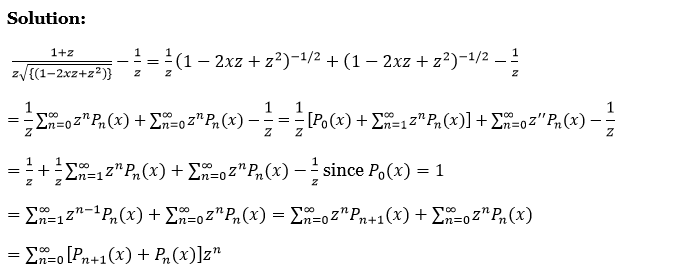
85. Find \(L\left\{e^{3 t} \sin ^2 t\right\}\).

Solution:

We have \( L\left\{\sin ^2 t\right\}=L\left\{\frac{1-\cos 2 t}{2}\right\}=\frac{1}{2}[L\{1\}-L\{\cos 2 t\}]\)

= \(\frac{1}{2}\left[\frac{1}{p}-\frac{p}{p^2+4}\right]=\frac{2}{p\left(p^2+4\right)}=f(p), \text { say }\)

By First Shifting Theorem,  \(L\left\{e^{3 t} \sin ^2 t\right\}=f(p-3)\)

= \(\left[\frac{2}{p\left(p^2+4\right)}\right]_{p \rightarrow p-3}=\frac{2}{(p-3)\left[(p-3)^2+4\right]}=\frac{2}{(p-3)\left(p^2-6 p+13\right)}\)

86. Find \(L\left(e^t \cos t \sin t\right)\).

Solution:

L\((\sin t \cos t)=L\left(\frac{\sin 2 t}{2}\right)=\frac{1}{2} L(\sin 2 t)=\frac{1}{2} \cdot \frac{2}{p^2+4}=\frac{1}{p^2+4}\)

L\(\left(e^t \cdot \sin t \cos t\right)=\left(\frac{1}{p^2+4}\right)_{p \rightarrow p-1}=\frac{1}{(p-1)^2+4}=\frac{1}{p^2+2 p+5} .\)

87. Find \(L\left\{e^t \sin 2 t \cos t\right\}\).

Solution:

L\(\{\sin 2 t \cos t\}=L\left\{\frac{\sin 3 t+\sin t}{2}\right\}=\frac{1}{2}[L\{\sin 3 t\}+L\{\sin t\}]=\frac{1}{2}\left[\frac{3}{p^2+9}+\frac{1}{p^2+1}\right]\)

By First Shifting Theorem,  \(L\left\{e^t \sin 2 t \cos t\right\}\)

= \(\frac{1}{2}\left[\frac{3}{p^2+9}+\frac{1}{p^2+1}\right]_{p \rightarrow p-1}=\frac{1}{2}\left[\frac{3}{(p-1)^2+9}+\frac{1}{(p-1)^2+1}\right]\)

= \(\frac{1}{2}\left[\frac{3}{p^2-2 p+10}+\frac{1}{p^2-2 p+2}\right] .\)

88. Find \(L\left\{e^{4 t} \sin 2 t \cos t\right\}\).

Solution:

We have \(L\{\sin 2 t \cos t\}=L\left\{\frac{1}{2}(2 \sin 2 t \cos t)\right\}=L\left\{\frac{1}{2}(\sin 3 t+\sin t)\right\}\)

= \(\frac{1}{2}[L\{\sin 3 t\}+L\{\sin t\}]=\frac{1}{2}\left[\frac{3}{p^2+3^2}+\frac{1}{p^2+1^2}\right]\)

By First Shifting Theorem, \(L\left\{e^{4 t} \cdot \sin 2 t \cos t\right\}=\frac{1}{2}\left[\frac{3}{p^2+9}+\frac{1}{p^2+1}\right]_{p \rightarrow p-4}\)

= \(\frac{1}{2}\left[\frac{3}{(p-4)^2+9}+\frac{1}{(p-4)^2+1}\right]=\frac{1}{2}\left[\frac{3}{p^2-8 p+25}+\frac{1}{p^2-8 p+17}\right]\)

89. Find \(L\left[e^{-2 t} \sin 2 t \sin 3 t\right]\).

Solution:

L\([\sin 2 t \sin 3 t]=L\left[\frac{\cos t-\cos 5 t}{2}\right]=\frac{1}{2}[L(\cos t)-L(\cos 5 t)]\)

= \(\frac{1}{2}\left[\frac{p}{p^2+1}-\frac{p}{p^2+25}\right]=\frac{12 p}{\left(p^2+1\right)\left(p^2+25\right)}\)

L\(\left(e^{-2 t} \sin 2 t \sin 3 t\right)=\left[\frac{12 p}{\left(p^2+1\right)\left(p^2+25\right)}\right]_{p \rightarrow p+2}=\frac{12(p+2)}{\left\{(p+2)^2+1\right\}\left\{(p+2)^2+25\right\}}\)

= \(\frac{12 p+24}{\left(p^2+4 p+5\right)\left(p^2+4 p+29\right)} .\)

90. Find \(L\left\{e^{-t}(3 \sin 2 t-5 \cosh 2 t)\right\}\).

Solution:

L\(\langle 3 \sin 2 t-5 \cosh 2 t\}=3 L\{\sin 2 t\}-5 \dot{L}[\cosh 2 t]\)

= \(3 \frac{2}{p^2+2^2}-5 \frac{p}{p^2-2^2}=\frac{6}{p^2+4}-\frac{5 p}{p^2-4}\)

L\(\left\{e^{-t}(3 \sin 2 t-5 \cosh 2 t)\right\}=\left[\frac{6}{p^2+4}-\frac{5 p}{p^2-4}\right]_{p \rightarrow p+2}=\frac{6}{(p+1)^2+4}-\frac{5(p+1)}{(p+1)^2-4}\)

= \(\frac{6}{p^2+2 p+5}-\frac{5 p+5}{p^2+2 p-3}\)

91. Evaluate \(L\left\{e^t\left(\cos 2 t+\frac{1}{2} \sinh 2 t\right)\right\}\).

Solution:

L\(\left\{\cos 2 t+\frac{1}{2} \sinh 2 t\right\}=L\{\cos 2 t\}+\frac{1}{2} L[\sinh 2 t]=\frac{p}{p^2+2^2}+\frac{1}{2} \cdot \frac{2}{p^2-2^2}\)

= \(\frac{p}{p^2+4}+\frac{1}{p^2-4}=f(p), \text { say. }\) ∴ By First Shifting Theorem,

L\(\left\{e^t\left(\cos 2 t+\frac{1}{2} \sinh 2 t\right)\right\}=f(p-1)=\left(\frac{p}{p^2+4}+\frac{1}{p^2-4}\right)_{p \rightarrow p-1}\)

= \(\frac{p-1}{(p-1)^2+4}+\frac{1}{(p-1)^2-4}=\frac{p-1}{p^2-2 p+5}+\frac{1}{p^2-2 p-3} .\)

92. Evaluate \(L\left\{e^{-t}\left(\cos 2 t+\frac{1}{2} \sinh 2 t\right)\right\}\).

Solution:

L\(\left\{\cos 2 t+\frac{1}{2} \sinh 2 t\right\}=L\{\cos 2 t\}+\frac{1}{2} L[\sinh 2 t]=\frac{p}{p^2+2^2}+\frac{1}{2} \cdot \frac{2}{p^2-2^2}\)

+ \(\frac{p}{p^2+4}+\frac{1}{p^2-4}=f(p) \text {, say. }\) ∴ By First Shifting Theorem,

L\(\left\{e^{-t}\left(\cos 2 t+\frac{1}{2} \sinh 2 t\right)\right\}=f(p+1)=\left(\frac{p}{p^2+4}+\frac{1}{p^2-4}\right)_{p \rightarrow p+1}\)

= \(\frac{p+1}{(p+1)^2+4}+\frac{1}{(p+1)^2-4}=\frac{p+1}{p^2+2 p+5}+\frac{1}{p^2+2 p-3} .\)

93. Find Laplace transform of \(L\left\{e^{2 t}(3 \sinh 2 t-5 \cosh 2 t)\right\}\).

Solution:

By First Shifting Theorem,

L\(\left\{e^{2 t}(3 \sinh 2 t-5 \cosh 2 t)\right\}=[L\{3 \sinh 2 t-5 \cosh 2 t\}]_{p \rightarrow p-2}\)

= \(\left[\frac{6}{p^2-4}-\frac{5 p}{p^2-4}\right]_{p \rightarrow p-2}=\frac{6-5(p-2)}{(p-2)^2-4}=\frac{16-5 p}{p^2-4 p} .\)

94. Find L(sinh ⁡at cos ⁡at).

Solution:

L\((\sinh a t \cos a t)=L\left[\left(\frac{e^{a t}+e^{-a t}}{2}\right) \cos a t\right]=\frac{1}{2} L\left(e^{a t} \cos a t\right)+\frac{1}{2} L\left(e^{-a t} \cos a t\right)\)

L\((\cos a t)=\frac{p}{p^2+a^2} \Rightarrow L\left(e^{a t} \cos a t\right)=\left(\frac{p}{p^2+a^2}\right)_{p \rightarrow p-a}=\frac{p-a}{(p-a)^2+a^2}=\frac{p-a}{p^2-2 a p+2 a^2}\)

Similarly \(L\left(e^{-a t} \cos a t\right)=\frac{p+a}{p^2+2 a p+2 a^2}\)

∴ \(L(\sinh a t \cos a t)=\frac{1}{2}\left[\frac{p-a}{p^2-2 a p+2 a^2}\right]+\frac{1}{2}\left[\frac{p+a}{p^2+2 a p+2 a^2}\right]\)

95. Find L{sinh⁡ at sin ⁡at}.

Solution:

Sice \(\sinh a t \sin a t=\frac{1}{2}\left(e^{a t}-e^{-a t}\right) \sin a t \text {, we have }\)

L\(\{\sinh a t \sin a t\}=\frac{1}{2}\left[L\left\{e^{a t} \sin a t\right\}-L\left\{e^{-a t} \sin a t\right\}\right]\)

= \(\frac{1}{2}\left[\frac{a}{(p-a)^2+a^2}-\frac{a}{(p+a)^2+a^2}\right]=\frac{a}{2}\left[\frac{(p+a)^2+a^2-(p-a)^2-a^2}{\left\{(p-a)^2+a^2\right\}\left\{(p+a)^2+a^2\right\}}\right]\)

= \(\frac{a}{2} \frac{4 a p}{\left(p^2+2 a^2\right)^2-(2 a p)^2}=\frac{2 a^2 p}{p^4+4 a^4}\)

96. Find L{cosh ⁡at cos⁡ at}

Solution:

L\(\{\cosh a t \cos a t\}=\frac{1}{2} L\left\{\left(e^{a t}+e^{-a t}\right) \cos a t\right\}=\frac{1}{2}\left[L\left\{e^{a t} \cos a t\right\}+L\left\{e^{-a t} \cos a t\right\}\right]\)

= \(\frac{1}{2}\left[\frac{(p-a)}{(p-a)^2+a^2}+\frac{p+a}{(p+a)^2+a^2}\right]\), Using First Shifting Theorem

= \(\frac{1}{2}\left[\frac{(p-a)\left(p^2+2 a^2+2 a p\right)+(p+a)\left(p^2+2 a^2-2 a p\right)}{p^4+4 a^4}\right]=\frac{1}{2}\left[\frac{2 p\left(p^2+2 a^2\right)-4 p a^2}{p^4+4 a^4}\right]\)

= \(\frac{p\left(p^2+2 a^2-2 a^2\right)}{p^4+4 a^4}=\frac{p^3}{p^4+4 a^4}\)

97. Find L{cosh ⁡at sin⁡ bt}.

Solution:

L\(\{\cosh a t \sin b t\}=L\left\{\left(\frac{e^{a t}+e^{-a t}}{2}\right) \sin b t\right\}=\frac{1}{2}\left[L\left\{e^{a t} \sin b t\right\}+L\left\{e^{-a t} \sin b t\right\}\right]\)

By First Shifting Theorem,

L\(\{\cosh a t \sin b t\}=\frac{1}{2}\left[\{L(\sin b t)\}_{p \rightarrow p-a}+\{L(\sin b t)\}_{p \rightarrow p+a}\right]\)

= \(\frac{1}{2}\left[\left(\frac{b}{p^2+b^2}\right)_{p \rightarrow p-a}+\left(\frac{b}{p^2+b^2}\right)_{p \rightarrow p+a}\right]=\frac{1}{2}\left[\frac{b}{(p-a)^2+b^2}+\frac{b}{(p+a)^2+b^2}\right]\)

= \(\frac{b}{2}\left[\frac{1}{p^2-2 a p+a^2+b^2}+\frac{1}{p^2+2 a p+a^2+b^2}\right]=\frac{b}{2}\left[\frac{\dot{2}\left(p^2+a^2+b^2\right)}{\left[(p-a)^2+b^2\right]\left[(p+a)^2+b^2\right]}\right]\)

= \(\frac{b\left(p^2+a^2+b^2\right)}{\left[(p-a)^2+b^2\right]\left[(p+a)^2+b^2\right]}\)

98. Evaluate \(L\left\{t^2 e^{-2 t}\right\}\).

Solution:

We know that \(L\left(t^2\right)=\frac{2 !}{t^3}=\frac{2}{p^3} \text { then } L\left(e^{-2 t} t^2\right)=\left(\frac{2}{p^3}\right)_{p \rightarrow p+2}=\frac{2}{(p+2)^3} \text {. }\)

99. Find \(L\left(e^{-4 t} t^2\right)\).

Solution:

We know that \(L\left(t^2\right)=\frac{2 !}{t^3}=\frac{2}{p^3} \text { then } L\left(e^{-4 t} t^2\right)=\left(\frac{2}{p^3}\right)_{p \rightarrow p+4}=\frac{2}{(p+4)^3}\)

100. Find \(\dot{L}\left\{e^{-3 t}\left(t^2+1\right)\right\}\).

Solution:

L\(\left\{\left(t^2+1\right)\right\}=L\left\{t^2\right\}+L\{1\}=\frac{2 !}{p^3}+\frac{1}{p}\)

L\(\left\{e^{-3 t}\left(t^2+1\right)\right\}=\left(\frac{2}{p^3}+\frac{1}{p}\right)_{p \rightarrow p+3}=\frac{2}{(p+3)^3}+\frac{1}{p+3}=\frac{2+(p+3)^2}{(p+3)^3}=\frac{p^2+6 p+11}{(p+3)^3}\)

101. Find \(L\left\{(t+3)^2 e^t\right\}\).

Solution:

We have \(L\left\{(t+3)^2\right\}=L\left\{t^2+6 t+9\right\}=\frac{2}{p^3}+\frac{6}{p^2}+\frac{9}{p}=f(p)\)

By First Shifting Theorem, \(L\left\{e^t(t+3)^2\right\}=f(p-1)=\left[\frac{2}{p^3}+\frac{6}{p^2}+\frac{9}{p}\right]_{p \rightarrow p-1}\)

= \(\frac{2}{(p-1)^3}+\frac{6}{(p-1)^2}+\frac{9}{(p-1)}=\frac{9 p^2-12 p+5}{(p-1)^3}\)

102. Find \(L\left\{(t+2)^2 e^t\right\}\).

Solution:

By First Shifting Theorem,

L\(\left\{(t+2)^2 e^t\right\}=\left[L\left\{(t+2)^2\right\}\right]_{p \rightarrow p-1}=\left[L\left\{t^2+4 t+4\right\}\right]_{p \rightarrow p-1}\)

= \(\left[\frac{2}{p^3}+\frac{4}{p^2}+\frac{4}{p}\right]_{p \rightarrow p-1}=\left[\frac{2+4 p+4 p^2}{p^3}\right]_{p \rightarrow p-1}=\frac{2+4(p-1)+4(p-1)^2}{(p-1)^3}\)

= \(\frac{2\left[1+2 p-2+2 p^2-4 p+2\right]}{(p-1)^3}=\frac{2\left(2 p^2-2 p+1\right)}{(p-1)^3}\)

103. Find \(L\left\{\left(1+t e^{-t}\right)^3\right\}\).

Solution:

We have \(\left(1+t e^{-t}\right)^3=1+3 t e^{-t}+3 t^2 e^{-2 t}+t^3 e^{-3 t} \text {. }\)

∴ \(L\left\{\left(1+t e^{-t}\right)^3\right\}=L\left\{1+3 t e^{-t}+3 t^2 e^{-2 t}+t^3 e^{-3 t}\right\}\)

= \(L\{1\}+3 L\left\{t e^{-t}\right\}+3 L\left\{t^2 e^{-2 t}\right\}+L\left\{t^3 e^{-3 t}\right\}, \text { using Linearity Property }\)

= \(\frac{1}{p}+3 \cdot \frac{1}{(p+1)^2}+3 \cdot \frac{2 !}{(p+2)^2}+\frac{3 !}{(p+3)^4}=\frac{1}{p}+\frac{3}{(p+1)^2}+\frac{6}{(p+2)^3}+\frac{6}{(p+3)^4}\)

104. Show that

1) \(L\{t \sin a t\}=\frac{2 a p}{\left(p^2+a^2\right)^2}\)

2) \(L\{t \cos a t\}=\frac{p^2-a^2}{\left(p^2+a^2\right)^2}\)

Solution:

Since, \(L\{t\}=\frac{1}{p^2} \text {, we have } L\left\{t e^{i a t}\right\}=\frac{1}{(p-i a)^2}=\frac{(p+i a)^2}{(p-i a)^2(p+i a)^2}\)

Equating the real and imaginary parts on both sides, we obtain

⇒ \(L\{t(\cos a t+i \sin a t)\}=\frac{\left(p^2-\dot{a}^2\right)+i 2 a p}{\left(p^2+a^2\right)^2}\)

1) \(L\{t \sin a t\}=\frac{2 a p}{\left(p^2+a^2\right)^2}\)

2) \(L\{t \cos a t\}=\frac{p^2-a^2}{\left(p^2+a^2\right)^2}\)

105. Find the Laplace transform of \(t e^{2 t}\) sin⁡3t.

Solution:

Since \(L\{t\}=\frac{1}{p^2}\), we have \(L\left\{t e^{i 3 t}\right\}=\frac{1}{(p-3 i)^2}=\frac{(p+3 i)^2}{(p-3 i)^2(p+3 i)^2}\)

⇒ \(L\{t \cos 3 t+i t \sin 3 t\}=\frac{\left(p^2-9\right)+i 6 p}{\left(p^2+9\right)^2}\)

Equating imaginary parts on both sides, we have \(L\{t \sin 3 t\}=\frac{6 p}{\left(p^2+9\right)^2}\)

Now applying the First Shifting theorem, we have \(L\left\{e^{2 t} t \sin 3 t\right\}=[L\{t \sin 3 t\}]_{p \rightarrow p-2}=\left[\frac{6 p}{\left(p^2+9\right)^2}\right]_{p \rightarrow p-2}=\frac{6(p-2)}{\left(p^2-4 p+13\right)^2}\)

106. State and prove the second translation or shifting theorem.

Solution:

Statement: If L[F(t)]=f(p) and \(G(t)=\left\{\begin{array}{l}F(t-a), t>a \text {. } \\ 0, t<a\end{array}\right.\) then \(L[G(t)]=e^{-a p} f(p)\).

Proof: \(L(G(t)]=\int_0^{\infty} e^{-s t} G(t) d t=\int_0^a e^{-p t} G(t) d t+\int_a^{\infty} e^{-p t} G(t) d t\)

= \(\int_0^a e^{-p t} 0 d t+\int_a^{\infty} e^{-p t} F(t-a) d t=\int_a^{\infty} e^{-p t} F(t-a) d t\)

Put u=t-a. Then, t=u+a and dt=du when t=a, u=0 and \(t \rightarrow \infty, u \rightarrow \infty\)

∴ \(L[G(t)]=\int_0^{\infty} e^{-p(u+a)} F(u) d u=e^{-a p} \int_0^{\infty} e^{-p u} F(u) d u=e^{-a p} f(p)\)

107. If L[F(t)]=f(p) and a>0, then prove that \(L\{F(t-a) H(t-a)\}=e^{-a p} f(p)\), where \(H(t)= \begin{cases}1, & \text { if } t>0 \\ 0, & \text { if } t<0\end{cases}\)

Solution:

By definition, \(L\{F(t-a) H(t-a)\}=\int_0^{\infty} e^{-p t} F(t-a) H(t-a) d t \rightarrow(1)\)

Put t-a=u so that dt=du.

Also when t=0, u=-a when \(t \rightarrow \infty, u \rightarrow \infty\).

Then \(L\{F(t-a) H(t-a)\}=\int_0^{\infty} e^{-p(u+a)} F(u) H(u) d u\) by (1)

⇒ \(\int_{-a}^0 e^{-p(u+a)} F(u) H(u) d u+\int_0^{\infty} e^{-p(u+a)} F(u) H(u) d u\)

= \(\int_{-a}^0 e^i-p(u+a) F(u) \cdot 0 d u+\int_0^{\infty} e^{-p(u+a)} F(u) \cdot 1 d u\), by Definition of H(t)

= \(\int_{-a}^0 e^{-p(u+a)} F(u) d u=e^{-p a} \int_0^{\infty} e^{-p u} F(u) d u=e^{-p a} \int_0^{\infty} e^{-p t} F(t) d t,\)

= \(e^{-p a} L\{F(t)\}=e^{-a p} f(p)\)

108. Find L[G(t)], where \(G(t)= \begin{cases}e^{t-a}, & t>a \\ 0, & t<a\end{cases}\).

Solution:

Let \(F(t)=e^t \text {. Then, } L[F(t)]=f(p)=\frac{1}{p-1}\)

∴ \(G(t)=\left\{\begin{array}{l}
F(t-a), t>a. \\
0, \quad t<a
\end{array}\right.\)

Then \(L[G(t)]=e^{-a p} f(p)=e^{-a p} \frac{1}{p-1}=\frac{e^{-a p}}{p-1}, p>1\)

109. Find L{G(t)} where \(G(t)=\left\{\begin{array}{cc}
\sin (t-2 \pi / 3), & t>2 \pi / 3 \\
0, & t<2 \pi / 3
\end{array}\right.\)

Solution:

Let \(F(t)=\sin t \text { so that } G(t)=\left\{\begin{array}{cl}
F(t-2 \pi / 3), & t>2 \pi / 3 . \\
0, & t<2 \pi / 3
\end{array}\right.\)

We know that, \(L(F(t)]=L(\sin t)=\frac{1}{p^2+1}=f(p)\)

∴ \(L[G(t)]=e^{\frac{-2 \pi}{3} p} \frac{1}{p^2+1}=\frac{e^{-2 \pi p / 3}}{p^2+1}, p>0\)

110. Find L{F(t)} where \(F(t)=\left\{\begin{array}{rr}
\sin \left(t-\frac{\pi}{3}\right), & t>\frac{\pi}{3} \\
0, & t<\frac{\pi}{3}
\end{array}\right\}\).

Solution:

Let \(G(t)=\sin t \text {. }\)

∴ \(L\{G(t)\}=L\{\sin t\}=\frac{1}{p^2+1}=f(p)\)

Now, \(F(t)=\left\{\begin{aligned}
\sin (t-\pi / 3), & t>\pi / 3 \\
0, & t>\pi / 3
\end{aligned}\right.\)

Applying second shifting theorem \(L\{G(t)\}=e^{-\pi p / 3} f(p)=\frac{e^{-\pi p / 3}}{p^2+1}\)

111. Find L[G(t)], where \(G(t)=\left\{\begin{array}{cc}
\sin 2 t, & 0<t<\pi \\
0, & t>\pi
\end{array}\right.\).

Solution:

L\([G(t)]=\int_0^{\infty} e^{-p t} G(t) d t 2=\int_0^\pi e^{-p t} \sin 2 t d t+\int_\pi^{\infty} e^{-p t}(0) d t\)

= \(\left[e^{-p t} \frac{-(p \sin 2 t+2 \cos 2 t)}{p^2+4}\right]_0^\pi=0\)

∴ \(\left[ \int e^{a x} \sin b x d x=\frac{e^{a x}}{a^2+b^2}(a \sin b x-b \cos b x)\right]\)

112. Find L{G(t)} where \(G(t)=\left\{\begin{array}{cl}
\cos (-t-\pi / 3), & \text { if } t>\pi / 3 \\
0, & \text { if } t<\pi / 3
\end{array}\right.\)

Solution:

Let \(F(t)=\cos t \text {. }\)

∴ \(L\{F(t)\}=L\{\cos t\}=\frac{p}{p^2+1}=f(p)\)

Now \(G(t)=\left\{\begin{array}{cc}
F(t-\pi / 3)=\cos (t-\pi / 3), & t>\pi / 3 \\
0, & t<\pi / 3
\end{array}\right.\)

Applying the second Shifting theorem, we get \(L\{(t)\}=e^{-\pi p / 3}\left(\frac{p}{p^2+1}\right)=\frac{p e^{-\pi p / 3}}{p^2+1}\)

Proceeding as above, we get L\(L[G(t)]=e^{-2 \pi p / p}\left(\frac{1}{p^2+1}\right)=\frac{p e^{-2 \pi p / 3}}{p^2+1}\)

113. Find L{F(t)} where \(F(t)=\left\{\begin{array}{cl}
\cos (t-2 \pi / 3), & \text { if } t>2 \pi / 3 \\
0, & \text { if } t<2 \pi / 3
\end{array}\right.\)

Solution:

Let \(G(t)=\cos t \text {. }\)

∴ \(L\{G(t)\}=L\{\cos t\}=\frac{p}{p^2+1}=f(p)\)

Now, \(F(t)=\left\{\begin{array}{cc}
G(t-2 \pi / 3)=\cos (t-2 \pi / 3), & t>2 \pi / 3 \\
0, & t<2 \pi / 3
\end{array}\right.\)

Applying second shifting theorem\(L\{F(t)\}=e^{-2 \pi p / 3}\left(\frac{p}{p^2+1}\right)=\frac{p e^{-2 \pi p / 3}}{p^2+1}\)

114. Find the Laplace transform of \((t-2)^3 u(t-2)\).

Solution:

Comparing the given function with \(f(t-a) u(t-a) \text {, we have } a=2 \text { and } f(t)=t^3\)

∴ \(L\{F(t)\}=L\left\{t^3\right\}=\frac{3 !}{p^4}=\frac{6}{p^4}=f(p)\)

Applying second shifting theorem \(L\left\{(t-2)^3 u(t-2)\right\}=e^{-2 p} \frac{6}{p^4}=\frac{6 e^{-2 p}}{p^4}\)

115. Find the Laplace transform of \(e^{-3 t} u(t-2)\).

Solution:

L\(\left\{e^{-3 t} u(t-2)\right\}=L\left\{e^{-3(t-2)} e^{-6} u(t-2)\right\}=e^{-6} L\left\{e^{-3(t-2)} u(t-2)\right\}\)

Taking,\(F(t)=e^{-3 t}, f(p)=\frac{1}{p+3}\)and using second shifting theorem, we have

L\(\left\{e^{-3 t} u(t-2)\right\} = e^{-6} e^{-2 p} \frac{1}{p+3}=\frac{e^{-2(p+3)}}{p+3}\)

116. State and prove a change of scale property.

Solution:

Statement: If \(L[F(t)]=f(p), \text { then } L[F(a t)]=\frac{1}{a} f\left(\frac{p}{a}\right)\)

Proof: We know that \(L[F(a t)]=\int_0^{\infty} e^{-p t} F(a t) d t\)

Put u = at Then, t = \(\frac{u}{a}\) and \(d t=\frac{d u}{a}\)

∴ \(L[F(a t)]=\int_0^{\infty} e^{-p u / a} F(u) \frac{d u}{a}=\frac{1}{a} \int_0^{\infty} e^{-p W a} F(u) d u=\frac{1}{a} \int_0^{\infty} e^{-(b / a) u} F(u) d u=\frac{1}{a} f\left(\frac{p}{a}\right)\)

117. Find L(cos⁡ 4t) by using the change of scale property.

Solution:

We have that \(L(\cos t)=\frac{p}{p^2+1}=f(p)\)

Then \(L(\cos 4 t)=\frac{1}{4} f\left(\frac{p}{4}\right)=\frac{1}{4} \cdot \frac{p / 4}{(p / 4)^2+1}=\frac{p}{p^2+16}, p>0 \text {. }\)

118. Find L{cos⁡ 5t} by using the change of scale property.Solution:

We have that \(L(\cos t)=\frac{p}{p^2+1}=f(p)\)

Then  \(L(\cos 5 t)=\frac{1}{5} f\left(\frac{p}{5}\right)=\frac{1}{5} \cdot \frac{p / 5}{(p / 5)^2+1}=\frac{p}{p^2+25}, p>0 \text {. }\)

119. Find L[sinh ⁡2t] by using the change of scale property.

Solution:

We have \(L[\sinh t]=\frac{1}{p^2-1}=f(p)\)

∴ \(L[\sinh 2 t]=\frac{1}{2} \cdot f\left(\frac{p}{2}\right)=\frac{1}{2} \cdot \frac{1}{(p / 2)^2-1}=\frac{2}{p^2-4}\)

120. Find \(L\left\{\sin ^2(a t)\right\}\) by using change of scale property.

Solution:

Since \(\sin ^2(a t)=\frac{1-\cos 2 a t}{2} \text {, we have }\)

L\(\left\{\sin ^2(a t)\right\}=\frac{1}{2} L\{(1-\cos 2 a t)\}=\frac{1}{2}[L(1)-L\{\cos 2 a t\}]=\frac{1}{2} \cdot \frac{1}{p}-\frac{1}{2} L\{\cos 2 a t\}\)

Taking \(F(t)=\cos t, f(p)=\frac{p}{p^2+1}\)

∴ \(L\{\cos (2 a t)\}=\frac{1}{2 a} \frac{p / 2 a}{(P / 2 a)^2+1}=\frac{p}{p^2+4 a^2}\)

Hence \(L\left\{\sin ^2 a t\right\}=\frac{1}{2 p}-\frac{1}{2} \frac{p}{p^2+4 a^2}=\frac{1}{2}\left[\frac{1}{p}-\frac{p}{p^2+4 a^2}\right]=\frac{2 a^2}{p\left(p^2+4 a^2\right)} \text {. }\)
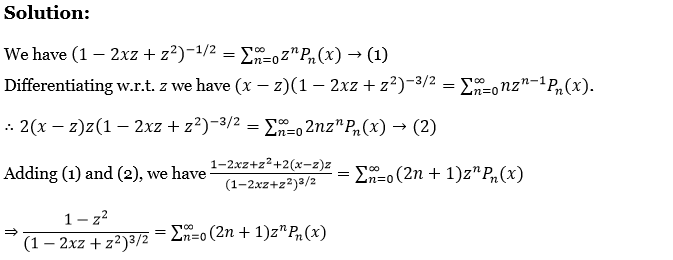
121. If \(L\{F(t)\}=\frac{1}{p} e^{-1 / p}\), prove that \(L\left\{e^{-t} F(3 t)\right\}=\frac{e^{-3 /(p+1)}}{p+1}\)

Solution:

L\(\{F(t)\}=\frac{1}{p} e^{-1 / p}=f(p)\)

∴ By the Change of Scale property, we have \(F(3 t)=\frac{1}{3} f\left(\frac{p}{3}\right)=\frac{1}{3} \cdot \frac{3}{p} e^{-3 / p}=\frac{1}{p} e^{-3 / p}\)

Now applying the First Shifting theorem, we get \(L\left\{e^{-t} F(3 t)\right\}=\frac{e^{-3 /(p+1)}}{p+1}\).

122. If \(L[F(t)]=\frac{9 p^2-12 p+15}{(p-1)^3}\) using change of scale property

Solution:

Given \(L[F(t)]=\frac{9 p^2-12 p+15}{(p-1)^3}=f(p)\).  By Change of Scale Property,

L\([F(3 t)]=\frac{1}{3} f\left(\frac{p}{3}\right)=\frac{1}{3} \cdot \frac{9(p / 3)^2-12(p / 3)+15}{(p / 3-1)^3}=\frac{9\left(p^2-4 p+15\right)}{(p-3)^3}\)

123. If \(L\{F(t)\}=\frac{p^2-p+1}{(2 p+1)^2(p-1)}\) then show that \(L\{F(2 t)\}=\frac{p^2-2 p+4}{4(p+1)^2(p-2)}\) by applying change of scale property,

Solution:

Given \(L\{F(t)\}=\frac{p^2-p+1}{(2 p+1)^2(p-1)}=f(p)\)

By Change of scale property,

L\(\{F(2 t)\}=\frac{1}{2} f\left(\frac{p}{2}\right)=\frac{1}{2}\left[\frac{\left(\frac{p}{2}\right)^2-\frac{p}{2}+1}{\left(2 \cdot \frac{p}{2}+1\right)\left(\frac{p}{2}-1\right)}\right]=\frac{1}{2}\left[\frac{-\frac{p^2-2 p+4}{4}}{\frac{(p+1)^2(p-2)}{4}}\right]=\frac{1}{4} \frac{p^2-2 p+4}{(p+1)^2(p-2)}\)


Bessel’s Equations Solved Exercise Problems

Bessel’s Equations Exercise 5

Solved Exercise Problems On Bessel’S Equations

1. Define Bessel’s differential equation.

Solution:

The differential equation of the form \(\frac{d^2 y}{d x^2}+\frac{1}{x} \frac{d y}{d x}+\left(1-\frac{n^2}{x^2}\right) y=0\) is called Bessel’s differential equation or Bessel’s equation.

Bessel’s Equations step-by-step solutions

2. Prove that \(a_0 x^n\left[1+(-1) \frac{x^2}{2^2 \cdot 1 !(n+1)}+(-1)^2 \frac{x^4}{2^4 2 !(n+1)(n+2)}+\ldots\right]\)and \(a_0 x^{-n}\left[1+(-1) \frac{x^2}{2^2 \cdot 1 !(-n+1)}+(-1)^2 \frac{x^4}{2^4 2 !(-n+1)(-n+2)}+\ldots .\right]\) are solutions of Bessel’s differential equation:

Solution:

Given

The Bessel’s differential equation is \(\frac{d^2 y}{d x^2}+\frac{1}{x} \frac{d y}{d x}+\left(1-\frac{n^2}{x^2}\right) y=0 \rightarrow \text { (1) }\)

Let us assume that its series solution is \(y=\sum_{r=0}^{\infty} a_r x^{k+r}\).

∴ \(\frac{d y}{d x}=\sum_{r=0}^{\infty} a_r(k+r) x^{k+r-1}\) and \(\frac{d^2 y}{d x^2}=\sum_{r=0}^{\infty} a_r(k+r)(k+r-1) x^{k+r-2}\)

Substituting these values in (1) we have \(\sum_{r=0}^{\infty} a_r\left[(k+r)(k+r-1) x^{k+r-2}+\frac{1}{x}(k+r) x^{k+r-1}+\left(1-\frac{n^2}{x^2}\right) x^{k+r}\right]=0\)

⇒ \(\sum_{r=0}^{\infty}\left[a_r\left\{(k+r)^2-n^2\right\} x^{k+r-2}+x^{k+r}\right]=0 \rightarrow \text { (2) }\)

Since (2) is an identity, the coefficients of various powers of x must be zero.

∴ Equating to zero the coefficient of lowest power of x, i.e., of \(x^{k-2}\) in (2), we have \(a_0\left(k^2-n^2\right)=0 \text {. }\)

Now \(a_0 \neq 0\) as it is the coefficient of the first term with which we begin the series.

∴ \(k^2-n^2=0 \Rightarrow k= \pm n \rightarrow \text { (3) }\)

Now equating to zero the coefficient of \(x^{k-1}\) in (2), we have \(a_1\left\{(k+1)^2-n^2\right\}=0\)

Now \(k= \pm n \Rightarrow(k+1)^2-n^2 \neq 0 \Rightarrow a_1=0\).

Again equating to zero the coefficient of the general term i.e. of \(x^{k+r}\) in (2), we have

⇒ \(a_{r+2}\left\{(k+r+2)^2-n^2\right\}+a_r=0 \Rightarrow a_{r+2}(k+r+n+2)(k+r-n+2)=-a_r\)

⇒ \(a_{r+2}=-\frac{a_r}{(k+r+n+2)(k+r-n+2)} \rightarrow \text { (4) }\)

Putting r=1 in (4), we have \(a_3=\frac{a_1}{(k+n+3)(k-n+3)}=0\), since \(a_1=0\).

Similarly putting \(r=3,5, \ldots\) etc. in (4), we have \(a_1=a_3=a_5 \ldots=0\) (each).

Now two cases arise.

Case 1: When k=n, from (4), we have \(a_{r+2}=-\frac{a_r}{(2 n+r+2)(r+2)}\)

Putting r=0,2,4 etc, we have \(a_2=-\frac{a_0}{(2 n+2)(2)}=-\frac{a_0}{2^2 \cdot 1(n+1)}\)

⇒ \(a_4=-\frac{a_2}{(2 n+4)(4)}=-\frac{a_2}{2^2 \cdot 2!(n+2)}=\frac{a_0}{2^4 \cdot 2!(n+1)(n+2)} \text { etc. }\)

∴ y = \(a_0\left[x^n-\frac{x^{n+2}}{2^2 \cdot 1!(n+1)}+\frac{x^{n+4}}{2^4 2!(n+1)(n+2) \ldots}\right]\)

= \(a_0 x^n\left[1+(-1) \frac{x^2}{2^2 \cdot 1!(n+1)}+(-1)^2 \frac{x^4}{2^4 2!(n+1)(n+2)}+\cdots\right]\)

Case 2: When k=-i. The series solution is obtained by replacing n by -n as \(a_0 x^{-n}\left[1+(-1) \frac{x^2}{2^2 \cdot 1!(-n+1)}+(-1)^2 \frac{x^4}{2^4 2!(-n+1)(-n+2)}+\cdots\right]\)

Examples Of Bessel’s Equations Solved Problems

3. Define Bessel’s function of the first kind of order n.

Solution:

If \(a_0=\frac{1}{2^n \Gamma(n+1)}\), then the solution of the Bessel’s equation, \(y=a_0 x^n\left[1+(-1) \frac{x^2}{2^2 \cdot 1!(n+1)}+(-1)^2 \frac{x^4}{2^4 2!(n+1)(n+2)}+\cdots\right]\) is called

Bessel’s function of the first kind of order n and it is denoted by \(J_n(x)\).

∴ \(J_n(x)=\frac{x^n}{2^n \Gamma(n+1)}\left[1+(-1) \frac{x^2}{2^2 \cdot 1!(n+1)}+(-1)^2 \frac{x^4}{2^4 \cdot 2!(n+1)(n+2)}+.\right]\)

= \(\frac{x^n}{2^n \Gamma(n+1)} \sum_{r=0}^{\infty}(-1)^r \frac{x^{2 r}}{2^{2 r} r!(n+1)(n+2) \ldots(n+r)}=\sum_{r=0}^{\infty}(-1)^r\left(\frac{x}{2}\right)^{n+2 r} \frac{1}{r!\Gamma(n+r+1)}\)

Bessel’s Differential Equation Solved Problems

4. Show that

1) \(J_{-n}(x)=(-1)^n J_n(x)\) when n is a positive integer and

2) \(J_n(-x)=(-1)^n J_n(x)\) for + ve or – ve integers.

Solution:

1) We have \(\int_{-n}(x)=\sum_{r=0}^{\infty}(-1)^r\left(\frac{x}{2}\right)^{-n+2 r} \frac{1}{r!\Gamma(-n+r+1)^r}\)

Since if p is an integer, then \(\Gamma(-p)\) is infinity for p>0,

∴ we get terms in \(J_{-n}\) equal to zero till -n+r+1<1, i.e., r<n.

Hence \(J_{-n}(x)=\sum_{r=0}^{\infty} \frac{(-1)^r}{r!\Gamma(-n+r+1)}\left(\frac{x}{2}\right)^{-n+2 r}=\sum_{s=0}^{\infty} \frac{(-1)^{n+s}}{(n+s)!\Gamma(s+1)}\left(\frac{x}{2}\right)^{n+2 s}\)

= \((-1)^n \sum_{s=0}^{\infty} \frac{(-1)^s}{\Gamma(n+s+1) s!}\left(\frac{x}{2}\right)^{n+2 s}=(-1)^n J_n(x) \text {. }\)

2) We know that \(J_n(x)=\sum_{r=0}^{\infty}(-1)^r \frac{1}{r!\Gamma(n+r+1)}\left(\frac{x}{2}\right)^{n+2 r}\)

Case 1. Let n be a+v e integer. Replacing x bY -x, we have

⇒ \(J_n(-x)=\sum_{r=0}^{\infty}(-1)^r \frac{1}{r!\Gamma(n+r+1)}\left(\frac{-x}{2}\right)^{n+2 r}\)

= \((-1)^n \sum_{r=0}^{\infty}(-1)^r \frac{1}{r!\Gamma(n+r+1)}\left(\frac{x}{2}\right)^{n+2 r}\)

= \((-1)^n J_n(x)\)

Case 2. If n is – ve integer, say n=-m where m is a + ve integer:

∴ \(J_n(x)=J_{-m}(x)=(-1)^m J_m(x)\)

Replacing x by -x

⇒ \(J_n(-x)=(-1)^m J_m(-x)=(-1)^m(-1)^m J_m(x)=(-1)^m J_{-m}(x)=(-1)^{2 m}(-1)^{-m} J_{-m}(x)\)

= \((-1)^{-m} J_{-m}(x)=(-1)^n J_n(x)\)

Hence \(J_n(-x)=(-1)^n J_n(x)\) for + ve or – ve integers.

Step-By-Step Guide To Solving Bessel’s Equations

5. If \(Y_n(x)\) is defined by \(Y_n(x)=\frac{\cos n \pi J_n(x)-J_{-n}(x)}{\sin n \pi}\), when n is not an integer and \(Y_n(x)=\lim _{r \rightarrow n} \frac{\cos r \pi J_r(x)-J_{-r}(x)}{\sin r \pi}\), when n is an integer then show that \(J_n(x)\) and \(Y_n(x)\)are two independent solutions of Bessel’s equation.

solution:

Case 1. Suppose n is not an integer.

Since n is not an integer, \(\sin n \pi \neq 0\).

Hence \(Y_n(x)\) is a linear combination of \(J_n(x)\) and \(J_{-n}(x)\). But \(J_n(x)\) and \(J_{-n}(x)\) are two independent solutions of Bessel’s equation.

Thus \(J_n(x)\) and \(Y_n(x)\) are two independent solutions of Bessel’s equation.

Case 2. Suppose n is an integer.

Since n is an integer, \(\cos n \pi=(-1)^n, \cos n \pi=0\) and \(J_{-n}(x)=(-1)^n J_n\)

Hence \(Y_n(x)\) is undefined. To make it meaningful, we define \(Y_n(x)=\lim _{r \rightarrow n} Y_r(x)=\lim _{r \rightarrow n} \frac{\cos r \pi J_r(x)-J_{-r}(x)}{\sin r \pi}=\lim _{r \rightarrow n} \frac{\frac{\partial}{\partial r}\left[\cos r \pi J_r(x)-J_{-r}(x)\right]}{\frac{\partial}{\partial r}[\sin r \pi]}\)

= \(\left[\frac{-\pi \sin r \pi J_r(x)+\cos r \pi \frac{\partial}{\partial r} J_r(x)-\frac{\partial}{\partial r} J_{-r}(x)}{\pi \cos r \pi}\right]_{r=n}\)

= \(\frac{\cos n \pi\left[\frac{\partial}{\partial r} J_r(x)\right]_{r=n}-\left[\frac{\partial}{\partial r} J_{-r}(x)\right]_{r=n}}{\pi \cos r \pi}\)

= \(\frac{(-1)^n\left[\frac{\partial}{\partial r} J_r(x)\right]_{r=n}-(-1)^{2 n}\left[\frac{\partial}{\partial r} J_{-r}(x)\right]_{r=n}}{\pi(-1)^n}\)

= \(\frac{1}{\pi}\left[\frac{\partial}{\partial r} J_r(x)-(-1)^n \frac{\partial}{\partial r} J_{-r}(x)\right]_{r=n}\)

Since \(J_r(x)\) and \(J_{-r}(x)\) are two solutions of Bessel’s equation, it can be proved that \(Y_n(x)\) is a solution of Bessel’s equation and it is independent with \(J_n(x)\).

Bessel’s Equations Solutions With Applications

6. Define Bessel’s function of the second kind of order n.

Solution:

The function \(Y_n(x)\) defined by \(Y_n(x)=\frac{\cos n \pi J_n(x)-J_{-n}(x)}{\sin n \pi}\), when n is not an integer and \(Y_n(x)=\lim _{r \rightarrow n} \frac{\cos r \pi J_r(x)-J_{-r}(x)}{\sin r \pi}\), when n is an integer is called Bessel’s function of the second kind of order n.

7. Write the general solution of the following equations

1) \(x^2 \frac{d^2 y}{d x^2}+x \frac{d y}{d x}+\left(x^2-64\right) y=0\)

2) \(x^2 \frac{d^2 y}{d x^2}+x \frac{d y}{d x}+\left(x^2-\frac{9}{16}\right) y=0\).

Solution:

1) Given equation is \(x^2 \frac{d^2 y}{d x^2}+x \frac{d y}{d x}+\left(x^2-64\right) y=0\)

⇒ \(x^2 \frac{d^2 y}{d x^2}+x \frac{d y}{d x}+\left(x^2-8^2\right) y=0\), which is a Bessel’s equation of order 8 , an integer

∴ It’s solution is \(y=a J_8(x)+b Y_8(x)\), where a and b are arbitrary constants.

2) Given equation is \(x^2 \frac{d^2 y}{d x^2}+x \frac{d y}{d x}+\left(x^2-\frac{9}{16}\right) y=0\)

⇒ \(x^2 \frac{d^2 y}{d x^2}+x \frac{d y}{d x}+\left[x^2-\left(\frac{3}{4}\right)^2\right] y=0\), which is a Bessel’s equation of order 3/4, not an integer.

∴ It’s solution is \(y=a J_8(x)+b J_{-3 / 4}(x)\), where a and b are arbitrary constants.

8. \(y=a_0\left(1-\frac{x^2}{2^2}+\frac{x^4}{2^2 \cdot 4^2}-\frac{x^6}{2^2 \cdot 4^2 \cdot 6^2} \cdots\right)\) is a solution of Bessel’s differential equation for n=0.

Solution:

The Bessel’s differential equation for n=0 is \(\frac{d^2 y}{d x^2}+\frac{1}{x} \frac{d y}{d x}+y=0 \rightarrow\) (1).

Let us assume that its solution is \(y^{\prime}=\sum_{r=0}^{\infty} a_r x^{k+r}\)

∴ \(\frac{d y}{d x}=\sum_{n=0}^{\infty} a_r(k+r) x^{k+r-1} \text { and } \frac{d^2 y}{d x^2}=\sum_{r=0}^{\infty} a_r(k+r)(k+r-1) x^{r+r-2}\)

Substituting these values in (1), we get \(\sum_{r=0}^{\infty} a_r\left[(k+r)(k+r-1) x^{k+r-2}+\frac{1}{x}(k+r) x^{k+r-1}+x^{k+r}\right]=0\)

⇒ \(\sum_{r=0}^{\infty} a_r\left[(k+r)^2 x^{k+r-2}+x^{k+r}\right]=0 \rightarrow \text { (2) }\)

which is an identity.

Equating to zero, the coefficient of lowest power of x i.e. \(x^{k-2}\), we have \(a_0 k^2=0\).

Since \(a_0 \neq 0\) we get \(k^2=0 \Rightarrow k=0 \rightarrow(3)\)

Now equating to zero the coefficient of next power of x, i.e., \(x^{k-1}\), we have \(a_1(k+1)^2=0 \text {. }\)

Since \(k+1 \neq 0\) by virtue of (3), we have \(a_1=0\).

Again equating to zero the coefficient of the general term, i.e. \(x^{k-r}\), we have \(a_{r+2}(k+r+2)^2+a_r=0 \Rightarrow a_{r+2}=-\frac{a_r}{(k+r+2)^2}\).

When \(k=0, a_{r+2}=-\frac{a_r}{(r+2)^2}\).

Putting \(r=1,3,5, \ldots\) etc., we have \(a_1=a_3=a_5=\cdots=0\) (each).

Again putting r=0,2,4, etc., we have \(a_2=-\frac{a_0}{2^2}, a_4=-\frac{a_2}{4^2}=\frac{a_0}{2^2 \cdot 4^2}\) etc.

Since \(y=\sum_{r=0}^{\infty} a_r x^r\), when k=0, we have \(y=a_0\left(1-\frac{x^2}{2^2}+\frac{x^4}{2^2 \cdot 4^2}-\frac{x^6}{2^2 \cdot 4^2 \cdot 6^2} \cdots\right)\)

Advanced Solved Examples On Bessel’s Equations

9. Prove that \(\ Lt_{x \rightarrow 0} \frac{J_n(x)}{x^n}=\frac{1}{2^n \Gamma(n+1)}\).

Solution:

⇒ \(J_n(x)=\frac{x^n}{2^n \Gamma(n+1)}\left[1-\frac{x^2}{4(n+1)}+\frac{x^4}{4 \cdot 8(n+1)(n+2)}-\cdots\right]\)

⇒ \(\ Lt_{x \rightarrow 0} \frac{J_n(x)}{x^n}=L_{x \rightarrow 0} \frac{1}{2^n \Gamma(n+1)}\left[1-\frac{x^2}{4(n+1)}+\frac{x^4}{4 \cdot 8(n+1)(n+2)}-\ldots\right]=\frac{1}{2^n \Gamma(n+1)} .\)

10. Show that

1) \(J_{-1 / 2}(x)=\sqrt{\left(\frac{2}{\pi x}\right)} \cos x\),

2) \(J_{1 / 2}(x)=\sqrt{\left(\frac{2}{\pi x}\right)} \sin x\) and

3) \(\left[J_{1 / 2}(x)\right]^2+\left[J_{-1 / 2}(x)\right]^2=\frac{2}{\pi x}\)

Solution:

We know that \(J_n(x)=\frac{x^n}{2^n \Gamma(n+1)}\left[1-\frac{x^2}{2(2 n+2)}+\frac{x^4}{2 \cdot 4(2 n+2)(2 n+4)}+\cdots\right]\)

1) Putting \(n=-\frac{1}{2}\) in \(J_n(x)\), we get \(J_{-1 / 2}(x)=\frac{x^{-1 / 2}}{2^{-1 / 2} \Gamma(1 / 2)}\left[1-\frac{x^2}{2(-1+2)}+\frac{x^4}{2 \cdot 4(-1+2)(-1+4)}-\cdots\right]\)

= \(\sqrt{\left(\frac{2}{\pi x}\right)}\left[1-\frac{x^2}{2!}+\frac{x^4}{4!} \cdots\right]=\sqrt{\left(\frac{2}{\pi x}\right)} \cos x\)

2) Putting \(n=\frac{1}{2}\), in \(J_n(x)\), we have

⇒ \(J_{1 / 2}(x)=\frac{x^{1 / 2}}{2^{1 / 2} \Gamma(3 / 2)}\left[1-\frac{x^2}{2(1+2)}+\frac{x^4}{2 \cdot 4 \cdot(1+2)(1+4)} \cdots\right]\)

= \(\sqrt{\left(\frac{x}{2}\right)} \frac{1}{\frac{1}{2} \sqrt{\pi}} \frac{1}{x}\left[x-\frac{x^3}{3!}+\frac{x^5}{5!}-\cdots\right]=\sqrt{\left(\frac{2}{\pi x}\right)} \sin x\)

3) \(\left[J_{1 / 2}(x)\right]^2+\left[J_{-1 / 2}(x)\right]^2=\left(\frac{2}{\pi x}\right) \cos ^2 x+\left(\frac{2}{\pi x}\right) \sin ^2 x=\frac{2}{\pi x}\)

11. Prove that \(\sqrt{\left(\frac{\pi x}{2}\right)} J_{3 / 2}(x)=\frac{1}{x} \sin x-\cos x\).

Solution:

We know that \(J_n(x)=\frac{x^n}{2^n \Gamma(n+1)}\left[1-\frac{x^2}{2(2 n+2)}+\frac{x^4}{2 \cdot 4(2 n+2)(2 n+4)} \cdots\right]\)

Putting n=3 / 2, we have \(J_{3 / 2}(x)=\frac{x^{3 / 2}}{2^{3 / 2} \Gamma(5 / 2)}[1-\frac{x^2}{2 \cdot 5}+\frac{x^4}{2 \cdot 4 \cdot 5 \cdot 7}\)

– \(\frac{x^6}{2 \cdot 4 \cdot 5 \cdot 6 \cdot 7 \cdot 9} \cdots]\)

= \(\frac{x \sqrt{x}}{2 \sqrt{2}(3 / 2)(1 / 2) \sqrt{\pi}}\left[1-\frac{x^2}{2 \cdot 5}+\frac{x^4}{2 \cdot 4 \cdot 5 \cdot 7}-\frac{x^6}{2 \cdot 4 \cdot 5 \cdot 6 \cdot 7 \cdot 9}+\cdots\right]\)

∴ \(\sqrt{\left(\frac{\pi x}{2}\right)} J_{\frac{3}{2}}(x)=\frac{1}{3}\left[x^2-\frac{x^4}{2 \cdot 5}+\frac{x^6}{2 \cdot 4 \cdot 5 \cdot 7}-\frac{x^8}{2 \cdot 4 \cdot 5 \cdot 6 \cdot 7 \cdot 9}\right]\)

= \(\frac{2 x^2}{3!}-\frac{4 x^4}{5!}+\frac{6 x^6}{7!}-\frac{8 x^8}{9!}+\cdots\)

= \(\left(\frac{1}{2!}-\frac{1}{3!}\right) x^2-\left(\frac{1}{4!}=\frac{1}{5!}\right) x^4+\left(\frac{1}{6!}-\frac{1}{7!}\right) x^6-\left(\frac{1}{8!}-\frac{1}{9!}\right) x^8 \cdots\)

= \(\left(\frac{x^2}{2!}-\frac{x^4}{4!}+\frac{x^6}{6!} \cdots\right)+\left(-\frac{x^2}{3!}+\frac{x^4}{5!}-\frac{x^6}{7!} \cdots\right)\)

= \(-\left(1-\frac{x^2}{2!}+\frac{x^4}{4}-\frac{x^6}{6!} \cdots\right)+\frac{1}{x}\left[x-\frac{x^3}{3!}+\frac{x^5}{5!}-\frac{x^7}{7!} \cdots\right]=-\cos x+\frac{1}{x} \sin x .\)

Hence \(\sqrt{\left(\frac{\pi x}{2}\right)} J_{3 / 2}(x)=\frac{1}{x} \sin x-\cos x\)

Worked examples of Bessel’s equations problems

12. Show that

1) \(J_{-3 / 2}(x)=-\sqrt{\left(\frac{2}{\pi x}\right)}\left[\sin x+\frac{1}{x} \cos x\right]\).

2) \(J_{5 / 2}(x)=\left[\frac{2}{\pi x}\right]^{1 / 2}\left[\frac{3-x^2}{x^2} \sin x-\frac{3}{x} \cos x\right]\).

Solution

We know that \(J_n(x)=\frac{x^{\prime \prime}}{2^n \Gamma(n+1)}\left[1-\frac{x^2}{2(2 n+2)}+\frac{x^4}{2 \cdot 4(2 n+2)(2 n+4)}-\cdots\right]\) → (1)

1) Put n=-3 / 2 in (1). Then

Put n=-3 / 2 in (1).

⇒ \(J_{-3 / 2}(x)=\frac{x^{-3 / 2}}{2^{-3 / 2} \Gamma\left(-\frac{3}{2}+1\right)}\left[1-\frac{x^2}{2(-3+2)}+\frac{x^4}{2 \cdot 4 \cdot(-3+2)(-3+4)}-\cdots\right]\)

= \(\frac{2 \sqrt{2}}{x^{3 / 2} \Gamma \Gamma\left(\frac{-1}{2}\right)^2}\left[1+\frac{x^2}{2}-\frac{x^4}{8}+\frac{x^0}{144}-\cdots\right]\)

= \(\frac{2 \sqrt{2}}{x^{3 / 2}(-2 \sqrt{\pi})}\left[1+\frac{x^2}{2}-\frac{x^4}{8}+\frac{x^6}{144}-\cdots\right]\)

= \(-\sqrt{\frac{2}{\pi x}}\left[\frac{1}{x}+\frac{x}{2}-\frac{x^3}{8}+\frac{x^5}{144}-\cdots\right]\)

= \(-\sqrt{\frac{2}{\pi r}}\left[\frac{1}{x}\left(1-\frac{x^2}{2!}+\frac{x^4}{4!}-\cdots\right)+\left(x-\frac{x^3}{3!}+\frac{x^5}{5!}-\cdots\right)\right]\)

= \(-\sqrt{\frac{2}{\pi x}}\left[\frac{1}{x} \cos x+\sin x\right]\)

2) Put n=5 / 2 in (1).

Then \(J_{5 / 2}(x)=\frac{x^{5 / 2}}{2^{5 / 2} \Gamma\left(\frac{5}{2}+1\right)}[1-\frac{x^2}{2 \cdot 7}\)

+ \(\frac{x^4}{2 \cdot 4 \cdot 7 \cdot 9}-\frac{x^6}{2 \cdot 4 \cdot 6 \cdot 7 \cdot 9 \cdot 11}+\cdots]\)

= \(\frac{x^{5 / 2}}{4 \sqrt{2}\left(\frac{5}{2}\right)\left(\frac{3}{2}\right)\left(\frac{1}{2}\right) \Gamma\left(\frac{1}{2}\right)}\left[1-\frac{x^2}{14}+\frac{x^4}{504}-\frac{x^6}{33264}+\cdots\right]\)

= \(\frac{x^2 \sqrt{2 x}}{15 \sqrt{\pi}}\left[1-\frac{x^2}{14}+\frac{x^4}{504}-\frac{x^6}{33264}+\cdots\right]\)

= \(\left[\frac{2}{\pi x}\right]^{1 / 2} \frac{1}{15}\left[x^3-\frac{x^5}{14}+\frac{x^7}{504}-\cdots\right]\)

= \(\left[\frac{2}{\pi x}\right]^{1 / 2}\left[\frac{x^3}{15}-\frac{x^5}{210}+\frac{x^7}{7560}-\cdots\right]\)

= \(\left[\frac{2}{\pi x}\right]^{1 / 2}\left[\frac{3}{x^2}\left(x-\frac{x^3}{3!}+\frac{x^5}{5!}-\cdots\right)-\left(x-\frac{x^3}{3!}+\frac{x^5}{5!}-\cdots\right)-\frac{3}{x}\left(1-\frac{x^2}{2!}+\frac{x^4}{4!}-\cdots\right)\right]\)

= \(\left[\frac{2}{\pi x}\right]^{1 / 2}\left[\frac{3}{x^2} \sin x-\sin x-\frac{3}{x} \cos x\right]=\left[\frac{2}{\pi x}\right]^{1 / 2}\left[\frac{3-x^2}{x^2} \sin x-\frac{3}{x} \cos x\right]\)

13. Show that \(\int_0^1 \frac{u J_0(x u)}{\left(1-u^2\right)^{1 / 2}}=\frac{\sin x}{x}\).

Solution:

We have \(J_0(x)=1-\frac{x^2}{2^2}+\frac{x^4}{2^2 \cdot 4^2}-\frac{x^6}{2^2 \cdot 4^2 \cdot 6^2}+\cdots \rightarrow(1)\)

∴ \(\int_0^1 \frac{u J_0(x u)}{\left(1-u^2\right)^{1 / 2}} d u\)

= \(\int_0^1 \frac{u}{\left(1-u^2\right)^{1 / 2}}\left(1-\frac{x^2}{4} u^2+\frac{x^4}{4 \cdot 16} u^4 \ldots\right) d u^{\pi / 2}\)

= \(\int_0^\pi \frac{\sin \theta}{\cos \theta}\left(1-\frac{x^2}{4} \sin ^2 \theta+\frac{x^4}{64} \sin ^4 \theta-\cdots\right) \cos \theta d \theta\)

(On putting \(u=\sin \theta\) and \(u=\cos \theta d \theta\))

= \(\int_0^{\pi / 2} \sin \theta d \theta-\frac{x^2}{4} \int_0^{\pi / 2} \sin ^3 \theta d \theta+\frac{x^4}{64} \int_0^{\pi / 2} \sin ^5 \theta d \theta \ldots\)

= \([-\cos \theta]_0^{\pi / 2}-\frac{x^2}{4} \times \frac{2}{3}+\frac{x^4}{64} \times \frac{4 \cdot 2}{5 \cdot 3}-\cdots\)

= \(1-\frac{x^2}{3!}+\frac{x^4}{5!}-\cdots=\frac{1}{x}\left(x-\frac{x^3}{3!}+\frac{x^5}{5!}+\cdots\right)=\frac{\sin x}{x}\)

Solutions for Bessel’s differential equation practice problems

14. Show that \(\int_0^{\pi / 2} J_1(z \cos \theta) d \theta=\frac{1-\cos z}{z}\).

Solution:

We have \(J_n(x)=\sum_{r=0}^{\infty} \frac{(-1)^r}{r!\Gamma(n+r+1)}\left(\frac{x}{2}\right)^{2 r+n} \rightarrow(1)\)

(1) ⇒ \(J_1(z \cos \theta)=\sum_{r=0}^{\infty} \frac{(-1)^r}{r!\Gamma(1+r+1)}\left(\frac{z \cos \theta}{2}\right)^{2 r+1}\)

∴ \(\int_0^{\pi / 2} J_1(z \cos \theta) d \theta=\sum_{r=0}^{\infty} \frac{(-1)^r z^{2 r+1}}{r!(r+1)!2^{2 r+1}} \int_0^{\pi / 2} \cos ^{2 r+1} \theta d \theta\)

= \(\sum_{r=0}^{\infty} \frac{(-1)^r z^{2 r+1}}{r!(r+1)!2^{2 r+1}} \cdot \frac{2 r(2 r-2) \ldots 4 \cdot 2}{(2 r+1)(2 r-1) \ldots 5 \cdot 3}\)

= \(\sum_{r=0}^{\infty} \frac{(-1)^r z^{2 r+1}}{r!(r+1)!2^{2 r+1}} \cdot \frac{[2 r(2 r-2) \ldots 4 \cdot 2]^2}{(2 r+1) 2 r(2 r-1)(2 r-2) \ldots 5 \cdot 4 \cdot 3 \cdot 2 \cdot 1}\)

= \(\sum_{r=0}^{\infty} \frac{(-1)^r z^{2 r+1}}{r!(r+1)!2^{2 r+1}} \cdot \frac{2^2(r!)^2}{(2 r+1)!}=\sum_{r=0}^{\infty} \frac{(-1)^r z^{2 r+1}}{2(r+1)(2 r+1)!}\)

= \(\frac{1}{z}-\frac{1}{z}+\frac{z}{2!}-\frac{z^3}{4!}+\frac{z^5}{6!}-\cdots=\frac{1}{z}-\frac{1}{z}\left(1+\frac{z^2}{2!}-\frac{z^4}{4!}+\frac{z^6}{6!}-\cdots\right)=\frac{1-\cos z}{z}\)

15. Prove that Recurrence Formula I : \(x J_n^{\prime}(x)=n J_n(x)-x J_{n+1}(x)\).

Solution:

We have \(J_n(x)=\sum_{r=0}^{\infty}(=1)^r\left(\frac{x}{2}\right)^{n+2 r} \frac{1}{r!\Gamma(n+r+1)}\) where n is a positive integer.

Differentiating w.r.t. x, we have \(J_n^{\prime}(x)=\sum_{r=0}^{\infty}(-1)^r \frac{(n+2 r)}{r!\Gamma(n+r+1)} \frac{1}{2}\left(\frac{x}{2}\right)^{n+2 r-1}\)

∴ \(x J_n^{\prime}(x)=x \sum_{r=0}^{\infty}(-1)^r \frac{(n+2 r)}{r!\Gamma(n+r+1)} \frac{1}{2}\left(\frac{x}{2}\right)^{n+2 r-1}\)

= \(\sum_{r=0}^{\infty}(-1)^r \frac{(n+2 r)}{r!\Gamma(n+r+1)}\left(\frac{x}{2}\right)^{n+2 r}\)

= \(\sum_{r=0}^{\infty}(-1)^r \frac{n}{r!\Gamma(n+r+1)}\left(\frac{x}{2}\right)^{n+2 r}\)

+ \(\sum_{r=0}^{\infty}(-1)^r \frac{2 r}{r!\Gamma(n+r+1)} \frac{x}{2}\left(\frac{x}{2}\right)^{n+2 r-1}\)

= \(n J_n(x)+x \sum_{r=1}^{\infty}(-1)^r \frac{1}{(r-1)!\Gamma(n+r+1)}\left(\frac{x}{2}\right)^{n+2 r-1}\) Putting r-1=s

= \(n J_n(x)-x \sum_{s=0}^{\infty}(-1)^s \frac{1}{s!\Gamma(n+1+s+1}\left(\frac{x}{2}\right)^{n+1+2 s}=n J_n(x)-x J_{n+1}(x) .\)

Hence \(x J_n^{\prime}=n J_n(x)-x J_{n+1}(x)\) which may also be written as \(\frac{d}{d x}\left(x^{-n} J_n\right)=-x^{-n} J_{n+1}\).

16. Prove that Recurrence Formula II : \(x J_n^{\prime}(x)=-n J_n(x)+x J_{n-1}(x)\).

Solution:

As in Recurrence Formula I, we have

⇒ \(x J_n^{\prime}(x)=\sum_{r=0}^{\infty}(-1)^r \frac{(n+2 r)}{r!\Gamma(n+r+1)}\left(\frac{x}{2}\right)^{n+2 r}\)

= \(\sum_{r=0}^{\infty}(-1)^r \frac{(2 n+2 r-n)}{r!\Gamma(n+r+1)}\left(\frac{x}{2}\right)^{n+2}\)

= \(-n \sum_{r=0}^{\infty}(-1)^r \frac{1}{r!\Gamma(n+r+1)}\left(\frac{x}{2}\right)^{n+2 r}\)

+ \(\sum_{r=0}^{\infty}(-1)^r \frac{(2 n+2 r)}{r!\Gamma(n+r+1)}\left(\frac{x}{2}\right)^{n+2 r}\)

= \(-n J_n(x)+\sum_{r=0}^{\infty}(-1)^r \frac{\dot{2}(n+r)}{r!\Gamma(n+r+1)}\left(\frac{x}{2}\right)^{n+2 r-1} \cdot\left(\frac{x}{2}\right)\)

= \(-n J_n(x)+x \sum_{r=0}^{\infty}(-1)^r \frac{1}{r!\Gamma(n+r)}\left(\frac{x}{2}\right)^{n+2 r-1}\)

= \(-n J_n(x)+x \sum_{r=0}^{\infty}(-1)^r \frac{1}{r!\Gamma(n-1+r+1)}\left(\frac{x}{2}\right)^{n-1+2 r}=-n J_n(x)+x J_{n-1}(x)\)

Hence \(x J_n^{\prime}(x)=-n J_n(x)+x J_{n-1}(x)\) which may also be written as \(\frac{d}{d x}\left(x^n J_n\right)=x^n J_{n-1}\)

17. Prove that Recurrence Formula 3: \(2 J_n^{\prime}(x)=J_{n-1}(x)-J_{n+1}(x)\).

Solution:

Recurrence formulas 1 and 2 are \(x J_n^{\prime}(x)=n J_n(x)-x J_{n+1}(x)\) and \(x J_n^{\prime}(x)=-n J_n(x)+x J_{n-1}(x) \text {. }\)

Adding we get \(2 x J_n^{\prime}(x)=x\left[J_{n-1}(x)-J_{n+1}(x)\right]\).

Hence \(2 J_n^{\prime}(x)=J_{n-1}(x)-J_{n+1}(x)\).

Aliter: \(J_n(x)=\sum_{r=0}^{\infty}(-1)^r \frac{1}{r!\Gamma(n+r+1)}\left(\frac{x}{2}\right)^{n+2 r}\)

⇒ \(2 J_n^{\prime}(x)=\sum_{r=0}^{\infty}(-1)^r \frac{2}{r!\Gamma(n+r+1)}(n+2 r) \frac{1}{2}\left(\frac{x}{2}\right)^{n+2 r-1}\)

= \(\sum_{r=0}^{\infty}(-1)^r \frac{(n+r+r)}{r!\Gamma(n+r+1)}\left(\frac{x}{2}\right)^{n+2 r-1}\)

= \(\sum_{r=0}^{\infty}(-1)^r \frac{(n+r)}{r!\Gamma(n+r+1)}\left(\frac{x}{2}\right)^{n+2 r-1}+\sum_{r=0}^{\infty}(-1)^r \frac{r}{r!\Gamma(n+r+1)}\left(\frac{x}{2}\right)^{n+2 r-1}\)

= \(\sum_{r=0}^{\infty}(-1)^r \frac{1}{r!\Gamma(n+r)}\left(\frac{x}{2}\right)^{n+2 r-1}-\sum_{r=0}^{\infty}(-1)^{r-1} \frac{1}{(r-1)!\Gamma(n+r+1)}\left(\frac{x}{2}\right)^{n+2 r-1}\)

= \(\sum_{r=0}^{\infty}(-1)^r \frac{1}{r!\Gamma(n-1+r+1)}\left(\frac{x}{2}\right)^{n-1+2 r}-\sum_{s=0}^{\infty}(-1)^s \frac{1}{s!\Gamma(1+n+s+1)}\left(\frac{x}{2}\right)^{n+1+2 s}\)

by putting r-1=s.

= \(J_{n-1}(x)-J_{n+1}(x) \text {. Hence } 2 J_n^{\prime}(x)=J_{n-1}(x)-J_{n+1}(x) \text {. }\)

18. Prove that Recurrence Formula 4: \(2 n J_n(x)=x\left[J_{n-1}(x)+J_{n+1}(x)\right]\).

Solution:

Writing Recurrence formula 1 and 2, we have \(x J_n^{\prime}(x)=n J_n(x)-x J_{n+1}(x)\) and \(x J_n^{\prime}(x)=-n J_n(x)+x J_{n-1}(x) \text {. }\)

Subtracting, we have \(0=2 n J_n(x)-x\left[J_{n+1}(x)+J_{n-1}(x)\right]\).

Hence \(2 n J_n(x)=x\left[J_{n+1}(x)+J_{n-1}(x)\right]\)

Aliter: \(J_n(x)=\sum_{r=0}^{\infty}(-1)^r \frac{1}{r!\Gamma(n+r+1)}\left(\frac{x}{2}\right)^{n+2 r}\)

∴ \(2 n J_n(x)=\sum_{r=0}^{\infty}(-1)^r \frac{(2 n+2 r-2 r)}{r!\Gamma(n+r+1)}\left(\frac{x}{2}\right)^{n+2 r}\)

= \(\sum_{r=0}^{\infty}(-1)^r \frac{2(n+r)}{r!\Gamma(n+r+1)}\left(\frac{x}{2}\right)^{n+2 r}-\sum_{r=0}^{\infty}(-1)^r-\frac{2 r}{r!\Gamma(n+r+1)}\left(\frac{x}{2}\right)^{n+2 r}\)

= \(x \sum_{r=0}^x(-1)^r \frac{1}{r!\Gamma(n-1+r-1)}\left(\frac{x}{2}\right)^{n-1+2}+x \sum_{r=0}^{\infty}(-1)^{r-1} \frac{1}{(r-1)!\Gamma(n+r+1)}\left(\frac{x}{2}\right)^{n+2 r-1}\)

= \(x J_{n-1}(x)+x \sum_{s=0}(-1)^s \frac{1}{s!\Gamma(n+1+s+1)} \times\left(\frac{x}{2}\right)^{n+1+2 s}\), by putting r-1=s

= \(x J_{n-1}(x)+x J_{n+1}(x)\)

Hence \(2 n J_n(x)=x\left[J_{n-1}(x)+J_{n+1}(x)\right]\).

19. Prove that Recurrence Formula 5: \(\frac{d}{d x}\left[x^{-n} J_n(x)\right]=x^{-n} J_{n+1}(x)\).

Solution:

⇒ \(\frac{d}{d x}\left[x^{-n} J_n(x)\right]=-n x^{-n-1} J_n(x)+x^{-n} J_n^{\prime}(x)=x^{-n-1}\left[-n J_n(x)+x J_n^{\prime}(x)\right]\)

= \(x^{-n-1}\left[-n J_n(x)+\left\{n J_n(x)-x J_{n+1}(x)\right\}\right]=x^{-n-1}\left[-x J_{n+1}(x)\right]=-x^{-n} J_{n+1}(x)\)

Hence \(\frac{d}{d x}\left[x^{-n} J_n(x)\right]=-x^{-n} J_{n+1}(x)\)

20. Prove that Recurrence Formula VI : \(\frac{d}{d x}\left[x^n J_n(x)\right]=x^n J_{n-1}(x)\).

Solution:

⇒ \(\frac{d}{d x}\left[x^n J_n(x)\right]=n x^{n-1} J_n(x)+x^n J_n^{\prime}(x)\)

= \(x^{n-1}\left[n J_n(x)+x J_n^{\prime}(x)\right]=x^{n-1}\left[n J_n(x)+\left\{-n J_n(x)+x J_{n-1}(x)\right\}\right]\)

= \(x^{n-1}\left[x J_{n-1}(x)\right]=x^n J_{n-1}(x)\)

Hence \(\frac{d}{d x}\left[x^n J_n(x)\right]=x^n J_{n-1}(x)\)

21. Prove that \(e^{x\left(z-\frac{1}{z}\right)}=\sum^{\infty} z^n J_n(x)\).

Solution:

⇒ \(e^{r(z-1 / z) / 2}=e^{n / 2} e^{-x / 2 z} \)

= \(\left[1+\frac{x z}{2}+\frac{1}{2!}\left(\frac{x z}{2}\right)^2+\cdots+\frac{1}{n!}\left(\frac{x z}{2}\right)^n+\frac{1}{(n+1)!}\left(\frac{x z}{2}\right)^{n+1}+\frac{1}{(n+2)!}\left(\frac{x z}{2}\right)^{n+2}+\cdots\right]\)

⇒ \({\left[1-\frac{x}{2 z}+\frac{1}{2!}\left(\frac{x}{2 z}\right)^2+\cdots+\frac{(-1)^n}{n!}\left(\frac{x}{2 z}\right)^n+\frac{(-1)^{n+1}}{(n+1)!}\left(\frac{x}{2 z}\right)^{n+1}+\frac{(-1)^{n+2}}{(n+2)!}\left(\frac{x}{2 z}\right)^{n+2}+\cdots\right]}\)

Coefficient of \(z^n\) in this product

= \(\frac{1}{n!}\left(\frac{x}{2}\right)^n-\frac{1}{(n+1)!}\left(\frac{x}{2}\right)\left(\frac{x}{2}\right)^{n+1}+\frac{1}{(n+2)!} \frac{1}{2!}\left(\frac{x}{2}\right)^2\left(\frac{x}{2}\right)^{n+2}+\cdots\)

= \(\frac{1}{n!}\left(\frac{x}{2}\right)^n-\frac{1}{(n+1)!}\left(\frac{x}{2}\right)^{n+2}+\frac{1}{2!(n+2)!}\left(\frac{x}{2}\right)^{n+4}+\cdots\)

= \(\frac{(-1)^0}{\Gamma(n+1)}\left(\frac{x}{2}\right)^n+\frac{(-1)}{1!\Gamma(n+2)}\left(\frac{x}{2}\right)^{n+2}+\frac{(-1)^2}{2!\Gamma(n+3)}\left(\frac{x}{2}\right)^{n+4}+\cdots\)

= \(\sum_{r=0}^{\infty}(-1)^r \frac{1}{r!\Gamma(n+r+1)}\left(\frac{x}{2}\right)^{n+2 r}=J_n(x)\)

Similarly, the coefficient of \(z^{-n}\) in the product

= \(\frac{(-1)^n}{n!}\left(\frac{x}{2}\right)^n+\frac{(-1)^{n+1}}{(n+1)!} \frac{x}{2}\left(\frac{x}{2}\right)^{n+1}+\frac{(-1)^{n+2}}{(n+2)!} \frac{1}{2!}\left(\frac{x}{2}\right)^2\left(\frac{x}{2}\right)^{n+2}+\cdots\)

= \((-1)^n\left[\frac{1}{n!}\left(\frac{x}{2}\right)^n+\frac{(-1)}{\Gamma(n+2)}\left(\frac{x}{2}\right)^{n+2}+\frac{(-1)^2}{2!\Gamma(n+3)}\left(\frac{x}{2}\right)^{n+4}+. .\right]=(-1)^n J_n(x) .\)

Hence \(e^{x\left(z-\frac{1}{2}\right)^2}=J_0+\left(z-\frac{1}{z}\right) J_1+\left(z^2+\frac{1}{z^2}\right)_2+\cdots\left[z^n+(-1)^n \frac{1}{z^n}\right] J_n+\cdots\)

= \(\sum_{-\infty}^{\infty} J_n(x), \text { since } J_{-n}(x)=(-1)^n J_n(x)\)

22. Prove that

1) \(\cos (x \sin \theta)=J_0+2 J_2 \cos 2 \theta+2 J_4 \cos 4 \theta+\ldots\)

2) \(\sin (x \sin \theta)=2 \sin \theta J_1+2 \sin 3 \theta J_3+\ldots+2 J_{2 m+1} \sin (2 m+1) \theta+\ldots\)

3) \(\cos x=J_0-2 J_2+2 J_4 \ldots\)

4) \(\sin x=2 J_1-2 J_3+2 J_5 \ldots\)

Solution:

We know that \(e^{(z-1 / z) / 2}=J_0+\left(z-\frac{1}{z}\right) J_1+\left(z^2+\frac{1}{z^2}\right) J_2+\left(z^3-\frac{1}{z^3}\right) J_3+\cdots\)

Putting \(z=e^{i \theta}\), we have

⇒ \(e^{x\left(\frac{e^{i \theta}-e^{-i \theta}}{2}\right)}=J_0+\left(e^{i \theta}-e^{-i \theta}\right) J_1+\left(e^{2 i \theta}+e^{-2 i \theta}\right) J_2+\left(e^{3 i \theta}-e^{-3 i \theta}\right) J_3+\cdots\)

⇒ \(e^{r i \sin \theta}=J_0+(2 i \sin \theta) J_1+(2 \cos 2 \theta) J_2+(2 i \sin 3 \theta) J_3+\cdots\)

⇒ \(\cos (x \sin \theta)+i \sin (x \sin \theta)\)

= \(\left(J_0+2 \cos 2 \theta J_2+2 \cos 4 \theta J_4+\cdots\right)+i\left(2 \sin \theta J_1+2 \sin 3 \theta J_3+\cdots\right)\)

Equating real and imaginary parts, we have

1) \(\cos (x \sin \theta)=J_0+2 J_2 \cos 2 \theta+2 J_4 \cos 4 \theta+\cdots+2 J_{2 m} \cos 2 m \theta+\cdots \rightarrow\) (1)

2) \(\sin (x \sin \theta)=2 \sin \theta J_1+2 \sin 3 \theta J_3+\cdots+2 J_{2 m+1} \sin (2 m+1) \theta+\cdots \rightarrow\) (2)

Putting \(\theta=\frac{\pi}{2}\) in (1) and (2) we have

3) \(\cos x=J_0-2 J_2+2 J_4+\cdots\) and

4) \(\sin x=2 J_1-2 J_3+2 J_5-\cdot\)

23. Express \(J_4(x)\) in terms of \(J_0 \text { and } J_1\).

Solution:

From recurrence relation 4, we have \(J_{n+1}(x)=\left(\frac{2 n}{x}\right) J_n(x)-J_{n-1}(x) \rightarrow\) (1)

Putting n=3 in (1), we get \(J_4(x)=\left(\frac{6}{x}\right) J_3(x)-J_2(x) \rightarrow(2)\)

Putting n=2 in (1), we get \(J_3(x)=\left(\frac{4}{x}\right) J_2(x)-J_1(x) \Rightarrow\) (3)

Substituting (3) in (2), we get \(J_4(x)=\frac{6}{x}\left[\frac{4}{x} J_2(x)-J_1(x)\right]-J_2(x)\)

⇒ \(J_4(x)=\left(\frac{24}{x^2}-1\right) J_2(x)-\frac{6}{x} J_1(x) \rightarrow(4)\)

Next, putting n=1 in (1) we get \(J_2(x)=\left(\frac{2}{x}\right) J_1(x)-J_0(x) \rightarrow\) (5)

Substituting (5) in (4), we get \(J_4(x)=\left(\frac{24}{x^2}-1\right)\left[\frac{2}{x} J_1(x)-J_0(x)\right]-\frac{6}{x} J_1(x)\)

⇒ \(J_4(x)=\left(\frac{48}{x^3}-\frac{8}{x}\right) J_1(x)-\left(\frac{24}{x^2}-1\right) J_0(x)\)

24. Prove that

1) \(J_0^{\prime}=-J_1\)

2) \(J_2=J_0^{\prime \prime}-x^{-1} J_0^{\prime}\) and

3) \(J_2-J_0=2 J_0^{\prime \prime}\).

Solution:

1) From Recurrence formula \(\mathrm{I}\), we have \(x J_n^{\prime}=n J_n-x J_{n+1}\).

Putting n=0, we have \(x J_0^{\prime}=-x J_1\)

∴ \(J_0^{\prime}=-J_1\)

2) From Recurrence formula {1}, we have \(x J_n^{\prime}=n J_n-x J_{n+1}\).

Putting n=1, we have \(x J_1^{\prime}=J_1-x J_2 \rightarrow\) (1).

But from (1): \(J_0^{\prime}=-J_1\).

∴ Differentiating, wehave \(J_0^{\prime \prime}=-J_1^{\prime}\).

Substituting these results in (1), we have \(-x J_0^{\prime \prime}=-J_0^{\prime}-x J_2 \Rightarrow x J_2=x J_0^{\prime \prime}-J_0^{\prime}\).

‍‍∴ \(J_2=J_0^{\prime \prime}-x^{-1} J_0^{\prime} \text {. }\)
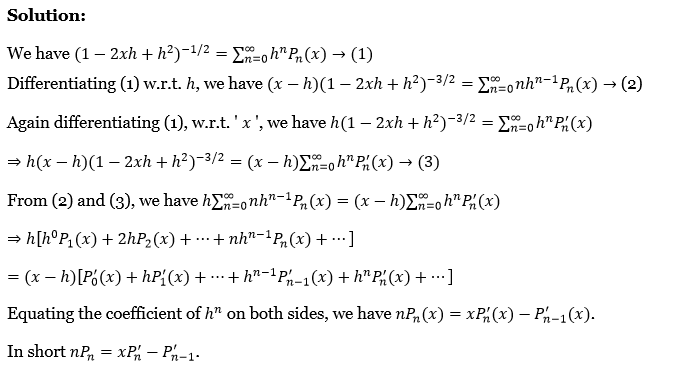
3) From Recurrence formula 3, we have \(2 J_n^{\prime}=J_{n-1}-J_{n+1} \rightarrow(A)\)

Differentiating both sides w.r.t. x and multiplying by 2 we have \(2^2 J_n^{\prime \prime}=2 J^{\prime}{ }_{n-1}-2 J^{\prime}{ }_{n+1} \rightarrow(B)\)

From (A), replacing n by (n-1) and (n+1) respectively, we have \(2 J_{n-1}^{\prime}=J_{n-2}-J_n \text { and } 2 J_{n+1}^{\prime}=J_n-J_{n+2}\)

Substituting these values in (B), we have \(2^2 J_n^{\prime \prime}=\left(J_{n-2}-J_n\right)-\left(J_n-J_{n+2}\right)=J_{n-2}-2 J_n+J_{n+2}\)

Putting n=0, we get \(2^2 J_0^{\prime \prime}=J_{-2}-2 J_0+J_2=(-1)^2 J_2-2 J_0+J_2=2 J_2-2 J_0\) since \(J_{-n}=(-1)^n J_n\)

Hence \(2 J_0^{\prime \prime}=J_2-J_0\)

25. Prove that \(4 \frac{d^2}{d x^2}\left[J_n(x)\right]=J_{n-2}(x)-2 J_n(x)+J_{n+2}(x)\).

Solution:

Recurrence formula 3 is \(2 J_n^{\prime}(x)=J_{n-1}(x)-J_{n+1}(x) \rightarrow(1)\)

Replacing n by n-1 in (1), we get \(2 J_{n-1}^{\prime}(x)=J_{n-2}(x)-J_n(x) \rightarrow\) (2)

Replacing n by n+1 in (1), we get \(2 J_{n+1}^{\prime}(x)=J_n(x)-J_{n+2}(x) \rightarrow\) (3)

From (1), (2) and (3); \(4 \frac{d^2}{d x^2}\left[J_n(x)\right]=2 \frac{d}{d x}\left\{2 J_n^{\prime}(x)\right\}=2 \frac{d}{d x}\left\{J_{n-1}(x)-J_{n+1}(x)\right\}=2 J_{n-1}^{\prime}(x)-2 J_{n+1}^{\prime}(x)\)

= \(J_{n-2}(x)-J_n(x)-J_n(x)+J_{n+2}(x)=J_{n-2}(x)-2 J_n(x)+J_{n+2}(x)\)

26. Establish the differential formula \(x^2 J_n^{\prime \prime}(x)=\left(n^2-n-x^2\right) J_n(x)+x J_{n+1}(x) \text { for } n=0,1,2, \ldots\)

Solution:

Writing recurrence formula I, we have \(x J_n^{\prime}(x)=n J_n(x)-x J_{n+1}(x) \rightarrow(1)\)

Differentiating both sides w.r.t. x, we have

⇒ \(x J_n^{\prime \prime}(x)+J_n^{\prime}(x)=n J_n^{\prime}(x)-x J_{n+1}^{\prime}(x)-J_{n+1}(x)\)

⇒ \(x^2 J_n^{\prime \prime}(x)=(n-1) x J_n^{\prime}(x)-x \cdot x J_{n+1}^{\prime}(x)-x J_{n+1}(x) \rightarrow(2)\)

From recurrence formula 2, we have \(x J_n^{\prime}(x)=-n J_n(x)+x J_{n-1}(x)\).

Writing (n+1) for n; we have \(x J_{n+1}^{\prime}(x)=-(n+1) J_{n+1}(x)+x J_n(x) \rightarrow\) (3)

Substituting for \(x J_n^{\prime}(x)\) from (1) and for \(x J_{n+1}^{\prime}(x)\) from (3) in (2),

we have \(x^2 J_n^{\prime \prime}(x)=(n-1)[n J_n(x)-x J_{n+1}(x)-x\left[-(n+1) J_{n+1}(x)+x J_n(x)\right]-x J_{n+1}(x)]\)

= \(\left(n^2-n-x^2\right) J_n(x)+x J_{n+1}(x) .\)

27. Prove that

1) \(J_{n-1}=\frac{2}{x}\left[n J_n-(n+2) J_{n+2}+(n+4) J_{n+4} \cdots\right]\)

2) \(\frac{1}{2} x J_n=(n+1) J_{n+1}-(n+3) J_{n+3}+(n+5) J_{n+5}+\ldots\)

3) \(J_n^{\prime}=\frac{2}{x}\left[\frac{n}{2} J_n-(n+2) J_{n+2}+(n+4) J_{n+4} \cdots \cdots\right]\)

Solution:

1) From recurrence formula 4, we have \(x\left(J_{n-1}+J_{n+1}\right)=2 n J_n \Rightarrow J_{n-1}+J_{n+1}=\frac{2}{x} n J_n \rightarrow \text { (1). }\)

Replacing n by (n+2), and changing sign, we get \(-J_{n+1}-J_{n+3}=\frac{-2}{x}(n+2) J_{n+2} \rightarrow(2)\)

Again replacing n by (n+4) in (1), we have \(J_{n+3}+J_{n+5}=\frac{2}{x}(n+4) J_{n+4} \rightarrow\) (3)

Again replacing n by (n+6) in (1) and changing the sign, we have \(-J_{n+5}-J_{n+7}=\frac{2}{x}(n+6) J_{n+6} \rightarrow(4)\)

……..

……..

Adding (1), (2), (3), (4), etc., we have \(J_{n-1}=\frac{2}{x}\left[n J_n-(n+2) J_{n+2}+(n+4) J_{n+4}-(n+6) J_{n+6} \cdots\right]\)

2) Replacing n by (n+1), we have \(\frac{x}{2} J_n=(n+1) J_{n+1}-(n+3) J_{n+3}+(n+5) J_{n+5} \cdots\)

3) From recurrence formula II, we have \(J_n^{\prime}=-\frac{n}{x} J_n+J_{n-1}\).

Substituting the value of \(J_{n-1}\) from (1), we have \(J_n^{\prime}=-\frac{n}{x} J_n+\frac{2}{x}\left[n J_n-(n+2) J_{n+2}+(n+4) J_{n+4} \cdots\right]\)

= \(\frac{2}{x}\left[\frac{n}{2} J_n-(n+2) J_{n+2}+(n+4) J_{n+4} \cdots\right]\)

28. Prove that

1) \(\frac{d}{d x}\left[J_n^2+J_{n+1}^2\right]=2\left(\frac{n}{x} J_n^2-\frac{n+1}{x} J_{n+1}^2\right)\)

2) \(J_0^2+2\left(J_1^2+J_2^2+J_3^2+\ldots\right)=1\)

3) \(\left|J_0(x)\right| \leq 1,\left|J_n(x)\right| \leq 2^{-1 / 2},(n \geq 1)\)

Solution:

From recurrence formula 1, we have \(J_n^{\prime}=\frac{n}{x} J_n-J_{n+1} \rightarrow\) (1)

Also from recurrence formula 2, we have \(J_n^{\prime}=-\frac{n}{x} J_n+J_{n-1}\)

Replacing n by (n+1), we have \(J_{n+1}^{\prime}=-\frac{n+1}{x} J_{n+1}+J_n \rightarrow\) (3)

Substituting the values of \(J_n^{\prime}\) and \(J_{n+1}^{\prime}\) from (2) and (3), we have

⇒ \(\frac{d}{d x}\left(J_n^2+J_{n+1}^2\right)=2 J_n J_n^{\prime}+2 J_{n+1} J_{n+1}^{\prime}\)

= \(2 J_n\left(\frac{n}{\chi} J_n-J_{n+1}\right)+2 J_{n+1}\left(-\frac{n+1}{x} J_{n+1}+J_n\right)=2\left(\frac{n}{x} J_n^2-\frac{n+1}{x} J_{n+1}^2\right)\)

2) From (1), we have \(\frac{d}{d x}\left(J_n^2+J_{n+1}^2\right)=2\left(\frac{n}{x} J_n^2-\frac{n+1}{x} J_{n+1}^2\right)\)

Putting n=0,1,2,3, ….. etc., we have

⇒ \(\frac{d}{d x}\left(J_0^2+J_1^2\right)=2\left(0-\frac{1}{x} J_1^2\right)\)

⇒ \(\frac{d}{d x}\left(J_1^2+J_2^2\right)=2\left(\frac{1}{x} J_1^2-\frac{2}{x} J_2^2\right)\)

⇒ \(\frac{d}{d x}\left(J_2^2+J_3^2\right)=2\left(\frac{2}{x} J_2^2-\frac{3}{x} J_3^2\right)\)

………

………

Adding all these, we have \(\frac{d}{d x}\left[J_0^2+2\left(J_1^2+J_2^2+J_3^2+..\right)\right]=0\)

Integrating, we have \(J_0^2+2\left(J_1^2+J_2^2+J_3^2+\cdots\right)=c\) (constant), Putting x=0, we get \(\left(J_0^2\right)_{x=0}=c\), since

⇒ \(\left(J_1\right)_{x=0}=0,\left(J_2\right)_{x=0}=0\) etc.

⇒ \(\left(J_0^2\right)_{x=0}=c \Rightarrow 1=c\).

Hence \(J_0^2+2\left(J_1^2+J_2^2+J_3^2+\cdots\right)=1\).

3) We have proved that \(J_0^2+2\left(J_1^2+J_2^2+J_3^2 \cdots+J_n^2+\cdots\right)=1\)

Since \(J_1^2, J_2^2, J_3^2 \ldots\) are all positive or zero.

∴ \(J_0^2 \leq 1 \Rightarrow\left|J_0\right| \leq 1\), i.e.. \(\left|J_0(x)\right| \leq 1\).

Also \(|2 J_n^2| \leq 1 \Rightarrow W_n |\leq \frac{1}{\sqrt{2}}\), i.e., \(\left|J_n(x)\right| \leq 2^{-1 / 2}\) (for \(n \geq 1\)).

29. Prove that \(J_n(x)=0\) has no repeated roots except at x=0.

Solution:

If possible let α be a repeated root of \(J_n(x)=0\).

∴ \(J_n(\alpha)=0 \text { and } J_n^{\prime}(\alpha)=0 \rightarrow(1)\)

From Recurrence formulas 1 and 2, we have \(J_{n+1}(x)=\frac{n}{x} J_n-J_n^{\prime}(x)\) and \(J_{n-1}(x)=\frac{n}{x} J_n+J_n^{\prime}(x)\)

∴ \(J_{n+1}(\alpha)=0\) and \(J_{n-1}(\alpha)=0\) with the help of (1), i.e., for the same value of \(x, J_n(x), J_{n+1}(x)\) and \(J_{n-1}(x)\) are all zero, which is absurd as we cannot have two power series having the same sum function. Thus \(J_n(x)=0\) cannot have repeated roots except at x=0.

30. Show that \(\int_0^x x^n J_{n-1}(x) d x=x^n J_n(x)\).

Solution:

Recurrence formula VI is \(\frac{d}{d x}\left[x^n J_n(x)\right]=x^n J_{n-1}(x)\)

Integrate this between the limits 0 to x, we get

∴ \(\left[x^n J_n(x)\right]_0^x=\int_0^x x^n J_{n-1}(x) d x \Rightarrow \int_0^x x^n J_{n-1}(x) d x=x^n J_n(x) .\).

31. Show that \(\int_0^x x^{n+1} J_n(x) d x=x^{n+1} J_{n+1}(x)\).

Solution:

Recurrence formula VI is \(\frac{d}{d x}\left[x^n J_n(x)\right]=x^n J_{n-1}(x)\)

Replace n by n+1, we get \(\frac{d}{d x}\left[x^{n+1} J_{n+1}(x)\right]=x^{n+1} J_n(x)\)

Integrate this between the limits 0 to x we get

\(\left[x^{n+1} J_{n+1}(x)\right]=\int_0^x x^{n+1} J_n(x) d x \Rightarrow \int_0^x x^{n+1} J_n(x) d x=x^{n+1} J_{n+1}(x) .\).

32. Prove that \(\int_a^b J_0(x) J_1(x) d x=\frac{1}{2}\left[J_0^2(a)-J_0^2(b)\right]\).

Solution:

Recurrence relation VII is \(\frac{d}{d x}\left[x^{-n} J_n(x)\right]=-x^{-n} J_{n+1}(x) \Rightarrow \frac{d}{d x} J_0(x)=-J_1(x)\)

∴\(\int_a^b J_0(x) J_1(x) d x=-\int_a^b J_0(x) J_0^{\prime}(x) d x=-\left[\frac{\left[J_0(x)\right]^2}{2}\right]_a^b=\frac{1}{2}\left[J_0^2(a)-J_0^2(b)\right]\).

33. Prove that

1) \(\frac{d}{d x}\left(x J_n J_{n+1}\right)=x\left(J_n^2-J_{n+1}^2\right)\)

2) \(x=2 J_0 J_1+6 J_1 J_2+\ldots+2(2 n+1) J_n J_{n+1}+\ldots\)

Solution:

1) \(\frac{d}{d x}\left(x J_n J_{n+1}\right)=J_n J_{n+1}+x\left(J_n^{\prime} J_{n+1}+J_n J_{n+1}^{\prime}\right)\)

= \(J_n J_{n+1}+\left(x J_n^{\prime}\right) J_{n+1}+J_n\left(x J_{n+1}^{\prime}\right) \rightarrow \text { (1) }\)

From Recurrence formulas 1 and 2, we have \(x J_n^{\prime}=n J_n-x J_{n+1} \rightarrow\) (2)

and \(x J_n^{\prime}=-n J_n+x J_{n-1} \rightarrow \text { (3). }\)

Replacing n by (n+1) in (3), we have \(x J_{n+1}^{\prime}=-(n+1) J_{n+1}+x J_n \rightarrow\) (4)

Substituting the values of \(x J_n^{\prime}\) and \(x J_{n+1}^{\prime}\) from (2) and (4), in (1), we have

∴ \(\frac{d}{d x}\left(x J_n J_{n+1}\right)=J_n J_{n+1}+\left(n J_n-x J_{n+1}\right) J_{n+1}+J_n\left\{-(n+1) J_{n+1}+x J_n\right\}=x\left(J_n^2-J_{n+1}^2\right) \text {. }\)
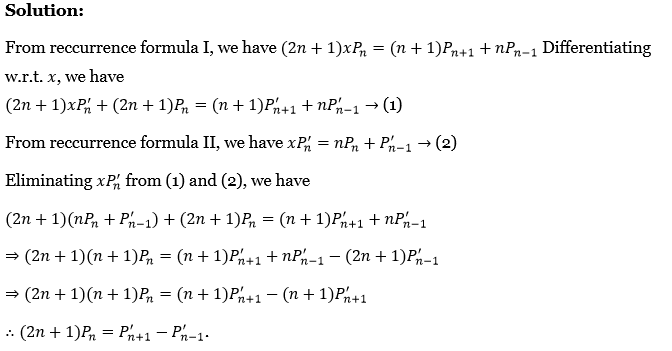
2) From (1), we have \(\frac{d}{d x}\left(x J_n J_{n+1}\right)=x\left(J_n^2-J_{n+1}^2\right)\)

Putting n=0,1,2,3, ….. we have

⇒ \(\frac{d}{d x}\left(x J_0 J_1\right)=x\left(J_0^2-J_1^2\right) \rightarrow(1)\)

⇒ \(\frac{d}{d x}\left(x J_1 J_2\right)=x\left(J_1^2-J_2^2\right) \rightarrow(2)\)

⇒ \(\frac{d}{d x}\left(x J_2 J_3\right)=x\left(J_2^2-J_3^2\right) \rightarrow(3)\)

⇒ \(\frac{d}{d x}\left(x J_3 J_4\right)=x\left(J_3^2-J_4^2\right) \rightarrow(4)\)

………..

…….

Multiplying (1), (2), (3)… by 1,3,5, ………. respectively and adding we have

⇒ \(\frac{d}{d x} {\left[x\left(J_0 J_1+3 J_1 J_2+5 J_2 J_3+\cdots\right)\right]=x\left[\left(J_0^2-J_1^2\right)+3\left(J_1^2-J_2^2\right)+5\left(J_2^2-J_3^2\right)+\cdots\right] }\)

= \(x\left[J_0^2+2\left(J_1^2+J_2^2+\cdots\right)\right]=x \cdot 1=x\)

Integrating both sides, we have \(x\left(J_0 J_1+3 J_1 J_2+5 J_2 J_2+\cdots\right)=\frac{x^2}{2}+c\) (constant)

Putting x=0, we get 0=0+c ∴ c=0

Hence \(x\left(J_0 J_1+3 J_1 J_2+5 J_2 J_3+\cdots\right)=\frac{x^2}{2}\)

⇒ \(2 J_0 J_1+6 J_1 J_2+10 J_2 J_3+\cdots+2(2 n+1) J_n J_{n+1}+\cdots=x\)

34. Show that \(2^r J_n^r=J_{n-r}-r J_{n-r+2}+\frac{r(r-1)}{2 !} J_{n-r+4}-\cdots+(-1)^r J_{n+r}\)

Solution:

Recurrence formula 3 is \(2 J_n{ }^{\prime}=J_{n-1}-J_{n+1} \rightarrow\) (1)

Replacing n by (n-1) and (n+1) respectively in (1), we get \(2 J_{n-1}^{\prime}=J_{n-2}-J_n \rightarrow\) (2)

and \(2 J_{n+1}^{\prime}=J_n-J_{n+2} \rightarrow \text { (3) }\)

Differentiating (1), w.r.t. ‘ x ‘, we have \(2 J_n^{\prime \prime}=J_{n-1}^{\prime}-J^{\prime}{ }_{n+1} \Rightarrow 2^2 J_n^{\prime \prime}=2 J_{n-1}^{\prime}-2 J_{n+1}^{\prime} \rightarrow \text { (4) }\)

Substituting the values of \(2 J_{n-1}^{\prime}\) and \(2 J_{n+1}^{\prime}\) from (2) and (3) obtained in (4), we get \(2^2 J_n^{\prime \prime}=\left(J_{n-2}^{\prime}-J_n\right)-\left(J_n-J_{n+2}\right)=J_{n-2}-2 J_n+J_{n+2}^{\prime \prime} \text {. }\)
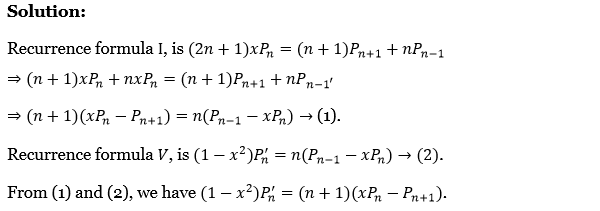
Differentiating (4) again, and multiplying by 2, we have \(2^3 J_n^{\prime \prime \prime}=2 J_{n-2}^{\prime}-2^2 J_n^{\prime}+2{ }_{n+2}^{\prime} \rightarrow \text { (5). }\)

Substituting in (5), the values of \(2 J_n^{\prime}, 2 J_{n-2}^{\prime}, 2 J_{n+2}^{\prime}\) from (1), the last two obtained by replacing n by (n-2) and (n+2) respectively in (1),

we get \(^3 J_n^{\prime \prime \prime}=\left(J_{n-3}-J_{n-1}\right)-2\left(J_{n-1}-J_{n+1}\right)+\left(J_{n+1}-J_{n+2}\right)\)

= \(J_{n-2}-3 J_{n-1}+3 J_{n+1}-J_{n+2}=J_{n-2}-{ }^3 C_1 J_{n-1}+{ }^2 C_2 J_{n+1}-{ }^3 C_3 J_{n+3}\)

Applying the same process again, and again, we have \(2^r J_n^r=J_{n-r}-{ }^r C_1 J_{n-r+2}+{ }^r C_2 J_{n-r+4}+\cdots+(-1)^r \cdot{ }^r C_r J_{n+r}\)

= \(J_{n-r}-r J_{n-r+2}+\frac{r(r-1)}{2!} J_{n-r+4}+\cdots+(-1)^r J_{n+r}\)

35. Prove that \(J_n J_{-n}^{\prime}-J_n^{\prime} J_{-n}=-\frac{2 \sin n \pi}{x \pi}\).

Solution:

We know that \(J_n\) and \(J_{-n}\) are solutions of Bessel’s equation \(y^{\prime \prime}+\frac{1}{x} y^{\prime}+\left(1-\frac{n^2}{x^2}\right) y=0\)

∴ \(J_n^{\prime \prime}+\frac{1}{x} J_n^{\prime}+\left(1-\frac{n^2}{x^2}\right) J_n=0 \rightarrow\) (1)

and \(J_{-n}^{\prime \prime}+\frac{1}{x} J_{-n}^{\prime}+\left(1-\frac{n^2}{x^2}\right) J_{-n}=0 \rightarrow \text { (2) }\)

Multiplying (1) by \(J_{-n}\) and (2) by \(J_n\) and then substracting. we get \(J_n^{\prime \prime} J_{-n}-J_{-n}^{\prime \prime} J_n+\frac{1}{x}\left(J_n^{\prime} J_{-n}-J_{-n}^{\prime} J_n\right)=0 \rightarrow (3)\)

Let \(J_n{ }^{\prime} J_{-n}-J_{-n}^{\prime} J_n=v \rightarrow(4)\)

Differentiating (4) w.r.t. x we get \(\left(J_n^{\prime \prime} J_{-n}+J_n^{\prime} J_{-n}^{\prime}\right)-\left(J_{-n}^{\prime \prime} J_n+J_{-n}^{\prime} J_n^{\prime}\right)=v^{\prime}\)

⇒ \(J_n^{\prime \prime} J_{-n}-J_{-n}^{\prime \prime} J_n=v^{\prime} \rightarrow \text { (5) }\)

Using (4) and (5), (3) becomes \(v^{\prime}+\left(\frac{1}{x}\right) v=0 \Rightarrow \frac{d v}{d x}+\frac{1}{x} v=0 \Rightarrow \frac{1}{v} d v+\frac{1}{x} d x=0\)

Integrating, we get \(\log v+\log x=\log c \Rightarrow v=\frac{c}{x} \Rightarrow J_n^{\prime} J_{-n}-J_{-n}^{\prime} J_n=\frac{c}{x} \rightarrow\) (6) by (4)

Now, \(J_n(x)=\frac{1}{2^n \Gamma(n+1)}\left[x^n-\frac{x^{n+2}}{4(n+1)}+\frac{x^{n+4}}{4 \cdot 8 \cdot(n+1)(n+2)}-\cdots\right]\)

and \(J_{-n}(x)=\frac{1}{2^{-n} \Gamma(-n+1)}\left[x^{-n}-\frac{x^{2-n}}{4(1-n)}+\frac{x^{4-n}}{4 \cdot 8 \cdot(1-n)(2-n)}-\cdots\right]\)

∴ Using the above values of \(J_n\) and \(J_{-n}\), and from (6) we have

⇒ \(\frac{1}{2^n \Gamma(n+1)}\left[n x^{n-1}-\frac{(n+2) x^{n+1}}{4(n+1)}+(n+4) \frac{x^{n+3}}{4 \cdot 8 \cdot(1-n)(2-n)}-\cdots\right]\)

x \(\frac{1}{2^{-n} \Gamma(-n+1)}\left[x^{-n}-\frac{x^{2-n}}{4(1-n)}+\frac{x^{4-n}}{4 \cdot 8 \cdot(1-n)(2-n)}-\cdots\right]\)

– \(\frac{1}{2^{-n} \Gamma(-n+1)}\left[-n x^{-n-1}-(2-n) \frac{x^{1-n}}{4(1-n)}+(4-n) \frac{x^{3-n}}{4 \cdot 8 \cdot(1-n)(2-n)}-\cdots\right]\)

x \(\frac{1}{2^n \Gamma(n+1)}\left[x^n-\frac{x^{n+2}}{4(n+1)}+\frac{x^{n+4}}{4 \cdot 8 \cdot(n+1)(n+2)}-\cdots\right]=\frac{c}{x}\)

Now comparing the coefficients of \(\frac{1}{x}\) from both sides, we get

⇒ \(\frac{n}{2^n \Gamma(n+1) \cdot 2^{-n} \Gamma(-n+1)}+\frac{n}{2^{-n} \cdot \Gamma(-n+1) 2^n \Gamma(n+1)}=c\)

⇒ \(c=\frac{2 n}{n \Gamma(n) \Gamma(1-n)} \Rightarrow c=\frac{2}{(\pi / \sin n \pi)}=\frac{2 \sin n \pi}{\pi}\)

(because \(\Gamma(n) \Gamma(1-n)=\frac{\pi}{\sin n \pi}\))

Putting this value of c in (6) and multiplying both sides by (-1), we get \(J_n J_{-n}^{\prime}-J_n^{\prime} J_{-n}=-\frac{2 \sin n \pi}{\pi x}\)

36. Prove that \(\frac{J_{n+1}}{J_n}=\frac{(x / 2)}{(n+1)-\frac{(x / 2)^2}{(n+2)-\frac{(x / 2)^2}{(n+3)} \cdots}}\)

Solution:

Since \(J_n\) and \(J_{-n}\) are the solutions of the Bessel’s differential equation.

⇒ \(\frac{d^2 y}{d x^2}+\frac{1}{x}-\frac{d y}{d x}+\left(1-\frac{n^2}{x^2}\right) y=0\), we have \(\frac{d^2 J_n}{d x^2}+\frac{1}{x} \frac{d J_n}{d x}+\left(1-\frac{n^2}{x^2}\right) J_n=0 \rightarrow(1)\) and \(\frac{d^2 J_{-n}}{d x^2}+\frac{1}{x} \frac{d J_{-n}}{d x}+\left(1-\frac{n^2}{x^2}\right) J_{-n}=0 \rightarrow (2)\)

Multiplying (1) by \(J_{-n}\) and (2) by \(J_n\) and subtracting, we have

⇒ \(\left(J_{-n} \frac{d^2 J_n}{d x^2}-J_n \frac{d^2 J_{-n}}{d x^2}\right)+\frac{1}{x}\left(J_{-n} \frac{d J_n}{d x}-J_n \frac{d J_{-n}}{d x}\right)=0\)

⇒ \(\frac{J_{-n} \frac{d^2 J_n}{d x^2}-J_n}{J_{-n} \frac{d J_n}{d x}-J_n}\) \(\frac{\frac{d^2 J_{-n}}{d x^2}}{\frac{d J_{-n}}{d x}}=-\frac{1}{x}\)

Integrating both the sides w.r.t x, we have \(\log \left(J_{-n} \frac{d J_n}{d x}-J_n \frac{d J_n}{x}\right)=-\log x+\log A\)

where A is an arbitrary constant. ∴ \({-n} \frac{d J_n}{d x}-J_n \frac{d J_{-n}}{d x}=\frac{A}{x} \rightarrow(3)\)

∴ \(\frac{1}{2^{-n} \Gamma(-n+1)}\left[x^{-n}-\frac{x^{-n+2}}{2(-2 n+2)}+\frac{x^{-n+4}}{2 \cdot 4(-2 n+2)(-2 n+4)} \cdots\right]\)

x \(\frac{1}{2^n \Gamma(n+1)}\left[n x^{n-1}-\frac{(n+2) x^{n+1}}{2 \cdot(2 n+2)}+\frac{(n+4) x^{n+3}}{2 \cdot 4(2 n+2)(2 n+4)} \cdots\right]\)

– \(\frac{1}{2^n \Gamma(n+1)} \cdot\left[x^n-\frac{x^{n+2}}{2(2 n+2)}+\frac{x^{n+4}}{2 \cdot 4(2 n+2)(2 n+4)}\right]\)

x \(\frac{1}{2^{-n} \Gamma(-n+1)}\left[-n x^{-n-1}-\frac{(-n+2) x^{-n+1}}{2 \cdot(-2 n+2)}+\frac{(-n+4) x^{-n+3}}{2 \cdot 4(-2 n+2)(-2 n+4)}\right]=\frac{A}{x}\).

Comparing coefficient of \(\frac{1}{x}\) on both the sides, we have \(\frac{1}{\Gamma(-n+1) \Gamma(n+1)}[n-(-n)]=A \Rightarrow A=\frac{2 n}{\Gamma(-n+1) \Gamma(n+1)}=\frac{2}{\Gamma(1-n) \Gamma(n)}\)

= \(\frac{2}{\frac{\pi}{\sin n \pi}}=\frac{2 \sin n \pi}{\pi}\), since \(\Gamma(n) \Gamma(1-n)=\frac{\pi}{\sin n \pi}\)

Hence from (3), we have \(J_{-n} \frac{d J_n}{d x}-J_n \frac{d J_{-n}}{d x}=\frac{2 \sin n \pi}{\pi x}\)

Dividing both sides by \(-J_n^2\), we get \(\frac{\frac{d J_{-n}}{d x} J_n-J_{-n} \frac{d J_n}{d x}}{J_n^2}=-\frac{2 \sin n \pi}{\pi x J_n^2} \Rightarrow \frac{d}{d x}\left(\frac{J_{-n}}{J_n}\right)=-\frac{2 \sin n \pi}{\pi x J_n^2}\).

37. Prove that \(\frac{d}{d x}\left(\frac{J_{-n}}{J_n}\right)=-\frac{2 \sin n \pi}{\pi x J_n^2}\).

Solution:

1) Recurrence relation 6 is \(\left.\frac{d}{d x}\left(x^n J_n\right)=x^n J_{n-1} \Rightarrow\left(\frac{1}{x} \frac{d}{d x}\right)\left(x^n J_n\right)=x^{n-1} J_{n-1}\right)\)

Now, \(\left(\frac{1}{x} \frac{d}{d x}\right)^m\left(x^n J_n\right)\)

= \(\left(\frac{1}{x} \frac{d}{d x}\right)^{m-1}\left(\frac{1}{x} \frac{d}{d x}\right)\left(x^n J_n\right)=\left(\frac{1}{x} \frac{d}{d x}\right)^{m-1}\left(x^{n-1} J_{n-1}\right) \cdots\)

= \(x^{n-m} J_{n-m}\), on preceeding as before m times more.

2) Recurrence relation 7 is \(\frac{d}{d x}\left(x^{-n} J_n\right)=-x^{-n} J_{n+1} \Rightarrow\left(\frac{1}{x} \frac{d}{d x}\right)\left(x^{-n} J_{n+1}\right)=(-1)^1 x^{-n-1} J_{n+1}\)

Now \(\left(\frac{1}{x} \frac{d}{d x}\right)^m\left(x^{-n} J_n\right)=\left(\frac{1}{x} \frac{d}{d x}\right)^{m-1}\left(\frac{1}{x} \frac{d}{d x}\right)\left(x^{-n} J_n\right)=\left(\frac{1}{x} \frac{d}{d x}\right)^{m-1}(-1)^1 x^{n-1} J_{n+1}\)

……. = \((-1)^m x^{-n-m} J_{n+m} \rightarrow(3)\), on proceeding as before m times more.

3) Replacing n by o and m by  n in part \(\left(\frac{1}{x} \frac{d}{d x}\right)^m\left(x^{-n} J_n\right)=(-1)^m x^{-n-m} J_{n+m}\), we get

⇒ \(\left(\frac{1}{x} \frac{d}{d x}\right)^n J_0=(-1)^n x^{-n} J_n \Rightarrow J_n(x)=(-1)^n x^n\left(\frac{1}{x} \frac{d}{d x}\right)^n J_0(x)\)
38. Prove that
1) \(\left(\frac{1}{x} \frac{d}{d x}\right)^m\left(x^n J_n\right)=x^{n-m} J_{n-m}\), where m is positive integer and m<n.

2) \(\left(\frac{1}{x} \frac{d}{d x}\right)^m\left(x^{-n} J_n\right)=(-1)^m x^{-n-m} J_{n+m}\)

3) \(J_n(x)=(-1)^n x^n\left(\frac{1}{x} \frac{d}{d x}\right)^n J_0(x)\),n being positive integer

Solution:

From recurrence formula 4, we have \(J_{n-1}+J_{n+1}=\frac{2 n}{x} J_n \Rightarrow J_{n-1}=\frac{2 n}{x} J_n-J_{n+1}\).

Replacing n by (n+1), we have \(J_n=\frac{2(n+1)}{x} J_{n+1}-J_{n+2} \Rightarrow \frac{J_n}{J_{n+1}}=\frac{2(n+1)}{x}-\frac{J_{n+2}}{J_{n+1}} \rightarrow \text { (1). }\)

Replacing n by (n+1) in (1), we have \(\frac{J_{n+1}}{J_{n+2}}=\frac{2(n+2)}{x}-\frac{J_{n+3}}{J_{n+2}} \rightarrow\) (2) and etc.

⇒ \(\frac{J_{n+1}}{J_n}=\frac{1}{\frac{J_n}{J_{n+1}}}=\frac{1}{\frac{2(n+1)}{x}-\frac{J_{n+2}}{J_{n+1}}}\)

= \(\frac{1}{\frac{2(n+1)}{x}-\frac{1}{\frac{J n+1}{J n+2}}}=\frac{1}{\frac{2(n+1)}{x}-\frac{1}{\frac{2(n+2)}{x}-\frac{J_{n+3}}{J_{n+2}}}}\)

= \(\frac{1}{\frac{2(n+1)}{x}-\frac{1}{\frac{2(n+2)}{x}-\frac{1}{J n+2}}}=\frac{1}{\frac{2(n+1)}{x}-\frac{1}{\frac{2(n+2)}{x}-\frac{1}{\frac{2(n+3)}{x} \ldots}}}\)

= \(\frac{x / 2}{(n+1)-\frac{x / 2}{\frac{2(n+2)}{x}-\frac{1}{\frac{2(n+3)}{x}} \cdots}}=\frac{x / 2}{(n+1)-\frac{x}{(x / 2)^2}}\)

= \(\frac{(x / 2)}{(n+1)-\frac{(x / 2)^2}{(n+2)-\frac{(x / 2)^2}{(n+3)} \cdots}}\)

39. Show that \(x^n J_n(x)\) is a solution of \(x \frac{d^2 y}{d x^2}+(1-2 n) \frac{d y}{d x}+x y=0\).

Solution:

Given equation is \(x \frac{d^2 y}{d x^2}+(1-2 n) \frac{d y}{d x}+x y=0 \rightarrow\) (1)

Let \(y=x^n J_n(x) \rightarrow(2)\)

Recurrence relation 6 is \(\frac{d}{d x}\left[x^n J_n(x)\right]=x^n J_{n-1}(x) \Rightarrow \frac{d y}{d x}=x^n J_{n-1}\)

and hence \(\frac{d^2 y}{d x^2}=x^n J_{n-1}^{\prime}+n x^{n-1} J_{n-1}\)

From recurrence relation 1 we have \(J_n^{\prime}(x)=\frac{n}{x} J_n-J_{n+1}(x) \Rightarrow J_{n-1}^{\prime}-\frac{n-1}{x} J_{n-1}=-J_n(x) \rightarrow \text { (5) }\)

∴ \(x\left(x^n J_{n-1}^{\prime}+n x^{n-1} J_{n-1}\right)+(1-2 n) x^n J_{n-1}+x^{n+1} J_n\)

=\(x^{n+1} J_{n-1}^{\prime}-(n-1) x^n J_{n-1}+x^{n+1} J_n\)

= \(x^{n+1}\left[J_{n-1}^{\prime}-\frac{(n-1)}{x} J_{n-1}\right]+x^{n+1} J_n=x^{n+1} J_n-x^{n+1} J_n=0\)

Hence \(x^n J_n\) is a solution of \(x \frac{d^2 y}{d x^2}+(1-2 n) \frac{d y}{d x}+x y=0\).

40. Show that \(x^{-n} J_n(x)\) is a solution of \(x \frac{d^2 y}{d x^2}+(1+2 n) \frac{d y}{d x}+x y=0\).

Solution:

Given equation is \(x \frac{d^2 y}{d x^2}+(1+2 n) \frac{d y}{d x}+x y=0 \rightarrow\) (1)

Let \(y=x^{-n} J_n(x) \rightarrow(2)\)

Recurrence relation V is \(\frac{d}{d x}\left\{-x^n J_n(x)\right\}=-x^{-n} J_{n+1}(x) \Rightarrow \frac{d y}{d x}=-x^{-n} J_{n+1}\)

and hence \(\frac{d^2 y}{d x^2}=-x^{-n} J_{n+1}^{\prime}+n x^{-n-1} J_{n+1} \rightarrow\) (3)

From recurrence relation 2, we have \(J_n^{\prime}(x)=J_{n-1}(x)-\frac{n}{x} J_n \Rightarrow J_{n+1}^{\prime}+\frac{n+1}{x} J_{n+1}=J_n(x)\)

∴ \(x\left(-x^{-n} J_{n+1}^{\prime}+n x^{-n-1} J_{n+1}\right)+(1+2 n)\left(-x^{-n} J_{n+1}\right)+x^{-n+1} J_n\)

= \(-x^{-n+1} J_{n+1}^{\prime}-(n+1) x^{-n} J_{n+1}+x^{-n+1} J_n\)

=\(-x^{-n+1}\left[J_{n+1}^{\prime}+\frac{n+1}{x} J_{n+1}\right]+x^{-n+1} J_n=-x^{-n+1} J_n+x^{-n+1} J_n=0\)

Hence \(x^{-n} J_n\) is a solution of \(x \frac{d^2 y}{d x^2}+(1+2 n) \frac{d y}{d x}+x y=0\)

41. Show that \(y=x^{-n / 2} J_n(2 \sqrt{x})\) satisfies the differential equation \(x \frac{d^2 y}{d x^2}+(n+1) \frac{d y}{d x}+y=0\).

Solution:

Put \(2 \sqrt{x}=t\). Then \(x=\frac{t^2}{4} \Rightarrow \frac{d x}{d t}=\frac{t}{2}\)

Now \(y=x^{-n / 2} J_n(2 \sqrt{x})=\left(\frac{t^2}{4}\right)^{-n / 2} J_n(t)=\left(\frac{t}{2}\right)^{-n} J_n(t)\)

⇒ \( \frac{d y}{d x}=\frac{d y}{d t} \frac{d t}{d x}=\frac{2}{t} \frac{d}{d t}\left\{\left(\frac{t}{2}\right)^{-n} J_n(t)\right\}=\frac{2^{n+1}}{t} \frac{d}{d t}\left\{t^{-n} J_n(t)\right\}\)

= \(-\frac{2^{n+1}}{t} t^{-n} J_{n+1}(t)=-2^{n+1} t^{-n-1} J_{n+1}(t)\)

⇒ \(\frac{d^2 y}{d x^2}=\frac{d}{d x}\left\{\frac{d y}{d x}\right\}=\frac{d}{d t}\left\{\frac{d y}{d x}\right\} \frac{d t}{d x}=\frac{2}{t} \frac{d}{d t}\left\{-2^{n+1} t^{-n-1} J_{n+1}(t)\right\} \)

= \(-\frac{2^{n+2}}{t} \frac{d}{d t}\left\{t^{-(n+1)} J_{n+1}(t)\right\}=\frac{2^{n+2}}{t} t^{-(n+1)} J_{n+2}(t)=2^{n+2} t^{-n-2} J_{n+2}(t)\)

x \(\frac{d^2 y}{d x^2}+(n+1) \frac{d y}{d x}+y\)

= \(\frac{t^2}{4} 2^{n+2} t^{-n-2} J_{n+2}(t)+(n+1)\left(-2^{n+1}\right) t^{-n-1} J_{n+1}(t)+2^n t^{-n} J_n(t)\)

= \(2^n t^{-n-1}\left[t J_{n+2}(t)-2 J_{n+1}(t)(n+1)+t J_n(t)\right]=0\)

y = \(x^{-n / 2} J_n(2 \sqrt{x}) \text { satisfies } x \frac{d^2 y}{d x^2}+(n+1) \frac{d y}{d x}+y=0\) .

42. Show that \(y=\frac{1}{\pi} \int_0^\pi \cos (x \sin \phi) d \phi\) satisfies Bessel’s equation of zeroeth order.

Solution:

Let y = \(J_0(x)=\frac{1}{\pi} \int_0^\pi \cos (x \sin \phi) d \phi \rightarrow \text { (1) }\)

∴ \(\frac{d y}{d x}=-\frac{1}{\pi} \int_0^\pi \sin (x \sin \phi) \sin \phi d \phi \rightarrow(2)\)

and \(\frac{d^2 y}{d x^2}=-\frac{1}{\pi} \int_0^\pi \cos (x \sin \phi) \sin ^2 \phi d \phi \rightarrow \text { (3) }\)

Evaluating the R.H.S. of (2) by the method of integration by parts, we have \(\frac{d y}{d x}=-\frac{1}{\pi}\left[\{-\sin (x \sin \phi) \cos \phi\}_0^\pi+\int_0^\pi \cos (x \sin \phi) x \cos ^2 \phi d \phi\right]\)

= \(-\frac{x}{\pi} \int_0^\pi \cos (x \sin \phi) \cos ^2 \phi d \phi=-\frac{x}{\pi} \int_0^\pi \cos (x \sin \phi) \cdot\left(1-\sin ^2 \phi\right) d \phi\)

= \(-\frac{x}{\pi} \int_0^\pi \cos (x \sin \phi) d \phi+\frac{x}{\pi} \int_0^\pi \cos (x \sin \phi) \sin ^2 \phi d \phi=-x y-x \frac{d^2 y}{d x^2}\)

from (1) and (3)

∴ \(\frac{d^2 y}{d x^2}+\frac{1}{x} \frac{d y}{d x}+y=0\) which is Bessel’s equation for n=0

Hence \(y=\frac{1}{x} \int_0^\pi \cos (x \sin \phi) d \phi\) satisfies the Bessel’s equation of the zeroeth order.

43. Show that \(y=A J_n(x) \int_0^x \frac{d x}{x J_n^2(x)}+B J_n(x)\) is the complete solution of Bessel’s equation.

Solution:

The Bessel’s equation is \(y^{\prime \prime}+\frac{1}{x} y+\left(1-\frac{n^2}{x^2}\right) y=0 \rightarrow\) (1)

We know that a solution (1) is \(u=J_n(x) \rightarrow\) (2)

Let the complete solution of (1) be \(y=u v \rightarrow\)(3)

Comparing (1) with \(y^{\prime \prime}+P y^{\prime}+Q y=R\), we get \(P=\frac{1}{x}\) and Q = \(1-\frac{n^2}{x^2}, R=0\)

Then, we know that v is given by \(\frac{d^2 v}{d x^2}+\left(P+\frac{2}{u} \frac{d u}{d x}\right) \frac{d v}{d x}=\frac{R}{u}\)

⇒ \(\frac{d^2 v}{d x^2}+\left(\frac{1}{x}+\frac{2 J_n^{\prime}(x)}{J_n(x)}\right) \frac{d v}{d x}=0 \rightarrow(4)\)

Let \(\frac{d v}{d x}=q\) so that \(\frac{d^2 v}{d x^2}=\frac{d q}{d x} \rightarrow (5)\)

Then (4) ⇒ \(\frac{d q}{d x}+\left(\frac{1}{x}+\frac{2 J_n^{\prime}}{J_n}\right) q=0 \Rightarrow \frac{d q}{q}+\left(\frac{1}{x}+\frac{2 J_n^{\prime}}{J_n}\right) d x=0\).

Integrating, we get \(\log q+\log x+2 \log J_n=\log A \Rightarrow q x J_n^2=A\)

⇒ q = \(\frac{d v}{d x}=\frac{A}{\left(x J_n^2\right)} \Rightarrow d v=\left\{\frac{A}{\left(x J_n^2\right)}\right\} d x\)

Integrating, we get \(v=A \int_0^x \frac{d x}{x J_n^2}+B \rightarrow\) (6) where A and B are arbitrary constants.

From (2), (3) and (6) the required complete solution is

y = \(J_n(x)\left(A \int_0^x \frac{d x}{x J_n^2}+B\right) \Rightarrow y=A J_n(x) \int_0^x \frac{d x}{x J_n^2(x)}+B J_n(x)\)

44. If n>-1, show that \(\int_0^x x^{-n} J_{n+1}(x) d x=\frac{1}{2^n \Gamma(n+1)}-x^{-n} J_n(x)\).

Solution:

From recurrence formula V, we have \(x^{-n} J_{n+1}(x)=-\frac{d}{d x}\left\{x^{-n} J_n(x)\right\}\)

Integrating between the limits o and x, we have \(\int_0^x x^{-n} J_{n+1}(x) d x=-\left[x^{-n} J_n(x)\right]=-x^{-n} J_n(x)+L t \frac{J_n(x)}{x \rightarrow 0}\)

(Diffe. Nr. and Dr. n times)

= \(-x^{-n} J_n(x)+\underset{x \rightarrow 0}{ } \frac{J_n^n(x)}{n!}=-x^{-n} J_n(x)+\frac{n!}{2^n \Gamma(n+1) n!}=-x^{-n} J_n(x)+\frac{1}{2^n \Gamma(n+1)}\)

45. Show that when n is integral, 1) \(\pi J_n=\int_0^\pi \cos (n \theta-x \sin \theta) d \theta\)

2) \(\pi J_0=\int_0^\pi \cos (x \cos \phi) d \phi=\int_0^\pi \cos (x \sin \phi) d \phi\) and hence deduce that \(J_0(x)=1-\frac{x^2}{2^2}+\frac{x^4}{2^2 \cdot 4^2}-\frac{x^6}{2^2 \cdot 4^2 \cdot 6^2}+\ldots=\sum_{r=0}^{\infty} \frac{(-1)^r x^{2 r}}{\left(2^r r !\right)^2}\).

Solution:

We have \(\cos (x \sin \theta)=J_0+2 J_2 \cos 2 \theta+2 J_4 \cos 4 \theta+\cdots+2 J_{2 m} \cos 2 m \theta+\cdots \rightarrow (1)\)

and \(\sin (x \sin \theta)\) = \(2 \sin \theta J_1+2 \sin 3 \theta J_3+\cdots+2 J_{2 m+1} \sin (2 m+1) \theta+\cdots \rightarrow (2)\)

1. Multiplying both sides of (1) by \(\cos 2 m \theta\) and then integrating between the limits o to π, \(\int_0^\pi \cos (x \sin \theta) \cos 2 m \theta d \theta\)

= \(J_0 \int_0^\pi \cos 2 m \theta d \theta+2 J_2 \int_0^\pi \cos 2 \theta \cos 2 m \theta d \theta+\cdots\)

+ \(2 J_{2 m} \int_0^\pi \cos ^2 2 m \theta d \theta+\cdots=0+0+\cdots+J_{2 m} \int_0^\pi(1+\cos 4 m \theta) d \theta+\cdots=\pi J_{2 m}\).

Similarly we can prove that \(\int_0^\pi \cos (x \sin \theta) \cos (2 m+1) \theta d \theta=0\).

Again multiplying both sides of (2) by \(\sin (2 m+1) \theta\) and then integrating between the limits o to π,

⇒ \(\int_0^\pi \sin (x \sin \theta) \sin (2 m+1) \theta d \theta=2 J_1 \int_0^\pi \sin \theta \sin (2 m+1) \theta d \theta\)

+ \(2 J_3 \int_0^\pi \sin 3 \theta \sin (2 m+1) \theta d \theta+\cdots+2 J_{2 m+1} \int_0^\pi \sin ^2(2 m+1) \theta d \theta+\cdots\)

= \(0+0+\cdots+J_{2 m+1} \int_0^\pi\{1-\cos 2(2 m+1) \theta\} d \theta+\cdots=J_{2 m+1}(\theta)=\pi J_{2 m+1}\)

Similarly, \(\int_0^\pi \sin (x \sin \theta) \sin 2 m \theta d \theta=0\)

Therefore, \(\int_0^\pi \cos (2 \min \theta-x \sin \theta) d \theta\)

= \(\int_0^\pi \cos 2 m \theta \cos (x \sin \theta) d \theta+\int_0^\pi \sin 2 m \theta \sin (x \sin \theta) d \theta=\pi J_{2 m}\)

Also \(\int_0^\pi \cos [(2 m+1) \theta-x \sin \theta] d \theta\)

= \(\int_0^\pi \cos (2 m+1) \theta \cos (x \sin \theta) d \theta+\int_0^\pi \sin (2 m+1) \theta \sin (x \sin \theta) d \theta=\pi J_{2 m+1} \text {. }\)
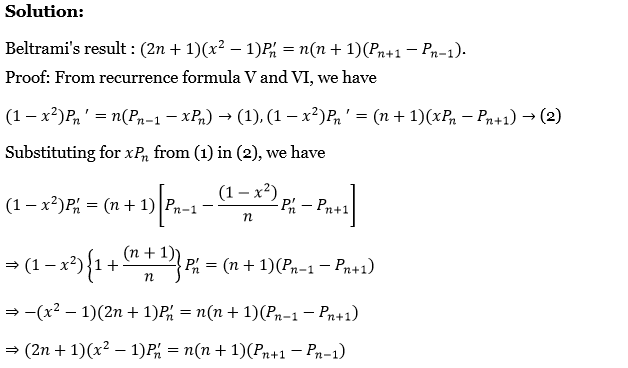
Hence for all positive integral n, we have \(int_0^\pi \cos (n \theta-x \sin \theta) d \theta=\pi J_n\)

If n is negative, say n=-m,where m is +ve then \(\int_0^\pi \cos (n \theta-x \sin \theta) d \theta\)

= \(\int_0^\pi \cos \{-m(\pi-\phi)-x \sin (\pi-\phi)\} d \phi, \text { putting } \theta=\pi-\phi\)

= \(\int_0^\pi \cos \{-m \pi+(m \phi-x \sin \phi)\} d \phi\)

= \(\int_0^\pi\{\cos m \pi \cdot \cos (m \phi-x \sin \phi)+\sin m \pi \sin (m \phi-x \sin \phi)\} d \phi\)

= \((-1)^m \int \pi \cos (m \phi-x \sin \phi) d \phi=(-1)^m \pi J_m(x)=\pi J_{-m}(x)=\pi J_n(x)\)

Hence for all integral values of \(n, \int_0^\pi \cos (n \theta-x \sin \theta) d \theta=\pi J_n\).

2. Putting \(\theta=\frac{\pi}{2}+\phi\) in the value of \(\cos (x \sin \theta)\) from (1), we have

⇒ \(\cos (x \cos \phi)=J_0-2 J_2 \cos 2 \phi+2 J_4 \cos 4 \phi-\cdots\)

∴ \(\int_0^\pi \cos (x \cos \phi) d \phi=J_0 \int_0^\pi d \theta-2 J_2 \int_0^\pi \cos 2 \phi d \phi+\cdots\)

From (1) we have \(\cos (x \sin \phi)=J_0+2 J_2 \cos 2 \phi+2 J_4 \cos 4 \phi+\cdots\)

∴ \(\int_0^\pi \cos (x \sin \phi) d \phi=J_0 \int_0^\pi d \phi+2 J_2 \int_0^\pi \cos 2 \phi d \phi+\cdots=\pi J_0\)

Deduction: We have proved that \(J_0(x)=\frac{1}{\pi} \int_0^\pi \cos (x \cos \phi) d \phi\)

= \(\frac{1}{\pi} \int_0^\pi\left(1-\frac{x^2 \cos ^2 \phi}{2!}+\frac{x^4 \cos ^4 \phi}{4!}-\frac{x^6 \cos ^6 \phi}{6!}+\cdots\right) d \phi \rightarrow \text { (1) }\)

Since \(\int_0^\pi \cos ^{2 r} \phi d \phi=\frac{1 \cdot 3 \cdot 5 \cdot(2 r-1)}{2 \cdot 4 \cdot 6 \cdots(2 r)} \pi\) from definite integrals.

From (1) we have \(J_0(x)=\frac{1}{\pi}\left[\pi-\frac{x^2}{2!} \cdot \frac{1}{2} \pi+\frac{x^4}{4!} \cdot \frac{1 \cdot 3}{2 \cdot 4} \pi-\frac{x^6}{6!} \cdot \frac{1 \cdot 3 \cdot 5}{2 \cdot 4 \cdot 6} \pi+\cdots\right]\)

= \(1-\frac{x^2}{2^2}+\frac{x^4}{2^2 \cdot 4^2}-\frac{x^6}{2^2 \cdot 4^2 \cdot 6^2}+\cdots=1-\frac{x^2}{2^2}+\frac{x^4}{2^4(2!)^2}-\frac{x^6}{2^6(3!)^2}+\cdots\)

= \(\sum_{r=0}^{\infty} \frac{(-1)^r x^{2 r}}{\left(2^r r!\right)^2}\)

46. Show that \(J_{2 n}(x)=(-1)^n \frac{2}{\pi} \int_0^{\pi / 2} \cos 2 n \phi \cos (x \sin \phi) d \phi\).

Solution:

We have \(\cos (x \sin \theta)=J_0+2 J_2 \cos 2 \theta+2 J_4 \cos 4 \theta+\cdots+2 J_{2 m} \cos 2 m \theta+\cdots \rightarrow\) (1)

Multiplying both sides of (1) by \(\cos 2 m \theta\) and then integrating between the limits o to \(\pi\), \(\int_0^\pi \cos (x \sin \theta) \cos 2 m \theta d \theta=J_0^\pi \int_0^\pi \cos 2 m \theta d \theta+2 J_2 \int_0^\pi \cos 2 \theta \cos 2 m \theta d \theta+\cdots\)

+ \(2 J_{2 m} \int_0^\pi \cos ^2 2 m \theta d \theta+\cdots=0+0+\cdots+J_{2 m} \int_0^\pi(1+\cos 4 m \theta) d \theta+\cdots=\pi J_{2 m}\)

⇒ \(J_{2 m}=\frac{1}{\pi} \int_0^\pi \cos (x \sin \theta) \cos 2 m \theta d \theta \Rightarrow J_{2 n}=\frac{1}{\pi} \int_0^\pi \cos (x \sin \theta) \cos 2 n \theta d \theta\)

Put \(\theta=\phi+\frac{\pi}{2}\). Then \(d \theta=d \phi ; \theta=0, \pi \Rightarrow \phi=-\frac{\pi}{2}, \frac{\pi}{2}\)

∴ \(J_{2 n}=\frac{1}{\pi} \int_{-\pi / 2}^{\pi / 2} \cos (x \cos \phi) \cos (n \pi+2 n \phi) d \phi=\frac{(-1)^n}{\pi} \int_{-\pi / 2}^{\pi / 2} \cos (x \cos \phi) \cos 2 n \phi d \phi\)

= \((-1)^n \frac{2}{\pi} \int_0^{\pi / 2} \cos (x \cos \phi) \cos 2 n \phi d \phi\)

47. Show that \(J_{2 n-1}(x)=-(-1)^n \frac{2}{\pi} \int_0^{\pi / 2} \cos (2 n+1) \theta \sin (x \cos \theta) d \theta\).

Solution:

We have \(\sin (x \sin \theta)=2 \sin \theta J_1+2 \sin 3 \theta J_3+\cdots+2 J_{2 m+1} \sin (2 m+1) \theta+\cdots \rightarrow(1)\)

Multiplying both sides of (1) by sin (2 m+1)θ and then integrating between the limits o to π

⇒ \(\int_0^\pi \sin (x \sin \theta) \sin (2 m+1) \theta d \theta=2 J_1 \int_0^\pi \sin \theta \sin (2 m+1) \theta d \theta\)

+ \(J_3 \int_0^\pi \sin 3 \theta \sin (2 m+1) \theta d \theta+\cdots+2 J_{2 m+1} \int_0^\pi \sin ^2(2 m+1) \theta d \theta+\cdots\)

= \(0+0+\cdots+J_{2 m+1} \int_0^\pi\{1-\cos 2(2 m+1) \theta\} d \theta+\cdots=J_{2 m+1}(\theta)=\pi J_{2 m+1}\)

⇒ \(J_{2 m+1}=\frac{1}{\pi} \int_0^\pi \sin (x \sin \theta) \sin (2 m+1) \theta d \theta\)

⇒ \(J_{2 n+1}=\frac{1}{\pi} \int_0^\pi \sin (x \sin \theta) \sin (2 n+1) \theta d \theta\)

Put \(\theta=\phi+\frac{\pi}{2}\). Then \(d \theta=d \phi ; \theta=0, \pi \Rightarrow \phi=-\frac{\pi}{2}, \frac{\pi}{2}\)

∴ \(J_{2 n+1}=\frac{1}{\pi} \int_{-\pi / 2}^{\pi / 2} \sin (x \cos \phi) \sin \left[(2 n+1)\left(\phi+\frac{\pi}{2}\right)\right] d \phi\)

= \(\frac{1}{\pi} \int_{-\pi / 2}^{\pi / 2} \sin (x \cos \phi)(-1)^n \cos (2 n+1) \phi d \phi\)

= \((-1)^n \frac{2}{\pi} \int_{-\pi / 2}^{\pi / 2} \sin (x \cos \phi)(-1)^n \cos (2 n+1) \phi d \phi\)

48. Prove that \(J_n(x)=\frac{(x / 2)^n}{\sqrt{\pi} \Gamma(n+1 / 2)} \int_{-1}^{+1}\left(1-t^2\right)^{n-1 / 2} e^{i x t} d t,\left(n>-\frac{1}{2}\right)\). And deduce that \(\int_0^1\left(1-t^2\right)^{n-1 / 2} \cos (x t) d t=\frac{2^{n-1} \Gamma(1 / 2) \Gamma(n+1 / 2) J_n(x)}{x^n}\).

Solution:

Let I = \(\int_{-1}^{+1}\left(1-t^2\right)^{n-1 / 2} e^{i x t} d t=\int_{-1}^{+1}\left(1-t^2\right)^{n-1 / 2}\left(\sum_{r=0}^{\infty} \frac{\left(i x t^r\right.}{r!}\right) d t\)

= \(\sum_{r=0}^{\infty} \frac{(i x)^r}{r!} \int_{-1}^{+1}\left(1-t^2\right)^{n-1 / 2} r d t\)

Now, if r is odd, the integrand in $I$ is an odd function of t. ∴ I=0.

And if r is even, the integrand in I is an even function of t.

∴ I = \(\sum_{r=0}^{\infty} \frac{(i x)^{2 s}}{(2 s)!} 2 \int_0^1\left(1-t^2\right)^{n-1 / 2} t^{2 s} d t\)

= \(\sum_{t=0}^{\infty} \frac{(i x)^{2 s}}{(2 s)!} \int_0^1(1-v)^{n-1 / 2} \cdot v^{s-1 / 2} d v\) ; Putting \(t^2=v\) so that 2 t d t=d v

= \(\sum_{t=0}^{\infty} \frac{(i x)^{2 s}}{(2 s)!} B\left(n+\frac{1}{2}, s+\frac{1}{2}\right)\), since \(B(m, n)=\int_0^1(1-t)^{m-1} t^{n-1}\)

= \(\sum_{r=0}^{\infty} \frac{(i x)^2}{(2 s)!} \frac{\Gamma\left(-n+\frac{1}{2}\right) \Gamma\left(s+\frac{1}{2}\right)}{\Gamma\left(n+\frac{1}{2}+s+\frac{1}{2}\right)},\left(n>-\frac{1}{2}\right)\) since \(B(m, n)=\frac{\Gamma(m) \Gamma(n)}{\Gamma(m+n)}\)

= \(\Gamma\left(n+\frac{1}{2}\right)_{s=0}^{\infty} \frac{\left(i^2\right)^s x^{2 s}\{(2 s+1) / 2\}}{(2 s)!\Gamma(n+s+1)}\)

= \(\Gamma\left(n+\frac{1}{2}\right) \sum_{s=0}^{\infty} \frac{(-1)^s x^{2 s}}{(2 s)!\Gamma(n+s+1)} \frac{(2 s)!}{2^{2 s} s!} \sqrt{\pi}, \text { since } \Gamma \cdot\left(\frac{2 s+1}{2}\right)=\frac{(2 s)!\sqrt{\pi}}{2^{2 s} s!}\)

= \(\Gamma\left(n+\frac{1}{2}\right)\left(\frac{x}{2}\right)^{-n} \sum_{s=0}^{\infty} \frac{(-1)^s}{s!\Gamma(n+s+1)}\left(\frac{x}{2}\right)^{n+2 s} \sqrt{\pi}=\Gamma\left(n+\frac{1}{2}\right)\left(\frac{x}{2}\right)^{-n} \sqrt{\pi} J_n(x)\)

∴ \(J_n(x)=\frac{(x / 2)^n}{\sqrt{\pi} \Gamma\left(n+\frac{1}{2}\right)} \int_{-1}^{+1}\left(1-t^2\right)^{n-1 / 2} e^{i x t} d t \rightarrow(1)\)

Deduction: From (1), we have \(J_n(x)=\frac{x^n}{2^n \Gamma\left(\frac{1}{2}\right) \Gamma\left(n+\frac{1}{2}\right)} \int_{-1}^1\left(1-t^2\right)^{n-1 / 2}(\cos x t+i \sin x t) d t\)

Equating real parts from both sides, we get \(J_n(x)=\frac{x^n}{2^n \Gamma\left(\frac{1}{2}\right) \Gamma\left(n+\frac{1}{2}\right)} \int_{-1}^1\left(1-t^2\right)^{n-1 / 2} \cos (x t) d t\)

= \(\frac{x^n}{2^n \Gamma\left(\frac{1}{2}\right) \Gamma\left(n+\frac{1}{2}\right)} 2 \int_0\left(1-t^2\right)^{n-1 / 2} \cos (x t) d t\)

⇒ \(\int_0\left(1-t^2\right)^{n-1 / 2} \cos (x t) d t=\frac{2^{n-1} \Gamma\left(\frac{1}{2}\right) \Gamma\left(n+\frac{1}{2}\right) J_n(x)}{x^n}\)

49. Prove that \(J_n(x)=\frac{2(x / 2)^{n-m}}{\Gamma(n-m)} \int_0^1(1-t)^{n-m-1} t^{m+1} J_m(x t) d t\).

Solution:

Let  I = \(\int_0^1\left(1-t^2\right)^{n-m-1} t^{m+1} J_m(x t) d t\)

= \(\int_0^1\left(1-t^2\right)^{n-m-1} t^{m+1} \sum_{r=0}^{\infty}(-1)^r \frac{1}{r!\Gamma(m+r+1)}\left(\frac{x t}{2}\right)^{2 r+m} d t\)

= \(\sum_{r=0}^{\infty} \frac{(-1)^r(x / 2)^{2 r+m}}{r!\Gamma(m+r+1)} \int_0^1\left(1-t^2\right)^{n-m-1} t^{2 r+2 m+1} d t\)

= \(\sum_{r=0}^{\infty} \frac{(-1)^r(x / 2)^{2 r+m}}{r!\Gamma(m+r+1)} \int_0^1\left(1-t^2\right)^{n-m-1}\left(t^2\right)^{m+r} t d t\)

= \(\sum_{r=0}^{\infty} \frac{(-1)^r(x / 2)^{2 r+m}}{r!\Gamma(m+r+1)} \frac{1}{2} \int_0^1(1-z)^{n-m-1} Z^{(m+r+1)-1} d z \text { on putting } t^2=z\)

= \(\sum_{r=0}^{\infty} \frac{(-1)^r(x / 2)^{2 r+m}}{r!\Gamma(m+r+1)} \frac{1}{2} B(n-m, m+r+1), \text { if } n-m>0, m+r+1>0\)

= \(\sum_{r=0}^{\infty} \frac{(-1)^r(x / 2)^{2 r+m}}{r!\Gamma(m+r+1)} \frac{1}{2} \frac{\Gamma(n-m) \Gamma(m+r+1)}{\Gamma(n+r+1)}\)

= \(\frac{\Gamma(n-m)}{2}\left(\frac{x}{2}\right)^{m-n} \sum_{r=0}^{\infty} \frac{(-1)^r}{r!\Gamma(n+r+1)}\left(\frac{x}{2}\right)^{n+2 r}=\frac{\Gamma(n-m)}{2}\left(\frac{x}{2}\right)^{m-n} J_n(x)\)

∴ \( J_n(x)=\frac{2(x / 2)^{n-m}}{\Gamma(n-m)} \int_0^1\left(1-t^2\right)^{n-m-1} t^{m+1} J_m(x t) d t\)

50. Prove that \(J_n(x)=\frac{-x^n}{2^{n-1} \Gamma(n)} \int_0^{\pi / 2} \sin \theta \cos ^{2 n-1} \theta J_0(x \sin \theta) d \theta \text {, where } n>-\frac{1}{2}\).

Solution:

We have \(J_n(x)=\sum_{r=0}^{\infty} \frac{(-1)^r}{r!\Gamma(n+r+1)}\left(\frac{x}{2}\right)^{2 r+n}\)

(1) ⇒ \(J_0(x \sin \theta)=\sum_{r=0}^{\infty} \frac{(-1)^r}{r!\Gamma(r+1)}\left(\frac{x \sin \theta}{2}\right)^{2 r} \text {. }\)…(2)

Let I = \(\int_0^{\pi / 2} \sin \theta \cos ^{2 n-1} \theta J_0(x \sin \theta) d \dot{\theta} \rightarrow(3)\)

∴ I = \(\int_0^{\pi / 2} \sin \theta \cos ^{2 n-1} \theta\left(\sum_{r=0}^{\infty} \frac{(-1)^r}{r!\Gamma(r+1)} \frac{x^{2 r}}{2^{2 r}} \sin ^{2 r} \theta\right) d \theta\)

= \(\sum_{r=0}^{\infty} \frac{(-1)^r x^{2 r}}{(r!)^2 \cdot 2^{2 r}} \int_0^{\pi / 2} \cos ^{2 n-1} \theta \sin ^{2 r+1} \theta d \theta\)

= \(\sum_{r=0}^{\infty} \frac{(-1)^r x^{2 r}}{(r!)^2 2^{2 r}} \frac{\Gamma(n) \Gamma(r+1)}{\Gamma(n+r+1)}=\frac{\Gamma(n)}{2} \sum_{r=0}^{\infty} \frac{(-1)^r}{r!\Gamma(n+r+1)}\left(\frac{x}{2}\right)^{2 r}\)

⇒ \(\frac{x^n}{2^{n-1} \Gamma(n)} I=\left(\frac{x}{2}\right)^n \sum_{r=0}^{\infty} \frac{(-1)^r}{r!\Gamma(n+r+1)}\left(\frac{x}{2}\right)^{2 r}=\sum_{r=0}^{\infty} \frac{(-1)^r}{r!\Gamma(n+r+1)}\left(\frac{x}{2}\right)^{2 r+n}\)

⇒ \(\frac{x^n}{2^{n-1} \Gamma(n)} \int_0^{\pi / 2} \sin \theta \cos ^{2 n-1} \theta J_0(x \sin \theta) d \theta=J_n(x)\), by (1) and (3).

51. Prove that \(J_n(x)=(-2)^n \cdot x^n \frac{d^n}{d\left(x^2\right)^n} J_0(x)\).

Solution:

Bessel’s equation for zeroeth order is \(y_2+\frac{1}{x} y_1+y=0 \rightarrow\) (1) whose solution is \(J_0(x)\)

Changing the independent variable from x to X, by the relation \(x^2=X\), so that

⇒ \(y_1=\frac{d y}{d x}=\frac{d y}{d X} \frac{d x}{d x}=2 x \frac{d y}{d x}=2 \sqrt{X} \frac{d y}{d X}\) and

⇒ \(y_2=\frac{d^2 y}{d x^2}=\frac{d}{d x}\left(2 \sqrt{X} \frac{d y}{d X}\right)\)

= \(\frac{d}{d x}\left(2 \sqrt{X} \frac{d y}{d X}\right) \frac{d x}{d x}=\left(2 \sqrt{X} \frac{d^2 y}{d X^2}+\frac{1}{\sqrt{X}} \frac{d y}{d X}\right) 2 \sqrt{X}\)

= \(4 X \frac{d^2 y}{d X^2}+2 \frac{d y}{d X}\)

Substituting in (1), we have \(\left(4 X \frac{d^2 y}{d X^2}+2 \frac{d y}{d X}\right)+\frac{1}{\sqrt{X}} 2 \sqrt{X} \frac{d y}{d X}+y=0\)

∴ \(4 X \frac{d^2 y}{d X^2}+4 \frac{d y}{d X}+y=0 \rightarrow \text { (4) }\)…..(4)

Differentiating (2), n times w.r.t. X by using Leibnitz’s theorem we have

4\(\left[X \frac{d^{n+2} y}{d X^{n+2}}+n 1 \frac{d^{n+1} y}{d X^{n+1}}\right]+4 \frac{d^{n+1} y}{d X^{n+1}}+\frac{d^n y}{d X^n}\)=0

⇒ \(4 X \frac{d^{n+2} y}{d X^{n+2}}+4(n+1) \frac{d^{n+1} y}{d X^{n+1}}+\frac{d^n y}{d X^n}=0\)

Putting \(y=\frac{d^n y}{d X^n}=\frac{d^n J_0(x)}{d X^n}\), it becomes \(4 X \frac{d^2 Y}{d X^2}+4(n+1) \frac{d Y}{d X}+Y=0\)

Again, \(J_n(x)\) is the solution of the Bessel’s equation \(\frac{d^2 y}{d x^2}+\frac{1}{x} \frac{d y}{d x}+\left(1-\frac{n^2}{x^2}\right) y=0 \rightarrow\) (4)

Putting \(y=x^n z\), so that \(\frac{d y}{d x}=x^n \frac{d z}{d x}+n x^{n-1} Z\)

and \(\frac{d^2 y}{d x^2}=x^n \frac{d^2 z}{d x^2}+2 n x^{n-1} \frac{d z}{d x}+n(n-1) x^{n-2} z\)=0

Substituting in (4), we have \(x^n \frac{d^2 z}{d x^2}+2 n x^{n-1} \frac{d z}{d x}+n(n-1) x^{n-2} z+\frac{1}{x}\left[x^n \frac{d z}{d x}+n x^{n-1} z\right]+\left[1-\frac{n^2}{x^2}\right] x^n z=0\)

⇒ \(x^n \frac{d^2 z}{d x^2}+(2 n+1) x^{n-1} \frac{d z}{d x}+x^n z=0 \Rightarrow \frac{d^2 z}{d x^2}+(2 n+1) \frac{1}{x} \frac{d z}{d x}+z=0 \rightarrow \text { (5). }\)

Comparing (3) and (5), we get \(z=Y=\frac{d^n J_0(x)}{d X^n}=\frac{d^n J_0(x)}{d\left(x^2\right)^n}\)

But y = \(x^n Z\)

Hence \(J_n(x)=c x^n \frac{d^n J_0(x)}{d\left(x^2\right)^n} \rightarrow(6)\) where c is a constant to be determined.

We know that \(J_0(x)=\sum_{r=0}^{\infty} \frac{(-1)^r x^{2 r}}{\left(2^r r!\right)^2}\)

∴ \(\frac{d^2 J_0(x)}{d\left(x^2\right)^n}=\frac{d^n}{d\left(x^2\right)^n} \sum_{r=0}^{\infty} \frac{(-1)^r x^{2 r}}{\left(2^r r!\right)^2}=\frac{d^n}{d\left(x^2\right)^n} \sum_{r=0}^{\infty} \frac{(-1)^{n+r}\left(x^2\right)^{n+r}}{\left[2^{n+r}(n+r)!\right]^2}\)

(Since all those terms in which the index of x is less than 2n will vanish on differentiation n times w.r.t. \(x^2\))

= \(\sum_{r=0}^{\infty} \frac{(-1)^{n+r}(n+r)(n+r-1) \ldots(r+1)\left(x^2\right)^r}{\left[2^{n+r} \cdot(n+r)!\right]^2}=(-1)^n \sum_{r=0}^{\infty}(-1)^r \frac{(n+r)!}{r!2^{3(n+r)} \cdot[(n+r)!]^2} x^{2 r}\)

∴ \(J_n(x)=c x^n(-1)^n \sum_{r=0}^{\infty}(-1)^r \frac{1}{r!2^{2 n+2 r}(n+r)!} x^{2 r}\)

= \(\frac{c(-1)^r}{2^n} \sum_{r=0}^{\infty}(-r)^r \frac{1}{r!\Gamma(n+r+1)}\left[\frac{x}{2}\right]^{n+2 r}=\frac{c}{(-2)^n} J_n(x)\) . ∴ \(c=(-2)^n\)

Hence \(J_n(x)=(-2)^n x^n \frac{d^n J_n(x)}{d\left(x^2\right)^n}\)

52. Prove that \(\int_0^{\infty} \frac{J_n(x)}{x} d x=\frac{1}{n}\).

Solution:

If n is a non-negative integer then we have \(\int_0^{\infty} J_n(x) d x=1\)

From recurrence relation 4, \(\frac{2 n}{x} J_n(x)=J_{n-1}^0(x)+J_{n+1}(x) \rightarrow\) (1)

Integrating (1) both sides with respect to x, from o to \(\infty\), we get

2n \(\int_0^{\infty} \frac{J_n(x)}{x}=\int_0^{\infty} J_{n-1}(x)+\int_0^{\infty} J_{n+1}(x) \Rightarrow 2 n \int_0^{\infty} \frac{J_n(x)}{x}\)=1+1

⇒ \(\int_0^{\infty} \frac{J_n(x)}{x}=1 \text {. }\)
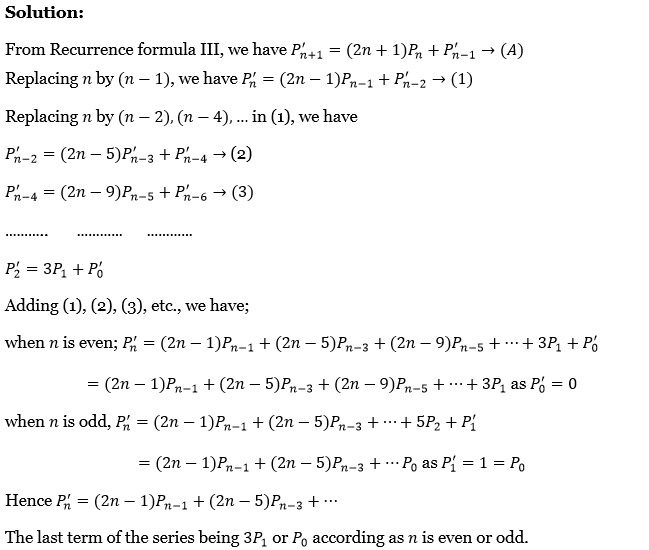
53. Show that \(\int_0^{\pi / 2} \sqrt{(\pi x)} \cdot J_{1 / 2}(2 x) d x=1\).

Solution:

⇒ \(\int_0^{\pi / 2} \sqrt{\pi x} J_{1 / 2}(2 x) d x=\int_0^{\pi / 2} \sqrt{\pi x} \sqrt{\frac{2}{\pi(2 x)}} \sin 2 x d x=\int_0^{\pi / 2} \sin 2 x d x=\left[-\frac{1}{2} \cos 2 x\right]^{\pi / 2}\)

= \(-\frac{1}{2}[-1-1]=1\)

54. Show that \(\int_0^1 J_0[\sqrt{x(t-x)}] d x=2 \sin \frac{1}{2} t\).

Solution:

We know that \(J_n=\sum_{r=0}^{\infty}(-1)^r\left(\frac{x}{2}\right)^{n+2 r} \frac{1}{r!\Gamma(n+r+1)} \rightarrow(1)\)

Putting n=0 and \(x=\{x(t-x)\}^{1 / 2}\) in (1), we get

⇒ \(J_0(\{x(t-x)\}^{1 / 2}=\sum_{r=0}^{\infty}(-1)^r \frac{1}{r!\Gamma(r+1)}\left[\frac{x\{x(t-x)\}^{1 / 2}}{2}\right]^{2 r}=\sum_{r=0}^{\infty} \frac{(-1)^r x^r(t-x)^r}{2^{2 r} r!\Gamma(r+1)}\)

∴ \(\int_0^1 J_0\left(\{x(t-x)\}^{1 / 2}\right) d x=\int_0^1 \sum_{r=0}^{\infty} \frac{(-1)^r x^r(t-x)^r}{2^{2 r} r!\Gamma(r+1)} d x=\sum_{r=0}^{\infty} \frac{(-1)^r}{2^{2 r} r!\Gamma(r+1)} \int_0^1 x^r(t-x)^r d x\)

= \(\sum_{r=0}^{\infty} \frac{(-1)^r t^{2 r+1}}{2^{2 r} r!\Gamma(r+1)} \int_0^1 y^r(1-y)^r d y\), putting x = ty and d x=t dy

= \(\sum_{r=0}^{\infty} \frac{(-1)^r t^{2 r+1}}{2^{2 r} r!\Gamma(r+1)} B(r+1, r+1)=\sum_{r=0}^{\infty} \frac{(-1)^r t^{2 r+1}}{2^{2 r} r!\Gamma(r+1)} \frac{\Gamma(r+1) \Gamma(r+1)}{\Gamma(2 r+1)}\)

= \(\sum_{r=0}^{\infty} \frac{(-1)^r t^{2 r+1}}{2^{2 r} r!r!} \frac{r!r!}{\Gamma(2 r+1)}=\sum_{r=0}^{\infty} \frac{(-1)^r t^{2 r+1} r!}{2^{2 r} r!\Gamma(2 r+1)}=2 \sum_{r=0}^{\infty}(-1)^r \frac{(t / 2)^{2 r+1}}{(2 r+1)!}\)

= \(2\left\{\frac{t}{2}-\frac{(t / 2)^3}{3!}+\frac{(t / 5)^5}{5!}-. .\right\}=2 \sin \frac{t}{2}\)

55. Prove that \(\int_0^b x J_0(a x) d x=\frac{b}{a} J_1(a b)\).

Solution:

Put ax = t Then a dx=dt and x=0, b ⇒ t=0, a b

⇒ \(\int_0^b x J_0(a x) d x=\int_0^{a b} \frac{t}{a} J_0(t) \frac{d t}{a}=\frac{1}{a^2} \int_0^{a b} t J_0(t) d t=\frac{1}{a^2}\left[t J_1(t)\right]=\frac{a b}{a} J_1(a b) .\)

56. Evaluate \(\int J_3(x) d x\) and express the result in terms of \(J_0 \text { and } J_1\).

Solution:

Given

\(\int J_3(x) d x\)

From recurrence 7, we have \(x^{-n} J_{n+1}=\frac{d}{d x}\left\{x^{-n} J_n(x)\right\}\).

Integrating it, \(\int x^{-n} J_{n+1}(x) d x=-x^{-n} J_n(x) \rightarrow\) (1)

Now \(\int J_3(x) d x=\int x^2\left[x^{-2} J_3(x)\right] d x=x^2\left[-x^{-2} J_2(x)\right]-\int 2 x\left[-x^{-2} J_2(x)\right] d x\)

= \(-J_2(x)+2 \int x^{-1} J_2(x) d x=-J_2(x)+2\left[-x^{-2} J_1(x)\right]+c\)

∴ \(\int J_3(x) d x=-J_2(x)-2 x^{-1} J_1(x)+c \rightarrow \text { (2) }\)

From recurrence relation 4, we have \(\left(\frac{2 n}{x}\right) J_n(x)=J_{n-1}(x)+J_{n+1}(x) \rightarrow(3)\)

Putting n=1 in (3), we get \(J_2(x)=\frac{2 J_1(x)}{x}-J_0(x) \rightarrow\) (4)

Substituting (4) in (2), we get \(\int J_3(x) d x=-\left(\frac{2 J_1(x)}{x}-J_0(x)\right)-2 x^{-1} J_2(x)+c\)

⇒ \(\int J_3(x) d x=J_0(x)-\frac{4 J_1(x)}{x}+c\), where c is an arbitrary constant.

57. Evaluate \(\int x^3 J_3(x) d x\).

Solution:

Given

\(\int x^3 J_3(x) d x\).

Since, \(\frac{d}{d x}\left\{x^{-n} J_n\right\}=-x^n J_{n+1}\), we have \(\int x^{-n} J_{n+1} d x=-x^{-n} J_n \rightarrow(1)\)

Now, \(\int x^3 J_3(x) d x=\int x^5\left(x^{-2} J_3\right) d x=x^5\left(-x^{-2} J_2\right)-\int 5 x^4\left(-x^{-2} J_2\right) d x\)

= \(-x^3 J_2+\int 5 x^2 J_2 d x=-x^3 J_2+5 \int x^3\left(x^{-1} J_2\right) d x\)

= \(-x^3 J_2+5\left[x^3\left(-x^{-1} J_1\right)-\int 3 x^2\left(-x^{-1} J_1\right) d x\right]\)

= \(-x^3 J_2-5 x^2 J_1+15 \int x J_1 d x=-x^3 J_2-5 x^2 J_1+15 \int x\left(-J_0^{\prime}\right) d x\)

= \(-x^3 J_2-5 x^2 J_1-15 \int x J_0^{\prime} d x=-x^3 J_2-5 x^2 J_1=15\left[x J_0-\int 1 J_0 d x\right]\)

= \(-x^3 J_2-5 x^3 J_1-15 x J_0+15 x \int J_0 d x\)

58. Evaluate \(\int x^4 J_1(x) d x\).

Solution:

Given

\(\int x^4 J_1(x) d x\).

Since, \(\frac{d}{d x}\left\{x^n J_n\right\}=x^n J_{n-1}\), we have \(\int x^n J_{n-1} d x=x^n J_n \rightarrow\) (1)

Now, \(\int x^4 J_1 d x=\int x^2\left(x^2 J_1\right) d x=x^2\left(x^2 J_2\right)-\int 2 x\left(x^2 J_2\right) d x\)

= \(x^4 J_2-2 \int x^3 J_2 d x=x^4 J_2-2 x^3 J_3+c\)

59. Express \(\int x^{-3} J_4(x) d x \text { in terms of } J_0 \text { and } J_1\).

Solution:

Putting n=3 in recurrence relation 7, we have \(\frac{d}{d x}\left\{x^{-n} J_n\right\}=-x^{-n} J_{n+1} \Rightarrow \frac{d}{d x}\left\{x^{-3} J_3\right\}=-x^{-3} J_4\)

Integrating, we get \(\int x^{-3} J_4(x) d x=-x^3 J_3+c \rightarrow\) (1), c being an arbitrary constant

From recurrence relation 6, we have \(J_{n+1}=\left(\frac{2 n}{x}\right) J_n-J_{n-1} \rightarrow\) (2)

Putting n=2 and n=1 successively in (2), we get \(J_3=\left(\frac{4}{x}\right) J_2-J_1 \rightarrow(3)\) and \(J_2=\left(\frac{2}{x}\right) J_1-J_0 \rightarrow \text { (4) }\)

Substituting (4) in (3), we get \(J_3=\left(\frac{4}{x}\right)\left[\left(\frac{2}{x}\right) J_1-J_0\right]-J_1=\left(\frac{8}{x^2}-1\right) J_1-\left(\frac{4}{x}\right) J_0 \rightarrow\) (5)

Substituting (5) in (1), we get \(\int x^{-3} J_4(x) d x=-x^{-3}\left[\left(\frac{8}{x^2}-1\right) J_1-\frac{4}{x} J_0\right]+c=\left(-\frac{1}{x^3}-\frac{8}{x^5}\right) J_1+\frac{4}{x^4} J_0 \text {. }\)
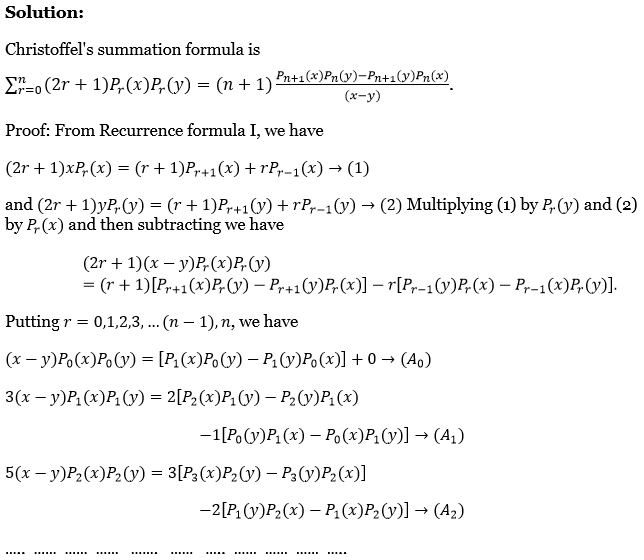
60. Prove that \(\int x^{-1} J_4(x) d x=-x^{-1} J_3(x)-2 x^{-2} J_2(x)+c\).

Solution:

Recurrence relation 7 is \(\frac{d}{d x}\left\{x^{-n} J_n(x)=-x^{-n} J_{n+i}(x)\right.\).

Integrating it, we get \(\int x^{-n} J_{n+1}(x) d x=-x^{-n} J_n(x) \rightarrow\) (1)

∴ \(x^{-1} J_4(x) d x=\int x^2\left[x^{-3} J_4(x)\right] d x=x^2\left[-x^{-3} J_3(x)\right]-\int 2 x \times\left[-x^{-3} J_3(x)\right] d x\)

= \(-x^{-1} J_3(x)+2 \int x^{-2} J_3(x) d x=-x^{-1} J_3(x)+2\left[-x^{-2} J_2(x)\right]+c\)

= \(-x^{-1} J_3(x)-2 x^{-2} J_2(x)+c\) .

61. Prove that \(\int J_3(x) d x=-J_2(x)-\frac{2}{x} J_0(x)+c\).

Solution:

⇒ \(\frac{d}{d x}\left\{x^{-n} J_n(x)\right\}=-x^{-n} J_{n+1}(x) \Rightarrow \int x^{-n} J_{n+1}(x) d x=-x^{-n} J_n(x) \rightarrow(1)\)

Now, \(\int J_3(x) d x=\int x^2\left\{x^{-2} J_3(x)\right\} d x=x^2 \int x^{-2} J_3(x) d x-\int 2 x\left(\int x^{-2} J_3(x) d x\right) d x\)

= \(x^2\left[-x^{-2} J_2(x)\right]-\int 2 x\left(-x^{-2} J_2(x)\right) d x\), using (1) for n=2

= \(-J_2(x)+2 \int x^{-1} J_2(x) d x=-J_2(x)-2 x^{-1} J_1(x)+c\), using (1) for n=1 .

62. Show that
1) \(\int_0^x x^3 J_0(x) d x=x^3 J_1(x)-2 x^2 J_2(x)\)

2) \(\int_0^1 x^3 J_0(x) d x=2 J_0(1)-3 J_1(1)\).

Solution:

1) \(\frac{d}{d x}\left\{x^n J_n(x)\right]=x^n J_{n-1}(x) \Rightarrow \int x^n J_{n-1}(x) d x=x^n J_n(x) \rightarrow \text { (1) }\)

∴ \(\int_0^x x^3 J_0(x) d x=\int_0^x x^2\left[x J_0(x)\right] d x=\left[x^2\left\{x J_1(x)\right\}\right]-\int_0^x 2 x\left\{x J_1(x)\right\} d x\) using (1) for n=1

= \(x^3 J_1(x)-2 \int_0^x x^2 J_1(x) d x=x^3 J_1(x)-2\left[x^2 J_2(x)\right]\), using (1) for n=2

= \(x^3 J_1(x)-2 x^2 J_2(x)\) as \(J_2(0)=0\).

2) From (1), we have \(\int_0^x x^3 J_0(x) d x=x^3 J_1(x)-2 x^2 J_2(x) \rightarrow\) (2)

Putting x=1 in (2), \(\int_0^1 x^3 J_0(x) d x=J_1(1)-2 J_2(1) \rightarrow\) (3)

Recurrence relation IV is \(J_{n-1}(x)+J_{n+1}(x)=\frac{2 n}{x} J_n(x)\).

Putting n=1 and x=1, we have \(J_2(1)=2 J_1(1)-J_0(1) \rightarrow(4)\)

Substituting the above value of \(J_2(1)\) in (3), we have \(\int_0^1 x^3 J_0(x) d x=J_1(1)-2\left[2 J_1(1)-J_0(1)\right]=2 J_0(1)-3 J_1(1) \text {. }\)
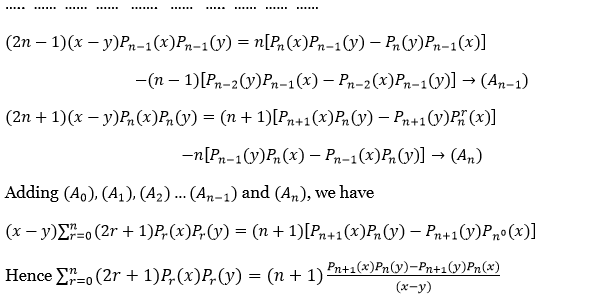
63. Prove that \(\int_0^{\infty} e^{-a x} J_0(b x) d x=\frac{1}{\sqrt{\left(a^2+b^2\right)}}, a>0\)

Solution:

We have \(J_0(x)=\frac{1}{\pi} \int_0^\pi \cos (x \sin \phi) d x\)

∴ \(\int_0^{\infty} e^{-a x} J_0(b x) d x=\int_0^{\infty} e^{-a x}\left\{\frac{1}{\pi} \int_0^\pi \cos (b x \sin \phi) d \phi\right\} d x\)

= \(\frac{1}{\pi} \int_0^\pi\left[\int_0^{\infty} e^{-a x} \cos (b x \sin \phi) d x\right] d \phi\)

= \(\frac{1}{\pi} \int_0^\pi\left[\int_0^{\infty} e^{-a x} \cdot \frac{e^{i(b x \sin \phi)}+e^{-i(b x \sin \phi)}}{2} d x\right] d \phi\)

= \(\frac{1}{2 \pi} \int_0^\pi\left[\int_0^{\infty}\left\{e^{-(a-i b \sin \phi) x}+e^{-(a+i b \sin \phi) x}\right\} d x\right] d \phi\)

= \(\left.\frac{1}{2 \pi} \int_0^\pi\left[\frac{e^{-(a-i b \sin \phi) x}}{-(a-i b \sin \phi)}-\frac{e^{-(a+i b \sin \phi) x}}{a+i b \sin \phi}\right] d \phi\right]\)

= \(\frac{1}{2 \pi} \int_0^\pi\left[\frac{1}{a-i b \sin \phi}+\frac{1}{a+i b \sin \phi}\right] d \phi\)

= \(\frac{1}{2 \pi} \int_0^\pi \frac{2 a d \phi}{a^2+b^2 \sin ^2 \phi}=2 \cdot \frac{a}{\pi} \int_0^{\pi / 2} \frac{\text{cosec}^2 \phi d \phi}{b^2+a^2 \text{cosec}^2 \phi}\)

= \(2 \frac{a}{\pi} \int_0^{\pi / 2} \frac{\text{cosec}^2 \phi d \phi}{\left(a^2+b^2\right)+a^2 \cot ^2 \phi}\)

= \(2 \frac{a}{\pi}\left(\frac{1}{a \sqrt{\left(a^2+b^2\right)}} \cot ^{-1} \frac{a \cot \phi}{\sqrt{\left(a^2+b^2\right)}}\right)_0^{\pi / 2}\)

= \(\frac{2}{\pi \sqrt{\left(a^2+b^2\right)}} \cdot\left(\cot ^{-1} 0-\cot ^{-1} \infty\right)=\frac{1}{\sqrt{\left(a^2+b^2\right)}}\)

Bessel's Equations Exercise 5 Question 63

64. Prove that \(\int_0^x t\left\{J_n(t)\right\}^2 d t=\frac{x^2}{2}\left\{J_n^2(x)-J_{n-1}(x) J_{n+1}(x)\right\}\).

solution:

We have \(\frac{d}{d t}\left[\frac{t^2}{2}\left\{J_n^2(t)-J_{n=1}(t) J_{n+1}(t)\right\}\right]\)

= \(t\left(J_n^2-J_{n-1}^{\prime} J_{n+1}+\frac{t^2}{2}\left[2 J_n J_n^{\prime}-J_{n-1}^{\prime} J_{n+1}-J_{n-1} J_{n+1}^{\prime}\right]\right.\)

= \(t\left(J_n^2-J_{n-1} J_{n+1}\right)+\frac{t^2}{2}\left[J_n\left(J_{n-1}-J_{n+1}\right)-\left(\frac{n-1}{t} J_{n-1}-J_n\right) J_{n+1}-J_{n-1}\left(-\frac{n+1}{t} J_{n+1}+J_n\right)\right]\)

(Substituting the value of \(2 J_n^{\prime}\) from recurrence formula 3 and the value of \(2 J_{n-1}^{\prime}\) and \(J^{\prime} n+1\) obtained by replacing n by n-1 and n+1 in recurrence formula 1 and 2 respectively.

∴ \(\frac{d}{d t}\left[\frac{t^2}{2}\left\{J_n^2(t)-J_{n=1}(t) J_{n+1}(t)\right\}\right]=t J_n^2(t)\)

Integrating both sides from o to x, we have \(\int_0^x t\left\{J_n(t)\right\}^2 d t=\left[\frac{t^2}{2}\left\{J_n^2(t)-J_{n-1}(t) J_{n+1}(t)\right]_0^x=\frac{x^2}{2}\left\{J_n^2(x)-J_{n-1}(x) J_{n+1}(x)\right\} .\right.\)


Cosets and Lagrange’s Theorem And Examples

Cosets and Lagrange’s Theorem And Examples Coset

Definition. Let (H,.) be a subgroup of the group (G,.).

Let a ∈ G. Then the set aH = {ah | h ∈ H} is called a left coset of H in G generated by a and the set Ha = {ha | h ∈ H} is called a right coset of H in G generated by a.

Here the operation in G is denoted multiplicatively. Also aH, and Ha are called cosets of H generated by a in G.

Since every element of aH or Ha is in G, aH and Ha are complexes of G.

If e is the identity in G, then eH = {eh \ h ∈ H} = {h | h e H} = H and He = {he | he H} = H. Hence the subgroup of G is itself a left and a right coset of H in G.

If e is the identity in G, it is also the identity in H.

Therefore, for a ∈ G,e ∈ H we have ea ∈ Ha and ae ∈ aH.

Hence the left coset or the right coset of H generated by a is non-empty. Further a ∈ Ha, a ∈ aH and \(\mathbf{H} a \cap a \mathbf{H} \neq \phi\).

If group G is abelian, then for every h ∈ H, we shall have ah = ha. Hence aH = Ha. However, even if G is not abelian, also we may have aH = Ha or aHHa.

Note

1. The left or right coset of any subgroup in a group is called residue class modulo the subgroup of the group.

2. If the operation in G is denoted additively, then the left subset of H in G is generated by a, denoted by a + H = {a + h | h ∈ H}

i.e. a + H =.{a + h | h ∈ H}.

Similarly, the right coset of H is G generated by a.

= H + a = {h + a | h ∈ H}.

3. Let H be a subgroup of the group G and a, b ∈ G.

Then (1) a (bH) = (ah) H and (Hb)a = H(ba).

(2) x ∈ aH => yx ∈ y(aH) for y ∈ G => yx e (ya) H.

4. The clement a is called the coset representative of aH (Ha).

| aH |, | Ha | denotes the number of elements in aH, Ha respectively,

Example 1. Consider the group of symmetries of the square

i.e. \(\left(\mathbf{D}_4, o\right)\) where \(\mathbf{D}_4=\left\{r_{90}, r_{180}, r_{360}, x, y, d_1, d_2\right\}\)

(H,o) where \(\mathbf{H}=\left\{r_{180}, r_{360}, x, y\right\}\) is a subgroup of \(\left(\mathbf{D}_4, o\right)\).

Cosets Definition And Examples In Group Theory

Then all the left cosets of H in G are

\(r_{90} \mathbf{H}=\left\{r_{90} \circ r_{180}, r_{90} \circ r_{360}, r_{90} \circ x, r_{90} \circ y\right\}\)          \(=\left\{r_{270}, r_{90}, d_2, d_1\right\}\)

\(r_{180} \mathbf{H}=\left\{r_{180} o r_{180}, r_{180} o r_{360}, r_{180} o x, r_{180} o y\right\}\)          \(=\left\{r_{360}, r_{180}, x, y\right\}=\mathbf{H}\)

\(r_{270} \mathbf{H}=\left\{r_{270} o r_{180}, \ldots \ldots\right\}\)                                         \(=\left\{r_{90} ; r_{270}, d_1, d_2\right\}\)

\(r_{360} \mathbf{H}=\left\{r_{360} o r_{180}, \ldots \ldots\right\}\)                                         \(=\left\{r_{180}, r_{360}, x, y\right\}=\mathbf{H}\)

\(x \mathbf{H}=\left\{x \circ r_{180}, \ldots \ldots\right\}\)                                                \(=\left\{x, y, r_{360}, r_{180}\right\}=\mathbf{H}\)

\(y \mathbf{H}=\left\{y o r_{180}, \ldots \ldots\right\}\)                                                  \(=\left\{x, y, r_{180}, r_{360}\right\}=\mathbf{H}\)

\(d_1 \mathbf{H}=\left\{d_1 o r_{180}, \ldots \ldots\right\}\)                                              \(=\left\{d_2, d_1, r_{270}, r_{90}\right\}\)

\(d_2 \mathbf{H}=\left\{d_2 o r_{180}, \ldots \ldots\right\}\)                                              \(=\left\{d_1, d_2, r_{90}, r_{270}\right\}\)

We have two distinct left cosets, namely,

∴ \(\left\{r_{90}, r_{270}, d_1, d_2\right\} \text { and }\left\{r_{180}, r_{360}, x, y\right\}=\mathbf{H}\)

These two may be taken as \(r_{90} \mathbf{H} \text { and } \mathbf{H}\)

Obviously \(r_{90} \mathbf{H} \cap \mathbf{H}=\phi \text { and } r_{90} \mathbf{H} \cup \mathbf{H}=\mathbf{D}_4\)

Similarly, we can have all the right cosets of \(\mathrm{H} \text { in } \mathbf{D}_4\).

Note. If a ∈ H, then aH = H = Ha.

Lagrange’s Theorem In Group Theory Explained With Examples

Example 2. Let G be the additive group of integers.

Now G = {…… -3, -2, -1, 0, 2, 3,…….. } and 0 is the identity in G. Also G is abelian.

Let H be a subset of G where elements of H are obtained by multiplying each element of G by 3 (say) i.e., H = { ……..,-9, -6,-3, 0,-3, 6, 9……}

Clearly, H is a subgroup of (G,+). (∵ \(n_1, n_2 \in \mathbf{H} \Rightarrow n_1-n_2 \in \mathbf{H}\))

Since G is abelian, the left coset of H of an element in G = right coset of H in G.

∴ 0 + H = H = {………, -9,-6,-3, 0, 3, 6,……}.

Since 1 ∈ G, 1 + H = { ………..,-8, -5, -2, 1, 4, 7,……}

Since 2 ∈ G, 2 + H = {………..,-7, -4, -1, 2, 5, 8,……}

Observe that (1) 3 + H = 6 + H = …… = 0 + H ,

4 + H = 7 + H = ……… = 1 + H,

5 + H = 8 + H = …….. = 2 + H.

(2) 0 + H, 1 + H, 2 + H are disjoint.

(3) 0 + H ∪ 1 + H ∪ 2 + H = G

Cosets and Lagrange’s Theorem And Examples Properties of Cosets

Theorem 1. H is any subgroup of a group (G,) and h ∈ G. Then h ∈ H iff hH = H = Hh.

Proof. (1) h ∈ H to prove that hH = H = Hh.

Let ‘h’ be an arbitrary element of H. Then is an arbitrary element of hH.

Since H is a subgroup of G, h, h’ ∈ H => hh’∈ H

Thus every element of hH is also an element of H.

∴  hHH …………………(1)

Again \(h^{\prime}=e h^{\prime}=\left(h h^{-1}\right) h^{\prime}=h\left(h^{-1} h^{\prime}\right) \in h \mathbf{H}\)

(∴ e is the identity in H, \(h \in \mathbf{H} \Rightarrow h^{-1} \in \mathbf{H} \text { and } h^{-1} \in \mathbf{H}, h^{\prime} \in \mathbf{H} \Rightarrow h^{-1} h^{\prime} \in \mathbf{H}\))

∴  H ⊆ hH

From (1) and (2), hH = H.

Similarly, we can prove  H = Hh

∴ h ∈ H

∴ hH = H = Hh.

(2) Let hH = H = Hh . To prove that he H.

Now h ∈ G. Since h = he, h ∈ hH.

But hH = H

∴ h ∈ H

Similarly Hh = H => h ∈ H

∴  hH = H= Hh => h ∈ H

Step-By-Step Guide To Understanding Cosets And Lagrange’s Theorem

Theorem 2. If a,b are any two elements of a group (G,.) and H any subgroup of G, then \(\mathbf{H} a=\mathbf{H} b \Leftrightarrow ab^{-1} \in \mathbf{H}\) and aH = bH ⇔ \(a^{-1} b \in \mathbf{H}\).

Proof. \(a \in \mathbf{H} a, \mathbf{H} a=\mathbf{H} b \Rightarrow a \in \mathbf{H} b \Rightarrow a b^{-1} \in(\mathbf{H} b) b^{-1}\)

\(\Rightarrow a b^{-1} \in \mathbf{H}\left(b b^{-1}\right) \Rightarrow a b^{-1} \in \mathbf{H} e \Rightarrow a b^{-1} \in \mathbf{H}\)

Now \(a b^{-1} \in \mathbf{H} a b^{-1}=\mathbf{H} \Rightarrow \mathbf{H} a b^{-1} b=\mathbf{H} b\)

\(\Rightarrow \mathbf{H} a\left(b^{-1} b\right)=\mathbf{H} b \Rightarrow \mathbf{H} a e=\mathbf{H} b \quad \Rightarrow \mathbf{H} a=\mathbf{H} b\)

Similarly we can Prove that \(a \mathbf{H}=b \mathbf{H} \Leftrightarrow a^{-1} b \in \mathbf{H}\)

Note. \(\text { If } a b^{-1} \in \mathbf{H} \text { then }\left(a b^{-1}\right)^{-1} \in \mathbf{H} \Rightarrow\left(b^{-1}\right)^{-1} a^{-1} \in \mathbf{H} \Rightarrow b a^{-1} \in \mathbf{H}\)

Similarly \(a^{-1} b \in \mathbf{H} \Rightarrow b^{-1} a \in \mathbf{H}\)

Solved Examples Of Cosets In Mathematics

Theorem 3. If a,b are any two elements of a group G and H any subgroup of G, then \(a \in b \mathbf{H} \Leftrightarrow a \mathbf{H}=b \mathbf{H} \text { and } a \in \mathbf{H} b \Leftrightarrow \mathbf{H} a=\mathbf{H} b\)

Proof. \(a \in b \mathbf{H} \Rightarrow b^{-1} a \in b^{-1} b \mathbf{H}\)

\(\Rightarrow b^{-1} a \in e \mathbf{H} \Rightarrow b^{-1} a \in \mathbf{H}\) \(\Rightarrow b^{-1} a \mathbf{H}=\mathbf{H} \Rightarrow b b^{-1} a \mathbf{H}=b \mathbf{H} \Rightarrow a \mathbf{H}=b \mathbf{H}\)

Converse: Let aH = bH

∴ \(a \in a \mathbf{H} \Rightarrow a \in b \mathbf{H}\)

Similarly, other results can be proved.

Proof Of Lagrange’s Theorem With Examples

Theorem 4. Any two left (right) cosets of a subgroup are either disjoint or identical.

 Proof. Let H be a subgroup of group G. Let aH and bH be two left cosets of H in G. If aH and bH are disjoint, there is nothing to prove.

If \(a \mathbf{H} \cap b \mathbf{H} \neq \phi\), then there exists at least one element c such that c ∈ aH and c ∈ bH.

Let \(c=a h_1 \text { and } c=b h_2 \text { where } h_1, h_2 \in \mathbf{H}\)

∴ \(a h_1=b h_2 \Rightarrow a h_1 h_1^{-1}=b h_2 h_1^{-1} \Rightarrow a e=b\left(h_2 h_1^{-1}\right) \Rightarrow a=b\left(h_2 h_1^{-1}\right)\)

Since H is a subgroup, \(h_2 h_1^{-1} \in \mathbf{H} \cdot \text { Let } h_3=h_2 h_1^{-1}\)

∴ \(h_3 \in \mathbf{H}\)

Now \(a=b h_3\)

∴ \(a \mathbf{H}=b h_3 \mathbf{H}=b \mathbf{H}\) (∵ \(h_3 \in \mathbf{H} \Rightarrow h_3 \mathbf{H}=\mathbf{H}\) )

Two left cosets are identical if they are not disjoint.

∴ \(a \mathbf{H} \cap b \mathbf{H}=\phi \quad \text { or } \quad a \mathbf{H}=b \mathbf{H}\)

Similarly, we can prove that \(\mathbf{H} a \cap \mathbf{H} b=\phi \text { or } \mathbf{H} a=\mathbf{H} b\).

Cor. H is any subgroup of a group G. If the cosets aH, bH, cH, … are all disjoint, then \(\mathbf{G}=\mathbf{H} \cup a \mathbf{H} \cup b \mathbf{H} \cup c \mathbf{H} \ldots\) where H is the cost corresponding to the identity element in G.

Also \(\mathbf{G}=\mathbf{H} \cup \mathbf{H} a \cup \mathbf{H} b \cup \mathbf{H} c \cup \ldots\)

Congruence Modulo H

Definition. Let (G,.) be a group and (H, .) be a subgroup of G. For a, b ∈ G, if \(b^{-1} a \in \mathbf{H}\) we say that a ≡ b (mod H)

Theorem 5. H is a subgroup of group G, for a,b ∈ G the relation a ≡ b (mod H) is an equivalence relation.

Proof. (1) Reflexive: Let e be the identity in (G,.).

Since H is a subgroup of G, e is the identity in H.

Let a ∈ G. Since \(a^{-1} a=e \text {, we have } a^{-1} a \in \mathbf{H}\)

∴ a ≡ a (mod H) => relation is reflexive.

(2) Symmetric: Let a ≡ b (mod H) for a, b ∈ G.

∴ \(b^{-1} a \in \mathbf{H} \Rightarrow\left(b^{-1} a\right)^{-1}, \in \mathbf{H} \Rightarrow a^{-1} b \in \mathbf{H}\)

b ≡ a (mod H )=> relation is symmetric.

(3) Transitive: Let a ≡ b (mod H) and b ≡ c (mod H) for a,b,c ∈ G.

∴ \(b^{-1} a \in \mathbf{H} \text { and } c^{-1} b \in \mathbf{H} \Rightarrow\left(c^{-1} b\right)\left(b^{-1} a\right) \in \mathbf{H}\)

\(\Rightarrow c^{-1}\left(b b^{-1}\right) a \in \mathbf{H} \Rightarrow c^{-1}(e a) \in \mathbf{H}\)

\(\Rightarrow c^{-1} a \in \mathbf{H} \Rightarrow a \equiv c(\bmod \mathbf{H}) \Rightarrow\) relation is transitive.

Since the congruence modulo H is reflexive, symmetric, and transitive, it is an equivalence relation.

Note: Let H be a subgroup of group G and a ∈ G, then the equivalence class containing a w.r.t. the equivalence relation ( ≡ mod H ) is denoted by \(\bar{a}\).

Cosets And Lagrange’s Theorem In Abstract Algebra

Theorem 6. Let (H, .) be a subgroup of a group (G,.). For a ∈ G, let the equivalence class \(\bar{a}=\{x \in \mathbf{G} / x≡a(\bmod \mathbf{H})\}\). Then \(\bar{a}=a \mathbf{H}\)

Proof. To prove that \(\bar{a}=a \mathbf{H}\)

Let e be the identity in G.

∴ e is also the identity in H.

\(x \in \bar{a} \Leftrightarrow x \equiv a(\bmod \mathbf{H})\) \(\Leftrightarrow a^{-1} x \in \mathbf{H}\)

\(\Leftrightarrow a^{-1} x=h \in \mathbf{H} \text { for some } h \in \mathbf{H}\)\(\Leftrightarrow a\left(a^{-1} x\right)=a h \in a \mathbf{H} \text { for some } h \in \mathbf{H}\)

\(\Leftrightarrow\left(a a^{-1}\right) x=a h \in a \mathbf{H} \text { for some } h \in \mathbf{H}\) \(\Leftrightarrow e x=a h \in a \mathbf{H} \text { for some } h \in \mathbf{H}\) \(\Leftrightarrow x=a h \in a \mathbf{H} \text { for some } h \in \mathbf{H}\) \(\Leftrightarrow x \in a \mathbf{H}\)

∴ \(\bar{a}=a \mathbf{H}\)

Note 1. The equivalence relation a ≡ b (mod H) induces a partition in G which is nothing but the left coset decomposition of G. w.r.t. H. No left coset of H in G will be empty. Every element of G belongs to one and only one left coset of G.

2. The relation in G, defined by a ≡ b (mod H) if \(a b^{-1} \in \mathbf{H}\), is an equivalence relation. This relation induces a partition in G which is nothing but the right coset decomposition of G.

Theorem 7. Let (H,) be a subgroup of a group (G.). Then there exists a bijection between any two left cosets of H in G.

Proof. Let aH,bH be two left cosets of H for a, b ∈ G.

Define \(f: a \mathbf{H} \rightarrow b \mathbf{H} \text { such that } f(a h)=b h \text { for } h \in \mathbf{H}\)

For \(h_1, h_2 \in \mathbf{H}, a h_1, a h_2 \in a \mathbf{H} \text { and } b h_1, b h_2 \in b \mathbf{H}\)

Now \(f\left(a h_1\right)=f\left(a h_2\right) \Rightarrow b h_1=b h_2 \Rightarrow h_1=h_2 \Rightarrow a h_1=a h_2\)

∴ \(f \text { is } 1-1\)

Now \(b h \in b \mathbf{H} \Rightarrow \exists h \in \mathbf{H} \text { such that } b h \in b \mathbf{H}\)

⇒ \(\exists h \in \mathbf{H} \text { such that } a h \in a \mathbf{H}\)

∴ For ah ∈ aH , f(ah) = bh

∴ f is onto.

∴ f is a bijection and there exists 1 — 1 correspondence between any two left cosets of H in G.

Note 1. Let H be a subgroup of a finite group G. Since there is 1—1 correspondence between any two left cosets of H, every left coset has the same number of elements including H (v H is also a left coset).

2. The above theorem can be proved between two right cosets. Also, every right coset of H of a finite group G has the same number of elements including H. (∵ H is also a right coset).

Properties Of Cosets Explained With Solved Problems

Theorem 8. If w is a subgroup of a group G then there is a one-to-one correspondence between the set of all distinct left cosets of H in G and the set of all distinct right cosets of H in G.

Proof. In G, let \(\mathrm{G}_1\) = the set of all distinct left cosets

and \(\mathrm{G}_2\) = the set of all distinct right cosets.

Define a mapping \(f: \mathbf{G}_1 \rightarrow \mathbf{G}_2 \text { such that } f(a \mathbf{H})=\mathbf{H} a^{-1} \forall a \in \mathbf{G}\)

For: \(\text { Let } a \mathbf{H}, b \mathbf{H} \in \mathbf{G}_1\)

Now \(a \mathbf{H}=b \mathbf{H} \Rightarrow b^{-1} a \in \mathbf{H} \Rightarrow\left(b^{-1} a\right)^{-1} \in \mathbf{H}\)

⇒ \(a^{-1}\left(b^{-1}\right)^{-1} \in \mathbf{H} \quad \Rightarrow \mathbf{H} a^{-1}=\mathbf{H} b^{-1}\)

⇒ \(f(a \mathbf{H})=f(b \mathbf{H})\)

⇒  \(f \text { is one-one : Let } a \mathbf{H}, b \mathbf{H} \in \mathbf{G}_1\)

∴ \(f(a \mathbf{H})=f(b \mathbf{H}) \Rightarrow \mathbf{H} a^{-1}=\mathbf{H} b^{-1}\)

⇒ \(a^{-1}\left(b^{-1}\right)^{-1} \in \mathbf{H} \Rightarrow a^{-1} b \in \mathbf{H} \Rightarrow\left(a^{-1}b\right)^{-1} \in \mathbf{H}\)

⇒ \(b^{-1} a \in \mathbf{H} \Rightarrow a \mathbf{H}=b \mathbf{H}\)

∴ \(f \text { is } 1-1\).

f is onto Let  \(\mathbf{H} a \in \mathbf{G}_2\).

Since \(a \in \mathbf{G}, a^{-1} \in \mathbf{G}\)

∴ \(a^{-1} \mathbf{H} \in \mathbf{G}_1 \text { and } f\left(a^{-1} \mathbf{H}\right)=\mathbf{H}\left(a^{-1}\right)^{-1}=\mathbf{H} a\)

∴ \(f \text { is onto }\)

There is a one-to-one correspondence between \(\mathbf{G}_1 \text { and } \mathbf{G}_2\).

Note 1. If H is a subgroup of a finite group G, then the number of distinct left cosets of H in G is the same as the number of distinct right cosets of H in G.

2. Since H is common to both the set of left cosets of H of a finite group G and the set of right cosets of H of the finite group G, the number of elements in a left coset of H is equal to the number of elements in a right coset of H.

Cosets and Lagrange’s Theorem And Examples Index of a subgroup of a finite group.

Definition. If H is a subgroup of a finite group G, then the number of distinct left (right) cosets of H in G is called the index of H in G. It is denoted by (G: H) or \(\)

Lagrange’s Theorem

Theorem .9. The order of a subgroup of a finite group divides the order of the group.

Proof. Since H is a subgroup of a finite group G, H is finite.

(1) If H = G, then O(H) / O(G) .

(2) If HG, let O(G) = n and O(H) = m

We know that every right coset of H in G has the same number of elements and the number of right cosets of H in G is finite.

Also since H = He, H is a right coset of H in G.

∴ If Ha, Hb, Hc, are right cosets of H in G, then

O (Ha) = O(Hb) = O(Hc) = …….. = O (H) = m

Let the number of distinct right cosets of H of G be k

All these right cosets are disjoint and induce a partition of G.

∴ \(\mathbf{O}(\mathbf{G})=\mathbf{O}(\mathbf{H} a)+\mathbf{O}(\mathbf{H} b)+\mathbf{O}(\mathbf{H} c)+\ldots \ldots+\mathbf{O}(\mathbf{H})(k \text { terms })\)

= \(m+m+m+\ldots+m(k \text { times }) \Rightarrow n=k m \Rightarrow k=\frac{n}{m}\)

∴ \(\mathbf{O}(\mathbf{H}) \text { divides } \mathbf{O}(\mathbf{G}) \text { i.e. } \mathbf{O}(\mathbf{H}) / \mathbf{O}(\mathbf{G})\)

Note 1. Lagrange’s theorem can also be proved by taking the right cosets of H in G.

2. Lagrange’s theorem deals with finite groups only.

Let O(G) = n. If m is not a divisor of n, then there can be no subgroup of G of order m.

3. Since \(k=\frac{n}{m}\) number of the distinct left (right) cosets of H in \(\mathbf{G}=\frac{|\mathbf{G}|}{|\mathbf{H}|}\).

= \(\frac{\text { order of the group } \mathbf{G}}{\text { order of the subgroup } \mathbf{H} \text { of } \mathbf{G}}=\text { Index of } \mathbf{H} \text { in } \mathbf{G}=(\mathbf{G}: \mathbf{H})\)

4. The converse of Lagrange’s theorem is not true.

(1) Consider G = {1, – 1,i, – i} . Clearly. G is a group of order 4 w.r.t. multiplication. Since 2 is a divisor of 4 i.e. the order of the group G, let us examine whether a complex H (of order 2) of G, which is a subgroup of G, exists.

Consider a complex \(\mathbf{H}_1=\{i, \quad-i\}\)

Since – i. i = 1 and since \(1 \notin \mathbf{H}_1 . \mathbf{H}_1\) is not a subgroup of G.

Again consider a complex \(\mathbf{H}_2=\{1,-1\}\). Clearly, \(\mathbf{H}_2\) is a subgroup of G.

∴ In conclusion, even if m is a divisor of n, a subgroup of order m in G need not exist.

(2) G is a finite group of order 6. Since 3 is a divisor of 6 i.e. the order of the group G, let us examine whether a complex H (of order 3) of G, which is a subgroup of G, exists.

Consider a complex \(\mathbf{H}_1=\left\{r_0, f_1, f_2\right\} \text { of } \mathbf{G}\)

Since \(f_1 \circ f_2=r_1\) and since \(r_1 \notin \mathbf{H}_1, \mathbf{H}_1\) is not a subgroup of G.

Again consider a complex \(\mathbf{H}_2=\left\{r_0, r_1, r_2\right\}\).

Clearly \(\mathbf{H}_2\) is a subgroup of G with identity \(r_0\) and with \(r_0^{-1}=r_0, r_1^{-1}=r_2\) and

∴ \(r_2^{-1}=r_1\).

∴ In conclusion, even if m is a divisor of n, a subgroup of order m in G need not exist.

Thus the converse of Lagrange’s Theorem does not hold.

Cor. : The order of an element of a finite group divides the order of the group.

Theorem 10. Suppose H and K are subgroups of a group G such that K ≤ H ≤ G and suppose (H: K) and (G: H) are both finite. Then (G: K) is finite, and (G: K) = (G:H)(H: K)

Proof: H and K are Subgroups of a group G such that K ≤ H ≤ G and suppose (H: K) and (G: H) are both finite.

(G: H) = the index of subgroup H in G is the number of distinct left cosets of H in G and (H: K) = the index of subgroup K in H is the number of distinct left cosets of K in H.

Thus by Lagrange’s Theorem : \((\mathbf{G}: \mathbf{H})=\frac{|\mathbf{G}|}{|\mathbf{H}|} \text { and }(\mathbf{H}: \mathbf{K})=\frac{|\mathbf{H}|}{|\mathbf{K}|}\)

∴ \((\mathbf{G}: \mathbf{H})(\mathbf{H}: \mathbf{K})=\frac{|\mathbf{G}|}{|\mathbf{H}|} \cdot \frac{|\mathbf{H}|}{|\mathbf{K}|}=\frac{|\mathbf{G}|}{|\mathbf{K}|}=(\mathbf{G}: \mathbf{K})\) implying that (G: K) is finite and (G: K) = (G: H) (H: K)

OR :

Suppose that the collection of distinct left cosets of H in \(\mathbf{G}=\left\{a_i \mathbf{H}: i=1,2, \ldots \ldots, r\right\}\) and the collection of distinct left cosets of K in \(\mathbf{H}=\left\{b_j \mathbf{K}: j=1,2, \ldots \ldots, s\right\}\).

Now we show that \(\left\{a_i b_j \mathbf{K}: i=1 ; 2, \ldots . . r, j=1,2, \ldots . s\right\}\) is the collection of distinct left cosets of K in G.

G \(=\bigcup_{i=1 \text { to r }} a_i \mathbf{H}, a_i \in \mathbf{G} \text { and } \mathbf{H}=\bigcup_{i=1 \text { to s }} b_j \mathbf{K}, b_j \in \mathbf{G}\)

Now \(x \in \mathbf{G} \Rightarrow x \in \bigcup_i a_i \mathbf{H} \Rightarrow x=a_1 h, h \in \mathbf{H} \text { and }\)

h\(\in \mathbf{H} \Rightarrow h \in \bigcup_j b_j \mathbf{K} \Rightarrow h=b_j \mathbf{K}, k \in \mathbf{K}\)

∴ \(x=a_i h=a_i b_j \mathbf{K}, k \in \mathbf{K} \Rightarrow x \in \bigcup_{i, j} a_i b_j \mathbf{K} \Rightarrow \mathbf{G}=\bigcup_{i, j} a_i b_j \mathbf{K}\)

Now we show \(a_i b_j \mathbf{K}=a_{i^{\prime}} b_{j^{\prime}} \mathbf{K} \Leftrightarrow i=i^{\prime}, j=j^{\prime}\)

If \(i=i^{\prime}, j=j^{\prime}, \text { then } a_i b_j \mathbf{K}=a_{i^{\prime}} b_{j^{\prime}} \mathbf{K}\)

If possible \(xa_i b_j \mathbf{K}=a_{i^{\prime}} b_{j^{\prime}} \mathbf{K} \text { when } i=i^{\prime}, j \neq j^{\prime}\)

Then \(b_j \mathbf{K} \cap b_{j^{\prime}} \mathbf{K}=\phi \Rightarrow a_i b_j \mathbf{K} \cap a_{i^{\prime}} b_{j^{\prime}} \mathbf{K}=\phi\)

=> it is a contradiction.

∴ \(j=j^{\prime}\)

If possible\(a_i b_j \mathbf{K}=a_{i^{\prime}} b_{j^{\prime}} \mathbf{K} \text { when } i \neq i^{\prime}, j=j^{\prime}\)

Then \(b_j \mathbf{K}=b_{j^{\prime}} \mathbf{K} \text { and } a_i \mathbf{H} \cap a_{i^{\prime}} \mathbf{H}=\phi \Rightarrow a_i b_j \mathbf{K} \cap a_{i^{\prime}} b_{j^{\prime}} \mathbf{K}=\phi\)

=> it is a contradiction.

∴ \(i=i^{\prime}\)

When \(i \neq i^{\prime}, j=j^{\prime}, a_i \mathbf{H} \cap a_{i^{\prime}} \mathbf{H}=\phi \text { and }\)

∴ \(b_i \mathbf{K} \cap b_i, \mathbf{K}=\phi \Rightarrow a_i b_j \mathbf{K} \cap a_{i^{\prime}} b_{j^{\prime}} \mathbf{K}=\phi\)

∴ \(a_i b_j \mathbf{K}=a_{i^{\prime}} b_{j^{\prime}} \mathbf{K} \Leftrightarrow i=i^{\prime}, j=j^{\prime}\)

Thus G is the collection of distinct left cosets of K in G.

Hence (G: K) is finite and (G: K) = (G: H) (H: K)

(\(\text { Euler’s } \phi \text {-function }\) It is the function \(\phi: Z^{+} \rightarrow Z^{+}\) defined as (1) \(\text { For } 1 \in Z^{+}, \phi(1)=1\) and (2) for \(n(>1) \in Z^{+}, \phi(n)=\) the number of positive integers less than n and relatively prime to n.)

Theorem 11. If n is a positive integer and a is an integer relatively prime to n then \(a^{(x)}≡1(\bmod n) \text { where } \phi \text { is the Euler’s } \phi \text {-function. }\)

Proof: Let x be any integer. Let [x] denote the residue class of the set of integers mod n.

G = {[a]/a is an integer relatively prime to n}.

Then G is a group of order ∅(n) with respect to the multiplication of residue classes. The identity in G is [1].

⇒ \([a] \in \mathbf{G} \Rightarrow[a]^{0(\mathbf{G})}=[1] \Rightarrow[a]^{\phi(n)}=[1]\)

a a a a } . . . to \(\phi((n) \text { times }]\) =[1]

⇒ \(\left[a^{\phi(n)}\right]=[1] \Rightarrow a^{\phi(n)} \equiv 1(\bmod n)\)

This theorem is known as Euler’s theorem.

Normalizer Of An Element Of A Group

Definition. If a is an element of a group G, then the normalizer on a in G is the set of all those elements of G which commute with a. The normalizer of an in G is denoted, by N (a) where N (a) = {x ∈ G / ax = xa).

The normalizer N (a) is a subgroup of G.

Note. If e is the identity in group G, \(e x=x e=x \forall x \in \mathbf{G} \Rightarrow \mathbf{N}(e)=\mathbf{G}\)

Cosets and Lagrange’s Theorem And Examples Solved Problems

Example. 1. Use Lagrange’s Theorem to prove that a finite group cannot be expressed as the union of two of its proper subgroups.

Solution: Let G be a finite group of order n. Assume that \(\mathbf{H} \cup \mathbf{K}=\mathbf{G}\) where H, K are two proper subgroups of G.

Since e ∈ H and e ∈ K at least one of H, K (say H) must contain more than half the number of elements of G.

Let O(H) = p

∴ \(\frac{n}{2}<p<n\) (∵ H is a proper subgroup of G )

∴ n is not divisible by p which contradicts Lagrange’s theorem.

Hence our assumption that \(\mathbf{H} \cup \mathbf{K}=\mathbf{G}\) is wrong.

∴ A finite group cannot be expressed as the union of two of its proper subgroups.

Example. 2. Show that two right, cosets Ha, Hb of a group G only if the two left cosets \(a^{-1} \mathbf{H}, b^{-1} \mathbf{H}\) of G are distinct.

Solution: Suppose that (Ha) = (Hb).

H\(a=\mathbf{H} b \Leftrightarrow a b^{-1} \in \mathbf{H} \Leftrightarrow a b^{-1} \mathbf{H}=\mathbf{H}\)

⇒ \(\Leftrightarrow a^{-1} a b^{-1} \cdot \mathbf{H}=a^{-1} \mathbf{H}\)\(\Leftrightarrow b^{-1} \mathbf{H}=a^{-1} \mathbf{H} \Leftrightarrow a^{-1} \mathbf{H}=b^{-1} \mathbf{H}\)

Ha, Hb are distinct iff \(a^{-1} \mathbf{H} \text { and } b^{-1} \mathbf{H}\) are distinct.

Example. 3. Show that every finite group of prime order does not have any proper subgroup.

Solution: Let G be a finite group of order n where n is prime.

If possible, let H be a subgroup of order m, say

Then m ≤ n. But by Lagrange’s theorem m is a divisor of n.

Also since n is prime, either m = 1 or m = n.

H = {e} or H = G. But these two are improper subgroups of G.

∴ Any group of prime order does not have any proper subgroup.

Note. Thus the total number of subgroups of a group of prime order is 2.

Example. 4. \(\mathbf{P}_3=\left\{f_1, f_2, f_3, f_4, f_5, f_6\right\}\) is a non-abelian group over S.

⇒ \(\mathbf{H}=\left\{f_1, f_2\right\}\) is a subgroup of \(\mathbf{P}_3\).

Let us form the left cosets of H in \(\mathbf{P}_3\).

⇒ \(f_1 \mathbf{H}=\mathbf{H}, f_2 \mathbf{H}=\mathbf{H}, f_3 \mathbf{H}=\mathbf{H}=\left\{f_3, f_6\right\}, f_4 \mathbf{H}=\left\{f_4, f_5\right\}\)

⇒ \(f_5 \mathbf{H}=\mathbf{H}=\left\{f_5, f_4\right\}, f_6 \mathbf{H}=\left\{f_6, f_3\right\}\)

Thus we get only three distinct left cosets.i.e. H, \(f_3 \mathbf{H}, f_4 \mathbf{H} \text { of } \mathbf{H} \text { in } \mathbf{P}_3\)

Thus \(\mathbf{P}_3=\mathbf{H} \cup f_3 \mathbf{H} \cup f_4 \mathbf{H}\) and index of subgroup H in \(\mathbf{P}_{\mathbf{3}} \text { is } 3\).

Observe that the number of elements in each left coset is the same as in H.

Further \(f_3 \mathbf{H} \neq \mathbf{H} f_3 \text { since } \mathbf{H} f_3=\left\{f_3, f_5\right\}\).

We can observe similar results by taking all the right cosets of H in G.

Note. \(\mathbf{A}_3=\left\{f_1, f_5, f_6\right\}\) is a commutative subgroup of \(\mathbf{P}_3\).

Two distinct left cosets of \(\mathbf{A}_3\) are \(\mathbf{A}_3, f_2 \mathbf{A}_3\) where \(f_2 \mathbf{A}_3=\left\{f_2, f_3, f_4\right\}\).

Also \(\mathbf{P}_2=\mathbf{A}_3 \cup f_2 \mathbf{A}_3\) and index of a subgroup of \(\mathbf{A}_3 \text { in } \mathbf{P}_3 \text { is } 2\).

Example. 5. Let H be a subgroup of group G and let \(\mathbf{T}=\{x \in \mathbf{G} / x \mathbf{H}=\mathbf{H} x\}\). Show that T is a subgroup of G.

Solution: H is a subgroup of group G.

Let \(x_1, x_2 \in \mathbf{T}\)

∴ \(x_1 \mathbf{H}=\mathbf{H} x_1, x_2 \mathbf{H}=\mathbf{H} x_2\)

Now \(x_2 \mathbf{H}=\mathbf{H} x_2 \Rightarrow x_2^{-1}\left(x_2 \mathbf{H}\right) x_2^{-1}=x_2^{-1}\left(\mathbf{H} x_2\right) x_2^{-1}\)

⇒ \(\mathbf{H} x_2^{-1}=x_2^{-1} \mathbf{H} \Rightarrow x_2^{-1} \in \mathbf{T}\)

Also \(\left(x_1 x_2^{-1}\right) \mathbf{H}=x_1\left(x_2^{-1} \mathbf{H}\right)=x_1\left(\mathbf{H} x_2^{-1}\right)=\left(x_1 \mathbf{H}\right) x_2^{-1}\)

= \(\left(\mathbf{H} x_1\right) x_2^{-1}=\mathbf{H}\left(x_1 x_2^{-1}\right) \Rightarrow x_1 x_2^{-1} \in \mathbf{T}\)
Thus \(x_1, x_2 \in \mathbf{T} \Rightarrow x_1, x_2^{-1} \in \mathbf{T}\)

T is a subgroup of G.

Conjugate Element Of A Group Self

Definition. (G,.) is a group and a ∈ G such that \(a=x^{-1} a x \forall x \in \mathbf{G}\). Then a is called a self-conjugate element of G. A self-conjugate element is sometimes called an invariant element.

Here \(a=x^{-1} a x \Rightarrow x a=a x \forall x \in \mathbf{G}\)

Cosets and Lagrange’s Theorem And Examples The centre of a group.

Definition. The set Z of all self-conjugated elements of group G is called the centre of group G.

Thus \(\mathbf{Z}=\{z \in \mathbf{G} / z x=x z \forall x \in \mathbf{G}\}\)

If G is abelian, then the centre of G is G. (Vide Theorem 18 Chapter 5)

Cosets and Lagrange’s Theorem And Examples Exercise 4

1. If H = {1, – 1} and G = {1, – 1, i, – i] then prove that (H, .) is a subgroup of the group (G,.). Find all the right cosets of H in G.

Solution:

1 \(\mathbf{H}=\mathbf{H},(-1) \mathbf{H}=\{-1,1\}, i \mathbf{H}=\{i,-i\},(-i) \mathbf{H}=\{-i, i\}\)1

2. Prove that \(\) is a subgroup of \(\). Find the left cosets of the above subgroup in \(\). Find the index of the subgroup in G.

Solution:

Given

If H = {1, – 1} and G = {1, – 1, i, – i]

0 + \({ }_{15} \mathbf{H}=\{0,3,6,9,12\}=\mathbf{H}, 1+{ }_{15} \mathbf{H}=\{1,4,7,10,13\}, 2+_{15} \mathbf{H}=\{2,5,8,11,14\}\)

3+ \({ }_{15} \mathbf{H}=\mathbf{H}, 4+_{15} \mathbf{H}=1+_{15} \mathbf{H}=1+_{15} \mathbf{H}, 5+_{15} \mathbf{H}=2+_{15} \mathbf{H} \text {, etc. }\)

3. (1) Determine the coset decomposition of the additive group of integers relative to a subgroup of all integral multiples of 4 = 4Z.

(2) Find all co-sets and index of the subgroup < 4 > of \(\mathrm{z}_{12}\).

Solution:

(1) \(\mathbf{Z}=(0+\mathbf{H}) \cup(1+\mathbf{H}) \cup(2+\mathbf{H}) \cup(3+\mathbf{H})\)

(2) \(\mathbf{Z}_{12}=0+{ }_{12} \mathbf{H} \cup 1+{ }_{12} \mathbf{H} \cup 2+_{12} \mathbf{H} \cup 3+_{12} \mathbf{H}\) where H = {0, 4, 8} = <4>. The index of the subgroup H of\(\mathrm{Z}_{12}\) is 4.


Abstract Algebra Subgroups Notes

COMPLEX DEFINITION

Any subset of a group G is called a complex of G.

Example. 1. The set of integers is a complex of the group (R,+).

Example. 2. The set of even integers is a complex of the group (Z,+).

Example. 3. The set of odd integers is a complex of the group. (R, +).

Example. 4 The set (1, – 1) is a complex of the multiplicative group G = (1, -1, i,-i)

Multiplication Of Two Complexes.

Definition: If M and N are any two complexes of group G then

MN = (mn ∈ G / m ∈ M, n ∈ N)

Clearly, MNG and MN is called the product of the complexes M, N of G.

Theorem 1: The multiplication of complexes of a group G is associative.

Proof: Let M, N, and P be any three complexes in a group G.

Let m ∈ M, n ∈ N, p ∈ P so that m, n, p ∈ G.

We have MN = (mn ∈ G / m ∈ M, n ∈ N} so that

(MN) P = ((mn)p ∈ G / mn ∈ MN, p ∈ P) = (m (n p) ∈ G / m ∈ M, np ∈ NP)

= M (NP) (∵ associativity is true in G )

Note. If HK = KH then we cannot imply that hk = kh for all h ∈ H and for all k ∈ K. What we imply is HK ⊆ KH and KH ⊆ HK.

Definition: If M is a complex in a group G, then we define \(\mathbf{M}^{-1}=\left\{m^{-1} \in \mathbf{G} / m \in \mathbf{M}\right\} \text { i.e. } \mathbf{M}^{-1}\) is the set of all inverses of the elements of M.

Clearly \(\mathbf{M}^{-1} \subseteq \mathbf{G}\).

Theorem 2: If M, N are any two complexes in group G then \((\mathbf{M N})^{-1}=\mathbf{N}^{-1} \mathbf{M}^{-1}\)

Proof. We have MN = {mn ∈ G / m ∈ M, n ∈ N)

Now \((\mathbf{M N})^{-1}\) = \(\left\{(m n)^{-1} \in \mathbf{G} / m \in \mathbf{M}, n \in \mathbf{N}\right\}\)

= \(\left\{n^{-1} m^{-1} \in \mathbf{G} / m \in \mathbf{M}, n \in \mathbf{N}\right\}=\mathbf{N}^{-1} \mathbf{M}^{-1}\)

Subgroups

Definition: Let (G,.) be a group. Let H be a non-empty subset of G such that (H,.) be a group. Then H is called a subgroup of G.
It is denoted by H ≤ G or G ≥ H. And H < G or G > H we mean H ≤ G, but H ≠ G.

Note: A complex of group G. is only a subset of G but a subgroup of group G is a group. The binary operations in a group and its subgroup are the same.

Example. 1. (Z,.) is a subgroup of (Q,.). Also (Q+,.) ‘is a subgroup of (R+,.)

Example. 2. The additive group of even integers is a subgroup of the additive group of all integers. •

Example. 3. The multiplicative group {1,-1} is a subgroup of the multiplicative group (1,-1, i,-i}.

For: G = {1,-1,i,-i} is a group under usual multiplication.
The composition table is:

Abstract Algebra Subgroups Notes composition table

Here 1 is the identity and \((i)^{-1}=-i,(-i)^{-1}=i,(-1)^{-1}=-1\)

Consider H = {1,-1} which is.a subset of a group (G,.).

Clearly (H,.) is a group.

Here 1 is the identity, \((-1)^{-1}=-1\)

∴ H is a subgroup of G.

Similarly ({1},.),({1,-1,i,-i},.) are subgroups of (G,.).

Example. 4. (N,+) is not a subgroup of the group (Z,+) since identity does not exist in N under +.

Note 1: Every group having at least two elements has at least two subgroups. Suppose e is the identity element in a group G. Then \(\{e\} \subseteq \mathbf{G}\) and we have \(e e=e, e^{-1}=e\), etc.

So {e} is a subgroup of G. Also \(\mathbf{G} \subseteq \mathbf{G}\). So G is also a subgroup of G. These two subgroups {e}, G of G are called trivial or improper subgroups of G. All other subgroups, if they exist, are called non-trivial or proper subgroups of G.

Note 2. A complex of a group need not be a subgroup of the group. But a subgroup of a group is always complex of the group.

Note 3. A complex of a group (G,.) need not be a subgroup w.r.t. the binary operation, but it can be a group w.r.t. another binary operation. For example, the complex \(\left\{3^n, n \in z\right\}\) of the group (Z, +) is not a subgroup of (Z, +) w.r.t. binary operation + whereas the same subset is a group under multiplication.

It is clear that every subgroup of an abelian group is abelian. But for the non-abelian group, it may not be true.

⇒ \(\mathbf{P}_3=\left\{f_1, f_2, f_3, f_4, f_5, f_6\right\}\) set of all bisections on three symbols is a non-abelian group.

But \(\mathbf{A}_3=\left\{f_1, f_5, f_6\right\}\) and H = \(\left\{f_1, f_2\right\}\) an abelian subgroup of P3.

Lattice Diagram. Often it is useful to show the subgroups of a group by a Lattice diagram. In this diagram, we show the larger group near the top of the diagram followed by a line running toward a subgroup of the group.

We give below the Lattice Diagram for the multiplicative group \(\{1,-1, i,-i\}\).

Abstract Algebra Subgroups Notes The Identity And Inverse Of An Element Of A Subgroup H Of A Group G.

Theorem 3: The identity of a subgroup H of a group is the same as the G

Proof. Let a ∈ H and e’ be the identity of H.

Since H is a group, ae’ = a ……………(l)

Let e be the identity in G.

Again a ∈ H => a ∈ G

∴ ae = a ………….(2)

Also e’ ∈ H => e’ ∈ G

From (1) and (2), ae’ = ae => e’= e (using left cancellation law).

Theorem 4: The inverse of any element of a subgroup H of group G is the same as the inverse of that element regarded as an element of group G.

Proof. Let e be the identity in -G.

Since H is a subgroup of G, e is also the identity in H.

Let a ∈ H.

∴ a ∈ G.

Let b be the inverse of a in H and c be the inverse of an in G. Then ab = e and ac = e.

=> ab = ac => b – c (using left cancellation law)

Theorem 5. If H is any subgroup of a group G . then \(\mathbf{H}^{-1}=\mathbf{H}\).

Proof. Let H be a subgroup of group G. Let \(h^{-1} \in \mathbf{H}^{-1}\)

By def. of \(\mathbf{H}^{-1}, h \in \mathbf{H}\)

Since H is a subgroup of a group G, \(h^{-1} \in \mathbf{H}\)

∴ \(h^{-1} \in \mathbf{H}^{-1} \Rightarrow h^{-1} \in \mathbf{H}\)

∴ \(\mathbf{H}^{-1} \subseteq \mathbf{H}\)

Again \(h \in \mathbf{H} \Rightarrow h^{-1} \in \mathbf{H} \Rightarrow\left(h^{-1}\right)^{-1} \in \mathbf{H}^{-1} \Rightarrow h \in \mathbf{H}^{-1}\)

∴ \(\mathbf{H} \subseteq \mathbf{H}^{-1} \text {. Hence } \mathbf{H}^{-1}=\mathbf{H}\)

Note. The converse of the above theorem is not true i.e. if H is any complex of a group G such that \(\mathbf{H}^{-1}=\mathbf{H}\), then H need not be a subgroup of G.

e.g. H = {-1} is a complex of the multiplicative group G = (1, – 1}.

Since the inverse of -1 is -1, then \(\mathbf{H}^{-1}=\{-1\}\).

But H = {-1} is not a group under multiplication since (-1)(-1) = 1 ∉ H (Closure is not true)  i.e. H is not a subgroup of G.

Hence even if \(\mathbf{H}^{-1}=\mathbf{H}\) , H is not a subgroup of G.

Theorem 6. If H is any subgroup of group G, then HH = H.

Proof. Let x ∈ HH so that x = \(h_1 \cdot h_2\) where \(h_1 \in \mathbf{H}\) and \(h_2 \in \mathbf{H}\). Since H is a subgroup, \(h_1 h_2 \in \mathbf{H}\)

∴ x ∈ H

∴ HH ⊆ H.

Let \(h_3 \in \mathbf{H}\) and e be the identity in H.

Then \(h_3=h_3 e \in \mathbf{H H}\)

∴ H ⊆ HH

∴ HH = H

Abstract Algebra Subgroups Notes Criterion For A Complex To Be A Subgroup

Theorem 7. A non-empty complex H of a group G is a subgroup of G if and only if

(1) \(a \in \mathbf{H}, b \in \mathbf{H} \Rightarrow a b \in \mathbf{H}\)

(2) \(a \in \boldsymbol{H}, a^{-1} \in \mathbf{H}\)

Proof. The conditions are necessary.

Let H be a subgroup of the group G.

• To prove that (1), (2) are true

H is a group.

∴ By closure axiom a, b ∈ H => ab ∈ H and by inverse axiom \(a \in \mathbf{H} \Rightarrow a^{-1} \in \mathbf{H}\)

The conditions are sufficient.

Let (1) and (2) be true.

To prove that H is a subgroup of G.

1. By (1) closure axiom is true in H.

2. The elements of H are also elements of G. Since G is a group, the composition ‘ in G is associative and hence the composition in H is associative.

3. Since H is non-empty, let a ∈ H.

∴ By (2) \(a^{-1} \in \mathbf{H}\)

∴ \(a \in \mathbf{H}, a^{-1} \in \mathbf{H} \Rightarrow a a^{-1} \in \mathbf{H}\).

=> e ∈ H (∵ \(a a^{-1} \in \mathbf{H} \Rightarrow a a^{-1} \in \mathbf{G} \Rightarrow a a^{-1}=e\) where e is the identity in G ).

=> e is the identity in H.

4. Since we have \(a \in \mathbf{H} \Rightarrow a^{-1} \in \mathbf{H}\) and \(a a^{-1}=e\) evety element of H possess inverse in H. Hence H itself is a group for the composition in G. So H is a subgroup of G.

Note 1. If the operation in G is +, then the conditions in the above theorem can be stated as follows :

a, \( b \in \mathrm{H} \Rightarrow a+b \in \mathrm{H}\) , (ii) \(a \in \mathbf{H} \Rightarrow-a \in \mathbf{H}\)

2. It is called a Two-step subgroup Test.

Theorem 8. H is a non-empty complex of a group G. The necessary and sufficient condition for H to be a subgroup of G is \(a, b \in \mathbf{H} \Rightarrow a b^{-1} \in \mathbf{H}\) where \(b^{-1}\) is the inverse of. b in G.

Proof.

Given

H is a non-empty complex of a group G. The necessary and sufficient condition for H to be a subgroup of G is \(a, b \in \mathbf{H} \Rightarrow a b^{-1} \in \mathbf{H}\) where \(b^{-1}\) is the inverse of. b in G.

The condition is necessary.

Since H is a group by itself, \(b \in \mathbf{H} \Rightarrow b^{-1} \in \mathbf{H}\)

∴ \(a \in \mathbf{H}, b \in \mathbf{H} \Rightarrow a \in \mathbf{H}, b^{-1} \in \mathbf{H} \Rightarrow a b^{-1} \in \mathbf{H}\) (by closure axiom).

The condition is sufficient.

1. Since \(\mathbf{H} \neq \phi, \text { let } a \in \mathbf{H}\)

By hyp. \(a \in \mathbf{H}, b \in \mathbf{H} \Rightarrow a b^{-1} \in \mathbf{H}\)

a \(\in \mathbf{H}, a^{-1} \in \mathbf{H} \Rightarrow a a^{-1} \in \mathbf{H} \Rightarrow a a^{-1} \in \mathbf{G}\)

But in G, \(a \in \mathbf{G} \Rightarrow a a^{-1}=e\), e is the identity in G.

∴ e ∈ H

2. We have \(e \in \mathbf{H}, a \in \mathbf{H} \Rightarrow e a^{-1} \in \mathbf{H} \Rightarrow a^{-1} \in \mathbf{H}\)

∴ \(a \in \mathbf{H} \Rightarrow a^{-1} \in \mathbf{H}\)

3. \(b \in \mathbf{H} \Rightarrow b^{-1} \in \mathbf{H}\)

∴ \(a \in \mathbf{H}, b \in \mathbf{H} \Rightarrow a, b^{-1} \in \mathbf{H} \Rightarrow a\left(b^{-1}\right)^{-1} \in \mathbf{H}\)

=> \(a b \in \mathbf{H}\)

4. Since all the elements of H are in G and since the composition is associative in

G, the composition is associative in H.

H is a group for the composition in G and hence H is a subgroup of G.

Note 1. If the operation in G is +, then the condition in the above theorem can be stated as follows :

a\(\in \mathbf{H}, b \in \mathbf{H} \Rightarrow a-b \in \mathbf{H}\)

2. The above theorem can be used to prove that a certain non-empty subset of a given group is a subgroup of the group. It is called the One-step subgroup Test.

Theorem 9. A necessary and sufficient condition for a non-empty complex H of a group G to be a subgroup of G is that \(\).

Proof. The condition is necessary.

Let H be a subgroup of G.

Let \(a b^{-1} \in \mathbf{H H}^{-1}\) so that a ∈ H, b ∈ H

Since H is a group we have \(b^{-1} \in \mathbf{H}\).

∴ \(a \in \mathbf{H} \Rightarrow b^{-1} \in \mathbf{H} \Rightarrow a b^{-1} \in \mathbf{H}\) , (By closure axiom)

∴ \(\mathbf{H H}^{-1} \subseteq \mathbf{H}\)

The condition is sufficient.

Let \(\mathrm{HH}^{-1} \subseteq \mathbf{H}\). Let a, b ∈H.

∴ \(a b^{-1} \in \mathbf{H H}^{-1}\)

Since \(\mathbf{H H}^{-1} \subseteq \mathbf{H}, a b^{-1} \in \mathbf{H}\)

H is a subgroup of G.

Theorem 10. A necessary and sufficient condition for a non-empty subset H of a group G to be a subgroup of G is that \(\mathbf{H H}^{-1}=\mathbf{H}\).

Proof. The condition is necessary.

Let H be a subgroup of G. Then we have \(\mathrm{HH}^{-1} \subseteq \mathrm{H}\).

Let e be the identity in G.

∴ e is the identity in H.
Let h ∈ H

∴ \(h=h e=h e^{-1} \in \mathbf{H H}^{-1}\)

∴ \(\mathbf{H} \subseteq \mathbf{H H}^{-1}\)

∴ \(\mathbf{H H}^{-1} \subseteq \mathbf{H}\)

The condition is sufficient.

Let \(\mathbf{H} \mathbf{H}^{-1}=\mathbf{H}\).

∴ \(\mathbf{H H}^{-1} \subseteq \mathbf{H}\)

H is a subgroup of G.

Theorem 11. The necessary and sufficient condition for a finite complex H of a group G is \(a, b \in \mathbf{H} \Rightarrow a b \in \mathbf{H}\)

OR

Prove that a non-empty finite subset of a group which is closed under multiplication is a subgroup of G.

Proof. The condition is necessary.

H be a subgroup of G. By closure axiom, \(\).

The condition is sufficient.

Let \(a, b \in \mathbf{H} \Rightarrow a b \in \mathbf{H}\) (∵ H ≠ ∅)

Let a ∈ H.

By hyp. we have \(a \in \mathbf{H}, a \in \mathbf{H} \Rightarrow a \cdot a \in \mathbf{H} \Rightarrow a^2 \in \mathbf{H}\)

Again \(a^2 \in \mathbf{H}, a \in \mathbf{H} \Rightarrow a^2, a \in \mathbf{H} \Rightarrow a^3 \in \mathbf{H}\)

By induction, we can prove that \(a^n \in \mathbf{H}\) where n is any positive integer.

Thus all the elements \(a, a^2, a^3, \ldots, a^n, \ldots\) belong to H and they are infinite in number.

But H is a finite subset of G.

But H is a finite subset of G.

Therefore, there must be repetitions in the collection of elements.

Let \(a^r=a^s\) for some positive integers r and s such that r > s

∴  \(a^r \cdot a^{-s}=a^s \cdot a^{-s}=a^{s-s}=a^0=e\) where e is the identity in G.

Since r – s is a positive integer, \(a^{r-s} \in \mathbf{H}^{\prime} \Rightarrow e \in \mathbf{H}\)

∴ \(e=a^0 \in \mathbf{H}\).

Now r > s => r – s ≥ 1

∴ r – s – 1 ≥ 0 and hence \(a^{r-s-1} \in \mathbf{H}\)

Also \(a^{r-s-1} a=a^{r-s}=e=a \cdot a^{r-s-1}\)

∴ We have for \(a \in \mathbf{H}, a^{r-s-1} \in \mathbf{H}\) as the inverse of a.

Thus each element of H is invertible.

Since all the elements of H are elements of G, associativity is satisfied.

H is a group for the composition in G and hence H is a subgroup of G.

Cor. A finite non-empty subset H of a group G is also a subgroup of G if and only if HH = H.

e.g. \(\left(\mathbf{Z}_6,+_6\right)\) is a group and \(\left(\mathbf{H}=\{0,2,4\},+_6\right)\) is a subgroup of it.

For: \(\mathbf{H} \subset \mathbf{Z}_6\). Also \(0+_6 0=0,0+_6 2=2,0+_6 4=4,2+_6 4=0,4+_6 4=2\) etc.

So \(a, b \in \mathbf{H} \Rightarrow a+_6 b \in \mathbf{H}\)

Note. The criterion given in the above theorem is valid only for finite subsets of a group G. It is not valid for an infinite subset of an infinite group G.

e.g. (Z, +) is a group. Let N be the set of all positive integers.

N ⊂ Z. Also (N, +) is not a group even though a, b ∈ N => a + b ∈ N.

∴ (N,+) is not a subgroup of (Z,+). Hence the above theorem is not satisfied.

Theorem 12. A non-empty subset H of a finite group G is a subgroup if \(a \in \mathbf{H}, b \in \mathbf{H} \Rightarrow a b \in \mathbf{H}\)

OR

A necessary and sufficient condition for a complex H of a finite group G to be a subgroup is that \(a \in \mathbf{H}, b \in \mathbf{H} \Rightarrow a b \in \mathbf{H} .\).

Proof. The condition is necessary.

Let H be a subgroup of a finite group G.

Then H is closed w.r.t. the composition in G.

∴ \(a \in \mathbf{H}, b \in \mathbf{H} \Rightarrow a b \in \mathbf{H}\)

The condition is sufficient.

H is a non-empty subset (complex of G ) of a finite group G such that

a \(\in \mathbf{H}, b \in \mathbf{H} \Rightarrow a b \in \mathbf{H}\)

Now we have to prove that H is a subgroup of G.

Associativity. Since H is a subset of G, all the elements of H are the elements of G and hence associativity is true in H w.r.t. the composition in G.

Existence of identity. Let a ∈ H.

a ∈ G. Since G is finite and since every element of a finite group is of finite order, it follows that the order of a is finite.
Let 0 (a) = n

∴ \(a^n=e\) where e is the identity in G.

By closure law in H, we have \(a^2, a^3, \ldots, a^n, \ldots \in \mathbf{H}\). …………..(1)

Since \(a^n=e=a^0\), we have \(a^0=e \in \mathbf{H}\) i.e. identity exists in H.

Existence of inverse. Let a ∈ H Here \(e=a^n=a^0\).

∴ a ∈ G and 0(a) = n => n is the least positive integer such that

=> (n – 1) > 0. \(a^n=e\)

By (1), \(a^{n-1} \in \mathbf{H}\).

Now in G, \(a^{n-1} a=a^n=a a^{n-1}\).

=> \(a^{n-1} a=a a^{n-1}=e\) true in H .

=> \(a^{-1}=a^{n-1}\)

=> Every element of H is invertible.

=> H is a group and hence a subgroup of G.

Abstract Algebra Subgroups Notes Criterion For The Product Of Two Subgroups To Be A Subgroup

Theorem 13. If H and K are two subgroups of a group G, then HK is a subgroup of G iff HK = KH.

Proof. Let H, K be any two subgroups of G.

1st part. Let HK = KH. To prove that HK is a subgroup of G.

So it is sufficient to prove that \((\mathbf{H K})(\mathbf{H K})^{-1}=\mathbf{H K}\)

⇒ \((\mathbf{H K})(\mathbf{H K})^{-1}\)

= \((\mathbf{H K})\left(\mathbf{K}^{-1} \mathbf{H}^{-1}\right)\)(Theorem 2.)

= \(\mathbf{H}\left(\mathbf{K K}^{-1}\right) \mathbf{H}^{-1}\) (∵ Complex multiplication is associative).

= \(\mathbf{H}(\mathbf{K}) \mathbf{H}^{-1}\) (Theorem 10) = \((\mathbf{H K}) \mathbf{H}^{-1}\) (Theorem 1) .

= \(\text { (KH) } \mathbf{H}^{-1}\) (Hyp.) = \(\mathbf{K}\left(\mathbf{H H}^{-1}\right)=\mathbf{K H}=\mathbf{H K}\).

HK = KH => HK is a subgroup of G.

2nd part. Let HK be a subgroup of group G.

∴ \((\mathrm{HK})^{-1}=\mathrm{HK} \Rightarrow \mathrm{K}^{-1} \mathbf{H}^{-1}=\mathrm{HK} \Rightarrow \mathrm{KH}=\mathrm{HK}\)

(∵ K is a subgroup, \(\mathbf{K}^{-1}=\mathbf{K}\) and H is a subgroup, \(\mathbf{H}^{-1}=\mathbf{H}\))

Cor. If H, K are subgroups of an abelian group G, then HK is a subgroup of G.

For: Since G is abelian, HK = KH. By the above theorem, HK is a subgroup of G.

Abstract Algebra Subgroups Notes Solved Problems

Example.1: If Z is the additive group of integers, then prove that the set of all multiples of integers by a fixed integer m is a subgroup of Z.
Solution:

Given

Z is the additive group of integers

We have Z = { ….,3,-2,-1, 0,1,2,3,…}

Let H = {…,- 3m, – 2m, – m, 0, m, 2m, 3m,…} = mz

where m is a fixed integer.

Let a = rm, b = sm be any two elements of H where r, s are integers.

Then a – b = rm – sm = (r – s) m – pm where p is an integer

=> a – b ∈ H.

∴ a, b ∈ H => a – b ∈ H.

H is a subgroup of Z.

Example. 2: Prove that in the dihedral group of order 8, denoted by \(\mathbf{D}_4\), the subset \(\mathbf{H}=\left\{r_{360}, r_{180}, x, y\right\}\) is subgroup of \(\mathbf{D}_4\).

Solution: We can observe from the composition table of \(\mathbf{D}_4\).

(1) Closure is obvious.

(2) Associativity is evident since the composition of maps is associative

(3) The identity element of H is \(r_{360}\).

(4) Each element of H is inverse of itself. I

∴ H is a group. Here H is a subgroup of \(\mathbf{D}_4\).

Example. 3 : \(\mathbf{P}_3\) is a non-abelian group of order 6. \(\mathbf{A}_3\) is a subgroup of \(\mathbf{P}_3\). Also  \(\mathbf{A}_3\) is an abelian subgroup of \(\mathbf{P}_3\).

Example. 4: We have \(\mathbf{G}=\left\{r_0, r_1, r_2, f_1, f_2, f_3\right\}\) the set of all symmetries of cm Unilateral triangle, as a non-abelian group.

Consider \(\mathrm{H}=\left\{r_0, r_1, r_2\right\}\) . We can see from the composition table that H is a subgroup of G. Also H is abelian. Hence a non-abelian group can have an abelian subgroup.

Example. 5: S, the set of all ordered pairs (a,b) of real numbers for which a ≠ 0 w.r.t the operation x defined by (a, b) x (c, d) = (ac, be + d) is a non-abelian group.

Let H = {(1, b) | b ∈ R} be a subset of S. Show that H is a subgroup of the group (S, x).

Solution:

Given

S the set of all ordered pairs (a,b) of real numbers for which a ≠ 0 w.r.t the operation x defined by (a, b) x (c, d) = (ac, be + d) is a non-abelian group.

Let H = {(1, b) | b ∈ R} be a subset of S.

Identity in S is (1, 0). Clearly’ (1, 0) ∈ H.

The inverse of (a,b) in S is \(\left(\frac{1}{a},-\frac{b}{a}\right)\)  (∵ a ≠ 0)

The inverse of (1, c) in S is \(\left(\frac{1}{1},-\frac{c}{1}\right)\) i.e (1, -c)

Clearly (1 ,c) ∈ H. Let (1,b) ∈ H.

∴ \((1, b)(1, c)^{-1}=(1, b) \times(1,-c)=(1,1, b .1-c)=(1, b-c) \in \mathbf{H} \text { since } b-c \in \mathbf{R}\)

∴ \((1, b),(1, c) \in \mathrm{H} \Rightarrow(1, b) \times(1, c)^{-1} \in \mathrm{H}\)

∴ H is a subgroup of (S, x).

Note. \(\)

H is an abelian subgroup of the non-abelian group (S, x).

Hence a non-abelian group can have an abelian subgroup.

UNION AND INTERSECTION OF SUBGROUPS

Theorem 14. If \(\mathrm{H}_1 \text { and } \mathrm{H}_2\) are two subgroups of a group G then \(\mathrm{H}_1 \cap \mathrm{H}_2\), is also a subgroup of G.

(OR)

If H and K are subgroups of a group G show that \(\mathbf{H} \cap \mathbf{K}\) is also a subgroup of G. )

Proof. Let \(\mathbf{H}_1 \text { and } \mathbf{H}_2\) be two subgroups of G.

Let e be the identity in G.

∴ \(e \in \mathbf{H}_1 \text { and } e \in \mathbf{H}_2 \Rightarrow e \in \mathbf{H}_1 \cap \mathbf{H}_2\)

∴ \(\mathbf{H}_1 \cap \mathbf{H}_2 \neq \phi\)

Let \(a \in \mathbf{H}_1 \cap \mathbf{H}_2, b \in \mathbf{H}_1 \cap \mathbf{H}_2\)

∴ \(a \in \mathbf{H}_1, a \in \mathbf{H}_2 \text { and } b \in \mathbf{H}_1, b \in \mathbf{H}_2\)

Since \(\mathbf{H}_1\) is a subgroup, \(a \in \mathbf{H}_1 \text { and } b \in \mathbf{H}_1 \Rightarrow a b^{-1} \in \mathbf{H}\)

Similarly \(a b^{-1} \in \mathbf{H}_2\).

∴ \(a b^{-1} \in \mathbf{H}_1 \cap \mathbf{H}_2\)

Thus we have \(a \in \mathbf{H}_1 \cap \mathbf{H}_2, b \in \mathbf{H}_1 \cap \mathbf{H}_2 \Rightarrow a b^{-1} \in \mathbf{H}_1 \cap \mathbf{H}_2\).

∴ \(\mathbf{H}_1 \cap \mathbf{H}_2\) is a subgroup of G.

Note 1. The intersection of an arbitrary family of subgroups of a group is a subgroup of the group i.e. if \(\left\{\mathbf{H}_i / i \in \Delta\right\}\) is any set of subgroups of a group G, then \(\bigcap_{i \in \Delta} \mathbf{H}_i\) is a subgroup of G.

2. \(\mathbf{H}_1 \cap \mathbf{H}_2\) is the largest subgroup of G contained in \(\mathbf{H}_1 \cap \mathbf{H}_2\) is the subgroup contained in \(\mathbf{H}_1 \text { and } \mathbf{H}_2\) and is the subgroup that contains every subgroup of G contained in both \(\mathbf{H}_1 \text { and } \mathbf{H}_2\).

3. The union of two subgroups of a group need not be a subgroup of the group.

e.g. Let (Z,+) be the group of all integers.

Let \(\mathbf{H}_1=\{\ldots-6,-4,-2,0,2,4 \ldots\}=2 \mathbf{Z}\) and

⇒ \(\mathbf{H}_2=\{\ldots-12,-9,-6,-3,0,3,6,9 \ldots\}=3 \mathbf{Z}\) be two subgroups of Z.

We have \(\mathbf{H}_1 \cup \mathbf{H}_2=\{\ldots,-12,-9,-6,-4,-3,-2,0,2,3,4,6,9 \ldots\}\).

Since \(4 \in \mathbf{H}_1 \cup \mathbf{H}_2, 3 \in \mathbf{H}_1 \cup \mathbf{H}_2\) does not imply \(4+3 \in
\mathbf{H}_1 \cup \mathbf{H}_2, \mathbf{H}_1 \cup \mathbf{H}_2\) is not closed under +.
∴ \(\mathbf{H}_1 \cup \mathbf{H}_2\) is not a subgroup of (Z,+).

So the intersection of two subgroups of a group is a subgroup of the group whereas the union of two subgroups of a group need not be a subgroup of the group.

Thus we conclude: An arbitrary intersection of subgroups of a group G is a subgroup but the union of subgroups need not be a subgroup.

Theorem 15. The union of two subgroups of a group is a subgroup if one is contained in the other.

(OR)

If H and K are subgroups of a group Q then show that H ∪ K is a subgroup if either H ⊆ K or K ⊆ H

Proof. Let \(\mathbf{H}_1 \text { and } \mathbf{H}_2\) be two subgroups of a group (G,.)

To prove that \(\mathbf{H}_1 \cup \mathbf{H}_2\) is a subgroup ⇔ \(\mathbf{H}_1 \subseteq \mathbf{H}_2 \text { or } \mathbf{H}_2 \subseteq \mathbf{H}_1\).

The condition is necessary.

Let \(\mathbf{H}_1 \subseteq \mathbf{H}_2\)

∴ \(\mathbf{H}_1 \cup \mathbf{H}_2=\mathbf{H}_2\)

Since \(\mathbf{H}_2\) is a subgroup of G, \(\mathbf{H}_1 \cup \mathbf{H}_2\) is a subgroup of G.

Similarly, \(\mathbf{H}_2 \subseteq \mathbf{H}_1\) => \(\mathbf{H}_1 \cup \mathbf{H}_2\) is a subgroup of G.

The condition is sufficient.

Let \(\mathbf{H}_1 \cup \mathbf{H}_2\) be a subgroup of G.

We prove that \(\mathbf{H}_1 \subseteq \mathbf{H}_2 \text { or } \mathbf{H}_2 \subseteq \mathbf{H}_1\)

Suppose that \(\mathbf{H}_1 \not \subset \mathbf{H}_2 \text { and } \mathbf{H}_2 \not \subset \mathbf{H}_1\)

Since \(\mathbf{H}_1 \not \subset \mathbf{H}_2, \exists a \in \mathbf{H}_1 \text { and } a \notin \mathbf{H}_2\).

Again \(\mathrm{H}_2 \subset \mathrm{H}_1 \Rightarrow 3 b \in \mathrm{H}_2 \text { and } b \notin \mathrm{H}_1\).

From (1) and (2) we have that \(a \in \mathbf{H}_1 \cup \mathbf{H}_2 \text { and } b \in \mathbf{H}_1 \cup \mathbf{H}_2\).

Since \(\mathbf{H}_1 \cup \mathbf{H}_2\) is a subgroup, we have \(a b \in \mathrm{H}_1 \cup \mathrm{H}_2\).

∴ \(a b \in \mathbf{H}_1 \text { or } a b \in \mathbf{H}_2 \text { or } a b \in \mathbf{H}_1 \cap \mathbf{H}_2\).

Suppose \(a b \in \mathrm{H}_1\).

Since \(\mathrm{H}_1\) is a subgroup, \(a \in \mathrm{H}_1 \text { and } a b \in \mathrm{H}_1\)

=> \(a^{-1} \in \mathbf{H}_1 \text { and } a b \in \mathbf{H}_1 \Rightarrow a^{-1}(a b) \in \mathbf{H}_1\)

=> \(\left(a^{-1} a\right) b \in \mathbf{H}_1 \Rightarrow c b \in \mathbf{H}_1 \Rightarrow b \in \mathbf{H}_1\) which is absurd by (2).

∴ ab ∉ \(\mathbf{H}_1\)

Similarly, we can show that ab ∉ \(\mathrm{H}_2\).

∴ ab∉ \(\mathbf{H}_1 \cap \mathbf{H}_2\)

∴ ab ∉ \(\mathrm{H}_1 \cup \mathrm{H}_2\) which is a contradiction that \(\mathrm{H}_1 \cup \mathrm{H}_2\) is a group.

∴ we must have \(\mathrm{H}_1 \subseteq \mathrm{H}_2 \text { or } \mathrm{H}_2 \subseteq \mathrm{H}_1\).

Note. \(\left(Z_{16,}+16\right)\) is a group. \(\mathrm{S}=\{0,8\}, \mathrm{T}=\{0,4,8,12\}\) under \(+_{16}\) are two groups. Clearly, they are subgroups of \(Z_{16}\). Since S ∪ T = {0,4,8,12} = T, we have \(\left(S \cup T_{,}+{ }_{16}\right)\)

as a subgroup of \(Z_{16}\). Observe that \(S \subset T\) i.e. S is contained in T.

Example.6. Prove that a set of all multiples of 3 is a subgroup of the group of integers under addition.

Solution: Consider \(3 Z=\{3 n / n \in Z\}\)

3\(Z \neq \phi\) and 3Z is a subset of Z.

Let \(3 m, 3 n \in 3 Z \Rightarrow m, n \in Z\)

3\(m-3 n=3(m-n) \in 3 Z\)

∴ (3Z,+) is a subgroup of (Z, +) (using Th.8)

Example. 7. G & a group of non-zero real numbers under multiplication. Prove that

(1) \(\mathbf{H}=\{x \in \mathbf{G} / x=1 \text { or } x \text { is irrational }\}\)

(2) \(\mathbf{K}=\{x \in \mathbf{G} / x \geq 1\}\) are not subgroups of G

Solution: (1) \(\sqrt{2}, \sqrt{2} \in H\) but \(\sqrt{2} \cdot \sqrt{2}=2 z \mathrm{H}\).

So H is not a subgroup even though H ⊂ G.

(2) 1 is the identity in G and K ⊂ G.

2 ∈ K but \(2^{-1}=(1 / 2) \notin K\) . So K is not a subgroup.

Example. 8. \(\left(Z_6=\{0,1,2,3,4,5\}_{,}+6\right)\) is a group. Prove that S = [0,2,4}, T = {0,3} are subgroups of \(Z_6\) and S ∪ T, not a subgroup of \(\mathrm{z}_6\).

Abstract Algebra Subgroups Notes Multiplication table 1Abstract Algebra Subgroups Notes Multiplication table 2

Solution: S = {0,2,4}, T = {0,3} are subsets of \(\mathrm{z}_6\). and From the tables, 0 is the identity

(1) \(0^{-1}=0,2^{-1}=4,4^{-1}=2\)

(2)\(0^{-1}=0,3^{-1}=3\)

Clearly \(\left(\mathbf{S},+_6\right),\left(\mathbf{T},+_6\right)\) are subgroups of \(\mathrm{z}_6\).

Now S ∪ T = {0,2,3,4} is not a subgroup of \(\mathrm{z}_6\) as \(1,5 \notin \mathbf{S} \cup \mathbf{T}\)

Orthogonal Trajectories

Orthogonal Trajectories Of A Family Of Curves

Trajectory

Definition. If a carve C cuts every member of a given family of curves T according to some specified law, then the curve C is called the trajectory of the given family of curves T.

Orthogonal Trajectory

Definition. If a curve C cuts every member of a given family of curves T at a right angle, then the curve C is called an orthogonal trajectory of the family T.

example. Consider a family of concentric circles \(x^2+y^2=a^2\) with centre at the origin, where ‘a’ is a parameter. We know that the line y = x passing through the origin cuts each member of the above family of circles at a right angle. Therefore y = x is an orthogonal trajectory of the above family.

Infact y = mx where m is any real number is also an orthogonal trajectory.

Thus the family of straight lines y = mx where m is a parameter form orthogonal trajectories for the family of concentric circles.

Conversely, for the family of straight lines y = mx passing through the origin, the family of concentric circles \(x^2+y^2=a^2\) form orthogonal trajectories.

Orthogonal Trajectories Cartesian Coordinates

Theorem 1. The family of curves represented by the differential equation \(F\left(x, y,-1 / y^{\prime}\right)=0\) to form the orthogonal trajectories of the family of given curves represented by \(F\left(x, y, y^{\prime}\right)=0\).

Proof.

Orthogonal Trajectories cartesian Coordinates

Let/(x,y,c) = 0 ….(1) be the equation of the family of curves, where c is the parameter.

Differentiating (1) w. r. t. x. and eliminating c from (1), we get the differential equation of the family (1).

Let the differential equation of the family (1) be F (x, y, y’) = 0.

Let C be a member of the family of curves (1) and T be a member of the family of trajectories of (1).

Let \(\left(x_0, y_0\right)\) be any point on T.

Let two curves C and T intersect at P(x,y) at a right angle.

For each point on C, we associate an ordered triad (x,y,y’). where x,y are the coordinates of the point and y’ is the slope of the tangent line at that point to C.

Similarly, for each point on T we associate an ordered triad \(\left(x_0, y_0, y_0^{\prime}\right)\).

If \(\left(x, y, y^{\prime}\right) \text { and }\left(x_0, y_0, y_0^{\prime}\right)\) are ordered triads corresponding to P, we have \(x=x_0, y=y_0\) and \(y^{\prime}=-1 / y_0^{\prime}\)since the two curves C and T cut each other at a right angle at P.

Since the ordered triad (x,y,y’) = 0 satisfies F (x,y,y’) = 0, it implies that the ordered triad \(\left(x_0, y_0,-1 / y_0^{\prime}\right)\) satisfies the equation \(\mathrm{F}\left(x_0, y_0,-1 / y_0^{\prime}\right)=0\) …(2)

But the ordered triad \(\left(x_0, y_0-1 / y_0^{\prime}\right)\) represents any point on T. (2) is true for any point on T. Thus T is the locus of the point \(\left(x_0, y_0\right)\).

Hence the differential equation satisfying T is F (x,y,-1/ y’) = 0

∴ The family of curves of F (x,y,-1/y’) = 0 are the orthogonal trajectories of the family of F (x,y,y’) = 0.

Working Rule To Find The Orthogonal Trajectories Of A Given Family Of Curves

Let f(x,y,c) = 0 be the equation of the given family of curves. ………………..(1)

(1)Differentiate (1) w.r.t. x and obtain the differential equation F (x,y,y’) = 0 by eliminating the parameter c. …………………..(2)

Replace \(\frac{d y}{d x} \text { by }-\frac{1}{d y / d x}\) in (2)

Then the differential equation of the orthogonal trajectories if \(\mathrm{F}\left(x, y,-\frac{d x}{d y}\right)=0\) …………………..(3)

(3) Solve the equation (3) to get the equation of the orthogonal trajectories of (1).

Self Orthogonal Family Of Curves

Definition. If each member of a given family of curves cuts every other member of the family at right angle, then the given family of curves is said to be self-orthogonal.

Note. For self orthogonal family of curves, the differential equation of the family is the same as the differential equation of the family of orthogonal trajectories.

Orthogonal Trajectories Solved Problems

Example 1: Find the orthogonal trajectories of the family of curves \(y=\frac{1}{\log c_1 x}\) where \(c_1\) is the parameter.
Solution.

Given equation of the family of curves is \(y=\frac{1}{\log c_1 x} \Rightarrow \log c_1 x=\frac{1}{y}\) …………………..(1)

Differentiating (1) w. r. tx : \(x: \frac{1}{c_1 x} \cdot c_1=-\frac{1}{y^2} \frac{d y}{d x}\)

⇒ \(\Rightarrow \frac{1}{x}=-\frac{1}{y^2} \frac{d y}{d x} \Rightarrow \frac{d y}{d x}=-\frac{y^2}{x}\) …………………(2)

(2) is free from the parameter \(c_1\).

Hence (2) is the differential equation of the given family (1).

Replacing \(\frac{d y}{d x}\) by \(\frac{d x}{d y}\) in (2), the differential equation of the orthogonal trajectories is

⇒ \(-\frac{d x}{d y}=-\frac{y^2}{x} \Rightarrow y^2 d y=x d x \Rightarrow \int y^2 d y=\int x d x+c_2^{\prime}\)

⇒ \(\frac{y^3}{3}=\frac{x^2}{2}+c_2^{\prime} \Rightarrow 2 y^3=3 x^2+6 c_2^{\prime}=3 x^2+c_2\)

∴ The equation of the orthogonal trajectories of the given family is \(2 y^3=3 x^2+c_2\).

Orthogonal Trajectories Definition And Examples

Example. 2: Find the orthogonal trajectories of the family of curves \(y=\frac{x}{1+c_1 x}\)where \(c_1\) is the parameter.
Solution.

Given, the equation of the family of curves is \(y=\frac{x}{1+c_1 x}\) …………………(1)

Differentiating (1) i.e. \(1+c_1 x=x / y \text { w.r.t. } x: c_1=\frac{y \cdot 1-x y^{\prime}}{y^2}\) ……………………(2)

Eliminating \(\) from (1) and (2): \(1+x\left(\frac{y-x y^{\prime}}{y^2}\right)=\frac{x}{y} \Rightarrow 1+\frac{x}{y}-\frac{x^2}{y^2} \frac{d y}{d x}=\frac{x}{y}\)

⇒ \( 1=\frac{x^2}{y^2} \frac{d y}{d x}\) …………………….(3)

Now (3) is the differential equation of the given family (1).

Replacing \(\frac{d y}{d x}\) by \(-\frac{d x}{d y}\) in (3):

The Differential equation of the family of Orthogonal trajectories is

⇒ \(1=\frac{x^2}{y^2}\left(-\frac{d x}{d y}\right) \Rightarrow y^2 \frac{d y}{d x}=-x^2\)

⇒ \(\int y^2 d y=-\int x^2 d x+c_2^{\prime} \Rightarrow \frac{y^3}{3}=-\frac{x^3}{3}+c_2^{\prime} \Rightarrow x^3+y^3=3 c_2^{\prime}=c_2\)

∴ The equation of the orthogonal trajectories of the given family is \(x^3+y^3=c_2\).

Example. 3. Find the orthogonal trajectories of the family of curves \(\left(\frac{d y}{d x}\right)^2=\frac{a}{x}\)
Solution.

Given the differential equation of the family of curves is

⇒ \(\left(\frac{d y}{d x}\right)^2=\frac{a}{x}\) where a is any real number. ………………………(1)

Replacing \(\frac{d y}{d x}\) by \(-\frac{d x}{d y}\) in (1), the differential equation (D.E.) of the orthogonal trajectories

is \(\left(-\frac{d x}{d y}\right)^2=\frac{a}{x} \Rightarrow\left(\frac{d x}{d y}\right)^2=\frac{a}{x} \Rightarrow \frac{d x}{d y}=\pm \frac{\sqrt{a}}{\sqrt{x}} \Rightarrow d y=\pm \frac{\sqrt{x}}{\sqrt{a}} d x \Rightarrow \int d y=\pm \frac{1}{\sqrt{a}} \int \sqrt{x} d x-c\) ………………………..(2)

⇒ \(\Rightarrow y+c=\pm \frac{1}{\sqrt{a}} \frac{x^{3 / 2}}{(3 / 2)} \Rightarrow 3 \sqrt{a}(y+c)=\pm 2 x^{3 / 2} \Rightarrow 9 a(y+c)^2=4 x^3\) ……………………….(3)

∴ The equation of orthogonal trajectories is \(9 a(y+c)^2=4 x^3\) where c is the parameter.

Example. 4. Find the orthogonal trajectories of the family of carves \(x^{2 / 3}+y^{2 / 3}=a^{2 / 3}\), where ‘a’ is the parameter.
Solution.

Given equation of family of curves is x\(x^{2 / 3}+y^{2 / 3}=a^{2 / 3}\) …………………….(1)

Differentiating (1) w. r. t. \(x: \frac{2}{3} x^{-1 / 3}+\frac{2}{3} y^{-1 / 3} \frac{d y}{d x}=0\)

⇒ \(\Rightarrow x^{-1 / 3}+y^{-1 / 3} \frac{d y}{d x}=0 \Rightarrow x^{1 / 3} \frac{d y}{d x}+y^{1 / 3}=0\) ……………………….(2)

(2) is the differential equation of the given family (1).

Replacing \(\frac{d y}{d x}\) by \(\frac{d x}{d y}\) in (2), we get the D.E. of the orthogonal trajectories of (1) as \(y^{1 / 3}-x^{1 / 3} \frac{d x}{d y}=0 \Rightarrow y^{1 / 3} d y-x^{1 / 3} d x=0\).

Integrating: \(\int y^{1 / 3} d y-\int x^{1 / 3} d x=\frac{3}{4} c \Rightarrow \frac{y^{4 / 3}}{4 / 3}-\frac{x^{4 / 3}}{4 / 3}=\frac{c}{4 / 3}\)

⇒ \(y^{4 / 3}-x^{4 / 3}=c\) is the required equation of the orthogonal trajectories.

Solved Problems On Orthogonal Trajectories Step-By-Step

Example.5. Find the orthogonal trajectories of the family of parabolas through the origin and foci on the y-axis.
Solution.

Orthogonal Trajectories Families of Parabolas

The equation of the family of parabolas through the origin and foci on the y-axis is \(x^2=4 a y\) …………………(1) where a is the parameter.

Differentiating (1) w. r. t. \(x: 2 x=4 a \frac{d y}{d x}\) ………………….(2)

Eliminating the parameter a from (1) and (2): \(\frac{d y}{d x}=\frac{2 y}{x}\) ………………………(3)

(3) is the differential equation of the family (1).

Replacing \(\frac{d y}{d x}\) by \(\left(-\frac{d x}{d y}\right)\) in (3), the D.E. of the orthogonal trajectories to (1) is

⇒ \(-\frac{d x}{d y}=\frac{2 y}{x} \Rightarrow \frac{d y}{d x}=\frac{-x}{2 y} \Rightarrow 2 y d y=-x d x\)

Integrating : \(\int 2 y d y=\int-x d x+c \Rightarrow y^2=-\left(\frac{x^2}{2}\right)+c\)

∴ The equation of the orthogonal trajectories of the family of curves (1) is

⇒ \(y^2=-\frac{x^2}{2}+c \Rightarrow \frac{y^2}{c}+\frac{x^2}{2 c}=1\) ……………………….(4)

Note. The orthogonal trajectories of the family of parabolas (1) are ellipses (4) with centres at the origin and with centres on x-axis

Example. 6. Find the orthogonal trajectories of the family of rectangular hyperbolas \(x y=a^2\) where a is the parameter.
Solution.

Given the equation of the family of curves is \(x y=a^2\) where a is the parameter. (1)

Differentiating (1) w.r. t. x : \(x \frac{d y}{d x}+y=0\) ……………………..(2) is free from ‘a’ the parameter.

Hence (2) is the differential equation of the given family of curves (1).

Replacing \(\frac{d y}{d x}\) by \(\left(-\frac{d x}{d y}\right)\) in (2), the differential equation of the orthogonal trajectories is: \(x\left(-\frac{d x}{d y}\right)+y=0 \Rightarrow y d y=x d x\).

Integrating: \(\int y d y=\int x d x+\frac{c}{2} \Rightarrow \frac{y^2}{2}=\frac{x^2}{2}+\frac{c}{2}\)

⇒ \(y^2-x^2=c \Rightarrow \frac{y^2}{c}-\frac{x^2}{c}=1, c \neq 0\)

∴ The equation of the orthogonal trajectories of the given family of rectangular hyperbolas is \(\frac{y^2}{c}-\frac{x^2}{c}=1(c \neq 0)\) which again represents a family of hyperbolas.

Step-By-Step Guide To Solving Orthogonal Trajectories Problems

Example. 7: Find the orthogonal trajectories of the family of curves \(4 y+x^2+1+c_1 e^{2 y}=0\) where \(c_1\) is the parameter.
Solution.

Given equation of family of curves is \(4 y+x^2+1+c_1 e^{2 y}=0\) ………………..(1)

Differentiating (1) w. r. t. \(x: 4 \frac{d y}{d x}+2 x+2 c_1 e^{2 y} \frac{d y}{d x}=0\) ……………………….(2)

Eliminating \(c_1\) from (1) and (2): \(4 \frac{d y}{d x}+2 x+2\left(-4 y-x^2-1\right) \frac{d y}{d x}=0\)

⇒ \(\left(4-8 y-2 x^2-2\right) \frac{d y}{d x}+2 x=0 \Rightarrow\left(1-4 y-x^2\right) \frac{d y}{d x}+x=0\) …………………………(3)

Now (3) is the differential equation of the given family (1).

Replacing \(\frac{d y}{d x}\) by \(-\frac{d x}{d y}\) in (3).

The Differential equation of the family of Orthogonal trajectories is

⇒ \(\left(1-4 y-x^2\right)\left(-\frac{d x}{d y}\right)+x=0 \Rightarrow x^2+4 y-1+x \frac{d y}{d x}=0 \Rightarrow x \frac{d y}{d x}+4 y=1-x^2\)

⇒ \(\frac{d y}{d x}+\left(\frac{4}{x}\right) y=\frac{1-x^2}{x}\)

This is a linear equation in y.

⇒ \(\text { I.F. }=e^{\int(4 / x) d x}=e^{4 \log x}=e^{\log x^4}=x^4\)

∴ The G.S is \(y x^4=\int\left(\frac{1-x^2}{x}\right) x^4 d x+c_2\)

⇒ \(y x^4=\int x^3 d x-\int x^5 d x+c_2=\frac{x^4}{4}-\frac{x^6}{6}+c_2 \Rightarrow y=\frac{1}{4}-\frac{x^2}{6}+c_2 x^{-4}\)

∴ The equation of the orthogonal trajectories of the given family is

⇒ \(y=(1 / 4)-(1 / 6) x^2+c_2 x^{-4}\)

Example. 8: Find the members of the orthogonal trajectories for the curve \(x+y=c e^y\) which passes through (0,5).
Solution.

Given family of curves is \(x+y=c e^y\) ……………………(1)

Differentiating (1) w. r. t. \(1+\frac{d y}{d x}=c e^y \frac{d y}{d x}\) ……………………..(2)

Eliminatingcfrom(1)and(2): \(1+\frac{d y}{d x}=(x+y) \frac{d y}{d x} \Rightarrow \frac{d y}{d x}(x+y-1)=1\) ………………………(3)

(3)is the differential equation of the given family of curves.

Replacing \(\frac{d y}{d x}\) by \(-\frac{d x}{d y}\) in (3):

The D. E. of the family of O. T. is \(-\frac{d x}{d y}(x+y-1)=1 \Rightarrow \frac{d y}{d x}=-x-y+1\)

⇒ \(\frac{d y}{d x}+y=1-x\) …………………..(4)

This is a linear equation in y.

I F = \(e^x\)

Solution is \(y e^x=e^x-\left(x e^x-e^x\right)+c_2 \Rightarrow y e^x=2 e^x-x e^x+c_2\)

∴ The equation of the O. T. of the given family of curves is \(y e^x=2 e^x-x e^x+c_2\).

Given this passes through (0,5) \(\Rightarrow 5=2-0+c_2 \Rightarrow c_2=3\)

∴ The equation of the orthogonal trajectories of the given family of curves is \(y e^x=2 e^x-x e^x+3 \Rightarrow y=2-x+3 e^{-x}\)

Example. 9. Find the orthogonal trajectories of the family of coaxial circles \(x^2+y^2+2 g x+c=0\), where g is a parameter.
Solution.

Given family of coaxial circles is \(x^2+y^2+2 g x+c=0\) …………………….(1)

Differentiating (1) w.r.t. \(x: 2 x+2 y \frac{d y}{d x}+2 g=0 \Rightarrow g=-x-y \frac{d y}{d x}\) …………………….(2)

Eliminating g from (1) and (2) :

⇒ \(x^2+y^2-2 x^2-2 x y \frac{d y}{d x}+c=0 \Rightarrow y^2-x^2-2 x y \frac{d y}{d x}+c=0\) ……………………..(3)

(3) is the differential equation of the given family of curves. Replacing \(\frac{d y}{d x}\) by \(-\frac{d x}{d y}\) in (3)

⇒ the D.E. of the family of orthogonal trajectories is \(y^2-x^2+(2 x y) \frac{d x}{d y}+c=0\)

⇒ \((2 x y) \frac{d x}{d y}-x^2=-y^2-c \Rightarrow 2 x \frac{d x}{d y}-\frac{1}{y} x^2=-y-\frac{c}{y}\) …………………..(4)

(4)is a linear equation.in x.

Putting \(x^2=v \Rightarrow 2 x \frac{d x}{d y}=\frac{d v}{d y}\) ……………………(5)

(4) and (5) \(frac{d v}{d y}-\frac{1}{y} v=-y-\frac{c}{y} \text { where } P=-\frac{1}{y}, Q=-y-\frac{c}{y}\) ……………………(6)

⇒ \(\text { I.F. }=\exp \left(\int-\frac{1}{y} d y\right)=e^{-\log y}=e^{\log y^{-1}}=\frac{1}{y}\)

General solution of (6) is v(I.F) = \(\int Q(\mathrm{I} . \mathrm{F}) d y+c \Rightarrow \frac{v}{y}=\int\left(-y-\frac{c}{y}\right) \frac{1}{y} d y+c_1\)

⇒ \(v\left(\frac{1}{y}\right)=-\int d y-\int \frac{c}{y^2} d y+c_1=-y+\frac{c}{y}+c_1\)

⇒ \(x^2+y^2-c_1 y-c=0\) is the equation of the orthogonal trajectories of the given family of circles where \(c_1\) is the parameter.

Aliter to solve : \(y^2-x^2+2 x y \frac{d x}{d y}+c=0 \Rightarrow y(2 x) d x-x^2 d y+\left(y^2+c\right) d y=0\)

⇒ \(\frac{y(2 x) d x-x^2 d y}{y^2}+d y+\frac{c}{y^2} d y=0 \Rightarrow\left(x^2 / y\right)+y-(c / y)+2 k=0 \Rightarrow x^2+y^2+2 k y-c=0\)

Worked Examples Of Orthogonal Trajectories In Mathematics

Example. 10. Find the orthogonal trajectories of the family of curves \(\frac{x^2}{a^2}+\frac{y^2}{a^2+\lambda}=1\), where λ is the parameter
Solution.

Given family of curves is \(\frac{x^2}{a^2}+\frac{y^2}{a^2+\lambda}=1\) ……………………(1) where λ is the parameter.

Differentiating (1) w.r.t. \(x: \frac{2 x}{a^2}+\frac{2 y}{a^2+\lambda} \cdot \frac{d y}{d x}=0\)

⇒ \(-\frac{x}{a^2}=\frac{y}{a^2+\lambda} \frac{d y}{d x} \Rightarrow \frac{1}{a^2+\lambda}=-\frac{x}{a^2 y} \frac{d x}{d y}\) ………………………(2)

Eliminating λ from (1) and (2): \(\frac{x^2}{a^2}+y^2\left(-\frac{x}{a^2 y} \frac{d x}{d y}\right)=1\)

⇒ \(\frac{x^2}{a^2}-\frac{x y}{a^2} \frac{1}{d y / d x}=1\) ……………………..(3)

(3) is the differential equation of the given family of curves (1).

Replacing \(\frac{d y}{d x}\) by \(\left(-\frac{d x}{d y}\right)\) in (3), the DE. of the orthogonal trajectories is:

⇒ \(\frac{x^2}{a^2}-\frac{x y}{a^2}\left(\frac{-1}{d x / d y}\right)=1 \Rightarrow \frac{x^2}{a^2}+\frac{x y}{a^2} \cdot \frac{d y}{d x}=1\)

⇒ \(\frac{x y}{a^2} \frac{d y}{d x}=1-\frac{x^2}{a^2}=\frac{a^2-x^2}{a^2} \Rightarrow y d y=\left(\frac{a^2}{x}-x\right) d x\)

Integrating: \(\int y d y=\int \frac{a^2}{x} d x-\int x d x+\frac{c}{2} \Rightarrow \frac{y^2}{2}=a^2 \log |x|-\frac{x^2}{2}+\frac{c}{2}\)

⇒ \(x^2+y^2-2 a^2 \log x=c\) where c is the parameter, is the required equation of the orthogonal trajectories.

Example. 11. Show that the family of confocal conics \(\frac{x^2}{a^2+\lambda}+\frac{y^2}{b^2+\lambda}=1\) is self-orthogonal, where λ is the parameter
Solution.

Given family of confocal conics is \(\frac{x^2}{a^2+\lambda}+\frac{y^2}{b^2+\lambda}=1\) ………………………..(1)

where λ is the parameter

Differentiating (1) w. r. t. \(x: \frac{2 x}{a^2+\lambda}+\frac{2 y}{b^2+\lambda} \cdot \frac{d y}{d x}=0\)

For convenience write \(\frac{d y}{d x}=p\).

Then \(\frac{x}{a^2+\lambda}+\frac{y}{b^2+\lambda} \cdot p=0\) …………………………(2)

⇒ \(x\left(b^2+\lambda\right)+y\left(a^2+\lambda\right) p=0\)

⇒ \(\lambda(x+y p)=-\left(a^2 y p+b^2 x\right) \Rightarrow \lambda=\frac{-\left(b^2 x+a^2 y p\right)}{x+y p}\)

⇒ \(a^2+\lambda=a^2-\frac{\left(b^2 x+a^2 y p\right)}{x+y p}=\frac{a^2 x+a^2 y p-b^2 x-a^2 y p}{x+y p} \Rightarrow a^2+\lambda=\frac{\left(a^2-b^2\right) x}{x+y p}\)

Also \(b^2+\lambda=\frac{-\left(a^2-b^2\right) y p}{x+y p}\) ………………………(3)

Eliminating λ from (1) and (3):

⇒ \(\frac{x(x+y p)}{a^2-b^2}-\frac{y(x+y p)}{\left(a^2-b^2\right) p}=1 \Rightarrow \frac{x+y p}{a^2-b^2}\left(x-\frac{y}{p}\right)=1\)

⇒ \((x+y p)\left(x-\frac{y}{p}\right)=a^2-b^2\) …………………….(4)

(4) is the differential equation of the given family of curves (1).

Replacing p by -1/ p in (4), the differential equation of the orthogonal trajectories is \(\left(x-\frac{y}{p}\right)(x+y p)=a^2-b^2\) ………………………..(5)

(5) is the same as the differential equation (4) of the given family of curves (1).

Hence the given family of confocal conics (1) is self-orthogonal. That is each member of the given family of curves intersects its own members orthogonally.

Orthogonal Trajectories Exercise 3(a)

1. Find the orthogonal trajectories of the following family of curves :

(1) y = cx where ‘c’ is the parameter.

Solution: \(x^2+y^2=k^2\)

(2) \(y=a x^n\) where ‘a’ is the parameter.

Solution: \(n y^2+x^2=c\)

(3) \(\sinh y=c_1 x\) where \(c_1\) is the parameter.

Solution: \(2 \log (\cosh y)+x^2=c_2\)

(4) \(c_1 x^2+y^2=1\) where \(c_1\) is the parameter.

Solution: \(2 \log |y|=x^2+y^2+c_2\)

(5) \(x^{1 / 3}+y^{1 / 3}=c_1\) where \(c_1\) is the parameter.

Solution: \(y^{5 / 3}-x^{5 / 3}=c_2\)

(6) \(y^3+3 x^2 y=c_1\) where \(c_1\) is the parameter.

Solution: \(y^2-x^2=c_2 x\)

(7) \(3 x y=x^3-a^3\) where ‘a’ is the parameter.

Solution: \(2 x^2=(2 y-1)+c e^{-2 y}\)

2. Find the orthogonal trajectories of

(1) the family of circles \(x^2+y^2=a^2\) where ‘a’ is the parameter.

Solution: \(x=c y\)

(2)the family of circles \(x^2+y^2=c x\), c being the parameter.

Solution: \(x^2+y^2=c_1 y\)

(3)the family of circles \(x^2+y^2+2 f y+1=0\), f being the parameter.

Solution: \(x^2+y^2+c x-1=0\)

(4)the family of semicubical parabolas \(a y^2=x^3\), ‘a’ being the parameter.

Solution: \(2 x^2+3 y^2=c\)

(5)the family of parabolas \(y^2=4 a x\) where ‘a’ is the parameter.

Solution: \(2 x^2+y^2=c\)

3. (1) Find the orthogonal trajectories of the family of rectangular hyperbolas \(y=c_1 / x\), \(c_1\) being the parameter.

Solution: \(y^2-x^2=c_2\)

(2) Find the orthogonal trajectories of the family of curves whose differential equation is \(\frac{d y}{d x}=\frac{y^2-x^2}{2 x y}\)

Solution: \(x^2+y^2=c y\)

4. (1) Find the orthogonal trajectories of the family of straight lines in a plane and passing through the origin.

Solution: \(x^2+y^2=c^2\)

(2) Find the orthogonal trajectories of the family of circles through the origin and with centres on x – axis.

Solution: \(x^2+y^2=c y\)

(3) Find the orthogonal trajectories of the family of parabolas opening in the y – direction with the vertex at (1,2).

Solution: \(2(y-2)^2+(x-1)^2=c_2^2\)

5. (1) Find the orthogonal trajectories of the family \(y=x+c e^{-x}\) and determine that particular member of each family that passes through (0,3).

Solution: \(y=x+3 e^{-x}, x-y+2+e^{3-y}\)

(2) Find the family orthogonal to the family \(y=c e^{-x}\) of exponential curves. Determine the member of each family passing through (0,4).

Solution: \(y=4 e^{-x}, y^2=2(x+8)\)

Orthogonal Trajectories: Polar Coordinates

Theorem 2. If f(r,θ,c) = 0, c being the parameter, is the polar equation of the family of curves, then the differential equation of the family of its orthogonal trajectories is \(\mathrm{F}\left(r, \theta,-r^2 \frac{d \theta}{d r}\right)=0\)

Proof.

Orthogonal Trajectories Polar Coordinates

Given equation of the family of curves is f(r,θ,c) = 0 …………………..(1)

where c is the parameter.

Differentiating (1) w. r. t. θ and eliminating c from (1), we get the differential equation of the family (1).

Let the differential equation of the family (1) be

⇒ \(\mathrm{F}\left(r, \theta, \frac{d r}{d \theta}\right)=0\) ……………………(2)

Let C be a member of the family of the curves (1) and T be a member of the family of the trajectories of (1).

Let \(\left(r_0, \theta_0\right)\) be any point on T. Let the two curves C and T intersect at P (r,θ). At P, let \(\phi\) and \(\phi_0\) be the angles which the tangets to the two curves C and T make with the common radius vector OP.

We have tan \(\tan \phi=r \frac{d \theta}{d r}, \tan \phi_0=r_0 \frac{d \theta_0}{d r_0}\)

Also \(\phi_0-\phi=\pi / 2 \Rightarrow \phi_0=(\pi / 2)+\phi\)

⇒ \(\tan \phi_0=\tan (\pi / 2+\phi)=-\cot \phi=-1 / \tan \phi \Rightarrow \tan \phi \tan \phi_0=-1 \Rightarrow\left(r \frac{d \theta}{d r}\right)\left(r_0 \frac{d \theta_0}{d r_0}\right)=-1\)

⇒ \(\frac{d r}{d \theta}=-r r_0 \frac{d \theta_0}{d r_0}\) ………………………(3)

Also at \(r=r_0 \Rightarrow \theta=\theta_0\) ………………………(4)

Eliminating \(r, \theta, \frac{d r}{d \theta}\), from (2), (3), (4) we get :

⇒ \(\mathrm{F}\left(r_0, \theta_0,-r_0^2 \frac{d \theta_0}{d r_0}\right)=0\) …………………….(5)

(5) is true for any point on T.

Thus T is the locus of the point \(\left(r_0, \theta_0\right)\).

Hence the differential equation satisfying T is \(\mathrm{F}\left(r, \theta,-r^2 \frac{d \theta}{d r}\right)=0\)

Working Rule To Find The Orthogonal Trajectories Of A Given Family Of Curves In Polar Coordinates

Let f(r.θ,c)=0 be the equation of the given family of curves …………………….(1)

(1) Differentiate (1) w. r. t. θ and obtain the differential equation \(\mathrm{F}\left(r, \theta, \frac{d r}{d \theta}\right)=0\) by eliminating the parameter c. ……………………………(2)

(2) Replace \(\frac{d r}{d \theta}\) by \(-r^2 \frac{d \theta}{d r}\) in (2)

Then the differential equation of the orthogonal trajectories is \(\mathrm{F}\left(r, \theta,-r^2 \frac{d \theta}{d r}\right)=0\) ……………………(3)

(3) Solve the equation (3) to get the equation of the orthogonal trajectories of (1).

Orthogonal Trajectories Solved Problems

Example. 1. Find the orthogonal trajectories of the family of curves r=aθ where a is the parameter.
Solution.

Given equation of family of curves is r = aθ ………………………..(1)

Differentiating (1) w. r. t. \(\theta \Rightarrow \frac{d r}{d \theta}=a\) …………………….(2)

Eliminating ‘a’ from (1) and (2) ⇒ \(r=\theta \frac{d r}{d \theta} \Rightarrow \frac{d r}{d \theta}=\frac{r}{\theta}\) ………………………(3)

(3) is the differential equation of the given family (1).

Changing \(\frac{d r}{d \theta}\) by \(\left(-r^2 \frac{d \theta}{d r}\right)\) in (3), the differential equation of required orthogonal trajectory is

⇒ \(-r^2 \frac{d \theta}{d r}=\frac{r}{\theta} \Rightarrow \frac{d r}{r}=-\theta d \theta \Rightarrow \int \frac{d r}{r}=-\int \theta d \theta+\log c \Rightarrow \log r=-\frac{\theta^2}{2}+\log c\)

⇒ \(\log r-\log c=-\frac{\theta^2}{2} \Rightarrow \log (r / c)=-\frac{\theta^2}{2} \Rightarrow r / c=\exp \left(-\theta^2 / 2\right)\)

∴ The required family of the orthogonal trajectories of the family (1) is \(\).

Example. 2. Find an equation of the orthogonal trajectory of the family of circles having a polar equation r = 2acosθ where ‘a’ is the parameter.
Solution.

Given equation of the family of circles is r = 2a cosθ ……………….(1)

where ‘a’ is the parameter

Differentiating (1) w. r. t. \(\theta \Rightarrow \frac{d r}{d \theta}=-2 a \sin \theta\) ………………….(2)

Eliminating ‘a’ from (1) and (2): \(r=-\frac{1}{\sin \theta} \cdot \frac{d r}{d \theta} \cdot \cos \theta \Rightarrow r=-(\cot \theta) \frac{d r}{d \theta}\) …………………..(3)

(3) is the differential equation of the given family (1).

Replace \(\frac{d r}{d \theta}\) by \(\left(-r^2 \frac{d \theta}{d r}\right)\) in (3), the differential equation of the required orthogonal trajectories is

⇒ \(r=(-\cot \theta)\left(-r^2 \frac{d \theta}{d r}\right) \Rightarrow \frac{d r}{d \theta}=r \cot \theta\)

⇒ \(\frac{d r}{r}=\cot \theta d \theta \Rightarrow \int \frac{d r}{r}=\int \cot \theta d \theta \Rightarrow \log r=\log \sin \theta+\log 2 c\)

⇒ \(\log r=\log 2 c \sin \theta \Rightarrow r=2 c \sin \theta\)

∴ The equation of the orthogonal trajectories of the given family is r = 2c sin θ.

Example. 3. Find the orthogonal trajectories of the family of curves \(r^2=a^2 \cos 2 \theta\) where ‘a’ is the parameter.
Solution.

Given equation of the family of curves \(r^2=a^2 \cos 2 \theta\) ……………………(1)

Differentiating (1) w.r.t. \(\theta \Rightarrow 2 r \frac{d r}{d \theta}=-2 a^2 \sin 2 \theta \Rightarrow \frac{d r}{d \theta}=-\frac{a^2}{r} \sin 2 \theta\) …………………….(2)

Eliminating \(\) from (1) and (2) \(\Rightarrow \frac{d r}{d \theta}=-\left(\frac{r^2}{\cos 2 \theta}\right) \frac{1}{r} \sin 2 \theta \Rightarrow \frac{d r}{d \theta}=-r \tan 2 \theta\) ……………………..(3)

(3) is the differential equation of the given family (1).

Replacing \(\frac{d r}{d \theta}\) by \(\left(-r^2 \frac{d \theta}{d r}\right)\) in (3), the differential equation of the required orthogonal trajectories is

⇒ \(-r^2 \frac{d \theta}{d r}=-r \tan 2 \theta \Rightarrow r \frac{d \theta}{d r}=\tan 2 \theta \Rightarrow \frac{d r}{r}=\cot 2 \theta d \theta\).

Integrating : \(\int \frac{d r}{r}=\int \cot 2 \theta d \theta+\log c \Rightarrow \log r=\frac{\log \sin 2 \theta}{2}+\log c\)

⇒ \(2 \log r=\log \sin 2 \theta+2 \log c \Rightarrow \log r^2=\log c^2 \sin 2 \theta\)

⇒ \(r^2=c^2\) sin 2θ is the equation of the orthogonal trajectories of the family (1).

Example. 4. Find the orthogonal trajectories of the family of curves r = a(1 – cos θ) where ‘a ‘is the parameter
Solution.

Given equation of the family of curves is

r = a(1 – cos θ) where a is the parameter. …………………..(1)

Differentiating (1) w.r.t. \(\theta: \frac{d r}{d \theta}=a \sin \theta \Rightarrow a=\frac{1}{\sin \theta} \frac{d r}{d \theta}\) ……………………….(2)

Eliminating a from (1) and (2)

⇒ \(r=\frac{1}{\sin \theta} \frac{d r}{d \theta}(1-\cos \theta) \Rightarrow r=\tan \frac{\theta}{2} \frac{d r}{d \theta} \Rightarrow \frac{d r}{d \theta}=r \cot \frac{\theta}{2}\) ………………………(3)

(3) is the differential equation of the given family (1).

Replacing \(\frac{d r}{d \theta}\) by \(\left(-r^2 \frac{d \theta}{d r}\right)\) in (3), the differential equation of the required orthogonal trajectories is

⇒ \(-r^2 \frac{d \theta}{d r}=r \cot \frac{\theta}{2} \Rightarrow \frac{d r}{r}=\left(-\tan \frac{\theta}{2}\right) d \theta\)

⇒ \(\int \frac{d r}{r}=-\int \tan \frac{\theta}{2} d \theta+\log c \Rightarrow \log r=2 \log \cos \left(\frac{\theta}{2}\right)+\log c\)

⇒ \(\log r=\log c \cos ^2\left(\frac{\theta}{2}\right) \Rightarrow r=c \cos ^2\left(\frac{\theta}{2}\right)=\left(\frac{c}{2}\right)(1+\cos \theta)\)

∴ The equation of the. orthogonal trajectories of the given family is r = k(1 + cos θ) where k = c/2.

Example. 5. Find the orthogonal trajectories of the families of curves \(r=\frac{2 a}{1+\cos \theta}\) a is a parameter.
Solution.

Given equation of the family of curves is \(r=\frac{2 a}{1+\cos \theta}\) where a is a parameter

⇒ \( r=\frac{2 a}{2 \cos ^2(\theta / 2)}=a \sec ^2 \frac{\theta}{2}\) …………………….(1)

Differentiating (1) w. r. t. \(\theta: \frac{d r}{d \theta}=2 a \sec \frac{\theta}{2} \cdot \sec \frac{\theta}{2} \tan \frac{\theta}{2} \cdot \frac{1}{2} \Rightarrow \frac{d r}{d \theta}=a \sec ^2 \frac{\theta}{2} \tan \frac{\theta}{2}\) …………….(2).

Eliminating a from (1) and (2) : \(\frac{d r}{d \theta}=r \tan \frac{\theta}{2}\) ………………….(3)

which is the differential equation of the family (1).

Replacing \(\frac{d r}{d \theta}\) by\(\left(-r^2 \frac{d \theta}{d r}\right)\) in (3), the differential equation of the required orthogonal trajectories is

⇒ \(-r^2 \frac{d \theta}{d r}=r \tan \frac{\theta}{2} \Rightarrow-r \frac{d \theta}{d r}=\tan \frac{\theta}{2} \Rightarrow \frac{d r}{r}=\left(-\cot \frac{\theta}{2}\right) d \theta\)

⇒ \(\int \frac{d r}{r}=-\int \cot \frac{\theta}{2} d \theta+\log c \Rightarrow \log r=-2 \log \sin (\theta / 2)+\log c \Rightarrow \log r \sin ^2(\theta / 2)=\log c\)

⇒ \(r \sin ^2(\theta / 2)=c \Rightarrow r=\frac{2 c}{1-\cos \theta}\) is the required family of orthogonal trajectories of the given family.

Example. 6. Find the orthogonal trajectories of the family of curves \(r^n \sin (n \theta)=a^n\) where a is the parameter.
Solution.

The given equation of the family of curves is \(r^n \sin (n \theta)=a^n\) where a is the parameter. …………………(1)

Taking log on both sides of (1) \(\Rightarrow n \log r+\log \sin (n \theta)=n \log a\) ……………….. (2)

Differentiating (2) w.r.t. \(\theta: \frac{n}{r} \frac{d r}{d \theta}+\frac{n \cos n \theta}{\sin n \theta}=0 \Rightarrow \frac{1}{r} \frac{d r}{d \theta}=-\cot n \theta \Rightarrow \frac{d r}{d \theta}=-r \cot n \theta\) ……………………..(3)

(3) is the differential equation of the given family of curves(1).

Replacing \(\frac{d r}{d \theta}\) by \(-r^2 \frac{d \theta}{d r}\) in (3), the differential equation of the required orthogonal trajectories is

⇒ \(-r^2 \frac{d \theta}{d r}=-r \cot n \theta \Rightarrow \frac{d r}{r}=\tan (n \theta) d \theta\)

Integrating: \(\int \frac{d r}{r}=\int \tan (n \theta) d \theta+\log c \Rightarrow \log r=-\frac{1}{n} \log \cos (n \theta)+\log c \Rightarrow n \log r\)\(+\log \cos (n \theta)=n \log c\)

⇒ \(r^n \cos n \theta=c^n\) is the required family of the orthogonal trajectories of (1).

Orthogonal Trajectories Exercise 3(b)

1. Find the orthogonal trajectories of the families of curves in polar coordinates :
(1) rθ = a, a being the parameter.

Solution: \(r^2=c e^{\theta^2}\)

(2) r = a( 1 + cos θ) where a is the parameter.

Solution: \(r=c(1-\cos \theta)\)

(3) r sin 2θ = λ, λ being the parameter.

Solution: \(r^4 \cos 2 \theta=c^2\)

(4) \(r^n=a^n \cos n \theta\) where a is the parameter.

Solution: \(r^n=c^n \sin (n \theta)\)

(5) \(r^n \cos n \theta=a^n\) where a is the parameter.

Solution: \(r^n \sin (n \theta)=c^n\)

2. Find the orthogonal trajectory of \(r=c_1(1-\sin \theta), c_1\) being the parameter.

Solution: \(r=c_2(1+\sin \theta)\)

Legendre Polynomials Solved Exercise Problems

Legendre Polynomials Exercise 4

1. Define Legendre’s differential equation.

Solution:

The differential equation of the form \(\left(1-x^2\right) \frac{d^2 y}{d x^2}-2 x \frac{d y}{d x}+n(n+1) y=0\) is called Legendre’s differential equation (or Legendre’s equation), where n is a constant.

2. Show that 1) \(y=a_0\left[x^n-\frac{n(n+1)}{2(2 n-1)} x^{n-2}+\frac{n(n-1)(n-2)(n-3)}{2 \cdot 4(2 n-1)(2 n-3)} x^{n-4}+\cdots\right]\)

2) \(y=a_0\left[x^{-n-1}+\frac{(n+1)(n+2)}{2(2 n+3)} x^{-n-2}+\frac{(n+1)(n+2)(n+3)(n+4)}{2 \cdot 4(2 n+3)(2 n+5)} x^{-n-5}+\ldots\right]\)are solutions of

Legendre’s equation \(\left(1-x^2\right) \frac{d^2 y}{d x^2}-2 x \frac{d y}{d x}+n(n+1) y=0\)

Legendre Polynomials Exercise 4 Question 2.1

Solution:

The Legendre’s equation is \(\left(1-x^2\right) \frac{d^2 y}{d x^2}-2 x \frac{d y}{d x}+n(n+1) y=0 \rightarrow(1)\) it is can be solved in series of descending power of x.

Let us assume, y = \(y=\sum_{r=0}^{\infty} a_r x^{k-r}\) be solution of (1)

Now \(\frac{d y}{d x}=\sum_{r=0}^{\infty} a_r(k-r) x^{k-r+1} \text { and } \frac{d^2 y}{d x^2}=\sum_{r=0}^{\infty} a_r(k-r)(k-r-1) x^{k-r-2}\)

Substituting these in (1), we have

⇒ \(\left(1-x^2\right) \sum_{r=0}^{\infty} a_r(k-r)(k-r-1) x^{k-r-2}-2 x \sum_{r=0}^{\infty} a_r(k-r) k^{k-r-1}+n(n+1) \sum_{r=0}^{\infty} a_r x^{k-r}=0\)

⇒ \(\sum_{r=0}^{\infty} a_r\left[(k-r)(k-r-1) x^{k-r-2}+\{n(n+1)-(k-r)(k-r-1)-2(k-r)\} x^{k-r}\right]=0\)

⇒ \(\sum_{r=0}^{\infty} a_r\left[(k-r)(k-r-i) x^{k-r-2}+\{n(n+1)-(k-r)(k-r+1)\} x^{k-r}\right\}=0\)

⇒ \(\sum_{r=0}^{\infty} a_r\left[(k-r)(k-r-1) x^{k-r-2}+\left\{n^2-(k-r)^2+n-(k-r)\right\} x^{k-r}\right]=0\)

⇒ \(\sum_{r=0}^{\infty} a_r\left[(k-r)(k-r-1) x^{k-r-2}+(n-k+r)(n+k-r+1) x^{k-r}\right]=0 \rightarrow(2)\)

Now (2) being an identity, we can equal to zero the coefficient of power of x.

∴ The equation to zero the coefficient of the highest power of x, i.e. of xk, we have

⇒\(a_0(n-k)(n+k+1)=0\)

Now \(a_0 \neq 0\) as it is the coefficient of the first term with which we start to write the series.

∴ \(k=n \text { or } k=-(n+1) \rightarrow(3)\)

Equation to zero the coefficient of the next lower power of x i.e. \(x^{k-1}\), we have

⇒\(a_1(n-k+1)(n+k)=0\)

∴ a1 = 0, since neither (n-k+1) nor (n+k) is zero by virtue of (3)

Again equation to zero is the coefficient of the general term i.e. \(x^{k-r}\), we have

⇒ \(a_{r-2}(k-r+2)(k-r+1)+(n-k+r)(n+k-r+1) a_r=0\)

∴ \(a_r=-\frac{(k-r+2)(k-r+1)}{(n=k+r)(n+k-r+1)} a_{r-2} \rightarrow \text { (4) }\)

Putting r = 3, a3 = \(-\frac{(k-1)(k-2)}{(n-k+3)(n+k-2)} a_1=0\) since a1 = 0

∴ We have a1 = a3 = a5 = .. = 0 (each).

Case 1: supporting K = n

Then from (4), we have ar = \(-\frac{(n-r+2)(n-r+1)}{r(2 n-r+1)} a_{r-2} \rightarrow \text { (5) }\)

Putting r = 2,4….. in (5) we get \(a_2=-\frac{n(n-1)}{2(2 n-1)} a_0\)

\(a_4=-\frac{(n-2)(n-3)}{4(2 n-3)} a_2=\frac{n(n-1)(n-2)(n-3)}{2 \cdot 4 \cdot(2 n-1)(2 n-3)} a_0 \text { etc }\)

∴ \(y=a_0 x^n+a_n x^{n-2}+a_4 x^{n-4}+\cdots\)

⇒ \(y=a_0\left[x^n-\frac{n(n+1)}{2(2 n-1)} x^{n-2}+\frac{n(n-1)(n-2)(n-3)}{2 \cdot 4(2 n-1)(2 n-3)} x^{n-4}+\cdots\right] \rightarrow(6)\)

Which is one solution for Legndre’s equation

Legendre Polynomials Exercise 4 Question 2.2

Legendre Polynomials Exercise 4 Question 2.3

Legendre Polynomials Solved Examples Step-By-Step

Case 2: Support k = -(n+1)

From (4) we have \(a_r=\frac{(n+r-1)(n+r)}{r(2 n+r+1)} a_{r-2} \rightarrow(7)\)

Putting r = 2,4 …. in (7), we get \(a_2=\frac{(n+1)(n+2)}{2(2 n+3)} a_0 \text {, }\)

⇒ \(a_4=\frac{(n+3)(n+4}{4(2 n+5)} a_2=\frac{(n+1)(n+2)(n-3)(n+4)}{2 \cdot 4(2 n+3)(2 n+5)} a_0 \text { etc. }\)

∴ \(y=\sum_{r=0}^{\infty} a_r x^{-n-1-r}=a_0 x^{-n-1}+a_2 x^{-n-3}+a_4 x^{-n-5}+\cdots\)

⇒ \(a_0\left[x^{-n-1}+\frac{(n+1)(n+2)}{2(2 n+3)} x^{-n-2}+\frac{(n+1)(n+2)(n+3)(n+4)}{2 \cdot 4(2 n+3)(2 n+5)} x^{-n-5}+\cdots\right] \rightarrow \text { (8) }\)

Which is another solution of Legendre’s equation.

Solved Exercise Problems On Legendre Polynomials

3. Define Legendre’s function of the first kind.

Legendre Polynomials Exercise 4 Question 3

Solution:

If n is a positive integer and \(a_0=\frac{1 \cdot 3 \cdot 5 \ldots(2 n-1)}{n!}\), then the solution

⇒ \(y=a_0\left[x^n-\frac{n(n+1)}{2(2 n-1)} x^{n-2}+\frac{n(n-1)(n-2)(n-3)}{2 \cdot 4(2 n-1)(2 n-3)} x^{n-4}+\cdots\right]\) of Legendre’s equation is denoted by pn(x) and is called Legendre’s function of the first kind. Now

⇒ \(P_n(x)=\frac{1 \cdot 3 \cdot 5 \cdots(2 n-1)}{n!}\left[x^n-\frac{n(n-1)}{2(2 n-1)} x^{n-2}+\frac{n(n-1)(n-2)(n-3)}{2 \cdot 4(2 n-1)(2 n-3)} x^{n-4} \cdots\right]\)

Applications Of Legendre Polynomials With Worked Examples

4. Define Legendre’s function of the second kind.

Legendre Polynomials Exercise 4 Question 4

Solution:

Legendre’s function of the second kind

If n is a positive integer and \(a_0=\frac{n!}{1 \cdot 3 \cdot 5 \cdots(2 n+1)}\), then the solution

⇒ \(y=a_0\left[x^{-n-1}+\frac{(n+1)(n+2)}{2(2 n+3)} x^{-n-2}+\frac{(n+1)(n+2)(n+3)(n+4)}{2 \cdot 4(2 n+3)(2 n+5)} x^{-n-5}+\cdots\right] \text { of }\)

Legendre’s equation is denoted by Qn(x) and is called Legendre’s function of the second kind.

Now, \(Q_n(x)=\frac{n!}{1 \cdot 3 \cdots(2 n+1)}[x^{-n-1}+\frac{(n+1)(n+2)}{2(2 n+3)} x^{-n-2}+\frac{(n+1)(n+2)(n+3)(n+4)}{2 \cdot 4(2 n+3)(2 n+5)} x^{-n-3}+\cdots\)

5. Show that \(P_0(x)=1, P_1(x)=x, P_2(x)=\frac{1}{2}\left(3 x^2-1\right), P_3(x)=\frac{1}{2}\left(5 x^3-3 x\right)\)

\(P_4(x)=\frac{1}{8}\left(35 x^4-30 x^2+3\right)\)

Legendre Polynomials Exercise 4 Question 5

Solution:

⇒ \(\sum_{n=0}^{\infty} h^n P_n(x)=\left(1-2 x h+h^2\right)^{-1 / 2}=\{1-h(2 x-h)\}^{-1 / 2}\)

⇒ \(1+\frac{h}{2}(2 x-h)+\frac{1 \cdot 3}{2 \cdot 4} h^2(2 x-h)^2+\frac{1 \cdot 3 \cdot 5}{2 \cdot 4 \cdot 6} h^3(2 x-h)^3+\frac{1 \cdot 3 \cdot 5 \cdot 7}{2 \cdot 4 \cdot 6 \cdot 8} h^4(2 x-h)^4+….\)

⇒ \(P_0(x)+h P_1(x)+h^2 P_2(x)+h^3 P_3(x)+h^4 P_4(x)+\cdots\)

⇒ \(1+x h+\frac{1}{2}\left(3 x^2-1\right) h^2+\frac{1}{2}\left(5 x^3-3 x\right) h^3+\frac{1}{8}\left(35 x^4-30 x^2+3\right) h^4+\cdots\)

Equating the coefficient of like powers of h, we have P0(x) = 1, P1(x) = x,

⇒ \(P_2(x)=\frac{1}{2}\left(3 x^2-1\right), P_3(x)=\frac{1}{2}\left(5 x^3-3 x\right), P_4(x)=\frac{1}{8}\left(35 x^4-30 x^2+3\right)\)

Legendre polynomials orthogonality property with examples

6. Prove that, for all x 1) \(x^2=\frac{1}{3} P_0(x)+\frac{2}{3} P_2(x)\) 2) \(x^3=\frac{3}{5} P_1(x)+\frac{2}{5} P_2(x)\).

Legendre Polynomials Exercise 4 Question 6

Solution:

1. \(P_2(x)=\frac{1}{2}\left(3 x^2-1\right) \Rightarrow 3 x^2-1=2 P_2(x) \Rightarrow 3 x^2=2 P_2(x)+1\)

⇒ \(x^2=\frac{2}{3} P_2(x)+\frac{1}{3}=\frac{2}{3} P_2(x)+\frac{1}{3} P_0(x)\)

2. \(P_3(x)=\frac{1}{2}\left(5 x^3-3 x\right) \Rightarrow 5 x^3-3 x=2 P_3(x) \Rightarrow 5 x^3=3 x+2 P_3(x)\)

⇒ \(x^3=\frac{3}{5} P_1(x)+\frac{2}{5} P_3(x)\)

7. Express \(P(x)=x^4+2 x^3+2 x^2-x-3\) in terms of Legendre’s polynomials.

Legendre Polynomials Exercise 4 Question 7

Solution:

We have, \(P_0(x)=1, P_1(x)=x, P_2(x)=\frac{1}{2}\left(3 x^2-1\right), P_3(x)=\frac{1}{2}\left(5 x^3-3 x\right)\)

⇒ \(P_4(x)=\frac{1}{8}\left(35 x^4-30 x^2+3\right)\)

From \(P_4(x)=\frac{1}{8}\left(35 x^4-30 x^2+3\right), \text { we have } x^4=\frac{8}{35} P_4(x)+\frac{6}{7} x^2-\frac{3}{35}\)

From \(P_3(x)=\frac{1}{2}\left(5 x^3-3 x\right) \text {, we have } x^2=\frac{2}{5} P_3(x)+\frac{3}{5} x\)

From \(P_2(x)=\frac{1}{2}\left(3 x^2-1\right) \text {, we have } x^2=\frac{2}{3} P_2(x)+\frac{1}{3} \text {. And } x=P_1(x), 1=P_0(x) \text {. }\)
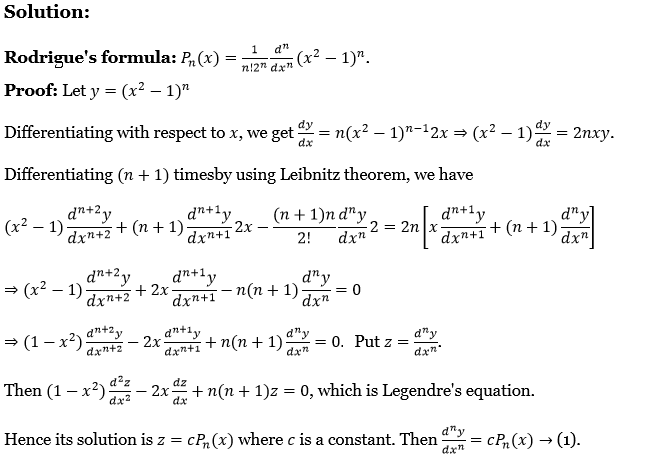
Substituting the value of \(x^4, x^3, x^2\), we have

∴ \(P(x)=\frac{8}{35} P_4(x)+\frac{6}{7} x^2-\frac{3}{35}+2 x^3+2 x^2-x-3\)

⇒ \(\frac{8}{35} P_4(x)+2 x^3+\frac{20}{7} x^2-x-\frac{108}{35}=\frac{8}{35} P_4(x)+2\left[\frac{2}{5} P_3(x)+\frac{3}{5} x\right]+\frac{20}{7} x^2-x-\frac{108}{35}\)

⇒ \(\frac{8}{35} P_4(x)+\frac{4}{5} P_3(x)+\frac{20}{7} x^2+\frac{1}{5} x-\frac{108}{35}\)

⇒ \(\frac{8}{35} P_4(x)+\frac{4}{5} P_3(x)+\frac{20}{7}\left[\frac{2}{3} P_2(x)+\frac{1}{3}\right]+\frac{1}{5} x-\frac{108}{35}\)

⇒ \(\frac{8}{35} P_4(x)+\frac{4}{5} P_3(x)+\frac{40}{21} P_2(x)+\frac{1}{5} x-\frac{224}{105}\)

⇒ \(=\frac{8}{35} P_4(x)+\frac{4}{5} P_3(x)+\frac{40}{21} P_2(x)+\frac{1}{5} P_1(x)-\frac{224}{105} P_0(x)\)

Step-By-Step Solutions For Legendre Polynomial Exercises

8. Prove that \(\left(1-2 x h+h^2\right)^{-1 / 2}=\sum_{n=0}^{\infty} h^n P_n(x)\).

Legendre Polynomials Exercise 4 Question 8

Solution:

We have \(\left(1-2 x h+h^2\right)^{-1 / 2}=\{1-h(2 x-h)\}^{-1 / 2}\)

⇒ \(1+\frac{1}{2} h(2 x-h)+\frac{1 \cdot 3}{2 \cdot 4} h^2(2 x-h)^2+\cdots+\frac{1 \cdot 3 \cdots(2 n-3)}{2 \cdot 4 \cdots(2 n-2)} h^{n-1}(2 x-h)^{n-1}+\frac{1 \cdot 3 \cdots(2 n-1)}{2 \cdot 4 \cdots(2 n)} h^n(2 x-h)^n+\cdots\)

∴ Coefficient of \(h^n=\frac{1 \cdot 3 \cdots(2 n-1)}{2 \cdot 4 \cdots 2 n}(2 x)^n+\frac{1 \cdot 3 \cdots(2 n-3)}{2 \cdot 4 \cdots(2 n-2)}{ }^{n-1} C_1(2 x)^{n-2}\)

⇒ \(+\frac{1 \cdot 3 \cdots(2 n-5)}{2 \cdot 4 \cdots(2 n-4)}{ }^{n-2} C_2(2 x)^{n-4}+\cdots\)

⇒ \(\frac{1 \cdot 3 \cdot(2 n-1)}{n!}\left[x^n-\frac{2 n}{2 n-1}(n-1) \frac{x^{n-2}}{2^2}+\frac{2 n(2 n-2)}{(2 n-1)(2 n-3)} \frac{(n-2)(n-3)}{2!} \frac{x^{n-4}}{2^4}-\cdots\right]\)

⇒ \(\frac{1 \cdot 3 \cdot(2 n-1)}{n!}\left[x^n-\frac{n(n-1)}{2(2 n-1)} x^{n-2}+\frac{n(n-1)(n-2)(n-3)}{2 \cdot 4(2 n-1)(2 n-2)} x^{n-4} \cdots\right]=P_n(x)\)

Thus we have \(\sum_{n=0}^{\infty} h^n P_n(\mathrm{x})=\left(1-2 \mathrm{x} h+h^2\right)^{-1 / 2}\)

Examples Of Generating Functions For Legendre Polynomials

9. Show that 1) \(P_n(1)=1\) 2) \(P_n(-x)=(-1)^n P_n(x)\) and hence deduce that \(P_n(-1)=(-1)^n\).

Legendre Polynomials Exercise 4 Question 9

Solution:

1. We know that \(\sum_{n=0}^{\infty} h^n P_n(\mathrm{x})=\left(1-2 \mathrm{x} h+h^2\right)^{-1 / 2} \rightarrow(1)\)

Putting x = 1 in (1), we get

⇒ \(\sum_{n=0}^{\infty} h^n P_n(1)=\left(1-2 h+h^2\right)^{-1 / 2}=(1-h)^{-1}=1+h+h^2+\cdots+h^n+\cdots=\sum_{n=0}^{\infty} h^n\)

Equation the coefficient of hn, we have Pn(1) = 1

2. \(\left(1-2 x h+h^2\right)^{-1 / 2}=\sum_{n=0}^{\infty} h^n P_n(x)\)

⇒ \(\left(1+2 x h+h^2\right)^{-1 / 2}=\left\{1-2 x(-h)+(-h)^2\right\}^{-1 / 2}\)

⇒ \(=\sum_{n=0}^{\infty}(-h)^n P_n(x)=\sum_{n=0}^{\infty}(-1)^n h^n P_n(x) \rightarrow(1)\)

Again \(\left(1+2 x h+h^2\right)^{-1 / 2}=\left\{1-2(-x) h+h^2\right\}^{-1 / 2}=\sum_{n=0}^{\infty} h^n P_n(-{x}) \rightarrow(2)\)

From (1) and (2), we have \(\sum_{n=0}^{\infty} h^n P_n(-x)=\sum_{n=0}^{\infty}(-1)^n h^n P_n(x)\)

Equating the coefficient of \(h^n, P_n(-x)=(-1)^n P_n(x)\)

10. Prove that \(P_n(0)=0\), for n odd and \(P_n(0)=\frac{(-1)^{n / 2} n !}{2^n\{(n / 2) !\}^2}\), for n even.

Legendre Polynomials Exercise 4 Question 10

Solution:

1. \(P_n(x)=\frac{1 \cdot 3 \cdot 5 \ldots(2 n-1)}{n!}\left[x^n+\frac{n}{2} \frac{(n-1)}{(2 n-1)} x^{n-2}+\frac{n(n-1)(n-2)(n-3)}{2 \cdot 4 \cdot(2 n-1)(2 n-3)} x^{n-4} \ldots\right]\)

When n = (2m+1), odd then

⇒ \(P_{2 m+1}(x)=\frac{1 \cdot 3 \cdot 5 \ldots\{2(2 m+1)-1\}}{(2 m+1)!} \times\left[x^{2 m+1}-\frac{(2 m+1)(2 m+1-1)}{2\{2(2 m+1)-1\}} x^{2 m+1-2}+\cdots\right]\)

Putting \(x=0, P_{2 m+1}(0)=0 \text {, i.e., } P_n(0)=0\), when n is odd.

Also, we have \(\sum_{n=0}^{\infty} h^n P_n(x)=\left(1-2 x h+h^2\right)^{-1 / 2}\)

∴ \(\sum_{n=0}^{\infty} h^n P_n(0)=\left(1+h^2\right)^{-1 / 2}=\left\{1-\left(-h^2\right)\right\}^{-1 / 2}\)

⇒ \(1+\frac{1}{2}\left(-h^2\right)+\frac{1 \cdot 3}{2 \cdot 4}\left(-h^2\right)^2+\frac{1 \cdot 3 \cdot 5}{2 \cdot 4 \cdot 6}\left(-h^2\right)^3+\cdots+\frac{1 \cdot 3 \cdot 5 \ldots(2 r-1)}{2 \cdot 4 \ldots 2 r}\left(-h^2\right)^r+\cdots\)

Here all powers of h on the R.H.S. are even. Equating the coefficients of h2m on both sides, we have

⇒ \(P_{2 m}(0)=\frac{1 \cdot 3 \cdot 5 \ldots(2 m-1)}{2 \cdot 4 \cdot 6 \ldots . .2 m}(-1)^m=(-1)^m \frac{(2 m)!}{2^{2 m}(m!)^2}\)

i.e., when n = 2m, then \(\)

⇒ \(P_n(0)=\frac{(-1)^{n / 2} n!}{2^n\{(n / 2)!\}^2}\)

11. Prove that \(\left(1-2 x z+z^2\right)^{-1 / 2}\) is a solution of the equation of \(z \frac{\partial^2(z v)}{\partial z^2}+\frac{\partial}{\partial x}\left\{\left(1-x^2\right) \frac{\partial v}{\partial x}\right\}=0\).

Legendre Polynomials Exercise 4 Question 11

Solution:

⇒ \(\frac{1+z}{z \sqrt{\left\{\left(1-2 x z+z^2\right)\right\}}}-\frac{1}{z}=\frac{1}{z}\left(1-2 x z+z^2\right)^{-1 / 2}+\left(1-2 x z+z^2\right)^{-1 / 2}-\frac{1}{z}\)

⇒ \(\frac{1}{z} \sum_{n=0}^{\infty} z^n P_n(x)+\sum_{n=0}^{\infty} z^n P_n(x)-\frac{1}{z}=\frac{1}{z}\left[P_0(x)+\sum_{n=1}^{\infty} z^n P_n(x)\right]+\sum_{n=0}^{\infty} z^{\prime \prime} P_n(x)-\frac{1}{z}\)

⇒ \(\frac{1}{z}+\frac{1}{z} \sum_{n=1}^{\infty} z^n P_n(x)+\sum_{n=0}^{\infty} z^n P_n(x)-\frac{1}{z} \text { since } P_0(x)=1\)

⇒ \(\sum_{n=1}^{\infty} z^{n-1} P_n(x)+\sum_{n=0}^{\infty} z^n P_n(x)=\sum_{n=0}^{\infty} z^n P_{n+1}(x)+\sum_{n=0}^{\infty} z^n P_n(x)\)

⇒ \(\sum_{n=0}^{\infty}\left[P_{n+1}(x)+P_n(x)\right] z^n\)

12. Prove that \(\frac{1+z}{z \sqrt{\left.\left\{1-2 x z+z^2\right)\right\}}}-\frac{1}{z}=\sum_{n=0}^{\infty}\left[P_n(x)+P_{n+1}(x)\right] z^n\).

Legendre Polynomials Exercise 4 Question 12

Solution:

We have \(\left(1-2 x z+z^2\right)^{-1 / 2}=\sum_{n=0}^{\infty} z^n P_n(x) \rightarrow(1)\)

Differentiating w.r.t. z we have \((x-z)\left(1-2 x z+z^2\right)^{-3 / 2}=\sum_{n=0}^{\infty} n z^{n-1} P_n(x)\)

∴ \(2(x-z) z\left(1-2 x z+z^2\right)^{-3 / 2}=\sum_{n=0}^{\infty} 2 n z^n P_n(x) \rightarrow(2)\)

Adding (1) and (2), we have \(\frac{1-2 x z+z^2+2(x-z) z}{\left(1-2 x z+z^2\right)^{3 / 2}}=\sum_{n=0}^{\infty}(2 n+1) z^n P_n(x)\)

⇒ \(\frac{1-z^2}{\left(1-2 x z+z^2\right)^{3 / 2}}=\sum_{n=0}^{\infty}(2 n+1) z^n P_n(x)\)

13. Show that \(\frac{1-z^2}{\left(1-2 x z+z^2\right)^{3 / 2}}=\sum_{n=0}^{\infty}(2 n+1) z^n P_n(x)\).

Legendre Polynomials Exercise 4 Question 13

Solution:

We have v = \(\left(1-2 x z+z^2\right)^{-1 / 2}=\sum_{n=0}^{\infty} z^n P_n \Rightarrow z v=\sum_{n=0}^{\infty} z^{n+1} P_n\)

∴ \(z \frac{\partial^2}{\partial z^2}(z v)=\sum_{n=0}^{\infty}(n+1) n z^n P_n \text { and } \frac{\partial v}{\partial x}=\sum_{n=0}^{\infty} z^n \cdot P_n\)

∴ \(\frac{\partial}{\partial x}\left\{\left(1-x^2\right) \frac{\partial v}{\partial x}\right\}=\frac{\partial}{\partial x}\left(\left(1-x^2\right) \sum_{n=0}^{\infty} z^n P_n^{\prime}\right)=\left(1-x^2\right) \sum_{n=0}^{\infty} z^n P_n^{\prime \prime}-2 x \sum_{n=0}^{\infty} z^n P_n^{\prime}\)

Now \(z \frac{\partial^2(z v)}{\partial z^2}+\frac{\partial}{\partial x}\left\{\left(1-x^2\right) \frac{\partial v}{\partial x}\right\}=\sum_{n=0}^{\infty}\left[(n+1) n z^n P_n+\left(1-x^2\right) z^n P_n^{\prime \prime}-2 x z^n P_n^{\prime}\right]\)

⇒ \(\sum_{n=0}^{\infty} Z^n\left[\left(1-x^2\right) P_n^{\prime \prime}-2 x P_n^{\prime}+n(n+1) P_n\right]=0\)

since Pn is a  solution of Legendre’s equation

Worked Problems On Legendre Polynomial Recursion Relations

14. Prove that \(P_n\left(-\frac{1}{2}\right)=P_0\left(-\frac{1}{2}\right) P_{2 n}\left(\frac{1}{2}\right)+P_1\left(-\frac{1}{2}\right) P_{2 n-1}\left(\frac{1}{2}\right)+\ldots+P_n\left(-\frac{1}{2}\right) P_0\left(\frac{1}{2}\right)\).

Legendre Polynomials Exercise 4 Question 14

Solution:

We have \(\left(1-2 x z+z^2\right)^{-1 / 2}=\sum_{n=0}^{\infty} z^n P_n(x) \rightarrow(1)\)

Replacing x by \(\frac{1}{2} \text { and }-\frac{1}{2}\) successively in (1), we get

⇒ \(\left(1-z+z^2\right)^{-1 / 2}=\sum_{n=0}^{\infty} z^n P_n\left(\frac{1}{2}\right) \rightarrow \text { (2) and }\left(1+z+z^2\right)^{-1 / 2}=\sum_{n=0}^{\infty} z^n P_n\left(-\frac{1}{2}\right) \rightarrow \text { (3) }\)

Next replacing z by z2 in (3), we get \(\left(1+z^2+z^4\right)^{-1 / 2}=\sum_{n=0}^{\infty} z^{2 n} P_n\left(-\frac{1}{2}\right) \rightarrow(4)\)

But \(\left(1+z^2+z^4\right)^{-1 / 2}=\left(1+z+z^2\right)^{-1 / 2}\left(1-z+z^2\right)^{-1 / 2}\)

⇒ \(\sum_{n=0}^{\infty} z^{2 n} P_n\left(-\frac{1}{2}\right)=\sum_{n=0}^{\infty} z^n P_n\left(-\frac{1}{2}\right) \times \sum_{n=0}^{\infty} z^n P_n\left(\frac{1}{2}\right) \text { by (2), (3) and (4) }\)

⇒ \(\sum_{n=0}^{\infty} z^{2 n} P_n\left(-\frac{1}{2}\right)=\left[P_0\left(-\frac{1}{2}\right)+z P_1\left(-\frac{1}{2}\right)+. .+z^{\geq n-1} P_{2 n-1}\left(-\frac{1}{2}\right)+z^{2 n} P_{2 n}\left(-\frac{1}{2}\right)+. .\right)\)

⇒ \(\times\left[P_0\left(\frac{1}{2}\right)+z P_1\left(\frac{1}{2}\right)+\cdots+z^{2 n-1} P_{2 n-1}\left(\frac{1}{2}\right)+z^{2 n} P_{2 n}\left(\frac{1}{2}\right)+\cdots\right]\)

Equating the coefficients of z2n from both sides of the above equation, we get

⇒ \(P_n\left(-\frac{1}{2}\right)=P_0\left(-\frac{1}{2}\right) P_{2 n}\left(\frac{1}{2}\right)+P_1\left(-\frac{1}{2}\right) P_{2 n-1}\left(\frac{1}{2}\right)+\cdots+P_n\left(-\frac{1}{2}\right) P_0\left(\frac{1}{2}\right)\)

15. Prove that 1) \(\int_{-1}^{+1} P_{m t}(x) P_n(x) d x=0 \text { if } m \neq n\) 2) \(\int_{-1}^{+1}\left[P_n(x)\right]^2 d x=\frac{2}{2 n+1}\).

Legendre Polynomials Exercise 4 Question 15.1

Solution:

1. Legendre’s equation may be written as \(\frac{d}{d x}\left\{\left(1-x^2\right) \frac{d y}{d x}\right\}+n(n+1) y=0\)

∴ \(\frac{d}{d x}\left\{\left(1-x^2\right) \frac{d P_n}{d x}\right\}+n(n+1) P_n=0 \rightarrow(1)\) and

\(\frac{d}{d x}\left\{\left(1-x^2\right) \frac{d P_m}{d x}\right\}+m(m+1) P_m=0 \rightarrow \text { (2) }\)

Multiplying (1) by Pm and (2) by Pn and then subtracting, we have

⇒ \(P_m \frac{d}{d x}\left\{\left(1-x^2\right) \frac{d P_n}{d x}\right\}-P_n \frac{d}{d x}\left\{\left(1-x^2\right) \frac{d P_m}{d x}\right\}+\{n(n+1)-m(m+1)\} P_n P_m=0\)

Integrating between the limits -1 to 1, we have

⇒ \(\int_{-1}^{+1} P_m \frac{d}{d x}\left\{\left(1-x^2\right) \frac{d P_n}{d x}\right\} d x-\int_{-1}^1 P_n \frac{d}{d x}\left\{\left(1-x^2\right) \frac{d P_m}{d x}\right\} d x+\{n(n+1)-m(m+1)\} \int_{-1}^1 P_m P_n d x=0\)

Integrating by parts

⇒ \(\left[P_m\left(1-x^2\right) \frac{d P_n}{d x}\right]_{-1}^{+1}-\int_{-1}^{+1} \frac{d P_m}{d x}\left\{\left(1-x^2\right) \frac{d P_n}{d x}\right\} d x-\left[P_n\left(1-x^2\right) \frac{d}{d x} P_m\right]_{-1}^{+1}\)

⇒ \(+\int_{-1}^{+1} \frac{d P_n}{d x}\left\{\left(1-x^2\right) \frac{d}{d x} P_m\right\} d x+[n(n+1)-m(m+1)] \int_{-1}^{+1} P_m P_n d x=0\)

∴ \(\{n(n+1)-m(m+1)\} \int_{-1}^{+1} P_m P_n d x=0\)

Hence \(\int_{-1}^{+1} P_m(x) P_n(x) d x=0\) since m ≠ n

Legendre Polynomials Exercise 4 Question 15.2

2. we have \(\left(1-2 x h+h^2\right)^{-1 / 2}=\sum_{n=0}^{\infty} h^n P_n(x)\)

Squaring both sides we have

⇒ \(\left(1-2 x h+h^2\right)^{-1}=\sum_{n=0}^{\infty} h^{2 n}\left\{P_n(x)\right\}^2+2 \sum_{{m=0 \\ n=0 \\ n \neq m}}^{\infty} h^{m+n} P_m(x) P_n(x)\)

Integrating between limits -1 to +1, we have

⇒ \(\sum_{n=0}^{\infty} \int_{-1}^{+1} h^{2 n}\left[P_n(\tilde{x})\right]^2 d x+2 \sum_{n=0}^{\infty} \int_{-1}^{+1} h^{m+n} P_m(x) P_n(x) d x=\int_{-1}^{+1} \frac{d x}{\left(1-2 x h+h^2\right)}\)

⇒ \(\sum_{n=0}^{\infty} \int_{-1}^{+1} h^{2 n}\left[P_n(x)\right]^2 d x=\int_{-1}^{+1} \frac{d x}{\left(1-2 x h+h^2\right)}\)

Since the other integral of the L.H.S. is zero by (1) as m ≠ n

⇒ \(-\frac{1}{2 h}\left[\log \left(1-2 x h+h^2\right)\right]_{-1}^{+1}=-\frac{1}{2 h}\left\{\log (1-h)^2-\log (1+h)^2\right\}\)

⇒ \(\frac{1}{2 h}\left[\log \left\{\frac{1+h}{1-h}\right\}^2\right]=\frac{1}{h} \log \left\{\frac{1+h}{1-h}\right\}=\frac{2}{h}\left\{h+\frac{h^3}{3}+\frac{h^5}{5}+\cdots\right\}\)

⇒ \(2\left\{1+\frac{h^2}{3}+\frac{h^4}{5}+\cdots+\frac{h^{2 n}}{2 n+1}+\cdots\right\}=\sum_{n=0}^{\infty} \frac{2 h^{2 n}}{2 n+1} .\)

Equating the coefficients of h2n, we have \(\int_{-1}^{+1}\left[P_n(x)\right]^n d x=\frac{2}{2 n+1}\)

16. Prove that \((2 n+1) x P_n=(n+1) P_{n+1}+n P_{n-1} \text {. }\).

Legendre Polynomials Exercise 4 Question 16

Solution:

We have \(\left(1-2 x h+h^2\right)^{-1 / 2}=\sum_{n=0}^{\infty} h^n P_n(x)\)

Differentiating both sides w.r.t ‘h’ we have

⇒ \(-\frac{1}{2}\left(1-2 x h+h^2\right)^{-3 / 2}(-2 x+2 h)=\sum_{n=0}^{\infty} n h^{n-1} P_n(x)\)

⇒ \((x-h)\left(1-2 x h+h^2\right)^{-\frac{1}{2}}=\left(1-2 x h+h^2\right) \sum_{n=0}^{\infty} n h^{n-1} P_n(x)\)

⇒ \((x-h) \sum_{n=0}^{\infty} h^n P_n(x)=\left(1-2 x h+h^2\right) \sum_{n=0}^{\infty} n h^{n-1} P_n(x)\)

⇒ \(\left(x_0-h\right)\left[P_0(x)+h P_1(x)+\cdots+h^{n-1} P_{n-1}(x)+h^n P_n(x)+\cdots\right]\)

⇒ \(\left(1-2 x h+h^2\right)\left[P_1(x)+2 h P_2(x)+\cdots+(n-1) h^{n-2} P_{n-1}(x)+n h^{n-1} P_n(x)\right.\)

⇒ \(\left.+(n+1) h^n P_{n+1}(x)+\cdots\right] \rightarrow(1)\)

Equating the coefficient of lln from two sides, we have

⇒ \({ }_x P_n(x)-P_{n-1}(x)=(n+1) P_{n+1}(x)-2 x n P_n(x)+(n-1) P_{n-1}(x)\)

⇒ \((2 n+1) x P_n(x)=(n+1) P_{n+1}(x)+n P_{n-1}(x)\)

In short \((2 n+1) x P_n=(n+1) P_{n+1}+n P_{n-1}\)

17. Prove that \(n P_n=x P_n^{\prime}-P_{n-1}^{\prime}\).

Legendre Polynomials Exercise 4 Question 17

Solution:

We have \(\left(1-2 x h+h^2\right)^{-1 / 2}=\sum_{n=0}^{\infty} h^n P_n(x) \rightarrow(1)\)

Differentiating (1) w.r.t. h, we have \((x-h)\left(1-2 x h+h^2\right)^{-3 / 2}=\sum_{n=0}^{\infty} n h^{n-1} P_n(x) \rightarrow(2)\)

Again differentiating (1), we have \(h\left(1-2 x h+h^2\right)^{-3 / 2}=\sum_{n=0}^{\infty} h^n P_n^{\prime}(x)\)

⇒ \(h(x-h)\left(1-2 x h+h^2\right)^{-3 / 2}=(x-h) \sum_{n=0}^{\infty} h^n P_n^{\prime}(x) \rightarrow(3)\)

From (2) and (3), we have \(h \sum_{n=0}^{\infty} n h^{n-1} P_n(x)=(x-h) \sum_{n=0}^{\infty} h^n P_n^{\prime}(x)\)

⇒ \(h\left[h^0 P_1(x)+2 h P_2(x)+\cdots+n h^{n-1} P_n(x)+\cdots\right]\)

⇒ \((x-h)\left[P_0^{\prime}(x)+h P_1^{\prime}(x)+\cdots+h^{n-1} P_{n-1}^{\prime}(x)+h^n P_n^{\prime}(x)+\cdots\right]\)

Equating the coefficient of hn on both sides, we have \(n P_n(x)=x P_n^{\prime}(x)-P_{n-1}^{\prime}(x)\)

In short \(n P_n=x P_n^{\prime}-P_{n-1}^{\prime}\)

18. Prove that \((2 n+1) P_n=P_{n+1}^{\prime}-P_{n-1}^{\prime}\).

Legendre Polynomials Exercise 4 Question 18

Solution:

From recurrence formula 1, we have \((2 n+1) x P_n=(n+1) P_{n+1}+n P_{n-1}\) Differentiating w.r.t we have

⇒ \((2 n+1) x P_n^{\prime}+(2 n+1) P_n=(n+1) P_{n+1}^{\prime}+n P_{n-1}^{\prime} \rightarrow(1)\)

From recurrence formula 2, we have\(x P_n^{\prime}=n P_n+P_{n-1}^{\prime} \rightarrow \text { (2) }\)

Eliminating xP’n From (1) and (2), we have

⇒ \((2 n+1)\left(n P_n+P_{n-1}^{\prime}\right)+(2 n+1) P_n=(n+1) P_{n+1}^{\prime}+n P_{n-1}^{\prime}\)

⇒ \((2 n+1)(n+1) P_n=(n+1) P_{n+1}^{\prime}+n P_{n-1}^{\prime}-(2 n+1) P_{n-1}^{\prime}\)

⇒ \((2 n+1)(n+1) P_n=(n+1) P_{n+1}^{\prime}-(n+1) P_{n+1}^{\prime}\)

∴ \((2 n+1) P_n=P_{n+1}^{\prime}-P_{n-1}^{\prime}\)

19. Prove that \((n+1) P_n=\left(P_{n+1}^{\prime}-x P_n^{\prime}\right)\).

Solution:

Writing Recurrence formula | and || we have,

⇒ \(n P_n=x P_n^{\prime}-P_{n-1}^{\prime} \rightarrow(1) \text { and }(2 n+1) P_n=P_{n+1}^{\prime}-P_{n-1}^{\prime} \rightarrow \text { (2) }\)

Subtracting (1) from (2) we have \((n+1) P_n=P_{n+1}^{\prime}-x P_n^{\prime}\)

20. Prove that \(\left(1-x^2\right) P_n^{\prime}=n\left(P_{n-1}-x P_n\right)\).

Solution:

Replacing n by (n-1) in recurrence formula IV, we have

⇒ \(n P_{n-1}=P_n^{\prime}-x P_{n-1}^{\prime} \rightarrow(1)\)

Writing II recurrence formula, we have \(n P_n=x P_n^{\prime}-P_{n-1}^{\prime} \rightarrow(2)\)

Multiplying by x and then subtracting from (1), we have

⇒ \(n\left(P_{n-1}-x P_n\right)=\left(1-x^2\right) P_n^{\prime} \Rightarrow\left(1-x^2\right) P_n^{\prime}=n\left(P_{n-1}-x P_n\right)\)

21. Prove that \(\left(1-x^2\right) P_n^{\prime}=(n+1)\left(x P_n-P_{n+1}\right)\).

Legendre Polynomials Exercise 4 Question 21

Solution:

Recurrence formula 1, is \((2 n+1) x P_n=(n+1) P_{n+1}+n P_{n-1}\)

⇒ \((n+1) x P_n+n x P_n=(n+1) P_{n+1}+n P_{n-1^{\prime}}\)

⇒ \((n+1)\left(x P_n-P_{n+1}\right)=n\left(P_{n-1}-x P_n\right) \rightarrow(1)\)

Recurrence formula V is \(\left(1-x^2\right) P_n^{\prime}=n\left(P_{n-1}-x P_n\right) \rightarrow(2)\)

From (1) and (2), we have \(\left(1-x^2\right) P_n^{\prime}=(n+1)\left(x P_n-P_{n+1}\right)\)

22. Prove Beltrami’s result. i.e., \((2 n+1)\left(x^2-1\right) P_n^{\prime}=n(n+1)\left(P_{n+1}-P_{n-1}\right)\).

Legendre Polynomials Exercise 4 Question 22

Solution:

Beltrami’s result: \((2 n+1)\left(x^2-1\right) P_n^{\prime}=n(n+1)\left(P_{n+1}-P_{n-1}\right)\)

Proof: From recurrence formulas 5 and 6, we have

⇒ \(\left(1-x^2\right) P_n^{\prime}=n\left(P_{n-1}-x P_n\right) \rightarrow(1),\left(1-x^2\right) P_n^{\prime}=(n+1)\left(x P_n-P_{n+1}\right) \rightarrow(2)\)

Substituting for xPn from (1) in (2), we have

⇒ \(\left(1-x^2\right) P_n^{\prime}=(n+1)\left[P_{n-1}-\frac{\left(1-x^2\right)}{n} P_n^{\prime}-P_{n+1}\right]\)

⇒ \(\left(1-x^2\right)\left\{1+\frac{(n+1)}{n}\right\} P_n^{\prime}=(n+1)\left(P_{n-1}-P_{n+1}\right)\)

⇒ \(-\left(x^2-1\right)(2 n+1) P_n^{\prime}=n(n+1)\left(P_{n-1}-P_{n+1}\right)\)

⇒ \((2 n+1)\left(x^2-1\right) P_n^{\prime}=n(n+1)\left(P_{n+1}-P_{n-1}\right)\)

23. Prove that \(P_n^{\prime}=(2 n-1) P_{n-1}+(2 n-5) P_{n-3}+(2 n-9) P_{n-5}+\ldots\), the last term of the series being \(3 P_1 \text { or } P_0\) according as n is even or odd.

Legendre Polynomials Exercise 4 Question 23

Solution:

From Recurrence formula 3, we have \(P_{n+1}^{\prime}=(2 n+1) P_n+P_{n-1}^{\prime} \rightarrow(A)\)

Replacing n by (n-1) we have \(P_n^{\prime}=(2 n-1) P_{n-1}+P_{n-2}^{\prime} \rightarrow(1)\)

Replacing n by (n-1) (n-4),…….. in (1), we have

⇒ \(P_{n-2}^{\prime}=(2 n-5) P_{n-3}^{\prime}+P_{n-4}^{\prime} \rightarrow(2)\)

⇒ \(P_{n-4}^{\prime}=(2 n-9) P_{n-5}+P_{n-6}^{\prime} \rightarrow(3)\)

………           ………            …….

⇒ \(P_2^{\prime}=3 P_1+P_0^{\prime}\)

Adding (1),(2),(3), etc., we have;

when n is even; \(P_n^{\prime}=(2 n-1) P_{n-1}+(2 n-5) P_{n-3}+(2 n-9) P_{n-5}+\cdots+3 P_1+P_0^{\prime}\)

⇒ \((2 n-1) P_{n-1}+(2 n-5) P_{n-3}+(2 n-9) P_{n-5}+\cdots+3 P_1 \text { as } P_0^{\prime}=0\)

When n is odd, \(P_n^{\prime}=(2 n-1) P_{n-1}+(2 n-5) P_{n-3}+\cdots+5 P_2+P_1^{\prime}\)

⇒ \((2 n-1) P_{n-1}+(2 n-5) P_{n-3}+\cdots P_0 \text { as } P_1^{\prime}=1=P_0\)

Hence \(P_n^{\prime}=(2 n-1) P_{n-1}+(2 n-5) P_{n-3}+\cdots\)

The last term of the series 3P1 or P0 according to n is even or odd.

24. Prove Christoffel’s summation formula :

\(\sum_{r=0}^n(2 r+1) P_r(x) P_r(y)=(n+1) \frac{P_{n+1}(x) P_n(y)-P_{n+1}(y) P_n(x)}{(x-y)} .\)

Legendre Polynomials Exercise 4 Question 24.1

Solution:

Christoffel’s summation formula is

⇒ \(\sum_{r=0}^n(2 r+1) P_r(x) P_r(y)=(n+1) \frac{P_{n+1}(x) P_n(y)-P_{n+1}(y) P_n(x)}{(x-y)}\)

Proof: From Recurrence formula 1, we have

⇒ \((2 r+1) x P_r(x)=(r+1) P_{r+1}(x)+r P_{r-1}(x) \rightarrow(1)\)

and \((2 r+1) y P_r(y)=(r+1) P_{r+1}(y)+r P_{r-1}(y) \rightarrow(2)\) Multiplying (1) by Pr(y) and (2) by Pr(x) and then subtracting we have

⇒ \((2 r+1)(x-y) P_r(x) P_r(y)\) = \((r+1)\left[P_{r+1}(x) P_r(y)-P_{r+1}(y) P_r(x)\right]-r\left[P_{r-1}(y) P_r(x)-P_{r-1}(x) P_r(y)\right]\)

Putting r = 0,1,2,3, ….. (n-1), n, we have

⇒ \((x-y) P_0(x) P_0(y)=\left[P_1(x) P_0(y)-P_1(y) P_0(x)\right]+0 \rightarrow\left(A_0\right)\)

⇒ \(3(x-y) P_1(x) P_1(y)=2\left[P_2(x) P_1(y)-P_2(y) P_1(x)\right.\)

⇒ \(-1\left[P_0(y) P_1(x)-P_0(x) P_1(y)\right] \rightarrow\left(A_1\right)\)

⇒ \(5(x-y) P_2(x) P_2(y)=3\left[P_3(x) P_2(y)-P_3(y) P_2(x)\right]\)

⇒ \(-2\left[P_1(y) P_2(x)-P_1(x) P_2(y)\right] \rightarrow\left(A_2\right)\)

…………       ……………        …………..

…..   …….   ……    ……   ……..   …….   ……..   ……   ……

Legendre Polynomials Exercise 4 Question 24.2

⇒ \((2 n-1)(x-y) P_{n-1}(x) P_{n-1}(y)=n\left[P_n(x) P_{n-1}(y)-P_n(y) P_{n-1}(x)\right]\)

⇒ \(-(n-1)\left[P_{n-2}(y) P_{n-1}(x)-P_{n-2}(x) P_{n-1}(y)\right] \rightarrow\left(A_{n-1}\right)\)

⇒ \((2 n+1)(x-y) P_n(x) P_n(y)=(n+1)\left[P_{n+1}(x) P_n(y)-P_{n+1}(y) P_n^r(x)\right]\)

⇒ \(-n\left[P_{n-1}(y) P_n(x)-P_{n-1}(x) P_n(y)\right] \rightarrow\left(A_n\right)\)

Adding \(\left(A_0\right),\left(A_1\right),\left(A_2\right) \ldots\left(A_{n-1}\right) \text { and }\left(A_n\right)\) we have

⇒ \((x-y) \sum_{r=0}^n(2 r+1) P_r(x) P_r(y)=(n+1)\left[P_{n+1}(x) P_n(y)-P_{n+1}(y) P_{n^0}(x)\right]\)

Hence \(\sum_{r=0}^n(2 r+1) P_r(x) P_r(y)=(n+1) \frac{P_{n+1}(x) P_n(y)-P_{n+1}(y) P_n(x)}{(x-y)}\)

25. Prove Rodrigue’s formula : \(P_n(x)=\frac{1}{n ! 2^n} \frac{d^n}{d x^n}\left(x^2-1\right)^n\)

Legendre Polynomials Exercise 4 Question 25.1

Solution:

Rodrigue”s formula: \(P_n(x)=\frac{1}{n!2^n} \frac{d^n}{d x^n}\left(x^2-1\right)^n\)

Proof: Let y = \(\left(x^2-1\right)^n\)

Differentiating with respect to x, we get \(\frac{d y}{d x}=n\left(x^2-1\right)^{n-1} 2 x \Rightarrow\left(x^2-1\right) \frac{d y}{d x}=2 n x y\)

Differentiating (n+10 times by using the Leibnitz theorem, we have

⇒ \(\left(x^2-1\right) \frac{d^{n+2} y}{d x^{n+2}}+(n+1) \frac{d^{n+1} y}{d x^{n+1}} 2 x-\frac{(n+1) n}{2!} \frac{d^n y}{d x^n} 2=2 n\left[x \frac{d^{n+1} y}{d x^{n+1}}+(n+1) \frac{d^n y}{d x^n}\right]\)

⇒ \(\left(x^2-1\right) \frac{d^{n+2} y}{d x^{n+2}}+2 x \frac{d^{n+1} y}{d x^{n+1}}-n(n+1) \frac{d^n y}{d x^n}=0\)

⇒ \(\left(1-x^2\right) \frac{d^{n+2} y}{d x^{n+2}}-2 x \frac{d^{n+1} y}{d x^{n+1}}+n(n+1) \frac{d^n y}{d x^n}=0\)

Put z= \(\frac{d^n y}{d x^n}\)

Then \(\left(1-x^2\right) \frac{d^2 z}{x^2}-2 x \frac{d z}{2}+n(n+1) z=0\) which is Legendre’s equation.

Hence its solution is z = cPn(x) where c is a constant. Then \(\frac{d^n y}{d x^n}=c P_n(x) \rightarrow(1)\)

Legendre Polynomials Exercise 4 Question 25.2

Putting x = 1, we have c = \(\left(\frac{d^n y}{d x^n}\right)_{x=1}\), since \(P_n(1)=1\)

Now \(y=\left(x^2-1\right)^n=(x+1)^n(x-1)^n\)

Differentiating n times by using Leibnitz’s theorem, we have

⇒ \(\frac{d^n y}{d x^n}=(x-1)^n \frac{d^n}{d x^n}(x+1)^n+n\left\{\frac{d^{n-1}}{d x^{n-1}}(x+1)^n\right\} n(x-1)^{n-1}+\cdots\)

⇒ \(+n\left(\frac{d}{d x}(x+1)^n\right) \frac{d^{n-1}}{d x^{n-1}}(x-1)^n+(x+1)^n \frac{d^n}{d x^n}(x-1)^n\)

⇒ \((x-1)^n n!+n \frac{n!}{1!}(x+1) n(x-1)^{n-1}+\cdots+n n(x+1)^{n-1} \frac{n!}{1!}(x-1)+(x+1)^n n!\)

Now \(\left(\frac{d^n y}{d x^n}\right)_{x=1}=(1+1)^n n!=2^n \cdot n!=c\)

∴ From (1), we have \(P_n(x)=\frac{1}{c} \frac{d^n y}{d x^n} \Rightarrow P_n(x)=\frac{1}{2^n n!} \frac{d^n\left(x^2-1\right)^n}{d x^n}\)

26. Prove that \(P_n^{\prime}-P_{n-2}^{\prime}=(2 n-1) P_{n-1}\).

Solution: \(\text { Recurrence formula III, is }(2 n+1) P_n=P_{n+1}^{\prime}-P_{n-1}^{\prime}\)

⇒ \(\text { Replacing } n \text { by  n-1} \text {, we get }(2 n-1) P_n=P_n^{\prime}-P_{n-2}^{\prime} \text {. }\)
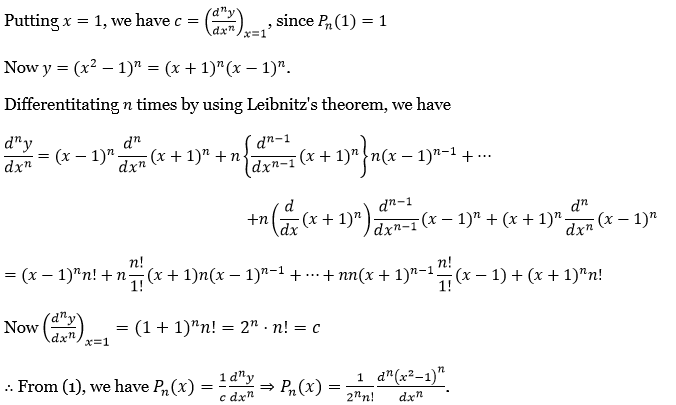
27. Prove that \(x P_9^{\prime}=P_8^{\prime}-2 P_9\).

Solution: \(\text { Recurrence formula II is } n P_n^{\prime}=x P_n^{\prime}-P_{n-1}^{\prime}\)

⇒ \(\text { Putting } n=9 \text {, we get } 9 P_9=x P_9^{\prime}-P_8^{\prime} \Rightarrow x P_9^{\prime}=9 P_9+P_8^{\prime} \text {. }\)
28. Prove that \(\frac{P_{n+1}-P_{n-1}}{2 n+1}=\int P_n d x+c\).

Solution: From the recurrence formula |||, we have

⇒ \((2 n+1) P_n=P_{n+1}^{\prime}-P_{n-1}^{\prime} \Rightarrow \frac{\left(P_{n+1}^{\prime}-P_{n-1}^{\prime}\right)}{2 n+1}=P_n\)

⇒ \(\text { Integrating, } \frac{P_{n+1}-P_{n-1}}{2 n+1}=\int P_n d x+c\)

29. Show that \(11\left(x^2-1\right) P_5^{\prime}=30\left(P_6-P_4\right)\).

Solution: Beltrami,s result is \((2 n+1)\left(x^2-1\right) P_n^{\prime}=n(n+1)\left(P_{n+1}-P_{n-1}\right)\)

⇒ \(\text { Putting } n=5 \text {, we get } 11\left(x^2-1\right) P_5^{\prime}=30\left(P_6-P_4\right)\)

30. If \(P_n(x)\) is a Legendre polynomial of degree n and α is such that \(P_n(\alpha)=0\), then show that \(P_{n-1}(\alpha) \text { and } P_{n+1}(\alpha)\) are of opposite signs.

Legendre Polynomials Exercise 4 Question 30

Solution:

From recurrence relation \(I,(2 n+1) x P_n(x)=(n+1) P_{n+1}(x)+n P_{n-1}(x)\)

Given that \(P_n(\alpha)=0 \rightarrow(2)\)

Putting x = a in (1) and using (2), we get

⇒ \((2 n+1) \alpha \cdot 0=(n+1) P_{n+1}(\alpha)+n P_{n-1}(\alpha) \Rightarrow \frac{P_{n+1}(\alpha)}{P_{n-1}(\alpha)}=-\frac{n}{n+1} \rightarrow \text { (3) }\)
Since n is a positive integer, the R.H.S of (3) is negative.

Thus (3) shows that Pn+1(α) and Pn-1(α) are of opposite signs.

31. Prove that \(P_0^2(x)+3 P_1^2(x)+5 P_2^2(x)+\ldots+(2 n+1) P_n^2(x)\)

⇒ \(=(n+1)\left[P_n(x) P_{n+1}^{\prime}(x)-P_{n+1}(x) P_n^{\prime}(x)\right]=(n+1)^2 P_n^2(x)+\left(1-x^2\right)\left\{P_n^{\prime}(x)\right\}^2\)

Legendre Polynomials Exercise 4 Question 31.1

Solution:

From Christollel’s summation formula, we have

⇒ \((x-y) \sum_{r=0}^{\infty}(2 r+1) P_r(x) P_r(y)=(n+1)\left[P_{n+1}(x) P_n(y)-P_{n+1}(y) P_n(x)\right]\)

Let h be a small quantity so that y = x+h. Then

⇒ \(-h \sum_{r=0}(2 r+1) P_r(x) P_r(x+h)=(n+1)\left[P_{n+1}(x) P_n(x+h)-P_{n+1}(x+h) P_n(x)\right]\)

By expanding by Taylor’s there, we have

⇒ \(-h \sum_{r=0}^n(2 r+1) P_r(x)\left\{P_r(x)+h P_r^{\prime}(x)+\cdots\right\}\)
⇒ \((n+1)\left[P_{n+1}(x)\left\{P_n(x)+h P_n^{\prime}(x)+\frac{h^2}{2!} P_n^{\prime \prime}(x)+\cdots\right\}\right.\)
⇒ \(\left.-\left\{P_{n+1}(x)+h P_{n+1}^{\prime}(x)+\frac{h^2}{2!} P^{\prime \prime}{ }_{n+1}(x)+\cdots\right\} P_n^{\prime}(x)\right]\)
Legendre Polynomials Exercise 4 Question 31.2

⇒ \(-h(n+1)\left[\left\{P_n(x) P_{n+1}^{\prime}(x)-P_n^{\prime}(x) P_{n+1}(x)+h(\ldots)+\cdots\right]\right.\)

⇒ \(\sum_{r=0}^n(2 r+1) P_r(x)\left\{P_r(x)+h P_r^{\prime}(x)+\cdots\right\}\)

⇒ \((n+1)\left[P_n(x) P_{n+1}^{\prime \prime}(x)-P_n^{\prime}(x) P_{n+1}(x)+h(\ldots)+\cdots\right]\)

Taking the limit as h → 0, we have

⇒ \(\sum_{r=0}^n(2 r+1) P_r^2(x)=(n+1)\left[P_n(x) P_{n+1}^{\prime}(x)-P_n^{\prime}(x) P_{n+1}(x)\right]\)

⇒ \(P_0^2(x)+3 P_2^2+5 P_2^2(x)+\cdots+(2 n+1) P_n^2(x)\)

⇒ \((n+1)\left[P_n(x) P_{n+1}^{\prime}(x)-P_{n+1}(x) P_n^{\prime}(x)\right]\)

Again \((n+1)^2 P_n^2(x)+\left(1-x^2\right) P_n^{\prime 2}(x)\)

⇒ \((n+1) P_n(x)\left[(n+1) P_n(x)\right]+P_n^{\prime}(x)\left[\left(1-x^2\right) P_n^{\prime}(x)\right]\)

⇒ \((n+1) P_n(x)\left[P_{n+1}^{\prime}(x)-x P_n^{\prime}(x)\right]+P_n^{\prime}(x)\left[(n+1)\left\{x P_n(x)-P_{n+1}(x)\right\}\right]\)

from recurrence formulas 4 and 6

⇒ \((n+1)\left[P_n(x) P_{n+1}^{\prime}(x)-P_{n+1}(x) P_n^{\prime}(x)\right]\)

32. Prove that \(P_{n+1}^{\prime}+P_n^{\prime}=P_0+3 P_1+5 P_2+\ldots+(2 n+1) P_n=\sum_{r=1}^n(2 r+1) P_r(x)\).

Legendre Polynomials Exercise 4 Question 32

Solution:

Recurrence formula 3, is \((2 n+1) P_n=P_{n+1}^{\prime}-P_{n-1}^{\prime}\)

Putting n = 1,2,3,…. we get

⇒ \(3 P_1=P_2^{\prime}-P_0^{\prime}\)

⇒ \(5 P_2=P_3^{\prime}-P_1^{\prime}\)

⇒ \(7 P_3=P_4^{\prime}-P_2^{\prime}\)

…….. …….. ……. …….

…….. …….. ……. …….

⇒ \((2 n-3) P_{n-2}=P_{n-1}^{\prime}-P_{n-3}^{\prime}\)

⇒ \((2 n-1) P_{n-1}=P_n^{\prime}-P_{n-2}^{\prime}\)

⇒ \((2 n+1) P_n=P_{n+1}^{\prime}-P_{n-1}^{\prime}\)

Adding all we get

⇒ \(3 P_1+5 P_2+\cdots+(2 n+1) P_n=P_n^{\prime}+P_{n+1}^{\prime}-P_0^{\prime}-P_1^{\prime}=P_n^{\prime}+P_{n+1}^{\prime}-0-P_0 .\)

Since \(P_0=1 \text { and } P_1=x, \)

∴ \(P_1^{\prime}=1=P_0\)

Hence \(P_0+3 P_1+5 P_2+\cdots+(2 n+1) P_n=P_{n+1}^{\prime}+P_n^{\prime}\)

33. Prove that \(\int_{-1}^{+1}\left(x^2-1\right) P_{n+1} P_n^{\prime} d x=\frac{2 n(n+1)}{(2 n+1)(2 n+3)}\).

Legendre Polynomials Exercise 4 Question 33

Solution:

From Recurrence formula V, we have \(\left(x^2-1\right) P_n^{\prime}=n\left(x P_n-P_{n-1}\right)\)

∴ \(\int_{-1}^{+1}\left(x^2-1\right) P_{n+1} P_n^{\prime} d x=\int_{-1}^{+1} n\left(x P_n-P_{n-1}\right) P_{n+1} d x\)

⇒ \(\int_{-1}^{+1} n x P_n P_{n+1} d x-\int_{-1}^{+1} n P_{n-1} P_{n+1} d x\)

⇒ \(n \int_{-1}^{+1} x P_n P_{n+1} d x\), the other integral being zero since \(\int_{-1}^{+1} P_m P_n d x=0 \text {, if } m \neq n\)

⇒ \(n \int_{-1}^{+1} \frac{(n+1) P_{n+1}+n P_{n-1}}{2 n+1} P_{n+1} d x\) from Recurrence formula 1

⇒ \(\frac{n(n+1)}{2 n+1} \int_{-1}^{+1} P_{n+1}^2 d x+\frac{n^2}{2 n+1} \int_{-1}^{+1} P_{n-1} P_{n+1} d x=\frac{n(n+1)}{(2 n+1)} \frac{2}{2(n+1)+1}+0\)

⇒ \(\frac{2 n(n+1)}{(2 n+1)(2 n+3)}\)

34. Proved that 1) \(1+\frac{1}{2} P_1(\cos \theta)+\frac{1}{3} P_2(\cos \theta)+\ldots=\log \left[\frac{1+\sin (\theta / 2)}{\sin (\theta / 2)}\right]\)

2) \(\sum_{n=0}^{\infty} \frac{P_n(\cos \theta)}{n+1}=\log \{1+\ cosec(\theta / 2)\}\)

Legendre Polynomials Exercise 4 Question 34.1

Solution:

We know that \(\sum_{n=0}^{\infty} z^n P_n(x)=\left(1-2 x z+z^2\right)^{-1 / 2} \rightarrow(1)\)

Integrating (1) w.r.t. z from 0 to 1, \(\sum_{n=0}^{\infty} \int_0^1 z^n P_n(x) d x=\int_0^1 \frac{d z}{\sqrt{\left(1-2 x z+z^2\right)}} \rightarrow \text { (2) }\)

Replacing x by cos θ on both sides of (2), we get

⇒ \(\sum_{n=0}^{\infty} P_n(\cos \theta) \int_0^1 z^n d z=\int_0^1 \frac{d z}{\sqrt{\left(1-2 z \cos \theta+z^2\right)}}\)

⇒ \(\sum_{n=0}^{\infty} P_n(\cos \theta)\left[\frac{z^{n+1}}{n+1}\right]_0^1=\int_0^1 \frac{d z}{\sqrt{\left[(z-\cos \theta)^2+\sin ^2 \theta\right]}}\)

⇒ \(\left.\sum_{n=0}^{\infty} \frac{P_n(\cos \theta)}{n+1}=\left[\log \left\{(z-\cos \theta)+\sqrt{\left[(z-\cos \theta)^2+\sin ^2 \theta\right.}\right]\right\}\right]\)

⇒ \(\left.=\log \left\{(1-\cos \theta)+\sqrt{\left[(1-\cos \theta)^2+\sin ^2 \theta\right.}\right]\right\}-\log (1-\cos \theta)\)

Legendre Polynomials Exercise 4 Question 34.2

⇒ \(\log \left\{(1-\cos \theta)+\sqrt{\left[(1-\cos \theta)^2+\sin ^2 \theta\right]}\right\}-\log (1-\cos \theta)\)

⇒ \(\log \{(1-\cos \theta)+\sqrt{[2(1-\cos \theta)]}\}-\log (1-\cos \theta)\)

⇒ \(\log \frac{(1-\cos \theta)+\sqrt{2} \sqrt{(1-\cos \theta)}}{1-\cos \theta}=\log \frac{\sqrt{(1-\cos \theta)}+\sqrt{2}}{\sqrt{(1-\cos \theta)}}\)

⇒ \(\log \frac{\sqrt{\left(2 \sin ^2(\theta / 2)\right)}+\sqrt{2}}{\left.\sqrt{\left(2 \sin ^2(\theta / 2)\right.}\right)}=\log \frac{1+\sin (\theta / 2)}{\sin (\theta / 2)}\)

∴\(\frac{P_0(\cos \theta)}{1}+\frac{1}{2} P_1(\cos \theta)+\frac{1}{3} P_2(\cos \theta)+\cdots=\log \frac{1+\sin (\theta / 2)}{\sin (\theta / 2)}\)

⇒ \(1+\frac{1}{2} P_1(\cos \theta)+\frac{1}{3} P_2(\cos \theta)+\cdots=\log \frac{1+\sin (\theta / 2)}{\sin (\theta / 2)} \text {, as } P_0(\cos \theta)=1 \rightarrow(3)\)

2. From (1), we have \(1+\frac{1}{2} P_1(\cos \theta)+\frac{1}{3} P_2(\cos \theta)+\cdots=\log \frac{1+\sin (\theta / 2)}{\sin (\theta / 2)}\)

⇒ \(\sum_{n=0}^{\infty} \frac{P_n(\cos \theta)}{n+1}=\log \{1+{cosec}(\theta / 2)\}\)

35. Prove that 1) \(\int_{-1}^{+1} P_n(x) d x=0, n \neq 0 \text { and }\) 2) \(\int_{-1}^{+1} P_0(x) d x=2\).

Solution:

From Rodrigue’s formula, we have \(P_n(x)=\frac{1}{2^n n !} \frac{d^n}{d x^n}\left(x^2-1\right)^n\)

∴ \(\int_{-1}^{+1} P_n(x) d x=\frac{1}{2^n n !} \int_{-1}^{+1} \frac{d^n}{d x^n}\left(x^2-1\right)^n d x=\frac{1}{2^n n !}\left\{\frac{d^{n-1}}{d x^{n-1}}\left(x^2-1\right)^n\right\}_{-1}^{+1} \rightarrow (1)\)

Legendre Polynomials Exercise 4 Question 35

Now \(\frac{d^{n-1}}{d x^{n-1}}\left(x^2-1\right)^n=\frac{d^{n-1}}{d x^{n-1}}(x+1)^n(x-1)^n\)

⇒ \((x+1)^n \frac{d^{n-1}}{d x^{n-1}}(x-1)^n+(n-1) n(x+1)^{n-1} \frac{d^{n-2}}{d x^{n-2}}(x-1)^n+\cdots+(x-1)^n \frac{d^{n-1}}{d x^{n-1}}(x+1)^n\)

⇒ \((x+1)^n \frac{n!}{1!}(x-1)+n(n-1)(x+1)^{n-1} \frac{n!}{2!}(x-1)^2+\cdots+(x-1)^n n!(x+1)\)

= 0, where x = -1 or 1, since each term contains (x-1) and (x+1)

∴ from (1), \(\int_{-1}^{+1} P_n(x) d x=0\)

2) We know that \(P_0(x)=1\).

⇒ \(\int_{-1}^{+1} P_0(x) d x=\int_{-1}^{+1} d x=\{x\}_{-1}^{+1}=2\)

36. Prove that if m is an integer less than n, then
\(\int_{-1}^{+1} x^m P_n(x) d x=0 \text { and } \int_{-1}^{+1} x^n P_n(x) d x=\frac{2^{n+1}(n !)^2}{(2 n+1) !}\)

Legendre Polynomials Exercise 4 Question 36

Solution:

Let l = \(\int_{-1}^{+1} x^m P_n(x) d x=\int_{-1}^{+1} x^m \frac{1}{2^n n!} \frac{d^n}{d x^n}\left(x^2-1\right)^n d x\), by Rodrigue’s formula

⇒ \(\frac{1}{2^n n!} \int_{-1}^{-1} x^m \frac{d^n}{d x^n}\left(x^2-1\right)^n d x=\frac{1}{2^n n!}\left[\left\{x^m \frac{d^{n-1}}{d x^{n-1}}\left(x^2-1\right)^n\right\}_{-1}^{+1}-\int_{-1}^{+1} m x^{m-1} \frac{d^{n-1}}{d x^{n-1}}\left(x^2-1\right)^n d x\right]\)

⇒ \(\frac{(-1) m}{2^n n!} \int_{-1}^{+1} x^{m-1} \frac{d^{n-1}}{d x^{n-1}}\left(x^2-1\right)^n d x \text {, since }\left\{\frac{d^{n-1}}{d x^{n-1}}\left(x^2-1\right)^n\right\}=0\)

Proceeding similarly, we have l = \(\frac{(-1)^m m!}{2^n n!} \int_{-1}^{+1} x^0 \frac{d^{n-m}}{d x^{n-m}}\left(x^2-1\right)^n d x\)

⇒ \(\frac{(-1)^m m!}{2^n n!}\left[\frac{d^{n-m-1}}{d x^{n-m-1}}\left(x^2-1\right)^n\right]_{-1}^{+1}=0\) [can be shown easily as n>m+1]

Again if m = n, then \(\int_{-1}^{+1} x^n P_n(x) d x=\frac{(-1)^n n!}{2^n n!} \int_{-1}^{+1} \frac{d^{n-m}}{d x^{n-m}}\left(x^2-1\right)^n d x,\)

⇒ \(\frac{(-1)^n}{2^n} \int_{-1}^1\left(x^2-1\right)^n d x=\frac{2}{2^n} \int_0^1\left(1-x^2\right)^n d x=\frac{2}{2^n} \int_0^{\pi / 2} \cos ^{2 n+1} \theta d \theta \text {. Put } x=\sin \theta\)

⇒ \(\frac{2}{2^n} \frac{n!\sqrt{\pi}}{2\left\{\frac{2 n+1}{2}\right\}\left\{\frac{2 n-1}{2}\right\}\left\{\frac{2 n-3}{2}\right\} \frac{531}{222} \sqrt{\pi}}\)

⇒ \(\frac{2(n!)^2}{2^n 2\left\{\frac{2 n+1}{2}\right\}\left\{\frac{2 n}{2}\right\}\left\{\frac{2 n-1}{2}\right\}\left\{\frac{2 n-2}{2}\right\} \frac{321}{222}}=\frac{(n!)^2}{2^n \frac{(2 n+1)!}{2^{2 n+1}}}=\frac{2^{n+1}(n!)^2}{(2 n+1)!}\)

37. Prove that\(\int_{-1}^{+1} x^2 P_{n+1} P_{n-1} d x=\frac{2 n(n+1)}{(2 n-1)(2 n+1)(2 n+3)}\).

Legendre Polynomials Exercise 4 Question 37

Solution:

From Recurrence formula 1, we have \((2 n+1) x P_n=(n+1) P_{n+1}+n P_{n-1}\)

Replacing n by (n-1) and (n+1) respectively, we have

⇒ \((2 n-1) x P_{n-1}=\| P_n+(n-1) P_{n-2} \text { and }(2 n+3) x P_{n+i}=(n+2) P_{n+2}+(n+1) P_n\)

Multiplying, we get

⇒ \((2 n-1)(2 n+3) x^2 P_{n+1} P_{n-1}=\left[n P_n+(n-1) P_{n-2}\right]\left[(n+2) P_{n+2}+(n+1) P_n\right]\)

⇒ \(n(n+1) P_n^2+n(n+2) P_n P_{n+2}+(n-1)(n+2) P_{n-2} P_{n+2}+(n-1)(n+1) P_{n-2} P_n\)

Integrating between the limits -1 to +1, we have

⇒ \((2 n-1)(2 n+3) \int_{-1}^{+1} x^2 P_{n+1} P_{n-1} d x=n(n+1) \int_{-1}^{+1} P_n^2 d x\) all other integrals being zero

⇒ \(n(n+1) \frac{2}{(2 n+1)}\)

∴ \(\int_{-1}^{+1} x^2 P_{n+1} P_{n-1} d x=\frac{2 n(n+1)}{(2 n-1)(2 n+1)(2 n+3)}\)

38. Show that \(\int_{-1}^1 x P_n(x) P_{n-1}(x) d x=\frac{2 n}{4 n^2-1}\).

Solution:

⇒ \(\int_{-1}^1 x P_n(x) P_{n-1}(x) d x=\int_{-1}^1\left[\frac{n+1}{2 n+1} P_{n+1}^{-1}(x)+\frac{n}{2 n+1} P_{n-1}(x)\right] P_{n-1}(x) d x\)

⇒ \(\frac{n+1}{2 n+1} \int_{-1}^1 P_{n+1}(x) P_{n-1}(x) d x+\frac{n}{2 n+1} \int_{-1}^1\left[P_{n-1}(x)\right]^2 d x\)

⇒ \(0+\frac{n}{2 n+1} \times \frac{2}{2(n-1)+1}=\frac{2 n}{(2 n+1)(2 n-1)}=\frac{2 n}{4 n^2-1}\)

39. Prove that \(\int_{-1}^{+1} P_m(x) P_n(x) d x=\frac{2}{2 n+1}, \delta_{m n}\) where \(\delta_{m n}\) is the kronecker delta.

Solution:

We have \(\int_{-1}^1 P_m(x) P_n(x) d x=0\) if m≠n and \(\int_{-1}^1 P_m(x) P_n(x)=\frac{2}{2 n+1}\) if m=n

∴\(\int_{-1}^1 P_m^ (x) P_n(x) d x=\frac{2}{2 n+1} \delta_{m n}\) where \(\delta_{m n}\)) is the kroneker delta.

40. Prove that \(\int_{-1}^1 x^2 P_n^2 d x=\frac{1}{8(2 n-1)}+\frac{3}{4(2 n+1)}+\frac{1}{8(2 n+3)}\)

Legendre Polynomials Exercise 4 Question 40

Solution:

from recurrence relation 1, \((2 n+1) x P_n=(n+1) P_{n+1}+n P_{n-1}\)

Squaring both sides, we get

⇒ \((2 n+1)^2 x^2 P_n^2=(n+1)^2 P_{n+1}^2+n^2 P_{n-1}^2+2 n(n+1) P_{n+1} P_{n-1} \rightarrow \text { (1) }\)

We know that \(\int_{-1}^1 P_m P_n d x=\left\{\begin{aligned}
0, & \text { if } m \neq n \\
2 /(2 n+1), & \text { if } m=n
\end{aligned} \rightarrow\right. \text { (2) }\)

Integrating both sides of (1) w.r.t. x between the limits -1 to 1 and using (2),

we have \((2 n+1)^2 \int_{-1}^1 x^2 P_n^2 d x=(n+1)^2 \frac{2}{2(n+1)+1}+n^2 \frac{2}{2(n-1)+1}+0\)

∴ \(\int_{-1}^1 x^2 P_n^2 d x=\frac{2}{(2 n+1)^2}\left[\frac{(n+1)^2}{2 n+3}+\frac{n^2}{2 n-1}\right]=\frac{1}{8(2 n-1)}+\frac{3}{4(2 n+1)}+\frac{1}{8(2 n+3)}\)

41. Prove that \(\int_x^1 P_n(x) d x=\frac{1}{2 n+1}\left[P_{n-1}(x)-P_{n+1}(x)\right]\)

Legendre Polynomials Exercise 4 Question 41

Recurrence formula 3 is \((2 n+1) P_n=P_{(n+1)}^{\prime}-P_{(n-1)}^{\prime}\)

Integrating between the limits x to 1, we get

⇒ \((2 n+1) \int_x^1 P_n(x) d x=\int_x^1\left[P^{\prime}{ }_{n+1}(x)-P_{n-1}^{\prime}(x)\right] d x=\left[P_{n+1}(x)-P_{n-1}(x)\right]_x^1\)

⇒ \(P_{n+1}(1)-P_{n-1}(1)-P_{n+1}(x)+P_{n-1}(x)=1-1+P_{n-1}(x)-P_{n+1}(x)\)

⇒ \(\int_x^1 P_n(x) d x=\frac{1}{2 n+1}\left[P_{n-1}(x)-P_{n+1}(x)\right]\)

42. Show that \(\int_{-1}^{+1} x^4 P_6(x) d x=0\).

Legendre Polynomials Exercise 4 Question 42

Solution:

⇒ \(I=\int_{-1}^1 x^4 P_6(x) d x=\int_{-1}^1 x^4 \frac{1}{2^6 6!} \frac{d^6}{d x^6}\left(x^2-1\right)^6 d x=\frac{1}{2^6 6!} \int_{-1}^1 x^4 \frac{d^6}{d x^6}\left(x^2-1\right)^6 d x\)

⇒ \(\frac{1}{2^6 6!}\left[\left\{x^4 \frac{d^5}{d x^5}\left(x^2-1\right)^6\right\}_{-1}^1-\int_{-1}^1 4 x^3 \frac{d^5}{d x^5}\left(x^2-1\right)^6 d x\right]\)

⇒ \(\frac{(-1)}{2^6 6!} \int_{-1}^1 4 x^3 \frac{d^5}{d x^5}\left(x^2-1\right)^6 d x\)

By continuing in this way, we get

⇒ \(I=\frac{(-1)^4}{2^6 6!} \int_{-1}^1 \frac{d^2}{d x^2}\left(x^2-1\right)^6 d x=\frac{(-1)^4}{2^6 6!}\left[\frac{d}{d x}\left(x^2-1\right)^6\right]_{-1}^1=0\)

43. If x>1, show that \(P_n(x)<P_{n+1}(x)\).

Legendre Polynomials Exercise 4 Question 43

Solution:

We shall prove this by the method of induction.

since \(P_0(x)=1, P_1(x)=x \text {, so that } P_0(x)<P_1(x)\), the result is true for n = 0

Assume that \(P_{n-1}(x)<P_n(x)\)

By Rodrigue’s formula, we have \(P_n(x)=\frac{1}{n!2^n} \frac{d^n}{d x^n}\left(x^2-1\right)^n\)

If \(x>1, P_n(x)>0\) for all values of n.

From recurrence formula 1, we have \((2 n+1) x P_n(x)=(n+1) P_{n+1}+n P_{n-1}\)

⇒ \((2 n+1) x=(n+1) \frac{P_{n+1}}{P_n}+n \frac{P_{n-1}}{P_n} \Rightarrow \frac{P_{n+1}}{P_n}=\frac{(2 n+1)}{(n+1)} x-\frac{n}{n+1} \frac{P_{n-1}}{P_n}\)

⇒ \(<\frac{(2 n+1)}{(n+1)}-\frac{n}{n+1}=\frac{n+1}{n+1}=1 \Rightarrow \frac{P_{n+1}}{P_n}>1 \Rightarrow P_{n+1}>P_n \text {, since } x>1 \text {. }\)

Hence by Induction \(P_n<P_{n+1}\) for all positive integers n.

Since this is also true for n = 0, this is true for all values of n.

44. Prove that \(\int_{-1}^{+1}\left(1-x^2\right) P_m^{\prime} P_n^{\prime} d x=0\) where m and n are distinct positive integers.

Legendre Polynomials Exercise 4 Question 44

Solution:

⇒ \(\int_{-1}^{+1}\left(1-x^2\right) P_m^{\prime} P_n^{\prime} d x=\left[\left(1-x^2\right) P_m^{\prime} P_n\right]_{-1}^{+1}-\int_{-1}^{+1}\left[P_n \frac{d}{d x}\left\{\left(1-x^2\right) P_m^{\prime}\right\}\right] d x\)

\(-\int_{-1}^{+1}\left[P_n \frac{d}{d x}\left\{\left(1-x^2\right) P_m^{\prime}\right] d x \rightarrow\right. \text { (1) }\)

Now since Pm is the solution of Legendre’s equation

∴ \(\left(1-x^2\right) P_m^{\prime \prime}-2 x P_m^{\prime}+m(m+1) P_m=0 \Rightarrow \frac{d}{d x}\left[\left(1-x^2\right) P_m^{\prime}\right]=-m(m+1) P_m\)

Hence from (1), we have \(\int_{-1}^{+1}\left(1-x^2\right) P_m^{\prime} P_n^{\prime} d x=-\int_{-1}^{+1}\left[-P_n m(m+1) P_m\right] d x\)

⇒ \(m(m+1) \int_{-1}^{+1} P_n P_m d x=0, \text { since } m \neq n\)

45. Prove that \(\int_{-1}^{+1}\left(1-x^2\right)\left(P_n^{\prime}\right)^2 d x=\frac{2 n(n+1)}{2 n+1}\).

Legendre Polynomials Exercise 4 Question 45

Solution:

From Christoffel’s result, we have

⇒ \(P_n^{\prime}=(2 n-1) P_{n-1}+(2 n-5) P_{n-3}+(2 n-9) P_{n-5}+\cdots \rightarrow \text { (1) }\)

Also from Beltramil’s result, we have \(\left(1-x^2\right) P_n^{\prime}=\frac{n(n+1)}{2 n+1}\left(P_{n-1}-P_{n+1}\right) \rightarrow(2)\)

Multiplying (1) and (2) and then integrating between the limits -1 to +1, we have

⇒ \(\int_{-1}^{+1}\left(1-x^2\right)\left(P_n^{\prime}\right)^2 d x\)

⇒ \(\frac{n(n+1)^{+1}}{2 n+1} \int_{-1}\left[(2 n-1) P_{n-1}^2-(2 n-1) P_{n-1} P_{n+1}+(2 n-5) P_{n-1} P_{n+1} \ldots\right] d x\)

⇒ \(\frac{n(n+1)(2 n-1)^{+1}}{2 n+1} \int_{-1}^2 P_{n-1}^2 d x\left(\text { since } \int P_m P_n d x=0, m \neq n\right)\)

⇒ \(\frac{n(n+1)(2 n-1)}{2 n+1} \frac{2}{2(n-1)+1}=\frac{2 n(n+1)}{2 n+1}\)

46. Prove that \(\int_{-1}^{+1}\left(P_n^{\prime}\right)^2 d x=n(n+1)\)

Legendre Polynomials Exercise 4 Question 46

Solution:

From Christoffel’s expression, we have,

⇒ \(P_n^{\prime}=(2 n-1) P_{n-1}+(2 n-5) P_{n-3}+(2 n-9) P_{n-5}+\cdots \rightarrow \text { (1) }\)

The last term is P0 or 3P1 i.e., 1 or 3x according as n is odd or even.

When we n is odd, let m’ be the number of terms on R.H.S. of (1)

Then las coeff. 3 = \((2 n-1)+\left(m^{\prime}-1\right)(-4) \Rightarrow m^{\prime}=n / 2\)

⇒ \(\left(P_n^{\prime}\right)^2=(2 n-1)^2 P_{n-1}^2+(2 n-5)^2 P_{(n-3)}^2+\cdots+2(2 n-1)(2 n-5) P_{n-1} P_{n-3}+\cdots\)

∴ \(\int_{-1}^{+1}\left(P_n^{\prime}\right)^2 d x=(2 n-1)^2 \int_{-1}^{+1} P_{n-1}^2 d x+(2 n-5)^2 \int_{-1}^{+1} P_{n-3}^2 d x+\cdots,\) other integrals are zero

⇒ \((2 n-1)^2 \frac{2}{2(n-1)+1}+(2 n-5)^2 \frac{2}{2(n-3)+1}+(2 n-9)^2 \frac{2}{2(n-5)+1}+\cdots\)

⇒ \(2[(2 n-1)+(2 n-5)+(2 n-9)+\cdots]\)

the last term being 1 or 3 according as n is odd or even

Case 1: When n is even, the number of terms on the R.H.S. of (2) is n/2

∴ \(\int_{-1}^{+1}\left(P_n^{\prime}\right)^2 d x=2 \frac{1}{2} \frac{n}{2}\left[2(2 n-1)+\left(\frac{n}{2}-1\right)(-4)\right]=n(n+1)\)

Case 2: When n is odd, the number of terms of the R.H.S of (2) is \(\frac{n+1}{2}\)

∴ \(\int_{-1}^{+1}\left(P_n^{\prime}\right)^2 d x=2 \frac{1}{2}\left(\frac{n+1}{2}\right)\left[2(2 n-1)+\left\{\frac{n+1}{2}-1\right\}(-4)\right]=n(n+1)\)

47. Prove that \(x P_n^{\prime}=n P_n+(2 n-3) P_{n-2}+(2 n-7) P_{n-4}+\ldots\) and hence or otherwise show that

1) \(\int_{-1}^1 x P_n P_n^{\prime} d x=\frac{(2 n)}{(2 n+1)}\)

2) \(\int_{-1}^1 x P_n P_m^{\prime} d x=\text { either } 0 \text { or } 2 \text { or } \frac{(2 n)}{(2 n+1)}\)

Legendre Polynomials Exercise 4 Question 47.1

Solution:

1. From recurrence relation 3, we have

⇒ \(x P_n^{\prime}=n P_n+P_{n-1}^{\prime} \Rightarrow x P_n^{\prime}-P_{n-1}^{\prime}=n P_n \rightarrow(1)\)

Again from recurrence relation 3, we have

⇒ \(P_{n+1}^{\prime}=(2 n+1) P_n+P_{n-1}^{\prime} \Rightarrow P_{n+1}^{\prime}-P_{n-1}^{\prime}=(2 n+1) P_n \rightarrow \text { (2) }\)

Replacing by n-2, n-4,n-6, …….. successive in (20, we get

⇒ \(P_{n-1}^{\prime}-P_{n-3}^{\prime}=(2 n-3) P_{n-2}\)

⇒ \(P_{n-3}^{\prime}-P_{n-5}^{\prime}=(2 n-7) P_{n-4}\)

……..   ……….   …………

……..   ……….    ……….

Adding all these and simplifying, we get

Multiplying both sides of (4) by Pn, we get

⇒ \(x P_n P_n^{\prime}=n P_n^2+(2 n-3) P_{n-2} P_n+(2 n-7) P_{n-4} P_n+\cdots \rightarrow(5)\)

and also we have \(\int_{-1}^1 P_m P_n d x=\left\{\begin{aligned}
0, & \text { if } m \neq n \\
2 /(2 n+1), & \text { if } m=n
\end{aligned} \rightarrow(6)\right.\)

Integrating both sides of (5) w.r.t. x, from -1 to 1and using (6) we have

⇒ \(\int_{-1}^1 x P_n P_n^{\prime} d x=n \frac{2}{2 n+1}+0+0+\cdots=\frac{2 n}{2 n+1} \rightarrow \text { (7) }\)

Legendre Polynomials Exercise 4 Question 47.2

2.  Replacing n by m in (4), we get \(\)

⇒ \(x P_m^{\prime}=m P_m+(2 m-3) P_{m-2}+(2 m-7) P_{m-4}+\cdots \rightarrow(8)\)

Multiplying both sides of (8) by Pn, we get

⇒ \(x P_n P_m{ }^{\prime}=m P_m P_n+(2 m-3) P_{m-2} P_n+(2 m-7) P_{m-4} P_n+\cdots \rightarrow \text { (9) }\)

Integrating both sides of (9) w.r.t.x, from -1 to 1, and using (6), three cases arise

Case 1: When n is different from m,m-2, m-4, ….. and so on. Then

⇒ \(\int_{-1}^1 x P_n P_m^{\prime} d x=0+0+0+\cdots=0\)

Case 2: When n = m. Then \(\int_{-1}^1 x P_n P_n^{\prime} d x=n \frac{2}{2 n+1}+0+0+\cdots=\frac{2 n}{2 n+1}\)

Case 3: When n = m .Then n ≠ m, n≠(m-4), n ≠ (m-6), ……… and so on.

So we obtain

⇒ \(\int_{-1}^1 x P_n P_m^{\prime} d x=0+(2 m-3) \times \frac{2}{2 n+1}\)

⇒ \([2(n+2)-3] \times \frac{2}{2 n+1}=(2 n+1) \times \frac{2}{2 n+1}=2\)

Similarly we can prove that \(\int_1^1 x P_n P_m^{\prime} d x=2\), when n = 4 or n = m-6, etc.

Thus \(\int_{-1}^1 x P_n P_m^{\prime} d x=0 \text { or } 2 \text { or } \frac{2 n}{2 n+1}\)

48. Show that all the roots of \(\) are real and lie between -1 and +1.

Legendre Polynomials Exercise 4 Question 48

Solution:

We have \(P_n(x)=\frac{1}{2^n n!} \frac{d^n}{d x^n}\left(x^2-1\right)^n\)

Now \(\left(x^2-1\right)^n=(x-1)^n(x+1)^n\)

Hence \(\left(x^2-1\right)^n\) vanishes n times at x = +1 and n times x = -1

Therefore from a theory of equations, \(\frac{d^n}{d x^n}\left(x^2-1\right)^n\) will have n roots all real and lying between -1 and +1

Hence \(P_n(x)=\frac{1}{2^n n} \frac{d^n}{d x^n}\left(x^2-1\right)^n=0\) has n roots all real and lying between -1 and +1

49. Prove that all the roots of \(\) are distinct.

Legendre Polynomials Exercise 4 Question 49.1

Solution:

If the roots of Pn(x) = 0 are not different, then at least two of them must be equal.

Let α be their common value.

∴ \(P_n(\alpha)=0 \rightarrow(1) \text { and } P_n^{\prime}(\alpha)=0 \rightarrow \text { (2) }\)

But Pn(x) is the solution of Legendre’s equation.

∴ \(\left(1-x^2\right) \frac{d^2}{d x^2} P_n(x)=2 x \frac{d}{d x} P_n(x)+n(n+1) P_n(x)=0\)

Differentiating r times by Leibnitz’s theorem, we have

⇒ \(\left[\left(1-x^2\right) \frac{d^{r+2}}{d x^{r+1}} P_n(x)-2 x^r C_1 \frac{d^{r+1}}{d x^{r+1}} P_n(x)-2^r C_2 \frac{d^r}{d x^r} P_n(x)\right]\)

⇒ \(-2\left[x \frac{d^{r+1}}{d x^{r+1}} P_n(x)+1^r C_1 \frac{d^r}{d x^r} P_n(x)\right]+n(n+1) \frac{d^r}{d x^r} P_n(x)=0\)

⇒ \(\left(1-x^2\right) \frac{d^{r+2}}{d x^{r+2}} P_n(x)-2 x\left({ }^r C_2+1\right) \frac{d^{r+1}}{d x^{r+1}} P_n(x)\)

⇒ \(-\left\{2^r C_2+2^r C_1-n(n+1)\right\} \frac{d^r}{d x} P_n(x)=0 \rightarrow(3)\)

Putting r = 0 and x = α, we have

⇒ \(\left(1-\alpha^2\right)\left[\frac{d^2}{d x^2} P_n(x)\right]_{x=\alpha}-2 \alpha\left[\frac{d}{d x} P_n(x)\right]_{x=\alpha}+n(n+1) P_n(\alpha)=0\)

Legendre Polynomials Exercise 4 Question 49.2

Similarly, by writing r = 1,2,3, ………. in (3)and simplifying stepwise we have

⇒ \(P_n^{\prime \prime \prime}(\alpha)=0=P_n^{i v}(\alpha)=\cdots=P_n^n(\alpha)\)

But since \(P_n(x)=\frac{1 \cdot 3 \ldots(2 n-1)}{n!^0}\left[x^n-\frac{n(n-1)}{2(2 n-1)} x^{n-2} \cdots\right]\)

∴ \(P_n^n(\alpha)=\frac{1 \cdot 3 \cdots(2 n-1)}{n!} n!\)

Hence \(P_n^n(\alpha) \neq 0 \text {. }\)

Therefore our assumption that \(P_n(x)=0\) is distinct.

50. Prove that 1) \(P_n^{\prime}(1)=\frac{1}{2} n(n+1)\) 2) \(P_n^{\prime}(-1)=(-1)^{n-1} \frac{1}{2} n(n+1)\)

Legendre Polynomials Exercise 4 Question 50

Solution:

Pn(x) satisfies Legendre’s equation \(\left(1-x^2\right) \frac{d^2 y}{d x^2}-2 x \frac{d y}{d x}+n(n+1) P_n(x)=0\)

⇒ \(\left(1-x^2\right) P_n^{\prime \prime}(x)-2 x P_n^{\prime}(x)+n(n+1) P_n(x)=0 \rightarrow(1)\)

(1) Putting x = 1, in (1), we have \(-2 P_n^{\prime}(1)+n(n+1) P_n(1)=0\)

⇒ \(P_n^{\prime}(1)=\frac{1}{2} n(n+1), \text { since } P_n(1)=1\)

(2) Putting x = -1 in (1), we have \(2 P_n^{\prime}(-1)+n(n+1) P_n(-1)=0\)

⇒ \(P_n^{\prime}(-1)=-\frac{1}{2} n(n+1) P_n(-1)=(-1)^{n-1} \frac{1}{2} n(n+1) \text {, since } P_n(-1)=(-1)^n\)

51. Prove that \(\int_0^1 P_n(x) d x=\frac{(-1)^{(n-1) / 2}(n-1) !}{2^n\{(n+1) / 2\} !\{(n-1) / 2\} !}\) when n is odd.

Legendre Polynomials Exercise 4 Question 51

Solution:

From Recurrence formula 3, we have \(P_n(x)=\frac{1}{(2 n+1)}\left[P_{n+1}^{\prime}(x)-P_{n-1}^{\prime}(x)\right]\)

∴ \(\int_0^1 P_n(x) d x=\frac{1}{(2 n+1)} \int_0^1\left\{P_{n+1}^{\prime}(x)-P_{n-1}^{\prime}(x)\right\} d x\)

⇒ \(\frac{1}{(2 n+1)}\left[P_{n+1}(x)-P_{n-1}(x)\right]_0^1\)

⇒ \(\frac{1}{(2 n+1)}\left[P_{n+1}(1)-P_{n-1}(1)-P_{n+1}(0)+P_{n-1}(0)\right]\)

⇒ \(\frac{1}{(2 n+1)}\left[1-1-(-1)^{(n+1) / 2} \frac{(n+1)!}{2^{n+1}[\{(n+1) / 2\}!]^2}+(-1)^{(n-1) / 2} \frac{(n-1)!}{2^{n-1}[\{(n-1) / 2\}!]^2}\right]\)

⇒ \(\frac{1}{(2 n+1)}(-1)^{(n-1) / 2} \frac{(n-1)!}{\left[\{(n-1) / 2!]^2\right.} \frac{1}{2^{n-1}}\left[(-1)^2 \frac{(n+1) n}{2^2\{(n+1) / 2\}^2}+1\right]\)

⇒ \(\frac{1}{(2 n+1)}(-1)^{(n-1) / 2} \frac{(n-1)!}{2^{n-1}[\{(n-1) / 2\}!]^2}\left[\frac{n}{n+1}+1\right]\)

⇒ \((-1)^{(n-1) / 2} \frac{(n-1)!}{2^{n-1}\{(n-1) / 2\}!\{(n-1) / 2\}!!} \frac{1}{(n+1)}\)

⇒ \((-1)^{(n-1) / 2} \frac{(n-1)!}{\left.2^{n-1}\{(n-1) / 2)\right\}![2(n+1) / 2]\{(n-1) / 2\}!}\)

⇒ \(\frac{(-1)^{(n-1) / 2}(n-1)!}{2^n\{(n+1) / 2\}!\{(n-1) / 2\}!}\)

52. If m>n-1 and n is a positive integer, prove that

⇒ \(\int_0^1 x^m P_n(x) d x=\frac{m(m-1)(m-2) \ldots(m-n+2)}{(m+n+1)(m+n-1) \ldots(m-n+3)}\)

Solution:

Legendre Polynomials Exercise 4 Question 52

Solution:

Using Rodrigue’s formula, we have

⇒ \(\int_0^1 x^m P_n(x) d x=\frac{1}{2^n n!} \int_0^1 x^m \frac{d^n}{d x^n}\left(x^2-1\right)^n d x\)

⇒ \(\frac{1}{2^n n!}\left[\left\{x^m \frac{d^{n-1}}{d x^{n-1}}\left(x^2-1\right)^n\right\}_0^1-m \int_0^1 x^{m-1} \frac{d^{n-1}}{d x^{n-1}}\left(x^2-1\right)^n d x\right]\)

⇒ \(\frac{(-1)^1 m}{2^n n!} \int_0^1 x^{m-1} \frac{d^{n-1}}{d x^{n-1}}\left(x^2-1\right)^n d x\)

⇒ \(\frac{(-1)^1 m}{2^n n!}\left[\left\{x^{m-1} \frac{d^{n-2}}{d x^{n-2}}\left(x^2-1\right)^n\right\}_0^1-(m-1) \int_0^1 x^{m-2} \frac{d^{n-2}}{d x^{n-2}}\left(x^2-1\right)^n d x\right]\)

⇒ \(\frac{(-1)^n m(m-1)}{2^n n!} \int_0^1 x^{m-2} \frac{d^{n-2}}{d x^{n-2}}\left(x^2-1\right)^n d x \rightarrow(2)\)

⇒ \(\frac{(-1)^n m(m-1) \ldots(m-n+1)}{2^n n!} \int_0^1 x^{m-n}\left(x^2-1\right)^n d x\), on continuing the similar steps

⇒ \(\frac{(-1)^n m(m-1) \ldots(m-n+1)}{2^n n!} \int_0^1 x^{m-n}(-1)^n\left(1-x^2\right)^n d x\)

⇒ \(\frac{m(m-1) \ldots(m-n+1)}{2^n n!} \int_0^1\left(t^{1 / 2}\right)^{m-n}(1-t)^{\prime \prime} \frac{d t}{2 t^{1 / 2}}, \text { taking } x^2=t \text { so that } d x=\frac{d t}{2 x}=\frac{d t}{2 t^{1 / 2}}\)

⇒ \(\frac{m(m-1) \ldots(m-n+1)}{2^{n+1} n!} \int_0^1 t^{(m-n-1) / 2}(1-t)^n d t\)

⇒ \(\frac{m(m-1) \ldots(m-n+1)}{2^{n+1} n!} \int_0^1 t^{\frac{1}{2}(m-n+1)-1}(1-t)^{(n+1)-1} d t\)

⇒ \(\frac{m(m-1) \ldots(m-n+1)}{2^{n+1} n!} \mathrm{B}\left(\frac{m-n+1}{2}, n+1\right)\)

⇒ \(\frac{m(m-1) \ldots(m-n+1)}{2^{n+1} n!} \frac{\Gamma\left(\frac{m-n+1}{2}\right) \Gamma(n+1)}{\Gamma\left(\frac{m-n+1}{2}+n+1\right)}\)

⇒ \(=\frac{m(m-1) \ldots(m-n+1) \Gamma\left(\frac{m-n+1}{2}\right)}{2^{n+1} \times \frac{m+n+1}{2} \cdot \frac{m+n-1}{2} \ldots \frac{m-n+1}{2} \Gamma\left(\frac{m-n+1}{2}\right)}\)

⇒ \(=\frac{m(m-1) \ldots(m-n+1)}{(m+n+1)(m+n-1) \ldots(m-n+1)}=\frac{m(m-1) \ldots(m-n+2)}{(m+n+1)(m+n-1) \ldots(m-n+3)}\)

⇒ \(\frac{m(m-1) \ldots(m-n+1)}{2^{n+1} n!} \frac{\Gamma\left(\frac{m-n+1}{2}\right) n!}{\Gamma\left(\frac{m+n+3}{2}\right)}\)

53. Using Rodrigue’s formula, show that \(\) satisfies

⇒ \(\frac{d}{d x}\left\{\left(1-x^2\right) \frac{d}{d x} P_n(x)\right\}+n(n+1) P_n(x)=0\).

Legendre Polynomials Exercise 4 Question 53

Solution:

Rodrigue’s formula is \(P_n(x)=\frac{1}{2^n n!} \frac{d^n}{d x^n}\left(x^2-1\right)^n \rightarrow(1)\)

Le6t y = \(\left(x^2-1\right)^n \rightarrow(2)\)

Differentiating (2) w.r.t.x, we get \(y_1=2 n x\left(x^2-1\right)^{n-1}\) so that

⇒ \(\left(x^2-1\right) y_1=2 n x\left(x^2-1\right)^n \Rightarrow\left(x^2-1\right) y_1=2 n x y \rightarrow(3)\)

Differentiating (3) w.r.t.x, we get \(\left(x^2-1\right) y_2+2 x y_1=2 n\left(x y_1+y\right)\)

⇒ \(\left(x^2-1\right) y_2+2(1-n) x y_1-2 n y=0 \rightarrow(4)\)

⇒ \(\frac{d^n}{d x^n}\left\{\left(x^2-1\right) y_2\right\}+2(1-n) \frac{d^n}{d x^n}\left(x y_1\right)-2 n \frac{d^n}{d x^n}(y)=0 \rightarrow(5)\)

Using Leibnitz’s theorem, (5) yields

⇒ \(y_{n+2}\left(x^2-1\right)+{ }^n C_1 y_{n+1}(2 x)+{ }^n C_2 \cdot y_n 2+2(1-n)\left(y_{n+1} x+{ }^n C_1 y_n 1\right)-2 n y_n=0\)

⇒ \(\left(x^2-1\right) y_{n+1}+2 x y_{n+1}+\{n(n-1)+2 n(1-n)-2 n\} y_n=0\)

⇒ \(\left(1-x^2\right) y_{n+2}-2 x y_{n+1}+n(n+1) y_n=0\)

⇒ \(\frac{d}{d x}\left\{\left(1-x^2\right) y_{n+1}\right\}+n(n+1) y_n=0 \Rightarrow \frac{d}{d x}\left\{\left(1-x^2\right) \times\left(\frac{d y_n}{d x}\right)\right\}+n(n+1) y_n=0\)

⇒ \(\frac{d}{d x}\left\{\left(1-x^2\right) \frac{d}{d x}\left(\frac{d^n}{d x^n}\left(x^2-1\right)^n\right)\right\}+n(n+1) \frac{d^n}{d x^{n \prime}}\left(x^2-1\right)^n=0\)

Dividing by 2nn! and using (1), we get \(\frac{d}{d x}\left\{\left(1-x^2\right) \frac{d}{d x} P_n(x)\right\}+n(n+1) P_n(x)=0\)

Higher Order Linear Differential Equations III (Non Constant Coefficients)

Higher Order Linear Differential Equations III (Non-Constant Coefficients)

Higher Order Linear Differential Equations With Non-Constant Coefficients

Linear Differential Equation Of Order n Definition: An equation of the form \(a_n(x) \frac{d^n y}{d x^n}+a_{n-1}(x) \frac{d^{n-1} y}{d x^{n-1}}+\cdots+a_1(x) \frac{d y}{d x}\)\(+a_0(x) y=\mathrm{Q}(x)\) where \(a_0, a_P, \ldots, a_{n-1}, a_n\) and Q are continuous real functions in x defined on an interval \(I\) is called a linear differential equation of order n over the interval \(I\).

An equation of the form : \(\frac{d^2 y}{d x^2}+\mathrm{P}(x) \frac{d y}{d x}+\mathrm{Q}(x)=\mathrm{R}(x)\) where P(x), Q(x) and R(x) are real-valued functions of x defined on an interval \(I\), is called the linear equation of the second order with variable coefficients.

If P and Q are real constants, the linear equation can be solved by the methods discussed in the previous chapter. Otherwise, there is no general method known to solve the linear equation of the second order with variable coefficients. In this chapter, we discuss some methods which at times will yield a solution.

The linear equation of the second order with variable coefficients can be solved by the following methods.

  1. Change of the dependent variable, when part of the C. F. is known.
  2. Variation of parameters.
  3. Hereafter in this chapter P(x), Q(x), and R(x) are written as P, Q, and R.

Higher Order Linear Differential Equations 3 (Non-Constant Coefficients) General Solution Of \(\frac{d^2 y}{d x^2}+\mathrm{P} \frac{d y}{d x}+\mathrm{Q} y=\mathrm{R}\) By The Method Of Variation Of Parameters:

Given linear differential equation is \(\frac{d^2 y}{d x^2}+\mathrm{P} \frac{d y}{d x}+\mathrm{Qy}=\mathrm{R}\) ……..(1) where P and. Q are functions of x or real constants and R is only a function of x.

Its homogeneous equation corresponding to (1) is \(\frac{d^2 y}{d x^2}+\mathrm{P} \frac{d y}{d x}+\mathrm{Q} y=0\). Let \(y_c=c_1 u+c_2 v\)……(2) be the general solution of (2) where u and v are functions of x, and \(c_1, c_2\) are real constants hence it is the C. F. of (1).

y = \(c_1 u+c_2 v \text { satisfies }(2) \Rightarrow\left(c_1 u_2+c_2 v_2\right)+\mathrm{P}\left(c_1 u_1+c_2 v_1\right)+\mathrm{Q}\left(c_1 u+c_2 v\right)=0\)

⇒ \(c_1\left(u_2+\mathrm{P} u_1+\mathrm{Q} u\right)+c_2\left(v_2+\mathrm{P} v_1+\mathrm{Q} v\right)=0\)

⇒ \(u_2+\mathrm{P} u_1+\mathrm{Q} u=0 \ldots \text { (3) and } \Rightarrow v_2+\mathrm{P} v_1+\mathrm{Q} v=0 \ldots \text { (4) }\)

Let a particular integral \(y_p\) of (1) be \(y_p=\mathrm{A} u+\mathrm{B} v\)…….(5)

This is obtained from C.F. of (1) by replacing \(c_1\) and \(c_2\) with A and B respectively which are also some functions of x.

⇒ \(\frac{d y_p}{d x}=\mathrm{A} u_1+u \frac{d \mathrm{~A}}{d x}+\mathrm{B} v_1+v \frac{d \mathrm{~B}}{d x}=\left(\mathrm{A} u_1+\mathrm{B} v_1\right)+u \frac{d \mathrm{~A}}{d x}+v \frac{d \mathrm{~B}}{d x}\)

Choose A and B such that \(u \frac{d \mathrm{~A}}{d x}+v \frac{d \mathrm{~B}}{d x}=0\)…..(6)

Then \(\frac{d y_p}{d x}=\mathrm{A} u_1+\mathrm{B} v_1 \Rightarrow \frac{d^2 y_p}{d x^2}=\left(\mathrm{A} u_2+\mathrm{B} v_2\right)+u_1 \frac{d \mathrm{~A}}{d x}+v_1 \frac{d \mathrm{~B}}{d x}\)

And \(y_p=\mathrm{A} u+\mathrm{B} v\) Substituting these values in (1), we get: \((\mathrm{A} u_2+\mathrm{B} v_2+u_1 \frac{d \mathrm{~A}}{d x}+v_1 \frac{d \mathrm{~B}}{d x}\)

+ \(\mathrm{P}\left(\mathrm{A} u_1+\mathrm{B} v_1\right)+\mathrm{Q}(\mathrm{A} u+\mathrm{B} v)=\mathrm{R}.\)……(7)

⇒ \(\mathrm{A}\left(u_2+\mathrm{P} u_1+\mathrm{Q} u\right)+\mathrm{B}\left(v_2+\mathrm{P} v_1+\mathrm{Q} v\right)+\left(u_1 \frac{d \mathrm{~A}}{d x}+v_1 \frac{d \mathrm{~B}}{d x}\right)=\mathrm{R}\)

Using (3) and (4): ⇒ \(u_1 \frac{d \mathrm{~A}}{d x}+v_1 \frac{d \mathrm{~B}}{d x}=\mathrm{R}\)……..(8)

Solving (6) and (8) ⇒ \(\frac{d \mathrm{~A} / d x}{v \mathrm{R}}=\frac{d \mathrm{~B} / d x}{-u \mathrm{R}}=\frac{1}{v u_1-u v_1}\)

⇒ \(\frac{d \mathrm{~A}}{d x}=\frac{-v \mathrm{R}}{u v_1-v u_1}\) and \(\frac{d \mathrm{~B}}{d x}=\frac{u \mathrm{R}}{u v_1-v u_1}\)

A = \(\int \frac{-v \mathrm{R}}{u v_1-v u_1} d x\) and \(\mathrm{B}=\int \frac{u \mathrm{R}}{u v_1-v u_1} d x\)…..(9)

After integration, the constant is not added since A and B are involved in \(y_p\).

Substituting the values of A and B from (9) in (5), we get \(y_p\)

∴ The general solution of (1) is \(y=y_c+y_p \Rightarrow y=c_1 u+c_2 v+\mathrm{A} u+\mathrm{B} v\)

Another method: General solution of \(a_2 \frac{d^2 y}{d x^2}+a_1 \frac{d y}{d x}+a_0 y=Q(x)\) by the method of variation of parameters.

Given linear differential equation is \(a_2 \frac{d^2 y}{d x^2}+a_1 \frac{d y}{d x}+a_0 y=\mathrm{Q}(x)\)……(1)

Where \(a_2(\neq 0), a_1, a_0\) are functions of x or real constants and Q(x) is only a function of x. For the sake of convenience let \(a_2, a_1, a_0\) be real constants only.

The homogeneous equation corresponding to (1) is \(a_2 \frac{d^2 y}{d x^2}+a_1 \frac{d y}{d x}+a_0 y=0\)……(2)

Let \(y=y_c=c_1 y_1+c_2 y_2\) be the general solution of (2) where \(y_1\) and \(y_2\) are two L.I solutions of (2) and \(c_1, c_2\) are real constants. Hence it is the C.F. of (1).

Let P.I. of (1) be \(y_p=u y_1+v y_2 \ldots.\). (3) which is obtained from C.F. of (1) by replacing \(\dot{c}_1\) and \(c_2\) by u and v respectively which are also some functions of x and whose values are to be determined.

Differentiating the equation (3) twice, we get: \(y_p^{\prime}=\left(u y_1^{\prime}+v y_2^{\prime}\right)+\left(u^{\prime} y_1+v^{\prime} y_2\right) \ldots \ldots . . \text { (4) }\)

⇒ \(y_p^{\prime \prime}=\left(u y_1^{\prime \prime}+v y_2^{\prime \prime}\right)+\left(u^{\prime} y_1^{\prime}+v^{\prime} y_2^{\prime}\right)+\left(u^{\prime} y_1+v^{\prime} y_2\right)^{\prime} .\)……(5)

As \(y_p\) is a solution of (1), we have \(a_2 y_p^{\prime \prime}+a_1 y_p^{\prime \prime}+a_0 y_p=\mathrm{Q}(x)\)……..(6)

Substituting, (3), (4) and (5) in (6)

⇒ \(a_2\left[\left(u y_1^{\prime \prime}+v y_2^{\prime \prime}\right)+\left(u^{\prime} y_1^{\prime}+v^{\prime} y_2^{\prime}\right)+\left(u^{\prime} y_1+v^{\prime} y_2\right)^{\prime}\right]\)

+ \(a_1\left[\left(u y_1^{\prime}+v y_2^{\prime}\right)+\left(u^{\prime} y_1+v^{\prime} y_2\right)\right]+a_0\left(u y_1+v y_2\right)=\mathrm{Q}(x)\)

⇒ \(u\left(a_2 y_1^{\prime \prime}+a_1 y_1^{\prime}+a_0 y_1\right)+v\left(a_2 y_2^{\prime \prime}+a_1 y_2^{\prime}+a_0 y_2\right)\)

+ \(a_2\left(u^{\prime} y_1^{\prime}+v^{\prime} y_2^{\prime}\right)+a_2\left(u^{\prime} y_1+v^{\prime} y_2\right)^{\prime}+a_0 (u^{\prime} y_1+v^{\prime}\) \(y_2^{\prime})=\mathrm{Q}(x)\)…….(7)

Since \(y_1\) and \(y_2\) are the solutions of (2), we have : \(a_2 y_1^{\prime \prime}+a_1 y_1^{\prime}+a_0 y_1=0\) and \(a_2 y_2^{\prime \prime}+a_1 y_2^{\prime}+a_0 y_2=0\)…….(8)

(7) and (8) ⇒ \(a_2\left(u^{\prime} y_1^{\prime}+v^{\prime} y_2^{\prime}\right)+a_2\left(u^{\prime} y_1+v^{\prime} y_2\right)^{\prime}+a_1\left(u^{\prime} y_1+v^{\prime} y_2\right)=\mathrm{Q}(x)\)……..(9)

Choose u and v such that \(u^{\prime} y_1+v^{\prime} y_2=0\) …….(10)

(9) and (10) ⇒ \(a_2\left(u^{\prime} y_1^{\prime}+v^{\prime} y_2^{\prime}\right)=\mathrm{Q}(x) \Rightarrow u^{\prime} y_1^{\prime}+v^{\prime} y_2^{\prime}=\mathrm{Q}(x) / a_2\)……..(11)

Solving (10) and (11), we get :

⇒ \(u^{\prime}=-\left[y_2 \cdot \mathrm{Q}(x) / a_2\right] /\left(y_1 y_2^{\prime}-y_1^{\prime} y_2\right), v^{\prime}=\left[y_1 \cdot \mathrm{Q}(x) / a_2\right] /\left(y_1 y_2^{\prime}-y_1^{\prime} y_2\right)\)

⇒ \(u^{\prime}=\left|\begin{array}{cc}
0 & y_2 \\
\mathrm{Q}(x) / a_2 & y_2^{\prime}
\end{array}\right| /\left|\begin{array}{ll}
y_1 & y_2 \\
y_1^{\prime} & y_2^{\prime}
\end{array}\right|\), \(v^{\prime}=\left|\begin{array}{cc}
y_1 & 0 \\
y_1^{\prime} & \mathrm{Q}(x) / a_2
\end{array}\right| /\left|\begin{array}{ll}
y_1 & y_2 \\
y_1^{\prime} & y_2^{\prime}
\end{array}\right|\) ………………………. (12)

Integrating the equations in (12), we can find u and v. Substituting these u and v in (3), we get \(y_p\) of (1). Hence the general solution of (1) is \(y=y_c+y_p\).

Examples Of Non-Constant Coefficient Higher-Order Differential Equations

Example. Solve \(y^{\prime \prime}+2 y^{\prime}+y=e^{-x} \log x\)

Solution:

Given

\(y^{\prime \prime}+2 y^{\prime}+y=e^{-x} \log x\)

G.E. in operator form is \(\left(D^2+2 D+1\right) y=e^{-x} \log x\)

A.E. of (1) is f(m)=0 \(\Rightarrow m^2+2 m+1=0 \Rightarrow(m+1)^2=0 \Rightarrow m=-1,-1\)

∴ \(y_c=\left(c_1+c_2 x\right) e^{-x}=c_1 e^{-x}+c_2 x e^{-x} \text {. }\)

Let \(y_1=e^{-x}, y_2=x e^{-x} \Rightarrow y_1^{\prime}=-e^{-x}, y_2^{\prime}=-x e^{-x}+e^{-x}\).

Let \(y_p=u y_1+v y_2\) where u=u(x), v=v(x) to be determined.

Now \(\left|\begin{array}{ll}y_1 & y_2 \\ y_1^{\prime} & y_2^{\prime}\end{array}\right|\)

= \(\left|\begin{array}{cc}e^{-x} & x e^{-x} \\ -e^{-x} & -x e^{-x}+e^{-x}\end{array}\right|=-x e^{-2 x}+e^{-2 x}+x e^{-2 x}=e^{-2 x}\)

Then \(u^{\prime}=\left|\begin{array}{cc}0 & x e^{-x} \\ -e^{-x} \cdot \log x & -x e^{-x}+e^{-x}\end{array}\right| / e^{-2 x}=\frac{x e^{-2 x} \log x}{e^{-2 x}}=-x \log x\)

⇒ \(v^{\prime}=\left|\begin{array}{cc}
e^{-x} & 0 \\
-e^{-x} & e^{-x} \log x
\end{array}\right| / e^{-2 x}\)

= \(\frac{e^{-2 x} \log x}{e^{-2 x}}=\log x\)

u = \(\int-x \log x d x=-\frac{x^2}{2} \log x+\frac{x^2}{4}, v=\int \log x d x=x \log x-x\)

∴ \(y_p=u y_1+v y_2=-\frac{x^2}{2} e^{-x} \log x+\frac{x^2}{4} e^{-x}(x \log x-x) x e^{-x}\)

Hence G.S. is \(y=y_c+y_p=\left(c_1+c_2 x\right) e^{-x}-\frac{x^2}{2} e^{-x} \log x+\frac{x^2}{4} e^{-x}+x^2 e^{-x} \log x-x^2 e^{-x}\)

⇒ \(y=\left(c_1+c_2 x\right) e^{-x}+\frac{1}{2} x^2 e^{-x} \log x-\frac{3}{4} x^2 e^{-x}\).

Note 1. The form of \(y_c\) and \(y_p\) is the same. But the constants that occur in $\(y_c\) are changed into functions of the independent variable x in \(y_p\). For this reason, the method of finding the P.I. is called the method of variation of parameters.

2. The above method can be extended to linear equations of order higher than the two.

3. The above method is applicable to linear equations with constant coefficients and also variable coefficients.

4. We know that the given linear equation of second order can be solved when an integral of C. F. is known.

Therefore the above method is surely superior to the variation of parameters since this method requires a complete knowledge of the C.F. instead of one integral of it.

Hence the method of variation of parameters should be used only when specifically asked to solve by this method.

Higher Order Linear Differential Equations 3 (Non-Constant Coefficients) Working Rule to find the general solution of \(\frac{d^2 y}{d x^2}+\mathrm{P} \frac{d y}{d x}+\mathrm{Q} y=\mathrm{R}\)… (1) by the method of variation of parameters :

1. In case the given equation is not in the standard form reduce it to the standard form.

2. Find the solution of \(\frac{d^2 y}{d x^2}+\mathrm{P} \frac{d y}{d x}+\mathrm{Q} y=0\).

Let its solution be \(y=c_1 u(x)+c_2 v(x)\) which is C. F of (1).

3. Let the P.I. of (1) be \(y_p=\mathrm{A} u+\mathrm{B} v\) where A and B are functions of x.

4. Find \(u \frac{d v}{d x}-v \frac{d u}{d x} \Rightarrow u v_1-v u_1\)

5. Find A and B by using: \(\mathrm{A}=\int \frac{-v \mathrm{R} d x}{u v_1-v u_1}, \mathrm{~B}=\int \frac{u \mathrm{R} d x}{u v_1-v u_1}\)

6. The general solution of (1) is \(y=c_1 u+c_2 v+\mathrm{A} u+\mathrm{B} v\)

Higher Order Linear Differential Equations III (Non-Constant Coefficients) Important: In Order To Solve A Linear Equation Of Second Order \(\frac{d^2 y}{d x^2}+\mathrm{P}(x) \frac{d y}{d x}+\mathrm{Q}(x) y=\mathrm{R}(x)\), Proceed As Mentioned Below

1.  If the part of C. F. is given or known by inspection then apply the method.

2.  If the method is mentioned in the given problem, then only apply the method of variation of parameters.


Higher Order Linear Differential Equations 3 (NonConstant Coefficients) Solved Problems

Example 1(a). Solve \(\left(\mathrm{D}^2+a^2\right) y=\tan a x\) by the method of variation of parameters.

Solution.

Given equation is \(\left(\mathrm{D}^2+a^2\right) y=\tan a x\)….(1)

where \(f(\mathrm{D}) \equiv \mathrm{D}^2+a^2\).

The A.E. is f(m)=0 \(\Rightarrow m^2+a^2=0 \Rightarrow m= \pm a i\).

∴ \(y_c=c_1 \cos a x+c_2 \sin a x \text {. }\)

Let the P.I. of (1) be \(y_p=A \cos a x+B \sin a x\) where A and B are functions of x……(2)

Then \(u=\cos a x, v=\sin a x, \mathrm{R}=\tan a x\).

By the method of variation of parameters: \(u v_1-v u_1=\cos a x(a \cos a x)-\sin a x(-a \sin a x)=a\left(\cos ^2 a x+\sin ^2 a x\right)=a\)

Now \(\mathrm{A}=\int \frac{-v \mathrm{R}}{u v_1-v u_1} d x=-\int \frac{\sin a x \tan a x}{a} d x=-\frac{1}{a} \int \frac{\sin ^2 a x}{\cos a x} d x\)

= \(-\frac{1}{a} \int \frac{1-\cos ^2 a x}{\cos a x} d x=-\frac{1}{a}\left[\int \sec a x d x-\int \cos a x d x\right]\)

= \(-\frac{1}{a^2} \log |\sec a x+\tan a x|+\frac{1}{a^2} \sin a x\)

B = \(\int \frac{u \mathrm{R}}{u v_1-v u_1} d x=\int \frac{\cos a x \tan a x}{a} d x=\frac{1}{a} \int \sin a x d x=-\frac{1}{a^2} \cos a x\)

(2), (3), (4) ⇒  \(y_p=\frac{1}{a^2}[\sin a x-\log |\sec a x+\tan a x|] \cos a x\)

–\(\frac{1}{a^2} \cos a x \cdot \sin a x=-\frac{1}{a^2} \log |\sec a x+\tan a x| \cdot \cos a x\)

∴ The general solution of (1) is ⇒ \(y=y_c+y_p \Rightarrow y=c_1 \cos a x+c_2 \sin a x-\frac{1}{a^2} \cos a x \log (\sec a x+\tan a x)\)

Example 1(b). Solve \(\left(D^2+4^2\right) y=\tan 2 x\) by the method of variation of parameters.

Solution: Put a=2 in the above example.

Methods For Solving Non-Constant Coefficient Linear Differential Equations

Example 2. Solve \(\left(D^2+1\right) y=\ cosec x\) by the method of variation of parameters.

Solution:

Given equation is \(\left(\mathrm{D}^2+1\right) y=\text{cosec} x\) where f(D) \(\equiv \mathrm{D}^2+1\)

The A.E. is f(m)=0 \(\Rightarrow m^2+1=0 \Rightarrow m= \pm i\)

∴ \(y_c=c_1 \cos x+c_2 \sin x\)

Let the P.I. of (1) be \(y_p=\text{Acos} x+\mathrm{B} \sin x\)

where A = \(\mathrm{A}(x), \mathrm{B}=\mathrm{B}(x), u=\cos x, v=\sin x\) and \(\mathrm{R}=\text{cosec} x\)

Now by the method of variation of parameters: \(u v_1-v u_1=(\cos x)(\cos x)-(\sin x)(-\sin x)=\cos ^2 x+\sin ^2 x=1\)

A = \(\int \frac{-v \mathrm{R}}{u v_1-v u_1} d x=-\int \frac{\sin x \text{cosec} x}{1} d x=-\int d x=-x\)

B = \(\int \frac{u \mathrm{R}}{u v_1-v u_1} d x=\int \frac{\cos x \text{cosec} x}{1} d x=\int \cot x d x=\log |\sin x|\)

(2), (3), (4) ⇒ \(y_p=(-x) \cos x+(\log |\sin x|) \sin x\)

∴ The general solution of (1) is \(y=y_c+y_p\)

⇒ \(y=c_1 \cos x+c_2 \sin x-x \cos x+\sin x \log |\sin x|\)

Example 3. Solve \(\left(\mathrm{D}^2-2 \mathrm{D}\right) y=e^x \sin x\) by the method of variation of parameters.

Solution:

Given equation is \(\left(\mathrm{D}^2-2 \mathrm{D}\right) y=e^x \sin x\)…..(1)

where \(f(\mathrm{D}) \equiv \mathrm{D}^2-2 \mathrm{D}\)

The A.E. is \(f(m)=0 \Rightarrow m^2-2 m=0 \Rightarrow m(m-2)=0 \Rightarrow m=0,2\)

∴ \(y_c=c_1+c_2 e^{2 x}\)

Let the P.I. of (1) be \(y_p=\mathrm{A}+\mathrm{B} e^{2 x}\)…….(2)

where A = \(\mathrm{A}(x), \mathrm{B}=\mathrm{B}(x), u=1, v=e^{2 x}\) and \(\mathrm{R}=e^x \sin x\)

Now by the method of variation of parameters: \(u v_1-v u_1=1\left(2 e^{2 x}\right)-e^{2 x}(0)=2 e^{2 x}\)

A = \(\int \frac{-v \mathrm{R}}{u v_1-v u_1} d x=-\int \frac{e^{2 x} \cdot e^x \sin x}{2 e^{2 x}} d x=-\frac{1}{2} \int e^x \sin x d x\)

= \(-\frac{1}{2}\left[\frac{e^x \cdot \sin x-e^x \cos x}{1^2+1^2}\right]=\frac{1}{4} e^x(\cos x-\sin x) \ldots \ldots \ldots \ldots(3)\)…….(3)

B = \(\int \frac{u \mathrm{R}}{u v_1-v u_1} d x=\int \frac{1\left(e^x \sin x\right)}{2 e^{2 x}} d x=\frac{1}{2} \int e^{-x} \sin x d x\)

= \(\frac{1}{2}\left[\frac{e^{-x}(-1) \sin x-e^{-x} \cos x}{(-1)^2+1^2}\right]=-\frac{1}{4} e^{-x}(\cos x+\sin x) \ldots \ldots \ldots\)(4)

(2), (3), (4) ⇒ \(y_p=\frac{1}{4} e^x(\cos x-\sin x)-\frac{1}{4} e^{-x}(\cos x+\sin x) e^{2 x}\)

⇒ \(y_p=\frac{1}{4} e^x(\cos x-\sin x-\cos x-\sin x)=-\frac{1}{2} e^x \sin x\)

∴ The general solution of (1) is \(y=y_c+y_p=c_1+c_2 e^{2 x}-\frac{1}{2} e^x \sin x\)

Higher Order Differential Equations Non-Constant Coefficients Solved Problems

Example 4. Solve \(\left[(x-1) \mathrm{D}^2-x \mathrm{D}+1\right] y=(x-1)^2\) by the method of variation of parameters.

Solution:

Given equation in the standard form is \(\frac{d^2 y}{d x^2}-\frac{x}{x-1} \frac{d y}{d x}+\frac{1}{x-1} y=x-1\)…….(1)

Homogeneous equation of (1) is \(\frac{d^2 y}{d x^2}-\frac{x}{x-1} \frac{d y}{d x}+\frac{1}{x-1} y=0\) ……….(2)

where P = \(\frac{-x}{x-1}, \mathrm{Q}=\frac{1}{x-1}\) and \(\mathrm{R}=(x-1)\) from (1) \(1+\mathrm{P}+\mathrm{Q}=1-\frac{x}{x-1}+\frac{1}{x-1}=0 \Rightarrow y=e^x\) is a solution of (2).

Also \(\mathrm{P}+\mathrm{Q} x=-\frac{x}{x-1}+\frac{x}{x-1}=0 \Rightarrow y=x\) is a solution of (2)

∴ \(y_c \text { of }(1)=c_1 e^x+c_2 x\)

Let the P.I. of (1) be \(y_p=\mathrm{A} e^x+\mathrm{B} x\)……..(3)

where A = \(\mathrm{A}(x), \mathrm{B}=\mathrm{B}(x), u=e^x, v=x\) and R=x-1

Now by the method of variation of parameters: \(u v_1-v u_1=e^x(1)-x\left(e^x\right)=(1-x) e^x\)

A = \(\int \frac{-v \mathrm{R}}{u v_1-v u_1} d x=\int \frac{-x(x-1)}{(1-x) e^x} d x=\int x e^{-x} d x=-x e^{-x}+\int e^{-x} d x\)

= \(-x e^{-x}-e^{-x}=-(1+x) e^{-x} \ldots \ldots \ldots \ldots \ldots \ldots \ldots \ldots \ldots\)…….(4)

B = \(\int \frac{u \mathrm{R}}{u v_1-v u_1} d x=\int \frac{e^x(x-1)}{e^x(1-x)} d x=-\int d x=-x\)…..(5)

(3), (4), (5) ⇒ \(y_p=-(1+x) e^{-x} \cdot e^x-x(x)=-\left(1+x+x^2\right)\)

∴ The general solution of (1) is \(y=y_c+y_p \Rightarrow y=c_1 e^x+c_2 x-\left(1+x+x^2\right)\)

Example 5. Solve \(x^2 \frac{d^2 y}{d x^2}+x \frac{d y}{d x}-y=x^2 e^x\) by the method of variation of parameters.

Solution:

Given equation in the standard form is \(\frac{d^2 y}{d x^2}+\frac{1}{x} \frac{d y}{d x}-\frac{1}{x^2} y=e^x\)…….(1)

and its homogeneous equation is \(\frac{d^2 y}{d x^2}+\frac{1}{x} \frac{d y}{d x}-\frac{1}{x^2} y=0\)……(2)

where P = \(\frac{1}{x}, \mathrm{Q}=-\frac{1}{x^2}\) and \(\mathrm{P}+\mathrm{Q} x=\frac{1}{x}-\frac{1}{x}=0 \Rightarrow x\) is a part of C.F.

Put y = v x where v=v(x) \(\Rightarrow \frac{d y}{d x}=v+x \frac{d v}{d x} ; \frac{d^2 y}{d x^2}=x \frac{d^2 v}{d x^2}+2 \frac{d v}{d x}\)……(3)

Now (2) and (3) ⇒ \(x \frac{d^2 v}{d x^2}+2 \frac{d v}{d x}+\frac{v}{x}+\frac{d v}{d x}-\frac{1}{x^2}(v x)=0 \Rightarrow x \frac{d^2 v}{d x^2}+3 \frac{d v}{d x}=0\)

⇒ \(\int \frac{d^2 v}{d x^2}+\frac{3}{x} \frac{d v}{d x}=0 \Rightarrow \int \frac{\left(d^2 v / d x^2\right)}{(d v / d x)}=-\int \frac{3}{x} d x \Rightarrow \log \frac{d v}{d x}=-3 \log x+\log c\)

⇒ \(\log \frac{d v}{d x}=\log \frac{c}{x^3} \Rightarrow \frac{d v}{d x}=\frac{c}{x^3} \Rightarrow \int \frac{d v}{d x}=c \int \frac{1}{x^3} d x+c_1 \Rightarrow v=-\frac{c}{2 x^2}+c_1\)

C.F. of the equation (1) is \(y=v x=c_1 x-\frac{c_2}{x} \Rightarrow y_c=\) C.F. of \((1)=c_1 x+\left(c_2 / x\right)\)

Alter to find the part of C. F.

Put \(x=e^z\) or \(z=\log x\). Let \(\frac{d}{d z}=\theta \Rightarrow[\theta(\theta-1)+\theta-1] y=0 \Rightarrow \theta^2-1=0 \Rightarrow \theta= \pm 1\)

Then \(y_c=c_1 e^z+c_2 e^{-z}=c_1 x+\left(c_2 / x\right)\)

Let the P.I. of (1) be \(y_p=\mathrm{A} x+(\mathrm{B} / x)\)………(4)

where A = \(\mathrm{A}(x), \mathrm{B}=\mathrm{B}(x), u=x, v=1 / x\) and R = \(e^x\) [from (1)]

Now by the method of variation of parameters: \(u v_1-v u_1=x\left(-1 / x^2\right)-(1 / x) 1=-(1 / x)-1 / x=-2 / x\)

A = \(\int \frac{-v \mathrm{R}}{u v_1-v u_1} d x=\int \frac{-(1 / x) e^x}{(-2 / x)} d x=\frac{1}{2} \int e^x d x=\frac{1}{2} e^x \ldots \ldots \ldots \ldots \ldots \ldots \ldots \ldots \ldots \)(5)

B = \(\int \frac{u \mathrm{R}}{u v_1-v u_1} d x=\int \frac{x \cdot e^x}{(-2 / x)} d x=-\frac{1}{2} \int x^2 e^x d x=-\frac{1}{2} x^2 e^x+x e^x-e^x\)

(4), (5), (6) ⇒ \(y_p=\frac{1}{2} x e^x-\frac{1}{2} x e^x+e^x-\frac{1}{x} e^x=e^x-\frac{1}{x} e^x=e^x\left(\frac{x-1}{x}\right)\)

∴ The G.S. of (1) is \(y=y_c+y_p=c_1 x+\left(c_2 / x\right)+e^x(x-1) / x\)

Applications Of Non-Constant Coefficient Linear Differential Equations

Example 6. solve \(\left(\mathrm{D}^2-3 \mathrm{D}+2\right) y=\cos \left(e^{-x}\right)\)

Solution:

Given equation is \(\left(\mathrm{D}^2-3 \mathrm{D}+2\right) y=\cos \left(e^{-x}\right)\)……(1)

where \(f(\mathrm{D}) \equiv \mathrm{D}^2-3 \mathrm{D}+2\)

The A:E. is f(m)=0 ⇒ \(m^2-3 m+2=0\) (m-1)(m-2)=0, m=1,2

∴ \(y_c=c_1 e^x+c_2 e^{2 x}\)

Let the P.I. of (1) be \(y_p=A e^x+B e^{2 x}\)…….(2)

where A = \(\mathrm{A}(x), \mathrm{B}=\mathrm{B}(x), u=e^x, y=e^{2 x}\) and R = \(\cos \left(e^{-x}\right)\) (from (1)) Now by the method of variation of parameters : \(u v_1-v u_1=e^x\left(2 e^{2 x}\right)-e^{2 x}\left(e^x\right)=2 e^{3 x}-e^{3 x}=e^{3 x}\)

A = \(\int \frac{-v \mathrm{R}}{u_1-v u_1} d x=\int \frac{-e^{2 x} \cos \left(e^{-x}\right)}{e^{3 x}} d x=-\int e^{-x} \cos \left(e^{-x}\right) d x\)

= \(\int \cos t d t=\sin t=\sin \left(e^{-x}\right)\left[\mathrm{Put} e^{-x}=t \Rightarrow-e^{-x} d x=d t\right] \ldots \ldots \ldots(3)\)

B = \(\int \frac{u \mathrm{R}}{u v_1-\dot{v} u_1} d x=\int \frac{e^x \cos \left(e^{-x}\right)}{e^{3 x}} d x=\int e^{-2 x} \cos e^{-x} d x\)

= \(-\int t \cos t d t=-\left[t(\sin t)-\int \sin t d t\right]\left[\text { Put } e^{-x}=t \Rightarrow-e^{-x} d x=d t\right]\)

= \(-t \sin t+(-\cos t)=-\left(e^{-x} \sin e^{-x}+\cos e^{-x}\right) \ldots \ldots \ldots \ldots(4)\)…….

(2), (3), (4) \(\Rightarrow y_p=e^x \sin e^{-x}-\left(e^{-x} \sin e^{-x}+\cos e^{-x}\right) e^{2 x}\)

= \(e^x \sin e^{-x}-e^x \sin e^{-x}-e^{2 x} \cos e^{-x}=-e^{2 x} \cos e^{-x}\)

∴ The G.S.of (1) is \(y=y_c+y_p=c_1 e^x+c_2 e^{2 x}-e^{2 x} \cos \left(e^{-x}\right)\)

xample 7. If y=x and \(y=x e^{2 x}\) are L.I. solutions of the homogeneous equation corresponding to \(x^2 \frac{d^2 y}{d x^2}-2 x(1+x) \frac{d y}{d x}+2(x+1) y=x^3\), solve it by the method of variation of parameters.

Solution:

Given equation in the standard form is \(\frac{d^2 y}{d x^2}-\frac{2(1+x)}{x} \frac{d y}{d x}+\frac{2(x+1)}{x^2} y=x\)…….(1)

and its homogeneous equation is \(\frac{d^2 y}{d x^2}-\frac{2(1+x)}{x} \frac{d y}{d x}+\frac{2(x+1)}{x^2} y=0\)…….(2)

Given y=x and \(y=x e^{2 x}\) are L.I. solutions of (2)

∴ \(y_c=\) C.F. of (1)=\(c_1 x+c_2 x e^{2 x}\)

Let the P.I. of (1) be \(y_p=\mathrm{A} x+\mathrm{B} x e^{2 x}\)…….(3)

where A = \(\mathrm{A}(x), \mathrm{B}=\mathrm{B}(x), u=x, v=x e^{2 x}\) and R=x (from (1))

Now by the method of variation of parameters: \(u v_1-v u_1=x\left(e^{2 x}+2 x e^{2 x}\right)-x e^{2 x}(1)=2 x^2 e^{2 x}\)

A = \(\int \frac{-v \mathrm{R}}{u v_1-v u_1} d x=-\int \frac{x e^{2 x} \cdot x}{2 x^2 e^{2 x}} d x=-\frac{1}{2} \int d x=-\frac{x}{2} \ldots \ldots(4)\)…….(4)

B = \(\int \frac{u \mathrm{R}}{u v_1-v u_1} d x=\int \frac{x(x)}{2 x^2 e^{2 x}} d x=\frac{1}{2} \int e^{-2 x} d x=-\frac{1}{4} e^{-2 x} \ldots \ldots \ldots \ldots .\)…….(5)

(3), (4), (5) \(y_p=(-x / 2) x+(-1 / 4) e^{-2 x} \cdot x e^{2 x}=-(1 / 2) x^2-(1 / 4) x\)

∴ The G.S. of (1) is \(y=y_c+y_p=c_1 x+c_2 x e^{2 x}-(1 / 2) x^2-(1 / 4) x\)

Example 8. solve \(\left(D^2-2 D+2\right) y=e^x \tan x\) by the method of variation of parameters.

Solution:

Given equation is \(\left(\mathrm{D}^2-2 \mathrm{D}+2\right) y=e^x \tan x\) where \(f(\mathrm{D}) \equiv \mathrm{D}^2-2 \mathrm{D}+2\)………(1)

The A.E. is f(m)=0 \(\Rightarrow m^2-2 m+2=0^{\circ}\)

m = \(\frac{2 \pm \sqrt{4-8}}{2}=\frac{2 \pm 2 i}{2}=1-i, 1+i\) are the roots of A . E

∴ \(y_c=\) C.F. of (1) \(=e^x\left(c_1 \cos x+c_2 \sin x\right)\)

Let the P.I. of (1) be \(y_p=\mathrm{Ae} e^x \cos x+\mathrm{Be} e^x \sin x\)………(2)

where \(\mathrm{A}=\mathrm{A}(x), \mathrm{B}=\mathrm{B}(x), u=e^x \cos x, v=e^x \sin x\) and \(\mathrm{R}=e^x \tan x\)

Now by the method of variation of parameters: \(u v_1-v u_1=e^x \cos x\left(e^x \cos x+e^x \sin x\right)-e^x \sin x\left(e^x \cos x-e^x \sin x\right)\)

= \(e^{2 x} \cos ^2 x+e^{2 x} \sin x \cos x-e^{2 x} \sin x \cos x+e^{2 x} \sin ^2 x=e^{2 x}\)

A = \(\int \frac{-v \mathrm{R}}{u v_1-v u_1} d x=-\int \frac{e^x \sin x \cdot e^x \cdot \tan x}{e^{2 x}} d x=-\int \frac{\sin ^2 x}{\cos x}=-\int \frac{1-\cos ^2 x}{\cos x} d x\)

= \(\int(\cos x-\sec x) d x=\sin x-\log |\sec x+\tan x| \ldots \ldots \ldots \ldots \ldots \ldots \ldots \ldots\)………(3)

B = \(\int \frac{u \mathrm{R} d x}{u v_1-v u_1}=\int \frac{e^x \cos x \cdot e^x \tan x}{e^{2 x}} d x=\int \sin x d x=-\cos x \ldots \ldots \ldots \ldots\)……..(4)

∴ The G.S. of (1) is y = \(y_c+y_p=e^x\left(c_1 \cos x+c_2 \sin x\right)-e^x \cos x \log |\sec x+\tan x|\)

Properties Of Higher-Order Differential Equations With Non-Constant Coefficients

Example 9. solve \(y^{\prime \prime}+3 y^{\prime}+2 y=12 e^x\) by the method of variation of par ameters.

Solution:

Given \(\left(\mathrm{D}^2+3 \mathrm{D}+2\right) y=12 e^x\)……(1)

A.E. is \(\mathrm{D}^2+3 \mathrm{D}+2=0 \Rightarrow(\mathrm{D}+2)(\mathrm{D}+1)=0 \Rightarrow \mathrm{D}=-2,-1\)

∴ \(y_c=c_1 e^{-2 \dot{x}}+c_2 e^{-x}\).

Let P.I. of (1) be \(y_p=\mathrm{A} e^{-2 x}+\mathrm{Be} e^{-x}\).

Where A = \(\mathrm{A}(x), \mathrm{B}=\mathrm{B}(x), u=e^{-2 x}, \mathrm{~V}=e^{-x}\) and \(\mathrm{R}=12 e^x\).

Now by the method of variation of parameters : \(u \mathrm{~V}_1-\mathrm{V} u_1=e^{-2 x}\left(-e^{-x}\right)-e^{-x}\left(-2 e^{-2 x}\right)=e^{-3 x}\)

A = \(\int \frac{-\mathrm{VR} d x}{u \mathrm{~V}_1-\mathrm{V} u_1}=\int \frac{-e^{-x} \cdot 12 e^x}{e^{-3 x}} d x=-12 \int e^{3 x} d x=-\frac{12 e^{3 x}}{3}=-4 e^{3 x}\)

B = \(\int \frac{u \mathrm{R} d x}{u \mathrm{~V}_1-\mathrm{V} u_1}=\int \frac{e^{-2 x} \cdot 12 e^x d x}{e^{-3 x}}=12 \int e^{2 x} d x=\frac{12 e^{2 x}}{2}=6 e^{2 x}\)

∴ \(y_p=-4 e^{3 x} \cdot e^{-2 x}+6 e^{2 x} \cdot e^{-x}=6 e^x-4 e^x=2 e^x\)

∴ The G.S. of (1) is \(y=c_1 e^{-2 x}+c_2 e^{-x}+2 e^x\)

Worked Examples Of Higher-Order Differential Equations With Variable Coefficients

Example 10. solve \(y^{\prime \prime}-2 y^{\prime}+y=e^x \log x\) by the method of variation of parameters.

Solution:

Given \(y^{\prime \prime}-2 y^{\prime}+y=e^x \log x \Rightarrow\left(D^2-2 D+1\right) y=e^x \log x\)…….(1)

A.E. is \(D^2-2 D+1=0 \Rightarrow(D-1)^2=0 \Rightarrow D=1,1\)

∴ \(y_c=\left(c_1+c_2 x\right) e^x\)

Let P.I. of (1) be \(\cdot y_p=\mathrm{A} e^x+\mathrm{B} x e^x\) where \(u=e^x, v=x e^x \mathrm{R}=e^x \log x\)

Now \(u v_1-v u_1=e^x \cdot\left(e^x+x e^x\right)-x e^x \cdot e^x=e^{2 x}+x e^{2 x}-x e^{2 x}=e^{2 x}\)

A = \(\int \frac{\mathrm{VR}}{\mathrm{uv}_1-v u_1} d x=\int \frac{x e^x \cdot e^x \log x}{e^{2 x}} d x=\int x \log x d x\)

= \(\frac{x^2}{2} \log x-\int \frac{x^2}{2} \cdot \frac{1}{x} d x=\frac{x^2}{2} \log x-\frac{1}{2} \frac{x^2}{2}=\frac{x^2}{2} \log x-\frac{x^2}{4}\)

B = \(\int \frac{u \mathrm{R} d x}{u v_1-v u_1}=\int \frac{e^x \cdot e^x \log x}{e^{2 x}} d x=\int \log x d x=x \log x-x\)

∴ \(y_p=\left(\frac{x^2}{2} \log x-\frac{x^2}{4}\right) e^x+(x \log x-x) x e^x\)

G.S: of (1) is \(y=y_c+y_p=\left(c_1+c_2 x\right) e^x+\left(\frac{x^2}{2} \log x-\frac{x^2}{4}\right) e^x+(x \log x-x) x e^x\)


Higher Order Linear Differential Equations III (Non-Constant Coefficients) Exercise 6(a)


Solve the following differential equation by the method of variation of parameters:

1. \(\left(\mathrm{D}^2+a^2\right) y=\cos a x\)

Solution: \(y=c_1 \cos a x+c_2 \sin a x+(x / 2 a) \sin a x+\left(1 / 4 a^2\right) \cos a x\)

2. \(\left(D^2+1\right) y=\sec x\)

Solution: \(y=c_1 \cos x+c_2 \sin x+(\cos x) \log \cos x+x \sin x\)

3. \(\left(\mathrm{D}^2+a^2\right) y=\sec a x\)

Solution: \(y=c_1 \cos a x+c_2 \sin a x+\left(1 / a^2\right)(\cos a x) \log \cos x+(1 / a) x \sin a x\)

4. \(y^{\prime \prime}+4 y=4 \sec ^2 2 x\)

Solution: \(y=c_1 \cos 2 x+c_2 \sin 2 x-1+(\sin 2 x) \log |\sec 2 x+\tan 2 x|\)

5. \(\frac{d^2 y}{d x^2}+4 y=4 \tan 2 x\)

Solution: \(y=c_1 \cos 2 x+c_2 \sin 2 x-(\cos 2 x) \log |\sec 2 x+\tan 2 x|\)

6. \(\left(D^2+1\right) y=\ cosec  x \cot x\)

Solution: \(y=c_1 \cos x+c_2 \sin x-(\cos x) \log \sin x-(\cot x+x) \sin x\)

7. \(\left(\mathrm{D}^2+1\right) y=x \cos x\)

Solution: \(y=c_1 \cos x+c_2 \sin x+\frac{x}{4} \cos x+\frac{x^2}{4} \sin x\)

8. \(\left(\mathrm{D}^2+a^2\right) y=\ cosec a x\)

Solution: \(y=c_1 \cos a x+c_2 \sin a x-(1 / a) x \cos a x+\left(1 / a^2\right)(\sin a x) \log \sin a x\)

9. \(\frac{d^2 y}{d x^2}-y=\frac{2}{1+e^x}\)

Solution: \(y=c_1 e^x+c_2 e^{-x}-1+e^x \log \left(e^{-x}+1\right)-e^{-x} \log \left(e^x+1\right)\)

10. \(\left(D^2-1\right) y=\left(1+e^{-x}\right)^{-2}\)

Solution: \(y=c_1 e^x+c_2 e^{-x}-1+e^{-x} \log \left(1+e^x\right)\)

11. \(\left(\mathrm{D}^2-1\right) y=e^{-x} \sin \left(e^{-x}\right)+\cos \left(e^{-x}\right)\)

Solution: \(y=c_1 e^x+c_2 e^{-x}-e^x \sin e^{-x}\)

12. \(y^{\prime \prime}+2 y^t+y=x^2 e^{-x}\)

Solution: \(y=c_1 e^{-x}+c_2 x e^{-x}+(1 / 12) x^4 e^{-x}\)

13. \(\left(\mathrm{D}^2-3 \mathrm{D}+2\right) y=\sin \left(e^{-x}\right)\)

Solution: \(y=c_1 e^x+c_2 e^{2 x}-e^{2 x} \sin \left(e^{-x}\right)\)

14. \((1-x) \frac{d^2 y}{d x^2}+x \frac{d y}{d x}-y=2(x-1)^2 e^{-x}, 0<x<1\) given that y=x and \(y=e^x\) are L.I. solutions of the homogeneous equation corresponding to the given equation.

Solution: \(y=c_1 x+c_2 e^x+[(1 / 2)-x] e^{-x}\)


Higher Order Linear Differential Equations III (Non Constant Coefficients) Cauchy-Euler Equation

An equation of the form \(x^n \frac{d^n y}{d x^n}+\mathrm{P}_1 x^{n-1} \frac{d^{n-1} y}{d x^{n-1}}+\cdots \ldots+\mathrm{P}_n y=\mathrm{Q}\)

Where, \(P_1 \ldots . P_n\) are real constants and Q is a function of x defined on an interval I is called a homogenous linear equation or Cauchy Euler equation of order n and its operator form is \(v\left(x^n D^n+\mathrm{P}_1 D^{n-1}+\cdots \ldots+\mathrm{P}_n\right) y=\mathrm{Q}(x)\) where \(\mathrm{D} \equiv \frac{d}{d x}\)

Cauchy Euler equation can be transformed into a linear equation with constant coefficients by the change of independent variable with the substitution \(x=e^z\)

or \(z=\log x, x>0\)

⇒ \(\frac{d z}{d x}=\frac{1}{x} \text { Now } \frac{d y}{d x}=\frac{d y}{d z} \frac{d z}{d x}=\frac{1}{x} \frac{d y}{d z} \Rightarrow x \frac{d y}{d x}=\frac{d y}{d z}\)

⇒ \(\frac{d^2 y}{d x^2}=\frac{d}{d x}\left(\frac{1}{x} \frac{d y}{d z}\right)=-\frac{1}{x^2} \frac{d y}{d z}+\frac{1}{x} \frac{d}{d x}\left(\frac{d y}{d z}\right)=-\frac{1}{x^2} \frac{d y}{d z}+\frac{1}{x} \frac{d}{d z}\left(\frac{d y}{d z}\right) \frac{d z}{d x}\)

= \(-\frac{1}{x^2} \frac{d y}{d z}+\frac{1}{x^2} \frac{d y}{d z} \Rightarrow x^2 \frac{d^2 y}{d x^2}=\frac{d^2 y}{d z^2}-\frac{d y}{d z}\)

⇒ \(\frac{d^3 y}{d x^3}=\frac{d}{d x}\left(-\frac{1}{x^2} \frac{d y}{d z}+\frac{1}{x^2} \frac{d^2 y}{d z^2}\right)=\frac{2}{x^3} \frac{d y}{d z}-\frac{1}{x^2} \frac{d^2 y}{d z^2} \frac{1}{x}-\frac{2}{x^3} \frac{d^2 y}{d z^2}+\frac{1}{x^2} \frac{d^3 y}{d z^3} \frac{1}{x}\)

= \(\frac{1}{x^3} \frac{d^3 y}{d z^3}-\frac{3}{x^3} \frac{d^2 y}{d z^2}+\frac{2}{x^3} \frac{d y}{d z}=x^3 \frac{d^3 y}{d x^3}=\frac{d^3 y}{d z^3}-3 \frac{d^2 y}{d z^2}+2 \frac{d y}{d z}\)

We have \(\frac{d}{d x} \equiv \mathrm{D}\).

Let the differential operator \(\frac{d}{d z}\) be denoted by \(\theta\) so that \(\frac{d}{d z} \equiv \theta\).

Then \(\frac{d^2}{d z^2} \equiv \theta^2, \frac{d^3}{d z^3} \equiv \theta^3, \ldots \ldots, \frac{d^n}{d z^n} \equiv \theta^n\)

(1) (2), (3) ⇒ \(x \frac{d y}{d x}=x \mathrm{D} y=\theta y, x^2 \frac{d^2 y}{d x^2}=x^2 \mathrm{D}^2 y=\theta^2 y-\theta y=\theta(\theta-1) y\)

⇒ \(x^3 \frac{d^3 y}{d x^3}=x^3 \mathrm{D}^3 y=\theta^3 y-3 \theta^2+2 \theta y=\theta(\theta-1)(\theta-2) y\)

⇒ \(x^{n-1} \frac{d^{n-1}}{d x^{n-1}}=x^{n-1} \mathrm{D}^{n-1} y=[\theta(\theta-1) \ldots \ldots\{\theta-(n-2)\}] y\)

⇒ \(x^n \frac{d^n}{d x^n}=x^n \mathrm{D}^n y=[0(\theta-1) \ldots \ldots\{\theta-(n-1)\}] y\)

(5) \(\mathrm{D} \equiv \theta, x^2 \mathrm{D}^2 \equiv \theta(\theta-1), x^3 \mathrm{D}^3 \equiv \theta(\theta-1)(\theta-2), \ldots . x^n D^n \equiv \theta(\theta-1)\) …….(n-1)

Substituting the values from equation (5) in Cauchy Euler equation, we get \(\theta(\theta-1) \ldots \ldots(\theta-n+1) y+P_1 \theta(\theta-1) \ldots \ldots(\theta-n+2) y+\cdots .+P_n y=Q\left(e^z\right)\)

⇒ \(\left[\theta(\theta-1) \ldots(\theta-n+1)+P_1 \theta(\theta-1) \ldots(\theta-n+2)+\cdots+P_n\right] y=Q\left(e^z\right) \Rightarrow f(\theta) y=z\)

where \(f(\theta) \equiv \theta(\theta-1) \ldots(\theta-n+1)+P_1 \theta(\theta-1) \ldots(\theta-n+2)+\cdots .+P_n\) and \(z=Q\left(e^z\right)\)

This is a linear differential equation with constant coefficients.

The differential operator \(f(\theta)\) and the inverse operator \(\frac{1}{f(\theta)}\) obey the properties of f (D) and \(\frac{1}{f(\mathrm{D})}\).

Hence \(f(\theta) y=z\). can be solved by  the methods discussed already in this chapter.


Higher Order Linear Differential Equations III (Non-Constant Coefficients) Solved problems


Example 1: Solve \(3 x^2 \frac{d^2 y}{d x^2}+x \frac{d y}{d x}+y=x\)

Solution:

Given Equation in operator form is \(\left(3 x^2 \mathrm{D}^2+x \mathrm{D}+1\right) y=x\)…….(1)

which is a homogenous linear equation. Put \(x=e^z \Rightarrow z=\log x,^{\prime} x>0\).

Let \(\theta \equiv \frac{d}{d z}\) then \(x \mathrm{D} \equiv \theta, x^2 \mathrm{D}^2 \equiv \theta(\theta-1)\)…….(2)

(1) and (2) \(\Rightarrow[3 \theta(\theta-1)+\theta+1] y=e^z \Rightarrow\left(3 \theta^2-2 \theta+1\right) y=e^z\)…..(3)

where \(f(\theta) \equiv 3 \theta^2-2 \theta+1\). Then A.E. is \(f(m)=0 \Rightarrow 3 m^2-2 m+1=0\)…….(4)

⇒ \(m=\frac{2 \pm \sqrt{4-12}}{6}=\frac{2 \pm 2 \sqrt{2} i}{6}=\frac{1}{3} \pm \frac{i \sqrt{2}}{3}\) are the roots of (4)

∴ \(y_c=e^{z / 3}\left(c_1 \cos \frac{\sqrt{2}}{3} z+c_2 \sin \frac{\sqrt{2}}{3} z\right)\)

⇒ \(y_p=\frac{1}{3 \theta^2-2 \theta+1} e^z=e^z \frac{1}{3\left(1^2\right)-2(1)+1}=\frac{1}{2} e^z\)

The G.S. of (3) is \(y=y_c+y_p \Rightarrow y=e^{z / 3}\left(c_1 \cos \frac{\sqrt{2}}{3} z+c_2 \sin \frac{\sqrt{2}}{3} z\right)+\frac{e^z}{2}\)

∴ The general solution of (1) is \(y=x^{1 / 3}\left[c_1 \cos \left(\frac{\sqrt{2} \log x}{3}\right)+c_2 \sin \left(\frac{\sqrt{2} \log x}{3}\right)\right]+\frac{x}{2}\)

(because \(e^{z / 3}=e^{(1 / 3) \log x}=e^{\log x^{1 / 3}}=x^{1 / 3}\)and \(e^z=e^{\log x}=x\))

Example 2: Solve \(x^3 \frac{d^3 y}{d x^3}+2 x^2 \frac{d^2 y}{d x^2}+2 y=10\left(x+\frac{1}{x}\right)\)

Solution:

Given Equation in operator form is \(\left(x^3 \mathrm{D}^3+2 x^2 \mathrm{D}^2+2\right) y=10\left(x+\frac{1}{x}\right)\)……(1)

Let \(x=e^z \Rightarrow z=\log x, x>0\) and \(\theta \equiv \frac{d}{d z}\).

Then x D \(\equiv \theta, x^2 \mathrm{D}^2 \equiv \theta(\theta-1), x^3 \mathrm{D}^3 \equiv \theta(\theta-1)(\theta-2)\)

(1) and (2) \(\Rightarrow[\theta(\theta-1)(\theta-2)+2 \theta(\theta-1)+2] y=10\left(e^z+e^{-z}\right)\)

⇒ \(\left(\theta^3-\theta^2+2\right) y=10\left(e^z+e^{-z}\right)\) where \(f(\theta) \equiv \theta^3-\theta^2+2\)……(3)

The A.E. is \(f(m)=0 \Rightarrow m^3-m^2+2=0 \Rightarrow(m+1)\left(m^2-2 m+2\right)=0\)

⇒ \(m+1=0, m^2-2 m+2=0 \Rightarrow m=-1, m=\frac{2 \pm \sqrt{4-8}}{2}=\frac{2 \pm 2 i}{2}=1 \pm i\)

-1,1 \(\pm i\) are the roots of (3). ∴ \(y_c=c_1 e^{-z}+e^z\left(c_2 \cos z+c_3 \sin z\right)\)

⇒ \(y_p=10 \frac{1}{\theta^3-\theta^2+2}\left(e^z+e^{-z}\right)=10\left[\frac{1}{\theta^3-\theta^2+2} e^z+\frac{1}{\theta^3-\theta^2+2} e^{-z}\right]\)

= \(10 \frac{e^z}{1-1+2}+10 \frac{1}{(\theta+1)\left(\theta^2-2 \theta+2\right)} e^{-z}=5 e^z+\frac{10}{1+2+2} \cdot \frac{1}{\theta+1} e^{-z}=5 e^z+2 . z e^{-z}\)

The G.S. of (3) is \(y=y_c+y_p \Rightarrow y=c_1 e^{-z}+e^z\left(c_2 \cos z+c_3 \sin z\right)+5 e^z+2 z e^{-z}\)

∴ The G.S. of (1) is \(y=c_1 x^{-1}+x\left[c_2 \cos (\log x)+c_3 \sin (\log x)\right]+5 x+\left(\frac{2}{x}\right) \log x\)

Example 3: Solve \(\left(x^2 \mathrm{D}^2+2 x \mathrm{D}-12\right) y=x^3 \log x\)

Solution:

Given Equation \(\left(x^2 \mathrm{D}^2+2 x \mathrm{D}-12\right) y=x^3 \log x\)……(1)

Let \(x=e^z \Rightarrow z=\log x, x>0\) and \(\theta \equiv \frac{d}{d z} \Rightarrow x \mathrm{D} \equiv \theta, x^2 \mathrm{D}^2 \equiv \theta(\theta-1)\)…….(2)

(1) and (2) \(\Rightarrow[\theta(\theta-1)+2 \theta-12] y=z e^{3 z} \Rightarrow\left(\theta^2+\theta-12\right) y=z e^{3 z}\)

where \(f(\theta) \equiv \theta^2+\theta-12\)……..(3)

The A.E. is f(m)=0 \(\Rightarrow m^2+m-12=0\)

(m-3)(m+4)=0 ⇒ m=3,-4 are the roots of (3).

∴ \(y_c=c_1 e^{3 z}+c_2 e^{-4 z}\)

⇒ \(y_p=\frac{1}{(\theta-3)(\theta+4)} z e^{3 z}=e^{3 z} \frac{1}{(\theta+3-3)(\theta+3+4)} z=e^{3 z} \frac{1}{\theta(\theta+7)} z\)

= \(e^{3 z} \frac{1}{\theta+7}\left(\frac{1}{\theta} z\right)=e^{3 z} \frac{1}{\theta+7} \frac{z^2}{2}=\frac{e^{3 z}}{14}\left(1+\frac{\theta}{7}\right)^{-1} z^2\)

= \(\frac{e^{3 z}}{14}\left(1-\frac{\theta}{7}+\frac{\theta^2}{49}\right) z^2=\frac{e^{3 z}}{14}\left(z^2-\frac{2 z}{7}+\frac{2}{49}\right)=\frac{e^{3 z}}{98}\left(7 z^2-2 z\right)+\frac{1}{343} e^{3 z}\)

G.S. of (2) is \(y=y_c+y_p=c_1 e^{3 z}+c_2 e^{-4 z}+\frac{e^{3 z}}{98}\left(7 z^2-2 z\right)\)

(Note: \((1 / 343) e^{3 z}\) is abosrbed in \(c_1 e^{3 z}\))

∴ G.S. of (1) is \(y=c_1 x^3+c_2 \frac{1}{x^4}+\frac{x^3}{98}\left[7(\log x)^2-2(\log x)\right]\)

Example 4: Solve \(\left(x^4 \mathrm{D}^3+2 x^3 \mathrm{D}^2-x^2 \mathrm{D}+x\right) y=1\)

Solution:

Given Equation is \(\left(x^4 \mathrm{D}^3+2 x^3 \mathrm{D}^2-x^2 \mathrm{D}+x\right) y=1\)…..(1)

Dividing by \(x(>0)\) ⇒ \(\left(x^3 \mathrm{D}^3+2 x^2 \mathrm{D}^2-x \mathrm{D}+1\right) y=\frac{1}{x}\) which is clearly homogeneous …….(1)

Let \(x=e^z \Rightarrow z^{\prime}=\log x, x>0\) and \(\theta \equiv \frac{d}{d z}\)

⇒ \(x \mathrm{D} \equiv \theta, x^2 \mathrm{D}^2 \equiv \theta(\theta-1), x^3 \mathrm{D}^3 \equiv \theta(\theta-1)(\theta-2)\)……(3)

(1) and (2) ⇒ \([\theta(\theta-1)(\theta-2)+2 \theta(\theta-1)-\theta+1] y=e^{-z}\)

⇒ \((\theta-1)\left(\theta^2-1\right) y=e^{-z}\) where \(f(\theta) \equiv(\theta-1)\left(\theta^2-1\right)\)

The A.E. is f(m)=0 \(\Rightarrow(m-1)\left(m^2-1\right)=0 \Rightarrow m=1,1,-1\) are the roots.

∴ \(y_c=\left(c_1+c_2 z\right) e^z+c_3 e^{-z}\)

∴ \(y_p=\frac{1}{(\theta-1)^2(\theta+1)} e^{-z}=\frac{1}{(-1-1)^2} \cdot \frac{1}{\theta+1} e^{-z}=\frac{1}{4} z e^{-z}\)

The G. S. of (3) is \(y=y_c+y_p \Rightarrow y=\left(c_1+c_2 z\right) e^z+c_3 e^{-z}+(1 / 4) z e^{-z}\)

∴ The G. S. of (1) is \(y=\left(c_1+c_2 \log x\right) x+c_3(1 / x)+(\log x) /(4 x)\)

Example 5: Solve \(x^2 \frac{d^2 y}{d x^2}-3 x \frac{d y}{d x}+5 y=x^2 \sin (\log x)\)

Solution:

Given Equation in the operator form is \(\left(x^2 \mathrm{D}^2-3 x \mathrm{D}+5\right) y=x^2 \sin (\log x)\)…….(1)

Let \(x=e^z \Rightarrow z=\log x, x>0\) and \(\frac{d}{d z} \equiv \theta \Rightarrow x \mathrm{D} \equiv \theta, x^2 \mathrm{D}^2 \equiv \theta(\theta-1)\)……..(2)

(1) and (2) \(\Rightarrow[\theta(\theta-1)-3 \theta+5] y=e^{2 z} \sin z \Rightarrow\left(\theta^2-4 \theta+5\right) y=e^{2 z} \sin z\)…..(3)

where \(f(\theta) \equiv \theta^2-4 \theta+5\)

The A.E. is f(m)=0 \(\Rightarrow m^2-4 m+5=0\)……(3)

m=\(\frac{4 \pm \sqrt{16-20}}{2}=\frac{4 \pm 2 i}{2}=2 \pm i\)

∴ \(y_c=e^{2 z}\left(c_1 \cos z+c_2 \sin z\right)\)

⇒ \(y_p=\frac{1}{\theta^2-4 \theta+5}\left(e^{2 z} \sin z\right)=e^{2 z} \frac{1}{(\theta+2)^2-4(\theta+2)+5} \sin z\)

= \(e^{2 z} \cdot \frac{1}{\theta^2+1} \sin z=e^{2 z}\left(\frac{-z}{2}\right) \cos z\)

∴ The G. S. of (3) is \(y=y_c+y_p \Rightarrow y=e^{2 z}\left(c_1 \cos z+c_2 \sin z\right)-\frac{z}{2} e^{2 z} \cos z\)

∴ The G. S. of (1) is \(y=x^2\left[c_1 \cos (\log x)+c_2 \sin (\log x)\right]-\frac{1}{2}(\log x) \cdot x^2 \cos (\log x)\)

Example 6: Solve \(\left(x^2 \mathrm{D}^2+x \mathrm{D}+1\right) y=(\log x) \sin (\log x)\)

Solution:

Given Equation \(\left(x^2 \mathrm{D}^2+x \mathrm{D}+1\right) y=(\log x) \sin (\log x)\)……..(1)

Let \(x=e^z \Rightarrow z=\log x, x>0\) and \(\frac{d}{d z} \equiv \theta \Rightarrow x \mathrm{D} \equiv \theta, x^2 \mathrm{D}^2 \equiv \theta(\theta-1)\)…….(2)

(1) and (2) \(\Rightarrow[\theta(\theta-1)+\theta+1] y=z \sin z \Rightarrow\left(\theta^2+1\right) y=z \sin z\)……(3)

where \(f(\theta) \equiv \theta^2+1\).

The A.E. is f(m)=0 \\(Rightarrow m^2+1=0 \Rightarrow m= \pm i\)……..(4)

⇒ \(m=-i, i\) are the roots of (4)

∴ \(y_c=c_1 \cos z+c_2 \sin z\)

⇒ \(y_p=\frac{1}{\theta^2+1} z \sin z=\) I.P. of \(\frac{1}{\theta^2+1} z e^{i z}=\) I.P. of \(e^{i z} \frac{1}{(\theta+i)^2+1} z\)

= I.P. of \(e^{i z} \frac{1}{\theta^2+2 i \theta} z=\) I.P. of \(e^{i z} \cdot \frac{1}{2 i \theta}\left(1+\frac{\theta}{2 i}\right)^{-1} z\)

= I.P. of \(e^{i z} \frac{1}{2 i \theta}\left(1-\frac{i \theta}{2}\right)^{-1} z=\) I.P. of \(e^{i z} \cdot \frac{1}{2 i \theta}\left[1+\frac{i \theta}{2}-\frac{\theta^2}{4}+\cdots\right] z\)

= I.P. of \(e^{i z}\left(\frac{-i}{2}\right)\left(\frac{1}{\theta}+\frac{i}{2}-\frac{\theta}{4}+\cdots ..\right) z=\) I.P. of \(e^{i z}\left(\frac{-i}{2}\right)\left(\frac{z^2}{2}+\frac{i z}{2}-\frac{1}{4}\right)\)

= \(-\frac{1}{2}\) I.P. of \((\cos z+i \sin z)\left(\frac{z^2 i}{2}-\frac{z}{2}-\frac{i}{4}\right)\)

= \(-\frac{1}{2}\left[\left(\frac{z^2}{2}-\frac{1}{4}\right) \cos z-\frac{z}{2} \sin z\right]=-\frac{z^2}{4} \cos z+\frac{z}{4} \sin z+\frac{1}{8} \cos z\)

∴ The G. S. of (3) is \(y=c_1 \cos z+c_2 \sin z-\frac{z^2}{4} \cos z+\frac{z}{4} \sin z\)

(because(1 / 8) cos z is absorbed in \(y_c\))

∴ The G. S. of (1) is \(y=c_1 \cos (\log x)+c_2 \sin (\log x)-\frac{(\log x)^2}{4} \cos (\log x)+\frac{\log x}{4} \sin (\log x)\)

Example 7: Solve \(x^2 \frac{d^2 y}{d x^2}+3 x \frac{d y}{d x}+y=\frac{1}{(1-x)^2}\)

Solution:

Given Equation in operator form is \(\left(x^2 \mathrm{D}^2+3 x \mathrm{D}+1\right) y=\frac{1}{(1-x)^2}\)…….(1)

Let \(x=e^z \Rightarrow z=\log x, x>0\) and \(\frac{d}{d z} \equiv \theta \Rightarrow x \mathrm{D} \equiv \theta, x^2 \mathrm{D}^2 \equiv \theta(\theta-1)\)……(2)

(1) and (2) \([\theta(\theta-1)+3 \theta+1] y=\frac{1}{\left(1-e^z\right)^2} \Rightarrow\left(\theta^2+2 \theta+1\right) y=\frac{1}{\left(1-e^z\right)^2}\)…..(3)

where \(f(\theta) \equiv \theta^2+2 \theta+1\)……4)(

The A.E. is f(m)=0 \(\Rightarrow m^2+2 m+1=0\)

⇒ \((m+1)^2=0 \Rightarrow m=-1,-1\) are the roots of (4)

∴ \(y_c=\left(c_1+c_2 z\right) e^{-z}\)

⇒ \(y_p=\frac{1}{(\theta+1)^2\left(1-e^z\right)^2}=\frac{1}{(\theta+1)}\left[\frac{1}{(\theta+1)} \cdot \frac{1}{\left(1-e^z\right)^2}\right]=\frac{1}{(\theta+1)}\left[e^{-z} \int \frac{1}{\left(1-e^z\right)^2} \cdot e^z d z\right]\)

(\(\left[\frac{1}{\mathrm{D}+\alpha} \mathrm{Q}=e^{-\alpha z} \int \mathrm{Q} e^{\alpha z} d z\right]=\frac{1}{\theta+1}\left[e^{-z} \cdot \int \frac{d t}{(1-t)^2}\right]\)) where \(t=e^z \Rightarrow d t=e^z d z\)

= \(\frac{1}{\theta+1} e^{-z} \cdot \frac{1}{1-t}=\frac{1}{\theta+1} \frac{e^{-z}}{1-e^z}=e^{-z} \int \frac{e^{-z}}{1-e^z} \cdot e^z d z\)(using the same formula)

= \(e^{-z} \int \frac{d z}{1-e^z}=e^{-z} \int \frac{e^{-z}}{e^{-z}-1} d z=-e^{-z} \log \left|e^{-z}-1\right|\)

∴ The G.S. of (3) is \(y=y_c+y_p \Rightarrow y=\left(c_1+c_2 z\right) e^{-z}-e^{-z} \log \left|e^{-z}-1\right|\)

∴ The G. S. of (1) is \(y=\left(c_1+c_2 \log x\right) \frac{1}{x}-\frac{1}{x} \log \left|\frac{1-x}{x}\right|\).

Example 8: Solve \(x^2 \frac{d^2 y}{d x^2}+4 x \frac{d y}{d x}+2 y=e^x\)

Solution:

Given Equation in operator form is \(\left(x^2 \mathrm{D}^2+4 x \mathrm{D}+2\right) y=e^x\)…..(1)

Let \(x=e^z \Rightarrow z=\log x, x>0\) and \(\frac{d}{d z} \equiv \theta \Rightarrow x \mathrm{D} \equiv \theta, x^2 \mathrm{D}^2 \equiv \theta(\theta-1)\)…..(2)

(1) and (2) \(\Rightarrow[\theta(\theta-1)+4 \theta+2] y=\exp \left(e^z\right) \Rightarrow\left(\theta^2+3 \theta+2\right) y=\exp \left(e^z\right)\)…….(3)

where \(f(\theta) \equiv \theta^2+3 \theta+2\)

The A.E. is f(m)=0 \(\Rightarrow m^2+3 m+2=0\)…….(4)

⇒ \((m+2)(m+1)=0 \Rightarrow m=-1,-2\) are the roots of (4)

∴ \(y_c=c_1 e^{-z}+c_2 e^{-2 z}\)

⇒ \(y_p=\frac{1}{(\theta+1)(\theta+2)} \exp \left(e^z\right)=\left(\frac{1}{\theta+1}-\frac{1}{\theta+2}\right) \exp \left(e^z\right)\)

Let \(\frac{1}{\theta+1} \exp \left(e^z\right)=u \Rightarrow(\theta+1) u=\exp \left(e^z\right) \Rightarrow \frac{d u}{d z}+u=\exp \left(e^z\right)\) which is a linear in u.

I.F. = \(e^z[/latex

∴ [latex]u e^z=\int e^z \cdot e^{e^z} d z=e^{e^z}\)

(because \(e^z=x, e^z d z=d x\) and \(\int e^x d x=e^x=e^{e^z}\))

u = \(e^{-z} \cdot \exp \left(e^z\right)\)

Let \(\frac{1}{\theta+2} \exp \left(e^z\right)=v \Rightarrow(\theta+2) v=\exp \left(e^z\right) \Rightarrow \frac{d v}{d z}+2 v=\exp \left(e^z\right)\)

I.F. = \(e^{2 z}\)

∴ \(v e^{2 z}=\int e^{2 z} \cdot e^{e^z} \cdot d z=\int x e^x d x\) (because \(e^z=x \Rightarrow e^z d x=d x\) and \(\exp \left(e^z\right)=e^x\))

⇒ \(v e^{2 z}=e^x(x-1)=\left(e^z-1\right) e^{e^z} \Rightarrow v=e^{-2 z}\left(e^z-1\right) e^{e^z}\)

∴ \(y_p=e^{-z} \cdot e^{e^z}-e^{-2 z}\left(e^z-1\right) e^{e^z}=e^{e^z}\left(e^{-z}-e^{-z}+e^{-2 z}\right)=e^{e^z} \cdot e^{-2 z}\)

Now G. S. of (3) is \(y=c_1 e^{-z}+c_2 e^{-2 z}+e^{e^z} \cdot e^{-2 z}\)

∴ G.S. of (1) is \(y=\frac{c_1}{x}+\frac{c_2}{x^2}+\frac{e^x}{x^2}\)

Aliter to find \(y_p\)

⇒ \(y_p=\frac{1}{(\theta+1)(\theta+2)} \exp \left(e^z\right)=\frac{1}{(\theta+2)}\left[\frac{1}{\theta+1} e^{e^z}\right]=\frac{1}{\theta+2}\left[e^{-z} \int e^{e^z} \cdot e^z d z\right] \)

= \(\frac{1}{\theta+2}\left[e^{-z} \cdot e^{e^z}\right]=e^{-2 z} \cdot \int e^{-z} \cdot e^{u^z} \cdot e^{2 z} d z=e^{-2 z} \int e^{e^z} \cdot e^z d z=e^{-2 z} \cdot e^{e^z}=e^x / x^2\)


Higher Order Linear Differential Equations III (Non Constant Coefficients) Exercise 6(b)


1. \(\left(x^2 \mathrm{D}^2-x \mathrm{D}+1\right) y=\log x\)

Solution: \(y=\left(c_1+c_2 \log x\right) x+\log x+2\)

2. (a) \(x^2 \frac{d^2 y}{d x^2}-3 x \frac{d y}{d x}+4 y=2 x^2\)

Solution: \(y=x^2\left[c_1+c_2 \log x+(\log x)^2\right]\)

(b). \(\left(x^2 \mathrm{D}^2+x \mathrm{D}-4\right) y=x^2\)

Solution: \(y=c_1 x^2+c_2 x^{-2}+(1 / 4) x^2 \log x\)

3. \(\left(x^2 \mathrm{D}^2-x \mathrm{D}+1\right) y=2 \log x\)

Solution: \(y=x\left(c_1+c_2 \log x\right)+2 \log x+4\)

4. \(\left(x^2 \mathrm{D}^2+x \mathrm{D}-1\right) y=x^3\)

Solution: \(y=c_1 x+\left(c_2 / x\right)+\left(x^3 / 8\right)\)

5. \(\left(x^2 \mathrm{D}^2+2 x \mathrm{D}-20\right) y=(x+1)^2\)

Solution: \(y=c_1 x^{-5}+c_2 x^4-(1 / 14) x^2-(1 / 9) x-(1 / 20)\)

6. \(\left(x^2 \mathrm{D}^2+2 x \mathrm{D}-20\right) y=x+\log x\)

Solution: \(y=c_1 x^{-5}+c_2 x^4-(1 / 8) x-(1 / 400)(20 \log x-1)\)

7. \(\left(x^2 \mathrm{D}^2-2 x \mathrm{D}+2\right) y=x+\left(\frac{1}{x}\right)\)

Solution: \(y=c_1 x+c_2 x^2-x \log x+(1 / 6 x)\)

8. \(\frac{d^2 y}{d x^2}+\frac{1}{x} \frac{d y}{d x}=\frac{12 \log x}{x^2}\)

Solution: \(y=c_1+c_2 \log x+2(\log x)^3\)

9. \(\left(x^2 \mathrm{D}^3+3 x \mathrm{D}^2+\mathrm{D}\right) y=x^2 \log x\)

Solution: \(y=c_1+c_2(\log x)+c_3(\log x)^2+\left(x^3 / 27\right)(\log x-1)\)

10. \(\left(x^2 \mathrm{D}^2+x \mathrm{D}+4\right) y=2 x l_n x \quad(x>0)\)

Solution: \(y=c_1 \cos (2 \log x)+c_2 \sin (2 \log x)+(2 / 5) x[\log x-(2 / 5)]\)

11. \(\left(x^2 \mathrm{D}^2-x \mathrm{D}-3\right) y=x^2 \log x\)

Solution: \(y=c_1 x^{-1}+c_2 x^3-\left(x^2 / 9\right)(3 \log x+2)\)

12. \(\left(x^3 \mathrm{D}^3+2 x^2 \mathrm{D}^2+x \mathrm{D}-1\right) y=\cos (\log x)\)

Solution: \(y=c_1 x+c_2 \cos (\log x)+c_3 \sin (\log x)-(1 / 4)(\log x) \cos (\log x)\)\(-(1 / 4)(\log x) \cdot \sin (\log x)\)

13. \(\left(x^3 \mathrm{D}^3-x^2 \mathrm{D}^2+2 x \mathrm{D}-2\right) y=x^3+3 x\)

Solution: \(y=\left(c_1+c_2 \log x\right) x+c_3 x^2+(1 / 4) x^3-(3 / 2) x(\log x)^2\)

14. \(\left(x^3 \mathrm{D}^3+3 x^2 \mathrm{D}^2+x \mathrm{D}+8\right) y=65 \cos (\log x)\)

Solution: \(y=c_1 x^{-2}+\left[c_2 \cos (\sqrt{3} \log x)+c_3 \sin (\sqrt{3} \log x)\right] x\)\(+8 \cos (\log x)-\sin (\log x)\)

15. \(\left(x^2 \mathrm{D}^2-x \mathrm{D}+4\right) y=\cos (\log x)+x \sin (\log x)\)

Solution: \(y=x\left[c_1 \cos (\sqrt{3} \log x)+c_2 \sin (\sqrt{3} \log x)\right]+\frac{1}{13}[3 \cos (\log x)\) \(-2 \sin (\log x)]+\left(\frac{x}{2}\right) \sin (\log x)\)

16. \(\left(x^3 \mathrm{D}^3+x^2 \mathrm{D}^2\right) y=1+x+x^2\)

Solution: \(y=c_1+\left(c_2+c_3 \log x\right) x+\log x+(x / 2)(\log x)^2+\left(x^2 / 2\right)\)

17. \(\left(x^2 \mathrm{D}^2-x \mathrm{D}+2\right) y=x \log x\)

Solution: \(y=x\left[c_1 \cos (\log x)+c_2 \sin (\log x)\right]+x \log x\)

18. \(\left(x^3 \mathrm{D}^3+2 x^2 \mathrm{D}^2+3 x \mathrm{D}-3\right) y=x^2+x\)

Solution: \(y=c_1 x+c_2 \cos (\sqrt{3} \log x)+c_3 \sin (\sqrt{3} \log x)+\left(x^2 / 7\right)+(x / 4) \log x\)

19. \(\left(x^2 \mathrm{D}^2+x \mathrm{D}-1\right) y=\frac{1}{1+x}\)

Solution: \(y=c_1 x+c_2 x^{-1}+(x / 2) \log \left(1+x^{-1}\right)-(1 / 2 x) \log (1+x)-(1 / 2)\)

20.(a) \(\left(x^3 \mathrm{D}^3+3 x^2 \mathrm{D}^2+x \mathrm{D}+1\right) y=x \log x\)

Solution: \(y=\frac{c_1}{x}+\sqrt{x}\left[c_2 \cos \left(\frac{\sqrt{3}}{2}\right) \log x+c_3 \sin \left(\frac{\sqrt{3}}{2} \log x\right)\right]+\frac{x}{2} \log x-\frac{3 x}{4}\)

(b). \(x^3 \mathrm{D}^3 y+3 x^2 \mathrm{D}^2 y+x \mathrm{D} y+y=x+\log x\)

Solution: \(y=c_1 x^{-1}+\sqrt{x}\left[c_2 \cos \left(\frac{\sqrt{3}}{2} \log x\right)+c_3 \sin \left(\frac{\sqrt{3}}{2} \log x\right)\right]+\log x+\frac{1}{2} x\)


Higher Order Linear Differential Equations III (Non Constant Coefficients) Legender’s Equation

An equation of the form \((a x+b)^n \frac{d^n y}{d x^n}+P_1(a x+b)^{n-1} \frac{d^{n-1} y}{d x^{n-1}}+\cdots .+P_n y=Q\) where \(P_1, P_2, \ldots ., P_n\) are real constants and Q is a function of x defined on an interval I is called Legender’s linear equation.

Such equations can be reduced to linear equations with constant coefficients by the substitution \(a x+b=e^z \Rightarrow z=\log (a x+b) \Rightarrow \frac{d z}{d x}=\frac{a}{a^2+b} \text {. }\)

Now \(\frac{d y}{d x}=\frac{d y}{d z} \cdot \frac{d z}{d x}=\frac{a}{a x+b} \frac{d y}{d z} \Rightarrow(a x+b) \frac{d y}{d x}=a \frac{d y}{d z}=a \theta y\)

where \(\theta \equiv \frac{d}{d z} \Rightarrow(a x+b) \mathrm{Dy}=a \theta y\)

⇒ \(\frac{d^2 y}{d x^2}=\frac{d}{d x}\left[\frac{a}{a x+b} \frac{d y}{d z}\right]=\frac{d y}{d z} \cdot a \frac{d}{d x}\left(\frac{1}{a x+b}\right)+\frac{a}{a x+b} \cdot \frac{d}{d z}\left(\frac{d y}{d z}\right) \cdot \frac{d z}{d x}\)

= \(\frac{-a^2}{(a x+b)^2} \frac{d y}{d z}+\frac{a^2}{(a x+b)^2} \frac{d^2 y}{d z^2}=\frac{a^2}{(a x+b)^2}\left(\frac{d^2 y}{d z^2}-\frac{d y}{d z}\right)\)

⇒ \((a x+b)^2 \cdot \frac{d^2 y}{d x^2}=a^2\left(\theta^2 y-\theta y\right)=a^2 \theta(\theta-1) y \Rightarrow(a x+b)^2 D^2 y=a^2 \theta(\theta-1) y\)

Similarly, \((a x+b)^3 \frac{d^3 y}{d x^3}=a^3 \theta(\theta-1)(\theta-2) y\)

⇒ \((a x+b)^3 \mathrm{D}^3 y=a^3 \theta(\theta-1)(\theta-2) y\) and so on.


Higher Order Linear Differential Equations III (Non Constant Coefficients) Solved Problems


1. Solve \(\left[(1+x)^2 \mathrm{D}^2+(1+x) \mathrm{D}+1\right] y=4 \cos \log (1+x)\)

Solution:

Given equation is \((1+x)^2 \mathrm{D}^2 y+(1+x) \mathrm{D} y+y=4 \cos \log (1+x)\)……..(1)

Let \(1+x=e^z \Rightarrow z=\log (1+x)\)

and \(\frac{d}{d z} \equiv \theta \Rightarrow(x+1) \mathrm{D} \equiv \theta,(x+1)^2 \mathrm{D}^2 \equiv \theta(\theta-1) \text {. }\)…….(2)

(1) and (2) ⇒ \(\theta(\theta-1) y+\theta y+y=4 \cos z \Rightarrow\left(\theta^2+1\right) y=4 \cos z\)……(3)

where \(f(\theta) \equiv \theta^2+1\)

The A.E. is f(m)=0 \(\Rightarrow m^2+1=0 \Rightarrow m=-i, i\)

∴ \(y_c=c_1 \cos z+c_2 \sin z=c_1 \cos \log (1+x)+c_2 \sin \log (1+x)\).

⇒ \(y_p=4 \cdot \frac{1}{\theta^2+1} \cos z=4 \cdot \frac{z}{2} \sin z=2 z \sin z=2 \log (1+x) \cdot \sin \log (1+x)\).

∴ The G.S. of (3) is \(y=y_c+y_p \Rightarrow y=c_1 \cos z+c_2 \sin z+2 z \sin z\).

∴ The G.S. of (1) is y = \(c_1 \cos \log (1+x)+c_2 \sin \log (1+x)+2[\log (1+x)] \sin \log (1+x)\)

2. Solve \((3 x+2)^2 \frac{d^2 y}{d x^2}+3(3 x+2) \frac{d y}{d x}-36 y=3 x^2+4 x+1\)

Solution:

The given equation in the operator form is \(\left[(3 x+2)^2 D^2+3(3 x+2) \mathrm{D}-36\right] y=3 x^2+4 x+1\)…..(1)

Let \((3 x+2)=e^z \Rightarrow z=\log (3 x+2)\) and \(\frac{d}{d z}=\theta \Rightarrow x=\frac{e^z-2}{3}\)

Also \((3 x+2) \mathrm{D} \equiv 3 \theta\), and \((3 x+2)^2 \mathrm{D}^2=3^2 \theta(\theta-1)\)……(2)

(1) and (2) } \(\Rightarrow\left[3^2 \theta(\theta-1)+3.3 \theta-36\right] y=3\left(\frac{e^z-2}{3}\right)^2+4\left(\frac{e^z-2}{3}\right)+1\)

⇒ \(\left(9 \theta^2-9 \theta+9 \theta-36\right) y=\frac{1}{3}\left(e^{2 z}+4-4 e^z+4 e^z-8+3\right)\)

⇒ \(\left(\theta^2-4\right) y=\frac{1}{27}\left(e^{2 z}-1\right)\) where\(f(\theta)=\theta^2-4 \text {. }\)……..(3)

The A.E. is f(m)=0 \(\Rightarrow m^2-4=0 \Rightarrow m=-2,2\)

∴ \(y_c=c_1 e^{2 z}+c_2 e^{-2 z}=c_1(3 x+2)^2+c_2\left[1 /(3 x+2)^2\right]\)

⇒ \(y_p=\frac{1}{27} \frac{1}{\theta^2-4}\left(e^{2 z}-1\right)=\frac{1}{27}\left[\frac{1}{\theta^2-4} e^{2 z}-\frac{1}{\theta^2-4} e^{0 z}\right]\)

= \(\frac{1}{27}\left[\frac{1}{2+2} \cdot \frac{1}{\theta-2} e^{2 z}-\frac{1}{0-4}\right]=\frac{1}{27}\left[\frac{1}{4} \cdot z e^{2 z}+\frac{1}{4}\right]\)

= \(\frac{1}{108}\left(z e^{2 z}+1\right)=\frac{1}{108}\left[(3 x+2)^2 \log (3 x+2)+1\right]\)

G.S. of (3) is \(y=y_c+y_p=c_1 e^{2 z}+c_2 e^{-2 z}+\frac{1}{108}\left(z e^{2 z}+1\right)\)

G.S. of (1) is \(y=c_1(3 x+2)^2+c_2(3 x+2)^{-2}+(1 / 108)\left[(3 x+2)^2 \log (3 x+2)+1\right]\)

3. Solve \(\left[(1+2 x)^2 D^2-6(1+2 x) D+16\right] y=8(1+2 x)^2\)

Solution:

Given \(\left[(1+2 x)^2 D^2-6(1+2 x) D+16\right] y=8(1+2 x)^2\)…..(1)

Let \(1+2 x=e^z \Rightarrow z=\log (1+2 x)\) and \(\frac{d}{d z}=\theta \Rightarrow x=\frac{e^z-1}{2}\)

Also \((1+2 x) \mathrm{D} \equiv 2 \theta\) and \((1+2 x)^2 \mathrm{D}^2 \equiv 2^2 \theta(\theta-1)\)…..(2)

(1) and (2) \(\Rightarrow\left[2^2 \theta(\theta-1)-6.2 \theta+16\right] y=8 e^{2 z}\)

⇒ \(\left(4 \theta^2-16 \theta+16\right) y=8 e^{2 z} \Rightarrow\left(\theta^2-4 \theta+4\right)^y=2 e^{2 z}\)….(3)

where \(f(\theta)=\theta^2-4 \theta+4\). A.E. is f(m)=0 ⇒ \(m^2-4 m+4=0\)

⇒ \((m-2)^2=0 \Rightarrow m=2,2\)

∴ \(y_c=\left(c_1+c_2 z\right) e^{2 z}=\left[c_1+c_2 \log (1+2 x)\right](1+2 x)^2\)

⇒ \(y_p=2 \frac{1}{(\theta-2)^2} e^{2 z}=2 \cdot \frac{z^2}{2!} e^{2 z}=[\log (1+2 x)]^2(1+2 x)^2\)

The G.S. of (3) is \(y=y_c+y_p=\left(c_1+c_2 z\right) e^{2 z}+z^2 e^{2 z}\)

The G.S. of (1) is \(y=\left[c_1+c_2 \log (1+2 x)\right](1+2 x)^2+[\log (1+2 x)]^2(1+2 x)^2\).


Higher Order Linear Differential Equations III (Non Constant Coefficients) Exercise 6(c)


Solve the following differential equations.

1. \(\left[(5+2 x)^2 \mathrm{D}^2-6(5+2 x) \mathrm{D}+8 y=0\right.\)

Solution: \(y=(5+2 x)^2\left[c _ { 1 } \cos h \left(\sqrt{2} \log (5+2 x)+c_2 \sin h(\sqrt{2} \log (5+2 x)]\right.\right.\)

2. \((1+x)^2 \frac{d^2 y}{d x^2}+(1+x) \frac{d y}{d x}+y=2 \sin \log (1+x)\)

Solution: \(y=c_1 \cos \log (1+x)+c_2 \sin \log (1+x)-[\log (x+1)]\)\(\cos \log (x+1)\)

3. \((x+1)^2 \frac{d^2 y}{d x^2}-3(x+1) \frac{d y}{d x}+4 y=x^2+x+1\)

Solution: \(y=\left[c_1+c_2 \log (x+1)\right](x+1)^2+(1 / 2)[\log (x+1)]^2\)\((x+1)^2-(x+1)+(1 / 4)\)

4. \(\left[(x+3)^2 \mathrm{D}^2-4(x+3) \mathrm{D}+6\right] y=\log (x+3)\)

Solution: \(y=c_1(x+3)^2+c_2(x+3)^3+(1 / 36)[6 \log (x+3)+5]\)

5. \(\left[(x+a)^2 \mathrm{D}^2-4(x+a) \mathrm{D}+6\right] y=x .\)

Solution: \(y=c_1(x+a)^2+c_2(x+a)^3+\frac{x+a}{2}-\frac{a}{6}\)

6. \(\left[(2 x+1)^2 \mathrm{D}^2-2(2 x+1) \mathrm{D}-12\right] y=6 x\)

Solution: \(y=c_1(2 x+1)^3+c_2(2 x+1)^{-1}-(3 / 16)(2 x+1)+(1 / 4)\)

7. \(\left[(2 x+3)^2 \mathrm{D}^2-2(2 x+3) \mathrm{D}-12\right] y=6 x\)

Solution: \(y=c_1(2 x+3)^{-1}+c_2(2 x+3)^3-(3 / 16)(2 x+3)+(3 / 4)\)


Higher Order Linear Differential Equations III (Non-Constant Coefficients) Miscellaneous Differential Equations

Type 1: Differential equations of the form \(\frac{d^2 y}{d x^2}=f(x)\)

To solve such kinds of equations, integrating this equation once w.r.t. x on both sides we get \(\frac{d y}{d x}=\int f(x) d x+c_1\).

Here \(c_1\) is an integrating constant.

⇒ \(\frac{d y}{d x}=\mathrm{F}(x)+c_1 \text {. }\)

Here F(x)=\int f(x) d x

Again integrating this equation we get

y = \(\int F(x) d x+c_1 x+C\), where C is an integrating constant.

This becomes the general solution of the given differential equation consisting of two arbitrary constants.

If the given differential equation is of the form \(\frac{d^3 y}{d x^3}=F(x)\) then integrating this equation thrice successively we get the general solution consisting of 3 arbitrary constants.

In general, to solve the equation of the form \(\frac{d^n y}{d x^n}=f(x)\) we have to integrate it n times successively by which we can get a general solution of the given equation consisting of n arbitrary constants.

Type 2: Equations of the form \(\frac{d^2 y}{d x^2}=f(y)=\) function of y.

Such types of equations generally occur in dynamics.


Higher Order Linear Differential Equations III (Non-Constant Coefficients) Solved Problems


1. Solve \(\frac{d^2 y}{d x^2}=x^2 \sin x\)

Solution:

The given differential equation is \(\frac{d^2 y}{d x^2}=x^2 \sin x\)

Integrating with respect to x we get \(\frac{d y}{d x}=\int x^2 \sin x d x+c_1\).

Here \(c_1\) is an integrating constant.

⇒ \(\frac{d y}{d x}=\left(x^2\right) \int \sin x d x-\int 2 x \cdot\left(\int \sin x d x\right)+c_1\), using Integration by parts

⇒ \(\frac{d y}{d x}=-x^2 \cos x+2 \int x \cos x d x+c_1\)

⇒ \(\frac{d y}{d x}=-x^2 \cos x+2\left[x \sin x-\int \cos x d x\right]+c_1\)

⇒ \(\frac{d y}{d x}=-x^2 \cos x+2[x \sin x-\sin x d x]+c_1\)

⇒ \(\frac{d y}{d x}=-x^2 \cos x+2 x \sin x-2 \sin x d x+c_1\)

Integrating with respect to x as an y = \(\int\left[-x^2 \cos x-2(1-x) \sin x+c_1\right] d x+c\)

Here c is an integrating constant.

y = \(-\left[x^2 \sin x-\int 2 x \sin x d x\right]-2 \int(1-x) \sin x d x+c_1 x+c\)

y = \(-x^2 \sin x+\int 2 x \sin x d x-2 \int \sin x d x+\int 2 x \sin x d x+c_1 x+c\)

y = \(-x^2 \sin x-4 x \cos x+6 \sin x+c_1 x+c\)

2. Solve \(\frac{d^3 y}{d x^3}=x+\log x\)

Solution:

The given differential equation is \(\frac{d^3 y}{d x^3}=x+\log x\)

Integrating w.r.t x once, we get \(\frac{d^2 y}{d x^2}=\frac{x^2}{2}+x \log x-x+c_1\)

Here \(c_1\) is an integrating constant.

Integrating w.r.t x again, we get \(\frac{d y}{d x}=\frac{x^3}{6}-\frac{x^2}{2}+\int x \log x d x+c_1 x+c_2\)

⇒ \(\frac{d y}{d x}=\frac{x^3}{6}-\frac{x^2}{2}-\frac{x}{2}+\frac{x^2}{2} \log x+c_1 x+c_2\), using Integration by parts

Here \(c_2\) is an integrating factor.

Integrating again w.r.t x,

y = \(\frac{x^4}{24}-\frac{x^3}{6}-\frac{x^2}{4}+c_1 \frac{x^2}{2}+c_2 x+\int \frac{x^2}{2} \log x d x\)

y = \(\frac{x^4}{24}-\frac{x^3}{6}-\frac{x^2}{4}-\frac{x^3}{18}+\frac{x^3}{6} \log x+c_1 \frac{x^2}{2}+c_2 x+c_3, c_3\) is an arbitrary constant (using integration parts)

y = \(\frac{x^4}{24}-\frac{2}{9} x^3-\frac{x^2}{4}+\frac{x^3}{6} \log x+c_1 \frac{x^2}{2}+c_2 x+c_3\)

3. Solve \(\frac{d^2 y}{d x^2}=\frac{36}{y^2}, y=8-\frac{d y}{d x}=0 \text { when } x=0\)

Solution:

Given differential equation is \(\frac{d^2 y}{d x^2}=\frac{36}{y^2}\)

Multiplying with \(2 \frac{d y}{d x}\) we get, \(2 \frac{d y}{d x} \cdot \frac{d^2 y}{d x^2}=2 \cdot \frac{36}{y^2} \cdot \frac{d y}{d x}\)

Integrating w. r.t x, we get \(\left(\frac{d y}{d x}\right)^2=-\frac{76}{y}+c\)

Given that \(\frac{d y}{d x}=0\) when y=8

0 = \(\frac{-76}{8}+c \Rightarrow c=\frac{76}{8}\)

⇒ \(\left(\frac{d y}{d x}\right)^2=\frac{-76}{y}+\frac{76}{8}=76.8\left(\frac{1}{8}-\frac{1}{4}\right)\)

⇒ \(\left(\frac{d y}{d x}\right)=\sqrt{76} \cdot \sqrt{\frac{1}{8}-\frac{1}{y}}\)

Integrating and applying y=8 when x=0

We get \(\sqrt{y^2-8 y}+8 \sinh ^{-1}\left(\sqrt{\frac{y-8}{8}}\right)=3 x\)

4. Solve \(\frac{d^2 y}{d x^2}=3 \sqrt{y}, y=1, \frac{d y}{d x}=2 \text { when } x=0\)

Solution:

The given differential equation is \(\frac{d^2 y}{d x^2}=3 \sqrt{y}\)…..(1)

Multiplying with \(2 \frac{d y}{d x}\) on both side we get, \(2 \frac{d y}{d x} \cdot \frac{d^2 y}{d x^2}=3 \sqrt{y} \cdot 2 \cdot \frac{d y}{d x}\)

Integrating on both sides we get \(\left(\frac{d y}{d x}\right)^2=6 \int \sqrt{y} d y+c_1\)

⇒ \(\left(\frac{d y}{d x}\right)^2=6 \cdot \frac{2}{3} \cdot y^{3 / 2}+c_1 \Rightarrow\left(\frac{d y}{d x}\right)^2=4 y^{3 / 2}+c_1\)…….(2)

Here \(c_1\) is an arbitrary constant.

Given that \(\frac{d y}{d x}=2\) when y=1.

(2)\(^2=4.1+c_1 \Rightarrow c_1=0\)

From (2), \(\left(\frac{d y}{d x}\right)^2=4 y^{3 / 2}\)

⇒ \(\frac{d y}{d x}=2 y^{3 / 4} \Rightarrow \frac{d y}{y^{3 / 4}}=2 d x\)

Integrating \(4 y^{1 / 4}=2 x+c\)……..(3)

Here c is an arbitrary constant.

Given that y=1 when x=0

4=c

From (3), \(4 y^{1 / 4}=2 x+4\) is the solution of the given equation.


Higher Order Linear Differential Equations 3 (Non-Constant Coefficients) Exercise 6(d)


1. Solve \(\frac{d^2 y}{d x^2}=x e^x\)

Solution: \(y=(x-2) e^x+c_1 x+c_2\left(c_1, c_2 \text { are arbitrary constants }\right)\)

2. Solve \(\frac{d^2 y}{d x^2}=2\left(y^3+y\right)\) under the condition y=0,\(\frac{d y}{d x}=1\) when x =0.

Solution: \(y=\tan x\)

Differential Equations of First Order and First Degree

Differential Equations of First Order and First Degree Exact Differential Equations

1. Consider xy = c. Differentiating w.r.t. \(x: x \frac{d y}{d x}+y=0\)

2. Consider x/y=c. Differentiating w.r.t. \(x: x \frac{d y}{d x}-y=0\)

3. Consider \(e^x \cos y=c\). Differentiating w.r.t. \(x: e^x \cos y-e^x(\sin y) \frac{d y}{d x}=0\)

In the above examples, the differential equations are formed just by the process of differentiation. Such differential equations are called exact equations.

Now from example 1, we have \(x \frac{d y}{d x}+y=0 \Rightarrow x d y+y d x=0 \Rightarrow d(x, y)=0\)

∴ Its solution is \(x y=c_1\)

Similarly, differential equations in examples 2 and 3 can be written in the form \(d\left(\frac{x}{y}\right)=0, d\left(e^x \cos y\right)=0\) and their solutions are respectively \(\frac{x}{y}=c_2\) and \(e^x \cos y=c_3\)

Exact Differential Equations First Order And First Degree Examples

Thus, if a differential equation is expressed as d[f(x,y)] = 0, then its solution is f(x,y) = c.

Note: An exact differential equation can always be derived from its general solution directly by differentiating without any subsequent multiplication, or elimination.

First-Order And First-Degree Differential Equations Examples

Differential Equations of First Order and First Degree Definition

Let \(M(x, y) d x+N(x, y) d y=0\) be a first-order and first-degree differential equation where M, N are real-valued functions defined for some real x,y on some rectangle \(R:\left|x-x_0\right| \leq a ;\left|y-y_0\right| \leq b\).

Then the equation Mdx + Ndy = 0 is said to be an exact differential equation if there exists a function f(x,y) having continuous first partial derivatives in R such that

d\([f(x, y)]=M(x, y) d x+N(x, y) d y \Rightarrow \frac{\partial f}{\partial x} d x+\frac{\partial f}{\partial y} d y=M d x+N d y\)

e.g. 1. \(2 x y d x+x^2 d y=0\) is an exact equation.

For, there exists a function \(x^2 y\) such that

d\(\left({x}^2 y\right)=\frac{\partial}{\partial x}\left(x^2 y\right) d x+\frac{\partial}{\partial y}\left(x^2 y\right) d y \Rightarrow d\left(x^2 y\right)=2 x y d x+x^2 d y\)

e.g. 2. x dx + y dy = 0 is an exact equation.

For, there exists a function \(\frac{x^2+y^2}{2}\) such that

d\(\left(\frac{x^2+y^2}{2}\right)=\frac{\partial}{\partial x}\left(\frac{x^2+y^2}{2}\right) d x+\frac{\partial}{\partial y}\left(\frac{x^2+y^2}{2}\right) d y \Rightarrow d\left(\frac{x^2+y^2}{2}\right)=x d x+y d y\)

Definition And Solutions Of Exact Differential Equations

Theorem 1: If M(x, y), N(x, y) are two real-valued functions that have continuous first partial derivatives on some rectangle \(\mathrm{R}:\left|x-x_0\right| \leq a,\left|y-y_0\right| \leq b\), then a necessary and sufficient condition for the differential equation Mdx+Ndy=0 to be exact, is \(\frac{\partial \mathbf{M}}{\partial y}=\frac{\partial \mathbf{N}}{\partial x} \text { in } R\)

Proof. (1) The condition is necessary.
Let the equation \(\mathrm{M} d x+\mathrm{N} d y=0\) be an exact equation. Now we have to show that \(\frac{\partial \mathrm{M}}{\partial y}=\frac{\partial \mathrm{N}}{\partial x}\)

By definition, there must exist a function f(x, y) having continuous first and second partial derivatives such that \(d[f(x, y)]=\mathrm{M} d x+\mathrm{N} d y\)   ……………………..(1)

From total differentiation, we have \(d[f(x, y)]=\frac{\partial f}{\partial x} d x+\frac{\partial f}{\partial y} d y\)   ………………….(2)

From (1) and (2): \(\mathrm{M} d x+\mathrm{N} d y=\frac{\partial f}{\partial x} d x+\frac{\partial f}{\partial y} d y\)

so that \(\mathrm{M}=\frac{\partial f}{\partial x}\) ……………….. (3) and \(\mathrm{N}=\frac{\partial f}{\partial y}\) ………………….(4)

Differentiating partially (3) and (4) w.r.t. y and x respectively, we get

\(\frac{\partial \mathrm{M}}{\partial y}=\frac{\partial^2 f}{\partial y \partial x}\)     ……………………(5) and  \(\frac{\partial \mathrm{N}}{\partial x}=\frac{\partial^2 f}{\partial x \partial y}\)     …………………….(6)

for f(x, y) we have  \(\frac{\partial^2 f}{\partial y \partial x}=\frac{\partial^2 f}{\partial x \partial y}\)

∴ From (5) and (6): \(\frac{\partial \mathrm{M}}{\partial y}=\frac{\partial \mathrm{N}}{\partial x}\)

Thus if \(\mathrm{M} d x+\mathrm{N} d y=0\) is exact, M and N satisfy the equation \(\frac{\partial \mathrm{M}}{\partial y}=\frac{\partial \mathrm{N}}{\partial x}\)

(2) The condition is sufficient.

Let us now show that if the equation \(\frac{\partial \mathrm{M}}{\partial y}=\frac{\partial \mathrm{N}}{\partial x}\) is satisfied, then Mdx + Ndy = 0 is an exact equation.

For this we have to find a function f(x,y) such that \(d[f(x, y)]=\mathrm{M} d x+\mathrm{N} d y\)

Let us define u(x,y)\(=\int^x \mathrm{M} d x\) ……………….(7)

where \(\int^x\) denotes that while integrating, y is to be treated as constant.

From (7), we have \(\frac{\partial}{\partial x}\left(\int^x \mathrm{M} d x\right)=\frac{\partial u}{\partial x} \Rightarrow \mathrm{M}=\frac{\partial u}{\partial x}\)  ……………………(8)

⇒ \(\frac{\partial \mathrm{M}}{\partial y}=\frac{\partial^2 u}{\partial y \partial x}\)

Since => \(\frac{\partial \mathrm{M}}{\partial y}=\frac{\partial \mathrm{N}}{\partial x}\) (given) and \(\frac{\partial^2 u}{\partial y \partial x}=\frac{\partial^2 u}{\partial x \partial y}\)

we have \(\frac{\partial \mathrm{N}}{\partial x}=\frac{\partial^2 u}{\partial x \partial y}=\frac{\partial}{\partial x}\left(\frac{\partial u}{\partial y}\right)\)

Integrating this w.r.t. x treating y as constant, we get \(\mathrm{N}=\frac{\partial u}{\partial y}+\mathrm{C}=\frac{\partial u}{\partial y}+\phi(y)\)   ……………………(9)

(∵ the arbitrary constant C may be any function of y)

From (8) and (9) :

⇒ \(\mathrm{M} d x+\mathrm{N} d y=\frac{\partial u}{\partial x} d x+\left[\frac{\partial u}{\partial y}+\phi(y)\right] d y\) = \(\left(\frac{\partial u}{\partial x} d x+\frac{\partial u}{\partial y} d y\right)+\phi(y) d y=d u+\phi(y) d y=d\left[u+\int \phi(y) d y\right]\)   ………………….(10) which is an exact differential.

∴ Mdx + Ndy = 0 is an exact differential equation.

Differential Equations of First Order and First Degree Working Rule For Solving An Exact Differential Equation :

1. Compare the given equation with Mdx+Ndy = 0 and find out M and N. Then find out \(\frac{\partial \mathrm{M}}{\partial y} \text { and } \frac{\partial \mathrm{N}}{\partial x}\)
2. Given equation will be exact if \(\frac{\partial \mathrm{M}}{\partial y}=\frac{\partial \mathrm{N}}{\partial x}\)
3. Integrate M partially with respect to x, treating y as constant. Denote this by \(\int^x \mathrm{M} d x\)
4. Integrate only those terms of N, which do not contain x, with respect to y.
5. Equate the sum of the results obtained from (3) and (4) to a constant to obtain the required solution.
∴ The general solution of the given exact differential equation is \(\int^x \mathrm{M} d x+\int\) (terms of N not involving x) dy = c

Differential Equations of First Order and First Degree Equations Reducible To Exact Form

Definition. Let M(x,y)dx + N(x,y)dy = 0 be not an exact differential equation. If M dx + N dy = 0 can be made exact by multiplying it with a suitable function μ (x,y) ≠ 0, , then μ (x,y) is called an integrating factor of M dx + N dy = 0.

Example. Let y dx – x dy = 0 ……………………….. (1) where M = y,N = -x

Then \(\frac{\partial \mathrm{M}}{\partial y}=1, \frac{\partial \mathrm{N}}{\partial x}=-1 \Rightarrow \frac{\partial \mathrm{M}}{\partial y} \neq \frac{\partial \mathrm{N}}{\partial x}\)    … (1) is not an exact equation.

Multiplying (1) with \(1 / x^2\), we get: \(\left(y / x^2\right) d x-(1 / x) d y=0\) …………………………(2)

where \(\mathrm{M}=y / x^2, \mathrm{~N}=-1 / x\)

Since \(\frac{\partial \mathrm{M}}{\partial y}=1 / x^2=\frac{\partial \mathrm{N}}{\partial x}\), (2) is an exact equation.

Hence \(1 / x^2\) is an integrating factor of y dx -x dy=0.

Solved Problems On First-Order Exact Differential Equations

Since d(x / y) = \(\frac{y d x-x d y}{y^2}, d[\log (x / y)]=\frac{y d x-x d y}{x y}\) and \(d\left[\text{Tan}^{-1}(x / y)\right]=\frac{y d x-x d y}{x^2+y^2}\), the functions \(1 / y^2, 1 / x y, 1 /\left(x^2+y^2\right)\) are also integrating factors of y dx-x d y=0

Note: From the above example we observe that a differential equation can have more than one integrating factor.

Differential Equations of First Order and First Degree Methods To Find Integrating Factors Of Mdx + Ndy = 0

Method 1. By Inspection: An integrating factor (I.F) of the given equation Mdx + Ndy = 0 can be found by inspection as explained below.

By rearranging the terms of the given equation or (and) by dividing with a suitable function of x and y, the equation thus obtained will contain several parts integrable easily. In this connection, the following exact differentials will be found useful:

(1) \(d(x y)=x d y+y d x\)

(2) \(d[\log (x y)]=\frac{x d y+y d x}{x y}\)

(3) \(d\left(\frac{x}{y}\right)=\frac{y d x-x d y}{y^2}\)

(4) \(d\left(\frac{y}{x}\right)=\frac{x d y-y d x}{x^2}\)

(5) \(d\left(\frac{y^2}{x}\right)=\frac{2 x y d y-y^2 d x}{x^2}\)

(6) \(d\left(\frac{x^2}{y}\right)=\frac{2 x y^{\prime} d x-y^2 d y}{y^2}\)

(7) \(d\left(\frac{y^2}{x^2}\right)=\frac{2 x^2 y d y-2 x y^2 d x}{x^4}\)

(8) \(d\left(\frac{x^2}{y^2}\right)=\frac{2 y^2 x d x-2 y x^2 d y}{y^4}\)

(9) \(d\left(\ Tan^-1 \frac{y}{x}\right)=\frac{x d y-y d x}{x^2+y^2}\)

(10) \(d\left(\ Tan^-1 \frac{x}{y}\right)=\frac{y d x-x d y}{x^2+y^2}\)

(11) \(d\left(\frac{e^x}{y}\right)=\frac{y e^x d x-e^x d y}{y^2}\)

(12) \(d\left(\frac{e^y}{x}\right)=\frac{x e^y d y-e^y d x}{x^2}\)

(13) \(d\left[\log \left(\frac{x}{y}\right)\right]=\frac{y d x-x d y}{x y}\)

(14) \(d\left[\log \left(\frac{y}{x}\right)\right]=\frac{x d y-y d x}{x y}\)

Differential Equations of First Order and First Degree Method 2 To Find An Integrating Factor Of Mdx + Ndy=0

Theorem 2: M(x,y)dx + N(xyy)dy – 0 is a homogeneous differential equation and Mx + Ny ≠ 0, then \(\frac{1}{\mathrm{M} x+\mathrm{N} y}\) is an integrating factor of Mdx+ Ndy = 0.

Proof. Given Mdx+Ndy = 0 is a homogeneous differential equation.

∴ \(\mathrm{M}=x^k \cdot f(y / x), \mathrm{N}=x^k g(y / x)\)

By Euler’s theorem on homogeneous functions, we have \(x \frac{\partial \mathrm{M}}{\partial x}+y \frac{\partial \mathrm{M}}{\partial y}=k \mathrm{M}\) …………………..(2)

and \(x \frac{\partial \mathrm{N}}{\partial x}+y \frac{\partial \mathrm{N}}{\partial y}=k \mathrm{~N}\) ………………………(3)

Let us take \(\mathrm{M}_1=\frac{\mathrm{M}}{\mathrm{Mx}+\mathrm{Ny}}, \mathrm{N}_1=\frac{\mathrm{N}}{\mathrm{Mx}+\mathrm{Ny}} . \text { Then } \frac{\partial \mathrm{M}_1}{\partial y}=\frac{\partial}{\partial y}\left(\frac{\mathrm{M}}{\mathrm{M} x+\mathrm{Ny}}\right)\)

= \(\frac{(\mathrm{M} x+\mathrm{N} y) \frac{\partial \mathrm{M}}{\partial y}-\mathrm{M}\left(x \frac{\partial \mathrm{M}}{\partial y}+\mathrm{N}+y \frac{\partial \mathrm{N}}{\partial y}\right)}{(\mathrm{M} x+\mathrm{N} y)^2}\)

= \(\frac{\mathrm{Ny} y \frac{\partial \mathrm{M}}{\partial y}-\mathrm{MN}-\mathrm{My} \frac{\partial \mathrm{N}}{\partial y}}{(\mathrm{M} x+\mathrm{N} y)^2}\)

⇒ \(\frac{\partial \mathrm{N}_1}{\partial x}=\frac{\partial}{\partial x}\left(\frac{\mathrm{N}}{\mathrm{M} x+\mathrm{N} y}\right)=\frac{(\mathrm{M} x+\mathrm{N} y) \frac{\partial \mathrm{N}}{\partial x}-\mathrm{N}\left(\mathrm{M}+x \frac{\partial \mathrm{M}}{\partial x}+y \frac{\partial \mathrm{N}}{\partial x}\right)}{(\mathrm{M} x+\mathrm{N} y)^2}=\frac{\mathrm{M} x \frac{\partial \mathrm{N}}{\partial x}-\mathrm{MN}-\mathrm{N} x \frac{\partial \mathrm{M}}{\partial x}}{(\mathrm{M} x+\mathrm{N} y)^2}\)

⇒ \(\frac{\partial \mathrm{M}_1}{\partial y}-\frac{\partial \mathrm{N}_1}{\partial x}=\frac{\mathrm{N} y \frac{\partial \mathrm{M}}{\partial y}-\mathrm{MN}-\mathrm{M} y \frac{\partial \mathrm{N}}{\partial y}-\mathrm{M} x \frac{\partial \mathrm{N}}{\partial x}+\mathrm{MN}+\mathrm{N} x \frac{\partial \mathrm{M}}{\partial x}}{(\mathrm{M} x+\mathrm{N} y)^2}\)

= \(\frac{\mathrm{N}\left(y \frac{\partial \mathrm{M}}{\partial y}+x \frac{\partial \mathrm{M}}{\partial x}\right)-\mathrm{M}\left(x \frac{\partial \mathrm{N}}{\partial x}+y \frac{\partial \mathrm{N}}{\partial y}\right)}{(\mathrm{M} x+\mathrm{N} y)^2}=\frac{\mathrm{N}(k \mathrm{M})-\mathrm{M}(k \mathrm{~N})}{(\mathrm{M} x+\mathrm{N} y)^2}=0\)

∴ \(\frac{\partial \mathrm{M}_1}{\partial y}=\frac{\partial \mathrm{N}_1}{\partial x} \Rightarrow \mathrm{M}_1 d x+\mathrm{N}_1 d y=0\) is an exact equation.

⇒ \(\frac{1}{\mathrm{M} x+\mathrm{N} y}(\mathrm{M} d x+\mathrm{N} d y)=0\) is an exact equation.

Hence \(\frac{1}{M x+N y}\) is an integrating factor of Mdx + Ndy = 0.

Note. If Mx + Ny = 0; then, M/N =-y/x. Then the equation Mdx+Ndy = 0 reduces to y dx – x dy = 0. and its solution is x/y = c.

Differential Equations of First Order and First Degree Working Rule In solve Mdx + Ndy = 0

1. The general equation is Mdx + Ndy = 0 …. (1). Observe \(\frac{\partial \mathrm{M}}{\partial y} \neq \frac{\partial \mathrm{N}}{\partial x} \Rightarrow\) (1) is not exact.
2. Observe M and N are homogeneous functions of the same order.
3. Find Mx + Ny and observe it ≠ as 0. Then \(\frac{1}{\mathrm{M} x+\mathrm{N} y}\) is an I.F of(1).
4. Multiply (1) with I.F. to transform it into an exact equation of (1) \(\mathrm{M}_1 d x+\mathrm{N}_1 d y=0\) …………………. (2)
5. Solve (2) to get the general solution of (1)

Differential Equations of First Order and First Degree Method 3 To Find An Integrating Factor Of Mdx+Ndy = 0

Theorem 3: If the equation Mdx+Ndy = 0 is of the form y f(xy) dx + x g (xy) dy = 0 and Mx – Ny ≠ 0, \(\frac{1}{\mathrm{M} x-\mathrm{Ny}}\)then is an integrating factor of Mdx+Ndy=0

Proof. Given equation is Mdx+Ndy = 0 …………………….(1)

Comparing (1) with \(y f(x y) d x+x g(x y) d y=0, \text { we have } \mathrm{M}=y f(x y), \mathrm{N}=x g(x y)\)

Let \(x y=u \Rightarrow \frac{\partial u}{\partial x}=y, \frac{\partial u}{\partial y}=x\) ……………………(2)

Let us take \(\mathrm{M}_1=\frac{\mathrm{M}}{\mathrm{Mx}-\mathrm{Ny}}, \mathrm{N}_1=\frac{\mathrm{N}}{\mathrm{M} x-\mathrm{N} y}\)

⇒ \(\mathrm{M}_1=\frac{y f(x y)}{x y f(x y)-x y g(x y)}=\frac{f}{x(f-g)}, \quad \mathrm{N}_1=\frac{x g(x y)}{x y f(x y)-x y g(x y)}=\frac{g}{y(f-g)}\)

Let \(\frac{d f}{\partial u}=f^{\prime} \text { and } \frac{d g}{\partial u}=g^{\prime} \text {. Now } \frac{\partial \mathrm{M}_1}{\partial y}=\frac{1}{x}\left[\frac{(f-g) f^{\prime} \frac{\partial u}{\partial y}-f\left(f^{\prime} \frac{\partial u}{\partial y}-g^{\prime} \frac{\partial u}{\partial y}\right)}{(f-g)^2}\right]\)

= \(\frac{1}{x} \frac{\partial u}{\partial y}\left[\frac{f f^{\prime}-g f^{\prime}-f f^{\prime}+f g^{\prime}}{(f-g)^2}\right]=\frac{1}{x} \cdot x \cdot \frac{f g^{\prime}-g f^{\prime}}{(f-g)^2}=\frac{f g^{\prime}-g f^{\prime}}{(f-g)^2}\) [from(2)] …………………..(3)

⇒ \(\frac{\partial \mathrm{N}_1}{\partial x}=\frac{1}{y}\left[\frac{(f-g) g^{\prime} \frac{\partial y}{\partial x}-g\left(f^{\prime} \frac{\partial u}{\partial x}-g^{\prime} \frac{\partial u}{\partial x}\right)}{(f-g)^2}\right]=\frac{1}{y} \frac{\partial u}{\partial x}\left[\frac{f g^{\prime}-g g^{\prime}-g f^{\prime}+g g^{\prime}}{(f-g)^2}\right]=\frac{f g^{\prime}-g f^{\prime}}{(f-g)^2}\) …………………….(4)

From (3) and (4): \(\frac{\partial \mathrm{M}_1}{\partial y}=\frac{\partial \mathrm{N}_1}{\partial x} \Rightarrow \mathrm{M}_1 d x+\mathrm{N}_1 d y=0\) is an exact equation

⇒ \(\frac{\mathrm{M}}{\mathrm{M} x-\mathrm{Ny}} d x+\frac{\mathrm{N}}{\mathrm{M} x-\mathrm{Ny}} d y=0\) is an exact equation.

Hence \(\frac{1}{M x-N y}\) is an integrating factor of \(\mathrm{M} d x+\mathrm{N} d y=0\)

Note. If Mx-Ny = 0, then M/N = y/x.

Then the equation reduces to y dx + x dy = 0 and its solution is xy = c.

Differential Equations of First Order and First Degree Working Rule to solve Mdx +Ndy = 0

1. General equation is Mdx + Ndy = 0 …. (1). Observe \(\frac{\partial \mathrm{M}}{\partial y} \neq \frac{\partial \mathrm{N}}{\partial x}\) => (1) is not exact.

2. Observe (1) is of the form \(y f(x y) d x+x g(x y) d y=0\)

3. Find Mx-Ny and observe it ≠ 0. Then \(\frac{1}{M x-N y}\) is an I.F of (1)

4. Multiply (1)with I.F. to transform it into an exact equation of (1) Mdx+ Ndy = 0 …………….. (2)

5. Solve (2) to get the general solution of (1)

Differential Equations of First Order and First Degree Method 4 To Find An Integrating Factor Of Mdx+Ndy=0

Definition And Types Of First-Order Differential Equations

Theorem 4. If there exists a continuous single variable function f (x) such that \(\frac{1}{N}\left(\frac{\partial M}{\partial y}-\frac{\partial N}{\partial x}\right)\) = f(x) or K (real number), then \(e^{\int f(x) d x}\) or \(e^{\int k d x}\) is an integrating factor of Mdx+Ndy=0

Proof. Given: \(\mathrm{M} d x+\mathrm{N} d y=0 \text { and } \frac{\partial \mathrm{M}}{\partial y}-\frac{\partial \mathrm{N}}{d x}=\mathrm{N} f(x)\) ……………………..(1)

Let us take \(\mathrm{M}_1=\mathrm{M} \exp \left(\int f(x) d x\right), \quad \mathrm{N}_1=\mathrm{N} \exp \left(\int f(x) d x\right)\)

Now, \(\frac{\partial M_1}{\partial y}-\frac{\partial \mathrm{N}_1}{\partial x}=\frac{\partial}{\partial y}\left[M \exp \left(\int f(x) d x\right)\right]-\frac{\partial}{\partial x}\left[N \exp \left(\int f(x) d x\right)\right]\)

= \(\exp \left(\int f(x) d x\right) \frac{\partial \mathrm{M}}{\partial y}-\exp \left(\int f(x) d x\right) \frac{\partial \mathrm{N}}{\partial x}-\mathrm{N} \exp \left(\int f(x) d x\right) \cdot \frac{\partial}{\partial x}\left(\int f(x) d x\right)\)

= \(\exp \left(\int f(x) d x\right) \frac{\partial \mathrm{M}}{\partial y}-\exp \left(\int f(x) d x\right) \frac{\partial \mathrm{N}}{\partial x}-\mathrm{N} f(x) \exp \left(\int f(x) d x\right)\)

= \(\exp \left(\int f(x) d x\right)\left[\left(\frac{\partial \mathrm{M}}{\partial y}-\frac{\partial \mathrm{N}}{\partial x}\right)-\mathrm{N} f(x)\right]=\exp \left(\int f(x) d x\right)[\mathrm{N} f(x)-\mathrm{N} f(x)]\)

= \(0 \Rightarrow \frac{\partial \mathrm{M}_1}{\partial y}-\frac{\partial \mathrm{N}_1}{\partial x}\) [From (1) ]. \(\mathrm{M}_1 d x+\mathrm{N}_1 d y=0\) is an exact equation.

⇒ \(\exp \left(\int f(x) d x\right)(\mathrm{M} d x+\mathrm{N} d y)=0\) is an exact equation.

Hence exp \(\left(\int f(x) d x\right)\) is an integrating factor of Mdx + NSy = 0.

Note 1. \(e^{\log f(x)}=f(x) \text { and } e^{k \log x}=e^{\log x^k}=x^k\) is a function of x alone or a real number k, then exp \(\left(\int f(x) d x\right)\) is an integrating factor of M dx + N dy = 0.

2. \(e^{\log f(x)}=f(x) \text { and } e^{k \log x}=e^{\log x^k}=x^k\) where k is constant.

First Order Differential Equations Exact Type Explained

Differential Equations of First Order and First Degree Working Rule to solve Mdx + Ndy = 0

1. General equation is \(\mathrm{M} d x+\mathrm{N} d y=0\) …. (1). Observe \(\frac{\partial \mathrm{M}}{\partial y} \neq \frac{\partial \mathrm{N}}{\partial x}\) => (1) is not exact.

2. Find \(\frac{1}{\mathrm{~N}}\left(\frac{\partial \mathrm{M}}{\partial y}-\frac{\partial \mathrm{N}}{\partial x}\right)\) and observe it as a function of x alone = f(x) or a real constant k.

3. Then \(e^{\int f(x) d x} \text { or } e^{\int k d x}\) is an I.F of (1)

4. Multiply (1)with I.F. to transform it into an exact equation of (1), \(\mathrm{M}_1 d x+\mathrm{N}_1 d y=0\) … (2)

5. Solve (2) to get the general solution of (1)

Differential Equations of First Order and First Degree Method 5 To Find An Integrating Factor Of Mdx + Ndy = 0

Solved Problems On First-Order And First-Degree Differential Equations

Theorem 5. If there exists a continuous and differentiable single variable function of g(y) such that \(\frac{1}{M}\left(\frac{\partial N}{\partial x}-\frac{\partial M}{\partial y}\right)\) = g(y) or a real number k then \(\exp \left(\int g(y) d y\right) \quad o r \exp e x p\left(\int d y\right)\) is an integrating factor of Mdx+Ndy-0.

Proof. It is similar to the proof of Theorem 4.

Note. If \(\frac{1}{\mathrm{M}}\left(\frac{\partial \mathrm{N}}{\partial x}-\frac{\partial \mathrm{M}}{\partial y}\right)\) is a function of y alone, then \(\exp \left(\int g(y) d y\right)\) is an integrating factor of Mdx + Ndy = 0.

Differential Equations of First Order and First Degree Working Rule to solve Mdx + Ndy = 0

1. General equation is Mdx + Ndy = 0 …. (1). Observe \(\frac{\partial \mathrm{M}}{\partial y} \neq \frac{\partial \mathrm{N}}{\partial x}\)=> (1) is not exact

2. Find \(\frac{1}{\mathrm{M}}\left(\frac{\partial \mathrm{N}}{\partial x}-\frac{\partial \mathrm{M}}{\partial y}\right)\) and observe it is a function of y alone = g(y).

3. Then \(e^{\int g(y) d y}\) is an I.F of (1)

4. Multiply (1) with l.F. to transform it into an exact equation of (1), \(\mathrm{M}_1 d x+\mathrm{N}_{\mathrm{l}} d y=0\) … (2)

5. Solve (2) to get the general solution of (1)

Differential Equations of First Order and First Degree Method 6 to find an integrating factor of M dx + N dy = 0.

Step-By-Step Guide To Solving Exact Differential Equations

Theorem 6: If the differential equation Mdx+Ndy = 0 is of the form \(\left(m x^a y^b+p x^c y^d\right) y d x+\left(n x^a y^b+q x^c y^d\right) x d y=0\) (a,b,c,d,m,n, p are constants), then \(x^h y^k\) (h,k are constants) is an integrating factor of Mdx + Ndy = 0.

Proof. Let \(x^h y^k\) be the integrating factor of Mdx + Ndy = 0.

∴ \(x^h y^k\left[x^a y^b(m y d x+n x d y)+x^c y^d(p y d x+q x d y)\right]=0\)

⇒ \(x^h y^k\left[\left(m x^a y^b+p x^c y^d\right) y d x+\left(n x^a y^b+q x^c y^d\right) x d y\right]=0\)

⇒ \(\left(m x^{a+h} y^{b+k+1}+p x^{c+h} \cdot y^{d+k+1}\right) d x+\left(n x^{a+h+1} \cdot y^{b+k}+q x^{c+h+1} \cdot y^{d+k}\right) d y=0\) …….(1)

Here \(\mathrm{M}_1=m x^{a+h} y^{b+k+1}+p x^{c+h} y^{d+k+1}, \mathrm{~N}_1=n x^{a+h+1} y^{b+k}+q x^{c+h+1} y^{d+k}\)

⇒ \(\frac{\partial \mathrm{M}_1}{\partial y}=m(b+k+1) x^{a+h} y^{b+k}+p(d+k+1) x^{c+h} y^{d+k}\)

⇒ \(\frac{\partial \mathrm{N}_1}{\partial x}=n(a+h+1) x^{a+h} y^{b+k}+q(c+h+1) x^{c+h} y^{d+k}\)

(1) is exact if \(\frac{\partial \mathrm{M}_1}{\partial v}=\frac{\partial \mathrm{N}_1}{\partial x} \Rightarrow m(b+k+1)=n(a+h+1), p(d+k+1)=q(c+h+1)\)

⇒ \(n h-m k=m(b+1)-n(a+1)\) …………………….(2)

q h-p k=p(d+1)-q(c+1) ………………….(3)

Solving (2)and (3), we get the values of h and k.

Differential Equations of First Order and First Degree Working Rule to solve Mdx +Ndy = 0

1. General equation is Mdx + Ndy = 0 ….(1). Observe that \(\frac{\partial \mathrm{M}}{\partial \nu} \neq \frac{\partial \mathrm{N}}{\partial x} \Rightarrow\) (1) is not exact

2. Observe (1) is of the form \(x^a y^b(m y d x+n x d y)+x^c y^d(p y d x+q x d y)=0\) ………………..(2)

3. . Multiply the equation (2) with \(x^h y^k\)

4. After multiplication with \(x^h y^k\) the given equation (1) is exact, where \(\mathrm{M}_1\) = coefficient of dx, \(\mathrm{N}_1\) = coeff. of dy.

5. Find the values of h and k after using the condition \(\frac{\partial \mathrm{M}_1}{\partial y}=\frac{\partial \mathrm{N}_1}{\partial x}\)

6. Substitute the values of h and k in the transformed equation and then solve the
transformed equation.

Differential Equations of First Order and First Degree Linear Differential Equations Of First Order

Definition: An equation of the form \(\frac{d y}{d x}+\mathrm{Py}=\mathrm{Q}\) where P and Q are Constants or functions of x defined over an interval  I alone is called a linear differential equation of first order in y.

If Q = 0 for all x in 1, then the corresponding equation \(\frac{d y}{d x}+\mathrm{P} y=0\) is called a homogeneous linear equation of first order.

If Q ≠ 0 for all x in I, then  \(\frac{d y}{d x}+\mathrm{Py}=\mathrm{Q}\) is Called a non-homogeneous linear equation of first order.

Exact and linear First-Order Differential Equations With Examples

Theorem 7: If P and Q are differentiable functions of x Over an interval I then \(y \exp \left(\int P d x\right)=\int\left[Q \exp \left(\int \mathrm{P} d x\right)\right] d x+c\) is the general solution of the equation id \(\frac{d y}{d x}+\mathrm{P} y=\mathrm{Q}\)

Proof: The given equation is \(\frac{d y}{d x}+\mathrm{P} y=\mathrm{Q}\) …..(1) where P and Q are functions of x.
Rewriting (1) in the form Mdx +Ndy = 0, we get (Py-Q)dx+dy = 0 where M = Py-Q, N = 1 …………………………(2)

⇒ \(\frac{\partial \mathrm{M}}{\partial y}=\mathrm{P} \text { and } \frac{\partial \mathrm{N}}{\partial x}=0 \Rightarrow \frac{\partial \mathrm{M}}{\partial y} \neq \frac{\partial \mathrm{N}}{\partial x} \Rightarrow\) (2) is not an exact equation.

But \(\frac{1}{\mathrm{~N}}\left(\frac{\partial \mathrm{M}}{\partial y}-\frac{\partial \mathrm{N}}{\partial x}\right)=1(\mathrm{P}-0)=\mathrm{P}\) = f(x) = function of x alone

∴ By the method of 4 : \(e^{\int \mathrm{P} d x}\) is an integrating factor of (2) and hence in an I.F. of (1) Multiplying (1) by \(e^{\int P d x}\) , We get :

⇒ \(\exp \left(\int \mathrm{P} d x\right) \frac{d y}{d x}+\mathrm{P} \exp \left(\int \mathrm{P} d x\right) \cdot y=\mathrm{Q} \exp \left(\int \mathrm{P} d x\right) \Rightarrow \frac{d}{d x}\left[y \exp \left(\int \mathrm{P} d x\right)\right]=\mathrm{Q} \exp \left(\int \mathrm{P} d x\right)\)

Integrating: \(\int \frac{d}{d x}\left[y \exp \left(\int \mathrm{P} d x\right)\right] d x=\int\left[\mathrm{Q} \exp \left(\int \mathrm{P} d x\right)\right] d x+c\)

⇒ \(y \exp \left(\int \mathrm{P} d x\right)=\int\left[\mathrm{Q} \exp \left(\int \mathrm{P} d x\right)\right] d x+c\) is the general solution of \(\frac{d y}{d x}+\mathrm{P} y=\mathrm{Q}\)

Differential Equations of First Order and First Degree Working Rule to solve linear equation \(\frac{d y}{d x}+\mathrm{P} y=\mathrm{Q}\) where \(\mathrm{P}=f(x) \text { and } \mathrm{Q}=g(x)\)

1. First reduce the given equation to the standard form and then identify P and Q.

2. Find \(\int \mathrm{P} d x\) and then \(\text { I.F. }=e^{\int \mathrm{P} d x}\)

3. Then obtain a general solution by using: \(y(\text { I.F. })=\mathrm{Q}(\text { I.F) } d x+c\)

Note: \(e^{m \log \mathrm{A}}=\mathrm{A}^m \text { and } e^{-m \log \mathrm{A}}=1 / \mathrm{A}^m\) will be often used in simplifying I.F.

Differential Equations of First Order and First Degree Working rule for solving linear equation \(\frac{d x}{d y}+P_1 x=Q_1\)

1. First reduce the given equation to the standard form and then identify P₁ and Q₁.
2. Find \(\int \mathrm{P}_1 d y\) and then \(\text { I.F. }=\exp \left[\int \mathrm{P}_1 d y\right]\)
3. Then obtain G. S. by using \(x(\text { I.F. })=\int \mathrm{Q}_1 \text { (I.F) } d y+c\)

Equations Reducible To Linear Form

Differential Equations of First Order and First Degree Bernoulli’s Equation

An equation of the form \(\frac{d y}{d x}+\mathrm{P} y=\mathrm{Q} y^n\) where P and Q are real numbers or functions of x alone and n is a real number such that n ≠ 0 and n ≠ 1, is called a Bernoulli’s differential equation. We can solve Bernoulli’s equation by reducing it to a linear differential equation in y as follows:
Solution. Given equation is \(\frac{d y}{d x}+\mathrm{Py}=\mathrm{Q} y^n\) ………(1)

Multiplying (1) by \(y^{-n}\) we get: \(y^{-n} \frac{d y}{d x}+\mathrm{P} y^{-n+1}=\mathrm{Q}\)

Let \(y^{1-n}=u \Rightarrow(1-n) y^{-n} \frac{d y}{d x}=\frac{d u}{d x} \Rightarrow y^{-n} \frac{d y}{d x}=\frac{1}{1-n} \frac{d u}{d x}\) …………(3)

⇒ \(\frac{1}{1-n} \frac{d u}{d x}+\mathrm{P} u=\mathrm{Q} \Rightarrow \frac{d u}{d x}+(1-n) \mathrm{P} u=(1-n) \mathrm{Q}\) …………(4)

(4) is a linear equation of first order in u and x.

∴ \(\text { I.F. }=\exp \left[\int(1-n) \mathrm{P} d x\right]\). Hence the general solution of (4) is

u \(\exp \left[\int(1-n) \mathrm{P} d x\right]=(1-n) \int \mathrm{Q} \cdot \exp \left[\int(1-n) \mathrm{P} d x\right] d x+c\) ……….(5)

Substitution of \(u=y^{1-n}\) in (5), we get the general solution of (1).

Note : \(\frac{d x}{d y}+\mathrm{P}_1 x=\mathrm{Q}_1 x^n\) is also in the Bernoulli’s form, where \(\mathrm{P}_1 \text { and } \mathrm{Q}_1\) are functions of y only.

The method of solution is similar to that of the form (1) given above.


Differential Equations of First Order and First Degree Change Of Variables :

If the given differential equation does not directly come under any of the forms discussed so far to one of these forms, we can reduce the given differential equation by suitable substitution. This procedure of reducing the given differential equation by substitution is called the change of dependent or independent variable.

Equations Reducible To First Order And First Degree By \(p=\frac{d y}{d x}\) Substitution.

Consider the differential equation \(f\left(\frac{d^2 y}{d x^2}, \frac{d y}{d x}, x\right)=0\) not containing y directly.

By putting \(\frac{d y}{d x}=p\) the equation can be transformed as \(F\left(\frac{d p}{d x}, p, x\right)=0\) which is of first order and first degree.

Applications Of First-Order Differential Equations In Real Life

Example. 1 Solve \(x \frac{d^2 y}{d x^2}+\frac{d y}{d x}+1=0\)
Solution.

Given

\(x \frac{d^2 y}{d x^2}+\frac{d y}{d x}+1=0\)

Put \(\frac{d y}{d x}=p \text { so that } \frac{d^2 y}{d x^2}=\frac{d p}{d x}\)

∴ The given equation takes the form \(x \frac{d p}{d x}+p+1=0 \Rightarrow x \frac{d p}{d x}=-(p+1)\)

⇒ \(\frac{1}{p+1} d p=-\frac{1}{x} d x\)

∴ \(\int \frac{1}{p+1} d p=-\frac{1}{x} \cdot d x\)

∴ \(\log (p+1)=\log \frac{c}{x}\)

∴ \(p+1=\frac{c}{x} \Rightarrow \frac{d y}{d x}=\frac{c}{x}-1 \Rightarrow d y=\left(\frac{c}{x}-1\right) d x\)

Integrating the general solution is \(y=c \log x-x+c\)

Homogeneous And Non-Homogeneous First-Order Differential Equations

Example. 2: Solve \(\frac{d^2 y}{d x^2}+\frac{d y}{d x} \tan x=\sec x+\cos x\)
Solution.

Given

\(\frac{d^2 y}{d x^2}+\frac{d y}{d x} \tan x=\sec x+\cos x\)

Put \(\frac{d y}{d x}=p\) so that \(\frac{d^2 y}{d x^2}=\frac{d p}{d x}\)

∴ The given equation takes the form \(\frac{d p}{d x}+p \tan x=\sec x+\cos x\) which is linear equation.

∴ I.F. = \(e^{f \tan x d x}=e^{\log \sec x}=\sec x\)

G. S. is P (I.F.) = \(\mathrm{Q} \int(\mathrm{I} . \mathrm{F}) d x+c\)

∴ \(p \sec x=\int \sec x(\sec x+\cos x) d x+c=\tan x+x+c\)

∴ \(\frac{d y}{d x}=\sin x+x \cos x+c \cos x\)

∴ The general solution is y = \(\int(\sin x+c \cos x+x \cos x) d x+c^{\prime}\)

⇒ \(y=-\cos x+c \sin x+(x \sin x+\cos x)+c^{\prime} \Rightarrow y=x \sin x+c \sin x+c^{\prime}\)


Ordinary Differential Equations Power Series Solved Exercise Problems

Power Series And Power Series Solutions Of Ordinary Differential Equations Exercise 2

1. Find the radius of convergence of the following series 1) \(\Sigma \frac{(n+1) x^n}{n(n+2)}\) 2) \(\Sigma \frac{2^n x^n}{n !}\) 3) \(\Sigma \frac{n^n x^n}{n !}\)

Solution:

1) Let the given series be \(\sum_{n=1}^{\infty} a_n x^n \text {. Then } a_n=\frac{n+1}{n(n+2)} \text { and } a_{n+1}=\frac{n+2}{(n+1)(n+3)}\)

∴ Radius of convergence

⇒ \(=\underset{n \rightarrow \infty}{{Lt}}\left|\frac{a_n}{a_{n+1}}\right|=\underset{n \rightarrow \infty}{{Lt}}\left|\frac{(n+1)^2(n+3)}{n(n+2)^2}\right|={Lt}_{n \rightarrow \infty}\left|\frac{(1+1 / n)^2(1+3 / n)}{(1+2 / n)^2}\right|=1 .\)

2) Let the given series be \(\sum_{n=1}^{\infty} a_n x^n \text {. Then } a_n=\frac{2^n}{n!} \text { and } a_{n+1}=\frac{2^{n+1}}{(n+1)!}\)

∴ Radius of convergence \(={ }_n L t>0\left|\frac{a_n}{a_{n+1}}\right|=L t_{n \rightarrow \infty}\left|\frac{2^n}{n!} \times \frac{(n+1)!}{2^{n+1}}\right|=\underset{n \rightarrow \infty}{L t}\left|\frac{n+1}{2}\right|=\infty .\)

3) Let The given Series Be \(\sum_{n=1}^{\infty} a_n x^n \text {. Then } a_n=\frac{n^n}{n!} \text { and } a_{n+1}=\frac{(n+1)^{n+1}}{(n+1)!}\)

∴ Radius of convergence \(=\underset{n \rightarrow \infty}{{Lt}}\left|\frac{a_n}{a_{n+1}}\right|=\underset{n \rightarrow \infty}{{Lt}}\left|\frac{n^n}{n!} \times \frac{(n+1)!}{(n+1)^{n+1}}\right|=\underset{n t \infty}{L t}\left|\frac{1}{(1+1 / n)^n}\right|=\frac{1}{e}\)

Ordinary Differential Equations Solved With Power Series Examples

2. Find the radius of convergence of the following series :

⇒1) \(\frac{x}{2}+\frac{1 \cdot 3}{2 \cdot 5} x^2+\frac{1 \cdot 3 \cdot 5}{2 \cdot 5 \cdot 8} x^3+\ldots\) 2) \(1+\frac{a \cdot b}{1 \cdot c}+\frac{a(a+1) b(b+1)}{1 \cdot 2 \cdot c(c+1)}+\ldots\)

Solution:

1) let the given series be donated by \(\sum^{\infty} a_n x^n\)

Then, here \(a_n=\frac{1 \cdot 3 \cdot 5 \ldots(2 n-1)}{2 \cdot 5 \cdot 8 \ldots(3 n-1)} \text { and } a_{n+1}=\frac{1 \cdot 3 \cdot 5 \ldots(2 n-1)(2 n+1)}{2 \cdot 5 \cdot 8 \ldots(3 n-1)(3 n+2)}\)

∴ Radius of convergence =\(\underset{n \rightarrow \infty}{{Lt}}\left|\frac{a_n}{a_{n+1}}\right|=L t\left|\frac{3 n+2}{2 n+1}\right|=L t\left|\frac{3+2 / n}{2+1 / n}\right|=\frac{3}{2} .\)

2) Omitting The First term, let the given series be donated by \(\).

Then, we have \(a_n=\frac{a(a+1) \ldots(a+n-1) b(b+1) \ldots(b+n-1)}{1 \cdot 2 \ldots n c(c+1) \ldots(c+n-1)}\)

and \(a_{n+1} \frac{a(a+1) \ldots(a+n-1)(a+n) b(b+1) \ldots(b+n-1)(b+n)}{1 \cdot 2 \ldots n(n+1) c(c+1) \ldots(c+n-1)(c+n)}\)

Radius of convergence

⇒ \(=\underset{n \rightarrow \infty}{L t}\left|\frac{a_n}{a_{n+1}}\right|=L t\left|\frac{(n+1)(c+n)}{(a+n)(b+n)}\right| \underset{n \rightarrow \infty}{=L t}\left|\frac{(1+1 / n)(1+c / n)}{(1+a / n)(1+b / n)}\right|=1\)

3. Find the radius of convergence and the exact interval of convergence of each of the following power series.

1) \(\Sigma \frac{3^n x^n}{n !}\)
2) \(\Sigma \frac{x^n}{n^3}\)
3) \(\Sigma \frac{x^n}{n^n}\)

Solution: 

1) Let the given series be \(\sum a_n x^n\). Then we have \(a_n=\frac{3^n}{n!} \text { and } a_{n+1}=\frac{3^{n+1}}{(n+1)}\)

Radius of convergence.r  \(=\underset{n \rightarrow \infty}{e{Lt}} \cdot\left|\frac{a_n}{a_{n+1}}\right|=L t t_{n \rightarrow \infty} \frac{3^n}{n!} \times \frac{(n+1)!}{3^{n+1}}=\underset{n \rightarrow \infty}{{Lt}} \frac{n+1}{3}=\infty .\)

The exact interval of convergence is [-1,1]

3) Let the given series of \(\Sigma a_n x^n \text { or } \Sigma u_n\)

If r=radius of convergences then \(\frac{1}{r}=L_{n \rightarrow \infty}\left(u_n\right)^{1 / n}=\underset{n \rightarrow \infty}{{Lt}} \frac{x}{n}=0 .\)

4. Find the radius of convergence and the exact interval of convergence of each of the following power series

1) \(\Sigma \frac{n x^n}{(n+1)^2}\)
2) \(\Sigma \frac{(n+1)}{(n+2)(n+3)} x^n\)

Solution:

1) let the given series be \(\Sigma a_n x^n \text { or } \Sigma u_n\)

Then \(a_n=\frac{n}{(n+1)^2} \text { and } a_{n+1}=\frac{n+1}{(n+2)^2}\)

∴ Radius of convergence, \(r=L t{ }_{n \rightarrow \infty}\left|\frac{a_n}{a_{n+1}}\right|=\underset{n \rightarrow \infty}{L t}\left|\frac{n(n+2)^2}{(n+1)^3}\right|=1\)

∴ Given Series Converges if \(|x|<1\) and diverges if \(|x|>1\).

If x=1 then \(u_n=\frac{n}{(n+1)^2}=\frac{1}{n(1+1 / n)^2} .\)

Let \(v_n=\frac{1}{n}\). Then \(\underset{n \rightarrow \infty}{{Lt}} \frac{u_n}{v_n}=\underset{n \rightarrow \infty}{{Lt}} \frac{1}{(1+1 / n)^2}=1 \neq 0 .\)

Now \(\Sigma v_n=\Sigma \frac{1}{n}\) is divergent. So by comparison test \(\Sigma u_n\) diverges for x=1.

If x = -1 then \(\Sigma u_n\) is an alternating series for which \(u_{n+1}<u_n\) for each natural number n and \(\underset{n \rightarrow \infty}{{Lt}} u_n=\underset{n \rightarrow \infty}{{Lt}} \frac{1}{n}=0\)

By Leibnitz’s test \(\Sigma u_n\)  converges for x=-1

∴ The exact interval of convergence is [-1,1).

2. Let The given series be \(\Sigma a_n x^n \text { or } \Sigma u_n\)

Then, we have \(a_n=\frac{(n+1)}{(n+2)(n+3)} \text { and } a_{n+1}=\frac{(n+2)}{(n+3)(n+4)}\)

∴ r= radius of convergence \(=\underset{n \rightarrow \infty}{{Lt}}\left|\frac{a_n}{a_{n+1}}\right|=\underset{n \rightarrow \infty}{{Lt}} \frac{(n+1)(n+4)}{(n+2)^2}=1\)

Hence, the given series converges for \(|x|<1\) and diverges for \(|x|>1\)

we now investigate the nature of the given power series when \(|x|=1 \text {, i.e.., } x= \pm 1\)

For \(x=1, u_n=\frac{(n+1)}{(n+2)(n+3)}=\frac{1}{n} \times \frac{(1+1 / n)}{(1+2 / n)(1+3 / n)} \rightarrow \text { (1) }\)

Let Σvn be such that \(v_n=\frac{1}{n}\). Then \(\underset{n \rightarrow \infty}{{Lt}} \frac{u_n}{v_n}=1 \text {, }\), Which is finite and non zero.

Again, \(\Sigma v_n=\Sigma \frac{1}{n}\) is a divergent series. So by comparison test \(\Sigma u_n\) diverges for x=1.

Next, for x=-1, the given series in an alternating series for which \(u_{n+1}<u_n\) for each number n and \(\underset{2 \rightarrow \infty}{{Lt}} u=0 \text {, }\). hence, by Lebnitz’s test, the given series converges for x=-1. thus, the exact interval of convergence is [-1,1).

Power Series Method For Solving Ordinary Differential Equations

5. Find the radius of convergence and the exact interval of convergence of each of the following power series.

1) \(\Sigma \frac{(2 n) ! x^{2 n}}{(n !)^2}\)
2) \(\Sigma \frac{(n !)^2 x^{2 n}}{(2 n) !}\)

Solution: 

Let \(u_n=\frac{(2 n)!x^{2 n}}{(n!)^2} \text {. Then } u_{n+1}=\frac{(2 n+2)!x^{2 n+2}}{[(n+1)!]^2}\)

⇒ \(L t_{n \rightarrow \infty}\left|\frac{u_{n+1}}{u_n}\right|=\underset{n \rightarrow \infty}{L t}\left|\frac{(2 n+2)!x^{2 n+2}}{[(n+1)!]^2} \times \frac{(n!)^2}{(2 n)!x^{2 n}}\right|=L t\left|\frac{(2 n+2)(2 n+1) x^2}{(n+1)^2}\right|\)

⇒ \(=\underset{n \rightarrow \infty}{L t}\left|\frac{(2+2 / n)(2+1 / n)}{(1+1 / n)^2} x^2\right|=4|x|^2 .\)

By S’ Alembert’s ration test \(\Sigma u_n\) Converges absolutely if \(4|x|^2<1 \text {. ie., }|x|<1 / 2\) Radius Of convergence. r=1/4.

2. Let \(u_n=\frac{(n!)^2 x^{2 n}}{(2 n)!} \text {. Then } u_{n+1}=\frac{[(n+1)!]^2 x^{2 n+2}}{(2 n+2)!}\)

⇒ \({Lt}_{n \rightarrow \infty}\left|\frac{u_{n+1}}{u_n}\right|={Lt}_{n \rightarrow \infty}\left|\frac{[(n+1)!]^2 x^{2 n+2}}{(2 n+2)!} \times \frac{(2 n)!}{(n!)^2 x^{2 n}}\right|=L t \frac{(n+1)^2 x^2}{(2 n+2)(2 n+1)}=\frac{x^2}{4}\)

∴ The radius of convergence, r=4. the interval of convergence is (-4,4).

6. Find the radius of convergence and the exact interval of convergence of each of the following power series.

1) \(\Sigma \frac{(-1)^n x^{2 n}}{(n !)^2 2^{2 n}}\)
2) \(\Sigma(-1)^n \frac{x^{2 n+1}}{(2 n+1) !}\)
3) \(\sum(-1)^n \frac{x^{2 n+1}}{(2 n+1)}\)

Solution:

Let \(u_n=\frac{(-1)^n x^{2 n}}{(n!)^2 2^{2 n}} \text {. Then } u_{n+1}=\frac{(-1)^{n+1} x^{2 n+2}}{[(n+1)!]^2 2^{2 n+2}}\).

⇒\(\mathrm{Lt}_{n \rightarrow \infty}\left|\frac{u_{n+1}}{u_n}\right|=\mathrm{Lt}_{n \rightarrow \infty}\left|\frac{x^{2 n+2}}{[(n+1)!]^2 2^{2 n+2}} \times \frac{(n!)^2 2^{2 n}}{x^{2 n}}\right|=\mathrm{Lt}_{n \rightarrow \infty} \frac{x^2}{\left(\sqrt{n+1)^2 2^2}\right.}=0\).

∴ Radius f convergence. r=∞.

2. Let \(u_n=\frac{(-1)^n x^{2 n+1}}{(2 n+1)!} \text {. Then } u_{n+1}=\frac{(-1)^{n+1} x^{2 n+3}}{(2 n+3)!}\)

∴ The radius of convergence r= ∞.

3. Let \(u_n=(-1)^n \frac{x^{2 n+1}}{2 n+1} \text {. Then } u_{n+1}=\frac{(-1)^{n+1} x^{2 n+3}}{2 n+3}\)

⇒ \(\underset{n \rightarrow \infty}{{Lt}}\left|\frac{u_{n+1}}{u_n}\right|=\underset{n \rightarrow \infty}{L t}\left|\frac{x^{2 n+3}}{2 n+3} \times \frac{2 n+1}{x^{2 n+1}}\right|=x^2\) ∴Radius of convergence. r=1.

∴ By ratio test Σun convergence if \(x^2<1\) and divergence if x2>1.

If x=\(\pm 1\) then un is an alternating series with \(u_{n+1}<u_n \text { and } L t u_{n \rightarrow \infty}=0 \text {. }\).

∴ By Leibnitz’s test  [atex]\Sigma u_n[/latex] is converges for \(x= \pm 1\).

∴ The interval of convergence is [-1.1].

7. Find the radius of convergence and the exact interval of convergence of each power series.

1) \(\frac{(x-1)^n}{2^n}\)
2) \(\Sigma \frac{n !(x+2)^n}{n^n}\)

Solution: 

1) Let the given series be \(\Sigma a_n\left(x-x_0\right)^n\). Then we have \(a_n=\frac{1}{2^n}, x_0=1\).

The radius of convergence, \(r=\underset{n \rightarrow \infty}{L t}\left|\frac{a_n}{a_{n+1}}\right|\)\(=\underset{n \rightarrow \infty}{L t}\left|\frac{2^{n+1}}{2^n}\right|=2\).

Interval of convergence =(1-2,1+2)=(-1,3).

2) Let the given series be \(\sum a_n\left(x-x_0\right)^n\).

Then we have \(a_n=\frac{n !}{n^n}, x_0=-2\), and \(a_{n+1}=\frac{(n+1) !}{(n+1)^{n+1}}\).

Radius of Convergence = \(r=\underset{n \rightarrow \infty}{L t}\left|\frac{a_n}{a_{n+1}}\right|\)\(=\underset{n \rightarrow \infty}{L t}\left|\frac{n !}{n^n} \times \frac{(n+1)^{n+1}}{(n+1) !}\right|\)\(=\underset{n \rightarrow \infty}{L t}\left|(1+1 / n)^n\right|=e\)

Interval of convergence =(-2-e,-2+e).

8. Find the radius of convergence and the exact interval of convergence of each of the following power series.

1) \(\Sigma\left\{\frac{(-1)^{n+1}}{n}(x-1)^n\right\}\)
2) \(\Sigma \frac{(-1)^n(x-1)^n}{2^n(3 n-1)}\)

Solution:

1. Let the given series be denoted by \(\Sigma a_n\left(x-x_0\right)^n\)

Then, we have \(a_n=\frac{(-1)^{n+1}}{n} \text { and } a_{n+1}=\frac{(-1)^{n+2}}{n+1}\)

∴ r = \(\underset{n \rightarrow \infty}{{Lt}}\left|\frac{a_n}{a_{n+1}}\right|=\underset{n \rightarrow \infty}{{Lt}}\left|-\frac{n+1}{n}\right|=1\)

Since the given power series is about the point x = x0 = 1, then interval of convergence is \(x_0-r<x<x_0+r \text {, i.e., }-1+1<x<1+1 \text {, i.e., } 0<x<2\)

For x = 2, the given series reduces to the alternating series

\(\Sigma \frac{(-1)^{n-1}}{n}\left(=\Sigma(-1)^{n-1} u_n \text {, say }\right)\) for which \(u_{n+1}<u_n\) for each natural number n and \(\underset{n \rightarrow \infty}{{Lt}} u_n=\underset{n \rightarrow \infty}{L t} \frac{1}{n}=0\)

Hence by Leibnitz’s test, the given series is convergent when x = 2.

Next, for x = 0, clearly, the given series divergences.

Hence, the exact interval of convergence is (0,2).

2.  Let the given series be \(\Sigma a_n\left(x-x_0\right)^n\). Then we have \(a_n=\frac{(-1)^n}{2^n(3 n-1)}, x_0=1\)

Radius of convergence, r = \(\underset{n \rightarrow \infty}{L t}\left|\frac{a_n}{a_{n+1}}\right|=\underset{n \rightarrow \infty}{L t}\left|\frac{2^{n+1}(3 n+2)}{2^n(3 n-1)}\right|=2\)

Interval of convergence = (1-2, 1+2) = (-1,3).

Solved Problems On ODEs Using Power Series Expansion

9. Define the ordinary point and singular point of a differential equation.

Solution:

Ordinary point and singular point of a differential equation

A point \(x=x_0\) is said to be an ordinary point of the equation \(y^{\prime \prime}+P(x) y^{\prime}+Q(x) y=0 \rightarrow\)(1) if both the functions P(x) and Q(x) are analytic at \(x=x_0\). If the point \(x=x_0\) is not an ordinary point of the differential equation (1), then it is called a singular point of the differential equation (1).

10. Define a regular singular point and an irregular singular point.

Solution:

A regular singular point and an irregular singular point

A singular point \(\) of the differential equation \(y^{\prime \prime}+P(x) y^{\prime}+Q(x) y=0 \rightarrow\)(1) is said to be a regular singular point of the differential equation (1) if both \(\left(x-x_0\right) P(x) \text { and }\left(x-x_0\right)^2 Q(x)\) are analytic at \(x=x_0\). A singular point, which is not regular is called an irregular singular point.

11. Show that x=0 is an ordinary point of \(y^{\prime \prime}-x y^{\prime}+2 y=0\).

Solution:

Given equation is \(y^{\prime \prime}-x y^{\prime}+2 y=0 \rightarrow\) (1)

Comparing (1) with the standard equation \(y^{\prime \prime}+P(x) y^{\prime}+Q(x) y=0\), we have P(x)=-x, Q(x)=2.

Both P(x), and Q(x) are analytic at x=0. So x=0 is an ordinary point of (1).

12. Show that x=0 is an ordinary point \(\left(x^2+1\right) y^{\prime \prime}+x y^{\prime}-x y=0\).

Solution: 

Given equation is \(\left(x^2+1\right) y^{\prime \prime}+x y^{\prime}-x y=0 \Rightarrow y^{\prime \prime}+\frac{x}{x^2+1} y^{\prime}-\frac{x}{x^2+1} y=0 \rightarrow\) (1)

Comparing (1) with standard equation \(y^{\prime \prime}+P(x) y^{\prime}+Q(x) y=0\), we have \(P(x)=\frac{x}{x^2+1}, Q(x)=\frac{-x}{x^2+1}\).

Now P(x), Q(x) are analytic at x=0. So x=0 is an ordinary point.

13. Show that x=0 is a regular singular point of \(x^2 y^{\prime \prime}+x y^{\prime}+\left(x^2-1 / 4\right) y=0\).

Solution:

Given equation is \(x^2 y^{\prime \prime}+x y^{\prime}+\left(x^2-\frac{1}{4}\right) y=0 \Rightarrow y^{\prime \prime}+\frac{1}{x} y^{\prime}+\frac{4 x^2-1}{x^2} y=0 \rightarrow \text { (1) }\)

Comparing (1) with the standard equation \(\), we have

⇒ \(y^{\prime \prime}+P(x) y^{\prime}+Q(x) y=0\)

⇒ \(P(x)=\frac{1}{x}, Q(x)=\frac{4 x^2-1}{x^2}\)

Since both P(x), Q(x) are undefined at x = 0, so both P(x), Q(x) are not analytic at x = 0

Thus x = 0 is not an ordinary point and so x = 0 is a singular point.

Now (x-0)P(x) = 1, (x-0)2 Q(x) = 4x2-1

⇒ (x-0)P(x), (x-0)2 Q(x) and analytic at x = 0

Thus x = 0 is a regular singular point.

Step-By-Step Guide To Solving ODEs With Power Series

14. Show that x=0 is a regular singular point of \(2 x^2 y^{\prime \prime}+x y^{\prime}-(x+1) y=0\).

Solution:

Given equation is \(2 x^2 y^{\prime \prime}+x y^{\prime}-(x+1) y=0 \Rightarrow y^{\prime \prime}+\frac{1}{2 x} y^{\prime}-\frac{x+1}{2 x^2} y=0 \rightarrow(1)\)

Comparing (1) with the standard equation \(y^{\prime \prime}+P(x) y^{\prime}+Q(x) y=0\), we have

⇒ \(P(x)=\frac{1}{2 x}, Q(x)=-\frac{x+1}{2 x^2}\)

Now both P(x), Q(x) are undefined at x = 0 and so P(x), Q(x) are not analytic at x = 0

Thus x = 0 is not an ordinary point and so x = 0 is a singular point

Now \((x-0) P(x)=\frac{1}{2},(x-0)^2 Q(x)=-\frac{x+1}{2}\) are analytic at x = 0 and hence x = 0 is a regular singular point.

15. Determine the nature of the point x=0 for the equations

1) \(x y^{\prime \prime}+y \sin x=0\)
2) \(x^3 y^{\prime \prime}+y \sin x=0\)

Solution:

1.  Given equation is \(x y^{\prime \prime}+y \sin x=0 \Rightarrow y^{\prime \prime}+\frac{\sin x}{x} y=0 \rightarrow \text { (1) }\)

Comparing (1) with standard equation \(y^{\prime \prime}+P(x) y^{\prime}+Q(x) y=0\), we have

⇒ \(P(x)=0, Q(x)=\frac{\sin x}{x}\)

Now Q(x) is undefined at x = 0 and hence Q(x) is not analytic at x = 0

Thus x = 0 is not an ordinary point and so x= 0 is a singular point

Now (x-0) P(x) = 0, (x-0)2 Q(x) = x sin x are analytic at x = 0, and hence x = 0 is a regular singular point.

2. Given equation is \(x^3 y^{\prime \prime}+y \sin x=0 \Rightarrow y^{\prime \prime}+\frac{\sin x}{x^3} y=0 \rightarrow \text { (1) }\)

Comparing (1) with the standard equation \(y^{\prime \prime}+P(x) y^{\prime}+Q(x) y=0\), we have

⇒ \(P(x)=0, Q(x)=\frac{\sin x}{x^3}\)

Now Q(x) is undefined at x = 0 and so Q(x) is not analytic at x = 0

Thus x = 0 is not an ordinary point and so x = 0 is a singular point

Now \((x-0) P(x)=0,(x-0)^2 Q(x)=\frac{\sin x}{x}\)

(x-0)2 Q(x) is undefined at x = 0 and so (x – 0)2 Q(x) is not analytic at x = 0

Thus x = 0 is an irregular singular point

16. Determine whether x=0 is an ordinary point or regular singular point of the differential equation \(2 x^2 \frac{d^2 y}{d x^2}+7 x(x+1) \frac{d y}{d x}-3 y=0\).

Solution:

Given equation is \(2 x^2 \frac{d^2 y}{d x^2}+7 x(x+1) \frac{d y}{d x}-3 y=0\)

⇒ \(\frac{d^2 y}{d x^2}+\frac{7(x+1)}{2 x} \frac{d y}{d x}-\frac{3}{2 x^2} y=0 \rightarrow \text { (1) }\)

Comparing (1) with the standard equation \(y^{\prime \prime}+P(x) y^{\prime}+Q(x) y=0\), we have

⇒ \(P(x)=\frac{7(x+1)}{2 x} \text { and } Q(x)=-\frac{3}{2 x^2} \rightarrow \text { (2) }\)

Since both P(x) and Q(x) are undefined at x = 0, so both P(x) and Q(x) are not analytic at x = 0

Thus x = 0 is not an ordinary point and so x = 0 is a singular pint.

Also, \((x-0) P(x)=\frac{7(x+1)}{2} \text { and }(x-0)^2 Q(x)=-\frac{3}{2}\)

(x-0) P(x) and (x-0)2 Q (x) are analytic at x = 0

Therefore x = 0 is a regular singular point.

Applications Of Power Series In Solving Ordinary Differential Equations

17. Show that x=0 is an ordinary point of \(\left(x^2-1\right) y^{\prime \prime}+x y^{\prime}-y=0\), but x=1 is a regular singular point.

Solution:

Given equation is \(\left(x^2-1\right) y^{\prime \prime}+x y^{\prime}-y=0\)

⇒ \(\frac{d^2 y}{d x^2}+\frac{x}{(x-1)(x+1)} \frac{d y}{d x}-\frac{1}{(x-1)(x+1)} y=0 \rightarrow\)

Comparing (1) with the standard equation \(y^{\prime \prime}+P(x) y^{\prime}+Q(x) y=0\), we have

⇒ \(P(x)=\frac{x}{(x-1)(x+1)} \text { and } Q=-\frac{1}{(x-1)(x+1)}\)

Now both P(x) and Q(x) are undefined at x = 0, so x = 0 is an ordinary point of the given equation (1)\(\)

Since both P(x) and Q(x) are undefined at x = 1, so they are not analytic at x = 0

Thus x = 1 is not an ordinary point and so x = 1 is a singular point.

Also \((x-1) P(x)=\frac{x}{x+1} \text { and }(x-1)^2 Q(x)=-\frac{x-1}{x+1}\)

⇒  (x-1)P(x) and (x-1)2 Q(x) are analytic at x = 1

Therefore x = 1 is a regular singular point

18. Show that x=0 is an irregular singular point and x=-1 is a regular singular point of \(x^2(x+1)^2 y^{\prime \prime}+\left(x^2-1\right) y^{\prime}+2 y=0\).

Solution:

Dividing the given equation \(x^2(x+1)^2 y^{\prime \prime}+\left(x^2-1\right) y^{\prime}+2 y=0 \text { by } x^2(x+1)^2\), we get

⇒ \(\frac{d^2 y}{d x^2}+\frac{x-1}{x^2(x+1)} \frac{d y}{d x}+\frac{2}{x^2(x+1)^2} y=0 \rightarrow(1)\)

Comparing (1) with the standard equation \(y^{\prime \prime}+P(x) y^{\prime}+Q y=0\), we get

⇒ \(P(x)=\frac{x-1}{x^2(x+1)} \text { and } Q(x)=\frac{2}{x^2(x+1)^2}\)

Since both P(x) and Q(x) are undefined at x = 0 and x = -1, so they are not analytic at x = 0 and x = -1

Hence x = 0 and x = -1 are both singular points

Also \((x-0) P(x)=\frac{x-1}{x(x+1)} \text { and }(x-0)^2 Q(x)=\frac{2}{(x+1)^2}\)

Now P(x) is not analytic at x = 0 and so x= 0 is an irregular singular point.

Again, \((x+1) P(x)=\frac{x-1}{x^2} \text { and }(x+1)^2 Q(x)=\frac{2}{x^2}\)

(x+1) P(x) and (x+1)2 Q(x) are analytic at x = -1

Hence x = -1 is a regular singular point

19. Determine the singular points and their nature for the following differential equations 1) \(3 x y^{\prime \prime}+2 x(x-1) y^{\prime}+5 y=0\) 2) \(y^{\prime \prime}+(1-x) y^{\prime}+\left(1-x^2\right) y=0\).

Solution:

1.  Given equation is

⇒ \(3 x y^{\prime \prime}+2 x(x-1) y^{\prime}+5 y=0 \Rightarrow y^{\prime \prime}+\frac{2}{3}(x-1) y^{\prime}+\frac{5}{3 x} y=0 \rightarrow(1)\)

Comparing (1) with the standard equation \(y^{\prime \prime}+P(x) y^{\prime}+Q(x) y=0\), we have

⇒ \(P(x)=\frac{2}{3}(x-1), Q(x)=\frac{5}{3 x}\)

Now Q(x) is undefined at x = 0 and hence Q(x) is not analytic at x = 0

Thus x = 0 is not an ordinary point and so x = 0 is singular point.

Now \((x-0) P(x)=\frac{2}{3} x(x-1),(x-0)^2 Q(x)=\frac{5 x}{3}\) are analytic at x = 0

Thus x = 0 is a regular singular point.

2. Given equation is \(y^{\prime \prime}+(1-x) y^{\prime}+\left(1-x^2\right) y=0 \rightarrow(1)\)

Comparing (1) with standard equation \(y^{\prime \prime}+P(x) y^{\prime}+Q(x) y=0\)

We have P(x) = 1-x, Q(x) = 1-x2

Now P(x), Q(x) are analytic at every point.

Thus every point is an ordinary point of (1)

∴ There is no singular point.

Exercises On Power Series Solutions Of ODEs With Answers

20. Discuss the singularities of the equation \(x^2 y^{\prime \prime}+x y^{\prime}+\left(x^2-n^2\right) y=0\) at x=0 and x=∞.

Solution:

Singularity at x = 0:  Given equation is \(x^2 y^{\prime \prime}+x y^{\prime}+\left(x^2-n^2\right) y=0\)

⇒ \(y^{\prime \prime}+\left(\frac{1}{x}\right) y^{\prime}+\left(\frac{x^2-n^2}{x^2}\right) y=0 \rightarrow \text { (1) }\)

Comparing (1) with \(y^{\prime \prime}+P(x) y^{\prime}+Q(x) y=0\), we get \(P(x)=\frac{1}{x} \text { and } Q(x)=\frac{x^2-n^2}{x^2}\)

Now P(x) and Q(x) are undefined at x = 0 and so they are not analytic at x = 0.  Hence x = 0 is a singular point. Hence (x-0) P(x) = 1 and (x-0)2 Q(x) = x2-n2

Now (x-0) P(x) and (x-0)2 Q(x) are analytic at x = 0

Therefore, x = 0 is a regular singular point.

Singularity at x = ∞ Put x = \(x=\frac{1}{t}\) then \(t=\frac{1}{x} \text { and } \frac{d t}{d x}=-\frac{1}{x^2} \rightarrow \text { (2) }\)

Now, \(y^{\prime}=\frac{d y}{d x}=\frac{d y}{d t} \frac{d t}{d x}=\frac{d y}{d t}\left(-\frac{1}{x^2}\right)=-t^2 \frac{d y}{d t} \rightarrow \text { (3) }\)

and \(y^{\prime \prime}=\frac{d^2 y}{d x^2}=\frac{d}{d x}\left(\frac{d y}{d x}\right)=\frac{d}{d t}\left(\frac{d y}{d x}\right) \frac{d t}{d x}=\frac{d}{d t}\left(-t^2 \frac{d y}{d t}\right)\left(-\frac{1}{x^2}\right)=\left(-t^2 \frac{d^2 y}{d t^2}-2 t \frac{d y}{d x}\right) \times\left(-t^2\right)\)

⇒ \(t^4 \frac{d^2 y}{d t^2}+2 t^3 \frac{d y}{d t} \rightarrow \text { (4) }\)

Using 3 and 4, the equation reduces to

⇒ \(\frac{1}{t^2}\left(t^4 \frac{d^2 y}{d t^2}+2 t^3 \frac{d y}{d t}\right)+\frac{1}{t}\left(-t^2 \frac{d y}{d t}\right)+\left(\frac{1}{t^2}-n^2\right) y=0 \Rightarrow t^2 \frac{d^2 y}{d t^2}+t \frac{d y}{d t}+\frac{1-n^2 t^2}{t^2} y=0\)

⇒ \(\frac{d^2 y}{d t^2}+\frac{1}{t} \times \frac{d y}{d t}+\frac{1-n^2 t^2}{t^4}=0 \rightarrow(5)\)

Comparing (5) with \(\frac{d^2 y}{d t^2}+P(t) \frac{d y}{d t}+Q(t) y=0\), we get \(P(t)=\frac{1}{t} \text { and } Q(t)=\frac{1-x^2 t^2}{t^4}\)

Then we have \((t-0) P(t)=1 \text { and }(t-0)^2 Q(t)=\frac{1-n^2 t^2}{t^2}\)

Since (t-0)22 Q(t) is not analytic at t = 0,  so t = 0 is irregular singular point of (5)

∴ x = ∞ is an irregular singular point of the given equation.

21. Solve by power series method \(y^{\prime}-y=0\).

Solution:

Given equation is \(y^{\prime}-y=0 \rightarrow(1)\)

Let the solution of (1) is given by the power series

⇒ \(y=a_0+a_1 x+a_2 x^2+\cdots+a_n x^n+\cdots=\sum_{n=0}^{\infty} a_n x^n \rightarrow \text { (2) }\)

Differentiating (2), w.r.t. ‘x’, we get \(y^{\prime}=\sum_{n=1}^{\infty} n a_n x^{n-1}\)

Substituting the above values of y and y’ in (1), we get \(\sum_{n=1}^{\infty} n a_n x^{n-1}-\sum_{n=0}^{\infty} a_n x^n=0\)

⇒ \(\left(a_1+2 a_2 x+3 a_3 x^2+\cdots\right)-\left(a_0+a_1 x+a_2 x^2+\cdots\right)=0\)

⇒ \(\left(a_1-a_0\right)+\left(2 a_2-a_1\right) x+\left(3 a_3-a_2\right) x^2+\cdots=0 \rightarrow \text { (3) }\)

Since (3) is an identity, we must have

⇒ \(a_1-a_0=0,2 a_2-a_1=0,3 a_3-a_2=0 \rightarrow(4)\)

Solving (4), we get \(a_1=a_0, a_2=\frac{a_1}{2}=\frac{a_0}{2}, a_3=\frac{a_2}{3}=\frac{a_0}{3!} \ldots\)

Which is the required solution, a0 being an arbitrary constant

22. Find the power series solution of the equation \(\left(x^2-1\right) y^{\prime \prime}+x y^{\prime}-y=0\) near x=0.

Solution:

Given equation is \(\left(x^2-1\right) y^{\prime \prime}+x y-y=0 \rightarrow(1)\)

Let the solution in the power series be

⇒ \(y=a_0+a_1 x+a_2 x^2+\cdots a_n x^n+\cdots=\sum_{n=0}^{\infty} a_n x^n \rightarrow \text { (2) }\)

Differentiating (2) twice in succession, we get

⇒ \(y^{\prime}=\sum_{n=1}^{\infty} n a_n x^{n-1} \text { and } y^{\prime \prime}=\sum_{n=2}^{\infty} n(n-1) a_n x^{n-2} \rightarrow \text { (3) }\)

Substituting the value of y,y’, and y” in (1) we get

⇒ \(\left(x^2-1\right) \sum_{n=2}^{\infty} n(x-1) a_n x^{n-2}+x \sum_{n=1}^{\infty} n a_n x^{n-1}-\sum_{n=0} a_n x^n=0\)

⇒ \(\sum_{n=2}^{\infty} n(n-1) a_n x^n-\sum_{n=2}^{\infty} n(n-1) a_n x^{n-2}+\sum_{n=1}^{\infty} n a_n x^n-\sum_{n=0}^{\infty} a_n x^n=0\)

⇒ \(\sum_{n=2}^{\infty} n(n-1) a_n x^n-\sum_{n=0}^{\infty}(n+2)(n+1) a_{n+2} x^n+\sum_{n=1}^{\infty} n a_n x^n-\sum_{n=0}^{\infty} a_n x^n=0 \rightarrow \text { (4) }\)

Equating zero, the coefficient of various powers of x, in (4) we get

⇒ \(-2 a_2-a_0=0 \Rightarrow a_2=\frac{-a_0}{2} \rightarrow(5) \text {; }\)

⇒ \(-6 a_3+a_1-a_1=0 \Rightarrow a_3=0 \rightarrow \text { (6) }\)

⇒ \(2 a_2-12 a_4+2 a_2-a_2=0 \Rightarrow a_4=\frac{a_2}{4}=\frac{-a_0}{8} \rightarrow(7)\)

⇒ \(n(n-1) a_n-(n+2)(n+1) a_{n+2}+n a_n-a_n=0 \text { for } n \geq 3\)

⇒ \((n+2)(n+1) a_{n+2}+\left(n^2-1\right) a_n=0 \text { for } n \geq 3 \rightarrow \text { (8) }\)

Putting 3,4,5, ….. in (8) we get

⇒ \(20 a_5+8 a_3=0 \Rightarrow a_5=0,30 a_6+15 a_4=0 \Rightarrow a_6=-\frac{a_4}{2}=\frac{a_0}{16}\) and so on

Putting these values in (2), the required solution is

⇒ \(y=a_0+a_1 x-\frac{a_0}{2} x^2-\frac{a_0}{8} x^4+\frac{a_0}{16} \dot{x}^6+\cdots=a_0\left(1-\frac{x^2}{2}-\frac{x^4}{8}+\frac{x^6}{16}+\cdots\right)+a_1 x\)

Power Series Method Explained With ODE Solved Examples

23. Find the power series solution of the equation \(\left(x^2+1\right) y^{\prime \prime}+x y^{\prime}-x y=0\) about x=0

Solution:

Given equation is \(\left(x^2+1\right) y^{\prime \prime}+x y^{\prime}-x y=0 \rightarrow(1)\)

Dividing (1) by (x2+1), we get \(\frac{d^2 y}{d x^2}+\frac{x}{x^2+1} \frac{d y}{d x}-\frac{x}{x^2+1} y=0 \rightarrow(2)\)

Comparing (2) with y”+P(x)y’ + Q(x)y = 0, we get P(x) = \(\frac{x}{x^2+1}\) and

Q(x) = \(-\frac{x}{x^2+1}\) Now P(x) and Q(x) are analytic at x = 0 is an ordinary point.

Therefore, to solve (1), we take power series

⇒ \(y=a_0+a_1 x+a_2 x^2+a_3 x^3+\cdots=\sum_{n=0}^{\infty} a_n x^n \rightarrow \text { (3) }\)

Differentiating (3), twice in succession w.r.t. x, we get

⇒ \(y^{\prime}=\sum_{n=1}^{\infty} n a_n x^{n-1} \text { and } y^{\prime \prime}=\sum_{n=1}^{\infty} n(n-1) a_n x^{n-2} \rightarrow \text { (4) }\)

Substituting the above values of y,y’, and y” in (1), we get

⇒ \(\left(x^2+1\right) \sum_{n=2}^{\infty} n(n-1) a_n x^{n-2}+x \sum_{n=1}^{\infty} n a_n x^{n-1}-x \sum_{n=0}^{\infty} a_n x^n=0\)

⇒ \(\sum_{n=1}^{\infty} n(n-1) a_n x^n+\sum_{n=2}^{\infty} n(n-1) a_n x^{n-2}-\sum_{n=1}^{\infty} n a_n x^n-\sum_{n=0}^{\infty} C_n x^{n+1}=0\)

⇒ \(\sum_{n=2}^{\infty} n(n-1) a_n x^n+\sum_{n=0}^{\infty}(n+2)(n+1) a_{n+2} x^n+\sum_{n=1}^{\infty} n a_n-\sum_{n=1}^{\infty} a_{n-1} x^n=0\)

⇒ \(2 a_2+\left(6 a_3+a_1-a_0\right) x+\sum_{n=2}^{\infty}\left[n(n-1) a_n+(n+2)(n+1) a_{n+2}+n a_n-a_{n-1}\right] x^n=0 \rightarrow \text { (5) }\)

Since (5) is an identity, equating the constant term and the coefficient of various powers of x to zero, we get

2a2 = 0 so that a2 = 0 → 6

6a3 + a1 – a0 so that \(a_3=\frac{\left(a_0-a_1\right)}{6} \rightarrow(7)\)

⇒ \(n(n-1) a_n+(n+2)(n+1) a_{n+2}+n a_n-a_{n-1}=0 \text { for all } n \geq 2\)

⇒ \(a_{n+2}=\frac{a_{n-1}-n^2 a_n}{(n+1)(n+2)} \text {, for all } n \geq 2 \rightarrow \text { (8) }\)

The above relation (8) in known as a recurrence relation.

Putting n = 2 in (8) \(a_4=\frac{a_1-4 a_2}{12}=\frac{a_1}{12} \text {, as } a_2=0 \rightarrow(9)\)

Putting n = 3 in (8) \(a_5=-\frac{9 a_3}{20}=-\frac{9}{20}\left(\frac{a_0-a_1}{6}\right)=-\frac{3}{40}\left(a_0-a_1\right) \rightarrow(10)\)

Putting the above values of a2,a3,a4,a5, ….. etc. in (3), we have

⇒ \(y=a_0+a_1 x+a_2 x^2+a_3 x^3+a_4 x^4+a_5 x^5+\cdots \infty\)

⇒ \(y=a_\theta+a_1 x+\frac{1}{6}\left(a_0-a_1\right) x^3+\frac{1}{12} a_1 x^4-\frac{3}{40}\left(a_0-a_1\right) x^5+\cdots\)

⇒ \(y=a_0\left(1+\frac{1}{6} x^3-\frac{3}{40} x^5+\cdots\right)+a_1\left(x-\frac{1}{6} x^3+\frac{1}{12} x^4+\frac{3}{40} x^5-\cdots\right)\)

Legendre Equation Solved Using Power Series

24. Find the power series solution of the equation \(\left(2+x^2\right) y^{\prime \prime}+x y^{\prime}-(1+x) y=0\) near x=0.

Solution:

Given equation is \(\left(2+x^2\right) y^{\prime \prime}+x y^{\prime}-(1+x) y=0 \rightarrow(1)\)

Let the solution in the power series be

⇒ \(y=a_0+a_1 x+a_2 x^2+\cdots+a_n x^n+\cdots=\sum_{n=0}^{\infty} a_n x^n \rightarrow \text { (2) }\)

Differentiating (2), twice in succession we get

⇒ \(y^{\prime}=\sum_{n=1}^{\infty} n a_n x^{n-1} \text { and } y^{\prime \prime}=\sum_{n=2}^{\infty} n(n-1) a_n x^{n-2} \rightarrow \text { (3) }\)

Substituting the value of y,y’, and y” in (1), we get

⇒ \(\left(2+x^2\right) \sum_{n=2}^{\infty} n(n-1) a_n x^{n-2}+x \sum_{n=1}^{\infty} n a_n x^{n-1}-(1+x) \sum_{n=0}^{\infty} a_n x^n=0\)

⇒ \(\sum_{n=2}^{\infty} 2 n(n-1) a_n x^{n-2}+\sum_{n=2}^{\infty} n(n-1) a_n x^n+\sum_{n=1}^{\infty} n a_n x^n-\sum_{n=0}^{\infty} a_n x^n\)

⇒ \(-\sum_{n=0}^{\infty} a_n x^{n+1}=0\)

⇒ \(\sum_{n=0}^{\infty} 2(n+2)(n+1) a_{n+2} x^n+\sum_{n=2}^{\infty} n(n-1) a_n x^n+\sum_{n=1}^{\infty} n a_n x^n-\sum_{n=0}^{\infty} a_n x^n\)

⇒ \(-\sum_{n=1}^{\infty} a_{n-1} x^n=0 \rightarrow(4)\)

Equating zero, the coefficients of various powers of x, in (4) we get

⇒ \(4 a_2-a_0=0 \text { so that } a_2=\frac{1}{4} a_0 \rightarrow \text { (5) }\)

⇒ \(12 a_3+a_1-a_1-a_0=0 \text { so that } a_3=\frac{a_0}{12} \rightarrow(6)\)

⇒ \(24 a_4+2 a_2+2 a_2-a_2-a_1=0 \text { so that } a_4=\frac{-3 a_2+a_1}{24}=\frac{-a_0}{32}+\frac{a_1}{24} \rightarrow(7)\)

⇒ \(2(n+2)(n+1) a_{n+2}+n(n-1) a_n+n a_n-a_n-a_{n-1}=0 \text { for } n \geq 3\)

⇒ \(2(n+2)(n+1) a_{n+2}+\left(n^2-1\right) a_n-a_{n-1}=0 \text { for } n \geq 3 \rightarrow \text { (8) }\)

Putting n = 3,4,5, …. in (8) we get

⇒ \(40 a_5+8 a_3-a_2=0 \Rightarrow 40 a_5+8\left(\frac{a_0}{12}\right)-\frac{1}{4} a_0=0 \Rightarrow a_5=-\frac{a_0}{96}\)

⇒ \(60 a_6+15 a_4-a_3=0 \Rightarrow 60 a_6+15\left(-\frac{a_0}{32}+\frac{a_1}{24}\right)-\frac{a_0}{12}=0 \Rightarrow a_6=\frac{53}{5760} a_0-\frac{5}{8} a_1\)

Putting these values in (2), the required solution is

⇒ \(y=a_0+a_1 x+\frac{a_0}{4} x^2+\frac{a_0}{12} x^3+\left(-\frac{a_0}{32}+\frac{a_1}{24}\right) x^4-\frac{a_0}{96} x^5+\cdots\)

⇒ \(a_0\left(1+\frac{x^2}{4}+\frac{x^3}{12}-\frac{x^4}{32}+\cdots\right)+a_1\left(x+\frac{x^4}{24}+\cdots\right)\)

25. Find the solution in series of \(\frac{d^2 y}{d x^2}+x \frac{d y}{d x}+x^2 y=0\) about x=0.

Solution:

Given equation is \(y^{\prime \prime}+x y^{\prime}+x^2 y=0 \rightarrow(1)\)

Comparing (1) with y”+P(x)y’+Q(x)y = 0, we have P(x) = x and Q(x) = x2. Since \(\)

P(x) and Q(x) are both analytic at x = 0, it follows that x = 0 is an ordinary point.

To solve (1), we take y = \(a_0+a_1 x+a_2 x^2+a_2 x^3+\cdots=\sum_{n=0}^{\infty} a_n x^n \rightarrow \text { (2) }\)

Differentiating (2), twice in succession w.r.t. ‘x’,

⇒ \(y^{\prime}=\sum_{n=1}^{\infty} a_n n x^{n-1} \text { and } y^{\prime \prime}=\sum_{n=2}^{\infty} a_n n(n-1) x^{n-2} \rightarrow \text { (3) }\)

Putting the above values of y,y’, and y” is (1), we get

⇒ \(\sum_{n=2}^{\infty} a_n n(n-1) x^{n-2}+x \sum_{n=1}^{\infty} a_n n x^{n-1}+x^2 \sum_{n=0}^{\infty} a_n x^n=0\)

⇒ \(\sum_{n=2}^{\infty} a_n n(n-1) x^{n-2}+\sum_{n=1}^{\infty} a_n n x^n+\sum_{n=0}^{\infty} a_n x^{n+2}=0\)

⇒ \(\sum_{n=0}^{\infty} a_{n+2}(n+2)(n+1) x^n+\sum_{n=1}^{\infty} a_n n x^n+\sum_{n=2}^{\infty} a_{n-2} x^n=0\)

⇒ \(2 a_2+\left(6 a_3+a_1\right) x+\sum_{n=2}^{\infty}\left[(n+1)(n+2) a_{n+2}+n a_n+a_{n-2}\right] x^n=0 \rightarrow \text { (4) }\)

Since (4) is an identity, equating the constant term and the coefficients of various powers of x to zero, we get

⇒ \(2 a_2=0 \text { so that } a_2=0 \rightarrow(5) \text {, }\)

⇒ \(6 a_3+a_1=0 \text { so that } a_3=-\frac{1}{6} a_1 \rightarrow(6)\)

⇒ \((n+1)(n+2) a_{n+2}+n a_n+a_{n-2}=0 \text {, for all } n \geq 2 \rightarrow(7)\)

Putting n = 2 in (7) \(a_4=-\frac{2 a_2+a_0}{12}=-\frac{1}{12} a_0, \text { by }(5) \rightarrow(8)\)

Putting n = 3 in (7) \(a_5=-\frac{3 a_2+a_1}{20}=-\frac{3}{20}\left(-\frac{a_1}{6}\right)-\frac{a_1}{20}=-\frac{a_1}{40}, \text { by (6) }\)

Putting n = 4 in (7) \(a_6=-\frac{4 a_4+a_2}{30}=-\frac{-\left(a_0 / 3\right)}{30}=\frac{a_0}{90}, \text { by (8) }\) and so on.

Putting these values in (1), we get

⇒ \(y=a_0+a_1 x-\frac{1}{6} \times a_1 x^3-\frac{1}{12} \times a_0 x^4-\frac{1}{40} \times a_1 x^5+\frac{1}{90} \times a_0 x^6+\cdots\)

⇒ \(y=a_0\left(1-\frac{1}{12} x^4+\frac{1}{90} x^6-\cdots\right)+a_1\left(x-\frac{1}{6} x^3-\frac{1}{40} x^5-\cdots\right)\), which is the required general solution about x = 0, where a0 and a1 are arbitrary constants.

26. Solve \(y^{\prime \prime}-x y^{\prime}+x^2 y=0\) in powers of x.

Solution:

Given equation is \(y^{\prime \prime}-x y^{\prime}+x^2 y=0 \rightarrow(1)\)

Comparing (1) with y” + P(x)y’ + Q(x)y = 0, we have P(x)  = -x and Q(x) = x2

Since P(x) and Q(x) are both analytic at x = 0, it follows that x = 0 is an ordinary point.

To solve (1), we take y = \(a_0+a_1 x+a_2 x^2+a_2 x^3+\cdots=\sum_{n=0}^{\infty} a_n x^n \rightarrow \text { (2) }\)

Differentiating (2), twice in succession w.r.t. ‘x’,

Putting the above values of y,y’, and y” is (1), we get

⇒ \(\sum_{n=2}^{\infty} a_n n(n-1) x^{n-2}-x \sum_{n=1}^{\infty} a_n n x^{n-1}+x^2 \sum_{n=0}^{\infty} a_n x^n=0\)

⇒ \(\sum_{n=2}^{\infty} a_n n(n-1) x^{n-2}-\sum_{n=1}^{\infty} a_n n x^n+\sum_{n=0}^{\infty} a_n x^{n+2}=0\)

⇒ \(\sum_{n=0}^{\infty} a_{n+2}(n+2)(n+1) x^n-\sum_{n=1}^{\infty} a_n n x^n+\sum_{n=2}^{\infty} a_{n-2} x^n=0\)

⇒ \(2 a_2+\left(6 a_3-a_1\right) x+\sum_{n=2}^{\infty}\left[(n+1)(n+2) a_{n+2}-n a_n+a_{n-2}\right] x^n=0 \rightarrow(4)\)

Since (4) is an identity, equating the constant term and the coefficients of various powers of x to zero,

we get \(2 a_2=0\) so that \(a_2=0 \rightarrow(5),\)

⇒ \(6 a_3-a_1=0\) so that \(a_3=\frac{1}{6} a_1 \rightarrow(6)\),

⇒ \((n+1)(n+2) a_{n+2}-n a_n+a_{n-2}=0, for all n \geq 2 \rightarrow (7)\)

Putting n=2 in (7), \(a_4=\frac{2 a_2-a_0}{12}=-\frac{1}{12} a_0, by (5) \rightarrow (8)\)

Putting n=3 in (7), \(a_5=\frac{3 a_3-a_1}{20}=\frac{3}{20}\left(\frac{a_1}{6}\right)-\frac{a_1}{20}=-\frac{a_1}{40}, \)by (6)

Putting n=4 in (7), \(a_6=\frac{4 a_4-a_2}{30}=\frac{-\left(a_0 / 3\right)}{30}=-\frac{a_0}{90}\), by (8) and so on.

Putting these values in (1), we get

⇒ \(y=a_0+a_1 x+\frac{1}{6} \times a_1 x^3-\frac{1}{12} \times a_0 x^4-\frac{1}{40} \times a_1 x^5-\frac{1}{90} \times a_0 x^6+\cdots\)

⇒ \(y=a_0\left(1-\frac{1}{12} x^4-\frac{1}{90} x^6-\cdots\right)+a_1\left(x+\frac{1}{6} x^3-\frac{1}{40} x^5-\cdots\right)\),

which is the required general solution about x=0, where \(a_0\) and \(a_1\) are arbitrary constants.

27. Find the series solution of \(\left(1-x^2\right) y^{\prime \prime}+2 y=0, y(0)=4, y^{\prime}(0)=5\).

Given equation is \(\left(1-x^2\right) y^{\prime \prime}+2 y=0 \rightarrow(1)\)

Let the solution in the power series be

⇒ \(y=a_0+a_1 x+a_2 x^2+\cdots+a_n x^n+\cdots=\sum_{n=0}^{\infty} a_n x^n \rightarrow \text { (2) }\)

Differentiating (2), twice in succession, we get

⇒ \(y^{\prime}=\sum_{n=1}^{\infty} n a_n x^{n-1} \text { and } y^{\prime \prime}=\sum_{n=2}^{\infty} n(n-1) a_n x^{n-2} \rightarrow \text { (3) }\)

Substituting the value of y,y’, and y” in (1), we get

⇒ \(\left(1-x^2\right) \sum_{n=2}^{\infty} n(n-1) a_n x^{n-2}+2 \sum_{n=0}^{\infty} a_n x^n=0\)

⇒ \(\sum_{n=2}^{\infty} n(n-1) a_n x^{n-2}-\sum_{n=2}^{\infty} n(n-1) a_n x^n+\sum_{n=0}^{\infty} 2 a_n x^n=0\)

⇒ \(\sum_{n=0}^{\infty}(n+2)(n+1) a_{n+2} x^n-\sum_{n=2}^{\infty} n(n-1) a_n x^n+\sum_{n=0}^{\infty} 2 a_n x^n=0 \rightarrow(4)\)

Equating to zero, the coefficients of various powers of x, we get

⇒ \(2 a_2+2 a_0=0 \Rightarrow a_2=-a_0 \rightarrow(5)\)

⇒ \(6 a_3+2 a_1=0 \Rightarrow a_3=-\frac{a_1}{3} \rightarrow(6)\)

⇒ \(12 a_4-2 a_2+2 a_2=0 \Rightarrow a_4=0 \rightarrow(7)\)

⇒ \((n+2)(n+1) a_{n+2}-n(n-1) a_n+2 a_n=0 \text { for } n \geq 3 \rightarrow(8)\)

Putting n = 3,4,5, …….. in (8), we get

⇒ \(20 a_5-6 a_3+2 a_3=0 \Rightarrow a_5=\frac{a_3}{5}=-\frac{a_1}{15}\)

⇒ \(30 a_6-12 a_4+2 a_4=0 \Rightarrow a_6=0\)

⇒ \(42 a_7-20 a_5+2 a_5=0 \Rightarrow a_7=\frac{3 a_5}{7}=-\frac{a_1}{35}\)

⇒ \((n+2)(n+1) a_{n+2}-n(n-1) a_n+2 a_n=0 \text { for } n \geq 3 \rightarrow \text { (8) }\)

Substituting these values in (2), the solution is

⇒ \(y=a_0+a_1 x-a_0 x^2-\frac{a_1}{3} x^3-\frac{a_1}{15} x^5-\frac{a_1}{35} x^7+\cdots=a_0\left(1-x^2\right)+a_1\left(x-\frac{x^3}{3}-\frac{x^5}{15}-\frac{x^7}{35}+\cdots\right)\)

y(0) = 4 ⇒ α0 = 4

y'(0) = 5 = α1 = 5

∴ The required solution is y = \(4\left(1-x^2\right)+5\left(x-\frac{x^3}{3}-\frac{x^5}{15}-\frac{x^7}{35}+\cdots\right)\)

⇒ \(y=4+5 x-4 x^2-\frac{5 x^3}{3}-\frac{x^5}{3}-\frac{x^7}{7}-\cdots\)

28. Find the series solution of \(\left(x^2-1\right) y^{\prime \prime}+3 x y^{\prime}+x y=0, y(0)=2, y^{\prime}(0)=3\).

Solution:

Given equation is \(\left(x^2-1\right) y^{\prime \prime}+3 x y^{\prime}+x y=0 \rightarrow(1)\)

Let the solution in the power series be

⇒ \(y=a_0+a_1 x+a_2 x^2+\cdots+a_n x^n+\cdots=\sum_{n=0}^{\infty} a_n x^n \rightarrow\)

Differentiating (2), twice in succession, we get

⇒ \(y^{\prime}=\sum_{n=1}^{\infty} n a_n x^{n-1} \text { and } y^{\prime \prime}=\sum_{n=2}^{\infty} n(n-1) a_n x^{n-2} \rightarrow \text { (3) }\)

Substituting the value of y,y’, and y” in (1), we get

⇒ \(\left(x^2-1\right) \cdot \sum_{n=2}^{\infty} n(n-1) a_n x^{n-2}+3 x \sum_{n=1}^{\infty} n a_n x^{n-1}+x \sum_{n=0}^{\infty} a_n x^n=0\)

⇒ \(\sum_{n=2}^{\infty} n(n-1) a_n x^n-\sum_{n=2}^{\infty} n(n-1) a_n x^{n-2}+\sum_{n=1}^{\infty} 3 n a_n x^n+\sum_{n=0}^{\infty} a_n x^{n+1}=0\)

⇒ \(\sum_{n=2}^{\infty} n(n-1) a_n x^n-\sum_{n=0}^{\infty}(n+2)(n+1) a_{n+2} x^n+\sum_{n=1}^{\infty} 3 n a_n x^n+\sum_{n=1}^{\infty} a_{n-1} x^n=0 \rightarrow \text { (4) }\)

Equating zero, the coefficients of various powers of x, we get

⇒ \(-2 a_2=0 \Rightarrow a_2=0 \rightarrow(5)\)

⇒ \(-6 a_3+3 a_1+a_0=0 \Rightarrow a_3=\frac{a_0}{6}+\frac{a_1}{2} \rightarrow(6)\)

⇒ \(2 a_2-12 a_4+6 a_2+a_1=0 \Rightarrow 12 a_4=a_1 \Rightarrow a_4=\frac{a_1}{12} \rightarrow \text { (7) }\)

⇒ \(n(n-1) a_n-(n+2)(n+1) a_{n+2}+3 n a_n+a_{n-1}=0 \text { for } n \geq 3 \rightarrow(8)\)

Putting n = 3,4,5, …… in (8), we get

⇒ \(6 a_3-20 a_5+9 a_3+a_2=0 \Rightarrow 20 a_5=15 a_3+a_2=15\left(\frac{a_0}{6}+\frac{a_1}{2}\right)+0 \Rightarrow a_5=\frac{a_0}{8}+\frac{3 a_1}{8}\)

⇒ \(12 a_4-24 a_6+12 a_4+a_3=0 \Rightarrow 24 a_6=24 a_4+a_3\)

⇒ \(a_6=a_4+\frac{a_3}{24}=\frac{a_1}{12}+\frac{1}{24}\left(\frac{a_0}{6}+\frac{a_1}{2}\right)=\frac{a_0}{144}+\frac{5 a_1}{48}\)

Putting these values in (2) we get

⇒ \(y=a_0+a_1 x+0 x^2+\left(\frac{a_0}{6}+\frac{a_1}{2}\right) x^3+\frac{a_1}{12} x^4+\left(\frac{a_0}{8}+\frac{3 a_1}{8}\right) x^5+\left(\frac{a_0}{144}+\frac{5 a_1}{48}\right) x^6+\cdots\)

⇒ \(y=a_0\left(1+\frac{x^3}{6}+\frac{x^5}{8}+\frac{x^6}{144}+\cdots\right)+a_1\left(x+\frac{x^3}{2}+\frac{x^4}{12}+\frac{3 x^5}{8}+\frac{5 x^6}{48}+\cdots\right)\)

⇒ \(y(0)=2 \Rightarrow a_0=2 . y^{\prime}(0)=3 \Rightarrow a_1=3 \text {. }\)

∴ Required solution is y = \(2\left(1+\frac{x^3}{6}+\frac{x^5}{8}+\cdots\right)+3\left(x+\frac{x^3}{2}+\frac{x^4}{12}+\frac{3 x^5}{8}+\cdots\right)\)

⇒ \(y=2+3 x+\frac{11 x^3}{6}+\frac{x^4}{4}+\frac{11 x^5}{8}+\cdots\)

29. Find the general solution of \(y^{\prime \prime}+(x-3) y^{\prime}+y=0\) near x=2.

Solution:

Given equation is y” + (x-3)y’ + y = 0 → (1)

Comparing (1) with y” +P(x)y’ +Q(x)y = 0, we have p(x) = x-3 and Q(x) = 1

Since both P(x) and Q(x) are analytic at x = 2, so x = 2 is an ordinary point of (1)

To find a solution near x = 2, we shall find a series solution in the power of (x-2)

Let y = \(a_0+a_1(x-2)+a_2(x-2)^2+a_3(x-2)^3+\cdots=\sum_{n=0}^{\infty} a_n(x-2)^2 \rightarrow(2)\)

Differentiating (2), twice in succession w.r.t. ‘x’, we get

⇒ \(y^{\prime}=\sum_{n=1}^{\infty} n a_n(x-2)^{n-1} \text { and } y^{\prime \prime}=\sum_{n=2}^{\infty} n(n-1) a_n(x-2)^{n-2} \rightarrow \text { (3) }\)

Putting the above values of y,y’, and y” in (1), we get

⇒ \(\sum_{n=2}^{\infty} n(n-1) a_n(x-2)^{n-2}+(x-3) \sum_{n=1}^{\infty} n a_n(x-2)^{n-1}+\sum_{n=0}^{\infty} a_n(x-2)^n=0\)

⇒ \(\sum_{n=2}^{\infty} n(n-1) a_n(x-2)^{n-2}+[(x-2)-1] \sum_{n=1}^{\infty} n a_n(x-2)^{n-1}+\sum_{n=0}^{\infty} a_n(x-2)^n=0\)

⇒ \(\sum_{n=2}^{\infty} n(n-1) a_n(x-2)^{n-2}+\sum_{n=1}^{\infty} n a_n(x-2)^n-\sum_{n=1}^{\infty} n a_n(x-2)^{n-1}\)

⇒ \(+\sum_{n=0}^{\infty} a_n(x-2)^n=0\)

⇒ \(\sum_{n=0}^{\infty}(n+2)(n+1) a_{n+2}(x-2)^n+\sum_{n=1}^{\infty} n a_n(x-2)^n-\sum_{n=0}^{\infty}(n+1) a_{n+1}(x-2)^n\)

⇒ \(+\sum_{n=0}^{\infty} C_n(x-2)^n=0 \rightarrow(4)\)

Equating to zero, the coefficients of various powers of (x-2), we get

⇒ \(2 a_2-a_1+a_0=0 \text { so that } a_2=\frac{a_1-a_0}{2} \rightarrow(5) \text {. }\)

⇒ \((n+2)(n+1) a_{n+2}+(n+1) a_n-(n+1) a_{n+1}=0 \text { for all } n \geq 1\)

⇒ \(a_{n+2}=\frac{a_{n+1}-a_n}{n+2} \text {, for all } n \geq 1 \rightarrow \text { (6) }\)

Putting n = 1,2,3, ….. in (6) and using (5) etc., we get

⇒ \(a_3=\frac{a_2-a_1}{3}=\frac{1}{3}\left[\frac{a_1-a_0}{2}-a_1\right]=-\frac{a_0+a_1}{6} \rightarrow(7)\)

⇒ \(a_4=\frac{a_2-a_2}{4}=\frac{1}{4}\left[-\frac{a_0+a_1}{6}-\frac{a_1-a_0}{2}\right]=\frac{1}{12} a_0-\frac{1}{6} a_1 \rightarrow \text { (8) }\) and so on

Putting these values in (2), the required solution near x = 2 is

⇒ \(y=a_0+a_1(x-2)+\left(\frac{a_1-a_0}{2}\right)(x-2)^2-\left(\frac{a_0+a_1}{6}\right)(x-2)^3+\left(\frac{1}{12} a_0-\frac{1}{6} a_1\right)(x-2)^4+\cdots\)

⇒ \(y=a_0\left[1-\frac{1}{2}(x-2)^2-\frac{1}{6}(x-2)^3-\frac{1}{12}(x-2)^4+\cdots \infty\right]\)

⇒ \(+a_1\left[(x-2)+\frac{1}{2}(x-2)^2-\frac{1}{6}(x-2)^3-\frac{1}{6}(x-2)^4+\cdots \infty\right]\)

30. Obtain power series solution of \(y^{\prime \prime}+(x-1) y^{\prime}+y=0\) in powers of (x-2).

Solution:

Given equation is y” + (x-1)y’ = y = 0 → (1)

Comparing (1) with y” + P(x)y’ + Q(x)y = 0, we have P(x) = x-1 and Q(x) = 1

Since both P(x) and Q(x) are analytic at x = 2, so x = 2 is an ordinary point of (1)

To find a solution near x = 2, we shall find a series solution in the power of (x-2)

Differentiating (2), twice in succession w.r.t ‘x’, we get

⇒ \(y^{\prime}=\sum_{n=1}^{\infty} n a_n(x-2)^{n-1} \text { and } y^{\prime \prime}=\sum_{n=2}^{\infty} n(n-1) a_n(x-2)^{n-2} \rightarrow(3)\)

Putting the above values of y,y’, and y” in (1), we get

⇒ \(\sum_{n=2}^{\infty} n(n-1) a_n(x-2)^{n-2}+(x-1) \sum_{n=1}^{\infty} n a_n(x-2)^{n-1}+\sum_{n=0}^{\infty} a_n(x-2)^n=0\)

⇒ \(\sum_{n=2}^{\infty} n(n-1) a_n(x-2)^{n-2}+[(x-2)+1] \sum_{n=1}^{\infty} n a_n(x-2)^{n-1}+\sum_{n=0}^{\infty} a_n(x-2)^n=0\)

⇒ \(\sum_{n=2}^{\infty} n(n-1) a_n(x-2)^{n-2}+\sum_{n=1}^{\infty} n a_n(x-2)^n+\sum_{n=1}^{\infty} n a_n(x-2)^{n-1}\)

⇒ \(+\sum_{n=0}^{\infty} a_n(x-2)^n=0\)

⇒ \(\sum_{n=0}^{\infty}(n+2)(n+1) a_{n+2}^{\infty}(x-2)^n+\sum_{n=1}^{\infty} n a_n(x-2)^n+\sum_{n=0}^{\infty}(n+1) a_{n+1}(x-2)^n\)

⇒ \(+\sum_{n=0}^{\infty} C_n(x-2)^n=0 \rightarrow \text { (4) }\)

In an equation to zero, the coefficients of various powers of (x-2), we get

⇒ \(2 a_2+a_1+a_0=0 \text { so that } a_2=-\frac{a_1+a_0}{2} \rightarrow(5) \text {. }\)

⇒ \((n+2)(n+1) a_{n+2}+(n+1) a_n+(n+1) a_{n+1}=0 \text { for all } n \geq 1\)

⇒ \(a_{n+2}=-\frac{a_{n+1}+a_n}{n+2} \text {, for all } n \geq 1 \rightarrow \text { (6) }\)

Putting n = 1,2,3, …. in (6) and using (5) etc., we get

⇒ \(a_3=-\frac{a_2+a_1}{3}=-\frac{1}{3}\left[-\frac{a_1+a_0}{2}+a_1\right]=\frac{a_0-a_1}{6} \rightarrow(7)\)

⇒ \(a_4=-\frac{a_2+a_2}{4}=-\frac{1}{4}\left[\frac{a_0-a_1}{6}-\frac{a_1+a_0}{2}\right]=\frac{1}{12} a_0+\frac{1}{6} a_1 \rightarrow \text { (8) }\) and so on:

Putting these values in (2), the required solution near x = 2 is

⇒ \(y=a_0+a_1(x-2)-\left(\frac{a_1+a_0}{2}\right)(x-2)^2+\left(\frac{a_0-a_1}{6}\right)(x-2)^3+\left(\frac{1}{12} a_0+\frac{1}{6} a_1\right)(x-2)^4+\cdots\)

⇒ \(y=a_0\left[1-\frac{1}{2}(x-2)^2+\frac{1}{6}(x-2)^3+\frac{1}{12}(x-2)^4+\cdots \infty\right]\)

⇒ \(+a_1\left[(x-2)-\frac{1}{2}(x-2)^2-\frac{1}{6}(x-2)^3+\frac{1}{6}(x-2)^4+\cdots \infty\right]\)

31. Find the series solution of \(\left(x^2+2 x\right) y^{\prime \prime}+(x+1) y^{\prime}-y=0\) near x=-1.

Solution:

Given equation is \(\left(x^2+2 x\right) y^{\prime \prime}+(x+1) y^{\prime}-y=0 \rightarrow(1)\)

Let the solution in power series near x = -1 be

⇒ \(y=a_0+a_1(x+1)+a_2(x+1)^2+a_3(x+1)^3+\cdots=\sum_{n=0}^{\infty} a_n(x+1)^n \rightarrow \text { (2) }\)

Differentiating (2), twice in succession, we get

⇒ \(y^{\prime}=\sum_{n=1}^{\infty} n a_n(x+1)^{n-1} \text { and } y^{\prime \prime}=\sum_{n=2}^{\infty} n(n-1) a_n(x+1)^{n-2} \rightarrow \text { (3) }\)

Substituting the value of y,y’, and y” in (1), we get

⇒ \(\left(x^2+2 x\right) \sum_{n=2}^{\infty} n(n-1) a_n(x+1)^{n-2}+(x+1) \sum_{n=1}^{\infty} n a_n(x+1)^{n-1}-\sum_{n=0}^{\infty} a_n(x+1)^n=0\)

⇒ \(\sum_{n=2}^{\infty} n(n-1) a_n(x+1)^n-\sum_{n=2}^{\infty} n(n-1) a_n(x+1)^{n-2}\)

⇒ \(+\sum_{n=1}^{\infty} n a_n(x+1)^n-\sum_{n=0}^{\infty} a_n(x+1)^n=0\)

⇒ \(\sum_{n=2}^{\infty} n(n-1) a_n(x+1)^n-\sum_{n=0}^{\infty}(n+2)(n+1) a_{n+2}(x+1)^n\)

⇒ \(+\sum_{n=1}^{\infty} n a_n(x+1)^n-\sum_{n=0}^{\infty} a_n(x+1)^n=0 \rightarrow \text { (4) }\)

Equating to zero, the coefficients of various powers of x+1, we get

⇒ \(-2 a_2-a_0=0 \Rightarrow a_2=-\frac{a_0}{2} \rightarrow(5)\)

⇒ \(-6 a_3+a_1-a_1=0 \Rightarrow a_3=\rightarrow \text { (6) }\)

⇒ \(2 a_2-12 a_4+2 a_2-a_2=0 \Rightarrow a_4=\frac{a_2}{4}=-\frac{a_0}{8} \rightarrow(7)\)

⇒ \(n(n-1) a_n-(n+2)(n+1) a_{n+2}+n a_n-a_n=0 \text { for } n \geq 3\)

⇒ \((n+2)(n+1) a_{n+2}=\left(n^2-1\right) a_n \text { for } n \geq 3 \rightarrow(8)\)

Putting n = 3,4,5, ….. in (8), we get \(20 a_5=8 a_3 \Rightarrow a_5=0\)

⇒ \(30 a_6=15 a_4 \Rightarrow a_6=\frac{a_4}{2}=-\frac{a_0}{16}\) and so on

Substituting these values in (2), the required solution is

⇒ \(y=a_0+a_1(x+1)-\frac{a_0}{2}(x+1)^2-\frac{a_0}{8}(x+1)^4-\frac{a_0}{16}(x+1)^6-\cdots\)

⇒ \(y=a_0\left[1-\frac{(x+1)^2}{2}-\frac{(x+1)^4}{8}-\frac{(x+1)^6}{16}-\cdots\right]+a_1(x+1)\)

32. Solve \(y^{\prime \prime}-2 x^2 y^{\prime}+4 x y=x^2+2 x+4\) in powers of x.

Solution:

Given equation is \(y^{\prime \prime}-2 x^2 y^{\prime}+4 x y=x^2+2 x+4 \rightarrow(1)\)

Clearly x = 0 is an ordinary point of (1)

To solve (1), let \(y=a_0+a_1 x+a_2 x^2+a_3 x^3+\cdots=\sum_{n=0}^{\infty} a_n x^n \rightarrow \text { (2) }\)

Differentiating (2), twice in succession w.r.t. ‘x’, we have

⇒ \(y^{\prime}=\sum_{n=1}^{\infty} n a_n x^{n-1} \text { and } y^{\prime \prime}=\sum_{n=2}^{\infty} n(n-1) a_n x^{n-2} \rightarrow \text { (3) }\)

Substituting these values of y,y’, and y” in (1), we have

⇒ \(\sum_{n=2}^{\infty} n(n-1) a_n x^{n-2}-2 x^2 \sum_{n=1}^{\infty} n a_n x^{n-1}+4 x \sum_{n=0}^{\infty} a_n x^n=x^2+2 x+4\)

⇒ \(\sum_{n=2}^{\infty} n(n-1) a_n x^{n-2}-\sum_{n=1}^{\infty} 2 n a_n x^{n+1}+\sum_{n=0}^{\infty} 4 a_n x^{n+1}-x^2-2 x-4=0\)

⇒ \(\sum_{n=0}^{\infty}(n+2)(n+1) a_{n+2} x^n-\sum_{n=2}^{\infty} 2(n-1) a_{n-1} x^n+\sum_{n=1}^{\infty} 4 a_n x^n-x^2-2 x-4=0\)

⇒ \(\left(2 a_2-4\right)+\left(6 a_3+4 a_0-2\right) x+\left(12 a_4+2 a_1-1\right) x^2\)

⇒ \(+\sum_{n=3}^{\infty}\left[(n+2)(n+1) a_{n+2}-2(n-1) a_{n-1}+4 a_{n-1}\right] x^n=0 \rightarrow(4)\)

Equating to zero the coefficients of powers of x in (4), we get

2a2 – 4 = 0 so that a2 = 2 → (5)

6a3 + 4a0 – 2 = 0 so that \(a_3=\frac{1}{3}-\frac{2}{3} a_0 \rightarrow(6)\)

12a3 + 4a0 – 2 = 0 so that \(a_4=\frac{1}{12}-\frac{a_1}{6} \rightarrow(7)\)

and \((n+2)(n+1) a_{n+2}-2(n-1) a_{n-1}+4 a_{n-1}=0 \text {, for all } n \geq 3 \rightarrow(8)\)

Putting n = 3,4,5, … in (8) and using (5),(6),(7), etc., we get

⇒ \(20 a_5-4 a_2+4 a_2=0 \text { so that } a_5=0 \rightarrow(9) \text {, }\)

⇒ \(30 a_6=2 a_3 \text { so that } a_6=\frac{1}{15}\left(\frac{1}{3}-\frac{2}{3} a_0\right)=\frac{1}{45}-\frac{2}{45} a_0 \text {, }\)

⇒ \(42 a_7=4 a_4\) so that \(a_7=\frac{2}{21}\left(\frac{1}{12}-\frac{1}{6} a_1\right)=\frac{1}{126}-\frac{1}{63} a_1\) and so on

Putting these values in (2) the required solution is

⇒ \(y=a_0+a_1 x+2 x^2+\left(\frac{1}{3}-\frac{2 a_0}{3}\right) x^3+\left(\frac{1}{12}-\frac{a_1}{6}\right) x^4+\left(\frac{1}{45}-\frac{2 a_0}{45}\right) x^6+\left(\frac{1}{126}-\frac{a_1}{63}\right) x^7+\cdots\)

⇒ \(y=a_0\left(1-\frac{2}{3} x^3-\frac{2}{45} x^6 \ldots\right)+a_1\left(x-\frac{1}{6} x^4-\frac{1}{63} x^7 \ldots\right)\)

⇒ \(+2 x^2+\frac{1}{3} x^3+\frac{1}{12} x^4+\frac{1}{45} x^6+\frac{1}{126} x^7+\cdots\)

33. Solve by power series method \(y^{\prime \prime}-x y^{\prime}=e^{-x}, y(0)=2, y^{\prime}(0)=-3\).

Solution:

Given equation is \(y^{\prime \prime}-x y^{\prime}=e^{-x} \rightarrow(1)\)

Let the solution is power series be

⇒ \(y=a_0+a_1 x+a_2 x^2+\cdots+a_n x^n+\cdots=\sum_{n=0}^{\infty} a_n x^n \rightarrow \text { (2) }\)

Differentiating (2) twice in succession, we get

⇒ \(y^{\prime}=\sum_{n=1}^{\infty} n a_n x^{n-1} \text { and } y^{\prime \prime}=\sum_{n=2}^{\infty} n(n-1) a_n x^{n-2} \rightarrow \text { (3) }\) substituting the value of y,y’ and y” in (1) we get

⇒ \(\sum_{n=2}^{\infty} n(n-1) a_n x^{n-2}-x \sum_{n=1}^{\infty} n a_n x^{n-1}=1-\frac{x}{1!}+\frac{x^2}{2!}-\frac{x^3}{3!}+\cdots\)

⇒ \(\sum_{n=0}^{\infty}(n+2)(n+1) a_{n+2} x^n-\sum_{n=1}^{\infty} n a_n x^n-\sum_{n=0}^{\infty} \frac{(-1)^n x^n}{n!}=0 \rightarrow \text { (4) }\)

Equating the zero, the coefficient of various powers of x we get

⇒ \(2 a_2-1=0 \Rightarrow a_2=\frac{1}{2} \rightarrow(5)\)

⇒ \(6 a_3-a_1+\frac{1}{1!}=0 \Rightarrow a_3=\frac{a_1-1}{6} \rightarrow \text { (6) }\)

⇒ \(12 a_4-2 a_2-\frac{1}{2!}=0 \Rightarrow 12 a_4=1+\frac{1}{2} \Rightarrow a_4=\frac{1}{8} \rightarrow(7)\)

⇒ \((n+2)(n+1) a_{n+2}-n a_n-\frac{(-1)^n}{n!}=0 \rightarrow(8)\)

Putting n = 3,4,5, …. in (8), we get

⇒ \(20 a_5-3 a_3+\frac{1}{3!}=0 \Rightarrow 20 a_5=3\left(\frac{a_4-1}{6}\right)-\frac{1}{6} \Rightarrow a_5=\frac{a_4}{40}-\frac{2}{3}\) and so on.

Substituting these values in (2), the solution is

⇒ \(y=a_0+a_1 x+\frac{1}{2} x^2+\frac{a_1-1}{6} x^3-\frac{1}{8} x^4+\left(\frac{a_1}{40}-\frac{2}{3}\right) x^5+\cdots\)

⇒ \(y(0)=2 \Rightarrow a_0=2 ; y^{\prime}(0)=-3 \Rightarrow a_1=-3\)

The required solution is y = \(2-3 x+\frac{1}{2} x^2-\frac{2}{3} x^3-\frac{1}{8} x^4-\frac{89}{120} x^5-\cdots\)

34. Show that x=0 is a regular point of \(\left(2 x+x^3\right) y^{\prime \prime}-y^{\prime}-6 x y=0\) and find its solution about x=0.

Solution:

Given equation is \(\left(2 x+x^3\right) y^{\prime \prime}-y^{\prime}-6 x y=0 \rightarrow(1)\)

Dividing (2x+x3), (1) can be put in the standard form \(y^{\prime \prime}-\frac{1}{2 x+x^8} y^{\prime}-\frac{6}{2+x^2} y=0\)

Comparing it with \(y^{\prime \prime}+P(x) y^{\prime}+Q(x) y=0\), we get P(x) = \(-\frac{1}{2 x+x^2}\) and

⇒ \(Q(x)=-\frac{6}{2+x^2} \text { so that } x P(x)=-\frac{1}{2+x^2} \text { and } x^2 Q(x)=-\frac{6 x^2}{2+x^2}\)

Since x P(x) and x2P(x) are both analytic at x = 0, so x = 0 is a regular singular point of (1)\(\)

Let series solution of (1) be y = \(x^k\left(a_0+a_1 x+a_2 x^2+\cdots\right)=\sum_{m=0}^{\infty} a_m x^{k+m} \rightarrow(2), a_0 \neq 0\)

∴ \(\dot{y}^{\prime}=\sum_{m=0}^{\infty}(k+m) a_m x^{k+m-1} \text { and } y^{\prime \prime}=\sum_{m=0}^{\infty}(k+m)(k+m-1) a_m x^{k+m-2} \rightarrow \text { (3) }\)

Putting the above value of y,y’ and y” in (1), we get

⇒ \(\left(2 x+x^2\right) \sum_{m=0}^{\infty}(k+m)(k+m-1) a_m x^{k+m-2}-\sum_{m=0}^{\infty}(k+m) a_m x^{k+m-1}\)

⇒ \(-6 x \cdot \sum_{m=0}^{\infty} a_m x^{k+m}=0\)

⇒ \(\sum_{m=0} 2(k+m)(k+m-1) a_m x^{k+m-1}+\sum_{m=0}^{\infty}(k+m)(k+m-1) a_m x^{k+m+1}\)

⇒ \(-\sum_{m=0}^{\infty}(k+m) a_m x^{k+m-1}-\sum_{m=0}^{\infty} 6 a_m x^{k+m+1}=0\)

⇒ \(\sum_{m=0}^{\infty}\{2(k+m)(k+m-1)-(k+m)\} a_m x^{k+m-1}\)

⇒ \(+\sum_{m=0}^{\infty}\{(k+m)(k+m-1)-6\} a_m x^{k+m+1}=0\)

⇒ \(\sum_{m=0}^{\infty}\left\{2(k+m)^2-3(k+m)\right\} a_m x^{k+m-1}+\sum_{m=0}^{\infty}\left\{(k+m)^2-(k+m)-6\right\} a_m x^{k+m+1}=0\)

⇒ \(\sum_{m=0}^{\infty}(k+m)(2 k+2 m-3) a_m x^{k+m-1}+\sum_{m=0}^{\infty}(k+m-3)(k+m+2) a_m x^{k+m+1}=0 \rightarrow \text { (4) }\)

Equating to zero the coefficient of the smallest power of x, namely xk-1, the above identity (4) gives the indicia equation, namely a0k(2k-3) so that k =0 and \(\frac{3}{2}\) as

a0 ≠ 0. Hence the difference of these roots = \(\frac{3}{2}-0=\frac{3}{2}\) ≠ not an integer.

Hence the difference of the power of x in (4) = (k+m+1)-(k+m-1) = 2

Hence we equal to zero the coefficient of xk in the identity (4) and obtain

a1(k+1)(2k-1) = 0  so that a1 = 0 for both k = 0 and x = 3/2

Next, equating to zero the coefficient of xk+m-1 in (4), we get

⇒ \((k+m)(2 k+2 m-3) a_m+(k+m-5)(k+m) a_{m-2}=0\)

⇒ \(a_m=-\frac{k+m-5}{2 k+2 m-3} a_{m-2} \rightarrow \text { (5) }\)

Putting m = 3,5,7, …. in (5) and noting that a1 = 0, we get

a1 = a3 = a5 = a7 = ….. = 0 → (6)

Next, putting m = 2,4,6, …. in (5), we have

⇒ \(a_2=-\frac{k-3}{2 k+1} a_0, a_4=-\frac{k-1}{2 k+5} a_2=\frac{(k-1)(k-3)}{(2 k+1)(2 k+5)} a_0 \rightarrow \text { (7) }\) and so on

Putting these values in (2), we have

y= \(a_0 x^k\left[1-\frac{k-3}{2 k+1} x^2+\frac{(k-1)(k-3)}{(2 k+1)(2 k+5)} x^4-\cdots\right] \rightarrow \text { (8) }\)

Putting k=0 and replacing \(a_0\) by a in (8), we get y = \(a\left[1+3 x^2+\frac{3}{5} x^4-\cdots\right]\) = au, say

Putting k= \(\frac{3}{2}\) and replacing a_0[/latex] by b in(8), we get y= \(x^{3 / 2}\left[1+\frac{3 x^2}{8}-\frac{3 x^4}{128}+\cdots\right]\) =b v, say.

Hence the required solution is y=a u+b v, a, b being arbitrary constants.

35. Find solution near x=0 of \(x^2 y^{\prime \prime}+\left(x+x^2\right) y^{\prime}+(x-9) y=0\).

Solution:

Given equation is \(x^2 y^{\prime \prime}+\left(x+x^2\right) y^{\prime}+(x-9) y=0 \rightarrow (1)\)

Dividing by \(x^2\), (1) can be put in standard form as \(y^{\prime \prime}+\frac{1+x}{x} y^{\prime}+\frac{x-9}{x^2} y=0\)

Comparing it with \(y^{\prime \prime}+P(x) y^{\prime}+Q(x) y=0\), we get P(x) = \(\frac{1+x}{x}\) and Q(x) = \(\frac{x-9}{x^2}\)

so that \(x P(\bar{x})=1+x\) and \(x^2 Q(x)=x-9\). Since both \(x P(x), x^2 Q(x)\) are analytic at x=0. hence x=0 is a regular singular point of (1).

Let the series solution of (1) be

y = \(x^k\left(a_0+a_1 x+a_2 x^2+\cdots\right)=\sum_{m=c}^{\infty} a_m x^{k+m} \rightarrow \text { (2), where } a_0 \neq 0\)

∴ \(y^{\prime}=\sum_{m=0}^{\infty}(k+m) a_m x^{k+m-1} \text { and } y^{\prime \prime}=\sum_{m=0}^{\infty}(k+m)(k+m-1) a_m x^{k+m-2} \rightarrow \text { (3) }\)

Putting the values of y, y’, and y” in (1), we have

⇒ \(x_{m=0}^2(k+m)(k+m-1) a_m x^{k+m-2}+\left(x+x^2\right) \sum_{m=0}^{\infty}(k+m) a_m x^{k+m-1}\)

⇒ \(+(x-9) \sum_{m=0}^{\infty} a_m x^{k+m}=0\)

⇒ \(\sum_{n=0}^{\infty}(k+m)(k+m-1) a_m x^{k+m}+\sum_{m=0}^{\infty}(k+m) a_m x^{k+m}+\sum_{m=0}^{\infty}(k+m) a_m x^{k+m+1}\)

⇒ \(+\sum_{m=0}^{\infty} a_m x^{k+m+1}-9 \sum_{m=0}^{\infty} a_m x^{k+m}=0\)

⇒ \(\sum_{m=0}^{\infty}\{(k+m)(k+m-1)+(k+m)-9\} a_m x^{k+m}+\sum_{m=0}^{\infty}\{(k+m)+1\} a_m x^{k+m+1}=0\)

⇒ \(\sum_{m=0}^{\infty}\left\{(k+m)^2-3^2\right\} a_m x^{k+m}+\sum_{m=0}^{\infty}(k+m+1) a_m x^{k+m+1}=0\)

⇒ \(\sum_{m=0}^{\infty}(k+m+3)(k+m-3) a_m x^{k+m}+\sum_{m=0}^{\infty}(k+m+1) a_m x^{k+m+1}=0 \rightarrow \text { (4) }\)

Equating to zero the coefficient of the smallest power of x, namely xk, the above identity

(4) gives the indicial equation (k+3)(k-3) a0 = 0 so that k=3,=3 as a0 ≠ 0. Next, equating to zero the coefficient of x^{k+m} in (4), we get

⇒ \((k+m+3)(k+m-3) a_m+(k+m) a_{m-1}=0\)

⇒ \(a_m=-\frac{(k+m)}{(k+m+3)(k+m-3)} a_{m-1} \rightarrow(5)\)

Putting m = 1,2,3, …..  in (5), we get \(a_1=-\frac{k+1}{(k+4)(k-2)} a_0\)

⇒ \(a_2=-\frac{(k+2)}{(k+5)(k-1)} a_1=\frac{(k+1)(k+2)}{(k-1)(k-2)(k+4)(k+5)} a_0\)

⇒ \(a_3=-\frac{(k+3)}{(k+6) k} a_2=-\frac{(k+1)(k+2)(k+3)}{k(k-1)(k-2)(k+4)(k+5)(k+6)} a_0\) and so on.

Putting these values in (2), we have

⇒ \(y=a_0 x^k\left[1-\frac{(k+1)}{(k-2)(k+4)} x+\frac{(k+1)(k+2)}{(k-1)(k-2)(k+4)(k+5)} x^2\right.\)

⇒ \(\left.-\frac{(k+1)(k+2)(k+3)}{k(k-1)(k-2)(k+4)(k+5)(k+6)} x^3+\cdots \infty\right] \rightarrow(6)\)

Putting k =3 and replacing a0 by a in (6), we have

⇒ \(y=a x^3\left[1-\frac{4}{2.7} x+\frac{4.5}{2 \cdot 1.7 .8} x^2+\frac{4.5-6}{3 \cdot 2 \cdot 1 \cdot 7 \cdot 8 \cdot 9} x^3-\cdots\right]=b v\), say

Putting k = -3 and replacing a0 by b in (6), we have y = \(y=b x^{-3}\left[1-\frac{2}{5} x+\frac{1}{20} x^3\right]=b v\), say

The required solution is y = au+bv, where a and b are arbitrary constants.

36. Solve in series \(x(1-x) y^{\prime \prime}-3 x y^{\prime}-y=0\) near x=0.

Solution:

Given equation is \(x(1-x) y^{\prime \prime}-3 x y^{\prime}-y=0 \rightarrow(1)\)

Dividing by x(1-x),(1) becomes \(\frac{d^2 y}{d x^2}-\frac{3}{1-x} \frac{d y}{d x}-\frac{1}{x(1-x)} y=0\)

Comparing it with \(y^{\prime \prime}+P(x) y^{\prime}+Q(x) y=0/\),

we have P(x) = \(\frac{3}{1-x}\) and Q(x) = \(-\frac{1}{x(1-x)}\) so that x P(x) = \(-\frac{3 x}{1-x}\) and \(x^2 Q(x) = -\frac{x}{1-x}\)

Since x P(x) and \(x^2 Q(x)\) are both analytic at x=0, so x=0 is a regular singular point of (1).

Let the series solution of (1) be y = \(\sum_{m=0}^{\infty} a_m x^{k+m} \rightarrow\) (2), where \(a_0 neq0\).

∴ \(y^{\prime}=\sum_{m=0}^{\infty} a_m(k+m) x^{k+m-1} \text { and } y^{\prime \prime}=\sum_{m=0}^{\infty} a_m(k+m)(k+m-1) x^{k+m-2} \rightarrow \text { (3) }\)

Putting the values of y, y’,y” in (1), we get

⇒ \(\left(x-x^2\right) \sum_{m=0}^{\infty} a_m(k+m)(k+m-1) x^{k+m-2}-3 x \sum_{m=0}^{\infty} a_m(k+m) x^{k+m-1}\)

⇒ \(-\sum_{m=0}^{\infty} a_m x^{k+m}=0\)

⇒ \(\sum_{m=0}^{\infty} a_m(k+m)(k+m-1) x^{k+m-1}-\sum_{m=0}^{\infty} a_m(k+m)(k+m-1) x^{k+m}\)

⇒ \(-3 \sum_{m=0}^{\infty} a_m(k+m) x^{k+m}-\sum_{m=0}^{\infty} a_m x^{k+m}=0\)

⇒ \(\sum_{m=0}^{\infty} a_m(k+m)(k+m-1) x^{k+m-1}-\sum_{m=0}^{\infty} a_m\{(k+m)(k+m-1)\)

⇒ \(+3(k+m)+1\} x^{k+m}=0\)

⇒ \(\sum_{m=0}^{\infty} a_m(k+m)(k+m-1) x^{k+m-1}-\sum_{m=0}^{\infty} a_m\left\{(k+m)^2+2(k+m)+1\right\} x^{k+m}=0\)

⇒ \(\sum_{m=0}^{\infty} a_m(k+m)(k+m-1) x^{k+m-1}-\sum_{m=0}^{\infty} a_m(k+m+1)^2 x^{k+m}=0 \rightarrow \text { (4) }\)

Which is an identity

∴ Equating to zero the coefficient of the smallest power of x, namely \(x^{k-1}\), (4) gives the

indicial equation \(a_0 k(k-1)=0 \Rightarrow k(k-1)=0\left[c_0 \neq 0\right]\)

which gives k=0 and k=1. These are unequal and differ by an integer.

Next, to find the recurrence relation we equate to zero the coefficient of

⇒ \(x^{k+m-1}\) and obtain \(a_m(k+m)(k+m-1)-a_{m-1}(k+m)^2=0 \Rightarrow a_m=\frac{k+m}{k+m-1} a_{m-1} \rightarrow (5)\)

Putting m=1 in (5) gives \(a_1=\frac{k+1}{k} a_0 \rightarrow (6)\)

Putting m=2 in (5) and using (6) gives \(a_2=\frac{k+2}{k+1} a_1=\frac{k+2}{k} a_0 \rightarrow (7)\)

Putting m=3 in (5) and using (7) gives \(a_3=\frac{k+3}{k+2} a_2=\frac{k+3}{k} a_0 \rightarrow (8)\) and so on.

Putting these values in (2), i.e., \(y=x^k\left(a_0+a_1 x+a_2 x^2+\cdots\right)\), gives

y = \(a_0 x^k\left[1+\frac{k+1}{k} x+\frac{k+2}{k} x^2+\frac{k+3}{k} x^3+\cdots\right] \rightarrow \text { (9) }\)

If we put k=0 in (9), we find that due to the presence of the factor k in their denominators, the coefficients become infinite.

To remove this difficulty, we write \(a_0=k d_0\) in (9).

Then (9) becomes \(y=d_0 x^k\left[k+(k+1) x+(k+2) x^2+(k+3) x^3+\cdots\right] \rightarrow(10)\)

Putting k=0 and replacing \(d_0\) by a in (10) gives

y = \(a\left(x+2 x^2+3 x^3+\cdots\right)=a u \rightarrow(11)\), say

To obtain a second solution, if we put k=1 in (9) we obtain

y = \(a_0\left(x+2 x+3 x^2+\cdots\right) \rightarrow (12)\) which is not distinct (i.e. not linearly independent because ratio of the two series in (11) and (12) is a constant) from (11).

Hence (12) will not serve the purpose of a second solution.

In such a case, the second independent solution is given by \(\left(\frac{\partial y}{\partial k}\right)_{k=0}\)

Differentiating (10) partially w.r.t. k, we get

⇒ \(\frac{\partial y}{\partial k}=d_0 x^k \log x\left[k+(k+1) x+(k+2) x^2+\cdots\right]+d_0 x^k\left[1+x+x^2+\cdots\right] \rightarrow \text { (13) }\)

Putting k=0 and replacing \(d_0\) by b in (13), we get

⇒ \(\left(\frac{\partial y}{\partial k}\right)_{k=0}=b \log x\left(x+2 x^2+3 x^3+\cdots\right)+b\left(1+x+x^2+\cdots\right)\)

⇒ \(\left(\frac{\partial y}{\partial k}\right)_{k=0}=b\left[u \log x+\left(1+x+x^2+\cdots\right)\right]=b v \rightarrow \text { (14), by (11) }\)

The required solution is y=a u+b v, where a and b are arbitrary constants.

37. Find the series solution of \(\left(x-x^2\right) y^{\prime \prime}+(1-x) y^{\prime}-y=0\) near x=0.

Power Series and Power Series Solutions of Ordinary Differential Equations Exercise 2 Question 37.1

Solution:

Given equation is \(\left(x-x^2\right) y^{\prime \prime}+(1-x) y^{\prime}-y=0 \rightarrow (1)\)

Dividing by \(\left(x-x^2\right)\), (1) gives \(y^{\prime \prime}+\frac{1-x}{x-x^2} y^{\prime}-\frac{1}{x-x^2} y=0 \Rightarrow y^{\prime \prime}+\frac{1}{x} y^{\prime}-\frac{1}{x-x^2} y=0\)

Comparing it with \(y^{\prime \prime}+P(x) y^{\prime}+Q(x) y=0\), we get

⇒ \(P(x)=\frac{1}{x}\) and \(Q(x)=-\frac{1}{x-x^2}\) so that x P(x)=1 and \(x^2 Q(x)=-\frac{x}{1-x}\)

Since x P(x) and \(x^2 Q(x)\) are analytic at x=0, so x=0 is a regular singular point of (1)

Let its series solution be

⇒ \( y=x^k\left(a_0+a_1 x+a_2 x^2+\cdots\right)=\sum_{m=0}^{\infty} a_m x^{k+m}, \text { where } a_0 \neq 0 \rightarrow \text { (2) }\)

⇒ \( y^{\prime}=\sum_{m=0}^{\infty}(k+m) a_m x^{k+m-1} \text { and } y^{\prime \prime}=\sum_{m=0}^{\infty}(k+m)(k+m-1) a_m x^{k+m-2} \rightarrow \text { (3) }\)

Putting the values of y, y’, and y” in (1), we get

⇒ \(\left(x-x^2\right) \sum_{m=0}^{\infty}(k+m)(k+m-1) a_m x^{k+m-2}+(1-x) \sum_{m=0}^{\infty}(k+m) a_m x^{k+m-1}\)

⇒ \(-\sum_{m=0}^{\infty} a_m x^{k+m}=0\)

⇒ \(\sum_{m=0}^{\infty}(k+m)(k+m-1) a_m x^{k+m-1}-\sum_{m=0}^{\infty}(k+m)(k+m-1) a_m x^{k+m}\)

⇒ \(+\sum_{m=0}^{\infty}(k+m) a_m x^{k+m-1}-\sum_{m=0}^{\infty}(k+m) a_m x^{k+m}-\sum_{m=0}^{\infty} a_m x^{k+m}=0\)

⇒ \(\sum_{m=0}^{\infty}[(k+m)(k+m-1)+(k+m)] a_m x^{k+m-1}\)

⇒ \(-\sum_{m=0}^{\infty}[(k+m)(k+m-1)+(k+m)+1] a_m x^{k+m}=0\)

⇒ \(\sum_{m=0}^{\infty}(k+m)^2 a_m x^{k+m-1}-\sum_{m=0}^{\infty}\left[(k+m)^2+1\right] a_m x^{k+m}=0 \rightarrow \text { (4) }\)

which is an identity is x

Equating to zero the coefficient of the smallest power of $x$, namely $x^{k-1}$ in (4), the indicial equation is $a_0 k^2=0$ so that $k=0,0$ as $a_0 \neq 0$.

Equating to zero the coefficient of $x^{k+m-1}$ in (4), we get

⇒ \((k+m)^2 a_m-\left\{(k+m-1)^2+1\right\} a_{m-1}=0, for all m \geq 1\)

⇒ \(a_m=\frac{(k+m-1)^2+1}{(k+m)^2} a_{m-1}$, for all m \geq 1 \rightarrow(5)\)

Putting m=1,2,3, ……. in (5), we have \(a_1=\frac{k^2+1}{(k+1)^2} a_0 \rightarrow (6)\)

⇒ \(a_2=\frac{(k+1)^2+1}{(k+2)^2} a_1=\frac{\left(k^2+1\right)\left\{(k+1)^2+1\right\}}{(k+1)^2(k+2)^2} a_0 \rightarrow(7)\)

⇒ \(a_3=\frac{(k+2)^2+1}{(k+3)^2} a_2=\frac{\left(k^2+1\right)\left\{(k+1)^2+1\right\}\left\{(k+2)^2+1\right\}}{(k+1)^2(k+2)^2(k+3)^2} a_0\) and so on.

Putting these values in (2), we have

⇒ \(y=a_0 x^k\left[\quad+\frac{k^2+1}{(k+1)^2} x+\frac{\left(k^2+1\right)\left\{(k+1)^2+1\right\}}{(k+1)^2(k+2)^2} x^2\right.\)

⇒ \(\left.+\frac{\left(k^2+1\right)\left\{(k+1)^2+1\right\}\left\{(k+2)^2+1\right\}}{(k+1)^2(k+2)^2(k+3)^2} x^3+\cdots\right] \rightarrow(8)\)

Differentiating (8) partially w.r.t k we have

⇒ \(\frac{\partial y}{\partial k}= a_0 x^k \log x\{1+\frac{k^2+1}{(k+1)^2} x+\frac{(k^2+1)[(k+1)^2+1]}{(k+1)^2(k+2)^2} x^2\)

⇒ \(\left.+\frac{\left(k^2+1\right)\left\{(k+1)^2+1\right\}\left\{(k+2)^2+1\right\}}{(k+1)^2(k+2)^2(k+3)^2} x^3+\cdots\right]\)

⇒ \(+a_0 x^k\{[ \frac { 2 k } { ( 2 k + 1 ) ^ { 2 } } – \frac { 2 ( k ^ { 2 } + 1 ) } { ( k + 1 ) ^ { 3 } } ] x[\frac{2 k\{(k+1)^2+1\}+2(k+1)(k^2+1)}{(k+1)^2(k+2)^2}\)

⇒ \(\left.\left.-\frac{2\left(k^2+1\right)\left\{(k+1)^2+1\right\}}{(k+1)^3(k+2)^2}-\frac{2\left(k^2+1\right)\left\{(k+1)^2+1\right\}}{(k+1)^2(k+2)^3}\right] x^2+\cdots\right\} \rightarrow(9)\)

Putting k=0 and replacing \(a_0\) by a in (8), \(y=a\left(1+x+\frac{2}{4} x^2+\frac{2 \cdot 5}{4 \cdot 9} x^3+\cdots\right)=a u\), say Putting k=0 and replacing \(a_0\) by b in (9), we get.

⇒ \(\left(\frac{\partial y}{\partial k}\right)_{k=0}=b \log x\left(1+x+\frac{2}{4} x^2+\frac{2 \cdot 5}{4 \cdot 9} x^3+\cdots\right)+b\left(-2 x-x^2-\cdots\right)\)

⇒ \(\left(\frac{\partial y}{\partial k}\right)_{k=0}=b\left[\log x\left(1+x+\frac{2}{4} x^2+\frac{2 \cdot 5}{4 \cdot 9} x^3+\cdots\right)+\left(-2 x-x^2-\cdots\right)\right]=b v, \text { say }\)

The required solution is y=a u+b v, a, b being arbitrary constants.

38. Find the power series solution of \(\left(1-x^2\right)\left(\frac{d^2 y}{d t^2}\right)-2 x\left(\frac{d y}{d x}\right)+6 y=0\) about x=∞.

Solution:

Given equation is \(\left(1-x^2\right)\left(\frac{d^2 y}{d x^2}\right)-2 x\left(\frac{d y}{d x}\right)+6 y=0 \rightarrow(1)\)

Let x = \(\frac{1}{t}\) or t= \(\frac{1}{x}\) so that \(\frac{d t}{d x}=-\frac{1}{x^2} \rightarrow (2)\)

Now, \(\frac{d y}{d x}=\frac{d y}{d t} \frac{d t}{d x}=\frac{d y}{d t}\left(-\frac{1}{x^2}\right)=-t^2 \frac{d y}{d t} \rightarrow(3)\)

and \(\frac{d^2 y}{d x^2}=\frac{d}{d x}\left(\frac{d y}{d x}\right)=\frac{d}{d t}\left(\frac{d y}{d x}\right) \frac{d t}{d x}=\frac{d}{d t}\left(-t^2 \frac{d y}{d t}\right) \times\left(-\frac{1}{x^2}\right)\), by (2) and (3).

⇒ \(\frac{d^2 y}{d x^2}=t^2 \frac{d}{d t}\left(t^2 \frac{d y}{d t}\right)=t^2\left(2 t \frac{d y}{d t}+t^2 \frac{d^2 y}{d t^2}\right) \rightarrow(4)\)

Using (2), (3) and (4), (1) is transformed to

⇒ \(\left(1-\frac{1}{t^2}\right)\left(2 t^3 \frac{d y}{d t}+t^4 \frac{d^2 y}{d t^2}\right)-\frac{2}{t}\left(-t^2 \frac{d y}{d t}\right)+6 y=0 \)

⇒ \( t^2\left(t^2-1\right) \frac{d^2 y}{d t^2}+2 t^3 \frac{d y}{d t}+6 y=0 \rightarrow \text { (5) }\)

Dividing by \(t^2\left(t^2-1\right)\), we get \(\frac{d^2 y}{d t^2}+\frac{2 t}{t^2-1} \frac{d y}{d t}+\frac{6}{t^2\left(t^2-1\right)} y=0\)

Comparing it with \(\frac{d^2 y}{d t^2}+P(t) \frac{d y}{d t}+Q(t) y=0\), we get

P(t) = \(\frac{2 t}{t^2-1}\) and \(Q(t)=\frac{6}{t^2\left(t^2-1\right)}\) so that \(t P(t)=\frac{2 t^2}{t^2-1}\) and \(t^2 Q(t)=\frac{6}{t^2-1}\)

Since t P(t) and \(t^2 Q(t)\) are both analytic at t=0, so t=0 is a regular singular point of(5). Let the series solution of (5) be

⇒ \(y=t^k\left(a_0+a_1 t+a_2 t^2+\cdots\right)=\sum_{m=0}^{\infty} a_m t^{k+m}, \text { where } a_0 \neq 0 \rightarrow(0)\)

∴ \(\frac{d y}{d t}=\sum_{m=0}^{\infty}(k+m) a_m t^{k+m-1} \text { and } \frac{d^2 y}{d t^2}=\sum_{m=0}^{\infty}(k+m)(k+m-1) a_m t^{k+m-2}\)

Putting these values of \(y, \frac{d y}{d t}\) and \(\frac{d^2 y}{d t^2}\) in (5), we get

⇒ \(\left(t^4-t^2\right) \sum_{m=0}^{\infty}(k+m)(k+m-1) a_m t^{k+m-2}+2 t^3 \sum_{m=0}^{\infty}(k+m) a_m t^{k+m-1}\)

⇒ \(+6 \sum_{m=0}^{\infty} a_m t^{k+m}=0\)

⇒ \(\sum_{m=0}^{\infty}(k+m)(k+m-1) a_m t^{k+m+2}-\sum_{m=0}^{\infty}(k+m)(k+m-1) a_m t^{k+m}\)

⇒ \(+\sum_{m=0}^{\infty} 2(k+m) a_m t^{k+m+2}+6 \sum_{m=0}^{\infty} a_m t^{k+m}=0\)

⇒ \(-\sum_{m=0}^{\infty}\{(k+m)(k+m-1)-6\} a_m t^{k+m}+\sum_{m=0}^{\infty}\{(k+m)(k+m-1)\)

⇒ \(+2(k+m)\} a_m t^{k+m+2}=0\)

⇒ \(\sum_{m=0}^{\infty}\left\{(k+m)^2-(k+m)-6\right\} a_m t^{k+m}-\sum_{m=0}^{\infty}\left\{(k+m)^2+(k+m)\right\} a_m t^{k+m+2}=0\)

⇒ \(\sum_{m=0}^{\infty}(k+m-3)(k+m+2) a_m t^{k+m}-\sum_{m=0}^{\infty}(k+m)(k+m \dot{+}) a_m t^{k+m+2}=0 \rightarrow(7)\)

which is an identity.

Equating to zero the coefficient of the smallest power of t, namely \(t^k,\)(7) gives the indicial equation \(a_0(k-3)(k+2)=0\) so that k=3 and k=-2 as \(a_0 \neq 0\)

The roots of the indicial equation are unequal and differ by an integer.

Next equating to zero the coefficient of \(t^{k+1}\) in (7), we get \((k-2)(k+3) a_1=0\) giving \(a_1=0\) for both k=3 and k=-2.

Finally, equating to zero the coefficients of \(t^{k+m}\) in (4), we get

⇒ \((k+m-3)(k+m+2) a_m-(k+m-2)(k+m-1) a_{m-2}=0\)

⇒ \(a_m=\frac{(k+m-2)(k+m-1)}{(k+m-3)(k+m+2)} a_{m-2} \rightarrow(8)\) for all \(m \geq 2\) Putting m=3,5,6, ….. in (8) and noting that \(a_1=0\), we get

⇒ \(a_1=a_3=a_5=a_7=\cdots=0 \rightarrow(9)\)

Next, putting m=2,4,6, …….. in (8), we have \(a_2=\frac{k(k+1)}{(k-1)(k+4)} a_0\)

⇒ \(a_4=\frac{(k+2)(k+3)}{(k+1)(k+6)} a_2=\frac{k(k+1)(k+2)(k+3)}{(k-1)(k+1)(k+4) \cdot(k+6)} a_0=\frac{k(k+2)(k+3)}{(k-1)(k+4)(k+6)} a_0 \ldots\)

⇒ \( y=t^k a_0\left[1+\frac{k(k+1)}{(k-1)(k+4)} x^2+\frac{k(k+2)(k+3)}{(k-1)(k+4)(k+6)} x^4+\cdots\right] \rightarrow \text { (11) }\)

Putting k=3 in (11) and replacing \(a_0\) by a, we get

⇒ \(y=a t^3\left[1+\frac{3.4}{2.7} t^2+\frac{3.5 .6}{2.7 .9} t^4+\cdots\right]=a u \text {. }\)

Putting k=-2 in (11) and replacing \(a_0\) by b, we get \(y=b t^{-2}\left[1-\frac{t^2}{3}\right]=b v\)

The required solution is y=a u+bv, i.e.

⇒ \(y=a t^3\left(1+\frac{3 \cdot 4}{2 \cdot 7} t^2+\frac{3 \cdot 5 \cdot 6}{2 \cdot 7 \cdot 9} t^4+\cdots\right)+\frac{b}{t^2}\left(1-\frac{t^2}{3}\right)\)

⇒ \(y=\frac{a}{x^3}\left(1+\frac{3 \cdot 4}{2 \cdot 7} \frac{1}{x^2}+\frac{3 \cdot 5 \cdot 6}{2 \cdot 7 \cdot 9} \frac{1}{x^4}+\cdots\right)+b x^2\left(1-\frac{1}{3 x^2}\right), \text { as } t=\frac{1}{x^2}\)