Savvas Learning Co Geometry Student Edition Chapter 4 Congruent Triangles Exercise 4.1 Congruent Figures

Savvas Learning Co Geometry Student Edition Chapter 4 Congruent Triangles Exercise 4.1 Congruent Figures


Savvas Learning Co Geometry Student Edition Chapter 4 Exercise 4.1 Congruent Figures Solutions Page 221  Exercise 1  Problem 1

Given that,ΔBAT ≅ ΔFOR

⇒ \(\overline{T A} \cong \overline{R O}\)

⇒ ∠R ≅ ∠T

\(\overline{T A} \cong \overline{R O}\) ∠R ≅ ∠T.


Exercise 4.1 Congruent Figures Savvas Geometry Answers Page 221  Exercise 2   Problem 2
Savvas Learning Co Geometry Student Edition Chapter 4 Congruent Triangles Exercise 4.1 Congruent Figures

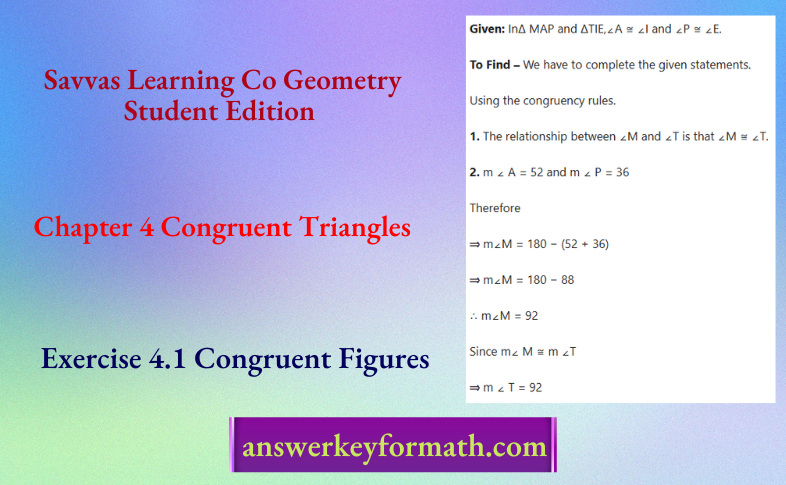
1. The relationship between ∠M and ∠T is that ∠M ≅ ∠T ,  2. If m ∠ A = 52 and m ∠ P = 36 , then m ∠ T = 92.

Read and Learn More Savvas Learning Co Geometry Student Edition Solutions

Congruent Figures Solutions Chapter 4 Exercise 4.1 Savvas Geometry Page 221  Exercise 3  Problem 3

In our daily life, the apartments have multiple buildings that are congruent, Vehicles of the same company and model are congruent, and classrooms of a school are congruent.

In our daily life, the apartments have multiple buildings that are congruent, Vehicles of the same company and model are congruent, and classrooms of a school are congruent.


Congruent Figures Solutions Chapter 4 Exercise 4.1 Savvas Geometry Page 222  Exercise 4  Problem 4

Given: ΔABC ≅ ΔABD

To find –  List the congruent corresponding parts.

Two triangles are congruent if they have equal corresponding sides and equal corresponding angles.

It is given that ΔABC and ΔABD ,so they will have equal corresponding sides and equal corresponding angles.

So, we conclude that vertex A,B,C corresponding to vertex A,B,D respectively.

Thus, we get

⇒   \(\overline{A B} \cong \overline{A B}\)

⇒   \(\overline{A C} \cong \overline{A D}\)

⇒   \(\overline{C B} \cong \overline{D B}\) And

∠CAB ≅ ∠DAB

∠ABC ≅ ∠ABD

∠ACB ≅ ∠ADB

Thus, for ΔABC ≅ ΔABD we get

⇒   \(\overline{A B} \cong \overline{A B}\)

⇒   \(\overline{A C} \cong \overline{A D}\)

⇒  \(\overline{C B} \cong \overline{D B}\) 

And

∠CAB ≅ ∠DAB

∠ABC ≅ ∠ABD

∠ACB ≅ ∠ADB


Chapter 4 Exercise 4.1 Congruent Figures Savvas Learning Co Geometry Explanation Page 222  Exercise 5  Problem 5

Given: ΔEFG ≅ ΔHIJ

To find – List the congruent corresponding parts.

Two triangles are congruent if they have equal corresponding sides and equal corresponding angles.

It is given that ΔEFG ≅ ΔHIJ, so they will have equal corresponding sides and equal corresponding angles.

So, we conclude that vertex E,F, G is congruent to vertex H,I ,J respectively

Therefore

⇒  \(\overline{E F} \cong \overline{H I}\)

⇒  \(\overline{F G} \cong \overline{I J}\)

⇒  \(\overline{G E} \cong \overline{J H}\) and

∠GEF ≅ ∠JHI

∠EFG ≅ ∠HIJ

∠FGE ≅ ∠IJH

Thus, for ΔEFG ≅ ΔHIJ we get

⇒  \(\overline{E F} \cong \overline{H I}\)

⇒  \(\overline{F G} \cong \overline{I J}\)

⇒  \(\overline{G E} \cong \overline{J H}\)

And

∠GEF ≅ ∠JHI

∠EFG ≅ ∠HIJ

∠FGE ≅ ∠IJH


Solutions For Congruent Figures Exercise 4.1 In Savvas Geometry Chapter 4 Student Edition Page 222   Exercise 6   Problem 6

Given: ΔLCM ≅ ΔBJK

To find –  Complete the congruence statements.

Two triangles are congruent if they have equal corresponding sides and equal corresponding angles.

It is given that ΔLCM ≅ BJK so they will have equal corresponding sides and equal corresponding angles.

SO, we conclude that vertex L,C,M is congruent to vertex B ,J, K respectively.

Thus, \(\overline{K J} \cong \overline{M C}\)

Thus, \(\overline{K J} \cong \overline{M C}\)


Exercise 4.1 Congruent Figures Savvas Learning Co Geometry Detailed Answers Page 222   Exercise 7  Problem 7

Given: \(\overline{J B} \cong \overline{M C}\) ≅ ?

To find – Complete the congruence statements.

Two triangles are congruent if they have equal corresponding sides and equal corresponding angles.

\(\overline{J B} \cong \overline{M L}\)

The complete congruence statement will be \(\overline{J B} \cong \overline{M L}\).


Geometry Chapter 4 Congruent Figures Savvas Learning Co Explanation Guide Page 222   Exercise 8   Problem 8

Given: ∠ L ≅?

To find –  Complete the congruence statements.

Two triangles are congruent if they have equal corresponding sides and equal corresponding angles.

∠L ≅ ∠B

The congruence statement will be ∠L ≅ ∠B.


Geometry Chapter 4 Congruent Figures Savvas Learning Co Explanation Guide Page 222   Exercise 9  Problem 9

Given: ∠ K ≅?

To find – Complete the congruence statements.

Two triangles are congruent if they have equal corresponding sides and equal corresponding angles.

∠K ≅ ∠C

The congruence statement will be ∠K ≅ ∠C.


Savvas Learning Co Geometry Student Edition Chapter 4 Page 222   Exercise 10  Problem 10

Given: ∠ M ≅?

To find –  Complete the congruence statements.

Two triangles are congruent if they have equal corresponding sides and equal corresponding angles.

∠M ≅ ∠J

The congruence statement will be ∠M ≅ ∠J.


Page 222  Exercise 11  Problem 11

 Given: ΔCML ≅ ?

To find – Complete the congruence statements.

Two triangles are congruent if they have equal corresponding sides and equal corresponding angles.

ΔCML ≅ ΔKJB

The congruence statement will be ΔCML ≅ ΔKJB.


Savvas Learning Co Geometry Student Edition Chapter 4 Page 222   Exercise 12   Problem 12

Given:  ΔKBJ ≅ ?

To find – Complete the congruence statements.

Two triangles are congruent if they have equal corresponding sides and equal corresponding angles.

ΔKBJ ≅ ΔCLM

The congruence statement will be ΔKBJ ≅ ΔCLM


Page 222  Exercise 13  Problem 13

Given:  ΔMLC ≅ ?

To find –  Complete the congruence statements.

Two triangles are congruent if they have equal corresponding sides and equal corresponding angles.

ΔMLC ≅ ΔJBK

The congruence statement will be ΔMLC ≅ ΔJBK.


Savvas Learning Co Geometry Student Edition Chapter 4 Page 222   Exercise 14   Problem 14

Given: ΔJKB ≅ ?

To find – Complete the congruence statements.

Two triangles are congruent if they have equal corresponding sides and equal corresponding angles.

ΔJKB ≅ ΔMCL

The congruence statement will be ΔJKB ≅ ΔMCL


Page 222   Exercise 15  Problem 15

Given: POLY ≅ SIDE

To find – List the four pairs of congruent sides.

Two polygons are congruent if they have equal corresponding sides and equal corresponding angles.

⇒   \(\overline{P O} \cong \overline{S I}\)

⇒   \(\overline{O L} \cong \overline{I D}\)

⇒   \(\overline{L Y} \cong \overline{D E}\)

⇒   \(\overline{Y P} \cong \overline{E S}\)

The four pairs of congruent sides are:

⇒  \(\overline{P O} \cong \overline{S I}\)

⇒  \(\overline{O L} \cong \overline{I D}\)

⇒  \(\overline{L Y} \cong \overline{D E}\)

⇒  \(\overline{Y P} \cong \overline{E S}\)


Savvas Learning Co Geometry Student Edition Chapter 4 Page 222  Exercise 16  Problem 16

Given: POLY ≅ SIDE

To find – List the four pairs of congruent angles.

Two polygons are congruent if they have equal corresponding sides and equal corresponding angles.

∠P ≅ ∠S

∠O ≅ ∠I

∠L ≅ ∠D

∠Y ≅ ∠E

The four pairs of congruent angles are:

∠P ≅ ∠S

∠O ≅ ∠I

∠L ≅ ∠D

∠Y ≅ ∠E


Page 222   Exercise 17   Problem 17

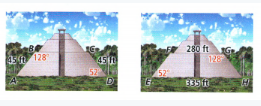
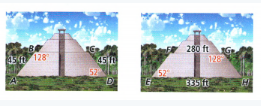
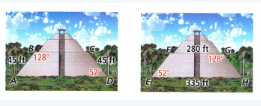
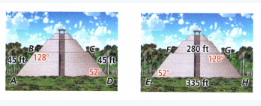
Given that: At an archeological site, the remains of two ancient step pyramids are congruent.

If ABCD ≅ EFGH
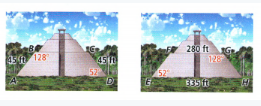
Savvas Learning Co Geometry Student Edition Chapter 4 Congruent Triangles Exercise 4.1 Congruent Figures Page 222 Exercise 17 Problem 17 Pyramids 1

To find –  Find GH

These two shapes ABCD and FEGH are congruent to each other it means shape and size of ABCD and are same FEGH .

The size of GH = 45ft because GH ≅ CD
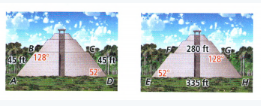
Savvas Learning Co Geometry Student Edition Chapter 4 Congruent Triangles Exercise 4.1 Congruent Figures Page 222 Exercise 17 Problem 17 Pyramids 2


Savvas Learning Co Geometry Student Edition Chapter 4 Page 222  Exercise 18  Problem 18

Given that: At an archeological site, the remains of two ancient step pyramids are congruent.

If ABCD ≅ EFGH
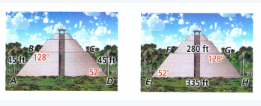
Savvas Learning Co Geometry Student Edition Chapter 4 Congruent Triangles Exercise 4.1 Congruent Figures Page 222 Exercise 18 Problem 18 Pyramids 1

To find – Find EF

These two shapes ABCD and EFGH are congruent to each other it means shape and size of ABCD and EFGH are same.

The size of EF = 45 ft  because EF ≅ AB.

The size of EF = 45ft because EF ≅ AB for the problem
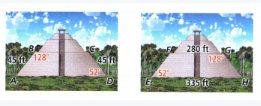
Savvas Learning Co Geometry Student Edition Chapter 4 Congruent Triangles Exercise 4.1 Congruent Figures Page 222 Exercise 18 Problem 18 Pyramids 2


Page 222  Exercise 19  Problem 19

Given that: At an archeological site, the remains of two ancient step pyramids are congruent.

If ABCD ≅ EFGH
Savvas Learning Co Geometry Student Edition Chapter 4 Congruent Triangles Exercise 4.1 Congruent Figures Page 222 Exercise 19 Problem 19 Pyramids 1

To find – Find BC

These two shapes ABCD and EFGH are congruent to each other it means shape and size of ABCD and EFGH are same.

The size of BC = 280ft because BC ≅ FG

The size of BC = 280ft because BC ≅ FG for the problem
Savvas Learning Co Geometry Student Edition Chapter 4 Congruent Triangles Exercise 4.1 Congruent Figures Page 222 Exercise 19 Problem 19 Pyramids 2


Savvas Learning Co Geometry Student Edition Chapter 4 Page 222  Exercise 20  Problem 20

Given that: At an archeological site, the remains of two ancient step pyramids are congruent.

If ABCD ≅ EFGH
Savvas Learning Co Geometry Student Edition Chapter 4 Congruent Triangles Exercise 4.1 Congruent Figures Page 222 Exercise 20 Problem 20 Pyramids 1

To find –  Find m∠DCB

These two shapes ABCD and EFGH are congruent to each other it means shape and size of ABCD and EFGH are same.

The angle m ∠DCB = 128 because m ∠DCB ≅ m∠FGH

The angle m∠ DCB = 128 because m∠ DCB ≅ m∠FGH for the problem.
Savvas Learning Co Geometry Student Edition Chapter 4 Congruent Triangles Exercise 4.1 Congruent Figures Page 222 Exercise 20 Problem 20 Pyramids 2


Page 222   Exercise 21  Problem 21

Given that: At an archeological site, the remains of two ancient step pyramids are congruent.

If ABCD ≅ EFGH
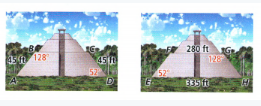
Savvas Learning Co Geometry Student Edition Chapter 4 Congruent Triangles Exercise 4.1 Congruent Figures Page 222 Exercise 21 Problem 21 Pyramids 1

To find  – Find m ∠ EFG

These two shapes ABCD and EFGH are congruent to each other it means they have same shape and size.

The angle m ∠EFG = 128° because m ∠EFG ≅ m∠ABC

The angle m∠EFG = 128° because m ∠EFG ≅ m ∠ABC for the problem
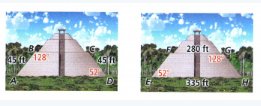
Savvas Learning Co Geometry Student Edition Chapter 4 Congruent Triangles Exercise 4.1 Congruent Figures Page 222 Exercise 21 Problem 21 Pyramids 2


Savvas Learning Co Geometry Student Edition Chapter 4 Page 222  Exercise 22  Problem 22

Given that: Δ SPQ and Δ TUV
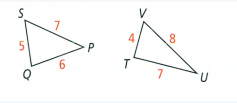
Savvas Learning Co Geometry Student Edition Chapter 4 Congruent Triangles Exercise 4.1 Congruent Figures Page 222 Exercise 22 Problem 22 Triangles Congruent 1

To find – Can you conclude that the triangles are congruent.

The triangle SPQ,TUV are not congruent because shape and size of the triangles are not same.

The sides of triangle SPQ and TUV are not same.

The triangle SPQ, TUV are not congruent because shape and size of triangles are not same for the problem
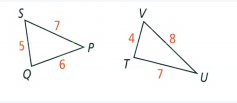
Savvas Learning Co Geometry Student Edition Chapter 4 Congruent Triangles Exercise 4.1 Congruent Figures Page 222 Exercise 22 Problem 22 Triangles Congruent 2


Page 223  Exercise 23  Problem 23

Given that: Δ DEF ≅ Δ LMN

To find – Which of the following must be a correct congruence statement?

1. DE = LN

2. ∠N ≅ ∠F

3. FE ≅ NL

4. ∠M ≅ ∠F

Let the vertex E of triangle DEF corresponds to vertex N of triangle LMN, the vertex L of triangle LMN corresponds to vertex D of triangle DEF and the vertex M of triangle LMN corresponds to vertex F of triangle DEF.

If the triangle congruent than ED ≅ LN, EF ≅ NM, DF ≅ LM,∠M ≅ ∠F.

The option (4)  is correct rest are wrong.

The option (4) ∠M ≅ ∠F  is correct when ΔDEF ≅ ΔLMN for the problem


Savvas Learning Co Geometry Student Edition Chapter 4 Page 223  Exercise  24   Problem 24

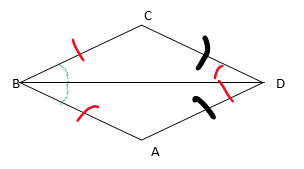
Given that: Randall says he can use the information in the figure to prove  ΔBCD ≅ Δ DAB
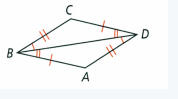
Savvas Learning Co Geometry Student Edition Chapter 4 Congruent Triangles Exercise 4.1 Congruent Figures Page 223 Exercise 24 Problem 24 Randall Triangles 1

To find –  Is he correct? Explain.

If the triangle ΔBCD ≅ ΔDAB  then BC ≅ BA, AD ≅ CD, ∠CDB ≅ ∠ADB, ∠CBD ≅ ABD

But Randall says  CD ≅ BA, AD ≅ BC, ∠CDB  ≅  ∠ABD, ∠CBD ≅ ∠ADB  which is incorrect.

The correct explanation of congruence of triangles ΔBCD ≅ ΔDAB is BC ≅ BA,AD ≅  CD, ∠CDB  ≅  ∠ADB,∠CBD ≅ ABD for Randall problem
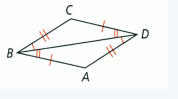
Savvas Learning Co Geometry Student Edition Chapter 4 Congruent Triangles Exercise 4.1 Congruent Figures Page 223 Exercise 24 Problem 24 Randall Triangles 2

And the diagram shown as

Savvas Learning Co Geometry Student Edition Chapter 4 Congruent Triangles Exercise 4.1 Congruent Figures Page 223 Exercise 24 Problem 24 Randall Triangles 3


Page 223   Exercise 25   Problem 25

Given that: ΔABC ≅ ΔDEF ,m∠A = x + 10. m∠D = 2x

To find – Find the measures of the given angles or the lengths of the given sides.

If the two triangles are congruent than sides and angles are congruent.

The given m∠A = x + 10. m∠D = 2x and the triangles ΔABC ≅ ΔDEF than

m∠A ≅ m∠D it means

​x + 10 = 2x

10 = 2x – x

10 = x

x = 10 and now

m∠A = x + 10

m∠A = 20°

m∠D = 2(10)

m∠D = 20°

The length x = 10 and angles m∠A = 20 ° and m∠D = 20° for the problem of congruency when ΔABC ≅ ΔDEF and m ∠A = x + 10,m∠D = 2x.


Savvas Learning Co Geometry Student Edition Chapter 4 Page 223  Exercise 26  Problem 26

Given that:  ΔABC ≅ ΔDEF , m∠B = 3y, m∠E = 6y − 12

To find – Find the measures of the given angles or the lengths of the given sides.

If the two triangles are congruent than sides and angles are congruent

The given m∠B = 3y, m∠E = 6y − 12 and the triangles ABC ≅ DEF than m ∠B ≅ m∠E  it means

​3y = 6y − 12

3y = 12

y = 4 and now

​m∠B = 3(4)

m ∠B = 12°

m∠E = 6(4)−12

m ∠E = 12°

The length y = 4 and angles m ∠B = 12° and m ∠E = 12° the problem of congruency when ΔABC ≅ ΔDEF and m∠B = 3y,m∠E = 6y − 12


Page 223  Exercise 27  Problem 27

Given: Two triangle s ΔABC ≅ ΔDEF and  BC = 3z + 2, EF = z + 6

To find – Measures of the lengths of the given sides.

Since, the triangles are congruent, vertex B of ΔABC corresponds to E of ΔDEFTriangles corresponding sides are equal, i.e. BC = EF

Equating corresponding sides of two triangle.

BC = EF

3z + 2 = z + 6

Bringing one side to one side of equation and constant terms to other side of triangle.

⇒ 3z − z = 6 − 2

2z = 4

z = \(\frac{4}{2}\)

z = 2

Substituting value of z in lengths BC and EF

BC = 3 × 2 + 2

BC = 8 units

EF= 2 + 6

EF = 8 units

Measures of the lengths of the given sides are- BC = 8 units EF = 8 units


Savvas Learning Co Geometry Student Edition Chapter 4 Page 223  Exercise 28  Problem 28

Given : Two triangles ΔABC ≅ ΔDEF and AC = 7a + 5, DF = 5a + 9

To find –  Measures of the lengths of the given sides.

Since, the triangles are congruent, vertex A of ΔABC corresponds to D of ΔDEF Triangles corresponding sides are equal, i.e. AC = DF

Equating corresponding sides of two triangle.

AC = DF

7a + 5 = 5a + 9

Bringing one side to one side of equation and constant terms to other side of triangle.

7a − 5a = 9 − 5

2a = 4

a = \(\frac{4}{2}\)

a = 2

Substituting value of a in lengths AC and DF

AC = 7 × 2 + 5

AC = 19 units

DF = 5 × 2 + 9

DF = 19 units

Measures of the lengths of the given sides are- AC = 19 units, DF = 19 units


Page 223  Exercise 29  Problem 29

Given: Two triangles Δ ABC ≅ Δ DBE.

To find – Meaning for two triangles to be congruent.

Two triangles are said to be congruent, if there corresponding sides and angles are equal.

Meaning for two triangles to be congruent is – “Two triangles are said to be congruent, if there corresponding sides and angles are equal”.


Savvas Learning Co Geometry Student Edition Chapter 4 Page 223  Exercise 29  Problem 30

Given: Two triangles ΔABC ≅ ΔDBE.

To find –  Which angle measures are already known.The angles known in ΔABC are m∠ CAB = (x + 5)°and m∠ABC = 51°

The angles known in ΔDBE are m∠

BED = 81°

Since, The given triangles are congruent, vertex C of Δ ABC corresponds to vertex E of

Δ DBE m∠DEB  =  m∠ACB = 81°

The angles known in ΔABC are m∠ CAB = (x + 5)°  and m ∠ACB = 51° and m∠ ACB = 81° , The angles known in ΔDBE are m ∠BED = 81°


Page 223  Exercise 29  Problem 31

Given: Two triangles ΔABC ≅ ΔDBE.

To find  – The value of x and the missing angle measure in a triangle.

Using Angle sum property of triangle,  Sum of angles of triangle is 180°

m∠BAC + m∠BCA+m∠

ABC = 180°

x + 5 + 81° + 51°

= 180°

x +137° =180°

x = 43°

Since, The given triangles are congruent, missing angles can be found out by equating the corresponding angles.

Vertex A of ΔABC corresponds to Vertex D of ΔDBE

∴ m ∠CAB = m ∠EDB = 43 + 5 = 48°

Vertex B is common in both the triangles.

m ∠ABC = m ∠DBE = 51°

Value of x is 43°

The given triangles ΔABC ≅ ΔDBE are congruent, missing angles can be found out by equating the corresponding angles.m ∠EDB = 48° m ∠DBE = 51°  m∠ACB = 81°


Savvas Learning Co Geometry Student Edition Chapter 4 Page 223  Exercise 30  Problem 32

Given: Two triangles ΔABC ≅ ΔKLM.

To Find – The values of the variables.

Since, ΔABC≅ ΔKLM, vertex C of ΔABC corresponds to vertex M of ΔKLM.

Therefore, m ∠ACB = m ∠KML = 3x°

Using angle sum property in ΔABC

m∠ ACB + m ∠CBA + m ∠BAC = 1800

3x + 90° + 45° = 180°

3x = 180° − 135°

3x = 45°

x = 15°

The value of the variable x is 15°


Page 223  Exercise 31  Problem 33

Given: Two triangles ΔACD ≅ ΔACB.

To Find –  The values of the variables.

Since A is the common vertex of two triangles.

The corresponding angles m ∠BAC = m ∠DAC 6x = 30° which on solving gives

6x = 30°

⇒ \(\frac{300}{6}\)

x = 5°

The value of the variable x is 5°


Savvas Learning Co Geometry Student Edition Chapter 4 Page 223  Exercise 32  Problem 34

Given: Figure of Two triangles ΔMLJ and ΔZRN.

To find – To Complete in two different ways that ΔJLM ≅ Δ NRZ.

Three corresponding angles of ΔJLM and ΔNRZ are equal.

From the figures of two triangles JLM and NRZ

∠L = ∠R

∠M = ∠Z

∠J = ∠N

Three corresponding sides are also equal.

ML = ZR

LJ = RN

JM = NZ

Therefore, ΔJLM ≅ ΔNRZ, since corresponding angles and sides of two triangles are equal.

From the figures of two triangles, ΔJLM and ΔNRZ

Corresponding angles are equal

∠L = ∠R

∠M = ∠Z

∠J = ∠N

Corresponding sides are equal

ML = ZR

LJ = RN

JM = NZ

Therefore, Δ JLM ≅ ΔNRZ


Savvas Learning Co Geometry Student Edition Chapter 4 Page 223  Exercise 33  Problem 35

Given: Terms “congruent sides and angles” and “triangles”.

To find – To write a congruence statement for two triangles and to list the congruent sides and angles.

Let two triangles are congruent ΔABC ≅ ΔXYZ

List of congruent sides of two triangles are

AB = XY

BC = YZ

AC = XZ

List of congruent angles of two triangles are

⇒ ∠A = ∠X

∠B = ∠Y

∠C = ∠Z

Congruence statement for two triangles is ΔABC ≅ ΔXYZ

List of congruent sides of two triangles are

AB = XY

BC = YZ

AC = XZ

List of congruent angles of two triangles are

∠A = ∠X

∠B = ∠Y

∠C = ∠Z


Page 223   Exercise 34  Problem 36

Given: Two triangles ΔABD and ΔCDB, and AB⊥AD, BC⊥CD, AB ≅ CD, AD≅CB, AB ∥ CD

To find –  To prove ΔABD ≅ ΔCDB.

The SAS rule states that If two sides and the included angle of one triangle are equal to two sides and included angle of another triangle, then the triangles are congruent.

In the two triangles given

AD side of ΔABD= BC side of ΔCDB

AB side of ΔABD = CD side of ΔCDB

∠A = ∠C (Since, both are right angles)

Using SAS rule, ΔABD and ΔCDB are congruent.

AD side of ΔABD= BC side of ΔCDB

AB side of ΔABD = CD side of ΔCDB

∠A = ∠C

Using SAS rule, ΔABD ≅ ΔCDB


Savvas Learning Co Geometry Student Edition Chapter 4 Page 224  Exercise 35  Problem 37

Given: Two triangle ΔPRS and ΔQTS, PR ∥ TQ , PR ≅ TQ, PS ≅ QS

To find –  To prove ΔPRS ≅ ΔQTS

The SAS rule states that If two sides and the included angle of one triangle are equal to two sides and included angle of another triangle, then the triangles are congruent.

In the two triangles given

PR ≅ TQPS ≅QS

Since, PR ∥ TQ and PQ is the transversal.

∠P = ∠Q, because they are alternate interior angles.

Using SAS rule, ΔPRS ≅ ΔQTS

In the two triangles ΔPRS and ΔQTS

PR ≅ TQ

PS ≅ QS

∠P = ∠Q

Using SAS rule, ΔPRS ≅ ΔQTS


Page 224  Exercise 36  Problem 38

Given  The vertices of ΔGHJ are G(−2,−1), H(−2,3),J(1,3).

To find –  KL, LM, and KM.

Using distance formula to calculate distance between two points.

Distance = \(\sqrt{\left(x_1-x_2\right)^2+\left(y_1-y_2\right)^2}\)

Where (x1,y1) and  (x2,y2) are two points.

Since, ΔKLM ≅ ΔGHJ.

Side KL corresponds to side GH of ΔGHJ

KL = \(\sqrt{(-2+2)^2+(3+1)^2}\)

= \(\sqrt{16}\)

Side KL = 4 units.

Side LM corresponds to side HJ of ΔGHJ

LM = \(\sqrt{(1+2)^2+(3-3)^2}\)

= \(\sqrt{9}\)

Side LM = 3 units.

Side KM corresponds to side GJ of ΔGHJ

KM = \(\sqrt{(1+2)^2+(3+1)^2}\)

= \(\sqrt{9+16}\)

KM = 5 units.

Side KL = 4 units , LM = 3 units , KM = 5 units


Savvas Learning Co Geometry Student Edition Chapter 4 Page 224  Exercise 37  Problem 39

Given: The coordinates of L and M(3,−3),(6,−3)

To find – How many pairs of coordinates are possible for K, find one pair.

Given, L(3,−3) M(6,−3)

Now, let K as(x,y)

Centroid:

\(\frac{3-6+x}{3}\) = \(\frac{-3+(-3)+y}{3}\)

\(\frac{3+x}{3}=\frac{1}{1}\)

Now equate the x-coordinates and y-coordinates we get:

⇒ \(\frac{-3+x}{3}=\frac{1}{1}\)

= −3 + 1x = 3

x = 6

⇒ \(\frac{6+y}{3}=\frac{2}{1}\)

= 6 + 1y = 6

1y = 6 − 6

y = 1

The one pair for, k is(6,1)

The pair for, k is(6,1)


Page 224  Exercise 38  Problem 40

Given: ΔHLN ≅ ΔGST and m∠H = 66, m∠S = 42

To find – To find the value of m∠T

Congruent triangles are triangles that have the same size and shape.

We conclude m∠H = m∠G = 66

And we know m∠S = 42

The sum of interior angles of a triangle is180°

In ΔGST

m ∠G + m ∠S + m ∠T = 180°

66 + 42 + m ∠T = 180°

m∠T = 180° − 108°

m ∠T = 72°

The value of m ∠T = 72° 
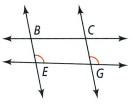
Savvas Learning Co Geometry Student Edition Chapter 3 Parallel And Perpendicular Lines Exercise 3.3 Proving Lines Parallel

Savvas Learning Co Geometry Student Edition Chapter 3 Parallel And Perpendicular Lines Exercise 3.3 Proving Lines Parallel


Savvas Learning Co Geometry Student Edition Chapter 3 Exercise 3.3 Proving Lines Parallel Solutions Page 160  Exercise 1  Problem 1

Given:

Savvas Learning Co Geometry Student Edition Chapter 3 Parallel And Perpendicular Lines Exercise 3.3 Proving Lines Parallel Page 160 Exercise 1 Problem 1 Alternate Interior angle

To find –  State the theorem to prove a ∥ b.

We can prove a ∥ b, by the converse of the alternate interior angles theorem.

The theorem states, if two lines and a transversal form alternate interior angles that are congruent, then the two lines are parallel.

If two lines and a transversal form alternate interior angles that are congruent, then the two lines are parallel.


Exercise 3.3 Proving Lines Parallel Savvas Geometry Answers Page 160  Exercise 2  Problem 2

Given:

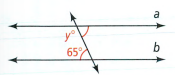
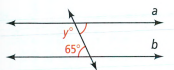
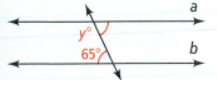
Savvas Learning Co Geometry Student Edition Chapter 3 Parallel And Perpendicular Lines Exercise 3.3 Proving Lines Parallel Page 160 Exercise 2 Problem 2 Interior angle 1

To find –  y Use the interior angle theorem.

The interior angle theorem state that, if two parallel lines and a transversal form the same side interior angles, then those angles are supplementary.

In the figure

Savvas Learning Co Geometry Student Edition Chapter 3 Parallel And Perpendicular Lines Exercise 3.3 Proving Lines Parallel Page 160 Exercise 2 Problem 2 Interior angle 2

By exterior angle theorem

65° + y = 180°

y = 180° − 65°

y = 115°

The required angle y°  is 115°.

Read and Learn More Savvas Learning Co Geometry Student Edition Solutions

Proving Lines Parallel Solutions Chapter 3 Exercise 3.3 Savvas Geometry Page 160   Exercise 3  Problem 3

Given: Alternate interior angle theorem and its converse.

To find –  Use of Alternate interior angle theorem and its converse.

When the two lines are given parallel and we have to prove alternate angles are congruent, then the Alternate interior angle theorem is used.

When Alternate angles are given congruent and we have to prove two lines are parallel, then the converse of alternate interior angle theorem is used.

When the two lines are given parallel and we have to prove alternate angles are congruent, then the Alternate interior angle theorem is used and when Alternate interior angles are given congruent and we have to prove two lines are parallel, then the converse of alternate interior angle theorem is used.


Proving Lines Parallel Solutions Chapter 3 Exercise 3.3 Savvas Geometry Page 160  Exercise 4  Problem 4

Given:  Flow proofs and two-column proofs.

To find – Similarities and differences of flow proofs and two-column proofs.

Flow proofs are diagrammatic representations of the proofs represented by arrows to reach the conclusion.

Two-column proofs are represented by two columns, one which consists of conclusions and the other consisting of reasons.

The similarity between Flow proofs and Two-column proofs is it is represented by arrows and reaches conclusion step-by-step.

The difference is Flow proof does not include reasons but column proof does include reasons.

The similarity between Flow proofs and Two-column proofs is it is represented by arrows and reach a conclusion step-by-step and the difference is Flow proof does not include reasons but column proof does include reasons.


Savvas Learning Co Geometry Student Edition Chapter 3 Page 160  Exercise 5  Problem 5

Given:

Savvas Learning Co Geometry Student Edition Chapter 3 Parallel And Perpendicular Lines Exercise 3.3 Proving Lines Parallel Page 160 Exercise 5 Problem 5 Parallel lines 1

To find – Parallel lines.

Use the converse of the corresponding angle theorem and find parallel lines.

In the figure

Savvas Learning Co Geometry Student Edition Chapter 3 Parallel And Perpendicular Lines Exercise 3.3 Proving Lines Parallel Page 160 Exercise 5 Problem 5 Parallel lines 2
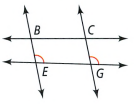
∠E ≅ ∠G

By converse of corresponding angle theorem

Lines BE ∥ CG are parallel and EG is transversal.

The required parallel lines are BE ∥ CG.


Chapter 3 Exercise 3.3 Proving Lines Parallel Savvas Learning Co Geometry Explanation Page 160  Exercise 6  Problem 6

Savvas Learning Co Geometry Student Edition Chapter 3 Parallel And Perpendicular Lines Exercise 3.3 Proving Lines Parallel

Solutions For Proving Lines Parallel Exercise 3.3 In Savvas Geometry Chapter 3 Student Edition Page 160  Exercise 7  Problem 7

Given:

Savvas Learning Co Geometry Student Edition Chapter 3 Parallel And Perpendicular Lines Exercise 3.3 Proving Lines Parallel Page 160 Exercise 7 Problem 7 Parallel lines 1

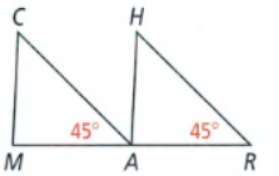
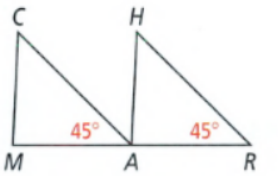
To find – Parallel lines. Use the converse of the corresponding angle theorem and find parallel lines.

In the figure

Savvas Learning Co Geometry Student Edition Chapter 3 Parallel And Perpendicular Lines Exercise 3.3 Proving Lines Parallel Page 160 Exercise 7 Problem 7 Parallel lines 2

By converse of corresponding angle theorem

Lines CA ∥ HR are parallel and MR is transversal.

The required parallel lines are CA ∥ HR.


Exercise 3.3 Proving Lines Parallel Savvas Learning Co Geometry Detailed Answers Page 160  Exercise 8  Problem 8

Given:

Savvas Learning Co Geometry Student Edition Chapter 3 Parallel And Perpendicular Lines Exercise 3.3 Proving Lines Parallel Page 160 Exercise 8 Problem 8 Parallel lines 1

To find –  Parallel lines.Use the converse of the corresponding angle theorem and find parallel lines.

In the figure
Savvas Learning Co Geometry Student Edition Chapter 3 Parallel And Perpendicular Lines Exercise 3.3 Proving Lines Parallel Page 160 Exercise 8 Problem 8 Parallel lines 2

∠ JKR ≅ ∠LMT

By converse of corresponding angle theorem

Lines KR ∥ MT are parallel and JM is transversal.

The required parallel lines are KR ∥ MT.


Exercise 3.3 Proving Lines Parallel Savvas Learning Co Geometry Detailed Answers Page 161  Exercise 9  Problem 9

Given:

Savvas Learning Co Geometry Student Edition Chapter 3 Parallel And Perpendicular Lines Exercise 3.3 Proving Lines Parallel Page 161 Exercise 9 Problem 9 Alternate angle 1

To find –  x.

Use the Alternate angle theorem.

In the figure

Savvas Learning Co Geometry Student Edition Chapter 3 Parallel And Perpendicular Lines Exercise 3.3 Proving Lines Parallel Page 161 Exercise 9 Problem 9 Alternate angle 2

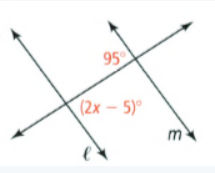
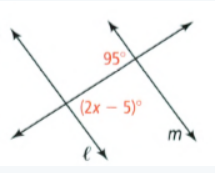
Lines l ∥ m.

By alternate interior angle theorem, 95° = (2x−5)°

⇒ 95 − 5 = 2x

⇒ 90 = 2x

⇒ \(\frac{90}{2}\)= x

⇒ 45 = x  or  x = 45

The required value of x is 45°.


Geometry Chapter 3 Proving Lines Parallel Savvas Learning Co Explanation Guide Page 161  Exercise 10  Problem 10

Given:
Savvas Learning Co Geometry Student Edition Chapter 3 Parallel And Perpendicular Lines Exercise 3.3 Proving Lines Parallel Page 161 Exercise 10 Problem 10 Alternate angle 1

To find – x.

Use the vertical opposite and Alternate angle theorem.

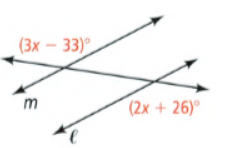
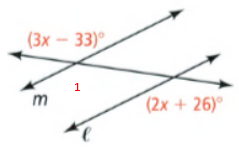
In the figure

Savvas Learning Co Geometry Student Edition Chapter 3 Parallel And Perpendicular Lines Exercise 3.3 Proving Lines Parallel Page 161 Exercise 10 Problem 10 Alternate angle 2

Lines l ∥ m

By vertically opposite angle

∠1 = 3x − 33  ……………………. (1)

By corresponding angle theorem

∠1 = 2x + 26 …………………………. (2)

From  equation (1) and (2)

⇒ 3x − 33 = 2x + 26

⇒ 3x − 2x = 26 + 33

⇒ x = 59

The required value of x is 59°.


Geometry Chapter 3 Proving Lines Parallel Savvas Learning Co Explanation Guide Page 161  Exercise 11  Problem 11

Given:

Savvas Learning Co Geometry Student Edition Chapter 3 Parallel And Perpendicular Lines Exercise 3.3 Proving Lines Parallel Page 161 Exercise 11 Problem 11 Alternate exterior angle 1

To find – x.

Use the Alternate exterior angle theorem.

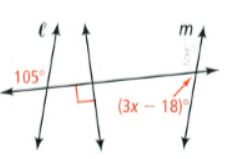
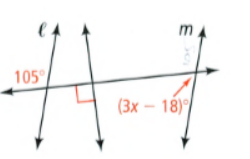
In the figure

Savvas Learning Co Geometry Student Edition Chapter 3 Parallel And Perpendicular Lines Exercise 3.3 Proving Lines Parallel Page 161 Exercise 11 Problem 11 Alternate exterior angle 2

Lines l ∥ m.

By alternate exterior angle theorem

⇒ 105 = 3x − 18

⇒ 105 + 18 = 3x

⇒ 123 = 3x

⇒ \(\frac{123}{3}\) = x

⇒ 41 = x  or  x = 41

The required value of x is 41°.


Page 161  Exercise 12  Problem 12

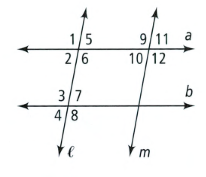
Given: ∠2 is supplementary to ∠3.

Savvas Learning Co Geometry Student Edition Chapter 3 Parallel And Perpendicular Lines Exercise 3.3 Proving Lines Parallel Page 161 Exercise 12 Problem 12 Supplementary parallel lines 1

To find – Parallel lines.

Use the converse of the interior angle theorem and find parallel lines.

In figure

Savvas Learning Co Geometry Student Edition Chapter 3 Parallel And Perpendicular Lines Exercise 3.3 Proving Lines Parallel Page 161 Exercise 12 Problem 12 Supplementary parallel lines 2

∠2 is supplementary to ∠3

By converse of interior angle theorem

Line a ∥ b are parallel.

The required parallel lines are a ∥ b.


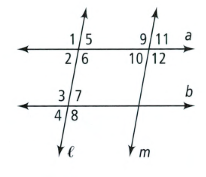
Savvas Learning Co Geometry Student Edition Chapter 3 Page 161  Exercise 13  Problem 13

Given: The given figure is

Savvas Learning Co Geometry Student Edition Chapter 3 Parallel And Perpendicular Lines Exercise 3.3 Proving Lines Parallel Page 161 Exercise 13 Problem 13 Parallel lines

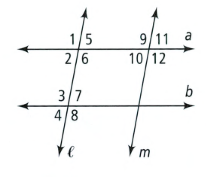
To find – We need to find if ∠1 ≅ ∠3 then proof which lines, if any, are parallel.

When any two parallel lines are intersected by another line called a transversal.

Any two lines are said to be parallel if the Corresponding angles so formed are equal.

Any two lines are said to be parallel if the Alternate interior angles so formed are equal.

Any two lines are said to be parallel if the Alternate exterior angles so formed are equal.

Any two lines are said to be parallel if the Consecutive interior angles on the same side of the transversal are supplementary.

The given information ∠1 ≅ ∠3

If two lines and transversal form corresponding angles that are congruent, then the lines are parallel,∴a and b mare parallel, the line l is the transversal.

∠1 ≅ ∠3 If two lines and transversal form corresponding angles that are congruent, then the lines are parallel So and are parallel, the line is the transversal.


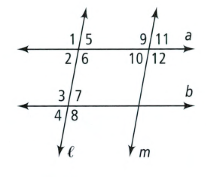
Page 161  Exercise 14  Problem 14

Given: The given figure is

Savvas Learning Co Geometry Student Edition Chapter 3 Parallel And Perpendicular Lines Exercise 3.3 Proving Lines Parallel Page 161 Exercise 14 Problem 14 Supplementary Parallel lines

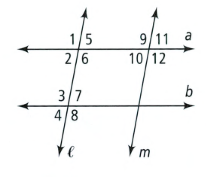
To find – We need to find if ∠6 is supplementary to∠7 then proof which lines, if any, are parallel.

When any two parallel lines are intersected by another line called a transversal.

Any two lines are said to be parallel if the Corresponding angles so formed are equal.

Any two lines are said to be parallel if the Alternate interior angles so formed are equal.

Any two lines are said to be parallel if the Alternate exterior angles so formed are equal.

Any two lines are said to be parallel if the Consecutive interior angles on the same side of the transversal are supplementary.

The given information ∠6 is supplementary to ∠7 if the Consecutive interior angles on the same side of the transversal are supplementary then the two lines are parallel.

∴ a ∥ b

∠6 is supplementary to ∠7 if the Consecutive interior angles on the same side of the transversal are supplementary then the two lines are parallel. so a ∥ b


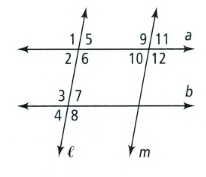
Savvas Learning Co Geometry Student Edition Chapter 3 Page 161  Exercise 15  Problem 15

Given: The given figure is

Savvas Learning Co Geometry Student Edition Chapter 3 Parallel And Perpendicular Lines Exercise 3.3 Proving Lines Parallel Page 161 Exercise 15 Problem 15 Parallel lines

To find –  We need to find if ∠9 ≅ ∠12 then proof which lines, if any, are parallel.

When any two parallel lines are intersected by another line called a transversal.

Any two lines are said to be parallel if the Corresponding angles so formed are equal.

Any two lines are said to be parallel if the Alternate interior angles so formed are equal.

Any two lines are said to be parallel if the Alternate exterior angles so formed are equal.

Any two lines are said to be parallel if the Consecutive interior angles on the same side of the transversal are supplementary.

The information given ∠in 9 ≅ ∠12 does not prove that any lines are parallel.

∠9 and ∠12 are vertical angles.

We do not need parallel lines to have vertical angles.

The given information ∠9 ≅ ∠12 does not prove any lines are parallel or not. ∠9 and ∠12 are vertical angles. We do not need parallel lines to have vertical angles.


Page 161  Exercise 16  Problem 16

Given: The given figure is

Savvas Learning Co Geometry Student Edition Chapter 3 Parallel And Perpendicular Lines Exercise 3.3 Proving Lines Parallel Page 161 Exercise 16 Problem 16 Parallel lines

To find – We need to find if m∠7 = 65, m∠9 = 115 then proof which lines, if any, are parallel.

When any two parallel lines are intersected by another line called a transversal.

Any two lines are said to be parallel if the Corresponding angles so formed are equal.

Any two lines are said to be parallel if the Alternate interior angles so formed are equal.

Any two lines are said to be parallel if the Alternate exterior angles so formed are equal.

Any two lines are said to be parallel if the Consecutive interior angles on the same side of the transversal are supplementary.

The given information ∠7 = 65,m∠9 = 115 ∠7 and ∠9 are supplementary, yet they are not any special angle pair of lines.

So no lines are proved to be parallel.

m∠7 = 65,m∠9 = 115 ∠7 and ∠9 are supplementary, yet they are not any special angle pair of lines. So no lines are proved to be parallel.


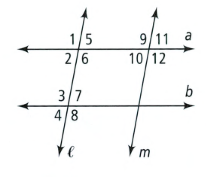
Savvas Learning Co Geometry Student Edition Chapter 3 Page 161  Exercise 17  Problem 17

Given: The given figure is

Savvas Learning Co Geometry Student Edition Chapter 3 Parallel And Perpendicular Lines Exercise 3.3 Proving Lines Parallel Page 161 Exercise 17 Problem 17 Parallel lines

To find – We need to find if ∠2≅∠10 then proof which lines, if any, are parallel.

When any two parallel lines are intersected by another line called a transversal.

Any two lines are said to be parallel if the Corresponding angles so formed are equal.

Any two lines are said to be parallel if the Alternate interior angles so formed are equal.

Any two lines are said to be parallel if the Alternate exterior angles so formed are equal.

Any two lines are said to be parallel if the Consecutive interior angles on the same side of the transversal are supplementary.

The given information ∠2 ≅ ∠10 ∠2 and ∠10 are corresponding angles on the side of the transversal a so the line l is parallel to the line m

∠2 ≅ ∠10, ∠2, and ∠10 are corresponding angles on the side of the transversal so the line is parallel to the line


Page 161 Exercise 18 Problem 18

Given: The given figure is

Savvas Learning Co Geometry Student Edition Chapter 3 Parallel And Perpendicular Lines Exercise 3.3 Proving Lines Parallel Page 161 Exercise 18 Problem 18 Parallel lines

To find –  We need to find if ∠1 ≅ ∠8 then proof which lines, if any, are parallel.

When any two parallel lines are intersected by another line called a transversal.

Any two lines are said to be parallel if the Corresponding angles so formed are equal.

Any two lines are said to be parallel if the Alternate interior angles so formed are equal.

Any two lines are said to be parallel if the Alternate exterior angles so formed are equal.

Any two lines are said to be parallel if the Consecutive interior angles on the same side of the transversal are supplementary.

The given information ∠1 ≅ ∠8 ∠1 and ∠8 are alternate exterior angles on the side of the transversal.

Since they are congruent then a ∥ b by the converse of the alternate exterior angles theorem.

∠1 ≅ ∠8 by the converse of the alternate exterior angles theorem a ∥ b


Savvas Learning Co Geometry Student Edition Chapter 3 Page 161  Exercise 19  Problem 19

Given: The given figure is

Savvas Learning Co Geometry Student Edition Chapter 3 Parallel And Perpendicular Lines Exercise 3.3 Proving Lines Parallel Page 161 Exercise 19 Problem 19 Parallel lines

To find – We need to find if ∠8≅∠6 then proof which lines, if any, are parallel.

When any two parallel lines are intersected by another line called a transversal.

Any two lines are said to be parallel if the Corresponding angles so formed are equal.

Any two lines are said to be parallel if the Alternate interior angles so formed are equal.

Any two lines are said to be parallel if the Alternate exterior angles so formed are equal.

Any two lines are said to be parallel if the Consecutive interior angles on the same side of the transversal are supplementary.

The given information ∠8 ≅ ∠6 ∠8 and ∠6 are the corresponding angles on the side of the transversall.

Since they are congruent, then a ∥ b by the converse of the corresponding angles postulate.

∠8 ≅ ∠6, ∠8 and ∠6 are the corresponding angles on the side of the transversal Since they are congruent, then by the converse of the corresponding angles postulate


Page 161  Exercise  20  Problem 20

Given: The given figure is

Savvas Learning Co Geometry Student Edition Chapter 3 Parallel And Perpendicular Lines Exercise 3.3 Proving Lines Parallel Page 161 Exercise 20 Problem 20 Parallel lines

To find –  We need to find if ∠11 ≅ ∠7 then proof which lines, if any, are parallel.

When any two parallel lines are intersected by another line called a transversal.

Any two lines are said to be parallel if the Corresponding angles so formed are equal.

Any two lines are said to be parallel if the Alternate interior angles so formed are equal.

Any two lines are said to be parallel if the Alternate exterior angles so formed are equal.

Any two lines are said to be parallel if the Consecutive interior angles on the same side of the transversal are supplementary.

The given information ∠11 ≅ ∠7.

The congruency shown does not follow any theorem or postulate and, therefore, does not prove any lines parallel.

∠11 ≅ ∠7 The congruency shown does not follow any theorem or postulate and, therefore, does not prove any lines parallel.


Savvas Learning Co Geometry Student Edition Chapter 3 Page 161  Exercise 21  Problem 21

Given: The given figure is

Savvas Learning Co Geometry Student Edition Chapter 3 Parallel And Perpendicular Lines Exercise 3.3 Proving Lines Parallel Page 161 Exercise 21 Problem 21 Parallel lines

To find  – We need to find if ∠5 ≅ ∠10 then proof which lines, if any, are parallel.

When any two parallel lines are intersected by another line called a transversal.

Any two lines are said to be parallel if the Corresponding angles so formed are equal.

Any two lines are said to be parallel if the Alternate interior angles so formed are equal.

Any two lines are said to be parallel if the Alternate exterior angles so formed are equal.

Any two lines are said to be parallel if the Consecutive interior angles on the same side of the transversal are supplementary.

The given information is ∠5 ≅ ∠10 ∠5 and ∠10 are alternate interior angles on the side of the transversal.

Since they are congruent,then l ∥ m by the converse of the alternate interior angles theorem.

∠5 and ∠10 are alternate interior angles on the side of the transversal Since they are congruent, then l ∥ m by the converse of the alternate interior angles theorem.


Page 161  Exercise 22  Problem 22

Given: The given figure is

Savvas Learning Co Geometry Student Edition Chapter 3 Parallel And Perpendicular Lines Exercise 3.3 Proving Lines Parallel Page 161 Exercise 22 Problem 22 Parallel lines

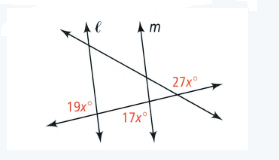
To find – We need to find the value of x for which l ∥ m.

Parallel lines are straight lines that never meet each other no matter how long we extend them.

We know that l ∥ m from the given figure we know that

let ∠1 = 19x

⇒ ∠2 = 17x

⇒ ∠3 = 27x

Now name the angle

Savvas Learning Co Geometry Student Edition Chapter 3 Parallel And Perpendicular Lines Exercise 3.3 Proving Lines Parallel Page 161 Exercise 22 Problem 22 Angle

∠4 = ∠1 = 19x

The angle 1 and 4 are vertical.

∴ ∠4 + ∠2 = 180°

⇒ 19x + 17x = 180

⇒ 36x = 180

⇒ x = \(\frac{180}{36}\)

⇒x = 5

The value of x is 5


Savvas Learning Co Geometry Student Edition Chapter 3 Page 161  Exercise 23  Problem 23

Given: The given figure is

Savvas Learning Co Geometry Student Edition Chapter 3 Parallel And Perpendicular Lines Exercise 3.3 Proving Lines Parallel Page 161 Exercise 23 Problem 23 Parallel lines

To find – We need to find the value of x for which l ∥ m

Parallel lines are straight lines that never meet each other no matter how long we extend them.

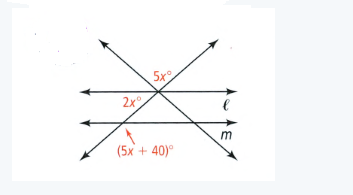
The vertical angles with the (5x + 40)° angle and the 2x° angle are the same side interior angles that must be supplementary so that l ∥ m by the converse of the same side interior angles theorem

So we find that

⇒ (5x + 40) + 2x = 180

⇒  7x + 40 = 180

⇒  7x = 140

⇒  x = 20

The value of x is 20


Page 161  Exercise 24  Problem 24

Given: The given figure is

Savvas Learning Co Geometry Student Edition Chapter 3 Parallel And Perpendicular Lines Exercise 3.3 Proving Lines Parallel Page 161 Exercise 24 Problem 24 Parallel lines

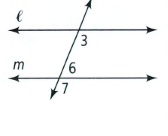
To find – We need to prove the Converse of the Same-Side Interior Angles Theorem, the given value is m∠3 + m∠6 = 180, prove l ∥ m.

Parallel lines are straight lines that never meet each other no matter how long we extend them.

The given condition is m∠3 + m∠6 = 180 ∠3 and ∠6 are supplementary ∠6 and ∠7 are supplementary ∠3 ≅ ∠7

∴  From this condition we know that l ∥ m

∠3 and ∠6 are supplementary ∠6 and ∠7 are supplementary ∠3 ≅ ∠7

∴ From these all conditions we know that l ∥ m


Savvas Learning Co Geometry Student Edition Chapter 3 Page 162  Exercise 25  Problem 25

Given: The given figure and condition is  m∠1 = 80−x, m ∠ 2 = 90 − 2x

Savvas Learning Co Geometry Student Edition Chapter 3 Parallel And Perpendicular Lines Exercise 3.3 Proving Lines Parallel Page 162 Exercise 25 Problem 25 Parallel line


To find –  We need to find m∠1 and m∠2

Parallel lines are straight lines that never meet each other no matter how long we extend them.

The given condition is  m∠1 = 80 − x, m∠2 = 90 − 2x

∴ 80 − x = 90 − 2x

⇒  −x = 10 − 2x

⇒  x = 10

∴ The angles are

m∠1 = 80 − 10

⇒  m∠1 = 70  and m ∠ 2 = 90 − 2(10)

⇒  m∠2 = 70

The values are x = 10, m ∠ 1 = 70,m ∠ 2 = 70


Page 162  Exercise 26   Problem 26

Given:  m∠1 = 60 − 2x, m∠2 = 70 − 4x

To Find –  Determine the value of x.

Given

⇒ ​m∠1 =  60 − 2x

⇒ m∠2 =  70 − 4x

Since corresponding angles are congruent, we have:

⇒ ​70 − 40 =  60 − 2x

⇒ 70 − 60 =  −2x + 4x

⇒ 10 = 2x

⇒ \(\frac{10}{5}\) = x

⇒ x = 5 or x = 5

Now substitute the value of x to find m:

⇒ ​m∠1 =  60 − 2(5)

⇒ m∠1 =  60 − 10

⇒ m∠1 =  50

⇒ m∠2 =  70 − 4(5)

⇒ m∠2 =  70 − 20

⇒ m∠2 =  50

The answer is x = 5,m ∠1 = 50 ,m ∠2 = 50


Savvas Learning Co Geometry Student Edition Chapter 3 Page 162   Exercise 27   Problem 27

Given: m∠1 = 40 − 4x , m∠2 = 50 − 8x

To find –  Determine value of x and m∠1 and m∠2

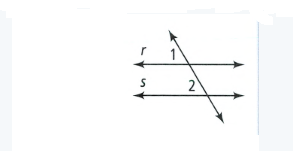
Since r ∥ s therefore due to corresponding angles m∠1 = m∠2

Thus, 40 − 4x = 50 − 8x

⇒ 8x − 4x = 50 − 40

⇒ 4x = 10

⇒ x = \(\frac{10}{4}\)

Substituting value of x in m∠1 and m∠2

⇒ ​m∠1 = 40 − 4x = 40 − 4 × \(\frac{10}{4}\)

=  40 − 10

=  30

​m∠2 = 50 − 4x

=  50 − 8 × \(\frac{10}{4}\)

=  50 − 20

=  30

Thus, m∠1 = m∠2 = 30

Thus, value of x = \(\frac{10}{4}\) and m∠1 = m∠2 = 30


Page 162  Exercise 28  Problem 28

Given: m∠1 = 20 − 8x ,m∠2 = 30 − 16x

To find – Determine value of x and m∠1 and m∠2

It is given that r∥s

Thus ,due to corresponding angles m∠1 = m∠2

i.e. 20 − 8x  =  30 − 16x

⇒ 16x − 8x  =  30 − 20

⇒ 8x = 10

x = \(\frac{10}{8}\)

Substituting value of x in m∠1 and m∠2

​m∠1 = 20 − 8x

=  20 − 8 × \(\frac{10}{8}\)

=  20 − 10

=  10

​m∠1 = 30 − 16x

=  30 − 16 × \(\frac{10}{8}\)

=  30 − 20

=  10

Thus ,m∠1 = m∠2 = 10

Thus, value of x = \(\frac{10}{8}\) and m∠1 = m∠2 = 10.


Savvas Learning Co Geometry Student Edition Chapter 3 Page 162  Exercise 29  Problem 29

Given: m∠1 ≅ m∠2

To find –  Determine which lines will be parallel and why?

Considering the diagram

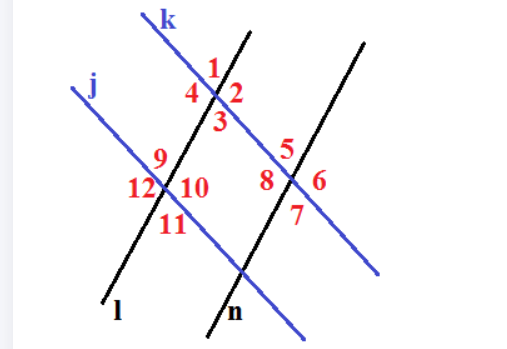
Savvas Learning Co Geometry Student Edition Chapter 3 Parallel And Perpendicular Lines Exercise 3.3 Proving Lines Parallel Page 162 Exercise 29 Problem 29 Parallel line 1

m∠1 = m∠2 ______ (Given)

m∠1 ≅ m∠9 ______ (We add the condition )

According to converse of corresponding angle postulate, the line j and line k are parallel i.e. j ∥ k

m∠1 ≅ m∠5______(We add the condition )

According to converse of corresponding angle postulate, the line l and linen are parallel i.e. l ∥ n

Thus, line j ∥ k and line l ∥ n

Savvas Learning Co Geometry Student Edition Chapter 3 Parallel And Perpendicular Lines Exercise 3.3 Proving Lines Parallel Page 162 Exercise 29 Problem 29 Parallel line 2


Page 162  Exercise 30  Problem 30

Given:  m∠8 = 110,m∠9 = 70

To find –  Determine which lines will be parallel and why?

Considering the diagram

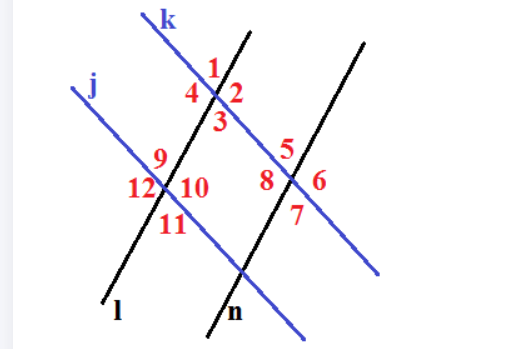
Savvas Learning Co Geometry Student Edition Chapter 3 Parallel And Perpendicular Lines Exercise 3.3 Proving Lines Parallel Page 162 Exercise 30 Problem 30 Parallel line 1

m∠8 = 110, m∠9 = 70 _____ (Given)

m∠9 ≅ m∠3 ________ (We add the condition)

According to converse of alternate angle theorem line  k ∥ j

m∠3 + m∠9 = 110 + 70 = 180 so, angle 3 and 8 are supplementary according to converse of same side angle postulate line l and n are parallel i.e. l ∥ n

Thus, parallel lines are j ∥ k and l ∥ n

Savvas Learning Co Geometry Student Edition Chapter 3 Parallel And Perpendicular Lines Exercise 3.3 Proving Lines Parallel Page 162 Exercise 30 Problem 30 Parallel line 2


Savvas Learning Co Geometry Student Edition Chapter 3 Page 162  Exercise 31  Problem 31

Given: ∠5 ≅ ∠11

To find – Determine which lines will be parallel

Considering the diagram

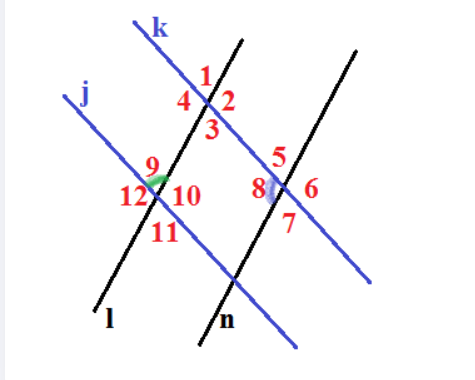
Savvas Learning Co Geometry Student Edition Chapter 3 Parallel And Perpendicular Lines Exercise 3.3 Proving Lines Parallel Page 162 Exercise 31 Problem 31 Parallel line 1

∠5 ≅ ∠11 ______ (Given)

∠11 ≅ ∠3 ______ (We add condition)

∠11 ≅ ∠3

⇒  j ∥ k

According to converse of corresponding angle postulate line j and k are parallel.

Also according to converse of alternate angle postulate line l and n are parallel

i.e.∠5 ≅ ∠3 ⇒ l ∥ n

Thus, line j ∥ k nand line l ∥ n

Savvas Learning Co Geometry Student Edition Chapter 3 Parallel And Perpendicular Lines Exercise 3.3 Proving Lines Parallel Page 162 Exercise 31 Problem 31 Parallel line 2


Page 162  Exercise 32  Problem 32

Given: ∠11 and ∠12 are supplementary.

To find –  Determine which lines will be parallel and why?

Considering the diagram
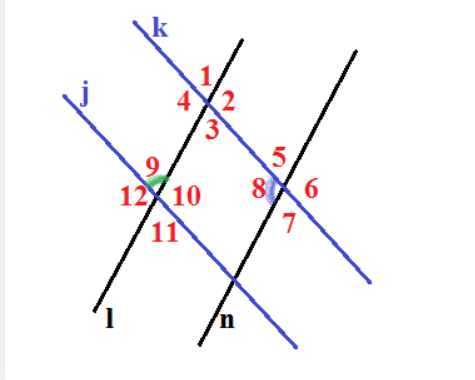
Savvas Learning Co Geometry Student Edition Chapter 3 Parallel And Perpendicular Lines Exercise 3.3 Proving Lines Parallel Page 162 Exercise 32 Problem 32 Parallel line 1

∠11, ∠12 are supplementary _______ (Given)

∠12 ≅ ∠4 ________ (Add condition )

According to converse of corresponding angle postulate line j and k are parallel.

i.e. ∠12 ≅ ∠4

⇒ j ∥ k

Thus, line j and k are parallel

Savvas Learning Co Geometry Student Edition Chapter 3 Parallel And Perpendicular Lines Exercise 3.3 Proving Lines Parallel Page 162 Exercise 32 Problem 32 Parallel line 2


Savvas Learning Co Geometry Student Edition Chapter 3 Page 162  Exercise 33  Problem 33

Given: ∠1 ≅ ∠7

To find –  What postulate or theorem can be used to show that l ∥ n.

Since ∠1 and ∠7 are alternate exterior angle on the side of transversal k and since they are congruent then, l ∥ n by converse of exterior angle theorem.

Line l ∥ n by converse of exterior angle theorem.


Page 162  Exercise 34  Problem 34

Given:  l ∥ n, ∠12 ≅ ∠8

To find – Draw a flow proof to prove that j∥k

Considering the diagram
Savvas Learning Co Geometry Student Edition Chapter 3 Parallel And Perpendicular Lines Exercise 3.3 Proving Lines Parallel Page 162 Exercise 34 Problem 34 Parallel line

Filling the missing value,we cannot reason ∠12 ≅ ∠4 as the line involved are j and k which are yet to proven parallel.

The flow proof is shown as:

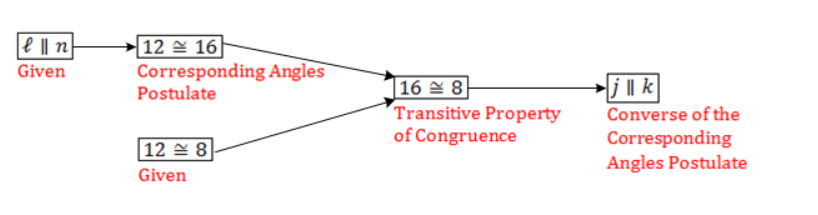
Savvas Learning Co Geometry Student Edition Chapter 3 Parallel And Perpendicular Lines Exercise 3.3 Proving Lines Parallel Page 162 Exercise 34 Problem 34 The flow proof 1

The flow proof that j ∥ k is as follows:

Savvas Learning Co Geometry Student Edition Chapter 3 Parallel And Perpendicular Lines Exercise 3.3 Proving Lines Parallel Page 162 Exercise 34 Problem 34 The flow proof 2


Savvas Learning Co Geometry Student Edition Chapter 3 Page 162  Exercise 35  Problem 35

Given: m ∠P = 72, m∠L = 108, m∠A = 72, m∠N = 108

To find – Sides of the parallelogram that are parallel.

In parallelogram PLAN

m∠P = 72

m∠L = 108

m∠A = 72

m∠N = 108

Here, we observe that m∠P + m∠L = 72 + 108 = 108

I.e. angle P and angle L are supplementary because they are same side interior angle for the transversal PL and the line PN and LA

Hence by converse of same side interior angle theorem side PN ∥ LA

Also,m∠L + m∠A = 72 + 108 = 180

i.e. angle L and angle A are supplementary because they are same side interior angle for the transversal AL and line PL and AN

Hence by converse of same side interior angle theorem side PL ∥ AN

Thus, we got that in parallelogram PLAN PN ∥ LA and PL ∥ AN


Savvas Learning Co Geometry Student Edition Chapter 3 Page 162  Exercise 36  Problem 36

Given: m∠P = 59, m∠L = 37,m∠A = 143, m∠N = 121

To find – Sides of the parallelogram that are parallel.

In parallelogram PLAN

m∠P = 59

m∠L = 37

m∠A = 143

m∠N = 121

Here,m∠P + m∠N = 59 + 121 = 180

Thus, angle P and angle N are supplementary because they are same side interior angle for the transversal PN and lines AN and PL.

Hence by converse of same side interior angle theorem side AL ∥ PL

Also, m∠P + m∠L = 59 + 37 = 96

Thus angle P and angle L are not supplementary i.e. PN ∦ LA

Therefore, AL ∥  PL

Thus, in parallelogram PLAN side AL ∥ PL


Savvas Learning Co Geometry Student Edition Chapter 3 Page 162  Exercise 37  Problem 37

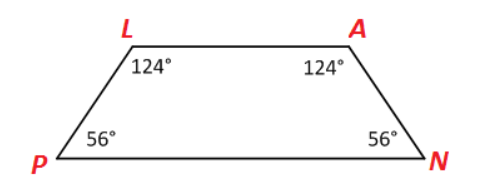
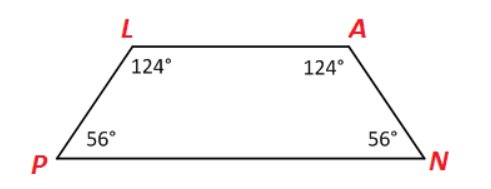
Given: m∠P = 56, m∠L = 124, m∠A = 124, m∠N = 56

To find – Sides of the parallelogram that are parallel.

Parallelogram PLAN can be sketched as:

Savvas Learning Co Geometry Student Edition Chapter 3 Parallel And Perpendicular Lines Exercise 3.3 Proving Lines Parallel Page 162 Exercise 37 Problem 37 Parallelogram 1

∠P and ∠L are same side interior angle on transversal  PL and are supplementary i.e. (124 + 56 = 180)

So, by converse of same side interior angle theorem \(\overline{L A} \| \overline{P N}\) thus \(\overline{L A} \| \overline{P N}\)

Thus, in parallelogram PLAN \(\overline{L A} \| \overline{P N}\) thus \(\overline{L A} \| \overline{P N}\) 

Savvas Learning Co Geometry Student Edition Chapter 3 Parallel And Perpendicular Lines Exercise 3.3 Proving Lines Parallel Page 162 Exercise 37 Problem 37 Parallelogram 2


Savvas Learning Co Geometry Student Edition Chapter 3 Page 162  Exercise 38  Problem 38

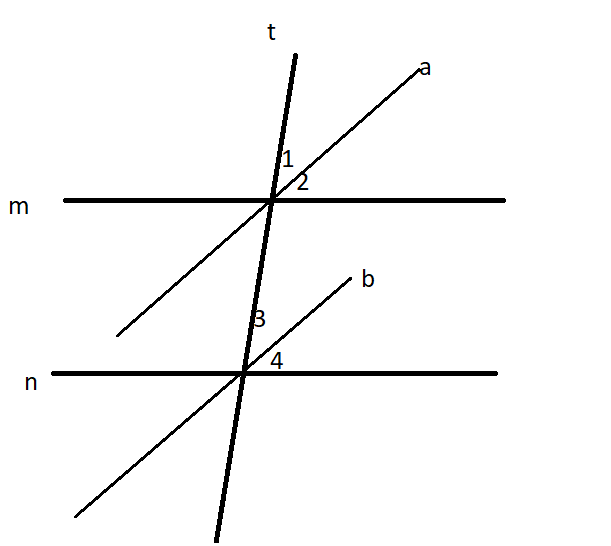
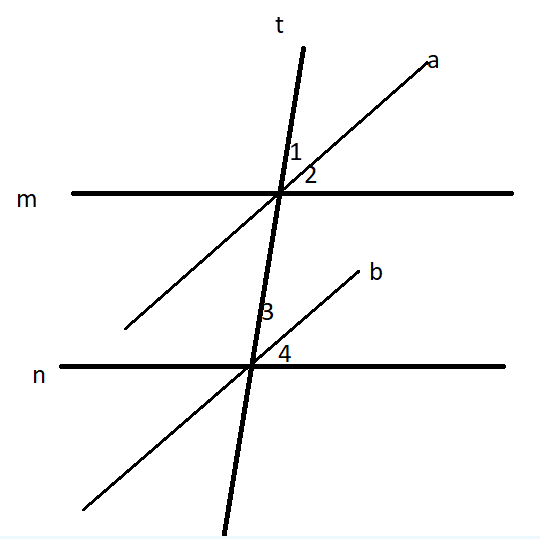
Given: Transversal t, line m ∥ n angle bisector a and b

To find – a ∥ b

Diagram :

Savvas Learning Co Geometry Student Edition Chapter 3 Parallel And Perpendicular Lines Exercise 3.3 Proving Lines Parallel Page 162 Exercise 38 Problem 38 Transversal lines 1

Transversal t ,a ∥ b ∠1 + ∠2 ≅ ∠3 + ∠4 _______ (Corresponding angle postulate)

m∠1 + m∠2 = m∠3 + m∠4 ______ (Definition of congruence angle)

Angle bisector a and b ___________ (Given)

Therefore,m∠1 = m∠2, m∠3 = m∠4

m∠1 + m∠1 = m∠3 + m∠3 __________ (Substitution property)

2m∠1 = 2m∠3

m∠1 = m∠3

Therefore, a ∥ b ________ (Converse of corresponding angle postulate

Thus, a ∥ b

Savvas Learning Co Geometry Student Edition Chapter 3 Parallel And Perpendicular Lines Exercise 3.3 Proving Lines Parallel Page 162 Exercise 38 Problem 38 Transversal lines 2


Savvas Learning Co Geometry Student Edition Chapter 3 Page 163  Exercise 39  Problem 39

The  corresponding angles between the parallel lines have equal measure and the measure of

m∠1 = 180 − 136 = 44 degree

m∠1 = 44 degree

The correct answer is 44 degrees

Savvas Learning Co Geometry Student Edition Chapter 3 Parallel And Perpendicular Lines Exercise 3.2 Properties Of Parallel Lines

Savvas Learning Co Geometry Student Edition Chapter 3 Parallel and Perpendicular Lines Exercise 3.2 Properties Of Parallel Lines


Savvas Learning Co Geometry Student Edition Chapter 3 Exercise 3.2 Properties Of Parallel Lines Solutions Page 152  Exercise 1  Problem 1

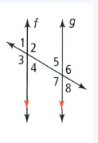
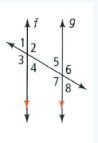
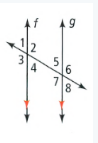
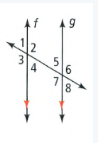
Given that:  The given two parallel lines with angles

Savvas Learning Co Geometry Student Edition Chapter 3 Parallel And Perpendicular Lines Exercise 3.2 Properties Of Parallel Lines Page 152 Exercise 1 Problem 1 Parallel lines angles 1

To find – Identify two pairs of supplementary angles. 

f,g are parallel lines with 8 angles. 

These are vertical, alternate, corresponding angles, supplementary angles.

The given two parallel lines with angles

Savvas Learning Co Geometry Student Edition Chapter 3 Parallel And Perpendicular Lines Exercise 3.2 Properties Of Parallel Lines Page 152 Exercise 1 Problem 1 Parallel lines angles 2

Have two lines pairs of supplementary angles are (2,40)(1,3).

The two pairs of supplementary angles are (2,40), (1,3) for the parallel lines with angles

Savvas Learning Co Geometry Student Edition Chapter 3 Parallel And Perpendicular Lines Exercise 3.2 Properties Of Parallel Lines Page 152 Exercise 1 Problem 1 Parallel lines angles 3

Read and Learn More Savvas Learning Co Geometry Student Edition Solutions

Exercise 3.2 Properties Of Parallel Lines Savvas Geometry Answers Page 152  Exercise 2  Problem 2

Savvas Learning Co Geometry Student Edition Chapter 3 Parallel And Perpendicular Lines Exercise 3.2 Properties Of Parallel Lines

The value of ∠m8 = 70 because of alternate angles. for the given parallel lines and ∠m1 = 70.

Savvas Learning Co Geometry Student Edition Chapter 3 Parallel And Perpendicular Lines Exercise 3.2 Properties Of Parallel Lines Page 152 Exercise 2 Problem 2 Parallel lines angles 2


Properties Of Parallel Lines Solutions Chapter 3 Exercise 3.2 Savvas Geometry Page 152  Exercise 3  Problem 3

Given: Alternate Interior Angles Theorem and the Alternate Exterior Angles Theorem

To Find – The similarity and difference between the given theorems.

The alternate interior angles are nonadjacent interior angles that lie on the opposite side of the transversal.

The Alternate Interior Angles Theorem states that “If a transversal intersects two parallel lines, then the alternate interior angles are congruent.

“The alternate exterior angles are nonadjacent exterior angles that lie on the opposite side of the transversal.

The Alternate Exterior Angles Theorem states that “If a transversal intersects two parallel lines, then the alternate exterior angles are congruent.

“The two theorems are alike in the fact that both of them deal with a transversal intersecting two parallel lines and that the alternate angles are congruent.

The two theorems differ from each other by the fact that the alternate interior angles are nonadjacent angles that lie within the parallel lines and the alternate exterior angles are nonadjacent angles that lie outside the parallel lines.

The similarity between the Alternate Interior Angles Theorem and the Alternate Exterior Angles Theorem is that two parallel lines are cut by a transversal and the angles are congruent. The difference between the Alternate Interior Angles Theorem and the Alternate Exterior Angles Theorem is that the interior angles are between the parallel line whereas the exterior angles are not between the parallel lines.


Properties Of Parallel Lines Solutions Chapter 3 Exercise 3.2 Savvas Geometry Page 152  Exercise 4  Problem 4

Given that: The problem is

Savvas Learning Co Geometry Student Edition Chapter 3 Parallel And Perpendicular Lines Exercise 3.2 Properties Of Parallel Lines Page 152 Exercise 4 Problem 4 Supplementary angles 1

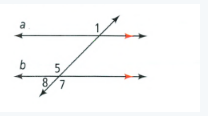
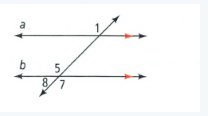
To find – You proved that ∠1 and ∠8, in the diagram below, are supplementary.

What is a good name for this pair of angles? Explain.

The lines a,b are parallel with each other and one line intersect both these parallel lines.

The angles ∠1,∠8 are supplementary angles because these are alternate same side exterior angles.

And the sum of two alternate same side angles is 180.

If the sum of two angles is 180 called supplementary angles.

The ∠1,∠8 are supplementary angles because these are alternate same side exterior angles. the good name of the pair of angle is alternate same side exterior angles. for the problem

Savvas Learning Co Geometry Student Edition Chapter 3 Parallel And Perpendicular Lines Exercise 3.2 Properties Of Parallel Lines Page 152 Exercise 4 Problem 4 Supplementary angles 2


Chapter 3 Exercise 3.2 Properties Of Parallel Lines Savvas Learning Co Geometry Explanation Page 153  Exercise 5  Problem 5

Given that: The given problem is 

Savvas Learning Co Geometry Student Edition Chapter 3 Parallel And Perpendicular Lines Exercise 3.2 Properties Of Parallel Lines Page 153 Exercise 5 Problem 5 Congruent angles 1

To find – Identify all the numbered angles that are congruent to the given angle.

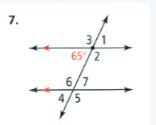
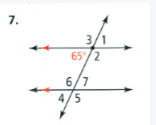
Justify your answers the given one angle is 65 degree and the congruent angles are ∠1,∠7,∠4.

The angle ∠1 is vertical opposite angle of 65 , the angle ∠7 is alternate angle with 65 and the angle ∠4 is correspondence angle with angle 65.

The congruent angles are ∠1,∠7,∠4  for the given problem is 

Savvas Learning Co Geometry Student Edition Chapter 3 Parallel And Perpendicular Lines Exercise 3.2 Properties Of Parallel Lines Page 153 Exercise 5 Problem 5 Congruent angles 2


Chapter 3 Exercise 3.2 Properties Of Parallel Lines Savvas Learning Co Geometry Explanation Page 153  Exercise 6  Problem 6

Given that: The given problem is 

Savvas Learning Co Geometry Student Edition Chapter 3 Parallel And Perpendicular Lines Exercise 3.2 Properties Of Parallel Lines Page 153 Exercise 6 Problem 6 Congruent angles 1

To find –  Identify all the numbered angles that are congruent to the given angle.

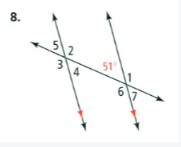
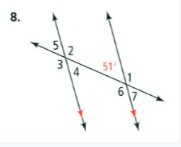
Justify your answers the given one angle is 51 degree and the angles ∠7,∠5,∠4
are congruent angles.

The ∠7 angle is vertical opposite angle of 51, the ∠4 angle is alternate angle with 51 and the angle ∠5 is correspondence angle with angle 51.

The congruent angles are ∠7,∠5,∠4 for the problem is

Savvas Learning Co Geometry Student Edition Chapter 3 Parallel And Perpendicular Lines Exercise 3.2 Properties Of Parallel Lines Page 153 Exercise 6 Problem 6 Congruent angles 2


Solutions For Properties Of Parallel Lines Exercise 3.2 In Savvas Geometry Chapter 3 Student Edition Page 153  Exercise 7  Problem 7

Given that: The given problem is

Savvas Learning Co Geometry Student Edition Chapter 3 Parallel And Perpendicular Lines Exercise 3.2 Properties Of Parallel Lines Page 153 Exercise 7 Problem 7 Congruent angles 1

To find – Identify all the numbered angles that are congruent to the given angle.

Justify your answers.The given one angle is 120 degree and the angles ∠3,∠1 are congruent angles.

The angle ∠3 is alternate angle with angle 120 and the angle ∠1 is correspondence angle with 120.

The congruent angles are ∠1,∠3 for the problem is

Savvas Learning Co Geometry Student Edition Chapter 3 Parallel And Perpendicular Lines Exercise 3.2 Properties Of Parallel Lines Page 153 Exercise 7 Problem 7 Congruent angles 2


Solutions For Properties Of Parallel Lines Exercise 3.2 In Savvas Geometry Chapter 3 Student Edition Page 153  Exercise 8  Problem 8

Given: The angle 2

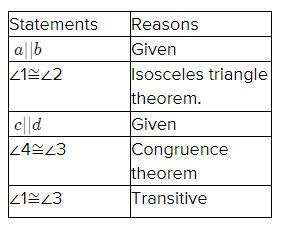
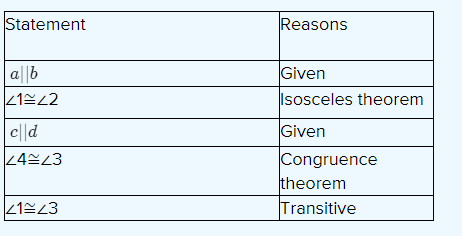
To Find – Write a two-column proof.

Given  a ∣∣ b

Two-column proof:

Savvas Learning Co Geometry Student Edition Chapter 3 Parallel And Perpendicular Lines Exercise 3.2 Properties Of Parallel Lines Page 153 Exercise 8 Problem 8 two column Proof

The two-column theorem:

Savvas Learning Co Geometry Student Edition Chapter 3 Parallel And Perpendicular Lines Exercise 3.2 Properties Of Parallel Lines Page 153 Exercise 8 Problem 8 two column Theorem


Exercise 3.2 Properties Of Parallel Lines Savvas Learning Co Geometry Detailed Answers Page 153  Exercise 9  Problem 9

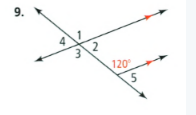
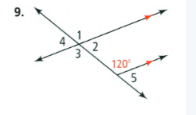
Given:  Figure in which two lines a∥b and q is transversal.

To find: m∠1 and m∠2 m∠1 is equal to 120°, because they are corresponding angles.

m∠1 and m∠2 are interior angles on same-side.

Therefore, they are supplementary angles.

⇒ m∠1 + m∠2 = 180°

⇒ 120° + m∠2 = 180°

⇒ m∠2 = 180° −120°

⇒ m∠2 = 60°

According to the given figure, m∠1 = 120° and m∠2 = 60°


Exercise 3.2 Properties Of Parallel Lines Savvas Learning Co Geometry Detailed Answers Page 153  Exercise 10  Problem 10

Given: Figure in which two lines AB∥CD and BC and AD are transversal.

To find –  m∠1 and m∠2 = 70° since they are alternate interior angles.

m∠1 and 80° are interior angles on same side.

Therefore, they are supplementary angles.

⇒ m∠1 + 80° = 180°

⇒ m∠2 = 180°− 80°

⇒ m∠2 = 100°

According to the given figure, m∠1 = 100° and m∠2 = 70°


Geometry Chapter 3 Properties Of Parallel Lines Savvas Learning Co Explanation Guide Page 153  Exercise 11  Problem 11

Given: A figure in which two lines are parallel.

To find – value of x and to find the measure of each labeled angle.

5x° and 4x°  are angles on same side.

Therefore, they are supplementary.

Value of x is 20° Measure of labeled angle 5x° = 100°,  4x° = 80°


Geometry Chapter 3 Properties Of Parallel Lines Savvas Learning Co Explanation Guide Page 154  Exercise 12  Problem 12

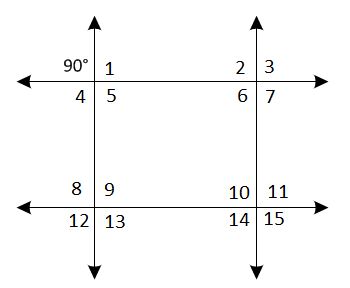
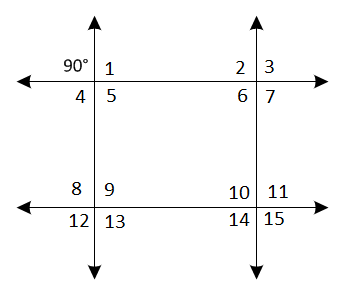
Given: Etchings on floors and walls in Rome suggest that the game required a grid of two intersecting pairs of parallel lines, similar to the modern game tick-tack-toe.

The measure of one of the angles formed by the intersecting lines is 90 degrees

To Find –  Find the measure of each of the other 15 angles. Justify your answers.

The diagram: Draw a diagram with two intersecting pairs of parallel lines where one angle is ninety degrees.

Savvas Learning Co Geometry Student Edition Chapter 3 Parallel And Perpendicular Lines Exercise 3.2 Properties Of Parallel Lines Page 154 Exercise 12 Problem 12 Parallel lines 1

The 90 degrees angle forms a linear pair with ∠1 and ∠ 4.

Since linear pairs are supplementary, then the sum of their measure is 180degree.

It means both the angles are equal to 90 degrees.

The 90 degrees angle and ∠5 are also vertical angles so they are congruent by the vertical angles theorem.

Hence, ∠5 is equal to 90 degrees

Each of these four angles we found is corresponding angles to angles  2,3,6,7,8,9,12,13 in no particular order so by the corresponding angles theorem, these eight angles also measure 90 degrees.

Using the angles set 2,3,6,7 or8,9,12,1 they are corresponding angles with angles10,11,14,15 so they are also congruent.

So, these four angles are measures 90 degrees

Hence, all 15 angles are measures 90 degrees.

All 15 angles are measure 90 degrees, the diagram

Savvas Learning Co Geometry Student Edition Chapter 3 Parallel And Perpendicular Lines Exercise 3.2 Properties Of Parallel Lines Page 154 Exercise 12 Problem 12 Parallel lines 2

Savvas Learning Co Geometry Student Edition Chapter Page 154  Exercise 13  Problem 13

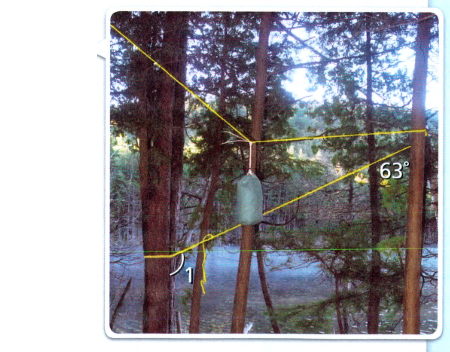
Given: Camper pulls the rope taut between the two parallel trees.

The figure:

Savvas Learning Co Geometry Student Edition Chapter 3 Parallel And Perpendicular Lines Exercise 3.2 Properties Of Parallel Lines Page 154 Exercise 13 Problem 13 Parallel trees


To Find – What is m∠1.

Given

Camper pulls the rope taut between the two parallel trees.

The given figure forms a triangle.

Given one angle: 63

We can see from the figure that the triangle is a right angle triangle so

The second angle is: 90 degree

Now, we know the sum of all three angles is 180 so

The third angle is:

⇒ 90 + 63 = 153

⇒ 180 − 153 = 27

Now the 1 point is perpendicular to 27degrees

And the sum of the perpendicular is180

So,∠1 180 − 27 = 153

The answer is 153 degrees

The answer is 153 degrees


Savvas Learning Co Geometry Student Edition Chapter 3 Page 155  Exercise 13  Problem 14

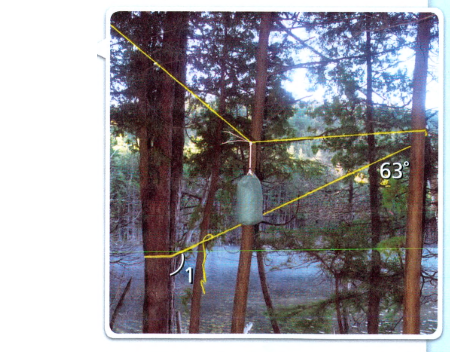
Given: The diagram

Savvas Learning Co Geometry Student Edition Chapter 3 Parallel And Perpendicular Lines Exercise 3.2 Properties Of Parallel Lines Page 154 Exercise 13 Problem 14 Parallel trees

To Find –  Are∠1 the given angle alternate interior angles, same-side interior angles, or corresponding angles?

Given , ∠1

If two parallel lines are transected by a third line, the angles which are inside the parallel lines and on alternate sides of the third line are called alternate interior angles.

 The angles which are inside the parallel lines and on the same side of the third line are called opposite interior angles.

In the given figure there is no alternate interior angle so, it is not an alternate angle.

Same side interior angles are two angles that are on the interior of (between) the two lines and specifically on the same side of the transversal.

The same-side interior angles sum up to 180 degrees.

Let check:

⇒ 153 + 63 = 216

So, it is not the same side interior angle.

Corresponding angles are the angles that are formed when two parallel lines are intersected by the transversal. These are formed in the matching corners or corresponding corners with the transversal.

Yes, it is a corresponding angle.

The given figure is a corresponding angle.

The answer is the corresponding angle.


Savvas Learning Co Geometry Student Edition Chapter 3 Page 155  Exercise 14  Problem 15

Given:  l ∥ m

To find – To prove ∠3 and ∠6 are supplementary.

Line l and m are Parallel ∠2 and ∠3 from a linear pair and linear pair are supplementary.

⇒ m∠2 + m∠3 = 180

⇒ ∠2 ≅ ∠6 are congurent

From congruence m∠2 = m∠6

By using substutition property

m∠6 + m∠3 = 180

∠3 and ∠6 are supplementary.

∠3 and ∠6 are supplementary proved.


Page 155  Exercise 15  Problem 16

Given:  a ∥ b, ∠1 ≅ ∠4

To find – To prove ∠2 ≅ ∠3

In geometry, two figures or objects are congruent if they have the same shape and size, or if one has the same shape and size as the mirror image of the other.

Line l and m are Parallel.

∠1 and∠2, ∠3 and ∠4 both are supplementary.

​⇒ m∠1 + m∠2 = 180

⇒ m∠3 + m∠4 = 180

Both have same value

⇒ m∠1 + m∠2 = m∠3 + m∠4

⇒ ∠1 ≅ ∠4 (given)

Which means

⇒ m∠1 = m∠4

By using substutition property

m∠4 + m∠2 = m∠3 + m∠4

Subtract

⇒ m∠2 = m∠3

By the defination of congruence

⇒ ∠2 ≅ ∠3

∠2 and ∠6 are congurent peoved.


Savvas Learning Co Geometry Student Edition Chapter 3 Page 155  Exercise 16  Problem 17

Given: The Diagram

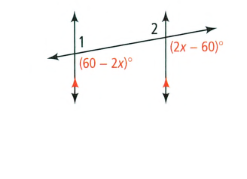
Savvas Learning Co Geometry Student Edition Chapter 3 Parallel And Perpendicular Lines Exercise 3.2 Properties Of Parallel Lines Page 155 Exercise 16 Problem 17 Error analysis

To find – To error analysis the diagram contain.

(60−2x)° and (2x−60)° are corresponding angles formed by tranversal,so they must be congruent.

We write it as

​⇒ 60 − 2x = 2x − 60

⇒ −4x =−120

⇒ x = 30°

Subsittuting  x = 30°

We get

​⇒ 60 − 2(30) = 0°

⇒ 2(30) − 60 = 0°

We get 0° in both the expression which contradict the diagram and the tranversal must have form angle with parallel lines.

We get 0° in both the expression which contradict the diagram and the tranversal must have form angle with parallel lines.


Page 155  Exercise 17  Problem 18

Given: ∠1 and ∠2 are same-side interior angles formed by two parallel lines and ∠1 = 115.

To find –  To find∠2

The theorem for the “same side interior angle theorem” states.

If a transversal intersects two parallel lines, each pair of same-side interior angles are supplementary.

Because ∠1 and∠2 are same-side interior angles formed by two parallel lines.

By using same-side interior angle theorem

⇒ m∠1 + m∠2 = 180

⇒ m∠2 = 180 − m∠1

⇒ ​m∠2 = 180 − 115

⇒ m∠2 = 65

The valuse of m∠2 is 65°


Savvas Learning Co Geometry Student Edition Chapter 3 Page 155  Exercise 18  Problem 19

Given: A rectangular swimmimg pool area 1500 ft 2 surround by the walkway.

To find –  Length of fencing to surround the walkway.

Length of fencing to surround the walkway is equal to the perimeterof the larger rectangle.

Let l and w are the length and width of the smaller rectangle respectively

Area

lw = \(\frac{1500}{l}\)

w = \(\frac{1500}{50}\)

Let L and W are the length and width of the larger Rectangle respectively

⇒ ​L = 50 + 2(4)

⇒ L = 59ft

​⇒ W = 20 + 3(4)

⇒ W = 38ft

Perimeter of the bigger reactangle

⇒ ​P =  2(L) + 2(W)

⇒ P =  2(59) + 2(38)

⇒ P =  192 ft

​Length of fencing to surround the walkway is 192 ft


Page 155  Exercise 19  Problem 20

Given: The sum of measure angle and two times of measure angle is complement.

To find – To find measured angle.

An angle and its complement add up to

This means we have  x + 2x = 90

⇒ 3x = 90

⇒ x = 30

The measure of the angle is 30°


Savvas Learning Co Geometry Student Edition Chapter 3 Page 155  Exercise 20  Problem 21

Given: ∠1 and ∠2 are vertical angles,  m∠1 = 4x and m∠2 = 56

To find –  To find value of x

Because ∠1 and ∠2 are vertical angles

By vertical angle theorem

⇒ m∠1 = m∠2

Subsitutin property

⇒ 4x = 56

⇒ x = \(\frac{56}{4}\)

The value of x is 46°


Page 155 Exercise 21  Problem 22

Given: The statement “Skew lines are coplanar.”

To find: The given statement is always, sometimes, or never true.

Skew lines are two or more lines that do not intersect, are not parallel, and are not coplanar.

The only way that two non parallel can never be intersect is if they are not coplaner.

The given statement is never ture.


Savvas Learning Co Geometry Student Edition Chapter 3 Page 155  Exercise 22  Problem 23

Given: The statement “Skew lines intersect.”

To find –  The given statementis always, sometimes, or never true.

Skew lines are two lines that do not intersect and are not parallel.

By the definaton we can conclude that skew line never intersect.

This statement is never be ture.


Page 155  Exercise 23  Problem 24

Given: The statement “Parallel planes intersect.”

To find –  The given statement is always, sometimes, or never true.

Parallel lines are coplanar straight lines that do not intersect at any point.

By the defination we can conclude that Parallel planes intersect.

This statement is never be true.

Savvas Learning Co Geometry Student Edition Chapter Page 155  Exercise 24  Problem 25

Given: The statement ” If a triangle is a right triangle, then it has a 90°”

To find – To Write the converse of the statement.

Converse of the satement is if triangle has 90° then it is a right angle triangle.

The converse of the given statement is if triangle has 90° then it is a right angle triangle.

Savvas Learning Co Geometry Student Edition Chapter 3 Parallel and Perpendicular Lines Exercise 3.1 Lines And Angles

Savvas Learning Co Geometry Student Edition Chapter 3 Parallel and Perpendicular Lines Exercise 3.1 Lines And Angles


Savvas Learning Co Geometry Student Edition Chapter 3 Exercise 3.1 Lines And Angles Solutions Page 143  Exercise 1  Problem 1

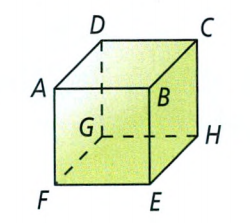
Given: A figure.

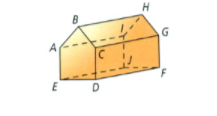
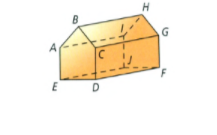
To Find –  Parallel segments in the given figure.A segment is a part of the line.

We have a figure

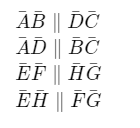
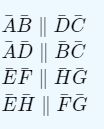
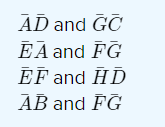
In the given figure, we can see that the parallel segments are

Savvas Learning Co Geometry Student Edition Chapter 3 Parallel And Perpendicular Lines Exercise 3.1 Lines And Angles Page 143 Exercise 1 Problem 1 Parallel Segment 1

The parallel segments in the given figure are

Savvas Learning Co Geometry Student Edition Chapter 3 Parallel And Perpendicular Lines Exercise 3.1 Lines And Angles Page 143 Exercise 1 Problem 1 Parallel Segment 2

Read and Learn More Savvas Learning Co Geometry Student Edition Solutions

Exercise 3.1 Lines And Angles Savvas Geometry Answers Page 143  Exercise 2  Problem 2

Given:  A figure.

To Find – Skew segments in the given figure.

A segment is a part of the line.

We have a figure

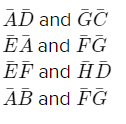
In the given figure, we can see that skew segments are

Savvas Learning Co Geometry Student Edition Chapter 3 Parallel And Perpendicular Lines Exercise 3.1 Lines And Angles Page 143 Exercise 2 Problem 2 Skew Segment 1

Some possible pairs of skew segments in the given figure are

Savvas Learning Co Geometry Student Edition Chapter 3 Parallel And Perpendicular Lines Exercise 3.1 Lines And Angles Page 143 Exercise 2 Problem 2 Skew Segment 2


Exercise 3.1 Lines And Angles Savvas Geometry Answers Page 143  Exercise 3  Problem 3

Savvas Learning Co Geometry Student Edition Chapter 3 Parallel and Perpendicular Lines Exercise 3.1 Lines And Angles

Some possible parallel planes in the given figure are:

Plane EFGH ∥ Plane ABCD

Plane AEFB ∥ Plane DHGC

Plane AEHD ∥ Plane BFGC


Lines And Angles Solutions Chapter 3 Exercise 3.1 Savvas Geometry Page 143  Exercise 4  Problem 4

Given: A figure.

To Find – Alternate interior angles in the given figure.

An angle is a combination of two rays ( half-lines ) with a common endpoint.

We have a figure

In the given figure, we can see that the possible pairs of alternate interior angles are

⇒ ∠2 and ∠3

⇒  ∠8 and ∠6

The possible pairs of alternate interior angles in the given figure are: ∠2 and ∠3, ∠8 and ∠6


Lines And Angles Solutions Chapter 3 Exercise 3.1 Savvas Geometry Page 143  Exercise 5  Problem 5

Given: A figure.

To Find –  Same-side interior angles in the given figure.

An angle is a combination of two rays ( half-lines ) with a common endpoint.

We have a figure

In the given figure, we can see that the pairs of same-side interior angles are

∠3 and ∠8

∠6 and ∠2

The possible pairs of same-side interior angles are: ∠3 and ∠8, ∠6 and ∠2


Chapter 3 Exercise 3.1 Lines And Angles Savvas Learning Co Geometry Explanation Page 143  Exercise 6  Problem 6

Given: A figure.

To Find – Corresponding angles in the given figure.

An angle is a combination of two rays ( half-lines ) with a common endpoint.

We have a figure

In the given figure, we can see the possible pairs of the corresponding angles are

∠1 and ∠3

∠7 and ∠6

∠8 and ∠5

∠2 and ∠4

The possible pairs of the corresponding angles are: ∠1 and ∠3,∠7 and ∠6,∠8 and ∠5,∠2 and ∠4


Solutions For Lines And Angles Exercise 3.1 In Savvas Geometry Chapter 3 Student Edition Page 143  Exercise 7  Problem 7

Given: A figure.

To Find  – Alternate exterior angles in the given figure.

An angle is a combination of two rays ( half-lines ) with a common endpoint.

We have a figure

In the given figure, we can see that possible pairs of alternate exterior angles are

∠1 and ∠4

∠7 and ∠5

The possible pairs of the alternate exterior angles in the given figure are:∠1 and ∠4, ∠7 and ∠5


Solutions for Lines and Angles Exercise 3.1 in Savvas Geometry Chapter 3 Student Edition Page 143  Exercise 8  Problem 8

Parallel lines are the lines that do not intersect, and if we do not include the property of coplanarity, we can find the lines in different planes , and will be called skew lines.

Skew lines are the lines that do not intersect but are not in the same plane, thus parallel lines are coplanar and which do not meet.

Coplanar is included in the definition of parallel planes to differentiate from the definition of skew lines.


Exercise 3.1 Lines And Angles Savvas Learning Co Geometry Detailed Answers Page 143  Exercise 9  Problem 9

Alternate interior angles are formed by a transversal intersecting two lines.

The angles are located inside the two lines but on the opposite sides of the transversal.

Alternate interior angles are located inside the two parallel lines on the opposite sides of the transversal.


Exercise 3.1 Lines And Angles Savvas Learning Co Geometry Detailed Answers Page 143  Exercise 10  Problem 10

Given: A figure is given

Savvas Learning Co Geometry Student Edition Chapter 3 Parallel And Perpendicular Lines Exercise 3.1 Lines And Angles Page 143 Exercise 10 Problem 10 Cube of parallel lines

To Find  – Who is correct between Juan and Carly?

As the question says lines appearing to be parallel are parallel.

In the figure, it can be seen clearly that AB ∥ HG

Since Carly is saying AB ∥ HG, that is correct.

But Juan is saying that AB and HG are skewed, so he is wrong.

Carly is correct because he is saying AB∥HG


Geometry Chapter 3 Lines And Angles Savvas Learning Co Explanation Guide Page 144  Exercise 11  Problem 11

Given: A figure is given

Savvas Learning Co Geometry Student Edition Chapter 3 Parallel And Perpendicular Lines Exercise 3.1 Lines And Angles Page 144 Exercise 11 Problem 11 Parallel lines AB

To Find – All lines that are parallel to AB

In the figure, a line that is parallel to AB is FG

Line parallel to AB is FG


Geometry Chapter 3 Lines And Angles Savvas Learning Co Explanation Guide Page 144  Exercise 12  Problem 12

Given: A figure is given

Savvas Learning Co Geometry Student Edition Chapter 3 Parallel And Perpendicular Lines Exercise 3.1 Lines And Angles Page 144 Exercise 12 Problem 12 Parallel lines DH

To Find  – All lines that are parallel to DH

In the figure, lines that are parallel to DH are GB, FA, JE, and CL

Lines parallel to DH are GB, FA, JE,  and CL


Savvas Learning Co Geometry Student Edition Chapter 3 Page 144  Exercise 13  Problem 13

Given: A figure is given

Savvas Learning Co Geometry Student Edition Chapter 3 Parallel And Perpendicular Lines Exercise 3.1 Lines And Angles Page 144 Exercise 13 Problem 13 Parallel lines EJ

To Find –  All lines that are parallel to EJ

In the figure, lines that are parallel to EJ are FA, GB, DH, and CL.

Lines parallel to EJ FA, GB, DH, and CL


Page 144  Exercise 14  Problem 14

Given: A figure is given
Savvas Learning Co Geometry Student Edition Chapter 3 Parallel And Perpendicular Lines Exercise 3.1 Lines And Angles Page 144 Exercise 14 Problem 14 Parallel lines JF AE

To Find –  All lines that are parallel to the plane JF AE

Lines parallel to JF AE are GB, DH, and CL


Savvas Learning Co Geometry Student Edition Chapter 3 Page 144  Exercise 15  Problem 15

Given: A figure is given

Savvas Learning Co Geometry Student Edition Chapter 3 Parallel And Perpendicular Lines Exercise 3.1 Lines And Angles Page 144 Exercise 15 Problem 15 Parallel lines LH

To Find –  A plane parallel to LH

A plane parallel to LH is JFGDC


Page 144  Exercise 16  Problem 16

Given: A figure is given

Savvas Learning Co Geometry Student Edition Chapter 3 Parallel And Perpendicular Lines Exercise 3.1 Lines And Angles Page 144 Exercise 16 Problem 16 Alternate Interior angles

To Find  – Alternate interior angles.

Alternate interior angles in the figure are 2 & 3


Savvas Learning Co Geometry Student Edition Chapter 3 Page 144  Exercise 17  Problem 17

Given: A figure is given

Savvas Learning Co Geometry Student Edition Chapter 3 Parallel And Perpendicular Lines Exercise 3.1 Lines And Angles Page 144 Exercise 17 Problem 17 Angles

To Find –  Whether the angles labeled in the same color alternate interior angles, same-side interior angles, corresponding angles, or alternate exterior angles?

Angles 3 & 4 and 5 & 6 are corresponding angles and angles  1 & 2 are same side interior angles.


Page 144  Exercise 18  Problem 18

Given: A figure is given

Savvas Learning Co Geometry Student Edition Chapter 3 Parallel And Perpendicular Lines Exercise 3.1 Lines And Angles Page 144 Exercise 18 Problem 18 Alternate Interior angles

To Find – Whether the angles labeled in the same color alternate interior angles, same-side interior angles, corresponding angles, or alternate exterior angles?

Only angles 5 & 6 are alternate interior angles.


Savvas Learning Co Geometry Student Edition Chapter 3 Page 144  Exercise 19  Problem 19

Given: A figure is given

Savvas Learning Co Geometry Student Edition Chapter 3 Parallel And Perpendicular Lines Exercise 3.1 Lines And Angles Page 144 Exercise 19 Problem 19 Corresponding angles

To Find  – Whether ∠1 & ∠2 are alternate interior angles, same-side interior angles, corresponding angles, or alternate exterior angles?

∠1 & ∠2 are corresponding angles.


Page 144  Exercise 20  Problem 20

Let, the lines p,q be cut by a transversal t.
Savvas Learning Co Geometry Student Edition Chapter 3 Parallel And Perpendicular Lines Exercise 3.1 Lines And Angles Page 144 Exercise 20 Problem 20 Alternate Exterior angles

Clearly,∠1 & ∠8 and ∠5 & ∠4  forms the pair of alternate exterior angles.

Two pairs of alternate exterior angles do two lines and a transversal form.


Savvas Learning Co Geometry Student Edition Chapter 3 Page 144  Exercise 21  Problem 21

Given: \(\stackrel{\leftrightarrow}{E D} \| \overleftarrow{H} \hat{G}\)

Savvas Learning Co Geometry Student Edition Chapter 3 Parallel And Perpendicular Lines Exercise 3.1 Lines And Angles Page 144 Exercise 21 Problem 21 Skew Lines

To find –  The statement as true or false.

The lines are False they are making skew lines.

According to the figure given, we can say that \(\overleftrightarrow{E D}\) ∦ \(\overleftarrow{H} \hat{G}\)  the lines and planes that appear to be parallel are not parallel they are skew.


Page 145  Exercise 22  Problem 22

Given: Plane  AED∥ Plane FGH

Savvas Learning Co Geometry Student Edition Chapter 3 Parallel And Perpendicular Lines Exercise 3.1 Lines And Angles Page 145 Exercise 22 Problem 22 Parallel Lines

To find – The statement as true or false.

The plane AED∥ plane FGH is true.

According to the figure given, we can say that plane AED∥ plane FGH. The lines and planes that appear to be parallel are parallel.


Savvas Learning Co Geometry Student Edition Chapter 3 Page 145  Exercise 23  Problem 23

Given: Plane ABH ∥ Plane CDF

Savvas Learning Co Geometry Student Edition Chapter 3 Parallel And Perpendicular Lines Exercise 3.1 Lines And Angles Page 145 Exercise 23 Problem 23 Intersect above lines

To find –  The statement as true or false.

The lines are False they intersect above \(\overrightarrow{C G}\)

According to the figure given, we can say that plane ABH ∥ plane CDF  the lines and planes that appear to be parallel are not parallel they intersect above  \(\overrightarrow{C G}\)


Page 145  Exercise 24  Problem 24

Given: \(\overrightarrow{A B}\) and \(\overrightarrow{H G}\) are skew line

Savvas Learning Co Geometry Student Edition Chapter 3 Parallel And Perpendicular Lines Exercise 3.1 Lines And Angles Page 145 Exercise 24 Problem 24 Skew Lines

To find –  The statement as true or false.

The lines are skew lines.

According to the figure given, we can say that \(\overrightarrow{A B}\) and \(\overrightarrow{H G}\) the lines and planes appear to be a skew line.


Savvas Learning Co Geometry Student Edition Chapter 3 Page 145  Exercise 25  Problem 25

Given: \(\overrightarrow{A E}\) and \(\overrightarrow{B C}\) are skew line

Savvas Learning Co Geometry Student Edition Chapter 3 Parallel And Perpendicular Lines Exercise 3.1 Lines And Angles Page 145 Exercise 25 Problem 25 Intersect at point

To find – The statement as true or false.

The lines are not skew lines because they intersect at point A.

According to the figure given, we can say that \(\overrightarrow{A E}\) and \(\overrightarrow{B C}\) the lines and planes apperear to be is not a skew lines because they intersect at point A.


Page 145  Exercise 26  Problem 26

Given: A rectangular rug covers the floor in a living room.

One of the walls in the same living room is painted blue.

To find –  Are the rug and the blue wall parallel No, the rug and the blue wall are not parallel because they intersect.

The opposite wall can be parallel to the blue wall.

Savvas Learning Co Geometry Student Edition Chapter 3 Parallel And Perpendicular Lines Exercise 3.1 Lines And Angles Page 145 Exercise 26 Problem 26 Parallel to blue wall

A rectangular rug covers the floor in a living room. One of the walls in the same living room is painted blue is not parallel because they intersect.


Savvas Learning Co Geometry Student Edition Chapter 3 Page 145  Exercise 27  Problem 27

Given: Two planes that do not intersect are parallel.

To find –  Determine each statement is always, sometimes, or never true.

Two planes that do not intersect are always parallel as a plane is a flat, two-dimensional surface that extends infinitely far.

A plane is the two-dimensional analog of a point, a line, and three-dimensional space.

The two planes that do not intersect are always parallel.


Page 145  Exercise 28  Problem 28

Given: A statement – Two lines that lie in parallel planes are parallel.

To find – Each statement is always, sometimes, or never true.

In order to be parallel, the two lines must be co-planer.

And as only some lines in two parallel planes are co-planer, the statement is sometimes true.

The given statement is sometimes true.

Savvas Learning Co Geometry Student Edition Chapter 1 Tools of Geometry Exercise 1.3 Measuring Segments

Savvas Learning Co Geometry Student Edition Chapter 1 Tools of Geometry Exercise 1.3 Measuring Segments


Savvas Learning Co Geometry Student Edition Chapter 1 Exercise 1.3 Measuring Segments Solutions Page 23  Exercise 1  Problem 1

Given: The point on \(\overrightarrow{D A}\) that is 2 units from D.

To name each of the following.By using geometry theory.

The ray moves in the direction of A therefore the only point 2 units away from D is point B, because we have to move 2 units toward A.

Solving the question, we found that it is B.


Page 23  Exercise 2  Problem 2

Given:
Savvas Learning Co Geometry Student Edition Chapter 1 Tools of Geometry Exercise 1.3 Measuring Segment Page 23 Exercise 2 Problem 2 Number line

The coordinate of the midpoint of AG

Using properties of line.

Midpoint of \(\overrightarrow{A G}\)

= \(\frac{A+G}{2}\)

Midpoint of \(\overrightarrow{A G}\)

= \(\frac{3−3}{2}\)

Midpoint \(\overrightarrow{A G}\) = 0

The coordinate of the midpoint of \(\overrightarrow{A G}\) = 0 whcich is at D.

Read and Learn More Savvas Learning Co Geometry Student Edition Solutions

Exercise 1.3 Measuring Segments Savvas Geometry Answers Page 23  Exercise 3  Problem 3

Savvas Learning Co Geometry Student Edition Chapter 1 Tools of Geometry Exercise 1.3 Measuring Segments

Solving the question, we found point Q and line ℓ.


Page 23  Exercise 4  Problem 4

Given: Two segments are congruent and saying that two segments have equal length.

To find When would you use each phrase.

Using theoretical method.

If two segments are equal in length, then they are congruent and if they are congruent then they are equal in length.

But the word equal is used to compare numbers; we can not say that two numbers are congruent, we say that two numbers are equal.

And the word congruent is used to compare shapes; we can not say that two triangles are equal, we say that two triangles are congruent.

The word equal is used to compare numbers. and the word congruent is used to compare shapes.


Chapter 1 Exercise 1.3 Measuring Segments Savvas Learning Co Geometry Explanation Page 24  Exercise 5  Problem 5

Given: You and your friend live 5 mi apart. He says that it is 5 mi from his house to your house and −5 mi from your house to his house.

To find What is the error in his argument.

Using the theoretical method.

The error is that the distance is never negative.

He applied the rule that the distance between two points on the number line is the absolute value of the difference between the two points, but he did not apply the absolute value which gives only positive numbers.

For example, if we calculate the distance on the number line between the point 7 and the point 2, it should be

∣7 − 2∣ = ∣2 − 7∣ = 5 ≠ −5

The error is that the distance is never negative.


Solutions For Measuring Segments Exercise 1.3 In Savvas Geometry Chapter 1 Student Edition Page 24   Exercise 6  Problem 6

Given:

Savvas Learning Co Geometry Student Edition Chapter 1 Tools of Geometry Exercise 1.3 Measuring Segment Page 24 Exercise 6 Problem 6 Number line

To Find the length of BD

Using addition.

Length of  BD = 6 + 3

BD = 9 units

Length of BD = 9 units


Page 24  Exercise 7  Problem 7

Given:
Savvas Learning Co Geometry Student Edition Chapter 1 Tools of Geometry Exercise 1.3 Measuring Segment Page 24 Exercise 7 Problem 7 Number line

To Find the length of AD

Using addition.

Length of AD = 3 + 8

AD = 11

Length of AD = 11


Exercise 1.3 Measuring Segments Savvas Learning Co Geometry Detailed Answers Page 24  Exercise 8  Problem 8

Given:
Savvas Learning Co Geometry Student Edition Chapter 1 Tools of Geometry Exercise 1.3 Measuring Segment Page 24 Exercise 8 Problem 8 Number line

To Find the length CE

Using subtraction.

Length of CE = 7 − 1

CE = 6 units.

Length of CE = 6 units.


Page 24  Exercise 9  Problem 9

Given: RS =  15

ST = 9

To find RT

Using addition.

RT = RS + ST

RT = 15 + 9

RT = 24

Value of RT = 24.


Geometry Chapter 1 Measuring Segments Savvas Learning Co Explanation Guide Page 24  Exercise 10  Problem 10

Given:

Savvas Learning Co Geometry Student Edition Chapter 1 Tools of Geometry Exercise 1.3 Measuring Segment Page 24 Exercise 10 Problem 10 Number line

To find value of y

Using RT = RS + ST

RT = RS + ST

15y−9 = 4y + 8 + 8y + 4

15y − 9 = 12y + 12

15y − 12y = 12 + 9

3y = 21

y = \(\frac{3}{21}\)

y = 7

Value of y = 7.


Page 24  Exercise 10  Problem 11

Given:

Savvas Learning Co Geometry Student Edition Chapter 1 Tools of Geometry Exercise 1.3 Measuring Segment Page 24 Exercise 10 Problem 11 Number line

To find RS,ST, and RT

Using simple calculation

15y − 9 = 4y + 8 + 8y + 4

15y − 9 = 12y + 12

15y − 12y = 12 + 9

3y = 21

y =\(\frac{3}{21}\)

y = 7

ST = 4y + 8

ST = 4.7 + 8

ST = 28 + 8

ST = 36

RS = 8y + 4

RS = 8.7 + 4

RS = 60

RT = RS + ST

RT = 60 + 36

RT = 96

Value of ST = 36, RT = 96,RS = 60


Savvas Learning Co Geometry Student Edition Chapter 1 Tools of Geometry Exercise 1.3 Measuring Segments Page 24   Exercise 11  Problem 12

Given:
Savvas Learning Co Geometry Student Edition Chapter 1 Tools of Geometry Exercise 1.3 Measuring Segment Page 24 Exercise 11 Problem 12 Number line

To Tell whether the segments \(\overline{M N}\) and \(\overline{P Q}\) are congruent.

Using properties of line.

\(\overline{M N}\) = |−3 − 3| = 6 units

\(\overline{P Q}\) = |6 − 12| = 6 units

Since distance between \(\overline{M N}\) and \(\overline{P Q}\) are equal so they are congruent.

\(\overline{M N}\) and \(\overline{P Q}\) are congurent.


Page 24   Exercise 12  Problem 13

Given:

Savvas Learning Co Geometry Student Edition Chapter 1 Tools of Geometry Exercise 1.3 Measuring Segment Page 24 Exercise 12 Problem 13 Number line

Tell whether the segments \(\overline{L P}\) and \(\overline{M Q}\) are congruent.

Using properties of line.

From the above figure we have

\(\overline{L P}\) = ∣−8−6∣ = 14 units

\(\overline{M Q}\) =∣−3−12∣ = 15 units.

So, distance between these two lines are not equal.

So, \(\overline{L P}\) and \(\overline{M Q}\) are not congruent \(\overline{L P}\) and \(\overline{M Q}\) are not congurent.


Savvas Learning Co Geometry Student Edition Chapter 1 Tools of Geometry Exercise 1.3 Measuring Segments Page 24  Exercise 13  Problem 14

Given: A is the midpoint of ​ \(\overline{X Y}\)
Savvas Learning Co Geometry Student Edition Chapter 1 Tools of Geometry Exercise 1.3 Measuring Segment Page 24 Exercise 13 Problem 14 Number line

To find XA

Using the midpoint of the line segment method.

From the given figure, XA = 3x.

So, it is must to solve x, first.

It is also given that A is the midpoint of a line segment XY

So, XA = AY

Substitute the given expression

3x = 5x − 6

⇒  −2x = −6

⇒  x =\(\frac{−6}{-2}\)

⇒  x = 3

Value of XA is 3


Page 24  Exercise 13  Problem 15

Given: A is the midpoint of ​ \(\overline{X Y}\)
Savvas Learning Co Geometry Student Edition Chapter 1 Tools of Geometry Exercise 1.3 Measuring Segment Page 24 Exercise 13 Problem 15 Number line

To find AY and XY.

Using the midpoint of line segment method

A is mid point of XY.

Therefore, value of XA  and  AY are equal.

⇒ 3x = 5 x− 6

⇒ 5x − 3x = 6

⇒ 2x = 6

⇒ x = 3

AY = 5x − 6

Substitute the value of x in equation for AY

AY = 5(3) − 6

​⇒  15 − 6

⇒   9

By segment addition postulate

XA + AY = XY

⇒  9 + 9 = 18

Value of AY is 9 and XY is 18.


Savvas Learning Co Geometry Student Edition Chapter 1 Tools of Geometry Exercise 1.3 Measuring Segments Page 24  Exercise 14  Problem 16

Given:  PT = 5x + 3 ,TQ = 7x − 9

Savvas Learning Co Geometry Student Edition Chapter 1 Tools of Geometry Exercise 1.3 Measuring Segment Page 24 Exercise 14 Problem 16 Number line

To find the value of PT

Using the midpoint of a line segment method

PT = 5x + 3

TQ = 7x − 9

Since T is the midpoint of a line segment PQ.

PT = TQ

5x + 3  =  7x − 9

Subtract 5x from both sides

3 = 2x − 9

Add 9 both sides

12 = 2x

x = \(\frac{12}{2}\)

6  =  x or x  =  6

Substitute value of x in PT = 5x + 3.

Then it results in ​PT = 5(6) +  3

⇒ 33

The value of PT n is 33


Page 24  Exercise 15  Problem 17

Given: ​PT = 4x − 6 , ​TQ = 3x + 4

Savvas Learning Co Geometry Student Edition Chapter 1 Tools of Geometry Exercise 1.3 Measuring Segment Page 24 Exercise 15 Problem 17 Number line

To find the value of PT.

Using the midpoint of line segment method.

Given that

PT = 4x−6

So it is required to solve x first

PT = TQ

Substituting the expression

4x − 6 = 3x + 4

Solve for x

4x = 3x + 10

⇒ x = 10

Substituting value of x in PT

​⇒ 4(10) − 6

⇒ 40 − 6

⇒ 34

Value of PT is 34.


Savvas Learning Co Geometry Student Edition Chapter 1 Tools of Geometry Exercise 1.3 Measuring Segments Page 24  Exercise 16  Problem 18

Given: X = −7, Y = −3,Z = 1 and W = 5

To find the length of the two-segmentUsing the formula distance between two points

Given the following coordinates:

X  = −7,Y = −3, Z = 1 , and W = 5

The length of the segments:

ZX = ∣1−(−7)∣

ZX = ∣8∣

ZX = 8, and

WY = ∣5−(−3)∣

WY = ∣8∣

WY = 8

Since, ZX = WY ,then

\(\overline{Z X}\)= \(\overline{W Y}\).

The length of the two segments are 8 and 8 respectively and also they are congruent


Page 24  Exercise 17  Problem 19

Given: The coordinate of A is 0, AR = 5, and AT = 7.

To find the possible coordinates of the midpoint of the \(\overline{A T}\).

Using the properties of geometry.

Let M be the midpoint of \(\overline{A T}\) , given that A = 0 so T may be located to the left or to the right of A as shown.

Savvas Learning Co Geometry Student Edition Chapter 1 Tools of Geometry Exercise 1.3 Measuring Segment Page 24 Exercise 17 Problem 19 Number lines

If T is to the left of A, then T = −7 so the midpoint is,

M =  \(\frac{A+T}{2}\)

=  \(\frac{0+(-7)}{2}\)

=  \(\frac{-7}{2}\)

M = − 3.5

If T is to the right of A, then T = 7 so the midpoint is

M =  \(\frac{A+T}{2}\)

M = \(\frac{0+(7)}{2}\)

M =  \(\frac{7}{2}\)

M =  3.5

The possible coordinates of the segment is M = −3.5 or M = 3.5


Savvas Learning Co Geometry Student Edition Chapter 1 Tools of Geometry Exercise 1.3 Measuring Segments Page 24   Exercise 18   Problem 20

Given: The coordinate of A is 0, and AR = 5 and AT = 7.

To find the possible coordinates of the midpoint of the RT

Using the properties of geometry.

Let M be the midpoint o \(\overline{R T}\)

We are given that A = 0 so R and T may be located to the left or to the right of A as shown

Savvas Learning Co Geometry Student Edition Chapter 1 Tools of Geometry Exercise 1.3 Measuring Segment Page 24 Exercise 18 Problem 20 Number lines

If both R and T is to the left of A ,the mid point is

M = \(\frac{R+T}{2}\)

M = \(\frac{-5+(-7)}{2}\)

M = \(\frac{-12}{2}\)

Therefore M = −6.

If both R and T is to the right of A ,the mid point is

M = \(\frac{R+T}{2}\)

M = \(\frac{5+(7)}{2}\)

M = \(\frac{12}{2}\)

Therefore M = 6.

If T is left of A and R is to the right of A ,the midpoint is

M = \(\frac{R+T}{2}\)

M = \(\frac{5+(-7)}{2}\)

M = \(\frac{-2}{2}\)

M = − 1

Therefore M = −1

If R is left of A and T is to the right of A , the midpoint is

M = \(\frac{R+T}{2}\)

M = \(\frac{-5+(7)}{2}\)

M = \(\frac{2}{2}\)

M = 1

Therefore M = 1

The possible coordinates of the segment is M = −6 or M = 6 or M = −1 or M = 1.


Page 25  Exercise 19  Problem 21

Given:  To sketch a segment without using a ruler.

To sketch a segment of 3 in.

Using geometrical method.

Sketch the segment with 3 in

Savvas Learning Co Geometry Student Edition Chapter 1 Tools of Geometry Exercise 1.3 Measuring Segment Page 25 Exercise 19 Problem 21 Line Segment 1

The segment of 3 in is 

Savvas Learning Co Geometry Student Edition Chapter 1 Tools of Geometry Exercise 1.3 Measuring Segment Page 25 Exercise 19 Problem 21 Line Segment 2


Savvas Learning Co Geometry Student Edition Chapter 1 Tools of Geometry Exercise 1.3 Measuring Segments Page 25  Exercise 20  Problem 22

Given: To sketch a segment without using a ruler.

To sketch a segment of 6 in.

Using geometrical method.

The segment with 6 in is

Savvas Learning Co Geometry Student Edition Chapter 1 Tools of Geometry Exercise 1.3 Measuring Segment Page 25 Exercise 20 Problem 22 Line Segment 1

Segment with 6 in is 

Savvas Learning Co Geometry Student Edition Chapter 1 Tools of Geometry Exercise 1.3 Measuring Segment Page 25 Exercise 20 Problem 22 Line Segment 2


Page 25  Exercise 21  Problem 23

Given: To sketch a segment without using a ruler.

To sketch a segment of 10 cm.

Using geometrical method.

The segment with 10 cm is

Savvas Learning Co Geometry Student Edition Chapter 1 Tools of Geometry Exercise 1.3 Measuring Segment Page 25 Exercise 21 Problem 23 Line Segment 1

Segment with 10 cm is

Savvas Learning Co Geometry Student Edition Chapter 1 Tools of Geometry Exercise 1.3 Measuring Segment Page 25 Exercise 21 Problem 23 Line Segment 2


Page 26  Exercise 22  Problem 24

Given: To sketch a segment without using a ruler.

To sketch a segment of 65 mm.

Using geometrical method.

The segment with 65 mm is

Savvas Learning Co Geometry Student Edition Chapter 1 Tools of Geometry Exercise 1.3 Measuring Segment Page 25 Exercise 22 Problem 24 Line Segment 1

Segment with 65 mm is

Savvas Learning Co Geometry Student Edition Chapter 1 Tools of Geometry Exercise 1.3 Measuring Segment Page 25 Exercise 22 Problem 24 Line Segment 2


Savvas Learning Co Geometry Student Edition Chapter 1 Tools of Geometry Exercise 1.3 Measuring Segments Page 25  Exercise 23  Problem 25

Given: A map of Florida and assuming that the route 10 between Quincy and Jacksonville is straight.

If you drive an average speed of 55 mi/h ,how long it will take to get from Lake Oak to Jacksonville.

Savvas Learning Co Geometry Student Edition Chapter 1 Tools of Geometry Exercise 1.3 Measuring Segment Page 25 Exercise 23 Problem 25 Map Of Florida

To find out how can you use mile markers to find distances between points.

o find how average speed, distance, and time all relate to each other.Using average speed formula.

From the figure we can see that: 

Live Oak is marked as 283

Jacksonville is marked as 357

Therefore the distance between the two places is 357 − 283 = 74

Average speed = distance traveled/time taken

Substitute average speed = 55 and distance = 74

To get 55 = ( 74 /Time taken)

Time taken =\(\frac{74}{55}\) ≈ 1.35 Hours.

The average speed, distance, and time all relate to each other asb Time taken =\(\frac{74}{55}\) ≈ 1.35 Hours.

Savvas Learning Co Geometry Student Edition Chapter 3 Parallel And Perpendicular Lines Exercise

Savvas Learning Co Geometry Student Edition Chapter 3 Parallel and Perpendicular Lines Exercise


Savvas Learning Co Geometry Student Edition Chapter 3 Parallel And Perpendicular Lines Exercise Answers Page 137  Exercise 1  Problem 1

Given: The following figure is provided.

Savvas Learning Co Geometry Student Edition Chapter 3 Parallel And Perpendicular Lines Page 137 Exercise 1 Problem 1 Linear pairs

To Find – All the linear pairs in the figure.

We observe the figure and pick out the adjacent angles that together form a straight angle.

The first pair of adjacent angles are ∠1 and ∠5.

The second pair of adjacent angles are ∠2 and ∠5.

The linear pairs in the figure are ∠1,∠5, and ∠2,∠5.


Page 137  Exercise 2  Problem 2

Given: The following figure is provided.

Savvas Learning Co Geometry Student Edition Chapter 3 Parallel And Perpendicular Lines Page 137 Exercise 2 Problem 2 Vertical Angles

To Find – All the pairs of vertical angles.

We carefully observe the figure and pick out the angles that are opposite to each other in intersecting lines.

There is only one pair of vertical angles, which is ∠1 and ∠2.

The vertical angles in the figure are ∠1 and ∠2.

Read and Learn More Savvas Learning Co Geometry Student Edition Solutions

Chapter 3 Parallel And Perpendicular Lines Solutions Savvas Geometry Page 137  Exercise 3  Problem 3

Savvas Learning Co Geometry Student Edition Chapter 3 Parallel And Perpendicular Lines Exercise

Parallel And Perpendicular Lines Exercises Savvas Geometry Student Edition Solutions Page 137  Exercise 4  Problem 4

Given: The equation 3x + 11 = 7x − 5

To Find –  The solution of the given equation.

Using the properties of equality, the given equation can be solved.

Considering the given equation

3x + 11 = 7x − 5

Using the subtraction property of equality

3x + 11 − 11 = 7x − 5 − 11

⇒  3x = 7x − 16

Using the subtraction property of equality

3x − 7x = 7x − 16 − 7x

⇒ −4x = −16

Using the division property of equality

\(\frac{−4x}{−4}\) =\(\frac{−16}{−4}\)

⇒  x = 4

The solution of the equation 3x + 11 = 7x − 5 is x = 4.


Parallel And Perpendicular Lines Exercises Savvas Geometry Student Edition Solutions Page 137  Exercise 5  Problem 5

Given: The equation (x − 4) + 52 = 109

To Find – The solution of the given equation.

Using the properties of equality, the given equation can be solved.

Considering the given equation

⇒ (x − 4) + 52 = 109

Using the subtraction property of equality

⇒ (x − 4) + 52 − 52 = 109 − 52

⇒  x − 4 = 57

Using the addition property of equality

⇒ x − 4 + 4 = 57 + 4

⇒ x = 61

The solution of the equation (x − 4) + 52 = 109 is x = 61.


Chapter 3 Parallel And Perpendicular Lines Explanation Savvas Geometry Student Edition Page 137  Exercise 6  Problem 6

Given: The equation (2x + 5) + (3x − 10) = 70

To Find –  The solution of the given equation.

Using the properties of equality, the given equation can be solved.

Considering the given equation

⇒ (2x + 5) + (3x − 10) = 70

⇒  2x + 5 + 3x − 10 = 70

Combining like terms

⇒ 5x − 5 = 70

Using the Addition Property of Equality

⇒ 5x − 5 + 5 = 70 + 5

⇒  5x = 75

Using the Division Property of Equality

\(\frac{5x}{5}\) = \(\frac{75}{5}\)

⇒  x = 15

The solution of the equation (2x + 5) + (3x − 10) = 70 is x = 15.


Chapter 3 Parallel And Perpendicular Lines Explanation Savvas Geometry Student Edition Page 137  Exercise 7  Problem 7

Given: The given points are(−4,2) and (4,4).

To Find –  The distance between the two given points.

Use the formula of distance between two points.

We have the given points,(−4,2) and (4,4)

Distance between the two points

= \(\sqrt{\left(x_2-x_1\right)^2+\left(y_2-y_1\right)^2}\)

=  \(\sqrt{(4-(-4))^2+(4-2)^2}\)

=  \(\sqrt{(4+4)^2+(2)^2}\)

=  \(\sqrt{64+4}\)

=  \(\sqrt{68}\)

=  8.25

The distance between the two points is 8.25 units.


Solutions For Parallel And Perpendicular Lines Exercises Savvas Geometry Chapter 3 Page 137  Exercise 8  Problem 8

Given: The given points are(3,−1) and (7,−2).

To Find – The distance between the two given points.

Use the formula of the distance between two points.

We have the given points,(3,−1) and (7,−2)

Distance between the two points

=  \(\sqrt{\left(x_2-x_1\right)^2+\left(y_2-y_1\right)^2}\)

=  \(\sqrt{(7-3)^2+(-2-(-1))^2}\)

=  \(\sqrt{4^2+(-2+1)^2}\)

=  \(\sqrt{16+1}\)

=  \(\sqrt{17}\) ≈ 4.12

The distance between the given two points is 4.12 units.


Solutions For Parallel And Perpendicular Lines Exercises Savvas Geometry Chapter 3 Page 137  Exercise 9  Problem 9

Given: The core of an apple is in the interior of the apple.

The peel is on the exterior.

To Find –  The meaning of the terms interior and exterior in the context of geometric figures.

A figure is a shape drawn on a plane or a space that comprises of curves, points, and lines.

When the figure is drawn on the plane or space, the plane or space gets divided into three regions.

The first region is the boundary of the figure, which is the figure itself.

The second region is the space inside the figure which is called the interior of the figure.

The third region is the space outside the figure which is called the exterior of the figure.

A figure divides a plane or a space into three parts – the figure itself, the region inside the figure called the interior, and the region outside the figure called the exterior.


Parallel And Perpendicular Lines Exercises Savvas Geometry Student Edition Detailed Solutions Page 137  Exercise 10  Problem 10

Given:  A ship sailing from the United States to Europe makes a transatlantic voyage.

To Find – Meaning of the prefix trans- and what a transversal does.

The words “transatlantic voyage” refer to a voyage that involves crossing the Atlantic Ocean.

So, the prefix trans- means to cross.

A transversal is a special type of line in geometry.

A transversal is a word with the prefix trans- so it means that it is a line that crosses a system of lines.

The prefix trans- means cross and the term transversal refers to a line that crosses other lines.


Parallel And Perpendicular Lines Exercises Savvas Geometry Student Edition Detailed Solutions Page 137  Exercise 11  Problem 11

Given: People in many jobs use flowcharts to describe the logical steps of a particular process.

To Find – How a flow proof can be used in geometry.

A flow proof shows each statement that leads to the conclusion using a diagram.

The sequence of the proof is represented by arrows.

The diagram’s form isn’t crucial, but the arrows should clearly demonstrate how one statement leads to the next.

Each statement is accompanied by an explanation or reason written beneath or beside it.

A flow proof shows the individual steps of the proof and how each step is related to other steps.

Savvas Learning Co Geometry Student Edition Chapter 2 Reasoning And Proof Exercise

Savvas Learning Co Geometry Student Edition Chapter 2 Reasoning And Proof Exercise


Page 79  Exercise 1  Problem 1

Given: An expression, 9x − 13

To find: The value of the expression at x = 7

Let, p(x) = 9x − 13

Now,p(7) = 9 × 7 − 13

⇒ p(7) = 63 − 13

⇒ p(7) = 50

The value of the given expression at x = 7 is 50.


Page 79  Exercise 2  Problem 2

Given: An expression, 90 − 3x

To find: The value of the expression at x = 31

Let,p(x) = 90 − 3x

Now, p(31) = 90 − 3 × 31

⇒ p(31) = 90 − 93

⇒ p(31) = −3

The value of the given expression at x = 31 is−3.

Read and Learn More Savvas Learning Co Geometry Student Edition Solutions

Savvas Learning Co Geometry Student Edition Chapter 2 Page 79  Exercise 3  Problem 3

Savvas Learning Co Geometry Student Edition Chapter 2 Reasoning And Proof Exercise

Page 79  Exercise 4  Problem 4

Given: An algebraic equation, 2x − 17 = 4

To find: The value of x

We have

⇒ 2x − 17 = 4

⇒ 2x = 4 + 17

⇒ 2x = 21

⇒ x = \(\frac{21}{2}\)

The solution of the given algebraic equation is x = \(\frac{21}{2}\).


Page 79  Exercise 5  Problem 5

Given: An algebraic equation,(10x + 5) + (6x − 1) = 180

To find: The value of x.

We have

⇒ (10x + 5) + (6x − 1) = 180

⇒ 16x + 5 − 1 = 180

⇒ 16x + 4 = 180

⇒ 16x = 176

⇒ x = 11

The solution of the given algebraic equation is x = 11.


Savvas Learning Co Geometry Student Edition Chapter 2 Page 79  Exercise 6  Problem 6

Given: An algebraic equation,14x = 2(5x + 14)

To find: The value of x.

We have

⇒ 14x = 2(5x + 14)

⇒ 14x = 10x + 28

⇒ 4x = 28

⇒ x = 7

The solution of the given algebraic equation is x = 7.


Page 79  Exercise 7  Problem 7

Given: An algebraic equation,2(x + 4) =  x + 13

To find: The value of x.

We have

⇒ 2(x + 4) =  x + 13

⇒ 2x + 8 = x + 13

⇒ x = 13 − 8

⇒ x = 5

The solution of the given algebraic equation is x = 5.


Savvas Learning Co Geometry Student Edition Chapter 2 Page 79  Exercise 8  Problem 8

Given: An algebraic equation,7x + 5 = 5x + 17

To find: The value of x

We have

⇒ 7x + 5 = 5x + 17

⇒ 7x − 5x = 17 − 5

⇒ 2x = 12

⇒ x = 6

The solution of the given algebraic equation is x = 6.


Page 79  Exercise 9  Problem 9

Given: An algebraic equation,(x + 21) + (2x + 9) = 90

To find: The value of x

We have

⇒ (x + 21) + (2x + 9) = 90

⇒ x + 2x + 21 + 9 =90

⇒ 3x + 30 = 90

⇒ 3x = 60

⇒ x = 20

The solution of the given algebraic equation is x = 20.


Savvas Learning Co Geometry Student Edition Chapter 2 Page 79  Exercise 10  Problem 10

Given: An algebraic equation,2(3x − 4) + 10 = 5(x + 4)

To find: The value of x

We have

⇒ 2(3x − 4) + 10 = 5(x + 4)

⇒ 6x − 8 + 10 = 5x + 20

⇒ 6x − 5x = 20 + 8 − 10

⇒ x = 18

The solution of the given algebraic equation is x = 18.


Page 79  Exercise 11  Problem 11

Given: m∠1 = 4y and m∠2 = 2y + 18

To find:  m∠1&m∠2.

We have ∠ACB = 90   (since∠ACB is a right angle)

⇒ m∠1 + m∠2 = 90

⇒ 4y + 2y + 18 = 90

⇒ 6y = 72

⇒ y = 12

Now,m∠1 = 4 × 12

⇒  m∠1 = 48°  and m∠2 = 2 × 12 + 18

⇒  m∠2 = 42°
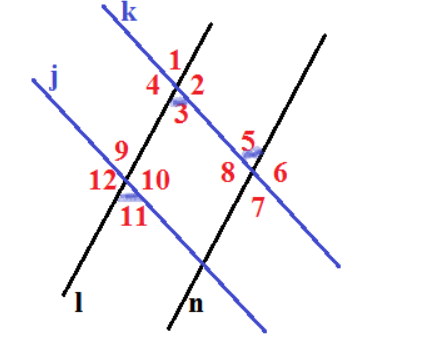
The value of m∠1 = 48°  and that of m∠2 = 42°.
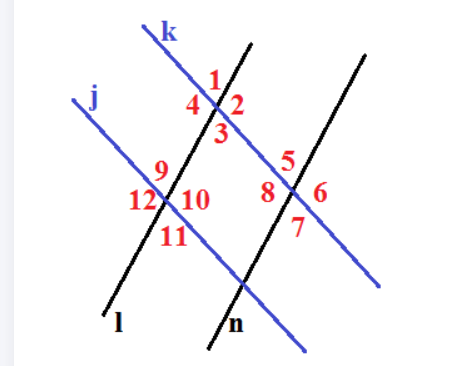
 

Savvas Learning Co Geometry Student Edition Chapter 2 Page 79  Exercise 12  Problem 12

Given: A figure.

To find: Linear pairs.

According to the definition of linear pair, we can only find one linear pair in the given figure and i.e., ∠ADC & ∠BDC.

The pair of angles that form a linear pair is ∠ADC & ∠BDC.


Page 79  Exercise 13  Problem 13

Given: A figure.

To find: A pair of adjacent angles that are not supplementary.

Clearly, ∠1 & ∠2 form a pair of adjacent angles that are not supplementary.

A pair of adjacent angles that are not supplementary is ∠1 & ∠2


Page 79  Exercise 14  Problem 14

Given: m∠ADC + m∠BDC = 180.

Savvas Learning Co Geometry Student Edition Chapter 2 Reasoning And Proof Page 79 Exercise 14 Problem 14 Straight angle

To find: Straight angle form.

The straight angle form has a measure 180° and is the sum of  m∠ADC +  m∠BDC  is  ∠ADB.
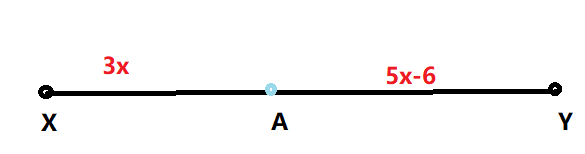
The required straight angle is ∠ADB.


Savvas Learning Co Geometry Student Edition Chapter 2 Page 79  Exercise 15  Problem 15

Given: The conclusion of a novel answers questions raised by the story.

To find: How do you think the term conclusion applies in geometryHypotheses are the answer you think you’ll find.

Prediction is your specific belief about the scientific idea: If my hypothesis is true, then I predict we will discover this.

The conclusion is the answer that the experiment gives.

The part of a conditional statement after then.

For example, the conclusion of “If a line is horizontal then the line has slope 0 ” is “the line has a slope 0”.

The term conclusion applies in geometry is that it gives the final value of the question.


Page 79  Exercise 16  Problem 16

Given: A detective uses deductive reasoning to solve a case by gathering, combining, and analyzing clues.

To find: How might you use deductive reasoning in geometryDeductive geometry is the art of deriving new geometric facts from previously-known facts by using logical reasoning.

In elementary school, many geometric facts are introduced by folding, cutting, or measuring exercises, not by logical deduction. In geometry, a written logical argument is called proof.

Deductive reasoning in geometry is much like the situation described above, except it relates to geometric terms. For example, given that a certain quadrilateral is a rectangle, and that all rectangles have equal diagonals, what can you deduce about the diagonals of this specific rectangle. They are equal.

Savvas Learning Co Geometry Student Edition Chapter 2 Reasoning And Proof Exercise 2.2 Logic And Truth Tables

Savvas Learning Co Geometry Student Edition Chapter 2 Reasoning And Proof Exercise 2.2 Logic And Truth Tables


Savvas Learning Co Geometry Student Edition Chapter 2 Exercise 2.2 Logic And Truth Tables Solutions Page 96  Exercise 1  Problem 1

Given:

s: We will go to the beach.

j: We will go out to dinner.

t: We will go to the movies.

To find – Construct the compound statements of s∨j

Disjunction is denoted as ∨

For disjunction we use the word “or” to join two sentences.

Thus, we get s∨j We will go to beach or we will go out to dinner.

Thus, the compound sentence is s∨j: We will go to beach or we will go out to dinner.

Read and Learn More Savvas Learning Co Geometry Student Edition Solutions

Exercise 2.2 Logic And Truth Tables Savvas Geometry Answers Page 96  Exercise 2  Problem 2

Given:

Savvas Learning Co Geometry Student Edition Chapter 2 Reasoning And Proof Exercise 2.2 Logic And Truth Tables

Thus, the compound sentence is s∨(j∧t): We will go to the beach or we will go out to dinner and movie.


Exercise 2.2 Logic And Truth Tables Savvas Geometry Answers Page 96  Exercise 3  Problem 3

Given: Write three of your own statements.

To find –  Construct compound sentences.

Let

s: I will drink coffee

j: I will drink tea

t: I will eat breakfast

Conjunction (∧) is used to join two sentences using “and”

Disjunction (∨)is used to join two sentences using “or”

1. s∧j  = I will drink coffee and I will drink tea.

2. s∨j = I will drink coffee or I will drink tea.

3. s∨(j∧t) =  I will drink coffee or I will drink tea and eat breakfast

4. (s∨j)∧t = I will drink coffee or tea and eat breakfast

Thus, we get I will drink coffee and I will drink tea.I will drink coffee and I will drink tea.I will drink coffee or I will drink tea and eat breakfast I will drink coffee or tea and eat breakfast


Logic And Truth Tables Solutions Chapter 2 Exercise 2.2 Savvas Geometry Page 96  Exercise 4  Problem 4

Given: x∧y

To find –  Use the statements to determine the truth value of the compound statement.

Considering the statement  x∧y 

Emperor penguins are black and white and Polar bears are a threatened species.

Conjunction x∧y is true only if both the statement is true .

Since given both the statements are true therefore x∧y is true compound sentence.

Thus ,compound sentence x∧y is true.


Logic And Truth Tables Solutions Chapter 2 Exercise 2.2 Savvas Geometry Page 96  Exercise 5  Problem 5

Given: x∨y

To find – Use the statements to determine the truth value of the compound statement.

Considering the statements we get

x∨y: Emperor penguins are black and white and Polar bears are a threatened species.

Disjunction x∨y is false only if both the statements are false.

Since, given both the statement is true therefore the truth value of the compound sentence x∨y is “true”.

Thus, the truth value of the compound sentence x∨y is “true”.


Chapter 2 Exercise 2.2 Logic And Truth Tables Savvas Learning Co Geometry Explanation Page 96  Exercise 6  Problem 6

Given: x∨z

To find – Use the statements to determine the truth value of the compound statement.

Considering the statements

We get x∨z :  Emperor penguins are black and white or Penguins wear tuxedos.

Disjunction of two statement is false only if both the statement is false.

Since, both the given statement is true , therefore the truth value of compound the statement x∨z is “true”

Thus, therefore the truth value of compound the statement x∨z is “true“.


Solutions For Logic And Truth Tables Exercise 2.2 In Savvas Geometry Chapter 2 Student Edition Page 97  Exercise 7  Problem 7

Given: Truth table

To find – Fill the missing values

Savvas Learning Co Geometry Student Edition Chapter 2 Reasoning And Proof Exercise 2.2 Logic And Truth Tables Page 97 Exercise 7 Problem 7 Truth values 1

The complete truth table is :

Savvas Learning Co Geometry Student Edition Chapter 2 Reasoning And Proof Exercise 2.2 Logic And Truth Tables Page 97 Exercise 7 Problem 7 Truth values 2


Solutions For Logic And Truth Tables Exercise 2.2 In Savvas Geometry Chapter 2 Student Edition Page 97  Exercise 8  Problem 8

Given: Truth table of a pattern.

To find –  Fill the missing values.

The truth table

Conjunction (∧) of two statement is true only if both the statements are true

Disjunction (∨) of two statement is false only if both the statements are false
Savvas Learning Co Geometry Student Edition Chapter 2 Reasoning And Proof Exercise 2.2 Logic And Truth Tables Page 97 Exercise 8 Problem 8 Truth values 1

Thus, the complete truth table is

Savvas Learning Co Geometry Student Edition Chapter 2 Reasoning And Proof Exercise 2.2 Logic And Truth Tables Page 97 Exercise 8 Problem 8 Truth values 2


Exercise 2.2 Logic And Truth Tables Savvas Learning Co Geometry Detailed Answers Page 97  Exercise 9  Problem 9

Given: Truth table of a pattern.

To find –  Fill the missing values.

The truth table

Conjunction(∧)of two statement is true only if both the statements are true.

Disjunction (∨)of two statement is false only if both the statements are false.

Savvas Learning Co Geometry Student Edition Chapter 2 Reasoning And Proof Exercise 2.2 Logic And Truth Tables Page 97 Exercise 9 Problem 9 Truth values 1

The complete truth table is:

Savvas Learning Co Geometry Student Edition Chapter 2 Reasoning And Proof Exercise 2.2 Logic And Truth Tables Page 97 Exercise 9 Problem 9 Truth values 2


Savvas Learning Co Geometry Student Edition Chapter 2 Page 97  Exercise 10  Problem 10

Given: Truth table of a pattern.

To find – Fill the missing values.

The true table:

Conjunction (∧)of two statement is true only if both the statements are true.

Disjunction (∨)of two statement is false only if both the statements are false.
Savvas Learning Co Geometry Student Edition Chapter 2 Reasoning And Proof Exercise 2.2 Logic And Truth Tables Page 97 Exercise 10 Problem 10 Truth values 1

The complete truth table is:

Savvas Learning Co Geometry Student Edition Chapter 2 Reasoning And Proof Exercise 2.2 Logic And Truth Tables Page 97 Exercise 10 Problem 10 Truth values 2


Geometry Chapter 2 Logic And Truth Tables Savvas Learning Co Explanation Guide Page 97  Exercise  11  Problem 11

 Given That: You can make a truth table like the one below.

You start with columns for the single statements and add columns to the right.

Each column builds toward the final statement. The table below starts with columns for s, j, and j and builds to (s ∧ j) ∨ ∼t.

Savvas Learning Co Geometry Student Edition Chapter 2 Reasoning And Proof Exercise 2.2 Logic And Truth Tables Page 97 Exercise 11 Problem 11 Truth values 1

To find –  To find the possible truth values of a complex statement such as (s∧j)∨∼t.

Copy the table and work with a partner to fill in the blanks……

The symbols ~, ∧ ,∨ are not, and, or.

The truth table can be filled by using the functions of symbols ~, ∧, ∨. as

~T = F

⇒ T∧F = F

⇒ T∨F = T

⇒ T∧T = T

⇒ F∧F = F

Now the table is filled by using these above results

Savvas Learning Co Geometry Student Edition Chapter 2 Reasoning And Proof Exercise 2.2 Logic And Truth Tables Page 97 Exercise 11 Problem 11 Truth values 2

The possible truth values of a complex statement such as (s∧j)∨∼t is

Savvas Learning Co Geometry Student Edition Chapter 2 Reasoning And Proof Exercise 2.2 Logic And Truth Tables Page 97 Exercise 11 Problem 11 Truth values 3

For the given table

Savvas Learning Co Geometry Student Edition Chapter 2 Reasoning And Proof Exercise 2.2 Logic And Truth Tables Page 97 Exercise 11 Problem 11 Truth values 4


Geometry Chapter 2 Logic And Truth Tables Savvas Learning Co Explanation Guide Page 97  Exercise 12  Problem 12

Given that: You can make a truth table like the one below.

You start with columns for the single statements and add columns to the right.

Each column builds toward the final statement. The table below starts with columns for s, j, and j and builds to (s∧j)∨∼t.

Savvas Learning Co Geometry Student Edition Chapter 2 Reasoning And Proof Exercise 2.2 Logic And Truth Tables Page 97 Exercise 12 Problem 12 Truth values 1

To find – To find the possible truth values of a complex statement such as (s∧j)∨∼t.

Copy the table and work with a partner to fill in the blanks ……….

The symbols ~, ∧ ,∨ are not, and, or.

The truth table can be filled by use the functions of symbols ~, ∧, ∨. as

~T = F

⇒ T ∧F = F

⇒ T∨ F = F

⇒ T∧T = T

⇒ F∧F = F

Now the table is fill by use these above results

Savvas Learning Co Geometry Student Edition Chapter 2 Reasoning And Proof Exercise 2.2 Logic And Truth Tables Page 97 Exercise 12 Problem 12 Truth values 2

The possible truth values of a complex statement such as (s∧j)∨∼t is 

Savvas Learning Co Geometry Student Edition Chapter 2 Reasoning And Proof Exercise 2.2 Logic And Truth Tables Page 97 Exercise 12 Problem 12 Truth values 3

For the given table

Savvas Learning Co Geometry Student Edition Chapter 2 Reasoning And Proof Exercise 2.2 Logic And Truth Tables Page 97 Exercise 12 Problem 12 Truth values 4


Savvas Learning Co Geometry Student Edition Chapter 2 Page 97  Exercise 13  Problem 13

Given that: You can make a truth table like the one below.

You start with columns for the single statements and add columns to the right.

Each column builds toward the final statement. The table below starts with columns for s,j, and t builds to (s∧j)∨∼t

.Savvas Learning Co Geometry Student Edition Chapter 2 Reasoning And Proof Exercise 2.2 Logic And Truth Tables Page 97 Exercise 13 Problem 13 Truth values 1

To find – To find the possible truth values of a complex statement such as(s∧j)∨∼t.

Copy the table and work with a partner to fill in the blanks…….

The symbols ~, ∧ ,∨ are not, and, or.

The truth table can be filled by use the functions of symbols ~, ∧, ∨. as

~ T = F

⇒ T ∧ F = T

⇒ T ∨ F = T

⇒ T ∧ T = T

⇒ F ∧ F = F

Now the table is fill by use these above results

Savvas Learning Co Geometry Student Edition Chapter 2 Reasoning And Proof Exercise 2.2 Logic And Truth Tables Page 97 Exercise 13 Problem 13 Truth values 2
The possible truth values of a complex statement such as (s∧j)∨∼t is

Savvas Learning Co Geometry Student Edition Chapter 2 Reasoning And Proof Exercise 2.2 Logic And Truth Tables Page 97 Exercise 13 Problem 13 Truth values 3

For the given table

Savvas Learning Co Geometry Student Edition Chapter 2 Reasoning And Proof Exercise 2.2 Logic And Truth Tables Page 97 Exercise 12 Problem 12 Truth values 4


Savvas Learning Co Geometry Student Edition Chapter 2 Page 97  Exercise 14  Problem 14

Given that: You can make a truth table like the one below.

You start with columns for the single statements and add columns to the right.

Each column builds toward the final statement.

The table below starts with columns for s,j, and t builds to (s∧j)∨∼t

Savvas Learning Co Geometry Student Edition Chapter 2 Reasoning And Proof Exercise 2.2 Logic And Truth Tables Page 97 Exercise 14 Problem 14 Truth values 1

To find –  To find the possible truth values of a complex statement such as (s∧j)∨∼t.

Copy the table and work with a partner to fill in the blanks ………

The symbols ~, ∧ ,∨ are not, and, or.

The truth table can be filled by use the functions of symbols ~, ∧, ∨. as

~ T = F

⇒ T ∧ F = T

⇒ T ∨ F = T

⇒ T ∧ T = T

⇒ F ∧ F = F

Now the table is fill by use these above results

Savvas Learning Co Geometry Student Edition Chapter 2 Reasoning And Proof Exercise 2.2 Logic And Truth Tables Page 97 Exercise 14 Problem 14 Truth values 2

The possible truth values of a complex statement such as (s∧j)∨∼t is

Savvas Learning Co Geometry Student Edition Chapter 2 Reasoning And Proof Exercise 2.2 Logic And Truth Tables Page 97 Exercise 14 Problem 14 Truth values 3

For the given table

Savvas Learning Co Geometry Student Edition Chapter 2 Reasoning And Proof Exercise 2.2 Logic And Truth Tables Page 97 Exercise 14 Problem 14 Truth values 4


Savvas Learning Co Geometry Student Edition Chapter 2 Page 97  Exercise 15  Problem 15

Given that: You can make a truth table like the one below.

You start with columns for the single statements and add columns to the right.

Each column builds toward the final statement. The table below starts with columns for s,j, and t builds to (s∧j)∨∼t

Savvas Learning Co Geometry Student Edition Chapter 2 Reasoning And Proof Exercise 2.2 Logic And Truth Tables Page 97 Exercise 15 Problem 15 Truth values 1

To find – To find the possible truth values of a complex statement such as (s∧j)∨∼t.

Copy the table and work with a partner to fill in the blanks ……….

The symbols ~, ∧ ,∨ are not, and, or.

The truth table can be filled by using the functions of symbols ~, ∧, ∨. as

~ T = F

⇒ T ∧ F = T

⇒ T ∨ F = T

⇒ T ∧ T = T

⇒ F ∧ F = F

Now the table is filled by using these above results

Savvas Learning Co Geometry Student Edition Chapter 2 Reasoning And Proof Exercise 2.2 Logic And Truth Tables Page 97 Exercise 15 Problem 15 Truth values 2

The possible truth values of a complex statement such as (s∧j)∨∼t is

Savvas Learning Co Geometry Student Edition Chapter 2 Reasoning And Proof Exercise 2.2 Logic And Truth Tables Page 97 Exercise 15 Problem 15 Truth values 3

For the given table

Savvas Learning Co Geometry Student Edition Chapter 2 Reasoning And Proof Exercise 2.2 Logic And Truth Tables Page 97 Exercise 15 Problem 15 Truth values 4


Savvas Learning Co Geometry Student Edition Chapter 2 Page 97  Exercise 16  Problem 16

Given that: You can make a truth table like the one below.

You start with columns for the single statements and add columns to the right.

Each column builds toward the final statement. The table below starts with columns for s,j and t builds to (s∧j)∨∼t

Savvas Learning Co Geometry Student Edition Chapter 2 Reasoning And Proof Exercise 2.2 Logic And Truth Tables Page 97 Exercise 16 Problem 16 Truth values 1

To find – To find the possible truth values of a complex statement such as (s∧j)∨∼t.

Copy the table and work with a partner to fill in the blanks ………….

The symbols ~, ∧ ,∨ are not, and, or.

The truth table can be filled by use the functions of symbols ~, ∧, ∨. as

~ T = F

⇒ T ∧ F = T

⇒ T ∨ F = T

⇒ T ∧ T = T

⇒ F ∧ F = F

Now the table is fill by use these above results

Savvas Learning Co Geometry Student Edition Chapter 2 Reasoning And Proof Exercise 2.2 Logic And Truth Tables Page 97 Exercise 16 Problem 16 Truth values 2

The possible truth values of a complex statement such as (s∧j)∨∼t is

Savvas Learning Co Geometry Student Edition Chapter 2 Reasoning And Proof Exercise 2.2 Logic And Truth Tables Page 97 Exercise 16 Problem 16 Truth values 3

For the given table

Savvas Learning Co Geometry Student Edition Chapter 2 Reasoning And Proof Exercise 2.2 Logic And Truth Tables Page 97 Exercise 16 Problem 16 Truth values 4


Savvas Learning Co Geometry Student Edition Chapter 2 Page 97  Exercise 17  Problem 17

Given that: You can make a truth table like the one below.

You start with columns for the single statements and add columns to the right.

Each column builds toward the final statement. The table below starts with columns for s, j and t builds to (s∧j)∨∼t

Savvas Learning Co Geometry Student Edition Chapter 2 Reasoning And Proof Exercise 2.2 Logic And Truth Tables Page 97 Exercise 17 Problem 17 Truth values 1

To find – To find the possible truth values of a complex statement such as (s∧j)∨∼t.

Copy the table and work with a partner to fill in the blanks ………..

The symbols ~, ∧ ,∨ are not, and, or.

The truth table can be filled by use the functions of symbols ~, ∧, ∨. as

~ T = F

⇒ T ∧ F = T

⇒ T ∨ F = T

⇒ T ∧ T = T

⇒ F ∧ F = F

Now the table is fill by use these above results

Savvas Learning Co Geometry Student Edition Chapter 2 Reasoning And Proof Exercise 2.2 Logic And Truth Tables Page 97 Exercise 17 Problem 17 Truth values 2

The possible truth values of a complex statement such as (s∧j)∨∼t is 

Savvas Learning Co Geometry Student Edition Chapter 2 Reasoning And Proof Exercise 2.2 Logic And Truth Tables Page 97 Exercise 17 Problem 17 Truth values 3

For the given table

Savvas Learning Co Geometry Student Edition Chapter 2 Reasoning And Proof Exercise 2.2 Logic And Truth Tables Page 97 Exercise 17 Problem 17 Truth values 4


Savvas Learning Co Geometry Student Edition Chapter 2 Page 97  Exercise 18  Problem 18

Given that:  You can make a truth table like the one below.

You start with columns for the single statements and add columns to the right.

Each column builds toward the final statement. The table below starts with columns for s, j and t builds to (s∧j)∨∼t

Savvas Learning Co Geometry Student Edition Chapter 2 Reasoning And Proof Exercise 2.2 Logic And Truth Tables Page 97 Exercise 18 Problem 18 Truth values 1

To find – To find the possible truth values of a complex statement such as (s∧j)∨∼t.

Copy the table and work with a partner to fill in the blanks …………..

The symbols ~, ∧ ,∨ are not, and, or.

The truth table can be filled by use the functions of symbols ~, ∧, ∨. as

~ T = F

⇒ T ∧ F = T

⇒ T ∨ F = T

⇒ T ∧ T = T

⇒ F ∧ F = F

Now the table is fill by use these above results

Savvas Learning Co Geometry Student Edition Chapter 2 Reasoning And Proof Exercise 2.2 Logic And Truth Tables Page 97 Exercise 18 Problem 18 Truth values 2

The possible truth values of acomple statement such as (s∧j)∨∼t is

Savvas Learning Co Geometry Student Edition Chapter 2 Reasoning And Proof Exercise 2.2 Logic And Truth Tables Page 97 Exercise 18 Problem 18 Truth values 3

For the given table

Savvas Learning Co Geometry Student Edition Chapter 2 Reasoning And Proof Exercise 2.2 Logic And Truth Tables Page 97 Exercise 18 Problem 18 Truth values 4


Savvas Learning Co Geometry Student Edition Chapter 2 Page 97  Exercise 19  Problem 19

Given that: (∼p∨q)∧∼r

To find – Make truth table for statement. (∼p∨q)∧∼r

The symbols ~, ∧ ,∨ are not, and, or.

The truth table for the statement is (∼p∨q)∧∼r

~ T = F

⇒ T ∧ F = T

⇒ T ∨ F = T

⇒ T ∧ T = T

⇒ F ∧ F = F

Now the table is fill by use these above results

Savvas Learning Co Geometry Student Edition Chapter 2 Reasoning And Proof Exercise 2.2 Logic And Truth Tables Page 97 Exercise 19 Problem 19 Truth values 1

The truth table for the statement (∼p∨q)∧∼r is

Savvas Learning Co Geometry Student Edition Chapter 2 Reasoning And Proof Exercise 2.2 Logic And Truth Tables Page 97 Exercise 19 Problem 19 Truth values 2

Savvas Learning Co Geometry Student Edition Chapter 2 Reasoning And Proof Exercise 2.2 Conditional Statement

Savvas Learning Co Geometry Student Edition Chapter 2 Reasoning And Proof Exercise 2.2 Conditional Statement


Savvas Learning Co Geometry Student Edition Chapter 2 Exercise 2.2 Conditional Statement Solutions Page 92  Exercise 1  Problem 1

Given:  A statement Residents of Key West live in Florida.

To Find – What is the hypothesis and the conclusion of the following statement and Write it as a conditional.

Given

A statement: Residents of Key West live in Florida.

The hypothesis: The people are residents of Key West.

The conclusion: They live in Florida.

Condition for the given statement: If people are residents of Key West, then they live in Florida.

The hypothesis: The people are residents of Key West.

The conclusion: They live in Florida.

Condition for the given statement: If people are residents of Key West, then they live in Florida.

Read and Learn More Savvas Learning Co Geometry Student Edition Solutions

Savvas Learning Co Geometry Student Edition Chapter 2 Exercise 2.2 Conditional Statement Solutions Page 92  Exercise 2  Problem 2

Given: A condition If a figure is a rectangle with sides 2cm and 3cm, then it has a perimeter of 10cm.

To Find –  Write if the given condition is true or false and what are the converse, inverse, and contrapositive of the condition, what are the truth values of each.

If a figure is a rectangle with sides 2cm, 3cm, then it has a perimeter of 10cm

The given statement is true, ​P = 2(2 + 3) P = 2(5) = 10

The converse is found by exchanging the hypothesis and the conclusion (q→p)

If a figure is a rectangle and has a perimeter of 10cm, then it has sides of 2cm,3cm

We note that this is false since a rectangle with sides 1cm, 4cm has a perimeter of 10cm as a counterexample.

The inverse is found by negating both the hypothesis and the conclusion of the condition.

If a figure is a rectangle and does not have sides, 2cm,3cm then it does not have a perimeter of 10cm.

We note that this is false since the rectangle with sides 1cm, 4cm has a perimeter of 10cm as a counterexample.

The contrapositive is found by negating both the hypothesis and the conclusion of the converse.

If a figure is a rectangle and does not have a perimeter 10cm, then it does not have sides of 2cm,3cm.

We note that this is true since the perimeter of a rectangle has sides 2cm,3cm is 10cm.

The conditional and contrapositive are both true.

The conditional and contrapositive are both true.

Converse: If a figure is a rectangle and has a perimeter of 10cm then it has sides of 2cm,3cm

Inverse: If a figure is a rectangle and does not have sides 2cm,3cm then it does not have a perimeter of 10cm

Contrapositive: If a figure is a rectangle and does not have a perimeter 10cm, then it does not have sides of 2cm,3cm


Exercise 2.2 Conditional Statement Savvas Geometry Answers Page 92  Exercise 3  Problem 3

Given: Your classmate rewrote the statement “You jog every Sunday” as the following conditional. If you jog, then it is Sunday.

To Find –  What is your classmate’s error? Correct it.

Given

The statement:

If you jog, then it is Sunday

The statement is false.

My classmate switched the hypothesis and conclusion.

The correct hypothesis:

If it is Sunday.

The correct conclusion:

Then you should jog.

The statement should actually read as

If it is Sunday, then you jog.

My classmate switched the hypothesis and conclusion. The statement should actually read as If it is Sunday, then you jog.


Conditional Statement Solutions Chapter 2 Exercise 2.2 Savvas Geometry Page 92  Exercise 4  Problem 4

Given:  A conditional statement and its converse are both true.

To Find –  What are the truth values of the contrapositive and inverse? How do you know?

Given

The statement:

A conditional statement and its converse are both true.

It must be true since the conditional and contrapositive have the same truth value and the inverse and converse have the same truth value.

Contrapositive: ~q →´

Converse: p → q

The answer is True, the conditional and contrapositive have the same truth value and the inverse and converse have the same truth value.


Conditional Statement Solutions Chapter 2 Exercise 2.2 Savvas Geometry Page 93  Exercise 5  Problem 5

Given: A condition If a figure is a rectangle, then it has four sides.

To Find –  Identify the hypothesis and conclusion of each conditional.

Given

A condition: If a figure is a rectangle, then it has four sides.

Look for the word ‘if’. The hypothesis will follow.

So, the hypothesis is:

A figure is a rectangle.

Look for the word ‘then’. The conclusion will follow.

So, the conclusion is:

It has four sides.

The hypothesis is: a figure is a rectangle. The conclusion is: it has four sides.


Chapter 2 Exercise 2.2 Conditional Statement Savvas Learning Co Geometry Explanation Page 93  Exercise 6  Problem 6

Savvas Learning Co Geometry Student Edition Chapter 2 Reasoning And Proof Exercise 2.2 Conditional Statement

So the conditional statement will be – If Hank Aaron broke Babe Ruth’s home-run record, then he is the record holder.

The conditional statement for the statement “Hank Aaron broke Babe Ruth’s home-run record” is “If Hank Aaron broke Babe Ruth’s home-run record, then he is the record holder.”


Solutions For Conditional Statement Exercise 2.2 In Savvas Geometry Chapter 2 Student Edition Page 93  Exercise 7  Problem 7

Given: 3x − 7 = 14 implies that 3x  = 21

To Find – Write the sentence as a conditional.

Here the hypothesis and the conclusion are

Hypothesis – 3x−7 = 14

Conclusion – 3x = 21

So the conditional statement will be, “If 3x − 7 = 14 , then 3x = 21 ”

The conditional statement for ” 3x − 7 = 14 implies that 3x = 21 ” is “If 3x−7=14 , then 3x = 21 “


Solutions For Conditional Statement Exercise 2.2 In Savvas Geometry Chapter 2 Student Edition Page 93  Exercise 8  Problem 8

Given:

A statement – A point in the first quadrant has two positive coordinates.

To Find –  Write the sentence as a conditional.

Here the hypothesis and the conclusion are

Hypothesis – A point in the first quadrant

Conclusion –  Has two positive coordinates

So the conditional statement will be – If a point is in the first quadrant, then it has two positive coordinates.

The conditional statement for “A point in the first quadrant has two positive coordinates.” is “If a point is in the first quadrant, then it has two positive coordinates.”


Solutions For Conditional Statement Exercise 2.2 In Savvas Geometry Chapter 2 Student Edition Page 93  Exercise 9  Problem 9

 Given:

A statement – A point in the first quadrant has two positive coordinates.

To find –  Write the sentence as a conditional.

Here the hypothesis and the conclusion will be.

Hypothesis – A point in the first quadrant

Conclusion – has two positive coordinates

So the conditional statement will be “If a point is in the first quadrant, then it has two positive coordinates.”

The conditional statement for “A point in the first quadrant has two positive coordinates.” is “If a point is in the first quadrant, then it has two positive coordinates.”


Exercise 2.2 Conditional Statement Savvas Learning Co Geometry Detailed Answers Page 93  Exercise 10  Problem 10

Given: A Venn diagram

Savvas Learning Co Geometry Student Edition Chapter 2 Reasoning And Proof Exercise 2.2 Conditional Statement Page 93 Exercise 10 Problem 10 Colors

To find – Write the Venn diagram as a conditional.

Here we can see that the smaller blue circle is within the large circle labeled “colors”, so we can identify that anything that is blue will have a color to it.

So the conditional statement will be – If something is blue then it has a colour

The conditional for the Venn diagram below is, “If something is blue, then it has a color”

Savvas Learning Co Geometry Student Edition Chapter 2 Reasoning And Proof Exercise 2.2 Conditional Statement Page 93 Exercise 10 Problem 10 Venna 2 Colors


Exercise 2.2 Conditional Statement Savvas Learning Co Geometry Detailed Answers Page 93  Exercise 11  Problem 11

Given: A Venn diagram

Savvas Learning Co Geometry Student Edition Chapter 2 Reasoning And Proof Exercise 2.2 Conditional Statement Page 93 Exercise 11 Problem 11 Venna 1 Integers

To Find – Write the Venn diagram as a conditional.

As the circle of whole numbers is within the circle for integers, so it implies that all whole numbers are also integers.

So the conditional statement will be – If a number is a whole number, then it is also an integer

The conditional statement for the Venn diagram given below is “If a number is a whole number, then it is also an integer.”

Savvas Learning Co Geometry Student Edition Chapter 2 Reasoning And Proof Exercise 2.2 Conditional Statement Page 93 Exercise 11 Problem 11 Venna 2 Integers


Exercise 2.2 Conditional Statement Savvas Learning Co Geometry Detailed Answers Page 93  Exercise 12  Problem 12

Given: A Venn diagram
Savvas Learning Co Geometry Student Edition Chapter 2 Reasoning And Proof Exercise 2.2 Conditional Statement Page 93 Exercise 12 Problem 12 Venna 1 Grains

To Find –  Write a conditional statement that the Venn diagram illustrates.

In the Venn diagram, we can see that the circle labeled wheat is within the circle labeled grains, so we can conclude that anything that is wheat is also a grain.

So the conditional statement will be – If anything is wheat, then it is also a grain.

The conditional statement that the Venn diagram illustrates is, “If anything is wheat, then it is also a grain.”

Savvas Learning Co Geometry Student Edition Chapter 2 Reasoning And Proof Exercise 2.2 Conditional Statement Page 93 Exercise 12 Problem 12 Venna 2 Grains


Geometry Chapter 2 Conditional Statement Savvas Learning Co Explanation Guide Page 93  Exercise 13  Problem 13

Given: A conditional – If a polygon has eight sides, then it is an octagon.

To find – Determine if the conditional is true or false.

If it is false, find a counterexample.

By the definition, a polygon that has 8 sides is an octagon, thus.

The conditional is true. A polygon with 8 sides is known as an octagon.

The conditional, “If a polygon has eight sides, then it is an octagon.” is true.


Geometry Chapter 2 Conditional Statement Savvas Learning Co Explanation Guide Page 93  Exercise 14  Problem 14

Given: A conditional – If an angle measures 80, then it is acute.

To find  – Determine if the conditional is true or false. If it is false, find a counterexample.

By the definition of the acute angle, we get that 80 degrees is an acute angle.

So the conditional is true. All acute angles lie between 0 degrees to 90 degrees.

The conditional, “If an angle measures 80, then it is acute.” is true. All acute angles lie between 0 degrees to 90 degrees.


Geometry Chapter 2 Conditional Statement Savvas Learning Co Explanation Guide Page 93  Exercise 15  Problem 15

Given: A statement – Pianists are musicians.

To Find –  Write the converse, inverse, and contrapositive of the given conditional statement.

Determine the truth value of all four statements. If a statement is false, give a counterexample.

We have, Pianists are musicians.

First, we will write the conditional statement.

Conditional: If you are a pianist then you are a musician.

Hypothesis: You are a pianist

Conclusion: You are a musician

The conditional statement is true.

Now we write the converse by interchanging the hypothesis and conclusion of conditional

Converse: If you are a musician, then you are a pianist

The converse is false because there are other types of musicians than pianists (for eg. violinists, cellists)

Now we write the inverse by negating the hypothesis and conclusion of conditional.

Inverse: If you are not a pianist, then you are not a musician.

The inverse is false because you can be a musician even if you are not a pianist.

Now we write the contrapositive by interchanging the hypothesis and conclusion of the inverse

Contrapositive: If you are not a musician, then you are not a pianist.

The contrapositive statement is true because you can not be a pianist if you are not a musician.

The conditional, converse, inverse, and contrapositive of the statement, “Pianists are musicians” are.

Conditional: If you are a pianist then you are a musician.

The conditional statement is true.

Converse: If you are a musician, then you are a pianist.

The converse is false because there are other types of musicians than pianists (for eg. violinists, cellists).

Inverse: If you are not a pianist, then you are not a musician.

The inverse is false because you can be a musician even if you are not a pianist.

Contrapositive: If you are not a musician, then you are not a pianist.

The contrapositive statement is true.


Page 93  Exercise 16 Problem 16

Given: A statement – If 4x + 8 = 28 , then x = 5

To find – Write the converse, inverse, and contrapositive of the given conditional statement.

Determine the truth value of all four statements. If a statement is false, give a counterexample.

We have, If 4x + 8 = 28 , then x = 5

Hypothesis- 4x + 8 = 28

Conclusion – x = 5

First, let us calculate the value of x

​⇒  4x + 8 = 28
⇒  4x = 20
⇒  x = 5

Conditional: If 4x + 28 = 28 then x = 5

The conditional is true because x = 5 is the solution of the equation when solved.

Now we write the converse by interchanging the hypothesis and conclusion of conditional.

Converse: If x = 5 , then 4x + 8 = 28

The converse is true because x = 5 satisfies the equation.

Now we write the inverse by negating the hypothesis and conclusion of the conditional.

Inverse:  If 4x + 28 ≠ 28 , then x ≠ 5

The inverse is true because x = 5 satisfies the related equation.

Now we write the contrapositive by interchanging the hypothesis and conclusion of the inverse.

Contrapositive: If x ≠ 5, then 4x + 8 ≠ 28

The contrapositive is true because x = 5 satisfies the equation

The conditional, converse, inverse, and contrapositive of the statement, “If 4x + 8 = 28 , then x = 5 ” are

Conditional: If 4x + 8 = 28 , then x = 5

The conditional is true.

Converse: If x = 5 , then 4x + 8 = 28

The converse is true.

Inverse: If 4x + 8 ≠ 28 , then x ≠ 5

The inverse is true.

Contrapositive: If x≠ 5 , then 4x + 8 ≠ 28

The contrapositive is true.


Page 93  Exercise 17  Problem 17

Given: 

A statement – Odd natural numbers less than 8 are prime.

To Find – Write the converse, inverse, and contrapositive of the given conditional statement.

Determine the truth value of all four statements. If a statement is false, give a counterexample.

We have a statement, “Odd natural numbers less than 8 are prime.”

Hypothesis: an odd natural number less than 8

Conclusion: It is prime.

Conditional: If a number is an odd natural number less than 8, then it is prime.

The conditional is true because 3, 5, 7 are odd natural numbers and are also prime.

Converse: If a number is prime, then it is an odd natural number less than 8.

The converse is false because 13 is a prime number that is greater than 8.

Inverse: If a number is not an odd natural number less than 8, then it is not prime.
The inverse is false as 13 is a prime number greater than 8.

Contrapositive: If a number is not prime, then it is not an odd natural number less than 8.

The contrapositive is true because all prime numbers less than 8 are odd.

The conditional, converse, inverse, and contrapositive of the statement, “Odd natural numbers less than 8 are prime” are

Conditional: If a number is an odd natural number less than 8, then it is prime.
The conditional is true.

Converse: If a number is prime, then it is an odd natural number less than 8.

The converse is false because 13 is a prime number greater than 8.

Inverse: If a number is not an odd natural number less than 8, then it is not prime.

The inverse is false because 13 is not an odd natural number less than but it is prime.

Contrapositive: If a number is not prime, then it is not an odd natural number less than 8.

The contrapositive is true.


Page 93  Exercise 18  Problem 18

Given: A statement – Two lines that lie in the same plane are coplanar.

To find – Write the converse, inverse, and contrapositive of the given conditional statement.

Determine the truth value of all four statements.

If a statement is false, give a counter example.

We have, Two lines that lie in the same plane are coplanar.

Hypothesis: Two lines lie in the same plane

Conclusion: The lines are coplanar

Conditional: If two lines lie in the same plane, then they are coplanar.

The conditional statement is true.

We write converse by exchanging hypothesis and conclusion of conditional.

Converse: If two lines are coplanar, then they lie in the same plane.

The converse statement is true.

We write inverse by negating the hypothesis and conclusion of conditional.

Inverse: If two lines don’t lie in the same plane, then they are not coplanar.

The inverse statement is true.

We write contrapositive by exchanging the hypothesis and conclusion of the inverse statement.

Contrapositive: If two lines are not coplanar, then they don’t lie in the same plane.

The contrapositive is true.

The conditional, converse, inverse, and contrapositive of the statement, “Two lines that lie in the same plane are coplanar.” are

Conditional: If two lines lie in the same plane, then they are coplanar.

The conditional statement is true.

Converse: If two lines are coplanar, then they lie in the same plane.

The converse statement is true.

Inverse: If two lines don’t lie in the same plane, then they are not coplanar.

The inverse statement is true.

Contrapositive:  If two lines are not coplanar, then they don’t lie in the same plane.

The contrapositive statement is true.


Page 94  Exercise 19  Problem 19

Given:

A statement- An event with probability 1 is certain to occur.

To Find – Write the statement as a conditional

We have, An event with probability 1 is certain to occur.

Hypothesis – An event has a probability of 1

Conclusion – The event is certain to occur

The conditional is an if-then statement so the conditional statement will be,

If an event has a probability of 1, then the event is certain to occur.

The conditional statement for the statement, “An event with probability 1 is certain to occur.” is “If an event has a probability of 1, then the event is certain to occur.”


Page 94  Exercise 20  Problem 20

Given: x = 2, x2= 4

To Find – Conditional and contrapositive both are true or not.

Use the basic concepts of reasoning.

If  x = 2 , on squaring both sides then we get

⇒  x2 = 4

Therefore, the conditional statement is true.

Now, if x2 ≠ 4 , then we get ⇒ x ≠ 2

Therefore, the contrapositive statement is also true.

Another example in which both conditional and contrapositive statements are true is if x = 3, then x2 = 9.

Both conditional and contrapositive statements are true.


Page 94  Exercise 21  Problem 21

Given: Conditional statement.

To find – write two conditional statements in which one is true and another is false.

Use the basic concepts of reasoning.

Statement (A): If x = 3 , then x2 = 9.

If x = 3, on squaring both the sides then we get, ⇒ x2 = 9

This statement is conditionally true.

Statement (B): “If you get a good score in the entrance exam then you will not get the scholarship”.

This statement is not conditionally true because generally if the candidate gets good marks in the entrance exam then he will definitely get the scholarship for study.

The statement (A) is conditionally true.

The statement is ” if x = 3, then x2 = 9.”

The statement (B) is conditionally false. The statement is “If you get a good score in the entrance exam then you will not get the scholarship”.


Page 94  Exercise 22  Problem 22

Given: The given conditional statement is true.

To find   whether the contrapositive statement is true or false.

Use the basic concepts of reasoning.

Statement A: ” If the pitchers performed well, then there is the chance of winning the baseball game”.

The contrapositive statement A is true because if there is no chance of winning then the pitchers are not performing well while playing the game.

Statement B:
” If someone is a baseball player then someone is an athlete.

The contrapositive statement B is False because” if someone is not a baseball player, then it does not mean he is not an athlete”.

Both Natalie and Sean are correct. Because the contrapositive of statement A is true and contrapositive of statement B is false.


Page 94  Exercise 23  Problem 23

Given: Conditional statement.

To find – Venn diagram Use the basic concepts of the Venn diagram.

The given conditional statement is,” If an angle measures 100 , then it is obtuse”.

The Venn diagram can be represented as:

Savvas Learning Co Geometry Student Edition Chapter 2 Reasoning And Proof Exercise 2.2 Conditional Statement Page 94 Exercise 23 Problem 23 Obtuse angle 1

The Venn diagram which represents the given conditional state

Savvas Learning Co Geometry Student Edition Chapter 2 Reasoning And Proof Exercise 2.2 Conditional Statement Page 94 Exercise 23 Problem 23 Obtuse angle 2


Page 94   Exercise 24   Problem 24

Given: Conditional statement.

To find  – Venn diagram Use the basic concepts of the Venn diagram.

The given conditional statement is, “If you are the captain of your team, then you are junior or senior”.

The Venn diagram can be represented as:

Savvas Learning Co Geometry Student Edition Chapter 2 Reasoning And Proof Exercise 2.2 Conditional Statement Page 94 Exercise 24 Problem 24 Venn 1 Captain and Senior

Venn diagram of the given conditional statement is:Savvas Learning Co Geometry Student Edition Chapter 2 Reasoning And Proof Exercise 2.2 Conditional Statement Page 94 Exercise 24 Problem 24 Venn 2 Captain and Senior


Page 94  Exercise 25  Problem 25

Given: If y is negative, then −y is positive.

To find – Converse statementUse the basic concepts of reasoning.

p: If y is negative, then −y is positive.

This statement is conditionally true.

Now we have to write the converse of this statement.

q: If −y is positive, then y is negative.

Let  − y = 4

⇒  y = −4

Hence the converse statement is also true.

The converse statement is true.


Page 94  Exercise 26  Problem 26

Given: If x < 0 , then x3 < 0.

To find contrapositive statement.Use the basic concepts of reasoning.

p: If x < 0 , then x3 < 0 .

This statement is conditionally true.

Now if have to find the converse of this statement.

q: If x3 < 0 , then x < 0.

Let x =−2 which is less than 0

On cubing both the sides, then we get

⇒  x3

=  −8 which is also less than 0.

⇒ If −2 < 0 , then (−2)3 < 0.

Hence the converse statement is also true.

The converse of the given statement is also true. The converse statement is,” if x < 0, then x3 < 0.


Page 94  Exercise 27  Problem 27

Given: If x < 0, then x2 > 0.

To find – Whether the converse is true or false.

Use the basic concept of reasoning.

p: If x < 0 , then x2 > 0.

This statement is conditionally true.

q: If x2 > 0, then x < 0.

Clearly, the converse part is not true.

Let us consider x2 =  4.

On square root both the sides then we get

⇒ x = −2,2

Here −2 < 0 but 2 > 0.

Therefore the converse of the statement is not true.

The converse of the statement is false.


Page 94  Exercise 28  Problem 28

Given: AdvertisementTo find a Conditional statement.

By using the basic concepts of reasoning we shall write the conditional statement.

The conditional statement can be written as,” If you wear snazzy sneakers, then you look cool”.

The conditional statement is,” If you wear snazzy sneakers, then you look cool”.


Page 94  Exercise 29  Problem 29

Given: Postulates.

To find a Conditional statement.

By using the basic concepts of reasoning we shall write the conditional statement.

The conditional statement can be written as,” If the two lines are intersecting lines, then they meet exactly at one point”.

The conditional is,” If the two lines are intersecting lines, then they meet exactly at one point“.

Savvas Learning Co Geometry Student Edition Chapter 2 Reasoning And Proof Exercise 2.1 Patterns and Inductive Reasoning

Savvas Learning Co Geometry Student Edition Chapter 2 Reasoning And Proof Exercise 2.1 Patterns and Inductive Reasoning


Savvas Learning Co Geometry Student Edition Chapter 2 Exercise 2.1 Patterns And Inductive Reasoning Solutions Page 85  Exercise 1  Problem 1

Given: All four-sided figures are squares.

To find –  What is a counterexample for the given conjecture.

Given

All four- sided figures are squares.

A counterexample is one that proves the statement false.

Therefore, by saying that a rectangle is a four-sided figure we prove the statement incorrect.

So, the counterexample is

A rectangle is a four-sided figure.

The answer is a rectangle is a four-sided figure.


Savvas Learning Co Geometry Student Edition Chapter 2 Exercise 2.1 Patterns And Inductive Reasoning Solutions Page 85  Exercise 2  Problem 2

The counter is something opposite from the given statement. A counterexample is used to show that conjecture is false.

A counterexample to a mathematical statement is an example that satisfies the statement’s condition(s) but does not lead to the statement’s conclusion.

Identifying counterexamples is a way to show that a mathematical statement is false.

These opposing positions are called counterarguments.

Think of it this way: if my argument is that dogs are better pets than cats because they are more social, but you argue that cats are better pets because they are more self-sufficient, your position is a counterargument to my position.

The counter is something opposite from the given statement. A counterexample is used to show that conjecture is false.

Read and Learn More Savvas Learning Co Geometry Student Edition Solutions

Exercise 2.1 Patterns And Inductive Reasoning Savvas Geometry Answers Page 85  Exercise 3  Problem 3

Given: The sequence 5,10,20,40

To find –  Find the next two-term in the sequence.

Given

Savvas Learning Co Geometry Student Edition Chapter 2 Reasoning And Proof Exercise 2.1 Patterns and Inductive Reasoning

The answer is 80,160


Exercise 2.1 Patterns And Inductive Reasoning Savvas Geometry Answers Page 85  Exercise 4  Problem 4

Given: 1,4,9,16,25,…

To find –  Find a pattern for each sequence.

Here, the pattern is 12,22,32,42,52

So the next two patterns will be 62,72

The next two patterns will be  62,72.


Patterns And Inductive Reasoning Solutions Chapter 2 Exercise 2.1 Savvas Geometry Page 85  Exercise 5  Problem 5

Given: 1,−1,2,−2,3,………..

To find –  Find a pattern for each sequence.

Use the pattern to show the next two terms.

A sequence or number pattern is an ordered set of numbers or diagrams that follow a rule.

The pattern for terms starts at 1, then goes to the opposite of this number.

Then one is added to the opposite of this new term. Continue in this pattern of alternating, making it the opposite or making it the opposite and adding one.

The next two terms of this sequence are −3,4.


Chapter 2 Exercise 2.1 Patterns And Inductive Reasoning Savvas Learning Co Geometry Explanation Page 85  Exercise 6  Problem 6

Given:  A series 1, \(1, \frac{1}{2}, \frac{1}{4}, \frac{1}{8}\)….. is given.

To find –  A pattern in the series and the next two terms.

Given series 1, \(1, \frac{1}{2}, \frac{1}{4}, \frac{1}{8}\)

Divide the second term by the first term to find the pattern

\(\frac{\frac{1}{2}}{1}=\frac{1}{2}\)

Each term is being multiplied by \(\frac{1}{2}\)in the series

Next term after \(\frac{1}{8}\) ⇒  \(\frac{1}{8}\) ×\(\frac{1}{2}\) = \(\frac{1}{16}\)

Next term after \(\frac{1}{16}\) ⇒  \(\frac{1}{16}\) ×\(\frac{1}{2}\) = \(\frac{1}{32}\)

Each term is being multiplied by \(\frac{1}{2}\) in the series and the next two terms in the series \(\frac{1}{16}\) and \(\frac{1}{32}\)


Chapter 2 Exercise 2.1 Patterns And Inductive Reasoning Savvas Learning Co Geometry Explanation Page 85  Exercise 7  Problem 7

Given: A series 1, \(\frac{1}{2}, \frac{1}{3}, \frac{1}{4}\) …………  is given.

To find  – A pattern in the series and the next two terms.

Given series 1, \(\frac{1}{2}, \frac{1}{3}, \frac{1}{4}\) ………..

We can see that in the denominator of each term, one is being added.

So next term after \(\frac{1}{4}\) ⇒ \(\frac{1}{4+1}\) = \(\frac{1}{5}\)

And the next term after \(\frac{1}{5}\) ⇒ \(\frac{1}{5+1}\) = \(\frac{1}{6}\).

In the sequence 1, \(\frac{1}{2}, \frac{1}{3}, \frac{1}{4}\) ………..

one is being added in the denominator of each term and the next two terms of the sequence are \(\frac{1}{5}\) and \(\frac{1}{6}\)


Chapter 2 Exercise 2.1 Patterns And Inductive Reasoning Savvas Learning Co Geometry Explanation Page 85  Exercise 8  Problem 8

Given: A series 15,12,9,6, ……. is given.

To Find –  A pattern in the series and the next two terms.

Given series 15,12,9,6 ……………..

Subtract the second term from the first term to find the pattern.

15 − 12 = 3

So 3 is being subtracted from each term.

The next term after 6 ⇒ 6 − 3 = 3 and the next term after 3 ⇒ 3 − 3 = 0

In the sequence15,12,9,6… ……, 3 is being subtracted from each term and the next two terms of the sequence are 3 and 0.


Solutions For Patterns And Inductive Reasoning Exercise 2.1 In Savvas Geometry Chapter 2 Student Edition Page 85  Exercise 9  Problem 9

Given:  A series O, T, T, F, F, S, E, …….. is given

To find – A pattern in the series and the next two terms.

Given series O, T, T, F, F, S, E, ……….

The letters given in the series are the first letter of numbers

​One = O

Two = T

Three = T

Four = F

Five = F

Six = S

Eight = E

So next letter in the series will be​ Nine = Nand Ten = T

The next two terms in the series O, T, T, F, F, S, E,… will be N and T.


Solutions For Patterns And Inductive Reasoning Exercise 2.1 In Savvas Geometry Chapter 2 Student Edition Page 85  Exercise 10  Problem 10

Given: A series- Dollar coin, half a dollar, quarter,……..  is given.

To find –  A pattern in the series and the next two terms.

Given series- Dollar coin, half a dollar, quarter,……..

We can see that the dollar is being divided in half in every term.

So the next two terms in the series will be⇒

one-eighth and one-sixteenth.

The next two terms in the series- Dollar coin, half a dollar, quarter,….. are ⇒ one-eighth and one-sixteenth.


Exercise 2.1 Patterns And Inductive Reasoning Savvas Learning Co Geometry Detailed Answers Page 85  Exercise 11  Problem 11

Given: A series AL, AK, AZ, AR, CA ……….  is given.

To find –  A pattern in the series and the next two terms.

Given series AL, AK, AZ, AR, CA ……

These are the short form of the states name of the U.S.

​AL = Alabama

AK = Alaska

AZ = Arizona

AR = Arkansas

CA = California

So the next two terms in the series will be

​CO = Colarado

CT = Connecticut

The next two terms in the series AL, AK, AZ, AR, CA …….  are CO and CT


Exercise 2.1 Patterns And Inductive Reasoning Savvas Learning Co Geometry Detailed Answers Page 85  Exercise 12  Problem 12

Given: A series is given

Savvas Learning Co Geometry Student Edition Chapter 2 Reasoning And Proof Exercise 2.1 Patterns And Inductive Reasoning Page 85 Exercise 12 Problem 12 Semicircle 1

To Find A pattern in the series and the next two terms.

In the given series the semicircle is being divided into equal parts.

So the next two terms in the series will be

Savvas Learning Co Geometry Student Edition Chapter 2 Reasoning And Proof Exercise 2.1 Patterns And Inductive Reasoning Page 85 Exercise 12 Problem 12 Semicircle 2

And

Savvas Learning Co Geometry Student Edition Chapter 2 Reasoning And Proof Exercise 2.1 Patterns And Inductive Reasoning Page 85 Exercise 12 Problem 12 Semicircle 3

The next two terms in the series are

Savvas Learning Co Geometry Student Edition Chapter 2 Reasoning And Proof Exercise 2.1 Patterns And Inductive Reasoning Page 85 Exercise 12 Problem 12 Semicircle 4

And

Savvas Learning Co Geometry Student Edition Chapter 2 Reasoning And Proof Exercise 2.1 Patterns And Inductive Reasoning Page 85 Exercise 12 Problem 12 Semicircle 5


Geometry Chapter 2 Patterns And Inductive Reasoning Savvas Learning Co Explanation Guide Page 85  Exercise 13  Problem 13

Given: Sequence of figures.

To find: The shape of the fortieth figure

We are given a sequence of figures. We need to find the shape of the fortieth figure.

In terms of shape, there are four shapes that repeat in a cycle of circle-triangle-square-star.

Using this pattern, the fortieth figure will be a star.

The fortieth figure will be a star.


Geometry Chapter 2 Patterns And Inductive Reasoning Savvas Learning Co Explanation Guide Page 85  Exercise 14  Problem 14

Given: The sum of the first 100 positive odd numbers.

To find a conjecture for each scenario

We make the following conjecture.

The sum of the first 100 positive odd numbers is 10,000.

The first 100 positive odd numbers are 1,3,5,…,199.

Let their sum be S.

⇒  S = 1 + 3 + 5 + ⋯+ 199

We write the sum in two ways.

⇒  S = 199 + 197 + ⋯+ 3 + 1

We add the two equations side by side.

⇒  S + S = (1 + 199) + (3 + 197) +…+(197​ + 3) + (199 + 1)

⇒  2S = 200 + 200 + ⋯ + 200

⇒  2S = 200.100

⇒  S = 10000

The sum of the first 100 positive odd numbers is 10000.


Savvas Learning Co Geometry Student Edition Chapter 2 Reasoning And Proof Exercise 2.1 Patterns and Inductive Reasoning Page 85  Exercise 15  Problem 15

Given: The sum of the first 100 positive even numbers.

To find:  A conjecture for each scenario

We start by considering a small number, and we will use a form of deduction to come up with a conjecture.

Consider first 10 even numbers. 2 + 4 + 6 + ⋯ + 20

Rearranging the terms: (2 + 20)+(4 + 16)+(6 + 14) + (8 + 12) + (10 + 12)

⇒  5(22) = 110

We can use a similar trick for the first 100 even numbers, except each pair will equal 202, instead of 22.

Since there were 5 terms when we found the sum of the first 10 odd numbers, there are 50 terms for the sum of first 100 even numbers.

That gives, S = 202(50) = 10100

The sum of first 100 positive even numbers is 10100.


Page 85  Exercise 16  Problem 16

Given:  The sum of an even and odd number.

To find: A conjecture for each scenario

The sum of an even and odd number is odd.

This is always true, because even and odd numbers are adjacent have the form n, n + 1,n + 2,…

Since the sum of consecutive even or odd numbers is even.

The sum of an even and odd number is odd.

The sum of an even and odd number is odd.


Savvas Learning Co Geometry Student Edition Chapter 2 Reasoning And Proof Exercise 2.1 Patterns and Inductive Reasoning Page 85  Exercise 17  Problem 17

Given: The product of two odd numbers

To find: A conjecture for each scenario

Since odd numbers are not divisible by two.

If multiplying two odd numbers got us an even number, then we would have the product of 2 and some number.

However, this is not right, because of the previous statement that odd numbers cannot be divisible by two.

So, the product of two odd numbers is odd.

The product of two odd numbers is odd.