Big Ideas Math Integrated Math 1 Student Journal Solutions Chapter 3 Maintaining Mathematical Proficiency Exercise

Big Ideas Math Integrated Math  Chapter 3 Maintaining Mathematical Proficiency

Page 58   Exercise 1  Problem 1

Question 1.

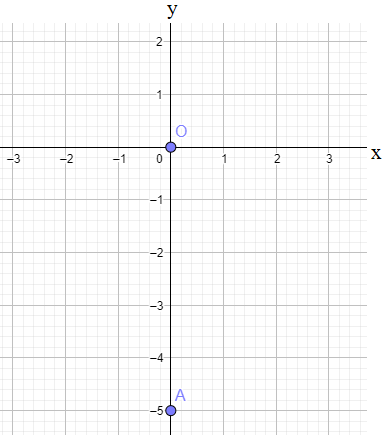
Plot the point on a coordinate plane that is on the y-axis and 5 units down from the origin.

Answer:

To find- plotting of a point that is on the y− axis and 5 units down from the origin.

Using property of coordinate plane we will plot required point.

∵  Required point is on the y− axis and 5 units down the origin.
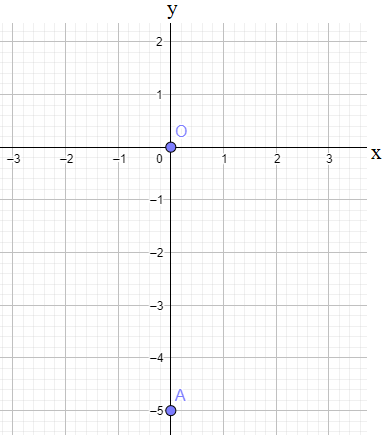
Big Ideas Math Integrated Math 1 Student Journal 1st Edition Chapter 3 Maintaining Mathematical Proficiency Page 58 Exercise 1 Problem 1 graph 1

Here point O is the origin and point A is our required point having coordinate b (0,−5).

Read and Learn More Big Ideas Math Integrated Math 1 Student Journal Solutions

The final answer is that the plotting of the point which is on the y− axis and 5 units down the origin is
Big Ideas Math Integrated Math 1 Student Journal 1st Edition Chapter 3 Maintaining Mathematical Proficiency Page 58 Exercise 1 Problem 1 graph 2


Big Ideas Math Integrated Math 1 Student Journal Chapter 3 Solutions Page 58  Exercise 2  Problem 2

Question 2.

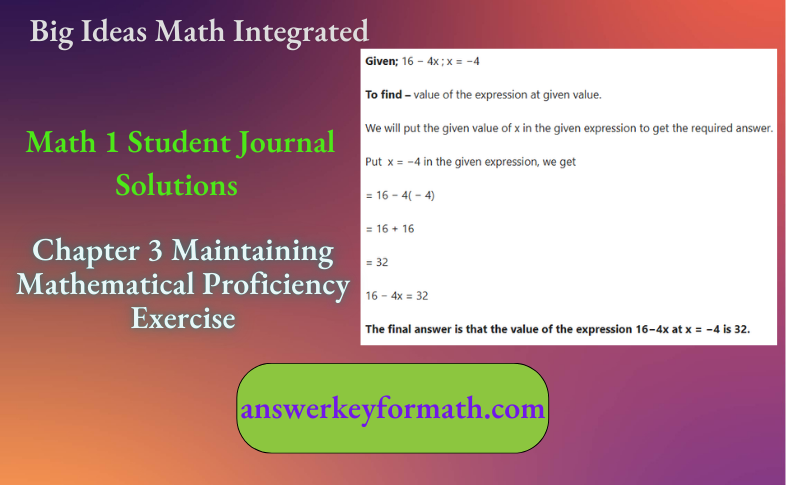
Evaluate the expression 16 – 4x at x = -4.

Answer:
Big Ideas Math Integrated Math 1 Student Journal Chapter 3 Maintaining Mathematical Proficiency Exercise


Page 58  Exercise 3  Problem 3

Question 3.

Evaluate the expression 12x + 7 at x = -2.

Answer:

Given: 12 x + 7; x = −2

To find- value of the expression at given value.

We will put the given value of x in the given expression to get the required answer.

Put x = −2 in the given expression, we get

= 12(−2) + 7

=− 24 + 7

= − 17.

12 x + 7 = − 17.

The final answer is that the value of the expression 12x + 7 at x = −2 is−17.


Page 58  Exercise 4  Problem 4

Question 4.

Evaluate the expression -9- 3x at x = 5.

Answer:

Given: −9−3x ; x = 5

To find- value of the expression at given value.

We will put the given value of x in the given expression to get the required answer.

Put x = 5in the given expression, and we get

= −9−3(5)

=−9−15

= −24.

−9−3x = −24.

The final answer is that the value of the expression −9 − 3x at x = 5 is−24.


Chapter 3 Maintaining Mathematical Proficiency Solutions Big Ideas Math Integrated Math 1 Page 59   Exercise 5  Problem 5

Question 5.

\(\begin{array}{|l|l|}
\hline x & y \\
\hline 1 & 8 \\
\hline 2 & 8 \\
\hline 3 & 8 \\
\hline 4 & 8 \\
\hline
\end{array}\)

Determine whether the given relation represents a function.

Answer:

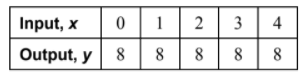
Given: An input-output table
Big Ideas Math Integrated Math 1 Student Journal 1st Edition Chapter 3 Maintaining Mathematical Proficiency Page 59 Exercise 5 Problem 5 table 1

To find- Whether the given relation represents a function.

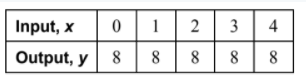
From the given input-output table, we can see that all the values of x is related with element 8 of y

⇒  Every element of x is related with exactly one element of y.

⇒ The given relation is a function.

The final answer is that the given relation
Big Ideas Math Integrated Math 1 Student Journal 1st Edition Chapter 3 Maintaining Mathematical Proficiency Page 59 Exercise 5 Problem 5 table 2

Is a function.


Page 59  Exercise 5  Problem 6

Question 6.

Given the input-output table below:

\(\begin{array}{|l|l|}
\hline x & y \\
\hline 8 & 0 \\
\hline 8 & 1 \\
\hline 8 & 2 \\
\hline 8 & 3 \\
\hline 8 & 4 \\
\hline
\end{array}\)

Determine whether the given relation represents a function.

Answer:

Given:  An input-output table
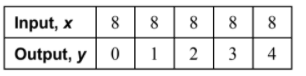
Big Ideas Math Integrated Math 1 Student Journal 1st Edition Chapter 3 Maintaining Mathematical Proficiency Page 59 Exercise 5 Problem 6 table 1

To find- Whether the given relation represents a function.

From the given input-output table, we can see that a single element of x i.e. 8 is related with more than one element of y i.e. 0,1,2,3 and 4.

⇒  Element of x is related with multiple element of y.

⇒ The given relation is not a function.

The final answer is that the given relation
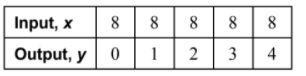
Big Ideas Math Integrated Math 1 Student Journal 1st Edition Chapter 3 Maintaining Mathematical Proficiency Page 59 Exercise 5 Problem 6 table 2
Is not a function.


Big Ideas Math Integrated Math 1 Chapter 3 Step-By-Step Solutions Page 59   Exercise 5  Problem 7

Question 7.

Given the input-output table below:

\(\begin{array}{|l|l|}
\hline x & y \\
\hline 1 & 10 \\
\hline 2 & 11 \\
\hline 3 & 10 \\
\hline 3 & 11 \\
\hline 4 & 12 \\
\hline
\end{array}\)

Determine whether the given relation represents a function.

Answer:

Given:  An input-output table
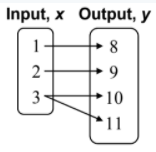
Big Ideas Math Integrated Math 1 Student Journal 1st Edition Chapter 3 Maintaining Mathematical Proficiency Page 59 Exercise 5 Problem 7 table 1
To find- whether the given relation represents a function.

From the given input-output table, we can see that there is an element of x i.e.3 which is related to two elements of y i.e.10and 11.

⇒ There is an element in x which is related to multiple elements in y.

⇒ The given relation is not a function.

The final answer is that the
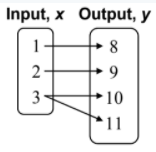
Big Ideas Math Integrated Math 1 Student Journal 1st Edition Chapter 3 Maintaining Mathematical Proficiency Page 59 Exercise 5 Problem 7 table 2

Is not a function.


Page 59  Exercise 5  Problem 8

Question 8.

Analyze the given graph to determine whether the relation it represents is a function:

Determine whether the given relation represents a function.

Answer:

Given: A graph representing a relation
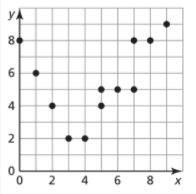
Big Ideas Math Integrated Math 1 Student Journal 1st Edition Chapter 3 Maintaining Mathematical Proficiency Page 59 Exercise 5 Problem 8 Graph 1

To find- whether the given relation represents a function.

From the given graph, we can easily see that there is an element of x i.e.5 which is related to two elements of y i.e.4 and 5.

⇒ There is an element in xwhich is related to multiple elements in y.

⇒ The given relation is not a function.

The final answer is that the given relation
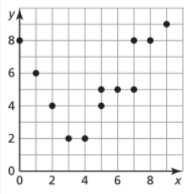
Big Ideas Math Integrated Math 1 Student Journal 1st Edition Chapter 3 Maintaining Mathematical Proficiency Page 59 Exercise 5 Problem 8 Graph 2
Is not a function.


Page 59  Exercise 5  Problem 9

Question 9.

Given the set of ordered pairs (-2,5), (-1,8), (0,6), (1,6), and (2,7), determine whether the relation represents a function.

Answer:

Given: (−2,5),(−1,8),(0,6),(1,6),(2,7)

We have to determine whether each given relation represents a function.

Since x− coordinates represent input and y−Coordinates represent the output of the relation.

Arrange the given relation
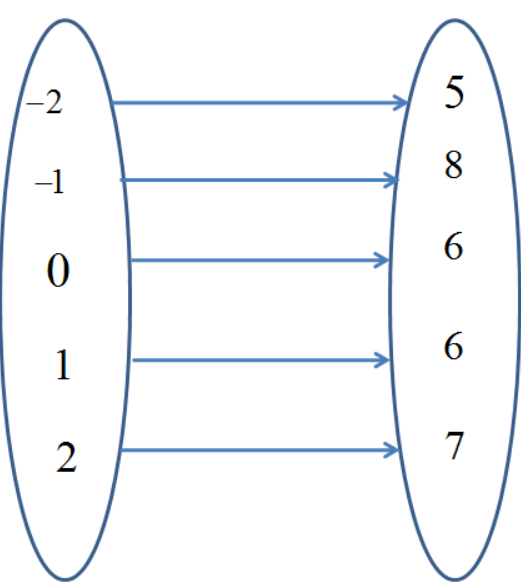
Big Ideas Math Integrated Math 1 Student Journal 1st Edition Chapter 3 Maintaining Mathematical Proficiency Page 58 Exercise 5 Problem 9 Function

From above we can see that each input has exactly one output.

Hence, the given relation represents a function.

The given relation (−2,5),(−1,8),(0,6),(1,6),(2,7) represents a function. Since each input has unique output.


Page 59  Exercise 5  Problem 10

Question 10.

Given the set of ordered pairs (-2,0), (-1,0), (-1,1), (0,1), (1,2), and (2,2), determine whether the relation represents a function.

Answer:

Given: (−2,0),(−1,0),(−1,1),(0,1),(1,2),(2,2)

We have to determine whether each given relation represents a function.

Since x-coordinates represent input and y-coordinates represent the output of the relation.

(−2,0),(−1,0),(−1,1),(0,1),(1,2),(2,2)  [Given relation]

In we can see that in the above-given relation input −1 has two outputs which are 0 and 1.

But a relation to be a function, each input has exactly one output.

which does not satisfy here in the given relation.

Hence, the given relation does not represent a function.

The given relation (−2,0),(−1,0),(−1,1),(0,1),(1,2),(2,2) does not represent a function because in the given relation input −1 have two output 0 and 1.


Solutions For Big Ideas Math Integrated Math 1 Chapter 3 Maintaining Mathematical Proficiency Exercises Page 60  Exercise 6   Problem 11

Question 11.

Determine whether each of the following relations represents a function. Explain your reasoning.

  1. Relation 1: (2,6), (2,7), (1,8), (3,6)
  2. Relation 2: (1,3), (2,5), (4,7)

Answer:

Function:

It is a rule in which for an input we get an output.

An important condition for the function is that for an input, x there should not be more than one different output.

Example of a function:  y = x3

Example of not a function: (2,6)(2,7),(1,8),(3,6)

A relation is a function where each input has exactly one output. Example of a function:(1,3),(2,5),(4,7)


Page 60   Exercise 6   Problem 12

Question 12.

Determine whether each of the following relations represents a function. Explain your reasoning.

  1. Given the equation, y = 2x3, determine if it represents a function.
  2. Given the set of ordered pairs (2,6), (2,7), (1,8), and (3,6), determine if it represents a function.

Answer:

Function:

It is a rule in which for an input we get an output.

An important condition for the function is that for an input, x there should not be more than one different output,y.

Example of a function: y = 2x3

Example of not a function: (2,6)(2,7),(1,8),(3,6)

A relation is a function where each input has exactly one output. Example of not a function: (2,6)(2,7),(1,8),(3,6)


Page 63  Exercise 7  Problem 13

Question 13.

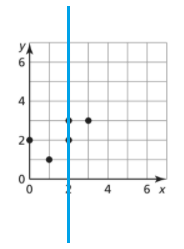
Given the graph below, determine whether the relation it represents is a function. Use the vertical line test to justify your answer.

Answer:

Given: The graph
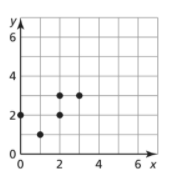
Big Ideas Math Integrated Math 1 Student Journal 1st Edition Chapter 3 Maintaining Mathematical Proficiency Page 63 Exercise 7 Problem 13 Graph 1

We have to find that the given graph represents a function or not.

Here, we use the vertical line test to check the given graph is a function or non-function.

From the graph, we can see that the input  x = 2 has two different outputs  y = 2 and y = 3

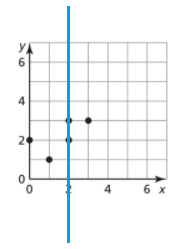
Also, by using the vertical line test draw a vertical line from x = 2 in the given graph
Big Ideas Math Integrated Math 1 Student Journal 1st Edition Chapter 3 Maintaining Mathematical Proficiency Page 63 Exercise 7 Problem 13 Graph 2

Here, the line pass through two points i.e y = 2 and y = 3.

Which does not satisfy the condition of function.

Hence, the given graph is not a function.

The given graph does not represent a function since it does not satisfy the condition of a function because when a vertical line is drawn it will pass through more than one point i.e. two points which can be shown in the below graph.
Big Ideas Math Integrated Math 1 Student Journal 1st Edition Chapter 3 Maintaining Mathematical Proficiency Page 63 Exercise 7 Problem 13 Graph 3


Big Ideas Math Integrated Math 1 Student Journal Chapter 3 Guide Page 63  Exercise 8   Problem 14

Question 14.

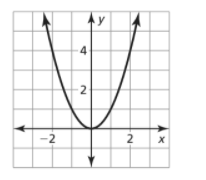
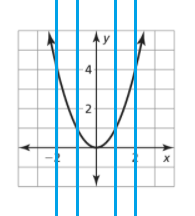
Given the graph below, determine whether the relation it represents is a function. Use the vertical line test to justify your answer.

Answer:

Given: The graph
Big Ideas Math Integrated Math 1 Student Journal 1st Edition Chapter 3 Maintaining Mathematical Proficiency Page 63 Exercise 8 Problem 14 Graph 1

We have to find that the given graph represents a function or not.

Here, we use the vertical line test to check the given graph is a function or non-function

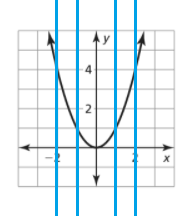
Applying vertical line test in the given graph
Big Ideas Math Integrated Math 1 Student Journal 1st Edition Chapter 3 Maintaining Mathematical Proficiency Page 63 Exercise 8 Problem 14 Graph 2

We can see in the above graph that when we draw a vertical line from any point it will not pass through more than one point.

Hence, the given graph represents a function.

When we apply the vertical line test we get that it will not pass through more than one point. Hence, the given graph represents a function
Big Ideas Math Integrated Math 1 Student Journal 1st Edition Chapter 3 Maintaining Mathematical Proficiency Page 63 Exercise 8 Problem 14 Graph 3


Page 63  Exercise 9   Problem 15

Question 15.

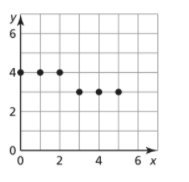
Given the graph below, determine the domain and range of the function represented by the graph.

Answer:

Given: The graph
Big Ideas Math Integrated Math 1 Student Journal 1st Edition Chapter 3 Maintaining Mathematical Proficiency Page 63 Exercise 9 Problem 15 Graph

To find – The domain and range of the function represented by the graph.

First, from the graph determine the coordinates points.

x− coordinates represent the domain.

y−coordinates represent the range.

Find the coordinates from the graph

The coordinate points are (0,4),(1,4),(2,4),(3,3),(4,3),(5,3)

Find the domain and range

Since, x− coordinates represent the domain.

Domain: D→{0,1,2,3,4,5}

And, y− coordinates represent the range.

Range: R → {4,3}

Hence, the domain D  → {0,1,2,3,4,5} and Range R → {4,3} from the given graph.


Chapter 3 Maintaining Mathematical Proficiency Explained Big Ideas Math Integrated Math 1 Page 63  Exercise 10  Problem 16

Question 16.

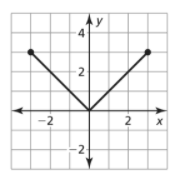
Given the graph below, determine the domain and range of the function represented by the graph.

Answer:

Given: The graph
Big Ideas Math Integrated Math 1 Student Journal 1st Edition Chapter 3 Maintaining Mathematical Proficiency Page 63 Exercise 10 Problem 16 Graph 1

To find – The domain and range of the function represented by the graph.

First, from the graph determine the coordinates points.

x−coordinates represent the domain.

y−coordinates represent the range.

The given is
Big Ideas Math Integrated Math 1 Student Journal 1st Edition Chapter 3 Maintaining Mathematical Proficiency Page 63 Exercise 10 Problem 16 Graph 2

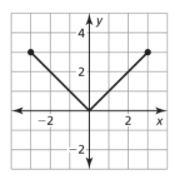
From the graph, we can say that it is a continuous graph.

So, since x− coordinates represent the domain.

Domain:  D→[−3,3]

And, y−coordinates represent the range.

Range: R→[0,3]

Hence, the domain and range of the given graph are Domain D→[−3,3],  and  Range R→[0,3]


Page 63  Exercise 11  Problem 17

Question 17.

Given the function, y = 12x, where y represents the number of pages printed and x represents the time taken to print in minutes, identify the independent and dependent variables.

Answer:

Given: y = 12x

To find –  Independent and dependent variables from the given function.

Here, y is the number of pages and x is the time taken to print in minutes.

y = 12x  [Given function]

Since y is the number of pages and x is the time taken to print in minutes.

Here, the independent variable is ‘x ‘ time taken to print in minutes.

And, the dependent variable is ′y′ the number of pages printed.

The independent variable is ′x′and the dependent variable is ′y′in the given function y = 12x.


Page 63  Exercise 12  Problem 18

Question 18.

Given the function, y = 12x with a domain of {1,2,3,4}, find the range of the function.

Answer:

Given: The function y = 12x

The domain of the given function is 1,2,3 and 4.

We have to find the range of the given function.

By putting different values of x = 1,2,3,4 find the value of y.

Here, x represents domain and y represents the range.

Put the value of x = 1,2,3,4 in the given function y=12x
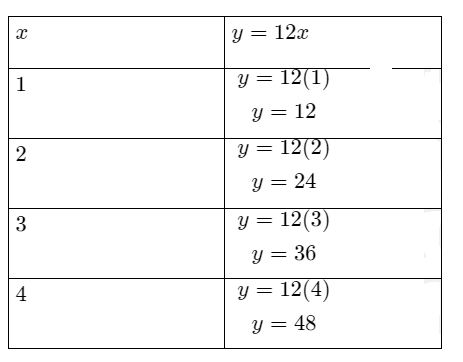
Big Ideas Math Integrated Math 1 Student Journal 1st Edition Chapter 3 Maintaining Mathematical Proficiency Page 63 Exercise 12 Problem 18 Table 1

From the above table, we get

Range = 12,24,36,48

Hence, the range of the given function y = 12x  whose domain is 1,2,3 and 4is 12,24,36,48 .


Page 64   Exercise 13  Problem 19

Question 19.

Given the length l = 2x and the breadth b = x of a rectangle, where x = 1, 2, 3, 4, 5:

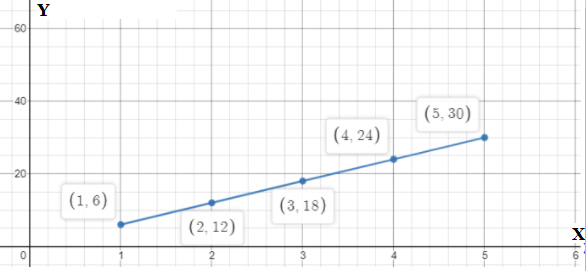
  1. Complete the table for the perimeter P of the rectangle using the formula P = 2 (l+b).
  2. Plot the points on a graph where the x-axis represents x and the y-axis represents P.
  3. Determine whether the pattern is linear or non-linear.

Answer:

Given:

Length of the rectangle, l=2x

The breadth of the rectangle, b=x

x = 1,2,3,4,5

We have to complete the given table
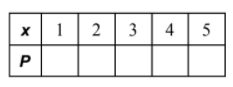
Big Ideas Math Integrated Math 1 Student Journal 1st Edition Chapter 3 Maintaining Mathematical Proficiency Page 64 Exercise 13 Problem 19 table 1

And, draw the graph and find the pattern whether it is linear or non-linear.

Using the formula of the perimeter of the rectangle complete the given table.

Then put the points on the graph and find the pattern.

Perimeter of rectangle, P = 2(l + b)

Put l = 2x and b = x in the above formula

P = 2(2x + x)

P = 2(3x)

P = 6x

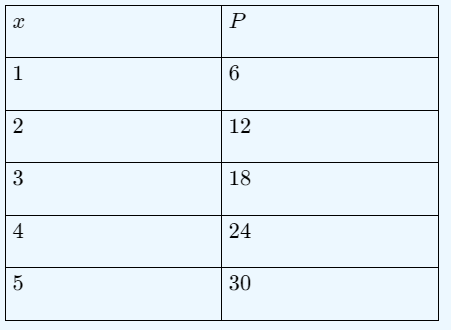
Now, put x = 1,2,3,4,5 in above equation to find the value of P

For x = 1

P=6(1)

⇒  P = 6

For x=2

P = 6(2)

P = 12

For x = 3

P = 6(3)

P = 18

For x = 4

P = 6(4)

P = 24

For x = 5

P = 6(5)

P = 30

Make the table
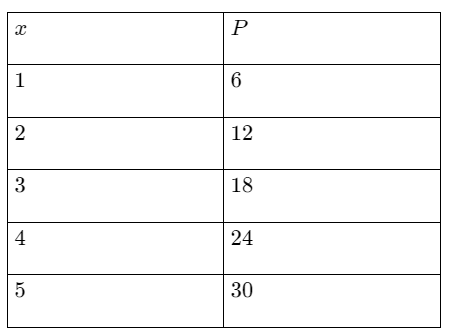
Big Ideas Math Integrated Math 1 Student Journal 1st Edition Chapter 3 Maintaining Mathematical Proficiency Page 64 Exercise 13 Problem 19 Table 2

Now, mark the points on the graph x-axis represents x.

And, the y−axis represents P.
Big Ideas Math Integrated Math 1 Student Journal 1st Edition Chapter 3 Maintaining Mathematical Proficiency Page 64 Exercise 13 Problem 21 graph 1

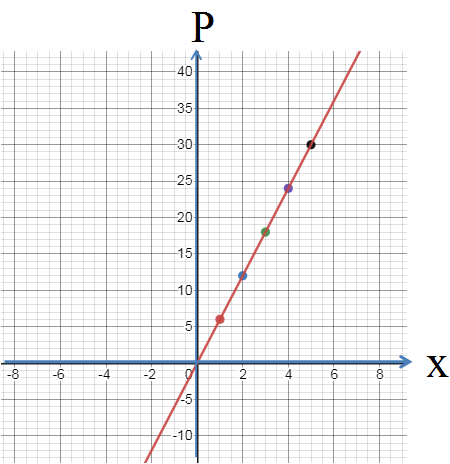
Hence, the graph is in a linear pattern.

Hence, the table is
Big Ideas Math Integrated Math 1 Student Journal 1st Edition Chapter 3 Maintaining Mathematical Proficiency Page 64 Exercise 13 Problem 19 Table 3

And it makes a linear pattern shown in the below graph.
Big Ideas Math Integrated Math 1 Student Journal 1st Edition Chapter 3 Maintaining Mathematical Proficiency Page 64 Exercise 13 Problem 19 graph 2


Worked Examples For Big Ideas Math Integrated Math 1 Chapter 3 Maintaining Mathematical Proficiency Page 64   Exercise 13  Problem 20

Question 20.

Given the length l = 2x and the breadth b = x of a rectangle, where x = 1,2,3,4,5:

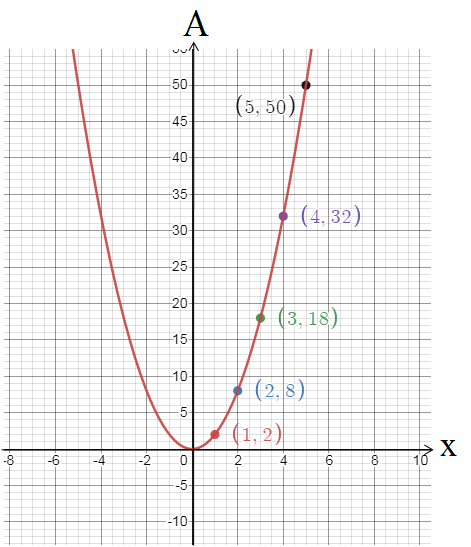
  1. Complete the table for the area A of the rectangle using the formula A = l x b.
  2. Plot the points on a graph where the x-axis represents x and the y-axis represents A.
  3. Determine whether the pattern is linear or non-linear.

Answer:

Given:

Length of the rectangle, l = 2x

The breadth of the rectangle, b = x

x = 1,2,3,4,5

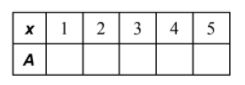
We have to complete the given table
Big Ideas Math Integrated Math 1 Student Journal 1st Edition Chapter 3 Maintaining Mathematical Proficiency Page 64 Exercise 13 Problem 20 table 1

And, draw the graph and find the pattern whether it is linear or non-linear.

Using the formula of the area of the rectangle complete the given table.

Then put the points on the graph and find the pattern.

Area of the rectangle, A = l × b

Put l = 2x and b = x in the above formula

A = 2x × x

A= 2 x2

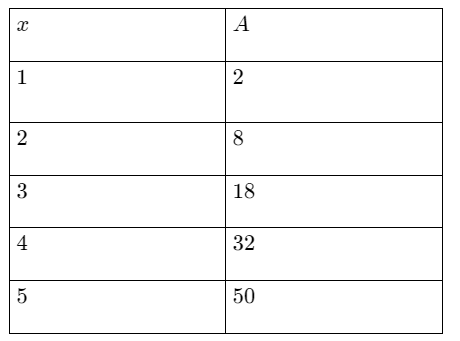
Now, put x = 1,2,3,4,5 in the above equation

For x = 1

A = 2(1)2

A = 2 × 1×1

A = 2

For x = 2

A = 2(2)2

A = 2 × 2 × 2

A = 8

For x = 3

A = 2(3)2

A = 2 × 3 × 3

A = 18

For x = 4

A = 2(4)2

A = 2 × 4 ×4

A = 32

For x = 5

A=2(5)2

A = 2 × 5 × 5

A = 50

The table is
Big Ideas Math Integrated Math 1 Student Journal 1st Edition Chapter 3 Maintaining Mathematical Proficiency Page 64 Exercise 13 Problem 20 Table 2

Now, mark the points on the graph

The x-axis represents the value of x.

And, y-axis represents the value of A.
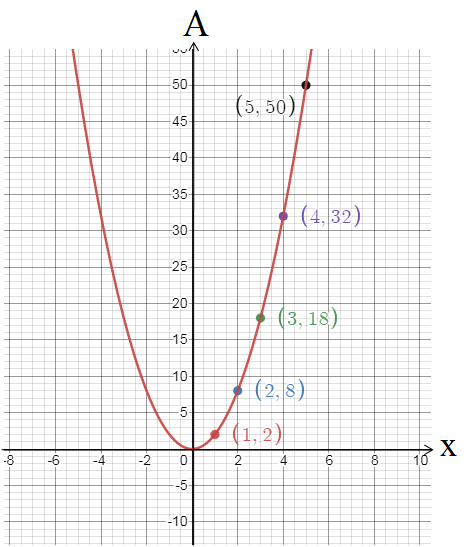
Big Ideas Math Integrated Math 1 Student Journal 1st Edition Chapter 3 Maintaining Mathematical Proficiency Page 64 Exercise 13 Problem 20 graph 1
Since the above graph makes a parabola and a parabola is a non-linear graph.

Hence, the complete table is
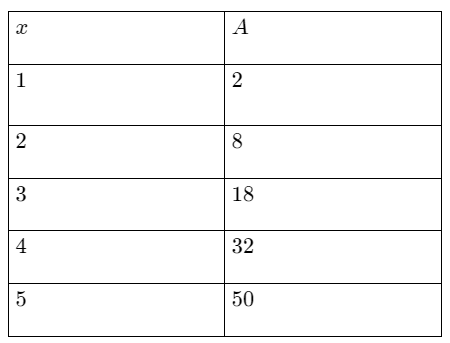
Big Ideas Math Integrated Math 1 Student Journal 1st Edition Chapter 3 Maintaining Mathematical Proficiency Page 64 Exercise 13 Problem 20 Table 3

The graph is

Big Ideas Math Integrated Math 1 Student Journal 1st Edition Chapter 3 Maintaining Mathematical Proficiency Page 64 Exercise 13 Problem 20 graph 2
Since the above graph makes a parabola and parabola is a non-linear graph.


Page 64  Exercise 13  Problem 21

Question 21.

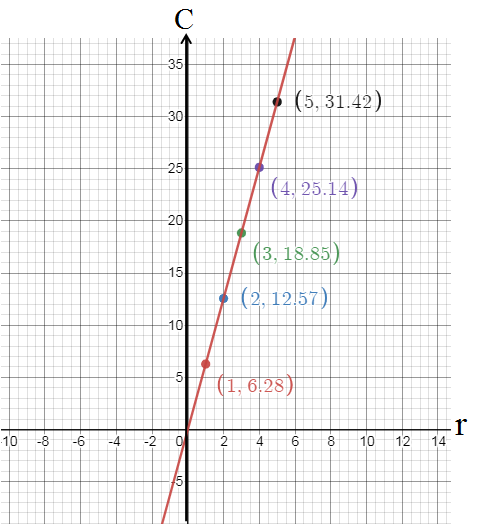
  1. Given the radius r = 1,2,3,4,5 of a circle, where C is the circumference of the circle:
  2. Complete the table for the circumference C of the circle using the formula C = 2πr.
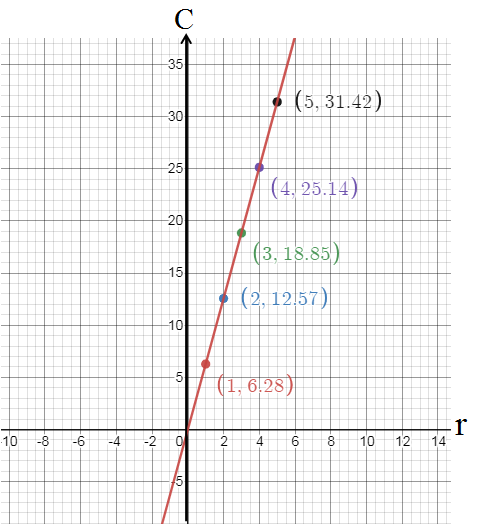
  3. Plot the points on a graph where the x-axis represents r and the y-axis represents C.
  4. Determine whether the pattern is linear or non-linear.

Answer:

Given:

The radius of circle, r = 1,2,3,4,5C is the circumferences of the circle.

We have to complete the given table
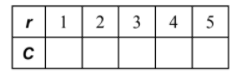
Big Ideas Math Integrated Math 1 Student Journal 1st Edition Chapter 3 Maintaining Mathematical Proficiency Page 64 Exercise 13 Problem 21 table 1
And, draw the graph and find the pattern whether it is linear or non-linear.

Using the formula of the circumferences of the circle to complete the given table.

Then put the points on the graph and find the pattern.

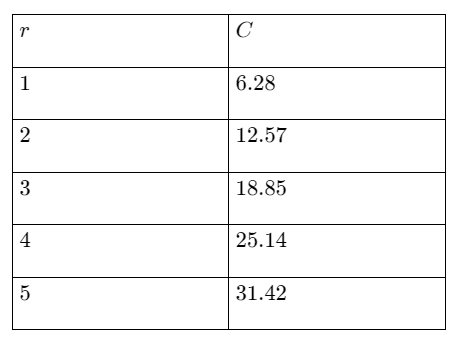
Circumferences of a circle, C = 2πr

Put r = 1,2,3,4,5 in the above formula

For r = 1

C = 2×\(\frac{22}{7}\)×1

C = 6.28

For r = 2

C = 2×\(\frac{22}{7}\)×2

C = 12.57

For r = 3

C = 2×\(\frac{22}{7}\)×3

C = 18.85

For  r= 4

C =  2×\(\frac{22}{7}\)×4

C = 25.14

For r = 5

C = 2×\(\frac{22}{7}\)×5

C = 31.42

Make the table
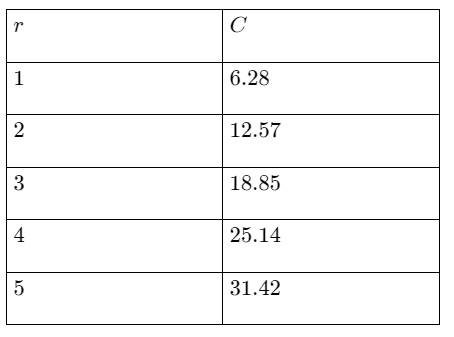
Big Ideas Math Integrated Math 1 Student Journal 1st Edition Chapter 3 Maintaining Mathematical Proficiency Page 64 Exercise 13 Problem 21 Table 2

Now, plot the points on the graph

The x-axis represents the radius of the circle, r

The y−axis represents the circumferences of the circle, C
Big Ideas Math Integrated Math 1 Student Journal 1st Edition Chapter 3 Maintaining Mathematical Proficiency Page 64 Exercise 13 Problem 21 graph 1

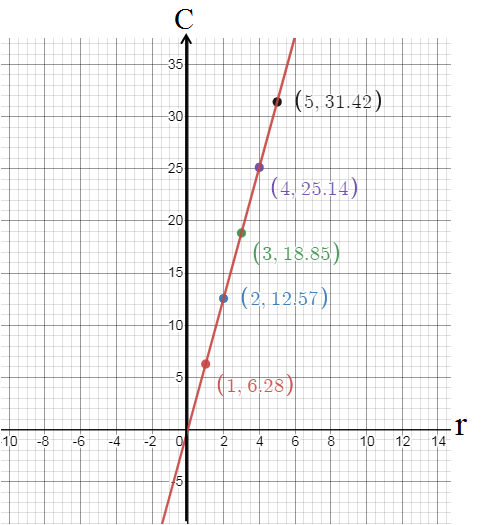
Hence, the graph makes a linear pattern.

Hence, the table is
Big Ideas Math Integrated Math 1 Student Journal 1st Edition Chapter 3 Maintaining Mathematical Proficiency Page 64 Exercise 13 Problem 21 Table 3

And, the graph makes a linear pattern which can be shown below.
Big Ideas Math Integrated Math 1 Student Journal 1st Edition Chapter 3 Maintaining Mathematical Proficiency Page 64 Exercise 13 Problem 21 graph 2


Big Ideas Math Integrated Math 1 Chapter 3 Detailed Answers Page 64   Exercise 13  Problem 22

Question 22.

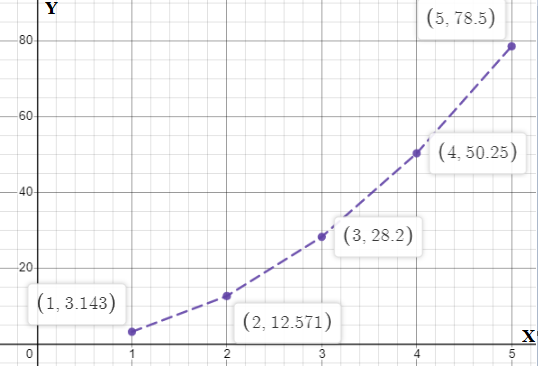
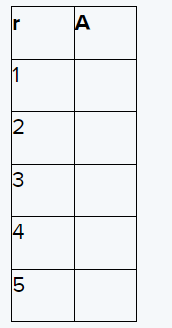
Given the radius r and the area A of a circle, complete the table and determine whether the function is linear or non-linear by drawing the graph.

1. Use the formula A = πr2 to find the area for each given radius r = 1,2,3,4,5.

2. Complete the table:

\(\begin{array}{|l|l|}
\hline r & \text { Area } A-\pi r^2 \\
\hline 1 & \\
\hline 2 & \\
\hline 3 & \\
\hline 4 & \\
\hline 5 & \\
\hline
\end{array}\)

3. Plot the points on a graph where the x-axis represents the radius r and the y-axis represents the area A.

4. Determine whether the graph represents a linear or non-linear function.

Answer:

The given table is
Big Ideas Math Integrated Math 1 Student Journal 1st Edition Chapter 3 Maintaining Mathematical Proficiency Page 64 Exercise 13 Problem 22 Table 1

Where r is the radius and A is the area of the circle.

Now, find the area with respect to different radius and do draw the graph to check whether the function is linear or not.

We know the formula for area of circle

A = πr2

So, for the given radius, the area can be calculated with the help of above formula i.e.
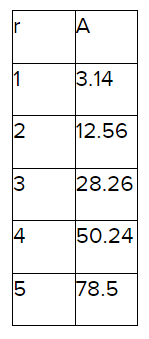
Big Ideas Math Integrated Math 1 Student Journal 1st Edition Chapter 3 Maintaining Mathematical Proficiency Page 64 Exercise 13 Problem 22 Table 2

So, the graph is

Big Ideas Math Integrated Math 1 Student Journal 1st Edition Chapter 3 Maintaining Mathematical Proficiency Page 64 Exercise 13 Problem 22 Graph 1

This shows that the graph of the data is not in a straight line i.e. non-linear which cannot be written in the form of y = mx + b.

Hence, it is concluded that the graph of the given data including radius with respect to area of a circle is not a linear function
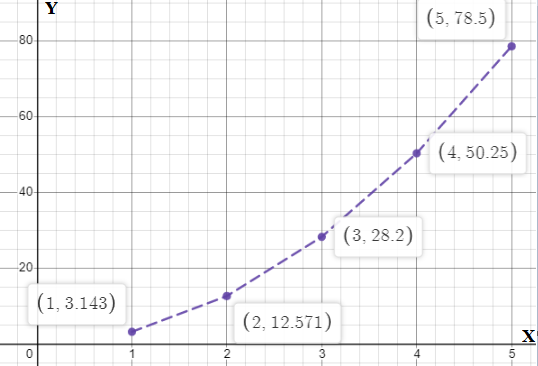
Big Ideas Math Integrated Math 1 Student Journal 1st Edition Chapter 3 Maintaining Mathematical Proficiency Page 64 Exercise 13 Problem 22 Graph 2


Page 65  Exercise 14  Problem 23

Question 23.

Given the graphs from Big Ideas Math Integrated Math 1 Student Journal 1st Edition Chapter 3 Maintaining Mathematical Proficiency Page 64 Exercise 13 Problems (19-22), determine whether each graph represents a function. Use the vertical line test to justify your answer.

  1. Problem 19: The perimeter of a rectangle for different lengths x and breadth 2x.
  2. Problem 20: The area of a rectangle for different lengths x and breadth 2x.
  3. Problem 21: The circumference of a circle for different radii r.
  4. Problem 22: The area of a circle for different radii r.

Answer:

Here, from the given data, we have to draw the graph of dependent variable with respect to independent variable.

If no vertical line drawn would intersect the curve more than once, then it will be a function.

For Page 64   Exercise 13  Problems (19 – 22)  lets plot the graph.

For  Page 64   Exercise 13  Problem 19    the perimeter of the rectangle for different length x and breadth 2x.
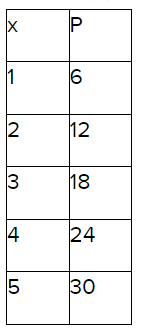
Big Ideas Math Integrated Math 1 Student Journal 1st Edition Chapter 3 Maintaining Mathematical Proficiency Page 65 Exercise 14 Problem 23 Table 1

So, the graph is

Big Ideas Math Integrated Math 1 Student Journal 1st Edition Chapter 3 Maintaining Mathematical Proficiency Page 65 Exercise 14 Problem 23 Graph 1

Since no vertical line intersects the line more than once. So, the graph does represent a function.

For Page 64   Exercise 13  Problem 20 , the area can be calculated as A = L × B.
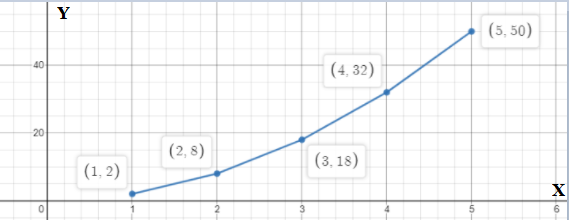
Big Ideas Math Integrated Math 1 Student Journal 1st Edition Chapter 3 Maintaining Mathematical Proficiency Page 65 Exercise 14 Problem 23 Graph 2

Since no vertical line intersect the curve more than once. So, the graph does represent a function.

For  Page 64   Exercise 13  Problem 21, circumference(C) can be calculated for radius r is C = 2πr
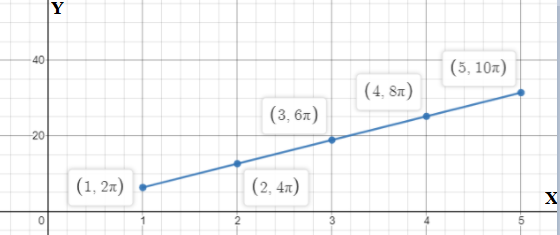
Big Ideas Math Integrated Math 1 Student Journal 1st Edition Chapter 3 Maintaining Mathematical Proficiency Page 65 Exercise 14 Problem 23 Graph 3

Since no vertical line intersects the curve more than once. So, the graph does represent a function.

For Page 64   Exercise 13  Problem 22, area(A) of the circle can be calculated as A = πr2
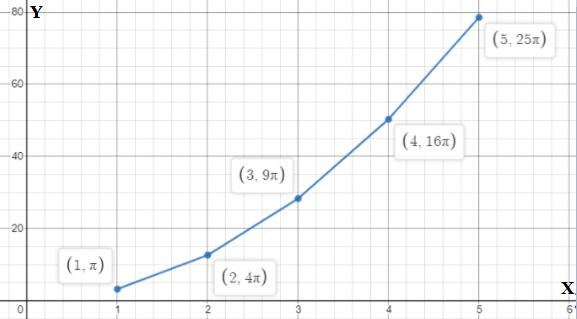
Big Ideas Math Integrated Math 1 Student Journal 1st Edition Chapter 3 Maintaining Mathematical Proficiency Page 65 Exercise 14 Problem 23 Graph 4

Since, no vertical line can intersect the line more than once.

So, the graph does represent a function.

Hence, for the Page 64   Exercise 13  Problems(19 – 22) there is no vertical line that intersect the line more than once. So, the graph does represent a function


Page 65  Exercise 15  Problem 24

Question 24.

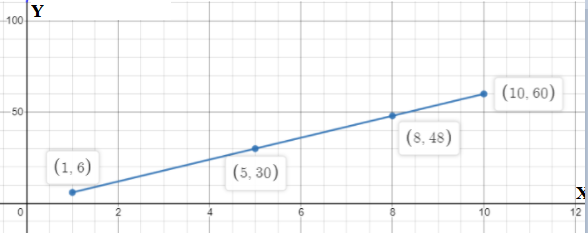
To determine whether a function is linear or not, consider the example of the perimeter of a rectangle with length x and breadth 2x. The perimeter P can be calculated using the formula P = 2(L + B).

  1. Given the formula for the perimeter, p = 2(L + B), where L = x and B = 2x, rewrite the formula in terms of x.
  2. Complete the table below for the perimeter when x = 1,2,3,4,5.
  3. Plot the graph using the values from the table.
  4. Determine if the function is linear or non-linear based on the graph.

Answer:

To explain whether a function is linear or not, let’s take an example to explain it.

Consider an example of perimeter of a rectangle of length x and breadth 2x such that perimeter can be calculated as P = 2(L + B).

The graph of the data for perimeter of rectangle
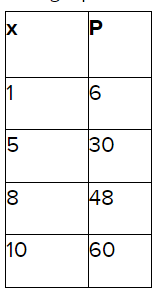
Big Ideas Math Integrated Math 1 Student Journal 1st Edition Chapter 3 Maintaining Mathematical Proficiency Page 65 Exercise 15 Problem 24 Table

The graph Is

Big Ideas Math Integrated Math 1 Student Journal 1st Edition Chapter 3 Maintaining Mathematical Proficiency Page 65 Exercise 15 Problem 24 Graph 1

Since, the graph of the function is straight line and can be written in the form of y = mx + b and no vertical line drawn is intersecting the curve more than once.

So, it is a linear function.

And if any vertical line drawn would intersect the curve more than once, then it will be a nonlinear function.

Hence, the function is linear or not depends on whether the graph of the data makes a straight line or not and also to check any vertical line drawn would intersect the curve more than once or not
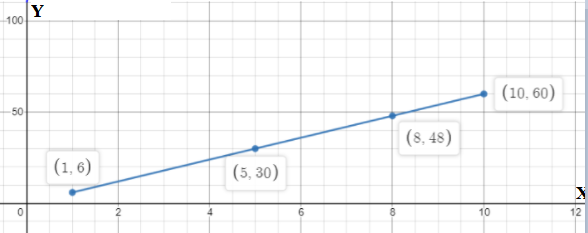
Big Ideas Math Integrated Math 1 Student Journal 1st Edition Chapter 3 Maintaining Mathematical Proficiency Page 65 Exercise 15 Problem 24 Graph 2


Page 65  Exercise 16  Problem 25

Question 25.

Consider the following real-life problems and determine whether they represent linear or nonlinear functions. Explain your reasoning and sketch the graphs to illustrate each example.

Answer:

To define real life problem of linear and nonlinear functions. We will consider examples to understand it.

The function represents linear :

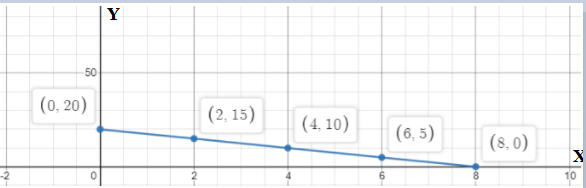
Example:- A 20-gallon bathtub is draining at a rate of 2.5 gallons per minute.

The number g of gallons remaining is a function of the number m of minutes.

Since the water in the bathtub (y) is decreasing by a constant amount (x).

So, the graph of the function is
Big Ideas Math Integrated Math 1 Student Journal 1st Edition Chapter 3 Maintaining Mathematical Proficiency Page 65 Exercise 16 Problem 25 Graph 1

Since the graph is a straight line and so is a linear function.

The function represents Nonlinearly:

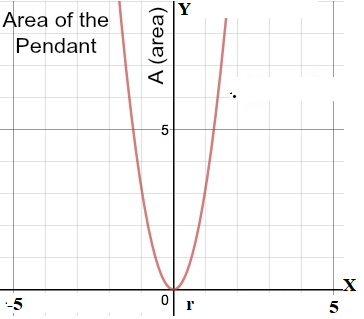
Example:- Diamond cutter is making a pendant and that pendant is going to be circular.

A customer decide to buy that pendant and ask how large that pendant will be.

In this situation, the area of the pendant can be calculated with the help of the formula

A = πr2 and so for different radius, we get the graph as
Big Ideas Math Integrated Math 1 Student Journal 1st Edition Chapter 3 Maintaining Mathematical Proficiency Page 65 Exercise 16 Problem 25 Graph 2

Since the graph is not a straight line and so is a nonlinear function.

Hence, the real-life examples of linear and nonlinear functions are

1.  A 20-gallon bathtub is draining at a rate of 2.5 gallons per minute. The number g of gallons remaining is a function of the number m of minutes

2.  Diamond cutter is making a pendant and that pendant is going to be circular.

3. A customer decide to buy that pendant and ask how large that pendant will be.


Page 68  Exercise 17  Problem 26

Question 26.

The graph of a given function is shown below.

Graph:

(Include the graph from Big Ideas Math Integrated Math 1 Student Journal 1st Edition Chapter 3 Maintaining Mathematical Proficiency Page 68 Exercise 17 Problem 26 Graph 1)

  1. Check whether the function is linear or not with the help of the given graph.
  2. Explain your reasoning based on the characteristics of the graph.

Answer:

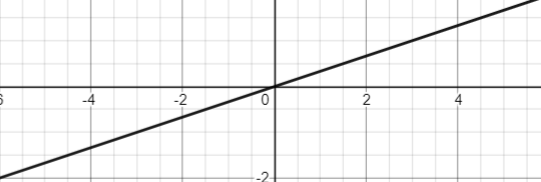
The graph of the given function is
Big Ideas Math Integrated Math 1 Student Journal 1st Edition Chapter 3 Maintaining Mathematical Proficiency Page 68 Exercise 17 Problem 26 Graph 1

Check whether the function is linear or not with the help of given graph.

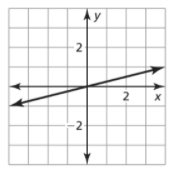
Since, from the graph, the rate of change of x with respect to y is constant and so make a straight line.

For a function to be linear, the line of graph must be straight where there is no vertical line that intersect the curve more than once and it can be seen that there exist no vertical line.

That intersect the curve more than once and so the given graph is of linear function.

Hence, the given graph of the function is a graph of linear function
Big Ideas Math Integrated Math 1 Student Journal 1st Edition Chapter 3 Maintaining Mathematical Proficiency Page 68 Exercise 17 Problem 26 Graph 2


Page 68  Exercise 18  Problem 27

Question 27.

Given the data in the table below.

\(\begin{array}{|l|l|}
\hline x & y \\
\hline 1 & 2 \\
\hline 2 & 4 \\
\hline 3 & 6 \\
\hline 4 & 8 \\
\hline 5 & 10 \\
\hline
\end{array}\)
  1. Check the rate of change of values between x and y.
  2. Plot the graph of the function using the given data.
  3. Determine whether the graph represents a linear function.

Answer:

The given data in the form of a table is
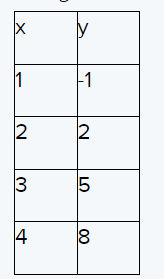
Big Ideas Math Integrated Math 1 Student Journal 1st Edition Chapter 3 Maintaining Mathematical Proficiency Page 68 Exercise 18 Problem 27 Table

Now, check the rate of change of values between x and y.

From the given table, the rate of change between x and y values is constant i.e. the graph of the function is
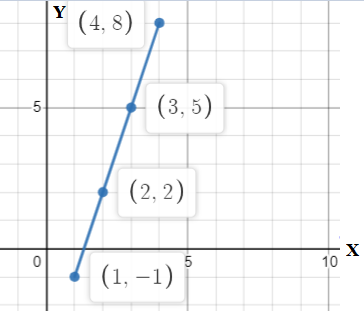
Big Ideas Math Integrated Math 1 Student Journal 1st Edition Chapter 3 Maintaining Mathematical Proficiency Page 68 Exercise 18 Problem 27 Graph 1

This implies that the graph of the function is linear.

Hence, the table of the data is a linear function from the graph
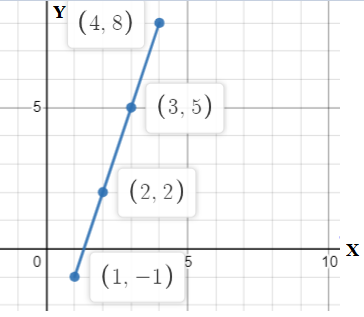
Big Ideas Math Integrated Math 1 Student Journal 1st Edition Chapter 3 Maintaining Mathematical Proficiency Page 68 Exercise 18 Problem 27 Graph 2


Big Ideas Math Integrated Math 1 Student Journal Chapter 3 Maintaining Proficiency Answers Page 68  Exercise 19  Problem 28

Question 28.

Given the data in the table below:

\(\begin{array}{|l|l|}
\hline x & y \\
\hline 1 & 3 \\
\hline 2 & 6 \\
\hline 3 & 12 \\
\hline 4 & 20 \\
\hline 5 & 30 \\
\hline
\end{array}\)
  1. Check the rate of change of values between x and y.
  2. Plot the graph of the function using the given data.
  3. Determine whether the graph represents a linear function.

Answer:

The given data in the form of table is
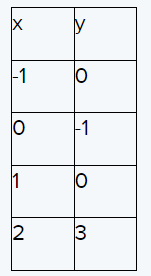
Big Ideas Math Integrated Math 1 Student Journal 1st Edition Chapter 3 Maintaining Mathematical Proficiency Page 68 Exercise 19 Problem 28 Table

Now, check the rate of change of values between x and y.

From the given table, the rate of change between x and y values is not constant i.e. the graph of the function is
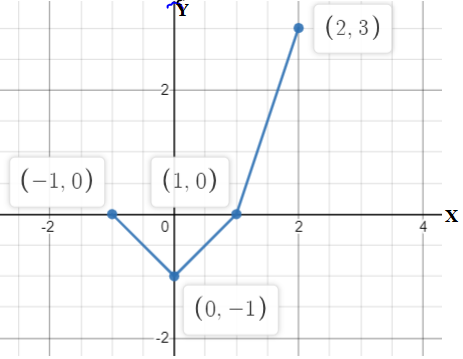
Big Ideas Math Integrated Math 1 Student Journal 1st Edition Chapter 3 Maintaining Mathematical Proficiency Page 68 Exercise 19 Problem 28 Graph 1

This implies that the graph of the function is nonlinear.

Hence, the table of the data is a nonlinear function from the graph
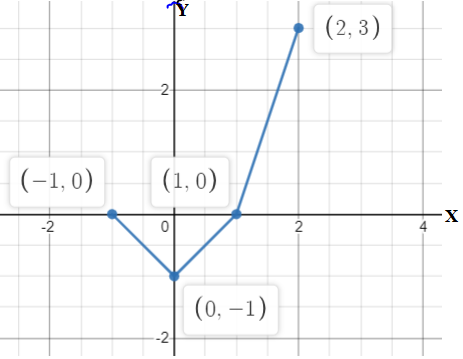
Big Ideas Math Integrated Math 1 Student Journal 1st Edition Chapter 3 Maintaining Mathematical Proficiency Page 68 Exercise 19 Problem 28 Graph 2


Page 68  Exercise 20  Problem 29

Question 29.

Given equation y = 3-2x:

  1. Check whether the equation can be written in the form y = mx + b, where m is the slope and b is the y-intercept.
  2. Determine the slope m and the y-intercept b.
  3. Confirm whether the equation represents a linear function.
  4. Plot the graph of the equation and verify its linearity.

Answer:

The given equation is

y = 3−2x

Now, check the equation can be written in the form of y = mx + b, where m is the slope.

Since the equation can be written as

y = −2x + 3

Where m is -2 and b is 3. Therefore, the given equation is linear function.

Also, from the graph
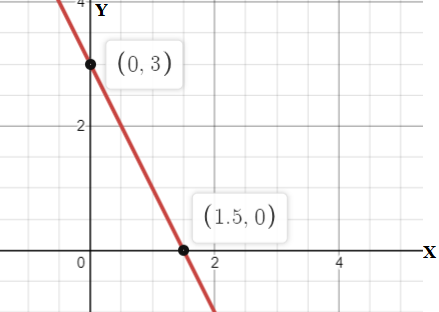
Big Ideas Math Integrated Math 1 Student Journal 1st Edition Chapter 3 Maintaining Mathematical Proficiency Page 68 Exercise 20 Problem 29 Graph

This implies that the graph of the function is linear.

Hence, the equation y = 3−2x is a linear function.


Page 68  Exercise 21  Problem 30

Question 30.

Given the equation \(y=-\frac{3}{4} x^3\):

  1. Check whether the equation can be written in the form y = mx + b, where m is the slope and b is the y-intercept.
  2. Determine if the equation represents a linear or nonlinear function.
  3. Explain why the equation is considered nonlinear.
  4. Plot the graph of the equation and verify its nonlinearity.

Answer:

The given equation is

y = \(\frac{-3}{4}\) x3

Now, check the equation can be written in the form of y = mx + b, where m is the slope.

Since the given equation can not be written in the form of y = mx + b.

Therefore, the given equation is nonlinear.

Also, from the graph
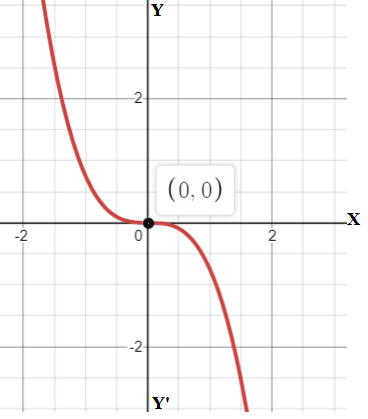
Big Ideas Math Integrated Math 1 Student Journal 1st Edition Chapter 3 Maintaining Mathematical Proficiency Page 68 Exercise 21 Problem 30 Graph

This implies that the equation is nonlinear function.

Hence, the given equation is a nonlinear equation.


Page 68  Exercise 22  Problem 31

Question 31.

Given the graph of the function:

(Big Ideas Math Integrated Math 1 Student Journal 1st Edition Chapter 3 Maintaining Mathematical Proficiency Page 68 Exercise 22 Problem 31 Graph)

  1. Observe the given graph and determine whether it has a continuous domain or a discrete domain.
  2. Explain the reasoning behind your conclusion.
  3. State the domain of the given graph.

Answer:

The graph of the given function is
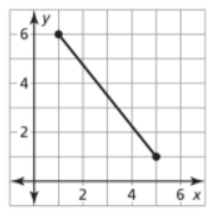
Big Ideas Math Integrated Math 1 Student Journal 1st Edition Chapter 3 Maintaining Mathematical Proficiency Page 68 Exercise 22 Problem 31 Graph

Now, observe the graph and find whether it has a continuous domain or a discrete domain.

Hence, the domain of the given graph is the continuous domain.


Page 68  Exercise 23  Problem 32

Question 32.

Given the graph of the function:

(Big Ideas Math Integrated Math 1 Student Journal 1st Edition Chapter 3 Maintaining Mathematical Proficiency Page 68 Exercise 23 Problem 32 Graph)

  1. Observe the given graph and determine whether it has a continuous domain or a discrete domain.
  2. Identify the domain of the function from the graph.
  3. Explain why the domain is classified as continuous or discrete.

Answer:

The graph of the given function is
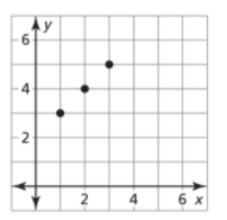
Big Ideas Math Integrated Math 1 Student Journal 1st Edition Chapter 3 Maintaining Mathematical Proficiency Page 68 Exercise 23 Problem 32 Graph

Now, observe the graph and find whether it has a continuous domain or a discrete domain.

Since the domain is a set of input values for which function exist and input values are the x-values.

Therefore, from the graph, the domain(D) is D = {1,2,3}

Also, the domain of the function is a discrete domain as only integer values are being used in the graph.

Hence, the domain of the given graph is the discrete domain.

Big Ideas Math Integrated Math 1 Student Journal Solutions Chapter 2 Maintaining Mathematical Proficiency Exercise

Big Ideas Math Integrated Math  Chapter 2 Maintaining Mathematical Proficiency

Big Ideas Math Integrated Math 1 Student Journal Chapter 2 Solutions Page 27  Exercise 1 Problem  1

Question 1.

Graph the absolute value of the given number:

|-2|

Answer:

We have to graph the number ∣−2∣

Given a number, ∣−2∣

The absolute value is 2.

Therefore, ∣−2∣ = 2

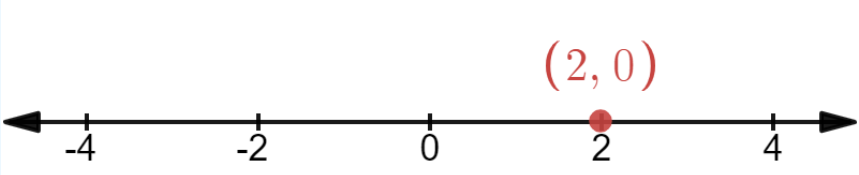
Big Ideas Math Integrated Math 1 Student Journal 1st Edition Chapter 2 Maintaining Mathematical Proficiency Page 27 Exercise 1 Problem 1 graph 1


The graph of ∣−2∣ is

Big Ideas Math Integrated Math 1 Student Journal 1st Edition Chapter 2 Maintaining Mathematical Proficiency Page 27 Exercise 1 Problem 1 graph 2


Page 27  Exercise 2  Problem 2

Question 2.

Graph the result of the following expression:

-3 + |-3|

Answer:

We have to graph the number −3 + ∣−3∣

Given, −3 + ∣−3∣

The absolute value of −3 is 3

So, −3+∣−3∣ = −3+3

= 0

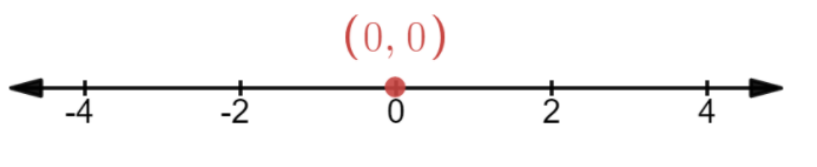
Big Ideas Math Integrated Math 1 Student Journal 1st Edition Chapter 2 Maintaining Mathematical Proficiency Page 27 Exercise 2 Problem 2 graph 1

The graph of −3+∣−3∣ is

Big Ideas Math Integrated Math 1 Student Journal 1st Edition Chapter 2 Maintaining Mathematical Proficiency Page 27 Exercise 2 Problem 2 graph 2


Read and Learn More Big Ideas Math Integrated Math 1 Student Journal Solutions

Page 27  Exercise 3  Problem 3

Question 3.

Determine whether -4 is greater than or less than -7.

Answer:

We have to decide  −4 is greater or lesser than − 7

Is greater than7.

4 lies right side of7, so

4 is greater than7.


Big Ideas Math Integrated Math 1 Student Journal 1st Edition Chapter 2 Maintaining Mathematical Proficiency Page 27 Exercise 3 Problem 3 graph

So − 4 > − 7

The desired solution for this is − 4 > − 7


Chapter 2 Maintaining Mathematical Proficiency Solutions Big Ideas Math Integrated Math 1 Page 27  Exercise 4  Problem 4

Question 4.

Determine whether -8 is greater than or less than -5.

Answer:

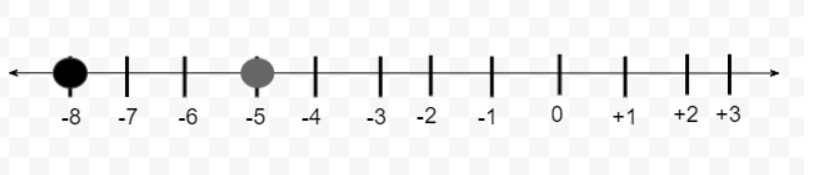
Now we have to decide −8 is greater or lesser than − 5.

−8 is lesser than −5

−8 lies left side of −5, so −8 is less than −5

Big Ideas Math Integrated Math 1 Student Journal 1st Edition Chapter 2 Maintaining Mathematical Proficiency Page 27 Exercise 4 Problem 4 graph

So − 8 < − 5

The desired solution of this is − 8 < − 5


Page 27  Exercise 5  Problem 5

Question 5.

Determine whether |-5| is greater than, less than, or equal to 5.

Answer:

Big Ideas Math Integrated Math 1 Student Journal Chapter 2 Maintaining Mathematical Proficiency Exercise


Page 27  Exercise 6  Problem 6

Question 6.

Determine whether -7 is greater than, less than, or equal to |-6|.

Answer:

Given

-7

Now we have decided −7 is greater or lesser or equal to  ∣−6∣.

As we know any number in modulus treated as positive number.

So here ∣−6∣ is treated as + 6.

So As we know

−7 < ∣−6∣

The desired solution of this is −7 < ∣−6∣.


Big Ideas Math Integrated Math 1 Chapter 2 Step-By-Step Solutions Page 27 Exercise 7  Problem 7

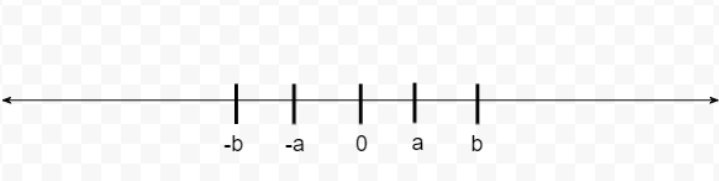
Question 7.

Using a number line, represent the numbers a, b, -a, and -b.

Answer:

Given

The numbers a, b, -a, and -b.

First, we have to make a number line representing a,b,−a,−b.

After that move on basis that has been described in Tips section.

Now we have to represent numbers a,b,−a,−b.

Big Ideas Math Integrated Math 1 Student Journal 1st Edition Chapter 2 Maintaining Mathematical Proficiency Page 27 Exercise 7 Problem 7 graph

As we know number present right-hand side of any number are greater then number presented left-hand side are smaller.

So here is a greater than b and −b is greater than −a.

−b is greater than−a.


Page 27  Exercise 8  Problem 8

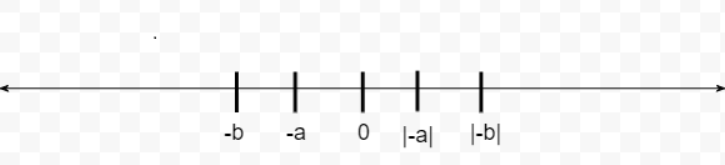
Question 8.

Using a number line, represent the numbers a, b, -a, and -b. Additionally, represent the absolute values |-a| and |-b|.

Answer:

Given

a, b, -a, and -b.

First, we have to make a number line.

After that represent a,b,∣−a∣,∣−b∣

Now we have to represent a,b,−a,−b on number line.

Big Ideas Math Integrated Math 1 Student Journal 1st Edition Chapter 2 Maintaining Mathematical Proficiency Page 27 Exercise 8 Problem 8 graph 1

So here − b < − a.

As we know any number in modulus treated as a positive number.

Big Ideas Math Integrated Math 1 Student Journal 1st Edition Chapter 2 Maintaining Mathematical Proficiency Page 27 Exercise 8 Problem 8 graph 2

So here by the number line representation ∣−b∣ is greater than ∣−a∣

The desired solution is ∣−b∣ is greater than ∣−a∣.


Solutions For Big Ideas Math Integrated Math 1 Chapter 2 Maintaining Mathematical Proficiency Exercises Page 28  Exercise 9  Problem 9

Question 9.

Determine the type of inequality and present it graphically.

Answer:

We first find the type of inequality.

In this question greater than equal to type inequality available.
Big Ideas Math Integrated Math 1 Student Journal 1st Edition Chapter 2 Maintaining Mathematical Proficiency Page 28 Exercise 9 Problem 9 graph 1


In the above diagram point is cover and goes to infinity so it is greater than equal to type inequality. or we can say x≥1

Big Ideas Math Integrated Math 1 Student Journal 1st Edition Chapter 2 Maintaining Mathematical Proficiency Page 28 Exercise 9 Problem 9 graph 2

The desired solution is x ≥ 1.


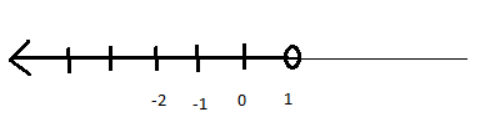
Page 28  Exercise 9  Problem 10

Question 10.

Determine the type of inequality and write the equation of the inequality based on the given graph.

Answer:

Big Ideas Math Integrated Math 1 Student Journal 1st Edition Chapter 2 Maintaining Mathematical Proficiency Page 28 Exercise 9 Problem 10 graph 1

First, we find the type of inequality.

Then write the equation of inequality.

Big Ideas Math Integrated Math 1 Student Journal 1st Edition Chapter 2 Maintaining Mathematical Proficiency Page 28 Exercise 9 Problem 10 graph 2

It is greater than type inequality in word  x > 1

 The Desired solution is x > 1 


Big Ideas Math Integrated Math 1 Student Journal Chapter 2 guide Page 28  Exercise 9  Problem 11

Question 11.

Determine the type of inequality and write the equation of the inequality based on the given graph.

Answer:

For the given graph.

The inequality equation is x ≤ 1

In words are x is less than or equal to 1

The inequality equation is x≤1, In words are “x is less than or equal to 1”


Page 28  Exercise 9  Problem 12

Question 12.

Determine the type of inequality and write the equation of the inequality based on the given graph.

Answer:

For the given graph.

The inequality equation is x<1

In words are x is less than 1

The inequality equation is x<1 , In words are “x is less than 1”


Page 29  Exercise 10  Problem 13

Question 13.

Describe how mathematical inequalities are used in everyday situations. Provide examples of situations where inequalities are applied and explain how they represent real-life constraints.

Answer:

Inequalities are used all the time in the world around us—we just have to know where to look.

Figuring out how to interpret the language of inequalities is an important step toward learning how to solve them in everyday contexts.

Think about the following situations.

Speed limits on the highway minimum payments on credit card bills the number of text messages you can send each month.

From your cell phone the amount of time it will take to get from home to school.

All of these can be represented as mathematical inequalities.

These situations on a day-to-day basis are confronted with mathematical inequalities but we may not notice them because they are so familiar.


Chapter 2 Maintaining Mathematical Proficiency Explained Big Ideas Math Integrated Math  Page 31  Exercise 11  Problem 14

Question 14.

Translate the following sentence into a mathematical inequality:

“Seven is less than or equal to the difference of a number q and 6.”

Answer:

The sentence as an inequality is.

Seven is less than or equal to the difference of a number q and 6.

Hence the equation as inequality is

⇒ 7 ≤ q−  6

Hence the equation as inequality is  7≤ q − 6


Page 31  Exercise 12  Problem 15

Question 15.

Translate the following sentence into a mathematical inequality:

“The sum of a number u and 14 is more than 6.”

Answer:

The sentence is an inequality.

The sum of a numbers u and 14 is more than 6.

Hence The equation inequality is

u + 14 > 6

The equation as inequality is  u + 14 > 6


Page 31  Exercise  13  Problem 16

Question 16.

Graph the linear inequality x ≥ 3.

Answer:

Given

x ≥ 3

To graph, a linear inequality in one variable (say, x or y ), first get variables alone on one side.

Then consider the related equation obtained by changing the inequality sign to an equality sign.

The graph of this equation is a line.

Here the equation is x ≥ 3

Then the graph is

Big Ideas Math Integrated Math 1 Student Journal 1st Edition Chapter 2 Maintaining Mathematical Proficiency Page 31 Exercise 13 Problem 16 graph 1

where dot represent the  x = 3

The graph of the equation is 

Big Ideas Math Integrated Math 1 Student Journal 1st Edition Chapter 2 Maintaining Mathematical Proficiency Page 31 Exercise 13 Problem 16 graph 2


Page 32  Exercise 14  Problem 17

Question 17.

Graph the linear inequality x > -1.

Answer:

Given

x > -1

To graph, a linear inequality in one variable (say, x or y ), first get variables alone on one side.

Then consider the related equation obtained by changing the inequality sign to an equality sign. The graph of this equation is a line.

Here the equation is x > −1

Then the graph is

Big Ideas Math Integrated Math 1 Student Journal 1st Edition Chapter 2 Maintaining Mathematical Proficiency Page 32 Exercise 14 Problem 17 graph 1

where circle represent x ≠ − 1

The graph of the equation is

Big Ideas Math Integrated Math 1 Student Journal 1st Edition Chapter 2 Maintaining Mathematical Proficiency Page 32 Exercise 14 Problem 17 graph 2


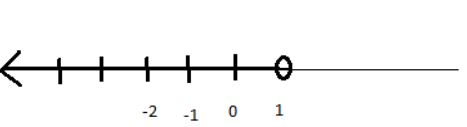
Page 32  Exercise 15  Problem 18

Question 18.

Graph the linear inequality x < 1 and describe the characteristics of the graph.

Answer:

Given

x < 1

Big Ideas Math Integrated Math 1 Student Journal 1st Edition Chapter 2 Maintaining Mathematical Proficiency Page 32 Exercise 15 Problem 18 graph 1
x<1 is made dark as shown in above graph

We write values below or above 1

we write whether 1 is included in graph

We write about circle on1

We write values included in graph

x<1 is made darker in the above graph.

We can see 0,−1,−2 below 1

1 is not included in graph,it is open.

Circle on 1 is not filled

We can see 0,−1,−2 that is lesser values included in graph

The graph for x<1 is as shown in graph

Where we see 1 is not included.

Values less than 1 are included in the graph
Big Ideas Math Integrated Math 1 Student Journal 1st Edition Chapter 2 Maintaining Mathematical Proficiency Page 32 Exercise 15 Problem 18 graph 2


Page 32 Exercise 16  Problem 19

Question 19.

Observe the given graph and determine the inequality it represents. Describe your observations and the steps to determine the inequality.

Answer:

We write observations looking at graph such as whether 1 is included or not.

We write about circle on 1

We then write about values included in the graph  are above or below 1

We arrive at decision whether we use less than or greater than or equal to sign

Then we write inequality as per our observation

we can see 1 is not included in the figure so it is open. Circle on 1 is not filled.

We see values above 1 like 2,3,….. etc.

This means inequality in the graph is x>1

1 is not included so it is open in the graph.

The graph shows values above 1.

Hence the inequality that represents the graph is x>1


Page 32  Exercise 17  Problem 20

Question 20.

Observe the given graph and determine the inequality it represents. Describe your observations and the steps to determine the inequality.

Answer:

We write observations looking at graph whether 0 is included or not.

We write about circles on 0.

We then write about values included in the graph  are above or below 0.

We arrive at decision of whether we use less than or greater than or equal to sign.

Then we write inequality as per our observation

We can see 0 is not included in the figure so it is open circle on 0 is not filled.

We see values below 0 like −1,−2,……etc.

This means inequality in the graph is x<0

0 is not included in the graph so it is open.

The graph shows values below 0.

Hence the inequality that represents the graph is x<0


Worked Examples For Big Ideas Math Integrated Math 1 Chapter 2 Maintaining Mathematical Proficiency Page 32  Exercise 18  Problem 21

Question 21.

Observe the given graph and determine the inequality it represents. Describe your observations and the steps to determine the inequality.

Answer:

We write observations looking at graph whether −3 is included or not.

We write about circle on −3.

We then write about values included in graph e are above or below −3.

We arrive at decision whether we use less than or greater than or equal to sign.

Then we write inequality as per our observation

−3 is included in the graph circle on −3 is filled so we use equal to sign in inequality of graph.

We see values above −3 like −1,−2,……. etc.

This means inequality in the graph is x≥−3

−3 is included in the graph.

The graph shows values above −3.

Hence the inequality that represents the graph is x ≥ −3


Page 32  Exercise 19  Problem 22

Question 22.

Observe the given graph and determine the inequality it represents. Describe your observations and the steps to determine the inequality.

Answer:

We write observations looking at graph whether 3 is included or not.

We write about circle on 3

We then write about values included in the graph  are above or below 3

We arrive at decision of whether we use less than or greater than or equal to sign.

Then we write inequality as per our observation

3 is included in the graph circle on 3 is filled so we use equal to sign in the inequality of graph.

We see values below 3 like 1,2,…. etc.

This means inequality in the graph is x≤3

3 is included in the graph.

The graph shows values below 3.

Hence the inequality that represents the graph is x ≤ 3.


Page 33  Exercise 20  Problem 23

Question 23.

Solve the following inequalities using addition and subtraction. Show all steps clearly.

  1. Solve inequality x – 3 < 5 using addition.
  2. Solve inequality x + 5 > 10 using subtraction.

Answer:

We write an example as solving  x−3 < 5 for addition.

We add 3 to each side of above inequality.

Thus adding 3 solves inequality.

Now we write an example as solving x+5>10 we subtract 5 from each side of inequality.

Thus subtracting 5 solves inequality.

Hence we use addition and subtraction to solve inequality

We solve inequality by using addition.

For example  x − 3 < 5.

We add 3 to each side of above inequality

x − 3 + 3 < 5 + 3

x < 8

We solve inequality using subtraction.

For example x + 5 > 10

Subtracting 5 from both sides of above inequality.

x + 5 − 5 > 10 − 5

x > 5

We add 5to both sides of  x − 3 < 5 Solving we get  x < 8 We subtract 5 from both sides of  x + 5 > 10 Solving we get  x > 5


Big Ideas Math Integrated Math 1 Chapter 2 Detailed Answers Page 34  Exercise 21  Problem 24

Question 24.

Given the passing efficiency formula: \(P=\frac{8.4 Y+100 C+330 T-200 N}{A}\)

Determine a set of values for A, C, Y, T, and N that make the inequality P < 0 true. Verify the solution by substituting the values into the formula and showing that the inequality holds.

Answer:

Given :   P<0

To find –  A passing record that makes the inequality true.

First of all we will assume the values of different variables.

Then we will check for these values so that the given inequality is satisfies.

Passing efficiency formula is  P=\(\frac{8.4 Y+100 C+330 T-200 N}{A}\)

Let’s consider

A = 240

C = 130

Y = 1200

T = 14 and

N = 150

⇒   P\( = \frac{8.4(1200)+100(130)+330(14)-200(150)}{240}\)

⇒  P = \(\frac{10080+13000+4620-30000}{240}\)

⇒  P =  \(\frac{27700-30000}{240}\)

⇒   P = \(\frac{−2300}{240}\)

⇒  P =  − 9. 58

⇒  P < 0

Let’s fill the table now.

Big Ideas Math Integrated Math 1 Student Journal 1st Edition Chapter 2 Maintaining Mathematical Proficiency Page 34 Exercise 21 Problem 24 Table

The final answer is that the passing record that makes the given inequality true is A = 240, C = 130, Y = 1200, T = 14, and  N = 150


Page 34  Exercise 21  Problem 25

Question 25.

Given the inequality:

P + 100 ≥ 250

and passing efficiency formula: \(P=\frac{8.4 Y+100 C+330 T-200 N}{A}\)

Determine a set of values for A, C, Y, T, and N that make the inequality true. Verify the solution by substituting the values into the formula and checking the inequality.

Answer:

Given:  P + 100 ≥ 250

To find – A passing record that makes the inequality true.

First of all we will assume the values of different variables.

Then we will check for this values so that the given inequality satisfies.

Passing efficiency formula is  P = \(\frac{8.4 Y+100 C+330 T-200 N}{A}\)

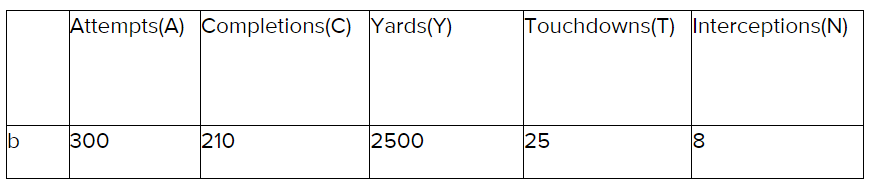
Let’s consider

A = 300

C = 210

Y = 2500

T = 25 and

N = 8.

⇒  P = \(\frac{8.4(2500)+100(210)+330(25)-200(8)}{300}\)

⇒  P = \(\frac{21000+21000+8250-1600}{300}\)

⇒  P = \(\frac{48650}{300}\)

⇒  P =  162.16

⇒ P + 100 = 262.16

⇒  P + 100 > or < 250.

Let’s fill the table now.

Big Ideas Math Integrated Math 1 Student Journal 1st Edition Chapter 2 Maintaining Mathematical Proficiency Page 34 Exercise 21 Problem 25 Table

The final answer is that the passing record that makes the given inequality true is  A = 300, C = 210, Y = 2500, T =25, and  N = 8.


Page 34  Exercise 21  Problem 26

Question 26.

Given the inequality:

P – 250 > -80

and passing efficiency formula: \(P=\frac{8.4 Y+100 C+330 T-200 N}{A}\)

Determine a set of values for A, C, Y, T, and N that make the inequality true. Verify the solution by substituting the values into the formula and checking the inequality.

Answer:

Given: P−250>−80

To find –   A passing record that makes the inequality true.

First of all we will assume the values of different variables.

Then we will check for these values so that the given inequality satisfies.

Passing efficiency formula is   P = \(\frac{8.4 Y+100 C+330 T-200 N}{A}\)

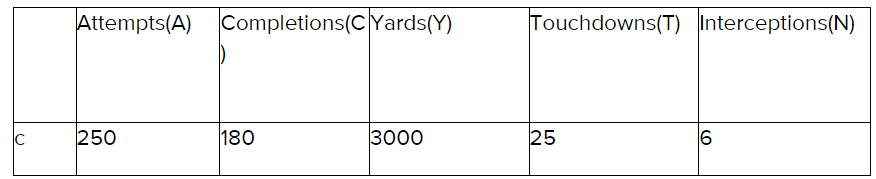
Let’s consider

A = 250

C = 180

Y = 3000

T = 25 and

N = 6.

⇒  P \(=\frac{8.4(3000)+100(180)+330(25)-200(6)}{250}\)

⇒  P = \(\frac{25200+18000+8250-1200}{250}\)

⇒  P =  \(\frac{50250}{250}\)

⇒  P =  201

⇒  P −  250 = 201 −  250

⇒  P  − 250 = − 49

⇒  P − 25 0 > − 80

Let’s fill the table now.

Big Ideas Math Integrated Math 1 Student Journal 1st Edition Chapter 2 Maintaining Mathematical Proficiency Page 34 Exercise 21 Problem 26 Table

The final answer is that the passing record that makes the given inequality true is A = 250, C = 180, Y = 3000, T = 25, and N =6.


Page 34  Exercise 22  Problem 27

Question 27.

Explain how to use addition and subtraction to solve inequalities. Provide examples to illustrate each method.

Answer:

Let’s first understand the use of addition to solve an inequality by taking an example.

If x − 2 ≤ 5 is an inequality.

Adding 2  to both sides, we get

x − 2 + 2 ≤ 5 + 2

⇒ x ≤ 7

which is the solution of the given inequality.

We will now understand the use of subtraction to solve an inequality by taking an example.

If x + 7 > 5 is an inequality.

Subtracting 7 from both sides, we get

x + 7 − 7 > 5 − 7

⇒  x> − 2

which is the solution of the given inequality.

The final answer is that we can use addition or subtraction such that only the variable term remains on either side of the inequality and then it will be easy to solve an inequality.


Page 36  Exercise 23  Problem 28

Question 28.

Given the inequality -3 > -3 + h:

  1. Solve the inequality by adding 3 to both sides and simplify.
  2. Represent the solution on a number line.

Answer:

Given: Inequality is − 3 > − 3 + h.

Add 3 on both side of the inequality and simplify it.

Now represent the inequality on a number line.

We have

− 3 > − 3 + h

⇒  − 3 + 3 > − 3 + h + 3 (Adding3 both side)

⇒  0 > h

⇒  h < 0

Representing the inequality on a number line.

Big Ideas Math Integrated Math 1 Student Journal 1st Edition Chapter 2 Maintaining Mathematical Proficiency Page 36 Exercise 23 Problem 28 graph 1

The solution of the inequality −3 > − 3 + h is h<0 and its representation on number line is given below.

Big Ideas Math Integrated Math 1 Student Journal 1st Edition Chapter 2 Maintaining Mathematical Proficiency Page 36 Exercise 23 Problem 28 graph 2


Page 37   Exercise 24  Problem 29

Question 29.

Given the inequality s-(-1)≥2:

  1. Simplify the inequality.
  2. Subtract 1 from both sides of the inequality and simplify further.
  3. Represent the solution on a number line.

Answer:

Given:  Inequality is−(−1)≥2.

Simplify it and then subtract 1.

On both side of an inequality.

Now represent the inequality on a number line.

We have

s − (−1) ≥ 2

⇒  s + 1 ≥ 2

⇒  s + 1− 1 ≥ 2 − 1 (Subtracting 1 on both side)

⇒  s ≥1

Representing the inequality on a number line.
Big Ideas Math Integrated Math 1 Student Journal 1st Edition Chapter 2 Maintaining Mathematical Proficiency Page 37 Exercise 24 Problem 29 graph 1

The solution of the inequality −(−1) ≥ 2 is s ≥ 1 and its representation on the number line is given below.

Big Ideas Math Integrated Math 1 Student Journal 1st Edition Chapter 2 Maintaining Mathematical Proficiency Page 37 Exercise 24 Problem 29 graph 2


Page 37  Exercise 25  Problem 30

Question 30.

Given the inequality 6 – 9 + u < -2:

  1. Simplify the inequality.
  2. Add 3 to both sides of the inequality and simplify further.
  3. Represent the solution on a number line.

Answer:

Given: Inequality is6−9+u<−2.

Simplify it and then add 3 both side of an inequality.Now represent the inequality on number line.

We have

6 − 9 + u < − 2

⇒ −3 + u < − 2

⇒ −3 + u + 3 <− 2 + 3 (Adding 3 both side)

⇒ u < 1

Representing the inequality on a number line.

Big Ideas Math Integrated Math 1 Student Journal 1st Edition Chapter 2 Maintaining Mathematical Proficiency Page 37 Exercise 25 Problem 30 graph 1

The solution of the inequality  6−9 + u <− 2 is u < 1 and its representation on number line is given below.
Big Ideas Math Integrated Math 1 Student Journal 1st Edition Chapter 2 Maintaining Mathematical Proficiency Page 37 Exercise 25 Problem 30 graph 2


Page 38  Exercise 26  Problem 31

Question 31.

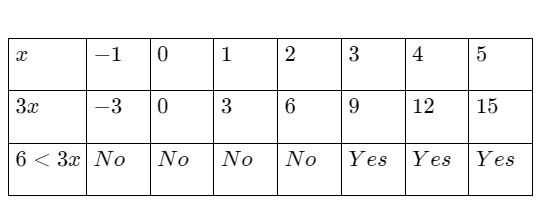
Complete the table and determine whether the inequality 6<3x is true or false for each given value of x. Then, solve the inequality by dividing both sides by 3 and choose the correct solution from the given graph.

Answer:

Complete the table and decide whether the inequality  6 < 3x is true or false for each case.

Divide by 3 on both sides of the inequality 6 < 3x and find the solution.

Now choose the correct solution from the given graph.

Big Ideas Math Integrated Math 1 Student Journal 1st Edition Chapter 2 Maintaining Mathematical Proficiency Page 38 Exercise 26 Problem 31 Table

We have

6 < 3x

⇒  \(\frac{6}{3}\) < \(\frac{3x}{3}\)

⇒  2 < x

⇒   x >  2

The correct solution from the given graph is

Big Ideas Math Integrated Math 1 Student Journal 1st Edition Chapter 2 Maintaining Mathematical Proficiency Page 38 Exercise 26 Problem 31 graph 1

The solution of the inequality is x >2 and its representation on number line is given below.
Big Ideas Math Integrated Math 1 Student Journal 1st Edition Chapter 2 Maintaining Mathematical Proficiency Page 38 Exercise 26 Problem 31 graph 2


Page 38  Exercise 27  Problem 32

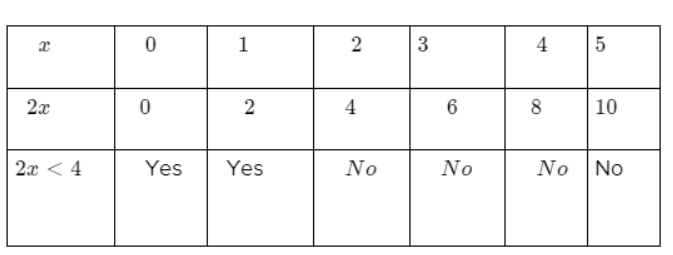
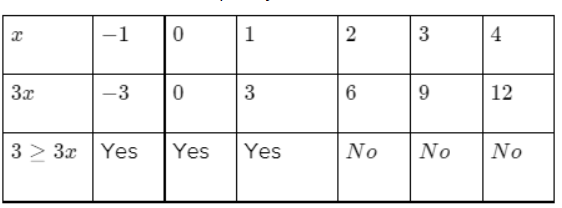
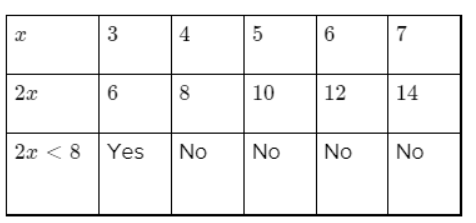
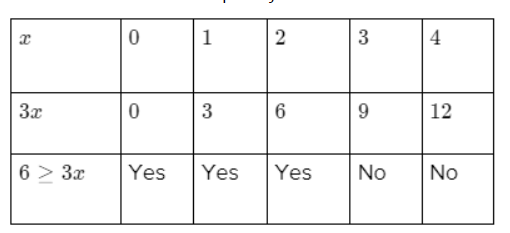
Question 32.

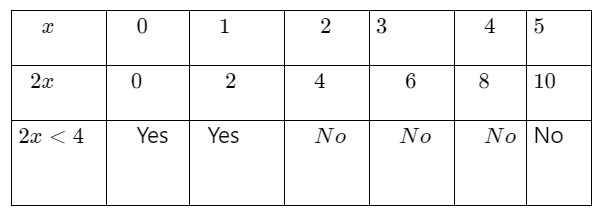
Complete the table and analyze it to find the solution for each of the given inequalities. Then, write the solution for each inequality and represent it on a number line.

Answer:

Given: 

Inequalities are:

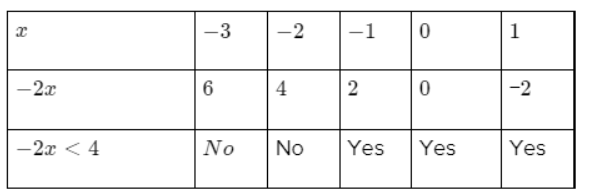
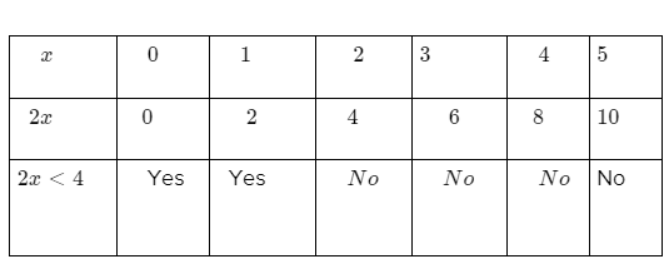
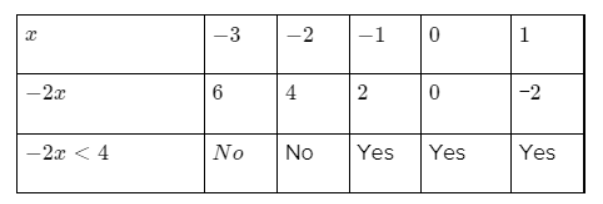
⇒ 1.2  x < 4

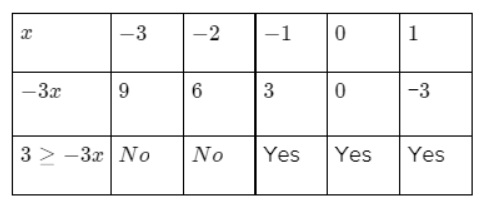
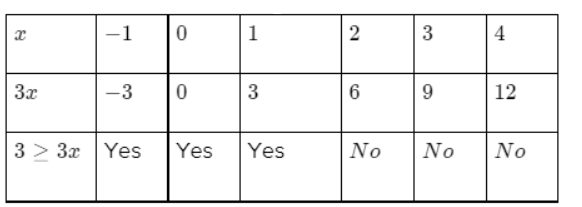
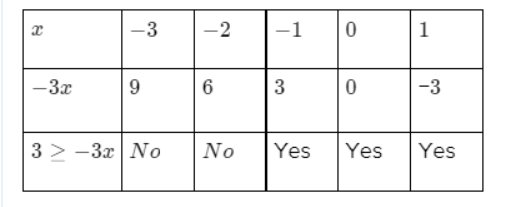
⇒  2.3 ≥ 3x

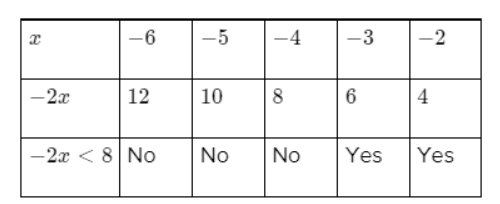
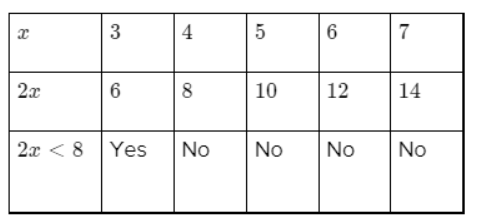
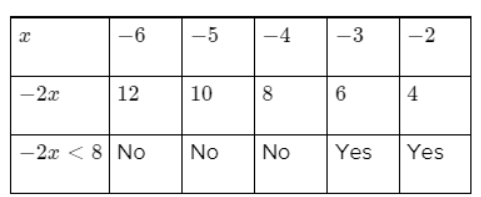
⇒  3.2x < 8

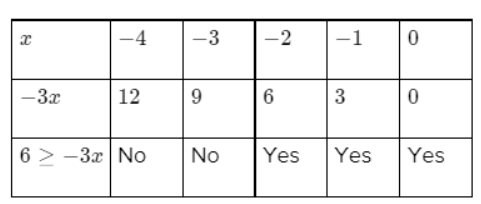
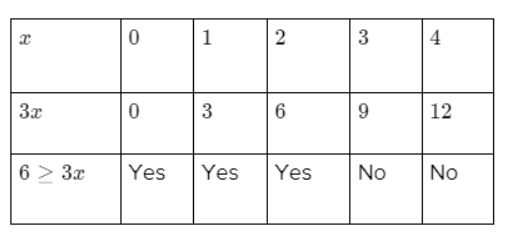
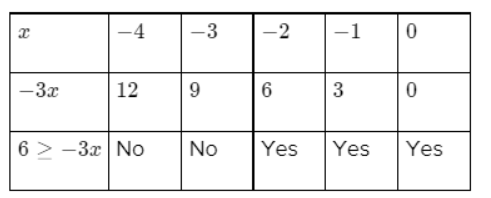
⇒  4.6 ≥ 3x

Complete the table and analyze it to find the solution of given inequality.

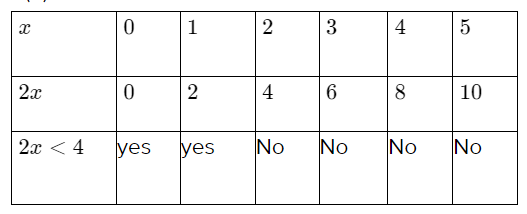
We have 2 x < 4

Big Ideas Math Integrated Math 1 Student Journal 1st Edition Chapter 2 Maintaining Mathematical Proficiency Page 38 Exercise 27 Problem 32 Table 1

Therefore the solution is x < 2

The rule is divide the coefficient of x both sides of the equality.

Therefore the solution is x < 2

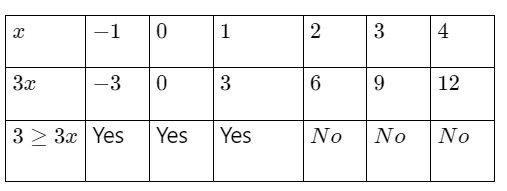
We have 3 ≥ 3x

Big Ideas Math Integrated Math 1 Student Journal 1st Edition Chapter 2 Maintaining Mathematical Proficiency Page 38 Exercise 27 Problem 32 Table 2

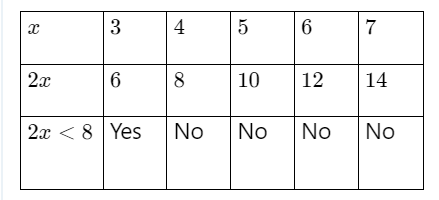
We have 2 x < 8

Big Ideas Math Integrated Math 1 Student Journal 1st Edition Chapter 2 Maintaining Mathematical Proficiency Page 38 Exercise 27 Problem 32 Table 3

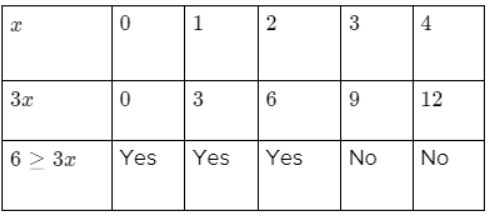
We have
Big Ideas Math Integrated Math 1 Student Journal 1st Edition Chapter 2 Maintaining Mathematical Proficiency Page 38 Exercise 27 Problem 32 Table 4

All are represented in tables.


Page 39  Exercise 28   Problem 33

Question 33.

  1. Consider the effects of dividing both sides of an inequality by positive and negative numbers.
  2. Given the inequality 3<4, divide both 2 and determine whether the inequality sign changes or remains the same.
  3. Given the inequality 3<4, divide both sides by -2 and determine whether the inequality sign changes or remains the same.
  4. Explain the rules for dividing inequalities by positive and negative numbers.

Answer:

Lets consider the inequality.

3 < 4

⇒   \(\frac{3}{2}\)<\(\frac{4}{2}\) (Dividing both side by 2)

⇒  1.5<2 (Sign of inequality remains same)

Again consider the inequality.

3 < 4

⇒  \(\frac{3}{−2}\)<\(\frac{4}{−2}\)

(Dividing both side by−2)

⇒  −1.5 > −2 (Sign of inequality changes)

If we divide by a positive number on both sides of inequality the sign of inequality remains the same.

If we divide by a negative number on both side of inequality the sign of inequality changes.


Page 39  Exercise 30   Problem 35

Question 35.

Solve the inequality 7x < -21 using the rule for dividing both sides of the inequality by the coefficient of the variable. Then represent the solution on a number line.

Answer:

Given

7x < -21

We have to solve each inequality 7x < − 21

From  Page 38  Exercise 27  Problem 32,  Tables  we get- Part 1  a rule that is 

To find the solution of the inequality we have to divide both sides of the inequality by the coefficient of the variable.

From  Page 38  Exercise 27  Problem 32, Tables we get – Part 1

Big Ideas Math Integrated Math 1 Student Journal 1st Edition Chapter 2 Maintaining Mathematical Proficiency Page 39 Exercise 30 Problem 35 Table 1

The solution of the inequality is x < 2

Big Ideas Math Integrated Math 1 Student Journal 1st Edition Chapter 2 Maintaining Mathematical Proficiency Page 39 Exercise 30 Problem 35 Table 2

The solution of the inequality is 1 ≥ x

Big Ideas Math Integrated Math 1 Student Journal 1st Edition Chapter 2 Maintaining Mathematical Proficiency Page 39 Exercise 30 Problem 35 Table 3

The solution of the inequality is  x < 4

Big Ideas Math Integrated Math 1 Student Journal 1st Edition Chapter 2 Maintaining Mathematical Proficiency Page 39 Exercise 30 Problem 35 Table 4

The solution of the inequality is  2 ≥ x

The rule is to divide both sides of the inequality by the coefficient of x.

Given, 7x < − 21 divided by 7 on both sides of an inequality.

x<− \(\frac{21}{7}\)

x < − 3

Big Ideas Math Integrated Math 1 Student Journal 1st Edition Chapter 2 Maintaining Mathematical Proficiency Page 39 Exercise 30 Problem 35 graph 1

The solution is x < − 3

Big Ideas Math Integrated Math 1 Student Journal 1st Edition Chapter 2 Maintaining Mathematical Proficiency Page 39 Exercise 30 Problem 35 graph 2


Page 39  Exercise 30   Problem 36

Question 36.

Solve the inequality 12 ≤ 4x using the rule for dividing both sides by the coefficient of the variable. Then represent the solution on a number line.

Answer:

We have to solve each inequality 12 ≤ 4x

From   Page 38  Exercise 27  Problem 32,  Tables we get Part 1 a rule to find the solution of the inequality.

The rule is to get the solution of the inequality we have to divide both sides of the equality by the coefficient of the variable.

If the coefficient of x is negative then the inequality sign will be inverted.

Here the coefficient of x is 4.

From  Page 38  Exercise 27  Problem 32, Tables we get – Part  1

Big Ideas Math Integrated Math 1 Student Journal 1st Edition Chapter 2 Maintaining Mathematical Proficiency Page 39 Exercise 30 Problem 36 Table 1

The solution of the inequality is  x < 2

Big Ideas Math Integrated Math 1 Student Journal 1st Edition Chapter 2 Maintaining Mathematical Proficiency Page 39 Exercise 30 Problem 36 Table 2

The solution of the inequality is 1 ≥ x

Big Ideas Math Integrated Math 1 Student Journal 1st Edition Chapter 2 Maintaining Mathematical Proficiency Page 39 Exercise 30 Problem 36 Table 3

The solution of the inequality is  x < 4

Big Ideas Math Integrated Math 1 Student Journal 1st Edition Chapter 2 Maintaining Mathematical Proficiency Page 39 Exercise 30 Problem 36 Table 4

From  Page 38  Exercise 27  Problem 32,   Tables we get  – Part 2

The solution of the inequality is x ≤ 2

Big Ideas Math Integrated Math 1 Student Journal 1st Edition Chapter 2 Maintaining Mathematical Proficiency Page 39 Exercise 30 Problem 36 Table 5

The solution of the inequality is x >− 2

Big Ideas Math Integrated Math 1 Student Journal 1st Edition Chapter 2 Maintaining Mathematical Proficiency Page 39 Exercise 30 Problem 36 Table 6

The solution of the inequality is −1 ≤ x

Big Ideas Math Integrated Math 1 Student Journal 1st Edition Chapter 2 Maintaining Mathematical Proficiency Page 39 Exercise 30 Problem 36 Table 7

The solution of the inequality is x > − 4

Big Ideas Math Integrated Math 1 Student Journal 1st Edition Chapter 2 Maintaining Mathematical Proficiency Page 39 Exercise 30 Problem 36 Table 8

The solution of the inequality is x ≥ − 2

We conclude that:

The rules of solution a inequality are

Divide the both sides by the coefficient of x

If the coefficient of x is a negative number then invert the inequality sign

Given,12 ≤ 4x

4x ≥ 12

Divide by 4 on both sides of an inequality.

x  ≥ \(\frac{12}{4}\)

x ≥ 3

Big Ideas Math Integrated Math 1 Student Journal 1st Edition Chapter 2 Maintaining Mathematical Proficiency Page 39 Exercise 30 Problem 36 graph 1

Big Ideas Math Integrated Math 1 Student Journal 1st Edition Chapter 2 Maintaining Mathematical Proficiency Page 39 Exercise 30 Problem 36 graph 2

The solution is x ≥ 3


Big Ideas Math Integrated Math 1 Student Journal Chapter 2 Maintaining Proficiency Answers Page 39  Exercise 30  Problem 37

Question 37.

Solve the inequality 10 < -5x using the division rule of inequality. Show all steps clearly.

Answer:

We are given an inequality 10 <−5x.

We need to use the division rule of inequality to solve it.

We are going to apply the division rule of inequality on given inequality.

And then solve it until we get the variable on one side and the number on the other.

10<−5x

⇔  \(\frac{10}{−5}\)>\(\frac{−5x}{−5}\)

(∵if x<y and z<0 then \(\frac{x}{z}\) >\(\frac{y}{z}\))

⇔ − 2 > x

By using the division rule of inequality for 10<−5x, we get −2 > x.


Page 39  Exercise 30   Problem 38

Question 38.

Solve the inequality -3 x ≤ 0 using the division rule of inequality. Show all steps clearly and represent the solution on a number line.

Answer:

We are given an inequality −3 x ≤ 0

We need to use the division rule of inequality to solve it.

We are going to apply the division rule of inequality on given inequality.

And then solve it until we get the variable on one side and the number on the other.

From   we get  Page 38  Exercise 27  Problem 32  (Part 1  and  Part 2)

Big Ideas Math Integrated Math 1 Student Journal 1st Edition Chapter 2 Maintaining Mathematical Proficiency Page 39 Exercise 30 Problem 38 Table 1

The solution of the inequality is  x < 2

Big Ideas Math Integrated Math 1 Student Journal 1st Edition Chapter 2 Maintaining Mathematical Proficiency Page 39 Exercise 30 Problem 38 Table 2

The solution of the inequality is  x ≤ 1

Big Ideas Math Integrated Math 1 Student Journal 1st Edition Chapter 2 Maintaining Mathematical Proficiency Page 39 Exercise 30 Problem 38 Table 3

The solution of the inequality  is  x < 4

Big Ideas Math Integrated Math 1 Student Journal 1st Edition Chapter 2 Maintaining Mathematical Proficiency Page 39 Exercise 30 Problem 36 Table 4

The solution of the inequality is  x ≥ − 2

Big Ideas Math Integrated Math 1 Student Journal 1st Edition Chapter 2 Maintaining Mathematical Proficiency Page 39 Exercise 30 Problem 38 Table 5

The solution of the inequality is  x > − 2

Big Ideas Math Integrated Math 1 Student Journal 1st Edition Chapter 2 Maintaining Mathematical Proficiency Page 39 Exercise 30 Problem 38 Table 6

The solution of the inequality is x ≥ − 1

Big Ideas Math Integrated Math 1 Student Journal 1st Edition Chapter 2 Maintaining Mathematical Proficiency Page 39 Exercise 30 Problem 38 Table 7

The solution of the inequality is  x > − 4

Big Ideas Math Integrated Math 1 Student Journal 1st Edition Chapter 2 Maintaining Mathematical Proficiency Page 39 Exercise 30 Problem 38 Table 8

The solution of the inequality is  x ≥ − 2

The rules are:

Divide both sides of the inequality by the coefficient of x.

If the coefficient of x is a negative number then invert the inequality sign.

Find the interval of inequality using division rule

−3x < 0

⇔  \(\frac{−3x}{−3}\) > \(\frac{0}{−3}\)

(∵if x<y and z<0 then \(\frac{x}{z}\) >\(\frac{y}{z}\))

⇔  x  >  0
Big Ideas Math Integrated Math 1 Student Journal 1st Edition Chapter 2 Maintaining Mathematical Proficiency Page 39 Exercise 30 Problem 38 graph 1


By using the division rule of inequality for −3x ≤ 0  we get x  ≥ 0.

Big Ideas Math Integrated Math 1 Student Journal 1st Edition Chapter 2 Maintaining Mathematical Proficiency Page 39 Exercise 30 Problem 38 graph 2


Page 41  Exercise 31  Problem 39

Question 39.

Solve the inequality -67 ≤ 37f using the multiplication property of inequality. Then, represent the solution on a number line.

Answer:

We are given an inequality \(\frac{−6}{7}\) ≤ \(\frac{3}{7}\) f

We have to solve it and graph the solution.

We will do this by using the multiplication property of inequality.

To obtain the required solution, we will solve till we get the variable on one side and numbers on another side.

Finally, we will represent this solution on a number line.

On the number line, fill in the circle for (≤or≥) and leave the circle unfilled for (<or>).

\(\frac{−6}{7}\)≤\(\frac{3}{7}\) f

⇔  \(\frac{−6}{7}\) ×\(\frac{7}{3}\)

(∵If x≤y, and z>0,then xz≤yz)

⇔  \(\frac{3}{7}\)f×\(\frac{7}{3}\)

⇔  2 ≤ f

For inequality \(\frac{−6}{7}\)≤\(\frac{3}{7}\) f

Interval notation of solution:  (−2,∞)

The representation of solution on the number line:
Big Ideas Math Integrated Math 1 Student Journal 1st Edition Chapter 2 Maintaining Mathematical Proficiency Page 41 Exercise 31 Problem 39 graph 1

The required solution to the inequality\(\frac{−6}{7}\)≤\(\frac{3}{7}\) f is −2 ≤ f . Graph of solution

Big Ideas Math Integrated Math 1 Student Journal 1st Edition Chapter 2 Maintaining Mathematical Proficiency Page 41 Exercise 31 Problem 39 graph 2


Page 41  Exercise 32  Problem 40

Question 40.

Solve the inequality -4m ≥ -16 using the division property of inequality. Then, represent the solution on a number line.

Answer:

We are given an inequality −4m≥−16

We have to solve it and graph the solution.

We will do this by using the division property of inequality.

To obtain the required solution, we will solve till we get the variable on one side and number on another side.

Finally, we will represent the solution on a number line.

On the number line, fill in the circle for (≤or≥) and leave the circle unfilled for (<or>)

−4m ≥−16

⇔  \(\frac{−4m}{4}\) ≤ \(\frac{−16}{−4}\)

(∵If x≥y and z<0, then  \(\frac{x}{z}\) ≤ \(\frac{y}{z}\))

⇔  m≤4

For inequality −4m≥−16

Interval notation of solution: (−∞,4)

The representation of solution on the number line:

Big Ideas Math Integrated Math 1 Student Journal 1st Edition Chapter 2 Maintaining Mathematical Proficiency Page 41 Exercise 32 Problem 40 graph 1

The required solution to inequality −4m≥−16 is m≤4. Graph of solution

Big Ideas Math Integrated Math 1 Student Journal 1st Edition Chapter 2 Maintaining Mathematical Proficiency Page 41 Exercise 32 Problem 40 graph 2


Page 42  Exercise 33  Problem 41

Question 41.

Solve the inequality \(1 \leq-\frac{1}{4} y\) using the multiplication property of inequality. Then, represent the solution on a number line.

Answer:

We are given an inequality 1≤−\(\frac{−1}{4}\) y

We have to solve it and graph the solution.

We will do this by using the multiplication property of inequality.

To obtain the required solution, we will solve till we get the variable on one side and number on another side.

Finally, we will represent the solution on a number line.

On the number line, fill in the circle for (≤or≥)and leave the circle unfilled for (<or>).

1≤−\(\frac{−1}{4}\) y

⇔ 1×−4≥−\(\frac{−1}{4}\) y × −4

(∵ If x≤y and z<0, then xz≥yz)

⇔ −4 ≥ y

For inequality   1≤−\(\frac{−1}{4}\) y

Interval notation of solution: (−∞,−4)

The representation of solution on the number line:

Big Ideas Math Integrated Math 1 Student Journal 1st Edition Chapter 2 Maintaining Mathematical Proficiency Page 42 Exercise 33 Problem 41 graph 1

The required solution to inequality 1≤−\(\frac{−1}{4}\) y  is −4 ≥ y. Graph of solution

Big Ideas Math Integrated Math 1 Student Journal 1st Edition Chapter 2 Maintaining Mathematical Proficiency Page 42 Exercise 33 Problem 41 graph 2


Page 42  Exercise 34  Problem 42

Question 42.

Solve the inequality \(-\frac{2}{3}<-4 x\) using the division property and the multiplication property of inequality. Then, represent the solution on a number line.

Answer:

We are given an inequality \(\frac{−2}{3}\)<− 4x

We have to solve it and graph the solution.

We will do this by using the division property and the multiplication property of inequality.

To obtain the required solution, we will solve until we get the variable on one side and the number on another side.

Finally, we will represent this solution on a number line.On the number line, fill in the circle for (≤or≥) and leave the circle unfilled for (<or>).

−\(\frac{−2}{3}\) <−4x

⇔ −\(\frac{−2}{3}\)<−4x × 3<−4x × 3

(∵ If x<y and z>0,then xz<yz)

⇔ −2<−12x

⇔ −\(\frac{−2}{12}\) > \(\frac{−12}{−12}\) x

(∵ If x < y and z<0, then \(\frac{x}{z}\)>\(\frac{y}{z}\))

⇔ \(\frac{1}{6}\)> x

For inequality \(\frac{−2}{3}\) <−4x

Interval notation of solution: (−∞,\(\frac{1}{6}\))

The representation of solution on the number line:

Big Ideas Math Integrated Math 1 Student Journal 1st Edition Chapter 2 Maintaining Mathematical Proficiency Page 42 Exercise 34 Problem 42 graph 1

The required solution to inequality  <−4x is \(\frac{−2}{3}\) \(\frac{1}{6}\) >x. Graph of solution:

Big Ideas Math Integrated Math 1 Student Journal 1st Edition Chapter 2 Maintaining Mathematical Proficiency Page 42 Exercise 34 Problem 42 graph 2

Big Ideas Math Integrated Math 1 Student Journal Solutions Chapter 1 Maintaining Mathematical Proficiency Exercise

Big Ideas Math Integrated Math  Chapter 1 Maintaining Mathematical Proficiency

Big Ideas Math Integrated Math 1 Student Journal Chapter 1 Solutions Page 1  Exercise 1 Problem 1

Question:

Simplify the following expression step-by-step:

1+(3)

Solution

Given

In this question {−1 + (−3)} first, we have to multiply the sign appears before the number.

If any question don’t have any sign before the number then by default it is a positive sign (+).

After that we do the addition or subtraction.

Read and Learn More Big Ideas Math Integrated Math 1 Student Journal Solutions

Multiply the sign presented before the no.

−1 + (−3)

We know that

(+) × (−)=(−)

So here after the multiplication

− 1 − 3

Here we do that addition or subtraction operation.

− 1 − 3 = −4

The desired solution is −1 + (−3) = −4.


Chapter 1 Maintaining Mathematical Proficiency Solutions Big Ideas Math Integrated Math 1 Page 1  Exercise 2  Problem 2

Question: Simplify the following expression step-by-step:


47

Answer:

Given expression is −4−7

If any question doesn’t have any sign before the number then by default it is positive sign.

After that, we do addition or subtraction.

We have to do subtraction operation

− 4 − 7 = −11

The desired solution is −4 − 7 = 11


Chapter 1 Maintaining Mathematical Proficiency Solutions Big Ideas Math Integrated Math 1 Page 1  Exercise 3  Problem 3

Question: Find two pairs of integer numbers whose sum is

6

.

Big Ideas Math Integrated Math 1 Student Journal Chapter 1 Maintaining Mathematical Proficiency Exercise

Question:

The record monthly high temperature for March is 56°F, and the record monthly low temperature for March is -4°F.

Using the formula for the range of a parameter, calculate the range of temperatures for the month of March.

Big Ideas Math Integrated Math 1 Chapter 1 Step-By-Step Solutions Page 1  Exercise 4  Problem 4

Given

The record monthly high temperature for March is 56°F.

The record monthly low temperature for March is −4°F.

Now use the formula for range of a parameter.

Range of a parameter

= Highest value of the parameter − The lowest value of parameter

=  56°F − (−4°)F

=  56°F + 4°F

=  60°F

The range of temperatures for the month of March is 60°F.


Big Ideas Math Integrated Math 1 Chapter 1 Step-By-Step Solutions Page 1 Exercise 5  Problem 5

Determine the algebraic sign of the product of the given numbers and find the final value.

Given:


8×(5)

Determine the algebraic sign of the given numbers.

Here 8 has a negative algebraic sign and 5 also has a negative algebraic sign.

Determine the algebraic sign of the final answer.

In this case it is a positive sign.

Simply multiply the given numbers and write the final answer with appropriate sign.

We have

⇒ − 8 ×  (−5)

= −8 × (−5)

= 40

The value of −8 × (−5) is 40.


Solutions For Big Ideas Math Integrated Math 1 Chapter 1 Maintaining Mathematical Proficiency Exercises Page 1  Exercise 6  Problem 6

Question:

Write

142

  as

1 2

and determine the algebraic sign of the given numbers.

Write  \(\frac{14}{2}\)  as  \(\frac{1}{2}\) × 14

Determine the algebraic sign of the given numbers.

Here \(\frac{1}{2}\) has a positive algebraic sign and 14 also has a positive algebraic sign.

Determine the algebraic sign of the final answer.

In this case it is a positive sign.

Simply multiply the given numbers and write the final answer with appropriate sign.

We have

⇒  \(\frac{14}{2}\)

=  \(\frac{1}{2}\) × 14

= \(\frac{1}{2}\) × (2 × 7)

Cancel out of 2

= 7

The value of \(\frac{14}{2}\) is 7


Big Ideas Math Integrated Math 1 Student Journal Chapter 1 Guide Page 1  Exercise 7  Problem 7

Question: Simplify the following expression and determine the algebraic sign of the final answer:


303

303

Write −30/(−3) = \(\frac{−30}{−3}\)

Now \(\frac{−30}{−3}\)

= \(\frac{1}{−3}\) × (−30)

Determine the algebraic sign of the given numbers.

Here 1 has a negative algebraic sign and 30 also has a negative algebraic sign.

Determine the algebraic sign of the final answer.

In this case it is a positive sign.

Simply multiply the given numbers and write the final answer with appropriate sign.

We have

−30/(−3)

= \(\frac{−30}{−3}\)

= \(\frac{1}{−3}\) × (−30)

= \(\frac{1}{3}\) × 3 × 10

= 10

The value of −30/(−3) is 10.


Big Ideas Math Integrated Math 1 Student Journal Chapter 1 guide Page 1  Exercise 8  Problem 8


Question:

Find two pairs of integers whose product is -20 by factorizing the number

-20


Answer:

Given number

-20

To find the integers whose product is -20 can be found by factorizing number −20

Factors of number -20 are given as

−20  = −(2 × 2 × 5)

Therefore two pairs of integers are

−(4 × 5)​ = −20

−(2 × 10)  = −20

Two pair of integers are : −(4×5) and −(2×5)


Page 1  Exercise 9  Problem 9

Question:

A football team loses 3 yards in 3 consecutive games.

Calculate the total yardage gained by negating the magnitude of the total yardage loss.

Answer:

Given that a football team loses 3 yards in 3 consecutive game.

We have to find total yardage gained by negating the magnitude of total yardage loss.

Here a football team losses 3 yards in 3 consecutive game.

Total yardage loss therefore total yardage gained = − (Total yardage loss)

= −(9)

The total yardage gained is − 9.


Page 2  Exercise 10  Problem 10

Question:

Explain how simple linear equations can be used to solve real-life problems. Provide specific examples.

Uses of simple equations to solve real-life problems

There are various real-life situations where unknown quantity can be expressed as linear equation.

Some are given as below-

To compare ages of two persons and find their ages.

To find the runs scored by a batsman.

Number of trees planted by an organization.

Cost of travelling in a taxi from place A to place B.

Cost of buying mangoes from a market.

To find profit/loss of a shop.

The final answer is that some of the real-life problem that can be solved using simple equations are:

To compare ages of two persons and find their ages

To find the runs scored by a batsman.

Number of trees planted by an organization.

Cost of travelling in a taxi from place A to place B.

Cost of buying mangoes from a market.

To find profit/loss of a shop.


Chapter 1 Maintaining Mathematical Proficiency explained Big Ideas Math Integrated Math 1 Page 2   Exercise 11   Problem 11

Question:

Measure all the four angles of a given quadrilateral using a protractor and check the precision of your measurements.

For a given quadrilateral have 4 sides and 4 angles denoted as ∠A, ∠B, ∠C, ∠D

We have to measure all the four angles using protractor and check how precise our measurement.

By using a protractor measuring the angle of the quadrilateral given below:

m∠A = 100 degrees

m ∠ B = 91 degrees

m∠C = 92 degrees

m∠D = 67 degrees

m∠A + m∠B + m∠C + m∠D = 100 + 91 + 92 + 67

=  360 degrees

Measurement of angles of given quadrilateral:

​m∠A = 100 degree

m∠B = 91 degree

m∠C = 92 degree

m∠D = 67 degree

m∠A + m∠B + m∠C + m∠D = 360degrees


Free Big Ideas Math Integrated Math 1 Chapter 1 Solutions Maintaining Mathematical Proficiency Page 2  Exercise 11 Problem 12

Question:

Measure all four angles of a given quadrilateral using a protractor and verify the precision of your measurements.

Answer:

For a given quadrilateral have 4 sides and 4 angles denoted as ∠A, ∠B, ∠C, ∠D

We have to measure all the four angle using protractor and check how precise our measurement.

By using protractor measure the angle of the quadrilateral given below:

m∠A = 67 degree

m∠B = 147 degree

m∠C = 56 degree

m∠D = 90 degree

m∠A + m∠B + m∠C + m∠D = 67 + 147 + 56 + 90 = 360 degree

Measurement of angles of given quadrilateral:

​m∠A = 67 degree

m∠B = 147 degree

m∠C = 56 degree

m∠D = 90 degree

m∠A + m∠B + m∠C + m∠D = 67 + 147 + 56 + 90 = 360 degree


Page 2  Exercise 11  Problem 13

Question:

Measure all four angles of a given quadrilateral using a protractor and verify the precision of your measurements.

For a given quadrilateral have 4 sides and 4 angles denoted as ∠A, ∠B, ∠C, ∠D

We have to measure all the four angles using protractor and check how precise our measurement.

By using a protractor measuring the angle of quadrilateral given below:

​m∠A  =  94 degrees

m∠B  =  79 degrees

m∠C  =  72 degrees

m∠ D  = 115 degrees

m∠A + m∠B + m∠C + m∠D =  94  + 79 + 72 + 115 = 360 degrees

Measurement of angles of given quadrilateral:

​m∠A  =  94 degrees

m∠B  =  79 degrees

m∠C  =  72 degrees

m∠ D  = 115 degrees

m∠A + m∠B + m∠C + m∠D =  94  + 79 + 72 + 115 = 360 degrees


Worked Examples For Big Ideas Math Integrated Math 1 Chapter 1 Maintaining Mathematical Proficiency Page 2  Exercise 12  Problem 14

For a given quadrilateral have 4 sides and 4 angles denoted as ∠A,∠B,∠C,∠D

We have to measure all four angles using a protractor and check how precise our measurement.

By using a protractor measure of the angles of the quadrilaterals are given below:

Big Ideas Math Integrated Math 1 Student Journal 1st Edition Chapter 1 Maintaining Mathematical Proficiency Page 2 Exercise 12 Problem 14 Table 1

Making the three different quadrilaterals.

1)
Big Ideas Math Integrated Math 1 Student Journal 1st Edition Chapter 1 Maintaining Mathematical Proficiency Page 2 Exercise 12 Problem 14 Quadrilaterals 1

2)

Big Ideas Math Integrated Math 1 Student Journal 1st Edition Chapter 1 Maintaining Mathematical Proficiency Page 2 Exercise 12 Problem 14 Quadrilaterals 2


3)

Big Ideas Math Integrated Math 1 Student Journal 1st Edition Chapter 1 Maintaining Mathematical Proficiency Page 2 Exercise 12 Problem 14 Quadrilaterals 3

Measuring the angles of the three different quadrilaterals using protractor and verifying the values

Big Ideas Math Integrated Math 1 Student Journal 1st Edition Chapter 1 Maintaining Mathematical Proficiency Page 2 Exercise 12 Problem 14 Table 2

Hence, The measurements are accurate so, by using a protractor we can measure the angles of the quadrilateral.

And the sum of all four of any quadrilateral is 360°


Big Ideas Math Integrated Math 1 Chapter 1 Detailed Answer Page 3   Exercise 13  Problem 15

A quadrilateral is given with its measurement of angle as:

​m∠A = 85degrees

m∠B = 80 degrees

m∠C = 100 degrees

m∠D = x degrees

We can find the m∠D using conjecture of  Page 2 Exercise 11 Problem 11

Sum of the angle measures of a quadrilateral are equals to 360 degrees.

Hence writing the simple equation :

85 + 80 + 100 +  x  = 360

⇒ x = 95

Hence m∠D = 95 degrees

Measure angle D of given quadrilateral is 95 degrees.


Page 3  Exercise 13  Problem 16

A quadrilateral is given with its measurement of angle as:

​m∠A = 72degrees

m∠B = 60 degrees

m∠C = 78degrees

m∠D = x degrees

We can find the m∠D

Using conjecture of Page 2 Exercise 11 Problem 11

Sum of the angle measures of a quadrilateral are equals to 360 degrees.

Hence writing the simple equation :

72 + 60 + 78 + x = 360

⇒  x = 150

m∠D = 150 degrees

Measure angle D of given quadrilateral is 150 degrees.


Big Ideas Math Integrated Math 1 Student Journal Chapter 1 Maintaining Proficiency Answers Page 3  Exercise 13  Problem 17

A quadrilateral is given with its measurement of angle as:

​m∠A = 90degrees

m∠B = 30 degrees

m∠C = 90degrees

m∠D = x degrees

We can find the m∠D = using conjecture of Page 2 Exercise 11 Problem 11

Sum of the angle measures of a quadrilateral are equals to 360 degrees.

Hence writing the simple equation :

90 + 30 + 90 + x = 360

⇒  x = 150

m∠D  = 150 degrees

Measure angle D of given quadrilateral is 150 degrees.


Page 6  Exercise 14  Problem 18

We have a simple equation as −15 + w = 6

We can find solution of equation by using core concept of the addition property of equality.

We have

−15 + w = 6…….(1)

Applying addition property of equality.

−15 + w + 15 = 6 + 15

⇒  w = 21

Hence solution of equation is w =  21

To verify the solution, put w = 21 in equation (1)

We get, −15 + 21 = 6

6 = 6

Therefore the solution w = 21 satisfying the equality of given equation.

The solution of given equation −15 + w = 6 is w = 21


Big Ideas Math Integrated Math 1 Student Journal Chapter 1 Maintaining Proficiency answers Page 6  Exercise 15  Problem 19

We have a simple equation as:  z−5 = 8

We can find solution of equation by using core concept

We have

z−5 = 8……………(1)

Applying addition property of equality.

⇒  z −5 + 5 = 8 + 5

⇒  z = 13

Hence solution of equation is  z =  13

To verify the solution, put  z = 13 in equation (1)

We get, ​13 − 5 = 8

⇒  8 = 8

Therefore the solution z=13

Satisfying the equality of given equation.

The solution of given equation z−5 = 8 is z = 13


Page 6  Exercise 16  Problem 20

We have simple equation as: −2 = y − 9

We can find solution of equation by using core concept of addition property of equality.

We have

−2 = y − 9……………. (1)

Applying addition property of equality.

⇒ −2 + 9 = y − 9 + 9

⇒  7 = y

Hence solution of equation is y = 7

To verify the solution put y = 7 in equation (1)

we get, −2 = 7−9

−2 = −2

Therefore the solution y  = 7 satisfying the equality of given equation.

The solution of given equation −2 = y−9  is  y = 7


Page 6  Exercise 17  Problem 21

We will first form the linear equation with variable p.

We will solve the linear equation to get the value of p.p will be the desired result.

Price of headphone = $ p

Price of headphone after applying coupon= $ (p − 17.95)

Price paid after applying coupon for headphone = $ 71.80

Price of headphone after applying coupon = Price paid for headphone

(p- 17.95) = 71.80

p = 71.80 + 17.95

p = $ 89.75

Original price of headphone = $ 89.75

Original price of headphone = $ 89.75


Page 6  Exercise 18  Problem 22

We will let the number of browines made for the party be x.

We will first form the linear equation with variable x.

We will solve the linear equation to get the value of x.

x will be the desired result.

Let, x brownies made for the party.

Number of brownies left = 16

Brownies left = 2/5 of total brownies

Then

\(\frac{2}{5}\) of   x = 16

\(\frac{2}{5}\) of   x = 16

x = 16

2x = 16 × 5

2x = 80

x = \(\frac{80}{2}\)

x= 40

I made 40 brownies for the party.

40 brownies were made for the party.


Big Ideas Math Integrated Math 1 Student Journal Chapter 1 Maintaining Proficiency answers Page 7  Exercise 19  Problem 23

We will form the equation 30°+9x°+(30+x)°=180° and solve it to get the value of x.

Sum of angles of triangle = 180°

30° + 9x° + (30+x)° = 180°

60° + 10x° = 180°

10x° = 180°− 60°

10x° = 120°

x° = \(\frac{120°}{10}\)

x = 12°

First angle = 30°

Second angle = ​9x°

= 108°

Third angle = (30+x)°

= 42°

We can check the answer by substituting value of x

30° + (9 × 12)° + (30 + 12)° = 180°

Angles of triangles are 30°,108°,42°


Page 7  Exercise 19  Problem 24

We will substitute the sum of angles = 180°

50°+ (x + 20)°+ (x + 10)°= 180°

By solving this, we will get the value of x.

Sum of angles of triangle = 180°

50° + (x + 20)° + (x + 10)° = 180°

80° + 2x = 180°

2x = 180° − 80°

2x = 100°

x = 50°

First angle  =  50°

Second angle = 70°

Third angle = 60°

We can check the value of x by substituting

50° + (50 + 20)° + (50 + 10)° = 180°

Angles of triangle are 50°,70°,60°


Page 7 Exercise 19 Problem 25

We will take the sum the value of all angles of diagram.

Sum of all angles will be equal to 360°

We get 50° + (2x + 30)° + (2x + 20)° + x° = 360°

On solving we will get the value of x and angles.

Sum of all angles  = 360°

50° + (2x + 30)°+(2x + 20)° + x° = 360°

100° + 5x° = 360°

5x° = 360° − 100°

5x° = 260°

x° = \(\frac{260°}{5}\)

x° = 52°

First angle = 50°

Second angle = 134°

Third angle = 124°

Fourth angle = 52°

We can check by substituting the value of x

50° + (2 × 52 + 30)° + (2 × 52 + 20)° + 52° = 360°

x° = 52°

Angles are 50°,52°,124°,134°


Page 7  Exercise 19  Problem 26

We will substitute the sum of all values of angles that is 360°

We will get the linear equation as (x+35)°  + (x + 42)° + (x − 17)° + x° = 360°.

We will solve the linear equation to get the value of x and angles.

On solving we will get the value of x and angles.

Sum of all angles = 360°

(x + 35)° + (x + 42)° + (x−17)° + x° = 360°

60° + 4x° = 360°

4x° = 360° − 60°

4x°= 300°

x° = \(\frac{300°}{4}\)

x° = 75°

First angle = 75°

Second angle = 110°

Third angle = 117°

Fourth angle  = 58°

We can check by substituting the value of x

(75 + 35)° + (75 + 42)° + (75 − 17)° + 75° = 360°

Angles are 75°,110°,117°,58°


Page 8  Exercise 20 Problem  27

We will draw an irregular polygon of 3 sides of different lengths and angles.

Big Ideas Math Integrated Math 1 Student Journal 1st Edition Chapter 1 Maintaining Mathematical Proficiency Page 8 Exercise 20 Problem 27

We draw a triangle


Page 8  Exercise 20  Problem  28

We will measure the angles of an irregular polygon drawn in a part.
Big Ideas Math Integrated Math 1 Student Journal 1st Edition Chapter 1 Maintaining Mathematical Proficiency Page 8 Exercise 20 Problem 28

Angles are 50°,70°,60°


Page 8  Exercise 20  Problem  29

We will find the different value of angles by letting variable x.
Big Ideas Math Integrated Math 1 Student Journal 1st Edition Chapter 1 Maintaining Mathematical Proficiency Page 8 Exercise 20 Problem 29

Let, the value of x be 50∘

Then , other two angles will be (x + 20)° ,(x + 60)°

Angles in variable are x°,(x + 20)°,(x + 10)°


Page 8   Exercise 20  Problem  30

We take any polygon drawn by our friend and measure the sides.

Polygon by my friend is

Big Ideas Math Integrated Math 1 Student Journal 1st Edition Chapter 1 Maintaining Mathematical Proficiency Page 8 Exercise 20 Problem 30

Angles are 75°,88°,110°,87°


Page 8  Exercise 20  Problem  31

We will measure the angle by a protractor and then by making equation and find out equation are helpful in finding angles.

Let, Angles are (x + 35)°,(x + 48),°(x + 70)°,(x + 47)°

(x+35)° + (x + 48)°+ (x + 70)°+ (x + 47)° = 360°

x = 40°

Big Ideas Math Integrated Math 1 Student Journal 1st Edition Chapter 1 Maintaining Mathematical Proficiency Page 8 Exercise 20 Problem 31

Angles are 75°,88°,110°,87°

Yes, Answer seems reasonable.

Both method that is protractor and equations gave the same answer.

Angles are 75°,88°,110°,87°


Page 8  Exercise 21   Problem  32

We have to tell a real life problem which can be solved by the use of the multistep solution.

So say you work part-time with your three friends to mow a lawn, you get total 40 dollars.

All of you incurred 10 dollars in total to get to the work site.

Now how much money each of you will get can simply be calculated by using the multi-step equation.

Let the money each of you get be x

Now the above situation can be written in the equation form as below

3x + 10 = 40

Here 10 is the cost you incurred to reach the work site.

Subtract 10 from both sides, and we get

⇒ 3x + 10 − 10 = 40 − 10

⇒ 3x = 30

In the next step we divide both sides by 3 we get

⇒  \(\frac{3x}{3}\)

= \(\frac{30}{3}\)

⇒  x = 10

Hence each of you gets $10

This is just one of the many ways we can use the multistep equations in our real life to solve day-to-day problem

The use of multistep equation in real life are multi-faceted one such example of their utility has been given above.


Page 8  Exercise 22  Problem  33

We have to prove that the formula for the sum of interior angles is

S = 180 (n−2)

The steps of the proof of the formula will be to first prove that the sum of all angles of the triangles the polygon is made of is equal to 180×n.

Then we will prove that sum of the angles other than the interior angle is 360∘

Then upon subtracting the 360 from the total angle 180×n we will get the sum of the interior angles as

S = 180(n−2)

ABCDE is an n sides polygon, Taking any point inside the polygon and joining we get n triangles.
Big Ideas Math Integrated Math 1 Student Journal 1st Edition Chapter 1 Maintaining Mathematical Proficiency Page 8 Exercise 22 Problem 33


The sum of these triangles will be 180 × n

Thus we can write that sum of angles at O  +  sum of interior angles  = 180 × n (1)

The sum of angles at O will be 360∘because total angle of a circle is always 360∘and the angles at O make a circle.

The equation 1can then be written as

⇒ 360+ sum of interior angles  = 180 × (n)

⇒  Sum of interior angles  = 180n − 360

⇒  Sum of interior angles = 180(n−2)

Hence the theorem is proved.

The formula for the calculation of interior angle of the polygon: S = 180 (n − 2)  is correct and we have proved it above.


Page 10  Exercise 23  Problem 34

We have to solve the equation.

3x + 4 = 19 and find the value of x

We will solve it as below

First, subtract 4 on both sides, we get

⇒  3x + 4 − 4 = 19 − 4

We get as

⇒  3x = 15

Then we divide both sides by 3, we get

⇒  \(\frac{3x}{3}\) = \(\frac{15}{3}\)

⇒  x = 5

Thus the value of the variable x is

x = 5

The solution of the equation: 3x + 4 = 19  is  x = 5


Page 10  Exercise 24  Problem 35

We have to solve the equation :

17 = z − (−9) and find the value of the variable z.

First, we will solve the brackets given on the left-hand side of the equation.

Then we will subtract 9 from both sides of the equation so that the right side is free of constants.

We have to solve the equation :

17 = z − (−9) and find the value of the variable z

First, we will solve the brackets given on the left-hand side of the equation.

Then we will subtract 9 from both sides of the equation so that the right side is free of constants.

The solution of the equation: 17 = z−(−9) is  z = 8


Page 10   Exercise 25   Problem 36

We have to solve the equation:

15 = 2 + 4 − d

We have to find the value of the variable d

First, we will solve the right-hand side addition in the given equation.

We will then subtract 6 on both sides of the equation then multiply −1 to get the variable in the positive value.

15 = 2 + 4 − d

15 = 6 − d

Solving further we get

15 − 6 = 6 − d − 6

9 = −d

9 × −1 = − d × − 1

d = −9

Thus the value of the variable d is

The solution of the equation: 15 = 2 + 4 − d is d = −9


Page 10  Exercise 26  Problem 37

We have to solve the equation:

\(\frac{q+(−5)}{3}\) = 8 and find the value of the variable q

First multiply both the sides of the equation with the number 3 to remove the denominator present on the left side of the equation.

Now after opening the bracket we will add 5 to both the sides of the equation.

\(\frac{q+(−5)}{3}\) = 8

\(\frac{q+(−5)}{3}\) × 3 = 8 × 3

q+ (−5) = 24

q−5 + 5 = 24 + 5

q = 29

Thus the value of the variable q is  ⇒ q = 29

The solution of the equation\(\frac{q+(−5)}{3}\) = 8  is q  =  29


Page 10  Exercise 27  Problem 38

We have to solve the equation :

5z−2z−4=−7 and find the value of the variable,z.

First, we will add the terms of the variable z

5z − 2z − 4 = −7

3z − 4 = − 7

Add 4 on both the sides of the equation.

3x − 4 + 4 = − 7 + 4

Divide both the sides of the equation by 3

3x = −3

\(\frac{3x}{3}\) = \(\frac{−3}{3}\)

x = −1

Thus the value of the variable x is

x = −1

The solution of the equation: 5z − 2z − 4 = −7 is z = −1


Page 11  Exercise 28    Problem 39

We have to solve the equation:

3(z + 7) = 21 and find the value of the variable z

First, solve the bracket on the left-hand side of the equation:

Subtract 21 from both sides of the equation:

Since the right-hand side will be 0, after dividing both sides of the equation with 3

3(z + 7) = 21

⇒  3(z + 7) = 21

⇒  3z + 21 = 21

Solving further we get

3z + 21  − 21 = 21 − 21

3z = 0

\(\frac{3z}{3}\)= \(\frac{0}{3}\)

z = 0

Thus the value of the variable z is ⇒ z = 0

The solution of the equation : 3(z+7) = 21  is z = 0


Page 11  Exercise 29  Problem 40

To find the value of z for given equation

⇒ −4(z − 12) = 42

First applying the distributive property to the given equations, then simplifying using the mathematical operations, and then the value of  z   can be obtained.

Applying distributive property on left-hand side of the given equation.

−4(z−12) = 42

−4 × z−{(−4) × 12} = 42

As ​(−) × (−) = (+)

(−) × (+) = (−)

Therefore equation obtained is

− 4z − (−48) = 42

− 4z + 48 = 42

Subtracting 48 on both sides of the equation, we get

− 4z = 42 − 48

− 4z = −6

Multiplying −1 on both sides of the equation, we get

⇒ 4z=6

Dividing both sides of the equation by 4 and simplifying

\(\frac{4z}{4}\) = \(\frac{6}{4}\)

z  =  \(\frac{3}{2}\) or  z = 1.5

The value of z is 1.5 for equation − 4(z−12) = 42


Page 11  Exercise 30  Problem 41

For the given equation is  33 = 12r−3(9−r), we have to calculate the value of r.

Value of r can be obtained by using distributive property in the given equation and mathematical properties like

​(−) × (−) = (+)

(−) × (+) = (−)

Given equation is

33 = 12r − 3 (9 − r)

Using distributive property on right-hand side of the equation and simplifying using mathematical operations

33 = 12r + {(−3) × 9 + (−3) × (−r)}

33 = 12r + (−27 + 3r)

On simplification, we get

​33 = 12r − 27 + 3r

​Adding the terms containing unknown r, we get

33 = 15r − 27

Adding 27 on both side of the above-obtained equation and simplifying

33 + 27 = 15r − 27 + 27

60 = 15r

Dividing both sides of the above equation by 15, then simplifying

\(\frac{60}{15}\)=\(\frac{15r}{15}\)

4 = r  or  r = 4

The desired value of ris 4for the given equation, 33 = 12r − 3(9 − r).


Page 11  Exercise 31  Problem 42

Value of g is to be calculated for given equation 7 + 3 (2g − 6) = −29

The first distributive property is applied in the equation and then the mathematical operations are used to obtain the desired value of unknown g.

The given equation is

7 + 3(2g−6) = −29

Using distributive property on the left-hand side of the equation and simplifying

7 + {3 × 2g − 6 × 3} = −29

7 + 6g − 18 = −29

6g − 11 = −29

Adding 11 on both sides of the equation and then simplifying

6g − 11 + 11 = − 29 + 11

6g = −18

Dividing both sides of the equation by 6 and we get

\(\frac{6g}{6}\)= −\(\frac{−18}{6}\)

g = −3

Hence, the value of g is −3 for the equation 7 + 3(2g−6) =−29


Page 11  Exercise 32  Problem 43

Odd integer is given with an expression 2n+1where n is any integer, then three consecutive integers are

2n + 1,2n + 1 + 2, 2n + 1 + 4

Therefore 2n + 1,2n + 3,2n + 5

It is given that sum of these consecutive odd integers is 63.

On solving the value for n, consecutive odd integers are calculated.

Consecutive odd integers for an odd integer having the expression 2n + 1 are

2n + 1,2n + 3,2n + 5

As sum of consecutive odd integers is 63, therefore

(2n + 1) + (2n + 3) + (2n + 5) = 63

Simplifying above equation 6n + 9 = 63

Subtracting 9 from both sides of the equation

6n + 9 − 9 = 63 − 9

On simplifying we get 6n = 54

Dividing both sides of the equation by 6 and we get

\(\frac{6n}{6}\)= \(\){54}{6}[\latex]

n = 9

Hence, the odd integers are

First odd integer = 2n + 1

= 2 × 9 + 1

= 19

2n + 1 = 19

Second odd integer = 2n+3

= 2 × 9 + 3

= 21

2n+3 = 21

Third odd integer = 2n + 5

= 2 × 9 + 5

= 23

2n + 5 = 23

Hence, three consecutive odd integers having sum 63are 19,21and 23 having odd integer with expression 2n + 1.


Page 11 Exercise 33 Problem 44

Given:  Cousin is 8 years older than your brother.

Three years ago, cousin was twice as old as brother.

To find- Present age of brother and cousin.

First of all we will define the present ages of cousin and brother.

Then we will define their ages three years ago.

Using given condition to find the value of x and then ages of cousin and brother.

Let the present age of brother be x years.

⇒   Present age of cousin will be (x+8)years.

Three years ago

Age of brother = (x−3) years and

Age of cousin = (x + 8 − 3)years

=  (x + 5)years.

According to given condition, we get

x + 5 = 2(x − 3)

⇒ x + 5 = 2x − 6

⇒  5 + 6 = 2x − x

⇒  11 = x

⇒  Present age of brother = 11years and

Present age of cousin = 11 + 8

=  19 years.

The final answer is that the present age of brother and his cousin are 11 and 19 years respectively.

Primary Mathematics Workbook 4A Common Core Edition Solutions Chapter 5 Measures Exercises 5.6

Primary Mathematics  Chapter 5 Measures

Primary Mathematics Workbook 4A Common Core Solutions Chapter 5 Measures Exercise 5.6 Page 163  Exercise 5.6  Problem 1

It is given that

⇒ \(\frac{5}{8}\)day = _____ h.

The unit conversion 1 day = 24h is to be used.

⇒ \(\frac{5}{8} d a y=\frac{5}{8} \times 24 h\)

Multiplying \(\frac{5}{8} \) and 24

⇒ \(\frac{5}{8} \times 24=\frac{5 \times 24}{8}\)

Canceling out common factors

= 5 × 3

= 15

⇒ \(\frac{5}{8}={15}\)

So we have got \(\frac{5}{8}\) day = 15h

The given measure has been converted into an equivalent measure as \(\frac{5}{8}\) day = 15h

Chapter 5 Exercise 5.6 Measures Workbook 4A Answers Page 163  Exercise 5.6  Problem 2

It is given that \(\frac{7}{10}\) m =_____cm.

The unit conversion 1m = 100cm is to be used

Multiplying \(\frac{7}{10}\) and 100 convert to centimeters.

⇒ \(\frac{7}{10}\)

Thus

⇒ \(\frac{7}{10} \times 100\)

⇒ \(\frac{7}{10} \times 100=\frac{7 \times 100}{10}\)

Canceling out a common factor 7 × 10

So we have got 70cm.

The given measure has been converted into an equivalent measure as \(\frac{7}{10}\) = 70cm

Page 163  Exercise 5.6  Problem 3

It is given that \(\frac{9}{20}\) min =____sec.

To find – The equivalent measure.

The unit conversion 1 min = 60 sec is to be used.

We have to multiply  \(\frac{9}{20}\)  and 60 in order to convert it to seconds.

Thus  \(\frac{9}{20}\) × 60 = \(\frac{9×60}{20}\)

Canceling out common factors, 9 × 3

So, we have got  27sec.

The given measure has been converted into an equivalent measure as    \(\frac{9}{20}\) min = 27 sec.

Workbook 4A Chapter 5 Exercise 5.6 Measures Solutions Page 163  Exercise 5.6  Problem 4

It is given that \(\frac{3}{4}\)gal=_____________qt

The unit conversion 1gal = 4qt is to be used

We have multiply \(\frac{3}{4}\) and 4 to convert to quarts.

Thus

⇒ \(\frac{3}{4} \times 4\)

⇒ \( \frac{3}{4} \times \frac{4}{1}\)

⇒ \(\frac{3 \times 4}{4}\)

Canceling common factor 3,

So we have to get 3qt

The given measure has been converted into an equivalent measure as

⇒ \(\frac{3}{4} \mathrm{gal}=3 q t\)

Page 164  Exercise 5.6  Problem 5

It is given that  2​\(\frac{3}{5}\)  m = 2m____ cm

Also, \(\frac{3}{5}\) m = \(\frac{3}{5}\) ×100cm

To write in compound units.

Here, the whole number is 2, so the bigger unit is 2m

The improper fraction is  \(\frac{3}{5}\)  and unit is  \(\frac{3}{5}\)m.

The unit conversion 1m = 100cm is to be used.

Multiplying \(\frac{3}{5}\) and 100 , \(\frac{3}{5}\) ×100  = \(\frac{3×100}{5} \).

Canceling out common factors, 3 × 20.

So, we have got 60cm.

Therefore, final result is 2\(\frac{3}{5}\) m = 2m60cm.

The given measure has been written as a compound unit as below  2\(\frac{3}{5}\) m = 2m60cm.

Page 164  Exercise 5.6  Problem 6

It is given that 4​\(\frac{7}{10}\) L = 4L______ ml.

To write in compound units.

Here, the whole number is 4, so the bigger unit is 4L.

The improper fraction is \(\frac{7}{10}\) and units is \(\frac{7}{10}\)L.

The unit conversion 1L = 1000ml is to be used.

Multiplying \(\frac{7}{10}\) and 1000,\(\frac{7}{10}\) × 1000 = \(\frac{7×1000}{10}\).

Canceling out common factors, 7×100.

So, we have got 700ml

Therefore, the final result is 4​\(\frac{7}{10}\) L = 4L​​ 700ml.

The given measure has been written as a compound unit as below   4​\(\frac{7}{10}\) L = 4L​​ 700ml.

Measures Exercise 5.6 Primary Mathematics Workbook 4A Explanation Page 164  Exercise 5.6  Problem 7

It is given that 3\(\frac{1}{4}\)  h = ____ h ____ min.

To write in compound units.

Here, the whole number is 3, so the bigger unit is 3h.

The improper fraction is \(\frac{1}{4}\) and units is \(\frac{1}{4}\) h.

The unit conversion 1h = 60min is to be used.

Multiplying \(\frac{1}{4}\) and 60 \(\frac{1}{4}\) ×60=\(\frac{1×60}{4}\).

Canceling out common factors, we get 15min.

Therefore, the final result is 3​\(\frac{1}{4}\)h = 3h​​ 15min.

The given measure has been written as a compound unit as below  3​\(\frac{1}{4}\)h = 3h​​ 15min.

Page 164  Exercise 5.6  Problem 8

It is given that 2​​\(\frac{1}{2}\)days =____ days ____ h.

To write in compound units.

Here, the whole number is 2, so the bigger unit is 2 days.

The improper fraction is  ​​\(\frac{1}{2}\) and units is  ​​\(\frac{1}{2}\)day.

The unit conversion 1 day = 24 h is to be used.

Multiplying ​​\(\frac{1}{2}\) and 24, ​​\(\frac{1}{2}\) × 24 = \(\frac{1×24}{2}\)

Canceling out common factors, we have got 12h.

Therefore, the final result is 2​​​\(\frac{1}{2}\) days = 2 days12 h.

The given measure has been written as a compound unit as below    2​​​\(\frac{1}{2}\)days = 2 days12 h.

Common Core Workbook 4A Chapter 5 Measures Exercise 5.6 Help Page 165  Exercise  5.7  Problem 1

It is given that  2​\(\frac{1}{10}\) kg =____ g   2kg= ____ g

\(\frac{1}{10}\)kg = \(\frac{1}{10}\) × 1000g =

​To write the equivalent measures.

Here, the whole number is 2kg

Using conversion 1kg = 1000g, we get it to be equivalent to

⇒ 2kg × 1000 = 2000g.

The improper fraction is  \(\frac{1}{10}\)kg

Using conversion, we get it to be equivalent to

​⇒ \(\frac{1}{10}\)kg=\(\frac{1}{10}\) × 1000g

\(\frac{1}{10}\)kg = 100g

Combining these by adding

2000g + 100g = 2100g

So, we have got  2​\(\frac{1}{10}\)

kg = 2100g.

The equivalent measure for the given measure has been written as below 2​\(\frac{1}{10}\) kg = 2100g.

Measures Exercise 5.6 Workbook 4A Detailed Solutions Common Core Page 166  Exercise 5.7  Problem 2

It is given that Brain jogs 3​​\(\frac{1}{8}\) km.

Using conversion 1km = 1000m

3m = 3 × 1000m

3m  = 3000m

The improper fraction is \(\frac{1}{8}\) km

using conversion, we get it to be equivalent to

⇒ \(\frac{1}{8} \mathrm{~km}=\frac{1}{8} \times 1000 \mathrm{~cm}\)

= 125

Combining these by adding

3000m + 125m = 3125m

So, we have to get that the brain jogs 3125m

Brain jogs for \(3 \frac{1}{8} \mathrm{~km}\) and this can expressed in meters as 3125m

Primary Mathematics Workbook 4A Chapter 5 Measures Exercise 5.6 Problem-Solving Page 166  Exercise 5.7  Problem 3

It is given that Peter practices the piano for   1​​\(\frac{3}{4}\)h.

Pablo practices for 125min.

We have to find who practices for a longer time and how much longer.

To compare them, we have to convert 1​​\(\frac{3}{4}\)h.into minutes using the conversion.

After conversion, the person having the greater value in minutes would practice for longer.

To get how much longer, we subtract them.

We have Peter’s time for practice as 1​​​\(\frac{3}{4}\)h.

Let us convert it to minutes first.

Here, the whole number is 1h.

Using conversion 1h = 60min, we get it to be equivalent to 60min.

The improper fraction is  ​​\(\frac{3}{4}\)h.

Using conversion, we get it to be equivalent to

⇒  ​​\(\frac{3}{4}\)h × 60min

= 3 × 15min

= 45 min

Combining these by adding

60min + 45min = 105min

So, we have got that Peter practices the piano for 105min.

Now, Peter practices piano for 105min.

Pablo practices piano for 125min.

Therefore, it is clear that since 125>105, Pablo practices longer than Peter.

Finding the difference

⇒ 125 − 105 = 20min

So, Pablo practices 20 min longer than Peter.

When it is given that Peter practices the piano for  1​\(\frac{3}{4}\)h and Pablo practices for 125min, we can say that Pablo practices for a longer time and for 20min  longer than Peter.

Primary Mathematics Workbook 4A Chapter 5 Measures Exercise 5.6 Problem Solving Page 166 Exercise 5.7 Problem 4

It is given that 1​\(\frac{1}{2}\) L ____  1050ml.

To compare and fill in the blank.

First, we will convert the quantities on both sides of the blank into a single unit, i.e. milliliters.

Then we will compare them and use the appropriate sign to fill the blank.

Let us convert 1​\(\frac{1}{2}\)Linto milliliters.

Here, the whole number is 1L.

Using conversion 1L = 1000ml, we get it to be equivalent to1000ml

The improper fraction is  \(\frac{1}{2}\)L.

Using conversion, we get it to be equivalent to\(\frac{1}{2}\) × 1000 = 500ml

Combining these by adding

1000ml + 500ml = 1500ml

So, we have got 1500ml.

Now, we have 1500ml _____ 1050ml

Since 1500ml is greater than 1050ml, we can say that

1500ml​​>​​1050ml

Finally, we can fill in the blank as

1​\(\frac{1}{2}\)L​​ > 1050ml

For the given quantities, the comparison has been done and we get 1​​\(\frac{1}{2}\)L​​>​​1050ml.

Primary Mathematics Workbook 4A Chapter 5 Measures Exercise 5.6 Problem Solving Page 166 Exercise 5.7 Problem 5

It is given that 1\(\frac{2}{3}\)h _____ 100min.

To compare and fill the blank.

First, we will convert the quantities on both sides of the blank into a single unit, i.e. minutes.

Then we will compare them and use the appropriate sign to fill the blank.

Let us convert   1\(\frac{2}{3}\)h   into minutes.

Here, the whole number is 1h.

Using conversion 1h = 60min, we get it to be equivalent to60min

The improper fraction is  \(\frac{2}{3}\) h.

Using conversion, we get it to be equivalent to \(\frac{2}{3}\) × 60 = 40min

Combining these by adding

⇒ 60min + 40min = 100min

So, we have got 100min

Now, we have

100min____ 100min

Since both are the same, we can say that

100min = 100min

Finally, we can fill in the blank as

1\(\frac{2}{3}\) h = ​​100 min

For the given quantities, the comparison has been done and we get 1\(\frac{2}{3}\)h = ​​100min.

Page 166 Exercise 5.7 Problem 6

It is given that  2\(\frac{1}{4}\)km_____2500m

To compare and fill in the blank.

First, we will convert the quantities on both sides of the blank into a single unit, i.e. meters.

Then we will compare them and use the appropriate sign to fill in the blank.

Let us convert   2\(\frac{1}{4}\)  km into metres.

Here, the whole number is 2km.

Using conversion 1km = 1000m, we get it to be equivalent to

⇒ 2km × 1000 = 2000km.

The improper fraction is \(\frac{1}{4}\) km.

Using conversion, we get it to be equivalent to

⇒ \(\frac{1}{4}\)km × 1000 = 250m.

Combining these by adding

⇒ 2000m + 250m = 2250m

So, we have got 2250m.

Now, we have

2250m _____ 2500m.

Since 2500m is greater than 2250m, we can say that

⇒ 2250m < 2500m.

Finally, we can fill in the blanks as

2\(\frac{1}{4}\) km < ​​2500m.

For the given quantities, the comparison has been done and we get   2\(\frac{1}{4}\) km <​​ 2500m.

Page 166 Exercise 5.7 Problem 7

It is given that 1\(\frac{1}{20}\) m_____120 cm.

To compare and fill in the blank.

First, we will convert the quantities on both sides of the blank into a single unit, i.e. centimeters.

Then we will compare them and use the appropriate sign to fill the blank.

Let us convert 1\(\frac{1}{20}\) min   to centimetres.

Here, the whole number is 1m.

Using conversion 1m = 100cm, we get it to be equivalent to

⇒ 1m × 100 = 100cm.

The improper fraction is \(\frac{1}{20}\) m.

Using conversion, we get it to be equivalent to

⇒ \(\frac{1}{20}\) m × 100  = 5cm.

Combining these by adding

⇒ 100cm + 5cm = 105 cm

So, we have got 105 cm.

Now, we have 105 cm_____120 cm.

Since 105cmis less than 120cm, we can say that

⇒ 105 cm < 120 cm

Finally, we can fill in the blanks as

1\(\frac{1}{20}\) m < ​​120 cm.

For the given quantities, the comparison has been done and we get 1\(\frac{1}{20}\) m <​​ 120cm.

Page 166 Exercise 5.7 Problem 8

It is given that 1 \(\frac{3}{4}\) ft _____ 20 in.

To compare and fill in the blank.

First, we will convert the quantities on both sides of the blank into a single unit, i.e. inches.

Then we will compare them and use the appropriate sign to fill in the blank

Let us convert 1\(\frac{3}{4}\) ft into inches.

Here, the whole number is 1 ft.

Using conversion 1 ft = 12 in, we get it to be equivalent to

⇒ 1 ft × 12 = 12 in.

The improper fraction is \(\frac{3}{4}\) ft.

Using conversion, we get it to be equivalent to

⇒ \(\frac{3}{4}\) ft × 12 = 9 in.

Combining these by adding

⇒ 12 in + 9 in = 21 in.

So, we have got 21 in.

Now, we have 21 in_____20 in

Since 21 in is greater than 20 in, we can say that

⇒ 21 in > 20 in

Finally, we can fill the blank as 1 \(\frac{3}{4}\) ft >​​ 20 in.

For the given quantities, the comparison has been done and we get 1 \(\frac{3}{4}\) ft >​​ 20 in.

Page 167 Exercise 5.8 Problem 1

It is given that 8months

To express it as a fraction of 1yr

First, we will convert the quantities in terms of months.

Using conversion, we know that 1 year = 12 months.

Hence, the fraction can be written as  \(\frac{8}{12}\)

Expressing it in simplest form by canceling common factors  \(\frac{2}{3}\)

 Therefore, 8 months has been expressed as a fraction of 1yr as   \(\frac{2}{3}\)

Page 167  Exercise 5.8  Problem 2

It is given that 95cm.

To express it as a fraction of 1m.

First, we will convert the quantities in terms of centimeters.

Using conversion, we know that 1m = 100cm.

Hence, the fraction can be written as.\(\frac{95}{100}\)

Expressing it in simplest form by canceling common factors   \(\frac{19}{20}\).

Therefore, 95cm has been expressed as a fraction of 1m as  \(\frac{19}{20}\)

Page 167  Exercise 5.8  Problem 4

It is given that 45min.

To express it as a fraction of 1h.

First, we will convert the quantities in terms of minutes.

Using conversion, we know that 1h = 60 min.

Hence, the fraction can be written as \(\frac{45}{60}\).

Expressing it in simplest form by canceling common factors \(\frac{3}{4}\)

Therefore, 45min has been expressed as a fraction of 1h as \(\frac{3}{4}\)

Page 167  Exercise 5.8  Problem 5

It is given that 15¢.

To express it as a fraction of 1$.

First, we will convert the quantities in terms of cents.

Using conversion, we know that 1$ = 100¢.

Hence, the fraction can be written as \(\frac{15}{100}\)

Expressing it in simplest form by canceling common factors  \(\frac{3}{20}\)

Therefore, 15¢ has been expressed as a fraction of 1$ as \(\frac{3}{20}\).

Page 167  Exercise 5.8  Problem 6

It is given that 650g.

To express it as a fraction of 1kg.

First, we will convert the quantities in terms of grams.

Using conversion, we know that 1kg = 1000g.

Hence, the fraction can be written as  \(\frac{650}{1000}\)

Expressing it in simplest form by canceling common factors   \(\frac{13}{20}\).

Therefore, 650g  has been expressed as a fraction of  1kg as  \(\frac{13}{20}\)

Page 168  Exercise 5.8  Problem 7

It is given that 40min.

To express it as a fraction of 2h.

First, we will convert the quantities in terms of minutes.

Using conversion, we know that 1h = 60 min.

So, we get that

⇒ ​2h = 2 × 60min = 120min

Hence, the fraction can be written as  \(\frac{40}{120}\)

Expressing it in simplest form by canceling common factors \(\frac{1}{3}\)

Therefore, 40min has been expressed as a fraction of 2h as \(\frac{1}{3}\).

Page 168  Exercise 5.8  Problem 8

It is given that 8 in.

To express it as a fraction of 3ft.

First, we will convert the quantities in terms of inches.

Using conversion, we know that 1 ft = 12 in.

So, we get that ​3 ft = 3 ×12 in = 36 in

Hence, the fraction can be written as \(\frac{8}{36}\)

Expressing it in simplest form by canceling common factors   \(\frac{2}{9}\)

Therefore, 8in has been expressed as a fraction of 3 ft as  \(\frac{2}{9}\).

Page 168  Exercise 5.8  Problem 9

It is given that $3.

To find what fraction of $3 is 90¢.

If we consider x as the fraction, then writing this mathematically, we have $3 × x = 90¢

First, we will convert the quantities in terms of cents.

Using conversion, we know that 1$ = 100¢.

Hence, the fraction can be written as

⇒ 300¢ × x = 90¢

Expressing it in simplest form by canceling common factors, we get

​x = \(\frac{90}{9}\)

x = \(\frac{3}{10}\)

Therefore, 90¢is \(\frac{3}{10}\) fraction of $3.

​Page 168 Exercise 5.8  Problem 10

It is given that Mrs. King bought 2kg of flour and used 750g  for baking bread.

We have to compute the fraction of flour she used.

First, we convert 2kg to grams using conversion 1kg = 1000g

⇒ 2kg = 2 × 1000g

2kg = 2000g

Now, the total amount of flour is 2000g.

The amount of flour used is 750g.

So, the fraction of flour used will be  \(\frac{750}{2000}\)

The simplest form would be obtained after canceling common terms as  \(\frac{3}{8}\)

Therefore, the fraction of flour used by Mrs. King is \(\frac{3}{8}\) when she bought 2kg of flour and used 750g for baking bread.

​Page 168 Exercise 5.8  Problem 11

It is given that Mrs. King bought 2kg of flour and used 750g for baking bread.

We have to compute the fraction of flour left with her.

From Exercise 5.8  Problem 10,  we have the total amount of flour as 2000g.

The amount of flour used is 750g.

So, the amount of flour left would be = 2000−750g

= 1250g

The fraction of flour left would be  \(\frac{1250}{2000}\)

Expressing in simplest form by canceling common factor   \(\frac{5}{8}\)

Therefore, the fraction of flour left with Mrs. King is \(\frac{5}{8}\) when she bought 2kg flour and used 750g for baking bread.

Primary Mathematics Workbook 4A Common Core Edition Solutions Chapter 5 Measures Exercises 5.1

Primary Mathematics  Chapter 5 Measures


Primary Mathematics Workbook 4A Common Core Solutions Chapter 5 Measures Exercise 5.1 Page 155  Exercise 5.1 Problem 1

A table with pounds and ounces is given as below

Primary Mathematics Workbook 4A Common Core Edition Chapter 5 measures Page 155 Exercise 5.1 Problem 1 , table 1

After that, we find the value from the table and then fill the blank.

We have to complete the table and then fill the blank in 8

lb = __________ oz.

So, we use the conversion 1 Pound =16 ounces and then complete the table by writing down values of ounces corresponding to the given pounds.

The table has values of pounds from 1 to 10 Using the conversion

3 pounds = 3 × 16

3 pounds = 48 ounces

4 pounds = 4 × 16

4 pounds = 64 ounces

5 pounds = 5 × 16

5 pounds=80 ounces

6 Pounds = 6 × 16

6 Pounds = 96 ounces

7 pounds = 7 × 16

7 pounds = 112 ounces

8 pounds = 8 × 16

8 pounds= 128 ounces

9 pounds = 9 × 16

9 pounds = 144 ounces

10 pounds = 10 × 16

10 pounds =160 ounces

Now the completed table is

Primary Mathematics Workbook 4A Common Core Edition Chapter 5 measures Page 155 Exercise 5.1 Problem 1 , table 2

From the table, we can see that 8 pounds is 128 ounces, so we can fill the blank as 8 lb = 128oz

For the given table

Primary Mathematics Workbook 4A Common Core Edition Chapter 5 measures Page 155 Exercise 5.1 Problem 1 , table 3

The completed table is

Primary Mathematics Workbook 4A Common Core Edition Chapter 5 measures Page 155 Exercise 5.1 Problem 1 , table 4

And the blank is filled as, 8 lb = 128 oz


Chapter 5 Exercise 5.1 Measures Workbook 4A Answers Page 155  Exercise 5.1  Problem 2

A table with pounds and ounces is given below

Primary Mathematics Workbook 4A Common Core Edition Chapter 5 measures Page 155 Exercise 5.1 Problem 2 , table 1

After that, we find the value from the table and then fill the blank.

We have to complete the table and then fill the blank in 80 oz = ______ lb.

So, we use the completed table from previous part and then fill the blank by locating values of pounds corresponding to the given ounces.

From problem 1 of Exercise 5.1, we have the completed table as below

Primary Mathematics Workbook 4A Common Core Edition Chapter 5 measures Page 155 Exercise 5.1 Problem 2 , table 2

From the table, we can see that corresponding to 80 ounces, we have 5 pounds, so we can fill the blank as 80 oz =5 lb

For the given table

Primary Mathematics Workbook 4A Common Core Edition Chapter 5 measures Page 155 Exercise 5.1 Problem 2 , table 3

The completed table is

Primary Mathematics Workbook 4A Common Core Edition Chapter 5 measures Page 155 Exercise 5.1 Problem 2 , table 4

And the blank is filled as 80 oz = 5 lb


Page 155  Exercise 5.1  Problem 3

A table with pounds and ounces is given as below

Primary Mathematics Workbook 4A Common Core Edition Chapter 5 measures Page 155 Exercise 5.1 Problem 3, table 1

After that, we find the value from the table and then fill the blank.

We have to complete the table and then fill the blank in 6 lb 7 oz = ______ lb.

So, we use the completed table from previous part and then fill the blank by locating values of pound corresponding to the given ounces.

From problem 1 of Exercise 5.1, we have the completed table as below

Primary Mathematics Workbook 4A Common Core Edition Chapter 5 measures Page 155 Exercise 5.1 Problem 3, table 2

From the table, we can see that corresponding to 6 pounds, we have 96 ounces.

And in the LHS, we have additional 7 ounces, so in order to represent entire LHS in ounces as per RHS, we add 96 and 7 to get 103 ounces.

So, we can fill the blank as 6 lb 7 oz = 10 oz

For the given table

Primary Mathematics Workbook 4A Common Core Edition Chapter 5 measures Page 155 Exercise 5.1 Problem 3, table 3

The completed table is

Primary Mathematics Workbook 4A Common Core Edition Chapter 5 measures Page 155 Exercise 5.1 Problem 3, table 4

And the blank is filled as 6lb 7 oz =103 oz


Workbook 4A Chapter 5 Exercise 5.1 Measures Solutions Page 155  Exercise 5.1  Problem 4

A table with pounds and ounces is given as below

Primary Mathematics Workbook 4A Common Core Edition Chapter 5 measures Page 155 Exercise 5.1 Problem 4 , table 1

After that, we find the value from the table and then fill the blank.

We have to complete the table and then fill the blank in 112 oz =_________ lb __________ oz.

So, we use the completed table from the previous part and then fill the blank by locating values of pound corresponding to the given ounces.

From problem 1 of Exercise 5.1, we have the completed table as below

Primary Mathematics Workbook 4A Common Core Edition Chapter 5 measures Page 155 Exercise 5.1 Problem 4 , table 2

From the table, we can see that corresponding to 7 pounds, we have 112 ounces.

The quantity on the LHS is 112 ounces and since we have a whole number as the conversion gives 7 pounds, the quantity of ounces on the RHS would be 0.

So, we can fill the blank as 112 oz = 7 lb 0 oz

For the given table

Primary Mathematics Workbook 4A Common Core Edition Chapter 5 measures Page 155 Exercise 5.1 Problem 4, table 3

The completed table is

Primary Mathematics Workbook 4A Common Core Edition Chapter 5 measures Page 155 Exercise 5.1 Problem 4 , table 4

And the blank is filled as 112 oz = 7 lb 0 oz


Measures Exercise 5.1 Primary Mathematics Workbook 4A Explanation Page 155  Exercise 5.1  Problem  5

It is given to fill the blanks for 25m = _________ cm.

We know that 1m = 100cm.

So, to get 25min cm, we have to multiply 25 by 100.

Therefore, we get 25m  = 2500cm.

The given blank in 25cm = _____ cm has been filled using the conversion as 25cm =  2500 cm.


Common Core Workbook 4A Chapter 5 Measures Exercise 5.1 Help Page 155  Exercise 5.1  Problem  6

It is given to fill the blanks for 10ft ________ in.

We know that 1ft =  12 in.

So, to get 10ft in, we have to multiply 10 by 12.

Therefore, we get 10ft =  120 in.

The given blank in 10ft = _____ in has been filled using the conversion as 10ft = 120in


Measures Exercise 5.1 Workbook 4A Detailed Solutions Common Core Page 155  Exercise 5.1 Problem  7

It is given to fill in the blanks for 2gal = _________ qt.

We know that 1gal = 4qt

So, to get 2gal in qt we have to multiply 2 by 4

Therefore, we get 2 gal = 8qt

The given blank in 2gal= _____ qt has been filled using the conversion as 2gal =  8 qt.


Measures Exercise 5.1 Workbook 4A Detailed Solutions Common Core Page 155  Exercise 5.1 Problem  8

It is given to fill the blanks for 3km = _________ m.

We know that 1km = 1000m.

So, to get 3km in m, we have to multiply 3 by 1000.

Therefore, we get 3km = 3000m.

The given blank in 3km = _____ m has been filled using the conversion as 3km = 3000m.

It is given to fill the blanks for 5 lb= _________ oz.

We know that 1lb = 16 oz.

So, to get 5lb in oz, we have to multiply 5 by 16.

Therefore, we get 5 lb = 80 oz.

The given blank in 5lb = _____ oz has been filled using the conversion as 5 lb = 80 oz


Measures Exercise 5.1 Workbook 4A Detailed Solutions Common Core Page 155  Exercise 5.1  Problem  9

It is given to fill the blanks for 4kg= _________ g

We know that 1kg = 1000g

So, to get 4kg in g, we have to multiply 4 by 1000

Therefore, we get 4kg =  4000 g

The given blank in 4kg = _____ g has been filled using the conversion as 4kg = 4000 g.


Measures Exercise 5.1 Workbook 4A Detailed Solutions Common Core Page 155  Exercise 5.1 Problem  10

It is given to fill the blanks for 6L = _________ ml

We know that 1L = 1000ml

So, to get 6L in ml, we have to multiply 6 by 1000

Therefore, we get 6L = 6000ml.

The given blank in 6L = _____ ml has been filled using the conversion as 6L = 6000 ml.


Measures Exercise 5.1 Workbook 4A Detailed Solutions Common Core Page 155  Exercise 5.1 Problem  11

It is given to fill in the blanks for 11 days = _________ h

We know that 1 day = 24h.

So, to get 11 days in h, we have to multiply 11 by 24

Therefore, we get 11 days = 264h.

The given blank in 11days = _____ h has been filled using the conversion as 11days = 264 h


Primary Mathematics Workbook 4A Chapter 5 Measures Exercise 5.1 Problem Solving Page 156 Exercise 5. 1 Problem 12

It is required to fill the blanks in given 5 yr 6months =_______ months.

We first convert year to months and then add the quantities on the LHS such that it gets converted into single unit as required on the RHS.

So, we use 1yr  = 12 months to convert 5 yr to months.

Therefore, we get 5 yr = 5 × 12 months

5yr = 60months

Now, we have to add 60 months and 6 months and we get 66 months as the total quantity on the LHS.

Therefore, we can fill the blank on the RHS as 5yr 6 months = 66 months

The given blank in 5yr 6months = ____ months has been filled as 5yr 6months = 66months.


Page 156 Exercise 5. 1 Problem  13

It is required to fill the blanks in given 6km​​20m= _______ m.

We first convert kilometers to meters and then add the quantities on the LHS such that it gets converted into single unit as required on the RHS.

So, we use 1km = 1000m to convert 6km to m

Therefore, we get

6km = 6 × 1000m

6km = 6000m

Now, we have to add 6000 and 20 and we get 6020 as the total quantity on the LHS.

Therefore, we can fill the blank on the RHS as 6km​​20m = 6020m

The given blank in 6km20m= ____ m has been filled as 6km​​20m = 6020 m


Page 156 Exercise 5. 1 Problem  14

It is required to fill the blanks in given 8L​​ 100ml= _______ ml

We first convert liter to milliliter and then add the quantities on the LHS such that it gets converted into single unit as required on the RHS.

So, we use 1L = 1000ml to convert 8L to ml

Therefore, we get 8L = 8 × 1000ml

8L = 8000ml

Now, we have to add 8000 and 100 and we get 8100 as the total quantity on the LHS.

Therefore, we can fill the blank on the RHS

8L 100 ml =  8100 ml

The given blank in 8L100ml = ____ ml has been filled as 8L100ml = 8100ml


Page 156 Exercise 5. 1 Problem  15

It is required to fill the blanks in given 5ft​​3in _______ in.

We first convert feet to inches and then add the quantities on the LHS such that it gets converted into single unit as required on the RHS.

So, we use 1 ft = 12 in to convert 5 ft to in

Therefore, we get

5 ft = 5 × 12 in

5 ft = 60 in

Now, we have to add 60 and 3 and we get 63 as the total quantity on the LHS.

Therefore, we can fill the blank on the RHS as

5 ft 3 in =  63 in

The given blank in 5 ft 3 in = ____ in has been filled as 5 ft 3 in = 63 in


Page 156 Exercise 5. 1 Problem  16

It is required to fill the blanks in given 7lb​​15oz= _______ oz.

We first convert pounds to ounces and then add the quantities on the LHS such that it gets converted into single unit as required on the RHS.

So, we use 1lb = 16 oz to convert 7lb to  oz.

Therefore, we get

7 lb = 7 × 16 oz

7 lb = 112 oz

Now, we have to add 112 and 15 and we get 127 as the total quantity on the LHS.

Therefore, we can fill the blank on the RHS as 7lb​​15 oz = 127oz

The given blank in 7 lb​​15 oz = ____ oz has been filled as 7lb​​ 15 oz = 127 oz


Page 156 Exercise 5. 1 Problem  17

It is required to fill the blanks in given 1 qt 1 pt= _______ pt.

We first convert quarts to pints and then add the quantities on the LHS such that it gets converted into single unit as required on the RHS.

So, we use 1qt = 2pt

Now, we have to add 2 and 1 and we get 3 as the total quantity on the LHS.

Therefore we can fill the blank on the RHS as

1 qt = 2 pt

The given blank in 1 qt 1 pt = ______ pt has been filled as  1 qt 1pt = 3 pt 


Page 156 Exercise 5.1 Problem 18

It is required to fill in the blanks in the given 113 ft = _______ yd ______ ft.

The quantity on the LHS has to be written in terms of two units to fill the blanks on the RHS.

So, first, we find how many yards are there in 113 feet.

We know that

1 yd = 3 ft or 1 ft = \(\frac{1}{3}\)yd

So, 113 ft = \(\frac{1}{3}\) × 113 yd

Dividing it
Primary Mathematics Workbook 4A Common Core Edition Chapter 5 measures Page 156 Exercise 5.1 Problem 18

So there are 37 yd and a remaining 2 ft.

Therefore, the blank can be filled as  113ft = 37 yd​​ 2 ft.

The given fill in the blanks in 113ft= ____ yd ____ ft can be filled as 113 ft = 37 yd​​ 2 ft


Page 156  Exercise 5.1 Problem 19

It is required to fill in the blanks in the given 8030L = ____ L ____ ml

The quantity on the LHS has to be written in terms of two units to fill the blanks on the RHS.

We know that 1L = 1000ml

So, we can divide 8030 by 1000 to get how many liters and milliliters are there in it.

\(\frac{8030}{1000}\) = 8.030

This means that there are 8L and 30ml in it.

Therefore, the blank on the RHS can be filled as

The given fill in the blanks in 8030 L = ____ L ____ ml can be filled as 8030 L = 8L 30ml


Page 156 Exercise 5.1 Problem 20

It is required to fill in the blanks in the given 45 days = ____ weeks ____ days.

The quantity on the LHS has to be written in terms of two units to fill the blanks on the RHS.

So, first, we find how many weeks are there in 45 days.

We know that 1week = 7days

So, dividing 45 by 7

Primary Mathematics Workbook 4A Common Core Edition Chapter 5 measures Page 156 Exercise 5.1 Problem 20
This means that there are 6 weeks and remaining 3 days in 45 days.

Therefore, the blanks on the RHS can be filled as 45days  = 6 weeks​​ 3 days

The given fill in blanks in 45 days = ____ weeks ____ days has been filled as 45 days =  6 weeks ​​3 days


Page 156 Exercise 5.1 Problem 21

It is required to fill in the blanks in the given 265qt = ____ gal _____ qt.

The quantity on the LHS has to be written in terms of two units to fill the blanks on the RHS.

So, first, we find how many gallons are there in 265qt.

We know that 1gal  = 4 qt.

So, divide 265 by 4 to get the number of gallons

Primary Mathematics Workbook 4A Common Core Edition Chapter 5 measures Page 156 Exercise 5.1 Problem 21

So, it means that there are 66 gallons and the remaining 1quarts in 265 qt.

Therefore, the blanks on the RHS can be filled as 265 qt = 66 gal​​ 1 qt

The given fill in the blanks in 265qt = ____ gal ____ qt has been filled as 265qt = 66 gal​​ 1qt


Page 157 Exercise 5.2 Problem 1

It is given that 1L−385 ml =_____ ml.

To subtract them.

First, we convert the terms on the LHS into a single unit to be able to subtract them.

The unit to be converted would be same as required on the RHS.

Here, we require milliliters.

So, we know that 1L = 1000ml.

Thus the LHS becomes

1000ml − 385ml

Subtracting, we get

1 0 0 0

−3 8 5
______
6 1 5

Hence, the RHS will become 615ml and we get 1L−385ml = 615ml

The given quantities 1L-385ml have been subtracted and the result obtained is 1 L− 385ml = 615ml.


Page 157 Exercise 5.2 Problem 2

It is given that 1h−22 min =____ min.

To subtract them.

First, we convert the terms on the LHS into a single unit to be able to subtract them.

The unit to be converted would be same as required on the RHS.

Here, we require minutes.

So, we know that 1h = 60 min.

Thus the LHS becomes

60 min−22 min

Subtracting, we get

6 0

−2 2
______
4 4

Hence, the RHS will become 44min and we get

1h−22 min = 44 min

The given quantities 1h−22min have been subtracted and the result obtained is 1h−22 min = 44min.


Page 157  Exercise 5.2  Problem 3

It is given that 1 ft−4 in=____ in.

To subtract them.

First, we convert the terms on the LHS into a single unit to be able to subtract them.

The unit to be converted would be same as required on the RHS.

Here, we require inches.

So, we know that 1 ft = 12 in.

Thus the LHS becomes

12 in − 4 in

Subtracting, we get RHS as 8 in

Hence, we get 1 ft − 4 in = 8 in

The given quantities 1ft-4in have been subtracted and the result obtained is 1 ft−4 in = 8 in.


Page 157 Exercise 5.2 Problem 4

It is given that 1lb−7 oz= ____ oz

To subtract them.

First, we convert the terms on the LHS into a single unit to be able to subtract them.

The unit to be converted would be same as required on the RHS.

Here, we require ounces.

So, we know that 1lb = 16 oz.

Thus the LHS becomes

16 oz−7 oz

Subtracting, we get RHS as 9 oz

Hence, we get 1lb−7 oz = 9 oz

The given quantities 1lb−7 oz have been subtracted and the result obtained is 1 lb−7 oz = 9 oz


Page 157  Exercise 5.2  Problem 5

It is given that 1gal−1 pt =____ pt.

To subtract them.

First, we convert the terms on the LHS into a single unit to be able to subtract them.

The unit to be converted would be same as required on the RHS.

Here, we require pints.

So, we know that 1gal = 8 pt.

Thus the LHS becomes 8 pt−1 pt

Subtracting, we get RHS as 7 pt

Hence, we get 1gal−1 pt = 7 pt

The given quantities 1gal−1pt have been subtracted and the result obtained is 1gal−1 pt = 7 pt.


Page 157  Exercise 5.2  Problem 6

It is given that  3h 20min + 6h 45min = ____ h ____ min

To add them.

First, we add the smaller and bigger units together separately.

Then we get

3h + 6h = 9h

20min + 45min = 65min

Now we convert the smaller unit in terms of the bigger unit using the conversion 1h=60min.

65min will have 60min + 5min , which is equivalent to 1h + 5min.

So, now we get it as 1h and 5 min.

Next, we can add this along with the previously found value 9h and get 9h + 1h = 10h.

The remaining quantity is 5min

Therefore, we can write the result as  3h20min + 6h45min = 10h5min

The given quantities have been added and the result is obtained as 3h20min + 6h45min = 10h 5min.


Page  157 Exercise 5.2  Problem 7

It is given that 12kg10g − 10kg600g = ____ kg ____ g

To subtract them.

First, we convert each of the compound units into single unit using the conversion 1kg = 1000g.

Then we get

12kg10g = 12  ×  1000g + 10g

12kg10g ​​​​​​​​​​​​​​= 12000g + 10g

​12kg10g  = 12010g

​10kg600g = 10 × 1000g + 600g

​10kg600g = 10000g + 600g

​10kg600g =10600g

Now we can subtract the quantities and we get

​1 2 0 1 0

1 0 6 0 0

__________
1 4 1 0


So we got it as 1410g

Now we use the conversion 1kg = 1000g and convert it in terms of kg and g.

So, now we get it as \(\frac{1410}{1000}\)

= 1.410kg

This means that there is 1kg and 410g

Therefore, we can write the

12kg 10g− 10kg 600g  = 1kg 410g.

The given quantities have been subtracted and the result obtained is 12kg 10g −10kg 600g = 1kg 410g.


Page 157 Exercise 5.2 Problem 8

It is given that 17 ft 3 in−7 ft 4 in = ____ ft ____ in.

To subtract them.

First, we convert each of the compound units into single unit using the conversion 1 ft = 12 in.

Then we get

17 ft 3 in = 17 × 12 in + 3 in

17 ft 3 in = 204 in + 3 in

17 ft 3 in = 207 in

​7 ft 4 in = 7 × 12 in + 4 in

​7 ft 4 in = 84 in + 4 in

​7 ft 4 in = 88 in

Now we can subtract the quantities and we get
​​2 0 7

8 8
_
______
119

​So we got it as 119in.

Now we use the conversion 1 ft = 12 in and convert it in terms of feet and inches by

Dividing 119 by 12
Primary Mathematics Workbook 4A Common Core Edition Chapter 5 measures Page 157 Exercise 5.2 Problem 8

This means that there are 9 feet and 11 inches in 119 inches.

Therefore, we get the result as

17 ft 3 in −  7 ft 4 in = 9 ft 11 in

The given quantities have been subtracted and the result obtained is 17 ft 3 in − 7 ft 4 in = 9ft 11 in.


Page 157 Exercise 5.2 Problem 9

It is given that 5gal 2 qt + 1gal 3 qt= ___ ga___ qt

To add them.

First, we add the smaller and bigger units together separately.

Then we get

5gal + 1gal = 6gal

2 qt + 3 qt = 5 qt

Now we convert the smaller unit in terms of the bigger unit using the conversion 1gal = 4 qt.

So, now we get it as 5 qt = 4 qt + 1 qt which is 1gal and 1qt.

Next, we can add this along with the previously found value of 6gal to get 7gal.

The remaining quantity is 1 qt.

Therefore, we can write the result as

5gal 2 qt + 1gal 3 qt = 7gal 1qt

The given quantities have been added and the result is obtained as 5gal 2 qt + 1gal 3 qt = 7gal 1 qt.


Page 158 Exercise 5.2  Problem 10

It is given that a bag of beans has a mass of 1kg 830g, a bag of flour is 340g heavier than a bag of beans, and 680g lighter than a bag of coffee.

We have to find the mass of a bag of coffee in kilograms and grams.

First, we interpret the given data and write it in mathematical terms.

So, a bag of flour is 340g heavier than bag of beans weighing 1kg830g, so we have to add these up to get the weight of bag of flour.

So, weight of a bag of flour = 1kg 830g + 340g.

Now, a bag of flour is 680g lighter than a bag of coffee.

It means that bag of coffee is 680g heavier than bag of flour.

⇒ Weight of bag of coffee = 1kg830g + 340g + 680g

Now adding all the grams, we get

8  3  0
3  4  0
6  8  0
+
________
1850


Converting this as kg and g using conversion 1kg = 1000g

\(\frac{1850}{1000}\)

= 1.850kgor1kg850g


We already have 1kg, so by adding it with the above result, we get  2kg 850g

∴  Weight of bag of coffee  = 2kg850g

For the given data that a bag of beans has a mass of 1kg830g , a bag of flour is 340g heavier than the bag of beans and 680g lighter than a bag of coffee, the mass of a bag of coffee has been computed as 2kg850g.


Page 158  Exercise 5.2  Problem 11

It is given that the backyard of a property is 130ft long and Mr.

Maxwell has 40 yd of fencing.

We have to find out how much more fencing he needs in yards and feet.

So, we first interpret given data and write it in mathematical form.

Total length of the backyard is 130 ft.

Available fencing is 40yd

⇒ More fencing required = 130 ft − 40 yd.

Now using conversion 1 yd = 3 ft

40 yd = 40 × 3 ft

40 yd = 120 ft

⇒  More fencing required = 130 ft−120 ft

More fencing required  = 10 ft

Dividing 10ft by 3
Primary Mathematics Workbook 4A Common Core Edition Chapter 5 measures Page 158 Exercise 5.2 Problem 11

​We get 3 yd and 1ft

Therefore, Mr. Maxwell will need 3yd1ft more length of fencing.

For the given data that the backyard of a property is 130ft long and Mr. Maxwell has 40 yd of fencing, he will need 3yd1ft more fencing.


Page 159 Exercise 5.3 Problem 1

It is given to multiply 3m​​20cm × 4 = ____ m ____ cm

So, first we multiply the meters and then we multiply the centimeters by 4

Multiplying 3m by 4, we get

3m × 4 = 12m

Multiplying 20cm by 4, we get

20cm × 4 = 80cm

Therefore, we get the final result as 3m​​20cm × 4 = 12m​​ 80cm.

The multiplication has been done and the blanks can be filled as 3m​​20cm × 4 = 12m 80cm.


Page 159 Exercise 5.3 Problem 2

It is given to multiply 85cm×3=_____ cm and then express it in terms of meters and centimeters.

So, we multiply 85 and 3 to get 255cm

Now we use the conversion 1m = 100cm to convert into 255cm meters and centimeters.

Dividing 255by 100

\(\frac{255}{100}\) = 2.55 m

This means that there are 2m and 55cm.

So, we can write the final result as

​85cm × 3 = 255cm = 2m​​55cm

The multiplication has been done and the result obtained is  85cm × 4 = 255cm = 2m​​55cm

Page 159 Exercise 5.3 Problem 3

It is given to multiply 2m85cm × 3 = ____ m ____ cm.

So, first we multiply the meters and then we multiply the centimeters by 3

Multiplying 2m by 3, we get

2m × 3 = 6m

Multiplying 85cm by 3, we get

85cm × 3 = 255cm

Now we use conversion 1m = 100cm to convert 255cm into meters and centimeters.

So, dividing

\(\frac{255}{100}\) = 2.55 m

This means that it indicates 2m55cm.

Now adding it to previous result of 6m, we get 8m55cm.

Therefore, the final result can be filled in the blanks as

​2m85cm × 3 = 6m​​255cm

2m85cm × 3 = 8m​​55cm

The multiplication has been carried out and the blanks can be filled as2m85cm×3=6m​​255cm, 2m85cm × 3 = 8m​​55cm

Page 159 Exercise 5.3 Problem 4

It is given that 6 ft ​​2 in × 4 =____ ft ____ in.

We have to multiply and fill in the blanks.

To do that we will multiply each unit with the given integer separately.

Multiplying 6 ft by 4, we get

6 ft × 4 = 24 ft

Multiplying 2 in by 4, we get

2 in × 4 = 8 in

Therefore, we can fill the blanks as

6 ft​​ 2 in × 4 = 24 ft 8 in

The given fill-in-the-blanks has been filled using multiplication as 6 ft​​ 2 in × 4 = 24 ft​​ 8 in.

It is given that 9 in × 6= ____ in and we have to fill the blanks in terms of feet and inches as well.

First, we multiply with the given integer and then use the conversion to express it as feet and inches.

Multiplying 9 in by 6, we get 54 in.

Using conversion 1 ft = 12 in, we can convert 54 in as below.

Dividing
Primary Mathematics Workbook 4A Common Core Edition Chapter 5 measures Page 159 Exercise 5.3 Problem 4

This means that it is 4 feet and 5 inches.

Therefore, we can fill the blanks as

​9 in × 6 = 54 in

9 in × 6 = 4 ft​​ 5 in

The given fill-in-the-blanks have been filled using multiplication as​ 9 in × 6 = 54 in , 9in × 6 = 4 ft​​ 5 in


Page 159 Exercise 5.3 Problem 5

It is given that 10 feet  and  ​​9 inches × 6 = ____ ft ____ in.

To fill the blanks.

First, we multiply each unit with the integer separately.

Multiplying 10 ft by 6, we get

10 ft × 6 = 60 ft

Multiplying 9 in by 6, we get

9 in × 6 = 54 in

Using conversion 1ft = 12in, we can convert 54in.

Be referring to Problem 4  Exercise 5.3, we get it as 4 ft 5 in.

So, adding it to the previous result of 60ft, we have 64 ft​​ 5 in.

Therefore, we can fill the blanks as 265 qt

​10 ft 9 in × 6 = 60 ft ​​54 in

10 ft 9 in × 6 = 64 ft  5 in

The given fill-in-the-blanks has been filled using multiplication as 10ft 9in × 6 = 60 ft ​​54 in, 10 ft 9 in × 6 = 64 ft  5 in


Page 160  Exercise 5.4  Problem 1

It is given that 4km​​250m ÷ 2= ____ km ____ m.

To fill the blanks with results obtained after division.

Dividing 4km by 2, we get 2km.

Dividing 250m by 2, we get 125m.

Therefore, the given blanks can be filled as 4km​​250m ÷ 2 = 2km​​125m.

The given blanks in the question 4km​​250m ÷ 2=___ km___ m can be filled as 4km​​250m ÷ 2 = 2km​​125m.


Page 160  Exercise 5.4  Problem 2

It is given that

1km200m ÷ 3 = 1200m ÷ 3 = ____ m.

We have to divide the given unit in meters by the given integer.

So, dividing 1200m by 3, we get 400m.

Therefore, the blanks can be filled as

1km200m ÷ 3 = 1200m ÷ 3

1km200m ÷ 3  =  400m

The given fill in the blanks has been filled after applying the division operation as 1km200m ÷ 3 = 1200m ÷ 3400 m


Page 160  Exercise 5.4  Problem 3

It is given that 4km​​200m ÷ 3 = ____ km ___ m.

We have to fill the blanks after dividing.

From the question, 4km can be written as  3km + 1km.

Adding 1km along with 200m and using the conversion 1km = 1000m , we can write it as 1200m

So, we get the LHS as 3km1200m ÷ 3

From Problem 2 Exercise 5.4, we have the result that 1200m ÷ 3 = 400m.

So, by dividing each unit separately by 3, we finally get it as 1km​​400m.

Therefore, we can write the blanks as

4km​​200m ÷ 3 = 1km​​400m

The given fill-in-the-blanks has been filled as 4km​​200m÷3= 1km​​400m using the division operation.


Page 161  Exercise 5.5  Problem 1

It is given that a bottle holds 1L500ml of water and a bucket holds 3 times as much water as the bottle.

We have to find out how much water the bucket holds.

So, first we interpret and write it is mathematical form.

Then, we use the multiplication operation for compound units and multiply each unit separately.

Then, we use the conversion that 1L = 1000ml.

Finally, we combine the results to get the final result.

The word “times” means multiplication.

So, 3 times would mean that quantity is being multiplied by 3.

Now we multiply 1L 500ml by 3.

Multiplying 1L by 3, we get 3L.

Multiplying 500ml by 3, we get 1500ml.

Now, we use the conversion that 1L=1000ml.

So, 1500ml would be \(\frac{1500}{1000}\)

= 1.5L​​ or ​​1L 500ml.

Adding it with previously found value of 3L, we get 4L​​500ml.

Therefore, the amount of water that the bucket can hold is 4L ​​500ml.

For the given situation when a bottle holds 1L 500ml of water and a bucket holds 3 times as much water as the bottle, the amount of water held by the bucket has been calculated as 4L 500ml.


Page 161 Exercise 5.5 Problem 2

It is given that a washing machine takes 1h40min to wash 1 load of laundry.

We have to find how long it takes to wash 4 loads of laundry.

So, we multiply the time taken for 1 load of laundry by 4.

We multiply hours and minutes separately.

Then use the conversion 1h = 60min to convert minutes in terms of hours and minutes.

Adding the hours together and writing it with the minutes will give us the required results.

We have time taken for 1 load of laundry as 1h40min.

Multiplying it with 4

1h × 4 = 4h and

40min × 4 = 160min

Now using conversion 1h = 60min

We divide 160 by 60
Primary Mathematics Workbook 4A Common Core Edition Chapter 5 measures Page 161 Exercise 5.5 Problem 2

So, we get it as 2h​​ 40min.

Adding it along with 4h

6h 40min.

Hence, the time taken for 4 loads of laundry will be 6h 40min.

The time taken by the washing machine for 4 loads of laundry is 6h 40min when it is given that the washing machine takes 1h40min to complete 1 load of laundry.


Page 161  Exercise  5.5 Problem 3

It is given that a fruit seller packed all his oranges into 6 boxes and each box of oranges weighed 12 lb 12 oz.

We have to find total weight of the oranges.

So, we multiply the weight of each orange box by 6.

We multiply pounds and ounces separately.

Then use the conversion 1lb=16oz to convert ounces in terms of pounds and ounces.

Adding the pounds together and writing it with the ounces will give us the required results.

We have to multiply the weight of one box of orange by the number of boxes.

So, we have weight of one box of oranges as 12 lb 12 oz and the number of boxes is 6.

12 lb12 oz  ×  6

We get

12 lb × 6 = 72 lb

12 oz × 6 = 72 oz

We have to use conversion 1 lb = 16 oz to convert 72 oz.

Dividing 72 by 16
Primary Mathematics Workbook 4A Common Core Edition Chapter 5 measures Page 161 Exercise 5.5 Problem 3

This gives 4lb8oz.

Adding it along with 72 lb, we get 76 lb 8oz.

Therefore, the weight of 6 boxes of oranges is 76 lb 8 oz.

For the given data that a box of oranges weighed 12lb​12oz and the fruit seller packed his entire oranges in 6 boxes, then the weight of 6 boxes of oranges is found out to be 76 lb ​​8 oz.


Page 162  Exercise 5.5  Problem 4

It is given that Meredith had 6lb12oz of mushrooms and she packed them equally into 9 boxes.

We have to find the weight of the mushrooms in each box.

It is said that “equally into 9 boxes” which means that we have to use the division operation.

First, convert into ounces using conversion 1lb = 16 oz

Divide that by 9.

Finally, reconvert back in terms of pounds and ounces.

We have the total weight of mushrooms as 6 lb​​12 oz.

The number of boxes is 9.

So, the weight of one box of mushrooms would be 6 lb ​​12oz ÷ 9.

Using 1 lb = 16 oz

​ 6 lb = 6 × 16 oz

​ 6 lb = 96 oz

Adding it with 12 oz,  108 oz

Now, divide 108 by 9
Primary Mathematics Workbook 4A Common Core Edition Chapter 5 measures Page 162 Exercise 5.5 Problem 4

This gives 12oz.

Since it doesn’t exceed 16oz, we cannot convert to pounds.

So, the weight of one box of mushroom is 12 oz.

For the given situation where Meredith had  6 lb 12 oz of mushrooms and she packed them equally into 9 boxes, the weight of the mushrooms in each box has been calculated as 12 oz.


Page 162 Exercise 5.5 Problem 5

It is given that a box contains 5 identical books and it has a mass of 6kg850g.

The mass of the empty box is 600g.

We have to find the mass of each book.

Since mass of box + books is given, first deduct mass of empty box to get mass of books alone.

Use unit conversion 1kg =1000g to convert to grams and then subtract.

Then, divide the obtained mass by 5 to get mass of one book.

The mass of books and box is given as 6kg850g.

Using unit conversion, we get

6 × 1000g = 6000g

So, mass of books and box is 6000g+850g=6850g.

The mass of empty box is 600g.

The mass of books  = 6850g − 600g

The mass of books = 6250g

The mass of books is 6250g.

The number of books is 5.

So, the mass of one book is obtained as 6250g ÷ 5.

Dividing
Primary Mathematics Workbook 4A Common Core Edition Chapter 5 measures Page 162 Exercise 5.5 Problem 5

This gives 1250g.

Using conversion 1kg = 1000g

\(\frac{1250}{100}\) = 1.25kg

Or we get 1kg​​250g.

Hence, the mass of one book is 1kg​​250g.

Therefore we got the mass of one book 1kg​​250g when we were given that mass of 5 identical books in a box is  6kg​​850g and the mass of the empty box is 600g.

Primary Mathematics Workbook 4A Common Core Edition Solutions Chapter 5 Measures Exercise 5.9

Primary Mathematics  Chapter 5 Measures


Primary Mathematics Workbook 4A Common Core Solutions Chapter 5 Measures Exercise 5.9 Page 169  Exercise 5.9  Problem 1

It is given that 2km ​​634m =  ____

To fill – In the blanks.

First, we will convert the quantities in terms of meters.

Using conversion, we know that 1km=1000m

Hence, 2km can be written as 2000m

Adding it along with 634m, we get the final result as

2000m + 634m = 2634m

The blank is filled as 2km​​634m = 2634m

The given fill-in-the-blanks has been filled as 2km ​​634m = 2634m.


Chapter 5 Exercise 5.9 Measures Workbook 4A Answers Page 169  Exercise 5.9  Problem 2

It is given that 5kg​​17g = ___ g

To fill –  In the blanks.

First, we will convert the quantities in terms of grams.

Using conversion, we know that 1kg=1000g

Hence, 5kg can be written as 5000g

Adding it along with 17g, we get the final result as

5000g + 17g = 5017g

The blank is filled as

5kg​​17g =  5017 g

The given fill-in-the-blanks has been filled as  5kg​​17g = 5017g.


Workbook 4A Chapter 5 Exercise 5.9 Measures Solutions Page 169 Exercise 5.9  Problem 3

It is given that 3h​​4min = ___ min

To fill – in the blanks.

First, we will convert the quantities in terms of minutes.

Using conversion, we know that 1h = 60min

Hence, 3h can be written as 3×60 = 180min

Adding it along with 4min, we get the final result as 184min

The blank is filled as

3h​​4min = 184 min

The given fill-in-the-blanks has been filled as  3h​​4min = 184 min.


Page 169  Exercise 5.9  Problem 4

It is given that 6m​​5cm = ____ cm

To fill –  In the blanks.

First, we will convert the quantities in terms of centimeters.

Using conversion, we know that 1m = 100cm

Hence, 6m can be written as 600cm

Adding it along with 5cm, we get the final result as 605cm

The blank is filled as 6m​​5cm = 605cm

The given fill-in-the-blanks has been filled as 6m​​ 5cm = 605cm


Measures Exercise 5.9 Primary Mathematics Workbook 4A Explanation Page 169  Exercise 5.9  Problem 5

It is given that 8ft​​ 7in = _____ in

To fill  – In the blanks.

First, we will convert the quantities in terms of inches.

Using conversion, we know that 1ft = 12in

Hence, 8ft can be written as

8 × 12 = 96in

Adding it along with 7in, we get the final result as 103in

The blank is filled as

8ft ​​7in = 103 in

The given fill-in-the-blanks has been filled as  8ft ​​7in = 103 in


Page 169  Exercise 5.9  Problem 6

It is given that 260min= ___ h ___ min.

To fill  –  In the blanks.

First, we will convert the quantities in terms of hours.

Using conversion, we know that 1h=60min

Hence, 260min can be written as \(\frac{260}{60}\)h.

Dividing it, we get
Primary Mathematics Workbook 4A Common Core Edition Chapter 5 measures page 169 Exercise 5.9 Problem 6

This means that it is 4h and 20min The blank is filled as

260 min = 4h 20 min

The given fill-in-the-blanks has been filled as  260min = 4h ​​20 min.


Common Core Workbook 4A Chapter 5 Measures Exercise 5.9 Help Page 169  Exercise 5.9  Problem 7

It is given that 4​\(\frac{1}{4}\) h =___ h___ min

To fill –  In the blanks.

We use concept of compound units.

Here, the whole number is 4, so the bigger unit is 4h.

The improper fraction is ​\(\frac{1}{2}\)

The unit conversion 1h = 60min is to be used.

Multiplying ​\(\frac{1}{2}\) and  60

​\(\frac{1}{2}\) × 60 = ​\(\frac{60}{2}\)

Cancelling out common factors, we get 30

So, we have got 30min.

The blank has been filled as

4​​ \(\frac{1}{2}\) h = 4h​​30min

The given blanks have been filled as 4​​\(\frac{1}{2}\) h = 4h​​30min


Measures Exercise 5.9 Workbook 4A Detailed Solutions Common Core Page 169  Exercise 5.9  Problem 8 

It is given that 2\(\frac{3}{4}\) ft = ____ ft ____in.

To fill  – In the blanks.We use concept of compound units.

Here, the whole number is 2, so the bigger unit is 2ft

The improper fraction is \(\frac{3}{4}\)

The unit conversion 1ft=12in is to be used.

Multiplying \(\frac{3}{4}\).

Multiplying \(\frac{3}{4}\) and 12

\(\frac{3}{4}\) × 12 = \(\frac{3×12}{4}\)

Cancelling out common factors, 9.

So, we have got 9 in.

The blank has been filled as 2 \(\frac{3}{4}\)ft = 2ft​​ 9in

The given blanks have been filled as \(\frac{3}{4}\)ft = 2ft​​ 9in


Measures Exercise 5.9 Workbook 4A Detailed Solutions Common Core Page 169  Exercise 5.9  Problem 9

It is given that 3\(\frac{9}{10}\)m=___ m___ cm

To fill  – In the blanks.

We use concept of compound units.

Here, the whole number is 3, so the bigger unit is 3m

The improper fraction is 3\(\frac{9}{10}\).

The unit conversion 1m=100cm is to be used.

Multiplying 3\(\frac{9}{10}\)and 100

3\(\frac{9}{10}\)×100 = \(\frac{9×100}{10}\)

Cancelling out common factors, 90.

So, we have got 90cm.

The blank has been filled as

3\(\frac{9}{10}\)10m = 3m ​​90cm

The given blanks have been filled as   3\(\frac{9}{10}\)m = 3m ​​90cm


Page 169  Exercise 5.9  Problem 10

The given blanks have been filled as 3\(\frac{9}{10}\)10m = 3m​​90cm

It is given that 5 \(\frac{3}{8}\)kg =___ g

To fill –  In the blanks.

Here, the whole number is 5 so the bigger unit is 5kg.

The unit conversion 1kg = 1000g is to be used.

​5kg = 5 × 1000g = 5000g

The improper fraction is \(\frac{3}{8}\)

Again using conversion

\(\frac{3}{8}\) × 1000 = \(\frac{l3×1000}{8}\)

Cancelling out common factors,3 × 125

So, we have got 375g.

Now adding the results,5000g + 375g = 5375g

The blank has been filled as  5\(\frac{3}{8}\)kg = 5375g

The given blank has been filled as 5 \(\frac{3}{8}\)kg = 5375g.


Primary Mathematics Workbook 4A Chapter 5 Measures Exercise 5.9 Problem Solving Page 169  Exercise 5.9  Problem 11

It is given that 10 \(\frac{2}{3}\) yd= ____ ft.

To fill  – In the blanks.

Here, the whole number is 10, so the bigger unit is 10yd

The unit conversion 1yd =3ft is to be used.

​10yd = 10 × 3ft

​10yd = 30ft

​The improper fraction is \(\frac{2}{3}\).

Again using conversion

\(\frac{2}{3}\) × 3

Cancelling out common factors, we have got

2ft

Now adding the results

30 + 2 = 32ft

The blank has been filled as

10\(\frac{2}{3}\)yd = 32ft


Page 170  Exercise 5.9  Problem 12

It is given to multiply 2 yd​​ 2ft × 5 = ___ yd ____ ft

First, we will multiply each unit separately.

Multiplying 2yd by 5, we get 10 yds.

Multiplying 2ft by 5, we get 10ft.

Using the conversion 1yd = 3ft, we convert 10ft into yards and feet.

Dividing

Primary Mathematics Workbook 4A Common Core Edition Chapter 5 measures Page 170 Exercise 5.9 Problem 12

This means that it has 3yd and 1ft

So, adding it to the previous result of 10yd, we get 13yd

Therefore, we can note down the final results and fill in the blanks as 2yd​​ 2ft × 5 = 13yd​​1ft.

The multiplication has been carried out and the given fill-in-the-blanks has been filled as 2yd​​ 2ft × 5 = 13yd ​​1ft.


Page 170 Exercise 5.9 Problem 13

It is given to multiply 6gal​​ 3qt × 6 = ___ gal ____ qt.

First, we will multiply each unit separately.

Multiplying 6gal by 6, we get 36gal.

Multiplying 3qt by 6, we get 18qt.

Using the conversion 1gal = 4qt, we convert 18qt into gallons and quarts.

Dividing
Primary Mathematics Workbook 4A Common Core Edition Chapter 5 measures Page 170 Exercise 5.9 Problem 13

This means that it has 4gal and 2qt.

So, adding it to previous result of 36gal, we get 40gal.

Therefore, we can note down the final results and fill in the blanks as 6gal​​3qt×6= 40 gal​​ 2qt.

The multiplication has been carried out and the given fill-in-the-blanks has been filled as 6gal​​ 3qt × 6 = 40 gal​​ 2qt


Page 170  Exercise 5.9  Problem 14

It is given to multiply 4m​​25cm × 7 = ___ m ____ cm.

First, we will multiply each unit separately.

Multiplying 4m by 7, we get 28m

Multiplying 25cm by 7, we get 175cm.

Using the conversion 1m = 100cm, we convert into meters and centimeters.

Dividing

\(\frac{175}{100}\) = 1.75

This means that it has 1m and 75cm.

So, adding it to previous result of 28m, we get 29m

Therefore, we can note down the final results and fill in the blanks as

4m ​​25cm × 25 = 29m ​​75cm

The multiplication has been carried out and the given fill-in-the-blanks has been filled as 4m​​25cm × 25 = 29m​​75cm.


Page 170  Exercise 5.9  Problem 15

It is given to multiply 6h ​​40min × 4 =___ h ____ min.

First, we will multiply each units separately.

Multiplying 6h by 4, we get 24h.

Multiplying 40min by 4, we get 160min.

Using the conversion 1h = 60min, we convert 160min into hours and minutes.

Dividing
Primary Mathematics Workbook 4A Common Core Edition Chapter 5 measures Page 170 Exercise 5.9 Problem 15

This means that it has 2h and 40min.

So, adding it to the previous result of 24h, we get 26h

Therefore, we can note down the final results and fill in the blanks as  6h​​40min × 4 = 26 h​​ 40min

The multiplication has been carried out and the given fill-in-the-blanks has been filled as 6h ​​40min × 4 = 26h​​ 40min.


Page 170  Exercise 5.9  Problem 16

It is given that 5lb ​​12oz ÷ 4 = ____ lb ____ oz

To fill – The blanks with results obtained after division.

So we can write 5lb = 4lb + 1lb.

Now if we add 1lb to 12oz and use the conversion 1lb = 12oz, then we get it as 12oz + 12oz = 24oz

Dividing 4lb by 4, we get 1lb

Dividing 24oz by 4, we get 6oz.

Therefore, the given blanks can be filled as 5lb​​ 12oz ÷ 4 = 1lb​​6oz

The division has been carried out and the given fill-in-the-blanks has been filled as 5lb​​ 12o z ÷ 4 = 1lb​​ 6oz.


Page 170  Exercise 5.9  Problem 17

It is given that 13ft ​​4in ÷ 5 = ____ ft____ in

To fill – The blanks with results obtained after division.

So we can write 13ft = 10ft + 3ft.

Now if we add 3ft to 4in and use the conversion 1ft=12in then we get it as

3 × 12in + 4in = 36in + 4in = 40in

Dividing 10ft by 5, we get 2ft.

Dividing 40in by 5, we get 8in.

Therefore, the given blanks can be filled as

13ft ​​4in ÷ 5= 2 ft​​ 8 in

The division has been carried out and the given fill-in-the-blanks has been filled as 13ft ​​4in ÷ 5 = 2ft​​ 8in


Page 170 Exercise 5.9 Problem 18

It is given that 7kg​​800g ÷ 6 = ____ kg ____ g

To fill – The blanks with results obtained after division.

So we can write 7kg = 6kg + 1kg.

Now if we add 1kg to 800g use the conversion 1kg = 1000g, then we get 1000g + 800g = 1800g

Dividing 6kg by 6, we get 1kg.

Dividing 1800g by 6, we get 300g.

Therefore, the given blanks can be filled as 7kg800g ÷ 6 = 1 kg​​ 300 g

The division has been carried out and the given fill-in-the-blanks has been filled as 7kg800g ÷ 6 = 1kg​​300g.


Page 170  Exercise 5.9  Problem 19

It is given that 10min​​21sec ÷ 9 = ____ min ____ sec

To fill  – The blanks with results obtained after division.

So we can write 10min = 9min + 1min.

Now we add 1min to 21sec and use the conversion 1min = 60 sec , then we get

60sec + 21sec = 81sec

Dividing 9min by 9, we get 1min

Dividing 81sec by 9, we get 9sec.

Therefore, the given blanks can be filled as  10min ​​21sec ÷ 9 = 1 min​​ 9sec

The division has been carried out and the given fill-in-the-blanks has been filled as 10min​​ 21sec ÷ 9 = 1 min​​ sec.


Page 170 Exercise 5.9  Problem 20

It is given that \(\frac{4}{5}\) m____ 80cm.

To compare and fill the blank.

First, we will convert the quantities on both sides of the blank into a single unit, i.e. centimeters.

Then we will compare them and use the appropriate sign to fill the blank.

Let us convert \(\frac{4}{5}\) m into centimeters.

Using conversion, we get it to be equivalent to

\(\frac{4}{5}\) × 100cm

Cancelling common terms, we get

4 × 20cm =  80cm

Now, we have \(\frac{4}{5}\) m = 80cm

For the given quantities, the comparison has been done and we get \(\frac{4}{5}\) m= ​​​ 80cm.


Page 170 Exercise 5.9  Problem  21

It is given that 3\(\frac{5}{6}\) yr ______ 3yr​​ 5months

To compare and fill the blank.

First, we will convert the quantities on both sides of the blank into a single unit, i.e. months.

Then we will compare them and use the appropriate sign to fill the blank.

Let us convert 3\(\frac{5}{6}\)yr into months.

Here, the whole number is 3yr.

Using conversion 1yr = 12months, we get it to be equivalent to

3 × 12 = 36 months

The improper fraction is \(\frac{5}{6}\)yr.

Using conversion, we get it to be equivalent to

\(\frac{5}{6}\)×12months

= 10months

Combining these by adding

36 + 10 = 46months

So, we have got 3\(\frac{5}{6}\) yr=46months.

Now let us convert 3yr​​ 5months into months.

The unit 3yr can be converted into months as

3 × 12 = 36months

Now adding it with 5 months, we get

36 + 5 = 41months

Finally, we have got that 3yr​​ 5months = 43months.

Now, we have 46months ____ 43months

Since 46 is greater than 43, we can say that

46months > 43months

Finally, we can fill the blank as 35 6yr>​​ 3yr ​​5months

For the given quantities, the comparison has been done and we get 3\(\frac{5}{6}\)6yr>​​3yr​​5months.


Page 170  Exercise 5.9  Problem  22

It is given that 2\(\frac{1}{10}\)kg ______ 2100g.

To compare and fill the blank.

First, we will convert the quantities on both sides of the blank into a single unit, i.e. grams.

Then we will compare them and use the appropriate sign to fill the blank.

Let us convert 2\(\frac{1}{10}\)kg _ into grams.

Here, the whole number is 2kg.

Using conversion 1kg = 1000g, we get it to be equivalent to 2000g.

The improper fraction is 1\(\frac{1}{10}\) kg.

Using conversion, we get it to be equivalent to

​\(\frac{1}{10}\) × 1000g

= 100g

Combining these by adding

2000g + 100g = 2100g

So, we have got 2100g.

Now, we have

2100g _____ 2100g

Since both are the same, we can say that

2100g​​ = 2100g

Finally, we can fill the blank as 2​\(\frac{1}{10}\) kg ​​= ​2100g

For the given quantities, the comparison has been done and we get 2​\(\frac{1}{10}\) kg​​=​2100g


Page 170  Exercise 5.9  Problem  23

It is given that 4\(\frac{1}{2}\)L______ 4L​​50ml.

To compare and fill the blank.

First, we will convert the quantities on both sides of the blank into a single unit, i.e. milliliters.

Then we will compare them and use the appropriate sign to fill the blank.

Let us convert 4 \(\frac{1}{2}\)L into meters.

Here, the whole number is 4L.

Using conversion 1L = 1000ml, we get it to be equivalent to 4000ml.

The improper fraction is 1\(\frac{1}{2}\)L.

Using conversion, we get it to be equivalent to \(\frac{1}{2}\) × 1000ml  = 500ml.

Combining these by adding

4000ml + 500ml

So, we have got 4500ml.

Now let us convert 4L ​​50 ml into months.

The unit 4L can be converted into milliliters as 4000ml.

Now adding it with 50ml, we get

4000ml + 50ml = 4050ml

Finally, we have got that 4050ml.

Now, we have 4500ml _____ 4050ml

Since 4500is greater than 4050, we can say that

4500ml > 4050ml

Finally, we can fill the blank as 4\(\frac{1}{2}\)L​​>4L​​50ml

For the given quantities, the comparison has been done and we get 4\(\frac{1}{2}\)L​​>4L​​50ml


Page 171  Exercise 5.9  Problem 24

It is given that 9 months.

To express it as a fraction of 2 years.

First, we will convert the quantities in terms of months.

Using conversion, we know that 1year = 12months.

So, 2 years = 24 months.

Hence, the fraction can be written as  \(\frac{9}{24}\)

Expressing it in simplest form by cancelling common factors  \(\frac{3}{8}\)

Therefore, 9 months has been expressed as a fraction of 2 years as \(\frac{3}{8}\).


Page 171  Exercise 5.9  Problem 25

It is given that 50min.

To express it as a fraction of 3h.

First, we will convert the quantities in terms of minutes.

Using conversion, we know that 1h = 60min.

3h = 3 × 60min = 180min

Hence, the fraction can be written as  \(\frac{150}{180}\)

Expressing it in simplest form by cancelling common factor \(\frac{15}{18}\)

Therefore, 50min has been expressed as a fraction of 3h as \(\frac{15}{18}\).


Page 171  Exercise 5.9  Problem 26

It is given that 500ml.

To express it as a fraction of 2L.

First, we will convert the quantities in terms of milliliters.

Using conversion, we know that 1L=1000ml.

So, we get 2L= 2000ml.

Hence, the fraction can be written as   \(\frac{500}{2000}\)

Expressing it in simplest form by cancelling common factor   is \(\frac{1}{4}\)

Therefore, 500ml has been expressed as a fraction of 2L as \(\frac{1}{4}\)


Page 171  Exercise 5.9  Problem 27

It is given that 3lb.

To find – what fraction of 3lb is 8oz

First, we will express it in mathematical terms.

If x is the fraction, then

3lb × x = 8oz

Convert the quantities in terms of ounces.

Using conversion, we know that 1lb = 16oz

So, we get

3lb = 3 × 16oz = 48oz

Hence, the fraction can be written as

x = \(\frac{8}{48}\)

Expressing it in simplest form by cancelling common factors

x = \(\frac{1}{6}\)

Therefore, 8oz is \(\frac{1}{6}\) fraction of 3lb.


Page 171  Exercise  5.9  Problem 28

It is given that Chris sleeps 8 hours a day.

To find –  what fraction of a day he sleeps.

So, we have to find what fraction of 1 day is 8 hours.

We know that 1day=24hours.

The fraction can be written as  \(\frac{8}{24}\)

Simplifying and expressing in simplest form  \(\frac{1}{3}\)

Hence, Chris sleeps \(\frac{1}{3}\) of a day.

Therefore, it has been found that the fraction of a day that Chris sleeps is \(\frac{1}{3}\), when it is given that he sleeps 8 hours in a day.


Page 172  Exercise  5.9  Problem 29

It is given that a carton contains 3L​​250ml of fruit juice.

We have to find how much fruit juice we can get from 6 such cartons.

Then express as liters and milliliters.

We use multiplication operation when quantity of one carton is given and we require quantity of six cartons.

So, we multiply the given quantity by 6

3L × 6 = 18L

250ml × 6 = 1500ml

Now using conversion 1L = 1000ml, we convert

1500ml = \(\frac{1500}{1000}\) L

1500ml = 1.5L

This means that it has got 1L and 500ml

Now adding it with previously found value

18L+1L = 19L

Therefore, we can get 19L​​500ml from 6 cartons of fruit juices.

We can get 19L​​500ml from 6 cartons of fruit juices when it is given that we get 3l​​250ml from 1 carton of fruit juice.


Page 173  Exercise  5.9  Problem 30

It is given that Jamie bought 6 identical dictionaries as prizes for some party games and the total weight of the dictionaries was 7lb​​ 8oz

We have to find the weight of each dictionary and express the answer in pounds and ounces.

Since total weight is given and we have to find weight of each dictionary, division operation has to be used.

So, we start by writing

Weight of one dictionary \(=\frac{\text { Total Weight of dictionary }}{6}\)

Weight of one dictionary = 7lb​​ 8oz ÷ 6

We can express 7lb = 6lb + 1lb.

Using conversion 1lb = 16oz.

Adding it along with 8oz to get 24oz.

So, we get 6lb ​​24oz ÷ 6.

Dividing

Weight of one dictionary = 1lb​​ 4oz.

Hence, got the answer.

So, we got the weight of one dictionary as 1lb ​​4oz when we know that Jamie bought 6 identical dictionaries as prizes for some party games and the total weight of the dictionaries was 7lb​​8oz.


Page 173   Exercise 5.9   Problem 31

It is given that Lindsey bought 8 bottles of orange juice.

Each bottle contained 1L​​275ml of orange juice.

She filled two 2L jugs with orange juice and poured the remaining juice into a barrel.

We have to find the amount of juice present in the barrel and express it in liters and milliliters.

So, first, we find the total amount of orange juice bought by Lindsey by multiplying 1L​​275ml by 8.

Then we convert it into milliliters and also convert 2L to milliliters using conversion 1L = 1000ml.

Now find the amount of orange juice filled in the jugs.

Then deduct this amount from the total amount to get the amount in barrel.

Again convert it in terms of liters and milliliters.

The amount of juice in each bottle is 1L​​275ml.

The number of bottles is 8.

So, the total amount of juice is 1L​​ 275ml × 8.

Multiplying we get

1L × 8 = 8L

275ml × 8 = 2200ml

Converting 8L into milliliters

8L × 1000 = 8000ml

Now the total amount of juice bought by Lindsey is

8000 + 2200 = 10200ml

The amount of juice that can be poured into a jug is 2L.

There are two such jugs.

So, total amount of juice poured in jugs is 2L ×  2 = 4L.

Using conversion, we get it as 4000ml.

The amount of remaining juice that is poured into a barrel would be

The total amount of juice Lindsey bought − Total amount of juice poured into jugs

​⇒ 10200ml − 4000ml

⇒ 6200ml

Now we have to express it as liters and milliliters.

Using conversion 1L =1000ml

​6200ml = \(\)\frac{6200]{1000}[\latex] L

​6200ml  = 6.2L

This gives us 6L and 200ml.

Therefore, when Lindsey bought 8 bottles of orange juice, each containing 1L​​ 275ml of orange juice, and filled two 2L jugs with orange juice, the remaining juice poured into a barrel is 6L​​ 200ml.

Primary Mathematics Workbook 4A Common Core Edition Solutions Chapter 4 Operations On Fractions Exercises 4.10

Primary Mathematics Chapter 4 Operations On Fractions


Primary Mathematics Workbook 4A Common Core Solutions Chapter 4 Operations On Fractions 4.10 Page 132  Exercise 4.10  Problem 1

Given:  90− page book is 50 pages.

What fraction of a 90− page book is 50 pages.

The fraction of a 90− page book in 50

pages= \(\frac{50}{90}\) or \(\frac{5}{9}\)

The fraction of a 90− page book in 50 pages are  \(\frac{5}{9}\).


Page 132  Exercise 4.10  Problem 2

Given: Cameron has 40 toy cars.15 are battery operated.

What fraction of the toy cars are battery-operated

A fraction of toys are in battery

Operated = \(\frac{15}{40}\) or \(\frac{3}{8}\)

The fraction of toy cars in battery-operated is \(\frac{3}{8}\).


Page 132  Exercise 4.10  Problem 3

Given: Jim bought a packet of 60 stamps.24 were Canadian stamps.

What fraction of stamps were Canadian stamps.

The fraction of the stamps in Canadian Stamps is = \(\frac{24}{60}\) or \(\frac{2}{5}\).

The fraction of stamps in Canadian stamps are  \(\frac{2}{5}\).


Chapter 4 Exercise 4.10 Operations On Fractions Workbook 4A Answers Page 133  Exercise 4.10  Problem 4

Given: Stewart had $25. He spent$5

What fraction of his money did he have left.

First of all, Stewart has $25 & He spent $5, then.

The money he left = $20

The fraction of his money he has left  \(\frac{20}{25}\) or  \(\frac{4}{5}\).

 The fraction of the money he has left is  \(\frac{4}{5}\)


Page 133  Exercise 4.10  Problem 5

Given: There are 100 children at a carnival,60 were boys.

Express the number of girls as a fraction of the total number of children at the carnival.

First of all, total children are 100 & boys are 60 , then girls are (100−60 = 40)

The fraction of number of girls are = \(\frac{240}{100}\)  or  \(\frac{2}{5}\).

The fraction of number of girls of the total number of children at the carnival is  \(\frac{2}{5}\).


Workbook 4A Chapter 4 Exercise 4.10 Operations On Fractions Solutions Page 134  Exercise 4.10   Problem 6

Given: Sara bought 40m of material.

She made 6 curtains from the material.

She used 2m to make each curtain.
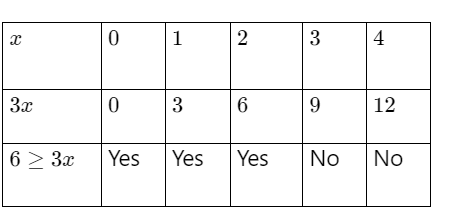
What fraction of the material did she use for the 6 curtains.

First of all, if each curtain make 2m, then6 curtain make = 2 × 6

So,6 curtains make = 12m

The fraction of material for 6 curtains is

The fraction of material used for 6 curtains is \(\frac{1}{3}\)m.


Page 134  Exercise 4.10  Problem 7

In the question, we are asked how many mangoes Travis sold.

Given that, he had 160 mangoes and each mango costs $2

Use the equation mentioned in the Tip section and find the solution.
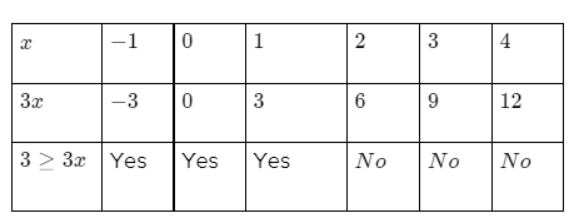
Given:

Each mango costs = $2

Total number of mangoes = 160

The total cost that he gained $ 240

We have

Total Cost = Number of mangoes×Cost of one mango

Number of mangoes \( =\frac{\text { Total Cost }}{\text { Cost of one mango }}\)

= \(\frac{240}{2}\)

Number of mangoes  = 120

Travis sells 120 mangoes for the cost of $240.
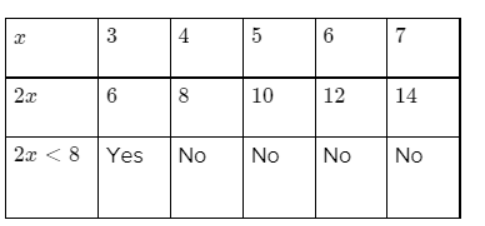
 

Operations On Fractions Exercise 4.10 Primary Mathematics Workbook 4A Explanation Page 134  Exercise 4.10  Problem 8

In the question, we are asked to find the fraction of his mangoes did he have left.

We found that how many mangoes he sold from exercise 8a.

So we can find how many mangoes left and can convert into fraction.

Number of mangoes that Travis sold =120

Number of mangoes left = 160 − 120

Number of mangoes left = 40

Fraction of mangoes that he has left

= \(\frac{40}{160}\)

Fraction of mangoes that he has left = \(\frac{1}{4}\)

Fraction of his mangoes he has left = \(\frac{1}{4}\)


Page 135  Exercise 4.11  Problem 1

In the question, asked to color by given fraction from the set.
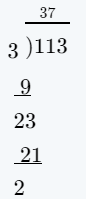
Find how many number of elements in the set.

Then find the fraction and color accordingly.

Given set contains 8 tortoises.

So, we have to find the given fraction of 8.

Given:  Fraction =\(\frac{1}{2}\)

To find – \(\frac{1}{2}\) of 8

8 × \(\frac{1}{2}\) = 4

Therefore, color 4 Tortoises.

Color 4 tortoises.

Primary Mathematics Workbook 4A Common Core Edition Chapter 4 Operations On Fractions page 135 Exercise 4.11 Problem 1 , Tortoise


Common Core Workbook 4A Chapter 4 Operations On Fractions Exercise 4.10 Help Page 135  Exercise 4.11  Problem 2

In the question, asked to color by given fraction from the set.

Find how many number of elements in the set.

Then find the fraction and color accordingly.

Given set contains 9 sandwiches.

So, we have to find given fraction of 9.

Given:  Fraction = \(\frac{1}{3}\)

To find – \(\frac{1}{3}\) of  9

9 × \(\frac{1}{3}\)  =  3

Therefore, color 3 sandwiches.

Color 3 Sandwiches.

Primary Mathematics Workbook 4A Common Core Edition Chapter 4 Operations On Fractions page 135 Exercise 4.11 Problem 2 , Sandwiches


Fractions Exercise 4.10 Workbook 4A Detailed Solutions Common Core Page 135  Exercise 4.11  Problem 3

In the question, asked to color by a given fraction from the set.

Find how many number of elements in the set.

Then find the fraction and color accordingly.

The given set contains 15 socks.

So we have to find the given fraction of 15

Given:  Fraction = \(\frac{2}{5}\)

To find – \(\frac{2}{5}\) of 15

15 × \(\frac{2}{5}\)

Therefore, Color 6 socks.

Color 6 socks.
Primary Mathematics Workbook 4A Common Core Edition Chapter 4 Operations On Fractions page 135 Exercise 4.11 Problem 3 , Socks


Primary Mathematics Workbook 4A Chapter 4 Fractions Exercise 4.10 Problem Solving Page 135 Exercise 4.11 Problem 4

In the question, asked to color by a given fraction from the set.

Find how many number of elements in the set.

Then find the fraction and color accordingly.

The given set contains 18 cakes.

We have to find a given fraction of 18.

Given: Fraction =\(\frac{5}{9}\)

To find – \(\frac{5}{9}\) of 18

18 × \(\frac{5}{9}\)= 10

Therefore, color 10 cakes.

Color 10 cakes.

Primary Mathematics Workbook 4A Common Core Edition Chapter 4 Operations On Fractions page 135 Exercise 4.11 Problem 4 , Cakes


Page 135  Exercise 4.11  Problem 5

In the question, we are asked to find the value of given problem.

Multiply the number by the fraction to get the solution.

We have to find

\(\frac{1}{2}\) of 12 = 12 × \(\frac{1}{2}\)

Simplify

\(\frac{1}{2}\) × 12 = 6

\(\frac{1}{2}\) of 12 =  6


Page 135  Exercise 4.11  Problem 6

In the question, we are asked to find the value of the given problem.

Multiply the number by the fraction to get the solution.

We have to find

\(\frac{1}{4}\) of 12 = 12 × \(\frac{1}{4}\)

Simplify

12 × \(\frac{1}{4}\) = 3

\(\frac{1}{4}\) of 12 = 3


Page 135  Exercise 4.11  Problem 7

In the question, we are asked to find the value of the given problem.

Multiply the number by the fraction to get the solution.

We have to find

\(\frac{1}{3}\) of 24 = 24 × \(\frac{1}{3}\)

Simplify

24 × \(\frac{1}{3}\)  =  8

\(\frac{1}{3}\) of 24 =  8


Page 135  Exercise 4.11  Problem 8

In the question, we are asked to find the value of given problem.

Multiply the number by the fraction to get the solution.

We have to find

\(\frac{1}{6}\) of 36 = 36× \(\frac{1}{3}\)

Simplify

36× \(\frac{1}{6}\) = 6

\(\frac{1}{6}\) of 36 = 6


Page 136  Exercise 4.11  Problem 9

In the question, we are asked to find the value of given problem.

Multiply the number by the fraction to get the solution.

We have to find

\(\frac{1}{4}\) of 20 = 20 × \(\frac{1}{4}\)

= 5

To find –

\(\frac{3}{4}\) of 20 = 20× \(\frac{3}{4}\)

= 15

\(\frac{1}{4}\) of 20 = 5 , \(\frac{3}{4}\) of 20 = 15


Page 136  Exercise 4.11  Problem 10

In the question, we are asked to find the value of given problem.

Multiply the number by the fraction to get the solution.

We have to find

\(\frac{1}{5}\) of 25 = 25× \(\frac{1}{5}\)= 5

To find – 

\(\frac{3}{5}\) of 25 = 25 × \(\frac{3}{5}\) = 15

\(\frac{1}{5}\) of 25 = 5 , \(\frac{3}{5}\) of 25 = 15


Page 136  Exercise 4.11  Problem 11

In the question, we are asked to find the value of given problem.

Multiply the number by the fraction to get the solution.

We have to find

\(\frac{1}{3}\) of 21 = 21× \(\frac{1}{3}\)= 7

To find – 

\(\frac{2}{3}\) of 21 = 21 × \(\frac{2}{3}\) = 14

\(\frac{1}{3}\) of 21 = 7 , \(\frac{2}{3}\) of 21 = 14


Page 136  Exercise 4.11  Problem 12

In the question, we are asked to find the value of given problem.

Multiply the number by the fraction to get the solution.

We have to find

\(\frac{1}{10}\) of 30 = 30× \(\frac{1}{10}\)= 3

To find – 

\(\frac{7}{10}\) of 30 = 30 × \(\frac{7}{10}\) = 21

\(\frac{1}{10}\) of 30 = 3 , \(\frac{7}{10}\) of 30 = 21


Page 137  Exercise 4.12  Problem 1

In the question, we are asked to find the value of given problem.

Using the rule mentioned in the Tip multiply the numbers with the fraction to get the solution.

We have to find

\(\frac{1}{4}\) of 8 = \(\frac{1}{4}\) × \(\frac{8}{1}\)

1. Multiply the numerators.

2. Multiply the denominators.

\(\frac{1}{4}\) of 8 = \(\frac{1×8}{4×1}\)

\(\frac{1}{4}\) of 8  = \(\frac{8}{4}\)

Simplify

\(\frac{8}{4}\) = 2 , \(\frac{1}{4}\) of 8 = 2


Page 137  Exercise 4.12  Problem 2

In the question, we are asked to find the value of given problem.

Using the rule mentioned in the Tip multiply the numbers with the fraction to get the solution.

We have to find

\(\frac{1}{5}\) of 15 =\(\frac{1}{5}\) × \(\frac{15}{1}\)

1. Multiply the numerators.

2. Multiply the denominators.

\(\frac{1}{5}\) of 15 = \(\frac{1× 15}{5× 1}\)

\(\frac{1}{5}\) of 15 = \(\frac{15}{5}\)

Simplifying

\(\frac{15}{5}\) = 3 , \(\frac{1}{5}\) of 15 = 3


Page 137  Exercise 4.12  Problem 3

In the question, we are asked to find the value of given problem.

Using the rule mentioned in the Tip multiply the numbers with the fraction to get the solution.

We have to find

\(\frac{1}{3}\) of 12 = \(\frac{1}{3}\) × \(\frac{12}{1}\)

1. Multiply the numerators.

2. Multiply the denominators.

\(\frac{1}{3}\) of 12 =\(\frac{1×12}{3× 1}\)

\(\frac{1}{3}\) of 12  = \(\frac{12}{3}\)

Simplify

\(\frac{12}{3}\) = 4 , \(\frac{1}{3}\) of 12 = 4


Page 137  Exercise 4.12  Problem 4

In the question, we are asked to find the value of given problem.

Using the rule mentioned in the Tip multiply the numbers with the fraction to get the solution.

We have to find

\(\frac{1}{3}\) of 6 =\(\frac{6}{1}\) × \(\frac{1}{3}\)

1. Multiply the numerators.

2. Multiply the denominators.

\(\frac{1}{3}\) of 6 = \(\frac{6}{3}\)

Simplifying

\(\frac{6}{3}\) = 2

\(\frac{1}{3}\) of 6 = 2


Page 137  Exercise 4.12  Problem 5

In the question, we are asked to find the value of given problem.

Using the rule mentioned in the Tip multiply the numbers with the fraction to get the solution.

We have to find 

\(\frac{2}{3}\) of 6= \(\frac{1}{3}\) of 6 =\(\frac{6}{1}\) × \(\frac{2}{3}\)

= \(\frac{12}{3}\)

1. Multiply the numerators.

2. Multiply the denominators.

Simplifying

\(\frac{12}{3}\) = 4

\(\frac{2}{3}\) of 6 = 4


Page 138  Exercise 4.12  Problem 6

In the question, we are asked to find the value of the given problem.

Using the rule mentioned in the Tip multiply the numbers with the fraction to get the solution

We have to find

\(\frac{1}{2}\) of 8= \(\frac{8}{1}\) × \(\frac{1}{2}\)

1. Multiply the numerators.

2. Multiply the denominators.

\(\frac{1}{2}\) of 8 = \(\frac{8}{2}\)

Simplifying

\(\frac{8}{2}\) = 4

\(\frac{1}{2}\) of 8 = 4


Page 138  Exercise 4.12  Problem 7

In the question, we are asked to find the value of the given problem.

Using the rule mentioned in the Tip multiply the numbers with the fraction to get the solution.

We have to find

\(\frac{1}{3}\) of 15 = \(\frac{1}{3}\) × \(\frac{15}{1}\)

1. Multiply the numerators.

2. Multiply the denominators.

\(\frac{1}{3}\) of 15= \(\frac{15}{3}\)

Simplifying

\(\frac{15}{3}\) = 5

\(\frac{1}{3}\) of 15 = 5


Page 138  Exercise 4.12  Problem 8

In the question, we are asked to find the value of the given problem.

Using the rule mentioned in the Tip multiply the numbers with the fraction to get the solution.

We have to find

\(\frac{1}{4}\) of 20 = \(\frac{20}{1}\) × \(\frac{1}{4}\)

1. Multiply the numerators.

2. Multiply the denominators.

\(\frac{1}{4}\) of 20= \(\frac{20}{4}\)

Simplifying

\(\frac{20}{4}\) = 5

\(\frac{20}{4}\) of 20 = 5


Page 138  Exercise 4.12  Problem 9

In the question, we are asked to find the value of given problem.

Using the rule mentioned in the Tip multiply the numbers with the fraction to get the solution.

We have to find

\(\frac{1}{6}\) of 18 = \(\frac{18}{1}\) × \(\frac{1}{6}\)

1. Multiply the numerators.

2. Multiply the denominators.

\(\frac{1}{6}\) of 18 = \(\frac{18}{6}\)

Simplifying

\(\frac{18}{6}\) =  3

\(\frac{1}{6}\) of 18 = 3


Page 139  Exercise 4.12  Problem 10

Given:  The expression

\(\frac{2}{3}\) of 15 = \(\frac{2}{3}\) × 15

To find –  The value of the given expression.

We multiply numerator with numerator and denominator with denominator and simplify.

First, we will convert 15 into a fraction using 1 as the denominator.

So, it can be written as ⇒ \(\frac{1}{15}\) .

Now, multiply the numerators and denominators.

\(\frac{2}{3}\) × \(\frac{15}{1}\)= \(\frac{2×15}{3×1}\)

Simplifying we get

\(\frac{30}{3}\) = 10

Therefore, the value of  \(\frac{2}{3}\) of 15 is 10.


Page 139  Exercise 4.12  Problem 11

Given:  The expression \(\frac{3}{4}\) of 20.

To find – The value of the given expression.

We multiply numerator with numerator and denominator with denominator and simplify.

We know that \(\frac{3}{4}\) of 20 can be written as \(\frac{3}{4}\) × 20.

First, we will convert 20 into a fraction using 1 as the denominator.

So, it can be written as ⇒  \(\frac{20}{1}\)

Now, multiply the numerators and denominators.

\(\frac{3}{4}\) × \(\frac{20}{1}\)= \(\frac{3×20}{4×1}\)

Simplifying we get

\(\frac{60}{4}\)

= 15

Therefore, the value of \(\frac{3}{4}\) of 20 is 15.


Page 139  Exercise 4.12  Problem 12

Given: The expression \(\frac{4}{5}\) of 30.

To find – The value of the given expression.

We multiply numerator with numerator and denominator with denominator and simplify.

We know that \(\frac{4}{5}\) of 20 can be written as \(\frac{4}{5}\)× 30.

First, we will convert 20 into a fraction using 1 as the denominator.

So, it can be written as ⇒  \(\frac{30}{1}\)

Now, multiply the numerators and denominators.

\(\frac{4}{5}\) × \(\frac{30}{1}\)

= \(\frac{4×30}{5×1}\)

Simplifying we get

\(\frac{120}{5}\)

= 24

Therefore, the value of \(\frac{4}{5}\) of 30 is 24.


Page 139  Exercise 4.12  Problem 13

Given: The expression \(\frac{5}{6}\) of 36.

To find –  The value of the given expression.

We multiply numerator with numerator and denominator with denominator and simplify.

We know that \(\frac{5}{6}\) of 36 can be written as  \(\frac{5}{6}\) × 36.

First, we will convert 20 into a fraction using 1 as the denominator.

So, it can be written as  ⇒ \(\frac{36}{1}\)

Now, multiply the numerators and denominators.

\(\frac{5}{6}\) × \(\frac{36}{1}\) = \(\frac{5×36}{6×1}\)

Simplifying we get

\(\frac{180}{4}\)

= 30

Therefore, the value of \(\frac{5}{6}\) of 36 is 30.


Page 140  Exercise 4.13  Problem 1

Given:  Manfred had 25 picture cards. He gave \(\frac{2}{5}\) of them to his friends.

To find –  The number of cards Manfred gave to his friends.

We find \(\frac{2}{5}\) of 25 cards.

We are given that Manfred gave \(\frac{2}{5}\) of them to his friends that implies

\(\frac{2}{5}\) of 25 =  \(\frac{2}{5}\)×25

First, we will convert 25 into a fraction using 1 as the denominator.

So, it can be written as ⇒  \(\frac{25}{1}\)

Now, multiply the numerators and denominators.

\(\frac{2}{5}\)×\(\frac{25}{1}\) = \(\frac{2×25}{5×1}\)

Simplifying we get

\(\frac{50}{5}\) = 10

Therefore, Manfred gave 10 cards to his friends.


Page 140  Exercise 4.13  Problem 2

Given:  Manfred had 25 picture cards. He gave \(\frac{2}{5}\) of them to his friends

To find –  The number of cards left with Manfred.

We find \(\frac{2}{5}\) of 25 cards and subtract it from the total cards.

We are given that Manfred gave \(\frac{2}{5}\) of them to his friends that implies

\(\frac{2}{5}\) of 25 = \(\frac{2}{5}\) × 25

First, we will convert 25 into a fraction using 1 as the denominator.

So, it can be written as ⇒  \(\frac{25}{1}\)

Now, multiply the numerators and denominators.

\(\frac{2}{5}\)×\(\frac{25}{1}\) =\(\frac{2×25}{5×1}\)

Simplifying we get

\(\frac{50}{5}\) = 10

A number of remaining cards can be calculated by subtracting the cards he gave to his friends from the total number of cards he had.

25−10 = 15

Therefore, the number of cards left with Manfred is 15.


Page 140  Exercise 4.13 Problem 3

Given:  Sharon had 40 dollars. She spent \(\frac{3}{8}\) of the money on a storybook.

To find – the cost of the storybook.

We find the money spent on the storybook which will be the cost of a storybook.

We are given that Sharon spent \(\frac{3}{8}\) of the money on a storybook that implies

\(\frac{3}{8}\) of 40 = \(\frac{3}{8}\)× 40

First, we will convert 40 into a fraction using 1 as the denominator.

So, it can be written as \(\frac{40}{1}\).

Now, multiply the numerators and denominators.

\(\frac{3}{8}\)×\(\frac{40}{1}\) = \(\frac{3×40}{8×1}\)

Simplifying we get

\(\frac{120}{8}\) = 15

Hence, the money spent on storybooks is 15.

Also, it is known that the cost of the storybook is equal to the expenditure on the storybook which is 15.

Therefore, the cost of the storybook is 15.


Page 140  Exercise 4.13  Problem 4

Given:  Sharon had 40 dollars.

She spent \(\frac{3}{8}\) of the money on a storybook.

To find –  The amount of money left with Sharon.

We find the money spent on the storybook and subtract it from the total cost.

We are given that Sharon spent \(\frac{3}{8}\) of the money on a storybook that implies

\(\frac{3}{8}\) of 40 = \(\frac{3}{8}\) × 40

First, we will convert 40 into a fraction using 1 as the denominator.

So, it can be written as \(\frac{40}{1}\).

Now, multiply the numerators and denominators.

\(\frac{3}{8}\)×\(\frac{40}{1}\) =\(\frac{3×40}{8×1}\)

Simplifying we get

\(\frac{120}{8}\) = 15

The remaining amount left with Sharon can be calculated by subtracting the amount spent on the storybook from the total money he had.

40−15 = 25

Therefore, 25 dollars are left with Sharon.


Page 141  Exercise 4.13  Problem 5

Given:  There are 24 potatoes in a bag and Lily peeled \(\frac{2}{3}\)

To find – The number of potatoes Lily peeled.

We find the peeled potatoes by calculating \(\frac{2}{3}\) of 24 potatoes.

We are given that Lily peeled \(\frac{2}{3}\) of total potatoes that implies

\(\frac{2}{3}\) of = \(\frac{2}{3}\) × 24

First, we will convert 24 into a fraction using 1 as the denominator.

So, it can be written as ⇒ \(\frac{42}{1}\)

Now, multiply the numerators and denominators.

\(\frac{2}{3}\)×\(\frac{24}{1}\) =\(\frac{2×24}{3×1}\)

Simplifying we get

\(\frac{48}{3}\) = 16

Hence, the number of potatoes Lily peeled is 16.

Therefore, the number of potatoes Lily peeled is 16.


Page 141  Exercise 4.13  Problem 6

Given:  Lindsay had 48 dollars. She spent \(\frac{3}{8}\) of the money.

To find – The amount of money she had spent.

We find the money spent by calculating \(\frac{3}{8}\)of 48 dollars.

We are given that Lindsay spent \(\frac{3}{8}\) of the money on a storybook that implies

\(\frac{3}{8}\) of 48 = \(\frac{3}{8}\) ×48

First, we will convert 48 into a fraction using 1 as the denominator.

So, it can be written as  ⇒ \(\frac{48}{1}\)

Now, multiply the numerators and denominators.

\(\frac{3}{8}\)×\(\frac{48}{1}\)=\(\frac{3×48}{8×1}\)

Simplifying we get

\(\frac{144}{3}\) = 18

Hence, the money spent is 18.

Therefore, the amount of money Lindsay had spent is 18 dollars.


Page 142  Exercise 4.14  Problem 1

Given:  Mandy had 25 dollars. She spent \(\frac{1}{5}\) of the money and saved the rest.

To find –  The amount of money she saved.

We find the money spent and subtract it from the total amount.

We are given that Mandy spent \(\frac{1}{5}\) of the money that implies

\(\frac{1}{5}\) of 25 = \(\frac{1}{5}\)× 25

First, we will convert 25 into a fraction using 1 as the denominator.

So, it can be written as ⇒  \(\frac{25}{1}\).

Now, multiply the numerators and denominators.

\(\frac{1}{5}\)×\(\frac{25}{1}\)=\(\frac{1×25}{5×1}\)

Simplifying we get

\(\frac{25}{5}\)=5

Hence, the money spent is 5 dollars.

The remaining amount saved with Mandy can be calculated by subtracting the amount spent from the total money she had.

25−5 = 20

Therefore, the amount of money Mandy saved is 20 dollars.


Page 142  Exercise 4.14  Problem 2

Given:  Matthew bought 45 oranges and used \(\frac{3}{5}\) of them to make orange juice.

To find –  The number of oranges left with him.

We will subtract the used oranges from the total oranges.

We are given that Matthew used \(\frac{3}{5}\) of the total oranges that implies

\(\frac{3}{5}\) of 45 = \(\frac{3}{5}\)×45

First, we will convert 45 into a fraction using 1 as the denominator.

So, it can be written as  ⇒ \(\frac{45}{1}\).

Now, multiply the numerators and denominators.

\(\frac{3}{5}\)×\(\frac{45}{1}\)=

\(\frac{3×45}{5×1}\)

Simplifying we get

\(\frac{135}{5}\) = 27

Hence, the number of oranges used to make orange juice is 27.

The remaining oranges left with Matthew can be calculated by subtracting the number of oranges used from the total oranges he had.

45 − 27 = 18

Therefore, the number of oranges left with Matthew is 18 oranges.


Page 143  Exercise 4.14  Problem 3

Given:  Nellie had 48 dollars and spent \(\frac{1}{4}\) of it on a calculator.

She also bought a book for 14 dollars.

To find  –  The amount of money she spent all together.

We add the amount spent on calculator and book.

We are given that Nellie spent \(\frac{1}{4}\)

of money she had on a calculator that implies

\(\frac{1}{4}\) of 45 = \(\frac{1}{4}\)×48

First, we will convert 48 into a fraction using 1 as the denominator.

So, it can be written as ⇒  \(\frac{48}{1}\)

Now, multiply the numerators and denominators.

\(\frac{1}{4}\)×\(\frac{48}{1}\)=\(\frac{1×48}{4×1}\)

Simplifying we get

\(\frac{48}{4}\)=12

Hence, the amount of money spent on a calculator is 12 dollars.

Also, we know that the amount spent on books is 14 dollars.

So, the total amount spent will be the amount spent on calculator + amount spent on book.

That is

12 + 14 = 26

Therefore, the amount of money she spent altogether is 26 dollars.


Page 144  Exercise 4.14  Problem 4

Given: There were 96 people on a board ship and \(\frac{1}{4}\)×\(\frac{48}{1}\)= of them were females.

To find – The number of males on the board ship.

We subtract the number of females from the total number of people.

We are given that \(\frac{1}{4}\) of total people were females. This implies that

\(\frac{1}{4}\) of = \(\frac{1}{4}\) × 96

First, we will convert 96 into a fraction using 1 as the denominator.

So, it can be written as  ⇒ \(\frac{96}{1}\)

Now, multiply the numerators and denominators.

\(\frac{1}{4}\)×\(\frac{96}{1}\)=\(\frac{1×96}{4×1}\)

Simplifying we get

\(\frac{96}{4}\) = 24

Hence, the number of females is 24.

The number of males can be calculated by subtracting the number of females from the total number of people on the board ship.

This implies, Number of males

​= 96−24

= 72

Page 145 Exercise 4.15 Problem 1

Given: Lynn spent \(\frac{7}{10}\) of the money she had.

She spent 42 dollars.

To find – The amount of money Lynn had at first.

We find the amount of money for 10 units.

We are given that Lynn spent \(\frac{7}{10}\) of the money she had which is 42 dollars.

This implies

7 units = 42 dollars

1 unit = 6 dollars

Now, the amount for 10 units will be the total amount.

⇒ 10 units = 6 × 10 dollars

⇒ 10 units = 60 dollars

Therefore, the amount of money Lynn had at first is 60 dollars.


Page 145  Exercise 4.15  Problem 2

Given:  Lynn spent \(\frac{7}{10}\) of the money she had.

She spent 42 dollars.

To find – The amount of money Lynn saved.

We subtract the amount of money spent from the total money she had at first.

We are given that Lynn spent \(\frac{7}{10}\) of the money she had which is 42 dollars.

This implies

7 units  = 42 dollars

1 unit = 6 dollars

Now, the amount for 10 units will be the total amount.

⇒ 10 units = 6 × 10 dollars

⇒ 10 units = 60 dollars

Hence, the amount of money Lynn had at first is 60 dollars.

We find the money she saved by subtracting money spent from the total amount of money.

Amount of money saved = 60 − 42 which is 18 dollars.

Therefore, the amount of money Lynn saved is 18 dollars.


Page 145  Exercise 4.15  Problem 3

Given:   A group of children went for a school picnic and \(\frac{3}{7}\) of them were boys.

There were 18 boys

To find –  The number of children presents there.

We find a number of children for 7 units.

We are given that \(\frac{3}{7}\) of the group of children were boys.

This implies

7 units =18 children

1 unit = \(\frac{18}{7}\) children

Now, the number of children for 7 units will be the total number.

⇒ 7 units = \(\frac{18}{7}\) × 7

⇒ 7 units = 18 children

Hence, the total number of children who went to the school picnic is 18 children.

Therefore, 18 children went to the school picnic.


Page 145  Exercise 4.15  Problem 4

Given:   A group of children went for a school picnic and \(\frac{3}{7}\) of them were boys. There were 18 boys.

To find – The number of girls present there.

We find the number of girls by calculating the number of children for 4 units.

We are given that \(\frac{3}{7}\) of the group of children were boys.

This implies

3 units = 18 boys

1 unit = 6 boys

Now, the number of girls will be calculated by finding the number of children for 7−3=4 units.

⇒ 4 units =  6 × 4 girls

⇒ 7 units =  24 girls

Hence, the number of girls who went for the school picnic is 24 girls.

Therefore, the number of girls who went for the school picnic is 24 girls.


Page 146  Exercise 4.15  Problem 5

Given: Susan spent \(\frac{3}{10}\) of her money on a bag.

To find – The amount of money she had at first if the bag costs 9 dollars.

We find the total amount of money she had by calculating the amount for 10 units.

We are given that Susan spent \(\frac{3}{10}\) of her money on a bag which is 9 dollars.

This implies

3 units = 9 dollars

1 unit = 3 dollars

Now, the total amount of money she had is for 10 units.

⇒ 10 units =  10 × 3 dollars

⇒ 10 units = 30 dollars

Therefore, the amount of money she had at first if the bag costs 9 dollars is 30 dollars.


Page 147 Exercise 4.15  Problem 6

Given: John bought some stamps. He used \(\frac{3}{5}\)of them to make mail letters and had 12 stamps left.

To find  – The number of stamps that he used.

We find the number of stamps he bought and then find \(\frac{3}{5}\) of them.

We are given that John used of the stamps and had 12 stamps left.

Remaining units are 5−3 = 2 units.

This implies

2units =12 stamps

1 unit =6 stamps

Now, the total number of stamps that she had is for 5 units.

⇒ 5 units  = 6 × 5 stamps

⇒  5 units = 30 stamps

We know that she used \(\frac{3}{5}\) of the total stamps.

Thus, the used number of stamps is \(\frac{3}{5}\) of 30 stamps.

Thus, used number of stamps is

⇒ \(\frac{3}{5}\)× 30 = \(\frac{3}{5}\) \(\frac{30}{1}\)

⇒ \(\frac{3×30}{5×1}\)= \(\frac{90}{5}\) 18 stamps.

Therefore, the number of stamps that he used is 18 stamps.

Primary Mathematics Workbook 4A Common Core Edition Solutions Chapter 4 Operations On Fractions Exercises 4.1

Primary Mathematics Chapter 4 Operations On Fractions

Primary Mathematics Workbook 4A Common Core Solutions Chapter 4 Operations On Fractions 4.1  Page 112  Exercise 4.1  Problem 1

We are asked to find the missing numbers

Given: \(\frac{1}{3}+\frac{1}{12}\)

As we can see that the denominators are not equal let us do LCM and then solve to get the result

\(\frac{1}{3}+\frac{1}{12}\) = \(\frac{4+1}{12}\)

\(\frac{1}{3}+\frac{1}{12}\) = \(\frac{5}{12}\)

So therefore, the missing fraction is \(\frac{5}{12}\)

Therefore, we can say that the missing fraction is \(\frac{5}{12}\)

Primary Mathematics Workbook 4A Common Core Solutions Chapter 4 Operations On Fractions 4.1 Page 112  Exercise 4.1  Problem 2

We are asked to find the missing numbers

Given: \(\frac{3}{8}+\frac{1}{2}\)

As we can see that the denominators are not equal let us do LCM and then solve to get the result.

\(\frac{3}{8}+\frac{1}{2}\) = \(\frac{3+4}{8}\)

\(\frac{3}{8}+\frac{1}{2}\) = \(\frac{7}{8}\)

So therefore, the missing fraction is \(\frac{7}{8}\).

Therefore, we can say that the missing fraction is \(\frac{7}{8}\).

Chapter 4 Exercise 4.1 Operations On Fractions Workbook 4A Answers Page 112  Exercise 4.1  Problem 3

We are asked to find the missing numbers

Given: \(\frac{2}{5}+\frac{3}{10}\)

As we can see that the denominators are not equal let us do LCM and then solve to get the result.

\(\frac{2}{5}+\frac{3}{10}\) = \(\frac{4+3}{8}\)

\(\frac{2}{5}+\frac{3}{10}\) = \(\frac{7}{10}\)

So therefore, the missing fraction is \(\frac{7}{10}\)

Therefore, we can say that the missing fraction is \(\frac{7}{10}\)

Workbook 4A Chapter 4 Exercise 4.1 Operations On Fractions Solutions Page 113  Exercise 4.1  Problem 4

We are asked to write the answers in the simplest form.

So, by solving we get

\(\frac{1}{2}+\frac{1}{4}\) = \(\frac{3}{4}\)

\(\frac{1}{6}+\frac{2}{3}\) = \(\frac{1+4}{3}\)=\(\frac{5}{3}\)

\(\frac{2}{9}+\frac{2}{3}\) = \(\frac{2+6}{9}\)=\(\frac{9}{3}\)= 3

\(\frac{1}{9}+\frac{2}{3}\) = \(\frac{1+6}{3}\)=\(\frac{7}{3}\)

\(\frac{1}{5}+\frac{1}{10}\) = \(\frac{2+1}{10}\)=\(\frac{3}{10}\)

\(\frac{3}{10}+\frac{1}{5}\) = \(\frac{3+2}{10}\)=\(\frac{5}{10}\)= \(\frac{1}{2}\)

\(\frac{1}{8}+\frac{3}{4}\) = \(\frac{1+6}{8}\)=\(\frac{7}{8}\)

\(\frac{3}{8}+\frac{1}{4}\) = \(\frac{3+2}{4}\)=\(\frac{5}{4}\)

\(\frac{1}{8}+\frac{1}{4}\) = \(\frac{1+2}{8}\)=\(\frac{3}{8}\)

\(\frac{1}{4}+\frac{1}{12}\) = \(\frac{3+1}{12}\)=\(\frac{4}{12}\)= \(\frac{1}{3}\)

Therefore, we can say that the simplified fractions are \(\frac{3}{4}\),\(\frac{5}{3}\),3, \(\frac{7}{3}\),\(\frac{3}{10}\),\(\frac{1}{2}\),\(\frac{7}{8}\),\(\frac{5}{4}\) ,\(\frac{3}{8}\),\(\frac{1}{3}\)

Operations On Fractions Exercise 4.1 Primary Mathematics Workbook 4A Explanation Page 115  Exercise 4.2  Problem 1

We are asked to find the missing numbers.

Given: \(\frac{3}{4}- \frac{1}{2}\)

As we can see that the denominators are not the same.

Let us multiply the second fraction by 2 for the numerator and denominator, we get

⇒ \(\frac{3}{4}− \frac{1}{4}\)

= \(\frac{3−2}{4}\)

= \(\frac{1}{4}\)

Therefore, by solving the given fractions we get \(\frac{1}{4}\)

Therefore, we can say that by solving the given fractions we get \(\frac{1}{4}\)

Page 115 Exercise 4.2 Problem 2

We are asked to find the missing numbers

Given: \(\frac{5}{6}- \frac{2}{3}\)

As we can see the denominators are not the same.

Let us multiply the second fraction by 2 for the numerator and denominator, we get

⇒ \(\frac{5}{6}- \frac{4}{6}\)

= \(\frac{5-4}{6}\)

= \(\frac{1}{6}\)

Therefore, by solving the given fractions we get \(\frac{1}{6}\)

Therefore, we can say that by solving the given fractions we get \(\frac{1}{6}\)

Page 115  Exercise 4.2  Problem 3

We are asked to find the missing numbers.

Given: \(\frac{2}{3}- \frac{1}{12}\)

As we can see the denominators are not the same

Let us multiply the first fraction by 4 for the numerator and denominator, we get

⇒ \(\frac{8}{12}- \frac{1}{12}\)

= \(\frac{8- 1}{12}\)

​= \(\frac{7}{12}\)

Therefore, by solving the given fractions we get \(\frac{7}{12}\)

Therefore, we can say that by solving the given fractions we get \(\frac{7}{12}\)

Common Core Workbook 4A Chapter 4 Operations On Fractions Exercise 4.1 Help Page 116  Exercise 4.2  Problem 4

Given: Some subtraction to compute.

To calculate the given subtractions and make an appropriate word with the answers connecting with the letters, where the word should represent a four-sided figure.

Recall that, subtraction is the process of removing a number from a larger number.

Compute each subtraction row-wise and match the letters with the numbers given in the box.

Follow the steps given below.

Perform the subtractions in the first row.

The LCM of the number 2,6 is 6.

Therefore

⇒ \(\frac{1}{2}- \frac{1}{6}\)

=\(\frac{(6÷2)×1−(6÷6)×1}{6}\)

=\(\frac{3−1}{6}\)

=\(\frac{2}{6}\)

=\(\frac{1}{3}\) [Reduce the fraction]

Similarly, the LCM of the number 4,8 is 8.

Therefore

⇒ \(\frac{3}{4}- \frac{5}{8}\)

=\(\frac{3×2−1×5}{8}\)

= \(\frac{6−5}{8}\)

=\(\frac{1}{8}\).

Also, the LCM of the numbers 3,9 is 9.

Therefore \(\frac{2}{3}- \frac{2}{9}\) = \(\frac{2×3−2×1}{9}\)

= \(\frac{6−2}{9}\)

= \(\frac{4}{9}\).

Perform the subtractions in the second row.

The LCM of the numbers 4,12 is 12.

Therefore \(\frac{3}{4}- \frac{1}{12}\) = \(\frac{3×3−1×1}{12}\)

=\(\frac{9−1}{12}\)

= \(\frac{8}{12}\).

= \(\frac{2}{3}\).

Similarly, the LCM of the numbers 5,10 is 10.

⇒ \(\frac{2}{5}- \frac{1}{10}\) = \(\frac{2×2−1×1}{10}\)

=\(\frac{4−1}{10}\)

= \(\frac{3}{10}\).

Also, the LCM of the numbers 6,12 is 12.

Then

⇒ \(\frac{5}{6}- \frac{5}{12}\) = \(\frac{5×2−5×1}{12}\)

= \(\frac{10−5}{12}\)

= \(\frac{5}{12}\).

Perform the subtractions in the Third row.

The LCM of the numbers 5,10 is 10.

Therefore

⇒ \(\frac{4}{5}- \frac{3}{10}\) = \(\frac{4×2−3×1}{10}\)= \(\frac{8−1}{10}\)

= \(\frac{5}{10}\)

= \(\frac{1}{2}\). [Reduction the fraction]

Similarly, the LCM of the numbers 2,12 is 12.

\(\frac{1}{2}- \frac{5}{12}\) = \(\frac{1×6−5×1}{12}\)

= \(\frac{6−5}{12}\)

= \(\frac{1}{12}\).

Also, the LCM of the number 12,3 is 12.

Then

⇒ \(\frac{7}{2}- \frac{1}{3}\) = \(\frac{7−4}{12}\)

= \(\frac{3}{12}\)

= \(\frac{1}{4}\).

Match the answers with the letters to form a word that represents a four-sided figure.

The answers to the subtractions are given by
Primary Mathematics Workbook 4A Common Core Edition Chapter 4 Operations On Fractions page 116 Exercise 4.2 Problem 4 , Figure

Thus, the letters that match the answers are given by

Primary Mathematics Workbook 4A Common Core Edition Chapter 4 Operations On Fractions page 116 Exercise 4.2 Problem 4 , table 1

The letters that match the answers and the word that represents a four-sided figure are given by

Primary Mathematics Workbook 4A Common Core Edition Chapter 4 Operations On Fractions page 116 Exercise 4.2 Problem 4 , table 2


Fractions Exercise 4.1 Workbook 4A Detailed Solutions Common Core Page 117  Exercise 4.3  Problem 1

We are given that Meredith brought a piece of cloth.

She used \(\frac{3}{8}\) of it to make a dress.

We are asked to find the remaining clothes that she has.

Let us consider the remaining cloth as x.

So, from the question

1 = x + \(\frac{3}{8}\)

Transferring \(\frac{3}{8}\) from RHS to LHS.

​x = 1 − \(\frac{3}{8}\)

x = \(\frac{5}{8}\)

Therefore, we can say that \(\frac{5}{8}\) the part of the cloth is left.

Therefore, we can say that Meredith has  \(\frac{5}{8}\) the part of cloth left with her.

Page 117  Exercise 4.3  Problem 2

Given: John spent \(\frac{1}{2}\) of his money on a toy car. He spent 1

⇒ \(\frac{1}{6}\) of his money on a pen.

To find the fraction of the money he spends altogether.

Here, add the fraction of the money he spends on a toy car and pen.

⇒ \(\frac{1}{2}\)+\(\frac{1}{6}\)

Multiply and divide the first fraction by 3, to get a common denominator.

⇒ \(\frac{3}{6}\)+\(\frac{1}{6}\)

Simplifying

⇒ \(\frac{3+1}{6}\)

⇒ \(\frac{4}{6}\)

⇒ \(\frac{2}{3}\)

Therefore, the fraction of money John spends altogether on his car is \(\frac{2}{3}\)

Primary Mathematics Workbook 4A Chapter 4 Fractions Exercise 4.1 Problem Solving Page 118  Exercise 4.3  Problem 3

Given: Mary drank \(\frac{7}{10}\) L of orange juice.

Jim drank  \(\frac{1}{5}\) L of orange juice less than Mary.

To find  – The fraction of orange juice they drank altogether.

Here, add the fraction of orange juice drank by Mary and Jim.

Jim drank \(\frac{1}{5}\) L of orange juice less than Mary.

Therefore, orange juice drank by Jim;

​⇒ \(\frac{7}{10}\) −\(\frac{1}{5}\)

⇒ \(\frac{7−2}{10}\)

⇒ \(\frac{5}{10}\)

⇒ \(\frac{1}{2}\)

​Add the fraction of orange juice drank by Mary and Jim

​⇒ \(\frac{7}{10}\)+\(\frac{1}{2}\)

⇒ \(\frac{7+5}{10}\)

⇒ \(\frac{12}{10}\)= \(\frac{6}{5}\)

Therefore, the fraction of orange juice Mary and Jim drank altogether is \(\frac{6}{5}\) L.

Page 118  Exercise 4.3  Problem 4

Given: Lily bought 1 yd of ribbon. She used \(\frac{1}{2}\) yd to tie a package and \(\frac{3}{10}\) to make a bow.

To find – How much ribbon she had left.

Here, add the fraction of ribbon used.

Then subtract it from the total ribbon brought.

She used \(\frac{1}{2}\)yd to tie a package and \(\frac{3}{10}\) to make a bow.

Therefore, the total ribbon used

​⇒ \(\frac{1}{2}\)+\(\frac{3}{10}\)

​⇒ \(\frac{5+3}{10}\)

⇒ \(\frac{8}{10}\)

​⇒ \(\frac{4}{5}\)

Subtract the fraction of ribbon used from the total ribbon brought

​⇒ 1 −  \(\frac{4}{5}\)

⇒ \(\frac{1}{5}\)

Therefore, the length of ribbon Lily left with is \(\frac{1}{5}\) yd.

Page 119  Exercise 4.4  Problem 1

Given: 1\(\frac{1}{12}\)+ 3\(\frac{1}{3}\)

To find  – The simplest form.

To add mixed numbers, we first add the whole numbers together, and then the fractions.

Adding the given mixed fraction:

⇒ \(\frac{1}{12}\) + 3\(\frac{1}{3}\)

Add the whole numbers together, and then the fractions

⇒  4\(\frac{1}{12}\)+ \(\frac{1}{3}\)

Multiple and divide the second fraction by 4

⇒ 4\(\frac{1}{12}\)+ \(\frac{1×4}{3×4}\)

⇒ 4\(\frac{1}{12}\)+\(\frac{4}{12}\)

⇒ 4\(\frac{5}{12}\)

The simplest form of the given expression 1\(\frac{1}{12}\)+ 3\(\frac{1}{3}\)= 4\(\frac{5}{12}\)

Page 119  Exercise 4.4  Problem 2

Given: 1\(\frac{3}{4}\)+ 1\(\frac{1}{8}\)

To find  – The simplest form.

To add mixed numbers, we first add the whole numbers together, and then the fractions.

Adding the given mixed fraction:

1\(\frac{3}{4}\)+ 1\(\frac{1}{8}\)

Add the whole numbers together, and then the fractions

⇒  2 \(\frac{3×2}{4×2}\)+ \(\frac{1}{8}\)

⇒  2 \(\frac{6}{8}\)+ \(\frac{1}{8}\)

⇒  2 \(\frac{7}{8}\)

The simplest  1\(\frac{3}{4}\) + 1\(\frac{1}{8}\) =  2 \(\frac{7}{8}\)

Page 119  Exercise 4.4  Problem 3

Given: 2\(\frac{3}{10}\)+ 2\(\frac{2}{5}\)

To find – The simplest form.

To add mixed numbers, we first add the whole numbers together, and then the fractions.

Adding the given mixed fraction:

⇒ 2\(\frac{3}{10}\)+ 2\(\frac{2}{5}\)

Add the whole numbers together, and then the fractions

⇒ 4\(\frac{3}{10}\) + \(\frac{2}{5}\)

Multiple and divide the second fraction by 2

⇒  4\(\frac{3}{10}\)+\(\frac{2×2}{5×2}\)

⇒ 4\(\frac{3}{10}\)+\(\frac{4}{10}\)

⇒  4\(\frac{7}{10}\)

The simplest form of the given expression  2\(\frac{3}{10}\)+ 2\(\frac{2}{5}\) = 4\(\frac{7}{10}\)

Page 119  Exercise 4.4  Problem 4

Given: 1\(\frac{2}{3}\)+ 5\(\frac{2}{15}\)

To find –  The simplest form.

To add mixed numbers, we first add the whole numbers together, and then the fractions.

Adding the given mixed fraction:

⇒ 1\(\frac{2}{3}\)+ 5\(\frac{2}{15}\)

Add the whole numbers together, and then the fractions

⇒ \(\frac{2}{3}\)+ 6\(\frac{2}{15}\)

Multiple and divide the first fraction by 5

⇒ \(\frac{2×5}{3×5}\) + 6\(\frac{2}{15}\)

⇒\(\frac{10}{15}\) +6\(\frac{2}{15}\)

⇒ 6\(\frac{12}{15}\)

⇒ 6\(\frac{4}{5}\)

The simplest form of the given expression 1\(\frac{2}{3}\)+ 5\(\frac{2}{15}\) = 6\(\frac{4}{5}\)

Page 120 Exercise 4.4 Problem  5

Given: 2\(\frac{1}{6}\) + 1\(\frac{2}{3}\)

To find –  The simplest form

To add mixed numbers, we first add the whole numbers together, and then the fractions.

Adding the given mixed fraction:

⇒ 2\(\frac{1}{6}\)+ 1\(\frac{2}{3}\)

Add the whole numbers together, and then the fractions

⇒ 3 \(\frac{1}{6}\)+ \(\frac{2}{3}\)

Multiple and divide the second fraction by 2

​⇒ 3 \(\frac{1}{6}\)+ \(\frac{2(2)}{3(2)}\)

⇒ 3 \(\frac{1}{6}\) + \(\frac{4}{6}\)

⇒ 3 \(\frac{5}{6}\)

⇒ 3 \(\frac{5}{6}\)

The simplest form of the given expression  2\(\frac{1}{6}\)+ 1\(\frac{2}{3}\)= 3 \(\frac{5}{6}\)\

Page 120  Exercise 4.4  Problem  6

Given: 2\(\frac{3}{8}\)+ 2\(\frac{3}{4}\)

To find  – The simplest form.

To add mixed numbers, we first add the whole numbers together, and then the fractions.

Adding the given mixed fraction:

⇒ 2\(\frac{3}{8}\)+ 2\(\frac{3}{4}\)

Add the whole numbers together, and then the fractions

⇒ 4\(\frac{3}{8}\)+ \(\frac{3}{4}\)

Multiple and divide the second fraction by 2

​⇒ 4\(\frac{3}{8}\)+\(\frac{3(2)}{4(2)}\)

⇒ 4\(\frac{3}{8}\)+ \(\frac{6}{8}\)

⇒ 4\(\frac{9}{8}\)

The simplest form of the given expression  2\(\frac{3}{8}\)+ 2\(\frac{3}{4}\)= 4\(\frac{9}{8}\)

Page 120  Exercise 4.4  Problem  7

Given:

3\(\frac{1}{3}\)+ 2\(\frac{7}{9}\)

To find – The simplest form.

To add mixed numbers, we first add the whole numbers together, and then the fractions.

​Adding the given mixed fraction:

⇒ 3\(\frac{1}{3}\)+ 2\(\frac{7}{9}\)

Add the whole numbers together, and then the fractions

⇒ 5\(\frac{1}{3}\)+\(\frac{7}{9}\)

Multiple and divide the first fraction by 3

​⇒ 5 \(\frac{1(3)}{3(3)}\)+ \(\frac{7}{9}\)

⇒ 5 \(\frac{3}{9}\)+\(\frac{7}{9}\)

⇒ 5\(\frac{10}{9}\)

​The simplest form of the given expression  3\(\frac{1}{3}\)+ 2\(\frac{7}{9}\)= 5\(\frac{10}{9}\)

Page 120  Exercise 4.4  Problem  8

Given:

2\(\frac{3}{12}\)+ 2 \(\frac{1}{6}\)

To find  – The simplest form.

To add mixed numbers, we first add the whole numbers together, and then the fractions.

Adding the given mixed fraction:

⇒ 2\(\frac{3}{12}\)+ 2 \(\frac{1}{6}\)

Add the whole numbers together, and then the fractions

⇒ 4\(\frac{3}{12}\)+ \(\frac{1}{6}\)

Multiple and divide the second fraction by 2

⇒ 4\(\frac{3}{12}\)+ \(\frac{1(2)}{6(2)}\)

⇒ 4\(\frac{3}{12}\)+ \(\frac{2}{12}\)

⇒ 4\(\frac{5}{12}\)

The simplest form of the given expression  2\(\frac{3}{12}\)+ 2 \(\frac{1}{6}\)= 4\(\frac{5}{12}\)

Page 121  Exercise 4.5 Problem 1

Given: 4\(\frac{7}{8}\)−1\(\frac{1}{2}\)

To find – The simplest form.

To add mixed numbers, we first add the whole numbers together, and then the fractions

Adding the given mixed fraction:

⇒ 4\(\frac{7}{8}\)−1\(\frac{1}{2}\)

Add the whole numbers together, and then the fractions

⇒ 3\(\frac{7}{8}\)−\(\frac{1}{2}\)

Multiple and divide the second fraction by 4

⇒ 3\(\frac{7}{8}\)− \(\frac{1(4)}{2(4)}\)

⇒ 3\(\frac{7}{8}\)− \(\frac{4}{8}\)

⇒ 3\(\frac{3}{8}\)

The simplest form of the given equation  4\(\frac{7}{8}\)−1\(\frac{1}{2}\) = 3\(\frac{3}{8}\)

Page 121  Exercise 4.5  Problem 2

Given: 7\(\frac{4}{5}\)−3\(\frac{1}{10}\)

To find –  The simplest form.

To add mixed numbers, we first add the whole numbers together, and then the fractions.

Adding the given mixed fraction:

⇒ 7\(\frac{4}{5}\)−3\(\frac{1}{10}\)

Add the whole numbers together, and then the fractions

⇒ 4\(\frac{4}{5}\)−\(\frac{1}{10}\)

Multiple and divide the first fraction by 2

⇒ 4\(\frac{4(2)}{5(2)}\)−\(\frac{1}{10}\)

⇒ 4\(\frac{8}{10}\)−\(\frac{1}{10}\)

⇒ 4\(\frac{7}{10}\)

The simplest form of the given equation  7\(\frac{4}{5}\)−3\(\frac{1}{10}\) = 4\(\frac{8}{10}\)

Page 121  Exercise 4.5  Problem 3

Given: 2\(\frac{5}{12}\)−1\(\frac{1}{4}\)

To find –  The simplest form.

To add mixed numbers, we first add the whole numbers together, and then the fractions.

Adding the given mixed fraction:

⇒ 2\(\frac{5}{12}\)−1\(\frac{1}{4}\)

Add the whole numbers together, and then the fractions

⇒ 1\(\frac{5}{12}\)−\(\frac{1}{4}\)

Multiple and divide the second fraction by 3

​⇒ 1\(\frac{5}{12}\)−\(\frac{1(3)}{4(3)}\)

⇒ 1\(\frac{5}{12}\)−\(\frac{3}{12}\)

⇒ 1\(\frac{2}{12}\)= 1\(\frac{1}{6}\)

The simplest form of the given equation  2\(\frac{5}{12}\)−1\(\frac{1}{4}\)= 1\(\frac{1}{6}\)

Page 121   Exercise 4.5 Problem 4

Given:

3\(\frac{2}{3}\)−2\(\frac{1}{9}\)

To find – The simplest form.

To add mixed numbers, we first add the whole numbers together, and then the fractions.

Adding the given mixed fraction:

⇒3\(\frac{2}{3}\)−2\(\frac{1}{9}\)

Add the whole numbers together, and then the fractions

⇒ 1\(\frac{2}{3}\)−\(\frac{1}{9}\)

Multiple and divide the first fraction by 3

​⇒ 1\(\frac{2(3)}{3(3)}\)−\(\frac{1}{9}\)

​​⇒ 1\(\frac{6}{9}\)−\(\frac{1}{9}\)

​⇒ 1\(\frac{5}{9}\)

The simplest form of the given equation  3\(\frac{2}{3}\)−2\(\frac{1}{9}\)= 1\(\frac{5}{9}\)

Page 122  Exercise 4.5  Problem 5

Given:

4\(\frac{1}{3}\)−1\(\frac{2}{9}\)

To find – The simplest form.

To add mixed numbers, we first add the whole numbers together, and then the fractions.

Adding the given mixed fraction:

⇒ 4\(\frac{1}{3}\)−1\(\frac{2}{9}\)

Add the whole numbers together, and then the fractions

⇒ 3\(\frac{1}{3}\)−\(\frac{2}{9}\)

Multiple and divide the first fraction by 3

⇒ 3\(\frac{1(3)}{3(3)}\)−\(\frac{2}{9}\)

⇒ 3\(\frac{3}{9}\)−\(\frac{2}{9}\)

⇒ 3\(\frac{3}{9}\)

The simplest form of the given equation   4\(\frac{1}{3}\)−1\(\frac{2}{9}\)= 3\(\frac{3}{9}\)

Page 121  Exercise 4.5  Problem 6

Given:

3\(\frac{3}{4}\)−\(\frac{1}{12}\)

To find  – The simplest form.

To add mixed numbers, we first add the whole numbers together, and then the fractions.

Adding the given mixed fraction:

⇒  3\(\frac{3}{4}\)−\(\frac{1}{12}\)

Add the whole numbers together, and then the fractions

⇒  3\(\frac{3}{4}\)−\(\frac{1}{12}\)

Multiple and divide the first fraction by 3

⇒ 3\(\frac{3(3)}{4(3)}\)−\(\frac{1}{12}\)

⇒ 3\(\frac{9}{12}\)−\(\frac{1}{12}\)

⇒ 3\(\frac{8}{12}\)= 3\(\frac{2}{3}\)

The simplest form of the given equation  3\(\frac{3}{4}\)−\(\frac{1}{12}\)= 3\(\frac{2}{3}\)

Page 121  Exercise 4.5  Problem 7

Given:

3\(\frac{5}{9}\)−1\(\frac{1}{3}\)

To find – The simplest form.

To add mixed numbers, we first add the whole numbers together, and then the fractions.

Adding the given mixed fraction:

⇒3\(\frac{5}{9}\)−1\(\frac{1}{3}\)

Add the whole numbers together, and then the fractions

⇒ 2\(\frac{5}{9}\)−\(\frac{1}{3}\)

Multiple and divide the second fraction by 3

⇒ 2\(\frac{5}{9}\)−\(\frac{1(3)}{3(3)}\)

⇒ 2\(\frac{5}{9}\)−\(\frac{3}{9}\)

⇒ 2\(\frac{2}{9}\)

The simplest form of the given equation  3\(\frac{5}{9}\)−1\(\frac{1}{3}\)= 2\(\frac{2}{9}\)

Page 121  Exercise 4.5  Problem 8

Given:

4\(\frac{7}{8}\)−2\(\frac{5}{16}\)

To find –  The simplest form.

To add mixed numbers, we first add the whole numbers together, and then the fractions.

Adding the given mixed fraction:

​​⇒ 4\(\frac{7}{8}\)−2\(\frac{5}{16}\)

Add the whole numbers together, and then the fractions

⇒ 2\(\frac{7}{8}\)−\(\frac{5}{16}\)

Multiple and divide the first fraction by 2

​​⇒  2\(\frac{7(2)}{8(2)}\)−\(\frac{5}{16}\)

​⇒  2\(\frac{14}{16}\)−\(\frac{5}{16}\)

​⇒  2\(\frac{9}{16}\)

The simplest form of the given equation   4\(\frac{7}{8}\)−2\(\frac{5}{16}\)= 2\(\frac{9}{16}\)

Page 123  Exercise 4.6  Problem 1

Given: John used 3\(\frac{5}{6}\)m of wire to create flower pot hangers, leaving him with   1\(\frac{7}{12}\) m. J

To find – The length of wire he had at first.

Here, add the length of wire used to make the flower pot and the length of the wire

Adding the length of wire used to make the flower pot and the length of the wire left.

⇒ 3\(\frac{5}{6}\)+1\(\frac{7}{12}\) m. J

Add the whole numbers together, and then the fractions

⇒ 4\(\frac{5}{6}\)+\(\frac{7}{12}\)

Multiple and divide the first fraction by 2

​⇒ 4\(\frac{5(2)}{6(2)}\)+\(\frac{7}{12}\)

⇒ 4\(\frac{10}{12}\)+\(\frac{7}{12}\)

⇒ 4\(\frac{3}{12}\)= 4\(\frac{1}{4}\)

The length of wire he had first is 4\(\frac{1}{4}\).

Page 123  Exercise 4.6  Problem 2

Given: The capacity of a container is 4\(\frac{4}{5}\) gal.

It contains  1\(\frac{3}{10}\) gal of water.

To find the water needed to fill the container

Here, subtract the amount of water in the container from the capacity of the container.

Subtract the amount of water in the container from the capacity of the container.

⇒ 4\(\frac{4}{5}\) − 1\(\frac{3}{10}\)

Add the whole numbers together, and then the fractions

⇒ 3\(\frac{4}{5}\) – \(\frac{3}{10}\)

Multiple and divide the first fraction by 2

​⇒ 3\(\frac{4(2)}{5(2)}\) – \(\frac{3}{10}\)

​⇒ 3\(\frac{8}{10}\) – \(\frac{3}{10}\)

⇒ 3\(\frac{5}{10}\) = 3\(\frac{1}{2}\)

Water required to fill the container is 3\(\frac{1}{2}\).

Page 124  Exercise 4.6  Problem 3

Given: Mrs. Lopez bought  3\(\frac{3}{4}\) kg of beans, 1\(\frac{1}{2}\) kg of lettuce, and 1\(\frac{3}{4}\)kg of carrots.

To find  – The total kilograms of vegetables she brought all together.

Here, add all the amount of vegetables brought.

Add all the amount of vegetables brought.

⇒ 3\(\frac{3}{4}\) + 1\(\frac{1}{2}\) + 1\(\frac{3}{4}\)

Add the whole numbers together, and then the fractions;

⇒ 5\(\frac{3}{4}\) + \(\frac{1}{2}\) + \(\frac{3}{4}\)

Multiple and divide the second fraction by 2 

⇒ 5\(\frac{3}{4}\) + \(\frac{1(2)}{2(2)}\) + \(\frac{3}{4}\)

⇒ 5\(\frac{3}{4}\) + \(\frac{2}{4}\) + \(\frac{3}{4}\)

⇒ 5\(\frac{8}{4}\) = 5(2) = 10

The total amount of vegetables she brought is 10kg

Page 124  Exercise 4.6 Problem 4

Given: Lauren purchased 7\(\frac{1}{2}\) lb of flour.

She baked several banana cakes using 2\(\frac{2}{5}\) Ib of flour.

She baked several chocolate cakes with another 3\(\frac{3}{10}\) lb of flour.

To find  The total amount of flour used.

Here, add the amount of flour used for banana cakes and chocolate cakes.

Add the amount of flour used for banana cakes and chocolate cakes.

⇒ 2\(\frac{2}{5}\) + 3\(\frac{3}{10}\)

Add the whole numbers together, and then the fractions

⇒ 5\(\frac{2}{5}\) + \(\frac{3}{10}\)

Multiple and divide the first fraction by 2

​⇒ 5\(\frac{2(2)}{5(2)}\) + \(\frac{3}{10}\)

⇒ 5\(\frac{4}{10}\) + \(\frac{3}{10}\)

⇒ 5\(\frac{7}{10}\)

The total amount of flour used is 5\(\frac{7}{10}\)

Page 124   Exercise 4.6  Problem 5

Given: Lauren purchased  \(\frac{1}{2}\) lb of flour.

She baked several banana cakes using  2\(\frac{2}{5}\) Ib of flour.

She baked several chocolate cakes with another 3\(\frac{3}{10}\) lb of flour.

To find – The total amount of flour used.

Here, subtract the amount of flour used for banana cakes and chocolate cakes from the total amount of flour brought

Subtract the amount of flour used for banana cakes and chocolate cakes from the total amount of flour brought.

⇒ 7\(\frac{1}{2}\) – 5\(\frac{7}{10}\)

Add the whole numbers together, and then the fractions

⇒ 2\(\frac{1}{2}\) – \(\frac{7}{10}\)

Multiple and divide the first fraction by 5

⇒   2 \(\frac{1(5)}{2(5)}\). 10

⇒  2\(\frac{5}{10}\). 10

⇒  2\(\frac{-2}{10}\) = − 2\(\frac{1}{5}\)

⇒ 1\(\frac{4}{5}\)

The total amount of flour left is 1\(\frac{4}{5}\)

Page 126  Exercise 4.7  Problem 1

Given: \(\frac{1}{3}\) × 9

The answer should be in the simplest form

Therefore

⇒ \(\frac{1}{3}\)× 9 = \(\frac{9}{3}\)

= 3

Simplest form of  \(\frac{1}{3}\) × 9 = 3

Page 126  Exercise 4.7  Problem 2

Given: \(\frac{1}{2}\)× 12 =

The answer should be in the simplest form

Therefore

⇒ \(\frac{1}{2}\)× 12 = \(\frac{12}{2}\)

= 6

Simplest form of   \(\frac{1}{2}\)×12 = 6

Page 126  Exercise 4.7  Problem 3

Given: \(\frac{1}{4}\)× 14 =

The answer should be in the simplest form

Therefore

⇒ \(\frac{1}{4}\)× 14 = \(\frac{14}{4}\)

= \(\frac{7}{2}\)

= 3\(\frac{1}{2}\)

Simplest form of  \(\frac{1}{4}\) × 14= 3\(\frac{1}{2}\)

Page 126  Exercise 4.7  Problem 4

Given: \(\frac{1}{6}\) × 5 =

Multiply write in simplest forms.

The expression  is \(\frac{1}{6}\)×5= \(\frac{5}{6}\)

The simplest form is \(\frac{5}{6}\)

Page 127  Exercise 4.8  Problem 1

Given: 4 by \(\frac{1}{3}\)

Multiply

The expression is

4×  \(\frac{1}{3}\)

Primary Mathematics Workbook 4A Common Core Edition Chapter 4 Operations On Fractions page 127 Exercise 4.8 Problem 1 number line 1

The solution of expression is \(\frac{4}{3}\)

Page 127  Exercise 4.8  Problem 2

Given : 5 by \(\frac{3}{4}\)

Multiply

The expression is

5×  \(\frac{3}{4}\)= \(\frac{15}{4}\)

Primary Mathematics Workbook 4A Common Core Edition Chapter 4 Operations On Fractions page 127 Exercise 4.8 Problem 1 number line 2

The solution of expression is \(\frac{15}{4}\)

Page 128 Exercise 4.8   Problem 3

Given: 8 × \(\frac{1}{3}\) =

Multiply and write in the simplest form

The expression is 8×\(\frac{8}{3}\)

The simplest form is \(\frac{8}{3}\)

Page 128  Exercise 4.8  Problem 4

Given: 12×\(\frac{1}{2}\)=

Multiply and write in simplest form.

The expression

12×\(\frac{1}{2}\)=\(\frac{6}{1}\)

The simplest form = \(\frac{6}{1}\)

Page 128  Exercise 4.8   Problem 5

Given: 14×\(\frac{1}{4}\)=

Multiply and write in simplest form.

The expression is

14× \(\frac{1}{4}\)=\(\frac{7}{2}\)

The simplest form is \(\frac{7}{2}\)

Page 128  Exercise 4.8 Problem 6

 Given: 5× \(\frac{1}{6}\)

Multiply and write in simplest form.

The Expression is

5× \(\frac{1}{6}\)

= \(\frac{5}{6}\)

The simplest form is \(\frac{5}{6}\)

Page 129  Exercise 4.9  Problem 1

We are given a set of fruits.

We are asked to divide the whole set into two equal parts.

From the given set, by counting the number of fruits we get the total count as 16.

Now, we have to divide the whole set into two parts with an equal number of fruits.

So, the number of fruits in each set is given as

Now, dividing the given set into two sets with 8 fruits in each we get

Primary Mathematics Workbook 4A Common Core Edition Chapter 4 Operations On Fractions page 129 Exercise 4.9 Problem 1 set 1

Therefore, the given set is divided into two equal parts which are given as

Primary Mathematics Workbook 4A Common Core Edition Chapter 4 Operations On Fractions page 129 Exercise 4.9 Problem 1 set 2

There are 8 fruits in each set.

Page 129  Exercise 4.9  Problem 2

We are given a set of ice – creams.

We are asked to divide the whole set into three equal parts.

From the given set, by counting the number of ice creams we get the total count as 18.

Now, we have to divide the whole set into three parts with an equal number of ice creams.

So, the number of ice creams in each set is given as

\(\frac{18}{3}\)  = 6

Now, dividing the given set into three sets with 6 ice creams in each we get
Primary Mathematics Workbook 4A Common Core Edition Chapter 4 Operations On Fractions page 129 Exercise 4.9 Problem 2 set 1

Therefore, the given set is divided into three equal parts which is given as
Primary Mathematics Workbook 4A Common Core Edition Chapter 4 Operations On Fractions page 129 Exercise 4.9 Problem 2 set 2

There are 6 ice creams in each set.

Page 129  Exercise 4.9  Problem 3

Given:  A picture with flowers shown.

We are asked to represent what fraction of flowers are shaded in their simplest form.

In the figure, it is clear that the total number of flowers is 7 and the shaded flowers are.

So, the fraction of each set is shaded =\(\frac{2}{7}\)

As we cannot divide either numerator or denominator with a common number we can say that it is in its simplest form.

Therefore, the fraction of flowers that are shaded, expressed in simplest form is \(\frac{2}{7}\).

Page 129  Exercise 4.9  Problem 4

Given: Apple pictures are shown.

What fraction of each set is shaded

Write the simplest form.The total apples = 12 and

Shaded apples = 8

Then fraction of set is shaded =\(\frac{8}{12}\)

= \(\frac{1}{2}\)

The fraction of shaded = \(\frac{1}{2}\)

Page 129  Exercise 4.9   Problem 5

Given: Octopus pictures are shown.

What fraction of each set is shaded.

Each answer is in simplest form.The total octopus =12

The total octopus =12

Shaded Octopus = 9

And fraction of set is shaded = \(\frac{9}{12}\)

= \({3}{4}\)

The fraction of set shaded = \(\frac{3}{4}\)

Page 129   Exercise 4.9  Problem 6

Given: Some key pictures are shown.

Write fraction of each set is shaded and written in simplest form.

The total keys =21

And

Shaded keys = 9 and

Fraction of each set is shaded= \(\frac{9}{21}\)

= \(\frac{3}{7}\)

The fraction of each set is shaded = \(\frac{3}{7}\)

Page 130  Exercise 4.9   Problem 7

Given: A circle shape is shown.

Write the fraction of each set that is shaded and write the simplest form.

The total circle shape =8 and shaded shape of circle = 4

Then, the fraction of set is shaded = \(\frac{4}{8}\)

= \(\frac{1}{2}\)

The fraction of set is shaded = \(\frac{1}{2}\)

Page 129  Exercise 4.9  Problem 8

Given: A circle shape is shown.

Write the fraction of each set that is shaded and write the simplest form.

The total circle shape = 12 and

The shaded shape of the circle =10 then

The fraction of the set is shaded = \(\frac{5}{6}\)

The fraction of the set is shaded=\(\frac{5}{6}\)

Page 129  Exercise 4.9  Problem 9

Given: A triangle shape is shown.

Write the fraction of each set that is shaded and write the simplest form.

The total triangle shape=16 and

The shaded shape of the triangle = 4, then

The fraction of the set is shaded = \(\frac{1}{4}\)

Page 129  Exercise 4.9  Problem 10

Given: A triangle shape is shown.

Write the fraction of each set that is shaded and write the simplest form.

The total triangle shape =16 and

The shaded shape of the triangle = 6

The fraction of the set is shaded = \(\frac{6}{16}\)

The fraction of the set is shaded = \(\frac{3}{8}\)

The fraction of the set is shaded =\(\frac{3}{8}\)

 Page 131  Exercise 4.9 Problem 11

Given: Some Apple’s pictures are shown.

Write the fraction of each set that is shaded and write the simplest form.

The total Apple’s are =15 , then

The fraction of green Apple’s=\(\frac{6}{15}\)

The fraction of green Apple’s=\(\frac{2}{5}\)

The fraction of green apples is \(\frac{2}{5}\)

Page 131  Exercise 4.9  Problem 12

Given: Some triangle, circle & square pictures are shown.

Write the fraction of each set is shaded & write the simplest form.

The total shapes are = 24 , then

The fraction of shapes in a circle = \(\frac{12}{24}\)

The fraction of shapes in a circle = \(\frac{1}{2}\), then

The fraction of shapes in a triangle = \(\frac{4}{24}\) or \(\frac{1}{6}\)

The fraction of shapes in squares = \(\frac{8}{24}\) or \(\frac{1}{3}\)

The fraction of the circle is \(\frac{1}{2}\) & triangles is \(\frac{1}{6}\) & square is \(\frac{1}{3}\)

Page 131  Exercise 4.9   Problem 13

Given: Some bead pictures are shown.

Write fractions and write each answer in the simplest form.

The total beads are20 and the fraction of black beads = \(\frac{10}{20}\) or \(\frac{1}{2}\)

The fraction of black beads is \(\frac{1}{2}\).

Primary Mathematics Workbook 4A Common Core Edition Solutions Chapter 4 Operations On Fractions Exercise 4.16

Primary Mathematics  Chapter 4 Operations On Fractions

Primary Mathematics Workbook 4A Common Core Solutions Chapter 3 Fractions Exercise 3.4  Page 148  Exercise 4.16  Problem 1

Given:  The expression \(\frac{5}{8}\) +\(\frac{3}{4}\)

Numerator and Denominator of \(\frac{3}{5}\) by 10

⇒ \(\frac{9 \times 5}{10 \times 5}-\frac{3 \times 10}{5 \times 10}\)

⇒ \(\frac{45}{50}-\frac{30}{50}\)

Since the Denominators are same, subtract the numerator

⇒ \(\frac{9 \times 5}{10 \times 5}\) – \(\frac{3 \times 10}{5 \times 10}\)

⇒ \(\frac{45}{50}\) – \(\frac{30}{50}\)

⇒ \(\frac{15}{50}\)

Now, simplify  \(\frac{15 \div 5}{50 \div 5}=\frac{3}{10}\)

Hence, the solution of \(\frac{9}{10}-\frac{3}{5} \text { is } \frac{3}{10} \text {. }\)

Chapter 3 Fractions Exercise 3.4 Answers Workbook 4A Common Core Page 148  Exercise 4.16   Problem 2

Given: \(\frac{5}{8}\)−\(\frac{3}{4}\)

First, we, find the LCM of \(\frac{5}{8}\) and \(\frac{3}{4}\)

LCM of \(\frac{5}{8}\) is \(\frac{3}{4}\)

Now, we make the denominators of both fractions equal.

⇒ \(\frac{3}{4} \times \frac{2}{2}=\frac{6}{8}\)

Simplify the expression we have

⇒ \(\frac{5}{8}+ \frac{3}{4}=\frac{5}{8}+\frac{6}{8}\)

⇒ \(\frac{5+6}{8}=\frac{11}{8}\)

Therefore the solution for  \(\frac{5}{8}+\frac{3}{4}=\frac{11}{8}\)

Chapter 3 Fractions Exercise 3.4 Answers Workbook 4A Common Core Page 148  Exercise 4.16  Problem 3

Given: 4\(\frac{5}{6}\)+ 3\(\frac{2}{3}\)

To Find –  Find 4\(\frac{5}{6}\)+ 3\(\frac{2}{3}\)

To add fractions with unlike denominators, first, find the least common multiple of the two denominators and then add and simplify.

The LCM of 6 and 3 is 6. So, we need to find fractions equivalent to 4\(\frac{5}{6}\) and 3\(\frac{2}{3}\) which have 18 in the denominator.

Multiply the numerator and denominator of 4\(\frac{5}{6}\) by 3 , and multiply the numerator and denominator of 3\(\frac{2}{3}\) by 6.

⇒ 4\(\frac{5}{6}\)

⇒ \(\frac{6×4+5}{6}\)

⇒ \(\frac{29}{6}\)

​Similarly 3\(\frac{2}{3}\)

⇒ \(\frac{3×3+2}{3}\)

⇒ \(\frac{11}{3}\)

Now, add the fractions

4\(\frac{5}{6}\) + 3\(\frac{2}{3}\)

⇒ \(\frac{29}{6}\) + \(\frac{11}{3}\)

⇒ \(\frac{29×3}{6×3}+\frac{11×6}{3×6}\)

⇒ \(\frac{87}{18}\) + \(\frac{66}{18}\)

Since the denominators are the same, add the numerators.

⇒ \(\frac{87}{18}\)+\(\frac{66}{18}\)

= \(\frac{87+66}{18}\)

= \(\frac{153}{18}\)

Now, simplify

⇒ \(\frac{153}{18}\)

= \(\frac{153÷9}{18÷9}\)

= \(\frac{17}{2}\)

Hence, the solution of  4\(\frac{5}{6}\) + 3\(\frac{2}{3}\)  is  \(\frac{17}{2}\).

Primary Mathematics 4A Fractions Exercise 3.4 Step-By-Step Solutions Page 148  Exercise 4.16  Problem 4

Given:  5\(\frac{1}{4}\) – 2\(\frac{5}{12}\) =

To Find –  Find 5\(\frac{1}{4}\) – 2\(\frac{5}{12}\)

To subtract fractions with unlike denominators, first, find the least common multiple of the two denominators and then subtract and simplify.

The LCM of 4 and 12 is 12. So, we need to find fractions equivalent to  5\(\frac{1}{4}\)  and  2\(\frac{5}{12}\) which have 48 in the denominator.

Multiply the numerator and denominator of 5\(\frac{1}{4}\) by 12, and multiply the numerator and denominator of  2\(\frac{5}{12}\) by, 4.

⇒ 5\(\frac{1}{4}\)

= \(\frac{4×5+1}{4}\)

= \(\frac{21}{4}\)

Similarly

⇒ 2\(\frac{5}{12}\)

= \(\frac{12×2+5}{12}\)

​= \(\frac{29}{12}\)

Now, add the fractions

⇒ 5\(\frac{1}{4}\)– 2\(\frac{5}{12}\)

= \(\frac{21}{4}\) – \(\frac{29}{12}\)

= \(\frac{21×12}{4×12}\) – \(\frac{29×4}{12×4}\)

= \(\frac{252}{48}\) – \(\frac{116}{48}\)

Since the denominators are the same, subtract the numerators.

⇒ \(\frac{252}{48}\) – \(\frac{116}{48}\)

​= \(\frac{252-116}{48}\)

= \(\frac{136}{48}\)

Now, simplify

⇒ \(\frac{136}{48}\)

= \(\frac{136÷8}{48÷8}\)

= \(\frac{17}{6}\)

Hence, the solution of   5\(\frac{1}{4}\)− 2\(\frac{5}{12}\)  is \(\frac{17}{6}\).

Fractions Exercise 3.4 Explanation Common Core Workbook 4A Page 149  Exercise 4.16  Problem 5

Given: ______− 6\(\frac{3}{4}\) = \(\frac{1}{2}\)

Take \(\frac{3}{4}\) to the other side and add to \(\frac{1}{2}\)

⇒ \(\frac{1}{2}+6 \frac{3}{4}\)

⇒ \(\frac{1}{2}+\frac{27}{4}\)

Take LCM of 2 and 4 to simplify

⇒ \(\frac{1}{2}+\frac{27}{4}\)

⇒ \(\frac{2+27}{4}\)

⇒ \(\frac{29}{4}\)

Hence the solution is \(\frac{29}{4}-6 \frac{3}{4}=\frac{1}{2}\)

Page 149  Exercise 4.16   Problem  6

Given: 3\(\frac{7}{8}\) +_____ =  5 \(\frac{1}{8}\)

Take 3\(\frac{7}{8}\) to the other side and subtract from 5 \(\frac{1}{8}\)

⇒ \(5 \frac{1}{8}-3 \frac{7}{8}\)

⇒ \(\frac{8 \times 5+1}{8}-\frac{8 \times 3+7}{8}\)

⇒ \(\frac{41}{8}-\frac{31}{8}\)

As the denominator is the same, simplify

⇒ \(\frac{41}{8}-\frac{31}{8}\)

⇒ \(\frac{10}{8} \text { or } \frac{5}{4}\)

Hence solution is [latex3 \frac{7}{8}+\frac{5}{4}=5 \frac{1}{8}][/latex]

Exercise 3.4 Fractions Detailed Explanation Workbook 4A Page 150  Exercise 4.16  Problem 7

Given: Rope A is 10\(\frac{2}{3}\)ft long and rope B is 8\(\frac{5}{6}\) ft long.

To Find – Find the sum of the length of the two ropes.

By adding the integers rule, find the sum of the length of the two ropes.

Simplify 10\(\frac{2}{3}\)ft

⇒ 10\(\frac{2}{3}\)

=  \(\frac{10×3+2}{3}\)

=  \(\frac{32}{3}\)

Similarly for 8\(\frac{5}{6}\) ft.

⇒ 8\(\frac{5}{6}\)

= \(\frac{6×8+5}{6}\)

= \(\frac{53}{6}\)

Add the length of the two ropes

⇒ \(\frac{32}{3}\)+\(\frac{53}{6}\)

Take LCM of 3 and 6, then add

⇒ \(\frac{32}{3}\)+\(\frac{53}{6}\)

​= \(\frac{64}{6}\)+\(\frac{53}{6}\)

​=  \(\frac{64+53}{6}\)

= \(\frac{117}{6}\)

Or , \(\frac{39}{2}\) ft

Hence, the sum of the length of the two ropes is \(\frac{39}{2}\) ft.

Page 150 Exercise 4.16   Problem 8

Given: Rope A is  10\(\frac{2}{3}\) ft  long and rope B is  8\(\frac{5}{6}\)

To Find –  Find the difference in length of the two ropes.

By subtracting the integers rule, find the difference in length of the two ropes.

Simplify 10\(\frac{2}{3}\)ft

⇒ 10\(\frac{2}{3}\)

=  \(\frac{10×3+2}{3}\)

=  \(\frac{32}{3}\)

Similarly for 8\(\frac{5}{6}\) ft.

⇒ 8\(\frac{5}{6}\)

=  \(\frac{6×8+5}{6}\)

=  \(\frac{53}{6}\)

Subtract the length of the two ropes

⇒ \(\frac{32}{3}\) −  \(\frac{53}{6}\)

Take LCM of 3 and 6, then subtract

⇒ \(\frac{32}{3}\)− \(\frac{53}{6}\)

=  \(\frac{64}{6}\)−\(\frac{53}{6}\)

​=  \(\frac{64−53}{6}\)

=  \(\frac{11}{6}\)

Hence, the difference in the length of the two ropes is \(\frac{11}{6}\).

Common Core Primary Mathematics Workbook 4A Fractions Help Chapter 3 Page 150  Exercise 4.16  Problem 9

Given: Brandy bought 3 yd of raffia. She used \(\frac{5}{6}\) yd to make a doll.

To Find –  Find the length of the raffia left.

By subtracting the integers rule, find the length of the raffia left.

Given, Brandy bought 3 yd of raffia. She used \(\frac{5}{6}\) yd to make a doll.

Total raffia is 3yd . Out of which, \(\frac{5}{6}\) yd is used to make a doll. So, the length of the raffia left

⇒ (3-\(\frac{5}{6}\)) yd

Solve (3-\(\frac{5}{6}\)) yd

⇒ (3-\(\frac{5}{6}\)) yd

= (\(\frac{18-5}{6}\)) yd

= \(\frac{13}{6}\)

Hence, the length of the raffia left is \(\frac{13}{6}\).

Primary Mathematics 4A Exercise 3.4 Common Core Fraction Problems Page 151 Exercise 4.16   Problem 10

Given: Total 10 number of fruits, out of which 3 number of apples, 1 number of pears, and 6 number of oranges.

To Find – What fraction of the fruits are oranges?

The total number of fruits is 10. Out of which, 6 are oranges.

So, a fraction of the fruits are oranges is  \(\frac{6}{10}\)  =  \(\frac{3}{5}\)

Hence, \(\frac{3}{5}\) of the fruits are oranges.

Page 151 Exercise 4.16   Problem 11

Given: In a test, Matthew answered 32 out of 40 questions correctly.

To Find –  What fraction of the questions did he answer correctly?

In a test, Matthew answered 32 out of 40 questions correctly.

So, a fraction of the questions did he answer correctly  \(\frac{32}{40}\)

=  \(\frac{4}{5}\)

Hence, a fraction of the questions he answered correctly is  \(\frac{4}{5}\).

Fractions Exercise 3.4 Primary Mathematics Workbook 4A Worksheet Help Page 151 Exercise 4.16   Problem 12

Given: Mrs. Reed bought 30 eggs.

She used 5 of them to bake a cake.

To Find –  What fraction of the eggs did she have left?

Mrs. Reed bought 30 eggs.

She used 5 of them to bake a cake.

So, the remaining eggs she left were 30 − 5 = 2 eggs.

Thus, the fraction of the eggs she has left is  \(\frac{25}{30}\) = \(\frac{5}{6}\).

Hence, the fraction of the eggs left with her is  \(\frac{5}{6}\).

Page 152 Exercise 4.16   Problem 13

Given: Taylor made 98 sugar buns and 42 plain buns.

To Find – What fraction of the buns were plain buns?

The total number of buns Taylor has is 98 + 42 = 140 buns.

Thus, the fraction of the buns that were plain buns is  \(\frac{42}{140}\) =  \(\frac{21}{70}\).

Hence, \(\frac{21}{70}\) of the buns were plain buns.

Page 152  Exercise 4.16   Problem 14

Given: Rosa wants to tie 6 packages. She needs \(\frac{3}{5}\) yd of string for each package.

To Find – How many yards of the string must she buy?

Given, Rosa wants to tie 6 packages.

For each package, she needs \(\frac{3}{5}\) yd of string.

Hence , for 6 packages she needs 6 × \(\frac{3}{5}\)

= \(\frac{18}{5}\)  yd of string.

Hence, she must buy  \(\frac{18}{5}\) yd  of string for 6 packages.

Page 152  Exercise 4.16  Problem 15

Given: The job had $24

He used  \(\frac{7}{8}\)  of it to buy a book.

To Find – What was the cost of the book?

Given, that Job had $24. He used \(\frac{7}{8}\) of $24 to buy a book.

So, the cost book is \(\frac{7}{8}\) × $24  =  $21.

Hence, the cost of the book was $21.

Page 153  Exercise 4.16  Problem 16

Given: There are 60 roses. \(\frac{7}{10}\) of them are red roses.

The rest are yellow roses.

To Find – How many yellow roses are there?

Given

There are 60 roses. \(\frac{7}{10}\) of them are red roses.

So, red roses are

⇒ \(\frac{7}{10}\) × 60 = 42

Total of 60 roses, 42 roses are red.

Hence remaining roses are 60 − 42 = 18.

Therefore, there are 18 yellow roses.

Hence, there are 18 yellow roses.

Page 153  Exercise 4.16   Problem 17

Given: Ben had $35.

He spent \(\frac{2}{7}\) $35 on a pair of shoes.

To Find – How much money did he have left?

Given, Ben had $35. He spent \(\frac{2}{7}\) $35 on a pair of shoes.

Hence, money he had spent  \(\frac{2}{7}\) × $35 = $10.

Therefore, he had left  35 −10 = $25.

Hence, Ben has $25 left.

Page 154  Exercise 4.16  Problem 18

Given: After spending \(\frac{3}{5}\) of his money on a tennis racket, Sean had $14 left.

To Find – How much did the tennis racket cost?

First, assume total money x and then find the value of x, for which he left $14

Then, substitute the value of x, in money he had spent that is \(\frac{3x}{5}\), and find the cost.

Let’s assume, Sean had total money x.

He spent  \(\frac{3}{5}\)  of his money x on a tennis racket.

So, he spent  \(\frac{3x}{5}\)  and left $14.

Therefore, the total money he had

⇒ ​x−\(\frac{3x}{5}\) =14

⇒ \(\frac{5x−3x}{5}\) = 14

⇒ \(\frac{2x}{5}\) = 14

⇒ 2x = 70

Or , x = 35

Hence, the total money he had was $35. He spent on tennis

⇒ \(\frac{3x}{5}\)

=\(\frac{3×35}{5}\)

= 21

Hence, the tennis racket cost $21.

Page 154  Exercise 4.16  Problem 19

Given: A computer costs $2290.

An oven costs \(\frac{1}{5}\)  the cost of the computer.

To Find –  How much more does the computer cost than the oven?

A computer costs $2290. An oven costs  \(\frac{1}{5}\) the cost of the computer.

Hence, the oven cost  \(\frac{1}{5}\) ×2290  = $458.

Therefore, the computer costs more than the oven is

$2290 − $458 = $1832

Hence, the computer costs $1832 more than the oven.

Primary Mathematics Workbook 4A Common Core Edition Solutions Chapter 3 Fractions Exercise 3.10

Primary Mathematics  Chapter 3 Fractions

Primary Mathematics Workbook 4A Common Core Edition Solutions Page 107  Exercise 3.10 Problem 1

We are given a figure and asked to convert it into an improper fraction.

Draw a long line between the figures and then we can see 8 triangles and in that 2 triangles are shaded region.

Therefore we can say that the improper fraction will be \(\frac{2}{8}\)

Therefore, we can say that the fraction for the given figure is \(\frac{2}{8}\)

Page 107   Exercise 3.10    Problem 2

We are asked to find the missing numerators and denominators. As we can see the given are equivalent fractions.

Given:  First fraction as \(\frac{2}{3}\)

The second fraction has a numerator which is 3 times 2

So, the denominator also has to be 3 times 3

Which means \(\frac{6}{9}\)

In the third fraction, it is 4 times the first fraction i.e. \(\frac{8}{12}\)

In the fourth fraction, it is 5 times the first fraction i.e.  \(\frac{10}{12}\)

In the fifth fraction, it is 7 times the first fraction i.e.  \(\frac{14}{21}\)

Therefore, we can say that the completed fractions are

\(\frac{2}{3}\) = \(\frac{6}{9}\)

⇒ \(\frac{8}{12}\)

⇒ \(\frac{10}{12}\)

⇒ \(\frac{14}{21}\)

Chapter 3 Fractions Exercise 3.10 Solutions Page 107  Exercise 3.10   Problem 3

We are asked to write any two fractions that are equivalent to \(\frac{1}{4}\)

As we know equivalent fraction means multiple of the given fraction.

Therefore the equivalent fraction for the given fraction is

⇒ \(\frac{1×2}{4×2}\) = \(\frac{2}{8}\)

⇒ \(\frac{1×3}{2×3}\) =  \(\frac{3}{6}\)

Therefore, equivalent fractions are \(\frac{2}{8}\), \(\frac{3}{6}\)

Page 107  Exercise 3.10  Problem 4

We are asked to find the fractions that the number line represents.

In the given number it is divided by 10 parts.

So, we can see that the P is the 2nd part of the 10 parts.

So, the fraction will be  3\(\frac{6}{10}\)

Q is in the 6th part. So, the fraction will be 3\(\frac{6}{10}\)= 3\(\frac{3}{5}\).

R is the second part between 4 and 5. So, fraction will be 4\(\frac{2}{10}\)

= 4\(\frac{1}{5}\).

Therefore, the values of P, Q,R are 3\(\frac{3}{5}\) and 4\(\frac{1}{5}\)

Page 108  Exercise 3.10   Problem 5

We are asked to find the fractions that in missing in the number line.

In the given number line it is divided by 10 parts between the numbers.

As we can see the first blank is 5 the blank of 8 blanks.

So, the fraction is 1 \(\frac{5}{8}\)

The second blank is at the 7 position in 8 parts.

So, the fraction is 1\(\frac{6}{8}\)

The last blank is the first part between 2 and 3

So, 2\(\frac{1}{8}\) is the fraction.

Therefore, the values of the blanks are 1 \(\frac{5}{8}\), 1\(\frac{6}{8}\), 2\(\frac{1}{8}\) respectively.

Page 108  Exercise 3.10  Problem 6

We are asked to find which of the given fractions is small.

Given: \(\frac{1}{2}, \frac{2}{5}, \frac{3}{4}, \frac{4}{7} .\)

Let’s find the decimal values of the given fraction.

⇒ \(\frac{1}{2}\) =  0.5

⇒ \(\frac{2}{5}\) =  0.4

⇒ \(\frac{3}{4}\) =  0.75

⇒ \(\frac{4}{7}\) = 0.5714

So,\(\frac{2}{5}\) is the smallest faction.

Therefore, we can say that a given fraction is the smallest in given fractions.

Primary Mathematics 4A Chapter 3 Step-By-Step Solutions For Exercise 3.10 Page 108  Exercise 3.10  Problem 7

We are asked to find which of the given fractions is in its simplest form.

Given: \(\frac{3}{9}, \frac{2}{10}, \frac{5}{7}\)

In \(\frac{3}{9}\) we can see that 9 is a multiple of 3 so it is not in its simplest form.

In \(\frac{2}{10}\)we can see that 10 is a multiple of 2 so it is not in its simplest form.

In \(\frac{5}{7}\)we can see that 5 is not a multiple of 7 so it is not in its simplest form.

Therefore, we can say that  \(\frac{5}{7}\) is in its simplest form.

Page 108  Exercise 3.10   Problem 8

We are asked to find which of the given fractions is smaller than\(\frac{1}{2}\)

Let us find the decimal of all the given fractions, we get

⇒ \(\frac{7}{8}\) = 0.875

⇒ \(\frac{5}{9}\) =  0.55

⇒ \(\frac{2}{5}\) = 0.4

Therefore we can say that \(\frac{2}{5}\) is smaller than  \(\frac{1}{2}\)  is \(\frac{1}{2}\)

Therefore, we can say that \(\frac{2}{5}\) is the fraction that is smaller than  is \(\frac{1}{2}\)

Page 108  Exercise 3.10  Problem 9

We are asked to find which of the given fractions is nearest to 1

Let us find the decimal of all the given fractions, we get

⇒ \(\frac{4}{5}\) = 0.8

⇒ \(\frac{6}{7}\) = 0.85

⇒ \(\frac{11}{12}\) = 0.91

⇒ \(\frac{8}{9}\) = 0.88

Therefore we can say that  \(\frac{11}{12}\)  is nearest to 1

Therefore we can say that \(\frac{11}{12}\) is nearest to 1

Fractions Exercise 3.10 Primary Mathematics Workbook Answers Page 108  Exercise 3.10  Problem 10

We are asked to find which of the given fractions is greater.

Given:

⇒ \(\frac{3}{8}\) or \(\frac{7}{12}\)

Let us find the decimal of all the given fractions, we get

⇒ \(\frac{3}{8}\) = 0.37

⇒ \(\frac{7}{12}\) = 0.5

Therefore we can say that \(\frac{7}{12}\) is greater than 3\(\frac{3}{8}\)

Therefore we can say that \(\frac{7}{12}\) is greater than 3\(\frac{3}{8}\)

Page 109 Exercise 3.10  Problem 11

We are asked to arrange fractions in increasing order.

Given:

⇒ \(\frac{3}{4}, \frac{7}{6}, \frac{5}{12}\), 1

Given: \(\frac{3}{4}, \frac{7}{6}, \frac{5}{12}, 1\)

Let us find the decimal of all the given fractions, we get

⇒ \(\frac{3}{4}=0.75\)

⇒ \(\frac{7}{6}=1.16\)

⇒ \(\frac{5}{2}=0.415\)

Therefore we can say that the increasing order will be

⇒ \(\frac{5}{12}<\frac{3}{4}<1<\frac{7}{6}\)

Therefore we can say that the \(\frac{5}{12}<\frac{3}{4}<1<\frac{7}{6}\)

Page 109  Exercise 3.10  Problem 12

We are asked to arrange fractions in decreasing order.

Given:  \(\frac{2}{9}, \frac{2}{7}, \frac{9}{7}, \frac{2}{3}\)

⇒ \(\frac{2}{9}\) = 0.22

⇒ \(\frac{2}{7}\) = 0.28

⇒ \(\frac{9}{7}\) = 1.2

⇒ \(\frac{2}{3}\) = 0.6

Therefore we can say that the decreasing order will be.

⇒ \(\frac{9}{7}\)>\(\frac{2}{3}\)>\(\frac{2}{7}\)>\(\frac{2}{9}\).

Therefore we can say that the decreasing order will be. \(\frac{9}{7}\)>\(\frac{2}{3}\)>\(\frac{2}{7}\)>\(\frac{2}{9}\).

Page 109 Exercise 3.10  Problem 13

We are asked to find the missing fraction that makes the equation true.

Given:  ____ + \(\frac{3}{8}\)=1

Let us transfer \(\frac{3}{8}\) from LHS to RHS, we get

_______= 1− \(\frac{3}{8}\)

By solving the RHS, we get

______ = \(\frac{8-3}{8}\)

______ = \(\frac{5}{8}\)

Therefore, given blank fraction value is \(\frac{5}{8}\)

Therefore, we can say that the value of the given blank is \(\frac{5}{8}\)

Common Core Primary Mathematics 4A Chapter 3 Solved Examples For 3.10 Page 109  Exercise 3.10  Problem 14

We are asked to find the missing fraction that makes the equation true.

Given: 1−______ = \(\frac{5}{12}\)

Let us transfer 1 from LHS to RHS and multiply both sides with a negative sign, we get

⇒ 1−______ = \(\frac{5}{12}\)

⇒ _____ \(1-\frac{5}{12}\)

By solving the RHS, we get

______ \(\frac{12-5}{12}\)

______ \(\frac{7}{12}\)

Therefore, given a blank fraction value is \(\frac{7}{12}\)

Therefore we say that the value of a given blank is \(\frac{7}{12}\)

Solutions For Fractions Exercise 3.10 In Primary Mathematics 4A Page 109 Exercise 3.10  Problem 15

We are asked to write an improper fraction for each of the following.

Given:  9 –  Eighths.

As we know eighth means \(\frac{1}{8}\)

So, 9 eighths is 9(\(\frac{1}{8}\)). i.e. \(\frac{9}{8}\)

Therefore, we can say that the value of nine-eighths means  \(\frac{9}{8}\)

Page 109  Exercise 3.10  Problem 16

We are asked to write an improper fraction for each of the following.

Given:  11 –  quarters.

As we know quarter means\(\frac{1}{4}\)

So, 11 eighths is 11(\(\frac{1}{8}\)) i.e \(\frac{11}{8}\)

Therefore, we can say that the value of nine-eighths means  \(\frac{11}{8}\).

Page 109  Exercise 3.10  Problem 17

We are asked to write an improper fraction for each of the following.

Given: 7-fifths.

As we know fifths means \(\frac{1}{5}\)

So, 7 fifths is 7(\(\frac{1}{5}\)) i.e \(\frac{5}{7}\)

Therefore, we can say that the value of nine-eighths means \(\frac{5}{7}\)

Detailed Solutions For Exercise 3.10 Fractions In 4A Workbook Page 109  Exercise 3.10  Problem 18

We are asked to write an improper fraction for each of the following.

Given:  15 – sixths.

As we know sixths means \(\frac{1}{6}\)

So, 15 fifths is 15 (\(\frac{1}{6}\)) i.e \(\frac{15}{6}\)

Therefore, we can say that the value of 15 sixths means \(\frac{15}{6}\)

Page 110  Exercise 3.10  Problem 19

We are asked to express   2\(\frac{3}{5}\) as an improper fraction.

As we know mixed fraction contains a whole number and a fraction part we have to multiply the denominator with the whole number and we have to add this to the numerator to get the numerator of the improper fraction.

So, we get

2\(\frac{3}{5}\) = \(\frac{2×5+3}{5}\)

= \(\frac{13}{5}\)

Therefore, we can say that by converting a given mixed fraction into an improper fraction we get  \(\frac{13}{5}\).

Page 110  Exercise 3.10   Problem 20

We are asked to find how many thirds are there in 3

Let us write an equivalent fraction for \(\frac{3}{1}\)

Multiply the numerator and denominator by 3, and we get

= \(\frac{9}{3}\)

So, we can say that we have 9 thirds in three.

Therefore, we can say that we have 9 thirds in three.

Step-By-Step Guide For Fractions Exercise 3.10 In 4A Workbook Page 110  Exercise 3.10  Problem 21

We are asked to find how many sixths are there in 2\(\frac{1}{6}\)

Let us write an equivalent fraction for \(\frac{2}{1}\)

Multiply numerator and denominator by 6 , we get = \(\frac{12}{6}\)

So, we can say that we have 12 sixths in three.

Therefore, we can say that we have 12 sixths in two.

Page 110 Exercise 3.10  Problem 22

We are given to convert the given improper fraction into a mixed fraction.

Given: \(\frac{27}{6}\)

To convert an improper fraction into a mixed fraction let us divide the given fraction and then we have to write the divisor as the whole number and quotient as the numerator and the remainder as the numerator.

So, for 27÷6 we get 4 as quotient and 3 as remainder.

So, Mixed fraction = 4 \(\frac{3}{6}\)

Therefore, we can say that the mixed fraction for the given improper fraction is  4 \(\frac{3}{6}\)

Page 110  Exercise 3.10  Problem 23

We are asked to find which will match \(\frac{4}{5}\).

As from \(\frac{4}{5}\)we can say that 5 is diving 4.

So, therefore we can say that the correct option is 4÷5.

Therefore, we can say that the correct option is  4÷5.

Page 110  Exercise 3.10   Problem 24

We are asked to write a fraction of 8 girls sharing 2 cakes equally.

So, we can say that 2 cakes should be shared with 8 girls equally.

It implies \(\frac{2}{8}\)

⇒ \(\frac{1}{4}\)

So, each girl gets \(\frac{1}{4}\)  portion from the 2 cakes.

Therefore, we can the fraction that represents the part of each girl that the get is  \(\frac{1}{4}\)

Primary Mathematics Workbook 4A exercise 3.10 Fractions Page 110  Exercise 3.10  Problem 25

We are asked to add the given fractions.

Given:

⇒ \(\frac{2}{7}+\frac{4}{7}\)

As we can see that the denominators are the same we can add them directly, and we get

⇒ \(\frac{2}{7}+\frac{4}{7}\) = \(\frac{6}{7}\)

Therefore, by adding  \(\frac{2}{7}+\frac{4}{7}\) we get\(\frac{6}{7}\).

Page 110  Exercise 3.10  Problem 26

We are asked to subtract the given fractions.

Given:

⇒ \(\frac{7}{12}-\frac{3}{12}\)

As we can see that the denominators are the same we subtract and add them directly, and we get

⇒ \(\frac{7}{12}-\frac{3}{12}\)=\(\frac{3}{12}\)

⇒ \(\frac{1}{3}\)

Therefore, by subtracting  \(\frac{7}{12}-\frac{3}{12}\)=\(\frac{3}{12}\) we get\(\frac{1}{3}\)

Page 110  Exercise 3.10  Problem 27

We are asked to add the given fractions.

Given:

⇒ \(\frac{6}{9}+\frac{3}{9}\).

As we can see that the denominators are the same we add them directly, we get

⇒ \(\frac{6}{9}+\frac{3}{9}\)=\(\frac{9}{9}\)

= 1

Therefore, by adding  \(\frac{6}{9}+\frac{3}{9}\) we get 1

Chapter 3 Fractions Exercise 3.10 Breakdown With Solutions Page 110  Exercise 3.10  Problem 28

We are asked to subtract the given fractions.

Given: 2-\(\frac{6}{11}\)

As we can see the denominators are not the same, so let us find the LCM of the two denominators, and then by solving we get

⇒ \(\frac{22−6}{11}\)= \(\frac{6}{11}\)

Therefore, by subtracting  \(\frac{22−6}{11}\)  we get  \(\frac{6}{11}\)

Page 110  Exercise 3.10   Problem 29

We are asked to add the given fractions.

Given: \(\frac{2}{8}+\frac{3}{8}+\frac{1}{8}\)

As we can see that the denominators are the same.

So we can add them directly

⇒ \(\frac{2}{8}+\frac{3}{8}+\frac{1}{8}\)

⇒ \(\frac{2+3+1}{8}\)

⇒ \(\frac{6}{8}\)

⇒ \(\frac{3}{4}\)

There fore by adding \(\frac{2}{8}+\frac{3}{8}+\frac{1}{8} \text { we get } \frac{3}{4}\)

Common Core 4A Chapter 3 Exercise 3.10 Solutions Page 110  Exercise 3.10   Problem 30

We are asked to subtract the given fractions.

Given: 1− \(\frac{3}{10}-\frac{5}{10}\)

As we can see that the denominators are not the same.

So we have to do LCM and then we have to solve them.

By doing LCM and solving we get

⇒ \(\frac{10-3-5}{10}\)= \(\frac{2}{10}\)

⇒ \(\frac{1}{5}\)

Therefore, by subtracting 1-\(\frac{3}{10}-\frac{5}{10}\) we get \(\frac{1}{5}\)

Page 111  Exercise 3.10   Problem 31

Given: The total weight of two bags is 2 lb.

One of them is \(\frac{1}{4}\)lb.

We are asked to find the weight of the other bag.

Let us consider the other bag weight as x.

So, from the question x+\(\frac{1}{4}\) =2

Transferring \(\frac{1}{4}\) from LHS to RHS, we get

​x = 2−\(\frac{1}{4}\)

x = \(\frac{8-1}{4}\)

x = \(\frac{7}{4}\)

Therefore, we can say that the other bag weight is \(\frac{7}{4}\) lb.

Page 111  Exercise 3.10  Problem 32

Given: She used \(\frac{5}{8}\) meters rope and she has 7 meters left.

The total rope is the sum of the remaining rope and the used rope

Total rope is \(\)

⇒ \(\frac{5}{8}+7\)

⇒ \(\frac{5}{8}+\frac{7}{1}\)

⇒ \( \frac{5+7(8)}{8}\)

⇒ \(\frac{5+56}{8}\)

⇒ \(\frac{61}{8}\)

Therefore we say that the total rope is \(\frac{61}{8}\)