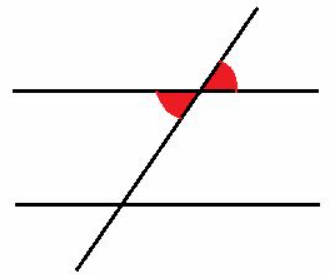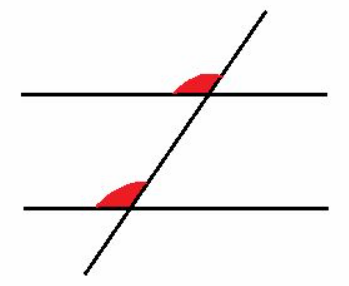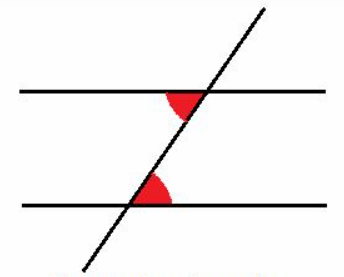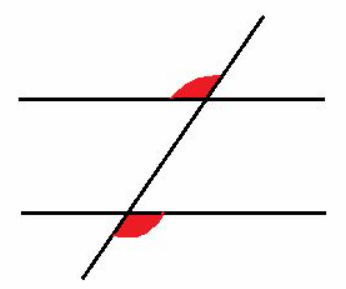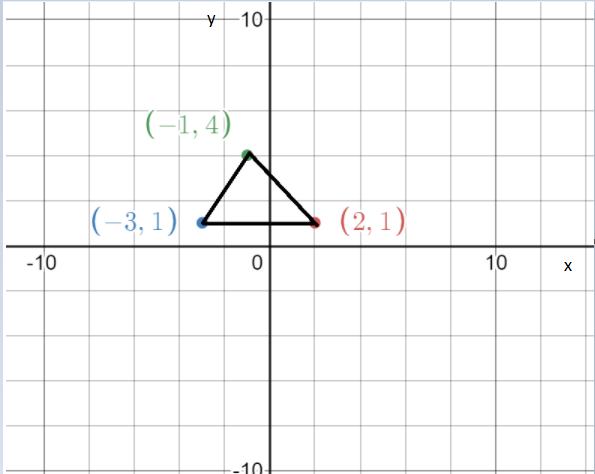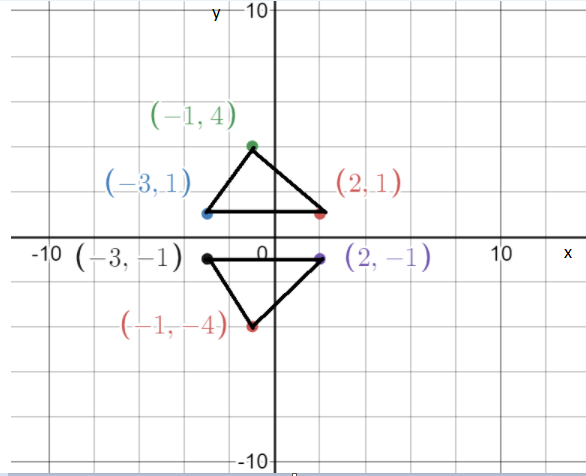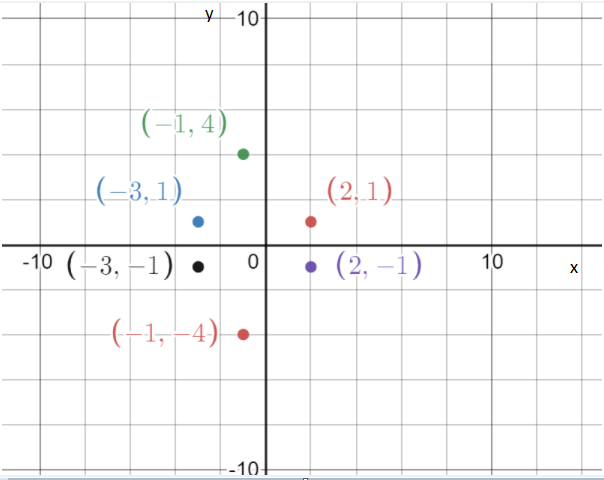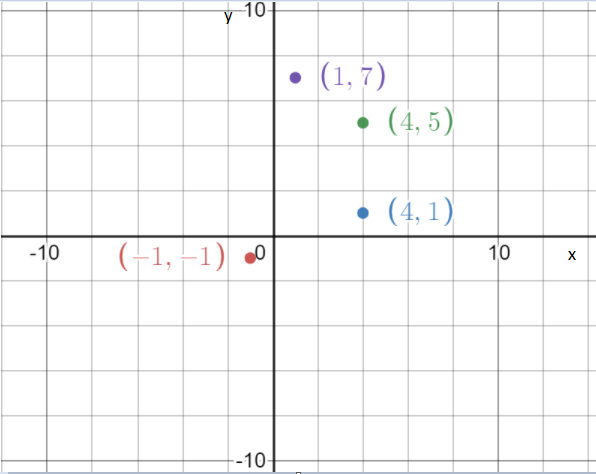
Glencoe Math Course 3 Volume 2 Student 1st Edition Chapter 7 Congruence And Similarity Exercise

Glencoe Math Course 3 Volume 2 Student Chapter 7 Congruence And Similarity Exercise

Glencoe Math Course 3 Volume 2 Chapter 7 Congruence And Similarity Exercise Solutions Page 504 Exercise 1, Problem1

The given equation is (x/15) = (7/30).

We apply cross multiplication i.e. multiply the numerator of one ratio to the denominator of the other ratio to obtain the value of the unknown variable.

We have the proportion \(\frac{x}{15}=\frac{7}{30}\),

⇒ \(\frac{x}{15}=\frac{7}{30}\)

⇒ x x 30 = 7 x 15 [applying cross multiplication]

⇒ x x 30 = 105

⇒ x = \(\frac{105}{30}\)

⇒ x = 3.5. Hence, the value of x is 3.5.

Finally, we can conclude that the value of the unknown variable is x = 3.5.

Read and Learn More Glencoe Math Course 2 Volume 1 Common Core Student Edition Solutions

Glencoe Math Course 3 Volume 2 Student Chapter 7 Page 504 Exercise 2 Problem1

The given equation is (4/9) = (14/y).

We apply cross multiplication i.e. multiply the numerator of one ratio to the denominator of the other ratio to obtain the value of the unknown variable.

We have the proportion \(\frac{4}{9}=\frac{14}{y}\),
Glencoe Math Course 2 Student Edition Volume 1 Chapter 7 Congruence Exercise

⇒ 4 x y = 14 x 9 [applying cross-multiplication]

⇒ 4 x y = 126

⇒ y = \(\frac{126}{4}\)

⇒ y = 31.5.

Finally, we can conclude that the value of the unknown variable is y=31.5.

Chapter 7 Congruence And Similarity Answers Glencoe Math Course 3 Volume 2 Page 504 Exercise 3, Problem1

The given equation is (12/Z) = (30/37).

We apply cross multiplication i.e. multiply the numerator of one ratio to the denominator of the other ratio to obtain the value of the unknown variable.

We have the proportion \(\frac{12}{Z}=\frac{30}{37}\),

⇒ 12 x 37 = 30 x z [applying cross-multiplication]

⇒ 30 x z = 444

⇒ z = \(\frac{444}{30}\)

⇒ z = 14.8.

Hence, the value of z is  14.8.

Finally, we can conclude that the value of the unknown variable is Z=14.8

Glencoe Math Course 3 Volume 2 Student Chapter 7 Page 504 Exercise 4 Problem1

The given equation is (8/15) = (m/21).

We apply cross multiplication i.e. multiply the numerator of one ratio to the denominator of the other ratio to obtain the value of the unknown variable.

We have the proportion \(\frac{8}{15}=\frac{m}{21}\),

⇒ 8 x 21 = m x15 [applying cross-multiplication]

⇒ 168 = m x 15

⇒ m = \(\frac{168}{15}\)

⇒ m = 11.2.

Hence, the value of m is 11.2.

Finally, we can conclude that the value of the unknown variable is m=112.

Step-By-Step Solutions For Chapter 7 Congruence And Similarity Exercises In Glencoe Math Course 3 Page 504 Exercise 5, Problem1

The given equation is (n/5) = (18/45).

We apply cross multiplication i.e. multiply the numerator of one ratio to the denominator of the other ratio to obtain the value of the unknown variable.

We have the proportion \(\frac{n}{5}=\frac{18}{45}\),

⇒ n x 45 = 18 x 5 [applying cross-multiplication]

⇒ n x 45 = 90

⇒ n = \(\frac{90}{45}\)

⇒ n = 2.

Hence, the value of n is 2.

Finally, we can conclude that the value of the unknown variable is n=2.

Glencoe Math Course 3 Volume 2 Student Chapter 7 Page 504 Exercise 6 Problem1

The given equation is (3/7) = (21/p).

We apply cross multiplication i.e. multiply the numerator of one ratio to the denominator of the other ratio to obtain the value of the unknown variable.

We have the proportion \(\frac{3}{7}=\frac{21}{p}\),

⇒ 3 x p = 21 x 7 [applying cross-multiplication]

⇒ 3 x p = 147

⇒ p = \(\frac{147}{3}\)

⇒ p = 49.

Hence, the value of p is 49.

Finally, we can conclude that the value of the unknown variable is p=49.

Exercise Solutions For Chapter 7 Congruence And Similarity Glencoe Math Course 3 Volume 2 Page 504 Exercise 7, Problem1

The given statement is to find the slope of the line that passes through each pair of points (-1,1),(-3,7).

We apply the formula, m=(y2−y1)/(x2−x1) for determining the slope.

m = \(\underline{y_2-y_1}, \text { where, } x_1=-1, x_2=-3, y_1=1, y_2=7\). Therefore,

m = \(\frac{7-1}{-3-(-1)}\)

⇒ m = \(\frac{6}{-3+1}\)

⇒ m = \(\frac{6}{-2}\)

⇒ m = -3.

Hence, the slope of the line is m = -3.

Finally, we can conclude that the slope of the line that passes through each pair of points (−1,1),(−3,7) is m=−3.

Glencoe Math Course 3 Volume 2 Student Chapter 7 Page 504 Exercise 8 Problem1

The given statement is to find the slope of the line that passes through each pair of points (2,0), (0,2).

We apply the formula, m=(y2−y1)/(x2−x1) for determining the slope.

We have to find the slope of the line that passes through the two points (2,0),(0,2).

Let the slope be m, then we can write the formula,

m = \(\frac{y_2-y_1}{x_2-x_1} \text {, where, } x_1=2, x_2=0, y_1=0, y_2=2\). Therefore,

m = \(\frac{2-0}{0-2}\)

⇒ m = \(\frac{2}{-2}\)

⇒ m = -1.

Hence, the slope of the line is m = -1.

Finally, we can conclude that the slope of the line that passes through each pair of points (2,0),(0,2)is m=−1.

Examples Of Problems From Chapter 7 Congruence And Similarity Exercises In Glencoe Math Course 3 Page 504 Exercise 9, Problem1

The given statement is to find the slope of the line that passes through each pair of points (−6,−1),(−3,4).

We apply the formula, m=(y2−y1)/(x2−x1)for determining the slope.

We have to find the slope of the line that passes through the two points (−6,−1),(−3,4).

Let the slope be m, then we can write the formula,

m = \(\frac{y_2-y_1}{x_2-x_1}, \text { where, } x_1=-6, x_2=-3, y_1=-1, y_2=4\). Therefore,

m = \(\frac{4-(-1)}{-3-(-6)}\)

⇒ m = \(\frac{4+1}{-3+6}\)

⇒ m = \(\frac{5}{3}\).

Hence, the slope of the line is m = \(\frac{5}{3}\).

Finally, we can conclude that the slope of the line that passes through each pair of points (−6,−1),(−3,4))is m=5/3.

Glencoe Math Course 3 Volume 2 Student Chapter 7 Page 505 Exercise 1 Problem1

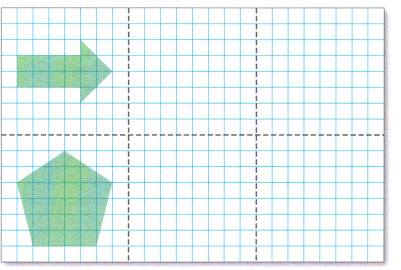
We have the instruction to fold the given page vertically into three parts.We can denote the folding lines in dotted fashion as,
Glencoe Math Course 3 Volume 2 Student 1st Edition Chapter 7 Congruence And Similarity Exercise Page 505 Exercise 1, Problem1

Finally, we can conclude that after folding the page vertically into three sections we get,

Glencoe Math Course 3 Volume 2 Student 1st Edition Chapter 7 Congruence And Similarity Exercise Page 505 Exercise 1, Problem1

Common Core Chapter 7 Congruence And Similarity Exercise Detailed Solutions Glencoe Math Course 3 Volume 2 Page 505 Exercise 1, Problem2

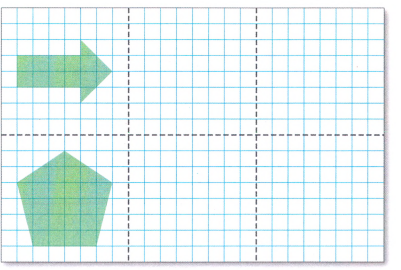
We have a page that is folded vertically into three sections
 

Glencoe Math Course 3 Volume 2 Student 1st Edition Chapter 7 Congruence And Similarity Exercise Page 505 Exercise 1, Problem2

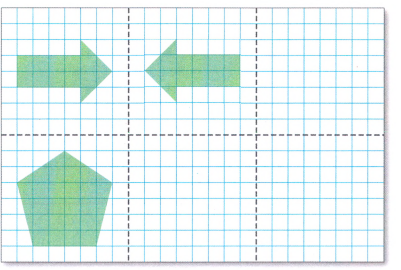
Now we draw the reflection of the arrow over the fold in the middle section.

We draw the reflected image of the arrow as the distance of each point of the previous arrow and its image with the folded line be the same.

As we know the distance of each point of an image and its preimage from the line of reflection is the same.

Here, the vertical folded line is referred to as the line of reflection.

So, we can draw as
Glencoe Math Course 3 Volume 2 Student 1st Edition Chapter 7 Congruence And Similarity Exercise Page 505 Exercise 1, Problem2

Finally, we can conclude that after drawing the reflection of the arrow over the fold in the middle section we get

Glencoe Math Course 3 Volume 2 Student 1st Edition Chapter 7 Congruence And Similarity Exercise Page 505 Exercise 1, Problem2

Glencoe Math Course 3 Volume 2 Student Chapter 7 Page 505 Exercise 1 Problem3

We have a page that is folded vertically into three sections
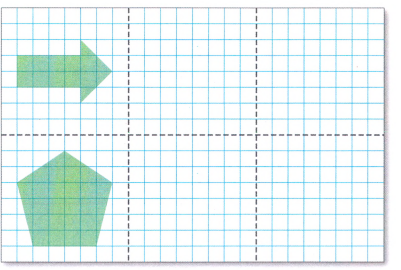
Glencoe Math Course 3 Volume 2 Student 1st Edition Chapter 7 Congruence And Similarity Exercise Page 505 Exercise 1, Problem 3

Then we draw the reflection of the arrow over the fold in the middle section
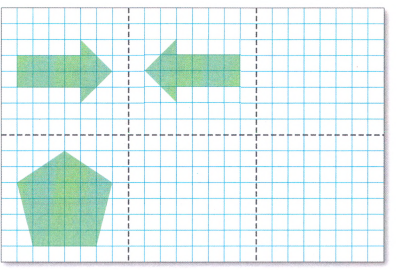
 

Glencoe Math Course 3 Volume 2 Student 1st Edition Chapter 7 Congruence And Similarity Exercise Page 505 Exercise 1, Problem -3
Now, we draw the reflection of the second arrow in the right-most section in a similar way.

As we know that the distance of each point of an image and its preimage from the line of reflection is the same.

Here, the vertical folded line is referred to as the line of reflection.

So, we can draw as
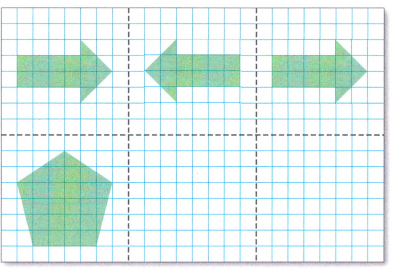
Glencoe Math Course 3 Volume 2 Student 1st Edition Chapter 7 Congruence And Similarity Exercise Page 505 Exercise 1, Problem -3.

Finally, we can conclude that after drawing the reflection of the second arrow over the fold in the right-hand section we get,

Glencoe Math Course 3 Volume 2 Student 1st Edition Chapter 7 Congruence And Similarity Exercise Page 505 Exercise 1, Problem -3.


Glencoe Math Course 3 Volume 2 Student Chapter 7 Page 505 Exercise 1 Problem4

When both images are reflected over the vertical line the resulting images of the pentagon are identical but that of the arrow is not.

Both the first and the second reflection produce the same shapes. The reflection is shown below.
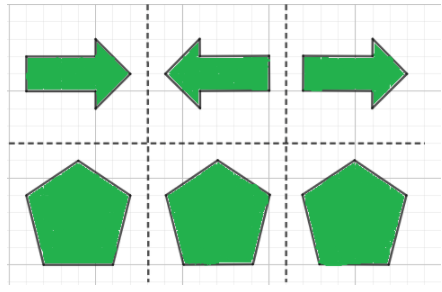
Glencoe Math Course 3 Volume 2 Student 1st Edition Chapter 7 Congruence And Similarity Exercise Page 505 Exercise 1, Problem4

When the reflection is done first over the vertical axis followed by the horizontal axis, the original and the final image of the arrow are different. Only the image formed after the horizontal reflection is the same as the preimage.

This is because the arrow possesses horizontal symmetry.
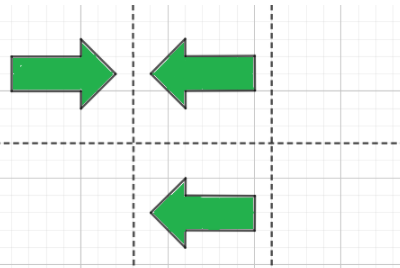
Glencoe Math Course 3 Volume 2 Student 1st Edition Chapter 7 Congruence And Similarity Exercise Page 505 Exercise 1, Problem 4
When the reflection is done first over the vertical axis followed by the horizontal axis, the original and the final image of the pentagon are different.

Only the image formed after the first reflection along the vertical axis is the same as the original image.

This is because the pentagon possesses only vertical symmetry.
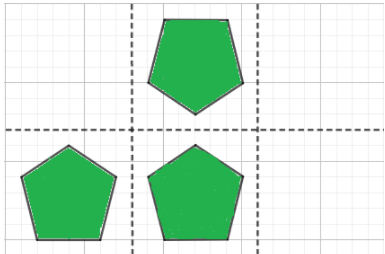
Glencoe Math Course 3 Volume 2 Student 1st Edition Chapter 7 Congruence And Similarity Exercise Page 505 Exercise 1, Problem-4


When both images are reflected over the vertical line the resulting images of the pentagon are identical but that of the arrow is not.

When the reflection is done first over the vertical axis followed by the horizontal axis, the original and the final image of the pentagon are different.

Only the image formed after the first reflection along the vertical axis is the same as the original image and in the case of the arrow, the original and the last reflected image is the same.

Glencoe Math Course 3 Volume 2 Student Chapter 7 Page 507 Exercise 1 Problem1

First, we need to apply translation to the given figure. Translation refers to the movement of shapes from one location to another. The foot on the left side is to be slid down beside the right foot.

Then a vertical line is drawn between them and the left foot is reflected along this line. This results in the formation of the right foot.
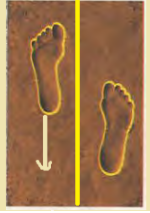
Glencoe Math Course 3 Volume 2 Student 1st Edition Chapter 7 Congruence And Similarity Exercise Page 507 Exercise 1, Problem-1

So, translation followed by reflection gives the required transformation.

We get the transformation by applying translation followed by reflection.
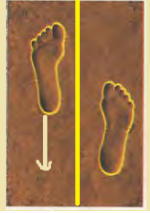
Glencoe Math Course 3 Volume 2 Student 1st Edition Chapter 7 Congruence And Similarity Exercise Page 507 Exercise 1, Problem-1

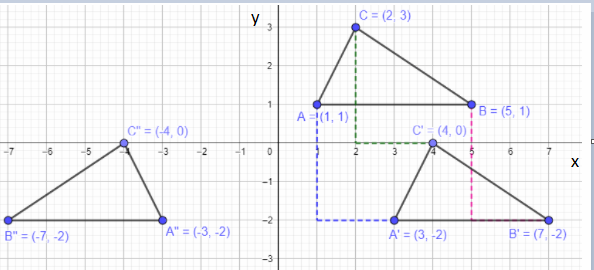
Student Edition Chapter 7 Congruence and Similarity Solutions Guide Glencoe Math Course 3 Volume 2 Page 507 Exercise 2, Problem1

The blue triangle is first flipped along the horizontal line. This is known as reflection.

A reflection is a metamorphosis that depicts a figure being flipped.

After this, the figure is translated down and then to the right side. This results in the pink triangle.
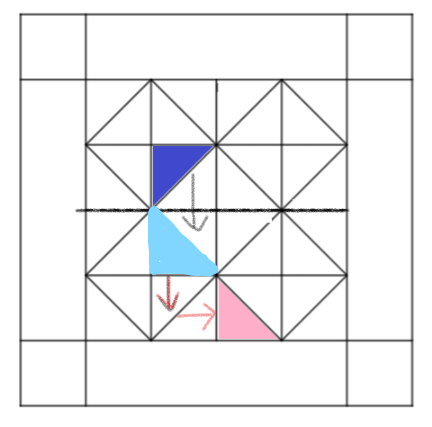
Glencoe Math Course 3 Volume 2 Student 1st Edition Chapter 7 Congruence And Similarity Exercise Page 507 Exercise 2, Problem-1

So the transformation is reflection followed by the translation.

Reflection followed by translation results in the given transformation.
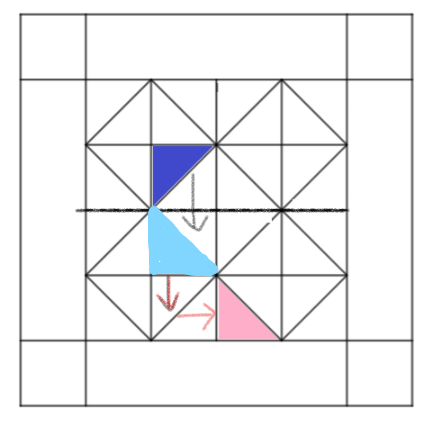
Glencoe Math Course 3 Volume 2 Student 1st Edition Chapter 7 Congruence And Similarity Exercise Page 507 Exercise 2, Problem-1

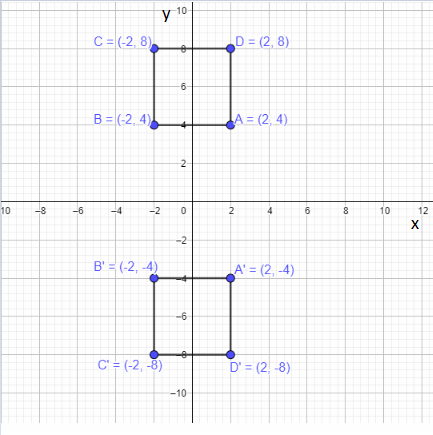
Glencoe Math Course 3 Volume 2 Student Chapter 7 Page 507 Exercise 3 Problem1

At first, the figure on the lower side is to be reflected along a vertical line.

A reflection is a metamorphosis that depicts a figure being flipped.

Now this reflected figure is to be translated to get the final figure.

The final figure is given in the following image.
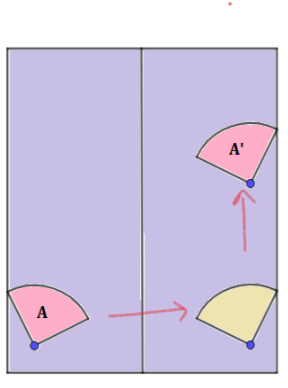
Glencoe Math Course 3 Volume 2 Student 1st Edition Chapter 7 Congruence And Similarity Exercise Page 507 Exercise 3, Problem-1

So, reflection followed by translation gives the final image.

The required transformation results from reflection followed by the translation.

Glencoe Math Course 3 Volume 2 Student 1st Edition Chapter 7 Congruence And Similarity Exercise Page 507 Exercise 3, Problem-1

Step-By-Step Answers For Chapter 7 Congruence And Similarity In Glencoe Math Course 3 Volume 2 Page 507 Exercise 4, Problem1

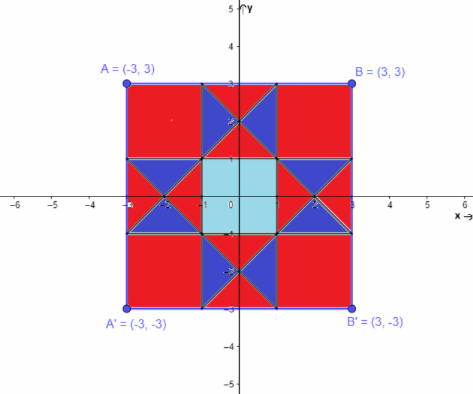
At first, using circles and sections the preimage is created.

Then, this preimage is constantly reflected first over the horizontal plane and then over the vertical plane.

At last, the small circle is rotated repeated at a right angle in the clockwise direction.

This results in the formation of a logo.
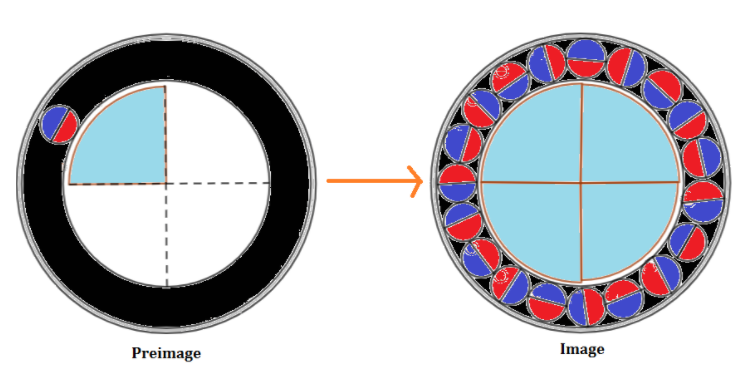
Glencoe Math Course 3 Volume 2 Student 1st Edition Chapter 7 Congruence And Similarity Exercise Page 507 Exercise 4, Problem-1

The logo formed by using reflection and rotation is given in the image below.
image

Glencoe Math Course 3 Volume 2 Student Chapter 7 Page 508 Exercise 5 Problem1

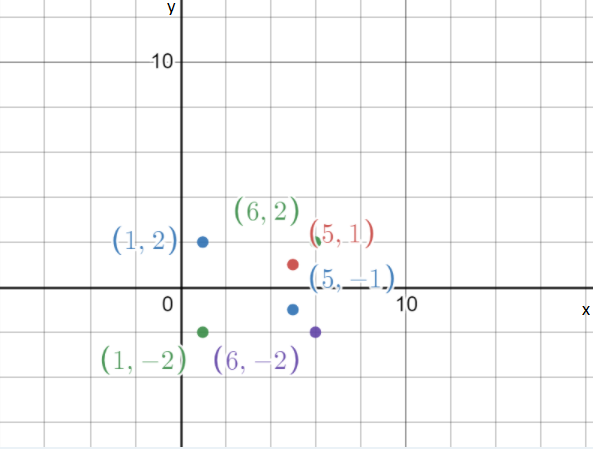
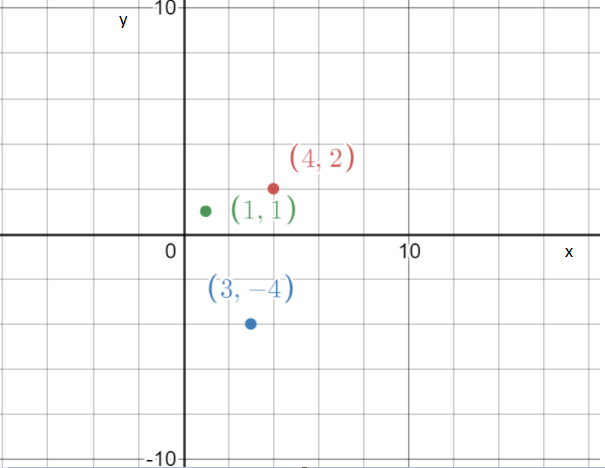
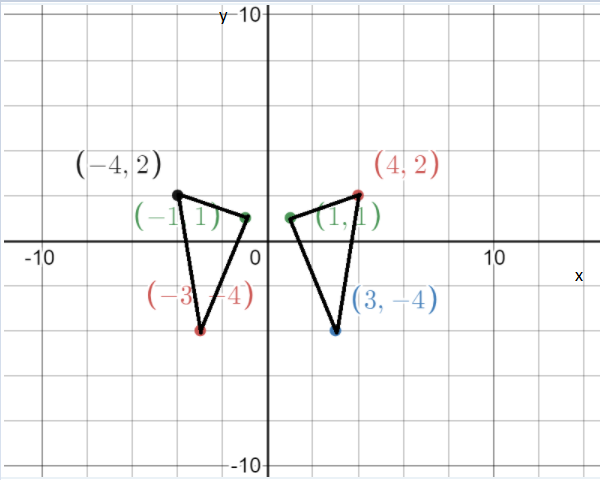
Let us consider the initial position of the line segment as (−4,4)and (−1,1).

After reflection from the x-axis, the x coordinates of the original image remain intact while they coordinates will be multiplied by −1.

After reflection from the y-axis, the x coordinates of the original image remain intact while the y coordinates will be multiplied by −1.

The resultant figure is given in the image below.
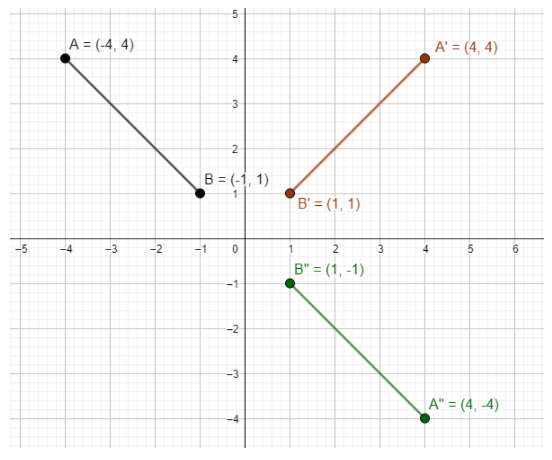
Glencoe Math Course 3 Volume 2 Student 1st Edition Chapter 7 Congruence And Similarity Exercise Page 508 Exercise 5, Problem-1


The final transformation is given in the image below.
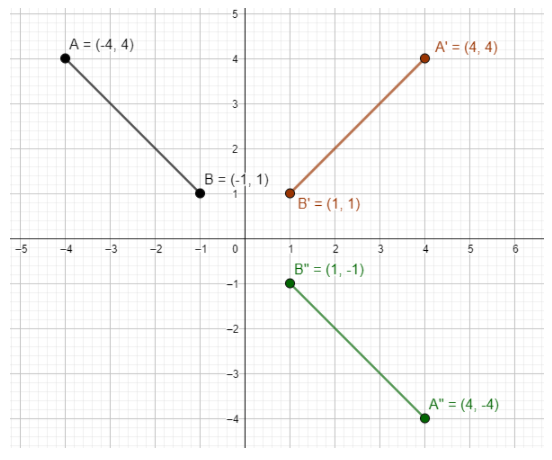
Glencoe Math Course 3 Volume 2 Student 1st Edition Chapter 7 Congruence And Similarity Exercise Page 508 Exercise 5, Problem-1


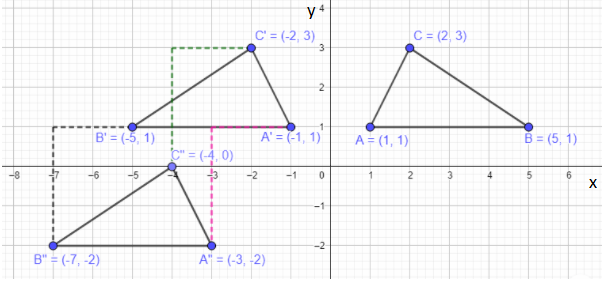
Glencoe Math Course 3 Volume 2 Student Chapter 7 Page 508 Exercise 6 Problem1

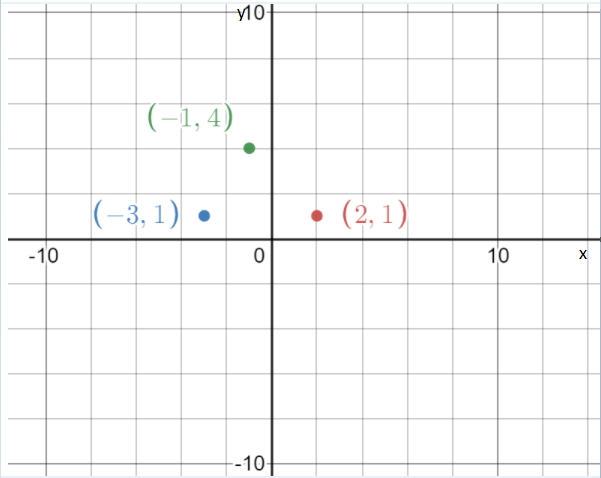
We consider two vertical axes. The ΔXYZ is first reflected over the first vertical axis and then, over the second axis.

The single transformation that could be used to obtain the final position of the triangle is by translating the original figure to the right-hand side.
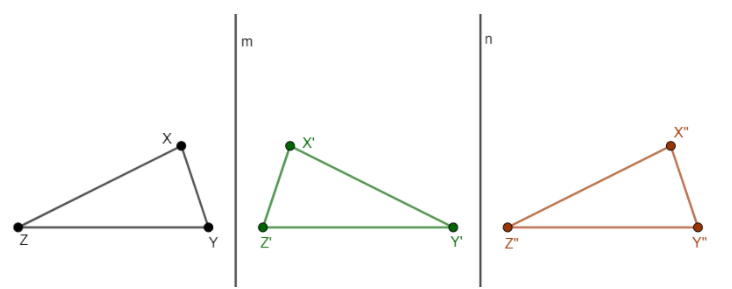
Glencoe Math Course 3 Volume 2 Student 1st Edition Chapter 7 Congruence And Similarity Exercise Page 508 Exercise 6, Problem-1

The single transformation that can be used to obtain the following image is translation.
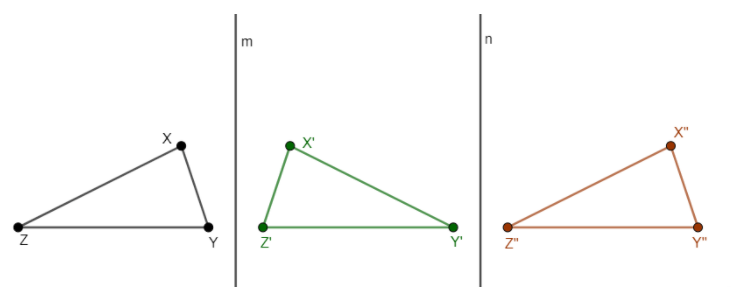
Glencoe Math Course 3 Volume 2 Student 1st Edition Chapter 7 Congruence And Similarity Exercise Page 508 Exercise 6, Problem-1

Glencoe Math Course 3 Volume 2 Student Chapter 7 Page 508 Exercise 7 Problem1

A dilation is a stretching or shrinking of an image that alters its location but does not change its shape.

To get the coordinates of the picture, we multiply each preimage coordinate by a scale factor when the coordinate plane’s centre of dilatation is the origin.When the scale factor is more than one, the size of the image is enlarged.

When the scale factor is less than one, the size of the image is reduced.When the scale factor is equal to one, the size of the image is unchanged.

A dilation is a stretching or shrinking of an image that alters its location but does not change its shape.

Page 504 Exercise 8, Problem1

After an object has been modified, the image of that object can be transformed again to create a new image. A combination of transformations is the name for such a transformation.

A single transformation can explain the transformation from a single object to the final image after a series of transformations.

An object’s image can be transformed again to generate a new image after it has been transformed. A combination of transformations is a type of transformation.

A single transformation can explain the transformation from a single object to the final image after a number of transformations have been applied.
Differential Equations Of First Order And First Degree Homogeneous Equation Methods To Find An Integrating Factor Solved Example Problems Exercise 2.5

Differential Equations of First Order and First Degree Solved Problems

Example. 1. Solve \(\left(x y^2-x^2\right) d x+\left(3 x^2 y^2+x^2 y-2 x^3+y^2\right) d y=0\)

Solution.

Given equation is \(\left(x y^2-x^2\right) d x+\left(3 x^2 y^2+x^2 y-2 x^3+y^2\right) d y=0\) ……………..(1)

where \(\mathrm{M}=x y^2-x^2, \mathrm{~N}=3 x^2 y^2+x^2 y-2 x^3+y^2\)

⇒ \(\frac{\partial \mathrm{M}}{\partial y}=2 x y, \frac{\partial \mathrm{N}}{\partial x}\)

= \(6 x y^2+2 x y-6 x^2 \Rightarrow \frac{\partial \mathrm{M}}{\partial y} \neq \frac{\partial \mathrm{N}}{\partial x}\) => (1) is not an exact equation.

But \(\frac{1}{M}\left(\frac{\partial \mathrm{N}}{\partial x}-\frac{\partial \mathrm{M}}{\partial y}\right)\)

= \(\frac{1}{x y^2-x^2}\left(6 x y^2+2 x y-6 x^2-2 x y\right)=\frac{1}{x y^2-x^2} \cdot 6\left(x y^2-x^2\right)=6K\)

∴ I.F = \(e^{\int 6 d y}=e^{6 y}\) Multiplying (1) by \(e^{6 y} \Rightarrow\left(x y^2-x^2\right) e^{6 y} d x+\left(3 x^2 y^2+x^2 y-2 x^3+y^2\right) e^{6 y} d y=0\) …………………(2)

(2) is an exact equation where \(\mathrm{M}_1=\left(x y^2-x^2\right) e^{6 y} \text { and } \mathrm{N}_1=\left(3 x^2 y^2+x^2 y-2 x^3+y^2\right) e^{6 y}\) since \(\frac{\partial \mathrm{M}_1}{\partial y}=\frac{\partial \mathrm{N}_1}{\partial x}\)  (verify)

(1) Integrating \(\mathrm{M}_1\) w.r.t. x, treating y as constant.

⇒ \(\int^x \mathrm{M}_1 d x=\int^x\left(x y^2-x^2\right) e^{6 y} d x=e^{6 y}\left(\frac{x^2}{2} y^2-\frac{x^3}{3}\right)\) …………………(3)

(2) \(\int\) (terms of \(\mathrm{N}_1\) not containing x) dy = \(\int y^2 e^{6 y} d y\)

= \(\frac{y^2 e^{6 y}}{6}-\int \frac{e^{6 y}}{6} \cdot 2 y d y=y^2 \frac{e^{6 y}}{6}-\frac{1}{3}\left[y \frac{e^{6 y}}{6}-\int \frac{e^{6 y}}{6} \cdot d y\right]\)

= \(\frac{y^2 e^{6 y}}{6}-\frac{1}{18} y e^{6 y}+\frac{1}{18} \frac{e^{6 y}}{6}\) ……………..(4)

∴ The general solution of (2) is (3) + (4) = C

⇒ \(\frac{x^2 y^2 e^{6 y}}{2}-\frac{x^3 e^{6 y}}{3}+\frac{y^2 e^{6 y}}{6}-\frac{y e^{6 y}}{18}+\frac{e^{6 y}}{108} \neq c \Rightarrow e^{6 y}\left(\frac{x^2 y^2}{2}-\frac{x^3}{3}+\frac{y^2}{6}-\frac{y}{18}+\frac{1}{108}\right)=c\)

Differential Equations Of First Order And First Degree Exercise 2.5

Example 2. Solve \(\left(x y^3+y\right) d x+2\left(x^2 y^2+x+y^4\right) d y=0\)

Solution.

Given equation is of the form Mdx + Ndy = 0

where \(\mathrm{M}=x y^3+y \text { and } \mathrm{N}=2\left(x^2 y^2+x+y^4\right)\)

Now, \(\frac{\partial \mathrm{M}}{\partial y}=3 x y^2+1, \frac{\partial \mathrm{N}}{\partial x}=4 x y^2+2 \Rightarrow \frac{\partial \mathrm{M}}{\partial y} \neq \frac{\partial \mathrm{N}}{\partial x} \Rightarrow\)

Given equation is not an exact equation

But \(\frac{1}{M}\left(\frac{\partial \mathrm{N}}{\partial x}-\frac{\partial \mathrm{M}}{\partial y}\right)=\frac{1}{x y^3+y}\left(4 x y^2+2-3 x y^2-1\right)=\frac{x y^2+1}{y\left(x y^2+1\right)}=\frac{1}{y}=g(y)\)

∴ \(\text { I.F. }=\exp \left(\int \frac{1}{y} d y\right)=\exp (\log y)=e^{\log y}=y\)

Multiplying the given equation with \(y: \Rightarrow\left(x y^4+y^2\right) d x+2\left(x^2 y^3+x y+y^5\right) d y=0\) ……(1)

Then (1) is an exact equation where \(\mathrm{M}_1=x y^4+y^2\)

and \(\mathrm{N}_1=2\left(x^2 y^3+x y+y^5\right) \Rightarrow \frac{\partial \mathrm{M}_1}{\partial y}=\frac{\partial \mathrm{N}_1}{\partial x}\)  (verify)

(1) Integrating \(\mathrm{M}_1\) w.r.t. x, treating y as constant

⇒ \(\int^x \mathrm{M}_1 d x=\int^x\left(x y^4+y^2\right) d x=\frac{x^2 y^4}{2}+y^2 x\) ………………………..(2)

(2) \(\int\) (terms of \(\mathrm{N}_1\) not containing x) dy = \(\int 2 y^5 d y=\frac{y^6}{3}\) …………….(3)

∴ The general solution of (1) is (2) + (3) = C

⇒ \(\frac{x^2 y^4}{2}+y^2 x+\frac{y^6}{3}=c \Rightarrow 3 x^2 y^4+6 x y^2+2 y^6=6 c\)

Homogeneous Equations Solved Problems Exercise 2.5

Example. 3. Solve \(\left(y^4+2 y\right) d x+\left(x y^3+2 y^4-4 x\right) d y=0\)

Solution.

Given equation is \(\left(y^4+2 y\right) d x+\left(x y^3+2 y^4-4 x\right) d y=0\) ………………………..(1)

Where \(\mathrm{M}=y^4+2 y, \mathrm{~N}=x y^3+2 y^4-4 x \Rightarrow \frac{\partial \mathrm{M}}{\partial v}=4 y^3+2, \frac{\partial \mathrm{N}}{\partial x}=y^3-4\)

Since, \(\frac{\partial \mathrm{M}}{\partial y} \neq \frac{\partial \mathrm{N}}{\partial x}\) (1) is not an exact equation

But \(\frac{1}{\mathrm{M}}\left(\frac{\partial \mathrm{N}}{\partial x}-\frac{\partial \mathrm{M}}{\partial y}\right)=\frac{1}{y\left(y^3+2\right)}\left(y^3-4-4 y^3-2\right)=\frac{-3\left(y^3+2\right)}{y\left(y^3+2\right)}=\frac{-3}{y}\) Tan-1

∴ I.F = \(\exp \left(\int \frac{-3}{y} d y\right)=\exp (-3 \log y)=\exp \left(\log y^{-3}\right)=\frac{1}{y^3}\)

Multiplying (1) with \(\frac{1}{y^3} \Rightarrow\left(y+\frac{2}{y^2}\right) d x+\left(x+2 y-\frac{4 x}{y^3}\right) d y=0\) ……………………..(2)

(2) is an exact equation where \(\mathrm{M}_1=y+\frac{2}{y^2}, \mathrm{~N}_1=x+2 y-\frac{4 x}{y^3}\)

∴ The general solution of (2) is \(\int^x\left(y+\frac{2}{y^2}\right) d x+\int 2 y d y=\mathrm{C} \Rightarrow\left(y+\frac{2}{y^2}\right) x+y^2=\mathrm{c}\)

Differential Equations Of First Order And First Degree Exercise 2.5

Example.4. Solve \(\left(2 x^2 y-3 y^2\right) d x+\left(2 x^3-12 x y+\log y\right) d y=0\)

Solution.

Given equation is of the form M dx + N dy = 0 …………………(1)

where \(\mathrm{M}=2 x^2 y-3 y^2, \mathrm{~N}=2 x^3-12 x y+\log y\)

⇒ \(\frac{\partial \mathrm{M}}{\partial y}=2 x^2-6 y, \frac{\partial \mathrm{N}}{\partial x}=6 x^2-12 y \Rightarrow \frac{\partial \mathrm{M}}{\partial y} \neq \frac{\partial \mathrm{N}}{\partial x}\)

=> The given equation is not an exact equation.

But \(\frac{1}{\mathrm{M}}\left(\frac{\partial \mathrm{N}}{\partial x}-\frac{\partial \mathrm{M}}{\partial y}\right)=\frac{1}{2 x^2 y-3 y^2}\left(6 x^2-12 y-2 x^2+6 y\right)=\frac{2\left(2 x^2-3 y\right)}{y\left(2 x^2-3 y\right)}=\frac{2}{y}\)

∴ I.F \(=e^{\int(2 / y) d y}=e^{2 \log y}=e^{\log y^2}=y^2\)

Multiplying (1) by  \(y^2:\left(2 x^2 y^3-3 y^4\right) d x+\left(2 x^3 y^2-12 x y^3+y^2 \log y\right) d y=0\) ……………..(2)

(2) is an exact equation where \(\mathrm{M}_1=2 x^2 y^3-3 y^4, \quad \mathrm{~N}_1=2 x^3 y^2-12 x y^3+y^2 \log y\)

⇒ \(\frac{\partial \mathrm{M}_1}{\partial y}=6 x^2 y^2-12 y^3=6 x^2 y^2-12 y^3=\frac{\partial \mathrm{N}_1}{\partial x}\) ……………………(3)

(1) Integrating M1 w.r.t.x., treating y as constant.

⇒ \(\int^x M_1 d x=\int^x\left(2 x^2 y^3-3 y^4\right) d x=(2 / 3) x^3 y^3-3 y^4 x\)

(2) \(\int\) (terms of \(\mathrm{N}_1\) not containing x)dy = \(\int y^2 \log y d y\)

= \((1 / 3) y^3 \log y-\int(1 / 3) y^3 \cdot(1 / y) d y=(1 / 3) y^3 \log y-(1 / 3) y^2 d y\)

= \(\frac{1}{3} y^3 \log y-\frac{1}{27} y^3\) …………………….(4)

The general solution (2) is (3) + (4) = c \(\frac{2}{3} x^3 y^3-3 y^4 x+\frac{y^3}{3} \log y-\frac{1}{9} y^3=\frac{c}{9} \Rightarrow 6 x^3 y^3-27 x y^4+3 y^3 \log y=c\)


Differential Equations Of First Order And First Degree Homogeneous Equation Methods To Find An Integrating Factor Solved Example Problems Exercise 2.7

Differential Equations of First Order and First Degree Solved Example Problems Exercise 2.7

Example. 1 Solve \(\left(x^2+1\right) \frac{d y}{d x}+4 x y=\frac{1}{x^2+1}\)

Solution.

Given Equation

\(\left(x^2+1\right) \frac{d y}{d x}+4 x y=\frac{1}{x^2+1}\)

Reducing the given equation to standard form, by dividing with \(\left(x^2+1\right)\)

⇒ \(\frac{d y}{d x}+\frac{4 x}{x^2+1} y=\frac{1}{\left(x^2+1\right)^2} \text { where } \mathrm{P}=\frac{4 x}{x^2+1}, \mathrm{Q}=\frac{1}{\left(x^2+1\right)^2}\) ……….(1)

⇒ \(\int \mathrm{P} d x=\int \frac{4 x}{x^2+1} d x=2 \log \left(x^2+1\right)=\log \left(x^2+1\right)^2\)

Then l.F = \(\exp \left[\int P d x\right]=\exp \left[\log \left(x^2+1\right)^2\right]=\left(x^2+1\right)^2\)

∴ G. S. of (1) is y (I.F.) = \(\int \mathrm{Q}(\mathrm{I} \cdot \mathrm{F}) d x+c\)

⇒ \(y\left(x^2+1\right)^2=\int \frac{1}{\left(x^2+1\right)^2} \cdot\left(x^2+1\right)^2 d x=\int d x=x+c\)

Differential Equations Of First Order And First Degree Exercise 2.7

Example. 2: Solve \(x \frac{d y}{d x}+2 y-x^2 \log x=0\)

Solution:

Given Equation

\(x \frac{d y}{d x}+2 y-x^2 \log x=0\)

Divide the equation with x to reduce it to standard form :

⇒ \(\frac{d y}{d x}+\frac{2}{x} y=x \log x\) ……………….(1)

where p = 2/x and Q = x log x

⇒ \(\int \mathrm{P} d x=\int \frac{2}{x} d x=2 \log x=\log x^2 \text { then I.F. }=e^{\log x^2}=x^2\)

The G, S. of (1)is y(I.F.) = \(\int \text { Q (I.F.) } d x+c \Rightarrow y\left(x^2\right)=\int(x \log |x|) x^2 d x+c\)

⇒ \(x^2 y=\int x^3 \log |x| d x+c=\frac{x^4}{4} \log x-\int \frac{x^4}{4} \cdot \frac{1}{x} d x+c\)

⇒ \(x^2 y=\frac{x^4}{4} \log |x|-\int \frac{x^3}{4} d x+c \Rightarrow x^2 y=\frac{x^4}{4} \log |x|-\frac{x^4}{16}+c\)

Homogeneous Equations Solved Problems Exercise 2.7

Example. 3: Solve \(x \cos x \frac{d y}{d x}+(x \sin x+\cos x) y=1\)

Solution.

Given Equation

\(x \cos x \frac{d y}{d x}+(x \sin x+\cos x) y=1\)

Dividing the given equation by x cos x, we get

⇒ \(\frac{d y}{d x}+\frac{x \sin x+\cos x}{x \cos x} y=\frac{1}{x \cos x}\)

where \(\mathrm{P}=\frac{x \sin x+\cos x}{x \cos x}, \mathrm{Q}=\frac{1}{x \cos x}\)

⇒ \(\int \mathrm{P} d x=\int \frac{x \sin x+\cos x}{x \cos x} d x=\int\left(\tan x+\frac{1}{x}\right) d x\)

= \(\int \tan x d x+\int \frac{1}{x} d x=\log |\sec x|+\log |x|=\log |x \sec x|\)

∴ \(\text { I.F. }=\exp \left[\int \mathrm{P} d x\right]=\exp (\log |x \sec x|)=x \sec x\)

The G. S. of (1) is y(l.F.) = \(\int \mathrm{Q}(\mathrm{I} . \mathrm{F}) d x+c\)

y \((x \sec x)=\int \frac{1}{x \cos x}(x \sec x) d x+c \Rightarrow y(x \sec x)=\int \sec ^2 x d x+c \Rightarrow x y \sec x=\tan x+c\)

Methods To Find Integrating Factors For Exercise 2.7

Example. 4: Solve \(x(x-1) \frac{d y}{d x}-(x-2) y=x^3(2 x-1)\)

Solution.

Given Equation

\(x(x-1) \frac{d y}{d x}-(x-2) y=x^3(2 x-1)\)

Dividing the given equation with x(x -1), we get

⇒ \(\frac{d y}{d x}-\frac{x-2}{x(x-1)} y=\frac{x^2(2 x-1)}{x-1} \text { where } \mathrm{P}=-\frac{x-2}{x(x-1)}, \mathrm{Q}=\frac{x^2(2 x-1)}{x-1}\) ………….(1)

⇒ \(\int \mathrm{P} d x=\int-\frac{x-2}{x(x-1)} d x=\int\left(\frac{1}{x-1}-\frac{2}{x}\right) d x=\log (x-1)-2 \log x\)

∴ \(\text { I.F. }=\exp \left[\int \mathrm{P} d x\right]=e^{\log (x-1)} \cdot e^{-2 \log x}\)

= \(e^{\log (x-1)} \cdot e^{\log x^{-2}}=e^{\log (x-1) x^{-2}}=(x-1) x^{-2}=\frac{x-1}{x^2}\)

∴ G. S. of (1) is y (I.F.) = \(\int \mathrm{Q}(\text { I.F.) } d x+c\)

⇒ \(\frac{y(x-1)}{x^2}=\int \frac{x^2(2 x-1)}{x-1} \cdot \frac{x-1}{x^2} d x+c=\int(2 x-1) d x+c\)

⇒ \(\frac{y(x-1)}{x^2}=\int \frac{2 x^2}{2} d x-\int d x+c=x^2-x+c\)

Solutions For Exercise 2.7 First-Order Homogeneous Equations 

Example. 5: Solve \(\left(y-e^{\sin ^{-1} x}\right) \frac{d x}{d y}+\sqrt{1-x^2}=0, \quad|x|<1\)

Solution:

Given Equation

\(\left(y-e^{\sin ^{-1} x}\right) \frac{d x}{d y}+\sqrt{1-x^2}=0, \quad|x|<1\)

Gien equation can be written as: \(\sqrt{1-x^2} \frac{d y}{d x}+y=e^{\text{Sin}^{-1}} x \Rightarrow \frac{d y}{d x}+\frac{1}{\sqrt{1-x^2}} y\)

= \(\frac{e^{\sin ^{-1} x}}{\sqrt{1-x^2}} \ldots \ldots \ldots\)

where \(\left.\mathrm{P}=\frac{1}{\sqrt{1-x^2}}, \mathrm{Q}=\frac{e^{\sin ^{-1} x}}{\sqrt{1-x^2}}\)

(Note.|x|<1 \(\Rightarrow\left(1-x^2\right)>0\right)\)

I.F. = \(\exp \left(\int \mathrm{P} d x\right)=\exp \left(\int \frac{d x}{\sqrt{1-x^2}}\right)\)

= \(\exp \left(\text{Sin}^{-1} x\right)=e^{\text{Sin}^{-1} x}\)

where \(\mathrm{P}=\frac{1}{\sqrt{1-x^2}}, \mathrm{Q}=\frac{e^{\sin ^{-1} x}}{\sqrt{1-x^2}}\)

(Note. |x|<1 ⇒ \(\left(1-x^2\right)>0\))

General solution of (1) is y (I.F.) = \(\int \mathrm{Q}\) (I.F.) dx+c

⇒ y e^{\text{Sin}^{-1} x}=\int \frac{e^{\text{Sin}^{-1} x}}{\sqrt{1-x^2}} \cdot e^{\text{Sin}^{-1} x} d x+c=\int \frac{e^{2 \text{Sin}^{-1} x}}{\sqrt{1-x^2}} d x+c[/latex]

⇒ \(y e^{\sin ^{-1} x}=\int e^{2 t} d t+c\) where t = \(\sin ^{-1} x \Rightarrow d t=\frac{d x}{\sqrt{1-x^2}}\)

⇒ \(y e^{\text{Sin}^{-1} x}=\frac{e^{2 t}}{2}+c=\frac{e^{2 \text{Sin}^{-1} x}}{2}+c \Rightarrow 2 y e^{\text{Sin}^{-1} x}=e^{2 \text{Sin}^{-1} x}+c\)

Step-By-Step Solutions For Exercise 2.7 Differential Equations

Example 6. Solve \(\frac{d y}{d x}+\frac{y}{(1-x) \sqrt{x}}=1-\sqrt{x}\)

Solution.

Given linear equation is \(\frac{d y}{d x}+\frac{y}{(1-x) \sqrt{x}}=1-\sqrt{x}\)  where P = \(\frac{1}{(1-x) \sqrt{x}}\)

⇒ \(\int \mathrm{P} d x=\int \frac{1}{(1-x) \sqrt{x}} d x\) . Put [katex]\sqrt{x}=t \Rightarrow \frac{1}{2 \sqrt{x}} d x=d t \Rightarrow \frac{1}{\sqrt{x}} d x=2 d t[/latex]

= \(2 \int \frac{d t}{1-t^2}=2 \frac{1}{2} \log \frac{1+t}{1-t}=\log \frac{1+\sqrt{x}}{1-\sqrt{x}}\)

∴ \(\text { I.F. }=\exp \log \frac{1+\sqrt{x}}{1+\sqrt{x}}=\frac{1+\sqrt{x}}{1-\sqrt{x}}\)

∴ (\(\exp (\log x)=e^{\log x}=x\))

∴ G.S of given equation is \(y\left(\frac{1+\sqrt{x}}{1-\sqrt{x}}\right)=\int(1-\sqrt{x})\left(\frac{1+\sqrt{x}}{1-\sqrt{x}}\right) d x+c=\int(1+\sqrt{x}) d x+c\)

⇒ \(y\left(\frac{1+\sqrt{x}}{1-\sqrt{x}}\right)=x+\frac{x^{3 / 2}}{3 / 2}+c \Rightarrow y\left(\frac{1+\sqrt{x}}{1-\sqrt{x}}\right)=x+\frac{2}{3} x^{3 / 2}+c\)

Methods For Solving Exercise 2.7 Differential Equations

Example.7. Solve \(y d x-x d y+\log x d x=0 \text { (or) Solve } x \frac{d y}{d x}-y=\log x\)

Solution.

Given equation is \(y d x-x d y+\log x d x=0\)

⇒ \(\frac{d y}{d x}-\frac{1}{x} y=\frac{\log x}{x}\) This is a linear equation in y.

Where \(\mathrm{P}=-\frac{1}{x}, \mathrm{Q}=(\log x) / x . \text { I.F. }=e^{\int(-1 / x) d x}=e^{-\log x}=e^{\log x^{-1}}=1 / x\)

The GS. of (1) is \(y(1 / x)=\int \frac{1}{x} \cdot \frac{\log x}{x} d x+c=\int \frac{1}{x^2} \log x d x+c\)

= \(-\frac{1}{x} \log x-\int\left(-\frac{1}{x}\right) \frac{1}{x} d x+c \text { (Integrating by parts) }\)

= \(-\frac{1}{x} \log x+\int \frac{1}{x^2} d x+c=-\frac{1}{x} \log x-\frac{1}{x}+c\)

∴ G.S. is \(y=-\log x-1+c x \Rightarrow y=c x-(1+\log x)\)

Aliter: G. E. can be written as (x dy – y dx) – log x = 0

⇒ \(\frac{x d y-y d x}{x^2}-\frac{1}{x^2} \log x=0 \Rightarrow d\left(\frac{y}{x}\right)+(\log x) d\left(\frac{1}{x}\right)=0\)

⇒ \(\int d\left(\frac{y}{x}\right)+\int \log x d\left(\frac{1}{x}\right)=c \Rightarrow\left(\frac{y}{x}\right)+\left(\frac{1}{x}\right) \log x-\int\left(\frac{1}{x^2}\right) d x \Rightarrow\left(\frac{y}{x}\right)+\left(\frac{1}{x}\right) \log x+\left(\frac{1}{x}\right)=c\)

Solution is \((y / x)+(1 / x)(1+\log x)=c\)

Exercise 2.7 Solutions For First-Order Differential Equations 

Example. 8: Obtain the equation of the curve satisfying the differential equation \(\left(1+x^2\right) \frac{d y}{d x}+2 x y-4 x^2=0\) and passing through the origin

Solution:

Given equation is \(\left(1+x^2\right) \frac{d y}{d x}+2 x y=4 x^2\) ……..(1)

Dividing (1) by \(\left(1+x^2\right)\) to reduce it to standard form

⇒ \(\frac{d y}{d x}+\frac{2 x}{1+x^2} y=\frac{4 x^2}{1+x^2} \text { where } \mathrm{P}=\frac{2 x}{1+x^2}, \mathrm{Q}=\frac{4 x^2}{1+x^2}\) …………(2)

Now, \(\int \mathrm{P} d x=\int \frac{2 x}{1+x^2} d x=\log \left(1+x^2\right)\)

∴ \(\text { I.F. }=\exp \left(\int \mathrm{P} d x\right)=\exp \left[\log \left(1+x^2\right)\right]=1+x^2\)

∴ G.S. of (1) is y(I.F.) = \(\int \mathrm{Q}(\mathrm{I} \cdot \mathrm{F}) d x+c \Rightarrow y\left(1+x^2\right)=\int \frac{4 x^2}{1+x^2} \cdot\left(1+x^2\right) d x+c=\int 4 x^2 d x+c\)

⇒ \(y\left(1+x^2\right)=\left(4 x^3 / 3\right)+c\)

Given the curve passes through the origin (0,0) => 0 = 0 +c => c = 0

∴ the equation if the required curve is \(3 y\left(1+x^2\right)=4 x^3\)


Glencoe Math Course 3 Volume 2 Student 1st Edition Chapter 5 Triangles And The Pythagorean Theorem Exercise 1.1

Glencoe Math Course 3 Volume 2 Student 1st Edition Chapter 5 Triangles And The Pythagorean Theorem

Glencoe Math Course 3 Volume 2 Chapter 5 Exercise 1.1 Solutions Page 371 Exercise 1, Problem1

As per the given instruction, we have to justify how can algebraic concepts be applied to geometry. From the concept of algebra and geometry, we can say algebra has to do with equations and formulas, and geometry has to do with objects and shapes.

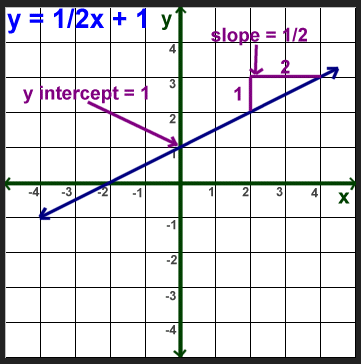
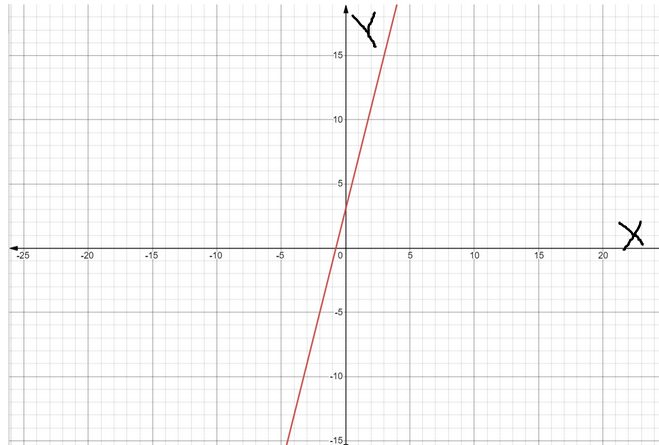
Now we will assume an equation and we will plot this in a graph. Let’s assume an equation that isy=4x+3 and we plot the equation in the graph. The graph is shown below

The graph of the equationy=4x+3 is a straight line.This illustrates a relationship between an algebraic concept (an equation) and a geometric concept (a line).


Glencoe Math Course 3 Volume 2 Student 1st Edition Chapter 5 Triangles And the Pythagorean Theorem Exercise5.1 Page 371 Exercise 1,Problem1


Finally, we can determine that algebra has to do with equations and formulas, and geometry has to do with objects and shapes. And if we graph an equation that is an algebraic concept we can make it a geometric concept.

Read and Learn More Glencoe Math Course 2 Volume 1 Common Core Student Edition Solutions

Glencoe Math Course 3 Volume 2 Student 1st Edition Chapter 5 Page 371 Exercise 1 Problem2


Glencoe Math Course 3 Volume 2 Student 1st Edition Chapter 5 Triangles And the Pythagorean Theorem Exercise5.1 Page 371 Exercise 1,Problem2


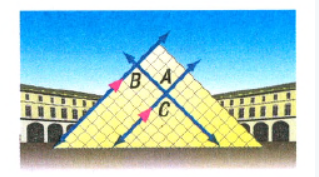
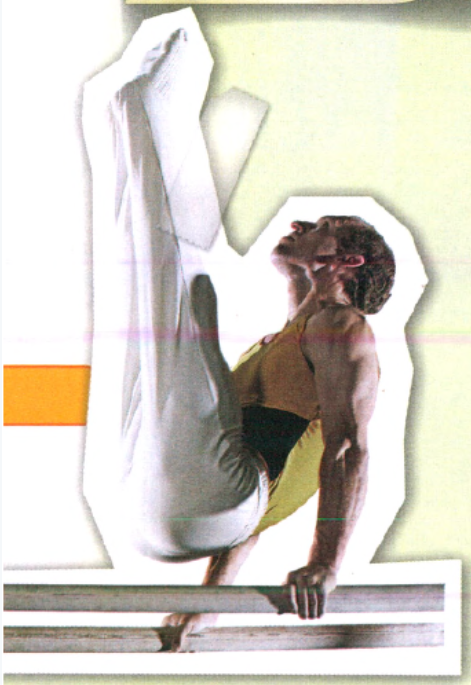
Here a gymnastic event in the Summer Olympics involves the parallel bars and we have to circle the parallel lines shown in the photo.

We know that parallel lines are the lines that never intersect each other at any point even on extending up to infinity, on either side.

Glencoe Math Course 3 Volume 2 Student 1st Edition Chapter 5 Triangles And the Pythagorean Theorem Exercise5.1 Page 371 Exercise 1,Problem2.


Parallel lines are the lines that never intersect each other at any point even on extending up to infinity, on either side. So as per the given instruction, the marked parallel lines are shown.

Glencoe Math Course 2 Student Edition Volume 1 Chapter 5 Triangles And The Pythagorean Theorem Exercise 5.1

Glencoe Math Course 3 Volume 2 Student 1st Edition Chapter 5 Page 373 Exercise 1 Problem1


Glencoe Math Course 3 Volume 2 Student 1st Edition Chapter 5 Triangles And the Pythagorean Theorem Exercise5.1 Page 373 Exercise 1,Problem1


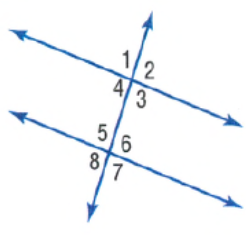
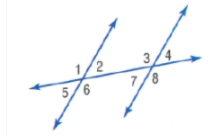
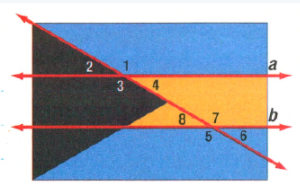
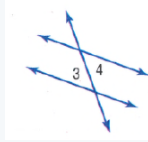
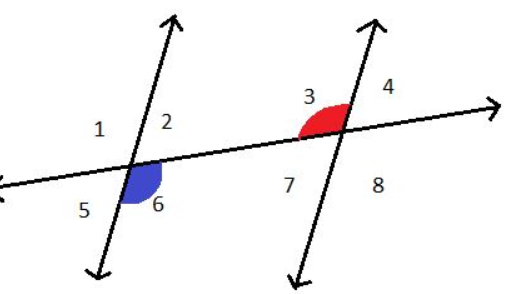
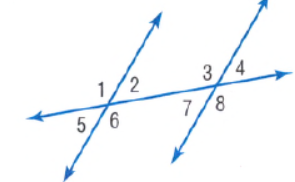
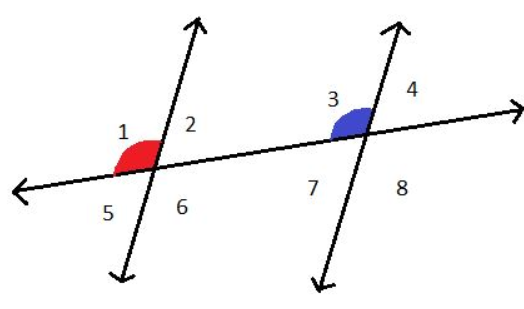
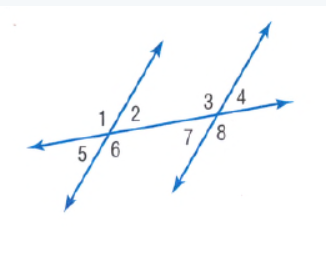
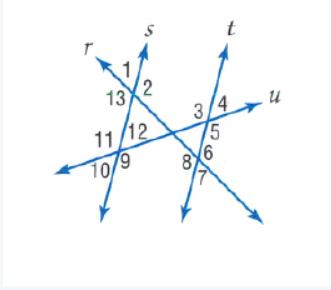
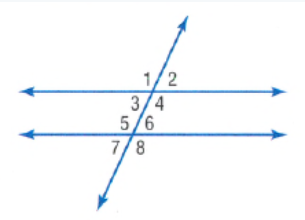
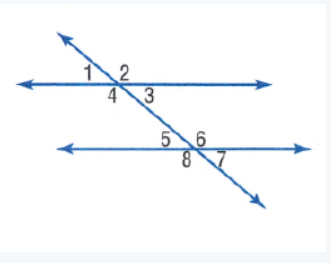
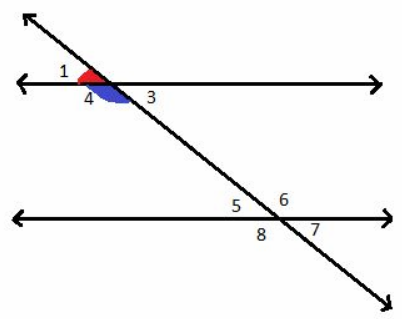
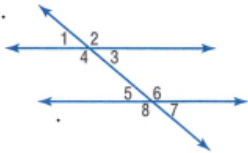
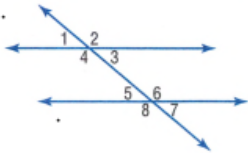
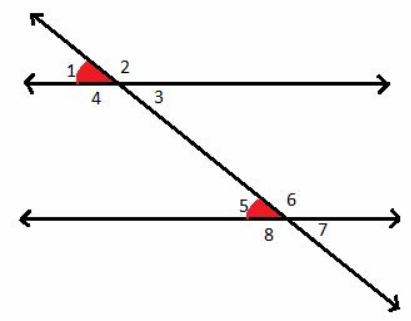
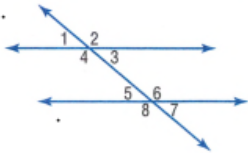
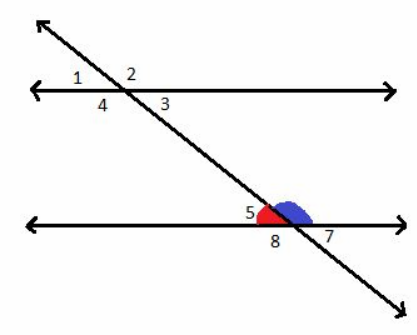
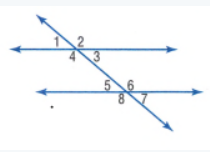
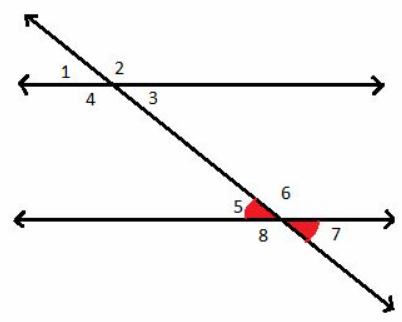
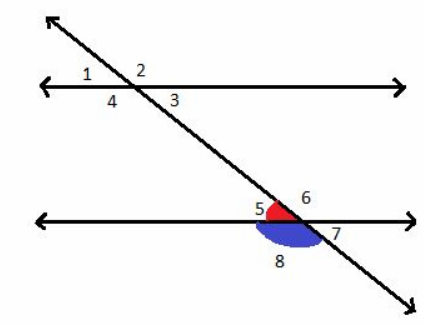
We have to find the relationship between∠4 and∠6.

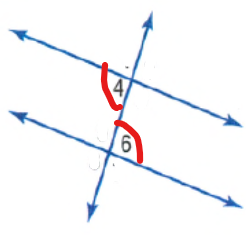
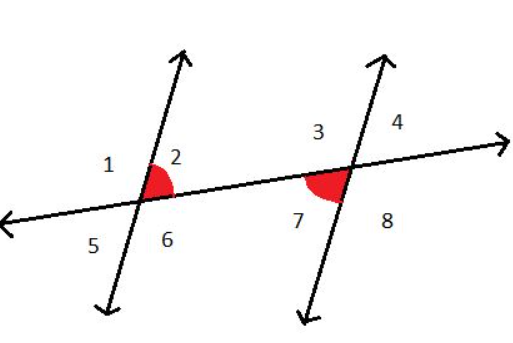
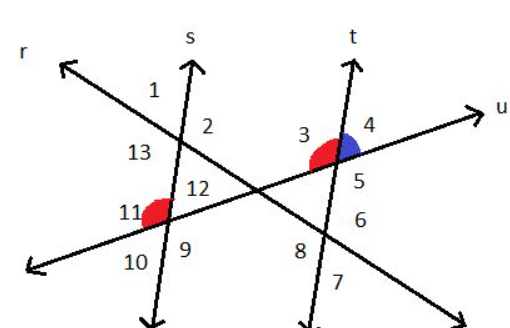
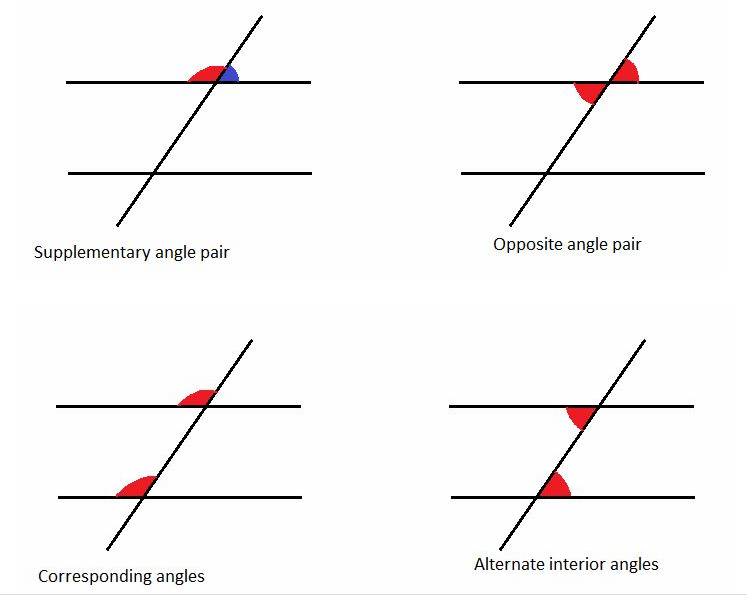
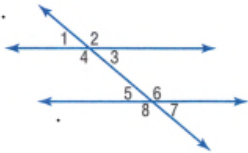
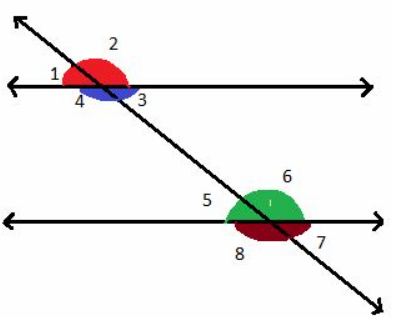
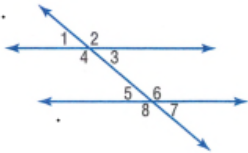
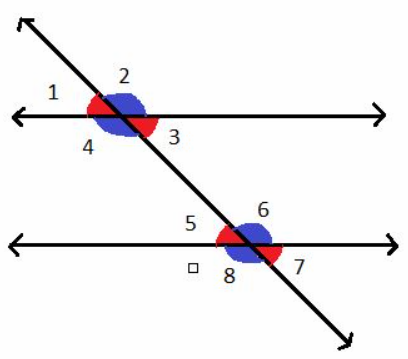
If we give a closer look at the given diagram we can say∠4 and∠6 are the alternate interior angles as here a transversal intersects two coplanar lines.The above-mentioned alternate interior angles are shown in the figures below


Glencoe Math Course 3 Volume 2 Student 1st Edition Chapter 5 Triangles And the Pythagorean Theorem Exercise5.1 Page 373 Exercise 1,Problem1.


Hence, as a transversal intersects two coplanar lines and∠4and∠6are formed so the relationship between them is they are alternate interior angles.

From the figure, we can easily observe that the verticle line has divided the horizontal line or 180o into exactly two equal halves. Therefore, the angle m∠4 is a right angle and has a value of 90o.

Finally, we can conclude that the angle m∠4=90o.


Glencoe Math Course 3 Volume 2 Student 1st Edition Chapter 5 Page 374 Exercise2 Problem1


Glencoe Math Course 3 Volume 2 Student 1st Edition Chapter 5 Triangles And the Pythagorean Theorem Exercise5.1 Page 374Exercise 2,Problem1


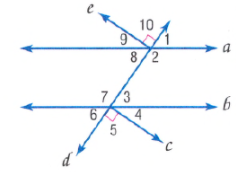
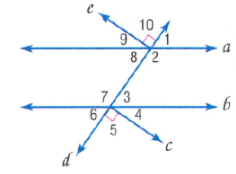
We have to find the measure of the angle∠9.

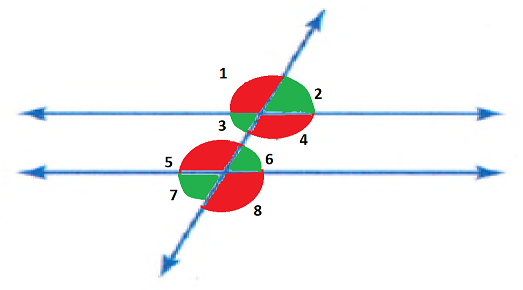
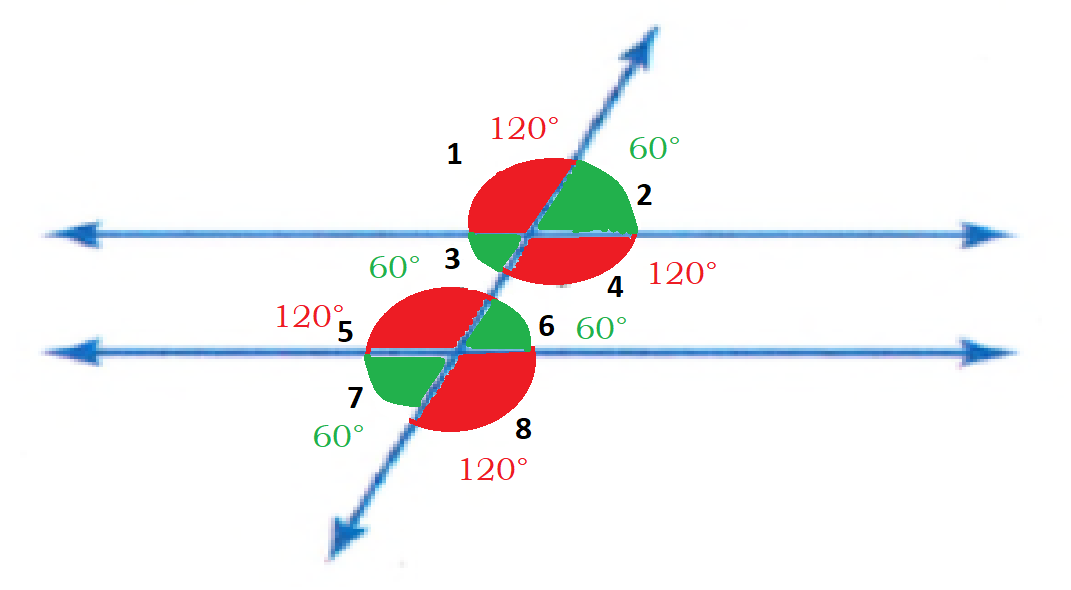
It can be found using the equality of corresponding and alternate angles


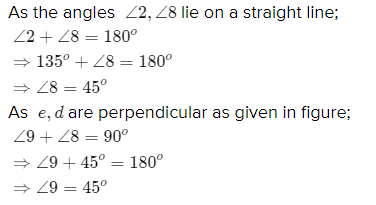
Glencoe Math Course 3 Volume 2 Student 1st Edition Chapter 5 Triangles And the Pythagorean Theorem Exercise Page 374Exercise 2, Problem1 solution

Finally, we can determine that the angle is found to be∠9=45o.


Glencoe Math Course 3 Volume 2 Student 1st Edition Chapter 5 Page 374 Exercise3 Problem1


Glencoe Math Course 3 Volume 2 Student 1st Edition Chapter 5 Triangles And the Pythagorean Theorem Exercise5.1 Page 374Exercise 3,Problem1

We have to find the measure of the angle∠7.

It can be found using the equality of corresponding and alternate angles.

As the angles ∠2,∠7 are alternate angles;∠2=∠7

∴∠7=135o.

Finally, we can determine that the final angle is found to be∠7=135°.


Page 374 Exercise4,Problem1


Glencoe Math Course 3 Volume 2 Student 1st Edition Chapter 5 Triangles And the Pythagorean Theorem Exercise5.1 Page 374Exercise 4,Problem1

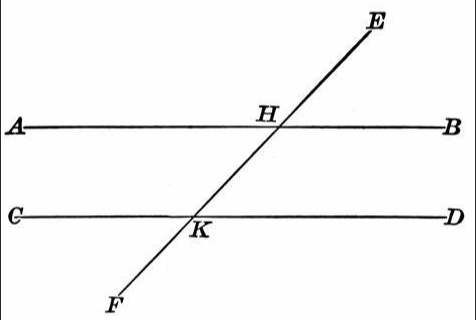
For the set of lines AB,CD with traversal asEF ; corresponding angles are always equal to each other, like∠EHB=∠EKD. Also similarly, alternate angles are also equal to each other, like∠EHB=∠FCK.

Corresponding and alternate angles are always equal for each set of parallel lines cut by a traversal.


Glencoe Math Course 3 Volume 2 Student 1st Edition Chapter 5 Page 375 Exercise2 Problem1


Glencoe Math Course 3 Volume 2 Student 1st Edition Chapter 5 Triangles And the Pythagorean Theorem Exercise5.1 Page 375 Exercise 2,Problem1

If the angles match the same corners of the parallel lines, they are corresponding angles, or else they are alternate angles.

As they don’t match the identical corners of the set of parallel lines, they are related as alternate angles.

Also as the angles are in the exterior side of the parallel lines, hence they are related as exterior alternate angles.

Finally, we can determine that the angles are related by exterior alternate angles.


Chapter 5 Exercise 1.1 Answers Triangles And Pythagorean Theorem Glencoe Math Course 3 Volume 2 Page 375 Exercise3,Problem1


Glencoe Math Course 3 Volume 2 Student 1st Edition Chapter 5 Triangles And the Pythagorean Theorem Exercise5.1 Page 375 Exercise 3,Problem1

We have to find the measure of the angle∠4,∠7.

It can be found using the equality of corresponding and alternate angles.

It is given that,

∠1=150°

As∠1,∠4 lie on a straight line,∠1+∠4=180o

⇒∠4=(180−150)°

⇒∠4=30°

Similarly,∠1,∠7 are corresponding angles.

Hence,∠7=150°.

Finally, the measurement of the angles were found as∠4=30o; ∠7=150°.


Glencoe Math Course 3 Volume 2 Student 1st Edition Chapter 5 Page 375 Exercise4 Problem1

Glencoe Math Course 3 Volume 2 Student 1st Edition Chapter 5 Triangles And the Pythagorean Theorem Exercise5.1 Page 375 Exercise 4,Problem1

We have to find the measure of the angle∠7

where it is given that∠2=110o;∠11=137°.

It can be found using the equality of corresponding and alternate angles.

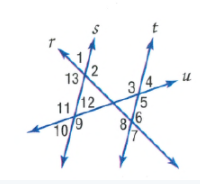
For the set of parallel lines with traversal as r;∠1+∠2=180°

[As they lie on a straight line]

⇒∠1=(180−110)°

⇒∠1=70°

Also, ∠1,∠7are alternate exterior angles.

∴∠1=∠7

∠7=70°

Finally, we can determine that the angle is found to be70o.


Step-by-step guide for Exercise 1.1 Chapter 5 Triangles and Pythagorean Theorem Glencoe Math Course 3 Page 375 Exercise6,Problem1

Glencoe Math Course 3 Volume 2 Student 1st Edition Chapter 5 Triangles And the Pythagorean Theorem Exercise5.1 Page 375 Exercise 6,Problem1

We have to find the measure of the angle∠3

where it is given that∠2=110o;∠11=137°.

It can be found using the equality of corresponding and alternate angles.

For the set of parallel lines with traversal as u;∠11=∠3

[As they are corresponding angles]

∴∠3=137°.

Finally, we can determine that the angle is found to be∠3=137°.


Glencoe Math Course 3 Volume 2 Student 1st Edition Chapter 5 Page 375 Exercise7 Problem1

Glencoe Math Course 3 Volume 2 Student 1st Edition Chapter 5 Triangles And the Pythagorean Theorem Exercise5.1 Page 375 Exercise 7,Problem1


We have to find the measure of the angle∠2

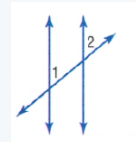
where it is given that∠1=45°

It can be found using the equality of corresponding and alternate angles.

As given in the question;

∠1,∠2

are corresponding angles. Hence, they are equal to each other.

∴∠1=∠2

⇒x+25=45

⇒x=45-25

⇒x=20

Finally, we can determine that the value of x is 20.


Glencoe Math Course 3 Volume 2 Student 1st Edition Chapter 5 Triangles And the Pythagorean Theorem Exercise5.1 Page 375 Exercise 7,Problem1.

We have to find the measure of the angle∠3

where it is given that∠4=80°.

It can be found using the equality of corresponding and alternate angles.

As given in the question; are alternate angles. Hence, they are equal to each other.

As given in the question; ∠3,∠4 are alternate angles. Hence, they are equal to each other.

∴∠3=∠4

⇒2x=80

⇒x=80/2

⇒x=40

Finally, we can determine that the value of x is 40.


Glencoe Math Course 3 Volume 2 Student 1st Edition Chapter 5 Page 375 Exercise8 Problem1

Glencoe Math Course 3 Volume 2 Student 1st Edition Chapter 5 Triangles And the Pythagorean Theorem Exercise5.1 Page 375 Exercise 8,Problem1

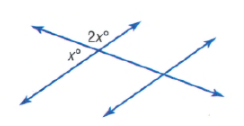
We have to find the measure of the angles represented by variables. The sum of angle in a straight line is always180°.

As we can see that the denoted angles lie on a straight line;

∴x+2x=180°

⇒3x=180

⇒ x=180/3

⇒x=60

∴2x=120

Finally, the value of the angles x and 2x were found as 60° and 120° .


Step-By-Step Guide For Exercise 1.1 Chapter 5 Triangles And Pythagorean Theorem Glencoe Math Course 3 Page 376 Exercise9, Problem1

Glencoe Math Course 3 Volume 2 Student 1st Edition Chapter 5 Triangles And the Pythagorean Theorem Exercise5.1 Page 376 Exercise 9,Problem1.


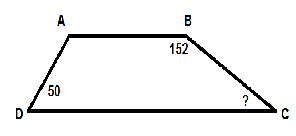
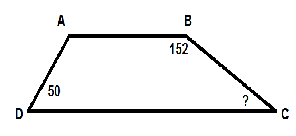
We have to find the measure of the angle∠C where it is given that∠D=50°;∠B=152°.

It can be found by extending the parallel set of lines and using the other sides as traversals and finally using the equality of corresponding and alternate angles.

It was found that the following problem can be solved It can be found by extending the parallel set of lines and using the other sides as traversals and finally using the equality of corresponding and alternate angles.

Glencoe Math Course 3 Volume 2 Student 1st Edition Chapter 5 Triangles And the Pythagorean Theorem Exercise5.1 Page 376 Exercise 9,Problem1

We have to find the measure of the angle∠C

where it is given that∠D=50°

;∠B=152°

It can be found by extending the parallel set of lines and using the other sides as traversals and finally using the equality of corresponding and alternate angles.

As given in the question;

∠B=152

If we extend the line DC and AB which are parallel lines and considering BC as traversal;

We can observe that ∠B,∠C

are interior angles that sum up to180 as it is the complement of the corresponding angle of ∠B.

∠B+∠C=180°

⇒∠C=(180−152)°

⇒∠C=28°

The final angle was found to be∠C=28°.


Glencoe Math Course 3 Volume 2 Student 1st Edition Chapter 5  Page 376 Exercise10 Problem1


Glencoe Math Course 3 Volume 2 Student 1st Edition Chapter 5 Triangles And the Pythagorean Theorem Exercise5.1 Page 376 Exercise 10,Problem1

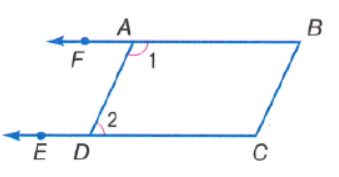
We need to make a conjecture about the relationship of ∠1 and ∠2.

Then justify our reasoning.

Given, that the quadrilateral ABCD is a parallelogram. So, we can say that lines AB and DC are parallel to each other, and segment AD is a transversal line. Therefore, m∠1 and m∠2

are interior angles on the same side of the transversal and therefore, their sum should be equal to 180 degree.

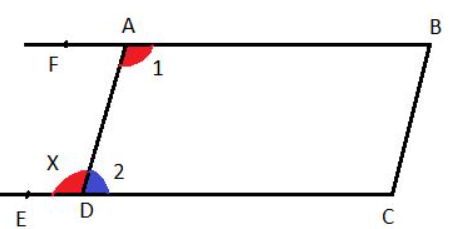
We can prove this reasoning with the help of alternate interior and supplementary angles, as shown below.

Glencoe Math Course 3 Volume 2 Student 1st Edition Chapter 5 Triangles And the Pythagorean Theorem Exercise5.1 Page 376 Exercise 10,Problem1.

In the figure, we can see that m∠1 and m∠x are the alternate interior angles, therefore both should be equal.

m∠1=m∠x

Also, m∠x and m∠2 are supplementary angles and therefore their sum should be equal to 180 degree.

​⇒m∠x+m∠2=180

⇒(m∠1)+m∠2=180 (replacing m∠x with m∠1)

⇒m∠1+m∠2=180

Therefore, our reasoning is correct, the sum of the interior angles on the same side of the transversal line is equal to 180 degree.

With the help of alternate interior and supplementary angles, we proved that the sum of the interior angles on the same side of the transversal line is equal to 180 degree.


Glencoe Math Course 3 Volume 2 Student 1st Edition Chapter 5 Page 376 Exercise11 Problem1

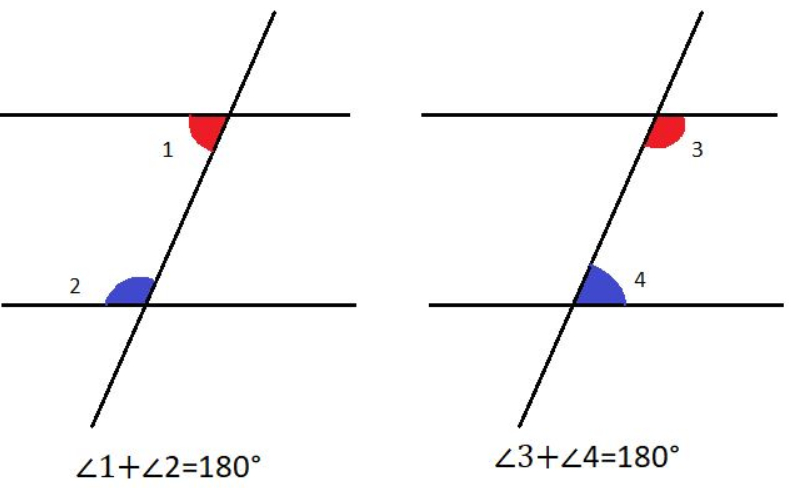
We need to determine if two parallel lines are cut by a transversal, what relationship exists between interior angles that are on the same side of the transversal.

If two parallel lines are cut by a transversal, then the sum of interior angles on both the side of the transversal is equal to 180 degree.

According to the definition, supplementary angles are two angles whose measures add up to 180 degree.

Therefore, these are supplementary angles.

Glencoe Math Course 3 Volume 2 Student 1st Edition Chapter 5 Triangles And the Pythagorean Theorem Exercise5.1 Page 376 Exercise 11,Problem1


The relation between interior angles that are on the same side of the transversal is they are supplementary angles.


Exercise 1.1 Solutions For Chapter 5 Triangles And Pythagorean Theorem Glencoe Math Course 3 Volume 2 Page 377 Exercise13, Problem1

Glencoe Math Course 3 Volume 2 Student 1st Edition Chapter 5 Triangles And the Pythagorean Theorem Exercise5.1 Page 376 Exercise 13,Problem1

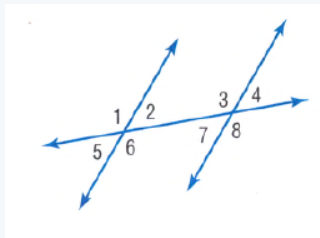
We need to classify the pair of angles ∠3 and ∠6.

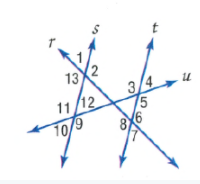
∠3 and ∠6 are interior angles that lie on the opposite sides of the transversal. They are called alternate interior angles.

Glencoe Math Course 3 Volume 2 Student 1st Edition Chapter 5 Triangles And the Pythagorean Theorem Exercise5.1 Page 376 Exercise 13,Problem1.

∠3 and ∠6 are alternate interior angles.


Glencoe Math Course 3 Volume 2 Student 1st Edition Chapter 5 Page 377 Exercise14 Problem1

Glencoe Math Course 3 Volume 2 Student 1st Edition Chapter 5 Triangles And the Pythagorean Theorem Exercise5.1 Page 376 Exercise 14,Problem1

We need to classify the pair of angles ∠1 and ∠3.

∠1 and ∠3 are called corresponding angles, one is an exterior angle and one is interior and lie on the same side of the transversal and are not adjacent.

Glencoe Math Course 3 Volume 2 Student 1st Edition Chapter 5 Triangles And the Pythagorean Theorem Exercise5.1 Page 376 Exercise 14,Problem1.

∠1 and ∠3are corresponding angles.


Examples Of Problems From Exercise 1.1 Chapter 5 Glencoe Math Course 3 Triangles And Pythagorean Theorem Page 377 Exercise15, Problem1

Glencoe Math Course 3 Volume 2 Student 1st Edition Chapter 5 Triangles And the Pythagorean Theorem Exercise5.1 Page 376 Exercise 15,Problem1

We need to classify the pair of angles ∠2 and ∠7.

∠2 and ∠7

are interior angles that lie opposite sides of the transversal. They are called alternate interior angles.


Glencoe Math Course 3 Volume 2 Student 1st Edition Chapter 5 Triangles And the Pythagorean Theorem Exercise5.1 Page 377 Exercise 15,Problem1.

∠2 and ∠7 are alternate interior angles.


Glencoe Math Course 3 Volume 2 Student 1st Edition Chapter 5 Page 377 Exercise17 Problem1

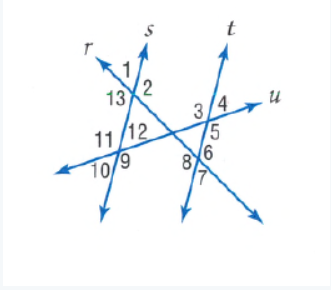
Given, Line s is parallel to line t, m∠2 is 110∘and m∠11 is 137∘

Glencoe Math Course 3 Volume 2 Student 1st Edition Chapter 5 Triangles And the Pythagorean Theorem Exercise5.1 Page 376 Exercise 17,Problem1

We need to find the measure of angle m∠6.

m∠2 and m∠6 are corresponding angles, and therefore they should be equal. It is given in the question that m∠2=110∘

​⇒m∠2=m∠6=110∘

∴m∠6=110∘

The measure of the angle m∠6=110∘.


Common Core Chapter 5 Exercise 1.1 Triangles And Pythagorean Theorem Detailed SolutionsPage 377 Exercise18, Problem1

Given, Line s is parallel to line t, m∠2 is 110∘ and m∠11 is 137∘.

Glencoe Math Course 3 Volume 2 Student 1st Edition Chapter 5 Triangles And the Pythagorean Theorem Exercise5.1 Page 377 Exercise 18,Problem1

We need to find the measure of the angle m∠13.

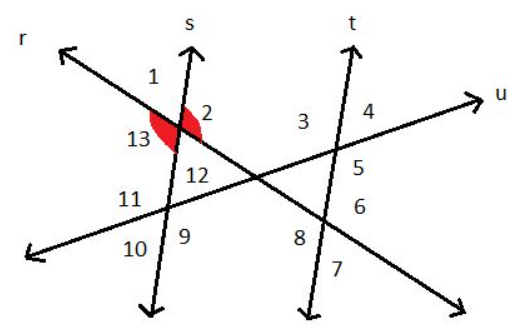
m∠2 and m∠13 are opposite angles and hence be equal. Given that, m∠=110∘  then m∠13

should also be equal to 110∘

​⇒m∠2=m∠13=110∘

∴m∠13=110∘

Glencoe Math Course 3 Volume 2 Student 1st Edition Chapter 5 Triangles And the Pythagorean Theorem Exercise5.1 Page 377 Exercise 18,Problem1.

The measure of the angle m∠13=110∘


Glencoe Math Course 3 Volume 2 Student 1st Edition Chapter 5 Page 377 Exercise19 Problem1

Glencoe Math Course 3 Volume 2 Student 1st Edition Chapter 5 Triangles And the Pythagorean Theorem Exercise5.1 Page 377 Exercise 19,Problem1

We need to find the measure of angle m∠4.

We are given in the equation that m∠11=137∘

. We can see that m∠11 and m∠3

are corresponding angles, so they should be equal.

⇒m∠11=m∠3=137∘

Now, m∠3 and m∠4 are adjacent supplementary angles.

​⇒m∠3+m∠4=180∘

⇒137∘

+m∠4=180∘

⇒m∠4=180∘

−137∘

⇒m∠4=43∘

Glencoe Math Course 3 Volume 2 Student 1st Edition Chapter 5 Triangles And the Pythagorean Theorem Exercise5.1 Page 377 Exercise 19,Problem1.

The measure of the angle is m∠4=43∘.


Glencoe Math Course 3 Volume 2 Student 1st Edition Chapter 5 Page 377 Exercise22 Problem1


Glencoe Math Course 3 Volume 2 Student 1st Edition Chapter 5 Triangles And the Pythagorean Theorem Exercise5.1 Page 377 Exercise 22,Problem1

We need to find the false option out of the given options.

(F): The statement is false. We cannot be sure about the kind of these angles without measuring them. They seem to be right angles.

(G): The statement is true. The angles ∠A and ∠C

are vertical. They are opposite angles between two lines that intersect.

(H): The statement is true. The angles ∠A and ∠B

are alternate interior angles.

(I): The statement is true. The angles ∠A and ∠C

are congruent as vertical angles. As we know, vertical angles are congruent.

The statement (F) is false.

The statement F is false.


Glencoe Math Course 3 Volume 2 Student 1st Edition Chapter 5 Page 378 Exercise23 Problem1


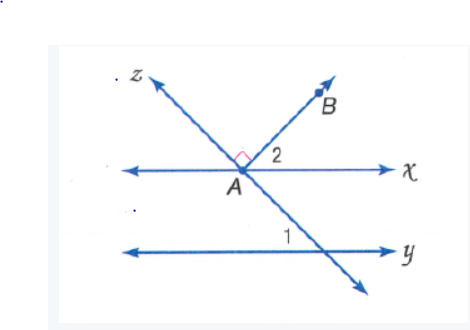
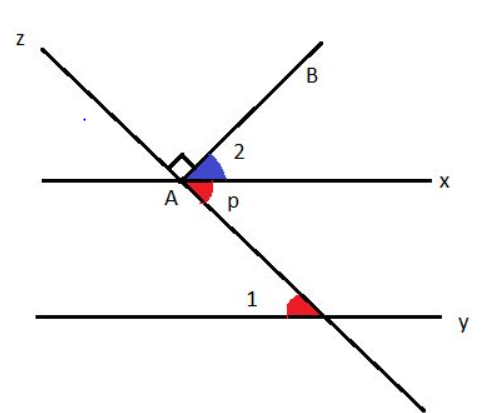
Given, line x is parallel to line y and line z is perpendicular to AB. The measure of ∠1 is 50∘.

Glencoe Math Course 3 Volume 2 Student 1st Edition Chapter 5 Triangles And the Pythagorean Theorem Exercise5.1 Page 378 Exercise 23,Problem1

We need to find out the measure of ∠2.


Glencoe Math Course 3 Volume 2 Student 1st Edition Chapter 5 Triangles And the Pythagorean Theorem Exercise5.1 Page 378 Exercise 23,Problem1.

In the above case we can see that m∠1 and m∠p are corresponding angles, therefore, they should be equal. We are given that m∠1= 50∘

⇒m∠1=m∠p= 50∘.

Now, We can see that taken together, m∠p and m∠2are making a supplementary pair with 90∘

Therefore, the sum of all three should be equal to 180∘

​⇒m∠p+m∠2+90∘

=180∘

⇒m∠p+m∠2+90∘

−90∘

=180∘

−90∘

⇒m∠p+m∠2=90∘

⇒50∘

+m∠2=90∘

⇒m∠2=90∘

−80∘

−50∘

⇒m∠2=40∘

Therefore, option A is correct, the measure of ∠2 is 40∘.

Option A is correct, the measure of ∠2 is 40∘


Glencoe Math Course 3 Volume 2 Student 1st Edition Chapter 5  Page 378 Exercise24 Problem1

Given, lines m and n are parallel and cut by the transversal p.

Glencoe Math Course 3 Volume 2 Student 1st Edition Chapter 5 Triangles And the Pythagorean Theorem Exercise5.1 Page 378 Exercise 24,Problem1

We will name all pairs of the corresponding angles.

When two parallel lines are intersected by a transversal line, then the angle in the same corner and on the same side of the transversal are called corresponding angles.

Each corresponding angles pair is shown in the same color, in the figure shown below.


Glencoe Math Course 3 Volume 2 Student 1st Edition Chapter 5 Triangles And the Pythagorean Theorem Exercise5.1 Page 378 Exercise 24,Problem1.

The corresponding angle pairs are as follows,

​1) m∠1 and ∠5

2) m∠2 and ∠6

3) m∠3 and ∠7

4) m∠4 and ∠8

After carefully observing the figure, we find  pairs of corresponding angles as follows,

​1) m∠1 and ∠5

2) m∠2 and ∠6

3) m∠3 and ∠7

4) m∠4 and∠8


Student Edition Exercise 1.1 Chapter 5 Triangles And Pythagorean Theorem Solutions Guide Page 378 Exercise25, Problem1

We are given that the base is4

inches long and height that measures8

inches on putting these values into the equationsArea= 12

× base × height

=12

×4 inches× 8 inches.

= 2×8inches2

=16inches2

Finally, we can determine that the area of the poster is 16 inches2.


Glencoe Math Course 3 Volume 2 Student 1st Edition Chapter 5 Page 378 Exercise28 Problem1


The given angles are 32° & 58°. So, the sum of the given angles is 32°+58°=90°.

Glencoe Math Course 3 Volume 2 Student 1st Edition Chapter 5 Triangles And the Pythagorean Theorem Exercise5.1 Page 378 Exercise 28,Problem1

Therefore, these will go into the category of complementary.

Differential Equations Of First Order And First Degree Homogeneous Equation Methods To Find An Integrating Factor Solved Example Problems Exercise 2.4

Differential Equations of First Order and First Degree Solved Example Problems Exercise 2.4

Example 1. Solve \(\left(y+\frac{y^3}{3}+\frac{x^2}{2}\right) d x+\frac{1}{4}\left(x+x y^2\right) d y=0\)

Solution:

Given \(\left(y+\frac{y^3}{3}+\frac{x^2}{2}\right) d x+\frac{1}{4}\left(x+x y^2\right) d y=0\) …………………(1)

where \(\mathrm{M}=y+\frac{y^3}{3}+\frac{x^2}{2}, \mathrm{~N}=\frac{1}{4}\left(x+x y^2\right)\)

⇒ \(\frac{\partial \mathrm{M}}{\partial y}=1+y^2, \frac{\partial \mathrm{N}}{\partial x}\)

= \(\frac{1}{4}\left(1+y^2\right) \Rightarrow \frac{\partial \mathrm{M}}{\partial y} \neq \frac{\partial \mathrm{N}}{\partial x} \Rightarrow\) (1) is not exact

Now \(\frac{1}{\mathrm{~N}}\left(\frac{\partial \mathrm{M}}{\partial y}-\frac{\partial \mathrm{N}}{\partial x}\right)\)

= \(\frac{4}{x\left(1+y^2\right)}\left[\left(1+y^2\right)-\frac{1}{4}\left(1+y^2\right)\right]\)

= \(\frac{4}{x\left(1+y^2\right)} \cdot \frac{3}{4}\left(1+y^2\right)=\frac{3}{x}=f(x)\)

∴ I.F \(=\exp \left[\int\left(\frac{3}{x}\right) d x\right]=\exp (3 \log x)=e^{\log x^3}=x^3\)

Multiplying (1) by \(x^3 \Rightarrow\left(y+\frac{y^3}{3}+\frac{x^2}{2}\right) x^3 d x+\frac{1}{4}\left(x+x y^2\right) x^3 d y=0\) …………………(2)

Now (2) is an exact equation (verify) where \(\mathrm{M}_1=x^3 y+\frac{x^3 y^3}{3}+\frac{x^5}{2}, \mathrm{~N}_1=\frac{1}{4} x^4+\frac{1}{4} x^4 y^2\)

The general solution (2) is \(\int^x M_1 d x+\int\left(\text { terms of } \mathrm{N}_1 \text { not containing } x\right) d y=c\)

⇒ \(\int^x\left(x^3 y+\frac{1}{3} x^3 y^3+\frac{1}{2} x^5\right) d x+\int 0 d y=c_1\)

⇒ \(\frac{x^4 y}{4}+\frac{x^4 y^3}{12}+\frac{x^6}{12}=\frac{c}{12} \Rightarrow 3 x^4 y+x^4 y^3+x^6=c\)

Differential Equations Of First Order And First Degree Exercise 2.4

Example 2. Solve \(\left(x^2+y^2+2 x\right) d x+2 y d y=0\)

Solution.

Given equation is \(\left(x^2+y^2+2 x\right) d x+2 y d y=0\) ……………………..(1)

Where \(\mathrm{M}=x^2+y^2+2 x, \mathrm{~N}=2 y \Rightarrow \frac{\partial \mathrm{M}}{\partial y}=2 y, \frac{\partial \mathrm{N}}{\partial x}=0\)

Since \(\frac{\partial \mathrm{M}}{\partial y} \neq \frac{\partial \mathrm{N}}{\partial x}\), (1) is not an exact equation.

Also \(\frac{1}{\mathrm{~N}}\left(\frac{\partial \mathrm{M}}{\partial y}-\frac{\partial \mathrm{N}}{\partial x}\right)=\frac{1}{2 y}(2 y-0)=\frac{1}{2 y}(2 y)=1\) = real number

∴ I.F \(=\exp \left[\int f(x) d x\right]=\exp \left(\int 1 d x\right)=e^x\)

Multiplying(1)by \(e^x \Rightarrow\left(x^2+y^2+2 x\right) e^x d x+2 y e^x d y=0\) …………………(2)

Now (2) is an exact equation (verify) where \(\mathrm{M}_1=\left(x^2+y^2+2 x\right) e^x \text { and } \mathrm{N}_1=2 y e^x\)

∴ G.S. of (2) is \(\int^x\left(x^2+y^2+2 x\right) e^x d x+\int 0 d y=c\) (∵ no term in \(\mathrm{N}_1\) not containing x )

⇒ \(\int x^2 e^x d x+y^2 \int e^x d x+2 \int x e^x d x=c\)

⇒ \(x^2 e^x-\int 2 x e^x d x+y^2 e^x+\int 2 x e^x d x=c \Rightarrow\left(x^2+y^2\right) e^x=c\)

Note. (2) can also be solved by the rearrangement of terms.

(2) \(\Rightarrow\left(x^2+y^2\right) e^x d x+2 e^x(x d x+y d y)=0\)

⇒ \(d\left[\left(x^2+y^2\right) e^x\right]=0 \Rightarrow \int d\left[\left(x^2+y^2\right) e^x\right]=c \Rightarrow\left(x^2+y^2\right) e^x=c\)

Homogeneous Equations Solved Problems Exercise 2.4

Example.3. Solve \(2 x y d y-\left(x^2+y^2+1\right) d x=0\)

Solution.

Given equation is \(2 x y d y-\left(x^2+y^2+1\right) d x=0\) …………………….(1)

where \(\mathrm{M}=-\left(x^2+y^2+1\right) \text { and } \mathrm{N}=2 x y\)

⇒ \(\frac{\partial \mathrm{M}}{\partial y}=-2 y, \frac{\partial \mathrm{N}}{\partial x}\)

= \(2 y \Rightarrow \frac{\partial \mathrm{M}}{\partial y} \neq \frac{\partial \mathrm{N}}{\partial x}\)=> (1) is not an exact equation

Also \(\frac{1}{\mathrm{~N}}\left(\frac{\partial \mathrm{M}}{\partial y}-\frac{\partial \mathrm{N}}{\partial x}\right)=\frac{1}{2 x y}(-2 y-2 y)=\frac{1}{2 x y}(-4 y)=-\frac{2}{x}=f(x)\)

∴ I.F \(=\exp \left[\int f(x) d x\right]=\exp \left[\int \frac{-2}{x} d x\right]=e^{-2 \log x}=e^{\log x^{-2}}=\frac{1}{x^2}\)

Multiplying (1) with \(\frac{1}{x^2} \Rightarrow 2 \frac{y}{x} d y-\left(1+\frac{y^2}{x^2}+\frac{1}{x^2}\right) d x=0\) ……………………(2)

Now (2) is an exact equation where \(\mathrm{M}_1=-\left(1+\frac{y^2}{x^2}+\frac{1}{x^2}\right), \mathrm{N}_1=\frac{2 y}{x}\)

∴ The general solution of (1) is \(\int^x-\left(1+\frac{y^2}{x^2}+\frac{1}{x^2}\right) d x+\int 0 d y=c\) (∵ no terms in \(\mathrm{N}_1\) free from x)

⇒ \(\int-d x+y^2 \int\left(-\frac{1}{x^2}\right) d x+\int\left(-\frac{1}{x^2}\right) d x\) = c

⇒ \(-x+y^2\left(\frac{1}{x}\right)+\frac{1}{x}=c \Rightarrow y^2-x^2+1=c x\)


Differential Equations Of First Order And First Degree Homogeneous Equation Methods To Find An Integrating Factor Solved Example Problems Exercise 2.3

Differential Equations of First Order and First Degree Solved Example Problems Exercise 2.3

Example. 1. Solve \(y\left(x y+2 x^2 y^2\right) d x+x\left(x y-x^2 y^2\right) dy=0\)

Solution.

Given \(y\left(x y+2 x^2 y^2\right) d x+x\left(x y-x^2 y^2\right) d y=0\) ………………….(1)

Comparing (1) with Mdx + Ndy = 0 => \(\mathrm{M}=y\left(x y+2 x^2 y^2\right), \mathrm{N}=x\left(x y-x^2 y^2\right)\)

⇒ \(\frac{\partial \mathrm{M}}{\partial y}=2 x y+6 x^2 y^2, \frac{\partial \mathrm{N}}{\partial x}=2 x y-3 x^2 y^2 \Rightarrow \frac{\partial \mathrm{M}}{\partial y} \neq \frac{\partial \mathrm{N}}{\partial x}\)

(1) is not an exact equation. But (1) is of the form y f(xy) dx + x g(xy) dy = 0

Also \(\mathrm{M} x-\mathrm{N} y=x^2 y^2+2 x^3 y^3-x^2 y^3+x^3 y^3=3 x^3 y^3 \neq 0\)

∴ I.F. = \(\frac{1}{M x-N y}=\frac{1}{3 x^3 y^3}\)

Multiplying (1) by \(\frac{1}{3 x^3 y^3}\)

⇒ \(\frac{x y^2+2 x^2 y^3}{3 x^3 y^3} d x+\frac{x^2 y-x^3 y^2}{3 x^3 y^3} d y=0\) …………………(2) which of the form

where \(\mathrm{M}_1=\frac{x y^2+2 x^2 y^3}{3 x^3 y^3}=\frac{1}{3 x^2 y}+\frac{2}{3 x} \text { and } \mathrm{N}_1=\frac{x^2 y-x^3 y^2}{3 x^3 y^3}=\frac{1}{3 x y^2}-\frac{1}{3 y}\)

⇒ \(\frac{\partial \mathrm{M}_1}{\partial y}=-\frac{1}{3 x^2 y^2}, \frac{\partial \mathrm{N}_1}{\partial x}=-\frac{1}{3 x^2 y^2} \Rightarrow \frac{\partial \mathrm{M}_1}{\partial y}=\frac{\partial \mathrm{N}_1}{\partial x} \Rightarrow\) (2) is exact

Now (2) can be solved by rearranging terms: \(\frac{1}{x^2 y} d x+\frac{2}{x} d x+\frac{1}{x y^2} d y-\frac{1}{y} d y=0\)

⇒ \(\frac{y d x+x d y}{x^2 y^2}+2 \cdot \frac{1}{x} d x-\frac{1}{y} d y=0 \Rightarrow \frac{d(x y)}{x^2 y^2}+\frac{2}{x} d x-\frac{1}{y} d y=0\)

⇒ \(\int \frac{d(x y)}{(x y)^2}+2 \int \frac{1}{x} d x-\int \frac{1}{y} d y=c \Rightarrow-\frac{1}{x y}+2 \log |x|-\log |y|=c \text { is the G.S. of (1) }\)

Differential Equations Of First Order And First Degree Exercise 2.3

Example. 2. Solve \((x y \sin x y+\cos x y) y d x+(x y \sin x y-\cos x y) x d y=0\)

Solution.

Given \((x y \sin x y+\cos x y) y d x+(x y \sin x y-\cos x y) x d y=0\) …………………. (1)

where \(\mathrm{M}=x y^2 \sin x y+y \cos x y, \mathrm{~N}=x^2 y \sin x y-x \cos x y\)

⇒ \(\frac{\partial \mathrm{M}}{\partial y}=\left(x^2 y^2+1\right) \cos x y+x y \sin x y, \frac{\partial \mathrm{N}}{\partial x}=3 x y \sin x y+\left(x^2 y^2-1\right) \cos x y\)

⇒ \(\frac{\partial \mathrm{M}}{\partial y} \neq \frac{\partial \mathrm{N}}{\partial x}\)

∴ (1) is not an exact equation

But (1) is of the form \(y f(x y) d x+x g(x y) d y=0\)

Also \(\mathrm{M} x-\mathrm{Ny}=x^2 y^2 \sin x y+x y \cos x y-x^2 y^2 \sin x y+x y \cos x y=2 x y \cos x y \neq 0\)

∴ I.F = \(\frac{1}{\mathrm{M} x-\mathrm{N} y}=\frac{1}{2 x y \cos x y}\)

Multiplying (1) with \(\frac{1}{(2 x y \cos x y)}\)

⇒ \(\frac{1}{2}\left(y \tan x y+\frac{1}{x}\right) d x+\frac{1}{2}\left(x \tan x y-\frac{1}{y}\right) d y=0\)……………………(2)

(2) is of the form \(\mathrm{M}_1 d x+\mathrm{N}_1 d y=0\) where \(\mathrm{M}_1=\frac{1}{2}\left(y \tan x y+\frac{1}{x}\right)\)

and \(\mathrm{N}_1=\frac{1}{2}\left(x \tan x y-\frac{1}{y}\right)\)

⇒ \(\frac{\partial \mathrm{M}_1}{\partial y}=\frac{1}{2}\left(x y \sec ^2 x y+\tan x y\right)=\frac{\partial \mathrm{N}_{\mathrm{l}}}{\partial x}\)

∴ (2) is an exact equation

∴ The general solution of (2) is \(\int^x \mathrm{M}_1 d x+\int\) ( terms of \(\mathrm{N}_1\) not containing x) dy = C

⇒ \(\int^x\left(\frac{1}{2} y \tan x y+\frac{1}{2 x}\right) d x+\int\left(-\frac{1}{2 y}\right) d y=c\)

⇒ \(\frac{1}{2} y \cdot \frac{\log |\sec x y|}{y}+\frac{1}{2} \log |x|-\frac{1}{2} \log |y|=\frac{1}{2} \log c\)

⇒ \(\log \left|\frac{x}{y} \sec x y\right|=\log c \Rightarrow x \sec x y=c y\)

Homogeneous Equations Solved Problems Exercise 2.3

Example 3. Solve \(\left(x^3 y^3+x^2 y^2+x y+1\right) y d x+\left(x^3 y^3-x^2 y^2-x y+1\right) x d y=0\)

Solution.

Given equation is of the form \(y f(x y) d x+x g(x y) d y=0\) and is not an exact equation (verify),

where M = \(x^3 y^4+x^2 y^3+x y^2+y, \mathrm{~N}=x^4 y^3-x^3 y^2-x^2 y+x\)

Also \(\mathrm{M} x-\mathrm{N} y=x^4 y^4+x^3 y^3+x^2 y^2+x y-x^4 y^4+x^3 y^3+x^2 y^2-x y\)

= \(2 x^3 y^3+2 x^2 y^2=2 x^2 y^2(x y+1) \neq 0\)

I.F = \(\frac{1}{\mathrm{M} x-\mathrm{N} y}=\frac{1}{2 x^2 y^2(x y+1)}\)

The given equation can be written as \((x y+1)\left(x^2 y^2+1\right) y d x+(x y-1)\left(x^2 y^2-1\right) x d y=0\) ……………………(1)

Multiplying(1) with \(\frac{1}{2 x^2 y^2(x y+1)} \Rightarrow \frac{x^2 y^2+1}{2 x^2 y} d x+\frac{(x y-1)^2}{2 x y^2} d y=0\) ……………………..(2)

(2) is exact (verify) where \(\mathrm{M}_1=\frac{x^2 y^2+1}{2 x^2 y}=\frac{y}{2}+\frac{1}{2 x^2 y}\)

and \(\mathrm{N}_1=\frac{(x y-1)^2}{2 x y^2}=\frac{x^2 y^2+1-2 x y}{2 x y^2}=\frac{x}{2}+\frac{1}{2 x y^2}-\frac{1}{y}\)

∴ \(\text { The G.S. of (2) is } \int^x\left(\frac{y}{2}+\frac{1}{2 x^2 y}\right) d x+\int\left(-\frac{1}{y}\right) d y=c \Rightarrow \frac{x y}{2}+\frac{1}{2 y}\left(-\frac{1}{x}\right)-\log |y|=c\)

⇒ \(x y-\frac{1}{x y}-\log y^2=2 c\)


Differential Equations Of First Order And First Degree Homogeneous Equation In X And Y Methods To Find An Integrating Factor Solved Example Problems Exercise 2.2

Differential Equations of First Order and First Degree Solved Example Problems Exercise 2.2

Example. 1. Solve \(x^2 y d x-\left(x^3+y^3\right) d y=0\)
Solution.

Given equation is \(x^2 y d x-\left(x^3+y^3\right) d y=0\) ………………………(1)

Comparing (1) with \(\mathrm{M} d x+\mathrm{N} d y=0 \Rightarrow \mathrm{M}=x^2 y, \mathrm{~N}=-\left(x^3+y^3\right)\)

⇒ \(\frac{\partial \mathrm{M}}{\partial y}=x^2, \frac{\partial \mathrm{N}}{\partial x}=-3 x^2 \Rightarrow \frac{\partial \mathrm{M}}{\partial y} \neq \frac{\partial \mathrm{N}}{\partial x}\) => (1) is not exact equation

But (1) is a homogeneous equation in x and y.

Now \(\mathrm{M} x+\mathrm{N} y=x^3 y-x^3 y-y^4=-y^4 \neq 0\)

∴ I.F. = Integrating Factor = \(=\frac{1}{\mathrm{M} x+\mathrm{N} y}=-\frac{1}{y^4}\)

Multiplying(1)by \(\left(-1 / y^4\right) \Rightarrow \frac{-x^2}{y^3} d x+\left(\frac{x^3}{y^4}+\frac{1}{y}\right) d y=0\) ………………………..(2)

(2) is in the form \(\mathrm{M}_1 d x+\mathrm{N}_1 d y=0\) where \(\mathrm{M}_1=-\frac{x^2}{y^3} \text { and } \mathrm{N}_1=\frac{x^3}{y^4}+\frac{1}{y}\)

since \(\frac{\partial \mathrm{M}_1}{\partial y}=\frac{3 \dot{x}^2}{v^4}=\frac{\partial \mathrm{N}_1}{\partial x}\), (2) is an exact equation.

(1) Integrating MjW.r.t. x treating y as constant

⇒ \(\int^x \mathrm{M}_1 d x=\int\left(-x^2 / y^3\right) d x=-x^3 / 3 y^3\) …………………….(3)

(2) \(\int\)(terms of \(\mathrm{N}_1\) not containing x) dy = \(d y=\int \frac{1}{y} d y=\log |y|\) ……………………….(4)

The GS. of (2) is (3) + (4) = c=> \(\Rightarrow-\frac{x^3}{3 y^3}+\log |y|=c\)

∴ The G.S of (1) is \(\log \left|\frac{y}{c}\right|=\frac{x^3}{3 y^3} \Rightarrow y=c e^{\left(x^3 / 3 y^3\right)}\)

Differential Equations Of First Order And First Degree Explained

Example 2. Solve \(y^2 d x+\left(x^2-x y-y^2\right) d y=0\)
Solution:

Given equation is \(y^2 d x+\left(x^2-x y-y^2\right) d y=0\)

comparing(1) with \(\mathrm{M} d x+\mathrm{N} d y=0 \Rightarrow \mathrm{M}=y^2, \mathrm{~N}=x^2-x y-y^2 \Rightarrow \frac{\partial \mathrm{M}}{\partial y}=2 y, \frac{\partial \mathrm{N}}{\partial x}=2 x-y\)

Since \(\frac{\partial \mathrm{M}}{\partial y} \neq \frac{\partial \mathrm{N}}{\partial x}\), (1) is not exact. But (1) is a homogeneous equation in x andy.

⇒ \(\mathrm{M} x+\mathrm{N} y=x y^2+x^2 y-x y^2-y^3=y\left(x^2-y^2\right) \neq 0\)

∴ \(\mathrm{I} . \mathrm{F}=\frac{1}{\mathrm{M} x+\mathrm{N} y}=\frac{1}{y\left(x^2-y^2\right)}\)

Multiplying (1) by \(\frac{1}{y\left(x^2-y^2\right)} \Rightarrow \frac{y}{x^2-y^2} d x+\frac{x^2-x y-y^2}{y\left(x^2-y^2\right)} d y=0\) …………………….(2)

(2) is in the form \(\mathrm{M}_1 d x+\mathrm{N}_1 d y=0\) where \(\mathrm{M}_1=\frac{y}{x^2-y^2}\)

and \(\mathrm{N}_1=\frac{x^2-x y-y^2}{y\left(x^2-y^2\right)}=\frac{x^2-y^2}{y\left(x^2-y^2\right)}-\frac{x y}{y\left(x^2-y^2\right)}=\frac{1}{y}-\frac{x}{x^2-y^2}\)

⇒ \(\frac{\partial \mathrm{M}_1}{\partial y}=\frac{x^2+y^2}{\left(x^2-y^2\right)^2}=\frac{\partial \mathrm{N}_1}{\partial x}\), (2) is an exact equation

(1) Integrating \(\mathrm{M}_1\) treating y as constant

⇒ \(\int^x \mathrm{M}_1 d x=\int^x \frac{y}{x^2-y^2} d x=y \cdot \frac{1}{2 y} \log \left|\frac{x-y}{x+y}\right|=\frac{1}{2} \log \left|\frac{x-y}{x+y}\right|\) …………………..(3)

(2) \(\int\) (terms of \(\mathrm{N}_1\) not containing x) dy = \(\int \frac{1}{y} d y=\log |y|\) …………………….(4)

∴ The general solution of (2) => G.S. of (1) is (3) + (4) = c.

⇒ \(\frac{1}{2} \log \left|\frac{x-y}{x+y}\right|+\log |y|=\log c\)

⇒ \(\log y \sqrt{\frac{x-y}{x+y}}=\log c \Rightarrow y \sqrt{\frac{x-y}{x+y}}=c \Rightarrow y^2(x-y)=c^2(x+y)\)

Homogeneous Equations In X And Y Solved Examples

Example. 3. Solve \(y^2+x^2 \frac{d y}{d x}=x y \frac{d y}{d x}\)
Solution.

Given \(y^2 d x+\left(x^2-x y\right) d y=0\) ……………………(1)

Comparing (1) with \(\mathrm{M} d x+\mathrm{N} d y=0 \Rightarrow \mathrm{M}=y^2, \mathrm{~N}=x^2-x y\)

⇒ \(\frac{\partial \mathrm{M}}{\partial y}=2 y, \frac{\partial \mathrm{N}}{\partial x}=2 x-y \Rightarrow \frac{\partial \mathrm{M}}{\partial y} \neq \frac{\partial \mathrm{N}}{\partial x}\) => (1) is not an exact equation.

But (1) is a homogeneous equation in x and y.

I.F = \(\frac{1}{\mathrm{M} x+\mathrm{N} y}=\frac{1}{x y^2+x^2 y-x y^2}=\frac{1}{x^2 y}(\mathrm{M} x+\mathrm{N} y \neq 0)\)

Multiplying (1) by \(\frac{1}{x^2 y} \text {, we get } \frac{y^2}{x^2 y} d x+\frac{x^2-x y}{\dot{x}^2 y} d y=0 \Rightarrow \frac{y}{x^2} d x+\left(\frac{1}{y}-\frac{1}{x}\right) d y=0\) …………………….(2)

(2) is in the form \(\mathrm{M}_1 d x+\mathrm{N}_1 d y=0 \text { where } \mathrm{M}_1=\frac{y}{x^2} \text { and } \mathrm{N}_1=\frac{1}{y}-\frac{1}{x}\)

since \(\frac{\partial \mathrm{M}_1}{\partial y}=\frac{1}{x^2}=\frac{\partial \mathrm{N}_1}{\partial x}\); (2) is an exact equation.

(1) Integrating \(M_1\) w.r.t x, treating y as constant: \(\int \mathrm{M}_1 d x=\int\left(y / x^2\right) d x=-y / x\) …………………….(3)

(2) \(\int\) (terms of \(\mathrm{N}_1\) not containing x) dy = \(\int(1 / y) d y=\log y\) …………………….(4)

The G.S. of (2) is (3) + (4) = c => -(y/x) + logy = -log c

∴ The G.S. of (1) is log c + logy = y/x => y/x = log(cy)


Glencoe Math Course 3 Volume 2 Student 1st Edition Chapter 5 Triangles And The Pythagorean Theorem Exercise

Glencoe Math Course 3 Volume 2 Student 1st Edition Chapter 5 Triangles And The Pythagorean Theorem

Glencoe Math Course 3 Volume 2 Chapter 5 Triangles And Pythagorean Theorem Exercise Solutions Page 365 Exercise 1, Problem1

We have been given some algebraic concepts. We have been told to apply the algebraic concepts to geometry. This can be done by focusing on 2-D coordinate geometry and their equations.

One way that algebra and geometry can be related is through the use of equations in graphs.

We can plot a set of points(x,y) according to an equation (for example, the line graph on the left!) to form a graph.

That’s one way that algebra is related to geometry.

A set of points can satisfy any equation which can produce any type of graph, not just straight lines.


Glencoe Math Course 3 Volume 2 Student 1st Edition Chapter 5 Triangles And the Pythagorean Theorem Exercise Page 365 Exercise 1, Problem1 graph.


Glencoe Math Course 3 Volume 2 Student 1st Edition Chapter 5 Triangles And the Pythagorean Theorem Exercise Page 365 Exercise 1, Problem1.

Finally, we can see that an equation, which is an algebraic notion, maybe graphed, transforming it into a geometric concept. We can see that the variables in the equation (both algebraic ideas) may be utilised to relate to geometric concepts of the line (slope and y-intercept).

We learned that Algebra is a branch of mathematics in which formulae and equations use variables in the form of letters and symbols instead of quantities or numbers. Geometry is a branch of mathematics that analyses points, lines,  multi-dimensional objects and shapes, as well as surfaces and solids.

Read and Learn More Glencoe Math Course 2 Volume 1 Common Core Student Edition Solutions

Glencoe Math Course 3 Volume 2 Student 1st Edition Chapter 5 Page 368 Exercise 2, Problem2

We have been given an equation.We need to find the value of b from the equation.This can be found by keeping only the unknown variable on the left-hand side of the ‘equal to’ symbol.

Given equation is,

49+b+45=180

⇒ b=180−49−45

⇒ b=180−94

⇒ b=86

Finally, we can determine that the value of b is 86.

Glencoe Math Course 2 Student Edition Volume 1 Chapter 5 Triangles And The Pythagorean Theorem Exercise

Chapter 5 Triangles And Pythagorean Theorem Answers Glencoe Math Course 3 Volume 2 Page 368 Exercise 3, Problem3

We have been given an equation.We need to find the value of t from the equation.This can be found by keeping only the unknown variable on the left-hand side of the ‘equal to’ symbol.

Given equation is,

t+98+55=180

⇒ t=180−98−55

⇒ t=180−153

⇒ t=27

Finally, we can determine that the value of t is 27.


Glencoe Math Course 3 Volume 2 Student 1st Edition Chapter 5 Page 368 Exercise 4, Problem4

We have been given an equation.We need to find the value of k from the equation.This can be found by keeping only the unknown variable on the left-hand side of the ‘equal to’ symbol.

Given equation is,

15+67+k=180

⇒ k=180−15−67

⇒ k=180−82

⇒ k=98

Finally, we can determine that the value of k is 98.


Glencoe Math Course 3 Volume 2 Student 1st Edition Chapter 5 Page 368 Exercise 5, Problem5

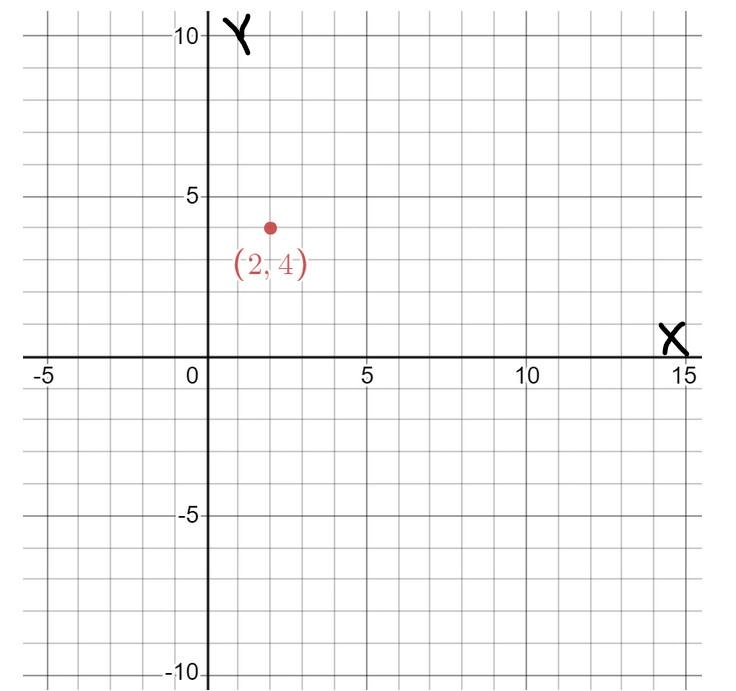
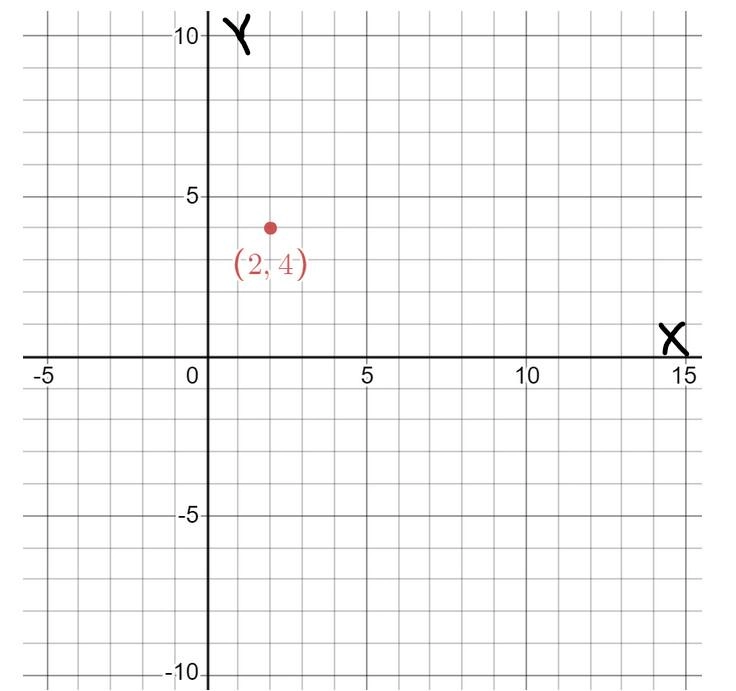
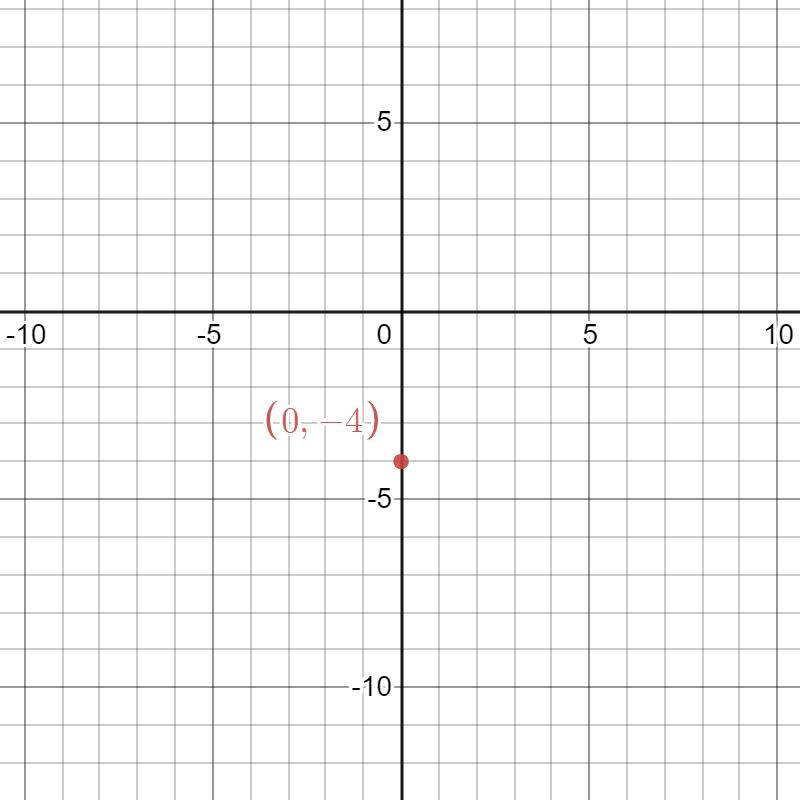
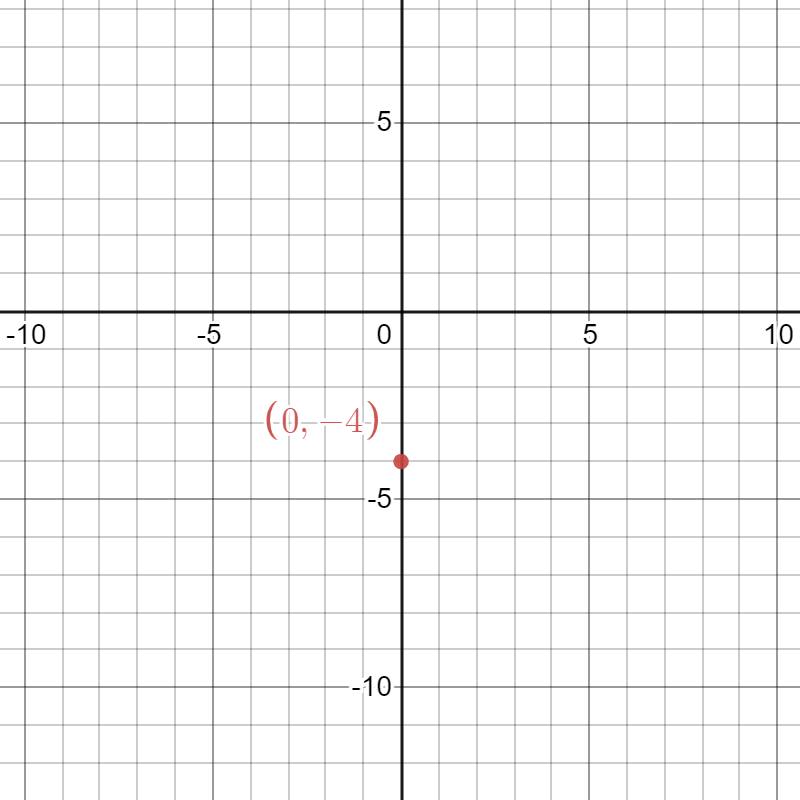
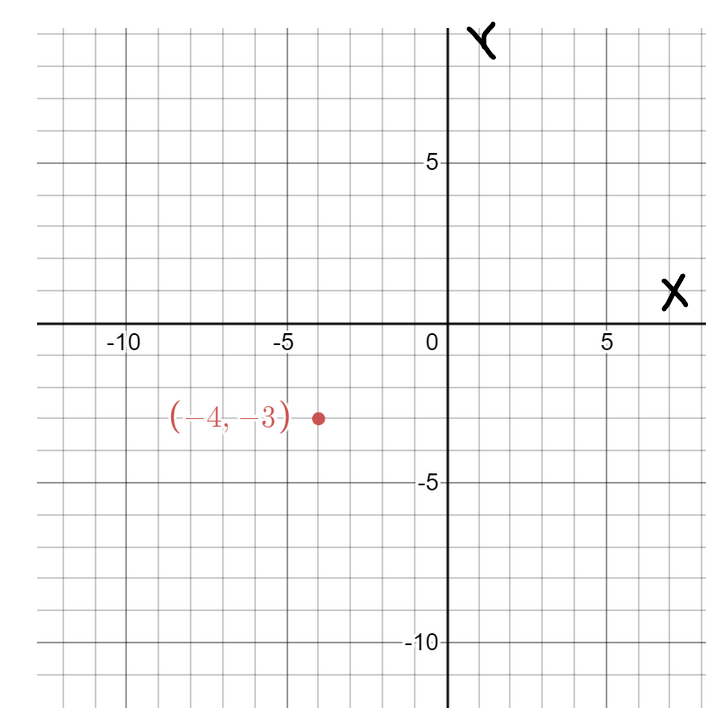
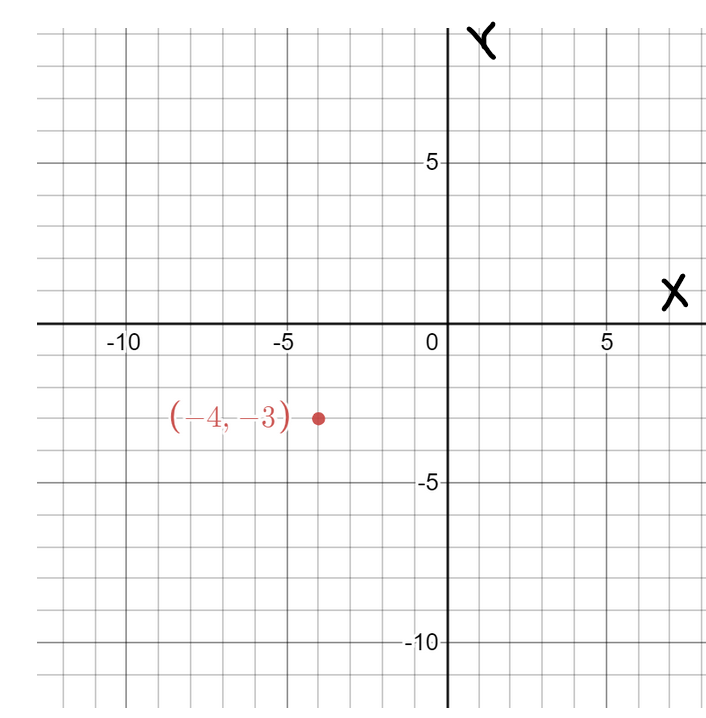
We have been given a point and the coordinate plane.We need to plot the given point on the plane.This can be done by locating the x and y coordinates and the move that distance horizontally and vertically from both the axes to find the required point.

The required point A is as follows

The x-axis denotes the value of the x coordinate.

The y-axis denotes the value of the y coordinate.

The red colored point on the coordinate plane denotes the point A.

Glencoe Math Course 3 Volume 2 Student 1st Edition Chapter 5 Triangles And the Pythagorean Theorem Exercise Page 365 Exercise 5, Problem5 graph


The given point has been plotted on the coordinate plane and is as follows,

Glencoe Math Course 3 Volume 2 Student 1st Edition Chapter 5 Triangles And the Pythagorean Theorem Exercise Page 365 Exercise 5, Problem5 graph 1


Glencoe Math Course 3 Volume 2 Student 1st Edition Chapter 5 Page 365 Exercise 6, Problem6

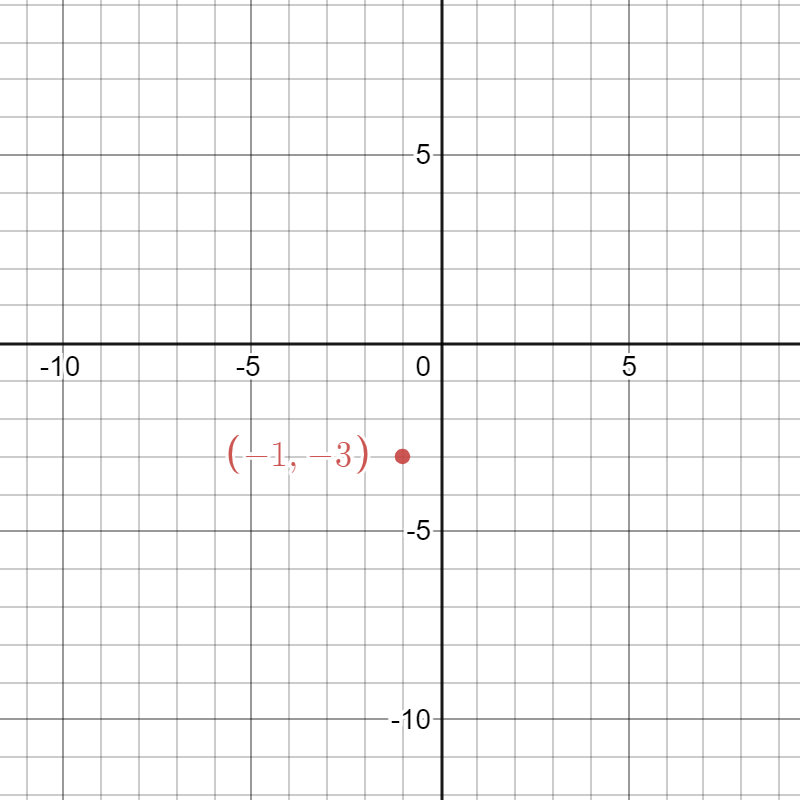
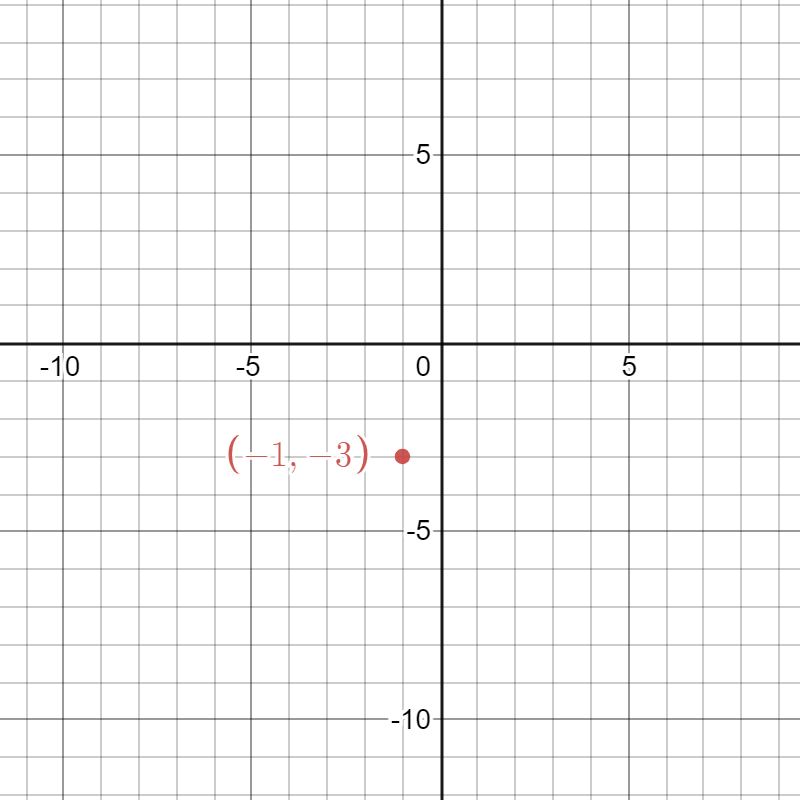
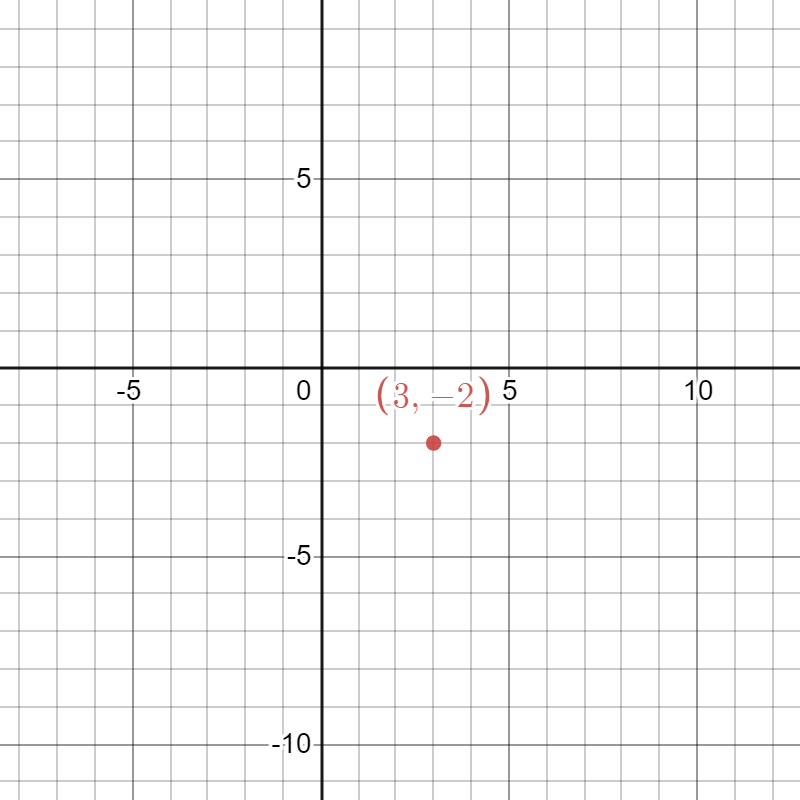
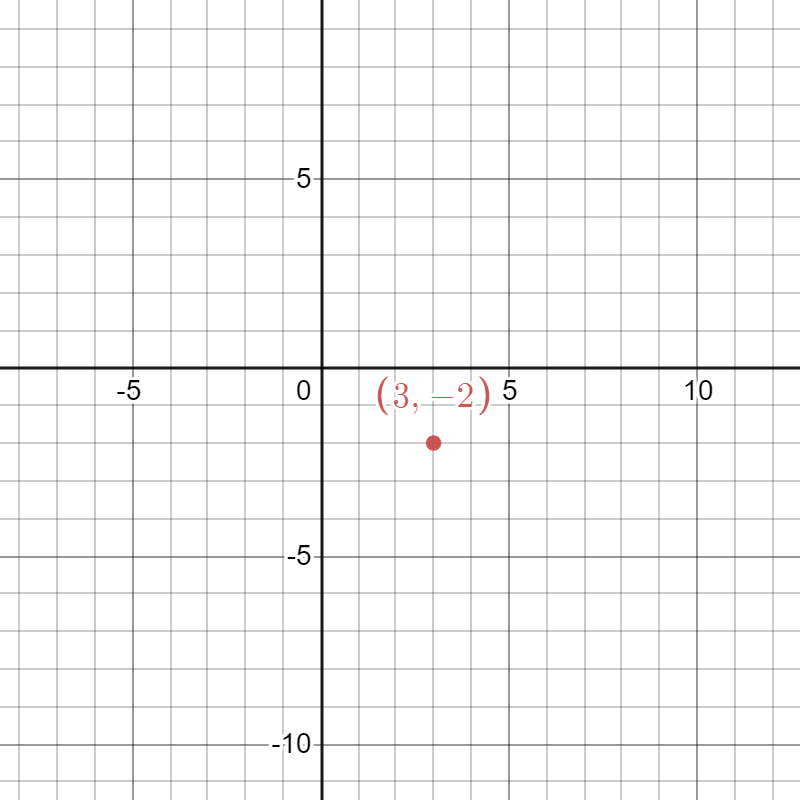
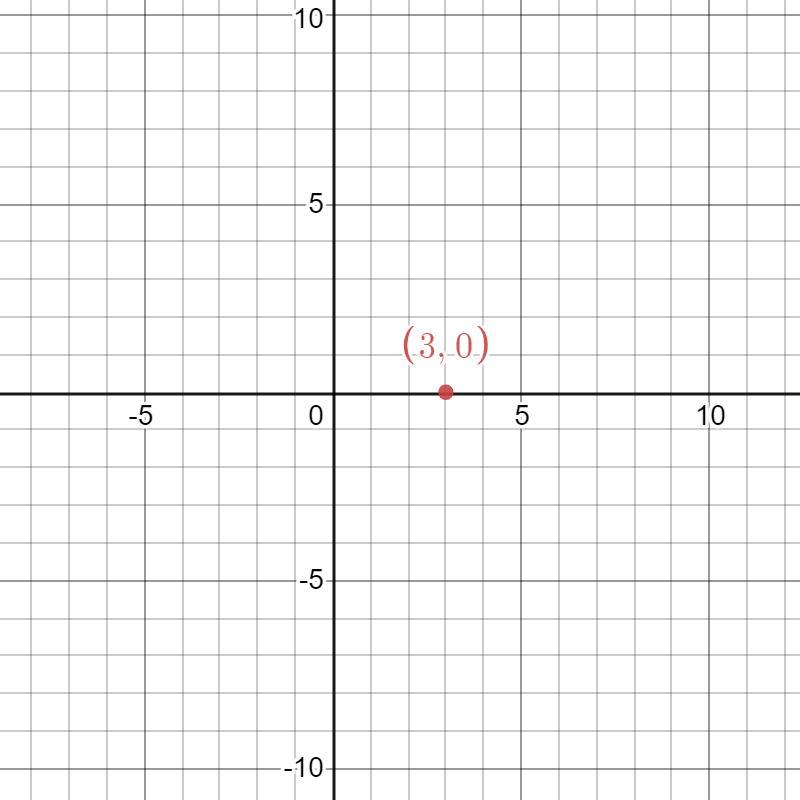
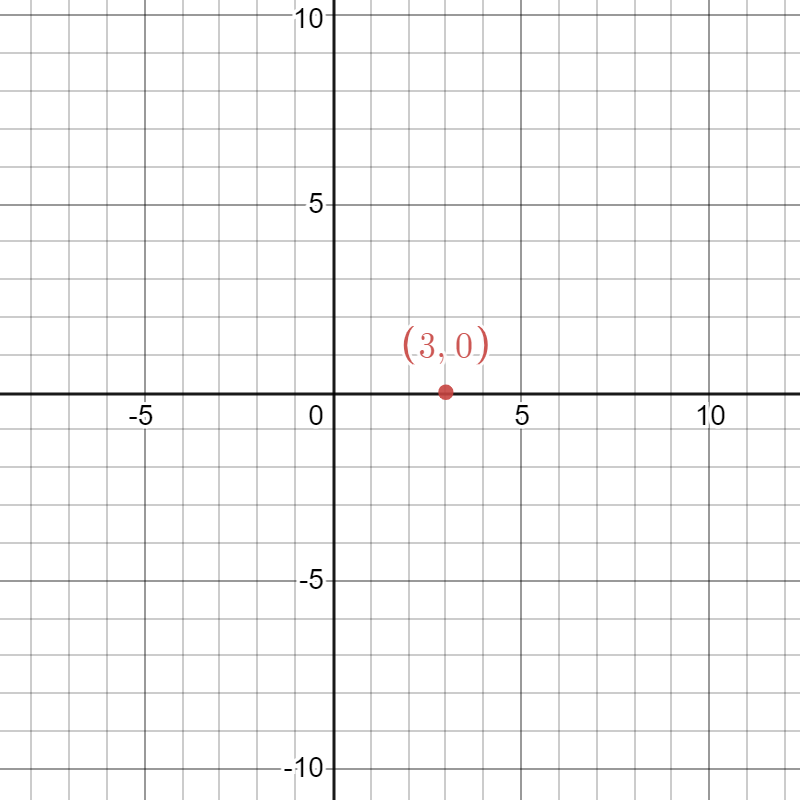
We have been given a point and the coordinate plane. We need to plot the given point on the plane. This can be done by locating the x and y coordinates and the move that distance horizontally and vertically from both the axes to find the required point.

The required point B is as follows:

Glencoe Math Course 3 Volume 2 Student 1st Edition Chapter 5 Triangles And the Pythagorean Theorem Exercise Page 365 Exercise 6, Problem6 graph


The x-axis denotes the value of the x-coordinate.

The y=axis denotes the value of the y coordinate.

The red colored point on the coordinate plane denotes the point B.

The given point has been plotted on the coordinate plane and is as follows,


Glencoe Math Course 3 Volume 2 Student 1st Edition Chapter 5 Triangles And the Pythagorean Theorem Exercise Page 365 Exercise 6, Problem6 graph 1


Glencoe Math Course 3 Volume 2 Student 1st Edition Chapter 5 Page 365 Exercise 7, Problem7

We have been given a point and the coordinate plane. We need to plot the given point on the plane. This can be done by locating the x and y coordinates and the move that distance horizontally and vertically from both axes to find the required point.

The required point C is as follows:

Glencoe Math Course 3 Volume 2 Student 1st Edition Chapter 5 Triangles And the Pythagorean Theorem Exercise Page 365 Exercise 7, Problem7 graph


The x-axis denotes the value of the x-coordinate.

The y=axis denotes the value of the y coordinate.

The red colored point on the coordinate plane denotes point C.

The given point has been plotted on the coordinate plane and is as follows:

Glencoe Math Course 3 Volume 2 Student 1st Edition Chapter 5 Triangles And the Pythagorean Theorem Exercise Page 365 Exercise 7, Problem7 graph 1


Glencoe Math Course 3 Volume 2 Student 1st Edition Chapter 5 Page 365 Exercise 8, Problem8

We have been given a point and the coordinate plane. We need to plot the given point on the plane. This can be done by locating the x and y coordinates and the move that distance horizontally and vertically from both axes to find the required point.

The required point D is as follows:

Glencoe Math Course 3 Volume 2 Student 1st Edition Chapter 5 Triangles And the Pythagorean Theorem Exercise Page 365 Exercise 8, Problem graph


The x-axis denotes the value of the x-coordinate .

The y=axis denotes the value of the y coordinate.

The red colored point on the coordinate plane denotes the point D.

The given point has been plotted on the coordinate plane and is as follows:

Glencoe Math Course 3 Volume 2 Student 1st Edition Chapter 5 Triangles And the Pythagorean Theorem Exercise Page 365 Exercise 8, Problem8 graph 1


Glencoe Math Course 3 Volume 2 Student 1st Edition Chapter 5 Page 365 Exercise 9, Problem9

We have been given a point and the coordinate plane. We need to plot the given point on the plane. This can be done by locating the x and y coordinates and the move that distance horizontally and vertically from both the axes to find the required point.


The required point E is as follows:

The x-axis denotes the value of the x-coordinate.

The y-axis denotes the value of the y-coordinate.

The red colored point on the coordinate plane denotes the point E.

Glencoe Math Course 3 Volume 2 Student 1st Edition Chapter 5 Triangles And the Pythagorean Theorem Exercise Page 365 Exercise 9, Problem9 graph


The given point has been plotted on the coordinate plane and is as follows,

Glencoe Math Course 3 Volume 2 Student 1st Edition Chapter 5 Triangles And the Pythagorean Theorem Exercise Page 365 Exercise 9, Problem9 graph 1


Glencoe Math Course 3 Volume 2 Student 1st Edition Chapter 5 Page 365 Exercise 10, Problem10

We have been given a point and the coordinate plane. We need to plot the given point on the plane. This can be done by locating the x and y coordinates and the move that distance horizontally and vertically from both axes to find the required point.


The required point F is as follows:


Glencoe Math Course 3 Volume 2 Student 1st Edition Chapter 5 Triangles And the Pythagorean Theorem Exercise Page 365 Exercise 10, Problem10 graph

The x-axis denotes the value of the x-coordinate.

The y=axis denotes the value of the y coordinate.

The red colored point on the coordinate plane denotes point F.

The given point has been plotted on the coordinate plane and is as follows,

Glencoe Math Course 3 Volume 2 Student 1st Edition Chapter 5 Triangles And the Pythagorean Theorem Exercise Page 365 Exercise 10, Problem10 graph 1


Glencoe Math Course 3 Volume 2 Student 1st Edition Chapter 5 Page 365 Exercise 11, Problem11

It is given that a third Iine intersects two parallel lines. We need to find the angle relationships formed. This can be found by considering a transversal which is a line that intersects two or more other (often parallel ) lines.
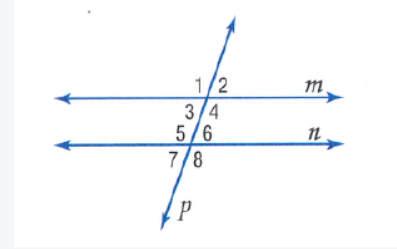
A transversal is any line that intersects two or more lines in the same plane but at distinct points.

The transversal is said to cut the two lines that it crosses.

If we draw two parallel lines and then draw a line transversal through them, we will get eight different angles. The eight angles will together form four pairs of corresponding angles.

One of the pairs in the diagram above is formed by angles F and B. If the two lines are parallel, the corresponding angles are congruent. Corresponding pairs are all angles that have the same location in relation to the parallel and transversal lines.

Interior angles are those that are in the area between the parallel lines, such as angles H and C above, whereas Exterior angles are those that are on the outside of the two parallel lines, such as D and G.

Alternate angles are those on the opposite sides of the transversal, such as H and B.

Adjacent angles are those that have the same vertex and a common ray, such as angles G and F or C and B in the diagram above.

We get two pairs of supplementary adjacent angles (G+F and H+E) in this example because the adjacent angles are created by two lines intersecting. Vertical angles are two angles that are opposite each other, such as D and B in the diagram above. Angles in the vertical plane are always congruent.

Glencoe Math Course 3 Volume 2 Student 1st Edition Chapter 5 Triangles And the Pythagorean Theorem Exercise Page 365 Exercise 11, Problem11 solution


The angle relationships that are formed when a third Ind Iine intersects two parallel lines have been stated.
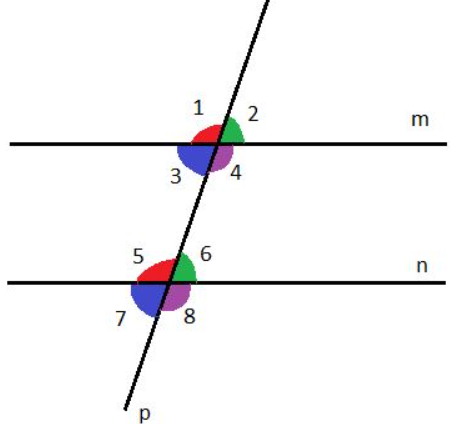
 

Glencoe Math Course 3 Volume 2 Student 1st Edition Chapter 5 Page 365 Exercise 12, Problem12

Given

Glencoe Math Course 3 Volume 2 Student 1st Edition Chapter 5 Triangles And the Pythagorean Theorem Exercise Page 365 Exercise 12, Problem12 graph


When two parallel lines are intersected by a third line then the resultant angles are in such a way that there are four angles that are equal to each other and the rest four are equal to each other. The two different measures are shown in the red and green colors, in the figure attached below.
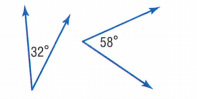
Glencoe Math Course 3 Volume 2 Student 1st Edition Chapter 5 Triangles And the Pythagorean Theorem Exercise Page 365 Exercise 12, Problem12


When all the eight angles are being measured with protractor we have found that we have four equal angles of measure equal to 60∘

Glencoe Math Course 3 Volume 2 Student 1st Edition Chapter 5 Triangles And the Pythagorean Theorem Exercise Page 365 Exercise 12, Problem12 1

which were marked in green color. The angles which were marked in red color are also of the same measure, equal to120∘and the figure will be as Measuring each of numbered angle and recording it in the table we get the table as

Glencoe Math Course 3 Volume 2 Student 1st Edition Chapter 5 Triangles And the Pythagorean Theorem Exercise Page 365 Exercise 12, Problem12 table

Finally, it has been stated that when two parallel lines are intersected by a third line then the resultant angles are in such a way that there are four angles that are equal to each other and the rest four are equal to each other. The equality of these angles can be explained with the help of opposite angle pairs, corresponding angle pairs, and alternate angle pairs.


Glencoe Math Course 3 Volume 2 Student 1st Edition Chapter 5 Page 365 Exercise 13, Problem13

It is given that the measure of angle∠1in the figure at the right is 40°.

We need to determine the measure of each given angle without using a protractor, and then check the answers by measuring with a protractor. This can be found by recalling the special angle relationships that parallel lines possess, for example, congruent angles, corresponding angles, adjacent angles, vertical angles, etc., and find the angle measurements of all the required angles from these relationships.

Glencoe Math Course 3 Volume 2 Student 1st Edition Chapter 5 Triangles And the Pythagorean Theorem Exercise Page 365 Exercise 13, Problem13 solution

The measure of each given angle has been determined without using a protractor, and then the answers have been checked by measuring with a protractor.


Glencoe Math Course 3 Volume 2 Student 1st Edition Chapter 5 Page 365 Exercise 14, Problem14

Given

Glencoe Math Course 3 Volume 2 Student 1st Edition Chapter 5 Triangles And the Pythagorean Theorem Exercise Page 365 Exercise 14, Problem14

From the given figure we have to calculate the value of∠3.

And here given the value of∠1 that is 40∘.


First, we have to find the relation between∠1 and ∠3.

Glencoe Math Course 3 Volume 2 Student 1st Edition Chapter 5 Triangles And the Pythagorean Theorem Exercise Page 365 Exercise 14, Problem14.


As we know that vertical angles are a pair of opposite angles which is formed by intersecting lines.

And here also∠1 and ∠3 are a pair of opposite angles which is formed by intersecting lines.

So they are vertical angles and the angle of vertical angles are same

Therefore the value of∠3is also40∘as it is the vertical angle of∠1.

Finally, we can determine that the angle value of∠3 is 40∘.


Glencoe Math Course 3 Volume 2 Student 1st Edition Chapter 5 Page 365 Exercise 15, Problem15

Given

Glencoe Math Course 3 Volume 2 Student 1st Edition Chapter 5 Triangles And the Pythagorean Theorem Exercise Page 365 Exercise 15, Problem15

From the given figure we have to calculate the value of∠4

And here given the value of∠1is40∘

First, we have to find the relation between∠1 and ∠4.


Given that,


Glencoe Math Course 3 Volume 2 Student 1st Edition Chapter 5 Triangles And the Pythagorean Theorem Exercise Page 365 Exercise 15, Problem15


Here we can say from the given figure∠1 and ∠4 are supplementary angles and therefore their sum should be equal to 180∘.

So∠1+∠4=180∘.

Now given that∠1=40∘

so we can solve for ∠4 from the above equation, as shown below

∠1+∠4=180∘

or,40∘+∠4=180∘

or,∠4=180∘

−40∘

or,∠4=140∘

Glencoe Math Course 3 Volume 2 Student 1st Edition Chapter 5 Triangles And the Pythagorean Theorem Exercise Page 365 Exercise 15, Problem15.


Finally, we can determine that the angle value of ∠4 is 140∘.


Glencoe Math Course 3 Volume 2 Student 1st Edition Chapter 5 Page 370 Exercise 16, Problem16

Given that

Glencoe Math Course 3 Volume 2 Student 1st Edition Chapter 5 Triangles And the Pythagorean Theorem Exercise Page 370 Exercise 16, Problem16


From the given figure we have to calculate the value of ∠5.

And here given the value of ∠1 is 40∘.


First, we have to find the relation between ∠1 and ∠5

Given that

Glencoe Math Course 3 Volume 2 Student 1st Edition Chapter 5 Triangles And the Pythagorean Theorem Exercise Page 370 Exercise 16, Problem16


Here,∠1 and ∠5 are the pair of corresponding angles, therefore these should be equal.

So, ∠1 = ∠5


We are given ∠1 = 40∘ therefore using the above equation, we have ∠5 = 40∘.

Glencoe Math Course 3 Volume 2 Student 1st Edition Chapter 5 Triangles And the Pythagorean Theorem Exercise Page 365 Exercise 16, Problem-16


Finally, we can determine that the angle value of ∠5 is 40​∘.


Glencoe Math Course 3 Volume 2 Student 1st Edition Chapter 5 Page 370 Exercise 17, Problem17

Given that

From the given figure we have to calculate the value of ∠6.

And here given the value of ∠1 = ∠5 is 40∘.

First, we have to find the relation between ∠5 and ∠6.

Given that

Glencoe Math Course 3 Volume 2 Student 1st Edition Chapter 5 Triangles And the Pythagorean Theorem Exercise Page 370 Exercise 17, Problem17


Here we can say from the given figure∠5and∠6are supplementary angles and therefore their sum should be equal to 180∘.

So ∠5 + ∠6 = 180∘

Now given that ∠1 = ∠5 is 40∘

so we can solve for∠6from the above equation, as shown below∠5+∠6=180∘

Or,40∘

+∠6=180∘

Or,∠6=180∘

−40∘

Or,∠6=140∘

Glencoe Math Course 3 Volume 2 Student 1st Edition Chapter 5 Triangles And the Pythagorean Theorem Exercise Page 370 Exercise 17, Problem17


Finally, we can determine that the angle value of∠6 is 140∘.

Glencoe Math Course 3 Volume 2 Student 1st Edition Chapter 5 Triangles And the Pythagorean Theorem Exercise Page 370 Exercise 17, Problem-17


Glencoe Math Course 3 Volume 2 Student 1st Edition Chapter 5 Page 370 Exercise 18, Problem18

Given that

Glencoe Math Course 3 Volume 2 Student 1st Edition Chapter 5 Triangles And the Pythagorean Theorem Exercise Page 370 Exercise 18, Problem18


From the given figure we have to calculate the value of∠7

And here given the value of∠1=∠5that is40∘


First, we have to find the relation between∠5 and ∠7.

Given that

Glencoe Math Course 3 Volume 2 Student 1st Edition Chapter 5 Triangles And the Pythagorean Theorem Exercise Page 370 Exercise 18, Problem18


As we know that vertical angles are a pair of opposite angles which is formed by intersecting lines.

And here also∠5and∠7are a pair of opposite angles which is formed by intersecting lines So they are vertical angles and the angle of vertical angles are same

Therefore the value of∠7is also40∘as it is the vertical angle of∠5.


Glencoe Math Course 3 Volume 2 Student 1st Edition Chapter 5 Triangles And the Pythagorean Theorem Exercise Page 370 Exercise 18, Problem-18

Finally, we can determine that the angle value of∠7 is40∘.


Glencoe Math Course 3 Volume 2 Student 1st Edition Chapter 5 Page 370 Exercise 19, Problem19

Given that

Glencoe Math Course 3 Volume 2 Student 1st Edition Chapter 5 Triangles And the Pythagorean Theorem Exercise Page 370 Exercise 19, Problem19


From the given figure we have to calculate the value of∠8

And here given the value of∠1=∠5 is 40∘


First, we have to find the relation between∠5 and ∠8.


Given that

Glencoe Math Course 3 Volume 2 Student 1st Edition Chapter 5 Triangles And the Pythagorean Theorem Exercise Page 370 Exercise 19, Problem19


Here we can say from the given figure∠5and∠8are supplementary angles and therefore their sum should be equal to180∘.

So∠5+∠8=180∘

Now given that ∠1 =∠5 is 40∘


so we can solve for∠8 from the above equation, as shown below

∠5+∠8=180∘

or,40∘+∠8=180∘

or,∠8=180∘−40∘

or,∠8=140∘

Glencoe Math Course 3 Volume 2 Student 1st Edition Chapter 5 Triangles And the Pythagorean Theorem Exercise Page 370 Exercise 19, Problem-19

Finally, we can determine that the angle value of∠8 is 140∘.


Glencoe Math Course 3 Volume 2 Student 1st Edition Chapter 5 Page 370 Exercise 20, Problem20

Given that


Glencoe Math Course 3 Volume 2 Student 1st Edition Chapter 5 Triangles And the Pythagorean Theorem Exercise Page 370 Exercise 20, Problem20

The angles that are side by side are adds up to180.

These make a straight line together when added. Such a pair is called supplementary pair of angles.
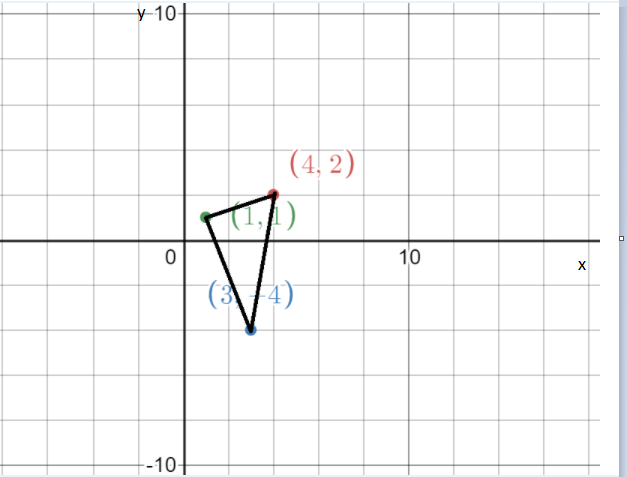
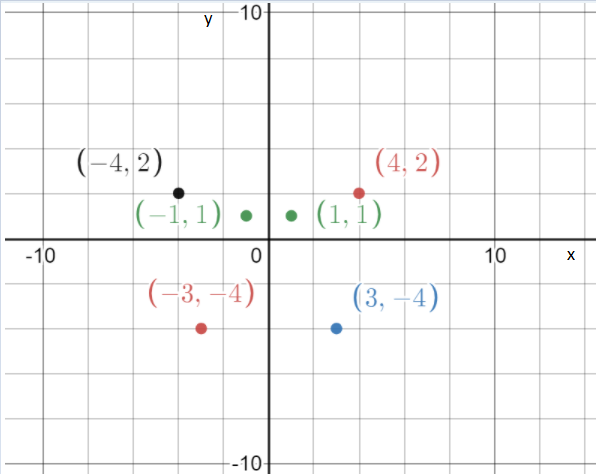
 

Glencoe Math Course 3 Volume 2 Student 1st Edition Chapter 5 Triangles And the Pythagorean Theorem Exercise Page 370 Exercise 20, Problem-20


Finally, we can determine that the angles that are side by side are adds up to180°, and such a pair is called supplementary pair of angles.


Glencoe Math Course 3 Volume 2 Student 1st Edition Chapter 5 Page 370 Exercise 21, Problem21

Given

Glencoe Math Course 3 Volume 2 Student 1st Edition Chapter 5 Triangles And the Pythagorean Theorem Exercise Page 370 Exercise 21, Problem21


The angles with the same measure are indicated in the figure using two different colors – red and blue.The red-colored angles are equal in measure and hence congruent angles. Similarly. The blue-colored angles are also equal to each other and hence congruent angles.The marked figure is

Glencoe Math Course 3 Volume 2 Student 1st Edition Chapter 5 Triangles And the Pythagorean Theorem Exercise Page 370 Exercise 21, Problem-21


The reason for the equality is either due to the opposite pair or due to corresponding angle pairs which are explained in the previous point.Now the pair of congruent angles would be1≅3≅5≅7 and2≅4≅6≅8.


Finally, we can determine that the position of the pair of the congruent angles are1≅3≅5≅7and2≅4≅6≅8.


Glencoe Math Course 3 Volume 2 Student 1st Edition Chapter 5 Page 370 Exercise 22, Problem22

Let’s draw a set of parallel lines cut by another line and we’ll get the figure as

Glencoe Math Course 3 Volume 2 Student 1st Edition Chapter 5 Triangles And the Pythagorean Theorem Exercise Page 370 Exercise 22, Problem-22-1


When two parallel lines are intersected by a third line then the resultant angles are in such a way that there are four angles that are equal to each other and the rest four are equal to each other. The two different measures are shown in the red and green colors, in the figure attached below


Glencoe Math Course 3 Volume 2 Student 1st Edition Chapter 5 Triangles And the Pythagorean Theorem Exercise Page 370 Exercise 22, Problem-22.

When all the eight angles are being measured with protractor we have found that we have four equal angles of measure equal to45∘


which were marked in red color. The angles which were marked in green color are also of the same measure, equal to135∘and the figure will be as


Glencoe Math Course 3 Volume 2 Student 1st Edition Chapter 5 Triangles And the Pythagorean Theorem Exercise Page 370 Exercise 22, Problem-22


So, when two parallel lines are intersected by a third line then the resultant angles are in such a way that there are four angles that are equal to each other and the rest four are equal to each other. The equality of these angles can be explained with the help of opposite angle pairs, corresponding angle pairs, and alternate angle pairs.


Glencoe Math Course 3 Volume 2 Student 1st Edition Chapter 5 Page 370 Exercise 23, Problem23

Let’s draw a set of parallel lines cut by another line and we’ll get the figure as


Glencoe Math Course 3 Volume 2 Student 1st Edition Chapter 5 Triangles And the Pythagorean Theorem Exercise Page 370 Exercise 23, Problem-23


Now the various types of relationships that can be found here between the angles will be as

Supplementary angle pairOpposite angle pairCorresponding angle pairAlternate interior anglesAlternate exterior angles

The above-mentioned angles are shown in the figures below

Glencoe Math Course 3 Volume 2 Student 1st Edition Chapter 5 Triangles And The Pythagorean Theorem

Supplementary angle pair

Opposite angle pair

Corresponding angle pair

Alternate interior angles

Alternate exterior angles


The above-mentioned angles are shown in the figures below


Supplementary angle pair:

Glencoe Math Course 3 Volume 2 Student 1st Edition Chapter 5 Triangles And the Pythagorean Theorem Exercise Page 370 Exercise 23, Problem-23 Supplementary angle pair

Opposite angle pair


Glencoe Math Course 3 Volume 2 Student 1st Edition Chapter 5 Triangles And the Pythagorean Theorem Exercise Page 370 Exercise 23, Problem-23 Opposite angle pair

Glencoe Math Course 3 Volume 2 Student 1st Edition Chapter 5 Triangles And The Pythagorean Theorem Corresponding angle pair

Glencoe Math Course 3 Volume 2 Student 1st Edition Chapter 5 Triangles And the Pythagorean Theorem Exercise Page 370 Exercise 23, Problem-23 Corresponding angle pair


Alternate interior angles

Glencoe Math Course 3 Volume 2 Student 1st Edition Chapter 5 Triangles And the Pythagorean Theorem Exercise Page 370 Exercise 23, Problem-23 Alternate interior angles

Alternate exterior angles


Glencoe Math Course 3 Volume 2 Student 1st Edition Chapter 5 Triangles And the Pythagorean Theorem Exercise Page 370 Exercise 23, Problem-23 Alternate exterior angles


So, the angle relationships formed are as follows Supplementary angles, Opposite angles, Corresponding angles, Alternate interior angles, Alternate exterior angles.

Differential Equations Of First Order And First Degree Homogeneous Equation Methods To Find An Integrating Factor Solved Example Problems Exercise 2

Differential Equations of First Order and First Degree Solved Example Problems Exercise 2


Example. 1: Solve \(\left(e^y+1\right) \cos x d x+e^y \sin x d y=0\)

Solution.

Given, equation is: \(\left(e^y+1\right) \cos x d x+e^y \sin x d y=0\) …………………(1)

(1) is in the form Mdx + Ndy = 0 where \(\mathrm{M}=\left(e^y+1\right) \cos x\) and \(\mathrm{N}=e^y \sin x\) Now \(\frac{\partial \mathrm{M}}{\partial y}=e^y \cos x, \frac{\partial \mathrm{N}}{\partial x}=e^y \cos x \Rightarrow \frac{\partial \mathrm{M}}{\partial y}=\frac{\partial \mathrm{N}}{\partial x}\) =>(1) is an exact equation.

⇒ \(\int^x \mathrm{M} d x=\int^x\left(e^y+1\right) \cos x d x=\left(e^y+1\right) \sin x\) ……………………..(2)

(Integrating M w.r.t. x, treating y as constant.)

⇒ \(\int\)(terms of N not containing x) dy=\(\int 0 . d y=0\) …………………….(3)

(2) + (3)=> The general solution of (1) is \(\left(e^y+1\right) \sin x+0=c \Rightarrow\left(e^y+1\right) \sin x=c\)

Differential Equations Of First-Order And First-Degree Examples

Example. 2: Solve: \((2 x y+y-\tan y) d x+\left(x^2-x \tan ^2 y+\sec ^2 y\right) d y=0\)

Solution.

Given equation is \((2 x y+y-\tan y) d x+\left(x^2-x \tan ^2 y+\sec ^2 y\right) d y=0\) ………………….. (1)

(1) is in the form Max + Ndy=0 where M = 2xy + y-tan y and \(\mathrm{N}=x^2-x \tan ^2 y+\sec ^2 y\)

Now \(\frac{\partial \mathrm{M}}{\partial y}=2 x+1-\sec ^2 y=2 x-\left(\sec ^2 y-1\right)=2 x-\tan ^2 y\)

⇒ \(\frac{\partial \mathrm{N}}{\partial x}=2 x-\tan ^2 y \Rightarrow \frac{\partial \mathrm{M}}{\partial y}=\frac{\partial \mathrm{N}}{\partial x}\) => (1) is an exact equation.

(1) Integrating M w.r.t. x, treating y as constant.

⇒ \(\int^x \mathrm{M} d x=\int^x(2 x y+y-\tan y) d x=\frac{2 x^2}{2} y+(y-\tan y) x=x^2 y+(y-\tan y) x\) ……………………(2)

(2) \(\int\)(terms of N not containing x) dy = \(\int \sec ^2 y d y\) =tan y …………………….(3)

The general solution of (1) is (2) + (3) = \(c \Rightarrow x^2 y+(y-\tan y) x+\tan y=c\)

Homogeneous Differential Equations Solved Problems

Example. 3. Show that the equation \(\left(y^2 e^{x y^2}+4 x^3\right) d x+\left(2 x y e^{x y^2}-3 y^2\right) d y=0\) is exact and hence solve it.

Solution.

Given equation is \(\left(y^2 e^{x y^2}+4 x^3\right) d x+\left(2 x y e^{x y^2}-3 y^2\right) d y=0\) ……………………(1)

(1) is in the form Mdx +Ndy=0 where \(\mathrm{M}=y^2 e^{x y^2}+4 x^3 \text { and } \mathrm{N}=2 x y e^{x y^2}-3 y^2\)

Now \(\frac{\partial \mathrm{M}}{\partial y}=2 y e^{x y^2}+y^2\left(e^{x y^2}\right)(2 x y)=2 y e^{x y^2}+2 x y^3 e^{x y^2}\)

and \(\frac{\partial \mathrm{N}}{\partial x}=2 y e^{x y^2}+2 x y \cdot e^{x y^2}\left(y^2\right)=2 y e^{x y^2}+2 x y^3 e^{x y^2}\)

⇒ \(\frac{\partial \mathrm{M}}{\partial y}=\frac{\partial \mathrm{N}}{\partial x}\) => (1) is an exact equation.

(1) Integrating M w.r.t. x treating y as constant.

⇒ \(\int^x \mathrm{M} d x=\int\left(y^2 e^{x y^2}+4 x^3\right) d x=[latex]y^2 \frac{e^{x y^2}}{x^2}\)+\(4 \frac{x^4}{4}=e^{x y^2}+x^4\) …………………..(2)

(2) \(\int\)( terms of N not containing x) dy = \(\int\left(-3 y^2\right) d y=-3 \cdot \frac{y^3}{3}=-y^3\) ………………………(3)

The general solution of (1) is (2) + (3) = c => \(e^{x y^2}+x^4-y^3=c\)

Methods To Find Integrating Factor In First-Order Differential Equations

Example. 4. Show that the equation \(x d x+y d y=\frac{a^2(x d y-y d x)}{x^2+y^2}\) is exact and solve it.

Solution:

Given x dx+y dy = \(\frac{a^2(x d y-y d x)}{x^2+y^2} \Rightarrow\left(x+\frac{a^2 y}{x^2+y^2}\right) d x+\left(y-\frac{a^2 x}{x^2+y^2}\right) d y=0\)……(1)

is in the form M dx + N dy = 0 where M = \(x+\frac{a^2 y}{x^2+y^2}\) and \(\mathrm{N}=y-\frac{a^2 x}{x^2+y^2}\)

⇒ \(\frac{\partial \mathrm{M}}{\partial y}=a^2\left[\frac{\left(x^2+y^2\right) \cdot 1-y(2 y)}{\left(x^2+y^2\right)^2}\right]\)

= \(\frac{a^2\left(x^2-y^2\right)}{\left(x^2+y^2\right)^2}\)

And \(\frac{\partial \mathrm{N}}{\partial x}=-a^2\left[\frac{\left(x^2+y^2\right) \cdot 1-x(2 x)}{\left(x^2+y^2\right)^2}\right]\)

= \(\frac{-a^2\left(y^2-x^2\right)}{\left(x^2+y^2\right)}\)

= \(\frac{a^2\left(x^2-y^2\right)}{\left(x^2+y^2\right)^2} \Rightarrow \frac{\partial \mathrm{M}}{\partial y}=\frac{\partial \mathrm{N}}{\partial x}\)

∴ (1) is an exact equation.

(1) Integrating M w.r.t. x, treating y as constant. \(\int^x M d x=\int\left(x+\frac{a^2 y}{x^2+y^2}\right) d x\)

= \(\frac{x^2}{2}+a^2 y \cdot \frac{1}{y} \text{Tan}^{-1}\left(\frac{x}{y}\right)=\frac{x^2}{2}+a^2 \text{Tan}^{-1}\left(\frac{x}{y}\right)\)………..(2)

(2) \(\int\) (terms of N not containing x) dy = \(\int y d y=\frac{y^2}{2}\)

∴ The general solution of (1) is (2) +(3)=c

⇒ \(\frac{x^2}{2}+a^2 \text{Tan}^{-1}\left(\frac{x}{y}\right)+\frac{y^2}{2}=c \Rightarrow x^2+y^2+2 a^2 \text{Tan}^{-1}\left(\frac{x}{y}\right)=2 c\)

Solved Example Problems For First-Order Homogeneous Equations

Example. 5: Solve: \(\left[y\left(1+\frac{1}{x}\right)+\cos y\right] d x+(x+\log x-x \sin y) d y=0\)

Solution.

Given equation is \(\left[y\left(1+\frac{1}{x}\right)+\cos y\right] d x+(x+\log x-x \sin y) d y=0\) …………….(1)

(1) is in the form Mdx + Ndy = 0 where \(\mathrm{M}=y\left(1+\frac{1}{x}\right)+\cos y \text { and } \mathrm{N}=x+\log x-x \sin y\)

⇒ \(\frac{\partial \mathrm{M}}{\partial y}=1+\frac{1}{x}-\sin y\) and

⇒ \(\frac{\partial \mathrm{N}}{\partial x}=1+\frac{1}{x}-\sin y\)

⇒ \(\frac{\partial \mathrm{M}}{\partial y}=\frac{\partial \mathrm{N}}{\partial x}\)

∴ (1) is an exact equation.

Now (1) Integrating M w.r.t. x, treating y as constant \(\int^x \mathrm{M} d x\)

= \(\int^x\left[y\left(1+\frac{1}{x}\right)+\cos y\right] d x=y(x+\log |x|)+x \cos y\) ……………………(2)

(2) \(\int\)(terms of N not involving x) dx = \(\int 0 \cdot d x=0\) …………….(3)

∴ The general solution of (1) is (2)+(3) = c

⇒ \(y(x+\log |x|)+x \cos y+0=c \Rightarrow y(x+\log |x|)+x \cos y=c\)

Example. 6.  Solve \(\frac{d y}{d x}+\frac{a x+h y+g}{h x+b y+f}=0\) and show that this differential equation represents a family of conics.

Solution.

Given equation is \(\frac{d y}{d x}+\frac{a x+h y+g}{h x+b y+f}=0 \Rightarrow(a x+h y+g) d x+(h x+b y+f) d y=0\) ….(1)

(1) is of the form Mdx + Ndy = 0 where M -ax + hy + g and N = hx + by + f

⇒ \(\frac{\partial \mathrm{M}}{\partial y}=h\)

and \(\frac{\partial \mathrm{N}}{\partial y}\)=h

⇒ \(\frac{\partial \mathrm{M}}{\partial y}=\frac{\partial \mathrm{N}}{\partial x}\)

∴ (1) is an exact equation.

Now (1) Integrating M w.r.t. x, treating y as constant. \(\int^x \mathrm{M} d x=\int(a x+h y+g) d x=\frac{a x^2}{2}+h x y+g x\)

(2)\(\int\)(terms of N free from x)dy = \((b y+f) d y=\frac{b y^2}{2}+f y\)

∴ The general solution of (1) is (2) + (3) = c.

⇒ \(\frac{a x^2}{2}+h y x+g x+\frac{b y^2}{2}+f y=c\)

⇒ \(a x^2+2 h x y+b y^2+2 g x+2 f y+c=0\) where c = -2c

Clearly, this equation represents a family of conics.

Exercise 2 Solutions For Differential Equations

Example. 7: Solve (y cos 2 x – 2 x ) dx + (sin x + cos y) dy = 0, it being given that y = 0 when x =0

Solution.

Given equation is (y cos 2 x – 2 x) dx + (sin x + cos y) dy = 0 ……………….. (1)

(1) is of the form Mdx + Ndy = 0 where M = y cos x – 2x and N = sin x + cos y

⇒ \(\frac{\partial \mathrm{M}}{\partial y}=\cos x, \frac{\partial \mathrm{N}}{\partial x}\)=cos x

⇒ \(\frac{\partial \mathrm{M}}{\partial y}=\frac{\partial \mathrm{N}}{\partial x}\)

∴ (1) is an exact equation.

Now (1) Integrating M w.r.t. x, treating y as constant. \(\int^x \mathrm{M} d x=\int^x(y \cos x-2 x) d x=y \sin x-x^2\) ……………….(2)

(2) \(\int\)(terms of N free from x)dy = \(\int \cos y d y=\sin y\) ……………………….(3)

∴ The general solution of (1) is (2) + (3) = c => \(y \sin x-x^2+\sin y=c\) ……………………… (4)

Given y = 0 when x = 0. Substituting these values in (4)

0sin 0 – 0 + sin0 = c => 0 – 0 + 0 = c => c = 0

The required solution is \(y \sin x-x^2+\sin y=0\)

Example. 8: Solve (r + sinθ-cosθ)dr + r(sinθ + cosθ)dθ = O

Solution.

Given equation is (r + sinθ-cosθ)dr + r(sinθ + cosθ)dθ = 0 …………………. (1)

(1) is of the form Mdθ + Ndr where M = r(sin θ + cos θ) and N = r + sin θ – cos θ

⇒ \(\frac{\partial \mathrm{M}}{\partial r}=\sin \theta+\cos \theta, \frac{\partial \mathrm{N}}{\partial \theta}=\cos \theta+\sin \theta\)

⇒ \(\frac{\partial \mathrm{M}}{\partial r}=\frac{\partial \mathrm{N}}{\partial \theta}\)

∴ (1) is an exact equation.

(1) Integrating M w.r.t. θ, treating r as constant \(\int^\theta M d \theta=\int r(\sin \theta+\cos \theta) d \theta=r(-\cos \theta+\sin \theta)\) ……………………..(2)

(2) \(\)(terms of N not containing θ) dr = \(\int r d r=\frac{r^2}{2}\)………………………(3)

The genera] solution of (1) is (2) + (3) = \(\frac{c}{2}\)

⇒ \(r(\sin \theta-\cos \theta)+\frac{r^2}{2}=\frac{c}{2} \Rightarrow r^2+2 r(\sin \theta-\cos \theta)=c\)

Glencoe Math Course 3 Volume 2 Student 1st Edition Chapter 6 Transformations Exercise 6.2

Glencoe Math Course 3 Volume 2 Student Chapter 6 Page 461 Exercise 1, Problem1

We have been given a figure. We need to show or describe the change in position of the figure. This can be found by the phenomena of motion.

Motion is the phenomenon in which an object changes its position over time. Motion is mathematically described in terms of displacement, distance, velocity, acceleration, speed, and time.

The best way to show or describe the change in position of a figure is through its motion.

Read and Learn More Glencoe Math Course 2 Volume 1 Common Core Student Edition Solutions

Glencoe Math Course 3 Volume 2 Chapter 6 Exercise 6.2 Solutions Page 461 Exercise 1, Problem2

It is said that Art Pysanky is the ancient Ukrainian art of egg decorating. We need to create our own Pysanky design. This can be done by considering the coordinate axes in the coordinate plane as the lines of symmetry.

The pysanky design can be created by drawing a design in quadrant II and drawing its reflections in the other quadrants.
The design is:

The pysanky design is as follows, pysanky design.

Glencoe Math Course 2 Student Edition Volume 1 Chapter 6 Transformations Exercise 6.2

Glencoe Math Course 3 Volume 2 Student Chapter 6 Page 461 Exercise 2, Problem1

It is given that Line symmetry is when a figure can be folded so one side is the mirror image of the other side.

We need to find whether the given pysanky have line symmetry.

This can be found by seeing that if after folding the figure vertically or horizontally, the two sides are mirror images of each other.

When the pysanky is folded horizontally, The two sides do not coincide and hence are not mirror images of each other.

Thus, the horizontal line is not a line of symmetry.

When the pysanky is folded vertically, The two sides do not coincide and hence are not mirror images of each other.

Thus, the vertical line is not a line of symmetry.

The given pysanky has zero line symmetry.

Glencoe Math Course 3 Volume 2 Student Chapter 6 Page 463 Exercise 1 Problem1

It is given that a Triangle PQR has vertices P(1,5), Q(3,7), and R(4,-1). We need to find the coordinates of the reflected image. This can be found by finding the coordinates of the vertices of the reflected image.

The triangle with the given coordinates is as follows,

Glencoe Math Course 3 Volume 2 Student Chapter 6 Transformations Exercise 6.2 Page 463 Exercise 1, Problem1

The reflected image is as follows,

Glencoe Math Course 3 Volume 2 Student Chapter 6 Transformations Exercise 6.2 Page 463 Exercise 1, Problem 1

The reflected image is as follows,

Glencoe Math Course 3 Volume 2 Student Chapter 6 Transformations Exercise 6.2 Page 463 Exercise 1, Problem -1

P’=(-1,5)
Q’=(-3,7)
R’=(-4,-1)

The coordinates of the reflected image are as follows,

P’=(-1,5)
Q’=(-3,7)
R’=(-4,-1)

Glencoe Math Course 3 Volume 2 Student Chapter 6 Page 463 Exercise 1, Problem2

A figure is given. We need to reflect the figure over x-axis and find the coordinates of A’ and B’.

This can be found by seeing that when a point is reflected over the x-axis, only it’s y-coordinate changes.

The coordinates of the reflected points as can be found from the graph are as follows,
A​′(−2,−2)

B​′(2,−2)

The reflected image on the coordinate plane is as follows,

Glencoe Math Course 3 Volume 2 Student Chapter 6 Transformations Exercise 6.2 Page 463 Exercise 1, Problem -2

The coordinates of the reflected points are A′(−2,−2),B​′(2,−2).

Glencoe Math Course 3 Volume 2 Student Chapter 6 Page 464 Exercise 1, Problem1

It is given that a Triangle ABC has vertices A(5,1), B(1,2), and C(6,2).

We need to find the coordinates of the reflected image.

This can be found by finding the coordinates of the vertices of the reflected image.

The given points are as follows,

Glencoe Math Course 3 Volume 2 Student Chapter 6 Transformations Exercise 6.2 Page 464 Exercise 1, Problem1

The triangle with the given coordinates is as follows,

Glencoe Math Course 3 Volume 2 Student Chapter 6 Transformations Exercise 6.2 Page 464 Exercise 1, Problem 1

The reflected image is as follows,


Glencoe Math Course 3 Volume 2 Student Chapter 6 Transformations Exercise 6.2 Page 464 Exercise 1, Problem 1.

The coordinates of the vertices of the reflected figure is,

Glencoe Math Course 3 Volume 2 Student Chapter 6 Transformations Exercise 6.2 Page 464 Exercise 1, Problem -1.


A’=(5,-1)
B’=(1,-2)
C’=(6,-2)

The coordinates of the reflected image are as follows,
A’=(5,-1)
B’=(1,-2)
C’=(6,-2)

Glencoe Math Course 3 Volume 2 Student Chapter 6 Page 464 Exercise 2 Problem1

A figure is given. We need to reflect the figure over y-axis and find the coordinates of A’ and B’.

This can be found by seeing that when a point is reflected over the x-axis, only it’s y-coordinate changes.

The coordinates of the reflected points areA​′ (0,−11),B​′(10,−10).

Chapter 6 Exercise 6.2 Answers Transformations Glencoe Math Course 3 Volume 2 Page 464 Exercise 3, Problem1

A figure is given. We need to find the coordinates of the figure after a reflection over either axis.

This can be found by the fact that after reflection over a particular axis, the coordinate of that axis remains the same and the other changes.

If the point is to be reflected over the x-axis, keep the coordinate of x-axis the same and take the opposite of the y-coordinate.

If the point is to be reflected over the y-axis, keep the coordinate of y-axis the same and take the opposite of the x-coordinate.

The coordinates of a figure after a reflection over either axis is determined by keeping the coordinate of that axis constant.

Glencoe Math Course 3 Volume 2 Student Chapter 6 Page 465 Exercise 1 Problem1

It is given that a Triangle GHJ has vertices G(4,2), H(3,-4), and J(1,1).

We need to find the coordinates of the reflected image.

This can be found by finding the coordinates of the vertices of the reflected image.

the given points are as follows

Glencoe Math Course 3 Volume 2 Student Chapter 6 Transformations Exercise 6.2 Page 465 Exercise 1, Problem 1


The triangle with the given coordinates is as follows,

Glencoe Math Course 3 Volume 2 Student Chapter 6 Transformations Exercise 6.2 Page 464 Exercise 1, Problem -1

The reflected image is as follows,

Glencoe Math Course 3 Volume 2 Student Chapter 6 Transformations Exercise 6.2 Page 465 Exercise 1, Problem. 1

The coordinates of the vertices of the reflected figure is,

Glencoe Math Course 3 Volume 2 Student Chapter 6 Transformations Exercise 6.2 Page 465 Exercise 1, Problem. (1)


G’=(-4,2)
H’=(-3,-4)
J’=(-1,1)

The coordinates of the reflected image are as follows,

G’=(-4,2)
H’=(-3,-4)
J’=(-1,1)

Glencoe Math Course 3 Volume 2 Student Chapter 6 Page 465 Exercise 2 Problem1

It is given that a Triangle MNP has vertices M(2,1), N(-3,1), and P(-1,4).

We need to find the coordinates of the reflected image.

This can be found by finding the coordinates of the vertices of the reflected image.

The given points are as follows,

Glencoe Math Course 3 Volume 2 Student Chapter 6 Transformations Exercise 6.2 Page 465 Exercise 2, Problem1


The triangle with the given coordinates is as follows,

Glencoe Math Course 3 Volume 2 Student Chapter 6 Transformations Exercise 6.2 Page 465 Exercise 2, Problem 1

The reflected image is as follows,

Glencoe Math Course 3 Volume 2 Student Chapter 6 Transformations Exercise 6.2 Page 465 Exercise 2, Problem -1

The coordinates of the vertices of the reflected figure is,

Glencoe Math Course 3 Volume 2 Student Chapter 6 Transformations Exercise 6.2 Page 465 Exercise 2, Problem 1.


M’=(2,-1)
N’=(-3,-1)
P=(-1,-4)

The coordinates of the reflected image are as follows,

M’=(2,-1)
N’=(-3,-1)
P=(-1,-4)

Glencoe Math Course 3 Volume 2 Student Chapter 6 Page 465 Exercise 3 Problem1

It is given that a quadrilateral WXYZ has vertices W(-1,-1), X(4,1), Y(4,5), and Z(1,7).We need to find the coordinates of the reflected image.

This can be found by finding the coordinates of the vertices of the reflected image.

The given points are as follows,

Glencoe Math Course 3 Volume 2 Student Chapter 6 Transformations Exercise 6.2 Page 465 Exercise 3, Problem1

The quadrilateral with the given coordinates is as follows,

Glencoe Math Course 3 Volume 2 Student Chapter 6 Transformations Exercise 6.2 Page 465 Exercise 3, Problem 1


The reflected image is as follows,

Glencoe Math Course 3 Volume 2 Student Chapter 6 Transformations Exercise 6.2 Page 465 Exercise 3, Problem 1.

The coordinates of the vertices of the reflected figure is,

Glencoe Math Course 3 Volume 2 Student Chapter 6 Transformations Exercise 6.2 Page 465 Exercise 3, Problem-1

W’=(-1,1)
X’=(4,-1)
Y’=(4,-5)
Z’=(1,-7)

The coordinates of the reflected image are as follows,

W’=(-1,1)
X’=(4,-1)
Y’=(4,-5)
Z’=(1,-7)

Glencoe Math Course 3 Volume 2 Student Chapter 6 Page 465 Exercise 4, Problem1

Given vertices of quadrilateral are D(1,0),E(1,−5),F(4,−1),G(3,2).

We have to find the coordinates of the reflected image When we translate quadrilateral over the y-axis, the y- coordinate of each of its vertices remains the same, and the x-coordinate will get multiplied by −1.

Given vertices of a quadrilateral areD(1,0),E(1,−5),F(4,−1),G(3,2).

When we translate quadrilateral over the y-axis, the y- coordinate of each of its vertices remains the same, and the x-coordinate will get multiplied by −1.

Therefore, new coordinates are,D(1,0)=D′(−1,0)E(1,−5)=E′(−1,−5)F(4,−1)=F′(−4,−1)G(3,2)=G′(−3,2)

Therefore, a Graph of given vertices and its reflected image becomes,

Glencoe Math Course 3 Volume 2 Student Chapter 6 Transformations Exercise 6.2 Page 465 Exercise 4, Problem 1

The coordinates of a quadrilateral DEFG after a reflection over the y-axis are D′(−1,0), E′(−1,−5), F′(−4,−1), G′(−3,2).

Step-By-Step Guide For Exercise 6.2 Chapter 6 Transformations In Glencoe Math Course 3 Page 465 Exercise 5, Problem1

We have to find the coordinates of point A′ and point B′.

When the figure is reflected over the x-axis, its x-coordinate remains the same, and the y-coordinate will get multiplied by −1.

When the figure is reflected over the x-axis, its x -x-coordinate remains the same, and the y -y-coordinate will get multiplied by 1.

The coordinates of the initial points are A(−3,3), B(3,3) after reflection over x-axis, the new coordinates will be

Sketch of the image on the coordinate plane,

Glencoe Math Course 3 Volume 2 Student Chapter 6 Transformations Exercise 6.2 Page 465 Exercise 5, Problem 1

The new coordinates after reflection are A′

(−3,−3),B′
(3,−3)

Glencoe Math Course 3 Volume 2 Student Chapter 6 Page 465 Exercise 6 Problem1

Given point is M(3,3) →M′(3,−3).

When the figure is reflected over the x-axis, its x-coordinate remains the same, and the coordinate will get multiplied by −1.

When the figure is reflected over the y-axis, its y-coordinate remains the same, and the x-coordinate will get multiplied by −1.

We have to describe the reflection as over the x-axis or y-axis.

When the figure is reflected over the x-axis, its x-coordinate remains the same, and the y -coordinate will get multiplied by−1.

When the figure is reflected every y-axis, its y-coordinate remains the same, and the x-coordinate will get multiplied by −1.

Given point is M(3,3)→M′(3,−3)

Here we can see that y-coordinate of point M′is negative of the initial point M.

Hence, the point is reflected through x-axis.

When the figure is reflected over x-axis, its x-coordinate remains the same, and the y-coordinate will get multiplied by−1
.
When the figure is reflected over y-axis, its y-coordinate remains the same, and the x-coordinate will get multiplied by −1.

Given point is M(3,3)→M′(3,−3)

Here we can see that y-coordinate of point M′is negative of the initial point M.

Hence, the given pointM(3,3)→M′(3,−3)is reflected throughx-axis.

Exercise 6.2 Solutions For Chapter 6 Transformations Glencoe Math Course 3 Volume 2 Page 466 Exercise 7, Problem1

Given coordinates of vertex of triangle are J(−7,4),K(7,1),L(2,−2).

When the point is reflected over x-axis, its x-coordinate remains the same, and the y-coordinate will get multiplied by−1.

When the point is reflected over y-axis, its y-coordinate remains the same, and the x-coordinate will get multiplied by−1.

We know that, when the figure is reflected over x-axis, its x-coordinate remains the same, and the y-coordinate will get multiplied by−1.
Therefore, the given coordinates become,

​J(−7,4)→J′(−7,−4)
K(7,1)→K′(7,−1)
L(2,−2)→L′(2,2)

We know that, when the figure is reflected over y-axis, itsy-coordinate remains the same, and the coordinate will get multiplied by −1.

Therefore, the given coordinates becomes,

​J(−7,4)→J′′(7,−4)
K(7,1)→K′′(−7,−1)
L(2,−2)→L′′(−2,2)

Hence, final coordinates after reflection over x-axis are
J′(−7,−4),
K′(7,−1),
L′(2,2).

Hence, final coordinates after reflection over y-axis are
J′′(7,−4),
K′′(−7,−1),
L′′(−2,2).

Hence, final coordinates after reflection over x-axis are
J′(−7,−4),
K′(7,−1),
L′(2,2).

Hence, final coordinates after reflection over y-axis are
J′′(7,−4),
K′′(−7,−1),
L′′(−2,2).

Glencoe Math Course 3 Volume 2 Student Chapter 6 Page 466 Exercise 8 Problem1

We have to reflect a triangle in Quadrant I over the y-axis, then translate the image 2 units left and 3 units down and check if there is a single transformation that maps the pre-image onto the image. When the figure is reflected over y-axis, itsy-coordinate remains the same, and the x-coordinate will get multiplied by−1.

Let us take ΔABC with vertices A(1,1),B(5,1),C(2,3).

When we reflect ΔABC over y-axis, A new triangle with vertices ΔA′ B′ C is formed with vertices A′(−1,1), B′(−5,1), C′(−2,3).

Now, we have to translate ΔA′B′C′2 units left and 3 units down, Therefore the coordinates of resultant image is as follows,
​(x,y)→(x−2,y−3)
(−1,1)→(−1−2,−1−3)=(−3,−2)
(−5,1)→(−5−2,−5−1)=(−7,−2)
(−2,3)→(−2−2,3−3)=(−4,0)

Hence, ΔA′′B′′C′′is formed with vertices
A′′(−3,−2),
B′′(−7,−2),
C′′(−4,0).

Glencoe Math Course 3 Volume 2 Student Chapter 6 Transformations Exercise 6.2 Page 466 Exercise 8, Problem 1

The triangle ΔA′′B′′C′′ can be obtained from ΔABC by two ways of transformation.

1. First flip the triangle ΔABC along y−axis, then move it 2 units left and 3 units down.
2. First move the triangle ΔABC, 3 units down and 2 units right and then flip it over y−axis.

Glencoe Math Course 3 Volume 2 Student Chapter 6 Transformations Exercise 6.2 Page 466 Exercise 8, Problem 1.

So, we conclude that to obtain ΔA′′B′′C′′from ΔABCa single transformation is not possible.

A single transformation is not possible to obtainΔA′′B′′C′′fromΔABC

Glencoe Math Course 3 Volume 2 Student Chapter 6 Page 466 Exercise 9 Problem1

We have to check, Is there a single transformation using reflections or translations that maps the pre-image onto the image, when you reflect a non-regular figure over the x-axis and then reflect it over the y-axis.

When the figure is reflected over x-axis, its x-coordinate remains the same, and the y-coordinate will get multiplied by−1.

When the figure is reflected over y-axis, its y-coordinate remains the same, and the x-coordinate will get multiplied by−1.

We have to check, Is there a single transformation using reflections or translations that maps the pre-image onto the image, when you reflect a non-regular figure over the x-axis and then reflect it over the y-axis.

This can be understood by example below, Consider triangle ΔABCwith vertices A(2,4), B(5,7), and C(2,8).

First, reflect the triangle over x−axis,

Therefore, the coordinates become,

​A(2,4)→A′(2,−4)
B(5,7)→B′(5,−7)
C(2,8)→C′(2,−8)

Now, reflection over y−axis.

Therefore, the coordinates become,

A′(2,−4)→A′′(−2,−4)
B′(5,−7)→B′′(−5,−7)
C′(2,−8)→C′′(−2,−8)

We can see that, there is no any other single transformation such as reflection or translation that can map same ,same image obtained by reflecting original image by X-axis and Y-axis.

No, There is no any other single transformation such as reflection or translation that can map same same image obtained by reflecting original image by X-axis and Y-axis.

Examples Of Problems From Exercise 6.2 Chapter 6 Transformations In Glencoe Math Course 3 Page 466 Exercise 10, Problem1

Given that quadrilateral ABCD is reflected over the x-axis and translated 5 units to the right. When the figure is reflected over x-axis, its x-coordinate remains the same, and the y-coordinate will get multiplied by−1.

We have to find resulting image of point B

Given that quadrilateral ABCD is reflected over the x-axis and translated 5 units to the right.

Coordinates of the point: B(−6,2).

We know that, when the point is reflected over x-axis, then the y-coordinate becomes opposite.

​A(x,y)→A′(x,−y)
B(−6,2)→B(−6,−2)

Now translating the point by 5 units to the right, Coordinates of point after translation:
B′(−6,−2)→B′′(−6+5,−2+0)=B′′(−1,−2)​

Hence, option (A) (−1,−2)is correct.

The correct option is (A) (−1,−2)

Glencoe Math Course 3 Volume 2 Student Chapter 6 Page 467 Exercise 11 Problem1

Given vertices of square ABCD are A(2,4),B(−2,4),C(−2,8),D(2,8).

When the figure is reflected over x-axis, its x-coordinate remains the same, and the y-coordinate will get multiplied by−1.

Given vertices of square ABCD areA(2,4),B(−2,4),C(−2,8),D(2,8).

When the figure is reflected over x-axis, its x-coordinate remains the same, and the y-coordinate will get multiplied by−1.

Therefore, the coordinates after reflection becomes.

​A(2,4)→A′(2,−4)
B(−2,4)→B′(−2,−4)
C(−2,8)→C′(−2,−8)
D(2,8)→D′(2,−8)

Hence, the vertices of reflected square will be,

A′(2,−4),
B′(−2,−4),
C′(−2,−8),
D′(2,−8).

The graphical representation will be,

Glencoe Math Course 3 Volume 2 Student Chapter 6 Transformations Exercise 6.2 Page 467 Exercise 11, Problem 1

The vertices of reflected square are, A′
(2,−4),B′
(−2,−4),C′
(−2,−8),D′
(2,−8).

Graphical representation is,

Glencoe Math Course 3 Volume 2 Student Chapter 6 Transformations Exercise 6.2 Page 467 Exercise 11, Problem 1

Glencoe Math Course 3 Volume 2 Student Chapter 6 Page 467 Exercise 12 Problem1

The coordinates of a point and its image after a reflection are X(−1,−4)→X′(−1,4).

We have to describe the reflection as over the x-axis or y-axis.

When the figure is reflected over x-axis, its x-coordinate remains the same, and the y-coordinate will get multiplied by−1.

When the figure is reflected over y-axis, its y-coordinate remains the same, and the x-coordinate will get multiplied by−1.

The coordinates of a point and its image after a reflection are X(−1,−4)→X′(−1,4).

When the figure is reflected over x-axis, its x-coordinate remains the same, and the y-coordinate will get multiplied by−1.
A(x,y)→A′(x,−y)

When the figure is reflected over y-axis, itsy-coordinate remains the same, and the x-coordinate will get multiplied by−1.
A(x,y)→A′(−x,y)

From the given point, we can see that x-coordinate of the point and its image are the same,and the y-coordinate of the image is opposite to that of its image.

Hence, the point is reflected over x-axis.

The point is reflected over x-axis.

Common Core Chapter 6 Exercise 6.2 Transformations Detailed Solutions Glencoe Math Course 3 Volume 2 Page 467 Exercise 13, Problem1

Given point and its image is, W(−4,0)→W′(4,0).

We have to describe the reflection as over the x-axis or y-axis. When the figure is reflected over x-axis, its x-coordinate remains the same, and the y-coordinate will get multiplied by−1.

When the figure is reflected over y-axis, its y-coordinate remains the same, and the x-coordinate will get multiplied by−1.

Given point and its image is, W(−4,0)→W′(4,0).

When the figure is reflected over x-axis, its x-coordinate remains the same, and the y-coordinate will get multiplied by−1.
A(x,y)→A′(x,−y)

When the figure is reflected over y-axis, its y-coordinate remains the same,and the x-coordinate will get multiplied by−1.

A(x,y)→A′(−x,y)

From the given point and its image we can see that, y-coordinate of the point and its image are same, and the x-coordinate of the point is opposite to that of image.

Hence, the point is reflected over y-axis.

The point is reflected over y-axis.

Glencoe Math Course 3 Volume 2 Student Chapter 6 Page 468 Exercise 14 Problem1

The given figure is, ΔABC with vertices A(1,-1), B(4,-1), and C(2,-4).

We have to choose the correct alternative as the reflection of the triangle over the x-axis.

Since the reflection is done over the x-axis, we apply the translation notation ⟨x,y)→(x,−y)to the coordinates of the vertices of the triangle.

We match the translated vertices with the vertices of the alternative choices to obtain the correct option.

We are given a triangle, ΔABC with coordinates A(1,-1), B(4,-1), and C(2,-4).

Since we have reflected the figure over the x-axis, the coordinates of the x-axis will be the same and the y-axis coordinates will be opposite signed i.e.

we will multiply -1 with the y-axis coordinates. Hence, the translation notation used is, P⟨x,y)→P′(x,−y).

Therefore, the translated point corresponding to A is, A⟨1,−1)→A′(1,1).

Similarly, the other two translated points are,B⟨4,−1)→B′(4,1) and C⟨2,−4)→C′(2,4).

From the four alternatives, we can see that in the figure at the second option i.e. option (B), the vertices have the coordinates as (1,1), (4,1), and (2,4). So, option (B) is the correct figure.

Glencoe Math Course 3 Volume 2 Student Chapter 6 Transformations Exercise 6.2 Page 468 Exercise 14, Problem 1


Finally, we can conclude that the figure at option (B) is the correct option for the reflected image of the given figure ΔABC.

Glencoe Math Course 3 Volume 2 Student Chapter 6 Transformations Exercise 6.2 Page 468 Exercise 14, Problem 1


Student Edition Exercise 6.2 Chapter 6 Transformations Solutions Guide Glencoe Math Course 3 Volume 2 Page 468 Exercise 15, Problem1

The given statement is, triangle RST is reflected over the x-axis and then translated 4 units to the right.

We have to determine the coordinates of point R in its new position.

We apply the translation, ⟨x,y)→(x,−y)to the coordinates of vertices of RST for the reflection over the x-axis.

We also add 4 with the x-coordinates of the vertices to signify the shift of 4 units to the right.

We have the figure ΔRST as

Glencoe Math Course 3 Volume 2 Student Chapter 6 Transformations Exercise 6.2 Page 468 Exercise 15, Problem 1

The coordinates of the point R are (-4,-3).

Now, we apply the translation ⟨x,y)→(x,−y)to R for the reflection over the x-axis as,R⟨−4,−3)→R′(−4,3).

Also, the point is shifted units to the right i.e. we have to add 4 with the x-coordinate of R’ as, R′⟨−4,3)→R​′′(−4+4,3)→R​′′
(0,3).

Therefore, the final position of the point R will be (0,3).

Finally, we can conclude that the coordinates of point R in its new position are R′⟨−4,3)→R​′′(0,3).

Glencoe Math Course 3 Volume 2 Student Chapter 6 Page 468 Exercise 16 Problem1

The given statement is, graph and label figure pentagon LMNOP with vertices L(0,3), M(2,2), N(2,0), O(-2,0), and P(-2,2).

We first plot the vertices according to the given coordinates and then link the vertices by straight lines to form the pentagon LMNOP.

We have the vertices of the pentagon LMNOP as L(0,3), M(2,2), N(2,0), O(-2,0), and P(-2,2).
Now, we can plot these points on the graph as

Glencoe Math Course 3 Volume 2 Student Chapter 6 Transformations Exercise 6.2 Page 468 Exercise 16, Problem 1

Now, we connect these vertices with straight lines to form the pentagon LMNOP as

Glencoe Math Course 3 Volume 2 Student Chapter 6 Transformations Exercise 6.2 Page 468 Exercise 16, Problem 1.

Finally, we can conclude that the pentagon LMNOP can be plotted and labeled as

Glencoe Math Course 3 Volume 2 Student Chapter 6 Transformations Exercise 6.2 Page 468 Exercise 16, Problem 1.