Differential Equations Of First Order And First Degree Homogeneous Equation Methods To Find An Integrating Factor Solved Example Problems Exercise 2.10

Differential Equations of First Order and First Degree Solved Example Problems Exercise 2.10

Example. 1: Solve \((x+1) \frac{d y}{d x}+1=e^{x-y}\). Also, find the solution for which y(0) = 0

Solution.

Given equation is \((x+1) \frac{d y}{d x}+1=e^{x-y}\) ….(1)

⇒ \(\frac{d y}{d x}+\frac{1}{x+1}=\frac{e^x \cdot e^{-y}}{x+1}\)

Multiplying with \(e^y\), we get: \(e^y \frac{d y}{d x}+\frac{1}{x+1} e^y=\frac{e^x}{x+1}\) = which is Bernoulli’s equation… (2)

Let \(e^y=u \Rightarrow e^y \frac{d y}{d x}=\frac{d u}{d x}\) ……………..(3)

(2) and (3) \(\Rightarrow \frac{d u}{d x}+\frac{1}{x+1} u=\frac{e^x}{x+1}\) which is linear in u and x …………………………(4)

where \(\mathrm{P}=\frac{1}{x+1} \text { and } \mathrm{Q}=\frac{e^x}{x+1}\)

Now \(\text { I.F. }=\exp \left(\int \frac{1}{x+1} d x\right)=e^{\log (x+1)}=x+1\)

The G.S of (4) is \(u(x+1)=\int \frac{e^x}{x+1}(x+1) d x+c=\int e^x d x+c \Rightarrow u(x+1)=e^x+c\)

∴ The general solution of (1) is \(e^y(x+1)=e^x+c\)

y(0) = 0=> value of y at (x = 0) is 0.

∴ \(e^0(0+1)=e^0+c \Rightarrow 1=1+c \Rightarrow c=0\)

The required solution when \(y(0)=0 \text { is } e^y(x+1)=e^x\)

Differential Equations Of First Order And First Degree Overview

Example. 2: Solve \(\frac{d y}{d x}+\left(2 x \text{Tan}^{-1} y-x^3\right)\left(1+y^2\right)\)=0

Solution.

Given equation is \(\frac{d y}{d x}+\left(2 x \text{Tan}^{-1} y-x^3\right)\left(1+y^2\right)=0\)………(1)

Dividing (1) by \(\left(1+y^2\right)\) and rearranging the equation:

⇒ \(\frac{1}{1+y^2} \frac{d y}{d x}+2 x \mathrm{Tan}^{-1} y=x^3\) which is Bernoulli’s equation……(2)

Let \(\text{Tan}^{-1} y=u \Rightarrow \frac{1}{1+y^2} \frac{d y}{d x}=\frac{d u}{d x}\)……….(3)

(2) and (3) ⇒ \(\frac{d u}{d x}+2 x u=x^3\) which is linear … (4) in u and x where \(\mathrm{P}=2 x\) and \(\mathrm{Q}=x^3\)

∴ I.F. \(=e^{\int 2 x d x}=e^{x^2}\).

Now the G. S. of (4) is \(u. e^{x^2}=\int x^3 e^{x^2} d x+c=\frac{1}{2} \int e^{t^t} \cdot t d t+c\)

where \(t=x^2 \Rightarrow u e^{x^2}=\frac{1}{2}\left(t e^t-e^t\right)+c\)

Substituting \(u=\text{Tan}^{-1} \quad y\) and \(t=x^2\)

The general solution of (1) is \(2 e^{x^2} \text{Tan}^{-1} y=\left(x^2-1\right) e^{x^2}+2 c\)

Homogeneous Equations Solved Problems Exercise 2.10

Example. 3: Solve \(\frac{d z}{d x}+\frac{z}{x} \log z=\frac{z}{x^2}(\log z)^2, z>0 \text { and } x>0\)

Solution.

Given \(\frac{d z}{d x}+\frac{z}{x} \log z=\frac{z}{x^2}(\log z)^2\) …………..(1)

(1) is Bernoulli’s equation. Then multiply (1) by \(z^{-1}(\log z)^{-2}\):

⇒ \(z^{-1}(\log z)^{-2} \frac{d z}{d x}+\frac{(\log z)^{-1}}{x}=\frac{1}{x^2}\) ………………(2)

Let \((\log z)^{-1}=u \Rightarrow z^{-1}(\log z)^{-2} \frac{d z}{d x}=-\frac{d u}{d x}\) ……………..(3)

(2) and (3) ⇒ \(-\frac{d u}{d x}+\frac{u}{x}=\frac{1}{x^2} \Rightarrow \frac{d u}{d x}-\frac{1}{x} u=-\frac{1}{x^2}\) ……………..(4)

(4) is a linear equation in u and x where \(\mathrm{P}=-\frac{1}{x}, \mathrm{Q}=-\frac{1}{x^2}\)

Now \(\text { I.F. }=\exp \left(\int \mathrm{P} d x\right)=\exp \left(-\frac{1}{x} d x\right)=e^{-\log x}=e^{\log x^{-1}}=\frac{1}{x}\)

The general solution of (4) is \(u\left(\frac{1}{x}\right)=\int\left(-\frac{1}{x^2}\right) \frac{1}{x} d x+c \Rightarrow u\left(\frac{1}{x}\right)=\int-x^{-3} d x+c=\frac{1}{2 x^2}+c\) ………..(5)

substitution \(u=(\log z)^{-1}\) in (5), the general solution of (1) is \(\frac{1}{x \log z}=\frac{1}{2 x^2}+c \Rightarrow 2 x=\log z+2 x^2 c \log z\)

Solved Example Problems From Exercise 2.10 In Differential Equations

Example. 4. Solve \(\frac{x d x+y d y}{x d y-y d x}=\sqrt{\frac{a^2-x^2-y^2}{x^2+y^2}}\)

Solution:

Given

\(\frac{x d x+y d y}{x d y-y d x}=\sqrt{\frac{a^2-x^2-y^2}{x^2+y^2}}\)

Let \(x=r \cos \theta\) and \(y=r \sin \theta\).

Then \(r^2=x^2+y^2, \theta=\text{Tan}^{-1}(y / x)\)

dx = \(d r \cdot \cos \theta-r \sin \theta d \theta, d y=r \cos \theta \cdot d \theta+d r \cdot \sin \theta\)

Then (1) becomes: \(\frac{r \cos \theta(\cos \theta \cdot d r-r \sin \theta d \theta)+r \sin \theta(r \cos \theta d \theta+d r \cdot \sin \theta)}{r \cos \theta(r \cos \theta d \theta+d r \cdot \sin \theta)-r \sin \theta(d r \cdot \cos \theta-r \sin \theta d \theta)}\)

= \(\sqrt{\frac{a^2-r^2}{r^2}} \Rightarrow \frac{\left(r \cos ^2 \theta+r \sin ^2 \theta\right) d r}{\left(r^2 \cos ^2 \theta+r^2 \sin ^2 \theta\right) d r}\)

= \(\sqrt{\frac{a^2-r^2}{r^2}} \Rightarrow \frac{1}{r} \frac{d r}{d \theta}=\frac{\sqrt{a^2-r^2}}{r}\)

⇒ \(\frac{d r}{\sqrt{a^2-r^2}}=d \theta \Rightarrow \sin ^{-1} \frac{r}{a}=\theta+c \Rightarrow r=a \sin (\theta+c)\)

The G.S. of (1) is \(\sqrt{x^2+y^2}=a \sin \left[\text{Tan}^{-1}\left(\frac{y}{x}\right)+c\right]\)


Differential Equations Of First Order And First Degree Homogeneous Equation Methods To Find An Integrating Factor Solved Example Problems Exercise 2.1

Differential Equations of First Order and First Degree Solved Example Problems Exercise 2.1

Example. 1: Solve \(x d y-y d x=x y^2 d x\)

Solution.

Given equation is \(x d y-y d x=x y^2 d x\)

Dividing (1) by \(\frac{x d y-y d x}{y^2}=x d x \Rightarrow x d x+\frac{y d x-x d y}{y^2}=0 \Rightarrow x d x+d(x / y)=0\)

Integrating : \(\frac{x^2}{2}+\frac{x}{y}=c\)

∴ The general solution (1) is \(\left(x^2 / 2\right)+(x / y)=c\)

Differential Equations Of First Order And First Degree Explained

Example. 2: Solve (1 + xy)x dy + (1 – yx)y dx = 0

Solution.

Given equation is (1 + xy)x dy + (1 -yx)y dx = 0 ……………………..(1)

⇒ x dy + y dx + (x dy – y dx) xy = 0 ……………………..(2)

Multiplying(2)with \(\frac{1}{x^2 y^2} \Rightarrow \frac{x d y+y d x}{x^2 y^2}+\frac{x d y-y d x}{x y}=0\)

⇒ \(\frac{d(x y)}{x^2 y^2}+\frac{1}{y} d y-\frac{1}{x} d x=0\)

Integrating : \(\int \frac{d(x y)}{x^2 y^2}+\int \frac{1}{y} d y-\int \frac{1}{x} d x=c \Rightarrow-\frac{1}{x y}+\log |y|-\log |x|=c\)

∴ The general solution of (1) is xy log(y/x) -1 = c xy.

Example. 3: Solve \(x d x+y d y+\frac{x d y-y d x}{x^2+y^2}=0\)

Solution:

Given equation is \(x d x+y d y+\frac{x d y-y d x}{x^2+y^2}=0\)

⇒ \(x d x+y d y+\frac{(x d y-y d x) / x^2}{1+\left(y^2 / x^2\right)}=0\)

⇒ x d x+y d y+\(\frac{d(y / x)}{1+(y / x)^2}=0 \Rightarrow d\left(\frac{x^2+y^2}{2}\right)+\frac{d(y / x)}{1+(y / x)^2}=0\)

Integrating, we get: \(\frac{x^2+y^2}{2}+\text{Tan}^{-1}\left(\frac{y}{x}\right)=c\)

∴ The general solution of (1) is \(\left(x^2+\dot{y}^2\right)+2 \text{Tan}^{-1}(y / x)=2 c\)

Methods To Find Integrating Factors In First-Order Equations

Example. 4. Solve ydx – xdy + logx dx = 00

Solution.

Given ydx – xdy + log x dx – 0 => log x dx – (xdy – ydx) = 0

Multiplying with \(\frac{1}{x^2} \Rightarrow \frac{1}{x^2} \log x d x-\frac{(x d y-y d x)}{x^2}=0 \Rightarrow \frac{1}{x^2} \log x d x-d\left(\frac{y}{x}\right)=0\)

Integrating: \(\int \frac{1}{x^2} \log x d x-\int d\left(\frac{y}{x}\right)=c \Rightarrow-\frac{1}{x} \log x-\int\left(-\frac{1}{x}\right) \cdot \frac{1}{x} d x-\frac{y}{x}=c\)

∴ The G.S. of (1) is \(c x+y+(1+\log x)=0\)

Example. 5. Solve \(x d y=\left[y+x \cos ^2(y / x)\right] d x\)

Solution.

Given equation is \(x d y=y d x+x \cos ^2(y / x) d x\) ……………………..(1)

⇒ \(x d y-y d x=x \cos ^2(y / x) d x\)

Dividing with \(x^2: \Rightarrow \frac{x d y-y d x}{x^2}=\frac{1}{x} \cos ^2\left(\frac{y}{x}\right) d x \Rightarrow \sec ^2 \frac{y}{x} \cdot \frac{x d y-y d x}{x^2}=\frac{1}{x} d x\)

⇒ \(\sec ^2\left(\frac{y}{x}\right) \cdot d\left(\frac{y}{x}\right)=\frac{1}{x} d x\)

Integrating : \(\int \sec ^2(y / x) \cdot d(y / x)=\int(1 / x) d x+c \Rightarrow \tan (y / x)=\log |x|+c\)

∴ The general solution of (1) is tan( y / x) = log|x| + c

Solved Example Problems For Exercise 2.1 In Differential Equations

Example. 6. Solve \(\left(x^2+y^2+x\right) d x-\left(2 x^2+2 y^2-y\right) d y=0\)

Solution.

Given \(\left(x^2+y^2\right) d x+x d x-2\left(x^2+y^2\right) d y+y d y=0\) ……………………(1)

Rearranging (1) : \(\left(x^2+y^2\right)(d x-2 d y)+x d x+y d y=0\)

⇒ \(d x-2 d y+\frac{x d x+y d y}{x^2+y^2}=0 \Rightarrow 2 d x-4 d y+\frac{2 x d x+2 y d y}{x^2+y^2}=0\)

⇒ \(2 d x-4 d y+d \log \left(x^2+y^2\right)=0\)

⇒ \(2 \int d x-4 \int d y+\int d \log \left(x^2+y^2\right)=c \Rightarrow 2 x-4 y+\log \left(x^2+y^2\right)=c\)

∴ The general solution of (1) is \(2 x-4 y+\log \left(x^2+y^2\right)=c\)

Example. 7. Solve \(\left(x^2+y^2-2 y\right) d y=2 x d x\)

Solution.

Given equation is

⇒ \(\left(x^2+y^2\right) d y=d\left(x^2+y^2\right) \Rightarrow d y=\frac{d\left(x^2+y^2\right)}{x^2+y^2} \Rightarrow \int d y=\int \frac{d\left(x^2+y^2\right)}{x^2+y^2}+c\)

∴ The general solution of (1) is \(y=\log \left(x^2+y^2\right)+c\)

Solutions For Exercise 2.1 First-Order Homogeneous Equations

Example. 8. Solve \(y d x-x d y+\left(1+x^2\right) d x+x^2 \sin y d y=0\)

Solution.

Given \((y d x-x d y)+\left(1+x^2\right) d x+x^2 \sin y d y=0\)

Dividing (1) by \(x^2 \Rightarrow \frac{y d x-x d y}{x^2}+\left(\frac{1}{x^2}+1\right) d x+\sin y d y=0\)

⇒ \(-\frac{x d y-y d x}{x^2}+\left(\frac{1}{x^2}+1\right) d x+\sin y d y=0 \Rightarrow-d(y / x)+\left(\frac{1}{x^2}+1\right) d x+\sin y d y=0\)

⇒  \(-\int d\left(\frac{y}{x}\right)+\int\left(\frac{1}{x^2}+1\right) d x+\int \sin y d y=c \Rightarrow-\left(\frac{y}{x}\right)-\left(\frac{1}{x}\right)+x-\cos y=c\)

∴ The general solution of (1) is \(x^2-y-1-x \cos y=c x\)

Homogeneous Differential Equations Exercise 2.1 Step-By-Step Solutions

Example. 9. Solve \(y\left(2 x^2 y+e^x\right) d x-\left(e^x+y^3\right) d y=0\)

Solution.

Given \(y\left(2 x^2 y+e^x\right) d x-\left(e^x+y^3\right) d y=0 \Rightarrow 2 x^2 y^2 d x+y e^x d x-e^x d y-y^3 d y=0\) ………………(1)

Dividing by \(y^2 \Rightarrow 2 x^2 d x+\left(\frac{y e^x d x-e^x d y}{y^2}\right)-y d y=0 \Rightarrow 2 x^2 \cdot d x+d\left(\frac{e^x}{y}\right)-y d y=0\)

Integrating : \(2 \int x^2 d x+\int d\left(\frac{e^x}{y}\right)-\int y d y=c \Rightarrow \frac{2 x^3}{3}+\frac{e^x}{y}-\frac{y^2}{2}=c\)

∴ The general solution of (1) is \(\frac{2 x^3}{3}+\frac{e^x}{y}-\frac{y^2}{2}=c\)

Example. 10. Solve \(\left(y-x y^2\right) d x-\left(x+x^2 y\right) d y=0\)

Solution.

Given \(\left(y-x y^2\right) d x-\left(x+x^2 y\right) d y=0 \ldots .(1) \Rightarrow(y d x-x d y)-x y(y d x+x d y)=0\)………………….. (2)

Dividing(2) by \(x y \Rightarrow\left(\frac{d x}{x}-\frac{d y}{y}\right)-(y d x+x d y)=0 \Rightarrow \frac{d x}{x}-\frac{d y}{y}-d(x y)=0\)

⇒ \(\int \frac{d x}{x}-\int \frac{d y}{y}-\int d(x y)=c \Rightarrow \log x-\log y-x y=c\)

∴ The general solution of (1) is \(\log (x / y)-x y=c\)

Methods For Solving Exercise 2.1 Differential Equations

Example. 11. Solve \(x d y-y d x=a\left(x^2+y^2\right) d y\)

Solution:

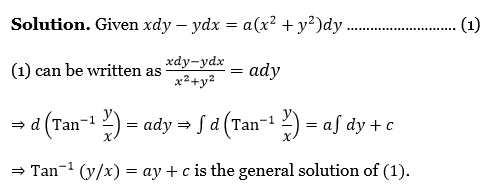
Given x dy-y dx = \(a\left(x^2+y^2\right) d y\)…….(1)

(1) can be written as \(\frac{x d y-y d x}{x^2+y^2}=a d y\)

⇒ \(d\left(\text{Tan}^{-1} \frac{y}{x}\right)=a d y\)

⇒ \(\int d\left(\text{Tan}^{-1} \frac{y}{x}\right)=a \int d y+c\)

⇒ \(\text{Tan}^{-1}(y / x)=a y+c\) is the general solution of (1).

Differential Equations of First Order and First Degree exercise 2(a) example 11

Examples Of Integrating Factors In Homogeneous Equations Exercise 2.1 

Example. 12. Solve \(y d x-x d y=3 x^2 e^{x^3} y^2 d x\)

Solution.

Given equation is\(y d x-x d y=3 x^2 e^{x^3} y^2 d x\) …………………….(1)

⇒ \(\frac{y d x-x d y}{y^2}=3 x^2 e^{x^3} d x \Rightarrow d\left(\frac{x}{y}\right)=3 x^2 e^{x^3} d x \Rightarrow \int d(x / y)=\int 3 x^2 e^{x^3} d x+c\)

∴ The general solution of (1) is \(x=y e^{x^3}+c y\)


Calculus Vector Differentiation Exercise Problems Ordinary Derivatives Of Vector

Vector Differentiation- 3 Exercise 3 Solved Problems

1. Define a vector function.

Vector function: Let S⊆ R . If to each t ∈ S there corresponds a unique vector f(t) then the corresponding f is called a vector function with scalar variable t of domain S.

2. Define the limit of a vector function.

Limit: Let f be a vector function over the domain S and an as be a limit point of S. A vector L is said to be the limit of at an if to each given ε>0,∃δ>0∋t ∈ S, 0<|t-a| δ ⇒|f(t)-L|<ε It is denoted by\(\underset{t \rightarrow a}{L t}\)f(t) = L.

3. Define the continuity of a vector function.

  1. Continuous at a point: let f be a vector function with domain S and a S. Then f is said to be continuous at if\(\underset{t \rightarrow a}{L t}\)f(t)=f(a)
  2. Continuity on a set: let f be a vector function with domain S. Then f is said to be continuous on S if f is continuous at a for all a S.

4. Define the derivative of a vector function.

Derivative: Let f be a vector function with domain S and a ∈ Then f is said to be differentiable at an if \(\underset{t \rightarrow a}{L t}\)\(\frac{f(t)-f(a)}{t-a}\)exits. At the limit is called the derivative of f at a. It is denoted by f'(a) or \(\left(\frac{d f}{d t}\right)_{t=a}\)

Calculus Vector Differentiation Exercise Solutions

5. If f, g are two differentiable vector functions at t  then prove that f + g is differentiable at t and\(\frac{d}{d t}\{\mathbf{f}+\mathbf{g}\}\)=\(=\frac{d f}{d t}+\frac{d g}{d t}\)

Solution:

Given

f, g are two differentiable vector functions at t

⇒ \(\underset{h \rightarrow 0}{L t} \frac{(\mathbf{f}+\mathbf{g})(t+h)-(\mathbf{f}+\mathbf{g})(t)}{h}=\underset{h \rightarrow 0}{L t} \frac{\mathbf{f}(t+h)+\mathbf{g}(t+h)-\mathbf{f}(t)-\mathbf{g}(t)}{h}\)

= \(\underset{h \rightarrow 0}{L t} \frac{\mathbf{f}(t+h)-\mathbf{f}(t)}{h}+\underset{h \rightarrow 0}{L t} \frac{\mathbf{g}(t+h)-\mathbf{g}(t)}{h}=\frac{d \mathbf{f}}{d t}+\frac{d \mathbf{g}}{d t}\)

∴ \(\mathbf{f}+\mathbf{g}\)are differentiable at t and \(\frac{d}{d t}\{\mathbf{f}+\mathbf{g}\}=\frac{d \mathbf{f}}{d t}+\frac{d \mathbf{g}}{d t}\)

6. If f and g are two differentiable vector functions at t then prove that

  1. f • g is differentiable at t and \(\frac{d}{d t}\{\mathbf{f} \cdot \mathbf{g}\}\)=\(\frac{d \mathbf{f}}{d t} \cdot \mathbf{g}+\mathbf{f} \cdot \frac{d \mathbf{g}}{d t}\)
  2. f x g is differentiable at t and \(\frac{d}{d t}\{\mathbf{f} \times \mathbf{g}\}\)=\(\frac{d \mathbf{f}}{d t} \times \mathbf{g}+\mathbf{f} \times \frac{d \mathbf{g}}{d t}\)

Solution:

1. \(\underset{h \rightarrow 0}{L t} \frac{(\mathbf{f} \cdot \mathbf{g})(t+h)-(\mathbf{f} \cdot \mathbf{g})(t)}{h}=\underset{h \rightarrow 0}{L t} \frac{\mathbf{1}(t+h) \cdot \mathbf{g}(t+h)-\mathbf{f}(t) \cdot \mathbf{g}(t)}{h}\)

= \(\text{Lt}_{h \rightarrow 0} \frac{\mathbf{f}(t \cdot+h) \cdot \mathbf{g}(t+h)-\mathbf{f}(t+h) \cdot \mathbf{g}(t)+\mathbf{f}(t+h) \cdot \mathbf{g}(t)-\mathbf{f}(t) \cdot \mathbf{g}(t)}{h}\)

= \(\underset{h \rightarrow 0}{L t}\left\{\mathbf{f}(t+h) \cdot \frac{[\mathbf{g}(t+h)-\mathbf{g}(t)]}{h}+\frac{[\mathbf{f}(t+h)-\mathbf{f}(t)]}{h} \cdot \mathbf{g}(t)\right\}\)

= \(\left[{ }_{h \rightarrow 0}^{L t} \mathbf{f}(t+h)\right] \cdot\left[{ }_{h \rightarrow 0}^{L t} \frac{\mathbf{g}(t+h)-\mathbf{g}(t)}{h}\right]+\left[{ }_{h \rightarrow 0}^{L t} \frac{\mathbf{f}(t+h)-\mathbf{f}(t)}{h}\right] \cdot \mathbf{g}(t)\)

= \(\mathbf{f} \cdot \frac{d \mathbf{g}}{d t}+\frac{d \mathbf{f}}{d t} \cdot \mathbf{g}\)

∴ \(\mathbf{f} \cdot \mathbf{g}\) is differentiable at t and \(\frac{d}{d t}\{\mathbf{f} \cdot \mathbf{g}\}=\frac{d \mathbf{f}}{d t} \cdot \mathbf{g}+\mathbf{f} \cdot \frac{d \mathbf{g}}{d t}\)

2. \(\underset{h \rightarrow 0}{L t} \frac{(\mathbf{f} \times \mathbf{g})(t+h)-(\mathbf{f} \times \mathbf{g})(t)}{h}=\underset{h \rightarrow 0}{L t} \frac{\mathbf{f}(t+h) \times \mathbf{g}(t+h)-\mathbf{f}(t) \times \mathbf{g}(t)}{h}\)

= \(\text{Lt}_{h \rightarrow 0} \frac{\mathbf{f}(t+h) \times \mathbf{g}(t+h)-\mathbf{f}(t+h) \times \mathbf{g}(t)+\mathbf{f}(t+h) \times \mathbf{g}(t)-\mathbf{f}(t) \times \mathbf{g}(t)}{h .}\)

= \(\text{Lt}_{h \rightarrow 0}\left\{\mathbf{f}(t+h) \times \frac{[\mathbf{g}(t+h)-\mathbf{g}(t)]}{h}+\frac{[\mathbf{f}(t+h)-\mathbf{f}(t)]}{h} \times \mathbf{g}(t)\right\}\)

= \([\underset{h \rightarrow 0}{L t} \mathbf{f}(t+h)] \times\left[\underset{h \rightarrow 0}{L t} \frac{\mathbf{g}(t+h)-\mathbf{g}(t)}{h}\right]+\left[\underset{h \rightarrow 0}{L t} \frac{\mathbf{f}(t+h)-\mathbf{f}(t)}{h}\right] \times \mathbf{g}(t)\)

= \(\mathbf{f} \times \frac{d \mathbf{g}}{d t}+\frac{d \mathbf{f}}{d t} \times \mathbf{g}\) .

∴ \(\mathbf{f} \times \mathbf{g}\) is differentiable at t and \(\frac{d}{d t}\{\mathbf{f} \times \mathbf{g}\}=\frac{d \mathbf{f}}{d t} \times \mathbf{g}+\mathbf{f} \times \frac{d \mathbf{g}}{d t}\)

Ordinary Derivatives Of Vector Functions Explained

7. If f, g, h are three differentiable vector functions at t then prove that

1. f×(g×h) is differentiable at t and \(\frac{d}{d t}\{\mathbf{f} \times(\mathbf{g} \times \mathbf{h})\}\)=\(\frac{d \mathbf{f}}{d t} \times(\mathbf{g} \times \mathbf{h})+\mathbf{f} \times\left(\frac{d \boldsymbol{g}}{d t} \times \mathbf{h}\right)+\mathbf{f} \times\left(\mathbf{g} \times \frac{d \mathbf{h}}{d t}\right)\)

2. (f×g)×h is differentiable at t and \(\frac{d}{d t}\{(\mathbf{f} \times \mathbf{g}) \times \mathbf{h}\}\)=\(\left(\frac{d \mathbf{f}}{d t} \times \mathbf{g}\right) \times \mathbf{h}+\left(\mathbf{f} \times \frac{d \boldsymbol{g}}{d t}\right) \times \mathbf{h}+(\mathbf{f} \times \mathbf{g}) \times \frac{d \mathbf{h}}{d t}\)

Solution:

1. g,h is differentiable at  t ⇒ g × h is differentiable at t

f,g × h are differentiable at t ⇒  f×(g × h) is differentiable at t

⇒ \(\frac{d}{d t}\{\mathbf{f} \times(\mathbf{g} \times \mathbf{h})\}\)

= \(\frac{d \mathbf{f}}{d t} \times(\mathbf{g} \times \mathbf{h}), \mathbf{f} \times \frac{d}{d t}(\mathbf{g} \times \mathbf{h})\)

= \(\frac{d \mathbf{f}}{d t} \times(\mathbf{g} \times \mathbf{h})+\mathbf{f} \times\left(\frac{d \mathbf{g}}{d t} \times \mathbf{h}+\mathbf{g} \times \frac{d \mathbf{h}}{d t}\right)\)

= \(\frac{d \mathbf{f}}{d t} \times(\mathbf{g} \times \mathbf{h})+\mathbf{f} \times\left(\frac{d \mathbf{g}}{d t} \times \mathbf{h}\right)+\mathbf{f} \times\left(\mathbf{g} \times \frac{d \mathbf{h}}{d t}\right)\)

2. f, g is differentiable at t ⇒ (f×g)  is differentiable at t

f×g,h are differentiable at t ⇒ (f×g) ×h is differentiable at t

⇒ \(\frac{d}{d t}\{(\mathbf{f} \times \mathbf{g}) \times \mathbf{h}\}=\left(\frac{d \mathbf{f}}{d t} \times \mathbf{g}+\mathbf{f} \times \frac{d \mathbf{g}}{d t}\right) \times \mathbf{h}+(\mathbf{f} \times \mathbf{g}) \times \frac{d \mathbf{h}}{d t}\)

= \(\left(\frac{d \mathbf{f}}{d t} \times \mathbf{g}\right) \times \mathbf{h}+\left(\mathbf{f} \times \frac{d \mathbf{g}}{d t}\right) \times \mathbf{h}+(\mathbf{f} \times \mathbf{g}) \times \frac{d \mathbf{h}}{d t}\)

8. If f  is a differentiable vector function at t and φ is a differentiable scalar function at t then prove that φ f  is differentiable at t and\(\frac{d}{d t}\{\varphi \boldsymbol{f}\}\)=\(\varphi \frac{d f}{d t}+\frac{d \varphi}{d t} \mathbf{f}\)

Solution:

Given

f  is a differentiable vector function at t and φ is a differentiable scalar function at t

⇒ \(\text{Lt}_{h \rightarrow 0} \frac{(\varphi \mathbf{f})(t+h)-(\varphi t)(t)}{h}=\text{Lt}_{h \rightarrow 0} \frac{\varphi(t+h) \mathbf{f}(t+h)-\varphi(t) \mathbf{f}(t)}{h}\)

= \(\text{Lt}_{h \rightarrow 0} \frac{\varphi(t+h) \mathbf{f}(t+h)-\varphi(t+h) \mathbf{f}(t)+\varphi(t+h) \mathbf{f}(t)-\varphi(t) \mathbf{f}(t)}{h}\)

= \(\text{Lt}_{h \rightarrow 0}\left\{\varphi(t+h) \frac{[\mathbf{f}(t+h)-\mathbf{f}(t)]}{h}+\frac{[\varphi(t+h)-\varphi(t)]}{h}(t)\right\}\)

= \(\underset{h \rightarrow 0}{L t} \varphi(t+h) \underset{h \rightarrow 0}{L t} \frac{f(t+h)-\mathbf{f}(t)}{h}+\underset{h \rightarrow 0}{L t} \frac{\varphi(t+h)-\varphi(t)}{h} \mathbf{f}(t)=\varphi(t) \frac{d \mathbf{t}}{d t}+\frac{d \varphi}{d t} \mathbf{f}\)

∴ φ  is differentiable at t and \(\frac{d}{d t}\){φf}= φ \(\frac{d t}{dt}+\frac{d \varphi}{d t}\) f

Vector Differentiation Practice Problems With Solutions

9. Prove that a vector function f is constant if f \(\frac{d f}{d t}\)=0

Solution:

Suppose f is constant  then \(\frac{d \mathbf{f}}{d t}\)=0

Conversely suppose that \(\frac{d \mathbf{f}}{d t}\)=0 .Let f= f1i+f2j+f3k

⇒ \(\frac{d f_1}{d t} \mathbf{i}+\frac{d f_2}{d t} \mathbf{j}+\frac{d f_3}{d t} \mathbf{k}\)=0

⇒ \(\frac{d f_1}{d t}\)=0, \(\frac{d f_2}{d t}\)=0,\(\frac{d f_3}{d t}\)=0

⇒ f1,f2,f3  are constants ⇒ f is a  constant vector function.

10. Prove that a vector function f is o fconstant magnitude if f.\(\frac{d f}{d t}\)=0

Solution:

Suppose f is constant magnitude. Then f2=|f|2= a constant.

∴ \(\frac{d}{d t}\){f2}=0 ⇒ 2f. \(\frac{d \mathbf{f}}{d t}\) =0  ⇒ f. \(\frac{d \mathbf{f}}{d t}\)

Conversely suppose that f. \(\frac{d \mathbf{f}}{d t}\) =0⇒ 2f. \(\frac{d \mathbf{f}}{d t}\) =0  ⇒ \(\frac{d}{d t}\){f2}=0

∴ f2 is constant  ⇒|f|2= constant  ⇒ f is of constant length.

11. Prove that a vector function I has constant direction if f  x \(\frac{d f}{d t}\)=0

Solution:

Let f (t)=f (t)F where f (t) =| f (t)| and F (t) is a vector function with unit magnitude, for every t in the domain of f.

∴  \(\frac{d \mathbf{f}}{d t}\) = \(\frac{d}{d t}\){fF} =f\(\frac{d \mathbf{F}}{d t}+\frac{d f}{d t}\) F

f× \(\frac{d \mathbf{f}}{d t}\)=f F ×(f\(\frac{d \mathbf{F}}{d t}+\frac{d f}{d t}\) F)= f2( F ×\(\frac{d \mathbf{F}}{d t}\)) +f\(\frac{d \mathbf{f}}{d t}\)

(F×F) = f(F×\(\frac{d \mathbf{F}}{d t}\))

Suppose f has a constant direction.

Then F is constant  ⇒ \(\frac{d \mathbf{F}}{d t}\))=0

⇒ F× \(\frac{d \mathbf{F}}{d t}\)=0  ⇒ f×\(\frac{d \mathbf{f}}{d t}\)= f2( F ×\(\frac{d \mathbf{F}}{d t}\)) =0

Conversely suppose that f×\(\frac{d \mathbf{f}}{d t}\) = 0. Then  f2( F ×\(\frac{d \mathbf{F}}{d t}\)) =0⇒ F ×\(\frac{d \mathbf{F}}{d t}\)=0

F is of unit length ⇒ F.\(\frac{d \mathbf{F}}{d t}\) = 0

F ×\(\frac{d \mathbf{F}}{d t}\)=0 ⇒  F.\(\frac{d \mathbf{F}}{d t}\) = 0 ⇒\(\frac{d \mathbf{F}}{d t}\) = 0 ⇒F is constant ⇒ f have constant direction.

12. If r = e-ti  + log(t2+ l)J-tan t k then find \(\frac{d \mathbf{r}}{d t}\),\(\frac{d^2 \mathbf{r}}{d t^2}\), \(\left|\frac{d t}{d t}\right|\), and \(\left|\frac{d^2 \mathbf{r}}{d t^2}\right|\) at =0

Solution:

Given

r = e-ti  + log(t2+ l)J-tan t k

r = \(e^{-t} \mathbf{i}+\log \left(t^2+1\right) \mathbf{J}-\tan t \mathbf{k} \Rightarrow \frac{d \mathbf{r}}{d t}=-e^{-t} \mathbf{i}+\frac{2 t}{t^2+1} \mathbf{J}-\sec ^2 t \mathbf{k} \)

⇒ \(\frac{d^2 \mathbf{r}}{d t^2}=e^{-t} \mathbf{I}+\frac{\left(t^2+1\right) 2-2 t \cdot 2 t}{\left(t^2+1\right)^2} \mathbf{J}-2 \sec ^2 t \tan t \mathbf{k}\)

At t = 0, \(\frac{d \mathbf{r}}{d t}=-\mathbf{I}-\mathbf{k}, \frac{d^2 \mathbf{r}}{d t^2}=\mathbf{I}+2 \mathbf{J},\left|\frac{d \mathbf{r}}{d t}\right|=\sqrt{1+1}=\sqrt{2},\left|\frac{d^2 \mathbf{r}}{d t^2}\right|=\sqrt{1+4}=\sqrt{5}\)

13. If r = t2 i- tj + (2t+ 1) k, find the values of \(\frac{d \mathbf{r}}{d t}\),\(\frac{d^2 \mathbf{r}}{d t^2}\), \(\left|\frac{d r}{d t}\right|\), and \(\left|\frac{d^2 \mathbf{r}}{d t^2}\right|\)  at =0

Solution:

Given

r = t2 i- tj + (2t+ 1) k

r = \(t^2 \mathbf{I}-t \mathbf{j}+(2 t-1) \mathbf{k} \Rightarrow \frac{d \mathbf{r}}{d t}=2 t \mathbf{I}-\mathbf{J}+2 \mathbf{k}, \frac{d^2 \mathbf{r}}{d \mathbf{t}^2}=2 \mathbf{r} . \)

At t = 0, \(\frac{d \mathbf{r}}{d t}=-\mathbf{J}+2 \mathbf{k}, \frac{d^2 \mathbf{r}}{d t^2}=2 \mathbf{i},\left|\frac{d \mathbf{r}}{d t}\right|=\sqrt{1+4}=\sqrt{5},\left|\frac{d^2 \mathbf{r}}{d t^2}\right|=2\)

14. If r = e-ti  + + log(t2+ l)J-tan t k find\(\left(\frac{d r}{d t} \times \frac{d^2 r}{d t^2}\right)\)  at  t=0

Solution:

Given

r = e-ti  + + log(t2+ l)J-tan t k

r = \(e^{-t} \mathbf{i}+\log \left(t^2+1\right) \mathbf{j}-\tan t \mathbf{k} \Rightarrow \frac{d \mathbf{r}}{d t}=-e^{-t} \mathbf{i}+\frac{2 t}{t^2+1} \mathbf{j}-\sec ^2 t \mathbf{k}\)

and \(\frac{d^2 \mathbf{r}}{d t^2}=e^{-t} \mathbf{i}+\frac{\left(t^2+1\right) 2-2 t \cdot 2 t}{\left(t^2+1\right)^2} \mathbf{j}-2 \sec ^2 t \tan t \mathbf{k}\)

At t=0, \(\frac{d \mathbf{r}}{d t}=-\mathbf{i}-\mathbf{k}, \frac{d^2 \mathbf{r}}{d t^2}=\mathbf{i}+2 \mathbf{j}\)

⇒ \(\frac{d \mathbf{r}}{d t} \times \frac{d^2 \mathbf{r}}{d t^2}=\left|\begin{array}{rrr}
\mathbf{i} & \mathbf{j} & \mathbf{k} \\
-1 & 0 & -1 \\
1 & 2 & 0
\end{array}\right|\)= \(\mathbf{i}(0+2)-\mathbf{j}(0+1)+\mathbf{k}(-2-0)=2 \mathbf{i}-\mathbf{j}-2 \mathbf{k}\)

Vector Differentiation Practice Problems With Solutions

15. If r=et ( c cos 2t +d sin 2t) where c and d are constant vectors then show that \(\frac{d^2 r}{d t^2}-2 \frac{d r}{d t}+5 r\)=0

Solution: 

Given that \(\mathbf{r}=e^t(\mathbf{c} \cos 2 t+\mathbf{d} \sin 2 t)\)

⇒ \(\frac{d \mathbf{r}}{d t}=e^t(-2 \mathbf{c} \sin 2 t+2 \mathbf{d} \cos 2 t)+e^t(\mathbf{c} \cos 2 t+\mathbf{d} \sin 2 t)\)

= \(e^t(-2 \mathbf{c} \sin 2 t+2 \mathbf{d} \cos 2 t+\mathbf{c} \cos 2 t+\mathbf{d} \sin 2 t)\)

⇒ \(\frac{d^2 \mathbf{r}}{d t^2}=e^t(-4 \mathbf{c} \cos 2 t-4 \mathbf{d} \sin 2 t-2 \mathbf{c} \sin 2 t+2 \mathbf{d} \cos 2 t)\)

+ \(e^t(-2 \mathbf{c} \sin 2 t+2 \mathbf{d} \cos 2 t+\mathbf{c} \cos 2 t+\mathbf{d} \sin 2 t)\)

= \(e^t(-3 c \cos 2 t-3 \mathbf{d} \sin 2 t-4 \mathbf{c} \sin 2 t+4 \mathbf{d} \cos 2 t)\)

⇒ \(\frac{d^2 \mathbf{r}}{d t^2}-2 \frac{d \mathbf{r}}{d t}+5 \mathbf{r}=e^t(-3 \mathbf{c} \cos 2 t-3 \mathbf{d} \sin 2 t-4 \mathbf{c} \sin 2 t+4 \mathbf{d} \cos 2 t)\)

-2 \(e^t(-2 \mathrm{e} \sin 2 t+2 \mathrm{~d} \cos 2 t+\mathrm{c} \cos 2 t+\mathrm{d} \sin 2 t)+5 e^t(\mathrm{c} \cos 2 t+\mathrm{d} \sin 2 t)\)

= \(e^t(-3 \mathbf{c} \cos 2 t-3 \mathbf{d} \sin 2 t-4 \mathbf{c} \sin 2 t+4 \mathbf{d} \cos 2 t+4 \mathbf{c} \sin 2t\)

-4 \(\mathbf{d} \cos 2 t-2 c \cos 2 t-2 \mathbf{d} \sin 2 t+5 \mathbf{c o s} 2 t+5 \mathbf{d} \sin 2 t)=\mathbf{0} \text {. }\)

16. If A= t i-t2j+(2t=1) k and B = (2t-3)i+j-tk, find

  1. (A×B)’
  2. (|A+B|)’ at t=1.

Solution:

1. \(\mathbf{A} \times \mathbf{B}=\left|\begin{array}{ccc}
\mathbf{i} & \mathbf{j} & \mathbf{k} \\
t^2 & -t & 2 t+1 \\
2 t-3 & 1 & -t
\end{array}\right|\)

= \(\mathbf{i}\left(t^2-2 t-1\right)-\mathbf{j}\left(-t^3-4 t^2+4 t+3\right)+\mathbf{k}\left(t^2+2 t^2-3 t\right)\)

= \(\left(t^2-2 t-1\right) \mathbf{i}+\left(t^3+4 t^2-4 t-3\right) \mathbf{j}+\left(3 t^2-3 t\right) \mathbf{k}\)

∴ \(\frac{d}{d t}(\mathbf{A} \times \mathbf{B})=(2 t-2) \mathbf{i}+\left(3 t^2+8 t-4\right) \mathbf{j}+(6 t-3) \mathbf{k}=7 \mathbf{j}+3 \mathbf{k}\) at t=1 .

2. A+B = \(\left[t^2 \mathbf{i}-t \mathbf{j}+(2 t+1) \mathbf{k}\right]+[(2 t-3) \mathbf{i}+\mathbf{j}-t \mathbf{k}]\)

= \(\left(t^2+2 t-3\right) \mathbf{i}+(1-t) \mathbf{j}+(t+1) \mathbf{k}\)

⇒ \(|\mathbf{A}+\mathrm{B}|=\sqrt{\left(t^2+2 t-3\right)^2+(1-t)^2+(t+1)^2}\)

= \(\sqrt{t^4+4 t^2+9+4 t^3-6 t^2-12 t+2+2 t^2}\)

= \(\sqrt{t^4+4 t^3-12 t+11}\)

⇒ \(\frac{d}{d t}(|\mathbf{A}+\mathrm{B}|)=\frac{1}{2 \sqrt{t^4+4 t^3-12 t+11}} \times 4 t^3+12 t^2-12=\frac{4+12-12}{2 \sqrt{1+4-12+11}}=\frac{2}{2}\)

=1 at t=1 .

17. If A= 5t2i+tj-t k and B = sin ti- cost j then find

(1) \(\frac{d}{d t}\) (A.B)

(2) \(\frac{d}{d t}\) (AB)

(3) \(\frac{d}{d t}\) (A.A)

Solution:

(1)  A.B = 5t2 sint-t cos t

∴ \(\frac{d}{d t}\) ( A.B) 5t2 cos t +10 t sin t+ t sin t -cos t =5t2 cos t + 11 t sin t -cos t

(2) \(\mathbf{A} \times \mathbf{B}\)

= \(\left|\begin{array}{ccc}
\mathbf{i} & \mathbf{j} & \mathbf{k} \\
5 t^2 & t & -t^3 \\
\sin t & -\cos t & 0
\end{array}\right|\)

= \(\mathbf{i}\left(0-t^3 \cos t\right)-\mathbf{j}\left(0+t^3 \sin t\right)+\mathbf{k}\left(-5 t^2 \cos t-t \sin t\right)\)

∴ \(\frac{d}{d t}(\mathbf{A} \times \mathbf{B})=\left(t^3 \sin t-3 t^2 \cos t\right) \mathbf{i}-\left(t^3 \cos t+3 t^2 \sin t\right) \mathbf{J}\)

+ \(\left(5 t^2 \sin t-10 t \cos t-t \cos t-\sin t\right) \mathbf{k}\)

(3) \(\mathbf{A} \cdot \mathbf{A}=\left(5 t^2\right)^2+(t)^2+\left(-t^3\right)^2=25 t^4+t^2+t^6=t^6+25 t^4+t^2\)

∴ \(\frac{d}{d t}(\mathbf{A} \cdot \mathbf{A})=\frac{d}{d t}\left(t^6+25 t^4+t^2\right)=6 t^5+100 t^3+2 t \text {. }\)

18. If r= a cos t i+ a sin t j+ at tan θ k then find \(\left|\frac{d r}{d t} \times \frac{d^2}{d t^2}\right|\) and \(\left[\frac{d \mathbf{r}}{d t} \frac{d^2 \mathbf{r}}{d t^2} \frac{d^3 \mathbf{r}}{d t^3}\right]\)

Solution: r- a cos t i+ a sin t j+ at tan θ k

r = \(a \cos t \mathbf{i}+a \sin t \mathbf{j}+a t \tan \theta \mathbf{k}\)

∴ \(\frac{d \mathbf{r}}{d t}=-a \sin t \mathbf{i}+a \cos t \mathbf{j}+a \tan \theta \mathbf{k}\), \(\frac{d^2 \mathbf{r}}{d t^2}=-a \cos t \mathbf{i}-a \sin t \mathbf{j}\),  \(\frac{d^3 \mathbf{r}}{d t^3}=a \sin t \mathbf{i}-a \cos t \mathbf{j}\)

∴ \(\frac{d \mathbf{r}}{d t} \times \frac{d^2 \mathbf{r}}{d t^2}\)

= \(\left|\begin{array}{ccc}
\mathbf{i} & \mathbf{j} & \mathbf{k} \\
-a \sin t & a \cos t & a \tan \theta \\
-a \cos t & -a \sin t & 0
\end{array}\right|\)

= \(\mathbf{i}\left(0+a^2 \sin t \tan \theta\right)-\mathbf{j}\left(0+a^2 \cos t \tan \theta\right)+\mathbf{k}\left(a^2 \sin ^2 t+a^2 \cos ^2 t\right)\)

= \(a^2 \sin t \tan \theta \mathbf{i}-a^2 \cos t \tan \theta \mathbf{j}+a^2 \mathbf{k}\)

⇒ \(\left|\frac{d \mathbf{r}}{d t} \times \frac{d^2 \mathbf{r}}{d t^2}\right|\)

= \(\sqrt{a^4 \sin ^2 t \tan ^2 \theta+a^4 \cos ^2 t \tan ^2 \theta+a^4}=a^2 \sqrt{\tan ^2 \theta+1}=a^2 \sec \theta\)

⇒ \({\left[\begin{array}{lll}
\frac{d \mathbf{r}}{d t} & \frac{d^2 \mathbf{r}}{d t^2} & \frac{d^3 \mathbf{r}}{d t^3}
\end{array}\right]}\)

= \({\left|\begin{array}{ccc}
-a \sin t & a \cos t & a \tan \theta \\
-a \cos t & -a \sin t & 0 \\
a \sin t & -a \cos t & 0
\end{array}\right|}\)

= \(a \tan \theta\left(a^2 \cos ^2 t+a^2 \sin ^2 t\right)=a^3 \tan \theta\)

19.  If r= a cos t i+ a sin t j+ at tan θ k  , find \(\left(\frac{d \mathbf{r}}{d t} \times \frac{d^2 \mathbf{r}}{d t^2}\right)\) at t=0.

Solution: r= a cos t i+ a sin t j+ at tan θ k

r = \(a \cos t \mathbf{I}+a \sin t \mathbf{j}+a t \tan \theta \mathbf{k}\)

∴ \(\frac{d \mathbf{r}}{d t}=-a \sin t \mathbf{i}+a \cos t \mathbf{j}+a \tan \theta \mathbf{k}\), \(\frac{d^2 \mathbf{r}}{d t^2}=-a \cos t \mathbf{i}-a \sin t \mathbf{j}\), \(\frac{d^3 \mathbf{r}}{d t^3}=a \sin t \mathbf{i}-a \cos t \mathbf{j}\)

∴ \(\frac{d \mathbf{r}}{d t} \times \frac{d^2 \mathbf{r}}{d t^2}\)

= \(\left|\begin{array}{ccc}
\mathbf{i} & \mathbf{j} & \mathbf{k} \\
-a \sin t & a \cos t & a \tan \theta \\
-a \cos t & -a \sin t & 0
\end{array}\right|\)

= \(\mathbf{I}\left(0+a^2 \sin t \tan \theta\right)-\mathbf{J}\left(0+a^2 \cos t \tan \theta\right)+\mathbf{k}\left(a^2 \sin ^2 t+a^2 \cos ^2 t\right)\)

= \(a^2 \sin t \tan \theta \mathbf{i}-a^2 \cos t \tan \theta \mathbf{j}+a^2 \mathbf{k}\)

∴ \(\left(\frac{d \mathbf{r}}{d t} \times \frac{d^2 \mathbf{r}}{d t^2}\right)_{t=0}=-a^2 \tan \theta \mathbf{J}+a^2 \mathbf{k}\)

Step-By-Step Guide To Ordinary Vector Derivatives In Calculus

20.  If A= sint i+ cos t j+tk, B= cos t i-sin t j-3k and C 2i+3j-k then find \(\frac{d}{d t}[\mathbf{A} \times(\mathbf{B} \times \mathbf{C})]\) at t =0

Solution: B× C\(=\left|\begin{array}{ccc}1 & \mathbf{k} & \mathbf{k} \\
\cos t & -\sin t & -3 \\2 & 3 & -1\end{array}\right|\)=i(sin t+9)-j(-cost+6) + k (3 cos t+2 sin t)

A x B x C = \(\left|\begin{array}{ccc}
\mathbf{i} & \mathbf{j} & \mathbf{k} \\
\sin t & \cos t & t \\
\sin t+9 & \cos t-6 & 3 \cos t+2 \sin t
\end{array}\right|\)

= \(\mathbf{i}\left(3 \cos ^2 t+2 \cos t \sin t-t \cos t+6 t\right)-\mathbf{j}\left(3 \sin t \cos t+2 \sin ^2 t-t \sin t-9 t\right)\)

+ \(\mathbf{k}(\sin t \cos t-6 \sin t-\sin t \cos t-9 \cos t)\)

= \(\mathbf{i}\left(3 \cos ^2 t+2 \cos t \sin t-t \cos t+6 t\right)-\mathbf{j}\left(3 \sin t \cos t+2 \sin ^2-t \sin t-9 t\right)\)

+ \(\mathbf{k}(-6 \sin t-9 \cos t)\)

∴ \(\frac{d}{d t}[\mathbf{A} \times(\mathbf{B} \times \mathbf{C})]=\mathbf{i}\left(-6 \cos t \sin t+2 \cos ^2 t-2 \sin ^2 t+t \sin t-\cos t+6\right)\)

– \(\mathbf{j}\left(3 \cos ^2 t-3 \sin ^2 t+4 \sin t \cos t-t \cos t-\sin t-9\right)+\mathbf{k}(-6 \cos t+9 \sin t)\)

∴ \(\frac{d}{d t}[\mathbf{A} \times(\mathbf{B} \times \mathbf{C})]=7 \mathbf{t}=0 \mathbf{i}-6 \mathbf{k} \text {. }\)

21. If r is a vector function such that |r| = r then show that

(1) [r r’ r”]’=[r r’ r”’]

(2) [r×(r’×r”)]’= (r ×(r’×r”’)+ r×(r’×r”’).

Solution: (1) [r r’ r”]= [r’ r’ r”] + [r r” r”]+[r r’ r”’]=[r r’ r”’]

(2)  [r×(r’×r”)]’=[r×(r’×r”)]’+[r×(r”×r”)]+[r×(r’×r”’)]

=r’×(r’×r”)+r×(r’×r”’)

22. Define the partial derivative of a vector function.

Solution:

Partial derivative: Let f = f (p, q, t) be a vector function of scalar variables that exists, then the limit is called the ”partial derivative”  of f  with respect to t. It is denoted by \(\frac{\partial f}{\partial f}\) . Similarly we can define \(\frac{\partial f}{\partial p}\),\(\frac{\partial f}{\partial q}\).

23. If f=cos xyi+(3xy-2x2)j-(3x+2y) k then find \(\frac{\partial^2 \mathbf{f}}{\partial x^2}\),\(\frac{\partial^2 \mathbf{f}}{\partial x \partial y}\),\(\frac{\partial^2 \mathbf{f}}{\partial y^2}\).

Solution:

f = \(\cos x y \mathbf{i}+\left(3 x y-2 x^2\right) \mathbf{j}-(3 x+2 y) \mathbf{k}\)

⇒ \(\frac{\partial \mathbf{f}}{\partial x}=-y \sin x y \mathbf{i}+(3 y-4 x) \mathbf{j}-3 \mathbf{k}\)

⇒ \(\frac{\partial \mathbf{f}}{d y}=-x \sin x y \mathbf{i}+3 x \mathbf{j}-2 \mathbf{k}\)

⇒ \(\frac{\partial^2 \mathbf{f}}{\partial x^2}=\frac{\partial}{\partial x}\left(\frac{\partial \mathbf{f}}{\partial x}\right)=-y^2 \cos x y \mathbf{i}-4 \mathbf{j}\)

⇒ \(\frac{\partial^2 \mathbf{f}}{\partial x \partial y}=\frac{\partial}{\partial x}\left(\frac{\partial \mathbf{f}}{\partial y}\right)\)

= \(-(x y \sin x y+\sin x y) \mathbf{i}+3 \mathbf{j}\)

∴ \(\frac{\partial^2 \mathbf{f}}{\partial y^2}=\frac{\partial}{\partial y}\left(\frac{\partial \mathbf{f}}{\partial y}\right)=-x^2 \cos x y \mathbf{i}\)

24.If f=(2x2y-x4)i+(exy-y sin x)j+(x2 cos y) k, find \(\frac{\partial^2 \mathbf{f}}{\partial x^2}\) and  \(\frac{\partial^2 \mathbf{f}}{\partial x \partial y}\)

Solution:

Given

f=(2x2y-x4)i+(exy-y sin x)j+(x2 cos y) k

f = \(\left(2 x^2 y-x^4\right) \mathbf{i}+\left(e^{x y}-y \sin x\right) \mathbf{j}+\left(x^2 \cos y\right) \mathbf{k}\)

⇒ \(\frac{\partial f}{\partial x}=\left(4 x y-4 x^3\right) \mathbf{I}+\left(y e^{x y}-y \cos x\right) \mathbf{j}+(2 x \cos y) \mathbf{k}\)

and \(\frac{\partial f}{\partial y} \doteq 2 x^2 \mathbf{I}+\left(x e^{x y}-\sin x\right) \mathbf{j}-x^2 \sin y \mathbf{k}\)

⇒ \(\frac{\partial^2 f}{\partial x^2}=\left(4 y-12 x^2\right) \mathbf{I}+\left(y^2 e^{x y}+y \sin x\right) \mathbf{j}+2 \cos y \mathbf{k}\)

and \(\frac{\partial^2 f}{\partial x \partial y}=4 x \mathbf{I}+\left(x y e^{x y}+e^{x y}-\cos x\right) \mathbf{j}-2 x \sin y \mathbf{k} .\)

25. If f= a cos  nt+b sin nt then prove that \(\frac{\partial^2 r}{\partial t^2}\)+n2 r =0 where a,b,n are constants .

Solution:

Given r = \(a \cos n t+b \sin n t\). Then \(\frac{\partial r}{\partial t}=-a n \sin n t+b n \cos n t\)

∴ \(\frac{\partial^2 r}{\partial t^2}=-a n^2 \cos n t-b n^2 \sin n t=-n^2(a \cos n t+b \sin n t)=-n^2 r \Rightarrow \frac{\partial^2 r}{\partial t^2}+n^2 r=0 \text {. }\)

26. If f=2x2i-3yzj+xz2k and φ=2z-x3y then find

(1) f.  \(\left(\mathbf{i} \frac{\partial \varphi}{\partial x}+\mathbf{j} \frac{\partial \varphi}{\partial y}+\mathbf{k} \frac{\partial \varphi}{\partial z}\right)\)

(2) \(\frac{\partial \mathbf{f}}{\partial x} \cdot\left(\mathbf{i} \frac{\partial \varphi}{\partial x}+\mathbf{\jmath} \frac{\partial \varphi}{\partial y}+\mathbf{k} \frac{\partial \varphi}{\partial z}\right)\)  and

(3) \(\frac{\partial \mathbf{f}}{\partial z} \times\left(\mathbf{i} \frac{\partial \varphi}{\partial x}+\mathbf{j} \frac{\partial \varphi}{\partial y}+\mathbf{k} \frac{\partial \varphi}{\partial z}\right)\) at (1,-1,1) .

Solution:

⇒ \(\frac{\partial \mathbf{f}}{\partial x}=4 x \mathbf{i}+z^2 \mathbf{k}, \frac{\partial \mathbf{f}}{\partial z}=-3 y \mathbf{j}+2 x z \mathbf{k} . \text { At }(1,-1,1), \frac{\partial \mathbf{f}}{\partial x}=4 \mathbf{i}+\mathbf{k}, \frac{\partial \mathbf{f}}{\partial z}=3 \mathbf{j}+2 \mathbf{k}\)

⇒ \(\frac{\partial \varphi}{\partial x}=-3 x^2 y, \frac{\partial \varphi}{\partial y}=-x^3, \frac{\partial \varphi}{\partial z}=2\)

At (1,-1,1), \(\mathbf{f}=2 x^2 \mathbf{i}-3 y z \mathbf{j}+x z^2 \mathbf{k}=2 \mathbf{i}+3 \mathbf{j}+\mathbf{k}\) and \(\mathbf{i} \frac{\partial \varphi}{\partial x}+\mathbf{j} \frac{\partial \varphi}{\partial y}+\mathbf{k} \frac{\partial \varphi}{\partial z}=\mathbf{i}\left(-3 x^2 y\right)+\mathbf{j}\left(-x^3\right)+\mathbf{k}(2)=3 \mathbf{i}-\mathbf{j}+2 \mathbf{k}\)

1. \(\mathbf{f} \cdot\left(\mathbf{i} \frac{\partial \varphi}{\partial x}+\mathbf{j} \frac{\partial \varphi}{\partial y}+\mathbf{k} \frac{\partial \varphi}{\partial z}\right)=(2 \mathbf{i}+3 \mathbf{j}+\mathbf{k}) \cdot(3 \mathbf{i}-\mathbf{j}+2 \mathbf{k})=6-3+2=5\)
2. \(\frac{\partial \mathbf{f}}{\partial x} \cdot\left(\mathbf{i} \frac{\partial \varphi}{\partial x}+\mathbf{j} \frac{\partial \varphi}{\partial y}+\mathbf{k} \frac{\partial \varphi}{\partial z}\right)=(4 \mathbf{i}+\mathbf{k}) \cdot(3 \mathbf{i}-\mathbf{j}+2 \mathbf{k})=12+2=14\)
3. \(\frac{\partial \mathbf{f}}{\partial z} \times\left(\mathbf{i} \frac{\partial \varphi}{\partial x}+\mathbf{j} \frac{\partial \varphi}{\partial y}+\mathbf{k} \frac{\partial \varphi}{\partial z}\right)=(3 \mathbf{j}+2 \mathbf{k}) \times(3 \mathbf{i}-\mathbf{j}+2 \mathbf{k})\)

= \(\left|\begin{array}{rrr}\mathbf{i} & \mathbf{j} & \mathbf{k} \\ 0 & 3 & \mathbf{2} \\ 3 & -1 & 2\end{array}\right|\)

= \(\mathbf{i}(6+2)-\mathbf{j}(0-6)+\mathbf{k}(0-9)=8 \mathbf{i}+6 \mathbf{j}-9 \mathbf{k}\).

Ordinary Derivatives Of Vector Functions Step-By-Step Solutions

27. If r=xi+yj+zk and  a is a constant vector prove that

(1) \(\frac{\partial}{\partial x}(\mathbf{a} \cdot \mathbf{r}) \mathbf{i}+\frac{\partial}{\partial y}(\mathbf{a} \cdot \mathbf{r}) \mathbf{j}+\frac{\partial}{\partial z}(\mathbf{a} \cdot \mathbf{r}) \mathbf{k}\)=a

(2) \(\frac{\partial}{\partial x}(\mathbf{a} \times \mathbf{r}) \times \mathbf{i}+\frac{\partial}{\partial y}(\mathbf{a} \times \mathbf{r}) \times \mathbf{I}+\frac{\partial}{\partial z}(\mathbf{a} \times \mathbf{r}) \times \mathbf{k}\)=-2a

Solution:

Let \(\mathbf{a}=a_1 \mathbf{i}+a_2 \mathbf{j}+a_3 \mathbf{k}\)

Given \(\mathbf{r}=x \mathbf{i}+y \mathbf{j}+z \mathbf{k}\)

Now \(\frac{\partial \mathbf{r}}{\partial x}=\mathbf{i}, \frac{\partial \mathbf{r}}{\partial y}=\mathbf{j}, \frac{\partial \mathbf{r}}{\partial z}=\mathbf{k}\).

1. \(\frac{\partial}{\partial x}(\mathbf{a} \cdot \mathbf{r}) \mathbf{i}+\frac{\partial}{\partial y}(\mathbf{a} \cdot \mathbf{r}) \mathbf{j}+\frac{\partial}{\partial z}(\mathbf{a} \cdot \mathbf{r}) \mathbf{k}\)

= \(\left(\mathbf{a} \cdot \frac{\partial \mathbf{r}}{\partial x}\right) \mathbf{i}+\left(\mathbf{a} \cdot \frac{\partial \mathbf{r}}{\partial y}\right) \mathbf{j}+\left(\mathbf{a} \cdot \frac{\partial \mathbf{r}}{\partial z}\right) \mathbf{k}\)

= \((\mathbf{a} \cdot \mathbf{i}) \mathbf{i}+(\mathbf{a} \cdot \mathbf{j}) \mathbf{j}+(\mathbf{a} \cdot \mathbf{k}) \mathbf{k}=\mathbf{a}\)

2. \(\frac{\partial}{\partial x}(\mathbf{a} \times \mathbf{r}) \times \mathbf{i}+\frac{\partial}{\partial x}(\mathbf{a} \times \mathbf{r}) \times \mathbf{j}+\frac{\partial}{\partial z}(\mathbf{a} \times \mathbf{r}) \times \mathbf{k}\)

= \(\left(\mathbf{a} \times \frac{\partial \mathbf{r}}{\partial x}\right) \times \mathbf{i}+\left(\mathbf{a} \times \frac{\partial \mathbf{r}}{\partial y}\right) \times \mathbf{j}+\left(\mathbf{a} \times \frac{\partial \mathbf{r}}{\partial z}\right) \times \mathbf{k}\)

= \((\mathbf{a} \times \mathbf{i}) \times \mathbf{i}+(\mathbf{a} \times \mathbf{j}) \times \mathbf{j}+(\mathbf{a} \times \mathbf{k}) \times \mathbf{k}\)

=  \((\mathbf{i} \cdot \mathbf{a}) \mathbf{i}-(\mathbf{i} \cdot \mathbf{i}) \mathbf{a}+(\mathbf{j} \cdot \mathbf{a}) \mathbf{j}-(\mathbf{j} \cdot \mathbf{j}) \mathbf{a}+(\mathbf{k} \cdot \mathbf{a}) \mathbf{k}-(\mathbf{k} \cdot \mathbf{k}) \mathbf{a}\)

= \({[(\mathbf{i} \cdot \mathbf{a}) \mathbf{i}+(\mathbf{j} \cdot \mathbf{a}) \mathbf{j}+(\mathbf{k} \cdot \mathbf{a}) \mathbf{a}]-3 \mathbf{a}=\mathbf{a}-3 \mathbf{a}=-2 \mathbf{a} }\)

28. If f=yzi+zxj+xyk, prove that \(\mathbf{i} \times \frac{\partial f}{\partial x}+\mathbf{j} \times \frac{\partial f}{\partial y}+\mathbf{k} \times \frac{\partial f}{\partial z}\)=0.

Solution:

f = \(y z \mathbf{i}+z x \mathbf{j}+x y \mathbf{k} \Rightarrow \frac{\partial f}{\partial \dot{x}}=z \mathbf{j}+y \mathbf{k}, \frac{\partial f}{\partial y}=z \mathbf{i}+x \mathbf{k}, \frac{\partial f}{\partial z}=y \mathbf{i}+x \mathbf{j}\)

⇒ \(\mathbf{i} \times \frac{\partial f}{\partial x}+\mathbf{j} \times \frac{\partial f}{\partial y}+\mathbf{k} \times \frac{\partial f}{\partial z}=\mathbf{i} \times(z \mathbf{j}+y \mathbf{k})+\mathbf{j} \times(z \mathbf{i}+x \mathbf{k})+\mathbf{k} \times(y \mathbf{i}+x \mathbf{j})\)

= \(z \mathbf{i}-y \mathbf{j}-z \mathbf{k}+x \mathbf{i}+y \mathbf{j}-x \mathbf{i}=\mathbf{0}\)

29. If φ=2xz4-x2y then find the value of \(\left|\frac{\partial \phi}{\partial x} \mathbf{i}+\frac{\partial \phi}{\partial y} \mathbf{j}+\frac{\partial \phi}{\partial k} \mathbf{k}\right|\) at (2,-2,-1).

Solution:

⇒ \(\phi=2 x z^4-x^2 y \Rightarrow \frac{\partial \phi}{\partial x}=2 z^4-2 x y, \frac{\partial \phi}{\partial y}=-x^2, \frac{\partial \phi}{\partial z}=8 x z^3\)

⇒ \(\frac{\partial \phi}{\partial x} \mathbf{i}+\frac{\partial \phi}{\partial y} \mathbf{j}+\frac{\partial \phi}{\partial z} \mathbf{k}=\left(2 z^4-2 x y\right) \mathbf{i}-x^2 \mathbf{j}+8 x z^3 \mathbf{k}=(2+8) \mathbf{i}-4 \mathbf{j}-16 \mathbf{k}=10 \mathbf{i}-4 \mathbf{j}-16 \mathbf{k}\)

⇒ \(\left|\frac{\partial \phi}{\partial x}+\frac{\partial \phi}{\partial y} \mathbf{j}+\frac{\partial \phi}{\partial z} \mathbf{k}\right|=\sqrt{100+16+256}=\sqrt{372} .\)

30. If φ =x2yz+4xz2 and A=2i-j-2k , find A \(\left[\mathbf{i} \frac{\partial \varphi}{\partial x}+\mathbf{j} \frac{\partial \varphi}{\partial y}+\mathbf{k} \frac{\partial \varphi}{\partial z}\right]\) at(2,-2,-1).

Solution:

⇒ \(\phi=2 x z^4-x^2 y \Rightarrow \frac{\partial \phi}{\partial x}=2 z^4-2 x y, \frac{\partial \phi}{\partial y}=-x^2, \frac{\partial \phi}{\partial z}=8 x z^3\)

⇒ \(\frac{\partial \phi}{\partial x} \mathbf{i}+\frac{\partial \phi}{\partial y} \mathbf{j}+\frac{\partial \phi}{\partial z} \mathbf{k}=\left(2 z^4-2 x y\right) \mathbf{i}-x^2 \mathbf{j}+8 x z^3 \mathbf{k}=(2+8) \mathbf{i}-4 \mathbf{j}-16 \mathbf{k}=10 \mathbf{i}-4 \mathbf{j}-16 \mathbf{k}\)

⇒ \(\left|\frac{\partial \phi}{\partial x}+\frac{\partial \phi}{\partial y} \mathbf{j}+\frac{\partial \phi}{\partial z} \mathbf{k}\right|=\sqrt{100+16+256}=\sqrt{372}\) .

31. Define a scalar point function.

Solution:

Scalar point function: Let S be a domain in space. If to each point P ∈ S there corresponds a unique scalar (real number) φ  (P) then the correspondence cp is called a “scalar point function” over the domain S.

32. Define a vector point function.

Solution:

Vector point function: Let S be a domain in space. If to each point P e S there corresponds a unique vector F (P) then the correspondence F is called a “vector point function “ over the domain S.

Vector Function Differentiation In Calculus For Beginners

33. Define distance function.

Solution:

Distance function: Let O be the origin in space. For each point P (x, y, z) in space if we define r (P) = OP = \(\sqrt{x^2+y^2+z^2}\) then r  is a scalar point function. It is called the “Distance function”.

34. Define the position vector point function

Solution:

Position vector point function: Let O be the origin in space. For each point P (x, y, z) in space if we define r (P)- \(\overrightarrow{O P}\) = xi+yj + zk, then r is a vector point function, r is called ”position vector point function”.

35. Define the directional derivative of a scalar point function.

Solution:

Directional derivative of scalar point function: Let φ be a scalar point function defined on a neighborhood D of a point P. Let L be a ray from P in the direction of the unit vector e. Let Q L ∩ D and Q≠ P. If \(\stackrel{L t}{Q \rightarrow P}\)\(\frac{\varphi(Q)-\varphi(P)}{Q P}\)exists then the limit is called the “Directional derivative of φ  at P in the direction of e. It is denoted by \(\frac{\partial \varphi}{\partial e}\) or  \(\frac{\partial \varphi}{\partial s}\) when s = QP.

36. Define the directional derivative of a vector point function.

Solution:

Directional derivative of a vector point function: Let F be a vector point function defined on a neighborhood D of a point P. Let L be a ray from P in the direction of the unit vector e. Let Q ∈ L∩D and Q≠P If \(\) exist then the limit is called the “Directional derivative” of F at P in the direction of e. It is denoted by\(\frac{\partial \varphi}{\partial e}\) when s = 0

37. If r is the position vector point function and e is a unit vector then prove that \(\frac{\partial r}{\partial e}\)=e

Solution:

Let P be a point and Q be a point in the ray from P in the direction of e such that Q≠P.

Let \(\mathbf{a}=a_1 \mathbf{i}+a_2 \mathbf{j}+a_3 \mathbf{k}\)

Given \(\mathbf{r}=x \mathbf{i}+y \mathbf{j}+z \mathbf{k}\)

Now \(\frac{\partial \mathbf{r}}{\partial x}=\mathbf{i}, \frac{\partial \mathbf{r}}{\partial y}=\mathbf{j}, \frac{\partial \mathbf{r}}{\partial z}=\mathbf{k}\).

1. \(\frac{\partial}{\partial x}(\mathbf{a} \cdot \mathbf{r}) \mathbf{i}+\frac{\partial}{\partial y}(\mathbf{a} \cdot \mathbf{r}) \mathbf{j}+\frac{\partial}{\partial z}(\mathbf{a} \cdot \mathbf{r}) \mathbf{k}\)

= \(\left(\mathbf{a} \cdot \frac{\partial \mathbf{r}}{\partial x}\right) \mathbf{i}+\left(\mathbf{a} \cdot \frac{\partial \mathbf{r}}{\partial y}\right) \mathbf{j}+\left(\mathbf{a} \cdot \frac{\partial \mathbf{r}}{\partial z}\right) \mathbf{k}\)

= \((\mathbf{a} \cdot \mathbf{i}) \mathbf{i}+(\mathbf{a} \cdot \mathbf{j}) \mathbf{j}+(\mathbf{a} \cdot \mathbf{k}) \mathbf{k}=\mathbf{a}\)

2. \(\frac{\partial}{\partial x}(\mathbf{a} \times \mathbf{r}) \times \mathbf{i}+\frac{\partial}{\partial x}(\mathbf{a} \times \mathbf{r}) \times \mathbf{j}+\frac{\partial}{\partial z}(\mathbf{a} \times \mathbf{r}) \times \mathbf{k}\)

= \(\left(\mathbf{a} \times \frac{\partial \mathbf{r}}{\partial x}\right) \times \mathbf{i}+\left(\mathbf{a} \times \frac{\partial \mathbf{r}}{\partial y}\right) \times \mathbf{j}+\left(\mathbf{a} \times \frac{\partial \mathbf{r}}{\partial z}\right) \times \mathbf{k}=(\mathbf{a} \times \mathbf{i}) \times \mathbf{i}+(\mathbf{a} \times \mathbf{j}) \times \mathbf{j}+(\mathbf{a} \times \mathbf{k}) \times \mathbf{k}\)

= \((\mathbf{i} \cdot \mathbf{a}) \mathbf{i}-(\mathbf{i} \cdot \mathbf{i}) \mathbf{a}+(\mathbf{j} \cdot \mathbf{a}) \mathbf{j}-(\mathbf{j} \cdot \mathbf{j}) \mathbf{a}+(\mathbf{k} \cdot \mathbf{a}) \mathbf{k}-(\mathbf{k} \cdot \mathbf{k}) \mathbf{a}\)

= \({[(\mathbf{i} \cdot \mathbf{a}) \mathbf{i}+(\mathbf{j} \cdot \mathbf{a}) \mathbf{j}+(\mathbf{k} \cdot \mathbf{a}) \mathbf{a}]-3 \mathbf{a}=\mathbf{a}-3 \mathbf{a}=-2 \mathbf{a} }\)

38. If r is the distance point function and e is a unit vector then prove that\(\frac{\partial \mathbf{r}}{\partial e}\) = r.e/ r.

Solution:

r= \(|\boldsymbol{r}| \Rightarrow r^2=\mathbf{r}^2 \Rightarrow \frac{\partial}{\partial \bullet}\left(r^2\right)=\frac{\partial}{\partial \bullet}\left(\mathbf{r}^2\right) \Rightarrow 2 r \frac{\partial r}{\partial \bullet}\)

= \(2 \mathbf{r} \cdot \frac{\partial \mathbf{r}}{\partial \bullet} \Rightarrow r \frac{\partial r}{\partial \bullet}=\mathbf{r} \cdot \bullet\)

⇒ \(\frac{\partial r}{\partial \bullet}=\frac{\mathbf{r} \cdot \bullet}{r}\)

Understanding Vector Differentiation Exercises In Calculus

39. Define the gradient of a scalar point function.

Solution:

Gradient s If φ is a scalar point function having directional derivatives in the i,j,k  then \(\mathbf{i} \frac{\partial \varphi}{\partial x}+\mathbf{j} \frac{\partial \varphi}{\partial y}+\mathbf{k} \frac{\partial \varphi}{\partial z}\)is called gradient of φ. It is denoted by grad φ or ∇φ.

40. If f and g are two scalar point functions then prove that

(1) grad (f±g)=grad f ±grad g

(2) grad (fg) =(grad f)g+ f (grad g)

(3) grad \(\left(\frac{f}{g}\right)\)=\(\frac{1}{g^2}\)[g (grad f)-f(grad g)](grad g)

Solution: 

(1) \(\text{grad}(f+g)=\mathbf{i} \frac{\partial}{\partial x}(f+g)+\mathbf{j} \frac{\partial}{\partial y}(f+g)+\mathbf{k} \frac{\partial}{\partial z}(f+g)\)

= \(\mathbf{i}\left(\frac{\partial f}{\partial x}+\frac{\partial g}{\partial x}\right)+\mathbf{j}\left(\frac{\partial f}{\partial y}+\frac{\partial g}{\partial y}\right)+\mathbf{k}\left(\frac{\partial f}{\partial z}+\frac{\partial g}{\partial z}\right)\)

= \(\mathbf{i} \frac{\partial f}{\partial x}+\mathbf{i} \frac{\partial g}{\partial x}+\mathbf{j} \frac{\partial f}{\partial y}+\mathbf{j} \frac{\partial g}{\partial y}+\mathbf{k} \frac{\partial f}{\partial z}+\mathbf{k} \frac{\partial g}{\partial z}\)

= \(\left(\mathbf{i} \frac{\partial f}{\partial x}+\mathbf{j} \frac{\partial f}{\partial y}+\mathbf{k} \frac{\partial f}{\partial z}\right)+\left(\mathbf{i} \frac{\partial g}{\partial x}+\mathbf{j} \frac{\partial g}{\partial y}+\mathbf{k} \frac{\partial g}{\partial z}\right)\)=\(\text{grad} f+\text{grad} g.\)

Similarly we can prove that \(\text{grad}(f-g)=\text{grad} f-\text{grad} g\).

(2) grad(f g) = \(\mathbf{i} \frac{\partial}{\partial x}(f g)+\mathbf{j} \frac{\partial}{\partial y}(f g)+\mathbf{k} \frac{\partial}{\partial z}(f g)\)

= \(\mathbf{i}\left(\frac{\partial f}{\partial x} g+f \frac{\partial g}{\partial x}\right)+\mathbf{j}\left(\frac{\partial f}{\partial y} g+f \frac{\partial g}{\partial y}\right)+\mathbf{k}\left(\frac{\partial f}{\partial z} g+f \frac{\partial g}{\partial z}\right)\)

= \(\mathbf{i} \frac{\partial f}{\partial x} g+\mathbf{i} f \frac{\partial g}{\partial x}+\mathbf{j} \frac{\partial f}{\partial y} g+\mathbf{j} f \frac{\partial g}{\partial y}+\mathbf{k} \frac{\partial f}{\partial z} \mathbf{g}+\mathbf{k} f \frac{\partial g}{\partial z}\)

= \(\left(\mathbf{i} \frac{\partial f}{\partial x}+\mathbf{j} \frac{\partial f}{\partial y}+\mathbf{k} \frac{\partial f}{\partial z}\right) g+f\left(\mathbf{i} \frac{\partial g}{\partial x}+\mathbf{j} \frac{\partial g}{\partial y}+\mathbf{k} \frac{\partial g}{\partial z}\right)=(g r a d f) g+f(\text{grad} g)\)

(3) \(\text{grad}\left(\frac{f}{g}\right)=\mathbf{i} \frac{\partial}{\partial x}\left(\frac{f}{g}\right)+\mathbf{j} \frac{\partial}{\partial y}\left(\frac{f}{g}\right)+\mathbf{k} \frac{\partial}{\partial z}\left(\frac{f}{g}\right)\)

= \(\mathbf{I} \frac{\left(g \frac{\partial f}{\partial x}-f \frac{\partial g}{\partial x}\right)}{g^2}+\mathbf{j} \frac{\left(g \frac{\partial f}{\partial y}-f \frac{\partial g}{\partial y}\right)}{g^2}+\mathbf{k} \frac{\left(\frac{\partial f}{\partial z} g+f \frac{\partial g}{\partial z}\right)}{g^2}\)

= \(\frac{1}{g^2}\left[g\left(\mathbf{I} \frac{\partial f}{\partial x}+\mathbf{J} \frac{\partial f}{\partial y}+\mathbf{k} \frac{\partial f}{\partial z}\right)-f\left(\mathbf{i} \frac{\partial g}{\partial x}+\mathbf{J} \frac{\partial g}{\partial y}+\mathbf{k} \frac{\partial g}{\partial z}\right)\right]\)

= \(\frac{1}{g^2}[g(g r a d f)-f(g r a d g)]\)

41. If φ  is a scalar point function and c is a scalar then prove that grad (c φ) = c (grad φ).

Solution:

grad\((c \varphi)=\mathbf{I} \frac{\partial}{\partial x}(c \varphi)+\mathbf{J} \frac{\partial}{\partial y}(c \varphi)+\mathbf{k} \frac{\partial}{\partial z}(c \varphi)\)

= \(\mathbf{I} c \frac{\partial \varphi}{\partial x}+\mathbf{J} c \frac{\partial \varphi}{\partial y}+\mathbf{k} c \frac{\partial \varphi}{\partial z}\)

= \(c\left(\mathbf{i} \frac{\partial \varphi}{\partial x}+\mathbf{J} \frac{\partial \varphi}{\partial y}+\mathbf{k} \frac{\partial \varphi}{\partial z}\right)=c(\text{grad} \varphi)\)

42. Prove that a scalar point function φ is constant if grad φ = 0.

Solution:

Suppose \(\varphi\) is constant. Then \(\frac{\partial \varphi}{\partial x}=0, \frac{\partial \varphi}{\partial y}=0, \frac{\partial \varphi}{\partial z}=0\)

∴ \(\text{grad} \varphi=1 \frac{\partial \varphi}{\partial x}+\mathrm{J} \frac{\partial \varphi}{\partial y}+\mathbf{k} \frac{\partial \varphi}{\partial z}=0\)

Conversely, suppose that grad \(\varphi=0\).

Then \(I \frac{\partial \varphi}{\partial x}+J \frac{\partial \varphi}{\partial y}+\mathbf{k} \frac{\partial \varphi}{\partial z}=0\)

⇒ \(\frac{\partial \varphi}{\partial x}=0, \frac{\partial \varphi}{\partial y}=0, \frac{\partial \varphi}{\partial z}=0 \Rightarrow \varphi\) is constant.

43. If φ + x3-y3+x2 z then find grad φ at (1, 1,-2).

Solution:

⇒ \(\frac{\partial \varphi}{\partial x}=3 x^2+2 x z, \frac{\partial \varphi}{\partial y}=-3 y^2, \frac{\partial \varphi}{\partial z}=x^2\)

grad \(\varphi=\mathbf{1} \frac{\partial \varphi}{\partial x}+\mathbf{J} \frac{\partial \varphi}{\partial y}+\mathbf{k} \frac{\partial \varphi}{\partial z}=\left(3 x^2+2 x z\right) \mathbf{1}-3 y^2 \mathbf{J}+x^2 \mathbf{k}\)

At (1,1,-2), \(\text{grad} \varphi=-\mathbf{I}-3 \mathbf{J}+\mathbf{k}\) .

44. Find grad f  at the point (1, 1,- 2) where f= x3+y3+3xyz.

Solution:

f = \(x^3+y^3+3 x y z \Rightarrow \frac{\partial f}{\partial x}=3 x^2+3 y z, \frac{\partial f}{\partial y}=3 y^2+3 x z, \frac{\partial f}{\partial z}=3 x y\)

∴ grad f = \(\mathbf{i} \frac{\partial f}{\partial x}+\mathbf{j} \frac{\partial f}{\partial y}+\mathbf{k} \frac{\partial f}{\partial z}=\left(3 x^2+3 y z\right) \mathbf{i}+\left(3 y^2+3 x z\right) \mathbf{j}+3 x y \mathbf{k}\)

At (1,1,-2), \(\text{grad} f=(3-6) \mathbf{i}+(3-6) \mathbf{j}+3 \mathbf{k}=-3 \mathbf{i}-3 \mathbf{j}+3 \mathbf{k}\).

45. If φ= x3 +y3 + z3+ 3xyz then find grad φ at  (1, 2, 3).

Solution:

Given

φ= x3 +y3 + z3+ 3xyz

⇒ \(\phi=x^3+y^3+z^3+3 x y z \Rightarrow \frac{\partial \phi}{\partial x}=3 x^2+3 y z, \frac{\partial \phi}{\partial y}=3 y^2+3 x z, \frac{\partial \phi}{\partial z}=3 z^2+3 x y\)

∴ grad \(\phi\)

= \(\mathbf{i} \frac{\partial \phi}{\partial x}+\mathbf{j} \frac{\partial \phi}{\partial y}+\mathbf{k} \frac{\partial \phi}{\partial z}=\left(3 x^2+3 y z\right) \mathbf{i}+\left(3 y^2+3 x z\right) \mathbf{j}+\left(3 z^2+3 x y\right) \mathbf{k}\)

At(1,2,3), \(\text{grad} \phi=(3+18) \mathbf{i}+(12+9) \mathbf{j}+(27+6) \mathbf{k}=21 \mathbf{i}+21 \mathbf{j}+33 \mathbf{k}\) .

r = \(x \mathbf{i}+y \mathbf{j}+z \mathbf{k}\)

Then  r= \(|\mathbf{r}|=\sqrt{x^2+y^2+z^2} \Rightarrow r^2=x^2+y^2+z^2\)

2 r \(\frac{\partial r}{\partial x}=2 x, 2 r \frac{\partial r}{\partial y}=2 y, 2 r \frac{\partial r}{\partial z}=2 z \Rightarrow \frac{\partial r}{\partial x}=\frac{x}{r}, \frac{\partial r}{\partial y}=\frac{y}{r}, \frac{\partial r}{\partial z}=\frac{z}{r}\)

⇒ \(\nabla r=\mathbf{i} \frac{\partial r}{\partial x}+\mathbf{j} \frac{\partial r}{\partial y}+\mathbf{k} \frac{\partial r}{\partial z}=\mathbf{i} \frac{x}{r}+\mathbf{j} \frac{y}{r}+\mathbf{k} \frac{z}{r}=\frac{x \mathbf{i}+y \mathbf{j}+z \mathbf{k}}{r}=\frac{\mathbf{r}}{r}\)

46. Show that ∇r\(=\frac{r}{r}\)

Solution:

r = \(x \mathbf{i}+y \mathbf{j}+z \mathbf{k}\)

Then r = \(|\mathbf{r}|=\sqrt{x^2+y^2+z^2} \Rightarrow r^2=x^2+y^2+z^2\)

2 r \(\frac{\partial r}{\partial x}=2 x, 2 r \frac{\partial r}{\partial y}=2 y, 2 r \frac{\partial r}{\partial z}\)=2 z

⇒ \(\frac{\partial r}{\partial x}=\frac{x}{r}, \frac{\partial r}{\partial y}=\frac{y}{r}, \frac{\partial r}{\partial z}=\frac{z}{r}\)

∴ \(\nabla r=\mathbf{i} \frac{\partial r}{\partial x}+\mathbf{j} \frac{\partial r}{\partial y}+\mathbf{k} \frac{\partial r}{\partial z}=\mathbf{i} \frac{x}{r}+\mathbf{j} \frac{y}{r}+\mathbf{k} \frac{z}{r}=\frac{x \mathbf{i}+y \mathbf{j}+z \mathbf{k}}{r}=\frac{\mathbf{r}}{r}\)

47. Show that ∇\(\left(\frac{1}{r}\right)\)=\(\frac{-r}{r^3}\)

Solution:

⇒ \(\nabla\left(\frac{1}{r}\right)=\mathbf{i} \frac{\partial}{\partial x}\left\{\frac{1}{r}\right\}+\mathbf{j} \frac{\partial}{\partial y}\left\{\frac{1}{r}\right\}+\mathbf{k} \frac{\partial}{\partial z}\left\{\frac{1}{r}\right\}\)

= \(\mathbf{i}\left\{-\frac{1}{r^2}\right\} \frac{\partial r}{\partial x}+\mathbf{j}\left\{-\frac{1}{r^2}\right\} \frac{\partial r}{\partial y}+\mathbf{k}\left\{-\frac{1}{r^2}\right\} \frac{\partial r}{\partial z}\)

= \(-\frac{1}{r^2}\left[\mathbf{i} \frac{\partial r}{\partial x}+\mathbf{j} \frac{\partial r}{\partial y}+\mathbf{k} \frac{\partial r}{\partial z}\right]=-\frac{1}{r^2}\left[\mathbf{i} \frac{x}{r}+\mathbf{j} \frac{y}{r}+\mathbf{k} \frac{z}{r}\right]\)

= \(-\frac{1}{r^3}[x \mathbf{i}+y \mathbf{j}+z \mathbf{k}]=-\frac{\mathbf{r}}{r^3}\)

48. show that ∇f(r) =f’ (r) \(=\frac{r}{r}\).

Solution:

⇒ \(\nabla f(r)=\mathbf{i} \frac{\partial}{\partial x}\{f(r)\}+\mathbf{j} \frac{\partial}{\partial y}\{f(r)\}+\mathbf{k} \frac{\partial}{\partial z}\{f(r)\}=\mathbf{i} f^{\prime}(r) \frac{\partial r}{\partial x}+\mathbf{j} f^{\prime}(r) \frac{\partial r}{\partial y}+\mathbf{k} f^{\prime}(r) \frac{\partial r}{\partial z}\)

= \(f^{\prime}(r)\left[\mathbf{i} \frac{x}{r}+\mathbf{j} \frac{y}{r}+\mathbf{k} \frac{z}{r}\right]=f^{\prime}(r) \frac{\mathbf{r}}{r}\)

49. Show that ∇(log|r|)\(=\frac{r}{r^2}\)

Solution:

⇒ \(\nabla \log |r|=\mathbf{I} \frac{\partial}{\partial x}\{\log |r|\}+\mathbf{J} \frac{\partial}{\partial y}\{\log |r|\}+\mathbf{k} \frac{\partial}{\partial z}\{\log |r|\}\)

= \(\mathbf{I} \frac{1}{r} \frac{\partial r}{\partial x}+\mathbf{J} \frac{1}{r} \frac{\partial r}{\partial y}+\mathbf{k} \frac{1}{r} \frac{\partial r}{\partial z}=\mathbf{I} \frac{1}{r} \frac{x}{r}+\mathbf{J} \frac{1}{r} \frac{y}{r}+\mathbf{k} \frac{1}{r} \frac{z}{r}=\frac{\mathbf{r}}{r^2}\)

50. If x+y+z,b=x2+y2+z2, c= xy+yz+zx then show that =0

Solution:

Given

If x+y+z,b=x2+y2+z2, c= xy+yz+zx

⇒ \(\nabla a=\left(\mathbf{1} \frac{\partial}{\partial x}+\mathbf{1} \frac{\partial}{\partial y}+\mathbf{k} \frac{\partial}{\partial z}\right)(x+y+z)\)

= \(\mathbf{I} \frac{\partial}{\partial x}(x+y+z)+\mathbf{J} \frac{\partial}{\partial y}(x+y+z)+\mathbf{k} \frac{\partial}{\partial z}(x+y+z)=\mathbf{1}+\mathbf{j}+\mathbf{k}\)

⇒ \(\nabla b=\left(\mathbf{i} \frac{\partial}{\partial x}+\mathbf{J} \frac{\partial}{\partial y}+\mathbf{k} \frac{\partial}{\partial z}\right)\left(x^2+y^2+z^2\right)=2 x \mathbf{i}+2 y \mathbf{J}+2 z \mathbf{k}\)

⇒ \(\nabla c=\left(\mathbf{1} \frac{\partial}{\partial x}+\mathbf{J} \frac{\partial}{\partial y}+\mathbf{k} \frac{\partial}{\partial z}\right)(x y+y z+z x)=(y+z) \mathbf{I}+(x+z) \mathbf{\jmath}+(y+x) \mathbf{k}\)

51. Show that gradrm=m m-2r.

Solution:

⇒ \(\frac{\partial}{\partial x}\left(r^m\right)=m r^{m-1} \frac{\partial r}{\partial x}=m r^{m-1} \frac{x}{r}=m r^{m-2} x\)

⇒ \(\frac{\partial}{\partial y}\left(r^m\right)=m r^{m-1} \frac{\partial r}{\partial y}=m r^{m-1} \frac{y}{r}=m r^{m-2} y\)

⇒ \(\frac{\partial}{\partial z}\left(r^m\right)=m r^{m-1} \frac{\partial r}{\partial z}=m r^{m-1} \frac{z}{r}=m r^{m-2} z\)

grad \(r^m=\mathbf{i} \frac{\partial}{\partial x}\left(r^m\right)+\mathbf{j} \frac{\partial}{\partial y}\left(r^m\right)+\mathbf{k} \frac{\partial}{\partial z}\left(r^m\right)=m r^{m-2} x \mathbf{i}+m r^{m-\dot{2}} y \mathbf{j}+m r^{m-2} z \mathbf{k}\)

= \(m r^{m-2}(x \mathbf{i}+y \mathbf{j}+z \mathbf{k})=m r^{m-2} \mathbf{r} \text {. }\)

52. Show that grad (r.a)=a

Solution:

Let a=a1i+a2j+a3k= , r= xi+yj=zk, r.a=a1x+a2y+a3z

grad(r.a) =∇(r.a)= \(=\mathbf{i} \frac{\partial}{\partial x}(\mathbf{r} \cdot \mathbf{a})+\mathbf{j} \frac{\partial}{\partial y}(\mathbf{r} \cdot \mathbf{a})+\mathbf{k} \frac{\partial}{\partial z}(\mathbf{r} \cdot \mathbf{a})\)

= i a1+j a2+k a3=a.

53. Define the level surface of a scalar point function.

Leval surface: Let φ  be a scalar point function defined over the domain S and P ∈  S. The set of all points Q  ∈ S such thatφ  (Q)= φ   (P) is called a “Level surface” of (p through P. If c is a constant then the set of all points Q (x,y, z) ∈ S such that φ (Q)- c is called a “Level surface” at the level c. It is denoted by φ(x,y,z) = c.

54. Prove that the directional derivative of a scalar point function φ at a point P in the direction of the unit e vector is (grad φ). e.

Solution:

⇒ \(\frac{\partial \varphi}{\partial e}\)=\(\frac{\partial \varphi}{\partial s}\) =\(\frac{\partial \varphi}{\partial x}\)

⇒ \(\frac{\partial \varphi}{\partial s}\)

+ \(\frac{\partial \varphi}{\partial y}\)\(\frac{\partial \varphi}{\partial s}\)

+ \(\frac{\partial \varphi}{\partial z}\)\(\frac{\partial \varphi}{\partial s}\)

= \(\left(\mathbf{i} \frac{\partial \varphi}{\partial x}+\mathbf{j} \frac{\partial \varphi}{\partial y}+\mathbf{k} \frac{\partial \varphi}{\partial z}\right) \cdot\left(\mathbf{i} \frac{\partial x}{\partial s}+\mathbf{j} \frac{\partial y}{\partial s}+\mathbf{k} \frac{\partial z}{\partial s}\right)\)

= (grad φ).e.

55. Find the directional derivative of φ =x2yz + 4x2z at the point (1, -2,- 1) in the direction of 2i − j −2k

Solution:

If e is the unit vector in the direction of 2i-j-2k then

e= \(=\frac{2 \mathbf{i}-\mathbf{j}-2 \mathbf{k}}{|2 \mathbf{i}-\mathbf{j}-2 \mathbf{k}|}=\frac{2 \mathbf{i}-\mathbf{j}-2 \mathbf{k}}{3}\)

=\(\frac{\partial \varphi}{\partial x}\)=2xyz+4z2,  \(\frac{\partial \varphi}{\partial y}\)=x2z,\(\frac{\partial \varphi}{\partial z}\)=x2y+8xz

grad φ =\(i \frac{\partial \varphi}{\partial x}+j \frac{\partial \varphi}{\partial y}+\mathbf{k} \frac{\partial \varphi}{\partial z}\)(2xyz+4z2)i+(x2z)j+(x2y+8xz)k

The directional derivative of in the direction of e is (grad φ) e

⇒ \(=\frac{2\left(2 x y z+4 z^2\right)-x^2 z-2\left(x^2 y+8 x z\right)}{3}\)

At (1,-2,-1) , directional derivative \(=\frac{2(4+4)-(-1)-2(-2-8)}{3}\)=\(\frac{37}{3}\)

56. Find the directional derivative of φ=xyz at (1, 1, 1) in the direction of the vector i+j+kSolution:

grad φ \(=1 \frac{\partial \varphi}{\partial x}+\mathbf{j} \frac{\partial \varphi}{\partial y}+k \frac{\partial \varphi}{\partial z}\) =yzi+xzj+xyz

It is the vector in the direction of I+J+K, then e \(=\frac{1+j+k}{\sqrt{1+1+1}}\)=\(\frac{1+j+k}{\sqrt{3}}\)

Directional derivative =(grad φ).  e (yzi+xzj+xyk).(i+j+k)/\(\sqrt{3}\)

(yz+zx+xy)/\(\sqrt{3}\)

Directional derivative at (1,1,1) is (1+1+1)/\(\sqrt{3}\)=\(\sqrt{3}\).

57. Find the directional derivative of φ= xy + yz + zx at the point (1, 2, 0) in the direction i+2j+2k.

Solution:

If e is the unit vector in the direction of i+2j+2k, then

e \(=\frac{\mathbf{i}+2 \mathbf{j}+2 \mathbf{k}}{\sqrt{1+4+4}}\)=\(\frac{\mathbf{i}+2 \mathbf{j}+2 \mathbf{k}}{3}\)

⇒ \(\frac{\partial \varphi}{\partial x}\)=y+z,\(\frac{\partial \varphi}{\partial x}\)=x+z,\(\frac{\partial \varphi}{\partial x}\)=y+x.

grad φ =\(\mathbf{i} \frac{\partial \varphi}{\partial x}+\mathbf{j} \frac{\partial \varphi}{\partial y}+\mathbf{k} \frac{\partial \varphi}{\partial z}\)=(y+z)i+(z+x)j+(x+y)k

The directional derivative of  in the direction of e is

(grad φ) . e\(=\frac{(y+z)+2(x+z)+2(y+x)}{3}\)

At directional (1,2,0) derivative \(=\frac{(2+0)+2(1+0)+2(2+1)}{3}\)=\(\frac{10}{3}\).

58. Find the directional derivative of φ =xy+yz+zx at A in the direction of \(\overrightarrow{A B}\) where A=(1,2,-1) , B=(-1,2,3).

Solution:

f = xy+yz+zx

grad f = \(\mathbf{i} \frac{\partial f}{\partial x}+\mathbf{j} \frac{\partial f}{\partial y}+\mathbf{k} \frac{\partial f}{\partial z}=(y+z) \mathbf{i}+(z+x) \mathbf{j}+(x+y) \mathbf{k}\)

A B =(-1-1) \(\mathbf{i}+(2-2) \mathbf{j}+(3+1) \mathbf{k}=-2 \mathbf{i}+4 \mathbf{k}\)

If is the unit vector in the direction of -2 i+4 k then \(\frac{-2 i+4 k}{\sqrt{4+16}}=\frac{1}{\sqrt{5}}(-1+2 k)\)

∴ The directional derivative =\(\mathbf{e} \cdot \text{grad} f\)

= \((1 / \sqrt{5})(-\mathbf{i}+2 \mathbf{k}) \cdot[(y+z) \mathbf{i}+(z+x) \mathbf{j}+(x+y) \mathbf{k}]=(1 / \sqrt{5})[-y-z+2 x+2 y]\)

= \((1 / \sqrt{5})[2 x+y-z]=1 / \sqrt{5}(2+2+1)\) at (1,2,-1)=\((5 / \sqrt{5})=\sqrt{5}\) at (1,2,-1)

59. Find the directional derivative of f=x2-y2 + 2z2 at the point P(1, 2, 3) in the direction of the line \(\overrightarrow{P Q}\)where Q = (5, 0, 4).

Solution:

Given that \(\overrightarrow{OP}\) =i+2j+3k,\(\overrightarrow{OQ}\) = 5i+4k.

∴  \(\overrightarrow{PQ}\)=\(\overrightarrow{OQ}\)–\(\overrightarrow{OP}\) = 4i-2j+k.

Unit vector in the direction of  \(\overrightarrow{PQ}\) is

e = \(\frac{\overrightarrow{P Q}}{|\overrightarrow{P Q}|}\) = \(\frac{4 i-2 j+k}{\sqrt{16+4+1}}\) = \(\frac{1}{\sqrt{21}}(4 i-2 j+k)\)

∇ f \(=i \frac{\partial f}{\partial x}+i \frac{\partial f}{\partial y}+k \frac{\partial f}{\partial z}\)=12x+j(-2y)+k(4z)

Directional derivative =e.∇f

= \(\frac{1}{\sqrt{21}}(4 i-2 j+k) \cdot(2 x i-2 y j+4 z k)\)

= \(\frac{1}{\sqrt{21}}(8 x+4 y+4 z)\)

60. Find the directional derivative of  φ = xy +yz2 +x2 along the tangent to the curve x = t,y = t2,z = t3 at (1, 1, 1)

Solution:

The position vector of any point on the given curve is r=xi+yj+zk

⇒ r= ti+t2j+t3k

⇒ \(\frac{d r}{d t}\)= i+2tj+3t2k

Unit vector along the tangent is e \(=\frac{\mathbf{i}+2 t \mathbf{j}+3 t^2 \mathbf{k}}{\sqrt{1+4 t^2+9 t^4}}\)=\(\frac{\mathbf{i}+2 \mathbf{j}+3 \mathbf{k}}{\sqrt{14}}\) at (1,1,1)

Directional derivative along e is ∇φ \(\left(\mathbf{i} \frac{\partial \varphi}{\partial x}+\mathbf{j} \frac{\partial \varphi}{\partial y}+\mathbf{k} \frac{\partial \varphi}{\partial z}\right)\).e

=[i(y2+2x)+j(2xy+z2) +k (2yz)].e

=(3i+3j+2k). \(\frac{(\mathbf{i}+2 \mathbf{j}+3 \mathbf{k})}{\sqrt{14}}\)

=\(=\frac{3+6+6}{\sqrt{14}}\)

=\(\frac{15}{\sqrt{14}}\) at(1,1,1).

61. Find the directional derivative of the function xy2+yz2+ zx2 along the tangent to the curve x =t,y  = t2, z = t3at the point (1, 1, 1).

Solution:

The position vector of any point on the given curve is r=xi+yj+zk

⇒ r=ti+t2j+t3k

⇒ \(\frac{d r}{d t}\) = i+2tj+3t2k

Unit vector along the tangent is e \(=\frac{\mathbf{i}+2 t \mathbf{j}+3 t^2 \mathbf{k}}{\sqrt{1+4 t^2+9 t^4}}\)=\(\frac{\mathbf{i}+2 \mathbf{j}+3 \mathbf{k}}{\sqrt{14}}\) at(1,1,1)

Let φ =xy2+yz2+zx2

The directional derivative of φ  along e is  ∇ φ .e \(=\left(\mathbf{i} \frac{\partial \varphi}{\partial x}+\mathbf{j} \frac{\partial \varphi}{\partial y}+\mathbf{k} \frac{\partial \varphi}{\partial z}\right)\).e

=[i(y2+2zx)+j(2xy+z2)+k (2yz+x2)].e

= (3i+3j+3k).\(\frac{(\mathbf{i}+2 \mathbf{j}+3 \mathbf{k})}{\sqrt{14}}\)

= \(\frac{3+6+9}{\sqrt{14}}\)

∴ \(\frac{18}{\sqrt{14}}\) at (1,1,1).

62. Prove that g grad φ is a normal vector to the level surface φ (x,y, z) = c where c is constant.

Solution:

Let p(x,y,z) be a point on the level surface and T be the unit tangent vector at P The position vector of P is r= xi+yj+zk

∴\(\frac{\partial r}{\partial s}=\mathbf{i} \frac{\partial x}{\partial s}+\mathbf{j} \frac{\partial y}{\partial s}+\mathbf{k} \frac{\partial z}{\partial s}\)

φ (x,y,z) = c ⇒ \(\frac{\partial \varphi}{\partial s}\)=0

⇒ \(\frac{\partial \varphi}{\partial x} \frac{\partial x}{\partial s}+\frac{\partial \varphi}{\partial y} \frac{\partial y}{\partial s}+\frac{\partial \varphi}{\partial z} \frac{\partial z}{\partial z}\)=0

\(\left(\mathbf{i} \frac{\partial \varphi}{\partial x}+\mathbf{j} \frac{\partial \varphi}{\partial y}+\mathbf{k} \frac{\partial \varphi}{\partial z}\right) \cdot\left(\mathbf{i} \frac{\partial x}{\partial s}+\mathbf{j} \frac{\partial y}{\partial s}+\mathbf{k} \frac{\partial z}{\partial s}\right)\)=0

⇒ (grad φ). \(\frac{\partial \varphi}{\partial s}\)=0

⇒ (grad φ). T =0 ⇒ grad φ is perpendicular to T

⇒ grad φ is a normal vector to the level surface φ(x,y,z)=c.

63. If φ is a scalar point function then prove that\(\frac{\partial \varphi}{\partial s}\) direction of grad φ.

Solution:

The directional derivative of φ at a point  P in the direction of a unit vector e is
\(\frac{\partial \varphi}{\partial s}\) =(grad φ ) .e =\(\frac{\partial \varphi}{\partial N}\)N.e where N is the normal vector to the surface. at P.

∴  \(\frac{\partial \varphi}{\partial s}\)=\(\frac{\partial \varphi}{\partial N}\) |N| |e| cos (N,e) = \(\frac{\partial \varphi}{\partial N}\) cos (N,e)

\(\frac{\partial \varphi}{\partial s}\) has maximum ⇔ cos (N,e) = 1 ⇔  N=e.

∴ The directional derivative has maximum value along the normal to the surface.

∴ \(\frac{\partial \varphi}{\partial s}\)  has maximum value in the direction of grad   φ

Maximum value of the directional derivative=\(\frac{\partial \varphi}{\partial \mathbf{N}}\)=|grad φ|

64 Find the maximum value of the directional derivative of φ = 2x2-y-z4 at (2,1,-1)

Solution:

⇒ \(\frac{\partial \varphi}{\partial x}=4 x, \frac{\partial \varphi}{\partial y}=-1, \frac{\partial \varphi}{\partial z}=-4 z^3\)

grad \(\varphi=\mathbf{i} \frac{\partial \varphi}{\partial x}+\mathbf{j} \frac{\partial \varphi}{\partial y}+\mathbf{k} \frac{\partial \varphi}{\partial z}=4 x \mathbf{i}-\mathbf{j}-4 z^3 \mathbf{k}\)

At (2,-1,1), \(\text{grad} \varphi=8 \mathbf{i}-\mathbf{j}-4 \mathbf{k}\)

Maximum value of the directional derivative of \(\varphi\) at (2,-1,1) is \(|\text{grad} \varphi|=\sqrt{64+1+16}=\sqrt{81}=9\)

65. Find the greatest value of the directional derivative of the function f=£y£ at (2, 1,-1).

Solution:

grad f=2xyzi+xzj+3xyzk= -4i-4j+12k at (2,-1,1)

∴ Greatest value directional derivative of f = |∇f| =\(\sqrt{16+16+44}\)=\( \sqrt{11}\).

66. Find the maximum value of the directional derivative and the direction of the directional derivative when it is maximum, of φ =xy+ 2yz + 3xz at the point (1, 1, 1).

Solution:

⇒ \(\frac{\partial \varphi}{\partial x}=y+3 z, \frac{\partial \varphi}{\partial y}=x+2 z, \frac{\partial \varphi}{\partial z}=2 y+3 x\)

grad \(\varphi=\mathbf{i} \frac{\partial \varphi}{\partial x}+\mathbf{j} \frac{\partial \varphi}{\partial y}+\mathbf{k} \frac{\partial \varphi}{\partial z}=(y+3 z) \mathbf{i}+(x+2 z) \mathbf{j}+(3 x+2 y) \mathbf{k}\)

At(1,1,1), \(\text{grad} \varphi=4 \mathbf{i}+3 \mathbf{j}+5 \mathbf{k}\)

Maximum value of the directional derivative of \(\varphi\) at (1,1,1) is \(|\text{grad} \varphi|\)

= \(\sqrt{16+9+25}=5 \sqrt{2}\)

A directional derivative is maximum in the direction of the unit normal vector N.

N = \(\frac{\text{grad} \varphi}{|\text{grad} \varphi|}=\frac{4 \mathbf{i}+3 \mathbf{j}+5 \mathbf{k}}{5 \sqrt{2}}\)

67. Define the angle between two surfaces.

Solution:

The angle between surfaces: Let P be a point of intersection (common point) to the level surfaces f(x, y, z) = 0,g (x, y, z) = 0. The angle between the normals to the surfaces f(x,y, z) = 0, g (x,y, z) = 0 at P is called the “Angle between the surfaces” at P.

68. Find the angle between the surfaces of the spheres x2+y2 + z2 = 29, x2 +y2 + z2 + 4x- 6y- 8z- 47 = 0 at the point (4,- 3, 2).

Solution: Let f=x2+y2 + z2 − 29,  g=x2 +y2 + z2 + 4x- 6y- 8z- 47

grad f = \(\mathbf{i} \frac{\partial f}{\partial x}+\mathbf{j} \frac{\partial f}{\partial y}+\mathbf{k} \frac{\partial f}{\partial z}=2 x \mathbf{i}+2 y \mathbf{j}+2 z \mathbf{k}\)

grad g = \(\mathbf{i} \frac{\partial g}{\partial x}+\mathbf{j} \frac{\partial g}{\partial y}+\mathbf{k} \frac{\partial g}{\partial z}=(2 x+4) \mathbf{i}+(2 y-6) \mathbf{j}+(23-8) \mathbf{k}\)

At (4,-3,2), \(\text{gradf}=8 \mathbf{i}-6 \mathbf{j}+4 \mathbf{k}=\mathbf{a}\) (say), \(\text{grad} g=12 \mathbf{i}-12 \mathbf{j}-4 \mathbf{k}=\mathbf{b}\)  (say).

Now \(\mathbf{a}, \mathbf{b}\) are normal vectors to the surfaces at (4,-3,2)

∴ Angle between the surfaces at (4,-3,2) is equal to \((\mathbf{a}, \mathbf{b})\).

⇒ \(\cos (\mathbf{a}, \dot{b})=\frac{\mathbf{a} \cdot \mathbf{b}}{|\mathbf{a}||\mathbf{b}|}=\frac{(8 \mathbf{i}-6 \mathbf{j}+4 \mathbf{k}) \cdot(12 \mathbf{I}-12 \mathbf{j}-4 \mathbf{k})}{\sqrt{64+36+16} \sqrt{144+144+16}}\)

= \(\frac{96+72-16}{\sqrt{166} \sqrt{304}}=\frac{152}{\sqrt{116 \times 304}}=\sqrt{\frac{19}{29}}\)

∴ \((\mathbf{a}, \mathbf{b})=\text{Cos}^{-1}\left(\sqrt{\frac{19}{29}}\right)\)

69.   Find the angle between the surfaces x2+y2+z2=9 and =x2+y2−z=3

Solution:

Let f=x2+y2+z2-9 and g=x2+y2+z2-3

∇f = \(\mathbf{i} \frac{\partial f}{\partial x}+\mathbf{j} \frac{\partial f}{\partial y}+\mathbf{k} \frac{\partial f}{\partial z}\)=2xi+2yj+2zk. At( 2,-1,2), ∇f=4I-2J+4K

The normal to the surface x+y+z= 9 at (2,-1,2), is 4i-2j+4k

= \(2xi+2yj-k At (2,-1,2), g=4i-2j-kx\)

The normal to the surface z= x2+y2-z at (2,-1,2) is 4i-2j+4k

If  θ  is the angle between the surfaces at (2,-1,2) then

cos θ \(=\frac{(4 \mathbf{i}-2 \mathbf{j}+4 \mathbf{k}) \cdot(4 \mathbf{i}-2 \mathbf{j}-\mathbf{k})}{|4 \mathbf{i}-2 \mathbf{j}+4 \mathbf{k}||4 \mathbf{i}-2 \mathbf{j}-\mathbf{k}|}\)

= \(\frac{16+4-4}{\sqrt{16+4+16} \sqrt{16+4+1}}\)

= \(\frac{16}{6 \sqrt{21}}\)=\(\frac{8}{3 \sqrt{21}}\)

∴ Angle between the surfaces = Cos-1\((8 / 3 \sqrt{21)}\)

 

Differential Equations Introduction Solved Problems Examples Family Of Curves, Parabolas And Circles

Differential Equations Introduction Solved Problems


Example 1: Form the differential equation corresponding to \(c(y+c)^2=x^2\) where c is a parameter.

Solution.

Given equation is \(c(y+c)^2=x^2\) ………………….(1)

Differentiating (1) w.r.t. x, we get: \(2 c(y+c) \frac{d y}{d x}=2 x \Rightarrow c(y+c) \frac{d y}{d x}=x\)

⇒ \(c(y+c)=\frac{x}{(d y / d x)}\) ……………………..(2)

⇒ \(\text { (1) } \div(2) \Rightarrow y+c=\frac{x^2}{x} \cdot \frac{d y}{d x}=x \frac{d y}{d x}\) ……………………..(3)

⇒ \(c=x \frac{d y}{d x}-y\) ……………………..(4)

Substituting the Values of (y + c) and c from (3) and (4) in (1), we get:

∴ \(\left(x \frac{d y}{d x}-y\right) \cdot\left(x \frac{d y}{d x}\right)^2=x^2 \Rightarrow\left(x \frac{d y}{d x}-y\right)\left(\frac{d y}{d x}\right)^2=1\) is the required differential equation.

Note: The given equation contains only one arbitrary constant. Hence we got only a first-order differential equation.

Example 2. Form the differential equation by eliminating the arbitrary constants A  and B from the equation \(y=e^x(\mathrm{~A} \cos x+\mathrm{B} \sin x)\)

Solution.

Given equation is \(y=e^x(\mathrm{~A} \cos x+\mathrm{B} \sin x)\) ……………………(1)

Differentiating (1) w.r.t. x, we get: \(\frac{d y}{d x}=e^x(\mathrm{~A} \cos x+\mathrm{B} \sin x)+e^x(-\mathrm{A} \sin x+\mathrm{B} \cos x)\)

= \(y+e^x(-\mathrm{A} \sin x+\mathrm{B} \cos x)\)  [Using (1)]………………….(2)

Differentiating (2) w.r.t. x, we get: \(\frac{d^2 y}{d x^2}=\frac{d y}{d x}+e^x(-\mathrm{A} \cos x-\mathrm{B} \sin x)+e^x(-\mathrm{A} \sin x+\mathrm{B} \cos x)=\frac{d y}{d x}-y+\frac{d y}{d x}-y\)

[Using (1) and (2)]

∴ The required differential equation is \(\frac{d^2 y}{d x^2}-2 \frac{d y}{d x}+2 y=0\)

Introduction To Differential Equations With Solved Problems

Example. 3. Form the differential equation whose solution is given by \(\) where A and α are arbitrary constants.

Solution.

Given equation is x = A cos(pt – α) …………………(1)

Differentiating (1) w.r.t. t, we get \(\frac{d x}{d t}\) = -Ap sin(pt-α) ……………….. (2)

Differentiating (2) w.r.t. t, we get: \(\frac{d^2 x}{d t^2}=-A p^2 \cos (p t-\alpha)=-p^2 x\) [Using (1)]

∴ The required differential equation is \(\frac{d^2 x}{d t^2}+p^2 x=0\)

Example. 4: By eliminating the arbitrary constants a,b obtain the differential equation of Which \(x y=a e^x+b e^{-x}+x^2\) is a solution.

Solution.

Given equation is \(x y=a e^x+b e^{-x}+x^2\) …………………..(1)

Differentiating (1) w.r.t. x, we get: \(x y^{\prime}+y=a e^x-b e^{-x}+2 x\) ……………….. (2)

Differentiating (2) w.r.t. x, we get \(x y^{\prime \prime}+y^{\prime}+y^{\prime}=a e^x+b e^{-x}+2\)

⇒ \(x y^{\prime \prime}+2 y^{\prime}-2=a e^x+b e^{-x} \Rightarrow x y^{\prime \prime}+2 y^{\prime}-2=\left(x y-x^2\right)\) [using (1)]

∴ The required differential equation is: \(x y^{\prime \prime}+2 y^{\prime}-x y+x^2-2=0\)

Example. 5. : Show that \(y=a e^{2 x}+b x e^{2 x}\) where a and b are arbitrary constants, is the solution of the differential equation \(y^{\prime \prime}-4 y^{\prime}+4 y=0\)

Solution.

Given differential equation is \(y^{\prime \prime}-4 y^{\prime}+4 y=0\)

Also given \(y=a e^{2 x}+b x e^{2 x}=(a+b x) e^{2 x}\) ……………………(1)

Differentiating (1) twice w.r.t. x: \(y^{\prime}=(a+b x) 2 e^{2 x}+b e^{2 x}, y^{\prime \prime}=(a+b x) 4 e^{2 x}+2 b e^{2 x}+2 b e^{2 x} \Rightarrow y^{\prime \prime}=4(a+b x) e^{2 x}+4 b e^{2 x}\)

Now, \(y^{\prime \prime}-4 y^{\prime}+4 y=4(a+b x) e^{2 x}+4 b e^{2 x}-8(a+b x) e^{2 x}-4 b e^{2 x}\)

+ \(4(a+b x) e^{2 x}=8(a+b x) e^{2 x}-8(a+b x) e^{2 x}+4 b e^{2 x}-4 b e^{2 x}=0 \text { for all, } x \in \mathrm{R}\)

∴ \(y=a e^{2 x}+b x e^{2 x}\) is the solution of \(y^{\prime \prime}-4 y^{\prime}+4 y=0\)

Examples Of Differential Equations With Family Of Curves

Example. 6. Find the differential equation of the family of circles having the centres on the x-axis and passing through the origin.

Solution.

The equation of the family of circles having the centres on the x-axis and passing through the origin is \(x^2+y^2+2 \lambda x=0\) where A, is the parameter ……………… (1)

Differential Equations Introduction chapter 1 example 6


Differentiating (1) w.r.t. x, we get: \(2 x+2 y \frac{d y}{d x}+2 \lambda=0 \Rightarrow \lambda=-\left(x+y \frac{d y}{d x}\right)\) ………………….(2)

Eliminating λ from (1) and (2), we get: \(x^2+y^2-2 x\left(x+y \frac{d y}{d x}\right)=0\)

∴ The required differential equation of the family of circles is \(y^2-x^2-2 x y \frac{d y}{d x}=0\)

Example. 7: Find the differential equation of the family of parabolas having a vertex at the origin and foci on the y-axis.

Solution:

The equation of the family of parabolas with vertex at the origin and foci on the y-axis is \(\)ay where ‘a is the parameter of the family …………………. (1)

Differential Equations Introduction chapter 1 example 7

Differentiating (1) w.r.t. x, we get: \(2 x=4 a \frac{d y}{d x} \Rightarrow 4 a=2 x /\left(\frac{d y}{d x}\right)\) ………………..(2)

Eliminating ‘a’ from (1) and (2): \(x^2=\frac{2 x}{(d y / d x)} \cdot y\)

∴ The required differential equation is \(x \frac{d y}{d x}=2 y\)

Example. 8: Form the differential equation of the family of curves represented by the equation \(\frac{x^2}{a^2}+\frac{y^2}{a^2+\lambda}=1\) where λ is the parameter.

Solution.

Given equation of family of curves is \(\frac{x^2}{a^2}+\frac{y^2}{a^2+\lambda}=1\) ……………………(1)

Differentiating (1) w.r.t; x, we get: \(\frac{2 x}{a^2}+\frac{2 y y^{\prime}}{a^2+\lambda}=0 \Rightarrow \frac{y}{a^2+\lambda} \cdot y^{\prime}=-\frac{x}{a^2} \Rightarrow \frac{y^2}{a^2+\lambda}=\frac{-x y}{a^2 y^{\prime}}\) ……………………..(2)

Eliminating the parameter λ from (1) and (2): \(\frac{x^2}{a^2}-\frac{x y}{a^2 y^{\prime}}=1 \Rightarrow\left(x^2-a^2\right) y^{\prime}=x y\) is the required differential equation.

Example. 9. Form the differential equation of the family of circles of radius r.

Solution.

The equation of the family of all circles of radius r is given by \((x-h)^2+(y-k)^2=r^2\) where h and k are parameters.

Differentiating (1) w.r.t. x, we get: \(2(x-h)+2(y-k) y_1=0 \Rightarrow(x-h)+(y-k) y_1=0\) …………………..(2)

Differentiating (2) w.r.t. x, we get: \(1+(y-k) y_2+y_1^2=0\)

⇒ \((y-k) y_2=-1-y_1^2 \Rightarrow y-k=-\left(1+y_1^2\right) / y_2\) ………………………..(3)

From (2) and (3): \((x-h)=\frac{\left(1+y_1^2\right) y_1}{y_2}\) …………………….(4)

substituting the values (x-h) and (y-k) from (4) and (3) in (1) we get: \(\frac{\left(1+y_1^2\right)^2 y_1^2}{y_2^2}+\frac{\left(1+y_1^2\right)^2}{y_2^2}=r^2 \Rightarrow\left(1+y_1^2\right)^2\left(1+y_1^2\right)=r^2 y_2^2\)

∴ The required differential equation is \(\left(1+y_1^2\right)^3=r^2 y_2^2\).

Example. 10. Obtain the differential equation of the family of all ellipses whose axes coincide with the axes of coordinates and centre at the origin.

Solution.

The equation of the family of ellipses whose axes coincide with the axes of  coordinates and centre at the origin is \(\frac{x^2}{a^2}+\frac{y^2}{b^2}=1\)
where a and b are parameters …………………….(1)

Differential Equations Introduction chapter 1 example 10

Differentiating (1) w.r.t. x, we get: \(\frac{2 x}{a^2}+\frac{2 y y_1}{b^2}=0 \Rightarrow \frac{x}{a^2}+\frac{y}{b^2} y_1=0 \Rightarrow \frac{y y_1}{x}=\frac{-b^2}{a^2}\) ………………………(2)

Differentiating (2) w.r.t. x, we get: \(\frac{y y_2}{x}+\frac{x y_1-y .1}{x^2} y_1=0\)

∴ The required differential equation is \(x y y_2+x y_1^2-y y_1=0\)

Solved Problems On Parabolas And Circles In Differential Equations

Example. 11: Form the differential equation of the family of circles given by \(x^2+y^2+2 a x+2 b y+c=0\) where a,b,c are arbitrary constants.

Solution.

Given equation is \(x^2+y^2+2 a x+2 b y+c=0\) …………………. (1)

Since a,b, and c are three arbitrary constants, we have to eliminate them between (1) and its, three derivatives.

Differentiating (1) w.r.t. x, successively, we get: \(2 x+2 y y_1+2 a x+2 b y_1=0\)

⇒ \(x+y y_1+a+b y_1=0\) …………………..(2)

⇒ \(1+y y_2+y_1^2=-b y_2\) ……………………(3)

⇒ \(y y_3+y_1 y_2+2 y_1 y_2=-b y_3 \Rightarrow y y_3+3 y_1 y_2=-b y_3\) …………………..(4)

∴ \((3) \div(4) \Rightarrow \frac{1+y y_2+y_1^2}{y y_3+3 y_1 y_2}=\frac{y_2}{y_3} \Rightarrow y_3\left(1+y y_2+y_1^2\right)=y_2\left(y y_3+3 y_1 y_2\right)\)

⇒ \(y_3+y y_2 y_3+y_3 y_1^2=y y_2 y_3+3 y_1 y_2^2\)

∴ The required differential equation is \(\frac{d^3 y}{d x^3}\left[1+\left(\frac{d y}{d x}\right)^2\right]=3\left(\frac{d y}{d x}\right)\left(\frac{d^2 y}{d x^2}\right)^2\)

Example. 12. Find the differential equation corresponding to \(y=a e^x+b e^{2 x}+c e^{3 x}\) where a, b,c. are parameters.

Solution.

Given equation is \(y=a e^x+b e^{2 x}+c e^{3 x}\) ……………………..(1)

Differentiating (1) w.r.t x, successively three times: \(y_1=a e^x+2 b e^{2 x}+3 c e^{3 x}=\left(a e^x+b e^{2 x}+c e^{3 x}\right)+b e^{2 x}+2 c e^{3 x}\)

⇒ \(y_1=y+b e^{2 x}+2 c e^{3 x}\)  [Using (2)]

⇒ \(y_1-y=b e^{2 x}+2 c e^{3 x}\) …………………….(2)

Differentiating (2) w.r.t. x, we get: \(y_2-y_1=2 b e^{2 x}+6 c e^{3 x}=2\left(b e^{2 x}+2 c e^{3 x}\right)+2 c e^{3 x}\)

⇒ \(y_2-y_1=2\left(y_1-y\right)+2 c e^{3 x} \Rightarrow y_2-3 y_1+2 y=2 c e^{3 x}\) [from (2)] ……………………..(3)

Differentiating (3) w.r.t. x, we get: \(y_3-3 y_2+2 y_1=6 c e^{3 x}=3\left(2 c e^{3 x}\right)=3\left(y_2-3 y_1+2 y\right)\) [from (3)]

∴ The required differential equation is \(y_3-6 y_2+11 y_1-6 y=0\)


Differential Equations Introduction Definition Examples Solved Problems Families Of Plane Curves

Differential Equations Introduction

In the study of many subjects such as Physics, Chemistry, and Economics, the problems faced are represented by a mathematical model called a differential equation.

A differential equation is formed involving the derivatives of the unknown function describing fully and accurately the physical process or a geometrical law.

The solution of such a differential equation gives the unknown function involved in explaining the physical process or geometrical law.

Since the time of Newton, Mathematicians are in constant search for the solution of differential equations describing the nature of a physical or geometrical law.

Thus an equation formed by the derivatives of an unknown function is called a differential equation, the solution of which gives the unknown function.

The following examples of geometrical nature and physical process illustrate the purpose of a differential equation whose solution involves a search for the unknown function.

Example 1. At each point (x, y) on a curve the length of the subtangent is equal to the sum of
the coordinates of the point given by the differential equation \((x+y) \frac{d y}{d x}=y\).

Example 2. If a particle moves in a straight line starting from a fixed point such that its acceleration is proportional to the displacement and is always directed towards that point, then the equation of motion of the particle is given by the differential equation \(\frac{d^2 x}{d t^2}+\mu^2 x=0\) where \(\mu^2\) is a constant


Differential Equations Introduction Differential Equations Introduction Differential Equation

Definition. An equation involving differentials or one dependent variable and its derivatives with respect to one or more independent variables is called a differential equation.

Differential Equations Introduction Ordinary Differential Equation

Definition. A differential equation is said to be ordinary if the derivatives in the equation have reference to only a single independent variable

Definition of differential equations with examples Examples:

1. \(\left(\frac{d y}{d x}\right)^3-4\left(\frac{d y}{d x}\right)^2+7 y=\cos x\)

2. \(\frac{d^2 y}{d x^2}+5 x\left(\frac{d y}{d x}\right)^2-6 y=\log x\)

3. \(\left(x^2+y^2-x\right) d y+\left(y e^y-2 x y\right) d x=0\)

4. \(\rho=\left[1+\left(\frac{d y}{d x}\right)^2\right]^{3 / 2} / \frac{d^2 y}{d x^2}\)

The general form of an ordinary differential equation is \(\mathrm{F}\left(x, y, \frac{d y}{d x}, \frac{d^2 y}{d x^2}, \ldots \ldots . . \frac{d^2 y}{d x^n}\right)=0\)

or \(\mathrm{F}\left(x, y, y^{\prime}, y^{\prime \prime}, \ldots \ldots y^{(n)}\right)=0 \text { or } \mathrm{F}\left(x, y, y^{(1)}, y^{(2)}, \ldots \ldots y^{(n)}\right)=0\)


Differential Equations Introduction Partial Differential Equation


Definition. A differential equation is said to be partial, if the derivatives in the equation have a reference, to two or more independent variables.

Example 1. \((y+z) \frac{\partial z}{\partial x}+(z+x) \frac{\partial z}{\partial y}=x+y\)

2. \(\left(\frac{\partial z}{\partial x}\right)^2+\left(\frac{\partial z}{\partial y}\right)^2=4 z\)

3. \(4 \frac{\partial^2 u}{\partial x^2}+5 \frac{\partial^2 u}{\partial x \partial y}+3+\frac{\partial^2 u}{\partial y^2}=x+2 y\)

We discuss only ordinary differential equations throughout unit-A – differential equations in this book.


Differential Equations Introduction Order Of A Differential Equation


Definition. A differential equation is said to be of order n if the nth derivative is the highest derivative in that equation.

Example. 1. \(\left(x^2+1\right) \frac{d y}{d x}+2 x y=4 x^2\)

Given

\(\left(x^2+1\right) \frac{d y}{d x}+2 x y=4 x^2\)

The first derivative \(\frac{d y}{d x}\) is the highest derivative in the above equation.

∴ The order of the above differential equation is 1.

Example 2. \(x \frac{d^2 y}{d x^2}-(2 x-1) \frac{d y}{d x}+(x-1) y=e^x\)

Given

\(x \frac{d^2 y}{d x^2}-(2 x-1) \frac{d y}{d x}+(x-1) y=e^x\)

The second derivative \(\frac{d^2 y}{d x^2}\) is the highest derivative in the above equation.

∴ The order of the above differential equation is 2.

A differential equation of order one is of the form \(\mathrm{F}\left(x, y, \frac{d y}{d x}\right)=0\)

A differential equation of order two is of the form \(\mathrm{F}\left(x, y, \frac{d y}{d x}, \frac{d^2 y}{d x^2}\right)=0\)

In general, the differential equation of order n is of the form \(\mathrm{F}\left(x, y, \frac{d y}{d x}, \frac{d^2 y}{d x^2}, \ldots \ldots, \frac{d^n y}{d x^n}\right)=0\)


Differential Equations Introduction Degree Of A Differential Equation


Definition. Let F \(\mathrm{F}\left(x, y, y^{\prime}, y^{\prime \prime}, \ldots \ldots y^{(n)}\right)=0\) be a differential equation of order n. If the given differential equation is a polynomial in \(y^{(n)}\), then the highest degree of \(y^{(n)}\) is defined as the degree of the differential equation.

Note 1. If in the given equation \(y^{(n)}\) enters the denominator or has a fractional index, then it may be possible to free it from radicals by algebraic operations so that \(y^{(n)}\) has the least positive integral index and the equation is written as a polynomial in \(y^{(n)}\).

2. The above definition of degree does not require variables x,t,u, etc to be free from radicals and fractions.

3. If it is not possible to express the differential equation as a polynomial in \(y^{(n)}\), then the degree of the differential equation is not defined.

Example 1. \(y=x \frac{d y}{d x}+\sqrt{\left[1+\left(\frac{d y}{d x}\right)^2\right]} \Rightarrow\left(y-x \frac{d y}{d x}\right)^2=1+\left(\frac{d y}{d x}\right)^2\)

⇒ \(\left(1+x^2\right)\left(\frac{d y}{d x}\right)^2+2 x y \frac{d y}{d x}+\left(1-y^2\right)=0\)

This is a polynomial equation in \(\frac{d y}{d x}\). The highest degree of \(\frac{d y}{d x}\)  is two.

Hence the degree of the above differential equation is 2.

Example 2. \(a \frac{d^2 y}{d x^2}=\left[1+\left(\frac{d y}{d x}\right)^2\right]^{3 / 2} \Rightarrow a^2\left(\frac{d^2 y}{d x^2}\right)^2=\left[1+\left(\frac{d y}{d x}\right)^2\right]^3\)

This is a polynomial equation in \(\frac{d^2 y}{d x^2}\). The highest degree of \(\frac{d^2 y}{d x^2}\) is 2.

Hence the degree of the above differential equation is 2.

Example 3. \(y=\cos \left(\frac{d y}{d x}\right) \text { and } x=y+\log \frac{d y}{d x}\)

The above equations cannot be expressed as polynomial equations in \(\frac{d y}{d x}\).

Hence the degree of the above differential equations cannot be determined and hence undefined.


Differential Equations Introduction Formation Or A Differential Equation


Let \(\phi\left(x, y, c_1, c_2, \ldots \ldots . ., c_n\right)=0\) …………….(1)

where \(c_1, c_2, \ldots \ldots \ldots, c_n\) are n arbitrary constants. Differentiating (1) successively n times

w.r.t. x, we get: \(f_1\left(x, y, y^{(1)}, c_1, c_2, \ldots \ldots \ldots, c_n\right)=0\) ……………..(2)

∴ \(f_2\left(x, y, y^{(1)}, y^{(2)}, c_1, c_2, \ldots \ldots . ., c_n\right)=0\) ……………..(3)

∴ \(f_n\left(x, y, y^{(1)}, y^{(2)}, \ldots \ldots . . y^{(n)}, c_1, c_2, \ldots \ldots . ., c_n\right)=0 \ldots \ldots .(n+1)\)

Eliminating the n arbitrary constants \(c_1, c_2, \ldots \ldots, c_n\) from the above (n + 1) equations, we get the eliminant, the differential equation \(\mathrm{F}\left(x, y, y^{(1)}, y^{(2)}, \ldots \ldots \ldots, y^{(n)}\right)=0\).

From the above discussion, we observe that

(1) \(\phi\left(x, y, c_1, c_2, \ldots \ldots . ., c_n\right)=0\) is a solution of \(\mathrm{F}\left(x, y, y^{(1)}, y^{(2)}, \ldots \ldots . . y^{(n)}\right)=0\)

(2) If \(\phi\left(x, y, c_1, c_2, \ldots \ldots . ., c_r\right)=0\) is a solution of a differential equation \(\mathrm{F}\left(x, y, y^{(1)}, y^{(2)}, \ldots \ldots, y^{(n)}\right)=0\) of order n,then r ≤ n.


Differential Equations Introduction Solution Of A Differential Equation


Definition. A relation between the dependent and independent variables when substituted in the differential equation reduces it to an identity, is called a solution or integral or primitive of the differential equation.

Note. A solution of a differential equation does not involve the derivatives of the dependent variable with respect to the independent variable.

The general solution of a differential equation :

Definition: Let \(F\left(x, y, y^{(1)}, y^{(2)}, \ldots \ldots, y^{(n)}\right)=0\) be a differential equation of order n.

If \(\phi\left(x, y, c_1, c_2, \ldots \ldots ., c_n\right)=0\) where \(c_1, c_2, \ldots \ldots, c_n\) are n independent arbitrary constants, is a solution of the given differential equation, then it is called the general solution of the given differential equation.

Note. The general solution (G. S) or complete integral of the differential equation of order n contains n arbitrary constants.

Particular solution of a differential equation.

Definition. The solution is obtained by giving particular values to arbitrary constants in the general solution of the differential equation. \(\) is called a particular solution of the given differential equation.

Singular solution of a differential equation.

Definition. An equation \(\psi(x, y)=0\) is called a singular solution of the differential equation \(\mathrm{F}\left(x, y, y^{(1)}, \ldots \ldots, y^{(n)}\right)=0\) if

(1) \(\psi(x, y)=0\) is a solution of the given differential equation.
(2) \(\psi(x, y)=0\) does not contain arbitrary constant and
(3) \(\psi(x, y)=0\) is not obtained by giving particular values to arbitrary constants in the general solution.


Differential Equations Introduction Families Of Plane Curves


For each given set of real values of \(c_1, c_2, \ldots \ldots \ldots, \dot{c}_n\) the equation \(\phi\left(x, y, c_1, c_2, \ldots \ldots \ldots, ., c_n\right)=0\) represents a curve in the XY-plane.

For different sets of real values of \(c_1, c_2, \ldots \ldots \ldots, c_n\) the equation \(\phi\left(x, y, c_1, c_2, \ldots \ldots \ldots, c_n\right)=0\) represents infinitely many curves. The set of all these curves is called n – n-parameter family of curves. \(c_1, c_2, \ldots \ldots \ldots, c_n\) are called the parameters of the family.

The differential equation \(\mathrm{F}\left(x, y, y^{\prime}, y^{\prime \prime}, \ldots \ldots y^{(n)}\right)=0\) is obtained by eliminating, the n – parameters \(c_1, c_2, \ldots \ldots \ldots, c_n\) is called the differential equation of the family of curves \(\phi\left(x, y, c_1, c_2, \ldots \ldots \ldots, c_n\right)=0\)

The family of curves given by \(\phi\left(x, y, c_1, c_2, \ldots \ldots \ldots, c_n\right)=0\) is called integral curves of the differential equation \(\mathrm{F}\left(x, y, y^{(1)}, y^{(2)}, \ldots \ldots \ldots y^{(n)}\right)=0\).

Example 1. Consider the equation \(\phi(x, y, c) \equiv x+y+c=0\) where c is the parameter. For a given c the equation represents a straight line. For different values of c, the equation represents a family of parallel lines.E

Differential Equations Introduction chapter 1 parallel lines

Example 2. Consider the equation \(\phi(x, y, r) \equiv x^2+y^2-r^2=0\) where r is the parameter. For a given value of r, the equation represents a circle with a centre (0,0) and radius of r. For different values of r, the equation represents a family of concentric circles with different radii.

Differential Equations Introduction chapter 1 circles

Example. 3. Consider the equation \(\phi(x, y, b, c) \equiv x^2+(y-b)^2-c^2=0\). where b and c are parameters. For a given b and c the equation represents a circle with a centre (0,b) and radius c. For different values of b and c the equation represents a family of circles with centres on the y-axis and different radii.

Differential Equations Introduction chapter 1 circles with centers x,y axes


Differential Equations Introduction Equations Of Some Families Of Curves :


1. Families of Circles :

(1) The family of all circles through the origin and centres on the y-axis is \(x^2+y^2+2 f y=0\) where \(f\) is a parameter.

(2) The family of all circles having centres on the x-axis and fixed radius r is \((x-h)^2+y^2=r^2\), the parameter being h.

(3)The family of all circles having centres on the y-axis and fixed radius r is \(x^2+(y-k)^2=r^2\), the parameter being k.

(4) The family of all circles touching the x – axis at the origin is \(x^2+y^2-2 k y=0\) where k is the parameter.

(5) The family of all circles touching the y-axis at the origin is \(x^2+y^2-2 k x=0\) where k is the parameter.

2. Families of Parabolas :

(1) The family of all parabolas with vertex at the origin and foci on x – axis is \(y^2=4 a x\), the parameter being a.

(2) The family of all parabolas with vertex at the origin and focus on the y-axis is \(x^2=4 a y\), the parameter being a.

(3) The family of all parabolas with latus rectum 4a and axes parallel to the x-axis is \((y-k)^2=4 a(x-h)\) where h and k are parameters.

(4)The family of all parabolas with latus rectum 4a and axes parallel to the y-axis is \((x-h)^2=4 a(y-k)\), the parameters being h and k.


Differential Equations Introduction Working Rule to Form A Differential Equation


  1. Let the given equation contain n arbitrary constants.
  2. Differentiate the given equation n times to get n additional equations.
  3. Eliminate the,n constants from (n +1) equations given by 1 and 2.
  4. Then we obtain the required differential equation of order n.


Existence And Uniqueness Theorem For Differential Equations

An Equation Of The Form \(\frac{d y}{d x}=f(x, y)\) is called a differential equation of the first order and of the first degree.


We study the following four methods for solving \(\frac{d y}{d x}=f(x, y)\)

1. Variables separable.
2. Homogeneous equations and equations reducible to homogeneous form.
3. Exact equations can be made exact by the use of integrating factors.
4. Linear equations and Bemouli’s form.

Before discussing the methods for solving \(\frac{d y}{d x}=f(x, y)\) without proof concerning the existence and uniqueness of solutions.


Differential Equations Introduction Existence And Uniqueness Theorem


Let S denote the rectangular region defined by \(\left|x-x_0\right| \leq a\) and \(\left|y-y_0\right| \leq b\) a region with the point \(\left(x_0, y_0\right)\) at its centre. If f(x,y) and \(\frac{\partial f}{\partial y}\) are continuous functions of x and y in a region S of the xy – plane and if \(\mathrm{P}\left(x_0, y_0\right) \in\) S, then there exists one and only one function say Φ(x), which in some neighbourhood of P, is a solution of the differential equation \(\frac{d y}{d x}=f(x, y)\) and is such that \(\phi\left(x_0\right)=y_0\)

In other words, the theorem states that if f(x,y) and \(\frac{\partial f}{\partial y}\) are continuous functions of x and y in a region S., then the differential equation \(\frac{d y}{d x}=f(x, y)\) has infinitely many solutions say Φ (x,y,c)=0,c being an arbitrary constant such that through each point of S, one and only one member of the family Φ (x,y, c) = 0 passes.


Differential Equations Introduction Variables Separable


If the differential equation \(\frac{d y}{d x}=f(x, y)\) can be expressed in the form \(\frac{d y}{d x}=\frac{f(x)}{g(y)}\) or \(\frac{d y}{d x}=f(x) \cdot g(y)\) where f and g are continuous functions of a single variable, it is said to be of the form variables separable.


Differential Equations Introduction Working rule to find the General Solution (G. S.)


1. The given equation \(\frac{d y}{d x}=\frac{f(x)}{g(y)}\) can be written by separating variables as f(x) d x=g(y) d y.

2. Integrate both sides of (1) and add an arbitrary constant of integration to any one of the two sides.

3. General solution of (1) is \(\int f(x) d x=\int g(y) d y+c\) or \(\phi(x, y, c)=0\).

Note 1. The constant of integration c can be selected in any suitable form as \(c / 2, \log c, \sin c, e^c\) or \(\text{Tan}^{-1} c\) etc.

4. Some differential equations can be brought to variables’ separable form by some substitution

Consider \(\frac{d y}{d x}=f(a x+b y+c)\) ………………….(1)

Put \(a x+b y+c=u \Rightarrow \frac{d u}{d x}=a+b \frac{d y}{d x} \Rightarrow \frac{d y}{d x}=\frac{1}{b}\left(\frac{d u}{d x}-a\right)\) …………………….(2)

From (1) and (2), we have : \(\frac{1}{b}\left(\frac{d u}{d x}-a\right)=f(u) \Rightarrow d u=[a+b f(u)] d x\)

Separating the variables, we get: \(\frac{d u}{a+b f(u)}=d x\)

⇒ \(\int \frac{d u}{a+b f(u)}=\int d x+c_1\)

∴ The general solution of (1) is \(\int \frac{d u}{a+b f(u)}=\int d x+c_1\) where \(\mathbf{c}_1\) is an arbitrary constant or \(\phi\left(u, x, \mathrm{c}_1\right)=0 \text { or } \phi\left(a x+b y+c, x, \mathrm{c}_1\right)=0\)


Integrals Exercise 7.3

Integral Transformations Exercise 7.3

1. Verify Stokes theorem for the function F=zi+xj+yk where the curve is the unit circle in the xy – plane bounding the hemispherez=\(\sqrt{\left.1-x^2-y^2\right)}\)

Solution:  

Given \(\oint_C(3 x+4 y) d x+(2 x-3 y) d y\) . Here \(\mathbf{P}=3 x+4 y, \mathbf{Q}=2 x-3 y\)

By Green’s theorem \(\int_C \mathbf{P} d x+\mathbf{Q} d y=\iint_S\left(\frac{\partial \mathbf{Q}}{\partial x}-\frac{\partial \mathbf{P}}{\partial y}\right) d x d y\)

= \(\iint_S(2-4) d x d y=-2 \int_S d \mathrm{~A}=-2 \mathrm{~A}=-2 \pi(2)^2=-8 \pi\)

∴ \(\int_C \mathbf{F} . d \mathbf{r}=\int_C x d y\) because z=0, d z=0

Let  x = \(\cos \theta, y=\sin \theta \quad \int \mathbf{F} . d \mathbf{r}=\int_0^{2 \pi} \cos ^2 \theta d \theta\)

= \(4 \int_0^{2 \pi} \cos ^2 \theta \cdot d \theta=4 \cdot \frac{1}{2} \cdot \frac{\pi}{2}=\pi\)……….(1)

Now let \(\int_S \text{curl} \mathbf{F} \cdot \mathbf{N} d \mathbf{S}\).

⇒ \(\nabla \times \mathbf{F}=\mathbf{i}+\mathbf{j}+\mathbf{k}\)

If \(\mathbf{S}_1\) is the plane region bounded by the circle C then unit normal N=k.

∴ \(\int_S \text{curl} \mathbf{F} . \mathbf{N} d \mathbf{S}=\int_{\mathrm{S}_1}(\nabla \times \mathbf{F}) \cdot \mathbf{k} d \mathbf{S}=\int_{\mathrm{S}_1} 1 . d \mathbf{S}=\mathbf{S}_1\)

But \(\mathbf{S}_1=\) area of the circle of radius unity \(=\pi\)

∴ \(\int_S \text{curl} \mathbf{F} \cdot \mathbf{N} d \mathbf{S}=\pi\)……….(2)

Hence from (1) and (2) the theorem is verified.

Integral Calculus Exercise 7.3 Problems

2. Evaluate \(\int_C\)F.dr by Stokes theorem , if F=(x2+y2)i- 2xyj where C is the rectangle formed x=±a, y=0, y=b

Solution:

curl F = (-4 y) k

Integral Transformations Exercise 7.3

In the xy-plane N =k

∴ \(\int_C \mathbf{F} . d \mathbf{r}=\int_S \text{curl} \mathbf{F} . \mathbf{N} d \mathbf{S}\)

= \(\int^x(\nabla \times \mathbf{F}) \cdot \mathbf{k} d s\)

= \(\int_{y=0}^b \int_{x=-a}^a-4 y d x d y=-4[x]_{-a}^a\left[\frac{y^2}{2}\right]_0^b=-4 a b^2\)

3. Evaluate by Stokes theorem \(\int_C\)F.dr where F= yzi+zxj+xyk and C is the curve x²+y²=1,z=y²

Solution:

F = \(y z \mathbf{i}+z x \mathbf{j}+x y \mathbf{k}\)

∴ \(\text{curl} \mathbf{F}=0\)

By Stokes theorem, \(\oint \mathbf{F} \cdot d \mathbf{r}=\int(\text{curl} \mathbf{F}) \cdot \mathbf{N} d \mathbf{S}=0\)

4. Evaluate by Stokes theorem \(\int_C\)sinz dx-cos x dy + sin y dz where C is the boundary of the rectangle 0 ≤ x≤π, 0<y≤1, z=3 [Hint: Unit normal vector N=k since rectangle lies in the plane z=3].

Solution:

Here \(\mathbf{F}=(\sin z) \mathbf{i}-\cos x \mathbf{j}+\sin y \mathbf{k}\)

∴ \(\text{curl} \mathbf{F}=(\cos y) \mathbf{i}+(\cos z) \mathbf{j}+(\sin x) \mathbf{k}\)

∴ The rectangle lies in the plane z=3

N = k\(\mathbf{F} . \mathbf{N}=\sin x\)

By Stokes theorem, \(\oint_C \mathbf{F} \cdot d \mathbf{r}=\int_{\mathbf{S}} \text{curl} \mathbf{F} \cdot \mathbf{N} d \mathbf{S}\)

= \(\int_{y=0}^1 \int_{x=0}^\pi \sin x d x d y=\int_0^1 d y \cdot \int_0^{S_\pi} \sin x d x=2\)

Integral Techniques Used In Exercise 7.3

5.Prove that \(\int_S\)r× dr=2\(\int_S\)dS [Hint: Apply Stokes theorem for a×r where a is a constant vector]

Solution:  Let F=a×r where a is a constant vector. Then ∇× F = ∇× (a×r)=2a

∴ By Stokes theorem \(\Rightarrow \int_C(\mathbf{a} \times \mathbf{r}) \cdot d \mathbf{r}=\int_S 2 \mathbf{a} \cdot \mathbf{N} d \mathbf{S}\)

a. \(\int(\mathbf{r} \times d \mathbf{r})=2 \mathbf{a} \cdot \int \mathbf{N} d \mathbf{S} \Rightarrow \int \mathbf{r} \times d \mathbf{r}=2 \int d \mathbf{S}\)

6. Evaluate by Stokes theorem \(\oint_C\)(ex dx+2y dy-dz) where C is the curve x2+y2=0,z=2.

Solution:

∴ \(\oint_C\left(e^x d x+2 y d y-d z\right)=\oint_C\left(e^x \mathrm{i}+2 y \mathrm{j}-\mathrm{k}\right) \cdot(\mathrm{i} d x+\mathrm{j} d y+\mathrm{k} d z)=\oint \mathrm{F} \cdot d \mathrm{r}\)

Hence \(\mathrm{F}=e^x \mathrm{i}+2 y \mathrm{j}-\mathrm{k}\)

∴ \(\nabla \times \mathbf{F}=0\)

By Stokes theorem \(\int_C \mathbf{F}. d \mathbf{r}=\int_S(\nabla \times \mathbf{F}) \cdot \mathbf{N} d s=0\)


Solved Problems Integral Transformations Stokes, Theorem In A Plane

Integral Transformations Solved Problems

Example.1 If F=yi+(x-2xz)j-xyk evaluate\(\int_s(\nabla \times \mathbf{F})\) .Nds where S is the surface of the sphere x2+y2+z2=a2 above the XY-plane

Solution:

Given \(\mathbf{F}=y \mathbf{i}+(x-2 x z) \mathbf{j}-x y \mathbf{k}\)

By stokes theorem \(\int_s \nabla \times \mathbf{F} \cdot \mathbf{N} d \mathbf{S}=\int_c \mathbf{F} \cdot d \mathbf{r}=\int_c \mathbf{F}_1 d x+\mathbf{F}_2 d y+\mathbf{F}_3 d z\)

= \(\int_c y d x+(x-2 x z) d y-x y d z\)

Above the x y – plane the sphere is \(z=0, x^2+y^2=a^2\)

∴ \(\int_c \mathbf{F} . d \mathbf{r}=\int_c y d x+x d y\) put \(x=a \cos \theta, y=a \sin \theta, d x=-a \sin \theta, d y=a \cos \theta d \theta\) and \(\theta\) varies from 0 to 2π

∴ \(\int_c \mathrm{~F} . d \mathbf{r}=\int_0^{2 \pi}[(a \sin \theta)(-a \sin \theta)+(a \cos \theta)(a \cos \theta)] d \theta\)

= \(a^2 \int_0^{2 \pi} \cos 2 \theta \cdot d \theta=a^2\left[\frac{\sin 2 \theta}{2}\right]_0^{2 \pi}=0\)

Applications Of Stokes’ Theorem In Plane Integral Transformations

Example.2 Prove by Stokes theorem that curl brad Φ=0.

Solution:

Stokes theorem

Let S be a surface enclosed by a simple closed curve C.

∴ By Stokes theorem \(\int_s(curl. \text{grad} \phi). \mathbf{N} d \mathbf{S}=\int_c[\nabla \times(\vee \phi)] . \mathbf{N} d \mathbf{S}=\oint_c \nabla \phi . d \mathbf{r}\)

= \(\int_c\left(\mathbf{i} \frac{\partial \phi}{d x}+\mathbf{j} \frac{\partial \phi}{d y}+\mathbf{k} \frac{\partial \phi}{d z}\right) \cdot(\mathbf{i} d x+\mathbf{j} d y+\mathbf{k} d z)\)

= \(\int_c\left(\frac{\partial \phi}{d x} d x+\frac{\partial \phi}{d y} d y+\frac{\partial \phi}{d z} d z\right)=\int_c d \phi=[\phi]_p^p\) where P is any p t on C=0.

∴ \(\int_c(\text{curl} \text{grad} \phi) \cdot \mathbf{N} d \mathbf{S}=0 \Rightarrow \text{curlgrad} \phi=0\)

Example.3 Verify Stokes theorem for A=(2x-y)i-yz2j-y2zk, where S is the upper half surface of the sphere x2+y2+z2=1 and C is its boundary.

Solution: The boundary C of S is a circle in xy-plane i.e. x+y=1,z=0

The parametric equation. Is x=cos t, y= sin t , z=0 for 0≤ t ≤ 2π

⇒ \(\int_c \mathbf{A} \cdot d \mathbf{r}\)=\(\int_c \mathbf{F}_1 d x+\mathbf{F}_2 d y+\mathbf{F}_3 d z\) = \(\int_c(2 x-y) d x-y z^2 d y-y^2 z d z\)

= \(\int_c(2 x-y) d x\) ∴ \(z=0, d z=0\)

= \(-\int_0^{2 \pi}(2 \cos t-\sin t) \sin t d t=\int_0^{2 \pi} \sin ^2 t d t-\int_0^{2 \pi} \sin 2 t d t\)

= \(4 \int_0^{\pi / 2} \sin ^2 t \cdot d t+\left[\frac{\cos 2 t}{2}\right]_0^{2 \pi}=4 \frac{1}{2} \cdot \frac{\pi}{2}+\frac{1}{2}(1-1)=\pi\)

Also \(\nabla \times \mathbf{A}=\left|\begin{array}{ccc}\mathbf{i} & \mathbf{j} & \mathbf{k} \\ \frac{\partial}{\partial x} & \frac{\partial}{\partial y} & \frac{\partial}{\partial z} \\ 2 x-y & -y z^2 & -y^2 z\end{array}\right|\) = k

∴ \(\int_z(\nabla \times \mathbf{A}) \cdot \mathbf{N} d \mathbf{S}=\int_z \mathbf{k} \cdot \mathbf{N} d \mathbf{S}=\int_R \int d x d y\)

Since \(\mathbf{k} \cdot \mathbf{N} d \mathbf{S}=d x d y\) and \(\mathbf{R}\) is the projection of S on x y-plane.

Now \(\iint_R d x d y=4 \int_{x=0}^1 \int_{y=0}^{\sqrt{\left(1-x^2\right)}} d y d x=4 \int_0^1 \sqrt{\left(1-x^2\right)} d x\) put \(x=\sin \theta, d x=\cos \theta d \theta\)

= \(4 \int_0^{\pi / 2} \cos ^2 \theta \cdot d \theta=4 \cdot \frac{1}{2} \frac{\pi}{2}=\pi\)

Thus Stokes’s theorem is verified.

Practical Examples Of Stokes’ Theorem In A Plane

Example.4 Verify Sokes theorem for F=-y3 i+x3 j, where S is the circular disc x2+y2≤1, z=0

Solution:

Given \(\mathrm{F}=-y^3 \mathbf{i}+x^3 \mathbf{j}\)

The boundary C of S is a circle in xy-plane

⇒ \(x^3+y^2=1,\)

In parametric form \(x=\cos \theta, y \sin \theta, z=0\) where \(0 \leq \theta \leq 2 \pi\)

∴ \(\int_c \mathrm{~F} . d \bar{r}=\int_c \mathrm{~F}_1 d x+\mathrm{F}_2 d y+\mathrm{F}_3 d z=\int_c\left(-y^3 d x+x^3 d y\right)\)

= \(\int_{2 \pi}^{2 \pi}\left[-\sin ^3 \theta(-\sin \theta)+\cos ^3 \theta \cos \theta\right] d \theta=\int_0^{\pi / 2}\left(1-2 \sin ^2 \theta \cos ^2 \theta\right) d \theta\)

= \(\int_0^{2 \pi} 1 d \theta-2 \int_0^{2 \pi} \sin ^2 \theta \cos ^2 \theta d \theta=2 \pi-2(4) \int_0^2 \sin ^2 \theta \cos ^2 \theta d \theta=2 \pi-8 \cdot \frac{1}{4} \cdot \frac{1}{2} \cdot \frac{\pi}{2}=\frac{3 \pi}{2}\)

⇒ \(\nabla \times F=\left|\begin{array}{ccc}
i & j & k \\
\frac{\partial}{\partial x} & \frac{\partial}{\partial y} & \frac{\partial}{\partial z} \\
-y^3 & x^3 & 0
\end{array}\right|\)

= \(k\left(3 x^2+3 y^2\right)\)

∴ \(\int(\nabla \times \mathrm{F}) \mathbf{N} d \mathrm{~S}=3 \int_s\left(x^2+y^2\right) \mathbf{k} \cdot \mathbf{N} d \mathrm{~S}\)

= \(3 \iint_R\left(x^2+y^2\right) d x d y\)…………(1)

Since \((\mathbf{k} . \mathbf{N}) d \mathrm{~S}=d x d y\) and R is the region of xy – plane

For solving (1) put x = \(r \cos \phi, y=r \sin \phi\)

∴ dx dy = \(r d r d \phi\) and r varies from 0 to 1 and \(0 \leq \phi \leq 2 \pi\)

∴ \(\int(\nabla \times \mathrm{F}) \mathbf{N} d \mathrm{~S}=3 \int_{\phi=0}^{2 \pi} \int_{r=0}^1 r^2 \cdot r d r d \phi=\frac{3 \pi}{2}\),

Hence the verification of the theorem.

Example.5 If F= (y2+z2-x2)i+(z2+x2-y2)j+(x2+y2-z2)k, evaluate ∫curl F.Nds taken over the portion of the surface x2+y2-2ax+az=0 above the plane z=0.

Solution:

Given \(F=\left(y^2+z^2-x^2\right) \mathbf{i}+\left(z^2+x^2-y^2\right) \mathbf{j}+\left(x^2+y^2-z^2\right) \mathbf{k}\)

By Stokes theorem \(\int_S(\nabla \times \mathrm{F}) \cdot \mathrm{N} d \mathrm{~S}=\int_C \mathrm{~F} \cdot d r\)

where C is the circle given by \(x^2+y^2-2 a x=0, z=0\) i.e. \((x-a)^2+y^2=a^2, z=0\)

In parameters the equation of the circle C is

x = \(a+a \cos \theta\),

y = \(a \sin \theta \text {, }\)

z = 0

∴ dx = \(-a \sin \theta d \theta \text {, }\)

dy = \(a \cos \theta d \theta\),

dz=0

∴ \(F. d r=F_1 d x+F_2 d y+F_3 d z\)

= \(\left(y^2+z^2-x^2\right) d x+\left(z^2+x^2-y^2\right) d y+\left(x^2+y^2-z^2\right) d z\)

= \(\left(y^2-x^2\right) d x+\left(x^2-y^2\right) d y\) on the circle C=\(\left(x^2-y^2\right)(d y-d x)\)

= \(\left[(a+a \cos \theta)^2-a^2 \sin ^2 \theta\right][a \cos \theta+a \sin \theta] d \theta\)

= \(a^3\left(1+2 \cos \theta+\cos ^2 \theta-\sin ^2 \theta\right)(\cos \theta+\sin \theta) d \theta\)

∴ \(\int_C F \cdot d r=a^3 \int_0^{2 \pi}\left(1+2 \cos \theta+\cos ^2 \theta-\sin ^2 \theta\right)(\cos \theta+\sin \theta) d \theta\)

= \(a^3 \int_0^{2 \pi}\left(1+2 \cos \theta+\cos ^2 \theta-\sin ^2 \theta\right) \cos \theta d \theta\) the other integrals vanish

= \(2 a^3 \int_0^\pi\left(1+2 \cos \theta+\cos ^2 \theta-\sin ^2 \theta\right) \cos \theta d \theta\)

= \(2 a^3 \int_0^\pi 2 \cos ^2 \theta \cdot d \theta\) the other integrals vanish

= \(8 a^3 \int_0^{\pi / 2} \cos ^2 \theta \cdot d \theta=8 a^3 \frac{1}{2} \cdot \frac{\pi}{2}=2 a^3 \pi\)

Integration Techniques Using Stokes’ Theorem In A Plane

Example.6 Evaluate \( \int_Cy \)dx + z dy + x dz where C is the curve of the Intersection of x2+y2+z2=a2 and x+z=a.

Solution:

y dx+z dy+x dz = \((y \bar{i}+z \bar{j}+x \bar{k}) \cdot(\bar{i} d x+\bar{j} d y+\bar{k} d z)=\bar{F} \cdot d \bar{r}\) where \(\bar{F}=y \bar{i}+z \bar{j}+x \bar{k}\)

by Stokes theorem \(\int_C F \cdot d \bar{r}=\int_S \text{curl} \bar{F} \cdot \overline{\mathrm{N}} d S\)

∴ \(\text{curl} \bar{F}=\nabla \times \bar{F}\) =\(\left|\begin{array}{ccc}
\bar{i} & \bar{j} & \bar{k} \\
\frac{\partial}{\partial x} & \frac{\partial}{\partial y} & \frac{\partial}{\partial z} \\
y & z & x
\end{array}\right|\) = \(-(\bar{i}+j+\bar{k})\)

Let the projection be taken in xy-plane

⇒ \(\overline{\mathrm{N}}=\bar{k}\)

∴ \(\int_C \bar{F} \cdot d \bar{r}=-\int_S(\bar{i}+\bar{j}+\bar{k}) \cdot \bar{k} d s=-\int_S d s=-S\)

where S is the surface area of the sphere

⇒ \(\mathrm{S}=4 \pi a^2\)

∴ \(\int \bar{F} . d \bar{r}=-4 \pi a^2\)

Example.7 Prove that \(\oint_c(f \nabla g) \cdot d r\)=\(\int_S[\nabla \times(f \nabla g)] . \mathrm{N} d \mathrm{~S}\)

Solution:

By Stokes theorem \(\oint_c(f \nabla g). d r=\int_S[\nabla \times(f \nabla g)]\). NdS

= \(\int_S[\nabla f \times \nabla g+f \quad curl\quad grad \quad g] \cdot \mathrm{N} d \mathrm{~S}=\int_S(\nabla f \times \nabla g) \cdot \mathrm{N} d \mathrm{~S}\)

Example.8 Prove that\(\int_S \phi \text { curlf. } d S\)=\(=\int_C \phi \mathrm{f} \cdot d r\) – \(\begin{equation}\int_S\end{equation}\) grad Φ ×f.dS

Solution:

Applying Stokes theorem to the function \(\phi \mathrm{f}\)

⇒ \(\int_C \phi \mathrm{f} . d r=\int \text{curl}(\phi f) \cdot \mathrm{N} d \mathrm{~S}=\int_S(\text{grad} \phi \times \mathrm{f}+\phi \text{curlf}) \cdot d S\) using the formula

∴ \(\int_S \phi \text{curl} \mathrm{f} . d \mathrm{~S}=\int_C \phi \mathrm{f} . d r-\int_S \nabla \phi \times \mathrm{f} . d S\)

Vector Calculus Problems Using Stokes’ Theorem

Example.9 Prove that\(\oint_C(f \nabla f) \cdot d r\)=0

Solution:

By Stokes theorem \(\int_{\mathrm{C}}(f \nabla f) \cdot d r=\int_{\mathrm{S}}(\text{curl} f \nabla f) \cdot \mathrm{N} d \mathrm{~S}=\int_{\mathrm{S}}[f \text{curl} \nabla f+\nabla f \times \nabla f] . \mathrm{N} d \mathrm{~S}\)

= \(\int 0 \cdot \mathrm{N} d \mathrm{~S}=0\)

(because curl \(\nabla f=0\) and \(\nabla f \times \nabla f=0\))

Example.10 Verify Stokes’s theorem for F=(y-z+2)i+(yz+4)j-xzk where S is the surface of the cube x=0,y=0,z=0,x=2,y=2,z=2 above the xy-plane.

Solution:

Given \(\mathbf{F}=(y-z+2) \mathbf{i}+(y z+4) \mathbf{j}-x z \mathbf{k}\) where S is the surface of the cube. \(x=0, y=0, z=0\), and x=2, y=2, z=2 above the xy-plane.

By Stoke’s theorem, we have \(\int \text{Curl} \mathbf{F} \cdot \mathbf{n} d s=\int \mathbf{F} \cdot d \mathbf{r}\)

⇒ \(\nabla \times \mathbf{F}\)=\(\left|\begin{array}{ccc}
\mathbf{i} & \mathbf{j} & \mathbf{k} \\
\frac{\partial}{\partial x} & \frac{\partial}{\partial y} & \frac{\hat{o}}{\partial z} \\
y-z+2 & y z+4 & -x z
\end{array}\right|\)

= \(\mathbf{i}(0-y)-\mathbf{j}(-z+1)+\mathbf{k}(0-1)=-y \mathbf{i}-(1-z) \mathbf{j}-\mathbf{k}\)

∴ \(\nabla \times \mathbf{F} \cdot \mathbf{n}=\nabla \times \mathbf{F} \cdot \mathbf{k}=(y \mathbf{i}-(1-z) \mathbf{j}-\mathbf{k}) \cdot \mathbf{k}=-1\)

∴ \(\int \nabla \times \mathbf{F} \cdot \mathbf{n} d s=\int_0^2 \int_0^2-1 d x d y\) (because z=0, d z=0) =-4…….(1)

To find \(\int F \cdot d r\)

⇒ \(\int \mathbf{F} \cdot d \mathbf{r}=\int((y-z+2) \mathbf{i}+(y z+4) \mathbf{j}-x z \mathbf{k}) \cdot(d x \mathbf{i}+d y \mathbf{j}+d z \mathbf{k})\)

= \(\int[(y-z+2) d x+(y z+4) d y-(x z) d z]\)

S is the surface of the cube above the XY plane

∴ \(z=0 \quad \Rightarrow d z=0\)

∴ \(\int \mathbf{F} \cdot d \mathbf{r}=\int(y+2) d x+\int 4 d y\)……(1)

Along \(\overline{O A}, y=0, z=0, d y=0, d z=0, x\) changes from 0 to 2 .

⇒ \(\int_0^2 2 d x=2[x]_0^2=4\)……(2)

Along \(\overline{B C}, y=2, z=0, d y=0, d z=0, x\) changes from 2 to 0 .

⇒ \(\int_2^0 4 d x=4[x]_2^0=-8\)…..(3)

Along \(\overline{A B}, x=2, z=0, d x=0, d z=0, y\) changes from 0 to 2 .

⇒ \(\int \mathbf{F} \cdot d \mathbf{r}=\int_0^2 4 d y=[4 y]_0^2=8\)……(4)

Along \(\overline{C O}, x=0, z=0, d x=0, d z=0, y\) changes from 2 to 0 .

⇒ \(\int_2^0 4 d y=-8\)……(5)

Above the surface when z=2

Along \(O^{\prime} A^{\prime}, \int_0^2 \mathbf{F} d \mathbf{r}=0\)….(6)

Along \(A^{\prime} B^{\prime}, x=2, z=2, d x=0, d z=0, y\) changes from 0 to 2 .

⇒ \(\left.\left.\int_0^2 \bar{F} \cdot \bar{r}=\int_0^2(2 y+4) d y=2 \cdot \frac{y^2}{2}\right]_0^2+4 y\right]_0^2=4+8=12\)…..(7)

Along \(B^{\prime} C^{\prime}, y=2, z=2, d y=0, d z=0, x\) changes from 2 to 0 .

⇒ \(\int_2^0 \mathbf{F} \cdot d \mathbf{r}=0\)……(8)

Along \(C^{\prime} D^{\prime}, x=0, z=2, d x=0, d z=0, y\) changes from 2 to 0 .

⇒ \(\left.\left.\int_2^0(2 y+4)=2 \cdot \frac{y^2}{2}\right]_2^0+4 y\right]_2^0=-12\)…….(9)

(2)+(3)+(4)+(5)+(6)+(7)+(8)+(9) gives

⇒ \(\int_C \mathbf{F} \cdot d \mathbf{r}=4-8+8-8+0+12+0-12=-4\)…..(10)

By Stoke’s theorem, we have \(\int \mathbf{F} \cdot d \mathbf{r}=\int \text{curl} \mathbf{F} \cdot \mathbf{n} d s=-4\)

Hence Stoke’s theorem is verified.


Integrals Exercise 7.2

Integral Transformations Exercise 7(b)

1. Evaluate \(\oint_C\)(3x+4y) dx+(2x-3y) dy where C is a circle x2+y2=4

Solution:

Given \(\oint_C(3 x+4 y) d x+(2 x-3 y) d y\). Here \(\mathbf{P}=3 x+4 y, \mathbf{Q}=2 x-3 y\)

By Green’s theorem \(\int_C \mathbf{P} d x+\mathbf{Q} d y=\iint_S\left(\frac{\partial \mathbf{Q}}{\partial x}-\frac{\partial \mathbf{P}}{\partial y}\right) d x d y\)

= \(\iint_S(2-4) d x d y=-2 \int_S d \mathrm{~A}=-2 \mathrm{~A}=-2 \pi(2)^2=-8 \pi\)

2. Find \(\oint_C\)(x2-2xy)dx+(x2y+z)dy around the boundary C of the regeion defined by y2= 8x and x=2 by Green’s theorem.

Solution: 

Given \(\oint\left(x^2-2 x y\right) d x+\left(x^2 y+2\right) d y\) .

P = \(x^2-2 x y, \mathrm{Q}=x^2 y+2\)

By Green’s theorem the given integral

= \(\iint_S\left(\frac{\partial \mathbf{Q}}{\partial x}-\frac{\partial \mathbf{P}}{\partial y}\right) d x d y=\iint_S(2 x y+2 x) d x d y\)

For the region \(y^2=8 x\) and x=2

x varies from 0 to 2 . y varies from \(-\sqrt{8 x}\) to \(\sqrt{8 x}\).

⇒ \(\int_{x=0}^2 \int_{y=-\sqrt{8 x}}^{\sqrt{8 x}} 2 x(y+1) d x d y=\int_0^2 2 x\left[\frac{y^2}{2}+y\right]_{-\sqrt{8 x}}^{\sqrt{8 x}} d x=+8 \sqrt{2} \int_0^2 x^{3 / 2} d x=\frac{128}{5}
\)

Examples From Integrals Exercise 7.2

3. Find the area bounded by one arc of the cycloid x=a(θ-sin). y=a(1-cosθ), a>0 and the axis.

Solution:

The area of the curve \(\mathbf{A}=\frac{1}{2} \oint_C(x d y-y d x)\)

Now \(x=a(\theta-\sin \theta), y=a(1-\cos \theta) \theta\) varies from 0 to \(2 \pi\).

∴ A = \(\frac{1}{2} \int_{\mathcal{C}}^{2 \pi}\left[a(\theta-\sin \theta) a \sin \theta-a^2(1-\cos \theta)^2\right] d \theta\)

= \(\frac{a^3}{2} \int_0^{2 \pi} \theta \sin \theta-\frac{a^2}{2} \int_0^{2 \pi} 2(1-\cos \theta) d \theta\)

= \(\frac{a^2}{2}[-\theta \cos \theta+\sin \theta]_0^{2 \pi}-2 \frac{a^2}{2}[\theta-\sin \theta]_0^{2 \pi}=3 \pi a^2\)

4. Find the area bounded by the hypocycloid x2/3+y2/3=a2/3, a>0 [Hint: Take x=a cos3 θ,y= a sin3θ ].

Solution:

Here x=a cos3  θ, y= asin3 θ and varies from 0 to  π/2

A = \(\int_C x d y-y d x=\int\left(a \cos ^3 \theta\right) \cdot\left(3 a \sin ^2 \theta \cos \theta\right)+\left(a \sin ^3 \theta\right)\left(3 a \cos ^2 \sin \theta\right) d \theta\)

= \(3 a^2 \cdot 2 \int_0^{\pi / 2} \sin ^2 \theta \cos ^2 \theta d \theta=\frac{3}{8} \pi a^2\)

5. Find \(\oint_C\)(3x2– 8y2)dx+ (4y-6xy)  dy by Green’s theorem where C is the boundary defined by x=0, y=0,  x+y=1.

Solution:

P = \(3 x^2-8 y^2, \mathbf{Q}=4 y-6 x y\)

Integrals Exercise 7.2

⇒ \(\frac{\partial \mathbf{P}}{\partial y}=-16 y \quad \frac{\partial \mathbf{Q}}{\partial x}=-6 y\)

⇒ \(\int_C \mathbf{P} d x+\mathbf{Q} d y=\iint_S\left(\frac{\partial \mathbf{Q}}{\partial x}-\frac{\partial \mathbf{P}}{\partial y}\right) d x d y\)

= \(\int_{x=0}^1 \int_{y=0}^{1-x}(10 y) d y d x=10 \int_0^1\left[\frac{y^2}{2}\right]_0^{1-x} d x=5 \int_0^1(1-x)^2 d x=\frac{5}{3}\)

Integral Calculus Exercise 7.2 Problems

6. Find \(\oint_C\)(2x2-y2) dx+(x2+y2) dy where C is the boundary of the surface in the xy-plane enclosed by the x-axis and the circle x2+y2=1.

Solution:

⇒ \(\frac{\partial \mathbf{P}}{\partial y}=-2 y \quad \frac{\partial \mathbf{Q}}{\partial x}=2 x\)

= \(\iint_S\left(\frac{\partial \mathbf{Q}}{\partial x}-\frac{\partial \mathbf{P}}{\partial y}\right) d x d y=\int_{x=-1}^1 \int_{y=0}^{\sqrt{1-x^2}}(2 y+2 x) d x d y\)

= \(\int_{-1}^1\left[2 x y+y^2 \int_{y=0}^{\sqrt{1-x^2}} d x=\int_{-1}^1\left[2 x \sqrt{1-x^2}+1-x^2\right] d x\right.\)

= \(\left[-\frac{2}{3}\left(1-x^2\right)^{3 / 2}+x-\frac{x^3}{3}\right]_{-1}^1=\frac{4}{3}\)

7. Find \(\oint_C\)(x2+y2)dx+3xy2 dy whre C is the circle x2+y2=4 in xy-plane.

Solution:

⇒ \(\int \int\left(\frac{\partial \mathbf{Q}}{\partial x}-\frac{\partial \mathbf{P}}{\partial y}\right) d x d y=\iint_S\left(3 y^2-2 y\right) d x d y\)

= \(\int_{x=-2}^2 \int_{y=-\sqrt{4-x^2}}^{\sqrt{4-x^2}}\left(3 y^2-2 y\right) d y d x=\int_{-2}^2\left[y^3-y^2\right]_{-\sqrt{4-x^2}}^{\sqrt{4-x^2}} d x\)

= \(2 \int_{-2}^2\left(4-x^2\right)^{3 / 2} d x=2.2 \int_0^2\left(4-x^2\right)^{3 / 2} d x\)

= \(64 \int_0^{\pi / 2} \cos ^4 \theta \cdot d \theta=64 \cdot \frac{3}{4} \cdot \frac{1}{2} \cdot \frac{\pi}{2}=12 \pi\)


Integrals Exercise 7.1

Integral Transformations Exercise 7.1

1. if N is the unit outward drawn normally to any closed surface, show that \(\int_V\) div N dV=S [Hint: Apply Gauss’s theorem for the unit vector N]

Solution: By Gauss’s Theorem \(\int_{\mathbf{V}}(\nabla \cdot \mathbf{N}) d \mathbf{V}=\int_{\mathbf{V}} \mathbf{N} \cdot \mathbf{N} d \mathbf{S}=\int_{\mathbf{V}} d \mathbf{S}\)

2. Apply the divergence theorem to evaluate ∫ \(\int_S\) (x+z)dy dz +(y+z)dz dx +(x+y)dx dy where is the surface of the sphere x2+y2+z2=4.

Solution:

Given \(\iint_S(x+z) d y d z+(y+z) d z d x+(z+x) d x d y\)

Here \(\mathbf{F}_1 \stackrel{s}{=} x+z, \mathbf{F}_2=y+z, \mathbf{F}_3=x+y\)

∴ \(\frac{\partial \mathbf{F}_1}{\partial x}=1, \frac{\partial \mathbf{F}_2}{\partial y}=1, \frac{\partial \mathbf{F}_3}{\partial z}=0\)

∴ \(\frac{\partial \mathbf{F}_1}{\partial x}+\frac{\partial \mathbf{F}_2}{\partial y}+\frac{\partial \mathbf{F}_3}{\partial z}=1+1+0=2\)

By Gauss’s theorem \(\iint_S \mathbf{F}_1 d y d z+\mathbf{F}_2 d z d x+\mathbf{F}_3 d x d y\)

= \(\iiint_V\left(\frac{\partial \mathbf{F}_1}{\partial x}+\frac{\partial \mathbf{F}_2}{\partial y}+\frac{\partial \mathbf{F}_3}{\partial z}\right) d x d y d z=\iiint 2 d x d y d z=2 \int_V d \mathbf{V}=2 \mathbf{V}\)

= \(2\left[\frac{4}{3} \pi(2)^3\right]=\frac{64 \pi}{3}\) [because For the sphere radius =2]

Examples From Integrals Exercise 7.1

3. Evalute ∫ \(\int_S\)x dydz + y dzdx + z dxdy where S- is the surface x²+y²+z²=1.

Solution:

Given

∫ \(\int_S\)x dydz + y dzdx + z dxdy where S- is the surface x²+y²+z²=1

Here \(\mathbf{F}_1=x, \mathbf{F}_2=y, \mathbf{F}_3=z\)

∴ \(\frac{\partial \mathbf{F}_1}{\partial x}+\frac{\partial \mathbf{F}_2}{\partial y}+\frac{\partial \mathbf{F}_3}{\partial z}=1+1+1=3\)

⇒ \(\mathrm{div} \mathbf{F}=3\)

∴ \(\iint_S x d y d z+y d z d x+z d x d y=\int_V \mathrm{div} \mathbf{F} d \mathbf{V}\)

⇒ \(\int_V 3 d \mathbf{V}=3 \mathbf{V}=3 \frac{4}{3} \pi=4 \pi\)……..[radius =1]

4. Find \(\int_S\) F.N dS where F= 2x2-y2j+4xzk and S is the region in the first octant bounded by y2+z2=9 and x=0, x=2

Solution:

⇒ \(\int_S \mathbf{F} . \mathbf{N} d \mathbf{S}=\int_V \text{div} \mathbf{F} d \mathbf{V}\)

= \(\int_V\left[\frac{\partial}{\partial x}\left(2 x^2\right)+\frac{\partial}{\partial y}\left(-y^2\right)+\frac{\partial}{\partial z}(4 x z)\right] d x d y d z\)

= \(\int_{x=0}^2 \int_{y=0}^3 \int_{z=0}^{\sqrt{\left(9-y^2\right)}}(8 x-2 y) d x d y d z=\int_{x=0}^2 \int_{y=0}^3(8 x-2 y) \sqrt{\left(9-y^2\right)} d x d y\)

= \(\int_0^2 8 x\left[\frac{1}{2} y \sqrt{\left(9-y^2\right)}+\frac{1}{2} \cdot 9 \text{Sin}^{-1} \frac{y}{3}\right]_0^3+\left[\frac{2}{3}\left(9-y^2\right)^{3 / 2}\right]_0^3 d x\)

= \(\int_0^2 8 x\left(\frac{9}{2} \cdot \frac{\pi}{2}\right)+\left(0-\frac{2}{3} \cdot 27\right) d x=\left[18 \pi \cdot \frac{x^2}{2}-18 x\right]_0^2=36 \pi-36\)

Integral Calculus Exercise 7.1 Problems

5. Evalute \(\int_S\) F.N dS where F= 2x2yi-y2j+4xzk taken over the region in the first octant bounded by y2+z2=9 and x=2.

Solution:

Given \(\mathbf{F}=2 x^2 y \mathbf{i}-y^2 \mathbf{j}+4 x z^2 \mathbf{k}\) . ∴ \(\text{div} \mathbf{F}=4 x y-2 y+8 x z\)

∴ \(\int_S \mathbf{F} \cdot \mathbf{N} d \mathbf{S}=\int_V \text{div} \mathbf{F} d \mathbf{V}=\int_{x=0}^2 \int_{y=0}^3 \cdot \int_{z=0}^{\sqrt{9-y^2}}(4 x y-2 y+8 x z) d x d y d z\)

= \(\int_{x=0}^2 \int_{y=0}^3[4 x y z-2 y z+4 x z^2 \int_0^{\sqrt{9-y^2}} d x^{\prime} d y\)

= \(\int_{x=0}^2 \int_{y=0}^3\left[4 x y \sqrt{9-y^2}-2 y \sqrt{9-y^2}+4 x\left(9-y^2\right) d x\right] d y\)

= \(\int_{y=0}^3\left[2 x^2 y \sqrt{9-y^2}-2 y \sqrt{9-y^2}+2 x^2\left(9-y^2\right)\right]_{x=0}^2 d y\)

= \(\int_0^3\left[8 y \sqrt{9-y^2}-4 y \sqrt{9-y^2}+8\left(9-y^2\right)\right] d y\)

= \(\int_0^3\left[4 y \sqrt{9-y^2}+8\left(9-y^2\right)\right] d y\)

= \(\left[-\frac{4}{3}\left(9-y^2\right)^{3 / 2}+8\left(9 y-\frac{y^3}{3}\right)\right]^3=36+144=180\)

6. Find \(\int_S\)(4xi-2y2j+z2k .N.dS where S is the region bounded by x2+y=4, z=0 and z=3.

Solution:

Given \(\mathbf{F}=4 x \mathbf{i}-2 y^2 \mathbf{j}+z^2 \mathbf{k}\)

∴ \(\text{div} \mathbf{F}=(4-4 y+2 z)\)

⇒ \(\int_S \mathrm{~F} \cdot \mathrm{N} d \mathrm{~S}=\int_V \text{div} \mathrm{F} d \mathrm{~V}=\int_{x=-2}^2 \int_{y=-\sqrt{4-x^2}}^{\sqrt{4-x^2}} \int_{z=0}^3(4-4 y+2 z) d x d y d z\)

= \(\int_{x=-2}^2 \int_{y=-\sqrt{4-x^2}}^{\sqrt{4-x^2}}\left[4 z-4 y z+z^2\right]_{z=0}^3 d x d y\)

= \(\int_{x=-2}^2 \int_{y=-\sqrt{4-x^2}}^{\sqrt{4-x^2}}(21-12 y) d x d y=\int_{x=-2}^2 42 \sqrt{4-x^2} d x=84 \pi\)

7. Using the divergence theorem, show that the volume V of the region bounded by surface S is V = ∫\(\int_S\)x dx dy = ∫\(\int_S\)y dx dz = ∫\(\int_S\)z dx dy =\(\frac{1}{3}\) ∫\(\int_S\)x dx dy + y dx dz + z dx dy

Solution:

By Gauss’s theorem \(\iint_S x d y d z=\int_V \frac{\partial}{\partial x}(x) d \mathbf{V}=\int_V d \boldsymbol{V}=\mathbf{V}\)

Similarly \(\iint_S y d z d x=\int_S^S z d x d y=\mathbf{V}\)

∴ Adding \(3 \mathbf{V}=\iint_S(x d y d z+y d z d x+z d x d y)\)

⇒ \(\mathbf{V}=\frac{1}{3} \iint_S(x d y d z+y d z d x+z d x d y)\)

Integral Techniques Used In Exercise 7.1

8. If F= 2xyi-yzj+x2k find \(\int_S\)F.NdS where S is the entire surface of the cube bounded by the coordinate planes and the planes x=a, y=a, z=a by the application of Gauss’s theorem.

Solution:

= \(\int_0^a \int_0^a \int_0^a(2 y-z) d x d y d z=\int_0^a \int_0^a(2 y-z)[x]_0^a d y . d z\)

= \(a \int_0^a\left[y^2-y z\right]_{y=0}^a d z=a \int_0^a\left(a^2-a z\right) d z=a\left[a^2 z-a \frac{z^2}{2}\right]_0^a=\frac{1}{2} a^4\)

9. If F= 4xz\(\overline{\mathrm{i}}\)-y\(\overline{\mathrm{j}}\) =yz\(\overline{\mathrm{k}}\) find \(\int_S\)F.Nds by divergence theorem where S is the surface of the cube bounded by x=0, x=1, y=0,y=1,z=0, z=1.

Solution:

⇒ \(\int_V \text{div} \mathbf{F} d \mathbf{V}=\int_0^1 \int_0^1 \int_0^1(4 z-y) d x d y d z=\int_0^1 \int_0^1(4 z-y) d y d z\)

= \(\int_0^1\left[4 z y-\frac{y^2}{2}\right]_{\nu=0}^1 d z=\int_0^1\left(4 z-\frac{1}{2}\right) d z=\frac{3}{2}\)