Green’s Theorem Examples And Solutions

Integral Transformations Solved Problems

Example.1 Show that the area bounded by a simple closed curve C is given by \(\frac{1}{2} \oint_C\)xdy-ydx and hence find the area of the ellipse x=a cos θ,y= bsinθ, 0 ≤ θ ≤ 2π

Solution:

By Green’s theorem \(\int_C \mathrm{P} d x+\mathrm{Q} d y=\iint_S\left(\frac{\partial \mathrm{Q}}{\partial x}-\frac{\partial \mathrm{P}}{\partial y}\right) d x d y\)

Put \(\mathrm{P}=-y\) and \(\mathrm{Q}=+x \frac{\partial \mathrm{P}}{\partial y}=-1, \frac{\partial \mathrm{Q}}{\partial x}=+1\)

∴ \(\oint_C x d y-y d x=2 \int_S d x d y=2 \mathrm{~A}\) where A is the area of the surface S

∴ \(\frac{1}{2} \int_C x d y-y d x=\mathrm{A}\)

Now for the ellipse x = \(a \cos \theta, y=b \sin \theta\).

Area = \(\frac{1}{2} \oint_C x d y-y d x\)

= \(\frac{1}{2} \int_0^{2 \pi}(a \cos \theta)(b \cos \theta)-(b \sin \theta)(-a \sin \theta) d \theta=\frac{1}{2} a b \int_0^{2 \pi} d \theta=\pi a b\)

Example.2 Evaluate \(\oint_C\)(cos x sin y – xy) dx+ sin x cos y dy, by Green’s theorem where C is the circle x2+y2 =1

Solution:

Given

\(\oint_C\)(cos x sin y – xy) dx+ sin x cos y dy

By Green’s theorem, we have \(\int_C \mathrm{P} d x+\mathrm{Q} d y=\iint_S\left(\frac{\partial \mathrm{Q}}{\partial x}-\frac{\partial \mathrm{P}}{\partial y}\right) d x d y\)

Here \(\mathrm{P}=\cos x \sin y-x y, \mathrm{Q}=\sin x \cos y\)

∴ \(\frac{\partial \mathrm{P}}{\partial y}=\cos x \cos y-x, \frac{\partial \mathrm{Q}}{\partial x}=\cos x \cos y\)

for the circle, \(x^2+y^2=1\). Changing to polar coordinates.

x = \(r \cos \theta, y=r \sin \theta, d x d y=r d r d \theta\)

∴ \(\oint_C(\cos x \sin y-x y) d x+\sin x \cos y d y \int_S[\cos x \cos y-(\cos x \cos y-x)] d x d y\)

= \(\iint_S x d x d y=\int_{\theta=0}^{2 \pi} \int_{r=0}^1 r \cos \theta \cdot r d r d \theta=\int_0^{2 \pi}\left[\frac{r^3}{3}\right]_0^1 \cos \theta d \theta=\frac{1}{3} \int_0^{2 \pi} \cos \theta d \theta=\frac{1}{3}[\sin \theta]_0^{2 \pi}=0\)

Practical Examples Of Green’S Theorem In Vector Calculus

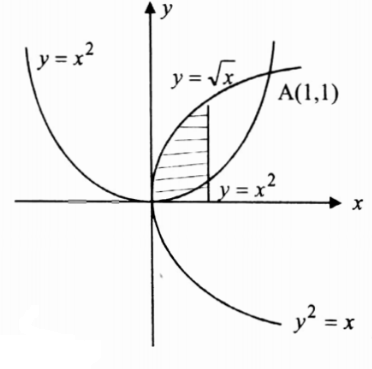
Example.3 Verify Green’s theorem in the plane for \(\oint_C\)(3x2-8y2)dx+(4x-6xy) dy where C is the region bounded by y=\(\sqrt{x}\)  and y=x2

Solution:

Here \(\mathrm{P}=3 x^2-8 y^2 \quad \frac{\partial \mathrm{P}}{\partial y}=-16 y \quad \mathrm{Q}=4 y-6 x y \quad \frac{\partial \mathrm{Q}}{\partial x}=-6 y\)

Hence to Green’s theorem

1. \(\int_C\left(3 x^2-8 y^2\right) d x+(4 y-6 x y) d y\)

= \(\iint_S(-6 y+16 y) d x d y=10 \int_{x=0}^1 \int_{y=x^2}^C y d y d x\)

=\(10 \int_0^1\left[\frac{y^2}{2}\right]_{x^2}^{\sqrt{x}} d x=5 \int_0^1\left(x-x^4\right) d x=\frac{3}{2}\)

Green's Theorem Examples And Solutions

2. Verification.

The line integral along C

= Line integral along y = \(x^2\) (from O to A) + line integral along \(y^2=x\) (from A to O) = \(\mathrm{I}_1+\mathrm{I}_2\)

∴ \(\mathrm{I}=\int_{x=0}^1\left[3 x^2-8\left(x^2\right)^2\right] d x+\left[4 x^2-6 x\left(x^2\right)\right] 2 x d x=\int_0^1\left(3 x^2+8 x^2-20 x^4\right) d x=-1\)

⇒ \(\mathrm{I}_2=\int_1^0\left(3 x^2-8 x\right) d x+\left(4 \sqrt{x}-6 x^{3 / 2}\right) \frac{1}{2 \sqrt{x}} d x\)

y = \(\sqrt{x}\)

= \(\int_1^0\left(3 x^2-11 x+2\right) d x=\frac{5}{2}\)

∴ \(\mathrm{I}_1+\mathrm{I}_2=-1+\frac{5}{2}=\frac{3}{2}\)

Hence the theorem is verified.

Example.4 Evaluate by Green’s theorem \(\oint_C\)(y-sinx)+cos x dy where C is the triangle enclosed by the lines x=0,x=\(\frac{\pi}{2}\), πy=2x.

Solution:

Here P = \(y-\sin x, \mathrm{Q}=\cos x \quad \frac{\partial \mathrm{P}}{\partial y}=1, \frac{\partial \mathrm{Q}}{\partial x}=-\sin x\)

Hence by Green’s theorem \(\int_C(y-\sin x) d x+\cos x d y=\iint_S(-1-\sin x) d x d y\)

= \(-\int_{x=0}^{\pi / 2} \int_{y=0}^{2 x / \pi}(1+\sin x) d x d y=-\int_0^{\pi / 2}(1+\sin x) \frac{2 x}{\pi} d x\)

= \(-\frac{2}{\pi} \int_0^{\pi / 2}(x+x \sin x) d x=-\left(\frac{\pi}{4}+\frac{2}{\pi}\right)\)

Example.5 Evaluate by greens theorem \(\oint_C\)(x-cosh y) dx +(y +sin x) dy where C is the rectangle with vertices (0,0),(π,0) (π,1) and (0,1)

Solution:

Here \(\mathrm{P}=x^2-\cosh y, \quad \mathrm{Q}=y+\sin x \quad \frac{\partial \mathrm{P}}{\partial y}=-\sinh y, \quad \frac{\partial \mathrm{Q}}{\partial x}=\cos x\)

By Green’s theorem \(\int_C\left(x^2-\cosh y\right) d x+(y+\sin x) d y=\iint_S(\cos x+\sinh y) d x d y\)

= \(\int_{x=0}^\pi \int_{y=0}^1(\cos x+\sinh y) d x d y=\int_0^\pi[(y \cos x+\cosh y)]_0^1 d x=\int_0^\pi[\cos x+\cosh 1-1] d x\)

= \([\sin x+x \cosh 1-x]_0^\pi=\pi[\cosh 1-1]\)

Examples Of Green’S Theorem In Physics And Engineering

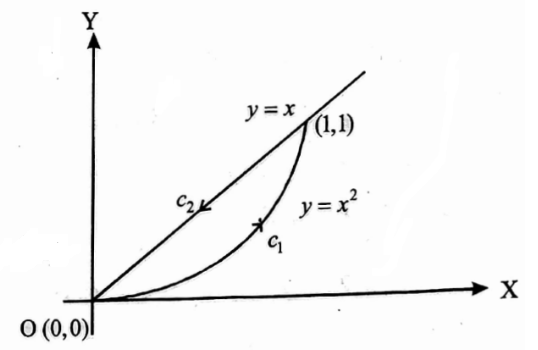
Example.6 Verify Greens theorem in the plane for \(\oint_C\)(xy+y2) dx+x2dy where C is the closed curve of the region bounded by y=x and y=x2

Solution:  Solving the curves y=x and y=x2 we get the points  of intersection are (0,0) and (1,1)

On the curve y=x2

The limits for x are 0 to 1

y2= x  ⇒ dy =2x dx

⇒ \(\int_{C_1}\left(x y+y^2\right) d x+x^2 d y\)

= \(\int_{x=0}^1\left(x\left(x^2\right)+x^4\right) d x+x^2 2 x d x\)

= \(\int_0^1\left(x^3+x^4+2 x^3\right) d x=\int_0^1\left(3 x^3+x^4\right) d x\)

= \(3 \frac{x^4}{4}+\frac{x^5}{5}_0^1=\frac{3}{4}+\frac{1}{5}-0=\frac{19}{20}\)

Green's Theorem Curve Examples And Solutions

On the curve y=x

The limits of x are \(1 \rightarrow 0\)

y = \(x \Rightarrow d y=d x\)

⇒ \(\left.\oint_C\left(x y+y^2\right) d x+x^2 d y=\int_{x=1}^0\left(x(x)+x^2\right) d x+x^2 d x=\int_1^0 3 x^2=\frac{3 x^3}{3}\right]_1^0=-1\)

Adding (1) and (2) : \(\oint_C\left(x y+y^2\right) d x+x^2 d y=\frac{19}{20}-1=-\frac{1}{20}\)

By Green’s theorem, \(\oint_C P d x+Q d y=\iint_R\left(\frac{\partial Q}{\partial x}-\frac{\partial P}{\partial y}\right)\)

R. H. S. \(=\int_{x=0}^1 \int_{y=x^2}^x\left[\frac{\partial}{\partial x}\left(x^2\right)-\frac{\partial}{\partial y}\left(x y+y^2\right)\right] d x d y\)

= \(\int_{x=0}^1 \cdot \int_{y=x^2}^x(2 x-x-2 y) d x d y=\int_{x=0}^1 \int_{y=x^2}^x(x-2 y) d x d y\)

= \(\left.\int_{x=0}^1 x y-y^2\right]_{x^2}^x d x=\int_0^1\left[\left(x^2-x^2\right)-\left(x^3-x^4\right)\right] d x\)

= \(\int_{x=0}^1\left(x^4-x^3\right) d x=\frac{x^5}{5}-\frac{x^4}{4}_0^1=\frac{1}{5}-\frac{1}{4}=-\frac{1}{20}=\text { L. H. S. }\)

∴ Green’s theorem is verified.


Solved Problems Integral Transformations Surface Of The Sphere Gauss’s Divergence

Integral Transformations Solved Problems

Example.1 Show that \(\int_S\)(axi+byj+czk).N.dS=4\(\frac{\pi}{3}\) (a+b+c) where S is the surface of the sphere x2+y2+z2=1.

Solution:

Here \(\mathbf{F}=a x \mathbf{i}+b y \mathbf{j}+c z \mathbf{k} \quad \text{div} \mathbf{F}=\nabla . \mathbf{F}=\frac{\partial \mathbf{F}_1}{\partial x}+\frac{\partial \mathbf{F}_2}{\partial y}+\frac{\partial \mathbf{F}_3}{\partial z}=a+b+c\)

By Gauss’s Theorem \(\int_S \mathbf{F} \cdot \mathbf{N} d \mathbf{S}=\int_V \nabla \cdot \mathbf{F} d \mathbf{V}=\int_V(a+b+c) d \mathbf{V}=(a+b+c) \mathbf{V}=\frac{4 \pi}{3}(a+b+c)\)

V = \(\frac{4 \pi}{3}\), for the given sphere

Example.2 Verify Gauss’s divergence theorem to evaluate (x³-yz)i-2x²yj+zk).NdS over the surface of a cube bounded by the coordinate planes x=y=z=a.

Solution:

Gauss’s theorem states that \(\iint_{\mathrm{S}} \mathbf{F}_1 d y d z+\mathbf{F}_2 d z d x+\mathbf{F}_3 d x d y=\iiint_V\left(\frac{\partial \mathbf{F}_1}{\partial x}+\frac{\partial \mathbf{F}_2}{\partial y}+\frac{\partial \mathbf{F}_3}{\partial z}\right) d x d y d z\)

From the problem \(\mathbf{F}_1=x^3-y z, \mathbf{F}_2=-2 x^2 y, \mathbf{F}_3=z\)

⇒ \(\frac{\partial \mathbf{F}_1}{\partial x}=3 x^2, \frac{\partial \mathbf{F}_2}{\partial y}=-2 x^2, \frac{\partial \mathbf{F}_3}{\partial z}=1\)

∴ RHS = \(\iiint_V\left(3 x^2-2 x^2+1\right) d x d y d z\)

= \(\int_0^a \int_0^a \int_0^a\left(x^2+1\right) d x d y d z\)

= \(\int_0^a \int_0^a\left[\frac{x^3}{3}+x\right]_0^a d y d z=\frac{1}{3} a^5+a^3\)

Integral Transformations For Spherical Surfaces Using Divergence Theorem

Verification: Let us calculate the value of \(\int \mathbf{F} \cdot \mathbf{N} d \mathbf{S}\) over the six faces of the cube directly

1. For the face PQAR \(\mathbf{N}=\mathbf{i}, d \mathbf{S}=d z d y\) and x=a

∴ \(\int_{S_1} \mathbf{F} . \mathbf{N} d \mathbf{S}=\iint_{S_1}\left[\left(x^3-y z\right) \mathbf{i}-2 x^2 y \mathbf{j}+z \mathbf{k}\right] . \mathbf{i} d z d y\)

= \(\int_{z=0}^a \int_{y=0}^a\left(x^3-y z\right) d z d y=\int_{z=0}^a \int_{y=0}^a\left(a^3-y z\right) d z d y=a^3\left[[y]_0^a[z]_0^a\right]-\left[\frac{y^2}{2}\right]_0^a\left[\frac{z^2}{2}\right]_0^a=a^5-\frac{1}{4} a^4\)

2. For the face OBSC \(\mathbf{N}=-\mathbf{i}, d \mathbf{S}=d y d z\) and x=0

∴ \(\int_{S_2} \mathbf{F} . \mathbf{N} d \mathbf{S}=-\int_{y=0}^a \int_{z=0}^a\left(x^3-y z\right) d y d z=\int_0^a \int_0^a y z d y d z=\left[\frac{y^2}{2}\right]_0^a\left[\frac{z^2}{2}\right]_0^a=\frac{1}{4} a^4\)

because x=0 for this face

3. For the face \(\text{PQBS} \mathbf{N}=\mathbf{j}, d \mathbf{S}=d z d x\) and y=a

∴ \(\int_{S_3} \mathbf{F} . \mathbf{N} d \mathbf{S}=-\int_{x=0}^a \int_{z=0}^a\left(2 x^2 y\right) d x d z=-2 a \int_0^a \int_0^a x^2 d x d z\)

because y = a for this face

= \(-2 a\left[\frac{x^3}{3}\right]_0^a[z]_0^a=-\frac{2}{3} a^5\)

4. For the face OARC \(\mathbf{N}=-\mathbf{j}, d \mathbf{S}=d z d x\) and y=0

⇒ \(\int_{S_4} \mathbf{F} \cdot \mathbf{N} d \mathbf{S}=\iint_{S_4} 2 x^2 y d x d z=0\) because on this face y=0

5. For the face PRCS \(\mathbf{N}=\mathbf{k}, d \mathbf{S}=d x d y\) and z=a

∴ \(\int_S \mathbf{F} . \mathbf{N} d \mathbf{S}=\int_{x=0}^a \int_{y=0}^a z d x d y=a \int_0^a \int_0^a d x d y\)

because z=a on this face

= \(a[x]_0^a[y]_0^a=a^3\)

6. For the face OBQA \(\mathbf{N}=-\mathbf{k}, d \mathbf{S}=d x d y\) and z=0

∴ \(\int_S \mathbf{F} . \mathbf{N} d \mathbf{S}=-\int_{x=0}^a \int_{y=0}^a z d x d y=0\) because on this face z=0

Hence for the total faces \(\int_S \mathbf{F} \cdot \mathbf{N} d \mathbf{S}=a^5-\frac{1}{4} a^4+\frac{1}{4} a^4-\frac{2}{3} a^5+0+a^3=\frac{1}{3} a^5+a^3\)

Example.3 Apply Gauss’s theorem to prove that \(\int_S\)r.N.dS=3V

Solution:  By Gauss’s theorem \(\int_S\)r.N.dS=\(\int_V\) div r dv

div \(\mathbf{r}=\nabla \cdot \mathbf{r}=\left(\mathbf{i} \frac{\partial}{\partial x}+\mathbf{j} \frac{\partial}{\partial y}+\mathbf{k} \frac{\partial}{\partial z}\right) \cdot(x \mathbf{i}+y \mathbf{j}+z \mathbf{k})=1+1+1=3\)

∴ \(\int_V \text{div} \mathbf{r} d \mathbf{V}=\int_V 3 d \mathbf{V}=3 V\)

Surface Integral Problems With Gauss’S Divergence On Spheres

Example.4 By transforming into a triple integral, evaluate (x³ dy dz+x²y dz dy+x²z dx dy) where S is the closed surface consisting of the cylinder x²+y²=a² and the circular discs z=0 and z=b.

Solution:

Here \(\mathbf{F}_1=x^3, \mathbf{F}_2=x^2 y, \mathbf{F}_3=x^2 z\)

⇒ \(\frac{\partial \mathbf{F}_1}{\partial x}=3 x^2, \frac{\partial \mathbf{F}_2}{\partial y}=x^2, \frac{\partial \mathbf{F}_3}{\partial z}=x^2\)

∴ \(\frac{\partial \mathbf{F}_1}{\partial x}+\frac{\partial \mathbf{F}_2}{\partial y}+\frac{\partial \mathbf{F}_3}{\partial z}=3 x^2+x^2+x^2=5 x^2\)

By Gauss’s theorem \(\iint_{\mathrm{S}} \mathbf{F}_1 d y d z+\mathbf{F}_2 d z d x+\mathbf{F}_3 d x d y=\iiint_V\left(\frac{\partial \mathbf{F}_1}{\partial x}+\frac{\partial \mathbf{F}_2}{\partial y}+\frac{\partial \mathbf{F}_3}{\partial z}\right) d x d y d z\)

∴ \(\iint_{\mathrm{S}} x^3 d y d z+x^2 y d z d x+x^2 z d x d y\)

= \(\iiint_V 5 x^2 d x d y d z=5(4) \int_{x=0}^a \int_{y=0}^{\sqrt{a^2-x^2}} \int_{z=0}^b x^2 d x d y d z\)

= \(20 \int_{x=0}^a \int_{y=0}^{\sqrt{a^2-x^2}} x^2(b) d x d y=20 b \int_0^a x^2 \sqrt{a^2-x^2} \cdot d x\)

Put x = \(a \sin \theta, d x=a \cos \theta d \theta\)

x = \(0 \Rightarrow \theta=0 \quad x=a \Rightarrow \theta=\pi / 2\)

= \(20 b a^4 \int_0^{\pi / 2} \sin ^2 \theta \cdot \cos ^2 \theta d \theta=20 a^4 b \int_0^{\pi / 2}\left(\sin ^2 \theta-\sin ^4 \theta\right) d \theta\)

= \(20 a^4 b\left[\frac{1}{2} \frac{\pi}{2}-\frac{3}{4} \cdot \frac{1}{2} \cdot \frac{\pi}{2}\right]=\frac{5}{4} \pi a^4 b\)

Example.5 Prove that ∫f.curl F dV =∫F×f.dS+∫F.curlf dV

Solution:

Consider the vector function \(\mathbf{F} \times \mathbf{f}\)

By Gauss’s theorem \(\int_S(\mathrm{~F} \times \mathrm{f}) \cdot \overline{\mathrm{N}} d \mathrm{~S}=\int_V \text{div}(\mathrm{F} \times \mathrm{f}) d \mathrm{~V}\)

⇒ \(\int_S(\mathrm{~F} \times \mathbf{f}) \cdot \mathrm{N} d \mathrm{~S}=\int_V \text{div}(\mathrm{F} \times \mathbf{f}) d \mathrm{~V}=\int(\mathbf{F} \times \mathbf{f}) \cdot d \mathbf{S}=\int_V \nabla \cdot(\mathbf{F} \times \mathbf{f}) d \mathbf{V}\)

because \(\mathbf{N} d \mathbf{S}=d \mathbf{S}\)

∴ \(\int(F \times \bar{f}) d \overline{\mathrm{S}}=\int_V(\mathrm{f} . \mathrm{curlF}-\mathrm{F} \text { curlf }) d \mathrm{~V}\)

∴ \(\int \mathbf{f} . \text{curl} \mathbf{F} d \mathbf{V}=\int(\mathbf{F} \times \mathbf{f}) \cdot d \mathbf{S}+\int \mathbf{F} . \text{curl} \mathbf{f} d \mathbf{V}\)

Integration Techniques For Surface Of The Sphere Using Gauss’S Theorem

Example.6 Compute \(\int_S\) (ax2+by2+cz2) ds over the sphere x2 +y2+z2=1

Solution:

By divergence theorem \(\int_S \mathbf{F} \cdot \mathbf{N} d \mathbf{S}=\int_V \nabla \cdot \mathbf{F} d \mathbf{V}\)

Given \(\mathbf{F}. \mathbf{N}=a x^2+b y^2+c z^2\)

Let \(\phi=x^2+y^2+z^2-1\)

∴ Normal vector N to the surface \(\phi\) is \(\nabla \phi=\left(\mathbf{i} \frac{\partial}{\partial x}+\mathbf{j} \frac{\partial}{\partial y}+\mathbf{k} \frac{\partial}{\partial z}\right)\left(x^2+y^2+z^2-1\right)=2(x \mathbf{i}+y \mathbf{j}+z \mathbf{k})\)

∴ Unit normal vector \(\mathbf{N}=\frac{2(x \mathbf{i}+y \mathbf{j}+z \mathbf{k})}{2 \sqrt{\left(x^2+y^2+z^2\right)}}=x \mathbf{i}+y \mathbf{j}+z \mathbf{k}\)

∴ \(\mathbf{F} . \mathbf{N}=\mathbf{F} .(x \mathbf{i}+y \mathbf{j}+z \mathbf{k})=a x^2+b y^2+c z^2\)

i.e. \(\mathbf{F}=a x \mathbf{i}+b y \mathbf{j}+c z \mathbf{k}\)

∴ \(\nabla . \mathbf{F}=a+b+c\)

Hence by Gauss theorem \(\oint_S\left(a x^2+b y^2+c z^2\right) d \mathbf{S}=\int_V(a+b+c) d \mathbf{V}\)

=(a+b+c) \(\mathbf{V}=\frac{4 \pi}{3}(a+b+c)\) as \(\mathbf{V}=\frac{4}{3} \pi\) being the volume of the sphere of unit radius.

Example.7 By converting the surface integral to volume integral show that ∫\(\int_S\) x3dy dz + y3dz dx+ z3dx dy= \(\frac{12 \pi}{5}\)where S is the surface of the sphere x2+y2+z2=1

Solution:

Consider the sphere \(x^2+y^2+z^2=a^2\) and

⇒ \(\bar{F}=x^3 \bar{i}+y^3 \bar{j}+z^3 \bar{k}=F_1 \bar{i}+F_2 \bar{j}+F_3 \bar{k}\)

div \(\bar{F}=\frac{\partial F_1}{\partial x}+\frac{\partial F_2}{\partial y}+\frac{\partial F_3}{\partial z}=3 x^2+3 y^2+3 z^2=3\left(x^2+y^2+z^2\right)=3 r^2\)

where r is the radius of the sphere.

We have by divergence theorem \(\iint_S \bar{F} \cdot \bar{n} d s=\iiint_{d i v} \bar{F} d \nu\)

i.e. \(\iint_{\text {S }} F_1 d y d z+F_2 d z d x+F_3 d x d y=\iiint_V d i v F d v=3 \iiint_S r^2 d v\)

Changing into a spherical coordinator

x = \(r \sin \theta \cos \phi \quad y=r \sin \theta \sin \phi \quad z=r \cos \theta\)

then \(d V=r^2 \sin \theta d r d \theta d \phi\)

L.H.S. = \(3 \int_{\phi=0}^{2 \pi} \int_{\theta=0}^\pi \int_{r=0}^a r^4 \sin \theta d r d \theta d \phi=3 \int_0^{2 \pi} d \phi \int_0^\pi \sin \theta d \theta \int_0^a r^4 d r\)

= \(3[\phi]_0^{2 \pi}[-\cos \theta]_0^\pi\left[\frac{r^5}{5}\right]_0^a=\frac{12}{5} \pi a^5\)

Taking a=1 we get the value as \(\frac{12}{5} \pi\)

Example.8 Find \(\iint_S \overline{\mathbf{F}} \cdot \overline{\mathbf{N}} d \mathrm{~s}\) where \(\overline{\mathrm{F}}\) =2xy\(\overline{\mathrm{i}}\) +yz2\(\overline{\mathrm{j}}\) +xz\(\overline{\mathrm{k}}\) and S is the surface of the parallelopiped formed by x=0,y=0,z=0,x=0,x=2,y=1,z=3.

Solution:

By Gauss’s theorem \(\iint_S \overline{\mathbf{F}} \cdot \overline{\mathbf{N}} d \mathbf{s}=\iiint_V \nabla \cdot \overline{\mathbf{F}} d \mathbf{v}\)

⇒ \(\nabla. \overline{\mathbf{F}}=\frac{\partial \mathbf{f}_1}{\partial x}+\frac{\partial \mathbf{f}_2}{\partial y}+\frac{\partial \mathbf{f}_3}{\partial z}=2 y+z^2+x\)

⇒ \(\iiint_V(\nabla . \overline{\mathbf{F}}) d \mathbf{v}=\int_{x=0}^2 \int_{y=0}^1 \int_{z=0}^3\left(x+2 y+z^2\right) d x d y d z=\int_{x=0}^2 \int_{y=0}^1\left[x z+2 y z+\frac{z^3}{3}\right]_0^3 d x d y\)

= \(\int_{x=0}^2 \int_{y=0}^1(3 x+6 y+9) d x d y=\int_{x=0}^2\left[3 x y+3 y^2+9 y\right]_{y=0}^1 d x\)

= \(\int_{x=0}^2(3 x+12) d x=\left[\frac{3 x^2}{2}+12 x\right]_0^2=6+24=30\)

Example.9 Valuate by Gauss divergence theorem∫ \(\int_S\)4xz dy dz-y2 dz dx+yz x dy where S is the surface of the cube bounded by the planes x=0,x=1, y=0,y=1,z=0,z=1.

Solution:

By divergence theorem \(\int_S \overline{\mathbf{F}} \cdot \mathbf{N} d \mathbf{S}=\int_V d i v \overline{\mathbf{F}} d \mathbf{V}\)

⇒ \(\iint_S \mathbf{f}_1 d y d z+\mathbf{f}_2 d z d x+\mathbf{f}_3 d x d y=\iiint_V\left(\frac{\partial \mathbf{f}_1}{\partial x}+\frac{\partial \mathbf{f}_2}{\partial y}+\frac{\partial \mathbf{f}_3}{\partial z}\right) d x d y d z\)

From the given problem \(\mathbf{f}_1=4 x z, \mathbf{f}_2=-y^2\) and \(\mathbf{f}_3=y z\)

We get \(\iiint_V\left[\frac{\partial}{\partial x}(4 x z)+\frac{\partial}{\partial y}\left(-y^2\right)+\frac{\partial}{\partial z}(y z)\right] d x d y d z\)

= \(\iiint_{x=0}^1(4 z-2 y+y) d x d y d z=\int_{x=0}^1 \int_{y=0}^1 \int_{z=0}^1(4 z-y) d z d y d x\)

= \(\int_{x=0}^1 \int_{x=0}^1\left[2 z^2-y z z_{z=0} d y d x=\int_{x=0}^1 \int_{y=0}^1(2-y) d y d x\)

= \(\int_{x=0}^1\left[2 y-\frac{y^2}{2}\right]_0^1 d x=\int_{x=0}^1\left(2-\frac{1}{2}\right) d x\right.\)

= \(\frac{3}{2} \int_0^1 d x=\frac{3}{2}[x]_0^1=\frac{3}{2}\)

Understanding Integral Transformations On Spherical Surfaces

Example.10 If\(\overline{\mathrm{F}}\) =(2x2-3z)\(\overline{\mathrm{i}}\)-2xy\(\overline{\mathrm{j}}\)-4x\(\overline{\mathrm{k}}\) then evaluate \(\int_S\)div\(\overline{\mathrm{F}}\) dv where V is the closed region bounded by the planes x=0, y=0,z=0 and 2x+2y+z=4.

Solution:

div \(\overline{\mathbf{F}}=\nabla \cdot \overline{\mathbf{F}}=\frac{\partial \mathbf{f}_1}{\partial x}+\frac{\partial \mathbf{f}_2}{\partial y}+\frac{\partial \mathbf{f}_3}{\partial z}=4 x-2 x=2 x\)

Limits of z are 0 to 4-(2 x+2 y)

Limits of y are 0 to 2-x

Limits of x are 0 to 2

∴ \(\int_V \nabla \cdot \overline{\mathbf{F}} d \mathbf{V}=\int_{x=0}^2 \int_{y=0}^{2-x} \int_{z=0}^{4-2 x-2 y} 2 x d x d y d z=\int_{x=0}^2 \int_{y=0}^{2-x}[2 x z]_{z=0}^{4-2 x-2 y} d y d x\)

= \(\int_{x=0}^2 \int_{y=0}^{2-x} 2 x(4-2 x-2 y) d y d x=\int_{x=0}^2 \int_{y=0}^{2-x}\left(8 x-4 x^2-4 x y\right) d y d x\)

= \(\int_{x=0}^2\left[8 x y-4 x^2 y-2 x y^2\right]_{y=0}^{2-x} d x=\int_0^2\left[8 x(2-x)-4 x^2(2-x)-2 x(2-x)^2\right] d x\)

= \(\int_0^2\left(2 x^3-8 x^2+8 x\right) d x=\left[\frac{2 x^4}{4}-\frac{8 x^3}{3}+\frac{8 x^2}{2}\right]_0^2=\frac{1}{2} \cdot 2^4-\frac{8}{3} \cdot 2^3+4 \cdot 2^2=\frac{8}{3}\)


Theorems Integral Transformations Deduction From gauss’s Gauss’s Divergence Green Identities

Integral Transformations Gauss’s Divergence Theorem

Let S be a closed surface enclosed in a volume V . If F is a continuously differentiable vector point function, then \(\int_V d i v \mathbf{F} d \mathbf{V}=\int_S \mathbf{F} \cdot \mathbf{N} d S\)

Where N is the outward drawn unit normal vector at any point of S.

Green’s identities And Gauss’s Divergence Relation

Cartesian Form

Let F =F1i+F2 j+F3 k and N=i cos α+j cos β+k cos γ

where \(\cos \alpha, \cos \beta, \cos \gamma\) are the direction cosines of N. \(\mathbf{F} . \mathbf{N}=\mathbf{F}_1 \cos \alpha+\mathbf{F}_2 \cos \beta+\mathbf{F}_3 \cos \gamma\)

Also div \(\mathbf{F}=\nabla . \mathbf{F}=\frac{\partial \mathbf{F}_1}{\partial x}+\frac{\partial \mathbf{F}_2}{\partial y}+\frac{\partial \mathbf{F}_3}{\partial z}\)

Theorems Integral Transformations Deduction From gauss's Gauss's Divergence Green Identities

Hence the divergence theorem can be written as \(\iiint\left(\frac{\partial \mathbf{F}_1}{\partial x}+\frac{\partial \mathbf{F}_2}{\partial y}+\frac{\partial \mathbf{F}_3}{\partial z}\right) d x d y d z\)

= \(\int_S\left(\mathrm{~F}_1 \cos \alpha+\mathrm{F}_2 \cos \beta+\mathrm{F}_3 \cos \gamma\right) d S\)

= \(\iint_S\left(\mathbf{F}_1 d y d z+\mathbf{F}_2 d z d x+\mathbf{F}_3 d x d y\right)\)

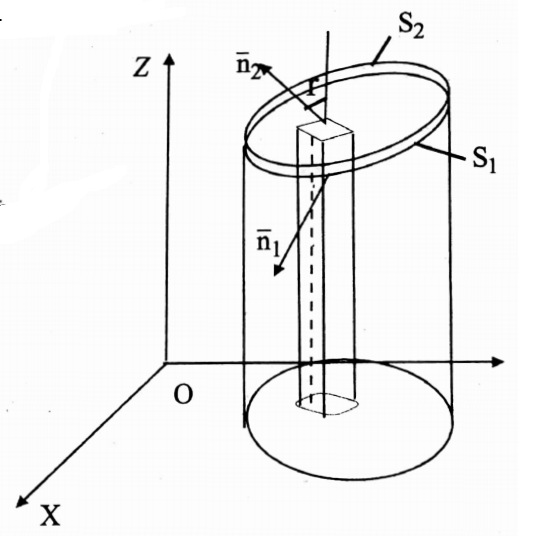
Proof: Let s be a closed surface. Let us choose the coordinate axes so that any line parallel to the coordinate axes cuts S in at most two points.  Let R be the projection of S on xy-plane. S and S are the lower and upper parts of S.

z=f(x,y) and z=g(x,y) be the  equations of S1 and S2. The relation can be put in the form f(x,y) ≤ z ≤ g(x,y).

∴  \(\int_V \frac{\partial \mathbf{F}_3}{\partial z} d \mathbf{V}\)\(=\iiint_V \frac{\partial \mathbf{F}_3}{\partial z}\) dx dy =\(=\iint_R\left[\frac{\partial \mathbf{F}_3}{\partial z} d z\right]_{z=f(x, y)}^{z=g(x, y)}\) dx dy

= \(\iint_R\left[\mathbf{F}_3(x, y, z)\right]_f^g d x d y=\iint_R\left[\mathbf{F}_3(x, y, g)-\mathbf{F}_3(x, y, f)\right] d x d y\)

= \(\iint_R \mathrm{~F}_3(x, y, g) d x d y-\mathrm{F}_3(x, y, f) d x d y\) …….. (1)

For the upper part \(\mathbf{S}_2 \quad d x d y=d S \cdot \cos \gamma=\mathbf{N} \cdot \mathbf{k} d S\)

Since the normal to \(\mathbf{S}_2\) makes an acute \(\gamma\) with \(\mathbf{k}\).

∴ \(\iint_R \mathbf{F}_3(x, y, g) d x d y=\int_{S_1} \mathbf{F}_{\mathbf{3}} \mathbf{N} \cdot \mathbf{k} d S\)

For the lower portion \(\mathbf{S}_1 \quad d x d y=-\cos \gamma d S=-\mathbf{N} \cdot \mathbf{k} d S\)

Since the normal to \(\mathbf{S}_1\) makes an obtuse angle \(\gamma\) with \(\mathbf{k}\)

∴ \(\iint_R \mathbf{F}_3(x, y, f) d x d y=-\int_{S_3} \mathbf{F}_3 \mathbf{N} \cdot \mathbf{k} d S\)

Hence from (1)

∴ \(\int_V \frac{\partial \mathbf{F}_3}{\partial z} d \mathbf{V}=\int_{S_2} \mathbf{F}_3 \mathbf{k} \cdot \mathbf{N} d S+\int_{S_1} \mathbf{F}_3 \mathbf{k} \cdot \mathbf{N} d S=\int_S \mathbf{F}_3 \mathbf{k} \cdot \mathbf{N} d S\)

The theorem can be extended to surfaces which are such that lines parallel to coordinate axes meet them in more than two points. In such a case, we subdivided the region bounded by S into subregions whose surfaces satisfy this condition. Applying the same procedure we can prove the Theorem.

Green’s Identities Explained With Examples

Integral Transformations Deduction From Gauss’s Theorem

1. Prove that\(\int_S\)N × F ds=\(\int_V\) ∇×F dv

Proof: Let f=a × F, where a is a constant vector.

Applying Gauss’s Theorem on f we have \(\int_S\)f.Nds= \(\int_V\)∇f dv ⇒ \(\int_S\)(a×f).Nds=\(\int_V\)∇.(a×f) dv

⇒ \(\int \mathbf{a} \cdot(\mathbf{F} \times \mathbf{N}) d \mathbf{S}=-\int \nabla \cdot(\mathbf{F} \times \mathbf{a}) d \mathbf{V}=-\int(\nabla \times \mathbf{F}) \cdot \mathbf{a} d \mathbf{V}\)

because \(\mathbf{a}\) is constant

⇒ \({\mathbf{a} \cdot \int_S}(\mathbf{N} \times \mathbf{F}) d \mathbf{S}=\mathbf{a} \cdot \int_S \nabla \times \mathbf{F} d \mathbf{V}\)

⇒ \(\mathbf{a} \cdot\left[\int_S(\mathbf{N} \times \mathbf{F}) d \mathbf{S}-\int_V \nabla \times \mathbf{F} d \mathbf{V}\right]=0\)

Since a is a constant vector

⇒ \(\int_S(\mathbf{N} \times \mathbf{F}) d \mathbf{S}-\int_V \nabla \times \mathbf{F} d \mathbf{V}=0 \Rightarrow \int(\mathbf{N} \times \mathbf{F}) d \mathbf{S}=\int \nabla \times \mathbf{F} d \mathbf{V}\)

2. Prove that \(\int_S\)NΦ ds=\(\int_V\)∇Φ dv

Proof:

Applying Gauss theorem to \(\mathbf{a} \phi\) we have

⇒ \(\int_S(\mathbf{a} \phi) \cdot \mathbf{N} d \mathbf{s}=\int_V \text{div}(\mathbf{a} \phi) d \mathbf{V}=\int_V \nabla \cdot(\mathbf{a} \phi) d \mathbf{V}\)

a. \(\int_S(\phi \mathbf{N}) \cdot \mathbf{N} d \mathbf{s}=\mathbf{a} \cdot \int_V(\nabla \phi) d \mathbf{V} \Rightarrow \mathbf{a} \cdot\left[\int_S \phi \mathbf{N} d \mathbf{S}-\int_V \nabla \phi d \mathbf{V}\right]=0\)

Since a is a constant vector.

⇒ \(\int_S \phi \mathbf{N} d \mathbf{S}-\int_V \nabla \phi d \mathbf{V}=0\)

∴ \(\int_S \mathbf{N} \phi d \mathbf{S}-\int_V \nabla \phi d \mathbf{V}=0\)

Note. The result proved above can be rewritten as follows.

1.\(\int_S\)Φ N.F dS = ∫∇.F dV

2.\(\int_S\)N× F dS=\(\int_V\)∇× F dV

3.∫NΦ dS=∫∇Φ dv

Here N is written before the function in L.H.S ∇ displaces N in R.H.S

Relationship Between Gauss’S Divergence Theorem And Green’S Identities

Integral Transformations  Green Identities


If f and g are two continuous and differentiable scalar point functions over the region V enclosed by the surfaces S. then

  1. \(\int_V\)[f∇2 g+∇ f.∇ g]dV=\(\int_S\)(f.∇ g).N dS
  2. \(\int_V\)[f∇2 g-g∇2 f]dV=\(\int_S\)(f∇g-g∇f).N S

Proof: By Gauss’s divergence theorem we have \(\int_V\)∇. F dV=\(\int_S\)F.N dS

Now substituting \(\overline{\mathrm{F}}\)=f ∇g, we get

∇.F ∇(f∇g)=f(∇.∇g)∇f+∇g

∴ Divergence theorem gives \(\int_V\)[f∇2g+∇f.g]dV=\(\int_S\)(f∇g).N dS      ……………….(1)

This is called Green’s first identity or theorem.

2. Interchanging f and g in (1), we get

∫[g∇2f+∇g.∇f]dV=(g∇f).N dS     ………………(2)

Subtracting (2) from(1) we, get

∫(f∇2g-g∇2f)dV=∫f∇g-g∇f). N dS

This is called Green’s second identity or Green’s theorem in symmetrical form.

Subrings, Ideals, Quotient Rings & Euclidean Rings Quotient Rings Or Factor Rings Theorems

Subrings, Ideals, Quotient Rings & Euclidean Rings Quotient Rings Or Factor Rings

The concept of a quotient ring is analogous to that of quotient groups. If U is an ideal of a ring (R,+,•) then (U,+) is a normal subgroup of the commutative group (R,+).

From group theory, we know that the set R/U.= {x+U =U+ x | x ∈ R} of all cosets of U In R is a group with respect to the addition of two cosets defined by (a+U) + (b+U) = (a+b)+U for a+U,b +U ∈(R/U).

We know further that these costs are disjoint.

As addition operation is commutative left coset a+llis equal to right coset u + a In order to impose ring structure in R/U we can define multiplication of two of cosets as (a+U) (b+U) = ab +U for a+U,b +U ∈ R /U

Subrings, Ideals, Quotient Rings, And Euclidean Rings Theorems

Theorem.1 If U is an ideal of a ring R then the set R/U ={x+U|x ∈R} is a ring with respect to the induced operations of addition (+ ) and multiplication ( • ) of cosets defined : (a+ u)+(b+u)=(a+b)+U and (a+U). (b+U)=ab+U for a+Ub+u R/U.

Proof. Since (R,+) is a commutative group, the quotient group (R/U,+) is also commutative, In order to show that (R,+,•) is a ring we must show that

(1) multiplication of cosets is well defined,
(2) multiplication is associative and (3) distributive laws hold.

(1) Let \(a+U=a_1+U\) and \(b+U=b_1+U \text {. }\)

Then \(a=a_1+u_1\) and \(b=b_1+u_2\) for \(u_1, u_2 \in U \text {. }\)

ab = \(\left(a_1+u_1\right)\left(b_1+u_2\right)=a_1 b_1+a_1 u_2+u_1 b_1+u_1 u_2\)

Since U is an ideal, \(a_1 u_2, u_1 b_1, u_1 u_2 \in U\)

∴ \(a b-a_1 b_1 \in U\) and hence \(a b+U=a_1 b_1+U \Rightarrow(a+U) \cdot(b+U)=\left(a_1+U\right) \cdot\left(b_1+U\right)\)

Therefore multiplication of cosets is well defined.

Let a+U,b+U,c+U ∈R/U

(2) [(a+U).(b+U)] .(c+U) = (ab+U).(c+U) = (ab) c+U = a'(bc) +U (v a,b,c∈R) = (a +U). (bc+U) = (a+U) . [(b+U).(c+U)]

(3) (a+U). [(b+U)+(c+U)] = (a+U).[(b+ c)+U] = a(b+ c)+U = (ab+ ac)+U (v a,b,c∈R)

(ab+U)(ac+U) = (a+U) .(b+U)+(a+U). (c+U)

Similarly we can prove that [(b+U)+ (c+ U)].(a+U) = (b+U).(a+U)+(c+U).(a+U) Hence (R/U,+,•) is a ring

Examples Of Factor Rings In Abstract Algebra

Definition Of Addition And Multiplication Cosets

Definition. Let R be a ring and U be an ideal of R. Then the set R/U = {x+U\x∈R] with respect to induced operations of addition and multiplication of cosets defined by (a+U)+(b+U)-(a+b) +U;(a+U). (b+U) = ab +Ufor a+U,b+U eR/U is a ring.

This ring (R/U,+,•)is called the quotient ring or factor ring, or residue class ring of R modulo U.

Note.

  1. It is convenient, sometimes, to denote coset a+U in R/U by the symbol a or.[a]. Then we write the sum and product of two cosets as [a]+[b] =[a+b] and [a].[b] = [ab].
  2. o+U = U is the zero element in the ring R/U.
  3. Every ring R has two improper ideals, namely, the trivial ideal {0} and the ideal R. The quotient ring of the ideal {0} is R/{0} or R /(0) = {x+ (0)| x∈ R}The quotient ring of the ideal R is R / R or Rt(l) = {x+(l) | x ∈ R}
  4. (a+U)+ (b+U) = (a+b)+U-,(a+U)(b+U) = ab+U
  5. (a+U)² =(a+U)(a+U) = a²+U
  6. a+U = b+U ⇔(a-b)∈U.
  7. a +U =U ⇔ a ∈ U

Theorem. 2. If R/U is the quotient ring prove that (1) R/U is commutative if R is commutative and (2) R/u has a unity element if R has a unity element.

Proof. (2) R is commutative => ab = ba∀ a,b ∈ R.

Let a+U,b+U ∈ R/U. (a+U) (b+U) = ab+U = ba+U =(b+U).(a+U)

∴ R/U is commutative.

(2) R has unity element => there exists 1 ∈ R so that a1 = 1a- a∀ a∈R.

Let a+U ∈ R/U.  For 1∈R we have 1+U ∈R/U

We now prove that 1 +U is the unity element.

(a+U)(l+U) = a1+U = a+U and (X+U)(a+U)*=la+U = a+U V a+U eR/U

1+U is the unity element in R/U.

Note. In the quotient ring R/U, the unity element = 1 +U.

Rings Examples Of Addition And Multiplication Cosets

Example. 1 Consider Z6 = {0,1, 2,3,4,5}, the ring of integers modulo 6.

U= {0,3} is an ideal of Z6. The costs of Uin R are as follows :

0+U = {0 + 0, 0+ 3} = {0,3};l+t/ = {1 + 0,1+ 3} = {1,4}

2+U = {2 +02 + 3} = {2,5};3+t/ = {3+0, 3+ 3} = {3,0} =0+ 17

4+U = {4+ 0, 4+ 3} = {4, 1} – 1 +U and 5+U {5 + 0, 5+3} = {5, 2} = 2+U

(Z6/U) = {0+U,l+U,2+U} is the quotientring.

Note. We observe that two cosets are identical or disjoint and the union of all cosets = Z6.

Quotient Rings And Their Properties Explained

Example 2. For the ring Z of all integers, we know that nZ = {nx| x∈ Z} for any n∈ Z is an additive subgroup of Z.

Let m ∈ nZ and r ∈ Z  Then m = na where a∈ Z.

mr = (na)r = n (ar) and rm =r (na) = n (ar)

so that mr = rm = n (ar) = nb∈nZ where b = ar∈Z Thus nZ is an ideal of Z.

The set of all cosets of nZ in Z, namely, (Z/nZ) = {x+nZ |x∈ Z} forms a ring under the induced operations of addition and multiplication.

Differential Equations Of First Order And First Degree Homogeneous Equation Methods To Find An Integrating Factor Solved Example Problems Exercise 2.6

Differential Equations of First Order and First Degree Solved Example Problems Exercise 2.6

Example. 1. Solve \(\left(y^2+2 x^2 y\right) d x+\left(2 x^3-x y\right) d y=0\)

Solution.

Given equation is \(\left(y^2+2 x^2 y\right) d x+\left(2 x^3-x y\right) d y=0\)

⇒ \(y\left(y+2 x^2\right) d x+x\left(2 x^2-y\right) d y=0\) . Let \(x^h y^k\) be the integrating factor.

Multiplying the given equation by \(x^h y^k\).

⇒ \(\left(x^h y^{k+2}+2 x^{h+2} y^{k+1}\right) d x+\left(2 x^{h+3} y^k-x^{h+1} y^{k+1}\right) d y=0\) …………………..(1)

where \(\mathrm{M}=x^h y^{k+2}+2 x^{h+2} y^{k+1}, \mathrm{~N}=2 x^{h+3} y^k-x^{h+1} y^{k+1}\)

If (1) exact , then \(\frac{\partial \mathrm{M}}{\partial y}=\frac{\partial \mathrm{N}}{\partial x}\)

⇒ \((k+2) x^h y^{k+1}+2(k+1) x^{h+2} y^k=-(h+1) x^h y^{k+1}+2(h+3) x^{h+2} y^k\)

Equating the coefficients of \(x^h y^{k+1} \text { and } x^{h+2} y^k\)

we get \(k+2=-(h+1), k+1=h+3 \Rightarrow h+k+3=0 ; h-k+2=0\)

Solving these equations: h = -5/2,k = -1/2.

∴ Integrating factor is [latexx^{-5 / 2} y^{-1 / 2}][/latex].

Multiplying the given equation with this I. F. we get \(\left(x^{-5 / 2} y^{3 / 2}+2 x^{-1 / 2} y^{1 / 2}\right) d x+\left(2 x^{1 / 2} y^{-1 / 2}-x^{-3 / 2} y^{1 / 2}\right) d y=0\) …………………….(2)

(2) is an exact equation where \(\mathrm{M}_1=x^{-5 / 2} y^{3 / 2}+2 x^{-1 / 2} y^{1 / 2}, \mathrm{~N}_1=2 x^{1 / 2} y^{-1 / 2}-x^{-3 / 2} y^{1 / 2}\) and \(\frac{\partial \mathrm{M}_1}{\partial y}=\frac{\partial \mathrm{N}_1}{\partial x}\) now solving (2).

⇒ \(\int \mathrm{M}_1 d x=\int\left(x^{-5 / 2} y^{3 / 2}+2 x^{-1 / 2} y^{1 / 2}\right) d x\) treating y as constant.

= \(y^{3 / 2} x^{-3 / 2}(-2 / 3)+4 x^{1 / 2} y^{1 / 2} \text { and } \int \mathrm{N}_1 d y\) = integrating the terms not having x = 0.

The required solution is \(\int \mathrm{M}_1 d x+\int \mathrm{N}_1 d y=c \Rightarrow-(2 / 3) x^{-3 / 2} y^{3 / 2}+4 x^{1 / 2} y^{1 / 2}=c\)

Differential Equations Of First Order And First Degree Exercise 2.6

Example. 2. Solve \((2 y d x+3 x d y)+2 x y(3 y d x+4 x d y)=0\)

Solution.

The given equation can be written as \(\left(2 y+6 x y^2\right) d x+\left(3 x+8 x^2 y\right) d y=0\) …………………(1)

Let \(x^h y^k\) be the integrating factor. Multiplying (1) by \(x^h y^k\) :

⇒ \(\left(2 x^h y^{k+1}+6 x^{h+1} y^{2+k}\right) d x+\left(3 x^{h+1} y^k+8 x^{h+2} y^{k+1}\right) d y=0\) ………………….(2)

(2) is an exact equation if \(\frac{\partial \mathrm{M}}{\partial y}=\frac{\partial \mathrm{N}}{\partial x}\) where

M\(=2 x^h y^{k+1}+6 x^{h+1} y^{2+k}, \mathrm{~N}=3 x^{h+1} y^k+8 x^{h+2} y^{k+1}\)

⇒ \(2(k+1) y^k x^h+6(k+2) y^{k+1} x^{h+1}=3(h+1) x^h y^k+8(h+2) x^{h+1} y^{k+1}\)

⇒ \(2 k+2=3 h+3,6 k+12=8 h+16 \Rightarrow 3 h-2 k+1=0,8 h-6 k+4=0\)

Solving these equations we get h=1,k=2.

∴ I.F. = xy²

Multiplying (1) with \(x y^2 \Rightarrow\left(2 x y^3+6 x^2 y^4\right) d x+\left(3 x^2 y^2+8 x^3 y^3\right) d y=0\)

where \(\dot{\mathrm{M}}_1=2 x y^3+6 x^2 y^4 \text { and } \mathrm{N}_1=3 x^2 y^2+8 x^3 y^3\)

⇒ \(\int \mathrm{M}_1 d x=\int\left(2 x y^3+6 x^2 y^4\right) d x=2\left(x^2 / 2\right) y^3+6\left(x^3 / 3\right) y^4\) treating y constant.

⇒ \(\int \mathrm{N}_1 d y\) = integrating the terms of N, not having x = 0.

∴ Solution of(1) is \(x^2 y^3+2 x^3 y^4+c=0 \Rightarrow x^2 y^3+2 x^3 y^4=c\)

Homogeneous Equations Solved Problems Exercise 2.6

3. Solve: \(\left(2 x^2 y-3 y^4\right) d x+\left(3 x^3+2 x y^3\right) d y=0\) ………………….(1)

Solution:

Given

\(\left(2 x^2 y-3 y^4\right) d x+\left(3 x^3+2 x y^3\right) d y=0\) ………………….(1)

Let \(x^a y^b\) be the integrating factor. multiplying (1) with this factor, we get :

⇒ \(\left(2 x^{a+2}+y^{b+1}-3 x^a y^{b+4}\right) d x+\left(3 x^{a+3} y^b+2 x^{a+1} y^{b+3}\right) d y=0\)

where  \(\mathrm{M}=2 x^{a+2} y^{b+1}-3 x^a y^{b+4}, \quad \mathrm{~N}=3 x^{a+3} y^b+2 x^{a+1} y^{b+3}\) …………………..(2)

For (2) to be exact: \(\frac{\partial \mathrm{M}}{\partial y}=\frac{\partial \mathrm{N}}{\partial x}\)

⇒ \(2(b+1) x^{a+2} y^b-3(b+4) x^a y^{b+3}=3(a+3) x^{a+2} y^b+2(a+1) x^a y^{b+3}\)

⇒ \(2(b+1)=3(a+3), 2(a+1)=-3(b+4) \Rightarrow 3 a-2 b+7=0, \quad 2 a+3 b+14=0\)

Solving for a and b: a=-49/13,b=-28/13

∴ I. F = \(x^{-49 / 13} y^{-28 / 13}\)

Multiplying (1) by \(x^{-49 / 13} y^{-28 / 13}\) we get: \(\left(2 x^2 y \cdot x^{-49 / 13} y^{-28 / 13}-3 y^4 x^{-49 / 13} y^{-28 / 13}\right) d x\)

+\(\left(3 x^3 \cdot x^{-49 / 13} y^{-28 / 13}-2 x y^3 x^{-49 / 13} y^{-28 / 15}\right) d y=0\)

⇒ \(\left(2 x^{-23 / 13} \cdot y^{-15 / 13}-3 x^{-49 / 13} \cdot y^{24 / 13}\right) d x+\left(3 x^{-10 / 13} y^{-28 / 13}+2 x^{-36 / 13} y^{11 / 13}\right) d y=0\)

where \(\mathrm{M}_1=2 x^{-23 / 13} y^{-15 / 13}-3 x^{-49 / 13} y^{24 / 13}\) and \(\mathrm{N}_1=3 x^{-10 / 13} y^{-28 / 13}+2 x^{-36 / 13} y^{11 / 13}\)

⇒ \(\int \mathrm{M}_1 d x=2 y^{-15 / 13} \frac{x^{-10 / 13}}{-10 / 13}-3 y^{24 / 13} \frac{x^{-36 / 13}}{-36 / 13}=5 x^{-36 / 13} y^{24 / 13}-12 x^{-10 / 13} y^{-15 / 13}, \mathrm{~N}_1 d y=0\)

G S. is \(5 x^{-36 / 13} y^{24 / 13}-12 x^{-10 / 13} y^{-15 / 13}=c\)

Methods To Find Integrating Factors For Exercise 2.6

Example.4. Solve \(x(4 y d x+2 x d y)+y^3(3 y d x+5 x d y)=0\)

Solution.

Given equation is \(\left(4 x y+3 y^4\right) d x+\left(2 x^2+5 x y^3\right) d y=0\) …………….(1)

verify \(\frac{\partial \mathrm{M}}{\partial y} \neq \frac{\partial \mathrm{N}}{\partial x}\) => (1) is not an exact equation.

Let \(x^a y^b\) be an integrating factor. Multiplying (1) with I.F.

⇒ \(\left(4 x^{a+1} y^{b+1}+3 x^a y^{b+4}\right) d x+\left(2 x^{a+2} y^b+5 x^{a+1} y^{b+3}\right) d y=0\) …………………(2)

where \(\mathrm{M}=4 x^{a+1} y^{b+1}+3 x^a y^{b+4}, \mathrm{~N}=2 x^{a+2} y^b+5 x^{a+1} y^{b+3}\)

⇒ \(\frac{\partial \mathrm{M}}{\partial y}=4 x^{a+1}(b+1) y^b+3(b+4) x^a y^{b+3}, \frac{\partial \mathrm{N}}{\partial x}=2(a+2) x^{a+1} \cdot y^b+5(a+1) x^a y^{b+3}\)

for(2) to be an exact, \(\frac{\partial \mathrm{M}}{\partial y}=\frac{\partial \mathrm{N}}{\partial x}\)

⇒ \(4(b+1) x^{a+1} y^b+3(b+4) x^a y^{b+3}=2(a+2) x^{a+1} y^b+5(a+1) x^a y^{b+3}\)

⇒ \(4(b+1)=2(a+2), 3(b+4)=5(a+1) \Rightarrow a-2 b=0,5 a-3 b-7=0\)

Solving these equation: 10b – 36 = 7 ⇒ b =1  ∴ a= 2

Multiplying (1) by \(x^2 \cdot y\); we get: \(\left(4 x^3 y^2+3 x^2 y^5\right) d x+\left(2 x^4 y+5 x^3 y^4\right) d y=0\)

Here \(\mathrm{M}_1=4 x^3 y^2+3 x^2 y^5, \mathrm{~N}_1=2 x^4 \dot{y}+5 x^3 y^4\)

⇒ \(\int M_1 d x=\int\left(4 x^3 y^2+3 x^2 y^5\right) d x=\frac{4 x^4}{4} y^2+\frac{3 x^3}{3} y^5 . \int N_1 d y=0\)

∴ GS. is \(x^4 y^2+x^3 y^5=c\)


Subrings, Ideals, Quotient Rings & Euclidean Rings Theorems

Euclidean Rings

Definition. An integral domain R is said to be a Euclidean ring or Euclidean domain if for every a(≠0)∈ R there is defined a non-negative integer d(a) such that

(1)for all a,b∈ R, a≠ 0,b≠ 0;d (a) < d (ab) and

(2)for any a,b∈R,b≠ 0 there exist q,r∈R such that a = bq +r where either r = 0 or d (r) <d(b) .

Note

  1. For any a(≠ 0)∈R,d (a)> 0.
  2. For the zero element 0 of R,d{0) is not defined. However, some authors defined d(0) = 0, integer.
  3. The property (2) in the above definition is called the division algorithm.
  4. From the above definition, we note that d: R- {0} -> Z is a mapping such that

(1) d (a) > 0 ∀ R— {0} .
(2) d (a) < d (a,b)∀1 a,b∈R- {0} and
(3) there exist q,r∈R so that a-bq+r where either r = 0 or d (r) < d (b) for any a b∈R and b≠0.

Subrings, Ideals, Quotient Rings, And Euclidean Rings Theorems

Theorem 1. Every field is a Euclidean ring

Proof. Let F be a field and F be the set of all non-zero elements of F. Since F is a field, F is an integral domain

Define the mapping d:FZ by d(a) = 0 (zero integer) for all a ϵ F

d (a) ≥0 ∀ a ϵF

Let a bϵF.

Then a,b, and ab are non-zero elements of F

d (a) = 0 and d (ab) = 0 => d (a) <,d (ab)

Let aϵF and bϵF.

Now a = a 1 where 1 is the unity element of F.

=a(b-1b) = (ab-1)b  ( b-1b=1)

= (ab-1]) b+ 0 where ‘O’ is the zero element of the field F.

a = qb +r where q = ab-1,r = 0 1

Hence, for a ϵ F,b ϵ F there exists q,r ϵ F so that a = qb+r where r= 0. F is an Euclidean ring.

Note. We can prove the above theorem by defining d: F -> Z by d(a) = 1 (integer) ∀ a ϵ F

Theorems On Subrings And Their Applications

Theorem 2. Every Euclidean ring is a principal ideal ring (or) Every ideal of an Euclidean ring is a principal ideal

Proof. Let R be an Euclidean ring.

Let U = {0} where ‘O’ is the zero element of R. Then U = {0} is the ideal generated by QϵR.

U is a principal ideal of R.

Let U be an ideal of R.

Let u≠ {0}. there exists xϵU and x≠0 so that the set {d (x) | x≠ 0} is a non-empty set of nonnegative integers.

By well ordering principle there exists b≠0 ϵ U so that d(b)<d (x) where x≠0ϵU.

We now prove that U = (b). Let ‘a’ be any element of U.

By division algorithm, there exists q,rϵR so that a -bq +r where r = 0 or d (r) < d (b). bϵU,qϵR, and U is an ideal => bqϵU. aϵU,bq ϵU => a-bq =r ϵU

If r≠ 0 then d (r) < d (b) so that we have a contradiction as d (b) < d (x) V x≠ 0 ϵU

r = 0 and hence a=b q.

U- {bq| qϵR} = (b) is the principal ideal generated by b(≠ 0) ϵU. Hence every ideal U of R is a principal ideal.

R is a principal ideal ring.

Note 1. If U is an ideal of a Euclidean ring R then U is a principal ideal of R so that U = (b) = {bq |q ϵF}

For,’ the ring R = \(\left\{a+b\left(\frac{1+\sqrt{19 i}}{2}\right): a, b \in Z\right\}\) of complex numbers is a principal ideal ring but not Euclidean

Subrings, Ideals, Quotient Rings And Euclidean Ring Principal Ideal Theorem

Subrings, Ideals, Quotient Rings & Euclidean Rings Principal Ideal

If a commutative ring with unity from Theorem (3) Art! 2.2 we observed that for a given a ∈ R the set {ra | r ∈ #} is an ideal in R that contains the element ‘a’.

Definition. Let R be a commutative ring with unity and a ∈ R The ideal {ra |r ∈ R) of all multiples of ‘a’ is called the principal ideal generated by ‘a’ and is denoted by (a) or (a).

An ideal Uofthe ring R is a principal ideal =>U = (ci) = {ra ) r ∈ It} for some a∈R

example. 1 The null ideal or trivial ideal {0}’ofaring# is the principal ideal generated by the zero element of R. That is null ideal = (0).

example. 2. The unit ideal or improper ideal R of a ring R is the principal ideal generated by the unity element T of the ring R. That is R =(l).

example.3. Z is a commutative ring with a unity element. The principal ideal generated by 2 ∈ Z = (2) = [2n| n ∈ Z} = the set of all even integers.

example. 4. A field has only null ideal = (0) and unit ideal =F =(l) which are principal ideals.

Definition. (Principal ideal ring). A commutative ring R with unity is a principal ‘ ideal ring if every ideal in R is a principal ideal

D is a principal ideal domain => every ideal U in D is in the form U (a) for some a ∈D.

Principal Ideal Theorem In Euclidean Rings Explained

Theorem. 1. A field is a principal ideal ring

Proof. A field F has only two ideals, namely, U = (0) and U = F = {l).

But U = (0) and U = (l) are principal ideals. the field F is a principal ideal ring.

Theorem. 2. ring of integers the principal ideal ring, (or) Every ideal Z is of Z is a principal ideal.

Proof. Let U be the ideal of Z and U = {0}. Then U is generated by the zero element.

.’. U = (0) is a principal ideal. Let U be an ideal of Z and U≠ (0).

there exists a ∈U so that a ≠  0,

Since u ⊂ Z, one of a, -a must be a positive integer.

∴ the set of positive integers U+ in U is non-empty. by the well-ordering principle, U+ has the least member, say, b.

We now prove that U = {b) = the principal ideal generated by ‘b’.

Let x∈U. Since x,b are integers and b≠0 there exist q,r ∈ Z

such that x = bq+r; 0 <,r<b (Division algorithm).

b ∈ U,q ∈ Z and u is an ideal => bq ∈ U. x∈U,bq ∈U => x-bq =r ∈U .

Now r ∈U 0 <r < b and b is the least member in U+ =>r = 0.

x-bq =r=>x-bq = 0 => x = bq .

Hence x∈U=>x=bq for q∈Z =>U = (b).

∴  every ideal U of Z is a principal ideal. Hence Z  is a principal ideal ring.

Examples Of Principal Ideal Theorem In Subrings And Quotient Rings

Note. 1. Principal ideal rings that are also integral domains, such as rings of integers Z  are called principal ideal domains

2. If Z is the ring of integers then the principal ideal generated by a∈ Z is ] {aq \q∈Z} = (a).

Subrings, Ideals, Quotient Rings And Euclidean Rings Ideals Theorems

Subrings, Ideals, Quotient Rings & Euclidean Rings Ideas

The concept of an ideal of a ring is analogous to that of a normal subgroup of a group. Some of the subrings which we call ideals play a very important role as the normal subgroups
in group theory.

Definition. (Ideal). Let. (R, +,• ) be a ring. A non-empty subset U of R is called a two-sided ideal or ideal if (1) a,b ∈ U=>a-b∈U and (2) a ∈ U and r ∈ R=> ar,r a∈ U.

(Ideal). A subring U of a ring R is called a (two-sided) ideal of R if, for every r ∈ R and every a ∈ U, both ra and ar are in U.

Note

  1. A subring u of the ring R satisfying rU⊂ U and Ur⊂U for all r ∈ R is an ideal.
  2. The (2) condition of ideal is stronger than the (2) condition of a subring.
  3. The condition (1), namely, a,b∈ U => a -b∈U is called module property.
  4. If U is an ideal of the ring R,+, • ) then (U, +) is a normal subgroup of the commutative group (R, +). Hence zero element in R is zero element in U.

Definition. A non-empty subset U of a ring R is called a right ideal if.

(1) a,b∈U=>a-b ∈U and(2)a ∈U,r ∈R=>ar ∈U . A non-empty subset U of a ring R is called a left ideal if (1) a,b ∈U a-b ell and a ∈U,r∈R=>ra ∈U .

Note.

  1. An ideal is both a left and a right ideal.
  2. For commutative rings left ideals coincide with right ideals.

Theorem 1. If U is an ideal of a ring R with unity element and 1∈ U then U  =R.

Proof: by the definition ideal  U⊂R.

Also x ∈R=>x.1 eR =>x.1∈U for x∈R, 1 ∈u (Def. of ideal) =>x ∈U .

R⊂U and hence U ⊂ R

Theorems On Ideals In Subrings And Quotient Rings

Theorem 2. A field has no proper non-trivial ideals, (or) The ideals of a field f are only {0} and F itself

Proof. Let U be an ideal of F so that U ≠ {0}

We now prove that U = F

By the definition of ideal, U⊂ F …… (1)

Let a∈ U and a≠ 0.

For a (≠ 0) ∈F there exists a -1  ∈  F so that aa -1 = 1

x ∈F => x 1 ∈ F=>x . 1 ∈U for xeF, 1∈U

=> x∈U .-. F ∈U … (2)

From (1) and (2): U = F Hence ideals of F are either {o} orF.

Theorem 3. If R is a commutative ring and a ∈ R then Ra = {ra\r| ∈ R \ is an ideal of R.

Proof. For 0 ∈ R, 0a = 0∈Ra. Ra≠ Φand R⊂R.

Let x,y∈Ra. Then x =r 1 a, y = r2a where r1,r2 ∈ R  :. x,y ∈ Ra=>x-y ∈ R

x. y = r1a-r2a=(r1-r2)a= ra where r =r1~r2 ∈ R.

Let x ∈ Ra and r ∈R.

x.r = (r1a)r ( :.x = r1a Where r∈R) =r1(ar) = r1(ra) (By R5 and R is commutative )

=(r1r) a-r’a where r’ = r1r ∈ R .

Since R is commutative, x.r=r.x.

∴ x∈Ra, r ∈R=>xr = rx ∈Ra  ……. (2)

Hence from (1) and (2): Ra is an ideal of R.

Note. 1. If R is a commutative ring and a e R then aR = { ar \ r e R } is an ideal of R.

2. If R is a r in and a ∈ R then Ra is a left ideal and aR is a right ideal.

Theorem 4. A commutative ring R with unity element is a field if R have no proper ideals.

Proof. Since the Ring R has no proper nontrivial ideals, the ideals of R are {o} and R only.

To prove that R is a field we have to show that every a (≠ 0) ∈ R has a multiplicative inverse. We know that aR = {ar|r ∈ R} is an ideal of R.

Since a ≠ 0 .aR ≠ {0} and hence aR =R (By hypothesis)

1 ∈ R => 1 ∈ a R =>1 = ab for some b≠ 0 ∈ R . Since R is conimutatiye,1= ab= ba .

a ≠ 0 ∈ R has a multiplicative inverse b∈ R . Hence R is a field.

Note. If R is a ring with a unity element and R has no proper nontrivial ideals then R is a division ring.

Examples Of Ideals In Quotient Rings And Euclidean Domains

Theorem. 5. The intersection of two ideals of a ring R is an ideal of R.

Proof. Let U1, and U2 be two ideals of the ring R.

If 0 ∈ R is the zero element, then 0∈ U1 and 0 ∈ U2 .

:. 0∈U1∩U2 and hence U1∩ U2 ≠φ

Let a,b ∈ U1 ∩ U2 and r ∈ R. Then a b∈U and a,b ∈U2.

a,b ∈ U1,r ∈R and U1 is an ideal =>a-b ∈U1 and ar, ra ∈ U1……………………….1

a,b ∈U2,r ∈R and U2 is an ideal=> a-b ∈U2 and ar, ra ∈U2………………………….2

From (1) and (2): a-b ∈ U1 ∩ U2 and ar, ra ∈ U1∩U2

Hence U1∩ U2 is an ideal of R.

Remark: The union of two ideals of a ring R need not be an ideal of R

For the ring Z of integers, A = { 2n | n∈ Z) and B = {3n\n ∈ Z } are two ideals.

But, for 2,3 ∈ A∪B, 3-2 = 1 ≠ A∪B.   A∪B is not an ideal of Z

Understanding The Properties Of Ideals In Algebraic Structures

Theorem 6. If U1, and U2 are two ideals of a ring R then U1∪U2is ideal of R if and only if U1⊂ U2 or U2⊂U1

Proof. Let U1 ∪ U2 be an ideal of R. We now prove that U1⊂ U2 or U2⊂U1

If possible, suppose that U1⊄ U2 or U2⊄U1

Since U1⊄ U2 there exists an element a ∈ U1 and a ∈ U2.

Since U2⊄U1 there exists an element b ∈ U2 and ∈ U1.

a ∈ U1 and b∈ U => a, b ∈ U1⊂ U2

a,b ∈ U1⊂ Uand U1⊂ U2 is an ideal =>a-b ∈ U1 ∪ U2

=> a-b ∈ U1  or a-b ∈ U2

But a-b ∈ U1=>a- {a-b) = b ∈U1 …………………..1

a-b ∈ U2 => b+(a-b)=a ∈ U2    ………………………2

Both (1) and (2) contradict a ∉U2 and b∉U1

Our supposition is wrong.

Hence U1⊂ U2 or U2⊂U1

Conversely, let U1⊂ U2 or U2⊂U1

Then U1 ∪ U= U2 or U1and is an ideal.

Note. If S1, and S2 are two subrings of a ring prove that S1 u S2 is also a subring iff either S1 ⊆ S2 or S2 ⊆S1

Binary Operations (Definition, Types, and Examples)

The use of numbers was existed for many centuries and we are familiar with the types of numbers – integers, rational numbers, real numbers, and complex numbers together with certain operations, such as addition and multiplication, defined on them.

The addition is basically just such a rule that people learn, enabling them to associate, with two numbers in a given order, some number as the answer. Multiplication is also such a rule, but a different rule.

But with the use of arbitrary quantities a,b,c,…, for numbers the subject, Algebra which is the generalization of Arithmetic, came into being. For many years mathematicians concentrated on improving the methods to use numbers, and not on the structure of the number system.

In the nineteenth century, mathematicians came to know that the methods to use numbers are not limited to only sets of numbers but also to other types of sets. A set with a method of combination of the elements of it is called an algebraic structure and we can have many algebraic structures.

The study of algebraic structures which have been subjected to axiomatic development in terms of Abstract Algebra. In what follows we study Group Theory i.e. the study of the algebraic structure. Group, which is rightly termed the basis of Abstract Algebra.

In Group Theory the basic ingredients are sets, relations, and mappings. It is expected that the student is very much familiar with them. However, we introduce and discuss some of the aspects connected with them which will be useful to us in our future study.

Binary Operations Equality Of Sets A And B

A ⊆ B And B ⊆ A ⇔ A = B

Binary Operations Union And Intersection  Of Sets A1, A2, . . . , An


A1 ∪ A2 ∪ A3 . . . ∪ An = S ni =1 Ai and A1 ∩ A2 ∩ A3 . . . ∩ An = Tni =1 Ai


Binary Operations f Is A Relation  From A Set A TO A Set B

⇔ f ⊆ A × B. ⇔ f ⊆ {(a, b) : a ∈ A, b ∈ B}

We write (a, b) ∈ f as afb and we say that a is f related to b.

Sometimes we write ∼ for f. In such a case we write a ∼ b.

If A = B, then we say that f is a relation in A.

If f ⊆ A × B, we write f1 = {(b, a)/(a, b) ∈ f} ⊆ B × A and f1 is called

inverse relation of f and it is from B to A.

The domain of f is equal to the range of f1 and the range of f is equal to the domain of f1. Further (f1)-1= f.

f is a relation in A ⇔ f ⊆ A × A ⇔ f{(a, b)/a, b ∈ A} ⊆ A A.

Binary Operations Types Of Relations

f is a relation in a set A.

(1) If ∀x ∈ A, (x, x) ∈ f then f is said to be reflexive in A.

(2) If ∀(x, y) ∈ f ⇒ (y, x) ∈ f, then f is said to be symmetric in A.

(3) If (x, y) ∈ f and (y, z) ∈ f ⇒ (x, z) ∈ f, then f is said to be transitive in A.

(4) If f is reflexive, symmetric and transitive, then f is said to be an equivalence relation.

Example: 1. In the set of triangles in a plane, the relation of similarity is an equivalence relation.

2. A = {1, 2, 3} the relation f = {(1, 1), (2, 2), (3, 3)} is an equivalence relation in A.

Partition of a set

A partition of a set S is a set of non-empty subsets Si, with i in some index set ∆, such that:

(1). s = ∪i ∈∆si and

(2) si ∩ sj = φ for i 6= j.

That is, a partition of a set S is a collection of disjoint subsets of S whose union is the whole set S.

Binary Operations Partition  Of A Set

f is an equivalence relation in a non-empty set S and a is an element of S.

The subset of elements which are f related to a constitutes an equivalence class of a.

The equivalence class of a is denoted by a¯ or [a] or {a}. Thus a¯ = {x ∈ S afx} and a¯ ⊆ S.

Further

(1) a ∈ a¯,
(2) b ∈ a¯ ⇒ ¯b = ¯a.

For, b ∈ a¯ ⇒ afb and x is any element of ¯b ⇒ bfx.

Now a fb, bfx ⇒ afx ⇒ x ∈ a¯ ⇒ ¯b ⊆ a¯

Again y is any element of a¯ ⇒ afy.

Since f symmetric a f b ⇒ bfa.

Now bfa, afy ⇒ bfy ⇒ y ∈ ¯b ⇒ a¯ ⊆ ¯b and hence ¯b = ¯a using (1).

(3) a¯ = ¯b ⇒ afb

For a¯ = ¯b ⇒ a ∈ ¯b ⇒ bfa ⇒ afb.

(4) afb˙ ⇒ a¯ = ¯b

For x ∈ a, afb¯ ⇒ afx, bfa ⇒ bfa, afx ⇒ bfx ⇒ x ∈ ¯b ⇒ a¯ ⊆ ¯b . . …

Again y is any element of ¯b ⇒ bfy.

Now a fb ⇒ afy ⇒ y ∈ a¯ ⇒ ¯b ⊆ a¯ and hence a¯ = ¯b using (2).

Theorem 1. If f is an equivalence relation in a non-empty set S and a, b are two arbitrary elements of S, then

(1) a¯ = ¯b or a¯ ∩ ¯b = φ

(2) a¯ ∪ ¯b ∪ c¯ ∪ .. = S

Proof.

Given

If f is an equivalence relation in a non-empty set S and a, b are two arbitrary elements of S,

(1) If a¯ ∩ ¯b = φ, there is nothing to prove. Let a¯ ∩ ¯b = φ.

Then there exists some element x such that x ∈ a¯ and x ∈ ¯b.

∴ afx and bfx ⇒ afx and xfb ⇒ af : b ⇒ a¯ = ¯b

Hence we must have either a¯ = ¯b if a¯ ∩ ¯b 6= φ or a¯ 6= ¯b if a¯ ∩ ¯b = φ.

(2) Let c be any element of S.

If afc, then a¯ = ¯c, and if bfc then ¯b = ¯c.

If a¯ 6= ¯c or ¯b 6= ¯c, then a¯ ∩ ¯b ∩ c¯ = φ.

∴ Every element of S must belong to some equivalence class of S

i.e. all the elements of S must belong to the disjoint equivalence classes of S

i.e. a¯ ∪ ¯b ∪ c¯ ∪ . . . = S.

Note. If f is an equivalence relation defined in a non-empty set S, the set of equivalence classes related to f is a partition of S.

That is, two equivalence classes related to f are

(1) either identical or disjoint and

(2) the union of all the disjoint equivalence classes of f is the set S.

Theorem 2. For any given partition of a set S, there exists an equivalence relation f in S such that the set of equivalence classes related to f is the given partition.

Proof. Let P = {Sa, Sb, Sc, . . . ..} be any partition of S.
Let p, q ∈ S.

Let us define a relation f in S by pfq if there is a Si in the partition such that p, q ∈ Si.

(1) Since S = S a ∪ S b ∪ S c ∪ . . . . . . , ∀x˙ ∈ S, there exists Si ∈ P such that x ∈ Si.

Hence x, x ∈ Si ⇒ xfx.

∴ f is reflexive in S.

(2) If xfy, then there exists Si ∈ P such that x, y ∈ Si.

But x, y ∈ Si ⇒ y, x ∈ Si ⇒ yfx. Hence xfy ⇒ yfx.

∴ f is symmetric in S.

(3) Let xfy and yfz then by the definition of f, there exist subsets Sj and Sk (not necessarily distinct) of S such that x, y ∈ Sj and y, z ∈ Sk.

Since y ∈ Sj and also y ∈ Sk, we have Sj ∩ Sk 6= φ.

But Sj, Sk belong to the partition of S.

∴ Sj ∩ Sk 6= φ ⇒ Sj = Sk

Then x, z ∈ Sj and hence xfz.

Hence f is transitive in S.

∴ f is an equivalence relation in S.

Binary Operations Functions Or Mappings

Definition. A, B are non-empty sets. If f ⊆ A × B such that the following conditions are true, then f is called a function from A, to B.

(1) ∀x ∈ A∃y ∈ B

such that (x, y) ∈ f.

(2) (x, y), (x, z) ∈ f ⇒ y = z.

If f is a function from A to B then we say that f is a mapping from A to B and we write f: A B.

Domain of f is A and range of f is f(A) and f(A) ⊆ B.

Alternatively, if f is a relation that associates every element of A to an element of B, and if x = y ⇒ f(x) = f(y) for x, y ∈ A, then f is a function from A to B.

In this context, we say that the function is well-defined.

Transformation. If f: A A then the function f is called an operator or transformation on A.

Equality of Functions. If f : A B and g : A B and if f(x) = g(x) for every x ∈ A then f = g. If ∃x ∈ A such that f(x) 6= g(x) then we say that f ≠ g.

Binary Operations 1.8 Types Of Functions Or Mappings

(1) If f; A B is such that there is at least one element in B which is not the f image of any element in A, then we say that f is a mapping from A into B

i.e. f maps A into B.

(2) If f : A B is such that f(A) = B, then we say that f is a mapping from A into B · f is also called a surjection or a surjective mapping.

If ∃ some element b ∈ B such that f(a) 6= b for some a ∈ A, then f is not onto.

(3) If f : A B is such that for x, y ∈ A, f(x) = f(y) ⇒ x = y, then f is said to be a one-one or one-to-one function or an injection or an injective mapping. We write f as 1 − 1.

If x, y ∈ A and x 6= y ⇒ f(x) 6= f(y), then f is 1 − 1.

This is equivalent to the above condition.

If f(x) = f(y) does not imply x = y then we say that f is not 1 1.

(4) If f : A B is 1 − 1 and onto, then f is called a bijection.

In other words we say that f is a 1 − 1 function from A onto B. Here f is called a one-one correspondence between A and B.

If A, B are finite and if f : A B is a bijection then the number of elements in A, B are equal.

(5) If f : A B is such that every element of A is mapped into one and only one element of B, then f is called a constant function. Here f (A) is a singleton set.

(6) If f : A A is such that f(x) = x for every x ∈ A, then f is called the identity function on A. It is denoted by I A or simply I. I is always 1 − 1 and onto.

(7) If f : A B is a bijection then f − 1 : B A is unique and is also a bijection. If f : A B, is one-one and onto, then f − 1 : B A where f − 1 = {(b, a)/(a, b) ∈ f) is called the inverse mapping of f.

Here f(a) = b ⇔ f − 1(b) = a.

Only bijections possess inverse mappings.

Binary Operations Product Or Composite Of Mappings And Some Of Their Properties

1. Let f : A B and g : B C.

Then the composite function of f and g, denoted by gof is a mapping from A to C.

i.e. gof : A C such that (g ◦ f)(x) = g[f(x)], ∀x ∈ A.

Here fog cannot be defined. Even if it is possible to define fog and gof, then we may have fog 6= gof. Thus composition of mappings is not commutative:

2. If f : A B and g : B C are one-one, then gof : A C is one-one.

If f, g are onto, then gof is onto.

If f, g are functions such that gof, is one-one, then f is one-one.

If f, g are functions such that gof is onto, then g is onto.

3. If f: A B is a bijection, thenf−1: B A. Also f−1of = I A and fof−1=IB.

In particular, if f: A A is a bijection, then  f−1 : A A.
Also  of = f◦ f−1 = I.

4. If f : A B then I Bof = f and foI A = f.

In particular, if f: A A then Iof = foI = f.

5. If f : A B and g : B C are bijections, then gof : A C is also a bijection. If f, g are functions such that gof is a bijection then f is one-one and g is onto. In particular, if f, and g are bijections on A, then gof is also a bijection on A. Also (g ◦ f)−1 is a bijection and (g ◦ f)− 1 =  f−1og−1

6. If f : A B, g : B C and h : C D, then (h ◦ g) of = ho( gof ) i.e. composition of mappings is associative.

Definition. f : A A is a function. fn: A A where n ∈ Z is defined as follows.

  1. If n = 0, f 0 = I the identity mapping on A.
  2. If n = 1, f 1 = f
  3. If n ≥ 2 and n ∈ N, fn = f◦fn − 1 = fn − 1 of .
  4. If n is a negative integer and f is a bijection then fn =  f−1 −n.

7. f2 = f ◦ f, f3 = f ◦ f 2 = fofof . . . . . . fn = fo f−1= fofof ….. to n times where n ∈ N.

8. If n is a negative integer and n = −m so that m is a positive integer, then fn = f−m =  f−1 m =  f−1o f−1o f−1o . . . . . . to m times
= ( fofof . . . . . . to m times ) −1 = (fm)−1

9. If f : A A is a bijection, then fn : A A for n ∈ Z is also a bijection.

10. If m, n ∈ Z then fmofn = fm +n = fn +m = fnofm.

Binary Operations Binary Operations

Let R be the set of real numbers and addition (+), multiplication (x), and subtraction (−) be the operations in R. For every pair of numbers a, b ∈ R, we have unique elements a + b, a × b, a − b ∈ R.

Thus we can look upon addition, multiplication, and subtraction as three mappings of R × R into R, which for each element (a, b) of R × R determine the elements a + b, a × b, a − b respectively of R, Also one can define many mappings from R× R into R.

All these mappings are examples of binary operations on R. The idea of binary operation is not limited only to the sets of numbers. For example, the operations of union (∪), intersection (∩), and difference (−) are binary operations in P(A), the power set of A.

Binary operation

Definition. Let S be a non-empty set. If f : S × S S is a mapping, then f. is called binary operation or binary composition in S (or on S ).
Thus
1. If a relation in S is such that every pair (distinct or equal) of elements of S taken in definite order is associated with a unique element of S then it is called a binary operation is S. Otherwise the relation is not a binary operation in S and the relation is simply an operation in S.

2. (a, b˙ ) ∈ S × S, ∃ a unique image f(a, b) ∈ S.

We observe that addition (+), multiplication (× or :), and subtraction (−) are binary operations in R and division (÷) is not a binary operation in R.
( ∵ division by 0 is not defined.)

Symbolism. It is customary to denote the binary operation in S by o (read as a circle) or (read as star) or . or + and to take a, b, c ∈ S as arbitrary elements a, b, c of S.

1. For a ∈ S, b ∈ S ⇒ a + b ∈ S ⇒ + is a binary operation in S. Also + is called addition, + is called usual addition if S C and a + b is called the sum of a and b. Addition (+) is to be understood depending upon the set over which the operation is to be taken.

2. For a ∈ S, b ∈ S ⇒ a · b ∈ S ⇒. is a binary operation in S. Also . is called multiplication, . is called usual multiplication if S C and a.b is called product of a, b. Multiplication (.) is to be understood depending upon the set over which the operation is to be taken.

3. For a ∈ S, b ∈ S ⇒ aob ∈ S ⇒ o is a binary operation in S.

4. For a ∈ S, b ∈ S ⇒ a ∗b ∈ S ⇒ ∗ is a binary operation in S.

This is called closure law.

Sometimes we write products a · b or a ∗b of a and b as ab.

If a, b ∈ S such that aob /∈ S then o is not a binary operation in S. In this case we say that S is not closed under; o.

+ is a binary operation in the set of natural numbers N as (a, b) ∈ N ⇒ a + b ∈ N.

• is not a binary operation in N as (a, b) ∈ N does not imply a − b ∈ N.

o is a binary operation in S. The image elements under the mapping o are in S. If a and b are elements of a subset H of S, it may or may not happen that ab ∈ H.

But if ab ∈ H for arbitrary elements a, b ∈ H the subset H is said to be closed under the operation o.It may be observed that if o is a binary operation in S, it is implied that S is closed under the operation o :

o is a binary operation in S. If a, b ∈ S and a 6= b, we know that (a, b) 6= (b, a), and hence, in general, it is not necessary that the images in S of (a, b) and (b,a) under the binary operation o must be equal. In other words, if o is a binary composition in S it is not necessary that a, b ∈ S must hold aob = boa.

+ is a binary operation in R. If a, b, c ∈ R, then a + b ∈ R, b + c ∈ R, (a + b) + c ∈ R and a + (b + c) ∈ R. We observe that (a + b) + c = a + (b + c).

Again – is a binary operation in R. If a, b, c ∈ R as above we observe that (a − b) − c ∈ R and a − (b − c) ∈ R. But (a − b) − c 6= a − (b − c).

Definition. o is a binary operation in a set S. If for a, b ∈ S, aob = boa, then o is said to be commutative in S. This is called commutative law. Otherwise, o

is said to be not-commutative, in S.

Definition. o is a binary operation in a set S. If for a, b, c ∈ S, (aob)oc = ao(boc) then o is said to be associative in S.

This is called associative law. Otherwise, o is said to be not associative in S.

Note. If o is associative in S, then we write (aob)oc = ao(boc) = aoboc e.g. is a commutative binary operation on N ⇒ a ∗ (b ∗ c) = (b ∗ c) ∗ a = (c ∗ b) ∗ a

Definition. o, ∗ are binary operations in a set S.

If a, b, c ∈ S,

(1) ao(b ∗ c) = (a ◦ b) ∗ (a ◦ c),

(2) (b ∗ c)oa = (b ◦ a) ∗ (c ◦ a),

then o is said to be distributive w.r.t. the operation *.

(1) is called the left distributive law and

(2) is called the right distributive law.

(1) and (2) are called distributive laws.

It is customary in mathematics to omit the words and only if from a definition. Definitions are always understood to be if and only if statements. Theorems are not always if and only if statements and no such convention is ever used for theorems.

Note. To prove that a binary operation in S obeys (follows) a law (commutative law, associative law, etc., ) we must prove that elements of every ordered pair obey the law i.e., the law must be proved by taking arbitrary elements.

But to prove that a binary operation in S does not obey a particular law, it is sufficient if we give a counter-example. This method of proving the result is called the proof by counter-example.

Example: 1. Set of Natural numbers N

(1) +,. are binary’operations in N, since for a, b ∈ N ⇒ a + b ∈ N and ab ∈ N. In other words, N is said to be closed w.r.t. the operation + and.

(2) +,. are commutative in N since for a, b ∈ N, a + b = b + a and ab = ba.

(3) +, are associative in N since for a, b, c ∈ N. (a + b) + c = a + (b + c) and a(bc) = (ab)c.

(4) – is distributive w.r.t. the operation + in N since for a, b, c ∈ N. a · (b + c) = a · b + a · c and (b + c) · a = b · a + c.a.

(5) The operations subtraction (−) and division (÷) are not binary operations in N for 3, 5 ∈ N does not imply 3 − 5 ∈ N and 3/5∈ N.

(6) Operations +, −, · are binary operations on R but ÷ is not. However, ÷ is a binary operation on R ∗ = R − {0}.

(7) On Z+, ∀a, b ∈ Z+if ∗ is defined as a ∗ b = ab or a ∗ b = |a − b|, then ∗ is a binary operation.

(8)In N, o is a binary operation defined as aob = L. C. M. for every a, b ∈ N. Then 7o5 = 35 and 16o20 = 80.

Example: 2. A is the set of even integers.

(1) +,. are binary operations in A since for a, b ∈ A, a + b ∈ A and ab ∈ A.

(2) +,. are commutative in A since for a, b ∈ A, a + b = b + a and ab = ba.

(3) +, . . . are associative in A since for a, b, c ∈ A,(a + b) + c = a + (b + c) and a(bc) = (ab)c.

(4) is distributive w.r.t. the operation + in A since for a, b, c ∈ A, a.(b + c) = a · b + a · c and (b + c) · a = b · a + c · a.

Example:  3. A is the set of odd integers.

(1) – is a binary operation in A. Also: is associative and commutative in A.

(2) + is not a binary operation in A since 3, 5 ∈ A does not imply 3 + 5 = 8 ∈ A.

Example:  4. S is the set of all m × n matrices such that each element of any matrix is a complex number.

The addition of matrices, denoted by +, is a binary operation in S. Also +)is commutative and associative in S.

Example: 5. S is the set of all vectors.

(1) Addition of vectors, denoted by + is a binary operation in S. Also + is commutative and associative in s.

(2) Dot product of vectors, denoted ., is not a binary operation in S since for a,¯ ¯b ∈ S, a¯ · ¯b /∈ S.

(3) Cross product of vectors denoted by × is a binary operation in S since for a,¯ ¯b ∈ S, a¯ × ¯b = ¯c ∈ S.

Example:  6. In N the operation o defined by aob = aab+b is not a binary operation.

Example: 7. ’ o ’ is a composition in R such that aob = a + 3b for a, b ∈ R.

(1) Since a, b ∈ R, a + 3b is a real number and hence a + 3b ∈ R i.e. aob ∈ R. Therefore o is a binary operation in R.

(2) a ◦ b = a + 3b and boa = b + 3a Since abb 6= boa for a, b ∈ R, 0o ’ is not commutative in R.

(3) (a ◦ b)oc = (aob) + 3c = (a + 3b) + 3c and ao(boc) = a + 3(boc) = a + 3(b + c) = a + 3b + 9c.

Since (aob)oc 6= ao(boc) for a, b, c ∈ R, o is not associative in R.

Example: 8. On Q define ∗ such that a ∗ b = ab + 1 for every a, b ∈ Q.

(1) Since ab +1 ∈ Q for every a, b ∈ Q then ∗ is a binary operation.

(2) Since a ∗ b = ab + 1 = ba + 1 = b ∗ a, then ∗ is commutative.

(3) ∀a, b, c ∈ Q, (a ∗ b) ∗ c = (ab + 1) ∗ c = (ab + 1)c + 1 = abc + c + 1and a ∗ (b ∗ c) = a ∗ (bc + 1) = a(bc + 1) + 1 = abc + a + 1

⇒ (a ∗ b) ∗ c 6= a ∗ (b ∗ c) ⇒ ∗ is not associative in Q.

Example: 9. On R − {−1} define o such that aob = \(\frac{a}{b+1} \)for every a, b ∈ R − {−1}.

(1) Since \(\frac{a}{b+1} \)∈ R − {−1} for every a, b ∈ R − {−1}, then o is a binaryoperation.

(2) Since aob = \(\frac{a}{b+1} \)and boa = \(\frac{b}{a+1} \)then aob ≠ boa and hence o is not commutative.

(3) ∀a, b, c ∈ R − {−1}, (aob)oc = \(\frac{a}{b+1} \)oc = =\(\frac{\frac{a}{b+1}}{c+1}\)and ao(boc) = ao \(\frac{b}{a+1} \)

⇒ 0 is not associative R − {−1}.

Composition table for an operation on finite sets (Cayley’s composition table) Sometimes an operation o on a finite set can conveniently be specified by a table called the composition table. The construction of the table is explained below.

Let S = {a1, a2, . . . ai, aj, . . . an} be a finite set with n elements. Let a table with (n + 1) rows and (n + 1) columns be taken. Let the squares in the first row be filled in with a, a1, a2, . . . an, and the squares in the first column be filled in with a, a1, a2, . . . an. Let ai(1 ≤ i ≤ n) and aj(1 ≤ j ≤ n) be any two elements of S.

Let the product aioaj. obtained by operating ai with aj be placed in the square which is at the intersection of the row headed by ai and the column headed by aj. Thus the following table be got.

From the composition table, we can infer the following laws.

(1) Closure law. If all the products formed in the table are the elements of s, the ’ o ’ is said to be a binary operation in S, and S is said to be closed under the composition ’ o ’.
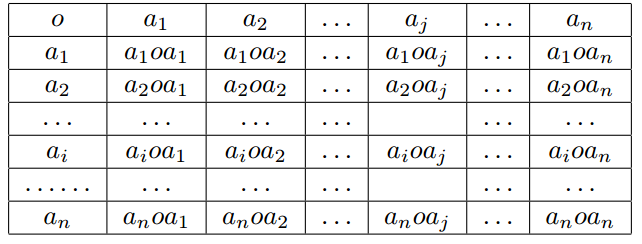
Binary options table 0

Otherwise, o is not a binary operation in S and the set S is not closed under the operation o.

(2) Commutative law. If the elements in every row are identical with the corresponding elements in the corresponding column, then the composition o is said to be commutative in S. Otherwise, the binary operation o is not commutative in S.

(3) Associative law. Also, we can know from the table whether the binary operation follows associative law or not.

Note: The diagonal through a 1oa 1 and anoan is called the leading diagonal in the table. If the elements in the table are symmetric about the leading diagonal, then we infer that o is commutative in S.

Binary Operations Identity Element. 

Definition. Let o be a binary operation on a non-empty set S. If there exists an element e ∈ S such that aoe = a = eoa ∀a ∈ A, then e is called Identity of S w.r.t. the operation o. If e is an identity of S w.r.t. o, then it can be proved to be unique.

Example: 1 In Z, 0 is the identity w.r.t. ’ + ’ since a + 0 = a = 0 + a, ∀a ∈ Z. But in N, 0 is not the idntity w.r.t. + since 0 ∈/ N and 1 is the identity w.r.t. ’ ’ as a · 1 = a = 1 · a∀a ∈ N.

Example: 2 In R, 0 is the identity w.r.t. + since a + 0 = a = 0 + a, ∀a ∈ R. In R, 1 is the identity w.r.t. ’!’ since a · 1 = a = 1 · a, ∀a ∈ R.

Note: Operations (−), (÷) are not binary operations in N. But +, −, · are binary operations in R and ÷ is a binary operation in R ∗ (non-zero real number set). Also o is the identity in R w.r.t. +, 1 is the identity in R (w.r.t. ’ · ’ where as ’ − ’ and 0 ÷ 0 ’ do not have identity element in R.)

Invertible element. Definition.

Let e be the identity element in S w.r.t. the binary operation o. An element a ∈ S is said to be invertible w.r.t. o, if there is an element b in S such that aob = e = boa and b is called inverse of a. If o is associative in S, then inverse of a is unique in S and is denoted by a− 1 or sometimes as 1/a if the operation is · and by −a if the operation is +.

Note
1. a ◦ a− 1 = a− 1oa = e and e− 1oe = eoe− 1 = e. Also a− 1− 1 = a.

2. In R, −a is the inverse w.r.t. ’ + ’ and 1/a(a 6= 0) is the inverse w.r.t. ’.’of a. For : a + (−a) = 0 = (−a) + a and a · a1 = 1 = a1 · a(a 6= 0)

3. −a is not the inverse of a in N w.r.t. + and a− 1 is not the inverse of a in N w.r.t. •.

Also a− 1 is the inverse of a in R. w.r.t. ’ ’ ’ and −a is the inverse of a. w.r.t. ’+.’ in R.

Example: 1. S = {1, −1, i, −i} and usual multiplication is the operation in S.
Then we have the following composition table. We can clearly see that is a binary operation in N following commutative law and associative law.
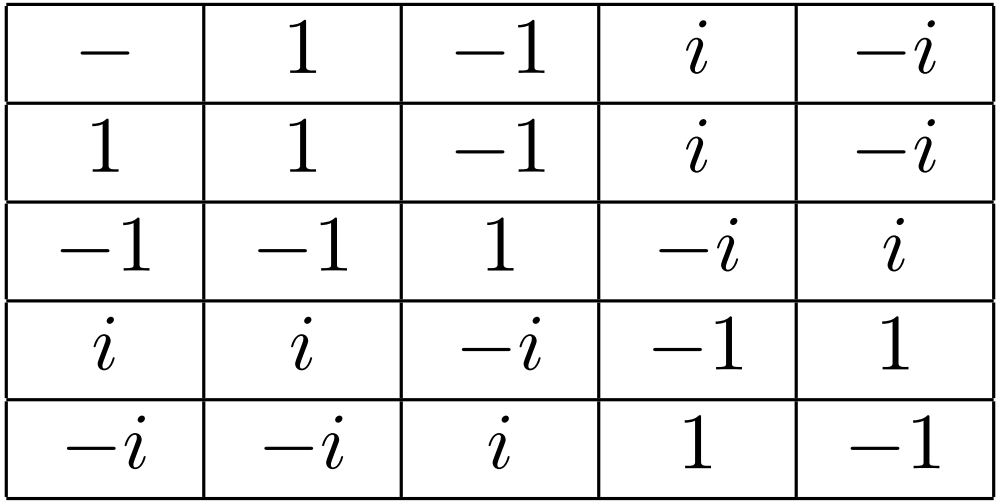
Binary options table 1.1

Example: 2. Consider the binary operation on the set {1, 2, 3, 4, 5} defined by aob = min{a, b}. Composition table is :
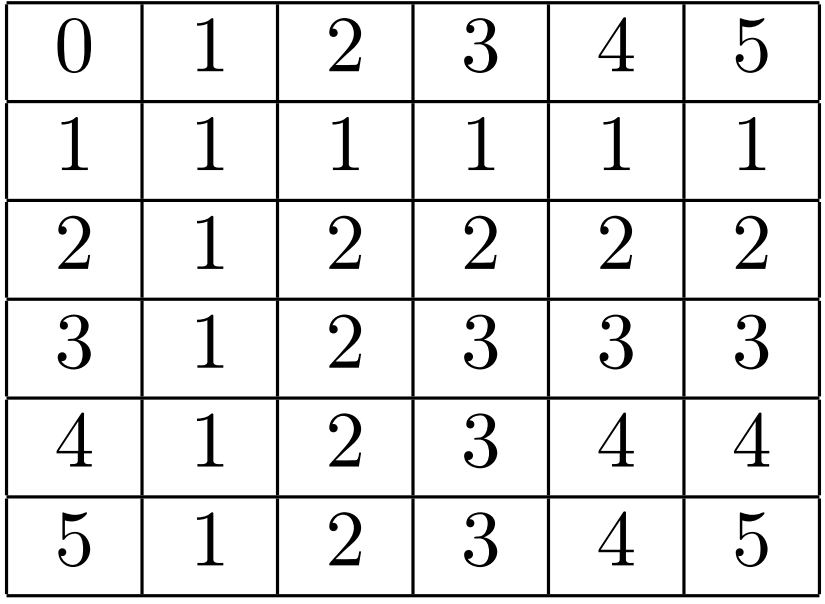

Binary options table 2.2


Example: 3. Define a binary operation ∗ on the set A = {0, 1, 2, 3, 4, 5} as a ∗ b =  a + b, −if6a, +if ab <+ b6 ≥ 6 .0 is the identity w.r.t. ∗ and each element (a 6= 0) of the set is invertible with 6 − a being the inverse of a.

For: Composition table is :
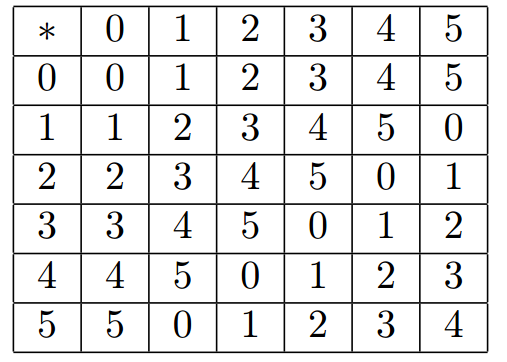
Binary options table 3

(1) ∗ is binary since every entry belongs to A.

(2) Every row is same as the corresponding column ⇒ ∗ is commutative.

(3) Since every element of the first row = every corresponding element of the top row, the identity element exists and it is 0 .

since 0 ∗ 0 = 0, 0 ∗ 1 = 1, . . . ., 0 ∗ 5 = 5 and 0 ∗ 0, 1 ∗ 0 := 1, 2 ∗ 0 =2, . . . . . . . . . , 5 ∗ 0 = 5.

(4) Since 1 ∗ 5 = 0 = 5 ∗ 1, 1− 1 = 5 and 5− 1 = 1;

Since 2 ∗ 4 = 0 = 4 ∗ 2, 2− 1 = 4 and 4− 1 = 2;

Since 3 ∗ 3 = 0, 3− 1 = 3. Also 0− 1 = 0.

Solved Problems

Example: 1. (1) Show that the operation o given by aob = ab. is a binary operation. on the set of natural numbers N. Is this operation associative and commutative in N?
(2) a ∗ b = smaller of a and b (O.U.A12)

Solution. (1) N is the set of natural numbers and o is the operation defined in N such that aob = ab for a, b ∈ N. When a, b ∈ N, ab = a × a × . . . b times is also a natural number and hence ab ∈ N.

∴ o is binary operation in N. Let a, b, c ∈ N.

∴ (aob)oc = (aob)c = abc = abc and ao(boc) = aobc = abc

∴ (aob)oc 6= ao(boc) and o is not associative in N.

Since ab 6= ba i.e. ’ o0 is not commutative in N.

(2) a, b, c ∈ Z +. Now a ∗ b = smaller of a and b.

Suppose a < b. Then a ∗ b = a, and b ∗ a = a

⇒ a ∗ b = b ∗ a ⇒ ∗ is commutative.

Now suppose (a ∗ b) ∗ c = a ∗ c = a and

a ∗ (b ∗ c) = a ∗ b = a ⇒ (a ∗ b) ∗ c = a ∗ (b ∗ c)

⇒ ∗ is associative.

Example:  2. Let S be a non-empty set and o be an operation on S defined by aob = a for a, b ∈ S. Determine whether o is commutative and associative in S.

Solution.  Since aob = a for a, b ∈ S and boa = b for a, b ∈ S, aob 6= boa.

∴ o is not commutative in S. Since (aob)oc = aoc = a

ao(boc) = aob = a for a, b, c ∈ S

o is associative in S.

Example: 3. o is an operation defined on Z such that aob = a + b − ab for a, b ∈ Z. Is the operation, o a binary operation in Z ? If so, is it associative and commutative in Z?

Solution.

Given

o is an operation defined on Z such that aob = a + b − ab for a, b ∈ Z. Is the operation, o a binary operation in Z

If a, b ∈ Z we have a + b ∈ Z, ab ∈ Z

a + b − ab ∈ Z.

∴ aob = a + b − ab ∈ Z

∴ o is a binary operation in Z.

Since aob = a + b − ab = b + a − ba = boa, ’ o ’ is commutative in Z.

Now. (aob)ac = (aab) + c − (aob)c

= a + b − ab + c − (a + b − ab)c

= a + b − ab + c − ac − bc + abc and ao(boc) = a + (boc) − a(boc)

= a + b + c − bc − a(b + c − bc)

= a + b + c − bc − ab − ac + abc

= a + b − ab + c − ac − bc + abc

∴ (aabˆ )oc = ao(boc) and hence o is associative in Z.

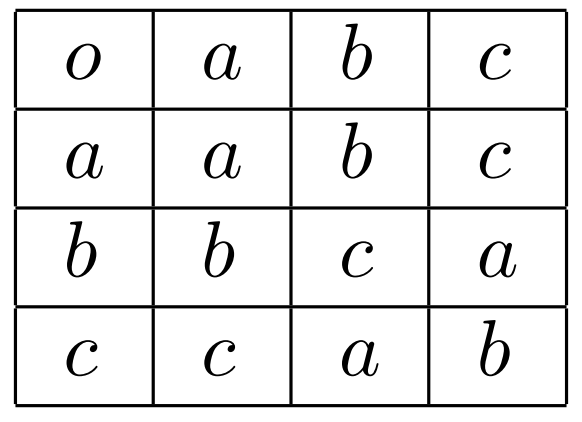
Example: 4. S = {a, b, c} and o is an operation on S for which the following composition table is formed. Is the operation o a binary operation in S ? Is the operation o in S commutative and associative?
Binary options table 4

Solution.  All the products formed are the elements of S.

∴ o is a binary operation in S and hence S is closed under the operation o.

Since the elements in every row are identical with corresponding elements in the corresponding column, o is commutative in S.

Since (aob)oc = boc = a = aoa = ao(boc), (boa) oc = boc = bo(aoc) etc., o is associative in S.

Example: 5. Fill in the blanks in the following composition table so that o is associative in S˙ = {a, b, c, d}
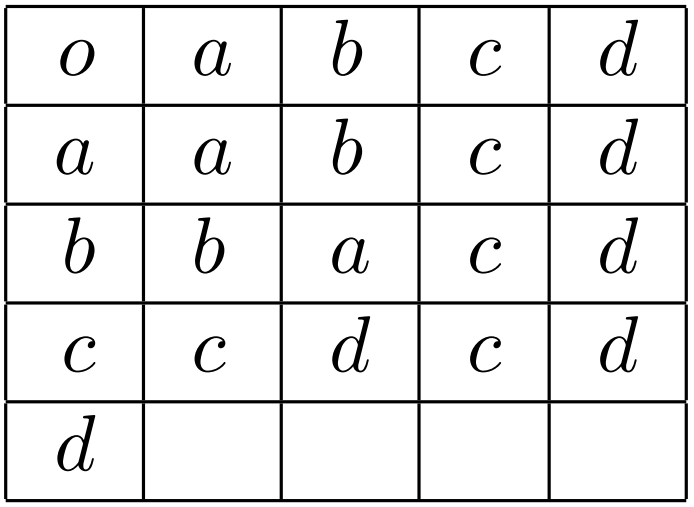
Binary options table 5

Solution.

Using associative law and by trial and error :

Since do(aoa) = doa and (doa)oa = do(aoa) = doa, doa must be equal to d only.

Since do(boa) = dob and (dob)oa = do(boa), dob must be equal to d only.

Since do(coa) = doc and (doc)oa = do(coa), doc must be equal to a only.

Since do(doa) = dod and do(doa) = (dod)oa, dod must be equal to a.

Thus d, d, a, a are respectively the four products.

Example: 6. Let P (S) be the power set of a non-empty set S. Let ’ ∩ ’ be an operation in P( S). Prove that associative law and commutative law are true for the operation ∩ in P(S) :

Solution.

Given

Let P (S) be the power set of a non-empty set S. Let ’ ∩ ’ be an operation in P( S).

P (S) = Set of all possible subsets of S.

Let A, B, C P(S). Since A S, B S A B S A B P(S)

Also B A S B A P(S).

∴ ∩ is a binary operation in P(S).

Also A B = B A.

∴ ∩ is commutative in P(S).

Again A B, B C, (A B) ∩ C, and A ∩ (B C) are subsets of S.

∴ (A B) ∩ C, A ∩ (B C) ∈ P(S).

Since (A B) ∩ C = A ∩ (B C), ∩ is associative in P(S).

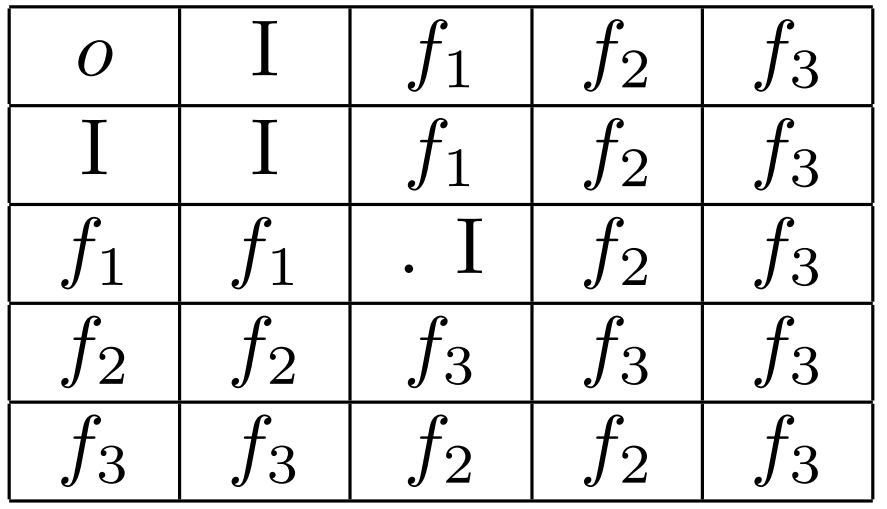
Example:  7. A = {a, b}. Consider the set S of all mappings from A A. Is the composition of mappings denoted by o is a binary composition in S.

Solution.

Given

A = {a, b}. Consider the set S of all mappings from A A.

Total number of possible mappings from A A is 4.

Let them be I : A A = {(a, a), (b, b)}

f1 : A A = {(a, b), (b, a)}

f2 : A A = {(a, a), (b, a)}

f3 : A A = {(a, a), (b, b)}

S = {I, f1, f2, f3}. Let the composition of mappings be denoted by o.

Composition table is :
 

Binary options table 6

Clearly (1) o is a binary operation in S,

(2) o is not commutative in S and

(3) o is not associative in S. sin a(f2of3) of 16= f2o (f3of1)

Glencoe Math Course 3 Volume 2 Student 1st Edition Chapter 6 Transformations Exercise

Glencoe Math Course 3 Volume 2 Student Chapter Chapter 6 Transformations Page 445 Exercise 1 Problem1

We have been given a figure. We need to show or describe the change in position of the figure. This can be found by the phenomena of motion

Motion is the phenomenon in which an object changes its position over time. Motion is mathematically described in terms of displacement, distance, velocity, acceleration, speed, and time.

The best way to show or describe the change in position of a figure is through its motion.


Glencoe Math Course 3 Volume 2 Chapter 6 Transformations Exercise Solutions Page 446 Exercise 1, Problem1

We have been given a quadrilateral ABCD with vertices A(1,1), B(3,5), C(4,7), and D(2,6).

We need to find that in what quadrant is ABCD located.

This can be found by the fact that if both xx and yy are positive, then the point lies in the first quadrant. If xx is negative and yy is positive, then the point lies in the second quadrant.

If both xx and yy are negative, then the point lies in the third quadrant. If xx is positive and yy is negative, then the point lies in the fourth quadrant.

Glencoe Math Course 2 Student Edition Volume 1 Chapter 6 Transformations Exercise

The given points A,B,C,D are plotted as follows,

Glencoe Math Course 3 Volume 2 Student 1st Edition Chapter Chapter 6 Transformations Page 446 Exercise 1, Problem1

We see that all the points lie on the first quadrant.

Hence, the quadrilateral ABCD lies on the first quadrant.

The quadrilateral ABCD is located in the first quadrant.

Read and Learn More Glencoe Math Course 2 Volume 1 Common Core Student Edition Solutions

Glencoe Math Course 3 Volume 2 Student Chapter Chapter 6 Page 446 Exercise 2 Problem1

We have been given a quadrilateral with vertices A(1,1), B(3,5), C(4,7), and D(2,6).We need to find that if the coordinates of ABCD are multiplied by3/4, then in what quadrant would the new figure be located. This can be found by the fact that when a coordinate (x,y) is multiplied with a scalar a, the new coordinate is (ax,ay).

The coordinates A,B,C,D are as follows,

Glencoe Math Course 3 Volume 2 Student 1st Edition Chapter Chapter 6 Transformations Page 446 Exercise 2, Problem1

When the coordinates of A, B, C, D are multiplied by 3/4 = 0.75 , the new coordinates are as follows,


Glencoe Math Course 3 Volume 2 Student 1st Edition Chapter Chapter 6 Transformations Page 446 Exercise 2, Problem1.

We see that all the points lie on the first quadrant.

Hence, the new quadrilateral ABCD lies on the first quadrant

When the coordinates of ABCD are multiplied by3/4,then the new figure lies in the first quadrant.


Glencoe Math Course 3 Volume 2 Student Chapter Chapter 6 Page 446 Exercise 3 Problem1

We have been given a quadrilateral with vertices A(1,1), B(3,5), C(4,7), and D(2,6).We need to find that when the x-coordinates in ABCD are multiplied by -1 , then in what quadrant would the new figure be located.

This can be found by the fact that when a coordinate (x,y) is multiplied with a scalar a, the new coordinate is (ax,ay).

The coordinates A, B, C, D are as follows,

Glencoe Math Course 3 Volume 2 Student 1st Edition Chapter Chapter 6 Transformations Page 446 Exercise 3, Problem 1

When the x-coordinates in ABCD are multiplied by -1, then the new coordinates are plotted as follows,

Glencoe Math Course 3 Volume 2 Student 1st Edition Chapter Chapter 6 Transformations Page 446 Exercise 3, Problem1

We see that all the points lie in the second quadrant.

Hence, the new quadrilateral ABCD lies on the second quadrant.

When the x-coordinates in ABCD are multiplied by -1, then the new figure lies in second quadrant.


Glencoe Math Course 3 Volume 2 Student Chapter Chapter 6 Page 446 Exercise 4 Problem1

We have been given a quadrilateral ABCD with vertices A(1,1), B(3,5), C(4,7), and D(2,6).We need to find that if we switch the x-and y-coordinates from Exercise 3, then in what quadrant would the new figure be located.

This can be found by the fact that hen a coordinate (x,y) is said to be switched, then the new point is (y,x).

The coordinates A, B, C, D are as follows, When we switch the x-and y-coordinates from Exercise 3, then the new coordinates are as follows,

Glencoe Math Course 3 Volume 2 Student 1st Edition Chapter Chapter 6 Transformations Page 446 Exercise 4, Problem1

We see that all the points lie in the fourth quadrant.

Hence, the new quadrilateral ABCD lies on the fourth quadrant

When we switch the x-and y-coordinates from Exercise 3, then the new figure lies in the fourth quadrant.


Glencoe Math Course 3 Volume 2 Student Chapter Chapter 6 Page 448 Exercise 1 Problem1

Given, a rectangle with vertices: B(−3,3) and C(−3,0) and side length 6 units. We need to graph figures and label the missing vertices.

Let, ABCD be the rectangle with vertices B(−3,3) and C(−3,0)and side length 6units.

For finding the other two vertices graphically, first, we need to put B(−3,3) and C(−3,0) on graph.

Now, the slope of a line that passes through a pair of points (x1,y1)and(x2,y2)is given by =y2−y1 x2−x1

We are given the endpoints, B(−3,3) and C(−3,0).

Therefore the slope of the line passing through these points is ​=0−3−3−(−3) =−30=infinite.

Here, we can see the slope of line BC is infinite, which means it is parallel to the y-axis. So the corresponding y – coordinate will remain the same.

Also, alternate sides of the rectangle are perpendicular therefore we will move 6 units along x-axis and thus x-coordinate will be shifted by 6 units.

Moving towards the positive x-axis.

X-coordinate of point A=−3+6=3

X-coordinate of point B=−3+6=3

So, the missing vertices of the rectangle ABCD are A(3,3)and D(3,0).

Glencoe Math Course 3 Volume 2 Student 1st Edition Chapter Chapter 6 Transformations Page 448 Exercise 1, Problem 1

Moving towards the negative X-axis.

X-coordinate of point A= −3−6=−9

X-coordinate of point B=−3−6=−9

So, in this case, missing vertices of the rectangle ABCD are A(−9,3) and D(−9,0).

Glencoe Math Course 3 Volume 2 Student 1st Edition Chapter Chapter 6 Transformations Page 448 Exercise 1, Problem1

The missing vertices of the rectangle ABCD are either A(3,3) and D(3,0).

Glencoe Math Course 3 Volume 2 Student 1st Edition Chapter Chapter 6 Transformations Page 448 Exercise 1, Problem 1

OrA(−9,3) and D(−9,0).

Glencoe Math Course 3 Volume 2 Student 1st Edition Chapter Chapter 6 Transformations Page 448 Exercise 1, Problem-1


Glencoe Math Course 3 Volume 2 Student Chapter Chapter 6 Page 448 Exercise 2 Problem1

Given, square with vertices: G(5,0), H(0,5), and side length 5 units.

We need to find the missing vertices of the given square.

Let HEGF be the square with vertices G(5,0),H(0,5) and side length 5 units.

First, We need to do is calculate the distance between the given points, so that we can be sure that if the given points are adjacent or diagonally opposite. The distance between any two coordinate (x1,y2)and(x2,y2)is given by √(x2−x1)2+(y2−y1)2.

The distance between G(5,0),H(0,5)is ​√(5−0)2+(0−5)2.=5√2

We can see that the distance between the G(5,0),H(0,5) is not equal to the given side length and therefore these points should be at diagonally opposite ends.

Glencoe Math Course 3 Volume 2 Student 1st Edition Chapter Chapter 6 Transformations Page 448 Exercise 2, Problem1

Let the coordinates of point F be (x.y). Then, GF=HF (As HEGF is a square).

The length of the side GF with given endpoints G(5,0)and F(x,y) is given as 5.

Therefore,​GF=√(x2−x1)²+(y2−y1)².

⇒5=√(x−5)²+(y−0)².

⇒5=√(x−5)²+(y)².

⇒25=(x−5)²+y²

Also, the length of the side HF with given endpoints H(0,5) and F(x,y)is given as 5.

​length HF=√(x2−x1)²+(y2−y1)².

⇒5=√(x−0)²+(y−5)².

⇒5=√x²+(y−5)².

⇒25=x²+(y−5)²

So, we have two unknown variables in two equations-

​25=(x−5)²+y² …….(1)
25=x²+(y−5)² …….(2)
To solve the equation, first, subtract equation two  from equation one, which will result in,

x²+y²−10y+25−x²+10x−25−y²

= 25−25

⇒ −10y+10x=0

⇒ −10y=−10x

⇒ y=x

Now, we can put y=x in any of the equation one to solve for x, ​x²+(y−5)²=25

⇒ x²+(x−5)²=25

⇒x²+x²−10x+25=25

⇒2x²−10x=0

⇒2x(x−5)=0

∴x=0 or x=5.

Since, y=x, therefore the possible value of (x, y) is either (0,0)and(5,5),Thus we can say that the missing points of the square are E(0,0)and F(5,5).

Glencoe Math Course 3 Volume 2 Student 1st Edition Chapter Chapter 6 Transformations Page 448 Exercise 2, Problem1.

The missing points of the square are E(0,0)and F(5,5).

The graph of the square is –

Glencoe Math Course 3 Volume 2 Student 1st Edition Chapter Chapter 6 Transformations Page 448 Exercise 2, Problem-1


Glencoe Math Course 3 Volume 2 Student Chapter Chapter 6 Page 448 Exercise 3 Problem1

Given, −5+3.

We need to find the addition

Given addition,

​=−5+3

=−2

After the addition =−5+3=−2

Page 448 Exercise 4, Problem1

Given, 7+(−9)

We need to find the addition.

Given addition,

​=7+(−9)

=−2

7+(−9) =−2

The result of addition is -2

Common Core Chapter 6 Transformations exercise answers Glencoe Math Course 3 Page 448 Exercise 5, Problem1

Given, −4+(−9)​

We will find the addition.

Given addition,

​=−4+(−9)

=−4−9

=−13

−4+(−9) =−13

The result of the addition is −13.

Glencoe Math Course 3 Volume 2 Student Chapter Chapter 6 Page 448 Exercise 6 Problem1

Given, −2+8.

We need to find the addition.

Given addition,

​=−2+8

=8−2

=6

−2+8 =6

The result of the addition is 6.

Step-By-Step Solutions For Chapter 6 Transformations Exercises In Glencoe Math Course 3 Page 448 Exercise 7, Problem1

Given, −8+(−6)

We will find the addition.

Given addition,

​=−8+(−6)

=−8−6

=−14

−8+(−6) =−14

The result of the addition is −14.

Page 448 Exercise 8, Problem1

Given, 0+(−6).

We will find the addition.

Given addition,

​=0+(−6)

=0−6

=−6

0+(−6) =−6

The result of the addition is −6.

Glencoe Math Course 3 Volume 2 Student Chapter Chapter 6 Page 448 Exercise 9 Problem1

Given, −8+2.

We need to find the addition.

Given addition,

​=−8+2

=2−8

=−6

−8+2 =−6

The result of the addition is −6.

Exercise Solutions For Chapter 6 Transformations Glencoe Math Course 3 Volume 2 Page 448 Exercise 10, Problem1

Here we have to add two integers. The given problem is3+(−1) and we have to calculate the value.

Here given problem is 3 + (−1)

Two integers have different signs so for adding integers with different signs, we have to keep the sign of the number with the largest absolute value and subtract the smallest absolute value from the largest.

So,3+(−1)=2

The calculated value of the two Integers is3+(−1)=2.

Examples Of Problems From Chapter 6 Transformations Exercises In Glencoe Math Course 3 Page 449 Exercise 1, Problem1

Here the rigid motion is a map of the plane to itself which preserves distances between points. So the information of rigid body we can say there are four types of rigid motions that are translation, rotation, reflection, and glide reflection.

Some rigid motions of the plane translation, rotation, reflection, and glide reflection. These four are basic rigid motions of the plane.

Glencoe Math Course 3 Volume 2 Student Chapter Chapter 6 Page 449 Exercise 1 Problem1

As per the given instruction here we have to arrange 10 index cards in a pile. And then on the top card, we have to draw a circle at the top right-hand corner. After drawing the figure of the card will be

Glencoe Math Course 3 Volume 2 Student 1st Edition Chapter Chapter 6 Transformations Page 449 Exercise 1, Problem-1.

There are 10 cards under this topmost card.

In the ten index cards in a pile. the top card with a circle at the top right-hand corner will be like the below figure

Glencoe Math Course 3 Volume 2 Student 1st Edition Chapter Chapter 6 Transformations Page 449 Exercise 1, Problem-1.

Student Edition Chapter 6 Transformations Solutions Guide Glencoe Math Course 3 Volume 2 Page 449 Exercise 1, Problem2

As per the given instruction here we have to arrange10 index cards in a pile. And then on the second card, we have to draw the red circle slightly down and to the left from the first card position. After drawing the figure of the card will be

Glencoe Math Course 3 Volume 2 Student 1st Edition Chapter Chapter 6 Transformations Page 449 Exercise 1, Problem-2.

Finally, the second card with the same circle will be the below figure and the circle will slightly down and to the left from the first card.

Glencoe Math Course 3 Volume 2 Student 1st Edition Chapter Chapter 6 Transformations Page 449 Exercise 1, Problem-2

Glencoe Math Course 3 Volume 2 Student Chapter Chapter 6 Page 449 Exercise 1 Problem3

As per the given instruction, we’ll repeat the red circle for three or four more cards until the circle is at the bottom of the card. We’ll use the remainder of the cards to draw the circle up and to the left. The most bottom card will be

Glencoe Math Course 3 Volume 2 Student 1st Edition Chapter Chapter 6 Transformations Page 449 Exercise 1, Problem-3.

Finally, we draw the circle is at the bottom of the card and the figure will

Glencoe Math Course 3 Volume 2 Student 1st Edition Chapter Chapter 6 Transformations Page 449 Exercise 1, Problem-3

Step-By-Step Answers For Chapter 6 Transformations In Glencoe Math Course 3 Volume 2 Page 449 Exercise 1, Problem4

As per the given instruction, we have to place a rubber band around the stack, hold the stack at the rubber band, and flip the cards from the front to back.

when we flip the cards from the front to back the circle seemed to move, as the cards were flipped from front to back Then if we look at the circles on the first and second cards and then the second and third cards we’ll observe that at first, the circle seemed to move down and shifted to the left unit it touched the bottom of the card.

After that, the circle moved again upward and keep shifting to the left. When you moved it the shape and the size did not change. Only the position changed.

when we flip the cards from front to back the circle seemed to move, as the cards were flipped from front to back.

Then if we look at the circles on the first and second cards and then the second and third cards we’ll observe that at first, the circle seemed to move down and shifted to the left unit it touched the bottom of the card.

After that, the circle moved again upward and keep shifting to the left.

When you moved it the shape and the size did not change. Only the position changed.


Glencoe Math Course 3 Volume 2 Student Chapter Chapter 6 Page 450 Exercise 1 Problem1

Here as per the given instruction, we have to draw a right triangle ∠XYZ on a piece of tracing paper. Then Place a dashed line on the paper in the middle of the paper. So now the figure will be

Glencoe Math Course 3 Volume 2 Student 1st Edition Chapter Chapter 6 Transformations Page 450 Exercise 1, Problem-1

Finally, the figure of a right angle ∠XYZ and a dashed line on a piece of tracing paper will be

Glencoe Math Course 3 Volume 2 Student 1st Edition Chapter Chapter 6 Transformations Page 450 Exercise 2, Problem-1.


Page 450 Exercise 2, Problem1

Given

Glencoe Math Course 3 Volume 2 Student 1st Edition Chapter Chapter 6 Transformations Page 450 Exercise 2, Problem-1.

First, we have to fold the paper along the dashed line and trace the angle onto the folded portion of the paper. Then we have to Unfold and label the angle ∠ABC so that A matches up with X ,B matches up with Y, and C matches up with Z.

By using a protractor to find the measure of ∠ABC and ∠XYZ and by using a centimeter ruler we have to measure the shortest distance from X and A to the dashed line and this will be repeated for Y and B and for Z and C.

If we placed a mirror on the folded line ∠ABC And ∠XYZ will be a mirror image of each other

Given

Glencoe Math Course 3 Volume 2 Student 1st Edition Chapter Chapter 6 Transformations Page 450 Exercise 2, Problem-1.

In this figure, if we draw an angle equal and mirror image with ∠XYZ the figure will be

Glencoe Math Course 3 Volume 2 Student 1st Edition Chapter Chapter 6 Transformations Page 450 Exercise 2 Problem-1..

Now by Use a protractor to find the measure of ∠XYZ and ∠ABC the angles are equal that is90∘

No the measure of the angle did not change after the flip.

Now by using a centimeter ruler if we measure the shortest distance from X and A to the dashed line we will notice the distance from X to the dashed line is the same with the distance from A to the dashed line.

And similarly, by using a centimeter ruler if we measure the shortest distance from Y and B to the dashed line we will notice the distance from Y to the dashed line is the same with the distance from B to the dashed line.

And by using a centimeter ruler if we measure the shortest distance from Z and C to the dashed line we will notice the distance from Z to the dashed line is the same with the distance from C to the dashed line.

So by using a protractor to find the measure of and ∠XYZ and ∠ABC the angles are equal.

No the measure of the angle did not change after the flip.

And The distance from X to the dashed line is the same with the distance from A to the dashed line.

The distance from Y to the dashed line is the same with the distance from B to the dashed line.

The distance from Z to the dashed line is the same with the distance from C to the dashed line.

Glencoe Math Course 3 Volume 2 Student Chapter Chapter 6 Page 450 Exercise 3 Problem1

Given that

As per the given instruction, we have to place a piece of tracing paper over the trapezoid and have to copy the trapezoid. Then we’ll draw points A,B,C and AB. Now the copied figure will beGlencoe Math Course 3 Volume 2 Student 1st Edition Chapter Chapter 6 Transformations Page 450Exercise 3, Problem1

Finally the figure of the trapezoid on the tracing paper with points A, B, C and AB will be

Glencoe Math Course 3 Volume 2 Student 1st Edition Chapter Chapter 6 Transformations Page 450Exercise 3, Problem1.


Page 450 Exercise 3, Problem2

Given that

Glencoe Math Course 3 Volume 2 Student 1st Edition Chapter Chapter 6 Transformations Page 450Exercise 3, Problem2

Here If we moved the trapezium that will look like the below figure

Glencoe Math Course 3 Volume 2 Student 1st Edition Chapter Chapter 6 Transformations Page 450Exercise 3, Problem2.

But the size and the shape never change for this moved it.

No, the shape of the trapezoid change when we moved it.

No, the size of the trapezoid change when we moved it.


Glencoe Math Course 3 Volume 2 Student Chapter Chapter 6 Page 451 Exercise 1 Problem1

Given that a pattern

Glencoe Math Course 3 Volume 2 Student 1st Edition Chapter Chapter 6 Transformations Exercise Page 451 Exercise 1, Problem1

We have to draw the image by using a ruler when this figure is moved 12 inches.

down and1 inch to the left.

First, we’ll convert the inch length into centimeters and then draw the changed pattern.

Given here

Glencoe Math Course 3 Volume 2 Student 1st Edition Chapter Chapter 6 Transformations Exercise Page 451 Exercise 1, Problem1

Now we have to move this pattern 1/2 inch. down and 1 inch to the left. If we convert these inches’ length in centimeters then 1/2 inch≈1.27centimeter and1inch≈2.54centimeter.

Using a ruler we’ll draw the figure and the figure is shown below


Glencoe Math Course 3 Volume 2 Student 1st Edition Chapter Chapter 6 Transformations Exercise Page 451 Exercise 1, Problem-1.

The pattern will be

Glencoe Math Course 3 Volume 2 Student 1st Edition Chapter Chapter 6 Transformations Exercise Page 451 Exercise 1, Problem1.

if we moved the main given pattern1/2inch. down and 1inch. to the left.

Page 451 Exercise 2, Problem1

Given that a pattern

Glencoe Math Course 3 Volume 2 Student 1st Edition Chapter Chapter 6 Transformations Page 451Exercise 2, Problem1

We have to draw the image by using a ruler when this figure is moved 1 inch up and 1 inch to the right. First, we’ll convert the inch length into centimeters and then draw the changed pattern.

Given here

Glencoe Math Course 3 Volume 2 Student 1st Edition Chapter Chapter 6 Transformations Page 451Exercise 2, Problem1

Now we have to move this pattern 1 inch up and 1 inch to the right.

If we convert these inches’ length in centimeters then1inch≈2.54centimeter.

Using a ruler we’ll draw the figure and the figure is shown below

Glencoe Math Course 3 Volume 2 Student 1st Edition Chapter Chapter 6 Transformations Page 451Exercise 2, Problem1.


The pattern will be

Glencoe Math Course 3 Volume 2 Student 1st Edition Chapter Chapter 6 Transformations Page 451Exercise 2, Problem1.


if we moved the main given pattern 1 inch up and 1 inch to the right.


Glencoe Math Course 3 Volume 2 Student Chapter Chapter 6 Page 451 Exercise 3 Problem1

Given pattern is

Glencoe Math Course 3 Volume 2 Student 1st Edition Chapter Chapter 6 Transformations Page 451Exercise 3, Problem1.

We have to draw the image when this figure is flipped over the line l.

To find the image of the figure after flipping it over the line l, we need to find the distance of each corner point of the given figure from the line l and plot new points with the same distance from I but in opposite direction to l.

Given the pattern is

Glencoe Math Course 3 Volume 2 Student 1st Edition Chapter Chapter 6 Transformations Page 451Exercise 3, Problem1.

It is like a mirror image of a figure over the line l, therefore, the distance of each point from I will remain the same.

As we know that to find the image of the figure after flipping it over the line l , we need to find the distance of each corner point of the given figure from the line land plot new points with the same distance from I but in opposite direction to l.

Now the flipped figure will be

Glencoe Math Course 3 Volume 2 Student 1st Edition Chapter Chapter 6 Transformations Page 451Exercise 3, Problem 1.


The flipped figure will be

Glencoe Math Course 3 Volume 2 Student 1st Edition Chapter Chapter 6 Transformations Page 451Exercise 3, Problem 1.

when the figure is flipped over the line l.

Page 448 Exercise 4, Problem1

Given pattern is

Glencoe Math Course 3 Volume 2 Student 1st Edition Chapter Chapter 6 Transformations Page 451Exercise 4, Problem1.

We have to draw the image when this figure is flipped over the line l .

To find the image of the figure after flipping it over the line l , we need to find the distance of each corner point of the given figure from the line l

and plot new points with the same distance from I but in opposite direction to l.

Given the pattern is

Glencoe Math Course 3 Volume 2 Student 1st Edition Chapter Chapter 6 Transformations Page 451Exercise 4, Problem1.

It is like a mirror image of a figure over the line l, therefore, the distance of each point from I will remain the same.

As we know that to find the image of the figure after flipping it over the line l

we need to find the distance of each corner point of the given figure from the line l and plot new points with the same distance from I but in opposite direction to l.

Now the flipped figure will be

Glencoe Math Course 3 Volume 2 Student 1st Edition Chapter Chapter 6 Transformations Page 451Exercise 4, Problem 1.

The flipped figure will be

Glencoe Math Course 3 Volume 2 Student 1st Edition Chapter Chapter 6 Transformations Page 451Exercise 4, Problem 1.

when the figure is flipped over the line l.


Glencoe Math Course 3 Volume 2 Student Chapter Chapter 6 Page 451 Exercise 5 Problem1

When the new Pentagon turned along the line AB, a new Pentagon of the same dimensions will be formed, but the face of the Pentagon changes to the opposite direction. The Pentagon must go through 3 rotations to reach the point C

(First rotation along the lineL1, second rotation along the lineL3and the final rotation along the lineL5.) as shown below.

Glencoe Math Course 3 Volume 2 Student 1st Edition Chapter Chapter 6 Transformations Page 451Exercise 5, Problem1.

The required image is attached below.

Glencoe Math Course 3 Volume 2 Student 1st Edition Chapter Chapter 6 Transformations Page 451Exercise 5, Problem1.


Page 452 Exercise 6, Problem1

Blue heart above the green heart can be obtained in two ways. The blue heart can be rotated clockwise or anticlockwise until it overlaps the green heart. To get the blue heart over the green heart, we can flip it twice, first along the lineL1 and then along the lineL2,as illustrated in the diagram below.

Glencoe Math Course 3 Volume 2 Student 1st Edition Chapter Chapter 6 Transformations Page 451Exercise 6, Problem1.

To get the blue heart over the green heart either turn the blue heart in clockwise or anticlockwise direction or flip the blue heart twice.


Glencoe Math Course 3 Volume 2 Student Chapter Chapter 6 Page 452 Exercise 7 Problem1

There are two ways that will place the blue figure on top of the green figure. Slide the blue figure to the right, then down, until it encroaches on the green figure. Slide the blue figure down, then right, until it overlaps with the green figure.

Glencoe Math Course 3 Volume 2 Student 1st Edition Chapter Chapter 6 Transformations Page 451Exercise 7, Problem1.

To place the blue figure on top of the green figure either slide the blue figure down first and then to the right or slide it right first and then to the down.


Page 452 Exercise 8, Problem1

At first, let us recap the two given exercises

Glencoe Math Course 3 Volume 2 Student 1st Edition Chapter Chapter 6 Transformations Page 452Exercise 8, Problem1.


With referring to investigation 1 and exercise 1 and 2, the word that best describes the movement of the figures is the slide.Glencoe Math Course 3 Volume 2 Student 1st Edition Chapter Chapter 6 Transformations Page 452Exercise 8, Problem1

The word that best describes the movement of the figures is slide.


Page 452 Exercise 9, Problem1

At first, let us recap the two given exercises.

Glencoe Math Course 3 Volume 2 Student 1st Edition Chapter Chapter 6 Transformations Page 452Exercise 9, Problem1


Glencoe Math Course 3 Volume 2 Student 1st Edition Chapter Chapter 6 Transformations Page 452Exercise 9, Problem1.


With referring to investigation 2 and exercises 3 and 4, the word that best describes the movement of the figures is the flip.

The word that best describes the movement of the figures is flip.


Glencoe Math Course 3 Volume 2 Student Chapter Chapter 6 Page 452 Exercise 10 Problem1

Based on the investigations we can describe the following characteristics regarding the rigid motion of the plane. When a point or object is moved but its size and shape remain the same, this is known as rigid motion.

This is in contrast to non-rigid motion, such as dilatation, in which the object’s size can rise or shrink. In order for the movement to be rigid, the pre-image and image must be congruent. See the following rigid motion of a triangle.

Glencoe Math Course 3 Volume 2 Student 1st Edition Chapter Chapter 6 Transformations Page 452Exercise 10, Problem1

Characteristics of the rigid motion of the plane are given above.


Page 452 Exercise 11, Problem1

There are four types of rigid motions: translation, rotation, reflection, and glide reflection. Translation: In a translation, everything moves by the same quantity and in the same direction. Each translation has a distance and a direction.

Glencoe Math Course 3 Volume 2 Student 1st Edition Chapter Chapter 6 Transformations Page 452Exercise 11, Problem1

Rotation: A rotation fixes one point (the ro to center), and everything revolves around it by the same amount. There is a roto center and an angle for every rotation.

Glencoe Math Course 3 Volume 2 Student 1st Edition Chapter Chapter 6 Transformations Page 452Exercise 11, Problem1.

Reflection: A reflection aligns a mirror line in the plane and exchanges points on one side of the line with points on the other side of the mirror at the same distance. There is a mirror line in every reflection.


Glencoe Math Course 3 Volume 2 Student 1st Edition Chapter Chapter 6 Transformations Page 452Exercise 11, Problem 1


Glide reflection: A glide reflection is a mirror reflection that is followed by a parallel translation. There is a mirror line and a translation distance for every glide reflection.

Glencoe Math Course 3 Volume 2 Student 1st Edition Chapter Chapter 6 Transformations Page 452Exercise 11, Problem-1


All the types of rigid motions of the plane are explained above.