Reducible To Homogeneous Differential Equation Examples

Differential Equations Introduction Solved Problems

Reducible To Homogeneous Differential Equation Examples With Solutions

Example. 1: Solve : \((x+y-1) \frac{d y}{d x}=x-y+2\)

Solution.

Given equation is \(\frac{d y}{d x}=\frac{x-y+2}{x+y-1}\) ………………..(1)

where \(a_1=1, b_1=1, a_2=1, b_2=-1 \Rightarrow a_1 b_2-a_2 b_1=2 \neq 0\)

Put \(x=\mathrm{X}+h \text { and } y=\mathrm{Y}+k \text { in (1) } \Rightarrow \frac{d y}{d x}=\frac{d \mathrm{Y}}{d \mathrm{X}}\) ……………………….(2)

(1) and (2) => \(\frac{d \mathrm{Y}}{d \mathrm{X}}=\frac{\mathrm{X}-\mathrm{Y}+(h-k+2)}{\mathrm{X}+\mathrm{Y}+(h+k-1)}\)

Choose h and k such that h-k + 2 = 0 ……………….(4)
and h + k – 1 = 0 …………………..(5)

Solving (4) and (5): \(h=-\frac{1}{2}, k=\frac{3}{2}\)

Now (3), (4), (5) => \(\frac{d \mathrm{Y}}{d \mathrm{X}}=\frac{\mathrm{X}-\mathrm{Y}}{\mathrm{X}+\mathrm{Y}}\) ………………….(6)

∵ f(kX, kY) = f(X, Y), (6) is homogeneous equation.

Putting \(\mathrm{Y}=v \mathrm{X} \Rightarrow \frac{d \mathrm{Y}}{d \mathrm{X}}=v+\mathrm{X} \frac{d v}{d \mathrm{X}}\) in (6), we get \(v+\mathrm{X} \frac{d v}{d \mathrm{X}}=\frac{1-v}{1+v}\)

⇒ \(\mathrm{X} \frac{d v}{d \mathrm{X}}=\frac{1-v}{1+v}-v=\frac{-v^2-2 v+1}{1+v}\)

Separating the variable: \(\frac{1+v}{v^2+2 v-1} d v=-\frac{d \mathrm{X}}{\mathrm{X}} \Rightarrow \frac{1}{2} \int \frac{2 v+2}{v^2+2 v-1} d v=-\int \frac{d \mathrm{X}}{\mathrm{X}}+\frac{1}{2} \log c\)

⇒ \(\frac{1}{2} \log \left(v^2+2 v-1\right)=-\log \mathrm{X}+\frac{1}{2} \log c \Rightarrow \log \left(\frac{\mathrm{Y}^2}{\mathrm{X}^2}+\frac{2 \mathrm{Y}}{\mathrm{X}}-1\right)+2 \log \mathrm{X}=\log c\)

(∵ \(v=\frac{\mathrm{Y}}{\mathrm{X}}\))

⇒ \(\log \frac{\mathrm{Y}^2+2 \mathrm{XY}-\mathrm{X}^2}{\mathrm{X}^2}+\log \mathrm{X}^2=\log c \Rightarrow \log \left(\frac{\left(\mathrm{Y}^2+2 \mathrm{XY}-\mathrm{X}^2\right)}{\mathrm{X}^2} \cdot \mathrm{X}^2\right)=\log c\)

⇒ \(\mathrm{Y}^2+2 \mathrm{XY}-\mathrm{X}^2=c\)

Now substitute: \(X=x+\frac{1}{2}, Y=y-\frac{3}{2}\)

∴ The general solution of (1)[ is \(\left(y-\frac{3}{2}\right)^2+2\left(x+\frac{1}{2}\right)\left(y-\frac{3}{2}\right)-\left(x+\frac{1}{2}\right)^2=c\)

Aliter: The given equation can be written as

(x+2) d x-y d x=(y-1) d y+x d y

(x+2) d x=(y d x+x d y)+(y-1) d y[/latex]

⇒ \(\int(x+2) d x=\int d(x y)+\int(y-1) d y \Rightarrow\left(x^2 / 2\right)+2 x=x y+\left(y^2 / 2\right)-y+(c / 2)\)

∴ The solution is \(x^2-y^2-2 x y+4 x+2 y=c\)

Step-By-Step Examples Of Reducible To Homogeneous Differential Equations

Example. 2: Solve : \((4 x+3 y+1) d x+(3 x+2 y+1) d y=0\)

Solution.

Given equation is \(\frac{d y}{d x}=\frac{-(4 x+3 y+1)}{(3 x+2 y+1)}\) ……………(1)

where \(a_1=-4, b_1=-3, c_1=-1, a_2=3, b_2=2, c_2=1 \Rightarrow a_1 b_2-a_2 b_1 \neq 0\)

to solve (1): put \(x=\mathrm{X}+h, y=\mathrm{Y}+k \Rightarrow \frac{d y}{d x}=\frac{d \mathrm{Y}}{d \mathrm{X}}\) …………………(2)

(1) and (2) => \(\frac{d \mathrm{Y}}{d \mathrm{X}}=-\frac{4(\mathrm{X}+h)+3(\mathrm{Y}+k)+1}{3(\mathrm{X}+h)+2(\mathrm{Y}+k)+1}=\frac{-(4 \mathrm{X}+3 \mathrm{Y})-(4 h+3 k+1)}{(3 \mathrm{X}+2 \mathrm{Y})+3(h+2 k+1)}\) ……………………..(3)

Choose h and 4 such that 4h + 3k + 1 = 0 ………………………..(4)

and 3h + 2k + 1 = 0 …………………(5)

Solving (4) and (5) h = -1, k = 1.

Then (3), (4), (5) \(\Rightarrow \frac{d Y}{d X}=-\frac{4 X+3 Y}{3 X+2 Y}\) …………………..(6)

∵ f(hx, ky) = f(X, Y),, (6) is homogeneous equation.

Putting \(\mathrm{Y}=v \mathrm{X} \Rightarrow \frac{d \mathrm{Y}}{d \mathrm{X}}=v+\mathrm{X} \frac{d v}{d \mathrm{X}}\) in (6), we get

v\(+\mathrm{X} \frac{d v}{d \mathrm{X}}=-\frac{4+3 v}{3+2 v} \Rightarrow \mathrm{X} \frac{d v}{d \mathrm{X}}=\frac{-4-3 v}{3+2 v}-v=\frac{-2\left(v^2+3 v+2\right)}{3+2 v}\)

Separating the variables : \(\frac{2 v+3}{v^2+3 v+2} d v=-2 \frac{d \mathrm{X}}{\mathrm{X}}\)

Integrating: \(\int \frac{2 v+3}{v^2+3 v+2} d v=-2 \int \frac{d \mathrm{X}}{\mathrm{X}}+\log c \Rightarrow \log \left(v^2+3 v+2\right)=-2 \log \mathrm{X}+\log c\)

⇒ \(\log \left(v^2+3 v+2\right)+\log \mathrm{X}^2=\log c \Rightarrow \log \left(v^2+3 v+2\right) \mathrm{X}^2=\log c\)

(∵ \(V=\frac{\mathrm{Y}}{\mathrm{X}}\))

⇒ \(\left(v^2+3 v+2\right) \mathrm{X}^2=c \Rightarrow\left(\frac{\mathrm{Y}^2}{\mathrm{X}^2}+3 \frac{\mathrm{Y}}{\mathrm{X}}+2\right) \mathrm{X}^2=c\)

⇒ \(\mathrm{Y}^2+3 \mathrm{XY}+2 \mathrm{X}^2=c\)

Substituting X = x+1, Y = y -1, in this

The general solution of (1) is \((y-1)^2+3(x+1)(y-1)+2(x+1)^2=c\)

Aliter: Given equation can be written as –\((4 x+1) d x=3(y d x+x d y)+(2 y+1) d y \Rightarrow(-4 x-1)^{\prime} d x=3 d(x y)+(2 y+1) d y\)

Integrating : \(-2 x^2-x=3 x y+y^2+y\)

∴ G. S. is \(2 x^2+3 x y+y^2+x+y=c\)

Reducible To Homogeneous Differential Equation Solved Examples Tutorial

Example. 3 : Solve : \(\frac{d y}{d x}=\frac{(x+y-1)^2}{4(x-2)^2}\)

Solution.

Given equation is \(\frac{d y}{d x}=\left(\frac{x+y-1}{2 x-4}\right)^2\) …………………….(1)

where \(a_1=1, b_1=1, a_2=2, b_2=0 \Rightarrow a_1 b_2-a_2 b_1=0-2=-2 \neq 0\)

to solve (1): put \(x =\mathrm{X}+h, y=\mathrm{Y}+k \Rightarrow \frac{d y}{d x}=\frac{d \mathrm{Y}}{d \mathrm{X}}\) ……………………(2)

(1) and (2) => \(\frac{d \mathrm{Y}}{d \mathrm{X}}=\frac{(\mathrm{X}+h+\mathrm{Y}+k-1)^2}{4(\mathrm{X}+h-2)^2}=\frac{[(\mathrm{X}+\mathrm{Y})+(h+k-1)]^2}{4[\mathrm{X}+(h-2)]^2}\) …………………….(3)

Choose, h and k such that h + k – 1 = 0 ……………………….(4)

and h – 2 = 0 ………………………..(5)

Solving (4) and (5): h = 2, k = -1

∴ \(\mathrm{X}=x-2, \mathrm{Y}=y-(-1)=y+1\)

(3), (4), (p) => \(\) …………………(6)

∵ f(kX, kY) = f(X, Y), (6) is homogeneous equation

Putting \(\mathrm{Y}=v \mathrm{X} \Rightarrow \frac{d \mathrm{Y}}{d \mathrm{X}}=v+\mathrm{X} \frac{d v}{d \mathrm{X}}\) in (6), we get

v\(+x \frac{d v}{d \mathrm{X}}=\frac{(\mathrm{X}+v \mathrm{X})^2}{4 \mathrm{X}^2}=\frac{(1+v)^2}{4} \Rightarrow \mathrm{X} \frac{d v}{d \mathrm{X}}=\frac{(1+v)^2}{4}-v=\frac{(1+v)^2-4 v}{4}=\frac{(1-v)^2}{4}\)

Separating the variables : \(\frac{4}{(1-v)^2} d v=\frac{d \mathrm{X}}{\mathrm{X}} \Rightarrow 4 \int \frac{d v}{(1-v)^2}=\int \frac{d \mathrm{X}}{\mathrm{X}}+c\)

⇒ \(4 \cdot \frac{-1}{1-v} \cdot \frac{1}{-1}=\log \mathrm{X}+c \Rightarrow \frac{4}{1-(\mathrm{Y} / \mathrm{X})}=\log \mathrm{X}+c\)

(∵ \(v=\frac{\mathrm{Y}}{\mathrm{X}}\))

⇒ \(\frac{4 X}{X-Y}=\log X+c\) ……………………(7)

Substituting X = x-2, Y = y +1, in (7)

∴ The general solution of (1) is \(\frac{4(x-2)}{x-y-3}=\log (x-2)+c\)

Reducible To Homogeneous Differential Equations Examples Explained

Example 4: Solve \((4 x+6 y+5) \frac{d y}{d x}=3 y+2 x+4\)

Solution: 

Given Equation is \(\frac{d y}{d x}=\frac{2 x+3 y+4}{4 x+6 y+5}\) ………………………(1)

Here \(a_1=2, b_1=3, a_2=4, b_2=6 \Rightarrow a_1 b_2-a_2 b_1=12-12=0\)

Also \(a_2=2 a_1, b_2=2 b_1 \text { and } c_2 \neq 2 c_1\)

Hence Put \(2 x+3 y=u \Rightarrow 2+3 \frac{d y}{d x}=\frac{d u}{d x} \Rightarrow \frac{d y}{d x}=\frac{1}{3}\left(\frac{d u}{d x}-2\right)\) ………………………(2)

(1) and (2) => \(\frac{1}{3}\left(\frac{d u}{d x}-2\right)=\frac{u+4}{2 u+5} \Rightarrow \frac{d u}{d x}=\frac{3 u+12}{2 u+5}+2 \Rightarrow \frac{d u}{d x}=\frac{7 u+22}{2 u+5}\) ………………………..(3)

Separating the variables : \(\frac{2 u+5}{7 u+22} d u=d x \Rightarrow \int \frac{2 u+5}{7 u+22} d u=\int d x+c\)

⇒ \(\int\left(\frac{2}{7}-\frac{9}{7} \cdot \frac{1}{7 u+22}\right) d u=x+c \Rightarrow \frac{2}{7} u-\frac{9}{7} \cdot \frac{1}{7} \log (7 u+22)=x+c\)

∴ General solution of (3) is \(14 u-9 \log (7 u+22)=49 x+49 c\)

Hence the G. S. of (1) is \(14(2 x+3 y)-9 \log |(14 x+21 y+22)|=49 x+c_1\) [from (2)]

Common Mistakes In Solving Reducible To Homogeneous Differential Equations

Example.5 : Solve \((2 x+2 y+1) \frac{d y}{d x}=x+y+3\)

Solution.

Given equation is \(\frac{d y}{d x}=\frac{x+y+3}{2 x+2 y+1}\) …………………………..(1)

where \(a_1=1, b_1=1, c_1=3, a_2=2, b_2=2, c_2=1 \text { and } a_1 b_2-a_2 b_1=2-2=0\)

Also \(a_2=2 a_1, b_2=2 b_1 \text { and } c_2 \neq 2 c_1\)

Let \(x+y=u \Rightarrow 1+\frac{d y}{d x}=\frac{d u}{d x} \Rightarrow \frac{d y}{d x}=\frac{d u}{d x}-1\) ………………………….(2)

(1) and (2) \(\Rightarrow \frac{d u}{d x}-1=\frac{u+3}{2 u+1} \Rightarrow \frac{d u}{d x}=\frac{u+3}{2 u+1}+1=\frac{3 u+4}{2 u+1}\) ……………………………(3)

Separating the variables : \(\frac{2 u+1}{3 u+4} d u=d x\)

⇒ \(\int\left[\frac{2}{3}-\frac{5}{3(3 u+4)}\right] d u=\int d x+c \Rightarrow \frac{2 u}{3}-\frac{5}{9} \log (3 u+4)=x+c\)

G.S. of (3) is \(6 u-5 \log (3 u+4)=9 x+9 c\)

∴ The general solution of (1) is \(6(x+y)-5 \log (3 x+3 y+4)=9 x+c_1\)


Introduction To Homogeneous Differential Equations First Order And First Degree Solved Problems Working Rule

Differential Equations Introduction Solved Problems


Example. 1: Solve : \(x^2 y d x-\left(x^3+y^3\right) d y=0\)

Solution:

Given: \(x^2 y d x=\left(x^3+y^3\right) d y \Rightarrow \frac{d y}{d x}=\frac{x^2 y}{x^3+y^3}\) …………………..(1)

Since \(f(k x, k y)=f(x, y)\), (1) is homogeneous equation.

Put \(y / x=v \text { in (1) } \Rightarrow y=v x \Rightarrow \frac{d y}{d x}=v+x \frac{d v}{d x}\) ……………………(2)

(1) and (2) => \(v+x \frac{d v}{d x}=\frac{v}{1+v^3} \Rightarrow x \frac{d v}{d x}=\frac{v}{1+\dot{v}^3}-v=\frac{-v^4}{1+v^3}\)

Separating the variables: \(\frac{1+v^3}{v^4} d v=-\frac{d x}{x}\)

Integrating: \(\int \frac{1+v^3}{v^4} d v=-\int \frac{d x}{x}+c \Rightarrow \int\left(v^{-4}+\frac{1}{v}\right) d v=-\int \frac{d x}{x}+c\)

⇒ \(\frac{v^{-3}}{-3}+\log v=-\log x+c \Rightarrow \log v-\frac{1}{3 v^3}+\log x=c\) …………………….(3)

Putting v = y/x in (3), the general solution is \(\log (y / x)-\left(x^3 / 3 y^3\right)+\log x=c\)

Solved Problems On First Order And First-Degree Homogeneous Differential Equations

Example. 2: Solve : \((x-y \log y+y \log x) d x+x(\log y-\log x) d y=0\)

Solution:

The given equation is

x\(\log \left(\frac{y}{x}\right) d y+\left[x-y \log \left(\frac{y}{x}\right)\right] d x=0 \Rightarrow \frac{d y}{d x}=\frac{y \log (y / x)-x}{x \log (y / x)}=\frac{(y / x) \log (y / x)-1}{\log (y / x)}\) ………………(1)

Clearly \(\frac{d y}{d x}=f\left(\frac{y}{x}\right)\) => Given equation.is homogeneous.

Put y/x = v in (1) \(y=v x \Rightarrow \frac{d y}{d x}=v+x \frac{d v}{d x}\) …………………..(2)

(1) and (2) \(\Rightarrow v+x \frac{d v}{d x}=\frac{v \log v-1}{\log v} \Rightarrow x \frac{d v}{d x}=-\frac{1}{\log v}\)

Separating the variables: \((\log v) d v=-\frac{d x}{x}\)

⇒ \(\int \log v \cdot d v=\int-\frac{d x}{x}+c \Rightarrow v \log v-\int v \cdot \frac{1}{v} d v=-\log x+c\)

⇒ \(v \log v-v=-\log x+c\) …………………….(3)

Put v = y/x in (3)

∴ The general solution of (1) is (y/x) log(y/x)-(y/x) = -log x + c

=> y (log y – log x) – y = -x log x + cx => y log y + (x – y) log x = y + cx

Example. 3. Solve : \(x \frac{d y}{d x}=y+x e^{y / x}\)

Solution.

Given equation is \(x \frac{d y}{d x}=y+x e^{y / x} \Rightarrow \frac{d y}{d x}=\frac{y}{x}+e^{y / x}\) …………………(1)

∵ \(f(k x, k y)=f(x, y)\), (1) is a homogeneous equation.

Put \(y=v x \text { in }(1) \Rightarrow \frac{d y}{d x}=v+x \frac{d v}{d x}\) ……………………..(2)

Then (1) and (2) \(\Rightarrow v+x \frac{d v}{d x}=v+e^v \Rightarrow x \frac{d v}{d x}=e^v\)

Separating the variables: \(\frac{d v}{e^v}=\frac{d x}{x} \Rightarrow e^{-v} d v=\frac{d x}{x}\)

Integrating : \(\int e^{-v} d v=\int \frac{d x}{x}+c \Rightarrow-e^{-v}=\log |x|+c\) …………………..(3)

Putting v = y / x in (3), the general solution of (1) is \(e^{-(y / x)}+\log |x|+c=0\)

Step-By-Step Guide To Homogeneous Differential Equations First Order

Example. 4. Solve : \(x d y-y d x=\left(\sqrt{x^2+y^2}\right) d x\)

Solution.

Given equation is \(x d y-y d x=\left(\sqrt{x^2+y^2}\right) d x\)

⇒ \(x \frac{d y}{d x}=y+\sqrt{x^2+y^2} \Rightarrow \frac{d y}{d x}=\frac{y+\sqrt{x^2+y^2}}{x}\) …………………(1)

∵ \(f(k x, k y)=f(x, y)\), (1) is a homogeneous equation.

Put y/x = v in (1) y = vx in (1) \(\Rightarrow \frac{d y}{d x}=v+x \frac{d v}{d x}\) …………………….(2)

(1) and (2) ⇒ \(v+x \frac{d v}{d x}=v+\sqrt{1+v^2} \Rightarrow \frac{x d v}{d x}=\sqrt{1+v^2}\)

Separating the variables: \(\frac{d v}{\sqrt{1+v^2}}=\frac{d x}{x}\)

Integrating: \(\int \frac{d v}{\sqrt{1+v^2}}=\int \frac{d x}{x}+\log c \Rightarrow \log \left|v+\sqrt{1+v^2}\right|=\log x+\log c\)

⇒ \(\log \left|v+\sqrt{1+v^2}\right|=\log c x \Rightarrow v+\sqrt{1+v^2}=c x\)

Putting v = y/x in (3), the general solution of (1) is \(y+\sqrt{x^2+y^2}=c x^2\)

Example. 5: Solve : [x – y arctan(y / x)] Jx + [x arctan(y / x)] dy = 0

Solution.

Given equation

[x – y arctan(y / x)] Jx + [x arctan(y / x)] dy = 0

The given equation is rearranged as follows: \(\frac{d y}{d x}=\frac{y \text{Tan}^{-1}(y / x)-x}{x \text{Tan}^{-1}(y / x)}\)

= \(\frac{(y / x) \text{Tan}^{-1}(y / x)-1}{\text{Tan}^{-1}(y / x)}\)…….(1)

because f(k x, k y)=f(x, y),(1) is homogeneous equation.

Put y=v x in (1) ⇒ \(\frac{d y}{d x}=v+x \frac{d v}{d x}\)……(2)

(1) and (2) ⇒ \(v+x \frac{d v}{d x}=\frac{v \text{Tan}^{-1} v-1}{\text{Tan}^{-1} \cdot v} \Rightarrow x \frac{d v}{d x}\)

= \(\frac{v \text{Tan}^{-1} v-1}{\text{Tan}^{-1} v}-v \Rightarrow x \frac{d v}{d x}=\frac{-1}{\text{Tan}^{-1} v}\)

Separating the variables: \(\text{Tan}^{-1} v d v=-\frac{d x}{x}\).

Integrating: \(\int \text{Tan}^{-1} v d v=-\int \frac{d x}{x}+c\).

⇒ \(v \text{Tan}^{-1} v-\int \frac{v}{1+v^2} d v=-\log |x|+c\)

⇒ \(v \text{Tan}^{-1} v-\frac{1}{2} \log \left(1+v^2\right)=-\log |x|+c \ldots\)……(3)

Putting \(v=y / x\) in (3), the general solution of (1) is \(\frac{y}{x} \text{Tan}^{-1}\left(\frac{y}{x}\right)-\frac{1}{2} \log \left(1+\frac{y^2}{x^2}\right)=-\log |x|+c\)

Working Rules Of First Order Homogeneous Differential Equations With Examples

Example. 6. Solve \((y d x+x d y) x \cos (y / x)=(x d y-y d x) y \sin (y / x)\)

Solution.

Given : \(\left[x y \cos (y / x)+y^2 \sin (y / x)\right] d x=\left[x y \sin (y / x)-x^2 \cos (y / x)\right] d y\)

⇒ \(\frac{d y}{d x}=\frac{x y \cos (y / x)+y^2 \sin (y / x)}{x y \sin (y / x)-x^2 \cos (y / x)}\) ………………..(1)

f(k x, k y)=f(x, y), (1) is a homogeneous equation.

Put \(y / x=v \Rightarrow y=v x \text { in }(1) \Rightarrow \frac{d y}{d x}=v+x \frac{d v}{d x}\) ……………………..(2)

(1) and (2) \(\Rightarrow v+x \frac{d v}{d x}=\frac{v \cos v+v^2 \sin v}{v \sin v-\cos v} \Rightarrow x \frac{d v}{d x}=\frac{v \cos v+v^2 \sin v}{v \sin v-\cos v}-v=\frac{2 v \cdot \cos v}{v \sin v-\cos v}\)

Separating the variables : \(2 \frac{d x}{x}=\frac{v \sin v-\cos v}{v \cos v} d v\)

Integrating : \(2 \int \frac{d x}{x}=\int \frac{v \sin v-\cos v}{v \cos v} d v+\log c\)

⇒ \(2 \log |x|=\int \tan v d v-\int \frac{1}{v} d v+\log c \Rightarrow 2 \log |x|=-\log |\cos v|-\log |v|+\log c\)

⇒ \(\log x^2=\log \left|\frac{c}{v \cos v}\right| \Rightarrow x^2 v \cos v=c \Rightarrow x^2 \cdot \frac{y}{x} \cos \frac{y}{x}=c\)

∴ The general solution of (1) is xy cos(y/x) = c

Example. 7 : Solve: \(\left(1+e^{x / y}\right) d x+e^{x / y}[1-(x / y)] d y=0\)

Solution.

Given equation is \(\left(1+e^{x / y}\right) d x+e^{x / y}[1-(x / y)] d y=0\)

Here we shall not be able to write the given equation in the form \(\frac{d y}{d x}=f\left(\frac{y}{x}\right)\).

But we can express it in the form \(\frac{d x}{d y}=f\left(\frac{x}{y}\right)\)

∴ Given equation is \(\frac{d x}{d y}=\frac{e^{x / y}[(x / y)-1]}{1+e^{x / y}}=f\left(\frac{x}{y}\right)\) ……………………(1)

f(kx, ky) = f(x, y), (1) is a homogeneous equation.

Put x/y = v where v is a function of y => x = vy => \(\frac{d x}{d y}=v+y \frac{d v}{d y}\) …………………..(2)

(1) and (2) => \(v+y \frac{d v}{d y}=\frac{e^v(v-1)}{1+e^v} \Rightarrow y \frac{d v}{d y}=\frac{e^v(v-1)}{1+e^v}-v=-\frac{e^v+v}{1+e^v}\)

Separating the variables: \(\frac{d y}{y}=-\frac{1+e^v}{v+e^v} d v\)

Integrating: \(\int \frac{d y}{y}=-\int \frac{1+e^v}{v+e^v} d v+\log c \Rightarrow \log |y|=-\log \left|v+e^v\right|+\log c\)

⇒ \(\log y+\log \left(v+e^v\right)=\log c \Rightarrow \log y\left(v+e^v\right)=\log c \Rightarrow y\left(v+e^v\right)=c\) …………………….(3)

Putting v = x/y in (3), the general solution of (1) is \(x+y e^{x / y}=c\)

Introduction To First Degree Homogeneous Differential Equations Tutorial

Example. 8: Solve \(x^2 \frac{d y}{d x}=\frac{y(x+y)}{2}\)

Solution:

Given equation is \(\frac{d y}{d x}=\frac{x y+y^2}{2 x^2}\) ……………………..(1)

∴ f(kx>ty) = f(x,y), (1) is a homogeneous equation.

Put y = vx in(1) \(\Rightarrow \frac{d y}{d x}=v+x \frac{d v}{d x}\) ……………………(2)

(1),(2) ⇒ \(v+x \frac{d v}{d x}=\frac{v x^2+v^2 x^2}{2 x^2}=\frac{v^2+v}{2}\)

⇒ \(x \frac{d v}{d x}=\frac{v^2+v}{2}-v=\frac{v^2+v-2 v}{2}=\frac{v^2-v}{2}\)

Separating variables: \(2 \frac{d v}{v(v-1)}=\frac{d x}{x}\)

⇒ \(2 \int \frac{d v}{v(v-1)}=\int \frac{d x}{x}+\log c\)

2\( \int\left(\frac{1}{v-1}-\frac{1}{v}\right) d v=\log x+\log c \Rightarrow 2[\log (v-1)-\log v]=\log c x\)

⇒ \(\log \left(\frac{v-1}{v}\right)^2=\log (c x) \Rightarrow\left(\frac{v-1}{v}\right)^2=c x\)

Putting \(v=\frac{y}{x}\), the general solution of (1) is \(\left[\frac{(y / x)-1}{y / x}\right]^2=c x \Rightarrow(y-x)^2=c x y^2\)

Homogeneous Differential Equations Working Rules Step By Step

Example. 9: Find the equation of the curve, which passes through the point (1, π/4) whose differential equation is \(\left[x \cos ^2(y / x)-y\right] d x+x d y=0(x>0, y>0)\)

Solution.

Given \(\left[x \cos ^2(y / x)-y\right] d x+x d y=0\)

⇒ \(\frac{d y}{d x}=\frac{y-x \cos ^2(y / x)}{x}=\frac{y}{x}-\cos ^2\left(\frac{y}{x}\right)\) ……………………..(1)

Clearly, \(\frac{d y}{d x}=\mathrm{F}\left(\frac{y}{x}\right)\) => Given equation is homogeneous.

Put v = y/x in (1) => \(y=v x \Rightarrow \frac{d y}{d x}=v+x \frac{d v}{d x}\) …………………..(2)

(1) and (2) \(\Rightarrow v+x \frac{d v}{d x}=v-\cos ^2 v \Rightarrow x \frac{d v}{d x}=-\cos ^2 v\).

Separating the variables: \(\sec ^2 v d v=-\frac{d x}{x}\)

⇒ \(\int \sec ^2 v d v=-\int \frac{d x}{x}+c \Rightarrow \tan v=-\log |x|+c\) ………………..(3)

Putting v = y/x in (3), the G. S. is tan (y/x) = —log 1 x | +c …………………………..(4)

Putting x = 1 and y = π/4 in (4):

tan (π / 4) = – log 1 + c tan (π / 4) = – log 1 + c => c = 1

The equation of the curve is tan(y/x) + log | x | = 1


Equations that are first order but not first degree Equations that differ Issues That Have Been Solved But Don’t Include X or Y

Differential Equations of First Order But Not of First Degree Equations That Do Not Contain X(or Y)


If the equation is of form f(x,p) = 0 and is solvable for p, it will give \(\frac{d y}{d x}=\phi(x)\), which is integrable. But if it is solvable for x, then x = F(p).

If the equation is of form f(y,p) = 0 and is solvable for p, it will give \(\frac{d y}{d x}=\phi(y)\), which is integrable. But if it is solvable for y, then y = F(p).


Differential Equations of First Order But Not of First Degree Solved Problems

First-Order But Not First-Degree Equations Examples And Solutions

Example. 1. Solve \(x p^3=a+b p\)
Solution.

Given equation is \(x p^3=a+b p\) ………………………(1)

Solving (1) for x, we have : \(x=\frac{a}{p^3}+\frac{b}{p^2}\) …………………………(2)

Differentiating (2) w.r.t. \(y \Rightarrow \frac{d x}{d y}=-\frac{3 a}{p^4} \frac{d p}{d y}-\frac{2 b}{p^3} \frac{d p}{d y}\)

⇒ \(\frac{1}{p}=-\frac{1}{p}\left(\frac{3 a}{p^3}+\frac{2 b}{p^2}\right) \frac{d p}{d y} \Rightarrow 1=-\left(\frac{3 a}{p^3}+\frac{2 b}{p^2}\right) \frac{d p}{d y}\)

⇒ \(d y=-\left(\frac{3 a}{p^3}+\frac{2 b}{p^2}\right) d p\)     (by separating variables)

Integrating : \(\int d y=-3 a \int \frac{1}{p^3} d p-2 b \int \frac{1}{p^2} d p+c \Rightarrow y=\frac{3 a}{2 p^2}+\frac{2 b}{p}+c\) …………………..(3)

It is not possible to eliminate p from (1) and (3):

∴ General solution of (1) is \(x=\frac{a}{p^3}+\frac{b}{p^2}\) and \(y=\frac{3 a}{2 p^2}+\frac{2 b}{p}+c\)

Differential Equations Solved Without X Or Y Variables

Example. 2. Solve \(x \sqrt{1+p^2}+p=a \sqrt{1+p^2}\)

Solution.

Given equation is \(x=a-\frac{p}{\sqrt{1+p^2}}\) …………………..(1)

Differentiating (1) w.r.t y: \(\frac{1}{p}-\frac{1}{\sqrt{1+p^2}} \frac{d p}{d y}+\frac{1}{2} p \frac{1}{\left(1+p^2\right)^{3 / 2}} 2 p \frac{d p}{d y}=0\)

⇒ \(\frac{1}{p}=-\frac{1}{\left(1+p^2\right)^{3 / 2}} \frac{d p}{d y} \Rightarrow d y=-\frac{p}{\left(1+p^2\right)^{3 / 2}} d p\)

⇒ \(\int d y=-\frac{1}{2} \int \frac{2 p}{\left(1+p^2\right)^{3 / 2}} d p-c \Rightarrow y+c=\frac{1}{\sqrt{1+p^2}} \Rightarrow(y+c)^2=\frac{1}{1+p^2}\) ………………….(2)

Eliminating p from (1) and (2)

From (1): \((x-a)^2=\frac{p^2}{1+p^2}=1-\frac{1}{1+p^2} \Rightarrow(x-a)^2=1-(y+c)^2\)

∴ The general solution of (1) is \((x-a)^2+(y+c)^2=1\).

Equations That Are First-Order But Differ From Standard Forms

Example. 3. Solve \(e^y=p^3+p\)

Solution.

Given equation is \(e^y=p^3+p\)

Differentiating (1) w.r.t. \(x \Rightarrow e^y \frac{d y}{d x}=3 p^2 \frac{d p}{d x}+\frac{d p}{d x}\)

⇒ \(p e^y=\left(3 p^2+1\right) \frac{d p}{d x} \Rightarrow p\left(p^3+p\right)=\left(3 p^2+1\right) \frac{d p}{d x}\) [from (1)]

Separating the variables: \(d x=\frac{3 p^2+1}{p^2\left(p^2+1\right)} d p\)

Integrating: \(\int d x=\int \frac{3 p^2+1}{p^2\left(p^2+1\right)} d p+c\)

⇒ \(x=\int\left(\frac{1}{p^2}+\frac{2}{p^2+1}\right) d p+c \Rightarrow x=-\frac{1}{p}+2 \text{Tan}^{-1} p+c \text {. }\)

It is not possible to eliminate p from (1) and (3).

∴ The G.S. of (1) is given by \(e^y=p^3+p\) and \(x=-\frac{1}{p}+2 \text{Tan}^{-1} p+c\).


Differential Equations of First Order But Not of First Degree Equations Reducible To Clairaut’s Form

Differential Equations of First Order But Not of First Degree Equations Reducible To Clairaut’s Form


Some differential equations can be transformed to Clairaut’s form by suitable substitution.

For example : \(y^2=p x y+f\left(\frac{p y}{x}\right)\) ………………….(1)

Put \(x^2=X\) and \(y^2=\mathrm{Y} \Rightarrow 2 x d x=d \mathrm{X}\) and \(2 y d y=d \mathbf{Y}\)

Let \(\mathrm{P}=\frac{d \mathrm{Y}}{d \mathrm{X}}=\frac{y}{x} \frac{d y}{d x}=\frac{y}{x} p\) …………………….(2)

(1) and (2) \(\Rightarrow \mathrm{Y}=x y\left(\frac{x \mathrm{P}}{y}\right)+f(\mathrm{P})=x^2 \mathrm{P}+f(\mathrm{P})\) …………………..(3)

=> Y = PX+f(P) which is Clairaut’s differential equation.

∴ The general solution of (3) is Y = cX+f(c) where c is any real number.

⇒ \(y^2=c x^2+f(c)\) is the general solution of (1).


Differential Equations of First Order But Not of First Degree Solved Problems


Example. 1. Solve \(x^2(y-p x)=p^2 y\)

Solution.

Given equation is \(x^2(y-p x)=y p^2\) ……………………..(1)

Put \(x^2=\mathrm{X} \text { and } y^2=\mathrm{Y} \Rightarrow 2 x d x=d \mathrm{X} \text { and } 2 y d y=d \mathrm{Y}\)

⇒ \(\mathrm{P}=\frac{d \mathrm{y}}{d \mathrm{x}}=\frac{2 y d y}{2 x d x}=\frac{y}{x} \frac{d y}{d x}=\frac{y}{x} p \Rightarrow p=\frac{\mathrm{P} x}{y}\) ……………………….(2)

(1) and (2) \(\Rightarrow \mathrm{X}\left(y-x \cdot \frac{\mathrm{P} x}{y}\right)=y \cdot \frac{\mathrm{P}^2 x^2}{y^2} \Rightarrow \mathrm{X}\left(y^2-x^2 \mathrm{P}\right)=x^2 \mathrm{P}^2\)

⇒ \(X(Y-X P)=X P^2 \Rightarrow Y-X P=P^2 \Rightarrow Y=X P+P^2\) ……………………(3)

(3) is Clairaut’s equation.

∴ General solution of (3) is \(Y=C X+C^2\)

∴ The general solution of (1) is \(y^2=C x^2+C^2\)

Differential Equations Of First Order But Not First Degree Reducible To Clairaut’s Form

Example. 2. Solve \((p y+x)(p x-y)=2 p\)

Solution.

Given equation is \((p y+x)(p x-y)=2 p\) ………………………..(1)

Put \(x^2=\mathrm{X} \text { and } y^2=\mathrm{Y} \Rightarrow 2 x d x=d \mathrm{X}, 2 y d y=d \mathrm{Y}\)

⇒ \(\mathrm{P}=\frac{d \mathrm{Y}}{d \mathrm{X}}=\frac{y}{x} \frac{d y}{d x}=\frac{y}{x} \cdot p \Rightarrow p=\frac{x}{y} \mathrm{P}\) …………………………..(2)

(1) and (2) \(\Rightarrow\left(\frac{x}{y} \mathrm{P} \cdot y+x\right)\left(\frac{x}{y} \mathrm{P}, x-y\right)=2\left(\frac{x}{y}\right) \mathrm{P}\)

⇒ \(x(\mathrm{P}+1)\left(x^2 \mathrm{P}-y^2\right)=2 x \mathrm{P} \Rightarrow(\mathrm{P}+1)\left(x^2 \mathrm{P}-y^2\right)=2 \mathrm{P}\)

⇒ \((\mathrm{P}+1)(\mathrm{XP}-\mathrm{Y})=2 \mathrm{P} \Rightarrow \mathrm{PX}-\mathrm{Y}=\frac{2 \mathrm{P}}{\mathrm{P}+1}\)

⇒ \(\mathrm{Y}=\mathrm{PX}-\frac{2 \mathrm{P}}{\mathrm{P}+1}\) is Clairaut’s equation. ………………………….(3)

The general solution of (3) is \(Y=c X-\frac{2 c}{c+1}\)

∴ The general solution of (1) is \(y^2=c x^2-\frac{2 c}{c+1}\)

Solved Problems On First-Order Non-First-Degree Reducible To Clairaut’s Form

Example. 3. Use the transformation \(u=x^2\) and \(v=y^2\) to solve \(a x y p^2+\left(x^2-a y^2-b\right) p-x y=0\).

Solution.

Given: \(a x y p^2+\left(x^2-a y^2-b\right) p-x y=0\).

Put \(x^2=u\) and \(y^2=v \Rightarrow 2 x dx=du, 2y dy=d v\)

⇒ \(\mathrm{P}=\frac{d v}{d x}=\frac{y}{x} \frac{d y}{d x}=\frac{y}{x} p \Rightarrow p=\frac{x}{y} \mathrm{P}\)

(1) and (2) ⇒ \(a x y\left(\frac{x^2}{y^2}\right) \mathrm{P}^2+\left(x^2-a y^2-b\right) \frac{x}{y} \mathrm{P}-x y=0\)

⇒ \(a x^2 \mathrm{P}^2+\left(x^2-a y^2-b\right) \mathrm{P}-y^2=0 \Rightarrow a u \mathrm{P}^2+(u-a v-b) \mathrm{P}-v=0\)

⇒ \(a u \mathrm{P}^2+u \mathrm{P}-a v \mathrm{P}-b \mathrm{P}-v=0 \Rightarrow u \mathrm{P}(a \mathrm{P}+1)-v(a \mathrm{P}+1)-b \mathrm{P}=0\)

⇒ \(v(a \mathrm{P}+1)=u \mathrm{P}(a \mathrm{P}+1)-b \mathrm{P} \Rightarrow v=u \mathrm{P}-\frac{b \mathrm{P}}{a \mathrm{P}+1} \ldots \ldots\) (3) is in Clairaut’s form.

The general solution of (3) is \(v=u \mathrm{C}-\frac{b \mathrm{C}}{a \mathrm{C}+1}\)

∴ The general solution of (1) is \(y^2=x^2 \mathrm{C}-\frac{b \mathrm{C}}{a \mathrm{C}+1}\)

Problems On Equations Reducible To Clairaut’s Form

Example. 4. Reduce the equation \(y^2(y-x p)=x^4 p^2\) to Clairaut’s form by the substitution \(x=1 / u, y=1 / v\) and hence solve the equation.
Solution.

Given equation is \(y^2(y-x p)=x^4 p^2\) ………………………(1)

Also given \(x=1 / u \text { and } y=1 / v \Rightarrow d x=-\frac{1}{u^2} d u, d y=-\frac{1}{v^2} d v\)

⇒ \(\frac{d y}{d x}=\frac{u^2}{v^2} \frac{d v}{d u} \Rightarrow p=\frac{u^2}{v^2} \mathrm{P}\) where \(\mathrm{P}=\frac{d v}{d u}, p=\frac{d y}{d x}\) ……………………..(2)

(1) and (2) \(\Rightarrow \frac{1}{v^2} \cdot\left(\frac{1}{v}-\frac{1}{u} \cdot \frac{u^2}{v^2} \mathrm{P}\right)=\frac{1}{u^4} \cdot \frac{u^4}{v^4} \mathrm{P}^2\)

⇒ \(\frac{1}{v^4}(v-u p)=\frac{\mathrm{P}^2}{v^4} \Rightarrow v-u \mathrm{P}=\mathrm{P}^2 \Rightarrow v=u \mathrm{P}+\mathrm{P}^2\) ……………………..(3)

The general solution of (3) is \(v=u c+c^2\)

Hence the general solution of (1) is \(\frac{1}{y}=\frac{1}{x} c+c^2 \Rightarrow x=c y+c^2 y x\)


Illustrations Of Homogeneous Differential Equations Introduction Reduction Of First Order And First Degree’s Working Rule To Homogeneous Form

Differential Equations Introduction Homogeneous Functions


Definition. A function f(x,y) is said to be a homogeneous function of degree n in x and y if \(f(k x, k y)=k^n f(x, y)\) for all values of k where n is a real number.

Introduction To Homogeneous Differential Equations

Example 1.

Given

A function f(x,y) is said to be a homogeneous function of degree n in x and y if \(f(k x, k y)=k^n f(x, y)\) for all values of k where n is a real number.

Let \(f(x, y)=\left(x^2+y^2\right) /\left(x^3+y^3\right)\)

Now \(f(k x, k y)=\left(k^2 x^2+k^2 y^2\right) /\left(k^3 x^3+k^3 y^3\right)=\frac{1}{k}\left(\frac{x^2+y^2}{x^3+y^3}\right)=k^{-1} f(x, y)\)

∴ f(x,y) is a homogeneous function of degree -1.

Illustrations Of Homogeneous Differential Equations

Example. 2. Let \(f(x, y)=(\sqrt[3]{x}+\sqrt[3]{y}) /(x+y)\)

Now \(f(k x, k y)=\frac{\sqrt[3]{(k x)}+\sqrt[3]{(k y)}}{k x+k y}=\frac{k^{1 / 3}(\sqrt[3]{x}+\sqrt[3]{y})}{k(x+y)}=k^{-2 / 3}\left(\frac{\sqrt[3]{x}+\sqrt[3]{y}}{x+y}\right)=k^{-2 / 3} f(x, y)\)

∴ f(x,y) is a homogeneous function of degree  -2/3.

Example 3. Let \(f(x, y)=\frac{y^2+x^2 e^{-x / y}}{x+y}\)

Now \(f(k x, k y)=\frac{k^2 y^2+k^2 x^2 e^{-k x / k y}}{k x+k y}=k \frac{y^2+x^2 e^{-x / y}}{x+y}=k f(x, y)\)

∴ f(x,y) is a homogeneous function of degree 1.

Example 4. Let f(x,y) = cos x + tan y

Now \(f(k x, k y)=\cos k x+\tan k y \neq k^n f(x, y)\) for any value of n

∴ f(x,y) is not a homogeneous function.

Further a homogeneous function of degree n in x and y can be expressed as , \(x^n f(x / y) \text { or } y^n f(x / y)\)

Example 5. Let \(f(x, y)=a x^3+3 b x^2 y+c y^3\)

Now \(f(x ; y)=x^3\left[a+3 b(y / x)+c(y / x)^3\right]=x^3 f(y / x)\)

Also \(f(x, y)=y^3\left[c+3 b(x / y)^2+a(x / y)^3\right]=y^3 f(x / y)\)

∴ f(x,y) is a homogeneous function of degree 3.

Methods To Convert Differential Equations To Homogeneous Form 

Example 6. Let \(f(x, y)=(\sqrt{x}+\sqrt{y}) /(\sqrt{x}-\sqrt{y}) .\)

Now \(f(x, y)=\frac{x^{1 / 2}\left[1+(y+x)^{1 / 2}\right]}{x^{1 / 2}\left[1-(y / x)^{1 / 2}\right]}=x^0 f(y / x)\)

∴ f(x, y) is a homogeneous function of degree 0.

Note. If f(x,y) is a homogeneous function of degree zero, then f(x,y) is a function of y/x or x/y alone.


Differential Equations Introduction Homogeneous Differential Equation


Definition. A differential equation \(\frac{d y}{d x}=f(x, y)\) of first order and first degree is called homogeneous in x and y if the function f(x,y) is a homogeneous function of degree zero in x and y.


Differential Equations Introduction Working rule to solve a Homogeneous Differential Equation


1. Let \(\frac{d y}{d x}=f(x, y)\) be the homogeneous equation.

Then express it in the form \(\frac{d y}{d x}=\phi\left(\frac{y}{x}\right)\) ……………………….(1)

2. To solve (z), put \(y / x=v \Rightarrow y=v x\) …………………….(2)

3. Differentiating (2) w.r.t. x: \(x: \frac{d y}{d x}=v+x \frac{d v}{d x}\) ……………………….(3)

4. Now (1), (2), (3) => \(v+x \frac{d v}{d x}=\phi(v) \Rightarrow x \frac{d v}{d x}=\phi(v)-v\)

Separating the variables : \(\frac{d x}{x}=\frac{d v}{\phi(v)-v}\)

Integrating: \(\int \frac{d x}{x}=\int \frac{d v}{\phi(v)-v}+c\) where c is an arbitrary constant.

5. After integration replaced by (y / x) to get the general solution of the given homogeneous equation.

Note: If the given homogeneous equation is reduced to the form \(\frac{d x}{d y}=\mathrm{F}\left(\frac{x}{y}\right)\) then put \(x=v y \Rightarrow \frac{d x}{d y}=v+y \frac{d v}{d y}\). This gives a differential equation in v and y where the variables are separable. After integration replace v by (x/y) to obtain the required general solution.


Differential Equations Introduction Equations Reduced to Homogeneous Form


Non-homogeneous equations of the first degree in x and y:

If the equation \(\frac{d y}{d x}=f(x, y)\) is of the form \(\left(a_2 x+b_2 y+c_2\right) \frac{d y}{d x}=a_1 x+b_1 y+c_1\) where \(a_1, b_1, c_1, a_2, b_2, c_2\) are real numbers and \(c_1 \neq 0 \text { or } c_2 \neq 0\), then it is called a non-homogeneous differential equation of the first degree in x and y.

2. General solution of non-homogeneous equation \(\left(a_2 x+b_2 y+c_2\right) \frac{d y}{d x}=a_1 x+b_1 y+c_1\)…… (1)

Equation (1) can be reduced to a homogeneous form or variables separable form by some transformation.


Differential Equations Introduction Working rule to solve the equation \(\left(a_2 x+b_2 y+c_2\right) \frac{d y}{d x}=a_1 x+b_1 y+c_1\)


Case 1.

(1) Let \(a_1 b_2-a_2 b_1=0\)

Let \(\frac{a_2}{a_1}=\frac{b_2}{b_1}=t\) (non-zero real number) \(\Rightarrow a_2=t a_1, b_2=t b_1\)

(2) Substitute the value \(a_2=t a_1, b_2=t b_1\) in (1)

(1) \(\Rightarrow\left[t\left(a_1 x+b_1 y\right)+c_2\right] \frac{d y}{d x}=a_1 x+b_1 y+c_1\) …………………….(2)

(3) If \(c_2=t c_1\), then (2) reduces to \(\frac{d y}{d x}=\frac{1}{t}\)

∴ G. S. of (1) is ty = x + c

(4) If \(\) then put \(a_1 x+b_1 y=u \Rightarrow \frac{d u}{d x}=a_1+b_1 \frac{d y}{d x}\) ……………………….(3)

(2) and (3) => \(\left(t u+c_2\right)\left[\frac{1}{b_1}\left(\frac{d u}{d x}-a_1\right)\right]=u+c_1 \Rightarrow \frac{d u}{d x}=\frac{\left(b_1+t a_1\right) u+\left(c_2+c_1 b_1\right)}{t u+c_2}\) ……………………..(4)

(4) is in variables separable form hence it can be solved by separating the variables.

∴ The G. S. of (4) is \(\phi(u, x, c)=0\)

Hence the G. S. of (1) is \(\phi\left(a_1 x+b_1 y, x, c\right)=0\)

Case 2. : Let \(a_1 b_2-a_2 b_1 \neq 0 \Rightarrow \frac{a_1}{a_2} \neq \frac{b_1}{b_2}\)

1. (1) \(\Rightarrow \frac{d y}{d x}=\frac{a_1 x+b_1 y+c_1}{a_2 x+b_2 y+c_2}\) ………………………..(2)

2. Put x = X + h and y = Y + k in (1) => \(\frac{d x}{d \mathrm{X}}=1, \frac{d y}{d \mathrm{Y}}=1 \Rightarrow \frac{d y}{d x}=\frac{d \mathrm{Y}}{d \mathrm{X}}\) ………………………….(3)

3. (2) and (3) \(\frac{d Y}{d X}=\frac{\left(a_1 X+b_1 Y\right)+\left(a_1 h+b_1 k+c_1\right)}{\left(a_2 X+b_2 Y\right)+\left(a_2 h+b_2 k+c_2\right)}\) …………………..(4)

4. Choose h and k such that \(a_1 h+b_1 k+c_1=0\) and \(a_2 h+b_2 k+c_2=0\)
Solve these equations to get h and k. ………………………..(5)

5. (4) and (5) \(\frac{d \mathrm{Y}}{d \mathrm{X}}=\frac{a_1 \mathrm{X}+b_1 \mathrm{Y}}{a_2 \mathrm{X}+b_2 \mathrm{Y}}\)

This is clearly a homogeneous equation which can be solved by putting Y = VX ……………………….(6)

6. The G. S. of (6) is F (X,Y,c) = 0 …………….(7)

7. The G.S. of (1) is obtained by replacing X and Y with x – h and y – k in (7)

∴ General solution of (1) is f(x-h,y-k,c) = 0

Note: In case 2 of the above method geometrically (A, k) is the point of intersection of two lines \(a_1 x+b_1 y+c_1=0, a_2 x+b_2 y+c_2=0\)


Glencoe Math Course 3 Volume 2 Student 1st Edition Chapter 8 Volume And Surface Area Exercise 8.1

Glencoe Math Course 3 Volume 2 Chapter 8 Exercise 8.1 Solutions Page 593 Exercise 1, Problem1

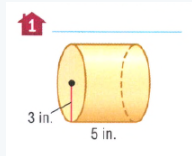
We are provided with the following figure.

Glencoe Math Course 3 Volume 2 Student 1st Edition Chapter 8 Volume and Surface Area Exercise 8.1 Page 593 Exercise 1, Problem1

From the figure, we can clearly say that the total figure has a height of 5 in and a radius as 3 in.

We can calculate the volume of the figure.

As per the formula;

V=3.14×3×3×5

=32.97

V ≈33.0 in3

After the calculations, the volume of the figure is found to be 33.0 in3.

Glencoe Math Coaurse 2 Student Edition Volume 1 Chapter 8 Volume And Surface Area Exercise 8.1

Page 593 Exercise 2, Problem1

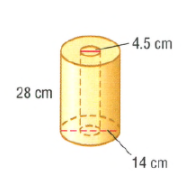
We are provided with the following figure.

Glencoe Math Course 3 Volume 2 Student 1st Edition Chapter 8 Volume and Surface Area Exercise 8.1 Page 593 Exercise 2, Problem1

From the figure, we can clearly say that the total figure has a height of 28 cm and the radius as 7,2.25 cm.

We can calculate the volume of the roll by substracting the volume of the smaller cylinder from the larger cylinder.

As per the formula;

The volume of a large cylinder \(V=\pi \times 7^2 \times 28\)

The volume of the smaller cylinder \(V^{\prime}=\pi \times 2.25^2 \times 28\)

Required volume = \(\left(\pi \times 7^2 \times 28\right)-\left(\pi \times 2.25^2 \times 28\right)\)

= \(28 \pi\left(7^2-2.25^2\right)\)

= \(28 \times 3.14 \times 43.9375\)

Required volume  = 3862.985 approx 3863.0 \(\mathrm{~cm}^3\)

After the calculations, the volume of the figure is found to be 3863.0 cm3.

Read and Learn More Glencoe Math Course 2 Volume 1 Common Core Student Edition Solutions

Page 593 Exercise 3, Problem1

We are provided with the following figure.

Glencoe Math Course 3 Volume 2 Student 1st Edition Chapter 8 Volume and Surface Area Exercise 8.1 Page 593 Exercise 3, Problem1

From the figure, we can clearly say that the total figure has a height of 6in and the radius as 1.25 in.

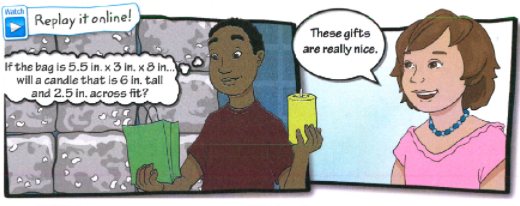
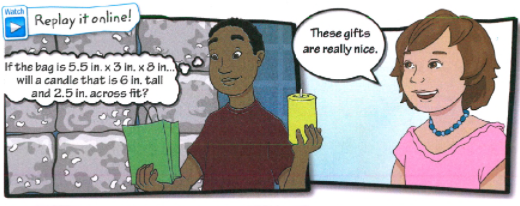
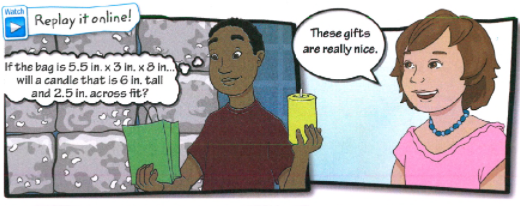
Similarly, the dimensions of the cuboid are 5.5×3×8 in.

We can calculate the volume of the figure.

As per the formula;

The volume of the bag

=5.5×3×8
=132 in3
The volume of the bag =132 in3

The volume of the candle

=3.14×1.25×1.25×6
=28.26 in3
=28.3 in3
The volume of the candle =28.3 in3
After the calculations, the volume of the candle and bag is found to be 132 in3 and 28.3 in3.
Chapter 8 Exercise 8.1 Volume And Surface Area Answers Glencoe Math Course 3 Volume 2 Page 593 Exercise 2, Problem2

We are provided with the following figure.

Glencoe Math Course 3 Volume 2 Student 1st Edition Chapter 8 Volume and Surface Area Exercise 8.1 Page 593 Exercise 3, Problem2

From the figure, we can clearly say that the total figure has a height of 6in and a radius as 1.25 in.

Similarly, the dimensions of the cuboid are  5.5 × 3 ×8 in.

We can calculate the volume of the figure. The difference between them gives us the required answer.

As per the previous calculations;

The volume of the bag=132 in3

The volume of the candle=28.3 in3

The total volume of packing material required is given by;

V=132−28.3

V =103.7in3

After the calculations, the volume of packing material in the bag is found to be 103.7 in3.


Page 593 Exercise 2, Problem3

We are provided with the following figure.

Glencoe Math Course 3 Volume 2 Student 1st Edition Chapter 8 Volume and Surface Area Exercise 8.1 Page 593 Exercise 3, Problem3


From the figure, we can clearly say that the total figure has a height of 6in and the radius as 1.25 in.

Similarly, the dimensions of the cuboid are 5.5 × 3 × 8 in.

We can calculate the volume of the figure.

As per the previous calculations;

The volume of packing material in each bag = 575 in3

Total number of teachers = 70

The total amount of packing material = 70×575

=40250 in3

After the calculations, the total volume of packing material in the bags is found to be 40250 in3.


Page 594 Exercise 1, Problem1

We are provided with the following figure.

Glencoe Math Course 3 Volume 2 Student 1st Edition Chapter 8 Volume and Surface Area Exercise 8.1 Page 594 Exercise 1, Problem1


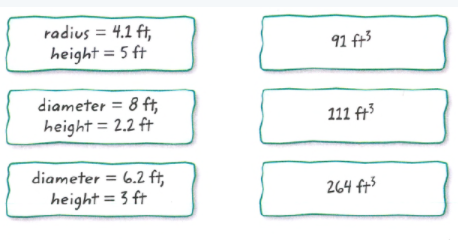
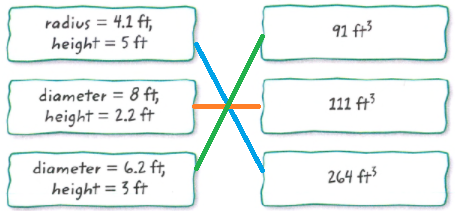
From the figure, we can clearly say that the total figures are provided with different dimensions. We can calculate the volume of the figure.

Glencoe Math Course 3 Volume 2 Student 1st Edition Chapter 8 Volume and Surface Area Exercise 8.1 Page 594 Exercise 1, Problem1.

After the calculations, we can say that they match the following as shown:


“Step-By-Step Solutions For Exercise 8.1 Chapter 8 Volume And Surface Area In Glencoe Math Course 3 Page 594 Exercise 2, Problem1

We are provided with the following figure.

Glencoe Math Course 3 Volume 2 Student 1st Edition Chapter 8 Volume and Surface Area Exercise 8.1 Page 594 Exercise 2, Problem1.

We have to draw a cylinder with more radius but less volume.

As we can observe that both the height and radius are directly proportional to the volume, so a cylinder with a smaller height should be our required figure. This figure is drawn as follows.

Glencoe Math Course 3 Volume 2 Student 1st Edition Chapter 8 Volume and Surface Area Exercise 8.1 Page 594 Exercise 2, Problem1

After further deductions, the final figure is constructed to be as shown.


Glencoe Math Course 3 Volume 2 Student 1st Edition Chapter 8 Volume and Surface Area Exercise 8.1 Page 594 Exercise 2, Problem1

Page 594 Exercise 3, Problem1

We are provided with the following figure.

Glencoe Math Course 3 Volume 2 Student 1st Edition Chapter 8 Volume and Surface Area Exercise 8.1 Page 594 Exercise 3, Problem1

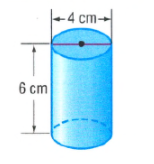
From the figure, we can clearly say that the total figure has a height of 6 cm and the radius as 2 cm.

We can calculate the volume of the figure.

As per the formula

V = 3.14×2×2×6

V  = 75.36 cm2

The volume of wax in the mould is found out to be 75.36≈75.4 cm2.


Exercise 8.1 Solutions For Chapter 8 Volume and Surface Area Glencoe Math Course 3 Volume 2 Page 595 Exercise 1, Problem1

We are provided with the following figure.

Glencoe Math Course 3 Volume 2 Student 1st Edition Chapter 8 Volume and Surface Area Exercise 8.1 Page 595 Exercise 1, Problem1.

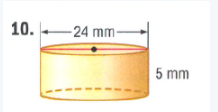
From the figure, we can clearly say that the total figure has a height of 5mm and the radius as 12mm.

We can calculate the volume of the figure.

As per the formula

V=3.14×12×12×5

V =2260.8mm3

After the calculations, the volume of the figure is found to be 2260.8 mm3

Examples of problems from Exercise 8.1 Chapter 8 Volume and Surface Area in Glencoe Math Course 3″  Page 595 Exercise 2, Problem1

We are provided with the following figure.

Glencoe Math Course 3 Volume 2 Student 1st Edition Chapter 8 Volume and Surface Area Exercise 8.1 Page 595 Exercise 2, Problem1.

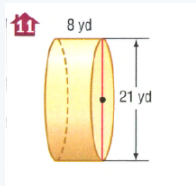
From the figure, we can clearly say that the total figure has a height of 8yd and a radius as 10.5 yd.

We can calculate the volume of the figure.

As per the formula;

V=3.14×10.5×10.5×8

V =2769.48yd3

V =2769.5yd3

After the calculations, the volume of the figure is found to be 2769.5 yd3.


Page 595 Exercise 3, Problem1

We are provided with the following figure.

Glencoe Math Course 3 Volume 2 Student 1st Edition Chapter 8 Volume and Surface Area Exercise 8.1 Page 595 Exercise 3, Problem1.

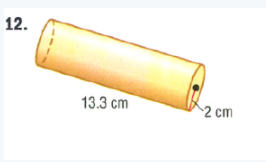
From the figure, we can clearly say that the total figure has a height of 13.3cm and the radius as 2cm.

We can calculate the volume of the figure.

As per the formula;

V=3.14×13.3×2×2

V =167.048

V =167.5cm3

After the calculations, the volume of the figure is found to be 167.5 cm3.


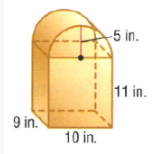
Page 595 Exercise 4, Problem1

We are provided with the following figure.

Glencoe Math Course 3 Volume 2 Student 1st Edition Chapter 8 Volume and Surface Area Exercise 8.1 Page 595 Exercise 4, Problem1.

Clearly, the figure is a combination of a cuboid and half a cylinder. From the figure, we can clearly say that the cylinder figure has a height of 9in and the radius as 5in.

Similarly, for the cuboid region, the length, breadth, and height are found as 9,10,11 in.

We can calculate the volume of the figure.

The volume of the cuboid region is found as

v=l × b × h

V =9×10×11

V =990 in3

The volume of the half-cylinder is found as;

v′=12×π×r2×h

=12×3.14×52×9

=353.25 in3

Total volume = 990+353.25

=1043.25in3

After the calculations, we can say that the total volume of the mailbox is 1043.2 in3.


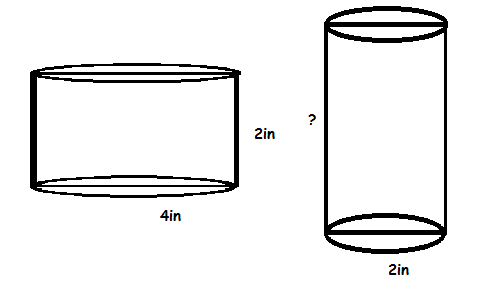
Page 595 Exercise 5, Problem1

We are provided with the following figure.

Glencoe Math Course 3 Volume 2 Student 1st Edition Chapter 8 Volume and Surface Area Exercise 8.1 Page 595 Exercise 5, Problem1.

From the figure, we have to find the height of the second cylinder so that both their volumes are same.

We can calculate the volume of the figure.

The volume of the first cylinder

V = 3.14×4×4×2

V = 100.48in3

The volume of the second cylinder

V′ = 3.14×2×2×h

= 12.56h in3

∴V=V′

⇒ 12.56h=100.48

⇒ h=100.48

12.56

⇒h=8 in

After the calculations, we can say that the height of the cylinder is 8 in.


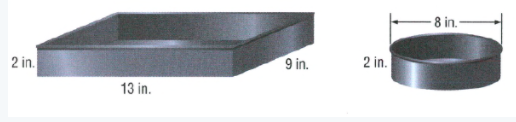
Page 595 Exercise 6, Problem1

We are provided with the following figure.

Glencoe Math Course 3 Volume 2 Student 1st Edition Chapter 8 Volume and Surface Area Exercise 8.1 Page 595 Exercise 6, Problem1.

We have to find which figure has more volume. We can calculate the volume of the figures using the formula.

The volume of the cuboid container is found as

=13×9×2

=234 in3

The volume of the cylinder is found as;

=3.14×2×4×4

=100.48in3

Volume of 2 cylinder pans=200.1in3

Clearly, the cuboid has more volume.

After the calculations, we can say that the cuboid will hold more than two circular pans as it has more volume.


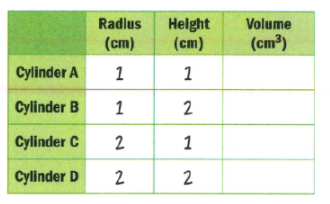
Page 595 Exercise 7, Problem1

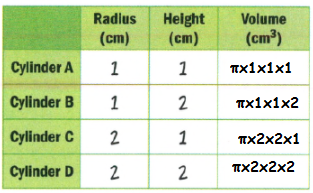
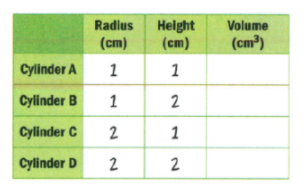
We are provided with the following table.

Glencoe Math Course 3 Volume 2 Student 1st Edition Chapter 8 Volume and Surface Area Exercise 8.1 Page 595 Exercise 7, Problem1

We have to write the equation to find the volume for each cylinder. We can do so as shown.

Glencoe Math Course 3 Volume 2 Student 1st Edition Chapter 8 Volume and Surface Area Exercise 8.1 Page 595 Exercise 7, Problem1.

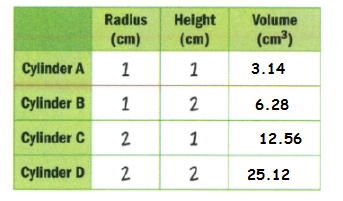
After the calculations, the table is completed as shown.

Glencoe Math Course 3 Volume 2 Student 1st Edition Chapter 8 Volume and Surface Area Exercise 8.1 Page 595 Exercise 7, Problem1.


Page 595 Exercise 7, Problem2

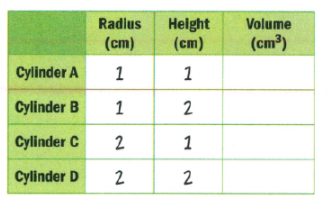
We are provided with the following table.

Glencoe Math Course 3 Volume 2 Student 1st Edition Chapter 8 Volume and Surface Area Exercise 8.1 Page 595 Exercise 7, Problem2


We have to compare the dimensions for each cylinder. We can clearly see that cylinders A and B have the same radius but different heights same as cylinders C and D.

So we can say that cylinder B is the double of cylinder A and similar for cylinder D and C.

After the deductions, we can say that cylinders B and D are double the cylinders A and C as per heights.


Page 595 Exercise 7, Problem3

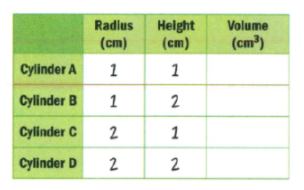
We are provided with the following table.

Glencoe Math Course 3 Volume 2 Student 1st Edition Chapter 8 Volume and Surface Area Exercise 8.1 Page 595 Exercise 7, Problem3

We have to complete the table by finding the volume for each cylinder. We can do so as shown.

Glencoe Math Course 3 Volume 2 Student 1st Edition Chapter 8 Volume and Surface Area Exercise 8.1 Page 595 Exercise 7, Problem3.

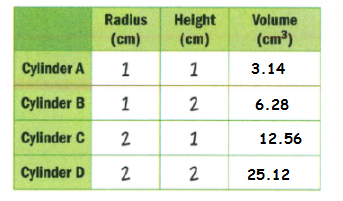
After the calculations, the table is completed as shown.

Glencoe Math Course 3 Volume 2 Student 1st Edition Chapter 8 Volume and Surface Area Exercise 8.1 Page 595 Exercise 7, Problem3.


Page 595 Exercise 7, Problem4

We are provided with the following table.

Glencoe Math Course 3 Volume 2 Student 1st Edition Chapter 8 Volume and Surface Area Exercise 8.1 Page 595 Exercise 7, Problem4


After completion, the table is found as shown.

Glencoe Math Course 3 Volume 2 Student 1st Edition Chapter 8 Volume and Surface Area Exercise 8.1 Page 595 Exercise 7, Problem4.

Clearly, we can see as the dimension increases the volumes keeps increasing.

After the calculations, the table is completed as it is deduced that with the increase of dimensions, the volume of the figure keeps increasing.


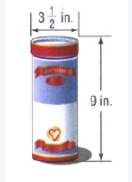
Page 596 Exercise 1, Problem1

We are provided with the following figure.

Glencoe Math Course 3 Volume 2 Student 1st Edition Chapter 8 Volume and Surface Area Exercise 8.1 Page 596 Exercise 1, Problem1

From the figure, we can clearly say that the total figure has a height of 9in and the radius as 1.75in.

We can calculate the volume of the figure.

As per the formula;

V=3.14×9×1.75×1.75

V =86.54 in3

After the calculations, the volume of the figure is found to be 86.54in3.


Page 596 Exercise 2, Problem1

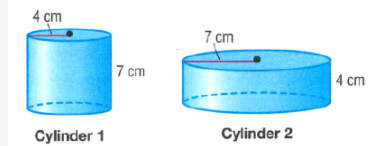
We are provided with the following figure.

Glencoe Math Course 3 Volume 2 Student 1st Edition Chapter 8 Volume and Surface Area Exercise 8.1 Page 596 Exercise 2, Problem1

From the figure, we have to find the volume of both the cylinder and find the relation between them. We can calculate the volume of the figure using the formula.

The volume of the first cylinder = 3.14×4×4×7

= 351.68 cm3

The volume of the second cylinder = 3.14×7×7×4

= 651.44 cm3

Clearly, the volume of Cylinder 2 is greater than the volume of Cylinder 1.

After the calculations, we deduce that the volume of Cylinder 2 is greater than the volume of Cylinder 1.


Page 596 Exercise 3, Problem1

The given circle is

Glencoe Math Course 3 Volume 2 Student 1st Edition Chapter 8 Volume and Surface Area Exercise 8.1 Page 596 Exercise 3, Problem1

We have to determine the area of this circle.

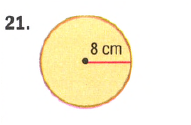
The radius of the given circle is 8cm. We apply the formula A=πr2  to find the area.

We have a circle of radius 8 cm

Glencoe Math Course 3 Volume 2 Student 1st Edition Chapter 8 Volume and Surface Area Exercise 8.1 Page 596 Exercise 3, Problem1

Since we know that the area of a circle of radius 8 cm is A=πr2

where A is the area and r is the radius of the circle.

So, we can write, A=π(8) 2

⇒ A = 64π

⇒A = 64×22/7

⇒A ≈ 201.1 cm2.

Therefore, the approximated area of the given circle is 201.1 cm2.


Page 596 Exercise 4, Problem1

The given circle is

Glencoe Math Course 3 Volume 2 Student 1st Edition Chapter 8 Volume and Surface Area Exercise 8.1 Page 596 Exercise 4, Problem1

We have to determine the area of this circle.

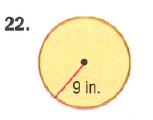
The radius of the given circle is 9 in. We apply the formula A=πr2 to find the area.

We have a circle of radius 9 cm

Glencoe Math Course 3 Volume 2 Student 1st Edition Chapter 8 Volume and Surface Area Exercise 8.1 Page 596 Exercise 4, Problem1

Since we know that the area of a circle of radius 9 in. is A=πr2

where A is the area and r is the radius of the circle.

So, we can write, A = π(9) 2

⇒ A=81π

⇒ A = 81×22/7

⇒ A ≈ 254.5in2.

Therefore, the approximated area of the given circle is 254.5  in2.

Finally, we can conclude that the approximated area of the circle with a radius of 9 in. is 254.5 in2.


Page 596 Exercise 5, Problem1

The given circle is

Glencoe Math Course 3 Volume 2 Student 1st Edition Chapter 8 Volume and Surface Area Exercise 8.1 Page 596 Exercise 5, Problem1

We have to determine the area of this circle.

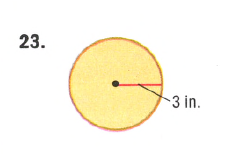
The radius of the given circle is 3 in. We apply the formula A=πr2 to find the area.

We have a circle of radius 3 in

Glencoe Math Course 3 Volume 2 Student 1st Edition Chapter 8 Volume and Surface Area Exercise 8.1 Page 596 Exercise 5, Problem1

Since we know that the area of a circle of radius 3 in. is A=πr2

where A is the area and r is the radius of the circle.

So, we can write, A = π(3) 2

⇒ A = 9π

⇒ A ≈ 28.3in2.

Therefore, the approximated area of the given circle is 28.3in2.

Finally, we can conclude that the approximated area of the circle with a radius of 3 in. is 28.3 in2.


Page 596 Exercise 6, Problem1

The given circle is

Glencoe Math Course 3 Volume 2 Student 1st Edition Chapter 8 Volume and Surface Area Exercise 8.1 Page 596 Exercise 6, Problem1

We have to determine the area of this circle.

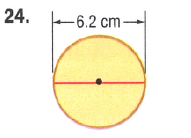
The diameter of the given circle is 6.2 cm. We apply the formula A=πr2 to find the area.

We have a circle of diameter 6.2 cm

Glencoe Math Course 3 Volume 2 Student 1st Edition Chapter 8 Volume and Surface Area Exercise 8.1 Page 596 Exercise 6, Problem1

Now, the radius of the circle is (6.2)/2 =3.1cm.

Since we know that the area of a circle of radius 3.1 cm is A=πr2

where  A is the area and r is the radius of the circle.

So, we can write, A = π(3.1) 2

⇒ A=9.61π

⇒ A = 9.61×22/7

⇒ A ≈ 30.2 cm2.

Therefore, the approximated area of the given circle is 30.2 cm2.

Finally, we can conclude that the approximated area of the circle with a diameter of 6.2 cm is 30.2 cm2.


Page 596 Exercise 7, Problem1

The given circle is

Glencoe Math Course 3 Volume 2 Student 1st Edition Chapter 8 Volume and Surface Area Exercise 8.1 Page 596 Exercise 7, Problem1

We have to determine the area of this circle.

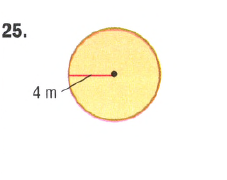
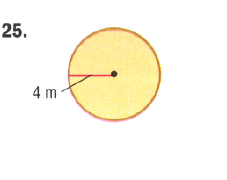
The radius of the given circle is 4 m. We apply the formula A=πr2  to find the area.

We have a circle of radius 4m

Glencoe Math Course 3 Volume 2 Student 1st Edition Chapter 8 Volume and Surface Area Exercise 8.1 Page 596 Exercise 7, Problem1

Since we know that the area of a circle of radius 4m is A = πr2

where A is the area and r is the radius.

So, we can write, A = π(4) 2

⇒A=16π

⇒A≈50.3m2.

Therefore, the approximated area of the given circle is 50.3 m2.

Finally, we can conclude that the approximated area of the circle with a radius of 4 m is 50.3m2.


Page 596 Exercise 8, Problem1

The given prism is

Glencoe Math Course 3 Volume 2 Student 1st Edition Chapter 8 Volume and Surface Area Exercise 8.1 Page 596 Exercise 8, Problem1

We have to determine the volume of the prism.

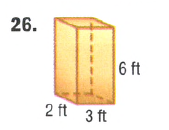
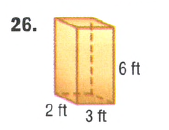
The three dimensions of the prism are 2ft, 3ft, and 6ft. We apply the formula V = l × d × h  to find the volume.

We have a prism of length 3 ft, width 2 ft, and height 6 ft

Glencoe Math Course 3 Volume 2 Student 1st Edition Chapter 8 Volume and Surface Area Exercise 8.1 Page 596 Exercise 8, Problem1

Since we know that the volume of a prism of dimensions 2ft, 3ft, and 6ft is V = l × d × h.

So, we can write V = 2×3×6

⇒ V = 36ft3.

Therefore, the determine d volume of the prism is 36ft3.

Finally, we can conclude that the determined volume of the prism is 36ft3.


Glencoe Math Course 3 Volume 2 Student 1st Edition Chapter 7 Congruence And Similarity Exercise 7.1

Glencoe Math Course 3 Volume 2 Student Chapter 7 Congruence And Similarity Exercise


Glencoe Math Course 3 Volume 2 Chapter 6 Transformations Exercise Solutions Page 509 Exercise 1, Problem1

Two items are similar if their shapes are the same, and one is a larger version of the other. When two objects have the same shape and size, they are said to be congruent.

The triangles are comparable if two pairs of corresponding angles in a pair of triangles are congruent. This is because if two angle pairs are equal, the third pair must be equal as well.

When all three angle pairs are equal, the three pairs of sides must be proportionate as well.

When two items have the same shape, one is an expansion of the other. When two objects have the same shape and size, they are congruent.


Common Core Chapter 6 Transformations Exercise Answers Glencoe Math Course 3v Page 509 Exercise 2, Problem1

We have been given the letter R written in Braille.

We need to find that which letter is of the same shape as R.

This can be found by counting and comparing the number of big dots and the number of small dots.

R has 3 big dots and 2 small dots in Braille.

We see that W also has 3 big dots and 2 small dots in Braille.
Glencoe Math Course 2 Student Edition Volume 1 Chapter 7 Congruence Exercise 7.1

Hence, they are similar.

Finally, we can determine that the W is the letter with the same shape as the letter R.

Read and Learn More Glencoe Math Course 2 Volume 1 Common Core Student Edition Solutions

Glencoe Math Course 3 Volume 2 Student Chapter 7 Page 509 Exercise 2 Problem1

We have been given a figure.

We need to copy the figure shown on tracing paper two times and then cut out both figures and finally label the figures A and B.

This can be achieved by checking if the figures are similar to each other or not.

The figure shown has been copied on tracing paper two times.

Both figures have been cut and labeled as A and B.

It can be seen that both the figures have the same shape and size and they are similar.

Finally, we can determine that figures A and B have the same size and shape.


Step-By-Step Solutions For Chapter 6 Transformations Exercises In Glencoe Math Course Page 509 Exercise 2, Problem2

We have been given two figures A and B.

We need to find out whether these figures have the same lengths and angles.

This can be found by checking whether the two figures are similar or not.

When the two figures are kept on top of each other, it is seen that the figures coincide.

Hence, they have the same lengths and angles.

Figures A and B have the same side lengths and angles.


Glencoe Math Course 3 Volume 2 Student Chapter 7 Page 509 Exercise 2 Problem3

We have been figures A and B.

We need to find whether these figures have the same side lengths and angles.

This can be found by the fact that similar figures do not always necessarily coincide.

When figures A and B are kept on top of each other, they produce mirror images of each other.

Hence, they are similar, i.e, they have the same side lengths and angles, but do not coincide.

Finally, we can determine that figures A and B have the same side lengths and angles.


Exercise Solutions For Chapter 6 Transformations Glencoe Math Course 3 Volume 2 Page 509 Exercise 2, Problem4

We have been given two figures A and B.

We need to move Figure A on top of Figure B so all sides and angles match.

This can be done based on that fact that putting figures facing each other is another way to make them coincide.

Put figure A in such a way that its bottom portion faces Figure B, i.e, put them facing facing other.
We see that the angles match when they’re put like that.

Finally, we can determine that it is put facing Figure B so that all sides and angles match.

Glencoe Math Course 3 Volume 2 Student Chapter 7 Page 512 Exercise 1 Problem1

We have been given two figures. We need to determine if the two figures are congruent by using transformations.

This can be found based on the fact that two figures are congruent if the second figure can be obtained from the first by a series of rotations, reflections, and/or translations(without affecting the size and shape).

Reflecting ΔLMN over the horizontal line.
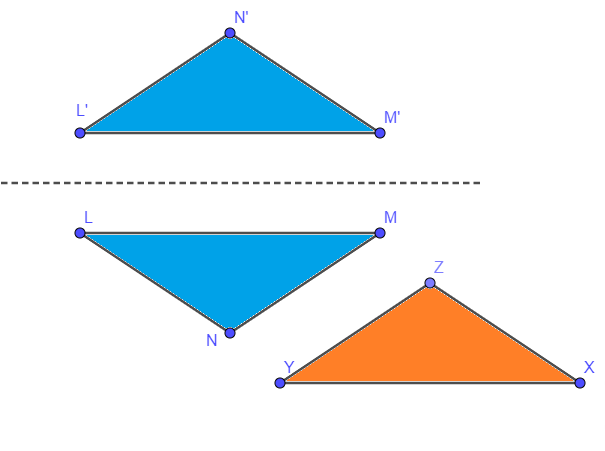
Glencoe Math Course 3 Volume 2 Student 1st Edition Chapter 7 Congruence And Similarity Exercise 7.1 Page 512 Exercise 1, Problem1

MovingΔL′M′N′to the right and going down until all sides and angles of ΔL′M′N′matches to the sides and angles of ΔXYZ.
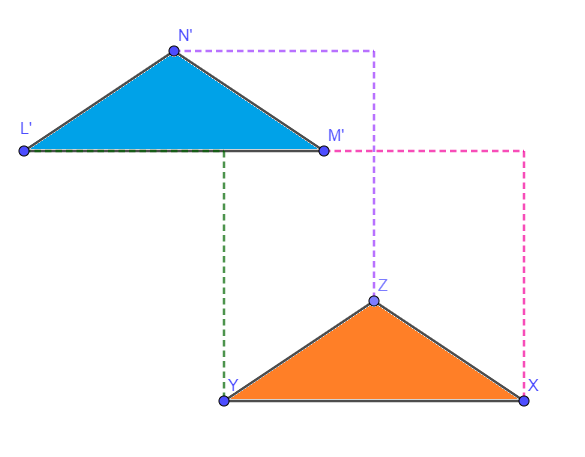
Glencoe Math Course 3 Volume 2 Student 1st Edition Chapter 7 Congruence And Similarity Exercise 7.1 Page 512 Exercise 1, Problem1.


The given figures are congruent as a series of transformations makes them coincide.


Glencoe Math Course 3 Volume 2 Student Chapter 7 Page 512 Exercise 2 Problem1

We have been given two figures.

We need to determine if the two figures are congruent by using transformations.

This can be found based on the fact that two figures are congruent if the second figure can be obtained from the first by a series of rotations, reflections, and/or translations(without affecting the size and shape).

Turning the red figure at an angle of 90o in the counterclockwise direction.
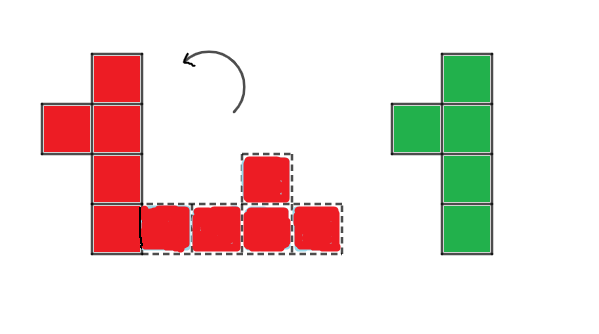
Glencoe Math Course 3 Volume 2 Student 1st Edition Chapter 7 Congruence And Similarity Exercise 7.1 Page 512 Exercise 2, Problem1

Moving the obtained figure to the rigt until it matches to the green figure completely.
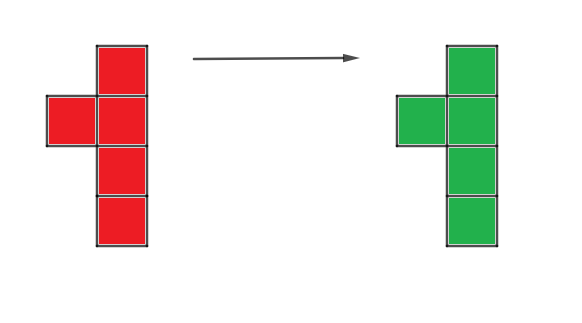
Glencoe Math Course 3 Volume 2 Student 1st Edition Chapter 7 Congruence And Similarity Exercise 7.1 Page 512 Exercise 2, Problem1.

The given figures are congruent as a series of transformations makes them coincide.


Glencoe Math Course 3 Volume 2 Student Chapter 7 Page 512 Exercise 2 Problem2

We have been given two figures. We need to determine if the two figures are congruent by using transformations.

This can be found based on the fact that two figures are congruent if the second figure can be obtained from the first by a series of rotations, reflections, and/or translations(without affecting the size and shape).

Turning the red figure at an angle of 90 in the counterclockwise direction.
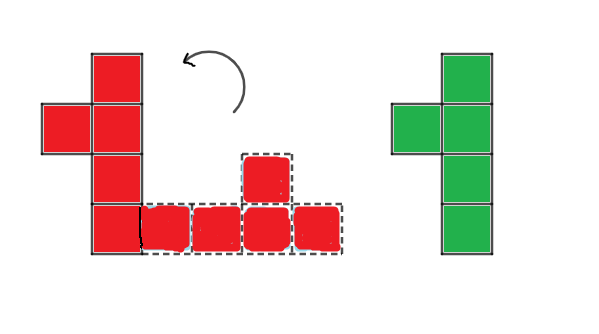
Glencoe Math Course 3 Volume 2 Student 1st Edition Chapter 7 Congruence And Similarity Exercise 7.1 Page 512 Exercise 2, Problem2

Moving the obtained figure to the rigt until it matches to the green figure completely.
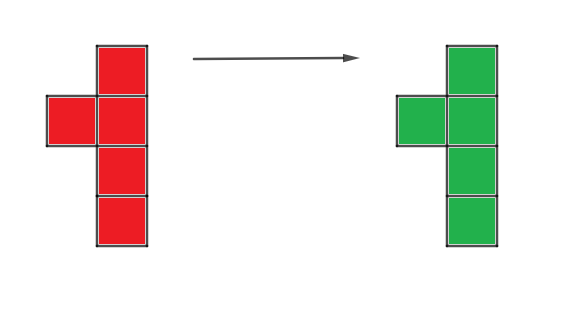
Glencoe Math Course 3 Volume 2 Student 1st Edition Chapter 7 Congruence And Similarity Exercise 7.1 Page 512 Exercise 2, Problem2.

The given figures are congruent as a series of transformations makes them coincide.

Glencoe Math Course 3 Volume 2 Student Chapter 7 Page 512 Exercise 3 Problem1

We have been given two figures.

We need to determine if the two figures are congruent by using transformations.

This can be found based on the fact that two figures are congruent if the second figure can be obtained from the first by a series of rotations, reflections, and/or translations(without affecting the size and shape).

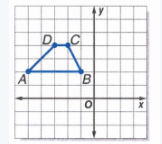
The figure is named as follows,
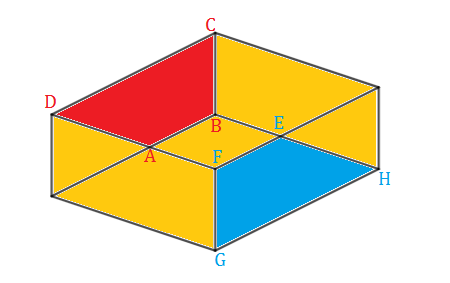
Glencoe Math Course 3 Volume 2 Student 1st Edition Chapter 7 Congruence And Similarity Exercise 7.1 Page 512 Exercise 3, Problem1

To map trapezoid EFGH to trapezoid ABCD, we follow the upcoming steps,

1. Reflecting the trapezoid EFGH over x-axis and then creating trapezoid E’F’G’H’.
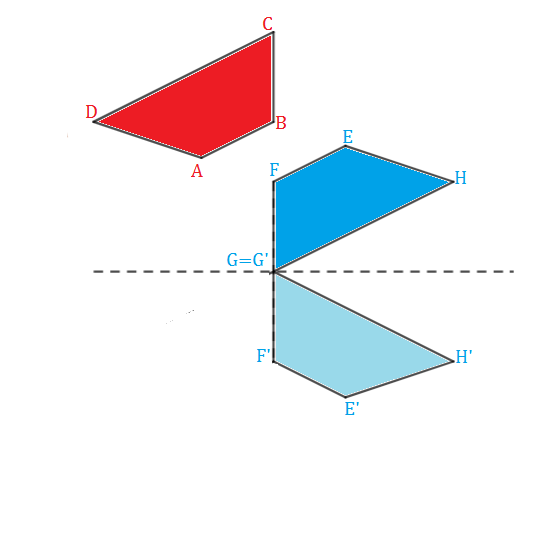
Glencoe Math Course 3 Volume 2 Student 1st Edition Chapter 7 Congruence And Similarity Exercise 7.1 Page 512 Exercise 3, Problem1.

2. Reflecting the trapezoid E’F’G’H’ over y-axis and creating E”F”G”H”.

3. Translating the trapezoid E”F”G”H” upward until it maps the trapezoid ABCD.
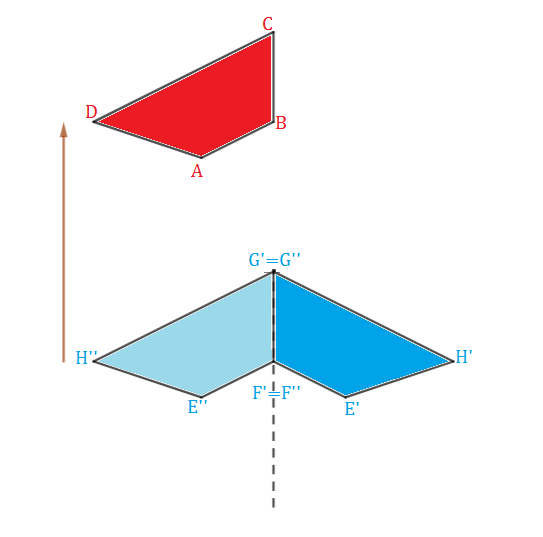
Glencoe Math Course 3 Volume 2 Student 1st Edition Chapter 7 Congruence And Similarity Exercise 7.1 Page 512 Exercise 3, Problem-1.

The given figures are congruent as a series of transformations makes them coincide.

Examples of problems from Chapter 6 Transformations Exercises In Glencoe Math Course 3 Page 512 Exercise 4, Problem1

We have been given two figures.

We need to determine if the two figures are congruent by using transformations.

This can be found based on the fact that two figures are congruent if the second figure can be obtained from the first by a series of rotations, reflections, and/or translations(without affecting the size and shape).

Reflection, translation, and rotation change the position of the image but do not change the size and shape of the image, hence, these transformations create congruent images.

On the other hand, dilation changes the size of the image.

So, the image created by dilation is similar but not congruent(unless k=1).

Reflection, translation, and rotation change the position of the image but do not change the size and shape of the image, hence, these transformations create congruent images.


Glencoe Math Course 3 Volume 2 Student Chapter 7 Page 513 Exercise 1 Problem1

We have been given two figures.

We need to determine if the two figures are congruent by using transformations.

This can be found based on the fact that two figures are congruent if the second figure can be obtained from the first by a series of rotations, reflections or translations(without affecting the size and shape).

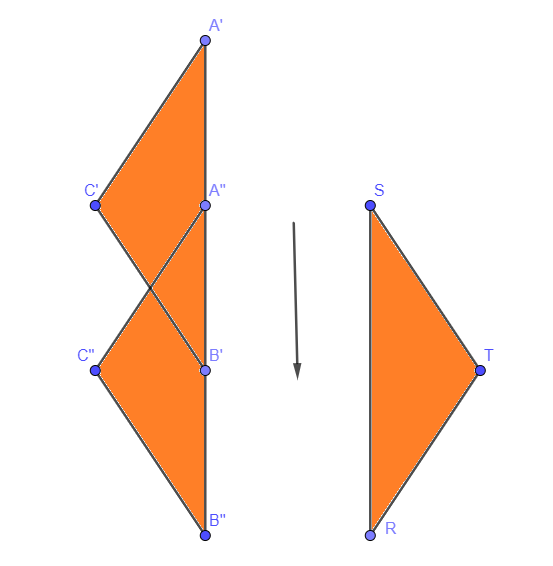
Turning ΔABC at an angle 90 in the clockwise direction.
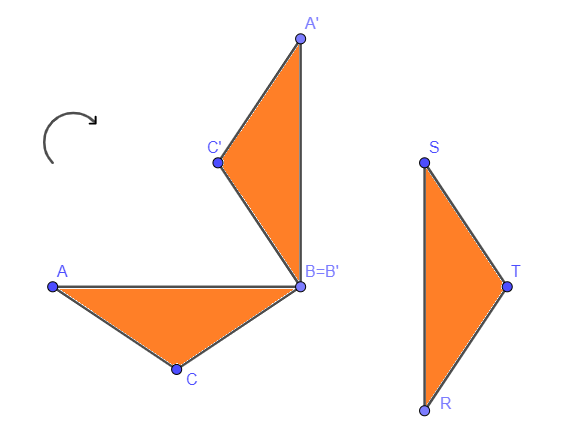
Glencoe Math Course 3 Volume 2 Student 1st Edition Chapter 7 Congruence And Similarity Exercise 7.1 Page 513 Exercise 1, Problem1


Moving A′B′C′to the down.

Glencoe Math Course 3 Volume 2 Student 1st Edition Chapter 7 Congruence And Similarity Exercise 7.1 Page 513 Exercise 1, Problem1.

Reflecting ΔA′′B′′C′′over vertical line.
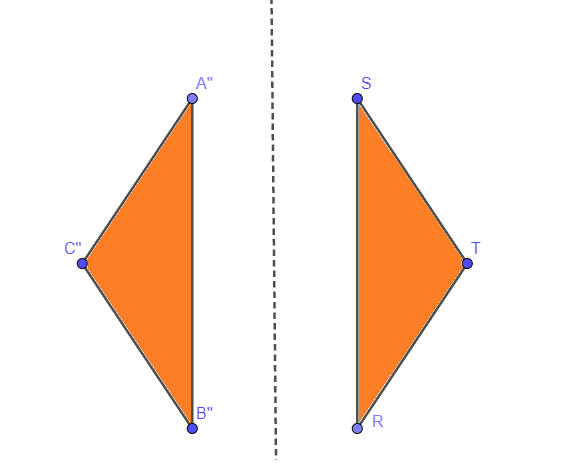
Glencoe Math Course 3 Volume 2 Student 1st Edition Chapter 7 Congruence And Similarity Exercise 7.1 Page 513 Exercise 1, Problem-1


The given figures are congruent as a series of transformations makes them coincide.

Student Edition Chapter 6 Transformations Solutions Guide Glencoe Math Course 3 Volume 2 Page 513 Exercise 2, Problem1

We have been given two figures. We need to determine if the two figures are congruent by using transformations.

This can be found based on the fact that two figures are congruent if the second figure can be obtained from the first by a series of rotations, reflections and translations(without affecting the size and shape).

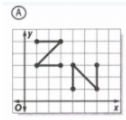
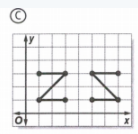
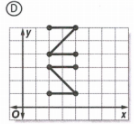
Turning the letter Z at an angle of 90 in the clockwise direction.
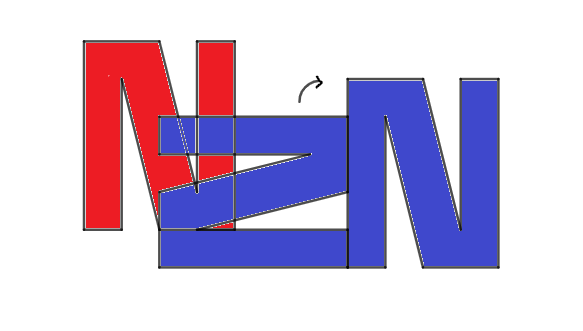
Glencoe Math Course 3 Volume 2 Student 1st Edition Chapter 7 Congruence And Similarity Exercise 7.1 Page 513 Exercise 2, Problem1


Moving the turned image of the letter Z to the right and then up until it overlaps the letter N.
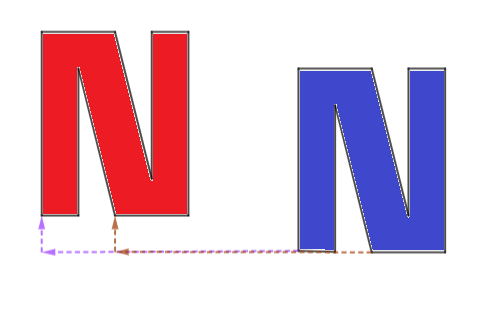
Glencoe Math Course 3 Volume 2 Student 1st Edition Chapter 7 Congruence And Similarity Exercise 7.1 Page 513 Exercise 2, Problem1.


The given figures are congruent as a series of transformations makes them coincide.

Glencoe Math Course 3 Volume 2 Student Chapter 7 Page 513 Exercise 3 Problem1

The three vertices of the triangle ΔCDE are given as C(1,4), D(1,1), and E(5,1).

First, we plot each vertex C(1,4), D(1,1), and E(5,1)on the coordinate plane.

Then connect each vertex to form sidesCD, DE, and CE of the triangle ΔCDE.
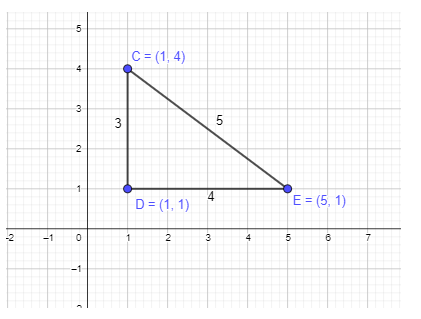
Glencoe Math Course 3 Volume 2 Student 1st Edition Chapter 7 Congruence And Similarity Exercise 7.1 Page 513 Exercise 3, Problem1

The ΔCDE is plotted as shown above.

Step-By-Step Answers For Chapter 6 Transformations In Glencoe Math Course 3 Volume 2 Page 513 Exercise 3, Problem2

The three vertices of ΔCDE are C(1,4), D(1,1), and E(5,1).
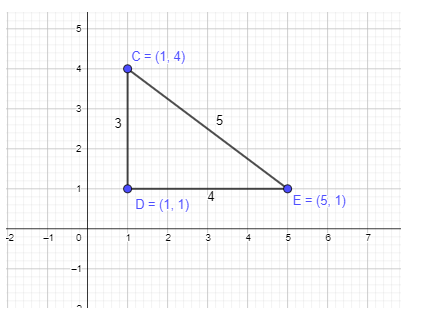
Glencoe Math Course 3 Volume 2 Student 1st Edition Chapter 7 Congruence And Similarity Exercise 7.1 Page 513 Exercise 3, Problem2

We have to find the length of the sidesCD, DE, and CE.

We know the distance between two points(x​1,y1) and ​(x2,y2)is given asDistance=√(x2−x1)²+(y2−y1)².

The length of CD with vertices C(1,4) and D(1,1) will be:

CD = \(\sqrt{\left(x_2-x_1\right)^2+\left(y_2-y_1\right)^2}\)

CD = \(\sqrt{(1-1)^2+(1-4)^2}\)

CD = \(\sqrt{(0)^2+(-3)^2}\)

CD = \(\sqrt{0+9}\)

CD = 3 units.

The length of DE with vertices D(1,1) and E(5,1) will be:

DE = \(\sqrt{\left(x_2-x_1\right)^2+\left(y_2-y_1\right)^2}\)

DE = \(\sqrt{(5-1)^2+(1-1)^2}\)

DE = \(\sqrt{(4)^2+(0)^2}\)

DE = \(\sqrt{16}\)

DE = 4 unit.

The length of CE with vertices C(1,4) and E(5,1) will be:

CE = \(\sqrt{\left(x_2-x_1\right)^2+\left(y_2-y_1\right)^2}\)

CE = \(\sqrt{(5-1)^2+(1-4)^2}\)

CE = \(\sqrt{(4)^2+(-3)^2}\)

CE = \(\sqrt{16+9}\)

CE = \(\sqrt{25}\)

CE = 5 unit.

The length of the sides of ΔCDE is CD=3 units, DE = 4 units, and CE = 5 units.

Glencoe Math Course 3 Volume 2 Student Chapter 7 Page 513 Exercise 3 Problem3

After reflection from the y-axis, the y-coordinate of each point of the initial image will remain the same and the x-coordinate will be multiplied by  -1. The three coordinates of the vertices of ΔCDE are given as

First, we will take the reflection and then translate it to get the final image.

The three coordinates of the vertices of ΔCDE are given as C(1,4), D(1,1), and  E(5,1).

The three coordinates of the vertices of \(\triangle C D E\) are given as C(1,4), D(1,1), and E(5,1).

After taking a reflection along the y-axis we get

(x, y) → (-x, y)

C(1,4) → C(-1,4)

D(1,1) → D(-1,1)

E(5,1) → E(-5,1)

Now, after taking 2 units left translation we get

(x, y) → (x+2, y)

⇒ \(C^{\prime}(-1,4) \rightarrow C^{\prime}(-3,4)\)

⇒ \(D^{\prime}(-1,1) \rightarrow D^{\prime}(-3,1)\)

⇒ \(E^{\prime}(-5,1) \rightarrow E^{\prime}(-7,1)\)

After transformation the coordinates of the vertices ofΔC′D′E′becomesC′(−3,4), D′(−3,1) and E′(−7,1).

Glencoe Math Course 3 Volume 2 Student Chapter 7 Page 513 Exercise 3 Problem4

Three vertices of ΔC′D′E′are C′(−3,4), D′(−3,1) and E′(−7,1).

We have to find the length of the sides C′D′, D′E′ and C′E′.

We know the distance between two points(x1,y1) and ​(x2,y2)is given as √(x2−x1)²+(y2−y1)².

The length of the side \(C^{\prime} D^{\prime}\) with vertices \(C^{\prime}(-3,4), D^{\prime}(-3,1)\) is given as:

⇒ \(C^{\prime} D^{\prime}=\sqrt{\left(x_2-x_1\right)^2+\left(y_2-y_1\right)^2}\)

⇒ \(C^{\prime} D^{\prime}=\sqrt{(-3+3)^2+(1-4)^2}\)

⇒ \(C^{\prime} D^{\prime}=\sqrt{(0)^2+(-3)^2}\)

⇒ \(C^{\prime} D^{\prime}=\sqrt{9}\)

∴ \(C^{\prime} D^{\prime}=3 \text { unit. }\)

The length of the side \(D^{\prime} E^{\prime}\) with vertices \(D^{\prime}(-3,1)\) and \(E^{\prime}(-7,1)\)is given as:

⇒ \(^{\prime} E^{\prime}=\sqrt{\left(x_2-x_1\right)^2+\left(y_2-y_1\right)^2}\)

⇒ \(D^{\prime} E^{\prime}=\sqrt{(-7+3)^2+(1-1)^2}\)

⇒ \(D^{\prime} E^{\prime}=\sqrt{(-4)^2+(0)^2}\)

⇒ \(D^{\prime} E^{\prime}=\sqrt{16}\)

∴ \(D^{\prime} E^{\prime}=4 \text { unit. }\)

The length of the side \(C^{\prime} E^{\prime}\) with vertices \(C^{\prime}\left(-3,4\right.\) and \(E^{\prime}(-7,1)\) is given as:

⇒ \(C^{\prime} E^{\prime}=\sqrt{\left(x_2-x_1\right)^2+\left(y_2-y_1\right)^2}\)

⇒ \(C^{\prime} E^{\prime}=\sqrt{(-7+3)^2+(1-4)^2}\)

⇒ \(C^{\prime} E^{\prime}=\sqrt{(-4)^2+(-3)^2}\)

⇒ \(C^{\prime} E^{\prime}=\sqrt{16+9}\)

⇒ \(C^{\prime} E^{\prime}=\sqrt{25}\)

⇒ \(C^{\prime} E^{\prime}=5 \text { unit. }\)

The length of the sides ofΔC′D′E′areC′D′=3 unit, D′E′=4 unit and C′E′=5 unit.

Page 513 Exercise 3, Problem5

Two figures are congruent if the second can be obtained from the first by a series of transformations (rotations reflections and translation).

Here, ΔC′D′E′is created by reflection followed by a translation of ΔCDE therefore, both these Triangles are congruent.

The other way to identify congruent triangles is that their matching side must have the same measure.

In the case of ΔCDE the length of their sides are =3 unit, DE =4 unit and CE =5 unit.

In the case ofΔC′D′E′the length of their sides are ′D′=3 unit, D′E′=4 unit, and C′E′=5 unit.

Therefore, these triangles are congruent.

ΔCDE and ΔC′D′E′are congruent triangles.

Glencoe Math Course 3 Volume 2 Student Chapter 7 Page 514 Exercise 4 Problem1

An image can be created using a number of ways of transformations. We will see two different ways. Way 1: Create triangle A as shown in the picture and reflect it over a vertical line to create triangle B.

Rotate the design created by triangles A and B at an angle of 90∘ ,180∘ , and 270∘ to create the final design as shown in the picture.
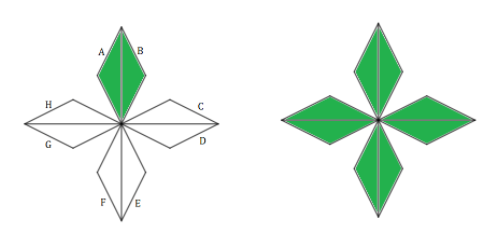
Glencoe Math Course 3 Volume 2 Student 1st Edition Chapter 7 Congruence And Similarity Exercise 7.1 Page 514 Exercise 4, Problem1


Way 2: Create a triangle A and a triangle H as shown in the picture and then rotate the design created at an angle of 90∘ ,180∘ , and 270∘ to create a final design as shown in the picture.
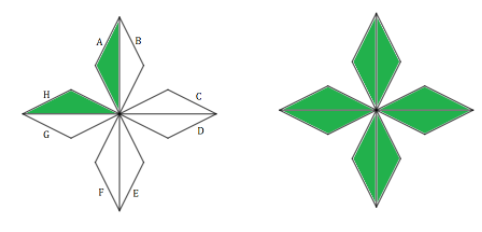
Glencoe Math Course 3 Volume 2 Student 1st Edition Chapter 7 Congruence And Similarity Exercise 7.1 Page 514 Exercise 4, Problem1.

The methods of creating a leaf design are described above and the required image is also attached.


Glencoe Math Course 3 Volume 2 Student Chapter 7 Page 514 Exercise 5 Problem1

Sketch segment BO connecting point B(−2,1) to the origin O(0, 0).

Sketch another segment B′O, so that the angle between points B, O, and B′ measures 90° and the segment is the same length as BO.

Do the same with vertex A(−3,4) and C(2,2)

The vertices of ΔABC\ after the rotation will be A′(4,3),B′(1,2),andC′(2,−2).
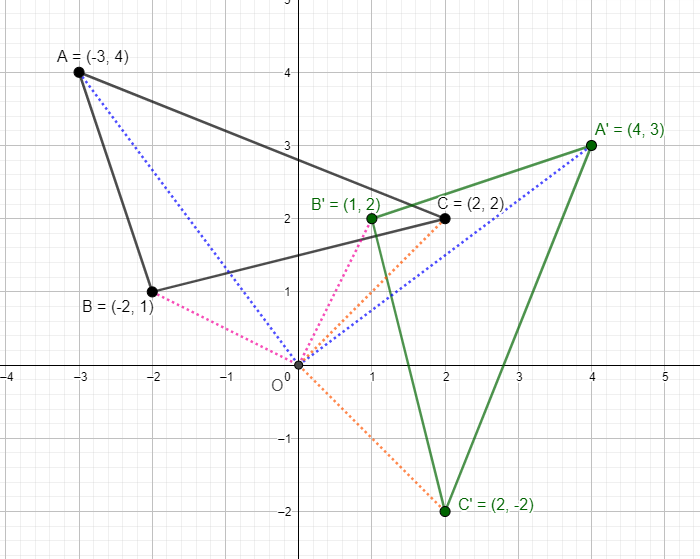
Glencoe Math Course 3 Volume 2 Student 1st Edition Chapter 7 Congruence And Similarity Exercise 7.1 Page 514 Exercise 5, Problem1

We have ΔA’B’C’ with vertices A′(4,3),B′(1,2)and C′(2,−2)

Here, a=0 and b=2 (x,y)→(x+0),(y+3)

A′(4,3)→(4+0,3+2)→(4,5)

B′(1,2)→(1+0,2+2)→(1,4)

C′(2,−2)→(2+0,−2+2)→(2,0)

So, the vertices of ΔA”B”C” areA″(4,5),B″(1,4)and C″(2,0).
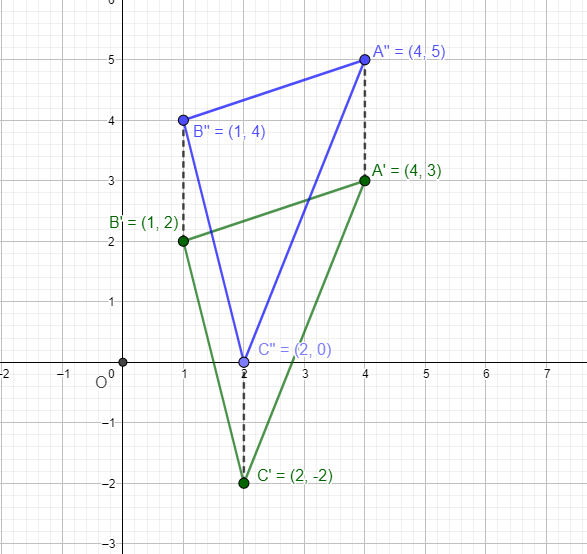
Glencoe Math Course 3 Volume 2 Student 1st Edition Chapter 7 Congruence And Similarity Exercise 7.1 Page 514 Exercise 5, Problem1.

After reflection from the y−axis, the y−coordinate of each point of the initial image will remain the same and the x−coordinates will be multiplied by -1.

We have ΔA”B”C′′ with vertices A″(4,5),B″(1,4)and C″(2,0)
(x, y) → (−x, y)

A″(4,5)→(−4,5)

B″(1,4)→(−1,4)

C″(2,0)→(−2,0)

So, the vertices after reflection from the y−axis are A′′′ (−4,5), B′′′ (−1,4), and C′′′(−2,0)

The coordinates of vertices of ΔABC after rotation at an angle of 90° followed by the given translation and reflection are A′′′(−4,5), B′′′(−1,2), and C′′′(−2,0).
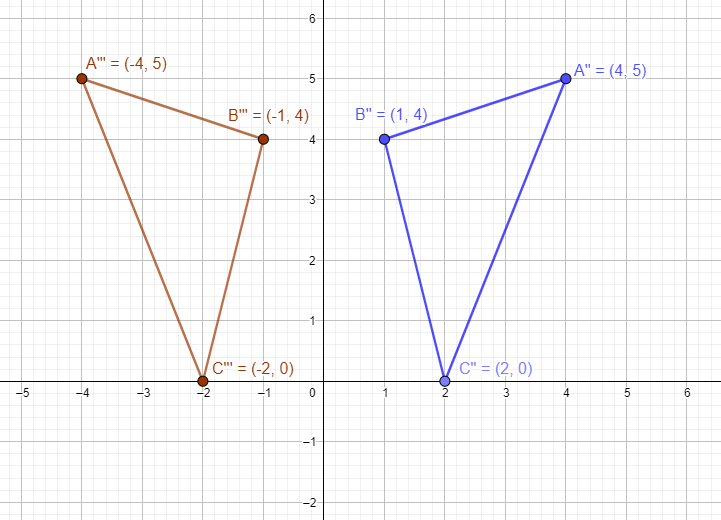
Glencoe Math Course 3 Volume 2 Student 1st Edition Chapter 7 Congruence And Similarity Exercise 7.1 Page 514 Exercise 5, Problem-1

The coordinates of vertices of ΔABC after rotation at an angle of 90°followed by given translation and reflection are ′′′(−4,5), B′′′(−1,4) and C′′′(−2,0).

Glencoe Math Course 3 Volume 2 Student Chapter 7 Page 514 Exercise 6 Problem1

We have to mapΔMNO onto ΔRST.
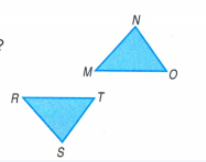
Glencoe Math Course 3 Volume 2 Student 1st Edition Chapter 7 Congruence And Similarity Exercise 7.1 Page 514 Exercise 6, Problem1

For this purpose, we reflect the ΔMNO along the axis first.

Then we translate the image of ΔMNO in the left side to map it ontoΔRST.

So, option(D) is the correct answer.

We will not be able to mapΔMNO onto ΔRST by all the transformations given in options (A), (B), and (C).

Option (D): reflection, then a translation is the right answer to mapΔMNO onto ΔRST.


Page 515 Exercise 7, Problem1

We have two thought bubbles Figure A and Figure B.

We will follow the following steps to map the figure A onto the figure B.

Step 1: Reflect Figure A over the vertical line to create Figure A’.

Step 2: Then translate Figure A’ to the down and to the right until it maps Figure B.
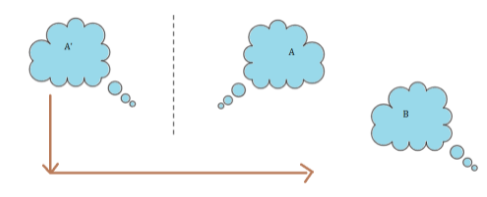
Glencoe Math Course 3 Volume 2 Student 1st Edition Chapter 7 Congruence And Similarity Exercise 7.1 Page 515 Exercise 7, Problem1

The required transformation that maps Figure A onto Figure B is reflection followed by the translation.

Glencoe Math Course 3 Volume 2 Student Chapter 7 Page 515 Exercise 8 Problem1

The length of the side PQ with given endpoints P(0, 0) and Q(2, 0) will be Legth PQ= √(2−0)²−(0−0)²= √4=2.

The length of the side QR with given endpoints Q(2, 0) and R(0, 2) will be LengthQR= □√(0−2)²+(2−0)²= √4+4 = √8.

The length of the side PR with given endpoints P(0, 0) and R(0, 2) will be LengthPR=√(0−0)²+(2−0)²= √4=2.

We have ΔPQR with vertices P(0, 0), Q(2, 0) and R(0, 2)(x,y) → (x, −y).

P(0,0)→P′(0,0).
Q(2,0)→Q′(2,0).
R(0,2)→R′(0,−2).

So, the coordinates of vertices of ΔP′Q′R′ are

P′(0,0),
Q′(2,0),
R′(0,−2).
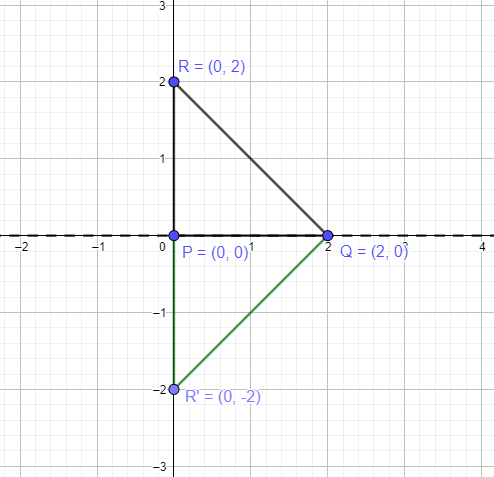
Glencoe Math Course 3 Volume 2 Student 1st Edition Chapter 7 Congruence And Similarity Exercise 7.1 Page 515 Exercise 8, Problem1

We have ΔP′Q′R′ with vertices P′

(0,0),Q′
(2,0),R′
(0,−2).

dilate ΔP′Q′R′ by a scale factor 2,multiply each coordinate of ΔP′Q′R′ by 2(x,y)→(2x,2y)

P’(0,0)→(2×0,2×0)→P”(0,0)
Q’(2,0)→(2×2,2×0)→Q”(4,0)
R’(0,−2)→(2×0,2×−2)→R”(0,−4).

So, the coordinates of ΔP′′Q′′R′′ after dilation are

P″(0,0),
Q″(4,0),
R″(0,−4).
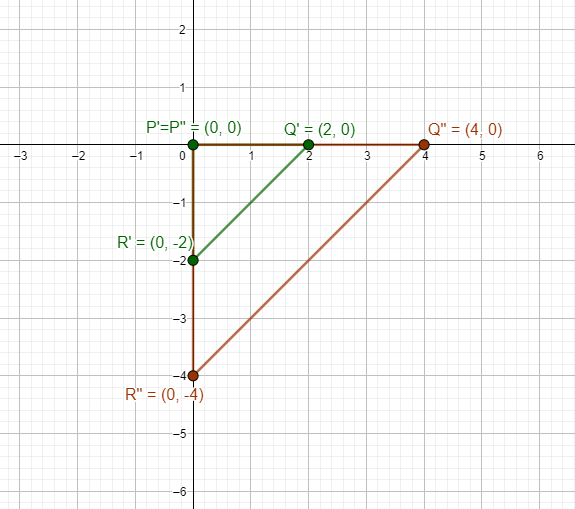
Glencoe Math Course 3 Volume 2 Student 1st Edition Chapter 7 Congruence And Similarity Exercise 7.1 Page 515 Exercise 8, Problem1.

The length of the side P′′Q′′ with given endpoints P”(0, 0) and Q”(4, 0) will be LengthP​′′Q​′′= √(4−0)2+(0−0)2 = √16 =4.
The length of the side Q′′R′′ with given endpoints Q”(4, 0) and R”(0,−4) will be Length​Q​′′R​′′= √(0−4)2+(−4−0)2 = √16+16 = √32.

The length of the side P′′R′′ with given endpoints P”(0, 0) and R”(0, −4) will be Length P​′′R​′′=√(0−0)2+(−4−0)2=√16=4.

The length of sides of ΔPQR isPQ=2, QR=2.82, PR=2, and the length of sides of ΔP′′Q′′R′′ isP′′Q′′=4, Q′′R′′=5.65, P′′R′′=4.

No, the preimage ΔPQR and image ΔP′′Q′′R′′ are not congruent because the length of the sides of ΔPQR is not equal to the corresponding sides of ΔP′′Q′′R′′.

The required image is attached inside.

The length of sides of ΔPQR is PQ=2, QR=2.82, PR=2, and the length of sides of ΔP′′Q′′R′′ is P′′Q′=4, Q′′R′′=5.65, P′′R′′=4.

No, the preimage ΔPQR and image ΔP′′Q′′R′′ are not congruent because the length of the sides of ΔPQR is not equal to the corresponding sides of ΔP′′Q′′R′′.


Glencoe Math Course 3 Volume 2 Student Chapter 7 Page 516 Exercise 9 Problem1

We have to map the pentagon ABCDE onto FGHIJ.
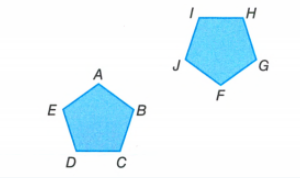
Glencoe Math Course 3 Volume 2 Student 1st Edition Chapter 7 Congruence And Similarity Exercise 7.1 Page 515 Exercise 9, Problem1

For this purpose, we reflect the pentagon ABCDE along the x-axis.

Then, we translate the image on the right-hand side to map it exactly onto the Pentagon FGHIJ.

So, option (B) is the correct answer.

We will not be able to map the pentagon ABCDE onto the pentagon FGHIJ by all the transformations given in options(A),(C), and (D).

Option (B): a reflection followed by a translation is the right answer to map the pentagon ABCDE onto the pentagon FGHIJ.


Page 516 Exercise 10, Problem1

According to the question, triangle A is the preimage, and triangle B is the image.

If we rotate triangle A at an angle 60∘ in the counterclockwise direction and then move it upward then it will map triangle B as shown.
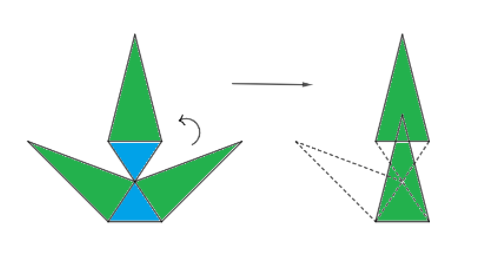
Glencoe Math Course 3 Volume 2 Student 1st Edition Chapter 7 Congruence And Similarity Exercise 7.1 Page 516 Exercise 10, Problem1

So, the transformation should be a rotation at an angle of 60∘ followed by an upward translation.

The transformation should be a rotation at an angle of 60∘ followed by an upward translation.

Glencoe Math Course 3 Volume 2 Student Chapter 7 Page 516 Exercise 11 Problem1

During the translation of a figure the x coordinate changes due to horizontal translation and the y coordinate changes due to vertical translation.

C is located at(−2,4).

D is located at(0,0).

According to the given translation of 3 units right and 2 units down:

​(x,y)→(x+3,y−2)

C(−2,4)→(−2+3,4−2)→C′(1,2)

D(0,0)→(0+3,0−2)→D′(3,−2)

The vertices of the segment CD after transformation are C′(1,2) and D′(3,−2).
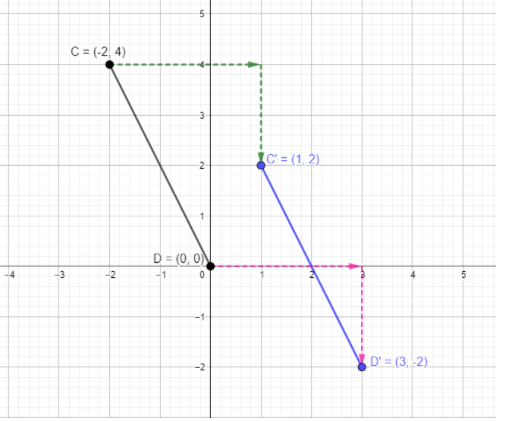
Glencoe Math Course 3 Volume 2 Student 1st Edition Chapter 7 Congruence And Similarity Exercise 7.1 Page 516 Exercise 11, Problem1

The vertices of the segment CD after transformation are C′(1,2) and D′(3,−2).

The required image is attached above.


Page 517 Exercise 1, Problem1

Let us consider that we are provided with two triangles similar to each other. We can say that they are congruent if they can be superimposed on one another.

For them to be superimposed on one another, we have to check if the corresponding sides and angles are equal to each other, or else their measurement may differ and hence, cannot be superimposed.

After all the deductions, we can say that two triangles are said to be congruent if their pair of corresponding sides or angles are equal.

Glencoe Math Course 3 Volume 2 Student Chapter 7 Page 519 Exercise 1 Problem1

As per the given instructions, we form the two triangles. As the two triangles have two sides equal and one corresponding angle equal to each other, they follow the SAS postulate.

As the triangles follow the SAS postulate, they can be said to be congruent to each other.

After the deductions, we can say that as the triangles follow the SAS postulate, they can be said congruent to each other.

Page 519 Exercise 1, Problem2

We can say that they are congruent if they can be superimposed on one another.

For them to be superimposed on one another, we have to check if the corresponding sides and angles are equal to each other, or else their measurement may differ and hence, cannot be superimposed.

As per the SAS postulate, they are always congruent irrespective of their rearrangements.

As per the SAS postulate, no more triangles can be formed and if there exist so they are always congruent irrespective of their rearrangements.


Glencoe Math Course 3 Volume 2 Student Chapter 7 Page 519 Exercise 2 Problem1

We can say that they are congruent if they can be superimposed on one another.

For them to be superimposed on one another, we have to check if the corresponding sides and angles are equal to each other, or else their measurement may differ and hence, cannot be superimposed.

After all the deductions we can complete the table as follows:
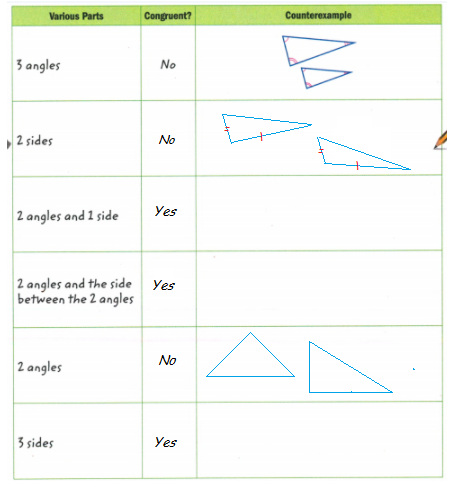
Glencoe Math Course 3 Volume 2 Student 1st Edition Chapter 7 Congruence And Similarity Exercise 7.1 Page 519 Exercise 2, Problem1

After all the deductions we can complete the table as follows:


Page 520 Exercise 1, Problem1

We can say that they are congruent if they can be superimposed on one another.

For them to be superimposed on one another, we have to check if the corresponding sides and angles are equal to each other, or else their measurement may differ and hence, cannot be superimposed.

As per Case 1: two pairs of congruent sides and a pair of congruent angles not between them, are not congruent as per the SAS postulate. As per

Case 2: two pairs of congruent sides and a pair of congruent angles between them, they are congruent as per the SAS postulate. As per

Case 3: two pairs of congruent sides and a pair of congruent angles not between them, they are not congruent as per the SAS postulate.

The results of the case studies are as follows:

As per Case 1: two pairs of congruent sides and a pair of congruent angles not between them, are not congruent as per the SAS postulate. As per

Case 2: two pairs of congruent sides and a pair of congruent angles between them, they are congruent as per the SAS postulate. As per

Case 3: two pairs of congruent sides and a pair of congruent angles not between them, they are not congruent as per the SAS postulate.


Glencoe Math Course 3 Volume 2 Student Chapter 7 Page 520 Exercise 2 Problem1

Let us consider that we are provided with two triangles similar to each other.

We can say that they are congruent if they can be superimposed on one another.For them to be superimposed on one another, we have to check if the corresponding sides and angles are equal to each other, or else their measurement may differ and hence, cannot be superimposed.

As all the sides are equal to each other, they are congruent.

As all the sides are equal to each other, we can say that the triangles are congruent to each other.


Page 520 Exercise 3, Problem1

Let us consider that we are provided with two triangles similar to each other. We can say that they are congruent if they can be superimposed on one another.

For them to be superimposed on one another, we have to check if the corresponding sides and angles are equal to each other, or else their measurement may differ and hence, cannot be superimposed.

As the angles are equal, they cannot be congruent as the corresponding sides may differ in length creating an enlarged or diminished image.


As the angles are equal, the triangles cannot be congruent as the corresponding sides may differ in length creating an enlarged or diminished image.

Glencoe Math Course 3 Volume 2 Student Chapter 7 Page 520 Exercise 4 Problem1

Let us consider that we are provided with two triangles similar to each other.We can say that they are congruent if they can be superimposed on one another.

For them to be superimposed on one another, we have to check if the corresponding sides and angles are equal to each other, or else their measurement may differ and hence, cannot be superimposed.

As the two pairs of corresponding sides including an angle are equal to each other, they are congruent by the SAS postulate.

As the two pairs of corresponding sides including an angle are equal to each other, the triangles are congruent by the SAS postulate.

Page 520 Exercise 5, Problem1

As instructed in the question that three pairs of corresponding parts can be used to show that two triangles are congruent.

There are some ways to check if two triangles are congruent or not, anyone out of these is sufficient to check the congruence of triangles.

There are some ways to check if two triangles are congruent or not, anyone out of these is sufficient to check the congruence of triangles.

Three pairs of corresponding parts can be used to show that two triangles are congruent as given in below:

1. SSS (side, side, side): All three corresponding sides are equal in length.
2. SAS (side, angle, side): A pair of corresponding sides and the included angle are equal.
3. ASA (angle, side, angle): A pair of corresponding angles and the included side are equal.
4. AAS (angle, angle, side): A pair of corresponding angles and a non-included side are equal.
5. HL (hypotenuse, leg of a right triangle): Two right triangles are congruent if the hypotenuse and one leg are equal.

Three pairs of corresponding parts can be used to show that two triangles are congruent SSS (side, side, side), SAS (side, angle, side), ASA (angle, side, angle), AAS (angle, angle, side), HL (hypotenuse, leg of a right triangle).

Glencoe Math Course 3 Volume 2 Student 1st Edition Chapter 6 Transformations Exercise 6.1

Glencoe Math Course 3 Volume 2 Student  Chapter 6 Transformations Exercise 6.1


Page 453 Exercise 1 Problem1

We have to show the best possible way to describe the change in position of a figure. We can show or describe the change in position of a figure by changing the direction and moving from one place to another.

Changing the direction and moving from one place to another is the best possible way to describe a figure.

Glencoe Math Course 3 Volume 2 Chapter 6 Exercise 6.1 Solutions Page 454 Exercise 1 Problem1

The given statement is, graph ΔABC with vertices A(4,−3), B(0,2), and C(5,1).
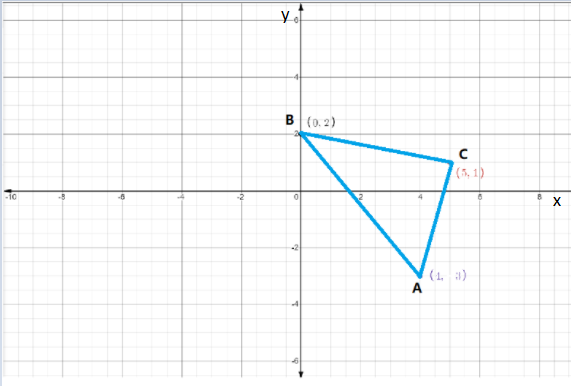
Then graph the image of ΔABC after each translation, and write the coordinates of its vertices. We have to determine the coordinates of the vertices of the figure at the direction of 4 units left and 3 units up.
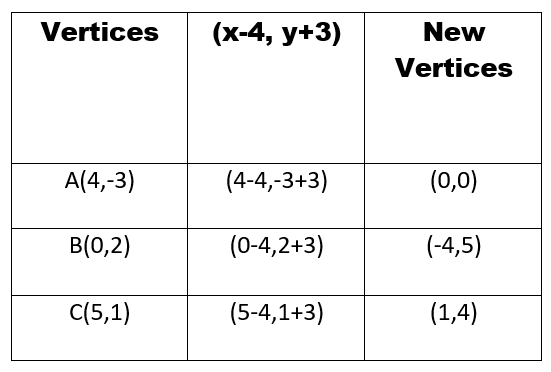
We add the ordered pair of shifting the direction(−4,3) to the coordinates of each vertex of the given figure to obtain the new vertices and their coordinates.

We have the given figure ΔABC with vertices A(4,−3), B(0,2), and C(5,1) in the X−Y plane.

Now, we plot the figure in the graph,

Glencoe Math Course 3 Volume 2 Student 1st Edition Chapter Chapter 6 Transformations Exercise Page 454 Exercise 1 Problem1

Now, to translate the figure towards 4 units left and 3 units up, we add(−4,3) to all the vertex coordinates of the figure as,

Glencoe Math Course 3 Volume 2 Student 1st Edition Chapter Chapter 6 Transformations Exercise Page 454 Exercise 1 Problem1.

We have calculated the new coordinates of vertices of the translated figure as A′(0,0), B′(−4,5), C′(1,4).

Glencoe Math Course 2 Student Edition Volume 1 Chapter 6 Transformations Exercise 6.1

Therefore, we can draw the figure as

Glencoe Math Course 3 Volume 2 Student 1st Edition Chapter Chapter 6 Transformations Exercise Page 454 Exercise 1 Problem 1

Finally, we can conclude that the new coordinates of the figure are A′(0,0), B′(−4,5), C′(1,4).

Read and Learn More Glencoe Math Course 2 Volume 1 Common Core Student Edition Solutions

Glencoe Math Course 3 Volume 2 Student  Chapter 6 Page 451 Exercise 1 Problem2

The given statement is a graph quadrilateral ABCD with vertices, A(0,0), B(2,0), C(3,4), and D(0,4).

Then graph the image of ABCD after each translation, and write the coordinates of its vertices.

We have to determine the coordinates of the vertices of the figure at the direction of 4 units right and 2 units down. We add the ordered pair of shifting the direction(4,−2) to the coordinates of each vertex of the given figure to obtain the new vertices and their coordinates.

We have the given figure quadrilateral ABCD with vertices A(0,0), B(2,0), C(3,4), and D(0,4) in the the X−Y plane.

Now, we plot the figure in the graph,

Glencoe Math Course 3 Volume 2 Student 1st Edition Chapter Chapter 6 Transformations Exercise Page 454 Exercise 1 Problem2


Now, to translate the figure towards 4 units right and 2 units down, we add(4,−2) to all the vertex coordinates of the figure as,

Glencoe Math Course 3 Volume 2 Student 1st Edition Chapter Chapter 6 Transformations Exercise Page 454 Exercise 1 Problem2


We have calculated the new coordinates of vertices of the translated figure as A′ (4,−2), B′ ((6,−2), C′ (7,2), D′ (4,2).

Therefore, we can draw the figure as,

Glencoe Math Course 3 Volume 2 Student 1st Edition Chapter Chapter 6 Transformations Exercise Page 454 Exercise 1 Problem3

Finally, we can conclude that the new coordinates of the figure areA′(4,−2), B′((6,−2), C′(7,2), D′(4,2)

Glencoe Math Course 3 Volume 2 Student  Chapter 6 Page 454 Exercise 1 Problem3

The translation is defined as the relocation of the figure to a different coordinate creating an exact replica of it. Let us consider that the figure is given as follows.

Glencoe Math Course 3 Volume 2 Student 1st Edition Chapter Chapter 6 Transformations Exercise Page 454 Exercise 1 Problem 3
If we need to translate it to 2 units right, we have to shift the coordinates to two units positive of the x-axis as shown.

Glencoe Math Course 3 Volume 2 Student 1st Edition Chapter Chapter 6 Transformations Exercise Page 454 Exercise 1 Problem 3.

The translation is defined as the relocation of the figure to a different coordinate creating an exact replica of it. An example is given below,

Glencoe Math Course 3 Volume 2 Student 1st Edition Chapter Chapter 6 Transformations Exercise Page 454 Exercise 1 Problem 3.


Chapter 6 Exercise 6.1 Answers Transformations Glencoe Math Course 3 Volume 2 Page 456 Exercise 1 Problem1

The given statement is, graph ΔXYZ with vertices X(-4,-4), Y(-3,-1), and Z(2,-2).

Then graph the image of ΔXYZ after each translation, and write the coordinates of its vertices.

We have to determine the coordinates of the vertices of the figure at the direction of 3 units right and 4 units up.

We add the ordered pair of shifting the direction (3,4) to the coordinates of each vertex of the given figure to obtain the new vertices and their coordinates.

We have the given figure ΔXYZ with vertices X(-4,-4), Y(-3,-1), and Z(2,-2) in the X-Y plane. Now, we plot the figure in the graph,

Glencoe Math Course 3 Volume 2 Student 1st Edition Chapter Chapter 6 Transformations Exercise Page 456 Exercise 1 Problem 1

Now, to translate the figure towards 3 units right and 4 units up, we add (3,4) to all the vertex coordinates of the figure as,

Glencoe Math Course 3 Volume 2 Student 1st Edition Chapter Chapter 6 Transformations Exercise Page 456 Exercise 1 Problem 1.

Now, to translate the figure towards 3 units right and 4 units up, we add (3,4) to all the vertex coordinates of the figure as,

Glencoe Math Course 3 Volume 2 Student 1st Edition Chapter Chapter 6 Transformations Exercise Page 456 Exercise 1 Problem 1.

Finally, we can conclude that the new coordinates of the figure are X(-1,0), Y(0,3), and Z(5,2).

Glencoe Math Course 3 Volume 2 Student  Chapter 6 Page 456 Exercise 2 Problem1

The given statement is, graph ΔXYZ with vertices X(-4,-4), Y(-3,-1), and Z(2,-2).

Then graph the image of ΔXYZ after each translation, and write the coordinates of its vertices.

We have to determine the coordinates of the vertices of the figure in the direction of 2 units left and 3 units down.

We add the ordered pair of shifting the direction (-2,-3) to the coordinates of each vertex of the given figure to obtain the new vertices and their coordinates.

We have the given figure ΔXYZ with vertices X(-4,-4), Y(-3,-1), and Z(2,-2) in the X-Y plane. Now, we plot the figure in the graph

Glencoe Math Course 3 Volume 2 Student 1st Edition Chapter Chapter 6 Transformations Exercise Page 456 Exercise 2 Problem 1.

Now, to translate the figure towards 2 units left and 3 units down, we add (-2,-3) to all the vertex coordinates of the figure as,

Glencoe Math Course 3 Volume 2 Student 1st Edition Chapter 6 Transformations Exercise 1.1 Page 456 Exercise 2 Problem1

We have calculated the new coordinates of vertices of the translated figure as X(-6,-7), Y(-5,-4), and Z(0,-5). Therefore, we can draw the figure as,


Glencoe Math Course 3 Volume 2 Student 1st Edition Chapter Chapter 6 Transformations Exercise Page 456 Exercise 2 Problem 1.

Finally, we can conclude that the new coordinates of the figure are X(-6,-7), Y(-5,-4), and Z(0,-5).

Glencoe Math Course 3 Volume 2 Student  Chapter 6 Page 456 Exercise 3 Problem1

The given statement is, The baseball at the right was filmed using stop-motion animation so it appears to be thrown in the air. Use translation notation to describe the translation from point A to point B.

Glencoe Math Course 3 Volume 2 Student 1st Edition Chapter Chapter 6 Transformations Exercise Page 456 Exercise 3 Problem 1.

We modify the X and Y coordinates of point A according to the horizontal change and vertical change respectively with respect to point B.

We have the given figure as,

Glencoe Math Course 3 Volume 2 Student 1st Edition Chapter Chapter 6 Transformations Exercise Page 456 Exercise 3 Problem 1.

Now, we can see from the figure the coordinates of point A is (-4,-1) and coordinates of point B is (-2,4).

We assume, let there be a change of a units in the horizontal axis (X) and b units change in the vertical axis (Y).

Hence, the changed coordinates will be (x+a, y+b) and as the changed point is B, so we can write,⟨x+a,y+b)→(−2,4) and we know that for point A x= -4 and y= -1. Thus, ⟨−4+a,−1+b)→(−2,4).

So, we compare the x-coordinates as, −4+a=−2

⇒ a=−2+4

⇒ a=2.

Hence, the horizontal translation is of +2 units i.e. 2 units in the right direction.

We also compare the y-coordinates as, −1+b=4

⇒ b=4+1

⇒ b=5.

Hence, the vertical translation is of +5 units i.e. 5 units in the up direction. We can show it in the graph as,

Glencoe Math Course 3 Volume 2 Student 1st Edition Chapter Chapter 6 Transformations Exercise Page 456 Exercise 3 Problem-1.

Finally, we can conclude that the translation from point A to B is (x+2,y+5) i.e. 2 units right and 5 units up.

Glencoe Math Course 3 Volume 2 Student  Chapter 6 Page 456 Exercise 4 Problem1

The given statement is, Quadrilateral DEFG has vertices at D(1,0), E(-2,-2), F(2,4), and G(6,-3).

We have to find the vertices of D′E′F′G′after a translation of 4 units right and 5 units down.

We add the ordered pair of shifting the direction (4,-5) to the coordinates of each vertex of the given figure to obtain the new vertices and their coordinates.

We have the given figure quadrilateral DEFG with vertices D(1,0), E(-2,-2), F(2,4), and G(6,-3) in the X-Y plane.

Now, we plot the figure in the graph,

Glencoe Math Course 3 Volume 2 Student 1st Edition Chapter Chapter 6 Transformations Exercise Page 456 Exercise 4Problem-1.


Now, to translate the figure towards 4 units right and 5 units down, we add (4,-5) to all the vertex coordinates of the figure as

Glencoe Math Course 3 Volume 2 Student 1st Edition Chapter Chapter 6 Transformations Exercise Page 456 Exercise 4Problem1.

We have calculated the new coordinates of vertices of the translated figure as D'(5,-5), E'(2,-7), F'(6,-1), and G'(10,-8). Therefore, we can draw the figure as,

Glencoe Math Course 3 Volume 2 Student 1st Edition Chapter 6 Transformations Exercise 1.1 Page 456 Exercise 4 Problem1

Finally, we can conclude that the new coordinates of the figure are D'(5,-5), E'(2,-7), F'(6,-1), and G'(10,-8).

Step-By-Step Guide For Exercise 6.1 Chapter 6 Transformations In Glencoe Math Course 3 Page 456 Exercise 5 Problem1

Let us assume a triangle ΔABC with vertices A(0,0), B(4,0), and C(2,2). We slide this triangle 2 units right and 3 units down, what will be the coordinates of the new triangle ΔA′B′C′.

We add the ordered pair of shifting the direction (2,-3) to the coordinates of each vertex of the given figure to obtain the new vertices and their coordinates.

We have the triangle, ΔABC with vertices A(0,0), B(4,0), and C(2,2) in the X-Y plane. Now, we plot the figure in the graph,

Glencoe Math Course 3 Volume 2 Student 1st Edition Chapter 6 Transformations Exercise 1.1 Page 456 Exercise 5Problem1

Now, to translate the figure towards 2 units right and 3 units down, we add (2,-3) to all the vertex coordinates of the figure as,

Glencoe Math Course 3 Volume 2 Student 1st Edition Chapter Chapter 6 Transformations Exercise Page 456 Exercise 5 Problem-1.

We have calculated the new coordinates of vertices of the translated figure as A'(2,-3), B'(6,-3), C'(4,-1). Therefore, we can draw the figure as,

Glencoe Math Course 3 Volume 2 Student 1st Edition Chapter Chapter 6 Transformations Exercise Page 456 Exercise 5 Problem- 1.

Finally, we can conclude that the new coordinates of the figure are A'(2,-3), B'(6,-3), C'(4,-1).

Glencoe Math Course 3 Volume 2 Student  Chapter 6 Page 457 Exercise 1 Problem1

The given figure is, rectangle JKLM with vertices J(-3,2), K(3,5), L(4,3), and M(-2,0).

We have to determine the coordinates of each vertex for the translated figure as 1 unit right and 4 units down. We first draw the rectangle as per the given vertices and then translate each vertex of the figure to the required direction, which creates the translated figure.


We have a rectangle JKLM with vertices J(-3,2), K(3,5), L(4,3), and M(-2,0). We plot this as,

Glencoe Math Course 3 Volume 2 Student 1st Edition Chapter 6 Transformations Page 457 Exercise 1 Problem1

Now, as given, we have to translate the figure to 1 unit right and 4 units down.

So, we add (1,-4) to coordinate each vertex of the figure. Hence, the translated vertices are,

J′(−3+1,2+(−4))
→ J′(−2,−2),K′(3+1,5+(−4))
→ K′(4,1),L′(4+1,3+(−4))
→ L′(5,−1),M′(−2+1,0+(−4))
→ M′(−1,−4).

Therefore, we can plot the translated figure as,

Glencoe Math Course 3 Volume 2 Student 1st Edition Chapter 6 Transformations Page 457 Exercise 1 Problem 1

Finally, we can conclude that the vertices of the translated figure are J'(-2,-2), K'(4,1), L'(5,-1), and M'(-1,-4).

Glencoe Math Course 3 Volume 2 Student 1st Edition Chapter 6 Transformations Page 457 Exercise 1 Problem 1


Glencoe Math Course 3 Volume 2 Student  Chapter 6 Page 457 Exercise 2 Problem1

The given figure is a triangle, ΔPQR which has vertices P(0,0), Q(5,-2), and R(-3,6).
We have to determine the coordinates of each vertex for the translated figure as 8 units left and 1 unit down.

We add the ordered pair of shifting the direction (-8,-1) to the coordinates of each vertex of the given figure to obtain the new vertices of the new triangle ΔP′Q′R′and their coordinates.

We have the figure ΔPQR with vertices P(0,0), Q(5,-2), and R(-3,6). We can plot it as,

Glencoe Math Course 3 Volume 2 Student 1st Edition Chapter Chapter 6 Transformations Exercise Page 457 Exercise 2 Problem1

Now, to translate the figure to 8 units left and 1 unit down, we have to add the ordered pair (-8,-1) with all the vertices of this figure to obtain the new coordinates.

So, we get the translated vertices as,

P′(0−8,0−1)→P′(−8,−1),

Q′(5−8,−2−1)→Q′(−3,3),

R′(−3−8,6−1)→R′(−11,5).

Hence, we can draw the translated triangle ΔP′Q′R′ as,

Glencoe Math Course 3 Volume 2 Student 1st Edition Chapter 6 Transformations Exercise 1.1 Page 457 Exercise 2 Problem1

Finally, we can conclude that the vertices of the translated figure, towards 8 units left and 1 unit down is, P'(-8,-1), Q'(-3,3),  R'(-11,5).

Glencoe Math Course 3 Volume 2 Student 1st Edition Chapter 6 Transformations Exercise 1.1 Page 457 Exercise 2 Problem1

Glencoe Math Course 3 Volume 2 Student  Chapter 6 Page 457 Exercise 3 Problem1

The given statement is, Use translation notation to describe the translation from point A to point B.

Glencoe Math Course 3 Volume 2 Student 1st Edition Chapter Chapter 6 Transformations Exercise Page 457 Exercise 3 Problem1

We modify the X and Y coordinates of point A according to the horizontal change and vertical change respectively with respect to point B.

We have the given figure as,


Glencoe Math Course 3 Volume 2 Student 1st Edition Chapter Chapter 6 Transformations Exercise Page 457 Exercise 3 Problem1

Now, we can see from the figure the coordinate of point A is (0,3) and the coordinate of point B is (-3,0).

We assume, let there be a change of a units in the horizontal axis (X) and b units change in the vertical axis (Y).

Hence, the changed coordinates will be (x+a, y+b) and as the changed point is B, so we can write, ⟨x+a,y+b)→(−3,0) and we know that for point A x= 0 and y= 3.

Thus, ⟨0+a,3+b)→(−3,0).
So, we compare the x-coordinates as, 0+a=−3,
⇒ a=−3.

Hence, the horizontal translation is of -3 units i.e. 3 units in the left direction.
We also compare the y-coordinates as, 3+b=0,
⇒ b=−3.

Hence, the vertical translation is of -3 units i.e. 3 units in the down direction.

Finally, we can conclude that the translation from point A to B is (x-3,y-3) i.e. 3 units left and 3 units down.


Exercise 6.1 solutions for Chapter 6 Transformations Glencoe Math Course 3 Volume 2 Page 457 Exercise 4 Problem1

The given statement is, Use translation notation to describe the translation from point B to point C.

Glencoe Math Course 3 Volume 2 Student 1st Edition Chapter Chapter 6 Transformations Exercise Page 457 Exercise 4 Problem1

We modify the X and Y coordinates of point B according to the horizontal change and vertical change respectively with respect to point C.

We have the given figure as,

Glencoe Math Course 3 Volume 2 Student 1st Edition Chapter Chapter 6 Transformations Exercise Page 457 Exercise 4 Problem1

Now, we can see from the figure the coordinate of point B is (-3,0) and the coordinate of point C is (-5,-4).

We assume, let there be a change of a units in the horizontal axis (X) and b units change in the vertical axis (Y).

Hence, the changed coordinates will be (x+a, y+b) and as the changed point is C, so we can write, ⟨x+a,y+b)→(−5,−4) and we know that for point B, x= -3 and y= 0.

Thus,⟨−3+a,0+b)→(−5,−4).

So, we compare the x-coordinates as, −3+a=−5,
⇒ a=−5+3
⇒ a=−2.
Hence, the horizontal translation is of -2 units i.e. 2 units in the left direction.
We also compare the y-coordinates as, 0+b=−4,
⇒ b=−4.

Hence, the vertical translation is of -4 units i.e. 4 units in the down direction.

Finally, we can conclude that the translation from point B to C is (x-2,y-4) i.e. 3 units left and 3 units down.

Glencoe Math Course 3 Volume 2 Student  Chapter 6 Page 457 Exercise 5 Problem1

The given statement, Quadrilateral KLMN has vertices K(-2,-2), L(1,1), M(0,4), and N(-3,5).

It is first translated by (x+2, y-1) and then translated by (x-3, y+4).

When a figure is translated twice, a double prime symbol is used.
We have to find the coordinates of quadrilateral K”L”M”N” after both translations.

We first add (2,-1) with all vertices of KLMN to translate it to K’L’M’N’.

We again translate the obtained figure K’L’M’N’ by adding (-3,4) to all vertices and obtain the final figure K”L”M”N”.


We have the given figure KLMN that has the vertices as K(-2,-2), L(1,1), M(0,4), and N(-3,5).

Now, we perform the translation (x+2, y-1) and obtain K’L’M’N’. hence, the translated coordinates are,

Glencoe Math Course 3 Volume 2 Student 1st Edition Chapter Chapter 6 Transformations Exercise Page 457 Exercise 5 Problem1

Now, we have the translated coordinates of K’L’M’N’ as K'(0,-3), L'(3,0), M'(2,3), and N'(-1,4).

We again perform the translation as (x-3, y+4) to obtain the coordinates of K”L”M”N”.


Glencoe Math Course 3 Volume 2 Student 1st Edition Chapter 6 Transformations Exercise 1.1 Page 457 Exercise 5 Problem 1

Therefore, the final translated coordinates are K”(-3,1), L'(0,4), M'(-1,7), and N'(-4,8).

Finally, we can conclude that the coordinates of quadrilateral K”L”M”N” after both translations are K”(-3,1), L'(0,4), M'(-1,7), and N'(-4,8).

Glencoe Math Course 3 Volume 2 Student  Chapter 6 Page 458 Exercise 6 Problem1

The given statement is, make a model with mathematics refers to the graphic novel frame below. List the five steps the girls should take and identify any transformations used in the dance steps.

Glencoe Math Course 3 Volume 2 Student 1st Edition Chapter Chapter 6 Transformations Exercise Page 458 Exercise 6 Problem1

We compare the position of the right and the left leg in the previous step with the next step to determine the transformation step.

We have the given figure with 6 positions as,

Glencoe Math Course 3 Volume 2 Student 1st Edition Chapter Chapter 6 Transformations Exercise Page 458 Exercise 6 Problem1

Now, starting from the first position, to reach the last one we need 5 steps of transformation.

For the first step, we can see the right leg is shifted from its previous position to the left side of the left leg i.e. crosses right to the left leg.

Next, the left leg is moved in the leftmost cell i.e. crosses left to the right leg.

Then, at the third step, we see the right leg is stepped forward to the next cell.
In the next position, the left leg also stepped forward to the next cell. In the last step, both the right and left legs are moved three steps to right.

Hence, the steps can be listed as follows, The right leg crosses the left leg to the left.

The left leg crosses the right leg to the left.

The right leg takes one step forward. The left leg takes one step forward. Both right and left legs moved three steps to the right.

Finally, we can conclude that the dance steps can be listed as,

The right leg crosses the left leg to the left.

The left leg crosses the right leg to the left.

The right leg takes one step forward

The left leg takes one step forward.

Both right and left legs moved three steps to the right.


Common Core Chapter 6 Exercise 6.1 Transformations Detailed Solutions Glencoe Math Course 3 Volume 2 Page 458 Exercise 7 Problem1

The given statement is, a figure is translated by (x-5, y+7) and then by (x+5, y-7). We have to determine the final position of the figure. We first translate the figure by some value and then again translate it by the negative of the same value.

Let the coordinate of A be (a,b). Now, after the first translation (x-5,y+7), we can write,(a,b)→(a−5,b+7).

Now, the second translation is (x+5,y-7) i.e. the final translated coordinate is,(a−5,b+7)→((a−5)+5,(b+7)−7)

⇒(a−5,b+7)→(a,b).

Therefore, the figure is back to its previous position after the two translations.

Finally, we can conclude that after two translations, first by positive value and then again translation by the negative of the same value, the figure remains at its primary position.

Glencoe Math Course 3 Volume 2 Student  Chapter 6 Page 458 Exercise 8 Problem1

The given statement is, the point (x, y) has been translated m units left and n units up.

We have to determine the final position of coordinates of the point.

We make the ordered pair for shifting i.e. (-m,n) and we add this pair with the coordinate of the point (x,y) to get the final position of the point.

We know that to shift a point to ‘a’ units horizontally and ‘b’ units vertically in the coordinate plane we need to add a with the x-coordinate of the point and b with the y-coordinate of the point.
A(x,y)→A′(x+a,y+b).

For the right shift, ‘a’ is positive and for the left shift, ‘a’ is negative.

Similarly, for the upshift ‘b’ is positive and for the downshift ‘b’ is negative.

Hence, in this case, for translation of m units left and n units up, we add (-m,n) with the coordinate of the point.
P(x,y)→P′ (x−m,y+n).

This is the final coordinate of the translated point.

Finally, we can conclude that the final coordinate of the point P(x,y) after translation of m units left and n units up, is P'(x-m,y+n).


Student Edition Exercise 6.1 Chapter 6 Transformations solutions guide Glencoe Math Course 3 Volume 2 Page 459 Exercise 9 Problem1

We are provided with the following figure.

Glencoe Math Course 3 Volume 2 Student 1st Edition Chapter Chapter 6 Transformations Exercise Page 459 Exercise 9 Problem1


It is given that the figure is translated 3 units on the right and 3 units to the up. Translation horizontally affects the x-axis and vertically affects the y-axis.

As given; H=(−1,0) J=(−2,−4) K=(1,−3)

Therefore after translations, the values would be

H′=(−1+3,0+3)

H′ =(2,3)

J′=(−2+3,−4+3)

J′=(1,−1)

K′=(1+3,−3+3)

K′ =(4,0)

Thereby the graph can be plotted as;


Glencoe Math Course 3 Volume 2 Student 1st Edition Chapter 6 Transformations Exercise 1.1 Page 459 Exercise 9 Problem 1

The triangle was transformed as given in the question and plotted as shown in the graph.

Glencoe Math Course 3 Volume 2 Student 1st Edition Chapter 6 Transformations Exercise 1.1 Page 459 Exercise 9 Problem 1


Glencoe Math Course 3 Volume 2 Student  Chapter 6 Page 459 Exercise 10 Problem1

We are provided with the following figure.

Glencoe Math Course 3 Volume 2 Student 1st Edition Chapter 6 Transformations Exercise 1.1 Page 459 Exercise 10 Problem 1

It is given that the figure is translated as 4 units on the left and 3 units to the up.

Translation horizontally affects the x-axis and vertically affects the y-axis.

As given;

K=(1,−1)

∴K′⇒(1−4,−1+3)=(−3,2)

L=(1,1)

∴L′⇒(1−4,1+3)=(−3,4)

M=(5,1)

∴M′⇒(5−4,1+3)=(1,4)

N=(5,−1)

∴N′⇒(5−4,−1+3)=(1,2)

Graphing the following;

Glencoe Math Course 3 Volume 2 Student 1st Edition Chapter Chapter 6 Transformations Exercise Page 459 Exercise 10 Problem 1

The rectangle was transformed as given in the question and plotted as shown in the graph.

Glencoe Math Course 3 Volume 2 Student 1st Edition Chapter Chapter 6 Transformations Exercise Page 459 Exercise 10 Problem 1


Glencoe Math Course 3 Volume 2 Student  Chapter 6 Page 459 Exercise 11 Problem1

We are provided with the following figure coordinates.

Glencoe Math Course 3 Volume 2 Student 1st Edition Chapter 6 Transformations Exercise 1.1 Page 459 Exercise 11 Problem 1

It is given that the figure is translated 4 units to the up. Translation horizontally affects the x-axis and vertically affects the y-axis.

As given; A=(−5,−1)

∴A′⇒(−5,−1+4)=(−5,3)

B=(−3,0)

∴B′⇒(−3,0+4)=(−3,4)

C=(2,−2)

∴C′⇒(2,−2+4)=(2,2)

∴D′⇒(0,−6+4)=(0,−2)

The coordinates of the vertices of the quadrilateral are


Step-by-step answers for Exercise 6.1 Chapter 6 Transformations in Glencoe Math Course 3 Volume 2 Page 459 Exercise 12 Problem1

We are provided with the following figure coordinates.

Glencoe Math Course 3 Volume 2 Student 1st Edition Chapter Chapter 6 Transformations Exercise Page 459 Exercise 12Problem 1

Julio is at Felines(3,1) and then moves 3 units right and 5 units up as given Translation horizontally affects the x-axis and vertically affects the y-axis.

Julio is located at Felines(3,1).

After he moved the given position he is at coordinate as;(3+3,1+5)=(6,6)

This means that he is now at Hooted animals(6,6).

After all the calculations we conclude that Julio is now at Hooted Animals(6,6).

Glencoe Math Course 3 Volume 2 Student  Chapter 6 Page 459 Exercise 13 Problem1

We are provided with the following figure coordinates.

Glencoe Math Course 3 Volume 2 Student 1st Edition Chapter 6 Transformations Exercise 1.1 Page 459 Exercise 13 Problem 1

We have to find how many translations are there using repeated reasoning. Clearly, we can observe that one helix is translated5
for the figure to form as shown.

Glencoe Math Course 3 Volume 2 Student 1st Edition Chapter 6 Transformations Exercise 1.1 Page 459 Exercise 13 Problem 1.

After clear observation and reasoning, we can say that there are 5 translations.

Glencoe Math Course 3 Volume 2 Student 1st Edition Chapter 6 Transformations Exercise 1.1 Page 459 Exercise 13 Problem-1

Page 459 Exercise 14 Problem1

We are provided with the following figures.

Glencoe Math Course 3 Volume 2 Student 1st Edition Chapter Chapter 6 Transformations Exercise Page 459 Exercise 14 Problem 1

In the following, only one of the graphs shows the real example of translation.

Translation defines transposing the figure to a different coordinate to make an exact copy of it.

We can clearly see that in this particular option the word ‘Z’ is transposed from(2,1) to (5,3) to make an exact copy of it.

Glencoe Math Course 3 Volume 2 Student 1st Edition Chapter Chapter 6 Transformations Exercise Page 459 Exercise 14 Problem 1.

In the following options:

(A) shows rotation.

Glencoe Math Course 3 Volume 2 Student 1st Edition Chapter 6 Transformations Exercise 1.1 Page 459 Exercise 14 Problem 1(1)


(C) shows mirror imaging.

Glencoe Math Course 3 Volume 2 Student 1st Edition Chapter Chapter 6 Transformations Exercise Page 459 Exercise 14 Problem 1(2)

(D) shows reflection.

Glencoe Math Course 3 Volume 2 Student 1st Edition Chapter Chapter 6 Transformations Exercise Page 459 Exercise 14 Problem 1(3)

Hence cannot be the correct answers.


After final observations, it was found that option(B) was the correct option.


Glencoe Math Course 3 Volume 2 Student  Chapter 6 Page 460 Exercise 15 Problem1

We are provided with the following figure coordinateA=(−1,2).

It is given that it moves 4 units left and 3 units up as given.

Translation horizontally affects the x-axis and vertically affects the y-axis.

We are given that A(−1,2)

After translation;

A′=(−1−4,2+3)

=(−5,5)

A′ =(−5,5)

This is represented by option (G).

In the last step, we clearly saw that the value of the point after translation is A′ =(−5,5).

Therefore, the other options are not correct as the correct answer is given by option (G).

After calculation, we have observed that the correct answer is given by option(G).

Glencoe Math Course 3 Volume 2 Student  Chapter 6 Page 460 Exercise 16 Problem1

We are provided with the following figure coordinate.

Glencoe Math Course 3 Volume 2 Student 1st Edition Chapter Chapter 6 Transformations Exercise Page 459 Exercise 16 Problem 1

It is given that it moves 3 units right and 7 units down as given. Translation horizontally affects the x-axis and vertically affects the y-axis.

Clearly, we can calculate the coordinate of the vertices of the trapezium.
A=(−6,2)

∴A′ ⇒(−6+3,2−7)=(−3,−5)

A′=(−3,−5)

B=(−1,2)

∴B′⇒(−1+3,2−7)=(2,−5)

B′ =(2,−5)

C=(−2,4)

∴C′⇒(−2+3,4−7)=(1,−3)

C′ =(1,−3)

D=(−3,4)

∴D′⇒(−3+3,4−7)=(0,−3)

D′ =(0,−3)

After the calculations, we can conclude that the coordinates of the A′B′C′D′is(−3,−5);(2,−5);(1,−3);(0,−3).

Page 460 Exercise 17 Problem1

The given problem is−5+12

We have to find its result. Clearly, by adding them we get the value as 7.

After calculations, we conclude that the value of the sum is 7.

Glencoe Math Course 3 Volume 2 Student  Chapter 6 Page 460 Exercise 18 Problem1

The given equation is

We can use the BODMAS RULE to calculate the value of this problem. When a negative number is multiplied by a positive number, the result is always negative.

We can use the BODMAS RULE to calculate the value of this problem.
​−36+(−42)
=−36−42
=−78

Finally, we can deduce that the above equation’s sum is −78.

Page 460 Exercise 19 Problem1

The given problem is256+(−82).
We have to find its result. Clearly, by adding them we get the value as256−82 =174.

After calculations, we conclude that the value of the sum is 174.

Glencoe Math Course 3 Volume 2 Student  Chapter 6 Page 460 Exercise 20 Problem1

We have been given two numbers. We need to find the sum of these two numbers.

This can be found by subtracting the two numbers and then putting the sign with the larger number in the answer.

−452+97

=−(452−97)

=−355

The sum of the given numbers is -355.

Differential Equations Of First Order And First Degree Homogeneous Equation Methods To Find An Integrating Factor Solved Example Problems Exercise 2.9

Differential Equations of First Order and First Degree Solved Example Problems Exercise 2.9

Example. 1: Solve \(\frac{d y}{d x}+\frac{y}{x}=y^2 x \sin x, x>0\)

Solution.

Given equation is \(\frac{d y}{d x}+\frac{y}{x}=y^2 x \sin x\) ………………(1) is Bernoulli’s equation.

Multiplying (1) by \(y^{-2} \text {, we get : } y^{-2} \frac{2 y}{d x}+\frac{y}{x}=x \sin x\) ………………(2)

Let \( y^{-1}=u \Rightarrow(-1) y^{-2} \frac{d y}{d x}=\frac{d u}{d x} \Rightarrow y^{-2} \frac{d y}{d x}=-\frac{d u}{d x}\) ……………..(3)

(2) and (3) \(\Rightarrow-\frac{d u}{d x}+\frac{u}{x}=x \sin x \Rightarrow \frac{d u}{d x}-\frac{u}{x}=-x \sin x\) ………..(4)

(4) is a linear equation in u and x where \(\mathrm{P}=-\frac{1}{x}, \mathrm{Q}=-x \sin x\)

∴ \(\text { I.F. }=\exp \left(\int \mathrm{P} d x\right)=\exp \left(\int-\frac{1}{x} d x\right)=e^{-\log x}=e^{\log x^{-1}}=\frac{1}{x}\)

The general solution of (4) is I.F \(=\int \mathrm{Q} \text { (I.F) } d x+c \Rightarrow u(1 / x)=\int(-x \sin x)(1 / x) d x+c=\int(-\sin x) d x+c\)

⇒ \(u(1 / x)=\cos x+c \Rightarrow u=x \cos x+c x\) …………………..(5)

substitution u = 1/y in (5), the general solution of (1) is

∴ \(\text { 1/ } y=x \cos x+c x \Rightarrow x y \cos x+c x y=1\)

Differential Equations Of First Order And First Degree Exercise 2.9

Example. 2: Solve \(x \frac{d y}{d x}+y=y^2 \log x\)

Solution:

Given equation is \(x \frac{d y}{d x}+y=y^2 \log x\) ……………………….(1)

Dividing (1) by x and then multiplying with \(y^{-2}\)2 we get:

⇒ \(\frac{d y}{d x}+\frac{y}{x}=\frac{y^2 \log x}{x} \Rightarrow \frac{1}{y^2} \frac{d y}{d x}+\frac{1}{x} \cdot \frac{1}{y}=\frac{\log x}{x}\) …………………..(2)

Let \(u=\frac{1}{y} \Rightarrow \frac{d u}{d x}=-\frac{1}{y^2} \frac{d y}{d x} \Rightarrow \frac{1}{y^2} \frac{d y}{d x} \Rightarrow=-\frac{d u}{d x}\) ……………(3)

(2) and (3) \(\Rightarrow-\frac{d u}{d x}+\frac{1}{x} u=\frac{\log x}{x} \Rightarrow \frac{d u}{d x}-\frac{1}{x} u=\frac{-\log x}{x}\) ……………..(4)

(4) is a linear equation in and x where \(\mathrm{P}=-\frac{1}{x}, \mathrm{Q}=\frac{-\log x}{x}\)

Then \(\text { I.F. }=\exp \left(\int \mathrm{P} d x\right)=\exp \left(\int-\frac{1}{x} d x\right)=e^{-\log x}=e^{\log x^{-1}}=\frac{1}{x}\)

The General solution of (4) is (I.F.) = \(\int \mathrm{Q}(\text { I.F) } d x+c\)

⇒ \(u\left(\frac{1}{x}\right)=\int \frac{-\log x}{x} \cdot \frac{1}{x} d x+c=\int-\frac{1}{x^2} \log x d x+c\)

⇒ \(u\left(\frac{1}{x}\right)=\frac{1}{x} \log x-\int \frac{1}{x} \cdot \frac{1}{x} d x+c=\frac{1}{x} \log x+\frac{1}{x}+c\) ………………………….(5)

Putting \(u=\frac{1}{y}\) in (5), the general solution of(1) is

∴ \(\frac{1}{x y}=\frac{1}{x} \log x+\frac{1}{x}+c \Rightarrow 1=y \log x+y+c x y\)

Homogeneous Equations Solved Problems Exercise 2.9

Example. 3: Solve \(\frac{d y}{d x}+\frac{x y}{1-x^2}=x \sqrt{y}\)

Solution.

Given equation is \(\frac{d y}{d x}+\frac{x y}{1-x^2}=x \sqrt{y} \) ………………………(1)

Multiplying (1) by \(y^{-1 / 2} \Rightarrow y^{-1 / 2} \frac{d y}{d x}+\frac{x}{1-x^2} y^{1 / 2}=x\) ………………………(2)

Let \(y^{1 / 2}=u \Rightarrow \frac{1}{2} y^{-1 / 2} \frac{d y}{d x}=\frac{d u}{d x} \Rightarrow y^{-1 / 2} \frac{d y}{d x}=2 \frac{d u}{d x}\) ……………………(3)

(2) and (3) \(\Rightarrow 2 \frac{d u}{d x}+\frac{x}{1-x^2} u=x \Rightarrow \frac{d u}{d x}+\frac{x}{2\left(1-x^2\right)} u=\frac{x}{2}\)

where \(\mathrm{P}=\frac{x}{2\left(1-x^2\right)} \text { and } \mathrm{Q}=\frac{x}{2}\)

Now \(\text { I.F. }=\exp \left(\int \frac{x}{2\left(1-x^2\right)} d x\right)=\exp \left(\int \frac{-2 x}{-4\left(1-x^2\right)} d x\right)\)

= \(\exp \left[-\frac{1}{4} \log \left(1-x^2\right)\right]=\exp \left[\log \left(1-x^2\right)^{-1 / 4}\right]=\frac{1}{\left(1-x^2\right)^{1 / 4}}\)

The G. S. of (4) is \(u \cdot \frac{1}{\left(1-x^2\right)^{1 / 4}}=\int \frac{x}{2} \cdot \frac{1}{\left(1-x^2\right)^{1 / 4}} d x+c\)

⇒ \(\frac{u}{\left(1-x^2\right)^{1 / 4}}=-\frac{1}{4} \int t^{-1 / 4} d t+c \text { where } t=1-x^2\)

⇒ \(\frac{u}{\left(1-x^2\right)^{1 / 4}}=-\frac{1}{4} \frac{t^{3 / 4}}{(3 / 4)}+c=-\frac{1}{3}\left(1-x^2\right)^{3 / 4}+c\)

∴ The G.S of (1) is \(\frac{\sqrt{y}}{\left(1-x^2\right)^{1 / 4}}=-\frac{1}{3}\left(1-x^2\right)^{3 / 4}+c \Rightarrow 3 \sqrt{y}+\left(1-x^2\right)=3 c\left(1-x^2\right)^{1 / 4}\)

Methods To Find Integrating Factors For Exercise 2.9

Example.4 Solve \(\frac{d y}{d x}\left(x^2 y^3+x y\right)=1\)

Solution.

Given equation is \(\frac{d y}{d x}\left(x^2 y^3+x y\right)=1 \Rightarrow \frac{d x}{d y}=x^2 y^3+x y \Rightarrow \frac{d x}{d y}-x y=x^2 y^3\) ……………..(1)

(1) is Bernoulli’s equation in x. Multiplying (1) by \(x^{-2} \Rightarrow x^{-2} \frac{d x}{d y}-x^{-1} y=y^3\) ……….(2)

Put \(x^{-1}=u \Rightarrow-1. x^{-2} \frac{d x}{d y}=\frac{d u}{d y} \Rightarrow x^{-2} \frac{d x}{d y}=-\frac{d u}{d y}\) ……………..(3)

(2) and (3) \(\Rightarrow-\frac{d u}{d y}-u y=y^3 \Rightarrow \frac{d u}{d y}+u y=-y^3\) ………….(4)

(4) is a linear equation in u and y where \(\mathrm{P}=y, \mathrm{Q}=-y^3 \text {. Now I.F. }=\exp \left(\int y d y\right)=e^{y^2 / 2}\)

G. S. of (4) is \(u e^{y^2 / 2}=\int-y^3 e^{y^2 / 2} d y+c=-2 \int t e^t d t+c \text { where } t=y^2 / 2\)

⇒ \(u e^{y^2 / 2}=-2 e^t(t-1)+c\) Substituting u and t

The G.S. of (1) is \(\frac{1}{x} e^{y^2 / 2}=-2 e^{y^2 / 2}\left(\frac{y^2}{2}-1\right)+c \Rightarrow x\left(2-y^2\right)-c x e^{-y^2 / 2}=1\)

Solved Example Problems From Exercise 2.9 In Differential Equations

Example.5. Solve \(\frac{d y}{d x}=\frac{x^2+y^2+1}{2 x y}\)

Solution.

Given equation

\(\frac{d y}{d x}=\frac{x^2+y^2+1}{2 x y}\)

Given equation can be written as \(2 x y \frac{d y}{d x}=x^2+y^2+1 \Rightarrow 2 x y \frac{d y}{d x}-y^2=x^2+1\)

⇒ \(2 y \frac{d y}{d x}-\left(\frac{1}{x}\right) y^2=\frac{x^2+1}{x} . \text { Put } y^2=z \Rightarrow 2 y \frac{d y}{d x}=\frac{d z}{d x}\)

∴ \(\frac{d z}{d x}-\frac{1}{x} z=\frac{x^2+1}{x}\) This is a linear equation in z

Where \(\mathrm{P}=-1 / x \text { I.F. }=e^{\int(-1 / x) d x}=e^{-\log x}=e^{\log x^{-1}}=x^{-1}=1 / x\)

⇒ \(e^{\int(-1 / x) d x}=e^{-\log x}=e^{\log x^{-1}}=x^{-1}=1 / x\)

∴ \(\text { G.S. is } z(1 / x)=\int \frac{1}{x} \cdot \frac{x^2+1}{x} d x+c=\int \frac{x^2+1}{x^2} d x+c\)

⇒ \(\frac{z}{x}=\int\left(1+\frac{1}{x^2}\right) d x+c=\int d x+\int \frac{1}{x^2} d x+c=x-\frac{1}{x}+c \Rightarrow z=x^2-1+c x\)

∴ The G.S. of the given equation is \(y^2=x^2-1+c x \Rightarrow y^2-x^2+1=c x\)

Solutions For Exercise 2.9 First-Order Homogeneous Equations

Example. 6. Solve \(x y-\frac{d y}{d x}=y^3 e^{-x^2}\)

Solution.

Given equation

\(x y-\frac{d y}{d x}=y^3 e^{-x^2}\)

Given equation can be written as \(\frac{d y}{d x}-x y=-y^3 e^{-x^2}\)

⇒ \(\frac{1}{y^3} \frac{d y}{d x}-\frac{1}{y^2} x=-e^{-x^2} \text {. Put } \frac{1}{y^2}=z \Rightarrow-\frac{2}{y^3} \frac{d y}{d x}=\frac{d z}{d x}\)

⇒ \(-\frac{1}{2} \frac{d z}{d x}-x z=-e^{-x^2} \Rightarrow \frac{d z}{d x}+2 x z=2 e^{-x^2}\)

This is a linear equation in z where \(\mathrm{P}=2 x . \text { I.F. }=e^{\int 2 x d x}=e^{x^2}\)

∴ G.S. is \(z e^{x^2}=2 \int e^{-x^2} \cdot e^{x^2} d x+c=2 \int d x+c=2 x+c\)

∴ G.S. of the given equation is \(\left(1 / y^2\right) e^{x^2}=2 x+c\)

Examples Of Integrating Factors In Homogeneous Equations Exercise 2.9

Example.7. Solve \(\frac{d y}{d x}=2 y \tan x+y^2 \tan ^2 x\)
Solution.

Given equation

\(\frac{d y}{d x}=2 y \tan x+y^2 \tan ^2 x\)

The given equation can be written as \(\frac{d y}{d x}-(2 \tan x) y=y^2 \tan ^2 x \Rightarrow \frac{1}{y^2} \frac{d y}{d x}-(2 \tan x) \frac{1}{y}=\tan ^2 x\)

Let \(-\frac{1}{y}=z \Rightarrow \frac{1}{y^2} \frac{d y}{d x}=\frac{d z}{d x}\)

Then the above equation becomes: \(\frac{d z}{d x}+(2 \tan x) z=\tan ^2 x\)

This is a linear equation in z where P = 2 tan x.

Now \(\text { I.F. }=e^{\int 2 \tan x d x}=e^{2 \log \sec x}=e^{\log \sec ^2 x}=\sec ^2 x\).

∴ G.S. is \(z \sec ^2 x=\int \tan ^2 x \sec ^2 x d x-c\)

⇒ \(z \sec ^2 x=\int \tan ^2 x d(\tan x)-c=\left(\tan ^3 x\right) / 3-c\)

∴ G.S of the G.E is \(-(1 / y) \sec ^2 x=(1 / 3) \tan ^3 x-c y^{-1} \sec ^2 x=c-(1 / 3) \tan ^3 x\)

Differential Equations Of First Order And First Degree Homogeneous Equation Methods To Find An Integrating Factor Solved Example Problems Exercise 2.8

Differential Equations of First Order and First Degree Solved Example Problems Exercise 2.8

Example. 1: Solve \(\left(1+y^2\right) d x=\left(\text{Tan}^{-1} y-x\right) d y\)

Solution.

Given equation

\(\left(1+y^2\right) d x=\left(\text{Tan}^{-1} y-x\right) d y\)

Given equation can be written as \(\left(1+y^2\right) \frac{d x}{d y}+x=\text{Tan}^{-1} y\)

Dividing by \(\left(1+y^2\right)\) to reduce this to standard form: [/latex]\frac{d x}{d y}+\frac{1}{1+y^2} x[/latex] = \(\frac{\text{Tan}^{-1} y}{1+y^2}\)……(1)

Where \(P_1=\frac{1}{1+y^2}\) and \(Q_1=\frac{\text{Tan}^{-1} y}{1+y^2}\) are functions of y alone.

Now \(\int P_1 d y=\frac{1}{1+y^2} d y=\text{Tan}^{-1} y\)

∴ I.F. = \(\exp \left(\int \mathrm{P} d y\right)=e^{\text{Tan}^{-1} y}\)

∴ G. S. of (1) is x (I.F.) \(=\int \mathrm{Q}_1\)

(I.F. ) dy+\(c \Rightarrow x e^{\mathrm{Tan}^{-1} y}=\int \frac{\text{Tan}^{-1} y}{1+y^2} \cdot e^{\mathrm{Tan}^{-1} y} d y+c\)

Put \(\text{Tan}^{-1} y=u \Rightarrow \frac{d y}{1+y^2}=d u\)

∴ G. S.is \(x e^{\text{Tan}^{-1} y}=\int u e^u d u+c=u e^u-e^u+c\)

∴ \(x e^{\text{Tan}^{-1} y}=e^{\text{Tan}^{-1} y}\left(\text{Tan}^{-1} y-1\right)+c\)


Differential Equations of First Order and First Degree Exrcise 2(h) Solved Problems Example 1

Differential Equations Of First Order And First Degree Exercise 2.8

Example. 2: Solve \(\left(1+x+x y^2\right) \frac{d y}{d x}+\left(y+y^3\right)=0\)

Solution.

Given equation

\(\left(1+x+x y^2\right) \frac{d y}{d x}+\left(y+y^3\right)=0\)

Given equation can be written as \(y\left(1+y^2\right) \frac{d x}{d y}+1+x\left(1+y^2\right)=0\)

⇒ \(\frac{d x}{d y}+\frac{x\left(1+y^2\right)}{y\left(1+y^2\right)}=\frac{-1}{y\left(1+y^2\right)} \Rightarrow \frac{d x}{d y}+\frac{1}{y} x=\frac{-1}{y\left(1+y^2\right)}\)

which is a linear equation in x

where \(\mathrm{P}_1=\frac{1}{y}\) and \(\mathrm{Q}_1=\frac{-1}{y\left(1+y^2\right)}\)

⇒ \(\int \mathrm{P}_1 d y=\int \frac{1}{y} d y=\log y\)

∴ I.F. = \(\exp \left(\int \mathrm{P}_1 d y\right)=e^{\log y}=y\)

∴ G. S. of (1) is x (I.F.) = \(\int \mathrm{Q}_1\) (I.F.) dy+c

⇒ x(y) = \(\int \frac{-1}{y\left(1+y^2\right)} \cdot y d y+c \Rightarrow x y=-\int \frac{1}{1+y^2} d y+c\)

⇒ xy = \(-\tan{Tan}^{-1} y+c \Rightarrow x y+\text{Tan}^{-1} y=c\)

Differential Equations of First Order and First Degree exercise 2(h) example 2

Homogeneous Equations Solved Problems Exercise 2.8

Example. 3: Solve \(\left(x+2 y^3\right) \frac{d y}{d x}=y\)

Solution.

Given equation

\(\left(x+2 y^3\right) \frac{d y}{d x}=y\)

Given equation may be written as \(y \frac{d x}{d y}=x+2 y^3 \Rightarrow \frac{d x}{d y}-\frac{1}{y} x=2 y^2\) ………(1)

where \(\mathrm{P}_1=-\frac{1}{y} \text { and } \mathrm{Q}_1=2 y^2\)

Now, \(\int \mathrm{P}_1 d y=\int\left(-\frac{1}{\dot{y}}\right) d y=-\log y \Rightarrow \text { I.F. }=\exp \left(\int \mathrm{P}_1 d y\right)=e^{-\log y}=\frac{1}{y}\)

Hence G. S. of (1) is x (I.F) \(=\int \mathrm{Q}_1(\mathrm{I} . \mathrm{F}) d y+c\)

⇒ \(x(1 / y)=\int 2 y^2(1 / y) d y+c=2\left(y^2 / 2\right)+c=y^2+c\)

∴ \(\text { G. S. of (1) is } x=y^3+c y\)

Methods To Find Integrating Factors For Exercise 2.8

Example 4. Solve \((x+y+1) \frac{d y}{d x}=1\)

Solution. Given \((x+y+1) \frac{d y}{d x}=1 \Rightarrow \frac{d x}{d y}=x+y+1 \Rightarrow \frac{d x}{d y}-x=(y+1)\)

This is a linear equation in x. I.F. = \(e^{\int-d y}=e^{-y}\)

∴ The GS. is \(x e^{-y}=\int(y+1) e^{-y} d y+c=\int y e^{-y} d y+\int e^{-y} d y+c\)

⇒\(x e^{-y}=y\left(-e^{-y}\right)-\int\left(-e^{-y}\right) d y-e^{-y}+c=-y e^{-y}+\int e^{-y} d y-e^{-y}+c\)

⇒ \(x e^{-y}=-y e^{-y}-e^{-y}-e^{-y}+c \Rightarrow x+y+2=c e^y\)