
Big Ideas Math Integrated Math Chapter 11 Maintaining Mathematical Proficiency
Big Ideas Math Integrated Math 1 Chapter 11 Solutions Page 301 Exercise 1 Problem 1
Question 1.
A diagram is given. Determine whether the given shaded diagram is a translation, reflection, or rotation of the non-shaded diagram.
Steps:
- Observe the given diagram with shaded and non-shaded parts.
- Draw a line between the shaded and non-shaded diagrams to help with the visualization.
- Analyze the relationship between the shaded and non-shaded diagrams.
Given Diagram:
- A diagram with a shaded and a non-shaded part.
Answer:
A diagram is given
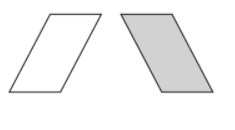
We have to find whether the given shaded diagram is a translation, reflection, or rotation of the non-shaded diagram.
First, draw a line between shaded and non-shaded diagrams.
The given diagram is
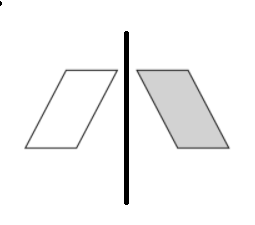
From the above diagram, we can see that the shaded diagram is flipped along the non-shaded diagram.
Hence, the given shaded diagram is a reflection of the non-shaded diagram.
Read and Learn More Big Ideas Math Integrated Math 1 Student Journal Solutions
Hence, the given shaded diagram is a reflection of the non-shaded diagram.
Page 301 Exercise 2 Problem 2
Question 2.
A diagram is given. Determine whether the given shaded diagram is a translation, reflection, or rotation of the non-shaded diagram.
Steps:
- Observe the given diagram with shaded and non-shaded parts.
- Analyze the relationship between the shaded and non-shaded diagrams to determine the type of transformation.
Given Diagram:
- A diagram with a shaded and a non-shaded part.
Answer:
A diagram is given
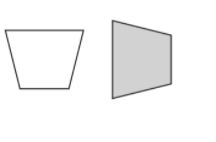
We have to find whether the given shaded diagram is a translation, reflection, or rotation of the non-shaded diagram.
The given diagram is
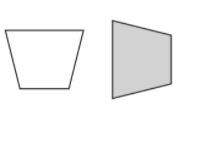
From the above diagram, we can see that the shaded diagram is a clockwise rotation of the non-shaded diagram.
Hence, the given shaded diagram is a rotation of the non-shaded diagram.
Hence, the given shaded figure is a rotation of the non-shaded diagram.
Page 301 Exercise 3 Problem 3
Question 3.
Given the vertices of a polygon at E(0,3), F(-3, 7), and G(0,7), find the perimeter and area of the polygon.
Steps:
- Mark the given vertices on the coordinate plane.
- Join the vertices E, F, and G to form the polygon ΔEFG.
- Calculate the lengths of the sides EF, FG, and GE using the distance formula.
- Determine the area of the polygon.
- Calculate the perimeter of the polygon.
Given Coordinates:
- E(0,3)
- F(-3,7)
- G(0,7)
Answer:
Given:
The vertices are E(0,3), F(−3,7), G(0,7)
We have to find the perimeter and area of the polygon with given vertices.
Mark the given vertices on the coordinate plane.
Join the EF,FG and GE.
Find the area and perimeter.
Mark the given vertices on the coordinate plane.
And join the vertices EF,FG and GE.
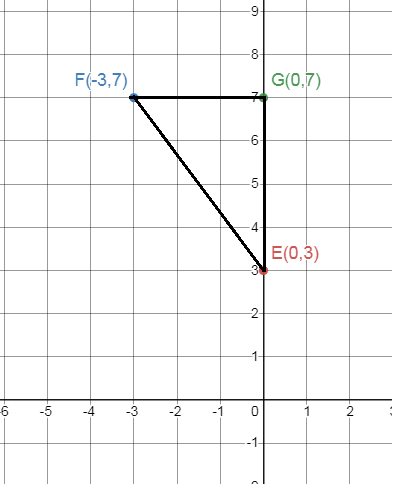
Since the given polygon makes a right-angle triangle.
Base = FG
Height = GE
Find the sides of the triangle EF ,FG and GE by using the distance formula
Since E(0,3) and F(−3,7)
EF = \(\sqrt{(-3-0)^2+(7-3)^2}\)
EF = \(\sqrt{(-3)^2+(4)^2}\)
EF = \(\sqrt{9+16}\)
EF = \(\sqrt{25}\)
EF = 5 units
Similarly, Since F(−3,7) and G(0,7)
FG = \(\sqrt{(0-(-3))^2+(7-7)^2}\)
FG = \(\sqrt{(3)^2}\)
FG = \(\sqrt{9}\)
FG = 3 units
Similarly, Since G(0,7) and E(0,3)
GE = \(\sqrt{(0-0)^2+(3-7)^2}\)
GE = \(\sqrt{-4}^2\)
GE = \(\sqrt{16}\)
GE = 4 units
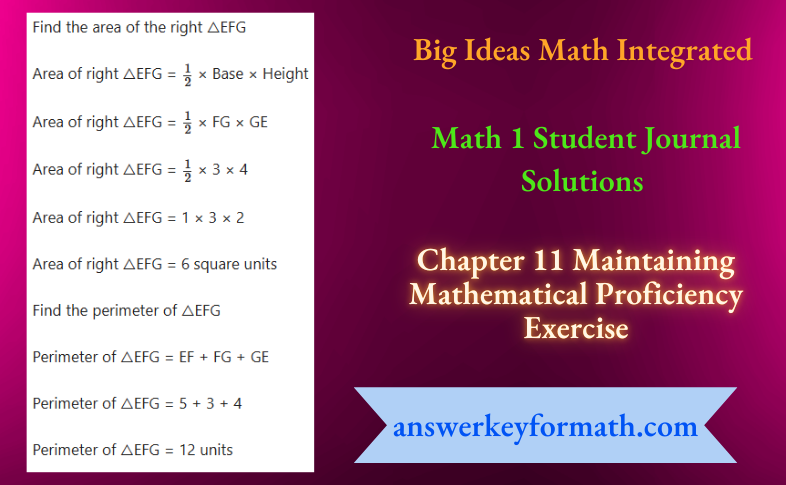
Hence, the area and perimeter of the polygon whose vertices are E(0,3),F(−3,7),G(0,7) is 6 square units and 12 units.
Big Ideas Math Integrated Math 1 Maintaining Mathematical Proficiency Chapter 11 Exercises Page 302 Exercise 4 Problem 4
Question 4.
Using dynamic geometry software, draw and label a triangle ΔABC with the following vertices:
- Select the geometry tool in the software.
- Input the vertices of ΔABC into the software.
- Label the triangle as shown in the diagram below.
Vertices:
- A(x1, y1)
- B(x2, y2)
- C(x3, y3)
Answer:
Here, we draw a △ABC using dynamic geometry software
Select geometry in the software.
Input the vertices of the △ABC in the software.Label the triangle
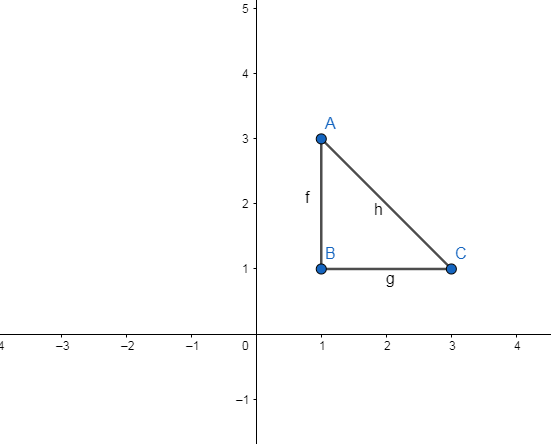
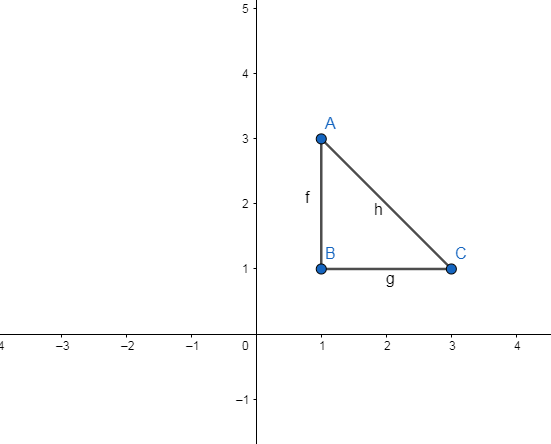
Hence, by using dynamic geometry software we draw a △ABC as shown below.
Page 302 Exercise 4 Problem 5
Question 5.
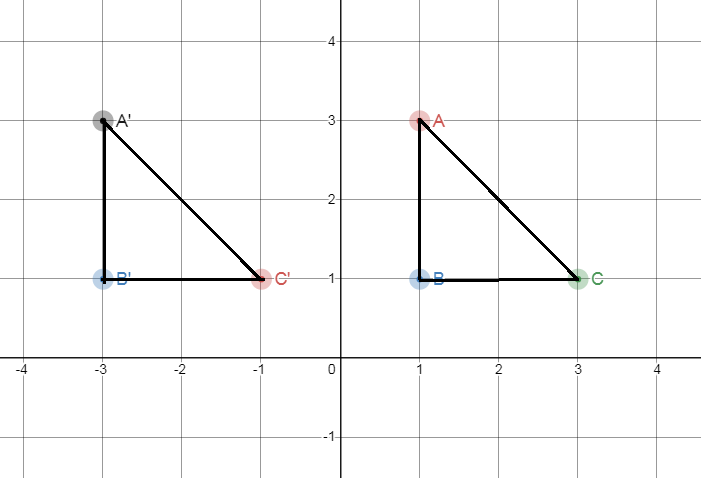
Given triangle ΔABC, translate the triangle to form ΔA’B’C’ with the following vertex transformation:
- A(1, 3) → A'(-3, 3)
- B(1, 1) → B'(-3, 1)
- C(3, 1) → C'(-1, 1)
Answer:
Given
Triangle ΔABC, translate the triangle to form ΔA’B’C.
Since we draw a △ABC in Page 302 Exercise 4 Problem 4.
Now, translate the △ABC as △A′ B′ C′ by A(1,3)→ A′ (−3,3),B(1,1)→ B′ (−3,1) and C(3,1)→C′ (−1,1)
Hence, the translated triangle of △ABC is △A′ B′ C′ shown below
Page 302 Exercise 4 Problem 6
Question 6.
Given the coordinates of the vertices of ΔABC and the translated triangle ΔA’B’C’ determine the relationship between the coordinates of the vertices of ΔABC and those of ΔA’B’C’.
Given Coordinates:
- A (−1, 2)
- B (3, 2)
- C (2, −1)
Translated Coordinates:
- A’ (3, 3)
- B ‘(7, 3)
- C’ (6, 0)
Answer:
Given
The coordinates of the vertices of ΔABC and the translated triangle ΔA’B’C’ are
A (−1, 2)
B (3, 2)
C (2, −1)
A’ (3, 3)
B ‘(7, 3)
C’ (6, 0)
We write coordinates of A,B,C and A′ ,B′,C′
We write about the coordinates of vertices of both triangles.
We write the relationship between the coordinates of the vertices of ΔABC and that of ΔA′ B′C′.
We write coordinates of vertices of given triangles
A = (−1,2)
B = (3,2)
C = (2,−1)
A′= (3,3)
B′= (7,3)
C′= (6,0)
Adding 4 units to x−coordinate of A,B,C and adding 1 unit to y-coordinate of A,B,C
We get coordinates of A′ ,B′,C′
When we add 4 units to x-coordinates of A,B,C add 1 unit to y coordinates of A,B,C , nwe get coordinates of A′ B′ C′.
Page 302 Exercise 5 Problem 7
Question 7.
Given that a point (x,y) is translated a and b units vertically, write a rule to describe the coordinates of the image of (x,y) after the translation.
Given:
- A point (x,y) is translated a units horizontally.
- The same point (x,y) is also translated b units vertically.
Answer:
Given that (x,y) is translated a units horizontally and b units vertically.
We write coordinates of diagram of (x,y)
we write rule to describe coordinates of image of (x,y)
Given that (x,y)is translated a units horizontally and b units vertically.
Coordinates of digram of (x,y) is (x − a,y − b)
Thus we write a rule to describe coordinates of diagram of (x,y)
(x,y) → (x − a,y − b)
We write rule to describe the coordinates of image of (x,y) , (x,y)→(x − a,y − b)
Solutions for Chapter 11 Maintaining Mathematical Proficiency In Big Ideas Math Page 302 Exercise 5 Problem 8
Question 8.
Given the coordinates of ΔABC and the translation rule, find the coordinates of the translated triangle ΔA’B’C’.
Given Coordinates:
- A = (0,3)
- B = (4,5)
- C = (3,-3)
Translation:
- The triangle ΔABC is translated as 4 units left(horizontally) and 3 units down(vertically).
Answer:
We write coordinates of A,B,C
Given that ΔABC is translated 4 units left (horizontally) and 3 units down(vertically) as ΔA′ B′C′ we write rule to translate (x,y)
Thus we write coordinates of A′ ,B′ ,C′
Coordinates of A = (0,3) B = (4,5) C = (3,−3) from diagram ΔABC is translated 4b units left and 3 units down.
We use rule in last example as (x,y) → (x − 4, y − 3)
Here a = 4 b = 3
A′ = (0 − 4, 3 − 3)
A′ = (−4,0)
B′ = (4 − 4,5 − 3)
B′ = (0,2)
C′ = (3 − 4,−3 − 3)
C′ = (−1,−6)
Given A = (0,3)
B = (4,5)
C = (3,−3)
Rule used in last example is (x,y)→(x − 4, y − 3)
Here a = 4
b = 3
ΔABC is translated into Δ A′B′C′
A′ =(−4,0), B′ = (0,2) ,C′ = (−1,−6)
Page 302 Exercise 5 Problem 9
Question 9.
Given the coordinates of ΔABC and its transformed ΔA’B’C’, use the distance formula to verify that the side lengths of ΔABC and ΔA’B’C’ are equal.
Given coordinates:
- A = (0,3)
- A = (4,5)
- A = (3,-3)
Transformed Coordinates:
- A’ = (-4,0)
- B’ = (0,2)
- C’ = (-1,-6)
Answer:
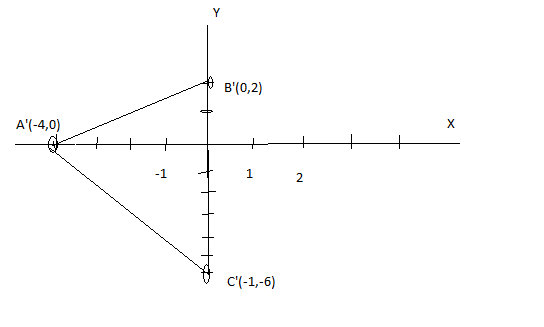
ΔA′B′C′ is as shown in diagram
We write coordinates of A,B,C
We calculate AB,BC,AC using distance formula.
We write coordinates of A′ ,B′ ,C′
Now we calculate A′ B′ ,B′ C′ ,A′ C′ using distance formula
We write coordinates of
A =(0,3)
B = (4,5)
C = (3,-3)
AB = \(\sqrt{(0-4)^2+(3-5)^2}\)
= \(\sqrt{20}\)
BC = \(\sqrt{(4-3)^2+(5+3)^2}\)
= \(\sqrt{65}\)
AC =\(\sqrt{(0-3)^2+(3+3)^2}\)
= \(\sqrt{45}\)
We write coordinates of A′ ,B′,C′now
A’ = (-4,0)
B’ = (0,2)
C’ = (−1,−6)
We calculate A′B′= \(\sqrt{(-4-0)^2+(5-3)^2}\)
= \(\sqrt{20}\)
B’C’ = \(\sqrt{(0+1)^2+(2+6)^2}\)
= \(\sqrt{65}\)
A’C’ = \(\sqrt{(-4+1)^2+(0+6)^2}\)
= \(\sqrt{45}\)
Thus AB = A’B’
BC = B’C’
AC = A’c’
Thus side lengths of Δ A′B′C′ is same as that of ΔABC
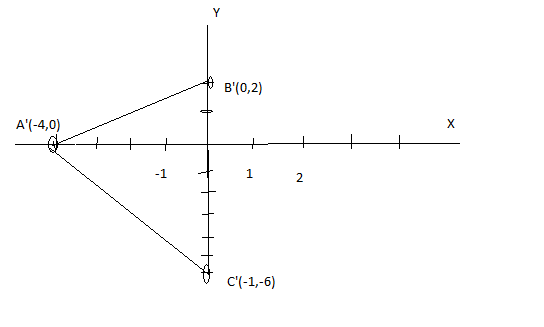
Δ A′B′C′ is as shown in above digram. Side lengths AB = A′B′,BC = B′, AC = A′C′
Page 305 Exercise 6 Problem 10
Question 10.
Given a vector in standard position on a coordinate plane, find the components of the vector from the graph.
Given Vector:
- The vector starts at the origin (0,0) and moves in the downward direction.
Answer:
Given
A vector in standard position on a coordinate plane,
The given vector is
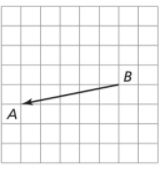
Now, find the components of the vector from the graph.
Since, the vectors standard position has its starting point in origin and vector is moving in downward direction. Therefore
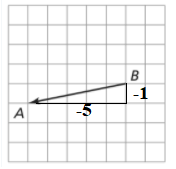
So, the changes in x – axis and y – axis is < −5 − 0, −1 − 0>.
Therefore, the name of the vector \(\overline{B A}\) with its component form as <−5,−1>.
Hence, the vector is \(\overline{B A}\) with components as <−5,−1>.
Page 306 Exercise 7 Problem 11
Question 11.
Given the vertices of triangle ΔABC with vertices A(1,2), and B(5,1), translate the triangle using the vector (0,-5).
Answer:
Given
The vertices of triangle ΔABC with vertices A(1,2), and B(5,1)
It is given that the vertices of triangle ABC having vertices A(1,2), B(5,1) and C(5,4)
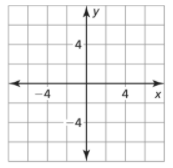
Now, translate the triangle ABC using the vector <0,−5>.
Use <0 ,−5 > to move each vertex 5 units down
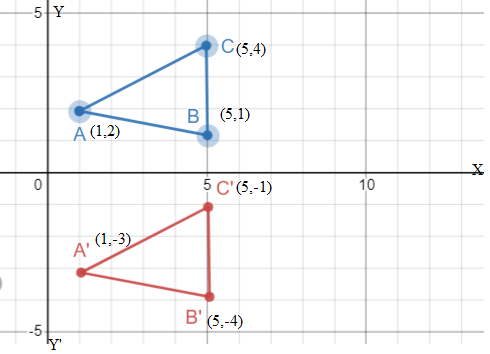
Label the image vertices as A’B’C’ and also vectors drawn from pre-image vertices to image vertices are parallel.
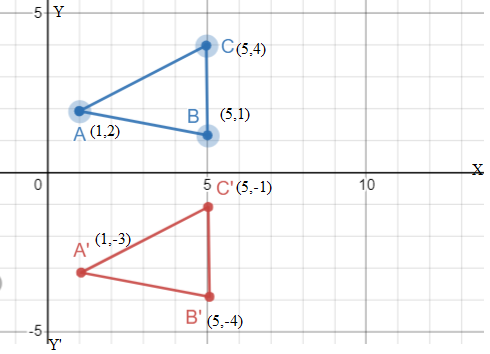
Hence, the graph of triangle ABC and its image A’B’C’ using the given vector <0,− 5> is
Free Solutions For Big Ideas Math Integrated Math 1 Chapter 11 Maintaining Mathematical Proficiency Page 306 Exercise 8 Problem 12
Question 12.
Given the quadrilateral PQRS (pre-image) and its image P’Q’R’S’, use the rule of translation for the given to find the translation vector and the corresponding rule.
Answer:
The given Quadrilateral PQRS (pre-image) and image P’Q’R’S’ is
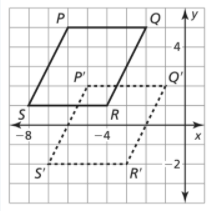
Use the rule of translation for the given diagram.
In the diagram draw vector components form and apply the translation rule such that
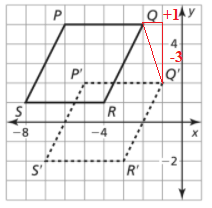
It can be seen that the diagram of quadrilateral moves 1 unit towards right and 3 units down.
So, (x,y) = (x + 1,y − 3)
Hence, the rule of translation is along the vector <1, -3> with notation is (x,y) = (x + 1,y − 3)
Page 306 Exercise 9 Problem 13
Question 13.
Given a translation (x,y) → (x + 6, y-3) and the vector (4,5), find the image of the point J(4,5) after applying the translation.
Answer:
The given translation is (x,y) = (x + 6, y − 3)and the given vector is (4,5).
Use the rule mentioned above to solve this.
So, the digram of <4,5> from (x,y) = (x + 6,y − 3)is
(x,y) = (4 + 6,5 − 3)
(x,y) = (10,2)
Hence, the image of J(4,5) is J′(10,2).
Page 306 Exercise 10 Problem 14
Question 14.
Given the translation rule (x,y) → (x + 6, y-3) and the vector R'(0,-5), find the image point of R'(0,-5) after applying the translation.
Answer:
The given translation is (x,y) = (x + 6, y − 3) and the given vector is R′(0,−5).
Use the rule mentioned above to solve this
So, the digram of <4,5> from (x,y) = (x + 6,y − 3)
(x,y) = (0 + 6,− 5 − 3)
(x,y) = (6,−8)
Hence, the image of R′ (0,−5) is R(6,−8).
Page 306 Exercise 11 Problem 15
Question 15.
Given the coordinate plane diagram, perform the following moves for a spaceship and rewrite the given composition as a single transformation.
Moves:
- Move the spaceship 1 unit left and 4 units up.
- Move the spaceship to 2 units left.
Answer:
Given: The Coordinate plane diagram
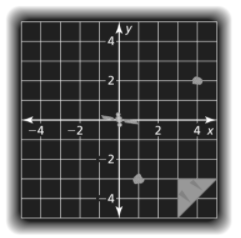
First move: Move the spaceship 1 unit left and 4 units up.
Second move: Move the spaceship to 2 units left.
We have to rewrite the given composition as a single transformation.
Since the first move of the spaceship is 1 unit left and 4 units up.
Which can be written as (−1,4)
Since the first move of the spaceship is 2 units left.
Which can be written as (−2,0)
Combine both the composition
(−1+−2, 4 + 0) = (−3,4)
Hence, the final composition for the given spaceship is
(x,y) → (x − 3, y + 4)
Hence, in a video game, we move given spaceship 1 unit left and 4units up. Then, you move the spaceship to 2 units left. Then the composition can be written as a single transformation such that (x,y) → (x − 3, y + 4).
Page 307 Exercise 12 Problem 16
Question 16.
A diagram can be reflected in a coordinate plane in two ways: over the x-axis or over the y-axis. Given a point on the diagram, apply the appropriate reflection rules to find its image.
Answer:
A diagram can be reflected in a coordinate plane in two ways:
1. Reflect over the x−axis
2. Reflect over the y− axis.
1. Reflect over the x-axis:
When the diagram is reflecting over the x−axis.
In this case, the axis of reflection is the x−axis.
Rule: In reflection of the digram across x−axis, change the sign of the coordinate value of y, and leave the coordinate value of x
same.
Such that (x,y) → (x,−y)
2. Reflect over the y-axis:
When the diagram is reflecting over the y− axis, the axis of reflection is the y−axis.
Rule: In reflection of the figure across the y−axis, change the sign of the coordinate value of x and leave the coordinate value of ysame, such that(x,y)→(−x,y)
A diagramcan be reflected over the x−axis and over the y−axis.
Rules to reflect over x−axis: Change the sign of y coordinate value such that (x,y) → (x,−y) Rules to reflect over y−axis: Change the sign of x coordinate value such that (x,y) → (−x,y).
Step-By-Step Solutions For Big Ideas Math Integrated Math 1 Chapter 11 Page 308 Exercise 13 Problem 17
Question 17.
Using dynamic geometry software, draw the triangle ΔABC with the given coordinates and then reflect it to cover the y-axis to obtain ΔA’B’C’.
Given Coordinates:
- A(3,4)
- B(1,1)
- C(6,1)
Answer:
Draw a △ABC using software.
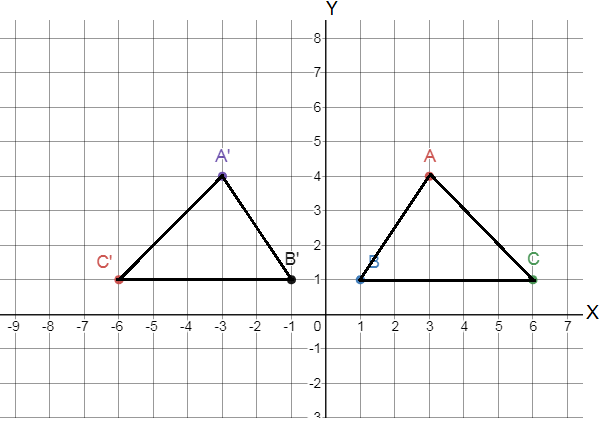
Let say the coordinates are A(3,4), B(1,1) and C(6,1).
Now, to draw the reflection, change the sign of the X coordinate value such that (3,4) → (−3,4), (1,1) → (−1,1)and (6,1) → (−6,1).
Name the new triangle as △A′B′C′.
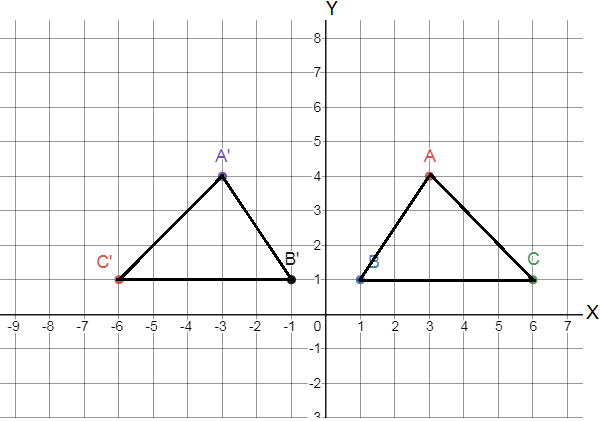
Hence, the reflection of ΔABCin the y-axis to △A′B′C′ by using a dynamic geometry software is shown below
Page 308 Exercise 13 Problem 18
Question 18.
Given ΔABC and its reflection ΔA’B’C’ over the y-axis, verify that the corresponding sides and angles of ΔABC and ΔA’B’C’ are congruent.
Given Coordinates:
- A(3,4)
- B(1,1)
- C(6,1)
Reflected Coordinates:
- A'(-3,4)
- B'(-1,1)
- C'(-6,1)
Answer:
Given
ΔABC and its reflection ΔA’B’C’ over the y-axis,
Since, △A′B′C′is the mirror image or reflection of △ABC
So, the side of the triangles are congruent such that
AB = A′B′
BC = B′C′
CA = C′A′
That means the corresponding sides of the △A′B′C′and △ABC are equal.
Also, the corresponding angles of the triangle
△A′B′C′and △ABC are equal such that
∠ABC = ∠A′B′C′
∠BCA = ∠B′C′A′
∠BAC = ∠B′A′C′
The corresponding also side lengths and angle measures of the △ABC and △A′B′C′ are equal .
Page 308 Exercise 14 Problem 19
Question 19.
Given a point on a coordinate plane, reflect it over the x-axis and the y-axis using the appropriate reflection rules.
Answer:
A diagram can be reflected in a coordinate plane in two ways:
1. Reflect over the x−axis
2. Reflect over the y−axis
1. Reflect over the x-axis:
When the diagram is reflecting over the x−axis.
In this case, the axis of reflection is the x−axis.
Rule: In reflection of the digram across the x−axis, change the sign of the coordinate value of yand leave the coordinate value of x, such that(x,y)→(x,−y).
2. Reflect over the y-axis:
When the diagram is reflecting over the y−axis, the axis of reflection is the y−axis.
Rule: In reflection of the figure across the y−axis, change the sign of the coordinate value of xand leave the coordinate value of y,such that (x,y) → (−x,y).
A diagram can be reflected over thex−axis and over the y−axis. Rules to reflect over x−axis: Change the sign of y coordinate value such that (x,y)→(x,−y).Rules to reflect over y−axis: Change the sign of x coordinate value such the (x,y)→(−x,y)
Page 310 Exercise 15 Problem 20
Question 20.
Given the coordinates of the vertices of ΔABC:
- A(-1,5)
- B(-4,4)
- C(-3,1)
Graph ΔABC and its reflection ΔA’B’C’ in the y-axis.
Answer:
Given:
The coordinates of the vertices of △ABC.
A(−1,5),B(−4,4),C(−3,1)
We have to graph △ABC and its reflection digram in the y−axis.
To draw the reflection image in the y−axis use (x,y)→(−x,y)
Plot the given vertices of △ABCwhich are A(−1,5),B(−4,4),C(−3,1) on the Coordinate plane.
Join the AB,BC and CA.
Now, find the reflection of △ABC named it △A′B′C′
Since the reflection in the y−axis.
So, change the sign of x value of the given coordinates such that A(−1,5) → A′(1,5), B(−4,4) → B′(4,4) and C(−3,1) → C′(3,1).
Now, plot the coordinates A′(1,5),B′(4,4),C′(3,1)on the Same coordinate plane.
Join A′B′,B′C′and C′A′.
Hence, the graph of ΔABCwhose vertices coordinates are A(−1,5),B(−4,4),C(−3,1)and its diagram after reflection in they−axis is
Page 310 Exercise 16 Problem 21
Question 21.
Given the coordinates of the vertices of ΔABC:
- A(0,2)
- B(4,5)
- C(5,2)
Graph ΔABC and its reflection ΔA’B’C’ in the x-axis.
Answer:
Given:
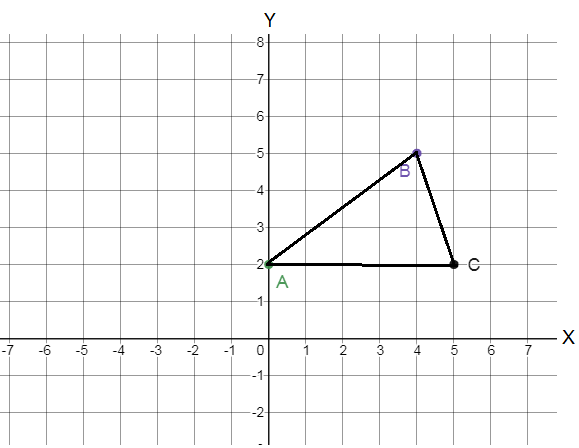
The coordinates of the vertices of △ABC A(0,2),B(4,5),C(5,2)
We have to graph △ABCand its reflection image in the x− axis.
To draw the reflection image in the x−axis use (x,y) → (x,−y)
Plot the given vertices of △ABCwhich are A(0,2),B(4,5),C(5,2)on the coordinate plane.
Join AB, BC and CA.
Now, find the reflection of △ABC and named it △A′B′C′
Since the reflection in the x−axis.
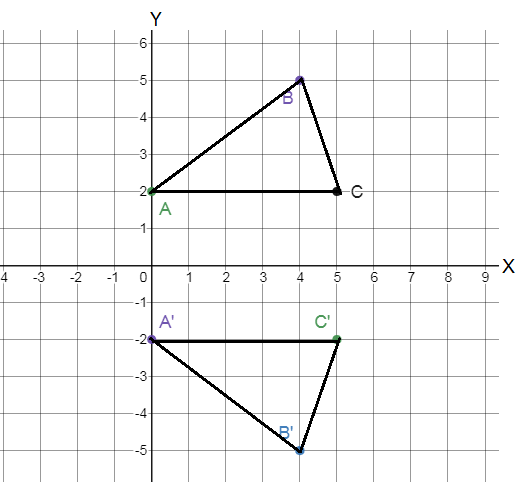
So, change the sign of y value of the given coordinates such that A(0,2)→A′(0,−2),B(4,5)→B′(4,−5),C(5,2)→C′(5,−2)
Now, plot the coordinates A′(0,−2),B′(4,−5),C′(5,−2)on the Same coordinate plane.
Join A′B′,B′C′ and C′A′.
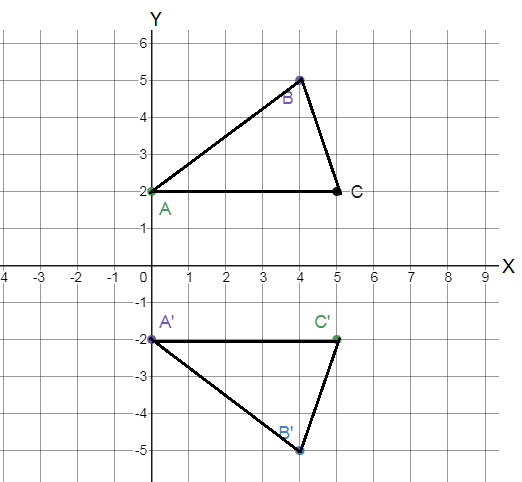
Hence, the graph of △ABC whose vertices coordinates are A(0,2),B(4,5),C(5,2) and its diagram after reflection in the x−axis is
Page 310 Exercise 17 Problem 22
Question 22.
Given the coordinates of the vertices of ΔABC:
- A(2,-1)
- B(-4,-2)
- C(-1,-3)
Graph ΔABC and its reflection image ΔA’B’C’ across the line y = 1.
Answer:
Given:
The coordinates of the vertices of △ABC A(2,−1),B(−4,−2),C(−1,−3)
We have to graph △ABC and its diagram after a reflection in the given line y = 1.
First, draw the line y = 1 in the coordinate plane to find the reflection diagram.
Plot the given vertices A(2,−1),B(−4,−2),C(−1,−3) of △ABC on the coordinate plane.
Join AB,BC and CA.
And, draw the line y = 1 on the graph.
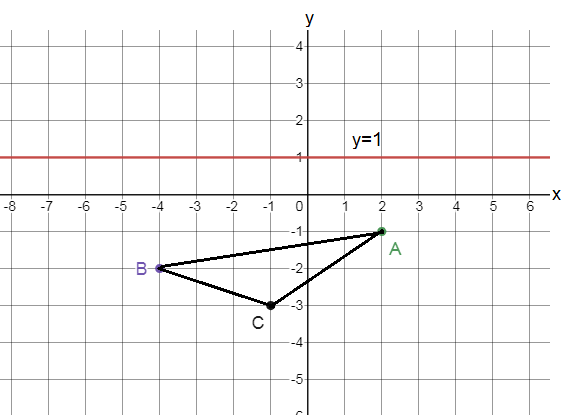
Now draw the reflection of △ABC
Since, y = 1 is the reflection line
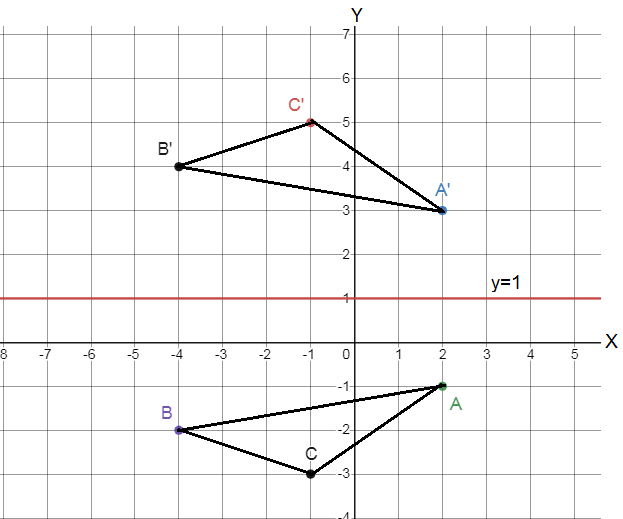
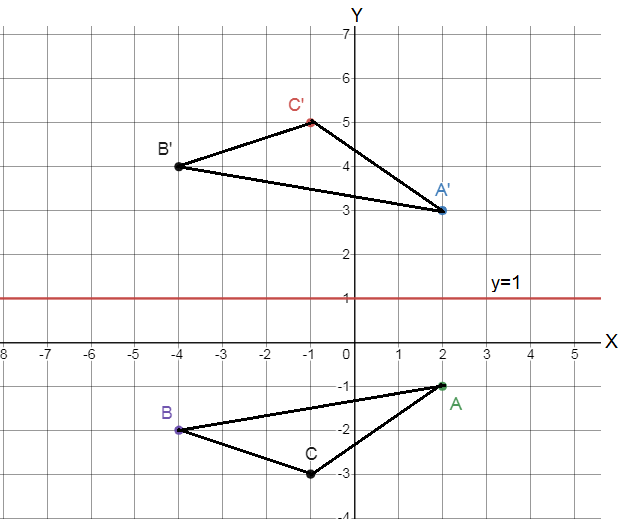
Hence, the graph of △ABC whose vertices coordinates are A(2,−1),B(−4,−2),C(−1,−3) and its diagram after reflection in the y = 1 is
Big Ideas Math Maintaining Mathematical Proficiency Chapter 11 answers Page 310 Exercise 18 Problem 23
Question 23.
Given the coordinates of the vertices of ΔABC:
- A(-2,3)
- B(-2,-2)
- C(0,-2)
Graph ΔABC and its reflection image ΔA’B’C’ across the line x = -3.
Answer:
Given: The coordinates of the vertices of △ABC
A(−2,3),B(−2,−2),C(0,−2)
We have to graph △ABC and its diagram after a reflection in the given line x = −3 .
First, plot the given coordinates on the coordinate plane and draw the line x = −3.
Plot the given vertices A(−2,3),B(−2,−2),C(0,−2) of △ABC on the coordinate plane.
Join AB,BC and CA.
And, draw the line x = −3 on the graph.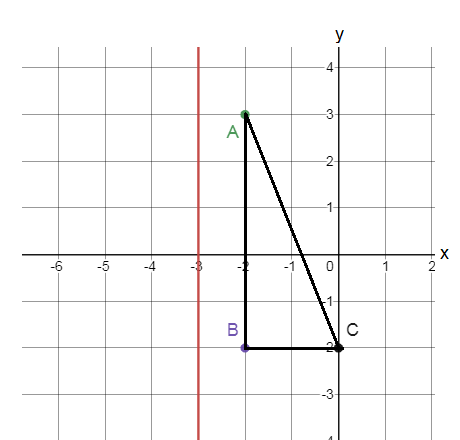
Now draw the reflection of △ABC and named it △A′B′C′
Since, x = −3 is the reflection line
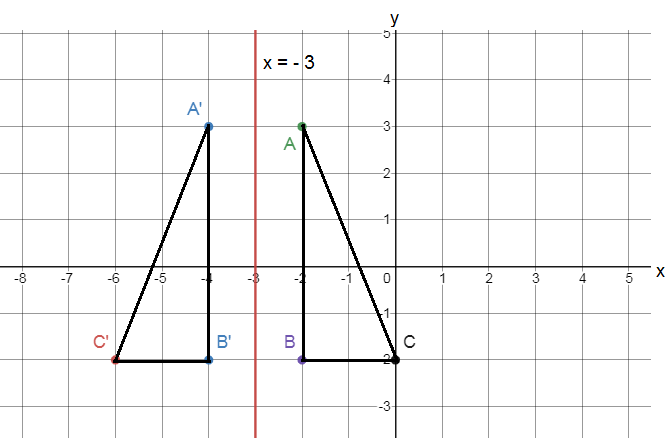
Hence, the graph of △ABCwhose vertices coordinates are A(−2,3),B(−2,−2),C(0,−2)and its image after reflection in the x = −3 is
Page 311 Exercise 19 Problem 24
Question 24.
Graph ΔJKL with vertices J(3,1), K(4,2), and L(1,3) and its image after a glide reflection. The glide reflection consists of a translation followed by a reflection.
Steps:
Translation: (x,y) → (x,y-4)
Reflection: Across the line x = 1
Answer:
Given
In this question, we have to graph ΔJKL with vertices J(3, 1), K(4, 2), and L(1, 3) and its diagram after the glide reflection.
Translation: (x,y)→(x,y−4)
Reflection: In the line x = 1
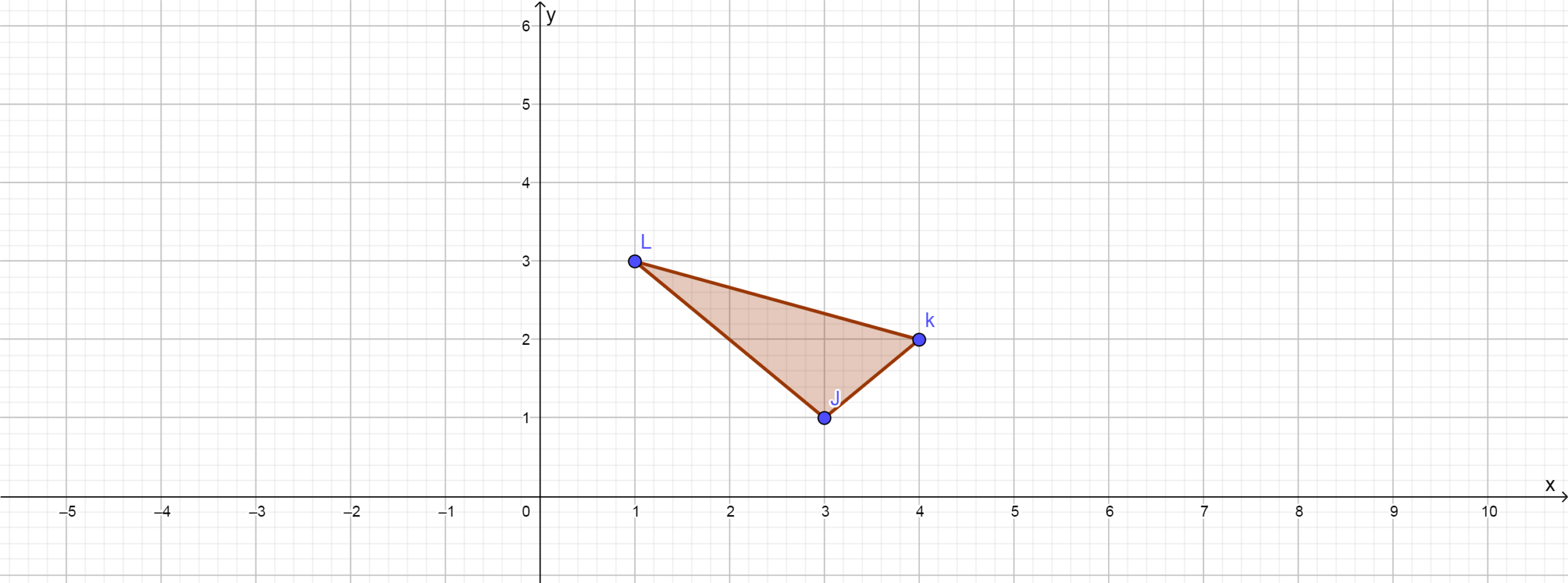
First we draw the graph of ΔJKL
The graph of ΔJKL with vertices J(3, 1), K(4, 2), and L(1, 3) is
Now we have to draw digram of ΔJKL after the glide reflection
Translation:(x,y) → (x,y − 4)
We have J = (3,1)now we put the coordinates of J in the given translation to find J′
(x,y) → (x,y − 4)
(x,y)→(3,1 − 4)
(x,y)→(3,−3)
K = (4,2) now we put the coordinates of K in the given translation to find K′
(x,y) → (x,y − 4)
(x,y) → (4,2 − 4)
(x,y)→ (4,−2)
L = (1,3) now we put the coordinates of L in the given translation to find L′
(x,y) → (x, y − 4)
(x,y)→ (1, 3 − 4)
(x,y) → (1,−1)
Now we graph the △J′K′L′ with vertices J′(3,−3),K′(4,−2),L′(1,−1)
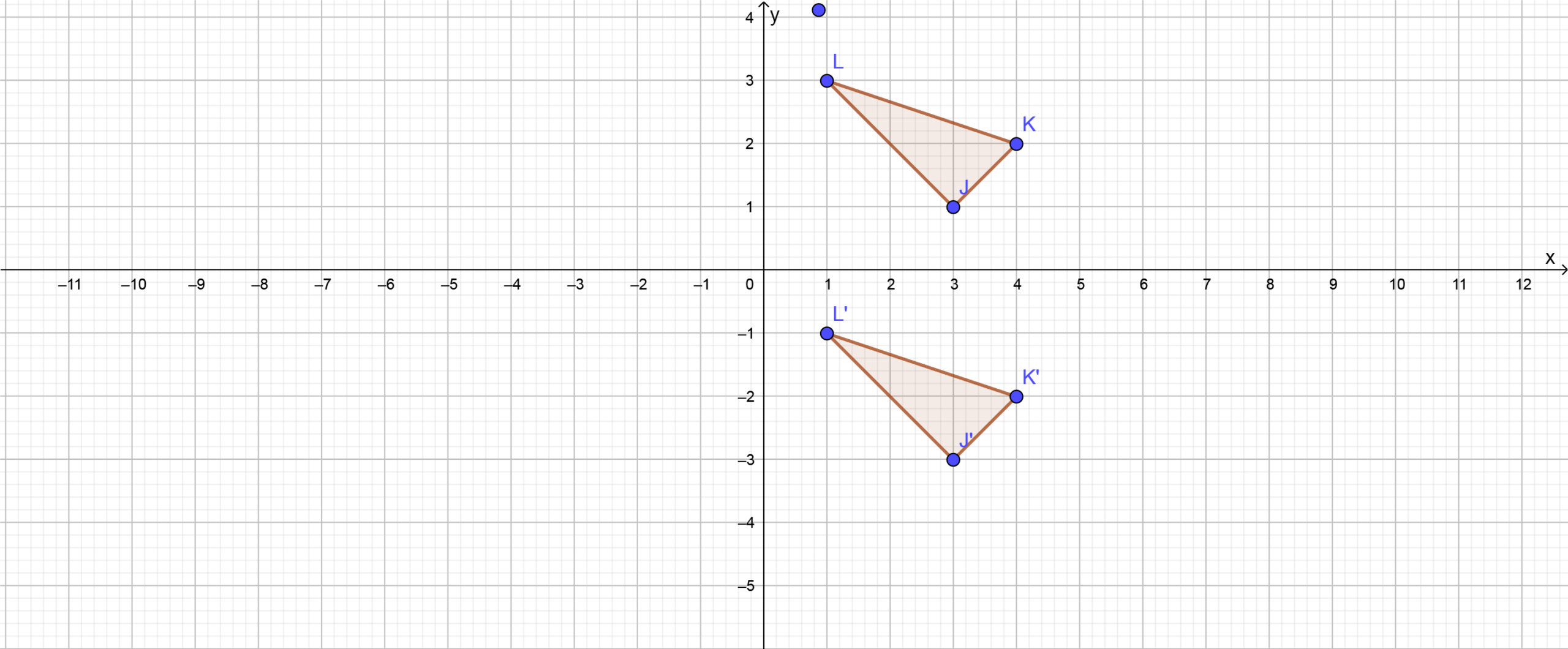
Now we apply reflection in the line x = 1
We know that if(a,b)is reflected in the line x = 1 then its diagram is the point (−a,b) so the poin t J′′ which is the reflection of J′ is J′′(−3,−3) the point K′′ which is the reflection of K′ is K′′(−4,−2)t he point L′′ which is the reflection of L′is L′′(−1,−1)
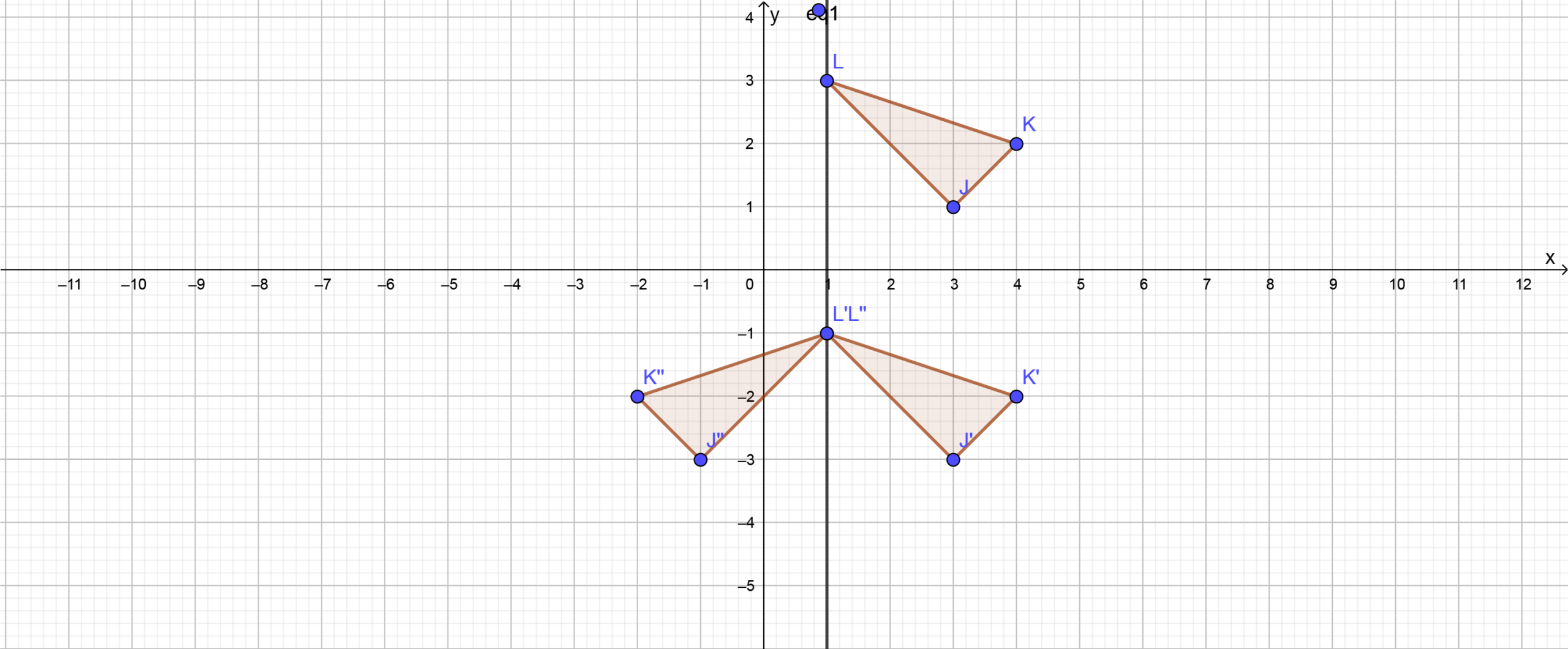
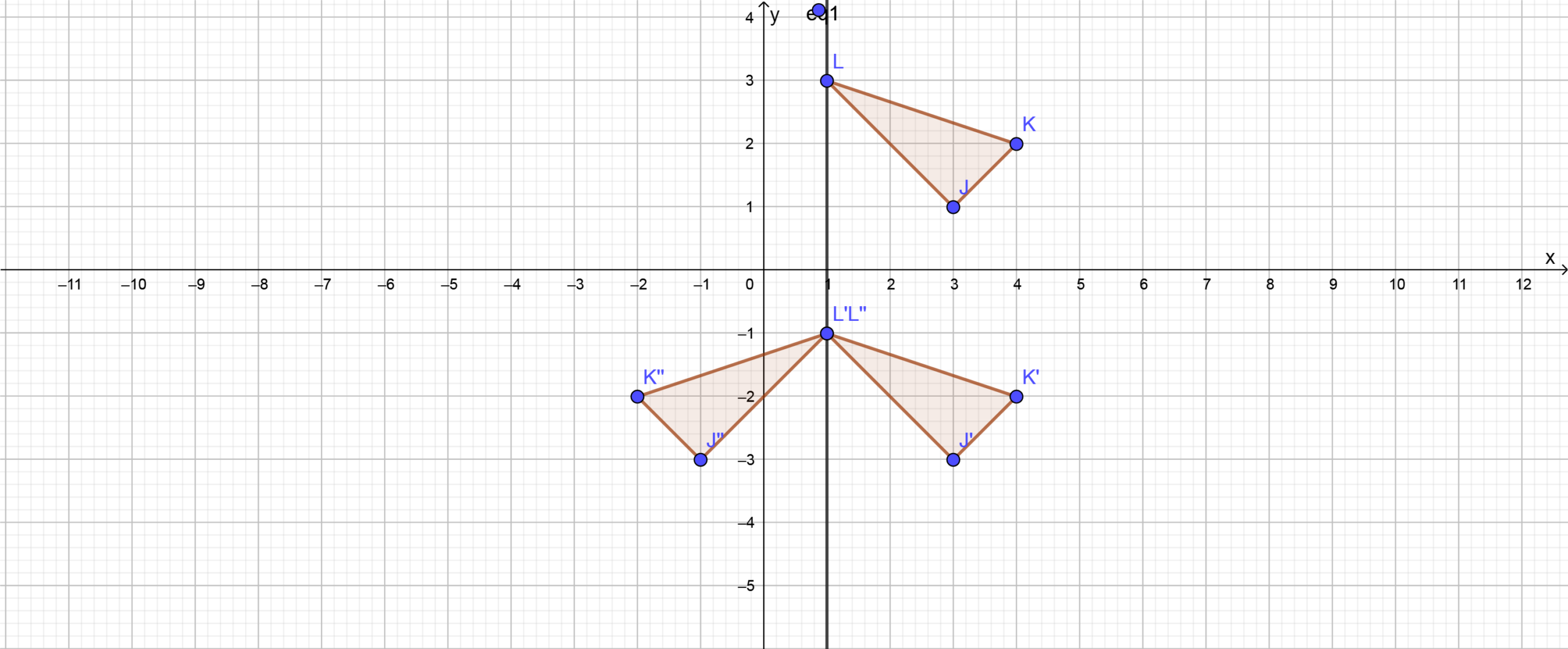
The graph of ΔJKL with vertices J(3, 1), K(4, 2), and L(1, 3) and its digram after the glide reflection.
Translation: (x,y) → (x, y − 4)
Reflection: In the line x = 1
The diagram of triangle JKL after translation is triangle J′K′L′
After reflection the diagram of triangle J′K′L′is triangle J′′K′′L′′
The graph contains the triangle JKL with vertices J(3,1), K (4,2), and L(1,3) and the diagram of triangle J′K′L′ with vertices J′(3,−3), K′(4,−2), L′(1,−1) and triangle J′′K′′L′′ with vertices J′′(−3,−3),K′′(−4,−2),L′′(−1,−1).
Chapter 11 Maintaining Mathematical Proficiency Big Ideas Math 1 workbook solutions Page 311 Exercise 20 Problem 25
Question 25.
Identify the line of symmetry of the word “WOW”.
Answer:
In this question have to identify the line of symmetry of the word WOW.
As from the definition of the line of symmetry:
The line of symmetry can be defined as the axis or imaginary line that passes through the center of the shape or object and divides it into identical halves.
As from the diagram given below we conclude that line of symmetry of the word WOW is possible because we get two identical halves.

The line of symmetry of the word WOW is

Page 311 Exercise 21 Problem 26
Question 26.
Identify the line of symmetry of the word “KID”.
Answer:
In this question have to identify the line of symmetry of the word KID
As from the definition of the line of symmetry:
The line of symmetry can be defined as the axis or imaginary line that passes through the center of the shape or object and divides it into identical halves.
As from the diagram given below we conclude that line of symmetry of the word KID is possible because we get two identical halves.

The line of symmetry of the word KID is

Page 311 Exercise 22 Problem 27
Question 27.
Given that power strips are placed along wall w, which connects two computers: Computer A and Computer B. Determine where to place the power strip to minimize the length of the connecting cables.
Answer:
Given that power strip are placed along wall w which connects to two computers that is Computer A −and Computer B.
We need to determine that where to place the power strip to minimize the length of the connecting cables.
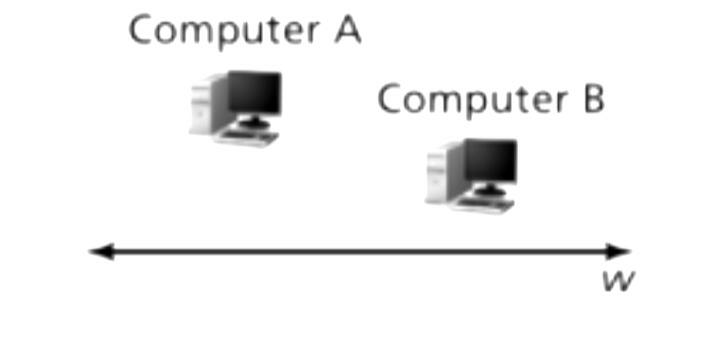
Here, wis the power strip line.
Now, draw the reflection of Computer A at point A.
Then, join point A to Computer B and the line intercept wat point B and it is the nearest distance to minimize the length of the connecting cables.
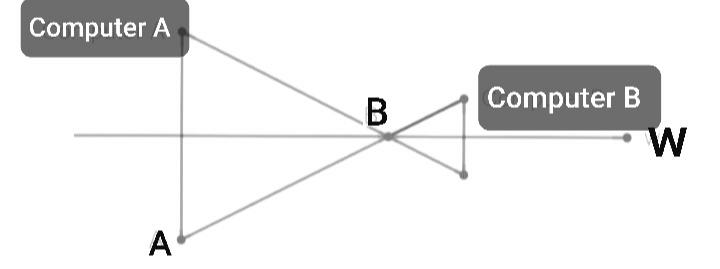
Place at equal distance from the both the computers that at point B to minimize the length of the connecting cables.