Geometry Student Text 2nd Edition Chapter 1 Tools of Geometry
Carnegie Learning Geometry Student Text 2nd Edition Chapter 1 Exercise 1.1 Solution Page 4 Problem 1 Answer
Question 1.
Given the graph where each point represents the age and height of different children:
- Identify which axis represents the age of the children.
- Determine the point that represents the oldest child based on the graph.
- Explain how you identified the point that represents the oldest child.
Read and learn More Carnegie Learning Geometry Student Text 2nd Edition Solutions
Answer:
The given graph is :-
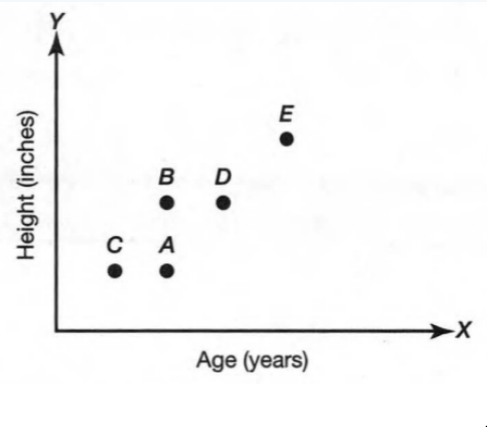
Each point in the graph represents the age and height of different children.
We have to find the point that represents the oldest child.
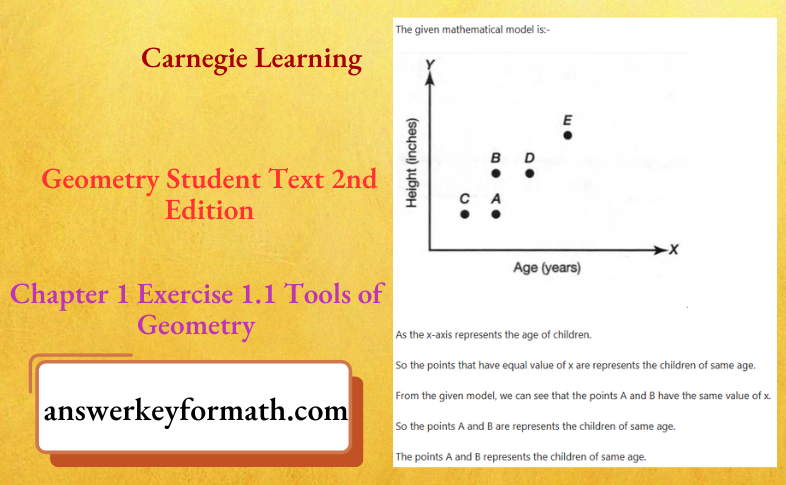
The given model is:-
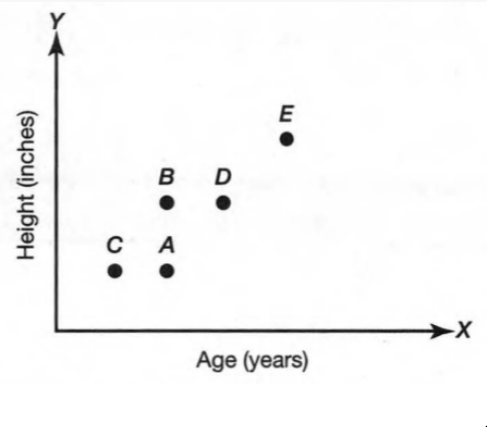
We can see that the x-axis represents the age of children.
So the maximum value of x, gives the maximum age.
We can see that The point E has the maximum value of x.
So the the point E represents the oldest children.
The point E represents the oldest children.
Page 4 Problem 2 Answer
Question 2.
Given the graph where each point represents the age and height of different children:
- Identify which axis represents the age of the children.
- Determine the points that represent children of the same age based on the graph.
- Explain how you identified the points that represent children of the same age.
Answer:
The given graph is:-
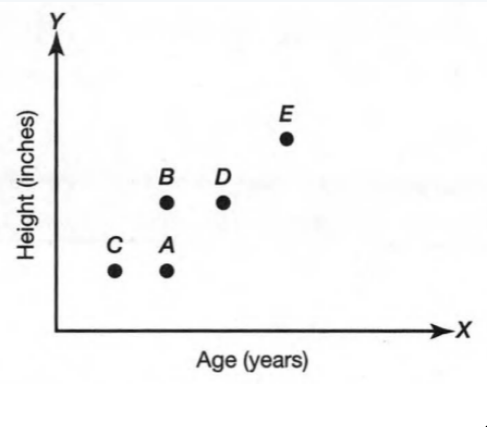
Each point in the graph represents the age and height of different children.
We have to find the point which represents the children of same age.
Carnegie Learning Geometry Chapter 1
Page 4 Problem 3 Answer
Question 3.
Given the graph where each point represents the age and height of different children:
- Identify which axis represents the height of the children.
- Determine the points that represent children of the same height based on the graph.
- Explain how you identified the points that represent children of the same height.
Answer:
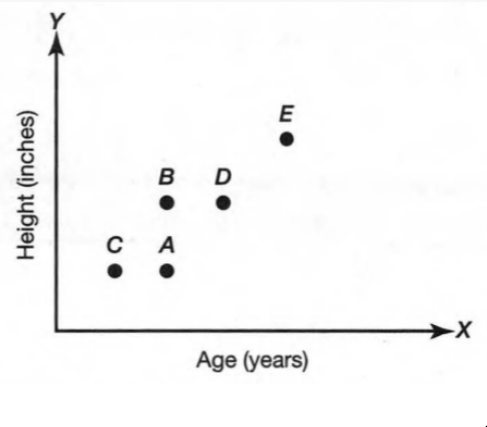
The given graph is:-
Each point in the graph represents the age and height of different children.
We have to find the points that represents the children of same height.
The given graph is :-
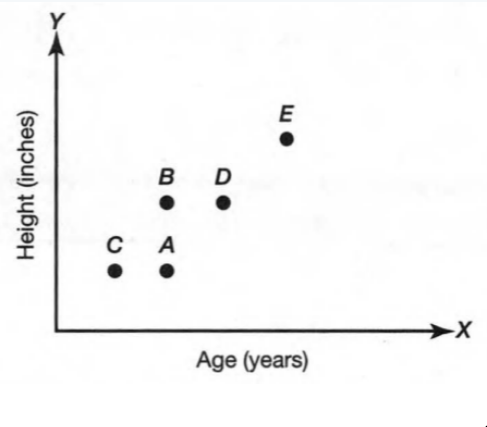
We can see that the points C and A has the same value of y and y represents the height of children.
So that the We can see that the points C and A has the same value of y and y represents the height of children.
So that the points C and A represents the children of same height.
Similarly, the points B and D has the same value of y.
So the points B and D represents the children of same height.
The points A and C represents the children of same height.
The points B and D also represents the children of same height.
Carnegie Learning Geometry Chapter 1 Page 4 Problem 4 Answer
Question 4.
Given that a mathematical model of several points is shown, where each point represents the age and height of a different child:
- Which point represents the oldest child?
- Which points represent children of the same age?
- Which points represent children of the same height?
Based on the answers provided:
- The point E represents the oldest child.
- The points A and B represent children of the same age.
- The points A and C represent children of the same height.
- The points B and D represent children of the same height.
Explain how the (x,y) coordinate system is used to represent the age and height of different children.
Answer:
Given that, A mathematical model of several points is shown. Each point represents the age and height of a different child.
From question 1to 3, we have,
- Which point represents the oldest child?
- Which points represent children of the same age?
- Which points represent children of the same height?
And their answers are,
- The point E represents the oldest children.
- The points A and B represents the children of same age.
- The pointsA andC represents the children of same height.
and also The points B and D represents the children of same height.
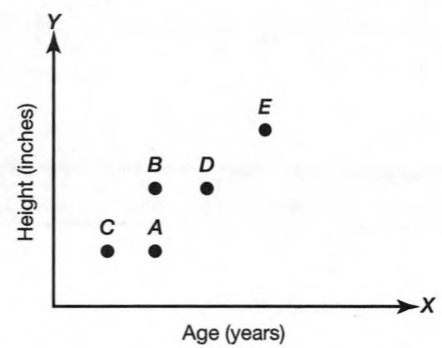
From above solutions we can say that, each point represents the age on x−axis and height on y−axis of a different child.
So, (x,y) coordinate system is used to represent height and age of different child.
(x,y) coordinate system is used to represent height and age of different child.
Page 4 Problem 5 Answer
Question 5.
Given a mathematical model of several lines:
- Determine whether point C represents a specific line in the model.
- Explain the characteristics of a line in geometry.
- Justify your conclusion about whether C represents a specific line using the properties of lines and points.
Answer:
The given mathematical model of several lines is :-
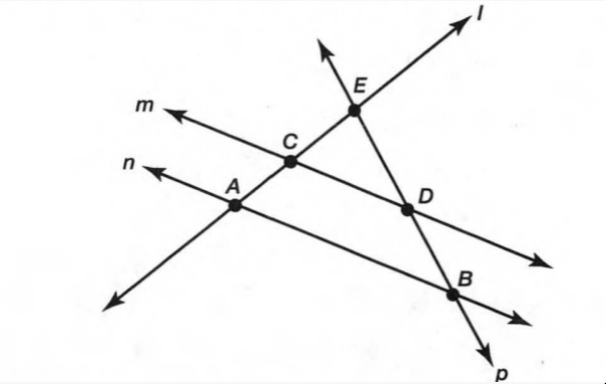
We have to check that is C determine a specific line in the model.
The given mathematical model of several lines is :-
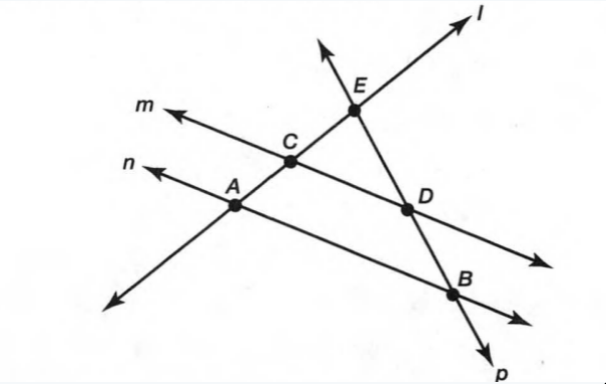
We know that a line is a straight continuous arrangement of several points.
Also, it has infinite length but no width and arrowheads are indicate that a line extends infinitely in opposite directions.
But C is not a arrangement of several points. It is just a single point.
So C is not a specific line in the given mathematical model.
No, C is not a specific line in the given mathematical model.
Carnegie Learning Geometry Chapter 1 Page 5 Problem 6 Answer
Question 6.
Given a mathematical model of several lines:
- Determine whether CD represents a specific line in the model.
- Explain the characteristics of a line and a line segment in geometry.
- Justify your conclusion about whether CD determines a specific line using the properties of lines and line segments.
Answer:
The given mathematical model of several lines is :-
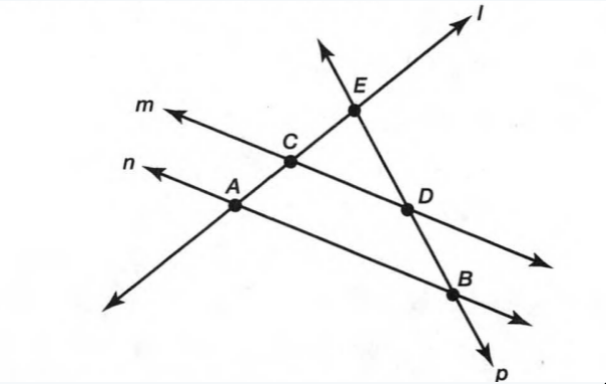
We have to check that is CD determine a specific line in the model.
The given mathematical model of several lines is :-
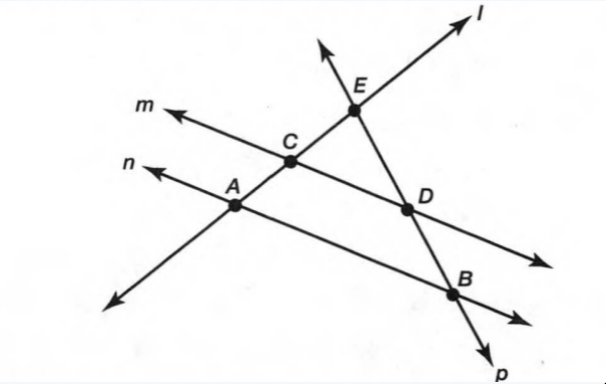
We can see that CD is a line segment of line m.
We know that a line is described as a straight continuous arrangement of an infinite number of points.
CD is also continuous arrangement of infinite points.
Also a line segment is also a line.
So CD determines a specific line in the model.
Yes, CD determines the specific line in the given model.
Solutions For Tools of Geometry Exercise 1.1 In Carnegie Learning Geometry Page 5 Problem 7 Answer
Question 7.
Given a mathematical model of several lines:
- Determine whether m represents a specific line in the model.
- Explain the characteristics of a line in geometry.
- Justify your conclusion about whether m determines a specific line using the properties of lines.
Answer:
The given mathematical model of several lines is :-
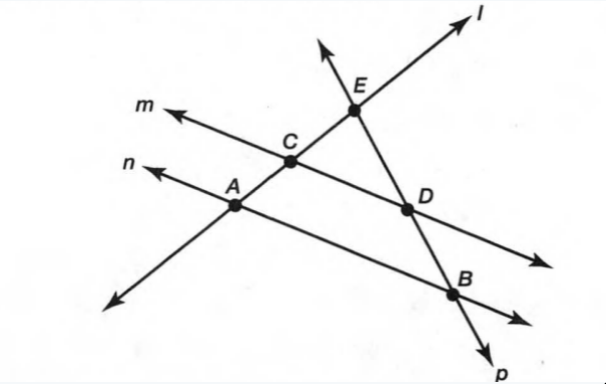
We have to check that is m determines the specific line in the model.
The given mathematical model of several lines is :-
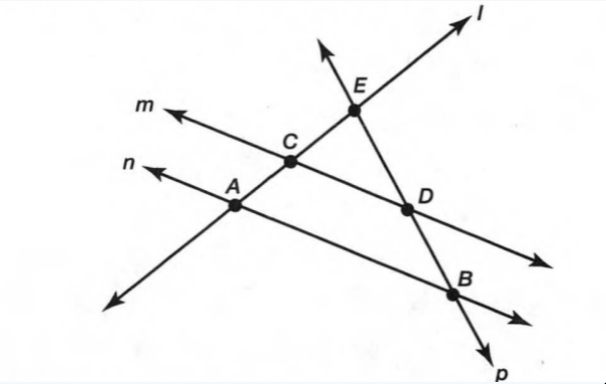
We know that a line is a straight continuous arrangement of several points.
Also it has infinite length but no width and arrowheads are indicate that a line extends infinitely in opposite directions.
In the above model, m satisfies all of these conditions.
So m is a specific line in the model.
Yes, m is a specific line in the given mathematical model.
Carnegie Learning Geometry Chapter 1 Page 5 Problem 8 Answer
Question 8.
Given a mathematical model of several lines:
- How many points are needed to describe a specific line?
- Explain the characteristics of a line in geometry and why it requires a certain number of points to be described.
Answer:
The given mathematical model of several lines is:-
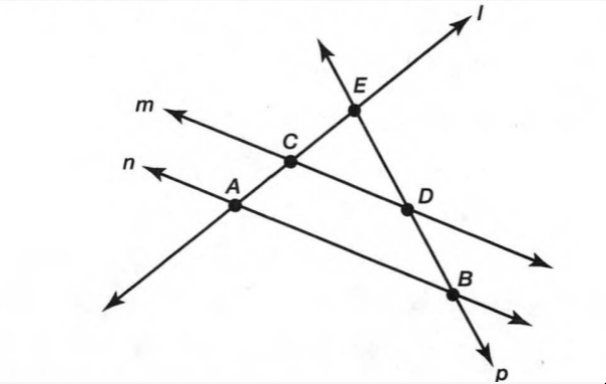
We have find that how many points are needed to describe a specific line.
We know that:-
A line is described as a straight continues arrangement of infinite number of points.
So to describe a specific line we need a continuous infinite points that should be in straight arrangement.
To describe a specific line we need a continues infinite points that should be in straight arrangement.
Tools Of Geometry Solutions Chapter 1 Exercise 1.1 Carnegie Learning Geometry Page 5 Problem 9 Answer
Question 9.
Given a mathematical model of several lines:
- Identify the line represented by AB in the model.
- Determine an alternative name for the line AB.
- Explain how you identified the alternative name for line AB.
Answer:
The given mathematical model of several lines is :-
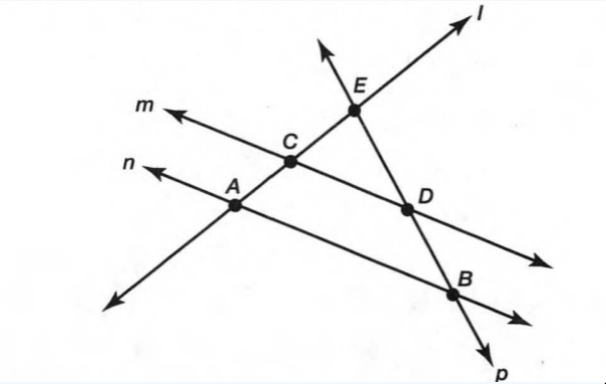
We have to find alternative name for line AB.
The given mathematical model of several lines is :-
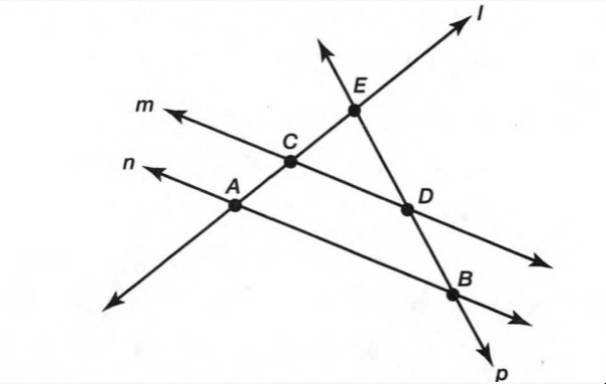
We can see that AB represents a line in the model.
N is also represents the same line.
So we can say that the alternative name for line AB is n.
In the given mathematical model, alternative name for line AB is n .
Carnegie Learning Geometry Chapter 1 Page 5 Problem 10 Answer
Question 10.
Given a mathematical model of several lines:
- Identify three points that are collinear in the model.
- Explain the definition of collinear points.
- Choose a line from the model and list the three points on that line which are collinear.
Answer:
The given mathematical model of several lines is :
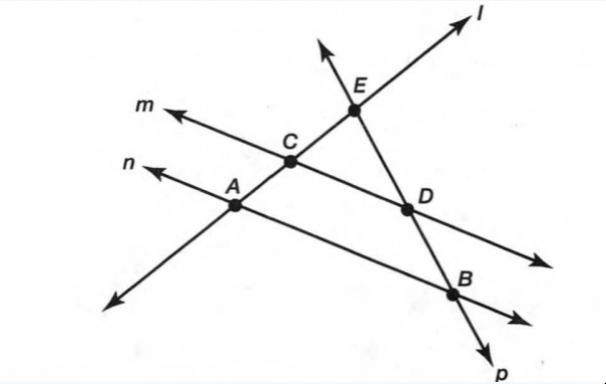
We have to give name of three points that are collinear.
The given mathematical model of several lines is :-
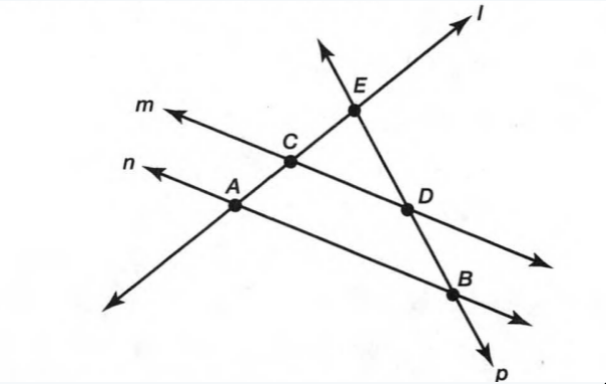
We know that the points that are located on same line are called collinear.
Choose the line l from the given model.
We can see that three points A,C,E are located on the same line l.
So that the points A,C,E are collinear.
The three points A,C,E are collinear.
Step-By-Step Solutions For Carnegie Learning Geometry Chapter 1 Exercise 1.1 Page 5 Problem 11 Answer
Question 11.
Given a mathematical model of several lines:
- Define what it means for points to be collinear.
- Identify three points in the model that are not collinear.
- Provide three sets of points from the model that are not collinear.
Answer:
Given that, Line AB can be read as “line AB. and
We have to Name three points that are not collinear in the model.
We know that, Collinear points are points that are located on the same line. So the points which are not on same line are not a colinear points.
From given model the following points are not colinear,
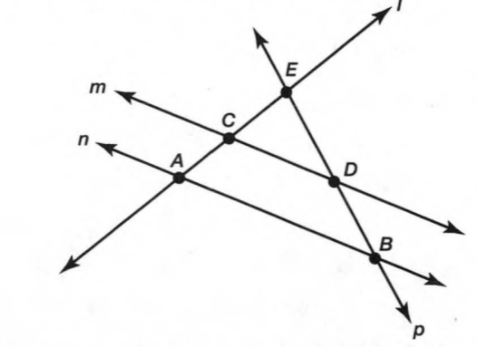
- A,B,D
- A,C,D
- C,E,D
The following points are not colinear,
- A,B,D
- A,C,D
- C,E,D
Carnegie Learning Geometry Chapter 1 Page 6 Problem 12 Answer
Question 12.
Given planes p, w, and z in the figure:
- Determine whether there is a single point that is common to all three planes.
- Explain what it means for planes to be parallel.
- Based on the figure, conclude whether the given planes are parallel or intersecting.
- Justify your conclusion about the relationship between the planes.
Answer:
Given planes p,w,and z are given in figure,
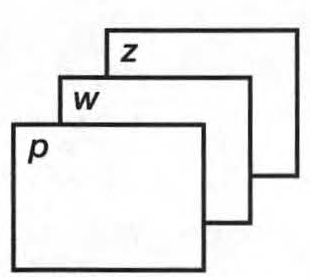
From given figure we can conclude that, there is no single point which is common to given three planes.
So given plane are not intersecting each other.
Therefore, given planes are parallel.
Given three planes are parallel.
Carnegie Learning Geometry Chapter 1 Exercise 1.1 Free Solutions Page 6 Problem 13 Answer
Question 13.
Given planes p, w, and z in the figure:
- Determine the relationship between the planes p, w, and z.
- Explain how the planes intersect with each other.
- State the number of points where the planes intersect.
- Conclude the type of intersection that occurs among the planes.
Answer:
Given planes p, w and z are given figure below,
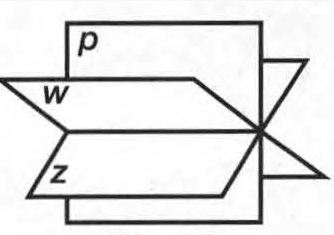
From above figure of planes, we can say that all planes p, w and z intersect with each other at a single line.
So there are infinite number of points of intersection.
All planes p, w and z intersect with each other at a single line.
So there are infinite number of points of intersection.
i.e. Three Planes Intersecting in a Line
Carnegie Learning Geometry Chapter 1 Page 6 Problem 14 Answer
Question 14.
Given planes p, w, and z in the figure:
- Describe the relationship between planes p and w.
- Explain how planes p and w intersect with plane z.
- Determine if planes p and w intersect with each other.
- Conclude the type of intersection that occurs among the planes.
Answer:
Given planes p, w and z are given in figure below,
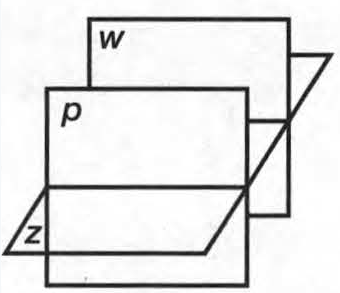
From above figure we can say that, the planes p and w are intersects the plane z at two different lines but the planes p and w are not intersectes to each other so the planes p and w are parallel planes.
The planes p and w are intersects the plane z at two different lines but the planes p and w are not intersects to each other so the planes p and w are parallel planes.
i.e. Two Parallel Planes and the Other Cuts Each in a Line.
Page 6 Problem 15 Answer
Question 15.
Given planes p, w, and z in the figure:
- Describe how plane p intersects with plane w.
- Describe how plane p intersects with plane z.
- Describe how plane w intersects with plane z.
- Determine the type of intersection that occurs among the planes p, w, and z.
- Conclude how the planes p, w, and z intersect with each other in the figure.
Answer:
Given planes p, w and z are shown in figure below,
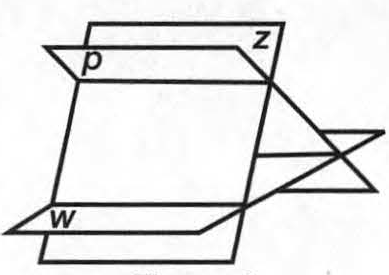
From the above figure we can say that, Plane p and w intersect the plane z.
Plane p and z intersect the plane w.
Plane w and z intersect the plane p That means all planes p, w and z intersect each other but not in single line, they are intersects each other in two different lines.
The planes p, w and z intersects each other in two different lines.
i.e. Each Plane Cuts the Other Two in a Line.
Carnegie Learning Geometry Chapter 1 Page 6 Problem 16 Answer
Question 16.
Given planes p, w, and z in the figure:
- Describe the intersection of planes p and w.
- Describe the intersection of planes p and z.
- Describe the intersection of planes w and z.
- Determine the type of intersection that occurs among the planes p, w, and z.
- Conclude how the planes p, w, and z intersect with each other in the figure.
Answer:
Given planes p, w and z are shown in figure below,
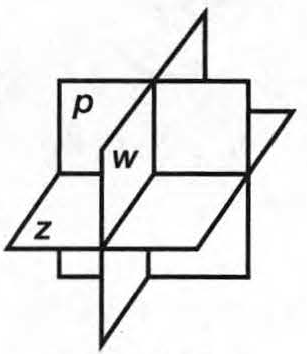
From above figure we can conclude that, all three planes p, w and z are intersects each other at single point.
The intersection of the three planes is a point.
Carnegie Learning Geometry Chapter 1 Page 6 Problem 17 Answer
Question 17.
List and describe all possible intersections of three planes.
Provide the following scenarios in your answer:
- Intersecting at a point.
- Each plane cutting the other two in a line.
- Two parallel planes with the third plane cutting each in a line.
- Three planes intersecting in a line.
- Two coincident planes with the third plane intersecting them in a line.
- Three parallel planes.
Answer:
We have to list all of the possible intersections of three planes.
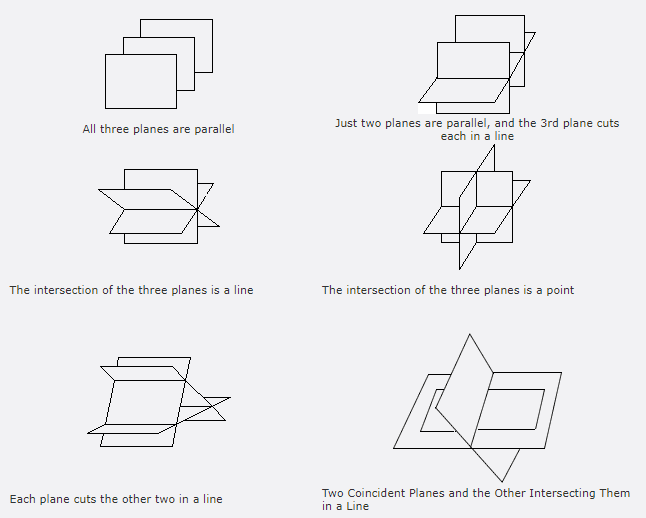
Following are the list all of the possible intersections of three planes.
Intersection of Planes.
Intersecting at a Point. Each Plane Cuts the Other Two in a Line.
Two Parallel Planes and the Other Cuts Each in a Line.
Three Planes Intersecting in a Line.
Two Coincident Planes and the Other Intersecting Them in a Line.
Three Parallel Planes.
Carnegie Learning Geometry Exercise 1.1 Student Solutions Page 6 Problem 18 Answer
Question 18.
List and describe all possible intersections of a line and a plane.
Provide the following scenarios in your answer:
- The line intersects the plane at a point.
- The line is parallel to the plane.
- The line is on the plane.
Answer:
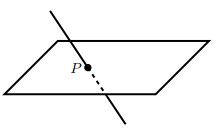
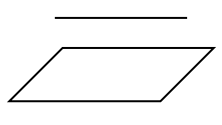
Following are the all possible intersections of a line and a plane.
Line intersects the plane at a point
line is parallel to the plane
line is on the plane
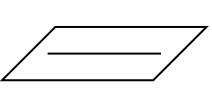
All possible intersections of a line and a plane,
- Line intersects the plane at a point
- line is parallel to the plane
- line is on the plane
Carnegie Learning Geometry Chapter 1 Page 7 Problem 19 Answer
Question 19.
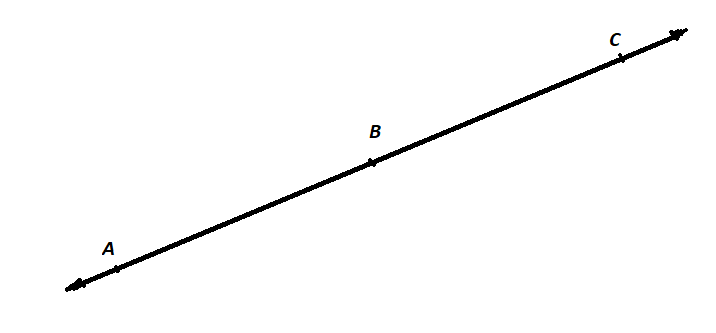
Given collinear points A, B, and C such that point B is located halfway between points A and C:
- Sketch the figure with points A, B, and C.
- Ensure that B is exactly halfway between A and C.
Answer:
Given that, a geometric figure using collinear points A, B, and C such that point B is located halfway between points A and C.
We have to Sketch the figure.
Required sketch is
Page 7 Problem 20 Answer
Question 20.
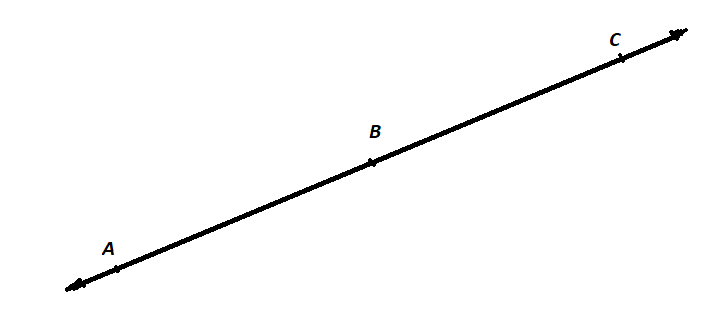
Given collinear points A, B, and C such that point B is located halfway between points A and C:
- Draw the figure with points A, B, and C ensuring that they are collinear.
- Place point B exactly halfway between points A and C.
Answer:
Given that, a geometric figure using collinear points A, B, and C such that point B is located halfway between points A and C.
We have to draw the figure.
Required sketch is
Carnegie Learning Geometry Chapter 1 Page 7 Problem 21 Answer
Question 21.
Consider the following:
- Sketch a geometric figure using collinear points A, B, and C such that point B is located halfway between points A and C.
- Draw a geometric figure using collinear points A, B, and C such that point B is located halfway between points A and C.
- Explain the difference between sketching a figure and drawing a figure.
- For part 1(a), sketch the figure without the use of any tools.
- For part 1(b), draw the figure using a ruler and straightedge to ensure accuracy.
Answer:
In the question 1 (a), we sketch the figure, the figure is created without the use of tools and in the question 1 (b), we draw a geometric figure, the figure is created with the use of ruler and straightedge.
Therefore, in the question 1 (a), we sketch the figure and in the question 1 (b), we draw a figure.
Page 7 Problem 22 Answer
Question 22.
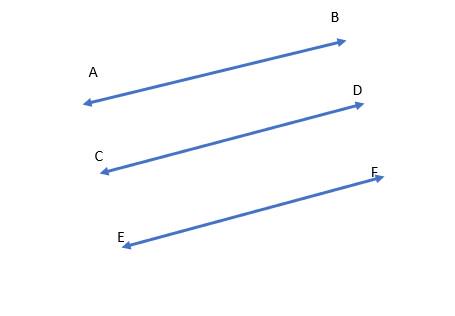
Draw and label three coplanar lines.
- Begin by drawing a line AB.
- Next, draw a line CD in the same plane as line AB.
- Finally, draw a line EF in the same plane as lines AB and CD.
Answer:
We have to draw and label three coplanar lines.
First we draw a line AB then draw a line CD and line EF in the same plane.
The required coplanar lines are
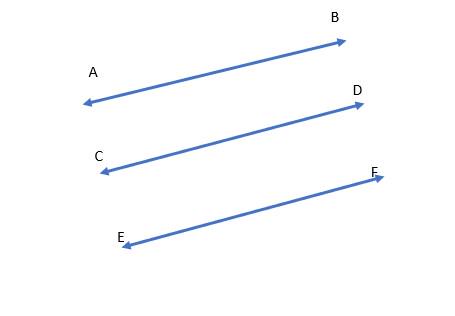
The required three coplanar lines are
Carnegie Learning Geometry Chapter 1 Page 8 Problem 23 Answer
Question 23.
Consider the following:
Your classroom is in the shape of a square.
- Define skew lines and explain their properties.
- Identify two lines in your classroom that are skew lines.
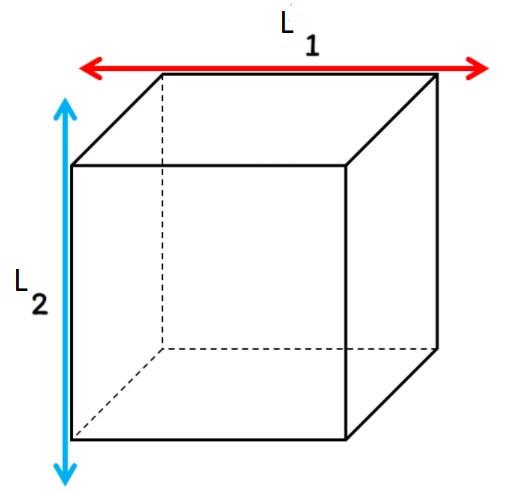
- Draw a figure to represent the square shape of your classroom and label the two skew lines L1 and L2.
Answer:
Skew lines are two or more lines that are located in the same plane.
My classroom is in square shape.
So the two skew line are L1 and L2 which represent the two lines of my classroom in figure given below.
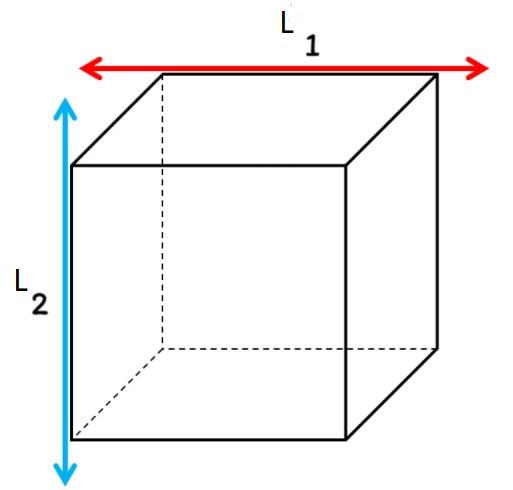
Therefore, the two skew line areL1 and L2 which represent the two lines of my classroom.
Page 8 Problem 24 Answer
Question 24.
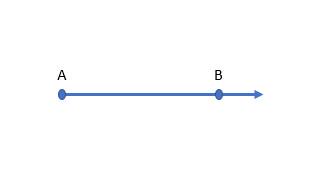
- Draw a line segment and mark point A at one endpoint of the line segment.
- Mark point B anywhere on the line segment.
- Label the line segment \(\overrightarrow{A B}\).
Answer:
First we draw a line and mark A on the end point of the line and B is anywhere on the line.
The sketch of A⃗B is
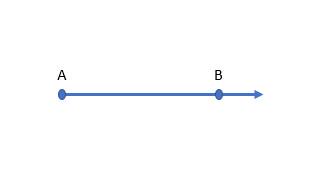
The sketch of A⃗B is
Carnegie Learning Geometry Chapter 1 Page 8 Problem 25 Answer
Question 25.
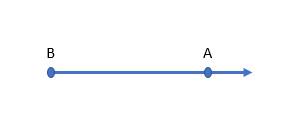
- Draw a line and mark point B at one endpoint of the line.
- Mark point A anywhere on the line.
- Label the directed line segment \(\overrightarrow{B A}\)
Answer:
First we draw a line and mark B on the end point of the line and A is anywhere on the line.
The sketch of B⃗A is
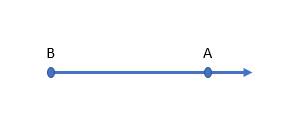
The sketch of B⃗A is
Page 8 Problem 26 Answer
Question 26.
- Define a ray and explain its properties.
- Explain how to properly name a ray using two capital letters.
- Given points A and B:
- Draw ray \(\overrightarrow{A B}\)and explain how it is different from ray \(\overrightarrow{B A}\).
- Clarify why \(\overrightarrow{A B}\) and \(\overrightarrow{B A}\) are not the same ray.
Answer:
A ray is portion of a line that begins with a single point and extends infinitely in one direction. The endpoint of a tray is the single point where the ray begins.
A ray is named using two capital letters, the first representing the endpoint and second representing any other point on the ray.
Ray AB can be written using symbols A⃗B as and is read as “ray AB”.
So, the A⃗B and B⃗A are not the same ray , the are two different ray.
Therefore, the A⃗B and B⃗A are not the same ray.
Tools Of Geometry Exercise 1.1 Carnegie Learning 2nd Edition Answers Page 8 Problem 27 Answer
Question 27.
Given a figure where G is the endpoint of a ray and F is any point on the ray:
- Define what a ray is and describe its properties.
- Identify the endpoint of the ray in the given figure.
- Name the ray using the correct notation.
- Explain why the given figure represents the ray \(\overrightarrow{G F}\) and not \(\overrightarrow{F G}\).
Answer:
A ray is portion of a line that begins with a single point and extends infinitely in one direction.
The endpoint of a tray is the single point where the ray begins.
In the given figure G is the endpoint of the ray and the point F is the any point on the ray.
So, the given figure represent the ray GF or G⃗F.
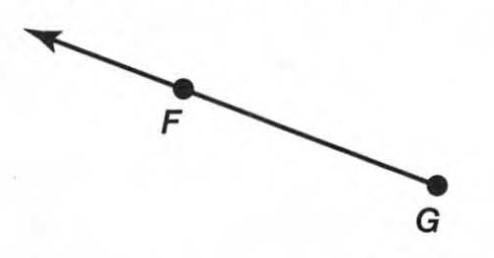
So, the given figure represent the ray GF or G⃗F.
Carnegie Learning Geometry Chapter 1 Page 9 Problem 28 Answer
Question 28.
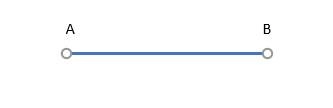
- Draw a line segment and mark point A on one endpoint and point B on the other endpoint.
- Label the line segment as \(\overline{A B} \).
Answer:
First we draw a line and mark the point A on one endpoints and point B on the other endpoint of the line segment.
The line segment AB is
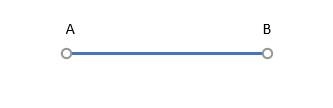
Therefore, the line segment AB is
Page 9 Problem 29 Answer
Question 29.
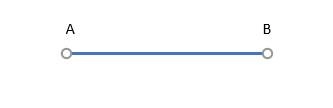
- Draw a line segment and mark point A on one endpoint and point B on the other endpoint.
- Label the line segment as \(\overline{B A} \).
Answer:
First we draw a line and mark the point A on one endpoints and point B on the other endpoint of the line segment.
The line segment BA is
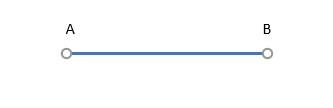
Therefore, the line segment BA is
Carnegie Learning Geometry Chapter 1 Page 9 Problem 30 Answer
Question 30.
- Define a line segment and describe its properties.
- Explain what endpoints of a line segment are.
- Given points A and B, discuss whether \(\overline{A B} \) and \(\overline{B A} \) represent the same line segment.
- Justify why \(\overline{A B} \) are names for the same line segment.
Answer:
A line segment is portion of a line that includes two points and all the collinear points between the two points.
The endpoints of a line segment are the points where the line segment begins and ends.
So, line segment AB is the same as line segment BA. Both pass through the same two points A and B.
Therefore, ABˉ and BAˉ names for same line segment is true.
Page 9 Problem 31 Answer
Question 31.
How do you measure the length of a line segment using a ruler, and what is the length of the line segment AB if measured to be 5 inches?
Answer:
Given-A line segment AB is given.
To Find-Length of the line segment AB.
(1) Line segment AB can be measured by the ruler by placing the ruler over line segment AB.
(2) The length between the two ends of the ruler gives the measure of the line segment AB.
(3) The length is 5 inches.
The length of the line segment AB is 5 inches.
Page 9 Problem 32 Answer
Question 32.
Fill in the blanks for the following statement:
“AB= _______ inches” is read as “the distance from point A to point B is equal to ______ inches.”
Use the given measurement of 5 inches to complete the statement.
“AB = 5 inches” is read as “the distance from point A to point B is equal to 5 inches.”
Answer:
Given-
“AB= _______inches” is read as “the distance from point A to point B is equal to ______inches.”
To Find-It is needed to fill in the blanks.
“AB=5 inches” is read as “the distance from point A to point B is equal to 5 inches.”
“AB=5 inches” is read as “the distance from point A to point B is equal to 5 inches.”
Carnegie Learning Geometry Chapter 1 Page 9 Problem 33 Answer
Question 33.
Fill in the blanks for the following statement:
“mAB = _______ inches” is read as “the measure of line segment AB is equal to ______ inches.”
Use the given measurement of 5 inches to complete the statement.
“mAB = 5 inches” is read as “the measure of line segment AB is equal to 5 inches.”.
Answer:
Given-
“mAB =_______ inches” is read as “the measure of line segment AB is equal to ____inches
To Find- It is needed to fill in the blanks.
“mAB = 5 inches” is read as “the measure of line segment AB is equal to 5 inches.
“mAB = 5 inches” is read as “the measure of line segment AB is equal to 5 inches.
Page 9 Problem 34 Answer
Question 34.
Given: “mCF = 3 inches”
To find: How to read this statement.
It is read as: “The measure of line segment CF is 3 inches.”
It is read as: “The measure of line segment CF is 3 inches.”
Answer:
Given-“mCF = 3 inches”
To Find- It is needed to find out how to read this?
It is read as-“measure of line segment CF is 3 inches.”
It is read as “measure of line segment CF is 3 inches.”
Page 9 Problem 35 Answer
Question 35.
Given “SP = 8 inches,” how should this be read?
It should be read as “the measure of line segment SP is 8 inches.
Answer:
Given- “SP =8 inches”
To Find- It is needed to find out how to read this?
It is read as-“measure of line segment SP is 8 inches.”
It is read as “measure of line segment SP is 8 inches.”
Carnegie Learning Geometry Chapter 1 Page 9 Problem 36 Answer
Question 36.
To Find: The name of the geometric figure using the symbols.
The given figure is a line segment. It can be named as FGˉ.
This represents the line segment FG.
What is the name of the geometric figure?
Answer:
Given-

To Find- The name of the geometric figure using the symbols.
The given figure is a line segment. It can be named as-FGˉ
This represents the line segment FG.
The name of the geometric figure is FGˉ.
Page 4 Problem 37 Answer
Question 37.
To Find: The name of the geometric figure using the symbols.
The given figure is a line and it can be named as FGˉ.
This means that it is a line FG and it extends in both directions.
What is the name of the figure?
Answer:
Given-

To Find- The name of the geometric figure using the symbols.
The given figure is a line and it can be named as-

This means that it is a line FG and it extends in both directions.
The name of the figure is

It is a line.
Carnegie Learning Geometry Chapter 1 Page 10 Problem 38 Answer
Question 38.
It is necessary to draw and label two congruent line segments.
Congruent line segments have equal lengths.
These are the two-line segments AB and CD.
Both have equal lengths and hence they are congruent line segments.
What are the two congruent line segments?
Answer:
It is needed to draw and label two congruent line segments.
The Congruent Line Segments have equal lengths.
These are the two-line segments AB and CD.
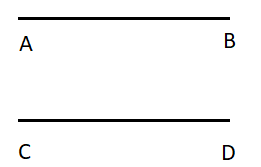
Both have equal lengths and hence they are Congruent Line Segments.
The two congruent line segments are-
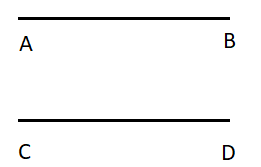
Page 10 Problem 39 Answer
Question 39.
To Find: Using symbols, it is needed to write three valid conclusions based on the figure. Also, how is each conclusion read?
Three valid conclusions and their readings are:
- \(\overline{F G} \| \overline{H I}\) (FG and HI are line segments)
- \(m \overline{F G}=10 \mathrm{~cm} \text { and } m \overline{H I}=10 \mathrm{~cm}\) (The measures of line segments FG and HI are 10cm)
- \(m \overline{F G}=m \overline{H I}=10 \mathrm{~cm}\) (Line segments FG and HI are equal)
What are the three valid conclusions and their readings?
Answer:
Given-

To Find- Using symbols, it is needed to write three valid conclusions based on the figure. Also, how each conclusion are read?
Three valid conclusions and their readings are-
(1) FGˉHIˉ (FG and HI are line segments)
(2) mFGˉ=10 cm mHIˉ=10 cm (measure of line segments FG and HI are 10 cm)
(3) mFGˉ=mHIˉ=10 cm
Line segment FG and HI are equal.
Three valid conclusions and their readings are-
(1) FGˉHIˉ (FG and HI are line segments)
(2) mFGˉ=10cmmHI=10cm (measure of the line segments FG and HI are 10 cm)
(3) mFGˉ=mHIˉ=10 cm (Line segments FG and HI are equal.)
Carnegie Learning Geometry Chapter 1 Page 10 Problem 40 Answer
Question 40.
To specify if there is a difference between GH and HG.
A ray is the portion of a line that begins with a single point and extends infinitely in one direction.
The endpoint of a ray is the single point where the ray begins.
A ray is named using two capital letters, the first representing the endpoint and the second representing any other point on the ray.
Ray GH can be written using symbols as \(\overrightarrow{G H}\) and is read as “ray GH”.
So GH and HG are not the same ray; they are two different rays.
Hence, GH and HG are not the same.
Is there a difference between GH and HG?
Answer:
Given : To specify is here is a difference between GH and HG
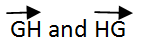
A ray is the portion of a line that begins with a single point and extends infinitely in one direction.
The endpoint of a tray is the single point where the ray begins.
A ray is named using two capital letters, the first representing the endpoint and the second representing any other point on the ray.
Ray GH can be written using symbols as GH and is read as “ray GH”.
So GH and HG are not the same ray, they are two different rays.
Hence, GH and HG are not same.
Page 10 Problem 41 Answer
Question 41.
A line segment is named using two capital letters representing the two endpoints of the line segment.
HG is a line segment that starts at H and ends at G, while GH is a line segment that starts at G and ends at H.
HG and GH are two different line segments starting at H and G, and ending at G and H respectively.
What is the difference between the line segments HG and GH?
Answer:
Given :
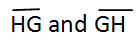
A line segment is named using two capital letters representing the two endpoints of the line segment.
HG is a line segment which starts at H and ends at G while GH is a line segment which starts at G and ends at H.
HG and GH are two different line segments starting at H and G , and ends at G and H respectively.
Carnegie Learning Geometry Chapter 1 Page 11 Problem 42 Answer
Question 42.
It is given that JK = MN and \(\overline{J K}=\overline{M N}\).
To explain the difference between the statements:
It is represented as: \(\overline{J K}=\overline{M N}\)
It shows that JK and MN have the same magnitude and direction.
Hence, the given statements are different.
How are the statements JK = MN and \(\overline{J K}=\overline{M N}\) different?
Answer:
It is given that JK=MN and JKˉ=MNˉ.
To explain the difference of the statements.
It is represented as,
∣JKˉ∣=∣MNˉ∣
It shows the JK and MN are same magnitude and same direction.
Hence, the given statements are different.