Geometry Student Text 2nd Edition Chapter 1 Tools of Geometry
Carnegie Learning Geometry Student Text 2nd Edition Chapter 1 Exercise 1.4 Solution Page 39 Problem 1 Answer
Question 1.
How did Emma reach the conclusion that raising a number to a power is the same as multiplying the number by itself as many times as indicated by the power?
Answer:
Given: Emma is watching her big sister do homework. She notices the following:- nine cubed is equal to nine times nine times nine
10 to the fourth power is equal to four factors of 10 multiplied together
To specify How did Emma reach this conclusion
Emma notices
42=4×4
93=9×9×9
104=10×10×10×10
So by raising a number to a power is the same as multiplying the number by itself as many times as indicated by the power.
Hence, Emma reach this conclusion by raising a number to a power is the same as multiplying the number by itself as many times as indicated by the power.
Read and learn More Carnegie Learning Geometry Student Text 2nd Edition Solutions
Carnegie Learning Geometry Chapter 1 Page 39 Problem 2 Answer
Question 2.
How did Ricky reach the conclusion that seven to the fourth power means multiplying seven by itself four times?
Answer:
It is given that 7 to 4th power is to be calculated.
Seven to fourth power means that the number seven has to be multiplied to itself four times which is mathematically expressed as: 7×7×7×7.
Ricky reached the conclusion using the definition of nth power of a number x.
Ricky reached the conclusion using the definition of nth power of a number x.
Carnegie Learning Geometry Chapter 1 Page 40 Problem 3 Answer
Question 3.
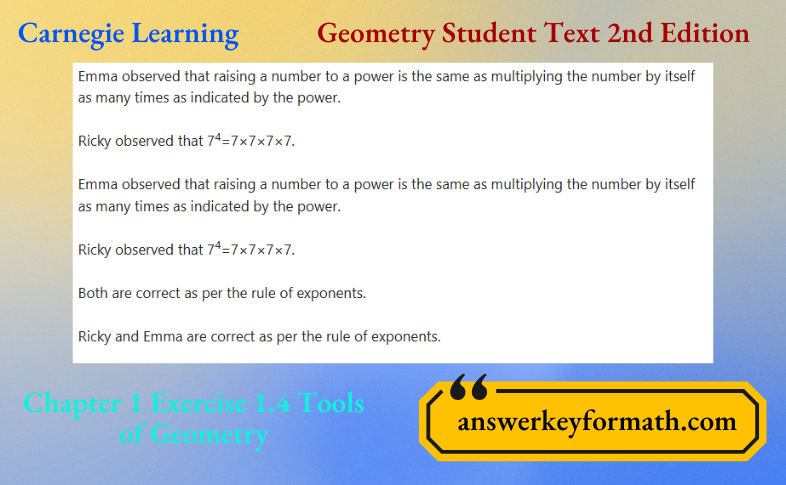
How did Emma and Ricky reach their conclusions about raising numbers to a power, and are their observations correct according to the rule of exponents?
Answer:
Carnegie Learning Geometry Chapter 1 Page 40 Problem 4 Answer
Question 4.
How much total salary did Aaron receive if he worked for 4 hours at a rate of 8.25 dollars per hour?
Answer:
It is given that Salary per hour =8.25 dollars, Total number of hours worked =4 hours
Substitute Salary per hour =8.25 dollars, Total number of hours worked =4 hours into the formula:
Salary per hour=Total salary received
Total number of hours worked.
so that 8.25=Total salary received/4
Hence Total salary recived=8.25×4=33 dollars
If Aaron worked for four hours, the total salary received is 33 dollars
Carnegie Learning Geometry Chapter 1 Page 40 Problem 5 Answer
Question 5.
How can the formula Salary per hour = \(\frac{\text { Total salary received }}{\text { Total number of hours worked }}\) be used to determine Aaron’s total salary if he worked for 4 hours at an average rate of 8.25 dollars per hour?
Answer:
The average salary per hour and the number of hours worked are given to be 8.25 dollars and 4 hours respectively.
To answer the task 6(a), the formula Salary per hour=Total salary received
Total number of hours worked. is used to make a conclusion.
To answer task 6(a), the formula Salary per hour=Total salary received
Total number of hours worked. is used to make conclusions.
Solutions For Tools Of Geometry Exercise 1.4 In Carnegie Learning Geometry Page 40 Problem 6 Answer
Question 6.
What is the general term used for the process that starts with a broad, general idea and then verifies it for specific cases?
Answer:
“Thinking down from” starts with a very broad and general idea and then idea is verified for specific cases.
Generally “the act of thinking down” would mean that a general theory or idea is known and it has to be tested or verified to more specific cases with certain restrictions or conditions.
The general term for such a phrase should be “DEDUCTIVE REASONING”.
The general term for the phrase “the act of thinking down” should be “DEDUCTIVE REASONING”.
Carnegie Learning Geometry Chapter 1 Page 40 Problem 7 Answer
Question 7.
What is the general term used for the process that starts with specific statements and then tests the idea for general cases?
Answer:
“Thinking toward or up to” starts with a very specific statement and then idea is tested for general cases.
Generally “the act of thinking toward or up to” would mean that some idea holds true for some specific cases with certain restrictions and it has to be tested or verified for a
a general case with no restrictions.
The general term for such a phrase should be “INDUCTIVE REASONING”.
The general term for the phrase “the act of thinking toward or up to” should be “INDUCTIVE REASONING”.
Carnegie Learning Geometry 2nd Edition Exercise 1.4 solutions Page 41 Problem 8 Answer
Question 8.
What type of reasoning did Emma use when she observed that raising a number to a power is the same as multiplying the number by itself as many times as indicated by the power?
Answer:
In the first question, Emma observes the following:
42=4×4
– nine cubed is equal to nine times nine times nine.
– 10 to the fourth power is equal to four factors of 10 multiplied together.
In the first question, Emma observed three things and made an observation based on those three things.
The observation made was “raising a number to a power is the same as multiplying the number by itself as many times as indicated by the power”.
This is an example of Inductive reasoning.
Emma used INDUCTIVE REASONING.
Carnegie Learning Geometry Chapter 1 Page 41 Problem 9 Answer
Question 9.
What type of reasoning did Emma use when she concluded that raising a number to a power is the same as multiplying the number by itself as many times as indicated by the power?
Answer:
In the first problem, Emma make a conclusion that raising a number to power is same as multiplying the number by itself as many times as indicated by power.
Thus, Emma used deductive reasioning.
Emma used deductive reasioning.
Page 41 Problem 10 Answer
Question 10.
What is the specific information provided in the given problem?
Answer:
Specific information in a given problem is that “his neighbor Matilda smokes”.
Specific information in a given problem is that “his neighbor Matilda smokes”.
Carnegie Learning Geometry Chapter 1 Page 41 Problem 11 Answer
Question 11.
What is the general information provided in the given problem?
Answer:
General information in this problem is that tobacco greatly increases the risk of cancer.
General information in this problem is that tobacco greatly increases the risk of cancer.
Page 41 Problem 12 Answer
Question 12.
What conclusion can be drawn from the given specific and general information?
Answer:
The conclusion of this problem is that Matilda has a high risk of cancer.
The conclusion of this problem is that Matilda has a high risk of cancer.
Tools of Geometry Solutions Chapter 1 Exercise 1.4 Carnegie Learning Geometry Page 41 Problem 13 Answer
Question 13.
How does your friend use reasoning to make the conclusion that Matilda has a high risk of cancer?
Answer:
Friend uses deductive reasoning to make the conclusion.
Reason: As the conclusion is based on general information.
Friend uses deductive reasoning to make the conclusion as he uses general information.
Carnegie Learning Geometry Chapter 1 Page 41 Problem 14 Answer
Question 14.
Is your friend’s conclusion that “Matilda has a high risk of cancer” correct? Explain your reasoning.
Answer:
Yes, my friend’s conclusion is correct.
As general information tells that tobacco greatly increases the risk of cancer and his neighbor Matlida smokes.
So, the conclusion based on general and specific information is “Matilda has a high risk of cancer”.
Yes, the conclusion is correct as it is based on general information.
Step-By-Step Solutions For Carnegie Learning Geometry Chapter 1 Exercise 1.4 Page 42 Problem 15 Answer
Question 15.
Is your friend’s conclusion correct, and what information supports this conclusion?
Answer:
Specific information in a given problem is that it rained each of the five days she was on a London trip.
Specific information in a given problem is that it rained each of the five days she was on a London trip.
Carnegie Learning Geometry Chapter 1 Page 42 Problem 16 Answer
Question 16.
What is the general information provided in this problem?
Answer:
General information in this problem is that “It rains every day in England”.
General information in this problem is that “It rains every day in England”.
Page 42 Problem 17 Answer
Question 17.
What conclusion can be drawn from the general information that “It rains every day in England”?
Answer:
The conclusion of this problem is that “It rains every day in England!”.
The conclusion of this problem is that “It rains every day in England!”.
Carnegie Learning Geometry Chapter 1 Page 42 Problem 18 Answer
Question 18.
If Molly uses a specific example to make a conclusion, what type of reasoning is she using?
Answer:
Molly uses a specific example to make a conclusion. So, Molly uses inductive reasoning to make the conclusion.
Molly uses a specific example to conclude. So, Molly uses inductive reasoning to conclude.
Page 42 Problem 19 Answer
Question 19.
Molly returned from a trip to London and tells you, “It rains every day in England!” She explains that it rained each of the five days she was there.
To find out: Is Molly’s conclusion correct? Explain.
Answer:
Given: – Molly returns from a trip to London and tells you, “It rains every day in England!” She explains that it rained each of the five days she was there.
To find out: – Is Molly’s conclusion correct? Explain.
The process used: – The conclusion of Molly’s is that “It rains every day in England!”. It is based on Inductive reasoning
Inductive reasoning based on example, so maybe Molly’s is not correct.
Hence, Molly’s conclusion based on Inductive reasoning so may be conclusion is not correct.
Carnegie Learning Geometry Chapter 1 Page 42 Problem 20 Answer
Question 20.
Detailed notes in history class and math class.
To find out: What conclusion did your classmate make? Why?
Answer:
Given: -Detailed notes in history class and math class.
To find out: – What conclusion did your classmate make? Why?
Process used: – Classmate use Inductive reasoning by taking example of math and history notebook.
so my classmate think that i also completed my Biology notebook.
Hence, classmate make conclusion that i also have complete notebook of Biology by inductive reasoning because he take example of my history and math notebook.
Page 42 Problem 21 Answer
Question 21.
Detailed notes in history class and math class
To find out: What type of reasoning did your classmate use? Explain.
Answer:
Given: -Detailed notes in history class and math class
To find out: -What type of reasoning did your classmate use? Explain.
Process used: -Classmate use Inductive reasoning by taking example of math and history notebook.
so my classmate think that i also completed my Biology notebook.
Hence, classmate use inductive reasoning because he taking the example of my history and math notebook.
Carnegie Learning Geometry Chapter 1 Page 42 Problem 22 Answer
Question 22.
Detailed notes in history class and math class
To find out: What conclusion did the biology teacher make? Why?
Answer:
Given: -Detailed notes in history class and math class
To find out: – What conclusion did the biology teacher make? Why?
Process used: – Because when biology teacher asks him(classmate) if he knows someone in class who always takes detailed notes.
He(classmate) gives my name to the teacher.
Then biology teacher suggests he borrow your biology notes because he concludes that they will be detailed on inductive reasoning.
Classmate give example of me that is the reason Biology teacher also think that i have detailed notebook of biology.
Hence, Biology teacher make conclusion that I also have detailed notebook of biology by inductive reasoning
Carnegie Learning Geometry Chapter 1 Exercise 1.4 Free Solutions Page 42 Problem 23 Answer
Question 23.
Detailed notes in history class and math class
To find out: What type of reasoning did the biology teacher use? Explain.
Answer:
Given: -Detailed notes in history class and math class
To find out: – What type of reasoning did the biology teacher use? Explain.
Process used: – Biology teacher use inductive reasoning by taking example that i have detailed notebook of biology because i have detailed notebook of math and history.
Because when he ask about detailed notebook of biology in the classroom then he gave my example.
Hence, Biology teacher use inductive reasoning because my classmate give my name as i have detailed notebook of biology.
Carnegie Learning Geometry Chapter 1 Page 42 Problem 24 Answer
Question 24.
Detailed notes in history class and math class.
To find out: Will your classmate’s conclusion always be true? Will the biology teacher’s conclusion always be true? Explain.
Answer:
Given: -Detailed notes in history class and math class.
To find out: – Will your classmate’s conclusion always be true? Will the biology teacher’s conclusion always be true? Explain.
Process used: – Inductive reasoning based on the example not on the rule.
My classmate take example of my detailed notebook of history and math, and my biology teacher believe on me because my classmate give my name as i have detailed notebook of biology.
Therefore, both my classmate and my teacher conclusion not always be true.
Hence, both my classmate and my teacher conclusion not always be true because they uses inductive reasoning.
Page 43 Problem 25 Answer
Question 25.
Sequence 4, 15, 26, 37
a1 = 4, a2 = 15, a3 = 26, a4 = 37
To find out: What is the next number in the sequence (a5)? How did you calculate the next number?
Answer:
Given: – 4, 15, 26, 37
a1=4, a2=15, a3=26, a4=37
To find out: – What is the next number in the sequence (a5)? How did you calculate the next number?
Formula used: -nth term,an=a+(n−1)d and d=a2−a1
a2−a1=15−4=11
a3−a2=26−15=11
Hence, the series in A.P.
d=a2−a1=15−4=11
If n=5
a5=4+(5−1)11
a5=4+44
a5=48
Hence, by using an =a+(n−1)d
we calculate the next number a5=48
Carnegie Learning Geometry Chapter 1 Page 43 Problem 26 Answer
Question 26.
Sequence -4, 15, 26, 37
To find out: What types of reasoning did you use and in what order to make the conclusion?
Answer:
Given: -4, 15, 26, 37
To find out: – What types of reasoning did you use and in what order to make the conclusion?
Process used: – By using d=a2−a1=a3−a2=a4−a3
we find Constant quantity in common difference,
d=15−4=26−15=37−26
d=11
Hence, the series is in Arithmetic progression
Carnegie Learning Geometry Exercise 1.4 Student Solutions Page 43 Problem 27 Answer
Question 27.
Explain the differences between inductive and deductive reasoning. Provide an example of each type of reasoning and outline the guidelines for ensuring logical and valid arguments in both cases.
Answer:
The differences between inductive and deductive reasoning:
Induction: A process of reasoning (arguing) which infers a general conclusion based on individual cases, examples, specific bits of evidence, and other specific types of premises.
Example: In Chicago last month, a nine-year-old boy died of an asthma attack while waiting for emergency aid.
After their ambulance was pelted by rocks in an earlier incident, city paramedics wouldn’t risk entering the Dearborn Homes Project (where the boy lived) without a police escort.
Thus, based on this example, one could inductively reason that the nine-year-old boy died as a result of having to wait for emergency treatment.
Guidelines for logical and valid induction:
- When a body of evidence is being evaluated, the conclusion about that evidence that is the simplest but still covers all the facts is the best conclusion.
- The evidence needs to be well-known and understood.
- The evidence needs to be sufficient. When generalizing from a sample to an entire population, make sure the sample is large enough to show a real pattern.
- The evidence needs to be representative. It should be typical of the entire population being generalized.
Deduction: A process of reasoning that starts with a general truth, applies that truth to a specific case (resulting in a second piece of evidence), and from those two pieces of evidence (premises), draws a specific conclusion about the specific case.
Example: Free access to public education is a key factor in the success of industrialized nations like the United States.
(major premise) India is working to become a successful, industrialized nation. (specific case)
Therefore, India should provide free access to public education for its citizens. (conclusion) Thus, deduction is an argument in which the conclusion is said to follow necessarily from the premise.
Guidelines for logical and valid deduction:
- All premises must be true.
- All expressions used in the premises must be clearly and consistently defined.
- The first idea of the major premise must reappear in some form as the second idea in the specific case.
- No valid deductive argument can have two negative premises.
- No new idea can be introduced in the conclusion.
Hence, the Induction and Deduction are explain with help of example.
Carnegie Learning Geometry Chapter 1 Page 44 Problem 28 Answer
Question 28.
What are the reasons why a conclusion may be false? Explain using an example.
Answer:
To find out: – Reasons why a conclusion may be false?
Process used: -Derek tells his little brother that it will not rain for the next thirty days because he “knows everything.”
It is an assumed information based on inductive reasoning.
Inductive reasoning based on examples, so may be it false.
Hence, Either the assumed information is false or the argument is not valid, conclusion may false of his little brother because it is based on example there is no rule for his little brother assumption.
Tools of Geometry Exercise 1.4 Carnegie Learning 2nd Edition answers Page 44 Problem 29 Answer
Question 29.
The given conclusion is: Two lines are not parallel so the lines must intersect. Justify whether this conclusion is true or false.
Answer:
The given conclusion is: Two lines are not parallel so the lines must intersect.
The main objective is to justify why the conclusion is false.
The conclusion is true as if two lines are not parallel then, they can be coincident as well as intersecting.
So, the conclusion is true because if the two lines are not parallel it means at any point they are going to meet or intersect.
Hence, the conclusion true and valid .
Carnegie Learning Geometry Chapter 1 Page 44 Problem 30 Answer
Question 30.
Provide an example of a conclusion that is false because the assumed information is false.
Answer:
To write : An example of a conclusion that is false because the assumed information is false.
Example is
“I have a very strong feeling that my ticket is the winning lottery ticket, so I’m quite confident I will win a lot of money tonight.”
Here argument is strong
But the information is false
The statement is
“I have a very strong feeling that my ticket is the winning lottery ticket, so I’m quite confident I will win a lot of money tonight.”
Carnegie Learning Geometry Chapter 1 Page 44 Problem 31 Answer
Question 31.
Provide an example of a conclusion that is false because the argument is not valid.
Answer:
To write : An example of a conclusion that is false because the argument is not valid.
The statement is
” Two lines are perpendicular so the lines must intersect. ”
There are lines which are perpendicular without intersection.
Hence the conclusion is wrong.
The statement is ” Two lines are perpendicular so the lines must intersect. “