
Geometry Student Text 2nd Edition Chapter 1 Tools of Geometry
Carnegie Learning Geometry Student Text 2nd Edition Chapter 1 Exercise 1.5 Solution Page 46 Problem 1 Answer
Question 1.
What is the hypothesis p in the given statement?
Answer:
Given : If the measure of an angle is 32∘, then the angle is acute.
To find : What is the hypothesis p
The form is if p then q
Hence p= The measure of an angle is 320
p is the measure of an angle is320
Page 46 Problem 2 Answer
Question 2.
What is the conclusion q in the given statement?
Answer:
Given : If the measure of an angle is 32∘, then the angle is acute.
Read and learn More Carnegie Learning Geometry Student Text 2nd Edition Solutions
To find : What is the conclusion q
The form is if p then q
Henceq= the angle is acute.
Q is the angle is acute.
Page 46 Problem 3 Answer
Question 3.
What does the phrase “If p is true” mean in terms of the conditional statement?
Answer:
“If p is true” mean in terms of the conditional statement as follows
Given : If the measure of an angle is 32∘, then the angle is acute.
To find : What does the phrase “If p is true” mean in terms of the conditional statement
pis measure of an angle is320
If p is true can be written as if measure of angle 320 is true
Measure of angle 320 is true
Page 46 Problem 4 Answer
Question 4.
What does the phrase “If q is true” mean in terms of the conditional statement?
Answer:
Given phrase “If q is true”
Given : If the measure of an angle is 32∘, then the angle is acute.
To find : What does the phrase “If q is true” mean in terms of the conditional statement
Q is the angle is acute.
If q is true is, the angle is acute is true
The angle is acute is true
Solutions For Tools Of Geometry Exercise 1.5 In Carnegie Learning Geometry Page 46 Problem 5 Answer
Question 5.
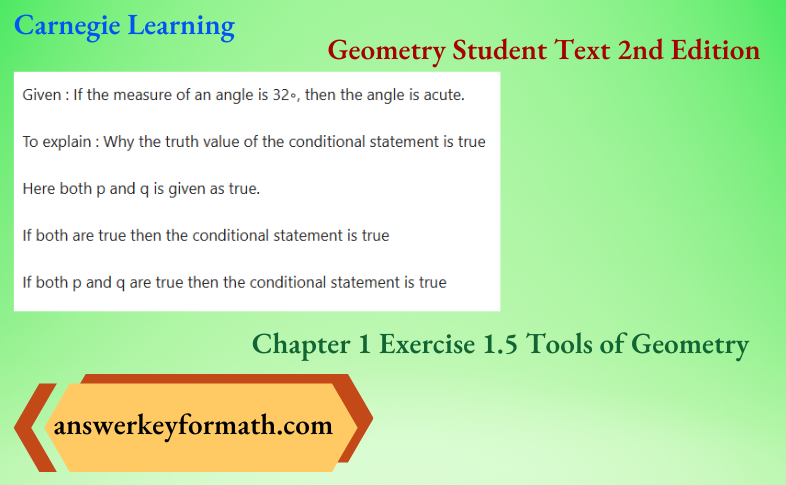
If the measure of an angle is 32°, then the angle is acute so the truth value of the conditional statement is true.
Answer:
Page 46 Problem 6 Answer
Question 6.
If p is true and q is false, then the truth value of a conditional statement is false. If the measure of an angle is 32°, then the angle is acute. What does the phrase “If p is true” mean in terms of the conditional statement?
Answer:
Given : If p is true and q is false, then the truth value of a conditional statement is false.
If the measure of an angle is 32°, then the angle is acute.
To explain : What does the phrase “If p is true” mean in terms of the conditional statement
P is measure of an angle is320
If p is true can be written as if measure of angle 320 is true Measure of angle 320 is true
Page 46 Problem 7 Answer
Question 7.
If p is true and q is false, then the truth value of a conditional statement is false. If the measure of an angle is 32°, then the angle is acute. What does the phrase “If q is false” mean in terms of the conditional statement?
Answer:
Given : If p is true and q is false, then the truth value of a conditional statement is false.
If the measure of an angle is 32°, then the angle is acute.
To explain : What does the phrase “If q is false” mean in terms of the conditional statement
Q is the angle is acute.
Q is false means
Angle is not acute
Angle is not acute
Page 46 Problem 8 Answer
Question 8.
If p is true and q is false, then the truth value of a conditional statement is false. If the measure of an angle is 32°, then the angle is acute. Why is the truth value of the conditional statement false?
Answer:
Given : If p is true and q is false, then the truth value of a conditional statement is false.
If the measure of an angle is 32°, then the angle is acute.
To explain : Why the truth value of the conditional statement is false.
Given that if p is true and q is false, then the truth value of a conditional statement is false.
If the angle is not acute then the angle cannot be 320
Why the truth value of the conditional statement is false is explained
Page 47 Problem 9 Answer
Question 9.
What does the phrase “If q is true” mean in terms of the conditional statement?
Answer:
Given that “If p is false and q is true, then the truth value of a conditional statement is true.”
We need to explain what does the phrase “If p is false” mean in terms of the conditional statement.
Since p is the hypothesis of the conditional statement and given thatp
is false, therefore the hypothesis of the conditional statement is false.
For example,
If the measure of an angle is32∘, then the angle is acute.
Here the statement p is “The measure of an angle is 32∘.”
If p is false, then the measure of an angle cannot be 32∘.
The phrase “If p is false” means the hypothesis of the conditional statement is false.
Page 47 Problem 10 Answer
Question 10.
What is the truth value of the conditional statement if p is false and q is true? Explain why this is the case using an example.
Answer:
Given that “If p is false and q is true, then the truth value of a conditional statement is true.”
We need to explain what does the phrase “If q is true” mean in terms of the conditional statement.
Since q is the conclusion of the conditional statement and given that q is true , therefore the conclusion of the conditional statement is true.
For example,If the measure of an angle is32∘then the angle is acute.
Here the statement q is “The angle is acute.”
If q is true, then the angle is acute.
The phrase “If q is true” means the conclusion of the conditional statement is true.
Carnegie Learning Geometry 2nd Edition Exercise 1.5 Solutions Page 47 Problem 11 Answer
Question 11.
Explain why the truth value of the conditional statement is true if p is false and q is true.
Answer:
Given: a conditional statement
To find: We have explain why the truth value of the conditional statement is true.
a conditional statement being true requires it to be true under all possible circumstances
We try to explain this through one example
Consider A number is even then it is an Integer
In the above statement
p= A number is even
q= then it is an integer
Consider an number 3 we know that 3 is not an even number
Hence the statement p is false but we also know that 3 is an integer Hence the statement q
is true then we just have found a counterexample.
3 would be a counterexample proving that not all even numbers are integers. But that does not fit . since 3 not even but odd.
A true counterexample would have to be an even number which is not an integer, which is clearly impossible.
From this we conclude that A is necessary condition for B but not sufficient.
Hence If p is false and q is true, then p→q is true.
Hence if p is false and q is true then p→q is true because A is a necessary condition for B
but not sufficient condition.
Page 48 Problem 12 Answer
Question 12.
A conditional statement of the form “If p, then q”. What is the conclusion q in terms of the conditional statement?
Answer:
A conditional statement is of the form ” If p, then q “, where p is hypothesis and q is conclusion of the hypothesis.
Here,The statement of condition or hypothesis is p:m ABˉ
=6 inches and m BCˉ=6 inches.
In other words given line segments ABˉ and BCˉ are of equal length.
For the given problem ,the hypothesis is p:m ABˉ=6 inches and m BCˉ=6 inches.
Page 48 Problem 13 Answer
Question 13.
Given the conditional statement “If \(m \overline{A B}=6\) inches and \(m \overline{B C}=6\) inches, then \(\overline{A B} \cong \overline{B C}\),” identify the hypothesis p and explain why the conclusion q is valid.
Answer:
A conditional statement is of the form ” If p, then q “, where p is hypothesis and q is conclusion of the hypothesis.
Here, The conclusion is q: ABˉ ≅ BCˉ
In other words given line segments ABˉ and BCˉ are congruent.
For the given problem,the conclusion is q: ABˉ ≅ BCˉ
Page 48 Problem 14 Answer
Question 14.
The conditional statement “If \(m \overline{A B}=6\) inches and \(m \overline{B C}=6\) inches, then \(\overline{A B} \cong \overline{B C}\)” with p: \(m \overline{A B}=6\) inches and \(m \overline{B C}=6\) inches and q: \(\overline{A B} \cong \overline{B C}\);
- If p is true (i.e., \(m \overline{A B}=6\) inches and \(m \overline{B C}=6\) inches), why is q (i.e., \(\overline{A B} \cong \overline{B C}\)) Also true?
- Explain why the truth value of the conditional statement p→q is true when both p and q are true.
Answer:
Let p:m ABˉ=6 inches and m BCˉ=6 inches and q:ABˉ≅BCˉ.
Given that p is true. Hence m ABˉ=m BCˉ=6 inches.
Hence they are of equal length.
So the above line segments ABˉ andBC ˉ are said to be congruent lines.
Hence q:ABˉ≅BCˉ is true.
So the truth value of p→q is true.
The truth value of the conditional statement if both p and q are true is true.
Page 48 Problem 15 Answer
Question 15.
p: \(m \overline{A B}=6\) inches and \(m \overline{B C}=6\) inches, and q: \(\overline{A B} \cong \overline{B C}\). What is the truth value of the conditional statement p → q when p is true and q is false?
Answer:
Let p:m ABˉ=6 inches and m BCˉ=6 inches and q:ABˉ≅BCˉ.
Given that p is true.
Hence m ABˉ=mBCˉ=6 inches.
So the length of ABˉ andBCˉ are same.
So they are congruent lines.
But given that q:ABˉ≅BCˉ is false.
So the truth valuep→q of is false.
For the given problem, the truth value of the conditional statement if p is true and q is false is false.
Tools Of Geometry Solutions Chapter 1 Exercise 1.5 Carnegie Learning Geometry Page 48 Problem 16 Answer
Question 16.
p: \(m \overline{A B}=6\) inches and \(m \overline{B C}=6\) inches, and q: \(\overline{A B} \cong \overline{B C}\).
What is the truth value of the conditional statement p → q when p is false and q is true?
Answer:
Let p:m ABˉ=6 inches and m BCˉ=6 inchesand q:ABˉ≅BCˉ.
Give that p is false. Hence mABˉ≠6 inches and mBCˉ≠6 inches.
Let us assume mABˉ=7 inches. mBCˉ=7 inches.
Hence ABˉ and BCˉ are congruent lines.
Implies that q:ABˉ≅BCˉ is true.
So the truth value of p→q is true.
For the given problem, the truth value of the conditional statement if p is false and q is true is true.
Page 48 Problem 17 Answer
Question 17.
p: \(m \overline{A B}=6\) inches and \(m \overline{B C}=6\) inches, and q: \(\overline{A B} \cong \overline{B C}\).
What is the truth value of the conditional statement p q when p is false and q is true?
- Determine the true value of p.
- Determine the true value of q.
- Use the values of p and q to determine the true value of the conditional statement p → q.
Answer:
Let p:mABˉ=6 inches and mBCˉ=6 inchesand q:ABˉ≅BCˉ.
Given that p is false. mABˉ≠6 inches and mBCˉ≠6 inches.
Let us assume mABˉ=7 inches. mBCˉ=5 inches.
Hence ABˉ and BCˉ are not congruent lines.
So it implies that q is false, which is the correct conclusion.
Hence the truth value p→q of is true.
For the given problem, the truth value of the conditional statement, if both p and q are false, is true.
Page 49 Problem 18 Answer
Question 18.
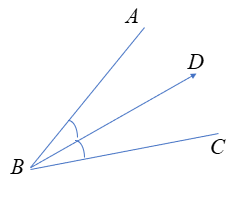
Given that BD bisects ∠ABC, prove that ∠ABD is congruent to ∠CBD using the properties of angle bisectors.
Answer:
Consider the given conditional statement –
If BD bisects ∠ABC then∠ABD≅∠CBD
We have to draw the diagram for the given conditional statement as well write the hypothesis as given and conclude as Prove statement
Diagram for the given conditional statement is given below:
Now from the given conditional statement the Given and concluding statement is as
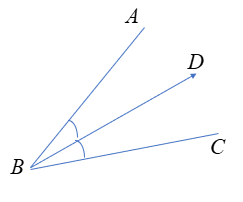
Given : BD bisects∠ABC
Prove :∠ABD≅∠CBD
Given :BD bisects∠ABC
Prove :∠ABD≅∠CBD
Step-By-Step Solutions For Carnegie Learning Geometry Chapter 1 Exercise 1.5 Page 49 Problem 19 Answer
Question 19.
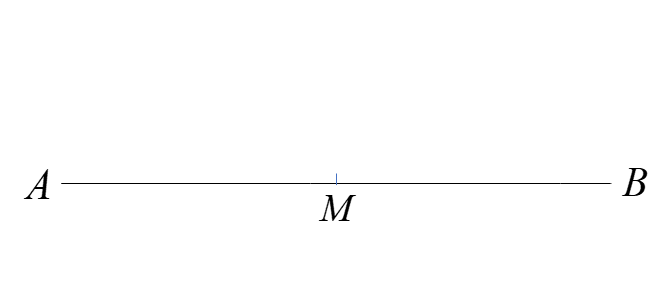
Consider the given conditional statement – AM ≅ MB, if M is the midpoint of AB.
- Draw the diagram for the given conditional statement.
- Using the properties of congruency, prove that AM is congruent to MB.
Answer:
Consider the given conditional statement -AM≅MB, ifM is the mid-point of AB.
We have to draw the diagram for the given conditional statement as well write the hypothesis as given and conclude as Prove statement by using the properties of congreuncy.
Diagram for the given conditional statement is given below:
Now from the given conditional statement the Given and concluding statement is as
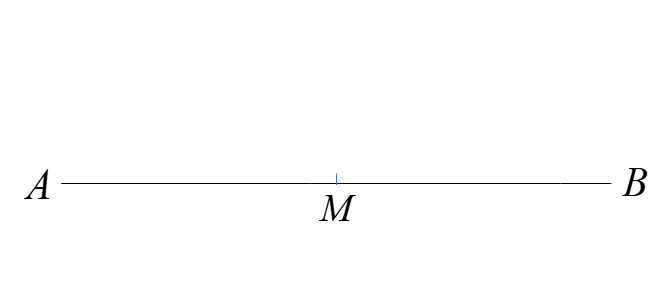
Given : M is the mid-point of AB.
To prove : AM≅MB
Given : M is the mid-point of AB.
Prove : AM≅MB
Page 50 Problem 20 Answer
Question 20.
If AB ⊥ CD at point C, then ∠ACD is a right angle and ∠BCD is a right angle.
- Draw the diagram for the given conditional statement.
- Using the definition of perpendicular lines, prove that ∠ACD and ∠BCD are right angles.
Answer:
Consider the given conditional statement –
If AB⊥CD at pointC, then∠ACD is a right angle and∠BCD is a right angle.
We have to draw the diagram for the given conditional statement as well write the hypothesis as given and conclude as Prove statement
Diagram for the given conditional statement is given below:
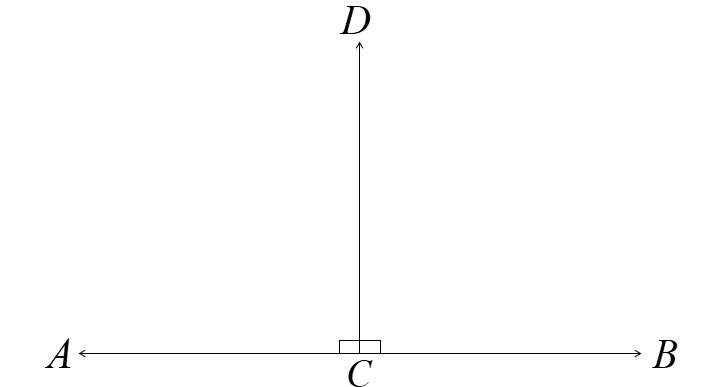
Now from the given conditional statement the Given and Concluding are as-
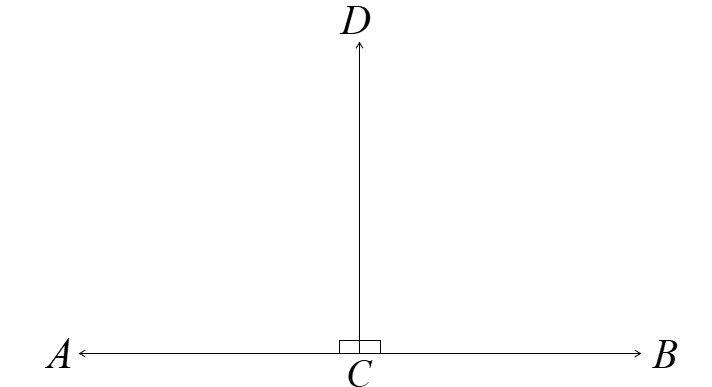
Given : AB⊥CD
To prove : ∠ACD and∠BCD are right angles.
Given :AB⊥CD
Prove :∠ACD and∠BCD are right angles.
Carnegie Learning Geometry Chapter 1 Exercise 1.5 Free Solutions Page 50 Problem 21 Answer
Question 21.
m∠DEG + m∠GEF = 180°, if ∠DEG and ∠GEF are a linear pair.
- Draw the diagram for the given conditional statement.
- Using the definition of a linear pair, prove that m∠DEG + m∠GEF = 180°.
Answer:
Consider the given conditional statement -m∠DEG+m∠GEF=180°,if∠DEF and∠GEF are liner pair.
We have to draw the diagram for the given conditional statement as well write the hypothesis as given and conclude as Prove statement.
Diagram for the given conditional statement is given below:
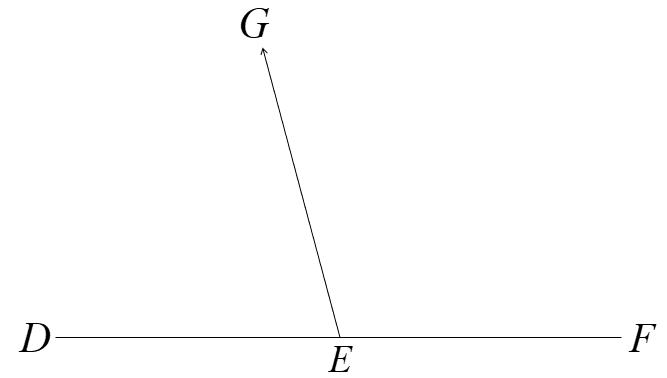
Now from the given conditional statement the Given and concluding statement is as
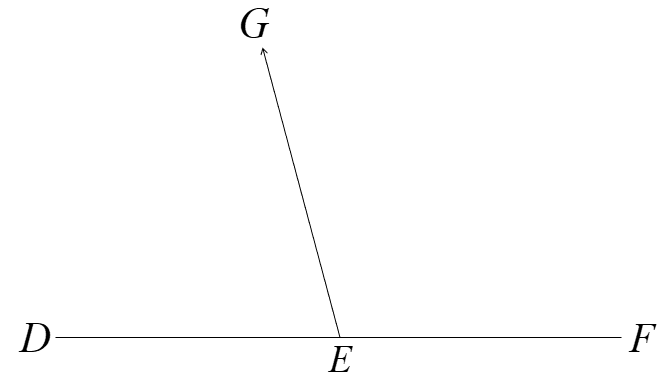
Given : ∠DEG and∠GEF are linear pair.
To prove: m∠DEG+m∠GEF=180°
Given :∠DEG and∠GEF are linear pair.
Prove :m∠DEG+m∠GEF=180
Page 50 Problem 22 Answer
Question 22.
Consider the “W is the perpendicular bisector of PR if WX ⊥ PR and WX bisects PR.”
- Draw the diagram for the given conditional statement.
- Write the hypothesis as given and conclude as a proof statement.
Answer:
Consider the given conditional statement -W is the perpendicular bisector of PR, if WX⊥PR
And WX bisects PR
We have to draw the diagram for the given conditional statement as well write the hypothesis as given and conclude as Prove statement
Diagram for the given conditional statement is given below:
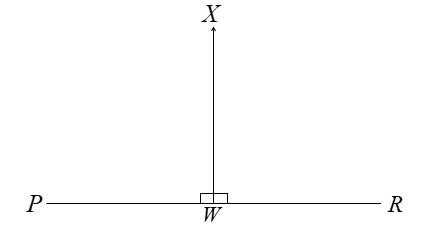
Now from the given conditional statement the Given and concluding statement is
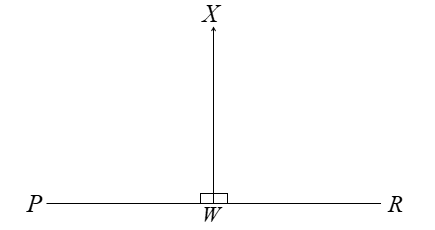
Given : WX⊥PR
Prove : WX bisects PR
Given : WX⊥PR
Prove : WX bisects PR
Carnegie Learning Geometry Exercise 1.5 Student Solutions Page 51 Problem 23 Answer
Question 23.
Consider the “If ∠ABD and ∠DBC are complementary, then BA ⊥ BC.”
- Draw the diagram for the given conditional statement.
- Write the hypothesis as given and conclude as a proof statement.
- Provide a proof to show that BA ⊥ BC.
Answer:
Given: If ∠ABD and ∠DBC are complementary then BA⊥BC.
To prove that BA⊥BC
From the given data ∠ABD and ∠DBC are complementary
So from the definition of the complimentary angle we cans say that, two angles are called complementary if their measures add to 90 degrees.
Therefore from the figure, we can say that BA⊥BC
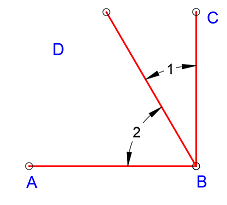
Hence, from above we can say that BA⊥BC
Page 53 Problem 24 Answer
Question 24.
Given two angles ∠A and ∠B, which form a linear pair:
- Explain why ∠A and ∠B must add up to 180 degrees.
- Draw the diagram to illustrate the linear pair.
- Provide a mathematical proof to show that ∠A and ∠B add up to 180 degrees.
Answer:
Two angles are said to be linear if they are adjacent angles formed by two intersecting lines.
The measure of a straight angle is 180∘, Therefore, a linear pair of angles must add to180∘ .
The diagram of a linear pair is as follows;
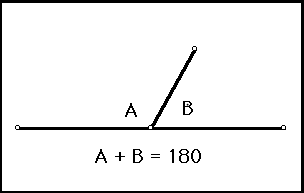
From the sketch and linear pair postulate ∠A and ∠B are linear pairs.
Page 53 Problem 25 Answer
Question 25.
The two angles, 130°, and 50°:
- Explain why these two angles are considered supplementary.
- Draw the diagram to illustrate these supplementary angles.
- Provide a mathematical proof to show that these angles add up to 180 degrees.
Answer:
If two angles sum up to 180 degrees, they are considered to be supplementary angles.
When supplementary angles are added together, they produce a straight angle (180 degrees).
Here, 130∘and 50∘are supplementary angles as their sum gives 180∘.
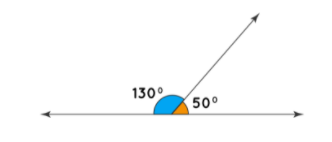
Definition From the defination of supplementary angles 130∘+50∘=180∘.
Page 53 Problem 26 Answer
Question 26.
The collinear points D, E, and F with point E between points D and F, draw the situation and explain how DE + EF = DF.
Answer:
Given: collinear points D, E, and F with point E between points D and F.
We have to draw the above situation.
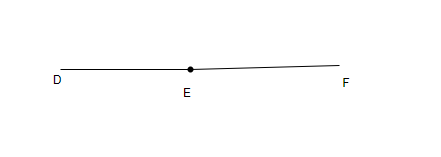
Here, E is in between D and F.
In the figure above E is between D and F such that DE+EF =DF.
Page 53 Problem 27 Answer
Question 27.
Using the segment addition postulate, if B is a point on \(\overline{A C}\) such that AB + BC = AC, then A, B, and C are collinear points. Draw the diagram of the given situation and explain the segment addition postulate.
Answer:
According to the segment addition postulate if B is a point ACˉ such that AB+BC = AC then, A,B, and C are collinear points.
The diagram of the situation above is;
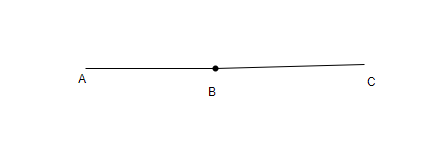
From the sketch above and the segment postulate AB+BC=AC.
Page 53 Problem 28 Answer
Question 28.
Using the segment addition postulate, verify the lengths of segments when a point B is on line segment \(\overline{A C}\) such that AB + BC = AC. Given that AC = 8m and B is 3m from A, find the length of BC and explain the verification process.
Answer:
Given
AC = 8m and B is 3m from A
According to the segment addition postulate if B is a point on AC such that AB+BC = AC then, A, B, and C are collinear points.
Let AC = 8m and B be 3 m from A. Such that AB = 3 m. Then BC = 5 m , because 3 m +5 m= 8 m .
Since, AB = 3 m, BC = 5m then by collinear postulate AC=8 m.
3 m +5 m= 8 m.
Tools of Geometry Exercise 1.5 Carnegie Learning 2nd Edition answers Page 53 Problem 29 Answer
Question 29.
Given ∠DEF with EG in the interior, verify that ∠DEG + ∠GEF = ∠DEF.
Answer:
Let draw ∠DEF with EGin the interior, as shown below;
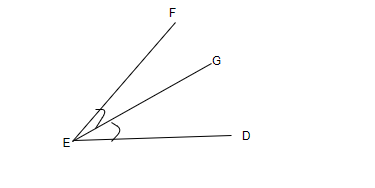
Clearly, line EG is drawn such that ∠DEG+∠GEF =∠DEF.
Page 53 Problem 30 Answer
Question 30.
Given ∠DEF with line segment EG in the interior, show that ∠DEG + ∠GEF = ∠DEF.
Answer:
Let us draw the line EG in ∠DEF as shown below;
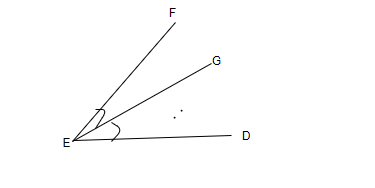
Clearly, line EG is drawn such that ∠DEG+∠GEF=∠DEF.