
Geometry Student Text 2nd Edition Chapter 1 Tools of Geometry
Carnegie Learning Geometry Student Text 2nd Edition Chapter 1 Exercise 1.6 Solution Page 55 Problem 1 Answer
Question 1.
How can the addition property of equality be applied to angle measures?
Answer:
The addition property of equality
The addition property of equality can be applied to angle measures as follows:
If m∠1=m∠2, then m∠1+m∠3=m∠2+m∠3.
Therefore, the addition property of equality to angles is m∠1+m∠3=m∠2+m∠3.
Page 55 Problem 2 Answer
Question 2.
How can the addition property of equality be applied to segment measures?
Answer:
The addition property of equality can be applied to segment measures as follows:
If mABˉ=mCDˉ, then mABˉ+mEFˉ=mCDˉ+mEFˉ.
The addition property of equality to segments is mABˉ+mEFˉ=mCDˉ+mEFˉ.
Read and learn More Carnegie Learning Geometry Student Text 2nd Edition Solutions
Carnegie Learning Geometry Student Chapter 1 Page 56 Problem 3 Answer
Question 3.
How can the subtraction property of equality be applied to angle measures?
Answer:
The subtraction property of equality can be applied to angles as follows:
If m∠1=m∠2, then m∠1−m∠3=m∠2−m∠3.
Therefore, the Subtraction Property of Equality to angles is m∠1−m∠3=m∠2−m∠3.
Page 56 Problem 4 Answer
Question 4.
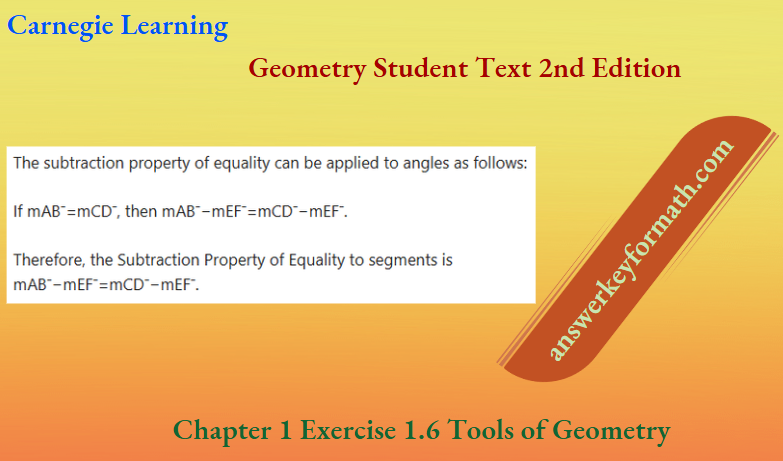
How can the subtraction property of equality be applied to segment measures?
Answer:
Page 56 Problem 5 Answer
Question 5.
How can the reflexive property be applied to angle measures?
Answer:
The reflexive property can be applied to angle measures as m∠1=m∠1.
The reflexive property to angles is m∠1=m∠1.
Carnegie Learning Geometry Student Chapter 1 Page 56 Problem 6 Answer
Question 6.
How can the reflexive property be applied to segment measures?
Answer:
The reflexive property can be applied to segment measures as mABˉ=mABˉ.
Therefore, the reflexive property to segments is mABˉ=mABˉ.
Solutions for Tools of Geometry Exercise 1.6 in Carnegie Learning Geometry Page 57 Problem 7 Answer
Question 7.
How can the substitution property be applied to angle measures?
Answer:
The substitution property can be applied to angle measures as follows:
If m∠1=56∘,m∠2=56∘, then m∠1=m∠2.
Therefore, the substitution property to angles is m∠1=m∠2.
Carnegie Learning Geometry Student Chapter 1 Page 57 Problem 8 Answer
Question 8.
How can the substitution property be applied to segment measures?
Answer:
The substitution property can be applied to segment measures as follows:
If mABˉ=4 mm and mCDˉ
=4 mm then mABˉ=mCDˉ.
The substitution property to segments is mABˉ=mCDˉ.
Page 57 Problem 9 Answer
Question 9.
How can the transitive property be applied to angle measures?
Answer:
The transitive property can be applied to angle measures as follows:
If m∠1=m∠2 and m∠2=m∠3 then m∠1=m∠3.
Therefore, the transitive property to angle measures is, “If m∠1=m∠2 and m∠2=m∠3 then m∠1=m∠3”.
Carnegie Learning Geometry Student Chapter 1 Page 57 Problem 10 Answer
Question 10.
How can the transitive property be applied to congruent segment measures?
Answer:
The transitive property can be applied to congruent segment measures as follows:
If mABˉ=mCDˉ and mCDˉ=mEFˉ then mABˉ=mEFˉ.
The transitive property to congruent segment measures is, “If mABˉ=mCDˉ and mCDˉ=mEFˉ
then mABˉ=mEFˉ”.
Carnegie Learning Geometry 2nd Edition Exercise 1.6 Solutions Page 58 Problem 11 Answer
Question 11.
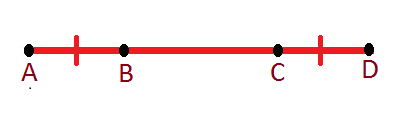
Given four collinear points A, B, C, and D such that B lies between A and C, C lies between B and D, and \(\overline{A B} \cong \overline{C D}\). Draw the line segment showing the collinear points and their relationships.
Answer:
Given
Given four collinear points A, B, C, and D such that B lies between A and C, C lies between B and D, and \(\overline{A B} \cong \overline{C D}\).
Draw four collinear points A,B,C,D such thatB is lies betweenA and C,C is lies betweenB and D,
And ABˉ≅CDˉ
Since pointsA,B,C,D is collinear and ABˉ≅CDˉ
⇒ mABˉ
=mCDˉ
So required line is
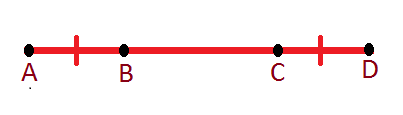
A line with four collinear points A,B,C,D, such that B is between A and C,C is lie between B and D,and ABˉ≅CD ˉ is
Carnegie Learning Geometry Student Chapter 1 Page 58 Problem 12 Answer
Question 12.
Line segment \(\overline{A B}\) is congruent to line segment \(\overline{B D}\)
To Prove: Line segment \(\overline{A C}\) is congruent to line segment \(\overline{B D}\)
Answer:
We haveABˉ≅CDˉ then ACˉ≅BDˉ
So the hypothesis is LineABˉ is congruent to LineCDˉ and the conclusion is Line AC is congruent to Line BDˉ.
Given: Line ABˉ is congruent to Line CDˉ.
Prove: Line ACˉ is congruent to Line BDˉ.
Carnegie Learning Geometry Student Chapter 1 Page 58 Problem 13 Answer
Question 13.
Given: Line segment \(\overline{A B}\) is congruent to line segment \(\overline{C D}\).
Prove: Line segment \(\overline{A C}\) is congruent to line segment \(\overline{B B}\).
Answer:
We have Given: Line ABˉ is congruent to Line CDˉ.
Prove: LineACˉ is congruent to Line BDˉ.
SinceABˉ≅CDˉ
We have LineABˉ is equal to CDˉ
In segment measure form we get
⇒mABˉ=mCDˉ −−−−−−−(1)
By Reflexive PropertyBCˉ≅BCˉ.
In segment measure form we get
⇒mBCˉ
=mBCˉ −−−−−−−(2)
By Addition Property of Equality add equation (1) and (2) we get
⇒mABˉ+mBCˉ=mCDˉ+mBCˉ
⇒mABˉ+mBCˉ=mBCˉ+mCDˉ −−−−−−−(3)
By Transitive Property ABˉ+BCˉ≅ACˉ and BCˉ+CDˉ≅BDˉ
In segment measure form we get
⇒m(ABˉ+BCˉ)=mACˉ and m(BCˉ+CDˉ)=mBDˉ
⇒mABˉ+mBCˉ=mACˉ and mBCˉ+mCDˉ=mBDˉ −−−−−−−(4)
By Substitution Property of Equality Using (4) in (3) we get
⇒mACˉ=mBDˉ
⇒ACˉ≅BDˉ
Hence the result is proved.
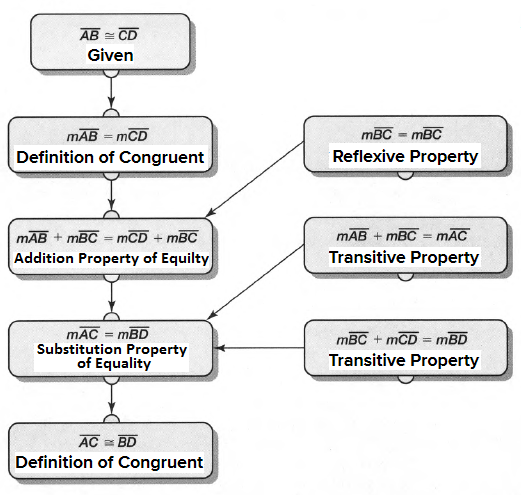
So flow chart becomes:
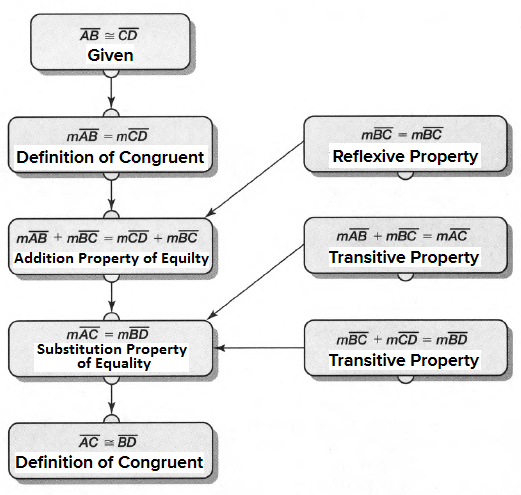
The flow chart for result IfABˉ≅CDˉ then ACˉ≅BDˉ is:
Tools Of Geometry Solutions Chapter 1 Exercise 1.6 Carnegie Learning Geometry Page 59 Problem 14 Answer
Question 14.
Given the conditional statement: If \(\overline{A B} \cong \overline{C D}\), then \(\overline{A C} \cong \overline{B D}\)
Write a two-column proof for the given conditional statement
Answer:
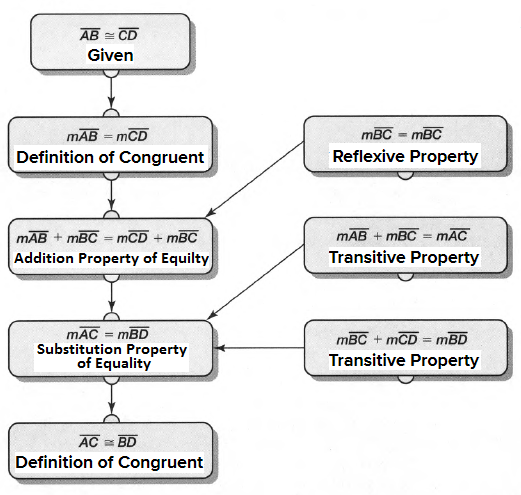
Given the conditional statement is IfABˉ≅CDˉ then ACˉ≅BDˉ
And flow chart is
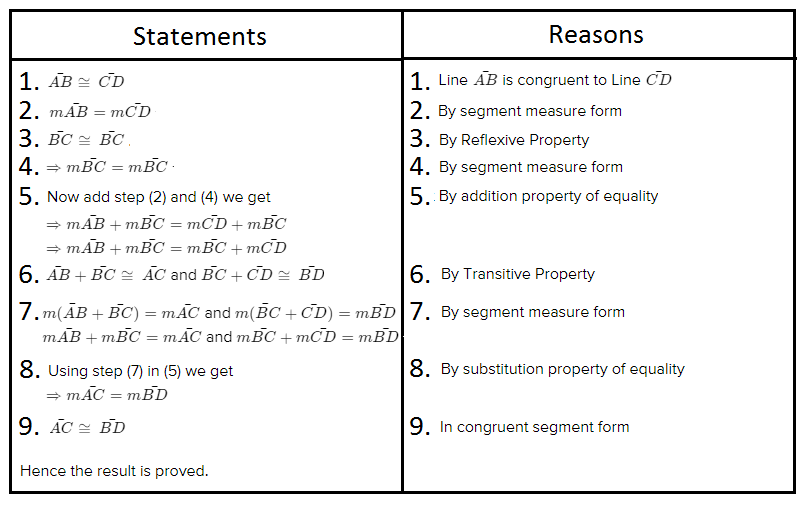
A two-column proof becomes
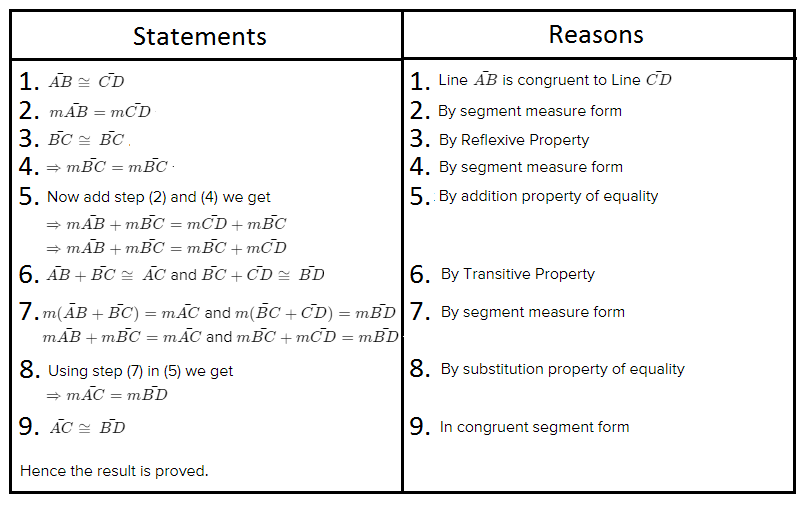
A two-column proof of the conditional statement: IfABˉ≅CDˉ then ACˉ≅BDˉis
Carnegie Learning Geometry Student Chapter 1 Page 59 Problem 15 Answer
Question 15.
Given the conditional statement: If \(\overline{A B} \cong \overline{C D}\) and \overline{A C} \cong \overline{B D}
Answer:
Given the conditional statement is IfABˉ≅CDˉ then ACˉ≅BDˉ and A two-column proof is
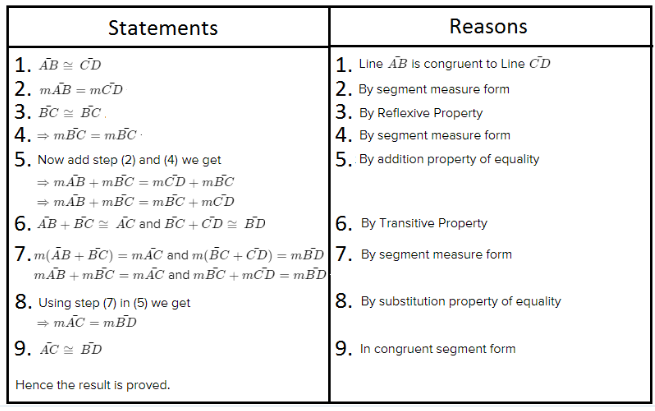
So A paragraph proof is
Given ABˉ≅CDˉ and we have to prove AC ≅BDˉ
IfABˉ≅CDˉ then by segment measure form we get
⇒mABˉ
=mCDˉ −−−−−−−(1)
We know that by reflexive property BCˉ≅BCˉ
⇒mBCˉ
=mBCˉ −−−−−−−(2)
Now by addition property of equality add equation (1) and (2) we get
⇒mABˉ+mBCˉ
=mCDˉ+mBCˉ
⇒mABˉ+mBCˉ
=mBCˉ+mCD −−−−−−−(3)
We know that by transitive property⇒ABˉ+BCˉ=ACˉ and BCˉ+CDˉ=BDˉ
⇒m(ABˉ+BCˉ)=mACˉ and m(BCˉ+CDˉ)=mBDˉ
⇒mABˉ+mBCˉ=mACˉ and mBCˉ+mCDˉ=mBDˉ −−−−−−−(4)
Now by substitution property of equality using (4) in (3) we get
⇒mACˉ
=mBDˉ
⇒ACˉ≅BDˉ
Hence the result is proved.
A paragraph proof of the conditional statement If ABˉ≅CDˉ then ACˉ≅BDˉ is given in explanation part.
Step-By-Step Solutions For Carnegie Learning Geometry Chapter 1 Exercise 1.6 Page 60 Problem 16 Answer
Question 16.
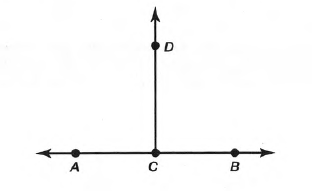
Given : ACD and ∠BCD are right angles.
Prove: ∠ACD≅∠BCD
Here is the completed flow chart with the statements for each reason:
Answer:
We have to Complete the flow chart of the Right Angle Congruence Theorem by writing the statement for each reason in the boxes provided.
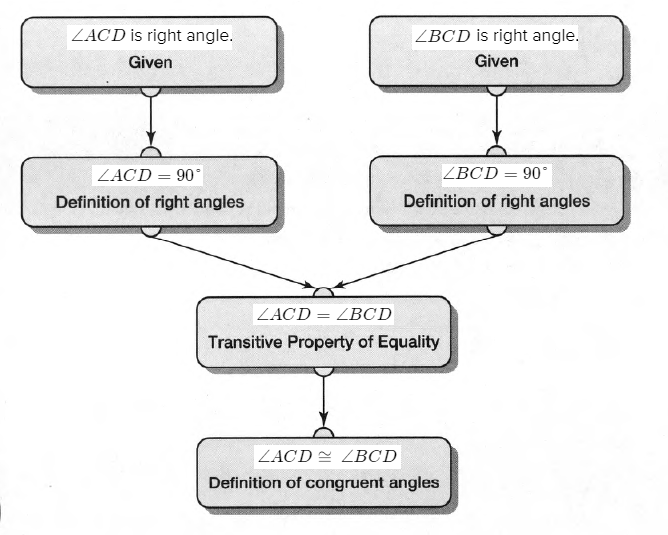
Given:∠ACD and ∠BCD are right angles.
Prove:∠ACD≅∠BCD
In first row write the statement of given.
Given:∠ACD is right angles, ∠BCD is right angles.
In second row write the results of right angles.
i.e.If ∠ACD is right angles, ∠BCD is right angles.
⇒∠ACD=90°,∠BCD=90°
In third row write the result of transitive property of equality
If ∠ACD=90°,∠BCD=90°
⇒∠ACD≅∠BCD
So we have which is required flow chart of the Right Angle Congruence Theorem.
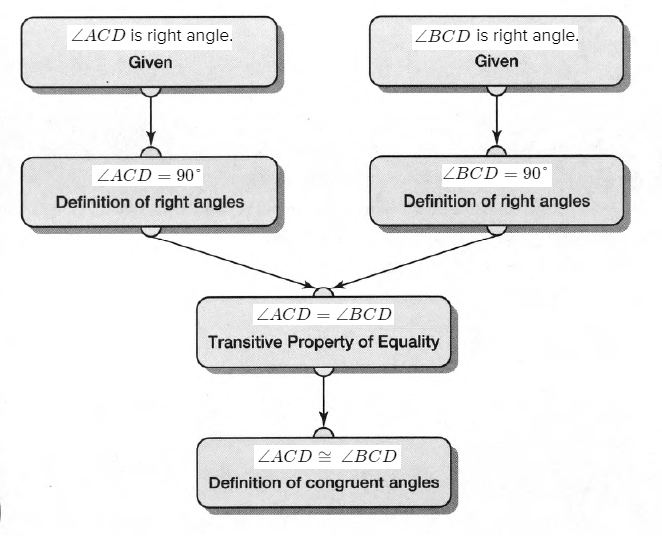
The flow chart of the Right Angle Congruence Theorem:
Carnegie Learning Geometry Student Chapter 1 Page 61 Problem 17 Answer
Question 17.
Prove that ∠1≅∠3.
Answer:
Consider the diagram:
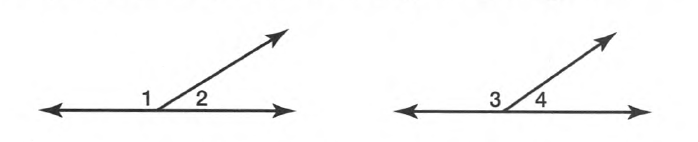
We have to write the “Given” statement such that “Prove:∠1≅∠3”.
For this by The Congruent Supplement Theorem we get the “Given” Statements
∠1 and ∠2 are supplement angles i.e.∠1+∠2=180°
∠3 and ∠4 are supplement angles i.e.∠3+∠4=180°
∠2=∠4 which is required solution.
By The Congruent Supplement Theorem
Given: ∠1 and ∠2 are supplement angles i.e.∠1+∠2=180°
Given: ∠3 and ∠4 are supplement angles i.e.∠3+∠4=180°
Given: ∠2=∠4 is required “Given” for Prove:∠1≅∠3
Carnegie Learning Geometry Chapter 1 Exercise 1.6 Free Solutions Page 61 Problem 18 Answer
Question 18.
Proof of the Congruent Supplement Theorem:
- ∠1 + ∠2 = 180
- ∠3 + ∠4 = 180
- ∠2 = ∠4
Answer:
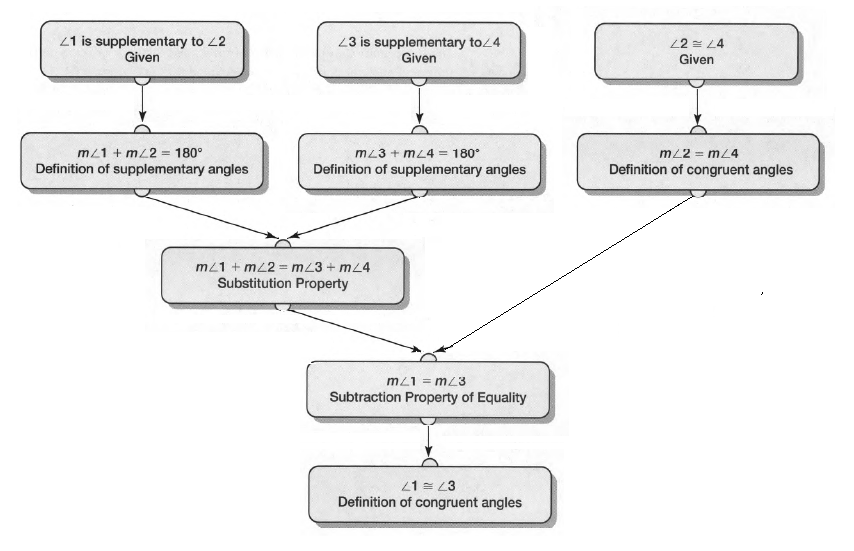
We have to complete a flow chart proof of the Congruent Supplement Theorem by drawing arrows to connect the steps in a logical sequence.
In first row write given parts portion.In second row write Definitions downwards to given parts.
In third row write substitution property downwards-center of definition of supplementary angles.
In forth row write subtraction property of equality downwards-center of supplementary angles and definition of congruent angles.
In fifth row write definition of congruent angles downwards to subtraction property of equality
So we have which is required flow chart.
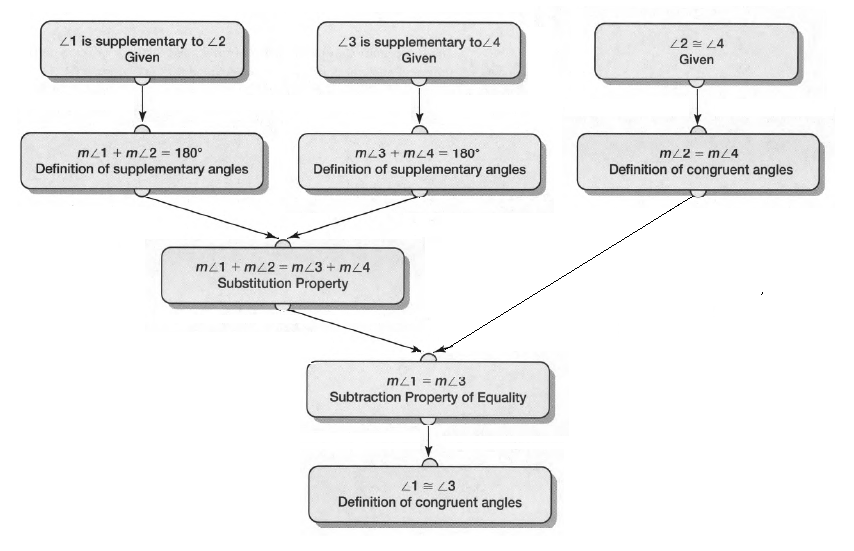
A flow chart proof of the Congruent Supplement Theorem:
Carnegie Learning Geometry Student Chapter 1 Page 62 Problem 19 Answer
Question 19.
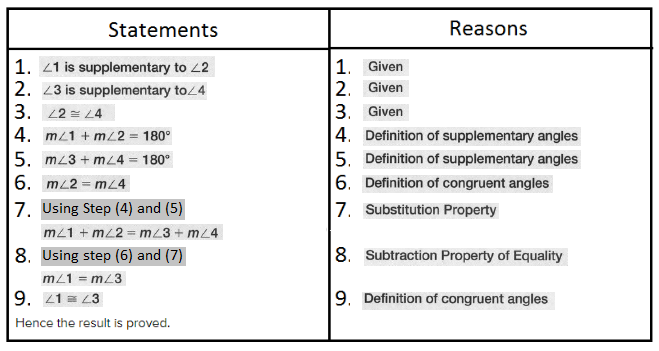
Congruent Supplement Theorem: If two angles are supplementary to the same angle (or to congruent angles), then those two angles are congruent.
To prove that ∠1≅∠3
Answer:
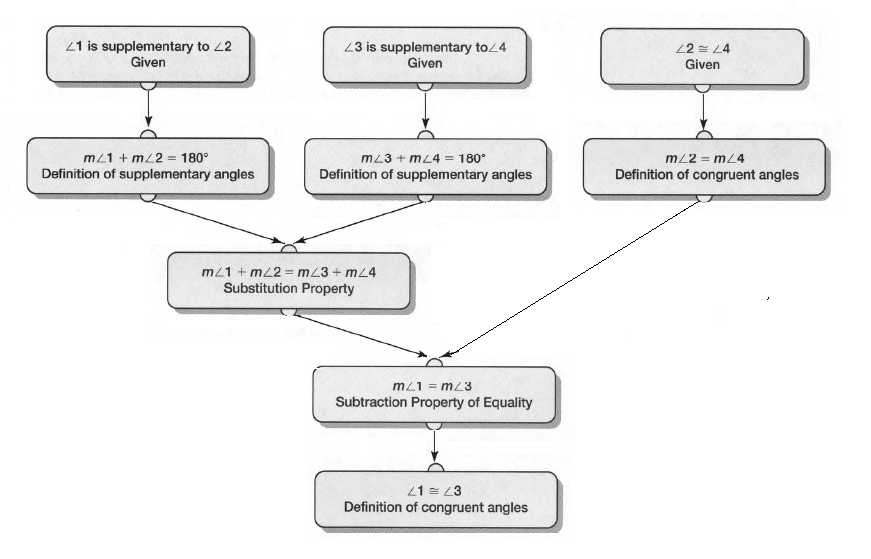
We have to create a two-column proof of the Congruent Supplement Theorem.
In first row write given parts portion.
In second row write Definitions downwards to given parts.
In third row write substitution property downwards-center of definition of supplementary angles.
In forth row write subtraction property of equality downwards-center of supplementary angles and definition of congruent angles.
In fifth row write definition of congruent angles downwards to subtraction property of equality
And flow chart is
A two-column proof becomes
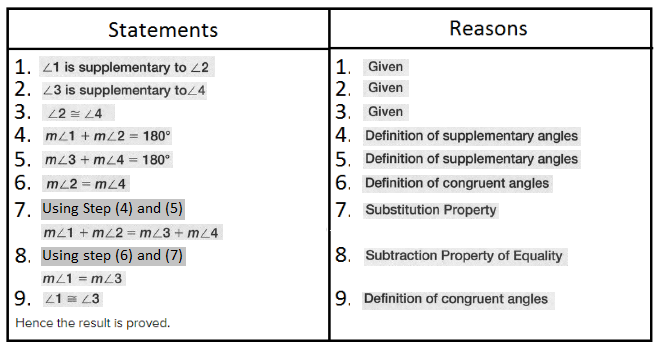
A two-column proof of the Congruent Supplement Theorem is:
Carnegie Learning Geometry Student Chapter 1 Page 62 Problem 20 Answer
Question 20.
Given:
- ∠1 and ∠2 are complementary angles.
- ∠3 and ∠4 are complementary angles.
- ∠2 ≅ ∠4
To Prove: ∠1 ≅ ∠3
Answer:
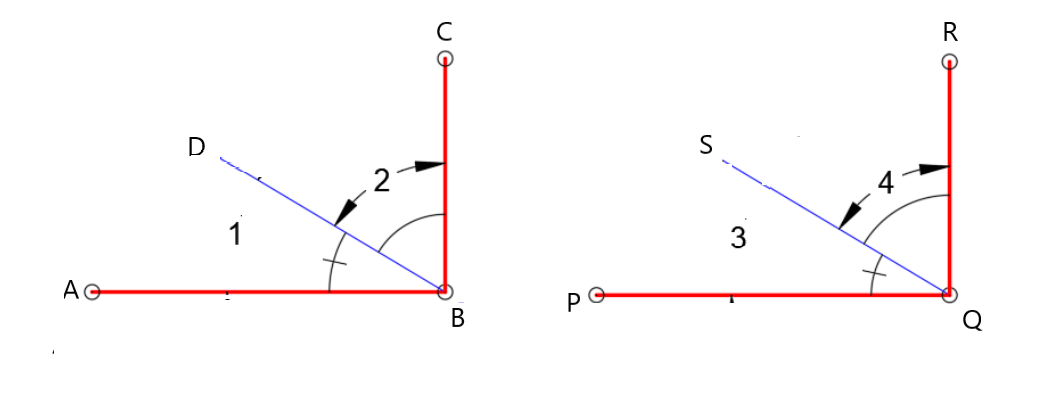
The angles ∠1 and ∠2 are complimentary. Also, the angles ∠3 and∠4 are complimentary angles.
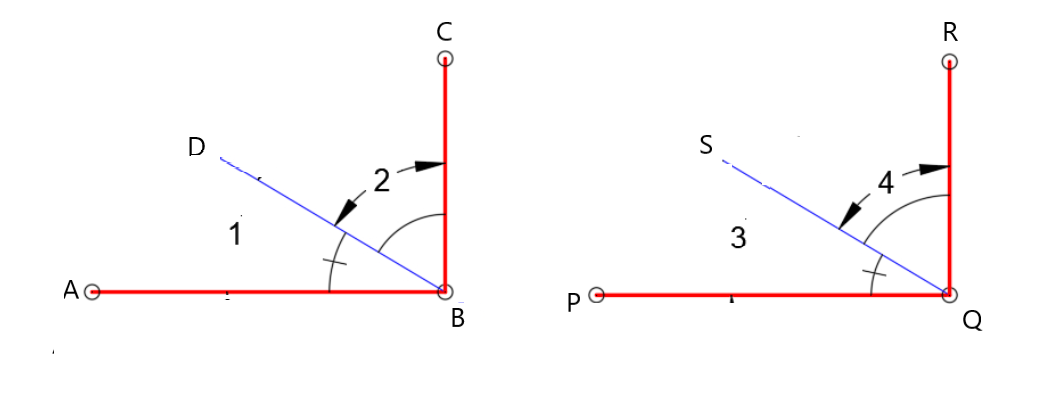
It is also given that it conclude that ∠1 and ∠3 are congruent
Carnegie Learning Geometry Exercise 1.6 Student Solutions Page 62 Problem 21 Answer
Question 21.
- ∠1 and ∠2 are complementary.
- ∠3 and ∠4 are complementary.
- ∠2 ≅ ∠4
To Prove: ∠1 ≅ ∠3
Answer:
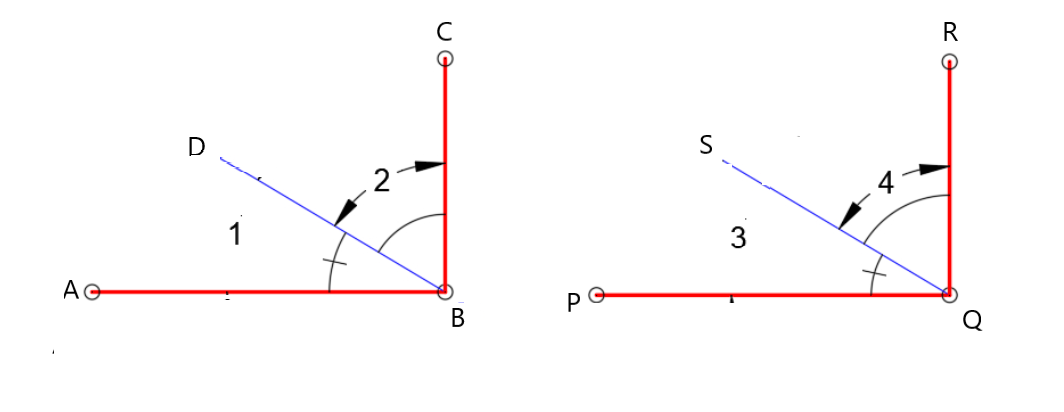
To use : The diagram to write the “Given” and “Prove” statements for the Congruent Complement Theorem.
Diagram for the given Theorem is given below:
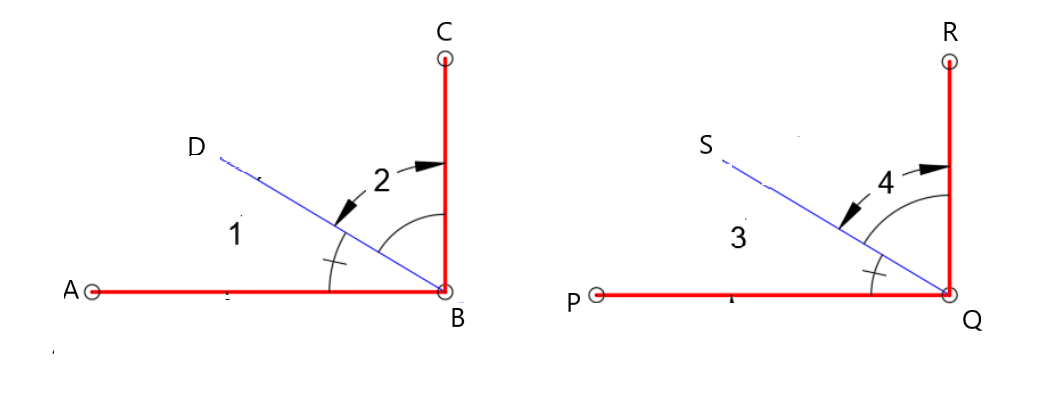
Now from the given Theorem the Given and concluding statement is as-
Given : ∠1 and∠2 are complimentary.
Given :∠3 and∠4 are complimentary.
Given :∠1+∠2=90° and∠3+∠4=90°
Prove :∠1≅∠3
Given :∠1 and∠2 are complimentary.
Given :∠3 and∠4 are complimentary
Given :∠1+∠2=90 and∠3+∠4=90
Prove :∠1≅∠3
Carnegie Learning Geometry Student Chapter 1 Page 63 Problem 22 Answer
Question 22.
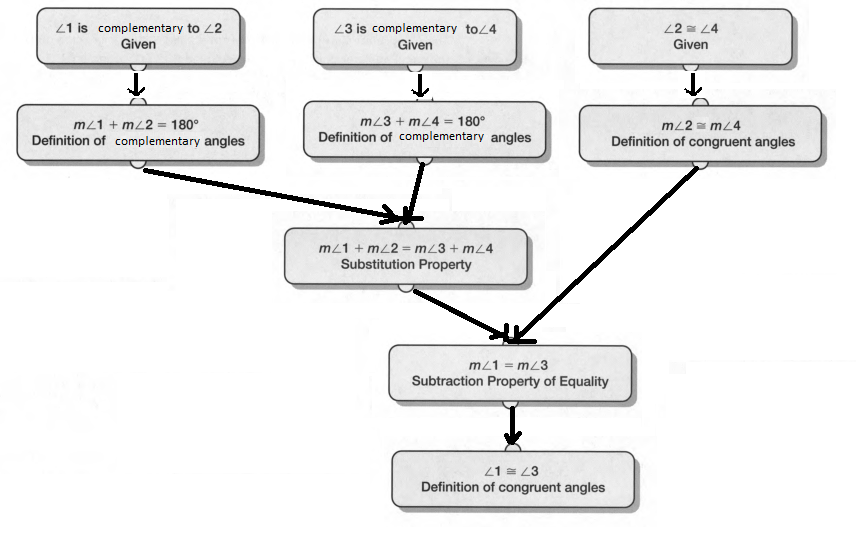
To create a flow chart proof of the Congruent Complement Theorem:
Given:
- ∠1 and ∠2 are complementary.
- ∠3 and ∠4 are complementary.
- ∠2 ≅ ∠4
To Prove: ∠1 ≅ ∠3
Answer:
To create: A flow chart proof of the Congruent Complement Theorem.
We have
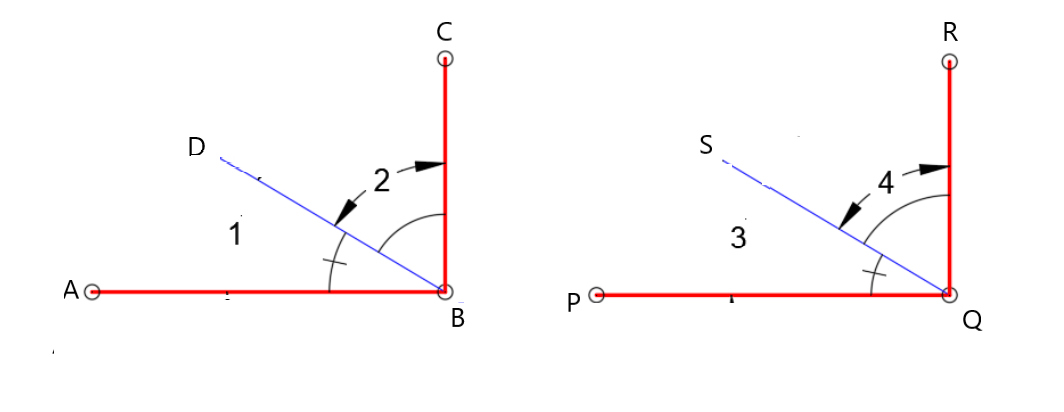
The flowchart is
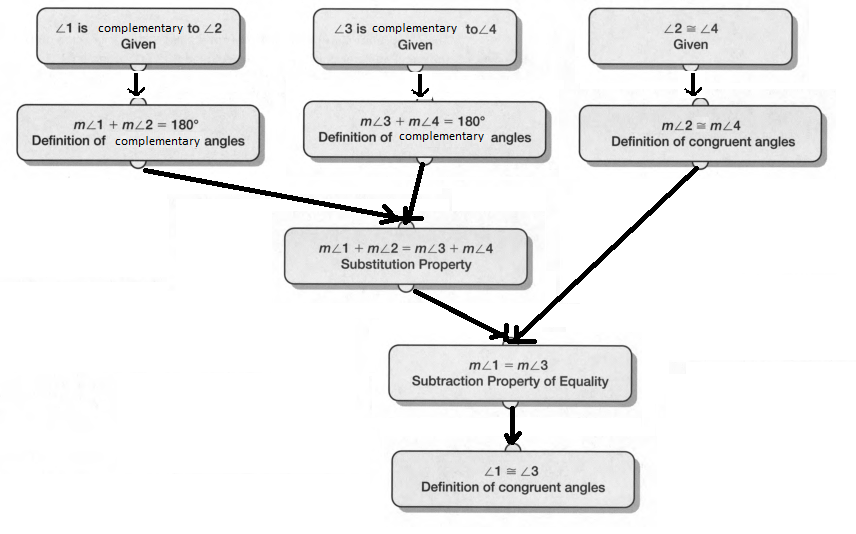
The flow chart is
Carnegie Learning Geometry Student Chapter 1 Page 64 Problem 23 Answer
Question 23.
write a formal proof to demonstrate that vertical angles are congruent.
Answer:
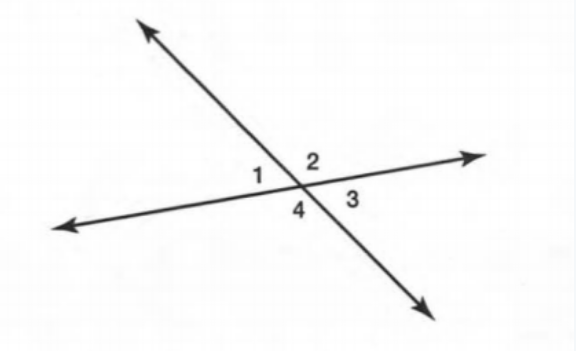
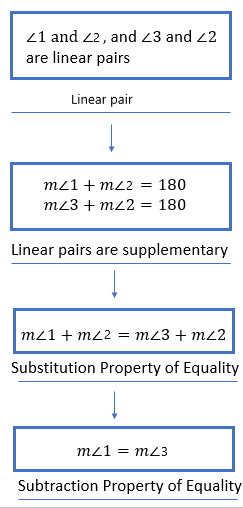
We know that,
∠1+∠2=180 and∠2+∠3=180 ( Linear Pair )
Therefore, ∠1+∠2=∠2+∠3 ⇒∠1=∠3
Similarly, ∠2=∠4
These are vertical angles hence it is proved that vertical angles are congruent.
Therefore, vertical angles are congruent.
Tools Of Geometry Exercise 1.6 Carnegie Learning 2nd Edition Answers Page 64 Problem 24 Answer
Question 24.
Using the diagram and the given statements, write a proof to demonstrate that ∠1 and ∠3 are congruent and that ∠2 and ∠4 are congruent.
Answer:
The diagram for the vertical angle theorem is given below-
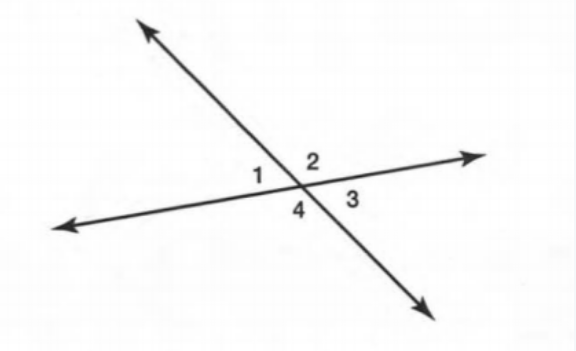
From the given statements and the the definition of vertical angle theorem we can state the Prove statements as-
Prove :∠1and∠3 are congruent
Prove :∠2 and∠4 are congruent
Therefore, the Prove statements are as-
Prove :∠1 and∠3 are congruent
Prove :∠2 and∠4 are congruent
Carnegie Learning Geometry Student Chapter 1 Page 64 Problem 25 Answer
Question 25.
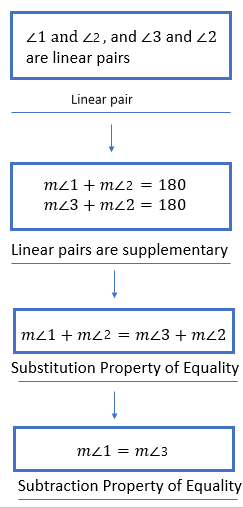
To Shows that ∠1 and ∠3 are congruent, in accordance with the vertical angle theorem.
Answer:
First Prove:∠1 and∠3 are congruent
Page 65 Problem 26 Answer
Question 26.
To Prove that ∠2 and ∠4 are congruent.
Answer:
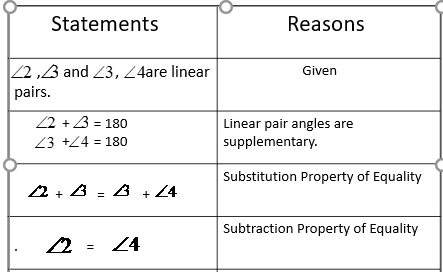
For the vertical angle theorem
Given :∠2 and∠3 are linear pair
Given :∠3 and∠4 are linear pair
Prove :∠2 and∠4 are congruent
We have to Create a two-column proof of the “Prove” statement
Carnegie Learning Geometry Student Chapter 1 Page 67 Problem 27 Answer
Question 27.
To prove that ∠5 ≅ ∠7
Answer:
A two-column proof uses a table to present a logical argument and assigns each column to do one job to take a reader from premise to conclusion.
Paragraph proof is a logical argument written as a paragraph, giving evidence and details to arrive at a conclusion.
So, everything needs to fit in an appropriate place.
Two-Column proof is easiest to understand as it makes the reader see the statement and conclusion side by side.
While as Paragraph proof makes the proof wordier and harder to follow thus it is hardest to understand.
Therefore, Two column proof is easiest to understand while as Paragraph proof is hardest to understand.
Page 67 Problem 28 Answer
Question 28.
Given the forms of mathematical proofs, which type of proof is easiest to write and which is hardest to write? Explain your reasoning.
Answer:
Given: Which form of proof is easiest to write? Hardest to write
To explain Which form of proof is easiest to write? Hardest to write.
A two-column proof is a easiest proof in which the steps are written in the left column and the corresponding reasons in the right column.
Each step is numbered and the same number is used for the corresponding reason.
A flow chart proof is a hardest proof in which the steps and corresponding reasons are written in boxes.
Arrows connect the boxes and indicate how each step and reason is generated from one or more other steps and reasons.
Hence, A two-column proof is a easiest proof and a flow chart proof is a hardest proof to write.
Carnegie Learning Geometry Student Chapter 1 Page 67 Problem 29 Answer
Question 29.
Which form of proof generally has the fewest steps? Which form of proof has the most steps? Explain your reasoning.
Answer:
Given: Which form of proof has the fewest steps? The most stepsTo Explain Which form of proof has the fewest steps? The most steps
A two-column proof is a proof which has the fewest steps, as in this the steps are written in the left column and the corresponding reasons in the right column.
Each step is numbered and same number is used for the corresponding reason.
A flow chart proof is a proof which has the most steps and corresponding reasons are written in boxes.
Arrows connect the boxes and indicates how each step and reason is generated from one or more other steps and reasons.
Hence, A two-column proof is a proof which has the fewest steps and a flow chart proof is a proof which has the most steps.
Carnegie Learning Geometry Student Chapter 1 Page 67 Problem 30 Answer
Question 30.
Which form of proof do you prefer? Explain why you prefer this form of proof.
Answer:
Given: Which form of proof do you prefer To explain Which form of proof do you prefer
I use to prefer a two-column proof because in it steps are written in the left column and the corresponding reasons in the right column.
Hence, I use to prefer a two-column proof because in it steps are written in the left column and the corresponding reasons in the right column.