
Geometry Student Text 2nd Edition Chapter 2 Parallel and Perpendicular Lines
Carnegie Learning Geometry Student Text 2nd Edition Chapter 2 Exercise 2.3 Solution Page 91 Problem 1 Answer
Given: The statement is∠3≅∠6.
The Corresponding Angles Theorem states that the corresponding angles are congruent if the set of parallel lines are cut by a transversal line.
The angles that have the same measure are said to be the congruent angles.
A linear pair can be defined as the two adjacent angles formed by two intersecting lines that add up to 180°.
Prove the given statement for the Alternate Interior Angle Conjecture.
From the figure, observe that w and x are two parallel line which is intersected by a transversal line z.
Sincew∣∣x, conclude that the angle1 and 5 are congruent angles.
So, by congruent angle theorem,∠1≅∠5.
By the definition of congruent theorem, the measures of both angles are equal.
So,m∠1=m∠5…(a)
Read and learn More Carnegie Learning Geometry Student Text 2nd Edition Solutions
The angle 1 and 3 form a linear pair, the angles1 and 3 are supplementary.
Thus,m∠1+m∠3=180∘…(b)
The angles 5 and 6 are supplementary since the angle 5 and the angle 6 form a linear pair.
So,m∠5+m∠6=180∘…(c)
Substituting∠1 form∠5 into the equation(c).
m∠1+m∠6=180∘…(d)
Substitute the value of180∘=m∠1+m∠6 into (b).
m∠1+m∠3=m∠1+m∠6
Cancel∠1 on both sides.
m∠3=m∠6
Hence,∠3≅∠6 proved.
Statement∠3≅∠6 is proved for the Alternate Interior Angle Conjecture.
Page 92 Problem 2 Answer
Given:
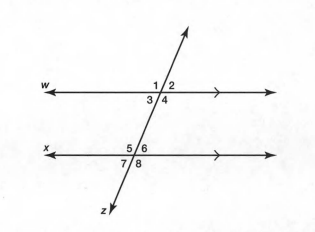
To Complete the flow chart proof of the Alternate Interior Angle Conjecture by writing the reason for each statement in the boxes provided.
Given
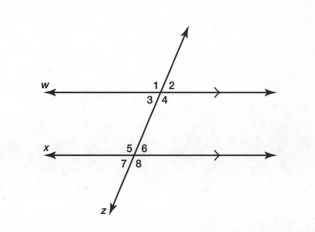
As per the definition of the Alternate interior angle
∠1=∠4
∠2=∠3
∠5=∠8
∠6=∠7
Also as per the transitive property
∠1=∠5
∠2=∠6
∠3=∠7
∠4=∠8
Because vertical angles are congruent
Hence, the flow chart proof of the Alternate Interior Angle Conjecture have been completed.
Solutions for Parallel and Perpendicular Lines Exercise 2.3 In Carnegie Learning Geometry Page 92 Problem 3 Answer
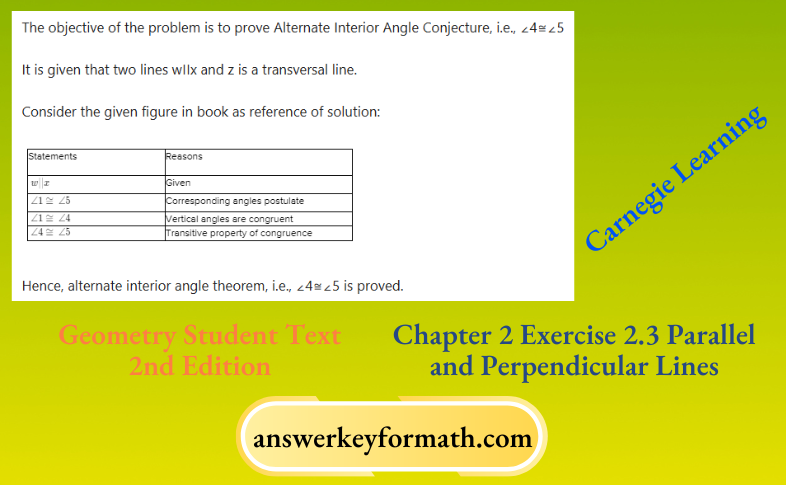
Page 93 Problem 4 Answer
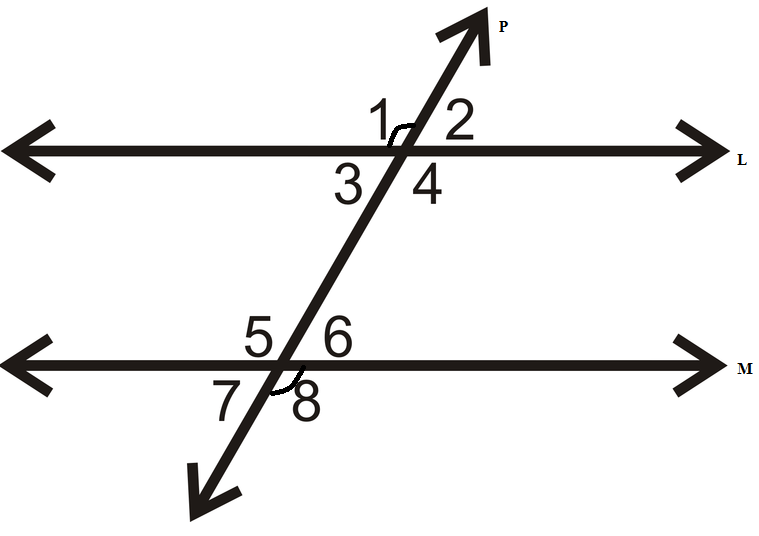
The objective of the problem is to draw labelled diagram for alternate exterior angle thoerem.
According to the alternate exterior angle theorem, If two parallel lines are intersected by a transversal, then alternate exterior angles are congruent.
The required labeled diagram for the given theorem is as shown below:
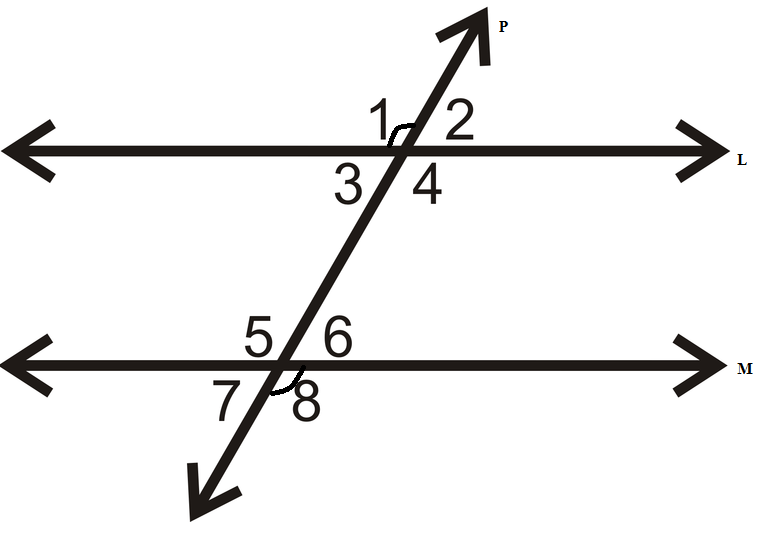
Here, two parallel lines L and M intersected by a transversal line P then,
∠1≅∠8
∠2≅∠7
Hence, the required diagram with a label for the alternate exterior angle conjecture is shown below:
Page 93 Problem 5 Answer
The objective of the problem is to write the given and prove statements for the alternate exterior angle conjecture.
Given:
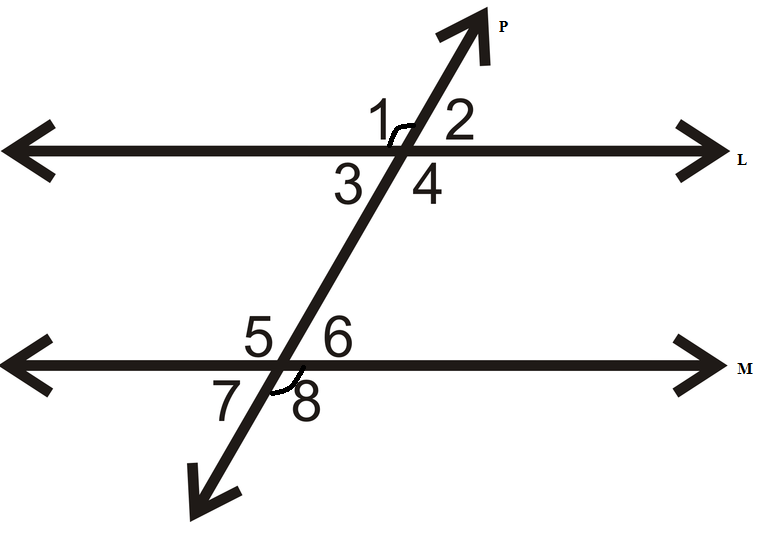
According to the alternate exterior angle theorem, If two parallel lines are intersected by a transversal, then alternate exterior angles are congruent.
As it is seen in the given diagram, two parallel lines are given and one transversal line is given.
Therefore,
Given: L∣∣M
Prove: ∠1≅∠8
Hence, the two required statements forgiven and prove is,
Given: L∣∣M
Prove: ∠1≅∠8
Carnegie Learning Geometry 2nd Edition Exercise 2.3 Solutions Page 93 Problem 6 Answer
The objective of the problem is to prove the alternate exterior angle theorem.
According to the alternate exterior angle thoerem, If two parallel lines are intersected by a transversal, then alternate exterior angles are congruent.
The required diagram for the solution:
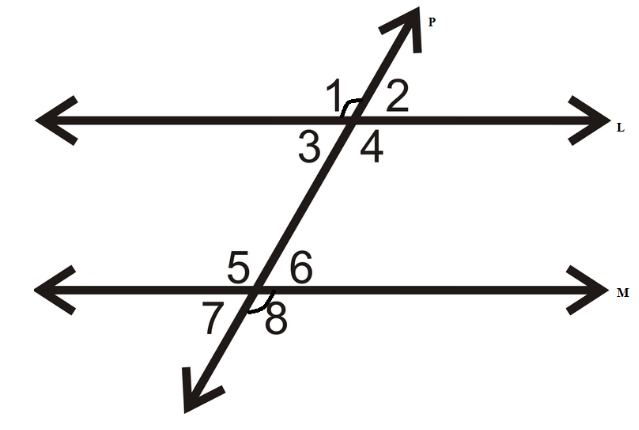
As two lines L∣∣M, by corresponding angles postulate,
∠1≅∠5
Also by the vertical angles theorem,
∠5≅∠8
Then, by the transitive property of congruence,
∠1≅∠8
Hence, alternate exterior angle theorem, i.e., ∠1≅∠8 is proved.
Page 94 Problem 7 Answer
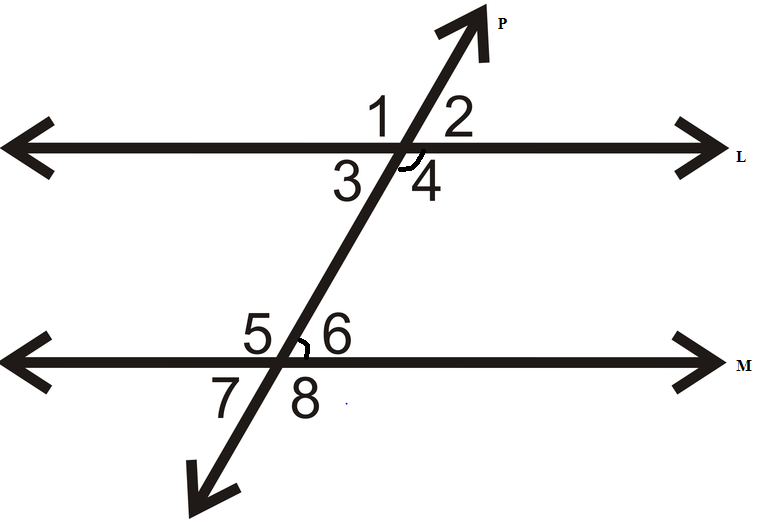
The objective of the problem is to draw a labeled diagram that illustrates the same side interior angle conjecture.
According to the same side interior angle conjecture, if two parallel lines are intersected by a transversal, then interior angles on the same side of the transversal are supplementary.
The required labeled diagram for the given theorem is as shown below:
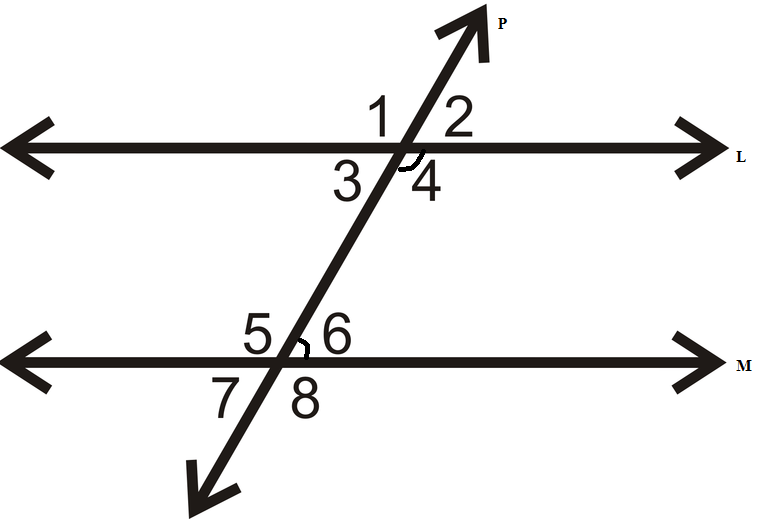
Here, two parallel lines are L and M intersected by the transversal line P then,
∠4+∠6=180∘
∠3+∠5=180∘
Hence, the required diagram with a label for the same side interior angle conjecture is shown below:
Parallel And Perpendicular Lines Solutions Chapter 2 Exercise 2.3 Carnegie Learning Geometry Page 94 Problem 8 Answer
The objective of the problem is to prove the same side interior angle conjecture.
When two parallel lines are cut by a transversal line, then a total of 8 angles are formed.
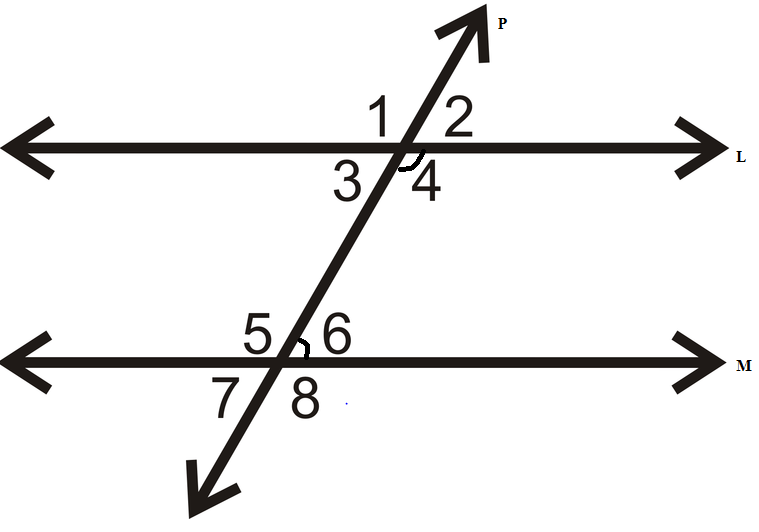
Given: Two parallel lines L and M are cut by the third line called transversal line P.
Prove: ∠3+∠5=180∘
Proof: Consider the below figure where two parallel lines L and M are cut by the transversal line P:
Here, ∠3 and ∠1 form a linear pair and same way ∠2 and ∠4 are also linear pairs.
According to the supplement postulate, the above two pairs are also supplementary,
∠1+∠3=180∘
∠2+∠4=180∘
By applying corresponding angles,
∠1≅∠5
∠2≅∠6
Therefore,
∠5+∠3=180∘
∠6+∠4=180∘
Hence, it is proved that if two parallel lines are intersected by a transversal, then interior angles on the same side of the transversal are supplementary.
Step-By-Step Solutions For Carnegie Learning Geometry Chapter 2 Exercise 2.3 Page 94 Problem 9 Answer
Given: The Same-Side Interior Angle Conjecture states: “If two parallel lines are intersected by a transversal, then interior angles on the same side of the transversal are supplementary.” To Prove the Same-Side Interior Angle Conjecture.
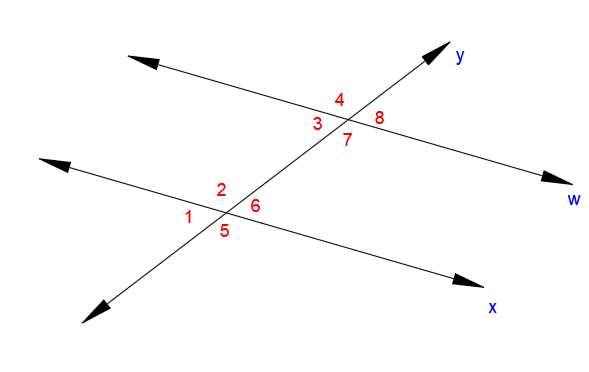
Two column table proof
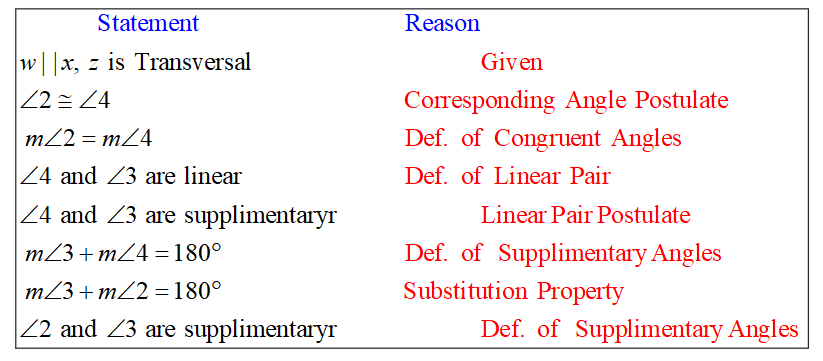
Hence, the Same-Side Interior Angle Conjecture have been proved
Page 95 Problem 10 Answer
The objective of the problem is to draw and label a diagram that illustrates alternate exterior angle conjecture.
According to the alternate Exterior angle conjecture, if two parallel lines are intersected by a transversal, then the alternate exterior angles on the same side of the transversal are supllymentary.
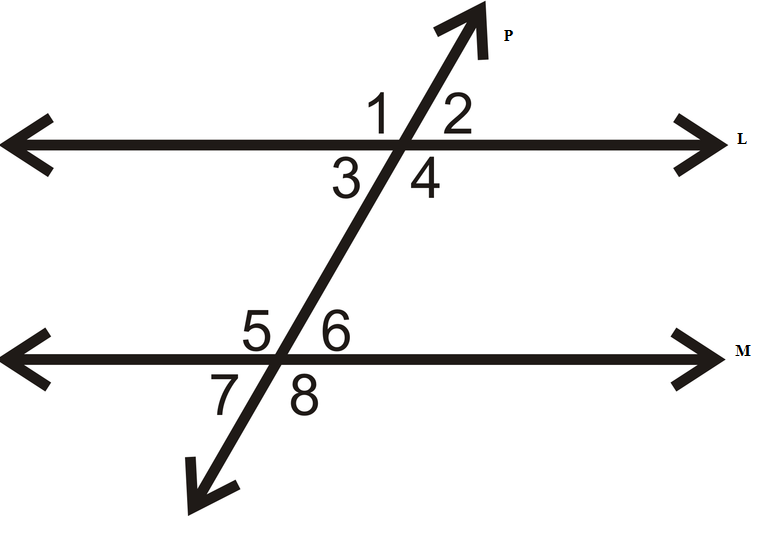
The required labeled diagram for the given theorem is as shown below:
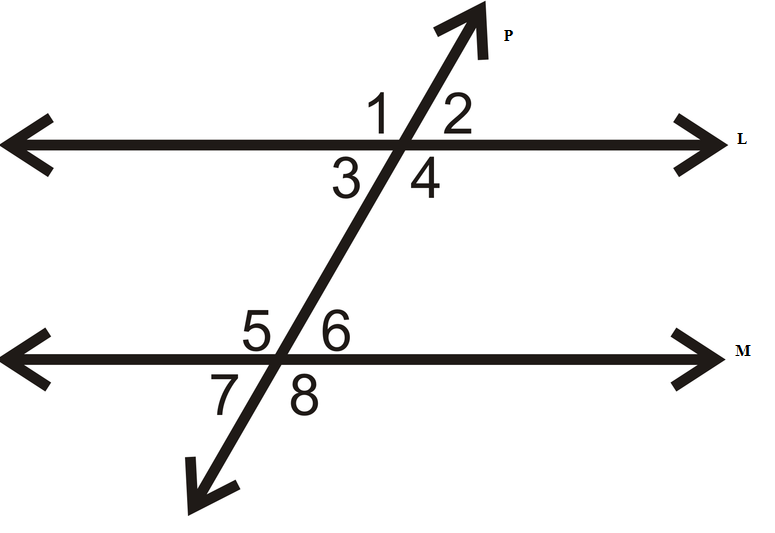
Here, two parallel lines are L and M intersected by the trasversal line P
The two pairs of alternate exterior angles are:
∠1 + ∠7=180∘
∠2 + ∠8=180∘
Hence, the required labeled diagram for alternate exterior angle conjecture is as shown below:
Carnegie Learning Geometry Chapter 2 Exercise 2.3 Free Solutions Page 95 Problem 11 Answer
The objective of the problem is to prove the same side exterior angle conjecture.
When two parallel lines are cut by a transversal line, then total of 8 angles are formed.
Given: two parallel lines L and M are cut by the third line called transversal line P.
Prove: ∠1 +∠7=180∘
Proof: Here, two parallel lines L and M are cut by the transversal line P which is shown below figure:
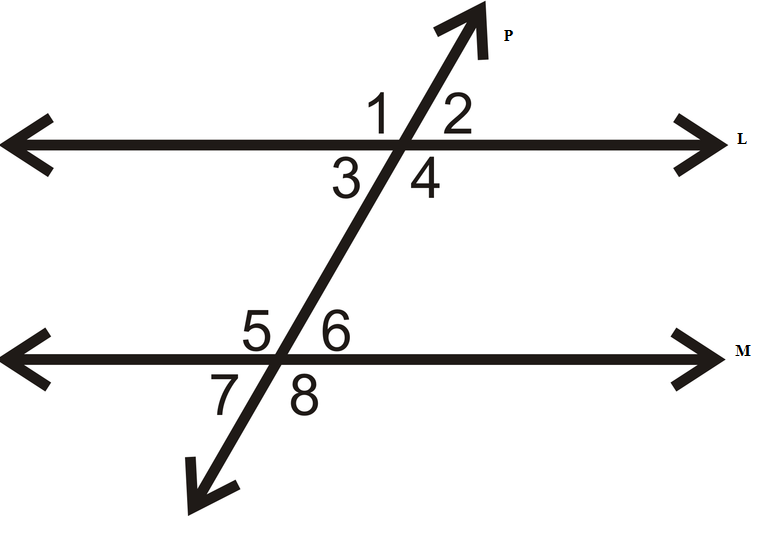
As two lines L and M are parallel, corresponding angles are congruent, i.e., ∠1 ≅∠5
Also, ∠5 and ∠7 form a straight line, i.e., ∠5 +∠7=180∘
By substitution, ∠1 +∠7=180∘
Hence, it is proved that if two parallel lines are intersected by a transversal, then exterior angles on the same side of transversal are supplymentary.
Page 95 Problem 12 Answer
Given: The diagram shows us a pair of parallel lines intersected by a transversal.
There are two pairs of exterior angles on the same side of the transversal, one pair being ∠2 and ∠8 and another pair being ∠1 and ∠7.
We need to prove that these exterior angles on the same side of the transversal are supplementary, that is m∠2+m∠8=180˚ and m∠1 + m∠7=180˚.
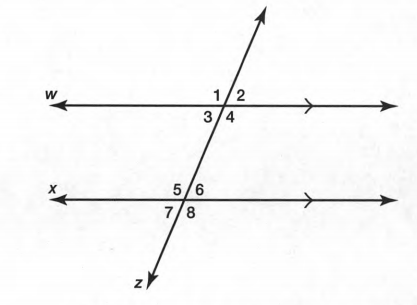
Proof: From the diagram, we see that m∠2+m∠4=180˚ (supplementary angles)
Again, m∠4=m∠8 (corresponding angles)
So, putting the value in the first equation, we have
m∠2+m∠4=180˚
⇒m∠2+m∠8=180˚
Hence, ∠2 and ∠8 are supplementary.
Similarly,m∠1+m∠3=180˚
⇒m∠1+m∠7=180˚ (m∠3=m∠7 since they are corresponding angles)
Hence, m∠1 and m∠7 are supplementary angles.
Therefore, exterior angles on the same side of the transversal are supplementary.
Hence proved, that if two parallel lines are intersected by a transversal, then exterior angles on the same side of the transversal are supplementary.
Carnegie Learning Geometry Exercise 2.3 Student Solutions Page 96 Problem 13 Answer
corresponding angles are congruent: The Corresponding Angle Postulate states that if two parallel lines are intersected by a transversal, then corresponding angles are congruent.
We used deductive reasoning to prove the postulate.
alternate interior angles are congruent: The Alternate Interior Angle Theorem states that if two parallel lines are intersected by a transversal, then alternate interior angles are congruent.
We used deductive reasoning to prove the postulate.
alternate exterior angles are congruent: The Alternate Exterior Angle Theorem states that if two parallel lines are intersected by a transversal, then alternate exterior angles are congruent.
We used deductive reasoning to prove the postulate.
same-side interior angles are supplementary: Same-Side Interior Angle Theorem states that if two parallel lines are intersected by a transversal, then interior angles on the same side of the transversal are supplementary.
We used deductive reasoning to prove the postulate.
same-side exterior angles are supplementary: If two parallel lines are intersected by a transversal, then exterior angles on the same side of the transversal are supplementary.
We used deductive reasoning to prove the postulate.
corresponding angles are congruent: We used deductive reasoning to prove the postulate.
alternate interior angles are congruent: We used deductive reasoning to prove the postulate.
alternate exterior angles are congruent: We used deductive reasoning to prove the postulate.
same-side interior angles are supplementary: We used deductive reasoning to prove the postulate.
same-side exterior angles are supplementary: We used deductive reasoning to prove the postulate.