Geometry Student Text 2nd Edition Chapter 1 Tools of Geometry
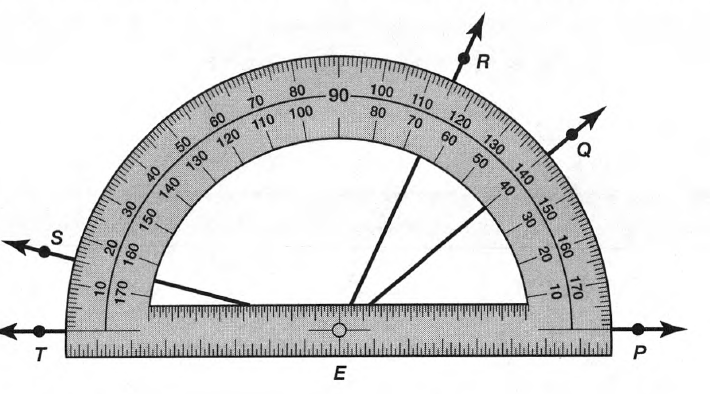
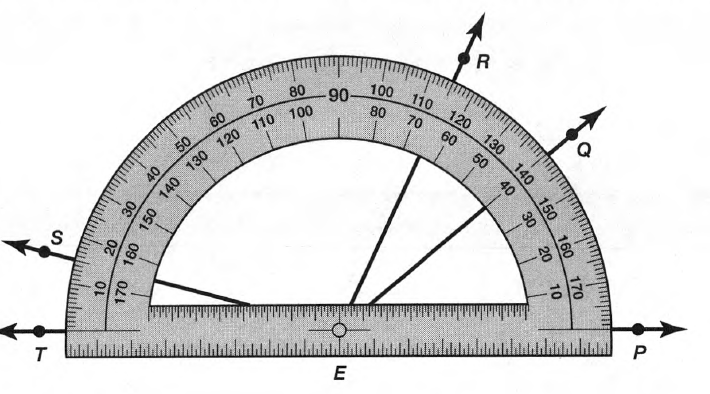
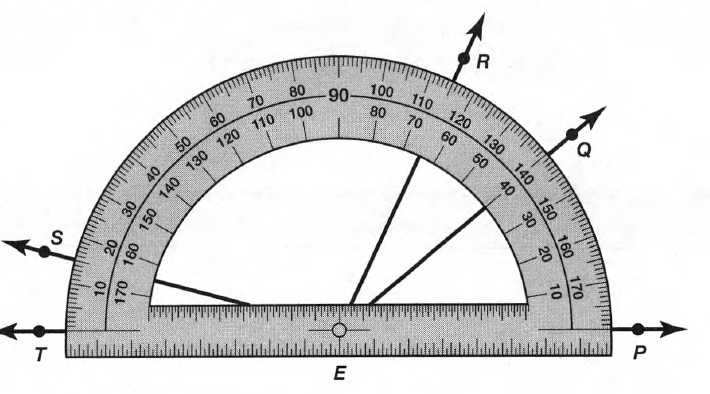
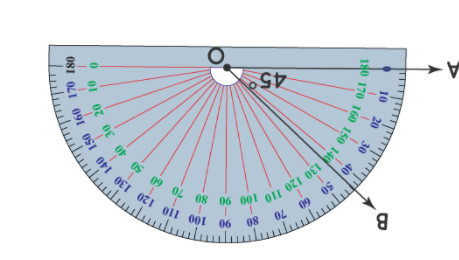
Carnegie Learning Geometry Student Text 2nd Edition Chapter 1 Exercise 1.3 Solution Page 27 Problem 1 Answer
Question 1.
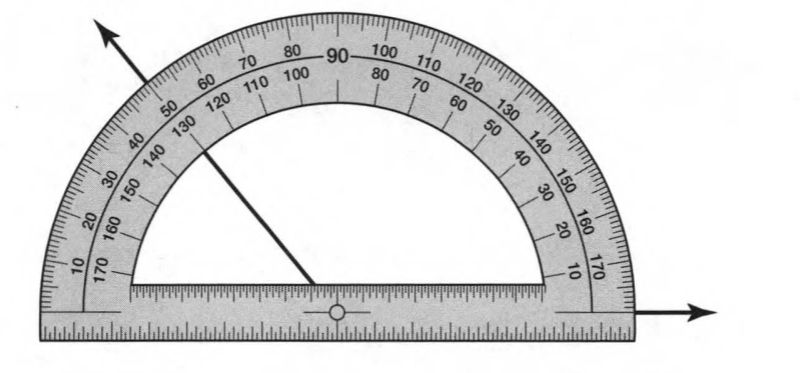
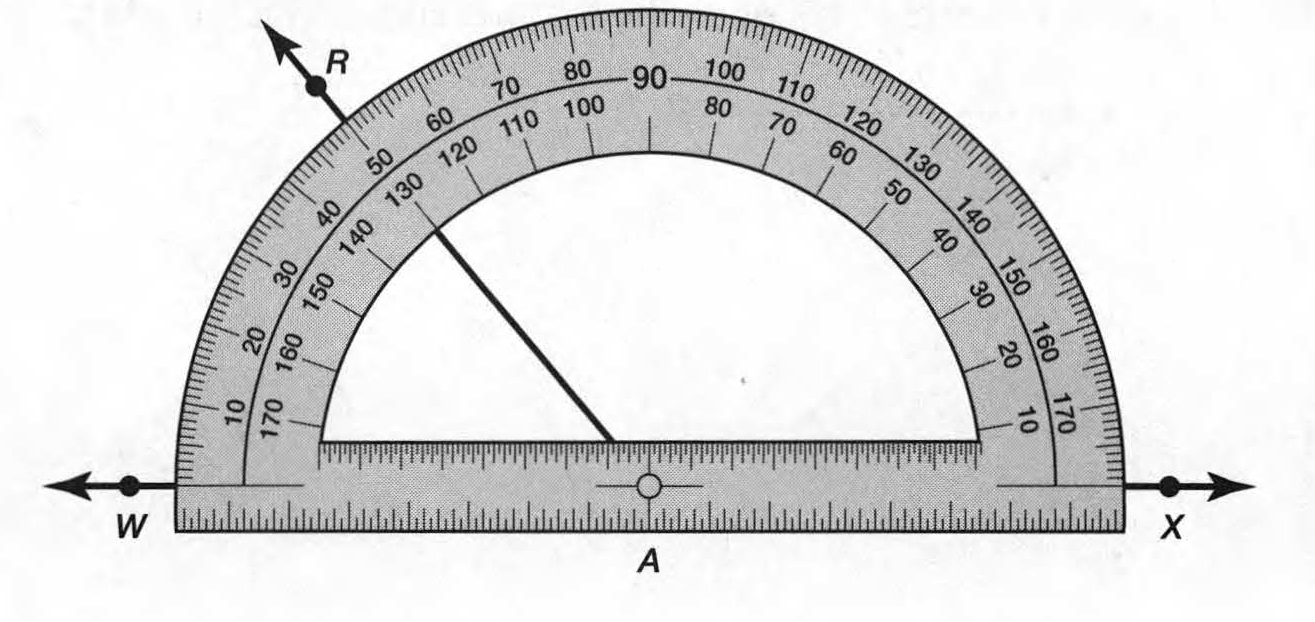
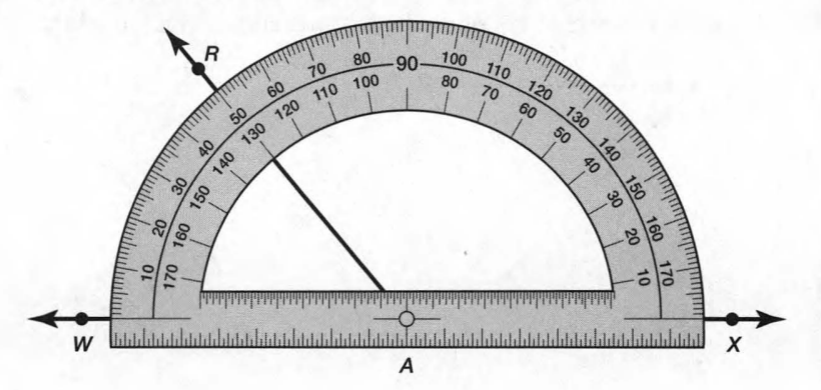
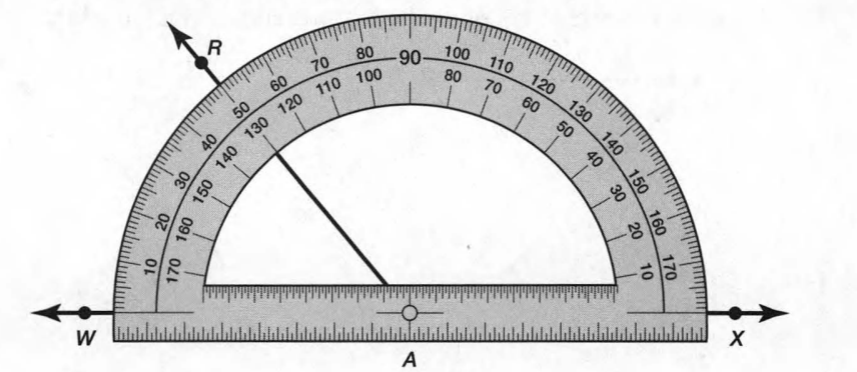
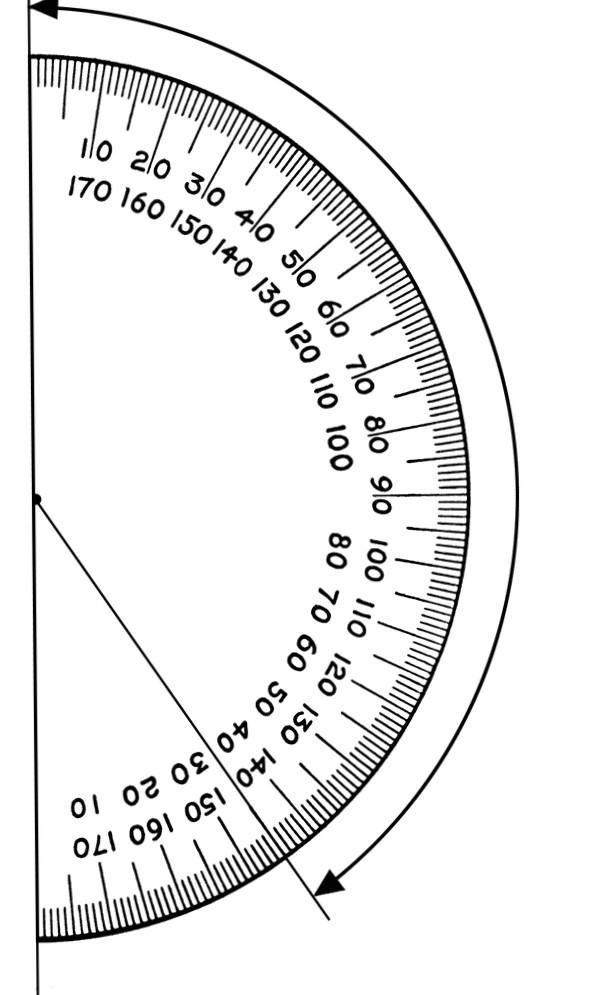
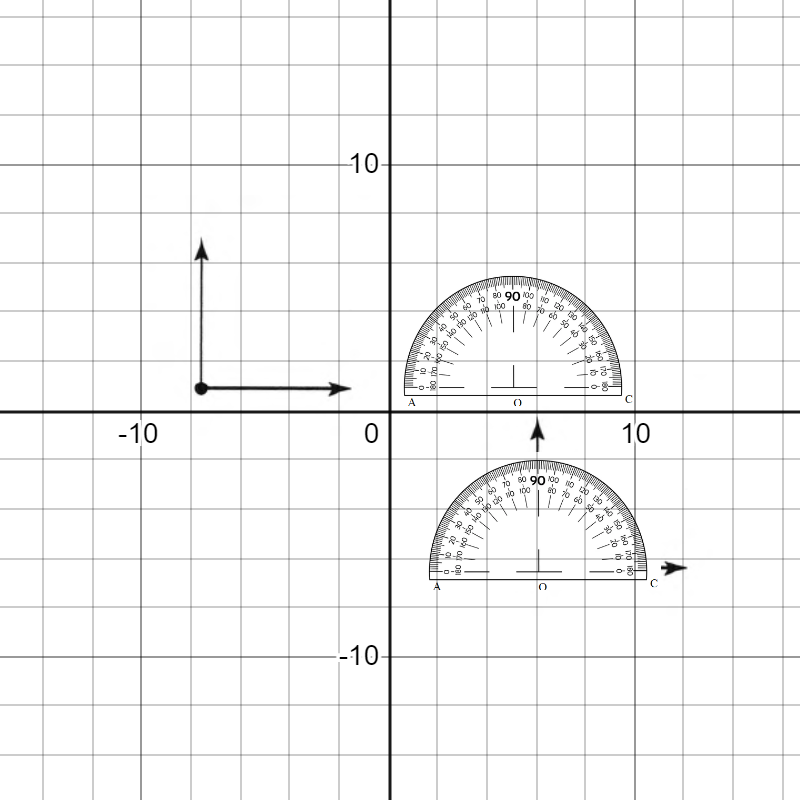
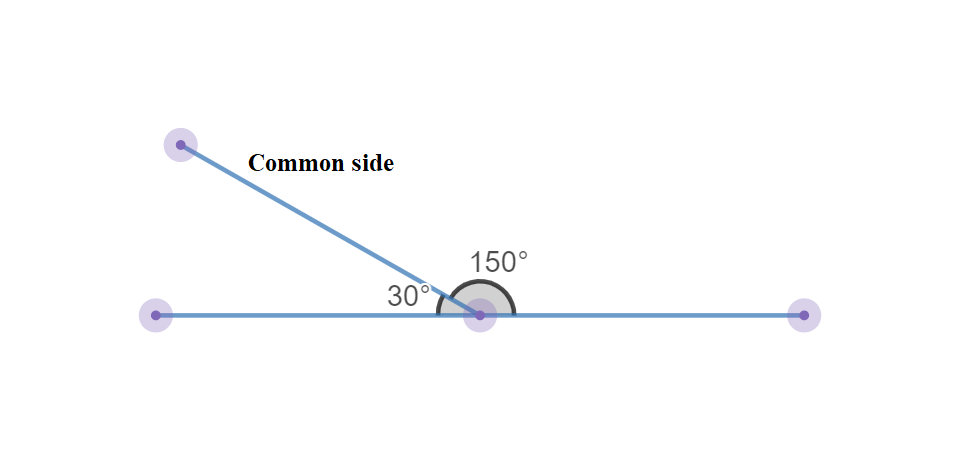
How can we use a protractor to draw a pair of supplementary angles that share a common side, and then measure each angle?
Answer:
We need to use a protractor to draw a pair of supplementary angles that share a common side, and then measure each angle.
We know that two angles are supplementary angles if the sum of their angle measures is equal to 1800.
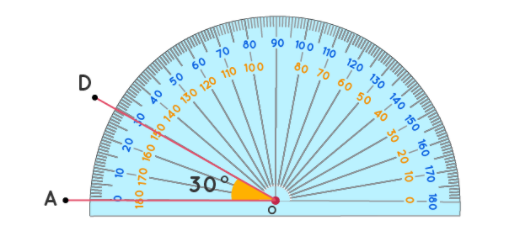
Then we consider a=1500then
a+b=180
150+b=180
b=180−150
b=30
So angle b=300
Hence we can draw this.
Read and learn More Carnegie Learning Geometry Student Text 2nd Edition Solutions
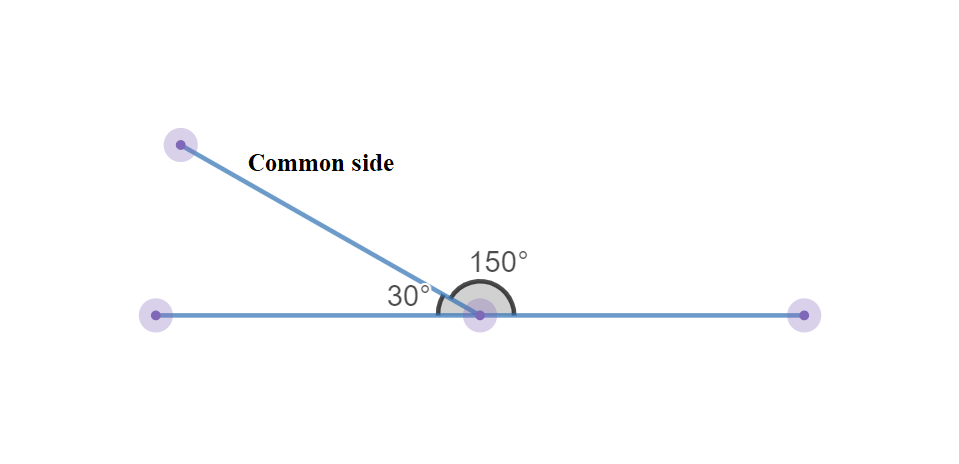
The answer is
Carnegie Learning Geometry Chapter 1 Page 27 Problem 2 Answer
Question 2.
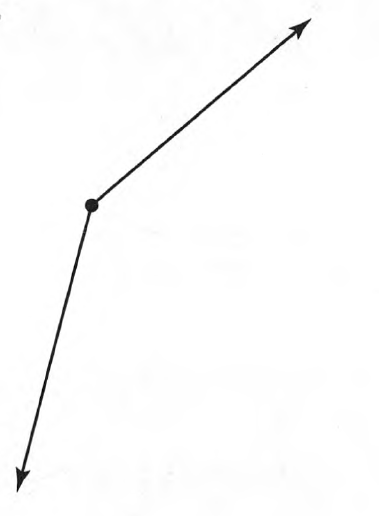
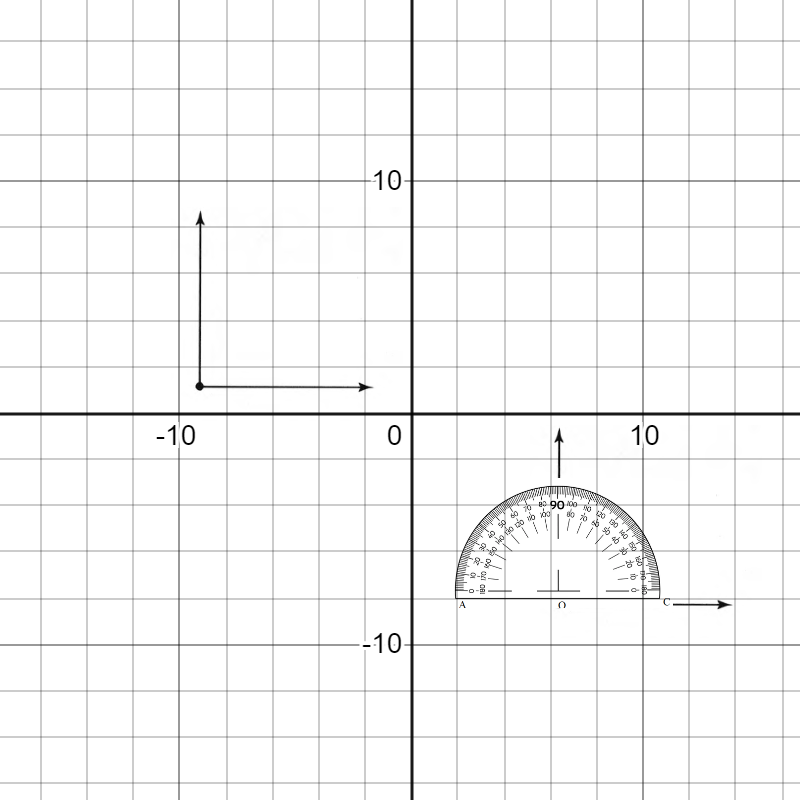
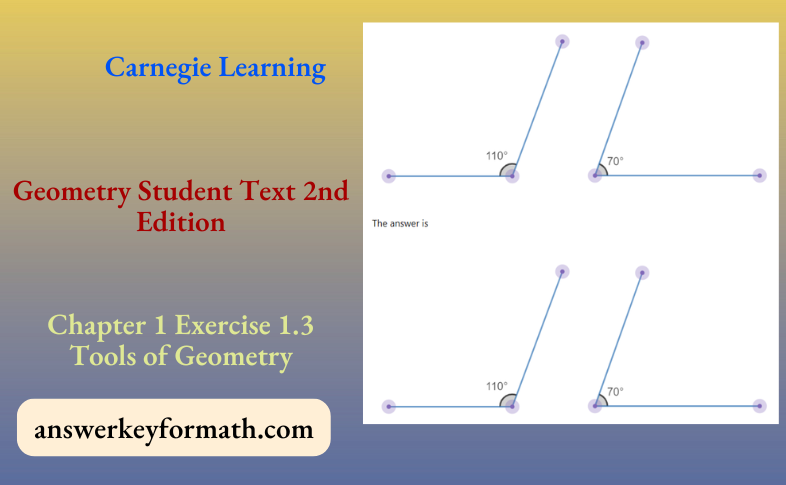
How can we use a protractor to draw a pair of supplementary angles that do not share a common side, and then measure each angle?
Answer:
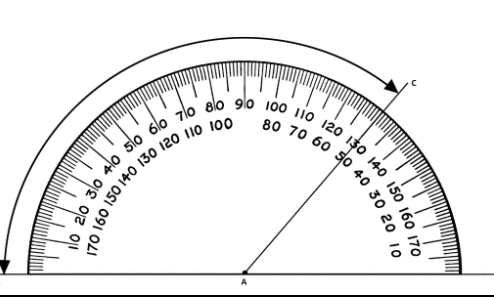
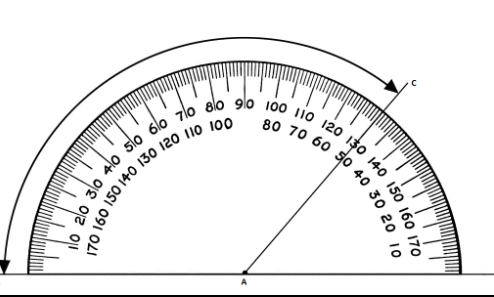
We need to use a protractor to draw a pair of supplementary angles that do not share a common side, and then measure each angle.
We know that two angles are supplementary angles if the sum of their angle measures is equal to 1800.
We consider a=1100.
We have
a+b=180
110+b=180
b=180−110
b=70
So angleb=700.
Hence we can draw this.
Page 28 Problem 3 Answer
Question 3.
It is given that in the figure, we need to find the measure of an angle that is supplementary to ∠KJL.
We know that two angles are supplementary if the sum of their measures is equal to 180°.
Given ∠J=22°,
Calculate the measure of the angle A that is supplementary to ∠KJL.
Answer:
It is given that
We know that two angles are supplementary if the sum of their measures is equal to 180°.
Given ∠J=22°,
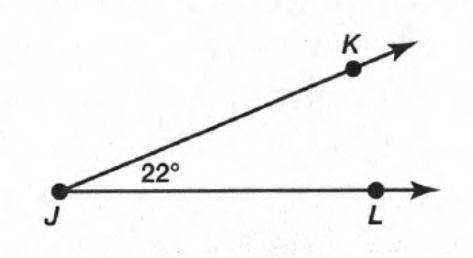
Then we need to find to measure an angle that is supplementary to ∠KJL.
We know that two angles are supplementary angles if the sum of their angle measures is equal to 1800.
∠J=220
A+J=180
A+22=180
A=180−22
A=158
Hence 1580 is the angle that is supplementary to∠KJL.
1580 is the angle that is supplementary to ∠KJL.
Carnegie Learning Geometry Chapter 1 Page 28 Problem 4 Answer
Question 4.
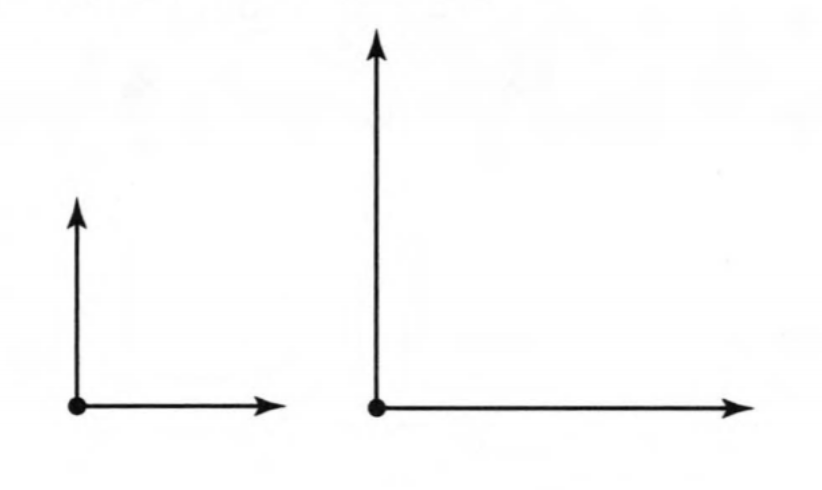
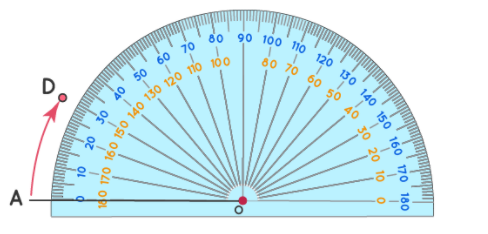
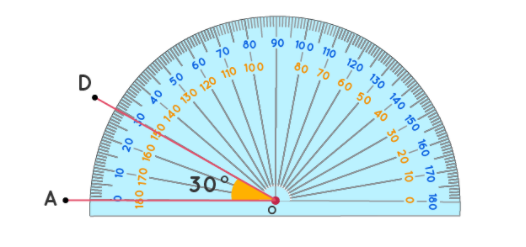
We need to a protractor to draw a pair of complementary angles that share a common side, and then measure each triangle.
Answer:
We need to use a protractor to draw a pair of complementary angles that share a common side, and then measure each angle.
Two angles are complementary angles if the sum of their angle measures is equal to 900.
We consider a=600. Then
a+b=90
60+b=90
b=90−60
b=30
So angleb=300.
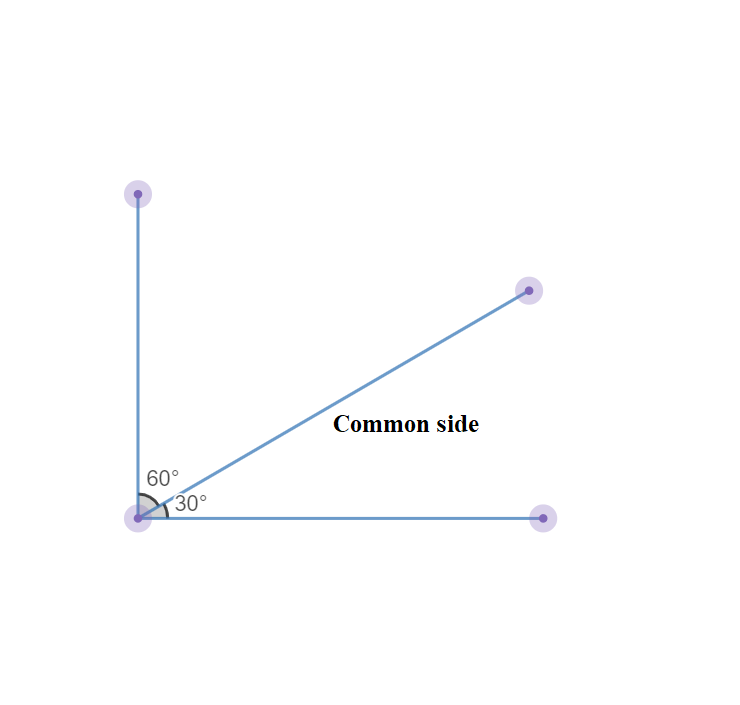
Hence we can draw this.
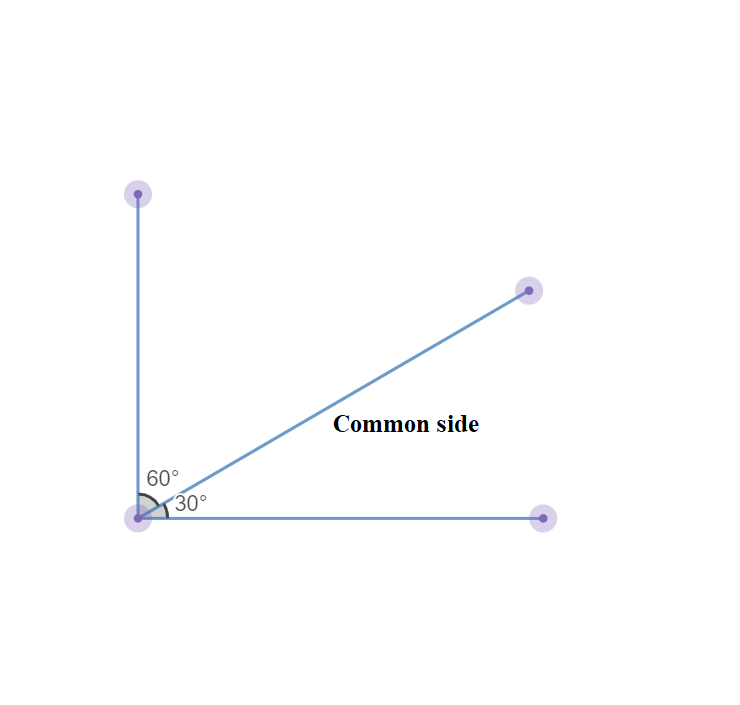
The answer is
Solutions for Tools of Geometry Exercise 1.3 in Carnegie Learning Geometry Page 28 Problem 5 Answer
Question 5.
Given the following figure:
We have to find the complementary angle of ∠J.
Answer:
Given figure:
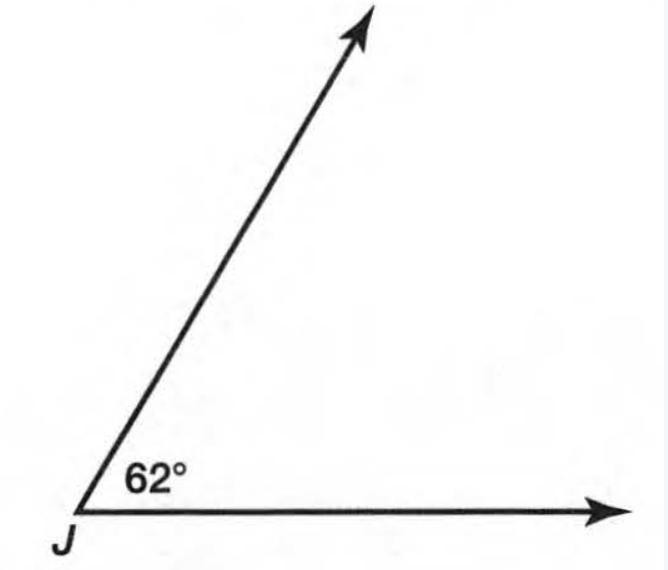
We have to find the complementary angle of angle ∠J.
To find the complementary angle of an angle we have to subtract the given angle from 90
because sum of complementary angles are 90˚.
So complementary angle of angle J is
∠J=90−62
∠J=28˚
The complementary angle of angle J is 28˚
Carnegie Learning Geometry Chapter 1 Page 29 Problem 6 Answer
Question 6.
Given that two angles are both congruent and supplementary, find the measure of each angle.
Answer:
Given statement: Two angles are both congruent and supplementary.
We have to find the measure of each angle.
Let two angles are ∠A and ∠B then
As they are congruent so ∠A=∠B−−−−−−1
Also as ∠A and ∠B are supplementary so there sum must be 180.
∠A+∠B=180−−−−−−−−−−−2
Now using equation 1 and 2 we get
∠A+∠A=180
2∠A=180
∠A=180/2
∠A=90
Thus measure of angle A and angle B are ∠A=∠B=90˚.
So we conclude that if two angles are congruent and supplementary than they must be right angles i.e., 90˚
We can say that if two angles are congruent and supplementary than they must be right angles i.e., 90˚.
Page 29 Problem 7 Answer
Question 7.
Given that two angles are both congruent and complementary, find the measure of each angle.
Answer:
Given statement: Two angles are both congruent and complementary,
We have to find the measure of each angle.
Let two angles are ∠A and ∠B then
As they are congruent so∠A=∠B−−−−−−1
Also as ∠A and ∠B are complementary so there sum must be 90.
∠A+∠B=90−−−−−−−−−−−2
Now using equation 1 and 2 we get
∠A+∠A=90
2∠A=90
∠A=90/2
∠A=45
Thus measure of angle A and angle B are 45 degrees.
So we conclude that if two angles are congruent and complementary than they must be 45˚.
We can say that if two angles are congruent and supplementary than they must 45˚.
Carnegie Learning Geometry Chapter 1 Page 29 Problem 8 Answer
Question 8.
The complement of an angle twice the measure of the angle. What are the measures of the angle angle and its complement?
Answer:
Given statement: The complement of an angle is twice the measure of the angle.
We have to find the measure of each angle.
Let measure of angle is x.
Then according to given statement its complement is 2x.
As we know sum of complementary angles must be equal to 90 degrees .
So
x+2x=90
3x=90
x=90/3 {dividing both sides by 3}
x=30
Thus measure of angle is 30˚ and measure of its complement is 2×30=60˚.
Thus measure of angle is 30˚and measure of its complement is 60˚.
Page 29 Problem 9 Answer
Question 9.
The supplement of an angle is half the measure of the angle. What are the measures of the angle and its supplement?
Answer:
Given statement: The supplement of an angle is half the measure of the angle.
We have to find the measure of each angle.
Let measure of angle is x. Then according to given statement its supplementary angle is x/2.
As we know sum of supplementary angles must be equal to 180˚.
Thus x+x/2=180
Multiply both sides by 2
2x+x=360
3x=360
dividing both sides by 3
x=360/3
x=120
Thus measure of angle is120˚and measure of its supplementary angle is 180−120=60˚.
Thus measure of angle is 120˚ and measure of its supplementary angle is 60˚ .
Carnegie Learning Geometry Chapter 1 Page 30 Problem 10 Answer
Question 10.
Given the figure, identify all the right angles in the figure.
Answer:
Given figure :
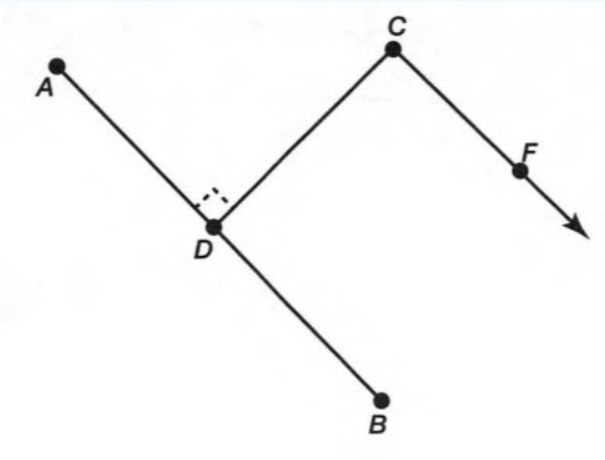
We have to name the right angles in the given figure.
From figure we observe that following angles are of right angle
∠ADC,∠BDC and ∠DCF.
From figure we observe that following angles are of right angle
∠ADC,∠BDC and ∠DCF
Carnegie Learning Geometry 2nd Edition Exercise 1.3 Solutions Page 30 Problem 11 Answer
Question 11.
Given that AB⊥CD at point E, how many right angles are formed? Describe and name these right angles.
Answer:
To draw : AB⊥CD at point E. How many right angles are formed
The drawing is
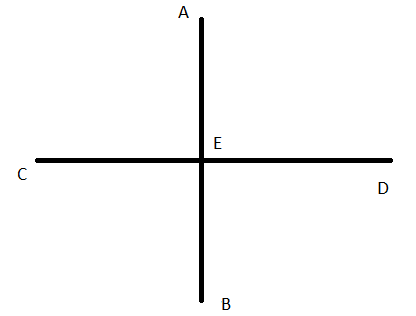
Right angles are∠AED,∠BED,∠BEC,∠CEA
Number of right angles formed is 4
The drawing is
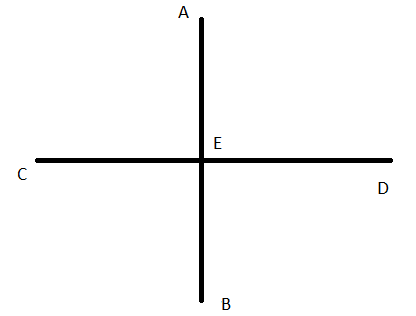
Number of right angles formed is4
Carnegie Learning Geometry Chapter 1 Page 30 Problem 12 Answer
Question 12.
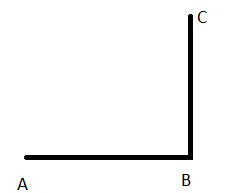
To draw: BC ⊥ AB at point E, how many right angles are formed? Describe and name these right angles.
Answer:
To draw: BC⊥AB at point B. How many right angles are formed
The drawing is
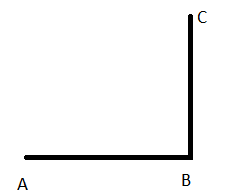
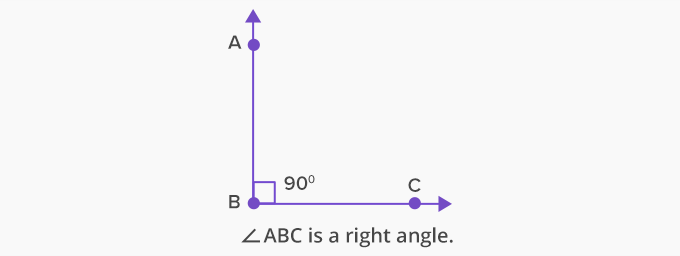
Right angle is∠ABC
Number of right angles formed is 1
The drawing is
Number of right angles formed is1
Page 31 Problem 13 Answer
Question 13.
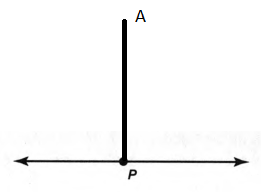
Give a line and a point P not on the line, construct a line perpendicular to the given line through point P.
Answer:
To construct A line perpendicular to the given line through point P.
Given :
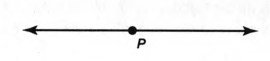
The perpendicular line means angle is 900
The drawing is
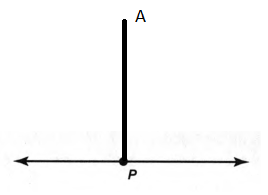
Here AP is the perpendicular line
The drawing is
Carnegie Learning Geometry Chapter 1 Page 32 Problem 14 Answer
Question 14.
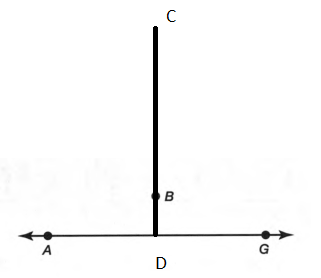
Given a line segment AG and a Point B on AG, Construct a line perpendicular to Ag through point B.
Answer:
To construct : A line perpendicular to AG through point B.
Given :
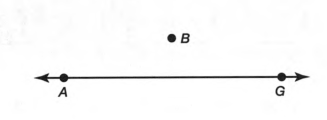
The perpendicular line means angle is900
The drawing is
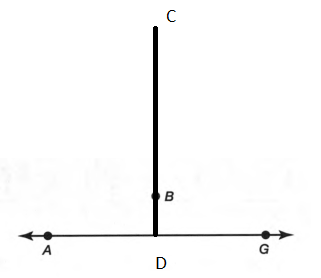
Here CD is the perpendicular line through B
The drawing is
Page 32 Problem 15 Answer
Question 15.
Describe the difference between constructing a perpendicular through a point on the line and constructing a perpendicular through a point not on the line.
Answer:
We have to find that the difference between the construction of perpendicular through a point on the line and construction of perpendicular through a point not on the line.
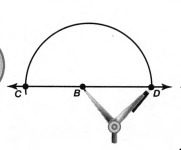
Firstly we will write the steps to construct a perpendicular in both ways.
After we will analyze the steps to find the difference between them.
The process of construction of Perpendicular in both the ways is as following :-
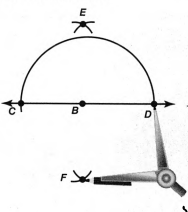
Construction of a perpendicular through a point on the line :-
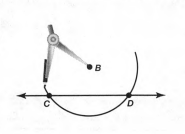
Use B as a center and label the intersection of points C and D.
With the same radius , draw the arcs by taking C and D as centers, above and below the line.
Draw straight line through points E and F. The line EF is perpendicular to CD.
Construction of a perpendicular through a point not on the line :-
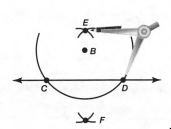
Use B as a center and label the intersection of points C and D.
With the same radius , draw the arcs by taking C and D as centers, above and below the line.
Draw straight line through points E and F.
The line EF is perpendicular to line CD.
The construction of perpendicular in the both the ways is completely different.
It looks like same but there are difference between both the constructions.
In the construction of perpendicular through a point on the line; we can draw the arc of any radius in first step.
Conversely in the construction of perpendicular through a point not on the line; we cannot draw the arc that does not intersect the line.
That is we have to take the radius as the distance between the line and point at least.
So the main difference between the construction of perpendicular in both ways is the choice of arc in first step.
After the process is quite similar.
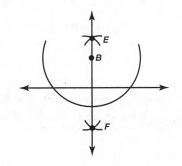
The difference between the construction of perpendicular through a point on line and not on line, is the choice of arc radius in first step.
After that process is quite similar.
Carnegie Learning Geometry Chapter 1 Page 34 Problem 16 Answer
Question 16.
How do you construct a perpendicular bisector of a given line segment FG and label it as a CD?
Answer:
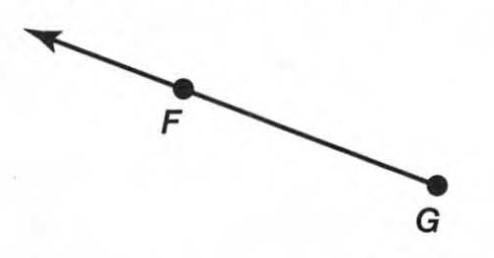
The given line segment is FG.
We have to construct a perpendicular bisector of this line segment and label it as CD.
Let the given line is :-
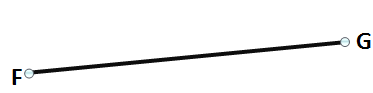
Firstly we will find mid point of line.
Then draw the perpendicular bisector.
The given line is :-
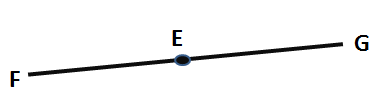
Let the mid point of line is E.
Then we have the following line :-
Now to draw perpendicular bisector :-
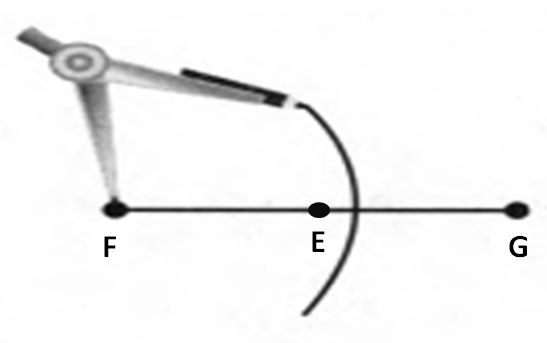
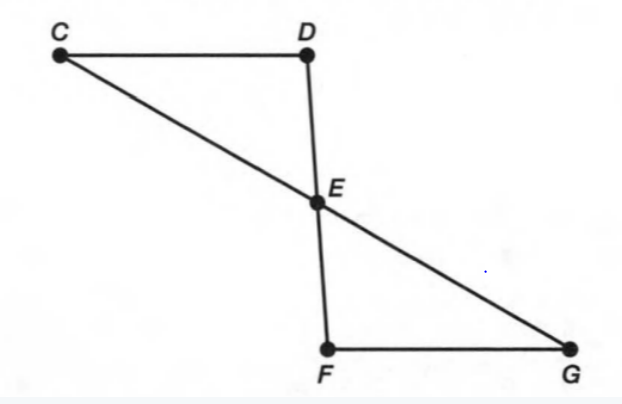
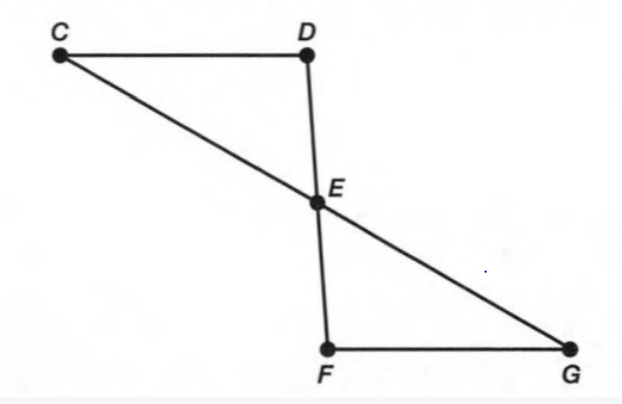
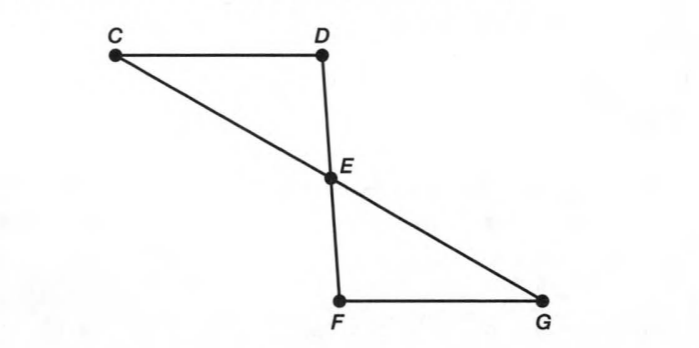
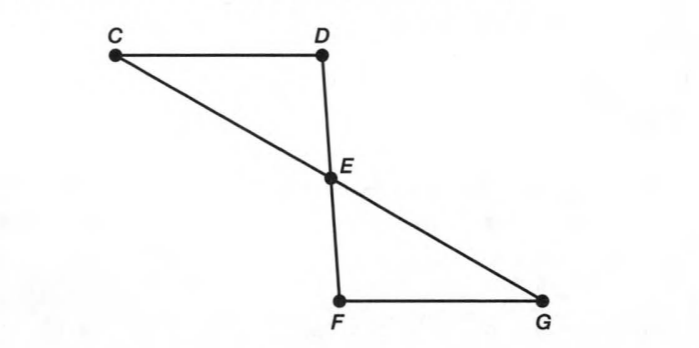
Firstly open the compass with radius more the half of line FG and draw the arc taking F as center as shown following :-
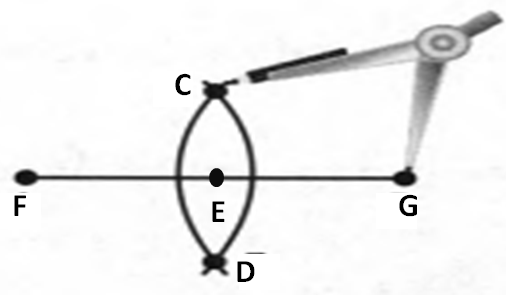
Now with the same radius draw an arc by taking G as center, then we have :-
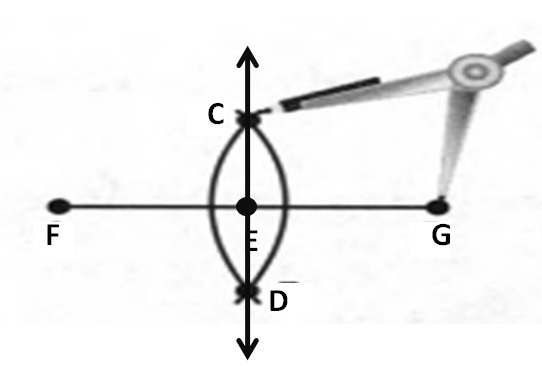
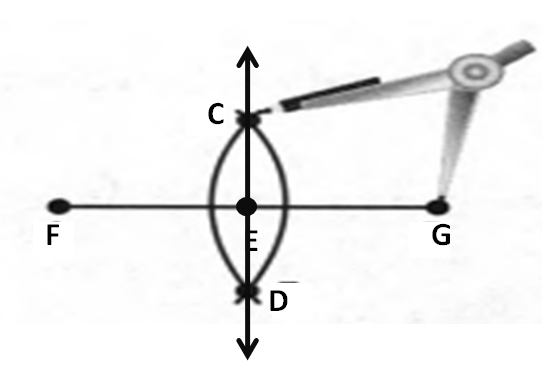
Now join the points C and D, then we have :-
The line segment CD is the required perpendicular bisector of the line FG.
The required perpendicular bisector CD of the given line FG is :-
Carnegie Learning Geometry Chapter 1 Page 34 Problem 17 Answer
Question 17.
How do you label the point of intersection of the perpendicular bisector CD and the line segment FG as E?
Answer:
The given line segment is FG.
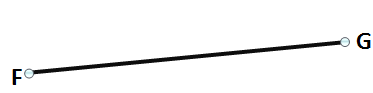
We find in previous part that CD is the perpendicular Bisector of line FG.
We have to label the point of intersection CD and FG as E.
The lines FG and its perpendicular bisector CD are as following :-
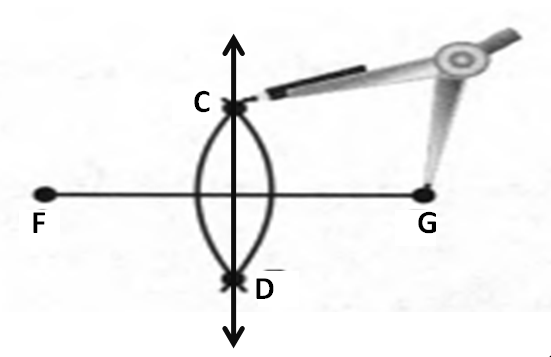
Now label the point of intersection of both lines as E, then we have :-
This is the required answer.
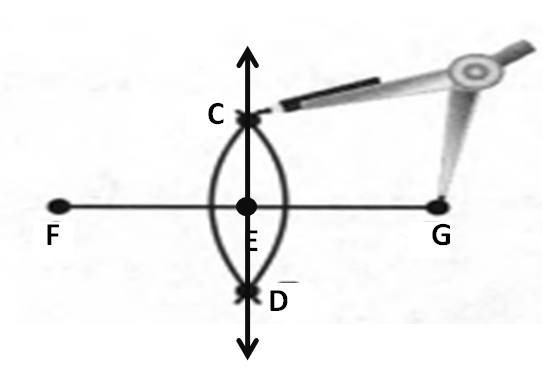
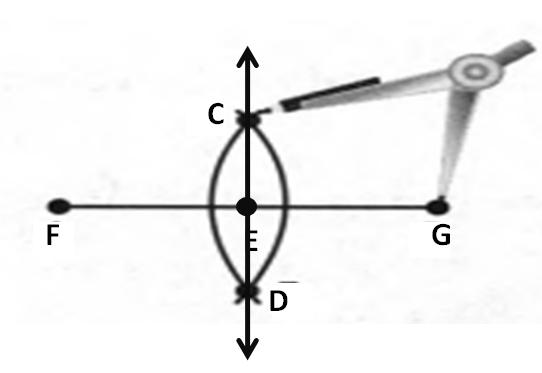
The required intersection point E of lines CD and FG is as following :-
Tools Of Geometry Solutions Chapter 1 Exercise 1.3 Carnegie Learning Geometry Page 34 Problem 18 Answer
Question 18.
Given that CD is perpendicular to FG, determine the measures of the angles formed by these lines. Provide the necessary conclusions about these angles.
Answer:
Given
CD is perpendicular to FG
In previous parts we find that the given lines CD and FG are as following :-
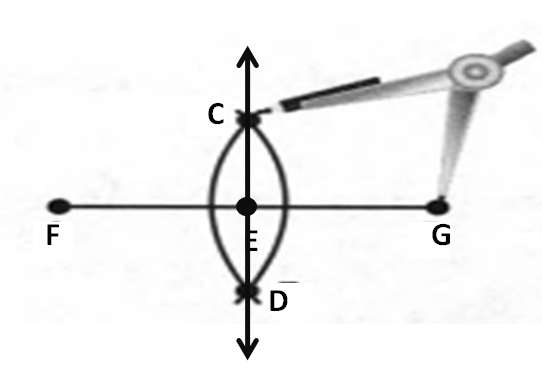
If you find the conclusions about these lines if CD⊥FG.
The given lines are as following:-
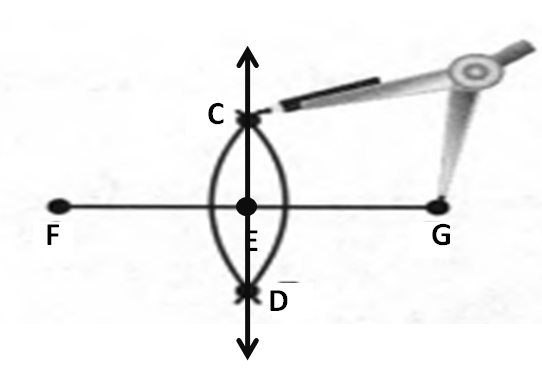
Here we have CD⊥FG.
We know that if two lines are perpendicular then the angle between them is 90∘.
Hence we can conclude that the angle ∠CEF,∠CEG,∠FED,GED
ARE OF 90∘.
If CD⊥FG, then we have :-
∠CEF=90∘,
∠CEG=90∘,
∠FED=90∘ and
∠GED=90∘
Step-By-Step Solutions For Carnegie Learning Geometry Chapter 1 Exercise 1.3 Page 34 Problem 19 Answer
Question 19.
Given that line CD bisects line FG, what can we conclude about the segments FE and EG? Provide a detailed explanation and conclusion.
Answer:
Given
Line CD bisects line FG
The given lines CD and FG are as following :-
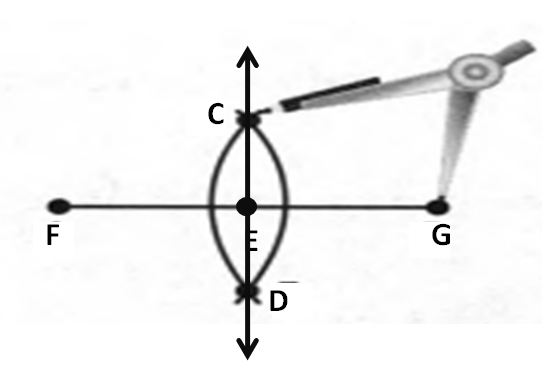
We have to find that what we can conclude that if the line CD bisects the line FG.
The given lines are :-
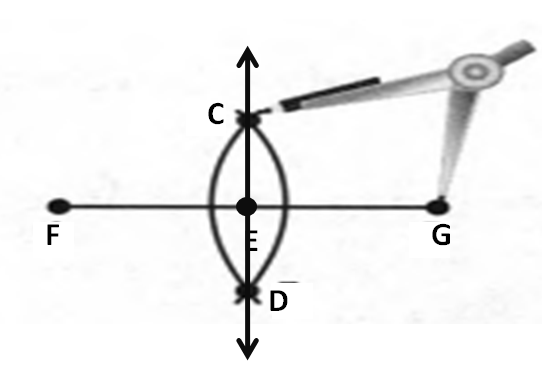
We know that if a line bisect the other then the point of intersect is a midpoint of the second line.
We have the line CD bisects the line FG.
So the point of intersection E is the midpoint of line FG.
Also as E is midpoint, we have :-
Measure of line segment FE=Measure of line segment EG.
If the line CD bisects the line FG as shown following :-
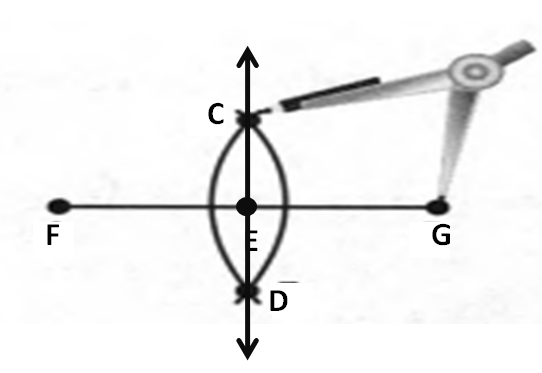
Then we have :- E is a midpoint of line FG.Measure of line FE=Measure of line EG.
Page 34 Problem 20 Answer
Question 20.
Given that line CD is the perpendicular bisector of line FG, what conclusions can we draw about the angles formed and the segments of FG? Provide a detailed explanation and conclusion.
Answer:
Given
line CD is the perpendicular bisector of line FG
The given lines CD and FG are as following :-
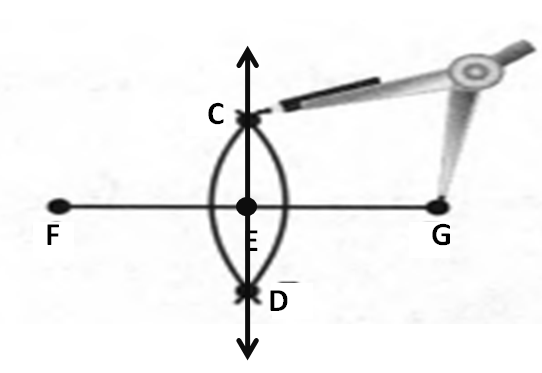
We have to find that what we can conclude if the line CD is the perpendicular bisector of the line FG.
The given lines are as following :-
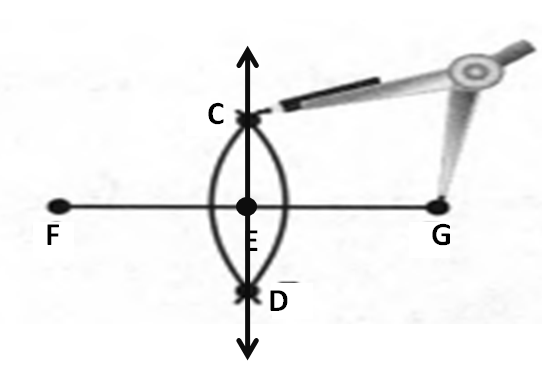
We have the line CD is the perpendicular bisector of line FG.
That is CD is perpendicular to line FG.
Then we have the angles between them are of 90∘. That is :-
∠CEF=90∘,
∠CEG=90∘,
∠FED=90∘and ∠GED=90∘
Also the line CD bisects the line FG.
So the intersection point is the midpoint of line FG.
That is the point E is the midpoint of line FG.
As E is the point of line FG, then we have :-
Measure of line FE=Measure of line EG.
If the line CD is the perpendicular bisector of line FG, then we have :-
∠CEF=90∘,∠CEG=90∘,∠FED=90∘ and∠GED=90∘
The point E is the midpoint of line FG.Measure of line FE=Measure of line EG.
Carnegie Learning Geometry Chapter 1 Page 34 Problem 21 Answer
Question 21.
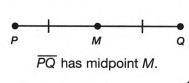
Given a line segment PQ, how do we construct the midpoint of the line segment? Explain the steps and show the construction.
Answer:
The given line PQ is as following :-
We have to construct the mid point of line PQ.
The given line is:-
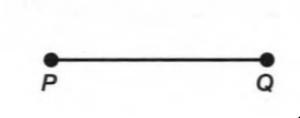
As we know the midpoint divides the line into two equal line segment.
The the midpoint of line PQ will divide the line into two equal parts.
Let the mid point of line is M. Then the M is constructed as following:-
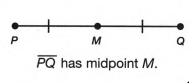
The required mid point M of line PQ is constructed as following :-
Carnegie Learning Geometry Chapter 1 Exercise 1.3 Free Solutions Page 35 Problem 22 Answer
Question 22.
What are adjacent angles? Explain and illustrate with a diagram.
Answer:
We have to explain the adjacent angles.
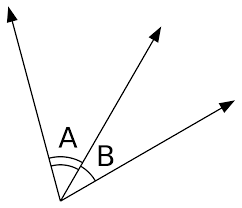
The adjacent angles are explained as following :- Adjacent angle :- Adjacent angles are two angles that have a common side and a common vertex (corner point) but do not overlap in any way.
Then two adjacent angles can be shown as following :-
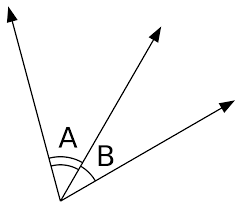
Here the angles A and B are adjacent as they have a common side and common vertex or corner.
Adjacent angles are two angles that have a common side and a common vertex (corner point) but do not overlap in any way.
Carnegie Learning Geometry Chapter 1 Page 35 Problem 23 Answer
Question 23.
What are adjacent angles? Explain and illustrate with a diagram.
Answer:
The given angle ∠1 is:-
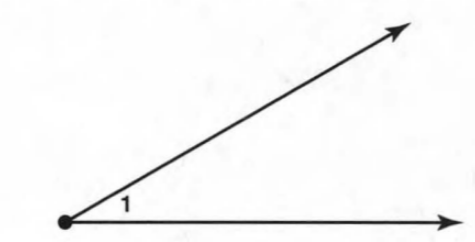
We have to draw ∠2 that is adjacent to angle ∠1.
The given angle ∠1 is as following:-
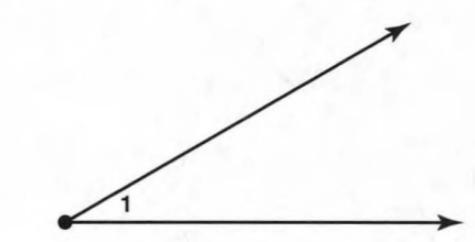
We know that the angles that have a common line and vertex are know as adjacent angles.
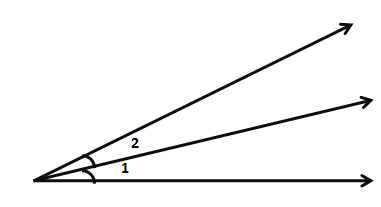
So the adjacent angle ∠2 to ∠1 can be constructed as following :-
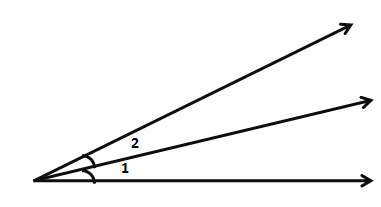
The required angle ∠2 adjacent to angle ∠1 can be drawn as following :-
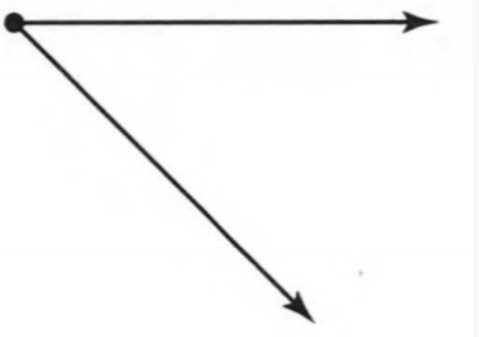
Page 35 Problem 24 Answer
Question 24.
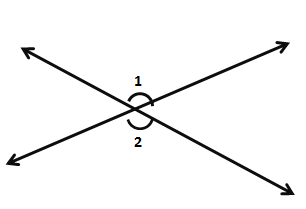
Is it possible to draw two angles that share a common vertex but do not share a common side? If so, draw an example and explain.
Answer:
We have to check that :-
Is it possible to draw two angles share a common vertex but do not share a common side.
If it is possible we have to draw an example and explain it.
Yes, we can draw two angles with common vertex but not common side.
Now suppose two angles ∠1 and ∠2. Let these angles have common vertex or corner say O
but not have common side.
Then these angles can be drawn as following :-
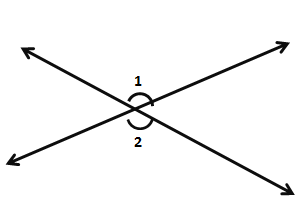
Here the angles ∠1 and ∠2 have common vertex but no common side.
These angles are not adjacent as these have no common side.
Yes, we can draw two angles with common vertex but not common side and this type of angles can be drawn as following :-
Carnegie Learning Geometry Chapter 1 Page 36 Problem 25 Answer
Question 25.
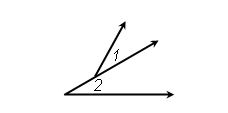
Is it possible to draw two angles that share a common side but do not share a common vertex? Draw an example.
Answer:
Given: Is it possible to draw two angles that share a common side, but do not share a common vertexTo draw an example.
Two angles that share a common side, but do not share a common vertex can be dawn as
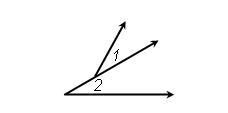
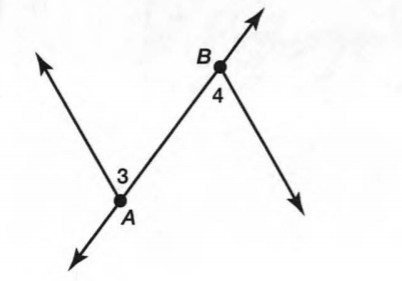
Here ∠1 and ∠2 are not adjacent since they do not share a common vertex.
Hence, Two angles that share a common side, but do not share a common vertex can be dawn as
Carnegie Learning Geometry Exercise 1.3 Student Solutions Page 36 Problem 26 Answer
Question 26.
What are linear pairs of angles? Describe them with an example.
Answer:
Given:
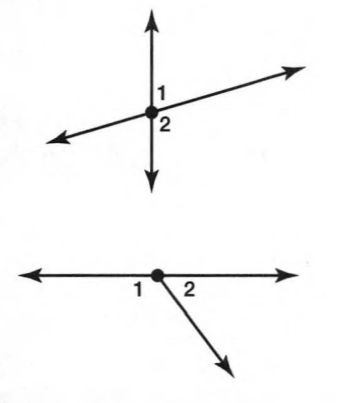
To Describe a linear pair of angles.
Linear pair of angles are formed when two lines intersect each other at a single point.
The angles are said to be linear if they are adjacent to each other after the intersection of the two lines.
The sum of angles of a linear pair is always equal to 180°.
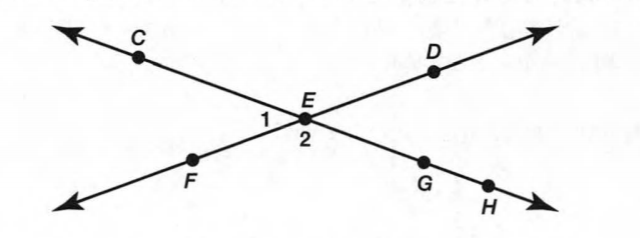
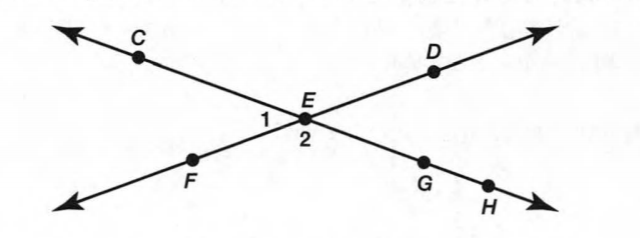
From the given figure we can say that ∠1 and ∠2 forms a linear pair of angle
Hence, from above we can say that Linear pair of angles are formed when two lines intersect each other at a single point.
The angles are said to be linear if they are adjacent to each other after the intersection of the two lines.
The sum of angles of a linear pair is always equal to 180°.
Carnegie Learning Geometry Chapter 1 Page 36 Problem 27 Answer
Question 27.
Identify and name all the linear pairs in the given figure.
Answer:
Given:
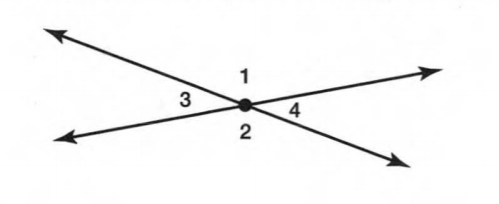
To Name all linear pairs in the figure shown
Form the figure given
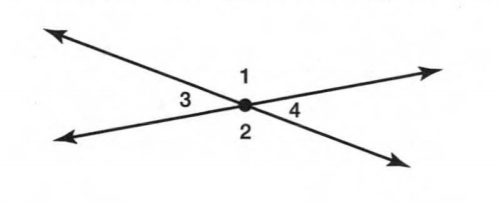
The linear pairs are ∠1 and ∠4, ∠4 and ∠2, ∠2 and ∠3,∠3 and ∠1
Hence, the linear pairs are ∠1 and ∠4,∠4 and ∠2,∠2 and ∠3,∠3 and ∠1
Page 37 Problem 28 Answer
Question 28.
What can we conclude if the angles that form a linear pair are congruent?
Answer:
Given: If the angles that form a linear pair are congruent,To specify what we can concludeBy following the definition
A linear pair consists of two adjacent angles that form a straight angle so they are supplementary, having a sum of 180∘.
If the two angles are congrent, then they have the same measure and thus both measure 90∘.
Hence, each angle is a right angle.
Hence, A linear pair consists of two adjacent angles that form a straight angle so they are supplementary, having a sum of 180∘.
If the two angles are congruent, then they have the same measure and thus both measure 90∘.
Hence, each angle is a right angle.
Carnegie Learning Geometry Chapter 1 Page 37 Problem 29 Answer
Question 29.
What are vertical angles, and how can they be identified in a given figure?
Answer:
Given:
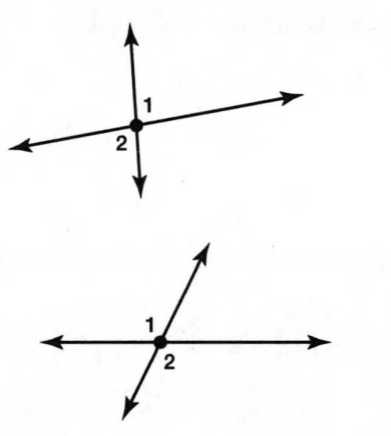
To describe vertical angle
The angles that are opposite to each other when two lines intersect each other are known as vertical angles.
In the given figure ∠1 and ∠2 are vertical angles to each other
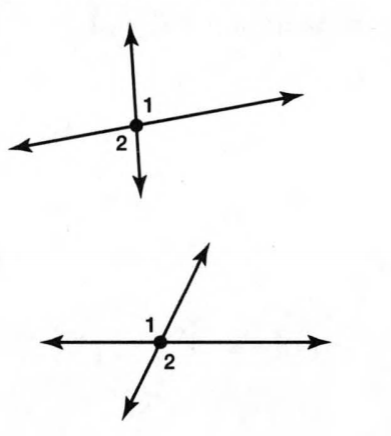
Hence, The angles that are opposite to each other when two lines intersect each other are known as vertical angles.
Tools Of Geometry Exercise 1.3 Carnegie Learning 2nd Edition Answers Page 37 Problem 30 Answer
Question 30.
Given the figure below, draw ∠2 so that it forms a vertical angle with ∠1.
Answer:
Given:
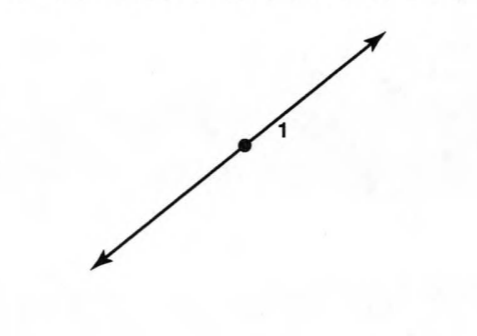
To draw ∠2 so that it forms a vertical angle with ∠1
The angles that are opposite to each other when two lines intersect each other are known as vertical angles.
So a vertical angle can be drawn as
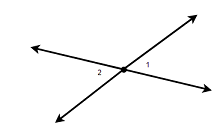
Here ∠1 and ∠2 are vertical angle
Hence, vertical angle can be drawn as
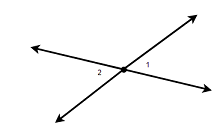
Carnegie Learning Geometry Chapter 1 Page 38 Problem 31 Answer
Question 31.
Given the diagram below, name all pairs of vertical angles.
Answer:
Given:
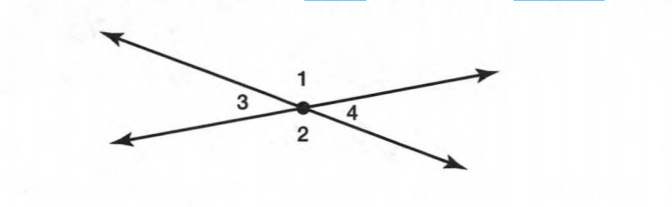
To Name all vertical angle pairs in the diagram shown.
From the given diagram we can show the vertical angle as
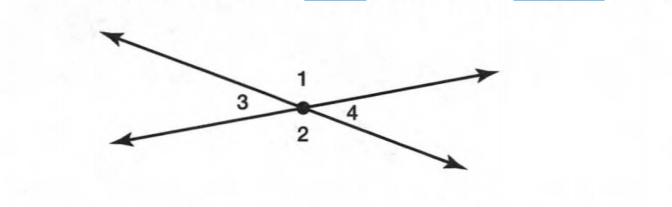
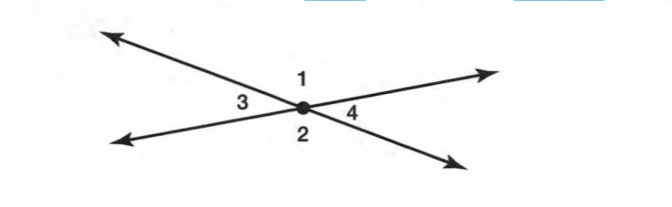
Here ∠1 and ∠2. ∠3 and ∠4 are the vertical angle
Hence, in the given diagram the vertical angles are ∠1 and ∠2, ∠3 and ∠4
Page 38 Problem 32 Answer
Question 32.
Given the diagram below, measure each angle and determine their properties.
Answer:
Given:
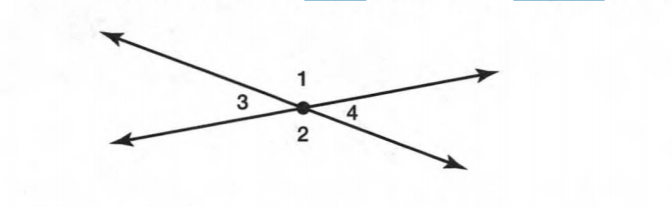
To Measure each angle
In the given figure,∠1 and ∠2, ∠3 and ∠4 are vertical opposite angle, so they must be equal
Also ∠3 and ∠4 are acute angle, so it must be less than 90o
Also ∠1 and ∠2 are obtuse angle and it must be greater than 90o and less than 180o Hence, in the given figure ∠1and∠2,∠3and∠4 are vertical opposite angle, so they must be equal
Also ∠3and∠4 are acute angle, so it must be less then 90∘
Also ∠1and∠2 are obtuse angle and it must be greater than 90∘ and less than 180∘