Differential Equations Of First Order And First Degree Homogeneous Equation Methods To Find An Integrating Factor Solved Example Problems Exercise 2.5

Differential Equations of First Order and First Degree Solved Problems

Example. 1. Solve \(\left(x y^2-x^2\right) d x+\left(3 x^2 y^2+x^2 y-2 x^3+y^2\right) d y=0\)

Solution.

Given equation is \(\left(x y^2-x^2\right) d x+\left(3 x^2 y^2+x^2 y-2 x^3+y^2\right) d y=0\) ……………..(1)

where \(\mathrm{M}=x y^2-x^2, \mathrm{~N}=3 x^2 y^2+x^2 y-2 x^3+y^2\)

⇒ \(\frac{\partial \mathrm{M}}{\partial y}=2 x y, \frac{\partial \mathrm{N}}{\partial x}\)

= \(6 x y^2+2 x y-6 x^2 \Rightarrow \frac{\partial \mathrm{M}}{\partial y} \neq \frac{\partial \mathrm{N}}{\partial x}\) => (1) is not an exact equation.

But \(\frac{1}{M}\left(\frac{\partial \mathrm{N}}{\partial x}-\frac{\partial \mathrm{M}}{\partial y}\right)\)

= \(\frac{1}{x y^2-x^2}\left(6 x y^2+2 x y-6 x^2-2 x y\right)=\frac{1}{x y^2-x^2} \cdot 6\left(x y^2-x^2\right)=6K\)

∴ I.F = \(e^{\int 6 d y}=e^{6 y}\) Multiplying (1) by \(e^{6 y} \Rightarrow\left(x y^2-x^2\right) e^{6 y} d x+\left(3 x^2 y^2+x^2 y-2 x^3+y^2\right) e^{6 y} d y=0\) …………………(2)

(2) is an exact equation where \(\mathrm{M}_1=\left(x y^2-x^2\right) e^{6 y} \text { and } \mathrm{N}_1=\left(3 x^2 y^2+x^2 y-2 x^3+y^2\right) e^{6 y}\) since \(\frac{\partial \mathrm{M}_1}{\partial y}=\frac{\partial \mathrm{N}_1}{\partial x}\)  (verify)

(1) Integrating \(\mathrm{M}_1\) w.r.t. x, treating y as constant.

⇒ \(\int^x \mathrm{M}_1 d x=\int^x\left(x y^2-x^2\right) e^{6 y} d x=e^{6 y}\left(\frac{x^2}{2} y^2-\frac{x^3}{3}\right)\) …………………(3)

(2) \(\int\) (terms of \(\mathrm{N}_1\) not containing x) dy = \(\int y^2 e^{6 y} d y\)

= \(\frac{y^2 e^{6 y}}{6}-\int \frac{e^{6 y}}{6} \cdot 2 y d y=y^2 \frac{e^{6 y}}{6}-\frac{1}{3}\left[y \frac{e^{6 y}}{6}-\int \frac{e^{6 y}}{6} \cdot d y\right]\)

= \(\frac{y^2 e^{6 y}}{6}-\frac{1}{18} y e^{6 y}+\frac{1}{18} \frac{e^{6 y}}{6}\) ……………..(4)

∴ The general solution of (2) is (3) + (4) = C

⇒ \(\frac{x^2 y^2 e^{6 y}}{2}-\frac{x^3 e^{6 y}}{3}+\frac{y^2 e^{6 y}}{6}-\frac{y e^{6 y}}{18}+\frac{e^{6 y}}{108} \neq c \Rightarrow e^{6 y}\left(\frac{x^2 y^2}{2}-\frac{x^3}{3}+\frac{y^2}{6}-\frac{y}{18}+\frac{1}{108}\right)=c\)

Differential Equations Of First Order And First Degree Exercise 2.5

Example 2. Solve \(\left(x y^3+y\right) d x+2\left(x^2 y^2+x+y^4\right) d y=0\)

Solution.

Given equation is of the form Mdx + Ndy = 0

where \(\mathrm{M}=x y^3+y \text { and } \mathrm{N}=2\left(x^2 y^2+x+y^4\right)\)

Now, \(\frac{\partial \mathrm{M}}{\partial y}=3 x y^2+1, \frac{\partial \mathrm{N}}{\partial x}=4 x y^2+2 \Rightarrow \frac{\partial \mathrm{M}}{\partial y} \neq \frac{\partial \mathrm{N}}{\partial x} \Rightarrow\)

Given equation is not an exact equation

But \(\frac{1}{M}\left(\frac{\partial \mathrm{N}}{\partial x}-\frac{\partial \mathrm{M}}{\partial y}\right)=\frac{1}{x y^3+y}\left(4 x y^2+2-3 x y^2-1\right)=\frac{x y^2+1}{y\left(x y^2+1\right)}=\frac{1}{y}=g(y)\)

∴ \(\text { I.F. }=\exp \left(\int \frac{1}{y} d y\right)=\exp (\log y)=e^{\log y}=y\)

Multiplying the given equation with \(y: \Rightarrow\left(x y^4+y^2\right) d x+2\left(x^2 y^3+x y+y^5\right) d y=0\) ……(1)

Then (1) is an exact equation where \(\mathrm{M}_1=x y^4+y^2\)

and \(\mathrm{N}_1=2\left(x^2 y^3+x y+y^5\right) \Rightarrow \frac{\partial \mathrm{M}_1}{\partial y}=\frac{\partial \mathrm{N}_1}{\partial x}\)  (verify)

(1) Integrating \(\mathrm{M}_1\) w.r.t. x, treating y as constant

⇒ \(\int^x \mathrm{M}_1 d x=\int^x\left(x y^4+y^2\right) d x=\frac{x^2 y^4}{2}+y^2 x\) ………………………..(2)

(2) \(\int\) (terms of \(\mathrm{N}_1\) not containing x) dy = \(\int 2 y^5 d y=\frac{y^6}{3}\) …………….(3)

∴ The general solution of (1) is (2) + (3) = C

⇒ \(\frac{x^2 y^4}{2}+y^2 x+\frac{y^6}{3}=c \Rightarrow 3 x^2 y^4+6 x y^2+2 y^6=6 c\)

Homogeneous Equations Solved Problems Exercise 2.5

Example. 3. Solve \(\left(y^4+2 y\right) d x+\left(x y^3+2 y^4-4 x\right) d y=0\)

Solution.

Given equation is \(\left(y^4+2 y\right) d x+\left(x y^3+2 y^4-4 x\right) d y=0\) ………………………..(1)

Where \(\mathrm{M}=y^4+2 y, \mathrm{~N}=x y^3+2 y^4-4 x \Rightarrow \frac{\partial \mathrm{M}}{\partial v}=4 y^3+2, \frac{\partial \mathrm{N}}{\partial x}=y^3-4\)

Since, \(\frac{\partial \mathrm{M}}{\partial y} \neq \frac{\partial \mathrm{N}}{\partial x}\) (1) is not an exact equation

But \(\frac{1}{\mathrm{M}}\left(\frac{\partial \mathrm{N}}{\partial x}-\frac{\partial \mathrm{M}}{\partial y}\right)=\frac{1}{y\left(y^3+2\right)}\left(y^3-4-4 y^3-2\right)=\frac{-3\left(y^3+2\right)}{y\left(y^3+2\right)}=\frac{-3}{y}\) Tan-1

∴ I.F = \(\exp \left(\int \frac{-3}{y} d y\right)=\exp (-3 \log y)=\exp \left(\log y^{-3}\right)=\frac{1}{y^3}\)

Multiplying (1) with \(\frac{1}{y^3} \Rightarrow\left(y+\frac{2}{y^2}\right) d x+\left(x+2 y-\frac{4 x}{y^3}\right) d y=0\) ……………………..(2)

(2) is an exact equation where \(\mathrm{M}_1=y+\frac{2}{y^2}, \mathrm{~N}_1=x+2 y-\frac{4 x}{y^3}\)

∴ The general solution of (2) is \(\int^x\left(y+\frac{2}{y^2}\right) d x+\int 2 y d y=\mathrm{C} \Rightarrow\left(y+\frac{2}{y^2}\right) x+y^2=\mathrm{c}\)

Differential Equations Of First Order And First Degree Exercise 2.5

Example.4. Solve \(\left(2 x^2 y-3 y^2\right) d x+\left(2 x^3-12 x y+\log y\right) d y=0\)

Solution.

Given equation is of the form M dx + N dy = 0 …………………(1)

where \(\mathrm{M}=2 x^2 y-3 y^2, \mathrm{~N}=2 x^3-12 x y+\log y\)

⇒ \(\frac{\partial \mathrm{M}}{\partial y}=2 x^2-6 y, \frac{\partial \mathrm{N}}{\partial x}=6 x^2-12 y \Rightarrow \frac{\partial \mathrm{M}}{\partial y} \neq \frac{\partial \mathrm{N}}{\partial x}\)

=> The given equation is not an exact equation.

But \(\frac{1}{\mathrm{M}}\left(\frac{\partial \mathrm{N}}{\partial x}-\frac{\partial \mathrm{M}}{\partial y}\right)=\frac{1}{2 x^2 y-3 y^2}\left(6 x^2-12 y-2 x^2+6 y\right)=\frac{2\left(2 x^2-3 y\right)}{y\left(2 x^2-3 y\right)}=\frac{2}{y}\)

∴ I.F \(=e^{\int(2 / y) d y}=e^{2 \log y}=e^{\log y^2}=y^2\)

Multiplying (1) by  \(y^2:\left(2 x^2 y^3-3 y^4\right) d x+\left(2 x^3 y^2-12 x y^3+y^2 \log y\right) d y=0\) ……………..(2)

(2) is an exact equation where \(\mathrm{M}_1=2 x^2 y^3-3 y^4, \quad \mathrm{~N}_1=2 x^3 y^2-12 x y^3+y^2 \log y\)

⇒ \(\frac{\partial \mathrm{M}_1}{\partial y}=6 x^2 y^2-12 y^3=6 x^2 y^2-12 y^3=\frac{\partial \mathrm{N}_1}{\partial x}\) ……………………(3)

(1) Integrating M1 w.r.t.x., treating y as constant.

⇒ \(\int^x M_1 d x=\int^x\left(2 x^2 y^3-3 y^4\right) d x=(2 / 3) x^3 y^3-3 y^4 x\)

(2) \(\int\) (terms of \(\mathrm{N}_1\) not containing x)dy = \(\int y^2 \log y d y\)

= \((1 / 3) y^3 \log y-\int(1 / 3) y^3 \cdot(1 / y) d y=(1 / 3) y^3 \log y-(1 / 3) y^2 d y\)

= \(\frac{1}{3} y^3 \log y-\frac{1}{27} y^3\) …………………….(4)

The general solution (2) is (3) + (4) = c \(\frac{2}{3} x^3 y^3-3 y^4 x+\frac{y^3}{3} \log y-\frac{1}{9} y^3=\frac{c}{9} \Rightarrow 6 x^3 y^3-27 x y^4+3 y^3 \log y=c\)


Differential Equations Of First Order And First Degree Homogeneous Equation Methods To Find An Integrating Factor Solved Example Problems Exercise 2.7

Differential Equations of First Order and First Degree Solved Example Problems Exercise 2.7

Example. 1 Solve \(\left(x^2+1\right) \frac{d y}{d x}+4 x y=\frac{1}{x^2+1}\)

Solution.

Given Equation

\(\left(x^2+1\right) \frac{d y}{d x}+4 x y=\frac{1}{x^2+1}\)

Reducing the given equation to standard form, by dividing with \(\left(x^2+1\right)\)

⇒ \(\frac{d y}{d x}+\frac{4 x}{x^2+1} y=\frac{1}{\left(x^2+1\right)^2} \text { where } \mathrm{P}=\frac{4 x}{x^2+1}, \mathrm{Q}=\frac{1}{\left(x^2+1\right)^2}\) ……….(1)

⇒ \(\int \mathrm{P} d x=\int \frac{4 x}{x^2+1} d x=2 \log \left(x^2+1\right)=\log \left(x^2+1\right)^2\)

Then l.F = \(\exp \left[\int P d x\right]=\exp \left[\log \left(x^2+1\right)^2\right]=\left(x^2+1\right)^2\)

∴ G. S. of (1) is y (I.F.) = \(\int \mathrm{Q}(\mathrm{I} \cdot \mathrm{F}) d x+c\)

⇒ \(y\left(x^2+1\right)^2=\int \frac{1}{\left(x^2+1\right)^2} \cdot\left(x^2+1\right)^2 d x=\int d x=x+c\)

Differential Equations Of First Order And First Degree Exercise 2.7

Example. 2: Solve \(x \frac{d y}{d x}+2 y-x^2 \log x=0\)

Solution:

Given Equation

\(x \frac{d y}{d x}+2 y-x^2 \log x=0\)

Divide the equation with x to reduce it to standard form :

⇒ \(\frac{d y}{d x}+\frac{2}{x} y=x \log x\) ……………….(1)

where p = 2/x and Q = x log x

⇒ \(\int \mathrm{P} d x=\int \frac{2}{x} d x=2 \log x=\log x^2 \text { then I.F. }=e^{\log x^2}=x^2\)

The G, S. of (1)is y(I.F.) = \(\int \text { Q (I.F.) } d x+c \Rightarrow y\left(x^2\right)=\int(x \log |x|) x^2 d x+c\)

⇒ \(x^2 y=\int x^3 \log |x| d x+c=\frac{x^4}{4} \log x-\int \frac{x^4}{4} \cdot \frac{1}{x} d x+c\)

⇒ \(x^2 y=\frac{x^4}{4} \log |x|-\int \frac{x^3}{4} d x+c \Rightarrow x^2 y=\frac{x^4}{4} \log |x|-\frac{x^4}{16}+c\)

Homogeneous Equations Solved Problems Exercise 2.7

Example. 3: Solve \(x \cos x \frac{d y}{d x}+(x \sin x+\cos x) y=1\)

Solution.

Given Equation

\(x \cos x \frac{d y}{d x}+(x \sin x+\cos x) y=1\)

Dividing the given equation by x cos x, we get

⇒ \(\frac{d y}{d x}+\frac{x \sin x+\cos x}{x \cos x} y=\frac{1}{x \cos x}\)

where \(\mathrm{P}=\frac{x \sin x+\cos x}{x \cos x}, \mathrm{Q}=\frac{1}{x \cos x}\)

⇒ \(\int \mathrm{P} d x=\int \frac{x \sin x+\cos x}{x \cos x} d x=\int\left(\tan x+\frac{1}{x}\right) d x\)

= \(\int \tan x d x+\int \frac{1}{x} d x=\log |\sec x|+\log |x|=\log |x \sec x|\)

∴ \(\text { I.F. }=\exp \left[\int \mathrm{P} d x\right]=\exp (\log |x \sec x|)=x \sec x\)

The G. S. of (1) is y(l.F.) = \(\int \mathrm{Q}(\mathrm{I} . \mathrm{F}) d x+c\)

y \((x \sec x)=\int \frac{1}{x \cos x}(x \sec x) d x+c \Rightarrow y(x \sec x)=\int \sec ^2 x d x+c \Rightarrow x y \sec x=\tan x+c\)

Methods To Find Integrating Factors For Exercise 2.7

Example. 4: Solve \(x(x-1) \frac{d y}{d x}-(x-2) y=x^3(2 x-1)\)

Solution.

Given Equation

\(x(x-1) \frac{d y}{d x}-(x-2) y=x^3(2 x-1)\)

Dividing the given equation with x(x -1), we get

⇒ \(\frac{d y}{d x}-\frac{x-2}{x(x-1)} y=\frac{x^2(2 x-1)}{x-1} \text { where } \mathrm{P}=-\frac{x-2}{x(x-1)}, \mathrm{Q}=\frac{x^2(2 x-1)}{x-1}\) ………….(1)

⇒ \(\int \mathrm{P} d x=\int-\frac{x-2}{x(x-1)} d x=\int\left(\frac{1}{x-1}-\frac{2}{x}\right) d x=\log (x-1)-2 \log x\)

∴ \(\text { I.F. }=\exp \left[\int \mathrm{P} d x\right]=e^{\log (x-1)} \cdot e^{-2 \log x}\)

= \(e^{\log (x-1)} \cdot e^{\log x^{-2}}=e^{\log (x-1) x^{-2}}=(x-1) x^{-2}=\frac{x-1}{x^2}\)

∴ G. S. of (1) is y (I.F.) = \(\int \mathrm{Q}(\text { I.F.) } d x+c\)

⇒ \(\frac{y(x-1)}{x^2}=\int \frac{x^2(2 x-1)}{x-1} \cdot \frac{x-1}{x^2} d x+c=\int(2 x-1) d x+c\)

⇒ \(\frac{y(x-1)}{x^2}=\int \frac{2 x^2}{2} d x-\int d x+c=x^2-x+c\)

Solutions For Exercise 2.7 First-Order Homogeneous Equations 

Example. 5: Solve \(\left(y-e^{\sin ^{-1} x}\right) \frac{d x}{d y}+\sqrt{1-x^2}=0, \quad|x|<1\)

Solution:

Given Equation

\(\left(y-e^{\sin ^{-1} x}\right) \frac{d x}{d y}+\sqrt{1-x^2}=0, \quad|x|<1\)

Gien equation can be written as: \(\sqrt{1-x^2} \frac{d y}{d x}+y=e^{\text{Sin}^{-1}} x \Rightarrow \frac{d y}{d x}+\frac{1}{\sqrt{1-x^2}} y\)

= \(\frac{e^{\sin ^{-1} x}}{\sqrt{1-x^2}} \ldots \ldots \ldots\)

where \(\left.\mathrm{P}=\frac{1}{\sqrt{1-x^2}}, \mathrm{Q}=\frac{e^{\sin ^{-1} x}}{\sqrt{1-x^2}}\)

(Note.|x|<1 \(\Rightarrow\left(1-x^2\right)>0\right)\)

I.F. = \(\exp \left(\int \mathrm{P} d x\right)=\exp \left(\int \frac{d x}{\sqrt{1-x^2}}\right)\)

= \(\exp \left(\text{Sin}^{-1} x\right)=e^{\text{Sin}^{-1} x}\)

where \(\mathrm{P}=\frac{1}{\sqrt{1-x^2}}, \mathrm{Q}=\frac{e^{\sin ^{-1} x}}{\sqrt{1-x^2}}\)

(Note. |x|<1 ⇒ \(\left(1-x^2\right)>0\))

General solution of (1) is y (I.F.) = \(\int \mathrm{Q}\) (I.F.) dx+c

⇒ y e^{\text{Sin}^{-1} x}=\int \frac{e^{\text{Sin}^{-1} x}}{\sqrt{1-x^2}} \cdot e^{\text{Sin}^{-1} x} d x+c=\int \frac{e^{2 \text{Sin}^{-1} x}}{\sqrt{1-x^2}} d x+c[/latex]

⇒ \(y e^{\sin ^{-1} x}=\int e^{2 t} d t+c\) where t = \(\sin ^{-1} x \Rightarrow d t=\frac{d x}{\sqrt{1-x^2}}\)

⇒ \(y e^{\text{Sin}^{-1} x}=\frac{e^{2 t}}{2}+c=\frac{e^{2 \text{Sin}^{-1} x}}{2}+c \Rightarrow 2 y e^{\text{Sin}^{-1} x}=e^{2 \text{Sin}^{-1} x}+c\)

Step-By-Step Solutions For Exercise 2.7 Differential Equations

Example 6. Solve \(\frac{d y}{d x}+\frac{y}{(1-x) \sqrt{x}}=1-\sqrt{x}\)

Solution.

Given linear equation is \(\frac{d y}{d x}+\frac{y}{(1-x) \sqrt{x}}=1-\sqrt{x}\)  where P = \(\frac{1}{(1-x) \sqrt{x}}\)

⇒ \(\int \mathrm{P} d x=\int \frac{1}{(1-x) \sqrt{x}} d x\) . Put [katex]\sqrt{x}=t \Rightarrow \frac{1}{2 \sqrt{x}} d x=d t \Rightarrow \frac{1}{\sqrt{x}} d x=2 d t[/latex]

= \(2 \int \frac{d t}{1-t^2}=2 \frac{1}{2} \log \frac{1+t}{1-t}=\log \frac{1+\sqrt{x}}{1-\sqrt{x}}\)

∴ \(\text { I.F. }=\exp \log \frac{1+\sqrt{x}}{1+\sqrt{x}}=\frac{1+\sqrt{x}}{1-\sqrt{x}}\)

∴ (\(\exp (\log x)=e^{\log x}=x\))

∴ G.S of given equation is \(y\left(\frac{1+\sqrt{x}}{1-\sqrt{x}}\right)=\int(1-\sqrt{x})\left(\frac{1+\sqrt{x}}{1-\sqrt{x}}\right) d x+c=\int(1+\sqrt{x}) d x+c\)

⇒ \(y\left(\frac{1+\sqrt{x}}{1-\sqrt{x}}\right)=x+\frac{x^{3 / 2}}{3 / 2}+c \Rightarrow y\left(\frac{1+\sqrt{x}}{1-\sqrt{x}}\right)=x+\frac{2}{3} x^{3 / 2}+c\)

Methods For Solving Exercise 2.7 Differential Equations

Example.7. Solve \(y d x-x d y+\log x d x=0 \text { (or) Solve } x \frac{d y}{d x}-y=\log x\)

Solution.

Given equation is \(y d x-x d y+\log x d x=0\)

⇒ \(\frac{d y}{d x}-\frac{1}{x} y=\frac{\log x}{x}\) This is a linear equation in y.

Where \(\mathrm{P}=-\frac{1}{x}, \mathrm{Q}=(\log x) / x . \text { I.F. }=e^{\int(-1 / x) d x}=e^{-\log x}=e^{\log x^{-1}}=1 / x\)

The GS. of (1) is \(y(1 / x)=\int \frac{1}{x} \cdot \frac{\log x}{x} d x+c=\int \frac{1}{x^2} \log x d x+c\)

= \(-\frac{1}{x} \log x-\int\left(-\frac{1}{x}\right) \frac{1}{x} d x+c \text { (Integrating by parts) }\)

= \(-\frac{1}{x} \log x+\int \frac{1}{x^2} d x+c=-\frac{1}{x} \log x-\frac{1}{x}+c\)

∴ G.S. is \(y=-\log x-1+c x \Rightarrow y=c x-(1+\log x)\)

Aliter: G. E. can be written as (x dy – y dx) – log x = 0

⇒ \(\frac{x d y-y d x}{x^2}-\frac{1}{x^2} \log x=0 \Rightarrow d\left(\frac{y}{x}\right)+(\log x) d\left(\frac{1}{x}\right)=0\)

⇒ \(\int d\left(\frac{y}{x}\right)+\int \log x d\left(\frac{1}{x}\right)=c \Rightarrow\left(\frac{y}{x}\right)+\left(\frac{1}{x}\right) \log x-\int\left(\frac{1}{x^2}\right) d x \Rightarrow\left(\frac{y}{x}\right)+\left(\frac{1}{x}\right) \log x+\left(\frac{1}{x}\right)=c\)

Solution is \((y / x)+(1 / x)(1+\log x)=c\)

Exercise 2.7 Solutions For First-Order Differential Equations 

Example. 8: Obtain the equation of the curve satisfying the differential equation \(\left(1+x^2\right) \frac{d y}{d x}+2 x y-4 x^2=0\) and passing through the origin

Solution:

Given equation is \(\left(1+x^2\right) \frac{d y}{d x}+2 x y=4 x^2\) ……..(1)

Dividing (1) by \(\left(1+x^2\right)\) to reduce it to standard form

⇒ \(\frac{d y}{d x}+\frac{2 x}{1+x^2} y=\frac{4 x^2}{1+x^2} \text { where } \mathrm{P}=\frac{2 x}{1+x^2}, \mathrm{Q}=\frac{4 x^2}{1+x^2}\) …………(2)

Now, \(\int \mathrm{P} d x=\int \frac{2 x}{1+x^2} d x=\log \left(1+x^2\right)\)

∴ \(\text { I.F. }=\exp \left(\int \mathrm{P} d x\right)=\exp \left[\log \left(1+x^2\right)\right]=1+x^2\)

∴ G.S. of (1) is y(I.F.) = \(\int \mathrm{Q}(\mathrm{I} \cdot \mathrm{F}) d x+c \Rightarrow y\left(1+x^2\right)=\int \frac{4 x^2}{1+x^2} \cdot\left(1+x^2\right) d x+c=\int 4 x^2 d x+c\)

⇒ \(y\left(1+x^2\right)=\left(4 x^3 / 3\right)+c\)

Given the curve passes through the origin (0,0) => 0 = 0 +c => c = 0

∴ the equation if the required curve is \(3 y\left(1+x^2\right)=4 x^3\)


Differential Equations Of First Order And First Degree Homogeneous Equation Methods To Find An Integrating Factor Solved Example Problems Exercise 2.4

Differential Equations of First Order and First Degree Solved Example Problems Exercise 2.4

Example 1. Solve \(\left(y+\frac{y^3}{3}+\frac{x^2}{2}\right) d x+\frac{1}{4}\left(x+x y^2\right) d y=0\)

Solution:

Given \(\left(y+\frac{y^3}{3}+\frac{x^2}{2}\right) d x+\frac{1}{4}\left(x+x y^2\right) d y=0\) …………………(1)

where \(\mathrm{M}=y+\frac{y^3}{3}+\frac{x^2}{2}, \mathrm{~N}=\frac{1}{4}\left(x+x y^2\right)\)

⇒ \(\frac{\partial \mathrm{M}}{\partial y}=1+y^2, \frac{\partial \mathrm{N}}{\partial x}\)

= \(\frac{1}{4}\left(1+y^2\right) \Rightarrow \frac{\partial \mathrm{M}}{\partial y} \neq \frac{\partial \mathrm{N}}{\partial x} \Rightarrow\) (1) is not exact

Now \(\frac{1}{\mathrm{~N}}\left(\frac{\partial \mathrm{M}}{\partial y}-\frac{\partial \mathrm{N}}{\partial x}\right)\)

= \(\frac{4}{x\left(1+y^2\right)}\left[\left(1+y^2\right)-\frac{1}{4}\left(1+y^2\right)\right]\)

= \(\frac{4}{x\left(1+y^2\right)} \cdot \frac{3}{4}\left(1+y^2\right)=\frac{3}{x}=f(x)\)

∴ I.F \(=\exp \left[\int\left(\frac{3}{x}\right) d x\right]=\exp (3 \log x)=e^{\log x^3}=x^3\)

Multiplying (1) by \(x^3 \Rightarrow\left(y+\frac{y^3}{3}+\frac{x^2}{2}\right) x^3 d x+\frac{1}{4}\left(x+x y^2\right) x^3 d y=0\) …………………(2)

Now (2) is an exact equation (verify) where \(\mathrm{M}_1=x^3 y+\frac{x^3 y^3}{3}+\frac{x^5}{2}, \mathrm{~N}_1=\frac{1}{4} x^4+\frac{1}{4} x^4 y^2\)

The general solution (2) is \(\int^x M_1 d x+\int\left(\text { terms of } \mathrm{N}_1 \text { not containing } x\right) d y=c\)

⇒ \(\int^x\left(x^3 y+\frac{1}{3} x^3 y^3+\frac{1}{2} x^5\right) d x+\int 0 d y=c_1\)

⇒ \(\frac{x^4 y}{4}+\frac{x^4 y^3}{12}+\frac{x^6}{12}=\frac{c}{12} \Rightarrow 3 x^4 y+x^4 y^3+x^6=c\)

Differential Equations Of First Order And First Degree Exercise 2.4

Example 2. Solve \(\left(x^2+y^2+2 x\right) d x+2 y d y=0\)

Solution.

Given equation is \(\left(x^2+y^2+2 x\right) d x+2 y d y=0\) ……………………..(1)

Where \(\mathrm{M}=x^2+y^2+2 x, \mathrm{~N}=2 y \Rightarrow \frac{\partial \mathrm{M}}{\partial y}=2 y, \frac{\partial \mathrm{N}}{\partial x}=0\)

Since \(\frac{\partial \mathrm{M}}{\partial y} \neq \frac{\partial \mathrm{N}}{\partial x}\), (1) is not an exact equation.

Also \(\frac{1}{\mathrm{~N}}\left(\frac{\partial \mathrm{M}}{\partial y}-\frac{\partial \mathrm{N}}{\partial x}\right)=\frac{1}{2 y}(2 y-0)=\frac{1}{2 y}(2 y)=1\) = real number

∴ I.F \(=\exp \left[\int f(x) d x\right]=\exp \left(\int 1 d x\right)=e^x\)

Multiplying(1)by \(e^x \Rightarrow\left(x^2+y^2+2 x\right) e^x d x+2 y e^x d y=0\) …………………(2)

Now (2) is an exact equation (verify) where \(\mathrm{M}_1=\left(x^2+y^2+2 x\right) e^x \text { and } \mathrm{N}_1=2 y e^x\)

∴ G.S. of (2) is \(\int^x\left(x^2+y^2+2 x\right) e^x d x+\int 0 d y=c\) (∵ no term in \(\mathrm{N}_1\) not containing x )

⇒ \(\int x^2 e^x d x+y^2 \int e^x d x+2 \int x e^x d x=c\)

⇒ \(x^2 e^x-\int 2 x e^x d x+y^2 e^x+\int 2 x e^x d x=c \Rightarrow\left(x^2+y^2\right) e^x=c\)

Note. (2) can also be solved by the rearrangement of terms.

(2) \(\Rightarrow\left(x^2+y^2\right) e^x d x+2 e^x(x d x+y d y)=0\)

⇒ \(d\left[\left(x^2+y^2\right) e^x\right]=0 \Rightarrow \int d\left[\left(x^2+y^2\right) e^x\right]=c \Rightarrow\left(x^2+y^2\right) e^x=c\)

Homogeneous Equations Solved Problems Exercise 2.4

Example.3. Solve \(2 x y d y-\left(x^2+y^2+1\right) d x=0\)

Solution.

Given equation is \(2 x y d y-\left(x^2+y^2+1\right) d x=0\) …………………….(1)

where \(\mathrm{M}=-\left(x^2+y^2+1\right) \text { and } \mathrm{N}=2 x y\)

⇒ \(\frac{\partial \mathrm{M}}{\partial y}=-2 y, \frac{\partial \mathrm{N}}{\partial x}\)

= \(2 y \Rightarrow \frac{\partial \mathrm{M}}{\partial y} \neq \frac{\partial \mathrm{N}}{\partial x}\)=> (1) is not an exact equation

Also \(\frac{1}{\mathrm{~N}}\left(\frac{\partial \mathrm{M}}{\partial y}-\frac{\partial \mathrm{N}}{\partial x}\right)=\frac{1}{2 x y}(-2 y-2 y)=\frac{1}{2 x y}(-4 y)=-\frac{2}{x}=f(x)\)

∴ I.F \(=\exp \left[\int f(x) d x\right]=\exp \left[\int \frac{-2}{x} d x\right]=e^{-2 \log x}=e^{\log x^{-2}}=\frac{1}{x^2}\)

Multiplying (1) with \(\frac{1}{x^2} \Rightarrow 2 \frac{y}{x} d y-\left(1+\frac{y^2}{x^2}+\frac{1}{x^2}\right) d x=0\) ……………………(2)

Now (2) is an exact equation where \(\mathrm{M}_1=-\left(1+\frac{y^2}{x^2}+\frac{1}{x^2}\right), \mathrm{N}_1=\frac{2 y}{x}\)

∴ The general solution of (1) is \(\int^x-\left(1+\frac{y^2}{x^2}+\frac{1}{x^2}\right) d x+\int 0 d y=c\) (∵ no terms in \(\mathrm{N}_1\) free from x)

⇒ \(\int-d x+y^2 \int\left(-\frac{1}{x^2}\right) d x+\int\left(-\frac{1}{x^2}\right) d x\) = c

⇒ \(-x+y^2\left(\frac{1}{x}\right)+\frac{1}{x}=c \Rightarrow y^2-x^2+1=c x\)


Differential Equations Of First Order And First Degree Homogeneous Equation Methods To Find An Integrating Factor Solved Example Problems Exercise 2.3

Differential Equations of First Order and First Degree Solved Example Problems Exercise 2.3

Example. 1. Solve \(y\left(x y+2 x^2 y^2\right) d x+x\left(x y-x^2 y^2\right) dy=0\)

Solution.

Given \(y\left(x y+2 x^2 y^2\right) d x+x\left(x y-x^2 y^2\right) d y=0\) ………………….(1)

Comparing (1) with Mdx + Ndy = 0 => \(\mathrm{M}=y\left(x y+2 x^2 y^2\right), \mathrm{N}=x\left(x y-x^2 y^2\right)\)

⇒ \(\frac{\partial \mathrm{M}}{\partial y}=2 x y+6 x^2 y^2, \frac{\partial \mathrm{N}}{\partial x}=2 x y-3 x^2 y^2 \Rightarrow \frac{\partial \mathrm{M}}{\partial y} \neq \frac{\partial \mathrm{N}}{\partial x}\)

(1) is not an exact equation. But (1) is of the form y f(xy) dx + x g(xy) dy = 0

Also \(\mathrm{M} x-\mathrm{N} y=x^2 y^2+2 x^3 y^3-x^2 y^3+x^3 y^3=3 x^3 y^3 \neq 0\)

∴ I.F. = \(\frac{1}{M x-N y}=\frac{1}{3 x^3 y^3}\)

Multiplying (1) by \(\frac{1}{3 x^3 y^3}\)

⇒ \(\frac{x y^2+2 x^2 y^3}{3 x^3 y^3} d x+\frac{x^2 y-x^3 y^2}{3 x^3 y^3} d y=0\) …………………(2) which of the form

where \(\mathrm{M}_1=\frac{x y^2+2 x^2 y^3}{3 x^3 y^3}=\frac{1}{3 x^2 y}+\frac{2}{3 x} \text { and } \mathrm{N}_1=\frac{x^2 y-x^3 y^2}{3 x^3 y^3}=\frac{1}{3 x y^2}-\frac{1}{3 y}\)

⇒ \(\frac{\partial \mathrm{M}_1}{\partial y}=-\frac{1}{3 x^2 y^2}, \frac{\partial \mathrm{N}_1}{\partial x}=-\frac{1}{3 x^2 y^2} \Rightarrow \frac{\partial \mathrm{M}_1}{\partial y}=\frac{\partial \mathrm{N}_1}{\partial x} \Rightarrow\) (2) is exact

Now (2) can be solved by rearranging terms: \(\frac{1}{x^2 y} d x+\frac{2}{x} d x+\frac{1}{x y^2} d y-\frac{1}{y} d y=0\)

⇒ \(\frac{y d x+x d y}{x^2 y^2}+2 \cdot \frac{1}{x} d x-\frac{1}{y} d y=0 \Rightarrow \frac{d(x y)}{x^2 y^2}+\frac{2}{x} d x-\frac{1}{y} d y=0\)

⇒ \(\int \frac{d(x y)}{(x y)^2}+2 \int \frac{1}{x} d x-\int \frac{1}{y} d y=c \Rightarrow-\frac{1}{x y}+2 \log |x|-\log |y|=c \text { is the G.S. of (1) }\)

Differential Equations Of First Order And First Degree Exercise 2.3

Example. 2. Solve \((x y \sin x y+\cos x y) y d x+(x y \sin x y-\cos x y) x d y=0\)

Solution.

Given \((x y \sin x y+\cos x y) y d x+(x y \sin x y-\cos x y) x d y=0\) …………………. (1)

where \(\mathrm{M}=x y^2 \sin x y+y \cos x y, \mathrm{~N}=x^2 y \sin x y-x \cos x y\)

⇒ \(\frac{\partial \mathrm{M}}{\partial y}=\left(x^2 y^2+1\right) \cos x y+x y \sin x y, \frac{\partial \mathrm{N}}{\partial x}=3 x y \sin x y+\left(x^2 y^2-1\right) \cos x y\)

⇒ \(\frac{\partial \mathrm{M}}{\partial y} \neq \frac{\partial \mathrm{N}}{\partial x}\)

∴ (1) is not an exact equation

But (1) is of the form \(y f(x y) d x+x g(x y) d y=0\)

Also \(\mathrm{M} x-\mathrm{Ny}=x^2 y^2 \sin x y+x y \cos x y-x^2 y^2 \sin x y+x y \cos x y=2 x y \cos x y \neq 0\)

∴ I.F = \(\frac{1}{\mathrm{M} x-\mathrm{N} y}=\frac{1}{2 x y \cos x y}\)

Multiplying (1) with \(\frac{1}{(2 x y \cos x y)}\)

⇒ \(\frac{1}{2}\left(y \tan x y+\frac{1}{x}\right) d x+\frac{1}{2}\left(x \tan x y-\frac{1}{y}\right) d y=0\)……………………(2)

(2) is of the form \(\mathrm{M}_1 d x+\mathrm{N}_1 d y=0\) where \(\mathrm{M}_1=\frac{1}{2}\left(y \tan x y+\frac{1}{x}\right)\)

and \(\mathrm{N}_1=\frac{1}{2}\left(x \tan x y-\frac{1}{y}\right)\)

⇒ \(\frac{\partial \mathrm{M}_1}{\partial y}=\frac{1}{2}\left(x y \sec ^2 x y+\tan x y\right)=\frac{\partial \mathrm{N}_{\mathrm{l}}}{\partial x}\)

∴ (2) is an exact equation

∴ The general solution of (2) is \(\int^x \mathrm{M}_1 d x+\int\) ( terms of \(\mathrm{N}_1\) not containing x) dy = C

⇒ \(\int^x\left(\frac{1}{2} y \tan x y+\frac{1}{2 x}\right) d x+\int\left(-\frac{1}{2 y}\right) d y=c\)

⇒ \(\frac{1}{2} y \cdot \frac{\log |\sec x y|}{y}+\frac{1}{2} \log |x|-\frac{1}{2} \log |y|=\frac{1}{2} \log c\)

⇒ \(\log \left|\frac{x}{y} \sec x y\right|=\log c \Rightarrow x \sec x y=c y\)

Homogeneous Equations Solved Problems Exercise 2.3

Example 3. Solve \(\left(x^3 y^3+x^2 y^2+x y+1\right) y d x+\left(x^3 y^3-x^2 y^2-x y+1\right) x d y=0\)

Solution.

Given equation is of the form \(y f(x y) d x+x g(x y) d y=0\) and is not an exact equation (verify),

where M = \(x^3 y^4+x^2 y^3+x y^2+y, \mathrm{~N}=x^4 y^3-x^3 y^2-x^2 y+x\)

Also \(\mathrm{M} x-\mathrm{N} y=x^4 y^4+x^3 y^3+x^2 y^2+x y-x^4 y^4+x^3 y^3+x^2 y^2-x y\)

= \(2 x^3 y^3+2 x^2 y^2=2 x^2 y^2(x y+1) \neq 0\)

I.F = \(\frac{1}{\mathrm{M} x-\mathrm{N} y}=\frac{1}{2 x^2 y^2(x y+1)}\)

The given equation can be written as \((x y+1)\left(x^2 y^2+1\right) y d x+(x y-1)\left(x^2 y^2-1\right) x d y=0\) ……………………(1)

Multiplying(1) with \(\frac{1}{2 x^2 y^2(x y+1)} \Rightarrow \frac{x^2 y^2+1}{2 x^2 y} d x+\frac{(x y-1)^2}{2 x y^2} d y=0\) ……………………..(2)

(2) is exact (verify) where \(\mathrm{M}_1=\frac{x^2 y^2+1}{2 x^2 y}=\frac{y}{2}+\frac{1}{2 x^2 y}\)

and \(\mathrm{N}_1=\frac{(x y-1)^2}{2 x y^2}=\frac{x^2 y^2+1-2 x y}{2 x y^2}=\frac{x}{2}+\frac{1}{2 x y^2}-\frac{1}{y}\)

∴ \(\text { The G.S. of (2) is } \int^x\left(\frac{y}{2}+\frac{1}{2 x^2 y}\right) d x+\int\left(-\frac{1}{y}\right) d y=c \Rightarrow \frac{x y}{2}+\frac{1}{2 y}\left(-\frac{1}{x}\right)-\log |y|=c\)

⇒ \(x y-\frac{1}{x y}-\log y^2=2 c\)


Differential Equations Of First Order And First Degree Homogeneous Equation In X And Y Methods To Find An Integrating Factor Solved Example Problems Exercise 2.2

Differential Equations of First Order and First Degree Solved Example Problems Exercise 2.2

Example. 1. Solve \(x^2 y d x-\left(x^3+y^3\right) d y=0\)
Solution.

Given equation is \(x^2 y d x-\left(x^3+y^3\right) d y=0\) ………………………(1)

Comparing (1) with \(\mathrm{M} d x+\mathrm{N} d y=0 \Rightarrow \mathrm{M}=x^2 y, \mathrm{~N}=-\left(x^3+y^3\right)\)

⇒ \(\frac{\partial \mathrm{M}}{\partial y}=x^2, \frac{\partial \mathrm{N}}{\partial x}=-3 x^2 \Rightarrow \frac{\partial \mathrm{M}}{\partial y} \neq \frac{\partial \mathrm{N}}{\partial x}\) => (1) is not exact equation

But (1) is a homogeneous equation in x and y.

Now \(\mathrm{M} x+\mathrm{N} y=x^3 y-x^3 y-y^4=-y^4 \neq 0\)

∴ I.F. = Integrating Factor = \(=\frac{1}{\mathrm{M} x+\mathrm{N} y}=-\frac{1}{y^4}\)

Multiplying(1)by \(\left(-1 / y^4\right) \Rightarrow \frac{-x^2}{y^3} d x+\left(\frac{x^3}{y^4}+\frac{1}{y}\right) d y=0\) ………………………..(2)

(2) is in the form \(\mathrm{M}_1 d x+\mathrm{N}_1 d y=0\) where \(\mathrm{M}_1=-\frac{x^2}{y^3} \text { and } \mathrm{N}_1=\frac{x^3}{y^4}+\frac{1}{y}\)

since \(\frac{\partial \mathrm{M}_1}{\partial y}=\frac{3 \dot{x}^2}{v^4}=\frac{\partial \mathrm{N}_1}{\partial x}\), (2) is an exact equation.

(1) Integrating MjW.r.t. x treating y as constant

⇒ \(\int^x \mathrm{M}_1 d x=\int\left(-x^2 / y^3\right) d x=-x^3 / 3 y^3\) …………………….(3)

(2) \(\int\)(terms of \(\mathrm{N}_1\) not containing x) dy = \(d y=\int \frac{1}{y} d y=\log |y|\) ……………………….(4)

The GS. of (2) is (3) + (4) = c=> \(\Rightarrow-\frac{x^3}{3 y^3}+\log |y|=c\)

∴ The G.S of (1) is \(\log \left|\frac{y}{c}\right|=\frac{x^3}{3 y^3} \Rightarrow y=c e^{\left(x^3 / 3 y^3\right)}\)

Differential Equations Of First Order And First Degree Explained

Example 2. Solve \(y^2 d x+\left(x^2-x y-y^2\right) d y=0\)
Solution:

Given equation is \(y^2 d x+\left(x^2-x y-y^2\right) d y=0\)

comparing(1) with \(\mathrm{M} d x+\mathrm{N} d y=0 \Rightarrow \mathrm{M}=y^2, \mathrm{~N}=x^2-x y-y^2 \Rightarrow \frac{\partial \mathrm{M}}{\partial y}=2 y, \frac{\partial \mathrm{N}}{\partial x}=2 x-y\)

Since \(\frac{\partial \mathrm{M}}{\partial y} \neq \frac{\partial \mathrm{N}}{\partial x}\), (1) is not exact. But (1) is a homogeneous equation in x andy.

⇒ \(\mathrm{M} x+\mathrm{N} y=x y^2+x^2 y-x y^2-y^3=y\left(x^2-y^2\right) \neq 0\)

∴ \(\mathrm{I} . \mathrm{F}=\frac{1}{\mathrm{M} x+\mathrm{N} y}=\frac{1}{y\left(x^2-y^2\right)}\)

Multiplying (1) by \(\frac{1}{y\left(x^2-y^2\right)} \Rightarrow \frac{y}{x^2-y^2} d x+\frac{x^2-x y-y^2}{y\left(x^2-y^2\right)} d y=0\) …………………….(2)

(2) is in the form \(\mathrm{M}_1 d x+\mathrm{N}_1 d y=0\) where \(\mathrm{M}_1=\frac{y}{x^2-y^2}\)

and \(\mathrm{N}_1=\frac{x^2-x y-y^2}{y\left(x^2-y^2\right)}=\frac{x^2-y^2}{y\left(x^2-y^2\right)}-\frac{x y}{y\left(x^2-y^2\right)}=\frac{1}{y}-\frac{x}{x^2-y^2}\)

⇒ \(\frac{\partial \mathrm{M}_1}{\partial y}=\frac{x^2+y^2}{\left(x^2-y^2\right)^2}=\frac{\partial \mathrm{N}_1}{\partial x}\), (2) is an exact equation

(1) Integrating \(\mathrm{M}_1\) treating y as constant

⇒ \(\int^x \mathrm{M}_1 d x=\int^x \frac{y}{x^2-y^2} d x=y \cdot \frac{1}{2 y} \log \left|\frac{x-y}{x+y}\right|=\frac{1}{2} \log \left|\frac{x-y}{x+y}\right|\) …………………..(3)

(2) \(\int\) (terms of \(\mathrm{N}_1\) not containing x) dy = \(\int \frac{1}{y} d y=\log |y|\) …………………….(4)

∴ The general solution of (2) => G.S. of (1) is (3) + (4) = c.

⇒ \(\frac{1}{2} \log \left|\frac{x-y}{x+y}\right|+\log |y|=\log c\)

⇒ \(\log y \sqrt{\frac{x-y}{x+y}}=\log c \Rightarrow y \sqrt{\frac{x-y}{x+y}}=c \Rightarrow y^2(x-y)=c^2(x+y)\)

Homogeneous Equations In X And Y Solved Examples

Example. 3. Solve \(y^2+x^2 \frac{d y}{d x}=x y \frac{d y}{d x}\)
Solution.

Given \(y^2 d x+\left(x^2-x y\right) d y=0\) ……………………(1)

Comparing (1) with \(\mathrm{M} d x+\mathrm{N} d y=0 \Rightarrow \mathrm{M}=y^2, \mathrm{~N}=x^2-x y\)

⇒ \(\frac{\partial \mathrm{M}}{\partial y}=2 y, \frac{\partial \mathrm{N}}{\partial x}=2 x-y \Rightarrow \frac{\partial \mathrm{M}}{\partial y} \neq \frac{\partial \mathrm{N}}{\partial x}\) => (1) is not an exact equation.

But (1) is a homogeneous equation in x and y.

I.F = \(\frac{1}{\mathrm{M} x+\mathrm{N} y}=\frac{1}{x y^2+x^2 y-x y^2}=\frac{1}{x^2 y}(\mathrm{M} x+\mathrm{N} y \neq 0)\)

Multiplying (1) by \(\frac{1}{x^2 y} \text {, we get } \frac{y^2}{x^2 y} d x+\frac{x^2-x y}{\dot{x}^2 y} d y=0 \Rightarrow \frac{y}{x^2} d x+\left(\frac{1}{y}-\frac{1}{x}\right) d y=0\) …………………….(2)

(2) is in the form \(\mathrm{M}_1 d x+\mathrm{N}_1 d y=0 \text { where } \mathrm{M}_1=\frac{y}{x^2} \text { and } \mathrm{N}_1=\frac{1}{y}-\frac{1}{x}\)

since \(\frac{\partial \mathrm{M}_1}{\partial y}=\frac{1}{x^2}=\frac{\partial \mathrm{N}_1}{\partial x}\); (2) is an exact equation.

(1) Integrating \(M_1\) w.r.t x, treating y as constant: \(\int \mathrm{M}_1 d x=\int\left(y / x^2\right) d x=-y / x\) …………………….(3)

(2) \(\int\) (terms of \(\mathrm{N}_1\) not containing x) dy = \(\int(1 / y) d y=\log y\) …………………….(4)

The G.S. of (2) is (3) + (4) = c => -(y/x) + logy = -log c

∴ The G.S. of (1) is log c + logy = y/x => y/x = log(cy)


Differential Equations Of First Order And First Degree Homogeneous Equation Methods To Find An Integrating Factor Solved Example Problems Exercise 2

Differential Equations of First Order and First Degree Solved Example Problems Exercise 2


Example. 1: Solve \(\left(e^y+1\right) \cos x d x+e^y \sin x d y=0\)

Solution.

Given, equation is: \(\left(e^y+1\right) \cos x d x+e^y \sin x d y=0\) …………………(1)

(1) is in the form Mdx + Ndy = 0 where \(\mathrm{M}=\left(e^y+1\right) \cos x\) and \(\mathrm{N}=e^y \sin x\) Now \(\frac{\partial \mathrm{M}}{\partial y}=e^y \cos x, \frac{\partial \mathrm{N}}{\partial x}=e^y \cos x \Rightarrow \frac{\partial \mathrm{M}}{\partial y}=\frac{\partial \mathrm{N}}{\partial x}\) =>(1) is an exact equation.

⇒ \(\int^x \mathrm{M} d x=\int^x\left(e^y+1\right) \cos x d x=\left(e^y+1\right) \sin x\) ……………………..(2)

(Integrating M w.r.t. x, treating y as constant.)

⇒ \(\int\)(terms of N not containing x) dy=\(\int 0 . d y=0\) …………………….(3)

(2) + (3)=> The general solution of (1) is \(\left(e^y+1\right) \sin x+0=c \Rightarrow\left(e^y+1\right) \sin x=c\)

Differential Equations Of First-Order And First-Degree Examples

Example. 2: Solve: \((2 x y+y-\tan y) d x+\left(x^2-x \tan ^2 y+\sec ^2 y\right) d y=0\)

Solution.

Given equation is \((2 x y+y-\tan y) d x+\left(x^2-x \tan ^2 y+\sec ^2 y\right) d y=0\) ………………….. (1)

(1) is in the form Max + Ndy=0 where M = 2xy + y-tan y and \(\mathrm{N}=x^2-x \tan ^2 y+\sec ^2 y\)

Now \(\frac{\partial \mathrm{M}}{\partial y}=2 x+1-\sec ^2 y=2 x-\left(\sec ^2 y-1\right)=2 x-\tan ^2 y\)

⇒ \(\frac{\partial \mathrm{N}}{\partial x}=2 x-\tan ^2 y \Rightarrow \frac{\partial \mathrm{M}}{\partial y}=\frac{\partial \mathrm{N}}{\partial x}\) => (1) is an exact equation.

(1) Integrating M w.r.t. x, treating y as constant.

⇒ \(\int^x \mathrm{M} d x=\int^x(2 x y+y-\tan y) d x=\frac{2 x^2}{2} y+(y-\tan y) x=x^2 y+(y-\tan y) x\) ……………………(2)

(2) \(\int\)(terms of N not containing x) dy = \(\int \sec ^2 y d y\) =tan y …………………….(3)

The general solution of (1) is (2) + (3) = \(c \Rightarrow x^2 y+(y-\tan y) x+\tan y=c\)

Homogeneous Differential Equations Solved Problems

Example. 3. Show that the equation \(\left(y^2 e^{x y^2}+4 x^3\right) d x+\left(2 x y e^{x y^2}-3 y^2\right) d y=0\) is exact and hence solve it.

Solution.

Given equation is \(\left(y^2 e^{x y^2}+4 x^3\right) d x+\left(2 x y e^{x y^2}-3 y^2\right) d y=0\) ……………………(1)

(1) is in the form Mdx +Ndy=0 where \(\mathrm{M}=y^2 e^{x y^2}+4 x^3 \text { and } \mathrm{N}=2 x y e^{x y^2}-3 y^2\)

Now \(\frac{\partial \mathrm{M}}{\partial y}=2 y e^{x y^2}+y^2\left(e^{x y^2}\right)(2 x y)=2 y e^{x y^2}+2 x y^3 e^{x y^2}\)

and \(\frac{\partial \mathrm{N}}{\partial x}=2 y e^{x y^2}+2 x y \cdot e^{x y^2}\left(y^2\right)=2 y e^{x y^2}+2 x y^3 e^{x y^2}\)

⇒ \(\frac{\partial \mathrm{M}}{\partial y}=\frac{\partial \mathrm{N}}{\partial x}\) => (1) is an exact equation.

(1) Integrating M w.r.t. x treating y as constant.

⇒ \(\int^x \mathrm{M} d x=\int\left(y^2 e^{x y^2}+4 x^3\right) d x=[latex]y^2 \frac{e^{x y^2}}{x^2}\)+\(4 \frac{x^4}{4}=e^{x y^2}+x^4\) …………………..(2)

(2) \(\int\)( terms of N not containing x) dy = \(\int\left(-3 y^2\right) d y=-3 \cdot \frac{y^3}{3}=-y^3\) ………………………(3)

The general solution of (1) is (2) + (3) = c => \(e^{x y^2}+x^4-y^3=c\)

Methods To Find Integrating Factor In First-Order Differential Equations

Example. 4. Show that the equation \(x d x+y d y=\frac{a^2(x d y-y d x)}{x^2+y^2}\) is exact and solve it.

Solution:

Given x dx+y dy = \(\frac{a^2(x d y-y d x)}{x^2+y^2} \Rightarrow\left(x+\frac{a^2 y}{x^2+y^2}\right) d x+\left(y-\frac{a^2 x}{x^2+y^2}\right) d y=0\)……(1)

is in the form M dx + N dy = 0 where M = \(x+\frac{a^2 y}{x^2+y^2}\) and \(\mathrm{N}=y-\frac{a^2 x}{x^2+y^2}\)

⇒ \(\frac{\partial \mathrm{M}}{\partial y}=a^2\left[\frac{\left(x^2+y^2\right) \cdot 1-y(2 y)}{\left(x^2+y^2\right)^2}\right]\)

= \(\frac{a^2\left(x^2-y^2\right)}{\left(x^2+y^2\right)^2}\)

And \(\frac{\partial \mathrm{N}}{\partial x}=-a^2\left[\frac{\left(x^2+y^2\right) \cdot 1-x(2 x)}{\left(x^2+y^2\right)^2}\right]\)

= \(\frac{-a^2\left(y^2-x^2\right)}{\left(x^2+y^2\right)}\)

= \(\frac{a^2\left(x^2-y^2\right)}{\left(x^2+y^2\right)^2} \Rightarrow \frac{\partial \mathrm{M}}{\partial y}=\frac{\partial \mathrm{N}}{\partial x}\)

∴ (1) is an exact equation.

(1) Integrating M w.r.t. x, treating y as constant. \(\int^x M d x=\int\left(x+\frac{a^2 y}{x^2+y^2}\right) d x\)

= \(\frac{x^2}{2}+a^2 y \cdot \frac{1}{y} \text{Tan}^{-1}\left(\frac{x}{y}\right)=\frac{x^2}{2}+a^2 \text{Tan}^{-1}\left(\frac{x}{y}\right)\)………..(2)

(2) \(\int\) (terms of N not containing x) dy = \(\int y d y=\frac{y^2}{2}\)

∴ The general solution of (1) is (2) +(3)=c

⇒ \(\frac{x^2}{2}+a^2 \text{Tan}^{-1}\left(\frac{x}{y}\right)+\frac{y^2}{2}=c \Rightarrow x^2+y^2+2 a^2 \text{Tan}^{-1}\left(\frac{x}{y}\right)=2 c\)

Solved Example Problems For First-Order Homogeneous Equations

Example. 5: Solve: \(\left[y\left(1+\frac{1}{x}\right)+\cos y\right] d x+(x+\log x-x \sin y) d y=0\)

Solution.

Given equation is \(\left[y\left(1+\frac{1}{x}\right)+\cos y\right] d x+(x+\log x-x \sin y) d y=0\) …………….(1)

(1) is in the form Mdx + Ndy = 0 where \(\mathrm{M}=y\left(1+\frac{1}{x}\right)+\cos y \text { and } \mathrm{N}=x+\log x-x \sin y\)

⇒ \(\frac{\partial \mathrm{M}}{\partial y}=1+\frac{1}{x}-\sin y\) and

⇒ \(\frac{\partial \mathrm{N}}{\partial x}=1+\frac{1}{x}-\sin y\)

⇒ \(\frac{\partial \mathrm{M}}{\partial y}=\frac{\partial \mathrm{N}}{\partial x}\)

∴ (1) is an exact equation.

Now (1) Integrating M w.r.t. x, treating y as constant \(\int^x \mathrm{M} d x\)

= \(\int^x\left[y\left(1+\frac{1}{x}\right)+\cos y\right] d x=y(x+\log |x|)+x \cos y\) ……………………(2)

(2) \(\int\)(terms of N not involving x) dx = \(\int 0 \cdot d x=0\) …………….(3)

∴ The general solution of (1) is (2)+(3) = c

⇒ \(y(x+\log |x|)+x \cos y+0=c \Rightarrow y(x+\log |x|)+x \cos y=c\)

Example. 6.  Solve \(\frac{d y}{d x}+\frac{a x+h y+g}{h x+b y+f}=0\) and show that this differential equation represents a family of conics.

Solution.

Given equation is \(\frac{d y}{d x}+\frac{a x+h y+g}{h x+b y+f}=0 \Rightarrow(a x+h y+g) d x+(h x+b y+f) d y=0\) ….(1)

(1) is of the form Mdx + Ndy = 0 where M -ax + hy + g and N = hx + by + f

⇒ \(\frac{\partial \mathrm{M}}{\partial y}=h\)

and \(\frac{\partial \mathrm{N}}{\partial y}\)=h

⇒ \(\frac{\partial \mathrm{M}}{\partial y}=\frac{\partial \mathrm{N}}{\partial x}\)

∴ (1) is an exact equation.

Now (1) Integrating M w.r.t. x, treating y as constant. \(\int^x \mathrm{M} d x=\int(a x+h y+g) d x=\frac{a x^2}{2}+h x y+g x\)

(2)\(\int\)(terms of N free from x)dy = \((b y+f) d y=\frac{b y^2}{2}+f y\)

∴ The general solution of (1) is (2) + (3) = c.

⇒ \(\frac{a x^2}{2}+h y x+g x+\frac{b y^2}{2}+f y=c\)

⇒ \(a x^2+2 h x y+b y^2+2 g x+2 f y+c=0\) where c = -2c

Clearly, this equation represents a family of conics.

Exercise 2 Solutions For Differential Equations

Example. 7: Solve (y cos 2 x – 2 x ) dx + (sin x + cos y) dy = 0, it being given that y = 0 when x =0

Solution.

Given equation is (y cos 2 x – 2 x) dx + (sin x + cos y) dy = 0 ……………….. (1)

(1) is of the form Mdx + Ndy = 0 where M = y cos x – 2x and N = sin x + cos y

⇒ \(\frac{\partial \mathrm{M}}{\partial y}=\cos x, \frac{\partial \mathrm{N}}{\partial x}\)=cos x

⇒ \(\frac{\partial \mathrm{M}}{\partial y}=\frac{\partial \mathrm{N}}{\partial x}\)

∴ (1) is an exact equation.

Now (1) Integrating M w.r.t. x, treating y as constant. \(\int^x \mathrm{M} d x=\int^x(y \cos x-2 x) d x=y \sin x-x^2\) ……………….(2)

(2) \(\int\)(terms of N free from x)dy = \(\int \cos y d y=\sin y\) ……………………….(3)

∴ The general solution of (1) is (2) + (3) = c => \(y \sin x-x^2+\sin y=c\) ……………………… (4)

Given y = 0 when x = 0. Substituting these values in (4)

0sin 0 – 0 + sin0 = c => 0 – 0 + 0 = c => c = 0

The required solution is \(y \sin x-x^2+\sin y=0\)

Example. 8: Solve (r + sinθ-cosθ)dr + r(sinθ + cosθ)dθ = O

Solution.

Given equation is (r + sinθ-cosθ)dr + r(sinθ + cosθ)dθ = 0 …………………. (1)

(1) is of the form Mdθ + Ndr where M = r(sin θ + cos θ) and N = r + sin θ – cos θ

⇒ \(\frac{\partial \mathrm{M}}{\partial r}=\sin \theta+\cos \theta, \frac{\partial \mathrm{N}}{\partial \theta}=\cos \theta+\sin \theta\)

⇒ \(\frac{\partial \mathrm{M}}{\partial r}=\frac{\partial \mathrm{N}}{\partial \theta}\)

∴ (1) is an exact equation.

(1) Integrating M w.r.t. θ, treating r as constant \(\int^\theta M d \theta=\int r(\sin \theta+\cos \theta) d \theta=r(-\cos \theta+\sin \theta)\) ……………………..(2)

(2) \(\)(terms of N not containing θ) dr = \(\int r d r=\frac{r^2}{2}\)………………………(3)

The genera] solution of (1) is (2) + (3) = \(\frac{c}{2}\)

⇒ \(r(\sin \theta-\cos \theta)+\frac{r^2}{2}=\frac{c}{2} \Rightarrow r^2+2 r(\sin \theta-\cos \theta)=c\)

Differential Equations Of First Order And First Degree Homogeneous Equation Methods To Find An Integrating Factor Solved Example Problems Exercise 2.10

Differential Equations of First Order and First Degree Solved Example Problems Exercise 2.10

Example. 1: Solve \((x+1) \frac{d y}{d x}+1=e^{x-y}\). Also, find the solution for which y(0) = 0

Solution.

Given equation is \((x+1) \frac{d y}{d x}+1=e^{x-y}\) ….(1)

⇒ \(\frac{d y}{d x}+\frac{1}{x+1}=\frac{e^x \cdot e^{-y}}{x+1}\)

Multiplying with \(e^y\), we get: \(e^y \frac{d y}{d x}+\frac{1}{x+1} e^y=\frac{e^x}{x+1}\) = which is Bernoulli’s equation… (2)

Let \(e^y=u \Rightarrow e^y \frac{d y}{d x}=\frac{d u}{d x}\) ……………..(3)

(2) and (3) \(\Rightarrow \frac{d u}{d x}+\frac{1}{x+1} u=\frac{e^x}{x+1}\) which is linear in u and x …………………………(4)

where \(\mathrm{P}=\frac{1}{x+1} \text { and } \mathrm{Q}=\frac{e^x}{x+1}\)

Now \(\text { I.F. }=\exp \left(\int \frac{1}{x+1} d x\right)=e^{\log (x+1)}=x+1\)

The G.S of (4) is \(u(x+1)=\int \frac{e^x}{x+1}(x+1) d x+c=\int e^x d x+c \Rightarrow u(x+1)=e^x+c\)

∴ The general solution of (1) is \(e^y(x+1)=e^x+c\)

y(0) = 0=> value of y at (x = 0) is 0.

∴ \(e^0(0+1)=e^0+c \Rightarrow 1=1+c \Rightarrow c=0\)

The required solution when \(y(0)=0 \text { is } e^y(x+1)=e^x\)

Differential Equations Of First Order And First Degree Overview

Example. 2: Solve \(\frac{d y}{d x}+\left(2 x \text{Tan}^{-1} y-x^3\right)\left(1+y^2\right)\)=0

Solution.

Given equation is \(\frac{d y}{d x}+\left(2 x \text{Tan}^{-1} y-x^3\right)\left(1+y^2\right)=0\)………(1)

Dividing (1) by \(\left(1+y^2\right)\) and rearranging the equation:

⇒ \(\frac{1}{1+y^2} \frac{d y}{d x}+2 x \mathrm{Tan}^{-1} y=x^3\) which is Bernoulli’s equation……(2)

Let \(\text{Tan}^{-1} y=u \Rightarrow \frac{1}{1+y^2} \frac{d y}{d x}=\frac{d u}{d x}\)……….(3)

(2) and (3) ⇒ \(\frac{d u}{d x}+2 x u=x^3\) which is linear … (4) in u and x where \(\mathrm{P}=2 x\) and \(\mathrm{Q}=x^3\)

∴ I.F. \(=e^{\int 2 x d x}=e^{x^2}\).

Now the G. S. of (4) is \(u. e^{x^2}=\int x^3 e^{x^2} d x+c=\frac{1}{2} \int e^{t^t} \cdot t d t+c\)

where \(t=x^2 \Rightarrow u e^{x^2}=\frac{1}{2}\left(t e^t-e^t\right)+c\)

Substituting \(u=\text{Tan}^{-1} \quad y\) and \(t=x^2\)

The general solution of (1) is \(2 e^{x^2} \text{Tan}^{-1} y=\left(x^2-1\right) e^{x^2}+2 c\)

Homogeneous Equations Solved Problems Exercise 2.10

Example. 3: Solve \(\frac{d z}{d x}+\frac{z}{x} \log z=\frac{z}{x^2}(\log z)^2, z>0 \text { and } x>0\)

Solution.

Given \(\frac{d z}{d x}+\frac{z}{x} \log z=\frac{z}{x^2}(\log z)^2\) …………..(1)

(1) is Bernoulli’s equation. Then multiply (1) by \(z^{-1}(\log z)^{-2}\):

⇒ \(z^{-1}(\log z)^{-2} \frac{d z}{d x}+\frac{(\log z)^{-1}}{x}=\frac{1}{x^2}\) ………………(2)

Let \((\log z)^{-1}=u \Rightarrow z^{-1}(\log z)^{-2} \frac{d z}{d x}=-\frac{d u}{d x}\) ……………..(3)

(2) and (3) ⇒ \(-\frac{d u}{d x}+\frac{u}{x}=\frac{1}{x^2} \Rightarrow \frac{d u}{d x}-\frac{1}{x} u=-\frac{1}{x^2}\) ……………..(4)

(4) is a linear equation in u and x where \(\mathrm{P}=-\frac{1}{x}, \mathrm{Q}=-\frac{1}{x^2}\)

Now \(\text { I.F. }=\exp \left(\int \mathrm{P} d x\right)=\exp \left(-\frac{1}{x} d x\right)=e^{-\log x}=e^{\log x^{-1}}=\frac{1}{x}\)

The general solution of (4) is \(u\left(\frac{1}{x}\right)=\int\left(-\frac{1}{x^2}\right) \frac{1}{x} d x+c \Rightarrow u\left(\frac{1}{x}\right)=\int-x^{-3} d x+c=\frac{1}{2 x^2}+c\) ………..(5)

substitution \(u=(\log z)^{-1}\) in (5), the general solution of (1) is \(\frac{1}{x \log z}=\frac{1}{2 x^2}+c \Rightarrow 2 x=\log z+2 x^2 c \log z\)

Solved Example Problems From Exercise 2.10 In Differential Equations

Example. 4. Solve \(\frac{x d x+y d y}{x d y-y d x}=\sqrt{\frac{a^2-x^2-y^2}{x^2+y^2}}\)

Solution:

Given

\(\frac{x d x+y d y}{x d y-y d x}=\sqrt{\frac{a^2-x^2-y^2}{x^2+y^2}}\)

Let \(x=r \cos \theta\) and \(y=r \sin \theta\).

Then \(r^2=x^2+y^2, \theta=\text{Tan}^{-1}(y / x)\)

dx = \(d r \cdot \cos \theta-r \sin \theta d \theta, d y=r \cos \theta \cdot d \theta+d r \cdot \sin \theta\)

Then (1) becomes: \(\frac{r \cos \theta(\cos \theta \cdot d r-r \sin \theta d \theta)+r \sin \theta(r \cos \theta d \theta+d r \cdot \sin \theta)}{r \cos \theta(r \cos \theta d \theta+d r \cdot \sin \theta)-r \sin \theta(d r \cdot \cos \theta-r \sin \theta d \theta)}\)

= \(\sqrt{\frac{a^2-r^2}{r^2}} \Rightarrow \frac{\left(r \cos ^2 \theta+r \sin ^2 \theta\right) d r}{\left(r^2 \cos ^2 \theta+r^2 \sin ^2 \theta\right) d r}\)

= \(\sqrt{\frac{a^2-r^2}{r^2}} \Rightarrow \frac{1}{r} \frac{d r}{d \theta}=\frac{\sqrt{a^2-r^2}}{r}\)

⇒ \(\frac{d r}{\sqrt{a^2-r^2}}=d \theta \Rightarrow \sin ^{-1} \frac{r}{a}=\theta+c \Rightarrow r=a \sin (\theta+c)\)

The G.S. of (1) is \(\sqrt{x^2+y^2}=a \sin \left[\text{Tan}^{-1}\left(\frac{y}{x}\right)+c\right]\)


Differential Equations Of First Order And First Degree Homogeneous Equation Methods To Find An Integrating Factor Solved Example Problems Exercise 2.1

Differential Equations of First Order and First Degree Solved Example Problems Exercise 2.1

Example. 1: Solve \(x d y-y d x=x y^2 d x\)

Solution.

Given equation is \(x d y-y d x=x y^2 d x\)

Dividing (1) by \(\frac{x d y-y d x}{y^2}=x d x \Rightarrow x d x+\frac{y d x-x d y}{y^2}=0 \Rightarrow x d x+d(x / y)=0\)

Integrating : \(\frac{x^2}{2}+\frac{x}{y}=c\)

∴ The general solution (1) is \(\left(x^2 / 2\right)+(x / y)=c\)

Differential Equations Of First Order And First Degree Explained

Example. 2: Solve (1 + xy)x dy + (1 – yx)y dx = 0

Solution.

Given equation is (1 + xy)x dy + (1 -yx)y dx = 0 ……………………..(1)

⇒ x dy + y dx + (x dy – y dx) xy = 0 ……………………..(2)

Multiplying(2)with \(\frac{1}{x^2 y^2} \Rightarrow \frac{x d y+y d x}{x^2 y^2}+\frac{x d y-y d x}{x y}=0\)

⇒ \(\frac{d(x y)}{x^2 y^2}+\frac{1}{y} d y-\frac{1}{x} d x=0\)

Integrating : \(\int \frac{d(x y)}{x^2 y^2}+\int \frac{1}{y} d y-\int \frac{1}{x} d x=c \Rightarrow-\frac{1}{x y}+\log |y|-\log |x|=c\)

∴ The general solution of (1) is xy log(y/x) -1 = c xy.

Example. 3: Solve \(x d x+y d y+\frac{x d y-y d x}{x^2+y^2}=0\)

Solution:

Given equation is \(x d x+y d y+\frac{x d y-y d x}{x^2+y^2}=0\)

⇒ \(x d x+y d y+\frac{(x d y-y d x) / x^2}{1+\left(y^2 / x^2\right)}=0\)

⇒ x d x+y d y+\(\frac{d(y / x)}{1+(y / x)^2}=0 \Rightarrow d\left(\frac{x^2+y^2}{2}\right)+\frac{d(y / x)}{1+(y / x)^2}=0\)

Integrating, we get: \(\frac{x^2+y^2}{2}+\text{Tan}^{-1}\left(\frac{y}{x}\right)=c\)

∴ The general solution of (1) is \(\left(x^2+\dot{y}^2\right)+2 \text{Tan}^{-1}(y / x)=2 c\)

Methods To Find Integrating Factors In First-Order Equations

Example. 4. Solve ydx – xdy + logx dx = 00

Solution.

Given ydx – xdy + log x dx – 0 => log x dx – (xdy – ydx) = 0

Multiplying with \(\frac{1}{x^2} \Rightarrow \frac{1}{x^2} \log x d x-\frac{(x d y-y d x)}{x^2}=0 \Rightarrow \frac{1}{x^2} \log x d x-d\left(\frac{y}{x}\right)=0\)

Integrating: \(\int \frac{1}{x^2} \log x d x-\int d\left(\frac{y}{x}\right)=c \Rightarrow-\frac{1}{x} \log x-\int\left(-\frac{1}{x}\right) \cdot \frac{1}{x} d x-\frac{y}{x}=c\)

∴ The G.S. of (1) is \(c x+y+(1+\log x)=0\)

Example. 5. Solve \(x d y=\left[y+x \cos ^2(y / x)\right] d x\)

Solution.

Given equation is \(x d y=y d x+x \cos ^2(y / x) d x\) ……………………..(1)

⇒ \(x d y-y d x=x \cos ^2(y / x) d x\)

Dividing with \(x^2: \Rightarrow \frac{x d y-y d x}{x^2}=\frac{1}{x} \cos ^2\left(\frac{y}{x}\right) d x \Rightarrow \sec ^2 \frac{y}{x} \cdot \frac{x d y-y d x}{x^2}=\frac{1}{x} d x\)

⇒ \(\sec ^2\left(\frac{y}{x}\right) \cdot d\left(\frac{y}{x}\right)=\frac{1}{x} d x\)

Integrating : \(\int \sec ^2(y / x) \cdot d(y / x)=\int(1 / x) d x+c \Rightarrow \tan (y / x)=\log |x|+c\)

∴ The general solution of (1) is tan( y / x) = log|x| + c

Solved Example Problems For Exercise 2.1 In Differential Equations

Example. 6. Solve \(\left(x^2+y^2+x\right) d x-\left(2 x^2+2 y^2-y\right) d y=0\)

Solution.

Given \(\left(x^2+y^2\right) d x+x d x-2\left(x^2+y^2\right) d y+y d y=0\) ……………………(1)

Rearranging (1) : \(\left(x^2+y^2\right)(d x-2 d y)+x d x+y d y=0\)

⇒ \(d x-2 d y+\frac{x d x+y d y}{x^2+y^2}=0 \Rightarrow 2 d x-4 d y+\frac{2 x d x+2 y d y}{x^2+y^2}=0\)

⇒ \(2 d x-4 d y+d \log \left(x^2+y^2\right)=0\)

⇒ \(2 \int d x-4 \int d y+\int d \log \left(x^2+y^2\right)=c \Rightarrow 2 x-4 y+\log \left(x^2+y^2\right)=c\)

∴ The general solution of (1) is \(2 x-4 y+\log \left(x^2+y^2\right)=c\)

Example. 7. Solve \(\left(x^2+y^2-2 y\right) d y=2 x d x\)

Solution.

Given equation is

⇒ \(\left(x^2+y^2\right) d y=d\left(x^2+y^2\right) \Rightarrow d y=\frac{d\left(x^2+y^2\right)}{x^2+y^2} \Rightarrow \int d y=\int \frac{d\left(x^2+y^2\right)}{x^2+y^2}+c\)

∴ The general solution of (1) is \(y=\log \left(x^2+y^2\right)+c\)

Solutions For Exercise 2.1 First-Order Homogeneous Equations

Example. 8. Solve \(y d x-x d y+\left(1+x^2\right) d x+x^2 \sin y d y=0\)

Solution.

Given \((y d x-x d y)+\left(1+x^2\right) d x+x^2 \sin y d y=0\)

Dividing (1) by \(x^2 \Rightarrow \frac{y d x-x d y}{x^2}+\left(\frac{1}{x^2}+1\right) d x+\sin y d y=0\)

⇒ \(-\frac{x d y-y d x}{x^2}+\left(\frac{1}{x^2}+1\right) d x+\sin y d y=0 \Rightarrow-d(y / x)+\left(\frac{1}{x^2}+1\right) d x+\sin y d y=0\)

⇒  \(-\int d\left(\frac{y}{x}\right)+\int\left(\frac{1}{x^2}+1\right) d x+\int \sin y d y=c \Rightarrow-\left(\frac{y}{x}\right)-\left(\frac{1}{x}\right)+x-\cos y=c\)

∴ The general solution of (1) is \(x^2-y-1-x \cos y=c x\)

Homogeneous Differential Equations Exercise 2.1 Step-By-Step Solutions

Example. 9. Solve \(y\left(2 x^2 y+e^x\right) d x-\left(e^x+y^3\right) d y=0\)

Solution.

Given \(y\left(2 x^2 y+e^x\right) d x-\left(e^x+y^3\right) d y=0 \Rightarrow 2 x^2 y^2 d x+y e^x d x-e^x d y-y^3 d y=0\) ………………(1)

Dividing by \(y^2 \Rightarrow 2 x^2 d x+\left(\frac{y e^x d x-e^x d y}{y^2}\right)-y d y=0 \Rightarrow 2 x^2 \cdot d x+d\left(\frac{e^x}{y}\right)-y d y=0\)

Integrating : \(2 \int x^2 d x+\int d\left(\frac{e^x}{y}\right)-\int y d y=c \Rightarrow \frac{2 x^3}{3}+\frac{e^x}{y}-\frac{y^2}{2}=c\)

∴ The general solution of (1) is \(\frac{2 x^3}{3}+\frac{e^x}{y}-\frac{y^2}{2}=c\)

Example. 10. Solve \(\left(y-x y^2\right) d x-\left(x+x^2 y\right) d y=0\)

Solution.

Given \(\left(y-x y^2\right) d x-\left(x+x^2 y\right) d y=0 \ldots .(1) \Rightarrow(y d x-x d y)-x y(y d x+x d y)=0\)………………….. (2)

Dividing(2) by \(x y \Rightarrow\left(\frac{d x}{x}-\frac{d y}{y}\right)-(y d x+x d y)=0 \Rightarrow \frac{d x}{x}-\frac{d y}{y}-d(x y)=0\)

⇒ \(\int \frac{d x}{x}-\int \frac{d y}{y}-\int d(x y)=c \Rightarrow \log x-\log y-x y=c\)

∴ The general solution of (1) is \(\log (x / y)-x y=c\)

Methods For Solving Exercise 2.1 Differential Equations

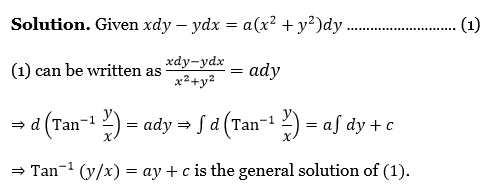
Example. 11. Solve \(x d y-y d x=a\left(x^2+y^2\right) d y\)

Solution:

Given x dy-y dx = \(a\left(x^2+y^2\right) d y\)…….(1)

(1) can be written as \(\frac{x d y-y d x}{x^2+y^2}=a d y\)

⇒ \(d\left(\text{Tan}^{-1} \frac{y}{x}\right)=a d y\)

⇒ \(\int d\left(\text{Tan}^{-1} \frac{y}{x}\right)=a \int d y+c\)

⇒ \(\text{Tan}^{-1}(y / x)=a y+c\) is the general solution of (1).

Differential Equations of First Order and First Degree exercise 2(a) example 11

Examples Of Integrating Factors In Homogeneous Equations Exercise 2.1 

Example. 12. Solve \(y d x-x d y=3 x^2 e^{x^3} y^2 d x\)

Solution.

Given equation is\(y d x-x d y=3 x^2 e^{x^3} y^2 d x\) …………………….(1)

⇒ \(\frac{y d x-x d y}{y^2}=3 x^2 e^{x^3} d x \Rightarrow d\left(\frac{x}{y}\right)=3 x^2 e^{x^3} d x \Rightarrow \int d(x / y)=\int 3 x^2 e^{x^3} d x+c\)

∴ The general solution of (1) is \(x=y e^{x^3}+c y\)


Differential Equations Introduction Solved Problems Examples Family Of Curves, Parabolas And Circles

Differential Equations Introduction Solved Problems


Example 1: Form the differential equation corresponding to \(c(y+c)^2=x^2\) where c is a parameter.

Solution.

Given equation is \(c(y+c)^2=x^2\) ………………….(1)

Differentiating (1) w.r.t. x, we get: \(2 c(y+c) \frac{d y}{d x}=2 x \Rightarrow c(y+c) \frac{d y}{d x}=x\)

⇒ \(c(y+c)=\frac{x}{(d y / d x)}\) ……………………..(2)

⇒ \(\text { (1) } \div(2) \Rightarrow y+c=\frac{x^2}{x} \cdot \frac{d y}{d x}=x \frac{d y}{d x}\) ……………………..(3)

⇒ \(c=x \frac{d y}{d x}-y\) ……………………..(4)

Substituting the Values of (y + c) and c from (3) and (4) in (1), we get:

∴ \(\left(x \frac{d y}{d x}-y\right) \cdot\left(x \frac{d y}{d x}\right)^2=x^2 \Rightarrow\left(x \frac{d y}{d x}-y\right)\left(\frac{d y}{d x}\right)^2=1\) is the required differential equation.

Note: The given equation contains only one arbitrary constant. Hence we got only a first-order differential equation.

Example 2. Form the differential equation by eliminating the arbitrary constants A  and B from the equation \(y=e^x(\mathrm{~A} \cos x+\mathrm{B} \sin x)\)

Solution.

Given equation is \(y=e^x(\mathrm{~A} \cos x+\mathrm{B} \sin x)\) ……………………(1)

Differentiating (1) w.r.t. x, we get: \(\frac{d y}{d x}=e^x(\mathrm{~A} \cos x+\mathrm{B} \sin x)+e^x(-\mathrm{A} \sin x+\mathrm{B} \cos x)\)

= \(y+e^x(-\mathrm{A} \sin x+\mathrm{B} \cos x)\)  [Using (1)]………………….(2)

Differentiating (2) w.r.t. x, we get: \(\frac{d^2 y}{d x^2}=\frac{d y}{d x}+e^x(-\mathrm{A} \cos x-\mathrm{B} \sin x)+e^x(-\mathrm{A} \sin x+\mathrm{B} \cos x)=\frac{d y}{d x}-y+\frac{d y}{d x}-y\)

[Using (1) and (2)]

∴ The required differential equation is \(\frac{d^2 y}{d x^2}-2 \frac{d y}{d x}+2 y=0\)

Introduction To Differential Equations With Solved Problems

Example. 3. Form the differential equation whose solution is given by \(\) where A and α are arbitrary constants.

Solution.

Given equation is x = A cos(pt – α) …………………(1)

Differentiating (1) w.r.t. t, we get \(\frac{d x}{d t}\) = -Ap sin(pt-α) ……………….. (2)

Differentiating (2) w.r.t. t, we get: \(\frac{d^2 x}{d t^2}=-A p^2 \cos (p t-\alpha)=-p^2 x\) [Using (1)]

∴ The required differential equation is \(\frac{d^2 x}{d t^2}+p^2 x=0\)

Example. 4: By eliminating the arbitrary constants a,b obtain the differential equation of Which \(x y=a e^x+b e^{-x}+x^2\) is a solution.

Solution.

Given equation is \(x y=a e^x+b e^{-x}+x^2\) …………………..(1)

Differentiating (1) w.r.t. x, we get: \(x y^{\prime}+y=a e^x-b e^{-x}+2 x\) ……………….. (2)

Differentiating (2) w.r.t. x, we get \(x y^{\prime \prime}+y^{\prime}+y^{\prime}=a e^x+b e^{-x}+2\)

⇒ \(x y^{\prime \prime}+2 y^{\prime}-2=a e^x+b e^{-x} \Rightarrow x y^{\prime \prime}+2 y^{\prime}-2=\left(x y-x^2\right)\) [using (1)]

∴ The required differential equation is: \(x y^{\prime \prime}+2 y^{\prime}-x y+x^2-2=0\)

Example. 5. : Show that \(y=a e^{2 x}+b x e^{2 x}\) where a and b are arbitrary constants, is the solution of the differential equation \(y^{\prime \prime}-4 y^{\prime}+4 y=0\)

Solution.

Given differential equation is \(y^{\prime \prime}-4 y^{\prime}+4 y=0\)

Also given \(y=a e^{2 x}+b x e^{2 x}=(a+b x) e^{2 x}\) ……………………(1)

Differentiating (1) twice w.r.t. x: \(y^{\prime}=(a+b x) 2 e^{2 x}+b e^{2 x}, y^{\prime \prime}=(a+b x) 4 e^{2 x}+2 b e^{2 x}+2 b e^{2 x} \Rightarrow y^{\prime \prime}=4(a+b x) e^{2 x}+4 b e^{2 x}\)

Now, \(y^{\prime \prime}-4 y^{\prime}+4 y=4(a+b x) e^{2 x}+4 b e^{2 x}-8(a+b x) e^{2 x}-4 b e^{2 x}\)

+ \(4(a+b x) e^{2 x}=8(a+b x) e^{2 x}-8(a+b x) e^{2 x}+4 b e^{2 x}-4 b e^{2 x}=0 \text { for all, } x \in \mathrm{R}\)

∴ \(y=a e^{2 x}+b x e^{2 x}\) is the solution of \(y^{\prime \prime}-4 y^{\prime}+4 y=0\)

Examples Of Differential Equations With Family Of Curves

Example. 6. Find the differential equation of the family of circles having the centres on the x-axis and passing through the origin.

Solution.

The equation of the family of circles having the centres on the x-axis and passing through the origin is \(x^2+y^2+2 \lambda x=0\) where A, is the parameter ……………… (1)

Differential Equations Introduction chapter 1 example 6


Differentiating (1) w.r.t. x, we get: \(2 x+2 y \frac{d y}{d x}+2 \lambda=0 \Rightarrow \lambda=-\left(x+y \frac{d y}{d x}\right)\) ………………….(2)

Eliminating λ from (1) and (2), we get: \(x^2+y^2-2 x\left(x+y \frac{d y}{d x}\right)=0\)

∴ The required differential equation of the family of circles is \(y^2-x^2-2 x y \frac{d y}{d x}=0\)

Example. 7: Find the differential equation of the family of parabolas having a vertex at the origin and foci on the y-axis.

Solution:

The equation of the family of parabolas with vertex at the origin and foci on the y-axis is \(\)ay where ‘a is the parameter of the family …………………. (1)

Differential Equations Introduction chapter 1 example 7

Differentiating (1) w.r.t. x, we get: \(2 x=4 a \frac{d y}{d x} \Rightarrow 4 a=2 x /\left(\frac{d y}{d x}\right)\) ………………..(2)

Eliminating ‘a’ from (1) and (2): \(x^2=\frac{2 x}{(d y / d x)} \cdot y\)

∴ The required differential equation is \(x \frac{d y}{d x}=2 y\)

Example. 8: Form the differential equation of the family of curves represented by the equation \(\frac{x^2}{a^2}+\frac{y^2}{a^2+\lambda}=1\) where λ is the parameter.

Solution.

Given equation of family of curves is \(\frac{x^2}{a^2}+\frac{y^2}{a^2+\lambda}=1\) ……………………(1)

Differentiating (1) w.r.t; x, we get: \(\frac{2 x}{a^2}+\frac{2 y y^{\prime}}{a^2+\lambda}=0 \Rightarrow \frac{y}{a^2+\lambda} \cdot y^{\prime}=-\frac{x}{a^2} \Rightarrow \frac{y^2}{a^2+\lambda}=\frac{-x y}{a^2 y^{\prime}}\) ……………………..(2)

Eliminating the parameter λ from (1) and (2): \(\frac{x^2}{a^2}-\frac{x y}{a^2 y^{\prime}}=1 \Rightarrow\left(x^2-a^2\right) y^{\prime}=x y\) is the required differential equation.

Example. 9. Form the differential equation of the family of circles of radius r.

Solution.

The equation of the family of all circles of radius r is given by \((x-h)^2+(y-k)^2=r^2\) where h and k are parameters.

Differentiating (1) w.r.t. x, we get: \(2(x-h)+2(y-k) y_1=0 \Rightarrow(x-h)+(y-k) y_1=0\) …………………..(2)

Differentiating (2) w.r.t. x, we get: \(1+(y-k) y_2+y_1^2=0\)

⇒ \((y-k) y_2=-1-y_1^2 \Rightarrow y-k=-\left(1+y_1^2\right) / y_2\) ………………………..(3)

From (2) and (3): \((x-h)=\frac{\left(1+y_1^2\right) y_1}{y_2}\) …………………….(4)

substituting the values (x-h) and (y-k) from (4) and (3) in (1) we get: \(\frac{\left(1+y_1^2\right)^2 y_1^2}{y_2^2}+\frac{\left(1+y_1^2\right)^2}{y_2^2}=r^2 \Rightarrow\left(1+y_1^2\right)^2\left(1+y_1^2\right)=r^2 y_2^2\)

∴ The required differential equation is \(\left(1+y_1^2\right)^3=r^2 y_2^2\).

Example. 10. Obtain the differential equation of the family of all ellipses whose axes coincide with the axes of coordinates and centre at the origin.

Solution.

The equation of the family of ellipses whose axes coincide with the axes of  coordinates and centre at the origin is \(\frac{x^2}{a^2}+\frac{y^2}{b^2}=1\)
where a and b are parameters …………………….(1)

Differential Equations Introduction chapter 1 example 10

Differentiating (1) w.r.t. x, we get: \(\frac{2 x}{a^2}+\frac{2 y y_1}{b^2}=0 \Rightarrow \frac{x}{a^2}+\frac{y}{b^2} y_1=0 \Rightarrow \frac{y y_1}{x}=\frac{-b^2}{a^2}\) ………………………(2)

Differentiating (2) w.r.t. x, we get: \(\frac{y y_2}{x}+\frac{x y_1-y .1}{x^2} y_1=0\)

∴ The required differential equation is \(x y y_2+x y_1^2-y y_1=0\)

Solved Problems On Parabolas And Circles In Differential Equations

Example. 11: Form the differential equation of the family of circles given by \(x^2+y^2+2 a x+2 b y+c=0\) where a,b,c are arbitrary constants.

Solution.

Given equation is \(x^2+y^2+2 a x+2 b y+c=0\) …………………. (1)

Since a,b, and c are three arbitrary constants, we have to eliminate them between (1) and its, three derivatives.

Differentiating (1) w.r.t. x, successively, we get: \(2 x+2 y y_1+2 a x+2 b y_1=0\)

⇒ \(x+y y_1+a+b y_1=0\) …………………..(2)

⇒ \(1+y y_2+y_1^2=-b y_2\) ……………………(3)

⇒ \(y y_3+y_1 y_2+2 y_1 y_2=-b y_3 \Rightarrow y y_3+3 y_1 y_2=-b y_3\) …………………..(4)

∴ \((3) \div(4) \Rightarrow \frac{1+y y_2+y_1^2}{y y_3+3 y_1 y_2}=\frac{y_2}{y_3} \Rightarrow y_3\left(1+y y_2+y_1^2\right)=y_2\left(y y_3+3 y_1 y_2\right)\)

⇒ \(y_3+y y_2 y_3+y_3 y_1^2=y y_2 y_3+3 y_1 y_2^2\)

∴ The required differential equation is \(\frac{d^3 y}{d x^3}\left[1+\left(\frac{d y}{d x}\right)^2\right]=3\left(\frac{d y}{d x}\right)\left(\frac{d^2 y}{d x^2}\right)^2\)

Example. 12. Find the differential equation corresponding to \(y=a e^x+b e^{2 x}+c e^{3 x}\) where a, b,c. are parameters.

Solution.

Given equation is \(y=a e^x+b e^{2 x}+c e^{3 x}\) ……………………..(1)

Differentiating (1) w.r.t x, successively three times: \(y_1=a e^x+2 b e^{2 x}+3 c e^{3 x}=\left(a e^x+b e^{2 x}+c e^{3 x}\right)+b e^{2 x}+2 c e^{3 x}\)

⇒ \(y_1=y+b e^{2 x}+2 c e^{3 x}\)  [Using (2)]

⇒ \(y_1-y=b e^{2 x}+2 c e^{3 x}\) …………………….(2)

Differentiating (2) w.r.t. x, we get: \(y_2-y_1=2 b e^{2 x}+6 c e^{3 x}=2\left(b e^{2 x}+2 c e^{3 x}\right)+2 c e^{3 x}\)

⇒ \(y_2-y_1=2\left(y_1-y\right)+2 c e^{3 x} \Rightarrow y_2-3 y_1+2 y=2 c e^{3 x}\) [from (2)] ……………………..(3)

Differentiating (3) w.r.t. x, we get: \(y_3-3 y_2+2 y_1=6 c e^{3 x}=3\left(2 c e^{3 x}\right)=3\left(y_2-3 y_1+2 y\right)\) [from (3)]

∴ The required differential equation is \(y_3-6 y_2+11 y_1-6 y=0\)


Differential Equations Introduction Definition Examples Solved Problems Families Of Plane Curves

Differential Equations Introduction

In the study of many subjects such as Physics, Chemistry, and Economics, the problems faced are represented by a mathematical model called a differential equation.

A differential equation is formed involving the derivatives of the unknown function describing fully and accurately the physical process or a geometrical law.

The solution of such a differential equation gives the unknown function involved in explaining the physical process or geometrical law.

Since the time of Newton, Mathematicians are in constant search for the solution of differential equations describing the nature of a physical or geometrical law.

Thus an equation formed by the derivatives of an unknown function is called a differential equation, the solution of which gives the unknown function.

The following examples of geometrical nature and physical process illustrate the purpose of a differential equation whose solution involves a search for the unknown function.

Example 1. At each point (x, y) on a curve the length of the subtangent is equal to the sum of
the coordinates of the point given by the differential equation \((x+y) \frac{d y}{d x}=y\).

Example 2. If a particle moves in a straight line starting from a fixed point such that its acceleration is proportional to the displacement and is always directed towards that point, then the equation of motion of the particle is given by the differential equation \(\frac{d^2 x}{d t^2}+\mu^2 x=0\) where \(\mu^2\) is a constant


Differential Equations Introduction Differential Equations Introduction Differential Equation

Definition. An equation involving differentials or one dependent variable and its derivatives with respect to one or more independent variables is called a differential equation.

Differential Equations Introduction Ordinary Differential Equation

Definition. A differential equation is said to be ordinary if the derivatives in the equation have reference to only a single independent variable

Definition of differential equations with examples Examples:

1. \(\left(\frac{d y}{d x}\right)^3-4\left(\frac{d y}{d x}\right)^2+7 y=\cos x\)

2. \(\frac{d^2 y}{d x^2}+5 x\left(\frac{d y}{d x}\right)^2-6 y=\log x\)

3. \(\left(x^2+y^2-x\right) d y+\left(y e^y-2 x y\right) d x=0\)

4. \(\rho=\left[1+\left(\frac{d y}{d x}\right)^2\right]^{3 / 2} / \frac{d^2 y}{d x^2}\)

The general form of an ordinary differential equation is \(\mathrm{F}\left(x, y, \frac{d y}{d x}, \frac{d^2 y}{d x^2}, \ldots \ldots . . \frac{d^2 y}{d x^n}\right)=0\)

or \(\mathrm{F}\left(x, y, y^{\prime}, y^{\prime \prime}, \ldots \ldots y^{(n)}\right)=0 \text { or } \mathrm{F}\left(x, y, y^{(1)}, y^{(2)}, \ldots \ldots y^{(n)}\right)=0\)


Differential Equations Introduction Partial Differential Equation


Definition. A differential equation is said to be partial, if the derivatives in the equation have a reference, to two or more independent variables.

Example 1. \((y+z) \frac{\partial z}{\partial x}+(z+x) \frac{\partial z}{\partial y}=x+y\)

2. \(\left(\frac{\partial z}{\partial x}\right)^2+\left(\frac{\partial z}{\partial y}\right)^2=4 z\)

3. \(4 \frac{\partial^2 u}{\partial x^2}+5 \frac{\partial^2 u}{\partial x \partial y}+3+\frac{\partial^2 u}{\partial y^2}=x+2 y\)

We discuss only ordinary differential equations throughout unit-A – differential equations in this book.


Differential Equations Introduction Order Of A Differential Equation


Definition. A differential equation is said to be of order n if the nth derivative is the highest derivative in that equation.

Example. 1. \(\left(x^2+1\right) \frac{d y}{d x}+2 x y=4 x^2\)

Given

\(\left(x^2+1\right) \frac{d y}{d x}+2 x y=4 x^2\)

The first derivative \(\frac{d y}{d x}\) is the highest derivative in the above equation.

∴ The order of the above differential equation is 1.

Example 2. \(x \frac{d^2 y}{d x^2}-(2 x-1) \frac{d y}{d x}+(x-1) y=e^x\)

Given

\(x \frac{d^2 y}{d x^2}-(2 x-1) \frac{d y}{d x}+(x-1) y=e^x\)

The second derivative \(\frac{d^2 y}{d x^2}\) is the highest derivative in the above equation.

∴ The order of the above differential equation is 2.

A differential equation of order one is of the form \(\mathrm{F}\left(x, y, \frac{d y}{d x}\right)=0\)

A differential equation of order two is of the form \(\mathrm{F}\left(x, y, \frac{d y}{d x}, \frac{d^2 y}{d x^2}\right)=0\)

In general, the differential equation of order n is of the form \(\mathrm{F}\left(x, y, \frac{d y}{d x}, \frac{d^2 y}{d x^2}, \ldots \ldots, \frac{d^n y}{d x^n}\right)=0\)


Differential Equations Introduction Degree Of A Differential Equation


Definition. Let F \(\mathrm{F}\left(x, y, y^{\prime}, y^{\prime \prime}, \ldots \ldots y^{(n)}\right)=0\) be a differential equation of order n. If the given differential equation is a polynomial in \(y^{(n)}\), then the highest degree of \(y^{(n)}\) is defined as the degree of the differential equation.

Note 1. If in the given equation \(y^{(n)}\) enters the denominator or has a fractional index, then it may be possible to free it from radicals by algebraic operations so that \(y^{(n)}\) has the least positive integral index and the equation is written as a polynomial in \(y^{(n)}\).

2. The above definition of degree does not require variables x,t,u, etc to be free from radicals and fractions.

3. If it is not possible to express the differential equation as a polynomial in \(y^{(n)}\), then the degree of the differential equation is not defined.

Example 1. \(y=x \frac{d y}{d x}+\sqrt{\left[1+\left(\frac{d y}{d x}\right)^2\right]} \Rightarrow\left(y-x \frac{d y}{d x}\right)^2=1+\left(\frac{d y}{d x}\right)^2\)

⇒ \(\left(1+x^2\right)\left(\frac{d y}{d x}\right)^2+2 x y \frac{d y}{d x}+\left(1-y^2\right)=0\)

This is a polynomial equation in \(\frac{d y}{d x}\). The highest degree of \(\frac{d y}{d x}\)  is two.

Hence the degree of the above differential equation is 2.

Example 2. \(a \frac{d^2 y}{d x^2}=\left[1+\left(\frac{d y}{d x}\right)^2\right]^{3 / 2} \Rightarrow a^2\left(\frac{d^2 y}{d x^2}\right)^2=\left[1+\left(\frac{d y}{d x}\right)^2\right]^3\)

This is a polynomial equation in \(\frac{d^2 y}{d x^2}\). The highest degree of \(\frac{d^2 y}{d x^2}\) is 2.

Hence the degree of the above differential equation is 2.

Example 3. \(y=\cos \left(\frac{d y}{d x}\right) \text { and } x=y+\log \frac{d y}{d x}\)

The above equations cannot be expressed as polynomial equations in \(\frac{d y}{d x}\).

Hence the degree of the above differential equations cannot be determined and hence undefined.


Differential Equations Introduction Formation Or A Differential Equation


Let \(\phi\left(x, y, c_1, c_2, \ldots \ldots . ., c_n\right)=0\) …………….(1)

where \(c_1, c_2, \ldots \ldots \ldots, c_n\) are n arbitrary constants. Differentiating (1) successively n times

w.r.t. x, we get: \(f_1\left(x, y, y^{(1)}, c_1, c_2, \ldots \ldots \ldots, c_n\right)=0\) ……………..(2)

∴ \(f_2\left(x, y, y^{(1)}, y^{(2)}, c_1, c_2, \ldots \ldots . ., c_n\right)=0\) ……………..(3)

∴ \(f_n\left(x, y, y^{(1)}, y^{(2)}, \ldots \ldots . . y^{(n)}, c_1, c_2, \ldots \ldots . ., c_n\right)=0 \ldots \ldots .(n+1)\)

Eliminating the n arbitrary constants \(c_1, c_2, \ldots \ldots, c_n\) from the above (n + 1) equations, we get the eliminant, the differential equation \(\mathrm{F}\left(x, y, y^{(1)}, y^{(2)}, \ldots \ldots \ldots, y^{(n)}\right)=0\).

From the above discussion, we observe that

(1) \(\phi\left(x, y, c_1, c_2, \ldots \ldots . ., c_n\right)=0\) is a solution of \(\mathrm{F}\left(x, y, y^{(1)}, y^{(2)}, \ldots \ldots . . y^{(n)}\right)=0\)

(2) If \(\phi\left(x, y, c_1, c_2, \ldots \ldots . ., c_r\right)=0\) is a solution of a differential equation \(\mathrm{F}\left(x, y, y^{(1)}, y^{(2)}, \ldots \ldots, y^{(n)}\right)=0\) of order n,then r ≤ n.


Differential Equations Introduction Solution Of A Differential Equation


Definition. A relation between the dependent and independent variables when substituted in the differential equation reduces it to an identity, is called a solution or integral or primitive of the differential equation.

Note. A solution of a differential equation does not involve the derivatives of the dependent variable with respect to the independent variable.

The general solution of a differential equation :

Definition: Let \(F\left(x, y, y^{(1)}, y^{(2)}, \ldots \ldots, y^{(n)}\right)=0\) be a differential equation of order n.

If \(\phi\left(x, y, c_1, c_2, \ldots \ldots ., c_n\right)=0\) where \(c_1, c_2, \ldots \ldots, c_n\) are n independent arbitrary constants, is a solution of the given differential equation, then it is called the general solution of the given differential equation.

Note. The general solution (G. S) or complete integral of the differential equation of order n contains n arbitrary constants.

Particular solution of a differential equation.

Definition. The solution is obtained by giving particular values to arbitrary constants in the general solution of the differential equation. \(\) is called a particular solution of the given differential equation.

Singular solution of a differential equation.

Definition. An equation \(\psi(x, y)=0\) is called a singular solution of the differential equation \(\mathrm{F}\left(x, y, y^{(1)}, \ldots \ldots, y^{(n)}\right)=0\) if

(1) \(\psi(x, y)=0\) is a solution of the given differential equation.
(2) \(\psi(x, y)=0\) does not contain arbitrary constant and
(3) \(\psi(x, y)=0\) is not obtained by giving particular values to arbitrary constants in the general solution.


Differential Equations Introduction Families Of Plane Curves


For each given set of real values of \(c_1, c_2, \ldots \ldots \ldots, \dot{c}_n\) the equation \(\phi\left(x, y, c_1, c_2, \ldots \ldots \ldots, ., c_n\right)=0\) represents a curve in the XY-plane.

For different sets of real values of \(c_1, c_2, \ldots \ldots \ldots, c_n\) the equation \(\phi\left(x, y, c_1, c_2, \ldots \ldots \ldots, c_n\right)=0\) represents infinitely many curves. The set of all these curves is called n – n-parameter family of curves. \(c_1, c_2, \ldots \ldots \ldots, c_n\) are called the parameters of the family.

The differential equation \(\mathrm{F}\left(x, y, y^{\prime}, y^{\prime \prime}, \ldots \ldots y^{(n)}\right)=0\) is obtained by eliminating, the n – parameters \(c_1, c_2, \ldots \ldots \ldots, c_n\) is called the differential equation of the family of curves \(\phi\left(x, y, c_1, c_2, \ldots \ldots \ldots, c_n\right)=0\)

The family of curves given by \(\phi\left(x, y, c_1, c_2, \ldots \ldots \ldots, c_n\right)=0\) is called integral curves of the differential equation \(\mathrm{F}\left(x, y, y^{(1)}, y^{(2)}, \ldots \ldots \ldots y^{(n)}\right)=0\).

Example 1. Consider the equation \(\phi(x, y, c) \equiv x+y+c=0\) where c is the parameter. For a given c the equation represents a straight line. For different values of c, the equation represents a family of parallel lines.E

Differential Equations Introduction chapter 1 parallel lines

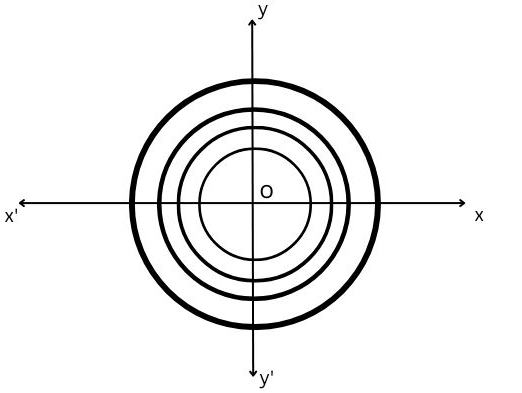
Example 2. Consider the equation \(\phi(x, y, r) \equiv x^2+y^2-r^2=0\) where r is the parameter. For a given value of r, the equation represents a circle with a centre (0,0) and radius of r. For different values of r, the equation represents a family of concentric circles with different radii.

Differential Equations Introduction chapter 1 circles

Example. 3. Consider the equation \(\phi(x, y, b, c) \equiv x^2+(y-b)^2-c^2=0\). where b and c are parameters. For a given b and c the equation represents a circle with a centre (0,b) and radius c. For different values of b and c the equation represents a family of circles with centres on the y-axis and different radii.

Differential Equations Introduction chapter 1 circles with centers x,y axes


Differential Equations Introduction Equations Of Some Families Of Curves :


1. Families of Circles :

(1) The family of all circles through the origin and centres on the y-axis is \(x^2+y^2+2 f y=0\) where \(f\) is a parameter.

(2) The family of all circles having centres on the x-axis and fixed radius r is \((x-h)^2+y^2=r^2\), the parameter being h.

(3)The family of all circles having centres on the y-axis and fixed radius r is \(x^2+(y-k)^2=r^2\), the parameter being k.

(4) The family of all circles touching the x – axis at the origin is \(x^2+y^2-2 k y=0\) where k is the parameter.

(5) The family of all circles touching the y-axis at the origin is \(x^2+y^2-2 k x=0\) where k is the parameter.

2. Families of Parabolas :

(1) The family of all parabolas with vertex at the origin and foci on x – axis is \(y^2=4 a x\), the parameter being a.

(2) The family of all parabolas with vertex at the origin and focus on the y-axis is \(x^2=4 a y\), the parameter being a.

(3) The family of all parabolas with latus rectum 4a and axes parallel to the x-axis is \((y-k)^2=4 a(x-h)\) where h and k are parameters.

(4)The family of all parabolas with latus rectum 4a and axes parallel to the y-axis is \((x-h)^2=4 a(y-k)\), the parameters being h and k.


Differential Equations Introduction Working Rule to Form A Differential Equation


  1. Let the given equation contain n arbitrary constants.
  2. Differentiate the given equation n times to get n additional equations.
  3. Eliminate the,n constants from (n +1) equations given by 1 and 2.
  4. Then we obtain the required differential equation of order n.