Glencoe Math Course 2 Volume 1 Common Core Student Edition Solutions

Glencoe Math Course 2 Volume 1 Common Core Student Edition Solutions

Glencoe Math Course 3 Volume 2 Student 1st Edition Chapter 7 Congruence And Similarity Exercise

Glencoe Math Course 3 Volume 2 Student Chapter 7 Congruence And Similarity Exercise

Glencoe Math Course 3 Volume 2 Chapter 7 Congruence And Similarity Exercise Solutions Page 504 Exercise 1, Problem1

The given equation is (x/15) = (7/30).

We apply cross multiplication i.e. multiply the numerator of one ratio to the denominator of the other ratio to obtain the value of the unknown variable.

We have the proportion \(\frac{x}{15}=\frac{7}{30}\),

⇒ \(\frac{x}{15}=\frac{7}{30}\)

⇒ x x 30 = 7 x 15 [applying cross multiplication]

⇒ x x 30 = 105

⇒ x = \(\frac{105}{30}\)

⇒ x = 3.5. Hence, the value of x is 3.5.

Finally, we can conclude that the value of the unknown variable is x = 3.5.

Read and Learn More Glencoe Math Course 2 Volume 1 Common Core Student Edition Solutions

Glencoe Math Course 3 Volume 2 Student Chapter 7 Page 504 Exercise 2 Problem1

The given equation is (4/9) = (14/y).

We apply cross multiplication i.e. multiply the numerator of one ratio to the denominator of the other ratio to obtain the value of the unknown variable.

We have the proportion \(\frac{4}{9}=\frac{14}{y}\),

Glencoe Math Course 2 Student Edition Volume 1 Chapter 7 Congruence Exercise

⇒ 4 x y = 14 x 9 [applying cross-multiplication]

⇒ 4 x y = 126

⇒ y = \(\frac{126}{4}\)

⇒ y = 31.5.

Finally, we can conclude that the value of the unknown variable is y=31.5.

Chapter 7 Congruence And Similarity Answers Glencoe Math Course 3 Volume 2 Page 504 Exercise 3, Problem1

The given equation is (12/Z) = (30/37).

We apply cross multiplication i.e. multiply the numerator of one ratio to the denominator of the other ratio to obtain the value of the unknown variable.

We have the proportion \(\frac{12}{Z}=\frac{30}{37}\),

⇒ 12 x 37 = 30 x z [applying cross-multiplication]

⇒ 30 x z = 444

⇒ z = \(\frac{444}{30}\)

⇒ z = 14.8.

Hence, the value of z is  14.8.

Finally, we can conclude that the value of the unknown variable is Z=14.8

Glencoe Math Course 3 Volume 2 Student Chapter 7 Page 504 Exercise 4 Problem1

The given equation is (8/15) = (m/21).

We apply cross multiplication i.e. multiply the numerator of one ratio to the denominator of the other ratio to obtain the value of the unknown variable.

We have the proportion \(\frac{8}{15}=\frac{m}{21}\),

⇒ 8 x 21 = m x15 [applying cross-multiplication]

⇒ 168 = m x 15

⇒ m = \(\frac{168}{15}\)

⇒ m = 11.2.

Hence, the value of m is 11.2.

Finally, we can conclude that the value of the unknown variable is m=112.

Step-By-Step Solutions For Chapter 7 Congruence And Similarity Exercises In Glencoe Math Course 3 Page 504 Exercise 5, Problem1

The given equation is (n/5) = (18/45).

We apply cross multiplication i.e. multiply the numerator of one ratio to the denominator of the other ratio to obtain the value of the unknown variable.

We have the proportion \(\frac{n}{5}=\frac{18}{45}\),

⇒ n x 45 = 18 x 5 [applying cross-multiplication]

⇒ n x 45 = 90

⇒ n = \(\frac{90}{45}\)

⇒ n = 2.

Hence, the value of n is 2.

Finally, we can conclude that the value of the unknown variable is n=2.

Glencoe Math Course 3 Volume 2 Student Chapter 7 Page 504 Exercise 6 Problem1

The given equation is (3/7) = (21/p).

We apply cross multiplication i.e. multiply the numerator of one ratio to the denominator of the other ratio to obtain the value of the unknown variable.

We have the proportion \(\frac{3}{7}=\frac{21}{p}\),

⇒ 3 x p = 21 x 7 [applying cross-multiplication]

⇒ 3 x p = 147

⇒ p = \(\frac{147}{3}\)

⇒ p = 49.

Hence, the value of p is 49.

Finally, we can conclude that the value of the unknown variable is p=49.

Exercise Solutions For Chapter 7 Congruence And Similarity Glencoe Math Course 3 Volume 2 Page 504 Exercise 7, Problem1

The given statement is to find the slope of the line that passes through each pair of points (-1,1),(-3,7).

We apply the formula, m=(y2−y1)/(x2−x1) for determining the slope.

m = \(\underline{y_2-y_1}, \text { where, } x_1=-1, x_2=-3, y_1=1, y_2=7\). Therefore,

m = \(\frac{7-1}{-3-(-1)}\)

⇒ m = \(\frac{6}{-3+1}\)

⇒ m = \(\frac{6}{-2}\)

⇒ m = -3.

Hence, the slope of the line is m = -3.

Finally, we can conclude that the slope of the line that passes through each pair of points (−1,1),(−3,7) is m=−3.

Glencoe Math Course 3 Volume 2 Student Chapter 7 Page 504 Exercise 8 Problem1

The given statement is to find the slope of the line that passes through each pair of points (2,0), (0,2).

We apply the formula, m=(y2−y1)/(x2−x1) for determining the slope.

We have to find the slope of the line that passes through the two points (2,0),(0,2).

Let the slope be m, then we can write the formula,

m = \(\frac{y_2-y_1}{x_2-x_1} \text {, where, } x_1=2, x_2=0, y_1=0, y_2=2\). Therefore,

m = \(\frac{2-0}{0-2}\)

⇒ m = \(\frac{2}{-2}\)

⇒ m = -1.

Hence, the slope of the line is m = -1.

Finally, we can conclude that the slope of the line that passes through each pair of points (2,0),(0,2)is m=−1.

Examples Of Problems From Chapter 7 Congruence And Similarity Exercises In Glencoe Math Course 3 Page 504 Exercise 9, Problem1

The given statement is to find the slope of the line that passes through each pair of points (−6,−1),(−3,4).

We apply the formula, m=(y2−y1)/(x2−x1)for determining the slope.

We have to find the slope of the line that passes through the two points (−6,−1),(−3,4).

Let the slope be m, then we can write the formula,

m = \(\frac{y_2-y_1}{x_2-x_1}, \text { where, } x_1=-6, x_2=-3, y_1=-1, y_2=4\). Therefore,

m = \(\frac{4-(-1)}{-3-(-6)}\)

⇒ m = \(\frac{4+1}{-3+6}\)

⇒ m = \(\frac{5}{3}\).

Hence, the slope of the line is m = \(\frac{5}{3}\).

Finally, we can conclude that the slope of the line that passes through each pair of points (−6,−1),(−3,4))is m=5/3.

Glencoe Math Course 3 Volume 2 Student Chapter 7 Page 505 Exercise 1 Problem1

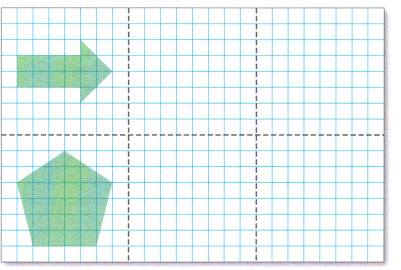
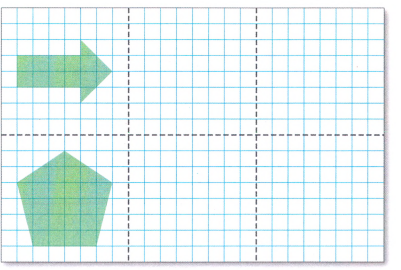
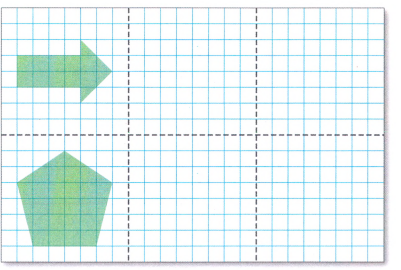
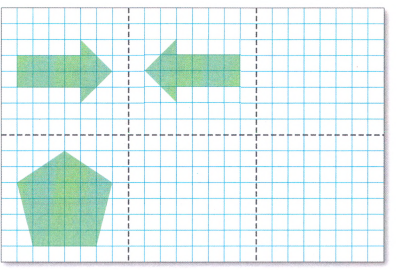
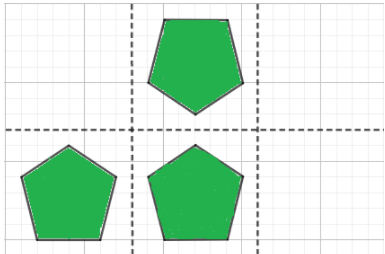
We have the instruction to fold the given page vertically into three parts.We can denote the folding lines in dotted fashion as,

Glencoe Math Course 3 Volume 2 Student 1st Edition Chapter 7 Congruence And Similarity Exercise Page 505 Exercise 1, Problem1

Finally, we can conclude that after folding the page vertically into three sections we get,

Glencoe Math Course 3 Volume 2 Student 1st Edition Chapter 7 Congruence And Similarity Exercise Page 505 Exercise 1, Problem1

Common Core Chapter 7 Congruence And Similarity Exercise Detailed Solutions Glencoe Math Course 3 Volume 2 Page 505 Exercise 1, Problem2

We have a page that is folded vertically into three sections


Glencoe Math Course 3 Volume 2 Student 1st Edition Chapter 7 Congruence And Similarity Exercise Page 505 Exercise 1, Problem2

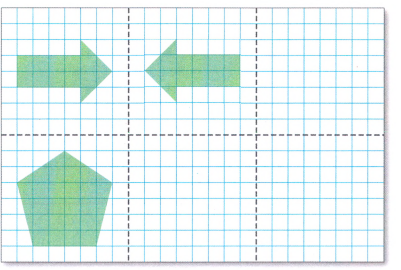
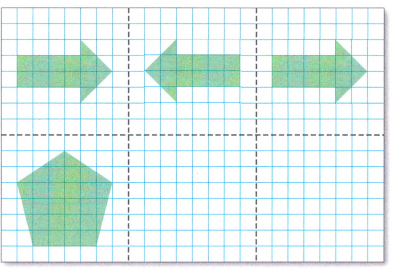
Now we draw the reflection of the arrow over the fold in the middle section.

We draw the reflected image of the arrow as the distance of each point of the previous arrow and its image with the folded line be the same.

As we know the distance of each point of an image and its preimage from the line of reflection is the same.

Here, the vertical folded line is referred to as the line of reflection.

So, we can draw as

Glencoe Math Course 3 Volume 2 Student 1st Edition Chapter 7 Congruence And Similarity Exercise Page 505 Exercise 1, Problem2

Finally, we can conclude that after drawing the reflection of the arrow over the fold in the middle section we get

Glencoe Math Course 3 Volume 2 Student 1st Edition Chapter 7 Congruence And Similarity Exercise Page 505 Exercise 1, Problem2

Glencoe Math Course 3 Volume 2 Student Chapter 7 Page 505 Exercise 1 Problem3

We have a page that is folded vertically into three sections

Glencoe Math Course 3 Volume 2 Student 1st Edition Chapter 7 Congruence And Similarity Exercise Page 505 Exercise 1, Problem 3

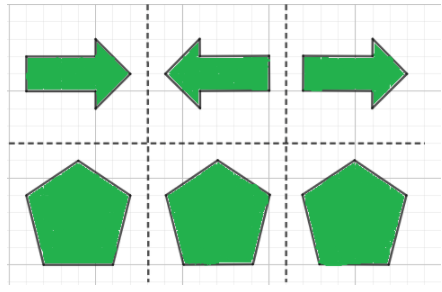
Then we draw the reflection of the arrow over the fold in the middle section


Glencoe Math Course 3 Volume 2 Student 1st Edition Chapter 7 Congruence And Similarity Exercise Page 505 Exercise 1, Problem -3
Now, we draw the reflection of the second arrow in the right-most section in a similar way.

As we know that the distance of each point of an image and its preimage from the line of reflection is the same.

Here, the vertical folded line is referred to as the line of reflection.

So, we can draw as

Glencoe Math Course 3 Volume 2 Student 1st Edition Chapter 7 Congruence And Similarity Exercise Page 505 Exercise 1, Problem -3.

Finally, we can conclude that after drawing the reflection of the second arrow over the fold in the right-hand section we get,

Glencoe Math Course 3 Volume 2 Student 1st Edition Chapter 7 Congruence And Similarity Exercise Page 505 Exercise 1, Problem -3.


Glencoe Math Course 3 Volume 2 Student Chapter 7 Page 505 Exercise 1 Problem4

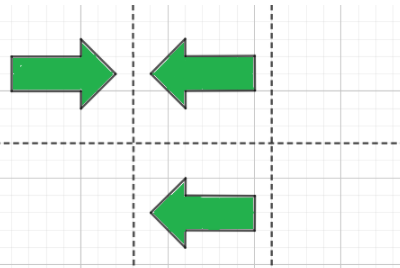
When both images are reflected over the vertical line the resulting images of the pentagon are identical but that of the arrow is not.

Both the first and the second reflection produce the same shapes. The reflection is shown below.

Glencoe Math Course 3 Volume 2 Student 1st Edition Chapter 7 Congruence And Similarity Exercise Page 505 Exercise 1, Problem4

When the reflection is done first over the vertical axis followed by the horizontal axis, the original and the final image of the arrow are different. Only the image formed after the horizontal reflection is the same as the preimage.

This is because the arrow possesses horizontal symmetry.

Glencoe Math Course 3 Volume 2 Student 1st Edition Chapter 7 Congruence And Similarity Exercise Page 505 Exercise 1, Problem 4
When the reflection is done first over the vertical axis followed by the horizontal axis, the original and the final image of the pentagon are different.

Only the image formed after the first reflection along the vertical axis is the same as the original image.

This is because the pentagon possesses only vertical symmetry.

Glencoe Math Course 3 Volume 2 Student 1st Edition Chapter 7 Congruence And Similarity Exercise Page 505 Exercise 1, Problem-4


When both images are reflected over the vertical line the resulting images of the pentagon are identical but that of the arrow is not.

When the reflection is done first over the vertical axis followed by the horizontal axis, the original and the final image of the pentagon are different.

Only the image formed after the first reflection along the vertical axis is the same as the original image and in the case of the arrow, the original and the last reflected image is the same.

Glencoe Math Course 3 Volume 2 Student Chapter 7 Page 507 Exercise 1 Problem1

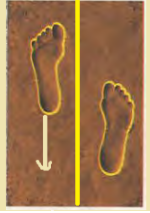
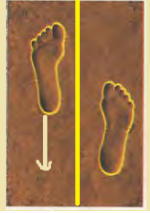
First, we need to apply translation to the given figure. Translation refers to the movement of shapes from one location to another. The foot on the left side is to be slid down beside the right foot.

Then a vertical line is drawn between them and the left foot is reflected along this line. This results in the formation of the right foot.

Glencoe Math Course 3 Volume 2 Student 1st Edition Chapter 7 Congruence And Similarity Exercise Page 507 Exercise 1, Problem-1

So, translation followed by reflection gives the required transformation.

We get the transformation by applying translation followed by reflection.

Glencoe Math Course 3 Volume 2 Student 1st Edition Chapter 7 Congruence And Similarity Exercise Page 507 Exercise 1, Problem-1

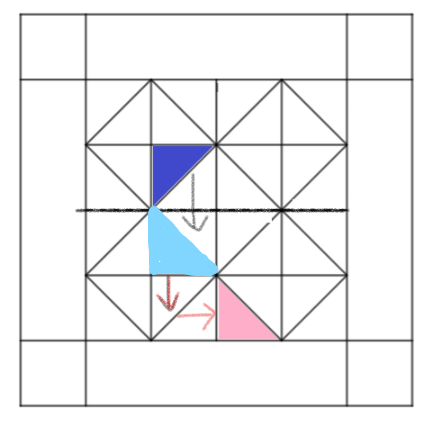
Student Edition Chapter 7 Congruence and Similarity Solutions Guide Glencoe Math Course 3 Volume 2 Page 507 Exercise 2, Problem1

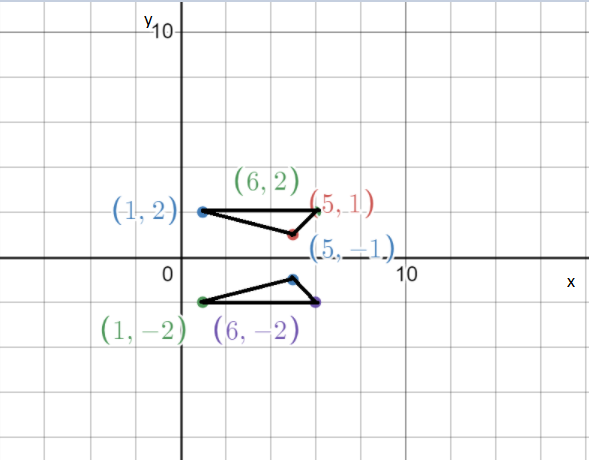
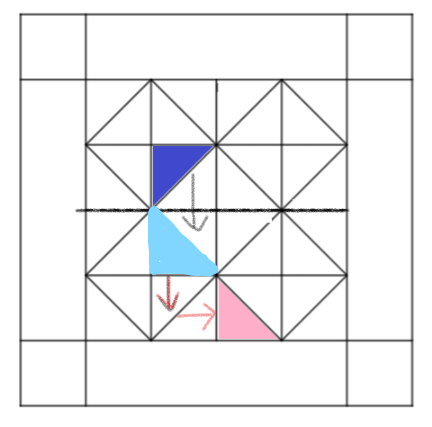
The blue triangle is first flipped along the horizontal line. This is known as reflection.

A reflection is a metamorphosis that depicts a figure being flipped.

After this, the figure is translated down and then to the right side. This results in the pink triangle.

Glencoe Math Course 3 Volume 2 Student 1st Edition Chapter 7 Congruence And Similarity Exercise Page 507 Exercise 2, Problem-1

So the transformation is reflection followed by the translation.

Reflection followed by translation results in the given transformation.

Glencoe Math Course 3 Volume 2 Student 1st Edition Chapter 7 Congruence And Similarity Exercise Page 507 Exercise 2, Problem-1

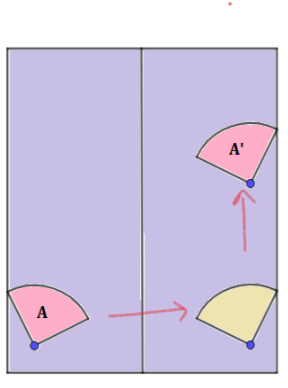
Glencoe Math Course 3 Volume 2 Student Chapter 7 Page 507 Exercise 3 Problem1

At first, the figure on the lower side is to be reflected along a vertical line.

A reflection is a metamorphosis that depicts a figure being flipped.

Now this reflected figure is to be translated to get the final figure.

The final figure is given in the following image.

Glencoe Math Course 3 Volume 2 Student 1st Edition Chapter 7 Congruence And Similarity Exercise Page 507 Exercise 3, Problem-1

So, reflection followed by translation gives the final image.

The required transformation results from reflection followed by the translation.

Glencoe Math Course 3 Volume 2 Student 1st Edition Chapter 7 Congruence And Similarity Exercise Page 507 Exercise 3, Problem-1

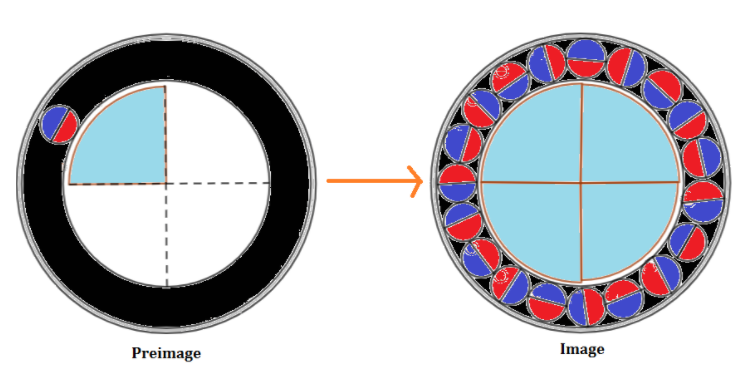
Step-By-Step Answers For Chapter 7 Congruence And Similarity In Glencoe Math Course 3 Volume 2 Page 507 Exercise 4, Problem1

At first, using circles and sections the preimage is created.

Then, this preimage is constantly reflected first over the horizontal plane and then over the vertical plane.

At last, the small circle is rotated repeated at a right angle in the clockwise direction.

This results in the formation of a logo.

Glencoe Math Course 3 Volume 2 Student 1st Edition Chapter 7 Congruence And Similarity Exercise Page 507 Exercise 4, Problem-1

The logo formed by using reflection and rotation is given in the image below.
image

Glencoe Math Course 3 Volume 2 Student Chapter 7 Page 508 Exercise 5 Problem1

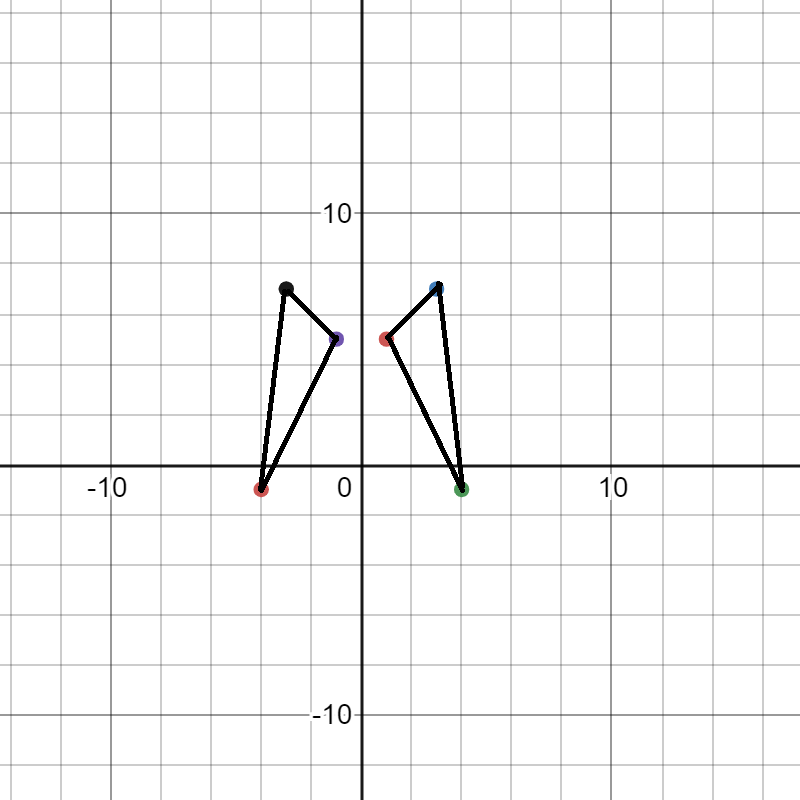
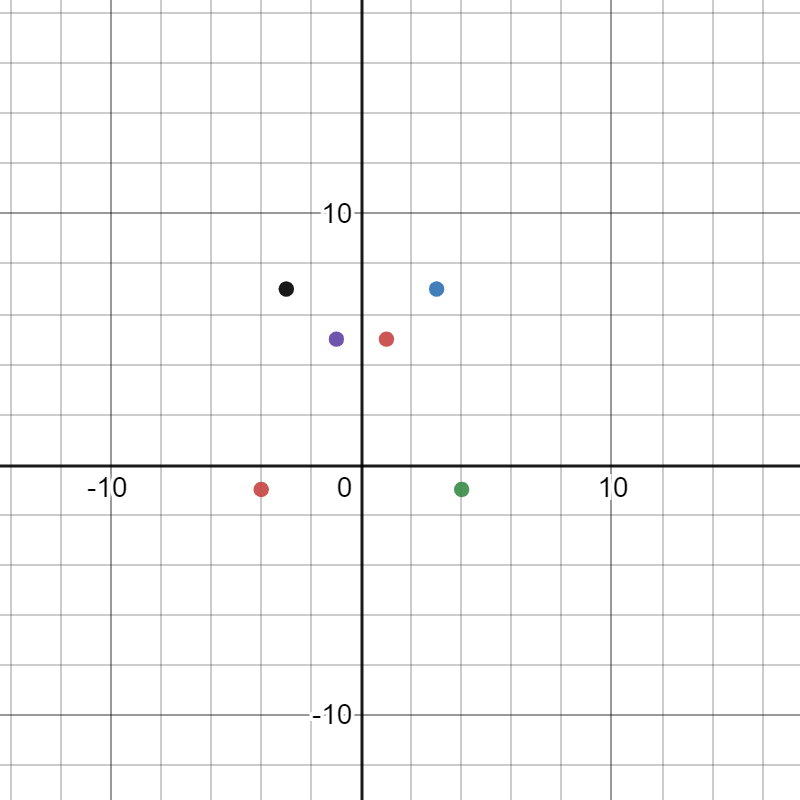
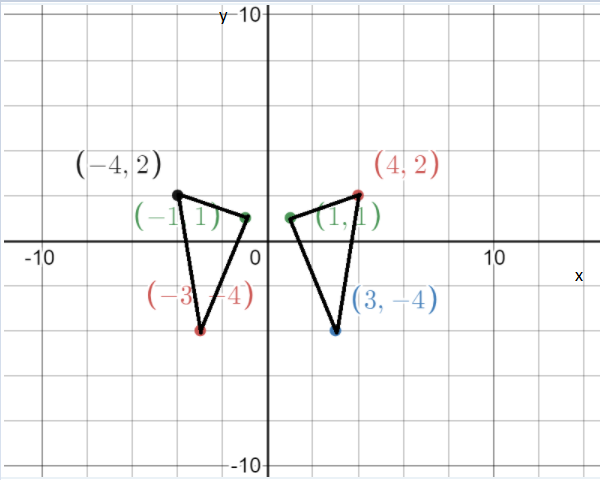
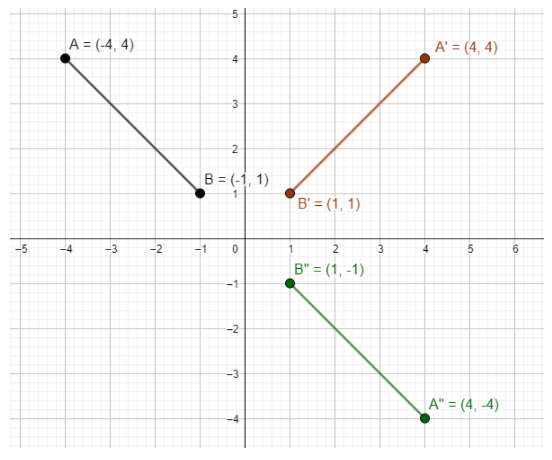
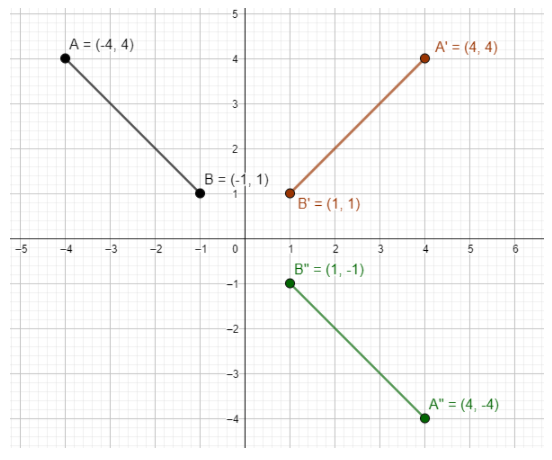
Let us consider the initial position of the line segment as (−4,4)and (−1,1).

After reflection from the x-axis, the x coordinates of the original image remain intact while they coordinates will be multiplied by −1.

After reflection from the y-axis, the x coordinates of the original image remain intact while the y coordinates will be multiplied by −1.

The resultant figure is given in the image below.

Glencoe Math Course 3 Volume 2 Student 1st Edition Chapter 7 Congruence And Similarity Exercise Page 508 Exercise 5, Problem-1


The final transformation is given in the image below.

Glencoe Math Course 3 Volume 2 Student 1st Edition Chapter 7 Congruence And Similarity Exercise Page 508 Exercise 5, Problem-1


Glencoe Math Course 3 Volume 2 Student Chapter 7 Page 508 Exercise 6 Problem1

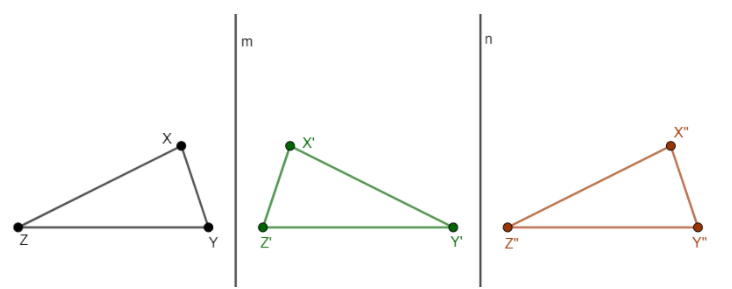
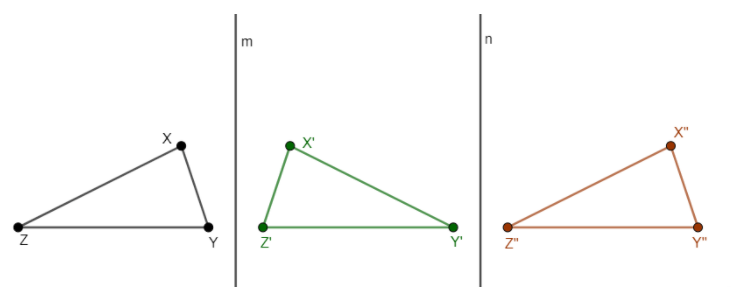
We consider two vertical axes. The ΔXYZ is first reflected over the first vertical axis and then, over the second axis.

The single transformation that could be used to obtain the final position of the triangle is by translating the original figure to the right-hand side.

Glencoe Math Course 3 Volume 2 Student 1st Edition Chapter 7 Congruence And Similarity Exercise Page 508 Exercise 6, Problem-1

The single transformation that can be used to obtain the following image is translation.

Glencoe Math Course 3 Volume 2 Student 1st Edition Chapter 7 Congruence And Similarity Exercise Page 508 Exercise 6, Problem-1

Glencoe Math Course 3 Volume 2 Student Chapter 7 Page 508 Exercise 7 Problem1

A dilation is a stretching or shrinking of an image that alters its location but does not change its shape.

To get the coordinates of the picture, we multiply each preimage coordinate by a scale factor when the coordinate plane’s centre of dilatation is the origin.When the scale factor is more than one, the size of the image is enlarged.

When the scale factor is less than one, the size of the image is reduced.When the scale factor is equal to one, the size of the image is unchanged.

A dilation is a stretching or shrinking of an image that alters its location but does not change its shape.

Page 504 Exercise 8, Problem1

After an object has been modified, the image of that object can be transformed again to create a new image. A combination of transformations is the name for such a transformation.

A single transformation can explain the transformation from a single object to the final image after a series of transformations.

An object’s image can be transformed again to generate a new image after it has been transformed. A combination of transformations is a type of transformation.

A single transformation can explain the transformation from a single object to the final image after a number of transformations have been applied.

Glencoe Math Course 2 Volume 1 Common Core Student Edition Chapter 3 Integers Exercise 3.2

Glencoe Math Course 2 Volume 1 Common Core Chapter 3 Integers Exercise 3.2


Glencoe Math Course 2 Volume 1 Chapter 3 Exercise 3.2 Solutions Page 203  Exercise 1 Problem  1

If you would increase the temperature by −5° then you would obtain a temperature of 0°

−5° +5° =0°

Finally, we concluded that the temperature that would make the sum of the two temperatures 0° ⇒ 5°


Glencoe Math Course 2 Volume 1 Common Core Chapter 3 Page 204  Exercise 1  Problem  2

Given:

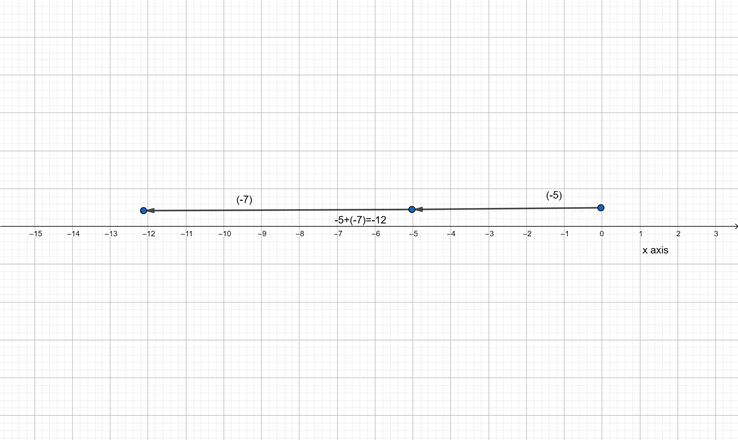
−5 + ( −7) = _____

To Find – The sum.

Given

​−5 + (−7) = −12

⇒ −12

​−5 + (−7) =  −12

Number line:


Glencoe Math Course 2, Volume 1, Common Core Student Edition, Chapter 3.2 Add integers Page 204 Exercise 1 graph 1

Finally, we find the sum  ⇒ −12

Glencoe Math Course 2 Student Edition Volume 1 Chapter 3 Integers Exercise 3.2

Read and Learn More Glencoe Math Course 2 Volume 1 Common Core Student Edition Solutions

Glencoe Math Course 2 Volume 1 Common Core Chapter 3 Integers Exercise 3.2

Given:

−10 + (−4)=_____

To Find –The sum.


Glencoe Math Course 2, Volume 1, Common Core Student Edition, Chapter 3.2 Add integers Page 204 Exercise 1 , graph 2

−10 + (−4)= -14

Finally, we find the sum  ⇒ −14


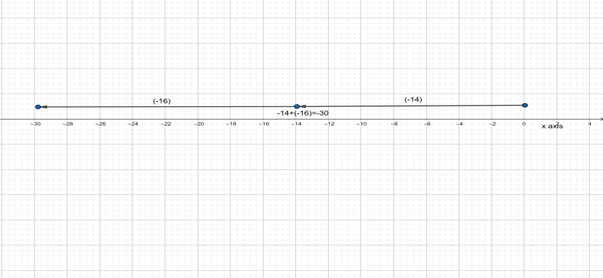
Given:

−14 + (−16) =

To Find – The sum.

Given

−14 + (−16) = −30

⇒ −30

Number line:


Glencoe Math Course 2, Volume 1, Common Core Student Edition, Chapter 3.2 Add integers Page 204 Exercise 1 , graph 3

Finally, we find the sum ⇒ −30

Glencoe Math Course 2 Volume 1 Common Core Chapter 3 Integers Exercise 3.2

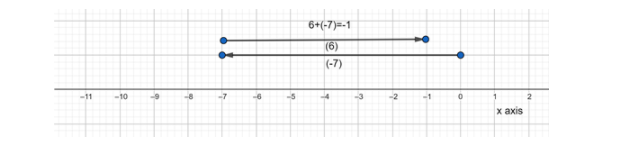
Given:

6 + (−7)=_____

To Find-  The sum.

Consider the operation given and simplify

​6 + (−7) = −1

⇒ −1

Glencoe Math Course 2, Volume 1, Common Core Student Edition, Chapter 3.2 Add integers Page 204 Exercise 1 , graph 4

The value of 6 + (−7) is −1

Glencoe Math Course 2 Volume 1 Common Core Chapter 3 Integers Exercise 3.2

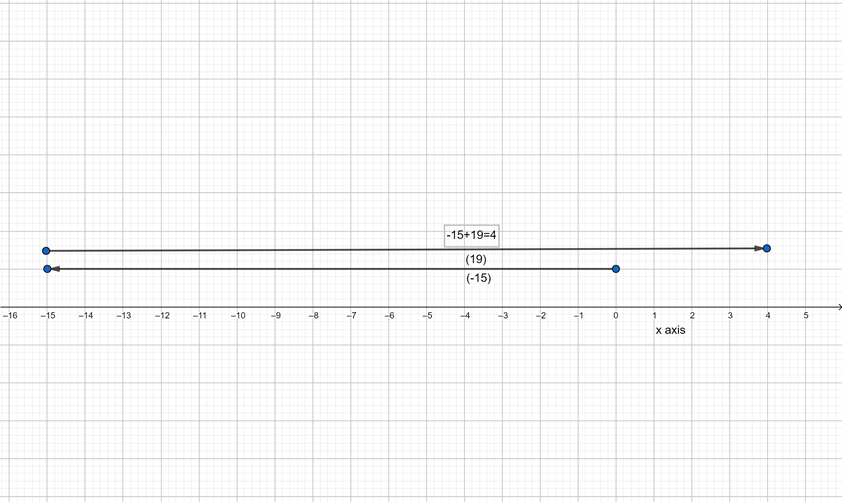
Given:

−15 + 19 =_____

To Find – The sum.

Given

​−15 + 19 = 4

⇒ 4

Number line:


Glencoe Math Course 2, Volume 1, Common Core Student Edition, Chapter 3.2 Add integers Page 204 Exercise 1 , graph 5

Finally, we find the sum  ⇒ 4

Glencoe Math Course 2 Volume 1 Common Core Chapter 3 Integers Exercise 3.2

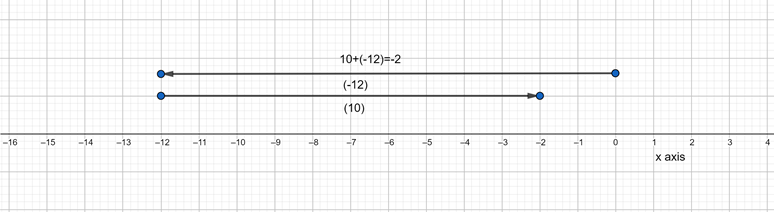
Given:

10 + (−12) =_____

To Find – The sum.

10 + (−12) =−2

= −2


Glencoe Math Course 2, Volume 1, Common Core Student Edition, Chapter 3.2 Add integers Page 204 Exercise 1 , graph 6

Finally, we find the sum ⇒−2


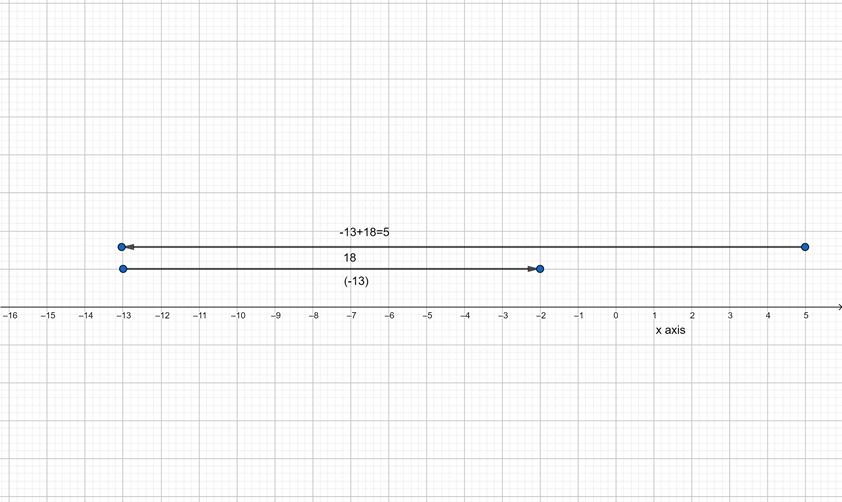
Given:

−13 + 18 =_____

To Find –  The sum.

−13 + 18 = 5

= 5


Glencoe Math Course 2, Volume 1, Common Core Student Edition, Chapter 3.2 Add integers Page 204 Exercise 1 , graph 7

Finally, we find the sum ⇒ 5

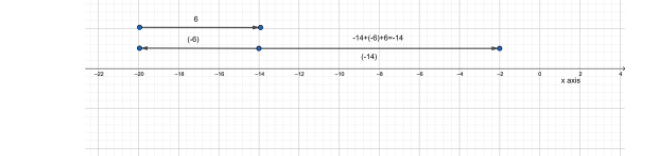
Glencoe Math Course 2 Volume 1 Common Core Chapter 3 Integers Exercise 3.2

Given:

−14 + (−6) + 6 =_____

To Find – The sum.

Consider the operation given and simplify

​−14 + (−6) + 6 = −14 + 0

= −14


Glencoe Math Course 2, Volume 1, Common Core Student Edition, Chapter 3.2 Add integers Page 204 Exercise 1 , graph 8

The value of −14+(−6)+6 is−14

Glencoe Math Course 2 Volume 1 Common Core Chapter 3 Integers Exercise 3.2

Given:

The temperature is−3°.An hour later it drops 6° and 2 hours later it rises 4°

To Write an additional expression to describe this situation. Then find the sum and explain its meaning

The temperature drops can best be represented by a negative number, while the temperature rise back is positive number.

−3−6 + 4 =−9 + 4 = 5

= 5

Finally we find the sum ⇒ −3− 6 + 4 = 5


Common Core Chapter 3 Integers Exercise 3.2 Answers Glencoe Math Course 2 Page 206  Exercise 1  Problem  3

Given:

−6 + (−8) =_____

To Find –  The sum.

−6 + (−8) = −14

= −14

Glencoe Math Course 2, Volume 1, Common Core Student Edition, Chapter 3.2 Add integers Page 206 Exercise 1 graph

Finally, we find the sum  ⇒ −14


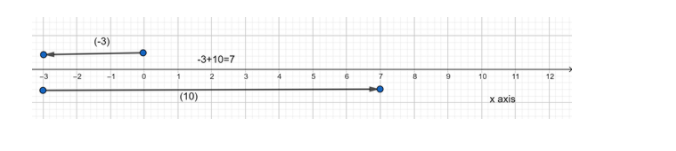
Step-By-Step Solutions For Exercise 3.2 Chapter 3 Integers In Glencoe Math Course 2 Page 206  Exercise 2  Problem  4

Given:

−3 + 10 =_____

To Find – The sum.

Consider the operation given and simplify

​−3 + 10 =7

⇒ 7

Glencoe Math Course 2, Volume 1, Common Core Student Edition, Chapter 3.2 Add integers Page 206 Exercise 2 graph

The value of−3 + 10 is  7


Glencoe Math Course 2 Volume 1 Common Core Chapter 3 Page 206  Exercise 3  Problem  5

Given:

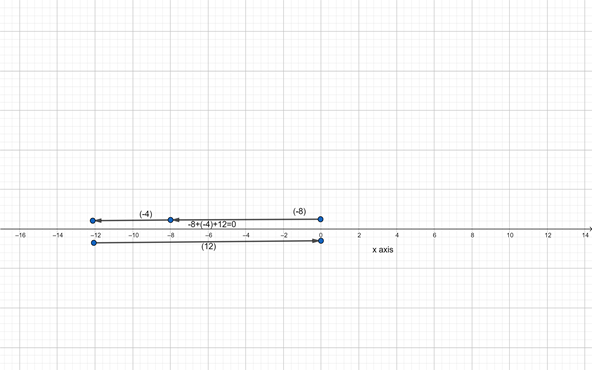
−8 + (−4) + 12 =_____

To Find –  The sum.

−8 + (−4) + 12 = − 12 + 12 = 0

⇒  0


Glencoe Math Course 2, Volume 1, Common Core Student Edition, Chapter 3.2 Add integers Page 206 Exercise 3 graph

Finally, we find the sum ⇒ 0


Page 206 Exercise 4   Problem  6

Given:

Sofia owes her brother $25

She gives her brother the $18

To write an addition expression.

The amount owed can best be represented by a negative number, while the amount paid back is a positive number.

− 25 + 18 − 7

= −7

This means that Sofia still owes her brother

Finally, we write the addition expression ⇒ −25 + 18 = −7


Glencoe Math Course 2 Volume 1 Common Core Chapter 3 Page 206  Exercise 5  Problem  7

The sum is positive

If the absolute value of the negative number is less than the absolute value of the positive number

If both numbers are positive The sum is negative

If the absolute value of the negative number is greater than the absolute value of the positive number

If both numbers are negative The sum is zero

If the absolute value of both integers is equal and if one is positive while the other is negative

Finally, we concluded that we can find a sum is positive, negative or zero without actually adding by the absolute value of the given integers.


Exercise 3.2 Solutions for Chapter 3 Integers Glencoe Math Course 2 Volume 1 Page 207  Exercise 1   Problem  8

Given:

−22 + (−16)

To add both numbers

Given equation is

​− 22 −16

=−38

If both numbers has a different sign, add the value and put the greatest value sign

Finally, we conclude the solution using an addition expression and the solution is −38


Glencoe Math Course 2 Volume 1 Common Core Chapter 3 Page 207   Exercise 2  Problem  9

Given:

−10 + (−15)

To add both numbers

If both numbers has a different sign, add the value and put the greatest value sign

​−10−15

= −25

Finally, we concluded an addition expression to solve the sum and the solution is −25


Examples of problems from Exercise 3.2 Chapter 3 Integers in Glencoe Math Course 2 Page 207  Exercise 3  Problem  10

Given:

6 + 10

To add  both numbers

If both numbers have a + sign, add the value and put a positive sign

​6 + 10

= 16

Finally, we concluded an addition expression to solve the sum and the solution is 16


Page 207  Exercise 4  Problem  11

Given:

21 + (−21) + (−4)

To add and subtract the numbers

If both numbers has a different sign, add the value and put the greatest value sign

​21 + (−21) + (−4)

= 21−21−4

= −4

Finally, we concluded an addition expression to solve the sum and the solution is −4


Glencoe Math Course 2 Volume 1 Common Core Chapter 3 Page 207  Exercise 5  Problem  12

Given:

17 + 20 + (−3)

To add and subtract the given numbers and find the result.

Add the first two numbers, then subtract 3 from their sum.

​17 + 20 + (−3)

= 37 − 3

= 34

The value of 17 + 20 + (−3)  is 34


Student Edition Glencoe Math Course 2 Chapter 3 Integers Exercise 3.2 solutions guide Page 207 Exercise 7 Problem  13

Given:

4 + 5

To add both numbers

If both numbers have + sign, add the value and put a positive sign

​4 + 5

= 9

Finally, we concluded an addition expression and the solution is 9


Page 207  Exercise 9  Problem  14

Given:

7 + (−11)

To add both numbers

If both numbers has a different sign, add the value and put the greatest value sign

​7 + (−11)

=  −4

Finally, we concluded the addition expression and the solution is −4


Glencoe Math Course 2 Volume 1 Common Core Chapter 3 Page 207  Exercise 10  Problem  15

Given:

$152 − $20 + $84

To find the sum and explain its meaning

If both numbers has different sign, add the value and put the greatest value sign

​$152 − $20 = $132

=  $132 + $84

=  $216

Finally, we concluded an additional expression to represent this situation is  $216


Page 208   Exercise 12  Problem  16

Given:

The given transactions are

Week one  $300

Week two $50

Week three $75

Week four $225

To find the sum and explain its meaning

The withdrawal represents negative (-) and the deposit represents positive (+).

So add the given values, we get

​$300 + (−$50) + (−$75) + $225

= −$125+$525

= $400

The total sum using the addition expression is $400


Glencoe Math Course 2 Volume 1 Common Core Chapter 3 Page 208  Exercise 14   Problem  17

The given equation x + (-x) =0 states the property of additive inverse because it has the sum of the number with opposite sides zero

The rule is to change the positive number to a negative number

Finally, we conclude the property as additive inverse property because it has the number wit opposite sides zero.


The given equations x + (-y) = −y + x states the property of commutative, because it allows you to interchange the numbers in a sum

This law simply states that with addition is commutative

Finally, we concluded the property is Commutative property because its interchanges the number in sums.


Step-by-step guide for Exercise 3.2 Chapter 3 Integers in Glencoe Math Course 2 Volume 1 Page 208  Exercise 17 Problem  18

Given:

−9 + m + (−6)

To simplify

Given equation is

​−9 + m + (−6)

= −9 + (−6) + m

=(−9 + (−6)) + m

= −15 + m

−9 + m + (−6) = −15 + m

​Finally, we concluded an addition expression to solve the sum and the solution is −15 + m

Glencoe Math Course 2 Volume 1 Common Core Chapter 3 Page 208  Exercise 18  Problem  19

The explanation for correct answer

(A) − 4 + 3

This is the correct answer because the blue line passing on the negative side and stop at −4 and the red line passing on the positive side and stop at 3

(B)−4 + 7

The blue line passing on the negative side and stop at −4 and the red line passing on the positive side and stop at 3, not at 7, so this is the wrong answer

(C) 3 + (−7)

The blue line passing on the negative side and stop at−4, not at 3 and the red line passing on the positive side and stop at 3, not at −7, so this is the wrong answer

(D) 0 + (−7)

The blue line passing on the negative side and stop at −4 not at 0 and the red line passing on the positive side and stop at  3, not at −7, so this is the wrong answer

Finally, we concluded that  (A) −4 + 3 is the correct expression represented by the number line.


Glencoe Math Course 2 Volume 1 Common Core Chapter 3 Page 209   Exercise 19  Problem  20

Given:

18 + (−5)

To add the given value

​18 + (−5)

= 18 + (−5) = 18 − 5

= 13

18 + (−5) = 13

Add both the number and the greatest number sign in the result

Finally, we concluded an addition expression to solve the sum and the solution is 13


Page 209   Exercise 20  Problem  21

Given:

−19 + 24

To add the given value

​−19 + 24

= −19 + 24 = 24 + (−19)

= 24 −19

= 5

−19 + 24 = 5

Add both the number and the greatest number sign in the result

Finally, we conclude the solution using addition expression and the solution is 5


Glencoe Math Course 2 Volume 1 Common Core Chapter 3 Page 209  Exercise 23  Problem  22

Given:

15 + 9 + (−9)

To add the given value

​15 + 9 + (−9)

= 24 + (−9)

= 24 − 9

= 15

15 + 9 + (−9) = 15

Add both the number and the greatest number sign in the result

Finally, we conclude the solution using addition expression and the solution is 15


Page 209  Exercise 24  Problem  23

Given:

−4 + 12 + (−9)

To add the given value

​−4 + 12 + (−9)

=  8 + (−9)

=  8 − 9

= −1

​−4 + 12 + (−9) = −1

Add both the number and the greatest number sign in the result

Finally, we conclude the solution using an addition expression and the solution is −1


Glencoe Math Course 2 Volume 1 Common Core Chapter 3 Page 209  Exercise 26  Problem  24

Given:

25 + 3 + (−25)

To add the given value

​25 + 3 + (−25)

=  28 + (−25)

=  28 − 25

=  3

​25 + 3 + (−25) =  3

Add both the number and the greatest number sign in the result

Finally, we conclude the solution using addition expression and the solution is 3


Page 209   Exercise 27  Problem  25

Given:

7 + (−19) + (−7)

To add the given value

​7 + (−19) + (−7)

= 7 − 19 − 7

= −12−7

= −19

7 + (−19) + (−7) = −19

Add both the number and the greatest number sign in the result

Finally, we conclude the solution using an addition expression and the solution is −19


Glencoe Math Course 2 Volume 1 Common Core Chapter 3 Page 209  Exercise 29  Problem  26

Given:

A quarterback is sacked for a loss of 5 yards

On the next day’s play, his team losses 15 yards.

Then the team gain 12 yards on the third play

Write an additional expression to describe each situation

The gain represents the positive numbers

The losses represent negative numbers

So it can be written as −5 + (−15) + 12

​−5 + (−15) + 12

= −20 + 12

= −8

​−5 + (−15) + 12 = −8

Add both the number and the greatest number sign in the result

Finally, we concluded that an addition expression to describe each situation is −5 + (−15) + 12


Page 210   Exercise 31  Problem  27

Given: Temperatures at 8 A.M and 1 P.M

To find – Temperature at 10 P.M

The temperature at  8 A.M was 3°F

The temperature rose at 1 A.M was 14°F

The temperature drops at 10 P.M were

The increase is denoted by a positive number and below zero or drop is denoted by a negative number.

From given

​−3 + 14 + (−12)

=  11 + (−12)

= −1

​−3 + 14 + (−12) = −1

​Thus, the temperature is 1°F  below zero.

The temperature at  10 P.M is 1°F below zero 


Glencoe Math Course 2 Volume 1 Common Core Chapter 3 Page 210  Exercise 32  Problem  28

Given: −8 + 7 + (−3)

To find -The value

Given that −8 + 7 + (−3)

The answer is  (−4)

Explanation:

−8 + 7 + (−3)

​=−1 + (−3)

= −4

−8 + 7 + (−3) = −4

The value −8 + 7 + (−3) of is −4 


Page 210  Exercise 30  Problem  29

Given: A bank deposit of $ 75

To find-  Integer format for a given situation.

A bank deposit of $ 75

Explanation:

A bank deposit will increase the money that is in your bank account and thus it is represented by a positive number.

Thus, the integer representation of this situation is 75

The integer representation for bank deposits is 75.


Page 210  Exercise 36  Problem  30

Given:  13°F below zero

To find –  Integer format for a given situation.

Given 13°F below zero.

Explanation:

The temperature below zero is represented by a negative number.

Thus, the integer representation of this situation is = 13°

The integer representation for temperature below zero is −13°


Glencoe Math Course 2 Volume 1 Common Core Chapter 3 Page 210   Exercise 37  Problem  31

Given: A gain of 4 yards

To find- Integer format for a given situation.

A gain of 4 yards

Explanation:

The gain will increase the number that you have and hence it is represented by a positive number.

Thus, the integer representation of this situation is 4.

The integer representation for a gain of yards is 4

Glencoe Math Course 2 Volume 1 Common Core Chapter 3 Page 210  Exercise 38  Problem  32

Given:  Spending of $12.

To find-  Integer format for a given situation.

Spending of $12.

Explanation:

Spending money will decrease the amount that you have and hence it is represented by a negative number.

Thus, the integer representation of this situation is −12.

The integer representation for spending of $12. is  −12

Glencoe Math Course 2 Volume 1 Common Core Student Edition Chapter 4 Rational Numbers Exercise

Glencoe Math Course 2 Volume 1 Common Core Chapter 4 Rational Numbers


Glencoe Math Course 2 Volume 1 Chapter 4 Rational Numbers Exercise Solutions Page 257  Exercise 1  Problem 1

When we add fractions with the same denominator, we add only the numerators.

To add fractions with unlike denominators, rename the fractions with a common denominator by finding the “Least common multiple”(LCM)

For example:  \(\frac{1}{4}\)+\(\frac{2}{4}\)=\(\frac{3}{4}\)

To subtract fractions with like denominators, subtract the numerators, and write the difference over the denominator.

To subtract fractions with unlike denominators, rename the fractions with a common denominator by finding the “Least common multiple”(LCM)

For example:  \(\frac{4}{2}\)–\(\frac{1}{2}\)=\(\frac{3}{2}\)

Glencoe Math Course 2 Student Edition Volume 1 Chapter 4 Rational Numbers Exercise

The numerators of both fractions are to be multiplied first, followed by the multiplication of the denominators.

Then, the resultant fraction is simplified to its lowest terms, if needed.

For example: \(\frac{1}{2}\)×\(\frac{1}{5}\)=\(\frac{1}{10}\)

Read and Learn More Glencoe Math Course 2 Volume 1 Common Core Student Edition Solutions

Dividing two fractions is the same as multiplying the first fraction by the reciprocal of the second fraction.

The first step to dividing fractions is to find the reciprocal (Reverse the numerator and denominator) of the second fraction.

Next, multiply the two numerators. Then, multiply the two denominators.

For example:  \(\frac{\frac{1}{2}}{\frac{3}{2}}\)=\(\frac{1}{2}\)×\(\frac{2}{3}\)

=  \(\frac{1}{3}\)

When we add, subtract, multiply, or divide fractions, a new fraction is obtained.


Common Core Chapter 4 Rational Numbers Exercise Answers Glencoe Math Course 2 Page 260 Exercise 1 Problem 2

Given: Here it is

∴ \(\frac{24}{36}\)

To find- Write each fraction in simplest form.

Here it is given that

\(\frac{24}{36}\) ÷ 12 = \(\frac{2}{3}\)

= \(\frac{2}{3}\)

∴ \(\frac{24}{36}\) = \(\frac{2}{3}\)

Therefore, The simplest form of the fraction is \(\frac{24}{36}\) = \(\frac{2}{3}\)

Step-By-Step Solutions For Chapter 4 Rational Numbers Exercises In Glencoe Math Course 2 Page 260  Exercise 2  Problem 3

Given: \(\frac{45}{50}\)

To find- Write each fraction in simplest form.

∴ \(\frac{45}{50}\)

Find the Greatest Common Factor (GCF) of 45 and 50, if it exists, and reduce our fraction by dividing both the numerator and denominator by it.

GCF = 5, and getting our simplified answer

\(\frac{45}{50}\) ÷ 5 = \(\frac{9}{10}\)

=  \(\frac{9}{10}\)

Therefore, The simplest form of the fraction is\(\frac{45}{50}\) =  \(\frac{9}{10}\)

Exercise Solutions For Chapter 4 Rational Numbers Glencoe Math Course 2 Volume 1 Page 260  Exercise 3  Problem 4

Given:

\(\frac{88}{121}\)

To find –  Write each fraction in simplest form.

⇒ \(\frac{88}{121}\)

Find the Greatest Common Factor (GCF) of 88 and 121, if it exists, and reduce our fraction by dividing both the numerator and denominator by it.

GCF = 11 and getting our simplified answer

\(\frac{88}{121}\)÷11= \(\frac{8}{11}\)

= \(\frac{8}{11}\)

Therefore, The simplest form of the fraction is  \(\frac{88}{121}\) = \(\frac{8}{11}\)

Examples Of Problems From Chapter 4 Rational Numbers Exercises In Glencoe Math Course 2 Page 260 Exercise 4 Problem 5

Given:

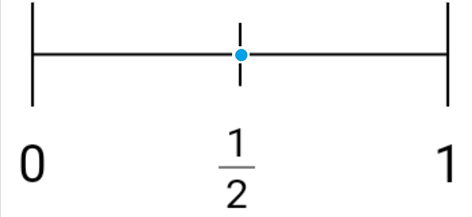
Graphing graph each fraction or mixed number on the number line below. \(\frac{1}{2}\)

To graph the fraction.

To find – The two whole numbers between which

0<\(\frac{1}{2}\)<1

Since the denominator is 2, divide each space into 2 sections.

Draw a dot at \(\frac{1}{2}\)

Glencoe Math Course 2, Volume 1, Common Core Student Edition, Chapter 4 Rational numbers Page 260 Exercise 4

Finally, we conclude that the graph has been plotted.


Student Edition Glencoe Math Course 2 Chapter 4 Rational Numbers Exercise Solutions Guide Page 260  Exercise 5  Problem  6

Given:

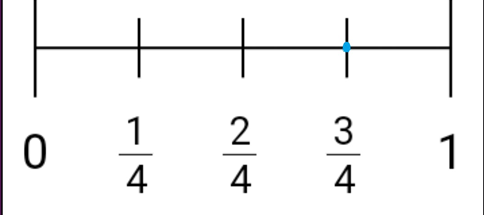
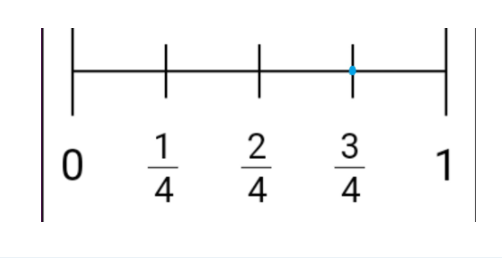
Graphing graph each fraction or mixed number on the number line below.\(\frac{3}{4}\)

To graph the fraction.

To find – The two whole numbers between which line below.\(\frac{3}{4}\)

0<\(\frac{3}{4}\)<1

Since the denominator is 4, divide each space into 4 sections.

Draw a dot at \(\frac{3}{4}\)


Glencoe Math Course 2, Volume 1, Common Core Student Edition, Chapter 4 Rational numbers Page 260 Exercise 5


The graph for the given fraction \(\frac{3}{4}\) is


Glencoe Math Course 2, Volume 1, Common Core Student Edition, Chapter 4 Rational numbers Page 260 Exercise 5.


Step-By-Step Guide For Chapter 4 Rational Numbers Exercises In Glencoe Math Course 2 Volume 1 Page 260  Exercise 6  Problem  7

Given:

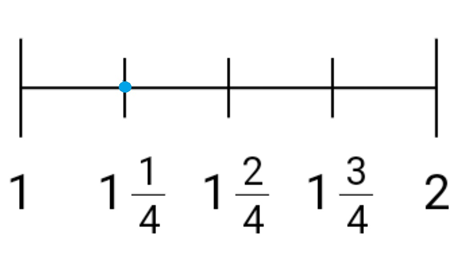
Graphing graph each fraction or mixed number on the number line below.

1\(\frac{1}{4}\)

To graph the fraction.

To find – The two whole numbers between which 1\(\frac{1}{4}\)

1<1\(\frac{1}{4}\)<2

Since the denominator is 4, divide each space into 4 sections.

Draw a dot at 1\(\frac{1}{4}\)

Glencoe Math Course 2, Volume 1, Common Core Student Edition, Chapter 4 Rational numbers Page 260 Exercise 6

Finally, we conclude that the graph has been plotted.


Page 260  Exercise 7  Problem  8

Given:

Graphing graph each fraction or mixed number on the number line below.

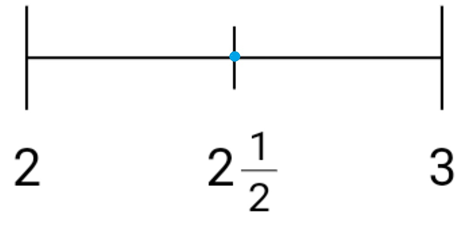
2\(\frac{1}{2}\)

To graph the fraction

To find –  The two whole numbers between which 2\(\frac{1}{2}\)

2<2\(\frac{1}{2}\)<3

Since the denominator is 2, divide each space into 2 sections.

Draw a dot at 2 \(\frac{1}{2}\)


Glencoe Math Course 2, Volume 1, Common Core Student Edition, Chapter 4 Rational numbers Page 260 Exercise 7

Finally, we conclude that the graph has been plotted.


Page 262   Exercise 1  Problem  9

Given:

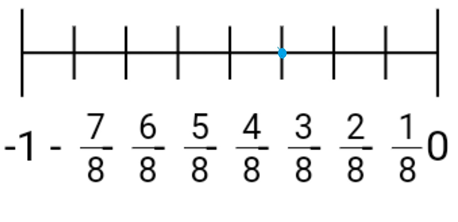
Graph each fraction on a number line. Use a bar diagram if needed. \(\frac{3}{8}\)

To graph the fraction.

To find – The two whole numbers between which −\(\frac{3}{8}\) lies

−1<−\(\frac{3}{8}\)<0

Since the denominator is  8, divide each space into 8 sections.

Draw a dot at −\(\frac{3}{8}\)


Glencoe Math Course 2, Volume 1, Common Core Student Edition, Chapter 4 Rational numbers Page 262 Exercise 1

Finally, we conclude that the graph has been plotted.


Page 262  Exercise 2  Problem  10

Given:

Graph each fraction on a number line. Use a bar diagram if needed.

−1\(\frac{2}{5}\)

Analyze the given and then graph the fraction.

To find – The two whole numbers between which −1\(\frac{2}{5}\) lies

−2<−1\(\frac{2}{5}\)<−1

Since the denominator is 5, divide each space into 5 sections.

Draw a dot at −1\(\frac{2}{5}\)


Glencoe Math Course 2, Volume 1, Common Core Student Edition, Chapter 4 Rational numbers Page 262 Exercise 2 , graph 1


The graph for −1\(\frac{2}{5}\) has been plotted:

Glencoe Math Course 2, Volume 1, Common Core Student Edition, Chapter 4 Rational numbers Page 262 Exercise 2 , graph 2


Page 262  Exercise 3  Problem  11

Given:

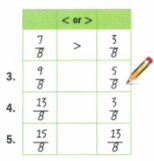
Glencoe Math Course 2, Volume 1, Common Core Student Edition, Chapter 4 Rational numbers Page 262 Exercise 3

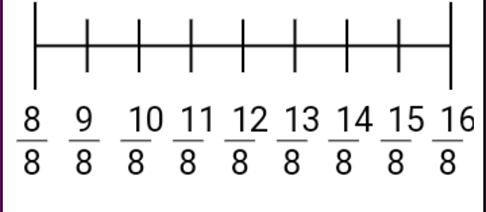
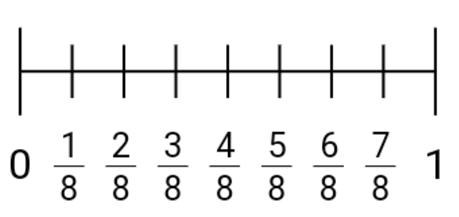
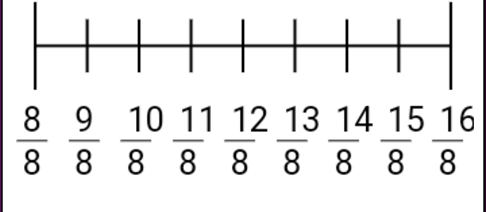
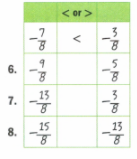
Use the number line and complete with < or >,

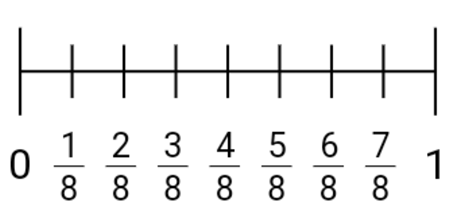
Plot the given fractions and Analyze the number line to complete the table

To find-  The greater one, first, we have to check whether the denominators are the same.

\(\frac{9}{8}\) and \(\frac{5}{8}\)

Both fractions have the same denominator.

Then check the signs.

In this case, both numbers are positive.

When comparing positive numbers, the larger number is greater.

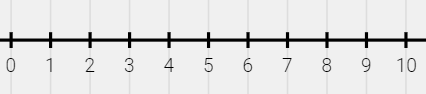
Glencoe Math Course 2, Volume 1, Common Core Student Edition, Chapter 4 Rational numbers Page 262 Exercise 3, graph 1

Hence, it is clear that \(\frac{9}{8}\)> \(\frac{5}{8}\)


The solution is  \(\frac{9}{8}\)> \(\frac{5}{8}\)

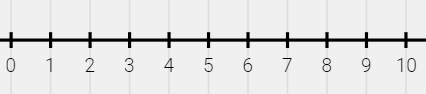
Glencoe Math Course 2, Volume 1, Common Core Student Edition, Chapter 4 Rational Page 262 Exercise 3, graph 2


Page 262   Exercise 4  Problem  12

Given:

Work with a partner to complete each table. Use the number if needed.

\(\frac{13}{8}\)>\(\frac{3}{8}\)

To complete with < or >.

Glencoe Math Course 2, Volume 1, Common Core Student Edition, Chapter 4 Rational numbers Page 262 Exercise 4 graph

Glencoe Math Course 2, Volume 1, Common Core Student Edition, Chapter 4 Rational numbers Page 262 Exercise 4 graph 2

Hence, it is clear that \(\frac{13}{8}\)>\(\frac{3}{8}\)

Finally, we conclude that the solution is \(\frac{13}{8}\)>\(\frac{3}{8}\)


Page 262  Exercise 5  Problem  13

Given:

Work with a partner to complete each table .Use a number if needed.

\(\frac{15}{8}\)>\(\frac{13}{8}\)

To complete with < or >

Glencoe Math Course 2, Volume 1, Common Core Student Edition, Chapter 4 Rational numbers Page 262 Exercise 5 graph 1


Glencoe Math Course 2, Volume 1, Common Core Student Edition, Chapter 4 Rational numbers Page 262 Exercise 5 graph 2

Hence, it is clear that  \(\frac{15}{8}\)>\(\frac{13}{8}\)

Finally, we conclude that the solution is  \(\frac{15}{8}\)>\(\frac{13}{8}\)


Page 262   Exercise 6  Problem  14

Given:

Glencoe Math Course 2, Volume 1, Common Core Student Edition, Chapter 4 Rational numbers Page 262 Exercise 6

Use the number line and complete with < or >.

Plot the given fractions and To find the greater one, first, we have to check whether the denominators are the same.

If we have both denominators.

Then check the signs.

In this case, both numbers are negative.

When comparing negative numbers, the larger number farther from zero is less.

Here −9 is farther from zero. It is less.

Glencoe Math Course 2, Volume 1, Common Core Student Edition, Chapter 4 Rational numbers Page 262 Exercise 6, graph 1


Hence, it is clear that −\(\frac{9}{8}\)<−\(\frac{5}{8}\)

The solution is −\(\frac{9}{8}\) <− \(\frac{5}{8}\)


Glencoe Math Course 2, Volume 1, Common Core Student Edition, Chapter 4 Rational numbers Page 262 Exercise 6, graph 2


Page 262  Exercise 9 Problem  15

Given:

Identify repeated reasoning compare and contrast the information in the tables.

To compare and contrast

From the table, we can understand that the positive numbers are plotted on the right of the zero on a number line and the negative numbers are plotted on the left side of the zero on a number line.

Also, the positive number values are going on increasing

=  \(\frac{7}{8}\)<\(\frac{9}{8}\)

The negative number values are goes on decreasing,  ⇒ −\(\frac{7}{8}\)>\(\frac{9}{8}\)

Finally, the information in the table has been explained.


Page 262  Exercise 10  Problem  16

Given:

Reason inductively how does graphing −\(\frac{3}{4}\) differ from graphing \(\frac{3}{4}\)

We know that, that the positive numbers are plotted on the right of the zero on a number line and the negative numbers are plotted on the left side of the zero on a number line.

Hence,-\(\frac{3}{4}\)is to be plotted on the left of the zero on a number line.

\(\frac{3}{4}\) is to be plotted on the right of the zero on a number line.

Finally, we can conclude that − \(\frac{3}{4}\) is to be plotted on the left of the zero on a number line. \(\frac{3}{4}\) is to be plotted on the right of the zero on a number line, this is the difference in their graphing.


Page 262  Exercise 11  Problem 17

Given:

How can you graph the negative fractions on the number line? To explain.

The negative numbers are plotted on the left side of the zero on a number line instead of moving right.

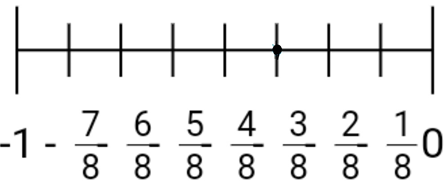
For example: To plot −\(\frac{7}{8}\)


Glencoe Math Course 2, Volume 1, Common Core Student Edition, Chapter 4 Rational numbers Page 262 Exercise 11, graph

Finally, we can conclude that the negative numbers are plotted on the left side of the zero on a number line.

Glencoe Math Course 2 Volume 1 Common Core Student Edition Chapter 4 Rational Numbers Exercise 4.1

Glencoe Math Course 2 Volume 1 Common Core Chapter 4 Rational Numbers


Glencoe Math Course 2 Volume 1 Chapter 4 Exercise 4.1 Solutions Page 264 Exercise 1 Problem 1

Given:

\(\frac{3}{10}\)

To find –  Write each fraction or mixed number as a decimal.

We know that

\(\frac{3}{10}\)

Use place value to write the equivalent decimal.

\(\frac{3}{10}\) = 0.3

So,\(\frac{3}{10}\) = 0.3

As a decimal, Each fraction or mixed number is \(\frac{3}{10}\) = 0.3 

Glencoe Math Course 2 Student Edition Volume 1 Chapter 4 Rational Numbers Exercise 4.1

Read and Learn More Glencoe Math Course 2 Volume 1 Common Core Student Edition Solutions

Given:

\(\frac{3}{25}\)

To find-  Write each fraction or mixed number as a decimal.

We know that

\(\frac{3}{25}\)

Use place value to write the equivalent decimal.

\(\frac{3}{25}\)\(=\frac{3 \times 4}{25 \times 4}\)

⇒  \(\frac{12}{100}\)

⇒  0.12

So, \(\frac{3}{25}\) = 0.12

As a decimal, Each fraction or mixed number is  \(\frac{3}{25}\) = 0.12

Glencoe Math Course 2 Volume 1 Common Core Chapter 4 Rational Numbers

Given:

− 6\(\frac{1}{2}\)

To find- Write each fraction or mixed number as a decimal.

We know that

−6\(\frac{1}{2}\)

−6\(\frac{1}{2}\) = −6+ \(\frac{1}{2}\)

⇒ −6 + 0.5

⇒ −5.5

So, -6\(\frac{1}{2}\) =−5.5

As a decimal, Each fraction or mixed number is −6\(\frac{1}{2}\) =−5.5


Given:

−\(\frac{7}{8}\)

To find- Write each fraction or mixed number as a decimal.

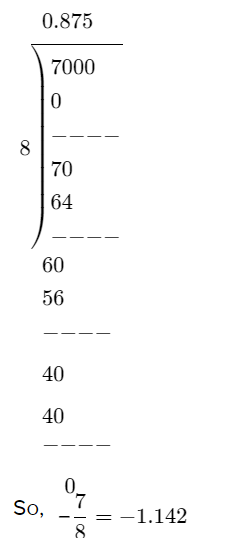
We know that −\(\frac{7}{8}\)
Glencoe Math Course 2, Volume 1, Common Core Student Edition, Chapter 4.1 Terminating and Repeating Decimals Page 264 Exercise 1 Answer 1

Then using long division for 7 divided by 8 and rounding Decimal Places gives us −1.142

Glencoe Math Course 2 Volume 1 Common Core Chapter 4 Rational Numbers

Given:

2\(\frac{1}{8}\)

To find- Write each fraction or mixed number as a decimal.

We know that

2\(\frac{1}{8}\)

= 2 + \(\frac{1}{8}\)
Glencoe Math Course 2, Volume 1, Common Core Student Edition, Chapter 4.1 Terminating and Repeating Decimals Page 264 Exercise 1 Answer 2

= 2 +0.125

= 2.125

2\(\frac{1}{8}\) = 2.125

Then using long division for  2\(\frac{1}{8}\) and rounding Decimal Places gives us 2.125


Given:

− \(\frac{3}{11}\)

To find- Write each fraction or mixed number as a decimal.

We know that

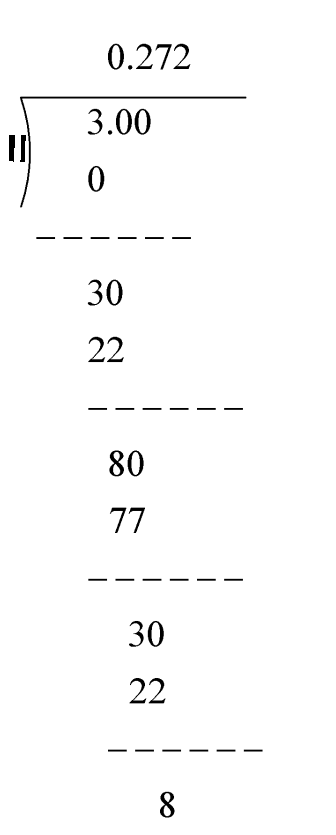
−\(\frac{3}{11}\)

Glencoe Math Course 2, Volume 1, Common Core Student Edition, Chapter 4.1 Terminating and Repeating Decimals Page 264 Exercise 1 Answer 3


So, −\(\frac{3}{11}\) = 0.273

Then using long division for –\(\frac{3}{11}\) and rounding Decimal Places gives us 0.273.

Glencoe Math Course 2 Volume 1 Common Core Chapter 4 Rational Numbers

Given:

8\(\frac{1}{3}\)

To find- Write each fraction or mixed number as a decimal.

We know that

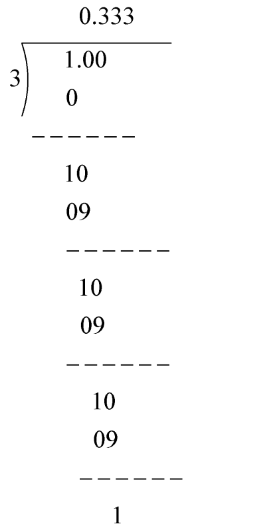
8\(\frac{1}{3}\)

=  8 + \(\frac{1}{3}\)

Glencoe Math Course 2, Volume 1, Common Core Student Edition, Chapter 4.1 Terminating and Repeating Decimals Page 264 Exercise 1 Answer 4

= 8 + 0.333 = 8.333

8\(\frac{1}{3}\) = 8.333

Then using long division for  8\(\frac{1}{3}\) and rounding Decimal Places gives us 8.333


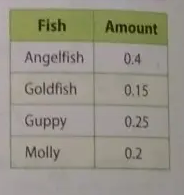
Given: Molly 0.2.

To find-  Write in simplest form

We know that

0.2

0.2 = \(\frac{2}{10}\)

= \(\frac{2}{10}\)

= \(\frac{1}{5}\)

So, \(\frac{1}{5}\) of the fish are Molly

Glencoe Math Course 2 Volume 1 Common Core Chapter 4 Rational Numbers

Given: Guppy 0.25

To find-  Write in simplest form

We know that

0.25

0.25 = \(\frac{25}{100}\)

= \(\frac{1}{4}\)

So , \(\frac{1}{4}\) of the fish are Guppy


Given:

Glencoe Math Course 2, Volume 1, Common Core Student Edition, Chapter 4.1 Terminating and Repeating Decimals Page 264 Exercise 1

Divide 0.4 by 10 as it is in tenth place, then write in simplest form.

We know that

0.4

0.4 = \(\frac{4}{10}\)

= \(\frac{2}{5}\)

The fraction of the aquarium made up by Angelfish is \(\frac{2}{5}\)


Glencoe Math Course 2 Volume 1 Common Core Chapter 4 Page 266  Exercise 1   Problem 2

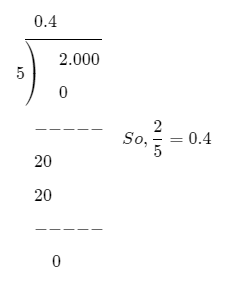
Given: \(\frac{2}{5}\)

To find- Write each fraction or mixed number as a decimal.

We know that

\(\frac{2}{5}\)
Glencoe Math Course 2, Volume 1, Common Core Student Edition, Chapter 4.1 Terminating and Repeating Decimals Page 266 Exercise 1 Answer

Then using long division for \(\frac{2}{5}\) and rounding Decimal Places gives us 0.4.


Step-By-Step Guide For Exercise 4.1 Chapter 4 Rational Numbers In Glencoe Math Course 2 Page 266  Exercise 2  Problem 3

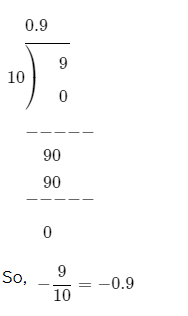
Given: − \(\frac{9}{10}\)

To find:- Write each fraction or mixed number as a decimal.

We know that

−\(\frac{9}{10}\)
Glencoe Math Course 2, Volume 1, Common Core Student Edition, Chapter 4.1 Terminating and Repeating Decimals Page 266 Exercise 2 Answer

Then using long division for −\(\frac{9}{10}\) and rounding Decimal Places gives us −0.9.


Glencoe Math Course 2 Volume 1 Common Core Chapter 4 Page 266  Exercise 3  Problem 4

Given:

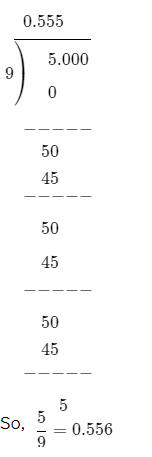
\(\frac{5}{9}\)

To find –  Write each fraction or mixed number as a decimal.

We know that

\(\frac{5}{9}\)
Glencoe Math Course 2, Volume 1, Common Core Student Edition, Chapter 4.1 Terminating and Repeating Decimals Page 266 Exercise 3 Answer

Then using long division for \(\frac{5}{9}\)  and rounding Decimal Places gives us 0.556.


Exercise 4.1 Solutions For Chapter 4 Rational Numbers Glencoe Math Course 2 Volume 1 Page 266  Exercise 4  Problem  5

Given: During a hockey game, an ice resurfacer travels 0.75 miles.

To find – The fraction which represents this distance.

We know that

0.75

​0.75=\(\frac{75}{100}\)

So, 0.75 = \(\frac{3}{4}\)

Finally, we concluded  0.75 = \(\frac{3}{4}\) fraction represents this distance.


Glencoe Math Course 2 Volume 1 Common Core Chapter 4 Page 267  Exercise 1  Problem 6

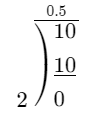
Given: \(\frac{1}{2}\)

To find- Write each fraction or mixed number as a decimal.

We know that

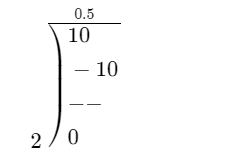
Glencoe Math Course 2, Volume 1, Common Core Student Edition, Chapter 4.1 Terminating and Repeating Decimals Page 267 Exercise 1 Answer

So, \(\frac{1}{2}\) = 0.5

Then using long division for 1 divided by 2 and rounding Decimal Places gives us 0.5


Examples of problems from Exercise 4.1 Chapter 4 Rational Numbers in Glencoe Math Course 2 Page 267  Exercise 2  Problem 7

Given: − 4\(\frac{4}{25}\)=

​To find- Write each fraction or mixed number as a decimal.

We know that

−4\(\frac{4}{25}\)

−4\(\frac{4}{25}\) = −4+\(\frac{4}{25}\)

= −4 + 0.16

= − 4.16

So, −4\(\frac{4}{25}\) = − 4.16

Because we know that 25 equals 100 (think quarters to a dollar), converting this fraction to a decimal in the hundredth place will be simple. 4 Times 25 is multiplied by 100 (again, 4 quarters make a dollar).

This means we’d have to multiply 4 by 4 to get \(\frac{16}{100}\)

The decimal for \(\frac{16}{100}\) is 0.16 As a result, 4 equals  \(\frac{4}{25}\) − 4.16

Finally, The decimal for  \(\frac{16}{100}\)  As a result, 4 and equals −4.16.


Glencoe Math Course 2 Volume 1 Common Core Chapter 4 Page 267  Exercise 3  Problem 8

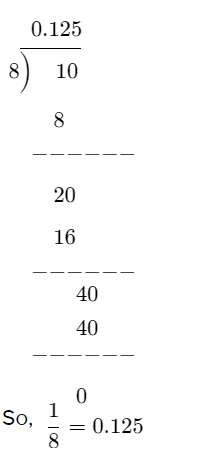
Given: \(\frac{1}{8}\)

To find- Write each fraction or mixed number as a decimal.

We know that

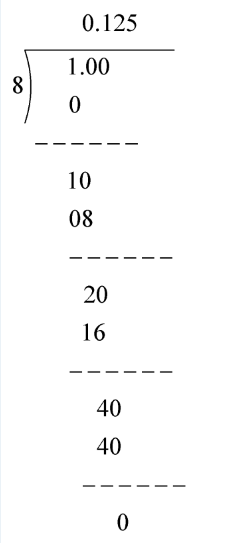
\(\frac{1}{8}\)
Glencoe Math Course 2, Volume 1, Common Core Student Edition, Chapter 4.1 Terminating and Repeating Decimals Page 267 Exercise 3 Answer

Then using long division for 1 divided by 8 and rounding Decimal Places gives us 0.125.


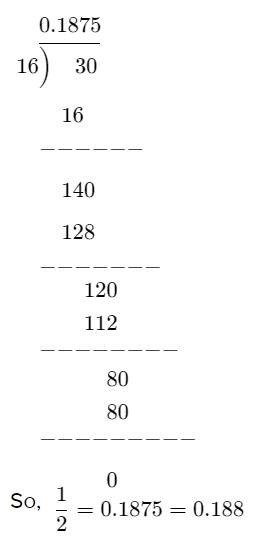
Common Core Exercise 4.1 Chapter 4 Rational Numbers detailed solutions Glencoe Math Course 2 Page 267  Exercise 4  Problem 9

Given:  \(\frac{3}{16}\)

To find- Write each fraction or mixed number as a decimal.

We know that

\(\frac{3}{16}\)
Glencoe Math Course 2, Volume 1, Common Core Student Edition, Chapter 4.1 Terminating and Repeating Decimals Page 267 Exercise 4 Answer

Then using long division for 3 divided by 16 and rounding Decimal Places gives us 0.188


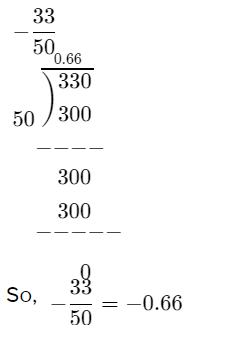
Glencoe Math Course 2 Volume 1 Common Core Chapter 4 Page 267  Exercise 5  Problem 10

Given: −\(\frac{33}{50}\)

To find-  Write each fraction or mixed number as a decimal.

We know that –\(\frac{33}{50}\)
Glencoe Math Course 2, Volume 1, Common Core Student Edition, Chapter 4.1 Terminating and Repeating Decimals Page 267 Exercise 5 Answer
Then using long division for −\(\frac{33}{50}\) and rounding Decimal Places gives us−0.66.


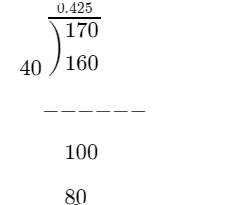
Student Edition Glencoe Math Course 2 Chapter 4 Rational Numbers Exercise 4.1 solutions guide Page 267  Exercise 6  Problem 11

Given: − \(\frac{17}{40}\)

To find- Write each fraction or mixed number as a decimal.

We know that −\(\frac{17}{40}\)

Glencoe Math Course 2, Volume 1, Common Core Student Edition, Chapter 4.1 Terminating and Repeating Decimals Page 267 Exercise 6 Answer

Then using long division for − \(\frac{17}{40}\) and rounding Decimal Places gives us 0.425


Glencoe Math Course 2 Volume 1 Common Core Chapter 4 Page 267  Exercise 7  Problem 12

Given:  5\(\frac{7}{8}\)

To find- Write each fraction or mixed number as a decimal.

We know that

5\(\frac{7}{8}\)

Multiply the denominator by the whole number 8 × 5 = 40

Add the answer to the numerator 5\(\frac{7}{8}\)

40 + 7 = 47

\(\frac{47}{8}\)

Simplified solution

\(=\frac{8 \times 5+7}{8}\)= \(\frac{47}{8}\)

= 5.875

So,5\(\frac{7}{8}\)= 5.875

Then using long division for  5\(\frac{7}{8}\)  and rounding Decimal Places gives us 5.875.


Step-by-step answers for Exercise 4.1 Chapter 4 Rational Numbers in Glencoe Math Course 2 Volume 1 Page 267  Exercise 8  Problem 13

Given:  9\(\frac{3}{8}\)

To find- Write each fraction or mixed number as a decimal.

We know that

9\(\frac{3}{8}\)

9\(\frac{3}{8}\) = 9 + \(\frac{3}{8}\)

=  9.375

So, 9\(\frac{3}{8}\) = 9.37

Then using long division for  9\(\frac{3}{8}\) and rounding Decimal Places gives us 9.37.


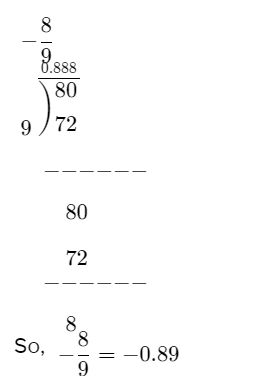
Glencoe Math Course 2 Volume 1 Common Core Chapter 4 Page 267   Exercise 9  Problem 14

Given: −\(\frac{8}{9}\)

We know that

Glencoe Math Course 2, Volume 1, Common Core Student Edition, Chapter 4.1 Terminating and Repeating Decimals Page 267 Exercise 9 Answer

Then using long division for −\(\frac{8}{9}\) and rounding Decimal Places gives us−0.89.


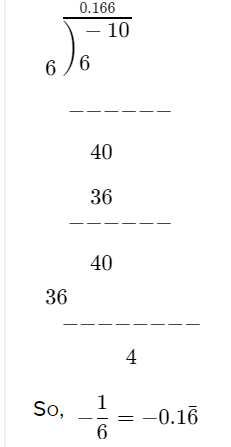
Page 267   Exercise 10  Problem 15

Given:  − \(\frac{1}{6}\)

To find – Using long division write each fraction or mixed number as a decimal.

Given

−\(\frac{1}{6}\)

Glencoe Math Course 2, Volume 1, Common Core Student Edition, Chapter 4.1 Terminating and Repeating Decimals Page 267 Exercise 10 Answer

The decimal form of −\(\frac{1}{6}\) = − 0.1666


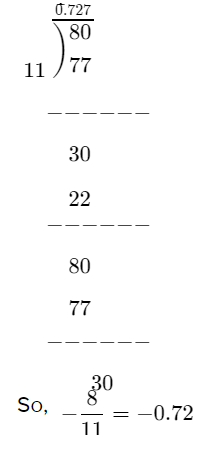
Glencoe Math Course 2 Volume 1 Common Core Chapter 4 Page 267  Exercise 11 Problem 16

Given: −\(\frac{8}{11}\)

To find- Write each fraction or mixed number as a decimal.

We know that

\(\frac{8}{11}\)

Glencoe Math Course 2, Volume 1, Common Core Student Edition, Chapter 4.1 Terminating and Repeating Decimals Page 267 Exercise 11 Answer

Then using long division for −\(\frac{8}{11}\)and rounding Decimal Places gives us −0.72.


Page 267  Exercise 12  Problem 17

Given:  2\(\frac{6}{11}\)

To find – Write each fraction or mixed number as a decimal.

We know that

2\(\frac{6}{11}\)

2\(\frac{6}{11}\) = 2 +  \(\frac{6}{11}\)

=  2 + 0.5454

=  2.5454

So, 2\(\frac{6}{11}\) = 2.545

Then using long division for  2\(\frac{6}{11}\)  and rounding Decimal Places gives us 2.545.


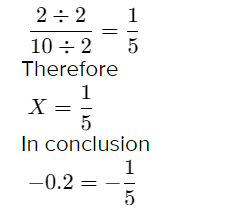
Glencoe Math Course 2 Volume 1 Common Core Chapter 4 Page 267  Exercise 13  Problem 18

Given:−0.2

To find- Write each decimal as a fraction or mixed number in simplest form.

We know that

−0.2

Remove the negative sign from the positive decimal value, convert it to a positive fraction, and then apply the negative sign to the fraction response.

Rewrite the decimal number as a fraction with 1  in the denominator

0.2 = \(\frac{0.2}{1}\)

Multiply to remove 1 decimal place. Here, you multiply top and bottom by 101 = 10

\(\frac{0.2}{1}\) × \(\frac{10}{10}\)

=  \(\frac{2}{10}\)

Find the Greatest Common Factor (GCF) of 2 and 10, if it exists, and reduce the fraction by dividing both the numerator and denominator by GCF = 2

Glencoe Math Course 2, Volume 1, Common Core Student Edition, Chapter 4.1 Terminating and Repeating Decimals Page 267 Exercise 13

Here, we concluded the mixed fraction in simplest form is −0.2 = − \(\frac{1}{5}\)


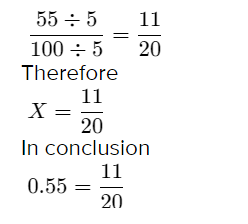
Page 267  Exercise 14  Problem 19

Given: 0.55

To find- Write each decimal as a fraction or mixed number in simplest form.

We know that0.55 Rewrite the decimal number as a fraction within the denominator

0.55  = \(\frac{0.55}{1}\)

Multiply to remove 2 decimal places. Here, you multiply the top and bottom by 102

= 1000\(\frac{0.55}{1}\)× \(\frac{100}{100}\) =  \(\frac{55}{100}\)

Find the Greatest Common Factor (GCF) of 55 and 100, if it exists, and reduce the fraction by dividing both numerator and denominator by GCF = 5
Glencoe Math Course 2, Volume 1, Common Core Student Edition, Chapter 4.1 Terminating and Repeating Decimals Page 267 Exercise 14

Here, we concluded the mixed fraction in simplest form is 0.55 =\(\frac{11}{20}\)


Glencoe Math Course 2 Volume 1 Common Core Chapter 4 Page 267  Exercise 15  Problem 20

Given: 5.96

To find- Write each decimal as a fraction or mixed number in simplest form.

We know that

5.96

Rewrite the decimal number as a fraction with 1 in the denominator

5.96 = \(\frac{5.96}{1}\)

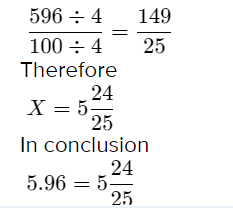
Multiply to remove 2 decimal places. Here, you multiply top and bottom by 102 = 100\(\frac{5.96}{1}\)×\(\frac{100}{100}\)=\(\frac{596}{100}\)

Find the Greatest Common Factor (GCF) of 596 and 100, if it exists, and reduce the fraction by dividing both numerator and denominator by GCF = 4

Glencoe Math Course 2, Volume 1, Common Core Student Edition, Chapter 4.1 Terminating and Repeating Decimals Page 267 Exercise 15

Here, we concluded the mixed fraction in simplest form is 5.96 = 5\(\frac{24}{25}\)


Page 267   Exercise 17   Problem 21

Given: A Praying mantis is an interesting insect that can rotate its head 180 degrees.

Suppose the praying mantis at the right is 10.5 centimeters long.

To find- The mixed number that represents this length.

We know that

Now think about the length you’ve been given 10.5

10.5 = 10 + 0.5

Because 10 is an integer, all we have to do now is convert 0.5 to fractional form to get a mixed number.

0.5 = \(\frac{5}{10}\)=\(\frac{1}{2}\)

Thus, the number is

10 + 0.5 = 10 + \(\frac{1}{2}\)

⇒ 10 \(\frac{1}{2}\)

As a result, the needed mixed number is 10\(\frac{1}{2}\).

Finally,  10\(\frac{1}{2}\)mixed number represents this length.

Glencoe Math Course 2 Volume 1 Common Core Chapter 4 Page 268  Exercise 18  Problem 22

Given: Suppose you buy a 1.25− pound package of ham at $5.20 per pound. Find the fraction of the pound bought that is find the portion purchased

\(\frac{\text { Number of pounds}}{\text {1 pound }}\)

⇒ \(\frac{1.25}{1}\)

⇒ \(\frac{125}{100}\)

⇒ \(\frac{5}{4}\)

Finally, \(\frac{5}{4}\) fraction of a pound did you buy.


Given: Suppose you buy a 1.25− pound package of ham at $5.20 per pound.

To find – How much money did you spend?

We know that

The amount of ham purchased in pounds = 1.25

We have a Ham of 1 pound = ​​$​​5.20

The amount spent on ham = The fraction of a pound bought × Price per pound

⇒   \(\frac{5}{4}\) × 5.20

⇒  5 × 1.3

⇒   ​​$​​6.5.

​Finally, ​​$​​6.5 amount is spend on ham.


Glencoe Math Course 2 Volume 1 Common Core Chapter 4 Page 268  Exercise 19  Problem 23

Given: Write a fraction that is equivalent to a terminating decimal between 0.5and0.75.

To find-  Write a fraction

We have Because both 0.5 and 0.75 are at two places after decimals, we know they are terminating.

Finding the average of a number that is between these two can be done by adding it and then dividing by two.

Adding both value =0.5 + 0.75 = 1.25

When you divide it by two, you get = 1.25  by 2 = 0.625

When we convert it to a fraction, we obtain

​⇒ \(\frac{0.625}{1}\)

​⇒ \(\frac{625}{1000}\)

​⇒ \(\frac{5}{8}\)

Finally, \(\frac{5}{8}\) is the terminating decimal.


Page 268  Exercise 20  Problem 24

Given Fractions in the simplest form that have denominators of2,4,8,16 and 32produce terminating decimals.

Fractions with denominators of  6,12,18, and 24 produce repeating decimals.

To find – The causes of difference.

As you can see, the denominator in  2,4,8,16,32  is of the kind  21,22,23,24,25.  As a result, the decimal comes to an end.

Consider fractions with denominators of 6,12,18,24.

Now, among all of these

6 = 2.3

12 = 2.2.3

18 = 2.3.3

24 = 2.2.2.3

All of these integers’ prime factors include a factor other than 2, namely 3.

As previously stated, if the denominator is not in the form of  2m or 5n or 2m⋅5 the decimal is non-terminating.


Glencoe Math Course 2 Volume 1 Common Core Chapter 4 Page 268  Exercise 21  Problem 25

Given The value of pi (π)  is 3.1415926…. The mathematician Archimedes believed that π was between 3 \(\frac{1}{7}\) and 3\(\frac{10}{71}\)

Convert the mixed fraction to improper fraction and solve further

Then check whether Archimedes is correct

We know that

π = 3.1415927

3 \(\frac{1}{7}\)

3 \(\frac{1}{7}\) = 3 + \(\frac{1}{7}\)

We know that

\(\frac{1}{7}\)

Is the same as 1 ÷ 7

Therefore, 3\(\frac{1}{7}\) = 3 + (1÷7)

3 + 0.143 = 3.143

3 \(\frac{10}{71}\)= 3 + \(\frac{10}{71}\)

We know that\(\frac{10}{71}\) Is the same as 10 ÷ 71

Then

3 + \(\frac{10}{71}\)= 3+(10÷71)

3 + 0.141 = 3.141

π = 3.1415927

π value has been rounded to seven decimal digits.

3\(\frac{1}{7}\)  = 3.1428571

Compare these numbers to ensure that pi is contained within the mixed fractions.

3\(\frac{10}{71}\) = 3.1408451

= 3.1408451

It is in this instance.

Finally, we concluded the Archimedes’ statement is correct.


Glencoe Math Course 2 Volume 1 Common Core Chapter 4 Page 268  Exercise 22  Problem 26

Given:

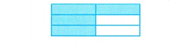
Tanya drew a model for the fraction\(\frac{4}{6}\)

Glencoe Math Course 2, Volume 1, Common Core Student Edition, Chapter 4.1 Terminating and Repeating Decimals Page 268 Exercise 22

Which of the following decimals is equal to \(\frac{4}{6}\)

​A. 0.666

B. 0.6

C. 0.667

D. 0.66777

To find – The decimals.

\(\frac{4}{6}\) = 0.666

Finally, we can conclude that the answer is options A and B.


Page 269   Exercise 23  Problem 27

Given:  \(\frac{4}{5}\)

To find-  Write each decimal as a fraction or mixed number in simplest form.

We know that
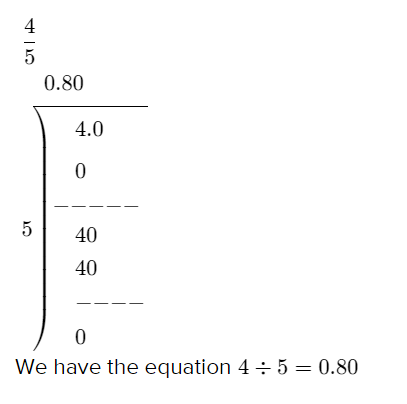
Glencoe Math Course 2, Volume 1, Common Core Student Edition, Chapter 4.1 Terminating and Repeating Decimals Page 269 Exercise 23 Answer

We have the equation  4÷5 = 0.80

Then using long division for 4 divided by 5 and rounding Decimal Places gives us 0.80.


Glencoe Math Course 2 Volume 1 Common Core Chapter 4 Page 269  Exercise 25  Problem 28

Given: − \(\frac{4}{9}\)

To find− Using long division write each fraction or mixed number as a decimal.

We know that
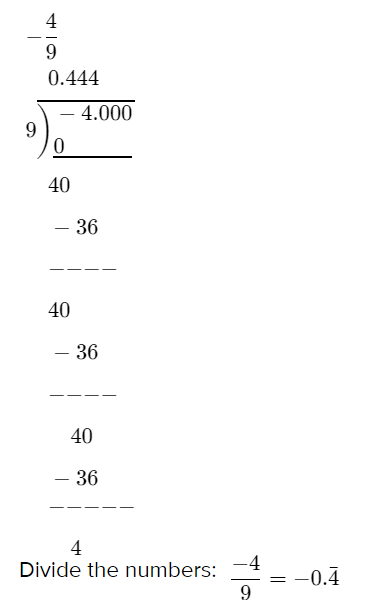
Glencoe Math Course 2, Volume 1, Common Core Student Edition, Chapter 4.1 Terminating and Repeating Decimals Page 269 Exercise 25 Answer

The decimal form of  − \(\frac{4}{9}\) is − 0.4444


Page 269  Exercise 26   Problem 29

Given:  5\(\frac{1}{3}\)

To find –  Write each decimal as a fraction or mixed number in simplest form.

We know that

Multiply the denominator by the whole number 3 × 5 = 15

Add the answer to the numerator 15 + 1 = 16

Write the answer over the denominator  = \(\frac{16}{3}\)

Simplified Solution

⇒  \(\frac{3×5+1}{3}\) = \(\frac{16}{3}\)

⇒   5.33

Then using long division for   5\(\frac{1}{3}\) rounding Decimal Places gives us 5.33.


Glencoe Math Course 2 Volume 1 Common Core Chapter 4 Page 269  Exercise 27  Problem 30

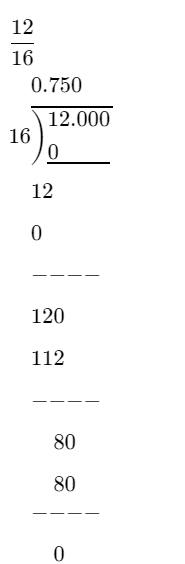
Given: The fraction of a dime that is made up of copper is \(\frac{12}{16}\)

To find- Write this fraction as a decimal

We know that
Glencoe Math Course 2, Volume 1, Common Core Student Edition, Chapter 4.1 Terminating and Repeating Decimals Page 269 Exercise 27 Answer

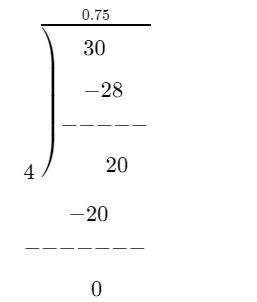
We have the equation 16 ÷ 12 = 0.750

Then using long division for  \(\frac{12}{16}\)  ,rounding Decimal Places gives us 0.750.


Page 269  Exercise 28  Problem 31

Given:

−0.9

To find- Decimal to a fraction or mixed fraction

Here −0.9

Rewrite the decimal number as a fraction with1 in the denominator

0.9  =  \(\frac{0.9}{1}\)

Multiply to remove 1 decimal place. Here, you multiply top and bottom by 101 = 10

\(\frac{0.9}{1}\)×\(\frac{10}{10}\) = \(\frac{9}{10}\)

⇒ −0.9 = −\(\frac{9}{10}\)

Finally, we concluded the value in decimal to fraction −0.9  = −\(\frac{9}{10}\)


Glencoe Math Course 2 Volume 1 Common Core Chapter 4 Page 269  Exercise 29  Problem 32

Given:

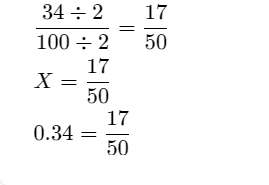
0.34

To find- Decimal to a fraction or mixed fraction

​Here it is given that  0.34

Rewrite the decimal number as a fraction with 1 in the denominator

0.34 = \(\frac{0.34}{1}\)

Multiply to remove 2 decimal places. Here, you multiply top and bottom by  102 = 100

\(\frac{0.34}{1}\) × \(\frac{100}{100}\)

=\(\frac{34}{100}\)

Find the Greatest Common Factor (GCF) of 34 and 100, if it exists, reduce the fraction by dividing both numerator and denominator by GCF = 2

Glencoe Math Course 2, Volume 1, Common Core Student Edition, Chapter 4.1 Terminating and Repeating Decimals Page 269 Exercise 29 Answer

Finally, we concluded the value in decimal to fraction   0.34 = \(\frac{17}{50}\)


Page 269   Exercise 30  Problem 33

Given:

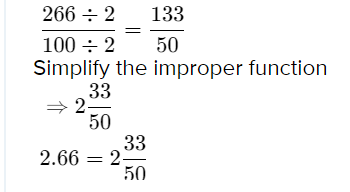
2.66

To find- Decimal to a fraction or mixed fraction

Here it is given that

2.66

Rewrite the decimal number as a fraction with 1 in the denominator

2.66 = \(\frac{2.66}{1}\)

Multiply to remove 2 decimal places. Here, you multiply the top and bottom by 102

\(\frac{2.66}{1}\)×\(\frac{100}{100}\)

=  \(\frac{266}{100}\)

Find the Greatest Common Factor (GCF) of 266 and 100, if it exists, reduce the fraction by dividing both numerator and denominator by GCF= 2
Glencoe Math Course 2, Volume 1, Common Core Student Edition, Chapter 4.1 Terminating and Repeating Decimals Page 269 Exercise 30 Answer

Finally, we concluded the value in decimal to fraction  2.66= 2 \(\frac{33}{50}\)


Glencoe Math Course 2 Volume 1 Common Core Chapter 4 Page 269  Exercise 31  Problem 34

Here an integer is given to us.

−13

We have to convert this into an improper fraction.

Any natural number which has to be converted into a fraction we divided by 1. So now −13 is converted −\(\frac{13}{1}\)

Therefore,  −\(\frac{13}{1}\)is the final answer.


Page 269   Exercise 32   Problem 35

We are given a mixed fraction.

7 \(\frac{1}{3}\)

We have to convert it into an improper fraction.

To convert 7\(\frac{1}{3}\)into an improper fraction

We multiply 7 with 3 and add 1 to the product.

​(7 × 3) + 1 = 22

Therefore, 22 is the numerator.

So, the improper fraction is  \(\frac{22}{3}\)

Finally, we conclude the value in an improper fraction  \(\frac{22}{3}\)


Glencoe Math Course 2 Volume 1 Common Core Chapter 4 Page 269  Exercise 33  Problem 36

We are given a negative decimal value

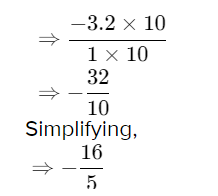
−3.2.

We have to convert it into a negative improper fraction.

Take the decimal −3.2.

Multiply and divide the decimal by 10.
Glencoe Math Course 2, Volume 1, Common Core Student Edition, Chapter 4.1 Terminating and Repeating Decimals Page 269 Exercise 33 Answer

Finally, we conclude, the value of the final answer is − \(\frac{16}{5}\)


Page 269  Exercise 34  Problem 37

Here we are given the time in hours and minutes.

We have to convert it into a decimal.

We are given Nicholas’ time playing the cello as 2 hours and 18 minutes.

First, we convert hours into minutes by multiplying by 60.

2 × 60  = 120 minutes.

Now adding it with the 18-minute

We get 138 minutes.

Now dividing by 60

​⇒  \(\frac{138}{60}\)

​⇒  \(\frac{23}{10}\)

2.3 Hour

Nicholas has been playing the cello for 2.3 hours.


Glencoe Math Course 2 Volume 1 Common Core Chapter 4 Page 270  Exercise 35  Problem 38

Given and Find:

We are given fraction and their recurring decimals.

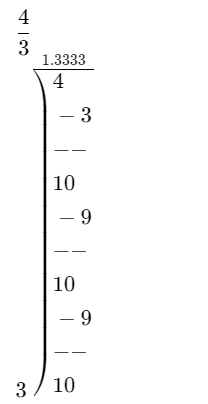
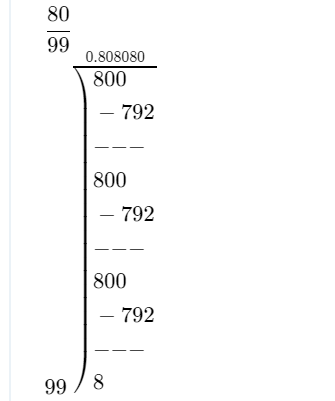
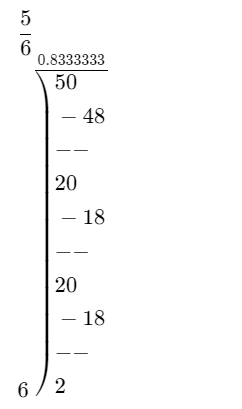
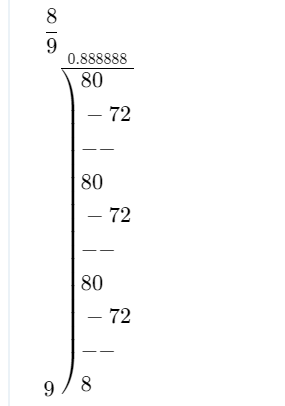
We have to find out which fraction corresponds to 0.88888.

Take option A
Glencoe Math Course 2, Volume 1, Common Core Student Edition, Chapter 4.1 Terminating and Repeating Decimals Page 270 Exercise 35 Answer 1

1.333333 is not the required answer.

Take option B
Glencoe Math Course 2, Volume 1, Common Core Student Edition, Chapter 4.1 Terminating and Repeating Decimals Page 270 Exercise 35 Answer 2

0.808080 is not the required answer.


Take option C
Glencoe Math Course 2, Volume 1, Common Core Student Edition, Chapter 4.1 Terminating and Repeating Decimals Page 270 Exercise 35 Answer 3

0.83333 is not the required answer.

Take option D
Glencoe Math Course 2, Volume 1, Common Core Student Edition, Chapter 4.1 Terminating and Repeating Decimals Page 270 Exercise 35 Answer 4

0.8888 is the required answer.

The required answer is option D.


Glencoe Math Course 2 Volume 1 Common Core Chapter 4 Page 270  Exercise 37  Problem 39

Given:

We are given Zoe’s total bill.

We have to find out which mixed fraction corresponds to the decimal given.

Solution:

We take that

12\(\frac{1}{20}\)

To convert it into improper fractions we multiply 20 with 12 and add 1 to the product.

The improper fraction:

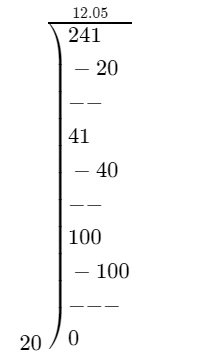
\(\frac{241}{20}\)

Glencoe Math Course 2, Volume 1, Common Core Student Edition, Chapter 4.1 Terminating and Repeating Decimals Page 270 Exercise 37 Answer


12.05 is the required answer.

Therefore the correct answer is 12.05


Page 270   Exercise 38   Problem 40

Given:

We are given a decimal. 5.69

We have to convert it into the nearest tenths place.

We take the decimal 5.69

We look at 9, which is greater than 5.

So we increase the next number by  1.

Now the decimal is rounded off to 5.7

This has been rounded off to the tenths place.

The rounded-off decimal is 5.7


Glencoe Math Course 2 Volume 1 Common Core Chapter 4 Page 270   Exercise 39  Problem 41

Given:

We are given a decimal. 0.05

We have to convert it into the nearest tenths place.

We take the decimal  0.05

We look at 5, which is greater or equal than 5.

So we increase the next number by 1.

Now the decimal is rounded off to 0.1.

This has been rounded off to the tenths place.

The rounded-off decimal is 0.1.


Page 270  Exercise 40  Problem 42

Given:

We are given a decimal.

98.99

We have to convert it into the nearest tenths place.

We take the decimal 98.99

We look at 9, which is greater or equal than 5.

So we increase the next number by 1.

Now the decimal is rounded off to This has been rounded off to the tenths place 99.0.

The rounded-off decimal is 99.0.


Glencoe Math Course 2 Volume 1 Common Core Chapter 4 Page 270  Exercise 41   Problem 43

Given and Find:

We are given 3 fractions

\(\frac{1}{2}\)

We have to convert them into decimals and put them onto a number line.

We are given the fraction as \(\frac{1}{2}\)
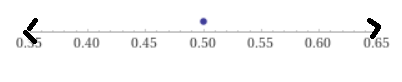
Glencoe Math Course 2, Volume 1, Common Core Student Edition, Chapter 4.1 Terminating and Repeating Decimals Page 270 Exercise 41 Answer


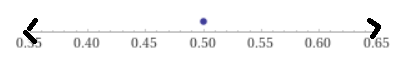
0.5 is decimal.

Glencoe Math Course 2, Volume 1, Common Core Student Edition, Chapter 4.1 Terminating and Repeating Decimals Page 270 Exercise 41 graph 1

Therefore we have shown it on the number line

Glencoe Math Course 2, Volume 1, Common Core Student Edition, Chapter 4.1 Terminating and Repeating Decimals Page 270 Exercise 41 graph 2


Page 270  Exercise 42  Problem 44

Given and Find:

We are given 3 fractions

\(\frac{3}{4}\)

Solution:

We are given the fraction as \(\frac{3}{4}\)
Glencoe Math Course 2, Volume 1, Common Core Student Edition, Chapter 4.1 Terminating and Repeating Decimals Page 270 Exercise 42 Answer

0.75 is a decimal.

Plot these decimals on the number line.


Glencoe Math Course 2, Volume 1, Common Core Student Edition, Chapter 4.1 Terminating and Repeating Decimals Page 270 Exercise 42 graph 1


Therefore we have shown it on the number line


Glencoe Math Course 2, Volume 1, Common Core Student Edition, Chapter 4.1 Terminating and Repeating Decimals Page 270 Exercise 42 graph 2


Glencoe Math Course 2 Volume 1 Common Core Chapter 4 Page 270 Exercise 43  Problem 45

Given and Find:

We are given 3 fractions

\(\frac{2}{3}\)

We have to convert them into decimals and put them onto a number line.

We are given the fraction as \(\frac{2}{3}\)
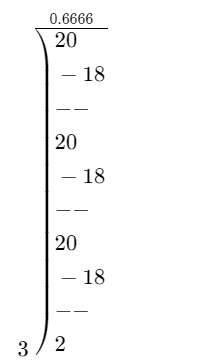
Glencoe Math Course 2, Volume 1, Common Core Student Edition, Chapter 4.1 Terminating and Repeating Decimals Page 270 Exercise 43 Answer

0.66 is given as the fraction.

Plot these decimals on the number line.


Glencoe Math Course 2, Volume 1, Common Core Student Edition, Chapter 4.1 Terminating and Repeating Decimals Page 270 Exercise 43 graph 1


Therefore we have shown it on the number line


Glencoe Math Course 2, Volume 1, Common Core Student Edition, Chapter 4.1 Terminating and Repeating Decimals Page 270 Exercise 43 graph 2


Glencoe Math Course 2 Volume 1 Common Core Student Edition Chapter 2 Percents Exercise 2.2

Glencoe Math Course 2 Volume 1 Common Core Chapter 2 Percents


Glencoe Math Course 2 Volume 1 Chapter 2 Exercise 2.2 Solutions Page 111   Exercise 1  Problem 1

We need to explain how we can percent help you understand situations

The percentage helps to understand situations involving money

The interest rates are written as percent

Also, find the interest earned on a savings account and the amount of interest charged on bank loans and credit cards.

The sales tax is also indicated in percents.

Hence explained.


Page 111   Exercise 2    Problem 2

Given:

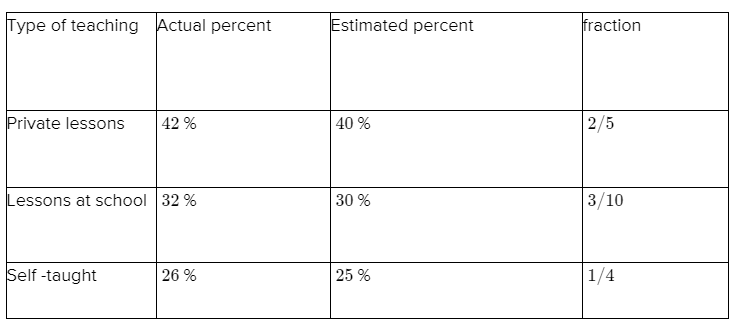
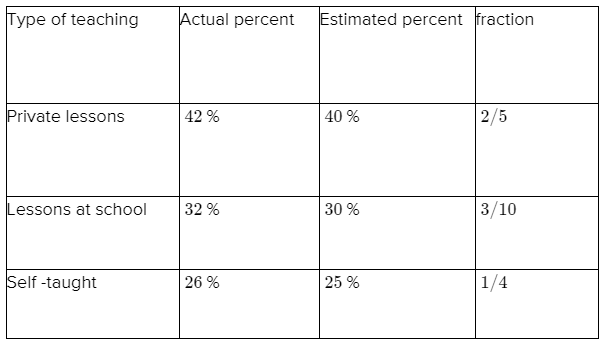
About how many people took lessons at school?

To find – The number of people took lessons at school.

Glencoe Math Course 2, Volume 1, Common Core Student Edition, Chapter 2.2 Percent and Estimation Page 111 Exercise 2

Total number of people surveyed = 200

Number of people took lessons at school =  \(\frac{3}{10}\) 0f 200

Glencoe Math Course 2 Student Edition Volume 1 Chapter 2 Percents Exercise 2.2

\(\frac{3}{10}\)  ×   200 =  60

The number of people took lessons at school = 60

Read and Learn More Glencoe Math Course 2 Volume 1 Common Core Student Edition Solutions

Glencoe Math Course 2 Volume 1 Common Core Chapter 2 Page 111   Exercise 3   Problem 3

Given:

The table shows the survey of 200 people who have learned to play the instrument in different ways.

Sarah estimates the percentage of people who are self-learned in fractions and in percentages.

To find- Compare the number with the actual number and give

To fill in the table of estimated percent and fraction with the actual percent:

Glencoe Math Course 2, Volume 1, Common Core Student Edition, Chapter 2.2 Percent and Estimation Page 111 Exercise 3

Calculation of percentage:

40%

\(\frac{40}{100}\)= \(\frac{4}{10}\)

= \(\frac{2}{5}\)

30%

\(\frac{30}{100}\)= \(\frac{3}{10}\)

25%

\(\frac{25}{100}\)= \(\frac{1}{4}\)

It is less than the actual number.

This is because we rounding the estimated percent as 25 % from the actual percent 26 %.

So it will cause our estimate to be slightly lower than the actual.

It is less than the actual number. Because we are rounding the percentage, the actual percent becomes slightly less than the estimated percent.


Common Core Chapter 2 Percents Exercise 2.2 Answers Glencoe Math Course 2 Page 114   Exercise 1  Problem 4

Given: 52 % of 10 ≈

To find- Estimate the value

Determine the product by rounding the percentage to the nearest tenth:

52 % of 10 ≈ 50

=  \(\frac{1}{2}\)

= 5

Finally, The Value of the estimate is 5.


Glencoe Math Course 2 Volume 1 Common Core Chapter 2 Page 114   Exercise 3   Problem 5

Given: 151 % of 70 ≈

To find- Estimate the value

Determine the product by rounding the percentage to the nearest tenth:

151 of 70 ≈ 150

​⇒  1.5 × 70

⇒ 105

Finally, The Value of the estimate is 105.


Page 114   Exercise 4   Problem 6

Given: \(\frac{1}{2}\)% of 82 ≈

To find- Estimate the value of the given problem.

Determine the product by rounding the percentage to the nearest tenth:

\(\frac{1}{2}\)% of 82

⇒  \(\frac{1}{2}\)%

= 0.5 %

To find 0.5% of 82

\(\frac{0.5}{100}\) × 82

​=  0.005  ×  82

=  0.41

≈0.4

Finally, The Value of the estimate is  \(\frac{1}{2}\)% of  82 ≈ 0.4


Glencoe Math Course 2 Volume 1 Common Core Chapter 2 Page 114  Exercise  5  Problem 7

Given: Of the 78 teenagers at a youth camp, 63 have birthdays in the spring.

To find-  How many teenagers have birthdays in the spring?

Determine the product by rounding the percentage to the nearest tenth:

63 of 78 ≈  60

​⇒  0.6 × 78

⇒   46.8 ≈ 47

As a result, approximately c

Finally, We conclude 47 teenagers celebrate their birthdays in the spring.


Step-By-Step Guide For Exercise 2.2 Chapter 2 Percents In Glencoe Math Course 2 Page 114   Exercise 6   Problem 8

Given: About 0.8 of the land in Maine is federally owned. If Maine has 19,847,680 acres, about how many acres are federally owned? (Example 5)

To find- How many acres are federally owned?

Determine the product by rounding the percentage to the nearest tenth:

0.8% of 19,847,680 ≈

\(\frac{0.8}{100}\) × 19847680

0.008 × 19847680

= 158781.44

​Finally, As a result, the feds own approximately 158781 acres.


Glencoe Math Course 2 Volume 1 Common Core Chapter 2 Page 114   Exercise 7   Problem 9

Given: Estimation of percentage of a number.

Common Method:

Use percent formulas to figure out percentages and unknowns in equations.

Add or subtract a percentage from a number or solve the equations.

There are many formulas for percentage problems. You can think of the most basic as X/Y = P × 100.

The formulas below are all mathematical variations of this formula.

Let’s explore the three basic percentage problems. X and Y are  number and P is the percentage:

1. Find P percent of  X

2. Find what percent of X is Y.

Example: What is 10% of 150?

Convert the problem to an equation using the percentage formula:

P is 10%, and X is 150, so the equation is 10% × 150 = Y

Convert 10% to a decimal by removing the percent sign and dividing by 100:10/100 = 0.10

Substitute 0.10 for 10% in the equation: 10% × 150 = Y becomes 0.10 × 150 = Y

Do the math: 0.10 × 150 = 15

Y = 15

So 10% of 150 is 15

Double-check your answer with the original question: What is 10% of 150? Multiply 0.10 × 150 = 15

In general, to find n percent of x, we follow these steps:

1. Dividend by 100.

2. Multiply the result by x.


Glencoe Math Course 2 Volume 1 Common Core Chapter 2 Page 115   Exercise 1  Problem 10

Given:

To convert percentage to a number 47% of 70

Given

47% of 70 ≈ 45

\(\frac{45}{100}\) × 70

=  (0.45)70

=  31.5

47% of 70 ≈ 45  = 31.5

The answer for 47 % of 70 ≈ 45 is  31.5

Exercise 2.2 Solutions For Chapter 2 Percents Glencoe Math Course 2 Volume 1 Page 115   Exercise 2  Problem 11

Given:

To convert percentage to a number 39 % of 120

Given

39% of 120 ≈ 40

\(\frac{40}{100}\) × 120

=  (0.40)(120)

=  48

39% of 120 ≈ 40 = 48

The answer for 39 % of 120 ≈ 40 = 48

Page 115  Exercise 3  Problem  12

Given:

To convert percentage to a number 21 % of 90

Given

21%  of  90 ≈ 20

\(\frac{20}{100}\) × 90

=  (0.2)90

=  18

21% of 90 ≈ 20 = 18

The answer for 21 % of 90 ≈ 20  = 18


Glencoe Math Course 2 Volume 1 Common Core Chapter 2 Page 115   Exercise 4  Problem  13

Given:

To convert percentage to a number 65 % of 152

Given

65 % of 152  ≈ 65

\(\frac{65}{100}\) × 150

=  (0.65)150

=  97.5

65 ≈ 65 = 97.5

The answer for 65 % of 152 = 97.5


Common Core Percents Exercise 2.2 Chapter 2 Solutions Glencoe Math Course 2 Page 115   Exercise 5  Problem  14

Given:

To convert percentage to a number 72 % of 238

Given

72 % of 238 ≈ 70

\(\frac{70}{100}\) × 238

=  (0.70)238

=  166.6

72 % of 238 ≈ 70 = 166.6

The answer 72 % of 238  = 166.6


Page 115  Exercise 6  Problem  15

Given:

To convert percentage to a number 132% of 54

Given

132 % of  54 ≈ 130

\(\frac{70}{100}\) × 54

= (1.3)54

= 70.2

132 % of 54 ≈130=70.2

The answer 132 % of 54 ≈ 130 = 70.2


Glencoe Math Course 2 Volume 1 Common Core Chapter 2 Page 115  Exercise 8  Problem  16

Given:

To estimate \(\frac{3}{4}\) % of 168

Given

\(\frac{3}{4}\)% of 168

\(\frac{3}{4}\)% × 168

\(\frac{0.75}{100}\) × 168

=  0.0075 × 168

=  1.26

Therefore, the percentage \(\frac{3}{4}\) of 168 is 1.26.

\(\frac{3}{4}\)% of 168 ≈ 1.3


Examples of problems from Exercise 2.2 Chapter 2 Percents in Glencoe Math Course 2 Page 115   Exercise 9   Problem  17

Given:

To estimate 0.4 % of 510

Given

0.4% of 510

= \(\frac{0.4}{100}\)  ×  510

=  0.004  ×  510

=  2.04

The percentage of 0.4 of 510 is 2.04


Page 115 Exercise 10   Problem  18

Given:

The Financial Literacy Carlie spent $42 at the salon.

Her mother loaned her the money.

Carlie will pay her mother 15% of $42 each week until the loan is repaid.

About how much will Carlie pay each week?

The amount Carlie pay each week is 15 % of $42

=  \(\frac{15}{100}\) × 42

= 0.15 ×  42

= 6.3

Carlie will pay $6.3 amount each week to her mother until the loan is repaid.


Glencoe Math Course 2 Volume 1 Common Core Chapter 2 Page 115  Exercise 11   Problem  19

Given:

The United States has 12,383 miles of coastline.

If 0.8 % of the coastline is located in Georgia, about how many miles of coastline are in Georgia?

Given

0.8 % of the coastline in Georgia and 12,383 miles of coastline in United States is

=  \(\frac{0.8}{100}\) × 12,383

=  0.008 × 12,383

=  99.064

Approximately 99 miles of coastlines are in Georgia.


Student Edition Glencoe Math Course 2 Chapter 2 Percents Exercise 2.2 Guide Page 116  Exercise 14  Problem  20

Given:

Estimate 54% of 76.8 =?

Given

54% of 76.8 = 50% of 76.8

=  \(\frac{50}{100}\) × 76.8

=  \(\frac{1}{2}\)×76.8

=  38.4

So,54%  of  76.8 is approximately 38.4

The percentage 54 % of 76.8is approximately 38.4


Page 116   Exercise 15  Problem  21

Given:

Estimate 10.5% of 238 =?

Given

10.5% of 238 = \(\frac{105}{1000}\) × 238

=  \(\frac{21}{200}\) × 238

=  \(\frac{21}{100}\) × 119

=  \(\frac{2499}{100}\)

≈ 24.99

So,10.5% of 238 is approximately 24

The percentage of 10.5% of 238 is approximately 24


Glencoe Math Course 2 Volume 1 Common Core Chapter 2 Page 116   Exercise 16  Problem  22

Given:

The average white rhinoceros gives birth to a single calf that weight about 3.8% as much as its mother rhinoceros weight 3.75 tons, about how many pounds does its calf weight?

Given

3.8% of 3.75 = \(\frac{3.8}{100}\) × 3.75

=  \(\frac{380}{10000}\) × 375

=  \(\frac{19}{500}\) × 375

=  \(\frac{19}{500}\) × 75

=  14.25t

≈ 0.145t (In pounds)

So, the baby animal weights in 0.145t


Step-by-step answers for Exercise 2.2 Chapter 2 Percents in Glencoe Math Course 2 Volume 1 Page 116  Exercise 18  Problem  23

Given:

Explain how you could find % of $800

By simplifying fraction to omit % symbol and multiplying the values.

\(\frac{3}{8}\)% of 800 =  \(\frac{3}{8}\)×800×\(\frac{1}{100}\)

=  3

\(\frac{3}{8}\)% of 800 =  3

The\(\frac{3}{8}\)% answer of  800 is 3.


Page 116   Exercise 19  Problem 24

Is an estimate for the percent of a number always sometimes or never greater than the actual percent of the number?

Give an example or a counterexample to support your answer

An estimate for the percent of a number is sometimes greater than the actual percent of the number

One estimate for 18% of 40 is, \(\frac{1}{5}\).40 = 8

While ,one estimate for 22% of 60 is ,\(\frac{1}{5}\).60 = 12

While never greater than the actual percent,50% of 30 is

\(\frac{1}{2}\).30 =  15

It is the example for the percent of a number sometimes, or never greater than the actual percent of the number


Glencoe Math Course 2 Volume 1 Common Core Chapter 2 Page 116   Exercise 20  Problem  25

Given:

Cost of bedroom furniture=$1,789.43

Percentage cost of dresser=39.7 of total cost

To find- Cost of the dresser?

Cost of dresser

​=  39.7% of $1,789.43

=   (\(\frac{40}{100}\) × 1,789.43) − (\(\frac{0.3}{100}\) × 1,789.43)

=  715.772 − 5.368

=  710.404 ≈ $720

Hence, $720 is the best estimate for the cost of the dresser.


Page 117 Exercise 21  Problem 26

Given:

76%of 180 ≈ ?

To find- Evaluate the problem.

76% 180 = 75% of 180 + 1% of 180

=  (\(\frac{75}{100}\) × 180) + (\(\frac{1}{100}\) × 180)

=  135 + 1.8

= 136.8 ≈ 137

Therefore by evaluating the equation the percentage of   76% of 180 ≈ 137


Page 117   Exercise 22    Problem 27

Given:

57%of 29 ≈?

To find- Evaluate the problem.

57%  of 29

​=  (\(\frac{60}{100}\) × 29) − (\(\frac{3}{100}\) × 29 )

=  17.4 − 0.87

=  16.53 ≈ 17

​Therefore by evaluating the equation the percentage of 57% of  29 ≈ 17

Glencoe Math Course 2 Volume 1 Common Core Chapter 2 Page 117   Exercise 23   Problem  28

Given:

92%of 104 ≈ ?

To find- Evaluate the problem.

Let, 92% of 104

=  (\(\frac{100}{100} × 104\)) − (\(\frac{8}{100} × 104\))

=  104 − 8.32

=  95.68 ≈ 96

Therefore by evaluating the equation the percentage of 92 of 104 ≈ 96


Page 117   Exercise 25   Problem 29

Given:

0.9% of 74 ≈ ?

To find- Evaluate the problem.

0.9% = (1−0.1)%

74 × \(\frac{1-0.1}{100}\) = \(\frac{74×1}{100}\)– \(\frac{74×0.1}{100}\)

=  \(\frac{74}{100}\)–\(\frac{7.4}{100}\)

=  0.74 − 0.074

=  0.666

Therefore by evaluating the equation the percentage of 0.9 of 74 = 0.666


Page 117  Exercise 26  Problem  30

Given:

32% of 89.9 ≈ ?

To find- Evaluate the problem.

30%of89.9 = \(\frac{30}{100}\) ×  89.9

=  26.97

2% of 89.9  = \(\frac{2}{100}\) × 89.9

=  1.798

32 % of 89.9  =  26.97 + 1.798 = 28.768

Therefore by evaluating the equation the percentage of 32 % of 89.9 = 28.8


Glencoe Math Course 2 Volume 1 Common Core Chapter 2 Page 117   Exercise 27   Problem 31

Given:

Total muscles to frown  =  43

Percentage of muscles used to smile = 32%

To find- A number of muscles used to smile?

Number of muscles used to smile

=  32%of43

=   (\(\frac{30}{100}\)) × 43  + (\(\frac{32}{100}\)) × 43

=  12.9 + 0.86

=  13.76  ≈ 14

​Therefore,14 muscles are used when using a smile.


Page 117   Exercise 28   Problem  32 

Given:

Coastline of Atlantic coast = 2.069miles

Percentage of coastlines in New Hampshire = \(\frac{6}{10}\)%

To find- Length of coastlines in New Hampshire?

Length of coastlines in New Hampshire = \(\frac{6}{10}\)% of 2.069

\(\frac{0.6}{10}\)%  ×  2.069 =  0.0124

Therefore, the length of coastlines in New Hampshire is 0.0124 miles.


Page 118   Exercise 32   Problem  33

Given:

5n = 120

To find- The value of n =?

The value of n is

​5n = 120

n = 120/5

= 24

Therefore, the value of n is 24.


Glencoe Math Course 2 Volume 1 Common Core Chapter 2 Page 118   Exercise 33  Problem 34

Given:

1,200 = 4a

To find – Solve each equation show your work

The given equation is 1200 = 4a

Divide both sides by ‘4’, and we get

\(\frac{1200}{4}\) = \(\frac{44}{4}\)

a = 300

By solving the given equation we get a = 300


Page 118   Exercise 34   Problem 35

Given:

6x = 39

To find – Solve each equation show your work

The given equation is 6x = 39

Divide both sides by ‘6’, and we get

\(\frac{6x}{6}\) = \(\frac{39}{6}\)

x = 6.5

By solving the given equation we get x = 6.5


Page 118   Exercise 36  Problem  36

Given:\(\frac{3}{5}\)

To find – Write three fraction equation

By multiplying the numerator and the denominator by 2,3and 4we get

The equivalent fractional to \(\frac{3}{5}\) is

\(\frac{6}{10}\), \(\frac{9}{15}\), and \(\frac{12}{20}\)

Three fractions equivalent to \(\frac{3}{5}\), \(\frac{6}{10}\),\(\frac{9}{15}\) and \(\frac{12}{20}\)


Glencoe Math Course 2 Volume 1 Common Core Chapter 2 Page 120 Exercise 1 Problem 37

Given:

The bar diagram for eighth and tenth grade.

To find-

Total tickets sold above each bar. We will divide the bar into ten equal sections.

Each section represents ten percent.

Let us divide the bar into 10 equal sections.

The bar for eighth and seventh grade are similar.

Glencoe Math Course 2, Volume 1, Common Core Student Edition, Chapter 2.1 Percent of Number Page 120 Exercise 1

By measuring the above bar, we found that 50 % of tickets were sold.

The bar diagrams below show 100% for each grade. Abel Divide each bar into 10 equal sections.

So, each section will represent 10%. The total number of tickets to be sold above each bar is 50 %.


Page 120  Exercise 2  Problem 38

Given:

To Find -The number that belongs in each section.

Then write that Section.

Calculation:

​300 ÷ 10 = 30

250 ÷ 10 = 25

The number of tickets in each section of eight  & seventh-grade baris 30 and 25 respectively.


Page 120  Exercise 3  Problem 39

Given:

To find- The number of sections to shade for each bar.

Then shade the sections.

Eight

225 ÷ 30 = 7.5

Seventh

200 ÷ 25 = 8

The number of sections to be Shaded in the eighth and seventh-grade bar is 7.5 and 8 respectively.

The eighth grade sold 75 % of their tickets. The seventh grade sold 80% of their tickets.

The Seventh grade sold the greater percent of their tickets.

Hence, the Seventh grade sold a greater percent of their tickets

Glencoe Math Course 2 Volume 1 Common Core Student Edition Chapter 3 Integers Exercise

Glencoe Math Course 2 Volume 1 Common Core Chapter 3 Integers


Glencoe Math Course 2 Volume 1 Chapter 3 Integers Exercise Solutions Page 187   Exercise 1  Problem 1

Because the first three operations close the set of integers:
Add
Subtract
Multiply

These operations will return a set of integers as a result.

When you divide two numbers, though, the result is when the first and second integers are not multiples of each other (In other words,

When the second integer is not a factor of the first integer), Then, rather than an integer, the outcome will be the Ratio between the two integers.

Hence the term “rational” for such numbers.

Finally, we concluded that when we add, subtract, and multiply. will return a set of integers as a result and when we divide integers the outcome will be the Ratio between the two integers. Hence the term “rational” for such numbers.


Page 190   Exercise 2   Problem 2

Given: (10+50) ÷ 5 = ______

To evaluate the expression.

Evaluate the given expression within the brackets first

(10 + 50) = 60

Now, Simplify

​60 ÷ (5) =  \(\frac{60}{5}\) = 12

Glencoe Math Course 2 Student Edition Volume 1 Chapter 3 Integers Exercise

⇒ 12

(10+50) ÷ 5 = 12

Finally, we concluded that the result is ⇒ 12

Read and Learn More Glencoe Math Course 2 Volume 1 Common Core Student Edition Solutions

Common Core Chapter 3 Integers Exercise Answers Glencoe Math Course 2 Page 190   Exercise 3  Problem 3

Given:18 + 2(4 − 1) = ______

To evaluate the expression.

Given

18 + 2(4 − 1) =

Evaluate the given expression within the brackets first

(4 − 1) = 3

Then

​2(4 − 1) = 2(3)

⇒ 6

Now, Simplify

​18 + 6 = 24

⇒ 24

18 + 2(4 − 1) = 24

We concluded that the 18 + 2(4 − 1) = 24


Step-By-Step Guide For Chapter 3 Integers Exercises In Glencoe Math Course 2 Page 190   Exercise 5    Problem 4

Given: B(2,8)

Graph and label each point on the coordinate grid.

The first number is the number on the x-axis (horizontal) and the second number is the number on the y-axis, i.e., vertical.

The required graph is:

Glencoe Math Course 2, Volume 1, Common Core Student Edition, Chapter 3 Integers Page 190 Exercise 5

Finally, we plotted Graph and labeled each point on the coordinate grid.


Exercise Solutions For Chapter 3 Integers Glencoe Math Course 2 Volume 1 Page 190   Exercise 6   Problem 5

Given: C(8,1)

Graph and label each point on the coordinate grid.

The first number is the number on the x-axis (horizontal) and the second number is the number on the y-axis, i.e., vertical.


Glencoe Math Course 2, Volume 1, Common Core Student Edition, Chapter 3 Integers Page 190 Exercise 6

Finally, we Graph and label each point on the coordinate grid.


Common Core Integers Chapter 3 Exercises With Solutions Glencoe Math Course 2 Page 190 Exercise 7 Problem 6

Given: D(3,4)

Graph and label each point on the coordinate grid.

The first number is the number on the x-axis (horizontal) and the second number is the number on the y-axis, i.e., vertical.

The required graph is:

Glencoe Math Course 2, Volume 1, Common Core Student Edition, Chapter 3 Integers Page 190 Exercise 7

Finally, we plotted Graph and labeled each point on the coordinate grid.


Examples Of Problems From Chapter 3 Integers Exercises In Glencoe Math Course 2 Page 190  Exercise 8  Problem 7

Given: E(1,5)

Graph and label each point on the coordinate grid.

The first number is the number on the x-axis (horizontal) and the second number is the number on the y-axis,i.e., vertical.

The required graph is:

Glencoe Math Course 2, Volume 1, Common Core Student Edition, Chapter 3 Integers Page 190 Exercise 8

Finally, we plotted Graph and labeled each point on the coordinate grid.

Glencoe Math Course 3 Volume 2 Student 1st Edition Chapter 5 Triangles And The Pythagorean Theorem Exercise 1.1

Glencoe Math Course 3 Volume 2 Student 1st Edition Chapter 5 Triangles And The Pythagorean Theorem

Glencoe Math Course 3 Volume 2 Chapter 5 Exercise 1.1 Solutions Page 371 Exercise 1, Problem1

As per the given instruction, we have to justify how can algebraic concepts be applied to geometry. From the concept of algebra and geometry, we can say algebra has to do with equations and formulas, and geometry has to do with objects and shapes.

Now we will assume an equation and we will plot this in a graph. Let’s assume an equation that isy=4x+3 and we plot the equation in the graph. The graph is shown below

The graph of the equationy=4x+3 is a straight line.This illustrates a relationship between an algebraic concept (an equation) and a geometric concept (a line).


Glencoe Math Course 3 Volume 2 Student 1st Edition Chapter 5 Triangles And the Pythagorean Theorem Exercise5.1 Page 371 Exercise 1,Problem1


Finally, we can determine that algebra has to do with equations and formulas, and geometry has to do with objects and shapes. And if we graph an equation that is an algebraic concept we can make it a geometric concept.

Read and Learn More Glencoe Math Course 2 Volume 1 Common Core Student Edition Solutions

Glencoe Math Course 3 Volume 2 Student 1st Edition Chapter 5 Page 371 Exercise 1 Problem2


Glencoe Math Course 3 Volume 2 Student 1st Edition Chapter 5 Triangles And the Pythagorean Theorem Exercise5.1 Page 371 Exercise 1,Problem2


Here a gymnastic event in the Summer Olympics involves the parallel bars and we have to circle the parallel lines shown in the photo.

We know that parallel lines are the lines that never intersect each other at any point even on extending up to infinity, on either side.

Glencoe Math Course 3 Volume 2 Student 1st Edition Chapter 5 Triangles And the Pythagorean Theorem Exercise5.1 Page 371 Exercise 1,Problem2.


Parallel lines are the lines that never intersect each other at any point even on extending up to infinity, on either side. So as per the given instruction, the marked parallel lines are shown.

Glencoe Math Course 2 Student Edition Volume 1 Chapter 5 Triangles And The Pythagorean Theorem Exercise 5.1

Glencoe Math Course 3 Volume 2 Student 1st Edition Chapter 5 Page 373 Exercise 1 Problem1


Glencoe Math Course 3 Volume 2 Student 1st Edition Chapter 5 Triangles And the Pythagorean Theorem Exercise5.1 Page 373 Exercise 1,Problem1


We have to find the relationship between∠4 and∠6.

If we give a closer look at the given diagram we can say∠4 and∠6 are the alternate interior angles as here a transversal intersects two coplanar lines.The above-mentioned alternate interior angles are shown in the figures below


Glencoe Math Course 3 Volume 2 Student 1st Edition Chapter 5 Triangles And the Pythagorean Theorem Exercise5.1 Page 373 Exercise 1,Problem1.


Hence, as a transversal intersects two coplanar lines and∠4and∠6are formed so the relationship between them is they are alternate interior angles.

From the figure, we can easily observe that the verticle line has divided the horizontal line or 180o into exactly two equal halves. Therefore, the angle m∠4 is a right angle and has a value of 90o.

Finally, we can conclude that the angle m∠4=90o.


Glencoe Math Course 3 Volume 2 Student 1st Edition Chapter 5 Page 374 Exercise2 Problem1


Glencoe Math Course 3 Volume 2 Student 1st Edition Chapter 5 Triangles And the Pythagorean Theorem Exercise5.1 Page 374Exercise 2,Problem1


We have to find the measure of the angle∠9.

It can be found using the equality of corresponding and alternate angles


Glencoe Math Course 3 Volume 2 Student 1st Edition Chapter 5 Triangles And the Pythagorean Theorem Exercise Page 374Exercise 2, Problem1 solution

Finally, we can determine that the angle is found to be∠9=45o.


Glencoe Math Course 3 Volume 2 Student 1st Edition Chapter 5 Page 374 Exercise3 Problem1


Glencoe Math Course 3 Volume 2 Student 1st Edition Chapter 5 Triangles And the Pythagorean Theorem Exercise5.1 Page 374Exercise 3,Problem1

We have to find the measure of the angle∠7.

It can be found using the equality of corresponding and alternate angles.

As the angles ∠2,∠7 are alternate angles;∠2=∠7

∴∠7=135o.

Finally, we can determine that the final angle is found to be∠7=135°.


Page 374 Exercise4,Problem1


Glencoe Math Course 3 Volume 2 Student 1st Edition Chapter 5 Triangles And the Pythagorean Theorem Exercise5.1 Page 374Exercise 4,Problem1

For the set of lines AB,CD with traversal asEF ; corresponding angles are always equal to each other, like∠EHB=∠EKD. Also similarly, alternate angles are also equal to each other, like∠EHB=∠FCK.

Corresponding and alternate angles are always equal for each set of parallel lines cut by a traversal.


Glencoe Math Course 3 Volume 2 Student 1st Edition Chapter 5 Page 375 Exercise2 Problem1


Glencoe Math Course 3 Volume 2 Student 1st Edition Chapter 5 Triangles And the Pythagorean Theorem Exercise5.1 Page 375 Exercise 2,Problem1

If the angles match the same corners of the parallel lines, they are corresponding angles, or else they are alternate angles.

As they don’t match the identical corners of the set of parallel lines, they are related as alternate angles.

Also as the angles are in the exterior side of the parallel lines, hence they are related as exterior alternate angles.

Finally, we can determine that the angles are related by exterior alternate angles.


Chapter 5 Exercise 1.1 Answers Triangles And Pythagorean Theorem Glencoe Math Course 3 Volume 2 Page 375 Exercise3,Problem1


Glencoe Math Course 3 Volume 2 Student 1st Edition Chapter 5 Triangles And the Pythagorean Theorem Exercise5.1 Page 375 Exercise 3,Problem1

We have to find the measure of the angle∠4,∠7.

It can be found using the equality of corresponding and alternate angles.

It is given that,

∠1=150°

As∠1,∠4 lie on a straight line,∠1+∠4=180o

⇒∠4=(180−150)°

⇒∠4=30°

Similarly,∠1,∠7 are corresponding angles.

Hence,∠7=150°.

Finally, the measurement of the angles were found as∠4=30o; ∠7=150°.


Glencoe Math Course 3 Volume 2 Student 1st Edition Chapter 5 Page 375 Exercise4 Problem1

Glencoe Math Course 3 Volume 2 Student 1st Edition Chapter 5 Triangles And the Pythagorean Theorem Exercise5.1 Page 375 Exercise 4,Problem1

We have to find the measure of the angle∠7

where it is given that∠2=110o;∠11=137°.

It can be found using the equality of corresponding and alternate angles.

For the set of parallel lines with traversal as r;∠1+∠2=180°

[As they lie on a straight line]

⇒∠1=(180−110)°

⇒∠1=70°

Also, ∠1,∠7are alternate exterior angles.

∴∠1=∠7

∠7=70°

Finally, we can determine that the angle is found to be70o.


Step-by-step guide for Exercise 1.1 Chapter 5 Triangles and Pythagorean Theorem Glencoe Math Course 3 Page 375 Exercise6,Problem1

Glencoe Math Course 3 Volume 2 Student 1st Edition Chapter 5 Triangles And the Pythagorean Theorem Exercise5.1 Page 375 Exercise 6,Problem1

We have to find the measure of the angle∠3

where it is given that∠2=110o;∠11=137°.

It can be found using the equality of corresponding and alternate angles.

For the set of parallel lines with traversal as u;∠11=∠3

[As they are corresponding angles]

∴∠3=137°.

Finally, we can determine that the angle is found to be∠3=137°.


Glencoe Math Course 3 Volume 2 Student 1st Edition Chapter 5 Page 375 Exercise7 Problem1

Glencoe Math Course 3 Volume 2 Student 1st Edition Chapter 5 Triangles And the Pythagorean Theorem Exercise5.1 Page 375 Exercise 7,Problem1


We have to find the measure of the angle∠2

where it is given that∠1=45°

It can be found using the equality of corresponding and alternate angles.

As given in the question;

∠1,∠2

are corresponding angles. Hence, they are equal to each other.

∴∠1=∠2

⇒x+25=45

⇒x=45-25

⇒x=20

Finally, we can determine that the value of x is 20.


Glencoe Math Course 3 Volume 2 Student 1st Edition Chapter 5 Triangles And the Pythagorean Theorem Exercise5.1 Page 375 Exercise 7,Problem1.

We have to find the measure of the angle∠3

where it is given that∠4=80°.

It can be found using the equality of corresponding and alternate angles.

As given in the question; are alternate angles. Hence, they are equal to each other.

As given in the question; ∠3,∠4 are alternate angles. Hence, they are equal to each other.

∴∠3=∠4

⇒2x=80

⇒x=80/2

⇒x=40

Finally, we can determine that the value of x is 40.


Glencoe Math Course 3 Volume 2 Student 1st Edition Chapter 5 Page 375 Exercise8 Problem1

Glencoe Math Course 3 Volume 2 Student 1st Edition Chapter 5 Triangles And the Pythagorean Theorem Exercise5.1 Page 375 Exercise 8,Problem1

We have to find the measure of the angles represented by variables. The sum of angle in a straight line is always180°.

As we can see that the denoted angles lie on a straight line;

∴x+2x=180°

⇒3x=180

⇒ x=180/3

⇒x=60

∴2x=120

Finally, the value of the angles x and 2x were found as 60° and 120° .


Step-By-Step Guide For Exercise 1.1 Chapter 5 Triangles And Pythagorean Theorem Glencoe Math Course 3 Page 376 Exercise9, Problem1

Glencoe Math Course 3 Volume 2 Student 1st Edition Chapter 5 Triangles And the Pythagorean Theorem Exercise5.1 Page 376 Exercise 9,Problem1.


We have to find the measure of the angle∠C where it is given that∠D=50°;∠B=152°.

It can be found by extending the parallel set of lines and using the other sides as traversals and finally using the equality of corresponding and alternate angles.

It was found that the following problem can be solved It can be found by extending the parallel set of lines and using the other sides as traversals and finally using the equality of corresponding and alternate angles.

Glencoe Math Course 3 Volume 2 Student 1st Edition Chapter 5 Triangles And the Pythagorean Theorem Exercise5.1 Page 376 Exercise 9,Problem1

We have to find the measure of the angle∠C

where it is given that∠D=50°

;∠B=152°

It can be found by extending the parallel set of lines and using the other sides as traversals and finally using the equality of corresponding and alternate angles.

As given in the question;

∠B=152

If we extend the line DC and AB which are parallel lines and considering BC as traversal;

We can observe that ∠B,∠C

are interior angles that sum up to180 as it is the complement of the corresponding angle of ∠B.

∠B+∠C=180°

⇒∠C=(180−152)°

⇒∠C=28°

The final angle was found to be∠C=28°.


Glencoe Math Course 3 Volume 2 Student 1st Edition Chapter 5  Page 376 Exercise10 Problem1


Glencoe Math Course 3 Volume 2 Student 1st Edition Chapter 5 Triangles And the Pythagorean Theorem Exercise5.1 Page 376 Exercise 10,Problem1

We need to make a conjecture about the relationship of ∠1 and ∠2.

Then justify our reasoning.

Given, that the quadrilateral ABCD is a parallelogram. So, we can say that lines AB and DC are parallel to each other, and segment AD is a transversal line. Therefore, m∠1 and m∠2

are interior angles on the same side of the transversal and therefore, their sum should be equal to 180 degree.

We can prove this reasoning with the help of alternate interior and supplementary angles, as shown below.

Glencoe Math Course 3 Volume 2 Student 1st Edition Chapter 5 Triangles And the Pythagorean Theorem Exercise5.1 Page 376 Exercise 10,Problem1.

In the figure, we can see that m∠1 and m∠x are the alternate interior angles, therefore both should be equal.

m∠1=m∠x

Also, m∠x and m∠2 are supplementary angles and therefore their sum should be equal to 180 degree.

​⇒m∠x+m∠2=180

⇒(m∠1)+m∠2=180 (replacing m∠x with m∠1)

⇒m∠1+m∠2=180

Therefore, our reasoning is correct, the sum of the interior angles on the same side of the transversal line is equal to 180 degree.

With the help of alternate interior and supplementary angles, we proved that the sum of the interior angles on the same side of the transversal line is equal to 180 degree.


Glencoe Math Course 3 Volume 2 Student 1st Edition Chapter 5 Page 376 Exercise11 Problem1

We need to determine if two parallel lines are cut by a transversal, what relationship exists between interior angles that are on the same side of the transversal.

If two parallel lines are cut by a transversal, then the sum of interior angles on both the side of the transversal is equal to 180 degree.

According to the definition, supplementary angles are two angles whose measures add up to 180 degree.

Therefore, these are supplementary angles.

Glencoe Math Course 3 Volume 2 Student 1st Edition Chapter 5 Triangles And the Pythagorean Theorem Exercise5.1 Page 376 Exercise 11,Problem1


The relation between interior angles that are on the same side of the transversal is they are supplementary angles.


Exercise 1.1 Solutions For Chapter 5 Triangles And Pythagorean Theorem Glencoe Math Course 3 Volume 2 Page 377 Exercise13, Problem1

Glencoe Math Course 3 Volume 2 Student 1st Edition Chapter 5 Triangles And the Pythagorean Theorem Exercise5.1 Page 376 Exercise 13,Problem1

We need to classify the pair of angles ∠3 and ∠6.

∠3 and ∠6 are interior angles that lie on the opposite sides of the transversal. They are called alternate interior angles.

Glencoe Math Course 3 Volume 2 Student 1st Edition Chapter 5 Triangles And the Pythagorean Theorem Exercise5.1 Page 376 Exercise 13,Problem1.

∠3 and ∠6 are alternate interior angles.


Glencoe Math Course 3 Volume 2 Student 1st Edition Chapter 5 Page 377 Exercise14 Problem1

Glencoe Math Course 3 Volume 2 Student 1st Edition Chapter 5 Triangles And the Pythagorean Theorem Exercise5.1 Page 376 Exercise 14,Problem1

We need to classify the pair of angles ∠1 and ∠3.

∠1 and ∠3 are called corresponding angles, one is an exterior angle and one is interior and lie on the same side of the transversal and are not adjacent.

Glencoe Math Course 3 Volume 2 Student 1st Edition Chapter 5 Triangles And the Pythagorean Theorem Exercise5.1 Page 376 Exercise 14,Problem1.

∠1 and ∠3are corresponding angles.


Examples Of Problems From Exercise 1.1 Chapter 5 Glencoe Math Course 3 Triangles And Pythagorean Theorem Page 377 Exercise15, Problem1

Glencoe Math Course 3 Volume 2 Student 1st Edition Chapter 5 Triangles And the Pythagorean Theorem Exercise5.1 Page 376 Exercise 15,Problem1

We need to classify the pair of angles ∠2 and ∠7.

∠2 and ∠7

are interior angles that lie opposite sides of the transversal. They are called alternate interior angles.


Glencoe Math Course 3 Volume 2 Student 1st Edition Chapter 5 Triangles And the Pythagorean Theorem Exercise5.1 Page 377 Exercise 15,Problem1.

∠2 and ∠7 are alternate interior angles.


Glencoe Math Course 3 Volume 2 Student 1st Edition Chapter 5 Page 377 Exercise17 Problem1

Given, Line s is parallel to line t, m∠2 is 110∘and m∠11 is 137∘

Glencoe Math Course 3 Volume 2 Student 1st Edition Chapter 5 Triangles And the Pythagorean Theorem Exercise5.1 Page 376 Exercise 17,Problem1

We need to find the measure of angle m∠6.

m∠2 and m∠6 are corresponding angles, and therefore they should be equal. It is given in the question that m∠2=110∘

​⇒m∠2=m∠6=110∘

∴m∠6=110∘

The measure of the angle m∠6=110∘.


Common Core Chapter 5 Exercise 1.1 Triangles And Pythagorean Theorem Detailed SolutionsPage 377 Exercise18, Problem1

Given, Line s is parallel to line t, m∠2 is 110∘ and m∠11 is 137∘.

Glencoe Math Course 3 Volume 2 Student 1st Edition Chapter 5 Triangles And the Pythagorean Theorem Exercise5.1 Page 377 Exercise 18,Problem1

We need to find the measure of the angle m∠13.

m∠2 and m∠13 are opposite angles and hence be equal. Given that, m∠=110∘  then m∠13

should also be equal to 110∘

​⇒m∠2=m∠13=110∘

∴m∠13=110∘

Glencoe Math Course 3 Volume 2 Student 1st Edition Chapter 5 Triangles And the Pythagorean Theorem Exercise5.1 Page 377 Exercise 18,Problem1.

The measure of the angle m∠13=110∘


Glencoe Math Course 3 Volume 2 Student 1st Edition Chapter 5 Page 377 Exercise19 Problem1

Glencoe Math Course 3 Volume 2 Student 1st Edition Chapter 5 Triangles And the Pythagorean Theorem Exercise5.1 Page 377 Exercise 19,Problem1

We need to find the measure of angle m∠4.

We are given in the equation that m∠11=137∘

. We can see that m∠11 and m∠3

are corresponding angles, so they should be equal.

⇒m∠11=m∠3=137∘

Now, m∠3 and m∠4 are adjacent supplementary angles.

​⇒m∠3+m∠4=180∘

⇒137∘

+m∠4=180∘

⇒m∠4=180∘

−137∘

⇒m∠4=43∘

Glencoe Math Course 3 Volume 2 Student 1st Edition Chapter 5 Triangles And the Pythagorean Theorem Exercise5.1 Page 377 Exercise 19,Problem1.

The measure of the angle is m∠4=43∘.


Glencoe Math Course 3 Volume 2 Student 1st Edition Chapter 5 Page 377 Exercise22 Problem1


Glencoe Math Course 3 Volume 2 Student 1st Edition Chapter 5 Triangles And the Pythagorean Theorem Exercise5.1 Page 377 Exercise 22,Problem1

We need to find the false option out of the given options.

(F): The statement is false. We cannot be sure about the kind of these angles without measuring them. They seem to be right angles.

(G): The statement is true. The angles ∠A and ∠C

are vertical. They are opposite angles between two lines that intersect.

(H): The statement is true. The angles ∠A and ∠B

are alternate interior angles.

(I): The statement is true. The angles ∠A and ∠C

are congruent as vertical angles. As we know, vertical angles are congruent.

The statement (F) is false.

The statement F is false.


Glencoe Math Course 3 Volume 2 Student 1st Edition Chapter 5 Page 378 Exercise23 Problem1


Given, line x is parallel to line y and line z is perpendicular to AB. The measure of ∠1 is 50∘.

Glencoe Math Course 3 Volume 2 Student 1st Edition Chapter 5 Triangles And the Pythagorean Theorem Exercise5.1 Page 378 Exercise 23,Problem1

We need to find out the measure of ∠2.


Glencoe Math Course 3 Volume 2 Student 1st Edition Chapter 5 Triangles And the Pythagorean Theorem Exercise5.1 Page 378 Exercise 23,Problem1.

In the above case we can see that m∠1 and m∠p are corresponding angles, therefore, they should be equal. We are given that m∠1= 50∘

⇒m∠1=m∠p= 50∘.

Now, We can see that taken together, m∠p and m∠2are making a supplementary pair with 90∘

Therefore, the sum of all three should be equal to 180∘

​⇒m∠p+m∠2+90∘

=180∘

⇒m∠p+m∠2+90∘

−90∘

=180∘

−90∘

⇒m∠p+m∠2=90∘

⇒50∘

+m∠2=90∘

⇒m∠2=90∘

−80∘

−50∘

⇒m∠2=40∘

Therefore, option A is correct, the measure of ∠2 is 40∘.

Option A is correct, the measure of ∠2 is 40∘


Glencoe Math Course 3 Volume 2 Student 1st Edition Chapter 5  Page 378 Exercise24 Problem1

Given, lines m and n are parallel and cut by the transversal p.

Glencoe Math Course 3 Volume 2 Student 1st Edition Chapter 5 Triangles And the Pythagorean Theorem Exercise5.1 Page 378 Exercise 24,Problem1

We will name all pairs of the corresponding angles.

When two parallel lines are intersected by a transversal line, then the angle in the same corner and on the same side of the transversal are called corresponding angles.

Each corresponding angles pair is shown in the same color, in the figure shown below.


Glencoe Math Course 3 Volume 2 Student 1st Edition Chapter 5 Triangles And the Pythagorean Theorem Exercise5.1 Page 378 Exercise 24,Problem1.

The corresponding angle pairs are as follows,

​1) m∠1 and ∠5

2) m∠2 and ∠6

3) m∠3 and ∠7

4) m∠4 and ∠8

After carefully observing the figure, we find  pairs of corresponding angles as follows,

​1) m∠1 and ∠5

2) m∠2 and ∠6

3) m∠3 and ∠7

4) m∠4 and∠8


Student Edition Exercise 1.1 Chapter 5 Triangles And Pythagorean Theorem Solutions Guide Page 378 Exercise25, Problem1

We are given that the base is4

inches long and height that measures8

inches on putting these values into the equationsArea= 12

× base × height

=12

×4 inches× 8 inches.

= 2×8inches2

=16inches2

Finally, we can determine that the area of the poster is 16 inches2.


Glencoe Math Course 3 Volume 2 Student 1st Edition Chapter 5 Page 378 Exercise28 Problem1


The given angles are 32° & 58°. So, the sum of the given angles is 32°+58°=90°.

Glencoe Math Course 3 Volume 2 Student 1st Edition Chapter 5 Triangles And the Pythagorean Theorem Exercise5.1 Page 378 Exercise 28,Problem1

Therefore, these will go into the category of complementary.

Glencoe Math Course 3 Volume 2 Student 1st Edition Chapter 5 Triangles And The Pythagorean Theorem Exercise

Glencoe Math Course 3 Volume 2 Student 1st Edition Chapter 5 Triangles And The Pythagorean Theorem

Glencoe Math Course 3 Volume 2 Chapter 5 Triangles And Pythagorean Theorem Exercise Solutions Page 365 Exercise 1, Problem1

We have been given some algebraic concepts. We have been told to apply the algebraic concepts to geometry. This can be done by focusing on 2-D coordinate geometry and their equations.

One way that algebra and geometry can be related is through the use of equations in graphs.

We can plot a set of points(x,y) according to an equation (for example, the line graph on the left!) to form a graph.

That’s one way that algebra is related to geometry.

A set of points can satisfy any equation which can produce any type of graph, not just straight lines.


Glencoe Math Course 3 Volume 2 Student 1st Edition Chapter 5 Triangles And the Pythagorean Theorem Exercise Page 365 Exercise 1, Problem1 graph.


Glencoe Math Course 3 Volume 2 Student 1st Edition Chapter 5 Triangles And the Pythagorean Theorem Exercise Page 365 Exercise 1, Problem1.

Finally, we can see that an equation, which is an algebraic notion, maybe graphed, transforming it into a geometric concept. We can see that the variables in the equation (both algebraic ideas) may be utilised to relate to geometric concepts of the line (slope and y-intercept).

We learned that Algebra is a branch of mathematics in which formulae and equations use variables in the form of letters and symbols instead of quantities or numbers. Geometry is a branch of mathematics that analyses points, lines,  multi-dimensional objects and shapes, as well as surfaces and solids.

Read and Learn More Glencoe Math Course 2 Volume 1 Common Core Student Edition Solutions

Glencoe Math Course 3 Volume 2 Student 1st Edition Chapter 5 Page 368 Exercise 2, Problem2

We have been given an equation.We need to find the value of b from the equation.This can be found by keeping only the unknown variable on the left-hand side of the ‘equal to’ symbol.

Given equation is,

49+b+45=180

⇒ b=180−49−45

⇒ b=180−94

⇒ b=86

Finally, we can determine that the value of b is 86.

Glencoe Math Course 2 Student Edition Volume 1 Chapter 5 Triangles And The Pythagorean Theorem Exercise

Chapter 5 Triangles And Pythagorean Theorem Answers Glencoe Math Course 3 Volume 2 Page 368 Exercise 3, Problem3

We have been given an equation.We need to find the value of t from the equation.This can be found by keeping only the unknown variable on the left-hand side of the ‘equal to’ symbol.

Given equation is,

t+98+55=180

⇒ t=180−98−55

⇒ t=180−153

⇒ t=27

Finally, we can determine that the value of t is 27.


Glencoe Math Course 3 Volume 2 Student 1st Edition Chapter 5 Page 368 Exercise 4, Problem4

We have been given an equation.We need to find the value of k from the equation.This can be found by keeping only the unknown variable on the left-hand side of the ‘equal to’ symbol.

Given equation is,

15+67+k=180

⇒ k=180−15−67

⇒ k=180−82

⇒ k=98

Finally, we can determine that the value of k is 98.


Glencoe Math Course 3 Volume 2 Student 1st Edition Chapter 5 Page 368 Exercise 5, Problem5

We have been given a point and the coordinate plane.We need to plot the given point on the plane.This can be done by locating the x and y coordinates and the move that distance horizontally and vertically from both the axes to find the required point.

The required point A is as follows

The x-axis denotes the value of the x coordinate.

The y-axis denotes the value of the y coordinate.

The red colored point on the coordinate plane denotes the point A.

Glencoe Math Course 3 Volume 2 Student 1st Edition Chapter 5 Triangles And the Pythagorean Theorem Exercise Page 365 Exercise 5, Problem5 graph


The given point has been plotted on the coordinate plane and is as follows,

Glencoe Math Course 3 Volume 2 Student 1st Edition Chapter 5 Triangles And the Pythagorean Theorem Exercise Page 365 Exercise 5, Problem5 graph 1


Glencoe Math Course 3 Volume 2 Student 1st Edition Chapter 5 Page 365 Exercise 6, Problem6

We have been given a point and the coordinate plane. We need to plot the given point on the plane. This can be done by locating the x and y coordinates and the move that distance horizontally and vertically from both the axes to find the required point.

The required point B is as follows:

Glencoe Math Course 3 Volume 2 Student 1st Edition Chapter 5 Triangles And the Pythagorean Theorem Exercise Page 365 Exercise 6, Problem6 graph


The x-axis denotes the value of the x-coordinate.

The y=axis denotes the value of the y coordinate.

The red colored point on the coordinate plane denotes the point B.

The given point has been plotted on the coordinate plane and is as follows,


Glencoe Math Course 3 Volume 2 Student 1st Edition Chapter 5 Triangles And the Pythagorean Theorem Exercise Page 365 Exercise 6, Problem6 graph 1


Glencoe Math Course 3 Volume 2 Student 1st Edition Chapter 5 Page 365 Exercise 7, Problem7

We have been given a point and the coordinate plane. We need to plot the given point on the plane. This can be done by locating the x and y coordinates and the move that distance horizontally and vertically from both axes to find the required point.

The required point C is as follows:

Glencoe Math Course 3 Volume 2 Student 1st Edition Chapter 5 Triangles And the Pythagorean Theorem Exercise Page 365 Exercise 7, Problem7 graph


The x-axis denotes the value of the x-coordinate.

The y=axis denotes the value of the y coordinate.

The red colored point on the coordinate plane denotes point C.

The given point has been plotted on the coordinate plane and is as follows:

Glencoe Math Course 3 Volume 2 Student 1st Edition Chapter 5 Triangles And the Pythagorean Theorem Exercise Page 365 Exercise 7, Problem7 graph 1


Glencoe Math Course 3 Volume 2 Student 1st Edition Chapter 5 Page 365 Exercise 8, Problem8

We have been given a point and the coordinate plane. We need to plot the given point on the plane. This can be done by locating the x and y coordinates and the move that distance horizontally and vertically from both axes to find the required point.

The required point D is as follows:

Glencoe Math Course 3 Volume 2 Student 1st Edition Chapter 5 Triangles And the Pythagorean Theorem Exercise Page 365 Exercise 8, Problem graph


The x-axis denotes the value of the x-coordinate .

The y=axis denotes the value of the y coordinate.

The red colored point on the coordinate plane denotes the point D.

The given point has been plotted on the coordinate plane and is as follows:

Glencoe Math Course 3 Volume 2 Student 1st Edition Chapter 5 Triangles And the Pythagorean Theorem Exercise Page 365 Exercise 8, Problem8 graph 1


Glencoe Math Course 3 Volume 2 Student 1st Edition Chapter 5 Page 365 Exercise 9, Problem9

We have been given a point and the coordinate plane. We need to plot the given point on the plane. This can be done by locating the x and y coordinates and the move that distance horizontally and vertically from both the axes to find the required point.


The required point E is as follows:

The x-axis denotes the value of the x-coordinate.

The y-axis denotes the value of the y-coordinate.

The red colored point on the coordinate plane denotes the point E.

Glencoe Math Course 3 Volume 2 Student 1st Edition Chapter 5 Triangles And the Pythagorean Theorem Exercise Page 365 Exercise 9, Problem9 graph


The given point has been plotted on the coordinate plane and is as follows,

Glencoe Math Course 3 Volume 2 Student 1st Edition Chapter 5 Triangles And the Pythagorean Theorem Exercise Page 365 Exercise 9, Problem9 graph 1


Glencoe Math Course 3 Volume 2 Student 1st Edition Chapter 5 Page 365 Exercise 10, Problem10

We have been given a point and the coordinate plane. We need to plot the given point on the plane. This can be done by locating the x and y coordinates and the move that distance horizontally and vertically from both axes to find the required point.


The required point F is as follows:


Glencoe Math Course 3 Volume 2 Student 1st Edition Chapter 5 Triangles And the Pythagorean Theorem Exercise Page 365 Exercise 10, Problem10 graph

The x-axis denotes the value of the x-coordinate.

The y=axis denotes the value of the y coordinate.

The red colored point on the coordinate plane denotes point F.

The given point has been plotted on the coordinate plane and is as follows,

Glencoe Math Course 3 Volume 2 Student 1st Edition Chapter 5 Triangles And the Pythagorean Theorem Exercise Page 365 Exercise 10, Problem10 graph 1


Glencoe Math Course 3 Volume 2 Student 1st Edition Chapter 5 Page 365 Exercise 11, Problem11

It is given that a third Iine intersects two parallel lines. We need to find the angle relationships formed. This can be found by considering a transversal which is a line that intersects two or more other (often parallel ) lines.

A transversal is any line that intersects two or more lines in the same plane but at distinct points.

The transversal is said to cut the two lines that it crosses.

If we draw two parallel lines and then draw a line transversal through them, we will get eight different angles. The eight angles will together form four pairs of corresponding angles.

One of the pairs in the diagram above is formed by angles F and B. If the two lines are parallel, the corresponding angles are congruent. Corresponding pairs are all angles that have the same location in relation to the parallel and transversal lines.

Interior angles are those that are in the area between the parallel lines, such as angles H and C above, whereas Exterior angles are those that are on the outside of the two parallel lines, such as D and G.

Alternate angles are those on the opposite sides of the transversal, such as H and B.

Adjacent angles are those that have the same vertex and a common ray, such as angles G and F or C and B in the diagram above.

We get two pairs of supplementary adjacent angles (G+F and H+E) in this example because the adjacent angles are created by two lines intersecting. Vertical angles are two angles that are opposite each other, such as D and B in the diagram above. Angles in the vertical plane are always congruent.

Glencoe Math Course 3 Volume 2 Student 1st Edition Chapter 5 Triangles And the Pythagorean Theorem Exercise Page 365 Exercise 11, Problem11 solution


The angle relationships that are formed when a third Ind Iine intersects two parallel lines have been stated.


Glencoe Math Course 3 Volume 2 Student 1st Edition Chapter 5 Page 365 Exercise 12, Problem12

Given

Glencoe Math Course 3 Volume 2 Student 1st Edition Chapter 5 Triangles And the Pythagorean Theorem Exercise Page 365 Exercise 12, Problem12 graph


When two parallel lines are intersected by a third line then the resultant angles are in such a way that there are four angles that are equal to each other and the rest four are equal to each other. The two different measures are shown in the red and green colors, in the figure attached below.

Glencoe Math Course 3 Volume 2 Student 1st Edition Chapter 5 Triangles And the Pythagorean Theorem Exercise Page 365 Exercise 12, Problem12


When all the eight angles are being measured with protractor we have found that we have four equal angles of measure equal to 60∘

Glencoe Math Course 3 Volume 2 Student 1st Edition Chapter 5 Triangles And the Pythagorean Theorem Exercise Page 365 Exercise 12, Problem12 1

which were marked in green color. The angles which were marked in red color are also of the same measure, equal to120∘and the figure will be as Measuring each of numbered angle and recording it in the table we get the table as

Glencoe Math Course 3 Volume 2 Student 1st Edition Chapter 5 Triangles And the Pythagorean Theorem Exercise Page 365 Exercise 12, Problem12 table

Finally, it has been stated that when two parallel lines are intersected by a third line then the resultant angles are in such a way that there are four angles that are equal to each other and the rest four are equal to each other. The equality of these angles can be explained with the help of opposite angle pairs, corresponding angle pairs, and alternate angle pairs.


Glencoe Math Course 3 Volume 2 Student 1st Edition Chapter 5 Page 365 Exercise 13, Problem13

It is given that the measure of angle∠1in the figure at the right is 40°.

We need to determine the measure of each given angle without using a protractor, and then check the answers by measuring with a protractor. This can be found by recalling the special angle relationships that parallel lines possess, for example, congruent angles, corresponding angles, adjacent angles, vertical angles, etc., and find the angle measurements of all the required angles from these relationships.

Glencoe Math Course 3 Volume 2 Student 1st Edition Chapter 5 Triangles And the Pythagorean Theorem Exercise Page 365 Exercise 13, Problem13 solution

The measure of each given angle has been determined without using a protractor, and then the answers have been checked by measuring with a protractor.


Glencoe Math Course 3 Volume 2 Student 1st Edition Chapter 5 Page 365 Exercise 14, Problem14

Given

Glencoe Math Course 3 Volume 2 Student 1st Edition Chapter 5 Triangles And the Pythagorean Theorem Exercise Page 365 Exercise 14, Problem14

From the given figure we have to calculate the value of∠3.

And here given the value of∠1 that is 40∘.


First, we have to find the relation between∠1 and ∠3.

Glencoe Math Course 3 Volume 2 Student 1st Edition Chapter 5 Triangles And the Pythagorean Theorem Exercise Page 365 Exercise 14, Problem14.


As we know that vertical angles are a pair of opposite angles which is formed by intersecting lines.

And here also∠1 and ∠3 are a pair of opposite angles which is formed by intersecting lines.

So they are vertical angles and the angle of vertical angles are same

Therefore the value of∠3is also40∘as it is the vertical angle of∠1.

Finally, we can determine that the angle value of∠3 is 40∘.


Glencoe Math Course 3 Volume 2 Student 1st Edition Chapter 5 Page 365 Exercise 15, Problem15

Given

Glencoe Math Course 3 Volume 2 Student 1st Edition Chapter 5 Triangles And the Pythagorean Theorem Exercise Page 365 Exercise 15, Problem15

From the given figure we have to calculate the value of∠4

And here given the value of∠1is40∘

First, we have to find the relation between∠1 and ∠4.


Given that,


Glencoe Math Course 3 Volume 2 Student 1st Edition Chapter 5 Triangles And the Pythagorean Theorem Exercise Page 365 Exercise 15, Problem15


Here we can say from the given figure∠1 and ∠4 are supplementary angles and therefore their sum should be equal to 180∘.

So∠1+∠4=180∘.

Now given that∠1=40∘

so we can solve for ∠4 from the above equation, as shown below

∠1+∠4=180∘

or,40∘+∠4=180∘

or,∠4=180∘

−40∘

or,∠4=140∘

Glencoe Math Course 3 Volume 2 Student 1st Edition Chapter 5 Triangles And the Pythagorean Theorem Exercise Page 365 Exercise 15, Problem15.


Finally, we can determine that the angle value of ∠4 is 140∘.


Glencoe Math Course 3 Volume 2 Student 1st Edition Chapter 5 Page 370 Exercise 16, Problem16

Given that

Glencoe Math Course 3 Volume 2 Student 1st Edition Chapter 5 Triangles And the Pythagorean Theorem Exercise Page 370 Exercise 16, Problem16


From the given figure we have to calculate the value of ∠5.

And here given the value of ∠1 is 40∘.


First, we have to find the relation between ∠1 and ∠5

Given that

Glencoe Math Course 3 Volume 2 Student 1st Edition Chapter 5 Triangles And the Pythagorean Theorem Exercise Page 370 Exercise 16, Problem16


Here,∠1 and ∠5 are the pair of corresponding angles, therefore these should be equal.

So, ∠1 = ∠5


We are given ∠1 = 40∘ therefore using the above equation, we have ∠5 = 40∘.

Glencoe Math Course 3 Volume 2 Student 1st Edition Chapter 5 Triangles And the Pythagorean Theorem Exercise Page 365 Exercise 16, Problem-16


Finally, we can determine that the angle value of ∠5 is 40​∘.


Glencoe Math Course 3 Volume 2 Student 1st Edition Chapter 5 Page 370 Exercise 17, Problem17

Given that

From the given figure we have to calculate the value of ∠6.

And here given the value of ∠1 = ∠5 is 40∘.

First, we have to find the relation between ∠5 and ∠6.

Given that

Glencoe Math Course 3 Volume 2 Student 1st Edition Chapter 5 Triangles And the Pythagorean Theorem Exercise Page 370 Exercise 17, Problem17


Here we can say from the given figure∠5and∠6are supplementary angles and therefore their sum should be equal to 180∘.

So ∠5 + ∠6 = 180∘

Now given that ∠1 = ∠5 is 40∘

so we can solve for∠6from the above equation, as shown below∠5+∠6=180∘

Or,40∘

+∠6=180∘

Or,∠6=180∘

−40∘

Or,∠6=140∘

Glencoe Math Course 3 Volume 2 Student 1st Edition Chapter 5 Triangles And the Pythagorean Theorem Exercise Page 370 Exercise 17, Problem17


Finally, we can determine that the angle value of∠6 is 140∘.

Glencoe Math Course 3 Volume 2 Student 1st Edition Chapter 5 Triangles And the Pythagorean Theorem Exercise Page 370 Exercise 17, Problem-17


Glencoe Math Course 3 Volume 2 Student 1st Edition Chapter 5 Page 370 Exercise 18, Problem18

Given that

Glencoe Math Course 3 Volume 2 Student 1st Edition Chapter 5 Triangles And the Pythagorean Theorem Exercise Page 370 Exercise 18, Problem18


From the given figure we have to calculate the value of∠7

And here given the value of∠1=∠5that is40∘


First, we have to find the relation between∠5 and ∠7.

Given that

Glencoe Math Course 3 Volume 2 Student 1st Edition Chapter 5 Triangles And the Pythagorean Theorem Exercise Page 370 Exercise 18, Problem18


As we know that vertical angles are a pair of opposite angles which is formed by intersecting lines.

And here also∠5and∠7are a pair of opposite angles which is formed by intersecting lines So they are vertical angles and the angle of vertical angles are same

Therefore the value of∠7is also40∘as it is the vertical angle of∠5.


Glencoe Math Course 3 Volume 2 Student 1st Edition Chapter 5 Triangles And the Pythagorean Theorem Exercise Page 370 Exercise 18, Problem-18

Finally, we can determine that the angle value of∠7 is40∘.


Glencoe Math Course 3 Volume 2 Student 1st Edition Chapter 5 Page 370 Exercise 19, Problem19

Given that

Glencoe Math Course 3 Volume 2 Student 1st Edition Chapter 5 Triangles And the Pythagorean Theorem Exercise Page 370 Exercise 19, Problem19


From the given figure we have to calculate the value of∠8

And here given the value of∠1=∠5 is 40∘


First, we have to find the relation between∠5 and ∠8.


Given that

Glencoe Math Course 3 Volume 2 Student 1st Edition Chapter 5 Triangles And the Pythagorean Theorem Exercise Page 370 Exercise 19, Problem19


Here we can say from the given figure∠5and∠8are supplementary angles and therefore their sum should be equal to180∘.

So∠5+∠8=180∘

Now given that ∠1 =∠5 is 40∘


so we can solve for∠8 from the above equation, as shown below

∠5+∠8=180∘

or,40∘+∠8=180∘

or,∠8=180∘−40∘

or,∠8=140∘

Glencoe Math Course 3 Volume 2 Student 1st Edition Chapter 5 Triangles And the Pythagorean Theorem Exercise Page 370 Exercise 19, Problem-19

Finally, we can determine that the angle value of∠8 is 140∘.


Glencoe Math Course 3 Volume 2 Student 1st Edition Chapter 5 Page 370 Exercise 20, Problem20

Given that


Glencoe Math Course 3 Volume 2 Student 1st Edition Chapter 5 Triangles And the Pythagorean Theorem Exercise Page 370 Exercise 20, Problem20

The angles that are side by side are adds up to180.

These make a straight line together when added. Such a pair is called supplementary pair of angles.


Glencoe Math Course 3 Volume 2 Student 1st Edition Chapter 5 Triangles And the Pythagorean Theorem Exercise Page 370 Exercise 20, Problem-20


Finally, we can determine that the angles that are side by side are adds up to180°, and such a pair is called supplementary pair of angles.


Glencoe Math Course 3 Volume 2 Student 1st Edition Chapter 5 Page 370 Exercise 21, Problem21

Given

Glencoe Math Course 3 Volume 2 Student 1st Edition Chapter 5 Triangles And the Pythagorean Theorem Exercise Page 370 Exercise 21, Problem21


The angles with the same measure are indicated in the figure using two different colors – red and blue.The red-colored angles are equal in measure and hence congruent angles. Similarly. The blue-colored angles are also equal to each other and hence congruent angles.The marked figure is

Glencoe Math Course 3 Volume 2 Student 1st Edition Chapter 5 Triangles And the Pythagorean Theorem Exercise Page 370 Exercise 21, Problem-21


The reason for the equality is either due to the opposite pair or due to corresponding angle pairs which are explained in the previous point.Now the pair of congruent angles would be1≅3≅5≅7 and2≅4≅6≅8.


Finally, we can determine that the position of the pair of the congruent angles are1≅3≅5≅7and2≅4≅6≅8.


Glencoe Math Course 3 Volume 2 Student 1st Edition Chapter 5 Page 370 Exercise 22, Problem22

Let’s draw a set of parallel lines cut by another line and we’ll get the figure as

Glencoe Math Course 3 Volume 2 Student 1st Edition Chapter 5 Triangles And the Pythagorean Theorem Exercise Page 370 Exercise 22, Problem-22-1


When two parallel lines are intersected by a third line then the resultant angles are in such a way that there are four angles that are equal to each other and the rest four are equal to each other. The two different measures are shown in the red and green colors, in the figure attached below


Glencoe Math Course 3 Volume 2 Student 1st Edition Chapter 5 Triangles And the Pythagorean Theorem Exercise Page 370 Exercise 22, Problem-22.

When all the eight angles are being measured with protractor we have found that we have four equal angles of measure equal to45∘


which were marked in red color. The angles which were marked in green color are also of the same measure, equal to135∘and the figure will be as


Glencoe Math Course 3 Volume 2 Student 1st Edition Chapter 5 Triangles And the Pythagorean Theorem Exercise Page 370 Exercise 22, Problem-22


So, when two parallel lines are intersected by a third line then the resultant angles are in such a way that there are four angles that are equal to each other and the rest four are equal to each other. The equality of these angles can be explained with the help of opposite angle pairs, corresponding angle pairs, and alternate angle pairs.


Glencoe Math Course 3 Volume 2 Student 1st Edition Chapter 5 Page 370 Exercise 23, Problem23

Let’s draw a set of parallel lines cut by another line and we’ll get the figure as


Glencoe Math Course 3 Volume 2 Student 1st Edition Chapter 5 Triangles And the Pythagorean Theorem Exercise Page 370 Exercise 23, Problem-23


Now the various types of relationships that can be found here between the angles will be as

Supplementary angle pairOpposite angle pairCorresponding angle pairAlternate interior anglesAlternate exterior angles

The above-mentioned angles are shown in the figures below

Glencoe Math Course 3 Volume 2 Student 1st Edition Chapter 5 Triangles And The Pythagorean Theorem

Supplementary angle pair

Opposite angle pair

Corresponding angle pair

Alternate interior angles

Alternate exterior angles


The above-mentioned angles are shown in the figures below


Supplementary angle pair:

Glencoe Math Course 3 Volume 2 Student 1st Edition Chapter 5 Triangles And the Pythagorean Theorem Exercise Page 370 Exercise 23, Problem-23 Supplementary angle pair

Opposite angle pair


Glencoe Math Course 3 Volume 2 Student 1st Edition Chapter 5 Triangles And the Pythagorean Theorem Exercise Page 370 Exercise 23, Problem-23 Opposite angle pair

Glencoe Math Course 3 Volume 2 Student 1st Edition Chapter 5 Triangles And The Pythagorean Theorem Corresponding angle pair

Glencoe Math Course 3 Volume 2 Student 1st Edition Chapter 5 Triangles And the Pythagorean Theorem Exercise Page 370 Exercise 23, Problem-23 Corresponding angle pair


Alternate interior angles

Glencoe Math Course 3 Volume 2 Student 1st Edition Chapter 5 Triangles And the Pythagorean Theorem Exercise Page 370 Exercise 23, Problem-23 Alternate interior angles

Alternate exterior angles


Glencoe Math Course 3 Volume 2 Student 1st Edition Chapter 5 Triangles And the Pythagorean Theorem Exercise Page 370 Exercise 23, Problem-23 Alternate exterior angles


So, the angle relationships formed are as follows Supplementary angles, Opposite angles, Corresponding angles, Alternate interior angles, Alternate exterior angles.

Glencoe Math Course 3 Volume 2 Student 1st Edition Chapter 6 Transformations Exercise 6.2

Glencoe Math Course 3 Volume 2 Student Chapter 6 Page 461 Exercise 1, Problem1

We have been given a figure. We need to show or describe the change in position of the figure. This can be found by the phenomena of motion.

Motion is the phenomenon in which an object changes its position over time. Motion is mathematically described in terms of displacement, distance, velocity, acceleration, speed, and time.

The best way to show or describe the change in position of a figure is through its motion.

Read and Learn More Glencoe Math Course 2 Volume 1 Common Core Student Edition Solutions

Glencoe Math Course 3 Volume 2 Chapter 6 Exercise 6.2 Solutions Page 461 Exercise 1, Problem2

It is said that Art Pysanky is the ancient Ukrainian art of egg decorating. We need to create our own Pysanky design. This can be done by considering the coordinate axes in the coordinate plane as the lines of symmetry.

The pysanky design can be created by drawing a design in quadrant II and drawing its reflections in the other quadrants.
The design is:

The pysanky design is as follows, pysanky design.
Glencoe Math Course 2 Student Edition Volume 1 Chapter 6 Transformations Exercise 6.2

Glencoe Math Course 3 Volume 2 Student Chapter 6 Page 461 Exercise 2, Problem1

It is given that Line symmetry is when a figure can be folded so one side is the mirror image of the other side.

We need to find whether the given pysanky have line symmetry.

This can be found by seeing that if after folding the figure vertically or horizontally, the two sides are mirror images of each other.

When the pysanky is folded horizontally, The two sides do not coincide and hence are not mirror images of each other.

Thus, the horizontal line is not a line of symmetry.

When the pysanky is folded vertically, The two sides do not coincide and hence are not mirror images of each other.

Thus, the vertical line is not a line of symmetry.

The given pysanky has zero line symmetry.

Glencoe Math Course 3 Volume 2 Student Chapter 6 Page 463 Exercise 1 Problem1

It is given that a Triangle PQR has vertices P(1,5), Q(3,7), and R(4,-1). We need to find the coordinates of the reflected image. This can be found by finding the coordinates of the vertices of the reflected image.

The triangle with the given coordinates is as follows,
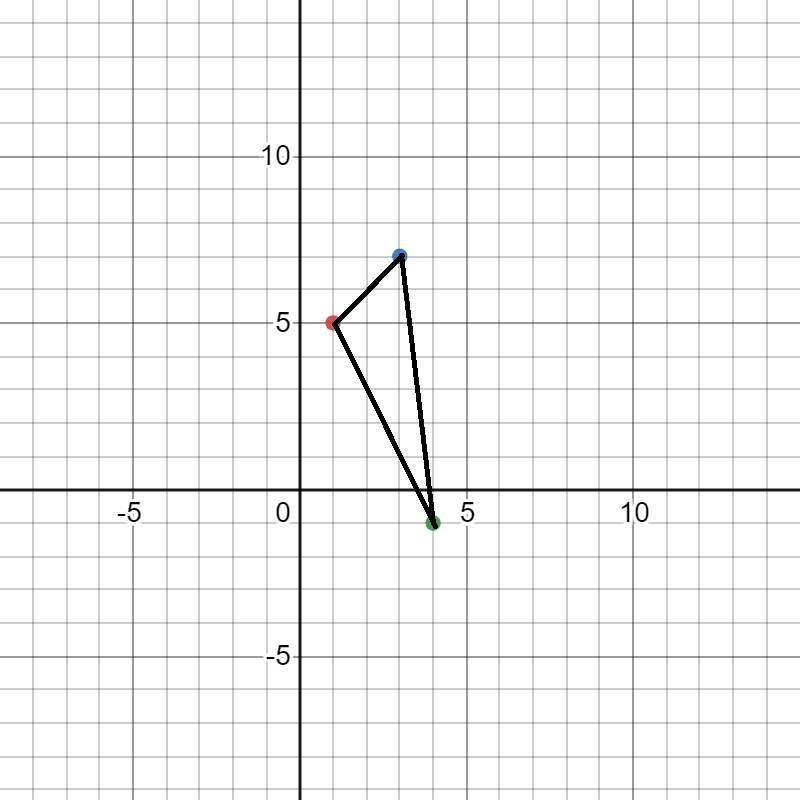
Glencoe Math Course 3 Volume 2 Student Chapter 6 Transformations Exercise 6.2 Page 463 Exercise 1, Problem1

The reflected image is as follows,

Glencoe Math Course 3 Volume 2 Student Chapter 6 Transformations Exercise 6.2 Page 463 Exercise 1, Problem 1

The reflected image is as follows,

Glencoe Math Course 3 Volume 2 Student Chapter 6 Transformations Exercise 6.2 Page 463 Exercise 1, Problem -1

P’=(-1,5)
Q’=(-3,7)
R’=(-4,-1)

The coordinates of the reflected image are as follows,

P’=(-1,5)
Q’=(-3,7)
R’=(-4,-1)

Glencoe Math Course 3 Volume 2 Student Chapter 6 Page 463 Exercise 1, Problem2

A figure is given. We need to reflect the figure over x-axis and find the coordinates of A’ and B’.

This can be found by seeing that when a point is reflected over the x-axis, only it’s y-coordinate changes.

The coordinates of the reflected points as can be found from the graph are as follows,
A​′(−2,−2)

B​′(2,−2)

The reflected image on the coordinate plane is as follows,
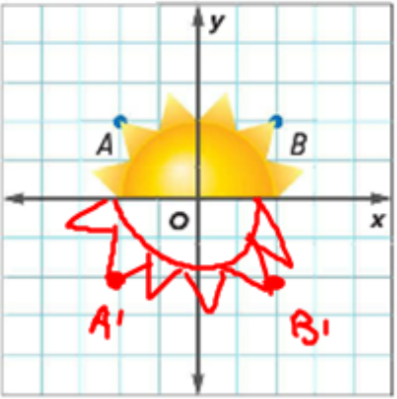
Glencoe Math Course 3 Volume 2 Student Chapter 6 Transformations Exercise 6.2 Page 463 Exercise 1, Problem -2

The coordinates of the reflected points are A′(−2,−2),B​′(2,−2).

Glencoe Math Course 3 Volume 2 Student Chapter 6 Page 464 Exercise 1, Problem1

It is given that a Triangle ABC has vertices A(5,1), B(1,2), and C(6,2).

We need to find the coordinates of the reflected image.

This can be found by finding the coordinates of the vertices of the reflected image.

The given points are as follows,
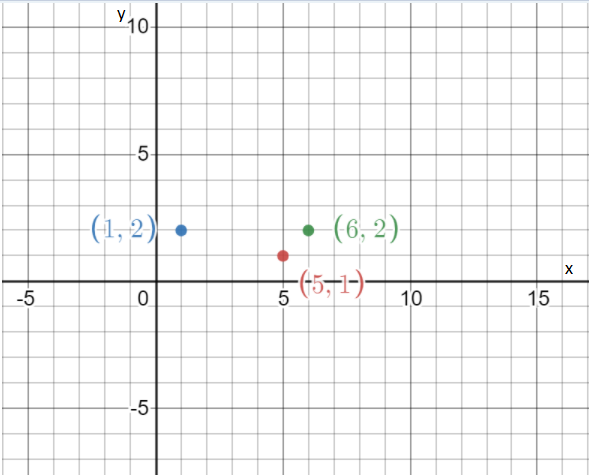
Glencoe Math Course 3 Volume 2 Student Chapter 6 Transformations Exercise 6.2 Page 464 Exercise 1, Problem1

The triangle with the given coordinates is as follows,
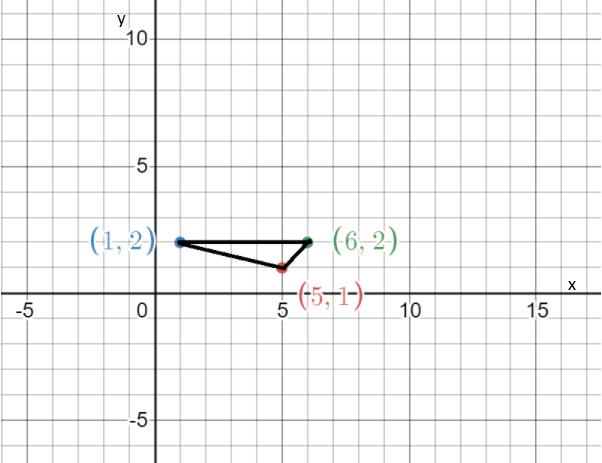
Glencoe Math Course 3 Volume 2 Student Chapter 6 Transformations Exercise 6.2 Page 464 Exercise 1, Problem 1

The reflected image is as follows,


Glencoe Math Course 3 Volume 2 Student Chapter 6 Transformations Exercise 6.2 Page 464 Exercise 1, Problem 1.

The coordinates of the vertices of the reflected figure is,
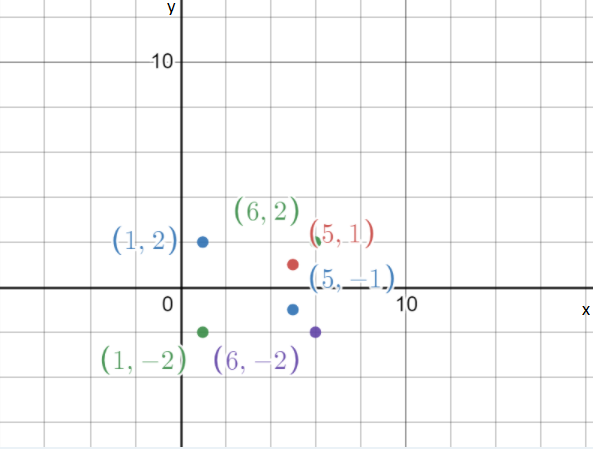
Glencoe Math Course 3 Volume 2 Student Chapter 6 Transformations Exercise 6.2 Page 464 Exercise 1, Problem -1.


A’=(5,-1)
B’=(1,-2)
C’=(6,-2)

The coordinates of the reflected image are as follows,
A’=(5,-1)
B’=(1,-2)
C’=(6,-2)

Glencoe Math Course 3 Volume 2 Student Chapter 6 Page 464 Exercise 2 Problem1

A figure is given. We need to reflect the figure over y-axis and find the coordinates of A’ and B’.

This can be found by seeing that when a point is reflected over the x-axis, only it’s y-coordinate changes.

The coordinates of the reflected points areA​′ (0,−11),B​′(10,−10).

Chapter 6 Exercise 6.2 Answers Transformations Glencoe Math Course 3 Volume 2 Page 464 Exercise 3, Problem1

A figure is given. We need to find the coordinates of the figure after a reflection over either axis.

This can be found by the fact that after reflection over a particular axis, the coordinate of that axis remains the same and the other changes.

If the point is to be reflected over the x-axis, keep the coordinate of x-axis the same and take the opposite of the y-coordinate.

If the point is to be reflected over the y-axis, keep the coordinate of y-axis the same and take the opposite of the x-coordinate.

The coordinates of a figure after a reflection over either axis is determined by keeping the coordinate of that axis constant.

Glencoe Math Course 3 Volume 2 Student Chapter 6 Page 465 Exercise 1 Problem1

It is given that a Triangle GHJ has vertices G(4,2), H(3,-4), and J(1,1).

We need to find the coordinates of the reflected image.

This can be found by finding the coordinates of the vertices of the reflected image.

the given points are as follows
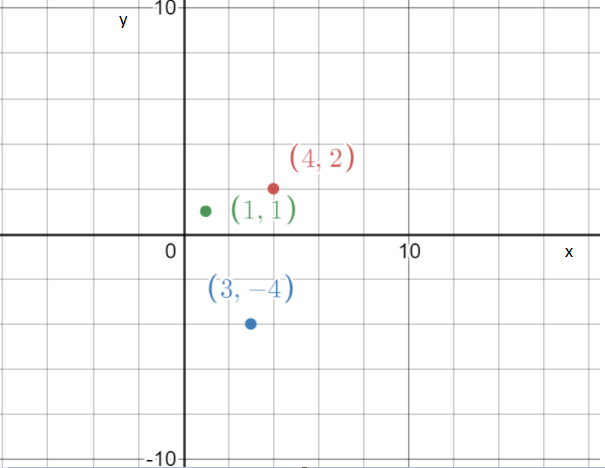
Glencoe Math Course 3 Volume 2 Student Chapter 6 Transformations Exercise 6.2 Page 465 Exercise 1, Problem 1


The triangle with the given coordinates is as follows,
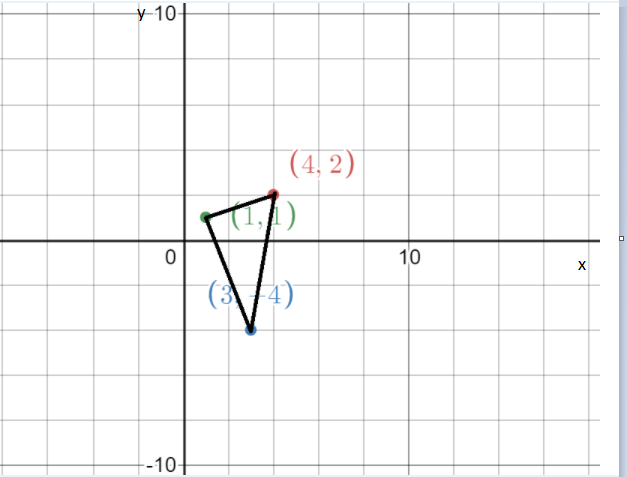
Glencoe Math Course 3 Volume 2 Student Chapter 6 Transformations Exercise 6.2 Page 464 Exercise 1, Problem -1

The reflected image is as follows,

Glencoe Math Course 3 Volume 2 Student Chapter 6 Transformations Exercise 6.2 Page 465 Exercise 1, Problem. 1

The coordinates of the vertices of the reflected figure is,
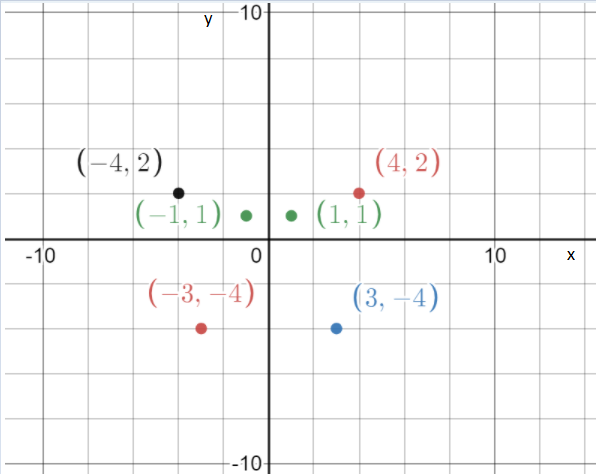
Glencoe Math Course 3 Volume 2 Student Chapter 6 Transformations Exercise 6.2 Page 465 Exercise 1, Problem. (1)


G’=(-4,2)
H’=(-3,-4)
J’=(-1,1)

The coordinates of the reflected image are as follows,

G’=(-4,2)
H’=(-3,-4)
J’=(-1,1)

Glencoe Math Course 3 Volume 2 Student Chapter 6 Page 465 Exercise 2 Problem1

It is given that a Triangle MNP has vertices M(2,1), N(-3,1), and P(-1,4).

We need to find the coordinates of the reflected image.

This can be found by finding the coordinates of the vertices of the reflected image.

The given points are as follows,
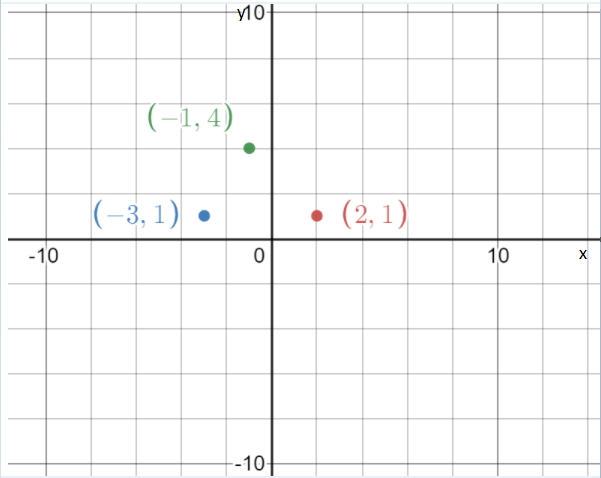
Glencoe Math Course 3 Volume 2 Student Chapter 6 Transformations Exercise 6.2 Page 465 Exercise 2, Problem1


The triangle with the given coordinates is as follows,
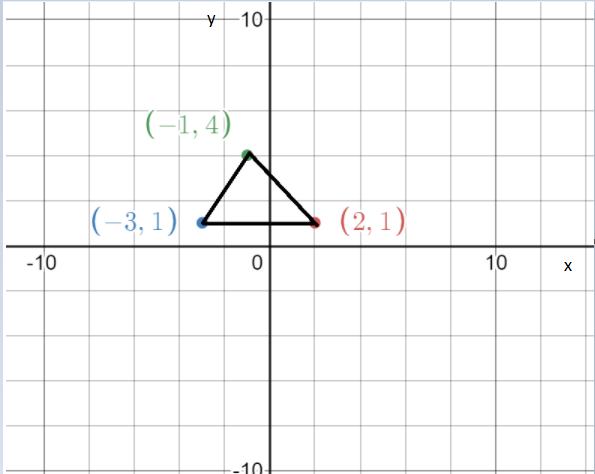
Glencoe Math Course 3 Volume 2 Student Chapter 6 Transformations Exercise 6.2 Page 465 Exercise 2, Problem 1

The reflected image is as follows,

Glencoe Math Course 3 Volume 2 Student Chapter 6 Transformations Exercise 6.2 Page 465 Exercise 2, Problem -1

The coordinates of the vertices of the reflected figure is,
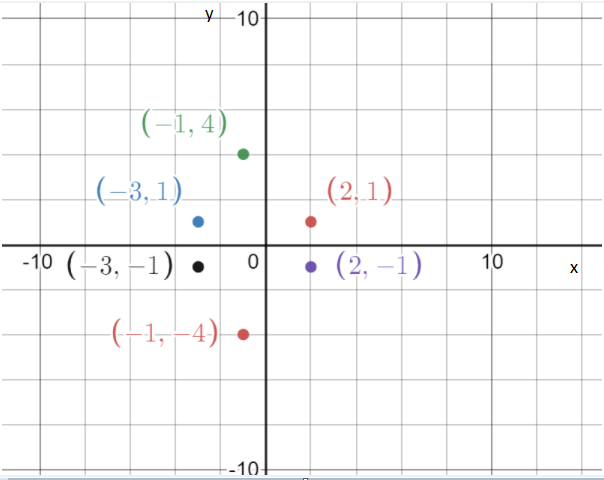
Glencoe Math Course 3 Volume 2 Student Chapter 6 Transformations Exercise 6.2 Page 465 Exercise 2, Problem 1.


M’=(2,-1)
N’=(-3,-1)
P=(-1,-4)

The coordinates of the reflected image are as follows,

M’=(2,-1)
N’=(-3,-1)
P=(-1,-4)

Glencoe Math Course 3 Volume 2 Student Chapter 6 Page 465 Exercise 3 Problem1

It is given that a quadrilateral WXYZ has vertices W(-1,-1), X(4,1), Y(4,5), and Z(1,7).We need to find the coordinates of the reflected image.

This can be found by finding the coordinates of the vertices of the reflected image.

The given points are as follows,
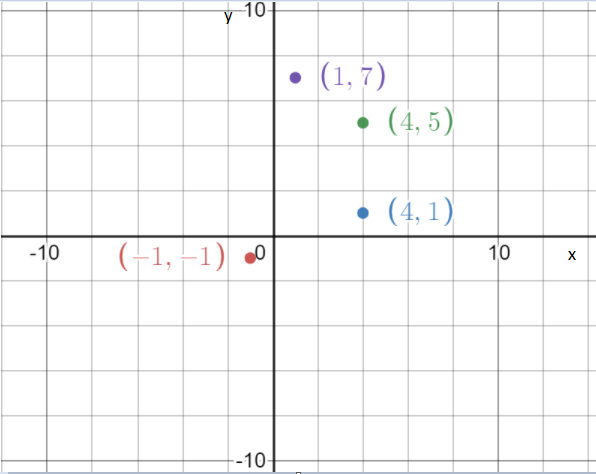
Glencoe Math Course 3 Volume 2 Student Chapter 6 Transformations Exercise 6.2 Page 465 Exercise 3, Problem1

The quadrilateral with the given coordinates is as follows,
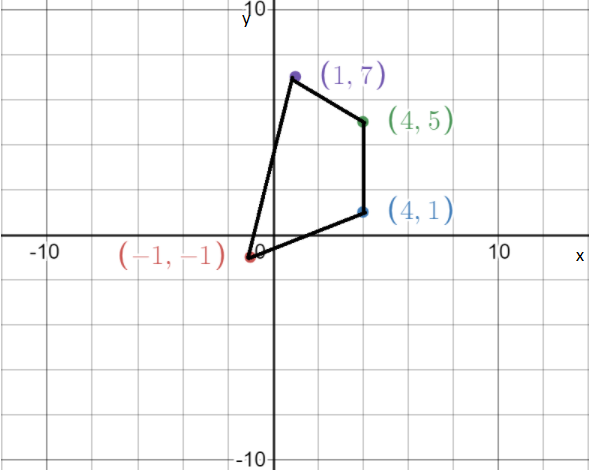
Glencoe Math Course 3 Volume 2 Student Chapter 6 Transformations Exercise 6.2 Page 465 Exercise 3, Problem 1


The reflected image is as follows,

Glencoe Math Course 3 Volume 2 Student Chapter 6 Transformations Exercise 6.2 Page 465 Exercise 3, Problem 1.

The coordinates of the vertices of the reflected figure is,
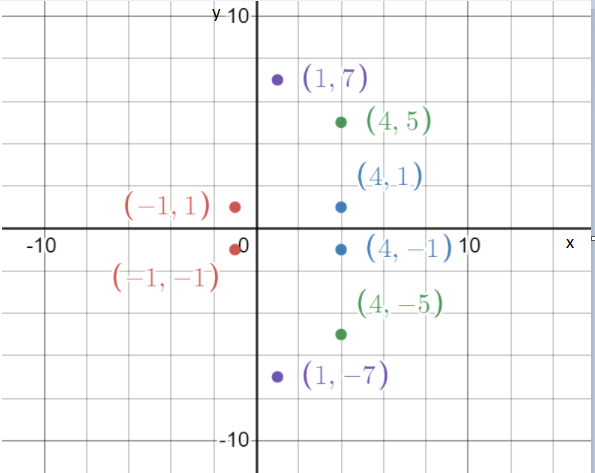
Glencoe Math Course 3 Volume 2 Student Chapter 6 Transformations Exercise 6.2 Page 465 Exercise 3, Problem-1

W’=(-1,1)
X’=(4,-1)
Y’=(4,-5)
Z’=(1,-7)

The coordinates of the reflected image are as follows,

W’=(-1,1)
X’=(4,-1)
Y’=(4,-5)
Z’=(1,-7)

Glencoe Math Course 3 Volume 2 Student Chapter 6 Page 465 Exercise 4, Problem1

Given vertices of quadrilateral are D(1,0),E(1,−5),F(4,−1),G(3,2).

We have to find the coordinates of the reflected image When we translate quadrilateral over the y-axis, the y- coordinate of each of its vertices remains the same, and the x-coordinate will get multiplied by −1.

Given vertices of a quadrilateral areD(1,0),E(1,−5),F(4,−1),G(3,2).

When we translate quadrilateral over the y-axis, the y- coordinate of each of its vertices remains the same, and the x-coordinate will get multiplied by −1.

Therefore, new coordinates are,D(1,0)=D′(−1,0)E(1,−5)=E′(−1,−5)F(4,−1)=F′(−4,−1)G(3,2)=G′(−3,2)

Therefore, a Graph of given vertices and its reflected image becomes,
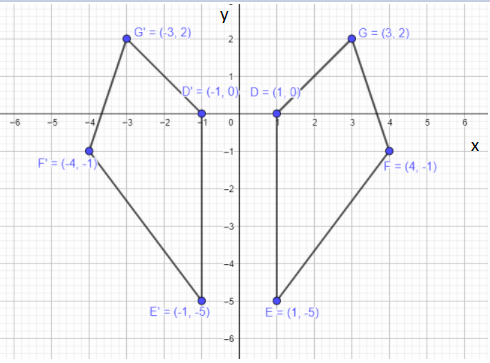
Glencoe Math Course 3 Volume 2 Student Chapter 6 Transformations Exercise 6.2 Page 465 Exercise 4, Problem 1

The coordinates of a quadrilateral DEFG after a reflection over the y-axis are D′(−1,0), E′(−1,−5), F′(−4,−1), G′(−3,2).

Step-By-Step Guide For Exercise 6.2 Chapter 6 Transformations In Glencoe Math Course 3 Page 465 Exercise 5, Problem1

We have to find the coordinates of point A′ and point B′.

When the figure is reflected over the x-axis, its x-coordinate remains the same, and the y-coordinate will get multiplied by −1.

When the figure is reflected over the x-axis, its x -x-coordinate remains the same, and the y -y-coordinate will get multiplied by 1.

The coordinates of the initial points are A(−3,3), B(3,3) after reflection over x-axis, the new coordinates will be

Sketch of the image on the coordinate plane,
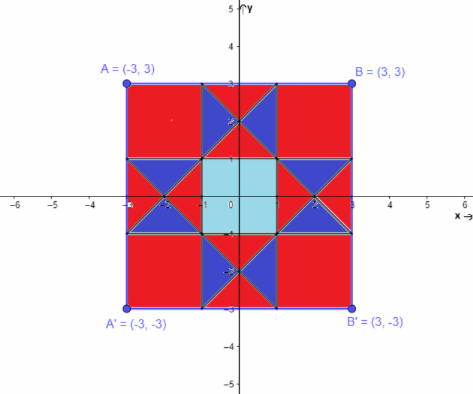
Glencoe Math Course 3 Volume 2 Student Chapter 6 Transformations Exercise 6.2 Page 465 Exercise 5, Problem 1

The new coordinates after reflection are A′

(−3,−3),B′
(3,−3)

Glencoe Math Course 3 Volume 2 Student Chapter 6 Page 465 Exercise 6 Problem1

Given point is M(3,3) →M′(3,−3).

When the figure is reflected over the x-axis, its x-coordinate remains the same, and the coordinate will get multiplied by −1.

When the figure is reflected over the y-axis, its y-coordinate remains the same, and the x-coordinate will get multiplied by −1.

We have to describe the reflection as over the x-axis or y-axis.

When the figure is reflected over the x-axis, its x-coordinate remains the same, and the y -coordinate will get multiplied by−1.

When the figure is reflected every y-axis, its y-coordinate remains the same, and the x-coordinate will get multiplied by −1.

Given point is M(3,3)→M′(3,−3)

Here we can see that y-coordinate of point M′is negative of the initial point M.

Hence, the point is reflected through x-axis.

When the figure is reflected over x-axis, its x-coordinate remains the same, and the y-coordinate will get multiplied by−1
.
When the figure is reflected over y-axis, its y-coordinate remains the same, and the x-coordinate will get multiplied by −1.

Given point is M(3,3)→M′(3,−3)

Here we can see that y-coordinate of point M′is negative of the initial point M.

Hence, the given pointM(3,3)→M′(3,−3)is reflected throughx-axis.

Exercise 6.2 Solutions For Chapter 6 Transformations Glencoe Math Course 3 Volume 2 Page 466 Exercise 7, Problem1

Given coordinates of vertex of triangle are J(−7,4),K(7,1),L(2,−2).

When the point is reflected over x-axis, its x-coordinate remains the same, and the y-coordinate will get multiplied by−1.

When the point is reflected over y-axis, its y-coordinate remains the same, and the x-coordinate will get multiplied by−1.

We know that, when the figure is reflected over x-axis, its x-coordinate remains the same, and the y-coordinate will get multiplied by−1.
Therefore, the given coordinates become,

​J(−7,4)→J′(−7,−4)
K(7,1)→K′(7,−1)
L(2,−2)→L′(2,2)

We know that, when the figure is reflected over y-axis, itsy-coordinate remains the same, and the coordinate will get multiplied by −1.

Therefore, the given coordinates becomes,

​J(−7,4)→J′′(7,−4)
K(7,1)→K′′(−7,−1)
L(2,−2)→L′′(−2,2)

Hence, final coordinates after reflection over x-axis are
J′(−7,−4),
K′(7,−1),
L′(2,2).

Hence, final coordinates after reflection over y-axis are
J′′(7,−4),
K′′(−7,−1),
L′′(−2,2).

Hence, final coordinates after reflection over x-axis are
J′(−7,−4),
K′(7,−1),
L′(2,2).

Hence, final coordinates after reflection over y-axis are
J′′(7,−4),
K′′(−7,−1),
L′′(−2,2).

Glencoe Math Course 3 Volume 2 Student Chapter 6 Page 466 Exercise 8 Problem1

We have to reflect a triangle in Quadrant I over the y-axis, then translate the image 2 units left and 3 units down and check if there is a single transformation that maps the pre-image onto the image. When the figure is reflected over y-axis, itsy-coordinate remains the same, and the x-coordinate will get multiplied by−1.

Let us take ΔABC with vertices A(1,1),B(5,1),C(2,3).

When we reflect ΔABC over y-axis, A new triangle with vertices ΔA′ B′ C is formed with vertices A′(−1,1), B′(−5,1), C′(−2,3).

Now, we have to translate ΔA′B′C′2 units left and 3 units down, Therefore the coordinates of resultant image is as follows,
​(x,y)→(x−2,y−3)
(−1,1)→(−1−2,−1−3)=(−3,−2)
(−5,1)→(−5−2,−5−1)=(−7,−2)
(−2,3)→(−2−2,3−3)=(−4,0)

Hence, ΔA′′B′′C′′is formed with vertices
A′′(−3,−2),
B′′(−7,−2),
C′′(−4,0).
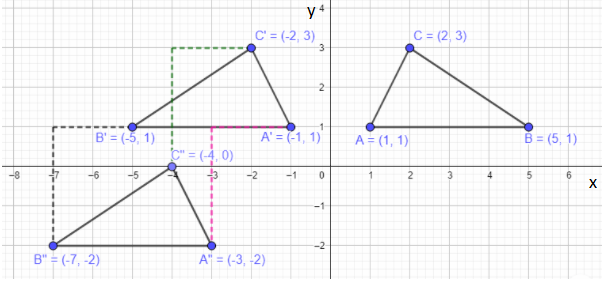
Glencoe Math Course 3 Volume 2 Student Chapter 6 Transformations Exercise 6.2 Page 466 Exercise 8, Problem 1

The triangle ΔA′′B′′C′′ can be obtained from ΔABC by two ways of transformation.

1. First flip the triangle ΔABC along y−axis, then move it 2 units left and 3 units down.
2. First move the triangle ΔABC, 3 units down and 2 units right and then flip it over y−axis.
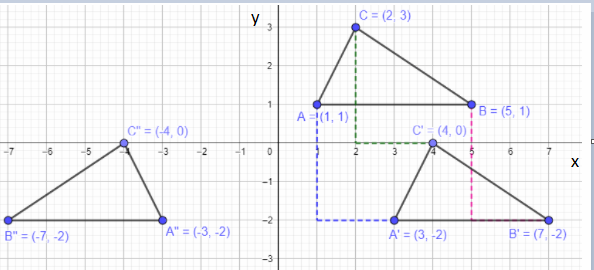
Glencoe Math Course 3 Volume 2 Student Chapter 6 Transformations Exercise 6.2 Page 466 Exercise 8, Problem 1.

So, we conclude that to obtain ΔA′′B′′C′′from ΔABCa single transformation is not possible.

A single transformation is not possible to obtainΔA′′B′′C′′fromΔABC

Glencoe Math Course 3 Volume 2 Student Chapter 6 Page 466 Exercise 9 Problem1

We have to check, Is there a single transformation using reflections or translations that maps the pre-image onto the image, when you reflect a non-regular figure over the x-axis and then reflect it over the y-axis.

When the figure is reflected over x-axis, its x-coordinate remains the same, and the y-coordinate will get multiplied by−1.

When the figure is reflected over y-axis, its y-coordinate remains the same, and the x-coordinate will get multiplied by−1.

We have to check, Is there a single transformation using reflections or translations that maps the pre-image onto the image, when you reflect a non-regular figure over the x-axis and then reflect it over the y-axis.

This can be understood by example below, Consider triangle ΔABCwith vertices A(2,4), B(5,7), and C(2,8).

First, reflect the triangle over x−axis,

Therefore, the coordinates become,

​A(2,4)→A′(2,−4)
B(5,7)→B′(5,−7)
C(2,8)→C′(2,−8)

Now, reflection over y−axis.

Therefore, the coordinates become,

A′(2,−4)→A′′(−2,−4)
B′(5,−7)→B′′(−5,−7)
C′(2,−8)→C′′(−2,−8)

We can see that, there is no any other single transformation such as reflection or translation that can map same ,same image obtained by reflecting original image by X-axis and Y-axis.

No, There is no any other single transformation such as reflection or translation that can map same same image obtained by reflecting original image by X-axis and Y-axis.

Examples Of Problems From Exercise 6.2 Chapter 6 Transformations In Glencoe Math Course 3 Page 466 Exercise 10, Problem1

Given that quadrilateral ABCD is reflected over the x-axis and translated 5 units to the right. When the figure is reflected over x-axis, its x-coordinate remains the same, and the y-coordinate will get multiplied by−1.

We have to find resulting image of point B

Given that quadrilateral ABCD is reflected over the x-axis and translated 5 units to the right.

Coordinates of the point: B(−6,2).

We know that, when the point is reflected over x-axis, then the y-coordinate becomes opposite.

​A(x,y)→A′(x,−y)
B(−6,2)→B(−6,−2)

Now translating the point by 5 units to the right, Coordinates of point after translation:
B′(−6,−2)→B′′(−6+5,−2+0)=B′′(−1,−2)​

Hence, option (A) (−1,−2)is correct.

The correct option is (A) (−1,−2)

Glencoe Math Course 3 Volume 2 Student Chapter 6 Page 467 Exercise 11 Problem1

Given vertices of square ABCD are A(2,4),B(−2,4),C(−2,8),D(2,8).

When the figure is reflected over x-axis, its x-coordinate remains the same, and the y-coordinate will get multiplied by−1.

Given vertices of square ABCD areA(2,4),B(−2,4),C(−2,8),D(2,8).

When the figure is reflected over x-axis, its x-coordinate remains the same, and the y-coordinate will get multiplied by−1.

Therefore, the coordinates after reflection becomes.

​A(2,4)→A′(2,−4)
B(−2,4)→B′(−2,−4)
C(−2,8)→C′(−2,−8)
D(2,8)→D′(2,−8)

Hence, the vertices of reflected square will be,

A′(2,−4),
B′(−2,−4),
C′(−2,−8),
D′(2,−8).

The graphical representation will be,
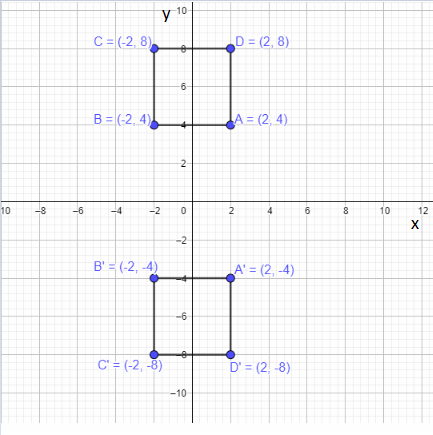
Glencoe Math Course 3 Volume 2 Student Chapter 6 Transformations Exercise 6.2 Page 467 Exercise 11, Problem 1

The vertices of reflected square are, A′
(2,−4),B′
(−2,−4),C′
(−2,−8),D′
(2,−8).

Graphical representation is,

Glencoe Math Course 3 Volume 2 Student Chapter 6 Transformations Exercise 6.2 Page 467 Exercise 11, Problem 1

Glencoe Math Course 3 Volume 2 Student Chapter 6 Page 467 Exercise 12 Problem1

The coordinates of a point and its image after a reflection are X(−1,−4)→X′(−1,4).

We have to describe the reflection as over the x-axis or y-axis.

When the figure is reflected over x-axis, its x-coordinate remains the same, and the y-coordinate will get multiplied by−1.

When the figure is reflected over y-axis, its y-coordinate remains the same, and the x-coordinate will get multiplied by−1.

The coordinates of a point and its image after a reflection are X(−1,−4)→X′(−1,4).

When the figure is reflected over x-axis, its x-coordinate remains the same, and the y-coordinate will get multiplied by−1.
A(x,y)→A′(x,−y)

When the figure is reflected over y-axis, itsy-coordinate remains the same, and the x-coordinate will get multiplied by−1.
A(x,y)→A′(−x,y)

From the given point, we can see that x-coordinate of the point and its image are the same,and the y-coordinate of the image is opposite to that of its image.

Hence, the point is reflected over x-axis.

The point is reflected over x-axis.

Common Core Chapter 6 Exercise 6.2 Transformations Detailed Solutions Glencoe Math Course 3 Volume 2 Page 467 Exercise 13, Problem1

Given point and its image is, W(−4,0)→W′(4,0).

We have to describe the reflection as over the x-axis or y-axis. When the figure is reflected over x-axis, its x-coordinate remains the same, and the y-coordinate will get multiplied by−1.

When the figure is reflected over y-axis, its y-coordinate remains the same, and the x-coordinate will get multiplied by−1.

Given point and its image is, W(−4,0)→W′(4,0).

When the figure is reflected over x-axis, its x-coordinate remains the same, and the y-coordinate will get multiplied by−1.
A(x,y)→A′(x,−y)

When the figure is reflected over y-axis, its y-coordinate remains the same,and the x-coordinate will get multiplied by−1.

A(x,y)→A′(−x,y)

From the given point and its image we can see that, y-coordinate of the point and its image are same, and the x-coordinate of the point is opposite to that of image.

Hence, the point is reflected over y-axis.

The point is reflected over y-axis.

Glencoe Math Course 3 Volume 2 Student Chapter 6 Page 468 Exercise 14 Problem1

The given figure is, ΔABC with vertices A(1,-1), B(4,-1), and C(2,-4).

We have to choose the correct alternative as the reflection of the triangle over the x-axis.

Since the reflection is done over the x-axis, we apply the translation notation ⟨x,y)→(x,−y)to the coordinates of the vertices of the triangle.

We match the translated vertices with the vertices of the alternative choices to obtain the correct option.

We are given a triangle, ΔABC with coordinates A(1,-1), B(4,-1), and C(2,-4).

Since we have reflected the figure over the x-axis, the coordinates of the x-axis will be the same and the y-axis coordinates will be opposite signed i.e.

we will multiply -1 with the y-axis coordinates. Hence, the translation notation used is, P⟨x,y)→P′(x,−y).

Therefore, the translated point corresponding to A is, A⟨1,−1)→A′(1,1).

Similarly, the other two translated points are,B⟨4,−1)→B′(4,1) and C⟨2,−4)→C′(2,4).

From the four alternatives, we can see that in the figure at the second option i.e. option (B), the vertices have the coordinates as (1,1), (4,1), and (2,4). So, option (B) is the correct figure.
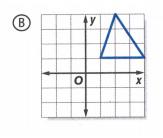
Glencoe Math Course 3 Volume 2 Student Chapter 6 Transformations Exercise 6.2 Page 468 Exercise 14, Problem 1


Finally, we can conclude that the figure at option (B) is the correct option for the reflected image of the given figure ΔABC.

Glencoe Math Course 3 Volume 2 Student Chapter 6 Transformations Exercise 6.2 Page 468 Exercise 14, Problem 1


Student Edition Exercise 6.2 Chapter 6 Transformations Solutions Guide Glencoe Math Course 3 Volume 2 Page 468 Exercise 15, Problem1

The given statement is, triangle RST is reflected over the x-axis and then translated 4 units to the right.

We have to determine the coordinates of point R in its new position.

We apply the translation, ⟨x,y)→(x,−y)to the coordinates of vertices of RST for the reflection over the x-axis.

We also add 4 with the x-coordinates of the vertices to signify the shift of 4 units to the right.

We have the figure ΔRST as
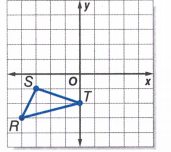
Glencoe Math Course 3 Volume 2 Student Chapter 6 Transformations Exercise 6.2 Page 468 Exercise 15, Problem 1

The coordinates of the point R are (-4,-3).

Now, we apply the translation ⟨x,y)→(x,−y)to R for the reflection over the x-axis as,R⟨−4,−3)→R′(−4,3).

Also, the point is shifted units to the right i.e. we have to add 4 with the x-coordinate of R’ as, R′⟨−4,3)→R​′′(−4+4,3)→R​′′
(0,3).

Therefore, the final position of the point R will be (0,3).

Finally, we can conclude that the coordinates of point R in its new position are R′⟨−4,3)→R​′′(0,3).

Glencoe Math Course 3 Volume 2 Student Chapter 6 Page 468 Exercise 16 Problem1

The given statement is, graph and label figure pentagon LMNOP with vertices L(0,3), M(2,2), N(2,0), O(-2,0), and P(-2,2).

We first plot the vertices according to the given coordinates and then link the vertices by straight lines to form the pentagon LMNOP.

We have the vertices of the pentagon LMNOP as L(0,3), M(2,2), N(2,0), O(-2,0), and P(-2,2).
Now, we can plot these points on the graph as
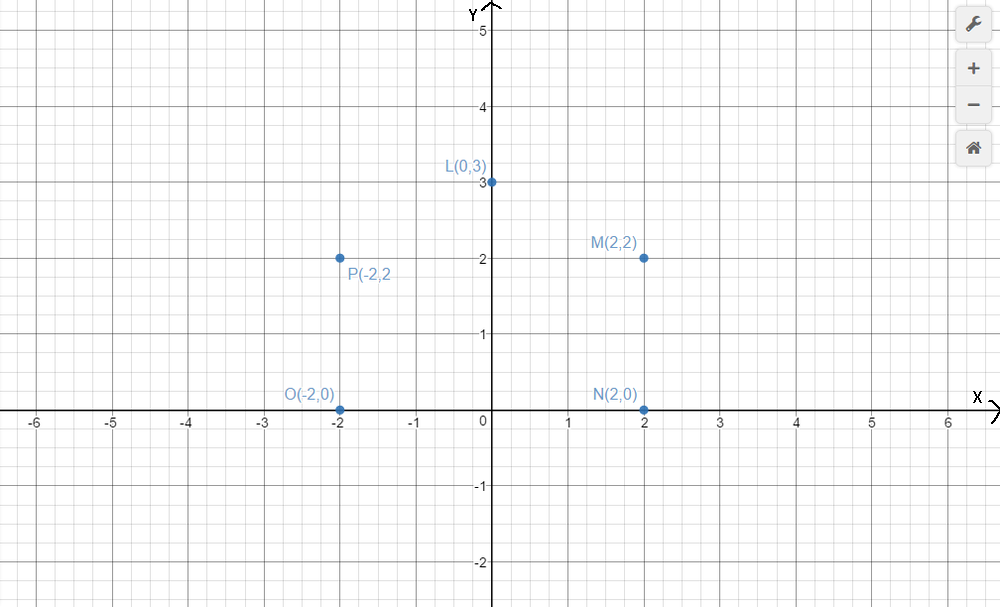
Glencoe Math Course 3 Volume 2 Student Chapter 6 Transformations Exercise 6.2 Page 468 Exercise 16, Problem 1

Now, we connect these vertices with straight lines to form the pentagon LMNOP as
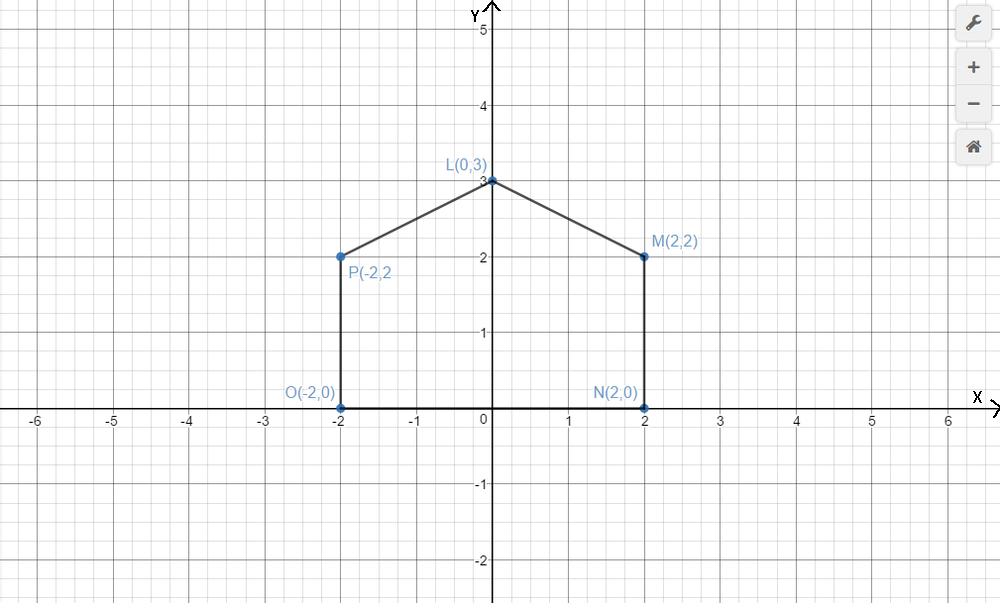
Glencoe Math Course 3 Volume 2 Student Chapter 6 Transformations Exercise 6.2 Page 468 Exercise 16, Problem 1.

Finally, we can conclude that the pentagon LMNOP can be plotted and labeled as
Glencoe Math Course 3 Volume 2 Student Chapter 6 Transformations Exercise 6.2 Page 468 Exercise 16, Problem 1.