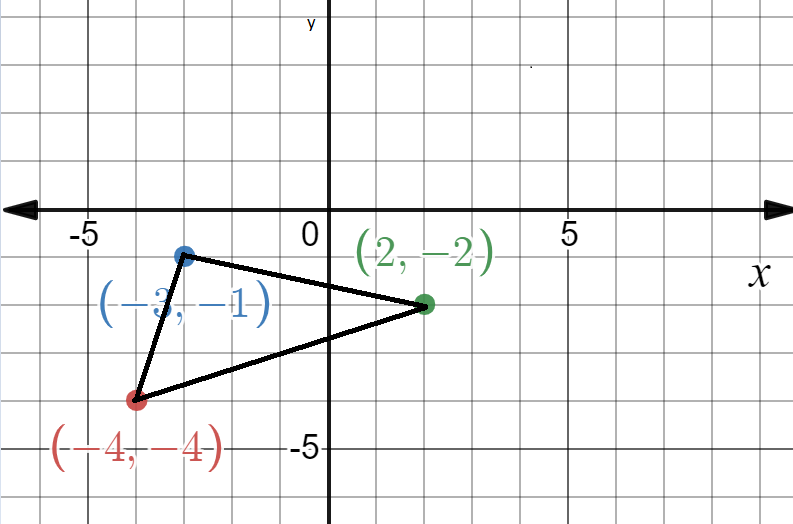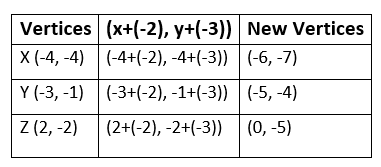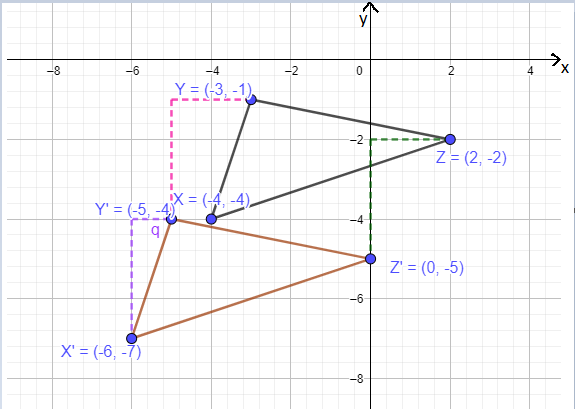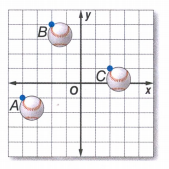
Glencoe Math Course 3 Volume 2 Student 1st Edition Chapter 6 Transformations Exercise

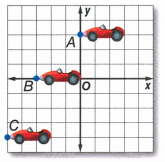
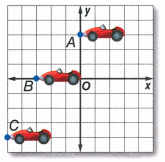
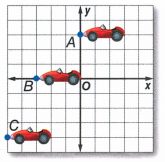
Glencoe Math Course 3 Volume 2 Student Chapter Chapter 6 Transformations Page 445 Exercise 1 Problem1

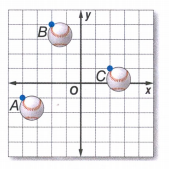
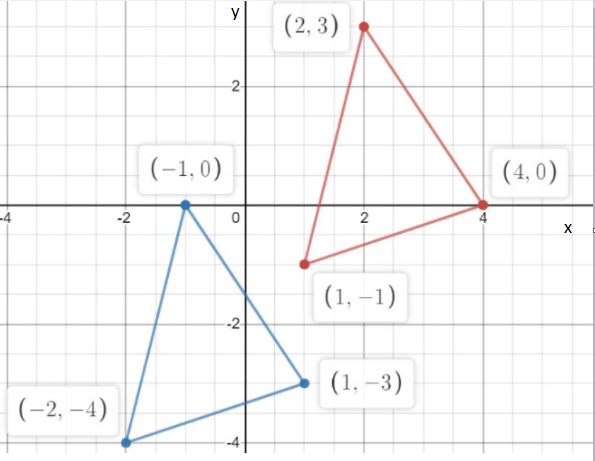
We have been given a figure. We need to show or describe the change in position of the figure. This can be found by the phenomena of motion

Motion is the phenomenon in which an object changes its position over time. Motion is mathematically described in terms of displacement, distance, velocity, acceleration, speed, and time.

The best way to show or describe the change in position of a figure is through its motion.


Glencoe Math Course 3 Volume 2 Chapter 6 Transformations Exercise Solutions Page 446 Exercise 1, Problem1

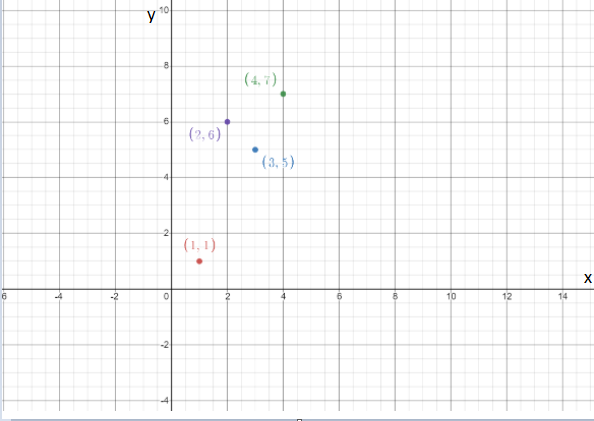
We have been given a quadrilateral ABCD with vertices A(1,1), B(3,5), C(4,7), and D(2,6).

We need to find that in what quadrant is ABCD located.

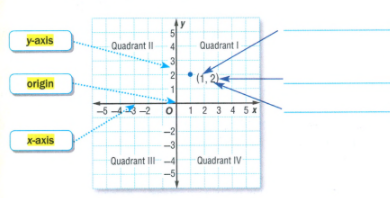
This can be found by the fact that if both xx and yy are positive, then the point lies in the first quadrant. If xx is negative and yy is positive, then the point lies in the second quadrant.

If both xx and yy are negative, then the point lies in the third quadrant. If xx is positive and yy is negative, then the point lies in the fourth quadrant.
Glencoe Math Course 2 Student Edition Volume 1 Chapter 6 Transformations Exercise

The given points A,B,C,D are plotted as follows,
Glencoe Math Course 3 Volume 2 Student 1st Edition Chapter Chapter 6 Transformations Page 446 Exercise 1, Problem1

We see that all the points lie on the first quadrant.

Hence, the quadrilateral ABCD lies on the first quadrant.

The quadrilateral ABCD is located in the first quadrant.

Read and Learn More Glencoe Math Course 2 Volume 1 Common Core Student Edition Solutions

Glencoe Math Course 3 Volume 2 Student Chapter Chapter 6 Page 446 Exercise 2 Problem1

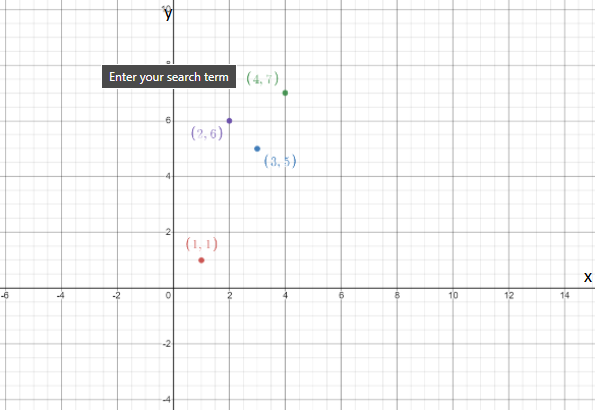
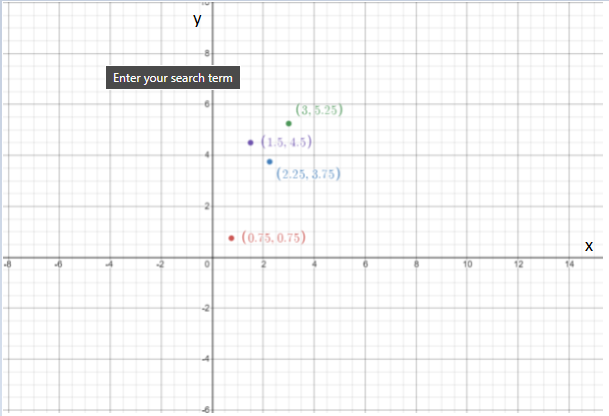
We have been given a quadrilateral with vertices A(1,1), B(3,5), C(4,7), and D(2,6).We need to find that if the coordinates of ABCD are multiplied by3/4, then in what quadrant would the new figure be located. This can be found by the fact that when a coordinate (x,y) is multiplied with a scalar a, the new coordinate is (ax,ay).

The coordinates A,B,C,D are as follows,
Glencoe Math Course 3 Volume 2 Student 1st Edition Chapter Chapter 6 Transformations Page 446 Exercise 2, Problem1

When the coordinates of A, B, C, D are multiplied by 3/4 = 0.75 , the new coordinates are as follows,
 

Glencoe Math Course 3 Volume 2 Student 1st Edition Chapter Chapter 6 Transformations Page 446 Exercise 2, Problem1.

We see that all the points lie on the first quadrant.

Hence, the new quadrilateral ABCD lies on the first quadrant

When the coordinates of ABCD are multiplied by3/4,then the new figure lies in the first quadrant.


Glencoe Math Course 3 Volume 2 Student Chapter Chapter 6 Page 446 Exercise 3 Problem1

We have been given a quadrilateral with vertices A(1,1), B(3,5), C(4,7), and D(2,6).We need to find that when the x-coordinates in ABCD are multiplied by -1 , then in what quadrant would the new figure be located.

This can be found by the fact that when a coordinate (x,y) is multiplied with a scalar a, the new coordinate is (ax,ay).

The coordinates A, B, C, D are as follows,
Glencoe Math Course 3 Volume 2 Student 1st Edition Chapter Chapter 6 Transformations Page 446 Exercise 3, Problem 1

When the x-coordinates in ABCD are multiplied by -1, then the new coordinates are plotted as follows,
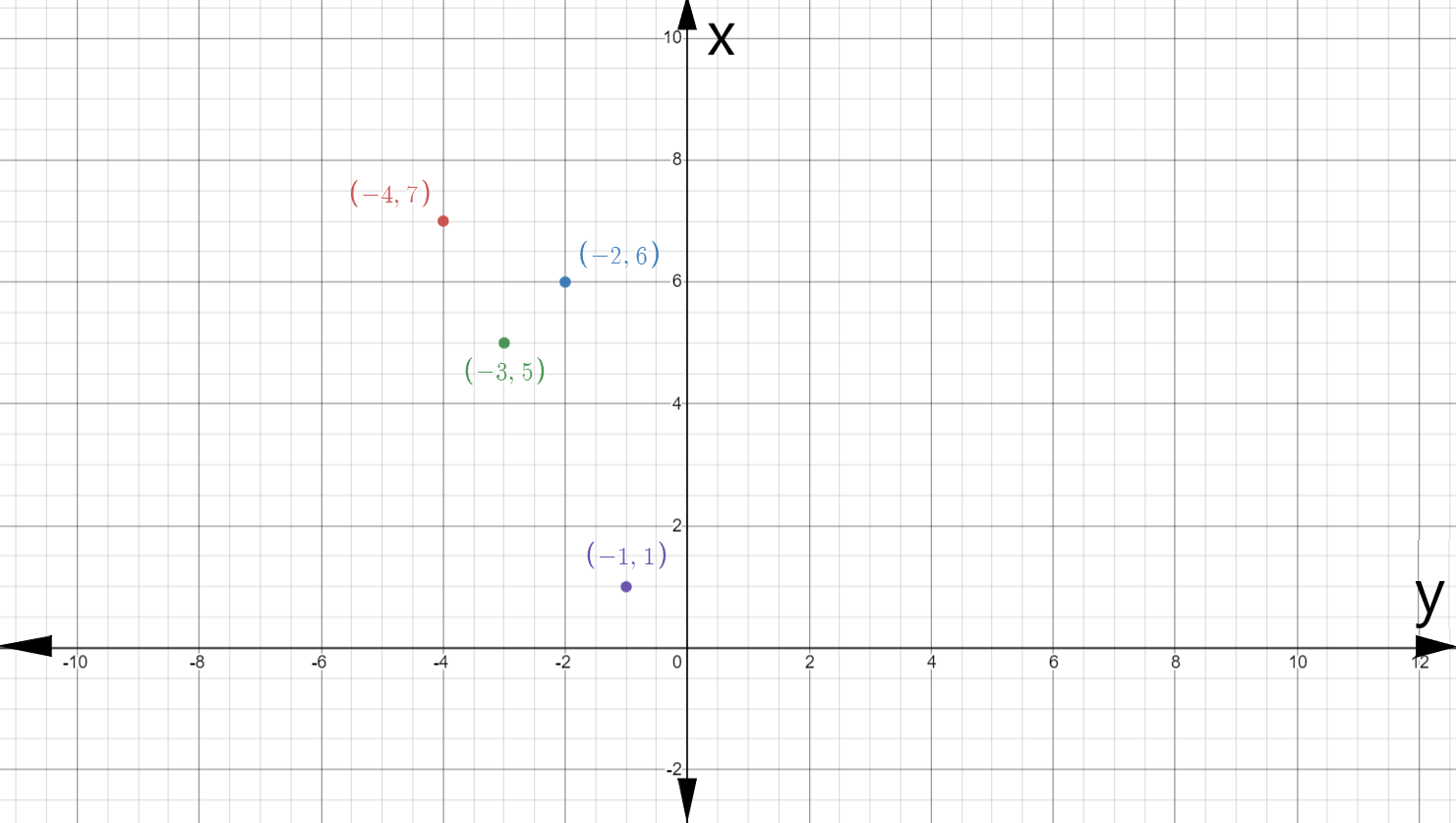
Glencoe Math Course 3 Volume 2 Student 1st Edition Chapter Chapter 6 Transformations Page 446 Exercise 3, Problem1

We see that all the points lie in the second quadrant.

Hence, the new quadrilateral ABCD lies on the second quadrant.

When the x-coordinates in ABCD are multiplied by -1, then the new figure lies in second quadrant.


Glencoe Math Course 3 Volume 2 Student Chapter Chapter 6 Page 446 Exercise 4 Problem1

We have been given a quadrilateral ABCD with vertices A(1,1), B(3,5), C(4,7), and D(2,6).We need to find that if we switch the x-and y-coordinates from Exercise 3, then in what quadrant would the new figure be located.

This can be found by the fact that hen a coordinate (x,y) is said to be switched, then the new point is (y,x).

The coordinates A, B, C, D are as follows, When we switch the x-and y-coordinates from Exercise 3, then the new coordinates are as follows,
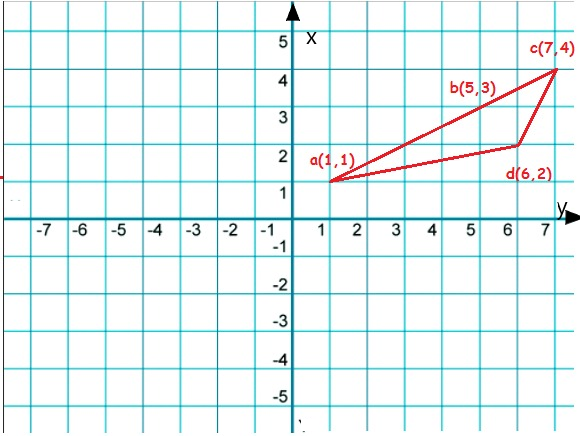
Glencoe Math Course 3 Volume 2 Student 1st Edition Chapter Chapter 6 Transformations Page 446 Exercise 4, Problem1

We see that all the points lie in the fourth quadrant.

Hence, the new quadrilateral ABCD lies on the fourth quadrant

When we switch the x-and y-coordinates from Exercise 3, then the new figure lies in the fourth quadrant.


Glencoe Math Course 3 Volume 2 Student Chapter Chapter 6 Page 448 Exercise 1 Problem1

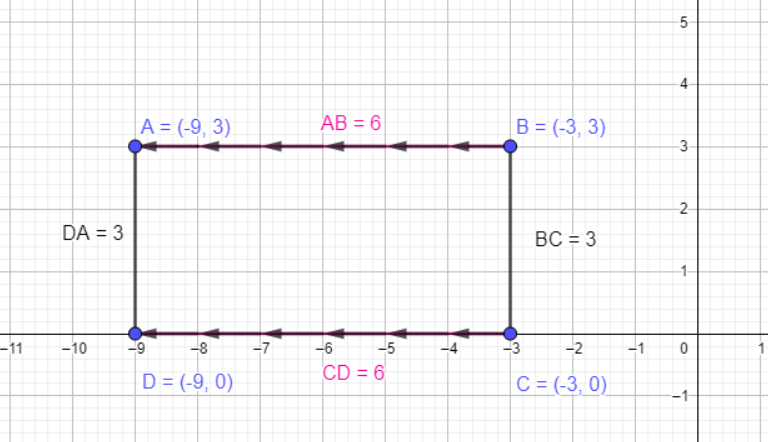
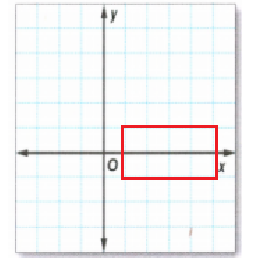
Given, a rectangle with vertices: B(−3,3) and C(−3,0) and side length 6 units. We need to graph figures and label the missing vertices.

Let, ABCD be the rectangle with vertices B(−3,3) and C(−3,0)and side length 6units.

For finding the other two vertices graphically, first, we need to put B(−3,3) and C(−3,0) on graph.

Now, the slope of a line that passes through a pair of points (x1,y1)and(x2,y2)is given by =y2−y1 x2−x1

We are given the endpoints, B(−3,3) and C(−3,0).

Therefore the slope of the line passing through these points is ​=0−3−3−(−3) =−30=infinite.

Here, we can see the slope of line BC is infinite, which means it is parallel to the y-axis. So the corresponding y – coordinate will remain the same.

Also, alternate sides of the rectangle are perpendicular therefore we will move 6 units along x-axis and thus x-coordinate will be shifted by 6 units.

Moving towards the positive x-axis.

X-coordinate of point A=−3+6=3

X-coordinate of point B=−3+6=3

So, the missing vertices of the rectangle ABCD are A(3,3)and D(3,0).
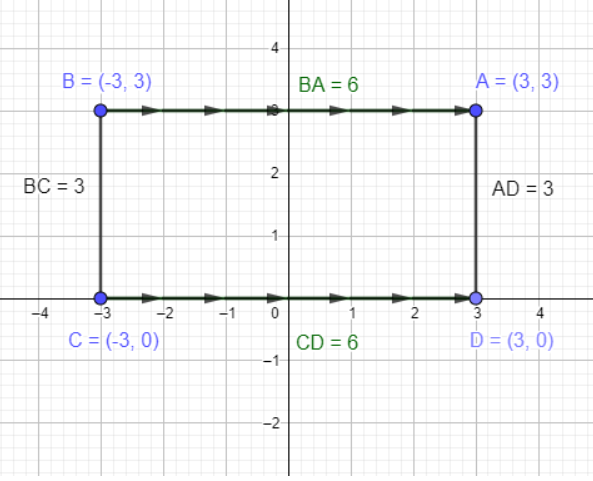
Glencoe Math Course 3 Volume 2 Student 1st Edition Chapter Chapter 6 Transformations Page 448 Exercise 1, Problem 1

Moving towards the negative X-axis.

X-coordinate of point A= −3−6=−9

X-coordinate of point B=−3−6=−9

So, in this case, missing vertices of the rectangle ABCD are A(−9,3) and D(−9,0).
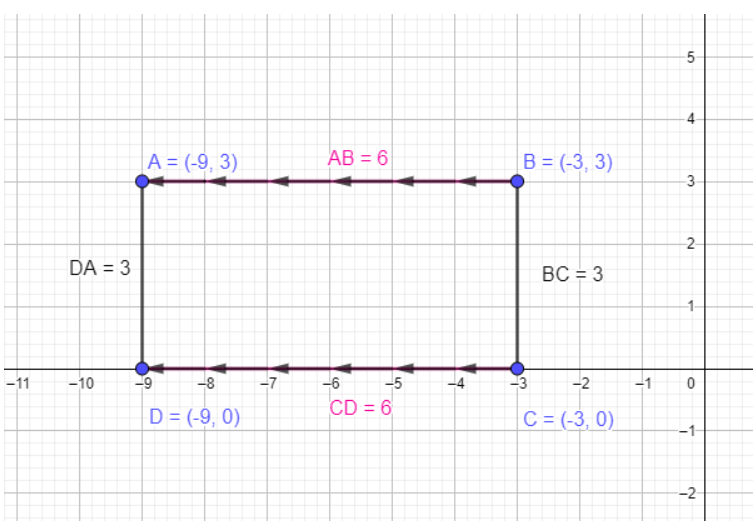
Glencoe Math Course 3 Volume 2 Student 1st Edition Chapter Chapter 6 Transformations Page 448 Exercise 1, Problem1

The missing vertices of the rectangle ABCD are either A(3,3) and D(3,0).
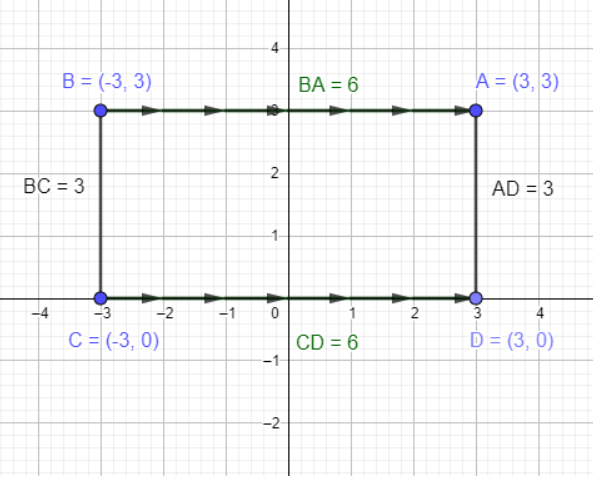
Glencoe Math Course 3 Volume 2 Student 1st Edition Chapter Chapter 6 Transformations Page 448 Exercise 1, Problem 1

OrA(−9,3) and D(−9,0).

Glencoe Math Course 3 Volume 2 Student 1st Edition Chapter Chapter 6 Transformations Page 448 Exercise 1, Problem-1


Glencoe Math Course 3 Volume 2 Student Chapter Chapter 6 Page 448 Exercise 2 Problem1

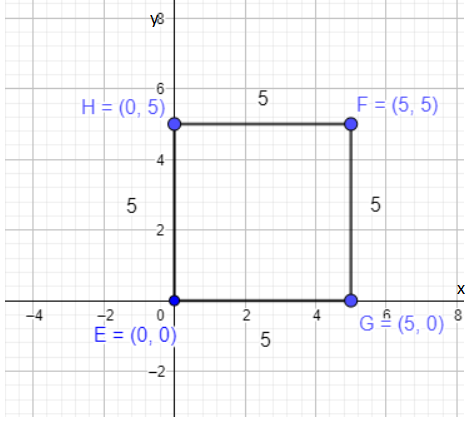
Given, square with vertices: G(5,0), H(0,5), and side length 5 units.

We need to find the missing vertices of the given square.

Let HEGF be the square with vertices G(5,0),H(0,5) and side length 5 units.

First, We need to do is calculate the distance between the given points, so that we can be sure that if the given points are adjacent or diagonally opposite. The distance between any two coordinate (x1,y2)and(x2,y2)is given by √(x2−x1)2+(y2−y1)2.

The distance between G(5,0),H(0,5)is ​√(5−0)2+(0−5)2.=5√2

We can see that the distance between the G(5,0),H(0,5) is not equal to the given side length and therefore these points should be at diagonally opposite ends.
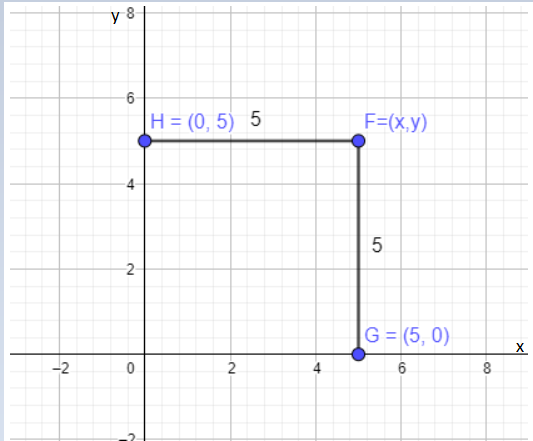
Glencoe Math Course 3 Volume 2 Student 1st Edition Chapter Chapter 6 Transformations Page 448 Exercise 2, Problem1

Let the coordinates of point F be (x.y). Then, GF=HF (As HEGF is a square).

The length of the side GF with given endpoints G(5,0)and F(x,y) is given as 5.

Therefore,​GF=√(x2−x1)²+(y2−y1)².

⇒5=√(x−5)²+(y−0)².

⇒5=√(x−5)²+(y)².

⇒25=(x−5)²+y²

Also, the length of the side HF with given endpoints H(0,5) and F(x,y)is given as 5.

​length HF=√(x2−x1)²+(y2−y1)².

⇒5=√(x−0)²+(y−5)².

⇒5=√x²+(y−5)².

⇒25=x²+(y−5)²

So, we have two unknown variables in two equations-

​25=(x−5)²+y² …….(1)

25=x²+(y−5)² …….(2)

To solve the equation, first, subtract equation two  from equation one, which will result in,

x²+y²−10y+25−x²+10x−25−y²

= 25−25

⇒ −10y+10x=0

⇒ −10y=−10x

⇒ y=x

Now, we can put y=x in any of the equation one to solve for x, ​x²+(y−5)²=25

⇒ x²+(x−5)²=25

⇒x²+x²−10x+25=25

⇒2x²−10x=0

⇒2x(x−5)=0

∴x=0 or x=5.

Since, y=x, therefore the possible value of (x, y) is either (0,0)and(5,5),Thus we can say that the missing points of the square are E(0,0)and F(5,5).
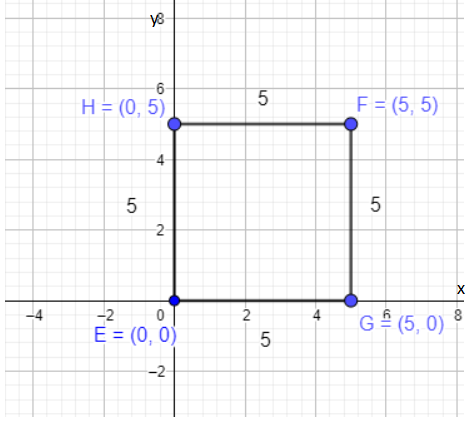
Glencoe Math Course 3 Volume 2 Student 1st Edition Chapter Chapter 6 Transformations Page 448 Exercise 2, Problem1.

The missing points of the square are E(0,0)and F(5,5).

The graph of the square is –
Glencoe Math Course 3 Volume 2 Student 1st Edition Chapter Chapter 6 Transformations Page 448 Exercise 2, Problem-1


Glencoe Math Course 3 Volume 2 Student Chapter Chapter 6 Page 448 Exercise 3 Problem1

Given, −5+3.

We need to find the addition

Given addition,

​=−5+3

=−2

After the addition =−5+3=−2

Page 448 Exercise 4, Problem1

Given, 7+(−9)

We need to find the addition.

Given addition,

​=7+(−9)

=−2

7+(−9) =−2

The result of addition is -2

Common Core Chapter 6 Transformations exercise answers Glencoe Math Course 3 Page 448 Exercise 5, Problem1

Given, −4+(−9)​

We will find the addition.

Given addition,

​=−4+(−9)

=−4−9

=−13

−4+(−9) =−13

The result of the addition is −13.

Glencoe Math Course 3 Volume 2 Student Chapter Chapter 6 Page 448 Exercise 6 Problem1

Given, −2+8.

We need to find the addition.

Given addition,

​=−2+8

=8−2

=6

−2+8 =6

The result of the addition is 6.

Step-By-Step Solutions For Chapter 6 Transformations Exercises In Glencoe Math Course 3 Page 448 Exercise 7, Problem1

Given, −8+(−6)

We will find the addition.

Given addition,

​=−8+(−6)

=−8−6

=−14

−8+(−6) =−14

The result of the addition is −14.

Page 448 Exercise 8, Problem1

Given, 0+(−6).

We will find the addition.

Given addition,

​=0+(−6)

=0−6

=−6

0+(−6) =−6

The result of the addition is −6.

Glencoe Math Course 3 Volume 2 Student Chapter Chapter 6 Page 448 Exercise 9 Problem1

Given, −8+2.

We need to find the addition.

Given addition,

​=−8+2

=2−8

=−6

−8+2 =−6

The result of the addition is −6.

Exercise Solutions For Chapter 6 Transformations Glencoe Math Course 3 Volume 2 Page 448 Exercise 10, Problem1

Here we have to add two integers. The given problem is3+(−1) and we have to calculate the value.

Here given problem is 3 + (−1)

Two integers have different signs so for adding integers with different signs, we have to keep the sign of the number with the largest absolute value and subtract the smallest absolute value from the largest.

So,3+(−1)=2

The calculated value of the two Integers is3+(−1)=2.

Examples Of Problems From Chapter 6 Transformations Exercises In Glencoe Math Course 3 Page 449 Exercise 1, Problem1

Here the rigid motion is a map of the plane to itself which preserves distances between points. So the information of rigid body we can say there are four types of rigid motions that are translation, rotation, reflection, and glide reflection.

Some rigid motions of the plane translation, rotation, reflection, and glide reflection. These four are basic rigid motions of the plane.

Glencoe Math Course 3 Volume 2 Student Chapter Chapter 6 Page 449 Exercise 1 Problem1

As per the given instruction here we have to arrange 10 index cards in a pile. And then on the top card, we have to draw a circle at the top right-hand corner. After drawing the figure of the card will be
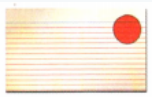
Glencoe Math Course 3 Volume 2 Student 1st Edition Chapter Chapter 6 Transformations Page 449 Exercise 1, Problem-1.

There are 10 cards under this topmost card.

In the ten index cards in a pile. the top card with a circle at the top right-hand corner will be like the below figure
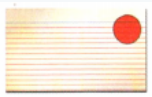
Glencoe Math Course 3 Volume 2 Student 1st Edition Chapter Chapter 6 Transformations Page 449 Exercise 1, Problem-1.

Student Edition Chapter 6 Transformations Solutions Guide Glencoe Math Course 3 Volume 2 Page 449 Exercise 1, Problem2

As per the given instruction here we have to arrange10 index cards in a pile. And then on the second card, we have to draw the red circle slightly down and to the left from the first card position. After drawing the figure of the card will be
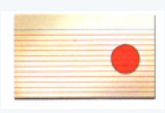
Glencoe Math Course 3 Volume 2 Student 1st Edition Chapter Chapter 6 Transformations Page 449 Exercise 1, Problem-2.

Finally, the second card with the same circle will be the below figure and the circle will slightly down and to the left from the first card.
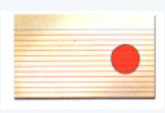
Glencoe Math Course 3 Volume 2 Student 1st Edition Chapter Chapter 6 Transformations Page 449 Exercise 1, Problem-2

Glencoe Math Course 3 Volume 2 Student Chapter Chapter 6 Page 449 Exercise 1 Problem3

As per the given instruction, we’ll repeat the red circle for three or four more cards until the circle is at the bottom of the card. We’ll use the remainder of the cards to draw the circle up and to the left. The most bottom card will be
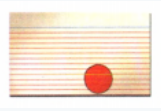
Glencoe Math Course 3 Volume 2 Student 1st Edition Chapter Chapter 6 Transformations Page 449 Exercise 1, Problem-3.

Finally, we draw the circle is at the bottom of the card and the figure will
Glencoe Math Course 3 Volume 2 Student 1st Edition Chapter Chapter 6 Transformations Page 449 Exercise 1, Problem-3

Step-By-Step Answers For Chapter 6 Transformations In Glencoe Math Course 3 Volume 2 Page 449 Exercise 1, Problem4

As per the given instruction, we have to place a rubber band around the stack, hold the stack at the rubber band, and flip the cards from the front to back.

when we flip the cards from the front to back the circle seemed to move, as the cards were flipped from front to back Then if we look at the circles on the first and second cards and then the second and third cards we’ll observe that at first, the circle seemed to move down and shifted to the left unit it touched the bottom of the card.

After that, the circle moved again upward and keep shifting to the left. When you moved it the shape and the size did not change. Only the position changed.

when we flip the cards from front to back the circle seemed to move, as the cards were flipped from front to back.

Then if we look at the circles on the first and second cards and then the second and third cards we’ll observe that at first, the circle seemed to move down and shifted to the left unit it touched the bottom of the card.

After that, the circle moved again upward and keep shifting to the left.

When you moved it the shape and the size did not change. Only the position changed.


Glencoe Math Course 3 Volume 2 Student Chapter Chapter 6 Page 450 Exercise 1 Problem1

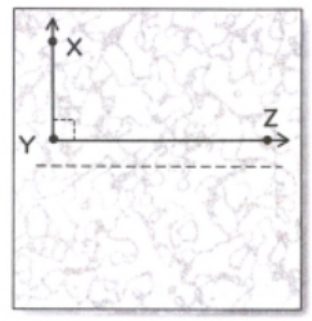
Here as per the given instruction, we have to draw a right triangle ∠XYZ on a piece of tracing paper. Then Place a dashed line on the paper in the middle of the paper. So now the figure will be
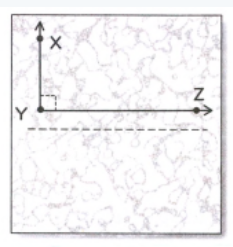
Glencoe Math Course 3 Volume 2 Student 1st Edition Chapter Chapter 6 Transformations Page 450 Exercise 1, Problem-1

Finally, the figure of a right angle ∠XYZ and a dashed line on a piece of tracing paper will be
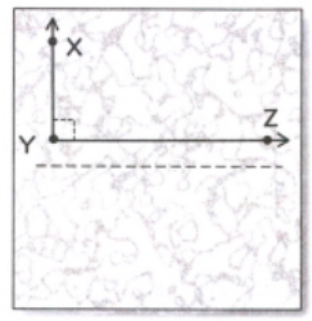
Glencoe Math Course 3 Volume 2 Student 1st Edition Chapter Chapter 6 Transformations Page 450 Exercise 2, Problem-1.


Page 450 Exercise 2, Problem1

Given

Glencoe Math Course 3 Volume 2 Student 1st Edition Chapter Chapter 6 Transformations Page 450 Exercise 2, Problem-1.

First, we have to fold the paper along the dashed line and trace the angle onto the folded portion of the paper. Then we have to Unfold and label the angle ∠ABC so that A matches up with X ,B matches up with Y, and C matches up with Z.

By using a protractor to find the measure of ∠ABC and ∠XYZ and by using a centimeter ruler we have to measure the shortest distance from X and A to the dashed line and this will be repeated for Y and B and for Z and C.

If we placed a mirror on the folded line ∠ABC And ∠XYZ will be a mirror image of each other

Given
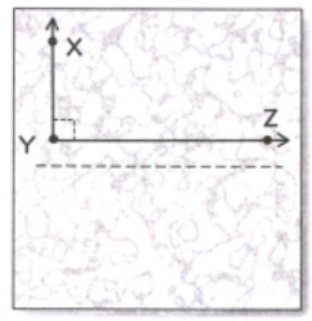
Glencoe Math Course 3 Volume 2 Student 1st Edition Chapter Chapter 6 Transformations Page 450 Exercise 2, Problem-1.

In this figure, if we draw an angle equal and mirror image with ∠XYZ the figure will be
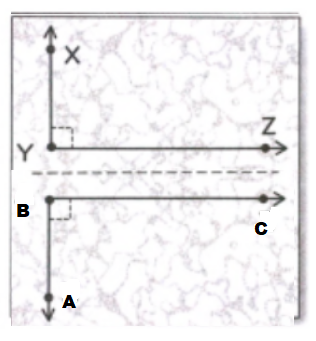
Glencoe Math Course 3 Volume 2 Student 1st Edition Chapter Chapter 6 Transformations Page 450 Exercise 2 Problem-1..

Now by Use a protractor to find the measure of ∠XYZ and ∠ABC the angles are equal that is90∘

No the measure of the angle did not change after the flip.

Now by using a centimeter ruler if we measure the shortest distance from X and A to the dashed line we will notice the distance from X to the dashed line is the same with the distance from A to the dashed line.

And similarly, by using a centimeter ruler if we measure the shortest distance from Y and B to the dashed line we will notice the distance from Y to the dashed line is the same with the distance from B to the dashed line.

And by using a centimeter ruler if we measure the shortest distance from Z and C to the dashed line we will notice the distance from Z to the dashed line is the same with the distance from C to the dashed line.

So by using a protractor to find the measure of and ∠XYZ and ∠ABC the angles are equal.

No the measure of the angle did not change after the flip.

And The distance from X to the dashed line is the same with the distance from A to the dashed line.

The distance from Y to the dashed line is the same with the distance from B to the dashed line.

The distance from Z to the dashed line is the same with the distance from C to the dashed line.

Glencoe Math Course 3 Volume 2 Student Chapter Chapter 6 Page 450 Exercise 3 Problem1

Given that

As per the given instruction, we have to place a piece of tracing paper over the trapezoid and have to copy the trapezoid. Then we’ll draw points A,B,C and AB. Now the copied figure will beGlencoe Math Course 3 Volume 2 Student 1st Edition Chapter Chapter 6 Transformations Page 450Exercise 3, Problem1
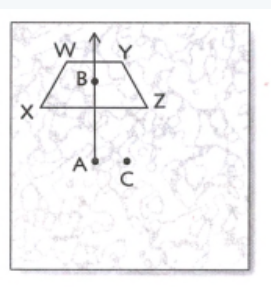
Finally the figure of the trapezoid on the tracing paper with points A, B, C and AB will be
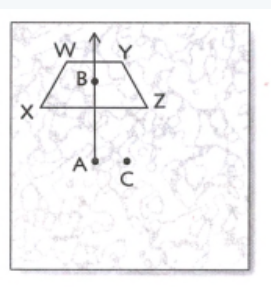
Glencoe Math Course 3 Volume 2 Student 1st Edition Chapter Chapter 6 Transformations Page 450Exercise 3, Problem1.


Page 450 Exercise 3, Problem2

Given that
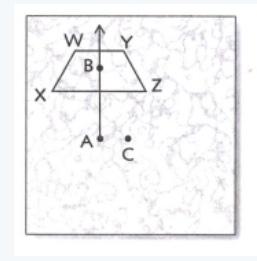
Glencoe Math Course 3 Volume 2 Student 1st Edition Chapter Chapter 6 Transformations Page 450Exercise 3, Problem2

Here If we moved the trapezium that will look like the below figure
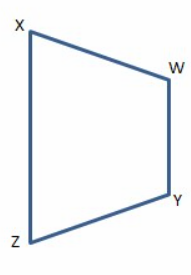
Glencoe Math Course 3 Volume 2 Student 1st Edition Chapter Chapter 6 Transformations Page 450Exercise 3, Problem2.

But the size and the shape never change for this moved it.

No, the shape of the trapezoid change when we moved it.

No, the size of the trapezoid change when we moved it.


Glencoe Math Course 3 Volume 2 Student Chapter Chapter 6 Page 451 Exercise 1 Problem1

Given that a pattern
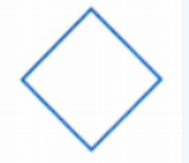
Glencoe Math Course 3 Volume 2 Student 1st Edition Chapter Chapter 6 Transformations Exercise Page 451 Exercise 1, Problem1

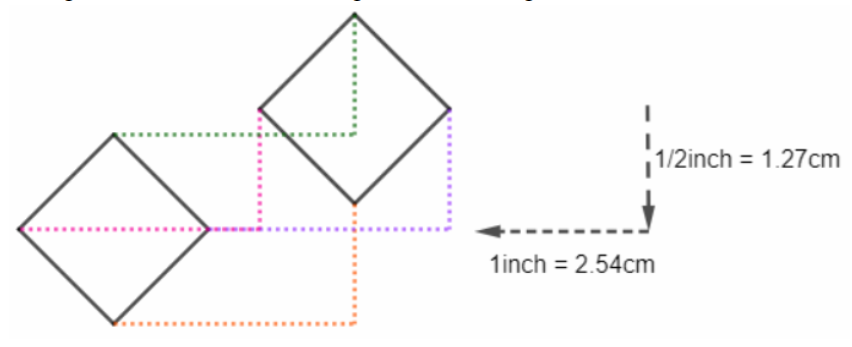
We have to draw the image by using a ruler when this figure is moved 12 inches.

down and1 inch to the left.

First, we’ll convert the inch length into centimeters and then draw the changed pattern.

Given here
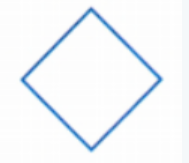
Glencoe Math Course 3 Volume 2 Student 1st Edition Chapter Chapter 6 Transformations Exercise Page 451 Exercise 1, Problem1

Now we have to move this pattern 1/2 inch. down and 1 inch to the left. If we convert these inches’ length in centimeters then 1/2 inch≈1.27centimeter and1inch≈2.54centimeter.

Using a ruler we’ll draw the figure and the figure is shown below
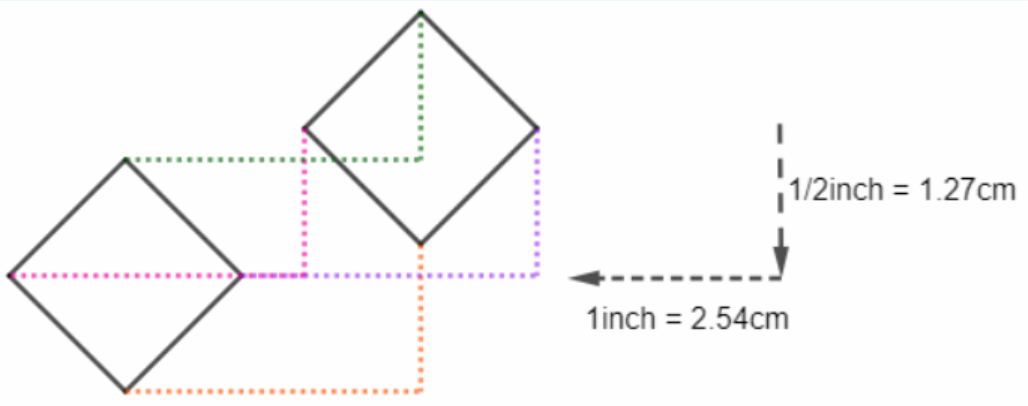
 

Glencoe Math Course 3 Volume 2 Student 1st Edition Chapter Chapter 6 Transformations Exercise Page 451 Exercise 1, Problem-1.

The pattern will be

Glencoe Math Course 3 Volume 2 Student 1st Edition Chapter Chapter 6 Transformations Exercise Page 451 Exercise 1, Problem1.

if we moved the main given pattern1/2inch. down and 1inch. to the left.

Page 451 Exercise 2, Problem1

Given that a pattern
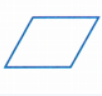
Glencoe Math Course 3 Volume 2 Student 1st Edition Chapter Chapter 6 Transformations Page 451Exercise 2, Problem1

We have to draw the image by using a ruler when this figure is moved 1 inch up and 1 inch to the right. First, we’ll convert the inch length into centimeters and then draw the changed pattern.

Given here

Glencoe Math Course 3 Volume 2 Student 1st Edition Chapter Chapter 6 Transformations Page 451Exercise 2, Problem1

Now we have to move this pattern 1 inch up and 1 inch to the right.

If we convert these inches’ length in centimeters then1inch≈2.54centimeter.

Using a ruler we’ll draw the figure and the figure is shown below
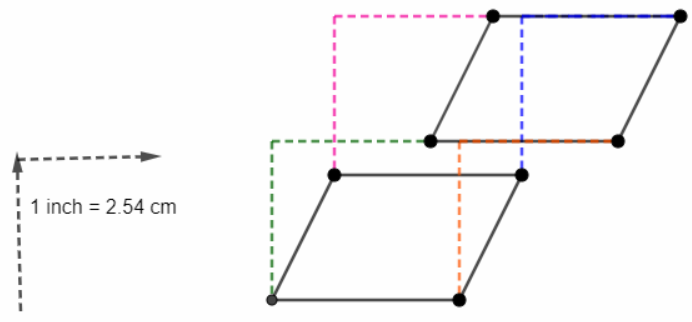
Glencoe Math Course 3 Volume 2 Student 1st Edition Chapter Chapter 6 Transformations Page 451Exercise 2, Problem1.


The pattern will be

Glencoe Math Course 3 Volume 2 Student 1st Edition Chapter Chapter 6 Transformations Page 451Exercise 2, Problem1.


if we moved the main given pattern 1 inch up and 1 inch to the right.


Glencoe Math Course 3 Volume 2 Student Chapter Chapter 6 Page 451 Exercise 3 Problem1

Given pattern is
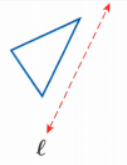
Glencoe Math Course 3 Volume 2 Student 1st Edition Chapter Chapter 6 Transformations Page 451Exercise 3, Problem1.

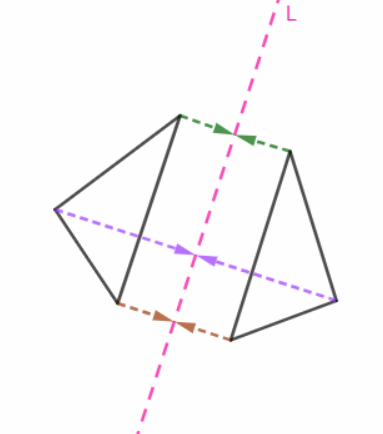
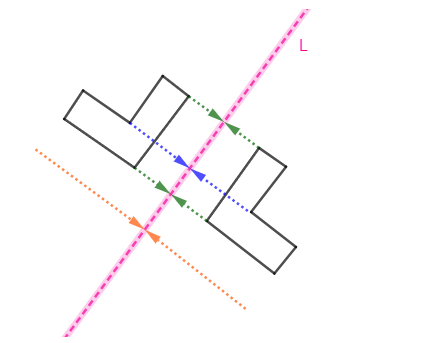
We have to draw the image when this figure is flipped over the line l.

To find the image of the figure after flipping it over the line l, we need to find the distance of each corner point of the given figure from the line l and plot new points with the same distance from I but in opposite direction to l.

Given the pattern is
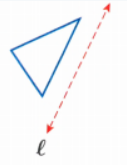
Glencoe Math Course 3 Volume 2 Student 1st Edition Chapter Chapter 6 Transformations Page 451Exercise 3, Problem1.

It is like a mirror image of a figure over the line l, therefore, the distance of each point from I will remain the same.

As we know that to find the image of the figure after flipping it over the line l , we need to find the distance of each corner point of the given figure from the line land plot new points with the same distance from I but in opposite direction to l.

Now the flipped figure will be
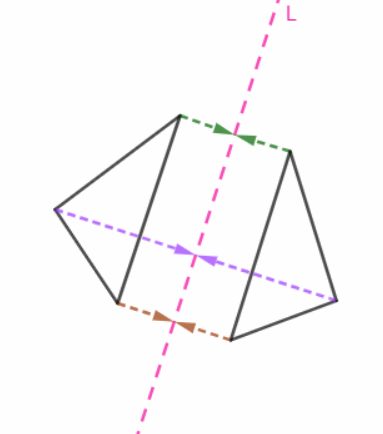
Glencoe Math Course 3 Volume 2 Student 1st Edition Chapter Chapter 6 Transformations Page 451Exercise 3, Problem 1.


The flipped figure will be

Glencoe Math Course 3 Volume 2 Student 1st Edition Chapter Chapter 6 Transformations Page 451Exercise 3, Problem 1.

when the figure is flipped over the line l.

Page 448 Exercise 4, Problem1

Given pattern is
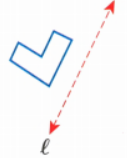
Glencoe Math Course 3 Volume 2 Student 1st Edition Chapter Chapter 6 Transformations Page 451Exercise 4, Problem1.

We have to draw the image when this figure is flipped over the line l .

To find the image of the figure after flipping it over the line l , we need to find the distance of each corner point of the given figure from the line l

and plot new points with the same distance from I but in opposite direction to l.

Given the pattern is
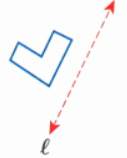
Glencoe Math Course 3 Volume 2 Student 1st Edition Chapter Chapter 6 Transformations Page 451Exercise 4, Problem1.

It is like a mirror image of a figure over the line l, therefore, the distance of each point from I will remain the same.

As we know that to find the image of the figure after flipping it over the line l

we need to find the distance of each corner point of the given figure from the line l and plot new points with the same distance from I but in opposite direction to l.

Now the flipped figure will be
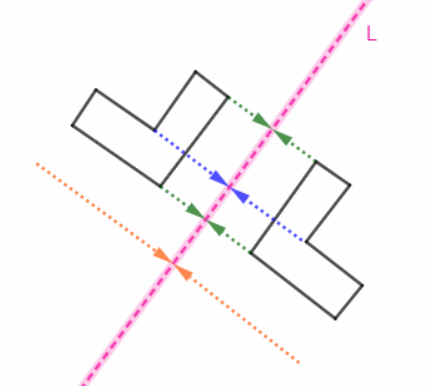
Glencoe Math Course 3 Volume 2 Student 1st Edition Chapter Chapter 6 Transformations Page 451Exercise 4, Problem 1.

The flipped figure will be

Glencoe Math Course 3 Volume 2 Student 1st Edition Chapter Chapter 6 Transformations Page 451Exercise 4, Problem 1.

when the figure is flipped over the line l.


Glencoe Math Course 3 Volume 2 Student Chapter Chapter 6 Page 451 Exercise 5 Problem1

When the new Pentagon turned along the line AB, a new Pentagon of the same dimensions will be formed, but the face of the Pentagon changes to the opposite direction. The Pentagon must go through 3 rotations to reach the point C

(First rotation along the lineL1, second rotation along the lineL3and the final rotation along the lineL5.) as shown below.
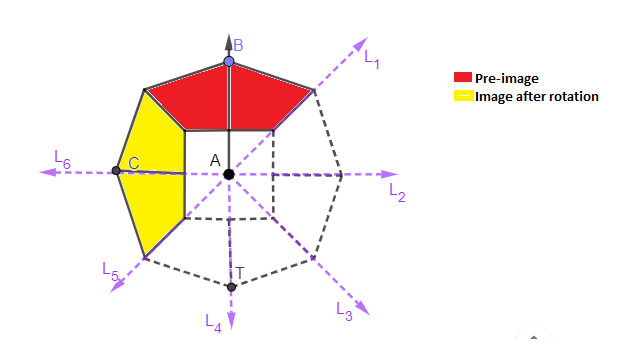
Glencoe Math Course 3 Volume 2 Student 1st Edition Chapter Chapter 6 Transformations Page 451Exercise 5, Problem1.

The required image is attached below.

Glencoe Math Course 3 Volume 2 Student 1st Edition Chapter Chapter 6 Transformations Page 451Exercise 5, Problem1.


Page 452 Exercise 6, Problem1

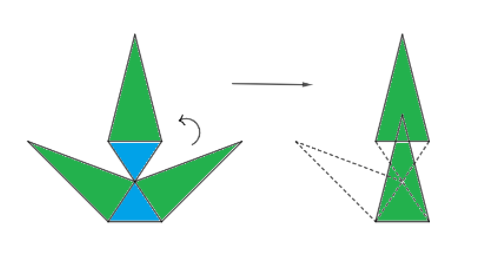
Blue heart above the green heart can be obtained in two ways. The blue heart can be rotated clockwise or anticlockwise until it overlaps the green heart. To get the blue heart over the green heart, we can flip it twice, first along the lineL1 and then along the lineL2,as illustrated in the diagram below.
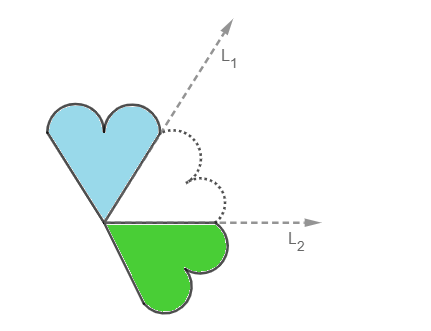
Glencoe Math Course 3 Volume 2 Student 1st Edition Chapter Chapter 6 Transformations Page 451Exercise 6, Problem1.

To get the blue heart over the green heart either turn the blue heart in clockwise or anticlockwise direction or flip the blue heart twice.


Glencoe Math Course 3 Volume 2 Student Chapter Chapter 6 Page 452 Exercise 7 Problem1

There are two ways that will place the blue figure on top of the green figure. Slide the blue figure to the right, then down, until it encroaches on the green figure. Slide the blue figure down, then right, until it overlaps with the green figure.
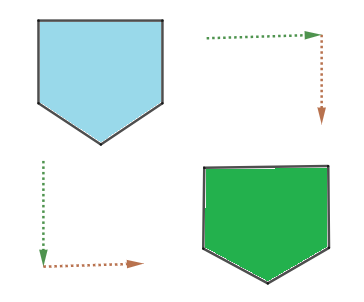
Glencoe Math Course 3 Volume 2 Student 1st Edition Chapter Chapter 6 Transformations Page 451Exercise 7, Problem1.

To place the blue figure on top of the green figure either slide the blue figure down first and then to the right or slide it right first and then to the down.


Page 452 Exercise 8, Problem1

At first, let us recap the two given exercises
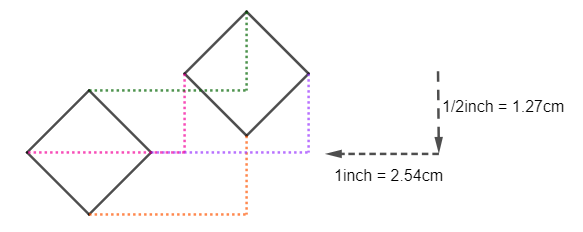
Glencoe Math Course 3 Volume 2 Student 1st Edition Chapter Chapter 6 Transformations Page 452Exercise 8, Problem1.


With referring to investigation 1 and exercise 1 and 2, the word that best describes the movement of the figures is the slide.Glencoe Math Course 3 Volume 2 Student 1st Edition Chapter Chapter 6 Transformations Page 452Exercise 8, Problem1
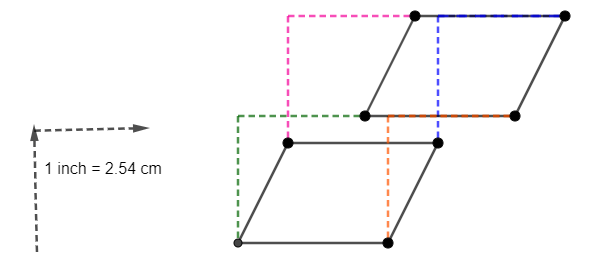
The word that best describes the movement of the figures is slide.


Page 452 Exercise 9, Problem1

At first, let us recap the two given exercises.
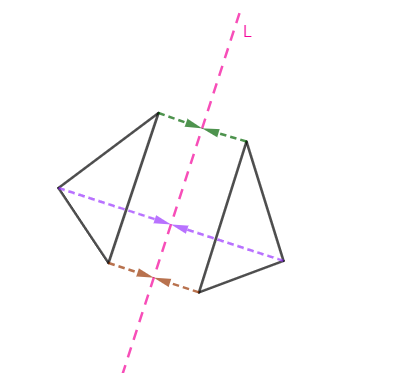
Glencoe Math Course 3 Volume 2 Student 1st Edition Chapter Chapter 6 Transformations Page 452Exercise 9, Problem1


Glencoe Math Course 3 Volume 2 Student 1st Edition Chapter Chapter 6 Transformations Page 452Exercise 9, Problem1.


With referring to investigation 2 and exercises 3 and 4, the word that best describes the movement of the figures is the flip.

The word that best describes the movement of the figures is flip.


Glencoe Math Course 3 Volume 2 Student Chapter Chapter 6 Page 452 Exercise 10 Problem1

Based on the investigations we can describe the following characteristics regarding the rigid motion of the plane. When a point or object is moved but its size and shape remain the same, this is known as rigid motion.

This is in contrast to non-rigid motion, such as dilatation, in which the object’s size can rise or shrink. In order for the movement to be rigid, the pre-image and image must be congruent. See the following rigid motion of a triangle.
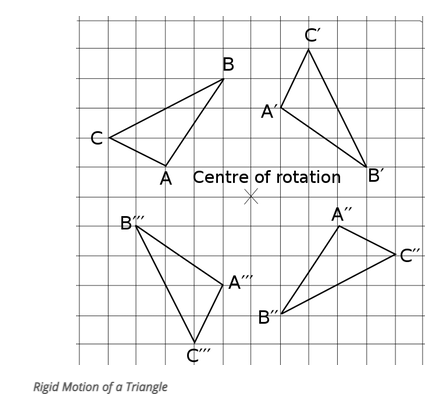
Glencoe Math Course 3 Volume 2 Student 1st Edition Chapter Chapter 6 Transformations Page 452Exercise 10, Problem1

Characteristics of the rigid motion of the plane are given above.


Page 452 Exercise 11, Problem1

There are four types of rigid motions: translation, rotation, reflection, and glide reflection. Translation: In a translation, everything moves by the same quantity and in the same direction. Each translation has a distance and a direction.
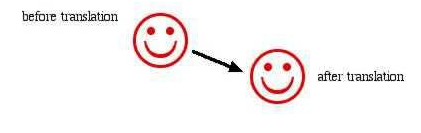
Glencoe Math Course 3 Volume 2 Student 1st Edition Chapter Chapter 6 Transformations Page 452Exercise 11, Problem1

Rotation: A rotation fixes one point (the ro to center), and everything revolves around it by the same amount. There is a roto center and an angle for every rotation.
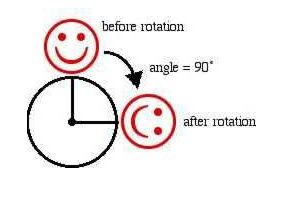
Glencoe Math Course 3 Volume 2 Student 1st Edition Chapter Chapter 6 Transformations Page 452Exercise 11, Problem1.

Reflection: A reflection aligns a mirror line in the plane and exchanges points on one side of the line with points on the other side of the mirror at the same distance. There is a mirror line in every reflection.
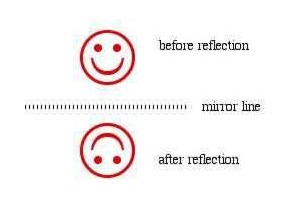
 

Glencoe Math Course 3 Volume 2 Student 1st Edition Chapter Chapter 6 Transformations Page 452Exercise 11, Problem 1


Glide reflection: A glide reflection is a mirror reflection that is followed by a parallel translation. There is a mirror line and a translation distance for every glide reflection.
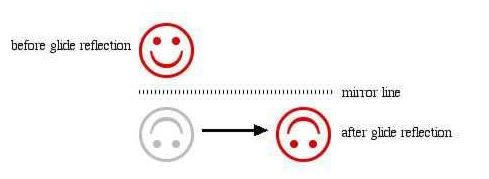
Glencoe Math Course 3 Volume 2 Student 1st Edition Chapter Chapter 6 Transformations Page 452Exercise 11, Problem-1


All the types of rigid motions of the plane are explained above.
Glencoe Math Course 3 Volume 2 Student 1st Edition Chapter 8 Volume And Surface Area Exercise 8.1

Glencoe Math Course 3 Volume 2 Chapter 8 Exercise 8.1 Solutions Page 593 Exercise 1, Problem1

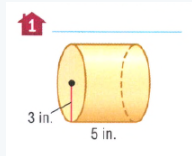
We are provided with the following figure.

Glencoe Math Course 3 Volume 2 Student 1st Edition Chapter 8 Volume and Surface Area Exercise 8.1 Page 593 Exercise 1, Problem1

From the figure, we can clearly say that the total figure has a height of 5 in and a radius as 3 in.

We can calculate the volume of the figure.

As per the formula;

V=3.14×3×3×5

=32.97

V ≈33.0 in3

After the calculations, the volume of the figure is found to be 33.0 in3.

Glencoe Math Coaurse 2 Student Edition Volume 1 Chapter 8 Volume And Surface Area Exercise 8.1

Page 593 Exercise 2, Problem1

We are provided with the following figure.

Glencoe Math Course 3 Volume 2 Student 1st Edition Chapter 8 Volume and Surface Area Exercise 8.1 Page 593 Exercise 2, Problem1

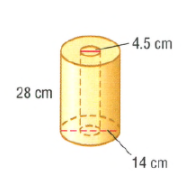
From the figure, we can clearly say that the total figure has a height of 28 cm and the radius as 7,2.25 cm.

We can calculate the volume of the roll by substracting the volume of the smaller cylinder from the larger cylinder.

As per the formula;

The volume of a large cylinder \(V=\pi \times 7^2 \times 28\)

The volume of the smaller cylinder \(V^{\prime}=\pi \times 2.25^2 \times 28\)

Required volume = \(\left(\pi \times 7^2 \times 28\right)-\left(\pi \times 2.25^2 \times 28\right)\)

= \(28 \pi\left(7^2-2.25^2\right)\)

= \(28 \times 3.14 \times 43.9375\)

Required volume  = 3862.985 approx 3863.0 \(\mathrm{~cm}^3\)

After the calculations, the volume of the figure is found to be 3863.0 cm3.

Read and Learn More Glencoe Math Course 2 Volume 1 Common Core Student Edition Solutions

Page 593 Exercise 3, Problem1

We are provided with the following figure.

Glencoe Math Course 3 Volume 2 Student 1st Edition Chapter 8 Volume and Surface Area Exercise 8.1 Page 593 Exercise 3, Problem1

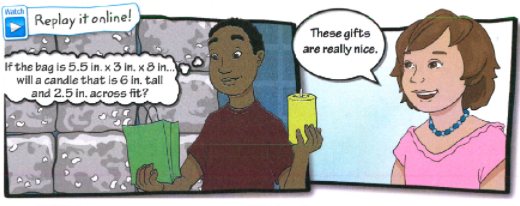
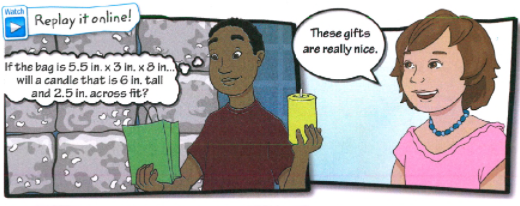
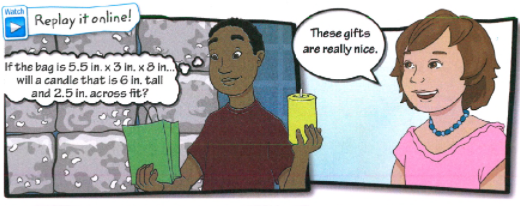
From the figure, we can clearly say that the total figure has a height of 6in and the radius as 1.25 in.

Similarly, the dimensions of the cuboid are 5.5×3×8 in.

We can calculate the volume of the figure.

As per the formula;

The volume of the bag

=5.5×3×8
=132 in3
The volume of the bag =132 in3

The volume of the candle

=3.14×1.25×1.25×6
=28.26 in3
=28.3 in3
The volume of the candle =28.3 in3
After the calculations, the volume of the candle and bag is found to be 132 in3 and 28.3 in3.
Chapter 8 Exercise 8.1 Volume And Surface Area Answers Glencoe Math Course 3 Volume 2 Page 593 Exercise 2, Problem2

We are provided with the following figure.

Glencoe Math Course 3 Volume 2 Student 1st Edition Chapter 8 Volume and Surface Area Exercise 8.1 Page 593 Exercise 3, Problem2

From the figure, we can clearly say that the total figure has a height of 6in and a radius as 1.25 in.

Similarly, the dimensions of the cuboid are  5.5 × 3 ×8 in.

We can calculate the volume of the figure. The difference between them gives us the required answer.

As per the previous calculations;

The volume of the bag=132 in3

The volume of the candle=28.3 in3

The total volume of packing material required is given by;

V=132−28.3

V =103.7in3

After the calculations, the volume of packing material in the bag is found to be 103.7 in3.


Page 593 Exercise 2, Problem3

We are provided with the following figure.

Glencoe Math Course 3 Volume 2 Student 1st Edition Chapter 8 Volume and Surface Area Exercise 8.1 Page 593 Exercise 3, Problem3


From the figure, we can clearly say that the total figure has a height of 6in and the radius as 1.25 in.

Similarly, the dimensions of the cuboid are 5.5 × 3 × 8 in.

We can calculate the volume of the figure.

As per the previous calculations;

The volume of packing material in each bag = 575 in3

Total number of teachers = 70

The total amount of packing material = 70×575

=40250 in3

After the calculations, the total volume of packing material in the bags is found to be 40250 in3.


Page 594 Exercise 1, Problem1

We are provided with the following figure.

Glencoe Math Course 3 Volume 2 Student 1st Edition Chapter 8 Volume and Surface Area Exercise 8.1 Page 594 Exercise 1, Problem1


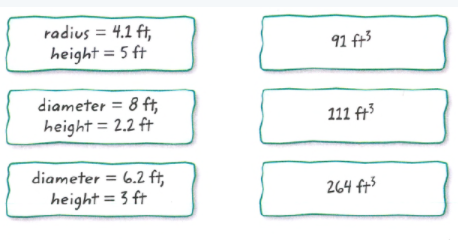
From the figure, we can clearly say that the total figures are provided with different dimensions. We can calculate the volume of the figure.

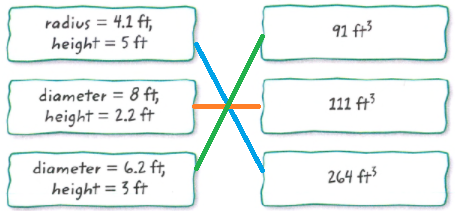
Glencoe Math Course 3 Volume 2 Student 1st Edition Chapter 8 Volume and Surface Area Exercise 8.1 Page 594 Exercise 1, Problem1.

After the calculations, we can say that they match the following as shown:


“Step-By-Step Solutions For Exercise 8.1 Chapter 8 Volume And Surface Area In Glencoe Math Course 3 Page 594 Exercise 2, Problem1

We are provided with the following figure.

Glencoe Math Course 3 Volume 2 Student 1st Edition Chapter 8 Volume and Surface Area Exercise 8.1 Page 594 Exercise 2, Problem1.

We have to draw a cylinder with more radius but less volume.

As we can observe that both the height and radius are directly proportional to the volume, so a cylinder with a smaller height should be our required figure. This figure is drawn as follows.

Glencoe Math Course 3 Volume 2 Student 1st Edition Chapter 8 Volume and Surface Area Exercise 8.1 Page 594 Exercise 2, Problem1

After further deductions, the final figure is constructed to be as shown.


Glencoe Math Course 3 Volume 2 Student 1st Edition Chapter 8 Volume and Surface Area Exercise 8.1 Page 594 Exercise 2, Problem1

Page 594 Exercise 3, Problem1

We are provided with the following figure.

Glencoe Math Course 3 Volume 2 Student 1st Edition Chapter 8 Volume and Surface Area Exercise 8.1 Page 594 Exercise 3, Problem1

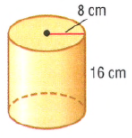
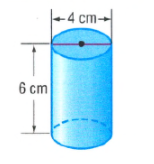
From the figure, we can clearly say that the total figure has a height of 6 cm and the radius as 2 cm.

We can calculate the volume of the figure.

As per the formula

V = 3.14×2×2×6

V  = 75.36 cm2

The volume of wax in the mould is found out to be 75.36≈75.4 cm2.


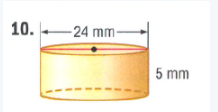
Exercise 8.1 Solutions For Chapter 8 Volume and Surface Area Glencoe Math Course 3 Volume 2 Page 595 Exercise 1, Problem1

We are provided with the following figure.

Glencoe Math Course 3 Volume 2 Student 1st Edition Chapter 8 Volume and Surface Area Exercise 8.1 Page 595 Exercise 1, Problem1.

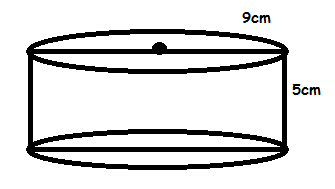
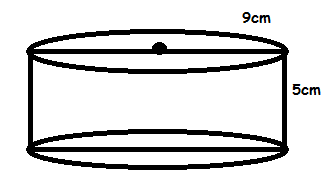
From the figure, we can clearly say that the total figure has a height of 5mm and the radius as 12mm.

We can calculate the volume of the figure.

As per the formula

V=3.14×12×12×5

V =2260.8mm3

After the calculations, the volume of the figure is found to be 2260.8 mm3

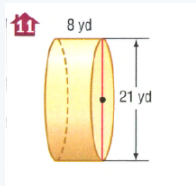
Examples of problems from Exercise 8.1 Chapter 8 Volume and Surface Area in Glencoe Math Course 3″  Page 595 Exercise 2, Problem1

We are provided with the following figure.

Glencoe Math Course 3 Volume 2 Student 1st Edition Chapter 8 Volume and Surface Area Exercise 8.1 Page 595 Exercise 2, Problem1.

From the figure, we can clearly say that the total figure has a height of 8yd and a radius as 10.5 yd.

We can calculate the volume of the figure.

As per the formula;

V=3.14×10.5×10.5×8

V =2769.48yd3

V =2769.5yd3

After the calculations, the volume of the figure is found to be 2769.5 yd3.


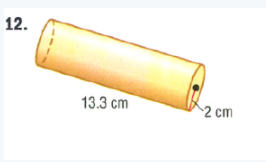
Page 595 Exercise 3, Problem1

We are provided with the following figure.

Glencoe Math Course 3 Volume 2 Student 1st Edition Chapter 8 Volume and Surface Area Exercise 8.1 Page 595 Exercise 3, Problem1.

From the figure, we can clearly say that the total figure has a height of 13.3cm and the radius as 2cm.

We can calculate the volume of the figure.

As per the formula;

V=3.14×13.3×2×2

V =167.048

V =167.5cm3

After the calculations, the volume of the figure is found to be 167.5 cm3.


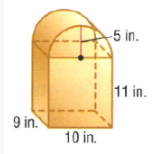
Page 595 Exercise 4, Problem1

We are provided with the following figure.

Glencoe Math Course 3 Volume 2 Student 1st Edition Chapter 8 Volume and Surface Area Exercise 8.1 Page 595 Exercise 4, Problem1.

Clearly, the figure is a combination of a cuboid and half a cylinder. From the figure, we can clearly say that the cylinder figure has a height of 9in and the radius as 5in.

Similarly, for the cuboid region, the length, breadth, and height are found as 9,10,11 in.

We can calculate the volume of the figure.

The volume of the cuboid region is found as

v=l × b × h

V =9×10×11

V =990 in3

The volume of the half-cylinder is found as;

v′=12×π×r2×h

=12×3.14×52×9

=353.25 in3

Total volume = 990+353.25

=1043.25in3

After the calculations, we can say that the total volume of the mailbox is 1043.2 in3.


Page 595 Exercise 5, Problem1

We are provided with the following figure.

Glencoe Math Course 3 Volume 2 Student 1st Edition Chapter 8 Volume and Surface Area Exercise 8.1 Page 595 Exercise 5, Problem1.

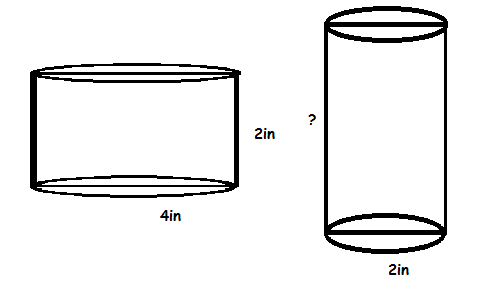
From the figure, we have to find the height of the second cylinder so that both their volumes are same.

We can calculate the volume of the figure.

The volume of the first cylinder

V = 3.14×4×4×2

V = 100.48in3

The volume of the second cylinder

V′ = 3.14×2×2×h

= 12.56h in3

∴V=V′

⇒ 12.56h=100.48

⇒ h=100.48

12.56

⇒h=8 in

After the calculations, we can say that the height of the cylinder is 8 in.


Page 595 Exercise 6, Problem1

We are provided with the following figure.

Glencoe Math Course 3 Volume 2 Student 1st Edition Chapter 8 Volume and Surface Area Exercise 8.1 Page 595 Exercise 6, Problem1.

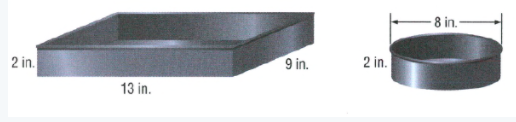
We have to find which figure has more volume. We can calculate the volume of the figures using the formula.

The volume of the cuboid container is found as

=13×9×2

=234 in3

The volume of the cylinder is found as;

=3.14×2×4×4

=100.48in3

Volume of 2 cylinder pans=200.1in3

Clearly, the cuboid has more volume.

After the calculations, we can say that the cuboid will hold more than two circular pans as it has more volume.


Page 595 Exercise 7, Problem1

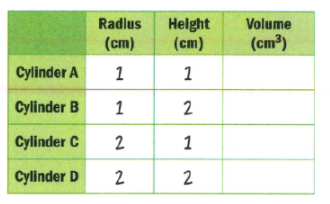
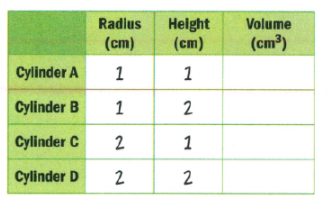
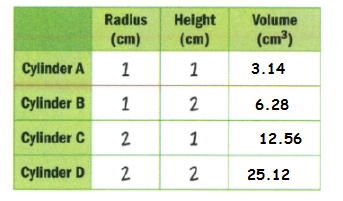
We are provided with the following table.

Glencoe Math Course 3 Volume 2 Student 1st Edition Chapter 8 Volume and Surface Area Exercise 8.1 Page 595 Exercise 7, Problem1

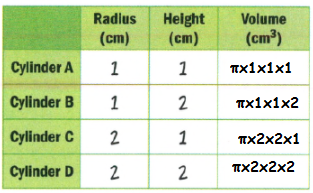
We have to write the equation to find the volume for each cylinder. We can do so as shown.

Glencoe Math Course 3 Volume 2 Student 1st Edition Chapter 8 Volume and Surface Area Exercise 8.1 Page 595 Exercise 7, Problem1.

After the calculations, the table is completed as shown.

Glencoe Math Course 3 Volume 2 Student 1st Edition Chapter 8 Volume and Surface Area Exercise 8.1 Page 595 Exercise 7, Problem1.


Page 595 Exercise 7, Problem2

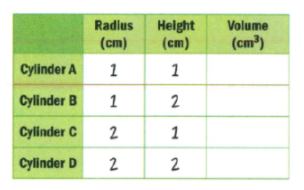
We are provided with the following table.

Glencoe Math Course 3 Volume 2 Student 1st Edition Chapter 8 Volume and Surface Area Exercise 8.1 Page 595 Exercise 7, Problem2


We have to compare the dimensions for each cylinder. We can clearly see that cylinders A and B have the same radius but different heights same as cylinders C and D.

So we can say that cylinder B is the double of cylinder A and similar for cylinder D and C.

After the deductions, we can say that cylinders B and D are double the cylinders A and C as per heights.


Page 595 Exercise 7, Problem3

We are provided with the following table.

Glencoe Math Course 3 Volume 2 Student 1st Edition Chapter 8 Volume and Surface Area Exercise 8.1 Page 595 Exercise 7, Problem3

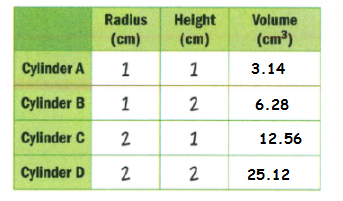
We have to complete the table by finding the volume for each cylinder. We can do so as shown.

Glencoe Math Course 3 Volume 2 Student 1st Edition Chapter 8 Volume and Surface Area Exercise 8.1 Page 595 Exercise 7, Problem3.

After the calculations, the table is completed as shown.

Glencoe Math Course 3 Volume 2 Student 1st Edition Chapter 8 Volume and Surface Area Exercise 8.1 Page 595 Exercise 7, Problem3.


Page 595 Exercise 7, Problem4

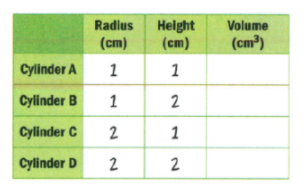
We are provided with the following table.

Glencoe Math Course 3 Volume 2 Student 1st Edition Chapter 8 Volume and Surface Area Exercise 8.1 Page 595 Exercise 7, Problem4


After completion, the table is found as shown.

Glencoe Math Course 3 Volume 2 Student 1st Edition Chapter 8 Volume and Surface Area Exercise 8.1 Page 595 Exercise 7, Problem4.

Clearly, we can see as the dimension increases the volumes keeps increasing.

After the calculations, the table is completed as it is deduced that with the increase of dimensions, the volume of the figure keeps increasing.


Page 596 Exercise 1, Problem1

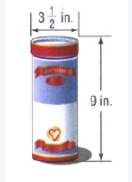
We are provided with the following figure.

Glencoe Math Course 3 Volume 2 Student 1st Edition Chapter 8 Volume and Surface Area Exercise 8.1 Page 596 Exercise 1, Problem1

From the figure, we can clearly say that the total figure has a height of 9in and the radius as 1.75in.

We can calculate the volume of the figure.

As per the formula;

V=3.14×9×1.75×1.75

V =86.54 in3

After the calculations, the volume of the figure is found to be 86.54in3.


Page 596 Exercise 2, Problem1

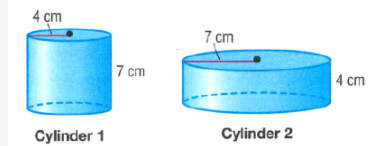
We are provided with the following figure.

Glencoe Math Course 3 Volume 2 Student 1st Edition Chapter 8 Volume and Surface Area Exercise 8.1 Page 596 Exercise 2, Problem1

From the figure, we have to find the volume of both the cylinder and find the relation between them. We can calculate the volume of the figure using the formula.

The volume of the first cylinder = 3.14×4×4×7

= 351.68 cm3

The volume of the second cylinder = 3.14×7×7×4

= 651.44 cm3

Clearly, the volume of Cylinder 2 is greater than the volume of Cylinder 1.

After the calculations, we deduce that the volume of Cylinder 2 is greater than the volume of Cylinder 1.


Page 596 Exercise 3, Problem1

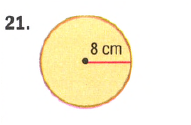
The given circle is

Glencoe Math Course 3 Volume 2 Student 1st Edition Chapter 8 Volume and Surface Area Exercise 8.1 Page 596 Exercise 3, Problem1

We have to determine the area of this circle.

The radius of the given circle is 8cm. We apply the formula A=πr2  to find the area.

We have a circle of radius 8 cm

Glencoe Math Course 3 Volume 2 Student 1st Edition Chapter 8 Volume and Surface Area Exercise 8.1 Page 596 Exercise 3, Problem1

Since we know that the area of a circle of radius 8 cm is A=πr2

where A is the area and r is the radius of the circle.

So, we can write, A=π(8) 2

⇒ A = 64π

⇒A = 64×22/7

⇒A ≈ 201.1 cm2.

Therefore, the approximated area of the given circle is 201.1 cm2.


Page 596 Exercise 4, Problem1

The given circle is

Glencoe Math Course 3 Volume 2 Student 1st Edition Chapter 8 Volume and Surface Area Exercise 8.1 Page 596 Exercise 4, Problem1

We have to determine the area of this circle.

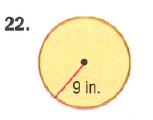
The radius of the given circle is 9 in. We apply the formula A=πr2 to find the area.

We have a circle of radius 9 cm

Glencoe Math Course 3 Volume 2 Student 1st Edition Chapter 8 Volume and Surface Area Exercise 8.1 Page 596 Exercise 4, Problem1

Since we know that the area of a circle of radius 9 in. is A=πr2

where A is the area and r is the radius of the circle.

So, we can write, A = π(9) 2

⇒ A=81π

⇒ A = 81×22/7

⇒ A ≈ 254.5in2.

Therefore, the approximated area of the given circle is 254.5  in2.

Finally, we can conclude that the approximated area of the circle with a radius of 9 in. is 254.5 in2.


Page 596 Exercise 5, Problem1

The given circle is

Glencoe Math Course 3 Volume 2 Student 1st Edition Chapter 8 Volume and Surface Area Exercise 8.1 Page 596 Exercise 5, Problem1

We have to determine the area of this circle.

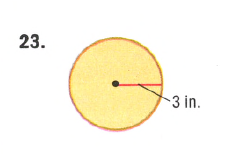
The radius of the given circle is 3 in. We apply the formula A=πr2 to find the area.

We have a circle of radius 3 in

Glencoe Math Course 3 Volume 2 Student 1st Edition Chapter 8 Volume and Surface Area Exercise 8.1 Page 596 Exercise 5, Problem1

Since we know that the area of a circle of radius 3 in. is A=πr2

where A is the area and r is the radius of the circle.

So, we can write, A = π(3) 2

⇒ A = 9π

⇒ A ≈ 28.3in2.

Therefore, the approximated area of the given circle is 28.3in2.

Finally, we can conclude that the approximated area of the circle with a radius of 3 in. is 28.3 in2.


Page 596 Exercise 6, Problem1

The given circle is

Glencoe Math Course 3 Volume 2 Student 1st Edition Chapter 8 Volume and Surface Area Exercise 8.1 Page 596 Exercise 6, Problem1

We have to determine the area of this circle.

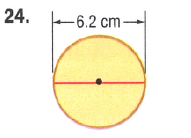
The diameter of the given circle is 6.2 cm. We apply the formula A=πr2 to find the area.

We have a circle of diameter 6.2 cm

Glencoe Math Course 3 Volume 2 Student 1st Edition Chapter 8 Volume and Surface Area Exercise 8.1 Page 596 Exercise 6, Problem1

Now, the radius of the circle is (6.2)/2 =3.1cm.

Since we know that the area of a circle of radius 3.1 cm is A=πr2

where  A is the area and r is the radius of the circle.

So, we can write, A = π(3.1) 2

⇒ A=9.61π

⇒ A = 9.61×22/7

⇒ A ≈ 30.2 cm2.

Therefore, the approximated area of the given circle is 30.2 cm2.

Finally, we can conclude that the approximated area of the circle with a diameter of 6.2 cm is 30.2 cm2.


Page 596 Exercise 7, Problem1

The given circle is

Glencoe Math Course 3 Volume 2 Student 1st Edition Chapter 8 Volume and Surface Area Exercise 8.1 Page 596 Exercise 7, Problem1

We have to determine the area of this circle.

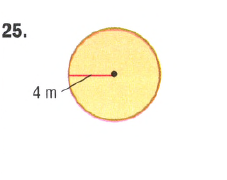
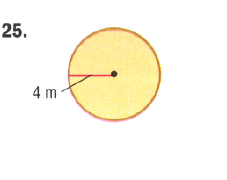
The radius of the given circle is 4 m. We apply the formula A=πr2  to find the area.

We have a circle of radius 4m

Glencoe Math Course 3 Volume 2 Student 1st Edition Chapter 8 Volume and Surface Area Exercise 8.1 Page 596 Exercise 7, Problem1

Since we know that the area of a circle of radius 4m is A = πr2

where A is the area and r is the radius.

So, we can write, A = π(4) 2

⇒A=16π

⇒A≈50.3m2.

Therefore, the approximated area of the given circle is 50.3 m2.

Finally, we can conclude that the approximated area of the circle with a radius of 4 m is 50.3m2.


Page 596 Exercise 8, Problem1

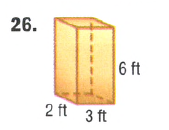
The given prism is

Glencoe Math Course 3 Volume 2 Student 1st Edition Chapter 8 Volume and Surface Area Exercise 8.1 Page 596 Exercise 8, Problem1

We have to determine the volume of the prism.

The three dimensions of the prism are 2ft, 3ft, and 6ft. We apply the formula V = l × d × h  to find the volume.

We have a prism of length 3 ft, width 2 ft, and height 6 ft

Glencoe Math Course 3 Volume 2 Student 1st Edition Chapter 8 Volume and Surface Area Exercise 8.1 Page 596 Exercise 8, Problem1

Since we know that the volume of a prism of dimensions 2ft, 3ft, and 6ft is V = l × d × h.

So, we can write V = 2×3×6

⇒ V = 36ft3.

Therefore, the determine d volume of the prism is 36ft3.

Finally, we can conclude that the determined volume of the prism is 36ft3.


Glencoe Math Course 3 Volume 2 Student 1st Edition Chapter 7 Congruence And Similarity Exercise 7.1

Glencoe Math Course 3 Volume 2 Student Chapter 7 Congruence And Similarity Exercise


Glencoe Math Course 3 Volume 2 Chapter 6 Transformations Exercise Solutions Page 509 Exercise 1, Problem1

Two items are similar if their shapes are the same, and one is a larger version of the other. When two objects have the same shape and size, they are said to be congruent.

The triangles are comparable if two pairs of corresponding angles in a pair of triangles are congruent. This is because if two angle pairs are equal, the third pair must be equal as well.

When all three angle pairs are equal, the three pairs of sides must be proportionate as well.

When two items have the same shape, one is an expansion of the other. When two objects have the same shape and size, they are congruent.


Common Core Chapter 6 Transformations Exercise Answers Glencoe Math Course 3v Page 509 Exercise 2, Problem1

We have been given the letter R written in Braille.

We need to find that which letter is of the same shape as R.

This can be found by counting and comparing the number of big dots and the number of small dots.

R has 3 big dots and 2 small dots in Braille.

We see that W also has 3 big dots and 2 small dots in Braille.

Glencoe Math Course 2 Student Edition Volume 1 Chapter 7 Congruence Exercise 7.1

Hence, they are similar.

Finally, we can determine that the W is the letter with the same shape as the letter R.

Read and Learn More Glencoe Math Course 2 Volume 1 Common Core Student Edition Solutions

Glencoe Math Course 3 Volume 2 Student Chapter 7 Page 509 Exercise 2 Problem1

We have been given a figure.

We need to copy the figure shown on tracing paper two times and then cut out both figures and finally label the figures A and B.

This can be achieved by checking if the figures are similar to each other or not.

The figure shown has been copied on tracing paper two times.

Both figures have been cut and labeled as A and B.

It can be seen that both the figures have the same shape and size and they are similar.

Finally, we can determine that figures A and B have the same size and shape.


Step-By-Step Solutions For Chapter 6 Transformations Exercises In Glencoe Math Course Page 509 Exercise 2, Problem2

We have been given two figures A and B.

We need to find out whether these figures have the same lengths and angles.

This can be found by checking whether the two figures are similar or not.

When the two figures are kept on top of each other, it is seen that the figures coincide.

Hence, they have the same lengths and angles.

Figures A and B have the same side lengths and angles.


Glencoe Math Course 3 Volume 2 Student Chapter 7 Page 509 Exercise 2 Problem3

We have been figures A and B.

We need to find whether these figures have the same side lengths and angles.

This can be found by the fact that similar figures do not always necessarily coincide.

When figures A and B are kept on top of each other, they produce mirror images of each other.

Hence, they are similar, i.e, they have the same side lengths and angles, but do not coincide.

Finally, we can determine that figures A and B have the same side lengths and angles.


Exercise Solutions For Chapter 6 Transformations Glencoe Math Course 3 Volume 2 Page 509 Exercise 2, Problem4

We have been given two figures A and B.

We need to move Figure A on top of Figure B so all sides and angles match.

This can be done based on that fact that putting figures facing each other is another way to make them coincide.

Put figure A in such a way that its bottom portion faces Figure B, i.e, put them facing facing other.
We see that the angles match when they’re put like that.

Finally, we can determine that it is put facing Figure B so that all sides and angles match.

Glencoe Math Course 3 Volume 2 Student Chapter 7 Page 512 Exercise 1 Problem1

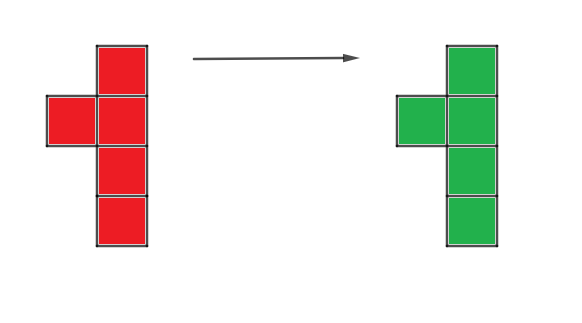
We have been given two figures. We need to determine if the two figures are congruent by using transformations.

This can be found based on the fact that two figures are congruent if the second figure can be obtained from the first by a series of rotations, reflections, and/or translations(without affecting the size and shape).

Reflecting ΔLMN over the horizontal line.

Glencoe Math Course 3 Volume 2 Student 1st Edition Chapter 7 Congruence And Similarity Exercise 7.1 Page 512 Exercise 1, Problem1

MovingΔL′M′N′to the right and going down until all sides and angles of ΔL′M′N′matches to the sides and angles of ΔXYZ.

Glencoe Math Course 3 Volume 2 Student 1st Edition Chapter 7 Congruence And Similarity Exercise 7.1 Page 512 Exercise 1, Problem1.


The given figures are congruent as a series of transformations makes them coincide.


Glencoe Math Course 3 Volume 2 Student Chapter 7 Page 512 Exercise 2 Problem1

We have been given two figures.

We need to determine if the two figures are congruent by using transformations.

This can be found based on the fact that two figures are congruent if the second figure can be obtained from the first by a series of rotations, reflections, and/or translations(without affecting the size and shape).

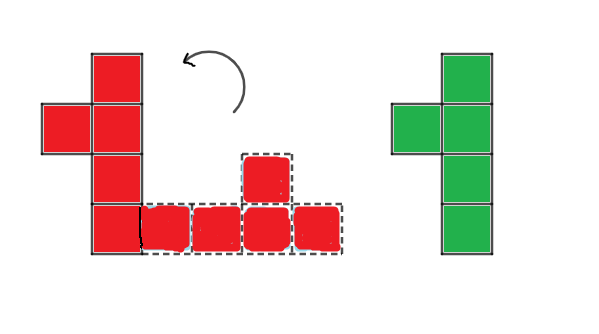
Turning the red figure at an angle of 90o in the counterclockwise direction.

Glencoe Math Course 3 Volume 2 Student 1st Edition Chapter 7 Congruence And Similarity Exercise 7.1 Page 512 Exercise 2, Problem1

Moving the obtained figure to the rigt until it matches to the green figure completely.

Glencoe Math Course 3 Volume 2 Student 1st Edition Chapter 7 Congruence And Similarity Exercise 7.1 Page 512 Exercise 2, Problem1.

The given figures are congruent as a series of transformations makes them coincide.


Glencoe Math Course 3 Volume 2 Student Chapter 7 Page 512 Exercise 2 Problem2

We have been given two figures. We need to determine if the two figures are congruent by using transformations.

This can be found based on the fact that two figures are congruent if the second figure can be obtained from the first by a series of rotations, reflections, and/or translations(without affecting the size and shape).

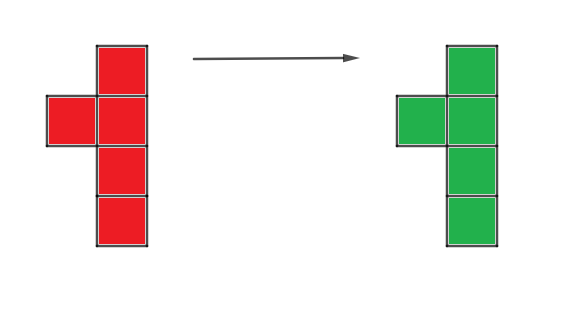
Turning the red figure at an angle of 90 in the counterclockwise direction.

Glencoe Math Course 3 Volume 2 Student 1st Edition Chapter 7 Congruence And Similarity Exercise 7.1 Page 512 Exercise 2, Problem2

Moving the obtained figure to the rigt until it matches to the green figure completely.

Glencoe Math Course 3 Volume 2 Student 1st Edition Chapter 7 Congruence And Similarity Exercise 7.1 Page 512 Exercise 2, Problem2.

The given figures are congruent as a series of transformations makes them coincide.

Glencoe Math Course 3 Volume 2 Student Chapter 7 Page 512 Exercise 3 Problem1

We have been given two figures.

We need to determine if the two figures are congruent by using transformations.

This can be found based on the fact that two figures are congruent if the second figure can be obtained from the first by a series of rotations, reflections, and/or translations(without affecting the size and shape).

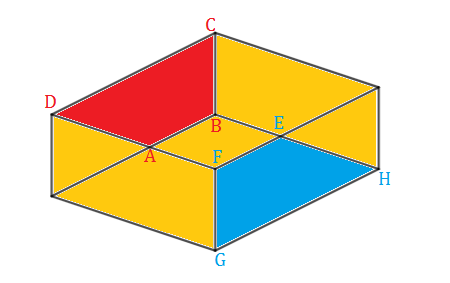
The figure is named as follows,

Glencoe Math Course 3 Volume 2 Student 1st Edition Chapter 7 Congruence And Similarity Exercise 7.1 Page 512 Exercise 3, Problem1

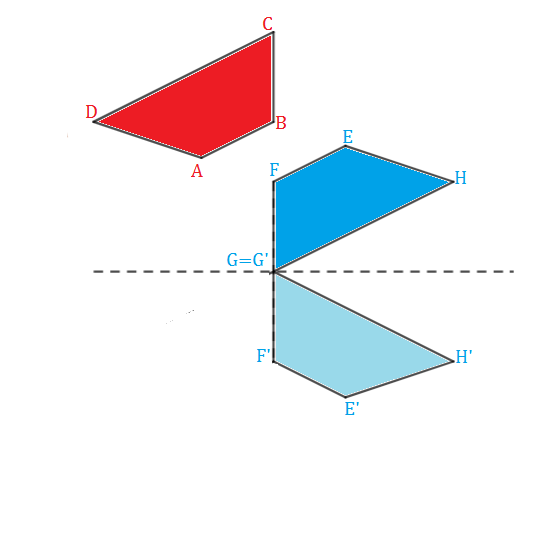
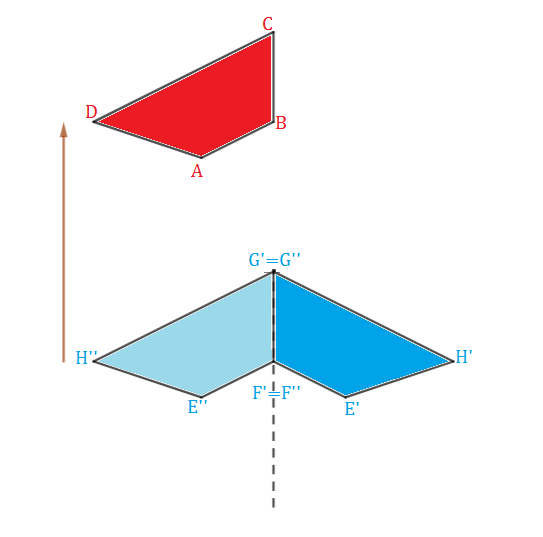
To map trapezoid EFGH to trapezoid ABCD, we follow the upcoming steps,

1. Reflecting the trapezoid EFGH over x-axis and then creating trapezoid E’F’G’H’.

Glencoe Math Course 3 Volume 2 Student 1st Edition Chapter 7 Congruence And Similarity Exercise 7.1 Page 512 Exercise 3, Problem1.

2. Reflecting the trapezoid E’F’G’H’ over y-axis and creating E”F”G”H”.

3. Translating the trapezoid E”F”G”H” upward until it maps the trapezoid ABCD.

Glencoe Math Course 3 Volume 2 Student 1st Edition Chapter 7 Congruence And Similarity Exercise 7.1 Page 512 Exercise 3, Problem-1.

The given figures are congruent as a series of transformations makes them coincide.

Examples of problems from Chapter 6 Transformations Exercises In Glencoe Math Course 3 Page 512 Exercise 4, Problem1

We have been given two figures.

We need to determine if the two figures are congruent by using transformations.

This can be found based on the fact that two figures are congruent if the second figure can be obtained from the first by a series of rotations, reflections, and/or translations(without affecting the size and shape).

Reflection, translation, and rotation change the position of the image but do not change the size and shape of the image, hence, these transformations create congruent images.

On the other hand, dilation changes the size of the image.

So, the image created by dilation is similar but not congruent(unless k=1).

Reflection, translation, and rotation change the position of the image but do not change the size and shape of the image, hence, these transformations create congruent images.


Glencoe Math Course 3 Volume 2 Student Chapter 7 Page 513 Exercise 1 Problem1

We have been given two figures.

We need to determine if the two figures are congruent by using transformations.

This can be found based on the fact that two figures are congruent if the second figure can be obtained from the first by a series of rotations, reflections or translations(without affecting the size and shape).

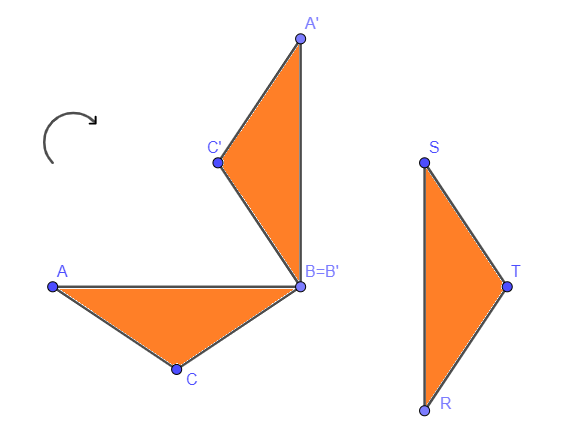
Turning ΔABC at an angle 90 in the clockwise direction.

Glencoe Math Course 3 Volume 2 Student 1st Edition Chapter 7 Congruence And Similarity Exercise 7.1 Page 513 Exercise 1, Problem1


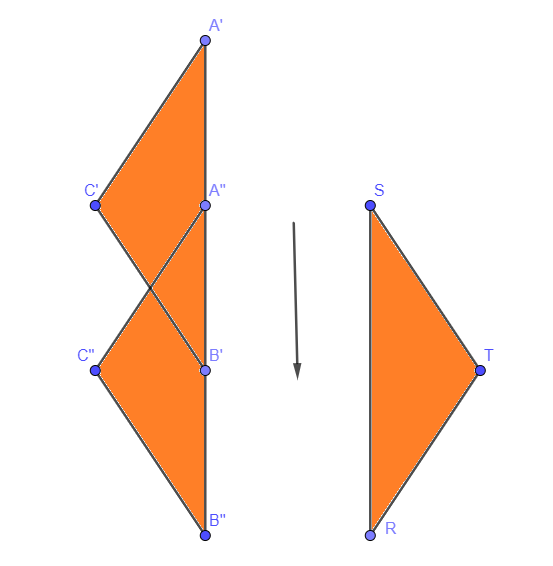
Moving A′B′C′to the down.

Glencoe Math Course 3 Volume 2 Student 1st Edition Chapter 7 Congruence And Similarity Exercise 7.1 Page 513 Exercise 1, Problem1.

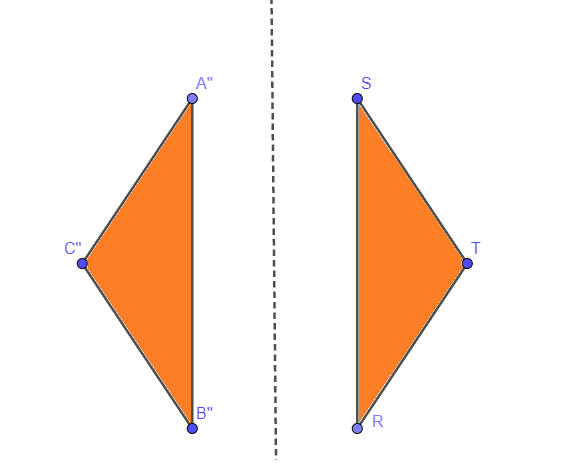
Reflecting ΔA′′B′′C′′over vertical line.

Glencoe Math Course 3 Volume 2 Student 1st Edition Chapter 7 Congruence And Similarity Exercise 7.1 Page 513 Exercise 1, Problem-1


The given figures are congruent as a series of transformations makes them coincide.

Student Edition Chapter 6 Transformations Solutions Guide Glencoe Math Course 3 Volume 2 Page 513 Exercise 2, Problem1

We have been given two figures. We need to determine if the two figures are congruent by using transformations.

This can be found based on the fact that two figures are congruent if the second figure can be obtained from the first by a series of rotations, reflections and translations(without affecting the size and shape).

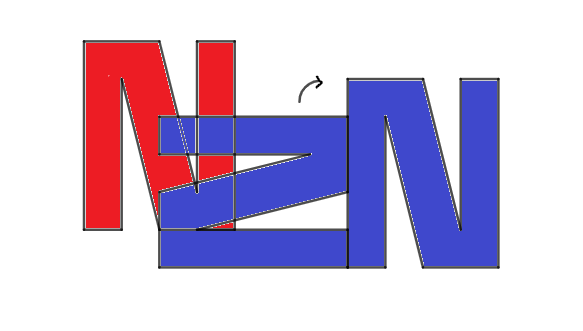
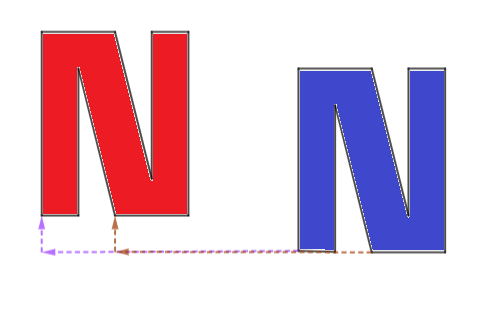
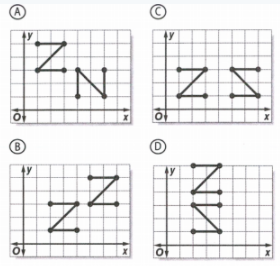
Turning the letter Z at an angle of 90 in the clockwise direction.

Glencoe Math Course 3 Volume 2 Student 1st Edition Chapter 7 Congruence And Similarity Exercise 7.1 Page 513 Exercise 2, Problem1


Moving the turned image of the letter Z to the right and then up until it overlaps the letter N.

Glencoe Math Course 3 Volume 2 Student 1st Edition Chapter 7 Congruence And Similarity Exercise 7.1 Page 513 Exercise 2, Problem1.


The given figures are congruent as a series of transformations makes them coincide.

Glencoe Math Course 3 Volume 2 Student Chapter 7 Page 513 Exercise 3 Problem1

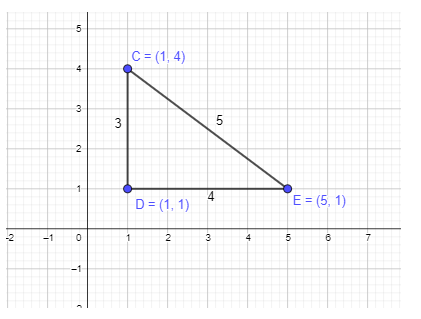
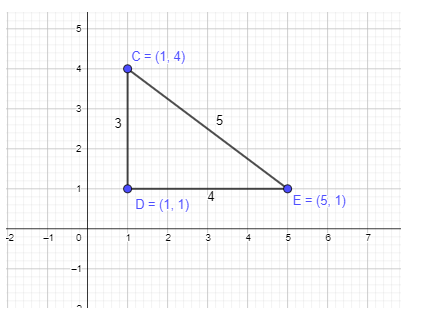
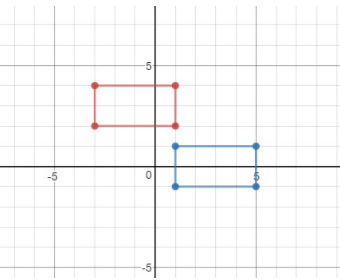
The three vertices of the triangle ΔCDE are given as C(1,4), D(1,1), and E(5,1).

First, we plot each vertex C(1,4), D(1,1), and E(5,1)on the coordinate plane.

Then connect each vertex to form sidesCD, DE, and CE of the triangle ΔCDE.

Glencoe Math Course 3 Volume 2 Student 1st Edition Chapter 7 Congruence And Similarity Exercise 7.1 Page 513 Exercise 3, Problem1

The ΔCDE is plotted as shown above.

Step-By-Step Answers For Chapter 6 Transformations In Glencoe Math Course 3 Volume 2 Page 513 Exercise 3, Problem2

The three vertices of ΔCDE are C(1,4), D(1,1), and E(5,1).

Glencoe Math Course 3 Volume 2 Student 1st Edition Chapter 7 Congruence And Similarity Exercise 7.1 Page 513 Exercise 3, Problem2

We have to find the length of the sidesCD, DE, and CE.

We know the distance between two points(x​1,y1) and ​(x2,y2)is given asDistance=√(x2−x1)²+(y2−y1)².

The length of CD with vertices C(1,4) and D(1,1) will be:

CD = \(\sqrt{\left(x_2-x_1\right)^2+\left(y_2-y_1\right)^2}\)

CD = \(\sqrt{(1-1)^2+(1-4)^2}\)

CD = \(\sqrt{(0)^2+(-3)^2}\)

CD = \(\sqrt{0+9}\)

CD = 3 units.

The length of DE with vertices D(1,1) and E(5,1) will be:

DE = \(\sqrt{\left(x_2-x_1\right)^2+\left(y_2-y_1\right)^2}\)

DE = \(\sqrt{(5-1)^2+(1-1)^2}\)

DE = \(\sqrt{(4)^2+(0)^2}\)

DE = \(\sqrt{16}\)

DE = 4 unit.

The length of CE with vertices C(1,4) and E(5,1) will be:

CE = \(\sqrt{\left(x_2-x_1\right)^2+\left(y_2-y_1\right)^2}\)

CE = \(\sqrt{(5-1)^2+(1-4)^2}\)

CE = \(\sqrt{(4)^2+(-3)^2}\)

CE = \(\sqrt{16+9}\)

CE = \(\sqrt{25}\)

CE = 5 unit.

The length of the sides of ΔCDE is CD=3 units, DE = 4 units, and CE = 5 units.

Glencoe Math Course 3 Volume 2 Student Chapter 7 Page 513 Exercise 3 Problem3

After reflection from the y-axis, the y-coordinate of each point of the initial image will remain the same and the x-coordinate will be multiplied by  -1. The three coordinates of the vertices of ΔCDE are given as

First, we will take the reflection and then translate it to get the final image.

The three coordinates of the vertices of ΔCDE are given as C(1,4), D(1,1), and  E(5,1).

The three coordinates of the vertices of \(\triangle C D E\) are given as C(1,4), D(1,1), and E(5,1).

After taking a reflection along the y-axis we get

(x, y) → (-x, y)

C(1,4) → C(-1,4)

D(1,1) → D(-1,1)

E(5,1) → E(-5,1)

Now, after taking 2 units left translation we get

(x, y) → (x+2, y)

⇒ \(C^{\prime}(-1,4) \rightarrow C^{\prime}(-3,4)\)

⇒ \(D^{\prime}(-1,1) \rightarrow D^{\prime}(-3,1)\)

⇒ \(E^{\prime}(-5,1) \rightarrow E^{\prime}(-7,1)\)

After transformation the coordinates of the vertices ofΔC′D′E′becomesC′(−3,4), D′(−3,1) and E′(−7,1).

Glencoe Math Course 3 Volume 2 Student Chapter 7 Page 513 Exercise 3 Problem4

Three vertices of ΔC′D′E′are C′(−3,4), D′(−3,1) and E′(−7,1).

We have to find the length of the sides C′D′, D′E′ and C′E′.

We know the distance between two points(x1,y1) and ​(x2,y2)is given as √(x2−x1)²+(y2−y1)².

The length of the side \(C^{\prime} D^{\prime}\) with vertices \(C^{\prime}(-3,4), D^{\prime}(-3,1)\) is given as:

⇒ \(C^{\prime} D^{\prime}=\sqrt{\left(x_2-x_1\right)^2+\left(y_2-y_1\right)^2}\)

⇒ \(C^{\prime} D^{\prime}=\sqrt{(-3+3)^2+(1-4)^2}\)

⇒ \(C^{\prime} D^{\prime}=\sqrt{(0)^2+(-3)^2}\)

⇒ \(C^{\prime} D^{\prime}=\sqrt{9}\)

∴ \(C^{\prime} D^{\prime}=3 \text { unit. }\)

The length of the side \(D^{\prime} E^{\prime}\) with vertices \(D^{\prime}(-3,1)\) and \(E^{\prime}(-7,1)\)is given as:

⇒ \(^{\prime} E^{\prime}=\sqrt{\left(x_2-x_1\right)^2+\left(y_2-y_1\right)^2}\)

⇒ \(D^{\prime} E^{\prime}=\sqrt{(-7+3)^2+(1-1)^2}\)

⇒ \(D^{\prime} E^{\prime}=\sqrt{(-4)^2+(0)^2}\)

⇒ \(D^{\prime} E^{\prime}=\sqrt{16}\)

∴ \(D^{\prime} E^{\prime}=4 \text { unit. }\)

The length of the side \(C^{\prime} E^{\prime}\) with vertices \(C^{\prime}\left(-3,4\right.\) and \(E^{\prime}(-7,1)\) is given as:

⇒ \(C^{\prime} E^{\prime}=\sqrt{\left(x_2-x_1\right)^2+\left(y_2-y_1\right)^2}\)

⇒ \(C^{\prime} E^{\prime}=\sqrt{(-7+3)^2+(1-4)^2}\)

⇒ \(C^{\prime} E^{\prime}=\sqrt{(-4)^2+(-3)^2}\)

⇒ \(C^{\prime} E^{\prime}=\sqrt{16+9}\)

⇒ \(C^{\prime} E^{\prime}=\sqrt{25}\)

⇒ \(C^{\prime} E^{\prime}=5 \text { unit. }\)

The length of the sides ofΔC′D′E′areC′D′=3 unit, D′E′=4 unit and C′E′=5 unit.

Page 513 Exercise 3, Problem5

Two figures are congruent if the second can be obtained from the first by a series of transformations (rotations reflections and translation).

Here, ΔC′D′E′is created by reflection followed by a translation of ΔCDE therefore, both these Triangles are congruent.

The other way to identify congruent triangles is that their matching side must have the same measure.

In the case of ΔCDE the length of their sides are =3 unit, DE =4 unit and CE =5 unit.

In the case ofΔC′D′E′the length of their sides are ′D′=3 unit, D′E′=4 unit, and C′E′=5 unit.

Therefore, these triangles are congruent.

ΔCDE and ΔC′D′E′are congruent triangles.

Glencoe Math Course 3 Volume 2 Student Chapter 7 Page 514 Exercise 4 Problem1

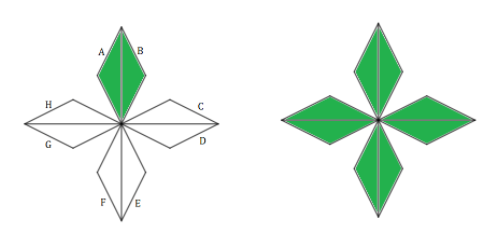
An image can be created using a number of ways of transformations. We will see two different ways. Way 1: Create triangle A as shown in the picture and reflect it over a vertical line to create triangle B.

Rotate the design created by triangles A and B at an angle of 90∘ ,180∘ , and 270∘ to create the final design as shown in the picture.

Glencoe Math Course 3 Volume 2 Student 1st Edition Chapter 7 Congruence And Similarity Exercise 7.1 Page 514 Exercise 4, Problem1


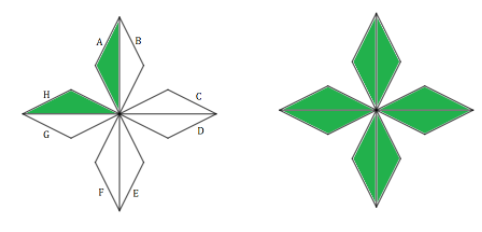
Way 2: Create a triangle A and a triangle H as shown in the picture and then rotate the design created at an angle of 90∘ ,180∘ , and 270∘ to create a final design as shown in the picture.

Glencoe Math Course 3 Volume 2 Student 1st Edition Chapter 7 Congruence And Similarity Exercise 7.1 Page 514 Exercise 4, Problem1.

The methods of creating a leaf design are described above and the required image is also attached.


Glencoe Math Course 3 Volume 2 Student Chapter 7 Page 514 Exercise 5 Problem1

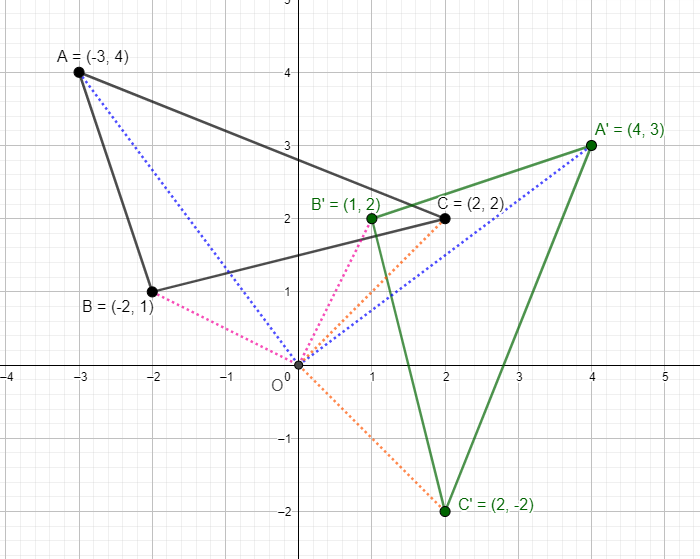
Sketch segment BO connecting point B(−2,1) to the origin O(0, 0).

Sketch another segment B′O, so that the angle between points B, O, and B′ measures 90° and the segment is the same length as BO.

Do the same with vertex A(−3,4) and C(2,2)

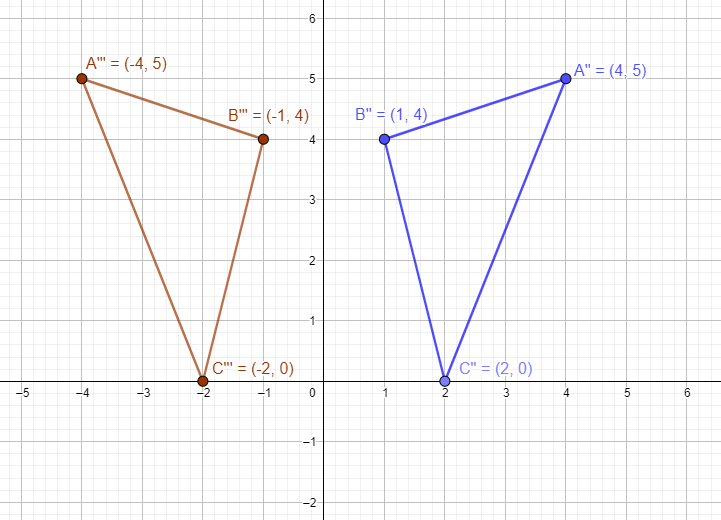
The vertices of ΔABC\ after the rotation will be A′(4,3),B′(1,2),andC′(2,−2).

Glencoe Math Course 3 Volume 2 Student 1st Edition Chapter 7 Congruence And Similarity Exercise 7.1 Page 514 Exercise 5, Problem1

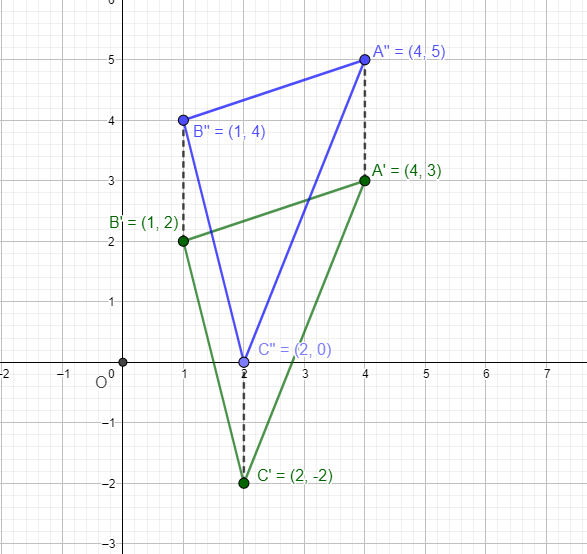
We have ΔA’B’C’ with vertices A′(4,3),B′(1,2)and C′(2,−2)

Here, a=0 and b=2 (x,y)→(x+0),(y+3)

A′(4,3)→(4+0,3+2)→(4,5)

B′(1,2)→(1+0,2+2)→(1,4)

C′(2,−2)→(2+0,−2+2)→(2,0)

So, the vertices of ΔA”B”C” areA″(4,5),B″(1,4)and C″(2,0).

Glencoe Math Course 3 Volume 2 Student 1st Edition Chapter 7 Congruence And Similarity Exercise 7.1 Page 514 Exercise 5, Problem1.

After reflection from the y−axis, the y−coordinate of each point of the initial image will remain the same and the x−coordinates will be multiplied by -1.

We have ΔA”B”C′′ with vertices A″(4,5),B″(1,4)and C″(2,0)
(x, y) → (−x, y)

A″(4,5)→(−4,5)

B″(1,4)→(−1,4)

C″(2,0)→(−2,0)

So, the vertices after reflection from the y−axis are A′′′ (−4,5), B′′′ (−1,4), and C′′′(−2,0)

The coordinates of vertices of ΔABC after rotation at an angle of 90° followed by the given translation and reflection are A′′′(−4,5), B′′′(−1,2), and C′′′(−2,0).

Glencoe Math Course 3 Volume 2 Student 1st Edition Chapter 7 Congruence And Similarity Exercise 7.1 Page 514 Exercise 5, Problem-1

The coordinates of vertices of ΔABC after rotation at an angle of 90°followed by given translation and reflection are ′′′(−4,5), B′′′(−1,4) and C′′′(−2,0).

Glencoe Math Course 3 Volume 2 Student Chapter 7 Page 514 Exercise 6 Problem1

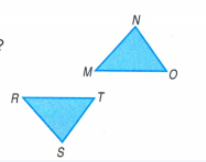
We have to mapΔMNO onto ΔRST.

Glencoe Math Course 3 Volume 2 Student 1st Edition Chapter 7 Congruence And Similarity Exercise 7.1 Page 514 Exercise 6, Problem1

For this purpose, we reflect the ΔMNO along the axis first.

Then we translate the image of ΔMNO in the left side to map it ontoΔRST.

So, option(D) is the correct answer.

We will not be able to mapΔMNO onto ΔRST by all the transformations given in options (A), (B), and (C).

Option (D): reflection, then a translation is the right answer to mapΔMNO onto ΔRST.


Page 515 Exercise 7, Problem1

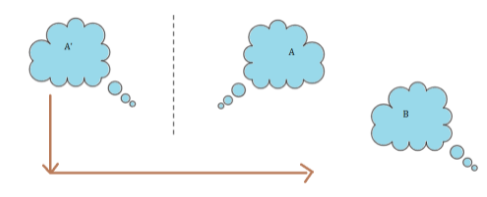
We have two thought bubbles Figure A and Figure B.

We will follow the following steps to map the figure A onto the figure B.

Step 1: Reflect Figure A over the vertical line to create Figure A’.

Step 2: Then translate Figure A’ to the down and to the right until it maps Figure B.

Glencoe Math Course 3 Volume 2 Student 1st Edition Chapter 7 Congruence And Similarity Exercise 7.1 Page 515 Exercise 7, Problem1

The required transformation that maps Figure A onto Figure B is reflection followed by the translation.

Glencoe Math Course 3 Volume 2 Student Chapter 7 Page 515 Exercise 8 Problem1

The length of the side PQ with given endpoints P(0, 0) and Q(2, 0) will be Legth PQ= √(2−0)²−(0−0)²= √4=2.

The length of the side QR with given endpoints Q(2, 0) and R(0, 2) will be LengthQR= □√(0−2)²+(2−0)²= √4+4 = √8.

The length of the side PR with given endpoints P(0, 0) and R(0, 2) will be LengthPR=√(0−0)²+(2−0)²= √4=2.

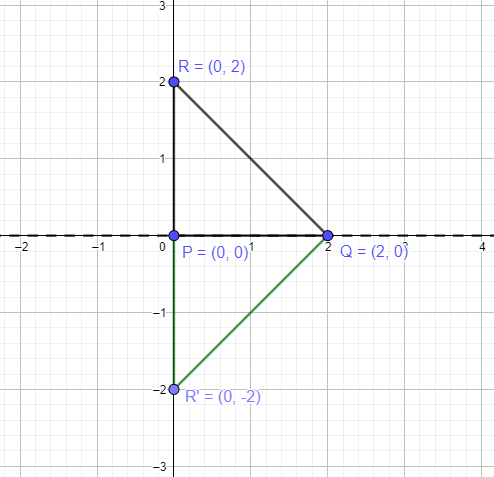
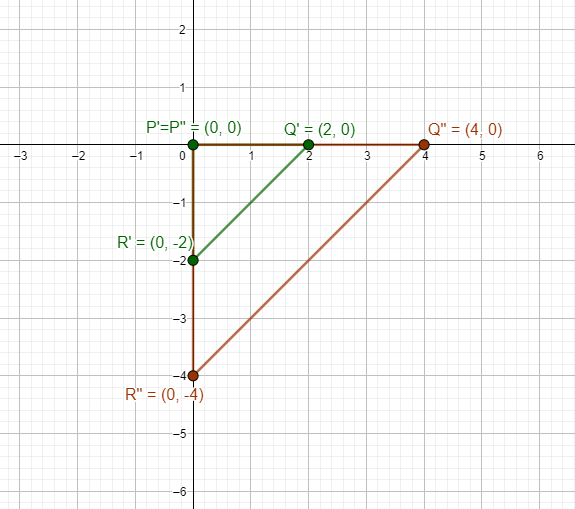
We have ΔPQR with vertices P(0, 0), Q(2, 0) and R(0, 2)(x,y) → (x, −y).

P(0,0)→P′(0,0).
Q(2,0)→Q′(2,0).
R(0,2)→R′(0,−2).

So, the coordinates of vertices of ΔP′Q′R′ are

P′(0,0),
Q′(2,0),
R′(0,−2).

Glencoe Math Course 3 Volume 2 Student 1st Edition Chapter 7 Congruence And Similarity Exercise 7.1 Page 515 Exercise 8, Problem1

We have ΔP′Q′R′ with vertices P′

(0,0),Q′
(2,0),R′
(0,−2).

dilate ΔP′Q′R′ by a scale factor 2,multiply each coordinate of ΔP′Q′R′ by 2(x,y)→(2x,2y)

P’(0,0)→(2×0,2×0)→P”(0,0)
Q’(2,0)→(2×2,2×0)→Q”(4,0)
R’(0,−2)→(2×0,2×−2)→R”(0,−4).

So, the coordinates of ΔP′′Q′′R′′ after dilation are

P″(0,0),
Q″(4,0),
R″(0,−4).

Glencoe Math Course 3 Volume 2 Student 1st Edition Chapter 7 Congruence And Similarity Exercise 7.1 Page 515 Exercise 8, Problem1.

The length of the side P′′Q′′ with given endpoints P”(0, 0) and Q”(4, 0) will be LengthP​′′Q​′′= √(4−0)2+(0−0)2 = √16 =4.
The length of the side Q′′R′′ with given endpoints Q”(4, 0) and R”(0,−4) will be Length​Q​′′R​′′= √(0−4)2+(−4−0)2 = √16+16 = √32.

The length of the side P′′R′′ with given endpoints P”(0, 0) and R”(0, −4) will be Length P​′′R​′′=√(0−0)2+(−4−0)2=√16=4.

The length of sides of ΔPQR isPQ=2, QR=2.82, PR=2, and the length of sides of ΔP′′Q′′R′′ isP′′Q′′=4, Q′′R′′=5.65, P′′R′′=4.

No, the preimage ΔPQR and image ΔP′′Q′′R′′ are not congruent because the length of the sides of ΔPQR is not equal to the corresponding sides of ΔP′′Q′′R′′.

The required image is attached inside.

The length of sides of ΔPQR is PQ=2, QR=2.82, PR=2, and the length of sides of ΔP′′Q′′R′′ is P′′Q′=4, Q′′R′′=5.65, P′′R′′=4.

No, the preimage ΔPQR and image ΔP′′Q′′R′′ are not congruent because the length of the sides of ΔPQR is not equal to the corresponding sides of ΔP′′Q′′R′′.


Glencoe Math Course 3 Volume 2 Student Chapter 7 Page 516 Exercise 9 Problem1

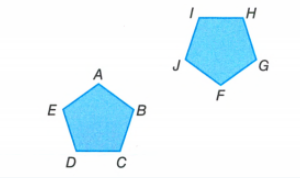
We have to map the pentagon ABCDE onto FGHIJ.

Glencoe Math Course 3 Volume 2 Student 1st Edition Chapter 7 Congruence And Similarity Exercise 7.1 Page 515 Exercise 9, Problem1

For this purpose, we reflect the pentagon ABCDE along the x-axis.

Then, we translate the image on the right-hand side to map it exactly onto the Pentagon FGHIJ.

So, option (B) is the correct answer.

We will not be able to map the pentagon ABCDE onto the pentagon FGHIJ by all the transformations given in options(A),(C), and (D).

Option (B): a reflection followed by a translation is the right answer to map the pentagon ABCDE onto the pentagon FGHIJ.


Page 516 Exercise 10, Problem1

According to the question, triangle A is the preimage, and triangle B is the image.

If we rotate triangle A at an angle 60∘ in the counterclockwise direction and then move it upward then it will map triangle B as shown.

Glencoe Math Course 3 Volume 2 Student 1st Edition Chapter 7 Congruence And Similarity Exercise 7.1 Page 516 Exercise 10, Problem1

So, the transformation should be a rotation at an angle of 60∘ followed by an upward translation.

The transformation should be a rotation at an angle of 60∘ followed by an upward translation.

Glencoe Math Course 3 Volume 2 Student Chapter 7 Page 516 Exercise 11 Problem1

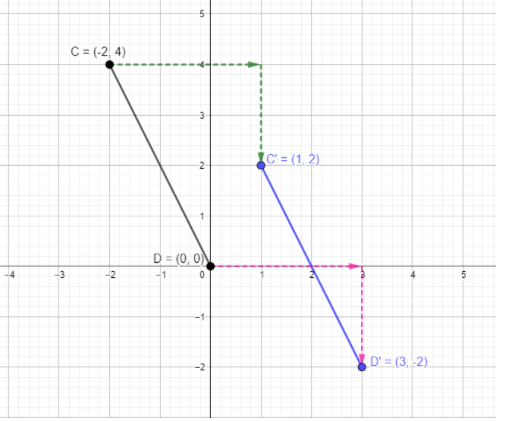
During the translation of a figure the x coordinate changes due to horizontal translation and the y coordinate changes due to vertical translation.

C is located at(−2,4).

D is located at(0,0).

According to the given translation of 3 units right and 2 units down:

​(x,y)→(x+3,y−2)

C(−2,4)→(−2+3,4−2)→C′(1,2)

D(0,0)→(0+3,0−2)→D′(3,−2)

The vertices of the segment CD after transformation are C′(1,2) and D′(3,−2).

Glencoe Math Course 3 Volume 2 Student 1st Edition Chapter 7 Congruence And Similarity Exercise 7.1 Page 516 Exercise 11, Problem1

The vertices of the segment CD after transformation are C′(1,2) and D′(3,−2).

The required image is attached above.
 

Page 517 Exercise 1, Problem1

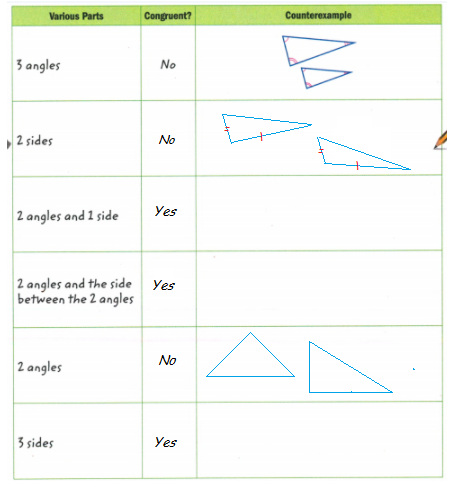
Let us consider that we are provided with two triangles similar to each other. We can say that they are congruent if they can be superimposed on one another.

For them to be superimposed on one another, we have to check if the corresponding sides and angles are equal to each other, or else their measurement may differ and hence, cannot be superimposed.

After all the deductions, we can say that two triangles are said to be congruent if their pair of corresponding sides or angles are equal.

Glencoe Math Course 3 Volume 2 Student Chapter 7 Page 519 Exercise 1 Problem1

As per the given instructions, we form the two triangles. As the two triangles have two sides equal and one corresponding angle equal to each other, they follow the SAS postulate.

As the triangles follow the SAS postulate, they can be said to be congruent to each other.

After the deductions, we can say that as the triangles follow the SAS postulate, they can be said congruent to each other.

Page 519 Exercise 1, Problem2

We can say that they are congruent if they can be superimposed on one another.

For them to be superimposed on one another, we have to check if the corresponding sides and angles are equal to each other, or else their measurement may differ and hence, cannot be superimposed.

As per the SAS postulate, they are always congruent irrespective of their rearrangements.

As per the SAS postulate, no more triangles can be formed and if there exist so they are always congruent irrespective of their rearrangements.


Glencoe Math Course 3 Volume 2 Student Chapter 7 Page 519 Exercise 2 Problem1

We can say that they are congruent if they can be superimposed on one another.

For them to be superimposed on one another, we have to check if the corresponding sides and angles are equal to each other, or else their measurement may differ and hence, cannot be superimposed.

After all the deductions we can complete the table as follows:

Glencoe Math Course 3 Volume 2 Student 1st Edition Chapter 7 Congruence And Similarity Exercise 7.1 Page 519 Exercise 2, Problem1

After all the deductions we can complete the table as follows:


Page 520 Exercise 1, Problem1

We can say that they are congruent if they can be superimposed on one another.

For them to be superimposed on one another, we have to check if the corresponding sides and angles are equal to each other, or else their measurement may differ and hence, cannot be superimposed.

As per Case 1: two pairs of congruent sides and a pair of congruent angles not between them, are not congruent as per the SAS postulate. As per

Case 2: two pairs of congruent sides and a pair of congruent angles between them, they are congruent as per the SAS postulate. As per

Case 3: two pairs of congruent sides and a pair of congruent angles not between them, they are not congruent as per the SAS postulate.

The results of the case studies are as follows:

As per Case 1: two pairs of congruent sides and a pair of congruent angles not between them, are not congruent as per the SAS postulate. As per

Case 2: two pairs of congruent sides and a pair of congruent angles between them, they are congruent as per the SAS postulate. As per

Case 3: two pairs of congruent sides and a pair of congruent angles not between them, they are not congruent as per the SAS postulate.


Glencoe Math Course 3 Volume 2 Student Chapter 7 Page 520 Exercise 2 Problem1

Let us consider that we are provided with two triangles similar to each other.

We can say that they are congruent if they can be superimposed on one another.For them to be superimposed on one another, we have to check if the corresponding sides and angles are equal to each other, or else their measurement may differ and hence, cannot be superimposed.

As all the sides are equal to each other, they are congruent.

As all the sides are equal to each other, we can say that the triangles are congruent to each other.


Page 520 Exercise 3, Problem1

Let us consider that we are provided with two triangles similar to each other. We can say that they are congruent if they can be superimposed on one another.

For them to be superimposed on one another, we have to check if the corresponding sides and angles are equal to each other, or else their measurement may differ and hence, cannot be superimposed.

As the angles are equal, they cannot be congruent as the corresponding sides may differ in length creating an enlarged or diminished image.


As the angles are equal, the triangles cannot be congruent as the corresponding sides may differ in length creating an enlarged or diminished image.

Glencoe Math Course 3 Volume 2 Student Chapter 7 Page 520 Exercise 4 Problem1

Let us consider that we are provided with two triangles similar to each other.We can say that they are congruent if they can be superimposed on one another.

For them to be superimposed on one another, we have to check if the corresponding sides and angles are equal to each other, or else their measurement may differ and hence, cannot be superimposed.

As the two pairs of corresponding sides including an angle are equal to each other, they are congruent by the SAS postulate.

As the two pairs of corresponding sides including an angle are equal to each other, the triangles are congruent by the SAS postulate.

Page 520 Exercise 5, Problem1

As instructed in the question that three pairs of corresponding parts can be used to show that two triangles are congruent.

There are some ways to check if two triangles are congruent or not, anyone out of these is sufficient to check the congruence of triangles.

There are some ways to check if two triangles are congruent or not, anyone out of these is sufficient to check the congruence of triangles.

Three pairs of corresponding parts can be used to show that two triangles are congruent as given in below:

1. SSS (side, side, side): All three corresponding sides are equal in length.
2. SAS (side, angle, side): A pair of corresponding sides and the included angle are equal.
3. ASA (angle, side, angle): A pair of corresponding angles and the included side are equal.
4. AAS (angle, angle, side): A pair of corresponding angles and a non-included side are equal.
5. HL (hypotenuse, leg of a right triangle): Two right triangles are congruent if the hypotenuse and one leg are equal.

Three pairs of corresponding parts can be used to show that two triangles are congruent SSS (side, side, side), SAS (side, angle, side), ASA (angle, side, angle), AAS (angle, angle, side), HL (hypotenuse, leg of a right triangle).

Glencoe Math Course 2 Volume 1 Common Core Student Edition Chapter 4 Rational Numbers Exercise 4.2

Glencoe Math Course 2 Volume 1 Common Core Chapter 4 Rational Numbers


Glencoe Math Course 2 Volume 1 Chapter 4 Exercise 4.2 Solutions Page 271   Exercise 1  Problem 1

To add or subtract the fractions we see the denominator.

If the denominators are the same we only function with the numerator.

If the denominators are not the same we take the L.C.M of it.

Multiplication: Multiply the numerator with the numerator.

Multiply the denominator with the denominator.

Divide: Dividing a fraction by another fraction is the same as multiplying the fraction by the reciprocal (inverse) of the other.

Here we have shown the addition, subtraction, multiplication, and division of two fractions

Read and Learn More Glencoe Math Course 2 Volume 1 Common Core Student Edition Solutions

Common Core Chapter 4 Rational Numbers Exercise 4.2 Answers Glencoe Math Course 2 Page 271   Exercise 1  Problem 2

The Greek letter π (pi) represents the nonterminating and nonrepeating number whose first few digits are 3.14.….

This number is an irrational number.

Using the internet we have to find the value of π

Glencoe Math Course 2 Student Edition Volume 1 Chapter 4 Rational Numbers Exercise 4.2

The fractional value of π is \(\frac{22}{7}\)

We divide them
Glencoe Math Course 2, Volume 1, Common Core Student Edition, Chapter 4.2 Compare and Order Rational Numbers Page 271 Exercise 1 Answer

The value of π is 3.1428… and so on. Because the value of π is an irrational number, it is an irrational number.

The value of π is presented as 3.14159, whose ration is unknown when it is originally introduced in the earlier lessons.

The most common estimate is in the form of a rational number, such as 227=3.1428571428571 which is the closest but not exact approximation to the actual value of π

Therefore, the value of π: is 3.1428.  The non-terminating and non-repeating decimal expansion ofπ makes it an irrational number.


Step-By-Step Guide For Exercise 4.2 Chapter 4 Rational Numbers In Glencoe Math Course 2 Page 272  Exercise 1 Problem 3


Given:  \(\frac{5}{6}\) ◯ \(\frac{7}{9}\)

To find – Fill in the ◯ with <, > or=

We know that

\(\frac{5}{6}\) ◯ \(\frac{7}{9}\)

The LCD of the denominators 6 and 9 is 18

\(\frac{5}{6}\) = \(\frac{5×3}{6×3}\)

⇒  \(\frac{15}{18}\)

\(\frac{7}{9}\) = \(\frac{7×2}{9×2}\)

⇒   \(\frac{14}{18}\)

Since, \(\frac{15}{18}\) > \(\frac{14}{18}\), \(\frac{5}{6}\) > \(\frac{7}{9}\)

Finally, We compare the numerators of each fraction and order them from least to largest or greatest to least. \(\frac{15}{18}\) > \(\frac{14}{18}\), \(\frac{5}{6}\) > \(\frac{7}{9}\)


Given: \(\frac{1}{5}\) ◯ \(\frac{7}{50}\)

To find – Fill in the ◯ with <, > or =

\(\frac{1}{5}\) ◯ \(\frac{7}{50}\)

The LCD of the denominators 5 and 50 is 50

\(\frac{1}{5}\) = \(\frac{1×10}{5×10}\)

⇒  \(\frac{10}{50}\)

⇒   \(\frac{1}{5}\)

\(\frac{7}{50}\) = \(\frac{7×1}{50×1}\)

⇒  \(\frac{7}{50}\)

\(\frac{10}{50}\)>\(\frac{7}{50}\), \(\frac{1}{5}\)>\(\frac{7}{50}\)

Finally, We compare the numerators of each fraction and order them from least to largest or greatest to least. \(\frac{10}{50}\)>\(\frac{7}{50}\), \(\frac{1}{5}\)>\(\frac{7}{50}\)


Given:  − \(\frac{9}{16}\) ◯ −\(\frac{7}{10}\)

To find – Fill in the◯ with <,>, or =

We know that

\(\frac{9}{16}\) ◯−\(\frac{7}{10}\)

The LCD of the denominators 16 and 10 is 80

\(\frac{9}{16}\) = \(\frac{−9×5}{16×5}\)

⇒  −\(\frac{45}{50}\)

−\(\frac{7}{10}\)= −\(\frac{7×8}{10×8}\)

⇒ −\(\frac{56}{80}\)

Since, −\(\frac{45}{50}\)>\(\frac{56}{80}\),−\(\frac{9}{16}\)> −\(\frac{7}{10}\)

Finally, We compare the numerators of each fraction and order them from least to largest or greatest to least. −\(\frac{45}{50}\)>\(\frac{56}{80}\),−\(\frac{9}{16}\)> −\(\frac{7}{10}\)


Given:

In a second-period class,37.5% of students like to bowl. In a fifth-period class, 12 out of 29 students like to bowl.

Convert the given percentage to decimal and then find which class does a greater fraction of the students like to bowl

In the second period class which means 5 th period37.5% of students like to bowl.

37.5% = 0.375

12 out of 29. Which means

\(\frac{12}{29}\) = 0.1413.

While comparing both the value.

0.375 < 0.413.

Hence, in the fifth-period class the fraction of students who like to bowl is greater than the second-period class of students.


Given:

{23%,0.21,\(\frac{1}{4}\)\(\frac{1}{5}\)}

First, convert % to decimal Then convert the fractions to decimal and then arrange them from least to greatest.

Convert % to a decimal. 23% = 0.23

This number is already in decimal. 0.21

Convert fractions to decimals.

\(\frac{1}{4}\) = 0.25

\(\frac{1}{5}\) = 0.2

The order from least to greatest is  0.2,0.21,0.23,0.25


Exercise 4.2 Solutions For Chapter 4 Rational Numbers Glencoe Math Course 2 Volume 1 Page 274  Exercise 1  Problem 4

Given: The fraction −\(\frac{4}{5}\), −\(\frac{1}{5}\)

To find – Make the true sentence

Since we can write

−4 < −1

And since the denominator are the same, we know that

−\(\frac{4}{5}\)<−\(\frac{1}{5}\)

The value of true sentence is −\(\frac{4}{5}\)<−\(\frac{1}{5}\)


Examples Of Problems From Exercise 4.2 Chapter 4 Rational Numbers In Glencoe Math Course 2 Page 274  Exercise 2  Problem 5

Given:

Two fractions are : 1\(\frac{3}{4}\), 1\(\frac{5}{8}\)

To find – Make the true sentence

Since 0.75>0.625

And since the denominator are the same, we know that

\(\frac{3}{4}\) = 0.75 >\(\frac{5}{8}\)

=  0.625

Add 1 to both sides of the inequality

1\(\frac{3}{4}\) > 1\(\frac{5}{8}\)

0.75 > 0.625

True sentence of this fraction is 1\(\frac{3}{4}\) > 1\(\frac{5}{8}\),  0.75 > 0.625


Common Core Exercise 4.2 Chapter 4 Rational Numbers Detailed Solutions Glencoe Math Course 2 Page 274  Exercise 3  Problem 6

Given: Elliot saves the goals \(\frac{3}{4}\)

Shanna saves the goals\(\frac{7}{11}\)

To find –  Better average

Since we can write

0.75 > 0.636

And since the denominator are the same, we know that

\(\frac{3}{4}\) = 0.75 > \(\frac{7}{11}\) = 0.636

0.75 > 0.636

Elliot saves the goal better than Shanna, Elliot > Shanna.


Student Edition Glencoe Math Course 2 Chapter 4 Rational Numbers Exercise 4.2 Solutions Guide Page 274  Exercise 4  Problem 7

Given:

The insects inches are 0.02, \(\frac{1}{8}\) , 0.1, \(\frac{2}{3}\)

To find –  List the insects from least to greatest

Since 0.02, \(\frac{1}{8}\) = 0.125, 0.1, \(\frac{2}{3}\) = 0.667

The length of four insects from least to greatest is

0.02<0.1<0.125<0.667

The length of four insects from least to greatest is 0.02 < 0.1 < 0.125 < 0.667, 0.02 < 0.1 < \(\frac{1}{8}\) < \(\frac{2}{3}\).


Page 274   Exercise 5  Problem 8

Add the fractions to the number line, the fraction that is the most to the right is the greatest fraction.

Hence we can compare two fractions by using the above method.


Step-by-step answers for Exercise 4.2 Chapter 4 Rational Numbers In Glencoe Math Course 2 Volume 1 Page 275   Exercise 3  Problem 9

Given: The fractions 6\(\frac{2}{3}\) , 6\(\frac{1}{2}\)

To find – Make a true sentence

Since we can write

4>3

And since the denominator are the same, we know that

\(\frac{2}{3}\) = \(\frac{4}{6}\)>\(\frac{3}{6}\) =  \(\frac{1}{2}\)

Add 6 to both sides of the inequality

The fraction value is 6\(\frac{2}{3}\)>6\(\frac{1}{2}\)


Page 275  Exercise 4  Problem 10

Given: −\(\frac{17}{24}\) and − \(\frac{11}{12}\)

Make the denominators the same for both the fractions and then relate them with <,> or =

Make the denominators of the two fractions the same by multiplying and dividing with the appropriate number.

−\(\frac{17}{24}\) and − \(\frac{11}{12}\)

−\(\frac{17}{24}\)× \(\frac{12}{12}\) > − \(\frac{11}{12}\)× \(\frac{24}{24}\)

−\(\frac{288}{24}\) > −\(\frac{264}{288}\)

The true sentence is −\(\frac{17}{24}\) > − \(\frac{11}{12}\).

The true sentence is −\(\frac{17}{24}\) > − \(\frac{11}{12}\).


Page 275  Exercise 5  Problem 11

Given: Meg answered in the first quiz is 92%, next quiz is

\(\frac{27}{30}\) First, convert the decimal to percentage and find which quiz she answered the better score

The number of questions answered in the second quiz is 27 out of 30

Then, \(\frac{27}{30}\) = 0.9

Convert to percentage

= 0.9 × 100

= 90 %

Therefore, Meg answered 90 % of the questions correctly in the second quiz.

But in the First quiz, Meg answered 92 % of the questions correctly. 92 %>90%

So, the First quiz is better than the second quiz.

Meg answered the First quiz better than the second quiz.


Page 275  Exercise 6  Problem 12

Given: The sets are 0.23,19

To find – Set least to greatest 0.23,19%, \(\frac{1}{5}\)

Since Percentage converted into number is divided by hundreds

0.23, \(\frac{19}{100}\) = 1.9, \(\frac{1}{5}\) = 0.2

And since set least to greatest is

0.2 < 0.23 < 1.9

Sets least to greatest is 0.2< 0.23<1.9, \(\frac{1}{5}\) < 0.23 < 19


Step-by-step answers for Exercise 4.2 Chapter 4 Rational Numbers in Glencoe Math Course 2 Volume 1 Page 275   Exercise 7  Problem 13

Given: Sets of numbers

To find – Least to the greatest

Since The value of −\(\frac{5}{8}\)

= −0.625

And since the value arranged from least to greatest is given below

{−0.625<−0.62<−0.615}

Sets arrange least to greatest is {−0.625<−0.62<−0.615} , {−\(\frac{5}{8}\) <−0.62<−0.615}


Page 275  Exercise 8  Problem 14

Given:

The sixth-graders have raised 52 % of their goal amount. The seventh- and eighth-graders have raised 0.57 and \(\frac{2}{5}\) of their goal amounts, respectively

Convert the percentage to decimal and find the order of least to greatest of their goal amounts.

The amount raised by the eighth graders = \(\frac{2}{5}\) of their goal amount.

= 0.4 of their goal amount.

The amount raised by sixth graders =52 % of their goal amount

\(\frac{52}{100}\)

= 0.52

The amount raised by seventh graders = 0.57

Compare the amount raised by the sixth, seventh, and eighth graders

Arranging, the least to greatest is:

0.4 < 0.52 > 0.57

The classes in order from least to greatest of their goal amounts is Eighth grade < Sixth grade < seventh grade.


Page 275  Exercise 9 Problem 15

Given: Two mixed fraction

1\(\frac{7}{12}\) gallons, 1\(\frac{5}{8}\)

Make the denominators of the two fractions the same by multiplying and dividing with the appropriate number.

1\(\frac{7}{12}\)< 1\(\frac{5}{8}\)

\(\frac{7}{12}\) × \(\frac{8}{8}\) < \(\frac{5}{8}\) × \(\frac{12}{12}\)

\(\frac{56}{96}\) < \(\frac{60}{96}\)

1\(\frac{7}{12}\) < 1\(\frac{5}{8}\)

The True sentence is  1\(\frac{7}{12}\) < 1\(\frac{5}{8}\)


Page 275  Exercise 10  Problem 16

​Given: Two mixed fraction

To find – The greater number between two fractions

Since we have two different times but one in a fraction

We 2\(\frac{5}{6}\) = \(\frac{12+5}{6}\)

\(\frac{17}{6}\) = 2.83

⇒ 2.83 > 2.8

2\(\frac{5}{6}\)> 2.8

The fraction is greater than number

True sentence is 2\(\frac{5}{6}\)> 2.8.


Page 276  Exercise 11  Problem 17

According to the graphic novel frame, the total width of the closet organizer is

69 \(\frac{1}{8}\) = \(\frac{553}{8}\)

= 69.125

The total width of the closet organizer is

69\(\frac{3}{4}\) = \(\frac{279}{4}\)

=  69.75

69.125 < 69.75

That is total width of the closet<total width of the closet

That means the closet can fit into the organizer.

Finally, we concluded That the closet can fit into the organizer.


Page 276 Exercise 12 Problem 18

Here it is given that

12 out of 15  ⇒ \(\frac{12}{15}\) = 0.8

0.08 ≠ 0.8

80% = \(\frac{80}{100}\)

= 0.8

\(\frac{4}{5}\) = 0.8

The ratio that does not have the same value as the other three is  \(\frac{4}{5}\)  = 0.8

The ratio that does not have the same value as the other three is 0.08.


Page 277  Exercise 15 Problem 19

Given: Two simple fractions

To find –  True sentence or sign

Since denominators are same easily put the value-based in numerators −\(\frac{5}{7}\)<\(\frac{2}{7}\)

The symbol of this statement is <

The true sentence of this fraction is −\(\frac{5}{7}\)<\(\frac{2}{7}\)


Page 277  Exercise 16  Problem 20

Given:

Two simple fractions : −3\(\frac{2}{3}\) and −3\(\frac{2}{3}\)

To find – True sentence or sign

Denominators are different so take simple fractions in cross multiplication method

​\(\frac{2}{3}\) × \(\frac{6}{6}\)= \(\frac{12}{18}\)

\(\frac{4}{6}\) × \(\frac{3}{3}\)

= \(\frac{12}{18}\)

\(\frac{12}{18}\) = \(\frac{12}{18}\)

\(\frac{2}{3}\) = \(\frac{4}{6}\)

The values are same so we put an equal sign

​The values are same so we put an equal sign \(\frac{2}{3}\) = \(\frac{4}{6}\)


Page 277  Exercise 17   Problem 21

Given:

Two simple fractions : \(\frac{4}{7}\)and \(\frac{5}{8}\)

To find – True sentence or sign

\(\frac{4}{7}\) = \(\frac{4×8}{7×8}\)

= \(\frac{32}{56}\)

\(\frac{5}{8}\) = \(\frac{5×7}{8×7}\)

= \(\frac{35}{56}\)

\(\frac{32}{56}\) < \(\frac{35}{56}\)

\(\frac{4}{7}\) < \(\frac{5}{8}\)

The sign of this fraction is <

The true sentence of this fraction is \(\frac{4}{7}\) < \(\frac{5}{8}\)


Page 277   Exercise 18   Problem 22

Given:

Two mixed fractions : 2\(\frac{3}{4}\) and 2\(\frac{2}{3}\)

To find – True sentence or sign

Since denominators are different we take cross multiplication

2\(\frac{3}{4}\) = \(\frac{3×3}{4×3}\)

= \(\frac{9}{12}\)

2\(\frac{2}{3}\) = \(\frac{2×4}{3×4}\)

= \(\frac{8}{12}\)

\(\frac{9}{12}\)>\(\frac{8}{12}\)

= 2\(\frac{3}{4}\)> 2\(\frac{2}{3}\)

Hence the true value of the sign is

Hence the true value of sign is  2\(\frac{3}{4}\) > 2\(\frac{2}{3}\).


Page 277   Exercise 19  Problem 23

Given:

Garcia made \(\frac{4}{15}\)

Jim missed \(\frac{6}{16}\)

To find – a greater fraction of the time

Garcia and Jim throw different values we find who made free throw a greater fraction

\(\frac{4}{15}\) = \(\frac{4×16}{15×16}\)

= \(\frac{64}{240}\)

\(\frac{6}{16}\) = \(\frac{6×15}{16×15}\)

= \(\frac{90}{240}\)

⇒  \(\frac{64}{240}\)<\(\frac{90}{240}\)

⇒  \(\frac{4}{15}\)<\(\frac{6}{16}\)

Jim throws better than Garcia \(\frac{4}{15}\)<\(\frac{6}{16}\).


Page 277  Exercise 20  Problem 24

Given:

Sets of numbers fraction : {7.49,7\(\frac{49}{50}\),7.5}

To find – Least to the greatest

Since we convert fractions into numbers

7\(\frac{49}{50}\) = \(\frac{350+49}{50}\)

= 7.98

​{0.75 < 7.49 < 7.98}

The order of a set of fractions from least to greatest {0.75 < 7.49 < 7.98}


Page 277  Exercise 21  Problem 25

Given:

Sets of numbers fraction : {-1.4,−1\(\frac{1}{25}\)-1.25}

To find- Least to the greatest

Since we convert mixed fractions into numbers

−1\(\frac{1}{25}\) = −\(\frac{25+1}{25}\)

− 1.04

{−1.25<−1.4<−1.04}

{−1.25<−1.4<−1\(\frac{1}{25}\)}

The sets of value least to greatest is  {−1.25<−1.4<−1\(\frac{1}{25}\)}


Page 277  Exercise 22  Problem 26

Given:

The four mammals’ length in the table is :

Eastern Chipmunk   \(\frac{1}{3}\)

European Mole   \(\frac{5}{12}\)

Masked Shrew −  \(\frac{1}{6}\)

Spiny Pocket Mouse  0.25

To find – Which animal is the smallest mammal

Since we have different animals’ lengths in tables, now we can find which animal length is small in size,

(\(\frac{1}{3}\) = 0.33),(\(\frac{5}{12}\) = 0.416), (\(\frac{1}{6}\) = 0.166), (0.25)

0.166 < 0.25 < 0.33 <0.416

Since 0.166 ft

The masked shrew is the smallest mammal in this table The length is 0.166ft


Given:

The four mammals’ length in the table is :

Eastern Chipmunk  \(\frac{1}{3}\)

European Mole   \(\frac{5}{12}\)

Masked Shrew  \(\frac{1}{6}\)

Spiny Pocket Mouse −    0.25

To find – Which animal is smaller than the European mole and larger the spiny pocket mouse

Since we have four different animals’ length

European mole length is

\(\frac{5}{12}\) = 0.416ft

Spiny pocket mouse length is

0.25ft

And since all length

0.416>0.33>0.25>0.166

In between the length of mammal is

0.33ft

The eastern chipmunk is smaller than the European mole and larger than a spiny pocket mouse.


Given:

The four mammals’ length in the table is :

Eastern Chipmunk \(\frac{1}{3}\)

European Mole −    \(\frac{5}{12}\)

Masked Shrew     \(\frac{1}{6}\)

Spiny Pocket Mouse 0.25

To find Order the animals from greatest to least size

Since we have four different animals in different size, we order the animal’s length in greater to the smallest

European mole length is

\(\frac{5}{12}\) =  0.416 ft

Spiny pocket mouse length is

0.25ft

And since we order in greatest to smallest is

0.416>0.33>0.25>0.166

Order the animals in greatest to smallest is 0.416>0.33>0.25>0.166.


Page 278  Exercise 23  Problem 27

Given: Four points in the line

To find – Which point located in \(\frac{7}{2}\)

Since we have four points in that line, The value of \(\frac{7}{2}\) = 3.5

This value is located at point C in the line

\(\frac{7}{2}\) = 3.5

This value is located at point C in the line.


Page 278  Exercise 24  Problem 28

Given: we have four list of numbers in order

To find – Order the list which is in least to greatest

Since we have four list of number in different values

4\(\frac{1}{4}\) = \(\frac{16+1}{4}\)

\(\frac{17}{4}\) = 4.25

\(\frac{1}{4}\) = 0.25

Since percentage converted into number is given below

4%=  \(\frac{4}{100}\) = 0.04

0.04<0.25<0.4<4.25.

The list of numbers is order from least to greatest is 0.04<0.25<0.4<4.25.


Page 278  Exercise 25  Problem 29

Given: Price changes list in every day

To find – which day the price decrease from the greatest amount

Since every day price change

On Thursday is + 0.45 price increased then next day decreased, so on Friday−1.15 the price decreased from the greatest amount

Friday is the price decreased from the greatest amount.


Page 278  Exercise 26  Problem 30

Given:

Two different numbers are −2 and 2.

To find- Make a true sentence

Since the negative value is smallest than the positive value so we put a greater sign in the positive side

−2<2

The true sentence of this value is −2<2.


Page 278  Exercise 28  Problem 31

Given:

Two values in different signs:  −20 and 20

To find- Make a true sentence

Since the value of number is same but the sign is different so we put greater sign in the positive side

−20<20

The true sentence is −20<20.


Page 278  Exercise 30  Problem 32

Given:

Two different values in same negative sign: −10 and −1

To find- The number that is greater

Both sides are negative sign so when dealing with negative numbers, the number closer to zero is the bigger number.

−10<−1

The true sentence of the value is −10<−1.


Page 278  Exercise 31  Problem 33

Given:

Two different values in different signs: 50 and −100

To find- The number that is greater

Since the sign are different negative is smaller than positive

50>−100

The true sentence of this value is 50>−100.


Page 278  Exercise 32  Problem 34

Given: Three students read books and spend money for this

To find – The student who has read least amount

Three student spend the value of money given in the fraction

Victoria   \(\frac{2}{5}\) =  0.4

Cooper −  \(\frac{1}{5}\) = 0.2

Diego  −  \(\frac{3}{5}\) =  0.6

Since Cooper has read the least amount \(\frac{1}{5}\)  =  0.2

Cooper has read the least amount \(\frac{1}{5}\) = 0.2.


Page 281  Exercise 1  Problem 35

Given:  \(\frac{1}{5}\)+\(\frac{2}{5}\)

First, divide the number line into fifths.

Since we don’t know if our answer is negative or positive include fractions to left and to right of zero.

Graph\(\frac{1}{5}\) on number line.

Glencoe Math Course 2, Volume 1, Common Core Student Edition, Chapter 4.2 Compare and Order Rational Numbers Page 281 Exercise 1 graph 1


Move 2 units to the right to show adding of \(\frac{2}{5}\)

Glencoe Math Course 2, Volume 1, Common Core Student Edition, Chapter 4.2 Compare and Order Rational Numbers Page 281 Exercise 1 graph 2

So, \(\frac{1}{5}\)+\(\frac{2}{5}\)= \(\frac{3}{5}\)

The final solution of\(\frac{1}{5}\)+\(\frac{2}{5}\)= \(\frac{3}{5}\).


Page 281  Exercise 2  Problem 36

Given: −\(\frac{3}{7}\)+(−\(\frac{1}{7}\))

To find – Addition of fractions

First, divide the number line into sevenths.

Since we don’t know if our answer is negative or positive include fractions to left and to right of zero.

Graph −\(\frac{3}{7}\) on number line.


Glencoe Math Course 2, Volume 1, Common Core Student Edition, Chapter 4.2 Compare and Order Rational Numbers Page 281 Exercise 2 graph 1


Move 1 unit to the left to show subtraction of \(\frac{1}{7}\)


Glencoe Math Course 2, Volume 1, Common Core Student Edition, Chapter 4.2 Compare and Order Rational Numbers Page 281 Exercise 2 graph 2


So, −\(\frac{3}{7}\)+(−\(\frac{1}{7}\)) is –\(\frac{4}{7}\)

The final solution of −\(\frac{3}{7}\) + (−\(\frac{1}{7}\)) is –\(\frac{4}{7}\)


Page 281  Exercise 3  Problem 37

 Given:

Here it is − \(\frac{3}{8}\) + \(\frac{5}{8}\)

To find-  Addition of fractions

First, divide the number line into eighths.

Since we don’t know if our answer is negative or positive include fractions to left and to right of zero.

Graph-\(\frac{3}{8}\)on number line.


Glencoe Math Course 2, Volume 1, Common Core Student Edition, Chapter 4.2 Compare and Order Rational Numbers Page 281 Exercise 3 graph 1

Move 5 units to the right to show adding of \(\frac{5}{8}\)


Glencoe Math Course 2, Volume 1, Common Core Student Edition, Chapter 4.2 Compare and Order Rational Numbers Page 281 Exercise 3 graph 2

So, − \(\frac{3}{8}\)+\(\frac{5}{8}\) is \(\frac{2}{8}\)

The final solution of –\(\frac{3}{8}\)+\(\frac{5}{8}\) is \(\frac{2}{8}\)


Page 281  Exercise 4  Problem 38

Given: \(\frac{8}{12}\) – \(\frac{4}{12}\)

To find – Subtraction of fractions

First, divide the number line into twelfths.

Since we don’t know if our answer is negative or positive include fractions to left and to right of zero.

Graph \(\frac{8}{12}\) on number line.

Move 4 units to the left to show subtraction of \(\frac{4}{12}\)


Glencoe Math Course 2, Volume 1, Common Core Student Edition, Chapter 4.2 Compare and Order Rational Numbers Page 281 Exercise 4 graph

So, \(\frac{8}{12}\)–\(\frac{4}{12}\) = \(\frac{4}{12}\)

The final solution of \(\frac{8}{12}\)–\(\frac{4}{12}\) is \(\frac{4}{12}\).


Page 281  Exercise 5 Problem 39

Given: \(\frac{4}{9}\)+\(\frac{5}{9}\)

To find – Addition of fractions

First, divide the number line into nineths.

Since we don’t know if our answer is negative or positive include fractions to left and to right of zero.

Graph − \(\frac{4}{9}\)


Glencoe Math Course 2, Volume 1, Common Core Student Edition, Chapter 4.2 Compare and Order Rational Numbers Page 281 Exercise 5 graph 1


Move 5 units to the right to show addition of \(\frac{5}{9}\)

Glencoe Math Course 2, Volume 1, Common Core Student Edition, Chapter 4.2 Compare and Order Rational Numbers Page 281 Exercise 5 graph 2

So, −\(\frac{4}{9}\) + \(\frac{5}{9}\)

= \(\frac{1}{9}\)

The final solution of −\(\frac{4}{9}\) + \(\frac{5}{9}\)  is  \(\frac{1}{9}\)


Page 282  Exercise 10  Problem 40

Using only numerators:

For like fractions, take the numerators separately.

Do the operations such as addition or subtraction for numerators.

Using number line:

Plot the fraction intervals on number line.

For addition operation, move to right, and for subtraction operation, move to left.

Rules for addition and subtraction: Add the numerators and place the sum over the common denominator.

Fraction subtraction: Subtract the numerators and place the difference over the common denominator.

The rules for addition and subtraction of like fractions are add the numerators and place the sum over the common denominator and Subtract the numerators and place the difference over the common denominator.

Glencoe Math Course 3 Volume 2 Student 1st Edition Chapter 6 Transformations Exercise 6.1

Glencoe Math Course 3 Volume 2 Student  Chapter 6 Transformations Exercise 6.1


Page 453 Exercise 1 Problem1

We have to show the best possible way to describe the change in position of a figure. We can show or describe the change in position of a figure by changing the direction and moving from one place to another.

Changing the direction and moving from one place to another is the best possible way to describe a figure.

Glencoe Math Course 3 Volume 2 Chapter 6 Exercise 6.1 Solutions Page 454 Exercise 1 Problem1

The given statement is, graph ΔABC with vertices A(4,−3), B(0,2), and C(5,1).

Then graph the image of ΔABC after each translation, and write the coordinates of its vertices. We have to determine the coordinates of the vertices of the figure at the direction of 4 units left and 3 units up.

We add the ordered pair of shifting the direction(−4,3) to the coordinates of each vertex of the given figure to obtain the new vertices and their coordinates.

We have the given figure ΔABC with vertices A(4,−3), B(0,2), and C(5,1) in the X−Y plane.

Now, we plot the figure in the graph,

Glencoe Math Course 3 Volume 2 Student 1st Edition Chapter Chapter 6 Transformations Exercise Page 454 Exercise 1 Problem1

Now, to translate the figure towards 4 units left and 3 units up, we add(−4,3) to all the vertex coordinates of the figure as,

Glencoe Math Course 3 Volume 2 Student 1st Edition Chapter Chapter 6 Transformations Exercise Page 454 Exercise 1 Problem1.

We have calculated the new coordinates of vertices of the translated figure as A′(0,0), B′(−4,5), C′(1,4).

Glencoe Math Course 2 Student Edition Volume 1 Chapter 6 Transformations Exercise 6.1

Therefore, we can draw the figure as

Glencoe Math Course 3 Volume 2 Student 1st Edition Chapter Chapter 6 Transformations Exercise Page 454 Exercise 1 Problem 1

Finally, we can conclude that the new coordinates of the figure are A′(0,0), B′(−4,5), C′(1,4).

Read and Learn More Glencoe Math Course 2 Volume 1 Common Core Student Edition Solutions

Glencoe Math Course 3 Volume 2 Student  Chapter 6 Page 451 Exercise 1 Problem2

The given statement is a graph quadrilateral ABCD with vertices, A(0,0), B(2,0), C(3,4), and D(0,4).

Then graph the image of ABCD after each translation, and write the coordinates of its vertices.

We have to determine the coordinates of the vertices of the figure at the direction of 4 units right and 2 units down. We add the ordered pair of shifting the direction(4,−2) to the coordinates of each vertex of the given figure to obtain the new vertices and their coordinates.

We have the given figure quadrilateral ABCD with vertices A(0,0), B(2,0), C(3,4), and D(0,4) in the the X−Y plane.

Now, we plot the figure in the graph,

Glencoe Math Course 3 Volume 2 Student 1st Edition Chapter Chapter 6 Transformations Exercise Page 454 Exercise 1 Problem2


Now, to translate the figure towards 4 units right and 2 units down, we add(4,−2) to all the vertex coordinates of the figure as,

Glencoe Math Course 3 Volume 2 Student 1st Edition Chapter Chapter 6 Transformations Exercise Page 454 Exercise 1 Problem2


We have calculated the new coordinates of vertices of the translated figure as A′ (4,−2), B′ ((6,−2), C′ (7,2), D′ (4,2).

Therefore, we can draw the figure as,

Glencoe Math Course 3 Volume 2 Student 1st Edition Chapter Chapter 6 Transformations Exercise Page 454 Exercise 1 Problem3

Finally, we can conclude that the new coordinates of the figure areA′(4,−2), B′((6,−2), C′(7,2), D′(4,2)

Glencoe Math Course 3 Volume 2 Student  Chapter 6 Page 454 Exercise 1 Problem3

The translation is defined as the relocation of the figure to a different coordinate creating an exact replica of it. Let us consider that the figure is given as follows.

Glencoe Math Course 3 Volume 2 Student 1st Edition Chapter Chapter 6 Transformations Exercise Page 454 Exercise 1 Problem 3
If we need to translate it to 2 units right, we have to shift the coordinates to two units positive of the x-axis as shown.

Glencoe Math Course 3 Volume 2 Student 1st Edition Chapter Chapter 6 Transformations Exercise Page 454 Exercise 1 Problem 3.

The translation is defined as the relocation of the figure to a different coordinate creating an exact replica of it. An example is given below,

Glencoe Math Course 3 Volume 2 Student 1st Edition Chapter Chapter 6 Transformations Exercise Page 454 Exercise 1 Problem 3.


Chapter 6 Exercise 6.1 Answers Transformations Glencoe Math Course 3 Volume 2 Page 456 Exercise 1 Problem1

The given statement is, graph ΔXYZ with vertices X(-4,-4), Y(-3,-1), and Z(2,-2).

Then graph the image of ΔXYZ after each translation, and write the coordinates of its vertices.

We have to determine the coordinates of the vertices of the figure at the direction of 3 units right and 4 units up.

We add the ordered pair of shifting the direction (3,4) to the coordinates of each vertex of the given figure to obtain the new vertices and their coordinates.

We have the given figure ΔXYZ with vertices X(-4,-4), Y(-3,-1), and Z(2,-2) in the X-Y plane. Now, we plot the figure in the graph,

Glencoe Math Course 3 Volume 2 Student 1st Edition Chapter Chapter 6 Transformations Exercise Page 456 Exercise 1 Problem 1

Now, to translate the figure towards 3 units right and 4 units up, we add (3,4) to all the vertex coordinates of the figure as,

Glencoe Math Course 3 Volume 2 Student 1st Edition Chapter Chapter 6 Transformations Exercise Page 456 Exercise 1 Problem 1.

Now, to translate the figure towards 3 units right and 4 units up, we add (3,4) to all the vertex coordinates of the figure as,

Glencoe Math Course 3 Volume 2 Student 1st Edition Chapter Chapter 6 Transformations Exercise Page 456 Exercise 1 Problem 1.

Finally, we can conclude that the new coordinates of the figure are X(-1,0), Y(0,3), and Z(5,2).

Glencoe Math Course 3 Volume 2 Student  Chapter 6 Page 456 Exercise 2 Problem1

The given statement is, graph ΔXYZ with vertices X(-4,-4), Y(-3,-1), and Z(2,-2).

Then graph the image of ΔXYZ after each translation, and write the coordinates of its vertices.

We have to determine the coordinates of the vertices of the figure in the direction of 2 units left and 3 units down.

We add the ordered pair of shifting the direction (-2,-3) to the coordinates of each vertex of the given figure to obtain the new vertices and their coordinates.

We have the given figure ΔXYZ with vertices X(-4,-4), Y(-3,-1), and Z(2,-2) in the X-Y plane. Now, we plot the figure in the graph

Glencoe Math Course 3 Volume 2 Student 1st Edition Chapter Chapter 6 Transformations Exercise Page 456 Exercise 2 Problem 1.

Now, to translate the figure towards 2 units left and 3 units down, we add (-2,-3) to all the vertex coordinates of the figure as,

Glencoe Math Course 3 Volume 2 Student 1st Edition Chapter 6 Transformations Exercise 1.1 Page 456 Exercise 2 Problem1

We have calculated the new coordinates of vertices of the translated figure as X(-6,-7), Y(-5,-4), and Z(0,-5). Therefore, we can draw the figure as,


Glencoe Math Course 3 Volume 2 Student 1st Edition Chapter Chapter 6 Transformations Exercise Page 456 Exercise 2 Problem 1.

Finally, we can conclude that the new coordinates of the figure are X(-6,-7), Y(-5,-4), and Z(0,-5).

Glencoe Math Course 3 Volume 2 Student  Chapter 6 Page 456 Exercise 3 Problem1

The given statement is, The baseball at the right was filmed using stop-motion animation so it appears to be thrown in the air. Use translation notation to describe the translation from point A to point B.

Glencoe Math Course 3 Volume 2 Student 1st Edition Chapter Chapter 6 Transformations Exercise Page 456 Exercise 3 Problem 1.

We modify the X and Y coordinates of point A according to the horizontal change and vertical change respectively with respect to point B.

We have the given figure as,

Glencoe Math Course 3 Volume 2 Student 1st Edition Chapter Chapter 6 Transformations Exercise Page 456 Exercise 3 Problem 1.

Now, we can see from the figure the coordinates of point A is (-4,-1) and coordinates of point B is (-2,4).

We assume, let there be a change of a units in the horizontal axis (X) and b units change in the vertical axis (Y).

Hence, the changed coordinates will be (x+a, y+b) and as the changed point is B, so we can write,⟨x+a,y+b)→(−2,4) and we know that for point A x= -4 and y= -1. Thus, ⟨−4+a,−1+b)→(−2,4).

So, we compare the x-coordinates as, −4+a=−2

⇒ a=−2+4

⇒ a=2.

Hence, the horizontal translation is of +2 units i.e. 2 units in the right direction.

We also compare the y-coordinates as, −1+b=4

⇒ b=4+1

⇒ b=5.

Hence, the vertical translation is of +5 units i.e. 5 units in the up direction. We can show it in the graph as,

Glencoe Math Course 3 Volume 2 Student 1st Edition Chapter Chapter 6 Transformations Exercise Page 456 Exercise 3 Problem-1.

Finally, we can conclude that the translation from point A to B is (x+2,y+5) i.e. 2 units right and 5 units up.

Glencoe Math Course 3 Volume 2 Student  Chapter 6 Page 456 Exercise 4 Problem1

The given statement is, Quadrilateral DEFG has vertices at D(1,0), E(-2,-2), F(2,4), and G(6,-3).

We have to find the vertices of D′E′F′G′after a translation of 4 units right and 5 units down.

We add the ordered pair of shifting the direction (4,-5) to the coordinates of each vertex of the given figure to obtain the new vertices and their coordinates.

We have the given figure quadrilateral DEFG with vertices D(1,0), E(-2,-2), F(2,4), and G(6,-3) in the X-Y plane.

Now, we plot the figure in the graph,

Glencoe Math Course 3 Volume 2 Student 1st Edition Chapter Chapter 6 Transformations Exercise Page 456 Exercise 4Problem-1.


Now, to translate the figure towards 4 units right and 5 units down, we add (4,-5) to all the vertex coordinates of the figure as

Glencoe Math Course 3 Volume 2 Student 1st Edition Chapter Chapter 6 Transformations Exercise Page 456 Exercise 4Problem1.

We have calculated the new coordinates of vertices of the translated figure as D'(5,-5), E'(2,-7), F'(6,-1), and G'(10,-8). Therefore, we can draw the figure as,

Glencoe Math Course 3 Volume 2 Student 1st Edition Chapter 6 Transformations Exercise 1.1 Page 456 Exercise 4 Problem1

Finally, we can conclude that the new coordinates of the figure are D'(5,-5), E'(2,-7), F'(6,-1), and G'(10,-8).

Step-By-Step Guide For Exercise 6.1 Chapter 6 Transformations In Glencoe Math Course 3 Page 456 Exercise 5 Problem1

Let us assume a triangle ΔABC with vertices A(0,0), B(4,0), and C(2,2). We slide this triangle 2 units right and 3 units down, what will be the coordinates of the new triangle ΔA′B′C′.

We add the ordered pair of shifting the direction (2,-3) to the coordinates of each vertex of the given figure to obtain the new vertices and their coordinates.

We have the triangle, ΔABC with vertices A(0,0), B(4,0), and C(2,2) in the X-Y plane. Now, we plot the figure in the graph,

Glencoe Math Course 3 Volume 2 Student 1st Edition Chapter 6 Transformations Exercise 1.1 Page 456 Exercise 5Problem1

Now, to translate the figure towards 2 units right and 3 units down, we add (2,-3) to all the vertex coordinates of the figure as,

Glencoe Math Course 3 Volume 2 Student 1st Edition Chapter Chapter 6 Transformations Exercise Page 456 Exercise 5 Problem-1.

We have calculated the new coordinates of vertices of the translated figure as A'(2,-3), B'(6,-3), C'(4,-1). Therefore, we can draw the figure as,

Glencoe Math Course 3 Volume 2 Student 1st Edition Chapter Chapter 6 Transformations Exercise Page 456 Exercise 5 Problem- 1.

Finally, we can conclude that the new coordinates of the figure are A'(2,-3), B'(6,-3), C'(4,-1).

Glencoe Math Course 3 Volume 2 Student  Chapter 6 Page 457 Exercise 1 Problem1

The given figure is, rectangle JKLM with vertices J(-3,2), K(3,5), L(4,3), and M(-2,0).

We have to determine the coordinates of each vertex for the translated figure as 1 unit right and 4 units down. We first draw the rectangle as per the given vertices and then translate each vertex of the figure to the required direction, which creates the translated figure.


We have a rectangle JKLM with vertices J(-3,2), K(3,5), L(4,3), and M(-2,0). We plot this as,

Glencoe Math Course 3 Volume 2 Student 1st Edition Chapter 6 Transformations Page 457 Exercise 1 Problem1

Now, as given, we have to translate the figure to 1 unit right and 4 units down.

So, we add (1,-4) to coordinate each vertex of the figure. Hence, the translated vertices are,

J′(−3+1,2+(−4))
→ J′(−2,−2),K′(3+1,5+(−4))
→ K′(4,1),L′(4+1,3+(−4))
→ L′(5,−1),M′(−2+1,0+(−4))
→ M′(−1,−4).

Therefore, we can plot the translated figure as,

Glencoe Math Course 3 Volume 2 Student 1st Edition Chapter 6 Transformations Page 457 Exercise 1 Problem 1

Finally, we can conclude that the vertices of the translated figure are J'(-2,-2), K'(4,1), L'(5,-1), and M'(-1,-4).

Glencoe Math Course 3 Volume 2 Student 1st Edition Chapter 6 Transformations Page 457 Exercise 1 Problem 1


Glencoe Math Course 3 Volume 2 Student  Chapter 6 Page 457 Exercise 2 Problem1

The given figure is a triangle, ΔPQR which has vertices P(0,0), Q(5,-2), and R(-3,6).
We have to determine the coordinates of each vertex for the translated figure as 8 units left and 1 unit down.

We add the ordered pair of shifting the direction (-8,-1) to the coordinates of each vertex of the given figure to obtain the new vertices of the new triangle ΔP′Q′R′and their coordinates.

We have the figure ΔPQR with vertices P(0,0), Q(5,-2), and R(-3,6). We can plot it as,

Glencoe Math Course 3 Volume 2 Student 1st Edition Chapter Chapter 6 Transformations Exercise Page 457 Exercise 2 Problem1

Now, to translate the figure to 8 units left and 1 unit down, we have to add the ordered pair (-8,-1) with all the vertices of this figure to obtain the new coordinates.

So, we get the translated vertices as,

P′(0−8,0−1)→P′(−8,−1),

Q′(5−8,−2−1)→Q′(−3,3),

R′(−3−8,6−1)→R′(−11,5).

Hence, we can draw the translated triangle ΔP′Q′R′ as,

Glencoe Math Course 3 Volume 2 Student 1st Edition Chapter 6 Transformations Exercise 1.1 Page 457 Exercise 2 Problem1

Finally, we can conclude that the vertices of the translated figure, towards 8 units left and 1 unit down is, P'(-8,-1), Q'(-3,3),  R'(-11,5).

Glencoe Math Course 3 Volume 2 Student 1st Edition Chapter 6 Transformations Exercise 1.1 Page 457 Exercise 2 Problem1

Glencoe Math Course 3 Volume 2 Student  Chapter 6 Page 457 Exercise 3 Problem1

The given statement is, Use translation notation to describe the translation from point A to point B.

Glencoe Math Course 3 Volume 2 Student 1st Edition Chapter Chapter 6 Transformations Exercise Page 457 Exercise 3 Problem1

We modify the X and Y coordinates of point A according to the horizontal change and vertical change respectively with respect to point B.

We have the given figure as,


Glencoe Math Course 3 Volume 2 Student 1st Edition Chapter Chapter 6 Transformations Exercise Page 457 Exercise 3 Problem1

Now, we can see from the figure the coordinate of point A is (0,3) and the coordinate of point B is (-3,0).

We assume, let there be a change of a units in the horizontal axis (X) and b units change in the vertical axis (Y).

Hence, the changed coordinates will be (x+a, y+b) and as the changed point is B, so we can write, ⟨x+a,y+b)→(−3,0) and we know that for point A x= 0 and y= 3.

Thus, ⟨0+a,3+b)→(−3,0).
So, we compare the x-coordinates as, 0+a=−3,
⇒ a=−3.

Hence, the horizontal translation is of -3 units i.e. 3 units in the left direction.
We also compare the y-coordinates as, 3+b=0,
⇒ b=−3.

Hence, the vertical translation is of -3 units i.e. 3 units in the down direction.

Finally, we can conclude that the translation from point A to B is (x-3,y-3) i.e. 3 units left and 3 units down.


Exercise 6.1 solutions for Chapter 6 Transformations Glencoe Math Course 3 Volume 2 Page 457 Exercise 4 Problem1

The given statement is, Use translation notation to describe the translation from point B to point C.

Glencoe Math Course 3 Volume 2 Student 1st Edition Chapter Chapter 6 Transformations Exercise Page 457 Exercise 4 Problem1

We modify the X and Y coordinates of point B according to the horizontal change and vertical change respectively with respect to point C.

We have the given figure as,

Glencoe Math Course 3 Volume 2 Student 1st Edition Chapter Chapter 6 Transformations Exercise Page 457 Exercise 4 Problem1

Now, we can see from the figure the coordinate of point B is (-3,0) and the coordinate of point C is (-5,-4).

We assume, let there be a change of a units in the horizontal axis (X) and b units change in the vertical axis (Y).

Hence, the changed coordinates will be (x+a, y+b) and as the changed point is C, so we can write, ⟨x+a,y+b)→(−5,−4) and we know that for point B, x= -3 and y= 0.

Thus,⟨−3+a,0+b)→(−5,−4).

So, we compare the x-coordinates as, −3+a=−5,
⇒ a=−5+3
⇒ a=−2.
Hence, the horizontal translation is of -2 units i.e. 2 units in the left direction.
We also compare the y-coordinates as, 0+b=−4,
⇒ b=−4.

Hence, the vertical translation is of -4 units i.e. 4 units in the down direction.

Finally, we can conclude that the translation from point B to C is (x-2,y-4) i.e. 3 units left and 3 units down.

Glencoe Math Course 3 Volume 2 Student  Chapter 6 Page 457 Exercise 5 Problem1

The given statement, Quadrilateral KLMN has vertices K(-2,-2), L(1,1), M(0,4), and N(-3,5).

It is first translated by (x+2, y-1) and then translated by (x-3, y+4).

When a figure is translated twice, a double prime symbol is used.
We have to find the coordinates of quadrilateral K”L”M”N” after both translations.

We first add (2,-1) with all vertices of KLMN to translate it to K’L’M’N’.

We again translate the obtained figure K’L’M’N’ by adding (-3,4) to all vertices and obtain the final figure K”L”M”N”.


We have the given figure KLMN that has the vertices as K(-2,-2), L(1,1), M(0,4), and N(-3,5).

Now, we perform the translation (x+2, y-1) and obtain K’L’M’N’. hence, the translated coordinates are,

Glencoe Math Course 3 Volume 2 Student 1st Edition Chapter Chapter 6 Transformations Exercise Page 457 Exercise 5 Problem1

Now, we have the translated coordinates of K’L’M’N’ as K'(0,-3), L'(3,0), M'(2,3), and N'(-1,4).

We again perform the translation as (x-3, y+4) to obtain the coordinates of K”L”M”N”.


Glencoe Math Course 3 Volume 2 Student 1st Edition Chapter 6 Transformations Exercise 1.1 Page 457 Exercise 5 Problem 1

Therefore, the final translated coordinates are K”(-3,1), L'(0,4), M'(-1,7), and N'(-4,8).

Finally, we can conclude that the coordinates of quadrilateral K”L”M”N” after both translations are K”(-3,1), L'(0,4), M'(-1,7), and N'(-4,8).

Glencoe Math Course 3 Volume 2 Student  Chapter 6 Page 458 Exercise 6 Problem1

The given statement is, make a model with mathematics refers to the graphic novel frame below. List the five steps the girls should take and identify any transformations used in the dance steps.

Glencoe Math Course 3 Volume 2 Student 1st Edition Chapter Chapter 6 Transformations Exercise Page 458 Exercise 6 Problem1

We compare the position of the right and the left leg in the previous step with the next step to determine the transformation step.

We have the given figure with 6 positions as,

Glencoe Math Course 3 Volume 2 Student 1st Edition Chapter Chapter 6 Transformations Exercise Page 458 Exercise 6 Problem1

Now, starting from the first position, to reach the last one we need 5 steps of transformation.

For the first step, we can see the right leg is shifted from its previous position to the left side of the left leg i.e. crosses right to the left leg.

Next, the left leg is moved in the leftmost cell i.e. crosses left to the right leg.

Then, at the third step, we see the right leg is stepped forward to the next cell.
In the next position, the left leg also stepped forward to the next cell. In the last step, both the right and left legs are moved three steps to right.

Hence, the steps can be listed as follows, The right leg crosses the left leg to the left.

The left leg crosses the right leg to the left.

The right leg takes one step forward. The left leg takes one step forward. Both right and left legs moved three steps to the right.

Finally, we can conclude that the dance steps can be listed as,

The right leg crosses the left leg to the left.

The left leg crosses the right leg to the left.

The right leg takes one step forward

The left leg takes one step forward.

Both right and left legs moved three steps to the right.


Common Core Chapter 6 Exercise 6.1 Transformations Detailed Solutions Glencoe Math Course 3 Volume 2 Page 458 Exercise 7 Problem1

The given statement is, a figure is translated by (x-5, y+7) and then by (x+5, y-7). We have to determine the final position of the figure. We first translate the figure by some value and then again translate it by the negative of the same value.

Let the coordinate of A be (a,b). Now, after the first translation (x-5,y+7), we can write,(a,b)→(a−5,b+7).

Now, the second translation is (x+5,y-7) i.e. the final translated coordinate is,(a−5,b+7)→((a−5)+5,(b+7)−7)

⇒(a−5,b+7)→(a,b).

Therefore, the figure is back to its previous position after the two translations.

Finally, we can conclude that after two translations, first by positive value and then again translation by the negative of the same value, the figure remains at its primary position.

Glencoe Math Course 3 Volume 2 Student  Chapter 6 Page 458 Exercise 8 Problem1

The given statement is, the point (x, y) has been translated m units left and n units up.

We have to determine the final position of coordinates of the point.

We make the ordered pair for shifting i.e. (-m,n) and we add this pair with the coordinate of the point (x,y) to get the final position of the point.

We know that to shift a point to ‘a’ units horizontally and ‘b’ units vertically in the coordinate plane we need to add a with the x-coordinate of the point and b with the y-coordinate of the point.
A(x,y)→A′(x+a,y+b).

For the right shift, ‘a’ is positive and for the left shift, ‘a’ is negative.
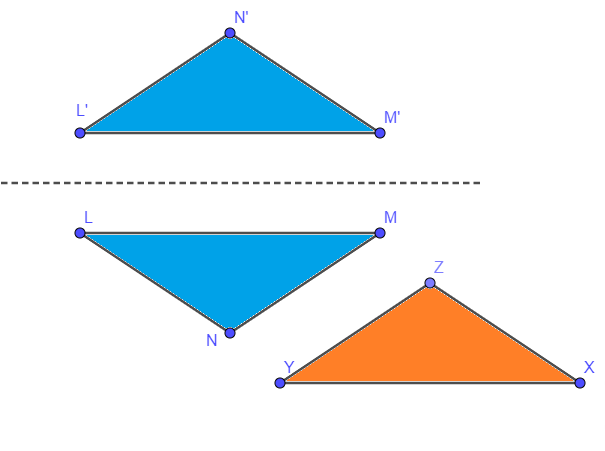
Similarly, for the upshift ‘b’ is positive and for the downshift ‘b’ is negative.
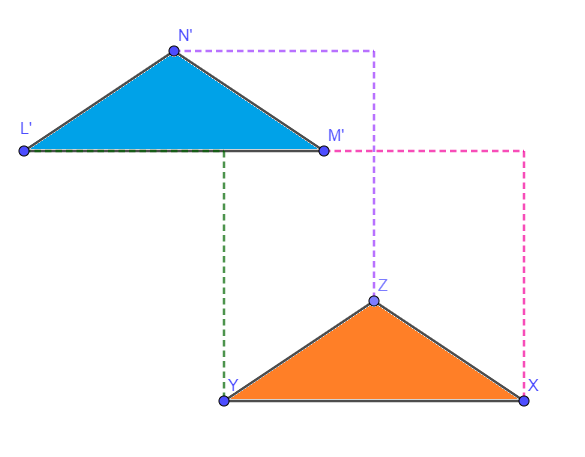
Hence, in this case, for translation of m units left and n units up, we add (-m,n) with the coordinate of the point.
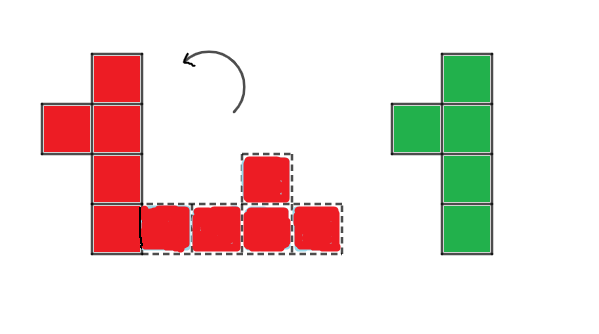
P(x,y)→P′ (x−m,y+n).

This is the final coordinate of the translated point.

Finally, we can conclude that the final coordinate of the point P(x,y) after translation of m units left and n units up, is P'(x-m,y+n).


Student Edition Exercise 6.1 Chapter 6 Transformations solutions guide Glencoe Math Course 3 Volume 2 Page 459 Exercise 9 Problem1

We are provided with the following figure.

Glencoe Math Course 3 Volume 2 Student 1st Edition Chapter Chapter 6 Transformations Exercise Page 459 Exercise 9 Problem1


It is given that the figure is translated 3 units on the right and 3 units to the up. Translation horizontally affects the x-axis and vertically affects the y-axis.

As given; H=(−1,0) J=(−2,−4) K=(1,−3)

Therefore after translations, the values would be

H′=(−1+3,0+3)

H′ =(2,3)

J′=(−2+3,−4+3)

J′=(1,−1)

K′=(1+3,−3+3)

K′ =(4,0)

Thereby the graph can be plotted as;


Glencoe Math Course 3 Volume 2 Student 1st Edition Chapter 6 Transformations Exercise 1.1 Page 459 Exercise 9 Problem 1

The triangle was transformed as given in the question and plotted as shown in the graph.

Glencoe Math Course 3 Volume 2 Student 1st Edition Chapter 6 Transformations Exercise 1.1 Page 459 Exercise 9 Problem 1


Glencoe Math Course 3 Volume 2 Student  Chapter 6 Page 459 Exercise 10 Problem1

We are provided with the following figure.

Glencoe Math Course 3 Volume 2 Student 1st Edition Chapter 6 Transformations Exercise 1.1 Page 459 Exercise 10 Problem 1

It is given that the figure is translated as 4 units on the left and 3 units to the up.

Translation horizontally affects the x-axis and vertically affects the y-axis.

As given;

K=(1,−1)

∴K′⇒(1−4,−1+3)=(−3,2)

L=(1,1)

∴L′⇒(1−4,1+3)=(−3,4)

M=(5,1)

∴M′⇒(5−4,1+3)=(1,4)

N=(5,−1)

∴N′⇒(5−4,−1+3)=(1,2)

Graphing the following;

Glencoe Math Course 3 Volume 2 Student 1st Edition Chapter Chapter 6 Transformations Exercise Page 459 Exercise 10 Problem 1

The rectangle was transformed as given in the question and plotted as shown in the graph.

Glencoe Math Course 3 Volume 2 Student 1st Edition Chapter Chapter 6 Transformations Exercise Page 459 Exercise 10 Problem 1


Glencoe Math Course 3 Volume 2 Student  Chapter 6 Page 459 Exercise 11 Problem1

We are provided with the following figure coordinates.

Glencoe Math Course 3 Volume 2 Student 1st Edition Chapter 6 Transformations Exercise 1.1 Page 459 Exercise 11 Problem 1

It is given that the figure is translated 4 units to the up. Translation horizontally affects the x-axis and vertically affects the y-axis.

As given; A=(−5,−1)

∴A′⇒(−5,−1+4)=(−5,3)

B=(−3,0)

∴B′⇒(−3,0+4)=(−3,4)

C=(2,−2)

∴C′⇒(2,−2+4)=(2,2)

∴D′⇒(0,−6+4)=(0,−2)

The coordinates of the vertices of the quadrilateral are


Step-by-step answers for Exercise 6.1 Chapter 6 Transformations in Glencoe Math Course 3 Volume 2 Page 459 Exercise 12 Problem1

We are provided with the following figure coordinates.

Glencoe Math Course 3 Volume 2 Student 1st Edition Chapter Chapter 6 Transformations Exercise Page 459 Exercise 12Problem 1

Julio is at Felines(3,1) and then moves 3 units right and 5 units up as given Translation horizontally affects the x-axis and vertically affects the y-axis.

Julio is located at Felines(3,1).

After he moved the given position he is at coordinate as;(3+3,1+5)=(6,6)

This means that he is now at Hooted animals(6,6).

After all the calculations we conclude that Julio is now at Hooted Animals(6,6).

Glencoe Math Course 3 Volume 2 Student  Chapter 6 Page 459 Exercise 13 Problem1

We are provided with the following figure coordinates.

Glencoe Math Course 3 Volume 2 Student 1st Edition Chapter 6 Transformations Exercise 1.1 Page 459 Exercise 13 Problem 1

We have to find how many translations are there using repeated reasoning. Clearly, we can observe that one helix is translated5
for the figure to form as shown.

Glencoe Math Course 3 Volume 2 Student 1st Edition Chapter 6 Transformations Exercise 1.1 Page 459 Exercise 13 Problem 1.

After clear observation and reasoning, we can say that there are 5 translations.

Glencoe Math Course 3 Volume 2 Student 1st Edition Chapter 6 Transformations Exercise 1.1 Page 459 Exercise 13 Problem-1

Page 459 Exercise 14 Problem1

We are provided with the following figures.

Glencoe Math Course 3 Volume 2 Student 1st Edition Chapter Chapter 6 Transformations Exercise Page 459 Exercise 14 Problem 1

In the following, only one of the graphs shows the real example of translation.

Translation defines transposing the figure to a different coordinate to make an exact copy of it.

We can clearly see that in this particular option the word ‘Z’ is transposed from(2,1) to (5,3) to make an exact copy of it.

Glencoe Math Course 3 Volume 2 Student 1st Edition Chapter Chapter 6 Transformations Exercise Page 459 Exercise 14 Problem 1.

In the following options:

(A) shows rotation.

Glencoe Math Course 3 Volume 2 Student 1st Edition Chapter 6 Transformations Exercise 1.1 Page 459 Exercise 14 Problem 1(1)


(C) shows mirror imaging.

Glencoe Math Course 3 Volume 2 Student 1st Edition Chapter Chapter 6 Transformations Exercise Page 459 Exercise 14 Problem 1(2)

(D) shows reflection.

Glencoe Math Course 3 Volume 2 Student 1st Edition Chapter Chapter 6 Transformations Exercise Page 459 Exercise 14 Problem 1(3)

Hence cannot be the correct answers.


After final observations, it was found that option(B) was the correct option.


Glencoe Math Course 3 Volume 2 Student  Chapter 6 Page 460 Exercise 15 Problem1

We are provided with the following figure coordinateA=(−1,2).

It is given that it moves 4 units left and 3 units up as given.

Translation horizontally affects the x-axis and vertically affects the y-axis.

We are given that A(−1,2)

After translation;

A′=(−1−4,2+3)

=(−5,5)

A′ =(−5,5)

This is represented by option (G).

In the last step, we clearly saw that the value of the point after translation is A′ =(−5,5).

Therefore, the other options are not correct as the correct answer is given by option (G).

After calculation, we have observed that the correct answer is given by option(G).

Glencoe Math Course 3 Volume 2 Student  Chapter 6 Page 460 Exercise 16 Problem1

We are provided with the following figure coordinate.

Glencoe Math Course 3 Volume 2 Student 1st Edition Chapter Chapter 6 Transformations Exercise Page 459 Exercise 16 Problem 1

It is given that it moves 3 units right and 7 units down as given. Translation horizontally affects the x-axis and vertically affects the y-axis.

Clearly, we can calculate the coordinate of the vertices of the trapezium.
A=(−6,2)

∴A′ ⇒(−6+3,2−7)=(−3,−5)

A′=(−3,−5)

B=(−1,2)

∴B′⇒(−1+3,2−7)=(2,−5)

B′ =(2,−5)

C=(−2,4)

∴C′⇒(−2+3,4−7)=(1,−3)

C′ =(1,−3)

D=(−3,4)

∴D′⇒(−3+3,4−7)=(0,−3)

D′ =(0,−3)

After the calculations, we can conclude that the coordinates of the A′B′C′D′is(−3,−5);(2,−5);(1,−3);(0,−3).

Page 460 Exercise 17 Problem1

The given problem is−5+12

We have to find its result. Clearly, by adding them we get the value as 7.

After calculations, we conclude that the value of the sum is 7.

Glencoe Math Course 3 Volume 2 Student  Chapter 6 Page 460 Exercise 18 Problem1

The given equation is

We can use the BODMAS RULE to calculate the value of this problem. When a negative number is multiplied by a positive number, the result is always negative.
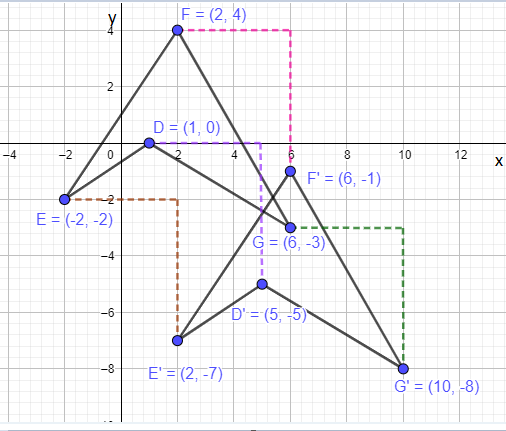
We can use the BODMAS RULE to calculate the value of this problem.
​−36+(−42)
=−36−42
=−78

Finally, we can deduce that the above equation’s sum is −78.

Page 460 Exercise 19 Problem1

The given problem is256+(−82).
We have to find its result. Clearly, by adding them we get the value as256−82 =174.

After calculations, we conclude that the value of the sum is 174.

Glencoe Math Course 3 Volume 2 Student  Chapter 6 Page 460 Exercise 20 Problem1

We have been given two numbers. We need to find the sum of these two numbers.

This can be found by subtracting the two numbers and then putting the sign with the larger number in the answer.

−452+97

=−(452−97)

=−355

The sum of the given numbers is -355.

Glencoe Math Course 2 Volume 1 Common Core Student Edition Chapter 1 Ratios and Proportional Reasoning Exercise 1.2

Glencoe Math Course 2 Volume 1 Common Core Chapter 1 Ratios and Proportional Reasoning


Glencoe Math Course 2 Volume 1 Chapter 1 Exercise 1.2 Solutions Page 17   Exercise 1   Problem 1

Let the two ratios be a:b and c:d

If both the ratios are equal, a:b = c:d

Then the given ratio is said to be in proportion.

And also, if the sets increase or decrease in the very same ratio, then the ratio is said to be in proportion.

In terms of objects, if the two objects are said to be in the very same shape but in different sizes.

Glencoe Math Course 2 Student Edition Volume 1 Chapter 1 Ratios and Proportional Reasoning Exercise 1.2

For example:  If the two objects are spheres, but one is smaller while the other one is larger.

Here, even though the sizes differ, the corresponding angles will be the same.
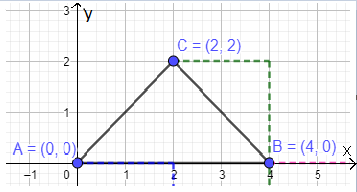
This makes their ratios be in proportion.
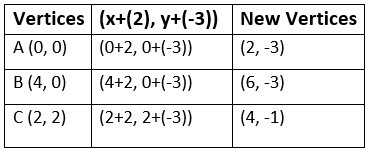
Hence, the two objects are proportional.

Two objects are said to be in proportion if they have the same shape, and same angles but in different sizes. This makes their ratios be in proportion.

Read and Learn More Glencoe Math Course 2 Volume 1 Common Core Student Edition Solutions

Common Core Chapter 1 Ratios And Proportional Reasoning Exercise 1.2 Answers Page 17   Exercise 2   Problem 2

Given: Dana is skating laps to train for a speed skating competition.

She can skate 1 lap in 40 seconds.

Suppose Dana skates for 20 seconds.

We need to determine how many laps she will skate.


Given:

The number of laps she can skate is 1 lap.

The number of time taken to do one lap is 40 seconds.

The ratio is = \(\frac{40}{1}\)

If she skates only for 20 Seconds, then the number of laps will be

\(\frac{40}{x}\)  =  \(\frac{40}{1}\)

x = \(\frac{20}{40}\)

x =  \(\frac{2}{4}\)

x = \(\frac{1}{2}\)

x =  0.5

The number of laps she will skate is 0.5 laps.


Glencoe Math Course 2 Volume 1 Common Core Chapter 1 Page 17   Exercise 3   Problem 3

Given: Dana is skating laps to train for a speed skating competition.

She can skate 1 lap for 40 seconds.

In exercise 2, Dana skates 0.5 laps for 20 seconds.

We need to write the ratio of Dana’s time from Exercise 2 to her number of laps.


Given:  From exercise 2

The number of laps she can skate is 0.5 lap.

The number of time taken to do one lap is 20 seconds.

The ratio from exercise 2 is

\(\frac{\text { Dana’s time }}{\text { Number of laps }}=\frac{20}{0.5}\)


We need to substitute this ratio in her number of laps. The ratio is

Glencoe Math Course 2, Volume 1, Common Core Student Edition, Chapter 1.2 Complex Fractions And Unit Rates Page 17 Exercise 3


The ratio is

Glencoe Math Course 2, Volume 1, Common Core Student Edition, Chapter 1.2 Complex Fractions And Unit Rates Page 17 Exercise 3.


Step-By-Step Guide For Glencoe Math Chapter 1 Exercise 1.2 Problems Page 17   Exercise 4   Problem 4

Given: Dana is skating laps to train for a speed skating competition.

She can skate 1 lap in 40 seconds.

We need to detect how we simplify the ratio we wrote in Exercise 3.

The ratio in exercise is

Glencoe Math Course 2, Volume 1, Common Core Student Edition, Chapter 1.2 Complex Fractions And Unit Rates Page 17 Exercise 4


Simplifying the ratio, we get

\(\frac{\text { Dana’s time }}{\text { Number of Laps }}=\frac{40}{\frac{20}{0.5}}\)

=  40  ×  \(\frac{0.5}{20}\)

=  40  ×  \(\frac{0.5}{2}\)

=  2 × 0.5

= 1

The simplification of the ratio we wrote in Exercise 3 results in a 1:1


Glencoe Math Course 2 Volume 1 Common Core Chapter 1 Page 20   Exercise 1  Problem 5

Given: The complex fraction is\(\frac{18}{\frac{3}{4}}\)

We need to simplify the given complex fraction.

Rewrite the given fraction as a division.

The expression becomes

\(\frac{18}{\frac{3}{4}}\) =\(\frac{18}{1}\) ÷ \(\frac{3}{4}\)

Multiply it by the reciprocal of \(\frac{3}{4}\) , we get

\(\frac{18}{\frac{3}{4}}\) =\(\frac{18}{1}\) ÷ \(\frac{3}{4}\)

\(\frac{18}{\frac{3}{4}}\) =\(\frac{18}{1}\) × \(\frac{4}{3}\)

Simplifying it further, we get

\(\frac{18}{\frac{3}{4}}\) =\(\frac{18}{1}\) × \(\frac{4}{3}\)

=  \(\frac{6}{1}\)×\(\frac{4}{1}\)

=  24

The value of \(\frac{18}{\frac{3}{4}}\)  is equal to 24


Exercise 1.2 Glencoe Math Course 2 Ratios And Proportional Reasoning Solutions Explained Page 20  Exercise 2  Problem 6

Given:  The complex fraction is \(\frac{\frac{3}{6}}{4}\)

We need to simplify the given complex fraction.

Rewrite the given fraction as a division.

The expression becomes

\(\frac{\frac{3}{6}}{4}\) =  \(\frac{3}{6}\)÷ \(\frac{4}{1}\)

Multiply it by the reciprocal of \(\frac{4}{1}\), we get

\(\frac{\frac{3}{6}}{4}\) = \(\frac{3}{6}\)÷\(\frac{4}{1}\)

\(\frac{\frac{3}{6}}{4}\) = \(\frac{3}{6}\)×\(\frac{1}{4}\)

Simplifying it further, we get

\(\frac{\frac{3}{6}}{4}\)= \(\frac{3}{6}\)×\(\frac{1}{4 }\)

= \(\frac{1}{2}\)×\(\frac{1}{4}\)

= \(\frac{1}{8}\)

The value of \(\frac{\frac{3}{6}}{4}\)  is equal to \(\frac{1}{8}\)


Glencoe Math Course 2 Volume 1 Common Core Chapter 1 Page 20   Exercise 3   Problem 7

Given: The complex fraction is \(\frac{\frac{1}{3}}{\frac{1}{4}}\)

We need to simplify the given complex fraction.

Rewrite the given fraction as a division.

The expression becomes

\(\frac{\frac{1}{3}}{\frac{1}{4}}\) = \(\frac{1}{3}\) ÷\(\frac{1}{4}\)

Multiply it by the reciprocal of, we get

\(\frac{\frac{1}{3}}{\frac{1}{4}}\) = \(\frac{1}{3}\) ÷ \(\frac{1}{4}\)

\(\frac{\frac{1}{3}}{\frac{1}{4}}\) = \(\frac{1}{3}\) × \(\frac{4}{1}\)

Simplifying it further, we get

\(\frac{\frac{1}{3}}{\frac{1}{4}}\) = \(\frac{1}{3}\) × \(\frac{4}{1}\)

=  \(\frac{4}{3}\)

The value of \(\frac{\frac{1}{3}}{\frac{1}{4}}\)  is equal to \(\frac{4}{3}\)


Examples Of Problems From Exercise 1.2 Ratios And Proportional Reasoning Chapter 1 Page 20   Exercise 4  Problem 8

Given: That, Pep Club members are making spirit buttons.

They make 490 spirit buttons in 3\(\frac{1}{2}\)hours.

We need to determine the number of buttons the Pep Club makes per hour.


Given: 

Number of spirit buttons  = 490

Time taken  = 3\(\frac{1}{2}\)= \(\frac{7}{2}\)hours

The unit rate is

Unite rate = \(\frac{490}{\frac{7}{2}}\)

=  490×\(\frac{2}{7}\)

=  70  × 2

=  140 Sprit buttons per hour

The number of buttons the Pep Club makes per hour is 140 spirit buttons per hour.


Glencoe Math Course 2 Volume 1 Common Core Chapter 1 Page 20   Exercise 5   Problem 9

Given:  That, the country sales tax is 6\(\frac{2}{3}\)%

We need to write the given percent as a fraction and to simplify it.


Given: Percent is 6\(\frac{2}{3}\)%

Converting the given mixed fraction into an improper fraction, we get

6\(\frac{2}{3}\) = \(\frac{20}{3}\)%

Thus, the percent becomes

\(\frac{20}{3}\) percentage = \(\frac{20}{3}\) ÷ 100

Multiply it by the reciprocal of  \(\frac{100}{1}\) we get

\(\frac{20}{3}\) percentage = \(\frac{20}{3}\)÷ 100

\(\frac{20}{3}\) percentage = \(\frac{20}{3}\) × \(\frac{1}{100}\)

=  \(\frac{1}{3}\) × \(\frac{1}{5}\)

=  \(\frac{1}{15}\)

The given percent 6\(\frac{2}{3}\)% \(\frac{1}{15}\)


Examples Of Problems From Exercise 1.2 Ratios And Proportional Reasoning Chapter 1 Page 20   Exercise 6   Problem 10

A complex fraction is nothing but a fraction that has fractions in its denominator or in the numerator or in both.

For example

\(\frac{\frac{5}{2}}{10}, \frac{11}{\frac{6}{8}}, \frac{\frac{12}{15}}{\frac{3}{4}}\)

These are all complex fractions.

Solving a complex fraction:

Let us consider a complex fraction

\(\frac{\frac{3}{4}}{\frac{10}{12}}\)

Simplifying it, we get

\(\frac{\frac{3}{4}}{\frac{10}{12}}\)= \(\frac{3}{4}\)× \(\frac{12}{10}\)

=  \(\frac{3}{1}\)×\(\frac{3}{10}\)

=  \(\frac{9}{10}\)

A complex fraction is a fraction that has more than one fraction. That is, fractions will be in their denominator or in the numerator, or in both.


Glencoe Math Course 2 Volume 1 Common Core Chapter 1 Page 21   Exercise 1  problem 11

Given:  The complex fraction is \(\frac{1}{\frac{2}{3}}\)

We need to simplify the given complex fraction.

Rewrite the given fraction as a division. 

The expression becomes

\(\frac{1}{\frac{2}{3}}\)= \(\frac{1}{1}\) ÷ \(\frac{2}{3}\)

Multiply it by the reciprocal of \(\frac{2}{3}\) , we get

\(\frac{1}{\frac{2}{3}}\)= \(\frac{1}{1}\) ÷ \(\frac{2}{3}\)

\(\frac{1}{\frac{2}{3}}\)= \(\frac{1}{1}\) × \(\frac{3}{2}\)

Simplifying it further, we get

\(\frac{1}{\frac{2}{3}}\)= \(\frac{1}{1}\) × \(\frac{3}{2}\)

= \(\frac{3}{2}\)

The value of \(\frac{1}{\frac{2}{3}}\) is equal to = \(\frac{3}{2}\)


Student Edition Glencoe Math Chapter 1 Exercise 1.2 Answers Guide Page 21   Exercise 2   Problem 12

Given: The complex fraction is \(\frac{2}{\frac{3}{11}}\)

We need to simplify the given complex fraction.

Rewrite the given fraction as a division.

The expression becomes

\(\frac{2}{\frac{3}{11}}\)= \(\frac{2}{1}\) ÷\(\frac{3}{11}\)

Multiply it by the reciprocal of \(\frac{3}{11}\) , we get

\(\frac{2}{\frac{3}{11}}\)= \(\frac{2}{1}\) ÷ \(\frac{3}{11}\)

\(\frac{2}{\frac{3}{11}}\)= \(\frac{2}{1}\) ×\(\frac{11}{3}\)

Simplifying it further, we get

\(\frac{2}{\frac{3}{11}}\) = \(\frac{2}{1}\) ×\(\frac{11}{3}\)

= \(\frac{22}{3}\)

The value of \(\frac{2}{\frac{3}{11}}\)  is equal to \(\frac{22}{3}\)


Glencoe Math Course 2 Volume 1 Common Core Chapter 1 Page 21   Exercise 3   Problem 13

Given: The complex fraction is \(\frac{\frac{8}{9}}{6}\)

We need to simplify the given complex fraction

Rewrite the given fraction as a division.

The expression becomes

\(\frac{\frac{8}{9}}{6}\) = \(\frac{8}{9}\)÷\(\frac{6}{1}\)

Multiply it by the reciprocal of \(\frac{1}{6}\) we get,

\(\frac{\frac{8}{9}}{6}\) = \(\frac{8}{9}\)÷\(\frac{6}{1}\)

\(\frac{\frac{8}{9}}{6}\) = \(\frac{8}{9}\)×\(\frac{1}{6}\)

Simplifying it further, we get,

​\(\frac{\frac{8}{9}}{6}\)= \(\frac{8}{9}\)×\(\frac{1}{6}\)

= \(\frac{4}{9}\)×\(\frac{1}{3}\)

=  \(\frac{4}{27}\)

The value of \(\frac{\frac{8}{9}}{6}\)  is equal to \(\frac{4}{27}\)


Student Edition Glencoe Math Chapter 1 Exercise 1.2 Answers Guide Page 21   Exercise 4   Problem 14

Given:  The complex fraction is \(\frac{\frac{2}{5}}{9}\)

We need to simplify the given complex fraction.

Rewrite the given fraction as a division.

The expression becomes

\(\frac{\frac{2}{5}}{9}\)= \(\frac{2}{5}\)÷\(\frac{9}{1}\)

Multiply it by the reciprocal of 9 , and we get

\(\frac{\frac{2}{5}}{9}\)= \(\frac{2}{5}\)÷\(\frac{9}{1}\)

\(\frac{\frac{2}{5}}{9}\)= \(\frac{2}{5}\)× \(\frac{1}{9}\)

Simplifying it further, we get

\(\frac{\frac{2}{5}}{9}\)= \(\frac{2}{5}\)× \(\frac{1}{9}\)

​= \(\frac{2}{45}\)

The value of \(\frac{\frac{2}{5}}{9}\)  is equal to \(\frac{2}{45}\)


Glencoe Math Course 2 Volume 1 Common Core Chapter 1 Page 21   Exercise 5   Problem 15

Given: The complex fraction is \(\frac{\frac{4}{5}}{10}\)

We need to simplify the given complex fraction.

Rewrite the given fraction as a division.

The expression becomes

\(\frac{\frac{4}{5}}{10}\) = \(\frac{4}{5}\)÷\(\frac{10}{1}\)

Multiply it by the reciprocal of \(\frac{10}{1}\) , we get,

\(\frac{\frac{4}{5}}{10}\) = \(\frac{4}{5}\)÷\(\frac{10}{1}\)

\(\frac{\frac{4}{5}}{10}\) = \(\frac{4}{5}\)×\(\frac{1}{10}\)

Simplifying it further, \(\frac{1}{10}\) we get

\(\frac{\frac{4}{5}}{10}\) = \(\frac{4}{5}\)×\(\frac{1}{10}\)

=  \(\frac{2}{5}\)×\(\frac{1}{5}\)

=  \(\frac{2}{25}\)

The value of \(\frac{\frac{4}{5}}{10}\) is equal to\(\frac{2}{25}\)


Chapter 1 Exercise 1.2 Glencoe Math Course 2 Step-By-Step Solutions Page 21   Exercise 6   Problem 16

Given: The complex fraction is \(\frac{\frac{1}{4}}{\frac{7}{10}}\)

We need to simplify the given complex fraction.

Rewrite the given fraction as a division.

The expression becomes

\(\frac{\frac{1}{4}}{\frac{7}{10}}\) = \(\frac{1}{4}\) ÷ \(\frac{7}{10}\)

Multiply it by the reciprocal of \(\frac{7}{10}\) , we get

\(\frac{\frac{1}{4}}{\frac{7}{10}}\) = \(\frac{1}{4}\) ÷ \(\frac{7}{10}\)

\(\frac{\frac{1}{4}}{\frac{7}{10}}\) = \(\frac{1}{4}\) × \(\frac{10}{7}\)

Simplifying it further, we get

\(\frac{\frac{1}{4}}{\frac{7}{10}}\) = \(\frac{1}{4}\) × \(\frac{10}{7}\)

=  \(\frac{1}{2}\)× \(\frac{5}{7}\)

=  \(\frac{5}{14}\)

The value of \(\frac{\frac{1}{4}}{\frac{7}{10}}\)  is equal to \(\frac{5}{14}\)


Glencoe Math Course 2 Volume 1 Common Core Chapter 1 Page 21   Exercise 8   Problem 17

Given:  Doug entered a canoe race. He rowed \(3\frac{1}{2}\) miles in \(\frac{1}{2}\) hour.

We need to determine his average speed in milés per hour.


Given:

Number of miles rowed = \(3\frac{1}{2}\)miles

Time taken = \(\frac{1}{2}\) hour

The unit rate is

Unite rate \( = \frac{\text { Number of miles }}{\text { Time taken }}\)

=  \(\frac{3 \frac{1}{2}}{\frac{1}{2}}\)

=  \(\frac{\frac{7}{2}}{\frac{1}{2}}\)

=  \(\frac{7}{2} \times \frac{2}{1}\)

=  7 miles per hour

Hence, The average speed of Doug in miles per hour is 7.


Chapter 1 Exercise 1.2 Glencoe Math Course 2 Step-By-Step Solutions Page 21   Exercise 9   Problem 18

Given: Monica reads \(7\frac{1}{2}\) pages of a mystery book in 9minutes.

We need to determine her average reading rate in pages per minute.


Given:

Number of pages = \(7\frac{1}{2}\)

Number of minutes taken = 9

The unit rate is

Unite rate = \(\frac{\text { Number of pages }}{\text { Number of minutes }}\)

=  \(\frac{7 \frac{1}{2}}{9}\)

=  \(\frac{\frac{15}{2}}{9}\)

=  \(\frac{15}{2} \times \frac{1}{9}\)

=  \(\frac{5}{2} \times \frac{1}{3}\)

=  \(\frac{5}{6}\)

Her average reading rate in pages per minute is \(\frac{5}{6}\).


Glencoe Math Course 2 Volume 1 Common Core Chapter 1 Page 21   Exercise 10   Problem 19

Given: The percent is \(56 \frac{1}{4} \%\)

We need to write the given percent as a fraction and simplify it.


Given percent is \(56 \frac{1}{4} \%\)

Converting the given mixed fraction into an improper fraction, we get

\(56 \frac{1}{4}\)=\(\frac{225}{4}\)%

Thus, the percent becomes

\(\frac{225}{4}\)percent = \(\frac{225}{4}\) ÷ 100

Multiply it by the reciprocal of \(\frac{100}{1}\), we get

\(\frac{225}{4}\) percent = \(\frac{225}{4}\) × \(\frac{1}{100}\)

\(=\frac{9}{4} \times \frac{1}{4}\)

= \(\frac{9}{16}\)

The given percent \(56 \frac{1}{4} \%\)as a fraction in the simplest form is \(\frac{9}{16}\)


Page 21   Exercise 11   Problem 20

Given:  The percent is \(15 \frac{3}{5} \%\)

We need to write the given percent as a fraction and simplify it.


Given percent is \(15 \frac{3}{5} \%\)

Converting the given mixed fraction into an improper fraction, we get

\(15 \frac{3}{5}\) = \(\frac{78}{5}%\)

Thus, the percent becomes

\(\frac{78}{5}\) percent = \(\frac{78}{5}\) ÷ \(\frac{100}{1}\)

Multiply it by the reciprocal of  \(\frac{100}{1}\) we get

\(\frac{78}{5}\) percent = \(\frac{78}{5}\) ÷ \(\frac{100}{1}\)

\(\frac{78}{5}\) percent = \(\frac{78}{5}\)× \(\frac{1}{100}\)

=  \(\frac{78}{500}\)

= \(\frac{39}{250}\)

The given percent  \(15 \frac{3}{5} \%\)as a fraction in the simplest form is  \(\frac{39}{250}\)

Glencoe Math Course 2 Volume 1 Common Core Student Edition Chapter 1 Ratios and Proportional Reasoning Exercise 1.5

Glencoe Math Course 2 Volume 1 Common Core Chapter 1 Ratios and Proportional Reasoning


Glencoe Math Course 2 Volume 1 Chapter 1 Exercise 1.5 Solutions Page 45   Exercise 1  Problem 1

We need to label the given coordinate plane with the terms ordered pair, x-coordinate, and y-coordinate.

We need to graph the points(2,3) and (−3,−2) and to connect the three points on the coordinate plane.

Glencoe Math Course 2, Volume 1, Common Core Student Edition, Chapter 1.5 Graph Proportional relationships Page 45 Exercise 1 , graph 1

The point which is already there on the graph is (1,2)

Labeling the mentioned blanks, we get

Glencoe Math Course 2, Volume 1, Common Core Student Edition, Chapter 1.5 Graph Proportional relationships Page 45 Exercise 1 , graph 2

Graphing the points (2,3),(−3,−2) on the graph and connecting the three points on the coordinate plane, we get,

Glencoe Math Course 2, Volume 1, Common Core Student Edition, Chapter 1.5 Graph Proportional relationships Page 45 Exercise 1 , graph 3

The obtained graph is a straight line.

Glencoe Math Course 2 Student Edition Volume 1 Chapter 1 Ratios and Proportional Reasoning Exercise 1.5

Read and Learn More Glencoe Math Course 2 Volume 1 Common Core Student Edition Solutions

Labeling the coordinate plane below

Glencoe Math Course 2, Volume 1, Common Core Student Edition, Chapter 1.5 Graph Proportional relationships Page 45 Exercise 1 , graph 4


Graphing the points and connecting them on the coordinate plane


Glencoe Math Course 2, Volume 1, Common Core Student Edition, Chapter 1.5 Graph Proportional relationships Page 45 Exercise 1 , graph 5


Glencoe Math Course 2 Volume 1 Common Core Chapter 1 Page 48   Exercise 1 Problem 2

Given the cost of 3-D movie tickets is $12 for 1 ticket, $24 for 2 tickets, and $36 for 3 tickets.

We need to determine whether the cost is proportional to the number of tickets by graphing on the coordinate plane.

Glencoe Math Course 2, Volume 1, Common Core Student Edition, Chapter 1.5 Graph Proportional relationships Page 48 Exercise 1 graph 1


Make a table to find the cost of tickets for 1,2 and 3 members.

Now, graph the ordered pairs (tickets, cost) on the coordinate plane. Then, connect the points together.

Glencoe Math Course 2, Volume 1, Common Core Student Edition, Chapter 1.5 Graph Proportional relationships Page 48 Exercise 1 , graph 2

The line passes through the origin and it is a straight line.

Therefore, the cost is proportional to the number of tickets.


The cost is proportional to the number of tickets.


Glencoe Math Course 2, Volume 1, Common Core Student Edition, Chapter 1.5 Graph Proportional relationships Page 48 Exercise 1 , graph 3


Common Core Chapter 1 Ratios And Proportional Reasoning Exercise 1.5 Answers Page 48   Exercise 2  Problem 3

Given that, the number of books the two stores sell after 1,2, and 3 days is shown.

We need to find which book sale represents a proportional relationship between time and books.


Glencoe Math Course 2, Volume 1, Common Core Student Edition, Chapter 1.5 Graph Proportional relationships Page 48 Exercise 2 , graph 1

The given graph is

Glencoe Math Course 2, Volume 1, Common Core Student Edition, Chapter 1.5 Graph Proportional relationships Page 48 Exercise 2 , graph 2

The graph for Discount books is not a straight line.

Hence, the relationship is not proportional.

The graph for The Book Palace is a straight line that passes through the origin.

Hence, it represents a proportional relationship between time and books. The Book Palace represents a proportional relationship between time and books.


Glencoe Math Course 2 Volume 1 Common Core Chapter 1 Page 48   Exercise 3  Problem 4

At first, we need to graph the ordered pairs (x,y) on the coordinate plane.

The x – represents the x−coordinate point.

The y- represents the y−coordinate point.

After graphing the ordered pairs, determine whether the graph obtained is a straight line or not.

If it was not a straight line, then the relationship is not proportional to each other.

If it is a straight line, check whether the straight line passes through the origin or not.

If the straight line passes through the origin, then the relationship is proportional to each other.

In this way, we can find the proportional relationship between the quantities.

If the graph represents the straight line that passes through the origin, then the quantities are said to be proportional. In this way, the graphing relationships help you determine whether the relationship is proportional or not.


Page 49   Exercise 1   Problem 5

Given that, we need to determine whether the relationship between the two quantities shown in the table is proportional by graphing on the coordinate plane.

Glencoe Math Course 2, Volume 1, Common Core Student Edition, Chapter 1.5 Graph Proportional relationships Page 49 Exercise 1 , graph 1

The given table is

Glencoe Math Course 2, Volume 1, Common Core Student Edition, Chapter 1.5 Graph Proportional relationships Page 49 Exercise 1 table


Now, graph the ordered pairs (weeks, balance) on the coordinate plane. Then, connect the points together.

Glencoe Math Course 2, Volume 1, Common Core Student Edition, Chapter 1.5 Graph Proportional relationships Page 49 Exercise 1 , graph 2

The line doesn’t pass through the origin and it is a straight line.

Thus, the number of weeks is not proportional to the account balance.


The number of weeks is not proportional to the account balance.


Glencoe Math Course 2, Volume 1, Common Core Student Edition, Chapter 1.5 Graph Proportional relationships Page 49 Exercise 1 , graph 3


Step-by-step guide for Glencoe Math Chapter 1 Exercise 1.5 problems Page 49   Exercise 2  Problem 6

Given that, we need to determine whether the relationship between the two quantities shown in the table is proportional by graphing on the coordinate plane.

Glencoe Math Course 2, Volume 1, Common Core Student Edition, Chapter 1.5 Graph Proportional relationships Page 49 Exercise 2 , graph 1

The given table is

Glencoe Math Course 2, Volume 1, Common Core Student Edition, Chapter 1.5 Graph Proportional relationships Page 48 Exercise 2 , table

Now, graph the ordered pairs (servings, calories) on the coordinate plane. Then, connect the points together.

Glencoe Math Course 2, Volume 1, Common Core Student Edition, Chapter 1.5 Graph Proportional relationships Page 49 Exercise 2 , graph 2


The line passes through the origin and it is a straight line.

Thus, the number of servings is proportional to the calories.

The number of servings is proportional to the calories.


Glencoe Math Course 2 Volume 1 Common Core Chapter 1 Page 49  Exercise 3   Problem 7

Given that the height of two plants is recorded after 1,2, and 3 weeks as shown in the graph at the right.

We need to determine which plants’ growth represents a proportional relationship between time and height.

Glencoe Math Course 2, Volume 1, Common Core Student Edition, Chapter 1.5 Graph Proportional relationships Page 49 Exercise 3, graph 1


The given graph is

Glencoe Math Course 2, Volume 1, Common Core Student Edition, Chapter 1.5 Graph Proportional relationships Page 49 Exercise 3, graph 2

The graph for Plant A is not a straight line.

Hence, the relationship is not proportional.

The graph for Plant B is a straight line that passes through the origin.

Hence, it represents a proportional relationship between time and height.

Plant B’s growth represents a proportional relationship between time and height.


Exercise 1.5 Glencoe Math Course 2 Ratios And Proportional Reasoning Solutions Explained Page 50    Exercise 4   Problem 8

Given that, the perimeter of a square is 4 times as great as the length of any of its sides.

We need to find if the perimeter of a square is proportional to its side length.

Given that, Perimeter P = 4a

Let a = Length of the sides.

Make a table to find the perimeter for the side’s length1,2,3, and 4

Glencoe Math Course 2, Volume 1, Common Core Student Edition, Chapter 1.5 Graph Proportional relationships Page 50 Exercise 4 , table


Now, graph the ordered pairs (side length, perimeter) on the coordinate plane. Then, connect the points together.

Glencoe Math Course 2, Volume 1, Common Core Student Edition, Chapter 1.5 Graph Proportional relationships Page 50 Exercise 4, graph

The line passes through the origin and it is a straight line.

Therefore, the perimeter of a square is proportional to its side length.

The perimeter of a square is proportional to its side length.


Glencoe Math Course 2 Volume 1 Common Core Chapter 1 Page 50 Exercise 5 Problem 9

Given that, a health club charges $35 a month for membership fees.

We need to determine whether the cost of membership is proportional to the number of months.

Glencoe Math Course 2, Volume 1, Common Core Student Edition, Chapter 1.5 Graph Proportional relationships Page 50 Exercise 5 , table

Make a table to find the membership fees for 1,2,3 and 4 months.

Now, graph the ordered pairs (months, fees) on the coordinate plane. Then, connect the points together.

Glencoe Math Course 2, Volume 1, Common Core Student Edition, Chapter 1.5 Graph Proportional relationships Page 50 Exercise 5 , graph


The line passes through the origin and it is a straight line.

Therefore, the cost of membership is proportional to the number of months.

The cost of membership is proportional to the number of months.


Examples Of Problems From Exercise 1.5 Ratios And Proportional Reasoning Chapter 1 Page 50   Exercise 6  Problem 10

We need to describe some data that when graphed would represent a proportional relationship.

Let us assume that the perimeter of a square is 4 times as great as the length of any of its sides.

We need to find if the perimeter of a square is proportional to its side length.

Glencoe Math Course 2, Volume 1, Common Core Student Edition, Chapter 1.5 Graph Proportional relationships Page 50 Exercise 6, table


Now, graph the ordered pairs (side length, perimeter) on the coordinate plane. Then, connect the points together.

Glencoe Math Course 2, Volume 1, Common Core Student Edition, Chapter 1.5 Graph Proportional relationships Page 50 Exercise 6 , graph


The line passes through the origin and it is a straight line.

Therefore, the perimeter of a square is proportional to its side length.

The perimeter of a square is proportional to its side length.


Glencoe Math Course 2 Volume 1 Common Core Chapter 1 Page 50   Exercise 7   Problem 11

Given that the greenhouse temperatures at certain times are shown in the table.

Glencoe Math Course 2, Volume 1, Common Core Student Edition, Chapter 1.5 Graph Proportional relationships Page 50 Exercise 7 , table 1

The greenhouse maintains temperatures between 65 degrees Fahrenheit and 85 degrees Fahrenheit and the temperature increases at a constant rate.

We need to create a graph of the time and temperatures at each hour from 1:00 P.M. to 8:00 P.M. and check whether the relationship is proportional.

The given table is

Glencoe Math Course 2, Volume 1, Common Core Student Edition, Chapter 1.5 Graph Proportional relationships Page 50 Exercise 7 , table 2


Now, graph the ordered pairs (time, temperature) on the coordinate plane. Then, connect the points together.

Glencoe Math Course 2, Volume 1, Common Core Student Edition, Chapter 1.5 Graph Proportional relationships Page 50 Exercise 7 , graph

The line doesn’t pass through the origin and it is a straight line.

Therefore, the relationship is not proportional.

The time is not proportional to the temperature in Fahrenheit.


Student Edition Glencoe Math Chapter 1 Exercise 1.5 answers guide Page 50   Exercise 8  Problem 12

The graph is

Glencoe Math Course 2, Volume 1, Common Core Student Edition, Chapter 1.5 Graph Proportional relationships Page 50 Exercise 8, graph 1

Given graph represents the Calories burned for exercising for various numbers of minutes are shown in the graph.

We need to determine which of the below statement about the graph is not true.

The statements are

(A)  The number of Calories burned is proportional to the number of minutes spent exercising.

(B)  The number of Calories burned is not proportional to the number of minutes spent exercising.

(C)  If the line were extended, it would pass through the origin.

(D)  The line is straight.

The given graph is

Glencoe Math Course 2, Volume 1, Common Core Student Edition, Chapter 1.5 Graph Proportional relationships Page 50 Exercise 8, graph 2


The given graph is a straight line.

It also passes through the origin.

Thus, the time in minutes is proportional to the number of calories represented in the graph.

Thus, the relationship between the two quantities is proportional.

The incorrect statement among them is “The number of Calories burned is not proportional to the number of minutes spent exercising.”

The Calories burned for exercising for various numbers of minutes are shown in the graph. Statement (B) about the graph is not true. (B) The number of Calories burned is not proportional to the number of minutes spent exercising.


Glencoe Math Course 2 Volume 1 Common Core Chapter 1 Page 51   Exercise 12  Problem 13

Given that, Frank and Allie purchased cell phone plans through different providers.

Their costs for several minutes are shown.

We need to graph each plan to determine whose plan is proportional to the number of minutes the phone is used

Glencoe Math Course 2, Volume 1, Common Core Student Edition, Chapter 1.5 Graph Proportional relationships Page 51 Exercise 12, table 1

The given table is

Glencoe Math Course 2, Volume 1, Common Core Student Edition, Chapter 1.5 Graph Proportional relationships Page 51 Exercise 12, table 2

Now, graph the ordered pairs (time, cost) on the coordinate plane.


Then, connect the points together.

Glencoe Math Course 2, Volume 1, Common Core Student Edition, Chapter 1.5 Graph Proportional relationships Page 51 Exercise 12, graph


For frank, the line passes through the origin and it is a straight line.

Therefore, the relationship is proportional.

For Allie, the line doesn’t pass through the origin and it is a straight line.

Therefore, the relationship is not proportional.

Frank’s plan is proportional to the number of minutes the phone is used.


Chapter 1 Exercise 1.5 Glencoe Math Course 2 step-by-step solutions Page 52   Exercise 13  Problem 14

We need to determine whether the relationship between the number of heartbeats and the time shown in the graph is proportional.

Glencoe Math Course 2, Volume 1, Common Core Student Edition, Chapter 1.5 Graph Proportional relationships Page 52 Exercise 13, graph 1


The given graph is

Glencoe Math Course 2, Volume 1, Common Core Student Edition, Chapter 1.5 Graph Proportional relationships Page 52 Exercise 13, graph 2

The graph given is a straight line that passes through the origin.

Hence, it represents a proportional relationship between the number of heartbeats and the time.

The relationship between the number of heartbeats and the time shown in the graph is proportional.


Glencoe Math Course 2 Volume 1 Common Core Chapter 1 Page 52    Exercise 14   Problem 15

We need to the graph below and to determine which of the following ordered pairs represent the unit rate.

Glencoe Math Course 2, Volume 1, Common Core Student Edition, Chapter 1.5 Graph Proportional relationships Page 52 Exercise 14, graph

The given ordered pairs are

(A) (0,0)

The unit rate is generally defined for only one quantity.

Here, the quantity is zero.

Thus, it cannot be the unit rate.

(B) (1,2)

Here, it represents for each second, the number of heartbeats is two.

Thus, this ordered pair represents the unit rate.

(C) (2,4)

Here, it represents for two seconds, and the number of heartbeats is four.

Thus, this ordered pair doesn’t represent the unit rate.

(D) (3,6)

Here, it represents for three seconds, and the number of heartbeats is six.

Thus, this ordered pair doesn’t represent the unit rate.

The ordered pair (B) (1,2) represents the unit rate.


Page 52   Exercise 17  Problem 16

Given that, a car dealership has 55 cars and 11 Vans.

We need to determine the ratio of cars to vans.

Number of cars  = 55

Number of vans = 11

The ratio of cars to vans is

\(\frac{\text{Cars}}{\text{Vans}}\) = \(\frac{55}{11}\)

=  \(\frac{5}{1}\)

The ratio of cars to vans is =  5:1

The ratio of cars to vans is 5:1


Glencoe Math Course 2 Volume 1 Common Core Chapter 1 Page 52   Exercise 18  Problem 17

Given that, a drawer has 4 red shirts and 8 green shirts.

We need to determine the ratio of red shirts to the total number of shirts.

Number of red shirts = 4

Number of green shirts = 8

The ratio of red shirts to the total number of shirts is

\(\frac{\text{Red shirts}}{\text{Total shirts}}\) = \(\frac{4}{4+8}\)

= \(\frac{4}{12}\)

= \(\frac{1}{3}\)

=  1:3

The ratio of red shirts to the total number of shirts is 1:3

Page 52   Exercise 19 Problem 18

Given that, a store sells 13 coffees and 65 hot chocolates.

We need to determine the ratio of coffee to hot chocolates.

Number of coffees = 13

Number of hot chocolates = 65

The ratio of coffee to hot chocolates is

\(\frac{\text{Cofees}}{\text{Hot chocolates}}\) =  \(\frac{13}{65}\)

= \(\frac{1}{5}\)

=  1:5

The ratio of coffee to hot chocolates is 1:5


Page 54   Exercise 1 Problem 19

We need to determine whether Albert’s graph represents a proportional relationship or Bianca’s.

Glencoe Math Course 2, Volume 1, Common Core Student Edition, Chapter 1.5 Graph Proportional relationships Page 54 Exercise 1, table 1


Make a table with the given information, we get

Glencoe Math Course 2, Volume 1, Common Core Student Edition, Chapter 1.5 Graph Proportional relationships Page 54 Exercise 1, table 2


Now, graph the ordered pairs on the coordinate plane. Then, connect the points together


Glencoe Math Course 2, Volume 1, Common Core Student Edition, Chapter 1.5 Graph Proportional relationships Page 54 Exercise 1, graph

The graph for Bianca’s comments is a straight line but doesn’t pass through the origin.

Hence, the relationship is not proportional.

The graph for Albert’s comments is a straight line that passes through the origin.

Hence, it represents a proportional relationship between comment number and replies.

Albert’s graph represents a proportional relationship while Bianca’s doesn’t.


Glencoe Math Course 2 Volume 1 Common Core Chapter 1 Page 54   Exercise 2   Problem 20

The proportionality of two different quantities can easily be determined by using constant ratios.

The constant ratios indicate that the value of the ratios is all the same.

If the ratios are constant, then the ratios are said to be proportional to each other.

When two ratios are equal, it is said to be in proportion.

Let the two ratios be a:b and c:d

If both the ratios are equal, a:b = c:d

Then the given ratio is said to be in proportion.

Two quantities are said to be in proportion if they have the same ratios. This makes their ratios be in proportion.


Page 54    Exercise 3  Problem 21

We need to describe the type of relationship shown by each set of ordered pairs.

Glencoe Math Course 2, Volume 1, Common Core Student Edition, Chapter 1.5 Graph Proportional relationships Page 54 Exercise 3 , table 1


Mark the order part on the given graph


Glencoe Math Course 2, Volume 1, Common Core Student Edition, Chapter 1.5 Graph Proportional relationships Page 54 Exercise 3 , graph

Here, we can see that the ordered pair 3 is a straight line and it passes through the origin.

Thus, it is linear and proportional.

The ordered pair 4 is not a straight line.

Thus, it is neither linear nor proportional.

Glencoe Math Course 2, Volume 1, Common Core Student Edition, Chapter 1.5 Graph Proportional relationships Page 54 Exercise 3 , table 2


Page 54   Exercise 4   Problem 22

We need to describe the type of relationship shown by each set of ordered pairs.

Glencoe Math Course 2, Volume 1, Common Core Student Edition, Chapter 1.5 Graph Proportional relationships Page 54 Exercise 4, table 1


Mark the ordered pairs given on the graph

Glencoe Math Course 2, Volume 1, Common Core Student Edition, Chapter 1.5 Graph Proportional relationships Page 54 Exercise 4, graph

Here, we can see that the ordered pair 3 is a straight line and it passes through the origin.

Thus, it is linear and proportional.

The ordered pair 4 is not a straight line.

Thus, it is neither linear nor proportional.

Glencoe Math Course 2, Volume 1, Common Core Student Edition, Chapter 1.5 Graph Proportional relationships Page 54 Exercise 4, table 2


Glencoe Math Course 2 Volume 1 Common Core Chapter 1 Page 54  Exercise 5  Problem 23

We need to describe a real-world situation that represents a proportional relationship.

Then explain how we could change the situation so that it represents a nonproportional relationship.

Let the real-world situation be, James earns $5 an hour babysitting.

We need to determine whether the amount of money James earns babysitting is proportional to the number of hours he babysits by graphing on the coordinate plane.

Make a table to find the amount of money he earned for 1,2,3,4 and 5 hours

Glencoe Math Course 2, Volume 1, Common Core Student Edition, Chapter 1.5 Graph Proportional relationships Page 54 Exercise 5, table

Now, graph the ordered pairs (time, earnings) on the coordinate plane. Then, connect the points together.


Glencoe Math Course 2, Volume 1, Common Core Student Edition, Chapter 1.5 Graph Proportional relationships Page 54 Exercise 5, graph


The line passes through the origin and it is a straight line.

Therefore, the amount of money James earns while babysitting is proportional to the number of hours he babysits.

We can change the situation so that it represents a nonproportional relationship by changing the amount of money he earns per hour.

For example, if he gets $5 for the first hour, and $7 for the next consecutive hours.

Then the graph will not be linear. Thus, it exhibits a nonproportional relationship.

The amount of money James earns babysitting is proportional to the number of hours he babysits. We can change the situation so that it represents a nonproportional relationship by changing the amount of money he earns every hour.


Glencoe Math Course 2 Volume 1 Common Core Student Edition Chapter 1 Ratios and Proportional Reasoning Practice Exercise 1.2

Glencoe Math Course 2 Volume 1 Common Core  Chapter 1 Ratios and Proportional Reasoning


Glencoe Math Course 2 Volume 1 Chapter 1 Practice Exercise 1.2 Solutions Page 21   Exercise 12   Problem 1

Given that, the percent is 13\(\frac{1}{3}\) %

We need to write the given percent as a fraction and simplify it.


Given percent is 13\(\frac{1}{3}\) %

Converting the given mixed fraction into an improper fraction, we get

13\(\frac{1}{3}\) = \(\frac{40}{3}\) %

Thus, the percentage becomes

\(\frac{40}{3}\) percent = \(\frac{40}{3}\)÷ \(\frac{100}{1}\)

Glencoe Math Course 2 Student Edition Volume 1 Chapter 1 Ratios and Proportional Reasoning Practical Exercise 1.2

Multiply it by the reciprocal of \(\frac{100}{1}\) , we get

\(\frac{40}{3}\) percent = \(\frac{40}{3}\)÷ \(\frac{100}{1}\)

= \(\frac{40}{3}\)× \(\frac{1}{100}\)

= \(\frac{4}{3}\)× \(\frac{1}{10}\)

= \(\frac{2}{3}\)× \(\frac{1}{5}\)

= \(\frac{2}{15}\)

The given percent 13\(\frac{1}{3}\) % as a fraction in the simplest form is \(\frac{2}{15}\)

Read and Learn More Glencoe Math Course 2 Volume 1 Common Core Student Edition Solutions

Glencoe Math Course 2 Volume 1 Page 22   Exercise 15   Problem 2

A complex fraction is nothing but a fraction that has fractions in its denominator or in the numerator or in both.

For example: 

\(\frac{\frac{5}{10}}{2}, \frac{11}{\frac{6}{5}}, \frac{\frac{13}{12}}{\frac{9}{8}}\). These are all complex fractions.

Solving a complex fraction:

Let us consider a complex fraction that involves ratios

\(\frac{\frac{5}{2}}{10}\)

Simplifying it, we get

​\(\frac{\frac{5}{2}}{10}\)

= \(\frac{5}{2}\) × \(\frac{1}{10}\)

= \(\frac{1}{2}\) × \(\frac{1}{2}\)

= \(\frac{1}{4}\)

A complex fraction is a fraction that has more than one fraction.

That is, fractions will be in their denominator or in the numerator, or in both.


Glencoe Math Course 2 Volume 1 Page 22   Exercise 16   Problem 3

We need to write three different complex fractions that simplify to \(\frac{1}{4}\)

So, we will use the definition

The three different complex fractions and their simplification is given below

1) \(\frac{\frac{1}{2}}{2}\)

Simplifying it, we get

\(\frac{\frac{1}{2}}{2}\)= \(\frac{1}{2}\)×\(\frac{1}{2}\)

= \(\frac{1}{4}\)

2)\(\frac{\frac{5}{4}}{5}\)

Simplifying it, we get

\(\frac{5}{4}\)× \(\frac{1}{5}\)

= \(\frac{1}{4}\)

3)\(\frac{\frac{1}{3}}{\frac{4}{3}}\)

Simplifying it, we get

\(\frac{\frac{1}{3}}{\frac{4}{3}}\) = \(\frac{1}{3}\)×\(\frac{3}{4}\)

= \(\frac{1}{4}\)

The three different complex fractions that simplify to \(\frac{1}{4}\) are \(\frac{\frac{1}{2}}{2}\), \(\frac{\frac{5}{4}}{5}\), \(\frac{\frac{1}{3}}{\frac{4}{3}}\)


Glencoe Math Course 2 Volume 1 Page 22   Exercise 17   Problem 4

We need to determine the value of ,\(\frac{15}{124} \cdot \frac{230}{30} \div \frac{230}{124} \)

Simplifying it, we get

\(\frac{15}{124} \cdot \frac{230}{30} \div \frac{230}{124} \) = \(\frac{15}{124} \times \frac{230}{30} \times \frac{124}{230}\)

= \(\frac{15}{1}\) × \(\frac{1}{30}\) × \(\frac{1}{1}\)

= \(\frac{15}{30}\)

= \(\frac{1}{2}\)

The value of \(\frac{15}{124} \cdot \frac{230}{30} \div \frac{230}{124} \) = \(\frac{1}{2}\)


Common Core Chapter 1 Ratios and Proportional Reasoning Practice Exercise 1.2 answers Page 22   Exercise 18   Problem 5

We need to determine which statement explains how to use the model to simplify the complex fraction.

Glencoe Math Course 2, Volume 1, Common Core Student Edition, Chapter 1.2 Complex Fractions And Unit Rates Page 22 Exercise 18

Count the twelfths that fit within  \({2}{3}\) of the above equation

There are 12 number of  \(\frac{1}{12}\)‘s are there.

Thus , \(\frac{2}{3}\) rd of the are

\(\frac{2}{3}\) ×12 =  2 × 4 = 8

The result of the given complex fraction is

\(\frac{\frac{2}{3}}{\frac{1}{12}}\)= \(\frac{2}{3}\)×\(\frac{12}{1}\)

= \(\frac{2}{1}\)×\(\frac{4}{1}\)

= 8

Thus, both are the same. Hence, this statement is correct.

Count the twelfths that fit within \(\frac{2}{3}\). This statement explains how to use the model to simplify the complex fraction.


Glencoe Math Course 2 Volume 1 Page 23   Exercise 20   Problem 6

The objective is to Simplify the value of \(\frac{12}{\frac{3}{5}}\)

We will use the definition.

Given is \(\frac{12}{\frac{3}{5}}\)

Simplifying it, we get

\(\frac{12}{\frac{3}{5}}\) = 12  ÷  \(\frac{3}{5}\)

=  12  ×  \(\frac{5}{3}\)

=  4  ×  5

=  20

The value of \(\frac{12}{\frac{3}{5}}\)  =  20


Step-By-Step Guide For Glencoe Math Practice Exercise 1.2 Chapter 1 Problems Page 23 Exercise 21 Problem 7

We are given \( \frac{\frac{9}{10}}{9}\)

To Find: The objective is to simplify the given fraction \( \frac{\frac{9}{10}}{9}\)

Given is \( \frac{\frac{9}{10}}{9}\)

Simplifying it, we get

\( \frac{\frac{9}{10}}{9}\) = \(\frac{9}{10}\)÷ 9

= \(\frac{9}{10}\) × \(\frac{1}{9}\)

= \(\frac{1}{10}\)

The value of \( \frac{\frac{9}{10}}{9}\)= \(\frac{1}{10}\)


Exercise 1.2 practice solutions for Glencoe Math Course 2 Chapter 1 Ratios And Proportional Reasoning Page 23   Exercise 22   Problem 8

Simplify the value of \(\frac{\frac{1}{2}}{\frac{1}{4}}\)

Given is \(\frac{\frac{1}{2}}{\frac{1}{4}}\)

Simplifying it, we get

\(\frac{\frac{1}{2}}{\frac{1}{4}}\)= \(\frac{1}{2}\) × \(\frac{4}{1}\)

= \(\frac{4}{2}\)

= 2

The value of \(\frac{\frac{1}{2}}{\frac{1}{4}}\)= 2


Glencoe Math Course 2 Volume 1 Page 23 Exercise 23 Problem 9

The objective is to Simplify the value of \(\frac{\frac{1}{12}}{\frac{5}{6}}\)

We will use the Definition.

Given \(\frac{\frac{1}{12}}{\frac{5}{6}}\)

Simplifying it, we get

\(\frac{\frac{1}{12}}{\frac{5}{6}}\)= \(\frac{1}{12}\) × \(\frac{6}{5}\)

= \(\frac{1}{2}\) × \(\frac{1}{5}\)

= \(\frac{1}{10}\)

Hence, The value of \(\frac{\frac{1}{12}}{\frac{5}{6}}\) = \(\frac{1}{10}\) 


Common Core Practice Exercise 1.2 Ratios and Proportional Reasoning Glencoe Math Course 2 Page 23  Exercise 24  Problem 10

Simplify the value of \(\frac{\frac{5}{6}}{\frac{5}{9}}\)

Given is \(\frac{\frac{5}{6}}{\frac{5}{9}}\)

Simplifying it, we get

\(\frac{\frac{5}{6}}{\frac{5}{9}}\) = \(\frac{5}{6}\)× \(\frac{9}{5}\)

= \(\frac{9}{6}\)

= \(\frac{3}{2}\)

The value of \(\frac{\frac{5}{6}}{\frac{5}{9}}\) = \(\frac{3}{2}\)


Examples Of Problems From Practice Exercise 1.2 Ratios And Proportional Reasoning Chapter 1 Glencoe Math Page 23   Exercise 25   Problem 11

Given that, Mrs. Frasier is making costumes for the school play. Each costume requires 0.75 yards of fabric. She bought 6 yards of fabric.

We need to determine how many costumes Mrs. Frasier can make.

The number of yards needed to make one costume =  0.75

Total yards of fabric bought  =  6

The ratio is, \(\frac{6}{0.75}\)

=  8

She can make eight costumes out of it.

Hence, Mrs. Frasier can make 8 costumes.


Glencoe Math Course 2 Volume 1 Page 23 Exercise 26 Problem 12

Given that, A lawn company advertises that they can spread 7,500 square feet of grass seed in 2\(\frac{1}{2}\) hours.

We need to determine the number of square feet of grass seed that can be spread per hour.

Given that
Square feet of grass that they can spread = 7500

Time taken = 2\(\frac{1}{2}\)

The unit rate is

Unite rate \( = \frac{7500}{2 \frac{1}{2}} \)

=  \(\frac{7500}{\frac{5}{2}}\)

=  7500  ×  \(\frac{2}{5}\)

= 1500 × 2

=  3000

Hence, The number of square feet of grass seed that can be spread per hour is 3000 square feet.


Glencoe Math Student Edition Chapter 1 Practice Exercise 1.2 Answers Guide Page 23   Exercise 28   Problem 13

Given that, the percent is 7 \(\frac{3}{4}\)%

We need to write the given percent as a fraction and simplify it.

Given percent is 7 \(\frac{3}{4}\)%

Converting the given mixed fraction into an improper fraction, we get

7 \(\frac{3}{4}\) = \(\frac{31}{4}\)%

Thus, the percent becomes

\(\frac{31}{4}\) percent = \(\frac{31}{4}\) ÷ \(\frac{100}{1}\)

Multiply it by the reciprocal of \(\frac{100}{1}\) , we get

\(\frac{31}{4}\) percent = \(\frac{31}{4}\) ÷ \(\frac{100}{1}\)

\(\frac{31}{4}\) percent = \(\frac{31}{4}\)×\(\frac{100}{1}\) we, get

= \(\frac{31}{400}\)

The given percent 7\(\frac{3}{4}\)% as a fraction in the simplest form is \(\frac{31}{400}\)


Glencoe Math Course 2 Volume 1 Page 23   Exercise 30    Problem 14

The value of a certain stock increased by 1 \(\frac{1}{4}\)%

We need to explain how to write it as a fraction in the simplest form

Given percent is 1\(\frac{1}{4}\)%

Converting it into fractions, we get

1\(\frac{1}{4}\) percent = \(\frac{5}{4}\)percent

= \(\frac{\frac{5}{4}}{100}\)

= \(\frac{5}{4}\)×\(\frac{1}{100}\)

= \(\frac{1}{4}\) × \(\frac{1}{20}\)

= \(\frac{1}{80}\)

Hence, The value of \(\frac{1}{4}\) percent = \(\frac{1}{80}\)


Chapter 1 Practice Exercise 1.2 Glencoe Math Course 2 Step-By-Step Solutions Page 24   Exercise 31    Problem 15

Given that, Debra can run 20\(\frac{1}{2}\) miles in 2 \(\frac{1}{4}\)

We need to determine how many miles per hour she can run.

Given that = 20\(\frac{1}{2}\)

= \(\frac{41}{2}\) miles

Time taken ​= 2 \(\frac{1}{4}\)

= \(\frac{9}{4}\)

​The unit rate is

Unite rate = \(\frac{\text { Number of miles }}{\text { Time taken }}\)

=  \(\frac{\frac{41}{2}}{\frac{9}{4}}\)

=  \(\frac{41}{2}\) × \(\frac{4}{9}\)

=  41 × \(\frac{2}{9}\)

= \(\frac{82}{9}\)

= 9 \(\frac{1}{9}\) miles per hour

She can run 9 \(\frac{1}{9}\) miles per hour


Page 24   Exercise 32   Problem 16

Among the given options.

We need to determine which of the given complex fraction is equivalent to the value

1) \(\frac{\frac{1}{4}}{\frac{1}{2}}\)= \(\frac{1}{4}\) × \(\frac{2}{1}\)

= \(\frac{2}{4}\)

= \(\frac{1}{2}\)

2) \(\frac{\frac{1}{2}}{\frac{1}{2}}\)= \(\frac{1}{2}\) × \(\frac{2}{1}\)

= \(\frac{2}{2}\)

= 1

3) \(\frac{\frac{1}{4}}{\frac{4}{1}}\)= \(\frac{1}{4}\) × \(\frac{4}{1}\)

= \(\frac{4}{4}\)

= 1

4) \(\frac{\frac{1}{8}}{\frac{1}{2}}\)= \(\frac{1}{8}\) × \(\frac{2}{1}\)

= \(\frac{2}{8}\)

= \(\frac{1}{4}\)

Here, Option (1) is equal to \(\frac{1}{2}\)

Hence, Option (1) \(\frac{\frac{1}{4}}{\frac{1}{2}}\) is equivalent to \(\frac{1}{2}\)


Glencoe Math Course 2 Volume 1 Page 24   Exercise 35   Problem 17

We need to determine how many inches does two feet measure using the equivalent customary measurement.

We will use the definitions

We know that the equivalent customary measurement of foot and inches will be

1 foot  =  12 inches

We need to calculate how many inches are there for two feet.

Thus

​2×1 foot  = 2 × 12 inches

2 feet  =  24 inches

Hence, 2 feet  = 24 inches


Page 24   Exercise 37  Problem 18

We need to determine how many quarts does 8 gallons measure using the equivalent customary measurement.

We know that the equivalent customary measurement of gallons and quarts will be

1 gallon  = 4.8038 quarts

We need to calculate how many quarts are there for 8 gallons.

Thus

​8 × 1 gallon  = 8 × 4.8038 quarts

8 gallons = 38.4304 quarts

8 gallons = 38.4304 quarts


Page 24    Exercise 40   Problem 19

We need to determine how many grams does one-kilogram measures using the equivalent metric measurement.

We need to calculate how many grams are there in one kilogram.

We know that kilo refers to the number 1000

According to the equivalent metric measurement of kilograms and grams

1 kilogram = 1000 grams

1 kilogram = 1000 grams


Glencoe Math Course 2 Volume 1 Page 24   Exercise 40   Problem 20

We need to determine how many grams does one-kilogram measures using the equivalent metric measurement.

We need to calculate how many grams are there in one kilogram.

We know that kilo refers to the number 1000

According to the equivalent metric measurement of kilograms and grams

1 kilogram = 1000 grams

1 kilogram = 1000 grams

Glencoe Math Course 2 Volume 1 Common Core Student Edition Chapter 1 Ratios and Proportional Reasoning Exercise 1.3

Glencoe Math Course 2 Volume 1 Common Core Chapter 1 Ratios and Proportional Reasoning


Glencoe Math Course 2 Volume 1 Chapter 1 Exercise 1.3 Solutions Page 25   Exercise 2   Problem 1

We need to determine the given calculations using the equivalent metric measurement.

1 minute = _____ seconds

1 hour = ______ seconds

We need to calculate how many seconds are there in one minute.

According to the equivalent metric measurement of minutes and seconds, we get

1 minute = 60 seconds

Thus, for one hour

Glencoe Math Course 2 Student Edition Volume 1 Chapter 1 Ratios and Proportional Reasoning Exercise 1.3

We know that

​1 hour  =  60 minutes

=  60 × 1 minute

=  60 × 60 seconds

=  3600 seconds

1 minute = 60 seconds

1 hour = 3600 seconds


Page 25  Exercise 3  Problem 2

Given:


Glencoe Math Course 2, Volume 1, Common Core Student Edition, Chapter 1.3 Convert Unit Rates Page 25 Exercise 3

We need to determine the number of feet per second a squirrel can run.

Read and Learn More Glencoe Math Course 2 Volume 1 Common Core Student Edition Solutions

From the given table, the squirrel can run 10 mph Thus

Speed  =  \(\frac{10 \text { miles }}{1 \text { hour }}\)

We know that

​1 mile = 5280 feet

10 miles = 52800 feet

Similarly

1 hour = 60 minutes

=  60 × 60 seconds

=  3600 seconds

The speed of the squirrel be

Speed  \(=\frac{52800 \text { feet }}{3600 \text { seconds }}\)


=  14. 6667 feet per second

≈  14.67 feet per second

A squirrel can run 14.67 feet per second.


Glencoe Math Course 2 Volume 1 Common Core Chapter 1 Page 25   Exercise 4   Problem 3

We need to determine the number of feet per second does it measure for 10 miles per hour

Given that, 10 miles per hour.

We know that

​1 mile = 5280 feet

10 miles = 52800 feet

Also, by converting hour to second, we get

​1 hour = 60 minutes

= 60×60 seconds

= 3600 seconds

Therefore

\(\frac{10 \text { miles }}{1 \text { hour }}=\frac{52800 \text { miles }}{3600 \text { seconds }}\)


= 14.667 feet per second

≈ 14.67 feet per second.

10 , miles per hour = 14.67 feet per second.

The number of feet per second  does it measure for 10 miles per hour is 14.67 feet per second.


Common Core Student Edition Ratios And Proportional Reasoning Exercise 1.3 Answers Page 28   Exercise 2   Problem

Given that, A skydiver is falling at about 176 feet per second.

We need to determine how many feet per minute is he falling.

Given falling speed is 176 feet per second.

We know that 1 minute  =  60 seconds

Converting the given, we get

\(\frac{176 \text { feet }}{1 \text { second }}=\frac{176 \text { feet }}{1 \text { second }} \times \frac{60 \text { second }}{1 \text { minutes }}\)

=  \(\frac{176 \times 60 \text { feet }}{1 \text { minutes }}\)

=  10560 feet per minute

He is falling at 10560 feet per minute.


Glencoe Math Course 2 Volume 1 Common Core Chapter 1 Page 28   Exercise 4 Problem 4

Given that, the ratio of\(\frac{3 \text { feet }}{1 \text { yard }}\) has a value of one.

We need to determine how it is equal to one.

Given that the ratio is having two different units.

Converting the two units into one.

We know that 1 yard = 3 feet

Thus, the given ratio becomes

\(\frac{3 \text { feet }}{1 \text { yard }}=\frac{1 \text { yard }}{1 \text { yard }}\) = 1

Thus, the value of the ratio is one.

Hence, The ratio \(\frac{3 \text { feet }}{1 \text { yard }}\) = 1 since the value of 3 feet = 1 yard


Chapter 1 Exercise 1.3 Glencoe Math Course 2 Volume 1 Workbook Solutions Page 29   Exercise 1   Problem 5

Given that, A go-kart’s top speed is 607,200 feet per hour.

We need to determine its speed in miles per hour.

The speed of the go-kart = \(\frac{607,200 \text { feet }}{1 \text { hour }}\)

We must convert the speed in feet to miles.

We know that 1 feet  = 0.000189394 miles

Thus, by converting, we get

= \(\frac{607200 \text { feet }}{1 \text { hour }} \times \frac{0.000189394 \text { miles }}{1 \text { feet }}\)

=\(\frac{607200 \times 0.000189394 \text { miles }}{1 \text { hour }}\)

=  115 miles per hour

Hence, The speed is 115 miles per hour.


Glencoe Math Course 2 Volume 1 Common Core Chapter 1 Page 29   Exercise 2   problem 6

Given that, the fastest a human has ever run is 27 miles per hour.

We need to determine how many miles per minute the human ran.

Given:

The fastest speed of the human = \(\frac{27 \text { miles }}{1 \text { hour }}\)

Converting the hour into minutes, we get

1 hour = 60 minutes

Thus, the speed becomes

\(\frac{27 \text { miles }}{1 \text { hour }}=\frac{27 \text { miles }}{1 \text { hour }} \times \frac{1 \text { hour }}{60 \text { minutes }}\)


=  \(\frac{27 \text { miles }}{60 \text { minutes }}\)

=  \(\frac{0.45 \text { miles }}{1 \text { minute }}\)

The human ran 0.45 miles per minute.


Glencoe Math Chapter 1 Ratios And Proportional Reasoning Exercise 1.3 Explanation Page 29   Exercise 3   Problem 7

Given that, A peregrine falcon can fly 322 kilometers per hour.

We need to determine how many meters per hour the falcon can fly.

Given:

Speed of the falcon = \(\frac{322 \text { Kilometers }}{1 \text { hour }}\)

Converting kilometers to meters, we get

=  \(\frac{322 \text { kilometers }}{1 \text { hour }}=\frac{322 \text { kilometers }}{1 \text { hour }} \times \frac{1000 \text { meters }}{1 \text { kilometer }}\)

=  \(\frac{322 \times 1000 \text { meters }}{1 \text { hour }}\)

=  \(\frac{322 \text { meters }}{1 \text { hour }}\)

The falcon can fly 322000 meters per hour.


Glencoe Math Course 2 Volume 1 Common Core Chapter 1 Page 29    Exercise 4   Problem 8

Given that, A pipe is leaking at 1.5 cups per day.

We need to determine how many gallons per week the pipe is leaking.

Also, given 1 gallon is equivalent to 16 cups.

Determine one cup is equivalent to how many gallons.

​1 gallon = 16 cups

\(\frac{1}{16}\) gallon = 1 cup

Determine one day is equivalent to how many weeks

​1 week = 7 days

\(\frac{1}{7}\) week = 1 day

Converting the given cups to gallons, we get

\(\frac{1.5 \text { cups }}{1 \text { day }}=\frac{1.5 \text { cups }}{1 \text { day }} \times \frac{\frac{1}{16} \text { gallon }}{1 \text { cup }} \times \frac{1 \text { day }}{\frac{1}{7} \text { week }}\)

=  \(\frac{1.5 \times \frac{1}{16} \text { gallons }}{\frac{1}{7} \text { week }}\)

=  \(\frac{0.09375 \text { gallons }}{\frac{1}{7} \text { week }}\)

= 0.65625 gallons per week

The pipe is leaking at 0.65625 gallons per week.


Student Edition Exercise 1.3 Ratios And Proportional Reasoning Glencoe Math Course 2 Page 30    Exercise 7    Problem 9 

Given that, the speed at which a certain computer can access the Internet is 2 megabytes per second.

We need to determine how fast is this in megabytes per hour.

Given:

Speed of the computer = \(\frac{2 \text { megabytes }}{1 \text { second }}\)

We know that

​1 hour = 3600 seconds

\(\frac{1}{3600}\) hour = 1 second

Converting we get

\(\frac{2 \text { megabytes }}{1 \text { second }}\) = \(\frac{2 \text { megabytes }}{1 \text { second }} \times \frac{1 \text { second }}{\frac{1}{3600} \text { hour }}\)

= \(\frac{2 \text { megabytes }}{\frac{1}{3600} \text { hour }}\)

= 7200 megabytes per hour

The computer can access the internet in 7200 megabytes per hour.


Glencoe Math Course 2 Volume 1 Common Core Chapter 1 Page 30   Exercise 8   Problem 10

Given that, the approximate metric measurement of length is given for the U.S.

a customary unit of length. We need to use our estimation skills to complete the graphic organizer below.

Fill in each blank with the foot, yard, inch, or mile.

Glencoe Math Course 2, Volume 1, Common Core Student Edition, Chapter 1.3 Convert Unit Rates Page 30 Exercise 8

We know that the metric to customary measurements are
​1 inch    =    2.54 centimeters
1 feet    =    0.30 meter
1 yard   =    0.91 meter
1 miles  =   1.61 kilometer

Thus

Glencoe Math Course 2, Volume 1, Common Core Student Edition, Chapter 1.3 Convert Unit Rates Page 30 Exercise 8 .

Hence, The Complete Figure is given below:

Glencoe Math Course 2, Volume 1, Common Core Student Edition, Chapter 1.3 Convert Unit Rates Page 30 Exercise 8 ..


Ratios And Proportional Reasoning Glencoe Math Course 2 Chapter 1 Exercise 1.3 Guide Page 30  Exercise 9  Problem 11

The unit rate is nothing but the rate per one unit of the material or a thing.

For example, if we come across a grocery store in the market and if we want to buy five kilograms of tomato, the shopkeeper tells us that the price of the tomatoes per kilogram will be $5

In this way, we can easily calculate how much the price will be if we want to buy more kilograms of tomatoes.

In this case, we need to buy 5 kilograms.

Thus, the price will be

​Unit price × Number of Kilograms of tomatoes we need to buy

=  5  ×  5

=  25  dollars

Like this, we can easily calculate the price of the thing for any quantity if we know the unit price.

The rate or price of anything for any varying quantity can be easily deduced if we know the unit rate or unit price.


Glencoe Math Course 2 Volume 1 Common Core Chapter 1 Page 30   Exercise 10   Problem 12

Given that, we need to determine and explain if we convert 100.

feet per second to inches per second, will there be more or less than 100 inches.

Given that

1 feet = 12 inches

Converting the given, we get

= \(\frac{100 \text { feet }}{1 \text { second }}=\frac{100 \text { feet }}{1 \text { second }} \times \frac{12 \text { inches }}{1 \text { feet }}\)

=  \(\frac{100 \times 12 \text { inches }}{1 \text { second }}\)

=  \(\frac{1200 \text { inches }}{1 \text { second }}\)

When you convert 100 feet per second to inches per second, there be more than 100 inches.

Since 100 feet per second = 1200 inches per second


Glencoe Math Chapter 1 Ratios And Proportional Reasoning Exercise 1.3 Explanation Page 30   Exercise 11 Problem 13

We need to convert 7 meters per minute to yards per hour.

We know that

​1 meters = 1.09361 yards

1 hour =  60 minutes

\(\frac{1}{60}\)hour = 1 minute

Converting the given, we get

\(\frac{7 \text { meters }}{1 \text { minute }}=\frac{7 \text { meters }}{1 \text { minute }} \times \frac{1.09361 \text { yards }}{1 \text { meter }} \times \frac{1 \text { minute }}{\frac{1}{60} \text { hour }}\)


\( = \frac{7.65529 \text { yards }}{\frac{1}{60} \text { hour }}\)


=  7.65529 × 60

=  459.3174 yards per hour

Thus, 7 meters per minute will be 459.3174 yards per hour


Glencoe Math Course 2 Volume 1 Common Core Chapter 1 Page 30  Exercise  12   Problem 14

Given that, A salt truck drops 39 kilograms of salt per minute.

We need to determine how many grams of salt the truck drops per second From the given options.
(1)  600
(2)  625
(3)  650
(4)  6,000

Converting the given, we get

\(\frac{39 \text { kilograms }}{1 \text { minute }}=\frac{39 \text { kilograms }}{1 \text { minute }} \times \frac{1000 \text { grams }}{1 \text { kilogram }} \times \frac{1 \text { minute }}{60 \text { seconds }}\)


\( = \frac{39000 \text { grams }}{60 \text { seconds }}\)


=  650 grams per second

Hence, Option (3) 650 grams of salt the truck drops per second.


Page 31   Exercise 13   Problem 15

We need to convert 20 mi/h to feet per minute.

Converting the given we get

\(\frac{20 \text { miles }}{1 \text { hour }}=\frac{20 \text { miles }}{1 \text { hour }} \times \frac{5280 \text { feet }}{1 \text { mile }} \times \frac{1 \text { hour }}{60 \text { minutes }}\)


=  \(\frac{20 \times 5280 \mathrm{feet}}{60 \text { minutes }}\)

=  1760 feet per minute

20 mi/h = 1760 feet/ minute


Glencoe Math Course 2 Volume 1 Common Core Chapter 1 Page 31   Exercise 14   Problem 16

Converting the given we get

\(\frac{16 \mathrm{~cm}}{1 \mathrm{~min}}=\frac{16 \mathrm{~cm}}{1 \mathrm{~min}} \times \frac{\frac{1}{100} \mathrm{~m}}{1 \mathrm{~cm}} \times \frac{1 \mathrm{~min}}{\frac{1}{60} \text { hour }}\)


=  \(\frac{16 \times \frac{1}{100} \mathrm{~m}}{\frac{1}{60} \text { hour }}\)

=  \(\frac{16}{100} \times 60 \text { meter / hour }\)

=  \(\frac{16 \times 6}{10} \text { meter / hour }\)

=  9.6 meter/hr

16 cm/min =  9.6 meter/hr


Page 31   Exercise 16   Problem 17

We need to convert 26 cm/s to m/min.

Converting the given we get

\(\frac{26 \mathrm{~cm}}{1 \mathrm{~second}}=\frac{26 \mathrm{~cm}}{1 \mathrm{~second}} \times \frac{1 \text { meter }}{100 \mathrm{~cm}} \times \frac{60 \text { seconds }}{1 \text { minute }}\)


\( = \frac{26 \times 60 \text { meter }}{100 \text { minute }}\)


=  15.6 meter/ minute

26cm/s  = 15.6 m/minute


Page 31   Exercise 17   Problem 18

We need to convert 24 mi/h to feet per second.

Converting the rates, we get

\(\frac{24 \text { miles }}{1 \text { hour }}=\frac{24 \text { miles }}{1 \text { hour }} \times \frac{5280 \text { feet }}{1 \text { mile }} \times \frac{1 \text { hour }}{3600 \text { seconds }}\)

= \(\frac{24 \times 5280 \text { feet }}{3600 \text { seconds }}\)

=  35.2 ft/sec

24 mi/h = 35.2 ft/s


Glencoe Math Course 2 Volume 1 Common Core Chapter 1 Page 31   Exercise 18   Problem 19

We need to convert 105.6 L/h to L/min.

Converting the given we get

\(\frac{105.6 \mathrm{~L}}{1 \text { hour }}\)=\(\frac{105.6 \mathrm{~L}}{1 \text { hour }} \times \frac{1 \text { hour }}{60 \text { minutes }}\)

=  \(\frac{105.6 \mathrm{~L}}{60 \text { minutes }}\)

=  1.76 L/min

1056 L/h  =  1.76L/min


Page 32    Exercise 20   Problem  20

We need to convert Thirty-five miles per hour to feet per minute.

Converting the rates, we get

\(\frac{35 \text { miles }}{1 \text { hour }}=\frac{35 \text { miles }}{1 \text { hour }} \times \frac{5280 \text { feet }}{1 \text { mile }} \times \frac{1 \text { hour }}{60 \text { minutes }}\)


\( = \frac{35 \times 5280 \text { feet }}{60 \text { minutes }}\)


=  3080 feet per minute

Thirty-five miles per hour is the same rate as 3,080 feet per minute.


Page 32   Exercise 21   Problem  21

Given that, a boat is traveling at an average speed of 15 meters per second.

We need to determine how many kilometers per second the boat is traveling.

Converting the rates, we get

\(\frac{15 \text { meters }}{1 \text { second }}=\frac{15 \text { meters }}{1 \text { second }} \times \frac{1 \text { kilometer }}{1000 \text { meter }}\)


\(=\frac{15 \text { Kilometer }}{1000 \text {second}}\)


= 0.015 Kilometer/ second

A boat is traveling at an average speed of 15 meters per second.

The boat is traveling at 0.015 kilometers per second.


Page 32  Exercise 22    Problem  22

Given that, an oil tanker empties at 3.5 gallons per minute.

We need to convert this rate to cups per second.

Converting the rates, we get

\(\frac{3.5 \text { gallons }}{1 \text { minute }}=\frac{3.5 \text { gallons }}{1 \text { minute }} \times \frac{16 \text { cups }}{1 \text { gallon }} \times \frac{1 \text { minute }}{60 \text { seconds }}\)


=  \(\frac{3.5 \times 16 \mathrm{cups}}{60 \text { seconds }}\)

= 0.93 cups/second

An oil tanker empties at 3.5 gallons per minute.

This rate in cups per second is 0.93 cups /second


Glencoe Math Course 2 Volume 1 Common Core Chapter 1 Page 32   Exercise 23   Problem  23

Given that

$36 for 4 basketball hats; $56 for 7 basketball hats.

We need to show that they are equivalent are not.

Find the values of each ratio:

For the first case

\(\frac{36 \text { dollars }}{4 \text { basketball hats }}=9 \text { dollars/hat }\)


For the second case

\(\frac{56 \text { dollars }}{7 \text { basketball hats }}=8 \text { dollars/hat }\)


Both the values of the ratios are different.

Thus, they are not equivalent.

The values of the ratios are different. Thus, they are not equivalent.


Page 32    Exercise 24    Problem  24

Given that 12 posters for 36 students; 21 posters for 63 students

We need to show that they are equivalent are not.

Find the values of each ratio:

For the first case:

\(\frac{12}{36}\) = \(\frac{1}{3}\)

For the second case:

\(\frac{21}{63}\) = \(\frac{1}{3}\)

Both the values of the ratios are the same. Thus, they are equivalent.

The values of the ratios are the same. Thus, they are equivalent.


Glencoe Math Course 2 Volume 1 Common Core Chapter 1 Page 32   Exercise 25    Problem  25

Given that, an employer pays $22 for 2 hours.

We need to use the ratio table to determine how much she charges for 5 hours.

The unit rate per hour is

\(\frac {22}{2}\)=\(\frac{11 \text { dollars }}{1 \text { hour }}\)

Thus, the employer pays 11 dollars per hour. Thus, for 5 hours

5 hours \(\times \frac{11 \text { dollars }}{1 \text { hour }}=5 \times 11 \text { dollars }\)

=  55 dollars

For 5 hours, she charges $55 26 

Glencoe Math Course 2, Volume 1, Common Core Student Edition, Chapter 1.3 Convert Unit Rates Page 25 Exercise 32


Glencoe Math Course 2 Volume 1 Common Core Student Edition Chapter 1 Ratios and Proportional Reasoning Exercise 1.4

Glencoe Math Course 2 Volume 1 Common Core Chapter 1 Ratios and Proportional Reasoning


Glencoe Math Course 2 Volume 1 Chapter 1 Exercise 1.4 Solutions Page 33   Exercise 1   Problem 1

Let the two ratios be a:b and c:d

If both the ratios are equal a:b=c:d

Then the given ratio is said to be in proportion.

Furthermore, if the sets fluctuate in the same proportion, the ratio is indeed in proportion.

In terms of objects, if two objects have the same form but different sizes, they are perhaps the same shape but different sizes.

For instance, suppose the two objects are spheres, but one is smaller and the other is larger.

Despite the fact that the sizes differ, the corresponding angles would be the same.

As a result, their ratios are proportional.

As a result, the two objects are proportional.

When two objects have the same form, and same angles, but various sizes, they all seem to be in proportion.

As a result, their ratios are proportional.

Glencoe Math Course 2 Student Edition Volume 1 Chapter 1 Ratios and Proportional Reasoning Exercise 1.4

Page 36   Exercise 1   Problem 2

The Vista Marina rents boats for $25 per hour.

In addition to the rental fee, there is a $12 charge for fuel.

We need to determine whether the number of hours you can rent the boat is proportional to the total cost.

As per the given information

Glencoe Math Course 2, Volume 1, Common Core Student Edition, Chapter 1.4 Proportional And Non Proportional Relational ships Page 36 Exercise 1

Read and Learn More Glencoe Math Course 2 Volume 1 Common Core Student Edition Solutions

For each hour, the relationship between the cost and the rental time as a ratio in its simplest form will be,

\(\frac{\text { cost }}{\text { Time }}=\frac{37}{1}\) = 37

\(\frac{62}{2}\)  =  31

\(\frac{87}{3}\)  =  29

The ratios of the two quantities are not the same.

Therefore, the number of hours you can rent the boat is not proportional to the total cost

The number of hours you can rent the boat is not proportional to the total cost.


Common Core Chapter 1 Ratios And Proportional Reasoning Exercise 1.4 Answers Page 36   Exercise 2   Problem 3

We need to find out which situation represents a proportional relationship between the hours worked and the amount earned for Matt and Jane.

The given is

Glencoe Math Course 2, Volume 1, Common Core Student Edition, Chapter 1.4 Proportional And Non Proportional Relational ships Page 36 Exercise 2


The given is

Glencoe Math Course 2, Volume 1, Common Core Student Edition, Chapter 1.4 Proportional And Non Proportional Relational ships Page 36 Exercise 2.

For each hour, the relationship between the time and Matt’s earnings as a ratio in its simplest form will be

\(\frac{\text {Earning}}{\text { Time }}=\frac{12}{1}\) = 12

\(\frac{20}{2}\)  = 10

\(\frac{31}{3}\)  =  10.33

The values of the ratios are different. Thus, they are not proportional.

Similarly
For each hour, the relationship between the time and Jane’s earnings as a ratio in its simplest form will be

\(\frac{12}{1}\)  =  12

\(\frac{24}{2}\)  =  12

\(\frac{36}{3}\)  =  12

The ratios of the two quantities are the same. Therefore, they are proportional.

Jane’s situation represents a proportional relationship between the hours worked and a mount earned.


Step-By-Step Guide For Glencoe Math Chapter 1 Exercise 1.4 Problems Page 37   Exercise 1   Problem 4

Given that, an adult elephant drinks about 225 liters of water each day.

We need to determine whether the number of days the water supply lasts is proportional to the number of liters of water the elephant drinks or not.

For each day, the elephant drinks 225 L of water.

As per the given information, completing the table as below

Glencoe Math Course 2, Volume 1, Common Core Student Edition, Chapter 1.4 Proportional And Non Proportional Relational ships Page 37 Exercise 1

For each day, the relationship between the number of days and the number of liters of water the elephant drinks as a ratio in its simplest form will be

\(\frac{225}{1}\) = 225

\(\frac{450}{2}\) = 225

\(\frac{675}{3}\) = 225

\(\frac{900}{4}\) = 225

The ratios of the two quantities are the same.

Therefore, the number of days the water supply lasts is proportional to the number of liters of water the elephant drinks.

The number of days the water supply lasts is proportional to the number of liters of water the elephant drinks.


Exercise 1.4 Glencoe Math Course 2 Ratios And Proportional Reasoning Solutions Explained Page 37   Exercise 2   Problem 5

Given that an elevator ascends, or goes up, at a rate of 750 feet per minute.

Glencoe Math Course 2, Volume 1, Common Core Student Edition, Chapter 1.4 Proportional And Non Proportional Relational ships Page 37 Exercise 2

We need to determine whether the height to which the elevator ascends is proportional or not to the number of minutes it takes to get there.

For each minute, the elevator rises 750 feet.

As per the given information, completing the table as below

Glencoe Math Course 2, Volume 1, Common Core Student Edition, Chapter 1.4 Proportional And Non Proportional Relational ships Page 37 Exercise 2.

For each minute, the relationship between the height and the time as a ratio in its simplest form will be

\(\frac{750}{1}\)   =  750

\(\frac{1500}{2}\) =  750

\(\frac{2250}{3}\) = 750

\(\frac{3000}{4}\) = 750

The ratios of the two quantities are the same.

Therefore, the height to which the elevator ascends is proportional to the number of minutes it takes to get there.

The height to which the elevator ascends is proportional to the number of minutes it takes to get there.


Examples Of Problems From Exercise 1.4 Ratios And Proportional Reasoning Chapter 1 Page 37   Exercise 3   Problem 6

We need to determine which among the given situation represents a proportional relationship between the number of laps run by each student and their time

Glencoe Math Course 2, Volume 1, Common Core Student Edition, Chapter 1.4 Proportional And Non Proportional Relational ships Page 37 Exercise 3


The given table is

Glencoe Math Course 2, Volume 1, Common Core Student Edition, Chapter 1.4 Proportional And Non Proportional Relational ships Page 37 Exercise 3.

For each second, the relationship between the laps and Desmond’s time as a ratio in its simplest form will be,

\(\frac{146}{2}\) = 73

\(\frac{292}{4}\) = 73

\(\frac{584}{8}\) = 73

The ratios of the two quantities are the same.

Therefore, the number of laps is proportional to Desmond’s time.


For each second, the relationship between the laps and Maria’s time as a ratio in its simplest form will be,

\(\frac{150}{2}\)= 75

\(\frac{320}{4}\) = 80

\(\frac{580}{6}\) = 96.67

The ratios of the two quantities are not the same.

Therefore, the number of laps is not proportional to Maria’s time.

Desmond’s situation represents a proportional relationship between the number of laps run by him and their time.


Student Edition Glencoe Math Chapter 1 Exercise 1.4 Answers Guide Page 37   Exercise 4   Problem 7

Given that, Plant A is 18 inches tall after one week, 36 inches tall after two weeks, and 56 inches tall after three weeks.

Plant B is 18 inches tall after one week, 36 inches tall after two weeks, and 54 inches tall after three weeks.

We need to determine which situation represents a proportional relationship between the plants’ height and the number of weeks.

From the given information, forming a table with those values

Glencoe Math Course 2, Volume 1, Common Core Student Edition, Chapter 1.4 Proportional And Non Proportional Relational ships Page 37 Exercise 4


Also

Glencoe Math Course 2, Volume 1, Common Core Student Edition, Chapter 1.4 Proportional And Non Proportional Relational ships Page 37 Exercise 4.


The ratio in its simplest form for Plant A is

\(\frac{18}{1}\) = 18

\(\frac{36}{2}\) = 18

\(\frac{56}{3}\) = 18.67

The ratios of the two quantities are not the same.

Therefore, the plant’s height is not proportional to the number of weeks.

Similarly, The ratio in its simplest form for Plant B is

\(\frac{18}{1}\) = 18

\(\frac{36}{2}\) = 18

\(\frac{54}{3}\) = 18

The ratios of the two quantities are the same.

Therefore, the plant B’s height is proportional to the number of weeks.

Plant B’s situation represents a proportional relationship between the plants’ height and number of weeks.


Chapter 1 Exercise 1.4 Glencoe Math Course 2 Step-By-Step Solutions Page 38   Exercise 7   Problem 8

Given that, Blake ran laps around the gym. His times are shown in the table below.

Glencoe Math Course 2, Volume 1, Common Core Student Edition, Chapter 1.4 Proportional And Non Proportional Relational ships Page 38 Exercise 7

Blake is trying to decide whether the number of laps is proportional to the time. We need to find his mistake and correct it.


As per the given information

Glencoe Math Course 2, Volume 1, Common Core Student Edition, Chapter 1.4 Proportional And Non Proportional Relational ships Page 38 Exercise 7.

We need to determine whether the number of laps is proportional to the time.

The relationship between the number of laps and the time as a ratio in its simplest form will b

\(\frac{4}{1}\) =  4

\(\frac{6}{2}\)  =  3

\(\frac{8}{3}\)  =  2.67

\(\frac{10}{4}\)  =  2.5

The ratios of the two quantities are not the same.

Therefore, the number of laps is not proportional to the time.

The number of laps is not proportional to the time.


Page 38   Exercise 8   Problem 9

We need to determine whether the cost for ordering multiple items that will be delivered is sometimes, always, or never proportional.

Also, we need to explain it.

Consider the price of an item, here we have considered a pen drive which costs $10.

If we ordered 10 pen drives, the cost will be

10 dollars × 10 = 100 dollars

If we ordered 20

20 × 10 = 200 dollars

For 30 pen drives

30 × 10 = 300 dollars

The relationship between the number of units and the cost as a ratio in its simplest form will be,

\(\frac{100}{10}\) =  10

\(\frac{200}{20}\) = 10

\(\frac{300}{30}\) = 10

Thus, the ratios are the same.

Thus, the cost for ordering multiple items that will be delivered is always proportional.

The cost for ordering multiple items that will be delivered is always proportional.


Page 38   Exercise 9   Problem 10

We need to determine which of the given relationship has a unit rate of 60 miles per hour.

Calculating the unit rate one by one

1) 300 miles in 6 hours

​Unit rate \( = \frac{\text { Number of miles }}{\text { Number of hours }}\)

=  \(\frac{300}{6}\)

=  50 miles/ hour

​Unit rate=  50 miles/hour

2) 300 miles in 5 hours

Unite rate = \(\frac{300}{5}\)

​Unit rate = 60 miles/hour


3) 240 miles in 6 hours

Unite rate = \(\frac{240}{6}\)

​Unit rate = 40 miles/hour

4)  240 miles in 5 hours

​Unit rate = \(\frac{240}{5}\)

​Unit rate = 48 miles/hour

300 Miles in 5 hours have a unit rate of 60 miles per hour.


Page 39   Exercise 10    Problem 11

Given that a vine grows 7.5 feet every 5 days.

We need to determine whether the length of the vine on the last day is proportional to the number of days of growth.

Glencoe Math Course 2, Volume 1, Common Core Student Edition, Chapter 1.4 Proportional And Non Proportional Relational ships Page 39 Exercise 10

The given table is

Glencoe Math Course 2, Volume 1, Common Core Student Edition, Chapter 1.4 Proportional And Non Proportional Relational ships Page 39 Exercise 10.

We need to determine whether the length of the vine on the last day is proportional to the number of days of growth.

The relationship between the time and the length as a ratio in its simplest form will be,

\(\frac{7.5}{5}\)  =  1.5

\(\frac{15}{10}\)  =  1.5

\(\frac{22.5}{15}\)  =  1.5

\(\frac{30}{20}\)  =  1.5

The ratios of the two quantities are the same.

Therefore, the length of the vine on the last day is proportional to the number of days of growth.

The length of the vine on the last day is proportional to the number of days of growth


Page 39   Exercise 11   Problem 12

Given that, To convert a temperature in degrees Celsius to degrees Fahrenheit, multiply the Celsius temperature by \(\frac{9}{5}\)and then add 32 degrees

We need to determine whether the temperature in degrees Celsius is proportional to its equivalent temperature in degrees Fahrenheit.

As per the given information, the completed table will be

Glencoe Math Course 2, Volume 1, Common Core Student Edition, Chapter 1.4 Proportional And Non Proportional Relational ships Page 39 Exercise 11

We need to determine whether the temperature in degrees Celsius is proportional to its equivalent temperature in degrees Fahrenheit.

The relationship between the Celsius and the Fahrenheit as a ratio in its simplest form will be

\(\frac{0}{32}\)  =  0

\(\frac{10}{50}\) =  \(\frac{1}{5}\) =  0.2

\(\frac{20}{68}\)  =  0.294

\(\frac{30}{86}\)  =  0.3488

The ratios of the two quantities are not the same.

Therefore, the temperature in degrees Celsius is not proportional to its equivalent temperature in degrees Fahrenheit.

The temperature in degrees Celsius is not proportional to its equivalent temperature in degrees Fahrenheit.


Page 40    Exercise 14   Problem 13

Given that, Mr. Martinez is comparing the price of oranges from several different markets.

We need to determine which market’s pricing guide is based on a constant unit price

Determine whether the total cost and the number of oranges are proportional or not.


Glencoe Math Course 2, Volume 1, Common Core Student Edition, Chapter 1.4 Proportional And Non Proportional Relational ships Page 40 Exercise 14


1)  \(\frac{3.50}{5}\) =  0.7

\(\frac{6}{10}\)  =  0.6

\(\frac{8.50}{15}\)  =  0.5667

\(\frac{11}{20}\) =  0.55

The ratio values are different.


2)  \(\frac{3.50}{5}\)  =  0.7

\(\frac{6.50}{10}\)  =  0.65

\(\frac{9.50}{15}\)  =  0.633

\(\frac{12.50}{20}\)  =  0.467

The ratio values are different.


3) \(\frac{3}{5}\) =  0.6

\(\frac{5}{10}\) =  0.5

\(\frac{7}{15}\) =  0.467

\(\frac{9}{20}\) =  0.45

The ratio values are different.


4) \(\frac{3}{5}\)  =  0.6

\(\frac{6}{10}\) =  0.6

\(\frac{9}{15}\)  =  0.6

\(\frac{12}{20}\) =  0.6

The ratio values are the same.

Hence, Option  (4)  is the market’s pricing guide is based on a constant unit price.

Option  (4)  is the market’s pricing guide is based on a constant unit price.


Page 40    Exercise 15   Problem 14

Given that, the middle school is planning a family movie night where popcorn will be served.

The constant relationship between the number of people n and the number of cups of popcorn p is shown in the table.

We need to determine how many people can be served with 519 cups of popcorn.


Glencoe Math Course 2, Volume 1, Common Core Student Edition, Chapter 1.4 Proportional And Non Proportional Relational ships Page 40 Exercise 15


Given that the relationship between the number of people and the number of cups of popcorn is constant.

Using the proportionality relationship

Let x be the number of people who can be served with 519 cups of popcorn.

\(\frac{30}{90}\) = \(\frac{x}{519}\)

\(\frac{1}{3}\)= \(\frac{x}{519}\)

x =  \(\frac{519}{3}\)

x =  173

173 people can be served with 519 cups of popcorn.


Page 40   Exercise 16   Problem 15

Given that, x = 12

We need to find the value of 3x

The given expression is 3x

Also x = 12

Thus, the value becomes

​3x = 3 (12)

3x = 36

The value of 3x = 36


Page 40   Exercise 17   Problem 16

Given that, x = 12

We need to find the value of 2x − 4

The given expression is 2x − 4

Also x = 12

Thus, the value becomes

​2x − 4 = 2(12) − 4

2x − 4 = 24 − 4

2x − 4 = 20

The value of 2x − 4 = 20


Page 40  Exercise 18   Problem 17

Given that, x = 12

We need to find the value of 5x + 30

The given expression is 5x + 30

Also x = 12

Thus, the value becomes

​5x + 30 = 5(12) + 30​

5x + 30 = 60 + 30

5x + 30 = 90

The value of 5x + 30 = 90


Page 40   Exercise 19   Problem 18

Given that, x = 12

We need to find the value of 3x − 2x

The given expression is 3x − 2x

Also x = 12

Thus, the value becomes

​3x − 2x = 3(12) − 2(12)

3x − 2x = 36 − 24

3x − 2x = 12

The value of 3x − 2x = 12


Page 40   Exercise 22   Problem 19

Given that, Brianna downloads 9 songs each month onto her MP3 player.

We need to show the total number of songs downloaded after 1,2,3, and 4 months.

Glencoe Math Course 2, Volume 1, Common Core Student Edition, Chapter 1.4 Proportional And Non Proportional Relational ships Page 40 Exercise 22

For the first month, the number of songs downloaded is 9.

For the second month

9 × 2 = 18 songs

For the third month

9 × 3 = 27 songs

For the fourth month

9 × 4 = 36 songs

Thus, the table becomes

Glencoe Math Course 2, Volume 1, Common Core Student Edition, Chapter 1.4 Proportional And Non Proportional Relational ships Page 40 Exercise 22.


The total number of songs downloaded after 1,2,3, and 4 months is shown below

Glencoe Math Course 2, Volume 1, Common Core Student Edition, Chapter 1.4 Proportional And Non Proportional Relational ships Page 40 Exercise 22..


Page 44   Exercise 1  Problem 20

We need to define complex fractions and also give two examples of complex fractions.

A complex fraction is nothing but a fraction that has fractions in its denominator or in the numerator or in both.

For example

\(\frac{5}{\frac{12}{3}}, \frac{\frac{10}{15}}{25}, \frac{\frac{14}{8}}{\frac{8}{5}}\) These are all complex fractions.

Solving a complex fraction:

Let us consider a complex fraction \(\frac{5}{\frac{12}{3}}\)

Simplifying it, we get

\(\frac{5}{\frac{12}{3}}\)= \(\frac{5}{2}\)× \(\frac{1}{10}\)

= \(\frac{1}{2}\)×\(\frac{1}{2}\)

= \(\frac{1}{4}\)

A complex fraction is a fraction that has more than one fraction.

That is, fractions will be in their denominator or in the numerator, or in both.

The two examples of complex fractions are \(\frac{11}{\frac{9}{7}} \text { and } \frac{\frac{22}{8}}{\frac{6}{7}}\)


Page 44   Exercise 2   Problem 21

A rate is a fraction of a ratio of two different quantities.

A ratio differs from a rate as the ratio is the relationship between two quantities of the same or different units.

The rate only deals with different units.

When we simplify a rate to make their denominator as 1, then it is said to be the unit rate.

Unit rate is nothing but the rate per unit of a quantity.

For example, if we buy 8 flowers for $10.

The unit rate is the cost of 1 flower.

When a rate is simplified so that it has a denominator of 1 unit, it is called a unit rate.


Page 44   Exercise 3  Problem 22

Given that, 750 yards in 25 minutes.

We need to determine the unit rate of the given and round the unit rate obtained to the nearest hundredth if needed.

Number of yards  = 750

Number of minutes  = 25

The unit rate is given by

Unite rate \(=\frac{\text { Number of yards }}{\text { Number of minutes }}\)

=  \(\frac{750}{25}\)

=  30 yards per minute

The unit rate of the given is 30 yards per minute.


Page 44   Exercise 4   Problem 24

Given that, $420 for 15 tickets.

We need to determine the unit rate of the given and round the unit rate obtained to the nearest hundredth if needed.

Amount in dollars  =  $420

Number of tickets = 15

The unit rate is

Unite rate \(=\frac{\text { Amount in dollars }}{\text { Number of tickets }}\)

= \(\frac{420}{15}\)

= 28 dollars per ticket

The unit rate of giving is, 28 dollars per ticket


Page 44   Exercise 5   Problem 25

Given, the complex fraction is\(\frac{9}{\frac{1}{3}}\)

We need to simplify the given complex fraction.

Rewrite the given fraction as a division.

The expression becomes

\(\frac{9}{\frac{1}{3}}\) = \(\frac{9}{1}\) ÷ \(\frac{1}{3}\)

Multiply it by the reciprocal of \(\frac{1}{3}\) , we get 

\(\frac{9}{\frac{1}{3}}\) = \(\frac{9}{1}\) ÷ \(\frac{1}{3}\)

\(\frac{9}{\frac{1}{3}}\) = \(\frac{9}{1}\) × \(\frac{1}{3}\)

Simplifying it further, we get

\(\frac{9}{\frac{1}{3}}\) = \(\frac{9}{1}\) ×  \(\frac{1}{3}\)

= \(\frac{27}{1}\)

=  27

The value of \(\frac{9}{\frac{1}{3}}\) is equal to 27.


Page 44   Exercise 7   Problem 26

Given, the complex fraction is \(\frac{\frac{1}{6}}{1 \frac{3}{8}}\)

We need to simplify the given complex fraction.

Rewrite the given fraction as a division.

The expression becomes

\(\frac{\frac{1}{6}}{1 \frac{3}{8}}=\frac{1}{6} \div 1 \frac{3}{8}\)


\(\frac{\frac{1}{6}}{1 \frac{3}{8}}=\frac{1}{6} \div \frac{11}{8}\)

Multiply it by the reciprocal of \(\frac{11}{8}\) , we get

\(\frac{\frac{1}{6}}{1 \frac{3}{8}}=\frac{1}{6} \div \frac{11}{8}\)


\(\frac{\frac{1}{6}}{1 \frac{3}{8}}\)= \(\frac{1}{6}\) × \(\frac{8}{11}\)

Simplifying it further, we get

\(\frac{\frac{1}{6}}{1 \frac{3}{8}}\)= \(\frac{1}{6}\) ×  \(\frac{8}{11}\)

=  \(\frac{1}{3}\)×\(\frac{4}{11}\)

=  \(\frac{4}{33}\)

The value of \(\frac{\frac{1}{6}}{1 \frac{3}{8}}\) is equal to \(\frac{4}{33}\)


Page 44   Exercise 9   Problem 27

We need to find out which among the given is the same as 2,088 feet per minute.
(1) 696 Meters per minute
(2) 696 Yards per minute
(3) 696 Feet per minute
(4) 696 Yards per second

Convert the given, 2,088 feet per minute to meters per minute.

Converting we get \(\frac{2088 \text { feet }}{1 \text { minute }}=\frac{2088 \text { feet }}{1 \text { minute }} \times \frac{0.3048 \text { meters }}{1 \text { feet }}\)

= \(\frac{2088 \times 0.3048 \text { meters }}{1 \text { minute }}\)

=  636.42 meters per minute

Convert the given to yards per minute \(\frac{2088 \text { feet }}{1 \text { minute }}=\frac{2088 \text { feet }}{1 \text { minute }} \times \frac{0.3333 \text { yards }}{1 \text { feet }}\)

= \(\frac{2088 \times 0.3333 \text { yards }}{1 \text { minute }}\)

=  696 yards per minute

Thus. Option (2) is correct.

696 yards per minute is the same as 2,088 feet per minute.