Glencoe Math Course 2 Volume 1 Common Core Student Edition Chapter 1 Ratios and Proportional Reasoning Exercise 1.1

Glencoe Math Course 2 Volume 1 Common Core  Chapter 1 Ratios and Proportional Reasoning


Page 9  Exercise 1  Problem 1

Let the two ratios be a:b and c:d

If both the ratios are equal a:b = c:d

Then the given ratio is said to be in proportion.

And also, if the sets increase or decrease in the very same ratio, then the ratio is said to be in proportion.

In terms of objects, if the two objects are said to be in the very same shape but in different sizes.


For example:  If the two objects are spheres, but one is smaller while the other one is larger.

Here, even though the sizes differ, the corresponding angles will be the same.

This makes their ratios be in proportion.

Hence, the two objects are proportional.

Two objects are said to be in proportion if they have the same shape, and same angles but in different sizes. This makes their ratios be in proportion.


Ratios and Proportional Reasoning Chapter 1 Exercise 1.1 Glencoe Math Page 9  Exercise 2  Problem 2

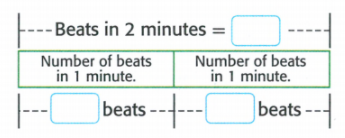
Use the results obtained from exercise 1 to complete the given bar diagram.

Also, determine the number of beats per minute for your partner.

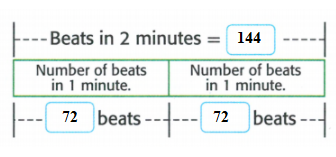
The given bar diagram is

Glencoe Math Course 2, Volume 1, Common Core Student Edition, Chapter 1 Rates Page 9 Exercise 2 ,Bar diagram 1


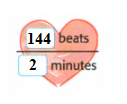
From exercise 1

Glencoe Math Course 2, Volume 1, Common Core Student Edition, Chapter 1 Rates Page 9 Exercice 2

Thus, 144 beats per 2 minutes.


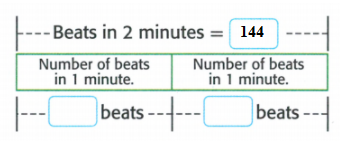
Thus, by completing the given bar diagram using the obtained information, we get

Glencoe Math Course 2, Volume 1, Common Core Student Edition, Chapter 1 Rates Page 9 Exercise 2 ,Bar diagram 2


To find the number of beats per minute, write an equation using the bar diagram.

Let the beats per minute be x

Thus, we get

​x + x = 144

2x = 144

x =  \(\frac{144}{2}\)

x = 72

Therefore, 72 beats per minute.


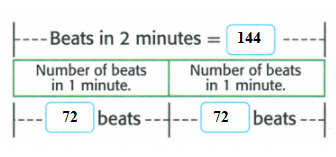
The bar diagram will become

Glencoe Math Course 2, Volume 1, Common Core Student Edition, Chapter 1 Rates Page 9 Exercise 2 ,Bar diagram 3


The completed bar diagram will be

Glencoe Math Course 2, Volume 1, Common Core Student Edition, Chapter 1 Rates Page 9 Exercise 2 ,Bar diagram 4

The number of beats per minute for my partner is 72 beats.

Hence, my partner’s heart beats 72 times per minute.


Page 9  Exercise 3  Problem 3

We need to use the results from Exercise 1 to determine the number of beats for

\(\frac{1}{2}\) minute for your partner.

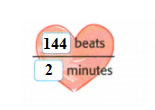
The results from exercise 1 will be

Glencoe Math Course 2, Volume 1, Common Core Student Edition, Chapter 1 Rates Page 9 Exercise 3

Thus, 144 beats per 2 minutes.


Thus, by writing an equation using the information, we get

2x = 144

x =  \(\frac{144}{2}\)

x =  72

Thus, for one minute, the number of beats is 72.


Therefore, the number of beats for \(\frac{1}{2}\) minute will be

\(\frac{1}{2}\) × x  =  \(\frac{1}{2}\)  ×  72

= 36

​Thus, for \(\frac{1}{2}\) minute, the number of beats will be 36

The number of beats for \(\frac{1}{2}\) minute for my partner is 36 beats.


Solving Exercise 1.1 Chapter 1 Ratios and Proportional Reasoning Page 12  Exercise 2  Problem  4

Given that, after 3.5 hours, Pasha had traveled 217 miles.

If she travels at a constant speed, we need to determine how far will she travel after 4 hours.

Determining the unit rate at which she travels per hour, we get

Unitr rate  \( = \frac{\text { Number of miles }}{\text { Number of hours }}\)


= \(\frac{217}{3.5}\)

= 62 miles per hour

Therefore, Pasha can travel 62 miles per hour.

Calculate the distance she traveled after 4 hours.

Multiply the unit rate by 4 hours, and we get

\( \frac{62\text { miles }}{1 \text { hours}}\) ×  4 hours =  62 × 4 miles

= 248

Pasha will have traveled 248 miles after 4 hours.

Pasha will have traveled 248 miles after 4 hours.


Page 12  Exercise 3  Problem 5

We need to calculate the unit rate of 5 pounds for $2.49 and round it to the nearest hundredth if needed.

The unit rate is given by

Unite rate \( = \frac{\text { Amount in dollars }}{\text { Number of pounds }}\)

= \({2.48}{5}\)

= 0.498

\(\approx\) 0.50 dollars per pound

The unit rate of the given is $0.50 per pound.


Page 12  Exercise 4  Problem 6

For example

If we want to measure our heartbeat, we will first check for a person’s pulse.

We calculate the pulse corresponding to the number of minutes.

Usually, the heartbeat is measured as beats per minute.

Here, the number of beats and the minutes are two different quantities.

Therefore, the rate of the heartbeat is measured by the formula below

Unite rate of heartbeat \(=\frac{\text {Number of beats}}{\text { Number of minutes }}\)


We cannot measure something without comparing it with another quantity.

Thus, it is explained that the rate is a measure of one quantity per unit of another quantity.


Examples From Chapter 1 Exercise 1.1 Glencoe Math Course 2  Page 13  Exercise 2  Problem 7

Given that the number of customers is 6840 customers.

The number of days taken is 45 days.

We need to determine the unit rate of the given and round the unit rate obtained to the nearest hundredth if needed.

Given:

Number of customers  =  6840

Number of days  =  45

The unit rate is given by the formula

Unite rate  = \(\frac{\text {Number of customers }}{\text { Number of days }}\)

=  \(\frac{6840}{45}\)

=  152 customers per days

The unit rate of  the given is 152 customers per day


Ratios and Proportional Reasoning Chapter 1 Exercise 1.1 Glencoe MathPage 13   Exercise 4  Problem 8

Given that the number of dollars is 7.40 dollars.

The number of pounds is 5 pounds.

We need to determine the unit rate of the given and round the unit rate obtained to the nearest hundredth if needed.


Given: 

A Number of dollars  =  7.40

Number of pounds = 5

The unit rate is given by the formula

​Unit rate  =  \(\frac{\text {Number of dollars }}{\text { Number of pounds }}\)

= \(\frac{7.40}{5}\)

= 1.48 dollars per pound

The unit rate of the given is 1.48 dollars per pound.


Page 13  Exercise 5  Problem 9

Given that the number of dollars for which the socks sold is 5.79 dollars.

The number of socks sold is 12 pairs of socks.

We need to determine the unit rate of the given and round the unit rate obtained to the nearest hundredth if needed.


Given:

A number of dollars  =  5.79 dollars.

Number of pairs of socks  =  12

The unit rate is given by the formula

Unite rate = \(\frac{\text {Amount in dollars }}{\text { Number of pair socks}}\)

= \(\frac{5.79}{12}\)

=  0.4825

\(\approx\) 0.48 dollars per pair of socks.

The unit rate of the given is 0.48 dollars per pair of socks.


Practice Problems From Exercise 1.1 Glencoe Math Chapter 1  Page 13  Exercise 6  Problem 10

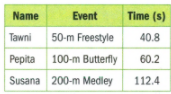
The results of a swim meet are shown below

Glencoe Math Course 2, Volume 1, Common Core Student Edition, Chapter 1 Rates Page 13 Exercise 6

We need to determine who swam the fastest


The time taken for Tawni to swim per meter is

Unite rate  =  \(\frac{\text {Time taken }}{\text {Meters crossed }}\)

=  \(\frac{40.8 \text { seconds }}{50 \text { meters }}\)

=  0.816 seconds/meter

The time taken for Pepita to swim per meter is

​Unit rate = \(\frac{60.2}{100}\)

= 0.602 seconds/meter

The time taken for Susana to swim per meter is

​Unit rate  = \(\frac{112.4}{200}\)

=  0.562 seconds/meter

Among them all, the time taken for Susana to swim per meter is less compared to others.

Time is taken for

Tawni = 0.816 seconds/meter

Pepita  = 0.602 seconds/meter

Susana = 0.562 seconds/meter

Thus, Susana is the fastest among them all.

Susana swam the fastest.


Page 13  Exercise 8  Problem 11

Given that, Kenji buys 3 yards of fabric for $7.47.

Then he realizes that he needs 2 more yards.

We need to determine how much will the extra fabric cost

The unit rate of the fabric is

Unite rate = \(\frac{\text {Amount in dollars }}{\text {Number of yard of fabric}}\)

= \(\frac{7.47}{3}\)

=  2.49 dollars per yard of fabric

He needs two more yards of fabric. The cost of two yards of fabric is

The cost of two yards of fabric is

​2 yards of fabric  \(\times \frac{2.49 \text { dollars }}{1 \text { yard of fabric }}\)

= 2 × 2.49 dollars

= 4.98 dollars

The cost of the extra fabric is 4.98 dollars.

Glencoe Math Course 2 Volume 1 Common Core Student Edition Chapter 1 Ratios and Proportional Reasoning Exercise

Glencoe Math Course 2 Volume 1 Common Core Chapter 1 Ratios and Proportional Reasoning


Glencoe Math Course 2 Chapter 1 Ratios And Proportional Reasoning Exercises With Solutions Page 3  Exercise 1  Problem 1

Let the two ratios be a:b and c:d

If both the ratios are equal a:b = c:d

Then the given ratio is said to be in proportion.

Furthermore, if the sets fluctuate in the same proportion, the ratio is indeed in proportion.


In terms of objects, if two objects have the same form but different sizes, they are perhaps the same shape but different sizes.

For instance, suppose the two objects are spheres, but one is smaller and the other is larger.

Despite the fact that the sizes differ, the corresponding angles would be the same.

As a result, their ratios are proportional.

As a result, the two objects are proportional.

Glencoe Math Course 2 Student Edition Volume 1 Chapter 1 Ratios and Proportional Reasoning Exercise

When two objects have the same form, same angles, but various sizes, they all seem to be in proportion. As a result, their ratios are proportional.

Read and Learn More Glencoe Math Course 2 Volume 1 Common Core Student Edition Solutions

Chapter 1 Ratios And Proportional Reasoning Glencoe Math Course 2 Exercise Answers Page 6   Exercise 1   Problem 2

Given: On a seventh-grade field trip.

The number of students who went on that trip is  180.

The number of adults who went on that trip is  24.

The number of buses in which they went is  4.


We need to write the ratio of adults: Students as a fraction and in its simplest form.

The number of adults  = 24

The number of students  = 180

The ratio of adults: Students in its simplest form is given by

​Adults: Students  = 24:180

\(\frac{\text { Adults }}{\text { Students }}=\frac{24}{180}\)


=\(\frac{2}{15}\)

The ratio of adults to students as a fraction in the simplest form is \(\frac{2}{15}\)


Glencoe Math Course 2 Volume 1 Common Core Page 6   Exercise 2  Problem 3

Given:  In a seventh-grade field trip.

The number of students who went on that trip is 180.

The number of adults who went on that trip is 24.

The number of buses in which they went is 4.


We need to write the ratio of the students: Buses as a fraction and in its simplest form.

The number of buses  = 4

The number of students  = 180

The ratio of students: Buses in its simplest form is given by

​Students : Buses  = 180:4

\(\frac{\text {Students}}{\text { Buses}}=\frac{180}{4}\)


=\(\frac{45}{1}\)

The ratio of students: buses as a fraction in the simplest form is \(\frac{45}{1}\)


Solutions For Glencoe Math Course 2 Volume 1 Chapter 1 Exercises Page 6   Exercise 3   Problem 4

Given:  in a seventh-grade field trip.

The number of students who went on that trip is 180.

The number of adults who went on that trip is 24.

The number of buses in which they went is 4.


We need to write the ratio of the buses: People as a fraction and in its simplest form.

The number of adults  =  24

The number of students  = 180

The number of buses  = 4

The total number of people on the bus = Adults + Students

​= 24 + 180

= 204

The total number of people on the bus = 204

The ratio of buses: People in its simplest form is given by

​Buses: People = 4:204

\(\frac{\text {Buses}}{\text { People}}=\frac{4}{204}\)


= \(\frac{1}{51}\)

The ratio of buses: People as a fraction in the simplest form is \(\frac{1}{51}\)


Glencoe Math Course 2 Volume 1 Common Core Page 6  Exercise 5  Problem 5

Given: 

12 out of 20 doctors agree

15 out of 30 doctors agree

We need to determine their ratios and to check whether the ratios are equivalent.

Writing the given ratios in their simplest form.

12 out of 20 doctors agree The ratio is

= \(\frac{12}{20}\)

= \(\frac{6}{10}\)

= \(\frac{3}{5}\)

15 out of 30 doctors agree The ratio is

= \(\frac{15}{30}\)

= \(\frac{1}{2}\)

Both the ratios are simplified to different fractions.

Thus, both ratios are not equivalent.

The ratios are not equivalent.


Step-By-Step Guide To Ratios And Proportional Reasoning Chapter 1 Exercises Page 8   Exercise 1  Problem 6

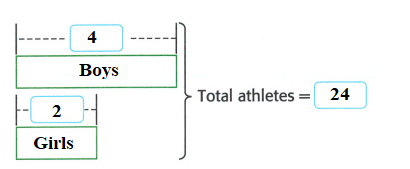
Given:  The ratio of the number of boys to the number of girls on the swim team is 4:2.

The total number of people on the swim team is 24 athletes.

We need to determine how many more boys than girls are there on the team.

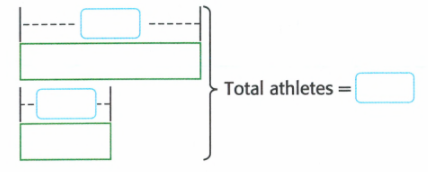
Also, use the given bar diagram to solve.

Glencoe Math Course 2, Volume 1, Common Core Student Edition, Chapter 1 Ratios and Proportional Reasoning Page 8 Exercise 1


Given: The  ratio is 4:2

The total number of boys and girls is 24

The obtained bar diagram is

Glencoe Math Course 2, Volume 1, Common Core Student Edition, Chapter 1 Ratios and Proportional Reasoning Page 8 Exercise 1.


Let each part of the ratio be x

Thus, the equation becomes

4x + 2x = 24

Solving the equation, we get

​4x + 2x = 24

6x = 24

x = \(\frac{24}{6}\)

x = 4

The total number of Boys will be

​4x = 4 × 4

= 16

The total number of Girls will be

​2x  = 2 × 4

=  8

Determining how many more boys than girls are there on the team, we get

16 − 8 = 8

Thus, 8 boys are more on the swim team than the girls.

8 more boys than girls are there on the team.


Glencoe Math Course 2 Volume 1 Common Core Page 8  Exercise 3  Problem 7

We are given a bar diagram.

We must write a real-world problem that could be represented by the bar diagram and also to solve it.

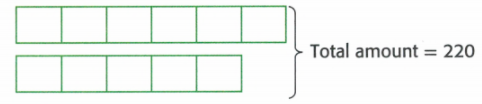
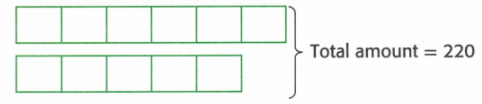
The bar diagram is as follows

Glencoe Math Course 2, Volume 1, Common Core Student Edition, Chapter 1 Ratios and Proportional Reasoning Page 8 Exercise 3 ,Bar diagram 1


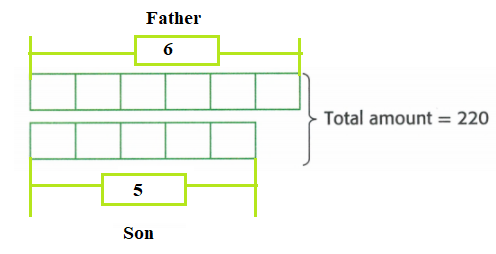
The given bar diagram is

Glencoe Math Course 2, Volume 1, Common Core Student Edition, Chapter 1 Ratios and Proportional Reasoning Page 8 Exercise 3 ,Bar diagram 2

The number of parts given is 6 and 5

Therefore, the ratio will be 6:5

The total amount given is 220.

Thus, the real-world problem for the given bar diagram will be.

The ratio of the expenses shared by the father and the son is 6:5.

The total amount shared by them will be 220.

We need to determine how much amount is shared by them both.


The bar diagram will be
Glencoe Math Course 2, Volume 1, Common Core Student Edition, Chapter 1 Ratios and Proportional Reasoning Page 8 Exercise 3 ,Bar diagram 3

Writing an equation using the obtained ratio and the total amount to solve this, we get

6x + 5x = 220

11x = 220

x = \(\frac{220}{11}\)

x =  20

Thus, each part represents the amount of 20.

The expense amount shared by the father is

6x=6×20=120

The expense amount shared by the son is

5x = 5×20 = 100


A real-world problem that could be represented by the given bar diagram is.

The ratio of the expenses shared by the father and the son is 6:5.

The total amount shared by them will be 220.

Determine how much expense amount is shared by them both.

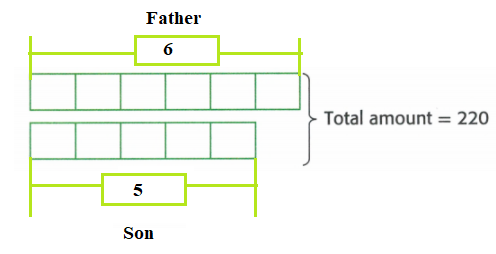
The corresponding bar diagram will be.

Glencoe Math Course 2, Volume 1, Common Core Student Edition, Chapter 1 Ratios and Proportional Reasoning Page 8 Exercise 3 ,Bar diagram 4

On solving the problem, we get the expense shared by the father is 120 and by the son is 100


Glencoe Math Course 2 Volume 1 Common Core Page 8  Exercise 4  Problem 8

Consider a real-world problem.

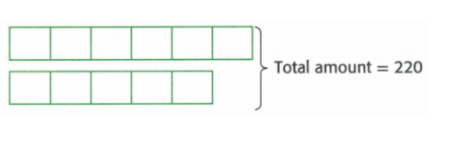
Let the bar diagram given for that particular real-world problem be.

Glencoe Math Course 2, Volume 1, Common Core Student Edition, Chapter 1 Ratios and Proportional Reasoning Page 8 Exercise 4 ,Bar diagram 1

Count the number of parts in each case to determine the ratio corresponding to it.

Here, the number of parts is 6 and 5.

Therefore, the ratio given will be 6:5

The total amount corresponding to the given ratio is 220.

Thus, for solving the given ratio, we need to take the total number of parts given and the total amount represented in the bar diagram.

Thus, the equation will be

​6x + 5x = 220

11x = 220

x=220/11

x  = 20

We can use a bar diagram to obtain the ratios of each part and the total amount represented by the real-world problem to solve it.

Glencoe Math Course 2 Volume 1 Common Core Student Edition Chapter 2 Percents Exercise

Glencoe Math Course 2 Volume 1 Common Core Chapter 2 Percents


Glencoe Math Course 2 Volume 1 Chapter 2 Percents Exercise Solutions Page 95   Exercise 1   Problem 1

Given:

To explain how can percent help you understand situations involving money?

The percent help to understand situations involving money

The interest rates are written as a percent.

Also, find the interest earned on a savings account and the amount of interest charged on bank loans and credit cards.

The sales tax is also indicated in percent.

Hence explained.


Common Core Chapter 2 Percents Exercise Answers Glencoe Math Course 2 Page 98 Exercise 1 Problem 2

Given:

Expression: 300 × 0.02 × 8 =

To find: Find each product

Determine the product of the first two factors, then the product of the result, and the last factor

(300 × 0.02) × 8

⇒  6 × 8 = 48

(300 × 0.02) × 8 = 48

Finally, The product of the factors are 48.

Glencoe Math Course 2 Student Edition Volume 1 Chapter 2 Percents Exercise

Step-By-Step Guide For Chapter 2 Percent Exercises In Glencoe Math Course 2 Page 98 Exercise 2 Problem 3

Given:

Expression: 85 × 0.25 × 3 =

To find: Find each product

Determine the product of the first two factors, then the product of the result, and the last factor

85 × 0.25 × 3

⇒  21.25 × 3 = 63.75

85 × 0.25 × 3 = 63.75

Finally, The product of the factors is 63.75.

Read and Learn More Glencoe Math Course 2 Volume 1 Common Core Student Edition Solutions

Page 98   Exercise 3  Problem 4

Given:

Suppose Nicole saves $2.50 every day. How much money will she have in 4 weeks?

To find: Find each product

Because there are seven days in a week, there are 28 days in four weeks

⇒  28 × $2.50 = $70.00

Finally, The product of the factors is $70.00.


Page 98  Exercise 4   Problem 5

Given:  0.675 =

To find: Write each decimal as a present.

By multiplying the decimal by 100 and adding a percent sign, you can rewrite it as a percent

⇒ 0.675 = 67.5 %

Finally, The Decimals as a percent  is  67.5 %


Exercise Solutions For Chapter 2 Percents Glencoe Math Course 2 Volume 1 Page 98  Exercise 5  Problem 6

Given: 0.725 =

To find: Write each decimal as a present.

By multiplying the decimal by 100 and adding a percent sign, you can rewrite it as a percent

⇒  0.725 = 72.5 %

Finally, The Decimals as a percent are  72.5.


Page 98   Exercise 6  Problem 7

Given: 0.95 =

To find: Write each decimal as a present.

By multiplying the decimal by 100 and adding a percent sign, you can rewrite it as a percent

⇒  0.95 = 95 %

Finally, The Decimals expressed as a percent are 95 %


Page 98   Exercise 7  Problem 8

Given: Approximately 0.92 of a watermelon is water. What percent represents this decimal?

To find: Write each decimal as a present.

By multiplying the decimal by 100 and adding a percent sign, you can rewrite it as a percent

⇒ 0.92% =  92 %

Finally, The Decimals expressed as a percent are  92 %


Common Core Percents Chapter 2 Exercises With Solutions Glencoe Math Course 2 Page 102   Exercise 3  Problem 9

Given:

To find:  The answers in blank boxes

Total  =  150

Percent  =  40%

Rate per hundred =  40/100

Therefore

Part = \(\frac{40}{100}\) ×(150)

=  60

The solution of part is 60


Page 102   Exercise 4  Problem  10

Given:

To find: The answers in blank boxes

Total = 150

Percent  =  50%

Rate per hundred  =  50/100

Therefore

Part =  ​\(\frac{50}{100}\) ×(150)

=  75

The solution of part is 75


Examples of problems from Chapter 2 Percent Exercises In Glencoe Math Course 2 Page 102   Exercise 5  Problem  11

Given:

To find: The pattern

Total  = 150

Percent = 40%

Rate per hundred = 40/100

Therefore

Part = \(\frac{40}{100}\) × (150)

= 60


​Total  = 150

Percent  =  50%

Rate per hundred = 50/100

Therefore

Part =  ​\(\frac{50}{100}\) × (150)

=  75

By analyzing the pattern we found that the part has been increasing by every 15. The part has been increased by 15.


Page 102   Exercise 6  Problem  12

Given: The table shows percentages equivalent to real numbers.

We have to write a real-world problem based on the values of the table.

This is done by equating the percentage to the real numbers.

According to the table

10 times, 10% = 10 × 10 = 100%

10times, 25 = 25 × 10 = 250, or

If, ​ 10% = 251%

= 2.5

∴  100%  =  250

Hence 10%  =  25 is verified to write in the form of a percentage expression.

10% = 25 is written in the form of a percentage based on the table.


Student Edition Glencoe Math Course 2 Chapter 2 Percents Exercise Guide Page 102  Exercise 7  Problem  13

4times, 25% = 25 × 4 = 100%

4times, 15 = 15 × 4 = 60 , or

If,   ​25% = 15

1% = ​\(\frac{15}{25}\)(100%)

=  ​\(\frac{15}{25}\)×100

∴  100%  =  60

Hence 100%  =  60 is verified to write in the form of a percentage expression.

100% = 60 is written in the form of a percentage based on the table.


Step-By-Step Answers For Chapter 2 Percents In Glencoe Math Course 2 Volume 1 Page 102 Exercise 8   Problem 14

Given:

How percent  used to solve a real-world problem

Explanation:

Percent diagram helps to display the information, making it easier to solve for what it is missing

A diagram in a way to help your to brain process a lot of information at once.

It is the visual planning tool that takes some of the pressure off of remembering every single detail

Sometimes we have hard questions that require sifting through a lot of information to figure them out.

This type of chart or diagram gives a quick and easy way to see a whole is divided into its constituent parts.

Glencoe Math Course 2 Volume 1 Common Core Student Edition Chapter 2 Percents Exercise 2.1

Glencoe Math Course 2 Volume 1 Common Core Chapter 2 Percents


Glencoe Math Course 2 Volume 1 Chapter 2 Exercise 2.1 Solutions Page 103  Exercise 1  Problem 1

We need to explain how can percent help you understand situations involving money.

The percent help to understand situations involving money

The interest rates are written as a percent.

Also, find the interest earned on a savings account and the amount of interest charged on bank loans and credit cards.

The sales tax is also indicated in percent.

Hence explained.


Glencoe Math Course 2 Volume 1 Chapter 2 Exercise 2.1 Solutions Page 103  Exercise 2  Problem 2

Given:

To show that the 60%  of  2000 = 1200

To prove that the 60%  of  2000 = 1200

\(\frac{60}{100}\) (2000) = 1200

60 × 20 = 1200

1200 = 1200

Glencoe Math Course 2 Student Edition Volume 1 Chapter 2 Percents Exercise 2.1

​Thus the  60% of 2000 = 1200 is proved

Read and Learn More Glencoe Math Course 2 Volume 1 Common Core Student Edition Solutions

Glencoe Math Course 2 Volume 1 Common Core Chapter 2 Page 106   Exercise 1  Problem 3

Given:

To find – The number from 8% of 50

8% of  50

\(\frac{8}{100}\)(50)

\(\frac{8}{2}\)

= 4

​8% of 50 is 4

8% of 50 is 4


Common Core Chapter 2 Percents Exercise 2.1 Answers Glencoe Math Course 2 Page 106  Exercise 2  Problem 4

Given:

Find each number. Round to the nearest tenth if necessary.

To find – The number of 95 % of 40

Given:

95 % of 40

95 % = \(\frac{95}{100}\)

Then \(\frac{95}{100}\) of 40

=  \(\frac{95}{100}\) × 40

⇒   \(\frac{95}{5}\) × 2

⇒  19 × 2 = 38

So, 95 % of 40 is 38.

The solution is 38.


Step-by-step guide for Exercise 2.1 Chapter 2 Percents in Glencoe Math Course 2 Page 106  Exercise 3  Problem 5

Given:

Find each number. Round to the nearest tenth if necessary.

To find – The number of 110 % of 70

Given:

​110 % of 70

110 % = \(\frac{110}{100}\)

Then \(\frac{110}{100}\) of 70

=  \(\frac{110}{100}\) × 70

⇒  11 × 7=  77

So, 110 % of 70 is 77.

The solution is 77.


Glencoe Math Course 2 Volume 1 Common Core Chapter 2 Page 106  Exercise 4  Problem 6

Given:

Mackenzie wants to buy a backpack that costs $50.If the tax rate is 6.5%, how much tax will she pay?

To find – The amount of tax.

Cost of backpack = $50

Tax rate =  6.5%

Amount of tax =  6.5 %  of  50

6.5 % =  \(\frac{6.5}{100}\)

Then ​\(\frac{6.5}{100}\) of  50

=  \(\frac{6.5}{100}\)  ×  50

⇒  \(\frac{6.5}{2}\)

= 3.25

So the amount of tax = $3.25

The solution is $3.25


Exercise 2.1 Solutions For Chapter 2 Percents Glencoe Math Course 2 Volume 1 Page 106 Exercise 5  Problem 7

Given:

Building on the essential question give an example of a real-world situation in which you would find the percent of a number.

To find – An example.

Take an example of 17% of 150 oranges are bad.

To find the number of oranges are bad.

17 % of 150

​17 % = \(\frac{17}{100}\)

\(\frac{17}{100}\) of  150

=  \(\frac{17}{100}\) × 150

⇒  \(\frac{17}{2}\) × 3 = 26

So, 26 oranges are bad.

Hence the example has been found.


Glencoe Math Course 2 Volume 1 Common Core Chapter 2 Page 107  Exercise 2   Problem 8

Given:

Find each number. Round to the nearest tenth if necessary.

45% of $432

To find – The number.

Given:

​45 % of 432

45 % \(\frac{45}{100}\)

Then,\(\frac{45}{100}\) ​ of  432

= \(\frac{45}{100}\)  × 432

& ⇒ \(\frac{9}{5}\) × 108  =  194.4

So,45% of $432 is $194.4

The solution is 194.4


Common Core Percents Exercise 2.1 Chapter 2 Solutions Glencoe Math Course 2 Page 107   Exercise 3  Problem 9

Given:

Find each number. Round to the nearest tenth if necessary.

3.23% of $640

To find –The number.

Given:

23 % of 640

23 % = \(\frac{23}{100}\)

Then \(\frac{23}{100}\)  of  640

= \(\frac{23}{100}\) × 640

=  \(\frac{23}{5}\) ×  32

=  147.2

So, 23 % of $640 is $147.2

The solution is 147.2


Glencoe Math Course 2 Volume 1 Common Core Chapter 2 Page 107  Exercise 4  Problem 10

Given:

Find each number. Round to the nearest tenth if necessary.

4.130% of 20

To find –  The number.

Given:

​130 % of 20

130 % = \(\frac{130}{100}\)

Then \(\frac{130}{100}\)  of  20

=  \(\frac{130}{100}\) × 20

⇒ 13 × 2 = 26

So,130 % of 20 is 26

The solution is 26


Examples Of Problems From Exercise 2.1 Chapter 2 Percents In Glencoe Math Course 2 Page 107  Exercise 7  Problem 11

Given:

Find each number. Round to the nearest tenth if necessary.

7.32% of 4

To find  –  The number.

Given:

​32 %of 4

32 = \(\frac{32}{100}\)

Then, \(\frac{32}{100}\)  of  4

=  \(\frac{32}{100}\) × 4

⇒  \(\frac{32}{25}\)

= 1.28

So, 32 % of 4 is 1.28.

The solution is 1.28


Glencoe Math Course 2 Volume 1 Common Core Chapter 2 Page 107   Exercise 9  Problem 12

Given:

Find each number. Round to the nearest tenth if necessary.

9.23.5%of 128

To find –  The number.

Given:

⇒ 23.5

Then, \(\frac{23.5}{100}\)  of  128

= \(\frac{23.5}{100}\)  × 128

=\(\frac{23.5}{25}\) × 32

=  30.08

So,23.5 % of 128 is 30.08

The solution is 30.08


Student Edition Glencoe Math Course 2 Chapter 2 Percents Exercise 2.1 Guide Page 107  Exercise 10  Problem 13

Given:

Suppose there are 20 questions on a multiple-choice test.

If 25% of the answers are choice B, how many of the answers are not choice B?

To find the number of answers are not choice B.

Total number of questions = 20

25% of the answers are choice B

Therefore, the number of answers are choice B = 25% of 20

​\(\frac{32}{100}\)of 20 = \(\frac{32}{100}\) × 20

⇒ \(\frac{1}{4}\) × 20

= 5

The number of answers are choice B = 5

So, the number of answers are not choice B = 20 − 5

= 15

The number of answers are not choice B = 15


Glencoe Math Course 2 Volume 1 Common Core Chapter 2 Page 107   Exercise 11  Problem 14

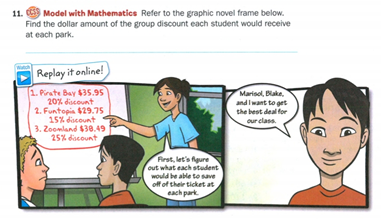
Given:


Glencoe Math Course 2, Volume 1, Common Core Student Edition, Chapter 2.1 Percent of Number Page 107 Exercise 11


To find – The dollar amount of the group discount each student would receive at each park.

At pirate bay 20% discount of $35.95

\(\frac{20}{100}\) of 35.95 = \(\frac{20}{100}\) ×35.95

⇒  \(\frac{1}{5}\)  × 35.95

=  7.19

At funtopia 15% discount of $29.75

​\(\frac{15}{100}\)of 29.75 = ​\(\frac{15}{100}\) ×29.75

⇒ ​\(\frac{3}{20}\) × 29.75 = 4.46

At zoomland 25% discount of $38.49

\(\frac{25}{100}\) of 38.49 = \(\frac{25}{100}\)  × 38.49

⇒ \(\frac{1}{4}\) × 38.49

= 9.62

$7.19 at pirate bay,$4.46 at funtopia, and $9.62 at zoomland.

The dollar amount of the group discount each student would receive is $7.19 at pirate bay,$4.46 at funtopia, and $9.62 at zoomland.


Page 108   Exercise 14   Problem 15

Given:

Find each number. Round to the nearest hundredth.

5\(\frac{1}{2}\)% of 60

To find – The number.

Given:

5\(\frac{1}{2}\)% of 60

5\(\frac{1}{4}\) = \(\frac{11}{2}\)%

=  \(\frac{11/2}{100}\)

=  \(\frac{11}{200}\)

5\(\frac{1}{2}\)% of 60 = \(\frac{11}{200}\)× 60

\(\frac{11}{10}\) × 3 = 3.3

So 5\(\frac{1}{2}\)% of 60 is 3.3.

The solution is 3.3


Glencoe Math Course 2 Volume 1 Common Core Chapter 2 Page 108  Exercise  15 Problem 16

Given:

Find each number. Round to the nearest hundredth.

20\(\frac{1}{4}\)% of 3

To find –  The number.

Given:

​20\(\frac{1}{4}\)% of 3

20\(\frac{1}{4}\) =  \(\frac{81}{4}\)%

\(\frac{81/4}{100}\) = \(\frac{81}{400}\)

​20\(\frac{1}{4}\)% of 3 = \(\frac{81}{400}\) ×  3

⇒  0.6075 ≃ 0.608

So ,  ​20\(\frac{1}{4}\)% of 3 is 0.608

The solution is 0.608


Step-By-Step Answers For Exercise 2.1 Chapter 2 Percents In Glencoe Math Course 2 Volume 1 Page 108   Exercise 16  Problem 17

Given:

Find each number. Round to the nearest hundredth.

1,000 % of 99

To find – The number.

Given:

​1,000 % of 99

1000 % \(\frac{1000}{100}\)  = 10

1,000 % of 99 = 10 × 99

⇒  990

So, 1,000 % of 99 is 990

The solution is 990


Page 108   Exercise 17  Problem 18

Given:

To convert a percentage to a number 520% of 100

520% of 100

\(\frac{520}{100}\)(100)

= 520

520% of 100  = 520

The answer is 520


Glencoe Math Course 2 Volume 1 Common Core Chapter 2 Page 108  Exercise 19  Problem 19

Given:

To convert a percentage to a number 200% of 79

200% of 79

\(\frac{200}{100}\)(79)

= 2(79)

= 158

200% of 79 = 158

​The answer 200% of 79 is 158


Page 108   Exercise 21  Problem 20

Given:

To convert a percentage to a number 0.28% of 50

0.28% of 50

\(\frac{0.28}{100}\)(50)

=  \(\frac{0.28}{10}\)(5)

=  \(\frac{0.25}{2}\)

=  0.14

0.28% of 50 =  0.14

The answer 0.28% of 50 is 0.14


Page 108  Exercise 23  Problem 21  

Given:

To explain the percentage has been done easier with fractions or decimal

Solution :

Its easier to use a decimal

Percent means a part of 100  x /100 = x%

If you have a decimal, just move the decimal place to the left of 2 places

If you have a fraction, try to get the denominator equal to 100, or divide it out and move the

A decimal place to the left 2 places

Decimal is easier than a fraction

The answer 0 is a decimal is easier than a fraction


Glencoe Math Course 2 Volume 1 Common Core Chapter 2 Page 108   Exercise 24  Problem 22

Given:

To choose the correct option in how much he left to spend

Solution :

Option c is correct

(1) He will spend 18% of the repair

\(\frac{18}{100}\)(300)

= (18)(3)

= 54

He spends $54 on repair

(2)  20% of savings

​\(\frac{20}{100}\) (300)

= 60


(C) 35% of the canvas

​\(\frac{35}{100}\)(300)

= 105

He will spend $54 on repair and $60in savings and $105 in canvas and leaving him $81

The answer $81 option c is correct


Page 109  Exercise 25  Problem 23

Given:

To convert the percentage into number 54% of 85

Solution :

54% of 85

​\(\frac{54}{100}\)(85)

= 54(0.85)

= 45.9

54% of 85 = 45.9

The answer for 54% of 85 is 45.9


Glencoe Math Course 2 Volume 1 Common Core Chapter 2 Page 109  Exercise 26  Problem 24

Given:

To convert the percentage into number 12% of $230

Solution:

12% of $230

​\(\frac{12}{100}\)(230)

=  0.12(230)

=  27.6

12% of $230 =  27.6

The answer for 12% of $230 is $27.6


Page 109  Exercise 27  Problem 25

Given:

To convert the percentage into number 98% of 15

Solution :

98% of 15
​​
​\(\frac{98}{100}\)(15)

=  0.98(15)

=  14.7

98% of 15 =  14.7

​The answer for 98% of 15 = 14.7


Glencoe Math Course 2 Volume 1 Common Core Chapter 2 Page 109   Exercise 28  Problem 26

Given:

To convert the percentage into number 250% of 25

Solution :

250% of 25

​\(\frac{250}{100}\)(25)

=  2.5(25)

=  62.5

250% of 25 =  62.5

The answer for 250% of 25 is 62.5


Page 109  Exercise 31  Problem 27

Given:

To convert the percentage into number 0.5% of 60

Solution :

0.5% of 60

​\(\frac{0.5}{100}\)(60)

= ​\(\frac{0.5}{10}\) (6)

= 0.3

0.5% of 60 = 0.3

The answer for 0.5% of 60 is 0.3


Page 109  Exercise 32  Problem 28

Given:

To convert the percentage into number 2.4% of 20

Solution :

2.4% of 20

​\(\frac{2.4}{100}\)(20)

= ​ \(\frac{2.4}{10}\)(2)

= 0.48

2.4% of 20 = 0.48

The answer for 2.4% of 20 = 0.48


Glencoe Math Course 2 Volume 1 Common Core Chapter 2 Page 109   Exercise 34   Problem 29

Given:

To find How many households watched the finals

Solution :

17.7% of 110.2

Turn percent to decimals

​​\(\frac{17.7}{100}\)(110.2)

= 0.177(110.2)

= 19.51

17.7% of 110.2 = 19.51

19.51 million households watched the finals

The answer is 19.51 million households watched the finals


Page 109   Exercise 35   Problem 30

Given:

To find – What will be the cost for internet access after the increase

Solution :

The amount family paid = $19

The cost will increase by 5%

5% of 19

​\(\frac{5}{100}\)(19)

= 0.05(19)

=  19.95

5% of 19 =  19.95

​The cost would be $19.95

The answer is the cost would be $19.95


Page 110  Exercise 38   Problem 31

Given:

To choose the answer for how many costumers prefer horror movies

Solution :

Total no of costumer 200

The percentage of customers who prefers horror movies is 46%

46% of 200

​\(\frac{46}{100}\)(200)

=  0.46(200)

=  92

46% of 200 =  92

92 customer prefer horror movies

The answer is 92 customer prefer horror movies is correct


Glencoe Math Course 2 Volume 1 Common Core Chapter 2 Page 110  Exercise 39   Problem 32

Given:

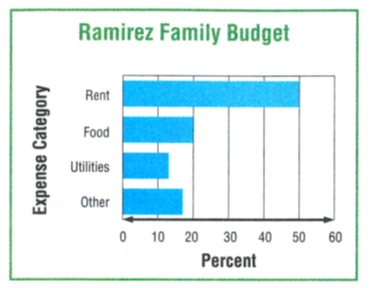
The bar graph shows Ramirez’s family budget.

Ramirez monthly income is 3000 dollars.

To find:

By satisfying the following condition and finding which statement is true.

Solution :

The monthly income of Ramirez is $3000


Glencoe Math Course 2, Volume 1, Common Core Student Edition, Chapter 2.1 Percent of Number Page 110 Exercise 39


1. The family budget is $ 1000 for rent.

To find – It in percent

​​\(\frac{1000}{3000}\) × 100

= 33.33

But the bar diagram shows 50% has been spent for rent so it is not correct.


2. The family budget is $ 600 for food.

​\(\frac{600}{3000}\) × 100

= 20

The diagram shows 20% for their food Hence it is true


3. The family budget is $100 more for utilities than for other

\(\frac{100}{3000}\) × 100

= 3.33

But the diagram shows more than 10 for this, Hence this is false.


4. The family budget is $900 more for food than for rent.

​\(\frac{900}{3000}\)×100

= 90

The bar diagram shows 10-20 % for this, hence it is false.

Answer : All of this option (2)  is 20% for their food is true.

By checking all the conditions with the bar graph, The answer option g, 20% for their food is true.


Page 110  Exercise 40  Problem 33

Given:

To multiply the given number

Solution :

Multiply With digits

1.7 × 54  =  91.8

The answer is 91.8


Page 110   Exercise 41  Problem 34

Given:

Multiply:

41.1.5 × 3.65

To multiply.

Multiplying

​1.5 × 3.65

= 5.475

The solution is  5.475


Glencoe Math Course 2 Volume 1 Common Core Chapter 2 Page 110   Exercise 42   Problem 35

Given:

Multiply:

42. 49.6×2.7

To multiply.

Multiplying

​49.6 × 2.7

= 133.92

The solution is 133.92


Page 110   Exercise 43   Problem 36

Given:

43 .trent spent 50 minutes at the neighbor’s house.

He spent 2/5 of the time swimming.

How many minutes did trent spend swimming?

To find the time trent spends swimming.

Total time trent spent in neighbor’s house = 50 minutes

Time he spent in swimming = \(\frac{2}{5}\) of 50 minutes

⇒ \(\frac{2}{5}\)  × 50  =  20

The time trent spent in swimming = 20 minutes.

The time trent spent in swimming = 20 minutes.


Page 110  Exercise 44   Problem 37

Given:

There are 240 seventh-graders at Yorktown middle school.

Two-thirds of the students participate in after-school activities.

To find –  The number of students who participate in after-school activities.

Number of seventh-graders at Yorktown middle school = 240

Students participate in after-school activities = \(\frac{2}{3}\) of 240

⇒ \(\frac{2}{3}\) × 240 = 160

The number of students participated in after-school activities = 160

The number of students participated in after-school activities = 160

Glencoe Math Course 2 Volume 1 Common Core Student Edition Chapter 3 Integers Exercise 3.1

Glencoe Math Course 2 Volume 1 Common Core  Chapter 3 Integers

Glencoe Math Course 2 Volume 1 Chapter 3 Integers Exercise Solutions Page 191  Exercise 1   Problem 1

Because the first three operations close the set of integers:
Add
Subtract
Multiply

These operations will return a set of integers as a result.

When you divide two numbers, though, the result is when the first and second integers are not multiples of each other (In other words, when the second integer is not a factor of the first integer), Then, rather than an integer, the outcome will be the Ratio between the two integers.

Hence the term “rational” for such numbers.

Finally, we concluded that when we add, subtract, and multiply will return a set of integers as a result. and when we divide integers the outcome will be the Ratio between the two integers. Hence the term “rational” for such numbers.
Glencoe Math Course 2 Student Edition Volume 1 Chapter 3 Integers Exercise 3.1

Common Core Chapter 3 Integers Exercise Answers Glencoe Math Course 2 Page 191  Exercise 1  Problem 2

The bottom of a snowboarding half-pipe is 5 meters below the top, Circle the integer you would use to represent this position 5 (or)(−5)

In weather forecasting, negative numbers are used to show the temperature of a region.

On the Fahrenheit and Celsius scales, negative numbers are used to represent the temperature.

Finally, we concluded that the result to represent this position is (−5)

Read and Learn More Glencoe Math Course 2 Volume 1 Common Core Student Edition Solutions

Step-By-Step Guide For Chapter 3 Integers Exercises In Glencoe Math Course 2 Page 194  Exercise 1  Problem 3

Given: $16

To write an integer.

A deposit increases the balance and thus it is best to take a positive integer

Therefore, the positive integer will be

⇒ 16

Finally, we concluded that the result is  ⇒  16


Exercise Solutions For Chapter 3 Integers Glencoe Math Course 2 Volume 1 Page 194  Exercise 2   Problem 4

Given: A loss of 11 yards

To write an integer.

A loss of 11 yards is a decrease of the number of yards and thus it is best to take a negative integer.

Therefore, the negative integer will be

⇒  −11

A loss of 11 yards = −11

Finally, we concluded that the result is ⇒ −11


Page 194  Exercise 4  Problem 5

Given:−9=____

To evaluate the expression.

The absolute value of a number is the distance from the number to zero.

Therefore, the absolute value is

⇒ −9 = 9

Finally, we concluded that the result is 9


Common Core Integers Chapter 3 Exercises With Solutions Glencoe Math Course 2 Page 194  Exercise 5  Problem 6

Given: |18|−|−10| =____

To evaluate the expression.

The absolute value of a number is the distance from the number to zero.

Therefore, the absolute value is

​|18|−|−10| = 18 − 10

=8

​|18|−|−10| =8

The value of  |18|−|−10| is 8


Page 194  Exercise 7  Problem 7

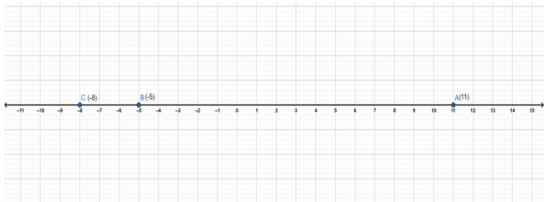
Given:{11,−5,−8}

To Graph the set of integers on a number line.

The given set is {11,−5,−8}

Here,11 Lies in the middle between 10 and 12, while−5 lies in the middle between−4 and−6 and −8 lies in the middle between−7 and−9

The graph on a number line
 

Glencoe Math Course 2, Volume 1, Common Core Student Edition, Chapter 3.1 Integers and Absolute value Page 194 Exercise 7 , graph 1


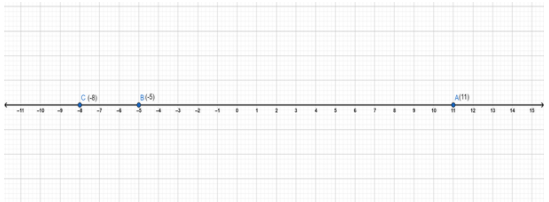
The given set of integers {11,−5,−8} is graphed on a number line.
Glencoe Math Course 2, Volume 1, Common Core Student Edition, Chapter 3.1 Integers and Absolute value Page 194 Exercise 7 , graph 2


Examples of problems from Chapter 3 Integers exercises in Glencoe Math Course 2 Page 194  Exercise 8  Problem 8

The absolute value of a number is positive because the distance of the number is always positive or zero if the number is zero.

Finally, we concluded that the absolute value of a number is positive since the distance is positive.


Page 195  Exercise 1  Problem 9

Given: A profit of $9

To write an integer.

A profit is an amount that was gained and thus it is best to use a positive integer.

Therefore, the positive integer will be

⇒ 9

Finally, we concluded that the result is  ⇒  9


Detailed Explanation Of Chapter 3 Integers Exercises Glencoe Math Course 2 Solutions Page 195  Exercise 2  Problem 10

Given: A bank withdrawal of $50

To write an integer.

A bank withdrawal decreases the balance of the bank account and thus it is best to use a negative integer.

Therefore, the negative integer will be

⇒ −50

Finally, we concluded that the result is ⇒ −50


Page 195   Exercise 3  Problem  11

Given: $53 below zero

To write an integer.

The temperature below zero is best described by a negative number.

Therefore, the negative integer will be

⇒ −53

Finally, we concluded that the result is ⇒−53


Student Edition Glencoe Math Course 2 Chapter 3 Integers Exercise Guide Page 195   Exercise 4  Problem 12

Given: 7 inches more than normal

To write an integer.

The number of inches more than normal is best described by a positive integer.

Therefore, the positive integer will be

⇒  7

Finally, we concluded that the result is ⇒ 7


Page 195  Exercise 7  Problem 13

Given: 10 =____

To evaluate the expression.

The absolute value of a number is the distance from the number to zero.

Therefore, the absolute value is

⇒  10 = 10

Finally, we concluded that the result is ⇒ 10


Step-By-Step Answers For Chapter 3 Integers In Glencoe Math Course 2 Volume 1 Page 195  Exercise 8  Problem 14

Given:−7−5 =____

To evaluate the expression.

The absolute value of a number is the distance from the number to zero.

Therefore, the absolute value is

​⇒ −7 − 5 = 7 − 5 = 2

⇒  2

Finally, we concluded that the result is ⇒ 2


Page 196  Exercise 13  Problem 15

Given: |−199.99|+|−39.99|+|−59.99|

To find the amount Mr. Chavez spent altogether.

The absolute value of a number is the distance of the number to zero.

Therefore, the absolute value is

​|−199.99| + |−39.99| + |−59.9|

= 199.99 + 39.99+59.99

= $299.97

|−199.99|+|−39.99|+|−59.99| = $299.97

Mr. Chavez spends ⇒ $299.97 altogether.


Page 196  Exercise 14   Problem 16

Given: x = 3

To find the value of x?

The absolute value of a number is the distance of the number to zero.

Hence, x has to be  3 or −3 (since 3 and −3 lie a distance of 3 from zero).

Therefore, the absolute value is

⇒  3  or −3

Finally we concluded that the value of x ⇒ 3 or − 3


Page 196  Exercise 15  Problem 17

The inequality is always true Because the absolute value of a number is positive.

Finally, we concluded that inequality is always true.


Page 196  Exercise 16  Problem 18

Given:

To find the expression that is not equal to the other three.

The absolute value of a number is the distance of the number to zero.

Evaluating each expression:

​15 − |−5| = 15 − 5

= 10

|−4| + 6 = 4 + 6

= 10

− |7 + 3|  = −10

|−10| = 10

Therefore, the expression does not equal the other three is

⇒ −|7 + 3| = −10

−|7+3| is the expression that does not equal the other three expressions.


Page 196  Exercise 17  Problem 19

Given:

1. − 11 °F

2. −10 °F

3. 10 °F

4. 11 °F

To find Which integer represents the temperature shown on the thermometer?

The integer−11 (thus below zero)is denoted on the thermometer and thus the temperature shown is −11 °F

Therefore, the integer represents the temperature shown on the thermometer A.(−11°F)

Finally, we concluded that the integer represents the temperature shown on the thermometer. (−11°F)


Page 197  Exercise 18  Problem 20

Given:

2 feet below flood level

To Write an integer for the situation?

The number of feet below flood level is represented by a negative integer

Therefore, the negative integer is −2

Finally, we concluded that the result is ⇒ −2


Page 197   Exercise 19  Problem 21

Given:

An elevator goes upto 12 floors

To Write an integer for the situation

The elevator goes up. Hence, it is represented by a positive integer.

Therefore, the positive integer is 12

Finally, we concluded that the result is  ⇒ 12


Page 197  Exercise 20  Problem 22

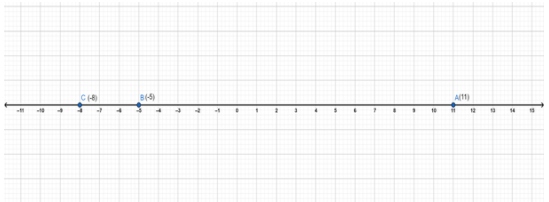
Given: {3,−7,6}

Graph the given set of integers on a number line.

The graph of the number is the point on this line that corresponds to each number. 3Lies in the middle between 2and4

While−7lies in the middle between−6 and−8,and 6lies in the middle between 5 and 7

 

Glencoe Math Course 2, Volume 1, Common Core Student Edition, Chapter 3.1 Integers and Absolute value Page 197 Exercise 20 , graph 1


The given set of integers {3,−7,6} is marked on a number line.
Glencoe Math Course 2, Volume 1, Common Core Student Edition, Chapter 3.1 Integers and Absolute value Page 194 Exercise 7 , graph 2


Page 197  Exercise 21   Problem 23

Given: (−2,−4,−6,−8)

To Graph the set of integers on a number line?

− 2 Lies in the middle between −1 and−3.While−4 lies in the middle between−3 and−5 , and −6 lies in the middle between−5 and−7,−8 Lies in the middle between −7 and -9
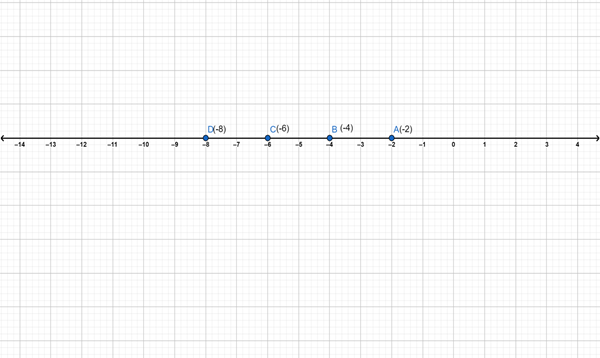
 

Glencoe Math Course 2, Volume 1, Common Core Student Edition, Chapter 3.1 Integers and Absolute value Page 197 Exercise 21

Finally, we Graph the set of integers on a number line.


Page 197  Exercise 22  Problem 24

Given: −12=____

To evaluate the expression.

The absolute value of a number is the distance from the number

The distance cannot be negative.

Therefore, the absolute value is

​⇒  12

Finally, we concluded that the result is  ⇒  12


Page 197  Exercise 23  Problem 25

Given: 7+4=____

To evaluate the expression

The absolute value of a number is the distance from the number to zero.

Therefore, the absolute value is

​⇒   7 + 4 = 7 + 4

⇒ 11

Finally, we concluded that the result is ⇒ 11


Page 197   Exercise 24   Problem 26

Given: |−9| + |−5| =____

Consider the given operations and evaluate the expression.

The absolute value function determines a number’s magnitude regardless of its sign.

​|−9| + |−5| = 9 + 5

= 14

​|−9| + |−5| = 14

The value of ∣−9∣+∣−5∣ is 14


Page 197   Exercise 25  Problem 27

Given: |−10| ÷ 2 × |5| = ____

Consider the signs and evaluate the expression.

The absolute value function determines a number’s magnitude regardless of its sign.

​|−10| ÷ 2 × |5| = 10 ÷ 2 × 5

= 5 × 5

= 25

​|−10| ÷ 2 × |5| = 25

The value of |−10| ÷ 2 × |5| is 25


Page 197  Exercise 26  Problem 28

Given: 12 − |−8| + 7 =____

Consider the signs and evaluate the expression.

The absolute value function determines a number’s magnitude regardless of its sign.

​​12−|−8| + 7 = 12 − 8 + 7

=  4 + 7

= 11

The value of 12−|−8| + 7 is 11


Page 197  Exercise 27  Problem 29

Given: 27 ÷ 3−4 = ____

To evaluate the expression.

The absolute value of a number is the distance from the number to zero.

Therefore, the absolute value is

​⇒  27÷3−4 = 27 ÷ 3 − 4 = 9 − 4 =5

⇒ 5

Finally, we concluded that the result is ⇒ 5


Page 197   Exercise 28  Problem  30

Given: Jasmine’s pet guinea pig gained 8 ounces in one month

To Write an integer to describe the amount of weight her pet gained.

Since the weight increased, it is described the amount of weight gained by a positive integer

Therefore, the positive integer is

⇒ 8

Finally, we concluded that the result is ⇒ 8


Page 198   Exercise 30  Problem  31

1. A $100 check deposited in a bank can be represented by  + 100.

2. loss of 15 yards in a football game can be represented by − 15

3. A temperature of 20 below zero can be represented by −20.

4. A submarine diving 300 feet underwater can be represented by + 300

To find Which of the following statements about these real-world situations is not true?

A situation below or under a level is best represented by a negative integer, while a situation above or over a level is represented by a positive Integer.

Therefore 4. A submarine diving 300 feet underwater can be represented by + 300 is not true.

Therefore, the statement 4 Option is not true.

Finally, we concluded that the result is  ⇒ 4 Option


Page 198  Exercise 31  Problem  32

Given:

Glencoe Math Course 2, Volume 1, Common Core Student Edition, Chapter 3.1 Integers and Absolute value Page 198 Exercise 31, table


To find which day was the low temperature the farthest from 0°F?

The temperature farthest from 0°Fis the temperature of −8°F on Wednesday

Therefore, the lowest temperature was on Wednesday

Finally, we concluded that the low temperature the farthestfrom0∘Fis on Wednesday at −8°F


Page 198  Exercise 32  Problem  33

Given:
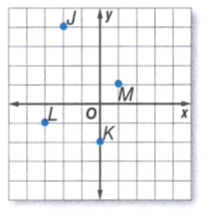
Glencoe Math Course 2, Volume 1, Common Core Student Edition, Chapter 3.1 Integers and Absolute value Page 198 Exercise 32 , graph

To Write the ordered pair corresponding to each point graphed.

The first number is the x-coordinate, while the second number is the y-coordinate.

Therefore J(−2,4)

Finally, we concluded that the ordered pair corresponding to each point was graphed. ⇒ J(−2,4)


Page 198  Exercise 33  Problem  34

Given:
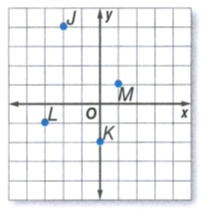
Glencoe Math Course 2, Volume 1, Common Core Student Edition, Chapter 3.1 Integers and Absolute value Page 198 Exercise 33 , graph

To Write the ordered pair corresponding to each point graphed.

The first number is the x-coordinate, while the second number is the y-coordinate.

Therefore K(0,2)

Finally, we concluded that the ordered pair corresponding to each point was graphed.  ⇒ K(0,2)


Page 198  Exercise 34   Problem  35

Given:
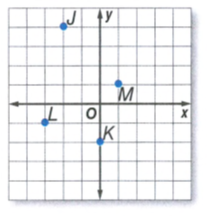
Glencoe Math Course 2, Volume 1, Common Core Student Edition, Chapter 3.1 Integers and Absolute value Page 198 Exercise 34 , graph

To Write the ordered pair corresponding to each point graphed.

The first number is the x-coordinate, while the second number is the y-coordinate.

Therefore L(−3,−1)

Finally, we concluded that the ordered pair corresponding to each point was graphed. ⇒ L(−3,−1)


Page 198  Exercise 35  Problem 36

Given:
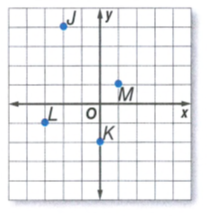
Glencoe Math Course 2, Volume 1, Common Core Student Edition, Chapter 3.1 Integers and Absolute value Page 198 Exercise 35 , graph

To Write the ordered pair corresponding to each point graphed.

The first number is the x-coordinate, while the second number is the y-coordinate.

Therefore M(1,1)

Finally, we concluded that the ordered pair corresponding to each point was graphed. ⇒ M(1,1)


Page 198  Exercise 36  Problem 37

Given: A(2,4)

To Graph and label each point on the coordinate plane.

The first number is the x-coordinate, while the second number is the y-coordinate.

The required graph is:
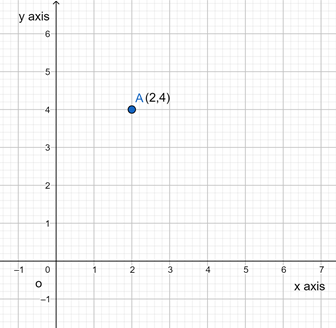
 

Glencoe Math Course 2, Volume 1, Common Core Student Edition, Chapter 3.1 Integers and Absolute value Page 198 Exercise 36 , graph 1


Finally, we Graph and label each point on the coordinate plane
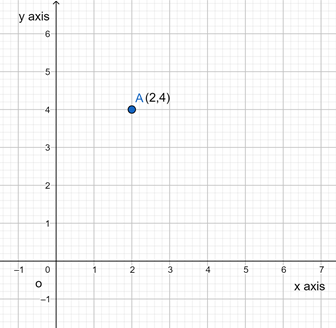
Glencoe Math Course 2, Volume 1, Common Core Student Edition, Chapter 3.1 Integers and Absolute value Page 198 Exercise 36 , graph 2


Page 198  Exercise 37  Problem 38

Given: B(−3,1)

To Graph and label each point on the coordinate plane.

The first number is the x-coordinate, while the second number is the y-coordinate.
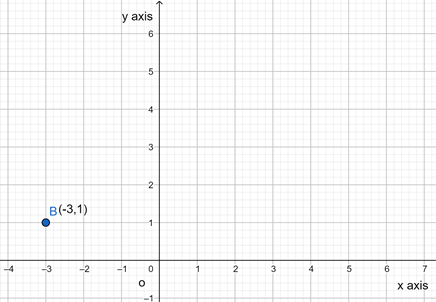
 

Glencoe Math Course 2, Volume 1, Common Core Student Edition, Chapter 3.1 Integers and Absolute value Page 198 Exercise 37 , graph 1


Finally, we Graph and label each point on the coordinate plane
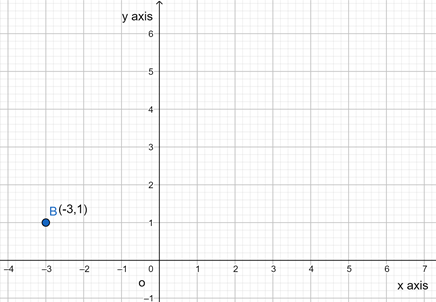
Glencoe Math Course 2, Volume 1, Common Core Student Edition, Chapter 3.1 Integers and Absolute value Page 198 Exercise 37 , graph 2


Page 198  Exercise 38  Problem 39

Given: C(2,0)

To Graph and label each point on the coordinate plane.

The first number is the x-coordinate, while the second number is the y-coordinate

The required graph is:
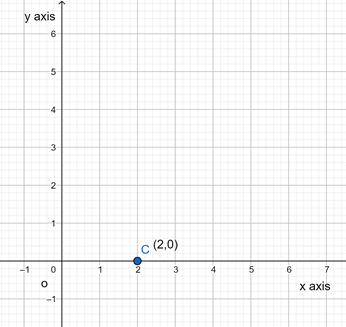
 

Glencoe Math Course 2, Volume 1, Common Core Student Edition, Chapter 3.1 Integers and Absolute value Page 198 Exercise 38 , graph 1


Finally, we plotted Graph and labeled each point on the coordinate plane
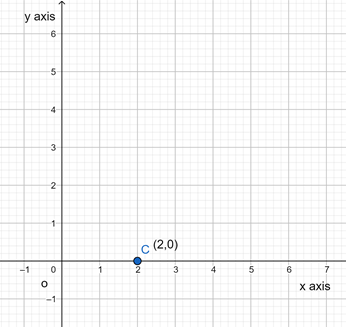
Glencoe Math Course 2, Volume 1, Common Core Student Edition, Chapter 3.1 Integers and Absolute value Page 198 Exercise 38 , graph 2


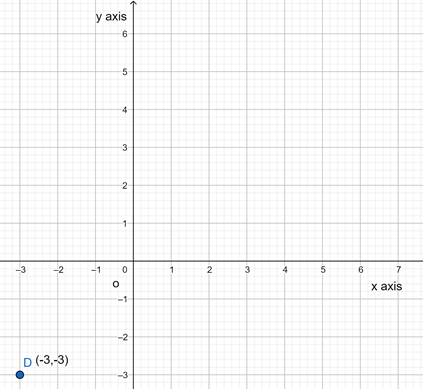
Page 198   Exercise 39  Problem 40

Given:D(−3,−3)

To Graph and label each point on the coordinate plane.

The first number is the x-coordinate, while the second number is the y-coordinate.

The required graph is:
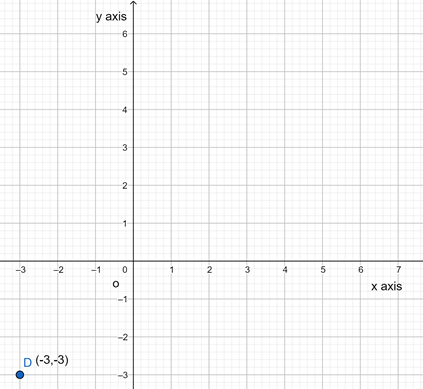
 

Glencoe Math Course 2, Volume 1, Common Core Student Edition, Chapter 3.1 Integers and Absolute value Page 198 Exercise 39 , graph 1


Finally, we Graph and label each point on the coordinate plane
Glencoe Math Course 2, Volume 1, Common Core Student Edition, Chapter 3.1 Integers and Absolute value Page 198 Exercise 39 , graph 2


Page 201  Exercise 1  Problem 41

Given:

5 + 6 =_____

To Find each sum. Show your work using drawings.

Given equation is

​5 + 6 = 11

⇒ 11

Drawings:

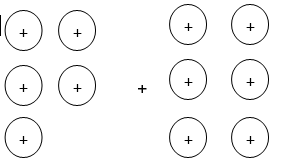
Glencoe Math Course 2, Volume 1, Common Core Student Edition, Chapter 3.1 Integers and Absolute value Page 201 Exercise 1

Finally, we find the sum ⇒ 11


Page 201  Exercise 3  Problem 42

Given:

−5 + (−4) =_____

To Find each sum. Show your work using drawings.

Given equation is

​−5 + (−4) = −9

⇒ −9

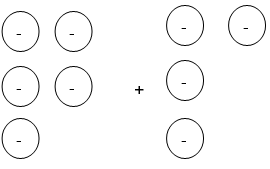
Drawings:

Glencoe Math Course 2, Volume 1, Common Core Student Edition, Chapter 3.1 Integers and Absolute value Page 201 Exercise 3

Finally, we find the sum  ⇒ −9


Page 201  Exercise 4  Problem 43

Given:

7 + 3 = _____

To Find each sum. Show your work using drawings.

Given equation is

​7 + 3 = 10

⇒ 10

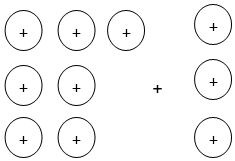
Drawings:


Glencoe Math Course 2, Volume 1, Common Core Student Edition, Chapter 3.1 Integers and Absolute value Page 201 Exercise 4

Finally, we find the sum  ⇒ 10


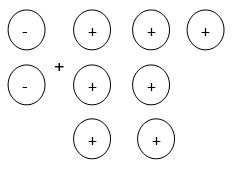
Page 201  Exercise 6  Problem  44

Given:

−2 + 7 =_____

To Find each sum. Show your work using drawings.

−2 + 7 =  5

⇒  5

Drawings:
Glencoe Math Course 2, Volume 1, Common Core Student Edition, Chapter 3.1 Integers and Absolute value Page 201 Exercise 6

Finally, we find the sum  ⇒ 5


Page 201  Exercise 7  Problem  45

Given:

8 + (−3) =_____

To Find each sum. Show your work using drawings.

Given equation is

​8 + (−3) = 5

⇒ 5

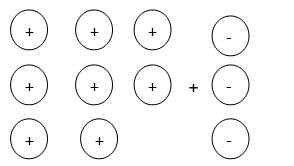
​Drawings:

Glencoe Math Course 2, Volume 1, Common Core Student Edition, Chapter 3.1 Integers and Absolute value Page 201 Exercise 7

Finally, we find the sum ⇒ 5


Page 201  Exercise 8  Problem 46 

Given:

3 + (−6)=_____

To Find each sum. Show your work using drawings.

Given equation is

​3 + (−6) =−3

⇒ −3

Drawings:

Glencoe Math Course 2, Volume 1, Common Core Student Edition, Chapter 3.1 Integers and Absolute value Page 201 Exercise 8

Finally, we find the sum  ⇒−3


Page 202  Exercise 10  Problem  47

Given:

Glencoe Math Course 2, Volume 1, Common Core Student Edition, Chapter 3.1 Integers and Absolute value Page 202 Exercise 10 , table 1

To complete the table.

The given equation is

​7 + (−12) = − 5

⇒ −5

Sign of addend with greatest absolute value: Negative

Sign of sum: Negative

Glencoe Math Course 2, Volume 1, Common Core Student Edition, Chapter 3.1 Integers and Absolute value Page 202 Exercise 10 , table 2


Finally, we complete the table.

Glencoe Math Course 2, Volume 1, Common Core Student Edition, Chapter 3.1 Integers and Absolute value Page 202 Exercise 10 , table 3


Page 202  Exercise 11  Problem 48

Given: 

Glencoe Math Course 2, Volume 1, Common Core Student Edition, Chapter 3.1 Integers and Absolute value Page 202 Exercise 11 , table 1

To complete the table.

Given equation is

​−4 + 9 = 5

⇒  5

Sign of addend with greatest absolute value: Positive

Sign of sum: Positive

Glencoe Math Course 2, Volume 1, Common Core Student Edition, Chapter 3.1 Integers and Absolute value Page 202 Exercise 11 , table 2


Finally, we complete the table.

Glencoe Math Course 2, Volume 1, Common Core Student Edition, Chapter 3.1 Integers and Absolute value Page 202 Exercise 11 , table 3


Page 202  Exercise 12  Problem 49 

Given:

Glencoe Math Course 2, Volume 1, Common Core Student Edition, Chapter 3.1 Integers and Absolute value Page 202 Exercise 12 , table 1

To complete the table.

-12 + 20 =  8

⇒  8

Sign of addend with greatest absolute value: Positive

Sign of sum: Positive

Glencoe Math Course 2, Volume 1, Common Core Student Edition, Chapter 3.1 Integers and Absolute value Page 202 Exercise 12 , table 2


Finally, we complete the table.

Glencoe Math Course 2, Volume 1, Common Core Student Edition, Chapter 3.1 Integers and Absolute value Page 202 Exercise 12 , table 3


Page 202  Exercise 13  Problem  50

Given:

Glencoe Math Course 2, Volume 1, Common Core Student Edition, Chapter 3.1 Integers and Absolute value Page 202 Exercise 13 , table 1

To complete the table

The given expression is

​15 + (−18) = −3

⇒ −3

Sign of addend with greatest absolute value: Negative

Sign of sum: Negative

Glencoe Math Course 2, Volume 1, Common Core Student Edition, Chapter 3.1 Integers and Absolute value Page 202 Exercise 13 , table 2


Finally, we complete the table.

Glencoe Math Course 2, Volume 1, Common Core Student Edition, Chapter 3.1 Integers and Absolute value Page 202 Exercise 13 , table 3


Page 202  Exercise 17  problem 51

Given:

First Round = −100

Second Round = −250

Third Round = 500

To Find the contestant’s total number of points. Explain your reasoning

The total number of points is the sum of all points.

The equation is

​⇒ −100 −250 + 500

⇒  (−350) + 500

⇒ 150

Finally, we concluded that the contestant’s total number of points  ⇒ 150 points


Page 202  Exercise 18  Problem  52

The sum of two integers is Negative, If

Both integers are negative

One integer is negative and the other is positive, while the absolute value of the negative integer is more than the absolute value of the positive integer.
Finally, we concluded that the sum of two integers is Negative. If Both integers are negative or One integer is negative and the other is positive, while the absolute value of the negative. An integer is more than the absolute value of the positive integer.