HMH Middle School Grade 7 Practice Fluency Workbook 1st Edition Solutions

Practice Fluency Workbook 1st Edition Solutions

HMH Middle School Grade 7 Practice Fluency Workbook 1st Edition, Chapter 4 Exercise 4.2 Ratios and Proportionality

HMH Middle School Grade 7 Practice Fluency Workbook 1st Edition Chapter 4 Ratios and Proportionality

HMH Grade 7 Ratios and Proportionality Exercise 4.2 solutions Page 29 Problem 1 Answer

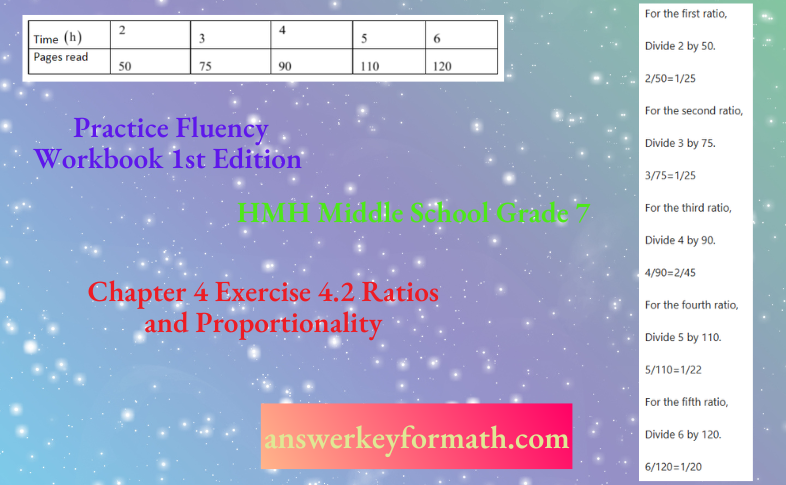
It is given, a table

Go Math!, Middle School Grade 7, Practice Fluency Workbook, 1st Edition, Chapter 4 Ratios and Proportionality 1

It is required to write whether the relationship in the given table is proportional or not.

In order to write whether the relationship in the given table is proportional or not, apply the definition of proportion.

In order to check whether the relationship in the given table is proportional or not, evaluate the ratios and check whether they are equal or not.

For the first ratio,

Divide 4 by 17.40.

4/17.40=20/87

For the second ratio,

Divide 5 by 21.75.

5/21.75=20/87

For the third ratio,

Divide 46 by 200.10.

46/200.10=20/87

Since, the ratios are constant, then, the relationship in the given table is proportional.

The relationship in the given table is proportional.

Read and Learn More HMH Middle School Grade 7 Practice Fluency Workbook 1st Edition Solutions

HMH Middle School Grade 7 Chapter 4 Page 29 Problem 2 Answer

It is given, a table with proportional relationship (refer to a part of this problem)

It is required to write the equation for the given relationship.

Go Math!, Middle School Grade 7, Practice Fluency Workbook, 1st Edition, Chapter 4 Ratios and Proportionality 2

In order to write the equation for the given relationship, form the equation using equation of directly proportional relationship.

To begin with, let x be the weight and y be the total cost.

Since, it is a proportional relationship.

So, the equation is in the form y=kx, where k is the constant of proportionality.

Further, evaluate k, by evaluating the difference of any two consecutive value from the table.

Thus, the cost difference of weights for 5th from 4th value is 21.75−17.40=4.35.

Furthermore, verify it by evaluating cost difference between weights 46 and 5.

​200.10−21.75/46−5=178.35/41

=4.35

Hence, as evaluated, the equation is y=4.35x.

The equation for the given relationship is y=4.35x.

HMH Middle School Grade 7 Chapter 4 Page 29 Problem 3 Answer

It is given, the equation representing the relationship given in the table is y=4.35x (refer to b part of this problem), and a table

Go Math!, Middle School Grade 7, Practice Fluency Workbook, 1st Edition, Chapter 4 Ratios and Proportionality 3

It is required to write the variable to represent weight in the given table.

In order to write the variable to represent weight in the given table, represent weight with any variable.

In order to represent weight with any variable, write which variable represents weight in the given equation y=4.35x.

Thus, the variable x represents the weight.

The variable x represents the weight.

HMH Middle School Grade 7 Chapter 4 Page 29 Problem 4 Answer

It is given, the equation representing the relationship given in the table is y=4.35x (refer to b part of this problem), and a table

Go Math!, Middle School Grade 7, Practice Fluency Workbook, 1st Edition, Chapter 4 Ratios and Proportionality 4

It is required to write the variable to represent total cost in the given table.

In order to write the variable to represent total cost in the given table, represent total cost with any variable.

In order to represent total cost with any variable, write which variable represents total cost in the given equation y=4.35x.

Thus, the variable y represents the total cost.

The variable y represents the total cost.

HMH Middle School Grade 7 Chapter 4 Page 29 Problem 5 Answer

A table as shown below is given.

It is required to check whether the given relationship is proportional or not, if so then write the equation for the relationship.

In order to check whether the given relationship is proportional or not, apply definition of proportional.

In order to check whether the relationship in the given table is proportional or not, evaluate the ratios and check whether they are equal or not.

HMH Middle School Grade 7 Practice Fluency Workbook 1st Edition Chapter 4 Exercise 4.2 Ratios and Proportionality

Since, the ratios are not constant, then, the relationship in the given table is not proportional.

The relationship in the given table is not proportional.

HMH Middle School Grade 7 Chapter 4 Page 29 Problem 6 Answer

A table that shows proportional relationships between two quantities, pens and boxes, is given.

It is required to find the constant of proportionality, k , write an equation to represent the relationship between the two quantities and tell what each variable represents.

First, find whether the two quantities in the table are directly proportional or inversely proportional.

Then, form equation with constant of proportionality k.

Find the value of constant of proportionality.

Finally, substitute the value of k to form the equation that represents the relation between two quantities.

Find the constant of proportionality k.

The table shows the proportionality relationship between two quantities, pens and boxes.

In the table,

Pens=3

Boxes =1

Here, the number of pens is more than the number of boxes. So, the number of pens vary inversely with the boxes.

Let x represent the number of pens and y represent the number of boxes.

For inverse proportion, the equation is,

y=k/x

Where, k is the constant of proportionality.

Solve the equation to represent a relation.

Here,x represents the number of pens and y represents number of the boxes.

So, the value of x is 3 and value of y is 1.

Substitute 3 for x and 1 for y in the equation y=k/x.

1=k/3

Cross multiply.

k=3

The value of k is 3.

To represent the relation in an equation,

Substitute 3 for k.

y=3/x

Hence, y=3/x is the equation that represents the relation.

The value of constant of proportionality k is 3.

The equation that represents the relation between two quantities is y=3/x.

Practice Fluency Workbook Chapter 4 Exercise 4.2 Answers Page 29 Problem 7 Answer

A table that shows proportional relationships between two quantities, pack and muffins, is given.

It is required to find the constant of proportionality,k, write an equation to represent the relationship between the two quantities and tell what each variable represents.

First, find whether the two quantities in the table are directly proportional or inversely proportional.  Then, form equation with constant of proportionality k.

Find the value of constant of proportionality.

Finally, substitute the value of k to form the equation that represents the relation between two quantities.

Find the constant of proportionality k.

The table shows the proportionality relationship between two quantities, pack and muffins.

In the table,

Pack =1

Muffins =6

Here, the number of packs is less than the number of muffins. So, the number of packs varies directly with the muffins.

Let x represent the number of packs and y represent the number of muffins.

For directly proportional, the equation is,

y=kx

Where,k is the constant of proportionality.

Solve the equation to represent a relation.

Here, x represents the number of packs and y represents number of the muffins.

Substitute 1 for x and 6 for y in the equation y=kx.

6=k⋅1 Or,k=6

The value of k is 6.

To represent the relation in an equation,

Substitute 6 for k.

y=6k

Hence, y=6k is the equation that represents the relation.

The value of constant of proportionality k is 6.

The equation that represents the relation between two quantities is y=6k.

HMH Middle School Grade 7 Chapter 4 Page 29 Problem 8 Answer

It is given that the number of days is related to the number of hours.

It is required to create table to show how the number of days is related to the number of hours.

Draw a table that represents two quantities, days and hours.

Table represents two quantities days and hours.

The number of days can be related to number of hours, since 1 day has 24 hours.

So,2 days have 48 hours, 3 days have 72 hours, 4 days have 96 hours and 5 days have 120 hours.

Table representation of days and hours is as follows.

Go Math!, Middle School Grade 7, Practice Fluency Workbook, 1st Edition, Chapter 4 Ratios and Proportionality 8

Table that shows a relationship between days and hours is given as,

Go Math!, Middle School Grade 7, Practice Fluency Workbook, 1st Edition, Chapter 4 Ratios and Proportionality 8 1

Page 29 Problem 9 Answer

A table that shows the number of days and number of hours is given.

It is required to find if the relationship is proportional.

Find the ratio between the hours and days.

If the rate comes out to be the same, the relationship is proportional.

Given, the table that shows number of days and number of hours

To known if this relationship is proportional, find out the rate of change is constant.

Express each rate of change shown in the table as a fraction.

So, 24/1=24

48/2=24

72/2=24

96/2=24

And, 120/2=24

The rate of change for each column is the same. Because the rate of change is constant, the relationship is proportional.

The relationship is proportional.

HMH Middle School Grade 7 Chapter 4 Page 29 Problem 10 Answer

It is given that the number of days is related to the number of hours.

It is required to find the equation to represent the relationship.

Find the value of constant of proportionality, k.

Then, substitute the value of k in the equation to form the equation that represents the relation between two quantities.

Here, the number of days varies directly with the hours.

Let x represent the number of days and y represent the number of hours.

For directly proportional, the equation is,

y=kx

Where, k is the constant of proportionality.

Substitute 1 for x and 24 for y in the equation y=kx.

24=k⋅1 Or, k=24

The value of k is 24.

Represent the relation in an equation.

Substitute 24 for k.

y=24k

Hence, y=24k is the equation that represents the relation.

The equation that represents the relation between the two given quantities is y=24k.

7th Grade HMH Ratios And Proportionality Exercise 4.2 Step-By-Step Page 30 Problem 12 Answer

A table showing the number of texts that Terri received in a certain period of time is given.

An equation for the relationship is required.

As the proportionality constant is obtained as 3, the equation relating the number of texts y and time period x can be written in terms of the proportionality constant k.

When considering the relation between any two quantities, if the rate of change of one quantity with respect to other remains constant, then, such relationship is proportional.

Write the general equation for a proportional relation of y with respect to x in terms of the proportionality constant k.

y=kx

Rewrite in terms of the proportionality constant 3.

y=3x

The relationship can be expressed in the form of an equation as y=3x.

HMH Middle School Grade 7 Chapter 4 Page 30 Problem 13 Answer

A table showing the number of texts that Terri received in a certain period of time is given.

It is required to find the rate of change from the given relation.

Note that the fraction for each column of the table gives the corresponding rate of change of quantities with respect to other.

But, as the relation in the table is proportional, the rate of change remains constant throughout for each value.

First, write the fraction for each column by dividing the number of texts with time as 3

1,​6/2,​9/3, and 12/4.As the result of all the four fraction is 3 , the rate of change is also 3.

The result of all the four fraction is obtained as 3 , which means that the rate of change is also 3.

Ratios Grade 7 Practice Fluency Workbook Help Exercise 4.2 Page 30 Problem 14 Answer

A table is given as shown below where x is the weight.

It is required to write the equation for the given table.

Go Math!, Middle School Grade 7, Practice Fluency Workbook, 1st Edition, Chapter 4 Ratios and Proportionality 14

To write the equation for the given table, it is necessary to check the constant rate of change of each set of data from the given table.

Here, x represents the weight and y represents the cost.

Let k be the constant rate of change between x and y.

The constant rate of change is given by, k=y/x.

For the first set of set of data, the constant rate of change k is given by,

21/3=7.

For the second set of set of data, the constant rate of change k is given by,

28/4=7.

For the third set of set of data, the constant rate of change k is given by,

35/5=7.

For the last set of set of data, the constant rate of change k is given by,

42/6=7.

The rate of change for each column is the same. It can be concluded that the rate of change is constant. It implies that the relationship is proportional.

The proportional relationship is scripted as y=kx.

Here, the value of k is 7 for the given relationship.

Hence, the proportional relationship will be y=7x.

The equation for the given table is y=7x.

HMH Middle School Grade 7 Practice Fluency Workbook 1st Edition, Chapter 4 Exercise 4.1 Ratios and Proportionality

HMH Middle School Grade 7 Practice Fluency Workbook 1st Edition, Chapter 4 Ratios and Proportionality

HMH Grade 7 Ratios and Proportionality Exercise 4.1 solutions Page 27 Problem 1 Answer

It is given that for 2 batches of nut bars, 4 eggs are needed.

It is required to find the number of eggs required to use in each batch of nut bars.

For that, divide both terms.

For 2 batches of nut bars, 4 eggs are used.

So, it can be written as,2 batches of nut bars =4 eggs.

Similarly,1 batch of nut bars =4/2 eggs.

Hence,1 batch of nut bars=2 eggs.

The number of eggs required in each batch of nut bars is 2.

HMH Middle School Grade 7 Chapter 4 Page 27 Problem 2 Answer

It is given that last week, Alexander was paid $56 for 7 hours of work.

It is required to find the pay per hour.

For that, divide both the terms.

Given, the pay last week was $56 for 7hours of work.

So, it can be written as,7 hours= $56

So,1 hour  = $ 56/7

Hence, 1 hour = $8.

Alexander is paid $8 per hour.

Read and Learn More HMH Middle School Grade 7 Practice Fluency Workbook 1st Edition Solutions

HMH Middle School Grade 7 Chapter 4 Page 27 Problem 3 Answer

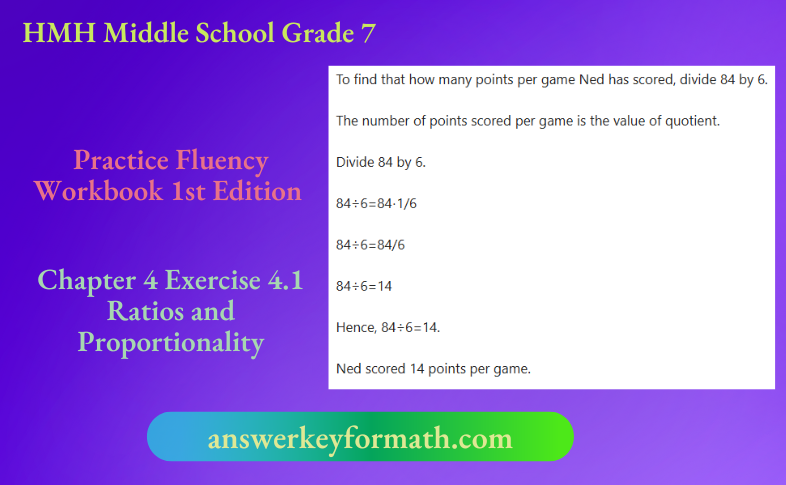
It is given that Ned has scored 84 points in the first 6 games of the basketball season.

It is required to find that how many points per game Ned has scored.

HMH Middle School Grade 7 Practice Fluency Workbook 1st Edition Chapter 4 Exercise 4.1 Ratios and Proportionality

Practice Fluency Workbook Chapter 4 Exercise 4.1 answers Page 27 Problem 4 Answer

It is given that at the local grocery store, a 16 -ounce bottle of apple juice costs $3.20.

It is required to find the cost of the apple juice per ounce.

To find the cost of the apple juice per ounce, divide $3.20 by 16.

The cost of apple juice per ounce is the value of quotient.

Divide$3.20 by 16.

​3.20÷16=31/5⋅1/16

3.20÷16=16/5⋅1/16

3.20÷16=1/5

Hence,3.20÷16=1/5.

The cost of the apple juice per ounce is $1/5 or $0.20.

HMH Middle School Grade 7 Chapter 4 Page 27 Problem 5 Answer

It is given that after  3/4 of a minute, a sloth has moved just  3/8 of a foot.

It is required to find the sloth’s speed in feet per minute.

To find the sloth’s speed in feet per minute, divide 3/8 by 3/4

The number of feet per minute (the speed) is the value of the quotient.

Divide 3/8 by 3/4.

​3/8÷3/4=3/8⋅4/3

3/8÷3/4=3⋅4/8⋅3

3/8÷3/4=12/24

3/8÷3/4=1/2

Hence, 3/8÷3/4=1/2.

The sloth’s speed is 1/2 feet per minute.

7th Grade HMH Ratios And Proportionality Exercise 4.1 Step-By-Step Page 27 Problem 6 Answer

It is given that food A contains 150 calories in 3/4 of a serving and food B contains 250 calories in 2/3 of a serving.

It is required to find each unit rate and which food has fewer calories per serving

To find each unit rate, divide 150 by 3/4 and 250 by 2/3

Determining unit rate of food A

​=150÷3/4

150÷3/4 =150×4/3

150÷3/4 =150×4/3

150÷3/4 =600/3

150÷3/4 =200

200 calories per serving

Determining unit rate of food B

=250÷2/3

150÷3/4 =250×3/2

150÷3/4 =150×3/2

150÷3/4 =750/2

150÷3/4 =375

375 calories per serving

As 200<375, Food A has fewer calories per serving.

Food A has 200 calories per serving, Food B has 375 calories per serving and Food A has fewer calories per serving

HMH Middle School Grade 7 Chapter 4 Page 28 Problem 7 Answer

A comparison is given as 70 students per 2 teachers.

It is required to express the given comparison as a rate in ratio form.

To express the given comparison as a rate in ratio form, divide 70 by 2.

Determine the rate in ratio form for 70 students per 2 teachers.

=70 students/2 teachers

The rate in ratio form for 70 students per 2 teachers is  70 students/2 teachers.

Ratios Grade 7 Practice Fluency Workbook Help Exercise 4.1 Page 28 Problem 8 Answer

A comparison is given as 3 books in 2 months.

It is required to express the given comparison as a rate in ratio form.

To express the given comparison as a rate in ratio form, divide 3 by 2.

Determine the rate in ratio form for 3 books in 2 months.

=3 books/2 months

The rate in ratio form for 3 books in 2 months is 3 books/2 months.

HMH Middle School Grade 7 Chapter 4 Page 28 Problem 9 Answer

A comparison is given as $52 for 4 hours of work.

It is required to express the given comparison as a rate in ratio form.

To express the given comparison as a rate in ratio form, divide $52 by 4

Determine the rate in ratio form of $52 for 4 hours of work =$52/4hours

The rate in ratio form of $52 for 4 hours of work is $52/4hours

Chapter 4 Ratios and Proportionality Exercise 4.1 HMH Workbook answers Page 28 Problem 10 Answer

A comparison is given as 28 patients for 2 nurses.

It is required to express the given comparison as a unit rate.

To express the given comparison as a rate in ratio form, divide 28 by 2 and then make the denominator  1.

Divide 28 by 2.

28 patients/2 nurses

Make the denominator equal to 1.

Divide both the numerator and the denominator by 2.

28/2

2/2=14/1

Hence.

The unit rate of $52 for 28 patients for 2 nurses is 14 patients/1 nurses.

HMH Middle School Grade 7 Chapter 4 Page 28 Problem 11 Answer

A comparison is given as 5 quarts for every 2 pounds.

It is required to express the given comparison as a unit rate.

To express the given comparison as a rate in ratio form, divide 5 by 2 and then make the denominator 1.

Divide 5 by 2.

5quartz/2pounds

Make the denominator equal to 1.

Divide both the denominator and the numerator by 2.

​5/2=5/2

2/2

5/2=2.5 /1

Hence, 5/2=2.5 /1.

The unit rate of 5 quarts for every 2 pounds is 2.5quarts/1pound.

Step-By-Step Ratios Solutions For 7th Grade Exercise 4.1 Page 28 Problem 12 Answer

It is given, 3 ounces for every 3/4 cup.

It is required to find the unit rate.

In order to find the unit rate, form an expression using the given information and simplify.

To begin with, make an expression using the given information to evaluate unit rate.

So, the expression is 3÷3/4.

Further, find the multiplicative inverse of 3/4.

So, multiplicative inverse of 3/4 is 4/3.

Now, multiply 4/3 to 3.

​3÷3/4=3×4/3

​3÷3/4 =4/1

Hence, as evaluated, the unit rate is 4 ounces per cup.

The unit rate is 4 ounces per cup.

HMH Middle School Grade 7 Chapter 4 Page 28 Problem 13 Answer

It is given, 32/3 feet per 11/60 hour.

It is required to find the unit rate.

In order to find the unit rate, form an expression using the given information and simplify.

To begin with, make an expression using the given information to evaluate unit rate.

So, the expression is 32/3÷11/60=11/3÷11/60.

Further, find the multiplicative inverse of 11/60.

So, multiplicative inverse of 11/60 is 60/11.

Now, multiply 60/11 to 11/3.

11/3÷11/60=11/3×60

11/=20/1

Hence, as evaluated, the unit rate is 20feet per hour.

The unit rate is 20 feet per hour.

HMH Middle School Grade 7 Practice Fluency Workbook 1st Edition Chapter 3 Exercise 3.6 Rational Numbers

HMH Middle School Grade 7 Practice Fluency Workbook 1st Edition Chapter 3 Rational Numbers

HMH Grade 7 Rational Numbers Exercise 3.6 solutions Page 25 Problem 1 Answer

It is given that the measure of each section of fencing is 4×1/3 feet long.

It is required to find the length of 6×1/2 sections placed end to end.

To find the length of 6 x1/2 sections placed end to end, it is necessary to multiply the length of each section to 6×1/2.

Since the length of each section is 4×1/3 feet, hence, the length of 6×1/2 sections placed will be the product of 4×1/3 and 6×1/2.

Compute the product.

​4×1/3⋅6×1/2=1×3/3⋅1×3/2

4×1/3⋅6×1/2=13⋅13/3⋅2

4×1/3⋅6×1/2=169/6

4×1/3⋅6×1/2=281/6

Hence, the required measurement is 281/6 feet.

The 6×1/2 sections when placed end to end are 281/6 feet long.

Read and Learn More HMH Middle School Grade 7 Practice Fluency Workbook 1st Edition Solutions

HMH Middle School Grade 7 Chapter 3 Page 25 Problem 2 Answer

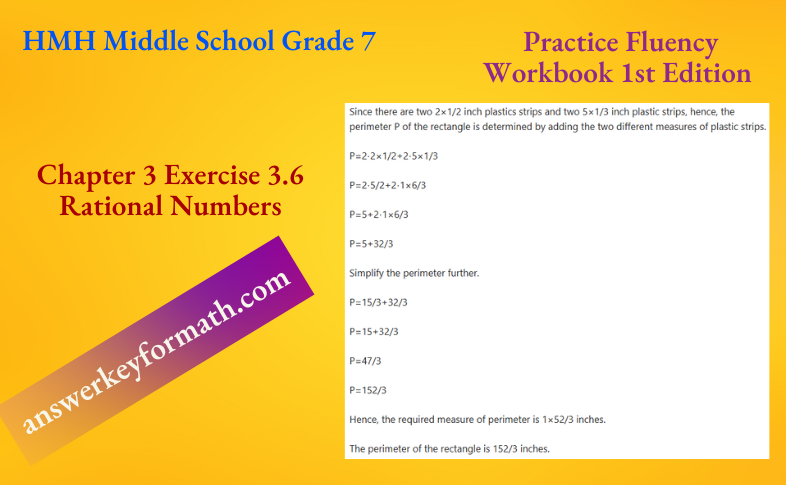
It is given that a rectangle is formed by using two 2×1/2 inch plastics strips and two 5×1/3 inch plastic strips.

It is required to find the perimeter of the rectangle.

To find the perimeter of the rectangle, it is necessary to add all the plastic strips as mentioned.

HMH Middle School Grade 7 Practice Fluency Workbook 1st Edition Chapter 3 Exercise 3.6 Rational Numbers

The perimeter of the rectangle is 152/3 inches.

Practice Fluency Workbook Chapter 3 Exercise 3.6 answers Page 25 Problem 3 Answer

It is given that the average mass of the eggs laid by chickens on Ms. Watson’s farm is 3.5grams.

It is required to find the weight of a dozen eggs.

To find the weight of a dozen eggs, it is necessary to multiply the average mass of eggs to a dozen eggs.

A dozen eggs can be written as 12 eggs.

The mass of a dozen egg is the product of average mass of an egg and 12 eggs.

It implies12⋅3.5.

Compute the value of the product.

12⋅3.5=12⋅31/2

12⋅3.5=12⋅7/2

Expand the term 12 as 2⋅6.

​12⋅3.5=2⋅6⋅7/2

12⋅3.5=6⋅7

12⋅3.5=42

​Hence, the weight is 42 grams.

The weight or mass of a dozen eggs is 42 grams.

HMH Middle School Grade 7 Chapter 3 Page 25 Problem 4 Answer

It is given that an 8.5cm green pod contains peas that average 0.45cm in diameter.

It is required to find the total numbers of peas are present in the pod.

For that, divide the given length of the pods with given

According to the given information,

The total number of peas will be calculated by dividing the length of the pod by the diameter of each pod.

So, Number of peas =8.5/0.45

Number of peas = 18.888888…

Hence the number of peas ≈19.

The total number of peas is 19.

HMH Middle School Grade 7 Chapter 3 Page 25 Problem 5 Answer

It is given that a dropper produces drops of  1/8mm to fill a 30mm test tube.

It is required to find the total numbers of drops needed to fill the test tube.

For that, divide the given length of the test tube with given millimeter.

The dropper produces drops of 1/8mm  to fill a 30mm test tube.

So, 1 drop=1/8mm

Number of drops will be calculated by dividing the total volume to be filled in the test tube by the volume of one drop.

So, Number of drops =30

1/8 Number of drops =30×8

Hence, the number of drops=240

The total numbers of drops needed to fill the test tube is 240.

HMH Middle School Grade 7 Chapter 3 Page 25 Problem 6 Answer

It is given that 3 strips of a 2yard wide outdoor carpet are used to cover a sidewalk.

One is 3.5yard long. Second is 25 percent longer than the first.

The third is 61/4 yard long.

It is required to find length if the three carpets are placed end to end.

For that, find the length of the all three carpets, and then add up the lengths.

As the length of the second carpet is 25 percent longer than the first, it can be written as,

3.5+25

3.5+25

The length of the third strip is 61/4 yard long.

So, 61/4=25/4 yard

61/4=6.25yard

​Hence,61/4=6.25yard.

So, the length, if the three carpets placed end to end, is,

3.5+4.375+6.25=14.125yard

The length, if the three carpets are placed end to end is 14.125 yard.

HMH Middle School Grade 7 Chapter 3 Page 26 Problem 7 Answer

It is given that a cup of dog food weighs 14/5 ounces. It is also given that the dog eats 61/3 cups of food a day.

It is required to find the ounces of food the dog eats each day.

For that, convert the given number of cups into ounces.

A cup of dog food weighs 14/5 ounces.

So, it could be written as,

1 cup =14/5 ounces.

Convert 14/5 into an improper fraction.

14/5=9/5

14/5=1.8ounces

Hence, 14/5=1.8ounces.

Similarly,

6×1/3 cups=6×1/3⋅1.8ounces

Convert 61/3 into an improper fraction.

​6×1/3=1×9/3⋅1.8

6×1/3=11.39ounces

Hence,6×1/3=11.39ounces.

The dog eats 11.39 ounces of food each day.

7th Grade HMH Rational Numbers Exercise 3.6 Step-By-Step Page 26 Problem 8 Answer

It is given that a painter spends 3 hours working on a painting.

It is also given that a sculptor spends 22/3 times as long on a sculpture.

It is required to find how long does the sculpture work.

Convert 22/3  into an improper fraction.

Then, multiply it with 3 to get the required answer.

In one hour, the sculptor spends 22/3 times longer than a painter.

So, it could be written as,1hour =22/3 times.

Convert 22/3  into an improper fraction.

22/3=8/3

So, for 3 hours,

3 hours= 3⋅8/3

Hence, 3 hours =8.

The sculpture works for 8 hours.

HMH Middle School Grade 7 Chapter 3 Page 26 Problem 9 Answer

It is given that meteorite of United States weighs 7/10  as much as one found in Mongolia which weighs 22ton.

It is required to find the weight of meteorite found in the United States.

For that, multiply the both terms.

The given data can be written as,

Weight of meteorite found in the United States =7/10⋅22

Weight of meteorite found in the United States =0.7⋅22

Hence, the weight of meteorite found in the United States =15.4tons.

The weight of meteorite of United State is 15.4tons.

Rational Numbers Grade 7 Practice Fluency Workbook Help Exercise 3.6 Page 26 Problem 10 Answer

It is given that the chicken salad recipe needs 1/8 pounds of chicken per serving.

It is required to find the pounds of chicken needed to make  8×1/2 servings.

For that, multiply both the terms.

The chicken salad recipe needs 1/8 pound of chicken per serving.

So, it can be written as,

Pounds of chicken needed to make 8×1/2 servings=8×1/2⋅1/8

Pounds of chicken needed to make 8×1/2 servings =17/2⋅1/8

Hence, pounds of chicken needed to make 8×1/2 servings =17/16

To make 81/2 servings of chicken are 17/16 pounds are needed.

HMH Middle School Grade 7 Practice Fluency Workbook 1st Edition Chapter 3 Exercise 3.5 Rational Numbers

Go Math! Middle School Grade 7 Practice Fluency Workbook 1st Edition Chapter 3 Rational Numbers

HMH Grade 7 Rational Numbers Exercise 3.5 solutions Page 23 Problem 1 Answer

An expression is given as, 1/2÷(−3).

It is required to find the quotient.

To find the quotient, first rewrite the problem and then multiply with the reciprocal.

Rewrite the problem to multiply by the reciprocal.

Hence, 1/2÷(−3)=1/2⋅(−1/3).

Multiply with the reciprocal.

1/2⋅(−1/3)=1⋅(−1)/2⋅3

1/2⋅(−1/3)=−1/6

Hence, 1/2⋅(−1/3)=−1/6.

Check the sign.

A positive divided by a negative is negative.

So, 1/2÷(−3)=−1/6.

The quotient of 1/2÷(−3) is −1/6.

Read and Learn More HMH Middle School Grade 7 Practice Fluency Workbook 1st Edition Solutions

HMH Middle School Grade 7 Chapter 3 Page 23 Problem 2 Answer

An expression is given as,−6÷(−3/4).

It is required to find the quotient.

To find the quotient, first rewrite the problem and then multiply with the reciprocal.

Rewrite the problem to multiply by the reciprocal.

Hence, −6÷(−3/4)=−6⋅(−4/3).

Multiply with the reciprocal.

​−6⋅(−4/3)=(−6)⋅(−4)/3

−6⋅(−4/3)=(−2⋅3)⋅(−4)/3

−6⋅(−4/3)=(−2)⋅(−4)

−6⋅(−4/3)=8

Hence, −6⋅(−4/3)=8.

Check the sign.

A negative divided by a negative is positive.

So, −6÷(−3/4)=9.

The quotient of −6÷(−3/4) is 9.

HMH Middle School Grade 7 Chapter 3 Page 23 Problem 3 Answer

HMH Middle School Grade 7 Practice Fluency Workbook 1st Edition Chapter 3 Exercise 3.5 Rational Numbers

Practice Fluency Workbook Chapter 3 Exercise 3.5 answers Page 23 Problem 4 Answer

An expression is given as, 5.25/15.

It is required to find the quotient.

To find the quotient, first rewrite the problem and then multiply with the reciprocal.

Rewrite the problem to multiply by the reciprocal.

​5.25/15=51/4/15

5.25/15=21/4⋅1/15

Hence, 5.25/15=21/4⋅1/15.

Multiply with the reciprocal.

​21/4⋅1/15=3⋅7/4⋅1/3⋅5

21/4⋅1/15=7⋅1/4⋅5

21/4⋅1/15=7/20

Hence,21/4⋅1/15=7/20.

Check the sign.

A positive divided by a positive is positive.

So, 5.25/15=7/20.

The quotient of 5.25/15 is 7/20.

HMH Middle School Grade 7 Chapter 3 Page 23 Problem 5 Answer

An expression is given as, −0.125÷(−0.5).

It is required to find the quotient.

To find the quotient, first rewrite the problem and then multiply with the reciprocal.

Rewrite the problem to multiply by the reciprocal.

​−0.125÷(−0.5)=−1/8÷(−1/2)

−0.125÷(−0.5)=−1/8⋅(−2)

Hence, −0.125÷(−0.5)=−1/8⋅(−2).

Multiply with the reciprocal.

​1/8⋅(−2)=(−1)⋅(−2)/8

1/8⋅(−2)=2/8

1/8⋅(−2)=1/4

Hence, 1/8⋅(−2)=1/4.

Check the sign.

A positive divided by a negative is positive.

So, −0.125÷(−0.5)=1/4.

The quotient of −0.125÷(−0.5) is 1/4.

HMH Middle School Grade 7 Chapter 3 Page 23 Problem 6 Answer

An expression is given as, −1/7÷(−3/14).

It is required to find the quotient.

To find the quotient, first rewrite the problem and then multiply with the reciprocal.

Rewrite the problem to multiply by the reciprocal.

Hence, −1/7÷−3/14=−1/7⋅(−14/3).

Multiply with the reciprocal.

​−1/7⋅(−14/3)=−1/7⋅−2⋅7/3

−1/7⋅(−14/3)=(−1)⋅(−2)/3

−1/7⋅(−14/3)=2/3​

Hence, −1/7⋅(−14/3)=2/3.

Check the sign.

A positive negative by a negative is positive.

So, −1/7÷(−3/14)=2/3.

The quotient of −1/7÷(−3/14) is 2/3.

7th Grade HMH Rational Numbers Exercise 3.5 step-by-step Page 23 Problem 7 Answer

An expression is given as, (3/2)/(−9/8).

It is required to find the quotient.

In order to find the quotient, find the multiplicative inverse of −9/8 and multiply it with 3/2.

Find the multiplicative inverse of −9/8.

So, the multiplicative inverse of −9/8 is −8/9.

Now, multiply −8/9  with  3/2.

​(3/2)/(−9/8)=3/2⋅(−8/9)

(3/2)/(−9/8)=−4/3

Hence, the quotient for the given expression is−4/3.

The quotient for the given expression is −4/3.

HMH Middle School Grade 7 Chapter 3 Page 23 Problem 8 Answer

An expression is given as, −11/2÷31/3.

It is required to find the quotient.

In order to find the quotient, find the multiplicative inverse of 31/3 and multiply it with−11/2.

Convert the mixed fraction into an improper fraction.

−11/2÷31/3=−3/2÷10/3.

Find the multiplicative inverse of 10/3.

So, the multiplicative inverse of 10/3 is 3/10.

Now, multiply  3/10 with −3/2.

​−3/2÷10/3=−3/2⋅(3/10)

−3/2÷10/3=−3/2⋅(3/10)

−3/2÷10/3=−9/20

Hence, −3/2÷10/3=−9/20.

The quotient for the given expression is −9/20.

Rational Numbers Grade 7 Practice Fluency Workbook help Exercise 3.5 Page 23 Problem 9 Answer

An expression is given as,21/4÷3/8.

It is required to find the quotient.

In order to find the quotient, find the multiplicative inverse of  3/8 and multiply with 21/4.

Convert the mixed fraction into an improper fraction.

21/4÷3/8=9/4÷3/8.

Find the multiplicative inverse of 3/8.

So, the multiplicative inverse of 3/8 is 8/3.

Now, multiply 8/3 with 9/4.

​9/4÷3/8=9/4⋅8/3

9/4÷3/8=72/12

9/4÷3/8=6

Hence, 9/4÷3/8=6.

The quotient for the given expression is 6.

HMH Middle School Grade 7 Chapter 3 Page 23 Problem 10 Answer

An expression is given as, 4.2−2.4.

It is required to find the quotient.

In order to find the quotient, find the multiplicative inverse of −24/10 and multiply it with 42/10.

Given, 4.2−2.4.

Divide both the numerator and the denominator by 10.

4.2−2.4=42/10−24/10.

Find the multiplicative inverse of −24/10.

So, the multiplicative inverse of −24/10 is −10/24.

Now, multiply −10/24 with 42/10.

​42/10−24/10=42/10⋅(−10/24)

42/10−24/10=−420/240

42/10−24/10=−7/4

Hence, 42/10−24/10=−7/4.

The quotient for the given expression is −7/4.

Grade 7 Rational Numbers Exercise 3.5 explained step-by-step Page 23 Problem 11 Answer

An expression is given as, −5/8÷(−5/16).

It is required to find the quotient.

In order to find the quotient, find the multiplicative inverse of −5/16 and multiply it with−5/8.

Find the multiplicative inverse of −5/16.

So, the multiplicative inverse of −5/16 is −16/5.

Now, multiply −16/5 with −5/8.

​−5/8÷(−5/16)=−5/8⋅(−16/5)

−5/8÷(−5/16)=80/40

−5/8÷(−5/16)=2

Hence, −5/8÷(−5/16)==2.

The quotient for the given expression is 2.

HMH Middle School Grade 7 Chapter 3 Page 23 Problem 12 Answer

It is given that, 0.25÷_____=−0.25.

It is required to fill in the blank.

In order to fill in the blank, let the number to be filled in blank be x. Find the multiplicative inverse of x and multiply it with 0.25. Then, simplify further.

Let the number to be filled in the blank be x .

So, the multiplicative inverse of x is 1/x.

Now, multiply 1/x with 0.25.

​0.25÷x=−0.25

0.25⋅1/x=−0.25

0.25/x=−0.25

​Multiply both sides with x.

0.25=−0.25x

Divide both sides by −0.25.

Hence, x=−1.

To make the given statement true, the blank has to be filled with the value −1.         

It is given that, −1/2÷_____=−7/3.

It is required to fill in the blank.

In order to fill in the blank, let the number to be filled in blank be x, find the multiplicative inverse of x and multiply with −1/2.

Then, simplify further.

Let the number to be filled in the blank be x.

Find the multiplicative inverse of x.

So, the multiplicative inverse of x is 1/x.

Now, multiply 1/x by −1/2.

​−1/2÷x=−7/3

−1/2⋅1/x=−7/3

−1/2x=−7/3

Multiply by x on both sides.

Hence, −1/2=−7/3x.

Multiply by −3/7 on both sides of −1/2=−7/3x.

x=−1/2⋅(−3/7)

x=3/14

Hence, x=3/14.

To make the given statement true, the blank has to be filled with the value 3/14.

HMH Chapter 3 Rational Numbers Exercise 3.5 answers Page 23 Problem 14 Answer

It is given that, 1/7÷_____=14.

It is required to fill in the blank.

In order to fill in the blank, let the number to be filled in blank be x, find the multiplicative inverse of x and multiply with 1/7.

Then, simplify further.

Let the number to be filled in the blank be x.

Find the multiplicative inverse of x.

So, the multiplicative inverse of x is 1/x.

Now, multiply  1/x with 1/7.

​1/7÷x=14

1/7⋅1/x=14

1/7x=14

Hence, 1/7x=14.

HMH Middle School Grade 7 Chapter 3 Page 23 Problem 15 Answer

It is given that the total plant food is of 8 pounds.

It is required to find how many quarter-pound (1/4) packets can be made out of the total plant food.

In order to find how many quarter-pound (1/4) packets can be made out of total plant food, make an expression using given information and simplify.

Let the number of packets that can be made out be x.

Make an expression using the given information.

8÷1/4=x

Further, evaluate the multiplicative inverse of 1/4.

So, the multiplicative inverse of 1/4 is 4.

Now, multiply 4 with 8.

​8÷1/4=x

8⋅4=x

32=x

Hence, 32=x.

The number of packets that can be made are 32.

Online help for Rational Numbers Grade 7 Exercise 3.5 Page 23 Problem 16 Answer

It is given that the assembly of a machine takes 3/4 hour and there are 12 steps in total.

It is required to find the average time for each step.

In order to find the average time for each step, make an expression using the given information and simplify.

Let the average time for each step be x.

The assembly takes 3/4 hour and there are 12 steps in total.

Make an expression using given information

3/4÷12=x.

Evaluate the multiplicative inverse of 12.

So, the multiplicative inverse of 12 is 1/12.

Now, multiply 1/12 with 3/4.

​3/4÷12=x

3/4⋅1/12=x

3/48=x

1/16=x

Hence, 1/16=x.

The average time for each step is 1/16 hour.

HMH Middle School Grade 7 Chapter 3 Page 23 Problem 17 Answer

It is given that the total length of a cable is 35m and it is cut into pieces of measure 1.25m.

It is required to find the number of pieces in which the cable is cut.

In order to find the number of pieces, make an expression using the given information and simplify.

Let the number of pieces be x.

The total length of the cable is 35m and it is cut into pieces which measure 1.25m.

Make an expression using given information.

Hence, 35÷1.25=x.

Evaluate the multiplicative inverse of 1.25.

So, the multiplicative inverse of 1.25 is 1/1.25.

Now, multiply 1/1.25 with 35.

​35÷1.25=x

35⋅1/1.25=x

35/1.25=x

x=28

Hence, x=28.

The number of pieces in which the cable is cut are 28.

Step-by-step Rational Numbers solutions for 7th Grade Exercise 3.5 Page 23 Problem 18 Answer

It is given that 41/8 tons of gravel are spread evenly across 21/6 acres.

It is required to find how many tons of gravel is on each acre.

In order to find how many tons of gravel is on each acre, make an expression using the given information and simplify.

Let the tons of gravel that are on each acre be x.

Make an expression using the given information.

Since 41/8 tons of gravel is spread evenly across 21/6 acres,

41/8÷21/6=x

Convert the mixed fraction into an improper fraction.

Hence, 33/8÷13/6=x.

Evaluate the multiplicative inverse of 13/6.

So, the multiplicative inverse of 13/6 is 6/13.

Now, multiply 6/13 with 33/8.

​33/8÷13/6=x

33/8⋅6/13=x

99/52=x

Hence, 99/52=x.

The tons of gravel on each acre are 99

52 tons or 147

52 tons.

HMH Middle School Grade 7 Chapter 3 Page 24 Problem 19 Answer

An expression is given as, 41/4÷31/2.

It is required to determine the sign of the quotient of the given expression.

To determine the sign of the quotient of the given expression, it is necessary to check the signs of the terms in the expression.

The terms in the given expression, 41/4 and 31/2 are both positive.

The quotient of division of two positive terms invariably gives a positive result.

Hence, the required sign of the quotient will be positive.

The sign of the quotient of the given expression 41/4÷31/2 will be positive.

Exercise 3.5 Rational Numbers Practice Workbook Grade 7 explained Page 24 Problem 20 Answer

An expression is given as,−3.5÷0.675.

It is required to determine the sign of the quotient of the given expression.

To determine the sign of quotient of the given expression, it is necessary to check the signs of the terms in the expression.

The terms in the given expression, −3.5 is a negative term and 0.675 is a positive term.

The quotient of division of a positive and a negative term invariably gives a negative result.

Hence, the required sign of the quotient will be negative.

The sign of the quotient of the given expression −3.5÷0.675 will be negative.

HMH Middle School Grade 7 Chapter 3 Page 24 Problem 21 Answer

An expression is given as, −1/7÷(−5/9).

It is required to find the quotient of the given expression by completing each step.

To find the quotient of the given expression by completing each step, it is necessary to reciprocate the second term of the expression.

Rescript the problem to multiply by the reciprocal.

−1/7÷(−5/9)=−1/7⋅(−9/5) Multiply.

−1/7⋅(−9/5)=(−1)⋅(−9)/7⋅5

(−1)⋅(−9)/7⋅5=9/35

Assign a sign to the quotient.

It is known that a negative divided by a negative is positive. Hence, the result is obtained as positive.

−1/7÷(−5/9)=9/35

The required quotient is 9/35.

The quotient of the given expression−1/7÷(−5/9) after completing each step is 9/35.

Page 24 Problem 22 Answer

An expression is given as,7/8÷8/9.

It is required to find the quotient of the given expression by completing each step.

To find the quotient of the given expression by completing each step, it is necessary to reciprocate the second term of the expression.

Re script the problem to multiply by the reciprocal.

7/8÷8/9=7/8⋅9/8 Multiply.

7/8⋅9/8=7⋅9/8⋅8

7⋅9/8⋅8=63/64

Assign a sign to the quotient.

It is known that a positive divided by a positive is positive. Hence, the result is obtained as positive.

7/8÷8/9=63/64

The required quotient is 63/64.

The quotient of the given expression 7/8÷8/9 after completing each step is 63/64.

HMH Middle School Grade 7 Practice Fluency Workbook 1st Edition Chapter 3 Exercise 3.4 Rational Numbers

HMH Middle School Grade 7 Practice Fluency Workbook 1st Edition Chapter 3 Rational Numbers

HMH Grade 7 Rational Numbers Exercise 3.4 Solutions Page 21 Problem 1 Answer

An expression is given as, 4(−1/2).

It is required to find the product of the given expression using a number line.

Go Math!, Middle School Grade 7, Practice Fluency Workbook, 1st Edition, Chapter 3 Rational Numbers 1

To find the product of the given expression using a number line, it is necessary to represent the expression on a number line.

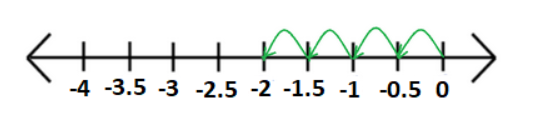
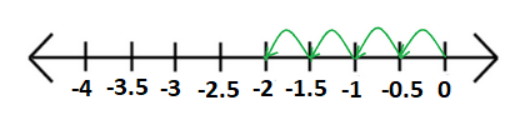
In the given expression,−1/2 is multiplied 4 times.

So, there will be  4 jumps of 1/2 or 0.5unit each along the number line.

Because the two numbers have different signs, hence, there will be a jump from 0 to the left.

The above-mentioned is represented on a number line as shown below.

The numbers where each jump ends are−1/2,−1,−11/2 and −2.

The number where the final jump ends is −2.

Hence, the required result is−2.

The product of the given expression4(−1/2) using a number line is −2. The same is represented on a number line as shown below.

Read and Learn More HMH Middle School Grade 7 Practice Fluency Workbook 1st Edition Solutions

Go Math!, Middle School Grade 7, Practice Fluency Workbook, 1st Edition, Chapter 3 Rational Numbers 1 1

HMH Middle School Grade 7 Chapter 3 Page 21 Problem 2 Answer

HMH Middle School Grade 7 Practice Fluency Workbook 1st Edition Chapter 3 Exercise 3.4 Rational Numbers

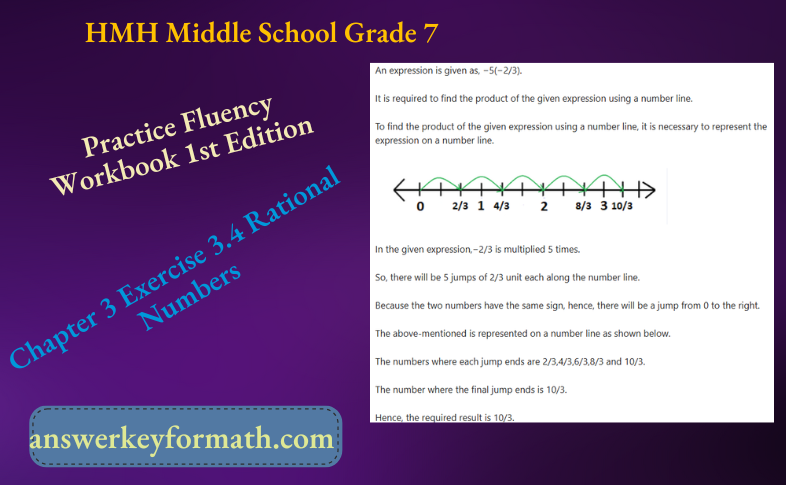
The product of the given expression−5(−2/3) using a number line is 10/3. The same is represented on a number line as shown below.

Go Math!, Middle School Grade 7, Practice Fluency Workbook, 1st Edition, Chapter 3 Rational Numbers 2 1

Practice Fluency Workbook Chapter 3 Rational Numbers Answers Page 21 Problem 3 Answer

An expression is given as, −2(3.1).

It is required to find the product of the given expression.

To find the product of the expression −2(3.1), it is necessary to operate multiplication on the given expression.

Perform multiplication on the expression −2(3.1).

Multiply the numerical values of the two numbers ignoring the negative sign and the decimal point.

​2(31)=2⋅31

2(31)=62

Now, it is known the decimal point is placed in the product in such a way that the number of decimal places in the product is the sum of the decimal places in the factors.

Also, the sign of the product will be negative since the given numbers have different signs.

Hence, the required product is obtained as −6.2.

The product of the given expression −2(3.1) is−6.2.

HMH Middle School Grade 7 Chapter 3 Page 21 Problem 4 Answer

An expression is given as, 4(−5.4).

It is required to find the product of the given expression.

To find the product of the expression 4(−5.4), it is necessary to operate multiplication on the given expression.

Perform multiplication on the expression 4(−5.4).

Multiply the numerical values of the two numbers ignoring the negative sign and the decimal point.

​4(54)=4⋅54

4(54)=216

Now, it is known the decimal point is placed in the product in such a way that the number of decimal places in the product is the sum of the decimal places in the factors.

Also, the sign of the product will be negative since the given numbers have different signs.

Hence, the required product is obtained as −21.6.

The product of the given expression4(−5.4)  is−21.6.

Hmh Middle School Math Workbook Chapter 3 Guide Page 21 Problem 5 Answer

An expression is given as, −3.3(6).

It is required to find the product of the given expression.

To find the product of the expression −3.3(6), it is necessary to operate multiplication on the given expression.

Perform multiplication on the expression −3.3(6).

Multiply the numerical values of the two numbers ignoring the negative sign and the decimal point.

​33(6)=33⋅6

33(6)=198

Now, it is known that the decimal point is placed in the product in such a way that the number of decimal places in the product is the sum of the decimal places in the factors.

Also, the sign of the product will be negative since the given numbers have different signs.

Hence, the required product is obtained as −19.8.

The product of the given expression−3.3(6) is−19.8.

HMH Middle School Grade 7 Chapter 3 Page 21 Problem 6 Answer

An expression is given as, 4.5(8).

It is required to find the product of the given expression.

To find the product of the expression 4.5(8), it is necessary to operate multiplication on the given expression.

Perform multiplication on expression 4.5(8).

Multiply the numerical values of the two numbers ignoring the decimal point.

​45(8)=45⋅8

45(8)=360

Now, it is known that the decimal point is placed in the product in such a way that the number of decimal places in the product is the sum of the decimal places in the factors.

Also, the sign of the product will be positive since the given numbers have the same signs.

Hence, the required product is obtained as 36.0 or 36.

The product of the given expression 4.5(8) is 36.

7th Grade HMH Rational Numbers Exercise 3.4 step-by-step Page 21 Problem 7 Answer

An expression is given as, 2(−1.05).

It is required to find the product of the given expression.

Multiply the given integers, also multiply the sign.

Write the given expression.

2(−1.05)

Now, multiply both the integers, also it is well known that when the(−) sign is multiplied with (+) sign, then, the result gives (−) sign.

So, 2(−1.05)=−2.1

The product of 2(−1.05) is −2.1.

HMH Middle School Grade 7 Chapter 3 Page 21 Problem 8 Answer

An expression is given as, −2.05(4).

It is required to find the product of the given expression.

Multiply the given integers, also multiply the sign

Write the given expression.

−2.05(4)

Now, multiply both the integer, also it is well known that when(+) sign is multiplied with a (−) sign and the result gives a (−)sign.

So,−2.05(4)=−8.2

The product of −2.05(4) is −8.2.

Rational numbers Grade 7 Practice Fluency Workbook help Page 21 Problem 9 Answer

An expression is given as,−3.5(−9).

It is required to find the product of the given expression.

Multiply the given integers, also multiply the sign.

Write the given expression.

−3.5(−9).

Now, multiply both the integers, also it is well known that when the(−) sign is multiplied with(−) sign, then, the result gives (+) sign.

So,−3.5(−9)=31.5

The product of the given integer,−3.5(−9) is 31.5.

HMH Middle School Grade 7 Chapter 3 Page 21 Problem 10 Answer

An expression is given as, (2/3)×(−6)×5.

It is required to find the product of the given expression.

Multiply the given integers, also multiply the sign.

Write the given expression.

(2/3)×(−6)×5.

Now, multiply both the integer, also it is well known that when (+) sign is multiplied with a (−) sign and the result gives a (−) sign.

So,(2/3)×(−6)×5=2(−6)(5)/3

(2/3)×(−6)×5=−60/3

(2/3)×(−6)×5=−20

​The product of the given integer, (2/3)×(−6)×5 is −20.

Grade 7 Math Practice Fluency Workbook Exercise 3.4 explained Page 21 Problem 11 Answer

An expression is given as, (−3/5)(−10/3)(−2/9).

It is required to find the product of the given expression.

Multiply the given integers, also multiply the sign.

Write the given expression.

(−3/5)(−10/3)(−2/9)

Now, multiply both the integers, also it is well known that when the (−) sign is multiplied with (−) sign, then, the result gives (+) sign.

Then, again, (+) sign is multiplied with a (−) sign and the result gives a (−) sign.

Or, the(−) sign can be taken as common from the expression.

​(−3/5)(−10/3)(−2/9)=−(3⋅10⋅2)/5⋅3⋅9

(−3/5)(−10/3)(−2/9)=−60/135

(−3/5)(−10/3)(−2/9)=−12/27

Hence,(−3/5)(−10/3)(−2/9)=−12/27.

The product of the given integer, (−3/5)(−10/3)(−2/9) is−12/27.

HMH Middle School Grade 7 Chapter 3 Page 21 Problem 12 Answer

An expression is given as, −7×(−3/5)(15/7).

It is required to find the product of the given expression.

Multiply the given integers, also multiply the sign.

Write the given expression.

−7×(−3/5)(15/7).

Now, multiply both the integers, also it is well known that when the (−) sign is multiplied with (−) sign, then, the result gives (+) sign.

​−7×(−3/5)(15/7)=−7(−3)(15)/5×7

−7×(−3/5)(15/7)=315/35

−7×(−3/5)(15/7)=9

Hence, −7×(−3/5)(15/7)=9.

The product of the given integer,−7×(−3/5)(15/7) is 9.

Rational Numbers problems explained for 7th Grade Page 21 Problem 13 Answer

An expression is given as, 2(4)(1/16).

It is required to find the product of the given expression.

Multiply the given integers, also multiply the sign.

Write the given expression.

2(4)(1/16).

Now, multiply both the integers.

So, 2(4)(1/16)=2(4)(1)/16

2(4)(1/16)=8/16

2(4)(1//16)=1/2

Hence,2(4)(1/16)=1/2.

The product of the given integer, 2(4)(1/16) is 1/2.

HMH Middle School Grade 7 Chapter 3 Page 21 Problem 14 Answer

It is given that a box-shaped fish trap measures 1/4×2/3×3/4m.

It is required to find the volume of the fish.

Since three dimensions are given of the fish, it is a cuboid.

Multiply the given integers as the volume of a cuboid is given by the product of its length, height and breadth.

Given, a box-shaped fish trap measures 1/4×2/3×3/4m.

The fish is in the shape of a cuboid.

Let V be the volume of the fish.

V=lbh , where, l,b,h are the length, height and breadth respectively.

​V=1/4⋅2/3⋅3/4

V=1⋅2⋅3/4⋅3⋅4

V=6/48

V=1/8m

Hence, V=1/8m.

The volume of the box-shaped fish trap is 1/8m.

Exercise 3.4 Rational Numbers Grade 7 Practice Workbook help Page 21 Problem 15 Answer

It is given that the temperature at noon is 75∘F. The temperature drops every half hour by 3∘F.

It is required to find the temperature at 4PM.

Multiply the given integer with the interval of every half an hour till 4PM.

As, it is given, the temperature at noon is 75∘F. Also, temperature drops at every half hour. It could be written as−3∘F.

So, Since 12 noon to 4PM, it has 8 intervals of every half an hour.

So, the total temperature drop between 12 noon to 4PM is,−3∘F⋅8=−24∘F.

At noon, the temperature was 75∘F and till 4PM it falls by −24∘F.

So, 75−24=51∘F.

The temperature at 4PM will be 51∘F.

HMH Middle School Grade 7 Chapter 3 Page 22 Problem 16 Answer

An expression is given as,6×1/4.

It is required to find that how many times 1/4 is multiplied and in which direction on the number line. It is also required to find the product of the given expression.

To find that how many times 1/4 is multiplied, multiply the number with 1/4.

In the given expression, 1/4 is multiplied six times.

These two numbers have the same sign, so, jump from 0 to the right side of the number line.

Move from 0 six times to 1/4,2/4,3/4,4/4,5/4,6/4.

Find the product of the given expression.

6×1/4=6/4

6×1/4=3/2

6×1/4=11/2

Hence, 6×1/4=11/2.

Go Math!, Middle School Grade 7, Practice Fluency Workbook, 1st Edition, Chapter 3 Rational Numbers 16

In the expression, 1/4 is multiplied six times in the right direction of the number line from 0.

The product of 6×1/4 is 11/2.


HMH Middle School Grade 7 Chapter 3 Page 22 Problem 17 Answer

An expression is given as, −8(−3.3).

It is required to find that how many times 3.3 is multiplied and in which direction on the number line.

It is also required to find the product of the given expression.

To find that how many times 3.3 is multiplied, multiply the number with 3.3.

In the given expression, 3.3 is multiplied eight times.

These two numbers have the same sign, so, jump from 0 to the right side of the number line.

Move eight times from 0 to 3.3, 6.6, 9.9, 13.2, 16.5, 19.8, 23.1, 26.4.

Find the product of the given expression.

−8(−3.3)=26.4

Hence,−8(−3.3)=26.4.

Go Math!, Middle School Grade 7, Practice Fluency Workbook, 1st Edition, Chapter 3 Rational Numbers 17

In the expression, 3.3 is multiplied eight times in the right direction of the number line from 0.

The product of −8(−3.3)

Go Math!, Middle School Grade 7, Practice Fluency Workbook, 1st Edition, Chapter 3 Rational Numbers 17 1

HMH Middle School Grade 7 Chapter 3 Page 22 Problem 18 Answer

An expression is given as, 4.6×5.

It is required to find that how many times 4.6 is multiplied and in which direction on the number line. It is also required to find the product of the given expression.

To find that how many times 4.6 is multiplied, multiply the number with 4.6.

In the given expression, 4.6 is multiplied five times.

Go Math!, Middle School Grade 7, Practice Fluency Workbook, 1st Edition, Chapter 3 Rational Numbers 18

These two numbers have the same sign, so, jump from 0 to the right side of the number line.

Move five times from 0 to 4.6,9.2,13.8,18.4,23.

Find the product of the given expression.

Hence, 4.6×5=23.

Go Math!, Middle School Grade 7, Practice Fluency Workbook, 1st Edition, Chapter 3 Rational Numbers 18 1

In the expression, 4.6 is multiplied six times in the right direction of the number line from 0. The product of 4.6×5 is 23.

HMH Middle School Grade 7 Practice Fluency Workbook 1st Edition Chapter 3 Exercise 3.3 Rational Numbers

HMH Middle School Grade 7 Practice Fluency Workbook 1st Edition Chapter 3 Rational Numbers

HMH Grade 7 Practice Fluency Workbook Chapter 3 Exercise 3.2 Solutions Page 19 Problem 1 Answer

An expression is given as,−5−4.

It is required to solve the given expression using a number line.

Go-Math-Middle-School-Grade-7-Practice-Fluency-Workbook-1st-Edition-Chapter-3-Rational-Numbers-1

On the number line, start from 0 and move towards 5 intervals left and then again 4 intervals left.

Write the given expression.

−5−4

From 0, move 5 intervals left. Then, again, move 4 intervals left.

Go-Math-Middle-School-Grade-7-Practice-Fluency-Workbook-1st-Edition-Chapter-3-Rational-Numbers-1

The value of −5−4 is −9.

HMH Grade 7 Practice Fluency Workbook Chapter 3 Exercise 3.2 Solutions Page 19 Problem 2 Answer

An expression is given as, 1−(−8).

It is required to solve the given expression using a number line.

Read and Learn More HMH Middle School Grade 7 Practice Fluency Workbook 1st Edition Solutions

HMH Middle School Grade 7 Practice Fluency Workbook 1st Edition Chapter 3 Exercise 3.3 Rational Numbers

Rational Numbers Exercise 3.2 Chapter 3 Answers HMH Grade 7 Workbook Page 19 Problem 3 Answer

An expression is given as, 4−(−5).

It is required to find the difference.

To solve the given expression, first, change subtraction by addition with the opposite number and then simplify.

Change subtraction by addition with the opposite number.

4−(−5)=4+5.

As the two numbers have the same sign, the result of the addition is given by the sum between the absolute values, to which the sign of the numbers can be substituted into.

Hence, 4+5=9.

The difference of 4−(−5) is 9.

Step-By-Step Solutions For Exercise 3.2 Rational Numbers HMH Grade 7 Practice Workbook Page 19 Problem 4 Answer

An expression is given as, 1/7−3/7.

It is required to find the difference.

To solve the given expression, first change subtraction by addition with the opposite number and then simplify.

Change subtraction by addition with the opposite number.

Hence, 1/7−3/7=1/7+(−3/7).

As the two numbers have the different signs, the result of the subtraction is given by the difference between the greater absolute values and the smaller absolute values, to which, the sign of the number which produced the greater absolute value can be substituted into.

​1/7+(−3/7)=−(3/7−1/7)

1/7+(−3/7)=−(3−1/7)

1/7+(−3/7)=−2/7

Hence,1/7+(−3/7)=−2/7.

The difference of 1/7−3/7  is−2/7.

Exercise 3.2 Rational Numbers solutions for HMH Middle School Grade 7 Workbook Page 19 Problem 5 Answer

An expression is given as, −3.7−(−4.9).

It is required to find the difference.

To solve the given expression, first change subtraction by addition with the opposite number and then simplify.

Change subtraction by addition with the opposite number.

Hence, −3.7−(−4.9)=−3.7+4.9.

As the two numbers have the different sign, the result of the subtraction is given by the difference between the greater absolute values and the smaller absolute values, to which the sign of the number which produced the greater absolute value can be substituted into.

​−3.7+4.9=+(4.9−3.7)

−3.7+4.9=+1.2

−3.7+4.9=1.2

​Hence, −3.7+4.9=1.2.

The difference of −3.7−(−4.9) is 1.2.

Examples Of Problems From Exercise 3.2 Rational Numbers In HMH Grade 7 Workbook Page 19 Problem 6 Answer

An expression is given as, −21/4−(−3).

It is required to find the difference.

To solve the given expression, first change subtraction by addition with the opposite number and then simplify.

Change subtraction by addition with the opposite number.

Hence, −21/4−(−3)=−21/4+3.

As the two numbers have the different signs, the result of the subtraction is given by the difference between the greater absolute values and the smaller absolute values, to which, the sign of the number which produced the greater absolute value can be substituted into.

​−21/4+3=+(3−21/4)

−21/4+3=3/4

Hence,−21/4+3=3/4.

The difference of  −21/4−(−3) is 3/4.

Common Core Chapter 3 Exercise 3.2 Rational Numbers Detailed Solutions HMH Grade 7 Workbook” Page 19 Problem 7 Answer

An expression is given as, −1.6−2.1.

It is required to find the difference.

To solve the given expression, first change subtraction by addition with the opposite number and then simplify.

Change subtraction by addition with the opposite number.

−1.6−2.1=−1.6+(−2.1).

As the two numbers have the same sign, the result of the addition is given by the sum between the greater absolute values, to which the sign of the numbers can be substituted into.

​−1.6+(−2.1)=−(1.6+2.1)

−1.6+(−2.1)=−3.7

Hence, −1.6+(−2.1)=−3.7.

The difference of −1.6−2.1 is −3.7.

Page 19 Problem 8 Answer

An expression is given as, −43/4−3/4.

It is required to find the difference.

To solve the given expression, first change subtraction by addition with the opposite number and then simplify.

Change subtraction by addition with the opposite number.

Hence, −43/4−3/4=−43/4+(−3/4).

As the two numbers have the same sign, the result of the addition is given by the sum between the greater absolute values, to which the sign of the numbers can be substituted into.

​−43/4+(−3/4)=−(43/4+3/4)

−43/4+(−3/4)=−(19/4+3/4)

−43/4+(−3/4)=−22/4

−43/4+(−3/4)=−11/2

Hence, −43/4+(−3/4)=−11/2.

The difference of −1.6−2.1 is −11/2.

Page 19 Problem 9 Answer

It is given, an expression −5.1−(−0.1)−1.2.

It is required in this problem to find the difference of the given expression without using number line.

In order to find in this problem, the difference of the given expression without using number line, apply subtraction operation.

In order to simplify, subtract −0.1 from −5.1 in −5.1−(−0.1)−1.2 and the sign will be of the greater absolute value.

−5.1−(−0.1)−1.2=−5−1.2

Further, subtract 1.2 from −5.

−5−1.2=−3.8

Hence, −5.1−(−0.1)−1.2=−3.8.

Hence, as required in the problem,−5.1−(−0.1)−1.2=−3.8.

Page 19 Problem 10 Answer

An expression is given as, −3/5−7/5−(−2/5).

It is required to find the difference of the given expression without using number line.

In order to find the difference of the given expression without using number line, apply subtraction operation.

In order to simplify, subtract −7/5 from −3/5 in −3/5−7/5−(−2/5)  and the sign will be of the greater absolute value.

​−3/5−7/5−(−2/5)=−3−7/5−(−2/5)

−3/5−7/5−(−2/5)=−10/5−(−2/5)

​Subtract −2/5 from −10/5.

​−10/5−(−2/5)=−10−(−2)/5

−10/5−(−2/5)=−8/5

Hence, −3/5−7/5−(−2/5)=−8/5.

The value of −3/5−7/5−(−2/5) is −8/5.

Page 19 Problem 11 Answer

It is given that the temperature on Monday was −1.5∘C and on Tuesday it was 2.6∘C less than that on Monday.

It is required to find the temperature on Tuesday.

In order to find the temperature on Tuesday, make an expression based on the given information and apply subtraction operation.

Form an equation based on the given information.

Since, the temperature on Tuesday was 2.6∘C less than that on Monday and the temperature on Monday was −1.5∘C.

So, the temperature on Tuesday can be evaluated by the expression −1.5∘C−2.6∘C.

In order to simplify, subtract 2.6 from−1.5 and the sign will be of the greater absolute value.

Hence,−1.5∘C−2.6∘C=−4.1∘C.

The temperature on Tuesday was −4.1∘C.

Page 19 Problem 12 Answer

It is given that the diver dove to the location 63/5m below the sea level and then dove to second location 81/5m below the sea level.

It is required to find the meters between the two locations.

In order to find the meters between the two locations, make an expression based on the given information and apply subtraction operation.

Form an equation based on the given information.

Since, as given, the diver dove to the location 63/5m below the sea level and then dove to second location 81/5m below the sea level.

So, the difference in the distance between two locations can be evaluated by the expression 81/5−63/5.

In order to simplify, subtract 63/5 from 81/5  and the sign will be of the greater absolute value.

​81/5−63/5=41/5−33/5

81/5−63/5=8/5

Hence, 81/5−63/5=8/5.

Hence, the difference in the distance between two locations is 8/5m or 13/5m.

Page 20 Problem 13 Answer

It is given that the total value of the tree cards with value 7,13, and −8 is 12.

It is required to find the values if 7 , 13 and −8 are taken away.

In order to find the values if 7,13, and −8 are taken away one by one, find the sum of other two cards.

If 7 is taken away, 13 and−8 are left.

Now, find the sum of 13 and −8.

13+(−8)=5

So, 12−7=5.

Hence, the value if 7is taken away, is 5.

If 13 is taken away, 7 and −8 are left.

Now, find the sum of 7 and−8.

7+(−8)=−1

So, 12−13=−1.

Hence, the value if 13 is taken away, is−1.

If −8 is taken away, 7 and 13 are left.

Now, find the sum of 7 and 13.

7+13=20

So, 12−(−8)=20.

Hence, the value if −8 is taken away, is 20.

The values if 7,13 and −8 are taken away are 5,−1 and 20 respectively.

Page 20 Problem 15 Answer

An expression is given as, −4−(−2).

It is required to subtract the given expression and answer some questions.

In order to solve, apply subtraction operation.

Then, answer the questions using the difference.

To begin with, simplify the given expression−4−(−2) and complete the first statement.

In order to simplify, subtract −2 from −4 in −4−(−2) and the sign will be of the greater absolute value.

−4−(−2)=−2

Hence, the completed statement is “−4<−2. So, the answer will be greater number.”

Further, simplify ∣4∣−∣2∣ and apply subtraction operation.

​∣4∣−∣2∣=4−2

∣4∣−∣2∣=2

Hence, ∣4∣−∣2∣=2.

The value of −4−(−2) is −2.

Thus, −4−(−2)=−2.

Hence, as required in the problem,  “−4<−2. So, the answer will be greater number.”, ∣4∣−∣2∣=2, and −4−(−2)=−2.

Page 20 Problem 16 Answer

An expression is given as, 31−(−9).

It is required to find the difference of the given expression.

In order to find the difference of the given expression, apply subtraction operation.

In order to simplify, subtract −9 from31 in 31−(−9) and the sign will be of the greater absolute value.

31−(−9)=31+9

31−(−9)=40

Hence, 31−(−9)=40.

The value of31−(−9) is 40.

Page 20 Problem 17 Answer

An expression is given as, −9−17.

It is required to find the difference of the given expression.

In order to find the difference of the given expression, apply subtraction operation.

In order to simplify, subtract 17 from −9 in −9−17 and the sign will be of the greater absolute value.

−9−17=−26

Hence, −9−17=−26.

The value of −9−17 is −26.

Page 20 Problem 18 Answer

An expression is given as, 4.5−2.5.

It is required to find the difference of the given expression.

In order to find the difference of the given expression, apply subtraction operation.

In order to simplify, subtract 2.5 from 4.5 in 4.5−2.5 and the sign will be of the greater absolute value.

4.5−2.5=2

Hence, 4.5−2.5=2.

The value of 4.5−2.5 is 2.

Page 20 Problem 19 Answer

An expression is given as, 4/5−(−1/5).

It is required to perform subtraction on the given expression.

To perform subtraction on the given expression, it is necessary to check the signs assigned to the fractions.

Two negative signs appear next to each other in the given expression 4/5−(−1/5).

Change the subtraction by addition with the opposite number.

Then, the given expression can be written as,

4/5−(−1/5)=4/5+1/5

As the two numbers have the same sign, the result of the addition is given by the sum between the absolute values, to which the signs of the numbers are assigned.

Perform addition on the expression 4/5+1/5.

​4/5+1/5=5/5

4/5+1/5=1

The result will be a positive number since the both the numbers 4/5 and 1/5 are positive.

Hence, the required result is 1.

The result of subtraction on the given expression 4/5−(−1/5) is  1.

Page 20 Problem 20 Answer

An expression is given as,−21/3−(−1/3).

It is required to perform subtraction on the given expression.

To perform subtraction on the given expression, it is necessary to check the signs assigned to the fractions.

Two negative signs appear next to each other in the given expression−21/3−(−1/3).

Change the subtraction by addition with the opposite number.

Then, the given expression can be written as,

−21/3−(−1/3)=−21/3+1/3

Now, the expression−21/3+1/3 has two numbers with different signs.

The result is given by the difference between the greater absolute value and the smaller absolute value.

Hence, operate subtraction by ignoring the signs.

​21/3−1/3=7/3−1/3

21/3−1/3=6/3

21/3−1/3=2

Here, the result thus obtained will get a negative sign since the greater value−21/3 is a negative number.

The required result is −2.

The result of subtraction on the given expression −21/3−(−1/3) is −2.

Page 20 Problem 21 Answer

An expression is given as,−7/8−3/8.

It is required to perform subtraction on the given expression.

To perform subtraction on the given expression, it is necessary to check the signsassigned to the fractions.

The given expression−7/8−3/8  has two negative numbers.

The result of the expression is given by the sum between the absolute values.

Perform the operation addition on the expression ignoring the negative signs.

​7/8+3/8=10/8

7/8+3/8=5/4

Since the two numbers −7/8 and −3/8 have the same negative signs, the result will also take the negative sign.

Hence, the required result is−5/4.

The result of subtraction on the given expression −7/8−3/8  is −5/4.

HMH Middle School Grade 7 Practice Fluency Workbook 1st Edition Chapter 3 Exercise 3.2 Rational Numbers

HMH Middle School Grade 7 Practice Fluency Workbook 1st Edition Chapter 3 Rational Numbers

HMH Grade 7 Practice Fluency Workbook Chapter 3 Exercise 3.2 Solutions Page 17 Problem 1 Answer

An expression is given as, −3+4.

An expression is required to solve the given expression using a number line.
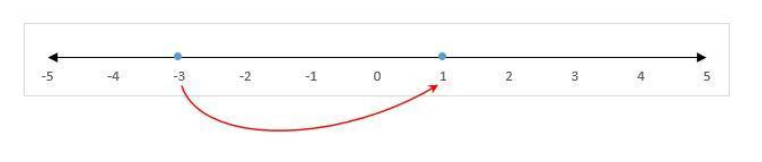
Go Math!, Middle School Grade 7, Practice Fluency Workbook, 1st Edition, Chapter 3 Rational Numbers 1

On the number line, start from −3 and move towards 4 intervals to the right because the number 4 is positive.

Start from −3 and move 4 intervals to the right because the number 4 is positive.

And, the result is 1.
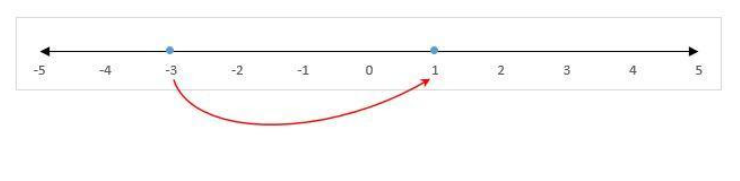
Go Math!, Middle School Grade 7, Practice Fluency Workbook, 1st Edition, Chapter 3 Rational Numbers 1 1

The sum of −3+4 is 1.

HMH Middle School Grade 7 Chapter 3 Page 17 Problem 2 Answer

An expression is given as, 1+(−8).

An expression is required to solve the given expression using a number line.

Read and Learn More HMH Middle School Grade 7 Practice Fluency Workbook 1st Edition Solutions
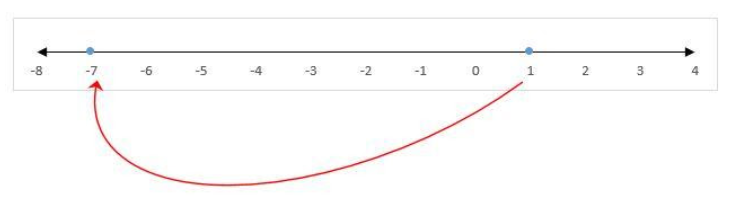
Go Math!, Middle School Grade 7, Practice Fluency Workbook, 1st Edition, Chapter 3 Rational Numbers 2

HMH Middle School Grade 7 Practice Fluency Workbook 1st Edition Chapter 3 Exercise 3.2 Rational Numbers

Rational Numbers Exercise 3.2 Chapter 3 Answers HMH Grade 7 Workbook Page 17 Problem 3 Answer

An expression is given as, 4+5.

An expression is required to solve the given expression.

To solve the given expression, first, determine the absolute values of the terms and then add both the numbers.

Determine the absolute values of the terms.∣4∣=4

∣5∣=5

Because the terms have the same sign, the sum has the sign of the terms, hence, the sum is positive.

Determine the sum.

​4+5=+(∣4∣+∣5∣)

4+5=+9

4+5=9

Hence, 4+5=9.

The sum of 4+5 is 9.

HMH Middle School Grade 7 Chapter 3 Page 17 Problem 4 Answer

An expression is given as, −3+1/2.

An expression is required to solve the given expression.

To solve the given expression, first determine the absolute values of the terms and then add both the numbers.

Determine the absolute values of the terms.

∣−3∣=3

∣1/2∣

=1/2

The terms have different signs.

The sign of the sum is the sign of the term with the greater absolute value.

Since, ∣3∣>∣1/2∣, the sum is negative.

Determine the sum.

−3+1/2=−(∣3∣−∣1/2∣)

−3+1/2=−(3−1/2)

−3+1/2=−5/2

Hence, −3+1/2=−5/2.

The sum of−3+1/2  is −5/2.

Step-By-Step Solutions For Exercise 3.2 Rational Numbers Hmh Grade 7 Practice Workbook Page 17 Problem 5 Answer

An expression is given as, −2/9+3/9.

An expression is required to solve the given expression.

To solve the given expression, first, determine the absolute values of the terms and then add both the numbers.

Determine the absolute values of the terms.

∣−2/9∣=2/9

∣3/9∣=3/9

The terms have different signs.

The sign of the sum is the sign of the term with the greater absolute value.

Since, ∣3/9∣>∣−2/9∣ , the sum is positive.

Determine the sum.

​−2/9+3/9=+(∣3/9∣−∣−2/9∣)

−2/9+3/9=+1/9

−2/9+3/9=1/9

Hence, −2/9+3/9=1/9.

The sum of−2/9+3/9 is 1/9.

HMH Middle School Grade 7 Chapter 3 Page 17 Problem 6 Answer

An expression is given as, −3.5+(−4.9).

An expression is required to solve the given expression.

To solve the given expression, first, determine the absolute values of the terms and then add both the numbers.

Determine the absolute values of the terms.

∣−3.5∣=∣3.5∣

∣−4.9∣=4.9

Because the terms have the same sign, the sum has the sign of the terms, hence, the sum is negative.

Determine the sum.

​−3.5+(−4.9)=−(∣−3.5∣+∣−4..9∣)

−3.5+(−4.9)=−(3.5+4.9)

−3.5+(−4.9)=−8.4

​Hence, −3.5+(−4.9)=−8.4.

The sum of−3.5+(−4.9) is −8.4.

Exercise 3.2 Rational Numbers Solutions For HMH Middle School Grade 7 Workbook Page 17 Problem 7 Answer

An expression is given as, −21/4+(−31/4).

An expression is required to solve the given expression.

To solve the given expression, first, determine the absolute values of the terms and then add both the numbers.

Determine the absolute values of the terms.

∣−21/4∣

∣=21/4∣

∣−31/4∣

=31/4

Because the terms have the same sign, the sum has the sign of the terms, hence, the sum is negative.

Determine the sum.

−21/4+(−31/4)=−(−21/4−31/4)

−21/4+(−31/4)=−(21/4+31/4)

−21/4+(−31/4)=−(9/4+13/4)

−21/4+(−31/4)=−(13+9/4)

​Simplify further.

−21/4+(−31/4)=−(22/4)−21/4+(−31/4)=−11/2

Hence, −21/4+(−31/4)=−11/2.

The sum of −21/4+(−31/4) is−11/2.

HMH Middle School Grade 7 Chapter 3 Page 17 Problem 8 Answer

An expression is given as, −0.6+(−2.5).

An expression is required to solve the given expression.

To solve the given expression, first, determine the absolute values of the terms and then add both the numbers.

Determine the absolute values of the terms.

∣−0.6∣=0.6

∣−2.5∣=2.5

Because the terms have the same sign, the sum has the sign of the terms, hence, the sum is negative.

Determine the sum.

​−0.6+(−2.5)=−(∣−0.6∣+∣−2.5∣)

−0.6+(−2.5)=−(0.6+2.5)

−0.6+(−2.5)=−3.1

Hence, −0.6+(−2.5)=−3.1.

The sum of −0.6+(−2.5) is −3.1.

Examples Of Problems From Exercise 3.2 Rational Numbers In HMH Grade 7 Workbook Page 17 Problem 9 Answer

An expression is given as, −3/4+1/5.

An expression is required to solve the given expression.

To solve the given expression, first determine the absolute values of the terms and then add both the numbers.

Determine the absolute values of the terms.

∣−3/4∣=3/4

∣1/5∣=1/5

The terms have different signs.

The sign of the sum is the sign of the term with the greater absolute value.

Here, ∣−3/4∣>∣1/5∣.

Determine the sum.

​−3/4+1/5=−(∣−3/4∣−1/5)−3/4+1/5

​−3/4+1/5 =−(3/4−1/5)−3/4+1/5

​−3/4+1/5 =−(15−4/20)−3/4+1/5

​−3/4+1/5 =−11/20

Hence, −3/4+1/5=−11/20.

The sum of−3/4+1/5  is −11/20.

HMH Middle School Grade 7 Chapter 3 Page 17 Problem 10 Answer

An expression is given as, 3+(−7.5)+1.2.

An expression is required to find the sum of the given expression without using a number line.

To find the sum of the given expression without using a number line, it is necessary to group the terms according to their signs.

Group the terms of the given expression in accordance with their signs.

The given expression will become (3+1.2)+(−7.5).

Now, perform the operation inside the parentheses.

(3+1.2)+(−7.5)=4.2+(−7.5)

Here, in the expression 4.2+ (−7.5), two different signs appear next to each other, hence, perform the operation subtraction.

Ignore the signs, subtract 4.2 from 7.5.

7.5−4.2=3.3

In the two numbers 4.2 and −7.5 one is positive and the other is a negative number and the larger number has a negative sign, the result will use the sign of the negative number.

Hence, the required result will be −3.3.

The sum of the given expression 3+(−7.5)+1.2 is −3.3.

Common Core Chapter 3 Exercise 3.2 Rational Numbers Detailed Solutions HMH Grade 7 Workbook Page 17 Problem 11 Answer

An expression is given as,−3+(−1.35)+2.5.

An expression is required to find the sum of the given expression without using a number line.

To find the sum of the given expression without using a number line, it is necessary to group the terms according to their signs.

Group the terms of the given expression in accordance with their signs.

The given expression will become [(−3)+(−1.35)]+2.5.

Now, perform the operation inside the parentheses.

Add the numbers 3 and 1.35 ignoring the negative signs and assign a negative sign to the result.

[(−3)+(−1.35)]+2.5=−4.35+2.5

An expression is known that the addition of a positive and negative number would imply the subtracting of the two numbers.

Ignore the signs, subtract 4.35 from 2.5.

4.35−2.5=1.85

In the two numbers −4.35 and2.5 one is positive and the other is a negative number and the larger number has a negative sign, the result will use the sign of the negative number.

Hence, the required result will be −1.85.

The sum of the given expression −3+(−1.35)+2.5 is −1.85.

HMH Middle School Grade 7 Chapter 3 Page 17 Problem 12 Answer

An expression is given as,  −6.5+(−0.15)+(−0.2).

An expression is required to find the sum of the given expression without using a number line.

To find the sum of the given expression without using a number line, it is necessary to group the terms according to their signs.

Group the terms of the given expression in accordance with their signs.

An expression is known that the addition of negative numbers would imply the adding of the numbers.

Ignoring the signs, add 6.5,0.15 and 7.5.

6.5+0.15+0.2=6.85

Since, the numbers −6.5,−0.15 and −7.5 are negative numbers, and the larger number −6.5 has a negative sign, the result will use the sign of the negative number.

Hence, the required result will be −6.85.

The sum of the given expression −6.5+(−0.15)+(−0.2) is−6.85.

Student Edition Chapter 3 Exercise 3.2 Rational Numbers HMH Grade 7 Workbook guide Page 17 Problem 13 Answer

An expression is given as, −3/2−7/4+1/8.

An expression is required to find the sum of the given expression without using a number line.

To find the sum of the given expression without using a number line, it is necessary to group the terms according to their signs.

Perform the operations from left to right side of the given expression.

Add −3/2 and −7/4 as the both the fractions have a negative sign.

​3/2+7/4=6/4+7/4

3/2+7/4=13/4

The result will have a negative sign.

Hence,−3

2−7/4=−13/4.

Now, the given expression −3/2−7/4+1/8 can be written as, −13/4+1/8.

The above expression has a positive and a negative fraction, so, subtract by ignoring the sign.

​13/4−1/8=26/8−1/8

13/4−1/8=25/8

The result will have a negative sign since the sign of the larger fraction, −13/4, is negative.

Hence, the required result is −25/8.

The sum of the given expression−3/2−7/4+1/8 is −25/8.

HMH Middle School Grade 7 Chapter 3 Page 17 Problem 14 Answer

An expression is given that Alex borrowed$12.50 and paid back $8.75.

An expression is required to find the amount of money he owes after paying back.

To find the amount of money he owes after paying back, it is necessary to assign signs to the given values.

And then, use the required operations.

Consider the amount of money Alex borrowed is represented by negative numbers and the amount of money he pays back is represented by positive numbers.

Establish an expression for the given situation considering the above mentioned.

−12.50+8.75

Now, solve the above expression.

Since the numbers have a positive and a negative sign, hence, operate subtraction.

Ignore the signs and subtract 8.75 from 12.50.

12.50−8.75=3.75

The result will have a negative sign, since, the larger number −12.50 is negative.

Hence, −12.50+8.75=−3.75.

The required amount of money is$3.75.

The amount of money Alex owes after paying back is $3.75.

Step-by-step answers for Exercise 3.2 Rational Numbers HMH Grade 7 Practice Workbook Page 17 Problem 15 Answer

An expression is given that a football team gains 18 yards and then losses 12 yards in the next.

An expression is required to find the total yardage of the team.

To find the total yardage of the team, it is necessary to assign signs to the given values.

Consider the number of yards the team gains is represented by positive numbers and the number of yards it loses by negative numbers.

Establish an expression for the given situation considering the above-mentioned.

18+(−12)

Now, solve the above expression.

Since the numbers have a positive and a negative sign, hence, operate subtraction.

Ignore the signs and subtract  12 from 18.

18−12=6

The result will have a positive sign since the larger number 18 is positive.

Hence, 18+(−12)=6.

The required number of yardage is 6.

The total yardage of the team is 6.

HMH Middle School Grade 7 Chapter 3 Page 17 Problem 16 Answer

An expression is given that Dee Dee spends $0.85,$4.50 and $1.50 individually on various items.

An expression is required to find the total amount of the money spent by Dee Dee.

To find the total amount of money Dee Dee spend, it is necessary to add the given individual amounts.

The amount of money spent by Dee Dee will be the addition of the money he spent on various items.

Establish an expression for the given situation.

0.85+4.50+1.50

Now, solve the above expression.

​0.85+4.50+1.50=5.35+1.50

0.85+4.50+1.50=6.85

The required amount of money is$6.85.

The total amount of money that Dee Dee spent is $6.85.

Page 18 Problem 17 Answer

An expression is given that Andre first hiked 4.5mi away from his house, then, hiked 2.4mi closer to his house, and lastly, hiked 1.7mi away from his house.

An expression is required to find the distance between Andre and his house.

To find the distance between Andre and his house,it is necessary to assign signs to the given values.

Then, add all the values.

Consider the distance Andre hikes away is represented by positive numbers and the distances he hikes closer to the house with negative numbers.

Establish an expression for the given situation considering the above mentioned.

4.5+(−2.4)+1.7

Now, solve the above expression from left to right.

Group the terms of the given expression in accordance with their signs.

4.5+1.7+(−2.4)

Add 4.5 and 1.7.

4.5+1.7=6.2

Since the two numbers, 4.5 and 1.7 are positive numbers, hence, the result will use the sign of the positive number.

Now, the expression4.5+(−2.4)+1.7 can be written as, 6.2+(−2.4).

Here, two different signs appear next to each other, hence, perform the operation subtraction.

Ignore the signs and subtract 6.2 from −2.4.

6.2−2.4=3.8

In the two numbers 6.2 and−2.4 one is positive and the other is a negative number and the larger number has a negative sign, the result will use the sign of the negative number.

Hence, the required result will be 3.8.

Andre is 3.8 mi away from his house.

HMH Middle School Grade 7 Chapter 3 Page 18 Problem 18 Answer

An expression is given as, 3+(−8).

An expression is required to find the sum.

Apply bodmas rule to find the sum.

Write the given expression.

3+(−8)

Subtract the expression.

3+(−8)=3−8

3+(−8)=−5

Hence, 3+(−8)=−5.

The value of 3+(−8) is −5.

Page 18 Problem 19 Answer

An expression is given as, 2.4+(−1.8).

An expression is required to find the sum.

Apply bodmas rule to find the sum.

Write the given expression.

2.4+(−1.8)

Subtract the expression.

​2.4+(−1.8)=2.4−1.8

2.4+(−1.8)=0.6

Hence, 2.4+(−1.8)=0.6.

The value of 2.4+(−1.8) is 0.6.

HMH Middle School Grade 7 Chapter 3 Page 18 Problem 20 Answer

An expression is given as, 1.1+3.6.

An expression is required to find the sum.

Apply bodmas rule to find the sum.

Write the given expression.

1.1+3.6

Add the expression.

Hence, 1.1+3.6=4.7.

The value of 1.1+3.6 is 4.7.

Page 18 Problem 21 Answer

An expression is given as, −2.1+(−3.9).

An expression is required to find the sum.

Apply bodmas rule to find the sum.

Write the given expression.

−2.1+(−3.9)

Solve the expression.

​−2.1+(−3.9)=−2.1−3.9

−2.1+(−3.9)=−6.0

Hence,−2.1+(−3.9)=−6.0.

The value of −3.9 is −6.

HMH Middle School Grade 7 Chapter 3 Page 18 Problem 22 Answer

An expression is given as, 4/5+(−1/5).

An expression is required to find the sum.

Apply bodmas rule to find the sum.

Write the given expression.

4/5+(−1/5)

Solve the expression.

4/5+(−1/5)=4/5−1/5

4/5+(−1/5)=4−1/5

4/5+(−1/5)=3/5

Hence, 4/5+(−1/5)=3/5.

The value of  4/5+(−1/5) is  3/5.

Page 18 Problem 23 Answer

An expression is given as, −11/3+(−1/3).

An expression is required to find the sum.

Apply bodmas rule to find the sum.

Write the given expression.

Write the given expression.

−11/3+(−1/3)

Solve the expression.

​−11/3+(−1/3)=−4/3−1/3

−11/3+(−1/3)=−4−1/3

−11/3+(−1/3)=−5/3

Hence, −11/3+(−1/3)=−5/3.

The value of −11/3+(−1/3) is −5/3.

HMH Middle School Grade 7 Chapter 3 Page 18 Problem 24 Answer

An expression is given as, −7/8+1/3.

An expression is required to find the sum.

Apply bodmas rule to find the sum.

Write the given expression.

−7/8+1/3

Solve the expression.

−7/8+1/3 =−7(3)+1(8)/8⋅3

−7/8+1/3 =−21+8/24

−7/8+1/3 =−13/24

Hence, −7/8+1/3 =−13/24.

The value of −7/8+1/3 is −13/24.

HMH Middle School Grade 7 Practice Fluency Workbook 1st Edition Chapter 3 Exercise 3.1 Rational Numbers

HMH Middle School Grade 7 Practice Fluency Workbook 1st Edition Chapter 3 Rational Numbers

HMH Grade 7 Practice Fluency Workbook Chapter 3 Exercise 3.1 Solutions Page 15 Problem 1 Answer

A rational number is given as,19/20.

A rational number is required to write the given rational number as a terminating decimal.

To write the given rational number as a terminating decimal, it is necessary to convert the given rational number into a decimal fraction.

Multiply the numerator and denominator of the given rational number 19/20 by 5 to obtain a decimal fraction.

19⋅5/20⋅5

19⋅5/20⋅5 =95/100

The decimal fraction 95/100 can be written as 0.95.

The required terminating decimal is 0.95.

The terminating decimal of the given rational number 19/20 is 0.95.

Read and Learn More HMH Middle School Grade 7 Practice Fluency Workbook 1st Edition Solutions
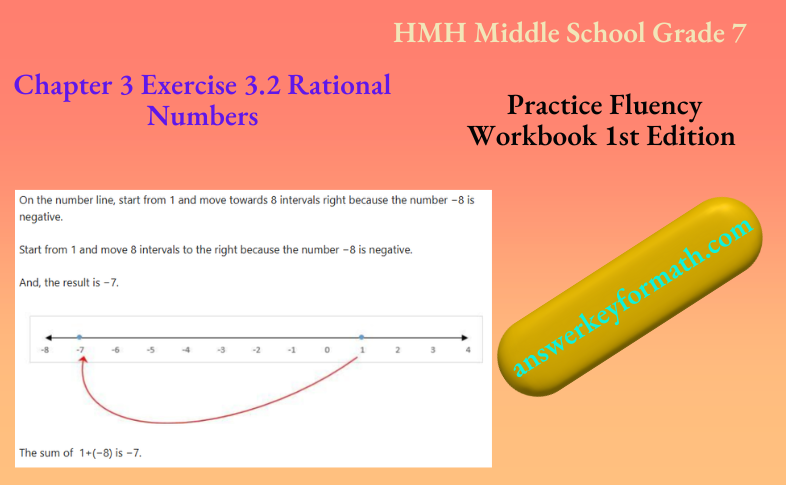
HMH Middle School Grade 7 Chapter 3 Page 15 Problem 2 Answer

A rational number is given as, −1/8.

A rational number is required to write the given rational number as a terminating decimal.

To write the given rational number as a terminating decimal, it is necessary to convert the given rational number into a decimal fraction.

Multiply the numerator and denominator of the given rational number −1/8 by 125 to obtain a decimal fraction.

−1⋅125/8⋅125

−1⋅125/8⋅125 =−125/1000

The decimal fraction −125/1000 can be written as,−0.125.

The required terminating decimal is −0.125.

The terminating decimal of the given rational number −1/8 is −0.125.

HMH Middle School Grade 7 Chapter 3 Page 15 Problem 3 Answer

HMH Middle School Grade 7 Practice Fluency Workbook 1st Edition Chapter 3 Exercise 3.1 Rational Numbers

Rational Numbers Exercise 3.1 Chapter 3 Answers HMH Grade 7 Workbook Page 15 Problem 4 Answer

A rational number is given as, −7/9.

A rational number is required to write the given rational number as a terminating decimal.

To write the given rational number as a terminating decimal, it is necessary to convert the given rational number into a decimal fraction.

Ignore the negative sign, and divide 7 by 9.

Here, 7 will be the dividend and 9 will be the divisor.

Since, 9 is larger than 7, the first number of the quotient will be 0 and the remainder 7.

As the division continues to go forever, the quotient and the remainder always gives the value 7.

Hence, −7/9=−0.7777777.

The value −0.7777777 can be written as−0.7.

Hence, the required repeating decimal is −0.7.

The repeating decimal of the given rational number −7/9 is −0.7.

HMH Middle School Grade 7 Chapter 3 Page 15 Problem 5 Answer

A rational number is given as,11/15.

A rational number is required to write the given rational number as a terminating decimal.

To write the given rational number as a terminating decimal, it is necessary to convert the given rational number into a decimal fraction.

Divide 11 by 5.

Here, 11 will be the dividend and 5 will be the divisor.

Since 11 is larger than 5, the first number of the quotient will be 0 and the remainder 11.

The next number of the quotient will be 7 and the remainder 5.

Similarly, the third number of the quotient will be 3 and the remainder 5.

As the division continues to go forever, the quotient always gives the value 3 and the remainder always gives the value 5.

Hence, 11/15

11/15 =0.733333.

The value 0.733333 can be written as 0.73.

Hence, the required repeating decimal is 0.73.

The repeating decimal of the given rational number 11/15 is 0.73.

Step-By-Step Solutions For Exercise 3.1 Rational Numbers HMH Grade 7 Practice Workbook Page 15 Problem 6 Answer

A rational number is given as, 8/3.

A rational number is required to write the given rational number as a terminating decimal.

To write the given rational number as a terminating decimal, it is necessary to convert the given rational number into a decimal fraction.

Divide 8 by 3.

Here, 8 will be the dividend and 3 will be the divisor.

Here, 8 is larger than 3. When 3 is multiplied by 2, it gives results 6. The value 6 is smaller than 8.

Hence, the first number of the quotient will be 2 and the remainder 2.

The next number of the quotient will be 6 and the remainder 2.

As the division continues to go forever, the quotient always gives the value 6

and the remainder always gives the value 2.

Hence, 8/3=2.666666.

The value 2.666666 can be written as 2.6.

Hence, the required repeating decimal is 2.6.

The repeating decimal of the given rational number 8/3 is 2.6.

HMH Middle School Grade 7 Chapter 3 Page 15 Problem 7 Answer

Three digits 2,3 and 4 are given.

A rational number is required to write a mixed number that has a terminating decimal, and write the decimal.

A rational number is also required to write a mixed number that has a repeating decimal, and write the decimal.

Form fractions using the given numbers and then find whether they terminating or repeating.

Form possible improper fractions that can be formed with the use of the given numbers.

First, take 2 as the denominator.

Hence, two improper fractions are formed as, 4×3/2  and 3×4/2.

Take 3 as the denominator.

Hence, two improper fractions are formed as, 4×2/3 and 2×4/3.

Take 4 as the denominator.

Hence, two improper fractions are formed as, 3×2/4 and 2×3/4.

The required improper fractions are 4×3/2,3×4/2,4×2/3,2×4/3,3×2/4 and 2×3/4.

Solve the improper fractions one by one.

For 4×3/2,4×3/2=1×1/2

4×3/2=5.5

Now, for 3×4/2,3×4/2=10/2

3×4/2=5

Hence, 3×4/2=5.

For 4×2/3,

​4×2/3=1×4/3

4×2/3=4.6

Now, for 2×4/3,

2×4/3=10/3

2×4/3=3.3

Hence, 2×4/3=3.3.

For 3×2/4,

​3×2/4=14/4

3×2/4=3.5

​Now, for 2×3/4,

2×3/4=11/4

2×3/4=2.75

​Hence, mixed numbers with terminating decimals are 4×2/3 and 2×4/3.

And, mixed numbers with repeating decimals are 4×3/2,3×4/2,3×2/4 and 2×3/4.

The mixed numbers that have terminating decimals are 4×2/3 and 2×4/3.

The mixed numbers that have repeating decimals are 4×3/2,3×4/2,3×2/4 and 2×3/4.

HMH Middle School Grade 7 Chapter 3 Page 15 Problem 8 Answer

A rational number is given that a ruler is marked at every 1/16 inch.

A rational number is required to convert the improper fraction into decimal and tell whether it is terminating or repeating.

Simplify the given fraction and then find whether it is terminating or repeating.

Given,

Go Math!, Middle School Grade 7, Practice Fluency Workbook, 1st Edition, Chapter 3 Rational Numbers 8

Simplify the given improper fractions.

For 3/16,

3/16=0.1875

As 0.1875 is not repeating, it shows that it is a terminating decimal.

For 1/2,

1/2=0.5

As 0.5 is not repeating, it shows that it is a terminating decimal.

For 7/8,

7/8=0.875

As 0.875 is not repeating, it shows that it is a terminating decimal.

For 11/4,

11/4=5/4

11/4=1.25

​As, 1.25 is not repeating, it shows that it is a terminating decimal.

All the given improper fractions are not repeating, so, they are terminating decimals.

Exercise 3.1 Rational Numbers Solutions For HMH Middle School Grade 7 Workbook Page 16 Problem 9 Answer

An improper fraction is given as, 11×5/6.

A rational number is required to find the decimal for the fraction part and then write the whole improper number as a decimal.

Simplify the improper fraction and convert it into decimal form.

First, separate the whole number part and the fraction part, that is, 11 and 5/6 respectively.

Solve the value for 5/6.

5/6=0.83.

Now, add up the whole number part with the decimal value.

Hence, 11+0.83

11+0.83 =11.83.

The decimal value of the given improper fraction is 11.83.

HMH Middle School Grade 7 Chapter 3 Page 16 Problem 10 Answer

An improper fraction is given as,9×2/9.

A rational number is required to find the decimal for the fraction part and then write the whole improper number as a decimal.

Simplify the improper fraction and convert it into decimal form.

First, separate the whole number part and the fraction part, that is, 9 and 2/9respectively.

Solve the value for 2/9.

2/9=0.2

Now, add up the whole number part with the decimal value.

Hence, 9+0.2=9.2.

Use direct method to solve 9×2/9.

​9×2/9=8×3/9

9×2/9=9.2

Hence, 9×2/9=9.2.

The decimal value of the given improper fraction is 9.2.

Examples Of Problems From Exercise 3.1 Rational Numbers In HMH Grade 7 Workbook Page 16 Problem 11 Answer

A mixed number is given as, 9×2/9.

A rational number is required to use two methods to write the given mixed number as a decimal.

To write the given mixed number as a decimal, in first method rewrite the number and then find decimal for fraction part, in second part write the number as improper fraction and then write the given mixed number as a decimal.

Rewrite the number.

21×5/8=21+5/8

Find decimal for the fraction part.

​5/8=5⋅125/8⋅125

5/8=625/1000

5/8=0.625

​Hence, 5/8=0.625.

Now,

21×5/8=21+5/8

21×5/8=21+0.625

21×5/8=21.625

Hence, 21×5/8=21.625.

Write the number as an improper fraction.

21×5/8=17×3/8

Write the given mixed number as a decimal.

​17×3/8=173⋅125/8⋅125

17×3/8=21625/1000

17×3/8=21.625

​Hence, 17×3/8=21.625.

The mixed number 9×2/9 as a decimal is 21.625.

HMH Middle School Grade 7 Practice Fluency Workbook 1st Edition Chapter 2 Exercise 2.3 Multiplying and Dividing Integers

HMH Middle School Grade 7 Practice Fluency Workbook 1st Edition Chapter 2 Multiplying and Dividing Integers

HMH Grade 7 Practice Fluency Workbook Chapter 2 Exercise 2.3 Solutions Page 13 Problem 1 Answer

It is given the expression (−3)(−2)+8.

It is required to simplify the given expression.

To simplify the given expression, first solve the brackets by using multiplication and then use division to get the required answer.

Solving the brackets by using multiplication and then using division.

(−3)(−2)+8=6+8​

(−3)(−2)+8 =14

So, the value of the expression turns out to be 14.

HMH Grade 7 Practice Fluency Workbook Chapter 2 Exercise 2.3 Solutions Page 13 Problem 2 Answer

The given expression is (−18)÷3+(5)(−2).

It is required to simplify the given expression

To do this apply the BODMAS rule and simplify the expression.

The given expression is (−18)÷3+(5)(−2).

First simplifying the brackets by multiplying and dividing the terms in the above expression.

(−18)÷3+(5)(−2)=−6−10

So, the solution will become−16.

The value after simplifying the expression is−16.

Read and Learn More HMH Middle School Grade 7 Practice Fluency Workbook 1st Edition Solutions

Multiplying And Dividing Integers Exercise 2.3 Chapter 2 Answers HMH Grade 7 Workbook Page 13 Problem 1 Answer

HMH Middle School Grade 7 Practice Fluency Workbook 1st Edition Chapter 2 Exercise 2.3 Multiplying and Dividing Integers

Multiplying And Dividing Integers Exercise 2.3 Chapter 2 Answers HMH Grade 7 Workbook Page 13 Problem 3 Answer

The given expression is 24÷(−6)(−2)+7.

It is required to simplify the given expression.

To do this apply the BODMAS rule and simplify the expression.

The given expression is 24÷(−6)(−2)+7.

First simplifying the brackets by multiplying the terms:

24÷(−6)(−2)+7=24÷12+7

Now solving the terms for division:

24÷12+7=2+7

So, the solution will become 9.

The value after simplifying the expression is 9.

HMH Middle School Grade 7 Practice Fluency Workbook 1st Edition Chapter 2 Page 13 Problem 4 Answer

The given expression is 4(−8)+3.

It is required to simplify the given expression.

To do this apply the BODMAS rule and simplify the expression.

The given expression is4(−8)+3.

First simplifying the brackets by multiplying the terms.

4(−8)+3=−32+3

So, the solution will become−29.

The value after simplifying the expression is −29.

Step-By-Step Solutions For Exercise 2.3 Multiplying And Dividing Integers Hmh Grade 7 Practice Workbook Page 13 Problem 5 Answer

The given expression is (−9)(0)+(8)(−5).

It is required to simplify the given expression.

To do this apply the BODMAS rule and simplify the expression.

The given expression is (−9)(0)+(8)(−5).

First simplifying the brackets by multiplying the terms.

(−9)(0)+(8)(−5)=0−40

So, the solution will become−40.

The value after simplifying the expression is −40.

Exercise 2.3 Multiplying And Dividing Integers Solutions For HMH Middle School Grade 7 Workbook Page 13 Problem 6 Answer

It is given that a boat would have to be lowered 12 feet at Amsterdam, 11 feet at tribes Hill, and 8 feet at Randall.

It is required to evaluate by how much the elevation of the boat changes between Amsterdam and Randall.

Apply the BODMAS and solve it.

Form the expression 12ft. at Amsterdam, 11ft at Tribes Hill, 8ft at Randall.

So, according to given value, −12+(−11)+(−8).

Solving the operator.

​−12+(−11)+(−8)=−(12+11+18)

​−12+(−11)+(−8) =−31​

Hence, it is lowered by 31ft.

Examples Of Problems From Exercise 2.3 Multiplying And Dividing Integers In HMH Grade 7 Workbook Page 13 Problem 7 Answer

It is given that Mrs. Armour bought 7 pairs of socks for $3 each, and a sweater for $12 each.

She found $5 on the sidewalk.

It is required to evaluate the change in amount of money

Apply the BODMAS and solve it.

From the expression, 7 pairs of socks for $3 each.

A sweater for $12 each. $5 on the sidewalk.

So, according to the given value, 7(−3)+(−12)+5.

Solve the expression.

​7(−3)+(−12)+5

​7(−3)+(−12)+5 =−21−12+5

​7(−3)+(−12)+5 =−33+5

​7(−3)+(−12)+5 =−28​

Hence, the value will be decreased by 28.

HMH Middle School Grade 7 Practice Fluency Workbook 1st Edition Chapter 2 Page 14 Problem 8 Answer

It is given −4+(3)(−8)+7.

It is required to find the order and solve it accordingly.

Apply the bodmas and solve it.

Write the given expression.

−4+(3)(−8)+7

Multiply in order from left to right.

​−4+(3)(−8)+7=−4−24+7

​Add and subtract in order from left to right.

​−4−24+7=−28+7

​−4−24+7 =−21

​The operation that is used first is multiplication. The value of −4+(3)(−8)+7 is −21.

Common Core Chapter 2 Exercise 2.3 Multiplying and Dividing Integers detailed solutions HMH Grade 7 Workbook Page 14 Problem 9 Answer

It is given −3+(−8)−6.

It is required to find the order and solve it accordingly.

Apply the bodmas and solve it.

Write the given expression −3+(−8)−6.

Add and subtract in order from left to right.

​−3+(−8)−6=−11−6

​−3+(−8)−6 =−17

​The operation that is used first is addition. The value of −3+(−8)−6 is −17.

HMH Middle School Grade 7 Practice Fluency Workbook 1st Edition Chapter 2 Page 14 Problem 10 Answer

It is given 16+72÷(−8)+6(−2).

It is required to find the order and solve it accordingly.

Apply the BODMAS and solve it.

Write the given expression.

16+72÷(−8)+6(−2)

Multiply and Divide in order from left to right.

​16+72÷(−8)+6(−2)=16+(−9)+(−12)

​Add and subtract in order from left to right.

16+(−9)+(−12)=16−9−12

16+(−9)+(−12) ​=16−21

16+(−9)+(−12) =−5

The operation that is used first is division. The value of 16+72÷(−8)+6(−2) is−5

Student Edition Chapter 2 Exercise 2.3 Multiplying and Dividing Integers HMH Grade 7 Workbook guide Page 14 Problem 11 Answer

It is given 17+8+(−16)−34.

It is required to find the order and solve it accordingly.

Apply the Bodmas and solve it.

Write the given expression.

17+8+(−16)−34

Add and subtract in order from left to right.

​17+8+(−16)−34=25+(−16)−34

17+8+(−16)−34 =25−16−34

17+8+(−16)−34 =9−34

17+8+(−16)−34 =−25

​The operation that is used first is addition. The value of 17+8+(−16)−34 is −25.

HMH Middle School Grade 7 Practice Fluency Workbook 1st Edition Chapter 2 Page 14 Problem 12 Answer

It is given−8+13+(−24)+6(−4).

It is required in this problem to name the operation that is to be done first.

In order to name this problem, the operation that is to be done first, apply the order of operations.

First, apply the order of operations and perform multiplication from left to right.

−8+13+(−24)+6(−4)=−8+13−24−24

Further, perform addition and subtraction from left to right.

​−8+13−24−24=−56+13

​−8+13−24−24 =−43

Hence, the first operation done is a multiplication operation.

Hence, as required in the problem, multiplication operation is the operation that is done first.

Step-by-step answers for Exercise 2.3 Multiplying and Dividing Integers HMH Grade 7 Practice Workbook Page 14 Problem 13 Answer

It is given 12÷(−3)+7(−7).

It is required in this problem to name the operation that is to be done first.

In order to name this problem, the operation that is to be done first, apply the order of operations.

At first, apply the order of operations, perform division and then multiplication from left to right.

12÷(−3)+7(−7)=−4+(−49)

Further, perform addition and subtraction from left to right.

−4+(−49)=−53

Hence, the first operation done is division operation.

Hence, as required in the problem, division operation is the operation that is done first.

HMH Middle School Grade 7 Practice Fluency Workbook 1st Edition Chapter 2 Page 14 Problem 14 Answer

It is given (−5)6+(−12)−6(9).

It is required in this problem to name the operation that is to be done first.

In order to name this problem, the operation that is to be done first, apply the order of operations.

First, apply the order of operations and perform multiplication from left to right.

(−5)6+(−12)−6(9)=−30+(−12)−54

Further, perform addition and subtraction from left to right.

−30+(−12)−54=−96

Hence, the first operation done is a multiplication operation.

Hence, as required in the problem, multiplication operation is the operation that is done first.

Page 14 Problem 15 Answer

It is given 14−(−9)−6−5.

It is required in this problem to name the operation that is to be done first.

In order to name this problem, the operation that is to be done first, apply the order of operations.

At first, apply the order of operations, perform addition and subtraction from left to right.

​14−(−9)−6−5=14+9−6−5

​14−(−9)−6−5 =23−11

​14−(−9)−6−5 =12

Hence, the first operation done is an addition operation.

Hence, as required in the problem, addition operation is the operation that is done first.

HMH Middle School Grade 7 Practice Fluency Workbook 1st Edition Chapter 2 Page 14 Problem 16 Answer

It is given (−6)+5(−2)+15.

It is required in this problem to find the value of a given expression.

In order to find in this problem the value of a given expression, apply the order of operations.

First, apply the order of operations and perform multiplication from left to right.

(−6)+5(−2)+15=−6−10+15

Further, perform addition and subtraction from left to right.

−6−10+15=−1

Hence, (−6)+5(−2)+15=−1.

Hence, the value of the expression given is (−6)+5(−2)+15=−1.

Hence, as required in the problem, the value of the expression given is (−6)+5(−2)+15=−1.

Page 14 Problem 17 Answer

It is given (−8)+(−19)−4.

It is required in this problem to find the value of a given expression.

In order to find in this problem the value of a given expression, apply the order of operations.

At first, apply the order of operations, perform addition and subtraction from left to right.

​(−8)+(−19)−4=−8−19−4

​(−8)+(−19)−4 =−31

Hence, (−8)+(−19)−4=−31.

Hence, the value of the expression given is (−8)+(−19)−4=−31.

Hence, as required in the problem, the value of the expression given is (−8)+(−19)−4=−31.

HMH Middle School Grade 7 Practice Fluency Workbook 1st Edition Chapter 2 Page 14 Problem 18 Answer

It is given 3+28÷(−7)+5(−6).

It is required in this problem to find the value of a given expression.

In order to find in this problem the value of a given expression, apply the order of operations.

At first, apply the order of operations, perform division first and then multiplication from left to right.

3+28÷(−7)+5(−6)=3+(−4)+(−30)

Further, perform addition and subtraction from left to right.​

3+(−4)+(−30)=3−4−30

3+(−4)+(−30) =−31

Hence, 3+28÷(−7)+5(−6)=−31.

Hence, the value of the expression given is 3+28÷(−7)+5(−6)=−31.

Hence, as required in the problem, the value of the expression given is 3+28÷(−7)+5(−6)=−31.

Page 14 Problem 19 Answer

It is given 15+32+(−8)−6.

It is required in this problem to find the value of a given expression.

In order to find in this problem the value of a given expression, apply the order of operations.

At first, apply the order of operations, perform addition and subtraction from left to right.

​15+32+(−8)−6=15+32−8−6

​15+32+(−8)−6 =47−14

​15+32+(−8)−6 =33

Hence, 15+32+(−8)−6=33.

Hence, the value of the expression given is 15+32+(−8)−6=33.

Hence, as required in the problem, the value of the expression given is 15+32+(−8)−6=33.

HMH Middle School Grade 7 Practice Fluency Workbook 1st Edition Chapter 2 Page 14 Problem 20 Answer

It is given (−5)+22+(−7)+8(−9).

It is required in this problem to find the value of a given expression.

In order to find in this problem the value of a given expression, apply the order of operations.

At first, apply the order of operations, perform multiplication from left to right.

(−5)+22+(−7)+8(−9)=−5+22−7+(−72)

Further, perform addition and subtraction from left to right.

−5+22−7+(−72)=−5−7−72+22

−5+22−7+(−72) =−84+22

−5+22−7+(−72) =−62

Hence, (−5)+22+(−7)+8(−9)=−62.

Hence, the value of the expression given is (−5)+22+(−7)+8(−9)=−62.

Hence, as required in the problem, the value of the expression given is (−5)+22+(−7)+8(−9)=−62.

Page 14 Problem 21 Answer

It is given 21÷(−7)+5(−9).

It is required in this problem to find the value of a given expression.

In order to find in this problem the value of a given expression, apply the order of operations.

At first, apply the order of operations, perform division first and then multiplication from left to right.

21÷(−7)+5(−9)=(−3)+(−45)

Further, perform addition and subtraction from left to right.

​(−3)+(−45)=−3−45

​(−3)+(−45) =−48

Hence, 21÷(−7)+5(−9)=−48.

Hence, the value of the expression given is 21÷(−7)+5(−9)=−48.

Hence, as required in the problem, the value of the expression given is 21÷(−7)+5(−9)=−48.