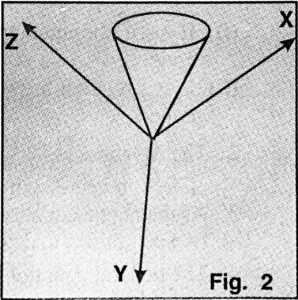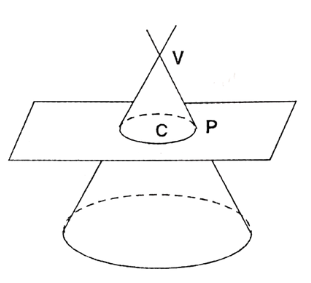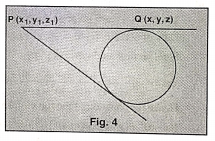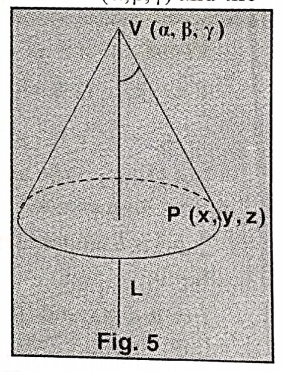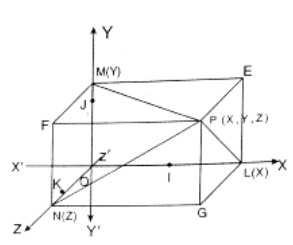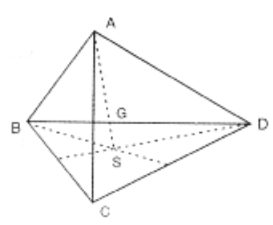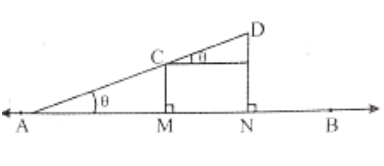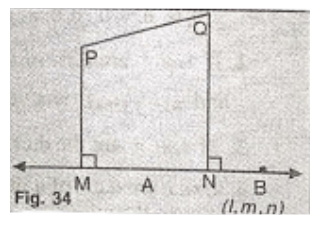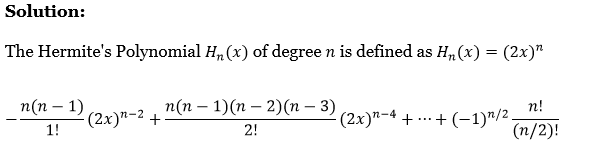
Legendre Polynomials Solved Exercise Problems

Legendre Polynomials Exercise 4

1. Define Legendre’s differential equation.

Solution:

The differential equation of the form \(\left(1-x^2\right) \frac{d^2 y}{d x^2}-2 x \frac{d y}{d x}+n(n+1) y=0\) is called Legendre’s differential equation (or Legendre’s equation), where n is a constant.

2. Show that 1) \(y=a_0\left[x^n-\frac{n(n+1)}{2(2 n-1)} x^{n-2}+\frac{n(n-1)(n-2)(n-3)}{2 \cdot 4(2 n-1)(2 n-3)} x^{n-4}+\cdots\right]\)

2) \(y=a_0\left[x^{-n-1}+\frac{(n+1)(n+2)}{2(2 n+3)} x^{-n-2}+\frac{(n+1)(n+2)(n+3)(n+4)}{2 \cdot 4(2 n+3)(2 n+5)} x^{-n-5}+\ldots\right]\)are solutions of

Legendre’s equation \(\left(1-x^2\right) \frac{d^2 y}{d x^2}-2 x \frac{d y}{d x}+n(n+1) y=0\)
Legendre Polynomials Exercise 4 Question 2.1

Solution:

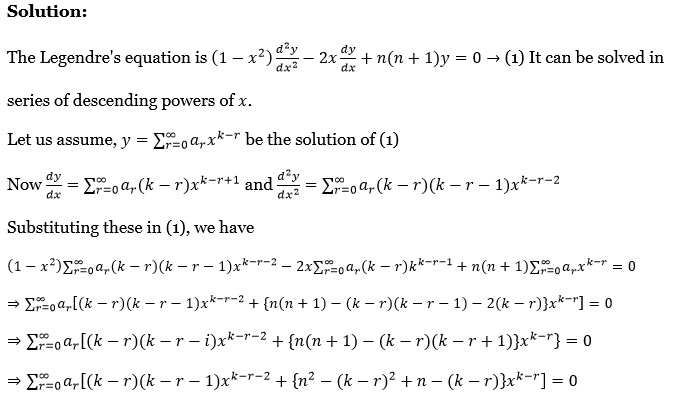
The Legendre’s equation is \(\left(1-x^2\right) \frac{d^2 y}{d x^2}-2 x \frac{d y}{d x}+n(n+1) y=0 \rightarrow(1)\) it is can be solved in series of descending power of x.

Let us assume, y = \(y=\sum_{r=0}^{\infty} a_r x^{k-r}\) be solution of (1)

Now \(\frac{d y}{d x}=\sum_{r=0}^{\infty} a_r(k-r) x^{k-r+1} \text { and } \frac{d^2 y}{d x^2}=\sum_{r=0}^{\infty} a_r(k-r)(k-r-1) x^{k-r-2}\)

Substituting these in (1), we have

⇒ \(\left(1-x^2\right) \sum_{r=0}^{\infty} a_r(k-r)(k-r-1) x^{k-r-2}-2 x \sum_{r=0}^{\infty} a_r(k-r) k^{k-r-1}+n(n+1) \sum_{r=0}^{\infty} a_r x^{k-r}=0\)

⇒ \(\sum_{r=0}^{\infty} a_r\left[(k-r)(k-r-1) x^{k-r-2}+\{n(n+1)-(k-r)(k-r-1)-2(k-r)\} x^{k-r}\right]=0\)

⇒ \(\sum_{r=0}^{\infty} a_r\left[(k-r)(k-r-i) x^{k-r-2}+\{n(n+1)-(k-r)(k-r+1)\} x^{k-r}\right\}=0\)

⇒ \(\sum_{r=0}^{\infty} a_r\left[(k-r)(k-r-1) x^{k-r-2}+\left\{n^2-(k-r)^2+n-(k-r)\right\} x^{k-r}\right]=0\)

⇒ \(\sum_{r=0}^{\infty} a_r\left[(k-r)(k-r-1) x^{k-r-2}+(n-k+r)(n+k-r+1) x^{k-r}\right]=0 \rightarrow(2)\)

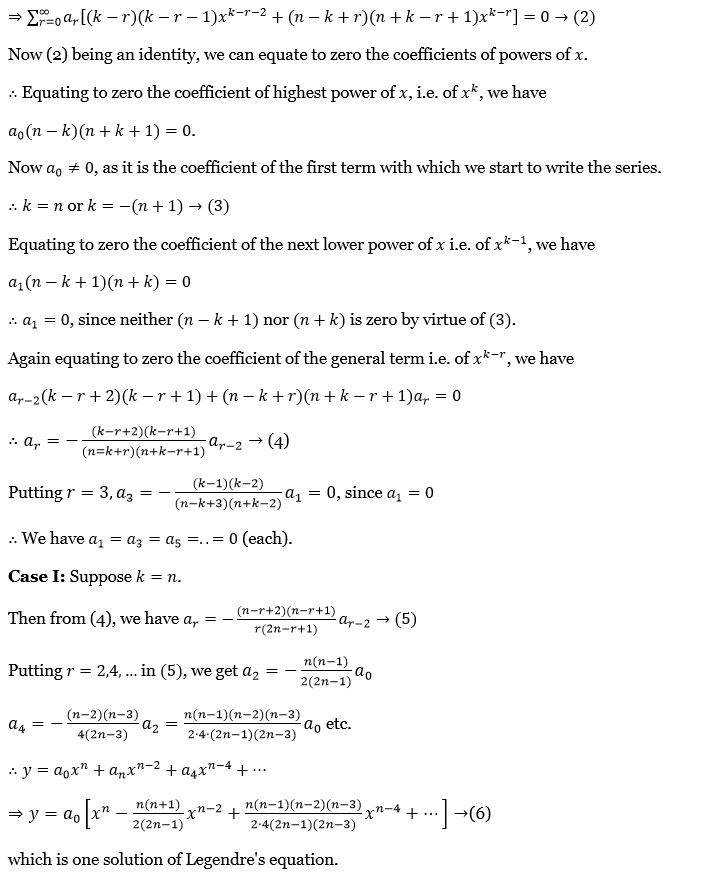
Now (2) being an identity, we can equal to zero the coefficient of power of x.

∴ The equation to zero the coefficient of the highest power of x, i.e. of xk, we have

⇒\(a_0(n-k)(n+k+1)=0\)

Now \(a_0 \neq 0\) as it is the coefficient of the first term with which we start to write the series.

∴ \(k=n \text { or } k=-(n+1) \rightarrow(3)\)

Equation to zero the coefficient of the next lower power of x i.e. \(x^{k-1}\), we have

⇒\(a_1(n-k+1)(n+k)=0\)

∴ a1 = 0, since neither (n-k+1) nor (n+k) is zero by virtue of (3)

Again equation to zero is the coefficient of the general term i.e. \(x^{k-r}\), we have

⇒ \(a_{r-2}(k-r+2)(k-r+1)+(n-k+r)(n+k-r+1) a_r=0\)

∴ \(a_r=-\frac{(k-r+2)(k-r+1)}{(n=k+r)(n+k-r+1)} a_{r-2} \rightarrow \text { (4) }\)

Putting r = 3, a3 = \(-\frac{(k-1)(k-2)}{(n-k+3)(n+k-2)} a_1=0\) since a1 = 0

∴ We have a1 = a3 = a5 = .. = 0 (each).

Case 1: supporting K = n

Then from (4), we have ar = \(-\frac{(n-r+2)(n-r+1)}{r(2 n-r+1)} a_{r-2} \rightarrow \text { (5) }\)

Putting r = 2,4….. in (5) we get \(a_2=-\frac{n(n-1)}{2(2 n-1)} a_0\)

\(a_4=-\frac{(n-2)(n-3)}{4(2 n-3)} a_2=\frac{n(n-1)(n-2)(n-3)}{2 \cdot 4 \cdot(2 n-1)(2 n-3)} a_0 \text { etc }\)

∴ \(y=a_0 x^n+a_n x^{n-2}+a_4 x^{n-4}+\cdots\)

⇒ \(y=a_0\left[x^n-\frac{n(n+1)}{2(2 n-1)} x^{n-2}+\frac{n(n-1)(n-2)(n-3)}{2 \cdot 4(2 n-1)(2 n-3)} x^{n-4}+\cdots\right] \rightarrow(6)\)

Which is one solution for Legndre’s equation
Legendre Polynomials Exercise 4 Question 2.2

Legendre Polynomials Exercise 4 Question 2.3

Legendre Polynomials Solved Examples Step-By-Step

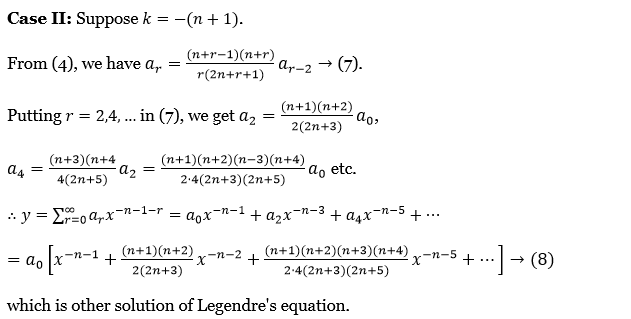
Case 2: Support k = -(n+1)

From (4) we have \(a_r=\frac{(n+r-1)(n+r)}{r(2 n+r+1)} a_{r-2} \rightarrow(7)\)

Putting r = 2,4 …. in (7), we get \(a_2=\frac{(n+1)(n+2)}{2(2 n+3)} a_0 \text {, }\)

⇒ \(a_4=\frac{(n+3)(n+4}{4(2 n+5)} a_2=\frac{(n+1)(n+2)(n-3)(n+4)}{2 \cdot 4(2 n+3)(2 n+5)} a_0 \text { etc. }\)

∴ \(y=\sum_{r=0}^{\infty} a_r x^{-n-1-r}=a_0 x^{-n-1}+a_2 x^{-n-3}+a_4 x^{-n-5}+\cdots\)

⇒ \(a_0\left[x^{-n-1}+\frac{(n+1)(n+2)}{2(2 n+3)} x^{-n-2}+\frac{(n+1)(n+2)(n+3)(n+4)}{2 \cdot 4(2 n+3)(2 n+5)} x^{-n-5}+\cdots\right] \rightarrow \text { (8) }\)

Which is another solution of Legendre’s equation.

Solved Exercise Problems On Legendre Polynomials

3. Define Legendre’s function of the first kind.
Legendre Polynomials Exercise 4 Question 3

Solution:

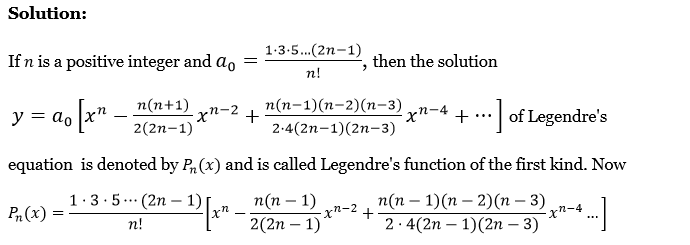
If n is a positive integer and \(a_0=\frac{1 \cdot 3 \cdot 5 \ldots(2 n-1)}{n!}\), then the solution

⇒ \(y=a_0\left[x^n-\frac{n(n+1)}{2(2 n-1)} x^{n-2}+\frac{n(n-1)(n-2)(n-3)}{2 \cdot 4(2 n-1)(2 n-3)} x^{n-4}+\cdots\right]\) of Legendre’s equation is denoted by pn(x) and is called Legendre’s function of the first kind. Now

⇒ \(P_n(x)=\frac{1 \cdot 3 \cdot 5 \cdots(2 n-1)}{n!}\left[x^n-\frac{n(n-1)}{2(2 n-1)} x^{n-2}+\frac{n(n-1)(n-2)(n-3)}{2 \cdot 4(2 n-1)(2 n-3)} x^{n-4} \cdots\right]\)

Applications Of Legendre Polynomials With Worked Examples

4. Define Legendre’s function of the second kind.
Legendre Polynomials Exercise 4 Question 4

Solution:

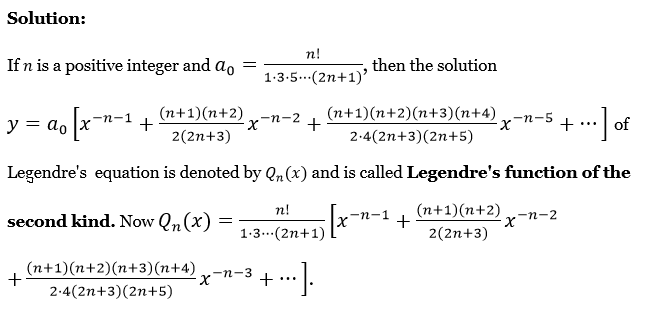
Legendre’s function of the second kind

If n is a positive integer and \(a_0=\frac{n!}{1 \cdot 3 \cdot 5 \cdots(2 n+1)}\), then the solution

⇒ \(y=a_0\left[x^{-n-1}+\frac{(n+1)(n+2)}{2(2 n+3)} x^{-n-2}+\frac{(n+1)(n+2)(n+3)(n+4)}{2 \cdot 4(2 n+3)(2 n+5)} x^{-n-5}+\cdots\right] \text { of }\)

Legendre’s equation is denoted by Qn(x) and is called Legendre’s function of the second kind.

Now, \(Q_n(x)=\frac{n!}{1 \cdot 3 \cdots(2 n+1)}[x^{-n-1}+\frac{(n+1)(n+2)}{2(2 n+3)} x^{-n-2}+\frac{(n+1)(n+2)(n+3)(n+4)}{2 \cdot 4(2 n+3)(2 n+5)} x^{-n-3}+\cdots\)

5. Show that \(P_0(x)=1, P_1(x)=x, P_2(x)=\frac{1}{2}\left(3 x^2-1\right), P_3(x)=\frac{1}{2}\left(5 x^3-3 x\right)\)

\(P_4(x)=\frac{1}{8}\left(35 x^4-30 x^2+3\right)\)
Legendre Polynomials Exercise 4 Question 5

Solution:

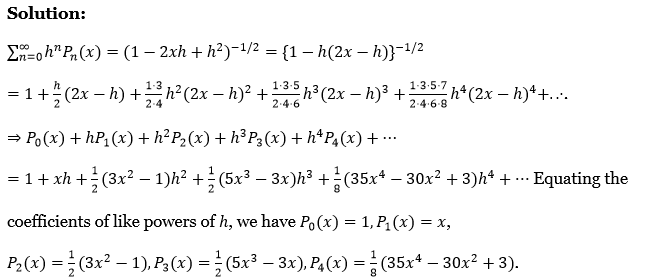
⇒ \(\sum_{n=0}^{\infty} h^n P_n(x)=\left(1-2 x h+h^2\right)^{-1 / 2}=\{1-h(2 x-h)\}^{-1 / 2}\)

⇒ \(1+\frac{h}{2}(2 x-h)+\frac{1 \cdot 3}{2 \cdot 4} h^2(2 x-h)^2+\frac{1 \cdot 3 \cdot 5}{2 \cdot 4 \cdot 6} h^3(2 x-h)^3+\frac{1 \cdot 3 \cdot 5 \cdot 7}{2 \cdot 4 \cdot 6 \cdot 8} h^4(2 x-h)^4+….\)

⇒ \(P_0(x)+h P_1(x)+h^2 P_2(x)+h^3 P_3(x)+h^4 P_4(x)+\cdots\)

⇒ \(1+x h+\frac{1}{2}\left(3 x^2-1\right) h^2+\frac{1}{2}\left(5 x^3-3 x\right) h^3+\frac{1}{8}\left(35 x^4-30 x^2+3\right) h^4+\cdots\)

Equating the coefficient of like powers of h, we have P0(x) = 1, P1(x) = x,

⇒ \(P_2(x)=\frac{1}{2}\left(3 x^2-1\right), P_3(x)=\frac{1}{2}\left(5 x^3-3 x\right), P_4(x)=\frac{1}{8}\left(35 x^4-30 x^2+3\right)\)

Legendre polynomials orthogonality property with examples

6. Prove that, for all x 1) \(x^2=\frac{1}{3} P_0(x)+\frac{2}{3} P_2(x)\) 2) \(x^3=\frac{3}{5} P_1(x)+\frac{2}{5} P_2(x)\).
Legendre Polynomials Exercise 4 Question 6

Solution:

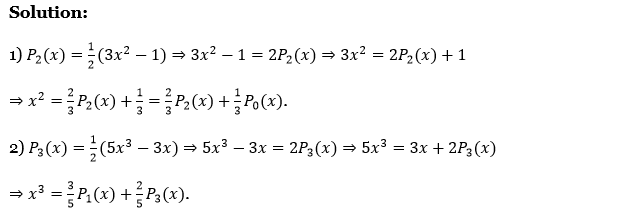
1. \(P_2(x)=\frac{1}{2}\left(3 x^2-1\right) \Rightarrow 3 x^2-1=2 P_2(x) \Rightarrow 3 x^2=2 P_2(x)+1\)

⇒ \(x^2=\frac{2}{3} P_2(x)+\frac{1}{3}=\frac{2}{3} P_2(x)+\frac{1}{3} P_0(x)\)

2. \(P_3(x)=\frac{1}{2}\left(5 x^3-3 x\right) \Rightarrow 5 x^3-3 x=2 P_3(x) \Rightarrow 5 x^3=3 x+2 P_3(x)\)

⇒ \(x^3=\frac{3}{5} P_1(x)+\frac{2}{5} P_3(x)\)

7. Express \(P(x)=x^4+2 x^3+2 x^2-x-3\) in terms of Legendre’s polynomials.
Legendre Polynomials Exercise 4 Question 7

Solution:

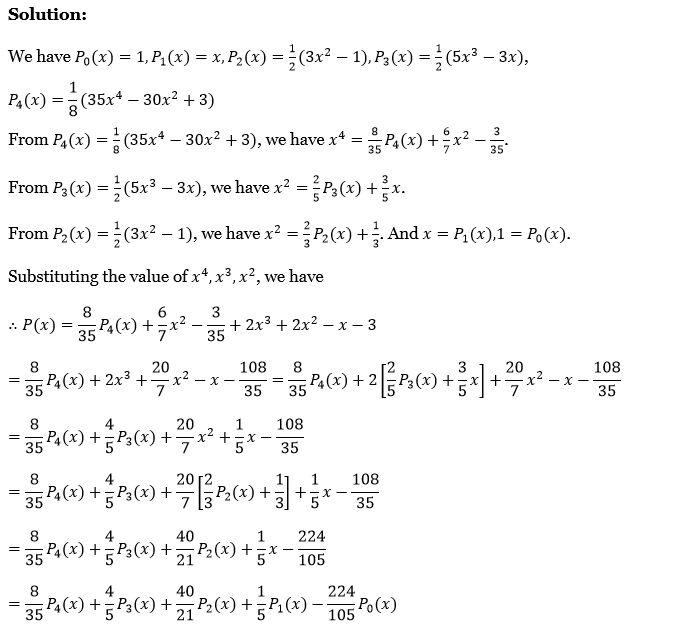
We have, \(P_0(x)=1, P_1(x)=x, P_2(x)=\frac{1}{2}\left(3 x^2-1\right), P_3(x)=\frac{1}{2}\left(5 x^3-3 x\right)\)

⇒ \(P_4(x)=\frac{1}{8}\left(35 x^4-30 x^2+3\right)\)

From \(P_4(x)=\frac{1}{8}\left(35 x^4-30 x^2+3\right), \text { we have } x^4=\frac{8}{35} P_4(x)+\frac{6}{7} x^2-\frac{3}{35}\)

From \(P_3(x)=\frac{1}{2}\left(5 x^3-3 x\right) \text {, we have } x^2=\frac{2}{5} P_3(x)+\frac{3}{5} x\)

From \(P_2(x)=\frac{1}{2}\left(3 x^2-1\right) \text {, we have } x^2=\frac{2}{3} P_2(x)+\frac{1}{3} \text {. And } x=P_1(x), 1=P_0(x) \text {. }\)

Substituting the value of \(x^4, x^3, x^2\), we have

∴ \(P(x)=\frac{8}{35} P_4(x)+\frac{6}{7} x^2-\frac{3}{35}+2 x^3+2 x^2-x-3\)

⇒ \(\frac{8}{35} P_4(x)+2 x^3+\frac{20}{7} x^2-x-\frac{108}{35}=\frac{8}{35} P_4(x)+2\left[\frac{2}{5} P_3(x)+\frac{3}{5} x\right]+\frac{20}{7} x^2-x-\frac{108}{35}\)

⇒ \(\frac{8}{35} P_4(x)+\frac{4}{5} P_3(x)+\frac{20}{7} x^2+\frac{1}{5} x-\frac{108}{35}\)

⇒ \(\frac{8}{35} P_4(x)+\frac{4}{5} P_3(x)+\frac{20}{7}\left[\frac{2}{3} P_2(x)+\frac{1}{3}\right]+\frac{1}{5} x-\frac{108}{35}\)

⇒ \(\frac{8}{35} P_4(x)+\frac{4}{5} P_3(x)+\frac{40}{21} P_2(x)+\frac{1}{5} x-\frac{224}{105}\)

⇒ \(=\frac{8}{35} P_4(x)+\frac{4}{5} P_3(x)+\frac{40}{21} P_2(x)+\frac{1}{5} P_1(x)-\frac{224}{105} P_0(x)\)

Step-By-Step Solutions For Legendre Polynomial Exercises

8. Prove that \(\left(1-2 x h+h^2\right)^{-1 / 2}=\sum_{n=0}^{\infty} h^n P_n(x)\).
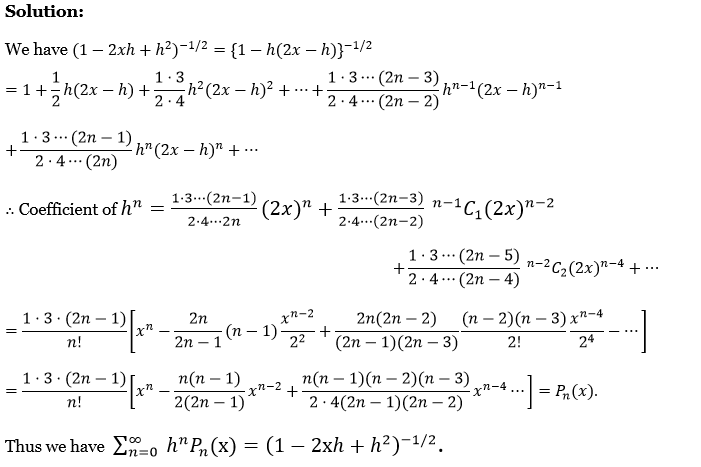
Legendre Polynomials Exercise 4 Question 8

Solution:

We have \(\left(1-2 x h+h^2\right)^{-1 / 2}=\{1-h(2 x-h)\}^{-1 / 2}\)

⇒ \(1+\frac{1}{2} h(2 x-h)+\frac{1 \cdot 3}{2 \cdot 4} h^2(2 x-h)^2+\cdots+\frac{1 \cdot 3 \cdots(2 n-3)}{2 \cdot 4 \cdots(2 n-2)} h^{n-1}(2 x-h)^{n-1}+\frac{1 \cdot 3 \cdots(2 n-1)}{2 \cdot 4 \cdots(2 n)} h^n(2 x-h)^n+\cdots\)

∴ Coefficient of \(h^n=\frac{1 \cdot 3 \cdots(2 n-1)}{2 \cdot 4 \cdots 2 n}(2 x)^n+\frac{1 \cdot 3 \cdots(2 n-3)}{2 \cdot 4 \cdots(2 n-2)}{ }^{n-1} C_1(2 x)^{n-2}\)

⇒ \(+\frac{1 \cdot 3 \cdots(2 n-5)}{2 \cdot 4 \cdots(2 n-4)}{ }^{n-2} C_2(2 x)^{n-4}+\cdots\)

⇒ \(\frac{1 \cdot 3 \cdot(2 n-1)}{n!}\left[x^n-\frac{2 n}{2 n-1}(n-1) \frac{x^{n-2}}{2^2}+\frac{2 n(2 n-2)}{(2 n-1)(2 n-3)} \frac{(n-2)(n-3)}{2!} \frac{x^{n-4}}{2^4}-\cdots\right]\)

⇒ \(\frac{1 \cdot 3 \cdot(2 n-1)}{n!}\left[x^n-\frac{n(n-1)}{2(2 n-1)} x^{n-2}+\frac{n(n-1)(n-2)(n-3)}{2 \cdot 4(2 n-1)(2 n-2)} x^{n-4} \cdots\right]=P_n(x)\)

Thus we have \(\sum_{n=0}^{\infty} h^n P_n(\mathrm{x})=\left(1-2 \mathrm{x} h+h^2\right)^{-1 / 2}\)

Examples Of Generating Functions For Legendre Polynomials

9. Show that 1) \(P_n(1)=1\) 2) \(P_n(-x)=(-1)^n P_n(x)\) and hence deduce that \(P_n(-1)=(-1)^n\).
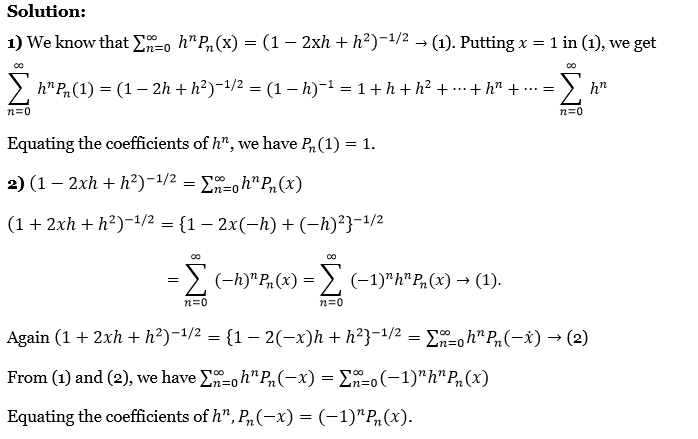
Legendre Polynomials Exercise 4 Question 9

Solution:

1. We know that \(\sum_{n=0}^{\infty} h^n P_n(\mathrm{x})=\left(1-2 \mathrm{x} h+h^2\right)^{-1 / 2} \rightarrow(1)\)

Putting x = 1 in (1), we get

⇒ \(\sum_{n=0}^{\infty} h^n P_n(1)=\left(1-2 h+h^2\right)^{-1 / 2}=(1-h)^{-1}=1+h+h^2+\cdots+h^n+\cdots=\sum_{n=0}^{\infty} h^n\)

Equation the coefficient of hn, we have Pn(1) = 1

2. \(\left(1-2 x h+h^2\right)^{-1 / 2}=\sum_{n=0}^{\infty} h^n P_n(x)\)

⇒ \(\left(1+2 x h+h^2\right)^{-1 / 2}=\left\{1-2 x(-h)+(-h)^2\right\}^{-1 / 2}\)

⇒ \(=\sum_{n=0}^{\infty}(-h)^n P_n(x)=\sum_{n=0}^{\infty}(-1)^n h^n P_n(x) \rightarrow(1)\)

Again \(\left(1+2 x h+h^2\right)^{-1 / 2}=\left\{1-2(-x) h+h^2\right\}^{-1 / 2}=\sum_{n=0}^{\infty} h^n P_n(-{x}) \rightarrow(2)\)

From (1) and (2), we have \(\sum_{n=0}^{\infty} h^n P_n(-x)=\sum_{n=0}^{\infty}(-1)^n h^n P_n(x)\)

Equating the coefficient of \(h^n, P_n(-x)=(-1)^n P_n(x)\)

10. Prove that \(P_n(0)=0\), for n odd and \(P_n(0)=\frac{(-1)^{n / 2} n !}{2^n\{(n / 2) !\}^2}\), for n even.
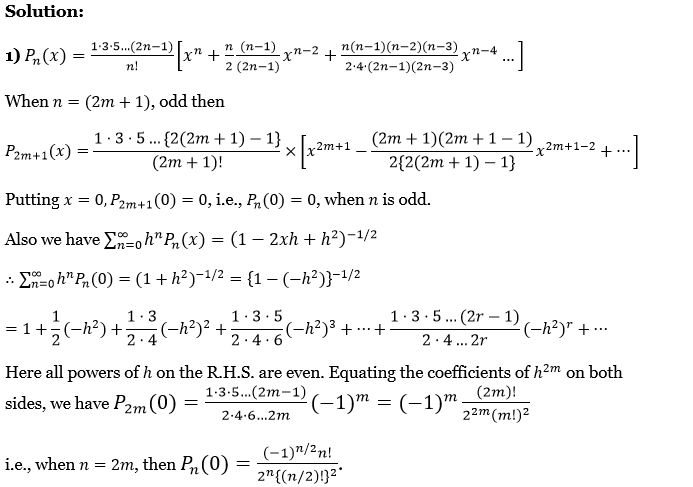
Legendre Polynomials Exercise 4 Question 10

Solution:

1. \(P_n(x)=\frac{1 \cdot 3 \cdot 5 \ldots(2 n-1)}{n!}\left[x^n+\frac{n}{2} \frac{(n-1)}{(2 n-1)} x^{n-2}+\frac{n(n-1)(n-2)(n-3)}{2 \cdot 4 \cdot(2 n-1)(2 n-3)} x^{n-4} \ldots\right]\)

When n = (2m+1), odd then

⇒ \(P_{2 m+1}(x)=\frac{1 \cdot 3 \cdot 5 \ldots\{2(2 m+1)-1\}}{(2 m+1)!} \times\left[x^{2 m+1}-\frac{(2 m+1)(2 m+1-1)}{2\{2(2 m+1)-1\}} x^{2 m+1-2}+\cdots\right]\)

Putting \(x=0, P_{2 m+1}(0)=0 \text {, i.e., } P_n(0)=0\), when n is odd.

Also, we have \(\sum_{n=0}^{\infty} h^n P_n(x)=\left(1-2 x h+h^2\right)^{-1 / 2}\)

∴ \(\sum_{n=0}^{\infty} h^n P_n(0)=\left(1+h^2\right)^{-1 / 2}=\left\{1-\left(-h^2\right)\right\}^{-1 / 2}\)

⇒ \(1+\frac{1}{2}\left(-h^2\right)+\frac{1 \cdot 3}{2 \cdot 4}\left(-h^2\right)^2+\frac{1 \cdot 3 \cdot 5}{2 \cdot 4 \cdot 6}\left(-h^2\right)^3+\cdots+\frac{1 \cdot 3 \cdot 5 \ldots(2 r-1)}{2 \cdot 4 \ldots 2 r}\left(-h^2\right)^r+\cdots\)

Here all powers of h on the R.H.S. are even. Equating the coefficients of h2m on both sides, we have

⇒ \(P_{2 m}(0)=\frac{1 \cdot 3 \cdot 5 \ldots(2 m-1)}{2 \cdot 4 \cdot 6 \ldots . .2 m}(-1)^m=(-1)^m \frac{(2 m)!}{2^{2 m}(m!)^2}\)

i.e., when n = 2m, then \(\)

⇒ \(P_n(0)=\frac{(-1)^{n / 2} n!}{2^n\{(n / 2)!\}^2}\)

11. Prove that \(\left(1-2 x z+z^2\right)^{-1 / 2}\) is a solution of the equation of \(z \frac{\partial^2(z v)}{\partial z^2}+\frac{\partial}{\partial x}\left\{\left(1-x^2\right) \frac{\partial v}{\partial x}\right\}=0\).
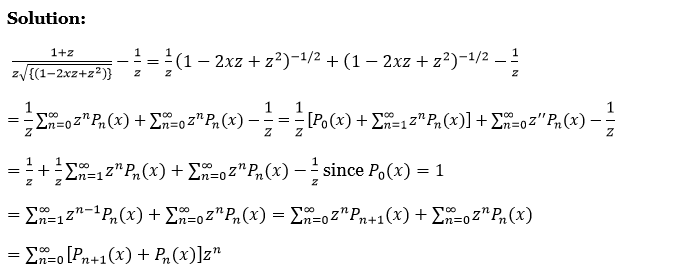
Legendre Polynomials Exercise 4 Question 11

Solution:

⇒ \(\frac{1+z}{z \sqrt{\left\{\left(1-2 x z+z^2\right)\right\}}}-\frac{1}{z}=\frac{1}{z}\left(1-2 x z+z^2\right)^{-1 / 2}+\left(1-2 x z+z^2\right)^{-1 / 2}-\frac{1}{z}\)

⇒ \(\frac{1}{z} \sum_{n=0}^{\infty} z^n P_n(x)+\sum_{n=0}^{\infty} z^n P_n(x)-\frac{1}{z}=\frac{1}{z}\left[P_0(x)+\sum_{n=1}^{\infty} z^n P_n(x)\right]+\sum_{n=0}^{\infty} z^{\prime \prime} P_n(x)-\frac{1}{z}\)

⇒ \(\frac{1}{z}+\frac{1}{z} \sum_{n=1}^{\infty} z^n P_n(x)+\sum_{n=0}^{\infty} z^n P_n(x)-\frac{1}{z} \text { since } P_0(x)=1\)

⇒ \(\sum_{n=1}^{\infty} z^{n-1} P_n(x)+\sum_{n=0}^{\infty} z^n P_n(x)=\sum_{n=0}^{\infty} z^n P_{n+1}(x)+\sum_{n=0}^{\infty} z^n P_n(x)\)

⇒ \(\sum_{n=0}^{\infty}\left[P_{n+1}(x)+P_n(x)\right] z^n\)

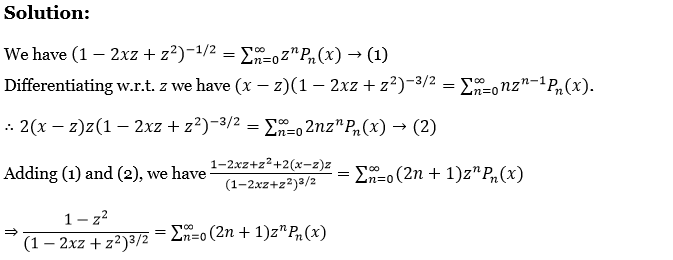
12. Prove that \(\frac{1+z}{z \sqrt{\left.\left\{1-2 x z+z^2\right)\right\}}}-\frac{1}{z}=\sum_{n=0}^{\infty}\left[P_n(x)+P_{n+1}(x)\right] z^n\).
Legendre Polynomials Exercise 4 Question 12

Solution:

We have \(\left(1-2 x z+z^2\right)^{-1 / 2}=\sum_{n=0}^{\infty} z^n P_n(x) \rightarrow(1)\)

Differentiating w.r.t. z we have \((x-z)\left(1-2 x z+z^2\right)^{-3 / 2}=\sum_{n=0}^{\infty} n z^{n-1} P_n(x)\)

∴ \(2(x-z) z\left(1-2 x z+z^2\right)^{-3 / 2}=\sum_{n=0}^{\infty} 2 n z^n P_n(x) \rightarrow(2)\)

Adding (1) and (2), we have \(\frac{1-2 x z+z^2+2(x-z) z}{\left(1-2 x z+z^2\right)^{3 / 2}}=\sum_{n=0}^{\infty}(2 n+1) z^n P_n(x)\)

⇒ \(\frac{1-z^2}{\left(1-2 x z+z^2\right)^{3 / 2}}=\sum_{n=0}^{\infty}(2 n+1) z^n P_n(x)\)

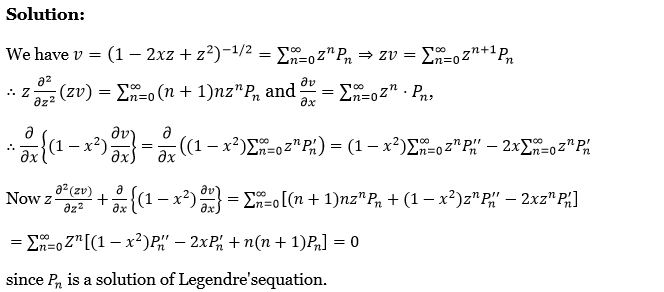
13. Show that \(\frac{1-z^2}{\left(1-2 x z+z^2\right)^{3 / 2}}=\sum_{n=0}^{\infty}(2 n+1) z^n P_n(x)\).
Legendre Polynomials Exercise 4 Question 13

Solution:

We have v = \(\left(1-2 x z+z^2\right)^{-1 / 2}=\sum_{n=0}^{\infty} z^n P_n \Rightarrow z v=\sum_{n=0}^{\infty} z^{n+1} P_n\)

∴ \(z \frac{\partial^2}{\partial z^2}(z v)=\sum_{n=0}^{\infty}(n+1) n z^n P_n \text { and } \frac{\partial v}{\partial x}=\sum_{n=0}^{\infty} z^n \cdot P_n\)

∴ \(\frac{\partial}{\partial x}\left\{\left(1-x^2\right) \frac{\partial v}{\partial x}\right\}=\frac{\partial}{\partial x}\left(\left(1-x^2\right) \sum_{n=0}^{\infty} z^n P_n^{\prime}\right)=\left(1-x^2\right) \sum_{n=0}^{\infty} z^n P_n^{\prime \prime}-2 x \sum_{n=0}^{\infty} z^n P_n^{\prime}\)

Now \(z \frac{\partial^2(z v)}{\partial z^2}+\frac{\partial}{\partial x}\left\{\left(1-x^2\right) \frac{\partial v}{\partial x}\right\}=\sum_{n=0}^{\infty}\left[(n+1) n z^n P_n+\left(1-x^2\right) z^n P_n^{\prime \prime}-2 x z^n P_n^{\prime}\right]\)

⇒ \(\sum_{n=0}^{\infty} Z^n\left[\left(1-x^2\right) P_n^{\prime \prime}-2 x P_n^{\prime}+n(n+1) P_n\right]=0\)

since Pn is a  solution of Legendre’s equation

Worked Problems On Legendre Polynomial Recursion Relations

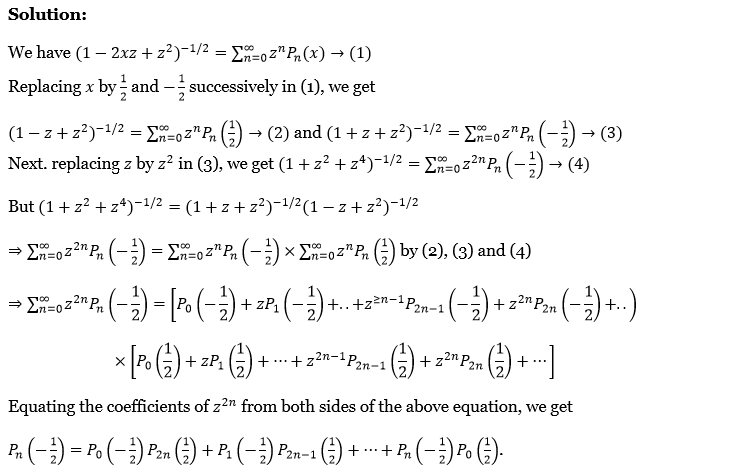
14. Prove that \(P_n\left(-\frac{1}{2}\right)=P_0\left(-\frac{1}{2}\right) P_{2 n}\left(\frac{1}{2}\right)+P_1\left(-\frac{1}{2}\right) P_{2 n-1}\left(\frac{1}{2}\right)+\ldots+P_n\left(-\frac{1}{2}\right) P_0\left(\frac{1}{2}\right)\).
Legendre Polynomials Exercise 4 Question 14

Solution:

We have \(\left(1-2 x z+z^2\right)^{-1 / 2}=\sum_{n=0}^{\infty} z^n P_n(x) \rightarrow(1)\)

Replacing x by \(\frac{1}{2} \text { and }-\frac{1}{2}\) successively in (1), we get

⇒ \(\left(1-z+z^2\right)^{-1 / 2}=\sum_{n=0}^{\infty} z^n P_n\left(\frac{1}{2}\right) \rightarrow \text { (2) and }\left(1+z+z^2\right)^{-1 / 2}=\sum_{n=0}^{\infty} z^n P_n\left(-\frac{1}{2}\right) \rightarrow \text { (3) }\)

Next replacing z by z2 in (3), we get \(\left(1+z^2+z^4\right)^{-1 / 2}=\sum_{n=0}^{\infty} z^{2 n} P_n\left(-\frac{1}{2}\right) \rightarrow(4)\)

But \(\left(1+z^2+z^4\right)^{-1 / 2}=\left(1+z+z^2\right)^{-1 / 2}\left(1-z+z^2\right)^{-1 / 2}\)

⇒ \(\sum_{n=0}^{\infty} z^{2 n} P_n\left(-\frac{1}{2}\right)=\sum_{n=0}^{\infty} z^n P_n\left(-\frac{1}{2}\right) \times \sum_{n=0}^{\infty} z^n P_n\left(\frac{1}{2}\right) \text { by (2), (3) and (4) }\)

⇒ \(\sum_{n=0}^{\infty} z^{2 n} P_n\left(-\frac{1}{2}\right)=\left[P_0\left(-\frac{1}{2}\right)+z P_1\left(-\frac{1}{2}\right)+. .+z^{\geq n-1} P_{2 n-1}\left(-\frac{1}{2}\right)+z^{2 n} P_{2 n}\left(-\frac{1}{2}\right)+. .\right)\)

⇒ \(\times\left[P_0\left(\frac{1}{2}\right)+z P_1\left(\frac{1}{2}\right)+\cdots+z^{2 n-1} P_{2 n-1}\left(\frac{1}{2}\right)+z^{2 n} P_{2 n}\left(\frac{1}{2}\right)+\cdots\right]\)

Equating the coefficients of z2n from both sides of the above equation, we get

⇒ \(P_n\left(-\frac{1}{2}\right)=P_0\left(-\frac{1}{2}\right) P_{2 n}\left(\frac{1}{2}\right)+P_1\left(-\frac{1}{2}\right) P_{2 n-1}\left(\frac{1}{2}\right)+\cdots+P_n\left(-\frac{1}{2}\right) P_0\left(\frac{1}{2}\right)\)

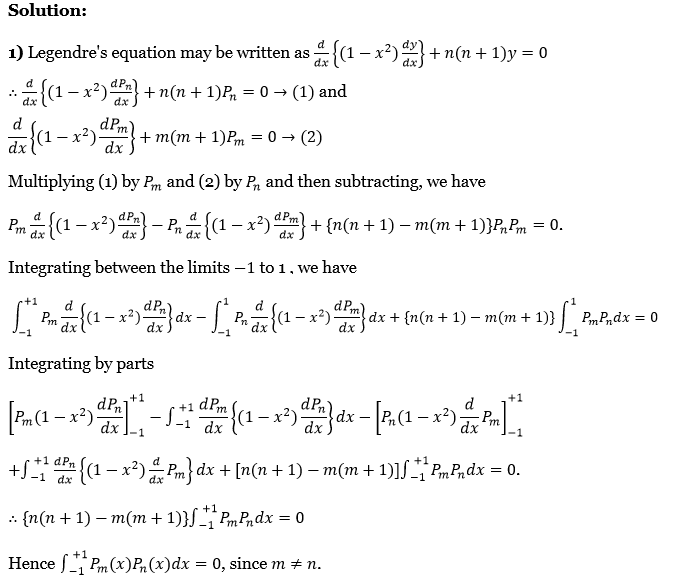
15. Prove that 1) \(\int_{-1}^{+1} P_{m t}(x) P_n(x) d x=0 \text { if } m \neq n\) 2) \(\int_{-1}^{+1}\left[P_n(x)\right]^2 d x=\frac{2}{2 n+1}\).
Legendre Polynomials Exercise 4 Question 15.1

Solution:

1. Legendre’s equation may be written as \(\frac{d}{d x}\left\{\left(1-x^2\right) \frac{d y}{d x}\right\}+n(n+1) y=0\)

∴ \(\frac{d}{d x}\left\{\left(1-x^2\right) \frac{d P_n}{d x}\right\}+n(n+1) P_n=0 \rightarrow(1)\) and

\(\frac{d}{d x}\left\{\left(1-x^2\right) \frac{d P_m}{d x}\right\}+m(m+1) P_m=0 \rightarrow \text { (2) }\)

Multiplying (1) by Pm and (2) by Pn and then subtracting, we have

⇒ \(P_m \frac{d}{d x}\left\{\left(1-x^2\right) \frac{d P_n}{d x}\right\}-P_n \frac{d}{d x}\left\{\left(1-x^2\right) \frac{d P_m}{d x}\right\}+\{n(n+1)-m(m+1)\} P_n P_m=0\)

Integrating between the limits -1 to 1, we have

⇒ \(\int_{-1}^{+1} P_m \frac{d}{d x}\left\{\left(1-x^2\right) \frac{d P_n}{d x}\right\} d x-\int_{-1}^1 P_n \frac{d}{d x}\left\{\left(1-x^2\right) \frac{d P_m}{d x}\right\} d x+\{n(n+1)-m(m+1)\} \int_{-1}^1 P_m P_n d x=0\)

Integrating by parts

⇒ \(\left[P_m\left(1-x^2\right) \frac{d P_n}{d x}\right]_{-1}^{+1}-\int_{-1}^{+1} \frac{d P_m}{d x}\left\{\left(1-x^2\right) \frac{d P_n}{d x}\right\} d x-\left[P_n\left(1-x^2\right) \frac{d}{d x} P_m\right]_{-1}^{+1}\)

⇒ \(+\int_{-1}^{+1} \frac{d P_n}{d x}\left\{\left(1-x^2\right) \frac{d}{d x} P_m\right\} d x+[n(n+1)-m(m+1)] \int_{-1}^{+1} P_m P_n d x=0\)

∴ \(\{n(n+1)-m(m+1)\} \int_{-1}^{+1} P_m P_n d x=0\)

Hence \(\int_{-1}^{+1} P_m(x) P_n(x) d x=0\) since m ≠ n
Legendre Polynomials Exercise 4 Question 15.2

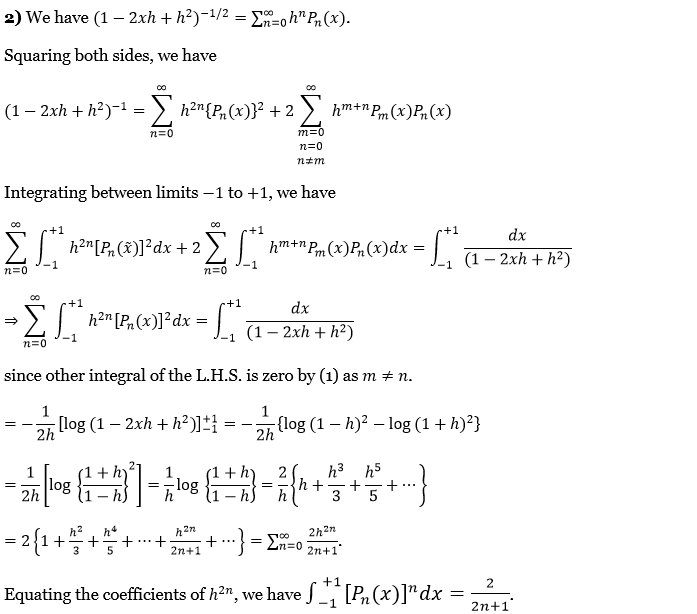
2. we have \(\left(1-2 x h+h^2\right)^{-1 / 2}=\sum_{n=0}^{\infty} h^n P_n(x)\)

Squaring both sides we have

⇒ \(\left(1-2 x h+h^2\right)^{-1}=\sum_{n=0}^{\infty} h^{2 n}\left\{P_n(x)\right\}^2+2 \sum_{{m=0 \\ n=0 \\ n \neq m}}^{\infty} h^{m+n} P_m(x) P_n(x)\)

Integrating between limits -1 to +1, we have

⇒ \(\sum_{n=0}^{\infty} \int_{-1}^{+1} h^{2 n}\left[P_n(\tilde{x})\right]^2 d x+2 \sum_{n=0}^{\infty} \int_{-1}^{+1} h^{m+n} P_m(x) P_n(x) d x=\int_{-1}^{+1} \frac{d x}{\left(1-2 x h+h^2\right)}\)

⇒ \(\sum_{n=0}^{\infty} \int_{-1}^{+1} h^{2 n}\left[P_n(x)\right]^2 d x=\int_{-1}^{+1} \frac{d x}{\left(1-2 x h+h^2\right)}\)

Since the other integral of the L.H.S. is zero by (1) as m ≠ n

⇒ \(-\frac{1}{2 h}\left[\log \left(1-2 x h+h^2\right)\right]_{-1}^{+1}=-\frac{1}{2 h}\left\{\log (1-h)^2-\log (1+h)^2\right\}\)

⇒ \(\frac{1}{2 h}\left[\log \left\{\frac{1+h}{1-h}\right\}^2\right]=\frac{1}{h} \log \left\{\frac{1+h}{1-h}\right\}=\frac{2}{h}\left\{h+\frac{h^3}{3}+\frac{h^5}{5}+\cdots\right\}\)

⇒ \(2\left\{1+\frac{h^2}{3}+\frac{h^4}{5}+\cdots+\frac{h^{2 n}}{2 n+1}+\cdots\right\}=\sum_{n=0}^{\infty} \frac{2 h^{2 n}}{2 n+1} .\)

Equating the coefficients of h2n, we have \(\int_{-1}^{+1}\left[P_n(x)\right]^n d x=\frac{2}{2 n+1}\)

16. Prove that \((2 n+1) x P_n=(n+1) P_{n+1}+n P_{n-1} \text {. }\).
Legendre Polynomials Exercise 4 Question 16

Solution:

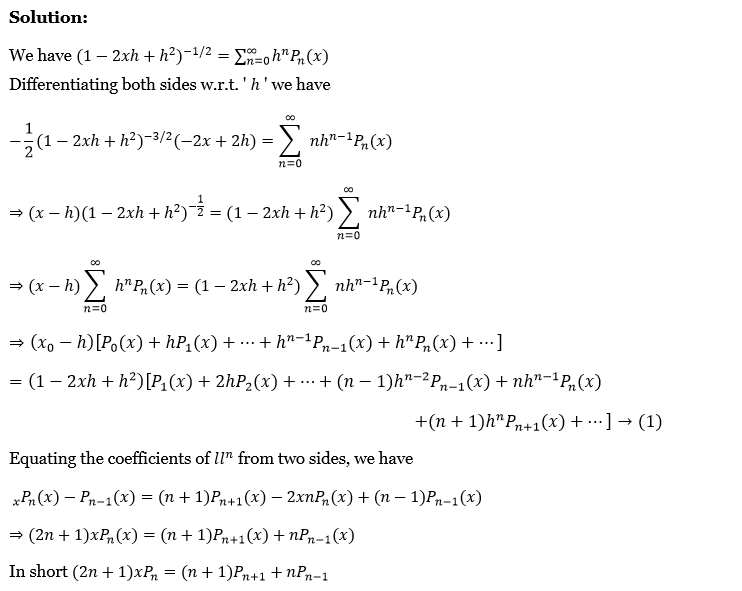
We have \(\left(1-2 x h+h^2\right)^{-1 / 2}=\sum_{n=0}^{\infty} h^n P_n(x)\)

Differentiating both sides w.r.t ‘h’ we have

⇒ \(-\frac{1}{2}\left(1-2 x h+h^2\right)^{-3 / 2}(-2 x+2 h)=\sum_{n=0}^{\infty} n h^{n-1} P_n(x)\)

⇒ \((x-h)\left(1-2 x h+h^2\right)^{-\frac{1}{2}}=\left(1-2 x h+h^2\right) \sum_{n=0}^{\infty} n h^{n-1} P_n(x)\)

⇒ \((x-h) \sum_{n=0}^{\infty} h^n P_n(x)=\left(1-2 x h+h^2\right) \sum_{n=0}^{\infty} n h^{n-1} P_n(x)\)

⇒ \(\left(x_0-h\right)\left[P_0(x)+h P_1(x)+\cdots+h^{n-1} P_{n-1}(x)+h^n P_n(x)+\cdots\right]\)

⇒ \(\left(1-2 x h+h^2\right)\left[P_1(x)+2 h P_2(x)+\cdots+(n-1) h^{n-2} P_{n-1}(x)+n h^{n-1} P_n(x)\right.\)

⇒ \(\left.+(n+1) h^n P_{n+1}(x)+\cdots\right] \rightarrow(1)\)

Equating the coefficient of lln from two sides, we have

⇒ \({ }_x P_n(x)-P_{n-1}(x)=(n+1) P_{n+1}(x)-2 x n P_n(x)+(n-1) P_{n-1}(x)\)

⇒ \((2 n+1) x P_n(x)=(n+1) P_{n+1}(x)+n P_{n-1}(x)\)

In short \((2 n+1) x P_n=(n+1) P_{n+1}+n P_{n-1}\)

17. Prove that \(n P_n=x P_n^{\prime}-P_{n-1}^{\prime}\).
Legendre Polynomials Exercise 4 Question 17

Solution:

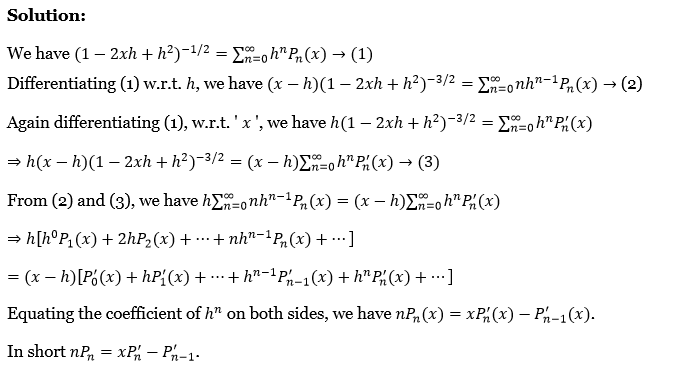
We have \(\left(1-2 x h+h^2\right)^{-1 / 2}=\sum_{n=0}^{\infty} h^n P_n(x) \rightarrow(1)\)

Differentiating (1) w.r.t. h, we have \((x-h)\left(1-2 x h+h^2\right)^{-3 / 2}=\sum_{n=0}^{\infty} n h^{n-1} P_n(x) \rightarrow(2)\)

Again differentiating (1), we have \(h\left(1-2 x h+h^2\right)^{-3 / 2}=\sum_{n=0}^{\infty} h^n P_n^{\prime}(x)\)

⇒ \(h(x-h)\left(1-2 x h+h^2\right)^{-3 / 2}=(x-h) \sum_{n=0}^{\infty} h^n P_n^{\prime}(x) \rightarrow(3)\)

From (2) and (3), we have \(h \sum_{n=0}^{\infty} n h^{n-1} P_n(x)=(x-h) \sum_{n=0}^{\infty} h^n P_n^{\prime}(x)\)

⇒ \(h\left[h^0 P_1(x)+2 h P_2(x)+\cdots+n h^{n-1} P_n(x)+\cdots\right]\)

⇒ \((x-h)\left[P_0^{\prime}(x)+h P_1^{\prime}(x)+\cdots+h^{n-1} P_{n-1}^{\prime}(x)+h^n P_n^{\prime}(x)+\cdots\right]\)

Equating the coefficient of hn on both sides, we have \(n P_n(x)=x P_n^{\prime}(x)-P_{n-1}^{\prime}(x)\)

In short \(n P_n=x P_n^{\prime}-P_{n-1}^{\prime}\)

18. Prove that \((2 n+1) P_n=P_{n+1}^{\prime}-P_{n-1}^{\prime}\).
Legendre Polynomials Exercise 4 Question 18

Solution:

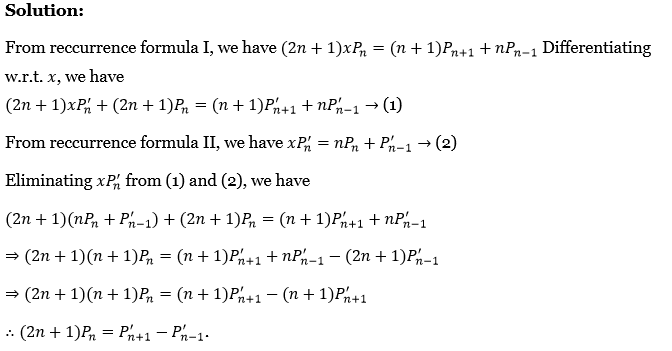
From recurrence formula 1, we have \((2 n+1) x P_n=(n+1) P_{n+1}+n P_{n-1}\) Differentiating w.r.t we have

⇒ \((2 n+1) x P_n^{\prime}+(2 n+1) P_n=(n+1) P_{n+1}^{\prime}+n P_{n-1}^{\prime} \rightarrow(1)\)

From recurrence formula 2, we have\(x P_n^{\prime}=n P_n+P_{n-1}^{\prime} \rightarrow \text { (2) }\)

Eliminating xP’n From (1) and (2), we have

⇒ \((2 n+1)\left(n P_n+P_{n-1}^{\prime}\right)+(2 n+1) P_n=(n+1) P_{n+1}^{\prime}+n P_{n-1}^{\prime}\)

⇒ \((2 n+1)(n+1) P_n=(n+1) P_{n+1}^{\prime}+n P_{n-1}^{\prime}-(2 n+1) P_{n-1}^{\prime}\)

⇒ \((2 n+1)(n+1) P_n=(n+1) P_{n+1}^{\prime}-(n+1) P_{n+1}^{\prime}\)

∴ \((2 n+1) P_n=P_{n+1}^{\prime}-P_{n-1}^{\prime}\)

19. Prove that \((n+1) P_n=\left(P_{n+1}^{\prime}-x P_n^{\prime}\right)\).

Solution:

Writing Recurrence formula | and || we have,

⇒ \(n P_n=x P_n^{\prime}-P_{n-1}^{\prime} \rightarrow(1) \text { and }(2 n+1) P_n=P_{n+1}^{\prime}-P_{n-1}^{\prime} \rightarrow \text { (2) }\)

Subtracting (1) from (2) we have \((n+1) P_n=P_{n+1}^{\prime}-x P_n^{\prime}\)

20. Prove that \(\left(1-x^2\right) P_n^{\prime}=n\left(P_{n-1}-x P_n\right)\).

Solution:

Replacing n by (n-1) in recurrence formula IV, we have

⇒ \(n P_{n-1}=P_n^{\prime}-x P_{n-1}^{\prime} \rightarrow(1)\)

Writing II recurrence formula, we have \(n P_n=x P_n^{\prime}-P_{n-1}^{\prime} \rightarrow(2)\)

Multiplying by x and then subtracting from (1), we have

⇒ \(n\left(P_{n-1}-x P_n\right)=\left(1-x^2\right) P_n^{\prime} \Rightarrow\left(1-x^2\right) P_n^{\prime}=n\left(P_{n-1}-x P_n\right)\)

21. Prove that \(\left(1-x^2\right) P_n^{\prime}=(n+1)\left(x P_n-P_{n+1}\right)\).
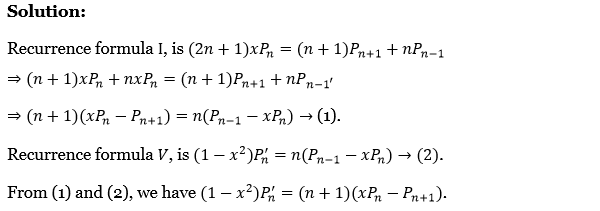
Legendre Polynomials Exercise 4 Question 21

Solution:

Recurrence formula 1, is \((2 n+1) x P_n=(n+1) P_{n+1}+n P_{n-1}\)

⇒ \((n+1) x P_n+n x P_n=(n+1) P_{n+1}+n P_{n-1^{\prime}}\)

⇒ \((n+1)\left(x P_n-P_{n+1}\right)=n\left(P_{n-1}-x P_n\right) \rightarrow(1)\)

Recurrence formula V is \(\left(1-x^2\right) P_n^{\prime}=n\left(P_{n-1}-x P_n\right) \rightarrow(2)\)

From (1) and (2), we have \(\left(1-x^2\right) P_n^{\prime}=(n+1)\left(x P_n-P_{n+1}\right)\)

22. Prove Beltrami’s result. i.e., \((2 n+1)\left(x^2-1\right) P_n^{\prime}=n(n+1)\left(P_{n+1}-P_{n-1}\right)\).
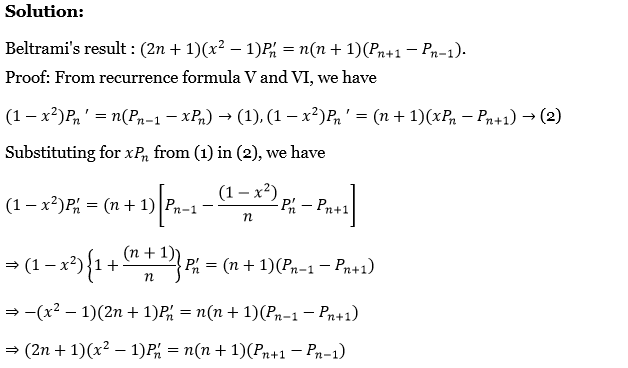
Legendre Polynomials Exercise 4 Question 22

Solution:

Beltrami’s result: \((2 n+1)\left(x^2-1\right) P_n^{\prime}=n(n+1)\left(P_{n+1}-P_{n-1}\right)\)

Proof: From recurrence formulas 5 and 6, we have

⇒ \(\left(1-x^2\right) P_n^{\prime}=n\left(P_{n-1}-x P_n\right) \rightarrow(1),\left(1-x^2\right) P_n^{\prime}=(n+1)\left(x P_n-P_{n+1}\right) \rightarrow(2)\)

Substituting for xPn from (1) in (2), we have

⇒ \(\left(1-x^2\right) P_n^{\prime}=(n+1)\left[P_{n-1}-\frac{\left(1-x^2\right)}{n} P_n^{\prime}-P_{n+1}\right]\)

⇒ \(\left(1-x^2\right)\left\{1+\frac{(n+1)}{n}\right\} P_n^{\prime}=(n+1)\left(P_{n-1}-P_{n+1}\right)\)

⇒ \(-\left(x^2-1\right)(2 n+1) P_n^{\prime}=n(n+1)\left(P_{n-1}-P_{n+1}\right)\)

⇒ \((2 n+1)\left(x^2-1\right) P_n^{\prime}=n(n+1)\left(P_{n+1}-P_{n-1}\right)\)

23. Prove that \(P_n^{\prime}=(2 n-1) P_{n-1}+(2 n-5) P_{n-3}+(2 n-9) P_{n-5}+\ldots\), the last term of the series being \(3 P_1 \text { or } P_0\) according as n is even or odd.
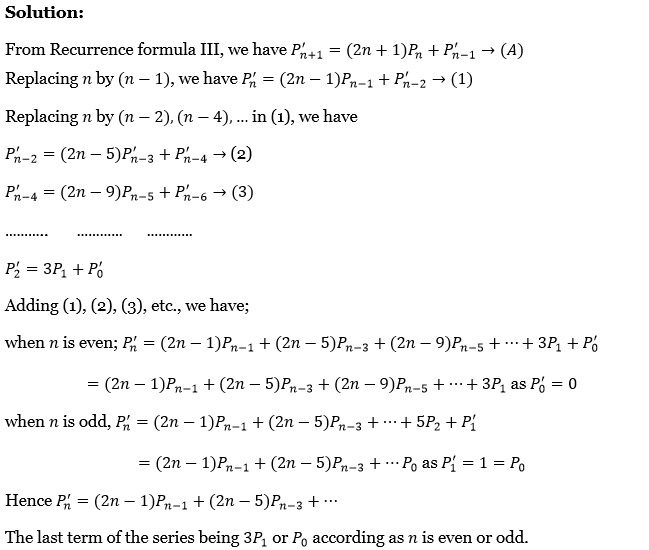
Legendre Polynomials Exercise 4 Question 23

Solution:

From Recurrence formula 3, we have \(P_{n+1}^{\prime}=(2 n+1) P_n+P_{n-1}^{\prime} \rightarrow(A)\)

Replacing n by (n-1) we have \(P_n^{\prime}=(2 n-1) P_{n-1}+P_{n-2}^{\prime} \rightarrow(1)\)

Replacing n by (n-1) (n-4),…….. in (1), we have

⇒ \(P_{n-2}^{\prime}=(2 n-5) P_{n-3}^{\prime}+P_{n-4}^{\prime} \rightarrow(2)\)

⇒ \(P_{n-4}^{\prime}=(2 n-9) P_{n-5}+P_{n-6}^{\prime} \rightarrow(3)\)

………           ………            …….

⇒ \(P_2^{\prime}=3 P_1+P_0^{\prime}\)

Adding (1),(2),(3), etc., we have;

when n is even; \(P_n^{\prime}=(2 n-1) P_{n-1}+(2 n-5) P_{n-3}+(2 n-9) P_{n-5}+\cdots+3 P_1+P_0^{\prime}\)

⇒ \((2 n-1) P_{n-1}+(2 n-5) P_{n-3}+(2 n-9) P_{n-5}+\cdots+3 P_1 \text { as } P_0^{\prime}=0\)

When n is odd, \(P_n^{\prime}=(2 n-1) P_{n-1}+(2 n-5) P_{n-3}+\cdots+5 P_2+P_1^{\prime}\)

⇒ \((2 n-1) P_{n-1}+(2 n-5) P_{n-3}+\cdots P_0 \text { as } P_1^{\prime}=1=P_0\)

Hence \(P_n^{\prime}=(2 n-1) P_{n-1}+(2 n-5) P_{n-3}+\cdots\)

The last term of the series 3P1 or P0 according to n is even or odd.

24. Prove Christoffel’s summation formula :

\(\sum_{r=0}^n(2 r+1) P_r(x) P_r(y)=(n+1) \frac{P_{n+1}(x) P_n(y)-P_{n+1}(y) P_n(x)}{(x-y)} .\)
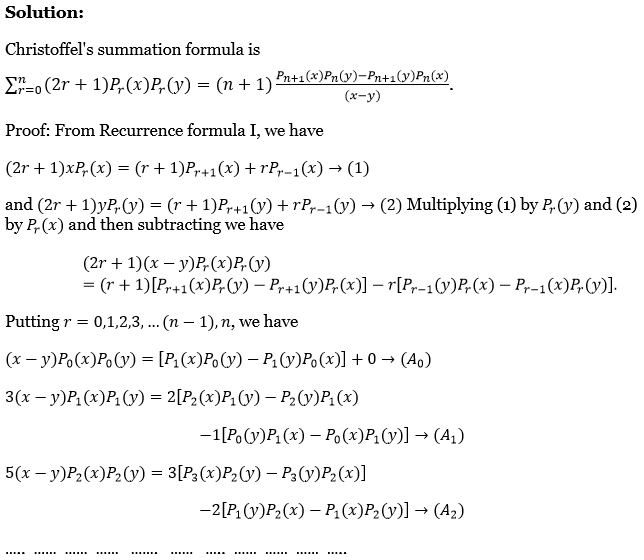
Legendre Polynomials Exercise 4 Question 24.1

Solution:

Christoffel’s summation formula is

⇒ \(\sum_{r=0}^n(2 r+1) P_r(x) P_r(y)=(n+1) \frac{P_{n+1}(x) P_n(y)-P_{n+1}(y) P_n(x)}{(x-y)}\)

Proof: From Recurrence formula 1, we have

⇒ \((2 r+1) x P_r(x)=(r+1) P_{r+1}(x)+r P_{r-1}(x) \rightarrow(1)\)

and \((2 r+1) y P_r(y)=(r+1) P_{r+1}(y)+r P_{r-1}(y) \rightarrow(2)\) Multiplying (1) by Pr(y) and (2) by Pr(x) and then subtracting we have

⇒ \((2 r+1)(x-y) P_r(x) P_r(y)\) = \((r+1)\left[P_{r+1}(x) P_r(y)-P_{r+1}(y) P_r(x)\right]-r\left[P_{r-1}(y) P_r(x)-P_{r-1}(x) P_r(y)\right]\)

Putting r = 0,1,2,3, ….. (n-1), n, we have

⇒ \((x-y) P_0(x) P_0(y)=\left[P_1(x) P_0(y)-P_1(y) P_0(x)\right]+0 \rightarrow\left(A_0\right)\)

⇒ \(3(x-y) P_1(x) P_1(y)=2\left[P_2(x) P_1(y)-P_2(y) P_1(x)\right.\)

⇒ \(-1\left[P_0(y) P_1(x)-P_0(x) P_1(y)\right] \rightarrow\left(A_1\right)\)

⇒ \(5(x-y) P_2(x) P_2(y)=3\left[P_3(x) P_2(y)-P_3(y) P_2(x)\right]\)

⇒ \(-2\left[P_1(y) P_2(x)-P_1(x) P_2(y)\right] \rightarrow\left(A_2\right)\)

…………       ……………        …………..

…..   …….   ……    ……   ……..   …….   ……..   ……   ……
Legendre Polynomials Exercise 4 Question 24.2

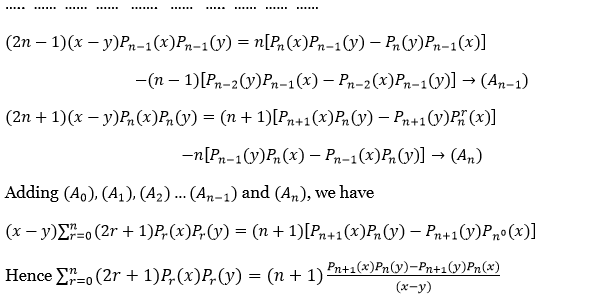
⇒ \((2 n-1)(x-y) P_{n-1}(x) P_{n-1}(y)=n\left[P_n(x) P_{n-1}(y)-P_n(y) P_{n-1}(x)\right]\)

⇒ \(-(n-1)\left[P_{n-2}(y) P_{n-1}(x)-P_{n-2}(x) P_{n-1}(y)\right] \rightarrow\left(A_{n-1}\right)\)

⇒ \((2 n+1)(x-y) P_n(x) P_n(y)=(n+1)\left[P_{n+1}(x) P_n(y)-P_{n+1}(y) P_n^r(x)\right]\)

⇒ \(-n\left[P_{n-1}(y) P_n(x)-P_{n-1}(x) P_n(y)\right] \rightarrow\left(A_n\right)\)

Adding \(\left(A_0\right),\left(A_1\right),\left(A_2\right) \ldots\left(A_{n-1}\right) \text { and }\left(A_n\right)\) we have

⇒ \((x-y) \sum_{r=0}^n(2 r+1) P_r(x) P_r(y)=(n+1)\left[P_{n+1}(x) P_n(y)-P_{n+1}(y) P_{n^0}(x)\right]\)

Hence \(\sum_{r=0}^n(2 r+1) P_r(x) P_r(y)=(n+1) \frac{P_{n+1}(x) P_n(y)-P_{n+1}(y) P_n(x)}{(x-y)}\)

25. Prove Rodrigue’s formula : \(P_n(x)=\frac{1}{n ! 2^n} \frac{d^n}{d x^n}\left(x^2-1\right)^n\)
Legendre Polynomials Exercise 4 Question 25.1

Solution:

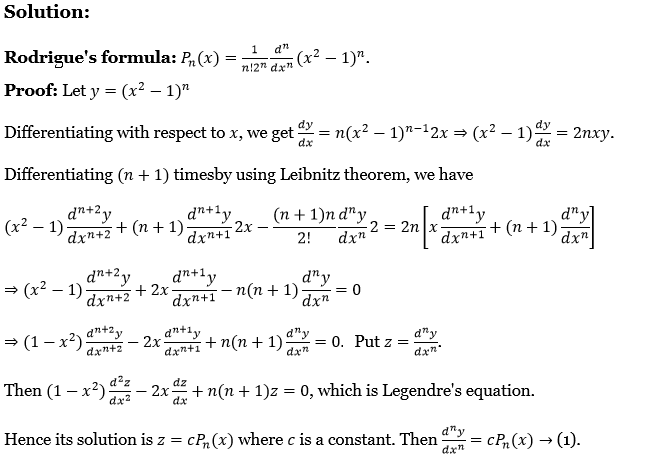
Rodrigue”s formula: \(P_n(x)=\frac{1}{n!2^n} \frac{d^n}{d x^n}\left(x^2-1\right)^n\)

Proof: Let y = \(\left(x^2-1\right)^n\)

Differentiating with respect to x, we get \(\frac{d y}{d x}=n\left(x^2-1\right)^{n-1} 2 x \Rightarrow\left(x^2-1\right) \frac{d y}{d x}=2 n x y\)

Differentiating (n+10 times by using the Leibnitz theorem, we have

⇒ \(\left(x^2-1\right) \frac{d^{n+2} y}{d x^{n+2}}+(n+1) \frac{d^{n+1} y}{d x^{n+1}} 2 x-\frac{(n+1) n}{2!} \frac{d^n y}{d x^n} 2=2 n\left[x \frac{d^{n+1} y}{d x^{n+1}}+(n+1) \frac{d^n y}{d x^n}\right]\)

⇒ \(\left(x^2-1\right) \frac{d^{n+2} y}{d x^{n+2}}+2 x \frac{d^{n+1} y}{d x^{n+1}}-n(n+1) \frac{d^n y}{d x^n}=0\)

⇒ \(\left(1-x^2\right) \frac{d^{n+2} y}{d x^{n+2}}-2 x \frac{d^{n+1} y}{d x^{n+1}}+n(n+1) \frac{d^n y}{d x^n}=0\)

Put z= \(\frac{d^n y}{d x^n}\)

Then \(\left(1-x^2\right) \frac{d^2 z}{x^2}-2 x \frac{d z}{2}+n(n+1) z=0\) which is Legendre’s equation.

Hence its solution is z = cPn(x) where c is a constant. Then \(\frac{d^n y}{d x^n}=c P_n(x) \rightarrow(1)\)
Legendre Polynomials Exercise 4 Question 25.2

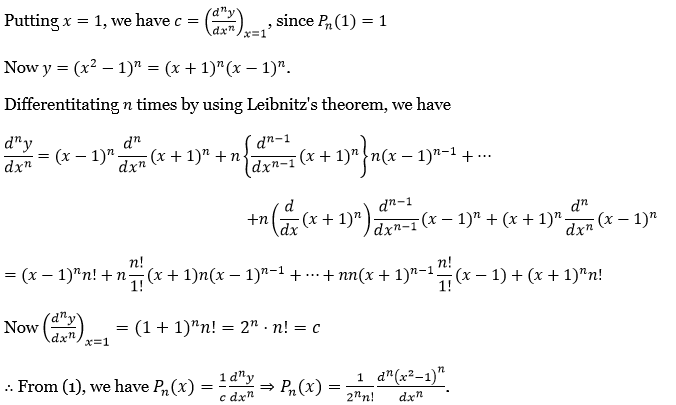
Putting x = 1, we have c = \(\left(\frac{d^n y}{d x^n}\right)_{x=1}\), since \(P_n(1)=1\)

Now \(y=\left(x^2-1\right)^n=(x+1)^n(x-1)^n\)

Differentiating n times by using Leibnitz’s theorem, we have

⇒ \(\frac{d^n y}{d x^n}=(x-1)^n \frac{d^n}{d x^n}(x+1)^n+n\left\{\frac{d^{n-1}}{d x^{n-1}}(x+1)^n\right\} n(x-1)^{n-1}+\cdots\)

⇒ \(+n\left(\frac{d}{d x}(x+1)^n\right) \frac{d^{n-1}}{d x^{n-1}}(x-1)^n+(x+1)^n \frac{d^n}{d x^n}(x-1)^n\)

⇒ \((x-1)^n n!+n \frac{n!}{1!}(x+1) n(x-1)^{n-1}+\cdots+n n(x+1)^{n-1} \frac{n!}{1!}(x-1)+(x+1)^n n!\)

Now \(\left(\frac{d^n y}{d x^n}\right)_{x=1}=(1+1)^n n!=2^n \cdot n!=c\)

∴ From (1), we have \(P_n(x)=\frac{1}{c} \frac{d^n y}{d x^n} \Rightarrow P_n(x)=\frac{1}{2^n n!} \frac{d^n\left(x^2-1\right)^n}{d x^n}\)

26. Prove that \(P_n^{\prime}-P_{n-2}^{\prime}=(2 n-1) P_{n-1}\).

Solution: \(\text { Recurrence formula III, is }(2 n+1) P_n=P_{n+1}^{\prime}-P_{n-1}^{\prime}\)

⇒ \(\text { Replacing } n \text { by  n-1} \text {, we get }(2 n-1) P_n=P_n^{\prime}-P_{n-2}^{\prime} \text {. }\)

27. Prove that \(x P_9^{\prime}=P_8^{\prime}-2 P_9\).

Solution: \(\text { Recurrence formula II is } n P_n^{\prime}=x P_n^{\prime}-P_{n-1}^{\prime}\)

⇒ \(\text { Putting } n=9 \text {, we get } 9 P_9=x P_9^{\prime}-P_8^{\prime} \Rightarrow x P_9^{\prime}=9 P_9+P_8^{\prime} \text {. }\)

28. Prove that \(\frac{P_{n+1}-P_{n-1}}{2 n+1}=\int P_n d x+c\).

Solution: From the recurrence formula |||, we have

⇒ \((2 n+1) P_n=P_{n+1}^{\prime}-P_{n-1}^{\prime} \Rightarrow \frac{\left(P_{n+1}^{\prime}-P_{n-1}^{\prime}\right)}{2 n+1}=P_n\)

⇒ \(\text { Integrating, } \frac{P_{n+1}-P_{n-1}}{2 n+1}=\int P_n d x+c\)

29. Show that \(11\left(x^2-1\right) P_5^{\prime}=30\left(P_6-P_4\right)\).

Solution: Beltrami,s result is \((2 n+1)\left(x^2-1\right) P_n^{\prime}=n(n+1)\left(P_{n+1}-P_{n-1}\right)\)

⇒ \(\text { Putting } n=5 \text {, we get } 11\left(x^2-1\right) P_5^{\prime}=30\left(P_6-P_4\right)\)

30. If \(P_n(x)\) is a Legendre polynomial of degree n and α is such that \(P_n(\alpha)=0\), then show that \(P_{n-1}(\alpha) \text { and } P_{n+1}(\alpha)\) are of opposite signs.
Legendre Polynomials Exercise 4 Question 30

Solution:

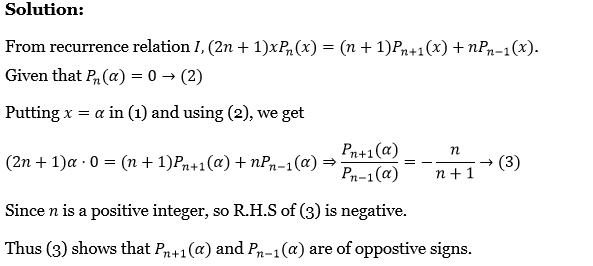
From recurrence relation \(I,(2 n+1) x P_n(x)=(n+1) P_{n+1}(x)+n P_{n-1}(x)\)

Given that \(P_n(\alpha)=0 \rightarrow(2)\)

Putting x = a in (1) and using (2), we get

⇒ \((2 n+1) \alpha \cdot 0=(n+1) P_{n+1}(\alpha)+n P_{n-1}(\alpha) \Rightarrow \frac{P_{n+1}(\alpha)}{P_{n-1}(\alpha)}=-\frac{n}{n+1} \rightarrow \text { (3) }\)

Since n is a positive integer, the R.H.S of (3) is negative.

Thus (3) shows that Pn+1(α) and Pn-1(α) are of opposite signs.

31. Prove that \(P_0^2(x)+3 P_1^2(x)+5 P_2^2(x)+\ldots+(2 n+1) P_n^2(x)\)

⇒ \(=(n+1)\left[P_n(x) P_{n+1}^{\prime}(x)-P_{n+1}(x) P_n^{\prime}(x)\right]=(n+1)^2 P_n^2(x)+\left(1-x^2\right)\left\{P_n^{\prime}(x)\right\}^2\)
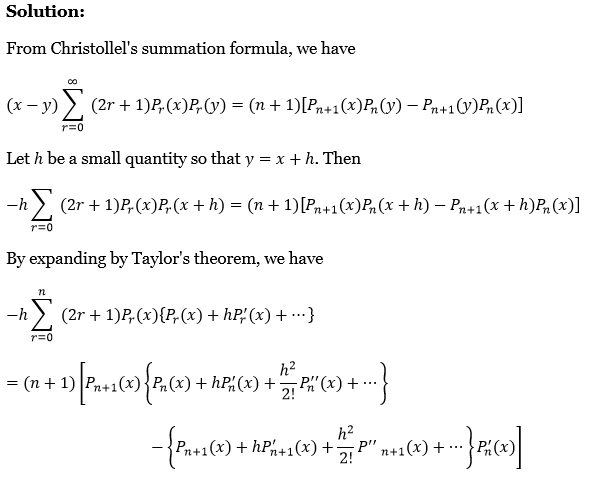
Legendre Polynomials Exercise 4 Question 31.1

Solution:

From Christollel’s summation formula, we have

⇒ \((x-y) \sum_{r=0}^{\infty}(2 r+1) P_r(x) P_r(y)=(n+1)\left[P_{n+1}(x) P_n(y)-P_{n+1}(y) P_n(x)\right]\)

Let h be a small quantity so that y = x+h. Then

⇒ \(-h \sum_{r=0}(2 r+1) P_r(x) P_r(x+h)=(n+1)\left[P_{n+1}(x) P_n(x+h)-P_{n+1}(x+h) P_n(x)\right]\)

By expanding by Taylor’s there, we have

⇒ \(-h \sum_{r=0}^n(2 r+1) P_r(x)\left\{P_r(x)+h P_r^{\prime}(x)+\cdots\right\}\)

⇒ \((n+1)\left[P_{n+1}(x)\left\{P_n(x)+h P_n^{\prime}(x)+\frac{h^2}{2!} P_n^{\prime \prime}(x)+\cdots\right\}\right.\)

⇒ \(\left.-\left\{P_{n+1}(x)+h P_{n+1}^{\prime}(x)+\frac{h^2}{2!} P^{\prime \prime}{ }_{n+1}(x)+\cdots\right\} P_n^{\prime}(x)\right]\)
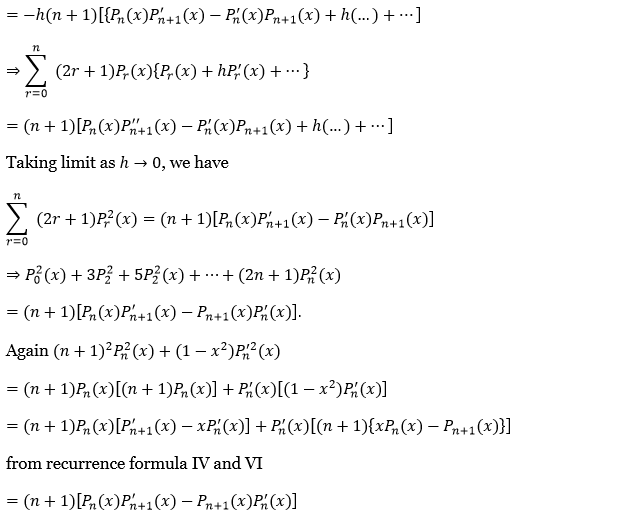
Legendre Polynomials Exercise 4 Question 31.2

⇒ \(-h(n+1)\left[\left\{P_n(x) P_{n+1}^{\prime}(x)-P_n^{\prime}(x) P_{n+1}(x)+h(\ldots)+\cdots\right]\right.\)

⇒ \(\sum_{r=0}^n(2 r+1) P_r(x)\left\{P_r(x)+h P_r^{\prime}(x)+\cdots\right\}\)

⇒ \((n+1)\left[P_n(x) P_{n+1}^{\prime \prime}(x)-P_n^{\prime}(x) P_{n+1}(x)+h(\ldots)+\cdots\right]\)

Taking the limit as h → 0, we have

⇒ \(\sum_{r=0}^n(2 r+1) P_r^2(x)=(n+1)\left[P_n(x) P_{n+1}^{\prime}(x)-P_n^{\prime}(x) P_{n+1}(x)\right]\)

⇒ \(P_0^2(x)+3 P_2^2+5 P_2^2(x)+\cdots+(2 n+1) P_n^2(x)\)

⇒ \((n+1)\left[P_n(x) P_{n+1}^{\prime}(x)-P_{n+1}(x) P_n^{\prime}(x)\right]\)

Again \((n+1)^2 P_n^2(x)+\left(1-x^2\right) P_n^{\prime 2}(x)\)

⇒ \((n+1) P_n(x)\left[(n+1) P_n(x)\right]+P_n^{\prime}(x)\left[\left(1-x^2\right) P_n^{\prime}(x)\right]\)

⇒ \((n+1) P_n(x)\left[P_{n+1}^{\prime}(x)-x P_n^{\prime}(x)\right]+P_n^{\prime}(x)\left[(n+1)\left\{x P_n(x)-P_{n+1}(x)\right\}\right]\)

from recurrence formulas 4 and 6

⇒ \((n+1)\left[P_n(x) P_{n+1}^{\prime}(x)-P_{n+1}(x) P_n^{\prime}(x)\right]\)

32. Prove that \(P_{n+1}^{\prime}+P_n^{\prime}=P_0+3 P_1+5 P_2+\ldots+(2 n+1) P_n=\sum_{r=1}^n(2 r+1) P_r(x)\).
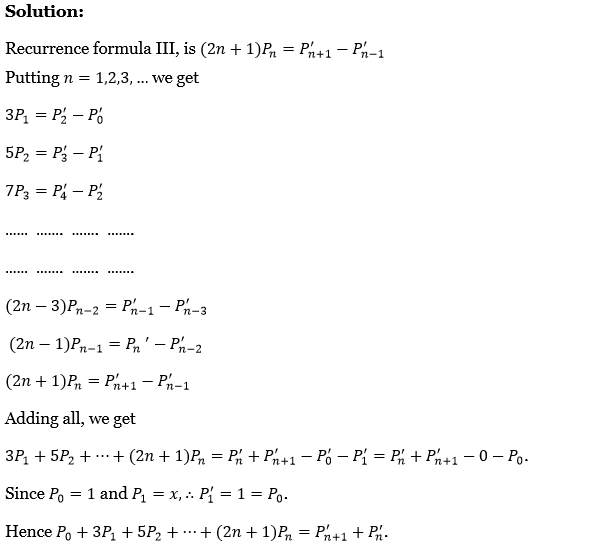
Legendre Polynomials Exercise 4 Question 32

Solution:

Recurrence formula 3, is \((2 n+1) P_n=P_{n+1}^{\prime}-P_{n-1}^{\prime}\)

Putting n = 1,2,3,…. we get

⇒ \(3 P_1=P_2^{\prime}-P_0^{\prime}\)

⇒ \(5 P_2=P_3^{\prime}-P_1^{\prime}\)

⇒ \(7 P_3=P_4^{\prime}-P_2^{\prime}\)

…….. …….. ……. …….

…….. …….. ……. …….

⇒ \((2 n-3) P_{n-2}=P_{n-1}^{\prime}-P_{n-3}^{\prime}\)

⇒ \((2 n-1) P_{n-1}=P_n^{\prime}-P_{n-2}^{\prime}\)

⇒ \((2 n+1) P_n=P_{n+1}^{\prime}-P_{n-1}^{\prime}\)

Adding all we get

⇒ \(3 P_1+5 P_2+\cdots+(2 n+1) P_n=P_n^{\prime}+P_{n+1}^{\prime}-P_0^{\prime}-P_1^{\prime}=P_n^{\prime}+P_{n+1}^{\prime}-0-P_0 .\)

Since \(P_0=1 \text { and } P_1=x, \)

∴ \(P_1^{\prime}=1=P_0\)

Hence \(P_0+3 P_1+5 P_2+\cdots+(2 n+1) P_n=P_{n+1}^{\prime}+P_n^{\prime}\)

33. Prove that \(\int_{-1}^{+1}\left(x^2-1\right) P_{n+1} P_n^{\prime} d x=\frac{2 n(n+1)}{(2 n+1)(2 n+3)}\).
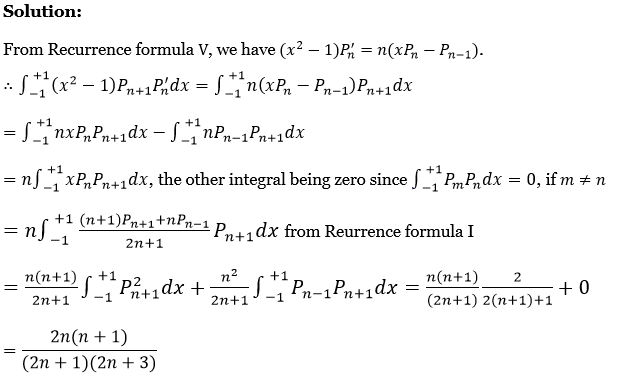
Legendre Polynomials Exercise 4 Question 33

Solution:

From Recurrence formula V, we have \(\left(x^2-1\right) P_n^{\prime}=n\left(x P_n-P_{n-1}\right)\)

∴ \(\int_{-1}^{+1}\left(x^2-1\right) P_{n+1} P_n^{\prime} d x=\int_{-1}^{+1} n\left(x P_n-P_{n-1}\right) P_{n+1} d x\)

⇒ \(\int_{-1}^{+1} n x P_n P_{n+1} d x-\int_{-1}^{+1} n P_{n-1} P_{n+1} d x\)

⇒ \(n \int_{-1}^{+1} x P_n P_{n+1} d x\), the other integral being zero since \(\int_{-1}^{+1} P_m P_n d x=0 \text {, if } m \neq n\)

⇒ \(n \int_{-1}^{+1} \frac{(n+1) P_{n+1}+n P_{n-1}}{2 n+1} P_{n+1} d x\) from Recurrence formula 1

⇒ \(\frac{n(n+1)}{2 n+1} \int_{-1}^{+1} P_{n+1}^2 d x+\frac{n^2}{2 n+1} \int_{-1}^{+1} P_{n-1} P_{n+1} d x=\frac{n(n+1)}{(2 n+1)} \frac{2}{2(n+1)+1}+0\)

⇒ \(\frac{2 n(n+1)}{(2 n+1)(2 n+3)}\)

34. Proved that 1) \(1+\frac{1}{2} P_1(\cos \theta)+\frac{1}{3} P_2(\cos \theta)+\ldots=\log \left[\frac{1+\sin (\theta / 2)}{\sin (\theta / 2)}\right]\)

2) \(\sum_{n=0}^{\infty} \frac{P_n(\cos \theta)}{n+1}=\log \{1+\ cosec(\theta / 2)\}\)
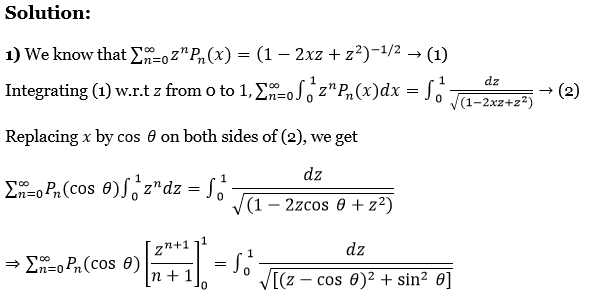
Legendre Polynomials Exercise 4 Question 34.1

Solution:

We know that \(\sum_{n=0}^{\infty} z^n P_n(x)=\left(1-2 x z+z^2\right)^{-1 / 2} \rightarrow(1)\)

Integrating (1) w.r.t. z from 0 to 1, \(\sum_{n=0}^{\infty} \int_0^1 z^n P_n(x) d x=\int_0^1 \frac{d z}{\sqrt{\left(1-2 x z+z^2\right)}} \rightarrow \text { (2) }\)

Replacing x by cos θ on both sides of (2), we get

⇒ \(\sum_{n=0}^{\infty} P_n(\cos \theta) \int_0^1 z^n d z=\int_0^1 \frac{d z}{\sqrt{\left(1-2 z \cos \theta+z^2\right)}}\)

⇒ \(\sum_{n=0}^{\infty} P_n(\cos \theta)\left[\frac{z^{n+1}}{n+1}\right]_0^1=\int_0^1 \frac{d z}{\sqrt{\left[(z-\cos \theta)^2+\sin ^2 \theta\right]}}\)

⇒ \(\left.\sum_{n=0}^{\infty} \frac{P_n(\cos \theta)}{n+1}=\left[\log \left\{(z-\cos \theta)+\sqrt{\left[(z-\cos \theta)^2+\sin ^2 \theta\right.}\right]\right\}\right]\)

⇒ \(\left.=\log \left\{(1-\cos \theta)+\sqrt{\left[(1-\cos \theta)^2+\sin ^2 \theta\right.}\right]\right\}-\log (1-\cos \theta)\)
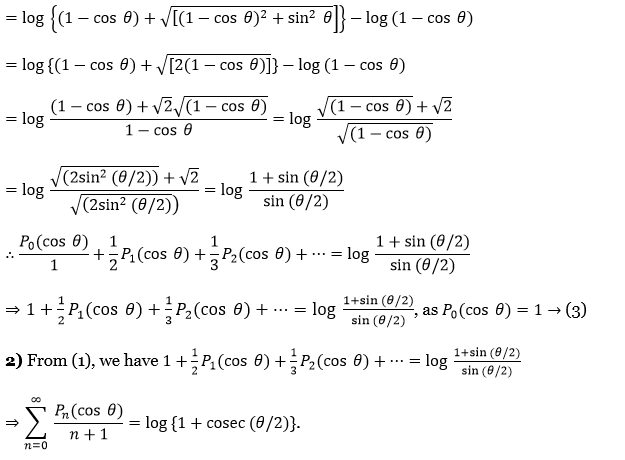
Legendre Polynomials Exercise 4 Question 34.2

⇒ \(\log \left\{(1-\cos \theta)+\sqrt{\left[(1-\cos \theta)^2+\sin ^2 \theta\right]}\right\}-\log (1-\cos \theta)\)

⇒ \(\log \{(1-\cos \theta)+\sqrt{[2(1-\cos \theta)]}\}-\log (1-\cos \theta)\)

⇒ \(\log \frac{(1-\cos \theta)+\sqrt{2} \sqrt{(1-\cos \theta)}}{1-\cos \theta}=\log \frac{\sqrt{(1-\cos \theta)}+\sqrt{2}}{\sqrt{(1-\cos \theta)}}\)

⇒ \(\log \frac{\sqrt{\left(2 \sin ^2(\theta / 2)\right)}+\sqrt{2}}{\left.\sqrt{\left(2 \sin ^2(\theta / 2)\right.}\right)}=\log \frac{1+\sin (\theta / 2)}{\sin (\theta / 2)}\)

∴\(\frac{P_0(\cos \theta)}{1}+\frac{1}{2} P_1(\cos \theta)+\frac{1}{3} P_2(\cos \theta)+\cdots=\log \frac{1+\sin (\theta / 2)}{\sin (\theta / 2)}\)

⇒ \(1+\frac{1}{2} P_1(\cos \theta)+\frac{1}{3} P_2(\cos \theta)+\cdots=\log \frac{1+\sin (\theta / 2)}{\sin (\theta / 2)} \text {, as } P_0(\cos \theta)=1 \rightarrow(3)\)

2. From (1), we have \(1+\frac{1}{2} P_1(\cos \theta)+\frac{1}{3} P_2(\cos \theta)+\cdots=\log \frac{1+\sin (\theta / 2)}{\sin (\theta / 2)}\)

⇒ \(\sum_{n=0}^{\infty} \frac{P_n(\cos \theta)}{n+1}=\log \{1+{cosec}(\theta / 2)\}\)

35. Prove that 1) \(\int_{-1}^{+1} P_n(x) d x=0, n \neq 0 \text { and }\) 2) \(\int_{-1}^{+1} P_0(x) d x=2\).

Solution:

From Rodrigue’s formula, we have \(P_n(x)=\frac{1}{2^n n !} \frac{d^n}{d x^n}\left(x^2-1\right)^n\)

∴ \(\int_{-1}^{+1} P_n(x) d x=\frac{1}{2^n n !} \int_{-1}^{+1} \frac{d^n}{d x^n}\left(x^2-1\right)^n d x=\frac{1}{2^n n !}\left\{\frac{d^{n-1}}{d x^{n-1}}\left(x^2-1\right)^n\right\}_{-1}^{+1} \rightarrow (1)\)
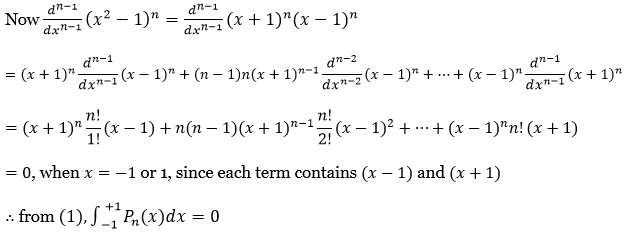
Legendre Polynomials Exercise 4 Question 35

Now \(\frac{d^{n-1}}{d x^{n-1}}\left(x^2-1\right)^n=\frac{d^{n-1}}{d x^{n-1}}(x+1)^n(x-1)^n\)

⇒ \((x+1)^n \frac{d^{n-1}}{d x^{n-1}}(x-1)^n+(n-1) n(x+1)^{n-1} \frac{d^{n-2}}{d x^{n-2}}(x-1)^n+\cdots+(x-1)^n \frac{d^{n-1}}{d x^{n-1}}(x+1)^n\)

⇒ \((x+1)^n \frac{n!}{1!}(x-1)+n(n-1)(x+1)^{n-1} \frac{n!}{2!}(x-1)^2+\cdots+(x-1)^n n!(x+1)\)

= 0, where x = -1 or 1, since each term contains (x-1) and (x+1)

∴ from (1), \(\int_{-1}^{+1} P_n(x) d x=0\)

2) We know that \(P_0(x)=1\).

⇒ \(\int_{-1}^{+1} P_0(x) d x=\int_{-1}^{+1} d x=\{x\}_{-1}^{+1}=2\)

36. Prove that if m is an integer less than n, then
\(\int_{-1}^{+1} x^m P_n(x) d x=0 \text { and } \int_{-1}^{+1} x^n P_n(x) d x=\frac{2^{n+1}(n !)^2}{(2 n+1) !}\)
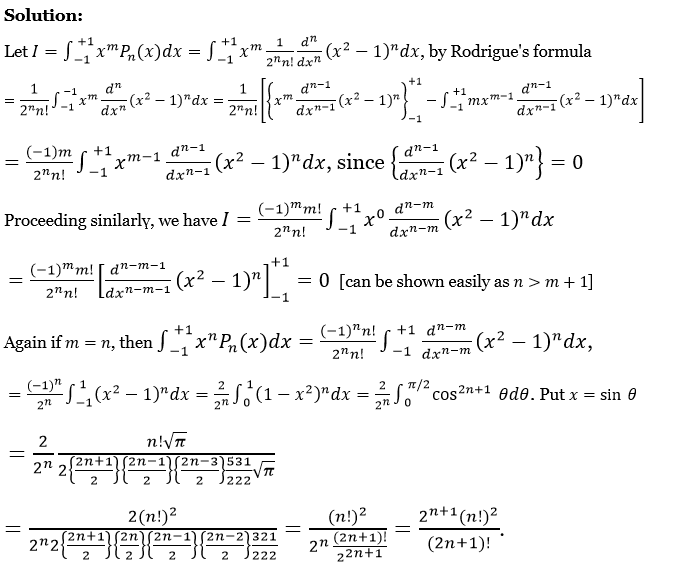
Legendre Polynomials Exercise 4 Question 36

Solution:

Let l = \(\int_{-1}^{+1} x^m P_n(x) d x=\int_{-1}^{+1} x^m \frac{1}{2^n n!} \frac{d^n}{d x^n}\left(x^2-1\right)^n d x\), by Rodrigue’s formula

⇒ \(\frac{1}{2^n n!} \int_{-1}^{-1} x^m \frac{d^n}{d x^n}\left(x^2-1\right)^n d x=\frac{1}{2^n n!}\left[\left\{x^m \frac{d^{n-1}}{d x^{n-1}}\left(x^2-1\right)^n\right\}_{-1}^{+1}-\int_{-1}^{+1} m x^{m-1} \frac{d^{n-1}}{d x^{n-1}}\left(x^2-1\right)^n d x\right]\)

⇒ \(\frac{(-1) m}{2^n n!} \int_{-1}^{+1} x^{m-1} \frac{d^{n-1}}{d x^{n-1}}\left(x^2-1\right)^n d x \text {, since }\left\{\frac{d^{n-1}}{d x^{n-1}}\left(x^2-1\right)^n\right\}=0\)

Proceeding similarly, we have l = \(\frac{(-1)^m m!}{2^n n!} \int_{-1}^{+1} x^0 \frac{d^{n-m}}{d x^{n-m}}\left(x^2-1\right)^n d x\)

⇒ \(\frac{(-1)^m m!}{2^n n!}\left[\frac{d^{n-m-1}}{d x^{n-m-1}}\left(x^2-1\right)^n\right]_{-1}^{+1}=0\) [can be shown easily as n>m+1]

Again if m = n, then \(\int_{-1}^{+1} x^n P_n(x) d x=\frac{(-1)^n n!}{2^n n!} \int_{-1}^{+1} \frac{d^{n-m}}{d x^{n-m}}\left(x^2-1\right)^n d x,\)

⇒ \(\frac{(-1)^n}{2^n} \int_{-1}^1\left(x^2-1\right)^n d x=\frac{2}{2^n} \int_0^1\left(1-x^2\right)^n d x=\frac{2}{2^n} \int_0^{\pi / 2} \cos ^{2 n+1} \theta d \theta \text {. Put } x=\sin \theta\)

⇒ \(\frac{2}{2^n} \frac{n!\sqrt{\pi}}{2\left\{\frac{2 n+1}{2}\right\}\left\{\frac{2 n-1}{2}\right\}\left\{\frac{2 n-3}{2}\right\} \frac{531}{222} \sqrt{\pi}}\)

⇒ \(\frac{2(n!)^2}{2^n 2\left\{\frac{2 n+1}{2}\right\}\left\{\frac{2 n}{2}\right\}\left\{\frac{2 n-1}{2}\right\}\left\{\frac{2 n-2}{2}\right\} \frac{321}{222}}=\frac{(n!)^2}{2^n \frac{(2 n+1)!}{2^{2 n+1}}}=\frac{2^{n+1}(n!)^2}{(2 n+1)!}\)

37. Prove that\(\int_{-1}^{+1} x^2 P_{n+1} P_{n-1} d x=\frac{2 n(n+1)}{(2 n-1)(2 n+1)(2 n+3)}\).
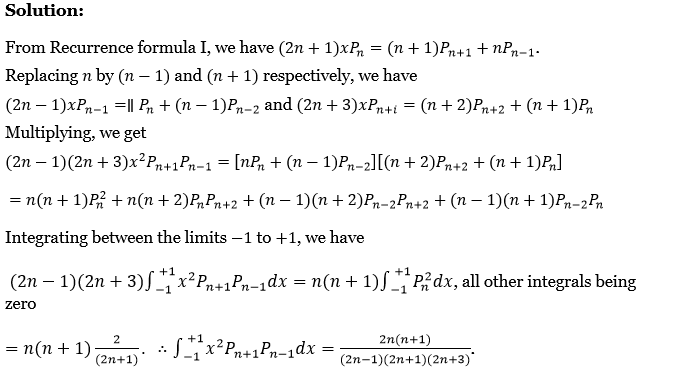
Legendre Polynomials Exercise 4 Question 37

Solution:

From Recurrence formula 1, we have \((2 n+1) x P_n=(n+1) P_{n+1}+n P_{n-1}\)

Replacing n by (n-1) and (n+1) respectively, we have

⇒ \((2 n-1) x P_{n-1}=\| P_n+(n-1) P_{n-2} \text { and }(2 n+3) x P_{n+i}=(n+2) P_{n+2}+(n+1) P_n\)

Multiplying, we get

⇒ \((2 n-1)(2 n+3) x^2 P_{n+1} P_{n-1}=\left[n P_n+(n-1) P_{n-2}\right]\left[(n+2) P_{n+2}+(n+1) P_n\right]\)

⇒ \(n(n+1) P_n^2+n(n+2) P_n P_{n+2}+(n-1)(n+2) P_{n-2} P_{n+2}+(n-1)(n+1) P_{n-2} P_n\)

Integrating between the limits -1 to +1, we have

⇒ \((2 n-1)(2 n+3) \int_{-1}^{+1} x^2 P_{n+1} P_{n-1} d x=n(n+1) \int_{-1}^{+1} P_n^2 d x\) all other integrals being zero

⇒ \(n(n+1) \frac{2}{(2 n+1)}\)

∴ \(\int_{-1}^{+1} x^2 P_{n+1} P_{n-1} d x=\frac{2 n(n+1)}{(2 n-1)(2 n+1)(2 n+3)}\)

38. Show that \(\int_{-1}^1 x P_n(x) P_{n-1}(x) d x=\frac{2 n}{4 n^2-1}\).

Solution:

⇒ \(\int_{-1}^1 x P_n(x) P_{n-1}(x) d x=\int_{-1}^1\left[\frac{n+1}{2 n+1} P_{n+1}^{-1}(x)+\frac{n}{2 n+1} P_{n-1}(x)\right] P_{n-1}(x) d x\)

⇒ \(\frac{n+1}{2 n+1} \int_{-1}^1 P_{n+1}(x) P_{n-1}(x) d x+\frac{n}{2 n+1} \int_{-1}^1\left[P_{n-1}(x)\right]^2 d x\)

⇒ \(0+\frac{n}{2 n+1} \times \frac{2}{2(n-1)+1}=\frac{2 n}{(2 n+1)(2 n-1)}=\frac{2 n}{4 n^2-1}\)

39. Prove that \(\int_{-1}^{+1} P_m(x) P_n(x) d x=\frac{2}{2 n+1}, \delta_{m n}\) where \(\delta_{m n}\) is the kronecker delta.

Solution:

We have \(\int_{-1}^1 P_m(x) P_n(x) d x=0\) if m≠n and \(\int_{-1}^1 P_m(x) P_n(x)=\frac{2}{2 n+1}\) if m=n

∴\(\int_{-1}^1 P_m^ (x) P_n(x) d x=\frac{2}{2 n+1} \delta_{m n}\) where \(\delta_{m n}\)) is the kroneker delta.

40. Prove that \(\int_{-1}^1 x^2 P_n^2 d x=\frac{1}{8(2 n-1)}+\frac{3}{4(2 n+1)}+\frac{1}{8(2 n+3)}\)
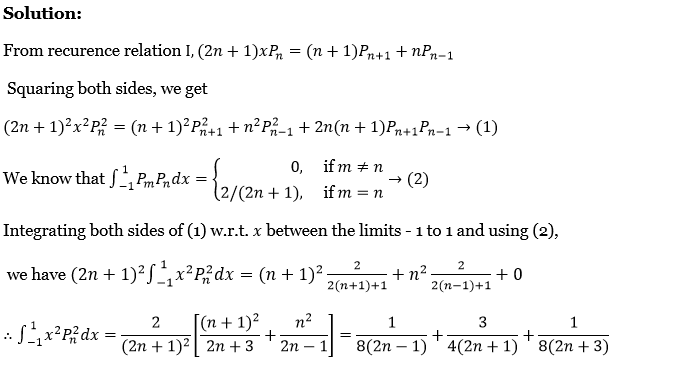
Legendre Polynomials Exercise 4 Question 40

Solution:

from recurrence relation 1, \((2 n+1) x P_n=(n+1) P_{n+1}+n P_{n-1}\)

Squaring both sides, we get

⇒ \((2 n+1)^2 x^2 P_n^2=(n+1)^2 P_{n+1}^2+n^2 P_{n-1}^2+2 n(n+1) P_{n+1} P_{n-1} \rightarrow \text { (1) }\)

We know that \(\int_{-1}^1 P_m P_n d x=\left\{\begin{aligned}
0, & \text { if } m \neq n \\
2 /(2 n+1), & \text { if } m=n
\end{aligned} \rightarrow\right. \text { (2) }\)

Integrating both sides of (1) w.r.t. x between the limits -1 to 1 and using (2),

we have \((2 n+1)^2 \int_{-1}^1 x^2 P_n^2 d x=(n+1)^2 \frac{2}{2(n+1)+1}+n^2 \frac{2}{2(n-1)+1}+0\)

∴ \(\int_{-1}^1 x^2 P_n^2 d x=\frac{2}{(2 n+1)^2}\left[\frac{(n+1)^2}{2 n+3}+\frac{n^2}{2 n-1}\right]=\frac{1}{8(2 n-1)}+\frac{3}{4(2 n+1)}+\frac{1}{8(2 n+3)}\)

41. Prove that \(\int_x^1 P_n(x) d x=\frac{1}{2 n+1}\left[P_{n-1}(x)-P_{n+1}(x)\right]\)
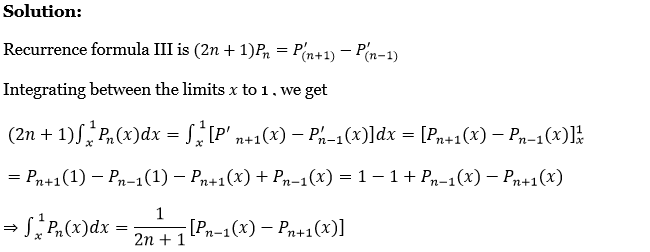
Legendre Polynomials Exercise 4 Question 41

Recurrence formula 3 is \((2 n+1) P_n=P_{(n+1)}^{\prime}-P_{(n-1)}^{\prime}\)

Integrating between the limits x to 1, we get

⇒ \((2 n+1) \int_x^1 P_n(x) d x=\int_x^1\left[P^{\prime}{ }_{n+1}(x)-P_{n-1}^{\prime}(x)\right] d x=\left[P_{n+1}(x)-P_{n-1}(x)\right]_x^1\)

⇒ \(P_{n+1}(1)-P_{n-1}(1)-P_{n+1}(x)+P_{n-1}(x)=1-1+P_{n-1}(x)-P_{n+1}(x)\)

⇒ \(\int_x^1 P_n(x) d x=\frac{1}{2 n+1}\left[P_{n-1}(x)-P_{n+1}(x)\right]\)

42. Show that \(\int_{-1}^{+1} x^4 P_6(x) d x=0\).
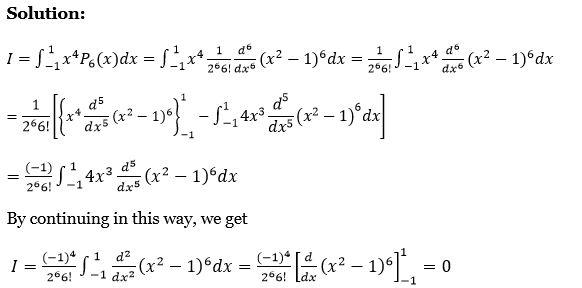
Legendre Polynomials Exercise 4 Question 42

Solution:

⇒ \(I=\int_{-1}^1 x^4 P_6(x) d x=\int_{-1}^1 x^4 \frac{1}{2^6 6!} \frac{d^6}{d x^6}\left(x^2-1\right)^6 d x=\frac{1}{2^6 6!} \int_{-1}^1 x^4 \frac{d^6}{d x^6}\left(x^2-1\right)^6 d x\)

⇒ \(\frac{1}{2^6 6!}\left[\left\{x^4 \frac{d^5}{d x^5}\left(x^2-1\right)^6\right\}_{-1}^1-\int_{-1}^1 4 x^3 \frac{d^5}{d x^5}\left(x^2-1\right)^6 d x\right]\)

⇒ \(\frac{(-1)}{2^6 6!} \int_{-1}^1 4 x^3 \frac{d^5}{d x^5}\left(x^2-1\right)^6 d x\)

By continuing in this way, we get

⇒ \(I=\frac{(-1)^4}{2^6 6!} \int_{-1}^1 \frac{d^2}{d x^2}\left(x^2-1\right)^6 d x=\frac{(-1)^4}{2^6 6!}\left[\frac{d}{d x}\left(x^2-1\right)^6\right]_{-1}^1=0\)

43. If x>1, show that \(P_n(x)<P_{n+1}(x)\).
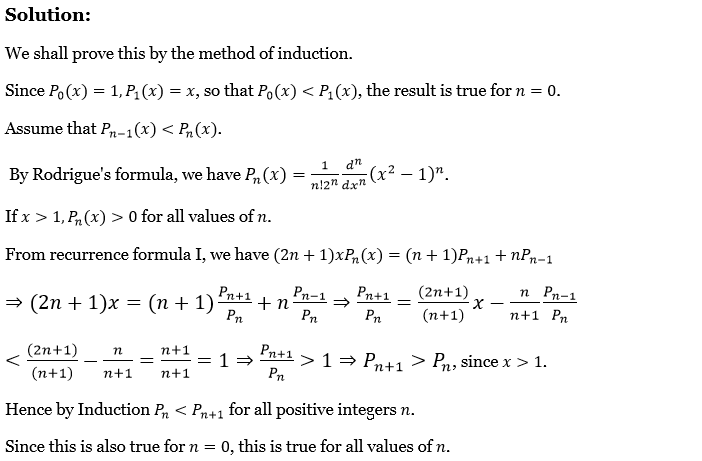
Legendre Polynomials Exercise 4 Question 43

Solution:

We shall prove this by the method of induction.

since \(P_0(x)=1, P_1(x)=x \text {, so that } P_0(x)<P_1(x)\), the result is true for n = 0

Assume that \(P_{n-1}(x)<P_n(x)\)

By Rodrigue’s formula, we have \(P_n(x)=\frac{1}{n!2^n} \frac{d^n}{d x^n}\left(x^2-1\right)^n\)

If \(x>1, P_n(x)>0\) for all values of n.

From recurrence formula 1, we have \((2 n+1) x P_n(x)=(n+1) P_{n+1}+n P_{n-1}\)

⇒ \((2 n+1) x=(n+1) \frac{P_{n+1}}{P_n}+n \frac{P_{n-1}}{P_n} \Rightarrow \frac{P_{n+1}}{P_n}=\frac{(2 n+1)}{(n+1)} x-\frac{n}{n+1} \frac{P_{n-1}}{P_n}\)

⇒ \(<\frac{(2 n+1)}{(n+1)}-\frac{n}{n+1}=\frac{n+1}{n+1}=1 \Rightarrow \frac{P_{n+1}}{P_n}>1 \Rightarrow P_{n+1}>P_n \text {, since } x>1 \text {. }\)

Hence by Induction \(P_n<P_{n+1}\) for all positive integers n.

Since this is also true for n = 0, this is true for all values of n.

44. Prove that \(\int_{-1}^{+1}\left(1-x^2\right) P_m^{\prime} P_n^{\prime} d x=0\) where m and n are distinct positive integers.
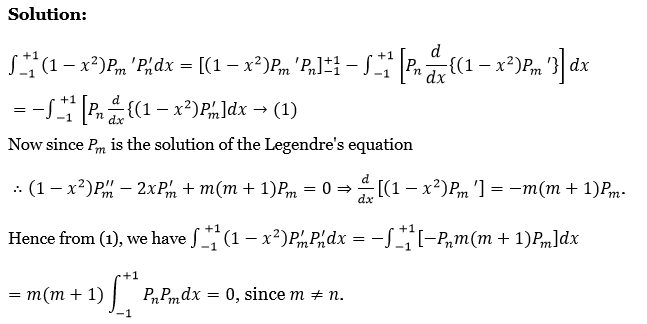
Legendre Polynomials Exercise 4 Question 44

Solution:

⇒ \(\int_{-1}^{+1}\left(1-x^2\right) P_m^{\prime} P_n^{\prime} d x=\left[\left(1-x^2\right) P_m^{\prime} P_n\right]_{-1}^{+1}-\int_{-1}^{+1}\left[P_n \frac{d}{d x}\left\{\left(1-x^2\right) P_m^{\prime}\right\}\right] d x\)

\(-\int_{-1}^{+1}\left[P_n \frac{d}{d x}\left\{\left(1-x^2\right) P_m^{\prime}\right] d x \rightarrow\right. \text { (1) }\)

Now since Pm is the solution of Legendre’s equation

∴ \(\left(1-x^2\right) P_m^{\prime \prime}-2 x P_m^{\prime}+m(m+1) P_m=0 \Rightarrow \frac{d}{d x}\left[\left(1-x^2\right) P_m^{\prime}\right]=-m(m+1) P_m\)

Hence from (1), we have \(\int_{-1}^{+1}\left(1-x^2\right) P_m^{\prime} P_n^{\prime} d x=-\int_{-1}^{+1}\left[-P_n m(m+1) P_m\right] d x\)

⇒ \(m(m+1) \int_{-1}^{+1} P_n P_m d x=0, \text { since } m \neq n\)

45. Prove that \(\int_{-1}^{+1}\left(1-x^2\right)\left(P_n^{\prime}\right)^2 d x=\frac{2 n(n+1)}{2 n+1}\).
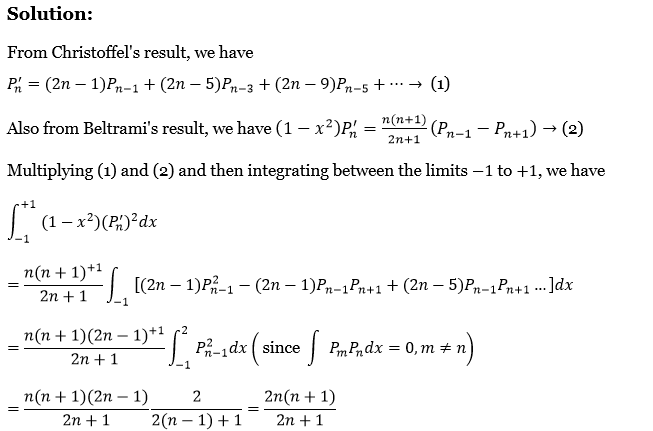
Legendre Polynomials Exercise 4 Question 45

Solution:

From Christoffel’s result, we have

⇒ \(P_n^{\prime}=(2 n-1) P_{n-1}+(2 n-5) P_{n-3}+(2 n-9) P_{n-5}+\cdots \rightarrow \text { (1) }\)

Also from Beltramil’s result, we have \(\left(1-x^2\right) P_n^{\prime}=\frac{n(n+1)}{2 n+1}\left(P_{n-1}-P_{n+1}\right) \rightarrow(2)\)

Multiplying (1) and (2) and then integrating between the limits -1 to +1, we have

⇒ \(\int_{-1}^{+1}\left(1-x^2\right)\left(P_n^{\prime}\right)^2 d x\)

⇒ \(\frac{n(n+1)^{+1}}{2 n+1} \int_{-1}\left[(2 n-1) P_{n-1}^2-(2 n-1) P_{n-1} P_{n+1}+(2 n-5) P_{n-1} P_{n+1} \ldots\right] d x\)

⇒ \(\frac{n(n+1)(2 n-1)^{+1}}{2 n+1} \int_{-1}^2 P_{n-1}^2 d x\left(\text { since } \int P_m P_n d x=0, m \neq n\right)\)

⇒ \(\frac{n(n+1)(2 n-1)}{2 n+1} \frac{2}{2(n-1)+1}=\frac{2 n(n+1)}{2 n+1}\)

46. Prove that \(\int_{-1}^{+1}\left(P_n^{\prime}\right)^2 d x=n(n+1)\)
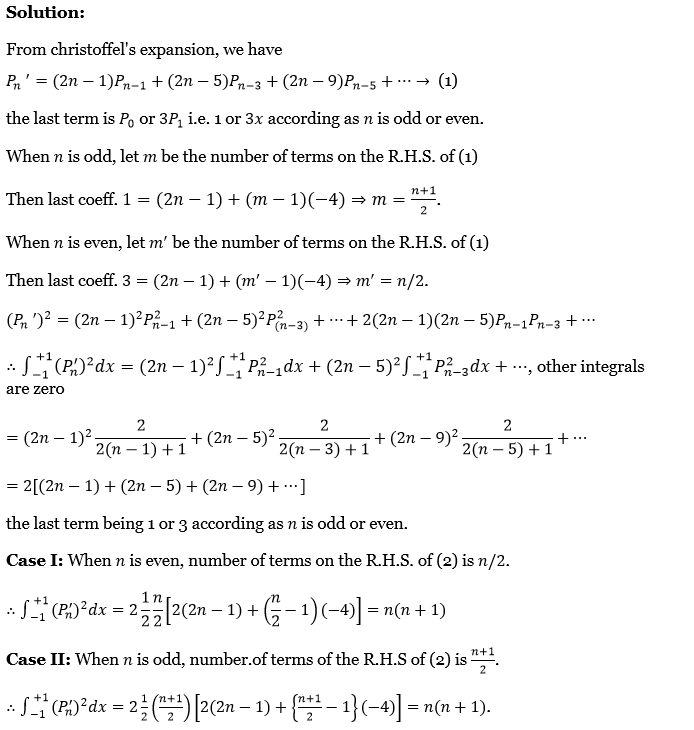
Legendre Polynomials Exercise 4 Question 46

Solution:

From Christoffel’s expression, we have,

⇒ \(P_n^{\prime}=(2 n-1) P_{n-1}+(2 n-5) P_{n-3}+(2 n-9) P_{n-5}+\cdots \rightarrow \text { (1) }\)

The last term is P0 or 3P1 i.e., 1 or 3x according as n is odd or even.

When we n is odd, let m’ be the number of terms on R.H.S. of (1)

Then las coeff. 3 = \((2 n-1)+\left(m^{\prime}-1\right)(-4) \Rightarrow m^{\prime}=n / 2\)

⇒ \(\left(P_n^{\prime}\right)^2=(2 n-1)^2 P_{n-1}^2+(2 n-5)^2 P_{(n-3)}^2+\cdots+2(2 n-1)(2 n-5) P_{n-1} P_{n-3}+\cdots\)

∴ \(\int_{-1}^{+1}\left(P_n^{\prime}\right)^2 d x=(2 n-1)^2 \int_{-1}^{+1} P_{n-1}^2 d x+(2 n-5)^2 \int_{-1}^{+1} P_{n-3}^2 d x+\cdots,\) other integrals are zero

⇒ \((2 n-1)^2 \frac{2}{2(n-1)+1}+(2 n-5)^2 \frac{2}{2(n-3)+1}+(2 n-9)^2 \frac{2}{2(n-5)+1}+\cdots\)

⇒ \(2[(2 n-1)+(2 n-5)+(2 n-9)+\cdots]\)

the last term being 1 or 3 according as n is odd or even

Case 1: When n is even, the number of terms on the R.H.S. of (2) is n/2

∴ \(\int_{-1}^{+1}\left(P_n^{\prime}\right)^2 d x=2 \frac{1}{2} \frac{n}{2}\left[2(2 n-1)+\left(\frac{n}{2}-1\right)(-4)\right]=n(n+1)\)

Case 2: When n is odd, the number of terms of the R.H.S of (2) is \(\frac{n+1}{2}\)

∴ \(\int_{-1}^{+1}\left(P_n^{\prime}\right)^2 d x=2 \frac{1}{2}\left(\frac{n+1}{2}\right)\left[2(2 n-1)+\left\{\frac{n+1}{2}-1\right\}(-4)\right]=n(n+1)\)

47. Prove that \(x P_n^{\prime}=n P_n+(2 n-3) P_{n-2}+(2 n-7) P_{n-4}+\ldots\) and hence or otherwise show that

1) \(\int_{-1}^1 x P_n P_n^{\prime} d x=\frac{(2 n)}{(2 n+1)}\)

2) \(\int_{-1}^1 x P_n P_m^{\prime} d x=\text { either } 0 \text { or } 2 \text { or } \frac{(2 n)}{(2 n+1)}\)
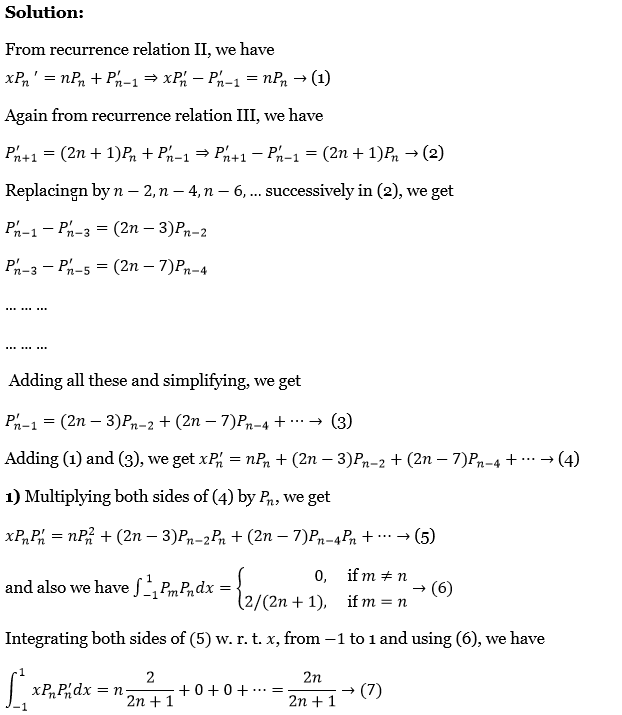
Legendre Polynomials Exercise 4 Question 47.1

Solution:

1. From recurrence relation 3, we have

⇒ \(x P_n^{\prime}=n P_n+P_{n-1}^{\prime} \Rightarrow x P_n^{\prime}-P_{n-1}^{\prime}=n P_n \rightarrow(1)\)

Again from recurrence relation 3, we have

⇒ \(P_{n+1}^{\prime}=(2 n+1) P_n+P_{n-1}^{\prime} \Rightarrow P_{n+1}^{\prime}-P_{n-1}^{\prime}=(2 n+1) P_n \rightarrow \text { (2) }\)

Replacing by n-2, n-4,n-6, …….. successive in (20, we get

⇒ \(P_{n-1}^{\prime}-P_{n-3}^{\prime}=(2 n-3) P_{n-2}\)

⇒ \(P_{n-3}^{\prime}-P_{n-5}^{\prime}=(2 n-7) P_{n-4}\)

……..   ……….   …………

……..   ……….    ……….

Adding all these and simplifying, we get

Multiplying both sides of (4) by Pn, we get

⇒ \(x P_n P_n^{\prime}=n P_n^2+(2 n-3) P_{n-2} P_n+(2 n-7) P_{n-4} P_n+\cdots \rightarrow(5)\)

and also we have \(\int_{-1}^1 P_m P_n d x=\left\{\begin{aligned}
0, & \text { if } m \neq n \\
2 /(2 n+1), & \text { if } m=n
\end{aligned} \rightarrow(6)\right.\)

Integrating both sides of (5) w.r.t. x, from -1 to 1and using (6) we have

⇒ \(\int_{-1}^1 x P_n P_n^{\prime} d x=n \frac{2}{2 n+1}+0+0+\cdots=\frac{2 n}{2 n+1} \rightarrow \text { (7) }\)
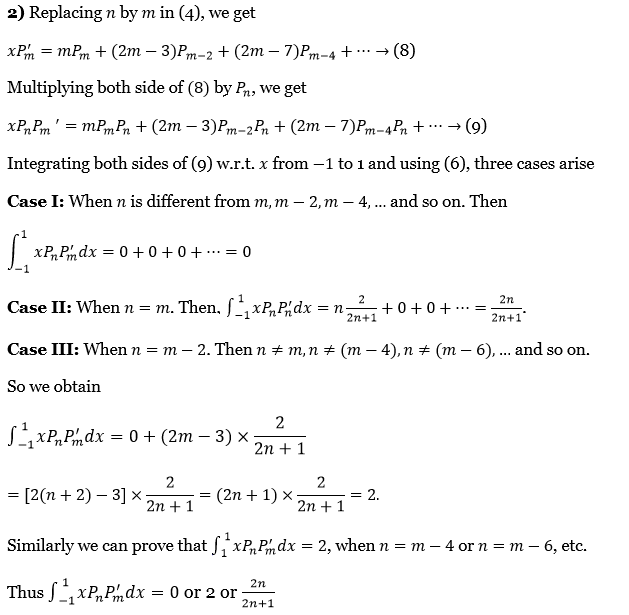
Legendre Polynomials Exercise 4 Question 47.2

2.  Replacing n by m in (4), we get \(\)

⇒ \(x P_m^{\prime}=m P_m+(2 m-3) P_{m-2}+(2 m-7) P_{m-4}+\cdots \rightarrow(8)\)

Multiplying both sides of (8) by Pn, we get

⇒ \(x P_n P_m{ }^{\prime}=m P_m P_n+(2 m-3) P_{m-2} P_n+(2 m-7) P_{m-4} P_n+\cdots \rightarrow \text { (9) }\)

Integrating both sides of (9) w.r.t.x, from -1 to 1, and using (6), three cases arise

Case 1: When n is different from m,m-2, m-4, ….. and so on. Then

⇒ \(\int_{-1}^1 x P_n P_m^{\prime} d x=0+0+0+\cdots=0\)

Case 2: When n = m. Then \(\int_{-1}^1 x P_n P_n^{\prime} d x=n \frac{2}{2 n+1}+0+0+\cdots=\frac{2 n}{2 n+1}\)

Case 3: When n = m .Then n ≠ m, n≠(m-4), n ≠ (m-6), ……… and so on.

So we obtain

⇒ \(\int_{-1}^1 x P_n P_m^{\prime} d x=0+(2 m-3) \times \frac{2}{2 n+1}\)

⇒ \([2(n+2)-3] \times \frac{2}{2 n+1}=(2 n+1) \times \frac{2}{2 n+1}=2\)

Similarly we can prove that \(\int_1^1 x P_n P_m^{\prime} d x=2\), when n = 4 or n = m-6, etc.

Thus \(\int_{-1}^1 x P_n P_m^{\prime} d x=0 \text { or } 2 \text { or } \frac{2 n}{2 n+1}\)

48. Show that all the roots of \(\) are real and lie between -1 and +1.
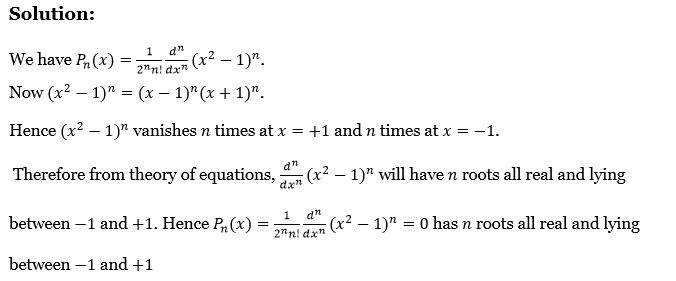
Legendre Polynomials Exercise 4 Question 48

Solution:

We have \(P_n(x)=\frac{1}{2^n n!} \frac{d^n}{d x^n}\left(x^2-1\right)^n\)

Now \(\left(x^2-1\right)^n=(x-1)^n(x+1)^n\)

Hence \(\left(x^2-1\right)^n\) vanishes n times at x = +1 and n times x = -1

Therefore from a theory of equations, \(\frac{d^n}{d x^n}\left(x^2-1\right)^n\) will have n roots all real and lying between -1 and +1

Hence \(P_n(x)=\frac{1}{2^n n} \frac{d^n}{d x^n}\left(x^2-1\right)^n=0\) has n roots all real and lying between -1 and +1

49. Prove that all the roots of \(\) are distinct.
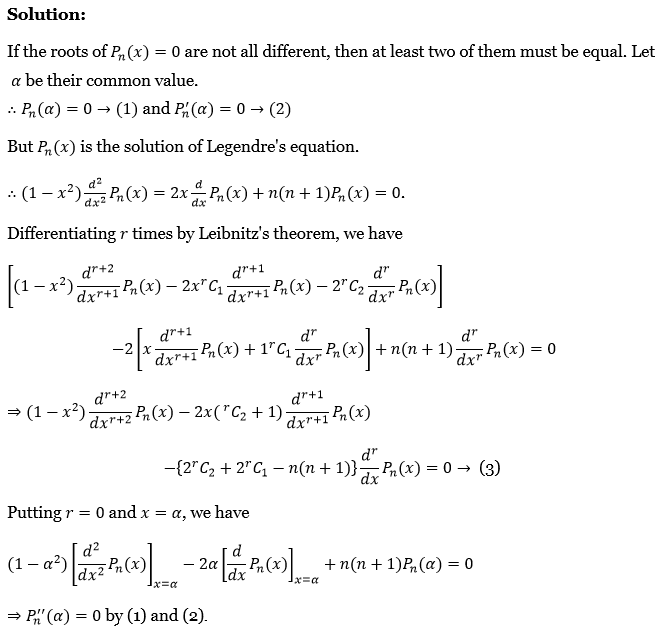
Legendre Polynomials Exercise 4 Question 49.1

Solution:

If the roots of Pn(x) = 0 are not different, then at least two of them must be equal.

Let α be their common value.

∴ \(P_n(\alpha)=0 \rightarrow(1) \text { and } P_n^{\prime}(\alpha)=0 \rightarrow \text { (2) }\)

But Pn(x) is the solution of Legendre’s equation.

∴ \(\left(1-x^2\right) \frac{d^2}{d x^2} P_n(x)=2 x \frac{d}{d x} P_n(x)+n(n+1) P_n(x)=0\)

Differentiating r times by Leibnitz’s theorem, we have

⇒ \(\left[\left(1-x^2\right) \frac{d^{r+2}}{d x^{r+1}} P_n(x)-2 x^r C_1 \frac{d^{r+1}}{d x^{r+1}} P_n(x)-2^r C_2 \frac{d^r}{d x^r} P_n(x)\right]\)

⇒ \(-2\left[x \frac{d^{r+1}}{d x^{r+1}} P_n(x)+1^r C_1 \frac{d^r}{d x^r} P_n(x)\right]+n(n+1) \frac{d^r}{d x^r} P_n(x)=0\)

⇒ \(\left(1-x^2\right) \frac{d^{r+2}}{d x^{r+2}} P_n(x)-2 x\left({ }^r C_2+1\right) \frac{d^{r+1}}{d x^{r+1}} P_n(x)\)

⇒ \(-\left\{2^r C_2+2^r C_1-n(n+1)\right\} \frac{d^r}{d x} P_n(x)=0 \rightarrow(3)\)

Putting r = 0 and x = α, we have

⇒ \(\left(1-\alpha^2\right)\left[\frac{d^2}{d x^2} P_n(x)\right]_{x=\alpha}-2 \alpha\left[\frac{d}{d x} P_n(x)\right]_{x=\alpha}+n(n+1) P_n(\alpha)=0\)
Legendre Polynomials Exercise 4 Question 49.2

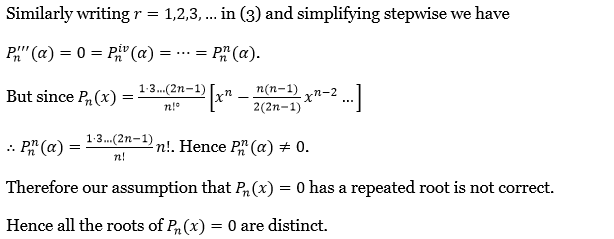
Similarly, by writing r = 1,2,3, ………. in (3)and simplifying stepwise we have

⇒ \(P_n^{\prime \prime \prime}(\alpha)=0=P_n^{i v}(\alpha)=\cdots=P_n^n(\alpha)\)

But since \(P_n(x)=\frac{1 \cdot 3 \ldots(2 n-1)}{n!^0}\left[x^n-\frac{n(n-1)}{2(2 n-1)} x^{n-2} \cdots\right]\)

∴ \(P_n^n(\alpha)=\frac{1 \cdot 3 \cdots(2 n-1)}{n!} n!\)

Hence \(P_n^n(\alpha) \neq 0 \text {. }\)

Therefore our assumption that \(P_n(x)=0\) is distinct.

50. Prove that 1) \(P_n^{\prime}(1)=\frac{1}{2} n(n+1)\) 2) \(P_n^{\prime}(-1)=(-1)^{n-1} \frac{1}{2} n(n+1)\)
Legendre Polynomials Exercise 4 Question 50

Solution:

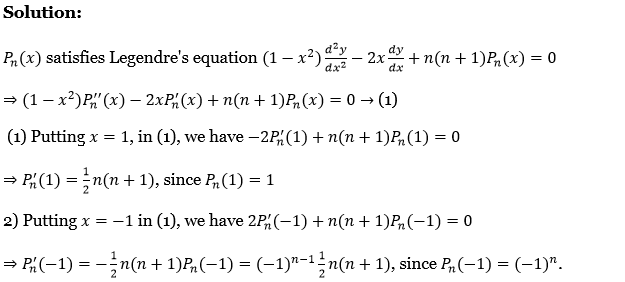
Pn(x) satisfies Legendre’s equation \(\left(1-x^2\right) \frac{d^2 y}{d x^2}-2 x \frac{d y}{d x}+n(n+1) P_n(x)=0\)

⇒ \(\left(1-x^2\right) P_n^{\prime \prime}(x)-2 x P_n^{\prime}(x)+n(n+1) P_n(x)=0 \rightarrow(1)\)

(1) Putting x = 1, in (1), we have \(-2 P_n^{\prime}(1)+n(n+1) P_n(1)=0\)

⇒ \(P_n^{\prime}(1)=\frac{1}{2} n(n+1), \text { since } P_n(1)=1\)

(2) Putting x = -1 in (1), we have \(2 P_n^{\prime}(-1)+n(n+1) P_n(-1)=0\)

⇒ \(P_n^{\prime}(-1)=-\frac{1}{2} n(n+1) P_n(-1)=(-1)^{n-1} \frac{1}{2} n(n+1) \text {, since } P_n(-1)=(-1)^n\)

51. Prove that \(\int_0^1 P_n(x) d x=\frac{(-1)^{(n-1) / 2}(n-1) !}{2^n\{(n+1) / 2\} !\{(n-1) / 2\} !}\) when n is odd.
Legendre Polynomials Exercise 4 Question 51

Solution:

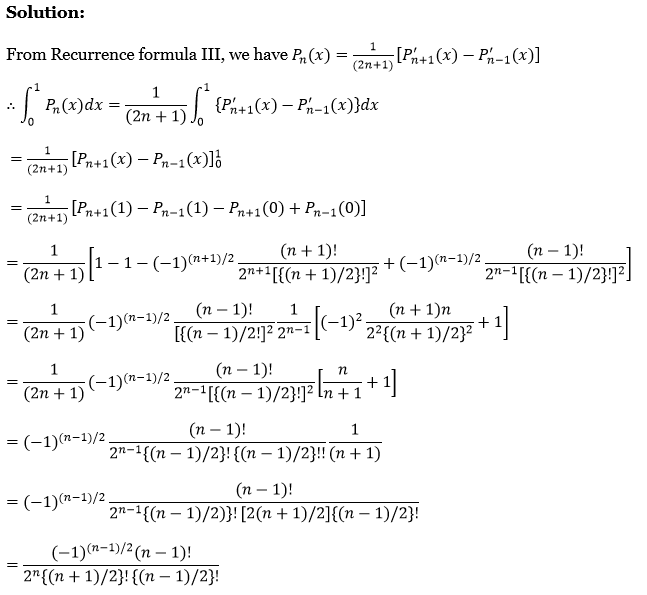
From Recurrence formula 3, we have \(P_n(x)=\frac{1}{(2 n+1)}\left[P_{n+1}^{\prime}(x)-P_{n-1}^{\prime}(x)\right]\)

∴ \(\int_0^1 P_n(x) d x=\frac{1}{(2 n+1)} \int_0^1\left\{P_{n+1}^{\prime}(x)-P_{n-1}^{\prime}(x)\right\} d x\)

⇒ \(\frac{1}{(2 n+1)}\left[P_{n+1}(x)-P_{n-1}(x)\right]_0^1\)

⇒ \(\frac{1}{(2 n+1)}\left[P_{n+1}(1)-P_{n-1}(1)-P_{n+1}(0)+P_{n-1}(0)\right]\)

⇒ \(\frac{1}{(2 n+1)}\left[1-1-(-1)^{(n+1) / 2} \frac{(n+1)!}{2^{n+1}[\{(n+1) / 2\}!]^2}+(-1)^{(n-1) / 2} \frac{(n-1)!}{2^{n-1}[\{(n-1) / 2\}!]^2}\right]\)

⇒ \(\frac{1}{(2 n+1)}(-1)^{(n-1) / 2} \frac{(n-1)!}{\left[\{(n-1) / 2!]^2\right.} \frac{1}{2^{n-1}}\left[(-1)^2 \frac{(n+1) n}{2^2\{(n+1) / 2\}^2}+1\right]\)

⇒ \(\frac{1}{(2 n+1)}(-1)^{(n-1) / 2} \frac{(n-1)!}{2^{n-1}[\{(n-1) / 2\}!]^2}\left[\frac{n}{n+1}+1\right]\)

⇒ \((-1)^{(n-1) / 2} \frac{(n-1)!}{2^{n-1}\{(n-1) / 2\}!\{(n-1) / 2\}!!} \frac{1}{(n+1)}\)

⇒ \((-1)^{(n-1) / 2} \frac{(n-1)!}{\left.2^{n-1}\{(n-1) / 2)\right\}![2(n+1) / 2]\{(n-1) / 2\}!}\)

⇒ \(\frac{(-1)^{(n-1) / 2}(n-1)!}{2^n\{(n+1) / 2\}!\{(n-1) / 2\}!}\)

52. If m>n-1 and n is a positive integer, prove that

⇒ \(\int_0^1 x^m P_n(x) d x=\frac{m(m-1)(m-2) \ldots(m-n+2)}{(m+n+1)(m+n-1) \ldots(m-n+3)}\)

Solution:
Legendre Polynomials Exercise 4 Question 52

Solution:

Using Rodrigue’s formula, we have

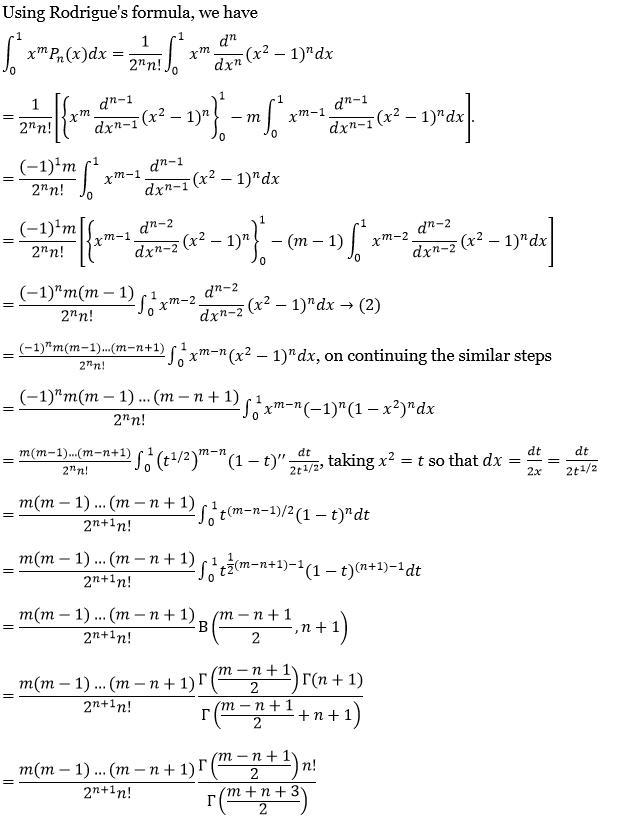
⇒ \(\int_0^1 x^m P_n(x) d x=\frac{1}{2^n n!} \int_0^1 x^m \frac{d^n}{d x^n}\left(x^2-1\right)^n d x\)

⇒ \(\frac{1}{2^n n!}\left[\left\{x^m \frac{d^{n-1}}{d x^{n-1}}\left(x^2-1\right)^n\right\}_0^1-m \int_0^1 x^{m-1} \frac{d^{n-1}}{d x^{n-1}}\left(x^2-1\right)^n d x\right]\)

⇒ \(\frac{(-1)^1 m}{2^n n!} \int_0^1 x^{m-1} \frac{d^{n-1}}{d x^{n-1}}\left(x^2-1\right)^n d x\)

⇒ \(\frac{(-1)^1 m}{2^n n!}\left[\left\{x^{m-1} \frac{d^{n-2}}{d x^{n-2}}\left(x^2-1\right)^n\right\}_0^1-(m-1) \int_0^1 x^{m-2} \frac{d^{n-2}}{d x^{n-2}}\left(x^2-1\right)^n d x\right]\)

⇒ \(\frac{(-1)^n m(m-1)}{2^n n!} \int_0^1 x^{m-2} \frac{d^{n-2}}{d x^{n-2}}\left(x^2-1\right)^n d x \rightarrow(2)\)

⇒ \(\frac{(-1)^n m(m-1) \ldots(m-n+1)}{2^n n!} \int_0^1 x^{m-n}\left(x^2-1\right)^n d x\), on continuing the similar steps

⇒ \(\frac{(-1)^n m(m-1) \ldots(m-n+1)}{2^n n!} \int_0^1 x^{m-n}(-1)^n\left(1-x^2\right)^n d x\)

⇒ \(\frac{m(m-1) \ldots(m-n+1)}{2^n n!} \int_0^1\left(t^{1 / 2}\right)^{m-n}(1-t)^{\prime \prime} \frac{d t}{2 t^{1 / 2}}, \text { taking } x^2=t \text { so that } d x=\frac{d t}{2 x}=\frac{d t}{2 t^{1 / 2}}\)

⇒ \(\frac{m(m-1) \ldots(m-n+1)}{2^{n+1} n!} \int_0^1 t^{(m-n-1) / 2}(1-t)^n d t\)

⇒ \(\frac{m(m-1) \ldots(m-n+1)}{2^{n+1} n!} \int_0^1 t^{\frac{1}{2}(m-n+1)-1}(1-t)^{(n+1)-1} d t\)

⇒ \(\frac{m(m-1) \ldots(m-n+1)}{2^{n+1} n!} \mathrm{B}\left(\frac{m-n+1}{2}, n+1\right)\)

⇒ \(\frac{m(m-1) \ldots(m-n+1)}{2^{n+1} n!} \frac{\Gamma\left(\frac{m-n+1}{2}\right) \Gamma(n+1)}{\Gamma\left(\frac{m-n+1}{2}+n+1\right)}\)

⇒ \(=\frac{m(m-1) \ldots(m-n+1) \Gamma\left(\frac{m-n+1}{2}\right)}{2^{n+1} \times \frac{m+n+1}{2} \cdot \frac{m+n-1}{2} \ldots \frac{m-n+1}{2} \Gamma\left(\frac{m-n+1}{2}\right)}\)

⇒ \(=\frac{m(m-1) \ldots(m-n+1)}{(m+n+1)(m+n-1) \ldots(m-n+1)}=\frac{m(m-1) \ldots(m-n+2)}{(m+n+1)(m+n-1) \ldots(m-n+3)}\)

⇒ \(\frac{m(m-1) \ldots(m-n+1)}{2^{n+1} n!} \frac{\Gamma\left(\frac{m-n+1}{2}\right) n!}{\Gamma\left(\frac{m+n+3}{2}\right)}\)

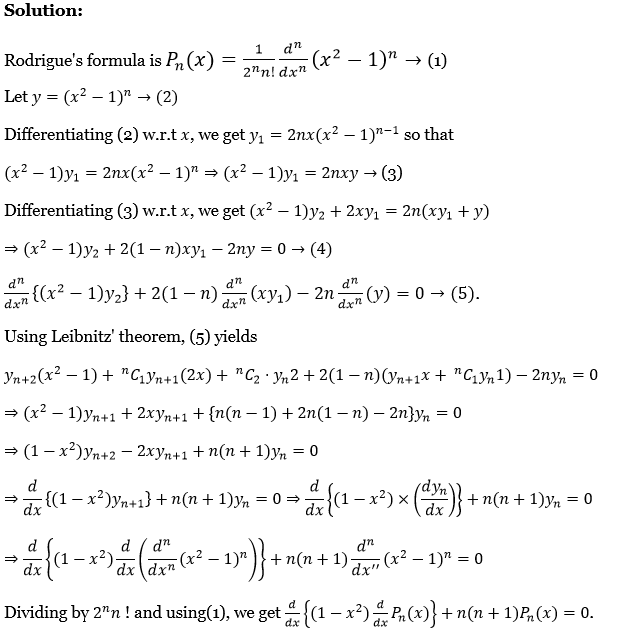
53. Using Rodrigue’s formula, show that \(\) satisfies

⇒ \(\frac{d}{d x}\left\{\left(1-x^2\right) \frac{d}{d x} P_n(x)\right\}+n(n+1) P_n(x)=0\).
Legendre Polynomials Exercise 4 Question 53

Solution:

Rodrigue’s formula is \(P_n(x)=\frac{1}{2^n n!} \frac{d^n}{d x^n}\left(x^2-1\right)^n \rightarrow(1)\)

Le6t y = \(\left(x^2-1\right)^n \rightarrow(2)\)

Differentiating (2) w.r.t.x, we get \(y_1=2 n x\left(x^2-1\right)^{n-1}\) so that

⇒ \(\left(x^2-1\right) y_1=2 n x\left(x^2-1\right)^n \Rightarrow\left(x^2-1\right) y_1=2 n x y \rightarrow(3)\)

Differentiating (3) w.r.t.x, we get \(\left(x^2-1\right) y_2+2 x y_1=2 n\left(x y_1+y\right)\)

⇒ \(\left(x^2-1\right) y_2+2(1-n) x y_1-2 n y=0 \rightarrow(4)\)

⇒ \(\frac{d^n}{d x^n}\left\{\left(x^2-1\right) y_2\right\}+2(1-n) \frac{d^n}{d x^n}\left(x y_1\right)-2 n \frac{d^n}{d x^n}(y)=0 \rightarrow(5)\)

Using Leibnitz’s theorem, (5) yields

⇒ \(y_{n+2}\left(x^2-1\right)+{ }^n C_1 y_{n+1}(2 x)+{ }^n C_2 \cdot y_n 2+2(1-n)\left(y_{n+1} x+{ }^n C_1 y_n 1\right)-2 n y_n=0\)

⇒ \(\left(x^2-1\right) y_{n+1}+2 x y_{n+1}+\{n(n-1)+2 n(1-n)-2 n\} y_n=0\)

⇒ \(\left(1-x^2\right) y_{n+2}-2 x y_{n+1}+n(n+1) y_n=0\)

⇒ \(\frac{d}{d x}\left\{\left(1-x^2\right) y_{n+1}\right\}+n(n+1) y_n=0 \Rightarrow \frac{d}{d x}\left\{\left(1-x^2\right) \times\left(\frac{d y_n}{d x}\right)\right\}+n(n+1) y_n=0\)

⇒ \(\frac{d}{d x}\left\{\left(1-x^2\right) \frac{d}{d x}\left(\frac{d^n}{d x^n}\left(x^2-1\right)^n\right)\right\}+n(n+1) \frac{d^n}{d x^{n \prime}}\left(x^2-1\right)^n=0\)

Dividing by 2nn! and using (1), we get \(\frac{d}{d x}\left\{\left(1-x^2\right) \frac{d}{d x} P_n(x)\right\}+n(n+1) P_n(x)=0\)
Introduction To Plane Definition Axioms of Planes Euclidean Geometry

Introduction

Logical development of any branch of mathematics depends on a set. The elements of the set are underfilled terms. Associated with them are certain statements which are taken as axioms or postulates for the subject.

In earlier classes, the set language was used for the effective understanding of geometrical concepts. It may be recalled that the structure of geometry was developed by taking point, line, plane, and space as undefined concepts and that every geometrical figure is a set of points.

Solid analytical geometry (Three-dimensional coordinate geometry) is a subject redeveloped on the above lines. The study of quantitative and qualitative nature of space very much depends upon coordinates and algebraic operations and methods associated with it. Also, vectors as ordered triads have an application in the treatment of solid analytical geometry.

We take a set S and call it the 3-D space, \(R^3\) – space and its elements the points of the 3-D space. We take line L, plane π, sphere S, etc. as subsets of S.

If P ∈ L, we say that P is a point on the line L, i.e., line L passes through the point P. If P ∉ L, we say that the point is not on line L and does not pass through point P.

Points on the same line are said to be collinear and points on the same plane are said to be coplanar. If L ⊂ π, we say that L is a line in the plane π i.e., the plane π contains the line L. Further, L ⊂ π implies L is not in the plane π.

We give below, not all, but certain axioms, definitions, and theorems (without proofs) of Euclidean geometry which have wide application in solid analytical geometry.

Further, some well-known terms and concepts which are used in the development of the subject and which have to be redefined are deliberately left out as their definitions and the results involving them given out in earlier classes are true even here.

Introduction To Planes In Geometry With Examples

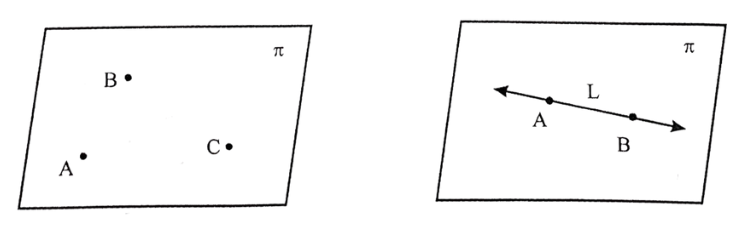
1. Axiom. One and only one line passes through two distinct points.

If A, B are two distinct points on L, we say that L is the one and only one line which passes through A and B. We write L as \(\overleftrightarrow{\mathrm{AB}}\).

2. Axiom. One and only one plane passes through three non-collinear points.

If π is a plane passing through three non-collinear points A, B, C we say that π is the one and only one plane determined by A, B, C, We write the plane π as

⇒ \(\overleftrightarrow{\mathrm{ABC}}\).

Answer key For Maths For BSC 2 Semester Chapter 1 Introduction Image 1 - Copy

3. Axiom. If two distinct points lie in a plane then the line through the two points lies in the plane.

If A, B are two distinct points in a plane π, we say that \(\overleftrightarrow{A B}\) lies in the plane π.

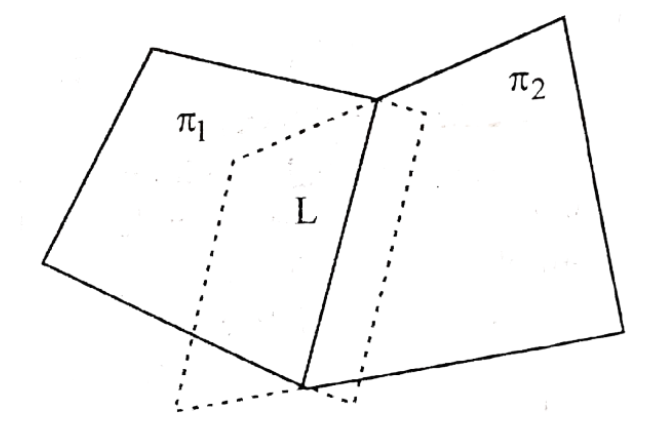
4. Axiom. If two planes intersect, they intersect in one and only one line π12 are two intersecting planes intersecting in the line L.


Answer key For Maths For BSC 2 Semester Chapter 1 Introduction Image 2

5. Axiom. Every line consists of at least two points. Every plane consists of at least three non-collinear points. In space, there always exist at least four points. which are non-coplanar.

6. Axiom. Corresponding to any two points, there exists always a unique real number called the distance between the points.

If A, B are any two points, there exists a unique real number d (AB) or AB called the distance between the points A and B with the following properties (1) AB ≥ 0, (2) AB = 0 <=> A = B (3) AB = BA (4) AC + CB ≥ AB where C is any point.

7. Definition. If A, P, B are three collinear points such that AP+PB=Ab then we say that P lies between A and B on the line. We write A-P-B. The set of points P is called the line segment between A and B with endpoints A,B. we denote the line segment as AB.

It is to be understood that the meaning of AB is to be understood depending on the context.

If A-P-B and Ap=PB, then P is called the middle point of the line segment AB.

If A, B are different points, then AB ∪ {P/A-B-P} is called the ray from A through B and we write it as \(\overrightarrow{\mathrm{AB}}\)

8. Definition. Two lines \(L_1, L_2\) in a plane π are said to intersect if \(L_1 \cap L_2 \neq \phi\) Now \(L_1, L_2\) are called intersecting lines.

9. Definition. Two lines \(L_1, L_2\) in a plane π are said to be parallel if either \(L_1, L_2\) are coincident \(\left(L_1=L_2\right) \text { or } L_1, L_2\) are not intersecting \(\left(L_1 \cap L_2 \neq \phi\right)\)

We write \(\mathrm{L}_1 \| \mathrm{L}_2\).

If A,B ∈ \(L_1\) and C,D ∈ \(L_2\) then write

⇒ \(\overleftrightarrow{A B} \| \overleftrightarrow{C D}\) or \(\mathrm{AB} \| \mathrm{CD}\).

If \(\overrightarrow{\mathrm{AB}}, \overrightarrow{\mathrm{CD}}\)

are non-collinear, \(\overleftrightarrow{A B} \| \overleftrightarrow{C D}\)

and B, D lie on the same side of \(\overleftrightarrow{\mathrm{AC}}\)

we say that \(\overrightarrow{\mathrm{AB}} \| \overrightarrow{\mathrm{CD}}\).

Also if \(\overrightarrow{\mathrm{AB}}, \overrightarrow{\mathrm{CD}}\)are collinear we say that

⇒ \(\overleftrightarrow{\mathrm{AB}} \| \overleftrightarrow{\mathrm{CD}}\).

If \(L_1, L_2\) are not parallel we write \(\mathrm{L}_1 / / \mathrm{L}_2\).

Definition Of A Plane In Euclidean Geometry

10. Axiom. To a given line, through a given point one and only one parallel line exists.

11. Theorem. Two distinct lines cannot intersect at more than one point.

12. Theorem. If L is a line not in the plane π and intersecting π, then the line L intersects the plane π in one and only one point.

If the point is M in π, then M is called the foot of L in π.

13. Theorem. A plane containing a line and a point not on the line is unique.

If L ⊂ π and P ∉ L, then π is unique.

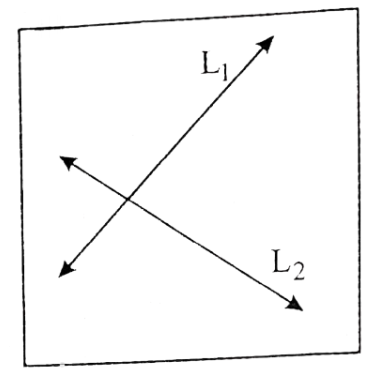
14. Theorem. Two intersecting lines determine a unique plane.

If \(\mathrm{L}_1 \text { and } \mathrm{L}_2\) are two intersecting lines \(\mathrm{L}_1 \text { and } \mathrm{L}_2\) determine a plane.

Axioms Of Planes In Euclidean Geometry Explained

15. Axiom. For every angle, there corresponds a unique number between 0 and π. This real number is called the measure of the angle.

The measure of an angle when measured by comparison with selected standard radial, the measure will be in radians. When the selected standard-a right angle is, the measure will be in degrees.

Answer key For Maths For BSC 2 Semester Chapter 1 Introduction Image 3


If θ is the angle between \(\overrightarrow{\mathrm{AB}} \text { and } \overrightarrow{\mathrm{AC}}\), we write θ = \(\angle(\overrightarrow{\mathrm{AB}}, \overrightarrow{\mathrm{AC}})=(\overrightarrow{\mathrm{AB}}, \overrightarrow{\mathrm{AC}})(\overrightarrow{\mathrm{AC}}, \overrightarrow{\mathrm{AB}})=\angle \mathrm{BAC}=\angle \mathrm{CAB}\) such that 0 ≤ θ ≤ π.

Also \((\overrightarrow{A B}, \overrightarrow{A B})=0\) and \((\overrightarrow{A B}, \overrightarrow{B A})=\pi\).

If \(\angle \mathrm{BAC}=\frac{\pi}{2}\),we say that\(\overrightarrow{\mathrm{BA}}\) is perpendicular to \(\overleftrightarrow{\mathrm{AC}}\)and we write

⇒ \(\overleftrightarrow{\mathrm{BA}} \perp \overleftrightarrow{\mathrm{AC}}\) or

⇒ \(\overleftrightarrow{\mathrm{AB}} \perp \overleftrightarrow{\mathrm{AC}}\overrightarrow{\mathrm{OP}}, \overrightarrow{\mathrm{OQ}}\) or AB ⊥ Ac.

If \(\overrightarrow{\mathrm{OP}}, \overrightarrow{\mathrm{OQ}}\) are parallel to two lines

⇒ \(\mathrm{L}_1, \mathrm{~L}_2\) respectively, the angle between L1 and L2 is \((\overrightarrow{O P}, \overrightarrow{O Q})\)

or \(\pi-(\overrightarrow{\mathrm{OP}}, \overrightarrow{\mathrm{OQ}})\).

Angle between parallel lines is 0 or π.

Here π is the measure of an angle and not a symbol used to denote a plane and the meaning of π is to be understood depending on context.

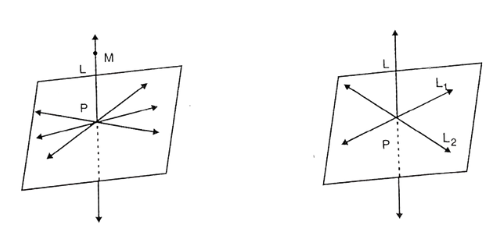
16. Definition. A line L cuts (or intersects) a plane π in a point P. If all the lines in π through P are perpendicular to L, then the line L is said to be perpendicular to the plane π. We write L ⊥ π or π ⊥ L. If M ∈ L, then we also write \(\overleftrightarrow{\mathrm{PM}} \perp \pi\) or PM ⊥ π.

Answer key For Maths For BSC 2 Semester Chapter 1 Introduction Image 4


17. Theorem. L1 and L2 are two lines intersecting at P. then L is perpendicular to the lines L1 and L2 at P is perpendicular to the plane determined by L1 and L2.

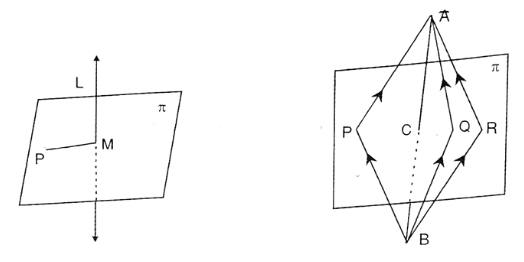
18. Theorem. P is a point and L is a line. Through P and perpendicular to L one and only plane (π) exists.

If L meets π in M, the PM ⊥ L.

Answer key For Maths For BSC 2 Semester Chapter 1 Introduction Image 5

19. Theorem. The set of points so that each point is equidistant from two points A and B determine a unique plane (π) perpendicular to AB and intersecting AB at its middle point(C).

If P, Q , R… are points such that AP=PB, AQ=QB, AR=RB, …., then P, Q, R… are in the plane π where π ⊥ Ab at C

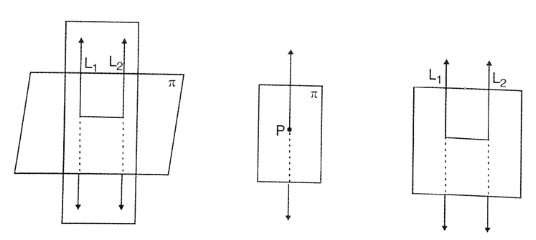
20. Theorem. If L1,L2 are two distinct lines perpendicular to the plane π, then L1 and L2 are parallel and coplanar.

21. Theorem. P is a point in the plane π. One and only one perpendicular line to π exists through P.

22. Theorem. L1,L2 are two parallel lines. If a plane is perpendicular to L1 then it is also perpendicular to L2.

Answer Key For Maths For BSC 2 Semester Chapter 1 Introduction Image 6


23. Theorem. one and only one perpendicular line can be drawn to a plane from a point, not in the plane.

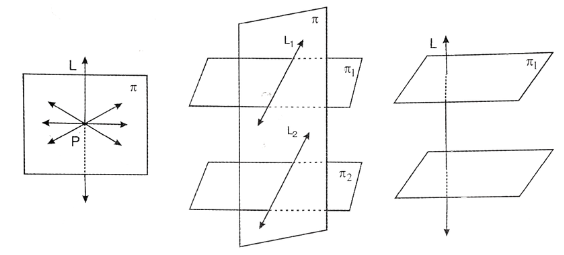
24. Theorem. L is a line and P is a point on L. If π is the plane perpendicular to L at P, then all the lines perpendicular to L through P lie in the plane π.

25. Definition. L is a line and π is a plane. If no point of L is in π(L∩π=ϕ) or if L is in π, then L is said to be parallel to π and we write L ∥ π.

26. Definition.  π1, π2 are two planes which are either coincident (π12) or parallel (π1 ∩ π2 = ϕ). Then π12 are said to be parallel and we write π1 ∥ π2.

27. Theorem. π12 are two distinct parallel planes. If a plane π cuts π1 in a line L1 and π2 in a line L2, then L1∥ L2.

28. Theorem. If L is a line perpendicular to the plane π1, then L is perpendicular to the planes parallel to π1.

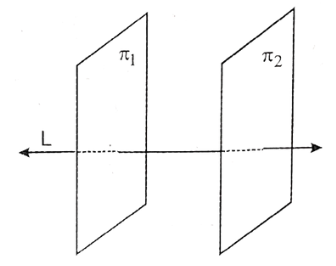
29. If π1, π2 are two planes perpendicular to the lines L, then π1 ∥ π2.

Answer key For Maths For BSC 2 Semester Chapter 1 Introduction Image 7


30. Theorem. If L1 is a line parallel to any line in a plane π then L1 ∥ π.

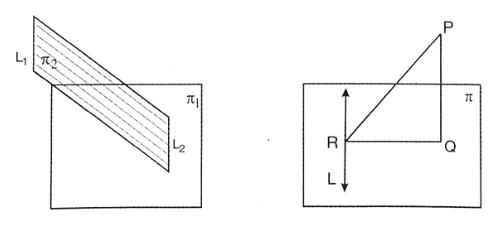
31. Theorem. L1 is a line parallel to the plane π1. π2 is a plane containing L1 and intersecting π1 in L2. Then L1 ∥ L2.

Answer key For Maths For BSC 2 Semester Chapter 1 Introduction Image 8


32. Theorem. L is a line in a plane π. R is a point on L. Also Q is a point in π, but not on L. Further, P is a point not in π. Then

1) QR ⊥ L and PR ⊥ L ⇒ PQ ⊥ π
2) PR ⊥ L and PQ ⊥ π ⇒ QR ⊥ L
3) PQ ⊥ π and QR ⊥ L ⇒ PR ⊥ L
This is called the theorem of three perpendiculars.

33. Theorem. Two parallel planes π1, π2 always make equal intercepts or lines perpendicular to π12.

Definition. L is perpendicular to π1, π2. The intercept on L by π12 is called the distance between π1 and π2.

34. Definition. If L1, L2, L3 are three lines such that L1 ∩ L2 ∩ L3 = P, then the lines L1, L2 and L3 are said to be concurrent.

Answer key For Maths For BSC 2 Semester Chapter 1 Introduction Image 9

35. Theorem. If L1 ∥ L2, L2 ∥ L3, then L1 ∥ L3.

We say that L1, L2, L3 are parallel and we write L1 ∥ L2 ∥ L3.

Examples Of Planes In 2d And 3d Euclidean Geometry

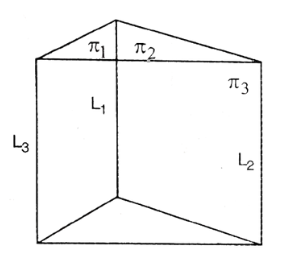
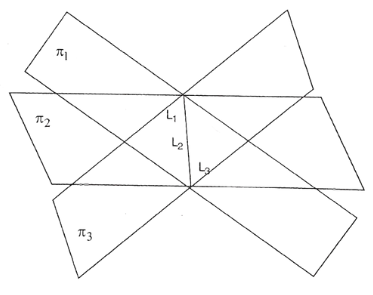
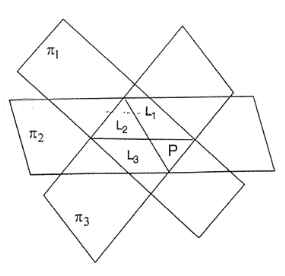
36. Theorem. π1, π2, π3 are three distinct planes so that no two of which are parallel. The three lines of their intersection are either parallel or concurrent.

Answer key For Maths For BSC 2 Semester Chapter 1 Introduction Image 10

Answer key For Maths For BSC 2 Semester Chapter 1 Introduction Image 11

Answer key For Maths For BSC 2 Semester Chapter 1 Introduction Image 12


37. Projections. Here projection will mean orthogonal projection only.

1. Definition. P is a point and L is a line. P ∉ L. If M is the foot of the perpendicular from P on L, then M is called the projection of P in L.

2. Definition. P is a point and π is a plane not containing P. If the perpendicular from P to π meets π in the point M, then M is called the projection of P in π.

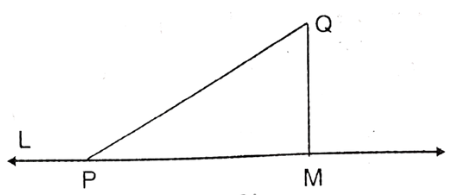
3. Definition. P, Q are two points and L is a line, P ∈ L and Q ∉ L. If M is the projection of Q and L, the PM is called the projection of PQ in L.

Answer key For Maths For BSC 2 Semester Chapter 1 Introduction Image 13

4. Definition. P, Q are two points and L is a line. P, Q ∉ L. If M,N are the respective projections of P, Q in L, then the line segment MN is called the projection of the line segment PQ in L.

5. Theorem. π is a plane and L is a line not in π. If perpendicular are drawn from every point on L to π, then all the projections in π are either collinear (when L is not perpendicular to π) or coincident in a point (when L ⊥ π).

38. Some Useful results

1. L is a line and P is a point on it. The perpendicular to L at P are coplanar.
2. The planes perpendicular to a line are all parallel.
3. L is a line perpendicular to a plane π. All the planes through L are perpendicular to π.
4. L1, L2 are a pair of intersecting lines. L3, L4 are a second pair of intersecting lines so that L3 ∥ L1 and L4 ∥ L2.

Then

  1. the angle between the first pair=the angle between the second pair.
  2. the plane determined by the first pair is parallel to the plane determined by the second pair.

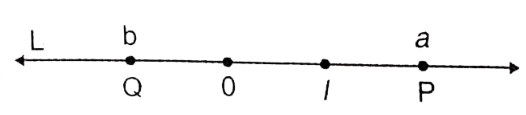
39. Definition. L is a line and R is the set of real numbers. \(f: L \rightarrow R\) is a one-one mapping. If A,B ∈ L such that \(|A, B|=|f(A)-f(B)|\), then f is called a coordinate system for L.

The real number x(=f(p)) is called the coordinate of P w.r.t the coordinate system f on the line L and we write it as p(x).

In this context, L is called the coordinate line. The set p(x) is called the geometric figure on L.


Axiom. Every line has a coordinate system.


A coordinate system on the line L depends on arbitrarily chosen points O and I on L such that

  1. O, called the origin, corresponds to the number of the O, and
  2. I, called the unit point, to correspond to the number 1.

Clearly, we can have infinitely many coordinate systems defined on L.

Answer key For Maths For BSC 2 Semester Chapter 1 Introduction Image 14

Then for every real number x and for each point P on L one-to-one correspondence exists with the following properties and notation,p(x) denotes the point p with coordinate x’

p(a),Q(b) ∈ L ⇒

  1. p(a) = 0 <=> p=0,
  2. p(a) lies to the right of O is a>0, and Q(b) lies to the left of O if b <0,
  3. Between P and Q, distance = PQ=|b-a| and directed distance = b-a,
  4. p(a) lies to the right of Q(b) if a > b,
  5. Q(b) lies to the left of p(a) if b < a,
  6. p(A) coincides with Q(b) i.e., P=Q if a=b.

40. Definition. A(a)., P(x), B(b) are points on the coordinate line L. Then

  1. A-P-B ⇒ is said to divide the line segment AB internally in the ratio (x-a):(b-x) and x-a,b-x are positive.
  2. P-A-B or A-B-P ⇒ is said to divide the line segment AB externally in the ratio (x-a,(b-x) are of opposite signs. we write (P;A,B)=(x-a):(b-x). It is +ve or -ve according as P divides AB internally or externally.

IF (P;A,B) = m:n, then (x-a):(b-x) = m:n ⇒ n(x-a)=m(b-x)

41. Theorem. In a given ratio a line segment is divided at one an only the point.

42. Skew lines.

Definition. Any two non-parallel and non-intersecting lines are called skew lines.

Since any two lines in a plane must be either parallel or intersecting, skew lines are non-coplanar. Conversely, any two non-coplanar lines are skew lines.

43. Theorem. L1,L2 are two skew lines. Then there exist one and only one plane π through one of the lines and parallel to the second.

44. Theorem. If \(\overleftrightarrow{\mathrm{MN}}\) is the projection of a line L in a plane π, then \(\overleftrightarrow{\mathrm{MN}}\), L are coplanar.

If L ∥ π, then L ∥ \(\overleftrightarrow{\mathrm{MN}}\).

45. Theorem. If L1,L2 are two skew lines, then there exists one and only one line that intersects L1,L2 and is perpendicular to L1,L2.

Properties and axioms of planes in mathematics

46. Definition. L is a line and π1 is a plane not containing L. If L is not parallel to π1, then the angle between L and π1 (written as (L, π1)) is the angle between L and \(\overleftrightarrow{\mathrm{MN}}\), where \(\overleftrightarrow{\mathrm{MN}}\) is the projection of L in π1.

We write \(\left(\mathrm{L},\pi_1\right)=(\mathrm{L}, \overleftrightarrow{\mathrm{MN}})\).

We can have (L,π1)= \(\frac{\pi}{2} \pm \theta\)

where θ is the acute angle between L and a normal to π1.


The Sphere Definition Theorems Proofs Solved Problems Exercises Spheres Orthogonal Radical Planes

The Sphere Angles Of Intersection Of Spheres, Orthogonal Spheres

Definition Of A Sphere In Geometry With Examples And Proofs

Definition. P is a common point to two spheres ξ1, ξ2. Any angle θ between the tangent planes at P to two spheres is called an angle of intersection of the spheres ξ1, ξ2 at P. The other angle between the spheres π – θ.

If θ = π/2 the spheres are said to interest orthogonally at P and the spheres are called orthogonally spheres.

Theorem.1  ξ1, ξ2 are two intersecting spheres (not touching). r1,r2 are their respective radii and d is the distance between their centres. If P is a common point to ξ1, ξ2 then an angle θ of the intersection of the spheres ξ1, ξ2 at P is given by

⇒ \(\cos \theta=\pm\left(\frac{r_1^2+r_2^2-a^2}{2 r_1 r_2}\right)\)

Proof. Let A, B be the centres of the spheres ξ1, ξ2. The tangent planes at P to ξ1, ξ2 are perpendicular to AP, Bp respectively. Since the angle between the planes is the angle between their normals, ∠APB = θ or π – θ.

Ap =r1, Bp = r2 and AB = d.

From △APB,

AB2 = AP2 + PB2 – 2 AB.PB cos∠APB

i.e.,d2 = r12 + r22 ± 2r1r2cosθ

i.e., \(\cos \theta=\pm \frac{r_1^2+r_2{ }^2-d^2}{2 r_1 r_2}\)

Note 1.  Since the value of cosθ is independent of P, then angle between two spheres ξ1, ξ2 can be found to be the same at any point of their intersection.
2. Spheres ξ1, ξ2 cut orthogonally <=> θ = 90° <=> r12 + r22 = d2       

In this case, the tangent plane to ξ1 at P passes through the centre of ξ2 and the tangent plane to ξ2 at P passes through the centre of ξ1.

Theorem.2  S ≡ x2 + y2 + z2 + 2ux + 2vy + 2wz + d = 0,s’ ≡ x2 + y2 + z2 + 2u’x + 2v’y + 2w’z + d’ = are two orthogonal spheres <=> 2uu’ + 2ww’ = d + d’.

Proof. Let A, B be the centres and r1, r2 be the radii of the spheres s = 0, s’ = 0.

Spheres s=0, s’=0 cut orthogonally

AB2 = r12 + r22

(u’-u)2 + (v’-v)2 + (w’-w)2 = u2 + v2 + w2 – d + u’2 + v’2 + w’2 – d’

-2uu’ – 2vv’ – 2ww’ = d + d’ <=> 2uu’ + 2vv’ + 2ww’ = d + d’

Theorems Related To Spheres With Solved Problems Step-By-Step

Theorem.3  If r1, r2 are the radii of two orthogonal spheres, then the radius of the circle of their intersection is \(\frac{r_1 r_2}{\sqrt{r_1^2+r_2^2}}\)

Proof. A, B are the centres of the two orthogonal spheres. M is the centre and a is the radius of the circle common to the spheres.

A, M, B are colinear and MP ⊥ AB.

P is a common point of intersection of the spheres,

AP = r1, BP = r2, ∠APB = 90° ⇒ AB2 = r12 + r22

⇒ (AM + MB)2 = r12 + r22

⇒ AM2 + MB2 + 2 AM . MB = r12 + r22

⇒ \(r_1^2-a^2+r_2^2-a^2+2 \sqrt{\left(r_1^2-a^2\right)\left(r_2^2-a^2\right)}=r_1^2+r_2^2\)

⇒ 4(r12 – a2)(r22 – a2) = 4a4

⇒\(r_1^2 r_2^2-a^2\left(r_1^2+r_2^2\right)=0 \Rightarrow a=\frac{r_1 r_2}{\sqrt{r_1^2+r_2^2}}\)

Note. If S=0, S’=0 are the equations to the orthogonal spheres with radii r1, r2 then 2uu’+2vv’+ww’=d+d’ and

r12 = u2 + v2 + w2 – d, r22 = u’2 + v’2 + w’2 – d’

r12 + r22 = u2 + v2 + w2 + u’2 + v’2 + w’2 – (2uu’ + 2vv’ + 2ww’)

= (u-u’)2 + (v-v’)2 + (w-w’)2

\(a=\frac{\sqrt{u^2+v^2+w^2-d} \cdot \sqrt{u^{\prime 2}+v^2+w^2-d^{\prime}}}{\left(u-u^{\prime}\right)^2+\left(v-v^{\prime}\right)^2+\left(w-w^{\prime}\right)^2}\)

The Sphere Power Of A Point

Definition. B is a point on a line L intersecting a sphere ξ with centre C and radius = a in P, Q. Then the power of the point B w.r.t. the sphere ξ is

(1) BP. BQ if B is an external point to ξ
(2) -BP.BQ if B is an internal point to ξ
(3) 0 if B is on ξ.

If B = \(\bar{b}\) (x1, y1, z1) and the equation to the sphere ξ is S, then the power of the point B w.r.t ξ is S11.

i.e., x12 + y12 + z12 + 2ux1 + 2vy1 + 2wz1 + d

= \(\overline{\mathrm{CB}}^2-a^2=\mathrm{CB}^2-(\text { radius of } \xi)^2\)

If B is an external point to ξ and \(\overleftrightarrow{\mathrm{BT}}\) is a tangent line to ξ at T, then BT2 = S11 = Power of the point B w.r.t ξ.

Note that: Power of the point B is independent of the d.cs.l,m,n.

Example. If the powers of a point w.r.t two given spheres are in a constant ratio, show that the locus of the point is a sphere.

The Sphere Radical Plane

Definition. The locus of points each of whose powers w.r.t two non-concentric spheres are equal is a plane called the radical plane (R.P.) of the two spheres.
ξ, ξ’ are two non-concentric spheres and π is their radical plane.
P is a point on the radical plane π. <=> power P w.r.t. ξ1= Power of P w.r.t ξ2.

Theorem.4 Equation to the radical plane of spheres S=0, S’=0 is S-S’=0.

Proof. S ≡ x2 + y2 + z2 + 2ux + 2vy + 2wz + d =0

S’ ≡ x2 + y2 + z2 + 2u’x + 2v’y + 2w’z + d’ = 0

(-u, -v, -w) ≠ (-u’, -v’, -w’)

B(x1, y1, z1) is a point whose powers w.r.t the spheres are equal.

⇔ S11 = S’11

⇔ x12 + y12 + z12 + 2ux1 + 2vy1 + 2wz1 + d = x12 + y12 + z12 + 2u’x1 + 2v’y1 + 2w’z1 + d’

⇔ 2(u-u’)x1 + 2(v-v’)y1 + 2(w-w’)z1 + (d-d’) = 0

Locus of B is 2(u-u’)x+2(v-v’)y+2(w-w’)z+(d-d’)=0 Which is a plane.

But the locus of B is the radical plane of the spheres S=0, S’=0.

The radical plane of the spheres S=0, S’=0 is

2(u-u’)x + 2(v-v’)y + 2(w-w’)z + d – d’ = 0 i.e., S-S’=0

Note. D.rs. of the line of centres of the spheres are u-u’, v-v’, w-w’.

Radical plane is perpendicular to the line of centres of the spheres.

Note 1. The line of centres and it is perpendicular to the radical plane.

Radical plane is perpendicular to the line of centres of the spheres.

2. If two spheres interest the plane of their circle of intersection is their radical place.

3. If two spheres touch, their radical plane is the tangent plane at the point of contact to either of the spheres.

The Sphere  Radical Line

Definition. If ξ, ξ’, ξ” are three spheres with non-collinear centres then the three radical planes of the spheres taken in pairs pass through a unique line, called the radical line.

Orthogonal Spheres Examples And Their Geometric Properties

Theorem.5  S=0, S’=0, S”=0 are three spheres whose centres are non-collinear, then the three radical planes of the spheres taken in pairs pass through a unique line.

Proof. Let A, B, C be the centres of the spheres S=0, S’=0, S”=0.

The radical plane (π) of S=0, S’=0 is S-S’=0 and is perpendicular to AB.

The radical plane (π’) of S’=0, S”=0 is S’-S”=0 and is perpendicular to BC.

The radical plane (π”) of S”=0, S=0 is S”-S=0 and is perpendicular to AB.

Since lines \(\overleftrightarrow{\mathrm{AB}}, \overleftrightarrow{\mathrm{BC}}\) intersect, the planes π,π’ have a line, say L in common.

All the points on L=0 lie on the plane (S-S’)+1(S’-S”)=0

i.e. S-S” = 0 i.e., S”-S=0 i.e. L lies in the plane S”-S=0

∴ π,π’,π” pass through the line L.

Note. L is the radical line of the spheres S=0, S’=0, S”=0 and its equation is S-S’=0, S’-S”=0 i.e. S=S’=S”.

The Sphere Radical Centre

Definition. The four radical lines of four spheres with non-coplanar centres, taken three by three intersect at a unique point, called the radical centre of the spheres.

Theorem.6  S=0, S’=0, S”=0, S'”=0 are four spheres whose centres are non-coplanar, then the four radical lines of four spheres taken three by three intersect at a unique point.

Proof. The radical plane of S=0, S’=0 is S-S’=0

i.e. 2(u-u’)x + 2(v-v’)y + 2(w-w’)z + (d-d’) = 0           …..(1)

The radical planes of S=0, S”=0 is S-S”=0

i.e. 2(u-u”)x + 2(v-v”)y + 2(w-w”)z + (d-d”) = 0        …..(2)

The radical planes of S=0, S”‘=0 is S-S'”=0

i.e. 2(u-u'”)x + 2(v-v'”)y + 2(w-w'”)z + (d-d'”) = 0     …..(3)

Since the centres (-u, -v, -w), (-u’, -v’, -w’),(-u”, -v”, -w”), (-u'”, -v'”, -w'”) are non-coplanar.

⇒ \(\left|\begin{array}{cccc}
-u & -v & -w & 1 \\
-u^{\prime} & -v^{\prime} & -w^{\prime} & 1 \\
-u^{\prime \prime} & -v^{\prime \prime} & -w^{\prime \prime} & 1 \\
-u^{\prime \prime \prime} & -v^{\prime \prime \prime} & -w^{\prime \prime \prime} & 1
\end{array}\right| \neq 0\)

⇒ \(\left|\begin{array}{cccc}
-u & -v & -w & 1 \\
u-u^{\prime} & v-v^{\prime} & w-w^{\prime} & 0 \\
u-u^{\prime \prime} & v-v^{\prime \prime} & w-w^{\prime \prime} & 0 \\
u-u^{\prime \prime \prime} & v-v^{\prime \prime \prime} & w-w^{\prime \prime \prime} & 0
\end{array}\right| \neq 0\)

⇒ \(\left|\begin{array}{ccc}
u-u^{\prime} & v-v^{\prime} & w-w^{\prime} \\
u-u^{\prime \prime} & v-v^{\prime \prime} & w-w^{\prime \prime} \\
u-u^{\prime \prime \prime} & v-v^{\prime \prime \prime} & w-w^{\prime \prime \prime}
\end{array}\right| \neq 0\)

⇒ Radical planes (1), (2), (3) pass through a unique point P.

∴ P lies on the radical planes of S=0, S’=0, S”=0, S'”=0,

⇒ P lies on the radical line of S=0, S’=0, S”=0

Similarly P lies on the radical line of S=0,S’=0,S”‘=0,

P lies on the radical line of S=0, S”=0, S”‘=0.

P lies on the radical line of S’=0,s”=0,S”‘=0.

∴ The four radical lines of four spheres taken three by three intersect at the unique point P.

Note. P is the radical centre of the spheres S=0, S’=0, S”=0, S'”=0.

Step-By-Step Solutions For Sphere Geometry Problems

Theorem.7  The centre of the sphere ξ which intersects two spheres ξ1, ξ2 orthogonally lies on the radical plane of the sphere ξ1, ξ2.

Proof. Let A, B be the centres and r1, r2 be the radii of the spheres ξ1, ξ2.
Answer key For Maths For BSC 2 Semester Chapter 6 The Sphere Image 2

Let C be the centre of the sphere ξ. Let T1, T2 be the respective common points to ξ1, ξ2  and ξ2, ξ.

ξ intersects ξ1 orthogonally

⇒ CT1 ⊥ AT1 ⇒ AC2-AT12 = CT12

⇒ AC2 – (radius of ξ1)2 = CT12 Art.6.32

⇒ Power of the Point C w.r.t ξ1 = CT12 =(radius of ξ)2.

Similarly power of point C w.r.t ξ2 = CT22 =(radius of ξ)2.

∴ Power of the point C w.r.t ξ1 = Power of the point C w.r.t ξ2.

∴ C lies on the radical plane of ξ1, ξ2.

OR
Let S’=0, S”=0 be the equations of the spheres ξ1, ξ2 and S=0 be the equation of ξ.

Radical plane of S’=0, S”=0 is S’-S”=0

i.e. 2(u’-u”)x + 2(v’-v”)y + 2(w’-w”)z + d’-d” = 0

ξ intersects ξ1 orthogonally ⇒ 2uu’ + 2vv’ + 2ww’ = d + d’        …..(1)

ξ intersects ξ1 orthogonally ⇒ 2uu” + 2vv” + 2ww” = d + d”     …..(2)

(1)-(2): 2(u’-u”)x + 2(v’-v”)y + 2(w’-w”)z + d’ – d” = 0

⇒ 2(u’-u”)(-u) + 2(v’-v”)(-v) + 2(w’-w”)(-w) + d’ – d” = 0

∴ The centre (-u, -v, -w) of S=0 clearly lies on the radical plane of s’=0, s”=0.

i.e. the centre of ξ lies on the radical plane ξ1, ξ2.

The Sphere Solved Problems

Example.1. Find the equation of the sphere through the circle x2 + y2 + z2 – 2x + 3y -4z +6 = 0 , 3x-4y+5z-15=0 and cutting the sphere x2 + y2 + z2 + 2x + 4y -6z +11 = 0 orthogonally.

Solution:

Given

x2 + y2 + z2 – 2x + 3y -4z +6 = 0 , 3x-4y+5z-15=0

x2 + y2 + z2 + 2x + 4y -6z +11 = 0

Let a sphere through the given circle and cut the sphere

x2 + y2 + z2  + 2x + 4y -6z +11 = 0 …..(1) orthogonally be

x2 + y2 + z2  – 2x + 3y -4z + 6 + λ(3x-4y+5z-15)=0

i.e., x2 + y2 + z2 + (3λ-2)x + (-4λ+3)y + (5λ-4)z + (-15λ+6) = 0

∴ \(\frac{2(3 \lambda-2)}{2}+\frac{4(-4 \lambda+3)}{2}-\frac{6(5 \lambda-4)}{2}=11-15 \lambda+6 \quad \text { i.e. } \lambda=-1 / 5\)

∴ Equations to the required sphere is 5(x2 + y2 + z2 ) – 13x + 19y – 25z + 45 = 0.

Radical Planes Of Spheres Explained With Solved Examples

Example. 2. Find the equation of the sphere which touches the plane 3x + 2y – z + = 0 at (1, -2, 1) and cuts orthogonally the sphere x2 + y2 + z2 – 4x + 6y + 4 = 0.

Solution:

Given

3x + 2y – z + = 0 and (1, -2, 1)

x2 + y2 + z2 – 4x + 6y + 4 = 0

For the sphere x2 + y2 + z2 – 4x + 6y + 4 = 0 …..(1)

centre = (2, -3, 0), radius = \(\sqrt{4+9-4}=3\)

Since the plane, 3x + 2y – z + 2 = 0 at (1, -2, 1) is the tangent plane to the required sphere, equations to the normal at (1, -2, 1) is the tangent plane to the required sphere, equations to the normal at (1, -2, 1) are

⇒ \(\frac{x-1}{3}=\frac{y+2}{2}=\frac{z-1}{-1} \text { (= } t \text { say) }\)

∴ Centre of the required sphere can be taken as (3t+1, 2t-2, -t+1)

and radius = \(\sqrt{(3 t+1-1)^2+(2 t-2+2)^2+(-t+1-1)^2}=\sqrt{14}|t|\)

Since the required sphere cuts orthogonally (1), (3t+1-2)2 + (2t-23)2 + (-t+1-0)2 = 14t2 + 9 i.e., t = -3/2.

∴ Centre of the required sphere \(\left(-\frac{7}{2},-5, \frac{5}{2}\right)\)

∴ Equation to the required sphere is \(\left(x+\frac{7}{2}\right)^2+(y+5)^2+\left(z-\frac{5}{2}\right)^2=\left(\frac{3}{2} \times \sqrt{14}\right)^2\)

i.e. x2 + y2 + z2 + 7x + 10y – 5z + 12 = 0.

Example. 3. Find the radical centre of the sphere

x2 + y2 + z2 + 4y = 0                            …..(1)
x2 + y2 + z2 + 2x + 2y + 2z + 2 = 0    ….(2)
x2 + y2 + z2 + 3x – 2y + 8z + 6 = 0     ….(3)
x2 + y2 + z2 – x + 4y – 6z – 2 = 0         ….(4)

Solution: R.P. of (1) and (2) is 2x – 2y + 2z + 2 = 0

i.e., x-y+z+1=0                                 ……(5)

R.P. of (1) and (3) is 3x-6y+8z+6=0 ……(6)

R.P. of (1) and (4) is x+6z+2 = 0      ……(7)

R.P. of (3) and (4) is 4x-6y+14z+8=0 i.e.,

2x-3y+7z+4=0         ……(8)

∴ Radical line of the spheres (1), (2), (3) is

x – y + z +1 = 0                                                             …..(5)

3x – 6y + 8z + 6 = 0                                                      …..(6)

and radical line of the spheres (1),(3),(4) is x+6z+2=0 …..(7)

2x – 3y + 7z + 4 = 0                                                     …..(8)

The point of the intersection of these radical lines is the radical centre of the spheres.

3 x (5)-(8) : x – 4z -1 = 0                                                ……(9)

(7)-(9) : 10z + 3 = 0 ⇒ \(z-\frac{3}{10}\)

∴ \(x=-\frac{1}{5}, y=\frac{1}{2}\)

∴ Radical centre of the spheres = \(\left(-\frac{1}{5}, \frac{1}{2},-\frac{3}{10}\right)\).

Solved Exercises On Spheres And Radical Planes In Geometry

Example.4. Show that all spheres through the origin and each set of points where the planes parallel to the plane \(\frac{x}{a}+\frac{y}{b}+\frac{z}{c}=0\) cut the axes, from a system of spheres which are cut orthogonally by the sphere x2 + y2 + z2 + 2fx + 2gy + 2hz = 0 …(1) if af + bg + ch = 0.

Solution:

Given

\(\frac{x}{a}+\frac{y}{b}+\frac{z}{c}=0\)

x2 + y2 + z2 + 2fx + 2gy + 2hz = 0 …(1) if af + bg + ch = 0

Let a plane parallel to

⇒ \(\frac{x}{a}+\frac{y}{b}+\frac{z}{c}=0\) be \(\frac{x}{a}+\frac{y}{b}+\frac{z}{c}=\lambda(\lambda \neq 0)\)

Let it meet the axes A, B, C.

∴ A=(λa,0,0), B=(0,λb,0), C=(0,0,λc),

∴ The equation to the sphere through O, A, B, C is x2 + y2 + z2 – λax – λby – λcz = 0

This intersects (1) orthogonally if

⇒ \(2 \cdot f \cdot\left(\frac{-\lambda a}{2}\right)+2 g\left(\frac{-\lambda b y}{2}\right)+2 h\left(\frac{-\lambda c z}{2}\right)=0\)

i.e., af + bg + ch = 0 (∵ λ≠0).

The Sphere  Coaxal System Of Spheres

Definition. A system of spheres such that any two spheres of the system have the same radical plane is called a coaxal system of spheres.

S=0 and S’=0 are two spheres of a coaxal system of sphere ξ.

⇒ S-S’=0 is the radical plane of the coaxal system of sphere ξ.

Theorem.8 If S=0 is a sphere and U=0 is a plane, then the equation s+λU=0(λ being real) represents a coaxal system of spheres with radical plane U=0.

Proof. Given that S=0 is a sphere and U=0 is a plane

Consider the equation S+λU=0, A being real ….(1)

Let S + λ1U=0                          ……(2) and

S + λ2U=0                               ……(3)

1 ≠ λ2) be two spheres of the system (1).

Radical plane of(2) and (3) is (λ1 ≠ λ2), U=0

∴ U=0 (∵ λ1 ≠ λ2), independent of λ.

∴ Every two spheres of the system (1) have the same radical plane U=0.

∴ S+λU=0 is the equation to coaxal system of spheres with radical plane U=0.

Note. S=0, and S’=0 are two non-concentric spheres. Then S-S’=0 is the radical plane of S=0, S’=0.

∴ S+λ(S-S’)=0, being real, is a coaxal system of spheres

i.e. (1+λ)S+(-λ)S’=0 is a coaxal system of spheres

i.e. λ1S+λ2S’=0, (λ12)≠(0,0) and λ12≠0 represents a coaxal system of spheres with radical plane S-S’=0.

Theorem.9 The centres of the spheres of a coaxal system of spheres are collinear.

Proof. Let ξ be a coaxal system of spheres with radical plane π.

Let ξ1, ξ2 be two spheres of the system ξ with centres A, B.

∴ AB ⊥ π. …..(1)

Let ξ3 be a sphere of the system ξ distinct from ξ1, ξ2 with centre C.

∴ ξ1, and ξ3 have the same radical plane and AC ⊥ π. …..(2)

∴ From (1) and (2), A, B, C are collinear.

∴ All the centres of the spheres of the system lie on \(\overleftrightarrow{\mathrm{AB}}\)

i.e. all the centres are collinear.

⇒ \(\overleftrightarrow{\mathrm{AB}}\) is called the line of centres of the coaxal system ξ.

Note. The radial plane of a coaxal system of spheres is perpendicular to the line of centres of the system.

The Sphere A Simplified Form Of The Equation To A Coaxal System Of Spheres.

Theorem.10 A Coaxal system of spheres can be reduced to the form x2 + y2 + z2+ 2λx + d = 0 where d is a constant and λ is a parameter.

Proof. The line of centres of a coaxal system of spheres is perpendicular to the radical plane of the system.

Let the point of intersection of the line of centres with the radical plane be origin O, the line of centres be X-axis and the radical plane be YZ plane.

With this frame of reference, let a sphere of the coaxal system be

x2 + y2 + z2  + 2ux + d = 0 ……(1) (∵ centre lies on the x-axis)

where u, and d are parameters. O is a point on the radical plane of the system.

∴ Power of O w.r.t. (1) = 0 + 0 + 02u(0) + d = d.

Since the power of the point O w.r.t. any sphere of the system must be the same, d is a constant.

∴ Equation to the coaxal system of spheres can be taken as x2 + y2 + z2 + 2λx + d = 0 where λ(=u) is a parameter and d is a constant.

Note. The equation x2 + y2 + z2 + 2λx + d = 0 (λ is a parameter and d is a constant) represents a coaxal system with the line of centres as X-axis and the radical plane as YZ plane.

By giving values to λ and taking f as constant, we get spheres of the coaxal system.

Consider a coaxal system of spheres x2 + y2 + z2 + 2λx + d = 0 …….(1)

where d is a constant and λ is a parameter.

The radical plane of the system is the YZ plane i.e. x = 0 …..(2)

∴ (1) and (2) intersect in points given by x = 0,  y2 + z2 + d = 0

i.e.  y2 + z2 = -d.

(1) d < 0.

All the points of intersection lie on the circle x = 0,\(y^2+z^2=(\sqrt{-d})^2\) and every sphere of the system passes through the circle.

∴ The coaxal system is an intersecting type of coaxal system of spheres.

(2) d = 0.

∴ x=0, y2 + z2= 0 i.e. x = 0, y = 0, z = 0

i.e. (0, 0, 0) is a point common to (1) and (2).

i.e. every pair of spheres of the system touch at (0, 0, 0) and the radical plane of the system is the system is the tangent plane at (0, 0, 0) to every sphere of the system.

∴ The coaxal system is a touching type of coaxal system such that every pair touches at (0,0,0).

(3) d > 0.

∴ There are no points common to (1) and (2)

i.e. there are no points in common to any two spheres of the system.

∴ The coaxal system is a non-intersecting type of coaxal system of spheres.

The Sphere Limiting Points

Definition. Point spheres of a coaxal system of spheres are called limiting points of the system.

Let x2 + y2 + z2 + 2λx + d = 0 where d is a constant and λ is a parameter, represent a coaxal system of spheres.

For any sphere of the system, radius = \(\sqrt{\left(\lambda^2-d\right)}\) and centre = (-λ, 0, 0)

For limiting points of the system, radius = 0

i.e. \(\sqrt{\left(\lambda^2-d\right)}=0\) i.e. λ = ±√d

(1) If d=0 then λ=0 and hence the system has only one limiting point and it is, (0, 0, 0). In this case the system is a touching type of coaxal system of spheres at (0, 0, 0).

(2) If d>0; then λ has two values ±√d and hence the system has two limiting points only. The limiting points are (√d, 0, 0), (-√d, 0, 0). In this case, no two spheres of the system intersect.

(3) If d<0, the system has no limiting points. In this case, the system is intersecting type.

Note 1. The equation to the limiting point (√d, 0, 0) is

⇒ \((x-\sqrt{d})^2+y^2+z^2=0 \text { i.e. } x^2+y^2+z^2-2 \sqrt{d} x+d=0\)

The equation to the limiting point (-√d, 0, 0) is

⇒ \((x+\sqrt{d})^2+y^2+z^2=0 \text { i.e. } x^2+y^2+z^2+2 \sqrt{d} x+d=0\)

2. If there is only one limiting point (0, 0, 0), its equation is x2 + y2 + z2 = 0.

The Sphere Solved Problems

Example. 1. Find the limiting points of the coaxal system defined by spheres x2 + y2 + z2 + 4x – 2y + 2z + 6 = 0 ….(1) and  x2 + y2 + z2+ 2x – 4y – 2z + 6 = 0       …..(2)

Solution:

Given

x2 + y2 + z2 + 4x – 2y + 2z + 6 = 0 ….(1) and  x2 + y2 + z2+ 2x – 4y – 2z + 6 = 0       …..(2)

The R.P. of the sphere of the coaxal system is 2x + 2y + 4z = 0 i.e., x + y + 2z = 0

∴ The equation to a sphere of the coaxal system is

⇒ x2 + y2 + z2 + 4x – 2y + 2z + 6 + λ(x + y + 2z) = 0

i.e. x2 + y2 + z2 + (4+λ)x + (λ-2)y + (2λ+2)z + 6 = 0

∴ centre = \(\left(-\frac{4+\lambda}{2}, \frac{2-\lambda}{2},-\lambda-1\right)\) and

radius = \(\sqrt{\left[\frac{(4+\lambda)^2}{4}+\frac{(2-\lambda)^2}{4}+(\lambda+1)^2-6\right]}\)

For limiting points of the system, radius = 0.

∴ \(\frac{(4+\lambda)^2}{4}+\frac{(2-\lambda)^2}{4}+(\lambda+1)^2-6=0\) i.e., λ2 + 2λ = 0

i.e. λ = 0, -2

∴ Limiting points are (-2, 1, -1); (-1, 2, 1).

Geometric Interpretation Of Radical Planes And Orthogonal Spheres

Example.2. Find the equation of the sphere belonging to the coaxal system given by x2 + y2 + z2 – 2ax – 2ay – 2az + 4a2 + λ(x + y – z) = 0 and x2 + y2 + z2 – 4ax – 4ay + 4a2 = 0 and which cuts the sphere x2 + y2 + z2 – 2ax = 0 orthogonally.

Solution:

Given

x2 + y2 + z2 – 2ax – 2ay – 2az + 4a2 + λ(x + y – z) = 0 and x2 + y2 + z2 – 4ax – 4ay + 4a2 = 0

x2 + y2 + z2 – 2ax = 0

R.P. of the given spheres is 2ax + 2ay – 2az = 0 i.e., x + y – z =0

∴ The equation to a sphere of the coaxal system is

⇒ x2 + y2 + z2 – 2ax – 2ay – 2az + 4a2 + λ(x + y – z) = 0

If the sphere intersects x2 + y2 + z2 – 2ax – 2ay – 2az = 0 orthogonally, then

⇒ \(2\left(\frac{\lambda-2 a}{2}\right) \cdot a+2\left(\frac{\lambda-2 a}{2}\right) \cdot 0+2\left(\frac{-\lambda-2 a}{2}\right) \cdot 0=4 a^2\) i.e., λ=6a.

∴ Equation to the required sphere is x2 + y2 + z2 – 4ax – 4ay – 8az + 4a2 = 0.

Solved Problems On Equations Of Spheres And Their Radical Planes

Example. 3. Prove that every sphere through the limiting points of a coaxal system intersects every sphere of that system orthogonally.

Solution: Let a coaxal system of spheres be x2 + y2 + z2 + 2λx + d = 0 …..(1)

(d > 0)

∴ Limiting points of the system are (-√d, 0, 0), (√d, 0, 0)

Let a sphere through the limiting points be x2 + y2 + z2 + 2ux + 2vy + 2wz + c = 0 ……(2)

∴ \(d-2 u \sqrt{d}+c=0, d+2 u \sqrt{d}+c=0\)

∴ Solving, u=0, c = -d.

∴ The equation to the system of spheres through the limiting points is x2 + y2 + z2 + 2vy 2wz – d = 0 …..(3)

Since 2.λ.0 + 2.0.v + 2.0.w = d – d is true for any sphere of the system (1), every sphere of the system intersects every sphere of the system through the limiting points orthogonally.

The Cone Definition Theorems Proofs Solved Problems Exercises Vertex At The Origin Are Homogenous

The Cone

Theorems Related To Cones With Proofs And Examples

Definition. The surface generated by a straight line that which passes through a fixed point and intersecting a given curve or touches a given surface, is called a cone.

The fixed point is called the vertex and the given curve the guiding curve of the cone.

An individual straight line on the surface of a cone is called a generator.

Thus a cone is the set of lines called generators through a given point.

Answer Key For Maths For BSC 2 Semester Chapter 7 The Cone Image 1

Another Definition. Let S be a set of points in space. It there exists a point V in S such that P ∈ S ⇒ \(\overleftrightarrow{V P}\) ⊂ S then S is called the cone and V is said to be the vertex of the cone.

⇒\(\overleftrightarrow{V P}\) is called a generator of a cone.

Note 1. If V is the vertex of the cone S and P is a point on ‘S’ the \(\overleftrightarrow{V P}\) is a generator.

2. If L is a generator of the cone S then every point of L lies on S.

Example. (1) The equation 2×2 + 3y2 – z2 = 0 represents a cone with vertex as origin.

(2) Intersection pairs of planes form a cone with every point on the common line as a vertex.

(3) A plane is a cone with every point on it as a vertex.

Theorem.1  If f(x, y, z) is a homogeneous polynomial of nth degree then the surface S represented by f(x, y, z) = 0 is a cone with a vertex at the origin.

Proof. Since f(x, y, z) is a homogeneous polynomial of degree n, for a real number λ.

f(λx, λy, λz) = λn f(x, y, z).

⇒ λnf(x, y, z) = 0 ⇒ f(λx, λy, λz) = 0

⇒ every point on \(\overleftrightarrow{O P}\) lies on the surface S.

∴ P ∈ S ⇒ \(\overleftrightarrow{O P}\) ⊂ S.

Hence the homogeneous equation f(x, y, z) = 0, represents a cone with a vertex at the origin.

Corollary. The line \(\frac{x}{l}=\frac{y}{m}=\frac{z}{n}\) is (λl, λm, λn) where λ is a real number.

∴ \(\frac{x}{l}=\frac{y}{m}=\frac{z}{n}\) is a generator of the cone <=> f(l,m,n) = 0

<=> Any point on the generator ∈ cone <=> (λl, λm, λn) ∈ cone

<=> f(λl, λm, λn) = 0 <=> λn f(l, m, n) = 0 <=> f(l, m, n) = 0

NOTE. If f(x, y, z) is a homogeneous polynomial of degree n then the cone f(x, y, z) = 0 is called a cone of nth degree.

example (1) 2x3 – y3 + 3x2z + 2z3 = 0 is a cone of third degree.

(2) x2 + y2 – z2 = 0 is a cone of 2nd degree.

Cones of second degree are also called Quadric cones. In this chapter, we deal with quadric cones only.

It will be seen that the degree of equation of a cone whose generators intersect a given conic or touch a given sphere is of the second degree.

Quadric Cones With Vertex At The Origin

Theorem.2  The equation of a cone with vertex at the origin is a homogeneous equation.

Proof. Let the general equation of second degree

ax2 + by2 + cz2 + 2fyz + 2gzx + 2hxy + 2ux + 2vy + 2wz + d = 0 represent cone S with vertex at (0, 0, 0).

Let P (x1, y1, z1) be a point on the cone

∴ The equation of generator \(\overleftrightarrow{O P}\) is \(\frac{x}{x_1}=\frac{y}{y_1}=\frac{z}{z_1}\) (=λ)

Any point (λx1, λy1, λz1) on \(\overleftrightarrow{O P}\) lies on the cone S.

<=> λ2(ax12 + by12 + cz12 + 2fy1z1 + 2gz1x1 + 2hx1y1) + 2λ(ux1 + vy1 + wz1) + d = 0

This is true for all real values of λ.

<=> ax12 + by12 + cz12 + 2fy1z1 + 2gz1x1 + 2hx1y1 …..(1)

ux1 + vy1 + wz1 …..(2)

d = 0                 …..(3)

The relation (3) is obvious as the origin lies on the cone.

If u, v, w are not all zero, equation(2)

⇒ (λx1, λy1, λz1) lies on the plane ux + vy + wz = 0

Which is a contradiction. Thus we have u = v = w = 0, d = 0

Hence the equation to the cone S with vertex at the origin is given by the homogeneous equation ax2 + by2 + cz2 + 2fyz + 2gzx + 2hxy = 0 …..(1)

Conversely. Every homogeneous equation of the second degree represents a cone with its vertex at the origin.

Let the homogeneous equation of second degree be

S ≡ ax2 + by2 + cz2 + 2fyz + 2gzx + 2hxy = 0

Let P(x1, y1, z1) be a point on the cone.

Then ax12 + by12 + cz12 + 2fy1z1 + 2gz1x1 + 2hx1y1 …..(1)

Multiplying by a real number λ2 we have

2x12 + bλ2y12 + cλ2z12 + 2fλ2y1z1 + 2hλ2x1y1 = 0

⇒ (λx1, λy1, λz1) lies on the surface.

Thus P lies on the surface ⇒ Every point on OP lies on it.

∴ The surface is generated by lines through O and hence, by definition is a cone with its vertex at O.

Note.1. Let △ = abc + 2fgh – af2 – bg2 – ch2 = \(\left|\begin{array}{lll}
a & h & g \\
h & b & f \\
g & f & c
\end{array}\right|\)

(1) If △ = 0, equation I represents a pair of planes, and S is called a degenerate cone.

(2) If △ ≠ 0, then the surface S is called a Quadric cone or a non-degenerate cone.

2. The equation ax2 + by2 + cz2 + 2fyz + 2gzx + 2hxy = 0 always represents a cone of second degree with its vertex at the origin.

3. As the above equation of the cone contains five arbitrary constants, we need five conditions to determine the cone.

4. The general equation of the cone with vertex at (α, β, γ) is

a(x−α)2+b(y−β)2+c(z−γ)2+2f(y−β)(z−γ)+2g(z−γ)(x−α)+2h(x−α)(γ−β)=0

This is a homogeneous equation in (x-α),(y-β), and (z-γ).

The Cone Solved Problems

Example. 1. Find the equation of the cone whose generators pass through the point (α, β, γ) and have their direction cosines satisfying the relation al2 + bm2 + cn2 = 0.

Solution. Equation to the generator passing through (α, β, γ)

and having directions cosines (l, m, n) is \(\frac{x-\alpha}{l}=\frac{y-\beta}{m}=\frac{z-\gamma}{n}=k \text { (say) }\)

⇒ \(l=\frac{x-\alpha}{k}, m=\frac{y-\beta}{k} \text { and } n=\frac{z-\gamma}{k}\)

But l, m, n satisfy al2 + bm2 + cn2 = 0 <=> \(\frac{1}{k}\left[(x-\alpha)^2+(y-\beta)^2+(z-\gamma)^2\right]=0\)

Hence the required to the cone is \((x-\alpha)^2+(y-\beta)^2+(z-\gamma)^2=0\)

Homogeneous Cone With Vertex At The Origin Examples

Example. 2. Show that x = -y = -z is a generator of the cone 5yz + 8zx – 3xy = 0.

Solution. \(\frac{x}{1}=\frac{y}{-1}=\frac{z}{-1}\)

is a generator of the cone 5yz + 8zx – 3xy = 0 …..(1)

<=> 5(-1)(-1)+8(-1)(1)-3(1)(-1) ⇒ 5 – 8 + 3 = 0

Hence the given line is a generator of the cone (1)

Theorem.3 shows that the general equation of the cone of the second degree which passes through the co-ordinate axes is fyz + gzx + hxy = 0

Proof. The equation of the cone of the second degree is ax2 + by2 + cz2 + 2fyz + 2gzx + 2hxy = 0 …..(1)

X – axis is a generator of the cone.

Answer key For Maths For BSC 2 Semester Chapter 7 The Cone Image 2

⇒ the direction cosines (1, 0, 0) of the x-axis satisfies (1)

⇒ a = 0.

Similarly, the y-axis is a generator ⇒ b = 0.

Similarly, the z-axis is a generator ⇒ c = 0.

Hence the general equation of the cone containing the three axes is fyz + gzx + hxy = 0

The Cone Solved Problems

Example. 1. Show that a cone can be found so as to contain any two given sets of three mutually perpendicular concurrent lines as generators.

solution. Let one set of three mutually perpendicular concurrent lines be taken as co-ordinate axes.

∴ The general equation of the cone through the coordinate axes is fyz + gzx + hxy = 0 …..(1)

Let the other set of perpendicular lines be OA, OB, OC given by the equations

Let the other set of lines be OA, OB, OC given by the equations

⇒\(\frac{x}{l_1}=\frac{y}{m_1}=\frac{z}{n_1} ; \frac{x}{l_2}=\frac{y}{m_2}=\frac{z}{n_2} ; \frac{x}{l_3}=\frac{y}{m_3}=\frac{z}{n_3}\)

Then m1n1 + m2n2 + m3n3 = 0 …..(1)

n1l1 + n2l2 + n3l3 = 0                …..(2)

l1m1 + l2m2 + l3n3 = 0             …..(3)

OA, OB, OC are the generators of cone

⇒ fm1n1 + gn1l1 + hl1m1 = 0   …..(2)

fm2n2 + gn2l2 + hl2m2 = 0      …..(3)

Adding (2) and (3) we get f(m1n1 + m2n2) + g(n1l1 + n2l2) + h(l1m1 + l2m2) = 0

i.e. f(-m3n3) + g(-n3l3) = 0       …by(3)

i.e. fm3n3 + gn3l3 + hl3m3 = 0

⇒ the line OC with directions ratio (l3, m3, n3) lies on the cone fyz + gzx + hxy = 0.

Hence cone (1) contains two sets of mutually perpendicular generators.

Step-By-Step Guide To Solving Cone Geometry Problems

Example. 2. Find the equation to the cone which passes through the three coordinate axes as well as the three lines \(\frac{1}{2} x=y=-z, x=\frac{1}{3} y=\frac{1}{5} z \text { and } \frac{1}{8} x=-\frac{1}{11} y=\frac{1}{5} z\).

Solution. The equation to the cone passing through the three coordinate axes can be taken in the form fyz + gzx + hxy = 0 …..(1)

The line \(\frac{x}{2}=\frac{y}{1}=\frac{z}{-1}\) lies on (1)

<=> f(1)(-1)+g(-1)(2)+h(2)(1) = 0 ⇒ f + 2g – 2h = 0       …..(2)

The line \(\frac{x}{1}=\frac{y}{3}=\frac{z}{5}\) lies on (1)

<=> f(3)(5) + g(5)(1) + h(1)(3) = 0 ⇒ 15f + 5g + 3h = 0  …..(3)

Solving (2) and (3) : \(\frac{f}{6+10}=\frac{g}{-30-3}=\frac{h}{5-30} \Rightarrow \frac{f}{16}=\frac{g}{-33}=\frac{h}{-25}\)

Hence the equation of the cone (1) is 16yz – 33zx – 25xy = 0

Clearly, the line with d.r’s (8, -11, 5) lies on it.

Example. 3. Find the equation of the cone which contains the three coordinate axes and the two lines through the origin with direction cosines (l1, m1, n1) and (l2, m2, n2)

Solution. The equation to the cone containing the coordinate axes can be taken as fyz + gzx + hxy = 0 …..(1)

The two lines with d.c.’s (l1, m1, n1) and (l2, m2, n2) lie on cone (1)

<=> fm1n1 + gn1l1 + hl1m1 = 0   …..(2)

and f(m2n2) + gn2l2 + hl2m2 = 0  …..(3)

Solving (2) and (3):

⇒ \(\frac{f}{l_1 l_2 m_2 n_1-l_1 l_2 m_1 n_2}=\frac{g}{m_1 m_2\left(n_2 l_1\right)-m_1 m_2 n_1 l_2}=\frac{h}{n_1 n_2 l_2 m_1-n_1 n_2 l_1 m_2}\)

⇒ \(\frac{f}{l_1 l_2\left(m_2 n_1-m_1 n_2\right)}=\frac{g}{m_1 m_2\left(n_2 l_0-n_1 l_2\right)}=\frac{h}{n_1 n_2\left(l_2 m_1-l_1 m_2\right)}\)

Substituting in (1) the required equation of the cone is

⇒ \(l_1 l_2\left(m_2 n_1-m_1 n_2\right) y z+m_1 m_2\left(n_2 l_1-n_1 l_2\right) z x+n_1 n_2\left(l_2 m_1-l_1 m_2\right) x y=0\)

⇒ \(\sum l_1 l_2\left(m_1 n_2-m_2 n_1\right) y z=0\)

The Cone Cone And A Plane Through Its Vertex.

Find the angle between the lines of intersection of the plane px + qy + rz = 0 and the cone F(x, y, z) ≡ ax2 + by2 + cz2+ 2fyz + 2gzx + 2hxy = 0

Solution. Let a line of intersection of the plane with the cone be \(\frac{x}{l}=\frac{y}{m}=\frac{z}{n}\).

∴ The line lies in the given plane as well as on the cone <=> pl + qm + rn = 0

and al2 + bm2 + cn2 + 2fmn + 2gnl + 2hlm = 0 …..(2)

Now substituting \(n=-\frac{p l+q m}{r}\) in (2) we have

⇒ \(a l^2+b m^2+c\left(\frac{p l+q m}{r}\right)^2+(2 f m+2 g l)\left(\frac{-p l+q m}{r}\right)+2 h l m=0\)

⇒ \(l^2\left(c p^2+a r^2-2 g r p\right)+2 l m\left(c p q+h r^2-g p r-f r p\right)+m^2\left(b r^2+c q^2-2 f q r\right)=0\)

⇒ \(\frac{l^2}{m^2}\left(c p^2+a r^2-2 g r p\right)+\frac{2 l}{m}\left(c p q+h r^2-g p r-f r p\right)+\left(b r^2+c q^2-2 f q r\right)=0\) …..(3)

This is a quadratic equation in \(\frac{l}{m}\) and shows that the plane cuts the cone in two times. If (l1, m1, n1) and (l2, m2, n2) are the d.c’s of the two lines then

⇒ \(\frac{l_1}{m_1}, \frac{l_2}{m_2}\) are the roots of (3)

⇒ \(\frac{l_1}{m_1} \cdot \frac{l_2}{m_2}=\frac{b r^2+c q^2-2 f q r}{c p^2+a r^2-2 g r p}\)

⇒ \(\frac{l_1 l_2}{b r^2+c q^2-2 f q r}=\frac{m_1 m_2}{c p^2+a r^2-2 g r p}=\frac{n_1 n_2}{a q^2+b p^2-2 h p q}\) by symmetry

each = \(\frac{l_1 l_2+m_1 m_2+n_1 n_2}{(b+c) p^2+(c+a) q^2+(a+b) r^2-2 f q r-2 g r p-2 h p q}\)

Also sum of the roots of (3) is \(\frac{l_1}{m_1}+\frac{l_2}{m_2}=-\frac{2\left(c p q+h r^2-g p r-f r p\right)}{c p^2+a r^2-2 g r p}\)

⇒ \(\frac{l_1 m_2+l_2 m_1}{-2\left(c p q+h r^2-g p r-f r p\right)}=\frac{m_1 m_2}{c p^2+a r^2-2 g r p}=\frac{l_1 l_2}{b r^2+c q^2-2 f q r}=\frac{n_1 n_2}{a q^2+b p^2-2 h p q}\)

each = \(\frac{\left[\left(l_1 m_2+l_2 m_1\right)^2-4 l_1 l_2 m_1 m_2\right]^{1 / 2}}{\left[4\left(c p q-g p r-f r p+h r^2\right)-4\left(b r^2+c q^2-2 f q r\right)\left(c p^2+a r^2-2 g r p\right)\right]^{1 / 2}}\)

⇒ \(\frac{l_1 m_2-l_2 m_1}{\pm 2 r \mathrm{D}} \text { where } \mathrm{D}^2=\left|\begin{array}{cccc}
a & h & g & p \\
h & b & f & q \\
g & f & c & r \\
p & q & r & 0
\end{array}\right|\)

By symmetry \(\frac{l_1 m_2-l_2 m_1}{\pm 2 r \mathrm{D}}=\frac{m_1 n_2-m_2 n_1}{\pm 2 p \mathrm{D}}=\frac{n_1 l_2-n_2 l_1}{\pm 2 q \mathrm{D}}=\frac{\sqrt{\sum\left(m_1 n_2-m_2 n_1\right)^2}}{\pm 2 \mathrm{D} \sqrt{p^2+q^2+r^2}}\)

Let θ be the angle between the lines then tanθ = =\(\frac{\sqrt{\sum\left(m_1 n_2-m_2 n_1\right)^2}}{l_1 l_2+m_1 m_2+n_1 n_2}\)

⇒ \(\tan \theta=\frac{2 \mathrm{D} \sqrt{\left(p^2+q^2+r^2\right)}}{(a+b+c)\left(p^2+q^2+r^2\right)-\mathrm{F}(p, q, r)}\)

Cor. Condition of perpendicularity.

If the lines of intersection of the plane px + qy + rz = 0 and the cone

ax2 + by2 + cz2 + 2fyz + 2gzx + 2hxy = 0 is a right angle then

θ = 90° ⇒ tanθ = tan90° = ∞’

⇒ (a + b + c)(p2 + q2 + r2)-F(p, q, r) = 0 which is the required condition.

The Cone Solved Problems

Example. 1. Find the equation of the lines of intersection of the plane 2x + y – z = 0 and the cone 4x2 – y2 + 3z2 = 0

Solution.

Given

The plane 2x + y – z = 0 and the cone 4x2 – y2 + 3z2 = 0

Let a line intersection of the plane with cone be \(\frac{x}{l}=\frac{y}{m}=\frac{z}{n}\) …..(1)

The line (1) lies on the plane and the cone <=> 2l + m – n = 0 …..(2)

and 4l2 – m2 + 3n2 = 0 …..(3)

∴ n = 2l + m

Substituting the value of n in (3): 4l2 – m2 + 3(2l+m)2 = 0 ⇒ 8l2 + 6lm + m2 = 0

⇒ (2l + m)(4l + m) = 0 ⇒ 2l + m = 0 …..(4)

and 4l + m = 0 …..(5)

(1) when 2l + m = 0, we have from (2): n = 0

⇒ \(\frac{l}{1}=\frac{m}{-2}=\frac{n}{0}\)

(2) Solving 2l + m – n = 0 …..(2)

and 4l + m + 0.n = 0 …..(3)

⇒ \(\frac{l}{0+1}=\frac{m}{-4-0}=\frac{n}{2-4} \Rightarrow \frac{l}{1}=\frac{m}{-4}=\frac{n}{-2}\)

Hence the two lines are \(\frac{x}{1}=\frac{y}{-2}=\frac{z}{0} \text { and } \frac{x}{1}=\frac{y}{-4}=\frac{z}{-2}\)

Solved Exercise Problems On Cone Geometry Step-By-Step

Example. 2. Find the equations of the lines of intersection of the plane 3x + 4y + z = 0 and the cone 15x2 – 32y2 – 7z2 = 0= 0.

Solution.

Given

The plane 3x + 4y + z = 0 and the cone 15x2 – 32y2 – 7z2 = 0= 0

Let a line of intersection be \(\frac{x}{l}=\frac{y}{m}=\frac{z}{n}\)

The line belongs to 3x + 4y + z = 0 <=> 3l + 4m + n = 0 …..(1)

⇒ n = -(3l + 4m)

Also, the line lies on the given cone 15x2 – 32y2 – 7z2 = 0

<=> 15l2 – 32m2 – 7n2 = 0 = 0 …..(2)

Substituting the value of n in (2):  15l2 – 32m2 – 7(3l + 4m)2 = 0

⇒ 2l2 – 7lm + 6m2 = 0 ⇒ (l+2m)(2l+3m)=0

⇒ l + 2m = 0 …..(3)

and 2l + 3m = 0 …..(4)

(1) solving 3l + 4m + n = 0 …..(1)

and l + 2m + 0.n = 0 …..(4)

(2) Again solving 3l + 4m + n = 0 …..(1)

and 2l + 3m + 0.n = 0 …..(4)

⇒ \(\frac{l}{0-3}=\frac{m}{2-0}=\frac{n}{9-8} \Rightarrow \frac{l}{-3}=\frac{m}{2}=\frac{n}{1}\)

∴ The two lines of intersection are \(\frac{x}{-2}=\frac{y}{1}=\frac{z}{-2} \text { and } \frac{x}{-3}=\frac{y}{2}=\frac{z}{1}\)

Example.3. Find the angle between the lines of intersection of the plane x – 3y + z = 0 and the cone x2 – 5y2 + z2 = 0.

Solution.

Given cone x2 – 5y2 + z2 = 0 and the plane x – 3y + z = 0.

Let \(\frac{x}{l}=\frac{y}{m}=\frac{z}{n}\) be one of the common lines of the cone and the plane.

∴ l2 – 5m2 + n2 = 0 …..(1)

and \(l-3 m+n=0 \Rightarrow \frac{l+n}{3}=m\) …..(2)

Substituting (2) in (1) \(l^2-5\left(\frac{l+n}{3}\right)^2+n^2=0\)

⇒ 2l2 – 5ln + 2n2 = 0 ⇒ (2l – n)(l – 2n) = 0

⇒ 2l – n = 0 …..(3) and l – 2n = 0 …..(4)

Now solving (2) and (3) i.e. l – 3m + n = 0

2l + 0.m – n = 0

we have \(\frac{l}{3-0}=\frac{m}{2+1}=\frac{n}{0+6} \Rightarrow \frac{l}{1}=\frac{m}{1}=\frac{n}{2}\)

Again solving (2) and (4) i.e. l – 3m + n = 0, l + 0.m – 2n = 0

We have \(\frac{l}{6-0}=\frac{m}{1+2}=\frac{n}{0+3} \Rightarrow \frac{l}{2}=\frac{m}{1}=\frac{n}{1}\)

Hence the direction ratios of the two lines of intersection are (1, 1, 2) and (2, 1,1).

∴ The equations of the lies of intersection are \(\frac{x}{1}=\frac{y}{1}=\frac{z}{2} \quad \text { and } \quad \frac{x}{2}=\frac{y}{1}=\frac{z}{1}\)

If θ is the angle between the lines, the cosθ = \(\frac{1(2)+1(1)+2(1)}{\sqrt{(1+1+4)} \cdot \sqrt{(4+1+1)}}=\frac{5}{6}\)

⇒ \(\theta=\cos ^{-1} \frac{5}{6}\)

Properties Of Cones With Solved Examples And Exercises

Example.4. Show that the equation of the quadric cone which contains the three coordinate axes and the lines in which the plane x – 5y – 3z = 0 cuts the cone 7x2 + 5y2 – 3z2 = 0 is yz + 10zx + 18xy = 0.

Solution. Let the plane x – 5y – 3z = 0 cut the cone 7x2 + 5y2 – 3z2 = 0

along the line \(\frac{x}{l}=\frac{y}{m}=\frac{z}{n}\)

⇒ l 5m – 3n = 0 …..(1)

and 7l2 + 5m2 – 3n2 = 0 …..(2)

Eliminating l from (1) and (2): 7(5m + 3n)2 + 5m2 – 3n2 = 0

⇒ 6m2 + 7mn + 2n2 = 0 ⇒ (2m + n)(3m + 2n) = 0

⇒ 2m + n = 0 …..(3) and 3m + 2n = 0 …..(4)

(1) Solving l – 5m – 3n = 0 …..(1)

and l.0 + 2m + n = 0 …..(3)

⇒ \(\frac{l}{-5+6}=\frac{m}{0-1}=\frac{n}{2-0} \Rightarrow \frac{l}{1}=\frac{m}{-1}=\frac{n}{2}\)

(2) Solving l – 5m – 3n = 0 …..(1)

and l.0 + 3m + 2n = 0 …..(4)

⇒ \(\frac{l}{-10+9}=\frac{m}{0-2}=\frac{n}{3-0} \Rightarrow \frac{l}{-1}=\frac{m}{-2}=\frac{n}{3}\)

∴ The two lines of intersection are \(\frac{x}{1}=\frac{y}{-1}=\frac{z}{2} \text { and } \frac{x}{1}=\frac{y}{2}=\frac{z}{-3}\)

Let the cone containing the coordinate axes be fyz + gzx + hxy = 0 …..(5)

<=> f(2)(-1) + g(2)(1) + h(1)(-1) = 0 ⇒ 2f – 2g + h = 0 …..(6)

and f(2)(-3) + g(-3)(1) + h(1)(2) = 0 ⇒ 6f + 3g – 2h = 0 …..(7)

Solving (6) and (7) : \(\frac{f}{4-3}=\frac{g}{6+4}=\frac{h}{6+12} \Rightarrow \frac{f}{1}=\frac{g}{10}=\frac{h}{18}\)

Hence the required cone is yz + 10zx + 18xy = 0

Example.5. Prove that the angle between the lines of intersection of the plane x + y + z = 0 with the cone ayz + bzx + cxy = 0 is π/3 if \(\frac{1}{a}+\frac{1}{b}+\frac{1}{c}=0\).

Solution. Let a line of intersection be \(\frac{x}{l}=\frac{y}{m}=\frac{z}{n}\) …..(1)

(1) lies on the given plane and cone

<=> l + m + n = 0 …..(2) and amn + bnl + clm = 0 …..(3)

Eliminating n from (2) and (3)

-am(l + m)-bl(l + m) + clm = 0 ⇒ bl2 + (a + b – c)lm + am2 = 0

This is a quadratic in \(\frac{l}{m}\). Let the roots be \(\frac{l_1}{m_1}, \frac{l_2}{m_2}\)

∴ \(\frac{l_1}{m_1} \cdot \frac{l_2}{m_2}=\frac{a}{b} \Rightarrow \frac{l_1 l_2}{a}=\frac{m_1 m_2}{b}=\frac{n_1 n_2}{c}\) by symmetry

each =\(\frac{l_1 l_2+m_1 m_2+n_1 n_2}{a+b+c}=k\)

Again \(\frac{l_1}{m_1}+\frac{l_2}{m_2}=\frac{c-b-a}{b} \Rightarrow \frac{l_1 m_2+l_2 m_1}{c-b-a}=\frac{m_1 m_2}{b}=k \text { (say) }\)

Now (l1m2 – l2m1)2 = (l1m2 + l2m1)2 – 4l1l2m1m2

= \(k^2(c-b-a)^2-4(a k)(b k)=k^2\left[(c-b-a)^2-4 a b\right]\)

= \(k^2\left(a^2+b^2+c^2-2 a b-2 b c-2 c a\right)\)

Now tanθ = \(\frac{\sqrt{\sum\left(l_1 m_2-l_2 m_1\right)^2}}{l_1 l_2+m_1 m_2+n_1 n_2}=\frac{\sqrt{3 k^2\left(a^2+b^2+c^2-2 b c-2 c a-2 a b\right)}}{k(a+b+c)}\)

If \(\theta=\frac{\pi}{3}, \tan ^2 \frac{\pi}{3}=(\sqrt{3})^2=\frac{3\left(a^2+b^2+c^2-2 b c-2 a c-2 a b\right)}{(a+b+c)^2}\)

⇒ (a + b + c)2 = a2 + b2 + c2 – 2bc – 2ca – 2ab

⇒ 4(bc + ca + ab) = 0 ⇒ \(\frac{1}{a}+\frac{1}{b}+\frac{1}{c}=0\)

Worked Examples Of Cones With The Vertex At The Origin

Example. 6. Prove that if the angle between the lines of intersection of the plane x + y + z = 0 and the cone ayz + bzx + cxy = 0 is \(\frac{\pi}{2}\) then a + b + c = 0.

Solution. Let a line of intersection be \(\frac{x}{l}=\frac{y}{m}=\frac{z}{n}\) …..(1)

(1) lies on the cone and the plane <=> l + m + n = 0 …..(2)

amn + bnl + clm = 0 …..(3)

Substituting n = -l – m in (3)

-am(l+m) – bl(l+m) + clm = 0 ⇒ -alm – am2 – bl2 – blm + clm = 0

⇒ bl2 + (a + b – c) lm + am2 = 0 ⇒ \(b\left(\frac{l}{m}\right)^2+(a+b-c) \frac{l}{m}+a=0\)

This is a quadratic in \(\frac{l}{m}\). Let the roots be \(\frac{l_1}{m_1}, \frac{l_2}{m_2}\)

∴\(\left(\frac{l_1}{m_1}\right)\left(\frac{l_1}{m_2}\right)=\frac{a}{b} \Rightarrow \frac{l_1 l_2}{a}=\frac{m_1 m_2}{b}\)

By symmetry: \(\frac{l_1 l_2}{a}=\frac{m_1 m_2}{b}=\frac{n_1 n_2}{c}=K \text { (say) }\)

the angle between the lines with dcs (l1, m1, n1) and (l2, m2, n2) is \(\frac{\pi}{2}\)

<=>l1l2 + m1m2 + n1n2 = 0

⇒ ka + kb + kc = 0

⇒ a + b + c = 0.

The Cone Cone With A Base Curve

Definition. Let S be the set of lies concurrent at V and C be a curve not containing V.

Answer Key For Maths For BSC 2 Semester Chapter 7 The Cone Image 3

If P ∈ C ⇒ \(\overleftrightarrow{V P}\) ⊂ S then S is called the base curve or guiding curve. \(\overleftrightarrow{V P}\) is called a generator of the cone.

Theorem.4  The equation of a cone with vertex at (α, β, γ) ∉ XY plane and the guiding curve f(x,y)=0, z=0 is \((z-\gamma)^2 \cdot f\left(\alpha-\gamma \frac{X-\alpha}{z-\gamma}, \beta-\gamma \frac{y-\beta}{z-\gamma}\right)=0\)

Proof. Let the equation to a line through (α, β, γ) with directions ratios (l, m, n) be

⇒ \(\frac{x-\alpha}{l}=\frac{y-\beta}{m}=\frac{z-\gamma}{n} \quad(=r)\) …..(1)

A point on the line is (lr + α, mr + β, nr + γ).

Let the equation to the curve be f(x,y) = ax2 + 2hxy + by2 + 2gx + 2fy + c = 0, z = 0

The line passes through the conic.

<=> The point P(lr + α, mr + β, nr + γ) lies on the f(x,y) = 0 and on the plane z = 0.

⇒ \(z=0 \Rightarrow n r+\gamma \Rightarrow r=-\frac{\gamma}{n}\)

Hence the point P =\(\left(\alpha-\frac{l \gamma}{n}, \beta-\frac{m \gamma}{n}, 0\right)\) which will lie on the given conic,

<=> \(a\left(\alpha-\frac{l \gamma}{n}\right)^2+2 h\left(\alpha-\frac{l \gamma}{n}\right)\left(\beta-\frac{m \gamma}{n}\right)+b\left(\beta-\frac{m \gamma}{n}\right)^2+2 g\left(\alpha-\frac{l \gamma}{n}\right)+2 f\left(\beta-\frac{m \gamma}{n}\right)+c=0\) …..(3)

This is the condition for the line to intersect the conic.

Now eliminating l, m, n between (1) and (3)

⇒ \(a\left(\alpha-\frac{x-\alpha}{z-\gamma} \cdot \gamma\right)^2+2 h\left(\alpha-\frac{x-\alpha}{z-\gamma} \cdot \gamma\right)\left(\beta-\frac{y-\alpha}{z-\gamma} \cdot \gamma\right)+b\left(\beta-\frac{y-\beta}{z-\gamma} \cdot \gamma\right)^2\)

⇒ \(+2 g\left(\alpha-\frac{x-\alpha}{z-\gamma} \cdot \gamma\right)+2 f\left(\beta-\frac{y-\beta}{z-\gamma} \cdot \gamma\right)+c=0\)

⇒ \(a(\alpha z-x \gamma)^2+2 h(\alpha z-x \gamma)(\beta z-\gamma y)+b(\beta z-\gamma y)^2\)

⇒ \(+2 g(\alpha z-\gamma x)(z-\gamma)+2 f(\beta z-\gamma y)(z-\gamma)+c(z-\gamma)^2=0\)

⇒ \((z-\gamma)^2 \cdot f\left(\alpha-\frac{x-\alpha}{z-\gamma} \cdot \gamma, \beta-\frac{y-\beta}{z-\gamma} \cdot \gamma\right)=0\) which is the required equation of the conic.

Note. The guiding curve of the cone may be f(y,z) = 0, x = 0 or f(z,x) = 0, y = 0

The Cone Solved Problems

Example. 1. Find the equation of the cone whose vertex is the origin and whose base curve is x2 + y2 + z2 + 2ux + d = 0 px + qy + rz = k.

Solution.

Given

x2 + y2 + z2 + 2ux + d = 0 px + qy + rz = k

Let P(x1, y1, z1) be a point on the cone.

∴ The equation to \(\overleftrightarrow{O P}\) is \(\frac{x}{x_1}=\frac{y}{y_1}=\frac{z}{z_1}(=r)\). A point on \(\overleftrightarrow{O P}\) is (λx1, λy1, λz1).

⇒ \(\overleftrightarrow{O P}\) intersects the base curve C ⇒ (λx1, λy1, λz1) ∈ C

<=> λ2(λx12, λy12, λz12) + 2uλx1 + d = 0 and λ(px1 + qy1 + rz1) = k.

Eliminating λ from the above two relations.

We have k2(x12 + y12 + z12) + 2ukx1(px1 + qy1 + rz1) + d(px1 + qy1 + rz1)2 = 0

Hence the equation to the locus of p is the curve

k2(x2 + y2 + z2) + 2ukx (px + qy + rz) + d(px + qy + rz)2 = 0

Alternative method:

Solution. The given curve is x2 + y2 + z2 + 2ux + d = 0 …..(1)

px + qy + rz = k …..(2)

The required equation is the homogeneous equation of second degree satisfied by the points common to the two equations.

∴ p x+q y+r z=k. \(\quad \frac{p x+q y+r z}{k}=1\) …..(3)

Now homogeneuising the equation of (1) by (3) we have the homogeneous equation

⇒ \(x^2+y^2+z^2+2 u x\left(\frac{p x+q y+r z}{k}\right)+d\left(\frac{p x+q y+r z}{k}\right)^2=0\)

Thus the equation to the homogeneous cone is

⇒ \(k^2\left(x^2+y^2+z^2\right)+2 u k x(p x+q y+r z)+d(p x+q y+r z)^2=0\)

Example. 2. Find the equation of the cone whose vertex is (1, 1, 0) and whose guiding curve is y = 0, x2 + z2 = 4

Solution. Let the equation to the generator through the vertex (1, 1, 0) be

⇒ \(\frac{x-1}{l}=\frac{y-1}{m}=\frac{z}{n}(=r)\) …..(1)

A point on the generator is (lr + 1, mr + 1, nr)

If this point lies on the curve y = 0,  x2 + z2  = 4, then

mr+1=0, (lr + 1)2 + (nr)2 = 4

i.e., \(r=-\frac{1}{m},(l r+1)^2+n^2 r^2=4\)

Eliminating r \(\left(1-\frac{l}{m}\right)^2+\frac{n^2}{m^2}=4 \Rightarrow(m-l)^2+n^2=4 m^2\) …..(2)

Eliminating l, m, n from (2) by using (1)

[(y – 1)+(x – 1)]2 + z2 = 4(y – 1)2 ⇒ x2 – 3y2 + z2 – 2xy + 8y – 4 = 0

which is the equation to the required cone.

Classification Of Cones And Their Equations With Solved Problems

Example. 3. Find the equation of the cone with vertex (5, 4, 3) and 3x2 + 2y2 = 6, y + z = 0 as base.

Solution. Let the equation to the generator be \(\frac{x-5}{l}=\frac{y-4}{m}=\frac{z-3}{n}=k\) …..(1)

Any point on (1) is (lk + 5, mk + 4, nk + 4)

This point lies on the base <=> 3(lk + 5)2 + 2(mk + 4)2 = 6 …..(2)

and mk + 4 + nk 3 = 0 ⇒ k(m + n) = -7 …..(3)

Substituting (3) in (2) : \(3\left(5-\frac{7 l}{m+n}\right)^2+2\left(4-\frac{7 m}{m+n}\right)^2=6\)

⇒ \(3(5 m+5 n-7 l)^2+2(4 m+4 n-7 m)^2=6(m+n)^2\)

⇒\(3[5(y-4)+5(z-3)-7(x-5)]^2+2[4(z-3)-3(y-4)]^2=6(y-4+z-3)^2\)

⇒ \(3(-7 x+5 y+5 z)^2+2(-3 y+4 z)^2=6(y+z-3)^2\)

⇒ \(147 x^2+87 y^2+101 z^2-210 x y+90 y z-210 x y-294=0\)

Example.4. Obtain the locus of the lines that pass through a point (α, β, γ) and through the points of the conic \(\frac{x^2}{a^2}+\frac{y^2}{b^2}=1, z=0\)

Solution. Let the equation line through (α, β, γ) be \(\frac{x-\alpha}{l}=\frac{y-\beta}{m}=\frac{z-\gamma}{n}=k\) …..(1)

Any point on the line is (α+lk, β+mk, γ+nk)

The point lies on the conic \(\frac{x^2}{a^2}+\frac{y^2}{b^2}=1, z=0\)

<=> \(\frac{(\alpha+l k)^2}{a^2}+\frac{(\beta+m k)^2}{b^2}=1 \text { and } \gamma+n k=0 \Rightarrow k=-\frac{\gamma}{n}\)

Substituting the value k we have

⇒ \(\frac{1}{a^2}\left(\alpha-\frac{l \gamma}{n}\right)^2+\frac{1}{b^2}\left(\beta-\frac{m \gamma}{n}\right)^2=1 \Rightarrow \frac{(\alpha n-\gamma l)^2}{a^2 n^2}+\frac{(\beta n-m \gamma)^2}{b^2 n^2}=1\)

Eliminating l, m, n using (1)

⇒ \(\frac{1}{n^2 a^2 k^2}[\alpha(z-\gamma)-\gamma(x-\alpha)]^2+\frac{1}{n^2 b^2 k^2}[\beta(z-\gamma)-\gamma(y-\beta)]^2=1\)

⇒ \(\frac{(\alpha z-\gamma x)^2}{a^2}+\frac{(\beta z-\gamma y)^2}{b^2}=(z-\gamma)^2\)

Example. 5. Find the equation of the cone whose vertex is (1, 2, 3) and base y2 = 4ax, z = 0.

Solution. Let a line through (1, 2, 3) be \(\frac{x-1}{l}=\frac{y-2}{m}=\frac{z-3}{n}=k\) …..(1)

Any point on the line is (1+lk, 2+mk, 3+nk)

It lies on the given conic <=> (2+mk)2= 4a(1+lk) and 3 + nk = 0 ⇒ k = -3/n

Eliminating k we have \(\left(2-\frac{3 m}{n}\right)^2=4 a\left(1-\frac{3 l}{n}\right) \Rightarrow(2 n-3 m)^2=4 a(n-3 l) n\)

using (1) we get [2(z-3)-3(y-2)]2 = 4a[z-3-3(x-1)](z-3)

⇒ (2z-3y)2 = 4a(y-3x)2(z-3)

Homogeneous Cone Equations With Proofs And Applications

Example. 6. The section of a cone whose vertex is P and guiding curve the ellipse \(\frac{x^2}{a^2}+\frac{y^2}{b^2}=1, z=0\) by the plane z=0 is a rectangular hyperbola. Show that the locus of P is \(\frac{x^2}{a^2}+\frac{y^2+z^2}{b^2}=1\)

Solution.

Given

The section of a cone whose vertex is P and guiding curve the ellipse \(\frac{x^2}{a^2}+\frac{y^2}{b^2}=1, z=0\) by the plane z=0 is a rectangular hyperbola.

Let the point p(x1, y1, z1)

Equation to a line through P be \(\frac{x-x_1}{l}=\frac{y-y_1}{m}=\frac{z-z_1}{n}=k\)

Any point on the lien is (x1 + lk, y1 + mk, z1 + nk)

This lies on the conic

<=> \(\frac{\left(x_1+l k\right)^2}{a^2}+\frac{\left(y_1+m k\right)^2}{b^2}=1, z_1+n k=0 \Rightarrow k=-\frac{z_1}{n}\)

Eliminating k we have

⇒ \(\frac{1}{a^2}\left[x_1-\frac{l z_1}{n}\right]^2+\frac{1}{b^2}\left[y_1-\frac{m z_1}{n}\right]^2=1 \Rightarrow \frac{\left(n x_1-l z_1\right)^2}{a^2}+\frac{\left(n y_1-m z_1\right)^2}{b^2}=n^2\)

⇒\(\frac{1}{a^2}\left[x_1\left(z-z_1\right)-z_1\left(x-x_1\right)\right]^2+\frac{1}{b^2}\left[y_1\left(z-z_1\right)-z_1\left(y-y_1\right)\right]^2=\left(z-z_1\right)^2\)

⇒ \(\frac{\left(z x_1-x z_1\right)^2}{a^2}+\frac{\left(z y_1-y z_1\right)^2}{b^2}=\left(z-z_1\right)^2\)

Now this meets x = 0 in a curve \(\frac{z^2 x_1^2}{a^2}+\frac{\left(z y_1-y z_1\right)^2}{b^2}=\left(z-z_1\right)^2, x=0\)

This will be a rectangular hyperbola <=> coefficient of y2+ coefficient of z2 = 0

⇒\(\frac{z_1^2}{b^2}+\left(\frac{x_1^2}{a^2}+\frac{y_1^2}{b^2}-1\right)=0\).

Hence the locus P is \(\frac{x^2}{a^2}+\frac{y^2+z^2}{b^2}=1\)

Example.7. A cone has as base the circle  x2 + y2 + 2ax + 2by = 0, z = 0 and passes through the fixed point (0, 0, c). If the section of the cone by ZX plane is a rectangular hyperbola, Prove that the vertex lies on a fixed circle.

Solution.

Given

A cone has as base the circle  x2 + y2 + 2ax + 2by = 0, z = 0 and passes through the fixed point (0, 0, c). If the section of the cone by ZX plane is a rectangular hyperbola,

Let P(x1, y1, z1) be the vertex of the cone and base curve

x2 + y2  + 2ax + 2by = 0, z = 0

The line through P, \(\frac{x-x_1}{l}=\frac{y-y_1}{m}=\frac{z-z_1}{n}\) …..(1)

meets the plane z = 0 at the point given by

⇒ \(\frac{x-x_1}{l}=\frac{y-y_1}{m}=\frac{z-z_1}{n} \Rightarrow \text { at }\left(x_1-\frac{l z_1}{n}, y_1-\frac{m z_1}{n}, 0\right)\)

This point lies on the circle

<=> \(\left(x_1-\frac{l z_1}{n}\right)^2+\left(y_1-\frac{m z_1}{n}\right)+2 a\left(x_1-\frac{l z_1}{n}\right)+2 b\left(y_1-\frac{m z_1}{n}\right)=0\)

Eliminating (l, m, n) using (1)

⇒ \(\left(x_1-\frac{x-x_1}{z-z_1} \cdot z_1\right)^2+\left(y_1-\frac{y-y_1}{z-z_1} \cdot z_1\right)^2+2 a\left(x_1-\frac{x-x_1}{z-z_1} \cdot z_1\right)+2 b\left(y_1-\frac{y-y_1}{z-z_1} \cdot z_1\right)=0\)

⇒ \(\left(x_1 z-x z_1\right)^2+\left(y_1 z-y z_1\right)^2+2 a\left(x_1 z-x z_1\right)\left(z-z_1\right)+2 b\left(y_1 z-y z_1\right)\left(z-z_1\right)=0\) …..(1)

This cone passes through (0, 0, c)

<=> \(\left(x_1 c\right)^2+\left(y_1 c\right)^2+2 a\left(x_1 c\right)\left(c-z_1\right)+2 b\left(y_1 c\right)\left(c-z_1\right)=0\)

<=> \(\left(x_1^2+y_1^2\right) c+\left(2 a x_1+2 b y_1\right)\left(c-z_1\right)=0\) …..(2)

Again the section of the cone (1) by the plane y = 0 is

⇒ \(\left(x_1 z-x z_1\right)^2+\left(y_1 z\right)^2+2 a\left(x_1 z-x z_1\right)\left(z-z_1\right)+2 b y_1 z\left(z-z_1\right)=0\) …..(3)

(3) represents a rectangular hyperbola

<=> coefficient of z2 + coefficient of y2 = 0 ⇒ x12 + y12 + 2ax1 + 2by1 + z12 = 0 …..(4)

Locus of P is given by (2) and (4) as \(\left(x^2+y^2\right) c+(2 ax+2 b y)(c-z)=0\) …..(5)

and x2 + y2 + z2 + 2ax + 2by = 0 …..(6)

Multiplying (6) by c and subtracting from (5), we get

cz2 + 2azx + 2byz = 0 ⇒ 2ax + 2by + 2cz = 0 …..(7)

Hence  x2 + y2 + z2 + 2ax + 2by = 0 and 2ax + 2by + cz = together represent a circle.

The Cone Enveloping Cone

Definition. Let S be a surface and P be a point not on the surface. The set of tangent lines to the surface S and passing through P form a cone with vertex at P. This is called the enveloping cone or the tangent cone of the given surface.

Theorem.5. The enveloping cone of the sphere x2 + y2 + z2 = a2 with vertex at (x1, y1, z1) is (xx1 + yy1 + zz1 – a2)2 = (x2 + y2 + z2 – a2)(x12 + y12 + z12 – a2).

Proof. Let S = x2 + y2 + z2 – a2 = 0

P(x1, y1, z1) ∉ S = 0

⇒ x12 + y12 + z12 – a2 ≠ 0

Answer Key For Maths For BSC 2 Semester The Cone Image 1

Let Q(x, y, z) be a point on the enveloping cone C.

∴ \(\overleftrightarrow{\mathrm{PQ}}\) is a tangent line to the sphere S = 0.

Let R ∈ \(\overleftrightarrow{\mathrm{PQ}}\) and (R, P, Q) = λ : 1

∴ \(\mathrm{R}=\left[\frac{\lambda x+x_1}{\lambda+1}, \frac{\lambda y+y_1}{\lambda+1}, \frac{\lambda z+z_1}{\lambda+1}\right]\)

R ∈ S = 0

⇒ \(\left(\frac{\lambda x+x_1}{\lambda+1}\right)^2+\left(\frac{\lambda y+y_1}{\lambda+1}\right)^2+\left(\frac{\lambda z+z_1}{\lambda+1}\right)^2=a^2\)

⇒ \(\left(\lambda x+x_1\right)^2+\left(\lambda y+y_1\right)^2+\left(\lambda z+z_1\right)^2=a^2(\lambda+1)^2\)

⇒ \(\lambda^2\left(x^2+y^2+z^2-a^2\right)+2 \lambda\left(x x_1+y y_1+z z_1-a^2\right)+\left(x_1^2+y_1^2+z_1^2-a^2\right)=0\)

⇒ \(\lambda^2 S+2 \lambda S_1+S_{11}=0\)

If \(\overleftrightarrow{\mathrm{PQ}}\) is a tangent line to the sphere then the two roots of the equation (1) are equal

⇒ 4S12 – 4SS11 = 0 ⇒ s12 = SS11

Hence the equation to the enveloping cone C is s12 = SS11

i.e., (xx1 + yy1 + zz1 – a2)2 = (x2 + y2 + z2 – a2)(x12 + y12 + z12 – a2)

The Cone Right Circular Cone

Definition. A right circular cone is a surface generator by a line that passes through a fixed point and makes a constant angle with a fixed line through the fixed point.

Let S be a set of concurrent lines, concurrent at V. If there exists a line L passing through V such that for a line M, M ∈ S ⇒ (L, M) = θ the S is called a right circular cone with vertex at V.

The line L is called the axis is θ the semi-vertical angle of the cone.

Note. The section of a right circular cone by any plane perpendicular to the axis is a circle.

Theorem.6. The equation of a right circular cone with vertex at (α, β, γ), semi-vertical angle θ and axis having direction ratios (l, m, n) is [l(x – α) + m(y – β) + n(z – γ)]2 = (l2 + m2 + n2)[(x – α)2 + (y – β)2 + (z – γ)2]cos2θ

Proof. Let V be the vertex and VL be the axis of the cone. V = (α, β, γ) and the direction ratios of the axis VL are (l, m, n).

Let P(x, y, z) be a point on the cone.

D.r’s of V.P are (x – α, y – β, z – γ)

Semi vertical angle θ = \((\overleftrightarrow{\mathrm{VL}}, \overleftrightarrow{\mathrm{VP}})\)

⇒ \(\cos \theta=\frac{l(x-\alpha)+m(y-\beta)+n(z-\gamma)}{\sqrt{\left[(x-\alpha)^2+(y-\beta)^2+(z-\gamma)^2\right]} \sqrt{\left(l^2+m^2+n^2\right)}}\)

Answer Key For Maths For BSC 2 Semester The Cone Image 2


Hence the equation of the right circular cone is

⇒ \(\left[(x-\alpha)^2+(y-\beta)^2+(z-\gamma)^2\right]\left(l^2+m^2+n^2\right) \cos ^2 \theta\)

⇒ \([l(x-\alpha)+m(y-\beta)+n(z-\gamma)]^2\)

Corollary 1. If the vertex be the origin then the equation of the cone becomes (lx + my + nz)2 = (l2 + m2 + n2)(x2 + y2 + z2)cos2θ

Corollary 2. The equation of the right circular cone with vertex at (0, 0, 0) and whose axis is the z-axis and semi-vertical angle α is x2 + y2  = z2 tan2α

Proof. Since d.r’s of the z-axis are (0, 0, 1)

l = 0, m = 0, n = 1

∴ The equation to the right circular cone is (x2 + y2 + z2 ) cos2α = z2

⇒ (x2 + y2) = z2 (sec2α – 1) ⇒ (x2 + y2) = z2 (tan2α)

The Cone Solved Problems

Example.1. Find the enveloping cone of the sphere x2 + y2 + z2 + 2x – 2y = 2, with its vertex at (1, 1, 1).

Solution. Given Vertex = (1, 1, 1).

Equation to the given sphere is S = x2 + y2 + z2 + 2x – 2y – 2 = 0

Now s1 = x.1 + y.1 + z.1 + (x + 1) – (y + 1) – 2 = 0 = 2x + z – 2

S11 = 1 + 1 + 1 + 2 – 2 – 2 = 1

∴ The equation to the enveloping cone is s12 = SS11

(2x + z – 2)2 = (x2 + y2 + z2 + 2x – 2y – 2)(1) ⇒ 3x2 – y2 + 4zx – 10x + 2y – 4z + 6 = 0

Example.2. Find the equation to the right circular cone whose vertex is P(2, -3, 5), axis PQ which makes equal angles with the axis and which passes through A(1, -2, 3).

Solution. The axis of the cone makes equal angles θ with the coordinate axes

∴ d.r’s of the axis are (cosθ, cosθ, cosθ) ⇒ d.r’s of the axis are (1, 1, 1)

Let α be the semi-vertical angle of the cone with vertex P(2, -3, 5)

∴ The equation to the required cone is

[(x – 2)2 + (y + 3)2 + (z – 5)2] (1 + 1 + 1)cos2α = [1.(x – 2) + 1.(y + 3) + 1(z – 5)]2

The point A(1, -2, 3) lies on the cone

<=> \(\left[(1-2)^2+(-2+3)^2+(3-5)^2\right] 3 \cos ^2 \alpha=[(1-2)+(-2+3)+(3-5)]^2\) <=> [/latex]\cos \alpha=\frac{\sqrt{2}}{3}[/latex]

∴ The equation to the required cone is

⇒ \(\left[(x-2)^2+(y+3)^2+(z-5)^2\right] \times \frac{2}{3}=[(x-2)+(y+3)+(z-5)]^2\)

Simplifying the equation x2 + y2 + z2 + 6(yz + zx + xy) – 16x – 36y – 4z – 28 = 0

Example.3. Find the equation of the right circular cone with vertex at (2, 1, -3) and whose axis is parallel to OY and whose semi-vertical angle is 45°.

Solution. Axis is parallel OY ⇒ d.cs. of axis are (0, 1, 0)

Given semi vertical angle α = 45°, vertex = (2, 1, -3).

∴ Equation to the cone is [(x – 2)2 + (y – 1)2 + (z + 3)2] =(y – 1)2 + (z + 3)2](0 + 1 + 0)cos245

= [0.(x – 2) + 1.(y – 1) + 0.(z + 3)]2

⇒ \(\frac{1}{2}\left[(x-2)^2+(y-1)^2+(z+3)^2\right]=(y-1)^2 \Rightarrow(x-2)^2-(y-1)^2+(z+3)^2=0\)

⇒ x2 – y2 + z2 – 4x + 2y + 6z + 12 = 0

Example.4. Find the equation of the right circular cone whose vertex is the origin, axis as the line x = t, y = 2t, z = 3t and whose semi-vertical angle is 60°.

Solution. Vertex (α, β, γ) = (0, 0, 0)

Equation to the axis \(\frac{x}{1}=\frac{y}{2}=\frac{z}{3}=t\)

⇒ D.r’s of the axis (l, m, n) = (1, 2, 2)

Semi vertical angle = 60°

∴ Equation to the required cone is

[(x – 0)2 + (y – 0)2 + (z – 0)2][12 + 22 + 32]cos260° = [1.(x – 0) + 2.(y – 0) + 3.(z – 0)]2

⇒ \(\frac{14}{4}\left(x^2+y^2+z^2\right)=(x+2 y+3 z)^2\)

⇒ 7(x2 + y2 + z2) = 2(x2 + 4y2 + 9z2 + 4xy + 12yz + 6zx)

⇒ 5x2 – y2 – 11z2 – 24yz – 12zx – 8xy = 0

Example.5. Show that the plane z = 0 cuts the enveloping cone of the sphere x2 + y2 + z2 = 11 which has its vertex at (2, 4, 1) in a rectangular hyperbola.

Solution. Let S ≡ x2 + y2 + z2 – 11 = 0

Given point P = (2, 4, 1) = (x1, y1, z1)

S1 ≡ xx1 + yy1 + zz1 – 11 ≡ x(2) + y(4) + z(1) – 11 = 2x + 4y + z – 11

S11 ≡ x12 + y12 + z12 – 11 ≡ (2)2 + (4)2 + (1)2 – 11 = 10

∴ Equation to the enveloping cone is SS11 = S12

⇒ (x2 + y2 + z2 – 11)(10) = (2x + 4y + z – 11)2

Where the plane z = 0 cuts the cone, then the equation to the conic is

10(x2 + y2 – 11) = (2x + 4y – 11)2 ⇒ 6x2 – 6y2 – 16xy + 88y + 44x – 331

In this equation coefficient of x2 + coefficient of y2 = 6 – 6 = 0

⇒ The conic is a rectangular hyperbola

Example.6. Find the equation of the cone generated by rotating the line \(\frac{x}{l}=\frac{y}{m}=\frac{z}{n}\) about the line \(\frac{x}{a}=\frac{y}{b}=\frac{z}{c}\) as axis.

Solution. Given lines pass through the origin ⇒ vertex is the origin.

D.r’s of an axis are (a, b, c)

Semi-vertical angle = angle between the generator and the axis

⇒ \(\cos \theta=\frac{a l+b m+c n}{\sqrt{a^2+b^2+c^2} \sqrt{l^2+m^2+n^2}}\) …..(1)

∴ Equation to the cone is [(x – 0)2 + (y – 0)2 + (z – 0)2](a2 + b2 + c2).cos2θ

= [a(x – 0) + b(y – 0) + c(z – 0)]2

Using (1) we have ⇒ (x2 + y2 + z2)(al + bm + cn)2 = (l2 + m2 + n2)(ax + by + cz)2

Example.7. If α is the semi-vertical angle of a right circular cone which passes through the lines OY, OZ, and x = y = z. Show that cosα = (9 – 4√3)-1/2.

Solution. Let (l, m, n) be d.r’s of the axis of the cone

D.r.’s of OY are (0, 1, 0)

D.r.’s of OZ are (0, 0, 1)

α is the angle between the axis and OY

⇒ \(\cos \alpha=\frac{0 . l+1 \cdot m+0 . n}{\sqrt{0+1+0} \sqrt{l^2+m^2+n^2}}=\frac{m}{\sqrt{l^2+m^2+n^2}}\) …..(1)

Also α is the angle between the axis and OZ

⇒ \(\cos \alpha=\frac{0 . l+0 . m+1 . n}{\sqrt{0+0+1} \sqrt{l^2+m^2+n^2}}=\frac{n}{\sqrt{l^2+m^2+n^2}}\) …..(2)

From (1) and (2) m = n

Similarly angle between the axis and \(\frac{x}{1}=\frac{y}{1}=\frac{z}{1}\)is

⇒ \(\cos \alpha=\frac{1 . l+1 \cdot m+1 \cdot n}{\sqrt{1+1+1} \sqrt{l^2+m^2+n^2}}=\frac{l+m+n}{\sqrt{3\left(l^2+m^2+n^2\right)}}\) …..(3)

Equating (1) and (3) \(m=\frac{l+m+n}{\sqrt{3}}\)

⇒ \(l+m(1-\sqrt{3})+n=0 \Rightarrow l+m(1-\sqrt{3})+m=0\) (∵ m = u)

⇒ \(l=m(\sqrt{3}-2) \Rightarrow \frac{l}{\sqrt{3}-2}=\frac{m}{1}=\frac{n}{1}\)

∴ From (1) \(\cos \alpha=\frac{1}{\sqrt{(\sqrt{3}-2)^2+1+1}}=\frac{1}{\sqrt{9-4 \sqrt{3}}}=(9-4 \sqrt{3})^{-1 / 2}\)

Example.8. Lines are drawn through the origin with direction ratios (1, 2, 2), (2, 3, 6) and (3, 4, 12). Find the direction ratios of the axis of the right circular cone and hence show that its semi-vertical angle is cos-1(1/√3). Also, find the equation of the cone.

Solution.

Given

Lines are drawn through the origin with direction ratios (1, 2, 2), (2, 3, 6) and (3, 4, 12).

Let (l, m, n) be the direction ratios of the axis of the right circular cone

Let α be the semi-vertical angle of cone

∴ Each given line is at α with the axis

(1) \(\cos \alpha=\frac{1 . l+2 \cdot m+2 \cdot n}{\sqrt{1+4+4} \sqrt{l^2+m^2+n^2}}\) …..(1)

(2) \(\cos \alpha=\frac{2 \cdot l+3 \cdot m+6 \cdot n}{\sqrt{4+9+36} \sqrt{l^2+m^2+n^2}}\) …..(2)

(3) \(\cos \alpha=\frac{3 \cdot l+4 \cdot m+12 \cdot n}{\sqrt{9+16+144} \sqrt{l^2+m^2+n^2}}\) …..(3)

From (1) and (2) : \(\frac{l+2 m+2 n}{3}=\frac{2 l+3 m+6 n}{7} \Rightarrow l+5 m-4 n=0\) …..1

From (1) and (3): \(\frac{1}{3}(l+2 m+2 n)=\frac{1}{13}(3 l+4 m+12 n) \Rightarrow 2 l+7 m-5 n=0\) …..2

Solving 1 and 2: \(\frac{l}{-25+28}=\frac{m}{-8+5}=\frac{n}{7-10} \Rightarrow \frac{l}{3}=\frac{m}{-3}=\frac{n}{-3} \Rightarrow \frac{l}{1}=\frac{m}{-1}=\frac{n}{-1}\)

∴ Direction cosines of the axis are \(\left(\frac{1}{\sqrt{3}},-\frac{1}{\sqrt{3}},-\frac{1}{\sqrt{3}}\right)\)

∴ The semi-vertical angle is given by

From (1) \(\cos \alpha=\frac{1(1)+2(-1)+2(-1)}{\sqrt{1+4+4} \sqrt{1+1+1}}=\frac{1}{\sqrt{3}} \Rightarrow \alpha=\cos ^{-1}\left(\frac{1}{\sqrt{3}}\right)\)

Equation the cone is \(\cos \alpha=\frac{1}{\sqrt{3}}=\frac{1(x-0)-1(y-0)-1(z-0)}{\sqrt{1+1+1} \sqrt{x^2+y^2+z^2}}\)

⇒ (x – y – z)2 = x2 + y2 + z2 ⇒ yz – zx – xy = 0

Example.9. find the equation of the cone formed by rotating the line 2x + 3y = 6, z = 0 about the y – axis.

Solution. The direction cosines of the axis are (0, 1, 0)

Given equation to the generator is 2x + 3y = 6, z = 0

2x = -3(y – 2), z = 0

⇒ \(\frac{x}{3}=\frac{y-2}{-2}=\frac{z}{0}\) …..(1)

Also Y-axis meets the line 2x + 3y = 6, z = 0 at (0, 2, 0)

⇒ vertex of the plane = (0, 2, 0)

∴ Semi-vertical angle = Angle between the line (1) and Y – axis.

⇒ \(\cos \alpha=\frac{0.3+1(-2)+0.0}{\sqrt{0+1+0} \sqrt{9+4+0}}=\frac{-2}{\sqrt{13}}\)

∴ The equation to the right circular cone with vertex (0, 2, 0) and axis d.r.’s (0, 1, 0) is

[0(x – 0) + 1(y – 2) + 0.z]2 (0 + 1 + 0)cos2α = (0.x + 1(y – 2) + 0.z)2

⇒ \([x+(y-2)+z]^2 \frac{4}{13}=(y-2)^2 \Rightarrow 4 x^2-9(y-2)^2+4 z^2=0\)

The Cone Notation

Let S represent the second-degree general equation in x, y, z. The following notation is used in this chapter.

i.e. S ≡ ax2 + by2 + cz2+ 2fyz + 2gzx + 2hxy + 2ux + 2vy + 2wz + d

E = E(x, y, z) = ax2 + by2 + cz2 + 2fyz + 2gzx + 2hxy

U = ax + hy + gz + u; V = hx + by + fz + v;

W = gx + fy + cz + w; D = ux + vy + wz + d and

U1 = ax1 + hy1 + gz1 + u; V1 = hx1 + by1 + fz1 + v;

W1 = gx1 + fy1 + cz1 + w; D1 = ux1 + vy1 + wz1 + d

Then S1 = axx1 + byy1 + czz1 + f(yz1 + y1z) + g(zx1 + z1x) + h(xy1 + x1y) + u(x + x1) + v(y + y1) + w(z + z1) + d

= (ax1 + hy1 + gz1 + u)x + (hx1 + by1 + fz1 + v)y + (gx1 + fy1 + cz1 + w) + ux1 + vy1 + wz1 + d = U1x + V1y + W1z + D1

S11 = U1x1 + V1y1 + W1z1 + D1

Theorem.7. If (x1, y1, z1) is the vertex of the cone S = 0 then U1 = V1 = W1 = D1 = 0

Proof. Let the equation to the cone be

S = ax2 + by2 + cz2 + 2fyz + 2gzx + 2hxy + 2ux + 2vy + 2wz + d = 0

Given vertex of the cone, P = (x1, y1, z1)

Shifting the origin to the point P the new equation of the cone referred to vertex P as the new origin is

a(x + x1)2 + b(y + y1)2 + c(z + z1)2 + 2f(y + y1)(z + z1) + 2g(x + x1)(z + z1) + 2h(x + x1)(y + y1) + 2u(x + x1) + 2v(y + y1) + d = 0

⇒ ax2 + by2 + cz2 + 2fyz + 2gzx + 2hxy + 2x(ax1 + hy1 + gz1 + u) + 2y(hx1 + by1 + fz1 + v) + 2z(gx1 + fy1 + cz1 + w) + ax12 + by12 + cz12 + 2fy1z1 + 2gz1x1 + 2hx1y1 + 2ux1 + 2vy1 + 2wz1 + d = 0.

⇒ E(x, y, z) +2U1x + 2V1y + 2W1z + S11 = 0

This must be a homogeneous equation

⇒ U1 = 0, V1 = 0, W1 = 0 and S11 = 0.

But S11 = U1x1 + V1y1 + W1z1 + D1 = 0 ⇒ D1 = 0 ⇒ U1 = V1 = W1 = D1 = 0

Corollary 1. If the equation S = 0 represents a cone then the condition is

⇒ \(\left|\begin{array}{llll}
a & h & g & u \\
h & b & f & v \\
g & f & c & w \\
u & v & w & d
\end{array}\right|=0\)

Proof. Eliminating x1, y1, z1 in the equations

U1 = ax1 + hy1 + gz1 + u = 0; V1 = hx1 + by1 + fz1 + v = 0;

W1 =gx1 + fy1 + cz1 + w= 0

D1 = ux1 + vy1 + wz1 + d = 0

We get \(\left|\begin{array}{llll}
a & h & g & u \\
h & b & f & v \\
g & f & c & w \\
u & v & w & d
\end{array}\right|=0\)

This is the required condition that the equation S = 0 represents a cone.

Corollary 2. The vertex ( x1, y1, z1 ) satisfies the equations

U ≡ ax + hy + bz + u = 0 …..(1) V ≡ hx + by + fz + v = 0 …..(2)

W ≡ gx + fy + cz + w = 0 …..(3) D ≡ ux + vy + wz + d = 0 …..(4)

Thus the vertex is obtained by solving any three of the above four equations

Note. Consider the homogeneous polynomial

S(x, y, z, t) = ax2 + by2 + cz2 + 2fyz + 2gzx + 2hxy + 2uxt + 2vyt + 2wzt + dt2

Now \(\frac{\partial \mathrm{S}}{\partial x}=2(a x+h y+g z+u t)\)

⇒ \(\frac{\partial \mathrm{S}}{\partial y}=2(h x+b y+f z+v t) ; \quad \frac{\partial \mathrm{S}}{\partial z}=2(g x+f y+c z+w t) ; \quad \frac{\partial \mathrm{S}}{\partial t}=2(u x+v y+w z+d t)\)

Now equating \(\frac{\partial S}{\partial x}, \frac{\partial S}{\partial y}, \frac{\partial S}{\partial z}, \frac{\partial S}{\partial t}\) each to zero and putting t = 1, we get

U = V = W = D = 0.

The Cone Solved Problems

Example.1. If ax2 + by2 + cz2 + 2ux + 2vy + 2wz + d = 0 represents a cone prove that \(\frac{u^2}{a}+\frac{v^2}{b}+\frac{w^2}{c}=d\).

Solution. Let ( x1, y1, z1 ) be the vertex of the given cone.

The given equation represents a cone if

⇒ \(\mathrm{U}_1=0 \Rightarrow a x_1+u=0 \quad \Rightarrow x_1=\frac{-u}{a}\);

⇒ \(\mathrm{V}_{\mathrm{I}}=0 \quad \Rightarrow b y_1+v=0 \Rightarrow y_1=\frac{-v}{b}\)

⇒ \(\mathrm{W}_1=0 \Rightarrow c z_1+w=0 \Rightarrow z_1=\frac{-w}{c}\) and

D1 = 0 ⇒ ux1 + vy1 + wz1 + d = 0

Substituting in D1 = 0 the values of x1 +  y1 +  z1 we get

⇒ \(u\left(\frac{-u}{a}\right)+v\left(\frac{-v}{b}\right)+w\left(\frac{-w}{c}\right)+d=0\)

⇒ \(\frac{u^2}{a}+\frac{v^2}{b}+\frac{w^2}{c}=d\)

Example.2. Find the vertex of the cone 7x2 + 2y2 + 2z2 – 10zx + 10xy + 26x – 2y + 2z – 17 = 0

Solution. Consider the homogeneous equation

S(x, y, z,t) = 7x2 + 2y2 + 2z2 – 10zx + 10xy + 26xt – 2yt + 2zt – 17t2 = 0

∴ \(\frac{\partial \mathrm{S}}{\partial x}=14 x-10 z+10 y+26 t=14 x+10 y-10 z+26\) (∵ t = 1)

⇒ \(\frac{\partial S}{\partial y}=4 y+10 x-2 t=10 x+4 y-2\)

⇒ \(\frac{\partial \mathrm{S}}{\partial z}=4 z-10 x+2 t=-10 x+4 z+2\);

⇒ \(\frac{\partial \mathrm{S}}{\partial t}=26 x-2 y+2 z-34 t=26 x-2 y+2 z-34\)

Coordinates of vertex satisfy the equations

14x + 10y – 10z + 26 = 0 …..(1) 10x + 4y – 2 = 0 …..(2)

-10x + 4z + 2 =0 …..(3) 26x – 2y + 2z – 34 = 0 …..(4)

Solving (1), (2), and (3) we get x = 1, y = -2, z = 2

Substituting (1, -2, 2) in (4) 26 + 4 + 4 + – 34 = 0

Hence the vertex of the cone is (1, -2, 2)

Example.3. Show that the equation 2y2 – 8yz – 4zx – 8xy + 6x – 4y – 2z + 5 = 0 represents a cone whose vertex is \(\left(-\frac{7}{6}, \frac{1}{3}, \frac{5}{6}\right)\)

Solution. Making the given equation homogeneous, we get

S(x, y, z, t) = 2y2 – 8yz – 4zx – 8xy + 6xt – 4yt – 2zt + 5t2 = 0

⇒ \(\frac{\partial \mathrm{S}}{\partial x}=-4 z-8 y+6 t ; \quad \frac{\partial \mathrm{S}}{\partial y}=4 y-8 z-8 x-4 t\)

⇒ \(\frac{\partial \mathrm{S}}{\partial z}=-8 y-4 x-2 t ; \quad \frac{\partial \mathrm{S}}{\partial t}=6 x-4 y-2 z+10 t\)

Equating t = 1 coordinates of the vertex satisfy the equations

4y + 2z – 3 = 0 …..(1) 2x – y + 2z + 1 = 0 …..(2)

2x + 4y + 1 = 0 …..(3) 3x – 2y – z + 5 = 0 …..(4)

Solving (1),(2) and (3) we get \(x=-\frac{7}{6}, y=\frac{1}{3}, z=\frac{5}{6}\)

Substituting in (4): \(3\left(-\frac{7}{6}\right)-2\left(\frac{1}{3}\right)-\frac{5}{6}+5=0 \Rightarrow-21-4-5+30=0\)

Hence the vertex of the cone is \(\left(-\frac{7}{6}, \frac{1}{3}, \frac{5}{6}\right)\)

Theorem.8. The cone E(x, y, z) = 0 will have three mutually perpendicular generators <=> a + b + c = 0.

Proof. Given the equation of the cone

E(x, y, z) = ax2 + by2 + cz2 + 2fyz + 2gzx + 2hxy = 0

Let \(\frac{x}{p}=\frac{y}{q}=\frac{z}{r}\) …..(1) be a generator of the cone,

∴ E(p, q, r) = 0 ⇒ ap2 + bq2 + cr2 + 2fqr + 2grp + 2hpq = 0 …..(2)

The equation to the plane ⊥er to (1) and passing through the vertex is px + qy + rz = 0 …..(3)

Let this plane intersect the cone along two real generators and (l, m, n) be the d.c’s of one of the generators.

∴ al2 + bm2 + cn2 + 2fmn + 2gnl + 2hlm = 0 …..(4)

pl + qm + rn = 0 …..(5)

Eliminating n between (4) and (5), we get

⇒ \(l^2\left(a r^2+c p^2-2 g r p\right)+2 l m\left(c p q+h r^2-g q r-f r p\right)+m^2\left(b r^2+c q^2-2 f q r\right)=0\)

⇒ \(\frac{l^2}{m^2}\left(a r^2+c p^2-2 g r p\right)+2 \frac{l}{m}\left(c p q+h r^2-g q r-f r p\right)+\left(b r^2+c q^2-2 f q r\right)=0\) …..(6)

If (l1, m1, n1) and (l2, m2, n2) are the direction cosines of the two generators of intersection then \(\frac{l_1}{m_1}, \frac{l_2}{m_2}\) are the roots of (6).

∴ \(\frac{l_1 l_2}{m_1 m_2}=\frac{b r^2+c q^2-2 f q r}{a r^2+c p^2-2 g r p}\)

⇒ \(\frac{l_1 l_2}{b r^2+c q^2-2 f g r}=\frac{m_1 m_2}{a r^2+c p^2-2 g r p}=\frac{n_1 n_2}{a q^2+b p^2-2 h p q}=k\), by symmetry.

∴ l1l2 + m1m2 + n1n2 = k[a(q2 + r2) + b(r2 + p2) + c(p2 + q2) – 2fqr – 2grp – 2hpq]

= k(a + b + c)(p2 + q2 + r2) …..(2)

The two generators of intersection of the plane (3) with the cone are at right angles.

<=> l1l2 + m1m2 + n1n2 = 0

<=> a + b + c = 0 [(∵ (p, q, r) ≠ (0, 0, 0)

Since plane (3) is perpendicular to generator (1), the two generators of intersection of the plane (3) with the cone are perpendicular to generator (1).

∴ These three generators are mutually perpendicular

<=> Two generators of intersection are perpendicular <=> a + b + c = 0.

Note. 1. Above condition is satisfied whatever is the direction of the generator. From this, we get if three mutually perpendicular lines are generators to the cone, then a + b + c = 0

Note. 2. Let F(x, y, z) = ax2 + by2 + cz2 + 2fyz + 2gzx + 2hxy + 2ux + 2vy + 2wz + d = 0 be a cone.

Shifting the origin to the vertex the transformed equation is

E(x, y, z) = ax2 + by2 + cz2 + 2fyz + 2gzx + 2hxy = 0.

the cone F(x, y, z) = 0, has three mutually perpendicular generators

<=> E(x, y, z) = 0 has three mutually perpendicular generators <=> a + b + c = 0

The Cone Solved Problems

Example.1. Show that the two lines of intersection of the plane ax + by + cz = 0 with the cone yz + zx + xy = 0 will be perpendicular if \(\frac{1}{a}+\frac{1}{b}+\frac{1}{c}=0\).

Solution. Given cone is yz + zx + xy = 0.

In this equation Coefficient of x2 + Coefficient of y2 + Coefficient of z2 = 0

∴ The cone contains sets of three mutually perpendicular generators.

The plane ax + by + cz = 0 cuts the cone in perpendicular generators if it’s a normal line through the vertex (0, 0, 0).

i.e., \(\frac{x}{a}=\frac{y}{b}=\frac{z}{c}\) is a generator of the cone.

⇒ bc + ca + ab = 0 ⇒ \(\frac{1}{a}+\frac{1}{b}+\frac{1}{c}=0\)

Example.2. If the line \(x=\frac{1}{2} y=z\) represents one of the three mutually perpendicular generators of the cone 11yz + 6zx – 14xy = 0, find the equations of the other two.

Solution. The given cone is 11yz + 6zx – 14xy = 0

The plane through the vertex of the cone and perpendicular to the generator.

⇒ \(\frac{x}{1}=\frac{y}{2}=\frac{z}{1}\) …..(1) is x + 2y + z = 0 the other two generators perpendicular to (1) are the lines of intersection of 11yz + 6zx – 14xy = 0 and x + 2y + z = 0.

Let l, m, n be the direction ratios of one of the common lines.

Then 11mn + 6nl – 14lm = 0 …..(2)

and l + 2m + n = 0 ⇒ n = -1-2m

Substituting in (2) 11m(-l-2m) + 6l(-l -2m)-14lm = 0

⇒ 6l2 + 37lm + 22m2 = 0 ⇒ (2l + 11m)(3l + 2m) = 0

⇒ 2l + 11m = 0 or 3l + 2m = 0

(1) solving l + 2m + n = 0
2l + 11m + 0.n = 0

we get \(\frac{l}{-11}=\frac{m}{2}=\frac{n}{7}\)

(2) solving 1 + 2m + n = 0
3l + 2m + 0.n = 0

we get \(\frac{1}{-2}=\frac{m}{3}=\frac{n}{-4}\)

∴ the other two perpendicular generators are \(\frac{x}{-11}=\frac{y}{2}=\frac{z}{7} \text { and } \frac{x}{2}=\frac{y}{-3}=\frac{z}{4}\)

Example.3. Show that if a right circular cone has sets of three mutually perpendicular generators, its semi vertical angle must be tan-1√2.

Solution. Let the origin be the vertex, l, m, n be direction cosines of the axis of the cone and α be its semi-vertical angle

Then the equation to cone is (lx + my + nz)2 = (l2 + m2 + n2)(x2 + y2 + z2)cos2α

∵ the cone contains three mutually perpendicular generators, then

i.e., Coefficient of x2 + Coefficient of y2 + Coefficient of z2 = 0.

Coefficient of x2 = l2-(l2 + m2 + n2)cos2α

Coefficient of y2 = m2-(l2 + m2 + n2)cos2α

Coefficient of z2 = n2-(l2 + m2 + n2)cos2α

Adding, we have by (1) (l2 + m2 + n2)-3(l2 + m2 + n2)cos2α = 0

⇒ 1 – 3cos2α = 0 ⇒ tan2α = 2 ⇒ tanα = √2 ⇒ α = tan-1 √2

Example.4. Show that cone whose vertex is the origin and which passes through the curve of intersection of the surface 2x2 – y2 + 2z2 = 3d2 any plane a distance d, from the origin has three mutually perpendicular generators.

Solution. The equation to any plane at a distance d from the origin is lx + my + nz = d …..(1)

where l, m, n are the actual d.c’s of normal to the plane.

Homogenizing the equation of the sphere with that of the plane, we have

⇒ \(2 x^2-y^2+2 z^2=3 d^2\left(\frac{l x+m y+n z}{d}\right)^2\)

Now Coefficient of x2 + Coefficient of y2 + Coefficient of z2

= (2 – 3l2) – l – 3m2 + (2 – 3n2) = 3 – 3(l2 + m2 + n2) = 3 – 3(1) = 0

Hence plane (1) cuts the cone into three mutually perpendicular generators.

Example.5. If the plane 2x – y + cz = 0 cuts the cone yz + zx + xy = 0 in perpendicular lines find c.

Solution. Given cone yz + zx + xy = 0 …..(1)

contains sets of three mutually perpendicular generators.

2x – y + cz = 0 cuts (1) in perpendicular lines

⇒ the normal of the plane lies on it.

⇒ (2, -1, c) must satisfy the cone equation

⇒ (-1)(c) + c(2) + (2)(-1) = 0 ⇒ c = 2

Example.6. Find the locus of the point from which three mutually perpendicular lines can be drawn to intersection the central conic ax2 + by2 = 1, z = 0.

Solution. Let the point P be (x1, y1, z1)

Any line through P is \(\frac{x-x_1}{l}=\frac{y-y_1}{m}=\frac{z-z_1}{n}=k\) …..(1)

Any point on the line is (x1 + lk, y1 + mk, z1 + nk)

the point lies on the base curve ax2 + by2 = 1, z = 0

<=> a(x1 + lk)2 + b(y1 + mk)2 = 1, z1 + nk = 0

Eliminating k, we have \(a\left(x_1-\frac{l z_1}{n}\right)^2+b\left(y_1-\frac{m z_1}{n}\right)^2=1\)

⇒ a(nx1 – lz1)2 + b(ny1 – mz1) = n2

using (1), to the cone is

a[x1(z – z1) – z1(x – x1)]2 + b[y1(z – z1) – z1(y – y1)]2 = (z – z1)2

This contains three mutually perpendicular generators

<=> Coefficient of x2 + coefficient of y2+ Coefficient of z2 = 0 ⇒ az12 + bz12 + ax12 + by12 – 1 = 0.

∴ Locus of P is a(x2 + z2) + b(y2 + z2) = 1

The Cone Intersection Of A Line With A Cone

Let the equation to the cone S be

S(x, y, z) ≡ ax2 + by2 + cz2 + 2fyz + 2gzx + 2hxy + 2ux + 2vu + 2wz + d = 0

Let the equation to a line be \(\frac{x-x_1}{l}=\frac{y-y_1}{m}=\frac{z-z_1}{n}(=r)\)

Let P be a point on this line

∴ p = (lr + x1, mr + y1, nr + z1) = 0

∴ P ∈ s <=> S(lr + x1, mr + y1, nr + z1) = 0

<=> \(a\left(l r+x_1\right)^2+b\left(m r+y_1\right)^2+c\left(n r+z_1\right)^2+2 f\left(m r+y_1\right)\left(n r+z_1\right)+2 g\left(n r+z_1\right)\left(l r+x_1\right)\)

⇒ \(+2 h\left(l r+x_1\right)\left(m r+y_1\right)+2 u\left(l r+x_1\right)+2 v\left(m r+y_1\right)+2 w\left(n r+z_1\right)+d=0\).

<=> \(r^2\left(a l^2+b m^2+c n^2+2 f m n+2 g m l+2 h l m\right)+2 r\left[l\left(a x_1+h y_1+g z_1+u\right)\right.\)

⇒ \(\left.+m\left(h x_1+b y_1+f z_1+v\right)+n\left(g x_1+f y_1+c z_1+w\right)\right]+\mathrm{S}\left(x_1, y_1, z_1\right)=0\)

<=> \(r^2 \mathrm{E}(l, m, n)+2 r\left[l \mathrm{U}_1+m \mathrm{~V}_1+n \mathrm{~W}_1\right]+\mathrm{S}_{11}=0\)

(1) This will be a quadratic equation in r <=> E(l, m, n) ≠ 0

The equation will have two real and distinctive roots.

<=> (lU1 + mV1 + nW1)2 – E(l, m, n) S11 > 0

Then there will be two real points of the line common with the cone. The line segment joining the two point is called the chord of the cone.

(2) If E(l, m, n) ≠ 0 and (lU1 + mV1 + nW1)2 – E(l, m, n) S11 > 0 then there are no common points.

(3) If E(l, m, n) ≠ 0 and (lU1 + mV1 + nW1)2   =  E(l, m, n) S11 then the two roots of the equation are real and equal. Hence the line meets the curve in two coincident points. Then the line is called the tangent line at that common point.

(4) If E(l, m, n) = lU1 + mV1 + nW1 = S11 = 0, then the line becomes a generator of the cone.

The Cone Tangent Plane

Definition. Let S = 0, be the cone and L be a tangent line to the cone at P on it. The locus of the line L is called the tangent plane to the cone at P.

Theorem.9. If P(x1, y1, z1) is a point on the cone S = 0, then the equation of the tangent plane to the cone at P is S1 = 0.

Proof. Given equation to the cone S = S(x, y, z) = 0

Let the equation to the line passing through P(x1, y1, z1) be

⇒ \(\frac{x-x_1}{l}=\frac{y-y_1}{m}=\frac{z-z_1}{n}(=r)\) …..(1)

P(x1, y1, z1) ∈ S = 0 ⇒ S11 = 0

The point (lr + x1, mr + y1, nr + z1) of the line (1) lies on S = 0

<=> S(lr + x1, mr + y1, nr + z1) = 0

<=> r2E(l, m, n)0 + 2r[lU1 + mV1 + nW1] + S11 < 0

The line is a tangent line to the cone

<=> (lU1 + mV1 + nW1)2 – E(l, m, n).S11 = 0

<=> lU1 + mV1 + nW1 = 0 …..(2)

Eliminating l, m, n in (1) and (2), the locus of the tangent line is

(x – x1)U1 + (y – y1)V1 + (z – z1)W1 = 0

i.e. U1x + V1y + W1z = U1x1 + V1y1 + W1z1

i.e. S1 = S11 i.e. S1 = 0 [∵ S11 = 0]

∴ The equation to the tangent plane at P(x1, y1, z1) to the cone S = 0 is S1 = 0

Corollary. If the equation of the cone

E(x, y, z) = ax2 + by2 + cz2 + 2fyz + 2gzx + 2hxy = 0

then the equation to the tangent plane at (x1, y1, z1) on the cone is U1x + V1y + W1z = 0

i.e. x(ax1 + hy1 + gz1 ) + y(hx1 + by1 + fz1) + z[gx1 + fy1 + cz1 ] = 0

i.e. axx1 + byy1 + czz1 + f(y1z + yz1) + g(z1x + zx1) + h(x1y + xy1) = 0

Note 1. The tangent plane at a point P to the cone is also the tangent plane at every point on the generator.

2. The tangent plane at point P to the cone contains the generator through P.

3. The equation to the normal line to the tangent plane at P(x1, y1, z1) is \(\frac{x-x_1}{\mathrm{U}_1}=\frac{y-y_1}{\mathrm{~V}_1}=\frac{z-z_1}{\mathrm{~W}_1}\)

Theorem.10. The necessary and sufficient condition for the plane π = lx + my + nz = 0 to be a tangent plane to the cone E(x, y, z) = ax2 + by2 + cz2 + 2fyz + 2gzx + 2hxy = 0 is \(\rho=\left|\begin{array}{llll}
a & h & g & l \\
h & b & f & m \\
g & f & c & n \\
l & m & n & o
\end{array}\right|=0\)

(1) Necessary Condition

Let P(x1, y1, z1) be the point of contact of the given tangent plane π with the cone

E(x, y, z) = ax2 + by2 + cz2 + 2fyz + 2gzx + 2hxy = 0

∴ The equation to the tangent plane is U1x + V1y + W1z  = 0

⇒ (ax1 + hy1 + gz1)x + (hx1 + by1 + fz1 )y + (gx1 + fy1 + cz1 )z = 0

Comparing with the given tangent plane π i.e. lx + my + nz = 0

We have \(\frac{\mathrm{U}_1}{l}=\frac{\mathrm{V}_1}{m}=\frac{\mathrm{W}_1}{n}\) (= -k, where k ≠ 0)

⇒ \(\frac{a x_1+h y_1+g z_1}{l}=\frac{h x_1+b y_1+f z_1}{m}=\frac{g x_1+f y_1+c z_1}{n}=-k\)

⇒ ax1 + hy1 + gz1 + lk = 0; hx1 + by1 + fz1 + mk = 0; gx1 + fy1 + cz1 + nk = 0

Also lx1 + my1 + nz1 = 0.

The non-zero solution (x1, y1, z1, k) satisfy the equations

ax + hy + gz + lt = 0; hx + by + fz + mt = 0 …..(1)

gx + fy + cz + nt = 0; lx + my + nz = 0.

Hence =\(\left|\begin{array}{lllc}
a & h & g & l \\
h & b & f & m \\
g & f & c & n \\
l & m & n & o
\end{array}\right|=0 \Rightarrow p=\mathrm{A} l^2+\mathrm{B} m^2+\mathrm{C} n^2+2 \mathrm{Fmn}+2 \mathrm{G} n l+2 \mathrm{H} l m=0\)

where A, B, C, F, G, H are the cofactors of a, b, c, f, g, h in the determinant.

⇒ \(\Delta=\left|\begin{array}{lll}
a & h & g \\
h & b & f \\
g & f & c
\end{array}\right|\)

(2) Sufficiency of the Condition. Given ρ = 0, to prove the plane π is a tangent plane to the cone E(x, y, z) = 0.

Proof. If ρ = 0, there exists a non-zero solution (x1, y1, z1, k) to I.

If k = 0, then U1 = 0, V1 = 0, W1 = 0 ⇒ (x1, y1, z1) is the vertex of the cone.

This contradicts the fact that (x1, y1, z1) ≠ (0, 0, 0). Hence k ≠ 0.

Corresponding to the non-zero solution (x1, y1, z1, k) of the equation I, we have

U1 = -kl, V1 = -km, W1 = -kn …..(1) and lx1 + my1 + nz1 = 0 …..(2)

(2) ⇒ P ∈ π

and E(x1, y1, z1) = U1x1 + V1y1 + W1z1 = -k(lx1 + my1 + nz1) = 0.

∴ (x1, y1, z1) is a point on the cone.

∴ P(x1, y1, z1) is a common point of the plane π and the cone.

∴ The equation to the tangent plane at P to the cone is U1x + V1y + W1z  = 0

Since l:m:n = U1 : V1 : W1, lx + my + nz = 0 is the tangent plane P(x1, y1, z1) to the cone.

The Cone Reciprocal Cone

Theorem.11. The locus of the lines perpendicular to the tangent planes of the cone E(x, y, z) = ax2 + by2 + cz2 + 2fyz + 2gzx + 2hxy = 0 and passing through its vertex is the cone.

⇒ \(\left|\begin{array}{llll}
a & b & g & x \\
h & b & f & y \\
g & f & c & z \\
x & y & z & o
\end{array}\right|=0\)

Proof. Let \(\frac{x}{l}=\frac{y}{m}=\frac{z}{n}\) be a line perpendicular to a tangent plane of the cone and passing through the vertex (0, 0, 0).

The cone is E(x, y, z) ≡ ax2 + by2 + cz2 + 2fyz + 2gzx + 2hxy = 0 …..(1)

∴ lx + my + nz = 0 is the tangent plane to (1).

<=> Al2 + Bm2 + Cn2+ 2Fmn + 2Gnl + 2Hlm = 0

where A, B, C, F, G, H are the cofactors of a, b, c, f, g, h in the determinant.

⇒ \(\Delta=\left|\begin{array}{lll}
a & h & g \\
h & b & f \\
g & f & c
\end{array}\right|\)

Hence the locus of the normal line is

Ax2 + By2 + Cz2 + 2Fyz + 2Gzx + 2Hxy = 0

i.e. \(\left|\begin{array}{llll}
a & b & g & x \\
h & b & f & y \\
g & f & c & z \\
x & y & z & 0
\end{array}\right|=0\)

This equation represents a cone called the reciprocal cone of (1).

Corollary. The reciprocal cone of

Ax2 + By2 + Cz2 + 2Fyz + 2Gzx + 2Hxy = 0 …..(2)

is the cone E(x, y, z) = 0

Proof. By the above theorem, the reciprocal cone of (2) is

A’x2 + B’y2 + C’z2+ 2F’yz + 2G’zx + 2H’xy = 0 …..(3)

Where A’, B’, C’, F’, G’, H’ are the cofactors of A, B, C, F, G, H in determinant

⇒ \(\Delta=\left|\begin{array}{lll}
\mathrm{A} & \mathrm{H} & \mathrm{G} \\
\mathrm{H} & \mathrm{B} & \mathrm{F} \\
\mathrm{G} & \mathrm{F} & \mathrm{C}
\end{array}\right|\)

∴ A’ = BC – F2 = (ca – g2)(ab – h2) – (gh – af)2

= a(abc + 2fgh – af2 – bg2 – ch2) = aΔ,

where Δ = abc + 2fgh – af2 – bg2 – ch2

Similarly B’ = bΔ, C’ = cΔ, F’ = fΔ, G’ = gΔ, H’ = hΔ

Then the equation (3) reduces to ax2 + by2 + cz2 + 2fyz + 2gzx + 2hxy = 0

i.e. E(x, y, z) = 0

Thus cones (1) and (2) are Reciprocal cones to each other.

Note 1. A cone and its reciprocal cone will have the same vertex.

2. Corresponding to each tangent plane of a cone there exists a generator of the reciprocal cone which is perpendicular to the tangent plane and vice versa.

3. A cone E(x, y, z) = 0 has three mutually perpendicular tangent planes

<=> the reciprocal cone of E(x, y, z) = 0 has three mutually perpendicular generators

<=> (bc – f2) – (ca – g2) – (ab – h2) = 0

<=> bc + ca + ab = f2 + g2 + h2

The Cone Solved Problems

Example.1. The semi-vertical angle of a right circular cone having three mutually perpendicular (1) generators is tan-1√2
(2) tangent plane is \(\tan ^{-1} \frac{1}{\sqrt{2}}\)

Solution. Let the equations to the right circular cone be x2 + y2 = z2 tan2α

(1) If the cone contains three mutually perpendicular generators then a + b + c = 0

(2) The given cone contains three mutually perpendicular tangent planes

<=> its reciprocal cone contains three mutually perpendicular generators

∴ Equations to the reciprocal cone of (1) is

-tan2αx2 – tan2αy2 + 1.z2 = 0    …..(2)

Equation (2) will have three mutually perpendicular generators if

-tan2α – tan2α + 1 = 0 ⇒ \(\alpha=\tan ^{-1} \frac{1}{\sqrt{2}}\).

Example 2. Show that the general equation to a cone that touches the three coordinate planes is \(\sqrt{a x}+\sqrt{b y}+\sqrt{c z}=0\).

Solution. The general equation of the cone containing the three coordinates axes is ayz + bzx + cxy = 0

The reciprocal cone of (1) will have the coordinate planes.

∴ The equation to the reciprocal cone of (1) is

Ax2 + By2 + Cz2 + 2Fyz + 2Gzx + 2Hxy = 0

Where A = -a2; B = -b2; C = -c2

F = bc; G = ca; H = ab

∴ The equation to the required cone is

-a2x2 – b2y2 – c2z2 + 2bcyz + 2cazx + 2abxy = 0

⇒ (ax + by – cz)2 = 4abxy ⇒ ax + by – cz = ±2√abxy

⇒ ax + by ± 2√abxy = cz ⇒ (√ax ± √by)2= cz

⇒ √ax ± √by = ±√cz ⇒ √ax ± √by ± √cz = 0

Example.3. Show that the reciprocal cone of ax2 + by2 + cz2 = 0 is the cone \(\frac{x^2}{a}+\frac{y^2}{b}+\frac{z^2}{c}=0\).

Solution. Given cone is ax2 + by2 + cz2 = 0

∴ The equation to the reciprocal cone is

Ax2 + By2 + Cz2 + 2Fyz + 2Gzx + 2Hxy = 0

Where A = bc, B = ca, C = ab, F = 0, G = 0, H = 0

∴ The equation to the reciprocal cone is

bcx2 + cay2 + abz2 = 0 ⇒ \(\frac{x^2}{a}+\frac{y^2}{b}+\frac{z^2}{c}=0\)

Example.4. Find the equation of the tangent planes to the cone 9x2 – 4y2 + 16z2 = 0, which contains the line \(\frac{x}{32}=\frac{y}{72}=\frac{z}{27}\).

Solution. The given line \(\frac{x}{32}=\frac{y}{72}=\frac{z}{27}\) is the line of intersection of the planes

72x – 32y = 0 and 27y – 72x = 0

i.e., 9x – 4y = 0 and 3y – 8z = 0 …..(1)

∴ The plane passing through line (1) is 9x – 4y + λ(3y – 8z) = 0

i.e., 9x + y(3λ – 4) – 8λz = 0 …..(2)

∴ The equation to the normal line of (2) is\(\frac{x}{9}=\frac{y}{3 \lambda-4}=\frac{z}{-8 \lambda}\) …..(3)

Now plane (2) is a tangent plane to the cone 9x2 – 4y2 + 16z2 = 0 …..(4)

<=> The normal line(3) is a generator of the reciprocal cone of the cone (4)

∴ The equation of the reciprocal cone of (4) is \(\frac{x^2}{9}-\frac{y^2}{4}+\frac{z^2}{16}=0\) …..(5)

Since (3) is a generator of (5)

⇒ \(\frac{9^2}{9}-\frac{(3 \lambda-4)^2}{4}+\frac{(-8 \lambda)^2}{16}=0 \text { i.e. } 7 \lambda^2+24 \lambda+20=0 \Rightarrow \lambda=-2 \text { or } \frac{-10}{7}\)

Hence the equations of tangent planes from (2) are 9x – 10y + 16z = 0 and 63x – 58y + 80z = 0

Example.5. Prove that the equation \(\sqrt{f x} \pm \sqrt{g y} \pm \sqrt{h z}=0\) represents a cone that touches the coordinate planes and find its reciprocal cone.

Solution. The given equation is \(\sqrt{f x} \pm \sqrt{g y} \pm \sqrt{h z}=0\)

⇒ \(f x+g y \pm 2 \sqrt{f g x y}=h z\)

⇒ \((f x+g y-h z)^2=4 f g x y\)

⇒ \(f^2 x^2+g^2 y^2+h^2 z^2-2 g h y z-2 h f x x-2 f g x y=0\) …..(1)

This being a homogenous equation of the second degree, represents a quadric cone

The coordinate plane x = 0 meets (1) in \(g^2 y^2+h^2 z^2-2 g h y z=0 \Rightarrow(g y-h z)^2=0\)

⇒ which is a perfect square

⇒ x = 0 touches it similarly we can show that y = 0, z = 0 also touch(1).

Again from the cone(1).

⇒ \(a^{\prime}=f^2, b^{\prime}=g^2, c^{\prime}=h^2, f^{\prime}=-g h,^{\prime} g^{\prime}=-h f,^{\prime} h^{\prime}=-f g\)

∴ \(\mathrm{A}=b c-f^2=g^2 h^2-(-g h)^2=0\)

Similarly \(\mathrm{B}=0, \mathrm{C}=0, \mathrm{~F}=g h-a f=(-h f)(-f g)-f^2(-g h)=2 f^2 g h\)

Similarly \(\mathrm{G}=2 g^2 h f, \mathrm{H}=2 h^2 f g\)

∴ Reciprocal cone is Ax2 + By2 + Cz2 + 2Fyz + 2Gzx + 2Hxy = 0

⇒ \(2 f^2 g h y z+2 g^2 h f z x+2 h^2 f g x y=0 \Rightarrow f y z+g z x+h x y=0\)

Example.6. Find the condition that one plane ux + vy + wz = 0 may touch the cone ax2 + by2 + cz2 = 0

Solution. Equation to the normal to the given plane is \(\frac{x}{u}=\frac{y}{v}=\frac{z}{w}\) …..(1)

The equation to the reciprocal cone of

⇒ \(a x^2+b y^2+c z^2=0 \text { is } \frac{x^2}{a}+\frac{y^2}{b}+\frac{z^2}{c}=0\) …..(2)

Now the plane touches the cone (2)

<=> The normal of the plane lies on cone (2)

<=> \(\frac{u^2}{a}+\frac{v^2}{b}+\frac{w^2}{c}=0\) which is the required condition.

Example.7. Find the equation of the cone that touches the three coordinate planes and the planes x + 2y + 3z = 0, 2x + 3y + 4z = 0.

Solution. The equation to the cone touching the three axes can be taken as \(\sqrt{f x} \pm \sqrt{g y} \pm \sqrt{h z}=0\)

Its reciprocal cone is fyz + gzx + hxy = 0 …..(2)

The planes x + 2y + 3z = 0 and 2x + 3y + 4z = 0

touch the cone (1) <=> their normals lies on (2)

⇒ D.r’s of the normal (1, 2, 3) and (2, 3, 4) satisfy (2)

(1) f(2)(3) + g(3)(1) + h(1)(2) = 0 ⇒ 6f + 3g + 2h = 0 …..(3)

(2) f(3)(4) + g(4)(2) + h(2)(3) = 0 ⇒ 6f + 4g + 3h = 0 …..(4)

Solving (3) and (4): \(\frac{f}{9-8}=\frac{g}{12-18}=\frac{h}{24-18}\)

Hence (1) becomes \(\sqrt{x}+\sqrt{-6 y}+\sqrt{6 z}=0\)

The Cone Intersection Of Two Cones With A Common Vertex

In general two cones with a common vertex intersect along four common generators.

Let S = 0 and S’ = 0 be two cones with origin as the common vertex, then S + λS’ = 0 represents the general equation of a cone whose vertex is at the origin and which passes through the four common generators of the two cones.

Cor. Let λ be so chosen that S + λS’ = 0 becomes the product of two linear factors the two linear factors equated to zero represent the equations to a pair of planes through the common generators.

In that case the values of λ are the roots of the λ – cubic eqution

⇒ \(\left|\begin{array}{lll}
a+\lambda a^{\prime} & h+\lambda h^{\prime} & g+\lambda g^{\prime} \\
h+\lambda h^{\prime} & b+b^{\prime} \lambda & f+\lambda f^{\prime} \\
g+\lambda g^{\prime} & f+\lambda f^{\prime} & c+\lambda c^{\prime}
\end{array}\right|=0\)

The three values of λ give the three pairs of planes through the four common generators.

The Cone Solved Problems

Example.1. Find the equation of the cone which passes through the common generators of the cones 2x2 – 4y2 – z2 = 0 and 10xy – 2yz + 5zx = 0 may the line with direction ratios (1, 2, 3).

Solution.

Given

2x2 – 4y2 – z2 = 0 and 10xy – 2yz + 5zx = 0

Let the required cone be 2x2 – 4y2 – z2 + λ(10xy – 2yz + 5zx) = 0 …..(1)

This is a quadric cone with a vertex at the origin.

The line with d.r.’s (1, 2, 3) lies on (1)

<=> 2(1)2 – 4(2)2 – (3)2 + λ[10(1)(2) – 2(2)(3) + 5(3)(1)] = 0

⇒ – 23 + 23λ = 0 ⇒ λ = 1

∴ Required cone is 2x2 – 4y2 – z2 + 10xy – 2yz + 5zx = 0

Example 2. Find the condition that the lines of the section of the plane lx + my + nz = 0 and the cones ax2 + by2 + cz2 = 0 and fyz + gzx + hxy = 0 should be concident.

Solution. Any cone through the intersection of the two given cones is ax2 + by2 + cz2 + λ(fyz + gzx + hxy) = 0 …..(1)

Given that the plane lx + my + nz = 0 cuts (1) in coincident lines

⇒ for some value of λ(1) must represent a pair of planes.

Let l1x + m1y + n1z = 0 …..(2) be the other plane.

Then ax2 + by2 + cz2 + λ(fyz + gzx + hxy) = (lx + my + nz)(l1x + m1y + n1z)

⇒ ll1 = a, mm1 = b, nn1 = c

⇒  l1 = a/1, m1 = b/m, n1 = c/n

Again \(\lambda f=m n_1+m_1 n=\frac{c m}{n}+\frac{b n}{m}=\frac{c m^2+b n^2}{m n}\)

Similarly \(\lambda g=\frac{a n^2+c l^2}{n l} \text { and } \lambda h=\frac{a m^2+b l^2}{l m}\)

⇒ \(\frac{c m^2+b n^2}{f m n}=\frac{a n^2+c l^2}{g n l}=\frac{a m^2+b l^2}{h l m}\) which is the required condition.

Higher Order Linear Differential Equations III (Non Constant Coefficients)

Higher Order Linear Differential Equations III (Non-Constant Coefficients)

Higher Order Linear Differential Equations With Non-Constant Coefficients

Linear Differential Equation Of Order n Definition: An equation of the form \(a_n(x) \frac{d^n y}{d x^n}+a_{n-1}(x) \frac{d^{n-1} y}{d x^{n-1}}+\cdots+a_1(x) \frac{d y}{d x}\)\(+a_0(x) y=\mathrm{Q}(x)\) where \(a_0, a_P, \ldots, a_{n-1}, a_n\) and Q are continuous real functions in x defined on an interval \(I\) is called a linear differential equation of order n over the interval \(I\).

An equation of the form : \(\frac{d^2 y}{d x^2}+\mathrm{P}(x) \frac{d y}{d x}+\mathrm{Q}(x)=\mathrm{R}(x)\) where P(x), Q(x) and R(x) are real-valued functions of x defined on an interval \(I\), is called the linear equation of the second order with variable coefficients.

If P and Q are real constants, the linear equation can be solved by the methods discussed in the previous chapter. Otherwise, there is no general method known to solve the linear equation of the second order with variable coefficients. In this chapter, we discuss some methods which at times will yield a solution.

The linear equation of the second order with variable coefficients can be solved by the following methods.

  1. Change of the dependent variable, when part of the C. F. is known.
  2. Variation of parameters.
  3. Hereafter in this chapter P(x), Q(x), and R(x) are written as P, Q, and R.

Higher Order Linear Differential Equations 3 (Non-Constant Coefficients) General Solution Of \(\frac{d^2 y}{d x^2}+\mathrm{P} \frac{d y}{d x}+\mathrm{Q} y=\mathrm{R}\) By The Method Of Variation Of Parameters:

Given linear differential equation is \(\frac{d^2 y}{d x^2}+\mathrm{P} \frac{d y}{d x}+\mathrm{Qy}=\mathrm{R}\) ……..(1) where P and. Q are functions of x or real constants and R is only a function of x.

Its homogeneous equation corresponding to (1) is \(\frac{d^2 y}{d x^2}+\mathrm{P} \frac{d y}{d x}+\mathrm{Q} y=0\). Let \(y_c=c_1 u+c_2 v\)……(2) be the general solution of (2) where u and v are functions of x, and \(c_1, c_2\) are real constants hence it is the C. F. of (1).

y = \(c_1 u+c_2 v \text { satisfies }(2) \Rightarrow\left(c_1 u_2+c_2 v_2\right)+\mathrm{P}\left(c_1 u_1+c_2 v_1\right)+\mathrm{Q}\left(c_1 u+c_2 v\right)=0\)

⇒ \(c_1\left(u_2+\mathrm{P} u_1+\mathrm{Q} u\right)+c_2\left(v_2+\mathrm{P} v_1+\mathrm{Q} v\right)=0\)

⇒ \(u_2+\mathrm{P} u_1+\mathrm{Q} u=0 \ldots \text { (3) and } \Rightarrow v_2+\mathrm{P} v_1+\mathrm{Q} v=0 \ldots \text { (4) }\)

Let a particular integral \(y_p\) of (1) be \(y_p=\mathrm{A} u+\mathrm{B} v\)…….(5)

This is obtained from C.F. of (1) by replacing \(c_1\) and \(c_2\) with A and B respectively which are also some functions of x.

⇒ \(\frac{d y_p}{d x}=\mathrm{A} u_1+u \frac{d \mathrm{~A}}{d x}+\mathrm{B} v_1+v \frac{d \mathrm{~B}}{d x}=\left(\mathrm{A} u_1+\mathrm{B} v_1\right)+u \frac{d \mathrm{~A}}{d x}+v \frac{d \mathrm{~B}}{d x}\)

Choose A and B such that \(u \frac{d \mathrm{~A}}{d x}+v \frac{d \mathrm{~B}}{d x}=0\)…..(6)

Then \(\frac{d y_p}{d x}=\mathrm{A} u_1+\mathrm{B} v_1 \Rightarrow \frac{d^2 y_p}{d x^2}=\left(\mathrm{A} u_2+\mathrm{B} v_2\right)+u_1 \frac{d \mathrm{~A}}{d x}+v_1 \frac{d \mathrm{~B}}{d x}\)

And \(y_p=\mathrm{A} u+\mathrm{B} v\) Substituting these values in (1), we get: \((\mathrm{A} u_2+\mathrm{B} v_2+u_1 \frac{d \mathrm{~A}}{d x}+v_1 \frac{d \mathrm{~B}}{d x}\)

+ \(\mathrm{P}\left(\mathrm{A} u_1+\mathrm{B} v_1\right)+\mathrm{Q}(\mathrm{A} u+\mathrm{B} v)=\mathrm{R}.\)……(7)

⇒ \(\mathrm{A}\left(u_2+\mathrm{P} u_1+\mathrm{Q} u\right)+\mathrm{B}\left(v_2+\mathrm{P} v_1+\mathrm{Q} v\right)+\left(u_1 \frac{d \mathrm{~A}}{d x}+v_1 \frac{d \mathrm{~B}}{d x}\right)=\mathrm{R}\)

Using (3) and (4): ⇒ \(u_1 \frac{d \mathrm{~A}}{d x}+v_1 \frac{d \mathrm{~B}}{d x}=\mathrm{R}\)……..(8)

Solving (6) and (8) ⇒ \(\frac{d \mathrm{~A} / d x}{v \mathrm{R}}=\frac{d \mathrm{~B} / d x}{-u \mathrm{R}}=\frac{1}{v u_1-u v_1}\)

⇒ \(\frac{d \mathrm{~A}}{d x}=\frac{-v \mathrm{R}}{u v_1-v u_1}\) and \(\frac{d \mathrm{~B}}{d x}=\frac{u \mathrm{R}}{u v_1-v u_1}\)

A = \(\int \frac{-v \mathrm{R}}{u v_1-v u_1} d x\) and \(\mathrm{B}=\int \frac{u \mathrm{R}}{u v_1-v u_1} d x\)…..(9)

After integration, the constant is not added since A and B are involved in \(y_p\).

Substituting the values of A and B from (9) in (5), we get \(y_p\)

∴ The general solution of (1) is \(y=y_c+y_p \Rightarrow y=c_1 u+c_2 v+\mathrm{A} u+\mathrm{B} v\)

Another method: General solution of \(a_2 \frac{d^2 y}{d x^2}+a_1 \frac{d y}{d x}+a_0 y=Q(x)\) by the method of variation of parameters.

Given linear differential equation is \(a_2 \frac{d^2 y}{d x^2}+a_1 \frac{d y}{d x}+a_0 y=\mathrm{Q}(x)\)……(1)

Where \(a_2(\neq 0), a_1, a_0\) are functions of x or real constants and Q(x) is only a function of x. For the sake of convenience let \(a_2, a_1, a_0\) be real constants only.

The homogeneous equation corresponding to (1) is \(a_2 \frac{d^2 y}{d x^2}+a_1 \frac{d y}{d x}+a_0 y=0\)……(2)

Let \(y=y_c=c_1 y_1+c_2 y_2\) be the general solution of (2) where \(y_1\) and \(y_2\) are two L.I solutions of (2) and \(c_1, c_2\) are real constants. Hence it is the C.F. of (1).

Let P.I. of (1) be \(y_p=u y_1+v y_2 \ldots.\). (3) which is obtained from C.F. of (1) by replacing \(\dot{c}_1\) and \(c_2\) by u and v respectively which are also some functions of x and whose values are to be determined.

Differentiating the equation (3) twice, we get: \(y_p^{\prime}=\left(u y_1^{\prime}+v y_2^{\prime}\right)+\left(u^{\prime} y_1+v^{\prime} y_2\right) \ldots \ldots . . \text { (4) }\)

⇒ \(y_p^{\prime \prime}=\left(u y_1^{\prime \prime}+v y_2^{\prime \prime}\right)+\left(u^{\prime} y_1^{\prime}+v^{\prime} y_2^{\prime}\right)+\left(u^{\prime} y_1+v^{\prime} y_2\right)^{\prime} .\)……(5)

As \(y_p\) is a solution of (1), we have \(a_2 y_p^{\prime \prime}+a_1 y_p^{\prime \prime}+a_0 y_p=\mathrm{Q}(x)\)……..(6)

Substituting, (3), (4) and (5) in (6)

⇒ \(a_2\left[\left(u y_1^{\prime \prime}+v y_2^{\prime \prime}\right)+\left(u^{\prime} y_1^{\prime}+v^{\prime} y_2^{\prime}\right)+\left(u^{\prime} y_1+v^{\prime} y_2\right)^{\prime}\right]\)

+ \(a_1\left[\left(u y_1^{\prime}+v y_2^{\prime}\right)+\left(u^{\prime} y_1+v^{\prime} y_2\right)\right]+a_0\left(u y_1+v y_2\right)=\mathrm{Q}(x)\)

⇒ \(u\left(a_2 y_1^{\prime \prime}+a_1 y_1^{\prime}+a_0 y_1\right)+v\left(a_2 y_2^{\prime \prime}+a_1 y_2^{\prime}+a_0 y_2\right)\)

+ \(a_2\left(u^{\prime} y_1^{\prime}+v^{\prime} y_2^{\prime}\right)+a_2\left(u^{\prime} y_1+v^{\prime} y_2\right)^{\prime}+a_0 (u^{\prime} y_1+v^{\prime}\) \(y_2^{\prime})=\mathrm{Q}(x)\)…….(7)

Since \(y_1\) and \(y_2\) are the solutions of (2), we have : \(a_2 y_1^{\prime \prime}+a_1 y_1^{\prime}+a_0 y_1=0\) and \(a_2 y_2^{\prime \prime}+a_1 y_2^{\prime}+a_0 y_2=0\)…….(8)

(7) and (8) ⇒ \(a_2\left(u^{\prime} y_1^{\prime}+v^{\prime} y_2^{\prime}\right)+a_2\left(u^{\prime} y_1+v^{\prime} y_2\right)^{\prime}+a_1\left(u^{\prime} y_1+v^{\prime} y_2\right)=\mathrm{Q}(x)\)……..(9)

Choose u and v such that \(u^{\prime} y_1+v^{\prime} y_2=0\) …….(10)

(9) and (10) ⇒ \(a_2\left(u^{\prime} y_1^{\prime}+v^{\prime} y_2^{\prime}\right)=\mathrm{Q}(x) \Rightarrow u^{\prime} y_1^{\prime}+v^{\prime} y_2^{\prime}=\mathrm{Q}(x) / a_2\)……..(11)

Solving (10) and (11), we get :

⇒ \(u^{\prime}=-\left[y_2 \cdot \mathrm{Q}(x) / a_2\right] /\left(y_1 y_2^{\prime}-y_1^{\prime} y_2\right), v^{\prime}=\left[y_1 \cdot \mathrm{Q}(x) / a_2\right] /\left(y_1 y_2^{\prime}-y_1^{\prime} y_2\right)\)

⇒ \(u^{\prime}=\left|\begin{array}{cc}
0 & y_2 \\
\mathrm{Q}(x) / a_2 & y_2^{\prime}
\end{array}\right| /\left|\begin{array}{ll}
y_1 & y_2 \\
y_1^{\prime} & y_2^{\prime}
\end{array}\right|\), \(v^{\prime}=\left|\begin{array}{cc}
y_1 & 0 \\
y_1^{\prime} & \mathrm{Q}(x) / a_2
\end{array}\right| /\left|\begin{array}{ll}
y_1 & y_2 \\
y_1^{\prime} & y_2^{\prime}
\end{array}\right|\) ………………………. (12)

Integrating the equations in (12), we can find u and v. Substituting these u and v in (3), we get \(y_p\) of (1). Hence the general solution of (1) is \(y=y_c+y_p\).

Examples Of Non-Constant Coefficient Higher-Order Differential Equations

Example. Solve \(y^{\prime \prime}+2 y^{\prime}+y=e^{-x} \log x\)

Solution:

Given

\(y^{\prime \prime}+2 y^{\prime}+y=e^{-x} \log x\)

G.E. in operator form is \(\left(D^2+2 D+1\right) y=e^{-x} \log x\)

A.E. of (1) is f(m)=0 \(\Rightarrow m^2+2 m+1=0 \Rightarrow(m+1)^2=0 \Rightarrow m=-1,-1\)

∴ \(y_c=\left(c_1+c_2 x\right) e^{-x}=c_1 e^{-x}+c_2 x e^{-x} \text {. }\)

Let \(y_1=e^{-x}, y_2=x e^{-x} \Rightarrow y_1^{\prime}=-e^{-x}, y_2^{\prime}=-x e^{-x}+e^{-x}\).

Let \(y_p=u y_1+v y_2\) where u=u(x), v=v(x) to be determined.

Now \(\left|\begin{array}{ll}y_1 & y_2 \\ y_1^{\prime} & y_2^{\prime}\end{array}\right|\)

= \(\left|\begin{array}{cc}e^{-x} & x e^{-x} \\ -e^{-x} & -x e^{-x}+e^{-x}\end{array}\right|=-x e^{-2 x}+e^{-2 x}+x e^{-2 x}=e^{-2 x}\)

Then \(u^{\prime}=\left|\begin{array}{cc}0 & x e^{-x} \\ -e^{-x} \cdot \log x & -x e^{-x}+e^{-x}\end{array}\right| / e^{-2 x}=\frac{x e^{-2 x} \log x}{e^{-2 x}}=-x \log x\)

⇒ \(v^{\prime}=\left|\begin{array}{cc}
e^{-x} & 0 \\
-e^{-x} & e^{-x} \log x
\end{array}\right| / e^{-2 x}\)

= \(\frac{e^{-2 x} \log x}{e^{-2 x}}=\log x\)

u = \(\int-x \log x d x=-\frac{x^2}{2} \log x+\frac{x^2}{4}, v=\int \log x d x=x \log x-x\)

∴ \(y_p=u y_1+v y_2=-\frac{x^2}{2} e^{-x} \log x+\frac{x^2}{4} e^{-x}(x \log x-x) x e^{-x}\)

Hence G.S. is \(y=y_c+y_p=\left(c_1+c_2 x\right) e^{-x}-\frac{x^2}{2} e^{-x} \log x+\frac{x^2}{4} e^{-x}+x^2 e^{-x} \log x-x^2 e^{-x}\)

⇒ \(y=\left(c_1+c_2 x\right) e^{-x}+\frac{1}{2} x^2 e^{-x} \log x-\frac{3}{4} x^2 e^{-x}\).

Note 1. The form of \(y_c\) and \(y_p\) is the same. But the constants that occur in $\(y_c\) are changed into functions of the independent variable x in \(y_p\). For this reason, the method of finding the P.I. is called the method of variation of parameters.

2. The above method can be extended to linear equations of order higher than the two.

3. The above method is applicable to linear equations with constant coefficients and also variable coefficients.

4. We know that the given linear equation of second order can be solved when an integral of C. F. is known.

Therefore the above method is surely superior to the variation of parameters since this method requires a complete knowledge of the C.F. instead of one integral of it.

Hence the method of variation of parameters should be used only when specifically asked to solve by this method.

Higher Order Linear Differential Equations 3 (Non-Constant Coefficients) Working Rule to find the general solution of \(\frac{d^2 y}{d x^2}+\mathrm{P} \frac{d y}{d x}+\mathrm{Q} y=\mathrm{R}\)… (1) by the method of variation of parameters :

1. In case the given equation is not in the standard form reduce it to the standard form.

2. Find the solution of \(\frac{d^2 y}{d x^2}+\mathrm{P} \frac{d y}{d x}+\mathrm{Q} y=0\).

Let its solution be \(y=c_1 u(x)+c_2 v(x)\) which is C. F of (1).

3. Let the P.I. of (1) be \(y_p=\mathrm{A} u+\mathrm{B} v\) where A and B are functions of x.

4. Find \(u \frac{d v}{d x}-v \frac{d u}{d x} \Rightarrow u v_1-v u_1\)

5. Find A and B by using: \(\mathrm{A}=\int \frac{-v \mathrm{R} d x}{u v_1-v u_1}, \mathrm{~B}=\int \frac{u \mathrm{R} d x}{u v_1-v u_1}\)

6. The general solution of (1) is \(y=c_1 u+c_2 v+\mathrm{A} u+\mathrm{B} v\)

Higher Order Linear Differential Equations III (Non-Constant Coefficients) Important: In Order To Solve A Linear Equation Of Second Order \(\frac{d^2 y}{d x^2}+\mathrm{P}(x) \frac{d y}{d x}+\mathrm{Q}(x) y=\mathrm{R}(x)\), Proceed As Mentioned Below

1.  If the part of C. F. is given or known by inspection then apply the method.

2.  If the method is mentioned in the given problem, then only apply the method of variation of parameters.


Higher Order Linear Differential Equations 3 (NonConstant Coefficients) Solved Problems

Example 1(a). Solve \(\left(\mathrm{D}^2+a^2\right) y=\tan a x\) by the method of variation of parameters.

Solution.

Given equation is \(\left(\mathrm{D}^2+a^2\right) y=\tan a x\)….(1)

where \(f(\mathrm{D}) \equiv \mathrm{D}^2+a^2\).

The A.E. is f(m)=0 \(\Rightarrow m^2+a^2=0 \Rightarrow m= \pm a i\).

∴ \(y_c=c_1 \cos a x+c_2 \sin a x \text {. }\)

Let the P.I. of (1) be \(y_p=A \cos a x+B \sin a x\) where A and B are functions of x……(2)

Then \(u=\cos a x, v=\sin a x, \mathrm{R}=\tan a x\).

By the method of variation of parameters: \(u v_1-v u_1=\cos a x(a \cos a x)-\sin a x(-a \sin a x)=a\left(\cos ^2 a x+\sin ^2 a x\right)=a\)

Now \(\mathrm{A}=\int \frac{-v \mathrm{R}}{u v_1-v u_1} d x=-\int \frac{\sin a x \tan a x}{a} d x=-\frac{1}{a} \int \frac{\sin ^2 a x}{\cos a x} d x\)

= \(-\frac{1}{a} \int \frac{1-\cos ^2 a x}{\cos a x} d x=-\frac{1}{a}\left[\int \sec a x d x-\int \cos a x d x\right]\)

= \(-\frac{1}{a^2} \log |\sec a x+\tan a x|+\frac{1}{a^2} \sin a x\)

B = \(\int \frac{u \mathrm{R}}{u v_1-v u_1} d x=\int \frac{\cos a x \tan a x}{a} d x=\frac{1}{a} \int \sin a x d x=-\frac{1}{a^2} \cos a x\)

(2), (3), (4) ⇒  \(y_p=\frac{1}{a^2}[\sin a x-\log |\sec a x+\tan a x|] \cos a x\)

–\(\frac{1}{a^2} \cos a x \cdot \sin a x=-\frac{1}{a^2} \log |\sec a x+\tan a x| \cdot \cos a x\)

∴ The general solution of (1) is ⇒ \(y=y_c+y_p \Rightarrow y=c_1 \cos a x+c_2 \sin a x-\frac{1}{a^2} \cos a x \log (\sec a x+\tan a x)\)

Example 1(b). Solve \(\left(D^2+4^2\right) y=\tan 2 x\) by the method of variation of parameters.

Solution: Put a=2 in the above example.

Methods For Solving Non-Constant Coefficient Linear Differential Equations

Example 2. Solve \(\left(D^2+1\right) y=\ cosec x\) by the method of variation of parameters.

Solution:

Given equation is \(\left(\mathrm{D}^2+1\right) y=\text{cosec} x\) where f(D) \(\equiv \mathrm{D}^2+1\)

The A.E. is f(m)=0 \(\Rightarrow m^2+1=0 \Rightarrow m= \pm i\)

∴ \(y_c=c_1 \cos x+c_2 \sin x\)

Let the P.I. of (1) be \(y_p=\text{Acos} x+\mathrm{B} \sin x\)

where A = \(\mathrm{A}(x), \mathrm{B}=\mathrm{B}(x), u=\cos x, v=\sin x\) and \(\mathrm{R}=\text{cosec} x\)

Now by the method of variation of parameters: \(u v_1-v u_1=(\cos x)(\cos x)-(\sin x)(-\sin x)=\cos ^2 x+\sin ^2 x=1\)

A = \(\int \frac{-v \mathrm{R}}{u v_1-v u_1} d x=-\int \frac{\sin x \text{cosec} x}{1} d x=-\int d x=-x\)

B = \(\int \frac{u \mathrm{R}}{u v_1-v u_1} d x=\int \frac{\cos x \text{cosec} x}{1} d x=\int \cot x d x=\log |\sin x|\)

(2), (3), (4) ⇒ \(y_p=(-x) \cos x+(\log |\sin x|) \sin x\)

∴ The general solution of (1) is \(y=y_c+y_p\)

⇒ \(y=c_1 \cos x+c_2 \sin x-x \cos x+\sin x \log |\sin x|\)

Example 3. Solve \(\left(\mathrm{D}^2-2 \mathrm{D}\right) y=e^x \sin x\) by the method of variation of parameters.

Solution:

Given equation is \(\left(\mathrm{D}^2-2 \mathrm{D}\right) y=e^x \sin x\)…..(1)

where \(f(\mathrm{D}) \equiv \mathrm{D}^2-2 \mathrm{D}\)

The A.E. is \(f(m)=0 \Rightarrow m^2-2 m=0 \Rightarrow m(m-2)=0 \Rightarrow m=0,2\)

∴ \(y_c=c_1+c_2 e^{2 x}\)

Let the P.I. of (1) be \(y_p=\mathrm{A}+\mathrm{B} e^{2 x}\)…….(2)

where A = \(\mathrm{A}(x), \mathrm{B}=\mathrm{B}(x), u=1, v=e^{2 x}\) and \(\mathrm{R}=e^x \sin x\)

Now by the method of variation of parameters: \(u v_1-v u_1=1\left(2 e^{2 x}\right)-e^{2 x}(0)=2 e^{2 x}\)

A = \(\int \frac{-v \mathrm{R}}{u v_1-v u_1} d x=-\int \frac{e^{2 x} \cdot e^x \sin x}{2 e^{2 x}} d x=-\frac{1}{2} \int e^x \sin x d x\)

= \(-\frac{1}{2}\left[\frac{e^x \cdot \sin x-e^x \cos x}{1^2+1^2}\right]=\frac{1}{4} e^x(\cos x-\sin x) \ldots \ldots \ldots \ldots(3)\)…….(3)

B = \(\int \frac{u \mathrm{R}}{u v_1-v u_1} d x=\int \frac{1\left(e^x \sin x\right)}{2 e^{2 x}} d x=\frac{1}{2} \int e^{-x} \sin x d x\)

= \(\frac{1}{2}\left[\frac{e^{-x}(-1) \sin x-e^{-x} \cos x}{(-1)^2+1^2}\right]=-\frac{1}{4} e^{-x}(\cos x+\sin x) \ldots \ldots \ldots\)(4)

(2), (3), (4) ⇒ \(y_p=\frac{1}{4} e^x(\cos x-\sin x)-\frac{1}{4} e^{-x}(\cos x+\sin x) e^{2 x}\)

⇒ \(y_p=\frac{1}{4} e^x(\cos x-\sin x-\cos x-\sin x)=-\frac{1}{2} e^x \sin x\)

∴ The general solution of (1) is \(y=y_c+y_p=c_1+c_2 e^{2 x}-\frac{1}{2} e^x \sin x\)

Higher Order Differential Equations Non-Constant Coefficients Solved Problems

Example 4. Solve \(\left[(x-1) \mathrm{D}^2-x \mathrm{D}+1\right] y=(x-1)^2\) by the method of variation of parameters.

Solution:

Given equation in the standard form is \(\frac{d^2 y}{d x^2}-\frac{x}{x-1} \frac{d y}{d x}+\frac{1}{x-1} y=x-1\)…….(1)

Homogeneous equation of (1) is \(\frac{d^2 y}{d x^2}-\frac{x}{x-1} \frac{d y}{d x}+\frac{1}{x-1} y=0\) ……….(2)

where P = \(\frac{-x}{x-1}, \mathrm{Q}=\frac{1}{x-1}\) and \(\mathrm{R}=(x-1)\) from (1) \(1+\mathrm{P}+\mathrm{Q}=1-\frac{x}{x-1}+\frac{1}{x-1}=0 \Rightarrow y=e^x\) is a solution of (2).

Also \(\mathrm{P}+\mathrm{Q} x=-\frac{x}{x-1}+\frac{x}{x-1}=0 \Rightarrow y=x\) is a solution of (2)

∴ \(y_c \text { of }(1)=c_1 e^x+c_2 x\)

Let the P.I. of (1) be \(y_p=\mathrm{A} e^x+\mathrm{B} x\)……..(3)

where A = \(\mathrm{A}(x), \mathrm{B}=\mathrm{B}(x), u=e^x, v=x\) and R=x-1

Now by the method of variation of parameters: \(u v_1-v u_1=e^x(1)-x\left(e^x\right)=(1-x) e^x\)

A = \(\int \frac{-v \mathrm{R}}{u v_1-v u_1} d x=\int \frac{-x(x-1)}{(1-x) e^x} d x=\int x e^{-x} d x=-x e^{-x}+\int e^{-x} d x\)

= \(-x e^{-x}-e^{-x}=-(1+x) e^{-x} \ldots \ldots \ldots \ldots \ldots \ldots \ldots \ldots \ldots\)…….(4)

B = \(\int \frac{u \mathrm{R}}{u v_1-v u_1} d x=\int \frac{e^x(x-1)}{e^x(1-x)} d x=-\int d x=-x\)…..(5)

(3), (4), (5) ⇒ \(y_p=-(1+x) e^{-x} \cdot e^x-x(x)=-\left(1+x+x^2\right)\)

∴ The general solution of (1) is \(y=y_c+y_p \Rightarrow y=c_1 e^x+c_2 x-\left(1+x+x^2\right)\)

Example 5. Solve \(x^2 \frac{d^2 y}{d x^2}+x \frac{d y}{d x}-y=x^2 e^x\) by the method of variation of parameters.

Solution:

Given equation in the standard form is \(\frac{d^2 y}{d x^2}+\frac{1}{x} \frac{d y}{d x}-\frac{1}{x^2} y=e^x\)…….(1)

and its homogeneous equation is \(\frac{d^2 y}{d x^2}+\frac{1}{x} \frac{d y}{d x}-\frac{1}{x^2} y=0\)……(2)

where P = \(\frac{1}{x}, \mathrm{Q}=-\frac{1}{x^2}\) and \(\mathrm{P}+\mathrm{Q} x=\frac{1}{x}-\frac{1}{x}=0 \Rightarrow x\) is a part of C.F.

Put y = v x where v=v(x) \(\Rightarrow \frac{d y}{d x}=v+x \frac{d v}{d x} ; \frac{d^2 y}{d x^2}=x \frac{d^2 v}{d x^2}+2 \frac{d v}{d x}\)……(3)

Now (2) and (3) ⇒ \(x \frac{d^2 v}{d x^2}+2 \frac{d v}{d x}+\frac{v}{x}+\frac{d v}{d x}-\frac{1}{x^2}(v x)=0 \Rightarrow x \frac{d^2 v}{d x^2}+3 \frac{d v}{d x}=0\)

⇒ \(\int \frac{d^2 v}{d x^2}+\frac{3}{x} \frac{d v}{d x}=0 \Rightarrow \int \frac{\left(d^2 v / d x^2\right)}{(d v / d x)}=-\int \frac{3}{x} d x \Rightarrow \log \frac{d v}{d x}=-3 \log x+\log c\)

⇒ \(\log \frac{d v}{d x}=\log \frac{c}{x^3} \Rightarrow \frac{d v}{d x}=\frac{c}{x^3} \Rightarrow \int \frac{d v}{d x}=c \int \frac{1}{x^3} d x+c_1 \Rightarrow v=-\frac{c}{2 x^2}+c_1\)

C.F. of the equation (1) is \(y=v x=c_1 x-\frac{c_2}{x} \Rightarrow y_c=\) C.F. of \((1)=c_1 x+\left(c_2 / x\right)\)

Alter to find the part of C. F.

Put \(x=e^z\) or \(z=\log x\). Let \(\frac{d}{d z}=\theta \Rightarrow[\theta(\theta-1)+\theta-1] y=0 \Rightarrow \theta^2-1=0 \Rightarrow \theta= \pm 1\)

Then \(y_c=c_1 e^z+c_2 e^{-z}=c_1 x+\left(c_2 / x\right)\)

Let the P.I. of (1) be \(y_p=\mathrm{A} x+(\mathrm{B} / x)\)………(4)

where A = \(\mathrm{A}(x), \mathrm{B}=\mathrm{B}(x), u=x, v=1 / x\) and R = \(e^x\) [from (1)]

Now by the method of variation of parameters: \(u v_1-v u_1=x\left(-1 / x^2\right)-(1 / x) 1=-(1 / x)-1 / x=-2 / x\)

A = \(\int \frac{-v \mathrm{R}}{u v_1-v u_1} d x=\int \frac{-(1 / x) e^x}{(-2 / x)} d x=\frac{1}{2} \int e^x d x=\frac{1}{2} e^x \ldots \ldots \ldots \ldots \ldots \ldots \ldots \ldots \ldots \)(5)

B = \(\int \frac{u \mathrm{R}}{u v_1-v u_1} d x=\int \frac{x \cdot e^x}{(-2 / x)} d x=-\frac{1}{2} \int x^2 e^x d x=-\frac{1}{2} x^2 e^x+x e^x-e^x\)

(4), (5), (6) ⇒ \(y_p=\frac{1}{2} x e^x-\frac{1}{2} x e^x+e^x-\frac{1}{x} e^x=e^x-\frac{1}{x} e^x=e^x\left(\frac{x-1}{x}\right)\)

∴ The G.S. of (1) is \(y=y_c+y_p=c_1 x+\left(c_2 / x\right)+e^x(x-1) / x\)

Applications Of Non-Constant Coefficient Linear Differential Equations

Example 6. solve \(\left(\mathrm{D}^2-3 \mathrm{D}+2\right) y=\cos \left(e^{-x}\right)\)

Solution:

Given equation is \(\left(\mathrm{D}^2-3 \mathrm{D}+2\right) y=\cos \left(e^{-x}\right)\)……(1)

where \(f(\mathrm{D}) \equiv \mathrm{D}^2-3 \mathrm{D}+2\)

The A:E. is f(m)=0 ⇒ \(m^2-3 m+2=0\) (m-1)(m-2)=0, m=1,2

∴ \(y_c=c_1 e^x+c_2 e^{2 x}\)

Let the P.I. of (1) be \(y_p=A e^x+B e^{2 x}\)…….(2)

where A = \(\mathrm{A}(x), \mathrm{B}=\mathrm{B}(x), u=e^x, y=e^{2 x}\) and R = \(\cos \left(e^{-x}\right)\) (from (1)) Now by the method of variation of parameters : \(u v_1-v u_1=e^x\left(2 e^{2 x}\right)-e^{2 x}\left(e^x\right)=2 e^{3 x}-e^{3 x}=e^{3 x}\)

A = \(\int \frac{-v \mathrm{R}}{u_1-v u_1} d x=\int \frac{-e^{2 x} \cos \left(e^{-x}\right)}{e^{3 x}} d x=-\int e^{-x} \cos \left(e^{-x}\right) d x\)

= \(\int \cos t d t=\sin t=\sin \left(e^{-x}\right)\left[\mathrm{Put} e^{-x}=t \Rightarrow-e^{-x} d x=d t\right] \ldots \ldots \ldots(3)\)

B = \(\int \frac{u \mathrm{R}}{u v_1-\dot{v} u_1} d x=\int \frac{e^x \cos \left(e^{-x}\right)}{e^{3 x}} d x=\int e^{-2 x} \cos e^{-x} d x\)

= \(-\int t \cos t d t=-\left[t(\sin t)-\int \sin t d t\right]\left[\text { Put } e^{-x}=t \Rightarrow-e^{-x} d x=d t\right]\)

= \(-t \sin t+(-\cos t)=-\left(e^{-x} \sin e^{-x}+\cos e^{-x}\right) \ldots \ldots \ldots \ldots(4)\)…….

(2), (3), (4) \(\Rightarrow y_p=e^x \sin e^{-x}-\left(e^{-x} \sin e^{-x}+\cos e^{-x}\right) e^{2 x}\)

= \(e^x \sin e^{-x}-e^x \sin e^{-x}-e^{2 x} \cos e^{-x}=-e^{2 x} \cos e^{-x}\)

∴ The G.S.of (1) is \(y=y_c+y_p=c_1 e^x+c_2 e^{2 x}-e^{2 x} \cos \left(e^{-x}\right)\)

xample 7. If y=x and \(y=x e^{2 x}\) are L.I. solutions of the homogeneous equation corresponding to \(x^2 \frac{d^2 y}{d x^2}-2 x(1+x) \frac{d y}{d x}+2(x+1) y=x^3\), solve it by the method of variation of parameters.

Solution:

Given equation in the standard form is \(\frac{d^2 y}{d x^2}-\frac{2(1+x)}{x} \frac{d y}{d x}+\frac{2(x+1)}{x^2} y=x\)…….(1)

and its homogeneous equation is \(\frac{d^2 y}{d x^2}-\frac{2(1+x)}{x} \frac{d y}{d x}+\frac{2(x+1)}{x^2} y=0\)…….(2)

Given y=x and \(y=x e^{2 x}\) are L.I. solutions of (2)

∴ \(y_c=\) C.F. of (1)=\(c_1 x+c_2 x e^{2 x}\)

Let the P.I. of (1) be \(y_p=\mathrm{A} x+\mathrm{B} x e^{2 x}\)…….(3)

where A = \(\mathrm{A}(x), \mathrm{B}=\mathrm{B}(x), u=x, v=x e^{2 x}\) and R=x (from (1))

Now by the method of variation of parameters: \(u v_1-v u_1=x\left(e^{2 x}+2 x e^{2 x}\right)-x e^{2 x}(1)=2 x^2 e^{2 x}\)

A = \(\int \frac{-v \mathrm{R}}{u v_1-v u_1} d x=-\int \frac{x e^{2 x} \cdot x}{2 x^2 e^{2 x}} d x=-\frac{1}{2} \int d x=-\frac{x}{2} \ldots \ldots(4)\)…….(4)

B = \(\int \frac{u \mathrm{R}}{u v_1-v u_1} d x=\int \frac{x(x)}{2 x^2 e^{2 x}} d x=\frac{1}{2} \int e^{-2 x} d x=-\frac{1}{4} e^{-2 x} \ldots \ldots \ldots \ldots .\)…….(5)

(3), (4), (5) \(y_p=(-x / 2) x+(-1 / 4) e^{-2 x} \cdot x e^{2 x}=-(1 / 2) x^2-(1 / 4) x\)

∴ The G.S. of (1) is \(y=y_c+y_p=c_1 x+c_2 x e^{2 x}-(1 / 2) x^2-(1 / 4) x\)

Example 8. solve \(\left(D^2-2 D+2\right) y=e^x \tan x\) by the method of variation of parameters.

Solution:

Given equation is \(\left(\mathrm{D}^2-2 \mathrm{D}+2\right) y=e^x \tan x\) where \(f(\mathrm{D}) \equiv \mathrm{D}^2-2 \mathrm{D}+2\)………(1)

The A.E. is f(m)=0 \(\Rightarrow m^2-2 m+2=0^{\circ}\)

m = \(\frac{2 \pm \sqrt{4-8}}{2}=\frac{2 \pm 2 i}{2}=1-i, 1+i\) are the roots of A . E

∴ \(y_c=\) C.F. of (1) \(=e^x\left(c_1 \cos x+c_2 \sin x\right)\)

Let the P.I. of (1) be \(y_p=\mathrm{Ae} e^x \cos x+\mathrm{Be} e^x \sin x\)………(2)

where \(\mathrm{A}=\mathrm{A}(x), \mathrm{B}=\mathrm{B}(x), u=e^x \cos x, v=e^x \sin x\) and \(\mathrm{R}=e^x \tan x\)

Now by the method of variation of parameters: \(u v_1-v u_1=e^x \cos x\left(e^x \cos x+e^x \sin x\right)-e^x \sin x\left(e^x \cos x-e^x \sin x\right)\)

= \(e^{2 x} \cos ^2 x+e^{2 x} \sin x \cos x-e^{2 x} \sin x \cos x+e^{2 x} \sin ^2 x=e^{2 x}\)

A = \(\int \frac{-v \mathrm{R}}{u v_1-v u_1} d x=-\int \frac{e^x \sin x \cdot e^x \cdot \tan x}{e^{2 x}} d x=-\int \frac{\sin ^2 x}{\cos x}=-\int \frac{1-\cos ^2 x}{\cos x} d x\)

= \(\int(\cos x-\sec x) d x=\sin x-\log |\sec x+\tan x| \ldots \ldots \ldots \ldots \ldots \ldots \ldots \ldots\)………(3)

B = \(\int \frac{u \mathrm{R} d x}{u v_1-v u_1}=\int \frac{e^x \cos x \cdot e^x \tan x}{e^{2 x}} d x=\int \sin x d x=-\cos x \ldots \ldots \ldots \ldots\)……..(4)

∴ The G.S. of (1) is y = \(y_c+y_p=e^x\left(c_1 \cos x+c_2 \sin x\right)-e^x \cos x \log |\sec x+\tan x|\)

Properties Of Higher-Order Differential Equations With Non-Constant Coefficients

Example 9. solve \(y^{\prime \prime}+3 y^{\prime}+2 y=12 e^x\) by the method of variation of par ameters.

Solution:

Given \(\left(\mathrm{D}^2+3 \mathrm{D}+2\right) y=12 e^x\)……(1)

A.E. is \(\mathrm{D}^2+3 \mathrm{D}+2=0 \Rightarrow(\mathrm{D}+2)(\mathrm{D}+1)=0 \Rightarrow \mathrm{D}=-2,-1\)

∴ \(y_c=c_1 e^{-2 \dot{x}}+c_2 e^{-x}\).

Let P.I. of (1) be \(y_p=\mathrm{A} e^{-2 x}+\mathrm{Be} e^{-x}\).

Where A = \(\mathrm{A}(x), \mathrm{B}=\mathrm{B}(x), u=e^{-2 x}, \mathrm{~V}=e^{-x}\) and \(\mathrm{R}=12 e^x\).

Now by the method of variation of parameters : \(u \mathrm{~V}_1-\mathrm{V} u_1=e^{-2 x}\left(-e^{-x}\right)-e^{-x}\left(-2 e^{-2 x}\right)=e^{-3 x}\)

A = \(\int \frac{-\mathrm{VR} d x}{u \mathrm{~V}_1-\mathrm{V} u_1}=\int \frac{-e^{-x} \cdot 12 e^x}{e^{-3 x}} d x=-12 \int e^{3 x} d x=-\frac{12 e^{3 x}}{3}=-4 e^{3 x}\)

B = \(\int \frac{u \mathrm{R} d x}{u \mathrm{~V}_1-\mathrm{V} u_1}=\int \frac{e^{-2 x} \cdot 12 e^x d x}{e^{-3 x}}=12 \int e^{2 x} d x=\frac{12 e^{2 x}}{2}=6 e^{2 x}\)

∴ \(y_p=-4 e^{3 x} \cdot e^{-2 x}+6 e^{2 x} \cdot e^{-x}=6 e^x-4 e^x=2 e^x\)

∴ The G.S. of (1) is \(y=c_1 e^{-2 x}+c_2 e^{-x}+2 e^x\)

Worked Examples Of Higher-Order Differential Equations With Variable Coefficients

Example 10. solve \(y^{\prime \prime}-2 y^{\prime}+y=e^x \log x\) by the method of variation of parameters.

Solution:

Given \(y^{\prime \prime}-2 y^{\prime}+y=e^x \log x \Rightarrow\left(D^2-2 D+1\right) y=e^x \log x\)…….(1)

A.E. is \(D^2-2 D+1=0 \Rightarrow(D-1)^2=0 \Rightarrow D=1,1\)

∴ \(y_c=\left(c_1+c_2 x\right) e^x\)

Let P.I. of (1) be \(\cdot y_p=\mathrm{A} e^x+\mathrm{B} x e^x\) where \(u=e^x, v=x e^x \mathrm{R}=e^x \log x\)

Now \(u v_1-v u_1=e^x \cdot\left(e^x+x e^x\right)-x e^x \cdot e^x=e^{2 x}+x e^{2 x}-x e^{2 x}=e^{2 x}\)

A = \(\int \frac{\mathrm{VR}}{\mathrm{uv}_1-v u_1} d x=\int \frac{x e^x \cdot e^x \log x}{e^{2 x}} d x=\int x \log x d x\)

= \(\frac{x^2}{2} \log x-\int \frac{x^2}{2} \cdot \frac{1}{x} d x=\frac{x^2}{2} \log x-\frac{1}{2} \frac{x^2}{2}=\frac{x^2}{2} \log x-\frac{x^2}{4}\)

B = \(\int \frac{u \mathrm{R} d x}{u v_1-v u_1}=\int \frac{e^x \cdot e^x \log x}{e^{2 x}} d x=\int \log x d x=x \log x-x\)

∴ \(y_p=\left(\frac{x^2}{2} \log x-\frac{x^2}{4}\right) e^x+(x \log x-x) x e^x\)

G.S: of (1) is \(y=y_c+y_p=\left(c_1+c_2 x\right) e^x+\left(\frac{x^2}{2} \log x-\frac{x^2}{4}\right) e^x+(x \log x-x) x e^x\)


Higher Order Linear Differential Equations III (Non-Constant Coefficients) Exercise 6(a)


Solve the following differential equation by the method of variation of parameters:

1. \(\left(\mathrm{D}^2+a^2\right) y=\cos a x\)

Solution: \(y=c_1 \cos a x+c_2 \sin a x+(x / 2 a) \sin a x+\left(1 / 4 a^2\right) \cos a x\)

2. \(\left(D^2+1\right) y=\sec x\)

Solution: \(y=c_1 \cos x+c_2 \sin x+(\cos x) \log \cos x+x \sin x\)

3. \(\left(\mathrm{D}^2+a^2\right) y=\sec a x\)

Solution: \(y=c_1 \cos a x+c_2 \sin a x+\left(1 / a^2\right)(\cos a x) \log \cos x+(1 / a) x \sin a x\)

4. \(y^{\prime \prime}+4 y=4 \sec ^2 2 x\)

Solution: \(y=c_1 \cos 2 x+c_2 \sin 2 x-1+(\sin 2 x) \log |\sec 2 x+\tan 2 x|\)

5. \(\frac{d^2 y}{d x^2}+4 y=4 \tan 2 x\)

Solution: \(y=c_1 \cos 2 x+c_2 \sin 2 x-(\cos 2 x) \log |\sec 2 x+\tan 2 x|\)

6. \(\left(D^2+1\right) y=\ cosec  x \cot x\)

Solution: \(y=c_1 \cos x+c_2 \sin x-(\cos x) \log \sin x-(\cot x+x) \sin x\)

7. \(\left(\mathrm{D}^2+1\right) y=x \cos x\)

Solution: \(y=c_1 \cos x+c_2 \sin x+\frac{x}{4} \cos x+\frac{x^2}{4} \sin x\)

8. \(\left(\mathrm{D}^2+a^2\right) y=\ cosec a x\)

Solution: \(y=c_1 \cos a x+c_2 \sin a x-(1 / a) x \cos a x+\left(1 / a^2\right)(\sin a x) \log \sin a x\)

9. \(\frac{d^2 y}{d x^2}-y=\frac{2}{1+e^x}\)

Solution: \(y=c_1 e^x+c_2 e^{-x}-1+e^x \log \left(e^{-x}+1\right)-e^{-x} \log \left(e^x+1\right)\)

10. \(\left(D^2-1\right) y=\left(1+e^{-x}\right)^{-2}\)

Solution: \(y=c_1 e^x+c_2 e^{-x}-1+e^{-x} \log \left(1+e^x\right)\)

11. \(\left(\mathrm{D}^2-1\right) y=e^{-x} \sin \left(e^{-x}\right)+\cos \left(e^{-x}\right)\)

Solution: \(y=c_1 e^x+c_2 e^{-x}-e^x \sin e^{-x}\)

12. \(y^{\prime \prime}+2 y^t+y=x^2 e^{-x}\)

Solution: \(y=c_1 e^{-x}+c_2 x e^{-x}+(1 / 12) x^4 e^{-x}\)

13. \(\left(\mathrm{D}^2-3 \mathrm{D}+2\right) y=\sin \left(e^{-x}\right)\)

Solution: \(y=c_1 e^x+c_2 e^{2 x}-e^{2 x} \sin \left(e^{-x}\right)\)

14. \((1-x) \frac{d^2 y}{d x^2}+x \frac{d y}{d x}-y=2(x-1)^2 e^{-x}, 0<x<1\) given that y=x and \(y=e^x\) are L.I. solutions of the homogeneous equation corresponding to the given equation.

Solution: \(y=c_1 x+c_2 e^x+[(1 / 2)-x] e^{-x}\)


Higher Order Linear Differential Equations III (Non Constant Coefficients) Cauchy-Euler Equation

An equation of the form \(x^n \frac{d^n y}{d x^n}+\mathrm{P}_1 x^{n-1} \frac{d^{n-1} y}{d x^{n-1}}+\cdots \ldots+\mathrm{P}_n y=\mathrm{Q}\)

Where, \(P_1 \ldots . P_n\) are real constants and Q is a function of x defined on an interval I is called a homogenous linear equation or Cauchy Euler equation of order n and its operator form is \(v\left(x^n D^n+\mathrm{P}_1 D^{n-1}+\cdots \ldots+\mathrm{P}_n\right) y=\mathrm{Q}(x)\) where \(\mathrm{D} \equiv \frac{d}{d x}\)

Cauchy Euler equation can be transformed into a linear equation with constant coefficients by the change of independent variable with the substitution \(x=e^z\)

or \(z=\log x, x>0\)

⇒ \(\frac{d z}{d x}=\frac{1}{x} \text { Now } \frac{d y}{d x}=\frac{d y}{d z} \frac{d z}{d x}=\frac{1}{x} \frac{d y}{d z} \Rightarrow x \frac{d y}{d x}=\frac{d y}{d z}\)

⇒ \(\frac{d^2 y}{d x^2}=\frac{d}{d x}\left(\frac{1}{x} \frac{d y}{d z}\right)=-\frac{1}{x^2} \frac{d y}{d z}+\frac{1}{x} \frac{d}{d x}\left(\frac{d y}{d z}\right)=-\frac{1}{x^2} \frac{d y}{d z}+\frac{1}{x} \frac{d}{d z}\left(\frac{d y}{d z}\right) \frac{d z}{d x}\)

= \(-\frac{1}{x^2} \frac{d y}{d z}+\frac{1}{x^2} \frac{d y}{d z} \Rightarrow x^2 \frac{d^2 y}{d x^2}=\frac{d^2 y}{d z^2}-\frac{d y}{d z}\)

⇒ \(\frac{d^3 y}{d x^3}=\frac{d}{d x}\left(-\frac{1}{x^2} \frac{d y}{d z}+\frac{1}{x^2} \frac{d^2 y}{d z^2}\right)=\frac{2}{x^3} \frac{d y}{d z}-\frac{1}{x^2} \frac{d^2 y}{d z^2} \frac{1}{x}-\frac{2}{x^3} \frac{d^2 y}{d z^2}+\frac{1}{x^2} \frac{d^3 y}{d z^3} \frac{1}{x}\)

= \(\frac{1}{x^3} \frac{d^3 y}{d z^3}-\frac{3}{x^3} \frac{d^2 y}{d z^2}+\frac{2}{x^3} \frac{d y}{d z}=x^3 \frac{d^3 y}{d x^3}=\frac{d^3 y}{d z^3}-3 \frac{d^2 y}{d z^2}+2 \frac{d y}{d z}\)

We have \(\frac{d}{d x} \equiv \mathrm{D}\).

Let the differential operator \(\frac{d}{d z}\) be denoted by \(\theta\) so that \(\frac{d}{d z} \equiv \theta\).

Then \(\frac{d^2}{d z^2} \equiv \theta^2, \frac{d^3}{d z^3} \equiv \theta^3, \ldots \ldots, \frac{d^n}{d z^n} \equiv \theta^n\)

(1) (2), (3) ⇒ \(x \frac{d y}{d x}=x \mathrm{D} y=\theta y, x^2 \frac{d^2 y}{d x^2}=x^2 \mathrm{D}^2 y=\theta^2 y-\theta y=\theta(\theta-1) y\)

⇒ \(x^3 \frac{d^3 y}{d x^3}=x^3 \mathrm{D}^3 y=\theta^3 y-3 \theta^2+2 \theta y=\theta(\theta-1)(\theta-2) y\)

⇒ \(x^{n-1} \frac{d^{n-1}}{d x^{n-1}}=x^{n-1} \mathrm{D}^{n-1} y=[\theta(\theta-1) \ldots \ldots\{\theta-(n-2)\}] y\)

⇒ \(x^n \frac{d^n}{d x^n}=x^n \mathrm{D}^n y=[0(\theta-1) \ldots \ldots\{\theta-(n-1)\}] y\)

(5) \(\mathrm{D} \equiv \theta, x^2 \mathrm{D}^2 \equiv \theta(\theta-1), x^3 \mathrm{D}^3 \equiv \theta(\theta-1)(\theta-2), \ldots . x^n D^n \equiv \theta(\theta-1)\) …….(n-1)

Substituting the values from equation (5) in Cauchy Euler equation, we get \(\theta(\theta-1) \ldots \ldots(\theta-n+1) y+P_1 \theta(\theta-1) \ldots \ldots(\theta-n+2) y+\cdots .+P_n y=Q\left(e^z\right)\)

⇒ \(\left[\theta(\theta-1) \ldots(\theta-n+1)+P_1 \theta(\theta-1) \ldots(\theta-n+2)+\cdots+P_n\right] y=Q\left(e^z\right) \Rightarrow f(\theta) y=z\)

where \(f(\theta) \equiv \theta(\theta-1) \ldots(\theta-n+1)+P_1 \theta(\theta-1) \ldots(\theta-n+2)+\cdots .+P_n\) and \(z=Q\left(e^z\right)\)

This is a linear differential equation with constant coefficients.

The differential operator \(f(\theta)\) and the inverse operator \(\frac{1}{f(\theta)}\) obey the properties of f (D) and \(\frac{1}{f(\mathrm{D})}\).

Hence \(f(\theta) y=z\). can be solved by  the methods discussed already in this chapter.


Higher Order Linear Differential Equations III (Non-Constant Coefficients) Solved problems


Example 1: Solve \(3 x^2 \frac{d^2 y}{d x^2}+x \frac{d y}{d x}+y=x\)

Solution:

Given Equation in operator form is \(\left(3 x^2 \mathrm{D}^2+x \mathrm{D}+1\right) y=x\)…….(1)

which is a homogenous linear equation. Put \(x=e^z \Rightarrow z=\log x,^{\prime} x>0\).

Let \(\theta \equiv \frac{d}{d z}\) then \(x \mathrm{D} \equiv \theta, x^2 \mathrm{D}^2 \equiv \theta(\theta-1)\)…….(2)

(1) and (2) \(\Rightarrow[3 \theta(\theta-1)+\theta+1] y=e^z \Rightarrow\left(3 \theta^2-2 \theta+1\right) y=e^z\)…..(3)

where \(f(\theta) \equiv 3 \theta^2-2 \theta+1\). Then A.E. is \(f(m)=0 \Rightarrow 3 m^2-2 m+1=0\)…….(4)

⇒ \(m=\frac{2 \pm \sqrt{4-12}}{6}=\frac{2 \pm 2 \sqrt{2} i}{6}=\frac{1}{3} \pm \frac{i \sqrt{2}}{3}\) are the roots of (4)

∴ \(y_c=e^{z / 3}\left(c_1 \cos \frac{\sqrt{2}}{3} z+c_2 \sin \frac{\sqrt{2}}{3} z\right)\)

⇒ \(y_p=\frac{1}{3 \theta^2-2 \theta+1} e^z=e^z \frac{1}{3\left(1^2\right)-2(1)+1}=\frac{1}{2} e^z\)

The G.S. of (3) is \(y=y_c+y_p \Rightarrow y=e^{z / 3}\left(c_1 \cos \frac{\sqrt{2}}{3} z+c_2 \sin \frac{\sqrt{2}}{3} z\right)+\frac{e^z}{2}\)

∴ The general solution of (1) is \(y=x^{1 / 3}\left[c_1 \cos \left(\frac{\sqrt{2} \log x}{3}\right)+c_2 \sin \left(\frac{\sqrt{2} \log x}{3}\right)\right]+\frac{x}{2}\)

(because \(e^{z / 3}=e^{(1 / 3) \log x}=e^{\log x^{1 / 3}}=x^{1 / 3}\)and \(e^z=e^{\log x}=x\))

Example 2: Solve \(x^3 \frac{d^3 y}{d x^3}+2 x^2 \frac{d^2 y}{d x^2}+2 y=10\left(x+\frac{1}{x}\right)\)

Solution:

Given Equation in operator form is \(\left(x^3 \mathrm{D}^3+2 x^2 \mathrm{D}^2+2\right) y=10\left(x+\frac{1}{x}\right)\)……(1)

Let \(x=e^z \Rightarrow z=\log x, x>0\) and \(\theta \equiv \frac{d}{d z}\).

Then x D \(\equiv \theta, x^2 \mathrm{D}^2 \equiv \theta(\theta-1), x^3 \mathrm{D}^3 \equiv \theta(\theta-1)(\theta-2)\)

(1) and (2) \(\Rightarrow[\theta(\theta-1)(\theta-2)+2 \theta(\theta-1)+2] y=10\left(e^z+e^{-z}\right)\)

⇒ \(\left(\theta^3-\theta^2+2\right) y=10\left(e^z+e^{-z}\right)\) where \(f(\theta) \equiv \theta^3-\theta^2+2\)……(3)

The A.E. is \(f(m)=0 \Rightarrow m^3-m^2+2=0 \Rightarrow(m+1)\left(m^2-2 m+2\right)=0\)

⇒ \(m+1=0, m^2-2 m+2=0 \Rightarrow m=-1, m=\frac{2 \pm \sqrt{4-8}}{2}=\frac{2 \pm 2 i}{2}=1 \pm i\)

-1,1 \(\pm i\) are the roots of (3). ∴ \(y_c=c_1 e^{-z}+e^z\left(c_2 \cos z+c_3 \sin z\right)\)

⇒ \(y_p=10 \frac{1}{\theta^3-\theta^2+2}\left(e^z+e^{-z}\right)=10\left[\frac{1}{\theta^3-\theta^2+2} e^z+\frac{1}{\theta^3-\theta^2+2} e^{-z}\right]\)

= \(10 \frac{e^z}{1-1+2}+10 \frac{1}{(\theta+1)\left(\theta^2-2 \theta+2\right)} e^{-z}=5 e^z+\frac{10}{1+2+2} \cdot \frac{1}{\theta+1} e^{-z}=5 e^z+2 . z e^{-z}\)

The G.S. of (3) is \(y=y_c+y_p \Rightarrow y=c_1 e^{-z}+e^z\left(c_2 \cos z+c_3 \sin z\right)+5 e^z+2 z e^{-z}\)

∴ The G.S. of (1) is \(y=c_1 x^{-1}+x\left[c_2 \cos (\log x)+c_3 \sin (\log x)\right]+5 x+\left(\frac{2}{x}\right) \log x\)

Example 3: Solve \(\left(x^2 \mathrm{D}^2+2 x \mathrm{D}-12\right) y=x^3 \log x\)

Solution:

Given Equation \(\left(x^2 \mathrm{D}^2+2 x \mathrm{D}-12\right) y=x^3 \log x\)……(1)

Let \(x=e^z \Rightarrow z=\log x, x>0\) and \(\theta \equiv \frac{d}{d z} \Rightarrow x \mathrm{D} \equiv \theta, x^2 \mathrm{D}^2 \equiv \theta(\theta-1)\)…….(2)

(1) and (2) \(\Rightarrow[\theta(\theta-1)+2 \theta-12] y=z e^{3 z} \Rightarrow\left(\theta^2+\theta-12\right) y=z e^{3 z}\)

where \(f(\theta) \equiv \theta^2+\theta-12\)……..(3)

The A.E. is f(m)=0 \(\Rightarrow m^2+m-12=0\)

(m-3)(m+4)=0 ⇒ m=3,-4 are the roots of (3).

∴ \(y_c=c_1 e^{3 z}+c_2 e^{-4 z}\)

⇒ \(y_p=\frac{1}{(\theta-3)(\theta+4)} z e^{3 z}=e^{3 z} \frac{1}{(\theta+3-3)(\theta+3+4)} z=e^{3 z} \frac{1}{\theta(\theta+7)} z\)

= \(e^{3 z} \frac{1}{\theta+7}\left(\frac{1}{\theta} z\right)=e^{3 z} \frac{1}{\theta+7} \frac{z^2}{2}=\frac{e^{3 z}}{14}\left(1+\frac{\theta}{7}\right)^{-1} z^2\)

= \(\frac{e^{3 z}}{14}\left(1-\frac{\theta}{7}+\frac{\theta^2}{49}\right) z^2=\frac{e^{3 z}}{14}\left(z^2-\frac{2 z}{7}+\frac{2}{49}\right)=\frac{e^{3 z}}{98}\left(7 z^2-2 z\right)+\frac{1}{343} e^{3 z}\)

G.S. of (2) is \(y=y_c+y_p=c_1 e^{3 z}+c_2 e^{-4 z}+\frac{e^{3 z}}{98}\left(7 z^2-2 z\right)\)

(Note: \((1 / 343) e^{3 z}\) is abosrbed in \(c_1 e^{3 z}\))

∴ G.S. of (1) is \(y=c_1 x^3+c_2 \frac{1}{x^4}+\frac{x^3}{98}\left[7(\log x)^2-2(\log x)\right]\)

Example 4: Solve \(\left(x^4 \mathrm{D}^3+2 x^3 \mathrm{D}^2-x^2 \mathrm{D}+x\right) y=1\)

Solution:

Given Equation is \(\left(x^4 \mathrm{D}^3+2 x^3 \mathrm{D}^2-x^2 \mathrm{D}+x\right) y=1\)…..(1)

Dividing by \(x(>0)\) ⇒ \(\left(x^3 \mathrm{D}^3+2 x^2 \mathrm{D}^2-x \mathrm{D}+1\right) y=\frac{1}{x}\) which is clearly homogeneous …….(1)

Let \(x=e^z \Rightarrow z^{\prime}=\log x, x>0\) and \(\theta \equiv \frac{d}{d z}\)

⇒ \(x \mathrm{D} \equiv \theta, x^2 \mathrm{D}^2 \equiv \theta(\theta-1), x^3 \mathrm{D}^3 \equiv \theta(\theta-1)(\theta-2)\)……(3)

(1) and (2) ⇒ \([\theta(\theta-1)(\theta-2)+2 \theta(\theta-1)-\theta+1] y=e^{-z}\)

⇒ \((\theta-1)\left(\theta^2-1\right) y=e^{-z}\) where \(f(\theta) \equiv(\theta-1)\left(\theta^2-1\right)\)

The A.E. is f(m)=0 \(\Rightarrow(m-1)\left(m^2-1\right)=0 \Rightarrow m=1,1,-1\) are the roots.

∴ \(y_c=\left(c_1+c_2 z\right) e^z+c_3 e^{-z}\)

∴ \(y_p=\frac{1}{(\theta-1)^2(\theta+1)} e^{-z}=\frac{1}{(-1-1)^2} \cdot \frac{1}{\theta+1} e^{-z}=\frac{1}{4} z e^{-z}\)

The G. S. of (3) is \(y=y_c+y_p \Rightarrow y=\left(c_1+c_2 z\right) e^z+c_3 e^{-z}+(1 / 4) z e^{-z}\)

∴ The G. S. of (1) is \(y=\left(c_1+c_2 \log x\right) x+c_3(1 / x)+(\log x) /(4 x)\)

Example 5: Solve \(x^2 \frac{d^2 y}{d x^2}-3 x \frac{d y}{d x}+5 y=x^2 \sin (\log x)\)

Solution:

Given Equation in the operator form is \(\left(x^2 \mathrm{D}^2-3 x \mathrm{D}+5\right) y=x^2 \sin (\log x)\)…….(1)

Let \(x=e^z \Rightarrow z=\log x, x>0\) and \(\frac{d}{d z} \equiv \theta \Rightarrow x \mathrm{D} \equiv \theta, x^2 \mathrm{D}^2 \equiv \theta(\theta-1)\)……..(2)

(1) and (2) \(\Rightarrow[\theta(\theta-1)-3 \theta+5] y=e^{2 z} \sin z \Rightarrow\left(\theta^2-4 \theta+5\right) y=e^{2 z} \sin z\)…..(3)

where \(f(\theta) \equiv \theta^2-4 \theta+5\)

The A.E. is f(m)=0 \(\Rightarrow m^2-4 m+5=0\)……(3)

m=\(\frac{4 \pm \sqrt{16-20}}{2}=\frac{4 \pm 2 i}{2}=2 \pm i\)

∴ \(y_c=e^{2 z}\left(c_1 \cos z+c_2 \sin z\right)\)

⇒ \(y_p=\frac{1}{\theta^2-4 \theta+5}\left(e^{2 z} \sin z\right)=e^{2 z} \frac{1}{(\theta+2)^2-4(\theta+2)+5} \sin z\)

= \(e^{2 z} \cdot \frac{1}{\theta^2+1} \sin z=e^{2 z}\left(\frac{-z}{2}\right) \cos z\)

∴ The G. S. of (3) is \(y=y_c+y_p \Rightarrow y=e^{2 z}\left(c_1 \cos z+c_2 \sin z\right)-\frac{z}{2} e^{2 z} \cos z\)

∴ The G. S. of (1) is \(y=x^2\left[c_1 \cos (\log x)+c_2 \sin (\log x)\right]-\frac{1}{2}(\log x) \cdot x^2 \cos (\log x)\)

Example 6: Solve \(\left(x^2 \mathrm{D}^2+x \mathrm{D}+1\right) y=(\log x) \sin (\log x)\)

Solution:

Given Equation \(\left(x^2 \mathrm{D}^2+x \mathrm{D}+1\right) y=(\log x) \sin (\log x)\)……..(1)

Let \(x=e^z \Rightarrow z=\log x, x>0\) and \(\frac{d}{d z} \equiv \theta \Rightarrow x \mathrm{D} \equiv \theta, x^2 \mathrm{D}^2 \equiv \theta(\theta-1)\)…….(2)

(1) and (2) \(\Rightarrow[\theta(\theta-1)+\theta+1] y=z \sin z \Rightarrow\left(\theta^2+1\right) y=z \sin z\)……(3)

where \(f(\theta) \equiv \theta^2+1\).

The A.E. is f(m)=0 \\(Rightarrow m^2+1=0 \Rightarrow m= \pm i\)……..(4)

⇒ \(m=-i, i\) are the roots of (4)

∴ \(y_c=c_1 \cos z+c_2 \sin z\)

⇒ \(y_p=\frac{1}{\theta^2+1} z \sin z=\) I.P. of \(\frac{1}{\theta^2+1} z e^{i z}=\) I.P. of \(e^{i z} \frac{1}{(\theta+i)^2+1} z\)

= I.P. of \(e^{i z} \frac{1}{\theta^2+2 i \theta} z=\) I.P. of \(e^{i z} \cdot \frac{1}{2 i \theta}\left(1+\frac{\theta}{2 i}\right)^{-1} z\)

= I.P. of \(e^{i z} \frac{1}{2 i \theta}\left(1-\frac{i \theta}{2}\right)^{-1} z=\) I.P. of \(e^{i z} \cdot \frac{1}{2 i \theta}\left[1+\frac{i \theta}{2}-\frac{\theta^2}{4}+\cdots\right] z\)

= I.P. of \(e^{i z}\left(\frac{-i}{2}\right)\left(\frac{1}{\theta}+\frac{i}{2}-\frac{\theta}{4}+\cdots ..\right) z=\) I.P. of \(e^{i z}\left(\frac{-i}{2}\right)\left(\frac{z^2}{2}+\frac{i z}{2}-\frac{1}{4}\right)\)

= \(-\frac{1}{2}\) I.P. of \((\cos z+i \sin z)\left(\frac{z^2 i}{2}-\frac{z}{2}-\frac{i}{4}\right)\)

= \(-\frac{1}{2}\left[\left(\frac{z^2}{2}-\frac{1}{4}\right) \cos z-\frac{z}{2} \sin z\right]=-\frac{z^2}{4} \cos z+\frac{z}{4} \sin z+\frac{1}{8} \cos z\)

∴ The G. S. of (3) is \(y=c_1 \cos z+c_2 \sin z-\frac{z^2}{4} \cos z+\frac{z}{4} \sin z\)

(because(1 / 8) cos z is absorbed in \(y_c\))

∴ The G. S. of (1) is \(y=c_1 \cos (\log x)+c_2 \sin (\log x)-\frac{(\log x)^2}{4} \cos (\log x)+\frac{\log x}{4} \sin (\log x)\)

Example 7: Solve \(x^2 \frac{d^2 y}{d x^2}+3 x \frac{d y}{d x}+y=\frac{1}{(1-x)^2}\)

Solution:

Given Equation in operator form is \(\left(x^2 \mathrm{D}^2+3 x \mathrm{D}+1\right) y=\frac{1}{(1-x)^2}\)…….(1)

Let \(x=e^z \Rightarrow z=\log x, x>0\) and \(\frac{d}{d z} \equiv \theta \Rightarrow x \mathrm{D} \equiv \theta, x^2 \mathrm{D}^2 \equiv \theta(\theta-1)\)……(2)

(1) and (2) \([\theta(\theta-1)+3 \theta+1] y=\frac{1}{\left(1-e^z\right)^2} \Rightarrow\left(\theta^2+2 \theta+1\right) y=\frac{1}{\left(1-e^z\right)^2}\)…..(3)

where \(f(\theta) \equiv \theta^2+2 \theta+1\)……4)(

The A.E. is f(m)=0 \(\Rightarrow m^2+2 m+1=0\)

⇒ \((m+1)^2=0 \Rightarrow m=-1,-1\) are the roots of (4)

∴ \(y_c=\left(c_1+c_2 z\right) e^{-z}\)

⇒ \(y_p=\frac{1}{(\theta+1)^2\left(1-e^z\right)^2}=\frac{1}{(\theta+1)}\left[\frac{1}{(\theta+1)} \cdot \frac{1}{\left(1-e^z\right)^2}\right]=\frac{1}{(\theta+1)}\left[e^{-z} \int \frac{1}{\left(1-e^z\right)^2} \cdot e^z d z\right]\)

(\(\left[\frac{1}{\mathrm{D}+\alpha} \mathrm{Q}=e^{-\alpha z} \int \mathrm{Q} e^{\alpha z} d z\right]=\frac{1}{\theta+1}\left[e^{-z} \cdot \int \frac{d t}{(1-t)^2}\right]\)) where \(t=e^z \Rightarrow d t=e^z d z\)

= \(\frac{1}{\theta+1} e^{-z} \cdot \frac{1}{1-t}=\frac{1}{\theta+1} \frac{e^{-z}}{1-e^z}=e^{-z} \int \frac{e^{-z}}{1-e^z} \cdot e^z d z\)(using the same formula)

= \(e^{-z} \int \frac{d z}{1-e^z}=e^{-z} \int \frac{e^{-z}}{e^{-z}-1} d z=-e^{-z} \log \left|e^{-z}-1\right|\)

∴ The G.S. of (3) is \(y=y_c+y_p \Rightarrow y=\left(c_1+c_2 z\right) e^{-z}-e^{-z} \log \left|e^{-z}-1\right|\)

∴ The G. S. of (1) is \(y=\left(c_1+c_2 \log x\right) \frac{1}{x}-\frac{1}{x} \log \left|\frac{1-x}{x}\right|\).

Example 8: Solve \(x^2 \frac{d^2 y}{d x^2}+4 x \frac{d y}{d x}+2 y=e^x\)

Solution:

Given Equation in operator form is \(\left(x^2 \mathrm{D}^2+4 x \mathrm{D}+2\right) y=e^x\)…..(1)

Let \(x=e^z \Rightarrow z=\log x, x>0\) and \(\frac{d}{d z} \equiv \theta \Rightarrow x \mathrm{D} \equiv \theta, x^2 \mathrm{D}^2 \equiv \theta(\theta-1)\)…..(2)

(1) and (2) \(\Rightarrow[\theta(\theta-1)+4 \theta+2] y=\exp \left(e^z\right) \Rightarrow\left(\theta^2+3 \theta+2\right) y=\exp \left(e^z\right)\)…….(3)

where \(f(\theta) \equiv \theta^2+3 \theta+2\)

The A.E. is f(m)=0 \(\Rightarrow m^2+3 m+2=0\)…….(4)

⇒ \((m+2)(m+1)=0 \Rightarrow m=-1,-2\) are the roots of (4)

∴ \(y_c=c_1 e^{-z}+c_2 e^{-2 z}\)

⇒ \(y_p=\frac{1}{(\theta+1)(\theta+2)} \exp \left(e^z\right)=\left(\frac{1}{\theta+1}-\frac{1}{\theta+2}\right) \exp \left(e^z\right)\)

Let \(\frac{1}{\theta+1} \exp \left(e^z\right)=u \Rightarrow(\theta+1) u=\exp \left(e^z\right) \Rightarrow \frac{d u}{d z}+u=\exp \left(e^z\right)\) which is a linear in u.

I.F. = \(e^z[/latex

∴ [latex]u e^z=\int e^z \cdot e^{e^z} d z=e^{e^z}\)

(because \(e^z=x, e^z d z=d x\) and \(\int e^x d x=e^x=e^{e^z}\))

u = \(e^{-z} \cdot \exp \left(e^z\right)\)

Let \(\frac{1}{\theta+2} \exp \left(e^z\right)=v \Rightarrow(\theta+2) v=\exp \left(e^z\right) \Rightarrow \frac{d v}{d z}+2 v=\exp \left(e^z\right)\)

I.F. = \(e^{2 z}\)

∴ \(v e^{2 z}=\int e^{2 z} \cdot e^{e^z} \cdot d z=\int x e^x d x\) (because \(e^z=x \Rightarrow e^z d x=d x\) and \(\exp \left(e^z\right)=e^x\))

⇒ \(v e^{2 z}=e^x(x-1)=\left(e^z-1\right) e^{e^z} \Rightarrow v=e^{-2 z}\left(e^z-1\right) e^{e^z}\)

∴ \(y_p=e^{-z} \cdot e^{e^z}-e^{-2 z}\left(e^z-1\right) e^{e^z}=e^{e^z}\left(e^{-z}-e^{-z}+e^{-2 z}\right)=e^{e^z} \cdot e^{-2 z}\)

Now G. S. of (3) is \(y=c_1 e^{-z}+c_2 e^{-2 z}+e^{e^z} \cdot e^{-2 z}\)

∴ G.S. of (1) is \(y=\frac{c_1}{x}+\frac{c_2}{x^2}+\frac{e^x}{x^2}\)

Aliter to find \(y_p\)

⇒ \(y_p=\frac{1}{(\theta+1)(\theta+2)} \exp \left(e^z\right)=\frac{1}{(\theta+2)}\left[\frac{1}{\theta+1} e^{e^z}\right]=\frac{1}{\theta+2}\left[e^{-z} \int e^{e^z} \cdot e^z d z\right] \)

= \(\frac{1}{\theta+2}\left[e^{-z} \cdot e^{e^z}\right]=e^{-2 z} \cdot \int e^{-z} \cdot e^{u^z} \cdot e^{2 z} d z=e^{-2 z} \int e^{e^z} \cdot e^z d z=e^{-2 z} \cdot e^{e^z}=e^x / x^2\)


Higher Order Linear Differential Equations III (Non Constant Coefficients) Exercise 6(b)


1. \(\left(x^2 \mathrm{D}^2-x \mathrm{D}+1\right) y=\log x\)

Solution: \(y=\left(c_1+c_2 \log x\right) x+\log x+2\)

2. (a) \(x^2 \frac{d^2 y}{d x^2}-3 x \frac{d y}{d x}+4 y=2 x^2\)

Solution: \(y=x^2\left[c_1+c_2 \log x+(\log x)^2\right]\)

(b). \(\left(x^2 \mathrm{D}^2+x \mathrm{D}-4\right) y=x^2\)

Solution: \(y=c_1 x^2+c_2 x^{-2}+(1 / 4) x^2 \log x\)

3. \(\left(x^2 \mathrm{D}^2-x \mathrm{D}+1\right) y=2 \log x\)

Solution: \(y=x\left(c_1+c_2 \log x\right)+2 \log x+4\)

4. \(\left(x^2 \mathrm{D}^2+x \mathrm{D}-1\right) y=x^3\)

Solution: \(y=c_1 x+\left(c_2 / x\right)+\left(x^3 / 8\right)\)

5. \(\left(x^2 \mathrm{D}^2+2 x \mathrm{D}-20\right) y=(x+1)^2\)

Solution: \(y=c_1 x^{-5}+c_2 x^4-(1 / 14) x^2-(1 / 9) x-(1 / 20)\)

6. \(\left(x^2 \mathrm{D}^2+2 x \mathrm{D}-20\right) y=x+\log x\)

Solution: \(y=c_1 x^{-5}+c_2 x^4-(1 / 8) x-(1 / 400)(20 \log x-1)\)

7. \(\left(x^2 \mathrm{D}^2-2 x \mathrm{D}+2\right) y=x+\left(\frac{1}{x}\right)\)

Solution: \(y=c_1 x+c_2 x^2-x \log x+(1 / 6 x)\)

8. \(\frac{d^2 y}{d x^2}+\frac{1}{x} \frac{d y}{d x}=\frac{12 \log x}{x^2}\)

Solution: \(y=c_1+c_2 \log x+2(\log x)^3\)

9. \(\left(x^2 \mathrm{D}^3+3 x \mathrm{D}^2+\mathrm{D}\right) y=x^2 \log x\)

Solution: \(y=c_1+c_2(\log x)+c_3(\log x)^2+\left(x^3 / 27\right)(\log x-1)\)

10. \(\left(x^2 \mathrm{D}^2+x \mathrm{D}+4\right) y=2 x l_n x \quad(x>0)\)

Solution: \(y=c_1 \cos (2 \log x)+c_2 \sin (2 \log x)+(2 / 5) x[\log x-(2 / 5)]\)

11. \(\left(x^2 \mathrm{D}^2-x \mathrm{D}-3\right) y=x^2 \log x\)

Solution: \(y=c_1 x^{-1}+c_2 x^3-\left(x^2 / 9\right)(3 \log x+2)\)

12. \(\left(x^3 \mathrm{D}^3+2 x^2 \mathrm{D}^2+x \mathrm{D}-1\right) y=\cos (\log x)\)

Solution: \(y=c_1 x+c_2 \cos (\log x)+c_3 \sin (\log x)-(1 / 4)(\log x) \cos (\log x)\)\(-(1 / 4)(\log x) \cdot \sin (\log x)\)

13. \(\left(x^3 \mathrm{D}^3-x^2 \mathrm{D}^2+2 x \mathrm{D}-2\right) y=x^3+3 x\)

Solution: \(y=\left(c_1+c_2 \log x\right) x+c_3 x^2+(1 / 4) x^3-(3 / 2) x(\log x)^2\)

14. \(\left(x^3 \mathrm{D}^3+3 x^2 \mathrm{D}^2+x \mathrm{D}+8\right) y=65 \cos (\log x)\)

Solution: \(y=c_1 x^{-2}+\left[c_2 \cos (\sqrt{3} \log x)+c_3 \sin (\sqrt{3} \log x)\right] x\)\(+8 \cos (\log x)-\sin (\log x)\)

15. \(\left(x^2 \mathrm{D}^2-x \mathrm{D}+4\right) y=\cos (\log x)+x \sin (\log x)\)

Solution: \(y=x\left[c_1 \cos (\sqrt{3} \log x)+c_2 \sin (\sqrt{3} \log x)\right]+\frac{1}{13}[3 \cos (\log x)\) \(-2 \sin (\log x)]+\left(\frac{x}{2}\right) \sin (\log x)\)

16. \(\left(x^3 \mathrm{D}^3+x^2 \mathrm{D}^2\right) y=1+x+x^2\)

Solution: \(y=c_1+\left(c_2+c_3 \log x\right) x+\log x+(x / 2)(\log x)^2+\left(x^2 / 2\right)\)

17. \(\left(x^2 \mathrm{D}^2-x \mathrm{D}+2\right) y=x \log x\)

Solution: \(y=x\left[c_1 \cos (\log x)+c_2 \sin (\log x)\right]+x \log x\)

18. \(\left(x^3 \mathrm{D}^3+2 x^2 \mathrm{D}^2+3 x \mathrm{D}-3\right) y=x^2+x\)

Solution: \(y=c_1 x+c_2 \cos (\sqrt{3} \log x)+c_3 \sin (\sqrt{3} \log x)+\left(x^2 / 7\right)+(x / 4) \log x\)

19. \(\left(x^2 \mathrm{D}^2+x \mathrm{D}-1\right) y=\frac{1}{1+x}\)

Solution: \(y=c_1 x+c_2 x^{-1}+(x / 2) \log \left(1+x^{-1}\right)-(1 / 2 x) \log (1+x)-(1 / 2)\)

20.(a) \(\left(x^3 \mathrm{D}^3+3 x^2 \mathrm{D}^2+x \mathrm{D}+1\right) y=x \log x\)

Solution: \(y=\frac{c_1}{x}+\sqrt{x}\left[c_2 \cos \left(\frac{\sqrt{3}}{2}\right) \log x+c_3 \sin \left(\frac{\sqrt{3}}{2} \log x\right)\right]+\frac{x}{2} \log x-\frac{3 x}{4}\)

(b). \(x^3 \mathrm{D}^3 y+3 x^2 \mathrm{D}^2 y+x \mathrm{D} y+y=x+\log x\)

Solution: \(y=c_1 x^{-1}+\sqrt{x}\left[c_2 \cos \left(\frac{\sqrt{3}}{2} \log x\right)+c_3 \sin \left(\frac{\sqrt{3}}{2} \log x\right)\right]+\log x+\frac{1}{2} x\)


Higher Order Linear Differential Equations III (Non Constant Coefficients) Legender’s Equation

An equation of the form \((a x+b)^n \frac{d^n y}{d x^n}+P_1(a x+b)^{n-1} \frac{d^{n-1} y}{d x^{n-1}}+\cdots .+P_n y=Q\) where \(P_1, P_2, \ldots ., P_n\) are real constants and Q is a function of x defined on an interval I is called Legender’s linear equation.

Such equations can be reduced to linear equations with constant coefficients by the substitution \(a x+b=e^z \Rightarrow z=\log (a x+b) \Rightarrow \frac{d z}{d x}=\frac{a}{a^2+b} \text {. }\)

Now \(\frac{d y}{d x}=\frac{d y}{d z} \cdot \frac{d z}{d x}=\frac{a}{a x+b} \frac{d y}{d z} \Rightarrow(a x+b) \frac{d y}{d x}=a \frac{d y}{d z}=a \theta y\)

where \(\theta \equiv \frac{d}{d z} \Rightarrow(a x+b) \mathrm{Dy}=a \theta y\)

⇒ \(\frac{d^2 y}{d x^2}=\frac{d}{d x}\left[\frac{a}{a x+b} \frac{d y}{d z}\right]=\frac{d y}{d z} \cdot a \frac{d}{d x}\left(\frac{1}{a x+b}\right)+\frac{a}{a x+b} \cdot \frac{d}{d z}\left(\frac{d y}{d z}\right) \cdot \frac{d z}{d x}\)

= \(\frac{-a^2}{(a x+b)^2} \frac{d y}{d z}+\frac{a^2}{(a x+b)^2} \frac{d^2 y}{d z^2}=\frac{a^2}{(a x+b)^2}\left(\frac{d^2 y}{d z^2}-\frac{d y}{d z}\right)\)

⇒ \((a x+b)^2 \cdot \frac{d^2 y}{d x^2}=a^2\left(\theta^2 y-\theta y\right)=a^2 \theta(\theta-1) y \Rightarrow(a x+b)^2 D^2 y=a^2 \theta(\theta-1) y\)

Similarly, \((a x+b)^3 \frac{d^3 y}{d x^3}=a^3 \theta(\theta-1)(\theta-2) y\)

⇒ \((a x+b)^3 \mathrm{D}^3 y=a^3 \theta(\theta-1)(\theta-2) y\) and so on.


Higher Order Linear Differential Equations III (Non Constant Coefficients) Solved Problems


1. Solve \(\left[(1+x)^2 \mathrm{D}^2+(1+x) \mathrm{D}+1\right] y=4 \cos \log (1+x)\)

Solution:

Given equation is \((1+x)^2 \mathrm{D}^2 y+(1+x) \mathrm{D} y+y=4 \cos \log (1+x)\)……..(1)

Let \(1+x=e^z \Rightarrow z=\log (1+x)\)

and \(\frac{d}{d z} \equiv \theta \Rightarrow(x+1) \mathrm{D} \equiv \theta,(x+1)^2 \mathrm{D}^2 \equiv \theta(\theta-1) \text {. }\)…….(2)

(1) and (2) ⇒ \(\theta(\theta-1) y+\theta y+y=4 \cos z \Rightarrow\left(\theta^2+1\right) y=4 \cos z\)……(3)

where \(f(\theta) \equiv \theta^2+1\)

The A.E. is f(m)=0 \(\Rightarrow m^2+1=0 \Rightarrow m=-i, i\)

∴ \(y_c=c_1 \cos z+c_2 \sin z=c_1 \cos \log (1+x)+c_2 \sin \log (1+x)\).

⇒ \(y_p=4 \cdot \frac{1}{\theta^2+1} \cos z=4 \cdot \frac{z}{2} \sin z=2 z \sin z=2 \log (1+x) \cdot \sin \log (1+x)\).

∴ The G.S. of (3) is \(y=y_c+y_p \Rightarrow y=c_1 \cos z+c_2 \sin z+2 z \sin z\).

∴ The G.S. of (1) is y = \(c_1 \cos \log (1+x)+c_2 \sin \log (1+x)+2[\log (1+x)] \sin \log (1+x)\)

2. Solve \((3 x+2)^2 \frac{d^2 y}{d x^2}+3(3 x+2) \frac{d y}{d x}-36 y=3 x^2+4 x+1\)

Solution:

The given equation in the operator form is \(\left[(3 x+2)^2 D^2+3(3 x+2) \mathrm{D}-36\right] y=3 x^2+4 x+1\)…..(1)

Let \((3 x+2)=e^z \Rightarrow z=\log (3 x+2)\) and \(\frac{d}{d z}=\theta \Rightarrow x=\frac{e^z-2}{3}\)

Also \((3 x+2) \mathrm{D} \equiv 3 \theta\), and \((3 x+2)^2 \mathrm{D}^2=3^2 \theta(\theta-1)\)……(2)

(1) and (2) } \(\Rightarrow\left[3^2 \theta(\theta-1)+3.3 \theta-36\right] y=3\left(\frac{e^z-2}{3}\right)^2+4\left(\frac{e^z-2}{3}\right)+1\)

⇒ \(\left(9 \theta^2-9 \theta+9 \theta-36\right) y=\frac{1}{3}\left(e^{2 z}+4-4 e^z+4 e^z-8+3\right)\)

⇒ \(\left(\theta^2-4\right) y=\frac{1}{27}\left(e^{2 z}-1\right)\) where\(f(\theta)=\theta^2-4 \text {. }\)……..(3)

The A.E. is f(m)=0 \(\Rightarrow m^2-4=0 \Rightarrow m=-2,2\)

∴ \(y_c=c_1 e^{2 z}+c_2 e^{-2 z}=c_1(3 x+2)^2+c_2\left[1 /(3 x+2)^2\right]\)

⇒ \(y_p=\frac{1}{27} \frac{1}{\theta^2-4}\left(e^{2 z}-1\right)=\frac{1}{27}\left[\frac{1}{\theta^2-4} e^{2 z}-\frac{1}{\theta^2-4} e^{0 z}\right]\)

= \(\frac{1}{27}\left[\frac{1}{2+2} \cdot \frac{1}{\theta-2} e^{2 z}-\frac{1}{0-4}\right]=\frac{1}{27}\left[\frac{1}{4} \cdot z e^{2 z}+\frac{1}{4}\right]\)

= \(\frac{1}{108}\left(z e^{2 z}+1\right)=\frac{1}{108}\left[(3 x+2)^2 \log (3 x+2)+1\right]\)

G.S. of (3) is \(y=y_c+y_p=c_1 e^{2 z}+c_2 e^{-2 z}+\frac{1}{108}\left(z e^{2 z}+1\right)\)

G.S. of (1) is \(y=c_1(3 x+2)^2+c_2(3 x+2)^{-2}+(1 / 108)\left[(3 x+2)^2 \log (3 x+2)+1\right]\)

3. Solve \(\left[(1+2 x)^2 D^2-6(1+2 x) D+16\right] y=8(1+2 x)^2\)

Solution:

Given \(\left[(1+2 x)^2 D^2-6(1+2 x) D+16\right] y=8(1+2 x)^2\)…..(1)

Let \(1+2 x=e^z \Rightarrow z=\log (1+2 x)\) and \(\frac{d}{d z}=\theta \Rightarrow x=\frac{e^z-1}{2}\)

Also \((1+2 x) \mathrm{D} \equiv 2 \theta\) and \((1+2 x)^2 \mathrm{D}^2 \equiv 2^2 \theta(\theta-1)\)…..(2)

(1) and (2) \(\Rightarrow\left[2^2 \theta(\theta-1)-6.2 \theta+16\right] y=8 e^{2 z}\)

⇒ \(\left(4 \theta^2-16 \theta+16\right) y=8 e^{2 z} \Rightarrow\left(\theta^2-4 \theta+4\right)^y=2 e^{2 z}\)….(3)

where \(f(\theta)=\theta^2-4 \theta+4\). A.E. is f(m)=0 ⇒ \(m^2-4 m+4=0\)

⇒ \((m-2)^2=0 \Rightarrow m=2,2\)

∴ \(y_c=\left(c_1+c_2 z\right) e^{2 z}=\left[c_1+c_2 \log (1+2 x)\right](1+2 x)^2\)

⇒ \(y_p=2 \frac{1}{(\theta-2)^2} e^{2 z}=2 \cdot \frac{z^2}{2!} e^{2 z}=[\log (1+2 x)]^2(1+2 x)^2\)

The G.S. of (3) is \(y=y_c+y_p=\left(c_1+c_2 z\right) e^{2 z}+z^2 e^{2 z}\)

The G.S. of (1) is \(y=\left[c_1+c_2 \log (1+2 x)\right](1+2 x)^2+[\log (1+2 x)]^2(1+2 x)^2\).


Higher Order Linear Differential Equations III (Non Constant Coefficients) Exercise 6(c)


Solve the following differential equations.

1. \(\left[(5+2 x)^2 \mathrm{D}^2-6(5+2 x) \mathrm{D}+8 y=0\right.\)

Solution: \(y=(5+2 x)^2\left[c _ { 1 } \cos h \left(\sqrt{2} \log (5+2 x)+c_2 \sin h(\sqrt{2} \log (5+2 x)]\right.\right.\)

2. \((1+x)^2 \frac{d^2 y}{d x^2}+(1+x) \frac{d y}{d x}+y=2 \sin \log (1+x)\)

Solution: \(y=c_1 \cos \log (1+x)+c_2 \sin \log (1+x)-[\log (x+1)]\)\(\cos \log (x+1)\)

3. \((x+1)^2 \frac{d^2 y}{d x^2}-3(x+1) \frac{d y}{d x}+4 y=x^2+x+1\)

Solution: \(y=\left[c_1+c_2 \log (x+1)\right](x+1)^2+(1 / 2)[\log (x+1)]^2\)\((x+1)^2-(x+1)+(1 / 4)\)

4. \(\left[(x+3)^2 \mathrm{D}^2-4(x+3) \mathrm{D}+6\right] y=\log (x+3)\)

Solution: \(y=c_1(x+3)^2+c_2(x+3)^3+(1 / 36)[6 \log (x+3)+5]\)

5. \(\left[(x+a)^2 \mathrm{D}^2-4(x+a) \mathrm{D}+6\right] y=x .\)

Solution: \(y=c_1(x+a)^2+c_2(x+a)^3+\frac{x+a}{2}-\frac{a}{6}\)

6. \(\left[(2 x+1)^2 \mathrm{D}^2-2(2 x+1) \mathrm{D}-12\right] y=6 x\)

Solution: \(y=c_1(2 x+1)^3+c_2(2 x+1)^{-1}-(3 / 16)(2 x+1)+(1 / 4)\)

7. \(\left[(2 x+3)^2 \mathrm{D}^2-2(2 x+3) \mathrm{D}-12\right] y=6 x\)

Solution: \(y=c_1(2 x+3)^{-1}+c_2(2 x+3)^3-(3 / 16)(2 x+3)+(3 / 4)\)


Higher Order Linear Differential Equations III (Non-Constant Coefficients) Miscellaneous Differential Equations

Type 1: Differential equations of the form \(\frac{d^2 y}{d x^2}=f(x)\)

To solve such kinds of equations, integrating this equation once w.r.t. x on both sides we get \(\frac{d y}{d x}=\int f(x) d x+c_1\).

Here \(c_1\) is an integrating constant.

⇒ \(\frac{d y}{d x}=\mathrm{F}(x)+c_1 \text {. }\)

Here F(x)=\int f(x) d x

Again integrating this equation we get

y = \(\int F(x) d x+c_1 x+C\), where C is an integrating constant.

This becomes the general solution of the given differential equation consisting of two arbitrary constants.

If the given differential equation is of the form \(\frac{d^3 y}{d x^3}=F(x)\) then integrating this equation thrice successively we get the general solution consisting of 3 arbitrary constants.

In general, to solve the equation of the form \(\frac{d^n y}{d x^n}=f(x)\) we have to integrate it n times successively by which we can get a general solution of the given equation consisting of n arbitrary constants.

Type 2: Equations of the form \(\frac{d^2 y}{d x^2}=f(y)=\) function of y.

Such types of equations generally occur in dynamics.


Higher Order Linear Differential Equations III (Non-Constant Coefficients) Solved Problems


1. Solve \(\frac{d^2 y}{d x^2}=x^2 \sin x\)

Solution:

The given differential equation is \(\frac{d^2 y}{d x^2}=x^2 \sin x\)

Integrating with respect to x we get \(\frac{d y}{d x}=\int x^2 \sin x d x+c_1\).

Here \(c_1\) is an integrating constant.

⇒ \(\frac{d y}{d x}=\left(x^2\right) \int \sin x d x-\int 2 x \cdot\left(\int \sin x d x\right)+c_1\), using Integration by parts

⇒ \(\frac{d y}{d x}=-x^2 \cos x+2 \int x \cos x d x+c_1\)

⇒ \(\frac{d y}{d x}=-x^2 \cos x+2\left[x \sin x-\int \cos x d x\right]+c_1\)

⇒ \(\frac{d y}{d x}=-x^2 \cos x+2[x \sin x-\sin x d x]+c_1\)

⇒ \(\frac{d y}{d x}=-x^2 \cos x+2 x \sin x-2 \sin x d x+c_1\)

Integrating with respect to x as an y = \(\int\left[-x^2 \cos x-2(1-x) \sin x+c_1\right] d x+c\)

Here c is an integrating constant.

y = \(-\left[x^2 \sin x-\int 2 x \sin x d x\right]-2 \int(1-x) \sin x d x+c_1 x+c\)

y = \(-x^2 \sin x+\int 2 x \sin x d x-2 \int \sin x d x+\int 2 x \sin x d x+c_1 x+c\)

y = \(-x^2 \sin x-4 x \cos x+6 \sin x+c_1 x+c\)

2. Solve \(\frac{d^3 y}{d x^3}=x+\log x\)

Solution:

The given differential equation is \(\frac{d^3 y}{d x^3}=x+\log x\)

Integrating w.r.t x once, we get \(\frac{d^2 y}{d x^2}=\frac{x^2}{2}+x \log x-x+c_1\)

Here \(c_1\) is an integrating constant.

Integrating w.r.t x again, we get \(\frac{d y}{d x}=\frac{x^3}{6}-\frac{x^2}{2}+\int x \log x d x+c_1 x+c_2\)

⇒ \(\frac{d y}{d x}=\frac{x^3}{6}-\frac{x^2}{2}-\frac{x}{2}+\frac{x^2}{2} \log x+c_1 x+c_2\), using Integration by parts

Here \(c_2\) is an integrating factor.

Integrating again w.r.t x,

y = \(\frac{x^4}{24}-\frac{x^3}{6}-\frac{x^2}{4}+c_1 \frac{x^2}{2}+c_2 x+\int \frac{x^2}{2} \log x d x\)

y = \(\frac{x^4}{24}-\frac{x^3}{6}-\frac{x^2}{4}-\frac{x^3}{18}+\frac{x^3}{6} \log x+c_1 \frac{x^2}{2}+c_2 x+c_3, c_3\) is an arbitrary constant (using integration parts)

y = \(\frac{x^4}{24}-\frac{2}{9} x^3-\frac{x^2}{4}+\frac{x^3}{6} \log x+c_1 \frac{x^2}{2}+c_2 x+c_3\)

3. Solve \(\frac{d^2 y}{d x^2}=\frac{36}{y^2}, y=8-\frac{d y}{d x}=0 \text { when } x=0\)

Solution:

Given differential equation is \(\frac{d^2 y}{d x^2}=\frac{36}{y^2}\)

Multiplying with \(2 \frac{d y}{d x}\) we get, \(2 \frac{d y}{d x} \cdot \frac{d^2 y}{d x^2}=2 \cdot \frac{36}{y^2} \cdot \frac{d y}{d x}\)

Integrating w. r.t x, we get \(\left(\frac{d y}{d x}\right)^2=-\frac{76}{y}+c\)

Given that \(\frac{d y}{d x}=0\) when y=8

0 = \(\frac{-76}{8}+c \Rightarrow c=\frac{76}{8}\)

⇒ \(\left(\frac{d y}{d x}\right)^2=\frac{-76}{y}+\frac{76}{8}=76.8\left(\frac{1}{8}-\frac{1}{4}\right)\)

⇒ \(\left(\frac{d y}{d x}\right)=\sqrt{76} \cdot \sqrt{\frac{1}{8}-\frac{1}{y}}\)

Integrating and applying y=8 when x=0

We get \(\sqrt{y^2-8 y}+8 \sinh ^{-1}\left(\sqrt{\frac{y-8}{8}}\right)=3 x\)

4. Solve \(\frac{d^2 y}{d x^2}=3 \sqrt{y}, y=1, \frac{d y}{d x}=2 \text { when } x=0\)

Solution:

The given differential equation is \(\frac{d^2 y}{d x^2}=3 \sqrt{y}\)…..(1)

Multiplying with \(2 \frac{d y}{d x}\) on both side we get, \(2 \frac{d y}{d x} \cdot \frac{d^2 y}{d x^2}=3 \sqrt{y} \cdot 2 \cdot \frac{d y}{d x}\)

Integrating on both sides we get \(\left(\frac{d y}{d x}\right)^2=6 \int \sqrt{y} d y+c_1\)

⇒ \(\left(\frac{d y}{d x}\right)^2=6 \cdot \frac{2}{3} \cdot y^{3 / 2}+c_1 \Rightarrow\left(\frac{d y}{d x}\right)^2=4 y^{3 / 2}+c_1\)…….(2)

Here \(c_1\) is an arbitrary constant.

Given that \(\frac{d y}{d x}=2\) when y=1.

(2)\(^2=4.1+c_1 \Rightarrow c_1=0\)

From (2), \(\left(\frac{d y}{d x}\right)^2=4 y^{3 / 2}\)

⇒ \(\frac{d y}{d x}=2 y^{3 / 4} \Rightarrow \frac{d y}{y^{3 / 4}}=2 d x\)

Integrating \(4 y^{1 / 4}=2 x+c\)……..(3)

Here c is an arbitrary constant.

Given that y=1 when x=0

4=c

From (3), \(4 y^{1 / 4}=2 x+4\) is the solution of the given equation.


Higher Order Linear Differential Equations 3 (Non-Constant Coefficients) Exercise 6(d)


1. Solve \(\frac{d^2 y}{d x^2}=x e^x\)

Solution: \(y=(x-2) e^x+c_1 x+c_2\left(c_1, c_2 \text { are arbitrary constants }\right)\)

2. Solve \(\frac{d^2 y}{d x^2}=2\left(y^3+y\right)\) under the condition y=0,\(\frac{d y}{d x}=1\) when x =0.

Solution: \(y=\tan x\)

Differential Equations of First Order and First Degree

Differential Equations of First Order and First Degree Exact Differential Equations

1. Consider xy = c. Differentiating w.r.t. \(x: x \frac{d y}{d x}+y=0\)

2. Consider x/y=c. Differentiating w.r.t. \(x: x \frac{d y}{d x}-y=0\)

3. Consider \(e^x \cos y=c\). Differentiating w.r.t. \(x: e^x \cos y-e^x(\sin y) \frac{d y}{d x}=0\)

In the above examples, the differential equations are formed just by the process of differentiation. Such differential equations are called exact equations.

Now from example 1, we have \(x \frac{d y}{d x}+y=0 \Rightarrow x d y+y d x=0 \Rightarrow d(x, y)=0\)

∴ Its solution is \(x y=c_1\)

Similarly, differential equations in examples 2 and 3 can be written in the form \(d\left(\frac{x}{y}\right)=0, d\left(e^x \cos y\right)=0\) and their solutions are respectively \(\frac{x}{y}=c_2\) and \(e^x \cos y=c_3\)

Exact Differential Equations First Order And First Degree Examples

Thus, if a differential equation is expressed as d[f(x,y)] = 0, then its solution is f(x,y) = c.

Note: An exact differential equation can always be derived from its general solution directly by differentiating without any subsequent multiplication, or elimination.

First-Order And First-Degree Differential Equations Examples

Differential Equations of First Order and First Degree Definition

Let \(M(x, y) d x+N(x, y) d y=0\) be a first-order and first-degree differential equation where M, N are real-valued functions defined for some real x,y on some rectangle \(R:\left|x-x_0\right| \leq a ;\left|y-y_0\right| \leq b\).

Then the equation Mdx + Ndy = 0 is said to be an exact differential equation if there exists a function f(x,y) having continuous first partial derivatives in R such that

d\([f(x, y)]=M(x, y) d x+N(x, y) d y \Rightarrow \frac{\partial f}{\partial x} d x+\frac{\partial f}{\partial y} d y=M d x+N d y\)

e.g. 1. \(2 x y d x+x^2 d y=0\) is an exact equation.

For, there exists a function \(x^2 y\) such that

d\(\left({x}^2 y\right)=\frac{\partial}{\partial x}\left(x^2 y\right) d x+\frac{\partial}{\partial y}\left(x^2 y\right) d y \Rightarrow d\left(x^2 y\right)=2 x y d x+x^2 d y\)

e.g. 2. x dx + y dy = 0 is an exact equation.

For, there exists a function \(\frac{x^2+y^2}{2}\) such that

d\(\left(\frac{x^2+y^2}{2}\right)=\frac{\partial}{\partial x}\left(\frac{x^2+y^2}{2}\right) d x+\frac{\partial}{\partial y}\left(\frac{x^2+y^2}{2}\right) d y \Rightarrow d\left(\frac{x^2+y^2}{2}\right)=x d x+y d y\)

Definition And Solutions Of Exact Differential Equations

Theorem 1: If M(x, y), N(x, y) are two real-valued functions that have continuous first partial derivatives on some rectangle \(\mathrm{R}:\left|x-x_0\right| \leq a,\left|y-y_0\right| \leq b\), then a necessary and sufficient condition for the differential equation Mdx+Ndy=0 to be exact, is \(\frac{\partial \mathbf{M}}{\partial y}=\frac{\partial \mathbf{N}}{\partial x} \text { in } R\)

Proof. (1) The condition is necessary.
Let the equation \(\mathrm{M} d x+\mathrm{N} d y=0\) be an exact equation. Now we have to show that \(\frac{\partial \mathrm{M}}{\partial y}=\frac{\partial \mathrm{N}}{\partial x}\)

By definition, there must exist a function f(x, y) having continuous first and second partial derivatives such that \(d[f(x, y)]=\mathrm{M} d x+\mathrm{N} d y\)   ……………………..(1)

From total differentiation, we have \(d[f(x, y)]=\frac{\partial f}{\partial x} d x+\frac{\partial f}{\partial y} d y\)   ………………….(2)

From (1) and (2): \(\mathrm{M} d x+\mathrm{N} d y=\frac{\partial f}{\partial x} d x+\frac{\partial f}{\partial y} d y\)

so that \(\mathrm{M}=\frac{\partial f}{\partial x}\) ……………….. (3) and \(\mathrm{N}=\frac{\partial f}{\partial y}\) ………………….(4)

Differentiating partially (3) and (4) w.r.t. y and x respectively, we get

\(\frac{\partial \mathrm{M}}{\partial y}=\frac{\partial^2 f}{\partial y \partial x}\)     ……………………(5) and  \(\frac{\partial \mathrm{N}}{\partial x}=\frac{\partial^2 f}{\partial x \partial y}\)     …………………….(6)

for f(x, y) we have  \(\frac{\partial^2 f}{\partial y \partial x}=\frac{\partial^2 f}{\partial x \partial y}\)

∴ From (5) and (6): \(\frac{\partial \mathrm{M}}{\partial y}=\frac{\partial \mathrm{N}}{\partial x}\)

Thus if \(\mathrm{M} d x+\mathrm{N} d y=0\) is exact, M and N satisfy the equation \(\frac{\partial \mathrm{M}}{\partial y}=\frac{\partial \mathrm{N}}{\partial x}\)

(2) The condition is sufficient.

Let us now show that if the equation \(\frac{\partial \mathrm{M}}{\partial y}=\frac{\partial \mathrm{N}}{\partial x}\) is satisfied, then Mdx + Ndy = 0 is an exact equation.

For this we have to find a function f(x,y) such that \(d[f(x, y)]=\mathrm{M} d x+\mathrm{N} d y\)

Let us define u(x,y)\(=\int^x \mathrm{M} d x\) ……………….(7)

where \(\int^x\) denotes that while integrating, y is to be treated as constant.

From (7), we have \(\frac{\partial}{\partial x}\left(\int^x \mathrm{M} d x\right)=\frac{\partial u}{\partial x} \Rightarrow \mathrm{M}=\frac{\partial u}{\partial x}\)  ……………………(8)

⇒ \(\frac{\partial \mathrm{M}}{\partial y}=\frac{\partial^2 u}{\partial y \partial x}\)

Since => \(\frac{\partial \mathrm{M}}{\partial y}=\frac{\partial \mathrm{N}}{\partial x}\) (given) and \(\frac{\partial^2 u}{\partial y \partial x}=\frac{\partial^2 u}{\partial x \partial y}\)

we have \(\frac{\partial \mathrm{N}}{\partial x}=\frac{\partial^2 u}{\partial x \partial y}=\frac{\partial}{\partial x}\left(\frac{\partial u}{\partial y}\right)\)

Integrating this w.r.t. x treating y as constant, we get \(\mathrm{N}=\frac{\partial u}{\partial y}+\mathrm{C}=\frac{\partial u}{\partial y}+\phi(y)\)   ……………………(9)

(∵ the arbitrary constant C may be any function of y)

From (8) and (9) :

⇒ \(\mathrm{M} d x+\mathrm{N} d y=\frac{\partial u}{\partial x} d x+\left[\frac{\partial u}{\partial y}+\phi(y)\right] d y\) = \(\left(\frac{\partial u}{\partial x} d x+\frac{\partial u}{\partial y} d y\right)+\phi(y) d y=d u+\phi(y) d y=d\left[u+\int \phi(y) d y\right]\)   ………………….(10) which is an exact differential.

∴ Mdx + Ndy = 0 is an exact differential equation.

Differential Equations of First Order and First Degree Working Rule For Solving An Exact Differential Equation :

1. Compare the given equation with Mdx+Ndy = 0 and find out M and N. Then find out \(\frac{\partial \mathrm{M}}{\partial y} \text { and } \frac{\partial \mathrm{N}}{\partial x}\)
2. Given equation will be exact if \(\frac{\partial \mathrm{M}}{\partial y}=\frac{\partial \mathrm{N}}{\partial x}\)
3. Integrate M partially with respect to x, treating y as constant. Denote this by \(\int^x \mathrm{M} d x\)
4. Integrate only those terms of N, which do not contain x, with respect to y.
5. Equate the sum of the results obtained from (3) and (4) to a constant to obtain the required solution.
∴ The general solution of the given exact differential equation is \(\int^x \mathrm{M} d x+\int\) (terms of N not involving x) dy = c

Differential Equations of First Order and First Degree Equations Reducible To Exact Form

Definition. Let M(x,y)dx + N(x,y)dy = 0 be not an exact differential equation. If M dx + N dy = 0 can be made exact by multiplying it with a suitable function μ (x,y) ≠ 0, , then μ (x,y) is called an integrating factor of M dx + N dy = 0.

Example. Let y dx – x dy = 0 ……………………….. (1) where M = y,N = -x

Then \(\frac{\partial \mathrm{M}}{\partial y}=1, \frac{\partial \mathrm{N}}{\partial x}=-1 \Rightarrow \frac{\partial \mathrm{M}}{\partial y} \neq \frac{\partial \mathrm{N}}{\partial x}\)    … (1) is not an exact equation.

Multiplying (1) with \(1 / x^2\), we get: \(\left(y / x^2\right) d x-(1 / x) d y=0\) …………………………(2)

where \(\mathrm{M}=y / x^2, \mathrm{~N}=-1 / x\)

Since \(\frac{\partial \mathrm{M}}{\partial y}=1 / x^2=\frac{\partial \mathrm{N}}{\partial x}\), (2) is an exact equation.

Hence \(1 / x^2\) is an integrating factor of y dx -x dy=0.

Solved Problems On First-Order Exact Differential Equations

Since d(x / y) = \(\frac{y d x-x d y}{y^2}, d[\log (x / y)]=\frac{y d x-x d y}{x y}\) and \(d\left[\text{Tan}^{-1}(x / y)\right]=\frac{y d x-x d y}{x^2+y^2}\), the functions \(1 / y^2, 1 / x y, 1 /\left(x^2+y^2\right)\) are also integrating factors of y dx-x d y=0

Note: From the above example we observe that a differential equation can have more than one integrating factor.

Differential Equations of First Order and First Degree Methods To Find Integrating Factors Of Mdx + Ndy = 0

Method 1. By Inspection: An integrating factor (I.F) of the given equation Mdx + Ndy = 0 can be found by inspection as explained below.

By rearranging the terms of the given equation or (and) by dividing with a suitable function of x and y, the equation thus obtained will contain several parts integrable easily. In this connection, the following exact differentials will be found useful:

(1) \(d(x y)=x d y+y d x\)

(2) \(d[\log (x y)]=\frac{x d y+y d x}{x y}\)

(3) \(d\left(\frac{x}{y}\right)=\frac{y d x-x d y}{y^2}\)

(4) \(d\left(\frac{y}{x}\right)=\frac{x d y-y d x}{x^2}\)

(5) \(d\left(\frac{y^2}{x}\right)=\frac{2 x y d y-y^2 d x}{x^2}\)

(6) \(d\left(\frac{x^2}{y}\right)=\frac{2 x y^{\prime} d x-y^2 d y}{y^2}\)

(7) \(d\left(\frac{y^2}{x^2}\right)=\frac{2 x^2 y d y-2 x y^2 d x}{x^4}\)

(8) \(d\left(\frac{x^2}{y^2}\right)=\frac{2 y^2 x d x-2 y x^2 d y}{y^4}\)

(9) \(d\left(\ Tan^-1 \frac{y}{x}\right)=\frac{x d y-y d x}{x^2+y^2}\)

(10) \(d\left(\ Tan^-1 \frac{x}{y}\right)=\frac{y d x-x d y}{x^2+y^2}\)

(11) \(d\left(\frac{e^x}{y}\right)=\frac{y e^x d x-e^x d y}{y^2}\)

(12) \(d\left(\frac{e^y}{x}\right)=\frac{x e^y d y-e^y d x}{x^2}\)

(13) \(d\left[\log \left(\frac{x}{y}\right)\right]=\frac{y d x-x d y}{x y}\)

(14) \(d\left[\log \left(\frac{y}{x}\right)\right]=\frac{x d y-y d x}{x y}\)

Differential Equations of First Order and First Degree Method 2 To Find An Integrating Factor Of Mdx + Ndy=0

Theorem 2: M(x,y)dx + N(xyy)dy – 0 is a homogeneous differential equation and Mx + Ny ≠ 0, then \(\frac{1}{\mathrm{M} x+\mathrm{N} y}\) is an integrating factor of Mdx+ Ndy = 0.

Proof. Given Mdx+Ndy = 0 is a homogeneous differential equation.

∴ \(\mathrm{M}=x^k \cdot f(y / x), \mathrm{N}=x^k g(y / x)\)

By Euler’s theorem on homogeneous functions, we have \(x \frac{\partial \mathrm{M}}{\partial x}+y \frac{\partial \mathrm{M}}{\partial y}=k \mathrm{M}\) …………………..(2)

and \(x \frac{\partial \mathrm{N}}{\partial x}+y \frac{\partial \mathrm{N}}{\partial y}=k \mathrm{~N}\) ………………………(3)

Let us take \(\mathrm{M}_1=\frac{\mathrm{M}}{\mathrm{Mx}+\mathrm{Ny}}, \mathrm{N}_1=\frac{\mathrm{N}}{\mathrm{Mx}+\mathrm{Ny}} . \text { Then } \frac{\partial \mathrm{M}_1}{\partial y}=\frac{\partial}{\partial y}\left(\frac{\mathrm{M}}{\mathrm{M} x+\mathrm{Ny}}\right)\)

= \(\frac{(\mathrm{M} x+\mathrm{N} y) \frac{\partial \mathrm{M}}{\partial y}-\mathrm{M}\left(x \frac{\partial \mathrm{M}}{\partial y}+\mathrm{N}+y \frac{\partial \mathrm{N}}{\partial y}\right)}{(\mathrm{M} x+\mathrm{N} y)^2}\)

= \(\frac{\mathrm{Ny} y \frac{\partial \mathrm{M}}{\partial y}-\mathrm{MN}-\mathrm{My} \frac{\partial \mathrm{N}}{\partial y}}{(\mathrm{M} x+\mathrm{N} y)^2}\)

⇒ \(\frac{\partial \mathrm{N}_1}{\partial x}=\frac{\partial}{\partial x}\left(\frac{\mathrm{N}}{\mathrm{M} x+\mathrm{N} y}\right)=\frac{(\mathrm{M} x+\mathrm{N} y) \frac{\partial \mathrm{N}}{\partial x}-\mathrm{N}\left(\mathrm{M}+x \frac{\partial \mathrm{M}}{\partial x}+y \frac{\partial \mathrm{N}}{\partial x}\right)}{(\mathrm{M} x+\mathrm{N} y)^2}=\frac{\mathrm{M} x \frac{\partial \mathrm{N}}{\partial x}-\mathrm{MN}-\mathrm{N} x \frac{\partial \mathrm{M}}{\partial x}}{(\mathrm{M} x+\mathrm{N} y)^2}\)

⇒ \(\frac{\partial \mathrm{M}_1}{\partial y}-\frac{\partial \mathrm{N}_1}{\partial x}=\frac{\mathrm{N} y \frac{\partial \mathrm{M}}{\partial y}-\mathrm{MN}-\mathrm{M} y \frac{\partial \mathrm{N}}{\partial y}-\mathrm{M} x \frac{\partial \mathrm{N}}{\partial x}+\mathrm{MN}+\mathrm{N} x \frac{\partial \mathrm{M}}{\partial x}}{(\mathrm{M} x+\mathrm{N} y)^2}\)

= \(\frac{\mathrm{N}\left(y \frac{\partial \mathrm{M}}{\partial y}+x \frac{\partial \mathrm{M}}{\partial x}\right)-\mathrm{M}\left(x \frac{\partial \mathrm{N}}{\partial x}+y \frac{\partial \mathrm{N}}{\partial y}\right)}{(\mathrm{M} x+\mathrm{N} y)^2}=\frac{\mathrm{N}(k \mathrm{M})-\mathrm{M}(k \mathrm{~N})}{(\mathrm{M} x+\mathrm{N} y)^2}=0\)

∴ \(\frac{\partial \mathrm{M}_1}{\partial y}=\frac{\partial \mathrm{N}_1}{\partial x} \Rightarrow \mathrm{M}_1 d x+\mathrm{N}_1 d y=0\) is an exact equation.

⇒ \(\frac{1}{\mathrm{M} x+\mathrm{N} y}(\mathrm{M} d x+\mathrm{N} d y)=0\) is an exact equation.

Hence \(\frac{1}{M x+N y}\) is an integrating factor of Mdx + Ndy = 0.

Note. If Mx + Ny = 0; then, M/N =-y/x. Then the equation Mdx+Ndy = 0 reduces to y dx – x dy = 0. and its solution is x/y = c.

Differential Equations of First Order and First Degree Working Rule In solve Mdx + Ndy = 0

1. The general equation is Mdx + Ndy = 0 …. (1). Observe \(\frac{\partial \mathrm{M}}{\partial y} \neq \frac{\partial \mathrm{N}}{\partial x} \Rightarrow\) (1) is not exact.
2. Observe M and N are homogeneous functions of the same order.
3. Find Mx + Ny and observe it ≠ as 0. Then \(\frac{1}{\mathrm{M} x+\mathrm{N} y}\) is an I.F of(1).
4. Multiply (1) with I.F. to transform it into an exact equation of (1) \(\mathrm{M}_1 d x+\mathrm{N}_1 d y=0\) …………………. (2)
5. Solve (2) to get the general solution of (1)

Differential Equations of First Order and First Degree Method 3 To Find An Integrating Factor Of Mdx+Ndy = 0

Theorem 3: If the equation Mdx+Ndy = 0 is of the form y f(xy) dx + x g (xy) dy = 0 and Mx – Ny ≠ 0, \(\frac{1}{\mathrm{M} x-\mathrm{Ny}}\)then is an integrating factor of Mdx+Ndy=0

Proof. Given equation is Mdx+Ndy = 0 …………………….(1)

Comparing (1) with \(y f(x y) d x+x g(x y) d y=0, \text { we have } \mathrm{M}=y f(x y), \mathrm{N}=x g(x y)\)

Let \(x y=u \Rightarrow \frac{\partial u}{\partial x}=y, \frac{\partial u}{\partial y}=x\) ……………………(2)

Let us take \(\mathrm{M}_1=\frac{\mathrm{M}}{\mathrm{Mx}-\mathrm{Ny}}, \mathrm{N}_1=\frac{\mathrm{N}}{\mathrm{M} x-\mathrm{N} y}\)

⇒ \(\mathrm{M}_1=\frac{y f(x y)}{x y f(x y)-x y g(x y)}=\frac{f}{x(f-g)}, \quad \mathrm{N}_1=\frac{x g(x y)}{x y f(x y)-x y g(x y)}=\frac{g}{y(f-g)}\)

Let \(\frac{d f}{\partial u}=f^{\prime} \text { and } \frac{d g}{\partial u}=g^{\prime} \text {. Now } \frac{\partial \mathrm{M}_1}{\partial y}=\frac{1}{x}\left[\frac{(f-g) f^{\prime} \frac{\partial u}{\partial y}-f\left(f^{\prime} \frac{\partial u}{\partial y}-g^{\prime} \frac{\partial u}{\partial y}\right)}{(f-g)^2}\right]\)

= \(\frac{1}{x} \frac{\partial u}{\partial y}\left[\frac{f f^{\prime}-g f^{\prime}-f f^{\prime}+f g^{\prime}}{(f-g)^2}\right]=\frac{1}{x} \cdot x \cdot \frac{f g^{\prime}-g f^{\prime}}{(f-g)^2}=\frac{f g^{\prime}-g f^{\prime}}{(f-g)^2}\) [from(2)] …………………..(3)

⇒ \(\frac{\partial \mathrm{N}_1}{\partial x}=\frac{1}{y}\left[\frac{(f-g) g^{\prime} \frac{\partial y}{\partial x}-g\left(f^{\prime} \frac{\partial u}{\partial x}-g^{\prime} \frac{\partial u}{\partial x}\right)}{(f-g)^2}\right]=\frac{1}{y} \frac{\partial u}{\partial x}\left[\frac{f g^{\prime}-g g^{\prime}-g f^{\prime}+g g^{\prime}}{(f-g)^2}\right]=\frac{f g^{\prime}-g f^{\prime}}{(f-g)^2}\) …………………….(4)

From (3) and (4): \(\frac{\partial \mathrm{M}_1}{\partial y}=\frac{\partial \mathrm{N}_1}{\partial x} \Rightarrow \mathrm{M}_1 d x+\mathrm{N}_1 d y=0\) is an exact equation

⇒ \(\frac{\mathrm{M}}{\mathrm{M} x-\mathrm{Ny}} d x+\frac{\mathrm{N}}{\mathrm{M} x-\mathrm{Ny}} d y=0\) is an exact equation.

Hence \(\frac{1}{M x-N y}\) is an integrating factor of \(\mathrm{M} d x+\mathrm{N} d y=0\)

Note. If Mx-Ny = 0, then M/N = y/x.

Then the equation reduces to y dx + x dy = 0 and its solution is xy = c.

Differential Equations of First Order and First Degree Working Rule to solve Mdx +Ndy = 0

1. General equation is Mdx + Ndy = 0 …. (1). Observe \(\frac{\partial \mathrm{M}}{\partial y} \neq \frac{\partial \mathrm{N}}{\partial x}\) => (1) is not exact.

2. Observe (1) is of the form \(y f(x y) d x+x g(x y) d y=0\)

3. Find Mx-Ny and observe it ≠ 0. Then \(\frac{1}{M x-N y}\) is an I.F of (1)

4. Multiply (1)with I.F. to transform it into an exact equation of (1) Mdx+ Ndy = 0 …………….. (2)

5. Solve (2) to get the general solution of (1)

Differential Equations of First Order and First Degree Method 4 To Find An Integrating Factor Of Mdx+Ndy=0

Definition And Types Of First-Order Differential Equations

Theorem 4. If there exists a continuous single variable function f (x) such that \(\frac{1}{N}\left(\frac{\partial M}{\partial y}-\frac{\partial N}{\partial x}\right)\) = f(x) or K (real number), then \(e^{\int f(x) d x}\) or \(e^{\int k d x}\) is an integrating factor of Mdx+Ndy=0

Proof. Given: \(\mathrm{M} d x+\mathrm{N} d y=0 \text { and } \frac{\partial \mathrm{M}}{\partial y}-\frac{\partial \mathrm{N}}{d x}=\mathrm{N} f(x)\) ……………………..(1)

Let us take \(\mathrm{M}_1=\mathrm{M} \exp \left(\int f(x) d x\right), \quad \mathrm{N}_1=\mathrm{N} \exp \left(\int f(x) d x\right)\)

Now, \(\frac{\partial M_1}{\partial y}-\frac{\partial \mathrm{N}_1}{\partial x}=\frac{\partial}{\partial y}\left[M \exp \left(\int f(x) d x\right)\right]-\frac{\partial}{\partial x}\left[N \exp \left(\int f(x) d x\right)\right]\)

= \(\exp \left(\int f(x) d x\right) \frac{\partial \mathrm{M}}{\partial y}-\exp \left(\int f(x) d x\right) \frac{\partial \mathrm{N}}{\partial x}-\mathrm{N} \exp \left(\int f(x) d x\right) \cdot \frac{\partial}{\partial x}\left(\int f(x) d x\right)\)

= \(\exp \left(\int f(x) d x\right) \frac{\partial \mathrm{M}}{\partial y}-\exp \left(\int f(x) d x\right) \frac{\partial \mathrm{N}}{\partial x}-\mathrm{N} f(x) \exp \left(\int f(x) d x\right)\)

= \(\exp \left(\int f(x) d x\right)\left[\left(\frac{\partial \mathrm{M}}{\partial y}-\frac{\partial \mathrm{N}}{\partial x}\right)-\mathrm{N} f(x)\right]=\exp \left(\int f(x) d x\right)[\mathrm{N} f(x)-\mathrm{N} f(x)]\)

= \(0 \Rightarrow \frac{\partial \mathrm{M}_1}{\partial y}-\frac{\partial \mathrm{N}_1}{\partial x}\) [From (1) ]. \(\mathrm{M}_1 d x+\mathrm{N}_1 d y=0\) is an exact equation.

⇒ \(\exp \left(\int f(x) d x\right)(\mathrm{M} d x+\mathrm{N} d y)=0\) is an exact equation.

Hence exp \(\left(\int f(x) d x\right)\) is an integrating factor of Mdx + NSy = 0.

Note 1. \(e^{\log f(x)}=f(x) \text { and } e^{k \log x}=e^{\log x^k}=x^k\) is a function of x alone or a real number k, then exp \(\left(\int f(x) d x\right)\) is an integrating factor of M dx + N dy = 0.

2. \(e^{\log f(x)}=f(x) \text { and } e^{k \log x}=e^{\log x^k}=x^k\) where k is constant.

First Order Differential Equations Exact Type Explained

Differential Equations of First Order and First Degree Working Rule to solve Mdx + Ndy = 0

1. General equation is \(\mathrm{M} d x+\mathrm{N} d y=0\) …. (1). Observe \(\frac{\partial \mathrm{M}}{\partial y} \neq \frac{\partial \mathrm{N}}{\partial x}\) => (1) is not exact.

2. Find \(\frac{1}{\mathrm{~N}}\left(\frac{\partial \mathrm{M}}{\partial y}-\frac{\partial \mathrm{N}}{\partial x}\right)\) and observe it as a function of x alone = f(x) or a real constant k.

3. Then \(e^{\int f(x) d x} \text { or } e^{\int k d x}\) is an I.F of (1)

4. Multiply (1)with I.F. to transform it into an exact equation of (1), \(\mathrm{M}_1 d x+\mathrm{N}_1 d y=0\) … (2)

5. Solve (2) to get the general solution of (1)

Differential Equations of First Order and First Degree Method 5 To Find An Integrating Factor Of Mdx + Ndy = 0

Solved Problems On First-Order And First-Degree Differential Equations

Theorem 5. If there exists a continuous and differentiable single variable function of g(y) such that \(\frac{1}{M}\left(\frac{\partial N}{\partial x}-\frac{\partial M}{\partial y}\right)\) = g(y) or a real number k then \(\exp \left(\int g(y) d y\right) \quad o r \exp e x p\left(\int d y\right)\) is an integrating factor of Mdx+Ndy-0.

Proof. It is similar to the proof of Theorem 4.

Note. If \(\frac{1}{\mathrm{M}}\left(\frac{\partial \mathrm{N}}{\partial x}-\frac{\partial \mathrm{M}}{\partial y}\right)\) is a function of y alone, then \(\exp \left(\int g(y) d y\right)\) is an integrating factor of Mdx + Ndy = 0.

Differential Equations of First Order and First Degree Working Rule to solve Mdx + Ndy = 0

1. General equation is Mdx + Ndy = 0 …. (1). Observe \(\frac{\partial \mathrm{M}}{\partial y} \neq \frac{\partial \mathrm{N}}{\partial x}\)=> (1) is not exact

2. Find \(\frac{1}{\mathrm{M}}\left(\frac{\partial \mathrm{N}}{\partial x}-\frac{\partial \mathrm{M}}{\partial y}\right)\) and observe it is a function of y alone = g(y).

3. Then \(e^{\int g(y) d y}\) is an I.F of (1)

4. Multiply (1) with l.F. to transform it into an exact equation of (1), \(\mathrm{M}_1 d x+\mathrm{N}_{\mathrm{l}} d y=0\) … (2)

5. Solve (2) to get the general solution of (1)

Differential Equations of First Order and First Degree Method 6 to find an integrating factor of M dx + N dy = 0.

Step-By-Step Guide To Solving Exact Differential Equations

Theorem 6: If the differential equation Mdx+Ndy = 0 is of the form \(\left(m x^a y^b+p x^c y^d\right) y d x+\left(n x^a y^b+q x^c y^d\right) x d y=0\) (a,b,c,d,m,n, p are constants), then \(x^h y^k\) (h,k are constants) is an integrating factor of Mdx + Ndy = 0.

Proof. Let \(x^h y^k\) be the integrating factor of Mdx + Ndy = 0.

∴ \(x^h y^k\left[x^a y^b(m y d x+n x d y)+x^c y^d(p y d x+q x d y)\right]=0\)

⇒ \(x^h y^k\left[\left(m x^a y^b+p x^c y^d\right) y d x+\left(n x^a y^b+q x^c y^d\right) x d y\right]=0\)

⇒ \(\left(m x^{a+h} y^{b+k+1}+p x^{c+h} \cdot y^{d+k+1}\right) d x+\left(n x^{a+h+1} \cdot y^{b+k}+q x^{c+h+1} \cdot y^{d+k}\right) d y=0\) …….(1)

Here \(\mathrm{M}_1=m x^{a+h} y^{b+k+1}+p x^{c+h} y^{d+k+1}, \mathrm{~N}_1=n x^{a+h+1} y^{b+k}+q x^{c+h+1} y^{d+k}\)

⇒ \(\frac{\partial \mathrm{M}_1}{\partial y}=m(b+k+1) x^{a+h} y^{b+k}+p(d+k+1) x^{c+h} y^{d+k}\)

⇒ \(\frac{\partial \mathrm{N}_1}{\partial x}=n(a+h+1) x^{a+h} y^{b+k}+q(c+h+1) x^{c+h} y^{d+k}\)

(1) is exact if \(\frac{\partial \mathrm{M}_1}{\partial v}=\frac{\partial \mathrm{N}_1}{\partial x} \Rightarrow m(b+k+1)=n(a+h+1), p(d+k+1)=q(c+h+1)\)

⇒ \(n h-m k=m(b+1)-n(a+1)\) …………………….(2)

q h-p k=p(d+1)-q(c+1) ………………….(3)

Solving (2)and (3), we get the values of h and k.

Differential Equations of First Order and First Degree Working Rule to solve Mdx +Ndy = 0

1. General equation is Mdx + Ndy = 0 ….(1). Observe that \(\frac{\partial \mathrm{M}}{\partial \nu} \neq \frac{\partial \mathrm{N}}{\partial x} \Rightarrow\) (1) is not exact

2. Observe (1) is of the form \(x^a y^b(m y d x+n x d y)+x^c y^d(p y d x+q x d y)=0\) ………………..(2)

3. . Multiply the equation (2) with \(x^h y^k\)

4. After multiplication with \(x^h y^k\) the given equation (1) is exact, where \(\mathrm{M}_1\) = coefficient of dx, \(\mathrm{N}_1\) = coeff. of dy.

5. Find the values of h and k after using the condition \(\frac{\partial \mathrm{M}_1}{\partial y}=\frac{\partial \mathrm{N}_1}{\partial x}\)

6. Substitute the values of h and k in the transformed equation and then solve the
transformed equation.

Differential Equations of First Order and First Degree Linear Differential Equations Of First Order

Definition: An equation of the form \(\frac{d y}{d x}+\mathrm{Py}=\mathrm{Q}\) where P and Q are Constants or functions of x defined over an interval  I alone is called a linear differential equation of first order in y.

If Q = 0 for all x in 1, then the corresponding equation \(\frac{d y}{d x}+\mathrm{P} y=0\) is called a homogeneous linear equation of first order.

If Q ≠ 0 for all x in I, then  \(\frac{d y}{d x}+\mathrm{Py}=\mathrm{Q}\) is Called a non-homogeneous linear equation of first order.

Exact and linear First-Order Differential Equations With Examples

Theorem 7: If P and Q are differentiable functions of x Over an interval I then \(y \exp \left(\int P d x\right)=\int\left[Q \exp \left(\int \mathrm{P} d x\right)\right] d x+c\) is the general solution of the equation id \(\frac{d y}{d x}+\mathrm{P} y=\mathrm{Q}\)

Proof: The given equation is \(\frac{d y}{d x}+\mathrm{P} y=\mathrm{Q}\) …..(1) where P and Q are functions of x.
Rewriting (1) in the form Mdx +Ndy = 0, we get (Py-Q)dx+dy = 0 where M = Py-Q, N = 1 …………………………(2)

⇒ \(\frac{\partial \mathrm{M}}{\partial y}=\mathrm{P} \text { and } \frac{\partial \mathrm{N}}{\partial x}=0 \Rightarrow \frac{\partial \mathrm{M}}{\partial y} \neq \frac{\partial \mathrm{N}}{\partial x} \Rightarrow\) (2) is not an exact equation.

But \(\frac{1}{\mathrm{~N}}\left(\frac{\partial \mathrm{M}}{\partial y}-\frac{\partial \mathrm{N}}{\partial x}\right)=1(\mathrm{P}-0)=\mathrm{P}\) = f(x) = function of x alone

∴ By the method of 4 : \(e^{\int \mathrm{P} d x}\) is an integrating factor of (2) and hence in an I.F. of (1) Multiplying (1) by \(e^{\int P d x}\) , We get :

⇒ \(\exp \left(\int \mathrm{P} d x\right) \frac{d y}{d x}+\mathrm{P} \exp \left(\int \mathrm{P} d x\right) \cdot y=\mathrm{Q} \exp \left(\int \mathrm{P} d x\right) \Rightarrow \frac{d}{d x}\left[y \exp \left(\int \mathrm{P} d x\right)\right]=\mathrm{Q} \exp \left(\int \mathrm{P} d x\right)\)

Integrating: \(\int \frac{d}{d x}\left[y \exp \left(\int \mathrm{P} d x\right)\right] d x=\int\left[\mathrm{Q} \exp \left(\int \mathrm{P} d x\right)\right] d x+c\)

⇒ \(y \exp \left(\int \mathrm{P} d x\right)=\int\left[\mathrm{Q} \exp \left(\int \mathrm{P} d x\right)\right] d x+c\) is the general solution of \(\frac{d y}{d x}+\mathrm{P} y=\mathrm{Q}\)

Differential Equations of First Order and First Degree Working Rule to solve linear equation \(\frac{d y}{d x}+\mathrm{P} y=\mathrm{Q}\) where \(\mathrm{P}=f(x) \text { and } \mathrm{Q}=g(x)\)

1. First reduce the given equation to the standard form and then identify P and Q.

2. Find \(\int \mathrm{P} d x\) and then \(\text { I.F. }=e^{\int \mathrm{P} d x}\)

3. Then obtain a general solution by using: \(y(\text { I.F. })=\mathrm{Q}(\text { I.F) } d x+c\)

Note: \(e^{m \log \mathrm{A}}=\mathrm{A}^m \text { and } e^{-m \log \mathrm{A}}=1 / \mathrm{A}^m\) will be often used in simplifying I.F.

Differential Equations of First Order and First Degree Working rule for solving linear equation \(\frac{d x}{d y}+P_1 x=Q_1\)

1. First reduce the given equation to the standard form and then identify P₁ and Q₁.
2. Find \(\int \mathrm{P}_1 d y\) and then \(\text { I.F. }=\exp \left[\int \mathrm{P}_1 d y\right]\)
3. Then obtain G. S. by using \(x(\text { I.F. })=\int \mathrm{Q}_1 \text { (I.F) } d y+c\)

Equations Reducible To Linear Form

Differential Equations of First Order and First Degree Bernoulli’s Equation

An equation of the form \(\frac{d y}{d x}+\mathrm{P} y=\mathrm{Q} y^n\) where P and Q are real numbers or functions of x alone and n is a real number such that n ≠ 0 and n ≠ 1, is called a Bernoulli’s differential equation. We can solve Bernoulli’s equation by reducing it to a linear differential equation in y as follows:
Solution. Given equation is \(\frac{d y}{d x}+\mathrm{Py}=\mathrm{Q} y^n\) ………(1)

Multiplying (1) by \(y^{-n}\) we get: \(y^{-n} \frac{d y}{d x}+\mathrm{P} y^{-n+1}=\mathrm{Q}\)

Let \(y^{1-n}=u \Rightarrow(1-n) y^{-n} \frac{d y}{d x}=\frac{d u}{d x} \Rightarrow y^{-n} \frac{d y}{d x}=\frac{1}{1-n} \frac{d u}{d x}\) …………(3)

⇒ \(\frac{1}{1-n} \frac{d u}{d x}+\mathrm{P} u=\mathrm{Q} \Rightarrow \frac{d u}{d x}+(1-n) \mathrm{P} u=(1-n) \mathrm{Q}\) …………(4)

(4) is a linear equation of first order in u and x.

∴ \(\text { I.F. }=\exp \left[\int(1-n) \mathrm{P} d x\right]\). Hence the general solution of (4) is

u \(\exp \left[\int(1-n) \mathrm{P} d x\right]=(1-n) \int \mathrm{Q} \cdot \exp \left[\int(1-n) \mathrm{P} d x\right] d x+c\) ……….(5)

Substitution of \(u=y^{1-n}\) in (5), we get the general solution of (1).

Note : \(\frac{d x}{d y}+\mathrm{P}_1 x=\mathrm{Q}_1 x^n\) is also in the Bernoulli’s form, where \(\mathrm{P}_1 \text { and } \mathrm{Q}_1\) are functions of y only.

The method of solution is similar to that of the form (1) given above.


Differential Equations of First Order and First Degree Change Of Variables :

If the given differential equation does not directly come under any of the forms discussed so far to one of these forms, we can reduce the given differential equation by suitable substitution. This procedure of reducing the given differential equation by substitution is called the change of dependent or independent variable.

Equations Reducible To First Order And First Degree By \(p=\frac{d y}{d x}\) Substitution.

Consider the differential equation \(f\left(\frac{d^2 y}{d x^2}, \frac{d y}{d x}, x\right)=0\) not containing y directly.

By putting \(\frac{d y}{d x}=p\) the equation can be transformed as \(F\left(\frac{d p}{d x}, p, x\right)=0\) which is of first order and first degree.

Applications Of First-Order Differential Equations In Real Life

Example. 1 Solve \(x \frac{d^2 y}{d x^2}+\frac{d y}{d x}+1=0\)
Solution.

Given

\(x \frac{d^2 y}{d x^2}+\frac{d y}{d x}+1=0\)

Put \(\frac{d y}{d x}=p \text { so that } \frac{d^2 y}{d x^2}=\frac{d p}{d x}\)

∴ The given equation takes the form \(x \frac{d p}{d x}+p+1=0 \Rightarrow x \frac{d p}{d x}=-(p+1)\)

⇒ \(\frac{1}{p+1} d p=-\frac{1}{x} d x\)

∴ \(\int \frac{1}{p+1} d p=-\frac{1}{x} \cdot d x\)

∴ \(\log (p+1)=\log \frac{c}{x}\)

∴ \(p+1=\frac{c}{x} \Rightarrow \frac{d y}{d x}=\frac{c}{x}-1 \Rightarrow d y=\left(\frac{c}{x}-1\right) d x\)

Integrating the general solution is \(y=c \log x-x+c\)

Homogeneous And Non-Homogeneous First-Order Differential Equations

Example. 2: Solve \(\frac{d^2 y}{d x^2}+\frac{d y}{d x} \tan x=\sec x+\cos x\)
Solution.

Given

\(\frac{d^2 y}{d x^2}+\frac{d y}{d x} \tan x=\sec x+\cos x\)

Put \(\frac{d y}{d x}=p\) so that \(\frac{d^2 y}{d x^2}=\frac{d p}{d x}\)

∴ The given equation takes the form \(\frac{d p}{d x}+p \tan x=\sec x+\cos x\) which is linear equation.

∴ I.F. = \(e^{f \tan x d x}=e^{\log \sec x}=\sec x\)

G. S. is P (I.F.) = \(\mathrm{Q} \int(\mathrm{I} . \mathrm{F}) d x+c\)

∴ \(p \sec x=\int \sec x(\sec x+\cos x) d x+c=\tan x+x+c\)

∴ \(\frac{d y}{d x}=\sin x+x \cos x+c \cos x\)

∴ The general solution is y = \(\int(\sin x+c \cos x+x \cos x) d x+c^{\prime}\)

⇒ \(y=-\cos x+c \sin x+(x \sin x+\cos x)+c^{\prime} \Rightarrow y=x \sin x+c \sin x+c^{\prime}\)


Cyclic Groups Definition Theorems Proofs Solved Problems Exercises Classification Of Cyclic Groups

Chapter 8 Cyclic Groups 8.1 Before Defining A Cyclic Group, We Prove A Theorem That Serves As A Motivation For The Definition Of Cyclic Group.

Theorem. Let G be a group and a be an element of G. Then \(\left.\mathbf{H}=\left\{a^n\right\rangle \in \mathbf{Z}\right\}\) is a subgroup of G. Further H is the smallest of subgroups of G which contain the element a.

Proof. Let (G, .) be a group and a ∈ G .

For 1 ∈ Z we have \(a^{\prime}=a \in \mathbf{H}\) which shows that H is nonempty.

Suppose now that \(a^r, a^s \in \mathbf{H}\). We will show that

1)\(a^r a^s \in \mathbf{H}\) and \(\left(a^r\right)^{-1}\) \in \mathbf{H}[/latex] which will prove that H is a subgroup of G.

⇒ \(a^r, a^s \in \mathbf{H} \Rightarrow r, s \in \mathbf{Z} \Rightarrow r+s,-r \in \mathbf{Z}\)

∴ \(a^r \cdot a^s=a^{r+s} \in \mathbf{H} \text { and }\left(a^r\right)^{-1}=a^{-r} \in \mathbf{H}\)

∴ H is a subgroup of G.

2)Suppose K is any other subgroup of G such that a ∈ K

Then \(a^n \in \mathbf{K} \forall n \in \mathbf{Z}\).

∴ \(\mathbf{H} \subset \mathbf{K}\) which shows that H is the subset of every subgroup of G which contains a.

Thus H is the smallest of subgroups of G which contain a.

Chapter 8 Cyclic Groups 8.2 Cyclic Subgroup Generated By a

Definition. Suppose G is a group and a is an element of G. Then the subgroup \(\mathbf{H}=\left\{a^n / n \in \mathbf{Z}\right\}\) is called a cyclic subgroup generated by a. a is called a generator of H.

This will be written as H = < a > or (a) or {a}.

Cyclic group.

Definition. Suppose G is a group and there is an element a ∈ G such that \(\mathbf{G}=\left\{a^n \mid n \in \mathbf{Z}\right\}\) Then G is called a cyclic group and a is called a generator of G.

We denote G by < a >.

Thus a group consisting of elements that are only the power of a single element belonging to it is a cyclic group.

Let G be a group and a ∈ G: If the cyclic subgroup of G generated by a i.e. < a > is finite, then the order of the subgroup i.e. \(\mid<a>\mid\) is the order of a. If < a > is infinite then we say that the order of a is infinite.

Note. If G is a cyclic group generated by a, then the elements of G will be \( \ldots a^{-2}, a^{-1}, a^0=e, a^1, a^2, \ldots\) in multiplicative notation and the elements of G will be\(\ldots-2 a,-a, 0 a=0, a, 2 a, \ldots\)in additive notation. The elements of G are not necessarily distinct. There exist finite and infinite cyclic groups.

Definition Of Cyclic Groups With Examples

Example 1. G = {1,-1} is a multiplicative group. Since \((-1)^0=1,(-1)^1=-1,(\mathbf{G}, .)\) is a cyclic group generated by – 1 i.e. G = < -1 > • It is a finite cyclic group of order 2 and 0(-l) = 2.

Example 2. G = {…- 4, – 2,0,2,4,….} is an additive group.

Since G = \(\mathbf{G}=\{2 m / m=\ldots-1,0,1,2, \ldots\}\), G is a cyclic group generated by 2 i.e.

G = < 2 > . It is an infinite cyclic group.

Example 3. (Q, +), \((Q^+, •)\) are groups but are not cyclic.

Example 4. \(\left\{12^n / n \in \mathbf{Z}\right\}\) is a cyclic group w.r.t. usual multiplication.

Its generators are 12,1/12.

Example 5. <18> is a cyclic subgroup of the cyclic group \(\left(\mathbf{Z}_{36},+_{36}\right)\), and since

⇒ \(18^1=18,18^2=18+{ }_{36} 18=0\)

⇒ \(18^3=18^2+_{36} 18=18,18^4=18^3++_{36} 18=18+{ }_{36} 18=0, \ldots \ldots,\) ,we have < 18 > = {0,18}.

Example 6. Let \(\mathbf{G}=\mathbf{S}_3\) and H = {(1),(13)}.

Then the left cosets of H in G are :

(1) H = H,(l 2) \(H = \left(\begin{array}{lll}
1 & 2 & 3 \\
2 & 1 & 3
\end{array}\right)\left(\begin{array}{lll}
1 & 2 & 3 \\
3 & 2 & 1
\end{array}\right)=\left(\begin{array}{lll}
1 & 3 & 2
\end{array}\right) \mathbf{H}\)

(1 3)H = H,(2 3)H = (1 2 3)H. (Analogous results hold for right cosets)

Theorem 1. Let (G, .) be a cyclic group generated by a. If O(a) = n, then \(a^n=e \text { and }\left\{a, a^2, \ldots . a^{n-1}, a^n=e\right\}\) is precisely the set of distinct elements belonging to G where e is the identity in the group (G)

Theorem 2. If G is a finite group and \(a \in \mathbf{G} \text {, then } o(a) / o(\mathbf{G})\)

Proof. G is a finite group. Let o (G) = m .

Let H be the cyclic subgroup of G generated by a.

Let o (a) = n

∴ o (H) = n (Vide Theorem 25, Art. 2.17.)

But by Lagrange’s Theorem, o (H) / o (G).

n / o(G) i.e. o (a) / o(G).

Note. If o(a) = n and a ∈ G , then \(o(\mathbf{H}) \leq o(\mathbf{G})\).

Theorems On Cyclic Groups With Proofs And Examples

Theorem 3. If G is a finite group of order n and if a ∈ G, then \(a^n=e\) (identity in G).

Given

If G is a finite group of order n and if a ∈

Proof. Let o (a) = d and \(a^d=e \text { and } d \leq n\).

If H is a cyclic subgroup generated by a, then o (H) = d = o (a).

But by Lagrange’s Theorem, o (H) / o (G) i.e. d/n.

∴ ∃ a positive integer q such that n = dq.

∴ \(a^n=a^{d q}=\left(a^d\right)^q=e^q=e\)

Note. the statement of the above theorem may be: If G is a finite group, then for any \(a \in \mathbf{G}, a^{0(G)}=e\).

Cyclic Groups Solved Problems

Example 1. Let \(\mathbf{A}=\left[\begin{array}{ll}
1 & 0 \\
0 & 1
\end{array}\right], \mathbf{B}=\left[\begin{array}{cc}
0 & 1 \\
-1 & 0
\end{array}\right], \mathbf{C}=\left[\begin{array}{cc}
-1 & 0 \\
0 & -1
\end{array}\right] \text { and } \mathbf{D}=\left[\begin{array}{cc}
0 & -1 \\
1 & 0
\end{array}\right]\).
We have that G = {A, B, C, D} with matrix multiplication as operation is a group whose composition table is given below. Show that G is a cyclic group with generator B.

Solution: here O(G) = 4, A is the identity element in G. Now we can see that
Chapter 8 Cyclic Groups Solved Problems Example 1


⇒ \(\mathbf{B}^1=\mathbf{B}, \mathbf{B}^2=\mathbf{B} \cdot \mathbf{B}=\mathbf{C}\)

⇒ \(\mathbf{B}^3=\mathbf{B}^2 \cdot \mathbf{B}=\mathbf{C} \cdot \mathbf{B}=\mathbf{D}\)

⇒ \(\mathbf{B}^4=\mathbf{B}^3 \cdot \mathbf{B}=\mathbf{D} \cdot \mathbf{B}=\mathbf{A}\)

Thus B ∈ G generated the group G and hence G is a cyclic group with B as a generator

i.e. G=<B>.

Note that O(B)=4=O(G) and \(\mathbf{B}^{\mathbf{O}(\mathbf{G})}=\mathbf{A}\).

Also, G is abelian.

Note: A, C, and D are not generators of group G.

Example 2. Prove that (Z, +) is a cyclic group.

Solution: (Z, +) is a group and 1 ∈ Z.

When we take additive notation in Z, a becomes na.

⇒ \(1^0=0.1=0,1^1=1.1=1,1^2=2.1=2\) etc.

Also \(1^{-1}=-1,1^{-2}=-2.1=-2\) etc.

∴ 1 is a generator of the cyclic group (Z, +) i.e. Z = <1>.

Similarly, we can prove that Z = < -1 > .

Note 1. (Z, +) has no generators except 1 and – 1.

For: Let r = 4 ∈ Z.

We cannot write every element m of z in the form m = 4n. For example, 7 = 4n is not possible for n ∈ Z. Thus when r is an integer greater than 1, r is not a generator of Z.

Similarly, when r is an integer less than – 1 also, r is not a generator of Z.

Thus (Z, +) is a cyclic group with only two generators 1 and – l.

2. (Z,- +) is an infinite abelian group and it is a cyclic group.

Classification Of Cyclic Groups With Detailed Explanation

Example 3. Show that G = {1, -1, i, -i} the set of all fourth roots of unity is a cyclic group w.r.t. multiplication.

Solution.

Given

G = {1, -1, i, -i}

Clearly (G,.) is a group. We see that

⇒ \((i)^1=i, i^2=i, i=-1, i^3=i^2 \cdot i=-1 . i=-i\)

⇒ \(i^4=i^3 \cdot i=(-i) i=1\)

Thus all the elements of G are the powers of i ∈ G i.e. G =< i >

Similarly, we can have G =< -i >. Note that 0 (G) = 0 (i) = 0 (-i) = 4 .

Also, G is abelian.

Note. (G, .) is a finite abelian group which is cyclic.

Example 4. Show that the set of all cube roots of unity is a cyclic group w.r.t. multiplication.

Solution. If ω is one of the complex cube roots of unity, we know that G = \({l,ω, ω^2}\) is a group w.r.t. multiplication. We see that \(\omega^1=\omega, \omega^2=\omega \omega=\omega^2, \omega^3=1\) .

∴ Then elements of G are the powers of the single element ω ∈ G

∴ G = <ω>

We can also have \(\mathbf{G}=\left\langle\omega^2\right\rangle\).

(\(\left.\left(\omega^2\right)^1=\omega^2,\left(\omega^2\right)^2=\omega,\left(\omega^2\right)^3=1\right)\)

Example 5. Prove that the group \( \left(\{1,2,3,4\}, \times_5\right)\) is cyclic and. write its generators.

Solution. \(2 x_5 2=4,2 \times_5 2 x_5 2=4 x_5 2=3,2 \times_5 2 x_5 2 x_5 2=1,2 x_5 2 x_5 2 x_5 2 x_5 2=2\)

⇒ 2 is a generator of the group ⇒ the group is cyclic.

Also group 3 is a generator.

1, 4 are not generators of the cyclic group.

Example 6. Show that \(\left(\overline{\mathbf{Z}}_5,+\right)\)where \(\overline{\mathbf{Z}}_S\) is the set of all residue classes modulo 5, is a cyclic group w.r.t. addition (+) of residue classes.

Solution. The composition table for the group \(\left(\overline{\mathbf{Z}}_5,+\right)\) is;
Chapter 8 Cyclic Groups Solved Problems Example 6

We can have

⇒ \(\overline{1}=\overline{1},(\overline{1})^2=2(\overline{1})=\overline{1}+\overline{1}=\overline{2}\)

⇒ \((\overline{1})^3=\left(\overline{1}^2\right)+(\overline{1})=\overline{2}+\overline{1}=\overline{3}\)

⇒ \((\overline{1})^4=(\overline{1})^3+(\overline{1})=\overline{3}+\overline{1}=\overline{4}\)

Thus \(\left(\overline{\mathbf{Z}}_5,+\right)\) is a cyclic group with 1 as generator.

∴ \(\left(\overline{\mathbf{Z}}_5,+\right)=\langle\overline{1}\rangle\)

Similarly, we can prove that 2,3,4 are also generators of this cyclic group.

Example 7. Show that \(\left(\overline{\mathbf{Z}}_m,+\right)\) , where \(\overline{\mathbf{z}}_m\)is the set of all residue classes modulo m and + is the residue class addition, is a cyclic group.

Solution. We have \(\left(\overline{\mathbf{Z}}_m,+\right)\) as an abeian group.

We can have \((\overline{1})^1=1,(\overline{1})^2=2(\overline{1})=\overline{1}+\overline{1}=\overline{2}\)

… … … … …

⇒ \((\overline{1})^{m-1}=(\overline{1})^{m-2}+(\overline{1})^1=(m-2) \overline{1}+\overline{1}=\overline{m-1}\)

We have nZ = {0, ± n, ± 2n, ± 3n, …}

∴ (nZ, +) = <n > and (nZ, +) = <-n >.

Note. (nZ, +) is a subgroup of the group (Z, +) and (nZ, +) is cyclic.

Cyclic Groups 8.3. Some Properties Of Cyclic Groups

Theorem 4. Every cyclic group is an abelian group.

Proof. Let G = < a > by a cyclic group.

We have \(\mathbf{G}=\left\{a^n / n \in \mathbf{Z}\right\}\)

Let \(a^r, a^s \in \mathbf{G}\)

∴ \(a^r \cdot a^s=a^{r+s}\)

= \(a^{s+r}=a^s \cdot a^r\)

G is abelian.

Note. Converse is not true i.e. every abelian group is not cyclic. Klein’s group of 4 is an example.

e = \(e^2=e^3=e^4 ; a=a, a^2=e, a^3=a, a^4=e\)

b = \(b, b^2=e, b^3=b, b^4=e, c=c, c^2=e, c^3=c, c^4=e\)

None of the elements of G generates G even though G is abelian

i.e. G is abelian but not cyclic.

example. Consider the set G = {A, B, C, D} where

⇒ \(\mathbf{A}=\left[\begin{array}{ll}
1 & 0 \\
0 & 1
\end{array}\right], \mathbf{B}=\left[\begin{array}{cc}
-1 & 0 \\
0 & 1
\end{array}\right], \mathbf{C}=\left[\begin{array}{cc}
1 & 0 \\
0 & -1
\end{array}\right], \mathbf{D}=\left[\begin{array}{cc}
-1 & 0 \\
0 & -1
\end{array}\right]\)

and the matrix multiplication as the binary composition on G.

Composition table is :

Chapter 8 Cyclic Groups 8.3 Some Properties Of Cyclic Groups Theorem 4

Clearly, G is a finite abelian group (of order 4) with identity element A.

Also \(\mathbf{B}^2=\mathbf{A}, \mathbf{C}^2=\mathbf{A} \text { and } \mathbf{D}^2=\mathbf{A}\)

i.e. each element is of order 2 (except the identity A )

∴ G is abelian.

Hence there is no element of order 4 in G.

∴ G is not cyclic and hence every finite abelian group is not cyclic.

Solved Problems On Cyclic Groups Step-By-Step

Theorem 5. If a is a generator of a cyclic group G, then \(a^{-1}\) is also a generator of G.

If \(\mathbf{G}=\langle a\rangle \text { then } \mathbf{G}=\left\langle a^{-1}\right\rangle\).

Proof. Let G = <a> be a cyclic group generated by a. Let \(a^r \in \mathbf{G}, r \in \mathbf{Z}\)

We have \(a^r=\left(a^{-1}\right)^{-r} \text { since }-r \in \mathbf{Z}\)

∴ Each element of G is generated by \(a^{-1}\)

Thus \(a^{-1}\) is also a generated of G

i.e., \(\mathrm{G}=\left\langle a^{-1}\right\rangle\)

Theorem 6. Every subgroup of the cyclic group is cyclic.

Proof. Let G =<a>. Let H be a subgroup of G. Since H is a subgroup of G, we take that every element of H is an element of G. Thus it can be expressed as \(a^n\) for some n ∈ Z.

Let d be the smallest of the positive integers such that \(a^n \in \mathbf{H}\). We will now prove that \(\mathbf{H}=\left\langle a^d\right\rangle\).

Let \(a^m \in \mathbf{H} \text { where } m \in \mathbf{Z}\)

By division algorithm, we can find integers g and r such that

m = dq + r 0 < r < d .

∴ \(a^m=a^{d q+r}=a^{d q} a^r=\left(a^d\right)^q \cdot a^r\)

But \(a^d \in \mathbf{H} \Rightarrow\left(a^d\right)^q \in \mathbf{H} \Rightarrow a^{d q} \Rightarrow a^{-d q} \in \mathbf{H}\)

Now \(a^m, a^{-d q} \in \mathbf{H} \Rightarrow a^m \cdot a^{-d q} \in \mathbf{H} \Rightarrow a^{\mu n-d q} \in \mathbf{H} \quad \Rightarrow a^r \in \mathbf{H}\)

But 0 < r < d and \(a^r \in \mathbf{H}\) is a contradiction to our assumption that of smallest integer such that \(a^d \in \mathbf{H}\) .

∴ r = 0

∴ m = dq

i.e. \(a^m=\left(a^d\right)^q\) which shows that every \(a^n \in \mathbf{H}\) can be written as \(\left(a^d\right)^q, q \in \mathbf{Z}\).

∴ \(\mathbf{H}=\left\langle a^d\right\rangle\)

Hence a subgroup LI of G is cyclic and ad is a generator of H

Note: The converse of the above theorem is not true.

That is though the subgroup of a group is cyclic, the group need not be cyclic.

We know that (Z, +) is a subgroup of (R, +) . We also have that (Z, +) is a cyclic group generated by 1 and – 1. But (R, +) is not cyclic. group since it has no generators.

Cor. Every subgroup of a cyclic group is a normal subgroup.

Proof. Every cyclic group is abelian (vide Theorem 4) and every subgroup of a cyclic group is cyclic (vide Theorem 6).

∴ Every subgroup of a cyclic group is abelian. Hence every subgroup of a cyclic group is a normal subgroup.

Cyclic Groups 8.4. Classification Of Cyclic Groups

Let G =<a>. Then

1)G is a finite cyclic group if there exist two unequal integers l and m such that \(a^{\prime}=a^m\)

If a group G of order n is cyclic, then G is a cyclic group of order n.

2)G is an infinite cyclic group if for every pair of unequal integers l and m, \(a^l \neq a^m\)

Theorem 7. The quotient group of a cyclic group is cyclic.

Proof. Let G =<a> be a cyclic group with a as a generator.

Let N be a subgroup of G. Since G is abelian we take that N is normal in G.

We know that \(\frac{\mathbf{G}}{\mathbf{N}}=\{\mathbf{N} x / x \in \mathbf{G}\}\)

Now \(a \in \mathbf{G} \Rightarrow \mathbf{N} a \in \mathbf{G} / \mathbf{N} \Rightarrow\langle\mathbf{N} a\rangle \subseteq \mathbf{G} / \mathbf{N}\)

Also \(\mathbf{N} x \in \mathbf{G} / \mathbf{N} \Rightarrow x \in \mathbf{G}=\langle a\rangle\)

∴ \(x=a^n\) for some n ∈ Z.

∴ Nx = Na = N(a a a ……n times) when n is a +ve integer

= NaNa……n times = \((\mathbf{N} a)^n\)

We can prove that \(\mathbf{N} x=(\mathbf{N} a)^n\) when n = 0 or a negative integer.

∴ \(\mathbf{N} x \in \mathbf{G} / \mathbf{N} \Rightarrow \mathbf{N}(x) \in\langle\mathbf{N} a\rangle\)

∴ \(\mathbf{G} / \mathbf{N} \subseteq\langle\mathbf{N} a\rangle\)

∴ From (1) and (2) G/N = <Na> which shows that G/N is cyclic.

Theorem 8. If p is a prime number then every group of order p is a cyclic group i.e. a group of prime order is cyclic.

Proof. Let p ≥ 2 be a prime number and G be a group such that O(G) ≥ p.

Since the number of elements is at least 2, one of the elements of G will be different from the identity e of G. Let that element be a.

Let <a > be the cyclic subgroup of G generated by a.

∴ \(a \in<a>\Rightarrow<a>\neq\{e\}\)

Let <a> have order h,

∴ By Lagrange’s Theorem h \ p

But p is a prime number.

∴ h = 1 of h = p

But \(<a>\neq\{e\}\)

∴ h ≠ 1 and hence h = p

∴ O( <a>) = p i.e. <a>= G which shows that G is a cyclic group.

Note 1. We have by the above theorem if O(G) – p, a prime number, then every element of G which is not an identity is a generator of G. Thus the number of generators of G having p elements is equal to p – 1.

2. Every group G of orders less than 6 is abelian. For: We know that every group G of order less than or equal to 4 is abelian.

Also, we know that every group of prime order is cyclic and every cyclic group is abelian. If O(G) = 5, then G is abelian.

Thus the smallest non-abelian group is of order 6.

3. Is the converse of the theorem “Every group of prime order is cyclic” true? Not true.

For 4th roots of unity w.r.t. multiplication forms a cyclic group and 4 is not a prime number. Thus a cyclic group need not be of prime order.

Cyclic Groups 8.5 Some More Theorems on Cyclic Groups

Theorem 9. If a finite group of order n contains an element of order n, then the group is cyclic.
Proof. Let G be a finite group of order n. Let a ∈ G such that O (a) = n

i.e. \(a^n=e\) where n is the least positive integer.

If H is a cyclic subgroup of G generated by a i.e. if \(\mathbf{H}=\left\{a^r / r \in \mathbf{Z}\right\}\) then O (H) = n because the order of the generator a of H is n.

Thus H is a cyclic subgroup of G and O (H) = 0 (G).

Hence H = G and G itself is a cyclic group with a as a generator.

Note. Suppose G is a finite group of order n and we are to determine whether G is cyclic or not.

For this we find the orders of the elements of G and if a ∈ G exists such that O (a) = n then G will be a cyclic group with a as a generator.

Exercises On Cyclic Groups With Solutions

Theorem 10. Every finite group of composite order possesses proper subgroups.
Proof. Let G be a finite group of composite order mn where m(≠) and n(≠) are positive integers.

1)Let G = <a>. Then O (a) = O (G) = mn

∴ \(a^{m n}=e \Rightarrow\left(a^n\right)^m=e \Rightarrow \mathrm{O}\left(a^n\right) \text { is finite and } \leq m\)

Let \(\mathrm{O}\left(a^n\right)=p\). where p < m.

Then \(\left(a^n\right)^p=e \Rightarrow a^{n p}=e\)

But p < m ⇒ np < mn

Thus \(a^{n p}=e\) where np < mn .

Since O (a) = mn,\(a^{n p}=e\) is not possible, so p = m

∴ \(\mathbf{O}\left(a^n\right)=m\)

∴ \(\mathbf{H}=\left\langle a^n\right\rangle\) is a cyclic subgroup of G and \(\mathbf{O}(\mathbf{H})=\mathbf{O}\left(a^n\right)\)

Thus O (H) = m .

Since 2 ≤ m ≤ n, H is a proper cyclic subgroup of G.

2) Let G be not a cyclic group.

Then the order of each element of G must be less than mn. So there exists an element, say b in G such that 2 ≤ O (b) < mn. Then H = <b > is a proper subgroup of G

Theorem 10(a). If G is a group of order p,q are prime numbers, then every proper subgroup of G is cyclic.

Proof. Let H be a proper subgroup of G where | G | = pq (p,q are prime numbers)

By Lagrange’s Theorem, | H | divides | G |.

∴ Either | H | = 1 or p or q.

∴| H | = 1 ⇒ H = (e) which is cyclic;

| H | = P (P is Prime) ⇒ H is cyclic and | H | = q {q is prime) ⇒ H is cyclic.

∴ H is a proper subgroup of G which is cyclic. Hence every proper subgroup of G is cyclic.

Theorem 11. If a cyclic group G is generated by an element a of order n, then \( a^m\) is a generator of G iff the greatest common divisor of m and n is 1 i.e. iff m,n are relatively prime i.e. (m,n)=1.

Proof. Let G = <a> such that O (a) = n i.e. \(a^n=e\).

Group G contains exactly n elements.

1)Let m be relatively prime to n. Consider the cyclic subgroup \(\mathbf{H}=\left\langle a^m\right\rangle\) of G.

Clearly H⊆G…(l) . since each integral power of am will be some integral power of a.

Since m and n are relatively prime, there exist two integers x and y such that mx + ny = 1.

∴ \(a=a^1=a^{m x+n y}=a^{n x} \cdot a^{n y}=a^{m x} \cdot\left(a^n\right)^y \cdot=a^{m x} e^y=a^{m x} e=\left(a^m\right)^x\)

∴ Each integral exponent of a will also be some integral exponent of \(a^m\).

∴ G ⊆ H

∴ From (1) and (2), H = G and \(a^m\) is a generator of G.

2)Let \(\mathbf{G}=\left\langle a^m\right\rangle\). Let the greatest common divisor of m and n be d(≠1) i.e. d > 1. Then m/d, n/d just be integers.

Now \(\left(a^m\right)^{n / d}=a^{m n / d}=\left(a^n\right)^{m / d}=e^{m / d}=e\)

∴ \(\mathbf{O}\left(a^m\right)<n\)

(\(\frac{n}{d}<n\))

∴ \(a^m\)cannot be a generator of G because the order of am is not equal to the order of G. So d must be equal to 1. Thus m and n are relatively prime.

Note 1. If G = < a > is a cyclic group of order n, then the total number of generators of G will be equal to the number of integers less than and prime to n.

2. \(\mathbf{Z}_8\) is a cyclic group with 1,3,5,7 as generators.

Note that < 3 > = (3, (3 + 3) mod 8, (3 + 3 + 3) mod 8,……} = (3,6,1,4,7,2,5,0} = \(\mathbf{Z}_8\)

< 2 > = {0,2,4,6} ≠ \(\mathbf{Z}_8\) implies 3 is a generator and 2 is not a generator of \(\mathbf{Z}_8\).

Theorem 12. If G is a finite cyclic group of order n generated by a, then the subgroups of G are precisely the subgroups generated by \( a^m\) where m divides n.

Proof. Since G is a finite cyclic group of order n generated by a, then \(a^m\) generates a cyclic subgroup, say H of G.

Since O(G) = .n, \(a^n=e\) where e is the identity in G.

Since H is a subgroup of G,e ∈ H i.e.\(a^n \in \mathbf{H}\).

If m is the least positive integer such that \(a^m \in \mathbf{H}\) then by division algorithm there exist positive integers q and r such that \(n=m q+r, \quad 0 \leq r<m\).

∴ \(a^n=a^{m q+r}=a^{m q} \cdot a^r=\left(a^m\right)^q \cdot a^r\)

But \(a^m \in \mathbf{H}\) .

∴ \(\left(a^m\right)^q \in \mathbf{H} \Rightarrow a^{m q} \in \mathbf{H} \Rightarrow a^{-m q} \in \mathbf{H}\).

Now \(a^n \in \mathbf{H} \Rightarrow a^{-m q} \in \mathbf{H} \Rightarrow a^{n-m q} \in \mathbf{H} \Rightarrow a^r \in \mathbf{H}\)•

But o < r < m and \(a^r \in \mathbf{H}\) is a contradiction to our assumption that m is the smallest positive integer such that \(a^m \in \mathbf{H}\)

∴ r = 0.

∴ n = mq i.e. m divides n and \(a^n=a^{m q}=\left(a^m\right)^q \in \mathbf{H}\) which means that \(a^m\) generates the cyclic subgroup H of G.

Example 10. Find all orders of subgroups of \(Z_6, Z_8, Z_{12}, Z_{60}\)

Solution. \((Z_6,+6)\) is a cyclic group and its subgroups have orders 1, 2, 3, 6 (Theorem.12)

(Proper subgroup of order 2 is ({0,3},+6),

A proper subgroup of order 3 is ({0,2,4},+6)).

⇒ \(\left(\mathbf{Z}_8,+_8\right)\) is a cyclic group and its subgroups have orders 1, 2, 4, 8.

⇒ \(\left(\mathbf{Z}_{12},+_{12}\right)\) is a cyclic group and its subgroups have orders 1,2, 3, 4, 6,12.

⇒ \(\left(\mathbf{Z}_{60},+_{60}\right)\) is a cyclic group and its subgroups have orders 1,2,3,4,5,6,10,12,15,20,30,60.

Example 11. Write clown all the subgroups of a finite cyclic group G of order 18, the cyclic group being generated by a.

Solution. Let e be the identity in G = < a >.

Now G, {e} are the trivial subgroups of G and generated by a and a18 =e respectively.

The other proper subgroups are precisely the subgroups generated by am where m divides 18. Such m’s are 2, 3, 6, 9. These subgroups are

⇒ \(\left.\left\langle a^2\right\rangle=\left\{a^2, a^4, a^6, a^8, a^{10}, a^{12}, a^{14}, a^{16}, a^{18}=e\right\},<a^3\right\rangle=\left\{a^3, a^6, a^9, a^{12}, a^{15}, a^{18}=e\right\}\)

⇒ \(\left\langle a^6\right\rangle=\left\{a^6, a^{12}, a^{18}=e\right\},\left\langle a^9\right\rangle=\left\{a^9, a^{18}=e\right\}\)

Understanding Cyclic Groups In Abstract Algebra

Theorem 13. The order of a cyclic group is equal to the order of its generator.

Proof. Let G be a cyclic group generated by a i.e. G =<a>

1) Let O(n)= n, a a finite integer.

Then \(e=a^0, a^1, a^2, \ldots \ldots, a^{n-1} \in \mathbf{G}\)

Now we prove that these elements are distinct and these are the only elements of G such that O(G) = n.

Let i,j ( ≤ n – 1) be two non-negative integers such that \(a^i=a^j \text { for } i \neq j\)

Now either i>j or i<j.

Suppose i > j. Then \(a^{i-j}=a^{j-j} \Rightarrow a^{i-j}=a^0=e \text { and } 0<i-j<n\)

But this contradicts the fact that O (a) = n. Hence i=j

∴ \(a^0, a^1, a^2, \ldots \ldots, a^{n-1}\) are all distinct.

Consider any \(a^p \in \mathbf{G}\) where p is any integer.

By Euclid’s Algorithm, we can write p = nq. + r for some integers q and y such that 0 ≤ r < n.

Then \(a^p=a^{n q+r}=\left(a^n\right)^q \cdot a^r=e^q \cdot a^r=e \cdot a^r=a^r\)

But \(a^r\) is one of \(a^0, a^1, \ldots \ldots, a^{n-1}\)

Hence each \(a^p \in \mathbf{G}\)is equal to one of the elements \(a^0, a^1, \ldots \ldots, a^{n-1}\)

i.e. O(G) = n = o{a).

2) LetO(a) be infinite. .

Let m, n be two positive integers such that \(a^m=a^n \text { for } n \neq m\).

Suppose m > n . Then \(a^{m-n}=a^0=e\) ⇒ O(a) is finite.

It is a contradiction to the fact that O (a) is infinite.

∴ n = m i.e. for every pair of unequal integers m and n , \(a^m \neq {a}^n\)

Hence G is of infinite order.

Thus from (1)and(2), the order of a cyclic group is equal to the order of its generator. .

Note. Thus : Let (G,.) be a group and a ∈ G

If a has finite order, say, n, then <a> = \(\left\{e, a, a^2, \ldots \ldots ., a^{n-1}\right\}\) and \(a^i=a^j\) if and only if n divides i-j .

If a has infinite order, then all distinct powers of a are distinct group elements.

Theorem. 14. If G is a cyclic group of order n, then there is a one-to-one correspondence between the subgroups of G and positive divisors of n.

Proof. Let G = <a> be a finite cyclic group of order n.

∴ O(a) = n, a +ve integer. If d (a +ve integer) is a divisor of n, ∃ a +ve integer m such that n = dm.

Now O (a) = n ⇒ \(a^n=e \Rightarrow a^{d m}=e \Rightarrow\left(a^m\right)^d=e \Rightarrow \mathbf{O}\left(a^m\right) \leq d\)

Let \(O (a^m) = s\) where s < d.

Then \((a^m)s\) = e ⇒ \(a^ms = e\) where ms < md i.e. ms < n .

Since 0(a) = n, when ms < n , \(a^ms = e\) is absurd.

∴ i.e. s < d s=d.

∴ \(a^m \in \mathbf{G} \text { where } \mathbf{O}\left(a^m\right)=d\)

Thus \(<a^m>\) is a cyclic subgroup of order d.

Now we show that \(<a^m >\) is a unique cyclic subgroup of G of order d.

We know that every subgroup of a cyclic group is cyclic. If possible suppose that there is another subgroup \(<a^k>\) of G of order d where n = dm.

We shall have to show that \(<a^k> = <a^m>\).

By division algorithm ∃ integers q and r such that k = mq + r where 0 ≤ r < m …(1)

∴ kd = mqd + rd where 0 ≤ rd < md

Now \(a^{k d}=a^{m q d+r d}=a^{m q d} \cdot a^{r d}=\left(a^{m d}\right)^q \cdot a^{r d}=\left(a^n\right)^q \cdot a^{r d}=e^q \cdot a^{r d}=e \cdot a^{r d}\)

⇒ \(a^{k d}=a^{r d}\) …(2)

Since \(<a^k>\) is of order d, \(0(a^k)\) = d

e = \(a^kd\) = e.

⇒ \(a^rd = e\) from (2) which is impossible (∵ rd < md ⇒ rd < m) unless r = 0 .

∴ From (1), k = mq ⇒ \(a^k = a^mq – (a^m)^q\) ⇒ \(a^k \in\left\langle a^m\right\rangle \Rightarrow\langle a\rangle \subseteq\left\langle a^m\right\rangle\)

But number of elements in \(<a^k >\) = number of elements in \(<a^m>\) .

∴ \(\left\langle a^k\right\rangle=\left\langle a^m\right\rangle\)

∴If G is a finite cyclic group of order n, there corresponds a unique subgroup of G of order d for every divisor d of n i.e. there is a 1 – 1 correspondence between the subgroups of G and positive divisors of n.

[∵ a one-on-one mapping is always possible to be defined between the set of subgroups of order d (any +ve divisor of n) and the set of +ve divisors of n]

Classification Of Finite And Infinite Cyclic Groups With Examples

Theorem 15. Every isomorphic image of a cyclic group is again cyclic.

Proof. Let G be a cyclic group generated by a so that \(a^n\) ∈ G from n ∈ Z

Let G’ be its isomorphic image under an isomorphism f.

Now \(a^n \in \mathbf{G} \Rightarrow f\left(a^n\right) \in \mathbf{G}^{\prime}\)

∴ \(f\left(a^n\right)=f(a \cdot a \cdot a, \ldots \ldots, n \text { times })\) when n is a +ve integer

= \(f(a) \cdot f(a) \ldots \ldots, n \text { times }=[f(a)]^n\)

We can prove that \(f\left(a^n\right)=[f(a)]^n\) when n = 0 or a – ve integer

Hence every element \(f\left(a^n\right) \in \mathbf{G}^{\prime}\) can be expressed as \({f(a)}^n\).

∴ f{a) is a generator of G’ implying that G’ is cyclic.

Theorem. 16. Let a he a generator of a cyclic group (G,.) of order n. Then \(a^m\) generates of a cyclic sub-group of (H,.) of (G, .) and O(H)=n/d where d is the H.C.F of n and m.

Proof. am generates a cyclic subgroup (H,.) of (G,.)

Let p be the smallest positive integer such that \((a^m)^p = e\) where e is the identity in H.

Let \(a^m =b\). Let \(b^k \in \mathbf{H} ; k>p\).

Now there exist integers q and r such that k = pq + r,0 ≤ r < p .

∴ \(b^k=b^{p q+r}=b^{p q} \cdot b^r=\left(b^p\right)^q \cdot b^r=e^q \cdot b^r=b^r \text { for } 0 \leq r<p\) .

∴ Any exponent k of b, greater than or equal to p, is reducible to r for 0 ≤ r < p .

∴ H contains p elements given by

∴ \(\mathbf{H} \simeq\left\{b, b^2, \ldots ., b^{p-1}, b^p=e\right\} \text { i.e. } \mathbf{H}=\left\{\left(a^m\right)^1,\left(a^m\right)^2, \ldots .,\left(a^m\right)^p=e\right\}\)

H has p elements, as many elements as the smallest power of \(a^m\) which gives the identity e. Now \(a^pm\) = e if and only if n divides pm since \(a^n\) = e, (G,.) be a cyclic group of order n.

∴ pm/n must be an integer.

Let d be the. H. C. F of n and m. Now \(\frac{p m}{n}=p \cdot \frac{m / d}{n / d}\)

But n/d does not divide m/d.

∴ n/d divides/p. ∴ Least value of p is n/d .

∴ 0 (H) = n/d.

Let | G | = 24 and G be cyclic. If \(a^8 \neq e \text { and } a^{12} \neq e\), show that G = < a > Divisors of 24 are 1,2,3,4,6,8,12, 24.

If | a | = 24 then \(a^2=e \text { and } a^4=\left(a^2\right)^2=e^2=e=a^8\)

Also if |a| = 3 , then \(a^3=e \text { and } a^{12}=\left(a^3\right)^4=e^4=e=a^6\) .

∴ |a|=24 is only acceptable and hence G=<a>.

Theorem 17. A cyclic group of order n has ϕ(n) generators.

Proof. First, we prove Theorem 11.

∴ G = \(<a^m>\) <=> (m,n) = 1 ,

∴ \(<a^m>\) is a generator of G <=> m is a positive integer less than n and relatively prime to n.

⇒ The number of generators of G <=> the number of positive integers that are less than n and relatively prime to n = ϕ(n).

Note. For n = 1, ϕ(1) = 1, and for n > 1 the number of generators ϕ(n) is the number of positive integers less than n and relatively prime to n.

example. a is a generator of a cyclic group G of order 8. Then G = < a > and O (a) = 8 .

Here G = \(\left\{a, a^2, a^3, a^4, a^5, a^6, a^7, a^8\right\}\)

Since 3, 5, 7 are relatively prime to 8 and each is less than \(8, a^3, a^5, a^7\) are the only other generators of G. Also \(a^2, a^4, a^6, a^8\) cannot be the generators of G. Hence G has only 4 generators and they are \(a^1, a^3, a^5,a^7\).

Now < a3 > =\(\left\{a^3, a^6, a^1, a^4, a^7, a^2, a^5, a^8\right\}\), etc.

Cyclic Group Properties And Their Proofs

Example 12. Show that the group (G = \({1,2,3,4,5,6},x_7)\)) is cyclic. Also, write down all its generators.

Solution. Clearly O (G) = 6. If there exists an element a ∈ G such that O (a) = 6, then G will be a cyclic group with generator a.

Since. \(3^1=3,3^2=3 \times_7 3=2,3^3=3^2 \times_7 3=6,3^4=3^3 \times_7 3=4\)

⇒ \(3^5=3^4 \times \times_7=5,3^6=3^5 \times_7 3=1\) , the identity element.

∴ G = \({3, 3^2, 3^3, 3^4, 3^5, 3^6}\) and is cyclic with 3 as a generator.

Since 5 is relatively prime to 6, \(3^5\) i.e. 5 is also a generator of G.

∴ Generators of G are 3 and 5.

Note. If (G, .) is a cyclic group of order n, then the number of generators of G = ϕ(n) = the number of numbers less than n and prime to n.

From theory of numbers, if \(n=p_1^{\alpha_1} \cdot p_2^{\alpha_2} \ldots \ldots p_k^{\alpha_k} \text { where } p_1 \ldots \ldots p_k\) are all primes factors of n, then \(\phi(n)=n\left(1-\frac{1}{p_1}\right) \ldots\left(1-\frac{1}{p_k}\right)\)

⇒ \(\phi(6)=6\left(1-\frac{1}{2}\right)\left(1-\frac{1}{3}\right)=2\) i.e. G has 2 generators.

Further, if \(n=p^\alpha\)where p is less than and prime to n, then \(\phi(n)=p^\alpha\left(1-\frac{1}{p}\right)\)

Example 13. Find all the subgroups of \(\left(\mathbf{Z}_{18},+_{18}\right)\).

Solution. \(\left(\mathbf{Z}_{18},+_{18}\right)\) is a cyclic group with 1 as its generator.

ο \(Z_18\) = {0,1,2,3, ,1.7} and all subgroups are cyclic.

Now all the generators of the group \(Z_18\) are less than 18 and are prime to 18. Thus 1, 3, 5, 7, 11, 13, and 17 are all generators of \(Z_18\).

All the subgroups of \(Z_18\) are the subgroups generated by 1,2,3,6,9,18 (Divisors of 18).

This number that corresponds to 18 is 0.

The subgroups are:

Trivial (improper)subgroups- \(\left(\mathbf{Z}_{18},+_{18}\right)=\langle 1\rangle,\left(\{0\},+_{18}\right)=\langle 0\rangle\).

proper groups \(\left(\{0,2,4,6,8,10,12,14,16\},+{ }_{18}\right)=\langle 2\rangle\),

⇒ \(\left(\{0,3,6,9,12,15\},++_{18}\right)=\langle 3\rangle\),

⇒  \(\left(\{0,6,12\},+_{18}\right)=\langle 6\rangle,(\{0,9\},+18)=\langle 9\rangle\).

Note.

1.O(<1>)=18, O(<0>)=1,O(<2>)=9,O(<3>)=6,O(<6>)=3,O(<9>)=2.

2. Lattice diagram for \(\left(\mathbf{Z}_{18},+_{18}\right)\).
Chapter 8 cyclic Groups 8.5 Some More Theorems On Cyclic Groups Example 13

Example 14. Find the number of elements in the cyclic subgroup of \(\left(\mathbf{Z}_{30},+{ }_{30}\right)\) generated by 25 and hence write the subgroup

Solution. \(\left(\mathbf{Z}_{30},+{ }_{30}\right)\) is a cyclic group.

Clearly 1 is a generator of \(\left(\mathbf{Z}_{30},+{ }_{30}\right)\).

Now \(25 \in \mathbf{Z}_{30} \text { and } 25=1^{25}=(25)(1)\).

Clearly \(\left(1^{25},+_{30}\right)\) is a subgroup of \(\left(\mathbf{Z}_{30},+{ }_{30}\right)\)

The g.c.d. of 30 and 25 is 5.

∴ \(25=1^{25}\) generates a cyclic subgroup of order (30/5) = 6

i.e. ({0,5,10,15,20,25},+30) is the cyclic subgroup generated by 25.

Example 15. Find the no. of elements in the cyclic subgroup of \(\left(\mathbf{Z}_{42},+_{42}\right)\) generated by 30 and hence write the subgroup.

Solution. \(\left(\mathbf{Z}_{42},+_{42}\right)\) is a cyclic group.

Clearly 1 is a generator of \(\left(\mathbf{Z}_{42},+_{42}\right)\)

Now \(30 \in \mathbf{Z}_{42} \text { and } 30=1^{30}=(30) \text { (1) }\) .

Clearly \(\left(1^{30},+_{42}\right)\) is a subgroup of \(\left(\mathbf{Z}_{42},+_{42}\right)\) .

The g.c.d. of 30 and 42 is 6.

∴ \(30=1^{30}\) generates a cyclic subgroup of order (42/6) = 7

i.e.\(\left(\{0,6,12,18,24,30,36\},+_{42}\right)\) is the cyclic subgroup generated by 30.

Example 16. Find the order of the cyclic subgroup of \(\left(\mathbf{Z}_{60},+_{60}\right)\) generated by 30.

Solution. \(\left(\mathbf{Z}_{60},+_{60}\right)\) is a cyclic group and 1 is a generator of it.

Now \( 30 \in \mathbf{Z}_{60} \text { and } 30=1^{30}=30 \text { (1) }\).

Clearly \(\left(1^{30},+_{60}\right) \text { i.e. }\left(30,++_{60}\right)\) is a subgroup of \(\left(\mathbf{Z}_{60},+_{60}\right)\) .

The g.c.d. of 60 and 30 is 30.

∴ \(30 = l^30\) generates a cyclic subgroup of order (60/30) = 2 .

Example 17. Find the number of generators of cyclic groups of orders 5,6,8,12,15,60.

Solution: O(G)=5, the number of generators of \(\mathbf{G}=\phi(5)=5\left(1-\frac{1}{5}\right)=4\)

O(G)=6, the number of generators of G = ϕ(6)

=\(6\left(1-\frac{1}{2}\right)\left(1-\frac{1}{3}\right)=2\) (∵ 2,3 are prime factors of 6)

O(G)=8, the number of generators of G

=\(\phi(8)=8\left(1-\frac{1}{2}\right)=4\) (∵ 2 is the only prime factor of 8)

O(G)=12, the number of generators of G

=\(\phi(12)=12\left(1-\frac{1}{2}\right)\left(1-\frac{1}{3}\right)=4\) (∵ 2,3 are the only prime factors of 12)

O(G)=15, the number of generators of G = \(\phi(15)=15\left(1-\frac{1}{3}\right)\left(1-\frac{1}{5}\right)=8\)

(∵ 3,5 are the only prime factors of 15.)

O(G)=60, the number of generators of

= \(\mathbf{G}=\phi(60)=60\left(1-\frac{1}{2}\right)\left(1-\frac{1}{3}\right)\left(1-\frac{1}{5}\right)=16\).

(∵ \(60=2^2 \cdot 3 \cdot 5 ; 2,3,5\) are the only prime factors of 60)

Example 18. Show that \(\left(\mathbf{Z}_p,+_p\right)\) has no proper subgroups if p is prime.

Solution. \(\left(\mathbf{Z}_p,+_p\right)\) is a cyclic group and \(\mathbf{O}\left(\mathbf{Z}_p\right)\) = p where p is prime.

∴ Number of generators of \(\left(\mathbf{Z}_p,+_p\right)=p\left(1-\frac{1}{p}\right)\)

∴ All the p -1 elements of \(Z_p\) except the identity element, generate the group \(\left(\mathbf{Z}_p,+_p\right)\). But this is a trivial subgroup.

So \(\left(\mathbf{Z}_p,+_p\right)\) has no proper subgroups.

Example 19. Find all orders of subgroups of the group \(\mathbf{z}_{17}\).

Solution. \(\left(\mathbf{Z}_{17},+_{17}\right)\) is a cyclic group and \(\mathbf{O}\left(\mathbf{Z}_{17}\right)=17\) (17 is prime)

∴ The no. of generators of \(\left(\mathbf{Z}_{17},+_{17}\right)=17\left(1-\frac{1}{17}\right)=16\)

The 16 elements of \(\mathbf{z}_{17}\) except identity element 0 (which corresponds to 17), generate the group \(\left(\mathbf{Z}_{17},+_{17}\right)\) which is of course a trivial subgroup.

Hence \(\left(\mathbf{Z}_{17},+_{17}\right)\) has no proper subgroups.

Also {0} is a trivial subgroup. Now \(\mathbf{O}\left(\mathbf{Z}_{17}\right)=17, \mathbf{O}(\{0\})=1\).

Example 20. (1) If p, q be prime numbers, find the number of generators, of the cyclic group \(\left(\mathbf{Z}_{p q},+_{p q}\right)\).

Solution.

Given

p, q be prime numbers

The number of generators of \(\left(\mathbf{Z}_{p q},+_{p q}\right)\)

=\(\phi(p q)=p q\left(1-\frac{1}{p}\right)\left(1-\frac{1}{q}\right)\)(∵ p,q are prime)

(2) If p is a prime number, find the number of generators of the cyclic group \(\left(\mathbf{Z}_{p^r},+_{p^r}\right)\) where r is an integer ≥ 1.

Solution. The number of generators = \(\phi\left(p^r\right)=p^r\left(1-\frac{1}{p}\right)=p^{r-1}(p-1)\)

Example 21. G is a group. If a is the only element in G such that \(|\langle a\rangle|=2\), then show that for every x ∈ G, ax = xa.

Solution.

Given

G is a group. If a is the only element in G such that \(|\langle a\rangle|=2\)

a is the only element in group G such that | < a > | = 2.

Let e be the identity in G.

∴ \(a^2=e\).

Also whenever\(b \in \mathbf{G} \Rightarrow b^2=e\), we have b = a

Now for \(x \in \mathbf{G}, x a x^{-1} \in \mathbf{G}\).

∴ In G , \(\left(x a x^{-1}\right)^2=\left(x a x^{-1}\right)\left(x a x^{-1}\right)=x a\left(x^{-1} x\right) a x^{-1}=x \text { e } a x^{-1}\)

=\(x \text { a } a x^{-1}=x a^2 x^{-1}=x \text { e } x^{-1}=x x^{-1}=e\).

∴ \(x a x^{-1}=a \Rightarrow x a x^{-1} x=a x \Rightarrow x a e=a x \Rightarrow x a=a x\).

Example. 22. Find all cosets of the subgroup < 4 > of \(\mathbf{Z}_{12}\)

Solution. \(\left(\mathbf{Z}_{12}=\{0,1,2, \ldots ., 11\},+_{12}\right)\)is a cyclic group.

Let the subgroup < 4 > of \(\mathbf{z}_{12}\) be H.

Since <4> = { ,-12,-8,-4,0,4,8,12,….}, \(\left(\mathbf{H}=\{0,4,8\},+_{12}\right)\) is the subgroup of \(\left(\mathbf{Z}_{12},+_{12}\right)\) for which all left cosets have to be found out.

Composition Table:
Chapter 8 Cyclic Groups 8.5 Some More Theorems On Cyclic Groups Example 22

⇒ \(0+_{12} \mathbf{H}=\{0,4,8\}, 1+{ }_{12} \mathbf{H}=\{1,5,9\}\)

⇒ \(2+_{12} \mathbf{H}=\{2,6,10\}, 3+_{12} \mathbf{H}=\{3,7,11\}\)

⇒ \(4+_{12} \mathbf{H}=\{4,8,0\}, 5+_{12} \mathbf{H}=\{5,9,1\}\)

⇒ \(6+_{12} \mathbf{H}=\{6,10,2\}, 7+_{12} \mathbf{H}=\{7,11,3\}\)

………………………………………

⇒ \(11+_{12} \mathbf{H}=\{11,3,7\}\)

∴ \(0+_{12} \mathbf{H}=4+_{12} \mathbf{H}=\ldots . .=\{0,4,8\}\)

⇒ \(1+_{12} \mathbf{H}=5+_{12} \mathbf{H}=\ldots \ldots=\{1,5,9\}\)

⇒ \(2+_{12} \mathbf{H}=6+_{12} \mathbf{H}=\ldots . .=\{2,6,10\}\)

⇒ \(3+_{12} \mathbf{H}=7+_{12} \mathbf{H}=\ldots \ldots=\{3,7,11\}\)

Since \(\left(\mathbf{Z}_{12},+_{12}\right)\) is abelian, left cosets of H are also right cosets of H.

In \(\mathbf{Z}_{12}\) cosets of H are \(0+_{12} \mathbf{H}, 1++_{12} \mathbf{H}, \ldots ., 11+_{12} \mathbf{H} \text { or } \mathbf{H}++_{12} 0, \mathbf{H}+{ }_{12} 1, \ldots ., \mathbf{H}++_{12} 11\)

Also \(0+_{12} \mathbf{H}=\mathbf{H}, 1+_{12} \mathbf{H}, 2+_{12} \mathbf{H}, 3+_{12} \mathbf{H}\)

Example 23. Find all cosets of the subgroup <18> of \(\mathbf{Z}_{36}\)

Solution. \(\left(\mathbf{Z}_{36}=\{0,1,2,3, \ldots \ldots, 35\},+_{36}\right)\) is a finite cyclic abelian group.

The subgroup < 18 > of \(\mathbf{Z}_{36}\) is cyclic and let it be denoted by H.

∴ H = {0,18}.

Here + means +36.

∴ Left cosets of H in \(\mathbf{Z}_{36}\) are

0+ H = {0,18} 18 + H = (18,0}

1+ H = {1,19} 19 +H = {19,1}

2+ H = {2,20} 20 + H = {20,2}

17+ H = {17,35} 35 + H = {35,17}

∴ Distinct left cosets of H in \(\mathbf{Z}_{36}\) are 0+ H,1 + H,….,17+ H and their number is 18

Since\(\mathbf{G}=\left(\mathbf{Z}_{36},+_{36}\right)\) is abelian,

left coset of H in G = right coset of H in G.

Cosets of <18> of \(\mathbf{Z}_{36}\) are 0 + H,1 + H,….,17 + H dr H + 0,H + 1,….,H + 17 .

Example 24. \(S_5\) is the set of all permutations on 5 symbols is a group. Find the index of the cyclic subgroup generated by the permutation (1 2 4) in \(S_5\)

Solution: Let f = (1 2 4).

∴ \(f=\left(\begin{array}{lllll}
1 & 2 & 3 & 4 & 5 \\
2 & 4 & 3 & 1 & 5
\end{array}\right)\)

∴ \(f^2=\left(\begin{array}{lllll}
1 & 2 & 3 & 4 & 5 \\
2 & 4 & 3 & 1 & 5
\end{array}\right)\left(\begin{array}{lllll}
1 & 2 & 3 & 4 & 5 \\
2 & 4 & 3 & 1 & 5
\end{array}\right)=\left(\begin{array}{lllll}
1 & 2 & 3 & 4 & 5 \\
4 & 1 & 3 & 2 & 5
\end{array}\right)\) and

\(f^3=f^2 f=\left(\begin{array}{lllll}
1 & 2 & 3 & 4 & 5 \\
4 & 1 & 3 & 2 & 5
\end{array}\right)\left(\begin{array}{lllll}
1 & 2 & 3 & 4 & 5 \\
2 & 4 & 3 & 1 & 5
\end{array}\right)=\left(\begin{array}{lllll}
1 & 2 & 3 & 4 & 5 \\
1 & 2 & 3 & 4 & 5
\end{array}\right)=\mathbf{I}\)

∴ |<f>|=3 and |\(S_5\)| = 5! = 120.

∴ Index of the cyclic subgroup f in \(\mathrm{S}_5=\frac{\left|\mathrm{S}_5\right|}{|\langle f\rangle|}=\frac{120}{3}=40\)

Example 25. If \(\sigma=\left(\begin{array}{llll}
1 & 2 & 3 & 4 \\
2 & 1 & 3 & 4
\end{array}\right), \tau=\left(\begin{array}{llll}
1 & 2 & 3 & 4 \\
2 & 3 & 4 & 1
\end{array}\right)\) are two permutations defind on A={1,2,3,4}, find the cyclic groups generated by σ,τ.

Solution: If n is a least positive integer such that \(f^n=e\) where f is a permutation on A,

then <f>=\(\left\{\mathrm{I}, f, f^2, \ldots \ldots, f^{n-1}\right\}\)

Now \(\sigma^2=\left(\begin{array}{llll}
1 & 2 & 3 & 4 \\
2 & 1 & 3 & 4
\end{array}\right)\left(\begin{array}{llll}
1 & 2 & 3 & 4 \\
2 & 1 & 3 & 4
\end{array}\right)=\left(\begin{array}{llll}
1 & 2 & 3 & 4 \\
1 & 2 & 3 & 4
\end{array}\right)=I \Rightarrow\langle\sigma\rangle=\{I, \sigma\}\)

Also \(\tau^2=\left(\begin{array}{llll}
1 & 2 & 3 & 4 \\
2 & 3 & 4 & 1
\end{array}\right)\left(\begin{array}{llll}
1 & 2 & 3 & 4 \\
2 & 3 & 4 & 1
\end{array}\right)=\left(\begin{array}{llll}
1 & 2 & 3 & 4 \\
3 & 4 & 1 & 2
\end{array}\right)\)

\(\tau^3=\tau^2 \tau=\left(\begin{array}{llll}
1 & 2 & 3 & 4 \\
3 & 4 & 1 & 2
\end{array}\right)\left(\begin{array}{llll}
1 & 2 & 3 & 4 \\
2 & 3 & 4 & 1
\end{array}\right)=\left(\begin{array}{llll}
1 & 2 & 3 & 4 \\
4 & 1 & 2 & 3
\end{array}\right)\) \(\tau^4=\tau^3 \tau=\left(\begin{array}{llll}
1 & 2 & 3 & 4 \\
4 & 1 & 2 & 3
\end{array}\right)\left(\begin{array}{llll}
1 & 2 & 3 & 4 \\
2 & 3 & 4 & 1
\end{array}\right)=\left(\begin{array}{llll}
1 & 2 & 3 & 4 \\
1 & 2 & 3 & 4
\end{array}\right)=I\)

⇒ \(\langle\tau\rangle=\left\{\mathrm{I}, \tau, \tau^2, \tau^3\right\}\)

Example 26. If \(\mathrm{S}=\left\{\mathrm{P}, \mathrm{P}^2, \mathrm{P}^3, \mathrm{P}^4, \mathrm{P}^5, \mathrm{P}^6\right\} \text { with } \mathrm{P}=\left(\begin{array}{lllll}
1 & 2 & 3 & 4 & 5 \\
2 & 4 & 5 & 1 & 3
\end{array}\right)\) then by using a multiplication table, prove that S forms an abelian group.

Solution. \(\mathrm{S}=\left\{\mathrm{P}, \mathrm{P}^2, \mathrm{P}^3, \mathrm{P}^4, \mathrm{P}^5, \mathrm{P}^6\right\} \text { with } \mathrm{P}=\left(\begin{array}{lllll}
1 & 2 & 3 & 4 & 5 \\
2 & 4 & 5 & 1 & 3
\end{array}\right)\)

Permutation multiplication is the operation.

⇒ \(P^2=\left(\begin{array}{lllll}
1 & 2 & 3 & 4 & 5 \\
2 & 4 & 5 & 1 & 3
\end{array}\right)\left(\begin{array}{lllll}
1 & 2 & 3 & 4 & 5 \\
2 & 4 & 5 & 1 & 3
\end{array}\right)=\left(\begin{array}{lllll}
1 & 2 & 3 & 4 & 5 \\
4 & 1 & 3 & 2 & 5
\end{array}\right)\)

⇒ \(P^3=P^2 P=\left(\begin{array}{lllll}
1 & 2 & 3 & 4 & 5 \\
4 & 1 & 3 & 2 & 5
\end{array}\right)\left(\begin{array}{lllll}
1 & 2 & 3 & 4 & 5 \\
2 & 4 & 5 & 1 & 3
\end{array}\right)=\left(\begin{array}{lllll}
1 & 2 & 3 & 4 & 5 \\
1 & 2 & 5 & 4 & 3
\end{array}\right)\)

\(P^4=P^3 P=\left(\begin{array}{lllll}
1 & 2 & 3 & 4 & 5 \\
1 & 2 & 5 & 4 & 3
\end{array}\right)\left(\begin{array}{lllll}
1 & 2 & 3 & 4 & 5 \\
2 & 4 & 5 & 1 & 3
\end{array}\right)\)

⇒ \(=\left(\begin{array}{lllll}
1 & 2 & 3 & 4 & 5 \\
2 & 4 & 3 & 1 & 5
\end{array}\right)\)

⇒ \(P^5=P^4 P=\left(\begin{array}{lllll}
1 & 2 & 3 & 4 & 5 \\
2 & 4 & 3 & 1 & 5
\end{array}\right)\left(\begin{array}{lllll}
1 & 2 & 3 & 4 & 5 \\
2 & 4 & 5 & 1 & 3
\end{array}\right)\)

= \(\left(\begin{array}{lllll}
1 & 2 & 3 & 4 & 5 \\
4 & 1 & 5 & 2 & 3
\end{array}\right)\)

⇒ \(P^6=P^5 P=\left(\begin{array}{lllll}
1 & 2 & 3 & 4 & 5 \\
4 & 1 & 5 & 2 & 3
\end{array}\right)\left(\begin{array}{lllll}
1 & 2 & 3 & 4 & 5 \\
2 & 4 & 5 & 1 & 3
\end{array}\right)=\left(\begin{array}{lllll}
1 & 2 & 3 & 4 & 5 \\
1 & 2 & 3 & 4 & 5
\end{array}\right)=I\)

Chapter 8 Cyclic Groups 8.5 Some More Theorems On Cyclic Groups Example 26

Clearly, \(P^2 P^3=P^3 P^2, P^3 P^4=P^4 P^3\)

Here \(P^6=I, \quad P^{-1}=P^5, P^5=P^{-1}\)etc. Thus S is an abelian group.

Example 27. Let A = {1,2,3}. Find the cyclic subgroups generated by

⇒ \(P_1=\left(\begin{array}{lll}
1 & 2 & 3 \\
2 & 3 & 1
\end{array}\right), P_2=\left(\begin{array}{lll}
1 & 2 & 3 \\
3 & 1 & 2
\end{array}\right), M_1=\left(\begin{array}{lll}
1 & 2 & 3 \\
1 & 3 & 2
\end{array}\right) \text { of } S_3\)


Solution:
Let A = {1,2,3}. ∴ \(S_3=\left\{e, P_1, P_2, M_1, M_2, M_3\right\}\)

where \(e=\left(\begin{array}{lll}
1 & 2 & 3 \\
1 & 2 & 3
\end{array}\right)\)

⇒ \(P_1=\left(\begin{array}{lll}
1 & 2 & 3 \\
2 & 3 & 1
\end{array}\right), P_2=\left(\begin{array}{lll}
1 & 2 & 3 \\
3 & 1 & 2
\end{array}\right), M_1=\left(\begin{array}{lll}
1 & 2 & 3 \\
1 & 3 & 2
\end{array}\right),\)

⇒ \(M_2=\left(\begin{array}{lll}
1 & 2 & 3 \\
2 & 1 & 3
\end{array}\right), M_3=\left(\begin{array}{lll}
1 & 2 & 3 \\
3 & 2 & 1
\end{array}\right)\)(say)

⇒ \(P_1^2=\left(\begin{array}{lll}
1 & 2 & 3 \\
2 & 3 & 1
⇒ \end{array}\right)\left(\begin{array}{lll}
1 & 2 & 3 \\
2 & 3 & 1
\end{array}\right)=\left(\begin{array}{lll}
1 & 2 & 3 \\
3 & 1 & 2
\end{array}\right)=P_2\)

\(P_1^3=P_1^2 P_1=\left(\begin{array}{lll}
1 & 2 & 3 \\
3 & 1 & 2
\end{array}\right)\left(\begin{array}{lll}
1 & 2 & 3 \\
2 & 3 & 1
\end{array}\right)=\left(\begin{array}{lll}
1 & 2 & 3 \\
1 & 2 & 3
\end{array}\right)=e\)

∴ \(<P_1>=\left\{e, P_1, P_2\right\}\)

⇒ \(P_2^2=\left(\begin{array}{lll}
1 & 2 & 3 \\
3 & 1 & 2
\end{array}\right)\left(\begin{array}{lll}
1 & 2 & 3 \\
3 & 1 & 2
\end{array}\right)=\left(\begin{array}{lll}
1 & 2 & 3 \\
2 & 3 & 1
\end{array}\right)=P_1\)

⇒ \(P_2^3=P_2^2 P_2=\left(\begin{array}{lll}
1 & 2 & 3 \\
2 & 3 & 1
\end{array}\right)\left(\begin{array}{lll}
1 & 2 & 3 \\
3 & 1 & 2
\end{array}\right)=\left(\begin{array}{lll}
1 & 2 & 3 \\
1 & 2 & 3
\end{array}\right)=e\)

∴\(\left.<P_2\right\rangle=\left\{e, P_1, P_2\right\}\)

⇒ \(\mathrm{M}_1^2=\left(\begin{array}{lll}
1 & 2 & 3 \\
1 & 3 & 2
\end{array}\right)\left(\begin{array}{lll}
1 & 2 & 3 \\
1 & 3 & 2
\end{array}\right)=\left(\begin{array}{lll}
1 & 2 & 3 \\
1 & 2 & 3
\end{array}\right)=e\)

∴ \(<\mathrm{M}_1>=\left\{e, \mathrm{M}_1\right\}\)

Example 28. If \(f: \mathbf{G} \rightarrow \mathbf{G}^{\prime}\) is isomorphic then the order of an element in G is equal to the order of its image in G’.

Solution. Since f is one – one onto mapping, corresponding to any element a’ ∈ G’ there exists an element a ∈ G. such that f{a) = a’. If e is the identity in G and e’ is the identity in G’ we have f(e) = e’.

Let n be the order of a ∈ G so that \(a^n = e\) where n is the least positive integer.

We have to show that the order of the image f{a) of a is also n.

Now \(a^n=e \Rightarrow f\left(a^n\right)=f(e)=e^{\prime}\)

⇒ f{a .a .a…. n times) = e’ ⇒ f(a).f(a). f (a)…… to n times = e’

⇒ [f(a)]n = e’ => the order of \(f(a) \leq n\) .

Let us suppose that m is the order of f{a) where m < n

so that \([f(a)]^m=e^{\prime}=f(e)\)

i.e. f(a). f(a). f(a)…. m times = f(e).

i.e. f(a. a . a…. m times) = f(e) i.e. \(f\left(a^m\right)=f(e) \Rightarrow a^m=e\)

Since m is less than n, \(a^m = e\) is a contradiction.

Hence there cannot be any other integer m less than n such that \(a^m = e\) .

∴ m = n ⇒ Order of f(a) = Order of a

⇒ Order of the image of an element = order of that element.

Theorem 18. If G is an infinite cyclic group, then G has exactly two generators which are inverses of each other.

Proof. Let G be an infinite cyclic group generated by a.

∴ \(\mathbf{G}=\left\{a^n / n \in \mathbf{Z}\right\}\).

Let \(a^m\) be a generator of G.

Since \(a \in \mathbf{G}, \exists\) an integer p such that \(a=\left(a^m\right)^p\).

i.e. \(a^{m p}=a\)

i.e.\(a^{m p} a^{-1}=a \cdot a^{-1}\)

i.e.\(a^{m p-1}=e\)

If mp – 1 > 0 then ∃q = mp – 1 such that \(a^q = e\) implies that G is finite.

But G is infinite.

∴ mp-1=0

i.e. mp = li.e. m = ±1,p = ±1 ,

∴ \(a^1, a^{-1}\) are generators of G.

i.e. G has exactly two generators and one is the inverse of the other in G.

Note. (Z, +) is an infinite cyclic group and it has only two generators 1 and – 1.

Theorem 19. Any infinite cyclic group is isomorphic to the additive group of integers (Z, +)

Proof: Let G be an infinite cyclic group generated by an element \(\mathbf{a}(\in \mathbf{G})\)

Thus 0(a) = 0 or ∞ and \(a^0 = e\) (identity in G)

∴ \(G = \left\{a^n / n \in \mathbf{Z}\right\}\) and all the elements of G are distinct.

Define a mapping \(f: \mathbf{G} \rightarrow \mathbf{Z} \text { such that } f\left(a^n\right)=n, \forall a^n \in \mathbf{G}\)

Let \(a^i, a^j \in \mathbf{G}\) . Let (Z, +) be the additive group of integers.

Now \(f\left(a^i\right)=f\left(a^j\right) \Rightarrow i=j \Rightarrow a^i=a^j\)

∴ f is 1 -1.

Let \(k \in \mathbf{Z}\)

∴ \(a^k \in \mathbf{G} \text { and } f\left(a^k\right)=k\)

∴ f is onto.

Further \(a^i, a^j \in \mathbf{G}\)and\(f\left(a^i a^j\right)=f\left(a^{i+j)}=i+j\right)\)\(f\left(a^i\right)+f\left(a^j\right)\).

∴ f is a homomorphism and hence/is an isomorphism from G to Z.

∴ \(G \cong Z\)

Theorem 20: Every finite cyclic group G of order u is isomorphic to the group of integers addition modulo n, i.e.\(\left(Z_n+{ }_n\right)\)

Proof: Let G be a finite cyclic group of order n generated by an element \( a(\in \mathbf{G})\).

Let e be the identity in G.

∴ \(G = \left\{a^0=e, a, a^2, a^3, \ldots \ldots . ., a^{n-1}\right\}=\left\{a^m / m \text { is an integer and } 0 \leq m<n\right\}\)

⇒ \(\mathbf{Z}_n=\{0,1,2, \ldots . .(n-1)\}\) is the group of integers w.r.t. +n.

Define a mapping \(f: \mathbf{G} \rightarrow \mathbf{Z}_n \text { such that } f\left(a^m\right)=m \forall a^m \in \mathbf{G}\) .

Since \(a^0=e, f(e)=f\left(a^0\right)=0\) where 0 s the identity in \(\left(\mathrm{Z}_n+{ }_n\right)\)

Let \(a^i, a^j \in \mathbf{G}\).

Now \(f\left(a^i\right)=f\left(a^j\right) \Rightarrow i=j \Rightarrow a^i=a^j\)

∴ f is 1 -1.

Let \(k \in \mathbf{Z}_n\)

⇒ \(a^k \in \mathbf{G} \text { and } f\left(a^k\right)=k\)

∴ f is onto.

Let \(a^i, a^j \in \mathbf{G}\). Then \(a^i, a^j \in \mathbf{G}\) and \( f\left(a^i a^j\right)=f\left(a^{l+j}\right)\). By division algorithm, there exist integers q and r.

such that i + j = qn + r, 0 ≤ r < n.

∴ \(a^{i+j}=a^{q n+r}=\left(a^n\right)^q \cdot a^r=e^q a^r=a^r\)

(\(a^n=a^0=e\))

∴ \(f\left(a^i a^j\right)=f\left(a^{i+j}\right)=f\left(a^r\right)=r\)

∴ \(f\left(a^i\right)++_n f\left(a^j\right)=r\) by the definition of f.

∴ f is a homomorphism and hence f is an isomorphism from G to \(\mathbf{Z}_n\).

∴ \(\mathbf{G} \cong \mathbf{Z}_n\)

Ordinary Differential Equations Power Series Solved Exercise Problems

Power Series And Power Series Solutions Of Ordinary Differential Equations Exercise 2

1. Find the radius of convergence of the following series 1) \(\Sigma \frac{(n+1) x^n}{n(n+2)}\) 2) \(\Sigma \frac{2^n x^n}{n !}\) 3) \(\Sigma \frac{n^n x^n}{n !}\)

Solution:

1) Let the given series be \(\sum_{n=1}^{\infty} a_n x^n \text {. Then } a_n=\frac{n+1}{n(n+2)} \text { and } a_{n+1}=\frac{n+2}{(n+1)(n+3)}\)

∴ Radius of convergence

⇒ \(=\underset{n \rightarrow \infty}{{Lt}}\left|\frac{a_n}{a_{n+1}}\right|=\underset{n \rightarrow \infty}{{Lt}}\left|\frac{(n+1)^2(n+3)}{n(n+2)^2}\right|={Lt}_{n \rightarrow \infty}\left|\frac{(1+1 / n)^2(1+3 / n)}{(1+2 / n)^2}\right|=1 .\)

2) Let the given series be \(\sum_{n=1}^{\infty} a_n x^n \text {. Then } a_n=\frac{2^n}{n!} \text { and } a_{n+1}=\frac{2^{n+1}}{(n+1)!}\)

∴ Radius of convergence \(={ }_n L t>0\left|\frac{a_n}{a_{n+1}}\right|=L t_{n \rightarrow \infty}\left|\frac{2^n}{n!} \times \frac{(n+1)!}{2^{n+1}}\right|=\underset{n \rightarrow \infty}{L t}\left|\frac{n+1}{2}\right|=\infty .\)

3) Let The given Series Be \(\sum_{n=1}^{\infty} a_n x^n \text {. Then } a_n=\frac{n^n}{n!} \text { and } a_{n+1}=\frac{(n+1)^{n+1}}{(n+1)!}\)

∴ Radius of convergence \(=\underset{n \rightarrow \infty}{{Lt}}\left|\frac{a_n}{a_{n+1}}\right|=\underset{n \rightarrow \infty}{{Lt}}\left|\frac{n^n}{n!} \times \frac{(n+1)!}{(n+1)^{n+1}}\right|=\underset{n t \infty}{L t}\left|\frac{1}{(1+1 / n)^n}\right|=\frac{1}{e}\)

Ordinary Differential Equations Solved With Power Series Examples

2. Find the radius of convergence of the following series :

⇒1) \(\frac{x}{2}+\frac{1 \cdot 3}{2 \cdot 5} x^2+\frac{1 \cdot 3 \cdot 5}{2 \cdot 5 \cdot 8} x^3+\ldots\) 2) \(1+\frac{a \cdot b}{1 \cdot c}+\frac{a(a+1) b(b+1)}{1 \cdot 2 \cdot c(c+1)}+\ldots\)

Solution:

1) let the given series be donated by \(\sum^{\infty} a_n x^n\)

Then, here \(a_n=\frac{1 \cdot 3 \cdot 5 \ldots(2 n-1)}{2 \cdot 5 \cdot 8 \ldots(3 n-1)} \text { and } a_{n+1}=\frac{1 \cdot 3 \cdot 5 \ldots(2 n-1)(2 n+1)}{2 \cdot 5 \cdot 8 \ldots(3 n-1)(3 n+2)}\)

∴ Radius of convergence =\(\underset{n \rightarrow \infty}{{Lt}}\left|\frac{a_n}{a_{n+1}}\right|=L t\left|\frac{3 n+2}{2 n+1}\right|=L t\left|\frac{3+2 / n}{2+1 / n}\right|=\frac{3}{2} .\)

2) Omitting The First term, let the given series be donated by \(\).

Then, we have \(a_n=\frac{a(a+1) \ldots(a+n-1) b(b+1) \ldots(b+n-1)}{1 \cdot 2 \ldots n c(c+1) \ldots(c+n-1)}\)

and \(a_{n+1} \frac{a(a+1) \ldots(a+n-1)(a+n) b(b+1) \ldots(b+n-1)(b+n)}{1 \cdot 2 \ldots n(n+1) c(c+1) \ldots(c+n-1)(c+n)}\)

Radius of convergence

⇒ \(=\underset{n \rightarrow \infty}{L t}\left|\frac{a_n}{a_{n+1}}\right|=L t\left|\frac{(n+1)(c+n)}{(a+n)(b+n)}\right| \underset{n \rightarrow \infty}{=L t}\left|\frac{(1+1 / n)(1+c / n)}{(1+a / n)(1+b / n)}\right|=1\)

3. Find the radius of convergence and the exact interval of convergence of each of the following power series.

1) \(\Sigma \frac{3^n x^n}{n !}\)
2) \(\Sigma \frac{x^n}{n^3}\)
3) \(\Sigma \frac{x^n}{n^n}\)

Solution: 

1) Let the given series be \(\sum a_n x^n\). Then we have \(a_n=\frac{3^n}{n!} \text { and } a_{n+1}=\frac{3^{n+1}}{(n+1)}\)

Radius of convergence.r  \(=\underset{n \rightarrow \infty}{e{Lt}} \cdot\left|\frac{a_n}{a_{n+1}}\right|=L t t_{n \rightarrow \infty} \frac{3^n}{n!} \times \frac{(n+1)!}{3^{n+1}}=\underset{n \rightarrow \infty}{{Lt}} \frac{n+1}{3}=\infty .\)

The exact interval of convergence is [-1,1]

3) Let the given series of \(\Sigma a_n x^n \text { or } \Sigma u_n\)

If r=radius of convergences then \(\frac{1}{r}=L_{n \rightarrow \infty}\left(u_n\right)^{1 / n}=\underset{n \rightarrow \infty}{{Lt}} \frac{x}{n}=0 .\)

4. Find the radius of convergence and the exact interval of convergence of each of the following power series

1) \(\Sigma \frac{n x^n}{(n+1)^2}\)
2) \(\Sigma \frac{(n+1)}{(n+2)(n+3)} x^n\)

Solution:

1) let the given series be \(\Sigma a_n x^n \text { or } \Sigma u_n\)

Then \(a_n=\frac{n}{(n+1)^2} \text { and } a_{n+1}=\frac{n+1}{(n+2)^2}\)

∴ Radius of convergence, \(r=L t{ }_{n \rightarrow \infty}\left|\frac{a_n}{a_{n+1}}\right|=\underset{n \rightarrow \infty}{L t}\left|\frac{n(n+2)^2}{(n+1)^3}\right|=1\)

∴ Given Series Converges if \(|x|<1\) and diverges if \(|x|>1\).

If x=1 then \(u_n=\frac{n}{(n+1)^2}=\frac{1}{n(1+1 / n)^2} .\)

Let \(v_n=\frac{1}{n}\). Then \(\underset{n \rightarrow \infty}{{Lt}} \frac{u_n}{v_n}=\underset{n \rightarrow \infty}{{Lt}} \frac{1}{(1+1 / n)^2}=1 \neq 0 .\)

Now \(\Sigma v_n=\Sigma \frac{1}{n}\) is divergent. So by comparison test \(\Sigma u_n\) diverges for x=1.

If x = -1 then \(\Sigma u_n\) is an alternating series for which \(u_{n+1}<u_n\) for each natural number n and \(\underset{n \rightarrow \infty}{{Lt}} u_n=\underset{n \rightarrow \infty}{{Lt}} \frac{1}{n}=0\)

By Leibnitz’s test \(\Sigma u_n\)  converges for x=-1

∴ The exact interval of convergence is [-1,1).

2. Let The given series be \(\Sigma a_n x^n \text { or } \Sigma u_n\)

Then, we have \(a_n=\frac{(n+1)}{(n+2)(n+3)} \text { and } a_{n+1}=\frac{(n+2)}{(n+3)(n+4)}\)

∴ r= radius of convergence \(=\underset{n \rightarrow \infty}{{Lt}}\left|\frac{a_n}{a_{n+1}}\right|=\underset{n \rightarrow \infty}{{Lt}} \frac{(n+1)(n+4)}{(n+2)^2}=1\)

Hence, the given series converges for \(|x|<1\) and diverges for \(|x|>1\)

we now investigate the nature of the given power series when \(|x|=1 \text {, i.e.., } x= \pm 1\)

For \(x=1, u_n=\frac{(n+1)}{(n+2)(n+3)}=\frac{1}{n} \times \frac{(1+1 / n)}{(1+2 / n)(1+3 / n)} \rightarrow \text { (1) }\)

Let Σvn be such that \(v_n=\frac{1}{n}\). Then \(\underset{n \rightarrow \infty}{{Lt}} \frac{u_n}{v_n}=1 \text {, }\), Which is finite and non zero.

Again, \(\Sigma v_n=\Sigma \frac{1}{n}\) is a divergent series. So by comparison test \(\Sigma u_n\) diverges for x=1.

Next, for x=-1, the given series in an alternating series for which \(u_{n+1}<u_n\) for each number n and \(\underset{2 \rightarrow \infty}{{Lt}} u=0 \text {, }\). hence, by Lebnitz’s test, the given series converges for x=-1. thus, the exact interval of convergence is [-1,1).

Power Series Method For Solving Ordinary Differential Equations

5. Find the radius of convergence and the exact interval of convergence of each of the following power series.

1) \(\Sigma \frac{(2 n) ! x^{2 n}}{(n !)^2}\)
2) \(\Sigma \frac{(n !)^2 x^{2 n}}{(2 n) !}\)

Solution: 

Let \(u_n=\frac{(2 n)!x^{2 n}}{(n!)^2} \text {. Then } u_{n+1}=\frac{(2 n+2)!x^{2 n+2}}{[(n+1)!]^2}\)

⇒ \(L t_{n \rightarrow \infty}\left|\frac{u_{n+1}}{u_n}\right|=\underset{n \rightarrow \infty}{L t}\left|\frac{(2 n+2)!x^{2 n+2}}{[(n+1)!]^2} \times \frac{(n!)^2}{(2 n)!x^{2 n}}\right|=L t\left|\frac{(2 n+2)(2 n+1) x^2}{(n+1)^2}\right|\)

⇒ \(=\underset{n \rightarrow \infty}{L t}\left|\frac{(2+2 / n)(2+1 / n)}{(1+1 / n)^2} x^2\right|=4|x|^2 .\)

By S’ Alembert’s ration test \(\Sigma u_n\) Converges absolutely if \(4|x|^2<1 \text {. ie., }|x|<1 / 2\) Radius Of convergence. r=1/4.

2. Let \(u_n=\frac{(n!)^2 x^{2 n}}{(2 n)!} \text {. Then } u_{n+1}=\frac{[(n+1)!]^2 x^{2 n+2}}{(2 n+2)!}\)

⇒ \({Lt}_{n \rightarrow \infty}\left|\frac{u_{n+1}}{u_n}\right|={Lt}_{n \rightarrow \infty}\left|\frac{[(n+1)!]^2 x^{2 n+2}}{(2 n+2)!} \times \frac{(2 n)!}{(n!)^2 x^{2 n}}\right|=L t \frac{(n+1)^2 x^2}{(2 n+2)(2 n+1)}=\frac{x^2}{4}\)

∴ The radius of convergence, r=4. the interval of convergence is (-4,4).

6. Find the radius of convergence and the exact interval of convergence of each of the following power series.

1) \(\Sigma \frac{(-1)^n x^{2 n}}{(n !)^2 2^{2 n}}\)
2) \(\Sigma(-1)^n \frac{x^{2 n+1}}{(2 n+1) !}\)
3) \(\sum(-1)^n \frac{x^{2 n+1}}{(2 n+1)}\)

Solution:

Let \(u_n=\frac{(-1)^n x^{2 n}}{(n!)^2 2^{2 n}} \text {. Then } u_{n+1}=\frac{(-1)^{n+1} x^{2 n+2}}{[(n+1)!]^2 2^{2 n+2}}\).

⇒\(\mathrm{Lt}_{n \rightarrow \infty}\left|\frac{u_{n+1}}{u_n}\right|=\mathrm{Lt}_{n \rightarrow \infty}\left|\frac{x^{2 n+2}}{[(n+1)!]^2 2^{2 n+2}} \times \frac{(n!)^2 2^{2 n}}{x^{2 n}}\right|=\mathrm{Lt}_{n \rightarrow \infty} \frac{x^2}{\left(\sqrt{n+1)^2 2^2}\right.}=0\).

∴ Radius f convergence. r=∞.

2. Let \(u_n=\frac{(-1)^n x^{2 n+1}}{(2 n+1)!} \text {. Then } u_{n+1}=\frac{(-1)^{n+1} x^{2 n+3}}{(2 n+3)!}\)

∴ The radius of convergence r= ∞.

3. Let \(u_n=(-1)^n \frac{x^{2 n+1}}{2 n+1} \text {. Then } u_{n+1}=\frac{(-1)^{n+1} x^{2 n+3}}{2 n+3}\)

⇒ \(\underset{n \rightarrow \infty}{{Lt}}\left|\frac{u_{n+1}}{u_n}\right|=\underset{n \rightarrow \infty}{L t}\left|\frac{x^{2 n+3}}{2 n+3} \times \frac{2 n+1}{x^{2 n+1}}\right|=x^2\) ∴Radius of convergence. r=1.

∴ By ratio test Σun convergence if \(x^2<1\) and divergence if x2>1.

If x=\(\pm 1\) then un is an alternating series with \(u_{n+1}<u_n \text { and } L t u_{n \rightarrow \infty}=0 \text {. }\).

∴ By Leibnitz’s test  [atex]\Sigma u_n[/latex] is converges for \(x= \pm 1\).

∴ The interval of convergence is [-1.1].

7. Find the radius of convergence and the exact interval of convergence of each power series.

1) \(\frac{(x-1)^n}{2^n}\)
2) \(\Sigma \frac{n !(x+2)^n}{n^n}\)

Solution: 

1) Let the given series be \(\Sigma a_n\left(x-x_0\right)^n\). Then we have \(a_n=\frac{1}{2^n}, x_0=1\).

The radius of convergence, \(r=\underset{n \rightarrow \infty}{L t}\left|\frac{a_n}{a_{n+1}}\right|\)\(=\underset{n \rightarrow \infty}{L t}\left|\frac{2^{n+1}}{2^n}\right|=2\).

Interval of convergence =(1-2,1+2)=(-1,3).

2) Let the given series be \(\sum a_n\left(x-x_0\right)^n\).

Then we have \(a_n=\frac{n !}{n^n}, x_0=-2\), and \(a_{n+1}=\frac{(n+1) !}{(n+1)^{n+1}}\).

Radius of Convergence = \(r=\underset{n \rightarrow \infty}{L t}\left|\frac{a_n}{a_{n+1}}\right|\)\(=\underset{n \rightarrow \infty}{L t}\left|\frac{n !}{n^n} \times \frac{(n+1)^{n+1}}{(n+1) !}\right|\)\(=\underset{n \rightarrow \infty}{L t}\left|(1+1 / n)^n\right|=e\)

Interval of convergence =(-2-e,-2+e).

8. Find the radius of convergence and the exact interval of convergence of each of the following power series.

1) \(\Sigma\left\{\frac{(-1)^{n+1}}{n}(x-1)^n\right\}\)
2) \(\Sigma \frac{(-1)^n(x-1)^n}{2^n(3 n-1)}\)

Solution:

1. Let the given series be denoted by \(\Sigma a_n\left(x-x_0\right)^n\)

Then, we have \(a_n=\frac{(-1)^{n+1}}{n} \text { and } a_{n+1}=\frac{(-1)^{n+2}}{n+1}\)

∴ r = \(\underset{n \rightarrow \infty}{{Lt}}\left|\frac{a_n}{a_{n+1}}\right|=\underset{n \rightarrow \infty}{{Lt}}\left|-\frac{n+1}{n}\right|=1\)

Since the given power series is about the point x = x0 = 1, then interval of convergence is \(x_0-r<x<x_0+r \text {, i.e., }-1+1<x<1+1 \text {, i.e., } 0<x<2\)

For x = 2, the given series reduces to the alternating series

\(\Sigma \frac{(-1)^{n-1}}{n}\left(=\Sigma(-1)^{n-1} u_n \text {, say }\right)\) for which \(u_{n+1}<u_n\) for each natural number n and \(\underset{n \rightarrow \infty}{{Lt}} u_n=\underset{n \rightarrow \infty}{L t} \frac{1}{n}=0\)

Hence by Leibnitz’s test, the given series is convergent when x = 2.

Next, for x = 0, clearly, the given series divergences.

Hence, the exact interval of convergence is (0,2).

2.  Let the given series be \(\Sigma a_n\left(x-x_0\right)^n\). Then we have \(a_n=\frac{(-1)^n}{2^n(3 n-1)}, x_0=1\)

Radius of convergence, r = \(\underset{n \rightarrow \infty}{L t}\left|\frac{a_n}{a_{n+1}}\right|=\underset{n \rightarrow \infty}{L t}\left|\frac{2^{n+1}(3 n+2)}{2^n(3 n-1)}\right|=2\)

Interval of convergence = (1-2, 1+2) = (-1,3).

Solved Problems On ODEs Using Power Series Expansion

9. Define the ordinary point and singular point of a differential equation.

Solution:

Ordinary point and singular point of a differential equation

A point \(x=x_0\) is said to be an ordinary point of the equation \(y^{\prime \prime}+P(x) y^{\prime}+Q(x) y=0 \rightarrow\)(1) if both the functions P(x) and Q(x) are analytic at \(x=x_0\). If the point \(x=x_0\) is not an ordinary point of the differential equation (1), then it is called a singular point of the differential equation (1).

10. Define a regular singular point and an irregular singular point.

Solution:

A regular singular point and an irregular singular point

A singular point \(\) of the differential equation \(y^{\prime \prime}+P(x) y^{\prime}+Q(x) y=0 \rightarrow\)(1) is said to be a regular singular point of the differential equation (1) if both \(\left(x-x_0\right) P(x) \text { and }\left(x-x_0\right)^2 Q(x)\) are analytic at \(x=x_0\). A singular point, which is not regular is called an irregular singular point.

11. Show that x=0 is an ordinary point of \(y^{\prime \prime}-x y^{\prime}+2 y=0\).

Solution:

Given equation is \(y^{\prime \prime}-x y^{\prime}+2 y=0 \rightarrow\) (1)

Comparing (1) with the standard equation \(y^{\prime \prime}+P(x) y^{\prime}+Q(x) y=0\), we have P(x)=-x, Q(x)=2.

Both P(x), and Q(x) are analytic at x=0. So x=0 is an ordinary point of (1).

12. Show that x=0 is an ordinary point \(\left(x^2+1\right) y^{\prime \prime}+x y^{\prime}-x y=0\).

Solution: 

Given equation is \(\left(x^2+1\right) y^{\prime \prime}+x y^{\prime}-x y=0 \Rightarrow y^{\prime \prime}+\frac{x}{x^2+1} y^{\prime}-\frac{x}{x^2+1} y=0 \rightarrow\) (1)

Comparing (1) with standard equation \(y^{\prime \prime}+P(x) y^{\prime}+Q(x) y=0\), we have \(P(x)=\frac{x}{x^2+1}, Q(x)=\frac{-x}{x^2+1}\).

Now P(x), Q(x) are analytic at x=0. So x=0 is an ordinary point.

13. Show that x=0 is a regular singular point of \(x^2 y^{\prime \prime}+x y^{\prime}+\left(x^2-1 / 4\right) y=0\).

Solution:

Given equation is \(x^2 y^{\prime \prime}+x y^{\prime}+\left(x^2-\frac{1}{4}\right) y=0 \Rightarrow y^{\prime \prime}+\frac{1}{x} y^{\prime}+\frac{4 x^2-1}{x^2} y=0 \rightarrow \text { (1) }\)

Comparing (1) with the standard equation \(\), we have

⇒ \(y^{\prime \prime}+P(x) y^{\prime}+Q(x) y=0\)

⇒ \(P(x)=\frac{1}{x}, Q(x)=\frac{4 x^2-1}{x^2}\)

Since both P(x), Q(x) are undefined at x = 0, so both P(x), Q(x) are not analytic at x = 0

Thus x = 0 is not an ordinary point and so x = 0 is a singular point.

Now (x-0)P(x) = 1, (x-0)2 Q(x) = 4x2-1

⇒ (x-0)P(x), (x-0)2 Q(x) and analytic at x = 0

Thus x = 0 is a regular singular point.

Step-By-Step Guide To Solving ODEs With Power Series

14. Show that x=0 is a regular singular point of \(2 x^2 y^{\prime \prime}+x y^{\prime}-(x+1) y=0\).

Solution:

Given equation is \(2 x^2 y^{\prime \prime}+x y^{\prime}-(x+1) y=0 \Rightarrow y^{\prime \prime}+\frac{1}{2 x} y^{\prime}-\frac{x+1}{2 x^2} y=0 \rightarrow(1)\)

Comparing (1) with the standard equation \(y^{\prime \prime}+P(x) y^{\prime}+Q(x) y=0\), we have

⇒ \(P(x)=\frac{1}{2 x}, Q(x)=-\frac{x+1}{2 x^2}\)

Now both P(x), Q(x) are undefined at x = 0 and so P(x), Q(x) are not analytic at x = 0

Thus x = 0 is not an ordinary point and so x = 0 is a singular point

Now \((x-0) P(x)=\frac{1}{2},(x-0)^2 Q(x)=-\frac{x+1}{2}\) are analytic at x = 0 and hence x = 0 is a regular singular point.

15. Determine the nature of the point x=0 for the equations

1) \(x y^{\prime \prime}+y \sin x=0\)
2) \(x^3 y^{\prime \prime}+y \sin x=0\)

Solution:

1.  Given equation is \(x y^{\prime \prime}+y \sin x=0 \Rightarrow y^{\prime \prime}+\frac{\sin x}{x} y=0 \rightarrow \text { (1) }\)

Comparing (1) with standard equation \(y^{\prime \prime}+P(x) y^{\prime}+Q(x) y=0\), we have

⇒ \(P(x)=0, Q(x)=\frac{\sin x}{x}\)

Now Q(x) is undefined at x = 0 and hence Q(x) is not analytic at x = 0

Thus x = 0 is not an ordinary point and so x= 0 is a singular point

Now (x-0) P(x) = 0, (x-0)2 Q(x) = x sin x are analytic at x = 0, and hence x = 0 is a regular singular point.

2. Given equation is \(x^3 y^{\prime \prime}+y \sin x=0 \Rightarrow y^{\prime \prime}+\frac{\sin x}{x^3} y=0 \rightarrow \text { (1) }\)

Comparing (1) with the standard equation \(y^{\prime \prime}+P(x) y^{\prime}+Q(x) y=0\), we have

⇒ \(P(x)=0, Q(x)=\frac{\sin x}{x^3}\)

Now Q(x) is undefined at x = 0 and so Q(x) is not analytic at x = 0

Thus x = 0 is not an ordinary point and so x = 0 is a singular point

Now \((x-0) P(x)=0,(x-0)^2 Q(x)=\frac{\sin x}{x}\)

(x-0)2 Q(x) is undefined at x = 0 and so (x – 0)2 Q(x) is not analytic at x = 0

Thus x = 0 is an irregular singular point

16. Determine whether x=0 is an ordinary point or regular singular point of the differential equation \(2 x^2 \frac{d^2 y}{d x^2}+7 x(x+1) \frac{d y}{d x}-3 y=0\).

Solution:

Given equation is \(2 x^2 \frac{d^2 y}{d x^2}+7 x(x+1) \frac{d y}{d x}-3 y=0\)

⇒ \(\frac{d^2 y}{d x^2}+\frac{7(x+1)}{2 x} \frac{d y}{d x}-\frac{3}{2 x^2} y=0 \rightarrow \text { (1) }\)

Comparing (1) with the standard equation \(y^{\prime \prime}+P(x) y^{\prime}+Q(x) y=0\), we have

⇒ \(P(x)=\frac{7(x+1)}{2 x} \text { and } Q(x)=-\frac{3}{2 x^2} \rightarrow \text { (2) }\)

Since both P(x) and Q(x) are undefined at x = 0, so both P(x) and Q(x) are not analytic at x = 0

Thus x = 0 is not an ordinary point and so x = 0 is a singular pint.

Also, \((x-0) P(x)=\frac{7(x+1)}{2} \text { and }(x-0)^2 Q(x)=-\frac{3}{2}\)

(x-0) P(x) and (x-0)2 Q (x) are analytic at x = 0

Therefore x = 0 is a regular singular point.

Applications Of Power Series In Solving Ordinary Differential Equations

17. Show that x=0 is an ordinary point of \(\left(x^2-1\right) y^{\prime \prime}+x y^{\prime}-y=0\), but x=1 is a regular singular point.

Solution:

Given equation is \(\left(x^2-1\right) y^{\prime \prime}+x y^{\prime}-y=0\)

⇒ \(\frac{d^2 y}{d x^2}+\frac{x}{(x-1)(x+1)} \frac{d y}{d x}-\frac{1}{(x-1)(x+1)} y=0 \rightarrow\)

Comparing (1) with the standard equation \(y^{\prime \prime}+P(x) y^{\prime}+Q(x) y=0\), we have

⇒ \(P(x)=\frac{x}{(x-1)(x+1)} \text { and } Q=-\frac{1}{(x-1)(x+1)}\)

Now both P(x) and Q(x) are undefined at x = 0, so x = 0 is an ordinary point of the given equation (1)\(\)

Since both P(x) and Q(x) are undefined at x = 1, so they are not analytic at x = 0

Thus x = 1 is not an ordinary point and so x = 1 is a singular point.

Also \((x-1) P(x)=\frac{x}{x+1} \text { and }(x-1)^2 Q(x)=-\frac{x-1}{x+1}\)

⇒  (x-1)P(x) and (x-1)2 Q(x) are analytic at x = 1

Therefore x = 1 is a regular singular point

18. Show that x=0 is an irregular singular point and x=-1 is a regular singular point of \(x^2(x+1)^2 y^{\prime \prime}+\left(x^2-1\right) y^{\prime}+2 y=0\).

Solution:

Dividing the given equation \(x^2(x+1)^2 y^{\prime \prime}+\left(x^2-1\right) y^{\prime}+2 y=0 \text { by } x^2(x+1)^2\), we get

⇒ \(\frac{d^2 y}{d x^2}+\frac{x-1}{x^2(x+1)} \frac{d y}{d x}+\frac{2}{x^2(x+1)^2} y=0 \rightarrow(1)\)

Comparing (1) with the standard equation \(y^{\prime \prime}+P(x) y^{\prime}+Q y=0\), we get

⇒ \(P(x)=\frac{x-1}{x^2(x+1)} \text { and } Q(x)=\frac{2}{x^2(x+1)^2}\)

Since both P(x) and Q(x) are undefined at x = 0 and x = -1, so they are not analytic at x = 0 and x = -1

Hence x = 0 and x = -1 are both singular points

Also \((x-0) P(x)=\frac{x-1}{x(x+1)} \text { and }(x-0)^2 Q(x)=\frac{2}{(x+1)^2}\)

Now P(x) is not analytic at x = 0 and so x= 0 is an irregular singular point.

Again, \((x+1) P(x)=\frac{x-1}{x^2} \text { and }(x+1)^2 Q(x)=\frac{2}{x^2}\)

(x+1) P(x) and (x+1)2 Q(x) are analytic at x = -1

Hence x = -1 is a regular singular point

19. Determine the singular points and their nature for the following differential equations 1) \(3 x y^{\prime \prime}+2 x(x-1) y^{\prime}+5 y=0\) 2) \(y^{\prime \prime}+(1-x) y^{\prime}+\left(1-x^2\right) y=0\).

Solution:

1.  Given equation is

⇒ \(3 x y^{\prime \prime}+2 x(x-1) y^{\prime}+5 y=0 \Rightarrow y^{\prime \prime}+\frac{2}{3}(x-1) y^{\prime}+\frac{5}{3 x} y=0 \rightarrow(1)\)

Comparing (1) with the standard equation \(y^{\prime \prime}+P(x) y^{\prime}+Q(x) y=0\), we have

⇒ \(P(x)=\frac{2}{3}(x-1), Q(x)=\frac{5}{3 x}\)

Now Q(x) is undefined at x = 0 and hence Q(x) is not analytic at x = 0

Thus x = 0 is not an ordinary point and so x = 0 is singular point.

Now \((x-0) P(x)=\frac{2}{3} x(x-1),(x-0)^2 Q(x)=\frac{5 x}{3}\) are analytic at x = 0

Thus x = 0 is a regular singular point.

2. Given equation is \(y^{\prime \prime}+(1-x) y^{\prime}+\left(1-x^2\right) y=0 \rightarrow(1)\)

Comparing (1) with standard equation \(y^{\prime \prime}+P(x) y^{\prime}+Q(x) y=0\)

We have P(x) = 1-x, Q(x) = 1-x2

Now P(x), Q(x) are analytic at every point.

Thus every point is an ordinary point of (1)

∴ There is no singular point.

Exercises On Power Series Solutions Of ODEs With Answers

20. Discuss the singularities of the equation \(x^2 y^{\prime \prime}+x y^{\prime}+\left(x^2-n^2\right) y=0\) at x=0 and x=∞.

Solution:

Singularity at x = 0:  Given equation is \(x^2 y^{\prime \prime}+x y^{\prime}+\left(x^2-n^2\right) y=0\)

⇒ \(y^{\prime \prime}+\left(\frac{1}{x}\right) y^{\prime}+\left(\frac{x^2-n^2}{x^2}\right) y=0 \rightarrow \text { (1) }\)

Comparing (1) with \(y^{\prime \prime}+P(x) y^{\prime}+Q(x) y=0\), we get \(P(x)=\frac{1}{x} \text { and } Q(x)=\frac{x^2-n^2}{x^2}\)

Now P(x) and Q(x) are undefined at x = 0 and so they are not analytic at x = 0.  Hence x = 0 is a singular point. Hence (x-0) P(x) = 1 and (x-0)2 Q(x) = x2-n2

Now (x-0) P(x) and (x-0)2 Q(x) are analytic at x = 0

Therefore, x = 0 is a regular singular point.

Singularity at x = ∞ Put x = \(x=\frac{1}{t}\) then \(t=\frac{1}{x} \text { and } \frac{d t}{d x}=-\frac{1}{x^2} \rightarrow \text { (2) }\)

Now, \(y^{\prime}=\frac{d y}{d x}=\frac{d y}{d t} \frac{d t}{d x}=\frac{d y}{d t}\left(-\frac{1}{x^2}\right)=-t^2 \frac{d y}{d t} \rightarrow \text { (3) }\)

and \(y^{\prime \prime}=\frac{d^2 y}{d x^2}=\frac{d}{d x}\left(\frac{d y}{d x}\right)=\frac{d}{d t}\left(\frac{d y}{d x}\right) \frac{d t}{d x}=\frac{d}{d t}\left(-t^2 \frac{d y}{d t}\right)\left(-\frac{1}{x^2}\right)=\left(-t^2 \frac{d^2 y}{d t^2}-2 t \frac{d y}{d x}\right) \times\left(-t^2\right)\)

⇒ \(t^4 \frac{d^2 y}{d t^2}+2 t^3 \frac{d y}{d t} \rightarrow \text { (4) }\)

Using 3 and 4, the equation reduces to

⇒ \(\frac{1}{t^2}\left(t^4 \frac{d^2 y}{d t^2}+2 t^3 \frac{d y}{d t}\right)+\frac{1}{t}\left(-t^2 \frac{d y}{d t}\right)+\left(\frac{1}{t^2}-n^2\right) y=0 \Rightarrow t^2 \frac{d^2 y}{d t^2}+t \frac{d y}{d t}+\frac{1-n^2 t^2}{t^2} y=0\)

⇒ \(\frac{d^2 y}{d t^2}+\frac{1}{t} \times \frac{d y}{d t}+\frac{1-n^2 t^2}{t^4}=0 \rightarrow(5)\)

Comparing (5) with \(\frac{d^2 y}{d t^2}+P(t) \frac{d y}{d t}+Q(t) y=0\), we get \(P(t)=\frac{1}{t} \text { and } Q(t)=\frac{1-x^2 t^2}{t^4}\)

Then we have \((t-0) P(t)=1 \text { and }(t-0)^2 Q(t)=\frac{1-n^2 t^2}{t^2}\)

Since (t-0)22 Q(t) is not analytic at t = 0,  so t = 0 is irregular singular point of (5)

∴ x = ∞ is an irregular singular point of the given equation.

21. Solve by power series method \(y^{\prime}-y=0\).

Solution:

Given equation is \(y^{\prime}-y=0 \rightarrow(1)\)

Let the solution of (1) is given by the power series

⇒ \(y=a_0+a_1 x+a_2 x^2+\cdots+a_n x^n+\cdots=\sum_{n=0}^{\infty} a_n x^n \rightarrow \text { (2) }\)

Differentiating (2), w.r.t. ‘x’, we get \(y^{\prime}=\sum_{n=1}^{\infty} n a_n x^{n-1}\)

Substituting the above values of y and y’ in (1), we get \(\sum_{n=1}^{\infty} n a_n x^{n-1}-\sum_{n=0}^{\infty} a_n x^n=0\)

⇒ \(\left(a_1+2 a_2 x+3 a_3 x^2+\cdots\right)-\left(a_0+a_1 x+a_2 x^2+\cdots\right)=0\)

⇒ \(\left(a_1-a_0\right)+\left(2 a_2-a_1\right) x+\left(3 a_3-a_2\right) x^2+\cdots=0 \rightarrow \text { (3) }\)

Since (3) is an identity, we must have

⇒ \(a_1-a_0=0,2 a_2-a_1=0,3 a_3-a_2=0 \rightarrow(4)\)

Solving (4), we get \(a_1=a_0, a_2=\frac{a_1}{2}=\frac{a_0}{2}, a_3=\frac{a_2}{3}=\frac{a_0}{3!} \ldots\)

Which is the required solution, a0 being an arbitrary constant

22. Find the power series solution of the equation \(\left(x^2-1\right) y^{\prime \prime}+x y^{\prime}-y=0\) near x=0.

Solution:

Given equation is \(\left(x^2-1\right) y^{\prime \prime}+x y-y=0 \rightarrow(1)\)

Let the solution in the power series be

⇒ \(y=a_0+a_1 x+a_2 x^2+\cdots a_n x^n+\cdots=\sum_{n=0}^{\infty} a_n x^n \rightarrow \text { (2) }\)

Differentiating (2) twice in succession, we get

⇒ \(y^{\prime}=\sum_{n=1}^{\infty} n a_n x^{n-1} \text { and } y^{\prime \prime}=\sum_{n=2}^{\infty} n(n-1) a_n x^{n-2} \rightarrow \text { (3) }\)

Substituting the value of y,y’, and y” in (1) we get

⇒ \(\left(x^2-1\right) \sum_{n=2}^{\infty} n(x-1) a_n x^{n-2}+x \sum_{n=1}^{\infty} n a_n x^{n-1}-\sum_{n=0} a_n x^n=0\)

⇒ \(\sum_{n=2}^{\infty} n(n-1) a_n x^n-\sum_{n=2}^{\infty} n(n-1) a_n x^{n-2}+\sum_{n=1}^{\infty} n a_n x^n-\sum_{n=0}^{\infty} a_n x^n=0\)

⇒ \(\sum_{n=2}^{\infty} n(n-1) a_n x^n-\sum_{n=0}^{\infty}(n+2)(n+1) a_{n+2} x^n+\sum_{n=1}^{\infty} n a_n x^n-\sum_{n=0}^{\infty} a_n x^n=0 \rightarrow \text { (4) }\)

Equating zero, the coefficient of various powers of x, in (4) we get

⇒ \(-2 a_2-a_0=0 \Rightarrow a_2=\frac{-a_0}{2} \rightarrow(5) \text {; }\)

⇒ \(-6 a_3+a_1-a_1=0 \Rightarrow a_3=0 \rightarrow \text { (6) }\)

⇒ \(2 a_2-12 a_4+2 a_2-a_2=0 \Rightarrow a_4=\frac{a_2}{4}=\frac{-a_0}{8} \rightarrow(7)\)

⇒ \(n(n-1) a_n-(n+2)(n+1) a_{n+2}+n a_n-a_n=0 \text { for } n \geq 3\)

⇒ \((n+2)(n+1) a_{n+2}+\left(n^2-1\right) a_n=0 \text { for } n \geq 3 \rightarrow \text { (8) }\)

Putting 3,4,5, ….. in (8) we get

⇒ \(20 a_5+8 a_3=0 \Rightarrow a_5=0,30 a_6+15 a_4=0 \Rightarrow a_6=-\frac{a_4}{2}=\frac{a_0}{16}\) and so on

Putting these values in (2), the required solution is

⇒ \(y=a_0+a_1 x-\frac{a_0}{2} x^2-\frac{a_0}{8} x^4+\frac{a_0}{16} \dot{x}^6+\cdots=a_0\left(1-\frac{x^2}{2}-\frac{x^4}{8}+\frac{x^6}{16}+\cdots\right)+a_1 x\)

Power Series Method Explained With ODE Solved Examples

23. Find the power series solution of the equation \(\left(x^2+1\right) y^{\prime \prime}+x y^{\prime}-x y=0\) about x=0

Solution:

Given equation is \(\left(x^2+1\right) y^{\prime \prime}+x y^{\prime}-x y=0 \rightarrow(1)\)

Dividing (1) by (x2+1), we get \(\frac{d^2 y}{d x^2}+\frac{x}{x^2+1} \frac{d y}{d x}-\frac{x}{x^2+1} y=0 \rightarrow(2)\)

Comparing (2) with y”+P(x)y’ + Q(x)y = 0, we get P(x) = \(\frac{x}{x^2+1}\) and

Q(x) = \(-\frac{x}{x^2+1}\) Now P(x) and Q(x) are analytic at x = 0 is an ordinary point.

Therefore, to solve (1), we take power series

⇒ \(y=a_0+a_1 x+a_2 x^2+a_3 x^3+\cdots=\sum_{n=0}^{\infty} a_n x^n \rightarrow \text { (3) }\)

Differentiating (3), twice in succession w.r.t. x, we get

⇒ \(y^{\prime}=\sum_{n=1}^{\infty} n a_n x^{n-1} \text { and } y^{\prime \prime}=\sum_{n=1}^{\infty} n(n-1) a_n x^{n-2} \rightarrow \text { (4) }\)

Substituting the above values of y,y’, and y” in (1), we get

⇒ \(\left(x^2+1\right) \sum_{n=2}^{\infty} n(n-1) a_n x^{n-2}+x \sum_{n=1}^{\infty} n a_n x^{n-1}-x \sum_{n=0}^{\infty} a_n x^n=0\)

⇒ \(\sum_{n=1}^{\infty} n(n-1) a_n x^n+\sum_{n=2}^{\infty} n(n-1) a_n x^{n-2}-\sum_{n=1}^{\infty} n a_n x^n-\sum_{n=0}^{\infty} C_n x^{n+1}=0\)

⇒ \(\sum_{n=2}^{\infty} n(n-1) a_n x^n+\sum_{n=0}^{\infty}(n+2)(n+1) a_{n+2} x^n+\sum_{n=1}^{\infty} n a_n-\sum_{n=1}^{\infty} a_{n-1} x^n=0\)

⇒ \(2 a_2+\left(6 a_3+a_1-a_0\right) x+\sum_{n=2}^{\infty}\left[n(n-1) a_n+(n+2)(n+1) a_{n+2}+n a_n-a_{n-1}\right] x^n=0 \rightarrow \text { (5) }\)

Since (5) is an identity, equating the constant term and the coefficient of various powers of x to zero, we get

2a2 = 0 so that a2 = 0 → 6

6a3 + a1 – a0 so that \(a_3=\frac{\left(a_0-a_1\right)}{6} \rightarrow(7)\)

⇒ \(n(n-1) a_n+(n+2)(n+1) a_{n+2}+n a_n-a_{n-1}=0 \text { for all } n \geq 2\)

⇒ \(a_{n+2}=\frac{a_{n-1}-n^2 a_n}{(n+1)(n+2)} \text {, for all } n \geq 2 \rightarrow \text { (8) }\)

The above relation (8) in known as a recurrence relation.

Putting n = 2 in (8) \(a_4=\frac{a_1-4 a_2}{12}=\frac{a_1}{12} \text {, as } a_2=0 \rightarrow(9)\)

Putting n = 3 in (8) \(a_5=-\frac{9 a_3}{20}=-\frac{9}{20}\left(\frac{a_0-a_1}{6}\right)=-\frac{3}{40}\left(a_0-a_1\right) \rightarrow(10)\)

Putting the above values of a2,a3,a4,a5, ….. etc. in (3), we have

⇒ \(y=a_0+a_1 x+a_2 x^2+a_3 x^3+a_4 x^4+a_5 x^5+\cdots \infty\)

⇒ \(y=a_\theta+a_1 x+\frac{1}{6}\left(a_0-a_1\right) x^3+\frac{1}{12} a_1 x^4-\frac{3}{40}\left(a_0-a_1\right) x^5+\cdots\)

⇒ \(y=a_0\left(1+\frac{1}{6} x^3-\frac{3}{40} x^5+\cdots\right)+a_1\left(x-\frac{1}{6} x^3+\frac{1}{12} x^4+\frac{3}{40} x^5-\cdots\right)\)

Legendre Equation Solved Using Power Series

24. Find the power series solution of the equation \(\left(2+x^2\right) y^{\prime \prime}+x y^{\prime}-(1+x) y=0\) near x=0.

Solution:

Given equation is \(\left(2+x^2\right) y^{\prime \prime}+x y^{\prime}-(1+x) y=0 \rightarrow(1)\)

Let the solution in the power series be

⇒ \(y=a_0+a_1 x+a_2 x^2+\cdots+a_n x^n+\cdots=\sum_{n=0}^{\infty} a_n x^n \rightarrow \text { (2) }\)

Differentiating (2), twice in succession we get

⇒ \(y^{\prime}=\sum_{n=1}^{\infty} n a_n x^{n-1} \text { and } y^{\prime \prime}=\sum_{n=2}^{\infty} n(n-1) a_n x^{n-2} \rightarrow \text { (3) }\)

Substituting the value of y,y’, and y” in (1), we get

⇒ \(\left(2+x^2\right) \sum_{n=2}^{\infty} n(n-1) a_n x^{n-2}+x \sum_{n=1}^{\infty} n a_n x^{n-1}-(1+x) \sum_{n=0}^{\infty} a_n x^n=0\)

⇒ \(\sum_{n=2}^{\infty} 2 n(n-1) a_n x^{n-2}+\sum_{n=2}^{\infty} n(n-1) a_n x^n+\sum_{n=1}^{\infty} n a_n x^n-\sum_{n=0}^{\infty} a_n x^n\)

⇒ \(-\sum_{n=0}^{\infty} a_n x^{n+1}=0\)

⇒ \(\sum_{n=0}^{\infty} 2(n+2)(n+1) a_{n+2} x^n+\sum_{n=2}^{\infty} n(n-1) a_n x^n+\sum_{n=1}^{\infty} n a_n x^n-\sum_{n=0}^{\infty} a_n x^n\)

⇒ \(-\sum_{n=1}^{\infty} a_{n-1} x^n=0 \rightarrow(4)\)

Equating zero, the coefficients of various powers of x, in (4) we get

⇒ \(4 a_2-a_0=0 \text { so that } a_2=\frac{1}{4} a_0 \rightarrow \text { (5) }\)

⇒ \(12 a_3+a_1-a_1-a_0=0 \text { so that } a_3=\frac{a_0}{12} \rightarrow(6)\)

⇒ \(24 a_4+2 a_2+2 a_2-a_2-a_1=0 \text { so that } a_4=\frac{-3 a_2+a_1}{24}=\frac{-a_0}{32}+\frac{a_1}{24} \rightarrow(7)\)

⇒ \(2(n+2)(n+1) a_{n+2}+n(n-1) a_n+n a_n-a_n-a_{n-1}=0 \text { for } n \geq 3\)

⇒ \(2(n+2)(n+1) a_{n+2}+\left(n^2-1\right) a_n-a_{n-1}=0 \text { for } n \geq 3 \rightarrow \text { (8) }\)

Putting n = 3,4,5, …. in (8) we get

⇒ \(40 a_5+8 a_3-a_2=0 \Rightarrow 40 a_5+8\left(\frac{a_0}{12}\right)-\frac{1}{4} a_0=0 \Rightarrow a_5=-\frac{a_0}{96}\)

⇒ \(60 a_6+15 a_4-a_3=0 \Rightarrow 60 a_6+15\left(-\frac{a_0}{32}+\frac{a_1}{24}\right)-\frac{a_0}{12}=0 \Rightarrow a_6=\frac{53}{5760} a_0-\frac{5}{8} a_1\)

Putting these values in (2), the required solution is

⇒ \(y=a_0+a_1 x+\frac{a_0}{4} x^2+\frac{a_0}{12} x^3+\left(-\frac{a_0}{32}+\frac{a_1}{24}\right) x^4-\frac{a_0}{96} x^5+\cdots\)

⇒ \(a_0\left(1+\frac{x^2}{4}+\frac{x^3}{12}-\frac{x^4}{32}+\cdots\right)+a_1\left(x+\frac{x^4}{24}+\cdots\right)\)

25. Find the solution in series of \(\frac{d^2 y}{d x^2}+x \frac{d y}{d x}+x^2 y=0\) about x=0.

Solution:

Given equation is \(y^{\prime \prime}+x y^{\prime}+x^2 y=0 \rightarrow(1)\)

Comparing (1) with y”+P(x)y’+Q(x)y = 0, we have P(x) = x and Q(x) = x2. Since \(\)

P(x) and Q(x) are both analytic at x = 0, it follows that x = 0 is an ordinary point.

To solve (1), we take y = \(a_0+a_1 x+a_2 x^2+a_2 x^3+\cdots=\sum_{n=0}^{\infty} a_n x^n \rightarrow \text { (2) }\)

Differentiating (2), twice in succession w.r.t. ‘x’,

⇒ \(y^{\prime}=\sum_{n=1}^{\infty} a_n n x^{n-1} \text { and } y^{\prime \prime}=\sum_{n=2}^{\infty} a_n n(n-1) x^{n-2} \rightarrow \text { (3) }\)

Putting the above values of y,y’, and y” is (1), we get

⇒ \(\sum_{n=2}^{\infty} a_n n(n-1) x^{n-2}+x \sum_{n=1}^{\infty} a_n n x^{n-1}+x^2 \sum_{n=0}^{\infty} a_n x^n=0\)

⇒ \(\sum_{n=2}^{\infty} a_n n(n-1) x^{n-2}+\sum_{n=1}^{\infty} a_n n x^n+\sum_{n=0}^{\infty} a_n x^{n+2}=0\)

⇒ \(\sum_{n=0}^{\infty} a_{n+2}(n+2)(n+1) x^n+\sum_{n=1}^{\infty} a_n n x^n+\sum_{n=2}^{\infty} a_{n-2} x^n=0\)

⇒ \(2 a_2+\left(6 a_3+a_1\right) x+\sum_{n=2}^{\infty}\left[(n+1)(n+2) a_{n+2}+n a_n+a_{n-2}\right] x^n=0 \rightarrow \text { (4) }\)

Since (4) is an identity, equating the constant term and the coefficients of various powers of x to zero, we get

⇒ \(2 a_2=0 \text { so that } a_2=0 \rightarrow(5) \text {, }\)

⇒ \(6 a_3+a_1=0 \text { so that } a_3=-\frac{1}{6} a_1 \rightarrow(6)\)

⇒ \((n+1)(n+2) a_{n+2}+n a_n+a_{n-2}=0 \text {, for all } n \geq 2 \rightarrow(7)\)

Putting n = 2 in (7) \(a_4=-\frac{2 a_2+a_0}{12}=-\frac{1}{12} a_0, \text { by }(5) \rightarrow(8)\)

Putting n = 3 in (7) \(a_5=-\frac{3 a_2+a_1}{20}=-\frac{3}{20}\left(-\frac{a_1}{6}\right)-\frac{a_1}{20}=-\frac{a_1}{40}, \text { by (6) }\)

Putting n = 4 in (7) \(a_6=-\frac{4 a_4+a_2}{30}=-\frac{-\left(a_0 / 3\right)}{30}=\frac{a_0}{90}, \text { by (8) }\) and so on.

Putting these values in (1), we get

⇒ \(y=a_0+a_1 x-\frac{1}{6} \times a_1 x^3-\frac{1}{12} \times a_0 x^4-\frac{1}{40} \times a_1 x^5+\frac{1}{90} \times a_0 x^6+\cdots\)

⇒ \(y=a_0\left(1-\frac{1}{12} x^4+\frac{1}{90} x^6-\cdots\right)+a_1\left(x-\frac{1}{6} x^3-\frac{1}{40} x^5-\cdots\right)\), which is the required general solution about x = 0, where a0 and a1 are arbitrary constants.

26. Solve \(y^{\prime \prime}-x y^{\prime}+x^2 y=0\) in powers of x.

Solution:

Given equation is \(y^{\prime \prime}-x y^{\prime}+x^2 y=0 \rightarrow(1)\)

Comparing (1) with y” + P(x)y’ + Q(x)y = 0, we have P(x)  = -x and Q(x) = x2

Since P(x) and Q(x) are both analytic at x = 0, it follows that x = 0 is an ordinary point.

To solve (1), we take y = \(a_0+a_1 x+a_2 x^2+a_2 x^3+\cdots=\sum_{n=0}^{\infty} a_n x^n \rightarrow \text { (2) }\)

Differentiating (2), twice in succession w.r.t. ‘x’,

Putting the above values of y,y’, and y” is (1), we get

⇒ \(\sum_{n=2}^{\infty} a_n n(n-1) x^{n-2}-x \sum_{n=1}^{\infty} a_n n x^{n-1}+x^2 \sum_{n=0}^{\infty} a_n x^n=0\)

⇒ \(\sum_{n=2}^{\infty} a_n n(n-1) x^{n-2}-\sum_{n=1}^{\infty} a_n n x^n+\sum_{n=0}^{\infty} a_n x^{n+2}=0\)

⇒ \(\sum_{n=0}^{\infty} a_{n+2}(n+2)(n+1) x^n-\sum_{n=1}^{\infty} a_n n x^n+\sum_{n=2}^{\infty} a_{n-2} x^n=0\)

⇒ \(2 a_2+\left(6 a_3-a_1\right) x+\sum_{n=2}^{\infty}\left[(n+1)(n+2) a_{n+2}-n a_n+a_{n-2}\right] x^n=0 \rightarrow(4)\)

Since (4) is an identity, equating the constant term and the coefficients of various powers of x to zero,

we get \(2 a_2=0\) so that \(a_2=0 \rightarrow(5),\)

⇒ \(6 a_3-a_1=0\) so that \(a_3=\frac{1}{6} a_1 \rightarrow(6)\),

⇒ \((n+1)(n+2) a_{n+2}-n a_n+a_{n-2}=0, for all n \geq 2 \rightarrow (7)\)

Putting n=2 in (7), \(a_4=\frac{2 a_2-a_0}{12}=-\frac{1}{12} a_0, by (5) \rightarrow (8)\)

Putting n=3 in (7), \(a_5=\frac{3 a_3-a_1}{20}=\frac{3}{20}\left(\frac{a_1}{6}\right)-\frac{a_1}{20}=-\frac{a_1}{40}, \)by (6)

Putting n=4 in (7), \(a_6=\frac{4 a_4-a_2}{30}=\frac{-\left(a_0 / 3\right)}{30}=-\frac{a_0}{90}\), by (8) and so on.

Putting these values in (1), we get

⇒ \(y=a_0+a_1 x+\frac{1}{6} \times a_1 x^3-\frac{1}{12} \times a_0 x^4-\frac{1}{40} \times a_1 x^5-\frac{1}{90} \times a_0 x^6+\cdots\)

⇒ \(y=a_0\left(1-\frac{1}{12} x^4-\frac{1}{90} x^6-\cdots\right)+a_1\left(x+\frac{1}{6} x^3-\frac{1}{40} x^5-\cdots\right)\),

which is the required general solution about x=0, where \(a_0\) and \(a_1\) are arbitrary constants.

27. Find the series solution of \(\left(1-x^2\right) y^{\prime \prime}+2 y=0, y(0)=4, y^{\prime}(0)=5\).

Given equation is \(\left(1-x^2\right) y^{\prime \prime}+2 y=0 \rightarrow(1)\)

Let the solution in the power series be

⇒ \(y=a_0+a_1 x+a_2 x^2+\cdots+a_n x^n+\cdots=\sum_{n=0}^{\infty} a_n x^n \rightarrow \text { (2) }\)

Differentiating (2), twice in succession, we get

⇒ \(y^{\prime}=\sum_{n=1}^{\infty} n a_n x^{n-1} \text { and } y^{\prime \prime}=\sum_{n=2}^{\infty} n(n-1) a_n x^{n-2} \rightarrow \text { (3) }\)

Substituting the value of y,y’, and y” in (1), we get

⇒ \(\left(1-x^2\right) \sum_{n=2}^{\infty} n(n-1) a_n x^{n-2}+2 \sum_{n=0}^{\infty} a_n x^n=0\)

⇒ \(\sum_{n=2}^{\infty} n(n-1) a_n x^{n-2}-\sum_{n=2}^{\infty} n(n-1) a_n x^n+\sum_{n=0}^{\infty} 2 a_n x^n=0\)

⇒ \(\sum_{n=0}^{\infty}(n+2)(n+1) a_{n+2} x^n-\sum_{n=2}^{\infty} n(n-1) a_n x^n+\sum_{n=0}^{\infty} 2 a_n x^n=0 \rightarrow(4)\)

Equating to zero, the coefficients of various powers of x, we get

⇒ \(2 a_2+2 a_0=0 \Rightarrow a_2=-a_0 \rightarrow(5)\)

⇒ \(6 a_3+2 a_1=0 \Rightarrow a_3=-\frac{a_1}{3} \rightarrow(6)\)

⇒ \(12 a_4-2 a_2+2 a_2=0 \Rightarrow a_4=0 \rightarrow(7)\)

⇒ \((n+2)(n+1) a_{n+2}-n(n-1) a_n+2 a_n=0 \text { for } n \geq 3 \rightarrow(8)\)

Putting n = 3,4,5, …….. in (8), we get

⇒ \(20 a_5-6 a_3+2 a_3=0 \Rightarrow a_5=\frac{a_3}{5}=-\frac{a_1}{15}\)

⇒ \(30 a_6-12 a_4+2 a_4=0 \Rightarrow a_6=0\)

⇒ \(42 a_7-20 a_5+2 a_5=0 \Rightarrow a_7=\frac{3 a_5}{7}=-\frac{a_1}{35}\)

⇒ \((n+2)(n+1) a_{n+2}-n(n-1) a_n+2 a_n=0 \text { for } n \geq 3 \rightarrow \text { (8) }\)

Substituting these values in (2), the solution is

⇒ \(y=a_0+a_1 x-a_0 x^2-\frac{a_1}{3} x^3-\frac{a_1}{15} x^5-\frac{a_1}{35} x^7+\cdots=a_0\left(1-x^2\right)+a_1\left(x-\frac{x^3}{3}-\frac{x^5}{15}-\frac{x^7}{35}+\cdots\right)\)

y(0) = 4 ⇒ α0 = 4

y'(0) = 5 = α1 = 5

∴ The required solution is y = \(4\left(1-x^2\right)+5\left(x-\frac{x^3}{3}-\frac{x^5}{15}-\frac{x^7}{35}+\cdots\right)\)

⇒ \(y=4+5 x-4 x^2-\frac{5 x^3}{3}-\frac{x^5}{3}-\frac{x^7}{7}-\cdots\)

28. Find the series solution of \(\left(x^2-1\right) y^{\prime \prime}+3 x y^{\prime}+x y=0, y(0)=2, y^{\prime}(0)=3\).

Solution:

Given equation is \(\left(x^2-1\right) y^{\prime \prime}+3 x y^{\prime}+x y=0 \rightarrow(1)\)

Let the solution in the power series be

⇒ \(y=a_0+a_1 x+a_2 x^2+\cdots+a_n x^n+\cdots=\sum_{n=0}^{\infty} a_n x^n \rightarrow\)

Differentiating (2), twice in succession, we get

⇒ \(y^{\prime}=\sum_{n=1}^{\infty} n a_n x^{n-1} \text { and } y^{\prime \prime}=\sum_{n=2}^{\infty} n(n-1) a_n x^{n-2} \rightarrow \text { (3) }\)

Substituting the value of y,y’, and y” in (1), we get

⇒ \(\left(x^2-1\right) \cdot \sum_{n=2}^{\infty} n(n-1) a_n x^{n-2}+3 x \sum_{n=1}^{\infty} n a_n x^{n-1}+x \sum_{n=0}^{\infty} a_n x^n=0\)

⇒ \(\sum_{n=2}^{\infty} n(n-1) a_n x^n-\sum_{n=2}^{\infty} n(n-1) a_n x^{n-2}+\sum_{n=1}^{\infty} 3 n a_n x^n+\sum_{n=0}^{\infty} a_n x^{n+1}=0\)

⇒ \(\sum_{n=2}^{\infty} n(n-1) a_n x^n-\sum_{n=0}^{\infty}(n+2)(n+1) a_{n+2} x^n+\sum_{n=1}^{\infty} 3 n a_n x^n+\sum_{n=1}^{\infty} a_{n-1} x^n=0 \rightarrow \text { (4) }\)

Equating zero, the coefficients of various powers of x, we get

⇒ \(-2 a_2=0 \Rightarrow a_2=0 \rightarrow(5)\)

⇒ \(-6 a_3+3 a_1+a_0=0 \Rightarrow a_3=\frac{a_0}{6}+\frac{a_1}{2} \rightarrow(6)\)

⇒ \(2 a_2-12 a_4+6 a_2+a_1=0 \Rightarrow 12 a_4=a_1 \Rightarrow a_4=\frac{a_1}{12} \rightarrow \text { (7) }\)

⇒ \(n(n-1) a_n-(n+2)(n+1) a_{n+2}+3 n a_n+a_{n-1}=0 \text { for } n \geq 3 \rightarrow(8)\)

Putting n = 3,4,5, …… in (8), we get

⇒ \(6 a_3-20 a_5+9 a_3+a_2=0 \Rightarrow 20 a_5=15 a_3+a_2=15\left(\frac{a_0}{6}+\frac{a_1}{2}\right)+0 \Rightarrow a_5=\frac{a_0}{8}+\frac{3 a_1}{8}\)

⇒ \(12 a_4-24 a_6+12 a_4+a_3=0 \Rightarrow 24 a_6=24 a_4+a_3\)

⇒ \(a_6=a_4+\frac{a_3}{24}=\frac{a_1}{12}+\frac{1}{24}\left(\frac{a_0}{6}+\frac{a_1}{2}\right)=\frac{a_0}{144}+\frac{5 a_1}{48}\)

Putting these values in (2) we get

⇒ \(y=a_0+a_1 x+0 x^2+\left(\frac{a_0}{6}+\frac{a_1}{2}\right) x^3+\frac{a_1}{12} x^4+\left(\frac{a_0}{8}+\frac{3 a_1}{8}\right) x^5+\left(\frac{a_0}{144}+\frac{5 a_1}{48}\right) x^6+\cdots\)

⇒ \(y=a_0\left(1+\frac{x^3}{6}+\frac{x^5}{8}+\frac{x^6}{144}+\cdots\right)+a_1\left(x+\frac{x^3}{2}+\frac{x^4}{12}+\frac{3 x^5}{8}+\frac{5 x^6}{48}+\cdots\right)\)

⇒ \(y(0)=2 \Rightarrow a_0=2 . y^{\prime}(0)=3 \Rightarrow a_1=3 \text {. }\)

∴ Required solution is y = \(2\left(1+\frac{x^3}{6}+\frac{x^5}{8}+\cdots\right)+3\left(x+\frac{x^3}{2}+\frac{x^4}{12}+\frac{3 x^5}{8}+\cdots\right)\)

⇒ \(y=2+3 x+\frac{11 x^3}{6}+\frac{x^4}{4}+\frac{11 x^5}{8}+\cdots\)

29. Find the general solution of \(y^{\prime \prime}+(x-3) y^{\prime}+y=0\) near x=2.

Solution:

Given equation is y” + (x-3)y’ + y = 0 → (1)

Comparing (1) with y” +P(x)y’ +Q(x)y = 0, we have p(x) = x-3 and Q(x) = 1

Since both P(x) and Q(x) are analytic at x = 2, so x = 2 is an ordinary point of (1)

To find a solution near x = 2, we shall find a series solution in the power of (x-2)

Let y = \(a_0+a_1(x-2)+a_2(x-2)^2+a_3(x-2)^3+\cdots=\sum_{n=0}^{\infty} a_n(x-2)^2 \rightarrow(2)\)

Differentiating (2), twice in succession w.r.t. ‘x’, we get

⇒ \(y^{\prime}=\sum_{n=1}^{\infty} n a_n(x-2)^{n-1} \text { and } y^{\prime \prime}=\sum_{n=2}^{\infty} n(n-1) a_n(x-2)^{n-2} \rightarrow \text { (3) }\)

Putting the above values of y,y’, and y” in (1), we get

⇒ \(\sum_{n=2}^{\infty} n(n-1) a_n(x-2)^{n-2}+(x-3) \sum_{n=1}^{\infty} n a_n(x-2)^{n-1}+\sum_{n=0}^{\infty} a_n(x-2)^n=0\)

⇒ \(\sum_{n=2}^{\infty} n(n-1) a_n(x-2)^{n-2}+[(x-2)-1] \sum_{n=1}^{\infty} n a_n(x-2)^{n-1}+\sum_{n=0}^{\infty} a_n(x-2)^n=0\)

⇒ \(\sum_{n=2}^{\infty} n(n-1) a_n(x-2)^{n-2}+\sum_{n=1}^{\infty} n a_n(x-2)^n-\sum_{n=1}^{\infty} n a_n(x-2)^{n-1}\)

⇒ \(+\sum_{n=0}^{\infty} a_n(x-2)^n=0\)

⇒ \(\sum_{n=0}^{\infty}(n+2)(n+1) a_{n+2}(x-2)^n+\sum_{n=1}^{\infty} n a_n(x-2)^n-\sum_{n=0}^{\infty}(n+1) a_{n+1}(x-2)^n\)

⇒ \(+\sum_{n=0}^{\infty} C_n(x-2)^n=0 \rightarrow(4)\)

Equating to zero, the coefficients of various powers of (x-2), we get

⇒ \(2 a_2-a_1+a_0=0 \text { so that } a_2=\frac{a_1-a_0}{2} \rightarrow(5) \text {. }\)

⇒ \((n+2)(n+1) a_{n+2}+(n+1) a_n-(n+1) a_{n+1}=0 \text { for all } n \geq 1\)

⇒ \(a_{n+2}=\frac{a_{n+1}-a_n}{n+2} \text {, for all } n \geq 1 \rightarrow \text { (6) }\)

Putting n = 1,2,3, ….. in (6) and using (5) etc., we get

⇒ \(a_3=\frac{a_2-a_1}{3}=\frac{1}{3}\left[\frac{a_1-a_0}{2}-a_1\right]=-\frac{a_0+a_1}{6} \rightarrow(7)\)

⇒ \(a_4=\frac{a_2-a_2}{4}=\frac{1}{4}\left[-\frac{a_0+a_1}{6}-\frac{a_1-a_0}{2}\right]=\frac{1}{12} a_0-\frac{1}{6} a_1 \rightarrow \text { (8) }\) and so on

Putting these values in (2), the required solution near x = 2 is

⇒ \(y=a_0+a_1(x-2)+\left(\frac{a_1-a_0}{2}\right)(x-2)^2-\left(\frac{a_0+a_1}{6}\right)(x-2)^3+\left(\frac{1}{12} a_0-\frac{1}{6} a_1\right)(x-2)^4+\cdots\)

⇒ \(y=a_0\left[1-\frac{1}{2}(x-2)^2-\frac{1}{6}(x-2)^3-\frac{1}{12}(x-2)^4+\cdots \infty\right]\)

⇒ \(+a_1\left[(x-2)+\frac{1}{2}(x-2)^2-\frac{1}{6}(x-2)^3-\frac{1}{6}(x-2)^4+\cdots \infty\right]\)

30. Obtain power series solution of \(y^{\prime \prime}+(x-1) y^{\prime}+y=0\) in powers of (x-2).

Solution:

Given equation is y” + (x-1)y’ = y = 0 → (1)

Comparing (1) with y” + P(x)y’ + Q(x)y = 0, we have P(x) = x-1 and Q(x) = 1

Since both P(x) and Q(x) are analytic at x = 2, so x = 2 is an ordinary point of (1)

To find a solution near x = 2, we shall find a series solution in the power of (x-2)

Differentiating (2), twice in succession w.r.t ‘x’, we get

⇒ \(y^{\prime}=\sum_{n=1}^{\infty} n a_n(x-2)^{n-1} \text { and } y^{\prime \prime}=\sum_{n=2}^{\infty} n(n-1) a_n(x-2)^{n-2} \rightarrow(3)\)

Putting the above values of y,y’, and y” in (1), we get

⇒ \(\sum_{n=2}^{\infty} n(n-1) a_n(x-2)^{n-2}+(x-1) \sum_{n=1}^{\infty} n a_n(x-2)^{n-1}+\sum_{n=0}^{\infty} a_n(x-2)^n=0\)

⇒ \(\sum_{n=2}^{\infty} n(n-1) a_n(x-2)^{n-2}+[(x-2)+1] \sum_{n=1}^{\infty} n a_n(x-2)^{n-1}+\sum_{n=0}^{\infty} a_n(x-2)^n=0\)

⇒ \(\sum_{n=2}^{\infty} n(n-1) a_n(x-2)^{n-2}+\sum_{n=1}^{\infty} n a_n(x-2)^n+\sum_{n=1}^{\infty} n a_n(x-2)^{n-1}\)

⇒ \(+\sum_{n=0}^{\infty} a_n(x-2)^n=0\)

⇒ \(\sum_{n=0}^{\infty}(n+2)(n+1) a_{n+2}^{\infty}(x-2)^n+\sum_{n=1}^{\infty} n a_n(x-2)^n+\sum_{n=0}^{\infty}(n+1) a_{n+1}(x-2)^n\)

⇒ \(+\sum_{n=0}^{\infty} C_n(x-2)^n=0 \rightarrow \text { (4) }\)

In an equation to zero, the coefficients of various powers of (x-2), we get

⇒ \(2 a_2+a_1+a_0=0 \text { so that } a_2=-\frac{a_1+a_0}{2} \rightarrow(5) \text {. }\)

⇒ \((n+2)(n+1) a_{n+2}+(n+1) a_n+(n+1) a_{n+1}=0 \text { for all } n \geq 1\)

⇒ \(a_{n+2}=-\frac{a_{n+1}+a_n}{n+2} \text {, for all } n \geq 1 \rightarrow \text { (6) }\)

Putting n = 1,2,3, …. in (6) and using (5) etc., we get

⇒ \(a_3=-\frac{a_2+a_1}{3}=-\frac{1}{3}\left[-\frac{a_1+a_0}{2}+a_1\right]=\frac{a_0-a_1}{6} \rightarrow(7)\)

⇒ \(a_4=-\frac{a_2+a_2}{4}=-\frac{1}{4}\left[\frac{a_0-a_1}{6}-\frac{a_1+a_0}{2}\right]=\frac{1}{12} a_0+\frac{1}{6} a_1 \rightarrow \text { (8) }\) and so on:

Putting these values in (2), the required solution near x = 2 is

⇒ \(y=a_0+a_1(x-2)-\left(\frac{a_1+a_0}{2}\right)(x-2)^2+\left(\frac{a_0-a_1}{6}\right)(x-2)^3+\left(\frac{1}{12} a_0+\frac{1}{6} a_1\right)(x-2)^4+\cdots\)

⇒ \(y=a_0\left[1-\frac{1}{2}(x-2)^2+\frac{1}{6}(x-2)^3+\frac{1}{12}(x-2)^4+\cdots \infty\right]\)

⇒ \(+a_1\left[(x-2)-\frac{1}{2}(x-2)^2-\frac{1}{6}(x-2)^3+\frac{1}{6}(x-2)^4+\cdots \infty\right]\)

31. Find the series solution of \(\left(x^2+2 x\right) y^{\prime \prime}+(x+1) y^{\prime}-y=0\) near x=-1.

Solution:

Given equation is \(\left(x^2+2 x\right) y^{\prime \prime}+(x+1) y^{\prime}-y=0 \rightarrow(1)\)

Let the solution in power series near x = -1 be

⇒ \(y=a_0+a_1(x+1)+a_2(x+1)^2+a_3(x+1)^3+\cdots=\sum_{n=0}^{\infty} a_n(x+1)^n \rightarrow \text { (2) }\)

Differentiating (2), twice in succession, we get

⇒ \(y^{\prime}=\sum_{n=1}^{\infty} n a_n(x+1)^{n-1} \text { and } y^{\prime \prime}=\sum_{n=2}^{\infty} n(n-1) a_n(x+1)^{n-2} \rightarrow \text { (3) }\)

Substituting the value of y,y’, and y” in (1), we get

⇒ \(\left(x^2+2 x\right) \sum_{n=2}^{\infty} n(n-1) a_n(x+1)^{n-2}+(x+1) \sum_{n=1}^{\infty} n a_n(x+1)^{n-1}-\sum_{n=0}^{\infty} a_n(x+1)^n=0\)

⇒ \(\sum_{n=2}^{\infty} n(n-1) a_n(x+1)^n-\sum_{n=2}^{\infty} n(n-1) a_n(x+1)^{n-2}\)

⇒ \(+\sum_{n=1}^{\infty} n a_n(x+1)^n-\sum_{n=0}^{\infty} a_n(x+1)^n=0\)

⇒ \(\sum_{n=2}^{\infty} n(n-1) a_n(x+1)^n-\sum_{n=0}^{\infty}(n+2)(n+1) a_{n+2}(x+1)^n\)

⇒ \(+\sum_{n=1}^{\infty} n a_n(x+1)^n-\sum_{n=0}^{\infty} a_n(x+1)^n=0 \rightarrow \text { (4) }\)

Equating to zero, the coefficients of various powers of x+1, we get

⇒ \(-2 a_2-a_0=0 \Rightarrow a_2=-\frac{a_0}{2} \rightarrow(5)\)

⇒ \(-6 a_3+a_1-a_1=0 \Rightarrow a_3=\rightarrow \text { (6) }\)

⇒ \(2 a_2-12 a_4+2 a_2-a_2=0 \Rightarrow a_4=\frac{a_2}{4}=-\frac{a_0}{8} \rightarrow(7)\)

⇒ \(n(n-1) a_n-(n+2)(n+1) a_{n+2}+n a_n-a_n=0 \text { for } n \geq 3\)

⇒ \((n+2)(n+1) a_{n+2}=\left(n^2-1\right) a_n \text { for } n \geq 3 \rightarrow(8)\)

Putting n = 3,4,5, ….. in (8), we get \(20 a_5=8 a_3 \Rightarrow a_5=0\)

⇒ \(30 a_6=15 a_4 \Rightarrow a_6=\frac{a_4}{2}=-\frac{a_0}{16}\) and so on

Substituting these values in (2), the required solution is

⇒ \(y=a_0+a_1(x+1)-\frac{a_0}{2}(x+1)^2-\frac{a_0}{8}(x+1)^4-\frac{a_0}{16}(x+1)^6-\cdots\)

⇒ \(y=a_0\left[1-\frac{(x+1)^2}{2}-\frac{(x+1)^4}{8}-\frac{(x+1)^6}{16}-\cdots\right]+a_1(x+1)\)

32. Solve \(y^{\prime \prime}-2 x^2 y^{\prime}+4 x y=x^2+2 x+4\) in powers of x.

Solution:

Given equation is \(y^{\prime \prime}-2 x^2 y^{\prime}+4 x y=x^2+2 x+4 \rightarrow(1)\)

Clearly x = 0 is an ordinary point of (1)

To solve (1), let \(y=a_0+a_1 x+a_2 x^2+a_3 x^3+\cdots=\sum_{n=0}^{\infty} a_n x^n \rightarrow \text { (2) }\)

Differentiating (2), twice in succession w.r.t. ‘x’, we have

⇒ \(y^{\prime}=\sum_{n=1}^{\infty} n a_n x^{n-1} \text { and } y^{\prime \prime}=\sum_{n=2}^{\infty} n(n-1) a_n x^{n-2} \rightarrow \text { (3) }\)

Substituting these values of y,y’, and y” in (1), we have

⇒ \(\sum_{n=2}^{\infty} n(n-1) a_n x^{n-2}-2 x^2 \sum_{n=1}^{\infty} n a_n x^{n-1}+4 x \sum_{n=0}^{\infty} a_n x^n=x^2+2 x+4\)

⇒ \(\sum_{n=2}^{\infty} n(n-1) a_n x^{n-2}-\sum_{n=1}^{\infty} 2 n a_n x^{n+1}+\sum_{n=0}^{\infty} 4 a_n x^{n+1}-x^2-2 x-4=0\)

⇒ \(\sum_{n=0}^{\infty}(n+2)(n+1) a_{n+2} x^n-\sum_{n=2}^{\infty} 2(n-1) a_{n-1} x^n+\sum_{n=1}^{\infty} 4 a_n x^n-x^2-2 x-4=0\)

⇒ \(\left(2 a_2-4\right)+\left(6 a_3+4 a_0-2\right) x+\left(12 a_4+2 a_1-1\right) x^2\)

⇒ \(+\sum_{n=3}^{\infty}\left[(n+2)(n+1) a_{n+2}-2(n-1) a_{n-1}+4 a_{n-1}\right] x^n=0 \rightarrow(4)\)

Equating to zero the coefficients of powers of x in (4), we get

2a2 – 4 = 0 so that a2 = 2 → (5)

6a3 + 4a0 – 2 = 0 so that \(a_3=\frac{1}{3}-\frac{2}{3} a_0 \rightarrow(6)\)

12a3 + 4a0 – 2 = 0 so that \(a_4=\frac{1}{12}-\frac{a_1}{6} \rightarrow(7)\)

and \((n+2)(n+1) a_{n+2}-2(n-1) a_{n-1}+4 a_{n-1}=0 \text {, for all } n \geq 3 \rightarrow(8)\)

Putting n = 3,4,5, … in (8) and using (5),(6),(7), etc., we get

⇒ \(20 a_5-4 a_2+4 a_2=0 \text { so that } a_5=0 \rightarrow(9) \text {, }\)

⇒ \(30 a_6=2 a_3 \text { so that } a_6=\frac{1}{15}\left(\frac{1}{3}-\frac{2}{3} a_0\right)=\frac{1}{45}-\frac{2}{45} a_0 \text {, }\)

⇒ \(42 a_7=4 a_4\) so that \(a_7=\frac{2}{21}\left(\frac{1}{12}-\frac{1}{6} a_1\right)=\frac{1}{126}-\frac{1}{63} a_1\) and so on

Putting these values in (2) the required solution is

⇒ \(y=a_0+a_1 x+2 x^2+\left(\frac{1}{3}-\frac{2 a_0}{3}\right) x^3+\left(\frac{1}{12}-\frac{a_1}{6}\right) x^4+\left(\frac{1}{45}-\frac{2 a_0}{45}\right) x^6+\left(\frac{1}{126}-\frac{a_1}{63}\right) x^7+\cdots\)

⇒ \(y=a_0\left(1-\frac{2}{3} x^3-\frac{2}{45} x^6 \ldots\right)+a_1\left(x-\frac{1}{6} x^4-\frac{1}{63} x^7 \ldots\right)\)

⇒ \(+2 x^2+\frac{1}{3} x^3+\frac{1}{12} x^4+\frac{1}{45} x^6+\frac{1}{126} x^7+\cdots\)

33. Solve by power series method \(y^{\prime \prime}-x y^{\prime}=e^{-x}, y(0)=2, y^{\prime}(0)=-3\).

Solution:

Given equation is \(y^{\prime \prime}-x y^{\prime}=e^{-x} \rightarrow(1)\)

Let the solution is power series be

⇒ \(y=a_0+a_1 x+a_2 x^2+\cdots+a_n x^n+\cdots=\sum_{n=0}^{\infty} a_n x^n \rightarrow \text { (2) }\)

Differentiating (2) twice in succession, we get

⇒ \(y^{\prime}=\sum_{n=1}^{\infty} n a_n x^{n-1} \text { and } y^{\prime \prime}=\sum_{n=2}^{\infty} n(n-1) a_n x^{n-2} \rightarrow \text { (3) }\) substituting the value of y,y’ and y” in (1) we get

⇒ \(\sum_{n=2}^{\infty} n(n-1) a_n x^{n-2}-x \sum_{n=1}^{\infty} n a_n x^{n-1}=1-\frac{x}{1!}+\frac{x^2}{2!}-\frac{x^3}{3!}+\cdots\)

⇒ \(\sum_{n=0}^{\infty}(n+2)(n+1) a_{n+2} x^n-\sum_{n=1}^{\infty} n a_n x^n-\sum_{n=0}^{\infty} \frac{(-1)^n x^n}{n!}=0 \rightarrow \text { (4) }\)

Equating the zero, the coefficient of various powers of x we get

⇒ \(2 a_2-1=0 \Rightarrow a_2=\frac{1}{2} \rightarrow(5)\)

⇒ \(6 a_3-a_1+\frac{1}{1!}=0 \Rightarrow a_3=\frac{a_1-1}{6} \rightarrow \text { (6) }\)

⇒ \(12 a_4-2 a_2-\frac{1}{2!}=0 \Rightarrow 12 a_4=1+\frac{1}{2} \Rightarrow a_4=\frac{1}{8} \rightarrow(7)\)

⇒ \((n+2)(n+1) a_{n+2}-n a_n-\frac{(-1)^n}{n!}=0 \rightarrow(8)\)

Putting n = 3,4,5, …. in (8), we get

⇒ \(20 a_5-3 a_3+\frac{1}{3!}=0 \Rightarrow 20 a_5=3\left(\frac{a_4-1}{6}\right)-\frac{1}{6} \Rightarrow a_5=\frac{a_4}{40}-\frac{2}{3}\) and so on.

Substituting these values in (2), the solution is

⇒ \(y=a_0+a_1 x+\frac{1}{2} x^2+\frac{a_1-1}{6} x^3-\frac{1}{8} x^4+\left(\frac{a_1}{40}-\frac{2}{3}\right) x^5+\cdots\)

⇒ \(y(0)=2 \Rightarrow a_0=2 ; y^{\prime}(0)=-3 \Rightarrow a_1=-3\)

The required solution is y = \(2-3 x+\frac{1}{2} x^2-\frac{2}{3} x^3-\frac{1}{8} x^4-\frac{89}{120} x^5-\cdots\)

34. Show that x=0 is a regular point of \(\left(2 x+x^3\right) y^{\prime \prime}-y^{\prime}-6 x y=0\) and find its solution about x=0.

Solution:

Given equation is \(\left(2 x+x^3\right) y^{\prime \prime}-y^{\prime}-6 x y=0 \rightarrow(1)\)

Dividing (2x+x3), (1) can be put in the standard form \(y^{\prime \prime}-\frac{1}{2 x+x^8} y^{\prime}-\frac{6}{2+x^2} y=0\)

Comparing it with \(y^{\prime \prime}+P(x) y^{\prime}+Q(x) y=0\), we get P(x) = \(-\frac{1}{2 x+x^2}\) and

⇒ \(Q(x)=-\frac{6}{2+x^2} \text { so that } x P(x)=-\frac{1}{2+x^2} \text { and } x^2 Q(x)=-\frac{6 x^2}{2+x^2}\)

Since x P(x) and x2P(x) are both analytic at x = 0, so x = 0 is a regular singular point of (1)\(\)

Let series solution of (1) be y = \(x^k\left(a_0+a_1 x+a_2 x^2+\cdots\right)=\sum_{m=0}^{\infty} a_m x^{k+m} \rightarrow(2), a_0 \neq 0\)

∴ \(\dot{y}^{\prime}=\sum_{m=0}^{\infty}(k+m) a_m x^{k+m-1} \text { and } y^{\prime \prime}=\sum_{m=0}^{\infty}(k+m)(k+m-1) a_m x^{k+m-2} \rightarrow \text { (3) }\)

Putting the above value of y,y’ and y” in (1), we get

⇒ \(\left(2 x+x^2\right) \sum_{m=0}^{\infty}(k+m)(k+m-1) a_m x^{k+m-2}-\sum_{m=0}^{\infty}(k+m) a_m x^{k+m-1}\)

⇒ \(-6 x \cdot \sum_{m=0}^{\infty} a_m x^{k+m}=0\)

⇒ \(\sum_{m=0} 2(k+m)(k+m-1) a_m x^{k+m-1}+\sum_{m=0}^{\infty}(k+m)(k+m-1) a_m x^{k+m+1}\)

⇒ \(-\sum_{m=0}^{\infty}(k+m) a_m x^{k+m-1}-\sum_{m=0}^{\infty} 6 a_m x^{k+m+1}=0\)

⇒ \(\sum_{m=0}^{\infty}\{2(k+m)(k+m-1)-(k+m)\} a_m x^{k+m-1}\)

⇒ \(+\sum_{m=0}^{\infty}\{(k+m)(k+m-1)-6\} a_m x^{k+m+1}=0\)

⇒ \(\sum_{m=0}^{\infty}\left\{2(k+m)^2-3(k+m)\right\} a_m x^{k+m-1}+\sum_{m=0}^{\infty}\left\{(k+m)^2-(k+m)-6\right\} a_m x^{k+m+1}=0\)

⇒ \(\sum_{m=0}^{\infty}(k+m)(2 k+2 m-3) a_m x^{k+m-1}+\sum_{m=0}^{\infty}(k+m-3)(k+m+2) a_m x^{k+m+1}=0 \rightarrow \text { (4) }\)

Equating to zero the coefficient of the smallest power of x, namely xk-1, the above identity (4) gives the indicia equation, namely a0k(2k-3) so that k =0 and \(\frac{3}{2}\) as

a0 ≠ 0. Hence the difference of these roots = \(\frac{3}{2}-0=\frac{3}{2}\) ≠ not an integer.

Hence the difference of the power of x in (4) = (k+m+1)-(k+m-1) = 2

Hence we equal to zero the coefficient of xk in the identity (4) and obtain

a1(k+1)(2k-1) = 0  so that a1 = 0 for both k = 0 and x = 3/2

Next, equating to zero the coefficient of xk+m-1 in (4), we get

⇒ \((k+m)(2 k+2 m-3) a_m+(k+m-5)(k+m) a_{m-2}=0\)

⇒ \(a_m=-\frac{k+m-5}{2 k+2 m-3} a_{m-2} \rightarrow \text { (5) }\)

Putting m = 3,5,7, …. in (5) and noting that a1 = 0, we get

a1 = a3 = a5 = a7 = ….. = 0 → (6)

Next, putting m = 2,4,6, …. in (5), we have

⇒ \(a_2=-\frac{k-3}{2 k+1} a_0, a_4=-\frac{k-1}{2 k+5} a_2=\frac{(k-1)(k-3)}{(2 k+1)(2 k+5)} a_0 \rightarrow \text { (7) }\) and so on

Putting these values in (2), we have

y= \(a_0 x^k\left[1-\frac{k-3}{2 k+1} x^2+\frac{(k-1)(k-3)}{(2 k+1)(2 k+5)} x^4-\cdots\right] \rightarrow \text { (8) }\)

Putting k=0 and replacing \(a_0\) by a in (8), we get y = \(a\left[1+3 x^2+\frac{3}{5} x^4-\cdots\right]\) = au, say

Putting k= \(\frac{3}{2}\) and replacing a_0[/latex] by b in(8), we get y= \(x^{3 / 2}\left[1+\frac{3 x^2}{8}-\frac{3 x^4}{128}+\cdots\right]\) =b v, say.

Hence the required solution is y=a u+b v, a, b being arbitrary constants.

35. Find solution near x=0 of \(x^2 y^{\prime \prime}+\left(x+x^2\right) y^{\prime}+(x-9) y=0\).

Solution:

Given equation is \(x^2 y^{\prime \prime}+\left(x+x^2\right) y^{\prime}+(x-9) y=0 \rightarrow (1)\)

Dividing by \(x^2\), (1) can be put in standard form as \(y^{\prime \prime}+\frac{1+x}{x} y^{\prime}+\frac{x-9}{x^2} y=0\)

Comparing it with \(y^{\prime \prime}+P(x) y^{\prime}+Q(x) y=0\), we get P(x) = \(\frac{1+x}{x}\) and Q(x) = \(\frac{x-9}{x^2}\)

so that \(x P(\bar{x})=1+x\) and \(x^2 Q(x)=x-9\). Since both \(x P(x), x^2 Q(x)\) are analytic at x=0. hence x=0 is a regular singular point of (1).

Let the series solution of (1) be

y = \(x^k\left(a_0+a_1 x+a_2 x^2+\cdots\right)=\sum_{m=c}^{\infty} a_m x^{k+m} \rightarrow \text { (2), where } a_0 \neq 0\)

∴ \(y^{\prime}=\sum_{m=0}^{\infty}(k+m) a_m x^{k+m-1} \text { and } y^{\prime \prime}=\sum_{m=0}^{\infty}(k+m)(k+m-1) a_m x^{k+m-2} \rightarrow \text { (3) }\)

Putting the values of y, y’, and y” in (1), we have

⇒ \(x_{m=0}^2(k+m)(k+m-1) a_m x^{k+m-2}+\left(x+x^2\right) \sum_{m=0}^{\infty}(k+m) a_m x^{k+m-1}\)

⇒ \(+(x-9) \sum_{m=0}^{\infty} a_m x^{k+m}=0\)

⇒ \(\sum_{n=0}^{\infty}(k+m)(k+m-1) a_m x^{k+m}+\sum_{m=0}^{\infty}(k+m) a_m x^{k+m}+\sum_{m=0}^{\infty}(k+m) a_m x^{k+m+1}\)

⇒ \(+\sum_{m=0}^{\infty} a_m x^{k+m+1}-9 \sum_{m=0}^{\infty} a_m x^{k+m}=0\)

⇒ \(\sum_{m=0}^{\infty}\{(k+m)(k+m-1)+(k+m)-9\} a_m x^{k+m}+\sum_{m=0}^{\infty}\{(k+m)+1\} a_m x^{k+m+1}=0\)

⇒ \(\sum_{m=0}^{\infty}\left\{(k+m)^2-3^2\right\} a_m x^{k+m}+\sum_{m=0}^{\infty}(k+m+1) a_m x^{k+m+1}=0\)

⇒ \(\sum_{m=0}^{\infty}(k+m+3)(k+m-3) a_m x^{k+m}+\sum_{m=0}^{\infty}(k+m+1) a_m x^{k+m+1}=0 \rightarrow \text { (4) }\)

Equating to zero the coefficient of the smallest power of x, namely xk, the above identity

(4) gives the indicial equation (k+3)(k-3) a0 = 0 so that k=3,=3 as a0 ≠ 0. Next, equating to zero the coefficient of x^{k+m} in (4), we get

⇒ \((k+m+3)(k+m-3) a_m+(k+m) a_{m-1}=0\)

⇒ \(a_m=-\frac{(k+m)}{(k+m+3)(k+m-3)} a_{m-1} \rightarrow(5)\)

Putting m = 1,2,3, …..  in (5), we get \(a_1=-\frac{k+1}{(k+4)(k-2)} a_0\)

⇒ \(a_2=-\frac{(k+2)}{(k+5)(k-1)} a_1=\frac{(k+1)(k+2)}{(k-1)(k-2)(k+4)(k+5)} a_0\)

⇒ \(a_3=-\frac{(k+3)}{(k+6) k} a_2=-\frac{(k+1)(k+2)(k+3)}{k(k-1)(k-2)(k+4)(k+5)(k+6)} a_0\) and so on.

Putting these values in (2), we have

⇒ \(y=a_0 x^k\left[1-\frac{(k+1)}{(k-2)(k+4)} x+\frac{(k+1)(k+2)}{(k-1)(k-2)(k+4)(k+5)} x^2\right.\)

⇒ \(\left.-\frac{(k+1)(k+2)(k+3)}{k(k-1)(k-2)(k+4)(k+5)(k+6)} x^3+\cdots \infty\right] \rightarrow(6)\)

Putting k =3 and replacing a0 by a in (6), we have

⇒ \(y=a x^3\left[1-\frac{4}{2.7} x+\frac{4.5}{2 \cdot 1.7 .8} x^2+\frac{4.5-6}{3 \cdot 2 \cdot 1 \cdot 7 \cdot 8 \cdot 9} x^3-\cdots\right]=b v\), say

Putting k = -3 and replacing a0 by b in (6), we have y = \(y=b x^{-3}\left[1-\frac{2}{5} x+\frac{1}{20} x^3\right]=b v\), say

The required solution is y = au+bv, where a and b are arbitrary constants.

36. Solve in series \(x(1-x) y^{\prime \prime}-3 x y^{\prime}-y=0\) near x=0.

Solution:

Given equation is \(x(1-x) y^{\prime \prime}-3 x y^{\prime}-y=0 \rightarrow(1)\)

Dividing by x(1-x),(1) becomes \(\frac{d^2 y}{d x^2}-\frac{3}{1-x} \frac{d y}{d x}-\frac{1}{x(1-x)} y=0\)

Comparing it with \(y^{\prime \prime}+P(x) y^{\prime}+Q(x) y=0/\),

we have P(x) = \(\frac{3}{1-x}\) and Q(x) = \(-\frac{1}{x(1-x)}\) so that x P(x) = \(-\frac{3 x}{1-x}\) and \(x^2 Q(x) = -\frac{x}{1-x}\)

Since x P(x) and \(x^2 Q(x)\) are both analytic at x=0, so x=0 is a regular singular point of (1).

Let the series solution of (1) be y = \(\sum_{m=0}^{\infty} a_m x^{k+m} \rightarrow\) (2), where \(a_0 neq0\).

∴ \(y^{\prime}=\sum_{m=0}^{\infty} a_m(k+m) x^{k+m-1} \text { and } y^{\prime \prime}=\sum_{m=0}^{\infty} a_m(k+m)(k+m-1) x^{k+m-2} \rightarrow \text { (3) }\)

Putting the values of y, y’,y” in (1), we get

⇒ \(\left(x-x^2\right) \sum_{m=0}^{\infty} a_m(k+m)(k+m-1) x^{k+m-2}-3 x \sum_{m=0}^{\infty} a_m(k+m) x^{k+m-1}\)

⇒ \(-\sum_{m=0}^{\infty} a_m x^{k+m}=0\)

⇒ \(\sum_{m=0}^{\infty} a_m(k+m)(k+m-1) x^{k+m-1}-\sum_{m=0}^{\infty} a_m(k+m)(k+m-1) x^{k+m}\)

⇒ \(-3 \sum_{m=0}^{\infty} a_m(k+m) x^{k+m}-\sum_{m=0}^{\infty} a_m x^{k+m}=0\)

⇒ \(\sum_{m=0}^{\infty} a_m(k+m)(k+m-1) x^{k+m-1}-\sum_{m=0}^{\infty} a_m\{(k+m)(k+m-1)\)

⇒ \(+3(k+m)+1\} x^{k+m}=0\)

⇒ \(\sum_{m=0}^{\infty} a_m(k+m)(k+m-1) x^{k+m-1}-\sum_{m=0}^{\infty} a_m\left\{(k+m)^2+2(k+m)+1\right\} x^{k+m}=0\)

⇒ \(\sum_{m=0}^{\infty} a_m(k+m)(k+m-1) x^{k+m-1}-\sum_{m=0}^{\infty} a_m(k+m+1)^2 x^{k+m}=0 \rightarrow \text { (4) }\)

Which is an identity

∴ Equating to zero the coefficient of the smallest power of x, namely \(x^{k-1}\), (4) gives the

indicial equation \(a_0 k(k-1)=0 \Rightarrow k(k-1)=0\left[c_0 \neq 0\right]\)

which gives k=0 and k=1. These are unequal and differ by an integer.

Next, to find the recurrence relation we equate to zero the coefficient of

⇒ \(x^{k+m-1}\) and obtain \(a_m(k+m)(k+m-1)-a_{m-1}(k+m)^2=0 \Rightarrow a_m=\frac{k+m}{k+m-1} a_{m-1} \rightarrow (5)\)

Putting m=1 in (5) gives \(a_1=\frac{k+1}{k} a_0 \rightarrow (6)\)

Putting m=2 in (5) and using (6) gives \(a_2=\frac{k+2}{k+1} a_1=\frac{k+2}{k} a_0 \rightarrow (7)\)

Putting m=3 in (5) and using (7) gives \(a_3=\frac{k+3}{k+2} a_2=\frac{k+3}{k} a_0 \rightarrow (8)\) and so on.

Putting these values in (2), i.e., \(y=x^k\left(a_0+a_1 x+a_2 x^2+\cdots\right)\), gives

y = \(a_0 x^k\left[1+\frac{k+1}{k} x+\frac{k+2}{k} x^2+\frac{k+3}{k} x^3+\cdots\right] \rightarrow \text { (9) }\)

If we put k=0 in (9), we find that due to the presence of the factor k in their denominators, the coefficients become infinite.

To remove this difficulty, we write \(a_0=k d_0\) in (9).

Then (9) becomes \(y=d_0 x^k\left[k+(k+1) x+(k+2) x^2+(k+3) x^3+\cdots\right] \rightarrow(10)\)

Putting k=0 and replacing \(d_0\) by a in (10) gives

y = \(a\left(x+2 x^2+3 x^3+\cdots\right)=a u \rightarrow(11)\), say

To obtain a second solution, if we put k=1 in (9) we obtain

y = \(a_0\left(x+2 x+3 x^2+\cdots\right) \rightarrow (12)\) which is not distinct (i.e. not linearly independent because ratio of the two series in (11) and (12) is a constant) from (11).

Hence (12) will not serve the purpose of a second solution.

In such a case, the second independent solution is given by \(\left(\frac{\partial y}{\partial k}\right)_{k=0}\)

Differentiating (10) partially w.r.t. k, we get

⇒ \(\frac{\partial y}{\partial k}=d_0 x^k \log x\left[k+(k+1) x+(k+2) x^2+\cdots\right]+d_0 x^k\left[1+x+x^2+\cdots\right] \rightarrow \text { (13) }\)

Putting k=0 and replacing \(d_0\) by b in (13), we get

⇒ \(\left(\frac{\partial y}{\partial k}\right)_{k=0}=b \log x\left(x+2 x^2+3 x^3+\cdots\right)+b\left(1+x+x^2+\cdots\right)\)

⇒ \(\left(\frac{\partial y}{\partial k}\right)_{k=0}=b\left[u \log x+\left(1+x+x^2+\cdots\right)\right]=b v \rightarrow \text { (14), by (11) }\)

The required solution is y=a u+b v, where a and b are arbitrary constants.

37. Find the series solution of \(\left(x-x^2\right) y^{\prime \prime}+(1-x) y^{\prime}-y=0\) near x=0.

Power Series and Power Series Solutions of Ordinary Differential Equations Exercise 2 Question 37.1

Solution:

Given equation is \(\left(x-x^2\right) y^{\prime \prime}+(1-x) y^{\prime}-y=0 \rightarrow (1)\)

Dividing by \(\left(x-x^2\right)\), (1) gives \(y^{\prime \prime}+\frac{1-x}{x-x^2} y^{\prime}-\frac{1}{x-x^2} y=0 \Rightarrow y^{\prime \prime}+\frac{1}{x} y^{\prime}-\frac{1}{x-x^2} y=0\)

Comparing it with \(y^{\prime \prime}+P(x) y^{\prime}+Q(x) y=0\), we get

⇒ \(P(x)=\frac{1}{x}\) and \(Q(x)=-\frac{1}{x-x^2}\) so that x P(x)=1 and \(x^2 Q(x)=-\frac{x}{1-x}\)

Since x P(x) and \(x^2 Q(x)\) are analytic at x=0, so x=0 is a regular singular point of (1)

Let its series solution be

⇒ \( y=x^k\left(a_0+a_1 x+a_2 x^2+\cdots\right)=\sum_{m=0}^{\infty} a_m x^{k+m}, \text { where } a_0 \neq 0 \rightarrow \text { (2) }\)

⇒ \( y^{\prime}=\sum_{m=0}^{\infty}(k+m) a_m x^{k+m-1} \text { and } y^{\prime \prime}=\sum_{m=0}^{\infty}(k+m)(k+m-1) a_m x^{k+m-2} \rightarrow \text { (3) }\)

Putting the values of y, y’, and y” in (1), we get

⇒ \(\left(x-x^2\right) \sum_{m=0}^{\infty}(k+m)(k+m-1) a_m x^{k+m-2}+(1-x) \sum_{m=0}^{\infty}(k+m) a_m x^{k+m-1}\)

⇒ \(-\sum_{m=0}^{\infty} a_m x^{k+m}=0\)

⇒ \(\sum_{m=0}^{\infty}(k+m)(k+m-1) a_m x^{k+m-1}-\sum_{m=0}^{\infty}(k+m)(k+m-1) a_m x^{k+m}\)

⇒ \(+\sum_{m=0}^{\infty}(k+m) a_m x^{k+m-1}-\sum_{m=0}^{\infty}(k+m) a_m x^{k+m}-\sum_{m=0}^{\infty} a_m x^{k+m}=0\)

⇒ \(\sum_{m=0}^{\infty}[(k+m)(k+m-1)+(k+m)] a_m x^{k+m-1}\)

⇒ \(-\sum_{m=0}^{\infty}[(k+m)(k+m-1)+(k+m)+1] a_m x^{k+m}=0\)

⇒ \(\sum_{m=0}^{\infty}(k+m)^2 a_m x^{k+m-1}-\sum_{m=0}^{\infty}\left[(k+m)^2+1\right] a_m x^{k+m}=0 \rightarrow \text { (4) }\)

which is an identity is x

Equating to zero the coefficient of the smallest power of $x$, namely $x^{k-1}$ in (4), the indicial equation is $a_0 k^2=0$ so that $k=0,0$ as $a_0 \neq 0$.

Equating to zero the coefficient of $x^{k+m-1}$ in (4), we get

⇒ \((k+m)^2 a_m-\left\{(k+m-1)^2+1\right\} a_{m-1}=0, for all m \geq 1\)

⇒ \(a_m=\frac{(k+m-1)^2+1}{(k+m)^2} a_{m-1}$, for all m \geq 1 \rightarrow(5)\)

Putting m=1,2,3, ……. in (5), we have \(a_1=\frac{k^2+1}{(k+1)^2} a_0 \rightarrow (6)\)

⇒ \(a_2=\frac{(k+1)^2+1}{(k+2)^2} a_1=\frac{\left(k^2+1\right)\left\{(k+1)^2+1\right\}}{(k+1)^2(k+2)^2} a_0 \rightarrow(7)\)

⇒ \(a_3=\frac{(k+2)^2+1}{(k+3)^2} a_2=\frac{\left(k^2+1\right)\left\{(k+1)^2+1\right\}\left\{(k+2)^2+1\right\}}{(k+1)^2(k+2)^2(k+3)^2} a_0\) and so on.

Putting these values in (2), we have

⇒ \(y=a_0 x^k\left[\quad+\frac{k^2+1}{(k+1)^2} x+\frac{\left(k^2+1\right)\left\{(k+1)^2+1\right\}}{(k+1)^2(k+2)^2} x^2\right.\)

⇒ \(\left.+\frac{\left(k^2+1\right)\left\{(k+1)^2+1\right\}\left\{(k+2)^2+1\right\}}{(k+1)^2(k+2)^2(k+3)^2} x^3+\cdots\right] \rightarrow(8)\)

Differentiating (8) partially w.r.t k we have

⇒ \(\frac{\partial y}{\partial k}= a_0 x^k \log x\{1+\frac{k^2+1}{(k+1)^2} x+\frac{(k^2+1)[(k+1)^2+1]}{(k+1)^2(k+2)^2} x^2\)

⇒ \(\left.+\frac{\left(k^2+1\right)\left\{(k+1)^2+1\right\}\left\{(k+2)^2+1\right\}}{(k+1)^2(k+2)^2(k+3)^2} x^3+\cdots\right]\)

⇒ \(+a_0 x^k\{[ \frac { 2 k } { ( 2 k + 1 ) ^ { 2 } } – \frac { 2 ( k ^ { 2 } + 1 ) } { ( k + 1 ) ^ { 3 } } ] x[\frac{2 k\{(k+1)^2+1\}+2(k+1)(k^2+1)}{(k+1)^2(k+2)^2}\)

⇒ \(\left.\left.-\frac{2\left(k^2+1\right)\left\{(k+1)^2+1\right\}}{(k+1)^3(k+2)^2}-\frac{2\left(k^2+1\right)\left\{(k+1)^2+1\right\}}{(k+1)^2(k+2)^3}\right] x^2+\cdots\right\} \rightarrow(9)\)

Putting k=0 and replacing \(a_0\) by a in (8), \(y=a\left(1+x+\frac{2}{4} x^2+\frac{2 \cdot 5}{4 \cdot 9} x^3+\cdots\right)=a u\), say Putting k=0 and replacing \(a_0\) by b in (9), we get.

⇒ \(\left(\frac{\partial y}{\partial k}\right)_{k=0}=b \log x\left(1+x+\frac{2}{4} x^2+\frac{2 \cdot 5}{4 \cdot 9} x^3+\cdots\right)+b\left(-2 x-x^2-\cdots\right)\)

⇒ \(\left(\frac{\partial y}{\partial k}\right)_{k=0}=b\left[\log x\left(1+x+\frac{2}{4} x^2+\frac{2 \cdot 5}{4 \cdot 9} x^3+\cdots\right)+\left(-2 x-x^2-\cdots\right)\right]=b v, \text { say }\)

The required solution is y=a u+b v, a, b being arbitrary constants.

38. Find the power series solution of \(\left(1-x^2\right)\left(\frac{d^2 y}{d t^2}\right)-2 x\left(\frac{d y}{d x}\right)+6 y=0\) about x=∞.

Solution:

Given equation is \(\left(1-x^2\right)\left(\frac{d^2 y}{d x^2}\right)-2 x\left(\frac{d y}{d x}\right)+6 y=0 \rightarrow(1)\)

Let x = \(\frac{1}{t}\) or t= \(\frac{1}{x}\) so that \(\frac{d t}{d x}=-\frac{1}{x^2} \rightarrow (2)\)

Now, \(\frac{d y}{d x}=\frac{d y}{d t} \frac{d t}{d x}=\frac{d y}{d t}\left(-\frac{1}{x^2}\right)=-t^2 \frac{d y}{d t} \rightarrow(3)\)

and \(\frac{d^2 y}{d x^2}=\frac{d}{d x}\left(\frac{d y}{d x}\right)=\frac{d}{d t}\left(\frac{d y}{d x}\right) \frac{d t}{d x}=\frac{d}{d t}\left(-t^2 \frac{d y}{d t}\right) \times\left(-\frac{1}{x^2}\right)\), by (2) and (3).

⇒ \(\frac{d^2 y}{d x^2}=t^2 \frac{d}{d t}\left(t^2 \frac{d y}{d t}\right)=t^2\left(2 t \frac{d y}{d t}+t^2 \frac{d^2 y}{d t^2}\right) \rightarrow(4)\)

Using (2), (3) and (4), (1) is transformed to

⇒ \(\left(1-\frac{1}{t^2}\right)\left(2 t^3 \frac{d y}{d t}+t^4 \frac{d^2 y}{d t^2}\right)-\frac{2}{t}\left(-t^2 \frac{d y}{d t}\right)+6 y=0 \)

⇒ \( t^2\left(t^2-1\right) \frac{d^2 y}{d t^2}+2 t^3 \frac{d y}{d t}+6 y=0 \rightarrow \text { (5) }\)

Dividing by \(t^2\left(t^2-1\right)\), we get \(\frac{d^2 y}{d t^2}+\frac{2 t}{t^2-1} \frac{d y}{d t}+\frac{6}{t^2\left(t^2-1\right)} y=0\)

Comparing it with \(\frac{d^2 y}{d t^2}+P(t) \frac{d y}{d t}+Q(t) y=0\), we get

P(t) = \(\frac{2 t}{t^2-1}\) and \(Q(t)=\frac{6}{t^2\left(t^2-1\right)}\) so that \(t P(t)=\frac{2 t^2}{t^2-1}\) and \(t^2 Q(t)=\frac{6}{t^2-1}\)

Since t P(t) and \(t^2 Q(t)\) are both analytic at t=0, so t=0 is a regular singular point of(5). Let the series solution of (5) be

⇒ \(y=t^k\left(a_0+a_1 t+a_2 t^2+\cdots\right)=\sum_{m=0}^{\infty} a_m t^{k+m}, \text { where } a_0 \neq 0 \rightarrow(0)\)

∴ \(\frac{d y}{d t}=\sum_{m=0}^{\infty}(k+m) a_m t^{k+m-1} \text { and } \frac{d^2 y}{d t^2}=\sum_{m=0}^{\infty}(k+m)(k+m-1) a_m t^{k+m-2}\)

Putting these values of \(y, \frac{d y}{d t}\) and \(\frac{d^2 y}{d t^2}\) in (5), we get

⇒ \(\left(t^4-t^2\right) \sum_{m=0}^{\infty}(k+m)(k+m-1) a_m t^{k+m-2}+2 t^3 \sum_{m=0}^{\infty}(k+m) a_m t^{k+m-1}\)

⇒ \(+6 \sum_{m=0}^{\infty} a_m t^{k+m}=0\)

⇒ \(\sum_{m=0}^{\infty}(k+m)(k+m-1) a_m t^{k+m+2}-\sum_{m=0}^{\infty}(k+m)(k+m-1) a_m t^{k+m}\)

⇒ \(+\sum_{m=0}^{\infty} 2(k+m) a_m t^{k+m+2}+6 \sum_{m=0}^{\infty} a_m t^{k+m}=0\)

⇒ \(-\sum_{m=0}^{\infty}\{(k+m)(k+m-1)-6\} a_m t^{k+m}+\sum_{m=0}^{\infty}\{(k+m)(k+m-1)\)

⇒ \(+2(k+m)\} a_m t^{k+m+2}=0\)

⇒ \(\sum_{m=0}^{\infty}\left\{(k+m)^2-(k+m)-6\right\} a_m t^{k+m}-\sum_{m=0}^{\infty}\left\{(k+m)^2+(k+m)\right\} a_m t^{k+m+2}=0\)

⇒ \(\sum_{m=0}^{\infty}(k+m-3)(k+m+2) a_m t^{k+m}-\sum_{m=0}^{\infty}(k+m)(k+m \dot{+}) a_m t^{k+m+2}=0 \rightarrow(7)\)

which is an identity.

Equating to zero the coefficient of the smallest power of t, namely \(t^k,\)(7) gives the indicial equation \(a_0(k-3)(k+2)=0\) so that k=3 and k=-2 as \(a_0 \neq 0\)

The roots of the indicial equation are unequal and differ by an integer.

Next equating to zero the coefficient of \(t^{k+1}\) in (7), we get \((k-2)(k+3) a_1=0\) giving \(a_1=0\) for both k=3 and k=-2.

Finally, equating to zero the coefficients of \(t^{k+m}\) in (4), we get

⇒ \((k+m-3)(k+m+2) a_m-(k+m-2)(k+m-1) a_{m-2}=0\)

⇒ \(a_m=\frac{(k+m-2)(k+m-1)}{(k+m-3)(k+m+2)} a_{m-2} \rightarrow(8)\) for all \(m \geq 2\) Putting m=3,5,6, ….. in (8) and noting that \(a_1=0\), we get

⇒ \(a_1=a_3=a_5=a_7=\cdots=0 \rightarrow(9)\)

Next, putting m=2,4,6, …….. in (8), we have \(a_2=\frac{k(k+1)}{(k-1)(k+4)} a_0\)

⇒ \(a_4=\frac{(k+2)(k+3)}{(k+1)(k+6)} a_2=\frac{k(k+1)(k+2)(k+3)}{(k-1)(k+1)(k+4) \cdot(k+6)} a_0=\frac{k(k+2)(k+3)}{(k-1)(k+4)(k+6)} a_0 \ldots\)

⇒ \( y=t^k a_0\left[1+\frac{k(k+1)}{(k-1)(k+4)} x^2+\frac{k(k+2)(k+3)}{(k-1)(k+4)(k+6)} x^4+\cdots\right] \rightarrow \text { (11) }\)

Putting k=3 in (11) and replacing \(a_0\) by a, we get

⇒ \(y=a t^3\left[1+\frac{3.4}{2.7} t^2+\frac{3.5 .6}{2.7 .9} t^4+\cdots\right]=a u \text {. }\)

Putting k=-2 in (11) and replacing \(a_0\) by b, we get \(y=b t^{-2}\left[1-\frac{t^2}{3}\right]=b v\)

The required solution is y=a u+bv, i.e.

⇒ \(y=a t^3\left(1+\frac{3 \cdot 4}{2 \cdot 7} t^2+\frac{3 \cdot 5 \cdot 6}{2 \cdot 7 \cdot 9} t^4+\cdots\right)+\frac{b}{t^2}\left(1-\frac{t^2}{3}\right)\)

⇒ \(y=\frac{a}{x^3}\left(1+\frac{3 \cdot 4}{2 \cdot 7} \frac{1}{x^2}+\frac{3 \cdot 5 \cdot 6}{2 \cdot 7 \cdot 9} \frac{1}{x^4}+\cdots\right)+b x^2\left(1-\frac{1}{3 x^2}\right), \text { as } t=\frac{1}{x^2}\)

Coordinates Definition Theorems Solved Exercise Problems The Plane Coordinates Interpretation Of Equations Magnitude Of A Vector Coordinates Direction

Coordinates Of A Point In Space

Let O be any point in space S. Let \(\overleftrightarrow{X^{\prime} X}, \overleftrightarrow{Y^{\prime} Y}\) be two perpendicular lines through O. Let the plane determined by the lines be \(\overleftrightarrow{\mathrm{XOY}}\).

Through O and perpendicular to the plane \(\overleftrightarrow{\mathrm{XOY}}\) let \(\overleftrightarrow{Z^{\prime} Z}\) be a line.

Imagine the plane \(\overleftrightarrow{\mathrm{XOY}}\) as the plane of the paper and the perpendicular \(\overleftrightarrow{Z^{\prime} Z}\) is to be visualized as perpendicular lines through O.

⇒ \(\overleftrightarrow{Z^{\prime} Z}\) may be regarded as vertical and \(\overleftrightarrow{X^{\prime} X}, \overleftrightarrow{Y^{\prime} Y}\) as horizontal. ⇒ \(\overleftrightarrow{X^{\prime} X}, \overleftrightarrow{Y^{\prime} Y}, \overleftrightarrow{Z^{\prime} Z}\) are three non-coplaner mutual perpendicular lines through O.

The lines \(\overleftrightarrow{Y^{\prime} Y}\) and \(\overleftrightarrow{Z^{\prime} Z}\) determine the plane \(\overleftrightarrow{\mathrm{YOZ}}\) and the lines \(\overleftrightarrow{Z^{\prime} Z}, \overleftrightarrow{X^{\prime} X}\) determine the plane \(\overleftrightarrow{\mathrm{ZOX}}\).

Answer Key For Maths For BSC 2 Semester Chapter 2 Coordinates Image 7

Also \(\overleftrightarrow{\mathrm{XOY}},\overleftrightarrow{\mathrm{YOZ}},\overleftrightarrow{\mathrm{ZOX}}\) are three mutually perpendicular planes through O.

On \(\overleftrightarrow{X^{\prime} X}\) take O as the origin, I as the unit point;

On \(\overleftrightarrow{Y^{\prime} Y}\) take O as the origin, J as the unit point and

On \(\overleftrightarrow{Z^{\prime} Z}\) take O as the origin, K as the unit point such that \(\overline{\mathrm{OI}}=\overline{\mathrm{OJ}}=\overline{\mathrm{OK}}\)

The coordinate of a point on \(\overleftrightarrow{X^{\prime} X}\) is called its x-coordinate, the coordinate of a point on \(\overleftrightarrow{Y^{\prime} Y}\) is called its y-coordinate and the coordinate of a point on \(\overleftrightarrow{Z^{\prime} Z}\) is called its z-coordinate.

⇒ \(\overleftrightarrow{\mathrm{XOY}}\)(XY plane), \(\overleftrightarrow{\mathrm{YOZ}}\)(YZ plane),\(\overleftrightarrow{\mathrm{ZOX}}\)(ZX plane) are called the rectangular coordinate planes.\(\overleftrightarrow{X^{\prime} X}\)(x-axis), \(\overleftrightarrow{Y^{\prime} Y}\)(y-axis),\(\overleftrightarrow{Z^{\prime} Z}\)(z-axis) are called the rectangular coordinate axes.

Such an assigned system of axes is called the frame of reference or coordinate frame (denoted by OXYZ) so that the coordinates of a point change with the change in the frame of reference. P is any point in space.

L, M, and N are respectively the projections on the coordinates axes. Let the X coordinate of L be x, Y coordinate of M be y and Z coordinate of N be z. The numbers x, y, z taken in this order are called the rectangular coordinates of P. We write p = (x, y, z). Thus point P is associated with an ordered trias of real numbers.

Let (x, y, z) be an ordered triad. Take the point L of co-ordinate x on \(\overleftrightarrow{X^{\prime} X}\), the point M of coordinate y on \(\overleftrightarrow{Y^{\prime} Y}\) and the point N of coordinate z on \(\overleftrightarrow{Z^{\prime} Z}\).

Through the points L, M, N draw planes π1, π2, π3 perpendicular to the coordinate axes \(\overleftrightarrow{X^{\prime} X}\),\(\overleftrightarrow{Y^{\prime} Y}\),\(\overleftrightarrow{Z^{\prime} Z}\) respectively. The three mutually perpendicular planes π1, π2, π3 intersect at a unique point P.

Answer Key For Maths For BSC 2 Semester Chapter 2 Coordinates Image 6

Since P ∈ π1, the projection of P on \(\overleftrightarrow{X^{\prime} X}\) is L and hence the x-coordinate of p is equal to L. Similarly the y-coordinate of p is equal to the y-coordinate of M and the z-coordinate of p is equal to the z-coordinate of N.

The coordinates of P are x, y, and z in that order. Thus for the ordered triad (x, y, z), we have a unique point P in space.

Hence a one-to-one correspondence is established between the set of points in space and the set of ordered traids of real numbers. This space is called 3D space or R3 space.

The three coordinate planes divide the space into eight compartments, each of which is called an octant.

Coordinates Definition Theorems Solved Exercise Problems The Plane Coordinates Interpretation Of Equations Magnitude Of A Vector Coordinates Direction

Clearly, the three planes through P are respectively parallel to the coordinates planes and the six planes form a rectangular parallelopiped. The three pairs of rectangular faces are

Coordinates Definition And Solved Exercise Problems

PFNG, EMOL; PGLE, FNOM; PEMF, GLON

We have

(1) For any point on the X-axis, y = 0 and z = 0.

For any point on the Y-axis, x = 0 and z = 0.

For any point on the Z-axis, x = 0 and y = 0.

(2) For any point on \(\overleftrightarrow{\mathrm{XOY}}\) plane z = 0.

For any point on \(\overleftrightarrow{\mathrm{YOZ}}\) plane x = 0.

For any point on \(\overleftrightarrow{\mathrm{ZOX}}\) plane y = 0.

(3) Origin O = (0, 0, 0)

(4) |x| = OL = ME = NG = FP = Distance of p from YZ plane,

|y| = OM = LE = NF = GP = Distance of p fron ZX plane,

|z| = ON = LG = MF = EP = Distance of p from XY plane.

(5) PL, PM, and PN are respectively perpendicular to X axis, Y axis, Z axis.

(6) Distance of p from the X-axis = PL = \(\sqrt{\left(\mathrm{LE}^2+\mathrm{EP}^2\right)}=\sqrt{\left(y^2+z^2\right)}\)

Distance of P from the Y-axis = PM = \(\sqrt{\left[\mathrm{EP}^2+\mathrm{ME}^2\right]}=\sqrt{\left(z^2+x^2\right)}\), (∵ (\(\overrightarrow{\mathrm{EP}}, \overrightarrow{\mathrm{EM}})=90^{\circ}\))

Distance of P from the Z-axis = PN = \(\sqrt{\left[\mathrm{NF}^2+\mathrm{FP}^2\right]}=\sqrt{\left(x^2+y^2\right)}\), (∵ (\(\overrightarrow{\mathrm{FP}}, \overrightarrow{\mathrm{FN}})=90^{\circ}\))

(7) \(\mathrm{OP}=\sqrt{\left[\mathrm{OL}^2+\mathrm{PL}^2\right]}=\sqrt{\left(x^2+y^2+z^2\right)}\) (∵ (\(\overrightarrow{\mathrm{LO}}, \overrightarrow{\mathrm{LP}})=90^{\circ}\))

(8) The projection of p(x, y, z) on the coordinates axes are L, M, N where L = (x, 0, 0), M = (0, y, 0), and N = (0, 0, z).

The projections of p(x, y, z) on the coordinate planes (YZ, ZX, XY) are F, G, E. where F = (0, y, 0), G = (x, 0 z), E = (x, y, 0).

(9) \(\begin{array}{ll}
\mathrm{X} \text { axis }=\{\mathrm{P}(x, y, z) / y=0, z=0\}, & \mathrm{YZ} \text { plane }=\{\mathrm{P}(x, y, z) / x=0\}, \\
\mathrm{Y} \text { axis }=\{\mathrm{P}(x, y, z) / x=0, z=0\}, & \mathrm{XY} \text { plane }=\{\mathrm{P}(x, y, z) / z=0\}, \\
\text { Z axis }=\{\mathrm{P}(x, y, z) / x=0, y=0\}, & \text { ZX plane }=\{\mathrm{P}(x, y, z) / y=0\} .
\end{array}\)

Coordinates Interpretation Of Equations

Definition. A locus is the set of points and only those points satisfying a given condition.

Definition. F is a function from R3 into R.

Answer Key For Maths For BSC 2 Semester Chapter 2 Coordinates Image 4

Then the locus S = {(x, y, z)|F(x, y, z) = 0} is called the surface represented by the equation F(x, y, z) = 0.

F(x, y, z) = 0 is called an equation to the surface S.

Definition. If F is a polynomial (not a zero polynomial) in x, y, z then the locus (surface) represented by F(x, y, z) = 0 is called an algebraic surface.

Consider.

(1) F(x)=0 where F(x) is a polynomial. So F(x) = 0 has a finite number of real roots. Let x1,x2,…..,xn be the real roots. The locus (surface) \(\pi_1=\left\{(x, y, z) / x=x_1\right\}\) is a plane parallel to YZ plane since every point in π1 has its x coordinate x1

Similarly, the locus (surface) of each of the equations x = x2,….,x = xn is a plane parallel to YZ plane. Thus the locus of the equation F(x) = 0 is a system of planes parallel to the YZ plane.

Similarly, F(y) = 0 and F(z) = 0 can be interpreted.

(2) F(x,z) = 0 where is a first degree polynomial in x, z (say, 3x – 5z = 15). This is a line in ZX plane. The locus (surface) π = {(x, y, z)|F(x, z) = 0} is a plane parallel to the Y axis since every point P(x, y, z) in π has a point on the line with the same x and z coordinates.

Answer Key For Maths For BSC 2 Semester Chapter 2 Coordinates Image 3

Similarly, F(x, y) = 0 where F(x, y) is a first-degree polynomial is the equation of a plane parallel to Z axis and F(y, z) = 0 where F(y, z) is a first-degree polynomial is the equation of a plane parallel to the x-axis.

(3) The curve F(x, z) = 0 is of second degree in the ZX plane in the two-dimensional Cartesian system.

Let Q(x, 0, z) be any point on F(x, z) = 0. Then the point P(x, y, z) where y ∈ R satisfies the equation F(x, z) = 0. \(\overleftrightarrow{\mathrm{PQ}}\) is a line parallel to Y-axis.

∴ For all Q on F(x, z) = 0, we have a set of lines parallel to the y-axis.

Thus the locus of the equation F(x, z) = 0 in 3D space is a system of lines parallel to the y-axis and the locus is a surface called a cylinder. Each of the lines is called a generator of the cylinder.

Similarly, F(x, z) = 0 and F(z, x) = 0 can be interpreted.

A surface generated by a line so that it keeps parallel to a fixed line and intersects a fixed curve in a plane is called a cylindrical surface or a cylinder. In accordance with this definition, a plane in (1) , or (2) is a special case of a cylinder.

Thus the locus (surface) or an equation in two variables is a cylinder with generators parallel to the axis of the missing variable.

(4) If F(x, y, z) = 0 and Φ (x, y, z) = 0 separately represent two surfaces then the points satisfying both equations lie on the curve of the intersection of the two surfaces.

The study of 3D geometry is made through vector methods wherever feasible. The students are already familiar with a detailed study of the geometrical concept of vectors in Vector Algebra. By expressing the equivalence of a vector to an ordered triad, we recapitulate the necessary ideas of Vector Algebra in the ensuing articles.

If felt convenient, methods using concepts of Vector Algebra may be used by students while proving theorems or solving problems.

Coordinates Vector

Let OXYZ be a frame of reference and \(\bar{i}, \bar{j}, \bar{k}\) be a unit orthogonal vector ordered triad (along \(\overline{\mathrm{OX}}, \overline{\mathrm{OY}}, \overline{\mathrm{OZ}}\)) in the right-handed system.

Let P(x, y, z) be any point in space and be determined by its position vector \(\overline{\mathrm{OP}}\). Then we can have \(\overline{\mathrm{OP}}=x \bar{i}+y \bar{j}+z \bar{k}\) for unique scalars x, y, z.

In view of this, let the point (x, y, z) be associated with a unique vector \(x \bar{i}+y \bar{j}+z \bar{k}\) and the vector \(x \bar{i}+y \bar{j}+z \bar{k}\) be associated with a unique point (x, y, z).

Thus in R3-space, a one-to-one correspondence is established between the set of points and the set of position vectors. Hence we write (x, y, z) = \(x \bar{i}+y \bar{j}+z \bar{k}\)

The coordinate of any point P are the rectangular components of its position vector \(\overline{\mathrm{OP}}\).

Any point on x-axis = (x, 0, 0) = \(x \bar{i}\), any point on the y-axis (0, y, 0) = \(y \bar{j}\) and any point on the z-axis (0, 0, z) = \(z \bar{k}\)

If \(\bar{a}\) istaken to represent the position vector of the point A(x, y, z), then

A \(=\bar{a}=x_1 \bar{i}+y_1 \bar{j}+z_1 \bar{k}=\left(x_1, y_1, z_1\right)\)

Theorems On Plane Coordinates With Examples

Note. \(\overline{\mathrm{O}}=0 \bar{i}+0 \bar{j}+0 \bar{k}=(0,0,0)\).

⇒ \(\overline{\mathrm{P}}=\left(x_1, y_1, z_1\right), \overline{\mathrm{Q}}=\left(x_2, y_2, z_2\right)\) are any two points. Then

Answer Key For Maths For BSC 2 Semester Chapter 2 Coordinates Image 2

(1) \(\overline{\mathrm{OP}}+\overline{\mathrm{OQ}}=\left(x_1 \bar{i}+y_1 \bar{j}+z_1 \bar{k}\right)+\left(x_2 \bar{i}+y_2 \bar{j}+z_2 \bar{k}\right)\)

= \(\left(x_1+x_2\right) \bar{i}+\left(y_1+y_2\right) \bar{j}+\left(z_1+z_2\right) \bar{k}\)

= \(\left(x_1+x_2, y_1+y_2, z_1+z_2\right)\)

(2) \(\overline{\mathrm{OP}}-\overline{\mathrm{OQ}}=\left(x_1-x_2, y_1-y_2, z_1-z_2\right)\).

(3) \(\lambda \overline{\mathrm{OP}}=(\lambda(x \bar{i}+y \bar{j}+z \bar{k})=\lambda x \bar{i}+\lambda y \bar{j}+\lambda z \bar{k}=(\lambda x, \lambda y, \lambda z)\) where λ is a real number.

(4) \(\overline{\mathrm{PQ}}=\overline{\mathrm{PO}}+\overline{\mathrm{OQ}}=\overline{\mathrm{OQ}}-\overline{\mathrm{OP}}=\left(x_2-x_1, y_2-y_1, z_2-z_1\right)\)

Definition. If \(\bar{a}=\overline{\mathrm{AB}}, \bar{b}=\overline{\mathrm{CD}}\) such that A, B, C, D are collinear or \(\overleftrightarrow{A B} \| \overleftrightarrow{C D}\), then \(\bar{a}, \bar{b}\) are said to be parallel or collinear.

Sometimes we write \(\bar{a} \| \overleftrightarrow{\mathrm{CD}} \text { or } \overleftrightarrow{\mathrm{AB}} \| \vec{b}\).

If \(\bar{a}, \bar{b}\) are not parallel or not collinear, then \(\bar{a}, \bar{b}\) are called non-parallel or non-collinear vectors.

P \(=\left(x_1, y_1, z_1\right), \mathrm{Q}=\left(x_2, y_2, z_2\right)\) are any two points. O, P, and Q are collinear

<=> \(\overline{\mathrm{OP}}=\lambda \overline{\mathrm{OQ}}, \lambda\) is a real number

<=> \(\left(x_1, y_1, z_1\right)=\lambda\left(x_2, y_2, z_2\right) \Leftrightarrow x_1: x_2=y_1: y_2: z_2=\lambda: 1\)

Coordinates Length Or Magnitude Of A Vector

Any point \(\overline{\mathrm{P}}=(x, y, z) \text { and } \overline{\mathrm{OP}}=(x, y, z)\). The length or magnitude or norm or modulus of the vector \(\overline{\mathrm{OP}}=|\overline{\mathrm{OP}}|=\overline{\mathrm{OP}}=\sqrt{\left(x^2, y^2, z^2\right)}\)

Theorem 1. Distance between two points (x1, y1, z1) and (x2, y2, z2) is \(\sqrt{\left[\left(x_2-x_1\right)^2+\left(y_2-y_1\right)^2+\left(z_2-z_1\right)^2\right]}\).

Proof. Let A = (x1, y1, z1), B = (x2, y2, z2).

Complete the parallelogram OABP so that OP ∥ AB and OP = AB.

∴ \(\overline{\mathrm{OP}}=\overline{\mathrm{AB}}\)

∴\(\overline{\mathrm{OP}}=\left(x_2-x_1, y_2-y_1, z_2-z_1\right)\)

⇒ \(|\overline{O P}|=O P=\sqrt{\left[\left(x_2-x_1\right)^2+\left(y_2-y_1\right)^2+\left(z_2-z_1\right)^2\right]}\)

∴ \(|\overline{\mathrm{OP}}|=\mathrm{OP}=\sqrt{\left[\left(x_2-x_1\right)^2+\left(y_2-y_1\right)^2+\left(z_2-z_1\right)^2\right]}\)

∴ \(|\overline{\mathrm{AB}}|=\mathrm{AB}=\sqrt{\left[\left(x_2-x_1\right)^2+\left(y_2-y_1\right)^2+\left(z_2-z_1\right)^2\right]}\)

∴ Distance between points A = (x1, y1, z1), B = (x2, y2, z2)

= \(\mathrm{AB}=\sqrt{\left[\left(x_2-x_1\right)^2+\left(y_2-y_1\right)^2+\left(z_2-z_1\right)^2\right]}\)

If \(\bar{a}, \bar{b}\) are two vectors, then there exists a unique vector \(\bar{c}\) such that \(\bar{c}+\bar{b}=\bar{a}\) i.e., \(\bar{a}\) = (x1, y1, z1), \(\bar{b}\) = (x2, y2, z2), \(\bar{c}\) = (x, y, z) then (x, y, z) + (x2, y2, z2) = (x1, y1, z1) ⇒ (x1, y1, z1) = (x1 – x2, y1 – y2, z1 – z2)

Coordinates Unit Vector

If A, B, and A ≠ B, are points, then \(\frac{\overline{\mathrm{AB}}}{|\overline{\mathrm{AB}}|}\) is the unit vector along \(\overleftrightarrow{\mathrm{AB}}\) in the direction from A to B.

If A = (x1, y1, z1), B = (x2, y2, z2) then the unit vector along \(\overleftrightarrow{\mathrm{AB}}\) in the direction from A to B = \(\frac{\left(x_2-x_1, y_2-y_1, z_2-z_1\right)}{\sqrt{\left[\left(x_2-x_1\right)^2+\left(y_2-y_1\right)^2+\left(z_2-z_1\right)^2\right]}}\)

If \(\overline{\mathrm{OA}}=\bar{a}, \overline{\mathrm{OB}}=\bar{b}\) are two non-collinear vectors, \(\overleftrightarrow{\mathrm{OA}}, \overleftrightarrow{\mathrm{OB}}\) determine a unique plane denoted by \(\overleftrightarrow{\mathrm{AOB}}\) and we say that it is the plane containing \(\bar{a}, \bar{b}\).

Coordinates Coplanar, Non-Coplanar Vectors

Let \(\bar{a}, \bar{b}\) be two non-collinear vectors and \(\bar{c}\) be a vector. Let O be the origin and A, B, C be three points such that \(\overline{\mathrm{OA}}=\bar{a}, \overline{\mathrm{OB}}=\bar{b}, \overline{\mathrm{OC}}=\bar{c}\). Since \(\overline{\mathrm{OA}}, \overline{\mathrm{OB}}\) are non-collinear, they determine the plane \(\overleftrightarrow{\mathrm{AOB}}\).

If C ∈ \(\overleftrightarrow{\mathrm{AOB}}\), then \(\overline{\mathrm{OA}}, \overline{\mathrm{OB}}, \overline{\mathrm{OC}}\) are said to be coplanar and if \(\mathrm{C} \notin \overleftrightarrow{\mathrm{AOB}}\), then \(\overline{\mathrm{OA}}, \overline{\mathrm{OB}}, \overline{\mathrm{OC}}\) are said to be non-coplanar. \(\bar{i}, \bar{j}, \bar{k}\) are non-coplanar.

Coordinates Angle Between Vectors

If \(\bar{a}=\overline{\mathrm{OA}}, \bar{b}=\overline{\mathrm{OB}}\), then the angle between the vectors \(\bar{a}, \bar{b}\) [written as (\(\bar{a}, \bar{b}\))] is (\(\overrightarrow{\mathrm{OA}}, \overrightarrow{\mathrm{OB}}\)) such that \(0^{\circ} \leq(\overrightarrow{\mathrm{OA}}, \overrightarrow{\mathrm{OB}}) \leq 180^{\circ}\).

We write \(0^{\circ} \leq(\bar{a}, \bar{b}) \leq 180^{\circ}\). We have \((\bar{a},-\bar{b})=(-\bar{a}, \bar{b})=(\overrightarrow{\mathrm{OA}}, \overrightarrow{\mathrm{BO}})=(\overrightarrow{\mathrm{AO}}, \overrightarrow{\mathrm{OB}})\)

If \((\bar{a}, \bar{b})=90^{\circ}\), then we write \(\bar{a} \perp \bar{b} \text { or } \overline{\mathrm{OA}} \perp b \text { or } \bar{a} \perp \overline{\mathrm{OB}} \text { or } \overline{\mathrm{OA}} \perp \overline{\mathrm{OB}}\).

We take that the null vector is perpendicular to every vector.

If \(\bar{a}, \bar{b}, \bar{c}\) are non-coplanar and \(\bar{r}\) is any vector, then there exist unique real numbers x, y, z such that \(\bar{r}=x \bar{a}+y \bar{b}+z \bar{c}\). \(\bar{r}\) is said to be a linear combination of \(\bar{a}, \bar{b}, \bar{c}\).

Since \(\bar{i}, \bar{j}, \bar{k}\) are non-coplanar \(\bar{r}=x \bar{a}+y \bar{b}+z \bar{c}\). \(\bar{r}\), for unique scalars x, y, z.

⇒ \(\bar{a}, \bar{b}, \bar{c}\) are non-coplanar.

(1) \(x_1 \bar{a}+y_1 \bar{b}+z_1 \bar{c}=x_2 \bar{a}+y_2 \bar{b}+z_2 \bar{c} \Rightarrow x_1=x_2, y_1=y_2, z_1=z_2\)

(2) \(x_1 \bar{a}+y_1 \bar{b}+z_1 \bar{c}=0 \Rightarrow x_1=0, y_1=0, z_1=0\).

Solved Problems On Interpretation Of Equations In Plane Coordinates

Definition. A, B are two points. If λ1, λ2,(λ1 + λ2 ≠ 0) are two real numbers such that P ∈ AB and \(\lambda_2 \overline{\mathrm{AP}}=\lambda_1 \overline{\mathrm{PB}}\), we say that P divides AB in the ratio λ1 : λ2.

λ1 : λ2 and λ1, λ2 < 0, P-A-B or A-B-P i.e., P is said to divide the line segment AB externally in the ratio λ12.

If \(\mathrm{A}=\bar{a}, \mathrm{~B}=\bar{b} \text { and }(\mathrm{P} ; \mathrm{A}, \mathrm{B})=\lambda_1: \lambda_2 \text { then } \overline{\mathrm{OP}}=\frac{\lambda_1 \bar{a}+\lambda_2 \bar{b}}{\lambda_1+\lambda_2}\left(\lambda_1+\lambda_2 \neq 0\right)\)

⇒ \(\overline{\mathrm{A}}, \overline{\mathrm{B}}, \overline{\mathrm{C}}\) are three points whose position vectors are \(\bar{a}, \bar{b}, \bar{c}\) respectively. \(\mathrm{A}(\bar{a}), \mathrm{B}(\bar{b}), \mathrm{C}(\bar{c})\) are collinear <=> \(\overline{l a}+m \bar{b}+n \bar{c}=0, l+m+n=0,(l, m, n) \neq(0,0,0)\)

Coordinates Dot Product Or Direct Product Or Scalar Product Or Inner Product.

Definition. If \(\vec{a}, \vec{b}\) are two non-zero vectors, then \(\bar{a} \cdot \bar{b}=|\bar{a}||\bar{b}| \cos (\bar{a}, \bar{b})\) and if one of \(\bar{a} \cdot \bar{b}\) is zero then \(\bar{a} \cdot \bar{b}=0\).

Now \(\bar{i} \cdot \bar{i}=1, \bar{j} \cdot \bar{j}=1, \bar{k} \cdot \bar{k}=1, \bar{i} \cdot \bar{j}=0, \bar{i} \cdot \bar{k}=0, \bar{j} \cdot \bar{k}=0\).

If \(\bar{a}=\left(x_1, y_1, z_1\right), \bar{b}=\left(x_2, y_2, z_2\right) \text {, then } \bar{a} \cdot \bar{b}=\left(x_1, y_1, z_1\right) \cdot\left(x_2, y_2, z_2\right)\)

= \(\left(x_1 \bar{i}, y_1 \bar{j}, z_1 \bar{k}\right) \cdot\left(x_2 \bar{i}, y_2 \bar{j}, z_2 \bar{k}\right)=x_1 x_2+y_1 y_2+z_1 z_2\)

Also we have (x1, y1, z1).(x2, y2, z2) = (x2, y2, z2).(x1, y1, z1)

Also if \(|\bar{a}|=\bar{a} \text {, then } \bar{a}^2=\bar{a}^2=\bar{a} \cdot \bar{a}=x_1^2+y_1^2+z_1^2\)

If \(\bar{a}\) is a unit vector, then \(\bar{a}^2=|\bar{a}|^2=1\).

If \(\mathrm{P}=\bar{a}=\left(a_1, b_1, c_1\right), \mathrm{Q}=\bar{b}=\left(a_2, b_2, c_2\right), \mathrm{P} \neq \mathrm{Q} \neq \mathrm{O} \text { and }(\overrightarrow{\mathrm{OP}}, \overrightarrow{\mathrm{OQ}})=(\bar{a}, \bar{b})=\theta\)

then \(\cos \theta=\frac{\bar{a} \cdot \bar{b}}{|\bar{a}||\bar{b}|}=\frac{a_1 a_2+b_1 b_2+c_1 c_2}{\sqrt{\left(a_1^2+b_1^2+c_1^2\right)} \cdot \sqrt{\left(a_2^2+b_2^2+c_2^2\right)}}\)

⇒ \(\bar{a} \cdot \bar{b}\) are parallel vectors <=> \(\bar{a}=\lambda \bar{b}\)

⇒ \(\left(a_1, b_1, c_1\right)=\lambda\left(a_2, b_2, c_2\right) \Leftrightarrow a_1=\lambda a_2, b_1=\lambda b_2, c_1=\lambda c_2\)

⇒ \(a_1: b_1: c_1=a_2: b_2: c_2 \text { or } a_1: a_2=b_1: b_2=c_1: c_2\)

⇒ \(\bar{a} \cdot \bar{b}\) are perpendicular vectors <=> \(\bar{a} \cdot \bar{b}=0 \Leftrightarrow a_1 a_2+b_1 b_2+c_1 c_2=0\)

Projection of \(\bar{b} \text { on } \bar{a}(\neq 0) \text { is } \bar{b} \cdot \frac{\bar{a}}{|\bar{a}|}=\frac{\bar{b} \cdot \bar{a}}{|\bar{a}|}=\bar{b} \cdot \bar{e}\) where \(\bar{e}\) is the unit vector in the direction of \(\bar{a}\).

⇒ \(\bar{a} \cdot(\bar{b}+\bar{c})=\bar{a} \cdot \bar{b}+\bar{a} \cdot \bar{c}, \bar{a} \cdot(\bar{b}-\bar{c})=\bar{a} \cdot \bar{b}-\bar{a} \cdot \bar{c}\)

⇒ \((\bar{a}-\bar{b})^2=(\bar{a}-\bar{b}) \cdot(\bar{a}-\bar{b})=\bar{a}^2-2 \bar{a} \cdot \bar{b}+\bar{b}^2\)

Coordinates Cross Product Skew Product Or Vector Product

If \(\bar{a}, \bar{b}\) are two non-zero or non-parallel vectors, then \((\bar{a} \times \bar{b})=|\bar{a}||\bar{b}| \sin (\bar{a}, \bar{b}) \bar{n}\) where \(\bar{n}\) is a unit vector perpendicular to the plane containing \(\bar{a}, \bar{b}\) so that \(\bar{a}, \bar{b}, \bar{n}\) form a right handed system and if at least one of \(\bar{a}, \bar{b}\) is a null vector or \(\bar{a} \| \bar{b}\), then \((\bar{a} \times \bar{b})=0\).

We find that \(\bar{a} \times \bar{b}=-\bar{b} \times \bar{a} \text { and }|\bar{a} \times \bar{b}|=|\bar{a}||\bar{b}||\sin (\bar{a}, \bar{b})|\)

We find that \(\bar{a} \times \bar{b}=-\bar{b} \times \bar{a} \text { and }|\bar{a} \times \bar{b}|=|\bar{a}||\bar{b}||\sin (\bar{a}, \bar{b})|\)

Now \(\bar{i} \times \bar{i}=0, \bar{j} \times \bar{j}=0, \bar{k} \times \bar{k}=0, \bar{i} \times \bar{j}=\bar{k}, \bar{i} \times \bar{k}=-\bar{j}, \bar{j} \times \bar{k}=\bar{i}, \bar{k} \times \bar{j}=-\bar{i}\)

⇒ \(\bar{j} \times \bar{i}=\bar{k}, \bar{k} \times \bar{i} \times \bar{j} .\)

If \(\bar{a}=\left(x_1, y_1, z_1\right), \bar{b}=\left(x_2, y_2, z_2\right)\), then

\(\bar{a} \times \bar{b}=\left(x_{\bar{b}}, y_1, z_1\right) \times\left(x_2, y_2, z_2\right)=\left(x_1 \bar{i}+y_1 \bar{j}+z_1 \bar{k}\right) \times\left(x_2 \bar{i}, y_2 \bar{j}, z_2 \bar{k}\right)\)

= \(x_1 y_2 \bar{k}-x_1 z_2 \bar{j}-x_2 y_1 \bar{k}+y_1 z_2 \bar{i}+z_1 x_2 \bar{j}-z_1 y_2 \bar{i}\)

= \(\left(y_1 z_2-y_2 z_1\right) \bar{i}-\left(x_1 z_2-x_2 z_1\right) \bar{j}+\left(x_1 y_2-x_2 y_1\right) \bar{k}\)

= \(\left(y_1 z_2-y_2 z_1, x_2 z_1-x_1 z_2, x_1 y_2-x_2 y_1\right)=\left|\begin{array}{ccc}
\bar{i} & \bar{j} & \bar{k} \\
x_1 & y_1 & z_1 \\
x_2 & y_2 & z_2
\end{array}\right|\)

i.e. \(\left(x_1, y_1, z_1\right) \times\left(x_2, y_2, z_2\right)=\left(y_1 z_2-y_2 z_1, x_2 z_1-x_1 z_2, x_1 y_2-x_2 y_1\right)\)

⇒ \(\left(x_2, y_2, z_2\right) \times\left(x_1, y_1, z_1\right)=-\left(y_1 z_2-y_2 z_1, x_2 z_1-x_1 z_2, x_1 y_2-x_2 y_1\right)\)

and \(\left|\left(x_1, y_1, z_1\right) \times\left(x_2, y_2, z_2\right)\right|=\sqrt{\left[\sum\left(y_1 z_2-y_2 z_1\right)^2\right]}\)

If \(\mathrm{P}=\bar{a}=\left(a_1, b_1, c_1\right), \mathrm{Q}=\bar{b}=\left(a_2, b_2, c_2\right)=(\mathrm{P} \neq \mathrm{Q} \neq \mathrm{O})\)

and \((\overrightarrow{\mathrm{OP}}, \overrightarrow{\mathrm{OQ}})=(\vec{a}, \bar{b})=\theta\), then

⇒ \(\sin \theta=\frac{|\bar{a} \times \bar{b}|}{|\bar{a}||\bar{b}|}=\frac{\left|\left(b_1 c_2-b_2 c_1, c_1 a_2-c_2 a_1, a_1 b_2-a_2 b_1\right)\right|}{\sqrt{\left(a_1^2+b_1^2+c_1^2\right)} \cdot \sqrt{\left(a_2^2+b_2^2+c_2^2\right)}}\)

If  \(\overline{\mathrm{ABC}}\) is a triangle, then the area of \(\Delta \overline{\mathrm{ABC}}=\frac{1}{2}|\overline{\mathrm{AB}} \times \overline{\mathrm{AC}}|\) square units.

Also \(\overline{\mathrm{AB}} \times \overline{\mathrm{AC}}\) is a vector perpendicular to the plane of \(\triangle \overline{\mathrm{ABC}}\).

Area of \(\triangle \overline{\mathrm{ABC}}\) = 0 ⇔ A, B, C are collinear.

A, B, C, and D are coplanar points. If ABCD is a parallelogram then the area of the parallelogram = \(|\overline{\mathrm{AB}} \times \overline{\mathrm{AD}}| \text { or } \frac{1}{2}|\overline{\mathrm{AC}} \times \overline{\mathrm{BD}}|\) square units.

If ABCD is a quadrilateral, then the area of the quadrilateral = \(\frac{1}{2}|\overline{\mathrm{AC}} \times \overline{\mathrm{BD}}|\) square units.

⇒ \(\bar{a}=\left(a_1, a_2, a_3\right), \bar{b}=\left(b_1, b_2, b_3\right), \bar{c}=\left(c_1, c_2, c_3\right)\)

⇒ \(\bar{a} \times \bar{b}=\left(a_2 b_3-a_3 b_2, a_3 b_1-a_1 b_3, a_1 b_2-a_2 b_1\right)\)

∴ \([\bar{a} \bar{b} \bar{c}]=(\bar{a} \times \bar{b}) \cdot \bar{c}\)

= \(\left(a_2 b_3-a_3 b_2, a_3 b_1-a_1 b_3, a_1 b_2-a_2 b_1\right) \cdot\left(c_1, c_2, c_3\right)\)

= \(\left(a_2 b_3 c_1-a_3 b_1 c_1+a_3 b_1 c_2-a_1 b_3 c_2+a_1 b_2 c_3-a_2 b_1 c_3\right)=\left|\begin{array}{ccc}
a_1 & a_2 & a_3 \\
b_1 & b_2 & b_3 \\
c_1 & c_2 & c_3
\end{array}\right|\)

i.e. \([\bar{a} \bar{b} \bar{c}]=\left[\left(a_1, a_2, a_3\right),\left(b_1, b_2, b_3\right),\left(c_1, c_2, c_3\right)\right]=\left|\begin{array}{lll}
a_1 & a_2 & a_3 \\
b_1 & b_2 & b_3 \\
c_1 & c_2 & c_3
\end{array}\right|\)

⇒ \(\bar{a}, \bar{b}, \bar{c}\) are three non-coplanar vectors. If V is the volume of the parallelopiped with adjacent sides \(\bar{a}, \bar{b}, \bar{c}\) then  \( \bar{V}=|[\bar{a}, \bar{b}, \bar{c}]|\) cubic units.

If V is the volume of the tetrahedron with adjacent sides \(\bar{a}, \bar{b}, \bar{c}\) then \(\overline{\mathrm{V}}=\frac{1}{6}|[\bar{a}, \bar{b}, \bar{c}]|\) cubic units. Also if any two of \(\bar{a}, \bar{b}, \bar{c}\) are parallel, \(\lceil\bar{a}, \bar{b}, \bar{c}\rceil=0\)

One of \(\bar{a}, \bar{b}, \bar{c}\) is \(0 \Rightarrow[\bar{a}, \bar{b}, \bar{c}]=0\) . Also if any two \(\bar{a}, \bar{b}, \bar{c}\) are parallel, \([\bar{a}, \bar{b}, \bar{c}]=0\).

⇒ \(\bar{a}, \bar{b}, \bar{c}\) are three non-zero, non-parallel vectors. \(\bar{a}, \bar{b}, \bar{c}\) are parallel, <=> \([\bar{a}, \bar{b}, \bar{c}]=0\).

If \(\bar{a}, \bar{b}, \bar{c}\) are three non-coplanar vectors, then \([\bar{a}, \bar{b}, \bar{c}]^2=\left|\begin{array}{lll}
\bar{a} \cdot \bar{a} & \bar{a} \cdot \bar{b} & \bar{a} \cdot \bar{c} \\
\bar{b} \cdot \bar{a} & \bar{b} \cdot \bar{b} & \bar{b} \cdot \bar{c} \\
\bar{c} \cdot \bar{a} & \bar{c} \cdot \bar{b} & \bar{c} \cdot \bar{c}
\end{array}\right|\)

A, B are two distinct points. Distance of P from  \(\overleftrightarrow{\mathrm{AB}}=\frac{|\overline{\mathrm{AP}} \times \overline{\mathrm{AB}}|}{|\overline{\mathrm{AB}}|}\)

A, B, and C are distinct points.

⇒ \(\overline{\mathrm{AB}}, \overline{\mathrm{AC}}\) are parallel <=> A, B, C are collinear.

A, B, C, and D are distinct points.

⇒ \(\overline{\mathrm{AB}}, \overline{\mathrm{AC}}, \overline{\mathrm{AD}}\) are coplanar <=> A, B, C, D are coplanar

Coordinates Notation   

⇒ \(‘ \bar{m} \perp \overline{\mathrm{L}} \text { ‘ means : }\) There exist two points A, B such that \(\overline{\mathrm{AB}}=\bar{m} \text { and } \mathrm{AB} \perp \mathrm{L} \text {. }\)

⇒ \(‘ \bar{m} \| \overline{\mathrm{L}} \text { ‘ means: }\) There exist two points A, B such that \(\overline{\mathrm{AB}}=\bar{m} \text { and } \mathrm{AB} \| \mathrm{L}\)

⇒ \({ }^{\prime} \bar{m} \subset \pi^{\prime} \text { means: }\) There exist two points A, B such that \(\overline{\mathrm{AB}}=\bar{m} \text { and } \overleftrightarrow{\mathrm{AB}} \subset \pi\)

⇒ \({ }^{\prime} \bar{m} \subset \pi^{\prime} \text { means: }\) \(\overline{\mathrm{m}}\) is a point π.

Coordinates Solved Problems

Example.1. Show that the points (3, -2, 4),(1, 1, 1), (-1, 4, -2) are collinear. Hence find (C; A, B).

Solution.

Given

(3, -2, 4),(1, 1, 1), (-1, 4, -2)

Let A = (3,-2,4), B = (1,1,1) and C = (-1,4,-2)

∴ \(\mathrm{AB}=|\overline{\mathrm{AB}}|=|(1-3,1+2,1-4)|=|(-2,3,-3)|=\sqrt{(4+9+9)}=\sqrt{(22)}\),

BC \(=|(-2,3,-3)|=\sqrt{(4+9+9)}=\sqrt{(22)}\)

AC\(=|(-4,6,-6)|=\sqrt{(16+36+36)}=2 \sqrt{(22)} .\)

∴ AB + BC = AC.

∴ A, B, and C are collinear, and (C, A, B) = (-1-3):(1+1) = -2:1

⇒ \(\mathrm{OR}: \overline{\mathrm{AC}}=(-4,6,-6), \overline{\mathrm{CB}}=(2,-3,3)\)

Since \(\overline{\mathrm{AC}}=-2(2,-3,3)=-2 \overline{\mathrm{CB}}\) A, B, C are collinear.

Let (C, A, B) = λ1 : λ2

∴ \(\lambda_2 \overline{\mathrm{AC}}=\lambda_1 \overline{\mathrm{CB}}\)

⇒ \(\lambda_2(-4,6,-6)=\lambda_1(2,-3,3) \Rightarrow 2 \lambda_1=-4 \lambda_2\)

⇒ \(\lambda_1: \lambda_2=-2: 1\) ⇒ (C, A, B) = -2:1

Example.2. Show that the points (-1, -2, -1), (2, 3, 2), (4, 7, 6), and (1, 2, 3) form a parallelogram.

Solution.

Given

(-1, -2, -1), (2, 3, 2), (4, 7, 6), and (1, 2, 3)

Let A = (-1, -2, -1), B = (2, 3, 2), C = (4, 7, 6) and D = (1, 2, 3)

∴ \(\mathrm{AB}=\sqrt{\left[(2+1)^2+(3+2)^2+(2+1)^2\right]}=\sqrt{(43)}, \mathrm{BC}=6, \mathrm{CD}=\sqrt{(43)}, \mathrm{AD}=6\)

Also \(\mathrm{AC}=\sqrt{(155)} \text { and } \mathrm{BD}=\sqrt{3}\)

∴ AB = CD, BC = AD and AC ≠ BD.

Example.3. Find the center and radius of the sphere determined by the points (1, -5, -3), (0, -6, -1), (-2, -2, 3), (1, -2, 0).

Solution.

Given

(1, -5, -3), (0, -6, -1), (-2, -2, 3), (1, -2, 0)

The sphere is the set of points P = (x, y, z) where A = (a, b, c) and PA = r (a non-negative number) A is called the center and r is called the radius.

Let \(P_1=(1,-5,3), P_2=(0,-6,-1), P_3=(-2,-2,3) \text { and } P_4=(1,-2,0) \text {. }\)

∴ \(P_1 A=P_2 A=P_3 A=P_4 A \Rightarrow P_1 A^2=P_2 A^2=P_3 A^2=P_4 A^2\)

⇒ \((a-1)^2+(b+5)^2+(c-3)^2=(a-0)^2+(b+6)^2+(c+1)^2\)   ………(1)

= \((a+2)^2+(b+2)^2+(c-3)^2=(a-1)^2+(b+2)^2+(c-0)^2\)   ……..(2)

From (1)  and (2): -2a – 2b – 8c = 2 ⇒ a + b + 4c = -1  …….(3)

-6a + 6b = -18 ⇒ a – b = 3

6b – 6c = -30 ⇒ b – c = -5

Solving 1 and 2 a = -1, b = -4, c = 1.

∴ Centre A = (-1, -4, 1).

Radius \(\mathrm{P}_1 \mathrm{~A}=\sqrt{\left[(a-1)^2+(b+5)^5+(c-3)^2\right]}=\sqrt{(4+1+4)}=3\)

Theorem. 2 If \(\overline{\mathrm{A}}=\left(x_1, y_1, z_1\right), \overline{\mathrm{B}}=\left(x_2, y_2, z_2\right)\) and P is a point the line segment \(\mathrm{AB}\) in the ratio λ1 : λ21 + λ2 ≠ 0), then \(P=\left(\frac{\lambda_2 \bar{x}_1+\lambda_1 \bar{x}_2}{\lambda_1+\lambda_2} \cdot \frac{\lambda_2 \bar{y}_1+\lambda_1 \bar{y}_1}{\lambda_1+\lambda_2} \cdot \frac{\lambda_2 \bar{z}_1+\lambda_1 \bar{z}_1}{\lambda_1+\lambda_2}\right)\)

Proof: Let P = (x, y, z).

Theorem 2

A, P, B = \(\lambda_1: \lambda_2\left(\lambda_1+\lambda_2 \neq 0\right)\)

⇔ \(\lambda_2 \overline{\mathrm{AP}}: \lambda_1 \overline{\mathrm{PB}}\)

⇔ \(\lambda_2\left(x-x_1, y-y_1, z-z_1\right)=\lambda_1\left(x_2-x, y_2-y, z_2-z\right)\)

⇔ \(\lambda_2\left(x-x_1\right)=\lambda_1\left(x_2-x\right)\), etc.

⇔ \(\left(\lambda_1+\lambda_2\right) x=\lambda_2 x_1+\lambda_1 x_2\), etc.

⇔ \(x=\frac{\lambda_2 x_1+\lambda_1 x_2}{\lambda_1+\lambda_2}, y=\frac{\lambda_2 y_1+\lambda_1 y_2}{\lambda_1+\lambda_2}, z=\frac{\lambda_2 z_1+\lambda_1 z_2}{\lambda_1+l_2}\)

⇔ \(\mathrm{P}=\left(\frac{\lambda_2 x_1+\lambda_1 x_2}{\lambda_1+\lambda_2}, \frac{\lambda_2 y_1+\lambda_1 y_2}{\lambda_1+\lambda_2}, \frac{\lambda_2 z_1+\lambda_1 z_2}{\lambda_1+I_2}\right),\left(\lambda_1+\lambda_2 \neq 0\right)\)

Note. 1. If λ1 = λ2, P wil be mid-point of AB and \(\mathrm{P}=\left(\frac{x_1+x_2}{2}, \frac{y_1+y_2}{2}, \frac{z_1+z_2}{2}\right)\)

2. \(\mathrm{A}=\left(x_1, y_1, z_1\right), \mathrm{B}=\left(x_2, y_2, z_2\right) \text {, }\)

P \(=\left(\frac{\lambda_2 x_1+\lambda_1 x_2}{\lambda_1+\lambda_2}, \frac{\lambda_2 y_1+\lambda_1 y_2}{\lambda_1+\lambda_2}, \frac{\lambda_2 z_1+\lambda_1 z_2}{\lambda_1+\lambda_2}\right)\)

are three points and λ1, λ2 ∈ R such that λ1 + λ2 ≠ 0.

⇒ A, P, B are collinear.

Theorem 3. If (xr, yr, zr), r = 1, 2, 3 are the vertices of a triangle, then its medians are concurrent and the point of concurrence trisects any median of the triangle.

Proof.

Theorem 3

Given

If (xr, yr, zr), r = 1, 2, 3 are the vertices of a triangle

Let ABC be the triangle where A = (x1, y1, z1), B = (x2, y2, z2), C = (x3, y3, z3)

Let D, E, and F be the mid-points of the sides. AD, BE, and CF are the medians of ΔABC.

Now D = \(\left(\frac{x_2+x_3}{2}, \frac{y_2+y_3}{2}, \frac{z_2+z_3}{2}\right)\)

Let (G, A, D) = 2: 1.

∴ \(\mathrm{G}=\frac{2\left(\frac{x_2+x_3}{2}, \frac{y_2+y_3}{2}, \frac{z_2+z_3}{2}\right)+1\left(x_1, y_1\right)}{2+1}\)

= \(\frac{\left(x_1+x_2+x_3, y_1+y_2+y_3, z_1+z_2+z_3\right)}{3}\)

= \(\left(\frac{x_1+x_2+x_3}{3}, \frac{y_1+y_2+y_3}{3}, \frac{z_1+z_2+z_3}{3}\right)\)

Similarly, the point dividing BE in the ratio 2:1 is

⇒ \(\left(\frac{x_1+x_2+x_3}{3}, \frac{y_1+y_2+y_3}{3}, \frac{z_1+z_2+z_3}{3}\right)\) and the point dividing CF in the ratio 2: 1 is \(\left(\frac{x_1+x_2+x_3}{3}, \frac{y_1+y_2+y_3}{3}, \frac{z_1+z_2+z_3}{3}\right)\)

∴ G is the point common to AD, BE, and CF.

∴ Medians in a triangle are concurrent and the point of concurrence trisects each median. This point G is called the centroid.

Coordinates Tetrahedron

Let A, B, C, D be four points such that \(\overleftrightarrow{\mathrm{ABC}}, \overleftrightarrow{\mathrm{ABD}}, \overleftrightarrow{\mathrm{ADC}}, \overleftrightarrow{\mathrm{BCD}}\) are four intersecting planes.

Then points A, B, C, and D are said to form a tetrahedron. A, B, C, and D are called vertices and the line segments AB, AD, AC, BC, BD, CD are called the edge, AB,  CD; AD, BC; AC, BD are called three pairs of opposite edges.

Answer Key For Maths For BSC 2 Semester Chapter 2 Coordinates Image 1

Observe that for the tetrahedron:

(1) Each of the points A, B, C, and D is non-coplanar with the remaining three.

(2) Opposite edges from non-coplanar lines i.e., \(\overleftrightarrow{\mathrm{AB}}, \overleftrightarrow{\mathrm{CD}}\) are non-coplanar, \(\overleftrightarrow{\mathrm{AD}}, \overleftrightarrow{\mathrm{BC}}\) are non-coplanar; \(\overleftrightarrow{\mathrm{AC}}, \overleftrightarrow{\mathrm{BD}}\) are non-coplanar.

(3) Four bounding planes \(\overleftrightarrow{\mathrm{ABD}}, \overleftrightarrow{\mathrm{ADC}}, \overleftrightarrow{\mathrm{ABC}}, \overleftrightarrow{\mathrm{BCD}}\) are triangular faces.

The point of concurrence of the line segments joining the vertices to their respective centroids of opposite triangular faces is called the centroid of the tetrahedron.

If all the edges are of equal length, then it is called a regular tetrahedron.

Theorem.4. If A = (x1, y1, z1), B = (x2, y2, z2), C = (x3, y3, z3), D = (x4, y4, z4) are the vertices of the tetrahedron ABCD, then the line segments joining the vertices to their respective centroids of opposite faces are concurrent and the point of concurrence divides each line segment in the ratio 3: 1.

Proof.
Let S, P, Q, and R be the centroids of

⇒ \(\triangle \mathrm{BCD}, \triangle \mathrm{ACD}, \triangle \mathrm{ABD}, \triangle \mathrm{ABC}\) respectively.

∴ \(\S=\left(\frac{x_2+x_3+x_4}{3}, \frac{y_2+y_3+y_4}{3}, \frac{z_2+z_3+z_4}{3}\right)\)

Let G divide the line segments AS in the ration 3:1. Since A = (x1, y1, z1),

G = \(\left(\frac{3\left(\frac{x_2+x_3+x_4}{3}\right)+1 \cdot x_1}{3+1}, \frac{3\left(\frac{y_2+y_3+y_4}{3}\right)+1 \cdot y_1}{3+1}, \frac{3\left(\frac{z_2+z_3+z_4}{3}\right)+1 \cdot z_1}{3+1}\right)\)

i.e., G = \(\left(\frac{\left(x_1+x_2+x_3+x_4\right)}{4}, \frac{y_1+y_2+y_3+y_4}{4}, \frac{z_1+z_2+z_3+z_4}{4}\right)\)

Similarly, the points that divide the other line segments BP, CQ, and DR in the ratio 3: 1 can be shown to be G.

The line segments AS, BP, CQ, and DR are concurrent at G and each is divided in the ratio 3: 1 at G. G is called the centroid of the tetrahedron.

Example.1 Show that the following points are collinear, find A = (5, 4, 2), B = (8, -2, -7), C = (6, 2, -1) If A. B. C are collinear, find (C ; A, B)

Solution.

Given

A = (5, 4, 2), B = (8, -2, -7), C = (6, 2, -1)

Let P divide AB in the ratio 1 : λ (1 + λ ≠ 0).

∴ P = \(\left(\frac{5 \lambda+8}{1+\lambda}, \frac{-2+4 \lambda}{1+\lambda}, \frac{-7+2 \lambda}{1+\lambda}\right)\)

If possible, let P = C.

Then \(\left.\begin{array}{c}
\frac{5 \lambda+8}{1+\lambda}=6, \\
\frac{-2+4 \lambda}{1+\lambda}=2, \\
\frac{-7+2 \lambda}{1+\lambda}=-1
\end{array}\right\}\)

∴ λ = 2.

Since λ = 2 satisfies all three equations, A, B, and C are collinear.

∴ (C; A, B) = 1: 2.

Coordinates Direction Cosines Of A Line

\(\overrightarrow{\mathrm{PQ}}\) is a ray making angles α,β, γ respectively with \(\overrightarrow{\mathrm{OX}}\), \(\overrightarrow{\mathrm{OY}}, \overrightarrow{\mathrm{OZ}}\).

Then the ordered triad \((\cos \alpha, \cos \beta, \cos \gamma)\) is called direction cosines triad of \(\overrightarrow{\mathrm{PQ}}\) i.e., \(\cos \alpha, \cos \beta, \cos \gamma\) in that order are called the direction cosines (d. cs.) of \(\overrightarrow{\mathrm{PQ}}\)

The direction cosine triad is generally denoted by (l, m, n). Thus cosα = 1, cosβ = m, cosγ = n, and the d.cs. of are l, m, n.

Since the ray \(\overrightarrow{\mathrm{QP}}\) makes angles 180° – α, 180° – β, 180° – γ respectively with \(\overrightarrow{\mathrm{OX}}, \overrightarrow{\mathrm{OY}}, \overrightarrow{\mathrm{OZ}}\) direction cosine triad of \(\overrightarrow{\mathrm{QP}}\) is [(cos(180° – α), cos(180° – β), cos(180° – γ)]

i.e. (-cosα, -cosβ, -cosγ) i.e. (-l, -m, -n)

If L is a line parallel to then the two ordered triads (l, m, n) in that order and -l, -m, -n in that order are defined as the d.c.s of L. Sometimes d. cs. l, m, n are written as (l, m, n).

Theorem.5. If l, m, n are d.cs of a line, then l2 + m2 + n2 = 1.

Proof:

Theorem 5

Let L be the line with d.cs. l, m, n

∴ (cos α, cos β, cos γ) = (l, m, n) or (-l, -m, -n)

If P(x, y, z) (≠G) is a point such that \(\overleftrightarrow{\mathrm{OP}} \| \mathrm{L}\) and OP = 1, then:

From Trigonometry

In \(\overleftrightarrow{\mathrm{POX}}\) plane, \(\cos \alpha=\frac{x}{1}=x\);

In \( \overleftrightarrow{\mathrm{POY}}\) plane, \(\cos \beta=\frac{y}{1}=y\);

In \(\overleftrightarrow{\mathrm{POZ}}\) plane, \(\cos \gamma=\frac{z}{1}=z\);

OR

a = \((\overrightarrow{\mathrm{OP}}, \overrightarrow{\mathrm{OX}})=(\overline{\mathrm{OP}}, \bar{i}) \Rightarrow \cos \alpha=\overline{\mathrm{OP}}, \bar{i}=(x, y, z) \cdot(1,0,0)=x \text {, etc. }\)

i.e. (x, y, z) = (l, m, n) or (-l, -m, -n)

But \(\mathrm{OP}^2=1 \Rightarrow x^2+y^2+z^2=1 \Rightarrow l^2+m^2+n^2=1 \text { etc. }\)

Note. (l, m, n) and (-l, -m, -n) are the only unit points on \(\stackrel{\leftrightarrow}{\mathrm{OP}}\) and l, m, n; -l, -m, -n are the d.cs. of L.

Coordinates Direction Ratios Or Direction Numbers Of A Line

L is a line and p(x, y, z) is a point such that \(\overleftrightarrow{\mathrm{OP}} \| \mathrm{L}\). Then the coordinates of any point on \(\overleftrightarrow{\mathrm{OP}}\), other than the origin, are called the direction numbers of L. But any point, other than the origin, on \(\overleftrightarrow{\mathrm{OP}}\) is (λx, λy, λz)(λ≠0). So in that order are called the direction numbers of the line L.

Clearly, the direction numbers for a line L are infinitely many and they are proportional. Further, the direction numbers cannot be 0, 0, 0.

The direction numbers are sometimes called as direction ratios(d. rs.)

The d.cs. (l, m, n) or (-l, -m, -n) of L are also d.rs. of L since each of (l, m, n) or (-l, -m, -n) is also a point on \(\overleftrightarrow{\mathrm{OP}}\).

If P(x, y, z) then unit points on \(\overleftrightarrow{\mathrm{OP}}\) are

⇒ \(\left(\frac{x}{\sqrt{\left(x^2+y^2+z^2\right)}}, \frac{y}{\sqrt{\left(x^2+y^2+z^2\right)}}, \frac{z}{\sqrt{\left(x^2+y^2+z^2\right)}}\right)\),

⇒  \(\left(\frac{-x}{\sqrt{\left(x^2+y^2+z^2\right)}}, \frac{-y}{\sqrt{\left(x^2+y^2+z^2\right)}}, \frac{-z}{\sqrt{\left(x^2+y^2+z^2\right)}}\right)\)

Hence if d.rs. of L are x, y, z then d.cs. of L are

⇒  \(\frac{x}{\sqrt{\left(x^2+y^2+z^2\right)}}, \frac{y}{\sqrt{\left(x^2+y^2+z^2\right)}}, \frac{z}{\sqrt{\left(x^2+y^2+z^2\right)}}\)

⇒  \(\frac{-x}{\sqrt{\left(x^2+y^2+z^2\right)}}, \frac{-y}{\sqrt{\left(x^2+y^2+z^2\right)}}, \frac{-z}{\sqrt{\left(x^2+y^2+z^2\right)}}\)

Note.1. D.rs. of the coordinate axes are respectively x, 0, 0; 0, y, 0; 0, 0, z (x≠0, y≠0, z≠0)

2. If x, y, z are d.rs. of a line L, there exists a point p(x, y, z) such that \(\overleftrightarrow{\mathrm{OP}} \| \mathrm{L}\) and \(x \bar{i}+y \bar{j}+z \bar{k}\) is a vector along \(\overleftrightarrow{\mathrm{OP}}\) i.e. a vector along L.

3. If l, m, n are the d.cs. of a line L then \(l \bar{i}+m \bar{j}+n \bar{k}\) is a unit vector L.

4. l, m, n are d.cs. of a line L. If any two of the d.cs. and the sign of the third is known, then the d.cs. of L can be found.

For example, \(\frac{1}{2}, \frac{1}{2}, n\) are d.cs. of L and n < 0 ⇒ \(n=-\sqrt{\left(1-\frac{1}{4}-\frac{1}{4}\right)}=\frac{1}{\sqrt{2}}\)

⇒ d.cs. of L are \(\frac{1}{2}, \frac{1}{2},-\frac{1}{\sqrt{2}}\)

example. The d.cs. of the line with d.rs. (3, 2, 6) are

± \(\frac{3}{\sqrt{(9+4+36)}}, \pm \frac{2}{(9+4+36)}, \pm \frac{6}{\sqrt{(9+4+36)}}\)

i.e. \(\frac{3}{7}, \frac{2}{7}, \frac{6}{7} ;-\frac{3}{7},-\frac{2}{7},-\frac{6}{7}\)

Theorem.6. If P=(x1, y1, z1), Q = (x2, y2, z2) then x2 – x1, y2 – y1, z2 – z1 are d.rs. of \(\overline{\mathrm{PQ}}\).

Proof. Let OPQR be a parallelogram

Theorem 6

Then \(\overline{\mathrm{OR}}=\overline{\mathrm{PQ}}=\left(x_2-x_1, y_2-y_1, z_2-z_1\right)\)

⇒ \(\mathrm{R}=\left(x_2-x_1, y_2-y_1, z_2-z_1\right)\)

∴ d.rs. of \(\overleftrightarrow{\mathrm{OR}} \text { are } x_2-x_1, y_2-y_1, z_2-z_1\)

∴ d.rs. of \(\overleftrightarrow{\mathrm{PQ}} \text { are } x_2-x_1, y_2-y_1, z_2-z_1\)

Coordinates Projection Of A Line Segment On Another Line

The projection of a line segment CD on a line \(\overleftrightarrow{\mathrm{AB}}\)  is MN where M, N are the feet of the perpendiculars on \(\overleftrightarrow{\mathrm{AB}}\).

If \(\overleftrightarrow{\mathrm{CD}}\) make an angle θ with \(\overleftrightarrow{\mathrm{AB}}\), then the projection of CD on \(\overleftrightarrow{\mathrm{AB}}\) is MN = CDcosθ.

Answer Key For Maths For BSC 2 Semester Chapter 2 Coordinates Projection Of A Line Segment On Another Line

Let \(\overleftrightarrow{\mathrm{AB}}\) ne a line. On \(\overleftrightarrow{\mathrm{AB}}\) let the projection of C, and D be M and, N respectively.

Then the projection of CD on the line \(\overleftrightarrow{\mathrm{AB}}\) is \(\overline{\mathrm{CD}}\). \(\frac{\overline{\mathrm{MN}}}{|\overline{\mathrm{MN}}|}\) in the direction \(\overline{\mathrm{MN}}\).

Theorem.7. If \(\overleftrightarrow{\mathrm{AB}}\) is a ray with d.cs. l, m, n, and P = (x1, y1, z1), Q = (x2, y2, z2) are two points, then the projection of PQ on \(\overleftrightarrow{\mathrm{AB}}\) in the direction \(\overleftrightarrow{\mathrm{AB}}\) is (x2 – x1)l + (y2 – y1)m + (z2 – z1)n.

Proof.

Answer Key For maths For BSC 2 Semester Chapter 2 Coordinates Theorem 7

PQ = \(\left(x_2-x_1, y_2-y_1, z_2-z_1\right)\)

Unit vector along \(\overrightarrow{\mathrm{AB}}\) = e = (l, m, n)

∴ Projection PQ on \(\overleftrightarrow{\mathrm{AB}}\) in the direction \(\overrightarrow{\mathrm{AB}}\)

= PQ. e = \(\left(x_2-x_1, y_2-y_1, z_2-z_1\right)(l, m, n)\)

= \(l\left(x_2-x_1\right)+m\left(y_2-y_1\right)+n\left(z_2-z_1\right)\)

Coordinates Angles Between Two Lines

Theorem.8. If l1, m1, n1 and l2, m2, n2 are d.cs. of two lines L1, L2 then an angle θ between them is given by cosθ  = l1l2 + m1m2 + n1n2

Proof. Let P = (l1, m1, n1) and Q = (l2, m2, n2) and

⇒  \(\overline{\mathrm{OP}}=\bar{e}_1=\left(l_1, m_1, n_1\right) \overline{\mathrm{OQ}}=\bar{e}_2=\left(l_2, m_2, n_2\right)\)

∴ \(\overleftrightarrow{\mathrm{OP}} \| \mathrm{L}_1 \text { and } \overleftrightarrow{\mathrm{OQ}} \| \mathrm{L}_2\)

Since θ is one of the angles between L1, L2, we take \((\overrightarrow{\mathrm{OP}}, \overrightarrow{\mathrm{OQ}})=\theta\)

∴ cos θ = \(\cos (\overrightarrow{\mathrm{OP}}, \overrightarrow{\mathrm{OQ}})\) = cos (OP, OQ) = cos(e1, e2)

= e1.e2 = (l1, m1, n1).(l2, m2, n2) = l1l2 + m1m2 + n1n2

∴ Angles between L1, L2 are θ, 180° – θ.

Note.1. \(\sin \theta=\left|\bar{e}_1 \times \bar{e}_2\right|=\left|\left(m_1 n_2-m_2 n_1, n_1 l_2-n_2 l_1, l_1 m_2-l_2 m_1\right)\right|\)

= \(\sqrt{\left[\left(m_1 n_2-m_2 n_1\right)^2+\left(n_1 l_2-n_2 l_1\right)^2+\left(l_1 m_2-l_2 m_1\right)^2\right]}=\sqrt{\left[\sum\left(m_1 n_2-m_2 n_1\right)^2\right]}\)

OR: \(\sin ^2 \theta=1-\cos ^2 \theta=\left(l_1^2+m_1^2+n_1^2\right)\left(l_2^2+m_2^2+n_2^2\right)-\cos ^2 \theta\)

= \(\left(l_1^2+m_1^2+n_1^2\right)\left(l_2^2+m_2^2+n_2^2\right)-\left(l_1 l_2+m_1 m_2+n_1 n_2\right)^2\)

= \(\left(m_1 n_2-m_2 n_1\right)^2+\left(n_1 l_2-n_2 l_1\right)^2+\left(l_1 m_2-l_2 m_1\right)^2\)


Coordinates Lagrange’s Identity

For any real numbers l1, m1, n1, l2, m2, n2

(l12 + m12 + n12)2 + (n1l2 – n2l1)2 + (l1m2 – l2m1)2

By simplifying L.H.S and regrouping the terms we can show that L.H.S = R.H.S.

Coordinates Solved problems

Example.1. Calculate the cosine of the angle A of the triangle with vertices a(1, -1, 2), B(6, 11, 2), C(1, 2, 6).

Solution.

Given A = (1,-1,2), B – (6,11,2), C = (1,2,6)

We have \(\overline{\mathrm{AB}}=(6-1,11+1,2-2) \text { and } \overline{\mathrm{AC}}=(1-1,2+1,6-2)\)

cos \(\mathrm{A}=\frac{\overline{\mathrm{AB}} \cdot \overline{\mathrm{AC}}}{|\overline{\mathrm{AB}}||\overline{\mathrm{AC}}|}=\frac{(5,12,0) \cdot(0,3,4)}{\sqrt{25+144+0} \cdot \sqrt{0+9+16}}=\frac{0+36+0}{13 \times 5}=\frac{36}{65}\)

OR: D.rs. of \(\overrightarrow{\mathrm{AB}}, \overrightarrow{\mathrm{AC}}\) are (6-1, 11+1, 2+2) and

(1-1,2+1,6-2) i.e., (5,12,0), (0,3,4)

∴ D.cs. of \(\overrightarrow{\mathrm{AB}}, \overrightarrow{\mathrm{AC}} \text { are }\left(\frac{5}{13}, \frac{12}{13}, 0\right),\left(0, \frac{3}{5}, \frac{4}{5}\right) \text {. }\)

∴ \(\cos A=\frac{5}{13} \cdot 0+\frac{12}{13} \cdot \frac{3}{5}+0 \cdot \frac{4}{5}=\frac{36}{65} .\)

Example.2. If (l1, m1, n1), (l2, m2, n2), (l3, m3,  n3) are the d.cs. of three mutually perpendicular rays, then find the d.cs. of a ray whose d.rs. are l1 + l2 + l3, m1 + m2 + m3, n1 + n2 + n3. Hence, it shows that the ray is equally inclined to the given rays.

Solution.

Given

If (l1, m1, n1), (l2, m2, n2), (l3, m3,  n3) are the d.cs. of three mutually perpendicular rays

Let L1, L2, L3 be three mutually perpendicular rays whose d.cs. are (l1,m1,n1), (l2,m2,n2), (l3,m3,n3)

∴ \(l_1^2+m_1^2+n_1^2=1, l_2^2+m_2^2+n_2^2=1, l_3^2+m_3^2+n_3^2=1 \text {, }\)

⇒ \(l_1 l_2+m_1 m_2+n_1 n_2=0, l_2 l_3+m_2 m_3+n_2 n_3=0, l_3 l_1+m_3 m_1+n_3 n_1=0\)

Now \(\left(l_1+l_2+l_3\right)^2+\left(m_1+m_2+m_3\right)^2+\left(n_1+n_2+n_3\right)^2\)

= \(\left(l_1^2+m_1^2+n_1^2\right)+\left(l_2^2+m_2^2+n_2^2\right)+\left(l_3^2+m_3^2+n_3^2\right)\)

+ \(2\left(l_1 l_2+m_1 m_2+n_1 n_2\right)+2\left(l_2 l_3+m_2 m_3+n_2 n_3\right)+2\left(l_3 l_1+m_3 m_1+n_3 n_1\right)=3\)

∴ d.cs. of the ray L whose d.rs. are \(l_1+l_2+l_3, m_1+m_2+m_3 \text {, are } n_1+n_2+n_3\)

are \(\frac{l_1+l_2+l_3}{\sqrt{3}}, \frac{m_1+m_2+m_3}{\sqrt{3}}, \frac{n_1+n_2+n_3}{\sqrt{3}}\)

If \(\left(\mathrm{L}, \mathrm{L}_1\right)=\theta \text {, then } \cos \theta=\frac{l_1\left(l_3+l_2+l_3\right)+m_1\left(m_1+m_2+m_3\right)+n_1\left(n_1+n_2+n_3\right)}{\sqrt{3}}=\frac{1}{\sqrt{3}}\)

i.e., \(\theta={Cos}^{-1}(1 / \sqrt{3})\). Similarly, we can have \(\left(\mathrm{L}, \mathrm{L}_2\right)=\left(\mathrm{L}, l_3\right)={Cos}^{-1}(1 / \sqrt{3}) \text {. }\)

∴ L is equally inclined with L1, L2, L3.

Example.3. L1, L2, L3 are three concurrent rays whose d.cs. are (l1, m1, n1), (l2, m2, n2), (l3, m3,  n3) respectively. Prove that L1, L2, L3 are coplanar <=> \(\left|\begin{array}{lll}
l_1 & m_1 & n_1 \\
l_2 & m_2 & n_2 \\
l_3 & m_3 & n_3
\end{array}\right|=0\)

Solution.

Given

L1, L2, L3 are three concurrent rays whose d.cs. are (l1, m1, n1), (l2, m2, n2), (l3, m3,  n3) respectively.

Rays L1, L2, L3 are concurrent and unit vectors along L1, L2, L3 are

⇒ \(l_1 \bar{i}+m_1 \bar{j}+n_1 \bar{k}, l_2 \bar{i}+m_2 \bar{j}+n_2 \bar{k}, l_3 \bar{i}+m_3 \bar{j}+n_3 \bar{k} \text { i.e. }\left(l_1, m_1, n_1\right),\left(l_2, m_2, n_2\right),\left(l_3, m_3, n_3\right) \text {. }\)

L1, L2, L3 are coplanar ⇔ \(\left[\left(l_1, m_1, n_1\right),\left(l_2, m_2, n_2\right),\left(l_3, m_3, n_3\right)\right]=0 \Leftrightarrow\left|\begin{array}{lll}
l_1 & m_1 & n_1 \\
l_2 & m_2 & n_2 \\
l_3 & m_3 & n_3
\end{array}\right|=0\)

Example.4. Find the foot of the perpendicular from p(1, 8, 4) to the line \(\overleftrightarrow{\mathrm{AB}}\) where  A = (0, -11, 4), B = (2, -3, 1).

Solution. Let (Q; A, B) = 1 : λ (1+λ≠0)

∴ Q = \(\left(\frac{2}{1+\lambda}, \frac{-3-11 \lambda}{1+\lambda}, \frac{1+4 \lambda}{1+\lambda}\right)\)

⇒ \(\overline{\mathrm{PQ}}=\left(\frac{2}{1+\lambda}-1, \frac{-3-11 \lambda}{1+\lambda}-8, \frac{1+4 \lambda}{1+\lambda}-4\right) \text { and } \overline{\mathrm{AB}}=(2,-3+11,1-4)=(2,8,-3)\)

If \(\mathrm{PQ} \perp \mathrm{AB} \text {, then } \overline{\mathrm{AB}} \cdot \overline{\mathrm{PQ}}=0\)

∴ \(2\left(\frac{2-1-\lambda}{1+\lambda}\right)+8\left(\frac{-3-11 \lambda-8-8 \lambda}{1+\lambda}\right)-3\left(\frac{1+4 \lambda-4-4 \lambda}{1+\lambda}\right)=0\)

⇒ \(2-2 \lambda-88-152 \lambda+9=0 \Rightarrow 154 \lambda=-77 \Rightarrow \lambda=-\frac{1}{2} \Rightarrow 1: \lambda=1:-\frac{1}{2}\)

∴ Foot of the perpendicular from P to \(\overleftrightarrow{\mathrm{AB}}=\left(\frac{2}{(1 / 2)}, \frac{-3+\frac{11}{2}}{(1 / 2)}, \frac{1-2}{(1 / 2)}\right)=(4,5,-2)\)

Note. Length of the perpendicular from P to the line

∴ \(\overrightarrow{\mathrm{AB}}=\sqrt{(4-1)^2+(5-8)^2+(-2-4)^2}=3 \sqrt{6}\)

Example.5. If P, Q, R, S are the points (-1, 2, 4), (1, 0, 5), (3, 4, 5), (4, 6, 3), find the projection of \(\overline{\mathrm{PQ}} \text { on } \overleftrightarrow{R S}\) in the direction of \(\overline{R S}\)

Solution.

Given

If P, Q, R, S are the points (-1, 2, 4), (1, 0, 5), (3, 4, 5), (4, 6, 3)

⇒ \(\overline{\mathrm{PQ}}=(2,-2,1) \text { and } \overline{\mathrm{RS}}=(1,2,-2)\)

∴ Projection of \(\overline{\mathrm{PQ}} \text { on } \overrightarrow{\mathrm{RS}}\) in the direction of \(\overline{\mathrm{RS}}\)

= \(\frac{\overline{\mathrm{PQ}} \cdot \overline{\mathrm{RS}}}{|\overline{\mathrm{RS}}|}=\frac{(2,-2,1),(1,2,-2)}{|(1,2,-2)|}=\frac{(2) 1+(-2) 2+1(-2)}{\sqrt{[1+4+4]}}=\frac{-4}{3}\)

Example.6. Find the area of the △OAB where O is the origin, A = (x1, y1, z1) and B = (x2, y2, z2).

Solution.

Given

O is the origin, A = (x1, y1, z1) and B = (x2, y2, z2)

⇒ \(\overline{\mathrm{OA}}=\left(x_1, y_1, z_1\right) \text { and } \overline{\mathrm{OB}}=\left(x_2, y_2, z_2\right) \text {. }\)

Area of the \(\Delta \mathrm{OAB}=\frac{1}{2}|\overline{\mathrm{OA}} \times \overline{\mathrm{OB}}|\)

But \(\overline{\mathrm{OA}} \times \overline{\mathrm{OB}}=\left|\begin{array}{ccc}
\bar{l} & \bar{j} & \bar{k} \\
x_1 & y_1 & z_1 \\
x_2 & y_2 & z_2
\end{array}\right|=\left(y_1 z_2-y_2 z_1, z_1 x_2-x_1 z_2, x_1 y_2-x_2 y_1\right)\)

∴ Area of \(\Delta \mathrm{OAB}=\frac{1}{2} \sqrt{\left\{\left(y_1 z_2-y_2 z_1\right)^2+\left(z_1 x_2-z_2 x_1\right)^2+\left(x_1 y_2-x_2 y_1\right)^2\right\}} \text { sq. units }\)


Hermite Polynomials Solved Exercise Problems

Hermite Polynomials Exercise 3

Hermite Polynomials Solved Examples Step-By-Step

1. Define Hermite’s differential equation.

Solution: The differential equation \(\frac{d^2 y}{d x^2}-2 x \frac{d y}{d x}+2 \lambda y=0\), where λ is a constant, is called Hermite’s differential equation.

2. Find the general solution of Hermite’s differential equation. 3.

Solution:

The differential equation \(\frac{d^2 y}{d x^2}-2 x \frac{d y}{d x}+2 \lambda y=0\), where \(\lambda\) is a constant, is called Hermite’s differential equation.

The Hermite’s equation \(\frac{d^2 y}{d x^2}-2 x \frac{d y}{d x}+2 \lambda y=0 \rightarrow\) (1) is solved by series integration

Let us assume \(y=\sum_{n=0}^{\infty} a_n x^n \rightarrow\) (2) as the solution of the given equation (1)

∴ \(\frac{d y}{d x}=\sum_{n=1}^{\infty} n a_n x^{n-1}\) and\(\frac{d^2 y}{d x^2}=\sum_{n=2}^{\infty} n(n-1) a_n x^{n-2}\)

Substituting these in (1), we have \(\sum_{n=2}^{\infty} n(n-1) a_n x^{n-2}-2 x\left(\sum_{n=1}^{\infty} n a_n x^{n-1}\right)+2 \lambda\left(\sum_{n=0}^{\infty} a_n x^n\right)=0\)

⇒ \(\sum_{n=2}^{\infty} n(n-1) a_n x^{n-2}-\sum_{n=1}^{\infty} 2 n a_n x^n+\sum_{n=0}^{\infty} 2 \lambda a_n x^n=0\)

⇒ \(\sum_{n=0}^{\infty}(n+2)(n+1) a_{n+2} x^n-\sum_{n=1}^{\infty} 2 n a_n x^n+\sum_{n=0}^{\infty} 2 \lambda a_n x^n=0\)

⇒ \(\left(2 a_2+2 \lambda a_0\right)+\sum_{n=0}^{\infty}\left[(n+2)(n+1) a_{n+2}-2 n a_n+2 \lambda a_n\right] x^n=0 \rightarrow \text { (3) }\)

Now (3) being an identity. we can equate to zero the coefficients of various powers of x .

∴ We get \(2 a_2+2 \lambda a_0=0 \Rightarrow a_2=-\lambda a_0 \rightarrow \text { (4) }\)

(n+2)(n+1) \(a_{n+2}-2 n a_n+2 \lambda a_n=0 \Rightarrow(n+2)(n+1) a_{n+2}=(2 n-2 \lambda) a_n \rightarrow \text { (5) }\)

Putting \(n=1,2,3, \cdots\) in (5), we have

6 \(a_3=(2-2 \lambda) a_1 \Rightarrow a_3=-2(\lambda-1) \frac{a_1}{3!}\)

12 \(a_4 *(4-2 \lambda) a_2 \Rightarrow a_4=(2-\lambda)(-\lambda) \frac{a_0}{6}=\lambda(\lambda-2) \frac{a_0}{6}\)

20 \(a_5=(6-2 \lambda) a_3 \Rightarrow a_5=(3-\lambda)(1-\lambda) \frac{a_1}{30}=(\lambda-1)(\lambda-3) \frac{a_1}{30}\)

30 \(a_6=(8-2 \lambda) a_4 \Rightarrow a_6=(4-\lambda)(\lambda)(\lambda-2) \frac{a_0}{90}=-\lambda(\lambda-2)(\lambda-4) \frac{a_0}{90}\) and so on

Substituting these in (2), we get the solution as \(y=a_0+a_1 x-\lambda a_0 x^2-(\lambda-1) \frac{a_1}{3} x^3\)

+ \(\lambda(\lambda-2) \frac{a_0}{6} x^4+(\lambda-1)(\lambda-3) \frac{a_1}{30} x^5-\lambda(\lambda-2)(\lambda-4) \frac{a_0}{90} x^6+\cdots\)

⇒ \(y=a_0\left[1-\lambda x^2+\lambda(\lambda-2) \frac{x^4}{6}-\lambda(\lambda-2)(\lambda-4) \frac{x^6}{90}+\cdots\right]\)

+ \(a_1\left[x-(\lambda-1) \frac{x_3}{3}+(\lambda-1)(\lambda-3) \frac{x^5}{30}-\cdots\right]\)

⇒ y = \(a_0\left[1+\frac{(-2) \lambda x^2}{2!}+\frac{(-2)^2 \lambda(\lambda-2) x^4}{4!}+\frac{(-2)^3 \lambda(\lambda-2)(\lambda-4) x^6}{6!}+\cdots\right]\)

+ \(a_1\left[x+\frac{(-2)(\lambda-1) x^3}{3!}+\frac{(-2)^2(\lambda-1)(\lambda-3) x^5}{5!}+\cdots\right]\)

Hence the general solution of Hermite’s equation is \(y=a_0 y_1+a_1 y_2\)

where \(a_0\) and \(a_1\) are arbitrary constants and \(y_1, y_2\) are given by \(y_1=1+\frac{(-2) \lambda x^2}{2!}+\frac{(-2)^2 \lambda(\lambda-2) x^4}{4!}+\frac{(-2)^3 \lambda(\lambda-2)(\lambda-4) x^6}{6!}+\cdots\)

and \(y_2=x+\frac{(-2)(\lambda-1) x^3}{3!}+\frac{(-2)^2(\lambda-1)(\lambda-3) x^5}{5!}+\cdots\)

Solved Exercise Problems On Hermite Polynomials

3. Define Hermitte’s polynomial.

Solution:

Hermitte’s polynomial

The Hermite’s Polynomial \(H_n(x)\) of degree n is defined as \(H_n(x)=(2 x)^n\)

– \(\frac{n(n-1)}{1!}(2 x)^{n-2}+\frac{n(n-1)(n-2)(n-3)}{2!}(2 x)^{n-4}+\cdots+(-1)^{n / 2} \frac{n!}{(n / 2)!}\)
Hermite Polynomials Exercise 3 Question 3

Applications Of Hermite Polynomials With Solved Problems

4. Prove that \(e^{2 l x-t^2}=\sum_{n=0}^{\infty} \frac{t^n}{n !} H_n(x)\).

Solution:

Here \(e^{2 x x-t^2}=e^{2 x x} e^{-1^2}=\sum_{r=0}^{\infty} \frac{(2 t x)^r}{r!} \sum_{s=0}^{\infty} \frac{\left(-t^2\right)^s}{s!}=\sum_{r, s=0}^{\infty}(-1)^s \frac{(2 x)^r}{r!s!} t^{r+2 s}\).

Coefficieent of \(t^n\) (for fixed value of s) = \((-1)^s \frac{(2 x)^{n-2 s}}{(n-2 s)!s!}\) obtained by putting r+2 s=n, i.e., r=n-2 s.

The total value of \(t^n\) is obtained by summing over all allowed values of s and since r=n-2 s.

∴ \(n-2 s \geq 0 \Rightarrow s \leq n / 2\).

Thus if n is even, s goes from o to n / 2 and if n is odd, s goes from o to (n-1) / 2.

∴ Coefficient of \(t^n=\sum_{s=0}^{(n / 2)}(-1)^s \frac{(2 x)^{n-2 s}}{(n-2 s)!s!}=\frac{H_n(x)}{n!}\).

Hence \(e^{2 x t-t^2}=\sum_{n=0}^{\infty} \frac{t^n}{n!} H_n(x)\)

5. Prove that \(H_n(x)=2^n\left\{\exp \left(-\frac{1}{4} \frac{d^2}{d x^2}\right)\right\} x^n .\).

Solution:

We have \(\frac{1}{2} \frac{d}{d x} e^{2 k x}=t e^{2 k x} \rightarrow\) (1)

Also \(\frac{d}{d x}\left(\frac{1}{2} \frac{d}{d x} e^{2 t x}\right)=2 t^2 e^{2 x x}\)

∴ \(\frac{1}{2} \frac{d}{d x}\left(\frac{1}{2} \frac{d}{d x} e^{2 \alpha x}\right)=t^2 e^{2 t x} \Rightarrow\left(\frac{1}{2} \frac{d}{d x}\right)^2 e^{2 t x}=t^2 e^{2 t x}\).

Hence \(\left(\frac{1}{2} \frac{d}{d x}\right)^n e^{2 x x}=t^n e^{2 t x} \rightarrow(2)\)

Thus \(\left\{\exp \left(-\frac{1}{4} \frac{d^2}{d x^2}\right)\right\} e^{2 x x}=\left[\sum_{n=0}^{\infty} \frac{1}{n!}\left(-\frac{1}{4} \frac{d^2}{d x^2}\right)^n\right] e^{2 x x}\)

= \(\sum_{n=0}^{\infty} \frac{(-1)^n}{n!}\left(\frac{1}{2} \frac{d}{d x}\right)^{2 n} e^{2 x x}\)

= \(\sum_{n=0}^{\infty} \frac{(-1)^n}{n!} t^{2 n} e^{2 x x}=e^{2 \alpha x} \sum_{n=0}^{\infty} \frac{(-1)^n}{n!} t^{2 n}\)

= \(e^{2 x x} \sum_{n=0}^{\infty} \frac{1}{n!}\left(-t^2\right)^n=e^{2 x x} e^{-t^2}=e^{-t^2+2 t x}\)

⇒ \(\left\{\exp \left(-\frac{1}{4} \frac{d^2}{d x^2}\right)\right\}_{n=0}^{\infty} \frac{1}{n!}(2 t x)^n=\sum_{n=0}^{\infty} \frac{t^n}{n!} H_n(x)\)

Equating the coefficient of \(t^n\) from the two sides, we have \(\left\{\exp \left(-\frac{1}{4} \frac{d^2}{d x^2}\right)\right\} \frac{1}{n!} 2^n x^n=\frac{1}{n!} H_n(x) \Rightarrow H_n(x)=2^n\left\{\exp \left(-\frac{1}{4} \frac{d^2}{d x^2}\right)\right\} x^n\)

Properties Of Hermite Polynomials With Solved Examples

6. Prove that \(H_n(x)=(-1)^n e^{x^2} \frac{d^n}{d x^n}\left(e^{-x^2}\right)\).

Solution:

⇒ \(e^{2 t x-t^2}=\sum_{n=0}^{\infty} \frac{H_n(x)}{n!} t^n\)

⇒ \(e^{x^2-(t-x)^2}=\frac{H_0(x)}{0!} t^0+\frac{H_1(x)}{1!} t+\frac{H_2(x)}{2!} t^2+\cdots+\frac{H_n(x)}{n!} t^n+\frac{H_{n+1}(x)}{(n+1)!} t^{n+1}+\cdots\)

Differentiating both sides, partially w.r.t ‘ t’, n times and then putting t=0, we have \(\left[\frac{\partial^n}{\partial t^n} e^{-(t-x)^2}\right]_{t=0} e^{x^2}=\frac{H_n(x)}{n!} n!\)

Now let t-x=u i.e., at t=0, x=-u.

∴ \(\frac{\partial}{\partial t}=\frac{\partial}{\partial u}\) and \(\left[\frac{\partial^n}{\partial t^n} e^{-(t-x)^2}\right]_{t=0}=\frac{\partial^n}{\partial u^n}\left(e^{-u^2}\right)\)

= \((-1)^n \frac{\partial^n}{\partial x^n}\left(e^{-x^2}\right)=(-1)^n \frac{d^n}{d x^n}\left(e^{-x^2}\right)\)

∴ \(H_n(x)=(-1)^n e^{x^2} \frac{d^n}{d x^n}\left(e^{-x^2}\right)\)

Exercises On Hermite Polynomials With Detailed Solutions

7. For what value of n,\(H_n(0)=0 \text {. }\).

Solution: \(H_n(0)=0 \Rightarrow(-1)^{n / 2} \frac{n !}{(n / 2) !}=0 \Rightarrow n \text { is odd. }\)

8. Prove that 1) \(H_0(x)=1\)

2) \(H_1(x)=2 x\)

3) \(H_2(x)=4 x^2-2\)

4) \(H_3(x)=8 x^3-12 x\)

Solution:

Putting \(n=0,1,2,3, \ldots\) in \(H_n(x)=(-1)^n e^{x^2} \frac{d^n}{d x^n}\left(e^{-x^2}\right)\), we have

⇒ \(H_0(x)=e^{x^2} e^{-x^2}=1\)

⇒ \(H_1(x)=(-1) e^{x^2} \frac{d}{d x}\left(e^{-x^2}\right)=2 x\)

⇒ \(H_2(x)=(-1)^2 e^{x^2} \frac{d^2}{d x^2}\left(e^{-x^2}\right)=e^{x^2} \frac{d}{d x}\left(-2 x e^{-x^2}\right)\)

= \(e^{x^2}\left(4 x^2 e^{-x^2}-2 e^{-x^2}\right)=4 x^2-2\)

⇒ \(H_3(x)=(-1)^3 e^{x^2} \frac{d^3}{d x^3}\left(e^{-x^2}\right)=-e^{x^2} \frac{d}{d x}\left\{\frac{d^2}{d x^2}\left(e^{-x^2}\right)\right\}\)

= \(-e^{x^2} \frac{d}{d x}{\left(4 x^2-2\right) e^{-x^2})}\)

= \(-e^{x^2}\left\{-2 x\left(4 x^2-2\right) e^{-x^2}+8 x e^{-x^2}\right\}=-e^{x^2}\left\{\left(-8 x^3+12 x\right) e^{-x^2}\right\}=8 x^3-12 x\)

Hermite Polynomial Problems In Quantum Mechanics Solve

9. Show that \(H_1(x)=2 x H_0(x)\).

Solution: We know \(H_0(x)=1, H_1(x)=2 x\).    ∴ \(H_1(x)=2 x H_0(x) .\)

10. Prove that \(H_4(x)=16 x^4-48 x^2+12\).

Solution:

⇒ \(H_4(x)=(-1)^4 e^{x^2} \frac{d^4}{d x^4}\left(e^{-x^2}\right)\)

= \(e^{x^2} \frac{d}{d x}\left\{\frac{d}{d x}\left[\frac{d}{d x}\left(\frac{d}{d x}\left(e^{-x^2}\right)\right)\right]\right\}\)

= \(e^{x^2} \frac{d}{d x}\left\{\frac{d}{d x}\left[\frac{d}{x}\left(e^{-x^2}(-2 x)\right)\right]\right\}\)

= \(\left.e^{x^2} \frac{d}{d x}\left\{\frac{d}{d x} e^{-x^2}(-2)+(-2 x) e^{-x^2}(-2 x)\right]\right\}\)

= \(\left.e^{x^2} \frac{d}{d x}\left[\frac{d}{d x}\left\{\left(4 x^2-2\right) e^{-x^2}\right)\right\}\right]\)

= \(e^{x^2} \frac{d}{d x}\left\{-2 x\left(4 x^2-2\right) e^{-x^2}+8 x e^{-x^2}\right\}\)

= \(e^{x^2} \frac{d}{d x}\left\{\left(-8 x^3+12 x\right) e^{-x^2}\right\}\)

= \(e^{x^2} \frac{d}{d x}\left\{\left(-24 x^2+12\right) e^{-x^2}+\left(-8 x^3+12 x\right) e^{-x^2}(-2 x)\right\}\)

= \(e^{x^2}\left\{\left(-24 x^2+12+16 x^4-24 x^2\right) e^{-x^2}\right\}=16 x^4-48 x^2+12 .\)

Step-By-Step Guide To Solving Hermite Polynomial Exercises

11. Prove that \(H_5(x)=32 x^5-160 x^3+120 x\).

Solution:

⇒ \(H_5(x)=(-1)^5 e^{x^2} \frac{d^5}{d x^5}\left(e^{-x^2}\right)=-e^{x^2} \frac{d}{d x}\left[\frac{d}{d x}\left\{\frac{d}{d x}\left[\frac{d}{d x}\left(\frac{d}{d x}\left(e^{-x^2}\right)\right]\right]\right\}\right]\)

= \(-e^{x^2} \frac{d}{d x}\left[\frac{d}{d x}\left\{\frac{d}{d x}\left[\frac{d}{d x}\left(e^{-x^2}(-2 x)\right)\right]\right\}\right]\)

= \(-e^{x^2} \frac{d}{d x}\left[\frac{d}{d x}\left\{\frac{d}{d x}\left[e^{-x^2}(-2)+(-2 x) e^{-x^2}(-2 x)\right]\right\}\right]\)

= \(\left.=-e^{x^2} \frac{d}{d x}\left[\frac{d}{d x}\left\{\frac{d}{d x}\left\{\left(4 x^2-2\right) e^{-x^2}\right)\right\}\right\}\right]\)

= \(-e^{x^2} \frac{d}{d x}\left[\frac{d}{d x}\left\{-2 x\left(4 x^2-2\right) e^{-x^2}+8 x e^{-x^2}\right\}\right]\)

= \(-e^{x^2} \frac{d}{d x}\left[\frac{d}{d x}\left\{\left(-8 x^3+12 x\right) e^{-x^2}\right\}\right]\)

= \(-e^{x^2} \frac{d}{d x}\left\{\left(-24 x^2+12\right) e^{-x^2}+\left(-8 x^3+12 x\right) e^{-x^2}(-2 x)\right\}\)

= \(-e^{x^2} \frac{d}{d x}\left[\left(-24 x^2+12+16 x^4-24 x^2\right) e^{-x^2}\right]=-e^{x^2} \frac{d}{d x}\left[\left(16 x^4-48 x^2+12\right) e^{-x^2}\right]\)

= \(-e^{x^2}\left[\left(16 x^4-48 x^2+12\right) e^{-x^2}(-2 x)+\left(64 x^3-96 x\right) e^{-x^2}\right]\)

= \(-e^{x^2}\left(-32 x^5+160 x^3-120 x\right) e^{-x^2}=32 x^5-160 x^3+120 x\)

Worked Examples Of Hermite Polynomials In Physics And Mathematics

12. Show that \(x^4=\frac{1}{16} H_4(x)+\frac{3}{4} H_2(x)+\frac{3}{4} H_0(x)\).

Solution:

We know that \(H_0(x)=1, H_2(x)=4 x^2-2, H_4(x)=16 x^4-48 x^2+12\).

∴ \(16 x^4=H_4(x)+48 x^2-12=H_4(x)+12\left[H_2(x)+2\right]-12\)

= \(\mathrm{H}_4(x)+12 \mathrm{H}_2(x)+12 \mathrm{H}_0(x)\)

⇒ \(x^4=\frac{1}{16} H_4(x)+\frac{3}{4} H_2+\frac{3}{4} H_0(x) .\)

13. Show that \(x^5=\frac{1}{32} H_5(x)+\frac{5}{8} H_3+\frac{15}{4} H_1(x)\).

Solution:

We know that \(H_1(x)=2 x, H_3(x)=8 x^3-12 x, H_5(x)=32 x^5-160 x^3+120 x\)

∴ \(32 x^5=H_5(x)+160 x^3-120 x=H_5(x)+20\left[H_3(x)+12 x\right]\)

= \(H_5(x)+20 H_3(x)+240 x=H_5(x)+20 H_3(x)+120 H_1(x)\)

⇒ \(x^5=\frac{1}{32} H_5(x)+\frac{5}{8} H_3+\frac{15}{4} H_1(x)\)

14. Prove that \(\int_{-\infty}^{\infty} e^{-x^2} H_n(x) H_m(x) d x\)= 0 if m \(\neq\) n [atex]\sqrt{\pi} 2^n n ![/latex] if m=n[/latex]

Solution:

We have \(e^{-t^2+2 t x}=\sum_{n=0}^{\infty} H_n(x) \frac{t^n}{n!}\) and

⇒ \(e^{-s^2+2 s x}=\sum_{m=0}^{\infty} H_m(x) \frac{s^m}{m!}\)

∴ \(e^{-t^2+2 t x} e^{-s^2+2 s x}=\sum_{n=0}^{\infty} H_n(x) \frac{t^n}{n!} \sum_{m=0}^{\infty} H_m(x) \frac{s^m}{m!}\)

∴ \(\frac{1}{n!m!} H_n(x) H_m(x)=\)ncoeff. of \(l^n s^m\) in the expansion of \(e^{-t^2+2 k x} e^{-s^2+2 s x}\)

∴ \(\int_{-\infty}^{\infty} e^{-x^2} H_n(x) H_m(x) d x\)

= n!m! (coefficient of \(f^{\prime} s^m\) in the expansion of \(\left.\int_{-\infty}^{\infty} e^{-x^2} e^{-t^2+2 t x} e^{-s^2+2 s x} d x\right)\)

Now \(\int_{-\infty}^{\infty} e^{-x^2} e^{-t^2+2 t x} e^{-s^2+2 s x} d x=\int_{-\infty}^{\infty} e^{-\left[x^2-2(t+s) x+t^2+s^2\right]} d x\)

= \(\int_{-\infty}^{\infty} e^{\left.-[x-(t+s)]^2+2 t s\right]} d x=e^{2 t s} \int_{-\infty}^{\infty} e^{-[x-(t+s)]^2} d x=e^{2 t s} \int_{-\infty}^{\infty} e^{-u^2} d u\)

putting \(x-(t+s)=u\)

= \(e^{2 t s} \sqrt{\pi}=\sqrt{\pi}\left[1+2 t s+\frac{(2 t s)^2}{2!} \ldots+\frac{(2 t s)^n}{n!}+\cdots\right]\).

Since \(\int_{-\infty}^{\infty} e^{-u^2} d u=\sqrt{\pi}\)

Coefficient of \(t^{\prime} s^m\) in the expansion of \(\int_{-\infty}^{\infty} e^{-x^2} t^{-t^2+2 t x} e^{-s^2+2 s x} d x\) is o if \(m \neq n\) and \(\frac{2^n \sqrt{\pi}}{n!}\) if m=n

Hence \(\int_{-\infty}^{\infty} e^{-x^2} H_n(x) H_m(x) d x\)

= 0 if \(m \neq n\) \(\sqrt{\pi} 2^n n! \) if m=n

Hermite Polynomials Differential Equations Solved Examples

15. Prove that \(H_n^{\prime}(x)=2 n H_{n-1}(x), n \geq 1\).

Solution:

We have \(\sum_{n=0}^{\infty} \frac{H_n(x)}{n!} t^n=e^{-t^2+2 t x}\)

Differentiating both sides w.r.t. x, we have \(\sum_{n=0}^{\infty} \frac{H_n^{\prime}(x)}{n!} t^{\prime}\)

= \(e^{-t^2+2 x t} 2 t=2 t \sum_{n=0}^{\infty} \frac{H_n(x)}{n!} t^n=2 \sum_{n=0}^{\infty} \frac{H_n(x)}{n!} t^{n+1}=2 \sum_{n=1}^{\infty} \frac{H_{n-1}(x)}{(n-1)!} t^n\)

Equating the coefficient of \(t^{\prime \prime}\), on both sides, we have \(\frac{H_n^{\prime}(x)}{n!}=2 \frac{H_{n-1}(x)}{(n-1)!} \Rightarrow H_n^{\prime}(x)=2 n H_{n-1}(x)\)

16. Prove that \(2 x H_n(x)=2 n H_{n-1}(x)+H_{n+1}(x)\).

Solution:

We have \(\sum_{n=0}^{\infty} \frac{H_n(x)}{n!} t^n=e^{-t^2+2 t x}\).

Differentiating both sides w.r.t. t we have \(\sum_{n=0}^{\infty} \frac{H_n(x)}{n!} n t^{n-1}=e^{-t^2+2 t x}(-2 t+2 x)\)

⇒ \(\sum_{n=1}^{\infty} \frac{H_n(x)}{(n-1)!} t^{n-1}=-2 t e^{-t^2+2 t x}+2 x e^{-t^2+2 t x}\)

⇒ \(\sum_{n=1}^{\infty} \frac{H_n(x)}{(n-1)!} t^{n-1}=-2 t \sum_{n=0}^{\infty} \frac{H_n(x)}{n!} t^n+2 x \sum_{n=0}^{\infty} \frac{H_n(x)}{n!} t^n\)

⇒ \(2 x \sum_{n=0}^{\infty} \frac{H_n(x)}{n!} l^n=2 \sum_{n=0}^{\infty} \frac{H_n(x)}{n!} t^{n+1}+\sum_{n=1}^{\infty} \frac{H_n(x)}{(n-1)!} l^{n-1}\)

2 \(x \sum_{n=0}^{\infty} \frac{H_n(x)}{n!} t^n=2 \sum_{n=1}^{\infty} \frac{H_{n-1}(x)}{(n-1)!} t^n+\sum_{n=0}^{\infty} \frac{H_{n+1}(x)}{n!} t^n\)

Equating the coefficients of \(l^n\), on the two sides, we have 2 \(x \frac{H_n(x)}{n!}=2 \frac{H_{n-1}(x)}{(n-1)!}+\frac{H_{n+1}(x)}{n!} \Rightarrow 2 x H_n(x)=2 n H_{n-1}(x)+H_{n+1}(x) \text {. }\)

17. Prove that \(H_n^{\prime}(x)=2 x H_n(x)-H_{n+1}(x)\).

Solution:

Writing recurrence formulae 1 and 2, we have \(H_n^{\prime}(x)=2 n H_{n-1}(x)\)

and \(2 x H_n(x)=2 n H_{n-1}(x)+H_{n+1}(x) \rightarrow \text { (2) }\)

Subtracting (2) from (1), we have \(H_n^{\prime}(x)=2 x H_n(x)-H_{n+1}(x)\).

Hermite Polynomial Recursion Relation Examples Solved

18. Prove that \(H_n^{\prime \prime}(x)-2 x H_n^{\prime}(x)+2 n H_n(x)=0\).

Solution:

Hermite’s differential equation is \(\frac{d^2 y}{d x^2}-2 x \frac{d y}{d x}+2 n y=0 \rightarrow\) (1)

∴ \(H_n(x)\) is the solution of (1), therefore, we have \(H_n^{\prime \prime}(x)-2 x H_n^{\prime}(x)+2 n H_n(x)=0\).

19. Prove that \(H_n^{\prime \prime}=4 n(n-1) H_{n-2}\).

Solution:

From recurrence formula 1, we have \(H_n^{\prime}=2 n H_{n-1} \rightarrow\) (1)

Differentiating w.r.t. ‘x’ we have \(H_n^{\prime \prime}=2 n H_{n-1}^{\prime} \rightarrow\) (2)

Replacing n by (n-1) in (1), we have \(H_{n-1}^{\prime}=2(n-1) H_{n-2} \rightarrow\) (3)

∴ From (2) and (3), we have \(H_n^{\prime \prime}=4 n(n-1) H_{n-2}\)

20. Show that \(H_n{ }^n(x)=2^n n ! H_0(x)\).

Solution:

We know \(\sum_{n=0}^{\infty} \frac{t^n}{n !} H_n(x)=e^{-t^2+2 t x} \Rightarrow \sum_{n=0}^{\infty} \frac{t^n}{n !} \frac{d^n}{d x^n}\left\{H_n(x)\right\}=\frac{d^n}{d x^n}\left\{e^{-t^2+2 t x}\right\}\)

= \((2 t)^n \cdot e^{-t^2+2 t x}=(2 t)^n \sum_{n=0}^{\infty} \frac{t^n}{n !} H_n(x)=2^n \sum_{n=0}^{\infty} \frac{t^{2 n}}{n !} H_n(x)=2^n \sum_{r=0}^{\infty} \frac{t^r}{(r-n) !} H_{r-n}(x)\)

Equating the coefficient \(t^n\) of both sides, we get \(\frac{1}{n !} \frac{d^n}{d x^n}\left\{H_n(x)\right\}=2^n H_0(x) \Rightarrow H_n^n(x)=2^n n ! H_0(x)\)

Hermite Polynomials Orthogonality Property With Solved Problems

21. Show that \(H_n^{\prime \prime}(x)=\left(4 x^2-2 n\right) H_n(x)-2 x H_{n+1}(x)\).

Solution:

Recurrence formula 4 is \(H_n^{\prime \prime}(x)-2 x H_n^{\prime}(x)+2 n H_n(x)=0\)
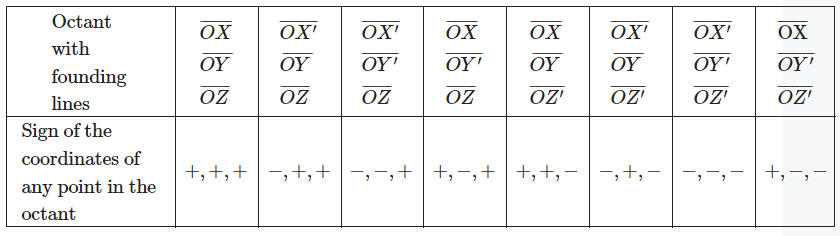
⇒ \(H_n^{\prime \prime}(x)=2 x H_n^{\prime}(x)-2 n H_n(x)\)

⇒ \(H_n^{\prime \prime}(x)=2 x\left[2 x H_n(x)-H_{n+1}(x)\right]-2 n H_n(x)\), from recurrence formula III

⇒ \(H_n^{\prime \prime}(x)=\left(4 x^2-2 n\right) H_n^{\prime}(x)-2 x H_{n+1}(x) \text {. }\)

22. Show that \(H_n(x)=2 x H_{n-1}(x)-2(n-1) H_{n-2}(x)\).

Solution:

Recurrence formula 1 is \(H_n^{\prime}(x)=2 n H_{n-1}(x) \Rightarrow H_n^{\prime \prime}(x)=2 n H_{n-1}^{\prime}(x)\)

⇒ \(H_n^{\prime \prime}(x)=2 n 2(n-1) H_{n-2}(x)=4 n(n-1) H_{n-2}(x)\)

Recurrence formula 4 is \(H_n^{\prime \prime}(x)-2 x H_n^{\prime}(x)+2 n H_n(x)=0\)
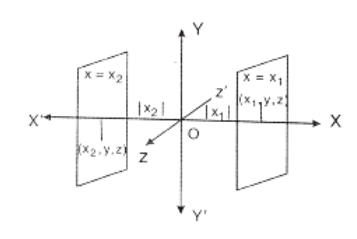
4n(n-1) \(H_{n-2}(x)-2 x 2 n H_{n-1}(x)+2 n H_n(x)=0\)
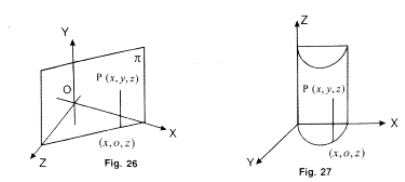
2(n-1) \(H_{n-2}(x)-2 x H_{n-1}(x)+H_n(x)=0\)
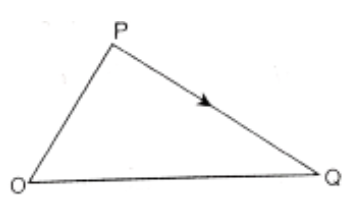
⇒ \(H_n(x)=2 x H_{n-1}(x)-2(n-1) H_{n-2}(x)\)

23. Evaluate \(\int_{-\infty}^{\infty} x e^{-x^2} H_n(x) H_m(x) d x\).

Solution:

Given

\(\int_{-\infty}^{\infty} x e^{-x^2} H_n(x) H_m(x) d x\)

From recurrence formula 2, we have \(x H_n(x)=n H_{n-\mathrm{j}}(x)+\frac{1}{2} H_{n+1}(x)\)

∴ \(\int_{-\infty}^{\infty} x e^{-x^2} H_n(x) H_m(x) d x=\int^{-e^2}\left[x H_n(x)\right] H_m(x) d x\)

= \(\int_{-\infty}^{\infty} e^{-x^2}\left\{n H_{n-1}(x)+\frac{1}{2} H_{n+1}(x)\right\} H_m(x) d x\)

= \(n \int_{-\infty}^{\infty} e^{-x^2} H_{n-1}(x) H_m(x) d x+\frac{1}{2} \int_{-\infty}^{\infty} e^{-x^2} H_{n+1}(x) H_m(x) d x\)

= \(n \sqrt{\pi} 2^{n-1}(n-1)!\delta_{n-1, m}+\frac{1}{2} \sqrt{\pi} 2^{n+1}(n+1)!\delta_{n+1, m}\)

= \(\sqrt{\pi} 2^{n-1} n!\delta_{n-1, m}+\sqrt{\pi} 2^n(n+1)!\delta_{n+1, m}\) where \(\delta\) is Kronecker delta.

24. Show that \(\int_{-\infty}^{\infty} x^2 e^{-x^2}\left\{H_n(x)\right\}^2 d x=\sqrt{\pi} 2^n n !\left(n+\frac{1}{2}\right)\).

Solution:

⇒ \(\int_{-\infty}^{\infty} x^2 e^{-x^2}\left\{H_n(x)\right\}^2 d x=\int_{-\infty}^{\infty} e^{-x^2}\left\{x H_n(x)\right\}^2 d x\)

= \(\int_{-\infty}^{\infty} e^{-x^2}\left[n H_{n-1}(x)+\frac{1}{2} H_{n+1}(x)\right]^2 d x\)

= \(\int_{-\infty}^{\infty} e^{-x^2}\left[n^2\left\{H_{n-1}(x)\right\}^2+\frac{1}{4}\left\{H_{n+1}(x)\right\}^2+n H_{n-1}(x) H_{n+1}(x)\right] d x\)

= \(n^2 \int_{-\infty}^{\infty} e^{-x^2}\left\{H_{n-1}(x)\right\}^2 d x+\frac{1}{4} \int_{-\infty}^{\infty} e^{-x^2}\left\{H_{n+1}(x)\right\}^2 d x+n \int_{-\infty}^{\infty} e^{-x^2} H_{n-1}(x) H_{n+1}(x) d x\)

= \(n^2 \sqrt{\pi} 2^{n-1}(n-1)!+\frac{1}{4} \sqrt{\pi} 2^{n+1}(n+1)!+0\)

= \(\sqrt{\pi} 2^n n!\left[\frac{n}{2}+\frac{1}{2}(n+1)\right]=\sqrt{\pi} 2^n n!\left(n+\frac{1}{2}\right)\)

25. If \(\psi_n(x)=e^{-x^2 / 2} H_n(x)\), where \(H_n(x)\) is a Hermites polynomial of degree n, then prove that \(I_{m, n}=\int_m^{\infty} \psi_m(x) \psi_n(x) d x=2^n n ! \sqrt{\pi} \delta_{m, n}\).

Solution:

Given

If \(\psi_n(x)=e^{-x^2 / 2} H_n(x)\), where \(H_n(x)\) is a Hermites polynomial of degree n

⇒ \(I_{m, n}=\int_{-\infty}^{\infty} \psi_m(x) \psi_n(x) d x=\int_{-\infty}^{\infty} e^{-x^2 / 2} H_m(x) e^{-x^2 / 2} H_n(x) d x\)

= \(\int_{-\infty}^{\infty} e^{-x^2} H_m(x) H_n(x) d x=2^n n ! \sqrt{\pi} \delta_{m, n}\)

26. Prove that 1) \(H_{2 n}(0)=(-1)^n \frac{(2 n) !}{n !}\) and 2) \(H_{2 n+1}(0)=0\).

Solution:

We have \(\sum_{n=0}^{\infty} \frac{t^n}{n!} H_n(x)=e^{-t^2+2 k x}\)

Putting x=0, we get \(\sum_{n=0}^{\infty} \frac{t^n}{n!} H_n(0)=e^{-t^2}=\left[1-t^2+\frac{\left(t^2\right)^2}{2!}+\cdots+(-1)^n \frac{\left(t^2\right)^n}{n!}+\cdots\right]\) → (1)

1) Equating the coefficients of \(2^{2 n}\), on the two sides, we have \(\frac{1}{(2 n)!} H_2,(0)=(-1)^n \frac{1}{n!}\)

∴ \(H_{2 n}(0)=(-1)^n \frac{(2 n)!}{n!}\)

2) Again equating the coefficients of \(t^{2 n+1}\), on the two sides of (1), we have \(\frac{1}{(2 n+1)!} H_{2 n+1}(0)=0\) (since R.H.S of (1) do not involve, odd powers of t.
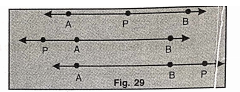
∴ \(H_{2 n+1}(0)=0\)
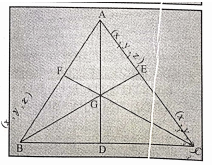
27. Prove that if m<n, then \(\frac{d^m}{d x^m}\left\{H_n(x)\right\}=\frac{2^m n !}{(n-m) !} H_{n-m}(x)\).

Solution:

We have \(\sum_{n=0}^{\infty} \frac{t^n}{n!} H_n(x)=e^{-t^2+2 t x} \rightarrow\)
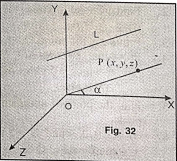
∴ \(\sum_{n=0}^{\infty} \frac{t^n}{n!} \frac{d^m}{d x^m}\left\{H_n(x)\right\}=\frac{d^m}{d x^m} e^{-t^2+2 t x}\)
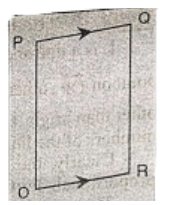
= \((2 t)^m e^{-t^2+2 t x}=(2 t)^m \sum_{n=0}^{\infty} \frac{t^n}{n!} H_n(x)\)

= \(2^m \sum_{n=0}^{\infty} \frac{1}{n!} l^{n+m} H_n(x)=2^m \sum^{\infty} x \sum_{r=m}(r-m)!H_{r-m}(x) .\)

Putting \(n+m=r, n=r-m\). For n=0 ; r

Equating the coefficient of r from the two sides, we n=0; r=m, for n = \(\infty; r=\infty\).

∴ \(\frac{1}{n!} \frac{d^m}{d x^m}\left\{H_n(x)\right\}=2^m \frac{1}{(n-m)!} H_{n-m}(x) \Rightarrow \frac{d^m}{d x^m}\left\{H_n(x)\right\}=\frac{2^m n!}{(n-m)!} H_{n-m}(x)\)

28. If \(P_n(x)=\sum_{r=0}^{(n / 2)}(-1)^r \frac{(2 n-2 r) !}{2^n(r) !(n-2 r) !(n-r) !} x^{n-2 r}\) then, prove that \(P_n(x)=\frac{2}{\sqrt{\pi} n !} \int_0^{\infty} t^n e^{-t^2} H_n(x t) d t\).

Solution:

Given

If \(P_n(x)=\sum_{r=0}^{(n / 2)}(-1)^r \frac{(2 n-2 r) !}{2^n(r) !(n-2 r) !(n-r) !} x^{n-2 r}\)

We have \(H_n(x)=\sum_{r=0}^{(n / 2)}(-1)^r \frac{n!}{r!(n-2 r)!}(2 x)^{n-2 r}\)

∴ \(H_n(x t)=\sum_{r=0}(-1)^r \frac{n!}{r!(n-2 r)!}(2 x t)^{n-2 r}\)

∴ \(\frac{2}{\sqrt{\pi} n!} \int_0^{\infty} t^n e^{-t^2} H_n(x t) d t\)

= \(\frac{2}{\sqrt{\pi n!}} \int_0^{\infty} t^n e^{-t^{2(n / 2)}} \sum_{r=0}(-1)^r \underbrace{r-2 r)!}_{r!(n!}(2 x t)^{n-2 r} d t\)

= \(\sum_{r=0}^{(n / 2)} \frac{2^{n-2 r+1}(-1)^r x^{n-2 r}}{\sqrt{\pi r!(n-2 r)!}} \int_e^{-t^2} t^{2 n-2 r}\)

= \(\sum_{r=0}^{(n / 2)} \frac{2^{n-2 r+1}(-1)^r x^{n-2 r}}{\sqrt{\pi} r!(n-2 r)!} \int_0^{\infty} e^{-t^2} t^{2(n-r+1 / 2)-1} d t\)

= \(\sum_{r=0}^{(n / 2)} \frac{2^{n-2 r+1}(-1)^r x^{n-2 r}}{\sqrt{\pi} r!(n-2 r)!} \frac{1}{2} \Gamma\left(n-r+\frac{1}{2}\right)\), since \(2 \int_0^{\infty} e^{-t^2} t^{(2 n-1)} d t=\Gamma(n)\)

= \(\sum_{r=0}^{(n / 2)} \frac{2^{n-2 r}(-1)^r x^{n-2 r}[2(n-r)]!}{\sqrt{\pi} r!(n-2 r)!2^{2(n-r)}(n-r)!} \sqrt{\pi}\), since \(\Gamma\left(x+\frac{1}{2}\right)=\frac{(2 x)!}{2^{2 x} x!} \sqrt{\pi}\)

= \(\sum_{r=0}^{(n / 2)}(-1)^r \frac{(2 n-2 r)!}{2^n(r)!(n-2 r)!(n-r)!} x^{n-2 r}=P_n(x)\)

Hence \(P_n(x)=\frac{2}{\sqrt{\pi} r!} \int_0^{\infty} t^n e^{-t^2} H_n(x t) d t\)

29. Show that \(\sum_{k=0}^n \frac{H_k(x) H_k(z)}{2^k k !}=\frac{H_{n+1}(y) H_n(x)-H_{n+1}(x) H_n(y)}{2^{n+1} n !(y-x)}\).

Solution:

From recurrence formulae II, we have \(x H_n(x)=n H_{n-1}(x)+\frac{1}{2} H_{n+1}(x) \rightarrow\) (1)

∴ \(y H_n(y)=n H_{n-1}(y)+\frac{1}{2} H_{n+1}(y) \rightarrow(2)\).

Multiplying (2) by \(H_n(x)\) and (1) by \(H_n(y)\) and than subtracting, we have

(y-x) \(H_n(x) H_n(y)=\frac{1}{2}\left[H_{n+1}(y) H_n(x)-H_{n+1}(x) H_n(y)\right]\) – \(n\left[H_{n-1}(x) H_n(y)-H_{n-1}(y) H_n(x)\right] \rightarrow(3)\)

Putting n=0,1,2,3, ….,(n-1), n in (3) respectively, we have

(y-x) \(H_0(x) H_0(y)=\frac{1}{2}\left[H_1(y) H_0(x)-H_1(x) H_0(y)\right]-0 \ldots\left(A_0\right)\)

(y-x) \(H_1(x) H_1(y)=\frac{1}{2}\left[H_2(y) H_1(x)-H_2(x) H_1(y)\right]\) – \(1\left[H_0(x) H_1(x)-H_0(y) H_1(x)\right] \ldots\left(A_1\right)\)

(y-x) \(H_2(x) H_2(y)=\frac{1}{2}\left[H_3(y) H_2(x)-H_3(x) H_2(y)\right]\)– \(2\left[H_1(x) H_2(y)-H_1(y) H_2(x)\right] \ldots\left(A_2\right)\)

(y-x) \(H_3(x) H_3(y)=\frac{1}{2}\left[H_4(y) H_3(x)-H_4(x) H_3(y)\right]\)–\(3\left[H_2(x) H_3(y)-H_2(y) H_3(x)\right] \ldots\left(A_3\right)\)

….. ….. …… …… …… …… …… …… …… …… ….. ……

…. …… …… …… …… …… …… …… …… …… ….. ……

(y-x) \(H_{n-1}(x) H_{n-1}(y)=\frac{1}{2}\left[H_n(y) H_{n-1}(x)-H_n(x) H_{n-1}(y)\right]\)–\((n-1)\left[H_{n-2}(x) H_{n-1}(y)-H_{n-2}(y) H_{n-1}(x)\right] \ldots\left(A_{n-1}\right) \)

(y-x) \(H_n(x) H_n(y)=\frac{1}{2}\left[H_{n+1}(y) H_n(x)-H_{n+1}(x) H_n(y)\right]\)–\(n\left[H_{n-1}(x) H_n(y)-H_{n-1}(y) H_n(x)\right] \ldots\left(A_n\right)\)

Multiplying \(\left(A_0\right),\left(A_1\right),\left(A_2\right),\left(A_3\right), \ldots\left(A_{n-1}\right),\left(A_n\right)\) by \(1, \frac{1}{2 \cdot 1!}, \frac{1}{2^2 \cdot 2!}, \frac{1}{2^3 \cdot 3!}, \ldots, \frac{1}{2^{n-1} \cdot(n-1)!} \frac{1}{2^n \cdot n!}\) respectively and adding, we have

(y-x) \(\sum_{k=0}^n \frac{H_k(x) H_k(y)}{2^k k!}=\frac{H_{n+1}(y) H_n(x)-H_{n+1}(x) H_n(y)}{2^{n+1} n!}\)

∴ \(\sum_{k=0}^n \frac{H_k(x) H_k(y)}{2^k k!}=\frac{H_{n+1}(y) H_n(x)-H_{n+1}(x) H_n(y)}{2^{n+1} n!(y-x)}\)