Right Line Definition Theorems Solved Exercise Problems

Right Line Representation Of Line

Definition Of A Right Line In Geometry With Examples

1. Consider XZ and XY planes. Their common line of intersection is X-axis.

p(x, y, z) ∈ X-axis <=> P ∈ XY plane and P ∈ XZ plane <=> z = 0 and y = 0

∴ Equations to the line x-axis are y = 0, z = 0 i.e., equations to the plane of the plane passing through the X-axis.

Similarly, equations to y-axis are x = 0, z = 0 i.e., equations to the planes through the y-axis, and equations to z-axis are y = 0, x = 0 i.e., equations to the planes through the z-axis.

2. Consider any line L and two planes π1, π2 whose line of intersection is L.

Let the equations to π1, π2 be respectively

a1x + b1y + c1z + d1 = 0 …..(1) a2x + b2y + c2z + d2 = 0 …..(2)

P(x, y, z) ∈ L <=> P ∈ π1 and P ∈ π2

<=> a1x + b1y + c1z + d1 = 0, a2x + b2y + c2z + d2 = 0

∴ Equations to the line L are a1x + b1y + c1z + d1 = 0, a2x + b2y + c2z + d2 = 0

Thus: A line is represented by the equations of two planes through the line. Since any pair of planes can be taken through the line, the pairs of equations of the line are infinitely many.

Right Line Parametric Form

Theorem.1. Equations to the line passing through the point (x1, y1, z1) and having d.cs. l, m, n are x = x1 + lr, y = y1 + mr, z = z1 + nr, r being any real number.

Proof.
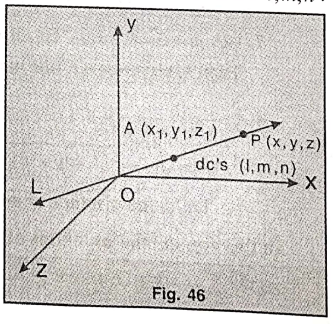
Theorem 1

Let L be the required line and A (x1, y1, z1). d.cs. of L are l,m,n.

Let P = (x,y,z) ∈ L. Let AP = |r|.

The projection of AP on the x-axis = x – x1 = lr

Similarly y – y1 = mr, z – z1 = nr

⇒ x = x1 + lr, y = y1 + mr, z = z1 + nr r being any real number.

∴ Equations to L are x = x1 + lr, y = y + mr, z = z1 + nr

i.e., \(\frac{x-x_1}{l}=\frac{y-y_1}{m}=\frac{z-z_1}{n}\)

Note: 1. \(\frac{a_1}{l_1}=\frac{a_2}{l_2}=\frac{a_3}{l_3} \Leftrightarrow a_1: l_1=a_2: l_2=a_3: l_3\) and if any of l’s is zero, the corresponding a is also zero.

2. Equations of the line in the parametric form x = x1 + lr, y = y1 + mr, z = z1 + nr can be written as

⇒ \(\frac{x-x_1}{l}=\frac{y-y_1}{m}=\frac{z-z_1}{n}(=r)\)

This form of equations of the line is called the equations of the line in the ‘Symmetric form’.

Let m = 0 = n, l ≠ 0, m ≠ 0. Equations to the line L are y – y1 = 0, z – z1 = 0. Then L represents a line parallel to the x-axis.

Theorem.2. Equations of a line through two distinct points (x1, y1, z1) and (x2, y2, z2) are \(\frac{x-x_1}{x_2-x_1}=\frac{y-y_1}{y_2-y_1}=\frac{z-z_1}{z_2-z_1} \text { or } \frac{x-x_2}{x_2-x_1}=\frac{y-y_2}{y_2-y_1}=\frac{z-z_2}{z_2-z_1}\)

Proof.

Let L be the required line. Since (x1,  y1, z1), (x2, y2, z2) ∈ L, d.rs. of L are x2 – x1, y2 – y1, z2 – z1.

∴ Equations to L are \(\frac{x-x_1}{x_2-x_1}=\frac{y-y_1}{y_2-y_1}=\frac{z-z_1}{z_2-z_1} \text { or } \frac{x-x_2}{x_2-x_1}=\frac{y-y_2}{y_2-y_1}=\frac{z-z_2}{z_2-z_1}\)

Theorems Related To Right Lines In Mathematics

Theorem.3. Transform the equations a1x + b1y + c1z + d1 = 0 a2x + b2 + cz2 + d2 = 0 of the line of symmetrical form.

Proof.

Let L be the line of intersection of the planes

a1x + b1y + c1z + d1 = 0        …(1)

a2x + b2y + c2z + d2 = 0       …(2)

Let [l,m,n] be the D.cs. of L.

L lies in both the places (1) and (2).

Since the d.rs. of the normals to the planes are (a1,b1,c1) and (a2,b2,c2) we have a1l + b1m + c1n = 0, a2l + b2m + c2n = 0

⇒ \(\frac{l}{b_1 c_2-b_2 c_1}=\frac{m}{c_1 a_2-c_2 a_1}=\frac{n}{a_1 b_2-a_2 b_1}\)

Without loss of generality, we can take a1b2 – a2b1 ≠ 0.

Now to find the equations to L, we require a point on L.

Let L intersect, say, the XY plane i.e. Z = 0 at P.

∴ From (1) and (2): a1x + b1y + d1 = 0, a2x + b2y + d2 = 0.

Solving: \(x=\frac{b_1 d_2-b_2 d_1}{a_1 b_2-a_2 b_1}, y=\frac{d_1 a_2-d_2 a_1}{a_1 b_2-a_2 b_1}\)

∴ \(\mathrm{P}=\left(\frac{b_1 d_2-b_2 d_1}{a_1 b_2-a_2 b_1}, \frac{d_1 a_2-d_2 a_1}{a_1 b_2-a_2 b_1}, 0\right)\) is a point on L.

∴ Equations to L in the symmetric form are

⇒ \(\frac{x-\frac{b_1 d_2-b_2 d_1}{a_1 b_2-a_2 b_1}}{b_1 c_2-b_2 c_1}=\frac{y-\frac{d_1 a_2-d_2 a_1}{a_1 b_2-a_2 b_1}}{c_1 a_2-c_2 a_1}=\frac{z-0}{a_1 b_2-a_2 b_1}\)

Example. Write the equations of the line x = ay + b and z = cy + d in the symmetrical form.

Solution. 

Given

x = ay + b and z = cy + d

Equations of the line L are lx + (-a)y + 0. z = b and ox + cy + (-1)z = -d.

Let d.rs. of the line L be l,m,n.

∴ 1.l + (-a)m + 0(n) = 0, 0.l + cm + (-l)n = 0 i.e., \(\frac{l}{a}=\frac{m}{l}=\frac{n}{c}\)

A point on L is (b,0,d).

∴ L is \(\frac{x-b}{a}=\frac{y-0}{1}=\frac{z-d}{c}\)

OR: Equations to the line are x = ax + b, z = cy + d.

They can be written as \(\frac{x-b}{a}=\frac{y}{1}, \frac{z-d}{c}=\frac{y}{1} \text {. i.e. } \frac{x-b}{a}=\frac{y}{1}=\frac{z-d}{c}\) which form is the symmetrical form of the equations of the line.

Note. If the equations of a line are given as a1x + b1y + c1z + d1 = 0, a2x + b2y + c2z + d2 = 0, then the equations of the line are said to be in unsymmetrical form.

Right Line Solved Problems

Example 1. Find the distance of the point (1, -2, 3) from the plane x – y + z = 5 measured parallel to the line whose d.cs. are proportional to 2, 3, -6.

Solution.

Given

The point (1, -2, 3) and the plane x – y + z = 5

Let L be the line through the point P(1, -2, 3) and parallel to the line with d.rs. 2, 3, -6.

∴ Equations to L are \(\frac{x-1}{2}=\frac{y+2}{3}=\frac{z-3}{-6}\) (= t say)

Any point on L is Q(2t + 1, 3t – 2, -6t + 3). Let π be the plane x – y + z = 5.

Q ∈ π ⇒ 2t + 1 – 3t + 2 – 6t + 3 = 5 ⇒ -7t = 1 ⇒ t = (1/7)

∴ \(\mathrm{Q}=\left(\frac{9}{7}, \frac{-11}{7}, \frac{15}{7}\right)\)  ∴\( \mathrm{PQ}^2=\left(\frac{9}{7}-1\right)^2+\left(\frac{-11}{7}+2\right)^2+\left(\frac{15}{7}-3\right)^2=\frac{4+9+36}{49}=1\)

∴ Required distance = 1

Example 2. Find the image of the point (2, -1, 3) in the plane 3x – 2y + z = 9.

Solution.

Given

The point (2, -1, 3) and the plane 3x – 2y + z = 9

Let P = (2,-1,3). Let π be the plane 3x – 2y + z = 9.

Let Q = (x1, y1, z1) be the image of P in π.

∴ \(\overleftrightarrow{\mathrm{PQ}} \perp \pi\) ∴ Drs. of \(\overleftrightarrow{\mathrm{PQ}}\) are 3, -2, 1.

∴ Equation to \(\overleftrightarrow{\mathrm{PQ}}\) are \(\frac{x-2}{3}=\frac{y+1}{-2}=\frac{z-3}{1}\) (= t say)

Let R be the midpoint of PQ.

Let R = (3t + 2, -2t -1, t + 3)

R ∈ π ⇒ 9t + 6 + 4t + 2 + t + 3 = 9 ⇒ t = -/frac{1}{7}

∴ R = \(\left(\frac{-3}{7}+2, \frac{2}{7}-1, \frac{-1}{7}+3\right)=\left(\frac{11}{7}, \frac{-5}{7}, \frac{20}{7}\right)\)

R is the midpoint of PQ

⇒ \(2+x_1=\frac{22}{7} \text { i.e., } x_1=\frac{8}{7} ; \quad-1+y_1=\frac{-10}{7}\)

⇒ \(\text { i.e., } y_1=\frac{-3}{7} ; \quad 3+z_1=\frac{40}{7} \text { i.e., } z_1=\frac{19}{7}\)

∴ Q = Image of P in π = \(\left(\frac{8}{7}, \frac{-3}{7}, \frac{19}{7}\right)\)

Solved Exercise Problems On Right Lines Step-By-Step

Example 3. Find the foot of the perpendicular from (1, 2, 3) to the plane x + 2y + 3z + 4 = 0

Solution.

Let the given plane is π = x + 2y + 3z + 4 = 0 …(1)

Given point is P = (1,2,3)

Let the foot of the perpendicular from P to the plane is \(\mathrm{Q}=\left(x_1, y_1, z_1\right)\)

Equations of \(\overline{\mathrm{PQ}}, \frac{x_1-1}{1}=\frac{y_1-2}{2}=\frac{z_1-3}{3}=t \text { (say) }\)

∴ \(x_1=t+1, y_1=2 t+2, z_1=3 t+3\)

Since Q lies on the plane, we have

(t + 1) + 2(2t + 2) + 3(3t + 3) + 4 = 0

⇒ \(14 t+18=0 \Rightarrow t=\frac{-9}{7}\)

⇒ \(x_1=\frac{-9}{7}+1=\frac{-2}{7}, y_1=2 t+2=\frac{-18}{7}+2=-\frac{4}{7}, z_1=3 t+3=\frac{-27}{7}+3=\frac{-6}{7}\)

∴ Foot of the perpendicular = P = \(\left(x_1, y_1, z_1\right)=\left(\frac{-2}{7}, \frac{-4}{7}, \frac{-6}{7}\right)\)

Example 4. Find the angles between the lines x – 2y + z = 0, x + y – z = 3;……L1 x + 2y + z = 5, 8x + 12y + 5z = 0……L2.

Solution.

Let the planes be

x – 2y + z = 0       …(1)

x + y – z = 3        …(2)

x + 2y + z = 5    …(3)

8x + 12y + 5z = 0     …(4)

(1), (2) represent the line L1 and (3), (4) represent the line L2.

The d.rs. of the normals to the planes (1), (2), (3), (4) are (1, -2, 1), (1, 1, -1) (1, 2, 1) and (8, 12, 5) respectively.

If \(\left(I_1, m_1, n_1\right) \text { and }\left(l_2, m_2, n_2\right)\) and the d.rs. of the lines L1 and L2 respectively, \(\left(l_1, m_1, n_1\right)=(2-1,1+1,1+2)=(1,2,3) \text {; }\)

⇒ \(\left(l_2, m_2, n_2\right)=(10-12,8-5,12-16)=(-2,3,-4)\)

∴ D.rs. of L1 are 1, 2, 3, and d.rs. of L2 are -2, 3, -4

If θ is one of the angles between L1, L2 then

⇒ \(\cos \theta=\frac{-2+6-12}{\sqrt{1+4+9} \cdot \sqrt{4+9+16}}=\frac{-8}{\sqrt{406}}\)

∴ \(\left(L_1, L_2\right)={Cos}^{-1}\left(\frac{-8}{\sqrt{(406)}}\right), \pi-{Cos}^{-1}\left(\frac{-8}{\sqrt{(406)}}\right)\)

Example 5. Find the equations to the line L1 passing through the origin and perpendicular to the L2 whose equations are \(\frac{x-2}{1}=\frac{y+3}{-2}=\frac{z}{1}\). Also find the foot of the perpendicular from the origin to L2.

Solution.

Equations to L2 are \(\frac{x-2}{1}=\frac{y+3}{-2}=\frac{z}{1} \quad(=t \text { say })\)

Any point L2 is (t+2, -2t-3, t).

Let P be the foot of the perpendicular from the origin to the line L2.

If P = (t+2, -2t-3,t) then d.rs. of (\(\mathrm{L}_{\mathrm{l}}=\overleftrightarrow{\mathrm{OP}}\)) are t + 2, -2t -3, t.

⇒ \(\mathrm{L}_1 \perp \mathrm{L}_2 \Rightarrow 1(t+2)-2(-2 t-3)+1 t=0 \Rightarrow 6 t=-8 \Rightarrow t=-\frac{4}{3}\)

∴ A foot of the perpendicular from the origin to L2

= \(\left(\frac{-4}{3}+2, \frac{8}{3}-3, \frac{-4}{3}\right)=\left(\frac{2}{3}, \frac{-1}{3}, \frac{-4}{3}\right)\)

∴ Equations to L1 are \(\frac{x-0}{(2 / 3)}=\frac{y-0}{(-1 / 3)}=\frac{z-0}{(-4 / 3)} \text { i.e., } \frac{x}{2}=\frac{-y}{1}=\frac{-z}{4}\)

Properties Of Right Lines With Examples And Solutions 

Example 6. A variable plane makes intercepts on the axes, the sum of whose squares is k2 (a constant). Show that the locus of the foot of the perpendicular from origin to the plane is (x-2 + y-2 + z-2)(x2 + y2 + z2)2 = k2

Solution.

Given

A variable plane makes intercepts on the axes, the sum of whose squares is k2 (a constant)

π is a variable plane \(\frac{x}{a}+\frac{y}{b}+\frac{z}{c}=1 \quad(a b c \neq 0)\)

⇒ intercepts of π on the axes are a, b, c ⇒ \(a^2+b^2+c^2=k^2 \text { (given) }\)          …(1)

D.rs. of normal to π are \(\frac{1}{a}, \frac{1}{b}, \frac{1}{c}\)

Let L be the line through O and perpendicular to π.

∴ Equations to L are \(\frac{x}{1 / a}=\frac{y}{1 / b}=\frac{z}{1 / c}(=t \text { say }) .\)

∴ Any point P on L is \(\left(\frac{t}{a}, \frac{t}{b}, \frac{t}{c}\right) .\)

P is the foot of the perpendicular from O to π

⇒ P ∈ π ⇒ \(\frac{t}{a^2}+\frac{t}{b^2}+\frac{t}{c^2}=1 \Rightarrow t=\left(a^{-2}+b^{-2}+c^{-2}\right)^{-1}\)

∴ \(\mathbf{P}=\left(a^{-1}\left(a^{-2}+b^{-2}+c^{-2}\right)^{-1}, b^{-1}\left(a^{-2}+b^{-2}+c^{-2}\right)^{-1}, c^{-1}\left(a^{-2}+b^{-2}+c^{-2}\right)^{-1}\right) \text {. }\)

P = \(\left(x_1, y_1, z_1\right) \Rightarrow x_1=a^{-1}\left(a^{-2}+b^{-2}+c^{-2}\right)^{-1} ; y_1=b^{-1}\left(a^{-2}+b^{-2}+c^{-2}\right)^{-1} \text {; }\)

⇒ \(z_1=c^{-1}\left(a^{-2}+b^{-2}+c^{-2}\right)^{-1} \text {. }\)

⇒ \(x_1^2+y_1^2+z_1^2=\left[\left(a^{-2}+b^{-2}+c^{-2}\right)^{-1}\right]^2\left(a^{-2}+b^{-2}+c^{-2}\right)=\left(a^{-2}+b^{-2}+c^{-2}\right)^{-1} \text { and }\)

⇒ \(x_1^{-2}+y_1^{-2}+z_1^{-2}=\left(a^{-2}+b^{-2}+c^{-2}\right)^2\left(a^2+b^2+c^2\right)\)

⇒ \(\left(x_1^{-2}+y_1^{-2}+z_1^{-2}\right)=\frac{1}{\left(x_1^2+y_1^2+z_1^2\right)^2} \cdot k^2\)      [using (1)]

⇒ \(\left(x_1^{-2}+y_1^{-2}+z_1^{-2}\right)\left(x_1^2+y_1^2+z_1^2\right)^2=k^2\)

∴ Locus of P is \(\left(x^{-2}+y^{-2}+z^{-2}\right)\left(x^2+y^2+z^2\right)^2=k^2\)

Example 7. The plane lx + my + nz = p, l2 + m2 + n2 = 1, p > 0 meets the axes in P, Q, R and G is the centroid of the △PQR, If the perpendicular line to the plane at G meets the coordinate planes in A, B, C then prove that \(\frac{1}{\mathrm{GA}}+\frac{1}{\mathrm{~GB}}+\frac{1}{\mathrm{GC}}=\frac{3}{p}\)

Solution.

Given

The plane lx + my + nz = p, l2 + m2 + n2 = 1, p > 0 meets the axes in P, Q, R and G is the centroid of the △PQR, If the perpendicular line to the plane at G meets the coordinate planes in A, B, C

Let π be the plane lx + my + nz = p, \(l^2+m^2+n^2=1\).

π meets the axes in P, Q, R.

∴ \(\mathrm{P}=\left(\frac{p}{l}, 0,0\right), \mathrm{Q}=\left(0, \frac{p}{m}, 0\right), \mathrm{R}=\left(0,0, \frac{p}{n}\right)\)

∴ Centroid G of △PQR = (p/3l, p/3m, p/3n)

Let L be the line perpendicular to π at G.

∴ Equations to L are \(\frac{x-(p / 3 l)}{l}=\frac{y-(p / 3 m)}{m}=\frac{z-(p / 3 n)}{n}\) (=t say)

L meets the YZ plane i.e. x = 0 in A.

∴ \(|t|=\mathrm{GA}=\left|\frac{0-(p / 3 l)}{l}\right|=\left|\frac{-p}{3 l^2}\right| \text { i.e., } \frac{1}{\mathrm{GA}}=\frac{3 l^2}{p}(p>0)\)

Similarly \(\frac{1}{\mathrm{~GB}}=\frac{3 m^2}{p} \text { and } \frac{1}{\mathrm{GC}}=\frac{3 n^2}{p}\)

∴ \(\frac{1}{\mathrm{GA}}+\frac{1}{\mathrm{~GB}}+\frac{1}{\mathrm{GC}}=\frac{3 l^2+3 m^2+3 n^2}{p}=\frac{3}{p}\)

Right Line Angle Between A Line And A Plane

Theorem.4. If θ is the acute angle between the line \(\frac{x-x_1}{l}=\frac{y-y_1}{m}=\frac{z-z_1}{n}\) and the plane ax + by + cz + d = 0, then \(\sin \theta=\pm \frac{a l+b m+c n}{\sqrt{a^2+b^2+c^2} \sqrt{l^2+m^2+n^2}}\)

Proof.

Let L be the given line and E  be the given plane.

The d.rs. of L are (l, m, n) and the d.rs. of the normal to E are (a, b, c).

Since θ is the acute angle between L and E, the angles between L and normal to E are 90° ± θ

⇒ \(\cos (90 \pm \theta)= \pm \sin \theta=\frac{a l+b m+c n}{\sqrt{a^2+b^2+c^2} \sqrt{l^2+m^2+n^2}}\)

⇒ \(\sin \theta= \pm \frac{a l+b m+c n}{\sqrt{a^2+b^2+c^2} \sqrt{l^2+m^2+n^2}}\)

Right Line Conditions For A Line To Lie In A Plane

Theorem.5. If L is the line \(\frac{x-x_1}{l}=\frac{y-y_1}{m}=\frac{z-z_1}{n}\) and π is the plane ax + by + cz + d = 0, then L ⊂ π <=> a1x + b1y + c1z + d = 0, al + bm + cn = 0.

Proof.

Any point P on L is \(\left(x_1+l r, y_1+m r, z_1+n r\right)\) where r is any real number.

L ⊂ π ⇔  P  ∈ π

⇔ \(a\left(x_1+l r\right)+b\left(y_1+m r\right)+c\left(z_1+n r\right)+d=0 \text { for any real number }\)

⇔ \(\left(a x_1+b y_1+c z_1+d\right)+r(a l+b m+c n)=0\) for any real number r

⇔ \(a x_1+b y_1+c z_1+d=0, a l+b m+c n=0\)

Note.1. A-line lies in a plane if

(1) any point on the line lies in the plane, and

(2) the normal to the plane is perpendicular to the line.

2. Equation to a plane containing the line \(\frac{x-x_1}{l}=\frac{y-y_1}{m}=\frac{z-z_1}{n}\) can be taken as a(x – x1) + b(y – y1) + c(z – z1) = 0 where a, b, c are parameters such that al + bm + cn = 0.

3. The line \(\frac{x-x_1}{l}=\frac{y-y_1}{m}=\frac{z-z_1}{n}\) is parallel to the plane ax + by + cz + d = 0 and not contained in the plane ⇒ al + bm + cn = 0 and ax1 + by1 + cz1 ≠ 0.

4. The line \(\frac{x-x_1}{l}=\frac{y-y_1}{m}=\frac{z-z_1}{n}\) is perpendicular to the plane ax + by + cz + d = 0 ⇒ \(\frac{l}{a}=\frac{m}{b}=\frac{n}{c}\)

Right Line Solved Problems

Example.1. Find the equation to a plane through the line \(\frac{x-x_1}{l}=\frac{y-y_1}{m}=\frac{z-z_1}{n}\) and parallel to another line with d.cs. l2, m2, n2.

Solution. 

Equation to the plane through the line \(\frac{x-x_1}{l_1}=\frac{y-y_1}{m_1}=\frac{z-z_1}{n_1}\) can be taken as

⇒ \(l\left(x-x_1\right)+m\left(y-y_1\right)+n\left(z-z_1\right)=0\)         …(1)

where \(l l_1+m m_1+m n_1=0\)          …(2)

If (1) is parallel to another line with d.cs. l2, m2, n2

then \(l l_2+m m_2+n n_2=0\)       …(3)

∴ From (2) and (3), \(\frac{l}{m_1 n_2-m_2 n_1}=\frac{m}{n_1 l_2-n_2 l_1}=\frac{n}{l_1 m_2-l_2 m_1} \quad \text { (= Ksay) }\)

∴ The equation to the required plane is

⇒ \(\left(m_1 n_2-m_2 n_1\right)\left(x-x_1\right)+\left(n_1 l_2-n_2 l_1\right)\left(y-y_1\right)+\left(l_1 m_2-l_2 m_1\right)\left(z-z_1\right)=0\)

i.e. \(\left|\begin{array}{ccc}
x-x_1 & y-y_1 & z-z_1 \\
l_1 & m_1 & n_1 \\
l_2 & m_2 & n_2
\end{array}\right|=0\)

(may also be obtained by eliminating l, m, n from (1), (2), (3))

Step-By-Step Guide To Solving Right Line Problems In Geometry

Example.2. Find the equation to the plane through the line \(\frac{x-x_1}{l}=\frac{y-y_1}{m}=\frac{z-z_1}{n}\) and through the point (x1, y1, z1)

Solution.

Let L be the line \(\frac{x-x_2}{l}=\frac{y-y_2}{m}=\frac{z-z_2}{n} .\)

∴ L passes through the point (x2, y2, z2).

Let π be the plane containing the line L and passing through the point (x1, y1, z1).

Let the equation to the plane π be \(a\left(x-x_2\right)+b\left(y-y_2\right)+c\left(z-z_2\right)=0\)       …(1)

where al + bm + cn = 0          …(2)

Also \(a\left(x_1-x_2\right)+b\left(y_1-y_2\right)+c\left(z_1-z_2\right)=0\)       …(3)

Eliminating a, b, c from (1), (3), and (2), the equation to the plane π is

⇒ \(\left|\begin{array}{ccc}
x-x_2 & y-y_2 & z-z_2 \\
x_1-x_2 & y_1-y_2 & z_1-z_2 \\
l & m & n
\end{array}\right|=0\)

Example.3. Find the equation of the plane through the origin and containing the line x – 3y + 2z + 3 = 0 = 3x – y + 2z – 5.

Solution.

Given line is x – 3y + 2z + 3 = 0 = 3x – y + 2z – 5.

Any plane through the given line is x – 3y + 2z + 3 + λ(3x – y + 2z – 5) = 0

If it passes through the origin, then 0 + 3 + λ(0-5) = 0 ⇒ λ = 3/5

∴ Equation to the required plane is x – 3y + 2z + 3 + (3/5)(3x – y + 2z –  5) = 0 i.e. 7x – 9y + 8z = 0.

Example.4. Find the equation of the plane that passes through the line a1x + b1y + c1z + d1 = 0 = a2x + b2y + c2z + d2 and is parallel to the line \(\frac{x}{l}=\frac{y}{m}=\frac{z}{n}\)

Solution.

Let the plane through the line \(a_1 x+b_1 y+c_1 z+d_1=0=a_2 x+b_2 y+c_2 z+d_2\) and parallel to \(\frac{x}{l}=\frac{y}{m}=\frac{z}{n} \text { be } a_1 x+b_1 y+c_1 z+d_1+\lambda\left(a_2 x+b_2 y+c_2 z+d_2\right)=0\) where

\(\left(a_1+\lambda a_2\right) l+\left(b_1+\lambda b_2\right) m+\left(c_1+\lambda c_2\right) n=0\)

i.e., \(\lambda=-\frac{l a_1+m b_1+n c_1}{l a_2+m b_2+n c_2},\left(l a_2+m b_2+n c^2 \neq 0\right)\)

∴ The equation to the required plane is

⇒ \(\left(l a_2+m b_2+n c_2\right)\left(a_1 x+b_1 y+c_1 z+d_1\right)-\left(l a_1+m b_1+n c_1\right)\left(a_2 x+b_2 y+c_2 z+d_2\right)=0\)

Examples Of Right Line Problems In 2d And 3d Geometry

Example.5. A = (a, 0, 0), B = (0, b, 0), C = (0, 0, c) and P = (a, b, c) are points distinct from O such that P2 = a2 + b2 + c2 (p > 0) and q-2 = a-2 + b-2 + c-2 (q > 0). If θ is the acute angle between \(\overleftrightarrow{\mathrm{OP}}, \overleftrightarrow{\mathrm{ABC}}\) show that \(\sin \theta=\frac{3 q}{p}\).

Solution.

Equation to the plane \(\overleftrightarrow{\mathrm{ABC}} \text { is } \frac{x}{a}+\frac{y}{b}+\frac{z}{c}=1 \text {. }\)

D.rs. of its normal are (1/a), (1/b), (1/c).

D.rs. of \(\overleftrightarrow{\mathrm{OP}}\) are a, b, c.

∴ \(\theta=(\overleftrightarrow{\mathrm{OP}}, \overleftrightarrow{\mathrm{ABC}})\)

⇒ \(\sin \theta=\frac{a \cdot \frac{1}{a}+b \cdot \frac{1}{b}+c \cdot \frac{1}{c}}{\sqrt{a^2+b^2+c^2} \cdot \sqrt{\left(1 / a^2\right)+\left(1 / b^2\right)+\left(1 / c^2\right)}} \Rightarrow \sin \theta=\frac{3}{p \cdot \frac{1}{q}}=\frac{3 q}{p}\)

Right Line Coplanarity Of Lines

Theorem.6. L1, L2 are lines whose equations are \(\frac{x-x_1}{l_1}=\frac{y-y_1}{m_1}=\frac{z-z_1}{n_1}\) …..(1)\(\frac{x-x_2}{l_2}=\frac{y-y_2}{m_2}=\frac{z-z_2}{n_2}\)….(2). L1, L2 are coplanar ⇒ \(\left|\begin{array}{ccc}
x_1-x_2 & y_1-y_2 & z_1-z_2 \\
l_1 & m_1 & n_1 \\
l_2 & m_2 & n_2
\end{array}\right|=0\)

Proof:

First Method.

An equation to the plane containing line (1) is

⇒ \(a\left(x-x_1\right)+b\left(y-y_1\right)+c\left(z-z_1\right)=0\)           …(3)

with the condition that \(a l_1+b m_1+c n_1=0\)       …(4)

where not all a, b, c are zero.

The line (2) lies on the plane (3) if (1) the point \(\left(x_2, y_2, z_2\right)\) lies on (3)

⇒ \(a\left(x_2-x_1\right)+b\left(y_2-y_1\right)+c\left(z_2-z_1\right)=0\)    …(5)

and (2) the line (2) is perpendicular to the normal to the plane (3)

⇒ a l_2+b m_2+c n_2=0         …(6)

The given lines (1) and (2) are coplanar if the three linear homogeneous equations (4), (5), (6) in a, b, c are consistent.

Eliminating a, b, c from the equations (4), (5), (6) we get

⇒ \(\left|\begin{array}{ccc}
x_2-x_1 & y_2-y_1 & z_2-z_1 \\
l_1 & m_1 & n_1 \\
l_2 & m_2 & n_2
\end{array}\right|=0\)       …(7)

This is the condition for the lines (1) and (2) be coplanar.

Theorem.7. Equation to the plane containing the line L1 with equations \(\frac{x-x_1}{l_1}=\frac{y-y_1}{m_1}=\frac{z-z_1}{n_1}\) and parallel to the line L2 with equations \(\frac{x-x_2}{l_2}=\frac{y-y_2}{m_2}=\frac{z-z_2}{n_2}\) is \(\left|\begin{array}{ccc}
x-x_1 & y-y_1 & z-z_1 \\
l_1 & m_1 & n_1 \\
l_2 & m_2 & n_2
\end{array}\right|=0\)

Proof.

The lines are \(\frac{x-x_1}{l_1}=\frac{y-y_1}{m_1}=\frac{z-z_1}{n_1}\)      …(1)

⇒ \(\frac{x-x_2}{l_2}=\frac{y-y_2}{m_2}=\frac{z-z_2}{n_2}\)       …(2)

the equation to the plane containing the line (1) is

⇒ \(a\left(x-x_1\right)+b\left(y-y_1\right)+c\left(z-z_1\right)=0\)    …(3)

with the condition \(a l_1+b m_1+c n_1=0\)      …(4) where not all a, b, c are zero.

The plane (3) will be parallel to the line (2),

if \(a l_2+b m_2+c n_2=0\)      …(5)

We obtain the equation to the required plane by eliminating a, b, c from (3), (4), (5)

⇒ \(\left|\begin{array}{ccc}
x-x_1 & y-y_1 & z-z_1 \\
l_1 & m_1 & n_1 \\
l_2 & m_2 & n_2
\end{array}\right|=0\)

Worked Examples Of Right Line Problems In Analytical Geometry

Theorem.8. L1, L2 are lines whose equations are \(\frac{x-x_1}{l_1}=\frac{y-y_1}{m_1}=\frac{z-z_1}{n_1}\)……(1) \(\frac{x-x_2}{l_2}=\frac{y-y_2}{m_2}=\frac{z-z_2}{n_2}\)…..(2) Then equation to the plane containing L1, L2 is \(\left|\begin{array}{ccc}
x-x_1 & y-y_1 & z-z_1 \\
l_1 & m_1 & n_1 \\
l_2 & m_2 & n_2
\end{array}\right|=0\)

Proof.

First Method. The equations to the lines L1, L2 are

⇒ \(\frac{x-x_1}{l_1}=\frac{y-y_1}{m_1}=\frac{z-z_1}{n_1}\)        …(1)

⇒ \(\frac{x-x_2}{l_2}=\frac{y-y_2}{m_2}=\frac{z-z_2}{n_2}\)     …(2)

the equation to the plane containing the line L1is

⇒ \(a\left(x-x_1\right)+b\left(y-y_1\right)+c\left(z-z_1\right)=0\)         …(3)

with the condition \(a l_1+b m_1+c n_1=0\)       …(4)

if L2 lies in (3) then \(a l_2+b m_2+c n_2=0\)     …(5)

Eliminating a, b, c from (3), (4), (5) we get \(\left|\begin{array}{ccc}
x-x_1 & y-y_1 & z-z_1 \\
l_1 & m_1 & n_1 \\
l_2 & m_2 & n_2
\end{array}\right|=0\)

this is the equation to the plane containing the lines L1 and L2

Theorem.9. If the lines \(\frac{x-\alpha}{l}=\frac{y-\beta}{m}=\frac{z-\gamma}{n}\).….(1) a1x + b1y + c1z + d1 = 0 = a2x + b2y + c2z + d2 = 0 ……(2) are coplanar, then \(\frac{a_1 \alpha+b_1 \beta+c_1 \gamma+d_1}{a_1 l+b_1 m+c_1 n}=\frac{a_2 \alpha+b_2 \beta+c_2 \gamma+d_2}{a_2 l+b_2 m+c_2 n}\)

Proof.

Any plane through the line (2) is

⇒ \(\lambda_1\left(a_1+b_1 y+c_1 z+d_1\right)+\lambda_2\left(a_2 y+c_2 z+d_2\right)=0 \text {, and } \lambda_1, \lambda_2\) being any scalars such that

⇒ \(\left(\lambda_1, \lambda_2\right) \neq(0,0) \text {. i.e., }\left(\lambda_1 a_1+\lambda_2 a_2\right) x+\left(\lambda_1 b_1+\lambda_2 b_2\right) y+\left(\lambda_1 c_1+\lambda_2 c_2\right) z+\left(\lambda_1 d_1+\lambda_2 d_2\right)=0\)

If the line (1) were to lie in this plane, then

⇒ \(\lambda_1\left(a_1 \alpha+b_1 \beta+c_1 \gamma+d_1\right)+\lambda_2\left(a_2 \alpha+b_2 \beta+c_2 \gamma+d_2\right)=0\)        …(3)

⇒ \(\left(\lambda_1 a_1+\lambda_2 a_2\right) l+\left(\lambda_1 b_1+\lambda_2 b_2\right) m+\left(\lambda_1 c_1+\lambda_2 c_2\right) n=0\)

i.e., \(\lambda_1\left(a_1 l+b_1 m+c_1 n\right)+\lambda_2\left(a_2 l+b_2 m+c_2 n\right)=0\)       …(4)

From (3) and (4), since \(\left(\lambda_1, \lambda_2\right) \neq(0,0),\) we have

⇒ \(\frac{a_1 \alpha+b_1 \beta+c_1 \gamma+d_1}{a_1 l+b_1 m+c_1 n}=\frac{a_2 \alpha+b_2 \beta+c_2 \gamma+d_2}{a_2 l+b_2 m+c_2 n}\)

Online Resources For Right Line Theorems And Solved Problems

Theorem.10. Condition for the lines in unsymmetrical form a1x + b1y + c1z + d1 =0, a2x + b2y + c2z + d2 = 0 ……(1) a3x + b3y + c3z + d3 = 0, a4x + b4y + c4z + d4 = 0 …..(2) to be coplanar is that \(\left|\begin{array}{llll}
a_1 & b_1 & c_1 & d_1 \\
a_2 & b_2 & c_2 & d_2 \\
a_3 & b_3 & c_3 & d_3 \\
a_4 & b_4 & c_4 & d_4
\end{array}\right|=0\)

Proof.

Equation to a plane containing the line (1) can be taken as

⇒ \(\lambda_1\left(a_1 x+b_1 y+c_1 z+d_1\right)+\lambda_2\left(a_2 x+b_2 y+c_2 z+d_2\right)=0 \text {, }\)

⇒ \(\lambda_1, \lambda_2\) being any scalars such that (\(\lambda_1, \lambda_2\)) ≠ (0,0).

i.e., \(\left(\lambda_1 a_1+\lambda_2 a_2\right) x+\left(\lambda_1 b_1+\lambda_2 b_2\right) y+\left(\lambda_1 c_1+\lambda_2 c_2\right) z+\left(\lambda_1 d_1+\lambda_2 d_2\right)=0\)

Similarly equation to a plane containing the line (2) can be taken as

⇒ \(\left(\lambda_3 a_3+\lambda_4 a_4\right) x+\left(\lambda_3 b_3+\lambda_4 b_4\right) y+\left(\lambda_3 c_3+\lambda_4 c_4\right) z+\left(\lambda_3 d_3+\lambda_4 d_4\right)=0\)

⇒ \(\lambda_3, \lambda_4\) being any scalars such that (\(\lambda_3, \lambda_4\)) ≠ (0,0).

If (1) and (2) are coplanar, then \(\lambda_1, \lambda_2, \lambda_3, \lambda_4\) can be so chosen to make the equations (3), (4) represent the same plane.

For λ ≠ 0,

⇒ \(\lambda_1 a_1+\lambda_2 a_2=\lambda\left(\lambda_3 a_3+\lambda_4 a_4\right) \Rightarrow \lambda_1 a_1+\lambda_2 a_2+\left(-\lambda \lambda_3\right) a_3+\left(-\lambda \lambda_4\right) a_4=0,\)

⇒ \(\lambda_1 b_1+\lambda_2 b_2=\lambda\left(\lambda_3 b_3+\lambda_4 b_4\right) \Rightarrow \lambda_1 b_1+\lambda_2 b_2+\left(-\lambda \lambda_3\right) b_3+\left(-\lambda \lambda_4\right) b_4=0 \text {, }\)

⇒ \(\lambda_1 c_1+\lambda_2 c_2=\lambda\left(\lambda_3 c_3+\lambda_4 c_4\right) \Rightarrow \lambda_1 c_1+\lambda_2 c_2+\left(-\lambda \lambda_3\right) c_3+\left(-\lambda \lambda_4\right) c_4=0\)

⇒ \(\lambda_1 d_1+\lambda_2 d_2=\lambda\left(\lambda_3 d_3+\lambda_4 d_4\right) \Rightarrow \lambda_1 d_1+\lambda_2 d_2+\left(-\lambda \lambda_3\right) d_3+\left(-\lambda \lambda_4\right) d_4=0\)

If these equations are to have a non-zero solution

i.e. \(\left(\lambda_1, \lambda_2, \lambda_3, \lambda_4\right) \neq(0,0,0,0)\), then

⇒ \(\left|\begin{array}{llll}
a_1 & a_2 & a_3 & a_4 \\
b_1 & b_2 & b_3 & b_4 \\
c_1 & c_2 & c_3 & c_4 \\
d_1 & d_2 & d_3 & d_4
\end{array}\right|=0 \text { i.e., }\left|\begin{array}{llll}
a_1 & b_1 & c_1 & d_1 \\
a_2 & b_2 & c_2 & d_2 \\
a_3 & b_3 & c_3 & d_3 \\
a_4 & b_4 & c_4 & d_4
\end{array}\right|=0\)

Right Line Number Of Arbitrary Constants Or Parameters In The Equation Of A Line

Consider the following equations of a line L in the symmetrical form \(\frac{x-x_1}{l}=\frac{y-y_1}{m}=\frac{z-z_1}{n}\). Let m ≠ 0, n ≠ 0.

The equations to L can be expressed as

⇒ \(x=\left(\frac{l}{m}\right) y+\left(\frac{m x_1-l y_1}{m}\right), x=\left(\frac{1}{n}\right) z+\left(\frac{n x_1-l z_1}{n}\right)\)

i.e., x = ay + b, x = cz + d where a, b, c, d are arbitrary constants.

Here the plane x = ay + b is parallel to the z-axis and the plane x = cz + d is parallel to the y-axis. Thus the equations to the line L always be expressed in terms of two first-degree equations with not more than four arbitrary constants.

Now to determine a line we consider various sets of given conditions by which we can evaluate the arbitrary constants in the equations to the line. For instance, when the line

(1) Passes through a given point and has a given direction (d.rs.)

(2) Passes through two given points.

(3) Passes through a given point and is parallel to two given planes.

(4) Passes through two given points and perpendicular to two given planes.

(5) Passes through a given point and intersects two given lines.

(6) Intersects two given lines and has a given direction.

(7) Passes through a given point and is intersecting a given line at right angles.

(8) Is intersecting two given lines at right angles.

Right Line Line Coplanar With Two Lines

Consider two non-coplanar lines u1 = 0 = v1 and u2 = 0 = v2.

For (λ11) ≠ (0,0) and (λ22) ≠ (0,0), the line λ1u1 + µ1v1 = 0 = λ2u2 + µ2v2 lies in the plane λ1u1 + µ1v1 = 0 which again contains the line u1 = 0 = v1.

The two lines λ1u1 + µ1v1 = 0 = λ2u2 + µ2v2; u1 = 0 = v1 are therefore, coplanar.

Similarly the two lines λ1u1 + µ1v1 = 0 = λ2u2 + µ2v2; u2 = 0 = v2 are coplanar.

Thus, λ1u1 + µ1v1 = 0 = λ2u2 + µ2v2 is the line coplanar with both the lines u1 = 0 = v1 ; u2 = 0 = v2

Right Line Solved Problems

Example.1. Show that the lines \(\frac{x}{l}=\frac{y}{m}=\frac{z}{n}, \frac{x}{a \alpha}=\frac{y}{b \beta}=\frac{z}{c \gamma}, \frac{x}{\alpha}=\frac{y}{\beta}=\frac{z}{\gamma}\) are coplanar if \(\frac{l}{\alpha}(b-c)+\frac{m}{\beta}(c-a)+\frac{n}{\gamma}(a-b)=0\)

Solution.

D.rs. of the line \(\frac{x}{l}=\frac{y}{m}=\frac{z}{n}\) are l, m, n.

∴ A vector along the line is (l, m, n).

Similarly vectors along the lines \(\frac{x}{a \alpha}=\frac{y}{b \beta}=\frac{z}{c \gamma}, \frac{x}{\alpha}=\frac{y}{\beta}=\frac{z}{\gamma}\) are respectively (aα, bβ, cγ), (α, β, γ).

The three given lines are coplanar

⇒ the vectors (l, m, n), (aα, bβ, cγ), (α, β, γ) are coplanar

⇒ [(l, m, n), (aα, bβ, cγ), (α, β, γ)]

⇒ \(\left|\begin{array}{ccc}
l & m & n \\
a \alpha & b \beta & c \gamma \\
\alpha & \beta & \gamma
\end{array}\right|=0 \Rightarrow \operatorname{l\beta \gamma }(b-c)+m \gamma \alpha(c-a)+n \alpha \beta(a-b)=0\)

⇒ \(\frac{l}{\alpha}(b-c)+\frac{m}{\beta}(c-a)+\frac{n}{\gamma}(a-b)=0\)

Right Line Equations And Their Geometric Interpretations

Example.2. Prove that the lines \(\frac{x+1}{1}=\frac{y+1}{2}=\frac{z+1}{3}\) and x + 2y + 3z – 8 = 0 = 2x + 3y + 4z – 11 are intersecting and find the point of their intersection. Find also the equation to the plane containing them.

Solution.

Given lines are \(\frac{x+1}{1}=\frac{y+1}{2}=\frac{z+1}{3}\)        …(1)

x + 2y + 3z – 8 = 0 = 2x + 3y + 4z – 11           …(2)

Any point P on (1) is (r-1, 2r-1, 3r-1)

If P lies on the first plane containing the line (2), r – 1 + 4r – 2 + 9r – 3 – 8 = 0 i.e., 14r = 14 i.e., r = 1.

∴ P = (0,1,2). Clearly P also lies on the plane 2x + 3y + 4z – 11 = 0

∴ (1) and (2) intersect at the point P (0,1,2)

A plane through the line (2) is x + 2y + 3z – 8 + k (2x + 3y + 4z – 11) = 0

i.e., (1 + 2k)x + (2+3k)y + (3+4k)z – (8+11k) = 0.

If this plane is parallel to (1), 1(1+2k) + 2(2+3k) + 3(3+4k) = 0

i.e., 20k = -14    i.e., k = -(7/10).

∴ The equation to the plane containing line (2) and parallel to (1) is \(x+2 y+3 z-8-\frac{7}{10}(2 x+3 y+4 z-11)=0\)

i.e. -4x – y + 2z – 3 = 0 i.e. 4x + y – 2z + 3 = 0.

This plane clearly contains the point (-1, -1, -1)

∴ 4x + y – 2z + 3 = 0 is the plane containing the lines (1) and (2).

Note.1. If the point (-1, -1, -1) on the base (1) does not lie on the plane 4x + y – 2z + 3 = 0 then 4x + y – 2z + 3 = 0 is the plane containing the line (2) and parallel to line(1).

2. To show that the lines (1) and (2) are coplanar, find the point of intersection of (1) and (2) or find the plan containing the line (2) and the line (1).

Example.3. Prove that \(\frac{x+4}{3}=\frac{y+6}{5}=\frac{z-1}{-2}\) and 3x – 2y + z + 5 = 0 = 2x + 3y + 4z -4 are coplanar. Find the point of intersection

Solution.

Given lines are \frac{x+4}{3}=\frac{y+6}{5}=\frac{z-1}{-2}=t \text { (say) }     …(1)

and 2x + 3y + 4z – 4 = 0 = 3x – 2y + z + 5     …(2)

Any point P on (1) is P = (3t – 4, 5t – 6, -2t + 1)

If P lies on the 1st plane of (2), we get

3(3t – 4) – 2(5t – 6) + (-2t + 1) + 5 = 0

⇒ 9t – 12 – 10t + 12 – 2t + 1 + 5 = 0 ⇒ -3t + 6 = 0 ⇒ t = 2.

∴ p = (2, 4, -3)

Clearly, P lies in the second plane of line (2)

∴ The lines (1) & (2) intersect the point (2, 4, -3).

Hence the two lines are coplanar.

Example.4. Find the equations of the line through the origin and intersect each of the lines \(\frac{x-x_1}{l_1}=\frac{y-y_1}{m_1}=\frac{z-z_1}{n_1} \text { and } \frac{x-x_2}{l_2}=\frac{y-y_2}{m_2}=\frac{z-z_2}{n_2}\)

Solution.

Given lines are \(\frac{x-x_1}{l_1}=\frac{y-y_1}{m_1}=\frac{z-z_1}{n_1}\)        …(1)

⇒ \(\frac{x-x_1}{l_1}=\frac{y-y_1}{m_1}=\frac{z-z_1}{n_1}\)     …(2)

Let the equation to the plane containing (1) be

⇒ \(a\left(x-x_1\right)+b\left(y-y_1\right)+c\left(z-z_1\right)=0\)        …(3)

∴ \(a l_1+b m_1+c n_1=0\)           …(4)

If the plane (3) passes through the origin, then

⇒ \(-a x_1-b y_1-c z_1=0 \text { i.e. } a x_1+b y_1+c z_1=0\)         …(5)

Solving (4) and (5), \(\frac{a}{m_1 z_1-n_1 y_1}=\frac{b}{n_1 x_1-l_1 z_1}=\frac{c}{l_1 y_1-m_1 x_1}\) .

∴ Equation to the plane containing the line (1) and passing through the origin is \(a x+b y+c z=a x_1+b y_1+c z_1\)

i.e. \(\left(m_1 z_1-n_1 y_1\right) x+\left(n_1 x_1-l_1 z_1\right) y+\left(l_1 y_1-m_1 x_1\right) z=0\)         …(6) [using (5)].

Similarly, the equation to the plane containing the line (2) passing through the origin is \(\left(m_2 z_2-n_2 y_2\right) x+\left(n_2 x_2-l_2 z_2\right) y+\left(l_2 y_2-m_2 x_2\right) z=0\) …(7)

∴ (6) and (7) represent the required line.

Example.5. Find the equations of the line through the point (1, 1, 1) and intersect the lines 2x – y – z – 2 = 0 = x + y + z – 1; x – y – z = 0 = 2x + 4y – z – 4.

Solution.

Given lines are 2x – y – z – 2 = 0, x + y + z – 1 = 0       …(1)

x – y – z – 3 = 0, 2x + 4y – z – 4 = 0          …(2)

Let the equation to the plane containing (1) and passing through (1,1,1) be (2x – y – z – 2)+λ(x + y + z – 1) = 0.

∴ (2 – 1 – 1 – 2) + λ(1 + 1 + 1 -1) = 0 i.e. λ = 1.

∴ required plane is x – 1 = 0.

Let the equation to the plane containing (2) and passing through (1,1,1) be (x – y – z – 3) + μ(2x + 4y – z – 4) = 0.

∴ (1 – 1 – 1 -3) + μ(2 + 4 – 1 – 4) = 0 i.e. μ = 4

∴ Required plane is 9x + 15y – 5z – 19 – 0.

∴ Equations of the required line are x – 1 = 0, x + 15y – 5z – 19 = 0

i.e. x – 1 = 0, 15(y – 1) = 5(z – 1) i.e. \(x-1=0, \frac{y-1}{1}=\frac{z+1}{3}\)

Example.6. Find the equations of the straight line passing through the point (1, 0, -1) and intersecting the lines 4x – y – 13 = 0 = 3y – 4z – 1; y – 2z + 2 = 0 = x -5.

Solution.

Equations of given lines are

4x – y – 13 = 0, 3y – 4z – 1 = 0        …(1) and

y – 2z + 2 = 0, x – 5 = 0               …(2)

equations of planes passing through (1), (2) are

⇒ \((4 x-y-13)+\lambda_1(3 y-4 z-1)=0\)            …(3)

⇒ \((y-2 z+2)+\lambda_2(x-5)=0\)                 …(4)

If the planes (3), (4) pass through (1,0,-1) substitute the points in (3), (4) we have \(\lambda_1=3, \lambda_2=1\), then equations of the planes passing through (1, 0, -1) and containing (1), (2) are given by x + 2y – 3z – 4 = 0 and x + y – 2z – 3 = 0    …(5)

converting these equations into symmetric form we get

⇒ \(\frac{x-0}{1}=\frac{y+1}{1}=\frac{z+2}{1} \text { (or) } x=y+1=z+2\)

Example.7. Find the equations of the line with d.cs. proportional to 7, 4, -1 which intersects the lines x-1= -9 + 3y = 3z + 6, \(\frac{x+3}{-3}=\frac{y-3}{2}=\frac{z-5}{4}\)

Solution.

Given lines are \(\frac{x-1}{3}=\frac{y-3}{1}=\frac{z+2}{1}=p\)   …(1)

⇒ \(\frac{x+3}{-3}=\frac{y-3}{2}=\frac{z-5}{4}=q\)        …(2)

A point P on (1) is (3p + 1, p + 3, p – 2) and a point Q on (2) is (-3q -3, 2q + 3, 41 + 5)

D.rs. of \(\overleftrightarrow{\mathrm{PQ}}\), are (3p + 3q + 4, p – 2q, p – 4q – 7)

If \(\overleftrightarrow{\mathrm{PQ}}\) is the required line, then

⇒ \(\left.\begin{array}{r}
3 p+3 q+4=7 \text { i.e. } \quad p+q=1 \\
+p-2 q=4 \text { i.e. }+p-2 q=4
\end{array}\right\}\)

∴ p = 2, q = -1 and these values satisfy p – 4q = 6

p – 4q – 7 = -1 i.e. p – 4q = 6.

∴ p = (7,5,0) and Q = (0,1,1)

∴ Equations to the required line are \(\frac{x-7}{7}=\frac{y-5}{4}=\frac{z}{-1} \text { or } \frac{x}{7}=\frac{y-1}{4}=\frac{z-1}{-1}\)

Example.8. Find the equations of the line intersecting the line 2x + y – 1 = 0 = x – 2y + 2z; 3x – y + z + 2 = 0 = 4x + 5y – 2z -3 and is parallel to the line \(\frac{x-1}{1}=\frac{y-2}{2}=\frac{z-3}{3}\).

Solution.

Let the equations to the required line be

2x + y – 1 + λ(x – 2y + 3z) = 0, (3x – y + z + 2) + μ(4x + 5y – 2z – 3) = 0

i.e. (2 +λ )x + (1-2λ)y + 3λz – 1 = 0, (3+4μ)x + (-1+5μ) + (1-2μ)z + 2 – 3μ = 0

since the required line is parallel to \(\frac{x-1}{1}=\frac{y-2}{2}=\frac{z-3}{3}\), we have

⇒ \(1(2+\lambda)+2(1-2 \lambda)+3(3 \lambda)=0,1(3+4 \mu)+2(-1+5 \mu)+3(1-2 \mu)=0\)

i.e. λ = -2/3, μ = -1/2

∴ Equations of the required line are 4x + 7y – 6z = 3, 2x – 7y + 4z = -7

Right Line Shortest Distance Between Two Skew Lines

Skew Lines. Any two non-parallel and non-intersecting lines are called skew lines. Skew lines are non-coplanar.

Let L1, L2 be two skew lines. We know that there exists one and only one line L intersecting L1, L2 such that L1 ⊥ L2 and L1 ⊥ L2. Let L intersect L1 at M and L2 at N so that MN is the line segment on L and in between L1, L2. Also MN is the shortest distance (S.D) between L1, L2 and \(\overleftrightarrow{\mathrm{MN}}(=\mathrm{L})\) is the line of S.D. Let A, B are any two points on L1, L2.
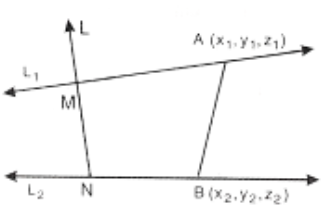
Answer Key For Maths For BSC 2 Semester Chapter 4 Right Lines Shortest Distance Between Two Skew Lines

⇒ \(\overline{\mathrm{MN}}=|| \overline{\mathrm{AB}}|\cos (\overline{\mathrm{MN}}, \overline{\mathrm{AB}})|=\overline{\mathrm{AB}}|\cos (\overline{\mathrm{MN}}, \overline{\mathrm{AB}})| \leq \overline{\mathrm{AB}}\)

Right Line Equations Of Two Skew Lines In A Simplified Form

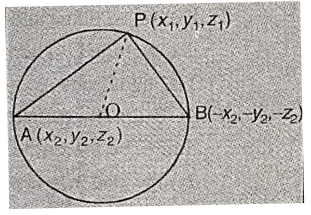
L1, L2 are two skew lines and MN be the line of S.D. between them. Let O be the mid point of MN.
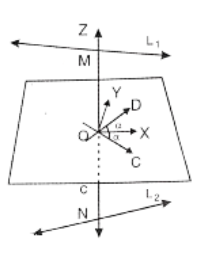
Answer Key For Maths For BSC 2 Semester Chapter 4 Right Lines Equations Of Two Skew Lines In A Simplified Form
Let \(\overrightarrow{\mathrm{OC}} \| \mathrm{L}_1 \text { and } \overleftrightarrow{\mathrm{OD}} \| \mathrm{L}_2\). In the plane \(\overleftrightarrow{\mathrm{COD}}\), let \(\overleftrightarrow{\mathrm{OX}}, \overleftrightarrow{\mathrm{OY}}\) be the bisectors of angles between \(\overleftrightarrow{\mathrm{OC}}, \overleftrightarrow{\mathrm{OD}}\) so that \(\overline{\mathrm{OX}}\) is the bisector of \((\overrightarrow{\mathrm{OC}}, \overrightarrow{\mathrm{OD}})\)

Right Line Length Of The Perpendicular From To A Line

Theorem.11. If L is the line \(\frac{x-\alpha}{l}=\frac{y-\beta}{m}=\frac{z-\gamma}{n}\) and P=(x1, y1, z1), then length of the perpendicular from P to \(L=\frac{1}{\sqrt{l^2+m^2+n^2}}\left[\sum\left\{m\left(z_l-\gamma\right)-n\left(y_1-\beta\right)\right\}^2\right]^{1 / 2}\)

Right Line Solved Problems

First Method.

Proof.
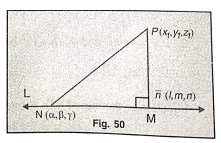
Theroem 12

Let M be the projection of P in L.

Let N be the point (α, β, γ) on L.

P = [atex]\left(x_1, y_1, z_1\right), \mathrm{NP}=\sqrt{\sum\left(x_1-\alpha\right)^2}[/latex]

△PMN is a right-angled triangle.

D.cs. of NM are \(\left(\frac{l}{\sqrt{\sum l^2}}, \frac{m}{\sqrt{\sum l^2}}, \frac{n}{\sqrt{\sum l^2}}\right)\)

NM = Projection of PN on the given line

= \(\frac{l\left(x_1-\alpha\right)+m\left(y_1-\beta\right)+n\left(z_1-\gamma\right)}{\sqrt{\sum l^2}}\)

= \(\mathrm{PM}^2=\mathrm{PN}^2-\mathrm{NM}^2=\Sigma\left(x_1-\alpha\right)^2-\left[\frac{\sum l\left(x_1-\alpha\right)}{\sqrt{\Sigma l^2}}\right]^2\)

= \(\frac{\left(\sum l^2\right)\left(\sum{\overline{x_1-\alpha}}^2\right)-\sum l\left(x_1-\alpha\right)^2}{\sqrt{\Sigma l^2}}=\frac{\left[\Sigma\left(m\left(z_1-\alpha\right)-n\left(y_1-\beta\right)^2\right]^{1 / 2}\right.}{\sqrt{\Sigma l^2}}\)

Second Method.

Proof.

Let M be the projection of P in L. Let N be the point (α, β, γ) on L. Since \(\mathrm{P}=\left(x_1, y_1, z_1\right), \overline{\mathrm{NP}}=\left(x_1-\alpha, y_1-\beta, z_1-\gamma\right)\). △PMN is a right-angled triangle.

Let \(\bar{n}\) be a unit vector along \(\overrightarrow{\mathrm{NM}}\) so that \(\bar{n}=\frac{1}{\sqrt{l^2+m^2+n^2}}(l, m, n) .\)

PM = \(\mathrm{NP} . \sin \angle \mathrm{PNM}=|\bar{n}||\overline{\mathrm{NP}}| \sin (\overline{\mathrm{NP}}, \bar{n})=\left|\bar{n} \times \frac{\sqrt{1}+m}{\mathrm{NP}}\right|\)

= \(\left|\frac{1}{\sqrt{l^2+m^2+n^2}}(l, m, n) \times\left(x_1-\alpha, y_1-\beta, z_1-\gamma\right)\right|\)

= \(\frac{1}{\sqrt{l^2+m^2+n^2}}\left|\left(m \overline{z_1-\gamma}-n \overline{y_1-\beta}, n \overline{x_1-\alpha}-l \overline{z_1-\gamma}, m \overline{x_1-\alpha}-l \overline{y_1-\beta}\right)\right|\)

= \(\frac{1}{\sqrt{I^2+m^2+n^2}}\left|\left(m \overline{z_1-\gamma}-n \overline{y_1-\beta}, n \overline{x_1-\alpha}-\mid \overline{z_1-\gamma}, m \overline{x_1-\alpha}-l \overline{y_1-\beta}\right)\right|\)

= \(\frac{1}{\sqrt{l^2+m^2+n^2}}\left[\sum\left\{m\left(z_1-\gamma\right)-n\left(y_1-\beta\right)\right\}^2\right]^{1 / 2}\)

∴ Length of the perpendicular from P to L

= \(\frac{1}{\sqrt{l^2+m^2+n^2}}\left[\sum\left\{m\left(z_1-\gamma\right)-n\left(y_1-\beta\right)\right\}^2\right]^{1 / 2}\)

Note. Length of the perpendicular from P to L is \(|\bar{n} \times \overline{\mathrm{NP}}|=\frac{|\overline{\mathrm{NM}} \times \overline{\mathrm{NP}}|}{|\overline{\mathrm{NM}}|}\)

Example.1. Find the distance between the straight lines \(\frac{x-3}{1}=\frac{y-5}{-2}=\frac{z-7}{1} ; \frac{x+1}{7}=\frac{y+1}{-6}=\frac{z+1}{1}\)

Solution.

Equations of given straight lines are \(\frac{x-3}{1}=\frac{y-5}{-2}=\frac{z-7}{1} ; \frac{x+1}{7}=\frac{y+1}{-6}=\frac{z+1}{1}\)

Let \(\frac{x-3}{1}=\frac{y-5}{-2}=\frac{z-7}{1}=r_1 \text { and } \frac{x+1}{7}=\frac{y+1}{-6}=\frac{z+1}{1}=r_2\)

Any point on (1) is \(P\left(r_1+3,-2 r_1+5, r_1+7\right)\)

Any point on (2) is \(Q\left(7 r_2-1,-6 r_2-1, r_2-1\right)\)

Dr’s of PQ are \(\left(r_1+3\right)-\left(7 r_2-1\right),\left(-2 r_1+5\right)-\left(-6 r_2-1\right),\left(r_1+7\right)-\left(r_2-1\right)\)

i.e., \(\left(n_1-7 r_2+4,-2 n+6 r_2+6, n-r_2+8\right)\)

Let PQ be the shortest distance between (1), (2) then PQ is perpendicular to (1), (2)

⇒ \(\left(r_1-7 r_2+4\right) \cdot 1+\left(-2 r_1+6 r_2+6\right)(-2)+\left(r_1-r_2+8\right) \cdot 1=0\)

⇒ \(\eta_1+4 \eta_1+\eta_1-7 r_2-12 r_2-r_2+4-12+8=0\)

⇒ \(6 r_1-20 r_2=0 \Rightarrow 3 r_1-10 r_2=0\)           …(3)

and \(\left(r_1-7 r_2+4\right)(7)+\left(-2 r_1+6 r_2+6\right)(-6)+\left(r_1-r_2+8\right) \cdot 1=0\)

⇒ \(7 r_1+12 n_1+r_1-49 r_2-36 r_2-r_2+28-36+8=0 \Rightarrow 20 r_1-86 r_2=0\)

⇒ \(10 n_1-43 m_2=0\)         …(4)

on solving (3), (4) r1 = r2 = 0

Co-ordinates of D: (3,5,7) and Co-ordinates of Q :(-1, 1, -1)

The shortest distance between (1), (2) is

⇒ \(P Q=\sqrt{(3+1)^2+(5+1)^2+(7+1)^2}=\sqrt{16+36+64}=\sqrt{116}=2 \sqrt{29} \text { units. }\)

Example.2. Find the length and equations of the line of S.D. between the lines \(\frac{x}{1}=\frac{y}{2}=\frac{z}{1}\) and x + y + 2z -3 = 0 = 2x + 3y + 3z – 4.

Solution.

Given lines are \(\frac{x}{1}=\frac{y}{2}=\frac{z}{1}\)         …(1)

and x + y + 2z – 3 = 0      …(2)

2x + 3y + 3z – 4 = 0    …(3)

A plane through the second line and parallel to (1) is x + y + 2z – 3 + λ(2x + 3y + 3z – 4) = 0        …(4)

i.e., (1 + 2λ)x + (1 + 3λ)y + (2 + 3λ)x – 3 – 4λ = 0.

∴ \(1(1+2 \lambda)+2(1+3 \lambda)+1(2+3 \lambda)=0 \Rightarrow 11 \lambda=-5 \Rightarrow \lambda=-\frac{5}{11}\)

∴ From (4), the equation to the plane through the second line and parallel to (1) is x – 4y + 7z – 13 = 0

A point on (1) is (0,0,0)         …(5)

∴ S.D. between the lines = Distance of (0,0,0) from (5) = \(\left|\frac{-13}{\sqrt{1+16+49}}\right|=\frac{13}{\sqrt{(66)}}\)

The equation to the plane through the first line and perpendicular to (5) is

⇒ \(\left|\begin{array}{ccc}
x & y & z \\
1 & 2 & 1 \\
1 & -4 & 7
\end{array}\right|=0 \quad \text { i.e., } 3 x-y-z=0\)            …(6)

Let a plane through the second line be x+y+2 z-3+\lambda_1(2 x+3 y+3 z-4)=0

i.e., \(\left(1+2 \lambda_1\right) x+\left(1+3 \lambda_1\right) y+\left(2+3 \lambda_1\right) z-3-4 \lambda_1=0\)

If this plane is perpendicular to (5),

⇒ \(\left(1+2 \lambda_1\right) x+\left(1+3 \lambda_1\right) y+\left(2+3 \lambda_1\right) z-3-4 \lambda_1=0\)

∴ From (4), the equation to the plane through the second line and perpendicular to (5) is x + 2y + z – 1 = 0

Example.3. Show that the equation to the plane containing the line \(\frac{y}{b}+\frac{z}{c}=1, x=0\) and parallel to the line \(\frac{x}{a_1}-\frac{z}{c}=1, y=0 \text { is } \frac{x}{a}-\frac{y}{b}-\frac{z}{c}+1=0\) and if 2d is S.D., prove that \(\frac{1}{d^2}=\frac{1}{a^2}+\frac{1}{b^2}+\frac{1}{c^2}\)

Solution.

Given lines are \(\frac{y}{b}+\frac{z}{c}-1=0, x=0\)   …(1)

and \(\frac{x}{a}-\frac{z}{c}=1, y=0\)      …(2)

The line (2) can be written as \(\frac{x-a}{a}=\frac{z}{c}, y=0\)

A plane through the line (1) is \(\frac{y}{b}+\frac{z}{c}-1+\lambda x=0.\)

If this is parallel to (2), then \(\lambda \cdot a+\frac{1}{b} \cdot 0+\frac{1}{c}, c=0 \Rightarrow \lambda=-\frac{1}{a}\)

∴ The equation to the plane containing the line (1) and parallel to (2) is

⇒ \(\frac{y}{b}+\frac{z}{c}-1-\frac{1}{a} x=0 \text { i.e., } \frac{x}{a}-\frac{y}{b}-\frac{z}{c}+1=0 \text {. }\)

A point on the line (2) is (a,0,0).

Since 2d is the S.D. between (1) and (2), therefore

2d = distance of (a,0,0) from the \(\frac{x}{a}-\frac{y}{b}-\frac{z}{c}+1=0\)

⇒ \(2 d=\left|\frac{\frac{a}{a}-\frac{0}{b}-\frac{0}{c}+1}{\sqrt{\frac{1}{a^2}+\frac{1}{b^2}+\frac{1}{c^2}}}\right| \Rightarrow \frac{1}{d^2}=\frac{1}{a^2}+\frac{1}{b^2}+\frac{1}{c^2}\)

Example.4. a, b, c are the lengths of the edges of a rectangular parallelopiped. Prove that the S.D. between the diagonals and the edges not n=meeting them are \(\frac{b c}{\sqrt{b^2+c^2}}, \frac{c a}{\sqrt{c^2+a^2}}, \frac{a b}{\sqrt{a^2+b^2}}\)

Solution.

Let (OBGA; CFDE) be the rectangular parallelopiped with edges a, b, c

Let \(\overrightarrow{\mathrm{OA}}, \overrightarrow{\mathrm{OB}}, \overrightarrow{\mathrm{OC}}\) be the axes.

∴ A = (a,0,0), B = (0,b,0), C = (0,0,c)

Equation to \(\overleftrightarrow{\mathrm{GC}} is \frac{x-0}{a}=\frac{y-0}{b}=\frac{z-c}{-c}\)
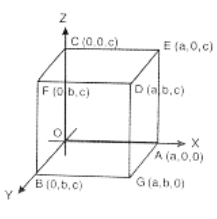

Answer Key For Maths For BSC 2 Semester Chapter 4 Right Line Example 6

A point on this line L2 is (3r+1, -3r+2, 10r-3). If this point lies on π, then 3(3r+1)-3(-3r+2)+10(10r-3)-26 = 0 ⇒ r = (1/2)

∴ The foot of (1,2,-3) in π is \(\left(\frac{3}{2}+1, \frac{-3}{2}+2,10 \times \frac{1}{2}-3\right) \text { i.e. }\left(\frac{5}{2}, \frac{1}{2}, 2\right)\)

If (x1, y1, z1) is the image of (1,2,-3) in π, then

⇒ \(\frac{1+x_1}{2}=\frac{5}{2}, \frac{2+y_1}{2}=\frac{1}{2}, \frac{-3+z_1}{2}=2 \Rightarrow x_1=4, y_1=-1, z_1=7\)

∴ The image of (1,2,-3) in π is (4, -1, 7).

∴ The line through the points \(\left(-\frac{525}{6},-\frac{47}{6}, \frac{159}{6}\right)\), (4,-1,7) is the image of the line L1 and its equation is i.e. \(\frac{x-4}{549}=\frac{y+1}{41}=\frac{z-7}{-117}\)

Example.5. Find the length of the perpendicular from the point (1, 2, 3) to the line through the point (6, 7, 7) whose d.rs. are 3, 2, -2. (or) Find the perpendicular distance of the point (1, 2, 3) from the line \(\frac{x-6}{3}=\frac{y-7}{2}=\frac{z-7}{-2}\)

Solution.

Let L be the line through (6, 7, 7) with d.rs. 3, 2, -2.

∴ Equation to L is \(\frac{x-6}{3}=\frac{y-7}{2}=\frac{z-7}{-2}\) (=r, say)

Let P = (1,2,3) and N = (6,7,7).

∴ \(\overline{\mathrm{NP}}=(5,5,4)\)

Let \(\bar{n}\) be a unit vector along L.

Since d.rs. of L are 3, 2, -2, we have \(\bar{n}=\left(\frac{3}{\sqrt{(17)}}, \frac{2}{\sqrt{(17)}}, \frac{-2}{\sqrt{(17)}}\right)\)

∴ Length of the perpendicular from P to L.

= \(|\overline{\mathrm{NP}} \times \bar{n}|=\left|(5,5,4) \times \frac{3,2,-2}{\sqrt{(17)}}\right|\)

= \(\frac{1}{\sqrt{(17)}}|-18,22,-5|=\frac{\sqrt{324+484+25}}{\sqrt{(17)}}=\sqrt{\frac{833}{17}}=7\)

OR: Let Q ∈ L and Q = (3r + 6, 2r + 7, -2r + 7)

If PQ ⊥ then 3(3r + 6 – 1) + 2(2r + 7 – 2) -2(-2r + 7  3) = 0

Since \(\overline{\mathrm{PQ}}=(3 r+6-1,2 r+7-2,-2 r+7-3)\)

∴ 17r = -17 i.e., r = -1

∴ Q = (3, 5, 9)

∴ PQ = \(\sqrt{4+9+36}=7\)
Theorems For The Derivative Of A Vector Function Of A Scalar Variable Vector Higher Order Derivatives Continuity

Derivative Of A Vector Function Vector Function Of A Scalar Variable

Let S R, Corresponding to each scalar t S, there is associated a unique vector r; then r is said to be a vector (vector-valued) function. S is called the domain of r. We express it as r = f(t) where f denotes the law of correspondence.

Let i, j, k be the three mutually perpendicular unit vectors in three-dimensional space. Then the vector function f(t) may be expressed in the form r = f(t) = f1(t)i + f2(t)j + f3(t)k these f1(t), f2(t), and f3 (3) are the real-valued functions and are called the components of r.

Derivative Of A Vector Function Interval

Interval is the subset of R which can be expressed as shown below.
(a, b) = {x/x R, a < x < b} (a, b] = {x/x R, a < x b}
[a, b) = {x/x R, a x < b} (a, b) = {x/x R, a x b}
[a, ) = {x/x R, x a} (a, ) = {x/x R, x > a}
(−∞, a] = {x/x R, x a} (−∞, ) = {x/x R}

Derivative Of A Vector FunctionLimit Of A Vector Function

Let f(t) be a vector function over the domain S and a S. If there exists a vector L such that for each ε > 0, it is possible to find δ > 0 where 0 < | t a| < δ ⇒ | f(t) L| < ε then the vector L is called the limit of f(t) as t tends to a.

This is denoted as Ltt a f(t) = L.

Note. Let Lt t a A(t) = L and Ltt a B(t) = M and λ being any constant then (a) Lt t a [A(t)+ B(t)] = L+ M (b) Ltt a[λA(t)] = λL (c) Ltt 0[A(t) · B(t)] = LM (d) Ltt a[A(t) × B(t)] = L × M

Derivative Of A Vector Function Continuity Of Vector Function

Let f be a vector function on an interval I, and a I. Then f is said to be continuous at a, if Lt t a

f(t) = f(a)

The function f is said to be continuous on I if f is continuous at each point of

1. Note. If f and g are continuous then f ± g, f · g and f × g are also continuous.

Derivative Of A Vector Function Derivative

Let f be a vector function on an interval I and a I. Then \(operatorname{Lt}_{t \rightarrow a} \frac{f(t)-f(a)}{t-a}\) if it exists, it is called the derivative of f at ’ a ’ and is denoted by\( f^{\prime}(a) \text { or }\left(\frac{d r}{d t}\right)_{t=a}\)

Also, it is said that f is differentiable at t = a.

Note 1. If f is differentiable at t = a, then it is continuous at t = a.

Note 2. If f is continuous at t = a, then it need not be differentiable at that point.

Note 3. If f is differentiable on an interval I and t I then the derivative of f at t is denoted by dtf

Note 4. As in calculus of real variables, if the changes in t, f are denoted by δt and δ respectively then we have \(\frac{d I}{d t}=\mathrm{Lt}_{\delta t \rightarrow 0} \frac{\delta f}{\delta t}=\mathrm{Lt}_{\delta t \rightarrow 0} \frac{\mathrm{f}(t+\delta t)-\mathrm{f}(t)}{\delta t}\)

Derivative Of A Vector Function Higher Order Derivatives

Let f be differentiable on an interval I and f0 = df /dt be the derivative of f. If \(L_{t \rightarrow a} \frac{\mathrm{r}^{\prime}(t)-\mathrm{r}^{\prime}(a)}{\mathrm{t}-a}\)exists for each t I1 I, then f’ is said to be differentiable on I1.

Also, f is said to possess second derivative on I1and is denoted by f(t) or\( \frac{d^2 d^2}{x^2}\) By induction if f(n1) is differentiable on In-1In-2. . . In I then f is said to possess nth derivative on In-1 and is denoted by \(f^{(n)}(t) \text { or } \frac{d^n r}{d t^n}\)

Derivative Of A Vector Function Derivative Of Constant Vector

Theorem: Let f be a constant vector function in the interval I and a I. Then f'(a) = 0

Proof: Let f(t) = c where c is a constant vector

⇒ \(\mathrm{Lt}_{t \rightarrow a} \frac{\mathbf{f}(t)-\mathbf{f}(a)}{t-a}=operatorname{Lt}_{t \rightarrow a} \frac{\mathbf{c}-\mathbf{c}}{t-a}=\mathrm{Lt}_{t \rightarrow a} 0-0 \Rightarrow\left(\frac{d \mathbf{f}}{d t}\right)_{t=a}=\mathrm{f}^{\prime}(a)=0\)

It can be proved that f’(a) = 0 for every a I.

Theorem: Let A and B be two differentiable vector functions of scalar variable t over the domain S then \( \frac{d}{d t}(A \pm B)=\frac{d A}{d t} \pm \frac{d B}{d t}\)

Proof : Let f = \(\mathbf{A} \pm \mathbf{B}, then \mathbf{L t}_{\delta \mathrm{d} \rightarrow 0} \frac{\mathrm{f}(t+\delta t)-\mathrm{f}(t)}{\delta t}=\mathrm{Lt}_{\delta t \rightarrow a} \frac{\mathbf{A}(t+\delta t)-\mathbf{A}(t)}{\delta t} \pm\)

operator name \({Lt}_{\delta t \rightarrow a} \frac{B(t+\delta t)-B(t)}{\delta t}\)

⇒ \(\frac{d \mathbf{A}}{d t} \pm \frac{d \mathbf{B}}{d t} \)  ( ∵ A, B are differentiable at t)

f is differentiable at t and ∴ \( \frac{d}{d t}(\mathbf{A} \pm \mathbf{B})=\frac{d \mathbf{A}}{d t} \pm \frac{d \mathbf{B}}{d t}\)

Derivative Of A Vector Function Theorem 1

Let A and B be differentiable vector functions of a scalar variable to ver the domain S, then (1)

⇒ \(\left.\frac{d}{d t}(\mathrm{~A} B)=\frac{d \mathrm{~A}}{d t} \cdot \mathbf{B}+\mathbf{A} \cdot \frac{d B}{d t}(2) \frac{d}{d d}(\mathrm{~A} \times \mathrm{B}) \mathrm{B}\right)=\frac{d A}{d t} \times B+A \times \frac{d B}{d t}\)

Proof (1): ∵ A and B differentiable

⇒ \(\frac{d \mathbf{A}}{d t}=\mathrm{Lt}_{\delta t \rightarrow 0} \frac{\mathbf{A}(t+\delta t)-\mathbf{A}(t)}{\delta t} \text { and } \frac{d \mathbf{B}}{d t}=\mathrm{Lt}_{\delta t \rightarrow 0} \frac{\mathbf{B}(t+\delta t)-\mathbf{B}(t)}{\delta t}\)

Let f = A · B

⇒ \(\mathrm{Lt}_{\delta t \rightarrow 0} \frac{\mathbf{f}(t+\delta t)-\mathbf{f}(t)}{\delta t}=\mathrm{Lt}_{\delta t \rightarrow 0} \frac{\mathbf{A}(t+\delta t) \cdot \mathbf{B}(t+\delta t)-\mathbf{A}(t) \cdot \mathbf{B}(t)}{\delta t}\)

⇒ \(=L_t t_{\delta t-0} \frac{\mathbf{A}(t+\delta t) \cdot[\mathbf{B}(t+\delta t)-\mathbf{B}(t)]}{\delta t}+{ }_{\delta t \rightarrow 0} \frac{[\mathbf{A}(t+\delta t)-\mathbf{A}(t)] \cdot \mathbf{B}(t)}{\delta t} =\mathbf{A} \cdot \frac{d \mathbf{B}}{d t}+\frac{d \mathbf{A}}{d t} \cdot \mathbf{B}\)

(∵A, B are differentiable and continuous at t  ).

f is differentiable at t and\( \frac{d}{d t}(\mathrm{~A} \cdot \mathrm{B})=\mathrm{A} \cdot \frac{d \mathrm{~B}}{d t}+\frac{d \mathrm{~A}}{d t} \cdot \mathbf{B}\)

Proof (2): Let g = A × B

⇒ \(therefore \mathrm{Lt}_{d t \rightarrow 0} \frac{\mathrm{g}(t+d t)-\mathrm{g}(t)}{d t}=\frac{\mathrm{A}(t+d t) \times \mathrm{B}(t+\delta t)-\mathrm{A}(t) \cdot \mathrm{B}(t)}{\delta t}\)

⇒ operator name \({Lt}_{\delta t \rightarrow 0} \frac{A(t+\delta t) \times[B(t+\delta t)-B(t)]}{\delta t}\)

⇒ \(+operatorname{Lt}_{\delta t \rightarrow 0} \frac{[A(t+\delta t)-A(t)] \times B(t)}{\delta t}=\mathbf{A} \times \frac{d B}{d t}+\frac{d \mathbf{A}}{d t} \times \mathbf{B}\)

( ∵ A, B are differentiable and continuous at t)

f is differentiable at t and\( \frac{d}{d t}(\mathrm{~A} \times \mathrm{B})=\mathbf{A} \times \frac{d \mathrm{~B}}{d t}+\frac{d \mathbf{A}}{d t} \times \mathbf{B} \)

Derivative Of A Vector Function Theorem 2

Let A, B, and C be three differentiable vector functions of scalar variable t over a domain S. Then

⇒ \(\text { (1) } \frac{d}{d t}(A B C)=\left[\frac{d A}{d t} B C\right]+\left[A \frac{d B}{d t} C\right]+\left[A B \frac{d C}{d t}\right] \)

⇒ \(\text { (2) } \frac{d}{d t}\{A \times(B \times C)\}=\frac{d A}{d t} \times(B \times C)+A \times\left(\frac{d B}{d t} \times C\right)+A \times\left(B \times \frac{d C}{d t}\right)\)

Proof : (1)  \(\frac{d}{d t}[\mathbf{A B C}]=\frac{d}{d t}[\mathbf{A} \cdot(\mathbf{B} \times \mathbf{C})]=\frac{d \mathbf{A}}{d t} \cdot(\mathbf{B} \times \mathbf{C})+\mathbf{A} \cdot \frac{d}{d t}(\mathbf{B} \times \mathbf{C}) \)

⇒ \(\left[\frac{d \mathrm{~A}}{d t} \mathrm{BC}\right]+\mathbf{A} \cdot\left(\frac{d \mathrm{~B}}{d t} \times \mathbf{C}+\mathbf{B} \times \frac{d \mathbf{C}}{d t}\right)=\left[\frac{d \mathrm{~A}}{d t} \mathbf{B C}\right]+\mathbf{A} \cdot\left(\frac{d \mathrm{~B}}{d t} \times \mathbf{C}\right)+\mathbf{A} \cdot\left(\mathbf{B} \times \frac{d \mathbf{C}}{d t}\right) \)

⇒ \(\left[\frac{d \mathrm{~A}}{d t} \mathbf{B C}\right]+\left[\mathbf{A} \frac{d \mathbf{B}}{d t} \mathbf{C}\right]+\left[\mathbf{A B} \frac{d \mathbf{C}}{d t}\right] \)

⇒ \( \text { (2) } \frac{d}{d t}\{\mathbf{A} \times(\mathbf{B} \times \mathbf{C})\}=\frac{d \mathbf{A}}{d t} \times(\mathbf{B} \times \mathbf{C})+\mathbf{A} \times \frac{d}{d t}(\mathbf{B} \times \mathbf{C})\)

⇒ \( =\frac{d \mathbf{A}}{d t} \times(\mathbf{B} \times \mathbf{C})+\mathbf{A} \times\left(\frac{d \mathbf{B}}{d t} \times \mathbf{C}+\mathbf{B} \times \frac{d \mathbf{C}}{d t}\right)\)

⇒ \(\frac{d \mathbf{A}}{d t} \times(\mathbf{B} \times \mathbf{C})+\mathbf{A} \times\left(\frac{d \mathbf{B}}{d t} \times \mathbf{C}\right)+\mathbf{A} \times\left(\mathbf{B} \times \frac{d \mathbf{C}}{d t}\right)\)

Derivative Of A Vector Function Theorem 3

Let f be a differentiable vector function and φ a scalar differentiable function on a common domain S. Then φf is differentiable on S and\(  \frac{d}{d t}(\phi f)=\phi \frac{d f}{d t}+\frac{d \phi}{d t} f\)

Proof: \({Lt}_{\delta t \rightarrow 0} \frac{\phi(t+\delta t) \mathrm{P}(t+\delta t)-\phi(t) \mathrm{r}(t)}{\delta t}\)

⇒ \(\mathrm{Lt}_{\delta t \rightarrow 0} \frac{\phi(t+\delta t)\{\mathbf{f}(t+\delta t)-\mathbf{f}(t)\}}{\delta t}+\mathrm{Lt}_{\delta t \rightarrow 0} \frac{\{\phi(t+\delta t)-\phi(t)\} \mathbf{f}(t)}{\delta t} \)

⇒ \(\phi(t) \frac{d}{d t}[\mathbf{f}(t)]+\frac{d}{d t}[\phi(t)] \mathbf{f}(t)\)

φf is differentiable at t and \( \frac{d}{d t}(\phi \mathrm{f})=\phi \frac{d \mathrm{f}}{d t}+\frac{d \phi}{d t} \mathrm{f}\)

Note. If f is a constant vector then \(\frac{d f}{d t}=0 \Rightarrow \frac{d}{d t}(\phi \mathrm{f})=0+\frac{d \phi}{d t} \mathrm{f}=\frac{d \phi}{d t} \mathrm{f} \)

Derivative Of A Vector Function Theorem 4

If f = f1(t)i + f2(t)j + f3(t)k, where f1(t), f2(t) and f3(t) are the cartesian components of the vector f, then \(\frac{d f}{d t}=\frac{d f}{d t} i+\frac{d f_2}{d t} j+\frac{d f_a}{d t} k \)

Proof : Given f = f1(t)i + f2(t)j + f3(t)k

⇒ \(\frac{d \mathbf{f}}{d t}=\frac{d}{d t}\left(f_1 \mathbf{i}+f_2 \mathbf{j}+f_3 \mathbf{k}\right)=\frac{d}{d t}\left(f_1 \mathbf{i}\right)+\frac{d}{d t}\left(f_2 \mathbf{j}\right)+\frac{d}{d t}\left(f_3 \mathbf{k}\right) \quad=\frac{d f_1}{d t} \mathbf{i}+\frac{d f_2}{d t} \mathbf{j}+\frac{d f_3}{d t} \mathbf{k} \)

Derivative Of A Vector Function Definition

If f1, f2, and f3 are constant functions then f = f1 i + f2j + f3k is called a constant vector function.

Derivative Of A Vector Function Theorem 5

The necessary and sufficient condition that f(t) may be a constant vector function is \(\frac{d f}{d t}=0 \text {. }\)

Proof : (1) The condition is necessary i.e. to prove \(\frac{d f}{d t}=0 \text {. }\) if f(t) is a constant vector function. Let f(t) = C

Then  \(\mathrm{Lt}_{\delta t \rightarrow 0} \frac{\mathrm{r}(t+\delta t)-\mathrm{f}(t)}{\Delta t}=\mathrm{Lt}_{\delta t \rightarrow 0} \frac{\mathrm{C}-\mathrm{C}}{s t}=0 \Rightarrow \frac{d \mathrm{ft}}{d t}=0 \)

(2) The condition is sufficient

To prove f(t) is a constant vector if \(\frac{d f}{d t}=0 \text {. }\)

Let f(t) = f1(t)i + f2(t)j + f3(t)k

⇒ Therefore\(\quad \frac{d f^{\prime}}{d t}=0 \Rightarrow \frac{d f_1}{d t} \mathbf{i}+\frac{d f_2}{d t} \mathbf{j}+\frac{d f_1}{d t} \mathbf{k}=0 \Rightarrow \frac{d f_t}{d t}=0, \frac{d f_2}{d t}=0, \frac{d f_2}{d t}=0\)

⇒ f1, f2, and f3 are constant functions f(t) is a constant vector function

Derivative Of A Vector Function Theorem 6

If A is a differentiable vector function of a scalar t over a domain S then

⇒ \(\frac{d}{d t}\left(\mathrm{~A}^2\right)=2 \mathrm{~A} \cdot \frac{d \mathrm{~A}}{d t} \)

Proof: We know that A2 = A. A

⇒ Therefore\(\quad \frac{d}{d t}\left(\mathbf{A}^2\right)=\frac{d}{d t}(\mathbf{A} \cdot \mathbf{A})=\mathbf{A} \cdot \frac{d \mathbf{A}}{d t}+\frac{d \mathbf{A}}{d t} \cdot \mathbf{A}=2 \mathbf{A} \cdot \frac{d \mathbf{A}}{d t} \)

Corollary: Let r be a vector function over a domain S and r denote the value |r(t)|, then\(  \mathbf{r} \cdot \frac{d r}{d t}=r \frac{d r}{d r}\)

Proof : Since r2 = r · r = r2

⇒ Therefore \(\quad \frac{d}{d t}(\mathbf{r} \cdot \mathbf{r})=\frac{d}{d t}\left(r^2\right) \quad 2 \mathbf{r} \cdot \frac{d r}{d t}=2 r \frac{d r}{d t} \Rightarrow \bar{r} \cdot \frac{d \vec{r}}{d t}=r \frac{d r}{d t} \)


Equation Of The Sphere The Sphere Definition Theorems solved Exercise Problems Sphere Arbitrary Constants A Plane Section Of Sphere

Chapter 5 The Sphere

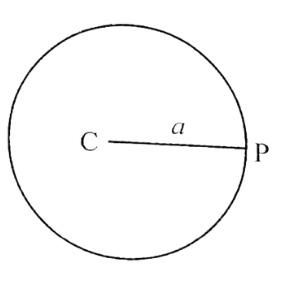
Definition. The set of points in space which are at a constant distance a(≥ 0) from a fixed point C is called a sphere.

In other words, a sphere is the locus of the points in space which are at a constant distance a(≥ 0) from a fixed point C.

C is called the centre and a is called the radius of the sphere.

If a = 0 the sphere is called a point sphere.

Chapter 5 Equation Of A Sphere

Theorem.1. Equation to the sphere with centre (x1, y1, z1) and radius a is (x – x1)2 + (y – y1)2 + (z – z1)2 = a2.

Proof. Let C = centre = (x1, y1, z1)

Let P = (x, y, z) be any point on the sphere.

By def. CP = radius = a ……(1)

⇒ \(\sqrt{\left(x-x_1\right)^2+\left(y-y_1\right)^2+\left(z-z_1\right)^2}=a\)

⇒  (x – x1)2 + (y – y1)2 + (z – z1)2 = a2

⇒ Equation to the sphere is (x – x1)2 + (y – y1)2 + (z – z1)2 = a2 …..(2)

having (x1, y1, z1) as a centre and a as radius.

Aliter. Let \(\mathrm{C}=\bar{c}\) (x1, y1, z1) be the centre of sphere Σ.

Answer Key For Maths For BSC 2 Semester Chapter 5 The Sphere Theorem 1 Image

a is the radius of Σ. Let \(\mathrm{P}=\bar{r}=(x, y, z) \in \Sigma\)

P ∈ Σ.

⇒ \(\mathrm{CP}=|\overline{\mathrm{CP}}|=a \Leftrightarrow|\bar{r}-\bar{c}|=a \Leftrightarrow(\bar{r}-\bar{c})^2=a^2\) …..(1)

⇒ \((\bar{r}-\bar{c}) \cdot(\bar{r}-\bar{c})=a^2\)

⇒ (x – x1, y – y1, z – z1).(x – x1, y – y1, z – z1) = a2

⇒ (x – x1)2 + (y – y1)2 + (z – z1)2 = a2 …..(2)

∴ Equation to the sphere with centre (x1, y1, z1) and radius a is (x – x1)2 + (y – y1)2 + (z – z1)2 = a2

Equation Of The Sphere With Examples And Solutions

Note 1. The equation to the sphere with centre (0, 0, 0) and radius a is x2 + y2 + z2 = a2.

2. The equation of the sphere with centre (x1, y1, z1) and radius o is (x – x1)2 + (y – y1)2 + (z – z1)2 = 0.

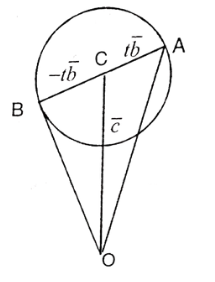
3. Let \(\bar{c}(\neq 0)\) be the centre of a sphere with non-zero radius a.

Answer Key For Maths For BSC 2 Semester Chapter 5 The Sphere Theorem 1. Image 2

If A is a point on the sphere with position vector \(\bar{c}+t \bar{b}\) where t is a real number, then from (1) we see that \(\bar{c}+t \bar{b}\), say B is also a point on the sphere.

Further, C is the midpoint of AB. AB is called the diameter of the sphere and A, and B are called the ends of the diameter AB. Since \(t \bar{b}\) can have infinitely many values, a sphere will have infinitely many diameters.

4. For a sphere only one centre and one radius exist. Thus where the centre and radius of a sphere are given, its equation is unique.

5. Equation (2) to the sphere Σ can be written as

x2 – 2x1x + x12 + y2 – 2y1y + y12 + z2 – 2z1z + z12 = a2 i.e.

x2 + y2 + z2 + 2(-x1)x + 2(-y1)y + 2(-z1)z + (x12 + y12 + z12 – a2)= 0.

i.e., x2 + y2 + z2 + 2ux + 2vy + 2wz + d = 0 where

x1 = -u, y1 = -v, z1 = -w, d = x12 + y12 + z12 – a2 = u2 + v2 + w2 – a2

i.e., a2 = u2 + v2 + w2 – d i.e., u2 + v2 +w2 – d ≥ 0 (∵ a ≥ 0)

∴ The equation to sphere is of the form

x2 + y2 + z2 + 2ux + 2vy + 2wz + d = 0 …..(3)

where (-u, -v, -w) is the centre and \(\sqrt{u^2+v^2+w^2-d}\) is the radius.

Equation (3) is taken as the general equation of a sphere. We denote:

S ≡ x2 + y2 + z2 + 2ux + 2vy + 2wz + d = 0

S’ ≡ x2 + y2 + z2 + 2u’x + 2v’y + 2w’z + d’ = 0

If the sphere S = 0 passes through the origin, then its equation is of the form x2 + y2 + z2 + 2ux + 2vy + 2wz = 0.

6. The equation to the point sphere is of the form x2 + y2 + z2 + 2ux + 2vy + 2wz + d = 0 where d = u2 + v2 + w2 (∵ a = 0)

7. The equation x2 + y2 + z2 + 2ux + 2vy + 2wz + d = 0 i.e., (x + u)2 + (y + v)2 + (z + w)2 = u2 + v2 + w2 – d does not represent a sphere if u2 + v2 + w2 < d.

In fact, there is no point which satisfies the above equation.

8. We may observe the following characteristics in the equation of a sphere:

(1) It is a second-degree equation in x, y, and z.

(2) The coefficients of x2, y2, z2 are equal.

(3) The product terms xy, yz, and zx are absent.

9. Concentric spheres. Spheres with the same centre are known as concentric spheres. If S = 0 is a sphere, then its concentric sphere is always x2 + y2 + z2 + 2ux + 2vy + 2wz + k = 0 where k is an unknown constant.

Theorems Related To The Sphere With Proofs And Solved Examples

Example.1. Equation of the sphere of radius 3 concentric with the sphere x2 + y2 + z2 – 2x – 2y – 2z = 1 is (x – 1)2 + (y – 1)2 + (z – 1)2 = 32. i.e. x2 + y2 + z2 – 2x – 2y – 2z + (-6) = 0 since (1, 1, 1) is the centre of the given sphere.

Example.2. Equation of the sphere concentric with the sphere x2 + y2 + z2 – 2x – 2y – 2z = 1 and of double its surface area is (x – 1)2 + (y – 1)2 + (z – 1)2 = 8.

Since: Given sphere radius = r =\(\sqrt{1+1+1+1}=2\) and radius of required sphere = R.

Here 4πR2 = 2 x 4πr2 = 2 x 4π x 4 ⇒ R2 = 8.

Step-By-Step Solutions For Sphere Equations Problems

Theorem.2. The equation ax2 + by2 + cz2 + 2fyz + 2gzx + 2hxy + 2ux + 2vy + 2wz + d = 0 represents a sphere if a = b = c ≠ 0, f = g = h = 0 and u2 + v2 +w2 > ad.

Proof. If a = b = c ≠ 0, f = g = h = 0, then the equation becomes ax2 + ay2 +az2 + 2ux + 2vy + 2wz + d =0.

i.e., \(x^2+y^2+z^2+2\left(\frac{u}{a}\right) x+2\left(\frac{v}{a}\right) y+2\left(\frac{w}{a}\right) z+\frac{d}{a}=0\),

Since u2 + v2 +w2 > ad, \(\frac{u^2}{a^2}+\frac{v^2}{a^2}+\frac{w^2}{a^2}-\frac{d}{a}=\frac{u^2+v^2+w^2-a d}{a^2}>0\)

i.e. (radius)2 > 0

∴ The given equation represents a sphere with centre = \(\left(\frac{-u}{a}, \frac{-v}{a}, \frac{-w}{a}\right)\)

and radius = \(\frac{\sqrt{u^2+v^2+w^2-a d}}{a}\)

if a = b = c ≠ 0, f = g = h = 0 and u2 + v2 +w2 > ad.

Chapter 5 The Sphere Arbitrary Constants Or Parameters In The Equation Of A Sphere

Consider the equation x2 + y2 + z2 + 2ux + 2vy + 2wz + d = 0. It represents a sphere for a set of values of u, v, w, d such that u2 + v2 +w2 – d ≥ 0. Since there are four parameters in the equation, the equation to a sphere can be uniquely determined only if four conditions, such that each condition gives rise to one relation linear between the four parameters, are given. In particular, we can have a unique sphere when four non-coplanar points on the sphere are given. On the other hand if lesser number of conditions are given we can have infinitely many spheres satisfying the given conditions.

Arbitrary Constants In The Equation Of A Sphere Explained

Theorem.3. Equation to the sphere passing through for non-coplanar points A(x1, y1, z1), B(x2, y2, z2), C(x3, y3, z3), D(x4, y4, z4) is

⇒ \(\left|\begin{array}{ccccc}
x^2+y^2+z^2 & x & y & z & 1 \\
x_1^2+y_1^2+z_1^2 & x_1 & y_1 & z_1 & 1 \\
x_2^2+y_2^2+z_2^2 & x_2 & y_2 & z_2 & 1 \\
x_3^2+y_3^2+z_3^2 & x_3 & y_3 & z_3 & 1 \\
x_4^2+y_4^2+z_4^2 & x_4 & y_4 & z_4 & 1
\end{array}\right|=0\)

Proof. Let a sphere through A, B, C, and D be

x2 + y2 + z2 + 2ux + 2vy + 2wz + d = 0 …..(1)

since (1) contains the points

A(x1, y1, z1), B(x2, y2, z2), C(x3, y3, z3), D(x4, y4, z4) we have

x12 + y12 + z12 + 2ux1 + 2vy1 + 2wz1 + d= 0 …..(2)

x22 + y22 + z22 + 2ux2 + 2vy2 + 2wz2 + d = 0 …..(3)

x32 + y32 + z32 + 2ux3 + 2vy3 + 2wz3 + d = 0 …..(4)

x42 + y42 + z42 + 2ux4 + 2vy4 + 2wz4 + d = 0 …..(5)

Further A, B, C, and D are non-coplanar.

⇒ \(\left|\begin{array}{llll}
x_1 & y_1 & z_1 & 1 \\
x_2 & y_2 & z_2 & 1 \\
x_3 & y_3 & z_3 & 1 \\
x_4 & y_4 & z_4 & 1
\end{array}\right| \neq 0\)

Hence equations (2), (3), (4), and (5) have a unique solution. For this solution i.e., for unique values of u, v, w, d there exists a unique sphere passing through the non-coplanar points. Its equation is obtained by eliminating u, v, w, and d from the equations (1), (2), (3), (4), (5).

∴ The equation to the required sphere is I.

Note 1. In numerical problems it is convenient to solve the equations (2), (3), (4), (5) for u, v, w, d and substitute the values in (1) to get the equation to the required sphere.

2. If \(\left|\begin{array}{llll}
x_1 & y_1 & z_1 & 1 \\
x_2 & y_2 & z_2 & 1 \\
x_3 & y_3 & z_3 & 1 \\
x_4 & y_4 & z_4 & 1
\end{array}\right|=0\) then A, B, C, D are coplanar and no sphere through A, B, C, D is possible.

Chapter 5 The Sphere Solved Problems

Example.1. Find t, if the radius of the sphere x2 + y2 + z2 + 6x – 8y – t = 0 is 6.

Solution. Radius = \(\sqrt{9+16+0+t}=6\) (given).

∴ 25 + t = 36 ⇒ t = 11

Plane Section Of A Sphere With Examples And Solutions

Example.2. Find the equation to the sphere through O = (0, 0, 0) and make intercepts a, b, and c on the axes.

Solution.

Given

O = (0, 0, 0)

Let the sphere through O intersect the axes at A, B, and C.

∴ A = (a, 0, 0), B = (0, b, 0), C = (0, 0, c).

Let the equation to the sphere through O, A, B, C be

x2 + y2 + z2 + 2ux + 2vy + 2wz + d = 0 …..(1)

∴ d = 0. Also a2 + 2ua = 0 i.e., \(u=-\frac{a}{2}\).

Similarly \(v=-\frac{b}{2} ; w=-\frac{c}{2}\).

∴ The equation to the sphere passing the origin and making intercepts a, b, and c on the axes is x2 + y2 + z2 – ax – by – cz = 0.

Its centre = \(\left(\frac{a}{2}, \frac{b}{2}, \frac{c}{2}\right)\) and radius = \(\frac{\sqrt{a^2+b^2+c^2}}{2}\)

Note 1. The above result may be taken as a formula.

2. The above equation is the equation of the sphere passing through (0, 0, 0), (a, 0, 0), (0, b, 0) and (0, 0, c).

3. Find the equation of the sphere through the points (0, 0, 0), (1, 0, 0), (0, 0, 1), (0, 1, 0)

Solution. Put a = 1, b = 1, c = 1 in the above problem x2 + y2 + z2 – x – y – z = 0.

Understanding Sphere Equations With Arbitrary Constants

Example.3. Find the equation of the sphere circumscribing the tetrahedron formed by the planes \(\frac{y}{b}+\frac{z}{c}=0, \frac{z}{c}+\frac{x}{a}=0, \frac{x}{a}+\frac{y}{b}=0, \frac{x}{a}+\frac{y}{b}+\frac{z}{c}=1\).

Solution. Given faces of the tetrahedron are

⇒ \(\frac{y}{b}+\frac{z}{c}=0\) …..(1)

⇒ \(\frac{z}{c}+\frac{x}{a}=0\) …..(2)

⇒  \(\frac{x}{a}+\frac{y}{b}=0\) …..(3)

⇒ \(\frac{x}{a}+\frac{y}{b}+\frac{z}{c}=1\) …..(4)

Solving (1), (2), (3): O = (0, 0, 0). Solving (1), (2), (4): A = (a, b, -c).

Solving (1), (3), (4): B = (a, -b, c). Solving (2), (3), (4): C = (-a, b, c).

Let the sphere through O, A, B, and C be

x2 + y2 + z2 + 2ux + 2vy + 2wz = 0 …..(5)

A ∈ (5) ⇒ a2 + b2 + c2 + 2ua + 2vb – 2wc = 0 …..(6)

B ∈ (5) ⇒ a2 + b2 + c2 + 2ua – 2vb + 2wc = 0 …..(7)

C ∈ (5) ⇒ a2 + b2 + c2 – 2ua + 2vb + 2wc = 0 …..(8)

(6) + (7) ⇒ \(4 u a=-2\left(a^2+b^2+c^2\right) \Rightarrow 2 u=-\frac{a^2+b^2+c^2}{a}\)

Similarly \(2 v=-\frac{a^2+b^2+c^2}{b}, 2 w=-\frac{a^2+b^2+c^2}{c}\)

Substituting these values in (5) we get

⇒ \(x^2+y^2+z^2-\left(a^2+b^2+c^2\right) \frac{x}{a}-\left(a^2+b^2+c^2\right) \frac{y}{b}-\left(a^2+b^2+c^2\right) \frac{z}{c}=0\)

i.e., \(\frac{x^2+y^2+z^2}{a^2+b^2+c^2}-\frac{x}{a}-\frac{y}{b}-\frac{z}{c}=0\) is the equation to the required sphere.

Applications Of Sphere Equations In Mathematics And Geometry

Example.4. A point is such that the sum of the squares of its distances from the six faces of a cube is a constant k(>0). Show that the point lies on a sphere.

Solution.

Given

A point is such that the sum of the squares of its distances from the six faces of a cube is a constant k(>0).

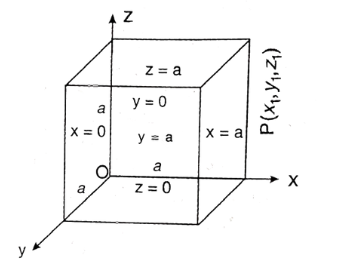
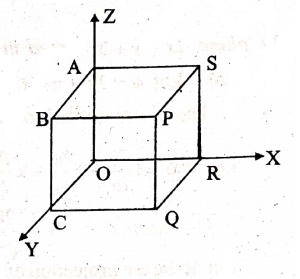
Let a be the edge of the cube. Let OXYZ be the frame as shown.

Equations to the six faces are y = 0, x = a, x = 0, y = a, z = 0, z = a.

point lies on a sphere.

Let P(x1, y1, z1) be a point such that the sum of the squares of its distance p from the faces is k.

x12 + (x1 – a)2 + y12 + (y1 – a)2 + z12 + (z1 – a)2 = k

i.e., \(x_1^2+y_1^2+z_1^2-a x_1-a y_1-a z_1=\frac{1}{2}\left(k-3 a^2\right)\)

∴ P(x1, y1, z1) lies on the sphere.

⇒ \(x^2+y^2+z^2-a(x+y+z)+\frac{1}{2}\left(3 a^2-k\right)=0\)

Example.5. A plane passes through a fixed point (a, b, c) and intersects the axes in A, B, C. Show that the centre of the sphere OABC lies on \(\frac{a}{x}+\frac{b}{y}+\frac{c}{z}=2\).

Solution.

Given

A plane passes through a fixed point (a, b, c) and intersects the axes in A, B, C.

Let the sphere through O, A, B, and C be

x2 + y2 + z2 + 2ux + 2vy + 2wz = 0 …..(1)

Since A ∈ x-axis, from (1), x = -2u

∴ Equation to the plane \(\overleftrightarrow{\mathrm{ABC}} \text { is } \frac{x}{-2 u}+\frac{y}{-2 v}+\frac{z}{-2 w}=1\)

Since this plane passes through the point (a, b, c), we have

⇒ \(\frac{a}{-2 u}+\frac{b}{-2 v}+\frac{b}{-2 w}=1 \Rightarrow \frac{a}{-u}+\frac{b}{-v}+\frac{c}{-w}=2\)

∴ The centre (-u, -v, -w) of the sphere OABC lies on \(\frac{a}{x}+\frac{b}{y}+\frac{c}{z}=2\).

Example.6. A sphere of constant radius r passes through the origin O and cuts the axes in A, B, C. Prove that the foot of the perpendicular from O to the plane \(\overleftrightarrow{A B C}\) lies on (x2 + y2 + z2)2(x-2 + y-2 + z-2) = 4r2.

Solution.

Given

A sphere of constant radius r passes through the origin O and cuts the axes in A, B, C.

Let the plane \(\overleftrightarrow{A B C}\) be \(\frac{x}{a}+\frac{y}{b}+\frac{z}{c}=1\)

∴ A = (a, 0, 0), B = (0, b, 0), C = (0, 0, c).

∴ The equation to the sphere through O, A, B, C is

x2 + y2 + z2 – ax – by – cz = 0 …..(2)

Since the radius of (2) is r, \(\frac{a^2}{4}+\frac{b^2}{4}+\frac{c^2}{4}=r^2 \Rightarrow a^2+b^2+c^2=4 r^2\) …..(3)

The equation to the line through O and perpendicular to the plane (1) is \(\frac{x-0}{1 / a}=\frac{y-0}{1 / b}=\frac{z-0}{1 / c}(=\lambda \text { say })\) …..(4)

∴ A point on (4) is (λ/a, λ/b, λ/c).

P(x1, y1, z1) is the foot of the perpendicular from O to \(\overleftrightarrow{\mathrm{ABC}}\).

⇒ \(x_1=\frac{\lambda}{a}, y_1=\frac{\lambda}{b}, z_1=\frac{\lambda}{c} ; \frac{x_1}{a}+\frac{y_1}{b}+\frac{z_1}{c}=1 from (1)\)

⇒ \(a=\frac{\lambda}{x_1}, b=\frac{\lambda}{y_1}, c=\frac{\lambda}{z_1} ; \frac{x_1}{a}+\frac{y_1}{b}+\frac{z_1}{c}=1\)

⇒ \(\lambda^2\left(\frac{1}{x_1^2}+\frac{1}{y_1^2}+\frac{1}{z_1^2}\right)=4 r^2 \text { from (3), } \frac{x_1^2}{\lambda}+\frac{y_1^2}{\lambda}+\frac{z_1^2}{\lambda}=1\)

⇒ (x12 + y12 + z12)2 (x1-2 + y1-2 + z1-2) = 4r2

∴ Foot of the perpendicular from O to the plane \(\overleftrightarrow{\mathrm{ABC}}\) lies on

(x2 + y2 + z2)2(x-2 + y-2 + z-2) = 4r2.

Example.7. A sphere of constant radius k passes through the origin and intersects the axes in A, B, C. Prove that the centroid of the △ABC lies on the sphere 9(x2 + y2 + z2) = 4k2.

Solution.

Given

A sphere of constant radius k passes through the origin and intersects the axes in A, B, C.

Let OA = a, OB = b, OC = c

⇒ Coordinates of A, B, C are (a, 0, 0), (0, b, 0), (0, 0, c)

⇒ The equation of the sphere OABC is

x2 + y2 + z2 – ax – by – cz = 0 …..(1)

The radius of the sphere (1) is

k = \(\sqrt{\frac{a^2}{4}+\frac{b^2}{4}+\frac{c^2}{4}} \Rightarrow a^2+b^2+c^2=4\) k^2 …..(2)

Let (x1, y1, z1) be the centroid of the △ABC.

Then \(\left.\begin{array}{l}
x_1=\frac{a+0+0}{3} \Rightarrow a=3 x_1 \\
y_1=\frac{0+b+0}{3} \Rightarrow b=3 y_1 \\
z_1=\frac{0+0+c}{3} \Rightarrow c=3 z_1
\end{array}\right\}\) …..(3)

Substituting values of a, b, and c from (3) in (2) we get, 9x12 + 9y12 + 9z12 = 4k2.

The locus of (x1, y1, z1) is 9(x2 + y2 + z2) = 4k2 …..(4)

The centroid of the △ABC lies on the sphere (4).

Chapter 5. Plane Sections Of A Sphere

Definition. If ξ is a sphere and π is a plane, the non-empty set of points common to the sphere ξ and the plane π is called a plane section of the sphere. Then we say that the plane π intersects the sphere ξ.

We, therefore, have:

P is a point on the plane section of π with ξ

⇒ P ∈ π ∩ ξ <=> P ∈ π and P ∈ ξ

Theorem.4. A Plane section of a sphere of radius a(>0) is a circle.

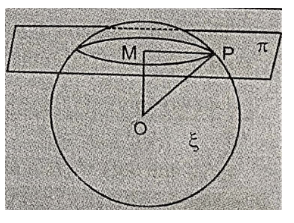
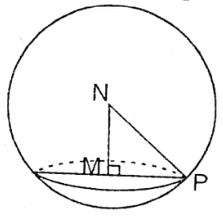
Proof. Let ξ be a sphere with centre O,

Answer Key For Maths For BSC 2 Semester Chapter 5 The Sphere Theorem 4 Image

Radius of ξ is a(>0).

Let π be a plane making a plane section on ξ.

Let M be the foot of the perpendicular from O to the plane π so that M and O are different.

Case(1). Let M ≠ P. Then OM ⊥ MP.

Since ∠OMP = 90°, MP2 = OP2 – OM2 = a – OM2.

Now O and M are fixed points and hence OM is fixed.

∴ MP is a constant for all P ∈ ξ ∩ π.

∴ The plane section is a circle with centre M and radius \(\sqrt{a^2-\mathrm{OM}^2}\).

Case(2). Let M = P. The case is trivial and the plane section is a point circle.

If M = O, then MP = OP = a (constant)

i.e., if the plane π passes through the centre of a sphere ξ, then the plane section is a circle with centre O and radius a.

Chapter 5 The Sphere Great Circle, Small Circle

Definition. If a plane π passes through the centre of a sphere ξ, then the plane section of the sphere is called a great circle.

The centre and radius of the great circle are respectively the centre and radius of the sphere.

Definition. If a plane π does not pass through the centre of a sphere ξ and intersects the sphere ξ, then the plane section is called a small circle.

The centre of the small circle is the foot of the perpendicular from the centre of the sphere to the plane π and the radius of the small circle is less than the radius of the sphere ξ.

Note. One and only one circle passes through three non-collinear points. The circle through three given points lies entirely on any sphere through the same three points. Thus if a circle lies on a sphere, then the sphere passes through any three points on the circle.

Chapter 5 Condition For A Plane To Intersect A Sphere

There exist points of intersection of the sphere and a plane if and only if the distance of the centre of the sphere from the plane is less than or equal to the radius of the sphere.

Thus: the sphere x2 + y2 + z2 + 2ux + 2vy + 2wz + d = 0 will intersect the plane lx + my + nz = p if and only if

⇒ \(\left|\frac{l(-u)+m(-v)+n(-w)-p}{\sqrt{l^2+m^2+n^2}}\right| \leq \sqrt{u^2+v^2+w^2-d}\)

i.e. if and only if (lu + mv + nw + p)2 ≤ (l2 + m2 + n2)(u2 + v2 + w2 – d).

Chapter 5 Intersection Of Two Spheres

Let ξ1, ξ2 be two spheres. If ξ1 ∩ ξ2 ≠ Φ, we say that the spheres ξ1 and ξ2 intersect or cut and ξ1, ξ2 intersect or cut and ξ1, ξ2 are called intersecting spheres. If ξ1 ∩ ξ2 ≠ Φ, we say that the sphere ξ1 and ξ2 do not intersect or cut and ξ1, ξ2 are called non-intersecting spheres.

Answer Key For Maths For BSC 2 Semester Chapter 5 The Sphere Image

Theorem.5. If two spheres intersect, then the locus of the set of points of intersection is a circle.

Proof. Let S = 0, S’ = 0 be two intersecting spheres where

S ≡ x2 + y2 + z2 + 2ux + 2vy + 2wz + d = 0,

S’ ≡ x2 + y2 + z2 + 2u’x + 2v’y + 2w’z + d’ = 0

S – S’ ≡ 2(u – u’)x + 2(v – v’)y + 2(w – w’)z + (d – d’) = 0

Clearly S – S’ = 0, being of first degree, is a plane. Also the coordinates of the points common to two spheres satisfy both S = 0, S’ = 0 and therefore S – S’ = 0.

Thus the points common to two spheres are the same as those any one of them and this plane and, therefore, they determine a circle.

Note 1. S = 0, S’ = 0 are two spheres intersecting in a circle C. Then equations to C are S = 0, S – S’ = 0 or S’ = 0, S – S’ = 0.

2. U = 0 is a plane and S = 0 is a sphere such that the plane section of the sphere is the circle C. Then the equations S = 0, U = 0 together represent the circle C. The equations x2 + y2 +  + 2gx + 2fy + c = 0, z = 0 represent a circle.

3. A, B are the centres of two intersecting spheres.

Let C be the circle (not a point circle) with centre P. Then

(1) the line \(\overleftrightarrow{\mathrm{AB}}\) is perpendicular to the plane of the circle C and

(2) the line \(\overleftrightarrow{\mathrm{AB}}\) passes through the centre P i.e. A, P, B aare collinear.

Chapter 5 The Sphere Solved Problems

Example.1. Find the radius of the circle x2 + y2 + z2 – 2x + 4y – 6z – 2 = 0, z = 0.

Solution. For the sphere: centre = (1, -2, 3) and radius = \(\sqrt{(1+4+9+2)}=4\)

The distance of (1, -2, 3) from the plane z = 0 is 3.

∴ radius of the circle = \(+\sqrt{16-9}=+\sqrt{7}\).

Example.2. prove that the circle x2 + y2 + z2 – 4x – 2y + 5z + 6 = 0, x + y + 2z + 2 = 0 is a great circle.

Solution. Centre of the sphere (2, 1, -5/2) lies on the plane x + y + 2z + 2 = 0

Example.3. Are there points of intersection of the sphere x2 + y2 + z2 + 3x + 5y – 2z + 9 = 0 with the plane x – y + 2z + 2 = 0?

Solution. For the sphere: centre = \(\left(-\frac{3}{2}, \frac{-5}{2}, 1\right)\) and radius = \(\sqrt{\frac{9}{4}+\frac{25}{4}+1-9}=\frac{1}{\sqrt{2}}\)

Distance of the centre from the plane x – y + 3z + 6 = 0

= \(\frac{-\frac{3}{2}-\left(-\frac{5}{2}\right)+3(1)+6}{\sqrt{\frac{9}{4}+\frac{25}{4}+1}}=\frac{20}{\sqrt{38}}>\text { radius }\left(=\frac{1}{\sqrt{2}}\right)\)

∴ There are no points of intersection of the sphere with the plane (i.e. the sphere is not intersected by the plane).

Example.4. If the spheres x2 + y2 + z2 – 2x – 4y – 11 = 0 …..(1) x2 + y2 + z2 + 2x – y + 12z + 5 = 0 …..(2) intersect in a circle, find its equation.

Solution. The plane of intersection of the spheres is – 4x – 3y – 12z – 16 = 0

i.e. 4x + 3y + 12z + 16 = 0 …..(3)

∴ Equation to the circle of intersection of (1) and (2) is (1), (3) or (2), (3).

Theorem.6. If AB is a diameter of a sphere ξ with centre O, then P(≠ A, ≠ B) ∈ ξ ⇒ ∠APB = 90°.

Proof. Let O = (0, 0, 0), P = (x1, y1, z1) A = (x2, y2, z2).

Answer Key For Maths For BSC 2 Semester Chapter 5 The Sphere Theorem 6

Since O is the mid point of AB, B = (-x2, -y2, -z2)

∴ \(\overline{\mathrm{P}}=\left(x_1, y_1, z_1\right), \overline{\mathrm{A}}=\left(x_2, y_2, z_2\right),\)

Dr’s of \(\overline{\mathrm{PA}}=\left(x_2-x_1, y_2-y_1, z_2-z_1\right)\)

Dr’s of \(\overline{\mathrm{PB}}=\left(-x_2-x_1,-y_2-y_1,-z_2-z_1\right)\)

Also radius of the sphere \(|\overline{\mathrm{OP}}|=|\overline{\mathrm{OA}}|\).

= x12 + y12 + z12 = x22 + y22 + z22

Consider (x2 – x1)(- x2 – x1) + (y2 – y1)(- y2 – y1) + (z2 – z1)(- z2 – z1)

= -(x22 + y22 + z22) + (x12 + y12 + z12) = 0.

∴ ∠APB = 90°.

Note. If \(\overleftrightarrow{\mathrm{PAB}}\) is the plane section of ξ then the plane section is a great circle and hence ∠APB = 90° from the properties of circles.

Theorem.7. Equation to the sphere having A = (x1, y1, z1) and B = (x2, y2, z2) as the ends of the diameter is (x – x1)(x – x2) + (y – y1)(y – y2) + (z – z1)(z – z2) = 0

First Proof. Let ξ be the sphere with AB as diameter.

Let P = (x, y, z) ∈ ξ.

Given A = (x1, y1, z1), B = (x2, y2, z2).

If P ≠ A, P ≠ B then ∠APB = 90°

The Dc’s of PA, PB are proportional to

(x – x1, y – y1, z – z1) and (x – x2, y – y2, z – z2) respectively.

PA is perpendicular to PB

<=> (x – x1)(x – x2) + (y – y1)(y – y2) + (z – z1)(z – z2) = 0

∴ Equation to the required sphere is

(x – x1)(x – x2) + (y – y1)(y – y2) + (z – z1)(z – z2) = 0.

Second Proof. Let ξ be the sphere with AB’s diameter.

Let P ∈ ξ. Let P = \(\bar{r}=(x, y, z)\).

Given A = \(\bar{a}=\left(x_1, y_1, z_1\right) \text { and } \mathrm{B}=\bar{b}=\left(x_2, y_2, z_2\right)\).

If P ≠ A, P ≠ B then ∠APB = 90° and hence \(\overline{\mathrm{PA}} \cdot \overline{\mathrm{PB}}\)

If P = A, then \(\overline{\mathrm{PA}}=0 \Rightarrow \overline{\mathrm{PA}} \cdot \overline{\mathrm{PB}}=0 \text { and If } \mathrm{P}=\mathrm{B} \text {, then } \overline{\mathrm{PB}}=0 \Rightarrow \overline{\mathrm{PA}} \cdot \overline{\mathrm{PB}}=0\)

⇒ \(\mathrm{P} \in \xi \Leftrightarrow \overline{\mathrm{PA}} \cdot \overline{\mathrm{PB}}=0 \Rightarrow \overline{\mathrm{AP}} \cdot \overline{\mathrm{BP}}=0 \Rightarrow(\bar{r}-\bar{a}) \cdot(\bar{r}-\bar{b})=0\)

⇒ \(\left(x-x_1, y-y_1, z-z_1\right) \cdot\left(x-x_2, y-y_2, z-z_2\right)=0\)

⇒ (x – x1)(x – x2) + (y – y1)(y – y2) + (z – z1)(z – z2) = 0

∴ Equation to the required sphere is

(x – x1)(x – x2) + (y – y1)(y – y2) + (z – z1)(z – z2) = 0

example. Equation of the sphere having the segment joining (2, 3, -1) and (1, -2, -1) as a diameter is (x – 2)(x – 1) + (y – 3)(y + 2) + (z + 1)(z + 1) = 0

Note. Vector equation of the sphere having the points \(\bar{a}, \bar{b}\) as the ends of a diameter is \((\bar{r}-\bar{a}),(\bar{r}-\bar{b})=0\).

Chapter 5. Sphere Through A Given Circle.

Theorem.8. If the plane U = 0 intersects the sphere S = 0, in a circle C, then for all real values of λ, S + λU = 0 represents the equation to a sphere passing through the circle C.

Proof. Let S ≡ x2 + y2 + z2 + 2ux + 2vy + 2wz + d = 0 be the sphere and

U ≡ lx + my + nz – p = 0 be the plane.

For the sphere, centre = (-u, -v, -w) and radius = \(\sqrt{u^2+v^2+w^2-d}\)

Plane U = 0 intersects the sphere S = 0

Distance of the centre from the plane ≤ radius

⇒ \(\left|\frac{l(-u)+m(-v)+n(-w)-p}{\sqrt{l^2+m^2+n^2}}\right| \leq \sqrt{u^2+v^2+w^2-d}\)

⇒ \((l u+m v+n w+p)^2 \leq\left(l^2+m^2+n^2\right)\left(u^2+v^2+w^2-d\right)\) …..(1)

S + λU ≡ x2 + y2 + z2 + 2ux + 2vy + 2wz + d + λ(lx + my + nz – p)

⇒ \(x^2+y^2+z^2+2\left(u+\frac{\lambda l}{2}\right) x+2\left(v+\frac{\lambda m}{2}\right) y+2\left(w+\frac{\lambda n}{2}\right) z+(d-\lambda p)=0\)

Now \(\left(u+\frac{\lambda l}{2}\right)^2+\left(v+\frac{\lambda m}{2}\right)^2\left(w+\frac{\lambda n}{2}\right)^2-(d-\lambda p)\)

= \(\frac{1}{4}\left(l^2+m^2+n^2\right) \lambda^2+(l u+m v+n w+p) \lambda+\left(u^2+v^2+w^2-d\right) \geq 0\),

for all real values of λ.

Since from (1), \((l u+m v+n w+p)^2-4 \cdot \frac{1}{4}\left(l^2+m^2+n^2\right)\left(u^2+v^2+w^2-d\right) \leq 0\)

∴ S + λU = 0 represents a sphere through the circle C, for all real values of λ.

Plane U = 0 intersects the sphere S = 0 in a circle C.

Note 1. If S = 0, S’ = 0 are two distinct intersecting spheres, then λ1S + λ2S’ = 0 (for real values of λ1, λ2 and λ1 + λ2 ≠ 0) represents a system of spheres passing through the circle of intersection of the spheres S = 0, S’ = 0.

Also S + λ(S – S’) = 0, λ being an arbitrary constant, represents a sphere through the circle of intersection of the spheres S = 0, S’ = 0.

2. If the equation x2 + y2 + 2gx + 2fy + c = 0, z = 0 represents a circle then the equation to any sphere through the circle is x2 + y2 + z2 + 2gx + 2fy + kz + c = 0, k being a parameter.

Chapter 5 The Sphere Solved Problems

Example.1. The plane of equation \(\frac{x}{a}+\frac{y}{b}+\frac{z}{c}=1\) meets the axes in A, B, C. Find the equation of the circumcircle of △ABC and hence find its centre.

Solution. Given plane \(\frac{x}{a}+\frac{y}{b}+\frac{z}{c}=1\) …..(1) meets the axes in A, B, C.

∴ A = (a, 0, 0), B = (0, b, 0), C = (0, 0, c).

Let x2 + y2 + z2 + 2ux + 2vy + 2wz + d = 0 be the equation of the sphere through O, A, B, C.

Answer Key For Maths For BSC 2 Semester Chapter 5 The Sphere Example 1

∴ d = 0, a2 + 2ua = 0 i.e. 2u = -a

Similarly 2v = -b, 2w = -c.

∴ Equation to the sphere through O, A, B, C is

x2 + y2 + z2 – ax – by – cz = 0 …..(2)

Since A, B, C are common points to (1) and (2) and (1) is a plane intersecting (2), through A, B, C a circle passes and it is the circumcircle of △ABC.

Let N be the centre of the sphere and M be the centre of the circle

∴ \(\overleftrightarrow{\mathrm{MN}} \perp \overleftrightarrow{\mathrm{ABC}}\)

∴ \(\mathrm{N}=\left(\frac{a}{2}, \frac{b}{2}, \frac{c}{2}\right) \text { and d.rs. of } \overrightarrow{\mathrm{MN}} \text { are } \frac{1}{a}, \frac{1}{b}, \frac{1}{c}\)

∴ Equation to \(\overleftrightarrow{\mathrm{MN}} \text { are } \frac{x-a / 2}{1 / a}=\frac{y-b / 2}{1 / b}-\frac{z-c / 2}{1 / c}(=t \text { say })\).

Let \(\mathrm{M}=\left(\frac{t}{a}+\frac{a}{2}, \frac{t}{b}+\frac{b}{2}, \frac{t}{c}+\frac{c}{2}\right)\)

∴ \(\mathrm{M} \in \overleftrightarrow{\mathrm{ABC}} \Rightarrow \frac{t}{a^2}+\frac{1}{2}+\frac{t}{b^2}+\frac{1}{2}+\frac{t}{c^2}+\frac{1}{2}=1 \Rightarrow t=\frac{-1}{2\left(a^{-2}+b^{-2}+c^{-2}\right)}\)

Equations to Circumcircle are (2) and (1) and the centre

⇒ \(\mathrm{M}=\left(\frac{a}{2}+\frac{t}{a}, \frac{b}{2}+\frac{t}{b}, \frac{c}{2}+\frac{t}{c}\right) \text { where } t=\frac{-1}{2\left(a^{-2}+b^{-2}+c^{-2}\right)}\)

Example.2. Show that the four points (-8, 5, 2), (-5, 2, 2), (-7, 6, 6), (-4, 3, 6) are concyclic.

Solution.

Given

(-8, 5, 2), (-5, 2, 2), (-7, 6, 6), (-4, 3, 6)

Let A = (-8, 5, 2), B = (-5, 2, 2), C = (-7, 6, 6), D =(-4, 3, 6)

Let l, m, n be d.rs. of normal to the plane \(\overleftrightarrow{\mathrm{ABC}}\).

∴ \(\left.\begin{array}{c}
3 l-3 m+0 n=0 \\
l+m+4 n=0
\end{array}\right\} \frac{l}{-12}=\frac{m}{-12}=\frac{n}{6} \Rightarrow \frac{l}{2}=\frac{m}{2}=\frac{n}{-1}\)

∴ Equation to \(\overleftrightarrow{\mathrm{ABC}}\) is 2(x + 8) + 2(y – 5) – 2(z – 2) = 0 i.e. 2x + 2y – z + 8 = 0 …..(1)

Let the equation of the sphere ξ through O, A, B, and C be x2 + y2 + z2 + 2ux + 2vy + 2wz = 0.

∴ A ∈ ξ ⇒ 64 + 25 + 4 – 16u + 10v + 4w = 0

⇒ -16u + 10v + 4w = -93 …..(2)

B ∈ ξ ⇒ 25 + 4 + 4 – 10u + 4v + 4w = 0

-10u + 4v + 4w = -33 …..(3)

C ∈ ξ ⇒ 49 + 36 + 36 – 14u + 12v + 12w = 0

-14u + 12v + 12w = -121 …..(4)

(2) – (3): -6u + 6v = -60 ⇒ u – v = 10 …..(5)

– 3 x (3) + (4) : 16u = -22 ⇒ u = -11/8

∴ From (5), \(\frac{-11}{8}-v=10 \Rightarrow v=\frac{-91}{8}\)

From (3), \(\frac{110}{8}-\frac{364}{8}+4 w=-33\)

⇒ – 254 + 32w = -264 ⇒ 32w = – 10 ⇒ w = -5/16

∴ Equation to the sphere ξ is \(x^2+y^2+z^2-\frac{22}{8} x-\frac{182}{8} y-\frac{5}{8} z=0\)

⇒ 8(x2 + y2 + z2) – 22x – 182y – 5z = 0 …..(6)

Now D = (-4, 3, 6) satisfies (1) and (6).

[∵ -8, + 6 -6 + 8 = 0, 8(16 + 9 + 36) + 88 – 546 – 30 = 0]

∴ D is concyclic with the points A, B, and C and the equation to the circle is given by (1) and (6).

Example.3. Find the equations of the spheres passing through the circle x2 + y2 = 4, z = 0 and is intersected by the plane x + 2y + 2z = 0 in a circle of radius 3.

Solution. Let the required sphere be ξ

Answer Key For Maths For BSC 2 Semester Chapter 5 The Sphere Example 3

i.e. x2 + y2 + z2 – 4 + λz = 0

Centre of ξ is (0, 0, -λ/2) and radius of ξ is \(\sqrt{\frac{\lambda^2}{4}+4}\).

Given plane is x + 2y + 2z = 0.

∴ perpendicular distance of the centre of the sphere from the plane

= \(\left|\frac{0+0-2 \cdot \lambda / 2}{\sqrt{1+4+4}}\right|=\frac{|\lambda|}{3}\)

∴ \(\frac{\lambda^2}{9}+9=\frac{\lambda^2}{4}+4 \Rightarrow \lambda=\pm 6\)

∴ The equation to the required spheres is \(x^2+y^2+z^2 \pm 6 z-4=0\).

Example.4. Prove that the plane x + 2y – z = 4 intersects the sphere x2 + y2 + z2 – x + z – 2 = 0 in a circle of radius unity. Also find the equation of the sphere which has this circle for one of the great circles.

Solution. Given plane is x + 2y – z = 4 …..(1)

and given sphere is x2 + y2 + z2 – x + z – 2 = 0 …..(2)

Let C be the centre and a be the radius of (2)

∴ \(\mathrm{C}=\left(\frac{1}{2}, 0,-\frac{1}{2}\right) \text { and } a=\sqrt{\left(\frac{1}{4}+0+\frac{1}{4}+2\right)}=\sqrt{(5 / 2)}\)

Let M be the centre of the circle given by (1) and (2).

∴\(\mathrm{CM}=\left|\frac{\frac{1}{2}+2.0+\frac{1}{2}-4}{\sqrt{(1+4+1)}}\right|=\frac{3}{\sqrt{6}}\).

Let r be the radius of the circle.

⇒ \(\mathrm{CM}^2+r^2=a^2 \Rightarrow \frac{9}{6}+r^2=\frac{5}{2} \Rightarrow r=1\)

Let a sphere through the circle given by (1) and (2) be

x2 + y2 + z2 – x + z – 2 + λ(x + 2y – z – 4) = 0

i.e. x2 + y2 + z2 + (λ – 1)x + 2λy(1 – λ)z – 2 – 4λ= 0 …..(3)

Centre of (3) is \(\left(-\frac{\lambda-1}{2},-\lambda,-\frac{1-\lambda}{2}\right)\)

If the circle is a great circle then the centre of (3) must lie on (1).

∴ \(-\frac{\lambda-1}{2}-2 \lambda+\frac{1-\lambda}{2}=4 \Rightarrow \lambda=-1\)

∴ Equation to the required sphere is (from (3))

x2 + y2 + z2 – 2x – 2y + 2z + 2 = 0 …..(4)

Note. Centre of the great circle = centre of (4) = (1, 1, -1) and radius of great circle = radius of (4) = \(\sqrt{(1+1+1-2)}=1\)

Example.5. Show that the two circles x2 + y2 + z2 – y + 2z = 0, x – y + z = 2 …..(1) x2 + y2 + z2 + x – 3y + z – 5 = 0, 2x – y + 4z – 1 = 0 …..(2) lie on the same sphere and find its equation.

Solution. A sphere through the circle (1) is

x2 + y2 + z2 – y + 2z + λ(x – y + z – 2) = 0

i.e. x2 + y2 + z2 + λx – (1 + λ)y + (λ + 2)z – 2λ = 0 …..(3)

A sphere through the circle (2) is

x2 + y2 + z2 + x – 3y + z – 5 + µ(2x – y + 4z – 1) = 0

i.e. x2 + y2 + z2 + (2µ + 1)x – (3 – µ)y + (4µ + 1)z – 5 – µ = 0 …..(4)

But circles (1) and (2) lie on the same sphere.

(3) and (4) represent the same sphere

⇒ \(\left.\begin{array}{l}
\lambda+2=4 \mu+1 \\
-2 \lambda=-5-\mu
\end{array}\right\}\)

These two are satisfied by λ = 3, µ = 1.

∴ (3) and (4) represent the same sphere.

∴ Equation to the required sphere is x2 + y2 + z2 + 3x – 4y + 5z – 6 = 0.

Example.6. The circle x2 + y2 + z2 + 2x + 3y + 6 = 0 x – 2y + 4z – 9 = 0 and the centre of the sphere x2 + y2 + z2 – 2x + 4y – 6z + 5 = 0

Solution. Given circle is x2 + y2 + z2 + 2x + 3y + 6 = 0 = x – 2y + 4z – 9 = 0 …..(1)

any sphere through this circle will be of the form S + λπ = 0

(i.e.,) (x2 + y2 + z2 + 2x + 3y + 6) + λ(x – 2y + 4z – 9) = 0 …..(2)

where λ is a parameter.

Given sphere is x2 + y2 + z2 – 2x + 4y – 6z + 5 = 0 …..(3)

The centre = (1, -2, 3)

By data (2) passes through this point.

Substituting this point in (2), we get (1 + 4 + 9 + 2 – 6 + 6) + λ(1 + 4 + 12 – 9) = 0

⇒ 16 + 8λ = 0 ⇒ λ = -2

Substituting this value in (2), we get

(x2 + y2 + z2 + 2x + 3y + 6) – 2(x – 2y + 4z – 9) = 0

⇒ x2 + y2 + z2 + 7y – 8z + 24 = 0.

This is the required sphere.

Chapter 5 The Sphere Notation

S ≡ x2 + y2 + z2 + 2ux + 2vy + 2wz + d ≡ F(x, y, z)

S1 ≡ xx1 + yy1 + zz1 + u(x + x1) + v(y + y1) + w(z + z1) + d

S2 ≡ xx2 + yy2 + zz2 + u(x + x2) + v(y + y2) + w(z + z2) + d

S11 ≡ x12 + y12 + z12 + 2ux1 + 2vy1 + 2wz1 + d ≡ F(x1, y1, z1)

Chapter 5 The Sphere Intersection Of A Sphere And A Line

Let S ≡ x2 + y2 + z2 + 2ux + 2vy + 2wz + d = 0 be the equation to the sphere ξ with centre C = \(\bar{c}=(-u,-v,-w) \text { and radius }=a=\sqrt{u^2+v^2+w^2-d}\)

Let the equation to the sphere be

S ≡ x2 + y2 + z2 + 2ux + 2vy + 2wz + d = 0 …..(1) Let B = (α, β, γ)

Let the equation to the line be \(\frac{x-\alpha}{l}=\frac{y-\beta}{m}=\frac{z-\gamma}{n}=r\)

The coordinates of a point on the line which is at a distance r from (α, β, γ) are (α + lr, β + mr, γ + nr). If this point lies on the given sphere (1), then,

⇒ \((\alpha+l r)^2+(\beta+m r)^2+(\gamma+n r)^2+2 u(\alpha+l r)+2 v(\beta+m r)+2 w(\gamma+n r)+d-0\)

⇒ \(r^2\left(l^2+m^2+n^2\right)+2 r[l(\alpha+u)+m(\beta+v)+n(r+w)]+\)

⇒ \(\left(\alpha^2+\beta^2+\gamma^2+2 u \alpha+2 v \beta+2 w \gamma+d\right)=0\) …..(3)

This quadratic equation in r gives two values of r Viz. r1 and r2 corresponding to which we get two points common to the sphere and the line. Therefore, a line meets a sphere always in two points. These points may be real, coincident or imaginary. These are

P(α + lr1, β + mr1, γ + nr1), Q(α + lr2, β + mr2, γ + nr2)

Let the points P, Q are coincident at T.

Note. \(B P \cdot B Q=\left|S_{11}\right| \text { and } B T^2=\left|S_{11}\right| \Rightarrow B P \cdot P Q=B T^2 \text {. }\)

Chapter 5 The Sphere Definition. If line L through a given point B has only one common point T with a given sphere, then L \((=\overleftrightarrow{B T})\) is called a tangent line to the sphere from B. T is called the point of contact of the tangent line \(\overleftrightarrow{B T}\) with the sphere. \(\overleftrightarrow{B T}\) is said to touch the sphere at T and is called a tangent line to the sphere at T.

Also if C is the centre of the sphere, then \(\overleftrightarrow{\mathrm{CT}} \perp \overleftrightarrow{\mathrm{BT}}\) i.e. line joining the point of contact to the centre of the sphere, is perpendicular to the tangent line.

Definition. B is a point and ξ is a sphere with centre C and radius a.

(1) If BC > a, we say that B is an external point to the sphere ξ and the set of points B such that BC > a is called the exterior of the sphere ξ.

(2) If BC < a, we say that B is an internal point to the sphere ξ and the set of points B such that BC < a is called the interior of the sphere ξ.

Let B = \(\bar{b}=\left(x_1, y_1, z_1\right)\). Let the sphere ξ be S = 0.

B is an external point to the sphere ξ.

⇒ \(\mathrm{BC}>a \Leftrightarrow|\bar{c}-\bar{b}|>a\) \((\bar{c}-\bar{b})^2>a^2\)

⇒ \(\bar{b}^2-2 \bar{b} \cdot \bar{c}+\bar{c}^2-a^2>0\) <=> \(F(\bar{b})>0 \quad \Leftrightarrow S_{11}>0\).

B is an internal point to the sphere ξ <=> S11 < 0.

Except for the point of contact, all other points on a tangent line belong to the exterior of the sphere.

For, the distance of every point on the tangent line from the centre is greater than or equal to the radius.

Also, a tangent line to a sphere does not pass through an interior point.

Definition. If a line through B intersects a sphere ξ in two distinct points P and Q, then PQ is called a chord of the sphere and \(\overleftrightarrow{\mathrm{PQ}}\) is called a second line of the sphere ξ.

Note. r is the radius and C is the centre of the sphere ξ. The distance of C from the chord PQ is d. Then length of PQ is \(2 \sqrt{r^2-d^2}\).

Chapter 5 The Sphere Length Of The Tangent Line From A Point

From an external point B to a sphere ξ, always there exists a tangent line through B to the sphere ξ.

Through B by taking different directions (d.cs.) we can draw infinitely many tangent lines to the sphere.

Definition. If \(\overleftrightarrow{\mathrm{BT}}\) is a tangent line from an external point B to a sphere touches the sphere at T, then BT is called the length of the tangent line to the sphere from B.

If B = (x1, y1, z1), we know that \(\mathrm{BT}^2=\left|\mathrm{S}_{11}\right|\).

∴ Length of the tangent line from B(x1, y1, z1) to the sphere \(\sqrt{\left[\mathrm{S}_{11}\right]}\)

Note. From an internal point of a sphere, there exists no tangent line to the sphere.

Definition. Normal.

Let S be the sphere and P be a point on S. Then the line through P and perpendicular to the tangent line to S at the point is called The normal to the sphere S at P. The point P is called the foot of the normal at P.

Theorem.9. The locus of the tangent line at a point on a sphere of non-zero radius is a plane.

Proof. Let the equation to the sphere be

S ≡ x2 + y2 + z2 + 2ux + 2vy + 2wz + d = 0 …..(1)

Let B = (x1, y1, z1) be a point on it.

Equations of any line through B are \(\frac{x-x_1}{l}=\frac{y-y_1}{m}=\frac{z-z_1}{n}=r\) …..(2)

Any point on (2) at a distance r from (x1, y1, z1) is (x1 + lr, y1 + mr, z1 + nr)

If this point lies on (1), we get (x1 + lr)2 + (y1 + mr)2 + (z1 + nr)2 + 2u(x1 + lr) + 2v(y1 + mr) + 2w(z1 + nr) + d = 0

⇒ r2 (l2 + m2 + n2) + 2r[l(x1 + u) + m(y1 + v) + n(z1 + w)] + (x12 + y12 + z12 + 2ux1 + 2vy1 + 2wz1 +d) = 0 …..(3)

Since B(x1, y1, z1) ∈ (1) we have x12 + y12 + z12 + 2ux1 + 2vy1 + 2wz1 +d = 0

⇒ one root of (3) is zero.

Now (3) ⇒ r(l2 + m2 + n2) + 2[l(x1 + u) + m(y1 + v) + n(z1 + w)]

If (2) is a tangent line to the sphere (1) then the points of intersection of (1) and (2) should coincide with (x1, y1, z1).

⇒ The second root of (3) should also be zero.

⇒ l(x1 + u) + m(y1 + v) + n(z1 + w) = 0 …..(6)

⇒ Eliminating l, m, n from equations (2) and (6) we have (x – x1)(x1 + u) + (y – y1)(y1 + v) + (z – z1)(z1 + w) = 0

⇒ xx1 + yy1 + zz1 + ux + vy +wz – ux1 – vy1 – wz1 – (x12 + y12 + z12) = 0

⇒ xx1 + yy1 + zz1 + u(x + x1) + v(y + y1) + w(z + z1) + d = 0 …..(7)

since x12 + y12 + z12 + 2ux1 + 2vy1 + 2wz1 + d = 0.

Equation (7) is a plane which gives the required locus.

∴ All the tangent lines at B pass through B and a plane having BC as its normal.

Chapter 5 The Sphere Tangent Plane

Definition. The locus of the tangent lines at a point B on a sphere ξ of non-zero radius is a plane called the tangent plane to the sphere ξ at B. B is called the point of contact of the plane with the sphere ξ.

Theorem.10. Equation to the tangent plane to the sphere S = 0 at (x1, y1, z1) on the sphere is x(x1 + u) + y(y1 + v) + z(z1 + w) + ux1 + vy1 + wz1 + d = 0.

Proof. We here proved in theorem vide that the locus of the tangent lines at a point B(x1, y1, z1) is a plane. This plane is defined as the tangent plant at B and we have proved that the equation to this plane is

xx1 + yy1 + zz1 + u(x + x1) + v(y + y1) + w(z + z1) + d = 0

This is the required equation to the tangent plane at (x1, y1, z1).

Note 1. The Tangent Plane at B is perpendicular to BC.

2. The line through B and perpendicular to the tangent plane at B is called the normal line to the sphere at B. The normal line at B passes through the centre C.

3. The perpendicular distance of any tangent line from centre C is equal to the radius a.

4. The perpendicular distance of any tangent line from C is equal to a.

5. If lx + my + nz = p is the tangent plane, then

⇒ \(\left|\frac{l(-u)+m(-v)+n(-w)-p}{\sqrt{l^2+m^2+n^2}}\right|=\sqrt{u^2+v^2+w^2-d}\)

i.e. (lu + mv + nw + p)2 = (l2 + m2 + n2)(u2 + v2 + w2 – d)

6. Except the point of contact all the other points on the tangent plane belong to the exterior of the sphere.

7. If B is a point in the exterior of the sphere ξ, then there exists a tangent plane to ξ through B.

8. ξ is a sphere and π is a plane.

ξ, π have only one point in common <=> π is a tangent plane to ξ.

example. The equation to the sphere with centre at (1, -2, 3) and touching the plane 6x + 3y + 2z = 4 is

⇒ \((x-1)^2+(y+2)^2+(z-3)^2=\left|\frac{6(1)-3(-2)+2(3)-4}{\sqrt{36+9+4}}\right|\)

⇒ x2 + y2 + z2 – 2x + 4y – 6z + 12 = 0.

Chapter 5 The Sphere Touching Spheres

Definition. ξ, ξ’ are two spheres with only one point P in common. Then ξ, ξ; are said to touch at P. ξ, ξ’ are called touching spheres and P is called the point of contact of the sphere ξ, ξ’.

The tangent plane at P to ξ is equal to the tangent plane at P to ξ’. This plane is called the common tangent plane at p to ξ, ξ’.

If A, B are the centres of ξ, ξ’ respectively, then A, P, B are collinear.

Theorem.11. S = 0, S’ = 0 are the equations of two spheres touching at P. Then the equation to the common tangent plane at P to the two spheres is S – S’ = 0.

Proof. S = 0 and S’ = 0 are two spheres with one and only one common point P.

∴ Their centres are not equal i.e. (-u, -v, -w) ≠ (-u’, -v’, -w)

i.e. (u – u’, v – v’, w – w’) ≠ (0, 0, 0).

Now S – S’ ≡ 2(u – u’)x + 2(v – v’)y + 2(w – w’)z + (d – d’) = 0 is a plane to which all the points common to the spheres S = 0, S’ = 0 belong. But S = 0, S’ = 0 have only one point P in common.

∴ P is the only point common to S = 0, S’ = 0 and which lies on the plane S – S’ = 0.

∴ S – S’ = 0 is the tangent plane at P to S as well as to S’ = 0.

∴ S – S’ = 0 is the common tangent plane at P to the spheres S = 0, S’ = 0.

Chapter 5 The Sphere Definition. A, B are the centres and r1(>0).r2(>0) are the radii of two spheres ξ, ξ’ touching at P.

(1) If A – P – B, the spheres are said to touch externally at P.

(2) If A – P – B or B – A – P, the spheres are said to touch internally at P.

We have AB = r1 + r2 ⇒ spheres ξ, ξ’ touch externally at P.

Further, P is an internal point to AB and (P; A, B) = r1 : r2

Again we have, \(\mathrm{AB}=\left|r_1-r_2\right|\) ⇒ spheres ξ, ξ’ to touch internally at P.

Further, P is an internal point to AB and (P; A, B) = r1 : -r2.

Chapter 5 The Sphere Solved Problems

Example.1. Find whether the points P = (3, 1, -1), Q = (2, -3, 1), R = (1, -2, 0) belong to the exterior of ξ or to the interior of ξ or to ξ where ξ is the sphere x2 + y2 + z2 – 3x + 5y + 7 = 0.

Solution. Let the equation to the sphere ξ be S = 0 where
S ≡ x2 + y2 + z2 – 3x + 5y + 7

P = (3, 1, -1). In this case S11 = 9 + 1 + 1 – 9 + 5 + 7 = 14 > 0

∴ P belongs to the exterior of ξ.

Q = (2, -3, 1). In this case S11 = 4 + 9 + 1 – 6 – 15 + 7 = 0.

∴ Q ∈ ξ

R = (1, -2, 0). In this case S11 = 1 + 4 + 0 – 3 – 10 + 7 = -1 < 0.

∴ R belongs to the interior of ξ.

Example.2. Find the length of the tangent line from the point (3, 1, -1) to the spheres x2 + y2 + z2 – 3x + 5y + 7 = 0.

Solution. If P = (x1, y1, z1) and S = 0 is a sphere, then the length of the tangent from P to the sphere is \(\sqrt{S_{11}}\).

∴ Length of the tangent from (3, 1, -1) to the sphere

x2 + y2 + z2 – 3x + 5y + 7 = 0 is \(\sqrt{9+1+1-9+5+7}=\sqrt{14}\).

Example.3. Find the points of intersection of the line \(\frac{x-8}{4}=\frac{y}{1}=-(z-1)\) and the sphere x2 + y2 + z2 – 4x + 6y – 2z + 5 = 0.

Solution. Let any point on the given line be (4t + 8, t, 1 – t).

If it belongs to the sphere x2 + y2 + z2 – 4x + 6y – 2z + 5 = 0, then

(4t + 8)2 + t2 + (1 – t)2 – 4(4t + 8) + 6t – 2(1 – t) + 5 = 0

i.e. t2 + 3t + 2 = 0 i.e. t = -1, -2.

∴ The points of intersection of the line with the spheres are (4, -1, 2), (0, -2, 3).

Example.4. Show that the plane 2x – 2y + z + 12 = 0 touches the sphere x2 + y2 + z2 – 2x – 4y + 2z – 3 = 0 and find the point of contact.

Solution. Given sphere is x2 + y2 + z2 – 2x – 4y + 2z – 3 = 0 …..(1)

Its centre = (1, 2, -1) and radius = \(\sqrt{1+4+1+3}=3\)

Given plane is 2x – 2y + z + 12 = 0 …..()

Distance of (1, 2, -1) from (2) = \(\left|\frac{2(1)-2(2)+1(-1)+12}{\sqrt{4+4+1}}\right|=3=\text { radius }\).

∴ The plane touches the sphere.

Let the line through the centre and perpendicular to (2) be

⇒ \(\frac{x-1}{2}=\frac{y-2}{-2}=\frac{z+1}{1}(=r \text { say) }\)

A point on this line is (2r + 1, -2r + 2, r – 1).

If it is the point of contact of (2) with (1), then this point must lie on (2).

∴ 2(2r + 1) – 2(-2r + 2) + (r – 1) + 12 = 0 ⇒ r = -1

∴ Point of contact = (-1, 4, -2).

Example.5. Find the equation of the sphere which touches the sphere x2 + y2 + z2 + 2x – 6y + 1 = 0 at the point (1, 2, -2) and passes through the origin.

Solution. Let S ≡ x2 + y2 + z2 + 2x – 6y + 1 = 0 and P = (1, 2, -2)

∴ Equation to the tangent plane (s1 = 0) at P is

1.x + 2.y + (-2)z + x + 1 – 3y – 3.2 + 1 = 0 i.e. 2x – y – 2z – 4 = 0

Let the sphere touching the spheres S = 0 at P and passing through the origin be

x2 + y2 + z2 + 2x – 6y + 1 + λ(2x – y – 2z – 4) = 0 …..(1)

∴ 0 + 0 + 0 + 0 – 0 + 1 + λ(0 – 0 – 0 – 4) = 0 ⇒ λ = 1/4

∴ The equation to the required sphere is

4(x2 + y2 + z2) + 10x – 25y – 2z = 0 [from(1)]

Since (0, 0, 0) belong to the exterior of S = 0, the required sphere touches S = 0 externally at (1, 2, -2).

Note. Even if (0, 0, 0) belongs to the interior of S = 0, the same method can be applied to find the touching sphere which touches internally.

Example.6. Find the equations of the tangent line to the circle x2 + y2 + z2 + 5x – 7y + 2z – 8 = 0, 3x – 2y + 4z + 3 = 0 at the point (-3, 5, 4).

Solution. The tangent line to a circle is the line of intersection of the tangent plane to the sphere at the given point and the plane of the circle.

Given sphere is x2 + y2 + z2 + 5x – 7y + 2z – 8 = 0 …..(1)

and plane of the circle is 3x – 2y + 4z + 3 = 0 …..(2)

∴ The equation to the tangent plane to (1) at (-3, 5, 4) is

⇒ \(x(-3)+y(5)+z(4)+\frac{5}{2} x+\frac{5}{2}(-3)-\frac{7}{2} y-\frac{7}{2}(5)+z+4-8=0\)

i.e. x – 3y – 10z + 58 = 0 …..(3)

∴ Equations to the tangent line can be put in the symmetrical form

\(\frac{x+3}{32}=\frac{y-5}{34}=\frac{z-4}{-7}\).

Example.7. Find the equations of the tangent planes to the sphere x2 + y2 + z2 + 2x – 4y + 6z – 7 = 0 which intersect in the line 6x – 3y – 23 = 0 = 3z + 2.

Solution. Let the plane through the line 6x – 3y – 23 = 0 = 3z + 2 and touching the sphere x2 + y2 + z2 + 2x – 4y + 6z – 7 = 0 be

6x – 3y – 23 + λ(3z + 2) = 0 i.e. 6x – 3y + 3λz + 2λ – 23 = 0

∴ =\(\left|\frac{6(-1)-3(2)+3 \lambda(-3)+2 \lambda-23}{\sqrt{\left(36+9+9 \lambda^2\right)}}\right|=\sqrt{(21)}\)

⇒ \(2 \lambda^2-8 \lambda-4=0 \Rightarrow \lambda=4,-\frac{1}{2}\)

∴ Required tangent planes are 2x – y + 4z – 5 = 0, 4x – 2y – z – 16 = 0.

Example.8. (1) Find the equations of spheres touching the coordinate planes. How many such spheres can be had?

(2) Find the equations of the spheres touching the three coordinate axes. How many such spheres can be had?

Solution. (1) Let a sphere touching the coordinate planes be

x2 + y2 + z2 + 2ux + 2vy + 2wz + d = 0 (d > 0) …..(1)

(1) touches the YZ plane i.e. x = 0 \(\Rightarrow\left|\frac{-u}{1}\right|=\sqrt{u^2+v^2+w^2-d}\)

⇒ v2 + w2 = d …..(2)

Similarly, w2 + u2 = d …..(3) u2 + v2 = d …..(4)

∴ (2) + (3) + (4) ⇒ \(u^2+v^2+w^2=\frac{3 d}{2}\)

∴\(u^2=\frac{d}{2}, v^2=\frac{d}{2}, w^2=\frac{d}{2} \quad \text { i.e. } u=\pm \sqrt{\frac{d}{2}}=v=w\)

∴ From (1), equations, of the spheres touching the coordinate planes are

\(x^2+y^2+z^2 \pm \sqrt{(2 d)} x \pm \sqrt{(2 d)} y \pm \sqrt{(2 d)} z+d=0\) …..(1)

(1) touches the x-axis i.e. y = 0, z = 0 at points whose x-coordinates are given by x2 + 2ux + d = 0 i.e. 4u2 – 4d = 0 (∵ (1) is touching) i.e. u2 = d.

Similarly v2 = d, w2 = d.

∴ \(u=v=w=\pm \sqrt{d}\).

∴ From (1), equations of the sphere touching the coordinate axes are

⇒ \(x^2+y^2+z^2 \pm 2 \sqrt{d} x \pm 2 \sqrt{d} y \pm 2 \sqrt{d} z+d=0\).

Since d > 0, there exists an infinite number of spheres touching the coordinate axes.

However, for a given d > 0, there exist only eight spheres touching the coordinate axes.

Example.9. A sphere is inscribed in the tetrahedron with faces x = 0, y = 0, z = 0, 2x + 6y + 3z = 14. Find the equation of the sphere.

Solution.

Given

A sphere is inscribed in the tetrahedron with faces x = 0, y = 0, z = 0, 2x + 6y + 3z = 14

The plane 2x + 6y + 3z = 14 meets the axes in

(7, 0, 0), (0, 7/3, 0), (0, 0, 14/3).

Let the equation to the inscribed sphere becomes

⇒ \(x^2+y^2+z^2-2 \sqrt{\frac{d}{2}} x-2 \sqrt{\frac{d}{2}} y-2 \sqrt{\frac{d}{2}} z+d=0, d>0\)

such that \(\sqrt{\frac{d}{2}}<\frac{7}{3}\left(\text { smaller of } 7, \frac{7}{3}, \frac{14}{3}\right)\)

Its centre = \(\left(\sqrt{\frac{d}{2}}, \sqrt{\frac{d}{2}}, \sqrt{\frac{d}{2}}\right) \text { and radius }=\sqrt{\left(\frac{d}{2}+\frac{d}{2}+\frac{d}{2}-d\right)}=\sqrt{\left(\frac{d}{2}\right)}\)

Let \(\sqrt{\frac{d}{2}}=k \text { say }\)

∴ \(\left|\frac{2 k+6 k+3 k-14}{\sqrt{(4+36+9)}}\right|=k \Rightarrow(11 k-14)^2=49 k^2 \Rightarrow 18 k^2-77 k+49=0\)

⇒ \(k=\frac{7}{9}, \frac{7}{2} \quad \text { Since } k=\sqrt{\left(\frac{d}{2}\right)}<\frac{7}{3}, k=\frac{7}{9} \text { only }\)

∴ Centre = \(\left(\frac{7}{9}, \frac{7}{9}, \frac{7}{9}\right) \text { and radius }=\frac{7}{9}\). Also \(\sqrt{\frac{d}{2}}=\frac{7}{9} \text { i.e. } d=\frac{98}{81}\)

∴ Equation to the inscribed sphere is \(x^2+y^2+z^2-\frac{14}{9}(x+y+z)+\frac{98}{81}=0\).

Example.10. Show that the centres of the spheres which touch the lines y = mx, z = c, y = -mx, z = -c lie upon the surface mxy + cz(1 + m2) = 0.

Solution. Given lines are y = mx, z = c …..(1) y = -mx, z = -c …..(2)

(1) can be written as \(\frac{x-0}{1}=\frac{y-0}{m}, z-c=0 \text { and }\)

(2) can be written as \(\frac{x-0}{1}=\frac{y-0}{-m}, z-(-c)=0\).

Let (α, β, γ) be the centre of the sphere which touches the lines (1) and (2). Sphere touches lines (1) and (2) <=> (α, β, γ) is equidistance from the lines (1) and (2).

Answer Key For Maths For BSC 2 Semester Chapter 5 The Sphere Example 10

⇒ \(\left|(\alpha, \beta, \gamma-c) \times\left(\frac{1}{\sqrt{\left(1+m^2\right)}}, \frac{m}{\sqrt{\left(1+m^2\right)}}, 0\right)\right|\)

= \(\left|(\alpha, \beta, \gamma-c) \times\left(\frac{1}{\sqrt{\left(1+m^2\right)}}, \frac{-m}{\sqrt{\left(1+m^2\right)}}, 0\right)\right|\)

⇒ \(\frac{1}{\sqrt{1+m^2}}|(\alpha, \beta, \gamma-c) \times(1, m, 0)|\)

⇒ \(|-m(\gamma-c), \gamma-c, \alpha m-\beta|=|(m(\gamma+c) \gamma+c,-\alpha m-\beta)|\)

⇒ 4cm2γ + 4cγ + 4mαβ = 0 <=> (m2 + 1)cγ + mαβ = 0

∴ (α, β, γ) lies on the surface (m2 + 1)cz + mxy = 0.

Example.11. Find the locus of the middle points of the system of parallel chords of the spheres x2 + y2 + z2 + 2ux + 2vy + 2wz + d = 0.

Solution. Let l, m, n be d.cs. of the system of parallel chords of the sphere and (x1, y1, z1) be the middle point of a chord of the system.

chord with the middle point (x1, y1, z1) intersects the sphere in the points (x1 + lr, y1 + mr, z1 + nr).

⇒ (x1 + lr)2 + (y1 + mr)2 + (z1 + nr)2 + 2u(x1 + lr) + 2v(y1 + mr) + 2w(z1 + nr)+ d = 0

⇒ r2(l2 + m2 + n2) + 2[(l(u + x1) + m(v + y1) + n(w + z1)] + s11 = 0

⇒ Sum of the two values of r is zero.

⇒ l(u + x1) + m(v + y1) + n(w + z1) = 0

∴ Locus of the middle points of the system of parallel chords of S = 0 is l(u + x) + m(v + y) + n(w + z) = 0.

Example.12. Show that the spheres x2 + y2 + z2 – 2x – 4y – 6z – 50 = 0, x2 + y2 + z2 – 10x + 2y + 18z + 82 = 0 touch externally at the point \(\left(\frac{45}{13}, \frac{2}{13}, \frac{-57}{13}\right)\).

Solution. Let A, B be the centres and r1, r2 be the radii of the two spheres.

Answer Key For Maths For BSC 2 Semester Chapter 5 The Sphere Example 12

∴ A = (1, 2, 3), B = (5, -1, -9),

⇒ \(r_1=\sqrt{(1+4+9+50)}=8\),

⇒ \(r_2=\sqrt{(25+1+81-82)}=5\).

Now \(A B=\sqrt{\left(4^2+3^2+12^2\right)}=13\)

∴ AB = r1 + r2

∴ The two spheres touch externally, say, at P.

∴ (P; A, B) = r1 :  r2 = 8 : 5

∴ \(\mathrm{P}=\left(\frac{45}{13}, \frac{2}{13}, \frac{-57}{13}\right)\)

Chapter 5 The Sphere Plane Of Contact Definition. Through an external point, B planes are drawn touching a sphere. The locus of contact of the tangent planes of the sphere is a plane, called the plane of contact of the point B w.r.t the sphere. If B is a point on the sphere, then the tangent plane at B to the sphere is called the plane of contact of B w.r.t the sphere.

Theorem.12. Equation of the plane of contact of the point (x1, y1, z1) w.r.t the sphere S = 0 of non-zero radius is s1 =0.

Proof. Let S ≡ x2 + y2 + z2 + 2ux + 2vy + 2wz + d = 0 be the equation to the sphere ξ with centre C = \(\bar{c}=(-u,-v,-w)\) and

radius = a(> 0) = \(\sqrt{u^2+v^2+w^2-d}\)

Let B = (x1, y1, z1).

Equation to the tangent plane at T (α, β, γ) is

x(α + u) + y(β + v) + z(γ + w) + uα + vβ + wγ + d = 0.

If this passes through the point B.

x1(α + u) + y1(β + v) + z1(γ + w) + uα + vβ + wγ + d = 0 which is the condition for the point (α, β, γ) to lie on the plane.

x1(x + u) + y1(y + v) + z1(z + w) + ux + vy + wz + d = 0 ⇒ s1 = 0

This is the equation to the plane of contact of the point (x1, y1, z1) i.e. s1 = 0

Note 1. Plane of contact is perpendicular to the line joining the given point with the centre of the sphere.

2. The locus of points of contact is the circle in which the plane of contact cuts the sphere.

3. The plane of contact of any point w.r.t a sphere does not pass through the centre of the sphere.

4. If B is an interior point to sphere S = 0, there does not exist plane of contact of B w.r.t. S = 0.

5. From now on we take spheres which are not point spheres unless otherwise stated.

example. The plane of contact of the point (3, 1, -1) w.r.t the sphere

2(x2 + y2 + z2) – 6x + 10y + 7 = 0 is

⇒ \(x \cdot 3+y \cdot 1+z(-1)-\frac{3}{2}(x+3)+\frac{5}{2}(y+1)+\frac{7}{2}=0 \text { i.e. } 3 x+7 y-2 z+3=0\).

Chapter 5 The Sphere Polar Plane, Pole Of The Polar Plane

Definition. ξ is a sphere and B is a point. The locus of the points, so that the plane of contact of each point w.r.t ξ passes through B, is a plane called the polar plane of B w.r.t ξ. B is called the pole of the polar plane.

Theorem.13. The equation to the polar plane of the point (x1, y1, z1) w.r.t the sphere S = 0 is s1 = 0.

Proof. Let S ≡ x2 + y2 + z2 + 2ux + 2vy + 2wz + d = 0 be the equation to the sphere with

center C = \(\bar{c}=(-u,-v,-w) \text { and radius }=a=\sqrt{u^2+v^2+w^2-d}\)

Let B = (x1, y1, z1)

Let P = (α, β, γ) be a point so that its plane of contact w.r.t the sphere S = 0 passes through B.

Plane of contact of P is α(x + u) + β(y + v) + γ(z + w) + ux + vy + wz + d = 0

this passes through B

⇒ α(x1 + u) + β(y1 + v) + γ(z1 + w) + (ux1 + vy1 + wz1 + d) = 0

⇒ Locus of P is

x(x1 + u) + y(y1 + v) + z(z1 + w) + (ux1 + vy1 + wz1 + d) = 0

But be def. the locus of P is the polar plane of B.

∴ Equation to the polar plane of B is

xx1 + yy1 + zz1 + u(x + x1) + v(y + y1) + w(z + z1) + d = 0 ⇒ S1 = 0

Note 1. If B lies on the sphere, then the polar plane of B is tangent plane at B to the sphere. If B is exterior to the sphere the polar plane of B w.r.t the sphere is the plane of contact of B w.r.t the sphere.

2. Polar plane of B is perpendicular to CB since d.rs. of \(\overleftrightarrow{\mathrm{CB}}\) are

x1 + u, y1 + v, z1 + w.

example. The polar plane of the point (1, 3, 4) w.r.t the sphere

x2 + y2 + z2 – 6x – 2z + 5 = 0 is

x.1 + y.3 + z.4 – 3(x + 1) – (z + 4) + 5 = 0

i.e. 2x – 3y + 3z + 2 = 0.

Theorem.14. ξ is a sphere. A lies on the polar plane of B w.r.t ξ if and only if B lies on the polar plane A w.r.t ξ.

Proof. Let S = x2 + y2 + z2 + 2ux + 2vy + 2wz + d = 0 …..(1)

be the equation to the sphere.

Let A(x1, y1, z1) and B(x2, y2, z2).

The polar plane of A is

xx1 + yy1 + zz1 + u(x + x1) + v(y + y1) + w(z + z1) + d = 0 …..(2)

If this passes through B(x2, y2, z2) then

x1x2 + y1y2 + z1z2 + u(x1 + x2) + v(y1 + y2) + w(z1 + z2) + d = 0 …..(3)

Evidently, this is the condition for the plane of B to pass through A.

⇒ A lies on the polar plane of B.

Note. If S = 0 is the equation to ξ and \(\mathrm{A}=\bar{a}=\left(x_1, y_1, z_1\right), \mathrm{B}=\bar{b}=\left(x_2, y_2, z_2\right)\), then the condition for A to lie in the polar plane of B is (x2, y2, z2).(x1, y1, z1).(-u, -v, -w) + (-u, -v, -w).(-u, -v, -w) – a2 = 0

i.e. x1x2 + y1y2 + z1z2 + u(x1 + x2) + v(y1 + y2) + w(z1 + z2) + u2 + v2 + w2 – a2 = 0

If S ≡ x2 + y2 + z2 – a2 = 0, then the condition for a to lie on the polar plane of B is x1x2 + y1y2 + z1z2 = a2.

Chapter 5 The Sphere Conjugate Points, Conjugate Planes

Definition. ξ is a sphere. If A, B are two points such that the polar plane of B w.r.t ξ passes through A, then A, B are called conjugate points w.r.t ξ.

The polar planes of A and B are called conjugate planes.

example. The polar plane of the point P(1, -1, 2) w.r.t the sphere.

x2 + y2 + z2 – 9 = 0 is x.1 + y.(-1) + z.2 – 9 = 0

i.e. x – y + 2z – 9 = 0 …..(1)

The polar plane of the point Q(5, 2, 3) w.r.t the sphere

x2 + y2 + z2 – 9 = 0 is x.5 + y.2 + z.3 – 9 = 0

i.e. 5x + 2y + 3z – 9 = 0 …..(2)

Clearly, the polar plane of P passes through Q and the polar plane of Q passes through P. Thus P, Q are conjugate points. Also, the polar planes (1) and (2) are conjugate planes.

Theorem.15. If x2 + y2 + z2 – a2 = 0 is a sphere, then the pole of the plane lx + my + nz = p (p ≠ 0) is \(\left(\frac{a^2 l}{p}, \frac{a^2 m}{p}, \frac{a^2 n}{p}\right)\)

Proof. Let P(x1, y1, z1) be the pole of the plane lx + my + nz – p = 0 …..(1)

w.r.t the sphere S = 0.

∴ polar plane of P w.r.t S = 0 is S1 = 0 i.e. xx1 + yy1 + zz1 – a2 = 0 …..(2)

Since (1) and (2) represent the same polar plane x1 : l = y1 : m = z1 : n = a2 = 0

⇒ \(x_1=\frac{l a^2}{p}, y_1=\frac{m a^2}{p}, z_1=\frac{n a^2}{p}(p \neq 0) . \quad \mathrm{P}=\left(\frac{a^2 l}{p}, \frac{a^2 m}{p}, \frac{a^2 n}{p}\right)\)

Note. It the line \(\overleftrightarrow{\mathrm{OP}}\) intersects the polar plane of P at Q, then OP.OQ = a2.

For: polar plane of P(x1, y1, z1) w.r.t S = 0 is xx1 + yy1 + zz1 – a2 = 0

and the polar plane is perpendicular to \(\overleftrightarrow{\mathrm{OP}}\).

∴ Distance of O from the polar plane of P

= \(\mathrm{OQ}=\left|\frac{-a^2}{\sqrt{x_1^2+y_1^2+z_1^2}}\right|=\frac{a^2}{\mathrm{OP}} \text { since } \mathrm{OP}=\sqrt{x_1^2+y_1^2+z_1^2}\)

∴ OP . OQ = a2

Observe that if P is interior (exterior) to the sphere then Q is exterior (interior) to the sphere.

Theorem.16. S ≡ x2 + y2 + z2 – a2 = 0 is a sphere. If l1x + m1y + n1z = p1 (≠0) …..(1), l2x + m2y + n2z = p2(≠ 0) …..(2) are conjugate planes w.r.t S = 0, then a2(l1l2 + m1m2 + n1n2) = p1p2.

Proof.  Pole of (1) w.r.t S = 0 is \(\left(\frac{a^2 l_1}{p_1}, \frac{a^2 m_1}{p_1}, \frac{a^2 n_1}{p_1}\right)\). But this point lies on (2).

∴ \(\frac{l_2 a^2 l_1^{-}}{p_1}+\frac{m_2 a^2 m_1}{p_1}+\frac{n_2 a^2 n_1}{p_1}=p_2 \Rightarrow a^2\left(l_1 l_2+m_1 m_2+n_1 n_2\right)=p_1 p_2\)

example. Prove that the planes 5x – y – 6z + 25 = 0 …..(1)

x – 2y – 3z + 25 = 0 …..(2)

and conjugate planes w.r.t the sphere x2 + y2 + z2 = 25 …..(3)

Solution. Let the pole of (1) be P(x1, y1, z1) w.r.t (3)

∴ polar plane of P w.r.t (3) is xx1 + yy1 + zz1 – 25 = 0 …..(4)

Since (4) and (1) represent the same plane,

⇒ \(\frac{x_1}{5}=\frac{y_1}{-1}=\frac{z_1}{-6}=\frac{-25}{25} \Rightarrow \mathrm{P}\left(x_1, y_1, z_1\right)=(-5,1,6)\)

Clearly, P lies on (2).

Similarly the pole of (2) w.r.t (3) can be obtained as Q(-1, 2, 3).

Clearly, Q lies on (1).

∴ Planes (1) and (2) are conjugate w.r.t. the sphere (3).

Theorem.17. S = 0 is a sphere. Then the polar planes of all points on the line L (not passing through C) w.r.t. S = 0 pass through another line L’.

Proof. Let S ≡ x2 + y2 + z2 – a2 = 0 be the given sphere.

Let the equation to L be \(\frac{x-x_1}{l}=\frac{y-y_1}{m}=\frac{z-z_1}{n}=t \text { (say) }\)

∴ Any point P on L is (x1 + lt, y1 + mt, z1 + nt).

∴ Equation to the polar plane of P w.r.t. S = 0 is x(x1 + lt) + y(y1 + mt) + z(z1 + nt) – a2 = 0

i.e. (x1x + y1y + z1z – a2) + t(lx + my + nz) = 0

∴ The polar plane of any point on L w.r.t S = 0 passes through the line L’ of intersection of the planes x1x + y1y + z1z = a2, lx + my + nz = 0 …..(1)

(The two planes are not parallel since L is not passing through the origin).

Note 1. The polar plane of any point P on L passes through every point of L’. So the polar plane of every point of L’, passes through the point P on L. As P can be any point on L, the polar plane of every point of L’ passes through L.

2. D.rs. (1) are (ny1 – mz1, lz1 – nx1, mx1 – ly1).

Since l(ny1 – mz1) + m(lz1 – nx1) + n(mx1 – ly1) = 0 the line L is perpendicular to its polar line L’.

Chapter 5 The Sphere Conjugate Lines Or Polar Lines

Definition. ξ is a sphere L, L’ are two lines such that the polar plane of every point on L w.r.t. ξ passes through L’, then, L, L’ are called conjugate lines. Some authors called L, L’ as polar lines.

Chapter 5 The Sphere Solved Problems

Example.1. Find the pole of the plane x + 2y + 3z = 7 w.r.t the sphere x2 + y2 + z2 – 2x – 4y – 6z + 11 = 0.

Solution. Given plane is x + 2y + 3z – 7 = 0 …..(1)

Let P(x1, y1, z1) be the pole of (1) w.r.t. the sphere

x2 + y2 + z2 – 2x – 4y – 6z + 11 = 0 …..(2)

polar plane of P(x1, y1, z1) w.r.t. (2) is

xx1 + yy1 + zz1 – (x + x1) – 2(y + y1) – 3(z + z1) + 11 = 0

⇒ x(x1 – 1) + y(y1 – 2) + z(z1 – 3) – (x1 + 2y1 + 3z1 – 11) = 0 …..(3)

Since (1) and (2) represent the same polar plane,

\(\frac{x_1-1}{1}=\frac{y_1-2}{2}=\frac{z_1-3}{3}=\frac{\left(x_1+2 y_1+3 z_1-11\right)}{7}=t \text { (say) }\)

(x1, y1, z1) = (t + 1, 2t + 2, 3t + 3) and x1 + 2y1 + 3z1 – 11 = 7t

⇒ (t + 1 + 4t + 4 + 9t + 9 – 11) = 7t ⇒ 7t = -3 ⇒ t = -3/7

⇒ Pole of (1) = (x1, y1, z1) = \(\left(+\frac{4}{7}, \frac{8}{7}, \frac{12}{7}\right)\)

Example.2. Show that the planes of contact of all points on the line \(\frac{x}{2}=\frac{y-a}{3}=\frac{z+3 a}{4}\) w.r.t. the sphere x2 + y2 + z2 = a2 pass through the line \(\frac{2 x+3 a}{-13}=\frac{y-a}{3}=\frac{z}{1}\).

Solution. Given line is \(\frac{x}{2}=\frac{y-a}{3}=\frac{z+3 a}{4}(=r \text { say })\) …..(1)

and given sphere is x2 + y2 + z2 = a2 …..(2)

Let \(\frac{2 x+3 a}{-13}=\frac{y-a}{3}=\frac{z}{1} \text { i.e, } \frac{x+\frac{3 a}{2}}{-13 / 2}=\frac{y-a}{3}=\frac{z}{1}(=t \text { say })\) …..(3)

Any point on (1) is P(2r, 3r + a, 4r – 3a).

∴ Plane of contact of P w.r.t. (2) is x.2r + y(3r + a) + z(4r – 3a) = a2

Any point on (3) is Q \(\left(\frac{-13 t-3 a}{2}, 3 t+a, t\right)\)

Substituting Q in the L.H.S of (4) we have

⇒ \(\frac{(-13 t-3 a)}{2} \cdot 2 r+(3 t+a)(3 r+a)+i(4 r-3 a)\)

= -13tr – 3ar + 9tr + 3ar + 3at + a2 + 4tr – 3at = a2 = R.H.S.

Also \(\frac{-13}{2} \cdot 2 r+3(3 r+a)+1(4 r-3 a)=-13 r+9 r+3 a+4 r-3 a=0\)

∴ (3) lies in (4) i.e., the plane of contact of all points on (1) w.r.t the sphere (2) pass through the line (3).

Example.3. Find the polar line of \(\frac{x-1}{2}=\frac{y-2}{3}=\frac{z-3}{4}\) …..(1) w.r.t. the sphere x2 + y2 + z2 = 16 …..(2)

Solution. Any point P on (1) is (2r + 1, 3r + 2, 4r + 3) say. polar plane of P w.r.t. (2) is

x(2r + 1) + y(3r + 2) + z(4r + 3) = 16

i.e. (x + 2y + 3z – 16) + r(2x + 3y + 4z) = 0

∴ For all values of r, the polar plane passes through the line

2x + 3y + 4z = 0 = x + 2y + 3z – 16, which is the required polar line.

Example.4. Find the locus of points whose polar planes w.r.t. the sphere x2 + y2 + z2 = a2 touch the sphere (x – α)2 + (y – β)2 + z2 = r2.

Solution. Let P = (x1, y1, z1). The polar plane of P w.r.t. x2 + y2 + z2 = a2 is

xx1 + yy1 + zz1 – a2 = 0

centre and radius of the sphere

(x – α)2 + (y – β)2 + z2 = r2 are (α, β, 0) and r.

(1) touches the sphere (x – α)2 + (y – β)2 + z2 = r2

⇒ distance of (α, β, 0) from (1) = r

⇒ \(\left|\frac{\alpha x_1+\beta y_1+0 . z_1-a^2}{\sqrt{x_1^2+y_1^2+z_1^2}}\right|=r\)

⇒ \(\left(\alpha x_1+\beta y_1-a^2\right)^2=r^2\left(x_1^2+y_1^2+z_1^2\right)\)

∴ The locus of P is \(\left(\alpha x+\beta y-a^2\right)^2=r^2\left(x^2+y^2+z^2\right)\).


Integration Of Vectors Examples And Solved Problems Exercises Of Line, Surface, Volume Integrals

Integration Of Vectors

Integration is the inverse operation of differentiation. Let F (t) be a differentiable vector function of a scalar variable t and

Let \(\frac{d}{d t} \mathbf{F}(t)\)=\(\mathbf{f}(t)\). Then \(\int \mathbf{f}(t) d t\)= F(t)

F (t) is called the primitive of f (t)

The set of all primitives of f (t), that is\(\int \mathbf{f}(t) d t\) = F (t) + C where C is any arbitrary constant vector, is called the indefinite integral of f (t).

Hence, the indefinite integral of F (t) is not unique.

 Note. If f(t)= f1(t)i + f2(t)j + f3(t)k , then

∫f(t)dt  =  i∫f1(t)dt +j∫f2(t)dt + k ∫f3(t)dt + C

Integration Of Vectors Examples And Solutions

Integration Of Vectors Definite Integral

Let  ∫f(t)dt  = F (t) . Then F (b)- F (a) is called the definite integral of F (t) between

The limits, t = a and t = b. This is denoted\(\int_a^b \mathbf{f}(t) dt \)=\([\mathbf{F}(t)]_a^b\) =F(b)-F(a)

This integral can also be defined as a limit of a sum in a manner analogous to that of elementary integral calculus.

Note. Let f(t)=f1(t)i + f2(t)j + f3(t)k .

Then \(\int_a^b \mathbf{f}(t) d t\)=\(\mathbf{i} \int_a^b f_1(t) d t+\mathbf{j} \int_a^b f_2(t) d t+\mathbf{k} \int_a^b f_3(t) d t\)

Standard Results

1. We have \(\frac{d}{d t}(\mathbf{r} \cdot \mathbf{s})\)=\(\frac{d \mathbf{r}}{d t} \cdot \mathbf{s}+\mathbf{r} \cdot \frac{d \mathbf{s}}{d t}\)

∴ \(\int\left(\frac{d \mathbf{r}}{d t} \cdot \mathbf{s}+\mathbf{r} \cdot \frac{d \mathbf{s}}{d t}\right) d t\) = r.s + c

Here c is a scalar constant, since the integrand is a scalar

We have \(\frac{d}{d t}\left(\mathbf{r}^2\right)\)=\(2 \mathbf{r} \cdot \frac{d \mathbf{r}}{d t}\)

∴ \(\int\left(2 \mathbf{r} \cdot \frac{d \mathbf{r}}{d t}\right) d t\) = r2+c

2.\(\frac{d}{d t}\left(\frac{d \mathbf{r}}{d t}\right)^2\)=\(2 \frac{d \mathbf{r}}{d t} \cdot \frac{d^2 \mathbf{r}}{d t^2}\)

∴\(\int\left(2 \frac{d \mathbf{r}}{d t} \cdot \frac{d^2 \mathbf{r}}{d t^2}\right) d t\)=\(\left(\frac{d \mathbf{r}}{d t}\right)^2+c\)

where c is a scalar constant

3.We have\(\frac{d}{d t}(\mathbf{r} \times \mathbf{s})\)=\(\frac{d \mathbf{r}}{d t} \times \mathbf{s}+\mathbf{r} \times \frac{d \mathbf{s}}{d t}\)

∴\(\int\left(\frac{d \mathbf{r}}{d t} \times \mathbf{s}+\mathbf{r} \times \frac{d \mathbf{s}}{d t}\right) d t\)=\(\mathbf{r} \times \mathbf{s}+\mathbf{c}\)

Here the constant c is a vector quantity since the integrand is also a vector quantity.

4. If an Inconstant vector, we have \(\frac{d}{d t}(\mathbf{a} \times \mathbf{r})\)=\(\mathbf{a} \times \frac{d \mathbf{r}}{d t}\)

∴  \(\int\left(\mathbf{a} \times \frac{d \mathbf{r}}{d t}\right) d t=\mathbf{a} \times \int \frac{d \mathbf{r}}{d t} d t\)=\(\mathbf{a} \times \mathbf{r}+\mathbf{c}\)

5. Now \(\frac{d}{d t}\left(\mathbf{r} \times \frac{d \mathbf{r}}{d t}\right)\)=\(\frac{d \mathbf{r}}{d t} \times \frac{d \mathbf{r}}{d t}+\mathbf{r} \times \frac{d^2 \mathbf{r}}{d t^2}\)=\(\mathbf{r} \times \frac{d^2 \mathbf{r}}{d t^2}\)

∴ \(\int\left(\mathbf{r} \times \frac{d^2 \mathbf{r}}{d t^2}\right) d t\)=\(\mathbf{r} \times \frac{d \mathbf{r}}{d t}+\mathbf{c}\)

6. Ifr = |r|, then \(\frac{d}{d t}\left(\frac{\mathbf{r}}{r}\right)\)=\(\frac{1}{r} \frac{d \mathbf{r}}{d t}-\frac{1}{\dot{r}^2} \frac{d r}{d t} \mathbf{r}\)

∴ \(\int\left(\frac{1}{r} \frac{d \mathbf{r}}{d t}-\frac{1}{r^2} \frac{d r}{d t} \mathbf{r}\right) d t\)=\(\frac{\mathbf{r}}{r}+\mathbf{c}\)

7. If c is a scalar constant then c is a scalar constant then∫ cr dt=c∫r dt

8. If r and s are any two vector functions of a scalar t, then ∫(r+s) dt= ∫r dt+ ∫ s dt

Integration Of Vectors Solved Problems

Exmple.1. Evaluate \(\int_0^1\left(e^t \mathbf{i}+e^{-2 t} \mathbf{j}+t \mathbf{k}\right) d t\)

Solution:

Given

\(\int_0^1\left(e^t \mathbf{i}+e^{-2 t} \mathbf{j}+t \mathbf{k}\right) d t\) \(\int_0^1\left(e^t \mathbf{i}+e^{-2 t} \mathbf{j}+t \mathbf{k}\right) d t=\mathbf{i} \int_0^1 e^t d t+\mathbf{j} \int_0^1 e^{-2 t} d t+\mathbf{k} \int_0^1 t d t\)

= \(\mathbf{i}\left[e^t\right]_0^1+\mathbf{j}\left[-\frac{1}{2} e^{-2 t}\right]_0^1+\mathbf{k}\left[\frac{t^2}{2}\right]_0^1=(e-1) \mathbf{i}-\frac{1}{2}\left(e^{-2}-1\right) \mathbf{j}+\frac{1}{2} \mathbf{k}\)

Solved Problems On Vector Integration Step-By-Step

Example. 2. Evaluate \(\int_2^3 \mathbf{f} \cdot \frac{d \mathbf{f}}{d t} d t\) if f(2) = 2i – i+2k and f(3)= 4i-2j+3k

Solution:

Given

\(\int_2^3 \mathbf{f} \cdot \frac{d \mathbf{f}}{d t} d t\)

(2) = 2i – i+2k and f(3)= 4i-2j+3k

We know that \(\int\left(2 \mathbf{f} \cdot \frac{d \mathbf{f}}{d t}\right) d t=\mathbf{f}^2+c\)

∴ \(\int_2^3(\mathrm{f} \cdot \frac{d \mathrm{f}}{d t}) d t=\frac{1}{2}[\mathrm{f}^2{ }_2^3=\frac{1}{2}[\mathrm{f}^2(3)-\mathrm{f}^2(2)]\)

= \(\frac{1}{2}\left[(4 \mathbf{i}-2 \mathbf{j}+3 \mathbf{k})^2-(2 \mathbf{i}-\mathbf{j}+2 \mathbf{k})^2\right]=\frac{1}{2}[(16+4+3)-(4+1+4)]=10\)

Example. 3. Find the value of \(\frac{d \mathbf{r}}{d t}\) by integrating \(\frac{d^2 \mathbf{r}}{d t^2}\) = -n2r

Solution:

The given equation is \(\frac{d^2 \mathbf{r}}{d t^2}=-n^2 \mathbf{r}\)

Taking the dot product with \(2 \frac{d \mathrm{r}}{d t}\) both sides

and integrating we have \(\int\left(2 \frac{d \mathbf{r}}{d t} \cdot \frac{d^2 \mathbf{r}}{d t^2}\right) d t=-n^2 \int\left(2 r \cdot \frac{d \mathbf{r}}{d t}\right) d t\)

⇒ \(\left(\frac{d \mathbf{r}}{d t}\right)^2=n^2 \mathbf{r}^2+\mathbf{c}\)

where c is any constant vector.

Exercises On Line, Surface, And Volume Integrals With Solutions

Example. 4. If f(t) =5t2 i+tj-t3k find \(\int_1^2\left(\bar{f} \times \frac{d^2 \tilde{f}}{d t^2}\right) d t\)

Solution: \(\int_1^2\left(\mathbf{f} \times \frac{d^2 \mathbf{f}}{d t^2}\right\} d t=\left[\mathbf{f} \times \frac{d \mathbf{f}}{d t}\right]_1^2\)

Given \(\mathbf{f}(t)=5 t^2 \mathbf{i}+t \mathbf{j}-t^3 \mathbf{k}\)

∴ \(\frac{d \mathbf{f}}{d t}=10 t \mathbf{i}+\mathbf{j}-3 t^2 \mathbf{k}\)

f x \(\frac{d \mathbf{f}}{d t}=\left|\begin{array}{ccc}
\mathbf{i} & \mathbf{j} & \mathbf{k} \\
5 t^2 & t & -t^3 \\
10 t & 1 & -3 t^2
\end{array}\right|\)

= \(-2 t^3 \mathbf{i}+5 t^4 \mathbf{j}-5 t^2 \mathbf{k}\)

∴ \(\left[\mathbf{f} \times \frac{d \mathbf{f}}{d t}\right]_1^2=\left[-2 t^3 \mathbf{i}+5 t^4 \mathbf{j}-5 t^2 \mathbf{k}\right]_1^2=-14 \mathbf{i}+75 \mathbf{j}-15 \mathbf{k}\)

∴ \(\int_1^2\left(\mathbf{f} \times \frac{d^2 \mathbf{f}}{d t^2}\right) d t=-14 \mathbf{i}+75 \mathbf{j}-15 \mathbf{k}\)

Integration Of Vectors Exercise 6(a)

1. If F(t) = (t-t2)i+2t3j-3k find \(\int_1^2 \mathbf{F}(t) d t\)
Solution:

Given

F(t) = (t-t2)i+2t3j-3k

⇒ \(\int_1^2\left[\left(t-t^2\right) \mathrm{i}+2 t^3 \mathrm{j}-3 \mathrm{k}\right] d t\)

= \(\left[\left(\frac{t^2}{2}-\frac{t^3}{3}\right) \mathrm{i}+\frac{2 t^4 \mathrm{j}}{4}-3 t \mathrm{k}\right]_1^2=-\frac{5}{6} \mathrm{i}+\frac{15}{2} \mathrm{j}-3 \mathrm{k}\)

Surface Integrals Of Vectors Examples And Solutions

2.If F(t) =ti+(t2-2t)j+(3t2+3t3)k find \(\int_0^1 f(t) d t\)
Solution:

Given

F(t) =ti+(t2-2t)j+(3t2+3t3)k

⇒ \(\int_0^1 f(t) d t=\int_0^1\left[t \mathbf{i}+\left(t^2-2 t\right) \mathbf{j}+\left(3 t^2+3 t^3\right) \mathbf{k}\right] d t\)

= \(\left[\frac{t^2}{2} \mathbf{i}+\left(\frac{t^3}{3}-t^2\right) \mathbf{j}+\left(t^3+\frac{3}{4} t^4\right) \mathbf{k}\right]_0^1=\frac{1}{2} \mathbf{i}-\frac{2}{3} \mathbf{j}+\frac{7}{4} \mathbf{k}\)

= \(\frac{1}{12}[6 \mathbf{i}-8 \mathbf{j}+21 \mathbf{k}]\)

3. If A=ti-t2j+(t-1)k and B= 2t2i+6tK find \(\int_1^2(\mathbf{A} \cdot \mathbf{B}) d t\)
Solution:

Given

A=ti-t2j+(t-1)k and B= 2t2i+6tK

A . B = \(t\left(2 t^3\right)+6 t(t-1)\)

∴ \(\int_0^2(\mathbf{A} \cdot \mathbf{B}) d t=\int_0^2\left(2 t^3+6 t^2-6 t\right) d t=12\)

4. If a=ti-3j+2tk : B= i-2j+2k : C= 3i+tj-k find
(1)\(\int_1^2[\mathbf{A B C}] d t\)
(2) \(\int_1^2[\mathrm{~A} \times(\mathrm{B} \times \mathrm{C})]dt\)
Solution:

Given

a=ti-3j+2tk : B= i-2j+2k : C= 3i+tj-k

(1) [А B C] = \(\left|\begin{array}{ccc}
t & -3 & 2 t \\
1 & -2 & 2 \\
3 & t & -1
\end{array}\right|\) =14 t-21

∴ \(\int_1^2[\mathbf{A ~ B ~ C}] d t=\int_1^2(14 t-21) d t=0\)

(2) Use \(\mathbf{A} \times(\mathbf{B} \times \mathbf{C})=(\mathbf{A} \cdot \mathbf{C}) \mathbf{B}-(\mathbf{A} \cdot \mathbf{B}) \mathbf{C}\) and then integrate.

5. If \(\frac{d^2 \mathbf{r}}{d t^2}\)=6ti-24t2j+4 sin tk find r given thatr= 2i+j and \(\frac{d \mathbf{r}}{d t}\)=-i-3k at t=0
Solution:

Given

\(\frac{d^2 \mathbf{r}}{d t^2}\)=6ti-24t2j+4 sin tk

∫ \(\frac{d^2 \mathbf{r}}{d t^2} \cdot d t=\int\left(6 t \mathbf{i}-24 t^2 \mathbf{j}+4 \sin t \mathbf{k}\right) d t\)

⇒ \(\frac{d \mathbf{r}}{d t}=3 t^2 \mathbf{i}-8 t^3 \mathbf{j}-4 \cos t \mathbf{k}+\mathbf{A}\) when t = \(0 \quad \frac{d \mathbf{r}}{d t}=-\mathbf{i}-3 \mathbf{k}\)

–\(\mathbf{i}-3 \mathbf{k}=-4 \mathbf{k}+\mathbf{A} \Rightarrow \mathbf{A}=-\mathbf{i}+\mathbf{k}\)

Hence \(\frac{d \mathrm{r}}{d t}=\left(3 t^2-1\right) \mathbf{i}-8 t^3 \mathbf{j}+(1-4 \cos t) \mathbf{k}\)

Again integrating \(\mathbf{r}=\int \frac{d \mathbf{r}}{d t} d t=\left(t^3-t\right) \mathbf{i}-2 t^4 \mathbf{j}+(t-4 \sin t) \mathbf{k}+\mathbf{B}\) when t=0,2 i+j=B

∴ \(\mathbf{r}=\left(t^2-t+2\right) \mathbf{i}+\left(1-2 t^4\right) \mathbf{j}+(t-4 \sin t) \mathbf{k}\)

Volume Integrals Solved Problems With Step-By-Step Explanations

6. Find F(t), given \(\frac{d \mathbf{F}}{d t}\) =12 cos 2ti-8 sin 2tj+2tk and F(0)=0
Solution:

F(t) = \(\int d \mathbf{F}=\int(12 \cos 2 t \mathbf{i}-8 \sin 2 t \mathbf{j}+2 t \mathbf{k}) d t\)

F(t) = \(6 \sin 2 t \mathbf{i}+4 \cos 2 t \mathbf{j}+t^2 \mathbf{k}+\mathbf{C}\)

Given \(\mathbf{F}(0)=0 \Rightarrow 4 \mathbf{j}+\mathbf{C}=0 \Rightarrow \mathbf{C}=-4 \mathbf{j}\)

∴ \(\mathrm{F}(t)=6 \sin 2 t \mathrm{i}+(4 \cos 2 t-4) \mathrm{j}+t^2 \mathrm{k}\)

7. If a,b, and n are constants and r= a cos nt+b sin nt. Show that \(\frac{d^2 \mathbf{r}}{d t^2}+n^2 \mathbf{r}\)=0
Solution:

Given

a,b, and n are constants and r= a cos nt+b sin nt

⇒ \(\frac{d \mathbf{r}}{d t}=-\mathbf{a} n \sin n t+\mathbf{b} n \cos n t\)

⇒ \(\frac{d^2 \mathbf{r}}{d t^2}=-\mathbf{a} n^2 \cos n t-\mathbf{b} n^2 \sin n t=-n^2 \mathbf{r}\)

∴ \(\frac{d^2 \mathbf{r}}{d t^2}+n^2 \mathbf{r}=0\)

Applications Of Vector Integration In Physics And Engineering

8. Given \(\frac{d^2 \mathbf{r}}{d t^2}\)=-k2r show that \(\left(\frac{d \mathbf{r}}{d t}\right)^2\)=c-k2r2
Solution:

The given equation is \(\frac{d^2 \mathbf{r}}{d t^2}=-n^2 \mathbf{r}\)

Taking the dot product with \(2 \frac{d \mathbf{r}}{d t}\) both sides and integrating we have \(\int\left(2 \frac{d \mathbf{r}}{d t} \cdot \frac{d^2 \mathbf{r}}{d t^2}\right) d t=-n^2 \int\left(2 r \cdot \frac{d \mathbf{r}}{d t}\right) d t \quad\left(\frac{d \mathbf{r}}{d t}\right)^2=n^2 \mathbf{r}^2+\mathbf{c}\)

where c is any constant vector.

Integration Of Vectors Line, Surface, Volume, Integrals Oriented Curve

Let C be a curve in space. A be the initial point and B be the terminal point of curve C . When the direction along C oriented
from A to B is positive then the direction B to A is then called the negative direction. If the two points coincide, curve C is called the closed curve.

Integration Of Vectors image1


Integration Of Vectors Smooth Curve

A curve r = F (t) is called a smooth curve if F (t) is continuously differentiable. A curve C is said to be piecewise smooth if it consists of a finite number of smooth curves. The curve of is composed of three smooth curves C1, C2, and C3.

Integration Of Vectors Line Integrals

Let r = f (t) define a smooth curve C joining points A and B. Let us be the differential of arc length at P e C.

Then \(\frac{d \mathbf{r}}{d s}\)=T, is the unit vector along the tangent to the curve C at P.

Let F (r) be a vector point, a function defined and continuous along C. The component of F (r) along the tangent at P is F (r). T.

The integral ∫F.Tds taken along the curve C is called the Linear integral of F along

C. This is written as\(\int_A^B \mathbf{F} \cdot \mathbf{T} d s\)=\(\int_C\left(\mathbf{F} \cdot \frac{d \mathbf{r}}{d s}\right) d s\)=\(\int_C \mathbf{F} \cdot d \mathbf{r}\)

This is also called the tangential line integral of F along C.

Note. The other types of line integrals are \(\int_C \mathbf{F} \times d \mathbf{r} \text { and } \int_C \phi d \mathbf{r}\)

where F is a continuous vector and Φ  a continuous scalar point function. In general, any integral which is to be evaluated along a curve is called a line integral. Such integrals can be defined in terms of limits of sums as are the integrals of elementary calculus.

Integration Of Vectors Circulation

Let C be a simple closed curve (i.e. a curve that does not intersect itself anywhere). The line integral of F along C is called the circulation of F along C. It is often denoted by

∴ \(\oint_{\mathrm{C}} \mathrm{F} \cdot d \bar{r}\)=\(\oint_{\mathrm{C}}\left(\mathrm{F}_1 d x+\mathrm{F}_2 d y+\mathrm{F}_3 d z\right)\)

Integration Of Vectors Cartesian Form

LetF(r) = F1i+F2j+F3k   (r) = xi+yj+zk

Then \(\oint_{\mathbf{C}} \mathbf{F} \cdot d \mathbf{r}\)=\(\oint_{\mathbf{C}}\left(\mathrm{F}_1 d x+\mathrm{F}_2 d y+\mathrm{F}_3 d z\right) \cdot(\mathbf{i} d x+\mathbf{j} d y+\mathbf{k} d z)\)

⇒ \(\oint_C\left(\mathrm{~F}_1 d x+\mathrm{F}_2 d y+\mathrm{F}_3 d z\right)\) is the line integral in cartesian form. If, x,y, and z are functions of t, then

⇒ \(\oint_{\mathbf{C}} \mathbf{F} \cdot d \mathbf{r}\)=\(\oint_{\mathbf{C}} \mathrm{F}_1 d x+\mathrm{F}_2 d y+\mathrm{F}_3 d z\)

= \(\oint_{\mathbf{C}}\left(\mathrm{F}_1 \frac{d x}{d t}+\mathrm{F}_2 \frac{d y}{d t}+\mathrm{F}_3 \frac{d z}{d t}\right) d t\)

Integration Of Vectors Work Done By A Force

If A is the force F acting on a particle moving along C, then \(\int_C \mathbf{A} d \mathbf{r}\) denotes the work done by the force.

Integration Of Vectors Solved  Problems

Example. 1. Find  \(\int_{\mathbf{C}} \mathbf{F} \cdot d \mathbf{r}\) where F= xyi+yzj+ zx+k and the curve C is r= ti+t2j+t3k , t varying from -1 to 1.

Solution:

Given \(\mathbf{r}=t \mathbf{i}+t^2 \mathbf{j}+t^3 \mathbf{k}\), for the curve \(\mathbf{C}\)

∴ \(\frac{d \mathbf{r}}{d t}=\mathbf{i}+2 t \mathbf{j}+3 t^2 \mathbf{k}\)

Also \(\mathbf{r}=x \mathbf{i}+y \mathbf{j}+z \mathbf{k}\)

∴ x=t, y=t^2, z = \(t^3\), is the curve C

Again F = \(x y \mathbf{i}+y z \mathbf{j}+z x \mathbf{k}\)

∴ F over the curve C is F = \(t\left(t^2\right) \mathbf{i}+\left(t^2\right)\left(t^3\right) \mathbf{j}+\left(t^3\right)(t) \mathbf{k}=t^3 \mathbf{i}+t^5 \mathbf{j}+t^4 \mathbf{k}\)

∴ \(\mathrm{F} \cdot \frac{d \mathrm{r}}{d t}=\left(t^3 \mathrm{i}+t^5 \mathrm{j}+t^4 \mathrm{k}\right) \cdot\left(\mathrm{i}+2 t \mathrm{j}+3 t^2 \mathrm{k}\right)=t^3+2 t^6+3 t^6=t^3+5 t^6\)

∴ \(\oint_{\mathrm{C}} \mathrm{F} \cdot d \mathrm{r}=\int_C\left(\mathrm{~F} \cdot \frac{d \mathrm{r}}{d t}\right) d t=\int_{t=-1}^1\left(t^3+5 t^6\right) d t=\left[\frac{t^4}{4}+\frac{5 t^7}{7}\right]_{-1}^1=\frac{10}{7}\)

Step-By-Step Guide To Vector Surface Integrals

Example.2. Evaluate \(\int_C \mathbf{A} d \mathbf{r}\)  where F= 3x2i=92xy-y)j=zk along the straight line C from (0,0,0) to (2,1,3)

Solution:

The equation to the line joining (0,0,0) and (2,1,3) is \(\frac{x}{2}=\frac{y}{1}=\frac{z}{3}=t\)

Then along the line C

x=2 t, y=t, z=3 t

Also \(\mathbf{r}=x \mathbf{i}+y \mathbf{j}+z \mathbf{k}=2 t \mathbf{i}+t \mathbf{j}+3 t \mathbf{k}\)

∴ \(d \mathbf{r}=(2 \mathbf{i}+\mathbf{j}+3 \mathbf{k}) d t\)

Given \(\mathrm{F}=3 x^2 \mathrm{i}+(2 x z-y) \mathrm{j}+z \mathrm{k}\)

And along C

F = \(3(2 t)^2 \mathbf{i}+[2(2 t)(3 t)-t] \mathbf{j}+3 t \mathbf{k}=12 t^2 \mathbf{i}+\left(12 t^2-t\right) \mathbf{i}+3 t \mathbf{k}\)

F. dr = \(\left[24 t^2+\left(12 t^2-t\right)+9 t\right] d t=\left(36 t^2+8 t\right) d t\)

At (0,0,0) and at (2,1,3), t=1.

∴ \(\int_{\mathbf{C}} \mathbf{F} . d \mathbf{r}=\int_{t=0}^1\left(36 t^2+8 t\right) d t=\left[12 t^3+4 t^2\right]_0^1=16\)

Example.3. If F= (3x2+6y)i-14yz j +20 xz2 k calculate \(\int_{\mathbf{C}} \mathbf{F} \cdot d \mathbf{r}\) along the lines from (0,0,0), to (1,0,0,) , then to (1,1,0) , and then to (1,1,1).

Solution:

Given F = \(\left(3 x^2+6 y\right) \mathrm{i}-14 y z \mathrm{j}+20 x z^2 \mathrm{k}\)

r = \(x \mathbf{i}+y \mathbf{j}+z \mathbf{k} \quad d \mathbf{r}=\mathbf{i} d x+\mathbf{j} d y+\mathbf{k} d z\)

∴ \(\int_{\mathbf{C}} \mathbf{F} \cdot d \mathbf{r}=\int_{\mathbf{C}}\left(3 x^2+6 y\right) d x-14 y z d y+20 x z^2 d z\)

1. Along the line from (0,0,0) to (1,0,0)

y = \(0, z=0 \Rightarrow \quad d y=0, d z=0\)

x varies from 0 to 1

The integral over this part of the path

∴ \(\int_{\mathrm{C}_1} \mathrm{~F} \cdot d \bar{r}=\int_{x=0}^1 3 x^2 d x=\left[x^3\right]_0=1\)

2. Along the line (1,0,0) to (1,1,0) x=1, z=0 ⇒ dx=0, dz=0

y varies from 0 to 1. The integral over this part of the path

∴ \(\int_{C_2} \mathbf{F} \cdot d \mathbf{r}=\int_{y=0}^1(0-0+0) d y=0\)

3. Along the line (1,1,0) to (1,1,1), x=1, y=1

dx=0, dy=0

z varies from 0 to 1

The integral over this part of the path

∴ \(\int_{\mathbf{C}_3} \mathbf{F} \cdot d \mathbf{r}=\int_{z=0}^1 20 z^2 d z=\left[\frac{20 z^3}{3}\right]_0^1=\frac{20}{3}\)

∴ Adding \(\int_{\mathbf{C}} \mathbf{F} \cdot d \mathbf{r}=1+0+\frac{20}{3}=\frac{23}{3}\)

Example.4. If F = 3xyi-y2j evaluates \(\int_{\mathbf{C}} \mathbf{F} \cdot d \mathbf{r}\) where C is curved y= 2x2 in xy plane from (0,0) to (1,2).

Solution:

Given

F = 3xyi-y2j

The equation of the curve C is y=\(2 x^2\)

dy = 4x d x

Given \(\mathbf{F}=3 x y \mathbf{i}-y^2 \mathbf{j}\)

Since the integration is performed in the xy plane (z=0) and x varies from 0 to 1.

∴ \(\int_{\mathbf{C}} \mathbf{F} . d \mathbf{r}=\int_{z=0}^1 \mathbf{F}_1 d x+\mathbf{F}_2 d y=\int_{\mathbf{C}} 3 x y d x-y^2 d y\)

= \(\int_{x=0}^1 3 x\left(2 x^2\right) d x-4 x^4(4 x) d x\)

= \(\int_0^1\left(6 x^3-16 x^5\right) d x=\left[\frac{6 x^4}{4}-\frac{16 x^6}{6}\right]_0^1=-\frac{7}{6}\)

Example.5 If F(x2+y2)i-2xyz evaluate \(\int_{\mathbf{C}} \mathbf{F} \cdot d \mathbf{r}\) where the curve C is the rectangle in the xy plane bounded by y=0, y=b, x=0, x=a

Solution:

Equation to the curve C \(x^2+y^2=1, z=0\) ∴ dz=0

In parametric form, \(x=\cos \theta, y=\sin \theta, z=0\)

The circulation of F = \(y \mathbf{i}+z \mathbf{j}+x \mathbf{k}\), along C is \(\oint_{\mathbf{C}} \mathbf{F} \cdot d \mathbf{r}=\oint_{\mathbf{C}} \mathbf{F}_1 d x+\mathbf{F}_2 d y+\mathbf{F}_3 d z=\oint_{\mathbf{C}} y d x+z d y+x d z=\oint_{\mathbf{C}} y d x\)

For the circle \(\theta\) varies from 0 to \(2 \pi\)

∴ \(\oint \mathbf{F} \cdot d \mathbf{r}=\int_0^{2 \pi} \sin \theta(-\sin \theta) d \theta=-4 \int_0^{\pi / 2} \sin ^2 \theta d \theta=-4\left(\frac{1}{2}\right) \frac{\pi}{2}=-\pi\)

Integration Of Vectors image 3

Worked Examples Of Vector Line And Volume Integrals

Example.6. If F=yi+ zj+xk find the circulation of f around the curve C where C is the circle x2+y2=1, z=0

Solution:

Equation to the curve C \(x^2+y^2=1, z=0\) ∴ dz=0

in parametric form, \(x=\cos \theta, y=\sin \theta, z=0\)

The circulation of \(\mathbf{F}=y \mathbf{i}+z \mathbf{j}+x \mathbf{k}\), along \(\mathbf{C}\) is \(\oint_{\mathbf{C}} \mathbf{F} \cdot d \mathbf{r}=\oint_{\mathbf{C}} \mathbf{F}_1 d x+\mathbf{F}_2 d y+\mathbf{F}_3 d z=\oint_{\mathbf{C}} y d x+z d y+x d z=\oint_{\mathbf{C}} y d x\)

For the circle \(\theta\) varies from 0 to \(2 \pi\)

∴ \(\oint \mathbf{F} . d \mathbf{r}=\int_0^{2 \pi} \sin \theta(-\sin \theta) d \theta=-4 \int_0^{\pi / 2} \sin ^2 \theta d \theta=-4\left(\frac{1}{2}\right) \frac{\pi}{2}=-\pi\)

Example.7. Find the work done in moving a particle force field F=3xi+(2xz-y)j+zk along the straight line form (0,0,0) to (2,1,3)

Solution:

Given curve is \(\mathbf{F}=3 x^2 \mathbf{i}+(2 x z-y) \mathbf{j}+z \mathbf{k}\)

Let \(\mathbf{r}=x \mathbf{i}+y \mathbf{j}+3 \mathbf{k} \Rightarrow d \mathbf{r}=d x \mathbf{i}+d y \mathbf{j}+d \mathbf{k}\)

F. \(d \mathbf{r}=3 x^2 d x+(2 x z-y) d y+z d z\)

The Cartesian equation of line through the points (0,0,0),(2,1,3) is \(\frac{x-0}{2-0}=\frac{y-0}{1-0}=\frac{z-0}{3-0}\) i.e. \(\frac{x}{2}=\frac{y}{1}=\frac{z}{3}=t\) (say)

The parametric equations are, x=2t, y=t, z=3t.

dx = 2 dt, dy=dt, dz=3 dt on C, t varies from 0 to 1.

The work done by particles in the force field is

= \(\int_C \mathbf{F} \cdot d \mathbf{r}=\int_{t=0}^1 3\left(2 t^2\right)^2 2 d t+(2.2 t .3 t-t) d t+(3 t) 3 d t\)

= \(\left.\left.\int_0^1\left(24 t^2+12 t^2-t+9 t\right) d t=\int_0^1\left(3 \dot{6} \dot{t}^2+8 t\right) d t\)

= \(36 \frac{t^3}{3}+\frac{8 t^2}{2}\right]_0^1=12 t^3+4 t^2\right]_0^1=1^7+4=16\)

Integration Of Vectors Exercise6 ( b )

1. Evaluate \(\int_{\mathbf{C}} \mathbf{F} \cdot d \mathbf{r}\)where F = x2y2i + yj and the curve C is y2 = 4x in the xy plane from (0,0) to (4,4).

Solution:

The equation of the curve C is \(4 x=y^2\) ∴4 dx=2y dy

Given F = \(x^2 y^2 \mathbf{i}+y \mathbf{j}\)

The integration is performed in xy – plane (z=0) and y varies from 0 to 4.

∴ \(\int_c \mathbf{F} . d \mathbf{r}=\int_c \mathbf{F}_1 d x+\mathbf{F}_2 d y=\int_c x^2 y^2 d x+y d y\)

= \(\int_{y=0}^4\left(\frac{y^2}{4}\right)^2 y^2\left(\frac{1}{2} y\right) d y+y d y=\int_0^4\left(\frac{y^7}{32}+y\right) d y=\left[\frac{y^8}{256}+\frac{y^2}{2}\right]_0^4=264\)

2. If F = (3x2 + 6y) i- 14yzj + 20xz2k evaluate ∫F.dr along the straight line joining (0,0,0) and (1,1,1).
Solution:

Equation to the line joining (0,0,0) and (1,1,1) is \(\frac{x}{1}=\frac{y}{1}=\frac{z}{1}=t\).

∴ \(\mathbf{r}=x \mathbf{i}+y \mathbf{j}+z \mathbf{k}=(\overline{\mathbf{i}}+\mathbf{j}+\mathbf{k}) t\)

d \(\mathbf{r}=(\mathbf{i}+\mathbf{j}+\mathbf{k}) d t\)

Given \(\mathrm{F}=\left(3 x^2+6 y\right) \mathbf{i}-14 y z \mathbf{j}+20 x z^2 \mathbf{k}\)

Along the straight line x=y=z=t

F = \(\left(3 t^2+6 t\right) \mathbf{i}-14 t^2 \mathbf{j}+20 t^3 \mathbf{k}\)

At (0,0,0), t=0 and at (1,1,1), t=1

⇒ \(\overline{\mathrm{F}} \cdot d \bar{r}=\left[\left(3 t^2+6 t\right)-14 t^2+20 t^3\right] d t\)

∴ \(\left.\int_C \overline{\mathrm{F}} \cdot d \bar{r}=3 t^2-\frac{11 t^3}{3}+5 t^4\right]_0^1=\frac{13}{3}\)

Examples Of Vector Integration In Electromagnetism

3. If F = 3xyi- 5zj+ l0xk evaluate ∫F.dr  along the curve x = t2+l, y=2t2, z = t3 from t=1 to t=2
Solution:

Given x = \(t^2+1, y=2 t^2, z=t^3\)

r = \(x \mathbf{i}+y \mathbf{j}+z \mathbf{k}=\left(t^2+1\right) \mathbf{i}+2 t^2 \mathbf{j}+t^3 \mathbf{k}\)

dr = \(\left(2 t \mathbf{i}+4 t \mathbf{j}+3 t^2\right) d t\)

Along the given curve C

4. If F = (2y + 3)i + xzj + (yz – x)k evaluate ∫F.dr along the curve C given x = t2, y = t, z =t3 from t = 0 to t = 1 (or) c is the line joining (0,0,0) and (2,1,1)
Solution:

F.dr = \([(2 y+3) \mathbf{i}+x z \mathbf{j}+(y z-x) \mathbf{k}] \cdot(\mathbf{i} d x+\mathbf{j} d y+\mathbf{k} d z)\)

= \((2 y+3) d x+x z d y+(y z-x) d x\)

= \((2 t+3)(4 t)+\left(2 t^2\right)\left(t^3\right)+\left[(t) t^3-2 t^2\right]\left(3 t^2\right)\)

= \(3 t^6+2 t^5-6 t^4+8 t^2+12 t\)

∴ \(\int_0^1 \mathbf{F} \cdot d \mathbf{r}=\int_0^1\left[3 t^6+2 t^5-6 t^4+8 t^2+12 t\right] d t\)

= \(\left[\frac{3}{7} \boldsymbol{t}^7+\frac{2}{6} \boldsymbol{t}^6-\frac{\mathbf{6}}{5} \boldsymbol{t}^5+\frac{8}{3} \boldsymbol{t}^3+\mathbf{6} t^2\right]_0^1=\frac{288}{35}\)

5. Find the line integral of the vector F = zi + xj+ yk over the curve C given by  x = a cost, y = a sin t,z = from z = t/2π  from z=0 to z = 1.

Solution:

F = \(z \mathbf{i}+x \mathbf{j}+y \mathbf{k}\)

Given x = \(a \cos t, y=a \sin t, z=\frac{t}{2 \pi}\)

∴ dx = \(-a \sin t d t, d y=a \cos t d t, d z=\frac{1}{2 \pi} d t\)

z = \(0 \Rightarrow t=0\) and \(z=1 \Rightarrow t=2 \pi\)

∴ \(\int \mathbf{F} \cdot d \mathbf{r}=\int z d x+x d y+y d z\)

= \(\frac{a}{2 \pi} \int_0^{2 \pi}\left(\frac{t}{2 \pi}(-a \sin t)+a \cos t-\sin t\right) t \cdot d t+a^2 \int_0^{2 \pi} \cos ^2 t \cdot d t\)

= \(\frac{a}{2 \pi}(t \sin t+\cos t)-\frac{a}{2 \pi}[-\cos t+\sin t]_0^{2 \pi}+4 a^2 \int_0^{2 \pi} \cos ^2 t \cdot d t\)

= \(\frac{a}{2 \pi}(2 \pi)-0+4 a^2=\left(\frac{1}{2} \cdot \frac{\pi}{2}\right)=a+\pi a^2\)

6. Evaluate \(\int_{\mathbf{C}}\)(x2 + xy) dx + (x2 + y2)dy where C is the square formed by the lines  x = ± 1, y = ± 1

Solution:

Given F. dr = \(\int\left(x^2+x y\right) d x+\left(x^2+y^2\right) d y\)

(1) Along \(\mathbf{A B}, y=1, d y=0\)

and x changes from 1 to -1.

∴ \(\int \mathbf{F} \cdot d \mathbf{r}=\int_1^{-1}\left(x^2+x\right) d x\)

= \(\left[\frac{x^3}{3}+\frac{x^2}{2}\right]_1^{-1}=-\frac{2}{3} .\)

Integration Of Vectors Exercises 6(b) Solution image 6

(2) Along B C, x=-1, d x=0, changes from 1 to -1

∴ \(\int \mathbf{F} \cdot d \mathbf{r}=\int_1^{-1}\left(1+y^2\right) d y=\left[y+\frac{y^3}{3}\right]_1^{-1}=-\frac{8}{3}\)

(3) Along CD, \(y=-1, d y=0\) and x changes from -1 to 1 .

∴ \(\int \mathbf{F} . d \mathrm{r}=\int_{-1}^1\left(x^2-x\right) d x=\left[\frac{x^3}{3}+\frac{y^2}{2}\right]_{-1}^1=\frac{2}{3}\)

(4) Along D A, \(x=1, d x=0\) and y changes from -1 to 1 .

∴ \(\int \mathbf{F} . d \mathbf{r}=\int_{-1}^1\left(1+y^2\right) d y=\left[y+\frac{y^3}{3}\right]_{-1}^1=\frac{8}{3}\)

∴ \(\int \mathbf{F} . d \mathbf{r}\) along \(x= \pm, y= \pm 1\) is \(\left[-\frac{2}{3}-\frac{8}{3}+\frac{2}{3}+\frac{8}{3}\right]=0\)

Properties Of Vector Integrals With Solved Problems

7. Find the circulation of F = (2x- y + 2z) i + (x + y- z) j + (3x- 2y- 5z)k along the circle x2+ y2 = 4, z = 0 . [Hint: Take x = 2 cos t, y = 2sint  and t from 0 to 2π ].

Solution:

The equation to the curve C \(x^3+y^3=4, z=0\)

In parametric form \(z=0, x=2 \cos \theta_1, y=2 \sin \theta\)

For the circle \(\theta\) varies from 0 to \(2 \pi\)

∴ The circulation of \(\mathbf{F}\) along C is \(\oint_C \mathbf{F} \cdot d \mathbf{r}=\oint_C \mathbf{F}_1 d x+\mathbf{F}_2 d y+\mathbf{F}_3 d z\)

= \(\oint_c(2 x-y+2 z) d x+(x+y-z) d y+(3 x-2 y-5 z) d z\)

= \(\int_0^{2 \pi}(4 \cos \theta-2 \sin \theta)(-2 \sin \theta) d \theta+(2 \cos \theta+2 \sin \theta) 2 \cos \theta\)

= \(\int_0^{2 \pi}(4-\sin 2 \theta) d \theta=4(2 \pi)-\int_0^{2 \pi} \sin \theta=8 \pi-0=8 \pi\)

8. Evaluate \(\int_{\mathbf{C}}\)F.dr along the line joining (0, 0, 0) to (2,1,4) where c F = yz i + (xz + 1) j + xy k .

Solution:

Equation to the line joining (1,0,0) to (2,1,4) is \(\frac{x-1}{1}=\frac{y}{1}=\frac{z}{4}=t\)

∴ \(x=t+1, y=t, z=4 t \Rightarrow d x=d t, d y=d t, d z=4 d t\)

t varies from 0 to 1

⇒ \(\mathbf{F} \cdot d \mathbf{r}=(y z \mathbf{i}+(x z+1) \mathbf{j}+x y \mathbf{k}) \cdot(\mathbf{i} d x+\mathbf{j} d y+\mathbf{k} d z)\)

= \(y z d x+(x z+1) d y+x y d z\)

∴ \(\int_C \mathbf{F} . d \mathbf{r}=\int_0^1 t(4 t) d t+[(t+1) 4 t+1] d t+(t+1) t(4 d t)\)

+ \(\int_0^1\left(12 t^2+8 t+1\right) d t=\left[4 t^3+4 t^2+t\right]=9\)

9. If F = (x- 3y)i + (y- 2x) j find\(\int_{\mathbf{C}}\)F.dr where C is the closed curve in the c xy plane, x = 2 cos t, y = 3 sin t from t = 0 to t = 2π .

Solution:

x = \(2 \cos t \Rightarrow d x=-2 \sin t . d t, \quad y=3 \sin t d t \Rightarrow d y=3 \cos t d t\)

F. dr = (x-3 y) d x+(y-2 x) d y

(2 cos t-9 sin t)(-2 sin t) d t+(3 sin t-4 cos t)(3 cos t) d t

= \(\left(\frac{5}{2} \sin 2 t+18 \sin ^2 t-12 \cos ^2 t\right) d t\)

= \(\left(\frac{5}{2} \sin 2 t-12 \cos 2 t+6 \sin ^2 t\right) d t\)

∴ \(\int_C \mathbf{F} . d \mathbf{r}=\int_0^{2 \pi}\left(6 \sin ^2 t+\frac{5}{2} \sin 2 t-12 \cos 2 t\right) d t\)

= \(6 \cdot \int_0^{2 \pi} \sin ^2 t+\int_0^{2 \pi}\left(+\frac{5}{2} \sin 2 t-12 \cos 2 t\right) d t\)

= \(6.4 \int_0^{\pi / 2} \sin ^2 t+0=6.4 \cdot \frac{1}{2} \frac{\pi}{2}=6 \pi\)

Integration Of Vectors Surface Integrals

A surface r = f (w, v) is called a smooth surface if f (u, V) is continuous and possesses partial derivatives. Let F (r) be a continuous vector point function,
defined over the smooth surface r = f (w, v) Let S be a region of the surface. Divide the region into m sub-regions of areas δS1 δS2, …, δSi… δSm. Let Pi be point of Si and Nj be the unit normal to δSi at  Pi.

Let δ  Ai be the vector area of δSi, then  Ai = Ni δ S1


Integration Of Vectors image 2

Now from the sum Im\(=\sum_{i=1}^m \mathbf{F}\left(\mathbf{r}_{\mathrm{i}}\right) \cdot \delta \mathbf{A}_{\mathrm{i}} \quad \text { or } \Sigma \mathbf{F}\left(\mathbf{r}_{\mathrm{i}}\right) \mathbf{N}_{\mathrm{i}} \delta \mathbf{S}_{\mathrm{i}}\)

Let m tend to infinity in such a way that each 8 Sj shrinks to a point. The limit of Im
if it exists, is called the normal surface integral of F (r) over the region S of the surface :

⇒ \(\bar{r}\)=\(\bar{f}(u, v)\)and is denoted by \(\int_S \mathrm{~F}(\bar{r}) \cdot d \mathrm{~A} \text { or } \int_S \mathbf{F} \cdot \mathbf{N} d \mathbf{S}\)

Note. The other types of surface integrals are \(\int_S \mathbf{F} \times d \mathbf{A}, \quad \int \phi d \mathbf{A}\)

where F is a continuous vector and  Φ  a continuous scalar point function.

Integration Of Vectors Flux

 Let S be a closed surface. Then the normal surface integral \(\int_S \mathbf{F} \cdot \mathbf{N} d \mathbf{S} \text { or } \int_S \mathbf{F} \cdot d \mathbf{A}\) called the flux of F over S.

Cartesian form

Let F(r) =F1i+ F2j+F3k where F1, F2, and F3 are continuous and differentiable functions of x, y, and z.

Let cosα, cos β, cos γ be the directions cosines of the unit normal N.

N = i cos α + j cos β + k cos γ and F . N = F1 cos α + F2 cos β + F3 cos γ

∴  \(\int_S \mathbf{F} \cdot \mathbf{N} d \mathbf{S}\)=\(\int_S\left(F_1 \cos \alpha+\mathrm{F}_2 \cos \beta+\mathrm{F}_3 \cos \gamma\right) d \mathbf{S}\)

But dScos α, dScosβ, and dScos γ  are the projections of dS on yz, zx and xy planes. If dx, dy, dz are the differentials along the axes then

dS cos α= dy dz, dS cos β= dz dx, dS cos ϒ = dx dy

∴ \(\int_S \mathbf{F} \cdot \mathbf{N} d \mathbf{S}=\iint_S\left(\mathrm{~F}_1 d y d z+\mathrm{F}_2 d z d x+\mathrm{F}_3 d x d y\right)\)

Note.  Let R1 be the projection of S on xy plane. then

⇒ \(\int_S \mathbf{F} \cdot \mathbf{N} d \mathbf{S}=\iint_{R_1} \mathbf{F} \cdot \mathbf{N} \frac{d x d y}{\cos \gamma}=\iint_{R_1} \mathrm{~F} \cdot \mathrm{N} \frac{d x d y}{|\mathrm{~N} \cdot \overline{\mathrm{K}}|}\)

Thus the surface integral S can be evaluated with the help of the double integral integrated over in R1 xy plane.

Similarly , \(\int_S \mathbf{F} \cdot \mathbf{N} d \mathbf{S}\)=\(\iint_{R_2} \mathbf{F} \cdot \mathbf{N} \frac{d y d z}{|\mathbf{N} \cdot \mathbf{i}|}\)=\(\iint_{R_3} \mathbf{F} \cdot \mathbf{N} \frac{d z d x}{|\mathbf{N} \cdot \mathbf{j}|}\)


Integration Of Vectors Solved problems

Example. 1. Evaluate \(\int_S\)F.Nds, where \(\int_S\)F=zi+xj-3y2zk and is the surface x2+y2=16 included in the first octant between z=0 and z=5.

Solution:

Given

\(\int_S\)F.Nds

Let \(\phi=x^2+y^2-16\)

∴ The normal to the surface \(\mathbf{S}\) is grad \(\phi\) (i.e. \(\nabla \phi\))

∴ normal = \(\nabla \phi=\mathbf{i} \frac{\partial \phi}{\partial x}+\mathbf{j} \frac{\partial \phi}{\partial y}+\mathbf{k} \frac{\partial \phi}{\partial z}=2 x \mathbf{i}+2 y \mathbf{j}\)

∴ Unit normal \(\mathbf{N}=\frac{2 x \mathbf{i}+2 y \mathbf{j}}{\sqrt{\left(4 x^2+4 y^2\right)}}=\frac{x \mathbf{i}+y \mathbf{j}}{\sqrt{\left(x^2+y^2\right)}}=\frac{x \mathbf{i}+y \mathbf{j}}{4}\) because \(x^2+y^2=16\) on S.

Let R be the projection of S on Y Z plane, then \(\iint_S \mathbf{F} \cdot \mathbf{N} d \mathbf{S}=\iint_S \mathbf{F} \cdot \mathbf{N} \frac{d y d z}{|\mathbf{N} \cdot \mathbf{i}|}\)

Given \(\mathbf{F}=z \mathbf{i}+x \mathbf{j}-3 y^2 z \mathbf{k}\)

∴ \(\mathbf{F} \cdot \mathbf{N}=\left(z \mathbf{i}+x \mathbf{j}-3 y^2 z \mathbf{k}\right) \cdot \frac{(x \mathbf{i}+y \mathbf{j})}{4}=\frac{1}{4}(x z+x y)\) and \(\mathbf{N} \cdot \mathbf{i}=\frac{1}{4}(x \mathbf{i}+y \mathbf{j}) \cdot \mathbf{i}=\frac{x}{4}\)

For the surface \(x^2+y^2=16\) in yz plane x=0 ⇒ y=4

Hence in first octant y varies from 0 to 4 z varies from 0 to 5

Then the surface integral \(\iint_R \mathbf{F} \cdot \mathbf{N} \frac{d y d z}{|\mathbf{N} \cdot \mathbf{i}|}=\iint_R\left(\frac{x z+x \dot{y}}{4}\right)\left(\frac{4}{x}\right) d y d z=\int_{y=0}^4 \int_{z=0}^5(y+z) d y d z\)

= \(\int_{y=0}^4 \int_0^5(y d y)^1 d z+\int_{y=0}^4 \int_{z=0}^5 d y(z d z)=\int_0^4 y d y \int_0^5 d z+\int_0^4 d y \int_0^5 z d z\)

= \({\left[\frac{y^2}{2}\right]_0^4[z]_0^5+[y]_0^4\left[\frac{z^2}{2}\right]_0^5=8 \cdot 5+4 \cdot \frac{25}{2}=90 }\)

Vector Integration Problems In Calculus And Physics

Example.2. Evaluate \(\int_S\)F.Nds where F= 18zi-12j+3yk and Sis the part of the plane 2x+3y+6z=12 located in the first octant

Solution:

Let \(\phi=2 x+3 y+6 z-12\)

∴ Normal to the plane \(\phi\) is \(\nabla \phi\)

⇒ \(\nabla \phi=\mathbf{i} \frac{\partial \phi}{\partial x}+\mathbf{j} \frac{\partial \phi}{\partial y}+\mathbf{k} \frac{\partial \phi}{\partial z} \quad=2 \mathbf{i}+3 \mathbf{j}+6 \mathbf{k}\)

∴ unit normal, \(\mathbf{N}=\frac{2 \mathbf{i}+3 \mathbf{j}+6 \mathbf{k}}{\sqrt{(4+9+36)}}=\frac{1}{7}(2 \mathbf{i}+3 \mathbf{j}+6 \mathbf{h}\) ।

Let R be the projection of S on X Y plane, then \(\int_S \mathbf{F} \cdot \mathbf{N} d \mathbf{S}=\iint_R \mathbf{F} \cdot \mathbf{N} \frac{d x d y}{|(\mathbf{N} \cdot \mathbf{k})|}\)

Given \(\mathbf{F}=18 z \mathbf{i}-12 \mathbf{j}+3 y \mathbf{k}\)

∴  \(\mathbf{F} \cdot \mathbf{N}=(8 z \mathbf{i}-12 \mathbf{j}+3 y \mathbf{k}) \cdot \frac{1}{7}(2 \mathbf{i}+3 \mathbf{j}+6 \mathbf{k})=\frac{1}{7}(36 z+36+18 y)=\frac{6}{7}(6 z-6+3 y)\)

⇒ \(\mathrm{N} \cdot \overline{\mathbf{k}} \cdot=\frac{1}{7}(2 \mathrm{i}+3 \mathrm{j}+6 \mathrm{k}) \cdot \mathbf{k}=\frac{6}{7}\)

Given surface S is 2 x+3 y+6 z=12 ∴ R of x y plane is 2 x+3 y=12

⇒ \(y=\frac{12-2 x}{3}\)

∴ y=0 ⇒ x=6

∴ x varies from 0 to 6 and y varies from 0 to \(\frac{12-2 x}{3}\)

The surface integral \(\iint_R \mathbf{F} \cdot \mathbf{N} \frac{d x d y}{|\mathbf{N} \cdot \mathbf{k}|}=\iint_R^6 \frac{7}{7}(6 z-6+3 y) \cdot \frac{7}{6} d x d y\)

= \(\iint_R(12-2 x-3 y-6+3 y) d x d y\) because 6 z=12-2 x-3 y

= \(\iint_R(6-2 x) d x d y=2 \int_0^6(3-x)\left[\int_0^{\frac{1}{3}(12-2 x)} d y d x\right.\)

= \(2 \int_0^6(3-x)[y]_0^{\frac{1}{3}(12-2 x)} d x=2 \int_0^6(3-x) \frac{1}{3}(12-2 x) d x\)

= \(\frac{4}{3} \int_0^6\left(18-9 x+x^2\right) d x=\frac{4}{3}\left[18 x-\frac{9}{2} x^2+\frac{1}{3} x^3\right]_0^6=24\)

Example.3.If f=4xzi-y2j+yzk, evaluate where S is the surface of the cube bounded by x=0,x=a,y=0,y=a,z=0,z=a.

Solution: Consider the cube surrounded by the following faces.

(1) For the face PQRS, i is the outward normal

∴ \(\mathbf{N}=\mathrm{i}, x=a, d \mathbf{S}=d y d z\)

∴ \(\int_0 \mathrm{~F} \cdot \mathrm{N} d \mathrm{~S}=\int_{y=0}^a \int_{z=0}^a\left(4 x z \mathrm{i}-y^2 \mathrm{j}+y z \mathrm{k}\right) \cdot \overline{\mathrm{i}} d y d z \)

= \(\int_{y=0}^a \int_{z=0}^a 4 x z d y d z=4 a \int_{y=0}^a d y \cdot \int_0^a z d z\)

because x = a on this face = \(4 a[y]_0^a\left[\frac{z^2}{2}\right]_0^a=2 a^4\)

Integration Of Vectors Example. 3 Solution image 3....

(2) For the face OABC, \(-\overline{\mathrm{i}}\) is the outward normal

∴ \(\mathbf{N}=-\mathrm{i}, x=0\), and \(d \mathbf{S}=d y d z\)

∴ \(\int_{R_2} \mathbf{F} \cdot \mathbf{N} d \mathbf{S}=\iint_{R_2}\left(4 x z \mathbf{i}-y^2 \mathbf{j}+y z \mathbf{k}\right) \cdot(-\mathbf{i}) d y d z=-\iint_{R_2} 4 x z d y d z=0\)

because x=0 on this face

(3) For the face BPQC, \(\bar{j}\) is the outward normal

∴ \(\mathrm{N}=\bar{j}, y=a\), and \(d \mathbf{S}=d x d z\)

∴ \(\int_{R_3} \mathrm{~F} \cdot \mathrm{N} d \mathrm{~S}=\iint_{R_3}\left(4 x z \mathrm{i}-y^2 \mathrm{j}+y z \mathrm{k}\right) \cdot \overline{\mathrm{j}} d x d z=-\iint_{R_3} y^2 d x d z\)

= \(-a^2 \int_{x=0}^a \int_{z=0}^a d y d z\) because y=a, on this face \(=-a^2[x]_0^a[z]_0^a=-a^4\)

(4) For the face ORSA, \(-\overline{\mathrm{j}}\) is the outward normal

∴ \(\mathrm{N}=-\overline{\mathrm{j}}, y=0\) and \(d \mathbf{S}=d x d z\)

F. \(\mathrm{N}=\left(4 x z \mathrm{i}-y^2 \mathrm{j}+y z \mathrm{k}\right) \cdot(-\mathrm{j})=y^2\)

∴ \(\int_{R_4} \mathbf{F} \cdot \mathbf{N} d \mathbf{S}=\iint_{R_4} y^2 d x d z=0\)

because y=0, on this face

(5) For the face ABPS; \(\overline{\mathrm{k}}\) is the outward normal

∴ \(\mathrm{N}=\overrightarrow{\mathrm{k}}, z=a\), and \(d \mathbf{S}=d x d y\)

F. \(\mathrm{N}=\left(4 x z \mathrm{i}-y^2 \mathrm{j}+y z \mathrm{k}\right) \cdot \overline{\mathrm{k}}=y z\)

∴ \(\int_{R_5} \mathbf{F} \cdot \mathbf{N} d \mathbf{S}=\iint_{R_5} y z d x d y=\int_{z=0}^a \int_{y=0}^a a y d x d y=a[x]_0^a \cdot\left[\frac{y^2}{2}\right]_0^a=\frac{a^4}{4}\)

(6) For the face OCQR,\(-\overline{\mathrm{k}}\) is the outward normal

∴ \(\mathrm{N}=-\overline{\mathrm{k}}, z=0\) and \(d \mathrm{~S}=d x d y\)

F . \(\mathrm{N}=\left(4 x z \mathrm{i}-y^2 \mathrm{j}+y z \mathrm{k}\right) \cdot(-\overline{\mathrm{k}})=-y z\)

∴ \(\int_{R_6} \mathbf{F} . \mathbf{N} d \mathbf{S}=-\iint_{R_6} y z d x d y=0\)

because z=0, on this face

Hence adding all we get \(\int_S \mathbf{F} \cdot \mathbf{N} d \mathbf{S}=2 a^4+0-a^4+0+\frac{1}{2} a^4+0=\frac{3}{2} a^4\).

Example.4. If F=(x+y2)i-2xj+2yzk evaluate  \(\int_S\)F.Nds where S is the surface of the plane  2x+y+2z=6 in the first octant.

Solution:

Let \(\phi=2 x+y+2 z-6\)

∴ The vector normal to surface \(\mathbf{S}\) is \(\nabla \phi\)

i.e. \(\nabla \phi=\mathbf{i} \frac{\partial \phi}{\partial x}+\mathbf{j} \frac{\partial \phi}{\partial y}+\mathbf{k} \frac{\partial \phi}{\partial z}=2 \mathbf{i}+\mathbf{j}+2 \mathbf{k}\)

∴ Unit normal, \(\mathbf{N}=\frac{2 \mathbf{i}+\mathbf{j}+2 \mathbf{k}}{\sqrt{(4+1+4)}}=\frac{1}{3}(2 \mathbf{i}+\mathbf{j}+2 \mathbf{k})\)

Let R be the projection of S over XY – plane. Now R is bounded by x-axis, y-axis, and the line 2 x+y=6, z=0.

we have \(\mathbf{F} \cdot \mathbf{N}=\left[\left(x+y^2\right) \mathbf{i}-2 x \mathbf{j}+2 y z \mathbf{k}\right] \cdot \frac{1}{3}(2 \mathbf{i}+\mathbf{j}+2 \mathbf{k})\)

= \(\frac{1}{3}\left[2 x+2 y^2-2 x+4 y z\right]=\frac{2}{3}\left(y^2+2 y z\right)\)

N \(\cdot \overline{\mathbf{k}}=\frac{1}{3}(2 \mathrm{i}+\mathrm{j}+2 \mathrm{k}) \cdot \mathbf{k}=\frac{2}{3}\)

∴ \(\int_S \mathbf{F} \cdot \mathbf{N} d \mathbf{S}=\iint_R \mathbf{F} \cdot \mathbf{N} \frac{d x d y}{|\mathbf{N} \cdot \mathbf{k}|}\)

= \(\iint_R^2 \frac{2}{3}\left(y^2+2 y z\right)\left(\frac{3}{2}\right) d x d y=\iint_R\left[y^2+2 y\left(\frac{6-2 x-y}{2}\right)\right] d x d y\)

= \(2 \iint_R y(3-x) d x d y\) because \(z=\frac{6-2 x-y}{2}\) on S

To evaluate the double integral keep x fixed and integrate with respect to y from y=0 to y=6-2x, then integrate y function from x=0 to x=3.

∴ The surface integral \(=2 \int_{x=0}^3 \int_{y=0}^{6-2 x} y(3-x) d x d y=\int_{x=0}^3\left[\int_{y=0}^{6-2 x} y d y\right](3-x) d x\)

= \(2 \int_0^3\left[\frac{y^2}{2}\right]_0^5(3-x) d x=\int_0^3(6-2 x)^2(3-x) d x=4 \int_0^3(3-x)^3 d x=4\left[\frac{(3-x)^4}{4}\right]_0^3=81\)

Integration Of Vectors Volume Integrals

Let V be a volume bounded by a surface r = f (w, v).F (r) be a vector point function defined over V .

Divide V into m sub-regions of volumes (δV1,δV2,….δVi,…δV,) let Pi (ri) be a point δVi  then form the sum Im =\(\sum_{i=1}^m \mathbf{F}\left(\mathbf{r}_{\mathrm{i}}\right) \delta \mathbf{V}_{\mathrm{i}}\)

Let m→ ∝ in such a way that δVi. Shrinks to a point. The limit of Im  if it exists, is called the volume integrals of F (r) in the region V and is denoted by\(\int_V \mathbf{F}(\mathbf{r}) d \mathbf{V} \text { or } \int_V \mathbf{F} d \mathbf{V}\)

Cartesian form

Let F (r) = F1i + F2 j + F3k where F1, F2 , F3 are functions of x,y,z

Also, we have dV= dx dy dz The volume integral is then given by

The volume integral is then given by\(\int_V \mathbf{F} d \mathbf{V}\)=\(\iiint\left(\mathbf{F}_1 \mathbf{i}+\mathbf{F}_2 \mathbf{j}+\mathbf{F}_3 \mathbf{k}\right) d x d y d z\)

= \(\mathbf{i} \iiint \mathbf{F}_1 d x d y d z+\mathbf{j} \iiint \mathbf{F}_2 d x d y d z+\mathbf{k} \iiint \mathbf{F}_3 d x d y d z\)

Integration Of Vectors Solved problems

Example.1. 2xzi-xj+y2k evaluate \(\int_V\)F.dv where V is the region bounded by the surfaces x=0,x=2,y=0,y=6,z=x2,z=4

Solution:

Given \(\mathbf{F}=2 x z \mathbf{i}-x \mathbf{j}+y^2 \mathbf{k}\)

∴ The volume integral is \(\int_V \mathrm{~F} . d \mathrm{~V}=\iiint_V\left(2 x z \mathrm{i}-x \mathrm{j}+y^2 \mathrm{k}\right) d x d y d z\)

= \(\mathbf{i} \int_{x=0}^2 \int_{y=0}^6 \int_{z=x^2}^4 2 x z d x d y d z-\mathbf{j} \iiint x d x d y d z+\mathbf{k} \iiint y^2 d x d y d z\)

= \(\mathbf{i} \int_{x=0}^2 \int_{y=0}^6 2 x\left[\frac{z^2}{2}\right]_{x^2}^4 d x d y-\mathbf{j} \int_{x=0}^2 \int_{y=0}^6 x\left[z \int_{x^2}^4 d x d y+\mathbf{k} \int_{x=0}^2 \int_{y=0}^6 y^2[z]_{x^2}^4 d x d y\right.\)

= \(\mathbf{i} \int_0^2 x\left(16-x^4\right) d x \int_0^6 d y-\mathbf{j} \int_0^2 x\left(4-x^2\right) d x \int_0^6 d y+\mathbf{k} \int_{x=0}^2\left(4-x^2\right) d x \int_0^6 y^2 d y\)

= \(\mathbf{i}\left[8 x^2-\frac{x^6}{6}\right]_0^2[y]_0^6-\mathbf{j}\left[2 x^2-\frac{x^4}{4}\right]_0^2[y]_0^6+\mathbf{k}\left[4 x-\frac{x^3}{3}\right]_0^2\left[\frac{y^3}{3}\right]_0^6=128 \mathbf{i}-24 \mathbf{j}+384 \mathbf{k}\)

Example.2.  If F = (2x2 – 3z)i- 2xyj- 4x k evaluate (1) \(\int_V\)∇F.dv and v (2)\(\int_V\)∇×F.dv where V is the closed region bounded by  x = 0, y = 0, z = 0,2x + 2y + z = 4.

Solution: (1) ∇. F =\(\left(\mathbf{i} \cdot \frac{\partial \mathbf{F}}{\partial x}+\mathbf{j} \cdot \frac{\partial \mathbf{F}}{\partial y}+\mathbf{k} \cdot \frac{\partial \mathbf{F}}{\partial z}\right)\) 4x-2x=2x

The limits are z=0 to z=4-2x-2y

y = 0 to \(\frac{4-2 x}{2}\) i.e. (2-x) x=0 to \(\frac{4}{2}\) i.e. 2

∴ \(\int_V \nabla . \overline{\mathrm{F}} d \mathrm{~V}=\int_{x=0}^2 \int_{y=0}^{2-x} \int_{z=0}^{4-2 x-2 y} 2 x d x d y d z\)

= \(\int_{x=0}^2 \int_{y=0}^{2-x} 2 x[z]_0^{4-2 x-2 y} d x d y\)

= \(\int_{x=0}^2 \int_{y=0}^{2-x} 2 x(4-2 x-2 y) d x d y=4 \int_{x=0}^2 \int_{y=0}^{2-x}\left(2 x-x^2-x y\right) d x d y\)

= \(4 \int_0^2\left[\left(2 x-x^2\right) y-x \frac{y^2}{2}\right]_0^{2-x} d x=4 \int_0^2\left[\left(2 x-x^2\right)(2-x)-\frac{x}{2}(2-x)^2\right] d x\)

= \(\int_0^2\left(2 x^3-8 x^2+8 x\right) d x=\left[\frac{x^4}{2}-\frac{8 x^3}{3}+4 x^2\right]_0^2=\frac{8}{3}\)

(2) \(\nabla \times \mathbf{F}=\left|\begin{array}{ccc}\mathbf{i} & \mathbf{j} & \mathbf{k} \\ \frac{\partial}{\partial x} & \frac{\partial}{\partial y} & \frac{\partial}{\partial z} \\ 2 x^2-3 z & -2 x y & -4 x\end{array}\right|=\mathbf{j}-2 y \mathbf{k}\)

∴ \(\int_V \nabla \times \mathbf{F} d \mathbf{V}=\iiint_V(\mathbf{j}-2 y \mathbf{k}) d x d y d z=\int_{x=0}^2 \int_{y=0}^{2-x} \int(\mathbf{j}-2 y \mathbf{k})[z]_0^{4-2 x-2 y} d x d y\)

= \(\int_{x=0}^2 \int_{y=0}^{2-x}(\mathbf{j}-2 y \mathbf{k})(4-2 x-2 y) d x d y\)

= \(\int_{x=0}^2 \mathbf{j}\left[(4-2 x) y-y^2\right]_0^{2-x} d x-\mathbf{k} \int_{x=0}^2\left[(4-2 x) y^2-\frac{4 y^3}{3}\right] d x\)

= \(\mathbf{j} \int_0^2(2-x)^2 d x-\mathbf{k} \int_0^2 \frac{2}{3}(2-x)^3 d x=\mathbf{j}\left[\frac{(2-x)^3}{3}\right]_0^2 \frac{-2 \mathbf{k}}{3}\left[\frac{(2-x)^4}{4}\right]_0^2=\frac{8}{3}(\mathbf{j}-\mathbf{k})\)


Integration Of Vectors Exercise 6(c)

1. Evaluate \(\int_{\mathbf{S}}\)F.NdS, where F = y i + 2xj-z k and S is the surface of the plane 2x + y = 6 in the first octant, cut off by the plane z = 4 .  [Take R the projection of S on yz plane].
Solution:

Let \(\phi=2 x+y-6\)

∴ The vector normal to the surface is \(\nabla \phi=2 \mathbf{i}+\mathbf{j}\)

∴ Unit normal N = \(\frac{2 \mathbf{i}+\mathbf{j}}{\sqrt{5}}\)

Let R be the projection of \(\mathbf{S}\) over the y z-plane. Here the surface S is \(\perp r\) to y – plane and hence cannot be projected on x y – plane.

∴ Now \(\mathbf{F} \cdot \mathbf{N}=(y \mathbf{i}+2 x \mathbf{j}-z \mathbf{k}) \cdot \frac{1}{\sqrt{5}}(2 \mathbf{i}+\mathbf{j})=\frac{2}{\sqrt{5}}(x+y)\)

∴ We have \(\oint_S \mathbf{F} . \mathbf{N} d \mathbf{S}=\int \oint_R \mathbf{F} \cdot \mathbf{N} \frac{d y d z}{|\mathbf{N} . i|}=\int \oint_R \frac{2}{\sqrt{5}}(x+y) \frac{\sqrt{5}}{2} d y d z\)

= \(\int \oint_R\left(\frac{6-y}{2}+y\right) d y d z\)…….. (because x=\(\frac{6-y}{2}\))

= \(\frac{1}{2} \int_{y=0}^6 \int_{y=0}^4(6+y) d y d z=\frac{1}{2} \int_{y=0}^6(6+y) d y \int_{y=0}^4 d z\)

= \(\frac{1}{2}\left[6 y+\frac{y^3}{2}\right]_0^6[z]_0^4=108\)

2. If F = 2yi- 3 j + x2k and S is the surface y2 = 8x in the first octant bounded by the planes y= 4 and z = 6, evaluate\(\int_{\mathbf{S}}\)F.NdS. [Take R by projecting S on yz plane]
Solution:

Let \(\phi=y^2-8 x\) be the surface S. Normal to S = \(\nabla \phi=-8 \mathbf{i}+2 y \mathbf{j}\)

∴ \(\mathbf{N}=\frac{-4 \mathbf{i}+y \mathbf{j}}{\sqrt{\left(16+y^2\right)}}\)

∴ \(\mathbf{N} . \mathbf{i}=\frac{-4}{\sqrt{16+y^2}}\)

∴ \(\mathrm{F} . \mathbf{N}=\frac{-8 y-3 y}{\sqrt{\left(16+y^2\right)}}=\frac{-11 y}{\sqrt{16+y^2}}\)

Let R be the projection of S over the y z-plane. Then

= \(\int_S \mathbf{F} \cdot \mathbf{N} d \mathbf{S} \iint_R \mathbf{F} \cdot \mathbf{N} \frac{d y d z}{|\mathbf{N} \cdot \mathbf{i}|}=\frac{11}{4} \iint_R y d y d z\)

= \(\frac{11}{4} \int_{y=0}^4 y d y \int_{z=0}^6 d z=132\)

3. Find \(\int_{\mathbf{S}}\)F.NdS over the entire surface of the region bounded by x2 + z2 = 9, x = 0, y = 0, z = 0 and y = 8 if F = 6zi + (2x + y)- xk .
Solution:

Let \(\varphi=x^2+z^2-9[/late] be the surface S.

Normal vector to S = [latex]\nabla \phi=2 x \mathbf{i}+2 z \mathbf{k}\)

∴ Unit normal \(\mathbf{N}=\frac{x \mathbf{i}+z \mathbf{k}}{\sqrt{x^3+z^3}}=\frac{1}{3}(x \mathbf{i}+z \mathbf{k})\)

Now \(\mathbf{N}=\frac{1}{3}(6 z x-z x)=\frac{5}{3} z x\)

Let R be the projection of S over the y z-plane. Then

= \(\int_S \mathbf{F} \cdot \mathbf{N} d \mathbf{S} \iint_R \mathbf{F} \cdot \mathbf{N} \frac{d y d z}{|\mathbf{N} \cdot \mathbf{i}|}=\frac{5}{3} \iint_R z x\left(\frac{3}{x}\right) d y d z\)

= \(5 \int_0^3 z d z \int_0^8 d y=180\)

4. If F = yz i + zx j + xy k evaluate \(\int_{\mathbf{S}}\)F.NdS over the surface of x2 + y2 + z2= 1 in the first octant.
Solution:

Let \(\phi=x^2+y^2+z^2-1\) be the surface S.

Normal vector to \(\mathrm{S}, \nabla \phi=2(x \mathbf{i}+y \mathbf{j}+\mathbf{z k})\)

∴ Unit normal \(\mathbf{N}=\frac{x \mathbf{i}+y \mathbf{j}+z \mathbf{k}}{\sqrt{x^3+y^3+z^3}}=\frac{x \mathbf{i}+y \mathbf{j}+z \mathbf{k}}{1}\)

∴ \(\mathbf{F} . \mathbf{N}=3 x y z, \mathbf{N} \cdot \mathbf{i}=x\)

Let R be the projection of S over the y z-plane. Then \(\int_S \mathbf{F} \cdot \mathbf{N} d \mathbf{S}=\iint_R \mathbf{F} \cdot \mathbf{N} \frac{d y d z}{|\mathbf{N} \cdot \mathbf{i}|}=\iint_R(3 x y z) \frac{d y d z}{x}\)

Now in the y z-plane x=0, hence the equation of the surface becomes \(x^2+y^2+z^2=1\)

∴ \(\int \mathbf{F} . \mathbf{N} d \mathbf{S}=3 \int_{y=0}^1 y \int_{z=0}^{\sqrt{1-y^2}} z d z d y\)

= \(\frac{3}{2} \int_0^1 y\left(1-y^2\right) d y=\frac{3}{2}\left[\frac{y^2}{2}-\frac{y^4}{4}\right]_0^1=\frac{3}{8}\)

5. Find ∫F.NdS Where F = 4xi- 2y2 j+ z2 k over the region bounded by x2 + y2 = 4, z = 0 and z = 3
Solution:

Let \(\phi=x^2+y^2-4, \mathbf{F}=4 x \mathbf{i}-2 y^2 \mathbf{j}+z^2 \mathbf{k}\)

Normal = \(\nabla \phi=2 x \mathbf{i}+2 y \mathbf{j}\)

∴ Unit normal \(\mathbf{N}=\frac{2 x \mathbf{i}+2 y \mathbf{j}}{\sqrt{4 x^2+4 y^2}}=\frac{1}{2}(x \mathbf{i}+y \mathbf{j})\)

Let R be the projection of S over the y z-plane. Then \(\int_S \mathbf{F} \cdot \mathbf{N} d \mathbf{S}=\iint_R \mathbf{F} \cdot \mathbf{N} \frac{d y d z}{|\mathbf{N} \cdot \mathbf{i}|}\)

Now \(\mathbf{F} \cdot \mathbf{N}=\left(4 x \mathbf{i}-2 y^2 \mathbf{j}+z^2 \mathbf{k}\right) \cdot \frac{1}{2}(x \mathbf{i}+y \mathbf{j})=2 x^2-y^3\) and \(\mathbf{N} \cdot \mathbf{i}=\frac{1}{2}(x \mathbf{i}+y \mathbf{j}) \cdot \mathbf{i}=\frac{x}{2}\)

For the surface \(x^2+y^2=4\) in y z-plane. x=0 ⇒ \(y= \pm 2\)

Hence y varies from -2 to 2.

z varies from 0 to 3

∴ The surface integral = \(\iint_R \mathbf{F} \cdot \mathbf{N} \frac{d y d z}{|\mathbf{N} \cdot \mathbf{i}|}=\iint_R\left(2 x^2-y^3\right)\left(\frac{2}{x}\right) d y d z\)

= \(\int_{y=-2}^2\left(4 x-\frac{2 y^3}{x}\right) d y \cdot \int_0^3 d z=3 \int_{y=-2}^2\left(4 \sqrt{4-y^2}-\frac{2 y^3}{\sqrt{4-y^2}}\right) d y\)

= \(12 \int_2^2 \sqrt{4-y^2} d y-6 \int_2^2 \frac{y^3}{\sqrt{4-y^2}} d y=24 \int_0^2 \sqrt{4-y^2} d y-0\)

Put \(y=2 \sin \theta, d y=2 \cos \theta, d \theta\)

6. If Φ  = 45x2,y evaluate \(\begin{equation}
\iiint_V \phi d \mathbf{V}\end{equation}\)where V is the closed region bounded by the planes 4x + 2y + z = 8, x = 0, y = 0, z = 0.
Solution:

The limits are

z=0 to z=8-4 x-2 y

y=0 to y=4-2 x

x=0 to x=2

∴ \(\iiint_V \phi d \mathrm{~V}=\int_{x=0}^2 \int_{y=0}^{4-2 x} \int_{z=0}^{8-4 x-2 y} 45 x^2 y d z d y d x\)

= \(45 \int_{x=0}^2 \int_{y=0}^{4-2 x} x^2 y[z]_0^{8-4 x-2 y} d y \cdot d x\)

= \(45 \int_{x=0}^2 \int_{y=0}^{4-2 x} x^2 y(8-4 x-2 y) d x d y\)

= \(45 \int_0^2 x^2\left[\frac{8 y^2}{2}-\frac{4 x y^2}{2}-\frac{2 y^3}{3}\right]_0^{4-2 x} d x\)


The Cone Definition Theorems solved Exercised Problems Common Vertex Notations Intersection Of A Line With A Cone Reciprocal Cone

The Cone Enveloping Cone

Definition Of A Cone With Common Vertex And Examples

Definition. Let S be a surface and P be a point not on the surface. The set of tangent lines to the surface S and passing through P form a cone with vertex at P. This is called the enveloping cone or the tangent cone of the given surface.

Theorem.1. The enveloping cone of the sphere x2 + y2 + z2 = a2 with vertex at (x1, y1, z1) is (xx1 + yy1 + zz1 – a2)2 = (x2 + y2 + z2 – a2)(x12 + y12 + z12 – a2).

Proof. Let S = x2 + y2 + z2 – a2 = 0

P(x1, y1, z1) ∉ S = 0

⇒ x12 + y12 + z12 – a2 ≠ 0

Answer Key For Maths For BSC 2 Semester The Cone Image 1

Let Q(x, y, z) be a point on the enveloping cone C.

∴ \(\overleftrightarrow{\mathrm{PQ}}\) is a tangent line to the sphere S = 0.

Let R ∈ \(\overleftrightarrow{\mathrm{PQ}}\) and (R, P, Q) = λ : 1

∴ \(\mathrm{R}=\left[\frac{\lambda x+x_1}{\lambda+1}, \frac{\lambda y+y_1}{\lambda+1}, \frac{\lambda z+z_1}{\lambda+1}\right]\)

R ∈ S = 0

⇒ \(\left(\frac{\lambda x+x_1}{\lambda+1}\right)^2+\left(\frac{\lambda y+y_1}{\lambda+1}\right)^2+\left(\frac{\lambda z+z_1}{\lambda+1}\right)^2=a^2\)

⇒ \(\left(\lambda x+x_1\right)^2+\left(\lambda y+y_1\right)^2+\left(\lambda z+z_1\right)^2=a^2(\lambda+1)^2\)

⇒ \(\lambda^2\left(x^2+y^2+z^2-a^2\right)+2 \lambda\left(x x_1+y y_1+z z_1-a^2\right)+\left(x_1^2+y_1^2+z_1^2-a^2\right)=0\)

⇒ \(\lambda^2 S+2 \lambda S_1+S_{11}=0\)

If \(\overleftrightarrow{\mathrm{PQ}}\) is a tangent line to the sphere then the two roots of the equation (1) are equal

⇒ 4S12 – 4SS11 = 0 ⇒ s12 = SS11

Hence the equation to the enveloping cone C is s12 = SS11

i.e., (xx1 + yy1 + zz1 – a2)2 = (x2 + y2 + z2 – a2)(x12 + y12 + z12 – a2)

The Cone Right Circular Cone

Definition. A right circular cone is a surface generator by a line which passes through a fixed point, and makes a constant angle with a fixed line through the fixed point.

Let S be a set of concurrent lines, concurrent at V. If there exists a line L passing through V such that for a line M, M ∈ S ⇒ (L, M) = θ the S is called a right circular cone with vertex at V.

The line L is called the axis is θ the semi – vertical angle of the cone.

Note. The section of a right circular cone by any plane perpendicular to the axis is a circle.

Theorems On Cones With Solved Problems Step-By-Step

Theorem.2. The equation of a right circular cone with vertex at (α, β, γ), semi-vertical angle θ and axis having direction ratios (l, m, n) is [l(x – α) + m(y – β) + n(z – γ)]2 = (l2 + m2 + n2)[(x – α)2 + (y – β)2 + (z – γ)2]cos2θ

Proof. Let V be the vertex and VL be the axis of the cone. V = (α, β, γ) and the direction ratios of the axis VL are (l, m, n).

Let P(x, y, z) be a point on the cone.

D.r’s of V.P are (x – α, y – β, z – γ)

Semi vertical angle θ = \((\overleftrightarrow{\mathrm{VL}}, \overleftrightarrow{\mathrm{VP}})\)

⇒ \(\cos \theta=\frac{l(x-\alpha)+m(y-\beta)+n(z-\gamma)}{\sqrt{\left[(x-\alpha)^2+(y-\beta)^2+(z-\gamma)^2\right]} \sqrt{\left(l^2+m^2+n^2\right)}}\)

Answer Key For Maths For BSC 2 Semester The Cone Image 2

Hence the equation of the right circular cone is

⇒ \(\left[(x-\alpha)^2+(y-\beta)^2+(z-\gamma)^2\right]\left(l^2+m^2+n^2\right) \cos ^2 \theta\)

= \([l(x-\alpha)+m(y-\beta)+n(z-\gamma)]^2\)

Corollary 1. If the vertex be the origin then the equation of the cone becomes (lx + my + nz)2 = (l2 + m2 + n2)(x2 + y2 + z2)cos2θ

Corollary 2. The equation of the right circular cone with vertex at (0, 0, 0) and whose axis is the z-axis and semi-vertical angle α is x2 + y2  = z2 tan2α

Proof. Since d.r’s of the z-axis are (0, 0, 1)

l = 0, m = 0, n = 1

∴ The equation to the right circular cone is (x2 + y2 + z2 ) cos2α = z2

⇒ (x2 + y2) = z2 (sec2α – 1) ⇒ (x2 + y2) = z2 (tan2α)

The Cone Solved Problems

Example.1. Find the enveloping cone of the sphere x2 + y2 + z2 + 2x – 2y = 2, with its vertex at (1, 1, 1).

Solution.

Given Vertex = (1, 1, 1).

Equation to the given sphere is S = x2 + y2 + z2 + 2x – 2y – 2 = 0

Now s1 = x.1 + y.1 + z.1 + (x + 1) – (y + 1) – 2 = 0 = 2x + z – 2

S11 = 1 + 1 + 1 + 2 – 2 – 2 = 1

∴ The equation to the enveloping cone is s12 = SS11

(2x + z – 2)2 = (x2 + y2 + z2 + 2x – 2y – 2)(1) ⇒ 3x2 – y2 + 4zx – 10x + 2y – 4z + 6 = 0

Intersection Of A Line With A Cone Examples And Solutions

Example.2. Find the equation to the right circular cone whose vertex is P(2, -3, 5), axis PQ which makes equal angles with the axis and which passes through A(1, -2, 3).

Solution.

Given

vertex is P(2, -3, 5)

A(1, -2, 3)

The axis of the cone makes equal angles θ with the coordinate axes

∴ d.r’s of the axis are (cosθ, cosθ, cosθ) ⇒ d.r’s of the axis are (1, 1, 1)

Let α be the semi-vertical angle of the cone with vertex P(2, -3, 5)

∴ The equation to the required cone is

[(x – 2)2 + (y + 3)2 + (z – 5)2] (1 + 1 + 1)cos2α = [1.(x – 2) + 1.(y + 3) + 1(z – 5)]2

The point A(1, -2, 3) lies on the cone

<=> \(\left[(1-2)^2+(-2+3)^2+(3-5)^2\right] 3 \cos ^2 \alpha=[(1-2)+(-2+3)+(3-5)]^2\) <=> [/latex]\cos \alpha=\frac{\sqrt{2}}{3}[/latex]

∴ The equation to the required cone is

⇒ \(\left[(x-2)^2+(y+3)^2+(z-5)^2\right] \times \frac{2}{3}=[(x-2)+(y+3)+(z-5)]^2\)

Simplifying the equation x2 + y2 + z2 + 6(yz + zx + xy) – 16x – 36y – 4z – 28 = 0

Example.3. Find the equation of the right circular cone with vertex at (2, 1, -3) and whose axis is parallel to OY and whose semi-vertical angle is 45°.

Solution. Axis is parallel OY ⇒ d.cs. of axis are (0, 1, 0)

Given semi vertical angle α = 45°, vertex = (2, 1, -3).

∴ Equation to the cone is [(x – 2)2 + (y – 1)2 + (z + 3)2] =(y – 1)2 + (z + 3)2](0 + 1 + 0)cos245

= [0.(x – 2) + 1.(y – 1) + 0.(z + 3)]2

⇒ \(\frac{1}{2}\left[(x-2)^2+(y-1)^2+(z+3)^2\right]=(y-1)^2 \Rightarrow(x-2)^2-(y-1)^2+(z+3)^2=0\)

⇒ x2 – y2 + z2 – 4x + 2y + 6z + 12 = 0

Example.4. Find the equation of the right circular cone whose vertex is the origin, axis as the line x = t, y = 2t, z = 3t and whose semi-vertical angle is 60°.

Solution. Vertex (α, β, γ) = (0, 0, 0)

Equation to the axis \(\frac{x}{1}=\frac{y}{2}=\frac{z}{3}=t\)

⇒ D.r’s of the axis (l, m, n) = (1, 2, 2)

Semi vertical angle = 60°

∴ Equation to the required cone is

[(x – 0)2 + (y – 0)2 + (z – 0)2][12 + 22 + 32]cos260° = [1.(x – 0) + 2.(y – 0) + 3.(z – 0)]2

⇒ \(\frac{14}{4}\left(x^2+y^2+z^2\right)=(x+2 y+3 z)^2\)

⇒ 7(x2 + y2 + z2) = 2(x2 + 4y2 + 9z2 + 4xy + 12yz + 6zx)

⇒ 5x2 – y2 – 11z2 – 24yz – 12zx – 8xy = 0

Step-By-Step Solutions For Line And Cone Intersection Problems

Example.5. Show that the plane z = 0 cuts the enveloping cone of the sphere x2 + y2 + z2 = 11 which has its vertex at (2, 4, 1) in a rectangular hyperbola.

Solution. Let S ≡ x2 + y2 + z2 – 11 = 0

Given point P = (2, 4, 1) = (x1, y1, z1)

S1 ≡ xx1 + yy1 + zz1 – 11 ≡ x(2) + y(4) + z(1) – 11 = 2x + 4y + z – 11

S11 ≡ x12 + y12 + z12 – 11 ≡ (2)2 + (4)2 + (1)2 – 11 = 10

∴ Equation to the enveloping cone is SS11 = S12

⇒ (x2 + y2 + z2 – 11)(10) = (2x + 4y + z – 11)2

Where the plane z = 0 cuts the cone, then the equation to the conic is

10(x2 + y2 – 11) = (2x + 4y – 11)2 ⇒ 6x2 – 6y2 – 16xy + 88y + 44x – 331

In this equation coefficient of x2 + coefficient of y2 = 6 – 6 = 0

⇒ The conic is a rectangular hyperbola

Example.6. Find the equation of the cone generated by rotating the line \(\frac{x}{l}=\frac{y}{m}=\frac{z}{n}\) about the line \(\frac{x}{a}=\frac{y}{b}=\frac{z}{c}\) as axis.

Solution. Given lines pass through the origin ⇒ vertex is the origin.

D.r’s of axis are (a, b, c)

Semi-vertical angle = angle between the generator and the axis

⇒ \(\cos \theta=\frac{a l+b m+c n}{\sqrt{a^2+b^2+c^2} \sqrt{l^2+m^2+n^2}}\) …..(1)

∴ Equation to the cone is [(x – 0)2 + (y – 0)2 + (z – 0)2](a2 + b2 + c2).cos2θ

= [a(x – 0) + b(y – 0) + c(z – 0)]2

Using (1) we have ⇒ (x2 + y2 + z2)(al + bm + cn)2 = (l2 + m2 + n2)(ax + by + cz)2

Example.7. If α is the semi-vertical angle of a right circular cone which passes through the lines OY, OZ, and x = y = z. Show that cosα = (9 – 4√3)-1/2.

Solution. Let (l, m, n) be d.r’s of the axis of the cone

D.r.’s of OY are (0, 1, 0)

D.r.’s of OZ are (0, 0, 1)

α is the angle between the axis and OY

⇒ \(\cos \alpha=\frac{0 . l+1 \cdot m+0 . n}{\sqrt{0+1+0} \sqrt{l^2+m^2+n^2}}=\frac{m}{\sqrt{l^2+m^2+n^2}}\) …..(1)

Also α is the angle between the axis and OZ

⇒ \(\cos \alpha=\frac{0 . l+0 . m+1 . n}{\sqrt{0+0+1} \sqrt{l^2+m^2+n^2}}=\frac{n}{\sqrt{l^2+m^2+n^2}}\) …..(2)

From (1) and (2) m = n

Similarly angle between the axis and \(\frac{x}{1}=\frac{y}{1}=\frac{z}{1}\)is

⇒ \(\cos \alpha=\frac{1 . l+1 \cdot m+1 \cdot n}{\sqrt{1+1+1} \sqrt{l^2+m^2+n^2}}=\frac{l+m+n}{\sqrt{3\left(l^2+m^2+n^2\right)}}\) …..(3)

Equating (1) and (3) \(m=\frac{l+m+n}{\sqrt{3}}\)

⇒ \(l+m(1-\sqrt{3})+n=0 \Rightarrow l+m(1-\sqrt{3})+m=0\) (∵ m = u)

⇒ \(l=m(\sqrt{3}-2) \Rightarrow \frac{l}{\sqrt{3}-2}=\frac{m}{1}=\frac{n}{1}\)

∴ From (1) \(\cos \alpha=\frac{1}{\sqrt{(\sqrt{3}-2)^2+1+1}}=\frac{1}{\sqrt{9-4 \sqrt{3}}}=(9-4 \sqrt{3})^{-1 / 2}\)

Solved Problems On Reciprocal Cones Step-By-Step

Example.8. Lines are drawn through the origin with direction ratios (1, 2, 2), (2, 3, 6), and (3, 4, 12). Find the direction ratios of the axis of the right circular cone and hence show that its semi-vertical angle is cos-1(1/√3). Also, find the equation of the cone.

Solution.

Given

Lines are drawn through the origin with direction ratios (1, 2, 2), (2, 3, 6), and (3, 4, 12).

Let (l, m, n) be the direction ratios of the axis of the right circular cone

Let α be the semi-vertical angle of the cone

∴ Each given line is at α with the axis

(1) \(\cos \alpha=\frac{1 . l+2 \cdot m+2 \cdot n}{\sqrt{1+4+4} \sqrt{l^2+m^2+n^2}}\) …..(1)

(2) \(\cos \alpha=\frac{2 \cdot l+3 \cdot m+6 \cdot n}{\sqrt{4+9+36} \sqrt{l^2+m^2+n^2}}\) …..(2)

(3) \(\cos \alpha=\frac{3 \cdot l+4 \cdot m+12 \cdot n}{\sqrt{9+16+144} \sqrt{l^2+m^2+n^2}}\) …..(3)

From (1) and (2) : \(\frac{l+2 m+2 n}{3}=\frac{2 l+3 m+6 n}{7} \Rightarrow l+5 m-4 n=0\) …..1

From (1) and (3): \(\frac{1}{3}(l+2 m+2 n)=\frac{1}{13}(3 l+4 m+12 n) \Rightarrow 2 l+7 m-5 n=0\) …..2

Solving 1 and 2: \(\frac{l}{-25+28}=\frac{m}{-8+5}=\frac{n}{7-10} \Rightarrow \frac{l}{3}=\frac{m}{-3}=\frac{n}{-3} \Rightarrow \frac{l}{1}=\frac{m}{-1}=\frac{n}{-1}\)

∴ Direction cosines of the axis are \(\left(\frac{1}{\sqrt{3}},-\frac{1}{\sqrt{3}},-\frac{1}{\sqrt{3}}\right)\)

∴ The semi-vertical angle is given by

From (1) \(\cos \alpha=\frac{1(1)+2(-1)+2(-1)}{\sqrt{1+4+4} \sqrt{1+1+1}}=\frac{1}{\sqrt{3}} \Rightarrow \alpha=\cos ^{-1}\left(\frac{1}{\sqrt{3}}\right)\)

Equation the cone is \(\cos \alpha=\frac{1}{\sqrt{3}}=\frac{1(x-0)-1(y-0)-1(z-0)}{\sqrt{1+1+1} \sqrt{x^2+y^2+z^2}}\)

⇒ (x – y – z)2 = x2 + y2 + z2 ⇒ yz – zx – xy = 0

Example.9. find the equation of the cone formed by rotating the line 2x + 3y = 6, z = 0 about the y – axis.

Solution.

Given line 2x + 3y = 6, z = 0

The direction cosines of the axis are (0, 1, 0)

Given equation to the generator is 2x + 3y = 6, z = 0

2x = -3(y – 2), z = 0

⇒ \(\frac{x}{3}=\frac{y-2}{-2}=\frac{z}{0}\) …..(1)

Also Y-axis meets the line 2x + 3y = 6, z = 0 at (0, 2, 0)

⇒ vertex of the plane = (0, 2, 0)

∴ Semi-vertical angle = Angle between the line (1) and Y – axis.

⇒ \(\cos \alpha=\frac{0.3+1(-2)+0.0}{\sqrt{0+1+0} \sqrt{9+4+0}}=\frac{-2}{\sqrt{13}}\)

∴ The equation to the right circular cone with vertex (0, 2, 0) and axis d.r.’s (0, 1, 0) is

[0(x – 0) + 1(y – 2) + 0.z]2 (0 + 1 + 0)cos2α = (0.x + 1(y – 2) + 0.z)2

⇒ \([x+(y-2)+z]^2 \frac{4}{13}=(y-2)^2 \Rightarrow 4 x^2-9(y-2)^2+4 z^2=0\)

The Cone Notation

Let S represent the second-degree general equation in x, y, z. The following notation is used in this chapter.

i.e. S ≡ ax2 + by2 + cz2+ 2fyz + 2gzx + 2hxy + 2ux + 2vy + 2wz + d

E = E(x, y, z) = ax2 + by2 + cz2 + 2fyz + 2gzx + 2hxy

U = ax + hy + gz + u; V = hx + by + fz + v;

W = gx + fy + cz + w; D = ux + vy + wz + d and

U1 = ax1 + hy1 + gz1 + u; V1 = hx1 + by1 + fz1 + v;

W1 = gx1 + fy1 + cz1 + w; D1 = ux1 + vy1 + wz1 + d

Then S1 = axx1 + byy1 + czz1 + f(yz1 + y1z) + g(zx1 + z1x) + h(xy1 + x1y) + u(x + x1) + v(y + y1) + w(z + z1) + d

= (ax1 + hy1 + gz1 + u)x + (hx1 + by1 + fz1 + v)y + (gx1 + fy1 + cz1 + w) + ux1 + vy1 + wz1 + d = U1x + V1y + W1z + D1

S11 = U1x1 + V1y1 + W1z1 + D1

Worked Examples Of Line-Cone Intersections With Solutions

Theorem.3. If (x1, y1, z1) is the vertex of the cone S = 0 then U1 = V1 = W1 = D1 = 0

Proof. Let the equation to the cone be

S = ax2 + by2 + cz2 + 2fyz + 2gzx + 2hxy + 2ux + 2vy + 2wz + d = 0

Given vertex of the cone, P = (x1, y1, z1)

Shifting the origin to the point P the new equation of the cone referred to vertex P as the new origin is

a(x + x1)2 + b(y + y1)2 + c(z + z1)2 + 2f(y + y1)(z + z1) + 2g(x + x1)(z + z1) + 2h(x + x1)(y + y1) + 2u(x + x1) + 2v(y + y1) + d = 0

⇒ ax2 + by2 + cz2 + 2fyz + 2gzx + 2hxy + 2x(ax1 + hy1 + gz1 + u) + 2y(hx1 + by1 + fz1 + v) + 2z(gx1 + fy1 + cz1 + w) + ax12 + by12 + cz12 + 2fy1z1 + 2gz1x1 + 2hx1y1 + 2ux1 + 2vy1 + 2wz1 + d = 0.

⇒ E(x, y, z) +2U1x + 2V1y + 2W1z + S11 = 0

This must be a homogeneous equation

⇒ U1 = 0, V1 = 0, W1 = 0 and S11 = 0.

But S11 = U1x1 + V1y1 + W1z1 + D1 = 0 ⇒ D1 = 0 ⇒ U1 = V1 = W1 = D1 = 0

Corollary 1. If the equation S = 0 represents a cone then the condition is

⇒ \(\left|\begin{array}{llll}
a & h & g & u \\
h & b & f & v \\
g & f & c & w \\
u & v & w & d
\end{array}\right|=0\)

Proof. Eliminating x1, y1, z1 in the equations

U1 = ax1 + hy1 + gz1 + u = 0; V1 = hx1 + by1 + fz1 + v = 0;

W1 =gx1 + fy1 + cz1 + w= 0

D1 = ux1 + vy1 + wz1 + d = 0

We get \(\left|\begin{array}{llll}
a & h & g & u \\
h & b & f & v \\
g & f & c & w \\
u & v & w & d
\end{array}\right|=0\)

This is the required condition that the equation S = 0 represents a cone.

Corollary 2. The vertex ( x1, y1, z1 ) satisfies the equations

U ≡ ax + hy + bz + u = 0 …..(1) V ≡ hx + by + fz + v = 0 …..(2)

W ≡ gx + fy + cz + w = 0 …..(3) D ≡ ux + vy + wz + d = 0 …..(4)

Thus the vertex is obtained by solving any three of the above four equations

Note. Consider the homogeneous polynomial

S(x, y, z, t) = ax2 + by2 + cz2 + 2fyz + 2gzx + 2hxy + 2uxt + 2vyt + 2wzt + dt2

Now \(\frac{\partial \mathrm{S}}{\partial x}=2(a x+h y+g z+u t)\)

⇒ \(\frac{\partial \mathrm{S}}{\partial y}=2(h x+b y+f z+v t) ; \quad \frac{\partial \mathrm{S}}{\partial z}=2(g x+f y+c z+w t) ; \quad \frac{\partial \mathrm{S}}{\partial t}=2(u x+v y+w z+d t)\)

Now equating \(\frac{\partial S}{\partial x}, \frac{\partial S}{\partial y}, \frac{\partial S}{\partial z}, \frac{\partial S}{\partial t}\) each to zero and putting t = 1, we get

U = V = W = D = 0.

The Cone Solved Problems

Example.1. If ax2 + by2 + cz2 + 2ux + 2vy + 2wz + d = 0 represents a cone prove that \(\frac{u^2}{a}+\frac{v^2}{b}+\frac{w^2}{c}=d\).

Solution.

Given

If ax2 + by2 + cz2 + 2ux + 2vy + 2wz + d = 0 represents a cone

Let ( x1, y1, z1 ) be the vertex of the given cone.

The given equation represents a cone if

⇒ \(\mathrm{U}_1=0 \Rightarrow a x_1+u=0 \quad \Rightarrow x_1=\frac{-u}{a}\);

⇒ \(\mathrm{V}_{\mathrm{I}}=0 \quad \Rightarrow b y_1+v=0 \Rightarrow y_1=\frac{-v}{b}\)

⇒ \(\mathrm{W}_1=0 \Rightarrow c z_1+w=0 \Rightarrow z_1=\frac{-w}{c}\) and

D1 = 0 ⇒ ux1 + vy1 + wz1 + d = 0

Substituting in D1 = 0 the values of x1 +  y1 +  z1 we get

⇒ \(u\left(\frac{-u}{a}\right)+v\left(\frac{-v}{b}\right)+w\left(\frac{-w}{c}\right)+d=0\)

⇒ \(\frac{u^2}{a}+\frac{v^2}{b}+\frac{w^2}{c}=d\)

Properties Of Reciprocal Cones With Solved Exercises

Example.2. Find the vertex of the cone 7x2 + 2y2 + 2z2 – 10zx + 10xy + 26x – 2y + 2z – 17 = 0

Solution.

Given

7x2 + 2y2 + 2z2 – 10zx + 10xy + 26x – 2y + 2z – 17 = 0

Consider the homogeneous equation

S(x, y, z,t) = 7x2 + 2y2 + 2z2 – 10zx + 10xy + 26xt – 2yt + 2zt – 17t2 = 0

∴ \(\frac{\partial \mathrm{S}}{\partial x}=14 x-10 z+10 y+26 t=14 x+10 y-10 z+26\) (∵ t = 1)

⇒ \(\frac{\partial S}{\partial y}=4 y+10 x-2 t=10 x+4 y-2\)

⇒ \(\frac{\partial \mathrm{S}}{\partial z}=4 z-10 x+2 t=-10 x+4 z+2\);

⇒ \(\frac{\partial \mathrm{S}}{\partial t}=26 x-2 y+2 z-34 t=26 x-2 y+2 z-34\)

Coordinates of vertex satisfy the equations

14x + 10y – 10z + 26 = 0 …..(1) 10x + 4y – 2 = 0 …..(2)

-10x + 4z + 2 =0 …..(3) 26x – 2y + 2z – 34 = 0 …..(4)

Solving (1), (2), and (3) we get x = 1, y = -2, z = 2

Substituting (1, -2, 2) in (4) 26 + 4 + 4 + – 34 = 0

Hence the vertex of the cone is (1, -2, 2)

Example.3. Show that the equation 2y2 – 8yz – 4zx – 8xy + 6x – 4y – 2z + 5 = 0 represents a cone whose vertex is \(\left(-\frac{7}{6}, \frac{1}{3}, \frac{5}{6}\right)\)

Solution.

Given

2y2 – 8yz – 4zx – 8xy + 6x – 4y – 2z + 5 = 0

Making the given equation homogeneous, we get

S(x, y, z, t) = 2y2 – 8yz – 4zx – 8xy + 6xt – 4yt – 2zt + 5t2 = 0

⇒ \(\frac{\partial \mathrm{S}}{\partial x}=-4 z-8 y+6 t ; \quad \frac{\partial \mathrm{S}}{\partial y}=4 y-8 z-8 x-4 t\)

⇒ \(\frac{\partial \mathrm{S}}{\partial z}=-8 y-4 x-2 t ; \quad \frac{\partial \mathrm{S}}{\partial t}=6 x-4 y-2 z+10 t\)

Equating t = 1 coordinates of the vertex satisfies the equations

4y + 2z – 3 = 0 …..(1) 2x – y + 2z + 1 = 0 …..(2)

2x + 4y + 1 = 0 …..(3) 3x – 2y – z + 5 = 0 …..(4)

Solving (1),(2) and (3) we get \(x=-\frac{7}{6}, y=\frac{1}{3}, z=\frac{5}{6}\)

Substituting in (4): \(3\left(-\frac{7}{6}\right)-2\left(\frac{1}{3}\right)-\frac{5}{6}+5=0 \Rightarrow-21-4-5+30=0\)

Hence the vertex of the cone is \(\left(-\frac{7}{6}, \frac{1}{3}, \frac{5}{6}\right)\)

Theorem.4. The cone E(x, y, z) = 0 will have three mutually perpendicular generators <=> a + b + c = 0.

Proof. Given the equation of the cone

E(x, y, z) = ax2 + by2 + cz2 + 2fyz + 2gzx + 2hxy = 0

Let \(\frac{x}{p}=\frac{y}{q}=\frac{z}{r}\) …..(1) be a generator of the cone,

∴ E(p, q, r) = 0 ⇒ ap2 + bq2 + cr2 + 2fqr + 2grp + 2hpq = 0 …..(2)

The equation to the plane ⊥er to (1) and passing through the vertex is px + qy + rz = 0 …..(3)

Let this plane intersect the cone along two real generators and (l, m, n) be the d.c’s of one of the generators.

∴ al2 + bm2 + cn2 + 2fmn + 2gnl + 2hlm = 0 …..(4)

pl + qm + rn = 0 …..(5)

Eliminating n between (4) and (5), we get

⇒ \(l^2\left(a r^2+c p^2-2 g r p\right)+2 l m\left(c p q+h r^2-g q r-f r p\right)+m^2\left(b r^2+c q^2-2 f q r\right)=0\)

⇒ \(\frac{l^2}{m^2}\left(a r^2+c p^2-2 g r p\right)+2 \frac{l}{m}\left(c p q+h r^2-g q r-f r p\right)+\left(b r^2+c q^2-2 f q r\right)=0\) …..(6)

If (l1, m1, n1) and (l2, m2, n2) are the direction cosines of the two generators of intersection then \(\frac{l_1}{m_1}, \frac{l_2}{m_2}\) are the roots of (6).

∴ \(\frac{l_1 l_2}{m_1 m_2}=\frac{b r^2+c q^2-2 f q r}{a r^2+c p^2-2 g r p}\)

⇒ \(\frac{l_1 l_2}{b r^2+c q^2-2 f g r}=\frac{m_1 m_2}{a r^2+c p^2-2 g r p}=\frac{n_1 n_2}{a q^2+b p^2-2 h p q}=k\), by symmetry.

∴ l1l2 + m1m2 + n1n2 = k[a(q2 + r2) + b(r2 + p2) + c(p2 + q2) – 2fqr – 2grp – 2hpq]

= k(a + b + c)(p2 + q2 + r2) …..(2)

The two generators of the intersection of the plane (3) with the cone are at right angles.

<=> l1l2 + m1m2 + n1n2 = 0

<=> a + b + c = 0 [(∵ (p, q, r) ≠ (0, 0, 0)

Since plane (3) is perpendicular to generator (1), the two generators of intersection of the plane (3) with the cone are perpendicular to generator (1).

∴ These three generators are mutually perpendicular

<=> Two generators of intersection are perpendicular <=> a + b + c = 0.

Note. 1. Above condition is satisfied whatever is the direction of the generator. From this, we get if three mutually perpendicular lines are generators to the cone, then a + b + c = 0

Note. 2. Let F(x, y, z) = ax2 + by2 + cz2 + 2fyz + 2gzx + 2hxy + 2ux + 2vy + 2wz + d = 0 be a cone.

Shifting the origin to the vertex the transformed equation is

E(x, y, z) = ax2 + by2 + cz2 + 2fyz + 2gzx + 2hxy = 0.

the cone F(x, y, z) = 0, has three mutually perpendicular generators

<=> E(x, y, z) = 0 has three mutually perpendicular generators <=> a + b + c = 0

The Cone Solved Problems

Example.1. Show that the two lines of intersection of the plane ax + by + cz = 0 with the cone yz + zx + xy = 0 will be perpendicular if \(\frac{1}{a}+\frac{1}{b}+\frac{1}{c}=0\).

Solution. Given cone is yz + zx + xy = 0.

In this equation Coefficient of x2 + Coefficient of y2 + Coefficient of z2 = 0

∴ The cone contains sets of three mutually perpendicular generators.

The plane ax + by + cz = 0 cuts the cone in perpendicular generators if it’s a normal line through the vertex (0, 0, 0).

i.e., \(\frac{x}{a}=\frac{y}{b}=\frac{z}{c}\) is a generator of the cone.

⇒ bc + ca + ab = 0 ⇒ \(\frac{1}{a}+\frac{1}{b}+\frac{1}{c}=0\)

Classification Of Cones By Vertex And Reciprocal Relations With Examples

Example.2. If the line \(x=\frac{1}{2} y=z\) represents one of the three mutually perpendicular generators of the cone 11yz + 6zx – 14xy = 0, find the equations of the other two.

Solution. The given cone is 11yz + 6zx – 14xy = 0

The plane through the vertex of the cone and perpendicular to the generator.

⇒ \(\frac{x}{1}=\frac{y}{2}=\frac{z}{1}\) …..(1) is x + 2y + z = 0 the other two generators perpendicular to (1) are the lines of intersection of 11yz + 6zx – 14xy = 0 and x + 2y + z = 0.

Let l, m, n be the direction ratios of one of the common lines.

Then 11mn + 6nl – 14lm = 0 …..(2)

and l + 2m + n = 0 ⇒ n = -1-2m

Substituting in (2) 11m(-l-2m) + 6l(-l -2m)-14lm = 0

⇒ 6l2 + 37lm + 22m2 = 0 ⇒ (2l + 11m)(3l + 2m) = 0

⇒ 2l + 11m = 0 or 3l + 2m = 0

(1) solving l + 2m + n = 0

2l + 11m + 0.n = 0

we get \(\frac{l}{-11}=\frac{m}{2}=\frac{n}{7}\)

(2) solving 1 + 2m + n = 0

3l + 2m + 0.n = 0

we get \(\frac{1}{-2}=\frac{m}{3}=\frac{n}{-4}\)

∴ the other two perpendicular generators are \(\frac{x}{-11}=\frac{y}{2}=\frac{z}{7} \text { and } \frac{x}{2}=\frac{y}{-3}=\frac{z}{4}\)

Example.3. Show that if a right circular cone has sets of three mutually perpendicular generators, its semi-vertical angle must be tan-1√2.

Solution. Let the origin be the vertex, l, m, n be direction cosines of the axis of the cone and α be its semi-vertical angle

Then the equation to cone is (lx + my + nz)2 = (l2 + m2 + n2)(x2 + y2 + z2)cos2α

∵ the cone contains three mutually perpendicular generators, then

i.e., Coefficient of x2 + Coefficient of y2 + Coefficient of z2 = 0.

Coefficient of x2 = l2-(l2 + m2 + n2)cos2α

Coefficient of y2 = m2-(l2 + m2 + n2)cos2α

Coefficient of z2 = n2-(l2 + m2 + n2)cos2α

Adding, we have by (1) (l2 + m2 + n2)-3(l2 + m2 + n2)cos2α = 0

⇒ 1 – 3cos2α = 0 ⇒ tan2α = 2 ⇒ tanα = √2 ⇒ α = tan-1 √2

Example.4. Show that cone whose vertex is the origin and which passes through the curve of intersection of the surface 2x2 – y2 + 2z2 = 3d2 any plane a distance d, from the origin has three mutually perpendicular generators.

Solution. The equation to any plane at a distance d from the origin is lx + my + nz = d …..(1)

where l, m, n are the actual d.c’s of normal to the plane.

Homogenizing the equation of the sphere with that of the plane, we have

⇒ \(2 x^2-y^2+2 z^2=3 d^2\left(\frac{l x+m y+n z}{d}\right)^2\)

Now Coefficient of x2 + Coefficient of y2 + Coefficient of z2

= (2 – 3l2) – l – 3m2 + (2 – 3n2) = 3 – 3(l2 + m2 + n2) = 3 – 3(1) = 0

Hence plane (1) cuts the cone in three mutually perpendicular generators.

Example.5. If the plane 2x – y + cz = 0 cuts the cone yz + zx + xy = 0 in perpendicular lines find c.

Solution. Given cone yz + zx + xy = 0 …..(1)

contains sets of three mutually perpendicular generators.

2x – y + cz = 0 cuts (1) in perpendicular lines

⇒ the normal of the plane lies on it.

⇒ (2, -1, c) must satisfy the cone equation

⇒ (-1)(c) + c(2) + (2)(-1) = 0 ⇒ c = 2

Example.6. Find the locus of the point from which three mutually perpendicular lines can be drawn to intersection the central conic ax2 + by2 = 1, z = 0.

Solution. Let the point P be (x1, y1, z1)

Any line through P is \(\frac{x-x_1}{l}=\frac{y-y_1}{m}=\frac{z-z_1}{n}=k\) …..(1)

Any point on the line is (x1 + lk, y1 + mk, z1 + nk)

the point lies on the base curve ax2 + by2 = 1, z = 0

<=> a(x1 + lk)2 + b(y1 + mk)2 = 1, z1 + nk = 0

Eliminating k, we have \(a\left(x_1-\frac{l z_1}{n}\right)^2+b\left(y_1-\frac{m z_1}{n}\right)^2=1\)

⇒ a(nx1 – lz1)2 + b(ny1 – mz1) = n2

using (1), to the cone is

a[x1(z – z1) – z1(x – x1)]2 + b[y1(z – z1) – z1(y – y1)]2 = (z – z1)2

This contains three mutually perpendicular generators

<=> Coefficient of x2 + coefficient of y2+ Coefficient of z2 = 0 ⇒ az12 + bz12 + ax12 + by12 – 1 = 0.

∴ Locus of P is a(x2 + z2) + b(y2 + z2) = 1

The Cone Intersection Of A Line With A Cone

Let the equation to the cone S be

S(x, y, z) ≡ ax2 + by2 + cz2 + 2fyz + 2gzx + 2hxy + 2ux + 2vu + 2wz + d = 0

Let the equation to a line be \(\frac{x-x_1}{l}=\frac{y-y_1}{m}=\frac{z-z_1}{n}(=r)\)

Let P be a point on this line

∴ p = (lr + x1, mr + y1, nr + z1) = 0

∴ P ∈ s <=> S(lr + x1, mr + y1, nr + z1) = 0

<=> \(a\left(l r+x_1\right)^2+b\left(m r+y_1\right)^2+c\left(n r+z_1\right)^2+2 f\left(m r+y_1\right)\left(n r+z_1\right)+2 g\left(n r+z_1\right)\left(l r+x_1\right)\)

⇒ \(+2 h\left(l r+x_1\right)\left(m r+y_1\right)+2 u\left(l r+x_1\right)+2 v\left(m r+y_1\right)+2 w\left(n r+z_1\right)+d=0\).

<=> \(r^2\left(a l^2+b m^2+c n^2+2 f m n+2 g m l+2 h l m\right)+2 r\left[l\left(a x_1+h y_1+g z_1+u\right)\right.\)

⇒ \(\left.+m\left(h x_1+b y_1+f z_1+v\right)+n\left(g x_1+f y_1+c z_1+w\right)\right]+\mathrm{S}\left(x_1, y_1, z_1\right)=0\)

<=> \(r^2 \mathrm{E}(l, m, n)+2 r\left[l \mathrm{U}_1+m \mathrm{~V}_1+n \mathrm{~W}_1\right]+\mathrm{S}_{11}=0\)

(1) This will be a quadratic equation in r <=> E(l, m, n) ≠ 0

The equation will have two real and dictinctive roots.

<=> (lU1 + mV1 + nW1)2 – E(l, m, n) S11 > 0

Then there will be two real points of the line common with the cone. The line segment joining the two point is called the chord of the cone.

(2) If E(l, m, n) ≠ 0 and (lU1 + mV1 + nW1)2 – E(l, m, n) S11 > 0 then there are no common points.

(3) If E(l, m, n) ≠ 0 and (lU1 + mV1 + nW1)2   =  E(l, m, n) S11 then the two roots of the equation are real and equal. Hence the line meets the curve in two coincident points. Then the line is called the tangent line ar that common point.

(4) If E(l, m, n) = lU1 + mV1 + nW1 = S11 = 0, then the line becomes a generator of the cone.

The Cone Tangent Plane

Definition. Let S = 0, be the cone and L be a tangent line to the cone at P on it. The locus of the line L is called the tangent plane to the cone at P.

Theorem.5. If P(x1, y1, z1) is a point on the cone S = 0, then the equation of the tangent plane to the cone at P is S1 = 0.

Proof. Given equation to the cone S = S(x, y, z) = 0

Let the equation to the line passing through P(x1, y1, z1) be

⇒ \(\frac{x-x_1}{l}=\frac{y-y_1}{m}=\frac{z-z_1}{n}(=r)\) …..(1)

P(x1, y1, z1) ∈ S = 0 ⇒ S11 = 0

The point (lr + x1, mr + y1, nr + z1) of the line (1) lies on S = 0

<=> S(lr + x1, mr + y1, nr + z1) = 0

<=> r2E(l, m, n)0 + 2r[lU1 + mV1 + nW1] + S11 < 0

The line is a tangent line to the cone

<=> (lU1 + mV1 + nW1)2 – E(l, m, n).S11 = 0

<=> lU1 + mV1 + nW1 = 0 …..(2)

Eliminating l, m, n in (1) and (2), the locus of the tangent line is

(x – x1)U1 + (y – y1)V1 + (z – z1)W1 = 0

i.e. U1x + V1y + W1z = U1x1 + V1y1 + W1z1

i.e. S1 = S11 i.e. S1 = 0 [∵ S11 = 0]

∴ The equation to the tangent plane at P(x1, y1, z1) to the cone S = 0 is S1 = 0

Corollary. If the equation of the cone

E(x, y, z) = ax2 + by2 + cz2 + 2fyz + 2gzx + 2hxy = 0

then the equation to the tangent plane at (x1, y1, z1) on the cone is U1x + V1y + W1z = 0

i.e. x(ax1 + hy1 + gz1 ) + y(hx1 + by1 + fz1) + z[gx1 + fy1 + cz1 ] = 0

i.e. axx1 + byy1 + czz1 + f(y1z + yz1) + g(z1x + zx1) + h(x1y + xy1) = 0

Note 1. The tangent plane at a point P to the cone is also the tangent plane at every point on the generator.

2. The tangent plane at point P to the cone contains the generator through P.

3. The equation to the normal line to the tangent plane at P(x1, y1, z1) is \(\frac{x-x_1}{\mathrm{U}_1}=\frac{y-y_1}{\mathrm{~V}_1}=\frac{z-z_1}{\mathrm{~W}_1}\)

Theorem.6. The necessary and sufficient condition for the plane π = lx + my + nz = 0 to be a tangent plane to the cone E(x, y, z) = ax2 + by2 + cz2 + 2fyz + 2gzx + 2hxy = 0 is

=\(\left|\begin{array}{lllc}
a & h & g & l \\
h & b & f & m \\
g & f & c & n \\
l & m & n & o
\end{array}\right|=0\)

(1) Necessary Condition

Let P(x1, y1, z1) be the point of contact of the given tangent plane π with the cone

E(x, y, z) = ax2 + by2 + cz2 + 2fyz + 2gzx + 2hxy = 0

∴ The equation to the tangent plane is U1x + V1y + W1z  = 0

⇒ (ax1 + hy1 + gz1)x + (hx1 + by1 + fz1 )y + (gx1 + fy1 + cz1 )z = 0

Comparing with the given tangent plane π i.e. lx + my + nz = 0

We have \(\frac{\mathrm{U}_1}{l}=\frac{\mathrm{V}_1}{m}=\frac{\mathrm{W}_1}{n}\) (= -k, where k ≠ 0)

⇒ \(\frac{a x_1+h y_1+g z_1}{l}=\frac{h x_1+b y_1+f z_1}{m}=\frac{g x_1+f y_1+c z_1}{n}=-k\)

⇒ ax1 + hy1 + gz1 + lk = 0; hx1 + by1 + fz1 + mk = 0; gx1 + fy1 + cz1 + nk = 0

Also lx1 + my1 + nz1 = 0.

The non-zero solution (x1, y1, z1, k) satisfy the equations

ax + hy + gz + lt = 0; hx + by + fz + mt = 0 …..(1)

gx + fy + cz + nt = 0; lx + my + nz = 0.

Hence =\(\left|\begin{array}{lllc}
a & h & g & l \\
h & b & f & m \\
g & f & c & n \\
l & m & n & o
\end{array}\right|=0\)

⇒ \(\Rightarrow p=\mathrm{A} l^2+\mathrm{B} m^2+\mathrm{C} n^2+2 \mathrm{Fmn}+2 \mathrm{G} n l+2 \mathrm{H} l m=0\)

where A, B, C, F, G, H are the cofactors of a, b, c, f, g, h in the determinant.

⇒ \(\Delta=\left|\begin{array}{lll}
a & h & g \\
h & b & f \\
g & f & c
\end{array}\right|\)

(2) Sufficiency of the Condition. Given ρ = 0, to prove the plane π is a tangent plane to the cone E(x, y, z) = 0.

Proof. If ρ = 0, there exists a non-zero solution (x1, y1, z1, k) to I.

If k = 0, then U1 = 0, V1 = 0, W1 = 0 ⇒ (x1, y1, z1) is the vertex of the cone.

This contradicts the fact that (x1, y1, z1) ≠ (0, 0, 0). Hence k ≠ 0.

Corresponding to the non-zero solution (x1, y1, z1, k) of the equation I, we have

U1 = -kl, V1 = -km, W1 = -kn …..(1) and lx1 + my1 + nz1 = 0 …..(2)

(2) ⇒ P ∈ π

and E(x1, y1, z1) = U1x1 + V1y1 + W1z1 = -k(lx1 + my1 + nz1) = 0.

∴ (x1, y1, z1) is a point on the cone.

∴ P(x1, y1, z1) is a common point of the plane π and the cone.

∴ The equation to the tangent plane at P to the cone is U1x + V1y + W1z  = 0

Since l:m:n = U1 : V1 : W1, lx + my + nz = 0 is the tangent plane P(x1, y1, z1) to the cone.

The Cone Reciprocal Cone

Theorem.7. The locus of the lines perpendicular to the tangent planes of the cone E(x, y, z) = ax2 + by2 + cz2 + 2fyz + 2gzx + 2hxy = 0 and passing through its vertex is the cone.

⇒ \(\left|\begin{array}{llll}
a & b & g & x \\
h & b & f & y \\
g & f & c & z \\
x & y & z & 0
\end{array}\right|\)

Proof. Let \(\frac{x}{l}=\frac{y}{m}=\frac{z}{n}\) be a line perpendicular to a tangent plane of the cone and passing through the vertex (0, 0, 0).

The cone is E(x, y, z) ≡ ax2 + by2 + cz2 + 2fyz + 2gzx + 2hxy = 0 …..(1)

∴ lx + my + nz = 0 is the tangent plane to (1).

<=> Al2 + Bm2 + Cn2+ 2Fmn + 2Gnl + 2Hlm = 0

where A, B, C, F, G, H are the cofactors of a, b, c, f, g, h in the determinant.

⇒ \(\Delta=\left|\begin{array}{lll}
a & h & g \\
h & b & f \\
g & f & c
\end{array}\right|\)

Hence the locus of the normal line is

Ax2 + By2 + Cz2 + 2Fyz + 2Gzx + 2Hxy = 0

i.e.\(\left|\begin{array}{llll}
a & b & g & x \\
h & b & f & y \\
g & f & c & z \\
x & y & z & 0
\end{array}\right|=0\)

This equation represents a cone called the reciprocal cone of (1).

Corollary. The reciprocal cone of

Ax2 + By2 + Cz2 + 2Fyz + 2Gzx + 2Hxy = 0 …..(2)

is the cone E(x, y, z) = 0

Proof. By the above theorem, the reciprocal cone of (2) is

A’x2 + B’y2 + C’z2+ 2F’yz + 2G’zx + 2H’xy = 0 …..(3)

Where A’, B’, C’, F’, G’, H’ are the cofactors of A, B, C, F, G, H in determinant

⇒\(\Delta=\left|\begin{array}{lll}
\mathrm{A} & \mathrm{H} & \mathrm{G} \\
\mathrm{H} & \mathrm{B} & \mathrm{F} \\
\mathrm{G} & \mathrm{F} & \mathrm{C}
\end{array}\right|\)

∴ A’ = BC – F2 = (ca – g2)(ab – h2) – (gh – af)2

= a (abc + 2fgh – af2 – bg2 – ch2) = aΔ,

where Δ = abc + 2fgh – af2 – bg2 – ch2

Similarly B’ = bΔ, C’ = cΔ, F’ = fΔ, G’ = gΔ, H’ = hΔ

Then the equation (3) reduces to ax2 + by2 + cz2 + 2fyz + 2gzx + 2hxy = 0

i.e. E(x, y, z) = 0

Thus cones (1) and (2) are Reciprocal cones to each other.

Note 1. A cone and its reciprocal cone will have the same vertex.

2. Corresponding to each tangent plane of a cone there exists a generator of the reciprocal cone which is perpendicular to the tangent plane and vice versa.

3. A cone E(x, y, z) = 0 has three mutually perpendicular tangent planes

<=> the reciprocal cone of E(x, y, z) = 0 has three mutually perpendicular generators

<=> (bc – f2) – (ca – g2) – (ab – h2) = 0

<=> bc + ca + ab = f2 + g2 + h2

The Cone Solved Problems

Example.1. The semi-vertical angle of a right circular cone having three mutually perpendicular (1) generators is tan-1√2 (2) tangent plane is \(\tan ^{-1} \frac{1}{\sqrt{2}}\)

Solution. Let the equations to the right circular cone be x2 + y2 = z2 tan2α

(1) If the cone contains three mutually perpendicular generators then a + b + c = 0

(2) The given cone contains three mutually perpendicular tangent planes

<=> its reciprocal cone contains three mutually perpendicular generators

∴ Equations to the reciprocal cone of (1) is

-tan2αx2 – tan2αy2 + 1.z2 = 0    …..(2)

Equation (2) will have three mutually perpendicular generators if

-tan2α – tan2α + 1 = 0 ⇒ \(\alpha=\tan ^{-1} \frac{1}{\sqrt{2}}\).

Example.2. Show that the general equation to a cone that touches the three coordinate planes is \(\sqrt{a x}+\sqrt{b y}+\sqrt{c z}=0\).

Solution. The general equation of the cone containing the three coordinates axes is ayz + bzx + cxy = 0

The reciprocal cone of (1) will have the coordinate planes.

∴ The equation to the reciprocal cone of (1) is

Ax2 + By2 + Cz2 + 2Fyz + 2Gzx + 2Hxy = 0

Where A = -a2; B = -b2; C = -c2

F = bc; G = ca; H = ab

∴ The equation to the required cone is

-a2x2 – b2y2 – c2z2 + 2bcyz + 2cazx + 2abxy = 0

⇒ (ax + by – cz)2 = 4abxy ⇒ ax + by – cz = ±2√abxy

⇒ ax + by ± 2√abxy = cz ⇒ (√ax ± √by)2= cz

⇒ √ax ± √by = ±√cz ⇒ √ax ± √by ± √cz = 0

Example.3. Show that the reciprocal cone of ax2 + by2 + cz2 = 0 is the cone \(\frac{x^2}{a}+\frac{y^2}{b}+\frac{z^2}{c}=0\).

Solution. Given cone is ax2 + by2 + cz2 = 0

∴ The equation to the reciprocal cone is

Ax2 + By2 + Cz2 + 2Fyz + 2Gzx + 2Hxy = 0

Where A = bc, B = ca, C = ab, F = 0, G = 0, H = 0

∴ The equation to the reciprocal cone is

bcx2 + cay2 + abz2 = 0 ⇒ \(\frac{x^2}{a}+\frac{y^2}{b}+\frac{z^2}{c}=0\)

Example.4. Find the equation of the tangent planes to the cone 9x2 – 4y2 + 16z2 = 0, which contains the line \(\frac{x}{32}=\frac{y}{72}=\frac{z}{27}\).

Solution. The given line \(\frac{x}{32}=\frac{y}{72}=\frac{z}{27}\) is the line of intersection of the planes

72x – 32y = 0 and 27y – 72x = 0

i.e., 9x – 4y = 0 and 3y – 8z = 0 …..(1)

∴ The plane passing through line (1) is 9x – 4y + λ(3y – 8z) = 0

i.e., 9x + y(3λ – 4) – 8λz = 0 …..(2)

∴ The equation to the normal line of (2) is\(\frac{x}{9}=\frac{y}{3 \lambda-4}=\frac{z}{-8 \lambda}\) …..(3)

Now plane (2) is a tangent plane to the cone 9x2 – 4y2 + 16z2 = 0 …..(4)

<=> The normal line(3) is a generator of the reciprocal cone of the cone (4)

∴ The equation of the reciprocal cone of (4) is \(\frac{x^2}{9}-\frac{y^2}{4}+\frac{z^2}{16}=0\) …..(5)

Since (3) is a generator of (5)

⇒ \(\frac{9^2}{9}-\frac{(3 \lambda-4)^2}{4}+\frac{(-8 \lambda)^2}{16}=0 \text { i.e. } 7 \lambda^2+24 \lambda+20=0 \Rightarrow \lambda=-2 \text { or } \frac{-10}{7}\)

Hence the equations of tangent planes from (2) are 9x – 10y + 16z = 0 and 63x – 58y + 80z = 0

Example.5. Prove that the equation \(\sqrt{f x} \pm \sqrt{g y} \pm \sqrt{h z}=0\) represents a cone that touches the coordinate planes and find its reciprocal cone.

Solution. The given equation is \(\sqrt{f x} \pm \sqrt{g y} \pm \sqrt{h z}=0\)

⇒ \(f x+g y \pm 2 \sqrt{f g x y}=h z\)

⇒ \((f x+g y-h z)^2=4 f g x y\)

⇒ \(f^2 x^2+g^2 y^2+h^2 z^2-2 g h y z-2 h f x x-2 f g x y=0\) …..(1)

This being a homogenous equation of the second degree, represents a quadric cone

The coordinate plane x = 0 meets (1) in \(g^2 y^2+h^2 z^2-2 g h y z=0 \Rightarrow(g y-h z)^2=0\)

⇒ which being a perfect square

⇒ x = 0 touches it similarly we can show that y = 0, z = 0 also touch (1).

Again from the cone(1).

⇒ \(a^{\prime}=f^2, b^{\prime}=g^2, c^{\prime}=h^2, f^{\prime}=-g h,^{\prime} g^{\prime}=-h f,^{\prime} h^{\prime}=-f g\)

∴ \(\mathrm{A}=b c-f^2=g^2 h^2-(-g h)^2=0\)

Similarly \(\mathrm{B}=0, \mathrm{C}=0, \mathrm{~F}=g h-a f=(-h f)(-f g)-f^2(-g h)=2 f^2 g h\)

Similarly \(\mathrm{G}=2 g^2 h f, \mathrm{H}=2 h^2 f g\)

∴ Reciprocal cone is Ax2 + By2 + Cz2 + 2Fyz + 2Gzx + 2Hxy = 0

⇒ \(2 f^2 g h y z+2 g^2 h f z x+2 h^2 f g x y=0 \Rightarrow f y z+g z x+h x y=0\)

Example.6. Find the condition that one plane ux + vy + wz = 0 may touch the cone ax2 + by2 + cz2 = 0

Solution. Equation to the normal to the given plane is \(\frac{x}{u}=\frac{y}{v}=\frac{z}{w}\) …..(1)

The equation to the reciprocal cone of

⇒ \(a x^2+b y^2+c z^2=0 \text { is } \frac{x^2}{a}+\frac{y^2}{b}+\frac{z^2}{c}=0\) …..(2)

Now the plane touches the cone (2)

<=> The normal of the plane lies on cone (2)

<=> \(\frac{u^2}{a}+\frac{v^2}{b}+\frac{w^2}{c}=0\) which is the required condition.

Example.7. Find the equation of the cone that touches the three coordinate planes and the planes x + 2y + 3z = 0, 2x + 3y + 4z = 0.

Solution. The equation to the cone touching the three axes can be taken as \(\sqrt{f x} \pm \sqrt{g y} \pm \sqrt{h z}=0\)

Its reciprocal cone is fyz + gzx + hxy = 0 …..(2)

The planes x + 2y + 3z = 0 and 2x + 3y + 4z = 0

touch the cone (1) <=> their normals lies on (2)

⇒ D.r’s of the normal (1, 2, 3) and (2, 3, 4) satisfy (2)

(1) f(2)(3) + g(3)(1) + h(1)(2) = 0 ⇒ 6f + 3g + 2h = 0 …..(3)

(2) f(3)(4) + g(4)(2) + h(2)(3) = 0 ⇒ 6f + 4g + 3h = 0 …..(4)

Solving (3) and (4): \(\frac{f}{9-8}=\frac{g}{12-18}=\frac{h}{24-18}\)

Hence (1) becomes \(\sqrt{x}+\sqrt{-6 y}+\sqrt{6 z}=0\)

The Cone Intersection Of Two Cones With A Common Vertex

In general two cones with a common vertex intersect along four common generators.

Let S = 0 and S’ = 0 be two cones with origin as the common vertex, then S + λS’ = 0 represents the general equation of a cone whose vertex is at the origin and which passes through the four common generators of the two cones.

Cor. Let λ be so chosen that S + λS’ = 0 becomes the product of two linear factors the two linear factors equated to zero represent the equations to a pair of planes through the common generators.

In that case the values of λ are the roots of the λ – cubic eqution

⇒ \(\left|\begin{array}{lll}
a+\lambda a^{\prime} & h+\lambda h^{\prime} & g+\lambda g^{\prime} \\
h+\lambda h^{\prime} & b+b^{\prime} \lambda & f+\lambda f^{\prime} \\
g+\lambda g^{\prime} & f+\lambda f^{\prime} & c+\lambda c^{\prime}
\end{array}\right|=0\)

The three values of λ give the three pairs of planes through the four common generators.

The Cone Solved Problems

Example.1. Find the equation of the cone which passes through the common generators of the cones 2x2 – 4y2 – z2 = 0 and 10xy – 2yz + 5zx = 0 may the line with direction ratios (1, 2, 3).

Solution.

Given

2x2 – 4y2 – z2 = 0 and 10xy – 2yz + 5zx = 0

Let the required cone be 2x2 – 4y2 – z2 + λ(10xy – 2yz + 5zx) = 0 …..(1)

This is a quadric cone with a vertex at the origin.

The line with d.r.’s (1, 2, 3) lies on (1)

<=> 2(1)2 – 4(2)2 – (3)2 + λ[10(1)(2) – 2(2)(3) + 5(3)(1)] = 0

⇒ – 23 + 23λ = 0 ⇒ λ = 1

∴ Required cone is 2x2 – 4y2 – z2 + 10xy – 2yz + 5zx = 0

Example 2. Find the condition that the lines of the section of the plane lx + my + nz = 0 and the cones ax2 + by2 + cz2 = 0 and fyz + gzx + hxy = 0 should be consistent.

Solution. Any cone through the intersection of the two given cones is ax2 + by2 + cz2 + λ(fyz + gzx + hxy) = 0 …..(1)

Given that the plane lx + my + nz = 0 cuts (1) in coincident lines

⇒ for some value of λ(1) must represent a pair of planes.

Let l1x + m1y + n1z = 0 …..(2) be the other plane.

Then ax2 + by2 + cz2 + λ(fyz + gzx + hxy) = (lx + my + nz)(l1x + m1y + n1z)

⇒ ll1 = a, mm1 = b, nn1 = c

⇒  l1 = a/1, m1 = b/m, n1 = c/n

Again \(\lambda f=m n_1+m_1 n=\frac{c m}{n}+\frac{b n}{m}=\frac{c m^2+b n^2}{m n}\)

Similarly \(\lambda g=\frac{a n^2+c l^2}{n l} \text { and } \lambda h=\frac{a m^2+b l^2}{l m}\)

⇒ \(\frac{c m^2+b n^2}{f m n}=\frac{a n^2+c l^2}{g n l}=\frac{a m^2+b l^2}{h l m}\) which is the required condition.

Differential Equations Of First Order But Not Of First Degree Solvable For p

Differential Equations Of First Order But Not Of First Degree

Differential Equations First Order But Not First Degree Solvable For P

So far we have discussed differential equations of the first order and of the first degree. In this chapter, we will discuss the differential equations of the first order in which the degree of \(\frac{d y}{d x}\) is not of the first degree. For convenience, we denote \(\frac{d y}{d x}\) by p.

An equation of form f(x,y,p)=0, where p is not of the first degree, is called a differential equation of first order and not of the first degree

An equation of the form \(p^n+P_1(x, y) p^{n-1}+\ldots \ldots \ldots+P_{n-1}(x, y) p+P_n(x, y)=0\) is called the general first order equation of degree n(>1).

These Equations Can Be Divided Into Four Types

  1. Solvable for p
  2.  Solvable for x
  3. Solvable for y
  4. Clairaut’s Equation.


Differential Equations of First Order But Not of First Degree Equations Solvable For p


Let f(x, y, p) = 0 ……………..(1) be the given equation of first order and degree_n(>1).

∴ (1) can be written as \(p^n+\mathrm{P}_1(x, y) p^{n-1}+\ldots \ldots . .+\mathrm{P}_n(x, y)=0\) ……………………(2)

If (2) is solved for p, let n solutions be \(p=f_1(x, y), p=f_2(x, y), \ldots \ldots, p=f_n(x, y)\), ……………………(3)

∴ (2) can be expressed in the form \(\left[p-f_1(x, y)\right]\left[p-f_2(x, y)\right] \ldots \ldots .\left[p-f_n(x, y)\right]=0\) ……………………..(4)

Solving each equation in (3), we get n solutions \(\) for n equations respectively.

Since \(\mathrm{F}_i\left(x, y, c_i\right)=0\) is solution to \(p=f_i(x, y)\) for each i, \(\mathrm{F}_i\left(x, y, c_i\right)=0\) is also solution of (4).

∴ The solution of (1) is \(\mathrm{F}_1\left(x, y, c_1\right) \mathrm{F}_2\left(x, y, c_2\right) \ldots \ldots \mathrm{F}_n\left(x, y, c_n\right)=0\)

Since equation (1) is of the first order, the general solution should have only one arbitrary constant.

Taking \(c_1=c_2=\ldots \ldots=c_n=c\), the general solution of (1) is \(\mathrm{F}_1(x, y, c) \mathrm{F}_2(x, y, c) \ldots \ldots \mathrm{F}_n(x, y, c)=0\)

Examples Of Differential Equations Solvable For P

Differential Equations of First Order But Not of First Degree Solved Problems

1. Solve \(p^2-5 p+6=0\)

Solution.

Given equation is \(p^2-5 p+6=0\) ………………..(1)

Solving for p => (p – 3) (p – 2) = 0

=> p = 3 ………………………..(2) and

P = 2 …………………….(3).

Solving (2) and (3), we get: \(\frac{d y}{d x}=3 \Rightarrow \int d y=3 \int d x+c \Rightarrow y=3 x+c \Rightarrow y-3 x-c=0\)

∴ \(\frac{d y}{d x}=2 \Rightarrow \int d y=2 \int d x+c \Rightarrow y=2 x+c \Rightarrow y-2 x-c=0\)

∴ The general solution of (1) is (y – 3x – c)(y – 2x – c) = 0

Solved Problems On Equations Solvable For P In Differential Equations

2. Solve \(x+y p^2=(1+x y) p\)

Solution.

Given \(x+y p^2=(1+x y) p\) ………………….(1)

Solving for \(\mathrm{p} \Rightarrow y p^2-p-x y p+x=0\)

⇒ \(p(y p-1)-x(y p-1)=0 \Rightarrow(p-x)(y p-1)=0 \Rightarrow p=x\) …………………(2)

yp -1 = 0 ……………………(3)

Solving (2) and (3): \(p=x \Rightarrow \frac{d y}{d x}=x \Rightarrow \int d y=\int x d x+c \Rightarrow y=\frac{x^2}{2}+c\)

⇒ \(2 y-x^2-2 c=0 \text { and } p=\frac{1}{y} \Rightarrow \frac{d y}{d x}=\frac{1}{y} \Rightarrow \int y d y=\int d x+c \Rightarrow\left(y^2 / 2\right)\)

= \(x+c \Rightarrow y^2-2 x-2 c=0\)

∴ The general solution of (1) is \(\left(2 y-x^2-2 c\right)\left(y^2-2 x-2 c\right)=0\)

Step-By-Step Solutions For First Order But Not First Degree Equations For P

3. Solve \(4 y^2 p^2+2 x y(3 x+1) p+3 x^3=0\)

Solution.

Given equation is \(4 y^2 p^2+2 x y(3 x+1) p+3 x^3=0\) ……………………….(1)

solving for p, we have : \(4 y^2 p^2+6 x^2 y p+2 x y p+3 x^3=0\)

⇒ \(2 y p\left(2 y p+3 x^2\right)+x\left(2 y p+3 x^2\right)=0 \quad \Rightarrow\left(2 y p+3 x^2\right)(2 y p+x)=0\)

⇒ \(p=-3 x^2 / 2 y\) ………………….(2)

p = -x/2y …………………….(3)

Solving(2): \(2 y d y=-3 x^2 d x \Rightarrow\) Integrating, \(y^2+x^3+c=0\)

Solving (3) : \(2 y d y=-x d x \Rightarrow\) Integrating, \(2 y^2+x^2+c=0\).

Thus the solutions of (2) and (3) are \(y^2+x^3+c=0 \text { and } 2 y^2+x^2+c=0\)

∴ The general solution of (1) is \(\left(y^2+x^3+c\right)\left(2 y^2+x^2+c\right)=0\)

Example. 1 Solve \(x y p^2+\left(x^2+x y+y^2\right) p+\left(x^2+x y\right)=0\)

Solution.

Given equation is \(x y p^2+\left(x^2+x y+y^2\right) p+\left(x^2+x y\right)=0\) ……………………(1)

⇒ \(x y p^2+x^2 \cdot p+x y p+x^2+y^2 p+x y=0 \Rightarrow x p(y p+x)+x(y p+x)+y(y p+x)=0\)

⇒ \((y p+x)(x p+x+y)=0 \quad \Rightarrow y p+x=0\) ……………………(2)

x p+x+y=0 ……………………..(3)

Solving (2): \(x \frac{d y}{d x}+x=0 \Rightarrow y d y+x d x=0\)

Integrating, \(y^2 / 2+x^2 / 2=c_1 \Rightarrow x^2+y^2=c\)

Solving (3): \(x \frac{d y}{d x}+x+y=0 \Rightarrow x d y+y d x+x d x=0 \Rightarrow d(x y)+x d x=0\)

Integrating: \(x y+\left(x^2 / 2\right)=c \Rightarrow 2 x y+x^2=2 c\)

Thus the solutions of (2) and (3) are \(x^2+y^2-c=0\) and \(2 x y+x^2-2 c=0\)

∴ The general solution of (1) is \(\left(x^2+y^2-c\right)\left(2 x y+x^2-2 c\right)=0\)

Applications Of Equations Solvable For p In Mathematics

Example. 2  Solve \(p^2+2 p y \cot x=y^2\)

Solution.

Given equation is \(p^2+(2 y \cot x) p=y^2\) ………………………(1)

Solving for \(p:(p+y \cot x)^2=y^2\left(1+\cot ^2 x\right)=y^2 \ cosec^2 x \Rightarrow p+y \cot x=\pm y \ cosec x\)

⇒ \((p+y \cot x+y \ cosec x)(p+y \cot x-y \ cosec x)=0\)

⇒ \( ……………………(2) and

⇒ [latex]\frac{d y}{d x}+y(\cot x-\ cosec x)=0\) …………………….(3)

In (2) and (3), variables are separable. Solving (2):

⇒ \(\frac{d y}{y}=-(\ cosec x+\cot x) d x=-\frac{1+\cos x}{\sin x} d x=-\cot (x / 2) d x\)

Integrating, \(\log y=-2 \log \sin (x / 2)+\log c \Rightarrow y=c \ cosec^2(x / 2)\)

Solving (3) : \(\frac{d y}{y}=(\ cosec x-\cot x) d x=\frac{1-\cos x}{\sin x} d x=\tan (x / 2) d x\)

Integrating, \(\log y=2 \log \sec (x / 2)+\log c \Rightarrow y=c \sec ^2(x / 2)\)

Thus the solutions of (2) and (3) are \(y-c \ cosec^2(x / 2)=0 \text { and } y-\sec ^2(x / 2)=0\)

∴ The general solution of (1) is \(\left[y-c \ cosec^2(x / 2)\right]\left[y-c \sec ^2(x / 2)\right]=0\)

Solving Non-First Degree Differential Equations For P With Examples

Example. 3  \(x^2\left(\frac{d y}{d x}\right)^2-2 x y \frac{d y}{d x}+2 y^2-x^2=0\)

Solution.

Given \(x^2 p^2-2 x y p+\left(2 y^2-x^2\right)=0 \text { where } \frac{d y}{d x}=p\) …………………….(1)

Solving (1) for p: \(\Rightarrow p=\frac{2 x y \pm \sqrt{4 x^2 y^2-4 x^2\left(2 y^2-x^2\right)}}{2 x^2}=\frac{y \pm \sqrt{x^2-y^2}}{x}\)

⇒ \(p=\frac{y+\sqrt{x^2-y^2}}{x}\) …………………….(2)

p \(=\frac{y-\sqrt{x^2-y^2}}{x}\) …………………………(3)

(2) and (3) are homogeneous equations.

Put \(y=v x \Rightarrow \frac{d y}{d x}=p=v+x \frac{d v}{d x}\) …………………….(4)

(2) and (4) \(\Rightarrow v+x \frac{d v}{d x}=\frac{v x+x \sqrt{1-v^2}}{x}=v+\sqrt{1-v^2} \Rightarrow x \frac{d v}{d x}=\sqrt{1-v^2} \Rightarrow \frac{d v}{\sqrt{1-v^2}}=\frac{d x}{x}\)

⇒ \(\int \frac{d v}{\sqrt{1-v^2}}=\int \frac{d x}{x}+\log c \Rightarrow \sin ^{-1} v=\log x+\log c=\log c x\)

The solution of (2) is \(\sin ^{-1}(y / x)-\log c x=0\)

Similarly, the solution of (3) is \(\sin ^{-1}(y / x)+\log c x=0\)

∴ The general solution of (1) is \(\left[\sin ^{-1}(y / x)-\log c x\right]\left[\sin ^{-1}(y / x)+\log c x\right]=0\)

Methods To Solve Equations Of First Order But Not First Degree Solvable For P

Example. 4  Solve \(p^3+\left(2 x-y^2\right) p^2=2 x y^2 p\)

Solution.

Given equation is \(p^3+\left(2 x-y^2\right) p^2-2 x y^2 p=0\) …………………….(1)

⇒ \(p\left[p^2+\left(2 x-y^2\right) p-2 x y^2\right]=0 \Rightarrow p\left(p^2+2 x p-y^2 p-2 x y^2\right)=0\)

⇒ \(p(p+2 x)\left(p-y^2\right)=0 \Rightarrow p=0\) ……………………(2)

p+2 x=0 …………………..(3)

∴ \(p-y^2=0\) …………………..(4)

Solving (2): \(p=0 \Rightarrow \frac{d y}{d x}=0 \Rightarrow y=c\)

Solving (3): \(\frac{d y}{d x}=-2 x \Rightarrow d y=-2 x d x \Rightarrow \int d y=-2 \int x d x+c\)

⇒ \(y=-2\left(x^2 / 2\right)+c \Rightarrow y+x^2=c\)

Solving (4) : \(\frac{d y}{y^2}=d x \Rightarrow \int \frac{d y}{y^2}=\int d x+c \Rightarrow-\frac{1}{y}=x+c \Rightarrow x y+c y+1=0\)

∴ The G.S. of (1) is \((y-c)\left(y+x^2-c\right)(x y+c y+1)=0\)

Differential Equations Solvable For P Examples And Properties

Example. 5  Solve \(p^4-(x+2 y+1) p^3+(x+2 y+2 x y) p^2-2 x y p=0\)

Solution.

Given \(p\left[p^3-(x+2 y+1) p^2+(x+2 y+2 x y) p-2 x y\right]=0\) …………………….(1)

⇒ \(p\left[p^3-(x+2 y) p^2-p^2+(x+2 y) p+2 x y p-2 x y\right]=0\)

⇒ \(p\left[\left(p^3-p^2\right)-(x+2 y) p(p-1)+2 x y(p-1)\right]=0\)

⇒ \(p(p-1)\left[p^2-(x+2 y) p+2 x y\right]=0\)

⇒ p = 0 …………………..(2)

⇒ p – 1 = 0 …………………….(3)

⇒ \(p^2-(x+2 y) p+2 x y=0\) ……………………….(4)

Solving (2) : \(\frac{d y}{d x}=0 \Rightarrow d y=0. d x \Rightarrow \int d y=0+c \Rightarrow y=c\)

Solving (3): \(p-1=0 \Rightarrow \frac{d y}{d x}=1 \Rightarrow \int d y=\int d x+c \Rightarrow y=x+c\)

Solving (4): \((p-x)(p-2 y)=0 \Rightarrow p=x, p=2 y\)

p = \(x \Rightarrow \frac{d y}{d x}=x \Rightarrow \int d y=\int x d x+c \Rightarrow y=\frac{x^2}{2}+c\)

p = \(2 y \Rightarrow \frac{d y}{d x}=2 y \Rightarrow \int \frac{d y}{y}=\int 2 d x+c \Rightarrow \log y=2 x+c \Rightarrow y=c^{2 x+c}\)

∴ The general solution of (1) is \((y-c)(y-x-c)\left(y-\frac{x^2}{2}-c\right)\left(y-e^{2 x+c}\right)=0\)

Worked on Examples Of Differential Equations Solvable For P

Example. 6  Solve \(x y p^2+p\left(3 x^2-2 y^2\right)-6 x y=0\)

Solution.

Given \(x y p^2+p\left(3 x^2-2 y^2\right)-6 x y=0\) ……………………(1)

x \(p(y p+3 x)-2 y(y p+3 x)=0 \Rightarrow(y p+3 x)(x p-2 y)=0 \Rightarrow p=2 y / x, p=-3 x / y\)

Solving: \(p=\frac{2 y}{x} \Rightarrow \frac{d y}{d x}=\frac{2 y}{x} \Rightarrow \int \frac{d y}{y}=2 \int \frac{d x}{x}+\log c\)

⇒ \(\log y=2 \log x+\log c=\log c x^2 \Rightarrow y=c x^2\)

Solving: \(p=-\frac{3 x}{y} \Rightarrow \frac{d y}{d x}=-\frac{3 x}{y} \Rightarrow \int y d y=-\int 3 x d x+c \Rightarrow \frac{y^2}{2}=-\frac{3 x^2}{2}+\frac{c}{2} \Rightarrow y^2+3 x^2=c\)

Hence the general solution of (1) is \(\left(y-c x^2\right)\left(y^2+3 x^2-c\right)=0\)


Equations that are first order but not first degree Equations that differ Issues That Have Been Solved But Don’t Include X or Y

Differential Equations of First Order But Not of First Degree Equations That Do Not Contain X(or Y)


If the equation is of form f(x,p) = 0 and is solvable for p, it will give \(\frac{d y}{d x}=\phi(x)\), which is integrable. But if it is solvable for x, then x = F(p).

If the equation is of form f(y,p) = 0 and is solvable for p, it will give \(\frac{d y}{d x}=\phi(y)\), which is integrable. But if it is solvable for y, then y = F(p).


Differential Equations of First Order But Not of First Degree Solved Problems

First-Order But Not First-Degree Equations Examples And Solutions

Example. 1. Solve \(x p^3=a+b p\)
Solution.

Given equation is \(x p^3=a+b p\) ………………………(1)

Solving (1) for x, we have : \(x=\frac{a}{p^3}+\frac{b}{p^2}\) …………………………(2)

Differentiating (2) w.r.t. \(y \Rightarrow \frac{d x}{d y}=-\frac{3 a}{p^4} \frac{d p}{d y}-\frac{2 b}{p^3} \frac{d p}{d y}\)

⇒ \(\frac{1}{p}=-\frac{1}{p}\left(\frac{3 a}{p^3}+\frac{2 b}{p^2}\right) \frac{d p}{d y} \Rightarrow 1=-\left(\frac{3 a}{p^3}+\frac{2 b}{p^2}\right) \frac{d p}{d y}\)

⇒ \(d y=-\left(\frac{3 a}{p^3}+\frac{2 b}{p^2}\right) d p\)     (by separating variables)

Integrating : \(\int d y=-3 a \int \frac{1}{p^3} d p-2 b \int \frac{1}{p^2} d p+c \Rightarrow y=\frac{3 a}{2 p^2}+\frac{2 b}{p}+c\) …………………..(3)

It is not possible to eliminate p from (1) and (3):

∴ General solution of (1) is \(x=\frac{a}{p^3}+\frac{b}{p^2}\) and \(y=\frac{3 a}{2 p^2}+\frac{2 b}{p}+c\)

Differential Equations Solved Without X Or Y Variables

Example. 2. Solve \(x \sqrt{1+p^2}+p=a \sqrt{1+p^2}\)

Solution.

Given equation is \(x=a-\frac{p}{\sqrt{1+p^2}}\) …………………..(1)

Differentiating (1) w.r.t y: \(\frac{1}{p}-\frac{1}{\sqrt{1+p^2}} \frac{d p}{d y}+\frac{1}{2} p \frac{1}{\left(1+p^2\right)^{3 / 2}} 2 p \frac{d p}{d y}=0\)

⇒ \(\frac{1}{p}=-\frac{1}{\left(1+p^2\right)^{3 / 2}} \frac{d p}{d y} \Rightarrow d y=-\frac{p}{\left(1+p^2\right)^{3 / 2}} d p\)

⇒ \(\int d y=-\frac{1}{2} \int \frac{2 p}{\left(1+p^2\right)^{3 / 2}} d p-c \Rightarrow y+c=\frac{1}{\sqrt{1+p^2}} \Rightarrow(y+c)^2=\frac{1}{1+p^2}\) ………………….(2)

Eliminating p from (1) and (2)

From (1): \((x-a)^2=\frac{p^2}{1+p^2}=1-\frac{1}{1+p^2} \Rightarrow(x-a)^2=1-(y+c)^2\)

∴ The general solution of (1) is \((x-a)^2+(y+c)^2=1\).

Equations That Are First-Order But Differ From Standard Forms

Example. 3. Solve \(e^y=p^3+p\)

Solution.

Given equation is \(e^y=p^3+p\)

Differentiating (1) w.r.t. \(x \Rightarrow e^y \frac{d y}{d x}=3 p^2 \frac{d p}{d x}+\frac{d p}{d x}\)

⇒ \(p e^y=\left(3 p^2+1\right) \frac{d p}{d x} \Rightarrow p\left(p^3+p\right)=\left(3 p^2+1\right) \frac{d p}{d x}\) [from (1)]

Separating the variables: \(d x=\frac{3 p^2+1}{p^2\left(p^2+1\right)} d p\)

Integrating: \(\int d x=\int \frac{3 p^2+1}{p^2\left(p^2+1\right)} d p+c\)

⇒ \(x=\int\left(\frac{1}{p^2}+\frac{2}{p^2+1}\right) d p+c \Rightarrow x=-\frac{1}{p}+2 \text{Tan}^{-1} p+c \text {. }\)

It is not possible to eliminate p from (1) and (3).

∴ The G.S. of (1) is given by \(e^y=p^3+p\) and \(x=-\frac{1}{p}+2 \text{Tan}^{-1} p+c\).