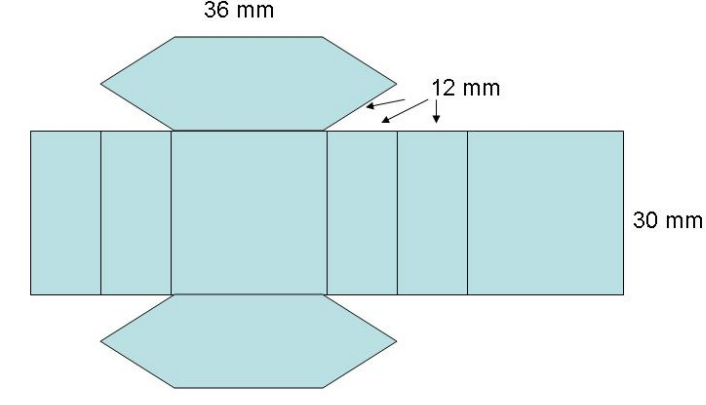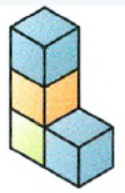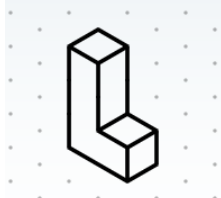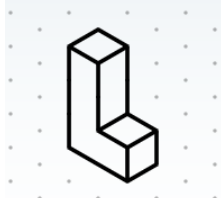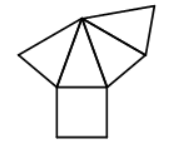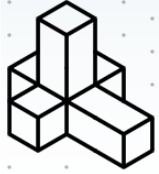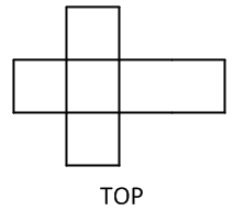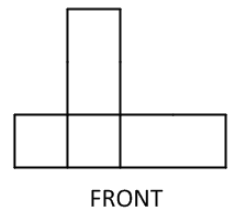
Savvas Learning Co Geometry Student Edition Chapter 2 Reasoning And Proof Exercise 2.2 Logic And Truth Tables

Savvas Learning Co Geometry Student Edition Chapter 2 Reasoning And Proof Exercise 2.2 Logic And Truth Tables


Savvas Learning Co Geometry Student Edition Chapter 2 Exercise 2.2 Logic And Truth Tables Solutions Page 96  Exercise 1  Problem 1

Given:

s: We will go to the beach.

j: We will go out to dinner.

t: We will go to the movies.

To find – Construct the compound statements of s∨j

Disjunction is denoted as ∨

For disjunction we use the word “or” to join two sentences.

Thus, we get s∨j We will go to beach or we will go out to dinner.

Thus, the compound sentence is s∨j: We will go to beach or we will go out to dinner.

Read and Learn More Savvas Learning Co Geometry Student Edition Solutions

Exercise 2.2 Logic And Truth Tables Savvas Geometry Answers Page 96  Exercise 2  Problem 2

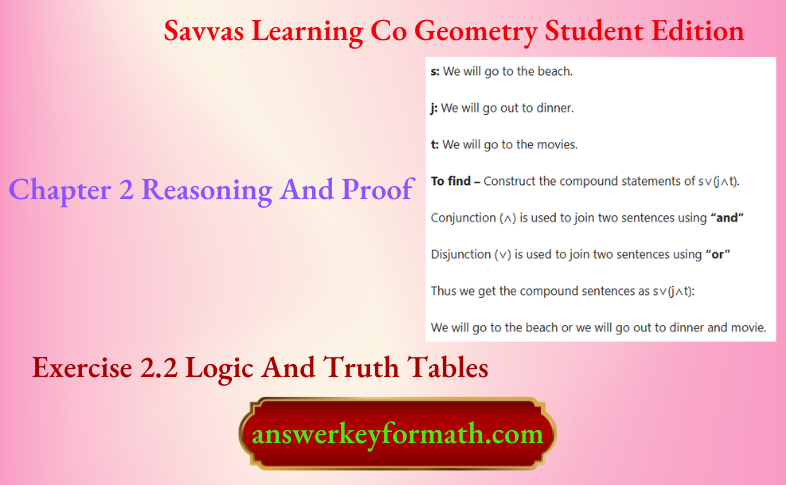
Given:
Savvas Learning Co Geometry Student Edition Chapter 2 Reasoning And Proof Exercise 2.2 Logic And Truth Tables

Thus, the compound sentence is s∨(j∧t): We will go to the beach or we will go out to dinner and movie.


Exercise 2.2 Logic And Truth Tables Savvas Geometry Answers Page 96  Exercise 3  Problem 3

Given: Write three of your own statements.

To find –  Construct compound sentences.

Let

s: I will drink coffee

j: I will drink tea

t: I will eat breakfast

Conjunction (∧) is used to join two sentences using “and”

Disjunction (∨)is used to join two sentences using “or”

1. s∧j  = I will drink coffee and I will drink tea.

2. s∨j = I will drink coffee or I will drink tea.

3. s∨(j∧t) =  I will drink coffee or I will drink tea and eat breakfast

4. (s∨j)∧t = I will drink coffee or tea and eat breakfast

Thus, we get I will drink coffee and I will drink tea.I will drink coffee and I will drink tea.I will drink coffee or I will drink tea and eat breakfast I will drink coffee or tea and eat breakfast


Logic And Truth Tables Solutions Chapter 2 Exercise 2.2 Savvas Geometry Page 96  Exercise 4  Problem 4

Given: x∧y

To find –  Use the statements to determine the truth value of the compound statement.

Considering the statement  x∧y 

Emperor penguins are black and white and Polar bears are a threatened species.

Conjunction x∧y is true only if both the statement is true .

Since given both the statements are true therefore x∧y is true compound sentence.

Thus ,compound sentence x∧y is true.


Logic And Truth Tables Solutions Chapter 2 Exercise 2.2 Savvas Geometry Page 96  Exercise 5  Problem 5

Given: x∨y

To find – Use the statements to determine the truth value of the compound statement.

Considering the statements we get

x∨y: Emperor penguins are black and white and Polar bears are a threatened species.

Disjunction x∨y is false only if both the statements are false.

Since, given both the statement is true therefore the truth value of the compound sentence x∨y is “true”.

Thus, the truth value of the compound sentence x∨y is “true”.


Chapter 2 Exercise 2.2 Logic And Truth Tables Savvas Learning Co Geometry Explanation Page 96  Exercise 6  Problem 6

Given: x∨z

To find – Use the statements to determine the truth value of the compound statement.

Considering the statements

We get x∨z :  Emperor penguins are black and white or Penguins wear tuxedos.

Disjunction of two statement is false only if both the statement is false.

Since, both the given statement is true , therefore the truth value of compound the statement x∨z is “true”

Thus, therefore the truth value of compound the statement x∨z is “true“.


Solutions For Logic And Truth Tables Exercise 2.2 In Savvas Geometry Chapter 2 Student Edition Page 97  Exercise 7  Problem 7

Given: Truth table

To find – Fill the missing values
Savvas Learning Co Geometry Student Edition Chapter 2 Reasoning And Proof Exercise 2.2 Logic And Truth Tables Page 97 Exercise 7 Problem 7 Truth values 1

The complete truth table is :

Savvas Learning Co Geometry Student Edition Chapter 2 Reasoning And Proof Exercise 2.2 Logic And Truth Tables Page 97 Exercise 7 Problem 7 Truth values 2


Solutions For Logic And Truth Tables Exercise 2.2 In Savvas Geometry Chapter 2 Student Edition Page 97  Exercise 8  Problem 8

Given: Truth table of a pattern.

To find –  Fill the missing values.

The truth table

Conjunction (∧) of two statement is true only if both the statements are true

Disjunction (∨) of two statement is false only if both the statements are false
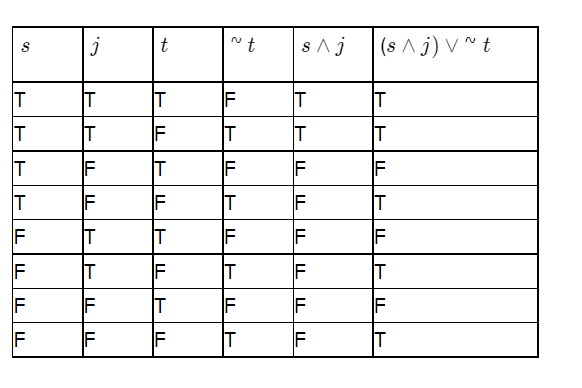
Savvas Learning Co Geometry Student Edition Chapter 2 Reasoning And Proof Exercise 2.2 Logic And Truth Tables Page 97 Exercise 8 Problem 8 Truth values 1

Thus, the complete truth table is

Savvas Learning Co Geometry Student Edition Chapter 2 Reasoning And Proof Exercise 2.2 Logic And Truth Tables Page 97 Exercise 8 Problem 8 Truth values 2


Exercise 2.2 Logic And Truth Tables Savvas Learning Co Geometry Detailed Answers Page 97  Exercise 9  Problem 9

Given: Truth table of a pattern.

To find –  Fill the missing values.

The truth table

Conjunction(∧)of two statement is true only if both the statements are true.

Disjunction (∨)of two statement is false only if both the statements are false.
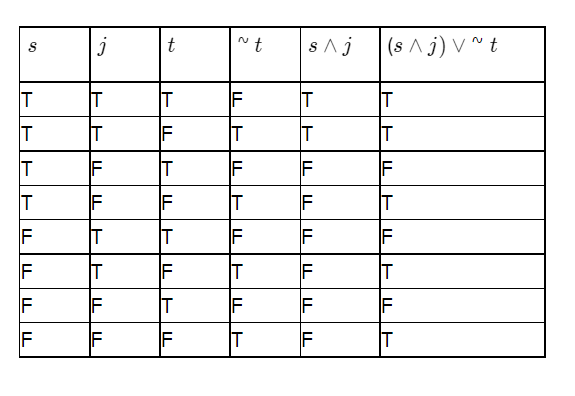
Savvas Learning Co Geometry Student Edition Chapter 2 Reasoning And Proof Exercise 2.2 Logic And Truth Tables Page 97 Exercise 9 Problem 9 Truth values 1

The complete truth table is:

Savvas Learning Co Geometry Student Edition Chapter 2 Reasoning And Proof Exercise 2.2 Logic And Truth Tables Page 97 Exercise 9 Problem 9 Truth values 2


Savvas Learning Co Geometry Student Edition Chapter 2 Page 97  Exercise 10  Problem 10

Given: Truth table of a pattern.

To find – Fill the missing values.

The true table:

Conjunction (∧)of two statement is true only if both the statements are true.

Disjunction (∨)of two statement is false only if both the statements are false.
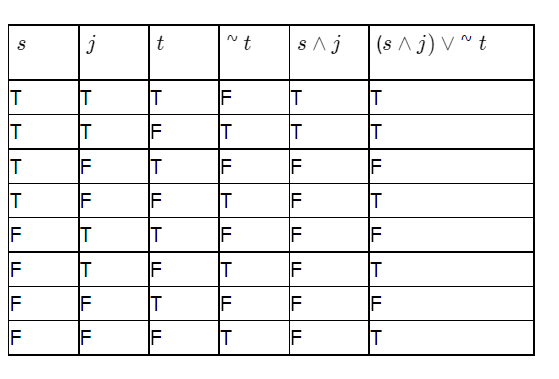
Savvas Learning Co Geometry Student Edition Chapter 2 Reasoning And Proof Exercise 2.2 Logic And Truth Tables Page 97 Exercise 10 Problem 10 Truth values 1

The complete truth table is:

Savvas Learning Co Geometry Student Edition Chapter 2 Reasoning And Proof Exercise 2.2 Logic And Truth Tables Page 97 Exercise 10 Problem 10 Truth values 2


Geometry Chapter 2 Logic And Truth Tables Savvas Learning Co Explanation Guide Page 97  Exercise  11  Problem 11

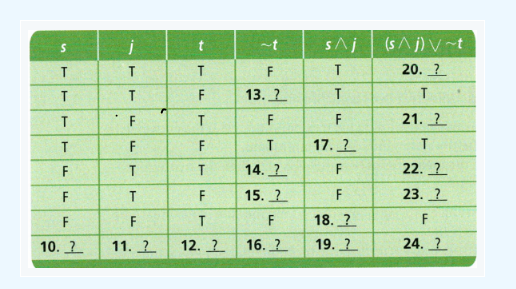
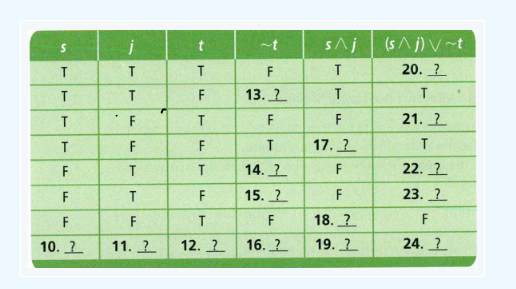
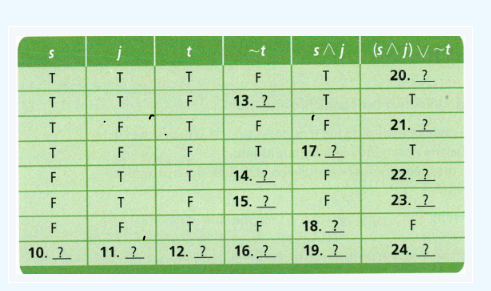
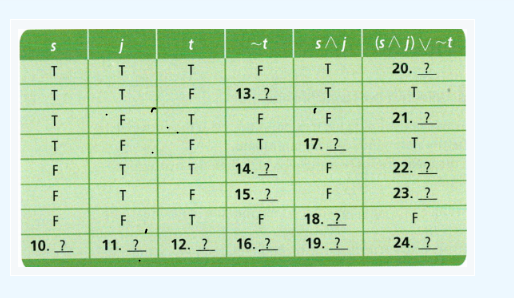
 Given That: You can make a truth table like the one below.

You start with columns for the single statements and add columns to the right.

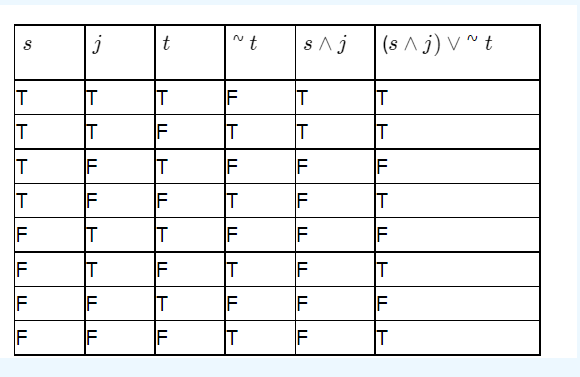
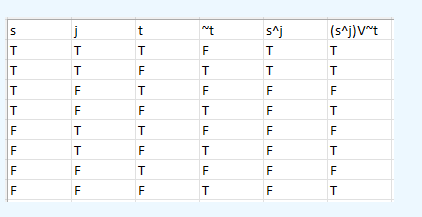
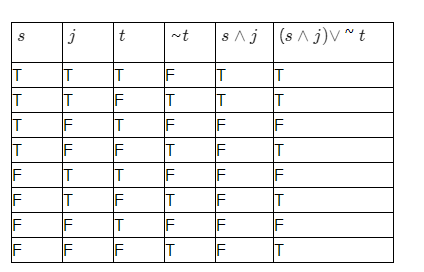
Each column builds toward the final statement. The table below starts with columns for s, j, and j and builds to (s ∧ j) ∨ ∼t.
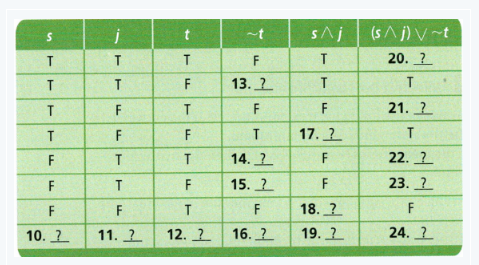
Savvas Learning Co Geometry Student Edition Chapter 2 Reasoning And Proof Exercise 2.2 Logic And Truth Tables Page 97 Exercise 11 Problem 11 Truth values 1

To find –  To find the possible truth values of a complex statement such as (s∧j)∨∼t.

Copy the table and work with a partner to fill in the blanks……

The symbols ~, ∧ ,∨ are not, and, or.

The truth table can be filled by using the functions of symbols ~, ∧, ∨. as

~T = F

⇒ T∧F = F

⇒ T∨F = T

⇒ T∧T = T

⇒ F∧F = F

Now the table is filled by using these above results
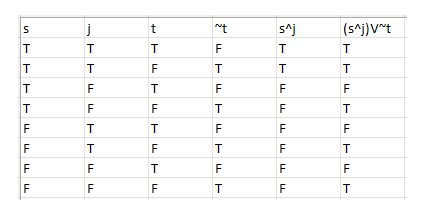
Savvas Learning Co Geometry Student Edition Chapter 2 Reasoning And Proof Exercise 2.2 Logic And Truth Tables Page 97 Exercise 11 Problem 11 Truth values 2

The possible truth values of a complex statement such as (s∧j)∨∼t is
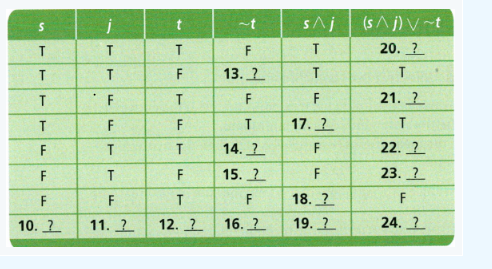
Savvas Learning Co Geometry Student Edition Chapter 2 Reasoning And Proof Exercise 2.2 Logic And Truth Tables Page 97 Exercise 11 Problem 11 Truth values 3

For the given table

Savvas Learning Co Geometry Student Edition Chapter 2 Reasoning And Proof Exercise 2.2 Logic And Truth Tables Page 97 Exercise 11 Problem 11 Truth values 4


Geometry Chapter 2 Logic And Truth Tables Savvas Learning Co Explanation Guide Page 97  Exercise 12  Problem 12

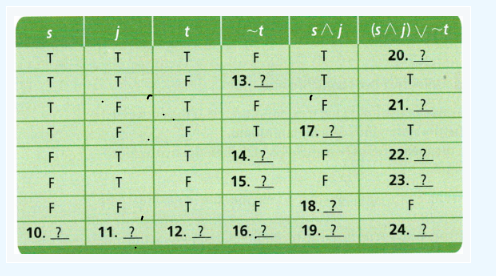
Given that: You can make a truth table like the one below.

You start with columns for the single statements and add columns to the right.

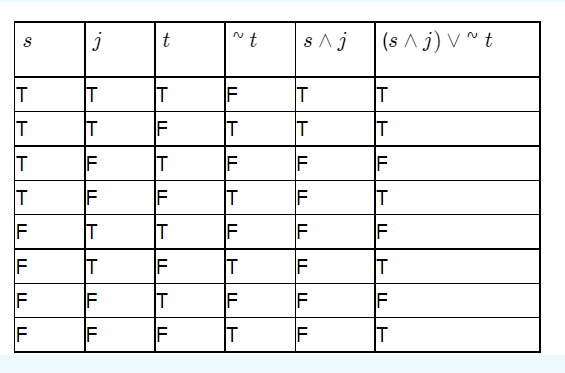
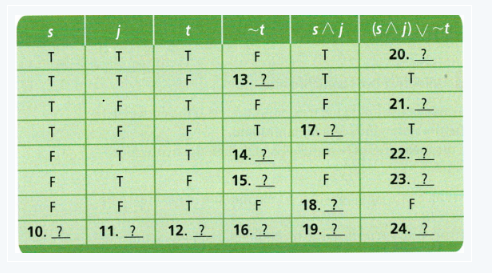
Each column builds toward the final statement. The table below starts with columns for s, j, and j and builds to (s∧j)∨∼t.
Savvas Learning Co Geometry Student Edition Chapter 2 Reasoning And Proof Exercise 2.2 Logic And Truth Tables Page 97 Exercise 12 Problem 12 Truth values 1

To find – To find the possible truth values of a complex statement such as (s∧j)∨∼t.

Copy the table and work with a partner to fill in the blanks ……….

The symbols ~, ∧ ,∨ are not, and, or.

The truth table can be filled by use the functions of symbols ~, ∧, ∨. as

~T = F

⇒ T ∧F = F

⇒ T∨ F = F

⇒ T∧T = T

⇒ F∧F = F

Now the table is fill by use these above results
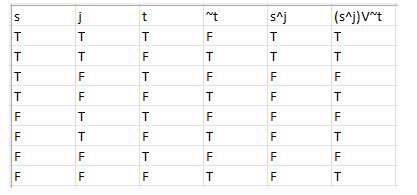
Savvas Learning Co Geometry Student Edition Chapter 2 Reasoning And Proof Exercise 2.2 Logic And Truth Tables Page 97 Exercise 12 Problem 12 Truth values 2

The possible truth values of a complex statement such as (s∧j)∨∼t is 
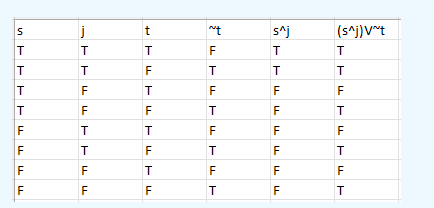
Savvas Learning Co Geometry Student Edition Chapter 2 Reasoning And Proof Exercise 2.2 Logic And Truth Tables Page 97 Exercise 12 Problem 12 Truth values 3

For the given table

Savvas Learning Co Geometry Student Edition Chapter 2 Reasoning And Proof Exercise 2.2 Logic And Truth Tables Page 97 Exercise 12 Problem 12 Truth values 4


Savvas Learning Co Geometry Student Edition Chapter 2 Page 97  Exercise 13  Problem 13

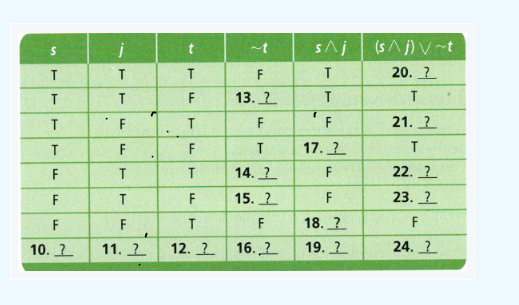
Given that: You can make a truth table like the one below.

You start with columns for the single statements and add columns to the right.

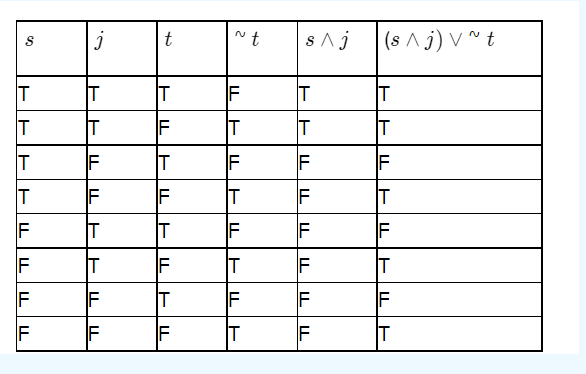
Each column builds toward the final statement. The table below starts with columns for s,j, and t builds to (s∧j)∨∼t

.Savvas Learning Co Geometry Student Edition Chapter 2 Reasoning And Proof Exercise 2.2 Logic And Truth Tables Page 97 Exercise 13 Problem 13 Truth values 1
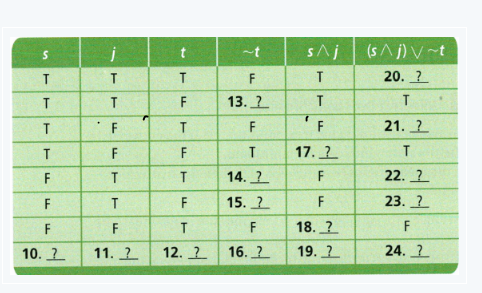
To find – To find the possible truth values of a complex statement such as(s∧j)∨∼t.

Copy the table and work with a partner to fill in the blanks…….

The symbols ~, ∧ ,∨ are not, and, or.

The truth table can be filled by use the functions of symbols ~, ∧, ∨. as

~ T = F

⇒ T ∧ F = T

⇒ T ∨ F = T

⇒ T ∧ T = T

⇒ F ∧ F = F

Now the table is fill by use these above results
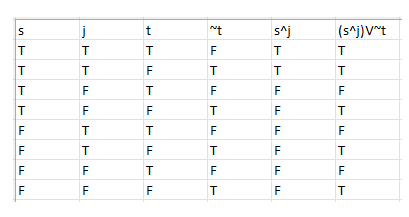
Savvas Learning Co Geometry Student Edition Chapter 2 Reasoning And Proof Exercise 2.2 Logic And Truth Tables Page 97 Exercise 13 Problem 13 Truth values 2
The possible truth values of a complex statement such as (s∧j)∨∼t is
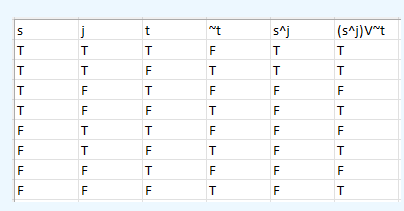
Savvas Learning Co Geometry Student Edition Chapter 2 Reasoning And Proof Exercise 2.2 Logic And Truth Tables Page 97 Exercise 13 Problem 13 Truth values 3

For the given table

Savvas Learning Co Geometry Student Edition Chapter 2 Reasoning And Proof Exercise 2.2 Logic And Truth Tables Page 97 Exercise 12 Problem 12 Truth values 4


Savvas Learning Co Geometry Student Edition Chapter 2 Page 97  Exercise 14  Problem 14

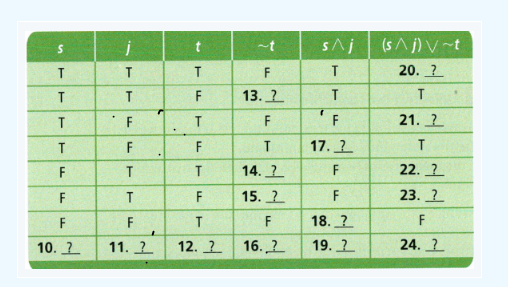
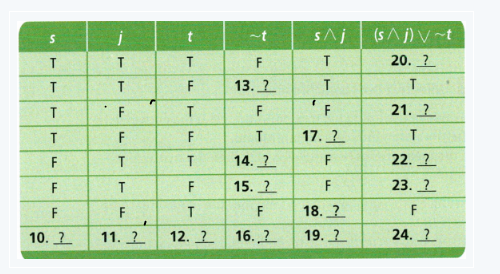
Given that: You can make a truth table like the one below.

You start with columns for the single statements and add columns to the right.

Each column builds toward the final statement.

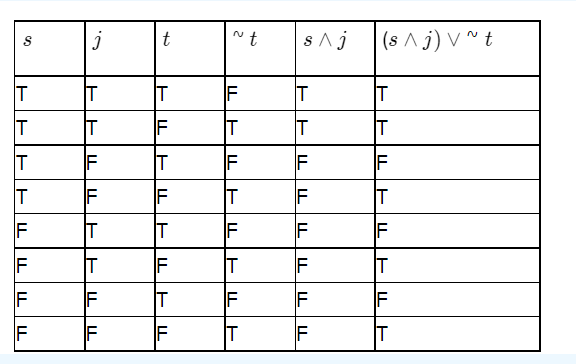
The table below starts with columns for s,j, and t builds to (s∧j)∨∼t
Savvas Learning Co Geometry Student Edition Chapter 2 Reasoning And Proof Exercise 2.2 Logic And Truth Tables Page 97 Exercise 14 Problem 14 Truth values 1

To find –  To find the possible truth values of a complex statement such as (s∧j)∨∼t.

Copy the table and work with a partner to fill in the blanks ………

The symbols ~, ∧ ,∨ are not, and, or.

The truth table can be filled by use the functions of symbols ~, ∧, ∨. as

~ T = F

⇒ T ∧ F = T

⇒ T ∨ F = T

⇒ T ∧ T = T

⇒ F ∧ F = F

Now the table is fill by use these above results
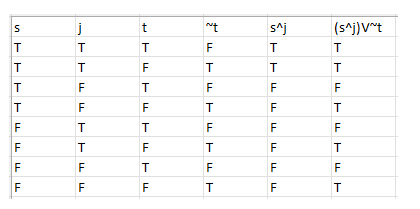
Savvas Learning Co Geometry Student Edition Chapter 2 Reasoning And Proof Exercise 2.2 Logic And Truth Tables Page 97 Exercise 14 Problem 14 Truth values 2

The possible truth values of a complex statement such as (s∧j)∨∼t is
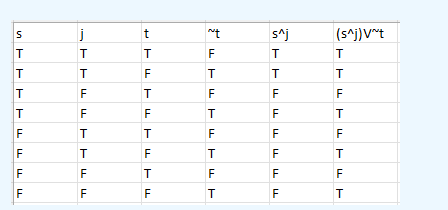
Savvas Learning Co Geometry Student Edition Chapter 2 Reasoning And Proof Exercise 2.2 Logic And Truth Tables Page 97 Exercise 14 Problem 14 Truth values 3

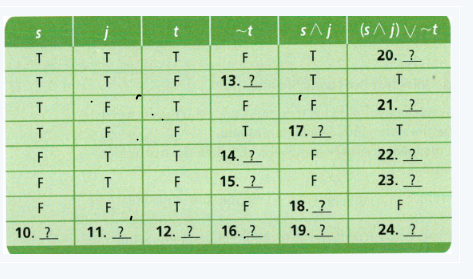
For the given table

Savvas Learning Co Geometry Student Edition Chapter 2 Reasoning And Proof Exercise 2.2 Logic And Truth Tables Page 97 Exercise 14 Problem 14 Truth values 4


Savvas Learning Co Geometry Student Edition Chapter 2 Page 97  Exercise 15  Problem 15

Given that: You can make a truth table like the one below.

You start with columns for the single statements and add columns to the right.

Each column builds toward the final statement. The table below starts with columns for s,j, and t builds to (s∧j)∨∼t
Savvas Learning Co Geometry Student Edition Chapter 2 Reasoning And Proof Exercise 2.2 Logic And Truth Tables Page 97 Exercise 15 Problem 15 Truth values 1

To find – To find the possible truth values of a complex statement such as (s∧j)∨∼t.

Copy the table and work with a partner to fill in the blanks ……….

The symbols ~, ∧ ,∨ are not, and, or.

The truth table can be filled by using the functions of symbols ~, ∧, ∨. as

~ T = F

⇒ T ∧ F = T

⇒ T ∨ F = T

⇒ T ∧ T = T

⇒ F ∧ F = F

Now the table is filled by using these above results
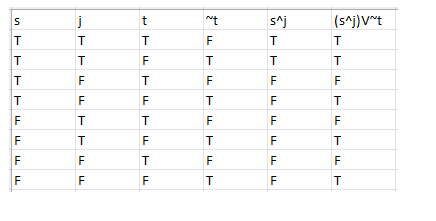
Savvas Learning Co Geometry Student Edition Chapter 2 Reasoning And Proof Exercise 2.2 Logic And Truth Tables Page 97 Exercise 15 Problem 15 Truth values 2

The possible truth values of a complex statement such as (s∧j)∨∼t is
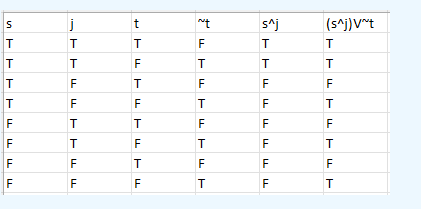
Savvas Learning Co Geometry Student Edition Chapter 2 Reasoning And Proof Exercise 2.2 Logic And Truth Tables Page 97 Exercise 15 Problem 15 Truth values 3

For the given table

Savvas Learning Co Geometry Student Edition Chapter 2 Reasoning And Proof Exercise 2.2 Logic And Truth Tables Page 97 Exercise 15 Problem 15 Truth values 4


Savvas Learning Co Geometry Student Edition Chapter 2 Page 97  Exercise 16  Problem 16

Given that: You can make a truth table like the one below.

You start with columns for the single statements and add columns to the right.

Each column builds toward the final statement. The table below starts with columns for s,j and t builds to (s∧j)∨∼t
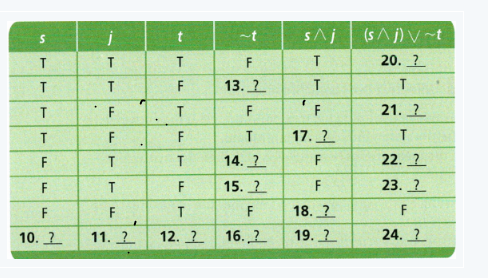
Savvas Learning Co Geometry Student Edition Chapter 2 Reasoning And Proof Exercise 2.2 Logic And Truth Tables Page 97 Exercise 16 Problem 16 Truth values 1

To find – To find the possible truth values of a complex statement such as (s∧j)∨∼t.

Copy the table and work with a partner to fill in the blanks ………….

The symbols ~, ∧ ,∨ are not, and, or.

The truth table can be filled by use the functions of symbols ~, ∧, ∨. as

~ T = F

⇒ T ∧ F = T

⇒ T ∨ F = T

⇒ T ∧ T = T

⇒ F ∧ F = F

Now the table is fill by use these above results
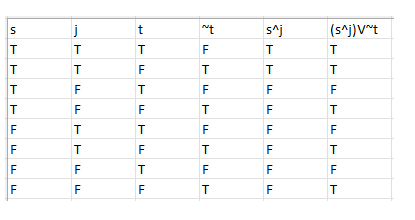
Savvas Learning Co Geometry Student Edition Chapter 2 Reasoning And Proof Exercise 2.2 Logic And Truth Tables Page 97 Exercise 16 Problem 16 Truth values 2

The possible truth values of a complex statement such as (s∧j)∨∼t is
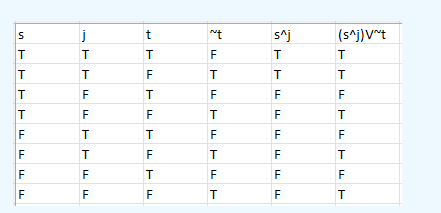
Savvas Learning Co Geometry Student Edition Chapter 2 Reasoning And Proof Exercise 2.2 Logic And Truth Tables Page 97 Exercise 16 Problem 16 Truth values 3

For the given table

Savvas Learning Co Geometry Student Edition Chapter 2 Reasoning And Proof Exercise 2.2 Logic And Truth Tables Page 97 Exercise 16 Problem 16 Truth values 4


Savvas Learning Co Geometry Student Edition Chapter 2 Page 97  Exercise 17  Problem 17

Given that: You can make a truth table like the one below.

You start with columns for the single statements and add columns to the right.

Each column builds toward the final statement. The table below starts with columns for s, j and t builds to (s∧j)∨∼t
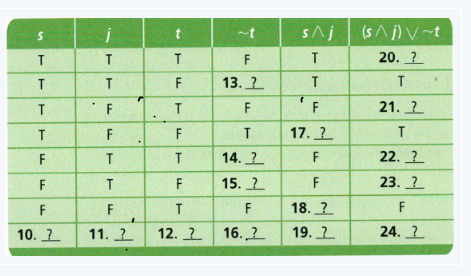
Savvas Learning Co Geometry Student Edition Chapter 2 Reasoning And Proof Exercise 2.2 Logic And Truth Tables Page 97 Exercise 17 Problem 17 Truth values 1

To find – To find the possible truth values of a complex statement such as (s∧j)∨∼t.

Copy the table and work with a partner to fill in the blanks ………..

The symbols ~, ∧ ,∨ are not, and, or.

The truth table can be filled by use the functions of symbols ~, ∧, ∨. as

~ T = F

⇒ T ∧ F = T

⇒ T ∨ F = T

⇒ T ∧ T = T

⇒ F ∧ F = F

Now the table is fill by use these above results
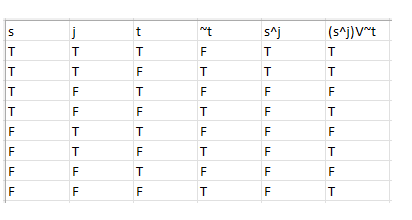
Savvas Learning Co Geometry Student Edition Chapter 2 Reasoning And Proof Exercise 2.2 Logic And Truth Tables Page 97 Exercise 17 Problem 17 Truth values 2

The possible truth values of a complex statement such as (s∧j)∨∼t is 
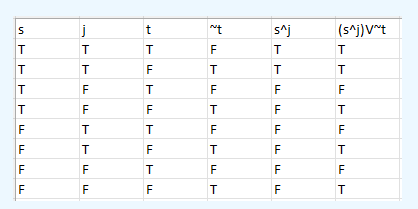
Savvas Learning Co Geometry Student Edition Chapter 2 Reasoning And Proof Exercise 2.2 Logic And Truth Tables Page 97 Exercise 17 Problem 17 Truth values 3

For the given table

Savvas Learning Co Geometry Student Edition Chapter 2 Reasoning And Proof Exercise 2.2 Logic And Truth Tables Page 97 Exercise 17 Problem 17 Truth values 4


Savvas Learning Co Geometry Student Edition Chapter 2 Page 97  Exercise 18  Problem 18

Given that:  You can make a truth table like the one below.

You start with columns for the single statements and add columns to the right.

Each column builds toward the final statement. The table below starts with columns for s, j and t builds to (s∧j)∨∼t
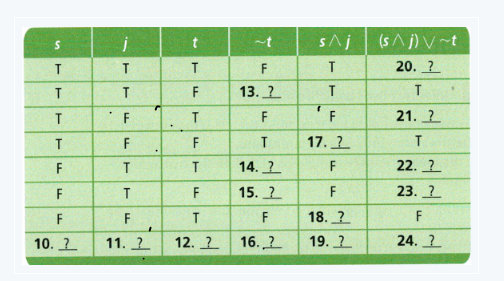
Savvas Learning Co Geometry Student Edition Chapter 2 Reasoning And Proof Exercise 2.2 Logic And Truth Tables Page 97 Exercise 18 Problem 18 Truth values 1

To find – To find the possible truth values of a complex statement such as (s∧j)∨∼t.

Copy the table and work with a partner to fill in the blanks …………..

The symbols ~, ∧ ,∨ are not, and, or.

The truth table can be filled by use the functions of symbols ~, ∧, ∨. as

~ T = F

⇒ T ∧ F = T

⇒ T ∨ F = T

⇒ T ∧ T = T

⇒ F ∧ F = F

Now the table is fill by use these above results
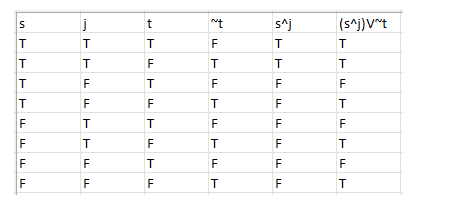
Savvas Learning Co Geometry Student Edition Chapter 2 Reasoning And Proof Exercise 2.2 Logic And Truth Tables Page 97 Exercise 18 Problem 18 Truth values 2

The possible truth values of acomple statement such as (s∧j)∨∼t is
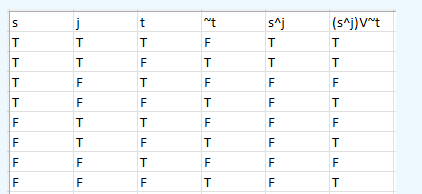
Savvas Learning Co Geometry Student Edition Chapter 2 Reasoning And Proof Exercise 2.2 Logic And Truth Tables Page 97 Exercise 18 Problem 18 Truth values 3

For the given table

Savvas Learning Co Geometry Student Edition Chapter 2 Reasoning And Proof Exercise 2.2 Logic And Truth Tables Page 97 Exercise 18 Problem 18 Truth values 4


Savvas Learning Co Geometry Student Edition Chapter 2 Page 97  Exercise 19  Problem 19

Given that: (∼p∨q)∧∼r

To find – Make truth table for statement. (∼p∨q)∧∼r

The symbols ~, ∧ ,∨ are not, and, or.

The truth table for the statement is (∼p∨q)∧∼r

~ T = F

⇒ T ∧ F = T

⇒ T ∨ F = T

⇒ T ∧ T = T

⇒ F ∧ F = F

Now the table is fill by use these above results
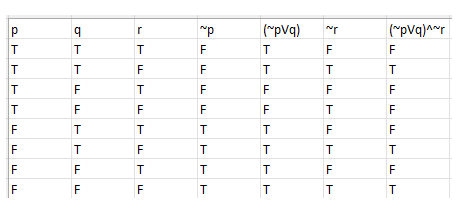
Savvas Learning Co Geometry Student Edition Chapter 2 Reasoning And Proof Exercise 2.2 Logic And Truth Tables Page 97 Exercise 19 Problem 19 Truth values 1

The truth table for the statement (∼p∨q)∧∼r is
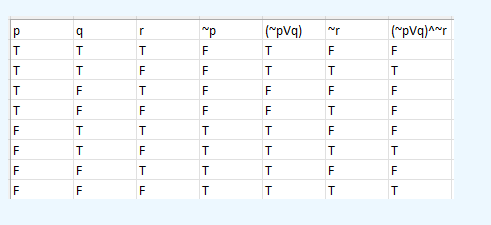
Savvas Learning Co Geometry Student Edition Chapter 2 Reasoning And Proof Exercise 2.2 Logic And Truth Tables Page 97 Exercise 19 Problem 19 Truth values 2

Savvas Learning Co Geometry Student Edition Chapter 2 Reasoning And Proof Exercise 2.2 Conditional Statement

Savvas Learning Co Geometry Student Edition Chapter 2 Reasoning And Proof Exercise 2.2 Conditional Statement


Savvas Learning Co Geometry Student Edition Chapter 2 Exercise 2.2 Conditional Statement Solutions Page 92  Exercise 1  Problem 1

Given:  A statement Residents of Key West live in Florida.

To Find – What is the hypothesis and the conclusion of the following statement and Write it as a conditional.

Given

A statement: Residents of Key West live in Florida.

The hypothesis: The people are residents of Key West.

The conclusion: They live in Florida.

Condition for the given statement: If people are residents of Key West, then they live in Florida.

The hypothesis: The people are residents of Key West.

The conclusion: They live in Florida.

Condition for the given statement: If people are residents of Key West, then they live in Florida.

Read and Learn More Savvas Learning Co Geometry Student Edition Solutions

Savvas Learning Co Geometry Student Edition Chapter 2 Exercise 2.2 Conditional Statement Solutions Page 92  Exercise 2  Problem 2

Given: A condition If a figure is a rectangle with sides 2cm and 3cm, then it has a perimeter of 10cm.

To Find –  Write if the given condition is true or false and what are the converse, inverse, and contrapositive of the condition, what are the truth values of each.

If a figure is a rectangle with sides 2cm, 3cm, then it has a perimeter of 10cm

The given statement is true, ​P = 2(2 + 3) P = 2(5) = 10

The converse is found by exchanging the hypothesis and the conclusion (q→p)

If a figure is a rectangle and has a perimeter of 10cm, then it has sides of 2cm,3cm

We note that this is false since a rectangle with sides 1cm, 4cm has a perimeter of 10cm as a counterexample.

The inverse is found by negating both the hypothesis and the conclusion of the condition.

If a figure is a rectangle and does not have sides, 2cm,3cm then it does not have a perimeter of 10cm.

We note that this is false since the rectangle with sides 1cm, 4cm has a perimeter of 10cm as a counterexample.

The contrapositive is found by negating both the hypothesis and the conclusion of the converse.

If a figure is a rectangle and does not have a perimeter 10cm, then it does not have sides of 2cm,3cm.

We note that this is true since the perimeter of a rectangle has sides 2cm,3cm is 10cm.

The conditional and contrapositive are both true.

The conditional and contrapositive are both true.

Converse: If a figure is a rectangle and has a perimeter of 10cm then it has sides of 2cm,3cm

Inverse: If a figure is a rectangle and does not have sides 2cm,3cm then it does not have a perimeter of 10cm

Contrapositive: If a figure is a rectangle and does not have a perimeter 10cm, then it does not have sides of 2cm,3cm


Exercise 2.2 Conditional Statement Savvas Geometry Answers Page 92  Exercise 3  Problem 3

Given: Your classmate rewrote the statement “You jog every Sunday” as the following conditional. If you jog, then it is Sunday.

To Find –  What is your classmate’s error? Correct it.

Given

The statement:

If you jog, then it is Sunday

The statement is false.

My classmate switched the hypothesis and conclusion.

The correct hypothesis:

If it is Sunday.

The correct conclusion:

Then you should jog.

The statement should actually read as

If it is Sunday, then you jog.

My classmate switched the hypothesis and conclusion. The statement should actually read as If it is Sunday, then you jog.


Conditional Statement Solutions Chapter 2 Exercise 2.2 Savvas Geometry Page 92  Exercise 4  Problem 4

Given:  A conditional statement and its converse are both true.

To Find –  What are the truth values of the contrapositive and inverse? How do you know?

Given

The statement:

A conditional statement and its converse are both true.

It must be true since the conditional and contrapositive have the same truth value and the inverse and converse have the same truth value.

Contrapositive: ~q →´

Converse: p → q

The answer is True, the conditional and contrapositive have the same truth value and the inverse and converse have the same truth value.
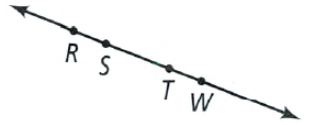
 

Conditional Statement Solutions Chapter 2 Exercise 2.2 Savvas Geometry Page 93  Exercise 5  Problem 5

Given: A condition If a figure is a rectangle, then it has four sides.
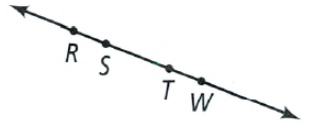
To Find –  Identify the hypothesis and conclusion of each conditional.
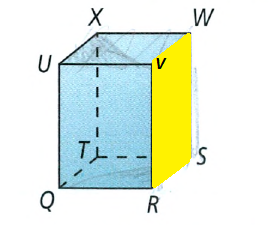
Given

A condition: If a figure is a rectangle, then it has four sides.
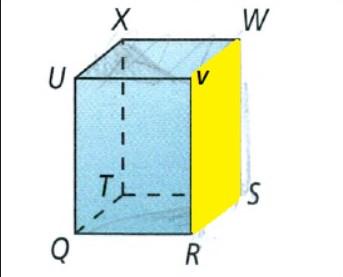
Look for the word ‘if’. The hypothesis will follow.

So, the hypothesis is:

A figure is a rectangle.

Look for the word ‘then’. The conclusion will follow.

So, the conclusion is:

It has four sides.

The hypothesis is: a figure is a rectangle. The conclusion is: it has four sides.


Chapter 2 Exercise 2.2 Conditional Statement Savvas Learning Co Geometry Explanation Page 93  Exercise 6  Problem 6

Savvas Learning Co Geometry Student Edition Chapter 2 Reasoning And Proof Exercise 2.2 Conditional Statement

So the conditional statement will be – If Hank Aaron broke Babe Ruth’s home-run record, then he is the record holder.

The conditional statement for the statement “Hank Aaron broke Babe Ruth’s home-run record” is “If Hank Aaron broke Babe Ruth’s home-run record, then he is the record holder.”


Solutions For Conditional Statement Exercise 2.2 In Savvas Geometry Chapter 2 Student Edition Page 93  Exercise 7  Problem 7

Given: 3x − 7 = 14 implies that 3x  = 21

To Find – Write the sentence as a conditional.

Here the hypothesis and the conclusion are

Hypothesis – 3x−7 = 14

Conclusion – 3x = 21

So the conditional statement will be, “If 3x − 7 = 14 , then 3x = 21 ”

The conditional statement for ” 3x − 7 = 14 implies that 3x = 21 ” is “If 3x−7=14 , then 3x = 21 “


Solutions For Conditional Statement Exercise 2.2 In Savvas Geometry Chapter 2 Student Edition Page 93  Exercise 8  Problem 8

Given:

A statement – A point in the first quadrant has two positive coordinates.

To Find –  Write the sentence as a conditional.

Here the hypothesis and the conclusion are

Hypothesis – A point in the first quadrant

Conclusion –  Has two positive coordinates

So the conditional statement will be – If a point is in the first quadrant, then it has two positive coordinates.

The conditional statement for “A point in the first quadrant has two positive coordinates.” is “If a point is in the first quadrant, then it has two positive coordinates.”


Solutions For Conditional Statement Exercise 2.2 In Savvas Geometry Chapter 2 Student Edition Page 93  Exercise 9  Problem 9

 Given:

A statement – A point in the first quadrant has two positive coordinates.

To find –  Write the sentence as a conditional.

Here the hypothesis and the conclusion will be.

Hypothesis – A point in the first quadrant

Conclusion – has two positive coordinates

So the conditional statement will be “If a point is in the first quadrant, then it has two positive coordinates.”

The conditional statement for “A point in the first quadrant has two positive coordinates.” is “If a point is in the first quadrant, then it has two positive coordinates.”


Exercise 2.2 Conditional Statement Savvas Learning Co Geometry Detailed Answers Page 93  Exercise 10  Problem 10

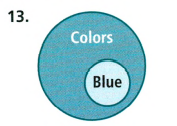
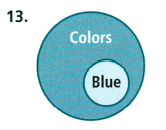
Given: A Venn diagram

Savvas Learning Co Geometry Student Edition Chapter 2 Reasoning And Proof Exercise 2.2 Conditional Statement Page 93 Exercise 10 Problem 10 Colors

To find – Write the Venn diagram as a conditional.

Here we can see that the smaller blue circle is within the large circle labeled “colors”, so we can identify that anything that is blue will have a color to it.

So the conditional statement will be – If something is blue then it has a colour

The conditional for the Venn diagram below is, “If something is blue, then it has a color”

Savvas Learning Co Geometry Student Edition Chapter 2 Reasoning And Proof Exercise 2.2 Conditional Statement Page 93 Exercise 10 Problem 10 Venna 2 Colors


Exercise 2.2 Conditional Statement Savvas Learning Co Geometry Detailed Answers Page 93  Exercise 11  Problem 11

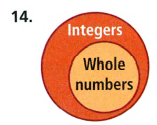
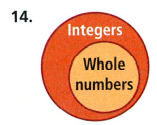
Given: A Venn diagram

Savvas Learning Co Geometry Student Edition Chapter 2 Reasoning And Proof Exercise 2.2 Conditional Statement Page 93 Exercise 11 Problem 11 Venna 1 Integers

To Find – Write the Venn diagram as a conditional.

As the circle of whole numbers is within the circle for integers, so it implies that all whole numbers are also integers.

So the conditional statement will be – If a number is a whole number, then it is also an integer
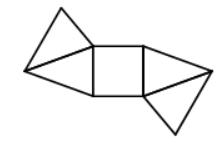
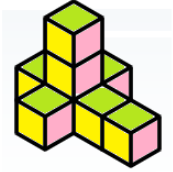
The conditional statement for the Venn diagram given below is “If a number is a whole number, then it is also an integer.”
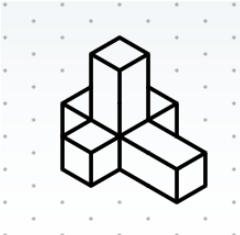
Savvas Learning Co Geometry Student Edition Chapter 2 Reasoning And Proof Exercise 2.2 Conditional Statement Page 93 Exercise 11 Problem 11 Venna 2 Integers


Exercise 2.2 Conditional Statement Savvas Learning Co Geometry Detailed Answers Page 93  Exercise 12  Problem 12

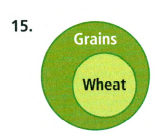
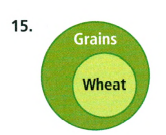
Given: A Venn diagram
Savvas Learning Co Geometry Student Edition Chapter 2 Reasoning And Proof Exercise 2.2 Conditional Statement Page 93 Exercise 12 Problem 12 Venna 1 Grains

To Find –  Write a conditional statement that the Venn diagram illustrates.

In the Venn diagram, we can see that the circle labeled wheat is within the circle labeled grains, so we can conclude that anything that is wheat is also a grain.

So the conditional statement will be – If anything is wheat, then it is also a grain.

The conditional statement that the Venn diagram illustrates is, “If anything is wheat, then it is also a grain.”

Savvas Learning Co Geometry Student Edition Chapter 2 Reasoning And Proof Exercise 2.2 Conditional Statement Page 93 Exercise 12 Problem 12 Venna 2 Grains


Geometry Chapter 2 Conditional Statement Savvas Learning Co Explanation Guide Page 93  Exercise 13  Problem 13

Given: A conditional – If a polygon has eight sides, then it is an octagon.

To find – Determine if the conditional is true or false.

If it is false, find a counterexample.

By the definition, a polygon that has 8 sides is an octagon, thus.

The conditional is true. A polygon with 8 sides is known as an octagon.

The conditional, “If a polygon has eight sides, then it is an octagon.” is true.


Geometry Chapter 2 Conditional Statement Savvas Learning Co Explanation Guide Page 93  Exercise 14  Problem 14

Given: A conditional – If an angle measures 80, then it is acute.

To find  – Determine if the conditional is true or false. If it is false, find a counterexample.

By the definition of the acute angle, we get that 80 degrees is an acute angle.

So the conditional is true. All acute angles lie between 0 degrees to 90 degrees.

The conditional, “If an angle measures 80, then it is acute.” is true. All acute angles lie between 0 degrees to 90 degrees.


Geometry Chapter 2 Conditional Statement Savvas Learning Co Explanation Guide Page 93  Exercise 15  Problem 15

Given: A statement – Pianists are musicians.

To Find –  Write the converse, inverse, and contrapositive of the given conditional statement.

Determine the truth value of all four statements. If a statement is false, give a counterexample.

We have, Pianists are musicians.

First, we will write the conditional statement.

Conditional: If you are a pianist then you are a musician.

Hypothesis: You are a pianist

Conclusion: You are a musician

The conditional statement is true.

Now we write the converse by interchanging the hypothesis and conclusion of conditional

Converse: If you are a musician, then you are a pianist

The converse is false because there are other types of musicians than pianists (for eg. violinists, cellists)

Now we write the inverse by negating the hypothesis and conclusion of conditional.

Inverse: If you are not a pianist, then you are not a musician.

The inverse is false because you can be a musician even if you are not a pianist.

Now we write the contrapositive by interchanging the hypothesis and conclusion of the inverse

Contrapositive: If you are not a musician, then you are not a pianist.

The contrapositive statement is true because you can not be a pianist if you are not a musician.

The conditional, converse, inverse, and contrapositive of the statement, “Pianists are musicians” are.

Conditional: If you are a pianist then you are a musician.

The conditional statement is true.

Converse: If you are a musician, then you are a pianist.

The converse is false because there are other types of musicians than pianists (for eg. violinists, cellists).

Inverse: If you are not a pianist, then you are not a musician.

The inverse is false because you can be a musician even if you are not a pianist.

Contrapositive: If you are not a musician, then you are not a pianist.

The contrapositive statement is true.


Page 93  Exercise 16 Problem 16

Given: A statement – If 4x + 8 = 28 , then x = 5

To find – Write the converse, inverse, and contrapositive of the given conditional statement.

Determine the truth value of all four statements. If a statement is false, give a counterexample.

We have, If 4x + 8 = 28 , then x = 5

Hypothesis- 4x + 8 = 28

Conclusion – x = 5

First, let us calculate the value of x

​⇒  4x + 8 = 28
⇒  4x = 20
⇒  x = 5

Conditional: If 4x + 28 = 28 then x = 5

The conditional is true because x = 5 is the solution of the equation when solved.

Now we write the converse by interchanging the hypothesis and conclusion of conditional.

Converse: If x = 5 , then 4x + 8 = 28

The converse is true because x = 5 satisfies the equation.

Now we write the inverse by negating the hypothesis and conclusion of the conditional.

Inverse:  If 4x + 28 ≠ 28 , then x ≠ 5

The inverse is true because x = 5 satisfies the related equation.

Now we write the contrapositive by interchanging the hypothesis and conclusion of the inverse.

Contrapositive: If x ≠ 5, then 4x + 8 ≠ 28

The contrapositive is true because x = 5 satisfies the equation

The conditional, converse, inverse, and contrapositive of the statement, “If 4x + 8 = 28 , then x = 5 ” are

Conditional: If 4x + 8 = 28 , then x = 5

The conditional is true.

Converse: If x = 5 , then 4x + 8 = 28

The converse is true.

Inverse: If 4x + 8 ≠ 28 , then x ≠ 5

The inverse is true.

Contrapositive: If x≠ 5 , then 4x + 8 ≠ 28

The contrapositive is true.


Page 93  Exercise 17  Problem 17

Given: 

A statement – Odd natural numbers less than 8 are prime.

To Find – Write the converse, inverse, and contrapositive of the given conditional statement.

Determine the truth value of all four statements. If a statement is false, give a counterexample.

We have a statement, “Odd natural numbers less than 8 are prime.”

Hypothesis: an odd natural number less than 8

Conclusion: It is prime.

Conditional: If a number is an odd natural number less than 8, then it is prime.

The conditional is true because 3, 5, 7 are odd natural numbers and are also prime.

Converse: If a number is prime, then it is an odd natural number less than 8.

The converse is false because 13 is a prime number that is greater than 8.

Inverse: If a number is not an odd natural number less than 8, then it is not prime.
The inverse is false as 13 is a prime number greater than 8.

Contrapositive: If a number is not prime, then it is not an odd natural number less than 8.

The contrapositive is true because all prime numbers less than 8 are odd.

The conditional, converse, inverse, and contrapositive of the statement, “Odd natural numbers less than 8 are prime” are

Conditional: If a number is an odd natural number less than 8, then it is prime.
The conditional is true.

Converse: If a number is prime, then it is an odd natural number less than 8.

The converse is false because 13 is a prime number greater than 8.

Inverse: If a number is not an odd natural number less than 8, then it is not prime.

The inverse is false because 13 is not an odd natural number less than but it is prime.

Contrapositive: If a number is not prime, then it is not an odd natural number less than 8.

The contrapositive is true.


Page 93  Exercise 18  Problem 18

Given: A statement – Two lines that lie in the same plane are coplanar.

To find – Write the converse, inverse, and contrapositive of the given conditional statement.

Determine the truth value of all four statements.

If a statement is false, give a counter example.

We have, Two lines that lie in the same plane are coplanar.

Hypothesis: Two lines lie in the same plane

Conclusion: The lines are coplanar

Conditional: If two lines lie in the same plane, then they are coplanar.

The conditional statement is true.

We write converse by exchanging hypothesis and conclusion of conditional.

Converse: If two lines are coplanar, then they lie in the same plane.

The converse statement is true.

We write inverse by negating the hypothesis and conclusion of conditional.

Inverse: If two lines don’t lie in the same plane, then they are not coplanar.

The inverse statement is true.

We write contrapositive by exchanging the hypothesis and conclusion of the inverse statement.

Contrapositive: If two lines are not coplanar, then they don’t lie in the same plane.

The contrapositive is true.

The conditional, converse, inverse, and contrapositive of the statement, “Two lines that lie in the same plane are coplanar.” are

Conditional: If two lines lie in the same plane, then they are coplanar.

The conditional statement is true.

Converse: If two lines are coplanar, then they lie in the same plane.

The converse statement is true.

Inverse: If two lines don’t lie in the same plane, then they are not coplanar.

The inverse statement is true.

Contrapositive:  If two lines are not coplanar, then they don’t lie in the same plane.

The contrapositive statement is true.


Page 94  Exercise 19  Problem 19

Given:

A statement- An event with probability 1 is certain to occur.

To Find – Write the statement as a conditional

We have, An event with probability 1 is certain to occur.

Hypothesis – An event has a probability of 1

Conclusion – The event is certain to occur

The conditional is an if-then statement so the conditional statement will be,

If an event has a probability of 1, then the event is certain to occur.

The conditional statement for the statement, “An event with probability 1 is certain to occur.” is “If an event has a probability of 1, then the event is certain to occur.”


Page 94  Exercise 20  Problem 20

Given: x = 2, x2= 4

To Find – Conditional and contrapositive both are true or not.

Use the basic concepts of reasoning.

If  x = 2 , on squaring both sides then we get

⇒  x2 = 4

Therefore, the conditional statement is true.

Now, if x2 ≠ 4 , then we get ⇒ x ≠ 2

Therefore, the contrapositive statement is also true.

Another example in which both conditional and contrapositive statements are true is if x = 3, then x2 = 9.

Both conditional and contrapositive statements are true.


Page 94  Exercise 21  Problem 21

Given: Conditional statement.

To find – write two conditional statements in which one is true and another is false.

Use the basic concepts of reasoning.

Statement (A): If x = 3 , then x2 = 9.

If x = 3, on squaring both the sides then we get, ⇒ x2 = 9

This statement is conditionally true.

Statement (B): “If you get a good score in the entrance exam then you will not get the scholarship”.

This statement is not conditionally true because generally if the candidate gets good marks in the entrance exam then he will definitely get the scholarship for study.

The statement (A) is conditionally true.

The statement is ” if x = 3, then x2 = 9.”

The statement (B) is conditionally false. The statement is “If you get a good score in the entrance exam then you will not get the scholarship”.


Page 94  Exercise 22  Problem 22

Given: The given conditional statement is true.

To find   whether the contrapositive statement is true or false.

Use the basic concepts of reasoning.

Statement A: ” If the pitchers performed well, then there is the chance of winning the baseball game”.

The contrapositive statement A is true because if there is no chance of winning then the pitchers are not performing well while playing the game.

Statement B:
” If someone is a baseball player then someone is an athlete.

The contrapositive statement B is False because” if someone is not a baseball player, then it does not mean he is not an athlete”.

Both Natalie and Sean are correct. Because the contrapositive of statement A is true and contrapositive of statement B is false.


Page 94  Exercise 23  Problem 23

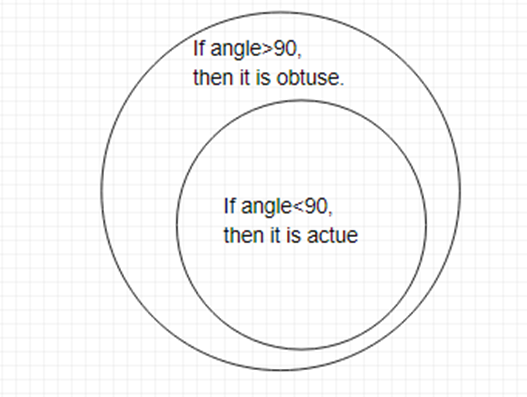
Given: Conditional statement.

To find – Venn diagram Use the basic concepts of the Venn diagram.

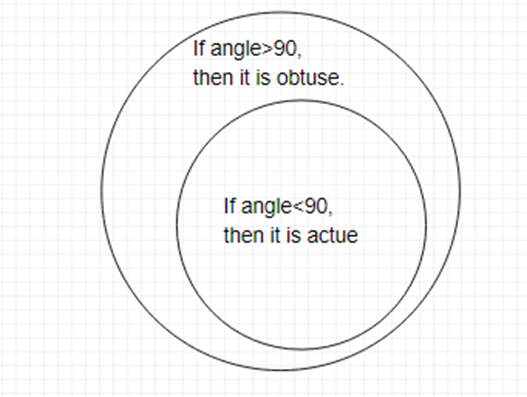
The given conditional statement is,” If an angle measures 100 , then it is obtuse”.

The Venn diagram can be represented as:

Savvas Learning Co Geometry Student Edition Chapter 2 Reasoning And Proof Exercise 2.2 Conditional Statement Page 94 Exercise 23 Problem 23 Obtuse angle 1

The Venn diagram which represents the given conditional state

Savvas Learning Co Geometry Student Edition Chapter 2 Reasoning And Proof Exercise 2.2 Conditional Statement Page 94 Exercise 23 Problem 23 Obtuse angle 2


Page 94   Exercise 24   Problem 24

Given: Conditional statement.

To find  – Venn diagram Use the basic concepts of the Venn diagram.

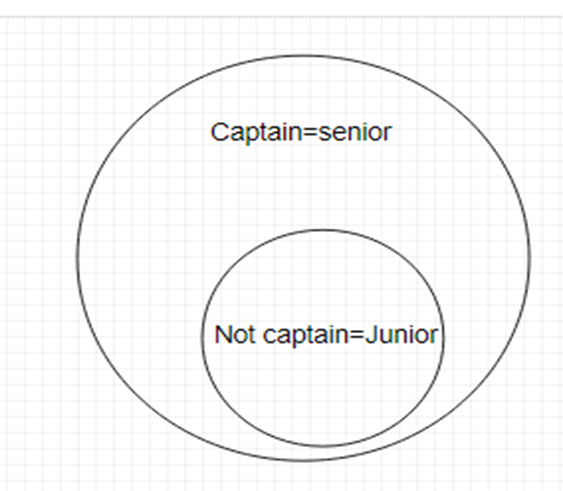
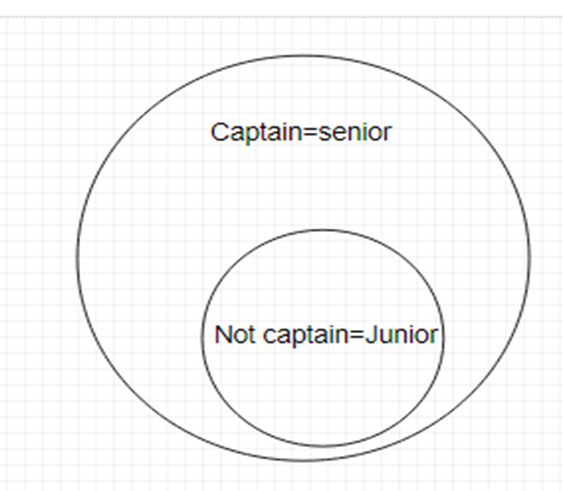
The given conditional statement is, “If you are the captain of your team, then you are junior or senior”.

The Venn diagram can be represented as:

Savvas Learning Co Geometry Student Edition Chapter 2 Reasoning And Proof Exercise 2.2 Conditional Statement Page 94 Exercise 24 Problem 24 Venn 1 Captain and Senior

Venn diagram of the given conditional statement is:Savvas Learning Co Geometry Student Edition Chapter 2 Reasoning And Proof Exercise 2.2 Conditional Statement Page 94 Exercise 24 Problem 24 Venn 2 Captain and Senior


Page 94  Exercise 25  Problem 25

Given: If y is negative, then −y is positive.

To find – Converse statementUse the basic concepts of reasoning.

p: If y is negative, then −y is positive.

This statement is conditionally true.

Now we have to write the converse of this statement.

q: If −y is positive, then y is negative.

Let  − y = 4

⇒  y = −4

Hence the converse statement is also true.

The converse statement is true.


Page 94  Exercise 26  Problem 26

Given: If x < 0 , then x3 < 0.

To find contrapositive statement.Use the basic concepts of reasoning.

p: If x < 0 , then x3 < 0 .

This statement is conditionally true.

Now if have to find the converse of this statement.

q: If x3 < 0 , then x < 0.

Let x =−2 which is less than 0

On cubing both the sides, then we get

⇒  x3

=  −8 which is also less than 0.

⇒ If −2 < 0 , then (−2)3 < 0.

Hence the converse statement is also true.

The converse of the given statement is also true. The converse statement is,” if x < 0, then x3 < 0.


Page 94  Exercise 27  Problem 27

Given: If x < 0, then x2 > 0.

To find – Whether the converse is true or false.

Use the basic concept of reasoning.

p: If x < 0 , then x2 > 0.

This statement is conditionally true.

q: If x2 > 0, then x < 0.

Clearly, the converse part is not true.

Let us consider x2 =  4.

On square root both the sides then we get

⇒ x = −2,2

Here −2 < 0 but 2 > 0.

Therefore the converse of the statement is not true.

The converse of the statement is false.


Page 94  Exercise 28  Problem 28

Given: AdvertisementTo find a Conditional statement.

By using the basic concepts of reasoning we shall write the conditional statement.

The conditional statement can be written as,” If you wear snazzy sneakers, then you look cool”.

The conditional statement is,” If you wear snazzy sneakers, then you look cool”.


Page 94  Exercise 29  Problem 29

Given: Postulates.

To find a Conditional statement.

By using the basic concepts of reasoning we shall write the conditional statement.

The conditional statement can be written as,” If the two lines are intersecting lines, then they meet exactly at one point”.

The conditional is,” If the two lines are intersecting lines, then they meet exactly at one point“.

Savvas Learning Co Geometry Student Edition Chapter 2 Reasoning And Proof Exercise 2.1 Patterns and Inductive Reasoning

Savvas Learning Co Geometry Student Edition Chapter 2 Reasoning And Proof Exercise 2.1 Patterns and Inductive Reasoning


Savvas Learning Co Geometry Student Edition Chapter 2 Exercise 2.1 Patterns And Inductive Reasoning Solutions Page 85  Exercise 1  Problem 1

Given: All four-sided figures are squares.

To find –  What is a counterexample for the given conjecture.

Given

All four- sided figures are squares.

A counterexample is one that proves the statement false.

Therefore, by saying that a rectangle is a four-sided figure we prove the statement incorrect.

So, the counterexample is

A rectangle is a four-sided figure.

The answer is a rectangle is a four-sided figure.


Savvas Learning Co Geometry Student Edition Chapter 2 Exercise 2.1 Patterns And Inductive Reasoning Solutions Page 85  Exercise 2  Problem 2

The counter is something opposite from the given statement. A counterexample is used to show that conjecture is false.

A counterexample to a mathematical statement is an example that satisfies the statement’s condition(s) but does not lead to the statement’s conclusion.

Identifying counterexamples is a way to show that a mathematical statement is false.

These opposing positions are called counterarguments.

Think of it this way: if my argument is that dogs are better pets than cats because they are more social, but you argue that cats are better pets because they are more self-sufficient, your position is a counterargument to my position.

The counter is something opposite from the given statement. A counterexample is used to show that conjecture is false.

Read and Learn More Savvas Learning Co Geometry Student Edition Solutions

Exercise 2.1 Patterns And Inductive Reasoning Savvas Geometry Answers Page 85  Exercise 3  Problem 3

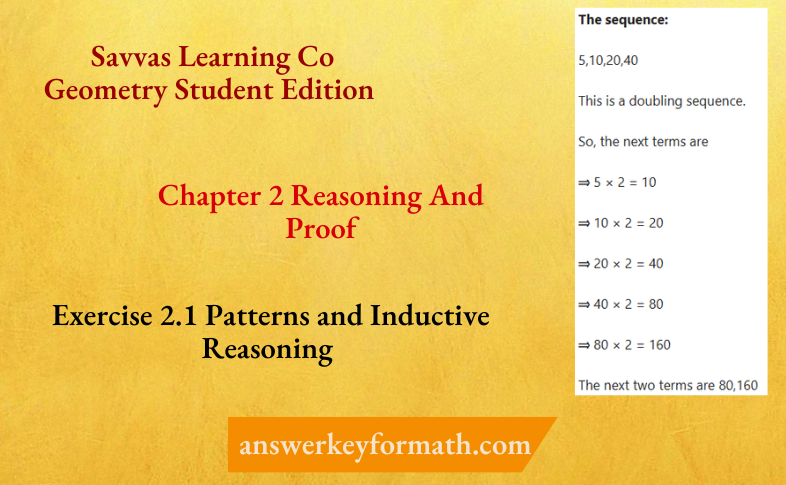
Given: The sequence 5,10,20,40

To find –  Find the next two-term in the sequence.

Given

Savvas Learning Co Geometry Student Edition Chapter 2 Reasoning And Proof Exercise 2.1 Patterns and Inductive Reasoning

The answer is 80,160


Exercise 2.1 Patterns And Inductive Reasoning Savvas Geometry Answers Page 85  Exercise 4  Problem 4

Given: 1,4,9,16,25,…

To find –  Find a pattern for each sequence.

Here, the pattern is 12,22,32,42,52

So the next two patterns will be 62,72

The next two patterns will be  62,72.


Patterns And Inductive Reasoning Solutions Chapter 2 Exercise 2.1 Savvas Geometry Page 85  Exercise 5  Problem 5

Given: 1,−1,2,−2,3,………..

To find –  Find a pattern for each sequence.

Use the pattern to show the next two terms.

A sequence or number pattern is an ordered set of numbers or diagrams that follow a rule.

The pattern for terms starts at 1, then goes to the opposite of this number.

Then one is added to the opposite of this new term. Continue in this pattern of alternating, making it the opposite or making it the opposite and adding one.

The next two terms of this sequence are −3,4.


Chapter 2 Exercise 2.1 Patterns And Inductive Reasoning Savvas Learning Co Geometry Explanation Page 85  Exercise 6  Problem 6

Given:  A series 1, \(1, \frac{1}{2}, \frac{1}{4}, \frac{1}{8}\)….. is given.

To find –  A pattern in the series and the next two terms.

Given series 1, \(1, \frac{1}{2}, \frac{1}{4}, \frac{1}{8}\)

Divide the second term by the first term to find the pattern

\(\frac{\frac{1}{2}}{1}=\frac{1}{2}\)

Each term is being multiplied by \(\frac{1}{2}\)in the series

Next term after \(\frac{1}{8}\) ⇒  \(\frac{1}{8}\) ×\(\frac{1}{2}\) = \(\frac{1}{16}\)

Next term after \(\frac{1}{16}\) ⇒  \(\frac{1}{16}\) ×\(\frac{1}{2}\) = \(\frac{1}{32}\)

Each term is being multiplied by \(\frac{1}{2}\) in the series and the next two terms in the series \(\frac{1}{16}\) and \(\frac{1}{32}\)


Chapter 2 Exercise 2.1 Patterns And Inductive Reasoning Savvas Learning Co Geometry Explanation Page 85  Exercise 7  Problem 7

Given: A series 1, \(\frac{1}{2}, \frac{1}{3}, \frac{1}{4}\) …………  is given.

To find  – A pattern in the series and the next two terms.

Given series 1, \(\frac{1}{2}, \frac{1}{3}, \frac{1}{4}\) ………..

We can see that in the denominator of each term, one is being added.

So next term after \(\frac{1}{4}\) ⇒ \(\frac{1}{4+1}\) = \(\frac{1}{5}\)

And the next term after \(\frac{1}{5}\) ⇒ \(\frac{1}{5+1}\) = \(\frac{1}{6}\).

In the sequence 1, \(\frac{1}{2}, \frac{1}{3}, \frac{1}{4}\) ………..

one is being added in the denominator of each term and the next two terms of the sequence are \(\frac{1}{5}\) and \(\frac{1}{6}\)


Chapter 2 Exercise 2.1 Patterns And Inductive Reasoning Savvas Learning Co Geometry Explanation Page 85  Exercise 8  Problem 8

Given: A series 15,12,9,6, ……. is given.

To Find –  A pattern in the series and the next two terms.

Given series 15,12,9,6 ……………..

Subtract the second term from the first term to find the pattern.

15 − 12 = 3

So 3 is being subtracted from each term.

The next term after 6 ⇒ 6 − 3 = 3 and the next term after 3 ⇒ 3 − 3 = 0

In the sequence15,12,9,6… ……, 3 is being subtracted from each term and the next two terms of the sequence are 3 and 0.


Solutions For Patterns And Inductive Reasoning Exercise 2.1 In Savvas Geometry Chapter 2 Student Edition Page 85  Exercise 9  Problem 9

Given:  A series O, T, T, F, F, S, E, …….. is given

To find – A pattern in the series and the next two terms.

Given series O, T, T, F, F, S, E, ……….

The letters given in the series are the first letter of numbers

​One = O

Two = T

Three = T

Four = F

Five = F

Six = S

Eight = E

So next letter in the series will be​ Nine = Nand Ten = T

The next two terms in the series O, T, T, F, F, S, E,… will be N and T.


Solutions For Patterns And Inductive Reasoning Exercise 2.1 In Savvas Geometry Chapter 2 Student Edition Page 85  Exercise 10  Problem 10

Given: A series- Dollar coin, half a dollar, quarter,……..  is given.

To find –  A pattern in the series and the next two terms.

Given series- Dollar coin, half a dollar, quarter,……..

We can see that the dollar is being divided in half in every term.

So the next two terms in the series will be⇒

one-eighth and one-sixteenth.

The next two terms in the series- Dollar coin, half a dollar, quarter,….. are ⇒ one-eighth and one-sixteenth.


Exercise 2.1 Patterns And Inductive Reasoning Savvas Learning Co Geometry Detailed Answers Page 85  Exercise 11  Problem 11

Given: A series AL, AK, AZ, AR, CA ……….  is given.

To find –  A pattern in the series and the next two terms.

Given series AL, AK, AZ, AR, CA ……

These are the short form of the states name of the U.S.

​AL = Alabama

AK = Alaska

AZ = Arizona

AR = Arkansas

CA = California

So the next two terms in the series will be

​CO = Colarado

CT = Connecticut

The next two terms in the series AL, AK, AZ, AR, CA …….  are CO and CT


Exercise 2.1 Patterns And Inductive Reasoning Savvas Learning Co Geometry Detailed Answers Page 85  Exercise 12  Problem 12

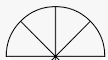
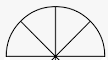
Given: A series is given

Savvas Learning Co Geometry Student Edition Chapter 2 Reasoning And Proof Exercise 2.1 Patterns And Inductive Reasoning Page 85 Exercise 12 Problem 12 Semicircle 1

To Find A pattern in the series and the next two terms.

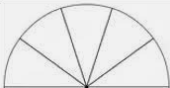
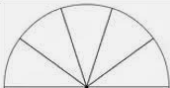
In the given series the semicircle is being divided into equal parts.

So the next two terms in the series will be

Savvas Learning Co Geometry Student Edition Chapter 2 Reasoning And Proof Exercise 2.1 Patterns And Inductive Reasoning Page 85 Exercise 12 Problem 12 Semicircle 2

And

Savvas Learning Co Geometry Student Edition Chapter 2 Reasoning And Proof Exercise 2.1 Patterns And Inductive Reasoning Page 85 Exercise 12 Problem 12 Semicircle 3

The next two terms in the series are

Savvas Learning Co Geometry Student Edition Chapter 2 Reasoning And Proof Exercise 2.1 Patterns And Inductive Reasoning Page 85 Exercise 12 Problem 12 Semicircle 4

And

Savvas Learning Co Geometry Student Edition Chapter 2 Reasoning And Proof Exercise 2.1 Patterns And Inductive Reasoning Page 85 Exercise 12 Problem 12 Semicircle 5


Geometry Chapter 2 Patterns And Inductive Reasoning Savvas Learning Co Explanation Guide Page 85  Exercise 13  Problem 13

Given: Sequence of figures.

To find: The shape of the fortieth figure

We are given a sequence of figures. We need to find the shape of the fortieth figure.

In terms of shape, there are four shapes that repeat in a cycle of circle-triangle-square-star.

Using this pattern, the fortieth figure will be a star.

The fortieth figure will be a star.


Geometry Chapter 2 Patterns And Inductive Reasoning Savvas Learning Co Explanation Guide Page 85  Exercise 14  Problem 14

Given: The sum of the first 100 positive odd numbers.

To find a conjecture for each scenario

We make the following conjecture.

The sum of the first 100 positive odd numbers is 10,000.

The first 100 positive odd numbers are 1,3,5,…,199.

Let their sum be S.

⇒  S = 1 + 3 + 5 + ⋯+ 199

We write the sum in two ways.

⇒  S = 199 + 197 + ⋯+ 3 + 1

We add the two equations side by side.

⇒  S + S = (1 + 199) + (3 + 197) +…+(197​ + 3) + (199 + 1)

⇒  2S = 200 + 200 + ⋯ + 200

⇒  2S = 200.100

⇒  S = 10000

The sum of the first 100 positive odd numbers is 10000.


Savvas Learning Co Geometry Student Edition Chapter 2 Reasoning And Proof Exercise 2.1 Patterns and Inductive Reasoning Page 85  Exercise 15  Problem 15

Given: The sum of the first 100 positive even numbers.

To find:  A conjecture for each scenario

We start by considering a small number, and we will use a form of deduction to come up with a conjecture.

Consider first 10 even numbers. 2 + 4 + 6 + ⋯ + 20

Rearranging the terms: (2 + 20)+(4 + 16)+(6 + 14) + (8 + 12) + (10 + 12)

⇒  5(22) = 110

We can use a similar trick for the first 100 even numbers, except each pair will equal 202, instead of 22.

Since there were 5 terms when we found the sum of the first 10 odd numbers, there are 50 terms for the sum of first 100 even numbers.

That gives, S = 202(50) = 10100

The sum of first 100 positive even numbers is 10100.


Page 85  Exercise 16  Problem 16

Given:  The sum of an even and odd number.

To find: A conjecture for each scenario

The sum of an even and odd number is odd.

This is always true, because even and odd numbers are adjacent have the form n, n + 1,n + 2,…

Since the sum of consecutive even or odd numbers is even.

The sum of an even and odd number is odd.

The sum of an even and odd number is odd.


Savvas Learning Co Geometry Student Edition Chapter 2 Reasoning And Proof Exercise 2.1 Patterns and Inductive Reasoning Page 85  Exercise 17  Problem 17

Given: The product of two odd numbers

To find: A conjecture for each scenario

Since odd numbers are not divisible by two.

If multiplying two odd numbers got us an even number, then we would have the product of 2 and some number.

However, this is not right, because of the previous statement that odd numbers cannot be divisible by two.

So, the product of two odd numbers is odd.

The product of two odd numbers is odd.

Savvas Learning Co Geometry Student Edition Chapter 1 Tools of Geometry Exercise 1.2 Points Lines and Planes

Savvas Learning Co Geometry Student Edition Chapter 1 Tools of Geometry Exercise 1.2 Points Lines and Planes


Savvas Learning Co Geometry Student Edition Chapter 1 Exercise 1.2 Points Lines And Planes Solutions Page 16  Exercise 1  Problem 1

Given:

Savvas Learning Co Geometry Student Edition Chapter 1 Tools of Geometry Exercise 1.2 Points Lines and Planes Page 16 Exercise 1 Problem 1 Geometrical 1

To find what are two other names for \(\overleftarrow{X Y}\).

Using the method geometrical representation.

From the given
Savvas Learning Co Geometry Student Edition Chapter 1 Tools of Geometry Exercise 1.2 Points Lines and Planes Page 16 Exercise 1 Problem 1 Geometrical 2

A line is named by any two points (in any order) on the line such as AB or by a single lowercase such as line l.

\(\overleftarrow{X Y}\) can also be named as \(\overleftarrow{Y X}\) or \(\overleftarrow{X R}\) or \(\overleftarrow{R X}\) or\(\overleftarrow{R Y}\) or\(\overleftarrow{Y R}\)

The other names for \(\overleftarrow{X Y}\) are\(\overleftarrow{Y X}\) or \(\overleftarrow{X R}\) or \(\overleftarrow{R X}\) or\(\overleftarrow{R Y}\) or\(\overleftarrow{Y R}\)

Read and Learn More Savvas Learning Co Geometry Student Edition Solutions

Exercise 1.2 Points Lines And Planes Savvas Geometry Answers Page 16  Exercise 2  Problem 2

Given:

Savvas Learning Co Geometry Student Edition Chapter 1 Tools of Geometry Exercise 1.2 Points Lines and Planes

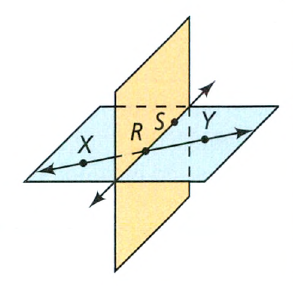
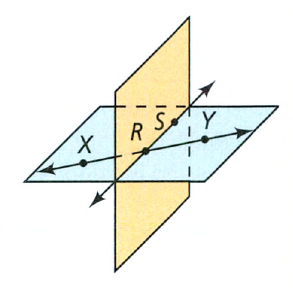
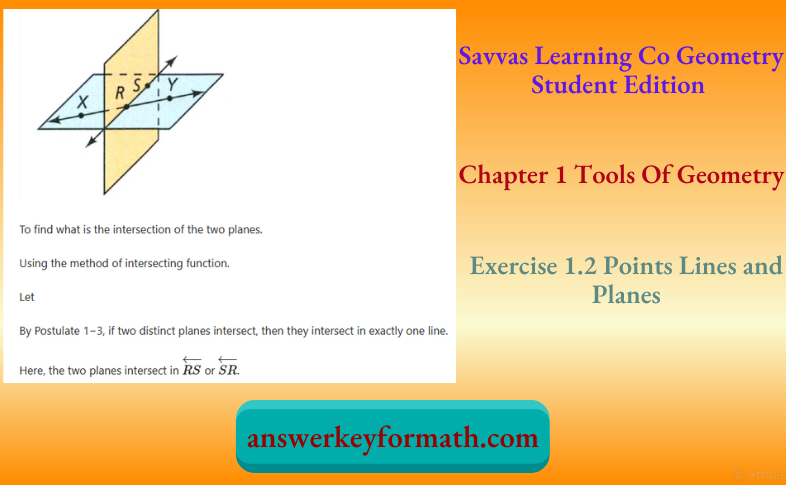
The intersection of the two planes is \(\overleftarrow{R S}\) or \(\overleftarrow{S R}\)


Points Lines And Planes Solutions Chapter 1 Exercise 1.2 Savvas Geometry Page 16  Exercise 3  Problem 3

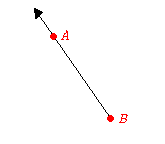
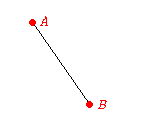
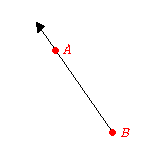
Given: Ray, \(\overline{AB}\)and \(\overline{AB}\)

To find the given rays are same.Using the method Functions of Ray.

A ray is a part of a line that has one endpoint and goes on infinitely in only one direction. Cannot measure the length of a ray.

Savvas Learning Co Geometry Student Edition Chapter 1 Tools of Geometry Exercise 1.2 Points Lines and Planes Page 16 Exercise 3 Problem 3 Direction of ray

A ray is named using its endpoint first, and then any other point on the ray (for example \(\overline{B A}\)).

These two are not the same ray because their directions are different. One starts at A then moves towards B and continues in the direction of B.

The other starts at B and goes toward A continuing in A’s direction.

The Rays \(\overline{A B}\) and \(\overline{A B}\) are not same


Page 16  Exercise 4  Problem 4

Given: \(\overleftarrow{E F}\)

To explain about two arrowheads.Using the method Functions of Line.

Can say that a line is an infinitely thin, infinitely long collection of points extending in two opposite directions.

When draw lines in geometry, use an arrow at each end to show that it extends infinitely

Savvas Learning Co Geometry Student Edition Chapter 1 Tools of Geometry Exercise 1.2 Points Lines and Planes Page 16 Exercise 4 Problem 4 Directions of rays

A line can be named either using two points on the line (for example,\(\overleftarrow{A B}\)).

Arrowheads are used to imply that the lines extend infinitely in both directions.

Arrowheads are used to imply that the lines extend infinitely in both directions.


Chapter 1 Exercise 1.2 Points Lines And Planes Savvas Learning Co Geometry Explanation Page 16  Exercise 5  Problem 5

Given: Ray and Line.

To Differentiate.

Using the method Functions of Ray and Line.

The naming of a ray and a line is similar in the sense that use two points named by letters to name each.

However, with a line the order of the letters does not matter because the line continues in both directions beyond these points.

A ray on the other hands has a specific direction, so the order of the letters determines which ray have named because the first letter is always the endpoint with the second letter being the direction in which the ray continues.

The naming of a ray and a line is similar in the sense that use two points named by letters to name each. The order of the letters determines which ray have named because the first letter is always the endpoint with the second letter being the direction in which the ray continues.


Solutions For Points Lines And Planes Exercise 1.2 In Savvas Geometry Chapter 1 Student Edition Page 16  Exercise 6  Problem 6

Given:
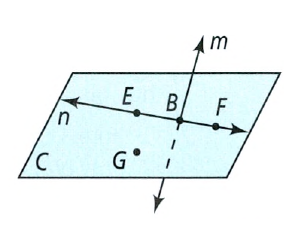
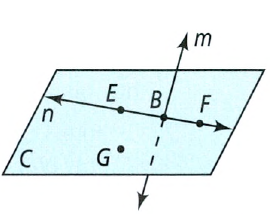
Savvas Learning Co Geometry Student Edition Chapter 1 Tools of Geometry Exercise 1.2 Points Lines and Planes Page 16 Exercise 6 Problem 6 Non collinear Point plane 1

To find other ways to name plane C.

Using the method Functions of Plane.

Given

Savvas Learning Co Geometry Student Edition Chapter 1 Tools of Geometry Exercise 1.2 Points Lines and Planes Page 16 Exercise 6 Problem 6 Non collinear Point plane 2

Can name a plane either by a letter or by a sequence of 3 noncollinear points which belong to the plane (because3 noncollinear points uniquely determine a plane):GEB, GEF, GEF.

The other way to name plane C is,GEB,GBF,GEF.


Solutions For Points Lines And Planes Exercise 1.2 In Savvas Geometry Chapter 1 Student Edition Page 16  Exercise 7  Problem 7

Given:

Savvas Learning Co Geometry Student Edition Chapter 1 Tools of Geometry Exercise 1.2 Points Lines and Planes Page 16 Exercise 7 Problem 7 Collinear Point plane 1

To name three collinear points.

Using the method Functions of collinear.

Three or more points that lie on the same line are collinear points.

Savvas Learning Co Geometry Student Edition Chapter 1 Tools of Geometry Exercise 1.2 Points Lines and Planes Page 16 Exercise 7 Problem 7 Collinear Point Line s


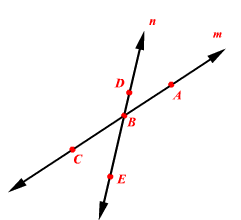
The points A,B and C lie on the line m they are collinear.

The points D,B and E lie on the line n they are collinear.

There is no line that goes through all three points A,B and D.

So, they are not collinear.

In this given Figure

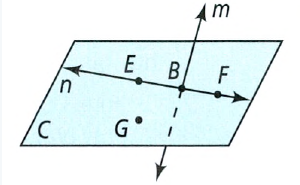
Savvas Learning Co Geometry Student Edition Chapter 1 Tools of Geometry Exercise 1.2 Points Lines and Planes Page 16 Exercise 7 Problem 7 Collinear Point plane 2
Collinear points are,E,B and F because that are all on line n.

Collinear points are E,B and F.


Exercise 1.2 Points Lines And Planes Savvas Learning Co Geometry Detailed Answers Page 16  Exercise 8  Problem 8

Given:

Savvas Learning Co Geometry Student Edition Chapter 1 Tools of Geometry Exercise 1.2 Points Lines and Planes Page 16 Exercise 8 Problem 8 Coplanar plane 1

To name coplanar points.

Using the method Functions of Coplanar.

Points or lines are said to be coplanar if they lie in the same plane.

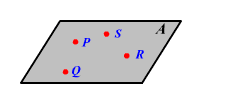
Savvas Learning Co Geometry Student Edition Chapter 1 Tools of Geometry Exercise 1.2 Points Lines and Planes Page 16 Exercise 8 Problem 8 Coplanar plane 2

The points P,Q and R lie in the same plane A.

They are coplanar.

In the given plane
Savvas Learning Co Geometry Student Edition Chapter 1 Tools of Geometry Exercise 1.2 Points Lines and Planes Page 16 Exercise 8 Problem 8 Coplanar plane 3

G,E,B and F are all coplanar because they are on plane C .

In the given plane G,E,B and F are all coplanar because they are on plane C.


Geometry Chapter 1 Points Lines And Planes Savvas Learning Co Explanation Guide Page 16  Exercise 9  Problem 9

Given:

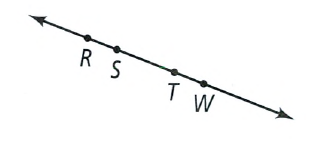
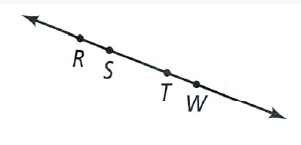
Savvas Learning Co Geometry Student Edition Chapter 1 Tools of Geometry Exercise 1.2 Points Lines and Planes Page 16 Exercise 9 Problem 9 Line sigment 1

To name the segments.

Using the method Functions of Line segment.

A line segment has two endpoints.

It contains these endpoints and all the points of the line between them.

Can measure the length of a segment, but not of a line.

Savvas Learning Co Geometry Student Edition Chapter 1 Tools of Geometry Exercise 1.2 Points Lines and Planes Page 16 Exercise 9 Problem 9 Line sigment 2

A segment is named by its two endpoints, for example \(\overline{A B}\)).

A segment is any two points that form part of a line. They go from one point to the other, with each point acting as an end point.

Therefore have to name all of the segments that are unique, meaning that they are between different points, and in doing so get all of the ones.

The segments of the figure are, \(\overline{R S}, \overline{S T}, \overline{T W}, \overline{R W}, \overline{W S}, \overline{T R}\)

The segments of the figure are, \(\overline{R S}, \overline{S T}, \overline{T W}, \overline{R W}, \overline{W S}, \overline{T R}\)


Page 16  Exercise 10  Problem 10

Given:

Savvas Learning Co Geometry Student Edition Chapter 1 Tools of Geometry Exercise 1.2 Points Lines and Planes Page 16 Exercise 10 Problem 10 Ray of direction line 1

To name the rays in the figure.

Using the method Functions of Ray.

Example for Ray

A ray is a part of a line that has one endpoint and goes on infinitely in only one direction. Cannot measure the length of a ray.

Savvas Learning Co Geometry Student Edition Chapter 1 Tools of Geometry Exercise 1.2 Points Lines and Planes Page 16 Exercise 10 Problem 10 Ray of direction line 2

A ray is named using its endpoint first, and then any other point on the ray (for example \(\overline{B A}\)

To ensure that name every ray have to treat each point as an endpoint for a ray and then follow it in both directions or the line, finding a second point (if there is one) to name it by. The reason don’t name both \(\overline{R S}\) and \(\overline{R T}\) as rays is because they have the same endpoint and then continue in the same direction, making them the same ray.

Therefore these rays would also be acceptable answers in place of another that describes the same ray.

The rays in the given figure are \(\overline{R S}, \overline{S R}, \overline{S T}, \overline{T S}, \overline{T W}, \overline{W T}\)

The rays in the given figure are \(\overline{R S}, \overline{S R}, \overline{S T}, \overline{T S}, \overline{T W}, \overline{W T}\)


Page 16  Exercise 11  Problem 11

Given:

Savvas Learning Co Geometry Student Edition Chapter 1 Tools of Geometry Exercise 1.2 Points Lines and Planes Page 16 Exercise 11 Problem 11 End point


To name the pair of opposite rays with endpoint T.

Using the method of endpoint function.

Let

Opposite rays are rays that share the same endpoint, but continue along the line in different directions.

Instead of \(\overline{T S}\) we could have also named this ray as \(\overline{T R}\) , because they both describe the same ray that starts at T and continues in the direction of R and S .

The pair of opposite rays with endpoint \(\overline{T R}\)and \(\overline{T R}\).


Page 16  Exercise 11  Problem 12

Given:

Savvas Learning Co Geometry Student Edition Chapter 1 Tools of Geometry Exercise 1.2 Points Lines and Planes Page 16 Exercise 11 Problem 12 Opposite Rays End point

To name another pair of opposite rays.

Using the method of endpoint function.

Let

Opposite rays are rays that share the same endpoint, but continue along the line in different directions.

Instead of \(\overline{T S}\) we could have also named this ray as \(\overline{T R}\) because they both describe the same ray that starts at T and continues in the direction of R and S.

The another pair of opposite rays is TW.


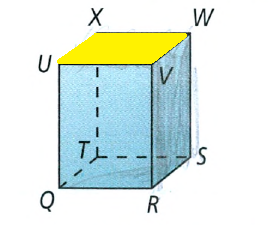
Page 16   Exercise 12  Problem 13

Given planes UXV and WVS.

To name the intersection of each pair of planes.

Using methods of geometry.

If two distinct planes intersect, then they intersect in exactly one line.

Here UXV and WVS intersect at \(\overrightarrow{V W}\).

In the figure the plane UXV and WVS intersect at \(\overrightarrow{V W}\).


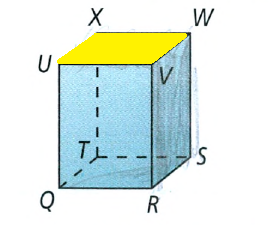
Page 16  Exercise 13  Problem 14

Given planes XWV and UVR.

To name the intersection of each pair of planes.

Using methods of geometry.

If two distinct planes intersect, then they intersect in exactly one line.

Here, planes XWV and UVR intersect at \(\overrightarrow{U V}\).

In the figure the plane XWV and−URV intersect at \(\overrightarrow{U V}\)


Page 16  Exercise 14  Problem 15

Given plane TXW and TQU.

To name the intersection of each pair of planes.

Using methods of geometry.

If two distinct planes intersect, then they intersect in exactly one line.

The planes TWX and TQU intersect at \(\overrightarrow{X T}\).

In the figure the plane TWX and TQU intersect at \(\overrightarrow{X T}\).


Page 16  Exercise 15  Problem 16

Given line TU.

To name two planes that intersect in the given line.

Using methods of geometry.

If two distinct planes intersect, then they intersect in exactly one line.

Here, \(\overrightarrow{T S}\) is the intersection to the back and bottom face of the figure so a possible name pair for them are XTS and QTS.

In the figure the plane XTS, and QTS intersect at line \(\overrightarrow{T S}\)


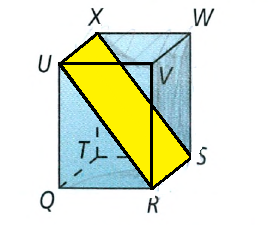
Page 16  Exercise 16  Problem 17

Given Points R,V,W

To Shade the plane that contains the given points.

Using methods of geometry.

The possible plane is RSWV which contains the given points.

Savvas Learning Co Geometry Student Edition Chapter 1 Tools of Geometry Exercise 1.2 Points Lines and Planes Page 16 Exercise 16 Problem 17 RSWV plane

In the figure the shaded plane contains R,V,W points.

Savvas Learning Co Geometry Student Edition Chapter 1 Tools of Geometry Exercise 1.2 Points Lines and Planes Page 16 Exercise 16 Problem 17 Shaded plane


Page 16  Exercise 17  Problem 18

Given points U,V,W

To Shade the plane that contains the given points.

Using methods of geometry.

The possible plane is UVWX  which contains the given points.

Savvas Learning Co Geometry Student Edition Chapter 1 Tools of Geometry Exercise 1.2 Points Lines and Planes Page 16 Exercise 17 Problem 18 UVWX plane

The shaded plane contain points U,V,W .

Savvas Learning Co Geometry Student Edition Chapter 1 Tools of Geometry Exercise 1.2 Points Lines and Planes Page 16 Exercise 17 Problem 18 Shaded plane


Page 16  Exercise 18  Problem 19

Given points U,X,X

To Shade the plane that contains the given points.

Using methods of geometry.

The possible plane is UXSR
Savvas Learning Co Geometry Student Edition Chapter 1 Tools of Geometry Exercise 1.2 Points Lines and Planes Page 16 Exercise 18 Problem 19 UXSR plane

In the figure the shaded plane contains points U,S,X.

Savvas Learning Co Geometry Student Edition Chapter 1 Tools of Geometry Exercise 1.2 Points Lines and Planes Page 16 Exercise 18 Problem 19 shaded plane


Page 16  Exercise 19  Problem 20

Given points T,U,V.

To Shade the plane that contains the given points.

Using methods of geometry.

The possible plane is STUV
Savvas Learning Co Geometry Student Edition Chapter 1 Tools of Geometry Exercise 1.2 Points Lines and Planes Page 16 Exercise 19 Problem 20 STUV plane

In the figure the Shaded plane contain points T,U,V

Savvas Learning Co Geometry Student Edition Chapter 1 Tools of Geometry Exercise 1.2 Points Lines and Planes Page 16 Exercise 19 Problem 20 Shaded plane


Page 17  Exercise 20  Problem 21

Given points S,U,V,Y

To determine whether the fourth point is in that plane.

Using methods of geometry.

The pointsS,U,V are in Blue plane.

The point Y is also in Blue plane.

Hence, point Y is co-planar to S,U,V.

The point Y is in Blue plane and co-planar to other points.


Page 17  Exercise 21  Problem 22

Given points X,Y,Z,U.

To determine whether the fourth point is in that plane.

Using methods of geometry.

Point Z lies in Yellow plane and other points are in Blue plane.

Hence non-coplanar.

The given points are non-coplanar.


Page 17  Exercise 22  Problem 23

Given points X,S,V,U

To determine whether the fourth point is in that plane.

Using methods of geometry.

All the 4 given points are in Blue plane.

Hence, the given points are co-planar.

The given points are co-planar.

Savvas Learning Co Geometry Student Edition Chapter 1 Tools of Geometry Exercise 1.1 Nets and Drawings for Visualizing Geometry

Savvas Learning Co Geometry Student Edition Chapter 1 Tools of Geometry Exercise 1.1 Nets and Drawings for Visualizing Geometry


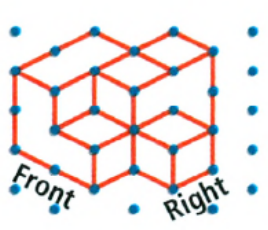
Savvas Learning Co Geometry Student Edition Chapter 1 Exercise 1.1 Nets And Drawings Solutions Page 7  Exercise 1  Problem  1

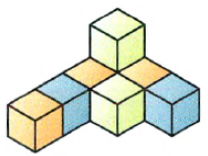
Given:

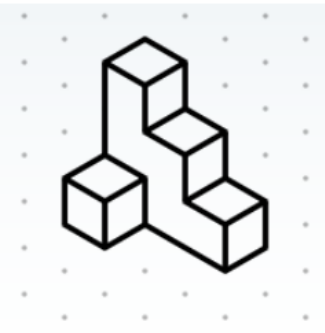
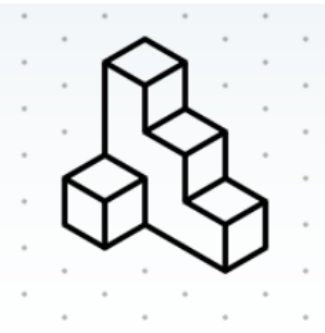
Savvas Learning Co Geometry Student Edition Chapter 1 Tools of Geometry Exercise 1.1 Nets and Drawings for Visualizing Geometry Page 7 Exercise 1 Problem 1 Isometric 1

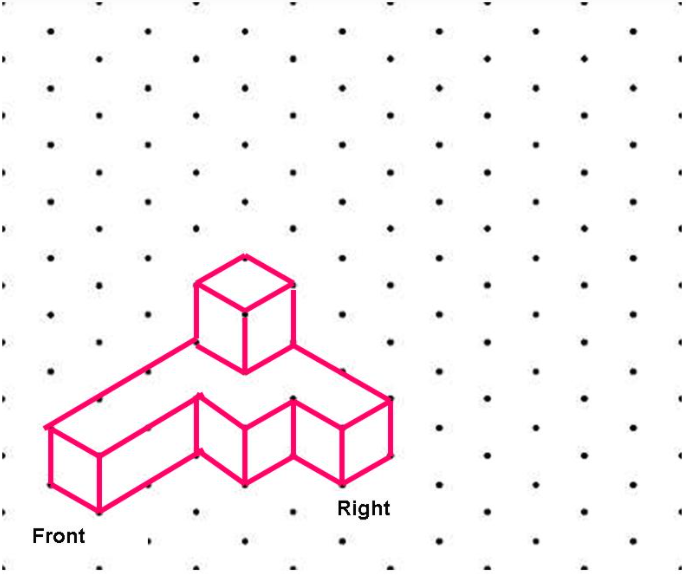
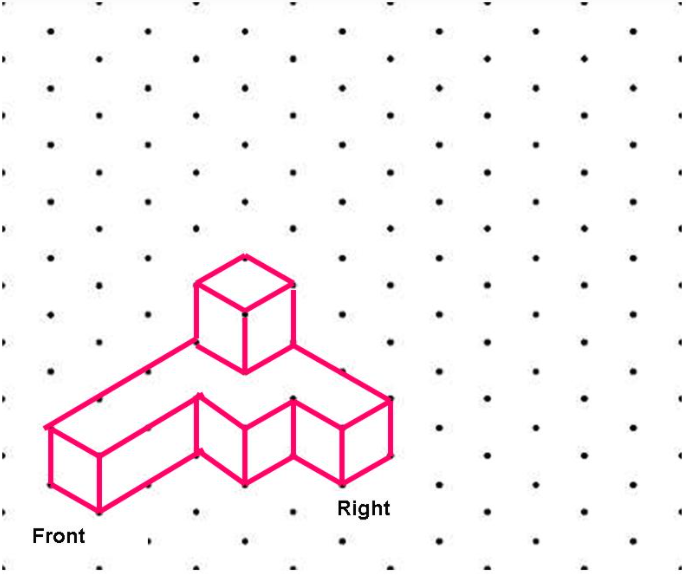
To find an isometric drawing of the cube structure.

By using graph method.

The isometric drawing for the given figure should look like

Savvas Learning Co Geometry Student Edition Chapter 1 Tools of Geometry Exercise 1.1 Nets and Drawings for Visualizing Geometry Page 7 Exercise 1 Problem 1 Isometric 2

The isometric drawing for the given figure should look like

Savvas Learning Co Geometry Student Edition Chapter 1 Tools of Geometry Exercise 1.1 Nets and Drawings for Visualizing Geometry Page 7 Exercise 1 Problem 1 Isometric 3


Exercise 1.1 Nets And Drawings For Visualizing Geometry Savvas Geometry Answers Page 7  Exercise 2  Problem 2

Read and Learn More Savvas Learning Co Geometry Student Edition Solutions

Given:

Savvas Learning Co Geometry Student Edition Chapter 1 Tools of Geometry Exercise 1.1 Nets and Drawings for Visualizing Geometry

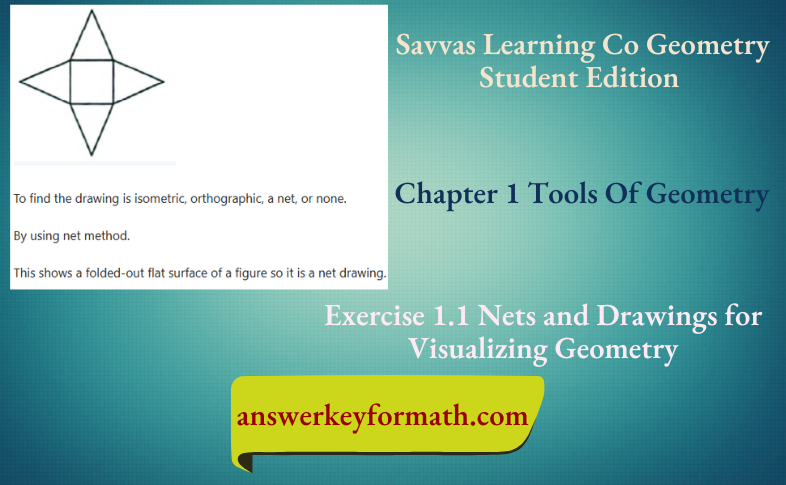
This shows a folded-out flat surface of a figure so it is a net drawing


Page 7  Exercise 2  Problem 3

Given:

Savvas Learning Co Geometry Student Edition Chapter 1 Tools of Geometry Exercise 1.1 Nets and Drawings for Visualizing Geometry Page 7 Exercise 2 Problem 3 Orthographic Method

To find the drawing is isometric, orthographic, a net, or none.

By using orthographic method.

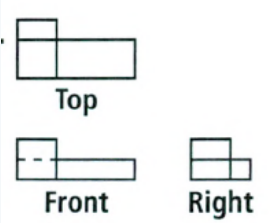
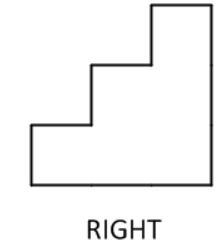
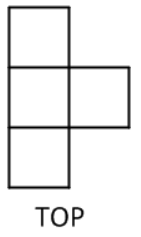
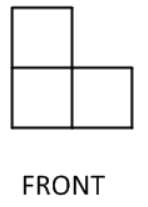
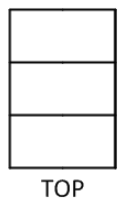
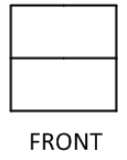
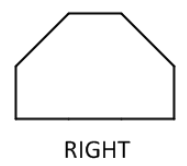
This shows three separate views: a top view, a front view, and a right-side view so it is an orthographic drawing.

This shows three separate views: a top view, a front view, and a right-side view so it is an orthographic drawing.


Nets And Drawings For Visualizing Geometry Solutions Chapter 1 Exercise 1.1 Savvas Geometry Page 7  Exercise 2  Problem 4

Given:

Savvas Learning Co Geometry Student Edition Chapter 1 Tools of Geometry Exercise 1.1 Nets and Drawings for Visualizing Geometry Page 7 Exercise 2 Problem 4 Isomeric Method

To find the drawing is isometric, orthographic, a net, or none.

By using isomeric method.

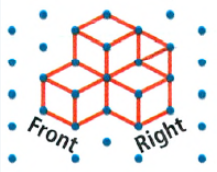
This shows a three-dimensional figure using slanted lines to represent depth so it is an isometric drawing.

This shows a three-dimensional figure using slanted lines to represent depth so it is an isometric drawing.


Chapter 1 Exercise 1.1 Nets And Drawings Savvas Learning Co Geometry Explanation Page 7  Exercise 2  Problem 5

Given:

Savvas Learning Co Geometry Student Edition Chapter 1 Tools of Geometry Exercise 1.1 Nets and Drawings for Visualizing Geometry Page 7 Exercise 2 Problem 5 Graph Method

To find the drawing is isometric, orthographic, a net, or none.

By using graph method.

None of the three drawings’ description fit the figure.

None of the three drawings’ description fit the figure.


Solutions For Nets And Drawings Exercise 1.1 In Savvas Geometry Chapter 1 Student Edition Page 7  Exercise 3  Problem 6

Given: Isometric drawing and an orthographic drawing.

To find the differences and similarities between the given drawing.

By using isometric method.

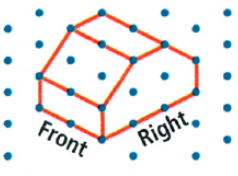
In an isometric drawing, you see three sides of a figure from one corner view. In an orthographic drawing, you see three separate views of the figure.

In both drawings, you see the same three sides of the figure (top, front, and right).

Also both drawings represent a three-dimensional object in two-dimensions.

In an isometric drawing, you see three sides of a figure from one corner view. In an orthographic drawing, you see three separate views of the figure. In both drawings, you see the same three sides of the figure (top, front, and right). Also both drawings represent a three-dimensional object in two-dimensions.


Exercise 1.1 Nets And Drawings Savvas Learning Co Geometry Detailed Answers Page 7  Exercise 4  Problem 7

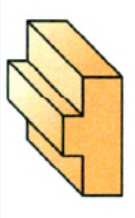
Given:

Savvas Learning Co Geometry Student Edition Chapter 1 Tools of Geometry Exercise 1.1 Nets and Drawings for Visualizing Geometry Page 7 Exercise 4 Problem 7 Three Dimensional 1(A)

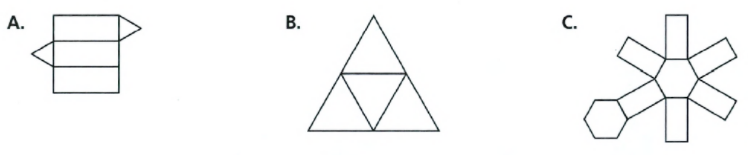
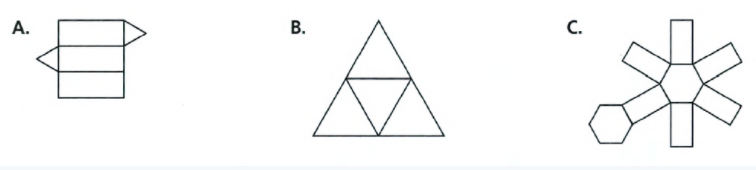
To find the three-dimensional figure with its net.

By using hexagons method.

Looking at this shape, we see that it has bases of triangles and three sides that are rectangles. Therefore knowing this, the only one that fits is A.

Looking at this shape, we see that it has bases of triangles and three sides that are rectangles. Therefore knowing this, the only one that fits is A.

Similarly

Given:

Savvas Learning Co Geometry Student Edition Chapter 1 Tools of Geometry Exercise 1.1 Nets and Drawings for Visualizing Geometry Page 7 Exercise 4 Problem 7 Three Dimensional 1(B)

To find the three-dimensional figure with its net.

By using hexagons method.

Looking at the shape we see that the base and all of the sides are triangles and thus the only net that fits is B)

Looking at the shape we see that the base and all of the sides are triangles and thus the only net that fits is B).


Geometry Chapter 1 Nets And Drawings For Visualizing Geometry Savvas Learning Co Explanation Guide Page 7  Exercise 5  Problem 8

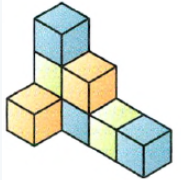
Given:

Savvas Learning Co Geometry Student Edition Chapter 1 Tools of Geometry Exercise 1.1 Nets and Drawings for Visualizing Geometry Page 7 Exercise 5 Problem 8 Dimensions

To find the net with its dimensions.

By using isometric method.

Start with the square that is shown on bottom.

First imagine the front side being lain down flat in front of the bottom.

Do the same with both sides and the back.

Then put the top square on any of the side that you have drawn. By looking at the book, label the sides appropriately.

Savvas Learning Co Geometry Student Edition Chapter 1 Tools of Geometry Exercise 1.1 Nets and Drawings for Visualizing Geometry Page 7 Exercise 5 Problem 8 Square sides 1

Start with the square that is shown on bottom. first imagine the front side being lain down flat in front of the bottom. Do the same with both sides and the back. Then put the top square on any of the side that you have drawn. By looking at the book, label the sides appropriately.

Savvas Learning Co Geometry Student Edition Chapter 1 Tools of Geometry Exercise 1.1 Nets and Drawings for Visualizing Geometry Page 7 Exercise 5 Problem 8 Square sides 2


Savvas Learning Co Geometry Student Edition Chapter 1 Tools of Geometry Exercise 1.1 Nets and Drawings for Visualizing Geometry Page 7  Exercise 6  Problem 9

Given:

Savvas Learning Co Geometry Student Edition Chapter 1 Tools of Geometry Exercise 1.1 Nets and Drawings for Visualizing Geometry Page 7 Exercise 6 Problem 9 Net Dimensions

To find the net with its dimensions.

By using isometric method.

A net is a pattern made when the surface of a three-dimensional figure is laid out flat showing each face of the figure.

The net for the figure should look like

Savvas Learning Co Geometry Student Edition Chapter 1 Tools of Geometry Exercise 1.1 Nets and Drawings for Visualizing Geometry Page 7 Exercise 6 Problem 9 Net Dimensional 1

The net for the figure should look like

Savvas Learning Co Geometry Student Edition Chapter 1 Tools of Geometry Exercise 1.1 Nets and Drawings for Visualizing Geometry Page 7 Exercise 6 Problem 9 Net Dimensional 2


Page 7  Exercise 7  Problem 10

Given:

Savvas Learning Co Geometry Student Edition Chapter 1 Tools of Geometry Exercise 1.1 Nets and Drawings for Visualizing Geometry Page 7 Exercise 7 Problem 10 Net Dimensions

To find the net with its dimensions.

By using isometric method.

Savvas Learning Co Geometry Student Edition Chapter 1 Tools of Geometry Exercise 1.1 Nets and Drawings for Visualizing Geometry Page 7 Exercise 7 Problem 10 Net Dimensional 1

Savvas Learning Co Geometry Student Edition Chapter 1 Tools of Geometry Exercise 1.1 Nets and Drawings for Visualizing Geometry Page 7 Exercise 7 Problem 10 Net Dimensional 2


Savvas Learning Co Geometry Student Edition Chapter 1 Tools of Geometry Exercise 1.1 Nets and Drawings for Visualizing Geometry Page 8  Exercise 8  Problem 11

Given:

Savvas Learning Co Geometry Student Edition Chapter 1 Tools of Geometry Exercise 1.1 Nets and Drawings for Visualizing Geometry Page 8 Exercise 8 Problem 11 Isometric 1

To find an isometric drawing of each cube structure on isometric dot paper.

By using isometric method.

The isometric drawing for the given figure should look like:

Savvas Learning Co Geometry Student Edition Chapter 1 Tools of Geometry Exercise 1.1 Nets and Drawings for Visualizing Geometry Page 8 Exercise 8 Problem 11 Isometric 2

The isometric drawing for the given figure should look like

Savvas Learning Co Geometry Student Edition Chapter 1 Tools of Geometry Exercise 1.1 Nets and Drawings for Visualizing Geometry Page 8 Exercise 8 Problem 11 Isometric 3


Page 8  Exercise 9  Problem 12

Given:

Savvas Learning Co Geometry Student Edition Chapter 1 Tools of Geometry Exercise 1.1 Nets and Drawings for Visualizing Geometry Page 8 Exercise 9 Problem 12 Isometric

To make an isometric drawing of each cube structure.

Using the method of isometric dot paper.

Let , An isometric drawing of each cube structure.

Savvas Learning Co Geometry Student Edition Chapter 1 Tools of Geometry Exercise 1.1 Nets and Drawings for Visualizing Geometry Page 8 Exercise 9 Problem 12 Isometric of cube 1

Isomeric dot paper is used to draw cube structure.

Savvas Learning Co Geometry Student Edition Chapter 1 Tools of Geometry Exercise 1.1 Nets and Drawings for Visualizing Geometry Page 8 Exercise 9 Problem 12 Isometric of cube 2


Savvas Learning Co Geometry Student Edition Chapter 1 Tools of Geometry Exercise 1.1 Nets and Drawings for Visualizing Geometry Page 8  Exercise 10  Problem 13

Given:

Savvas Learning Co Geometry Student Edition Chapter 1 Tools of Geometry Exercise 1.1 Nets and Drawings for Visualizing Geometry Page 8 Exercise 10 Problem 13 Isometric
To make an isometric drawing of each cube structure.

Using the method of isometric dot paper.

Let, An isometric drawing of each cube structure

Savvas Learning Co Geometry Student Edition Chapter 1 Tools of Geometry Exercise 1.1 Nets and Drawings for Visualizing Geometry Page 8 Exercise 10 Problem 13 Isometric of cube 1

Isomeric dot paper is used to draw cube structure.

Savvas Learning Co Geometry Student Edition Chapter 1 Tools of Geometry Exercise 1.1 Nets and Drawings for Visualizing Geometry Page 8 Exercise 10 Problem 13 Isometric of cube 2


Savvas Learning Co Geometry Student Edition Chapter 1 Tools of Geometry Exercise 1.1 Nets and Drawings for Visualizing Geometry Page 8  Exercise 11  Problem 14

Given:

Savvas Learning Co Geometry Student Edition Chapter 1 Tools of Geometry Exercise 1.1 Nets and Drawings for Visualizing Geometry Page 8 Exercise 11 Problem 14 Isometric

To make an isometric drawing of each cube structure.

Using the method of isometric dot paper.

Let, An isometric drawing of each cube structure

Savvas Learning Co Geometry Student Edition Chapter 1 Tools of Geometry Exercise 1.1 Nets and Drawings for Visualizing Geometry Page 8 Exercise 11 Problem 14 Isometric of cube 1

Isomeric dot paper is used to draw cube structure.

Savvas Learning Co Geometry Student Edition Chapter 1 Tools of Geometry Exercise 1.1 Nets and Drawings for Visualizing Geometry Page 8 Exercise 11 Problem 14 Isometric of cube 2


Page 8  Exercise 12  Problem 15

Given:

Savvas Learning Co Geometry Student Edition Chapter 1 Tools of Geometry Exercise 1.1 Nets and Drawings for Visualizing Geometry Page 8 Exercise 12 Problem 15 Orthographic

To make an orthographic drawing.

Using the method of isometric function.

Let, In an orthographic drawing, remember that:

An orthographic drawing shows the same three views of the isometric drawing (top, front, and right).Solid lines show visible edges.

Dashed lines show hidden edges.

The orthographic drawing for isometric drawing should look like:

Savvas Learning Co Geometry Student Edition Chapter 1 Tools of Geometry Exercise 1.1 Nets and Drawings for Visualizing Geometry Page 8 Exercise 12 Problem 15 Orthographic Top

Savvas Learning Co Geometry Student Edition Chapter 1 Tools of Geometry Exercise 1.1 Nets and Drawings for Visualizing Geometry Page 8 Exercise 12 Problem 15 Orthographic Front

Savvas Learning Co Geometry Student Edition Chapter 1 Tools of Geometry Exercise 1.1 Nets and Drawings for Visualizing Geometry Page 8 Exercise 12 Problem 15 Orthographic Right

An orthographic drawing for isometric drawing is drawned.


Savvas Learning Co Geometry Student Edition Chapter 1 Tools of Geometry Exercise 1.1 Nets and Drawings for Visualizing Geometry Page 8  Exercise 13  Problem 16

Given:

Savvas Learning Co Geometry Student Edition Chapter 1 Tools of Geometry Exercise 1.1 Nets and Drawings for Visualizing Geometry Page 8 Exercise 13 Problem 16 Orthographic

To make an orthographic drawing.

Using the method of isometric function.

In an orthographic drawing, remember that

An orthographic drawing shows the same three views of the isometric drawing (top, front, and right).

Solid lines show visible edges.

Dashed lines show hidden edges.

The orthographic drawing for isometric drawing should look like:

Savvas Learning Co Geometry Student Edition Chapter 1 Tools of Geometry Exercise 1.1 Nets and Drawings for Visualizing Geometry Page 8 Exercise 13 Problem 16 Orthographic Top

Savvas Learning Co Geometry Student Edition Chapter 1 Tools of Geometry Exercise 1.1 Nets and Drawings for Visualizing Geometry Page 8 Exercise 13 Problem 16 Orthographic Front

Savvas Learning Co Geometry Student Edition Chapter 1 Tools of Geometry Exercise 1.1 Nets and Drawings for Visualizing Geometry Page 8 Exercise 13 Problem 16 Orthographic Right
An orthographic drawing for isometric drawing is drawned.


Page 8  Exercise 14  Problem 17

Given:

Savvas Learning Co Geometry Student Edition Chapter 1 Tools of Geometry Exercise 1.1 Nets and Drawings for Visualizing Geometry Page 8 Exercise 14 Problem 17 Orthographic

To make an orthographic drawing.

Using the method of isometric function.

Let , In an orthographic drawing, remember that:

An orthographic drawing shows the same three views of the isometric drawing (top, front, and right).

Solid lines show visible edges.Dashed lines show hidden edges.

The orthographic drawing for isometric drawing should look like:

Savvas Learning Co Geometry Student Edition Chapter 1 Tools of Geometry Exercise 1.1 Nets and Drawings for Visualizing Geometry Page 8 Exercise 14 Problem 17 Orthographic Top

Savvas Learning Co Geometry Student Edition Chapter 1 Tools of Geometry Exercise 1.1 Nets and Drawings for Visualizing Geometry Page 8 Exercise 14 Problem 17 Orthographic Front

Savvas Learning Co Geometry Student Edition Chapter 1 Tools of Geometry Exercise 1.1 Nets and Drawings for Visualizing Geometry Page 8 Exercise 14 Problem 17 Orthographic Right

An orthographic drawing for isometric drawing is drawned.


Savvas Learning Co Geometry Student Edition Chapter 1 Tools of Geometry Exercise 1.1 Nets and Drawings for Visualizing Geometry Page 8  Exercise 15  Problem 18

Given:

Savvas Learning Co Geometry Student Edition Chapter 1 Tools of Geometry Exercise 1.1 Nets and Drawings for Visualizing Geometry Page 8 Exercise 15 Problem 18 Solid

To draw eight different nets for the solid given.

Using the method of multiple representation.

Let

1.

Savvas Learning Co Geometry Student Edition Chapter 1 Tools of Geometry Exercise 1.1 Nets and Drawings for Visualizing Geometry Page 8 Exercise 15 Problem 18 Different nets of Solid 1

2.

Savvas Learning Co Geometry Student Edition Chapter 1 Tools of Geometry Exercise 1.1 Nets and Drawings for Visualizing Geometry Page 8 Exercise 15 Problem 18 Different nets of Solid 2

3.

Savvas Learning Co Geometry Student Edition Chapter 1 Tools of Geometry Exercise 1.1 Nets and Drawings for Visualizing Geometry Page 8 Exercise 15 Problem 18 Different nets of Solid 3

4.

Savvas Learning Co Geometry Student Edition Chapter 1 Tools of Geometry Exercise 1.1 Nets and Drawings for Visualizing Geometry Page 8 Exercise 15 Problem 18 Different nets of Solid 4

5.

Savvas Learning Co Geometry Student Edition Chapter 1 Tools of Geometry Exercise 1.1 Nets and Drawings for Visualizing Geometry Page 8 Exercise 15 Problem 18 Different nets of Solid 5

 6.

Savvas Learning Co Geometry Student Edition Chapter 1 Tools of Geometry Exercise 1.1 Nets and Drawings for Visualizing Geometry Page 8 Exercise 15 Problem 18 Different nets of Solid 6

7.

Savvas Learning Co Geometry Student Edition Chapter 1 Tools of Geometry Exercise 1.1 Nets and Drawings for Visualizing Geometry Page 8 Exercise 15 Problem 18 Different nets of Solid 7

8.

Savvas Learning Co Geometry Student Edition Chapter 1 Tools of Geometry Exercise 1.1 Nets and Drawings for Visualizing Geometry Page 8 Exercise 15 Problem 18 Different nets of Solid 8
The eight different nets for the solid is represented.


Savvas Learning Co Geometry Student Edition Chapter 1 Tools of Geometry Exercise 1.1 Nets and Drawings for Visualizing Geometry Page 8  Exercise 16  Problem 19

Given:  8 cubes

To make an isometric drawing of a structure.

Using the method of isometric function.

Let, A possible structure using 8 cubes is given:

Savvas Learning Co Geometry Student Edition Chapter 1 Tools of Geometry Exercise 1.1 Nets and Drawings for Visualizing Geometry Page 8 Exercise 16 Problem 19 cubes 8

The corresponding isometric drawing is given below

Savvas Learning Co Geometry Student Edition Chapter 1 Tools of Geometry Exercise 1.1 Nets and Drawings for Visualizing Geometry Page 8 Exercise 16 Problem 19 Isometric of cubes 1

The isometric drawing is drawn.

Savvas Learning Co Geometry Student Edition Chapter 1 Tools of Geometry Exercise 1.1 Nets and Drawings for Visualizing Geometry Page 8 Exercise 16 Problem 19 Isometric of cubes 2


Page 8  Exercise 16  Problem 20

Given: 8 cubes

To make an orthographic drawing of the structure.

Using the method of orthographic function.

Let

Savvas Learning Co Geometry Student Edition Chapter 1 Tools of Geometry Exercise 1.1 Nets and Drawings for Visualizing Geometry Page 8 Exercise 16 Problem 20 Orthographic

In an orthographic drawing, remember that:

An orthographic drawing shows the same three views of the isometric drawing (top, front, and right).

Solid lines show visible edges.Dashed lines show hidden edges.

The orthographic drawing for isometric drawing should look like:


Savvas Learning Co Geometry Student Edition Chapter 1 Tools of Geometry Exercise 1.1 Nets and Drawings for Visualizing Geometry Page 8 Exercise 16 Problem 20 Orthographic Top


Savvas Learning Co Geometry Student Edition Chapter 1 Tools of Geometry Exercise 1.1 Nets and Drawings for Visualizing Geometry Page 8 Exercise 16 Problem 20 Orthographic Front

Savvas Learning Co Geometry Student Edition Chapter 1 Tools of Geometry Exercise 1.1 Nets and Drawings for Visualizing Geometry Page 8 Exercise 16 Problem 20 Orthographic Right

The orthographic drawing is drawned.


Savvas Learning Co Geometry Student Edition Chapter 1 Tools of Geometry Exercise 1.1 Nets and Drawings for Visualizing Geometry Page 8  Exercise 17  Problem 21

Given: Draw a net of the can at the right.

To explain what shape are the top and bottom of the can and uncurl the body.

Using the method of rectangular function.

Let

The shape of the top and bottom of the can are circles.

If we uncurl the body of the can, the shape is a rectangle

which has a length equal to the circumference of each circle and a width equal to the height of the can.

So, a possible net should look like:

Savvas Learning Co Geometry Student Edition Chapter 1 Tools of Geometry Exercise 1.1 Nets and Drawings for Visualizing Geometry Page 8 Exercise 17 Problem 21 Circle 1

The shape at top and bottom of can is a circle. A possible net is described.

Savvas Learning Co Geometry Student Edition Chapter 1 Tools of Geometry Exercise 1.1 Nets and Drawings for Visualizing Geometry Page 8 Exercise 17 Problem 21 Circle 2


Page 8  Exercise 18  Problem 22

Given: German printmaker Albrecht Dürer first used the word net.

To find Why he choose the word net.

Using the method of three dimensional function.

Let, Maybe he used the word net because when you use a real net it can wrap around a solid object.

If it’s wrapped tightly the net can take on the overall shape of the wrapped object.

So similarly the printed pattern when you fold it up is like a net wrapping around an object.

The printed pattern when he folds it up is like a net wrapping, so he chooses the word net.


Savvas Learning Co Geometry Student Edition Chapter 1 Tools of Geometry Exercise 1.1 Nets and Drawings for Visualizing Geometry Page 8  Exercise 19  Problem 23

Given:


Savvas Learning Co Geometry Student Edition Chapter 1 Tools of Geometry Exercise 1.1 Nets and Drawings for Visualizing Geometry Page 8 Exercise 19 Problem 23 Package of Net

To match the package with its net.Using the method of cubic function.

Let

Savvas Learning Co Geometry Student Edition Chapter 1 Tools of Geometry Exercise 1.1 Nets and Drawings for Visualizing Geometry Page 8 Exercise 19 Problem 23 Cube

Visualize the right hand side and the left hand side each folding into a half of a cube.

These are the top and bottom.

The piece in the middle then holds them on top of each other.

The Above diagram matches correctly for the package.


Page 8  Exercise 20  Problem 24

Given:

Savvas Learning Co Geometry Student Edition Chapter 1 Tools of Geometry Exercise 1.1 Nets and Drawings for Visualizing Geometry Page 8 Exercise 20 Problem 24 Package of Net

To match the package with its net.

Using the method of cubic function.

Let

Savvas Learning Co Geometry Student Edition Chapter 1 Tools of Geometry Exercise 1.1 Nets and Drawings for Visualizing Geometry Page 8 Exercise 20 Problem 24 Triangular shape

In the above case,looks like opening the triangular shape.

The above diagram matches correctly for the package.


Savvas Learning Co Geometry Student Edition Chapter 1 Tools of Geometry Exercise 1.1 Nets and Drawings for Visualizing Geometry Page 8  Exercise 21  Problem 25

Given:

To match the package with its net.

Using the method of cubic function.

Let

Savvas Learning Co Geometry Student Edition Chapter 1 Tools of Geometry Exercise 1.1 Nets and Drawings for Visualizing Geometry Page 8 Exercise 21 Problem 25 Triangular of squares
If you break down a Chinese takeout box it wouldn’t have mainly triangles but squares.

The Above diagram matches correctly for the package.


Page 9  Exercise 22  Problem 26

Given:

Savvas Learning Co Geometry Student Edition Chapter 1 Tools of Geometry Exercise 1.1 Nets and Drawings for Visualizing Geometry Page 9 Exercise 22 Problem 26 Orthographic

To make an orthographic drawing for the isometric drawing.

Using the method of isometric function.

Let

In an orthographic drawing, remember that:

An orthographic drawing shows the same three views of the isometric drawing (top, front, and right).

Solid lines show visible edges.

Dashed lines show hidden edges.

The orthographic drawing for isometric drawing should look like:

Savvas Learning Co Geometry Student Edition Chapter 1 Tools of Geometry Exercise 1.1 Nets and Drawings for Visualizing Geometry Page 9 Exercise 22 Problem 26 Orthographic Top

Savvas Learning Co Geometry Student Edition Chapter 1 Tools of Geometry Exercise 1.1 Nets and Drawings for Visualizing Geometry Page 9 Exercise 22 Problem 26 Orthographic Front

Savvas Learning Co Geometry Student Edition Chapter 1 Tools of Geometry Exercise 1.1 Nets and Drawings for Visualizing Geometry Page 9 Exercise 22 Problem 26 Orthographic Right

An orthographic drawing for isometric drawing is drawn.


Savvas Learning Co Geometry Student Edition Chapter 1 Tools of Geometry Exercise 1.1 Nets and Drawings for Visualizing Geometry Page 9  Exercise 23  Problem 27

Given:

Savvas Learning Co Geometry Student Edition Chapter 1 Tools of Geometry Exercise 1.1 Nets and Drawings for Visualizing Geometry Page 9 Exercise 23 Problem 27 Orthographic

To make an orthographic drawing for the isometric drawing.

Using the method of isometric function.

Let

In an orthographic drawing, remember that

An orthographic drawing shows the same three views of the isometric drawing (top, front, and right).Solid lines show visible edges.

Dashed lines show hidden edges.

The orthographic drawing for isometric drawing should look like:

Savvas Learning Co Geometry Student Edition Chapter 1 Tools of Geometry Exercise 1.1 Nets and Drawings for Visualizing Geometry Page 8 Exercise 12 Problem 15 Orthographic Top

Savvas Learning Co Geometry Student Edition Chapter 1 Tools of Geometry Exercise 1.1 Nets and Drawings for Visualizing Geometry Page 8 Exercise 12 Problem 15 Orthographic Front

Savvas Learning Co Geometry Student Edition Chapter 1 Tools of Geometry Exercise 1.1 Nets and Drawings for Visualizing Geometry Page 8 Exercise 12 Problem 15 Orthographic Right

An orthographic drawing for isometric drawing is drawn.


Savvas Learning Co Geometry Student Edition Chapter 1 Tools of Geometry Exercise 1.1 Nets and Drawings for Visualizing Geometry Page 9  Exercise 24  Problem 28

Given:

Savvas Learning Co Geometry Student Edition Chapter 1 Tools of Geometry Exercise 1.1 Nets and Drawings for Visualizing Geometry Page 9 Exercise 24 Problem 28 Orthographic

To make an orthographic drawing for the isometric drawing.

Using the method of isometric function.

In an orthographic drawing, remember that:

An orthographic drawing shows the same three views of the isometric drawing (top, front, and right).Solid lines show visible edges.

Dashed lines show hidden edges.

The orthographic drawing for isometric drawing should look like:

Savvas Learning Co Geometry Student Edition Chapter 1 Tools of Geometry Exercise 1.1 Nets and Drawings for Visualizing Geometry Page 9 Exercise 24 Problem 28 Orthographic Top

Savvas Learning Co Geometry Student Edition Chapter 1 Tools of Geometry Exercise 1.1 Nets and Drawings for Visualizing Geometry Page 9 Exercise 24 Problem 28 Orthographic Front

Savvas Learning Co Geometry Student Edition Chapter 1 Tools of Geometry Exercise 1.1 Nets and Drawings for Visualizing Geometry Page 9 Exercise 24 Problem 28 Orthographic Right

An orthographic drawing for isometric drawing is drawn.

Savvas Learning Co Geometry Student Edition Chapter 1 Tools Of Geometry Exercise

Savvas Learning Co Geometry Student Edition Chapter 1 Tools of Geometry Exercise


Savvas Learning Co Geometry Student Edition Chapter 1 Tools Of Geometry Exercise Answers Page 1  Exercise 1  Problem 1

Given: 112

To simplify the above equation.

Using the method of the geometry.

The simplified equation is   112 = 121


Page 1  Exercise 2  Problem 2

Given: 2(7.5) + 2(11)

To simplify the above expression.

Using the method of geometry.

2(7.5) + 2(11) = 2(7.5) + 2(11)

2(7.5) + 2(11) = 15 + 22

2(7.5) + 2(11) = 37.

The simplified expression is 2.7.5 + 2.11 = 37.


Savvas Learning Co Geometry Student Edition Chapter 1 Tools of Geometry Page 1  Exercise 3  Problem 3

Given:  π(5)2

To simplify the above expression.

Using the method of geometry.

= π(5)2

π = 3.14

π(5)2 = 3.14(5) 2

π(5)2 = 3.14(25)

π(5)2 = 78.5

The simplified expression is π(5)2 = 78.5.

Read and Learn More Savvas Learning Co Geometry Student Edition Solutions

Page 1  Exercise 4  Problem 4

Savvas Learning Co Geometry Student Edition Chapter 1 Tools Of Geometry Exercise

Chapter 1 Tools Of Geometry Exercise Solutions Savvas Learning Co Geometry Page 1  Exercise 5  Problem 5

Given: a = 4, b = −2

To find \(\frac{a−7}{3−b}\)

Using the method of geometry.

⇒ \(\frac{a−7}{3−b}\)

a = 4, b = −2

\(=\frac{4-7}{3-(-2)}\)


= \(\frac{-3}{5}\)

The evaluated expression is  \(\frac{a−7}{3−b}\) = \(\frac{-3}{5}\)


Page 1  Exercise 6   Problem 6 

Given:  a =  4,b = −2

To find \(\sqrt{(7-a)^2+(2-b)^2}\)

Using the method of geometry

⇒ \(\sqrt{(7-a)^2+(2-b)^2}\)

= \(\sqrt{(7-4)^2+(2+2)^2}\)

= \(\sqrt{3^2+4^2}\)

= \(\sqrt{9+16}\)

= \(\sqrt{25}\)

= 5

The evaluated expression is \(\sqrt{(7-a)^2+(2-b)^2}\) = 5.


Savvas Geometry Student Edition Chapter 1 Solutions Tools of Geometry Page 1  Exercise 7  Problem 7

Given: ∣−8∣

To find the absolute value expression.

Using the method of geometry.

⇒ ∣−8∣

= 8

The absolute value is 8.

The absolute value of ∣−8∣ = 8.


Page 1  Exercise 8   Problem 8

Given:  ∣2−6∣

To find the absolute value expression.

Using the method of geometry.

⇒ |2-6|

|2-6| = |− 4|

|2-6| =  4

The absolute value is  4

The absolute value of ∣2−6∣ = 4.


Tools Of Geometry Savvas Learning Co Chapter 1 Explanation Page 1  Exercise 9  Problem 9

Given: 2x + 7 = 13

To solve the equation.

Using the method of algebra.

2x = 6

x = \(\frac{6}{2}\)

x = 3

The solution of the equation is x = 3.


Page 1  Exercise 10   Problem 10

Given: 5x − 12 = 2x + 6

To solve the equation.

Using the method of algebra.

5x − 12 = 2x + 6

5x − 2x = 6 + 12

3x = 18

x = \(\frac{18}{3}\)

x = 6

The solution of the equation is x = 6.


Savvas Learning Co Geometry Chapter 1 Tools Of Geometry Explanation Guide Page 1  Exercise 11  Problem 11

Given: 2(x + 3) − 1 = 7x

To solve the equation.

Using the method of algebra.

2(x + 3)−1 = 7x

2x + 6 − 1 = 7x

2x + 5 = 7x

5 = 7x − 2x

5 = 5x

x = 1

The solution of the equation is x = 1.


Page 1  Exercise 12  Problem 12

Given: A child can construct models of buildings by stacking and arranging colored blocks.

To find the term construction mean in geometry.

Using the method of geometry.

Construction in Geometry means to draw shapes, angles, or lines accurately.

Construction in Geometry means to draw shapes, angles, or lines accurately. 


Savvas Geometry Chapter 1 Answers For Tools Of Geometry Page 1  Exercise 13  Problem 13

Given:  Artists often use long streaks to show rays of light coming from the sun.

To find the properties of a ray .

Using the method of geometry.

A ray is a line with a single endpoint (or point of origin) that extends infinitely in one direction.

A ray is a line with a single endpoint (or point of origin) that extends infinitely in one direction.