Stephen Friedberg Linear Algebra 5th Edition Solutions

Stephen Friedberg Linear Algebra 5th Edition Solutions

Stephen Friedberg Linear Algebra 5th Edition Chapter 3 Exercise 3.1 Elementary Matrix Operations and Systems of Linear Equations

Linear Algebra 5th Edition Chapter 3 Elementary Matrix Operations and Systems of Linear Equations

Page 150 Problem 1 Answer

Provided statement is “An elementary matrix is always square”.

We are to check if the statement is true or false.

We generate an elementary matrix starting from identity matrix by performing any elementary operation.

As the identity matrix is a square, an elementary matrix must be also be a square.

Thus, the statement “An elementary matrix is always square” is true.

The statement ‘An elementary matrix is not always a square matrix’ is incorrect because it is made up of an identity matrix which is always square in nature.

Thus, the statement “An elementary matrix is always square” is true.

Linear Algebra 5th Edition Chapter 3 Page 150 Problem 2 Answer

Provided – statement “the only entries of an elementary matrix are zero and ones.”

To check– the statement is true or false Multiplying any row of the identity matrix by a nonzero scalar refers to one of elementary operation.

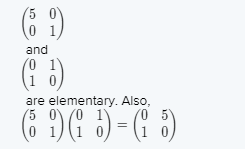
So, we can multiply first row by five times, for instance. In this way, we get an elementary matrix:

(5    0)
(0    1)

with an item equal  to five.

Thus, the statement “the only entries of an elementary matrix are zero and ones” is false.

The only entries of an elementary matrix are not zero and ones since the identity matrix could be multiplied with any scalar quantity.

Thus, the statement “the only entries of an elementary matrix are zero and ones” is false.

Read and Learn More Stephen Friedberg Linear Algebra 5th Edition Solutions

Stephen Friedberg Linear Algebra 5th Edition Solutions For Exercise 3.1 Linear Algebra 5th Edition Chapter 3 Page 150 Problem 3 Answer

Stephen Friedberg Linear Algebra 5th Edition Chapter 3 Exercise 3.1 Elementary Matrix Operations And Systems Of Linear Equations

Linear Algebra 5th Edition Chapter 3 Page 150 Problem 4 Answer

Provided – statement “the product of two n×n elementary matrices is an elementary matrix.”

To check – the statement is true or false.

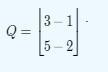
For example, matrices

Linear Algebra 5th Edition Chapter 3 Elementary Matrix Operations and Systems of Linear Equations 4

There is no way to obtain the product matrix as elementary from I2 by a single elementary operation.

Thus, the statement “the product of two n×n elementary matrices is an elementary matrix.” is false.

The product of two n×n elementary matrices is not elementary matrix because the product matrix couldn’t be obtained as elementary from the identity matrix in just one operation.

Thus, the statement “the product of two n×n elementary matrices is an elementary matrix” is false.

Page 150 Problem 5 Answer

Provided – statement “the inverse of an elementary matrix is an elementary matrix.”

To check – the statement is true or false

We know that the inverse corresponds to the inverse elementary operation.

Clearly, the statement “the inverse of an elementary matrix is an elementary matrix” is true.

The inverse of an elementary matrix is not an elementary matrix because it corresponds to the inverse elementary operations.

Thus, the statement “the inverse of an elementary matrix is an elementary matrix” is true.

Linear Algebra 5th Edition Chapter 3 Page 150 Problem 6 Answer

Provided – statement “the sum of two n×n elementary matrices is an elementary matrix.”

To check – the statement is true or false

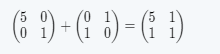
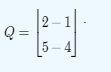
Consider

Linear Algebra 5th Edition Chapter 3 Elementary Matrix Operations and Systems of Linear Equations 6

Clearly, there is no way to obtain elementary matrix from I2 by a single elementary operation.

Thus, the statement “the sum of two n×n elementary matrices is an elementary matrix.” is false.

The sum of two n×n elementary matrices is not an elementary matrix because the sum matrix cannot be generated from the identity matrix in one operation.

Thus, the statement “the sum of two n×n elementary matrices is an elementary matrix” is false.

Exercise 3.1 Elementary Matrix Operations Solved Problems Linear Algebra 5th Edition Chapter 3 Page 150 Problem 7 Answer

Provided – statement “the transpose of an elementary matrix is an elementary matrix.”

To check – the statement is true or false

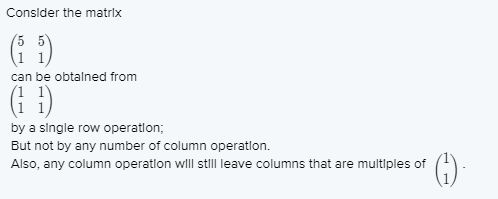
If the original matrix corresponds to elementary on rows, the transpose corresponds to the same operation on columns.

Thus, the statement “the transpose of an elementary matrix is an elementary matrix” is true.

The transpose of an elementary matrix is not an elementary matrix because the transpose corresponds to the same operation on columns.

Therefore, the statement “the transpose of an elementary matrix is an elementary matrix” is true.

Linear Algebra 5th Edition Chapter 3 Page 150 Problem 8 Answer

Provided – statement “If B is a matrix that can be obtained by performing an elementary row operation on a matrix A, then B can also be obtained by performing an elementary column operation on A.”

To check – the statement is true or false

Thus, the statement “If B is a matrix that can be obtained by performing an elementary row operation on a matrix A, then B can also be obtained by performing an elementary column operation on A” is false.

If B is a matrix that can be generated by performing an elementary row operation on a matrix A, then B cannot be generated by performing an elementary column operation on A because the column multiplication cannot simply operate on their own in one step.

Thus, the statement “If B is a matrix that can be obtained by performing an elementary row

Linear Algebra 5th Edition Chapter 3 Elementary Matrix Operations and Systems of Linear Equations 8

operation on a matrix A , then B can also be obtained by performing an elementary column operation on A” is false.

Linear Algebra 5th Edition Chapter 3 Page 150 Problem 9 Answer

Provided – statement “If B is a matrix that can be obtained by performing an elementary row operation on a matrix A, then A can be obtained by performing an elementary row operation on B .”

To check – the statement is true or false

We know that matrix A can be obtained by performing the inverse elementary row operation.

Thus, the statement “If B is a matrix that can be obtained by performing an elementary row operation on a matrix A, then A can be obtained by performing an elementary row operation on B ” is true.

If B is a matrix that can be generated by performing an elementary row operation on a matrix A, then A cannot be generated by performing an elementary row operation on B because A can be generated by performing the inverse elementary row operation.

Thus, the statement “If B is a matrix that can be obtained by performing an elementary row operation on a matrix A, then A can be obtained by performing an elementary row operation on B ” is true.

Linear Algebra 5th Edition Chapter 3

Page 151 Problem 10 Answer

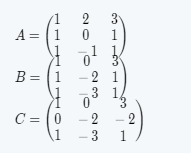
Provided are the matrices,

Linear Algebra 5th Edition Chapter 3 Elementary Matrix Operations and Systems of Linear Equations 10

Linear Algebra 5th Edition Chapter 3 Elementary Matrix Operations and Systems of Linear Equations 10 1

Linear Algebra 5th Edition Chapter 3 Elementary Matrix Operations and Systems of Linear Equations 10 2

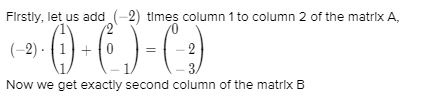
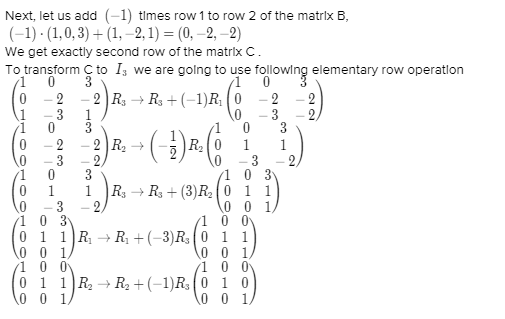
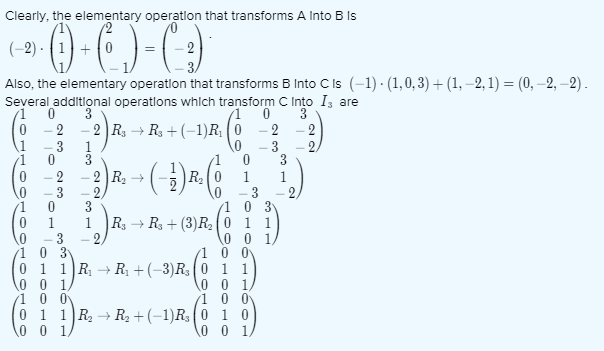
We are to determine the elementary operation that transforms A into B; elementary operation that transforms B into C and several additional operations which transform C into I3.

Note that matrices A and B have different second columns.

Linear Algebra 5th Edition Chapter 3 Elementary Matrix Operations and Systems of Linear Equations 10 3

Linear Algebra Friedberg Exercise 3.1 Systems Of Linear Equations Chapter 3 Page 151 Problem 11 Answer

We are to show that E is an elementary matrix if and only if Et is elementary.

Consider E to be an n×n elementary matrix.

There are three types of an elementary matrix:

If matrix E is type (1), matrix E is generated by interchange two rows (or two columns) i and j of In, i,j∈{1,….,n}.

This means that E is a matrix with all entries are same as in In, except items on a position (i,j) and (j,i) in matrix, which is equal to 1, and items on a position (i,i) and (j,j) in matrix, which is equal to 0.

Here, we can note that the generated matrix is symmetrical. So, Et=E.

Hence, Et is an elementary matrix.

If matrix E is type (2), matrix E is generated by multiplication a row i (or a column i) of In, i∈{1,….,n} by a nonzero scalar a.

This means that E is a matrix with all entries are same as in In, except an item on a position (i,i), which is equal to a. Here, we can note that the obtain matrix is symmetrical.

So, Et=E. Hence, Et is an elementary matrix.

Now, we assume that E is type (3) and that an elementary operation is performed on this way: row i multiply by a nonzero scalar a and added to row j, where i,j∈{1,….,n}.

Then E is a matrix with all entries are same as in In, except an item on a position (j,i) in matrix, which is equal a.

Then, the transpose matrix Et is a matrix with all entries are same as in In, except an item on a position (i,j) in matrix, which is equal a.

The same matrix we can get if we multiply a column i by a nonzero scalar a and add to a column j. So, Et is an elementary matrix. Otherwise, let Et is an n×n elementary matrix.

As (Et)t=E, we come to the conclusion that E is an elementary matrix as we can apply the previous procedure on Et.

E is an  n×n elementary matrix if and only if Et is an elementary matrix.

When a matrix E is type (1) or (2), then the matrix is symmetrical, so Et=E.

When a matrix E is type (3), then, if the matrix is generated by performing an elementary operation type (3) on rows (columns), the transpose corresponds to the same operation on columns (rows).

Thus, E is an elementary matrix if and only if Et is an elementary matrix.

Linear Algebra 5th Edition Chapter 3 Page 151 Problem 12 Answer

Theorem 3.1 states that:

Let A∈Mm×n(F), and suppose that B is generated from A by performing an elementary row [column] operation.

Then there exists an m×m[n×n] elementary matrix E such that B=EA[B=AE].

In fact, E is obtained from Im[In] by performing the same elementary row [column] operation as that which was performed on A to obtain B.

Conversely, if E is an elementary m×m[n×n]

matrix, then EA[AE] is the matrix obtained from A by performing the same elementary row [column] operation as that which produces E from Im[In].

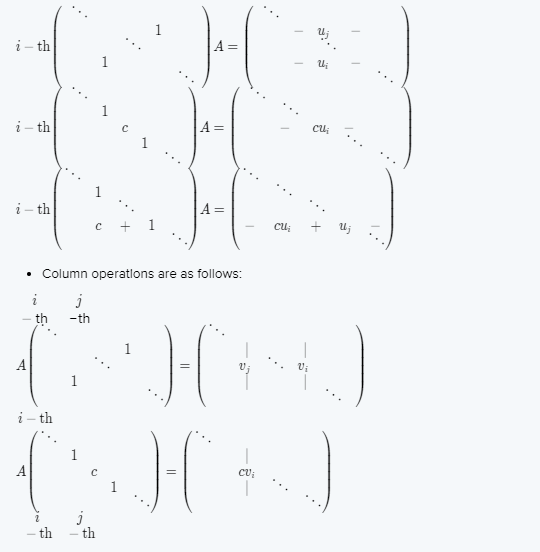
We can judge the following matrix multiplication is right. Let {u1,u2,…,un} and {v1,v2,…,vn} be the row and column vectors of A respectively.

Row operations are as follows:

Linear Algebra 5th Edition Chapter 3 Elementary Matrix Operations and Systems of Linear Equations 12

Therefore, the given theorem 3.1 is proved.

Exercise 3.1 Matrix Operations Examples Friedberg Chapter 3 Linear Algebra 5th Edition Page 151 Problem 13 Answer

Consider A to be a m×n matrix.

Using the theorem, E−1 is an elementary matrix of the same type if E is.

So, if Q can be obtained from P, we can write Q=EP and hence E−1Q=P.

This suggests that P can be obtained from Q.

Thus, it is proved above that then P can be generated from Q by an elementary matrix of the same type

Page 151 Problem 14 Answer

Here, we are to show that any elementary row [column] operation of type 2 can be obtained by dividing some row [column] by a nonzero scalar.

It is known that the operation of multiplying one row by a scalar c refers dividing the same row by a scalar 1/c.

Thus, it is shown that any elementary row [column] operation of type 2 can be generated by dividing some row [column] by a nonzero scalar.

Linear Algebra 5th Edition Chapter 3 Page 151 Problem 15 Answer

We are to show that any elementary row [column] operation of type 1 can be generated by a succession of three elementary row [column] operations of type 3 followed by one elementary row [column] operation of type 2.

Interchanging the ith and the j -th row can be generated by the following steps:

multiply the i -th row by −1;add −1 time the i -th row to the j -th row;add 1 time the j -th row to the i -th row;add −1 time the i -th row to the j -th row.

Thus, it is proved above that prove that any elementary row [column] operation of type 1 can be generated by a succession of three elementary row [column] operations of type 3 followed by one elementary row [column] operation of type 2.

Page 152 Problem 16 Answer

Here, we are to show that any elementary row [column] operation of type 3 can be obtained by subtracting a multiple of some row [column] from another row [column].

It is known that the operation of adding c times of the i -th row to the j -th row refers subtracting c times of the i -th row to the j -th row.

Thus, it is shown that any elementary row [column] operation of type 3 can be generated by subtracting a multiple of some row [column] from another row [column].

Linear Algebra 5th Edition Chapter 3 Page 152 Problem 17 Answer

Here, we are to show that any elementary row [column] operation of type 3 can be generated by subtracting a multiple of some row [column] from another row [column].

Firstly, let us assume k=min{m,n}.

Also, set j be a integer variable and do repeatedly the following processes:

When Aij=0 for all j, take i=i+1 and omit following steps and repeat process directly.

When Aij≠0 for some j, interchange the i -th and the j -th row.Now, add −Aij

Aji times the i-th row to the j-th row for all j>i.Then, set i=i+1 and repeat the process.

Thus, it is shown that any elementary row [column] operation of type 3 can be generated by subtracting a multiple of some row [column] from another row [column].

Stephen Friedberg Linear Algebra 5th Edition Chapter 2 Exercise 2.7 Linear Transformations and Matrices

Linear Algebra 5th Edition Chapter 2 Linear Transformations and Matrices

Page 140 Problem 1 Answer

Given: The set of solutions to an nth-order homogeneous linear differential equation with constant coefficients is an  -dimensional subspace of C .

To determine: Whether the given statement is true or false.

An n-th order homogeneous linear differential equation with constant coefficients is indeed a differential operator of order.

Hence its solution set, or the null space is an dimensional subspace of C , according to the theorem 2.32 on page 135.

The statement is true.

The statement, that the set of solutions to an nth-order homogeneous linear differential equation with constant coefficients is an n-dimensional subspace of C , is true.

Linear Algebra 5th Edition Chapter 2 Page 140 Problem 2 Answer

In the question, a statement is given that the solution space of a homogeneous linear differential equation with constant coefficients is the null space of a differential operator.

The task is to determine if this statement is true or false.

The statement given is indeed the theorem 2.28 given on page 132.

Therefore, the statement is true.

The statement, that the solution space of a homogeneous linear differential equation with constant coefficients is the null space of a differential operator, is true.

Read and Learn More Stephen Friedberg Linear Algebra 5th Edition Solutions

Linear Algebra 5th Edition Chapter 2 Page 140 Problem 3 Answer

In the question, a statement is given that the auxiliary polynomial of a homogeneous linear differential equation with constant coefficients is a solution to the differential equation.

The task is to determine if this statement is true or false.

Consider the equation  y=0.

It has the auxiliary polynomial p(t)=1 , but

y=1 is not a solution.

Based on this counter-example, it is concluded that the statement is false.

The statement, that the auxiliary polynomial of a homogeneous linear differential equation with constant coefficients is a solution to the differential equation, is false.

Stephen Friedberg Linear Algebra 5th Edition Solutions For Exercise 2.7 Linear Algebra 5th Edition Chapter 2 Page 140 Problem 4 Answer

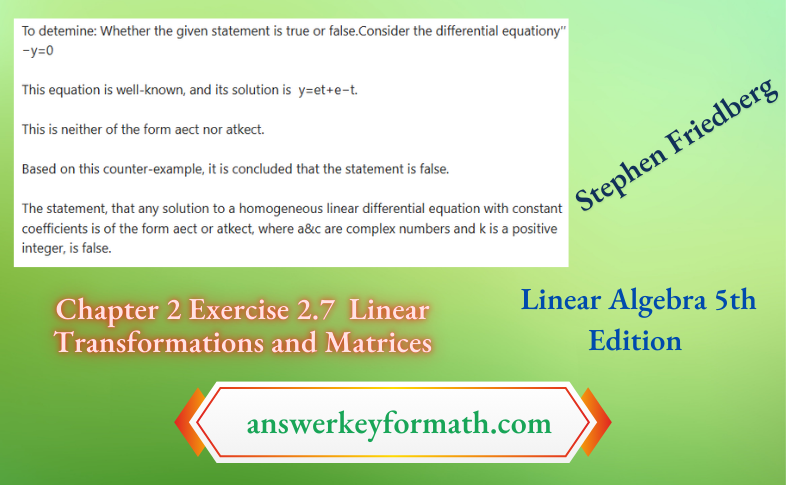
Given: Any solution to a homogeneous linear differential equation with constant coefficients is of the form aect or atkect, where a&c  are complex numbers and k is a positive integer.

Stephen Friedberg Linear Algebra 5th Edition Chapter 2 Exercise 2.7 Linear Tranformations And Matrices

Linear Algebra 5th Edition Chapter 2 Page 140 Problem 5 Answer

In the question, a statement is given that any linear combination of solutions to a given homogeneous linear differential equation with constant coefficients is also a solution to the given equation.

The task is to determine if this statement is true or false.

The differential operator is linear.

Hence, if et​1,et​2 are two of its solutions, then C1 et​1+C2et​2 is a solution too.

Therefore, the statement is true.

The statement, that any linear combination of solutions to a given homogeneous linear differential equation with constant coefficients is also a solution to the given equation, is true.

Linear Algebra 5th Edition Chapter 2 Page 140 Problem 6 Answer

In the question, a statement is given that for any homogeneous linear differential equation with constant coefficients having auxiliary polynomial p(t), if c1,c2,…,ck are the distinct zeros of  , then {ec​1t,ec​2t,…,ec​kt} is a basis for the solution space of the given differential equation.

The task is to determine if this statement is true or false.

Consider the differential equation y′′+2y′+y=0.

Its auxiliary polynomial is  (t+1)2.

A basis for this equation is te−t, which is not in the form ec​kt.

Based on this counter-example, it is concluded that the statement is false.

The statement, that for any homogeneous linear differential equation with constant coefficients having auxiliary polynomial p(t), if  c1,c2,…,ck are the distinct zeros of p(t) , then {ec​1t,ec​2t,…,ec​kt} is a basis for the solution space of the given differential equation, is false.

Linear Algebra 5th Edition Chapter 2 Page 140 Problem 7 Answer

Given: Given any polynomial p(t)∈P(C), there exists a homogeneous linear differential equation with constant coefficients whose auxiliary polynomial is p(t).

To determine: Whether the given statement is true or false.

Consider the differential equation p(D)(y)=0.

Its auxiliary polynomial is p(t).

The statement is true.

The statement, that given any polynomial p(t)∈P(C), there exists a homogeneous linear differential equation with constant coefficients whose auxiliary polynomial is p(t), is true.

Linear Algebra 5th Edition Chapter 2 Page 141 Problem 8 Answer

In the question, a statement is given that  any finite-dimensional subspace of C is the solution space of a homogeneous linear differential equation with constant coefficients.

The task is to determine if the statement is true or false.

Consider the finite-dimensional subspace generated by the function y=t.

Note that,

⇒ y′=1

⇒ y′′=0 and so on. Hence, fork≥2.

⇒ y(k)=0.

Therefore, the equation,

ay′+by=0 does not hold for non-zero a .

As W is not the solution space, the statement is false.

The statement that, any finite-dimensional subspace of Cis the solution space of a homogeneous linear differential equation with constant coefficients, is false.

As a counterexample, consider the function y=t which generates the finite-dimensional subspace  W, but W is not the solution space.

Linear Algebra 5th Edition Chapter 2 Page 141 Problem 9 Answer

In the question, a statement is given that there exists a homogeneous linear differential equation with constant coefficients whose solution space has the basis  {t,t2}.

The task is to determine if the statement is true or false.

Consider the function y=t.

As observed in Exercise 2.(a), y(k)=0 for greater than or equal to 2.

Hence, y is infinitely differentiable, and the solution space is C∞ .

Thus, the basis cannot be {t,t2}.

The statement is false.

The statement that, there exists a homogeneous linear differential equation with constant coefficients whose solution space has the basis {t,t2}, is false.

A counterexample is given by the equation y=t, whose solution space is  C∞.

Linear Algebra 5th Edition Chapter 2 Page 141 Problem 10 Answer

Given: For any homogeneous linear differential equation with constant coefficients, if x is a solution to the equation, so is its derivative x′.

To determine: Whether the given statement is true or false.

Let the auxiliary polynomial be p(t).

Then, p(D)(x′)=D(p(D)(x)) .

As p(D)(x) is zero, p(D)(x′)=0 .

The statement is true.

The statement that, for any homogeneous linear differential equation with constant coefficients, if is a solution to the equation, so is its derivative x′, is true.

Linear Algebra 5th Edition Chapter 2 Page 141 Problem 11 Answer

It is given that for two polynomials p(t) and q(t) in P(C) , if

⇒ x∈N(p(D))

⇒ y∈N(q(D)) then,

⇒ x+y∈N(p(D)q(D))

The task is to determine if the statement is true or false.

Note hatp(D)q(D)(x+y)=q(D)p(D)(x)+p(D)q(D)(y).As x,y belongs to the null space of p(D),q(D) respectively, hence p(D)(x) and q(D)(y) are both zero.Hence, p(D)q(D)(x+y)=0 .

It means that  x+y∈N(p(D)q(D)).

The statement is true.

The statement that,  for two polynomials p(t),q(t)in P(C)if,

⇒ x∈N(p(D))

⇒ y∈N(q(D))

​then,x+y∈N(p(D)q(D)) is true. It is true because, p(D)q(D)(x+y)=0

Solutions For Chapter 2 Exercise 2.7 Linear Transformations Page 141 Problem 12 Answer

It is given that for two polynomials  in p(t),q(t) , ifP(C)

x∈N(p(D))

y∈N(q(D)) then, xy∈N(p(D)q(D))

The task is to determine if the statement is true or false.

Consider the two well-known differential equations:

⇒ x′−x=0

⇒ y′+y=0​

The solutions for these equations are et,e−t respectively.

Then xy=ete−t, which is.

Although xy=1,  is not a solution for y′′−y=0 .

Thus xy∉N(p(D)q(D)) .

The given statement is false.

The statement that,  for two polynomials p(t),q(t) if,

⇒ x∈N(p(D))

⇒ y∈N(q(D)) then,xy∈N(p(D)q(D)) is false.

Linear Algebra 5th Edition Chapter 2 Page 141 Problem 13 Answer

Given: y′′+2y′+y=0

To find: A basis for the solution space for the given differential equation.

The auxiliary polynomial for the given differential equation is written and its zeros are identified.

The basis of the auxiliary equation is written based on the theorem which is also the basis of the given differential equation.

Given differential equation is

⇒ y′′+2y′+y=0

The auxiliary polynomial associated with the differential equation is

⇒ p(t)=t2+2t+1

The zeros of the auxiliary polynomial is

⇒ t2+2t+1=(t+1)(t+1)

⇒t=−1,−1​

Using the theorem, the basis for the solution space is {e−t,te−t}

The basis for the solution space for the given differential equation is {e−t,te−t}

Linear Algebra 5th Edition Chapter 2 Page 141 Problem 14 Answer

In the question, we are asked to find a basis for the solution space for the given differential equation.

The auxiliary polynomial for the given differential equation is written and its zeros are identified.

The basis of the auxiliary equation is written based on the theorem which is also the basis of the given differential equation.

Given differential equation is

⇒ y′′′=y′

The auxiliary polynomial associated with the differential equation is

⇒ p(t)=t3−t

The zeros o Using the theorem, the basis for the solution space is

⇒ {e(0)t,e−t,et}={1,e−t,et}

The basis for the solution space for the given differential equation is {1,e−t, et}

Linear Algebra 5th Edition Chapter 2 Page 141 Problem 15 Answer

In the question, we are asked to find a basis for the solution space for the given differential equation.

The auxiliary polynomial for the given differential equation is written and its zeros are identified.

The basis of the auxiliary equation is written based on the theorem which is also the basis of the given differential equation.

Given differential equation is y4−2y2+y=0

The auxiliary polynomial associated with the differential equation is p(t)=t4−2t2+1

The zeros of the auxiliary polynomial is

⇒ t4−2t2+1=(t2−1)(t2−1)=(t2−1)2

=[(t−1)(t+1)]2

=(t−1)2(t+1)2

⇒t=−1,−1,1,1

Using the theorem, the basis for the solution space is

⇒ n=2

⇒ c=−1,1

⇒{e−t,text, et,tet}

​The basis for the solution space for the given differential equation is

⇒ {e−t,te−t, et,tet}

Exercise 2.7 Matrices Examples Friedberg Linear Algebra 5th Edition Chapter 2 Page 141 Problem 16 Answer

Given: y′′+2y′+y=0

To find: A basis for the solution space for the given differential equation.

The auxiliary polynomial for the given differential equation is written and its zeros are identified.

The basis of the auxiliary equation is written based on the theorem which is also the basis of the given differential equation.

Given differential equation isy′′+2y′+y=0

The auxiliary polynomial associated with the differential equation isp(t)=t2+2t+1

The zeros of the auxiliary polynomial is t2+2t+1=(t+1)2

⇒t=−1,−1

​Using the theorem, the basis for the solution space is

⇒ n=2

⇒ c=−1,

⇒{e−t,te−t}

​The basis for the solution space for the given differential equation is {e−t,te−t}

Linear Algebra 5th Edition Chapter 2 Page 141 Problem 17 Answer

In the question, we are asked to show that C is a subspace of ℑ(R,C)

Let f&g be two elements of C.

So there exists k-th derivative of the sum of the two functions

⇒ (f+k)k=fk+gk

So the sum of the two elements belongs to C

The k-th derivative of an element multiplied with a scalar is (cf)k=cfk

Naturally, the element f=0 belongs C∞.

Hence it can be said that C∞ is a subspace of .ℑ(R,C)

It is proven that Cis a subspace of  ℑ(R,C)

Linear Algebra 5th Edition Chapter 2 Page 142 Problem 18 Answer

To show: {eatcosbt,eatsinbt} is a basis for the solution space.

Given: A second-order homogeneous linear differential equation with constant coefficients for which the auxiliary polynomial has the roots

⇒ a±ib

Evaluating e(a±ib)t

⇒ e(a±ib)t=eat×eibt

=eat(cosbt+isinbt)

=eatcosbt+ieatsinbt

So the solution set is{eatcosbt,eatsinbt} which forms the basis for the solution space.

It is proven that{eatcosbt,eatsinbt} is a basis for the solution space.

Exercise 2.7 Notes From Friedberg Linear Algebra 5th Edition 

Linear Algebra 5th Edition Chapter 2 Page 142 Problem 19 Answer

In the question, we are asked to prove that

N(Ui)⊆N(U1U2…Un) for any 1≤i≤n where {U1U2…Un}is a collection of pairwise commutative linear operators on a vector space V.

Operating the given operator onx∈N(Ui)  and solving to prove the given condition.

Consider x∈N(Ui)

Given that the operators are commutative

⇒UiUj=UjUi

Since1≤i≤n

⇒Ui

(x)=0

Considering(U1U2…Ui…Un)(x)

(U1U2…Ui…Un)(x)=(U1U2…Ui−1Ui…Un)(x)

(U1U2…Ui…Un)(x)=(U1U2…Ui−1…UnUi)(x)

(U1U2…Ui…Un)(x)=(U1U2…Ui−1…Un)Ui(x)

since (Ui)(x)=0

⇒(U1U2…Ui…Un)(x)=(U1U2…Ui…Un)(0)

⇒(U1U2…Ui…Un)(0)=0

⇒(U1U2…Ui…Un)(x)=0

Thenx∈N(U1U2…Un)

⇒N(Ui)⊆N(U1U2…Un)

It is proven that

N(Ui)⊆N(U1U2…Un) for anyi,1≤i≤n

Linear Algebra 5th Edition Chapter 2 Page 142 Problem 20 Answer

To prove Theorem 2.33 and its corollary.First consider b1ec​1t+b2ec​2t+…+bnec​nt=0

Then apply the induction on n.

Then verify the theorem for n=1.

Then assume that it is true n−1 functions, apply the operator D−cnI to establish the theorem for distinct exponential functions.

Whenn=1 in the equation

⇒ b1ec​1t+b2ec​2t+…+bnec​nt=0

⇒b1ec​1t=0​

Since exponential function is never zero, ⇒b1=0

Applying in the case of n−1 functions, b1ec​1t+b2ec​2t+…+bn−1ec​n−1t=0

⇒b1=0

⇒ b2=0

⇒ bn−1=0​

Using the operator D−cnI on the equation

⇒ b1ec​1t+b2ec​2t+…+bnec​nt=0

⇒ (D−cnI)(b1ec​1t+b2ec​2t+…+bnec​nt)=(D−cnI)0(b1c1ec​1t+b2

⇒ c2ec​2t+…+bncnec​nt)−cn(b1ec​1t+b2ec​2t+…+bnec​nt)=0

⇒ b1ec​1t(c1−cn)+b2ec​2t(c2−cn)+…+bn−1ec​n−1t(cn−1−cn)=0

​On assuming that the assumption is true for n−1 functions,

⇒b1(c1−cn)=0b2(c2−cn)=0bn−1(cn−1−cn)=0

​Since exponential functions are not zero;

⇒b1,b2,…bn−1=0

So the equation becomes

⇒ 0+0+…+bnec​nt=0

⇒ bn=0

The set {ec1t,ec2t,…,ecnt} is linearly independent.

If c is the zero of the auxiliary polynomial for a homogenous linear differential equation with constant coefficients.

Then {ect} is a solution of the differential equation.

Then for an auxiliary polynomial with n distinct zeros c1,c2,…,cn, then {ec1t,ec2t,…,ecnt}  is a solution of the differential equation.

Since it is also linearly independent, then the set{ec1t,ec2t,…,ecnt} forms a basis for the solution space of the differential equation.

Theorem 2.33 and its corollary is proven.

Stephen Friedberg Linear Algebra 5th Edition Chapter 2 Exercise 2.6 Linear Transformations and Matrices

Linear Algebra 5th Edition Chapter 2 Linear Transformations and Matrices

Page 124 Problem 1 Answer

Given in the question that, All vector spaces are finite-dimensional while the given statement is,  Every linear transformation is a linear functional.

To determine whether the given statement is true or false.

It is given that all vector spaces are finite-dimensional.

According to the definition of a linear functional, there is a mapping of linear transformation from a vector space V into its field of scalars F is itself a vector space.

Thus, conclude that every linear transformation is not linear functional since linear transformations into its field of scalars are linear functional.

Hence, the given statement is false.

The given statement “Every linear transformation is a linear functional” is false.

Linear Algebra 5th Edition Chapter 2 Page 124 Problem 2 Answer

Given in the question that, All vector spaces are finite-dimensional while the given statement is,  A linear functional defined on a field may be represented as a 1×1 matrix.

To determine whether the given statement is true or false.

It is given that all vector spaces are finite-dimensional.

According to the definition of a linear functional, there is a mapping of linear transformation from a vector space V into its field of scalars F, which is itself a vector space of dimension 1 over F.

Thus, conclude that both domain and codomain of a linear functional on a field F

will have the dimension 1.

Hence, the given statement is true since its domain and codomain have dimension 1.

The given statement “A linear functional defined on a field may be represented as a 1×1 matrix” is true.

Read and Learn More Stephen Friedberg Linear Algebra 5th Edition Solutions

Stephen Friedberg Linear Algebra 5th Edition Solutions For Exercise 2.6 Chapter 2 Page 124 Problem 3 Answer

Given in the question that, All vector spaces are finite-dimensional while the given statement is, Every vector space is isomorphic to its dual space.

Stephen Friedberg Linear Algebra 5th Edition Chapter 2 Exercise 2.6 Linear Tranformations And Matrices

Apply the theorem and conclude that every vector space and its dual space are isomorphic since they have equal dimension.

Hence, the given statement is true.

The given statement “Every vector space is isomorphic to its dual space” is true.

Linear Algebra 5th Edition Chapter 2 Page 124 Problem 4 Answer

Given in the question that,  All vector spaces are finite-dimensional while the given statement is, Every vector space is the dual space of some other vector space.

To determine whether the given statement is True or False.

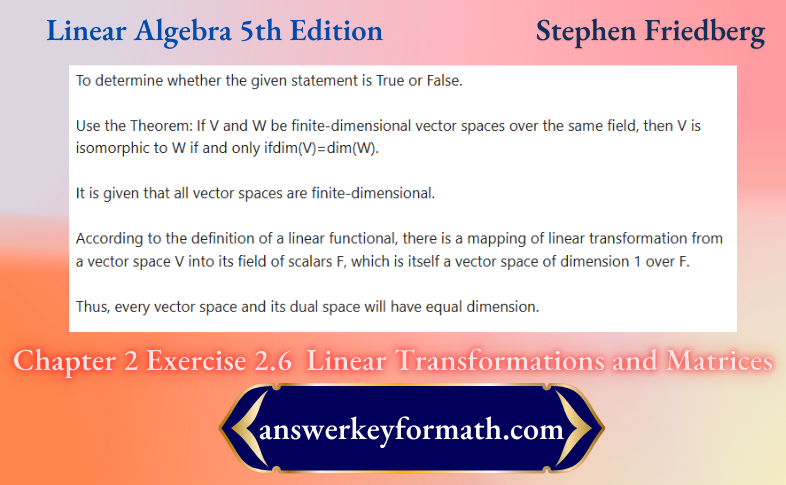
Use the Theorem: If V and W be finite-dimensional vector spaces over the same field, then V is isomorphic to W if and only ifdim(V)=dim(W).

It is given that all vector spaces are finite-dimensional.

According to the definition of a linear functional, there is a mapping of linear transformation from a vector space V into its field of scalars F, which is itself a vector space of dimension 1 over F.

Thus, every vector space and its double dual space will have equal dimension.

Apply the theorem and conclude that every vector space and the dual space of its dual space are isomorphic.

Therefore, every vector space is the dual of its dual space.

Hence, the given statement is true.

The given statement “Every vector space is the dual space of some other vector space” is true.

Linear Algebra 5th Edition Chapter 2 Page 124 Problem 5 Answer

Given in the question that, All vector spaces are finite-dimensional while the given statement is,  If T is an isomorphism from V onto V∗ and β is a finite ordered basis for V, then T(β)=β∗.

To determine whether the given statement is true or false.

It is given that all vector spaces are finite-dimensional and T is an isomorphism from V onto V∗.

If β is an ordered basis for V, then β∗ is an ordered basis for V∗ which consists of coordinate functions with respect to β.

Thus, the mapping of an isomorphism from V onto V∗ does not necessarily have to map the vectors from β to β∗.

Hence, the given statement is false.

The given statement “If T is an isomorphism from V onto V∗ and β is a finite ordered basis for V, then T(β)=β∗” is false.

Linear Algebra 5th Edition Chapter 2 Page 124 Problem 6 Answer

Given in the question that,  All vector spaces are finite-dimensional while the given statement is, If T is a linear transformation from V onto W, then the domain of (Tt)t is V∗∗.

To determine whether the given statement is True or False.

Use the Theorem: If T is a linear transformation from V to W, then the mapping Tt:W∗→V∗ defined by Tt(g)=gT for all g∈W∗ is a linear transformation.

It is given that all vector spaces are finite-dimensional.

According to the theorem, ff T is a linear transformation from V to W, then Tt is a linear transformation from W∗to V∗.

Thus, it implies that (Tt)t will be a linear transformation from W∗∗to V∗∗.

Therefore, the domain of (Tt)t is V∗∗.

Hence, the given statement is true.

The given statement “If T is a linear transformation from V onto W, then the domain of (Tt)t is V∗∗” is true.

Chapter 2 Exercise 2.6 Linear Transformations Solved Examples Page 124 Problem 7 Answer

Given in th  question that, All vector spaces are finite-dimensional while the given statement is, If V

is isomorphic to W, then V∗ is isomorphic to W∗.

To determine whether the given statement is True or False.

Use the Theorem: If V and W be finite-dimensional vector spaces over the same field, then V is isomorphic to W if and only ifdim(V)=dim(W).

Consider V and W as finite-dimensional vector spaces.

If V and W, then according to the theorem, dim(V)=dim(W)…(1).

Since every vector space is isomorphic to its dual space, by theorem dim(V∗)=dim(V).

Also, W is a finite-dimensional vector space. So, dim(W∗)=dim(W).

From equation (1), it is obtained as dim(W∗)=dim(V∗).

It implies that V∗ is isomorphic to W∗.

Hence, the given statement is true.

The given statement “If V is isomorphic to W, then V∗ is isomorphic to W∗” is true.

Linear Algebra 5th Edition Chapter 2 Page 124 Problem 8 Answer

Given in the question that,  All vector spaces are finite-dimensional and the statement is, The derivative of a function may be considered as a linear functional on the vector space of differentiable functions.

To determine whether the given statement is true or false.

Since the codomain of the linear functional must be a field, the derivative of a function cannot be considered as a linear functional on the vector space of differentiable functions.

Hence, the given statement is false.

The given statement is false.

Linear Algebra 5th Edition Chapter 2 Page 124 Problem 9 Answer

Given in the question is vector space, V=R3.

The basis is β={(1,0,1),(1,2,1),(0,0,)} .

To determine explicit formulas for vectors of the dual basis β∗ for  V∗.

Use the definition of dual basis to find equations for the vectors of dual bases and then solve them to get the coefficients for the linear equations for those vectors.

Let the dual basis for β be given as β∗={f1,f2,f3}.

Then, using the definition of dual basis, the following equations are achieved:

⇒ 1=f1(e1)+f1(e3)

⇒ 0=f1(e1)+2f1(e2)+f1(e3)

⇒ 0=f1(e3)

In the first equation , setting

⇒ 0=f1(e3):f1(e1)=1

Now, from the second equation we have:

⇒ f1(e2)=1/2

Finally, it follows that;

⇒ f1(e1)=1

⇒ f1(e2)=−1/2

⇒ f1(e3)=0

Therefore,

⇒ f1(x,y,z)=x−y/2

Similarly as in Step 1, using the definition of dual basis, the following equations are derived,

⇒ 0=f2(e1)+f2(e3)

⇒ 1=f2(e1)+2f2(e2)+f2(e3)

⇒ 0=f2(e3)

Here, it is obvious that,

⇒ f2(e1)=0

⇒ f2(e3)=0

From the second equation,

⇒ f2(e2)=1/2

Thus,

⇒ f2(x,y,z)=y/2

Finally, it the following equations hold too:

⇒ 0=f3(e1)+f3(e3)

⇒ 0=f3(e1)+2f3(e2)+f3(e3)

⇒ 1=f3(e3)

Setting f3(e3)=1 in the first equation:

⇒ f3(e1)=−1

From the second equation:

⇒ f3(e2)=0

Thus, f3(x,y,z)=−x+z

For the vector space V=R3 and basis,β={(1,0,1),(1,2,1),(0,0,1)}, the explicit formulas for vectors of the dual basis β∗ are:

⇒ {f1(x,y,z)=x−y/2

⇒ {f2(x,y,z)=y/2

⇒ {f3(x,y,x)=−x+z

Linear Algebra 5th Edition Chapter 2 ​Page 124 Problem 10 Answer

Take

⇒ V=P2®

⇒ β={1,x,x2}

={e1,e2,e3}

Hence,

⇒ 1=f1

⇒ (1)=f1(e1)

⇒ 0=f1(x)

=f1(e2)

⇒ 0=f1(x2)

=f1(e3)

⇒ f1(e1)=1,

⇒ f1(e2)=1,

⇒ f2(e3)=0

Hence,

⇒ 0=f2(1)=f2(e1)

1=f2(x)=f2(e2)

⇒ 0=f2(x2)

=f2(e3)

⇒ f2(e1)=1,

⇒ f2(e2)=1,

⇒ f2(e3)=0

​Then

⇒ 0=f3

⇒ (1)=f3(e1)

⇒ 0=f3(x)=f3(e2)

⇒ 1=f3(x2)=f3(e3)

⇒ f3(e1)=1,

⇒ f3(e2)=1,

⇒ f3(e3)=0

And

⇒ f1(a+bx+cx2)=a

⇒ f2(a+bx+cx2)=b

⇒ f3(a+bx+cx2)=c

And then β∗

={f1(a+bx+cx2),f2(a+bx+cx2),f3(a+bx+cx2)}={a,b,c}

Hence, for  vector spaces Vand bases β, find explicit formulas for vectors of the dual basis β∗ for V∗,  V=P2

(R) and β={1,x,x2}

Linear Algebra Friedberg Exercise 2.6 Step-By-Step Guide Page 124 Problem 11 Answer

In the question,f1,f2,f3∈V∗  are given as :

⇒ f1(x,y,z)=x−2y

⇒ f2(x,y,z)=x+y+z

⇒ f3(x,y,z)=y−3z

To prove that {f1,f2,f3} is a basis for V∗ and to find a basis for V for which it is the dual basis.

To show that it is indeed the basis for V∗ , show linear independence.

Dual basis for V can be find out using properties of dual basis.

To show the linear independency, let a,b,c be real numbers.

Then, from the equations for f1,f2, and f3:

⇒ a(x−2y)+b(x+y+z)+c(y−3z)=0

⇒ (a+b)x+(b+c−2a)y+(b−3c)z=0

As this is true for all (x,y,z)∈R3, one might say that:

⇒ a+b=0

⇒ b+c−2a=0

⇒ b−3c=0

The only solution for these equation:

⇒ a=0

⇒ b=0

⇒ c=0

Thus, the linear independency is proved.

Hence f1,f2,f3 form a basis for V∗.

To find the dual basis, the following must be satisfied for an e1

∈V:

⇒ f1e1=1

⇒ f2e2=0

⇒ f3e3=0

Thus:

⇒ x1−2y1=1

⇒ x1+y1+z1=0

⇒ y1−3z1=0

Setting z1=y1/3 in the second equation:

⇒ 4y1=−3×1

Then it easily follows that:

⇒ x1=2/5

⇒ y1=−3/10

⇒ z1=−1/10

Thus,

⇒ e1=(2/5,−3/10,−1/10)

It was proved that {f1,f2,f3} is a basis for V∗.

The basis vector V which is a dual basis is (2/5,−3/10,−1/10).

Linear Algebra 5th Edition Chapter 2 Page 125 Problem 12 Answer

Given in the question that for f∈(R2)∗ ,

⇒ f(x,y)=2x+y.’

Also,T: R2→R2  is given by,

⇒ T(x,y)=(3x+2y,x).

To compute  Tt(f).

Using the definition of the mapping Tt and f, the expression for Tt(f) can be easily computed.

Given:

⇒ f(x,y)=2x+y

⇒ T(x,y)=(3x+2y,x)

Then, it directly follows that:

⇒ Tt(f)=f(T)=f(3x+2y,x)

To compute f(3x+2y,x), use the definition of f:

⇒ f(3x+2y,x)=2(3x+2y)+x

=6x+4y+x

=7x+4y

Thus,   Tt(f)=7x+4y

If, f(x,y)=2x+y

⇒ T(x,y)=(3x+2y,x)

Then, Tt(f)=7x+4y

Linear Algebra 5th Edition Chapter 2 Page 125 Problem 13 Answer

Given in the question that for f∈(R2)∗,f(x,y)=2x+y

Also, T:R2→R2 is given as T(x,y)=(3x+2y,x)

To compute [Tt]β​∗where β is the standard ordered basis for R2.

First compute the dual bases {f1,f2} from the definition of T,f. From there find out Tt(f1), Tt(f2) and the respective coefficients gives the matrix [Tt]β∗ .

The basis of (R2)∗is {(1,0),(0,1)}

Note that, (x,y)=x(1,0)+y(0,1)

Hence, it simply follows that:

⇒ f1(x,y)=x

⇒ f2(x,y)=y

​Now, Tt(f1)may be written as:

⇒ Tt(f1)=f1

⇒ T(x,y)=f1(3x+2y,x)

=3x+2y

=3f1(x,y)+2f2(x,y)​

The last expression follows from the fact that,

⇒ f1(x,y)=x

⇒ f2(x,y)=y

​Similarly,

⇒ Tt(f2)=f2

⇒ T(x,y)=f2(3x+2y,x)

=x

=1f2(x,y)+0f2(x,y)

Therefore:

⇒ Tt(f1)=3f1(x,y)+2f1(x,y)

⇒ Tt(f2)=1f2(x,y)+0f2(x,y)

The matrix

[Tt]β​∗=
(3      2)
(1      0)

The matrix [Tt]β∗ is [Tt]β∗=

(3      2)
(1      0)

Exercise 2.6 Matrices Examples Friedberg Chapter 2 Page 125 Problem 14 Answer

Given in the question that for f∈W∗, f(a,b)=a−2b

Also, T:V→W is given as T(p(x))=(p(0)−2p(1),p(0)+p′(0))

To compute Tt(f)

Using the definition of the mapping Tt and f, the expression for Tt(f) can be easily computed.

If p(x)=a+bx then:

⇒ p(0)=a

⇒ p(1)=a+b

​Also, p′

⇒ (0)=b

⇒ T(a+bx)may be written as,

⇒ T(a+bx)=(a−2(a+b),a+b)=(−a−2b,a+b)

From the definition of Tt and f, it directly follows that:

⇒ Tt(f)(a+bx)=fT(a+bx)

=f(−a−2b,a+b)

To compute f(−a−2b,a+b), use the definition of f:

⇒ f(−a−2b,a+b)=(−a−2b)−2(a+b)

=−a−2b−2a−2b

=−3a−4b​

Thus, Tt(f)=−3a−4b

For f∈W∗defined by,

f(a,b)=a−2bwe have

⇒ Tt(f)=−3a−4b

Linear Algebra 5th Edition Chapter 2 Page 125 Problem 15 Answer

Given data: Let {u,v} be a linearly independent set in R3.

To show: That the plane {su+tv:s,t∈R} through the origin in R3 may be identified with the null space of a vector in (R3)∗.

It can be observed that every lane passing through the origin in R3 satisfies the equation shown below,

Therefore,

ax+by+cz=0  for any 3 scalars a,b,c

Henceforth the plane, can be represented in the form shown below,

Therefore,

P is {(x,y,z):ax+by+cz=0}

Now, observe that on condiering,

⇒ x=u

⇒ y=v

⇒ c=0

The plane is obtained as,

{(u,​v,​z):au+bv=0}

Observe that the plane passes through the origin and also the transformation T(u,​v,​z)=au+bv which is an element of (R3)∗ and its nullspace is actually P, henceforth P=N(T).

Thus, it can be clearly shown that the plane {su+tv:s,​t∈R} through the origin in R3 may be identified with the null space of a vector in (R3)∗

if   {u,​v} be a linearly independent set in R3.

Friedberg 5th Edition Chapter 2 Exercise 2.6 Guide Page 125 Problem 16 Answer

Given data: A function T:Fn→Fm is given

To prove: That function T:Fn→Fm is linear iff  there exist f1,f2,……,fm∈(Fn) such that T(x)=(f1

(x),f2(x),​……,fm(x))∀x∈Fn.

Consider, x∈Fm and observe as shown below,

Therefore,

⇒ T(x)=a1e1+a2e2+……+amem

Now, observe that,

fi=gi(T(x))

=gi(a1e1+a2e2+……+amem)

=ai​

Henceforth, it can be obtained that fi(x)=ai

Again, for the function T:Fn→Fm∃f1,f2,​……,​fm∈(Fn) and therefore,

⇒ T(x)=(f1(x),​f2(x),​……,​fm(x))∀x∈Fn

Consider as shown below,

Therefore,

⇒ T(ax+by)=(f1(ax+by),​f2(ax+by),……,fm(ax+by))

=(af1(x)+bf1(y),​af2(x)+bf2(y),……,afm(x)+bfm(y))

=a(f1(x),​f2(x),……,fm(x))+b(f1(y),f2(y),……,fm(y))

=aT(x)+bT(y)

​Thus, it can be clearly proved that function T: Fn→Fm is linear iff there exist f1,f2,……,fm∈(Fn) such thaT(x)=(f1(x),f2(x),……,fm(x))∀x∈Fn.

Stephen Friedberg Linear Algebra 5th Edition Chapter 2 Exercise 2.5 Linear Transformations and Matrices

Linear Algebra 5th Edition Chapter 2 Linear Transformations and Matrices

 Page 116 Problem 1 Answer

 Given:

β={x1,x2,x3,x4,….,xn}

β′={x′1,x′2,x′3,x′4,….,x′n}

To find: The jth column of Q is [xj]β′.

To determine whether the statement is true or false.

Now,      ​ 

​xj′=i=1∑nQijxi,jxj′=1,2,3,….,n​

Thus, the jth column of Q is [xj′]β

Since the jth column of Q is [xj′]β, and hence, the given statement is false.

Page 116 Problem 2 Answer

Given Statement: Every change of coordinate matrix is invertible.

To find:  Whether the given statement is true or false.

Since the change of matrix can be written as,

⇒ Q=[IV]β′β 

As IV is the identity transformation. So, it is invertible.

Since IV is invertible, then Q is also invertible.

Therefore, the given statement is true.

Since IV is invertible, then Q is also invertible and hence, the given statement is true.

Read and Learn More Stephen Friedberg Linear Algebra 5th Edition Solutions

Stephen Friedberg Linear Algebra 5th Edition Solutions For Exercise 2.5 Chapter 2 Page 116 Problem 3 Answer

Given: T be a linear operator on a vector space with finite dimensions V.

Ordered bases for V are β and β′.

The change of coordinate matrix is Q.

To prove: [T]β=Q[T]β​′

⇒ Q−1

Let, β and β′ be (x1,x2,x3,x4,….,xn) and (x′1,x′2,x′3,x′4,….,x′n) .

Since the change of matrix can be written as,

⇒ Q=[IV]β′β

As IV is the identity transformation, then use the identity property;       

⇒ TI=IT

⇒ TI=T

Now, the matrix [T]β is       ​

⇒ Q[T]β′=[I]−ββ

⇒ [T]−ββ

⇒ Q[T]β′

 =Q[T]β

Hence,

⇒ Q[T]β′

 =Q[T]β[T]β

=Q[T]β′Q−1

Therefore, the given statement is true.

Since, [T]β=Q[T]β′

Q−1 is proved and hence, the given statement is true.

Linear Algebra 5th Edition Chapter 2 Page 116 Problem 4 Answer

Stephen Friedberg Linear Algebra 5th Edition Chapter 2 Exercise 2.5 Linear Tranformations And Matrices

Linear Algebra 5th Edition Chapter 2 Page 116 Problem 5 Answer

Given: Let T be a linear operator on a vector space with finite dimensions V.

To prove: [T]β is similar to [T]γ.

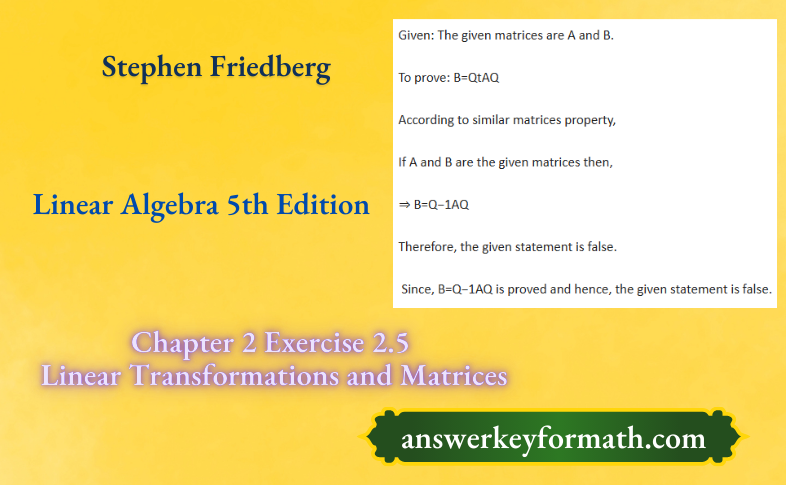
According to similar matrices property,

If T is a linear operator on V then the matrices [T]β and [T]γ. So, it must follow the relation,

⇒ [T]γ=Q−1

⇒ [T]βQ

Therefore, the given statement is true.

Since, [T]γ=Q−1[T]βQ is proved and hence, the given statement is true.

Page 117 Problem 6 Answer

Given in the question are,

⇒ β={e1,e2} and  β′={(a1,a2),(b1,b2)}

To find: [IR​2]β′β=?

For finding the change of coordinate matrix, find (a1,a2) and (b1,b2), then put the values in [IR​2]β′β.

Let, Q=[IR2]β′β

Now, find (a1,a2)

(a1,a2)=a1×(1,0)+a2×(0,1)(a1,a2)=a1×e1+a2×e2

Now, find (b1,b2)​

(b1,b2)=b1×(1,0)+b2×(0,1)(b1,b2)=b1×e1+b2×e2

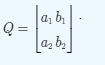
Therefore,

Linear Algebra, 5th Edition, Chapter 2 Linear Transformations and Matrices 6

The change of coordinate matrix is,

Linear Algebra, 5th Edition, Chapter 2 Linear Transformations and Matrices 6

Chapter 2 Exercise 2.5 Linear Transformations Solved Problems Linear Algebra 5th Edition Page 117 Problem 7 Answer

Given in the question are,

β={(−1,3),(2,−1)}  and β′={(0,10),(5,0)}

To find: [IR​2]β′β=?

For finding the change of coordinate matrix, find (0,10) and (5,0) , then put the values in [IR2]β′β.

Let, Q=[IR2]β′β

Now, find (0,10)

⇒ (0,10)=A×(−1,3)+B×(2,−1)

⇒ (0,10)=(−A,3A)+(2B,−B)

⇒ (0,10)=(−A+2B,2A−B)

On equating,

⇒ −A+2B=0     .. (1)

⇒ 2A−B=10      .. (2)

Solve the equation (1) and (2), get the results as

⇒ A=4

⇒ B=2

Therefore,

⇒ (0,10)=4×(−1,3)+2×(2,−1)

Now, find (0,10)

⇒ (5,0)=A×(−1,3)+B×(2,−1)

⇒ (5,0)=(−A,3A)+(2B,−B)

⇒ (5,0)=(−A+2B,2A−B)

On equating,

⇒ −A+2B=5     .. (3)

⇒ 2A−B=0        .. (4)

Solve the equation (3) and (4), get the results as

⇒ A=1

⇒ B=3

Therefore,

(5,0)=1×(−1,3)+3×(2,−1)

The change of coordinate matrix is,

Linear Algebra, 5th Edition, Chapter 2 Linear Transformations and Matrices 7

Linear Algebra 5th Edition Chapter 2 Page 117 Problem 8 Answer

Given in the question are,

β={(2,5),(−1,−3)} and  β′={e1,e2}

To find: [IR2]β′β=?

For finding the change of coordinate matrix, find (1,0) and (0,1), then put the values in [IR2]β′β.

Let, Q=[IR2]β′β

Now, find (1,0)

⇒ (1,0)=A×(2,5)+B×(−1,−3)

⇒ (1,0)=(2A,5A)+(−B,−3B)

⇒ (1,0)=(2A−B,5A−3B)

On equating,

⇒ 2A−B=1         .. (1)

⇒ 5A−3B=0      .. (2)

Solve the equation (1) and (2), get the results as

⇒ A=3

⇒ B=5

Therefore,

(1,0)=3×(2,5)+5×(−1,−3)

Now, find (0,1)

⇒  (0,1)=A×(2,5)+B×(−1,−3)

⇒ (0,1)=(2A,5A)+(−B,−3B)

⇒ (0,1)=(2A−B,5A−3B)

On equating,

⇒ 2A−B=0         .. (3)

⇒ 5A−3B=1      .. (4)

Solve the equation (3) and (4), get the results as

⇒ ​A=−1

⇒ B=−2

Therefore,

(0,1)=−1×(2,5)−2×(−1,−3)

The change of coordinate matrix is,

Linear Algebra, 5th Edition, Chapter 2 Linear Transformations and Matrices 8

Linear Algebra 5th Edition Chapter 2 Page 117 Problem 9 Answer

Given in the question are, β={(−4,3),(2,−1)}  and  β′={(2,1),(−4,1)}

To find: [IR​2]β′β=?

For finding the change of coordinate matrix, find (2,1) and (−4,1) , then put the values in [IR2]β′β.

 Let, Q=[IR​2]β′β

 Now, find (2,1)​

⇒  (2,1)=A×(−4,3)+B×(2,−1)

⇒ (2,1)=(−4A,3A)+(2B,−B)

⇒ (2,1)=(−4A+2B,3A−B)

On equating,−4A+2B=2         .. (1)

⇒ 3A−B=1              .. (2)

Solve the equation (1) and (2), get the results as

⇒ ​A=2

⇒ B=5

Therefore,

⇒ (2,1)=2×(−4,3)+5×(2,−1)

 Now, find (−4,1)

⇒ (−4,1)=A×(−4,3)+B×(2,−1)

⇒ (−4,1)=(−4A,3A)+(2B,−B)

⇒ (−4,1)=(−4A+2B,3A−B)

On equating,−4A+2B=−4         .. (3)

⇒ 3A−B=1             .. (4)

Solve the equation (3) and (4), get the results as

⇒ A=−1

⇒ B=−4

 Therefore,

⇒ (−4,1)=−1×(−4,3)−4×(2,−1)

 The change of coordinate matrix is,

Linear Algebra, 5th Edition, Chapter 2 Linear Transformations and Matrices 9

Linear Algebra Friedberg Exercise 2.5 Step-By-Step Solutions Chapter 2 Page 118 Problem 10 Answer

In the question,  Given vector space over field Mn×n(F).

To prove “is similar to” is an equivalence relation on Mn×n(F) or not.

Prove that it is reflexive, symmetric and transitive to prove it equivalence.

Given vector space over field Mn×n(F).

Reflexive relation: Let A∈Mn×n(F)

Clearly, we can say that A is similar to A .

So, it is a reflexive relation.

 Symmetric relation: Let A,B∈Mn×n(F) and  A is similar to B .

Then, clearly, we can say that, B is similar to A .

So, it is a symmetric relation.

Transitive relation: Let A,B,C∈Mn×n(F) and  A is similar to B and B is similar to C.

Then, clearly, we can say that A is similar to C .

So, it is a transitive relation.

Hence, “is similar to” is an equivalence relation on Mn×n(F)

Hence, “is similar to” is an equivalence relation on Mn×n(F) .

Page 118 Problem 11 Answer

Given in question that, A and B are similar n×n matrices.

In this we need to prove tr(A)=tr(B) .

As we know, if A and B are similar n×n matrices, then there exists an invertible matrix P such that B=P−1AP.

Solve by taking traces on both sides.

Given that, A and B are similar n×n matrices.

Consider B=P−1AP

Taking trace on both sides, we get,trB=tr(P−1AP)

Applying tr(A)=tr(B) , we get,

⇒ trB=tr(P−1(AP))

⇒ trB=tr((AP)P−1)

⇒ trB=tr(A(PP−1))

⇒ trB=tr(AI)

⇒ trB=trA

Hence, if A and B are similar n×n matrices, then tr(A)=tr(B).

Linear Algebra 5th Edition Chapter 2 Page 118 Problem 12 Answer

Given data: The given data is a finite-dimensional vector space.

To define: The trace of a linear operator on a finite-dimensional vector space and justify that the definition is well defined.

Observe that the trace of a linear operator T: V→V is tr([T]β) where β is the basis for V.

Now, consider α and β to be the 2 bases of V and consider T: V→V. Using exercise-8 it is clearly known that ∃ matrices P and P−1 as shown below,

Therefore,

⇒ [T]α=P[T]βP−1

And, henceforth by the definition of the similar matrices, it can be clearly obtained that [T]α and [T]β are similar matrices and using part (a), it implies,          

⇒ tr([T]α)=tr([T]β)

 Thus, it can be clearly the trace of a linear operator on a finite dimensional vector space can be clearly defined and justified that the definition is well defined.

Stephen Friedberg Linear Algebra 5th Edition Chapter 2 Exercise 2.4 Linear Transformations and Matrices

Linear Algebra 5th Edition Chapter 2 Linear Transformations and Matrices

Page 107 Problem 1 Answer

Given in the question is a statement, ([T]βα)−1=[T−1]αβ.

To determine whether the given statement is correct or not.

When T is invertible, we have ([T]αβ)−1=[T−1]βα which is not equal or the same as given in the statement.

Hence, the given statement is False.

The given statement  i.e., ([T]αβ)−1=[T−1]αβ is false.

Page 107 Problem 2 Answer

Given in the question is a statement, T is invertible if and only if T is one-to-one and onto.

To determine whether the given statement is correct or not.

We know that any linear transformation T is invertible if and only if it is a bijection i.e., both one-to-one and onto.

Hence, the given statement is True.

The given statement  i.e., T is invertible if and only if T is one-to-one and onto is true

Read and Learn More Stephen Friedberg Linear Algebra 5th Edition Solutions

Page 107 Problem 3 Answer

Given in the question  is a statement,T=LA , where A=[T]αβ. To determine whether the given statement is correct or not.

We know that for a linear transformation T:V→W exists a unique matrix M, such that T=LM, and in that case we have M=[T]αβ, where α and β are ordered bases of V and  W,respectively.

Hence, the given statement is True.

The given statement  i.e., T=LA , where A=[T]αβ is true

Stephen Friedberg Linear Algebra 5th Edition Solutions For Exercise 2.4 Page 107 Problem 4 Answer

Stephen Friedberg Linear Algebra 5th Edition Chapter 2 Exercise 2.4 Linear Tranformations And Matrices

Page 107 Problem 5 Answer

Given in the question is a statement,Pn(F) is isomorphic to Pm(F) if and only if n=m.

To determine whether the given statement is correct or not.

As the Vector Spaces PN and  PM have  dimensions n+1 and m+1, but they can only be isomorphic if and only if their dimensions are equal.

And this is only possible when n=m.

So, the given statement is True.

The given statement  i.e., Pn(F) is isomorphic to Pm(F) if and only if n=m true.

Page 107 Problem 6 Answer

Given in the question is a statement, AB=I  implies that A and  B are invertible.

To determine whether the given statement is correct or not.

As per the definition of Invertible Matrix, BA should also be equal to I in order to have A and  B as invertible.

So, the given statement is False.

The given statement i.e., AB=I  implies that A and  B are invertible is false.

Page 107 Problem 7 Answer

Given in the question is a statement, If A is invertible, then (A−1)−1=A are invertible.

To determine whether the given statement is correct or not.

As per  the definition of Invertible Matrix, inverse of matrix A  is denoted by A−1 and inverse of this is again A.

So, the given statement is True.

The given statement i.e.,  If A is invertible , then (A−1)−1=A are invertible is true.

Page 107 Problem 8 Answer

Given in the question is a statement,A is invertible if and only if  LA is invertible.

To determine whether the given statement is correct or not.

We know that when LA is invertible then A is invertible.

So, the given statement is True.

The given statement i.e., A is invertible if and only if  LA is invertible is true.

Page 107 Problem 9 Answer

Given in the question is a statement, A must be square in order to possess an inverse.

To determine whether the given statement is correct or not.

As per the definition of Invertible Matrix,  If  Bn×m is inverse of matrix Am×n then AB=BA which means m=n.

This implies that the matrix  A must be a square.

So, the given statement is True.

The given statement  i.e., A must be square in order to possess an inverse is true.

Page 107 Problem 10 Answer

Given that ,  T:R2→R3,T(a1,a2)=(a1−2a2,a2,3a1+4a2) .

To determine whether given transformation is invertible or not.

Solve as per the conditions and the definition of Invertible Transformation.

Given that , T:R2→R3,T(a1,a2)=(a1−2a2,a2,3a1+4a2) .

Dimensions of the vector spaces R2 and R3 are 2 and 3 respectively.

As per the definition, for given transformation to be invertible, dimensions of the two vector spaces must be equal.

As the dimensions of the two given vector spaces of transformation are not equal the transformation is not invertible.

The given transformation is not invertible because dimensions of the vector spaces  R2 and R3 are not equal.

Chapter 2 Exercise 2.4 Linear Transformations Solved Problems Page 107 Problem 11 Answer

Given that  T:R2→R3,T(a1,a2)=(3a1−a2,a2,4a1).To determine whether the given transformation is invertible or not.

Solve as per the conditions and the definition of Invertible Transformation.

Given that,  T:R2→R3,T(a1,a2)=(3a1−a2,a2,4a1).

Dimensions of the vector spaces  R2  and  R3 are  2  and  3 respectively.

According to the definition, for a given transformation to be invertible, dimensions of the two vector spaces must be equal.

As we can see that the dimensions of the two given vector spaces of transformation are not equal, this implies that the transformation is not invertible.

The given transformation is not invertible because dimensions of the vector spaces  R2 and R3 are not equal.

Page 107 Problem 12 Answer

Given that, T:R3→R3,T(a1,a2,a3)=(3a1−2a3,a2,3a1+4a2) .To determine whether given transformation is invertible or not.

Solve as per the conditions and the definition of Invertible Transformation.

Given that, T:R3→R3,T(a1,a2,a3)=(3a1−2a3,a2,3a1+4a2) .

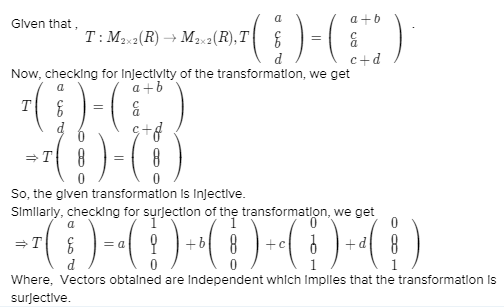
Now , checking for injectivity of the transformation, we get

T(a1,a2,a3)=(3a1−2a3,a2,3a1+4a2)

⇒T(0,0,0)=(3⋅0−2⋅0,0,3⋅0+4⋅0)

⇒T(0,0,0)=(0,0,0)

So , the given transformation is injective.

Similarly, checking for surjection of the transformation, we get

⇒T(a1,a2,a3)=a1(3,0,3)+a2(0,1,4)+a3(−2,0,0)

Where, (3,0,3),(0,1,4)  and  (−2,0,0) are independent which implies that the transformation is surjective.

As the given transformation is both injective and surjective , the transformation is invertible.

The given transformation is invertible because the transformation is both injective and surjective.

Page 107 Problem 13 Answer

Given that,  T:P3

⇒ (R)→P2

⇒ (R),T(p(x))=p′(x) .

Dimensions of the vector spaces P2(R) and P3(R) are 2 and 3 respectively.

As per the definition,  for given transformation to be invertible, dimensions of the two vector spaces must be equal.

As the dimensions of the two given vector spaces of transformation are not equal the transformation is not invertible.

The given transformation is not invertible because dimensions of the vector spaces  P2(R) and P3(R) are not equal.

Page 107 Problem 14 Answer

Given that,

T:M2×2(R)→P2(R),T(20c​ac​&​bd​)=a+2bx+(c+d)x2, we need to determine whether given transformation is invertible or not.

Solve as per the conditions and the definition of Invertible Transformation .

Given that,

T:M2×2(R)→P2(R),T(20c​ac​&​bd​)=a+2bx+(c+d)x2.

Dimensions of the vector spaces P2(R) and M2×2(R) are 3 and 4  respectively.

As per the definition, for given transformation to be invertible, dimensions of the two vector spaces must be equal.

As the dimensions of the two given vector spaces of transformation are not equal the transformation is not invertible.

The given transformation is not invertible because dimensions of the vector spaces  P2

(R) and M2×2(R)  are not equal.

Page 107 Problem 15 Answer

To determine whether given transformation is invertible or not.not.

Solve as per the conditions and the definition of Invertible Transformation.

Linear Algebra, 5th Edition, Chapter 2 Linear Transformations and Matrices 15

As the given transformation is both injective and surjective, the transformation is invertible.

The given transformation is invertible because the transformation is both injective and surjective.

Page 107 Problem 16 Answer

Given in the question are two vector spaces, F3 and  P3(F).In this question, determine if these two vector spaces are isomorphic.

For the two vector spaces to be isomorphic, they must have the same dimension.

The vector space F3 has dimension 3 and P3(F) has dimension 4.

So , they are not isomorphic they don’t have same dimension.

The two vector spaces F3 and P3(F) are not isomorphic.

Linear Algebra Friedberg Exercise 2.4 Step By Step Guide Page 107 Problem 17 Answer

Given in the question are two vector spaces,  F4 and P3(F).

In this question, determine if these two vector spaces are isomorphic.

For the two vector spacesspaces to be isomorphic, they must have the same dimension.

The vector space F4 has dimension 4 and P3(F) has dimension 4 too.

So , they are isomorphic as they have same dimension.

The two vector spaces F4 and P3(F) are isomorphic.

Page 107 Problem 18 Answer

Given in the question are two vector spaces , M2×2(R) and P3(R).

In this question,  determine if these two vector spaces are isomorphic.

For two vector spaces to be isomorphic, they must have the same dimension.

The vector space M2×2(R) has dimension 4 as it is a 2×2 matrix.

The vector space P3(R) has dimension 4.

So, they are isomorphic as they have same dimension.

The two vector spaces M2×2(R) and P3(R) are isomorphic.

Page 107 Problem 19 Answer

Given in the question are two vector spaces, V={A∈M2×2(R): tr(A)=0} and R4.

In this question, determine if these two vector spaces are isomorphic.

For two vector spaces to be isomorphic, they must have the same dimension.

The vector space V={A∈M2×2(R):tr(A)=0} has dimension 3 .

The vector space R4 has dimension 4.

So, they are not isomorphic they don’t have same dimension.

The two vector spaces V={A∈M2×2(R):tr(A)A=0} and R4 are not isomorphic as they do not have the same dimension.

Page 107 Problem 20 Answer

Given in the question aren×n invertible matrices,A and B .To prove that AB is invertible and (AB)−1

=B−1

⇒ A−1 .

Find a matrix for A such that their product equals the identity matrix.

Consider the matrix B−1

⇒A−1 .

Note that:

(B−1A−1)(AB)=B−1A−1AB

=B−1B

Again:

⇒(AB)(B−1A−1)=ABB−1A−1

=AA−1

=In

Hence, (B−1A−1)(AB)=(AB)(B−1A−1) and both of them are equal to In .

Therefore, AB is invertible. .

Also, it follows that

⇒(AB)−1=B−1A−1

It was proved that AB is invertible and (AB)−1=B−1A−1.

Page 107 Problem 21 Answer

Given that A is an invertible matrix.To prove that At is invertible and (At)−1=(A−1)t.

Find a matrix for At such that their product is the identity matrix.

Note that A is invertible, that is A−1 exists.

Then it follows that:

⇒(A−1)tAt=(AA−1)t

=(I)t

=I

Similarly

⇒At(A−1)t=(A−1A)t

=(I)t

=I

Hence, (A−1)tAt=At(A−1)t; that means that At is invertible and its inverse is (A−1)t.

Again ,(At)−1=(A−1)t

=I

It is proved that At is invertible and (At)−1=(A−1)t.

Page 107 Problem 22 Answer

Given that A is an invertible matrix and AB=O.  Prove that, then B=O Consider the fact that A is invertible. , A−1 exists and A−1

A=I. Then,

B=IB

=(A−1A)B

=A−1(AB)​

As AB=O, it follows that:

⇒B=A−1O

⇒B=O

It was proved that if A is invertible and AB=O.then B=O.

Exercise 2.4 Matrices Examples Friedberg Chapter 2 Page 108 Problem 23 Answer

Given that A is an n×n matrix.Prove that if A2=O, then A is not invertible.

Begin with the assumption that, A is an invertible matrix and proceed.

This will gives us a contradiction which suggests that the assumption was wrong.

Suppose that A is an invertible matrix and A−1 exists. Then,A=IA

=(A−1A)A

=A−1(AA)

As A2=O is given , it follows that:

⇒A=A−1O

⇒A=O

As it was assumed that A is an invertible matrix and we showed that A=O , it follows that, O is also invertible. has no inverse, and is not invertible.

But the null matrix O has no inverse , and is not invertible.

This is a contradiction.

Hence, A is not invertible.

It was proved that if A2=O, A is not invertible.

Page 108 Problem 24 Answer

Given that A is an n×n matrix, and AB=0 for some nonzero  n×n matrix  B.

To find if A could be invertible and explain.Begin with the assumption that A  is invertible.

Then, A−1 exists and AA−1=In .From Exercise 6, it follows that then,but it is given that B is nonzero; our assumption is incorrect an thus a contradiction holds.

So, A is not invertible.

If AB=0 for some nonzero n×n matrix B, A cannot be invertible as it would suggest that B is the zero matrix.

Page 108 Problem 25 Answer

In the question we need to  prove the two corollaries of theorem 2.18 on page 101.

First corollary: Let V be a finite-dimensional vector space with ordered basis β. Let T:V→V be linear.

Then T is invertible if and only if [T]β is invertible, and [T−1]β=([T]β)−1.

Second corollary: Let A be an n×n matrix.

Then A is invertible if and only if LA is invertible.

Furthermore, (LA)−1=LA​−1 .

The first corollary follows by taking V=W The second corollary follows by taking V=Fn and using the first corollary.

To prove the first corollary, take V=W.

As the ordered basis is β , the matrix representation is [T]β.

It follows from theorem 2.18 that T is invertible if and only if [T]β is invertible, and [T]β

=([T]β)−1 .

To prove the second corollary, let V=Fn.

Then the left-hand multiplication transformation LA is linear, according to theorem 2.15 on page 93, and [LA]β=A .

Using corollary 1, it follows that A is invertible if and only if LA is invertible and,(LA)−1=LA​−1 .

Corollaries 1 and 2 of theorem 2.18 was proved.

Exercise 2.4 Notes From Friedberg Linear Algebra 5th Edition Page 108 Problem 26 Answer

Given data: Let A and B be n×n matrices such that AB is invertible.

To prove: That A and B are invertible.

Observe that as AB is invertible ∃ a matrix Cas shown below.

ThereforeNow, use the associativity of matrix multiplication to obtain as shown below, C(AB)=I……(1)A(BC)=I……(2)And therefore according to the definition of inverse A,B are invertible from equations (1) and (2) with the inverse being BC,CA respectively.

Thus, it can be clearly proved that A and B are invertible if Aand B be n×n matrices such that AB is invertible.

Page 108 Problem 27 Answer

Given data: Let A and B be n×n matrices such thatABis invertible.

To give: An example to show that a product of nonsquare matrices can beinvertible even though the factors, by definition, are not.

Consider the two matrices as shown below,

Linear Algebra, 5th Edition, Chapter 2 Linear Transformations and Matrices 27

Thus, it can be clearly shown using an example that a product of nonsquare matrices can be invertible even though the factors, by definition, are not.

Page 108 Problem 28 Answer

It is stated in the question that A and B are two n×n matrices, where AB=In

It is required to demonstrate that A and B are invertible.

As AB=In , as a result AB is invertible in the same way as the identity matrix In .

As seen in Exercise 9, if the given requirements are met and if AB is invertible, then A,B are also invertible too.

Therefore, A and B are invertible.

It was determined that if A and B are n×n matrices in which AB=In ,as a result A and B are invertible.

Page 108 Problem 29 Answer

It is stated in the question that A and B are two n×n matrices, where AB=In .

It is required to demonstrate that A=B−1 are Invertible.

Therefore, B=A−1 too.It can be seen from Exercise 10.(a) that A is invertible, and A−1 exists and AA−1=In

The matrix A−1can be written as:

⇒ A−1=A−1In

=A−1(AB)

=(A−1A)B

=InB

Thus,           A−1=B

By taking the inverse on both sides, we get that A and B are n×n matrices, then

AB=In, therefore

A=B−1,and hence,  B=A−1

Examples Of Exercise 2.4 in Friedberg Linear Algebra Page 108 Problem 30 Answer

It is stated in the question that A and B are two n×n matrices, where AB=In.

The goal is to show comparable findings for linear transformations defined on finite-dimensional vector spaces.

Consider Exercises 10(a) and 10(b) and come up with an analogous argument for finite-dimensional vector spaces.

Then use isomorphism properties to back up your assertion.

On finite-dimensional vector spaces, the following claim is made based on the results of Exercises 10.(a) and 10.(b).

Claim:Let V becomes  n-dimensional vector space is a type of vector space that has a number of dimensions.

If S and T on which linear transformations are defined, then V results in, ST:V→V

If both are isomorphisms, then S and T are isomorphisms.

Let us look at some proof to support our claim:

Let β={β1,β2,….βn} be a logical foundation for V.

If A,B are the matrices representation for S,T respectively, then:A=[S]β

B=[T]β

As a result, AB=[ST]β

As ST is an isomorphism, AB is a matrx that can be inverted As a result of them from Exercise 10.

(a), A,B both can be inverted.

This implies that the transformations are related S, T both are isomorphisms. This brings the claim to a close.

For linear transformations defined on finite-dimensional vector spaces, a similar conclusion is:

For an n-dimensional vector space  V, if S and T are linear transformations in the sense that ST: V→V  is isomorphisms, then S and T are isomorphisms.

The outcome was established.

Stephen Friedberg Linear Algebra 5th Edition Chapter 2 Exercise 2.3 Linear Transformations and Matrices

Linear Algebra 5th Edition Chapter 2 Linear Transformations and Matrices

Page 96 Exercise 1 Answer

Given: statement is, If A is a square matrix and Aij=δij for all i and j, then

⇒ A=I.

We have,

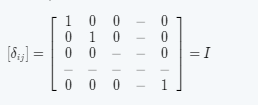
δij={​0,i≠j1,i=j

Linear Algebra, 5th Edition, Chapter 2 Linear Transformations and Matrices 1

So, in the case of matrices, we interpret it as [δij]={​aij=0,i≠jaij=1,i=j.

So,herefore, the given statement is true.

In view of linear transformation it is confirmed that, If A is a square matrix and Aij=δij for all i and j, then A=I statement is true.

Linear Algebra 5th Edition Chapter 2 Page 97 Exercise 2 Answer

Read and Learn More Stephen Friedberg Linear Algebra 5th Edition Solutions

Linear Algebra, 5th Edition, Chapter 2 Linear Transformations and Matrices 2

Stephen Friedberg Linear Algebra 5th Edition Chapter 2 Exercise 2.3 Linear Tranformations And Matrices

Linear Algebra, 5th Edition, Chapter 2 Linear Transformations and Matrices 2 3

Stephen Friedberg Linear Algebra 5th Edition Solutions For Exercise 2.3 Linear Algebra 5th Edition Chapter 2 Page 96 Exercise 3 Answer

Linear Algebra, 5th Edition, Chapter 2 Linear Transformations and Matrices 3 1

Linear Algebra, 5th Edition, Chapter 2 Linear Transformations and Matrices 3 2

Linear Algebra, 5th Edition, Chapter 2 Linear Transformations and Matrices 3

Linear Algebra, 5th Edition, Chapter 2 Linear Transformations and Matrices 3 3

Linear Algebra 5th Edition Chapter 2 Page 97 Exercise 4 Answer

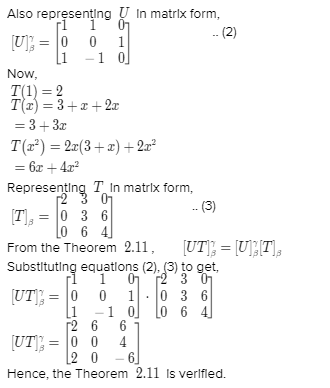
Given,

⇒ g(x)=3+x

⇒ T: P2

⇒ (R)→P2

⇒ (R)T(f(x))=f′

⇒ (x)g(x)+2f(x)

⇒ U: P2

⇒ (R)→R3

⇒ U(a+bx+cx2)=(a+b,c,a−b)

⇒ β={1,x,x2}

⇒ γ={(1,0,0),(0,1,0),(0,0,1)}

To compute [U]βγ,[T]β, and [UT]βγ.

Verify the result using Theorem 2.11.

Linear Algebra, 5th Edition, Chapter 2 Linear Transformations and Matrices 4

Represent U(T(f(x))), U and T in matrix form.

Compute [U]βγ,[T]β, and [UT]βγ.

Using the Theorem 2.11, verify [UT]αγ=[U]βγ[T]αβ.

Given,

⇒ g(x)=3+x

⇒ T:P2(R)→P2(R)T(f(x))=f′(x)g(x)+2f(x)

⇒ U:P2(R)→R3U(a+bx+cx2)=(a+b,c,a−b)​

⇒ β={1,x,x2}

⇒ γ={(1,0,0),(0,1,0),(0,0,1)}

Let, f(x)=a+bx+cx2∈P2(R)

Then,

⇒ T(f(x))=(b+2cx)(3+x)+2(a+bx+cx2)

=3b+6cx+bx+2cx2+2a+2bx+2cx2

=(2a+3b)+(3b+6c)x+(4c)x2

This implies,U(T(f(x)))=(2a+3b)+(3b+6c)x+(4c)x2

Representing U(T(f(x))) in matrix form,

⇒ ​UT(1)=(2,0,2)

⇒ UT(2)=(6,0,0)

⇒ UT(3)=(6,4,−6)

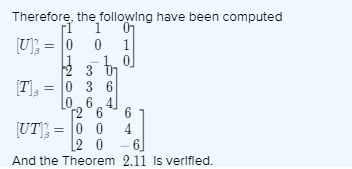
Linear Algebra, 5th Edition, Chapter 2 Linear Transformations and Matrices 4 1

Linear Algebra 5th Edition Chapter 2 Page 97 Exercise 5 Answer

In the question, it is given that: g(x)=3+x

⇒ h(x)=3−2x+x2

⇒ T:P2(R)→P2(R)T(f(x))=f′(x)g(x)+2f(x)

⇒ U:P2(R)→R3U(a+bx+cx2)=(a+b,c,a−b)​

⇒ β={1,x,x2}γ={(1,0,0),(0,1,0),(0,0,1)}

​To Find: [h(x)]β and [U(h(x))]γ. Verify the result using Theorem.

First, calculate U(h(x)) and [h(x)]β.

Then verify the Theorem 2.14.

Given,

⇒ g(x)=3+x

⇒ h(x)=3−2x+x2

⇒ T:P2(R)→P2(R)T(f(x))=f′(x)g(x)+2f(x)

⇒ U:P2(R)→R3U(a+bx+cx2)=(a+b,c,a−b)​

⇒ β={1,x,x2}

⇒ γ={(1,0,0),(0,1,0),(0,0,1)}

​Now,

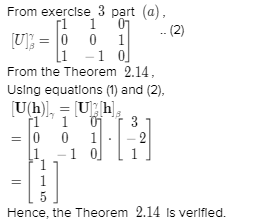
⇒ U(h(x))=U(3−2x+x2)=(1,1,5)

Representing U(h(x)) in matrix form,[U(h(x))]γ=

[​1]
[1]
[5​]

Also, representing [h(x)]βin matrix form,

[h(x)]β=[3−21]                   .. (1)

Therefore, the following have been computed[h(x)]β=

[3]
[−2]
[1]

[U(h(x))]γ=
[1]
[1]
[5]

And the Theorem 2.14 is verified.

Linear Algebra, 5th Edition, Chapter 2 Linear Transformations and Matrices 5

Exercise 2.3 Linear Transformations Solved Examples Chapter 2 Page 97 Exercise 6 Answer

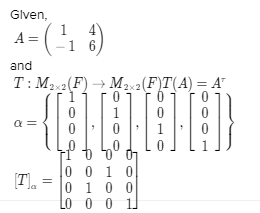
Given, T be a linear transformation and

A=
(1)
(−1)
(4)
(6).

To compute [T(A)]α.

Linear Algebra, 5th Edition, Chapter 2 Linear Transformations and Matrices 6

Obtain [T]α.

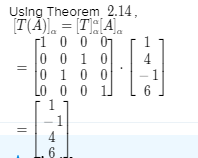
Using Theorem 2.14 compute [T(A)]α.

Linear Algebra, 5th Edition, Chapter 2 Linear Transformations and Matrices 6 1

Therefore, using theorem 2.14,

[T(A)]α=

[1]
[−1]
[4]
6].

Linear Algebra 5th Edition Chapter 2 Page 97 Exercise 7 Answer

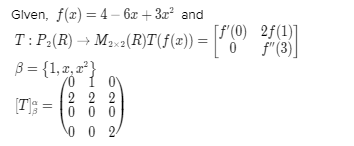
Given, T be a linear transformation andf(x)=4−6x+3×2.

To compute [T(f(x))]α.

Obtain [T]βα.

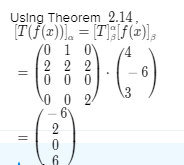
Using Theorem 2.14 compute [T(f(x))]α.

Linear Algebra, 5th Edition, Chapter 2 Linear Transformations and Matrices 7

Linear Algebra, 5th Edition, Chapter 2 Linear Transformations and Matrices 7 1

Therefore, using theorem 2.14,[T(f(x))]α=

[−6]
[2]
[0]
6].

Linear Algebra 5th Edition Chapter 2 Page 97 Exercise 8 Answer

In the question, it is given that T be a linear transformation and A=
(1)
(2)
(3)
(4).

To Find:  [T(A)]γ.

First obtain [T]αγ.

Then, use Theorem  2.14 to compute  [T(A)]γ.

GivenA=
(1)
(2)
(3)
)4)  and

T: M2×2

(F)→FT(A)=tr(A)γ={1}[T]αγ=
(1)
(0)
(0)
1).

Using Theorem  2.14,

[T(A)]γ=[T]αγ[A]α

Therefore, using theorem  2.14,

[T(A)]γ=(5).

Linear Algebra 5th Edition Chapter 2 Page 97 Exercise 9 Answer

In the question, it is given that T be a linear transformation and f(x)=4−6x+3×2.

To Find: [T(f(x))]γ.

Obtain [T]βγ.

Using Theorem 2.14 compute [T(f(x))]γ.

Given, f(x)=6−x+2×2 and T:P2(R)→RT(f(x))=f(2)

βγ=
[1]
[2]
[4]

Using Theorem 2.14,

⇒ ​[T(f(x))]γ=[T]βγ[f(x)]β

=[​124​]⋅[6−12]

=[12]​

Therefore, using theorem 2.14,

[T(f(x))]γ=[12].

Linear Algebra Friedberg Exercise 2.3 Step-By-Step Solutions Chapter 2 Page 98 Exercise 10 Answer

Given, A be an m×n matrix, B and C be n×p matrices and D and E be q×m matrices.

To complete the proof of Theorem 2.12 and its corollary.

Linear Algebra, 5th Edition, Chapter 2 Linear Transformations and Matrices 10 1

Linear Algebra, 5th Edition, Chapter 2 Linear Transformations and Matrices 10 2

Linear Algebra, 5th Edition, Chapter 2 Linear Transformations and Matrices 10 3

Linear Algebra, 5th Edition, Chapter 2 Linear Transformations and Matrices 10

To prove the Theorem 2.12 (a), (b) and (d).

Prove corollary of Theorem 2.12.

So,   (D+E)A=DA+EA.

So,         A(i=1∑kaiBi)=i=1∑kaiABi and

(i=1∑kaiCi)A=i=1∑kaiCiA.

Linear Algebra 5th Edition Chapter 2 Page 98 Exercise 11 Answer

Proving Theorem 2.13(b).Given, A be an m×n matrix and B be an n×p matrix. For each j(1≤j≤p) let uj and vj denote the jth columns of AB and B, respectively.

To prove Theorem 2.13(b).

Given, A be an m×n matrix and B be an n×p matrix. For each j(1≤j≤p) let uj and vj denote the jth columns of AB and B, respectively.

This implies,vj

=[B1j]
[B2j]

[Bnj]

Representing the elements of vj as,

⇒ B1j=0⋅B11+0⋅B12+…0⋅B1j−1+1⋅B1j+0⋅B1j+1+…+0⋅B1n

⇒ B2j=0⋅B21+0⋅B22+…0⋅B2j−1+1⋅B2j+0⋅B2j+1+…+0⋅B2n

⇒ Bnj

=0⋅Bn1+0⋅Bn2+…0⋅Bnj−1+1⋅Bnj+0⋅Bnj+1+…+0⋅Bnn

Linear Algebra, 5th Edition, Chapter 2 Linear Transformations and Matrices 11

Therefore, vj=Bej where ej is the jth standard vector of Fp is proved.

Linear Algebra 5th Edition Chapter 2 Page 98 Exercise 12 Answer

In the question, it is given that A be an m × n matrix with entries from F .

Then the left-multiplication transformation LA: Fn → Fm is linear. Furthermore, if B is any other m × n matrix (with entries from F ) and β and γ are the standard ordered bases for Fn and Fm, respectively.

We are asked to prove Theorem 2.15(c) and 2.15(d).

Use the definition of left multiplication transformation.

Given, A be an m × n matrix with entries from F .

Then the left-multiplication transformation LA : Fn → Fm is linear.

Furthermore, if Bis any other m × n matrix (with entries from F ) and β and γ are the standard ordered bases for Fn and Fm , respectively.

From the definition,​

LA+B(x)=(A+B)x=Ax+Bx=LA(x)+LB(x)

Also,

LaA(x)=(aA)x=a{Ax}=a{LA(x)}=aLA(x)

Therefore,LA+B=LA+LB  and LaA=aLA for all a∈F

Consider, LI​n(x)=Inx=x                       .. (1)

By the definition of left – multiplication transformation.

Using the identity transformation,

IF​n(x)=x                       .. (2) Where, IF​n is the identity transformation on the vector space Fn.

Therefore, from equations (1) and (2),

LI​n=IF​n

Therefore, Theorem 2.15(c) and Theorem 2.15(d) has been proved.

Exercise 2.3 Matrices Examples Friedberg Chapter 2 Page 98 Exercise 13 Answer

Given, V be a vector space. Let T,U1,U2∈L(V).

To prove Theorem 2.10 and giving a more general result.

Proving Theorem 2.10using a more general result involving linear transformations with domains unequal to their codomains.

Given, V be a vector space. Let T,U1,U2∈L(V).

From, T(U1+U2)=TU1+TU2 it implies,

​(T(U1+U2))(x)=T(U1(x)+U2(x))(T(U1+U2))(x)=T(U1(x))+T(U2(x))(T(U1+U2))(x)=(TU1+TU2)(x)

​Therefore, T(U1+U2)=TU1+TU2

And (U1+U2)T=U1T+U2T it implies,

​(U1+U2)T(x)=U1(Tx)+U2(Tx)(U1+U2)T(x)=(U1T)(x)+(U2T)(x)(U1+U2)T(x)=(U1T+U2T)(x)

Therefore, (U1+U2)T=U1T+U2T

Now,

​T(U1U2)(x)=T(U1(U2(x)))T(U1U2)(x)=(TU1)(U2(x))T(U1U2)(x)=(TU1)U2(x)

Therefore, T(U1U2)=(TU1)U2.

Clearly,

TI(x)=T(I(x))

TI(x)=T(x)

So,   TI=T

Also, IT(x)=I(T(x))

=T(x)

This implies, IT=T

Therefore,     TI=IT=T

Consider,​

a(U1U2)(x)=aU1(U2(x))a(U1U2)(x)=(aU1)(U2(x))a(U1U2)(x)=((aU1)U2)(x)

Therefore, a(U1U2)=(aU1)U2

Also,U1(aU2)(x)=U1(aU2(x))U1(aU2)(x)=(aU1)(U2(x))U1(aU2)(x)=a(U1U2)(x)

Therefore, a(U1U2)=(aU1)U2=U1(aU2)

For a more general result the Theorem is stated as,Put V,U,W to be vector spaces over the field K.

Assuming that the following mappings are linear, F:V→U,F′:V→U and G:U→W,G′:U→W.

For every scalar a∈K,

G(F+F′)=GF+GF′

(G+G′)F=GF+G′F

a(GF)=(aG)F=G(aF)

Therefore, the Theorem 2.10 is proved and a more general result is stated as,

Put V,U,W to be vector spaces over the field K.

Assuming that the following mappings are linear, F:V→U,F′:V→U and G:U→W,G′:U→W.

For every scalar a∈K,

G(F+F′)=GF+GF′

(G+G′)F=GF+G′F

a(GF)=(aG)F

=G(aF)

Linear Algebra 5th Edition Chapter 2 Page 98 Exercise 14 Answer

In the question, it is given that UT=T0 (the zero transformation) but

​​TU≠T0

Also, AB=O but BA≠O.

We are aske to find the linear transformations and matrices A and B.

First obtain linear transformations U,T.

Them using the linear transformations find the matrices A and B.

Given, UT=T0 (the zero transformation) but

​TU≠T0.

Also, AB=O but BA≠O.

Linear Algebra, 5th Edition, Chapter 2 Linear Transformations and Matrices 15

​Therefore, the linear transformations,

UT=U(T(x,y))

=U(x,0)

=(0,0)

=T0

And

​TU=T(U(x,y))

=T(y,y)

=(y,0)

≠T0

Also, the matrices

Linear Algebra, 5th Edition, Chapter 2 Linear Transformations and Matrices 15 1

Linear Algebra 5th Edition Chapter 2 Page 98 Exercise 15 Answer

Given, A be an n×n matrix.

To prove A is a diagonal matrix if and only if Aij=δijAij for all i and j.

Consider when A is a diagonal mabtrix and show Aij=δijAij for all i and j.

Suppose when A is not a diagonal matrix and prove A is a diagonal matrix.

Given, A be an n×n matrix.

Consider A is a diagonal matrix,

Then, Aij={ Aij,I=j0,I≠j}​

Aij={1.Aij,i=j0.Aij,i≠j}

Aij=δij

Aij for all i,j

Suppose that A is not a diagonal matrix,

There exist i,j,i≠j such that

Aij≠0

⇒0≠Aij

⇒0=0⋅Aij

0=0

This implies, A is a diagonal matrix.

Therefore, A is a diagonal matrix if and only if Aij=δijAij for all i and j is proved.

Exercise 2.3 Botes From Friedberg Linear Algebra 5th Edition 

Page 98 Exercise 16 Answer

In the question, it is given that V be a vector space and let T:V→V be linear.

We are asked to prove T2=T0 if and only if R(T)⊆N(T).

Consider T2=T0 and prove R(T)⊆N(T) using the definition of null space.

Conversely prove T2=T0 using the definition of null space.

Given, V be a vector space and let T:V→V be linear.

Consider,                     T2=T0

As T0 is the zero transformation for every x∈V.

Since, T:V→V is the linear transformation this implies,

T(x)∈R(T) for every x∈V    .. (1)

Applying T again,

T(T(x))=T2(x).

By hypothesis, T(T(x))=0.

Using the definition of null space,

T(x)∈N(T) for T(T(x))=0                                     .. (2)

From equations (1) and (2),

T(x)∈R(T)

⇒T(x)∈N(T)

Again, from the hypothesis,

T2(x)=0 for every x∈V we get,

T(T(x))=0

T(x)∈N(T)

Therefore, R(T)⊆N(T)

Conversely, assume

R(T)⊆N(T)                                .. (3)

And obtain x∈V

T(x)=0                                        .. (4)

Which is the definition for zero transformation and x∈V

⇒T(x)∈R(T)

From equation (3),

T(x)∈N(T)

Using the definition of null space,

T(T(x))=0

T2(x)=0 for all x∈V                .. (5)

From equations (4) and (5),

T2=T0

Therefore, T2=T0 if and only if R(T)⊆N(T) is proved.

Linear Algebra 5th Edition Chapter 2 Page 98 Exercise 17 Answer

Given: Let V,Wand Z be vector spaces, and let T: V → W and U:W →Z be linear.

Prove that if UT is one-to-one, then T is one-to-one. Must U also be one-to-one.

Assume that UT is one to one. We have to prove that T is one-to-one and whether U is one-to-one.

We will use the following example: Define U:R3→R2 such that U(a,b,c)= (a,b).

Assume that UT is one to one. We have to prove that T is one-to-one and whether U is one-to-one.

T(x)=T(y),x,y∈V

Since, the transformation U:W→Z is well-defined, and T(x),T(y)∈W

We have​

U(T(x))=U(T(y))

(UT)(x)=(UT)(y)

x=y.

​So it holds

​x,y∈V,

T(x)=T(y)

x=y

Then the linear transformation T is one-to-one.

In the case when UT is one to one then U may not be one-to-one.

We will use the following example: Define U:R3→R2 such that U(a,b,c)= (a,b). And, define T:R2→R3 such that

T(a,b)=(a,b,0)

So

(UT)(a,b)=U(T(a,b))

=U(a,b,0)

=(a,b).

​Since, UT is the identity function, it is linear and one-to-one.

kerU={(a,b,c):U(a,b,c)=0}

kerU={(a,b,c):(a,b)=(0,0)}

kerU={(a,b,c):a=0,b=0}

kerU={(0,0,c)}

​From kerU≠{0}, the transformation U is not one-to-one.

The transformation U is not one-to-one.

Examples Of Exercise 2.3 In Friedberg Linear Algebra 

Linear Algebra 5th Edition Chapter 2 Page 98 Exercise 18 Answer

In the question, it is given that V,W and Z be vector spaces, and let T: V → W and U:W →Z be linear.

We are asked to prove that if UT is onto, then U is onto. Must T also be onto.

Suppose that UT is one to one. Then prove that T is one-to-one and whether U is one-to-one.

Use the following example: Define U:R3→R2 such that U(a,b,c)= (a,b).

Assume that UT is onto. We have to prove that U is onto and whether T is onto.

As U:W→Z is a function, take z∈Z.

Linear Algebra, 5th Edition, Chapter 2 Linear Transformations and Matrices 18

From T:V→W, and U:W→Z, the transformation UT:V→Z is a function too.

Since UT is onto, z∈Z, there exist v∈V such that

(UT)(v)​​​​​​…(1)

T:V→W is well-defined so for v∈V,

T(v)=w∈W

From(1),

U(T(v))=z

U(w)=z

So for z∈Z, there exists w∈W such that

U(w)=z

The transformation U is not one-to-one.

Linear Algebra 5th Edition Chapter 2 Page 98 Exercise 19 Answer

Given: Let  V,W and  Z be vector spaces, and let  T: V → W  and  U:W →Z be linear.

Prove that if  T and U also be one-to-one and onto, then UT is also.

Let’s consider U:W→Z which is one-to-one and onto and T:V→W which is one-to-one and onto.

We have to show that  UT:V→Z  is also one-to-one and onto.

We will use the following example: Define U: R3→R2  such that  U(a,b,c)=(a,b).

Let’s consider U:W→Z which is one-to-one and onto and T:V→W which is one-to-one and onto.

We have to show that UT:V→Z  is also one-to-one and onto. Let (UT)(x)=(UT)(y),x,y∈V

Then we have

U(T(x))=U(T(y))

T(x)=T(y)

x=y

So for

x,y∈V,(UT)(x)=(UT)(y)⇒x=y

So  UT:V→Z  is one-to-one.

Let, z∈Z, since U:W→Z is onto, there exists w∈W such that U(w)=z

Since  T:V→W is onto, w∈W, there exists v∈V such that T(v)=w

By substituting

T(v)=w in

U(w)=z we get

​U(T(v))=z

(UT)(v)=z

So for, z∈Z, there is v∈V such that (UT)(v)=z

This implies UT:V→Z  is onto.

Hence,  UT: V→Z is one-to-one and onto when U: W→Z and T: V→W are one-to-one and onto.

The transformation UT is one-to-one and onto.

Stephen Friedberg Linear Algebra 5th Edition Chapter 2 Exercise 2.2 Linear Transformations and Matrices

Linear Algebra 5th Edition Chapter 2 Linear Transformations and Matrices

Page 84 Problem 1 Answer

In the question given that V and W are finite-dimensional vector spaces with ordered bases β and γ, respectively, and T, U: V→W are linear transformations.
It is required to find that the statement is false or true.

With the help of the definition of the tip section, the statement, either true or false, can be obtained easily.

It is observed from the definition that for any scalar a, a∈F,aT+U is a linear transformation from V to W.

Hence, the statement is true.

The following statement is true.

Linear Algebra 5th Edition Chapter 2 Page 84 Problem 2 Answer

In the question given that V and W are finite-dimensional vector spaces with ordered bases β and γ, respectively, and T, U: V→W are linear transformations.

Stephen Friedberg Linear Algebra 5th Edition Chapter 2 Exercise 2.2 Linear Tranformations And Matrices

Read and Learn More Stephen Friedberg Linear Algebra 5th Edition Solutions

Linear Algebra 5th Edition Chapter 2 Page 84 Problem 3 Answer

In the question given that V and W are finite-dimensional vector spaces with ordered bases β and γ, respectively, and T, U: V→W are linear transformations.

It is required to find that the statement if m=dim(V) and n=dim(W), then [T]βγ is an m×n matrix is false or true.

With the help of the definition of the tip section, the statement, either true or false, can be obtained easily.

By observing the definition and the statement it is clear that statement if m=dim(V) and n=dim(W), then [T]βγ is an n×m matrix.

Hence, the given statement is false.

The following statement is false.

Stephen Friedberg Linear Algebra 5th Edition Solutions For Exercise 2.2 Chapter 2 Page 84 Problem 4 Answer

Given: V and W are finite-dimensional vector spaces with ordered bases β and γ, respectively, and T, U: V→W are linear transformations.

To find: Whether the statement [T+U]βγ=[T]βγ+[U]βγ is false or true.

With the help of the theorem of the tip section, the statement, either true or false, can be obtained easily.

It is clearly observed from the theorem that [T+U]βγ=[T]βγ+[U]βγ when V and W be finite-dimensional vector spaces with ordered bases β and γ, respectively, and let T, U: V→W be linear transformations.

Hence, the statement is true.

The given statement is true.

Linear Algebra 5th Edition Chapter 2 Page 84 Problem 5 Answer

In the question given that V and W are finite-dimensional vector spaces with ordered bases β and γ, respectively, and T, U: V→W are linear transformations.

It is required to find that the statement L(V, W) is a vector space is false or true.

With the help of the definition of the tip section, the statement, either true or false, can be obtained easily.

From the definition it is clearly observed that the vector space of all linear transformations from V into W  denotes by L(V,W).

Hence, L(V, W) is a vector space. The statement is true.

The given statement is true.

Linear Algebra 5th Edition Chapter 2 Page 84 Problem 6 Answer

Given: V and W are finite-dimensional vector spaces with ordered bases β and γ, respectively, and T, U: V→W are linear transformations.

To find: Whether the statement L(V, W)=L(W, V) is false or true.

With the help of the definition of the tip section, the statement, either true or false, can be obtained easily.

From the definition it is clearly observed that the vector space of all linear transformations from V into W  denotes by L(V,W)  and it also can be written as L(V) instead of L(V,W).

Hence, L(V,W).

Therefore, the statement L(V,W)=L(W,V)is false.

The given statement is false.

Linear Algebra 5th Edition Chapter 2 Page 85 Problem 7 Answer

In the question given T:R2→R3 defined by T(a1,a2)=(2a1−a2,3a1+4a2,a1).

It is required to compute [T]βγ.

With the help of the definition of the matrix, the representation of a linear transformation [T]βγ can be computed easily.

Given, T:R2→R3 defined by T(a1,a2)=(2a1−a2,3a1+4a2,a1).

From the question β and γ be the standard ordered bases for Rn and Rm, respectively, for each linear transformation T: Rn→Rm.

Hence,​

Linear Algebra, 5th Edition, Chapter 2 Linear Transformations and Matrices 7

⇒ β={(1,0),(0,1)}

⇒ γ={(1,0,0),(0,1,0),(0,0,1)}

​Therefore,

⇒ ​T(1,0)=(2,3,1)

⇒T(1,0)=2⋅(1,0,0)+3⋅(0,1,0)+1⋅(0,0,1)

⇒ ​T(0,1)=(−1,4,0)

⇒T(0,1)=−1⋅(1,0,0)+4⋅(0,1,0)+0⋅(0,0,1)

Linear Algebra, 5th Edition, Chapter 2 Linear Transformations and Matrices 7 1

Chapter 2 Exercise 2.2 Linear Transformations Solved Problems ​Page 85 Problem 8 Answer

In the question given T:R3→R2 defined by T(a1,a2,a3)=(2a1+3a2−a3,a1+a3).It is required to compute [T]βγ.

With the help of the definition of the matrix, the representation of a linear transformation [T]βγ can be computed easily.

Given, T: R3→R2 defined by

⇒ T(a1,a2,a3)=(2a1+3a2−a3,a1+a3).

Linear Algebra, 5th Edition, Chapter 2 Linear Transformations and Matrices 8

From the question β and γ be the standard ordered bases for Rn and Rm, respectively, for each linear transformation T: Rn→Rm.

Hence,
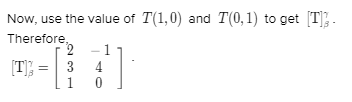
⇒ β={(1,0,0),(0,1,0),(0,0,1)}

⇒ γ={(1,0),(0,1)}

Therefore,

⇒ T(1,0,0)=(2,1)=2⋅(1,0)+1⋅(0,1)

⇒ T(0,1,0)=(3,0)=3⋅(1,0)+0⋅(0,1)

⇒ T(0,0,1)=(−1,1)=−1⋅(1,0)+1⋅(0,1)

Linear Algebra, 5th Edition, Chapter 2 Linear Transformations and Matrices 8 1

Linear Algebra 5th Edition Chapter 2 Page 85 Problem 9 Answer

Given: T:R3→R defined by T(a1,a2,a3)=2a1+a2−3a3

To find: [T]βγ.

With the help of the definition of the matrix, the representation of a linear transformation [T]βγ can be computed easily.

Given, T: R3→R defined by

⇒ T(a1,a2,a3)=2a1+a2−3a3.

From the question β and be the standard ordered bases for Rn and Rm, respectively, for each linear transformation

⇒ T: Rn→Rm.

Hence,

⇒ β={(1,0,0),(0,1,0),(0,0,1)}

⇒ γ={1}

Therefore,

⇒ T(1,0,0)=2=2⋅1

⇒ T(0,1,0)=1=1⋅1

⇒ T(0.0.1)=−3=−3⋅1

Now, use the value of  T(1,0,0),T(0,1,0) and T(0,0,1) to get [T]βγ.

Therefore,

⇒ [T]βγ=[​2​1​−3​].

The value of [T]βγ is [T]βγ=[​2​1​−3​].

Linear Algebra 5th Edition Chapter 2 Page 85 Problem 10 Answer

In the question given T: R3→R3 defined by T(a1,a2,a3)=(2a2+a3,−a1+4a2+5a3,a1+a3).

It is required to compute [T]βγ.

With the help of the definition of the matrix, the representation of a linear transformation [T]βγ can be computed easily.

Given, T:R3→R defined by  T(a1,a2,a3)=2a1+a2−3a3.

From the question β and γ be the standard ordered bases for Rn and Rm, respectively, for each linear transformation

T: Rn→Rm.
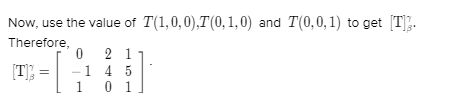
Linear Algebra, 5th Edition, Chapter 2 Linear Transformations and Matrices 10

Hence,

⇒ β={(1,0,0),(0,1,0),(0,0,1)}

⇒ β=γ={(1,0,0),(0,1,0),(0,0,1)}

Therefore,

⇒ T(1,0,0)=(0,−1,1)=0⋅(1,0,0)−1⋅(0,1,0)+1⋅(0,0,1)

⇒ T(0,1,0)=(2,4,0)=2⋅(1,0,0)+4⋅(0,1,0)+0⋅(0,0,1)

⇒ T(0,0,1)=(1,5,1)=1⋅(1,0,0)+5⋅(0,1,0)+1⋅(0,0,1).

Linear Algebra, 5th Edition, Chapter 2 Linear Transformations and Matrices 10 1

Linear Algebra 5th Edition Chapter 2 Page 85 Problem 11 Answer

In the question given T:Rn→Rn defined by T(a1,a2,…,an)=(a1,a1,…,a1).

It is required to compute [T]βγ.

With the help of the definition of the matrix, the representation of a linear transformation [T]βγ can be computed easily.

Given, ,T:Rn→Rn defined by

⇒ T(a1,a2,…,an)=(a1,a1,…,a1)

From the question β and γ be the standard ordered bases for Rn and Rm respectively, for each linear transformation T: Rn→Rm.
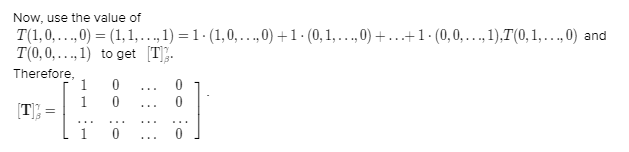
Linear Algebra, 5th Edition, Chapter 2 Linear Transformations and Matrices 11

Hence,

⇒ β={(1,0,…,0),(0,1,…,0),…,(0,0,…,1)}

⇒ γ={(1,0,…,0),(0,1,…,0),…,(0,0,…,1)}

Therefore,

⇒ T(1,0,…,0)=(1,1,…,1)=1⋅(1,0,…,0)+1⋅(0,1,…,0)+…+1⋅(0,0,…,1)

⇒ T(0,1,…,0)=(0,0,…,0)=0⋅(1,0,…,0)+0⋅(0,1,…,0)+…+0⋅(0,0,…,1)

⇒ T(0,0,…,1)=(0,0,…,0)=0⋅(1,0,…,0)+0⋅(0,1,…,0)+…+0⋅(0,0,…,1).

Linear Algebra, 5th Edition, Chapter 2 Linear Transformations and Matrices 11 1

Linear Algebra Friedberg Exercise 2.2 Matrices Step-By-Step Guide Page 85 Problem 12 Answer

Given: T: Rn→Rn defined by

T(a1,a2,…,an)=(˙an,an−1,…,a1).

To fin: [T]βγ.

With the help of the definition of the matrix, the representation of a linear transformation [T]βγ can be computed easily.

Given, T:Rn→Rn defined by T(a1,a2,…,an)=(a1,a1,…,a1).

From the question β and γ be the standard ordered bases for Rn and  Rm, respectively, for each linear transformation T: Rn→Rm.
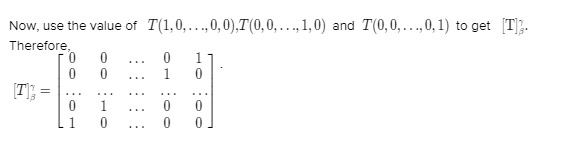
Linear Algebra, 5th Edition, Chapter 2 Linear Transformations and Matrices 12

Hence,

⇒ β={(1,0,…,0,0),(0,1,…,0,0),…,(0,0,…,1,0),(0,0,…,0,1)}

⇒ γ={(1,0,…,0,0),(0,1,…,0,0),…,(0,0,…,1,0),(0,0,…,0,1)}

Therefore,

⇒ T(1,0,…,0,0)=(0,0,…,0,1)

=0⋅(1,0,…,0,0)+0⋅(0,1,…,0,0)+…+0⋅(0,0,…,1,0)+1⋅(0,0,…,0,1)

⇒ T(0,1,…,0,0)=(0,0,…,1,0)

=0⋅(1,0,…,0,0)+0⋅(0,1,…,0,0)+…+1⋅(0,0,…,1,0)+0⋅(0,0,…,0,1)..

⇒ T(0,0,…,1,0)=(0,1,…,0,0)

=0⋅(1,0,…,0,0)+1⋅(0,1,…,0,0)+…+0⋅(0,0,…,1,0)+0⋅(0,0,…,0,1)

⇒ T(0,0,…,0,1)=(1,0,…,0,0)

=1⋅(1,0,…,0,0)+0⋅(0,1,…,0,0)+…+0⋅(0,0,…,1,0)+0⋅(0,0,…,0,1)

Linear Algebra, 5th Edition, Chapter 2 Linear Transformations and Matrices 12 1

Linear Algebra 5th Edition Chapter 2 Page 85 Problem 13 Answer

In the question given T: Rn→R  defined by

⇒ T(a1,a2,…,an)=a1+an.

It is required to compute [T]βγ.

With the help of the definition of the matrix, the representation of a linear transformation [T]βγ can be computed easily.

Given ,T:Rn→Rn defined by T(a1,a2,…,an)=(a1,a1,…,a1).

From the question β and γ be the standard ordered bases for Rn and Rm respectively, for each linear transformation T: Rn→Rm.

Hence,β={(1,0,…,0,0),(0,1,…,0,0),…,(0,0,…,1,0),(0,0,…,0,1)}

⇒ γ={1}

Therefore,

⇒ T(1,0,…,0,0)=1=1⋅1

⇒ T(0,1,…,0,0)=0=0⋅1

⇒ T(0,0,…,1,0)=0=0⋅1

⇒ T(0,0,…,0,1)=1=1⋅1.

Now, use the value of  T(1,0,…,0,0),T(0,0,…,1,0) and T(0,0,…,0,1) to get [T]βγ.

Therefore,

⇒ [T]βγ=35.

The value of [T]βγ is 35.

Linear Algebra 5th Edition Chapter 2 Page 85 Problem 14 Answer

Given: T:R2→R3 is defined as: T(a1,a2)=(a1−a2,a1,2a1+a2).

To find: The values of  [T]βγ and [T]aγ.

Analyzing the question, the values of  T(1,0) and  T(0,1) can be determined.

Using the values of  T(1,0) and  T(0,1), the unknown value of  [T]βγ can be found.

Evaluating  T(α) and writing it as a linear combination of the elements of γ, the unknown value of  [T]aγ can be determined.

According to the question,

T(a1,a2)=(a1−a2,a1,2a1+a2)

Substituting the value of a1 by 1 and a2 by  0,

​​⇒ T(1,0)=(1−0,1,2(1)+0)

=(1,1,2)

=A(1,1,0)+B(0,1,1)+C(2,2,3)

​Expressing in linear system of equations,

​​⇒ A+2C=1

⇒ A+B+2C=1

⇒ B+3C=2​

Solving the linear system of equations,

​​⇒ A=−1/3

⇒ B=0

⇒ C=2/3

Substituting the values of  A,  B  and  C in  T(1,0)=A(1,1,0)+B(0,1,1)+C(2,2,3) ,

T(1,0)=−1/3(1,1,0)+0(0,1,1)+2/3(2,2,3)

Substituting the value of  a1 by  0 and  a2 by  1 ,

⇒ ​​T(0,1)=(0−1,0,2(0)+1)

=(−1,0,1)

=A(1,1,0)+B(0,1,1)+C(2,2,3)

​Expressing in linear system of equations,

​​⇒ A+2C=−1

⇒ A+B+2C=0

⇒ B+3C=1

​Solving the linear system of equations,

⇒ ​​A=−1

⇒ B=1

⇒ C=0

​Substituting the values of  A,  B and  C in  T(1,0)=A(1,1,0)+B(0,1,1)+C(2,2,3),

T(0,1)=−1(1,1,0)+1(0,1,1)+0(2,2,3)
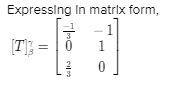
Linear Algebra, 5th Edition, Chapter 2 Linear Transformations and Matrices 14

Substituting the value of  a1 by  1 and  a2 by  2,

⇒ ​​T(1,2)=(1−2,1,2(1)+2)

=(−1,1,4)

=A(1,1,0)+B(0,1,1)+C(2,2,3)

​Expressing in linear system of equations,

⇒ ​​A+2C=−1

⇒ A+B+2C=1

⇒ B+3C=4

Solving the linear system of equations,

⇒ ​​A=−7/3

⇒ B=2

⇒ C=2/3​

Substituting the values of  A,  B and  C in  T(1,0)=A(1,1,0)+B(0,1,1)+C(2,2,3),

⇒ T(1,2)=−7/3(1,1,0)+2(0,1,1)+2/3(2,2,3)

Substituting the value of  a1 by  2 and  a2 by  3,

⇒ ​​T(2,3)=(2−3,2,2(2)+3)

=(−1,2,7)

=A(1,1,0)+B(0,1,1)+C(2,2,3)

​Expressing in linear system of equations,

​​⇒ A+2C=−1

⇒ A+B+2C=2

⇒ B+3C=7

​Solving the linear system of equations,

​​⇒ A=−11/3

⇒ B=3

⇒ C=4/3

Substituting the values of  A,  B and  C in  T(1,0)=A(1,1,0)+B(0,1,1)+C(2,2,3),

⇒ T(2,3)=−11/3(1,1,0)+3(0,1,1)+4/3(2,2,3)

Expressing in matrix form,

Linear Algebra, 5th Edition, Chapter 2 Linear Transformations and Matrices 14 1

Exercise 2.2 Linear Transformations Examples Friedberg Linear Algebra 5th Edition Chapter 2 Page 86 Problem 15 Answer

Given: to complete the proof of part (b) of Theorem 2.7

Here, we have to show the commutativity of addition, associativity of addition, additive identity, scalar identity, scalar associativity, scalar distribution and vector distribution to show that S is a vector space.

Let V and W be vector spaces over a field F, and let T, U: V → W be linear.

First assume that a∈F and define T+U:V→W by

⇒ (T+U)(x)=T(x)+U(x),​ for all ​x∈V……..(1)

⇒ aT: V→W by

⇒ (aT)(x)=aT(x),​ for all ​x∈V………(2).

So the transformation T+U is linear. We will suppose that S is the set of all linear transformations as we defined above. For every transformation T, U in S there exists a unique transformation T+U in S defined by

⇒ (T+U)(x)=T(x)+U(x)

Then for each element a in F, and, each transformation T in S there exists a unique transformation aT in S that is defined by

⇒ (aT)(x)=aT(x) .

commutativity of addition:

Let’s takeT+U, which is for all x∈V defined as,

(T+U)(x)=T(x)+U(x)

Now we get from commutativity of addition

⇒ T(x)+U(x)=U(x)+T(x)=(U+T)(x).

So for all T,U in S,

⇒ T+U=U+T

Associativity of addition:

Take ((T+U)+P)(x). Then, by definition of (1) and from associativity of addition we get

⇒ ​​((T+U)+P)(x)=(T+U)(x)+P(x)

=((T)(x)+U(x))+P(x)

=T(x)+(U+P)(x)

=(T+(U+P))(x)

So for all T,U,P in S,

⇒ (T+U)+P=T+(U+P).

Additive identity:

We have to prove that there exists a transformation in S, denoted by T0, that is defined as T0(x)=0, such that

⇒ T+T0=T for each T in S.

T0 is here zero transformation and it has the role of zero vectors.

Take (T+T0)(x), so by the definition of (1) we have

⇒ ​​(T+T0)(x)=(T)(x)+T0(x)

=T(x)+0

=T(x)​

So, for each T in S,

⇒ T+T0

=T

Additive inverse:

We have to prove that for each T in S, there exists a −T in such that T+(−T)=0.

From the definition (2), for −1∈F and for each T in S, there exists a unique transformation −1⋅T in S defined by,

⇒ ​​(−1⋅T)(x)=−1⋅T(x)

=−T(x)

Now we will take  (T+(−T))(x), so by the definition of (1)we have

​(T+(−T))(x)=T(x)+(−T)(x)

=T(x)−T(x)

=0(x)

This implies that for each T in S, there exists a −T in S such that

⇒ T+(−T)=0

Scalar identity:

We have to prove that for each T inS,IT=T.

From the definition (2), for I∈F and for each T in S, there exists the unique transformation 1⋅T in S defined by,

⇒ (1⋅T)(x)=1⋅T(x)=T(x)

Scalar Associativity: We have to prove that for each pair of elementsa,b∈∈F, and, for each T in S,a(bT)=(ab)T.

Let’s take a(bT)(x),so from the definition (2) we have.

⇒ ​​a(bT)(x)=a(bT(x))

=ab(T(x))

=((ab)T)(x)​

This implies that for each pair of elements a,b∈F and for each T in S

a(bT)=(ab)T

Scalar Distribution:

We have to show that for each element a in F and for each pair of T,U in S,a(T+U)=aT+aU.

Let’s take a((T+U)(x)), so from the definition (1) we have:

​​⇒ a((T+U)(x))=a(T(x)+U(x))

=a(T(x))+a(U(x))

=(aT(x))+(aU(x))

=(aT+aU)(x)

​This implies that for each element a in F and for each pair of T,U in S,

a(T+U)=aT+aU

Vector Distribution:

We have to show that for each pair of elements a,b∈F and for each T in S,(a+b)T=aT+bT. We will take ((a+b)T)(x), and then from the definition (2) we will get​

⇒ ​((a+b)T)(x)=(a+b)(T(x))

=aT(x)+bT(x)

=(aT+bT)(x)

​Hence for each pair of elements a,b∈F and for each T in S,

⇒ (a+b)T=aT+bT

Then from the above showed conditions, we can conclude that S is a vector space.

So the set of all linear transformation defined from the vector space V to the vector space W is a vector space over F

From the above shown conditions, we can conclude that S is a vector space.

So the set of all linear transformations defined from the vector space V to the vector space W is a vector space over F

Linear Algebra 5th Edition Chapter 2 Page 86 Problem 16 Answer

Given: Let V be an n-dimensional vector space with an ordered basis β. Define T: V → Fn

byT(x)=[x]β.

To prove that T is linear.

To show that T(γx+δy)=γT(x)+δT(y) for every x,y∈V and γ,δ∈F, use the definition of the transformation T and properties of matrix addition and multiplication.

Let x=(a1,a2,⋯,an)∈V and y=(b1,b2,⋯,bn)∈V.

Also, letγ,δ∈F.
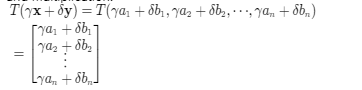
Linear Algebra, 5th Edition, Chapter 2 Linear Transformations and Matrices 16

In order to get that T is a linear transformation, we need to show that T(γx+δy)=γT(x)+δT(y).

We will do this using the definition of the transformation T and the basic properties of matrix addition and multiplication.
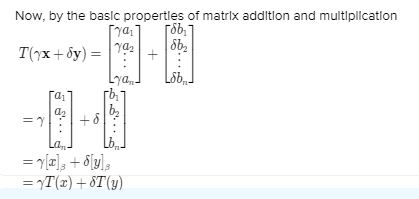
Linear Algebra, 5th Edition, Chapter 2 Linear Transformations and Matrices 16 1

​Hence T is linear.

Linear Algebra 5th Edition Chapter 2 Page 86 Problem 17 Answer

Given: Let V be the vector space of complex numbers over the field R.

To define T: V→V by T(z)=zˉ, where zˉ is the complex conjugate of z.

To prove that T is linear, and compute[T]β, where β={1,i}.

Let x=a+ib∈V and y=c+id∈V.

Also, let γ,δ∈R.

We need to show that T(γx+δy)=γT(x)+δT(y), in order to prove that T is a linear transformation.

Using the definition of the transformation T and the basic properties of multiplication and addition of complex numbers, we get the following.​

​⇒ T(γx+δy)=T[γ(a+ib)+δ(c+id)]

=T[(γa+δc)+(γb+δd)i]

=(γa+δc)−(γb+δd)i

=γ(a−ib)+δ(c−id)

=γx+δy

=γT(x)+δT(y)

​Now, let’s compute the matrix [T]β.Therefore, we need to represent T(1) and T(i) as linear combinations of the vectors of the basis β.

⇒ ​T(1)=T(1+0⋅i)

=1−0⋅i

=1⋅1+0⋅i

⇒ T(i)=T(0+i)

=0−i

=0⋅1+(−1)⋅i

By putting these coefficients into the columns of a 2×2 matrix, we get [T]β.

⇒ [T]β=[​1   0  ​0  −1​]

Linear Algebra, 5th Edition, Chapter 2 Linear Transformations and Matrices 17

Exercise 2.2 Notes From Friedberg Linear Algebra 5th Edition Chapter 2 Page 84 Problem 18 Answer

Given: Let V be a vector space with the ordered basis β={v1,v2,…,vn}.

To define v0=0. By Theorem 2.6  there exists a linear transformation T:V→V such that T(vj)=vj+vj−1 for j=1,2,…,n

Compute [T]β
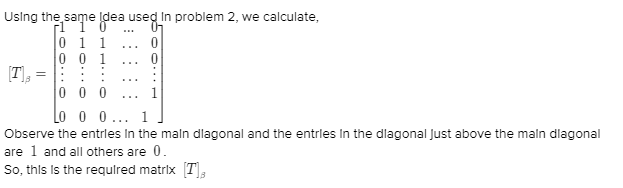
Linear Algebra, 5th Edition, Chapter 2 Linear Transformations and Matrices 18

Here,β={v1,v2,…,vn} is the basic of vector space V

v0=0

T:V→V such that T(vj)=vj+vj−1

Therefore,

⇒ ​v1=v1+v0

⇒ v2=v2+v1

⇒ v3=v3+v2

⇒ v4=v4+v3

⇒ vn=vn+vn−1
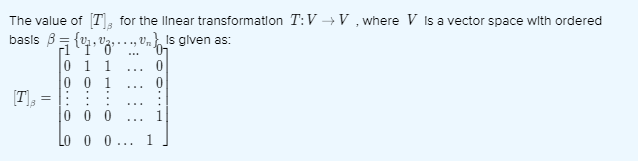
Linear Algebra, 5th Edition, Chapter 2 Linear Transformations and Matrices 18 1

Stephen Friedberg Linear Algebra 5th Edition Chapter 2 Exercise 2.1 Linear Transformations and Matrices

Linear Algebra 5th Edition Chapter 2 Linear Transformations and Matrices

Page 74 Problem 1 Answer

Given: If  T is linear, then T preserves sums and scalar products.

To determine whether the given statement is correct or not.

According to the definition of Linear Transformation  Form, the function must preserve the sums and the scalar products in order to be linear.

And, the given statement is same as the definition of Linear Transformation.

Hence, the given statement is True.

The given statement is True i.e., If  T is linear, then T preserves sums and scalar products.

Linear Algebra 5th Edition Chapter 2 Page 74 Problem 2 Answer

Stephen Friedberg Linear Algebra 5th Edition Chapter 2 Exercise 2.1 Linear Tranformations And Matrices

Read and Learn More Stephen Friedberg Linear Algebra 5th Edition Solutions

Linear Algebra 5th Edition Chapter 2 Page 74 Problem 3 Answer

Given: T is one-to-one if and only if the only vector x such that T(x)=0 is x=0.

To determine whether the given statement is correct or not.

Consider a function f(x2)=x2 on  R.

The only number x such that the value of function is zero is x=0.

But, function, f is not one-one. The given statement would be true only when T is linear.

So, the given statement is False.

The given statement i.e., T is one-to-one if and only if the only vector x such that T(x)=0 is x=0is False.

Page 74 Problem 4 Answer

Given: If T is linear, then T(0v)=0w.

To determine whether the given statement is correct or not.

The given function preserves  the scalar product as per  the definition of Linear Transformation i.e.,

T(0V)=0⋅T(0V)⇒T(0V)=0W.

Hence, the given statement is True.

The given statement, i.e.,  if T is linear, then T(0v)=0w, is True.

Linear Algebra 5th Edition Chapter 2 Page 74 Problem 5 Answer

Given:  If T is linear, then nullity(T)+rank(T)=dim(W).

To determine whether the given statement is correct or not.

Consider T:R2→R as T(a,b)=a which is a linear transformation over R.

Null space and Rank of  T is Null(T)=1 and

Rank(T)=1 respectively.

Null(T)+Rank(T)=2 but here the dimension of W is 1. This violates the Dimension Theorem.

So, the given statement is False.

The given statement, i.e., If T is linear, thennullity(T)+rank(T)=dim(W), is False.

Page 74 Problem 6 Answer

Given: If T is linear, then T carries linearly independent subsets of  V onto linearly independent subsets of W.

To determine whether the given statement is correct or not.

Considering T: R2→R as T(a,b)=a for every y∈R which is a linear transformation over R.

So, the given statement is False.

The given statement i.e., If T is linear, then T carries linearly independent subsets of  V onto linearly independent subsets of W, is False.

Linear Algebra 5th Edition Chapter 2 Page 74 Problem 7 Answer

Given: If T,U: V→W are both linear and agree on a basis for V, then T=U.

To determine whether the given statement is correct or not.

Any element x∈V can be written as x=c1x1+c2x2…+cnxn.

As both U and V agrees on the basis for V, and then T and U can be written as T(x)=c1

T(x1)+c2T(x2)…+cnT(xn) andU(x)=c1U(x1)+c2U(x2)…+cnU(xn).

So, the given statement is True.

The given statement i.e.,  If T,U: V→W are both linear and agree on a basis for V, then T=U, is True.

Page 74 Problem 8 Answer

Given: x1,x2∈V and y1,y2∈W , there exists a linear transformation T:V→W such that T(x1)=y1 and T(x2)=y2.

To determine whether the given statement is correct or not.

Consider T:R2→R2 , linear transformation over R and x2=cx1 for c≠0.

Also, y1=(1,0) and y2=(0,1).

If T(x1)=(1,0) then by linearity T(x2)=(c,0) andT(x2)≠0.

So, the given statement is False.

The given statement i.e.,  x1,x2∈V and y1,y2∈W , there exists a linear transformation T:V→W such that T(x1)=y1 and T(x2)=y2, is False.

Exercise 2.1 Linear Transformations Solved Examples Linear Algebra 5th Edition Chapter 2 Page 74 Problem 9 Answer

Given: T: R3→R2,T(a1,a2,a3)=(a1−a2,2a3) To prove the given transformation is linear, find the bases and compute the nullity and rank of T.

Also, we need to verify the Dimension Theorem and determine whether the T is one-one or onto.

First, prove the given transformation is linear and then find the bases for N(T) and R(T).

Then, find the nullity and rank of T and verify the Dimension Theorem.

Check whether given transformation is one-one or onto.

Given T:R3→R2,T(a1,a2,a3)=(a1−a2,2a3).

Consider a=(a1,a2,a3) and b=(b1,b2,b3) where a,b,α,β∈R.

Checking for Linearity of the given transformation, we get

T(αa+βb)=T(αa1+βb1,αa2+βb2,αa3+βb3)

⇒T(αa+βb)=(αa1+βb1−αa2−βb2,2αa3+2βb3)

⇒T(αa+βb)=α(a1−a2,2a3)+β(b1−b2,2b3)

⇒T(αa+βb)=αT(a)+βT(b)

The given transformation is linear.

Solving for the bases of N(T) ,we get

T(a1,a2,a3)=(0,0)⇒(a1−a2,2a3)=(0,0)

Comparing both sides of the equation, we get

a1−a2=0

⇒a1,a2=0

2a3=0

⇒a3=0

⇒N(T)={(1,1,0)}

Solving for the bases of R(T),we get

T(a1,a2,a3)=(a1−a2,2a3)

⇒(a1−a2,2a3)=(1,0)a1+(−1,0)a2+(0,2)a3

⇒R(T)={(1,0),(0,2)}

Nullity for the given transformation T is nullity(T)=1 and Rank for the given transformation is  Rank(T)=2. Dimension of R3 is 3.

Substituting these values in the Dimension Theorem, we get nullity(T)+rank(T)=dim(V)

⇒1+2=3

⇒3=3

⇒L.H.S.=R.H.S.​

Checking for the one-one and onto,we get

Since, nullity(T)≠0 the given transformation is not one-one  and

Rank(T)=dimR2 so the transformation is onto.

Given linear transformation is linear, onto and also satisfies the Dimension Theorem.

Linear Algebra 5th Edition Chapter 2 Page 74 Problem 10 Answer

In this question, we need to prove the given transformation is linear, find the bases and compute the nullity and rank of T.

Also, need to verify the Dimension Theorem and determine whether the T is one-one or onto.

Firstly, prove the given transformation is linear and then find the bases for N(T) and R(T).

Then, nullity and rank of T and verify the Dimension Theorem.

Check whether given transformation is one-one or onto.

Given T:R2→R3,T(a1,a2)=(a1+a2,0,2a1−a2).

Consider a=(a1,a2) and b=(b1,b2) where a,b,α,β∈R.

Checking for Linearity of the given transformation, we get

T(αa+βb)=T(αa1+βb1,αa2+βb2)

⇒T(αa+βb)=(αa1+βb1+αa2+βb2,0,2αa1+2βb1−αa2−βb2)

⇒T(αa+βb)=α(a1+a2,0,2a1−a2)+β(b1+b2,0,2b1−b2)

⇒T(αa+βb)=αT(a)+βT(b)

The given transformation is linear.

Solving for the bases of N(T),we get

T(a1,a2)=(0,0,0)

⇒(a1+a2,0,2a1−a2)=(0,0,0)

Comparing both sides of the equation, we get

⇒ a1+a2=0

⇒ 2a1−a2=0

⇒a1,a2=0

⇒N(T)={(0,0)}

Solving for the bases of R(T), we get

T(a1,a2)=(a1+a2,2a1−a2)⇒(a1+a2,2a1−a2)=(1,0,2)a1+(1,0,−1)a2

⇒R(T)={(1,0,2),(1,0,−1)}

Nullity for the given transformation nullity(T)=0 and

Rank for the given transformation is  Rank(T)=2.

Dimension of R2 is 2.

Substituting these values in the Dimension Theorem, we get

nullity(T)+rank(T)=dim(R2)

⇒0+2=2

⇒2=2

⇒L.H.S.=R.H.S.

Checking for the one-one and onto,we get

Since, nullity(T)=0 the given transformation is one-one  and

Rank(T)≠dimR3 so the transformation is not onto.

Given linear transformation is linear, one-one and also satisfies the Dimension Theorem.

Linear Algebra Friedberg Exercise 2.1 Matrices Explained Chapter 2 Page 74 Problem 11 Answer

In this question, we need to prove the given transformation is linear, find the bases, and compute the nullity and rank of T.

Also, need to verify the Dimension Theorem and determine whether the T is one-one or onto.

Linear Algebra, 5th Edition, Chapter 2 Linear Transformations and Matrices 11

Firstly, prove the given transformation is linear and then find the bases for N(T)and R(T).

Then, nullity and rank of T and verify the Dimension Theorem.

Check whether given transformation is one-one or onto.

Linear Algebra, 5th Edition, Chapter 2 Linear Transformations and Matrices 11 1

Nullity for the given transformation T is nullity(T)=4 and

Rank for the given transformation is  Rank(T)=2. Dimension of M2×3(F) is 2×3=6.

Substituting these values in the Dimension Theorem, we get

lnullity(T)+rank(T)=dim(M2×3(F))

⇒4+2=6

⇒6=6

⇒L.H.S.=R.H.S.

Checking for the one-one and onto,we get

Since, nullity(T)≠0 the given transformation is not one-one  and

Rank(T)≠dimM2×3(F) so the transformation is not onto also.

Given linear transformation is linear, neither one-one nor onto and also satisfies the Dimension Theorem.

Linear Algebra 5th Edition Chapter 2 Page 74 Problem 12 Answer

Given: T:P2(R)→P3(R),T(f(x))=xf(x)+f′(x)

To prove the given transformation is linear, find the bases and compute the nullity and rank of T .

Also, we need to verify the Dimension Theorem and determine whether the T is one-one or onto.

First, prove the given transformation is linear and then find the bases for N(T) and R(T).

Then, find the nullity and rank of T and verify the Dimension Theorem.

Check whether given transformation is one-one or onto.

Given T:P2(R)→P3(R),T(f(x))=xf(x)+f′(x).

Consider  f,g∈P2(R) and  α,β∈R.

Checking for Linearity of the given transformation, we get

T((αf+βg)(x))=x(αf+βg)(x)+(αf+βg)′

(x)⇒T((αf+βg)(x))=αxf(x)+βxg(x)+αf′(x)+βg′(x)

⇒T((αf+βg)(x))=α(xf(x)+f′(x))+β(xg(x)+g′(x))

⇒T((αf+βg)(x))=αT(f(x))+βT(g(x))

The given transformation is linear.

Solving for the bases of N(T),we get

T(f(x))=0

⇒xf(x)+f′(x)=0

⇒x(ax2+bx+c)+2ax+b=0

⇒ax3+bx2+(c+2a)x+b=0

​Comparing both sides of the equation, we get

⇒ a=0

⇒ b=0

⇒ c+2a=0

⇒a,b,c=0

⇒N(T)={0}

Solving for the bases of R(T),we get

T(f(x))=xf(x)+f′(x)

⇒T(f(x))=(x3+2x)a+(x2+1)b+xc

⇒R(T)={x3+2x,x2+1,x}

Nullity for the given transformation T is nullity(T)=0 and

Rank for the given transformation is  Rank(T)=3.

Dimension of P2(R)=3 is 3.

Substituting these values in the Dimension Theorem, we get

nullity(T)+rank(T)=dim(P2(R))

⇒0+3=3

⇒3=3

⇒L.H.S.=R.H.S.

Checking for the one-one and onto,we get

Since, nullity(T)=0 the given transformation is one-one  and

Rank(T)≠dim(P2(R)) so the transformation is not onto.

Given linear transformation is linear and one-one and also satisfies the Dimension Theorem.

Exercise 2.1 Linear Transformations Examples Friedberg Chapter 2 Page 75 Problem 13 Answer

Given: T:Mn×n(F)→F,T(A)=tr(A)

To prove the given transformation is linear, find the bases and compute the nullity and rank of T .

Also, need to verify the Dimension Theorem and determine whether the T is one-one or onto.

Firstly, prove the given transformation is linear and then find the bases for N(T) and R(T).

Then, nullity and rank of T and verify the Dimension Theorem.

Check whether given transformation is one-one or onto.

Given T:Mn×n

(F)→F,T(A)=tr(A).

Checking for Linearity of the given transformation, we get

⇒ T(cA+B)=i=1

∑  (cAii+Bii)
n

⇒T(cA+B)=ci=1

∑   Aii+i=1
n

∑ Bii
n

⇒T(cA+B)=cT(A)+T(B)

​The given transformation is linear.

Each of the given matrices in the basis of N(T) have trace equal to zero and can generate any matrix with trace equal to zero,we get

⇒N(T)={Eij}i≠j∪{Eii−Ei+1,i+1},For i=1,…,n.

Solving for the bases of R(T) ,we get⇒R(T)={1}

Nullity for the given transformation T is nullity(T)=n2−1 and
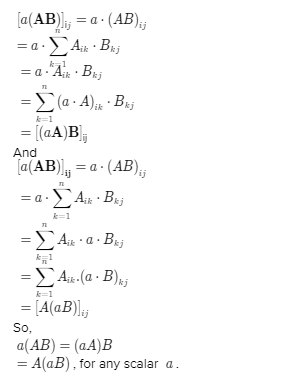
Rank for the given transformation is  Rank(T)=1. Dimension of Mn×n(F) is n2.

Substituting these values in the Dimension Theorem, we get

nullity(T)+rank(T)=dim(Mn×n(F))

⇒n2−1+1=n2

⇒n2

=n2

⇒L.H.S.=R.H.S.

​Checking for the one-one and onto,we get

Since, nullity(T)≠0 the given transformation is one-one  and

The given transformation is also onto as a matrix can be generated using any desired trace.

Given linear transformation is linear and one-one and also satisfies the Dimension Theorem.

Linear Algebra 5th Edition Chapter 2 Page 75 Problem 14 Answer

Given is a linear operator T.We have to prove that that T(0)=0.

For a linear transformation T, we know that T(x)+T(y)=T(x+y).

Hence, T(0)+T(0)=T(0).It implies that T(0)=0.

Hence, it is shown above that T(0)=0 if T is a linear operator.

Page 75 Problem 15 Answer

Given is a linear operator T.We have to prove that T(cx+y)=cT(x)+T(y) for all x,y∈V and c∈F.

Using the properties of a linear operator, we have T(cx+y)=T(cx)+T(y).Since, T(cx)=cT(x),T(cx+y)=cT(x)+T(y)

Hence, it is shown above that T(cx+y)=cT(x)+T(y) for all x,y∈V and c∈F.

Linear Algebra 5th Edition Chapter 2 Page 75 Problem 16 Answer

n the previous part, we have proved that T(cx+y)=cT(x)+T(y).

Replace x with y and y with x.Then substitute c=−1 to get T(−y+x)=−T(y)+T(x).
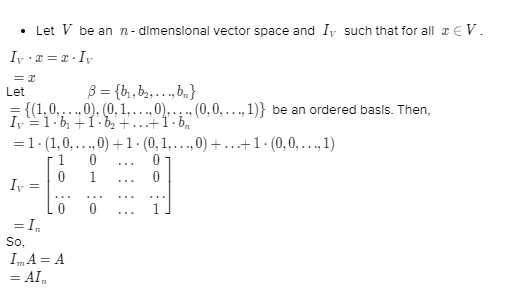
Hence, we have T(x−y)=T(x)−T(y).

Hence, it is shown above that T(x−y)=T(x)−T(y) for all x,y∈V.

Page 75 Problem 17 Answer

Linear Algebra, 5th Edition, Chapter 2 Linear Transformations and Matrices 17

Hence, it is shown above that T(cx+y)=cT(x)+T(y)  for all x,y∈V and c∈F.

Linear Algebra 5th Edition Chapter 2 Page 75 Problem 18 Answer

In the given question, we are asked to prove that the transformations in Examples  2 and  3 are linear.

Use the formula  Tθ

(a1,a2)=(a1cosθ−a2sinθ,a1sinθ+a2cosθ) and apply addition and scalar multiplication in  R2 , to prove the transformation in Example 2 as linear.

Using known properties of addition and scalar multiplication in  R2 , the transformation in Example  3 can be proved as linear.

Using the formula  Tθ

(a1,a2)=(a1cosθ−a2sinθ,a1sinθ+a2cosθ)  and applying scalar addition and multiplication in Example  2 ,

​T(c(a1,a2)+(b1,b2))=T((ca1+ca2)⋅(cb1+cb2))

=((ca1)cosθ−(ca2)sinθ,(ca1)sinθ+(ca2)cosθ+(b1)cosθ−(b2)sinθ,(b1)sinθ+(b2)cosθ)

=c(a1cosθ−a2sinθ,a1sinθ+a2cosθ)+(b1cosθ−b2sinθ,b1sinθ+b2cosθ)

=cT(a1,a2)+T(b1,b2)

​So, the transformation is linear.

Using known properties of addition and scalar multiplication in  R2 in Example  3,

​T(c(a1,a2)+(b1,b2))=T(ca1+b1,ca2+b2)

=(ca1+b1,−(ca2+b2))

=(ca1,−ca2)+(b1,−b2)

=cT(a1,a2)+T(b1,b2)

​So, the transformation is linear.

Hence, the transformation in Examples  2 and  3 are proved to be linear.

Exercise 2.1 Notes From Friedberg Linear Algebra 5th Edition Chapter 2 Page 75 Problem 19 Answer

Given that T:R2→R2 is a function defined by T(a1,a2)=(1,a2).

To show: T is not-linear.First, we will verify the properties of a function to be linear.

Finally, if T(x+y)≠T(x)+T(y) then T will not be linear.

Let a=(a1,a2),b=(b1,b2)∈R2 and α,β∈R.

​⇒ T(αa+βb)=T(α(a1,a2)+β(b1,b2))

⇒ T(αa+βb)=T(αa1+βb1,αa2+βb2)

⇒ T(αa+βb)=(1,αa2+βb2)

​Now,​

⇒ αT(a)+βT(b)=αT(a1,a2)+βT(b1,b2)

⇒ αT(a)+βT(b)=α(1,a2)+β(1,b2)

⇒ αT(a)+βT(b)=(α+β,αa2+βb2)

​⇒ T(αa+βb)≠αT(a)+βT(b)

Hence, T is not linear.

Page 75 Problem 20 Answer

Given that T:R2→R2 is a function defined by T(a1,a2)=(a1,a12).

To show: T is not-linear.

First, we will verify the properties of a function to be linear.

Finally, if T(x+y)≠T(x)+T(y) then T will not be linear.

Let a=(a1,a2),b=(b1,b2)∈R2 and α,β∈R.

⇒ T(αa+βb)=T(α(a1,a2)+β(b1,b2))

⇒ T(αa+βb)=T(αa1+βb1,αa2+βb2)

⇒ T(αa+βb)=(αa1+βb1,(αa2+βb2)2)

​Now,

⇒ αT(a)+βT(b)=αT(a1,a2)+βT(b1,b2)

⇒ αT(a)+βT(b)=α(a1,a22)+β(b1,b22)

⇒ αT(a)+βT(b)=(αa1+βb1,αa22+βb22)

⇒ T(αa+βb)≠αT(a)+βT(b)

Hence, T is not linear.

Linear Algebra 5th Edition Chapter 2 Page 75 Problem 21 Answer

Given that T:R2→R2 is a function defined by T(a1,a2)=(sina1,0).

To show:T is not-linear.

First, we will verify the properties of a function to be linear.

Finally, if T(x+y)≠T(x)+T(y) then T will not be linear.

Let a=(a1,a2),b=(b1,b2)∈R2 and α,β∈R.​

⇒ T(αa+βb)=T(α(a1,a2)+β(b1,b2))

⇒ T(αa+βb)=T(αa1+βb1,αa2+βb2)

⇒ T(αa+βb)=(sin(αa1+βb1),0)​

Now,​

⇒ αT(a)+βT(b)=αT(a1,a2)+βT(b1,b2)

⇒ αT(a)+βT(b)=α(sin(a1),0)+β(sin(b1),0)

⇒ αT(a)+βT(b)=(αsin(a1)+βsin(b1),0)​

⇒ T(αa+βb)≠αT(a)+βT(b)

Hence, T is not linear.

Page 75 Problem 22 Answer

Given that T:R2→R2 is a function defined by T(a1,a2)=(∣a1∣,a2).

To show: T is not-linear.

First, we will verify the properties of a function to be linear.

Finally, if T(x+y)≠T(x)+T(y) then T will not be linear.

Let a=(a1,a2),b=(b1,b2)∈R2 and α,β∈R.

⇒ ​T(αa+βb)=T(α(a1,a2)+β(b1,b2))

⇒ T(αa+βb)=T(αa1+βb1,αa2+βb2)

⇒ T(αa+βb)=(∣αa1+βb1∣,αa2+βb2)

​Now,​

⇒ αT(a)+βT(b)=αT(a1,a2)+βT(b1,b2)

⇒ αT(a)+βT(b)=α(∣a1∣,a2)+β(∣b1∣,b2)

⇒ αT(a)+βT(b)=(α∣a1∣+β∣b1∣,αa2+βb2)

⇒ ​T(αa+βb)≠αT(a)+βT(b)

Hence, T is not linear.

Examples Of Exercise 2.1 In Friedberg Linear Algebra Chapter 2 Page 75 Problem 23 Answer

Given that T:R2→R2 is a function defined by T(a1,a2)=(a1+1,a2).

To show: T is not-linear. First, we will verify the properties of a function to be linear.

Finally, if T(x+y)≠T(x)+T(y) then T will not be linear.

Let a=(a1,a2),b=(b1,b2)∈R2 and α,β∈R.

⇒ T(αa+βb)=T(α(a1,a2)+β(b1,b2))

⇒ T(αa+βb)=T(αa1+βb1,αa2+βb2)

⇒ T(αa+βb)=(αa1+βb1+1,αa2+βb2)

​Now,

⇒ αT(a)+βT(b)=αT(a1,a2)+βT(b1,b2)

⇒ αT(a)+βT(b)=α(a1+1,a2)+β(b1+1,b2)

⇒ αT(a)+βT(b)=(αa1+βb1+α+β,αa2+βb2)

⇒ ​T(αa+βb)≠αT(a)+βT(b)

Hence, T is not linear.

Linear Algebra 5th Edition Chapter 2 Page 75 Problem 24 Answer

Given: T:R2→R2 is a function is a linear; T(1,0)=(1,4); T(1,1)=(2,5).To find: T(2,3). Whether T is one-to-one.

First, we will find T(2,3).

Finally, we will determine whether T is one-to-one or not.

Since T is linear, we can write cT(x+y)=T(cx)+T(cy).

Need to write T(2,3)as a linear combination of T(1,0)and T(1,1).

​⇒ a(1,0)+b(1,1)=(2,3)

⇒ (a+b,b)=(2,3)

​So,

⇒ a=−1

⇒ b=3

⇒ T(2,3)=(−1)(T(1,0))+(3)(T(1,1))

⇒ T(2,3)=(−1)(1,4)+3(2,5)

⇒ T(2,3)=(−1,−4)+(6,15)

⇒ T(2,3)=(5,11)

​Need to write T(v,w)as a linear combination of T(1,0)and T(1,1).

⇒ ​(v,w)=a(1,0)+b(1,1)

⇒ (v,w)=(a+b,b)

⇒ ​v=a+b and

⇒ w=b

So,

⇒ a=v−w

⇒ b=w​

⇒ T(v,w)=(v−w)(T(1,0))+(w)(T(1,1))

⇒ T(v,w)=(v−w)(1,4)+w(2,5)

⇒ T(v,w)=(v−w+2w,4v−4w+5w)

⇒ T(v,w)=(v+w,4v+w)

​⇒ v+w,4v+w)=(0,0)

⇒v,w=0

So only T(0,0)=(0,0)

Thus, N(T)=(0,0)and T is one-to-one

Hence, T(2,3)=(5,11)and T is one-to-one.

Stephen Friedberg Linear Algebra 5th Edition Chapter 1 Exercise 1.7 Vector Spaces

Linear Algebra 5th Edition Chapter 1 Vector Spaces

Page 62 Problem 1 Answer

Given statement is: “Every family of sets contains a maximal element.”

Check whether the statement is true or false.

Use the definition and properties of Vector Space.

In the family of open intervals, there are no maximal elements.

Consider the{(0,n)} family, where n≥1. As a result, there are no maximum elements in this family.

Given statement is:

“Every family of sets contains a maximal element.”

Verify whether the statement is true or false.

Use the definition and properties of Vector Space.

It is not possible that in every family set, a maximal element is present. So, the statement cannot be true.

Hence, the statement “Every family of sets contains a maximal element” is FALSE.

Page 62 Problem 2 Answer

The given statement is:

“Every chain contains a maximal element.”

To verify whether the statement is true or false.

We can solve this by using the definition and properties of Vector Space.

In the family of open intervals, there are no maximal elements in terms with real numbers.

Consider the {(0,n)} family, where n≥1. As a result, there are no maximum elements in such a family.

The given statement is:

“Every chain contains a maximal element.”

To verify whether the statement is true or false.

Read and Learn More Stephen Friedberg Linear Algebra 5th Edition Solutions

We can solve this by using the definition and properties of Vector Space.

It is not possible that in every family set, a maximal element is present in terms with real numbers. So the statement can never be true.

Therefore, the given statement “Every chain contains a maximal element” is FALSE.

Stephen Friedberg Linear Algebra 5th Edition Solutions For Exercise 1.7 Page 62 Problem 3 Answer

Stephen Friedberg Linear Algebra 5th Edition Chapter 1 Exercise 1.7 Vector Spaces

It is not possible that in a family set, a unique maximal element is present as there is more than one maximal element present in the set.

So the statement can never be true.

Therefore, the given statement “If a family of sets has a maximal element, then that maximal element is unique” is FALSE.

Page 62 Problem 4 Answer

 The given statement is:

“If a chain of sets has a maximal element, then that maximal element is unique.”

To verify whether the statement is true or false.

We can solve this by using the definition and properties of Vector Space.

Consider there are two maximal elements A and B. As they are in a chain, A⊆B

and B⊂A. So,A=B  i.e., A and B are maximal elements.

The given statement is:

“If a chain of sets has a maximal element, then that maximal element is unique.”

To verify whether the statement is true or false.

We can solve this by using the definition and properties of Vector Space.

It is not possible that in a chain, more than one maximal element to be present.

So the statement can never be false.

Therefore, the given statement “If a chain of sets has a maximal element, then that maximal element is unique” is TRUE.

Page 62 Problem 5 Answer

The given statement is:

“A basis for a vector space is a maximal linearly independent subset of that vector space.”

To verify whether the statement is true or false.

We can solve this by using the definition and properties of Vector Space.

Assume there is a basis for an independent set.

The linear combination of vectors is not stated for the purpose of forming a basis.

The given statement is:

“A basis for a vector space is a maximal linearly independent subset of that vector space.”

To verify whether the statement is true or false.

We can solve this by using the definition and properties of Vector Space.

It is not possible that the basis for a vector space is not a subset of that vector space that is maximally linearly independent.

So the statement can never be false.

Therefore, the given statement “A basis for a vector space is a maximal linearly independent subset of that vector space” is TRUE.

Chapter 1 Exercise 1.7 Vector Spaces Solved Problems Page 62 Problem 6 Answer

The given statement is:

“A basis for a vector space is a maximal linearly independent subset of that vector space.”

To verify whether the statement is true or false.

We can solve this by using the definition and properties of Vector Space.

Assume there exist certain elements of a vector space’s basis.

As a result, they create the most linearly independent system.

As a result, a basis is a vector space’s largest linearly independent subset.

The given statement is:

“A basis for a vector space is a maximal linearly independent subset of that vector space.”

To verify whether the statement is true or false.

We can solve this by using the definition and properties of Vector Space.

It is not possible that the basis for a vector space is not a maximal linearly independent subset of that vector space.

So the can never be False.

Therefore, the given statement “A basis for a vector space is a maximal linearly independent subset of that vector space” is TRUE.

Page 62 Problem 7 Answer

Given that the set of sequences is convergent.

To prove that the set of convergent sequences is an infinite-dimensional subspace of the vector space of all sequences of real numbers.

We can solve this by using the definition and properties of vector space.

Consider the sequence {sinn}

From Taylor’s expansion, every real valued function can be written as sum of series of either finite or infinite terms as:

⇒ sinx=0

⇒ ∑(−1)0x2n+1

⇒ (2n+1)!

So, this is a polynomial of infinite degree in z. As a result, real-valued convergent sequences can be expressed as polynomials of finite or infinite degree.

Denoting

V={{an}:{an}is a convergent sequence of real numbers}

V is an infinite dimensional set of polynomials as at least one member of V is of infinite degree.

We will prove that V is a vector space using various properties as:

Closure law

If some sequence {an} and {bn} converges to a and b, then {an+bn} converges to a+b.

Scalar multiplication law

By properties of convergent sequences, we know {kan} converges to ka.

Zero{0} is the convergent sequence to 0 such that

{an}+{0}={an}

for every {an} in V.

Associativity

By associativity of real numbers, we know (a+b)+c = a+(b+c). Since ({an}+{bn})+{cn} converges to (a+b)+c, we get

({an}+{bn})+{cn}={an}+({bn}+{cn})

Abelian property

From abelian property for real numbers, we get

{an}+{bn}={bn}+{an}

Inverse

In the case when {an} converges to a, then {−an} converges to −a, hence additive inverse of a convergent sequence is also a convergent sequence.

Distributivity law

We know k{an+bn}

converges to k(a+b). From distributivity of real numbers we have

k(a+b)=ka+kb

On the other hand, k{an}+k{bn} converges to ka+kb. So,k{an+bn}=k{an}+k{bn}

Since (k+l){an} converges to (k+l)a , (k+l)a=ka+k land k{an}+l{an}

converges to ka+la

we have (k+l){an}=k{an}+l{an}

Multiplicative associativity

k(l{an}) converges to k(la). For the real numbers, it is well-known k(la)=(kl)a. We know that kl{an}converges to (kl)a, so

k(l{an}) = kl{an}

We know 1{an} converges to 1a, 1a = aso 1{an}converges to a, hence1{an}={an}

If the sequence {an} converges to a and {bn} converges to b, then for all real numbers x

we have

⇒ {an}+x{bn}={an+xbn}

from linearity of limits. Finally, the convergent sequences from a subspace of V

(real sequence).

We’ll use the fact that any two sequences of differing lengths are linearly independent to demonstrate that the subspace is infinitely dimensional

. There is no finite basis for this space since the number of terms in the sequence has an infinite number of possibilities.

Finally, space is an infinite-dimensional.

Hence, space is infinite-dimensional.

Linear Algebra Friedberg Exercise 1.7 Detailed Explanation Page 62 Problem 8 Answer

Given that π is transcendental and V is a set of real numbers regarded as a vector space over the field of rational numbers.

To prove that V is infinite-dimensional.

We can solve this by using the definition and properties of vector space and basis.

Assume that the elements

√2,√3,√5,… and π,π2,π3,…form a linearly independent set.

Because Q(rational numbers) is countable, the subset R created by the only countable set is also countable.

However, because R(real numbers) is an uncountable set, there is no set that forms a basis of R over Q, hence V is an infinite-dimensional set over a rational field.

Hence, V is an infinite-dimensional set over a field of rational.

Page 62 Problem 9 Answer

Given that W is a subspace of a vector space V.

To prove that any basis for W is a subset of a basis for V.

We can solve this by using the definition and properties of vector space and basis.

Assume

⇒ {α1,α2,…,αn}

be the basis for the finitely generated vector space over a field F.

If we suppose that there exists a linearly independent subspaces W of V, then W is finite-dimensional subset and let

S={β1,β2,…,βm} be its basis. We will prove that we can extend S to the basis for V.

Assume

S1={β1,β2,…,βm,α1,α2,…,αn}

so, we have L(S1)=V. Since β1,β2,…,βm can be express as linear combination α1,α2,…,αn so S1 is linearly independent.

There is one vector from S1 which is a linear combination of preceding vectors.

We will suppose that is αi.

Without that vector we get the set

S2={β1,β2,…,βm,α1,α2,…,αi−1,αi+1,αn}

We now get L(S2)=V, so S2 is a basis for V and it is the required extended set which forms a basis of V

. If S2 isn’t a linearly independent set, continue in the same way. Then V contains S, so S can be extended to the basis for V.

Finally, any basis of W is a subset of the basis for V.

Hence, the basis of W is a subset of the basis for V.

Page 62 Problem 10 Answer

Given that β is subset of an infinite-dimensional vector space V and β is a basis for V

if and only if

⇒ v=c1u1+c2u2+…+cnun

To prove an infinite-dimensional version of Theorem 1.8.

We can solve this by using the definition and properties of vector space and basis.

Assume β be the basis for V and v∈V. So,v∈span(β) from span(β)=V.

Thus, v is a linear combination of the vectors of β.

Suppose that

⇒ v=c1u1+c2u2+…+cnun      ..(1)

and v=b1u1+b2u2+…+bnun    ..(2)are two representations of v.

Subtracting equation (2) from (1),

⇒ 0=(c1−b1)u1+(c2−b2)u2+…+(cn−bn)un

From linear independence for β,

⇒ c1−b1=c2−b2=…=cn−bn

So,c1=b1,c2=b2,…,cn=bn

So, v is uniquely expressed as a linear combination of the vectors from β.

Hence, β is the basis for Vif and only if each nonzero vector of Vis uniquely expressed as a linear combination of the vectors from β.

Vector Spaces Exercise 1.7 Examples Friedberg Chapter 1 Page 63 Problem 11 Answer

In the problem statement, the given theorem is Theorem 1.9.

To prove the generalization of Theorem 1.9, use the definition and properties of vector space and basis.

Let F be the family of all linearly independent subsets of S2 that contain S1.

Using the well-known theorem:

Let F be the family of all linearly independent subsets of V such that it contains S. To show that F

contains a maximal element, we have to show that if C is a chain in F, then there exists a member U of F that contains each member of C.

In that case, we claim that U, the union of members from C

is the required set.

The set U, as union, contains each member of C and we have only to show that U∈F (it means U is a linearly independent subset of V that contains S).

As each member of C is a subset of V which contains S, we know

S⊆U⊆V

We need to prove the linear independence of U.

Assume the following vectors:

{u1, u2,…, un} ∈Uand scalars {c1, c2,…, cn}

such that

⇒ c1u1 + c2u2 + … + cnun = 0

Since ui∈U for all i = 1,2,…, n there exists Ai, set in C such that ui∈Ai.

As C is in chain, so one of these sets, At contains all others, so ui∈At for all i = 1,2,…, n.

Since At is linearly independent, we have

⇒ c1u1 + c2u2 + … + cnun = 0

⇒ c1 = c2 = … = cn = 0

Finally, U is linearly independent. By the maximal principle, F has a maximal element which is a maximal linearly independent subset of V that contains S.

There is a maximal element β in F by maximal principle. This implies that β generates S2 and so generates V, so β is the basis for V.

Hence, the generalization of Theorem 1.9 is proved.

Page 63 Problem 12 Answer

Given theorem is Replacement Theorem.

Use the definition and properties of vector space and basis.

We need to prove the generalization of the Replacement Theorem.

Assume βto be the basis of some vector space V.

For instance,

S={b1,b2,…,bk}

Is linearly independent subset of V. S1 denotes all elements of β.

Extending $S$ to the basis of $U$ as:

S1={b1,b2,…,bk,a1,a2,…,am}

So, L(S1)=V

Every bi can be expressed as a linear combination of ai, so S1 is linearly independent.

Thus, the vector from V can be written as a linear combination of vectors from S∪S1.

Finally, S∪S1 is linearly independent and it forms the basis of V.

Therefore, the generalization of Replacement Theorem is proved.