Core Connections Course 1 Student 1st Edition Chapter 1 Introduction and Representation
Core Connections Course 1 Student 1st Edition Chapter 1 Exercise 1.2 solutions Page 27 Problem 1 Answer
Given: Our teacher will bring our team a handful of pennies. It is asked to organize the pennies so that anyone who looks at our arrangement can easily see how many pennies your team has.
We will discuss the above situation in the step part.
From the explanation, Our teacher will bring our team a handful of pennies.
Now, We will make a rectangular array of pennies that is x pennies long and y pennies wide with z leftover pennies. i.e., the area would be the sum of the values of pennies x⋅y+z
(As, in these arrangement the pennies are look like a figure, so, they are easy to see and understand the objects).
The rectangular array of pennies is look like in the below image:

Where, in the above image, there is a rectangular array in the left side and some leftover pennies which are in the right sides.
Hence, the required arrangement is a rectangular array of pennies.
As, in these arrangement the pennies are look like a figure, so, they are easy to see and understand the objects.
solutions for Core Connections Course 1 Chapter 1 Exercise 1.2 Introduction and Representation Page 28 Problem 2 Answer
Given: We can see how other teams have arranged their pennies like stacks and piles of pennies with some left over of pennies.
It is asked to explain how we make our arrangement even clearer.
Read and learn More Core Connections Course 1 Student 1st Edition Solutions
We see some stacks and piles of pennies with some left over of pennies which are good for calculation but it is difficult to see how much penny in every stack or piles.
But, we have a rectangular array of pennies which is easy to see and to calculate the values.
Hence, our arrangement is easier than the others in the Gallery Walk.
So, we don’t need an improvement.
Therefore, from above explanation, we can conclude that, we don’t need an improvement.
Since a rectangular array of pennies is easy to see and to calculate the values than a pile or stack of pennies.
Core Connections Course 1 Student 1st Edition Chapter 1 Exercise 1.2 guide Page 28 Problem 3 Answer
Given: Our teacher will direct us to participate in a Gallery Walk so that we can see how other teams have arranged their pennies.
It is asked to draw a diagram that represents our new arrangement of the pennies without drawing all of the pennies themselves.
We know from the previous part(a), that we see in the Gallery Walk some stacks and piles of pennies with some leftover of pennies which are good for calculation but it is difficult to see how much penny in every stack or piles.
But, we have a rectangular array of pennies which is easy to see and to calculate the values. Hence, our arrangement is easier than the others in the Gallery Walk.
So, we don’t need an improvement.
Therefore, the diagram that represents our arrangement of the pennies without drawing all of the pennies themselves shown in the below:
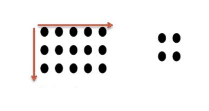
In the rectangular array we have 3 pennies long and 5 pennies width with 4 leftover pennies.
Hence, the required diagram that represents our arrangement of the pennies:
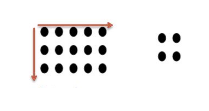
In the rectangular array we have 3 pennies long and 5 pennies width with 4 leftover pennies.
Chapter 1 Exercise 1.2 Introduction and Representation explained Core Connections Course 1 Page 28 Problem 4 Answer
Given: Our teacher will direct us to participate in a Gallery Walk so that we can see how other teams have arranged their pennies.
It is asked to compare your diagram with those made by your teammates.
We will analyze my arrangements with my teammates arrangements.
We have the diagram that represents our arrangement of the pennies which is:
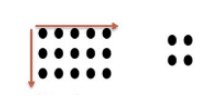
In the above rectangular array we have 3 pennies long and 5 pennies width with 4 leftover pennies.
Now, one of the diagrams of others that represent their arrangement of the pennies, which shown in below:
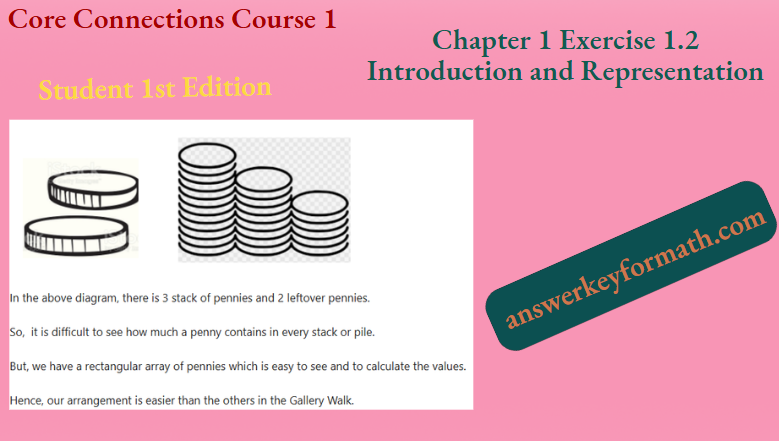
Therefore, from the above explanation, we can conclude that stacks of pennies with some left over of pennies which are good for calculation but it is difficult to see how much penny in every stack or piles.
But, we have a rectangular array of pennies which is easy to sea and to calculate the values. Hence, our arrangement is easier than the others in the Gallery Walk.
Hence, all team members have agreed on this explanation and draw the best arrangement into our paper which shown in the below:

Chapter 1 Exercise 1.2 Introduction and Representation explained Core Connections Course 1 Page 28 Problem 5 Answer
Given: Work with our team to represent our arrangement of pennies using words, numbers, and symbols.
It is asked to write three different numerical expressions using words, numbers and symbols of other teams.
We will assume three different numerical expressions of other teams.
Let, the three different numerical expressions using words, numbers and symbols of other teams be like-Team A: 11 piles of 10 pennies with 6 leftover pennies; i.e., the numerical expression will be 11(10)+6
=116
Team B: A rectangular array of pennies that is 9 pennies long and 12 pennies wide with 5 leftover pennies; i.e., the numerical expression will be 9(12)+5=113
Team C: 8 stacks of12 pennies with 7 leftover pennies; i.e., the numerical expression will be 8(12)+7=103
And our team:6 sets of 9 pennies and 4 leftover pennies and numerical expression is 6(9)+4=58
The different arrangements of pennies like piles, stacks and rectangle array of pennies in the above step and the numerical expressions for these are
11(10)+6=116
b.9(12)+5=113
c.6(9)+4=58
Core Connections Course 1 1st Edition Chapter 1 Exercise 1.2 solutions manual Page 28 Problem 6 Answer
We have 79 pennies.
We need to write numerical expression for number of pennies.
For this we consider 79 pennies & then write expression.
Numerical expression for arrangement of 79 pennies is :
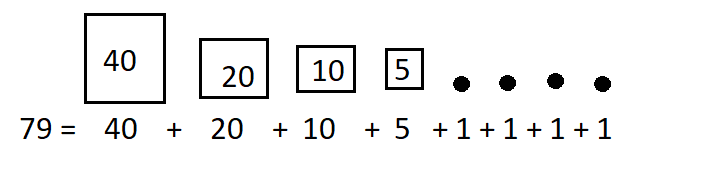
40+20+10+5+1+1+1+1
Below is the diagram for arrangement:
So, Numerical arrangement for 79 pennies is 40+20+10+5+1+1+1+1.
Core Connections Course 1 1st Edition Chapter 1 Exercise 1.2 solutions manual Page 29 Problem 7 Answer
Given a set of fill in the blanks.
It is asked to write one whole number or fraction in each blank to make each statement true.
We write 100 in the given blanks, As, from part(e), we have, one penny equals 1 one dollar(s).
Then, One hundred pennies equals100 dollar(s).
Hence, the required solution is, two hundred penny equals 100 dollar(s).
how to solve Core Connections Course 1 Chapter 1 Exercise 1.2 problems Page 29 Problem 8 Answer
Given: A fill in the blanks, Two hundred pennies equals _____ dollar(s).
It is asked to write one whole number or fraction in each blank to make each statement true.
We will find the value with the help of part(e).
As, from part(e), we have, one penny equals one dollar(s).
Then, two hundred pennies equals =(200⋅1)
=200 dollar(s).
Then, we will write 200 in the given blanks,
Hence, the required solution is, two hundred penny equals 200dollar(s).
how to solve Core Connections Course 1 Chapter 1 Exercise 1.2 problems Page 29 Problem 9 Answer
Given: A fill in the blanks, Fifty pennies equals _____ dollar(s).
It is asked to write one whole number or fraction in each blank to make each statement true.
We will find the value with the help of part(e).
As, from part(e), we have, one penny equals one dollar(s).
Then, fifty pennies equals =(50⋅1)
=50dollar(s).Then, we will write 50 in the given blanks.
Hence, the required solution is, fifty penny equals 50 dollar(s).
worked examples for Core Connections Course 1 Chapter 1 Exercise 1.2 Introduction and Representation Page 29 Problem 10 Answer
Given: A fill in the blanks, Ten pennies equals _____ dollar(s).
It is asked to write one whole number or fraction in each blank to make each statement true.
We will find the value with the help of part(e).
As, from part(e), we have, one penny equals one dollar(s).
Then, ten pennies equals =(10⋅1)
=10dollar(s).
Then, we will write 10 in the given blanks.
Hence, the required solution is, Ten penny equals 10 dollar(s).
worked examples for Core Connections Course 1 Chapter 1 Exercise 1.2 Introduction and Representation Page 29 Problem 11 Answer
Given a set of fill in blanks.
It is asked to write one whole number or fraction in each blank to make each statement true.
We write 1 in the given fill in the blanks first; then the statement will be, One penny equals 1dollar(s).
Hence, the required solution is, One penny equals 1dollar(s).
Core Connections Course 1 Chapter 1 Exercise 1.2 detailed answers Page 29 Problem 12 Answer
Given: Matthew passes through a certain blocks through out his journey.
It is asked to find the value of total blocks he traveled.
We will just stepwise adding up the blocks, he passes through during his journey to the store and then multiply it by 2 to calculate the value of total blocks he traveled, As he returns in the same path.
Now, from the given question,
On the journey from home to the store, Matthew passes through a total of (7+13+11/2) blocks.
As, by the question, he walked seven city blocks. He caught the bus and rode 13 blocks.
He got off and walked one and a half blocks to the store.
Therefore, the blocks he traveled from home to store is 20+3/2=43/2
Now, he also returns home from the store.
Therefore, the total blocks he traveled throughout his journey is 43/2⋅2=43 blocks.
Hence, Matthew travels 43 blocks throughout his journey.
Chapter 1 Exercise 1.2 Core Connections Course 1 Student 1st Edition solutions Page 29 Problem 13 Answer
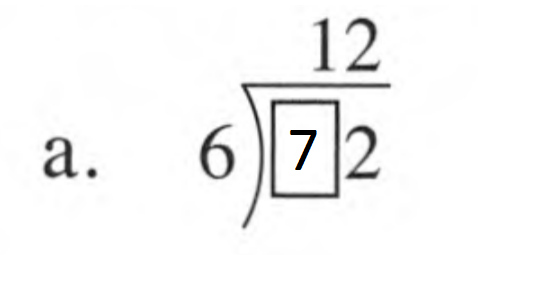
Given: The division problems shown below:
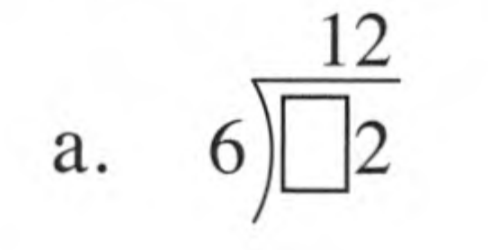
It is asked to replace each box and triangle with a single-digit number.
We will replace the box by 7.
As, 6⋅12=72. Hence, the problem looks like-
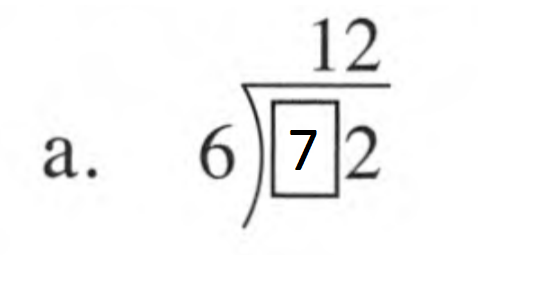
Hence, the required solution is 7
Page 29 Problem 14 Answer
Given: The division problems shown below:
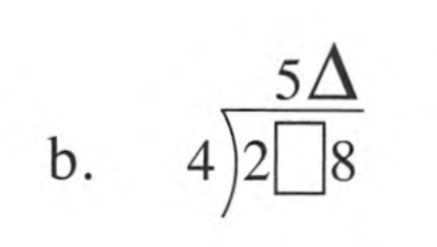
It is asked to replace each box and triangle with a single-digit number.
We will do the calculation part in the step section.
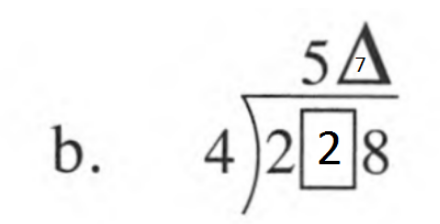
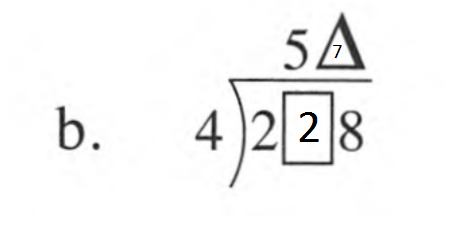
We will replace the box by 2 and the replace the triangle by 7.
As, 4⋅57=228. Hence, the problem looks like-
Hence, the required solution is 2(for the box) and 7(for the triangle)
Chapter 1 Exercise 1.2 Core Connections Course 1 Student 1st Edition Solutions Page 29 Problem 15 Answer
Given: A line segment is a piece of a straight lineIt is asked to draw marks on the first line segment to show how we can divide it into eight equal lengths.
We will draw marks on the first line segment into eight equal lengths.
So, the required line segment is:
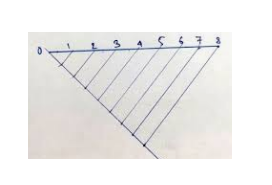
In the above diagram we draw marks on the line segment into eight equal lengths.
Hence, the required solution is-
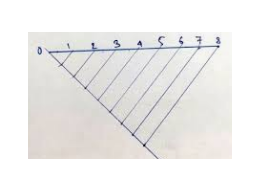
Where, we draw marks on the line segment into eight equal lengths.
Core Connections Course 1 Student 1st Edition Chapter 1 Exercise 1.2 Representation answers Page 29 Problem 16 Answer
Given: A line segment is a piece of a straight lineIt is asked to draw marks on the second line segment to show how we can divide it into five equal lengths.
We will draw marks on the second line segment into five equal lengths in the step section.
The objective is to draw marks on the second line segment to show how we can divide it into five equal lengths.
We will draw marks on the second line segment into five equal lengths.
So, the required line segment is:
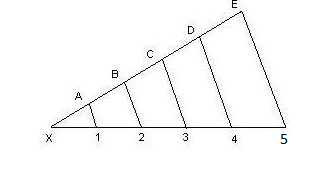
In the above diagram we draw marks on the line segment into five equal lengths.
Hence, the required solution is-
Where, we draw marks on the line segment into five equal lengths.
Core Connections Course 1 Student 1st Edition Chapter 1 Exercise 1.2 Representation answersPage 29 Problem 17 Answer
Given: A line segment is a piece of a straight lineIt is asked to explain the easier task and the reason behind it.
We can clearly said that, it is easy to draw marks on the line segment into five equal lengths than dividing a line segment into eight equal lengths; As we have to do the same process for three more time.
Hence, it is easier to draw the second line segment into five equal lengths.
Therefore, from the above explanation, We can clearly said that, it is easy to draw marks on the line segment into five equal lengths than dividing a line segment into eight equal lengths; As, we have to do the same process for three more time.
Hence, it is easier to draw the second line segment into five equal lengths.
Core Connections Course 1 Student 1st Edition Chapter 1 Exercise 1.2 Representation answers Page 31 Problem 18 Answer
Given: As, in the previous problem we have that there is no teams that have same pennies.
It is asked to tell the symbol which used to show that two values are the same.We know that from the previous problem there is no teams that have same pennies.
And we use the symbol ‘=’ (equals) to show that two values are same.
Hence, from the previous question we see that there is no teams that have same pennies and also we use the symbol ‘=’ to show that two values are same.
Therefore, from the problem 1-44, we have, Team A received the greatest number of pennies(116) and our team received the least number of pennies (58).
Core Connections Course 1 Student 1st Edition Chapter 1 Exercise 1.2 Representation answers Page 31 Problem 19 Answer
Given: for example, Team A may have written “5 sets of 25 pennies, or 5(25),’ while Team B may have written “5 sets of 17 pennies and 2 more, or 5(17)+2.
” To compare, you would use the less than < or greater than > symbol to write a number sentence like 5(25)>5(17)+2.
The corresponding word sentence might be, “5 sets of 25 pennies is greater than 5 sets of 17 pennies with two more.”It is asked to compare your team’s value to the values of at least two other teams and express each of your comparisons with both a number and a word sentence.
We take example from problem 1-44.
Now, We take example from problem 1-44,
So, for Team A: 11 piles of 10 pennies with 6 leftover pennies; i.e., the numerical expression will be 11(10)+6 and Team B: A rectangular array of pennies that is 9 pennies long and 12 pennies wide with 5 leftover pennies; i.e., the numerical expression will be 9(12)+5;
Then, for this condition, 11(10)+6>9(12)+5 [As, 116>113]
Again, for Team C: 8 stacks of 12 pennies with 7 leftover pennies; i.e., the numerical expression will be8(12)+7 and our team: 6 sets of 9 pennies and 4 leftover pennies and numerical expression is 6(9)+4
Then, for this condition 6(9)+4<8(12)+7 [As, 58<103]
Hence, from above step we have two comparisons, they are -11(10)+6>9(12)+5 [As, 116>113] and 6(9)+4<8(12)+7 [As, 58<103]
Core Connections Course 1 Student 1st Edition Chapter 1 Exercise 1.2 Representation answers Page 31 Problem 20 Answer
Given: from problem 1-44 we have, the team A has 116(greatest) pennies and the our team has 58(least) pennies.
It is asked to find the amount which will give to our team by team A, so that both of the team have some pennies.
We will calculate the amount by taking the difference of the two amount and divide the difference by 2.
Now, from the given explanation, the difference between Team A and our team is (116−58)=58
After dividing 58 by 2, we have, (58/2)=29
So, after giving 29 pennies to our team, Team A have (116−29)=87 and after taking 29 pennies from Team A, our team have (58+29)=87
Therefore, having greatest number of pennies, Team A have to give 29 pennies to our team(who have least number of pennies), so that both of the team have some pennies which is 87.
Hence, from the above step, we can conclude that, having greatest number of pennies, Team A have to give 29 pennies to our team(who have least number of pennies), so that both of the team have some pennies which is 87.