Core Connections Course 1 Student 1st Edition Chapter 3 Portions and Integers
Core Connections Course 1 Student 1st Edition Chapter 3 Closure Exercise Solutions Page 157 Problem 1 Answer
We are given a fraction: 6/24.
We are required to write three equivalent fractions.
We will simplify and multiply the fraction with the same number to find the equivalent fractions.
Expression: 6/24.
We can write24=6×4,
So,6/24=6
6×4=1/4
We can write6=2×3,24=8×3,
So,6/24=2×3/8×3 =2/8
Multiply 6/24 by 2/2,
=6/24×2/2
=12/48
Hence, the equivalent fractions of 6/24 is 1/4,2/8, and 12/48.
Read and learn More Core Connections Course 1 Student 1st Edition Solutions
Core Connections Course 1 Student 1st Edition Chapter 3 Closure Exercise Solutions Page 157 Problem 2 Answer
We are given a portion web:
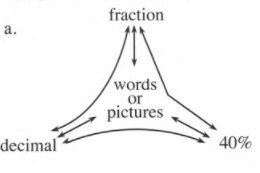
We are required to complete the portion web.
We will convert the given portions into other required forms.
Expression: 40%.
We will divide it by 100 to convert it into the decimal,
40/100=0.4
We will divide it by 100 and factor out the common factor to convert it into fraction,
40/100 =2×20/5×20 =2/5
In other words, we can write the 2 out of 5.
Hence, the expression 40% can be expressed as decimal, fraction and words as 0.4,2/5, and 2 out of 5 respectively.
Core Connections Course 1 Student 1st Edition Chapter 3 Closure Exercise Solutions Page 157 Problem 3 Answer
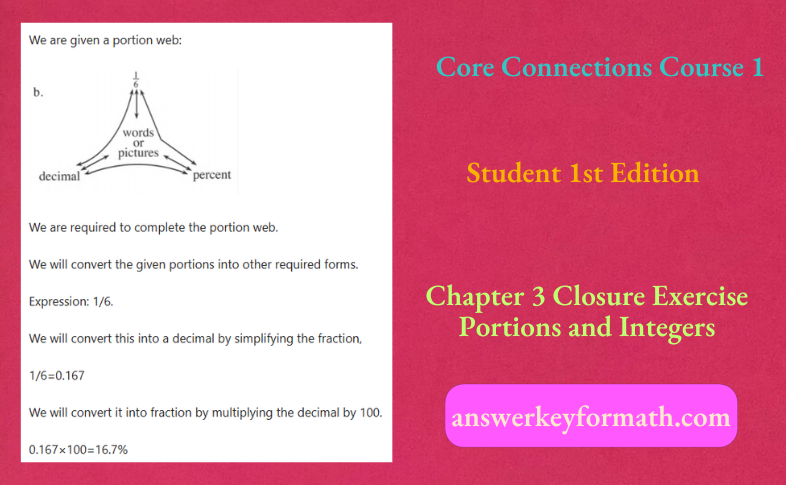
In words, we can write this as 1 out of 6.
Hence, the expression 1/6 can be expressed as a decimal, percentage, and words as 0.167,16.7% and 1 out of 6 respectively.
Chapter 3 Closure Exercise Portions And Integers Solutions Core Connections Course 1 Page 157 problem 4 Answer
We are given a portion web:
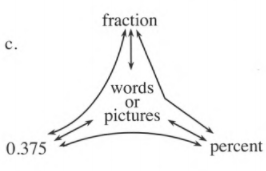
We are required to complete the portion web.
We will convert the given portions into other required forms.
Expression: 0.375.
We can write this as a percentage by multiplying it by 100,
0.375×100=37.5%
We will convert it into fraction by diving the percentage by 100,
37.5/100=3/8
In words, we can write this as 3 out of 8.
Hence, the expression 0.375 can be represented as decimal, percentage, and words as 37.5%,3/8 and 3 out of 8 respectively.
Core Connections Course Chapter 3 Page 157 problem 5 Answer
We are given a portion web:
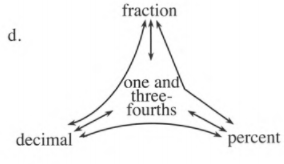
We are required to complete the portion web.
We will convert the given portions into other required forms.
Expression: one and three-fourths.
We can write this as a fraction:
1⋅3/4=4+3/4 =7/4
We can convert this as a decimal by simplifying,
7/4=1.75
We can convert it in percentage by multiplying the decimal by100,
1.75×100=175%
Hence, the expression one and three-fourths can be represented as decimal, percentage and fraction as 1.75,175% and 7/4 respectively.
Chapter 3 Closure Exercise Portions And Integers Solutions Core Connections Course 1 Page 157 Problem 6 Answer
We are given that Laura wants to estimate the sum0.26+0.9.
We are required to determine should her estimate be more or less than 1.
We will use the concept of inequality and addition to determine
Expression:0.26+0.9.
The sum of numbers 0.9 and any number greater than 0.1 will be more than 1.
We can observe that 0.1<0.26 which means the sum will be more than 1.
Hence, Laura should estimate the sum of 0.26+0.9 as more than 1 because 0.26>0.1 and any number greater than 0.1 added to 0.9 gives a number greater than 1.
Core Connections Course Chapter 3 Page 158 problem 7 Answer
We are given a picture of the number of blocks:
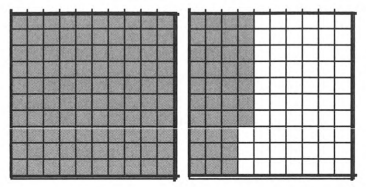
We are required to illustrate the number as a fraction, as a decimal, and as a percent.
We will observe the figure and then we will convert the numbers.
From the given figure, we can observe that 137 blocks are shaded from 200 blocks.
This can be represented in fraction as:
137/200
We will simplify it to convert it into decimal.
137/200=0.685
We will multiply it by 100 to convert it into percentage,
0.685×100=68.5%
Hence, the number illustrated can be represented as a fraction, as a decimal, and as a percent as 137/200,0.685 and 68.5%.
Core Connections Course Chapter 3 Page 158 problem 8 Answer
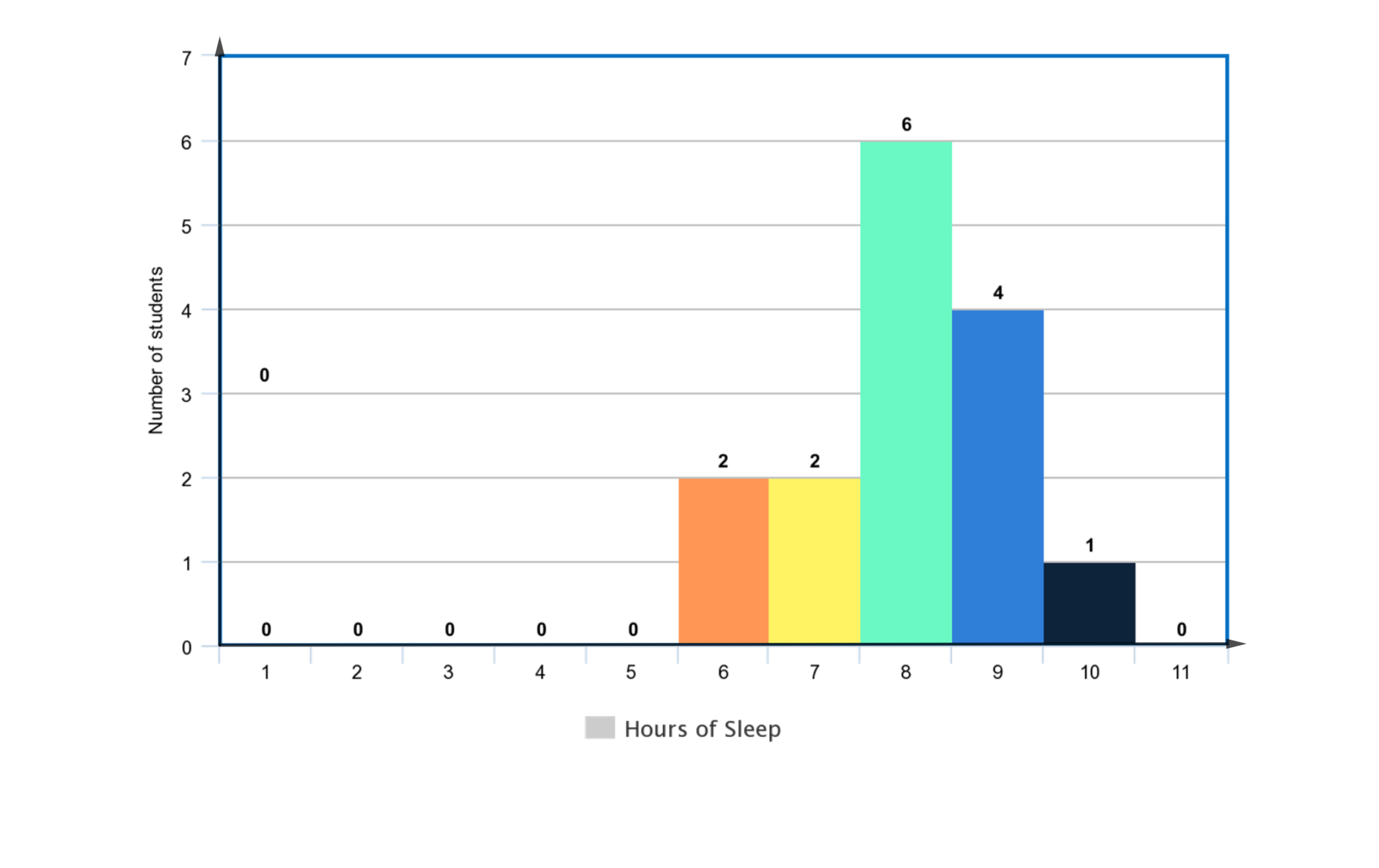
We are given hours of sleep they get on school nights: 6,8,71/2,9,8,8,8,9,9,10,6,81/2,9,7,8.
We are required to sketch the histogram for the data.
We will use the graphing calculator to draw the histogram.
The histogram of 6,8,71/2,9,8,8,8,9,9,10,6,81/2,9,7,8 using the graphing calculator is
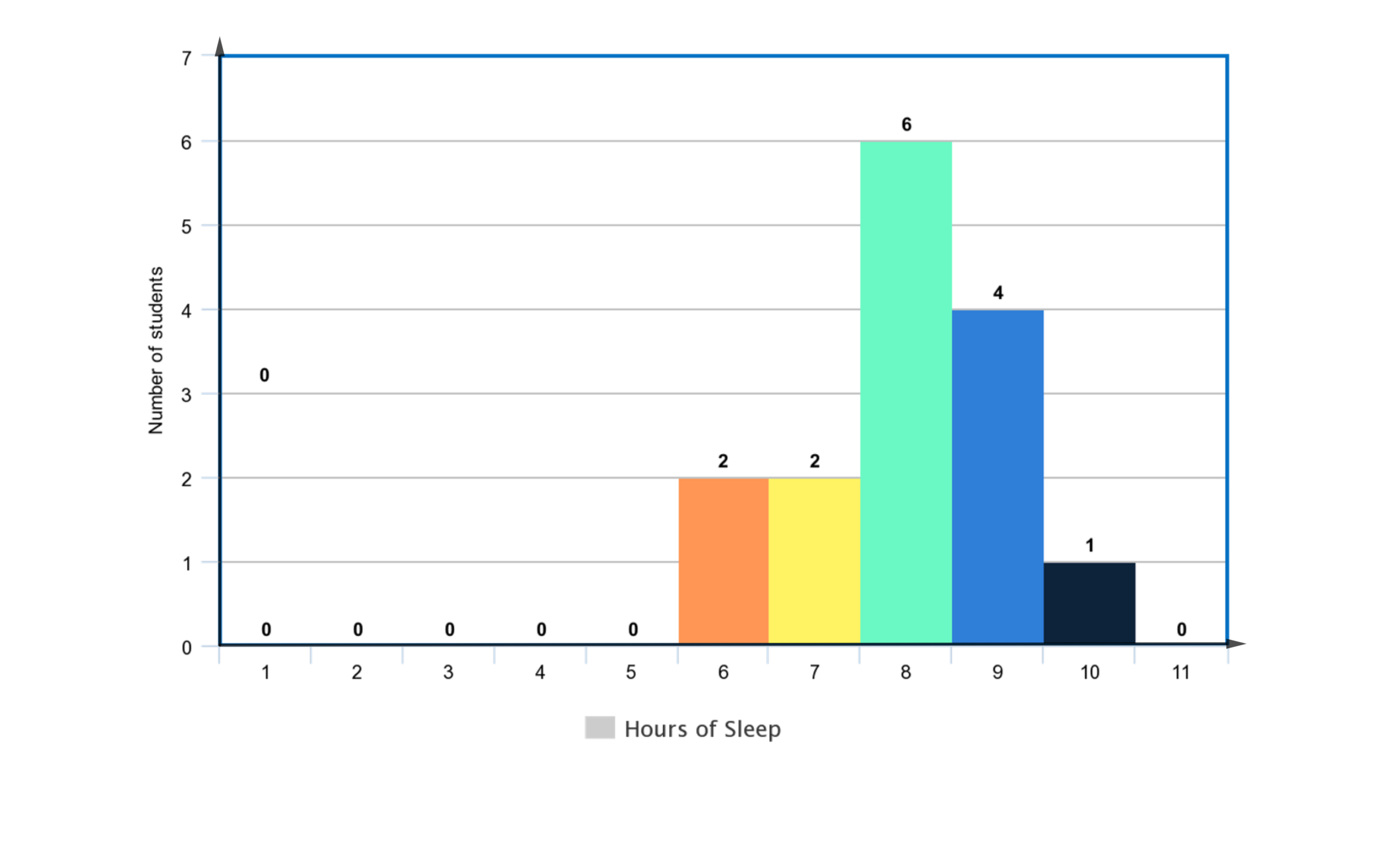
Hence, the histogram of hours of sleep they get on school nights 6,8,71/2,9,8,8,8,9,9,10,6,81/2,9,7,8 as:
Core Connections Course 1 Chapter 3 Closure Exercise Step-By-Step Solutions Page 159 Problem 9 Answer
The given generic rectangle is shown below.
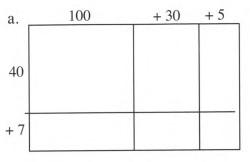
Label the dimensions of given generic rectangle and write the multiplication sentence of factors and the product.
Use the formula of area of rectangle, and then write its multiplication sentence.
Using the property of rectangle the given generic rectangle can be labeled as follows.
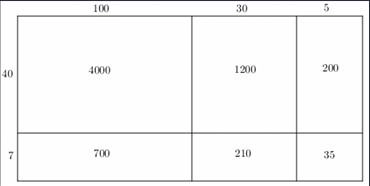
We know the area of rectangle=l⋅b where l is length and b is width of respective rectangle.
The multiplication sentence for factor and product can be given as following:
100⋅40=4000
100⋅7=700
30⋅40=1200
30⋅7=210
5⋅40=200
5⋅7=35
Thus, the label of dimension and area for the given generic rectangle is given by figure shown below.
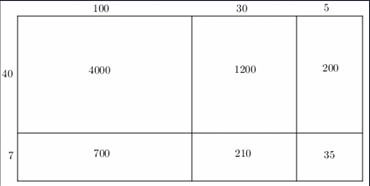
And the multiplication sentence showing the factors and product is following.
100⋅40=4000
100⋅7=700
30⋅40=1200
30⋅7=210
5⋅40=200
5⋅7=35
Core Connections Course 1 Chapter 3 Closure Exercise Step-By-Step Solutions Page 159 Problem 10 Answer
The given generic rectangle is shown below.
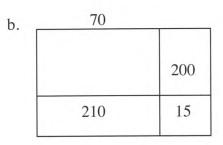
Label the dimensions of given generic rectangle and write the multiplication sentence of factors and the product.
Use the formula of area of rectangle, and then write its multiplication sentence.
Using the property of rectangle the given generic rectangle can be labeled as follows.
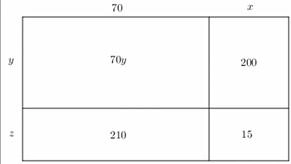
We know the area of rectangle=l⋅b where l is length and b is width of respective rectangle.
The multiplication sentence for factor and product can be given as following:
70⋅y=70y
x⋅y=200
70⋅z=210
x⋅z=15
Thus, the label of dimension and area for the given generic rectangle is given by figure shown below.
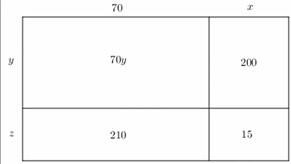
And the multiplication sentence showing the factors and product is following.
70⋅y=70y
x⋅y=200
70⋅z=210
x⋅z=15
Solutions For Core Connections Course 1 Chapter 3 Closure Exercise Portions And Integers Page 159 problem 11 Answer
The Given Venn diagram shows the prime factor of 21 and 35.
Determine how Marcus use the Venn diagram to find the least common multiple of 21 and 35.
Least factor of both numbers is the smallest common factors of both numbers.
Given the prime factor of 21 and 35 in figure. The figure shows the common prime factor is 7 and remaining factors are 3 and 5.
So, to calculate the least common multiple we multiply the common factor with the remaining factor,
Which is, least common multiple =7⋅3⋅5=10.
Thus, the least common multiple of 21 and 35 is 105.
Core Connections Course Chapter 3 Page 159 problem 12 Answer
The Given Venn diagram shows the prime factor of 21 and 35.
Determine how Marcus Uses to find the greatest common factor by using the given Venn diagram
.Check for the highest factor which is common for both the numbers.
We know, the greatest common factor of two number is the largest number or factor of the given numbers.
Therefore, form the given Venn diagram it has only one common factor 7.
So, 7 will be greatest common factor.
Thus, Marcus finds the 7 is the greatest common factor of 21 and 35 from the given Venn diagram.
Core Connections Course 1 Student 1st Edition Chapter 3 Closure Guide Page 160 problem 13 Answer
We are given an example of the number line:
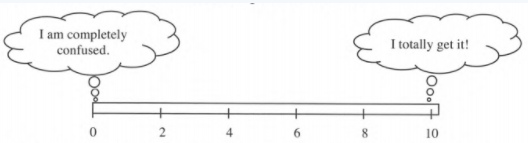
We are required to draw a number line that represents 0 to 10 and then shade the number line and complete one of the tasks.
We will draw a number line and then we will shade the number less than 4 to complete the task.
We drew a number line with shaded on all the numbers less than 4.
Now, according to the task, we will write two questions that we would like to ask about that problem:

What is the inequality of the shaded portion?
What other problems can we explain from the same number line?
Hence, the number line with the shaded portion is shown below, the two questions we would like to ask about the problem are:
What is the inequality of the shaded portion?
What other problems can we explain from the same number line?
