
Core Connections Course 1 Student 1st Edition Chapter 3 Portions and Integers
Core Connections Course 1 Student 1st Edition Chapter 3 Exercise 3.2 Solutions Page 136 Problem 1 Answer
The given figure is

It is required to find where the frog will end up.
We will find the frog’s ending point according to the additional and subtraction rules of the integers.
We can move (or leap) spaces from our beginning number using a number line; left for subtraction, sign(−), right for addition, sign(+).
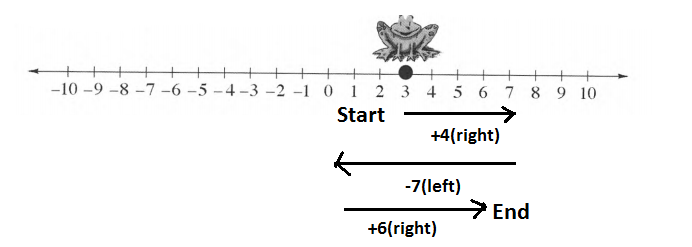
Frog starts at 3, hops to the right 4 units which are added, to the left 7 units which are subtraction, and then to the right 6 units which is an addition.
Read and learn More Core Connections Course 1 Student 1st Edition Solutions
3+4−7+6=6.
Diagram
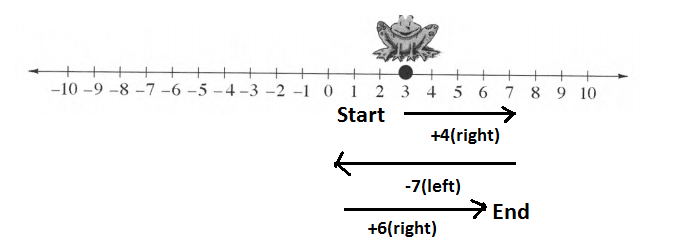
Thus, the frog ends up at number 6.
Core Connections Course Chapter 3 Page 136 Problem 2 Answer
The given figure is

It is required to list the lengths of two possible combinations of hops.
We will list the lengths according to the additional and subtraction rules of the integers.
We can move (or leap) spaces from our beginning number using a number line; left for subtraction, right for addition.
The two possibilities that the frog hopes 3 times from 3 to 10 are:
Hop 1: right 1 unit, right 3 units, right 3 units.
Hop 2: right 3 units, right 2 units, right 2units.
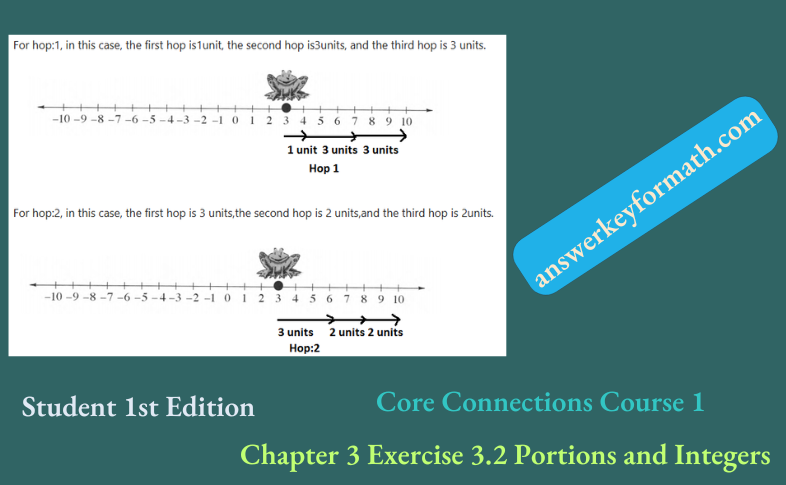
Thus, the lengths of two possible combinations of hops that will get it from 3 to 1.
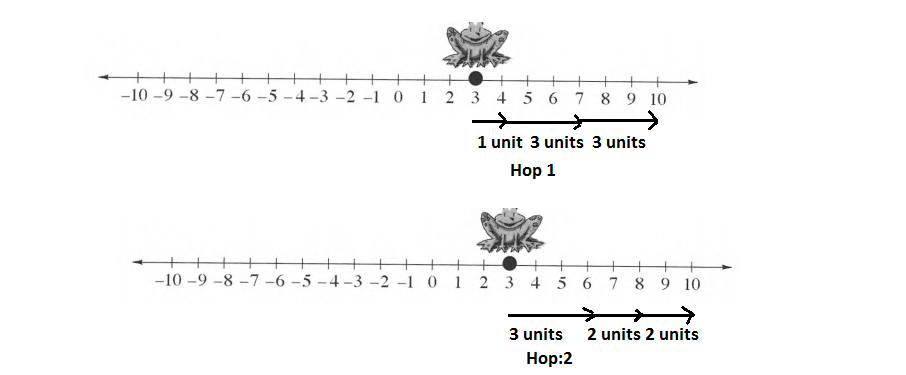
Hop 1: right 1 unit, right 3 units, right 3 units,
Hop 2: right 3 units, right 2 units, right 2 units.
Core Connections Course 1 Student 1st Edition Chapter 3 Exercise 3.2 Solutions Page 136 Problem 3 Answer
The given figure is

It is required to explain that the frog could land on a positive number if it makes three hops to the left.
We will explain according to the additional and subtraction rules of the integers.
We can move (or leap) spaces from our beginning number using a number line; left for subtraction, right for addition.
Yes, it can land on the positive number when at least one or two hops are less than one.
Let us take an example the 3 hops of the frog have left 0.5 unit, left 1 unit left 0.5 unit.
Which will end up at 1 which is a positive number.
Thus, the frog could land on a positive number if it makes three hops to the left.
Core Connections Course Chapter 3 Page 136 Problem 4 Answer
The given figure is

It is required to find how long the first two hops are.
We will find the distance of the first two hops according to the additional and subtraction rules of the integers.
We can move (or leap) spaces from our beginning number using a number line; left for subtraction, right for addition.
If each hop is right 7 units then the sum of two hops is right 14 units.
As the starting point is 3, after two hops it reaches to 17, now the hop left 6 units will end at 11 in the number line.
Thus, 14 units were long of the first two hops.
Core Connections Course 1 Student 1st Edition Chapter 3 Exercise 3.2 Solutions Page 137 Problem 5 Answer
The given figure is

It is required to find a possible set of hop directions, lengths, and ending points.
We will find the possible set of hop directions according to the additional and subtraction rules of the integers.
We can move (or leap) spaces from our beginning number using a number line; left for subtraction, sign(−), right for addition, sign(+).
The starting position of the frog is 3 in the number line.
Now in the first game, it hops 3 units to the right which leads the Frog to the ending point 6 in the number line.
Now in the second game, it hops 9 units to the left which leads the Frog to the ending point−6 in the number line, which is the opposite of the first game.
Thus, the possible set of hop directions, lengths, and ending points is hop 3 units to the right, hop 9 units to the left.
Core Connections Course Chapter 3 Page 137 Problem 6 Answer
The given figure is

It is required to find how the frog would hop to meet the given requirements.
We will determine the frog’s hop according to the additional and subtraction rules of the integers.
We can move (or leap) spaces from our beginning number using a number line; left for subtraction, sign(−), right for addition, sign(+).
Multiplying an integer by−1 is the opposite of multiplying it.
Any negative number has a corresponding positive number.
And any positive number is also a negative number.
From 3 to land on 6 the frog has to make a hop 3 units to the right.
From 6 to land on−6 the frog has to make a hop 12 units to the left.
From −6 to land on−(−6)=6 the frog has to make a hop 2 units to the right.
Thus, the frog would hop 3 units to the right, 12 units to the left,12 units to the right.
Core Connections Course 1 Student 1st Edition Chapter 3 Exercise 3.2 Solutions Page 137 Problem 7 Answer
The given figure is

It is required how you could write “the opposite of the opposite of 6”.
We will write according to the rules of the opposite of a number.
Multiplying an integer by−1 is the opposite of multiplying it.
Any negative number has a corresponding positive number.
And any positive number is also a negative number.
The opposite of opposite of 6 can be represented as−(−6)=6.
The position of it is 6 in the number line.
Thus, this would be the position 6 on the number line.
Core Connections Course Chapter 3 Page 137 Problem 8 Answer
The given Elliott’s expression is3+4−7+6.
It is required how Elliott’s expression represents in the words.
We will represent Elliott’s expression according to the additional and subtraction rules of the integers.
Subtract the two numbers and indicate the sign of the larger number if the two numbers have different signs, such as positive and negative.
If both numbers have the same sign, either positive or negative, add them together to get the common sign.
We can move (or leap) spaces from our beginning number using a number line; left for subtraction sign(−), right for addition sign(+).
Given Elliot’s expression: 3+4−7+6.
The frog’s movement in words is its starting is at 3 then it hops 4 units to the right next 7 units to left and finally 6 units to the right.
We use the minus sign when the frog hops to the left.
The movement of the frog is shown below:
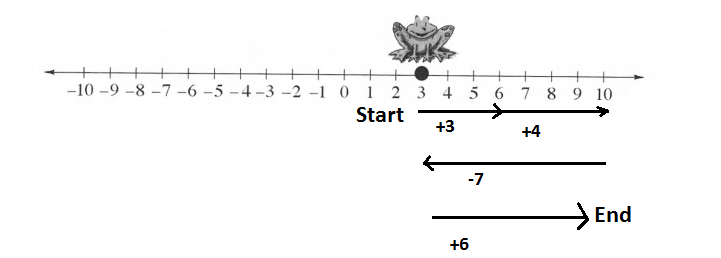
Thus, the movement of the frog is shown:
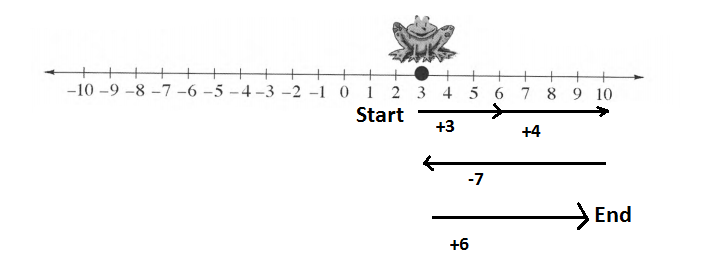
The frog’s movement in words is its starting is at 3 then it hops 4 units to the right next 7 units to left and finally 6 units to the right.
We use the minus sign when the frog hops to the left.
Chapter 3 Exercise 3.2 Portions And Integers Solutions Core Connections Course 1 Page 137 Problem 9 Answer
The given expression is 5−10+2+1.
It is required to determine where the frog started and where it ended up.
We will determine according to the additional and subtraction rules of the integers.
Subtract the two numbers and indicate the sign of the larger number if the two numbers have different signs, such as positive and negative.
If both numbers have the same sign, either positive or negative, add them together to get the common sign.
Given expression:
5−10+2+1=−2
The frog’s movement in words is its starting is at 5 then it hops 10 units to the left next 2 units to right and finally 1 units to the right.
The frog starts at 5 and ends at −2.
Thus, the frog starts at 5 and ends at −2.
Core Connections Course Chapter 3 Page 137 Problem 10 Answer
The given expression is−5+10.
It is required to determine the special about the ending point.
We will find according to the additional and subtraction rules of the integers.
Subtract the two numbers and indicate the sign of the larger number if the two numbers have different signs, such as positive and negative.
If both numbers have the same sign, either positive or negative, add them together to get the common sign.
Given expression:−5+10=5.
The frog’s movement in words is its starting is at −5 then it hops 10 units to the right.
The frog starts at −5 and ends at 5 which is the opposite of the starting point.
Thus, the special about the ending point is that it is opposite of the starting position.
Chapter 3 Exercise 3.2 Portions and Integers solutions Core Connections Course 1Page 137 Problem 11 Answer
Given: Another game of a frog’s movement.It is required to write an expression to represent the frog’s motion on the number line.
We will write the expression according to the additional and subtraction rules of the integers.
We can move (or leap) spaces from our beginning number using a number line; left for subtraction, right for addition.
Subtract the two numbers and indicate the sign of the larger number if the two numbers have different signs, such as positive and negative.
If both numbers have the same sign, either positive or negative, add them together to get the common sign.
Multiplying an integer by−1 is the opposite of multiplying it.
Any negative number has a corresponding positive number. And any positive number is also a negative number.
The expression of the new game is given by,
−(−3)−5+9−22=−11.
The frog ended up on−11 on the number line.
Thus, the frog ended up on−11 on the number line.
Core Connections Course Chapter 3 Page 137 Problem 12 Answer
The given expression is−(−2)+6.
It is required to simplify the expression so that we can determine where it lands.
We will simplify according to the rules of integers for addition and subtraction.
Subtract the two numbers and indicate the sign of the larger number if the two numbers have different signs, such as positive and negative.
Multiplying an integer by−1 is the opposite of multiplying it.
Given the expression of frogs movement
−(−2)+6.
=8.
The starting position of the frog is the opposite of −2 and the ending position is 8 on the number line.
Thus, it lands 8 on the number line.
“Core Connections Course 1 Chapter 3 Exercise 3.2 Step-By-Step Solutions Page 138 Problem 13 Answer
The given figure is
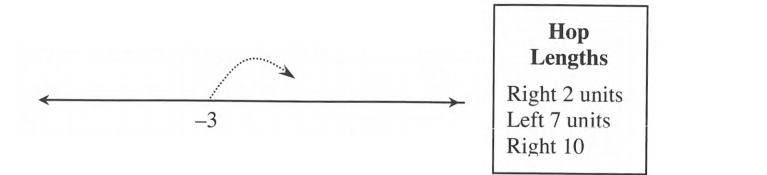
It is required to determine where the frog ends up.
We will find according to the rules of integers for addition and subtraction.
Subtract the two numbers and indicate the sign of the larger number if the two numbers have different signs, such as positive and negative.
If both numbers have the same sign, either positive or negative, add them together to get the common sign.
The expression for frogs movement as it starts from−3 is,−3+2−7+10−3=−1.
Thus, the frog ends up−1 on the number line.
Core Connections Course Chapter 3 Page 138 Problem 14 Answer
The given figure is
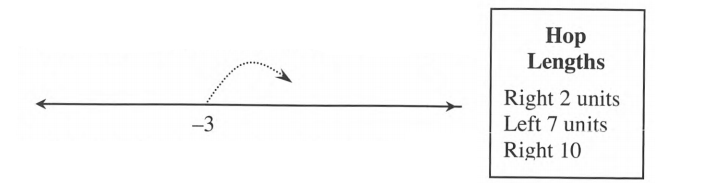
It is required to find that it is possible or not to finish at 2 on the number line.
We will find according to the rules of integers for addition and subtraction.
Subtract the two numbers and indicate the sign of the larger number if the two numbers have different signs, such as positive and negative.
If both numbers have the same sign, either positive or negative, add them together to get the common sign.
No, it won’t be possible to finish 2 in the number line by changing the order of hops.
The expression shows that.
−3+2−7+10−3=−1.
Because in that case, the ending point is−1, so it is impossible to finish 2on the number line.
Thus, it is impossible to finish 2 on the number line.
“Core Connections Course 1 Chapter 3 Exercise 3.2 Step-By-Step Solutions Page 138 Problem 15 Answer
The given figure is
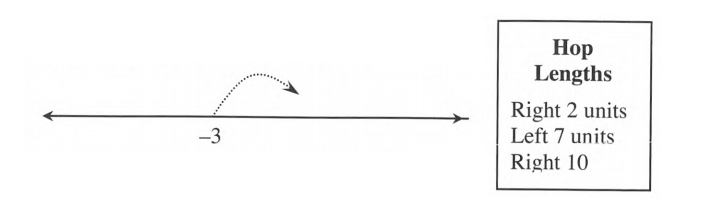
It is required to determine that it is possible to land the frog in the same place no matter which hops the frog takes first, second, etc.
We will find according to the checking the number of points in the expression and the result you get from that expression.
We can move (or leap) spaces from our beginning number using a number line; left for subtraction, right for addition.
Yes, frog land in the same place no matter the order of hops it takes.
Thus, yes frog land in the same place no matter the order of hops it takes.
Core Connections Course Chapter 3 Page 138 Problem 16 Answer
The given figure is
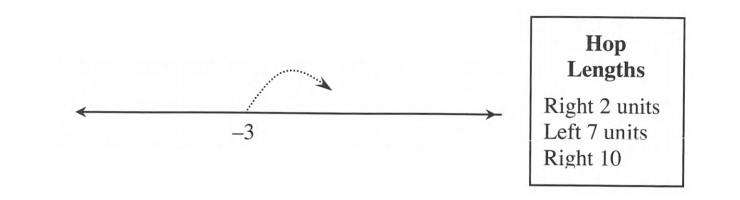
It is required to find that Kamille’s statement is right or wrong.
We will find according to the rules of integers for addition and subtraction.
Subtract the two numbers and indicate the sign of the larger number if the two numbers have different signs, such as positive and negative.
If both numbers have the same sign, either positive or negative, add them together to get the common sign.
We can move (or leap) spaces from our beginning number using a number line; left for subtraction(sign−), right for addition(lsign+).
Kamille is correct as the starting position is−3 when the frog hops 2 units to the right, so the frog is moving right, then the new position will be,−3+2=−1.
Thus, she is correct because the starting position is−3:
The expression is:−3+2=−1.
“Core Connections Course 1 Chapter 3 Exercise 3.2 Step-By-Step SolutionsPage 138 Problem 17 Answer
The given figure is
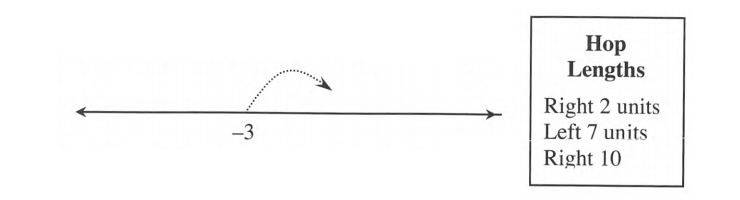
It is required to give another set of four hops that would have the frog end up.
We will give another set of four hops according to the rules of integers for addition and subtraction.
Subtract the two numbers and indicate the sign of the larger number if the two numbers have different signs, such as positive and negative.
If both numbers have the same sign, either positive or negative, add them together to get the common sign.
We can move (or leap) spaces from our beginning number using a number line; left for subtraction sign(−), right for addition(sign+).
Let us consider the four hops to be right 3 units, left 4 units, right 6 units, and left 5 units then the resultant position will be the same as where it started in the number line which is −3.
The sum of frogs hops movement should be equal to 0.
The expression is:3−4+6−5=0
Thus, it is true that the sum of frogs hops movement will be equal to0.
Core Connections Course Chapter 3 Page 139 Problem 18 Answer
Given: Lucas’ frog is sitting at−2 on the number line.It is required to write an expression (sum) to represent his frog’s movement.
We will write according to the rules of integers for addition and subtraction.
Subtract the two numbers and indicate the sign of the larger number if the two numbers have different signs, such as positive and negative. If both numbers have the same sign, either positive or negative, add them together to get the common sign.
We can move (or leap) spaces from our beginning number using a number line; left for subtraction, sign(−), right for addition, sign(+).
Lucas’ frog is sitting at−2 on the number, line. First, it hops 4 units to the right,6 units to the left, and then 8 more units to the right.
The expression for the frog’s movement is−2+4−6+8.
Thus, we write the expression (sum) to represent his frog’s movement, that is −2+4−6+8.
Solutions For Core Connections Course 1 Chapter 3 Exercise 3.2 Portions And Integers Page 139 Problem 19 Answer
Given: Lucas’ frog is sitting at−2 on the number line.It is required to find where the frog lands.
We will determine according to the rules of integers for addition and subtraction.
Subtract the two numbers and indicate the sign of the larger number if the two numbers have different signs, such as positive and negative.
If both numbers have the same sign, either positive or negative, add them together to get the common sign.
We can move (or leap) spaces from our beginning number using a number line; left for subtraction, sign(−), right for addition, sign(+).
The landing of the frog on the number line after all movements is−2+4−6+8=4.
Thus, the frog lands 4 on the number line.
Core Connections Course Chapter 3 Page 139 Problem 20 Answer
Given: Lucas’ frog is sitting at−2 on the number line.
It is required what number is the opposite of where Lucas’ frog landed.
We will find the number according to the rules of the opposite of a number.
Multiplying an integer by−1 is the opposite of multiplying it.
Any negative number has a corresponding positive number.
And any positive number is also a negative number.
When we multiply an integer value by−1, the result will be an opposite sign and the same value of the given integer.
The opposite number of where frog landed is(−1)×(−2)=2(from part(b)).
Where 2 is an integer value and after multiplication with−1, the result will be the same integer value but the sign is opposite to the given integer value’s sign.
Thus,2 is the number that is the opposite of where Lucas’ frog landed when sitting at−2.
Solutions For Core Connections Course 1 Chapter 3 Exercise 3.2 Portions And Integers Page 139 Problem 21 Answer
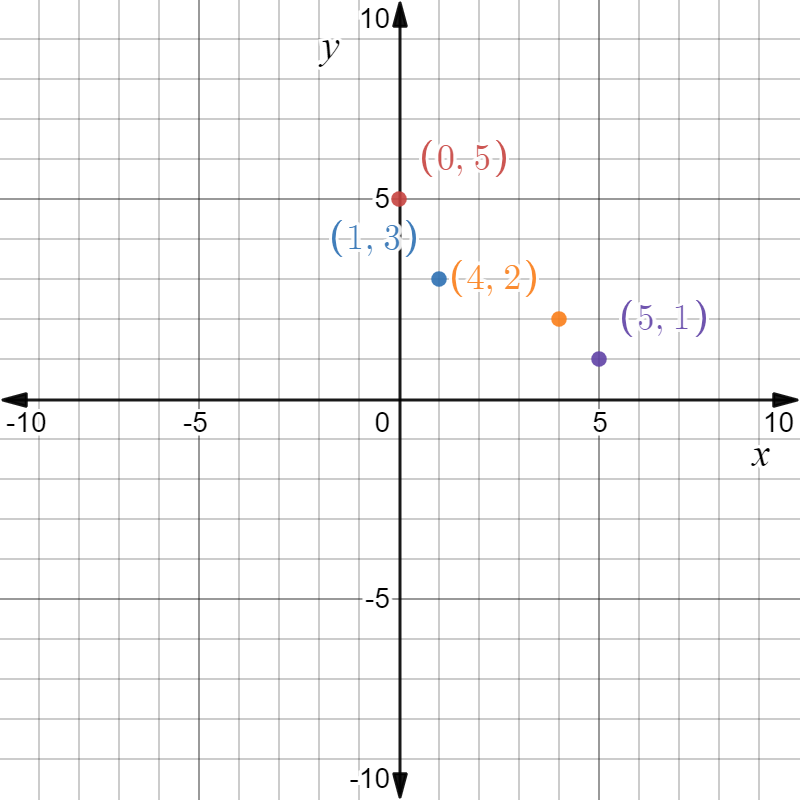
The given four points are(1,3),(4,2),(0,5),and(5,1).
It is required to draw and label a set of axes on your graph paper and plot and label the given poits.
We will draw using the graphing calculator.
We draw and label a set of axes on our graph paper and plot and label the following points:
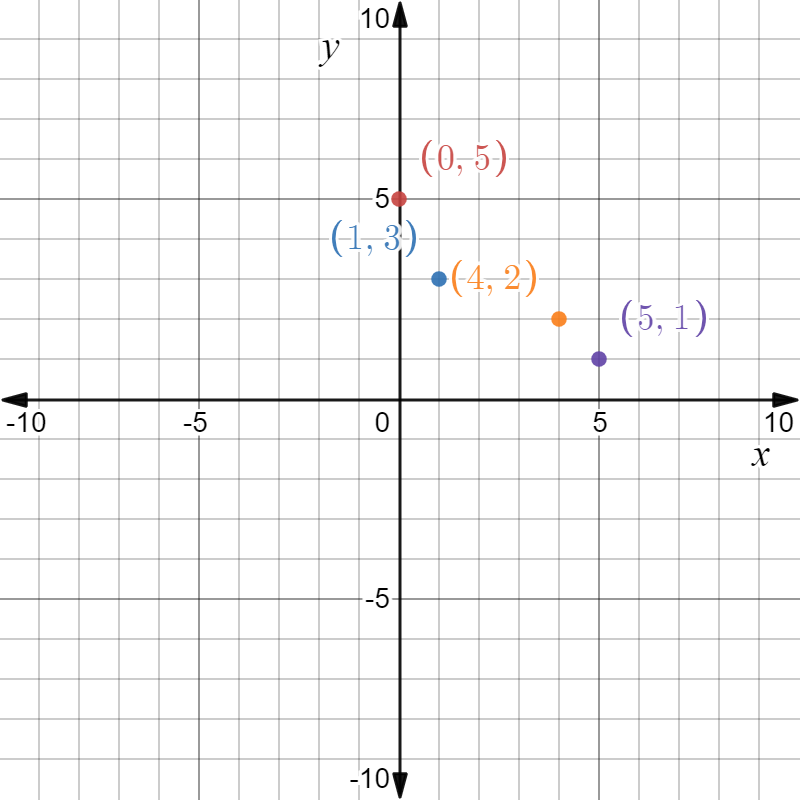
Thus, the plot of the following points(1,3),(4,2),(0,5),and(5,1) is shown below.
Core Connections Course Chapter 3 Page 139 Problem 22 Answer
The given expression is18(26).
It is required to simplify the given expression.
We will simplify the given expression according to the rules of the distributive property.
At first, we need to distribute (20+6) To 8.
Then simplify it. After that, use the calculator.
18⋅26
Using distributive property:
18⋅26
=18⋅(20+6) Distribute(20+6) to 18.
=18⋅20+18⋅6 Distributive property
=360+108 Simplify
=468. Use the calculator
Thus, using the distributive property we simplify the given product 18(26) and we get 468.
Core Connections Course 1 Student 1st Edition Chapter 3 Exercise 3.2 Guide Page 139 Problem 23 Answer
The given expression is 6(3405).
It is required to simplify the given expression.
We will simplify the given expression according to the rules of the distributive property.
At first, we need to distribute(3400+5)
To 6.
Then simplify it. After that, use the calculator.
Given 6⋅3405
Using distributive property:
6⋅3405
=6⋅(3400+5) Distribute(3400+5) to 6.
=6⋅3400+6⋅5 Distributive property
=20400+30 Simplify
=20430 Use the calculator.
Thus, using the distributive property we simplify the given product 6(3405) and we get 20430.
Core Connections Course Chapter 3 Page 139 Problem 24 Answer
The given expression is 21(35).
It is required to simplify the given expression.
We will simplify the given expression according to the rules of the distributive property.
At first, we need to distribute (30+5) to 21.
Then simplify it. After that, use the calculator.
Given 21⋅35
Using distributive property:
21⋅35
=21⋅(30+5) Distribute(30+5) to 21
=21⋅30+21⋅5 Distributive property
=630+105 Simplify
=735 Use the calculator.
Thus, using the distributive property we simplify the given product 21⋅35 and we get 735.
Chapter 3 Exercise 3.2 Portions And Integers Explained Core Connections Course 1 Page 139 Problem 25 Answer
Given the addition of fraction 9/10+7/9.
We need to compute the sum of given fractions.
Firstly, find the lowest common multiple of both denominators then write both original fractions as equivalent fractions with the least common denominator.
Then add the numerators.
At first, we will find the lowest common multiple of the denominators to make them equal.
Here, the lowest common multiple of 10,and,9 is 90.
Now, by using the lowest common multiple to make denominators equal and continue with the given operation i.e. to add the given fractions, we get
9/10+7/9=9/10⋅9/9+7
9⋅10/10=81/90+70/90
=151/90
Therefore, the sum of 9/10+7/9=151/90.
Core Connections Course Chapter 3 Page 139 Problem 26 Answer
Given -1/2−3/11
To find – It is asked to compute the difference of given fractions.
Firstly, Check if the denominators of the given fractions are the same to conduct the operation i.e Add or subtract. If the denominators are not equal then make them equal with the help of LCM.
Then write both original fractions as equivalent fractions with the least common denominator.
Then add or subtract the numerators of the given fraction.
Here, the denominators the given fractions are not equal.
Therefore, we will find the LCM of the denominators to make them equal.
The lowest common denominator of 2 and 11 is 22.
Now, we will make the denominators equal to 22.
1/2−3/11=1/2⋅11/11−3/11⋅2/2
=11/22−6/22
=5/22
Therefore, 1/2−3/11
=5/22.
Chapter 3 Exercise 3.2 Portions And Integers Explained Core Connections Course 1 Page 139 Problem 27 Answer
Given – 2/5−1/15
To find – It is asked to compute the difference of given fractions.
Firstly, Check if the denominators of the given fractions are the same to conduct the operation i.e Add or subtract.
If the denominators are not equal then make them equal with the help of LCM.
Then write both original fractions as equivalent fractions with the least common denominator.
Then add or subtract the numerators of the given fraction.
Here, the denominators of the given fractions are not equal. Therefore, we will find the LCM of the denominators to make them equal.
The Lowest common denominator of 5 and 15 is 15.
Now, we will make the denominators equal to 15.
2/5−1/15
=2/5⋅3/3−1/15
=6/15−1/15
=5/15
=1/3
Therefore, 2/5−1/15=1/3.
Core Connections Course Chapter 3 Page 139 Problem 28 Answer
Given – It is given that 40 percent of the mixture is ryegrass.
To find -It asked to find the ratio of ryegrass to bluegrass.
At first, we will subtract the given percent out of 100 percent to find the quantity of bluegrass and then find the ratio of ryegrass to bluegrass.
At first, We will find the quantity of bluegrass in the mixture
As we already know that the 40%
of the mixture is reygrass.
Now, 100%=40%+ bluegrass
⇒ bluegrass =100%−40%
⇒ bluegrass =60%
Now, by using the quantity of both ryegrass and bluegrass,
The ratio of ryegrass to the bluegrass will be 40/60=2/3
Therefore, the ratio of ryegrass to bluegrass will be 2/3
Worked Examples For Core Connections Course 1 Chapter 3 Exercise 3.2 Portions And Integers Page 140 Problem 29 Answer
Given –
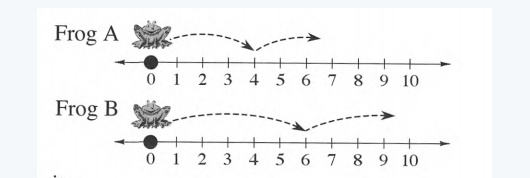
To find – It is asked if the frogs will ever land on the same number or not.
Construct the number line and find whether they will land on the same number or not.
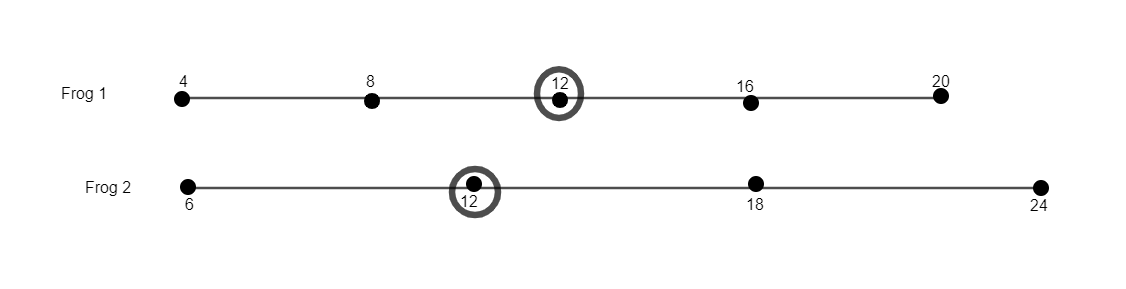
Part (i) When Frog A hops to the right 4 units at a time and Frog B hops to the right 6 units at a time
At first, we will construct the number line for both the frogs.
Through the number lines of both the frog, we can say that both of them will land on the same number that is 12 Part (ii) When Frog A hops 15 units at a time and Frog B hops 9 units at a time
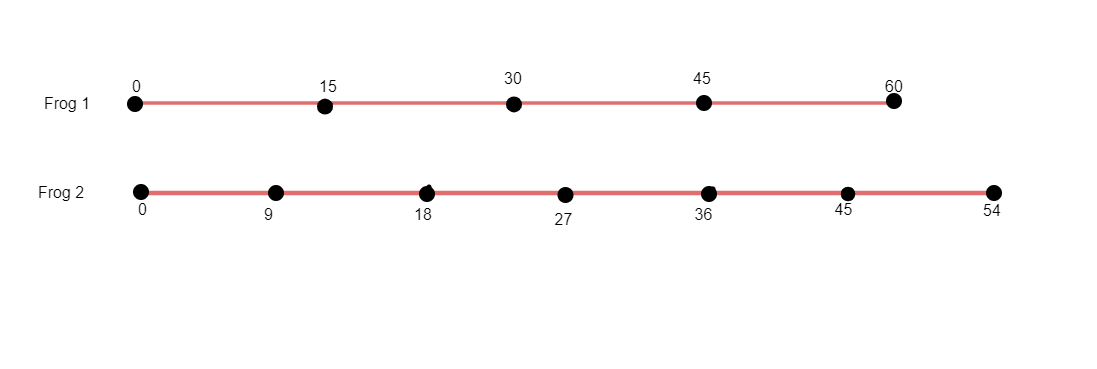
At first, we will construct the number line for both the frogs.
Through the number lines of both the frog, we can say that both of them will land on the same number that is 45.
Consequently,
When Frog A hops to the right 4 units at a time and Frog B hops to the right 6 units at a time, both of them will land on the same number that is 12.
When Frog A hops to the right 15 units at a time and Frog B hops to the right 9 units at a time, both of them will land on the same number that is 45.
Core Connections Course Chapter 3 Page 140 Problem 30 Answer
Given – It is given that each frog starts at 0 and each hop is same distance i.e equal distance.
To find – It is required to find the method for determining all of the numbers that both frogs will land on and how the length of the frog’s jump was used?
We will explain the method used to determine the number that both frogs will land on.
Referring to the part (a) In part (a), the length of the frog’s jump was used to decide the points on which they will land.
As we already know that the common point on which both the frogs will land is 12.
Therefore, the numbers that both frogs will land on will be the multiples of 12−12,24,36,48…
because the numbers frog will land on will be the multiple of the common point/number.
Therefore, the frogs will land on the multiples of 12 because it is the common number on which both the frogs will land.
Worked Examples For Core Connections Course 1 Chapter 3 Exercise 3.2 Portions And Integers Page 140 Problem 31 Answer
Given – We are given two numbers 8 and 12.
To find – It is required to find the least common multiple of 8 and 12.
We will find the multiples of both the number and then find the lowest common multiple out of them.
At first, we will write multiples for both numbers.
Therefore,
Multiples of 8 are 8,16,24,32,40,48…
Multiples of 12 are12,24,36,48,60…
Here, the lowest common multiple is 24.
Therefore, the least common multiple of 8 and 12 is 24.
Core Connections Course Chapter 3 Page 141 Problem 32 Answer
Given -−2−9
To find – It is asked to represent the given expression on a number line.
When we add two negative numbers, the result will always be a negative number.
Hence, on adding negative numbers direction of movement will always be to the left side.
When we add two negative numbers, the result will always be a negative number.
Hence, on adding negative numbers direction of movement will always be to the left side.
Here, the first number is −2 and the second number is −9and both are negative.
First, we will locate the first number on the number line.
Then move 9 places to the left will give −11.
Therefore,
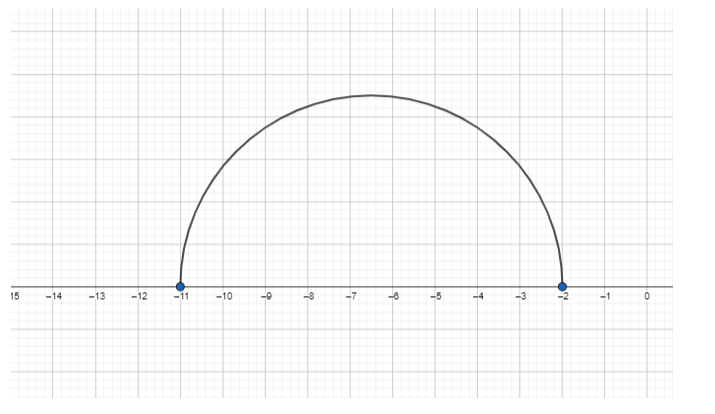
Therefore, −2−9=−11.
Core Connections Course Chapter 3 Page 141 Problem 33 Answer
Given -5−5
To find – It is asked to represent the given expression on a number line.
When we subtract two positive numbers, move to the left as far as the value of the second number.
When we subtract two positive numbers, move to the left as far as the value of the second number.
Therefore, we will move to the left on the number line.
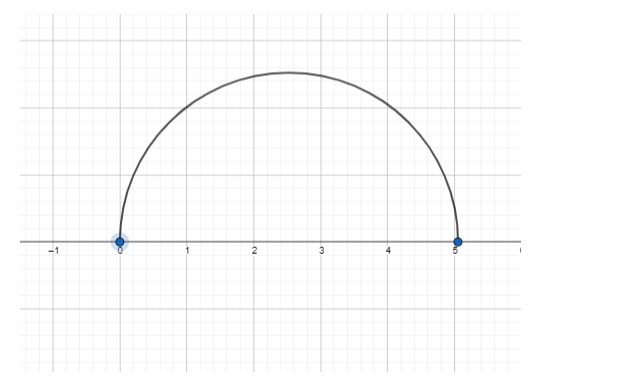
Here, the first number is 5 and the second number is 5.
First, we will locate the first number on the number line and then move 5 places to the left to get 0.
Therefore, 5−5=0.
Core Connections Course 1 Student 1st Edition Chapter 3 Exercise 3.2 Portions Answers Page 141 Problem 34 Answer
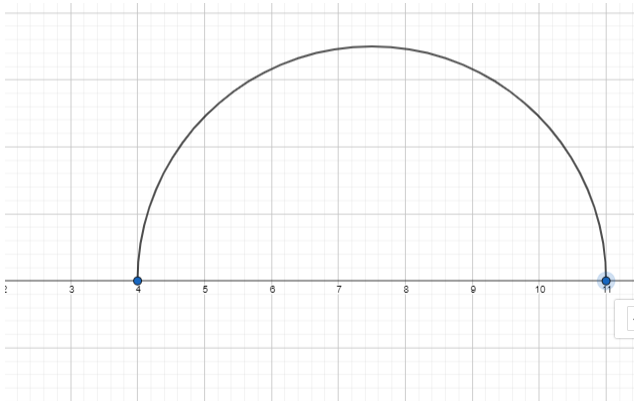
Given – −(−4)+7=4+7
To find – It is asked to represent the given expression on a number line.
When we add two positive numbers, the result will always be a positive number.
Hence, on adding positive numbers direction of movement will always be to the right side.
When we add two negative numbers, the result will always be a negative number.
Hence, on adding negative numbers direction of movement will always be to the left side.
Here, the first number is 4 and the second number is 7 and both are positive.
At first, we will locate the first number then move 7 places to the right to obtain 11.
Therefore,−(−4)+7=11
Core Connections Course Chapter 3 Page 141 Problem 35 Answer
Given -−6+2
To find – It is asked to represent the given expression on a number line.
Adding a negative is like Subtracting a positive number and then moving to the left on the number line.
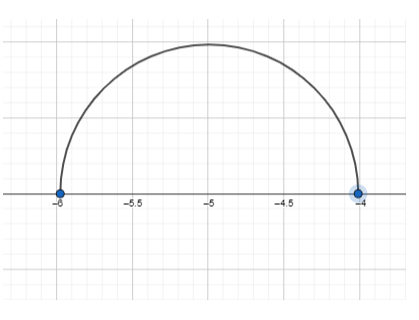
As we already know that Adding a negative is like Subtracting a positive number and then moving to the left on the number line.
Here, the first number is−6 and the second number is 2. At first, locate the first number and them move 2 places to the left on the number line to obtain−4.
Therefore, −6+2=−4
Core Connections Course 1 Student 1st Edition Chapter 3 Exercise 3.2 Portions Answers Page 141 Problem 36 Answer
Given −(−1)−8=1−8
To find – It is asked to represent the given expression on a number line.
Subtracting a positive number is like adding a negative and then moving to the left on the number line.
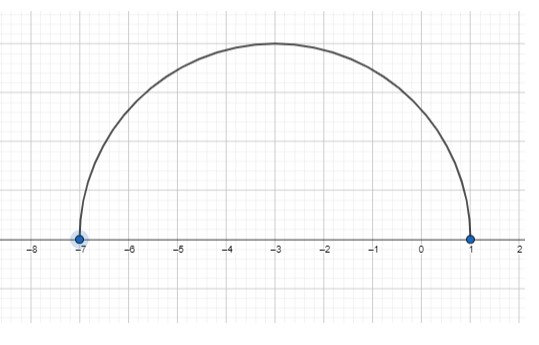
Subtracting a positive number is like adding a negative and then moving to the left on the number line.
Here, the first number is 1 and the second number is 8.
At first, locate first number and then move 8 places to the left of the number to obtain −7.
Therefore, the given expression is −(−1)−8=−7