Core Connections Course 1 Student 1st Edition Chapter 5 Multiplying Fractions and Area
Core Connections Course 1 Student 1st Edition Chapter 5 Exercise 5.1 Solutions Page 211 Problem 1 Answer
Given; Riley total area=1/2,Morgan total area=1/3,
Reggie total area=1/6.
Riley completed 1/3 of his part.
Morgan had completed 5/6 of her part.
Reggie had completed 2/3 of his part.
We need to determine who completed least or most work & what fraction of work each completed & how many piece of total work each completed.
For this we find the fraction of the work completed by each of them & then in order to determine least or most work done we make their denominator equal so we can compare numerator easily.
Read and Learn More Core Connections Course 1 Student 1st Edition Solutions
Let us assume mural area be 1.
Riley total area=1/2.
Morgan total area=1/3.
Reggie total area=1/6.
Given; Riley completed 1/3 of her total work.
So, actual work done by Riley=1/3×1/2=1/6
Morgan completed 5/6 of her part.
So, actual work done by Morgan =5/6×1/3=5/18
Reggie completed 2/3 work.
So, actual work done by Reggie =2/3×1/6=1/9
In order to know who has done the least or the most work we make denominator of each fraction same & then compare.
We have;1/6,5/18,1/9.
LCM=18.
So,1/6×3/3,5/18,1/9×2/2
⇒3/18,5/18,2/18
By the fraction above we can see that Reggie has completed least of the total mural area & Morgan completed most of the total mural area.
Riley completed 3 pieces of the total mural area.
Morgan completed 5 pieces of the total mural area.
Reggie completed 2 pieces of the total mural area.
So, Reggie has completed least of the total mural area & Morgan completed most of the total mural area.
Riley completed 3 pieces of the total mural area.
Morgan completed 5 pieces of the total mural area.
Reggie completed 2 pieces of the total mural area.
Fraction of work prepared by Riley, Morgan & Reggie are 3/18,5/18,2/18 respectively.
Core Connections Course Chapter 5 Page 212 Problem 2 Answer
Chapter 5 Exercise 5.1 Multiplying Fractions And Area Solutions Core Connections Course 1 Page 212 Problem 3 Answer
Given; Juanne drew a square with side lengths of 1 unit.
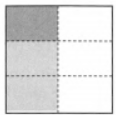
We need to find the area of the total figure & what shaded part represents.
For this we use the area of square formula.
We have; Side of square=1 unit.
So, area of square=side×side
=1×1 square unit.
The shaded shaded part represents the area.
So, the total area of the figure=1 sq. unit.
The shaded part represents area of the shaded region.
Core Connections Course Page 212 Problem 4 Answer
Given; Juanne drew a square with side lengths of 1 unit.
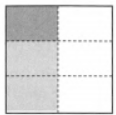
We need to determine what does dark shaded portion represents & its area.
To find area we first divide width into 3 equal parts & length in two equal parts & then using area of rectangle=l⋅b find area.
We have;
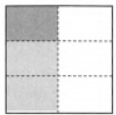
Since length of each side is 1 unit.
From previous part we have area of square is 1 sq. unit.
Since the square is divided into 6 equal parts so the area of darkly shaded region must be one-sixth of the total area.
i,e; area of darkly shaded region=1/6 sq. unit.
Therefore the dark shaded region represents the area of the region shaded region & its area is 1/6 sq. unit.
Core Connections Course 1 Chapter 5 Exercise 5.1 Step-By-Step Solutions Page 212 Problem 5 Answer
Given; Juanne drew a square with side lengths of 1 unit.
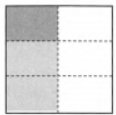
We need to determine the area of the darkly shaded rectangle.
To find area we first divide width into 3 equal parts & length in two equal parts & then using area of rectangle=l⋅b find area.
To calculate the length of side of shaded part.
We have;
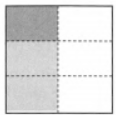
Since length of each side is 1 unit.
So, for shaded part length=1/2.
Breadth=1/3.
So, area of the dark shaded region =1/2×1/3=1/6 sq.unit
Therefore, the area of the darkly shaded region=1/6 sq. unit.
Core Connections Course Chapter 5 Page 212 Problem 6 Answer
We have been given 3/4⋅1/3.
We have been asked to solve this and represent on graph.
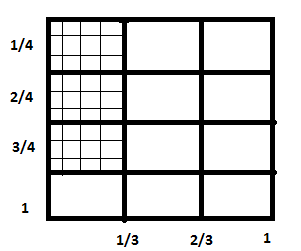
We will do it by multiplying numerator with numerator and denominator with denominator.
To solve 3/4⋅1/3
we will multiply it.
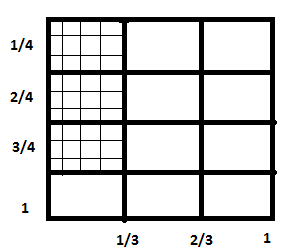
Multiplying 3/4⋅1/3
=3⋅1/4⋅3
=1/4
Hence, the product will be 3/4⋅1/3 = 1/4.
Solutions For Core Connections Course 1 Chapter 5 Exercise 5.1 Multiplying Fractions And Area Page 212 Problem 7 Answer
We have been given 1/5⋅1/7.
We have been asked to solve this and represent on graph.
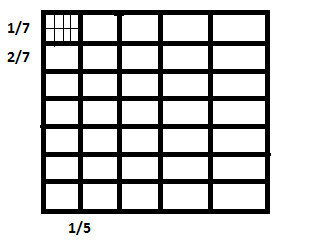
We will do it by multiplying numerator with numerator and denominator with denominator.
To solve 1/5⋅1/7
we will multiply it.
Multiplying1/5⋅1/7
=1/5⋅7
=1/35
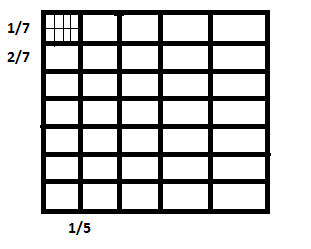
Hence, the product will be 1/5⋅1/7=1/35.
Core Connections Course Chapter 5 Page 212 Problem 8 Answer
We have been given 1/3⋅3/10.
We have been asked to solve this and represent on graph.
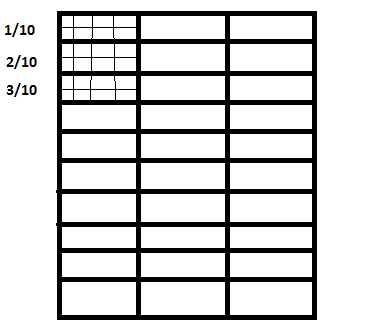
We will do it by multiplying numerator with numerator and denominator with denominator.
To solve 1/3⋅3/10
we will multiply it.
Multiplying1/3⋅3/10
=1×3/3×10
=1/10
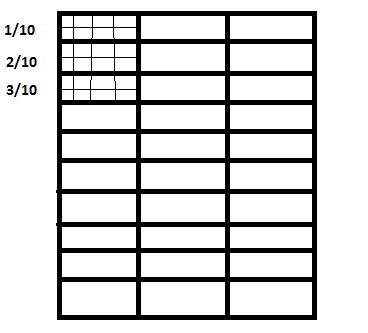
Hence, the product will be 1/3⋅3/10 = 1/10.
Core Connections Course 1 Student 1st Edition Chapter 5 Exercise 5.1 Guide Page 212 Problem 9 Answer
We have been given 4/4⋅2/3.
We have been asked to solve this and represent it on a graph.
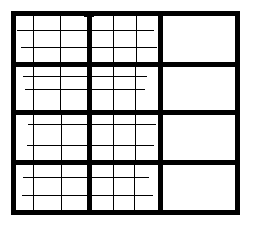
We will do it by multiplying numerator with numerator and denominator with denominator.
To solve 4/4⋅2/3
we will multiply it.
Multiplying4/4⋅2/3 = 2/3
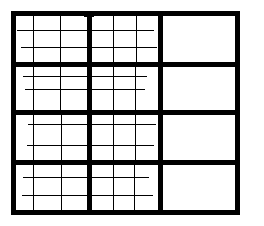
Hence, by using the graph paper the product is 4/4⋅2/3=2/3.
Core Connections Course Chapter 5 Page 212 Problem 10 Answer
We have been given 1/10⋅1/10.
We have been asked to solve this and represent on graph.
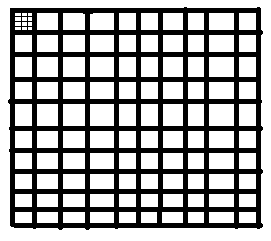
We will do it by multiplying numerator with numerator and denominator with denominator.
To solve 1/10⋅1/10
we will multiply it.
Multiplying1/10⋅1/10=1/10⋅10
=1/100
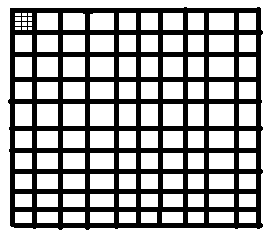
Hence, the product will be 1/10⋅1/10=1/100.
Chapter 5 Exercise 5.1 Multiplying Fractions And Area Explained Core Connections Course 1 Page 213 Problem 11 Answer
Given: Two points(13,14),(−3,14).
To Find: The distance between the two given points.
The distance between any two point with same abscissa or ordinate is the absolute value of the difference of the uncommon abscissa or ordinate.
For the given set of points(13,14),(−3,14), the distance would be given by the distance between its abscissa value which is given as:
∣13−(−3)∣
=∣13+3∣
=∣16∣
=16
The distance between (13,14),(−3,14) is 16 units.
Core Connections Course Chapter 5 Page 213 Problem 12 Answer
Given: Two points(−9,1),(−9,11).
To Find: The distance between the two given points.
The distance between any two point with same abscissa or ordinate is the absolute value of the difference of the uncommon abscissa or ordinate.
For the given set of points(−9,1),(−9,11),
the distance would be given by the distance between its ordinate value which is given as:
∣1−11∣
=∣−10∣
=10
The distance between (−9,1),(−9,11) is 10 units.
Worked Examples For Core Connections Course 1 Chapter 5 Exercise 5.1 Multiplying Fractions And Area Page 213 Problem 13 Answer
Given: The mixed fraction 44/5.
To Find: Convert the mixed fraction to improper fraction.
To convert a mixed number to an improper fraction multiply the denominator of the fractional part by the whole number, and add the result to the numerator.
Use this result as your numerator, and place it over the existing.
The mixed fraction is converted to the improper fraction as 44/5=4×5+4/5
= 20+4/5
= 24/5
The improper form of the fraction 44/5 is 24/5.
Core Connections Course Chapter 5 Page 213 Problem 14 Answer
Given: The improper fraction 17/7.
To Find: The conversion of improper fraction to mixed fraction.
To obtain a mixed fraction, divide the numerator by the denominator.
Write down the whole number part of the quotient.
Take the remainder and write it over the original denominator.
For the given fraction 17/7, the quotient is 2 and the remainder is 3 that is 17=7⋅2+3
Hence, the improper fraction is converted to the mixed fraction as 17/7=23/7.
The improper form of the fraction 17/7 is 23/7.
Core Connections Course 1 Chapter 5 Exercise 5.1 Detailed Answers Page 213 Problem 15 Answer
Given: The mixed fraction 413/15.
To Find: Convert the mixed fraction to an improper fraction.
To convert a mixed number to an improper fraction multiply the denominator of the fractional part by the whole number, and add the result to the numerator.
Use this result as your numerator, and place it over the existing.
The mixed fraction is converted to the improper fraction as 413/15 = 15×4+13/15
=60+13/15
=73/15
The improper form of the fraction 413/15 is 73/15.
Core Connections Course Chapter 5 Page 213 Problem 16 Answer
Given: The improper fraction 68/3.
To Find: The conversion of improper fraction to mixed fraction.
To obtain a mixed fraction, divide the numerator by the denominator.
Write down the whole number part of the quotient.
Take the remainder and write it over the original denominator.
For the given fraction 68/3, the quotient is 22 and the remainder is 2 that is 68=22⋅3+2
Hence, the improper fraction is converted to the mixed fraction as 68/3 =22×2/3.
The mixed fraction form of the number 68/3 is 22×2/3.
Core Connections Course 1 Chapter 5 Exercise 5.1 Detailed Answers Page 213 Problem 17 Answer
Given: The expression 3/5+1/4.
To Find: The simplification of the given expression and final answer expressed as a mixed fraction.
After simplification of the expression, in order to obtain a mixed fraction, divide the numerator by the denominator.
Write down the whole number part of the quotient.
Take the remainder and write it over the original denominator.
The simplification is done as: 3 /5+1/4=3×4+1×5/5×4
=12+5/20
=17/20
The expression 3/5+1/4 is simplified to 17/20.
Core Connections Course Chapter 5 Page 213 Problem 18 Answer
Given: The expression 3/4−2/3.
To Find: The simplification of the given expression and final answer expressed as a mixed fraction.
After simplification of the expression, in order to obtain a mixed fraction, divide the numerator by the denominator.
Write down the whole number part of the quotient.
Take the remainder and write it over the original denominator.
The simplification is done as: 3/4−2/3=3×3−2×4/4×3
=9−8/12
=1/12
The expression 3/4−2/3 is simplified to 1/12.
Core Connections Course 1 Chapter 5 Exercise 5.1 Detailed Answers Page 213 Problem 19 Answer
Given: The expression 51/2+41/3.
To Find: The simplification of the given expression and final answer expressed as a mixed fraction.
After simplification of the expression, in order to obtain a mixed fraction, divide the numerator by the denominator.
Write down the whole number part of the quotient.
Take the remainder and write it over the original denominator.
The simplification is done as: 5×1/2+4×1/3=11/2+13/3
=11×3+13×2/3×2
=33+26/6
=59/6
=9×5/6
The expression 51/2+41/3 is simplified to 95/6.
Core Connections Course Chapter 5 Page 213 Problem 20 Answer
Given: The expression 7/8⋅5/6.
To Find: The simplification of the given expression and final answer expressed as a mixed fraction.
After simplification of the expression, in order to obtain a mixed fraction, divide the numerator by the denominator.
Write down the whole number part of the quotient.
Take the remainder and write it over the original denominator.
The simplification is done as:
7/8⋅5/6=7/8×5/6=35/48
The expression 7/8⋅5/6 is simplified to 35/48.
Core Connections Course 1 Student 1st Edition Chapter 5 Exercise 5.1 Area Answers Page 214 Problem 21 Answer
We have given that Jenny’s house is 4/7 of a mile from the bus stop.
If Jenny had to run 2/3 of the way from the house to the bus stop.
It is asked that did Jenny run more or less than half a mile.
We will use the given fraction to get the answer.
Given that Jenny’s house is 4/7 of a mile from the bus stop.
Here, half of a mile =7/2
=3.5
But as per given fraction, Jenny has covered 4 out of 7 which is more than 3.5.
So, Jenny has covered distance more than half of a mile.
Yes, Jenny has covered distance more than half of a mile.
Core Connections Course Chapter 5 Page 214 Problem 22 Answer
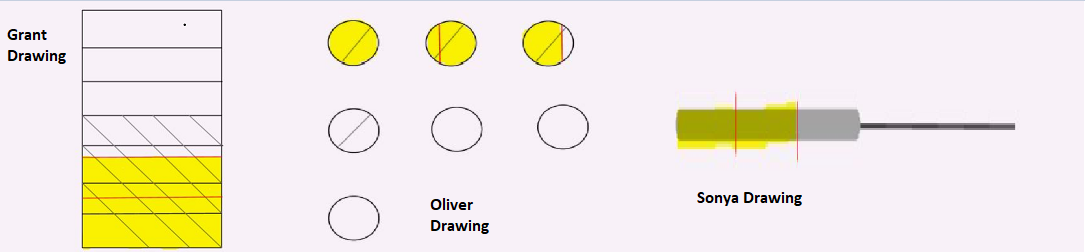
We have given three figures,
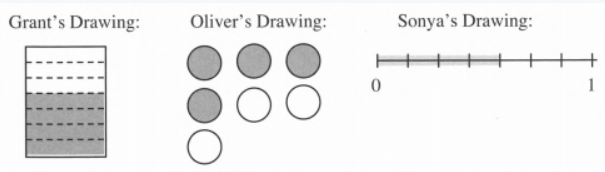
It is asked to use these given figures to show 2/3 of 4/7.
We will use given figures and then divide each figure in three equal parts and shade two parts.
Given figures are
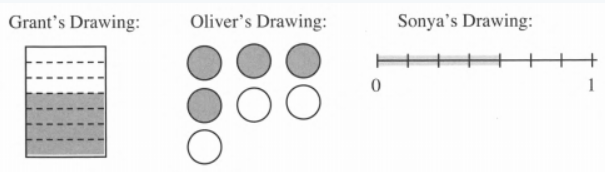
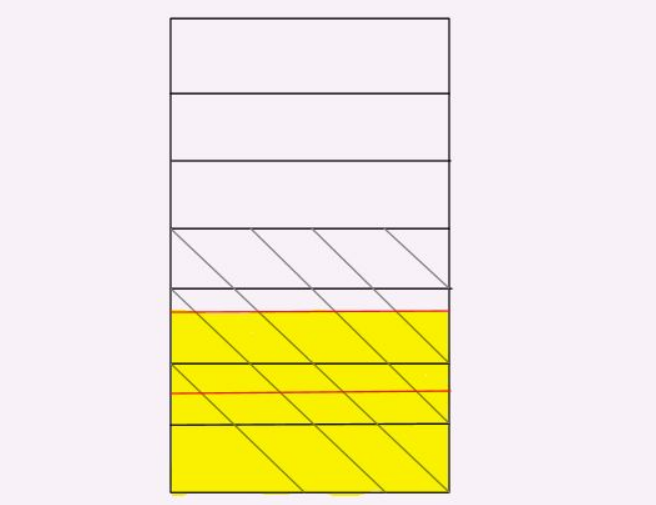
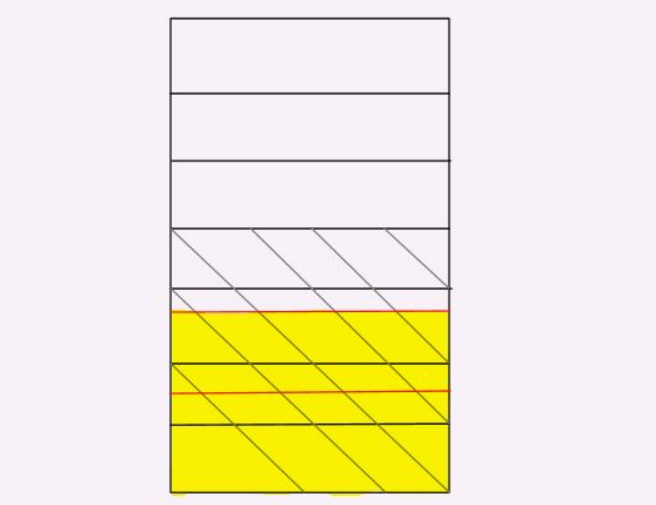
Here, In Grant’s drawing, area that represents 4 out of 7 that is 4 parts are divided into 3 parts(represented by red lines) and 2 parts out of those 3 parts are shaded by yellow color.
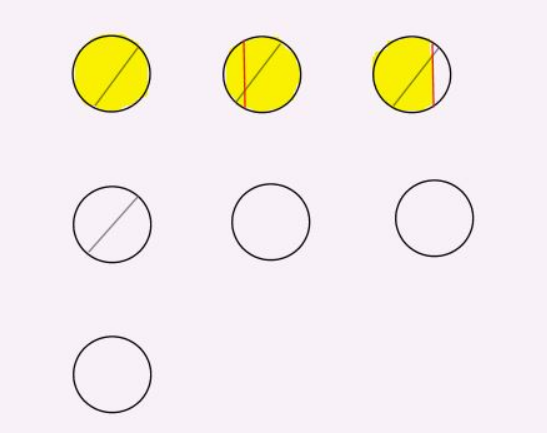
In Oliver’s Drawing, area that represents 4 parts out of 7 i.e. 4 circles are divided into 3 parts (represented by red lines) and the 2 parts out of those 3 parts are shaded by yellow color.
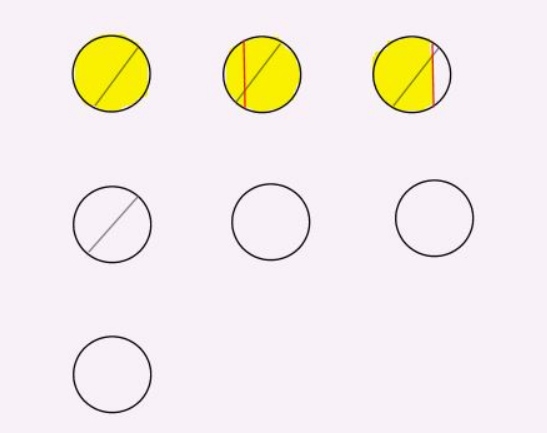
In Sonya’s Drawing, area that represents 4 parts out of 7i.e. 4 circles are divided into 3 parts (represented by red lines) and the 2 parts out of those 3 parts are shaded by yellow color.

The Drawings of Grant, Oliver and Sonya are shown below respectively.

Core Connections Course Chapter 5 Page 214 Problem 23 Answer
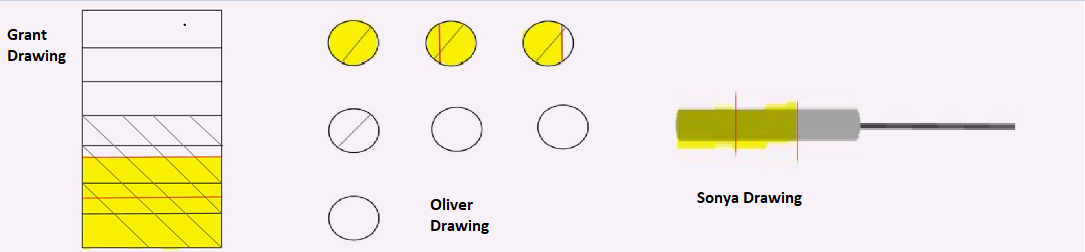
We have given three drawings
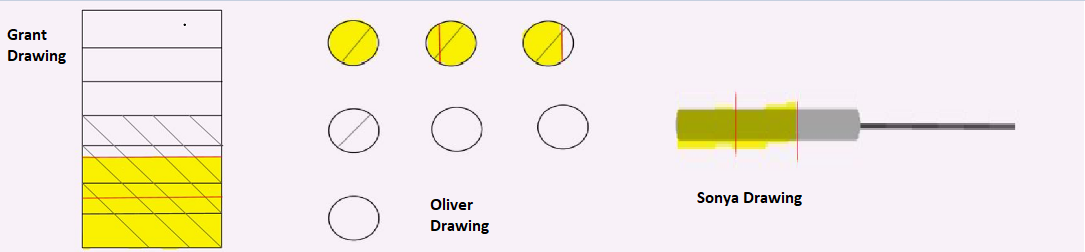
It is asked to find which drawing would team prefer.
We will observe each drawing and see which is easy to understand.
Given figures are
In each of the above drawings 2/3 of 4/7 is shown.
All the given drawings are easy to understand so the team will refer any of the given drawings.
The team will prefer any of the given drawings because each drawing showing 2/3 of 4/7.
Core Connections Course Chapter 5 Page 214 Problem 24 Answer
We have given drawings,
It is asked to find fraction of whole is 2/3 of 4/7.
We will multiply given fractions to get required fraction.
Given figure is
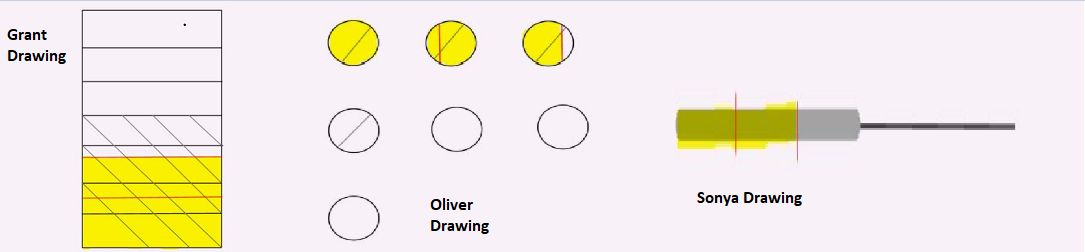
Here, using multiplication
2/3⋅4/7⇒8/21
So, 8/21 is fraction of whole is 2/3 of 4/7.
Hence,8/21 is fraction of whole is 2/3 of 4/7.
Core Connections Course 1 Student 1st Edition Chapter 5 Exercise 5.1 Area Answers Page 215 Problem 25 Answer
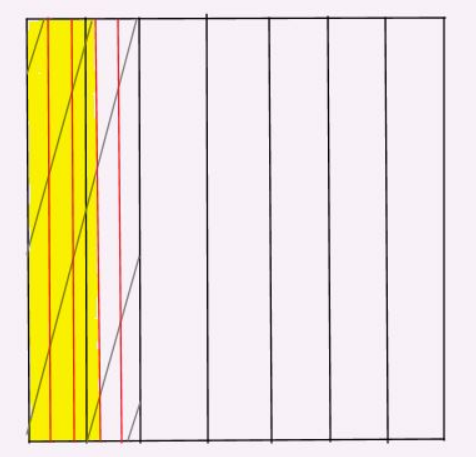
We have given fraction 3/5 of 2/7.
It is asked to find out what part of whole is 3/5 of 2/7 and also make diagram of it.
We will use multiplication of fractions.
Given fraction 3/5 of 2/7.
It is shown as below
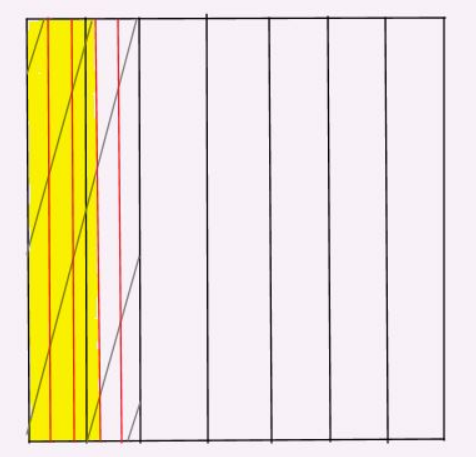
Grey lines represent the shaded part 2 out of 7.
Red lines represent division of 2 parts of 7 into 5 parts.
Yellow area represents 3 parts out of 5 of 2/7.
Using multiplication,
3/5⋅2/7⇒6/35
So, 6/35 is part of whole is 3/5⋅2/7.
Hence,6/35 is part of the whole is 3/5⋅2/7 which is shown below
Core Connections Course Chapter 5 Page 215 Problem 26 Answer
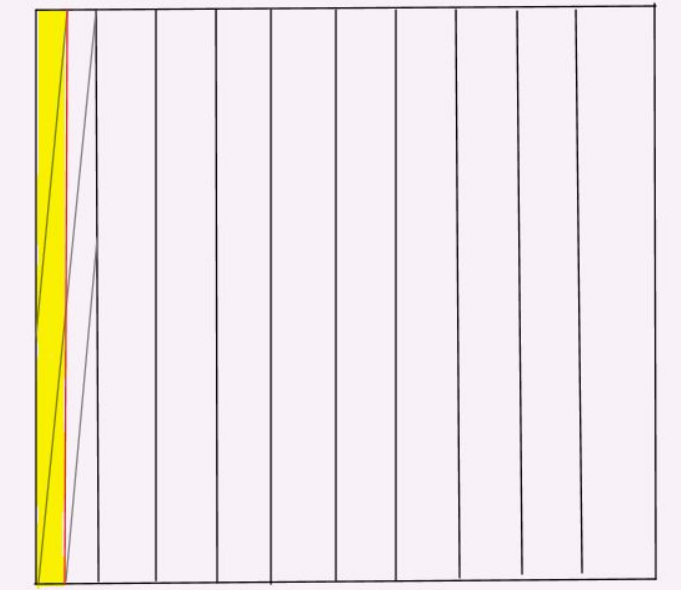
We have given fraction 1/2 of 1/10.
It is asked to find out what part of whole is 1/2 of 1/10 and also make diagram of it.
We will use multiplication of fractions.
Given fraction is 1/2 of1/10.
It is shown as below
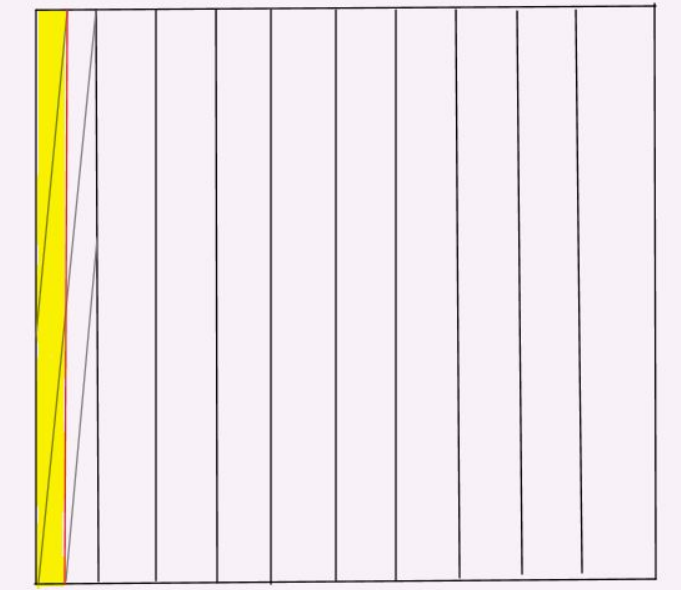
Grey lines represent the shaded part 1 out if 10 . Red lines represent division of 1 part of 10 into 2
parts. Yellow area represents 1 part out of 2 of 1/10.
Using multiplication,
1/2⋅1/10=1/20
So,1/20 is part of whole 1/2 of 1/10.
Hence,1/20 is part of the whole 1/2 of 1/10 and is shown below
Core Connections Course Chapter 5 Page 215 Problem 27 Answer
We have given that one half of a quarter would be the same as one quarter of a half.
It is asked to draw a picture that shows one half of one fourth.
We will first make picture of one fourth and then make one half on it.
Given that one half of a quarter would be the same as one quarter of a half.
Now drawing a picture of half of one fourth,
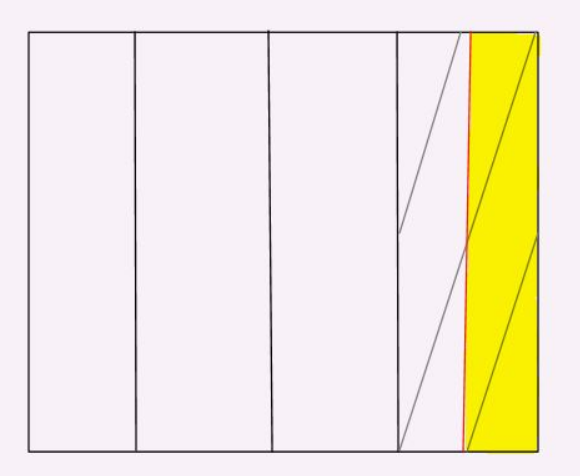
Grey lines represent the shaded area 1 part out of 4. Red lines represent the division of 1 part into 2 parts.
Yellow shaded area represents the half of one fourth.
The picture of half of one fourth is as follows
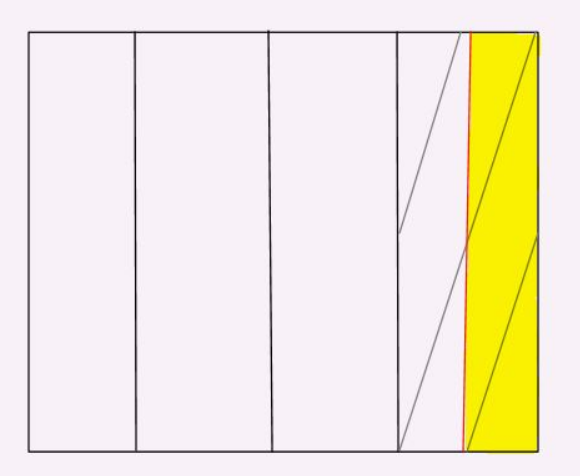
Core Connections Course Chapter 5 Page 215 Problem 28 Answer
We have given that one half of a quarter would be the same as one quarter of a half.
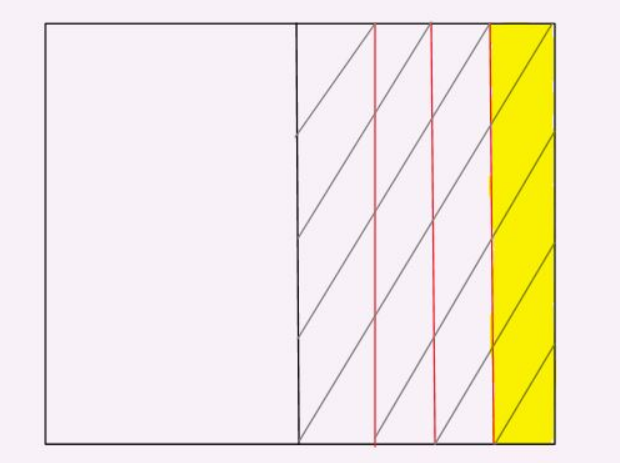
It is asked to draw a picture that shows one fourth of one half.
We will first make picture of one half and then make one fourth on it.
Given that one half of a quarter would be the same as one quarter of a half.
Now drawing a picture of one fourth of one half,
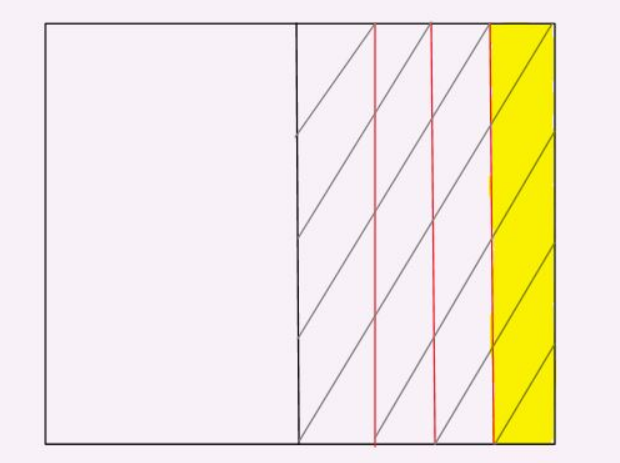
Grey lines represent the shaded area 1 part out of 2 . Red lines represent the division of 1 part into 4
parts. Yellow shaded area represents the one fourth of half.
The picture of one fourth of half is as follows
Core Connections Course 1 Student 1st Edition Chapter 5 Exercise 5.1 Area Answers Page 215 Problem 29 Answer
We have given that Grace and William were wondering if one half of a quarter would be the same as one quarter of a half.
It is asked to find out why Grace and William explain how these two values compare and why the result makes sense.
We will use the multiplication of fractions.
Given that one-half of one-fourth is equal to one-fourth of the half.
Using multiplication,
One half of one fourth is
1/2⋅1/4=1/8 and one-fourth of one half is 1/4⋅1/2=1/8
So, these both are equal that’s why one-half of one-fourth is equal to one-fourth of the half.
The value of one-half of one-fourth is equal to one-fourth of the half. So, the statement is correct.
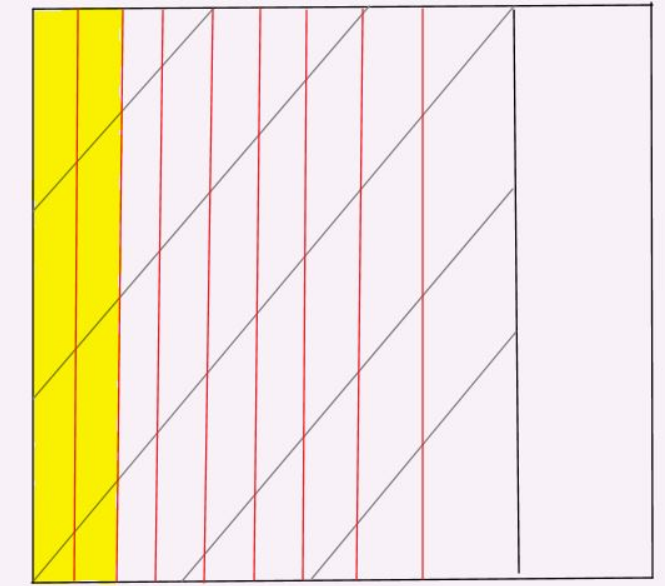
Core Connections Course Chapter 5 Page 215 Problem 30 Answer
We have given fraction 2/9 of 80%.It is asked to show the diagram of above fraction.
We will first use multiplication to get the value of fraction and we will make its diagram.
Given fraction is 2/9 of 80%.
Using multiplication,
2/9⋅80/100=2⋅80/9⋅100
⇒160/900
=8/45
So, the diagram of this fraction is as follows,
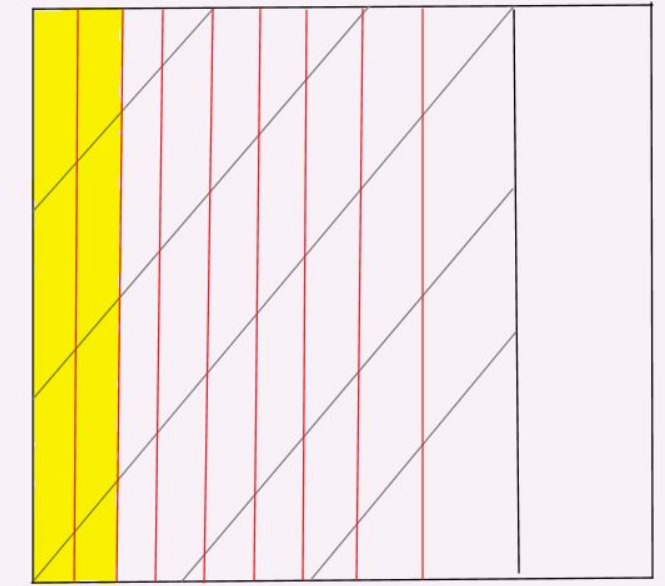
The diagram of given fraction is as follows.
Core Connections Course Chapter 5 Page 215 Problem 31 Answer
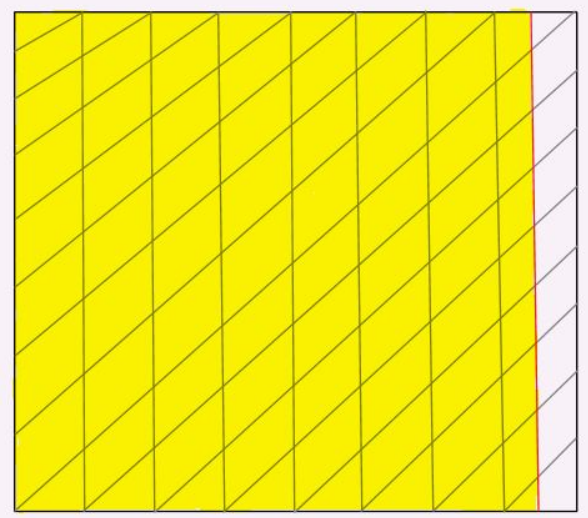
We have given fraction 2/3⋅27/8.It is asked to show the diagram of above fraction.
We will first use multiplication to get the value of fraction and we will make its diagram.
Given fraction is 2/3⋅27/8.
27/8 can be written in the form of improper fraction 2⋅8+7/8=23/8
Using multiplication,
2/3⋅27/8
=2/3⋅23/8
⇒23/12
So, the diagram of this fraction is as follows,
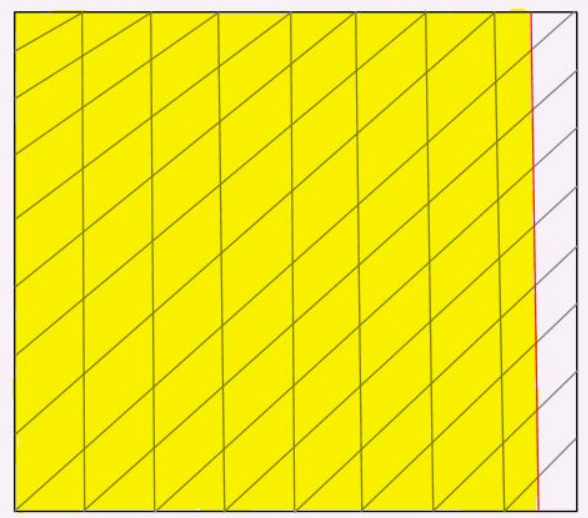
The diagram of the given fraction is as follows
Core Connections Course Chapter 5 Page 216 Problem 32 Answer
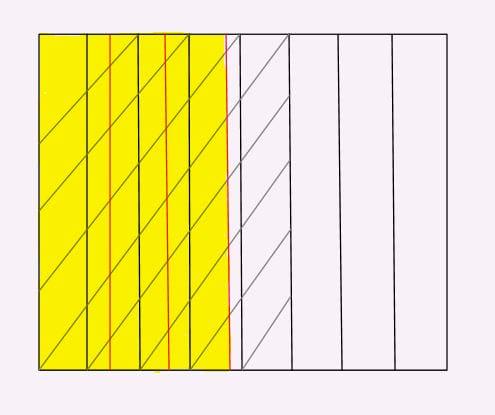
We are given 3/4 of 5/8.It is asked to find the parts of parts and also to create a diagram that demonstrates our thinking.
So we will find the parts of parts 3/4 of 5/8 and demonstrates it with a diagram.
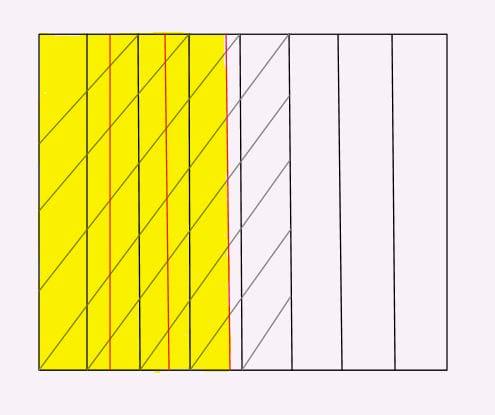
3/4 of 5/8 (given)
Grey lines represent the shaded parts of 5 out of 8 parts.
Red lines represent the division of 5 parts of 8 into 4 parts.
Yellow shaded area represents 3 parts of 4 parts of 5/8.
3/4×5/8=15/24
Thus, the parts of parts of 3/4 of 5/8 is 15/24 and is demonstrated by the diagram shown below
Core Connections Course Chapter 5 Page 216 Problem 33 Answer
We are given 3/8⋅2/3.
It is asked to find the parts of parts and also to create a diagram that demonstrates our thinking.
So we will find the parts of parts 3/8⋅2/3 and demonstrate it with a diagram.
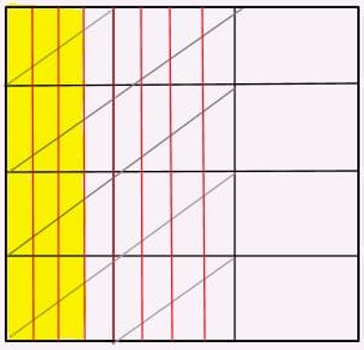
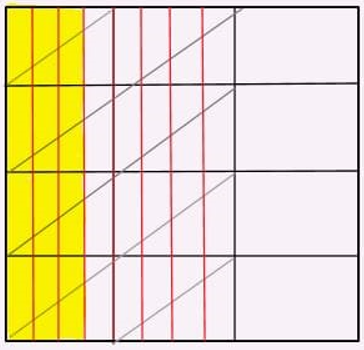
Grey lines represent the shaded parts of 2 out of 3 parts.
Red lines represent the division of 2 parts of 3 into 8 parts.
Yellow shaded area represents 3 parts of 8 parts of 2/3.
3/8×2/3
=6/24
=1/4
Thus, the parts of parts 3/8⋅2/3 is 1/4 and is demonstrated by the diagram shown below
Core Connections Course 1 Student 1st Edition Chapter 5 Exercise 5.1 Solutions Page 216 Problem 34 Answer
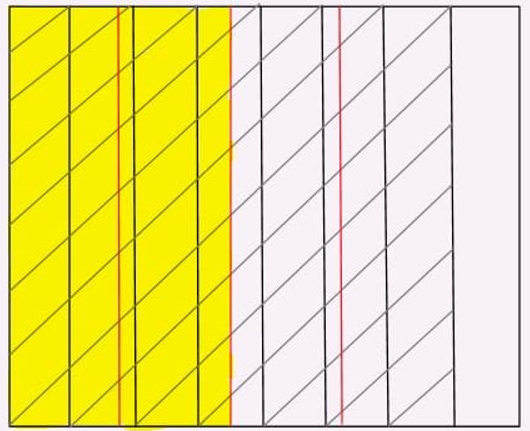
We are given 2/3 of 7/8.
It is asked to find the parts of parts and also to create a diagram that demonstrates our thinking.
So we will find the parts of parts 2/3 of 7/8 and demonstrates it with a diagram.
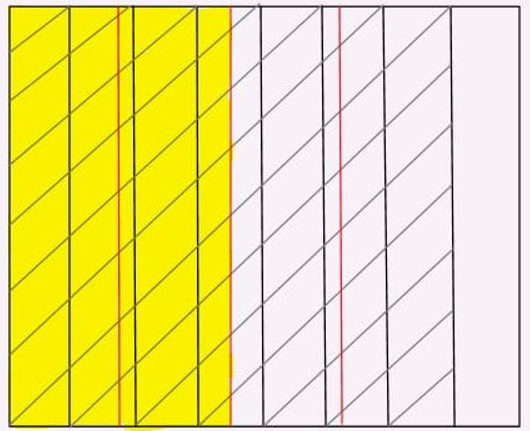
Grey lines represents the shaded parts of 7 out of 8 parts.
Red lines represent the division of 7 parts of 8 into 3 parts.
Yellow shaded area represents 2 parts of 3 parts of 7/8.
2/3×7/8
=14/24
=7/12
Thus, the parts of parts 2/3 of 7/8 is 7/12 and is demonstrated by the diagram shown below
Core Connections Course Chapter 5 Page 216 Problem 35 Answer
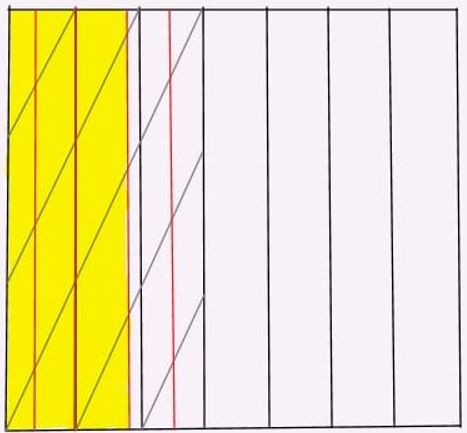
We are given 4/5⋅3/7.
It is asked to find the parts of parts and also to create a diagram that demonstrates our thinking.
So we will find the parts of parts 4/5⋅3/7 and demonstrate it with a diagram.
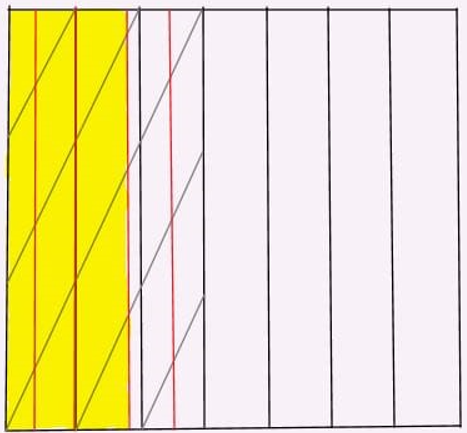
Grey lines represent the shaded parts of 3 out of 7 parts.
Red lines represent the division of 3 parts of 7 into 5 parts.
The yellow shaded area represents 4 parts of 5 parts of 3/7.
4/5×3/7=12/35
Thus, the parts of parts 4/5⋅3/7 is 12/35 and is demonstrated by the diagram shown below
Core Connections Course 1 Student 1st Edition Chapter 5 Exercise 5.1 Solutions Page 216 Problem 36 Answer
We are given∣−5+(−1)∣.
It is asked to simplify the given expression.
So we will simplify the given expression∣−5+(−1)∣by using the property∣−x∣=x.
∣−5+(−1)∣=∣−5−1∣
=∣−6∣
=6 (because∣−x∣=x)
Thus, by simplifying the given expression∣−5+(−1)∣we get 6.
Core Connections Course Chapter 5 Page 216 Problem 37 Answer
We are given an expression that is−∣2⋅4∣.
It is asked to simplify the given expression.
So we will simplify the given expression−∣2⋅4∣
by using the property−∣x∣=−x.
−∣2⋅4∣=−∣8∣
=−8 (because−∣x∣=−x)
Thus, by simplifying the given expression−∣2⋅4∣we get−8.
Multiplying Fractions And Area Solutions Core Connections Course 1 Page 216 Problem 38 Answer
We are given an expression that is 3.5∣−8∣.
It is asked to simplify the given expression.
So we will simplify the given expression 3.5∣−8∣by using the property∣−x∣=x.
3.5∣−8∣=3.5⋅8
=28
Thus, by simplifying the given expression 3.5∣−8∣we get 28.
Core Connections Course Chapter 5 Page 216 Problem 39 Answer
We are given an expression that is 3⋅∣8∣.
It is asked to simplify the expression.
So we will simplify the given expression 3⋅∣8∣by using the property−∣x∣=−x
3⋅∣8∣=3⋅8
=24
Thus, by simplifying the given expression 3⋅∣8∣ we get 24.
Core Connections Course 1 Chapter 5 Exercise 5.1 Step-By-Step Solutions Page 216 Problem 40 Answer
We are given an expression5.6−∣−5.6+11.2∣.
It is asked to simplify the given expression.
So we will simplify the given expression 5.6−∣−5.6+11.2∣by using the property−∣x∣=−x.
5.6−∣−5.6+11.2∣=5.6−∣5.6∣
=5.6−5.6
=0
Thus, by simplifying the given expression 5.6−∣−5.6+11.2∣we get 0.
Core Connections Course Chapter 5 Page 216 Problem 41 Answer
We are given an expression that is ∣6−10∣.
It is asked to simplify the given expression.
So we will simplify the given expression ∣6−10∣ by using the property ∣−x∣=x.
∣6−10∣=∣−4∣
=4
Thus, by simplifying the given expression ∣6−10∣ we get 4.