Glencoe Math Course 2 Volume 1 Common Core Chapter 1 Ratios and Proportional Reasoning
Glencoe Math Course 2 Volume 1 Chapter 1 Exercise 1.2 Solutions Page 17 Exercise 1 Problem 1
Let the two ratios be a:b and c:d
If both the ratios are equal, a:b = c:d
Then the given ratio is said to be in proportion.
And also, if the sets increase or decrease in the very same ratio, then the ratio is said to be in proportion.
In terms of objects, if the two objects are said to be in the very same shape but in different sizes.
For example: If the two objects are spheres, but one is smaller while the other one is larger.
Here, even though the sizes differ, the corresponding angles will be the same.
This makes their ratios be in proportion.
Hence, the two objects are proportional.
Two objects are said to be in proportion if they have the same shape, and same angles but in different sizes. This makes their ratios be in proportion.
Read and Learn More Glencoe Math Course 2 Volume 1 Common Core Student Edition Solutions
Common Core Chapter 1 Ratios And Proportional Reasoning Exercise 1.2 Answers Page 17 Exercise 2 Problem 2
Given: Dana is skating laps to train for a speed skating competition.
She can skate 1 lap in 40 seconds.
Suppose Dana skates for 20 seconds.
We need to determine how many laps she will skate.
Given:
The number of laps she can skate is 1 lap.
The number of time taken to do one lap is 40 seconds.
The ratio is = \(\frac{40}{1}\)
If she skates only for 20 Seconds, then the number of laps will be
\(\frac{40}{x}\) = \(\frac{40}{1}\)
x = \(\frac{20}{40}\)
x = \(\frac{2}{4}\)
x = \(\frac{1}{2}\)
x = 0.5
The number of laps she will skate is 0.5 laps.
Glencoe Math Course 2 Volume 1 Common Core Chapter 1 Page 17 Exercise 3 Problem 3
Given: Dana is skating laps to train for a speed skating competition.
She can skate 1 lap for 40 seconds.
In exercise 2, Dana skates 0.5 laps for 20 seconds.
We need to write the ratio of Dana’s time from Exercise 2 to her number of laps.
Given: From exercise 2
The number of laps she can skate is 0.5 lap.
The number of time taken to do one lap is 20 seconds.
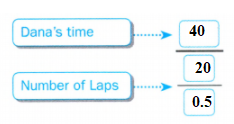
The ratio from exercise 2 is
\(\frac{\text { Dana’s time }}{\text { Number of laps }}=\frac{20}{0.5}\)
We need to substitute this ratio in her number of laps. The ratio is
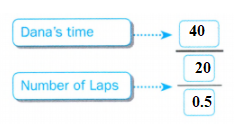
The ratio is
Step-By-Step Guide For Glencoe Math Chapter 1 Exercise 1.2 Problems Page 17 Exercise 4 Problem 4
Given: Dana is skating laps to train for a speed skating competition.
She can skate 1 lap in 40 seconds.
We need to detect how we simplify the ratio we wrote in Exercise 3.
The ratio in exercise is
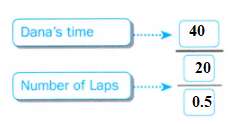
Simplifying the ratio, we get
\(\frac{\text { Dana’s time }}{\text { Number of Laps }}=\frac{40}{\frac{20}{0.5}}\)= 40 × \(\frac{0.5}{20}\)
= 40 × \(\frac{0.5}{2}\)
= 2 × 0.5
= 1
The simplification of the ratio we wrote in Exercise 3 results in a 1:1
Glencoe Math Course 2 Volume 1 Common Core Chapter 1 Page 20 Exercise 1 Problem 5
Given: The complex fraction is\(\frac{18}{\frac{3}{4}}\)
We need to simplify the given complex fraction.
Rewrite the given fraction as a division.
The expression becomes
\(\frac{18}{\frac{3}{4}}\) =\(\frac{18}{1}\) ÷ \(\frac{3}{4}\)
Multiply it by the reciprocal of \(\frac{3}{4}\) , we get
\(\frac{18}{\frac{3}{4}}\) =\(\frac{18}{1}\) ÷ \(\frac{3}{4}\)
\(\frac{18}{\frac{3}{4}}\) =\(\frac{18}{1}\) × \(\frac{4}{3}\)
Simplifying it further, we get
\(\frac{18}{\frac{3}{4}}\) =\(\frac{18}{1}\) × \(\frac{4}{3}\)
= \(\frac{6}{1}\)×\(\frac{4}{1}\)
= 24
The value of \(\frac{18}{\frac{3}{4}}\) is equal to 24
Exercise 1.2 Glencoe Math Course 2 Ratios And Proportional Reasoning Solutions Explained Page 20 Exercise 2 Problem 6
Given: The complex fraction is \(\frac{\frac{3}{6}}{4}\)
We need to simplify the given complex fraction.
Rewrite the given fraction as a division.
The expression becomes
\(\frac{\frac{3}{6}}{4}\) = \(\frac{3}{6}\)÷ \(\frac{4}{1}\)
Multiply it by the reciprocal of \(\frac{4}{1}\), we get
\(\frac{\frac{3}{6}}{4}\) = \(\frac{3}{6}\)÷\(\frac{4}{1}\)
\(\frac{\frac{3}{6}}{4}\) = \(\frac{3}{6}\)×\(\frac{1}{4}\)
Simplifying it further, we get
\(\frac{\frac{3}{6}}{4}\)= \(\frac{3}{6}\)×\(\frac{1}{4 }\)
= \(\frac{1}{2}\)×\(\frac{1}{4}\)
= \(\frac{1}{8}\)
The value of \(\frac{\frac{3}{6}}{4}\) is equal to \(\frac{1}{8}\)
Glencoe Math Course 2 Volume 1 Common Core Chapter 1 Page 20 Exercise 3 Problem 7
Given: The complex fraction is \(\frac{\frac{1}{3}}{\frac{1}{4}}\)
We need to simplify the given complex fraction.
Rewrite the given fraction as a division.
The expression becomes
\(\frac{\frac{1}{3}}{\frac{1}{4}}\) = \(\frac{1}{3}\) ÷\(\frac{1}{4}\)
Multiply it by the reciprocal of, we get
\(\frac{\frac{1}{3}}{\frac{1}{4}}\) = \(\frac{1}{3}\) ÷ \(\frac{1}{4}\)
\(\frac{\frac{1}{3}}{\frac{1}{4}}\) = \(\frac{1}{3}\) × \(\frac{4}{1}\)
Simplifying it further, we get
\(\frac{\frac{1}{3}}{\frac{1}{4}}\) = \(\frac{1}{3}\) × \(\frac{4}{1}\)
= \(\frac{4}{3}\)
The value of \(\frac{\frac{1}{3}}{\frac{1}{4}}\) is equal to \(\frac{4}{3}\)
Examples Of Problems From Exercise 1.2 Ratios And Proportional Reasoning Chapter 1 Page 20 Exercise 4 Problem 8
Given: That, Pep Club members are making spirit buttons.
They make 490 spirit buttons in 3\(\frac{1}{2}\)hours.
We need to determine the number of buttons the Pep Club makes per hour.
Given:
Number of spirit buttons = 490
Time taken = 3\(\frac{1}{2}\)= \(\frac{7}{2}\)hours
The unit rate is
Unite rate = \(\frac{490}{\frac{7}{2}}\)
= 490×\(\frac{2}{7}\)
= 70 × 2
= 140 Sprit buttons per hour
The number of buttons the Pep Club makes per hour is 140 spirit buttons per hour.
Glencoe Math Course 2 Volume 1 Common Core Chapter 1 Page 20 Exercise 5 Problem 9
Given: That, the country sales tax is 6\(\frac{2}{3}\)%
We need to write the given percent as a fraction and to simplify it.
Given: Percent is 6\(\frac{2}{3}\)%
Converting the given mixed fraction into an improper fraction, we get
6\(\frac{2}{3}\) = \(\frac{20}{3}\)%
Thus, the percent becomes
\(\frac{20}{3}\) percentage = \(\frac{20}{3}\) ÷ 100
Multiply it by the reciprocal of \(\frac{100}{1}\) we get
\(\frac{20}{3}\) percentage = \(\frac{20}{3}\)÷ 100
\(\frac{20}{3}\) percentage = \(\frac{20}{3}\) × \(\frac{1}{100}\)
= \(\frac{1}{3}\) × \(\frac{1}{5}\)
= \(\frac{1}{15}\)
The given percent 6\(\frac{2}{3}\)% \(\frac{1}{15}\)
Examples Of Problems From Exercise 1.2 Ratios And Proportional Reasoning Chapter 1 Page 20 Exercise 6 Problem 10
A complex fraction is nothing but a fraction that has fractions in its denominator or in the numerator or in both.
For example
\(\frac{\frac{5}{2}}{10}, \frac{11}{\frac{6}{8}}, \frac{\frac{12}{15}}{\frac{3}{4}}\)These are all complex fractions.
Solving a complex fraction:
Let us consider a complex fraction
\(\frac{\frac{3}{4}}{\frac{10}{12}}\)Simplifying it, we get
\(\frac{\frac{3}{4}}{\frac{10}{12}}\)= \(\frac{3}{4}\)× \(\frac{12}{10}\)
= \(\frac{3}{1}\)×\(\frac{3}{10}\)
= \(\frac{9}{10}\)
A complex fraction is a fraction that has more than one fraction. That is, fractions will be in their denominator or in the numerator, or in both.
Glencoe Math Course 2 Volume 1 Common Core Chapter 1 Page 21 Exercise 1 problem 11
Given: The complex fraction is \(\frac{1}{\frac{2}{3}}\)
We need to simplify the given complex fraction.
Rewrite the given fraction as a division.
The expression becomes
\(\frac{1}{\frac{2}{3}}\)= \(\frac{1}{1}\) ÷ \(\frac{2}{3}\)
Multiply it by the reciprocal of \(\frac{2}{3}\) , we get
\(\frac{1}{\frac{2}{3}}\)= \(\frac{1}{1}\) ÷ \(\frac{2}{3}\)
\(\frac{1}{\frac{2}{3}}\)= \(\frac{1}{1}\) × \(\frac{3}{2}\)
Simplifying it further, we get
\(\frac{1}{\frac{2}{3}}\)= \(\frac{1}{1}\) × \(\frac{3}{2}\)
= \(\frac{3}{2}\)
The value of \(\frac{1}{\frac{2}{3}}\) is equal to = \(\frac{3}{2}\)
Student Edition Glencoe Math Chapter 1 Exercise 1.2 Answers Guide Page 21 Exercise 2 Problem 12
Given: The complex fraction is \(\frac{2}{\frac{3}{11}}\)
We need to simplify the given complex fraction.
Rewrite the given fraction as a division.
The expression becomes
\(\frac{2}{\frac{3}{11}}\)= \(\frac{2}{1}\) ÷\(\frac{3}{11}\)
Multiply it by the reciprocal of \(\frac{3}{11}\) , we get
\(\frac{2}{\frac{3}{11}}\)= \(\frac{2}{1}\) ÷ \(\frac{3}{11}\)
\(\frac{2}{\frac{3}{11}}\)= \(\frac{2}{1}\) ×\(\frac{11}{3}\)
Simplifying it further, we get
\(\frac{2}{\frac{3}{11}}\) = \(\frac{2}{1}\) ×\(\frac{11}{3}\)
= \(\frac{22}{3}\)
The value of \(\frac{2}{\frac{3}{11}}\) is equal to \(\frac{22}{3}\)
Glencoe Math Course 2 Volume 1 Common Core Chapter 1 Page 21 Exercise 3 Problem 13
Given: The complex fraction is \(\frac{\frac{8}{9}}{6}\)
We need to simplify the given complex fraction
Rewrite the given fraction as a division.
The expression becomes
\(\frac{\frac{8}{9}}{6}\) = \(\frac{8}{9}\)÷\(\frac{6}{1}\)
Multiply it by the reciprocal of \(\frac{1}{6}\) we get,
\(\frac{\frac{8}{9}}{6}\) = \(\frac{8}{9}\)÷\(\frac{6}{1}\)
\(\frac{\frac{8}{9}}{6}\) = \(\frac{8}{9}\)×\(\frac{1}{6}\)
Simplifying it further, we get,
\(\frac{\frac{8}{9}}{6}\)= \(\frac{8}{9}\)×\(\frac{1}{6}\)
= \(\frac{4}{9}\)×\(\frac{1}{3}\)
= \(\frac{4}{27}\)
The value of \(\frac{\frac{8}{9}}{6}\) is equal to \(\frac{4}{27}\)
Student Edition Glencoe Math Chapter 1 Exercise 1.2 Answers Guide Page 21 Exercise 4 Problem 14
Given: The complex fraction is \(\frac{\frac{2}{5}}{9}\)
We need to simplify the given complex fraction.
Rewrite the given fraction as a division.
The expression becomes
\(\frac{\frac{2}{5}}{9}\)= \(\frac{2}{5}\)÷\(\frac{9}{1}\)
Multiply it by the reciprocal of 9 , and we get
\(\frac{\frac{2}{5}}{9}\)= \(\frac{2}{5}\)÷\(\frac{9}{1}\)
\(\frac{\frac{2}{5}}{9}\)= \(\frac{2}{5}\)× \(\frac{1}{9}\)
Simplifying it further, we get
\(\frac{\frac{2}{5}}{9}\)= \(\frac{2}{5}\)× \(\frac{1}{9}\)
= \(\frac{2}{45}\)
The value of \(\frac{\frac{2}{5}}{9}\) is equal to \(\frac{2}{45}\)
Glencoe Math Course 2 Volume 1 Common Core Chapter 1 Page 21 Exercise 5 Problem 15
Given: The complex fraction is \(\frac{\frac{4}{5}}{10}\)
We need to simplify the given complex fraction.
Rewrite the given fraction as a division.
The expression becomes
\(\frac{\frac{4}{5}}{10}\) = \(\frac{4}{5}\)÷\(\frac{10}{1}\)
Multiply it by the reciprocal of \(\frac{10}{1}\) , we get,
\(\frac{\frac{4}{5}}{10}\) = \(\frac{4}{5}\)÷\(\frac{10}{1}\)
\(\frac{\frac{4}{5}}{10}\) = \(\frac{4}{5}\)×\(\frac{1}{10}\)
Simplifying it further, \(\frac{1}{10}\) we get
\(\frac{\frac{4}{5}}{10}\) = \(\frac{4}{5}\)×\(\frac{1}{10}\)
= \(\frac{2}{5}\)×\(\frac{1}{5}\)
= \(\frac{2}{25}\)
The value of \(\frac{\frac{4}{5}}{10}\) is equal to\(\frac{2}{25}\)
Chapter 1 Exercise 1.2 Glencoe Math Course 2 Step-By-Step Solutions Page 21 Exercise 6 Problem 16
Given: The complex fraction is \(\frac{\frac{1}{4}}{\frac{7}{10}}\)
We need to simplify the given complex fraction.
Rewrite the given fraction as a division.
The expression becomes
\(\frac{\frac{1}{4}}{\frac{7}{10}}\) = \(\frac{1}{4}\) ÷ \(\frac{7}{10}\)
Multiply it by the reciprocal of \(\frac{7}{10}\) , we get
\(\frac{\frac{1}{4}}{\frac{7}{10}}\) = \(\frac{1}{4}\) ÷ \(\frac{7}{10}\)
\(\frac{\frac{1}{4}}{\frac{7}{10}}\) = \(\frac{1}{4}\) × \(\frac{10}{7}\)
Simplifying it further, we get
\(\frac{\frac{1}{4}}{\frac{7}{10}}\) = \(\frac{1}{4}\) × \(\frac{10}{7}\)
= \(\frac{1}{2}\)× \(\frac{5}{7}\)
= \(\frac{5}{14}\)
The value of \(\frac{\frac{1}{4}}{\frac{7}{10}}\) is equal to \(\frac{5}{14}\)
Glencoe Math Course 2 Volume 1 Common Core Chapter 1 Page 21 Exercise 8 Problem 17
Given: Doug entered a canoe race. He rowed \(3\frac{1}{2}\) miles in \(\frac{1}{2}\) hour.
We need to determine his average speed in milés per hour.
Given:
Number of miles rowed = \(3\frac{1}{2}\)miles
Time taken = \(\frac{1}{2}\) hour
The unit rate is
Unite rate \( = \frac{\text { Number of miles }}{\text { Time taken }}\)
= \(\frac{3 \frac{1}{2}}{\frac{1}{2}}\)
= \(\frac{\frac{7}{2}}{\frac{1}{2}}\)
= \(\frac{7}{2} \times \frac{2}{1}\)
= 7 miles per hour
Hence, The average speed of Doug in miles per hour is 7.
Chapter 1 Exercise 1.2 Glencoe Math Course 2 Step-By-Step Solutions Page 21 Exercise 9 Problem 18
Given: Monica reads \(7\frac{1}{2}\) pages of a mystery book in 9minutes.
We need to determine her average reading rate in pages per minute.
Given:
Number of pages = \(7\frac{1}{2}\)
Number of minutes taken = 9
The unit rate is
Unite rate = \(\frac{\text { Number of pages }}{\text { Number of minutes }}\)
= \(\frac{7 \frac{1}{2}}{9}\)
= \(\frac{\frac{15}{2}}{9}\)
= \(\frac{15}{2} \times \frac{1}{9}\)
= \(\frac{5}{2} \times \frac{1}{3}\)
= \(\frac{5}{6}\)
Her average reading rate in pages per minute is \(\frac{5}{6}\).
Glencoe Math Course 2 Volume 1 Common Core Chapter 1 Page 21 Exercise 10 Problem 19
Given: The percent is \(56 \frac{1}{4} \%\)
We need to write the given percent as a fraction and simplify it.
Given percent is \(56 \frac{1}{4} \%\)
Converting the given mixed fraction into an improper fraction, we get
\(56 \frac{1}{4}\)=\(\frac{225}{4}\)%
Thus, the percent becomes
\(\frac{225}{4}\)percent = \(\frac{225}{4}\) ÷ 100
Multiply it by the reciprocal of \(\frac{100}{1}\), we get
\(\frac{225}{4}\) percent = \(\frac{225}{4}\) × \(\frac{1}{100}\)
\(=\frac{9}{4} \times \frac{1}{4}\)= \(\frac{9}{16}\)
The given percent \(56 \frac{1}{4} \%\)as a fraction in the simplest form is \(\frac{9}{16}\)
Page 21 Exercise 11 Problem 20
Given: The percent is \(15 \frac{3}{5} \%\)
We need to write the given percent as a fraction and simplify it.
Given percent is \(15 \frac{3}{5} \%\)
Converting the given mixed fraction into an improper fraction, we get
\(15 \frac{3}{5}\) = \(\frac{78}{5}%\)
Thus, the percent becomes
\(\frac{78}{5}\) percent = \(\frac{78}{5}\) ÷ \(\frac{100}{1}\)
Multiply it by the reciprocal of \(\frac{100}{1}\) we get
\(\frac{78}{5}\) percent = \(\frac{78}{5}\) ÷ \(\frac{100}{1}\)
\(\frac{78}{5}\) percent = \(\frac{78}{5}\)× \(\frac{1}{100}\)
= \(\frac{78}{500}\)
= \(\frac{39}{250}\)
The given percent \(15 \frac{3}{5} \%\)as a fraction in the simplest form is \(\frac{39}{250}\)