Glencoe Math Course 2 Volume 1 Common Core Chapter 1 Ratios and Proportional Reasoning
Glencoe Math Course 2 Volume 1 Chapter 1 Exercise 1.3 Solutions Page 25 Exercise 2 Problem 1
We need to determine the given calculations using the equivalent metric measurement.
1 minute = _____ seconds
1 hour = ______ seconds
We need to calculate how many seconds are there in one minute.
According to the equivalent metric measurement of minutes and seconds, we get
1 minute = 60 seconds
Thus, for one hour
We know that
1 hour = 60 minutes
= 60 × 1 minute
= 60 × 60 seconds
= 3600 seconds
1 minute = 60 seconds
1 hour = 3600 seconds
Page 25 Exercise 3 Problem 2
Given:
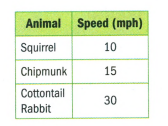
We need to determine the number of feet per second a squirrel can run.
Read and Learn More Glencoe Math Course 2 Volume 1 Common Core Student Edition Solutions
From the given table, the squirrel can run 10 mph Thus
Speed = \(\frac{10 \text { miles }}{1 \text { hour }}\)
We know that
1 mile = 5280 feet
10 miles = 52800 feet
Similarly
1 hour = 60 minutes
= 60 × 60 seconds
= 3600 seconds
The speed of the squirrel be
Speed \(=\frac{52800 \text { feet }}{3600 \text { seconds }}\)
= 14. 6667 feet per second
≈ 14.67 feet per second
A squirrel can run 14.67 feet per second.
Glencoe Math Course 2 Volume 1 Common Core Chapter 1 Page 25 Exercise 4 Problem 3
We need to determine the number of feet per second does it measure for 10 miles per hour
Given that, 10 miles per hour.
We know that
1 mile = 5280 feet
10 miles = 52800 feet
Also, by converting hour to second, we get
1 hour = 60 minutes
= 60×60 seconds
= 3600 seconds
Therefore
\(\frac{10 \text { miles }}{1 \text { hour }}=\frac{52800 \text { miles }}{3600 \text { seconds }}\)
= 14.667 feet per second
≈ 14.67 feet per second.
10 , miles per hour = 14.67 feet per second.
The number of feet per second does it measure for 10 miles per hour is 14.67 feet per second.
Common Core Student Edition Ratios And Proportional Reasoning Exercise 1.3 Answers Page 28 Exercise 2 Problem
Given that, A skydiver is falling at about 176 feet per second.
We need to determine how many feet per minute is he falling.
Given falling speed is 176 feet per second.
We know that 1 minute = 60 seconds
Converting the given, we get
\(\frac{176 \text { feet }}{1 \text { second }}=\frac{176 \text { feet }}{1 \text { second }} \times \frac{60 \text { second }}{1 \text { minutes }}\)
= \(\frac{176 \times 60 \text { feet }}{1 \text { minutes }}\)
= 10560 feet per minute
He is falling at 10560 feet per minute.
Glencoe Math Course 2 Volume 1 Common Core Chapter 1 Page 28 Exercise 4 Problem 4
Given that, the ratio of\(\frac{3 \text { feet }}{1 \text { yard }}\) has a value of one.
We need to determine how it is equal to one.
Given that the ratio is having two different units.
Converting the two units into one.
We know that 1 yard = 3 feet
Thus, the given ratio becomes
\(\frac{3 \text { feet }}{1 \text { yard }}=\frac{1 \text { yard }}{1 \text { yard }}\) = 1
Thus, the value of the ratio is one.
Hence, The ratio \(\frac{3 \text { feet }}{1 \text { yard }}\) = 1 since the value of 3 feet = 1 yard
Chapter 1 Exercise 1.3 Glencoe Math Course 2 Volume 1 Workbook Solutions Page 29 Exercise 1 Problem 5
Given that, A go-kart’s top speed is 607,200 feet per hour.
We need to determine its speed in miles per hour.
The speed of the go-kart = \(\frac{607,200 \text { feet }}{1 \text { hour }}\)
We must convert the speed in feet to miles.
We know that 1 feet = 0.000189394 miles
Thus, by converting, we get
= \(\frac{607200 \text { feet }}{1 \text { hour }} \times \frac{0.000189394 \text { miles }}{1 \text { feet }}\)
=\(\frac{607200 \times 0.000189394 \text { miles }}{1 \text { hour }}\)
= 115 miles per hour
Hence, The speed is 115 miles per hour.
Glencoe Math Course 2 Volume 1 Common Core Chapter 1 Page 29 Exercise 2 problem 6
Given that, the fastest a human has ever run is 27 miles per hour.
We need to determine how many miles per minute the human ran.
Given:
The fastest speed of the human = \(\frac{27 \text { miles }}{1 \text { hour }}\)
Converting the hour into minutes, we get
1 hour = 60 minutes
Thus, the speed becomes
\(\frac{27 \text { miles }}{1 \text { hour }}=\frac{27 \text { miles }}{1 \text { hour }} \times \frac{1 \text { hour }}{60 \text { minutes }}\)
= \(\frac{27 \text { miles }}{60 \text { minutes }}\)
= \(\frac{0.45 \text { miles }}{1 \text { minute }}\)
The human ran 0.45 miles per minute.
Glencoe Math Chapter 1 Ratios And Proportional Reasoning Exercise 1.3 Explanation Page 29 Exercise 3 Problem 7
Given that, A peregrine falcon can fly 322 kilometers per hour.
We need to determine how many meters per hour the falcon can fly.
Given:
Speed of the falcon = \(\frac{322 \text { Kilometers }}{1 \text { hour }}\)
Converting kilometers to meters, we get
= \(\frac{322 \text { kilometers }}{1 \text { hour }}=\frac{322 \text { kilometers }}{1 \text { hour }} \times \frac{1000 \text { meters }}{1 \text { kilometer }}\)
= \(\frac{322 \times 1000 \text { meters }}{1 \text { hour }}\)
= \(\frac{322 \text { meters }}{1 \text { hour }}\)
The falcon can fly 322000 meters per hour.
Glencoe Math Course 2 Volume 1 Common Core Chapter 1 Page 29 Exercise 4 Problem 8
Given that, A pipe is leaking at 1.5 cups per day.
We need to determine how many gallons per week the pipe is leaking.
Also, given 1 gallon is equivalent to 16 cups.
Determine one cup is equivalent to how many gallons.
1 gallon = 16 cups
\(\frac{1}{16}\) gallon = 1 cup
Determine one day is equivalent to how many weeks
1 week = 7 days
\(\frac{1}{7}\) week = 1 day
Converting the given cups to gallons, we get
\(\frac{1.5 \text { cups }}{1 \text { day }}=\frac{1.5 \text { cups }}{1 \text { day }} \times \frac{\frac{1}{16} \text { gallon }}{1 \text { cup }} \times \frac{1 \text { day }}{\frac{1}{7} \text { week }}\)
= \(\frac{1.5 \times \frac{1}{16} \text { gallons }}{\frac{1}{7} \text { week }}\)
= \(\frac{0.09375 \text { gallons }}{\frac{1}{7} \text { week }}\)
= 0.65625 gallons per week
The pipe is leaking at 0.65625 gallons per week.
Student Edition Exercise 1.3 Ratios And Proportional Reasoning Glencoe Math Course 2 Page 30 Exercise 7 Problem 9
Given that, the speed at which a certain computer can access the Internet is 2 megabytes per second.
We need to determine how fast is this in megabytes per hour.
Given:
Speed of the computer = \(\frac{2 \text { megabytes }}{1 \text { second }}\)
We know that
1 hour = 3600 seconds
\(\frac{1}{3600}\) hour = 1 second
Converting we get
\(\frac{2 \text { megabytes }}{1 \text { second }}\) = \(\frac{2 \text { megabytes }}{1 \text { second }} \times \frac{1 \text { second }}{\frac{1}{3600} \text { hour }}\)
= \(\frac{2 \text { megabytes }}{\frac{1}{3600} \text { hour }}\)
= 7200 megabytes per hour
The computer can access the internet in 7200 megabytes per hour.
Glencoe Math Course 2 Volume 1 Common Core Chapter 1 Page 30 Exercise 8 Problem 10
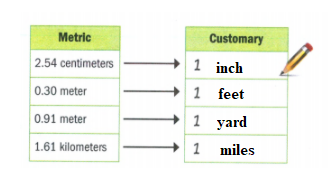
Given that, the approximate metric measurement of length is given for the U.S.
a customary unit of length. We need to use our estimation skills to complete the graphic organizer below.
Fill in each blank with the foot, yard, inch, or mile.
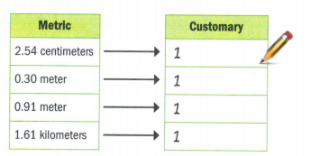
We know that the metric to customary measurements are
1 inch = 2.54 centimeters
1 feet = 0.30 meter
1 yard = 0.91 meter
1 miles = 1.61 kilometer
Thus
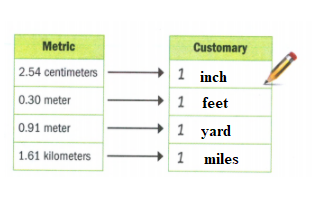
Hence, The Complete Figure is given below:
Ratios And Proportional Reasoning Glencoe Math Course 2 Chapter 1 Exercise 1.3 Guide Page 30 Exercise 9 Problem 11
The unit rate is nothing but the rate per one unit of the material or a thing.
For example, if we come across a grocery store in the market and if we want to buy five kilograms of tomato, the shopkeeper tells us that the price of the tomatoes per kilogram will be $5
In this way, we can easily calculate how much the price will be if we want to buy more kilograms of tomatoes.
In this case, we need to buy 5 kilograms.
Thus, the price will be
Unit price × Number of Kilograms of tomatoes we need to buy
= 5 × 5
= 25 dollars
Like this, we can easily calculate the price of the thing for any quantity if we know the unit price.
The rate or price of anything for any varying quantity can be easily deduced if we know the unit rate or unit price.
Glencoe Math Course 2 Volume 1 Common Core Chapter 1 Page 30 Exercise 10 Problem 12
Given that, we need to determine and explain if we convert 100.
feet per second to inches per second, will there be more or less than 100 inches.
Given that
1 feet = 12 inches
Converting the given, we get
= \(\frac{100 \text { feet }}{1 \text { second }}=\frac{100 \text { feet }}{1 \text { second }} \times \frac{12 \text { inches }}{1 \text { feet }}\)
= \(\frac{100 \times 12 \text { inches }}{1 \text { second }}\)
= \(\frac{1200 \text { inches }}{1 \text { second }}\)
When you convert 100 feet per second to inches per second, there be more than 100 inches.
Since 100 feet per second = 1200 inches per second
Glencoe Math Chapter 1 Ratios And Proportional Reasoning Exercise 1.3 Explanation Page 30 Exercise 11 Problem 13
We need to convert 7 meters per minute to yards per hour.
We know that
1 meters = 1.09361 yards
1 hour = 60 minutes
\(\frac{1}{60}\)hour = 1 minute
Converting the given, we get
\(\frac{7 \text { meters }}{1 \text { minute }}=\frac{7 \text { meters }}{1 \text { minute }} \times \frac{1.09361 \text { yards }}{1 \text { meter }} \times \frac{1 \text { minute }}{\frac{1}{60} \text { hour }}\)\( = \frac{7.65529 \text { yards }}{\frac{1}{60} \text { hour }}\)
= 7.65529 × 60
= 459.3174 yards per hour
Thus, 7 meters per minute will be 459.3174 yards per hour
Glencoe Math Course 2 Volume 1 Common Core Chapter 1 Page 30 Exercise 12 Problem 14
Given that, A salt truck drops 39 kilograms of salt per minute.
We need to determine how many grams of salt the truck drops per second From the given options.
(1) 600
(2) 625
(3) 650
(4) 6,000
Converting the given, we get
\( = \frac{39000 \text { grams }}{60 \text { seconds }}\)
= 650 grams per second
Hence, Option (3) 650 grams of salt the truck drops per second.
Page 31 Exercise 13 Problem 15
We need to convert 20 mi/h to feet per minute.
Converting the given we get
\(\frac{20 \text { miles }}{1 \text { hour }}=\frac{20 \text { miles }}{1 \text { hour }} \times \frac{5280 \text { feet }}{1 \text { mile }} \times \frac{1 \text { hour }}{60 \text { minutes }}\)
= \(\frac{20 \times 5280 \mathrm{feet}}{60 \text { minutes }}\)
= 1760 feet per minute
20 mi/h = 1760 feet/ minute
Glencoe Math Course 2 Volume 1 Common Core Chapter 1 Page 31 Exercise 14 Problem 16
Converting the given we get
\(\frac{16 \mathrm{~cm}}{1 \mathrm{~min}}=\frac{16 \mathrm{~cm}}{1 \mathrm{~min}} \times \frac{\frac{1}{100} \mathrm{~m}}{1 \mathrm{~cm}} \times \frac{1 \mathrm{~min}}{\frac{1}{60} \text { hour }}\)
= \(\frac{16 \times \frac{1}{100} \mathrm{~m}}{\frac{1}{60} \text { hour }}\)
= \(\frac{16}{100} \times 60 \text { meter / hour }\)
= \(\frac{16 \times 6}{10} \text { meter / hour }\)
= 9.6 meter/hr
16 cm/min = 9.6 meter/hr
Page 31 Exercise 16 Problem 17
We need to convert 26 cm/s to m/min.
Converting the given we get
\(\frac{26 \mathrm{~cm}}{1 \mathrm{~second}}=\frac{26 \mathrm{~cm}}{1 \mathrm{~second}} \times \frac{1 \text { meter }}{100 \mathrm{~cm}} \times \frac{60 \text { seconds }}{1 \text { minute }}\)\( = \frac{26 \times 60 \text { meter }}{100 \text { minute }}\)
= 15.6 meter/ minute
26cm/s = 15.6 m/minute
Page 31 Exercise 17 Problem 18
We need to convert 24 mi/h to feet per second.
Converting the rates, we get
\(\frac{24 \text { miles }}{1 \text { hour }}=\frac{24 \text { miles }}{1 \text { hour }} \times \frac{5280 \text { feet }}{1 \text { mile }} \times \frac{1 \text { hour }}{3600 \text { seconds }}\)
= \(\frac{24 \times 5280 \text { feet }}{3600 \text { seconds }}\)
= 35.2 ft/sec
24 mi/h = 35.2 ft/s
Glencoe Math Course 2 Volume 1 Common Core Chapter 1 Page 31 Exercise 18 Problem 19
We need to convert 105.6 L/h to L/min.
Converting the given we get
\(\frac{105.6 \mathrm{~L}}{1 \text { hour }}\)=\(\frac{105.6 \mathrm{~L}}{1 \text { hour }} \times \frac{1 \text { hour }}{60 \text { minutes }}\)
= \(\frac{105.6 \mathrm{~L}}{60 \text { minutes }}\)
= 1.76 L/min
1056 L/h = 1.76L/min
Page 32 Exercise 20 Problem 20
We need to convert Thirty-five miles per hour to feet per minute.
Converting the rates, we get
\(\frac{35 \text { miles }}{1 \text { hour }}=\frac{35 \text { miles }}{1 \text { hour }} \times \frac{5280 \text { feet }}{1 \text { mile }} \times \frac{1 \text { hour }}{60 \text { minutes }}\)\( = \frac{35 \times 5280 \text { feet }}{60 \text { minutes }}\)
= 3080 feet per minute
Thirty-five miles per hour is the same rate as 3,080 feet per minute.
Page 32 Exercise 21 Problem 21
Given that, a boat is traveling at an average speed of 15 meters per second.
We need to determine how many kilometers per second the boat is traveling.
Converting the rates, we get
\(\frac{15 \text { meters }}{1 \text { second }}=\frac{15 \text { meters }}{1 \text { second }} \times \frac{1 \text { kilometer }}{1000 \text { meter }}\)\(=\frac{15 \text { Kilometer }}{1000 \text {second}}\)
= 0.015 Kilometer/ second
A boat is traveling at an average speed of 15 meters per second.
The boat is traveling at 0.015 kilometers per second.
Page 32 Exercise 22 Problem 22
Given that, an oil tanker empties at 3.5 gallons per minute.
We need to convert this rate to cups per second.
Converting the rates, we get
\(\frac{3.5 \text { gallons }}{1 \text { minute }}=\frac{3.5 \text { gallons }}{1 \text { minute }} \times \frac{16 \text { cups }}{1 \text { gallon }} \times \frac{1 \text { minute }}{60 \text { seconds }}\)
= \(\frac{3.5 \times 16 \mathrm{cups}}{60 \text { seconds }}\)
= 0.93 cups/second
An oil tanker empties at 3.5 gallons per minute.
This rate in cups per second is 0.93 cups /second
Glencoe Math Course 2 Volume 1 Common Core Chapter 1 Page 32 Exercise 23 Problem 23
Given that
$36 for 4 basketball hats; $56 for 7 basketball hats.
We need to show that they are equivalent are not.
Find the values of each ratio:
For the first case
\(\frac{36 \text { dollars }}{4 \text { basketball hats }}=9 \text { dollars/hat }\)
For the second case
\(\frac{56 \text { dollars }}{7 \text { basketball hats }}=8 \text { dollars/hat }\)
Both the values of the ratios are different.
Thus, they are not equivalent.
The values of the ratios are different. Thus, they are not equivalent.
Page 32 Exercise 24 Problem 24
Given that 12 posters for 36 students; 21 posters for 63 students
We need to show that they are equivalent are not.
Find the values of each ratio:
For the first case:
\(\frac{12}{36}\) = \(\frac{1}{3}\)
For the second case:
\(\frac{21}{63}\) = \(\frac{1}{3}\)
Both the values of the ratios are the same. Thus, they are equivalent.
The values of the ratios are the same. Thus, they are equivalent.
Glencoe Math Course 2 Volume 1 Common Core Chapter 1 Page 32 Exercise 25 Problem 25
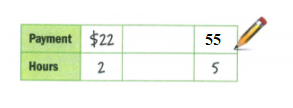
Given that, an employer pays $22 for 2 hours.
We need to use the ratio table to determine how much she charges for 5 hours.
The unit rate per hour is
\(\frac {22}{2}\)=\(\frac{11 \text { dollars }}{1 \text { hour }}\)
Thus, the employer pays 11 dollars per hour. Thus, for 5 hours
5 hours \(\times \frac{11 \text { dollars }}{1 \text { hour }}=5 \times 11 \text { dollars }\)
= 55 dollars
For 5 hours, she charges $55 26