Glencoe Math Course 2 Volume 1 Common Core Chapter 1 Ratios and Proportional Reasoning
Glencoe Math Course 2 Volume 1 Chapter 1 Practice Exercise 1.2 Solutions Page 21 Exercise 12 Problem 1
Given that, the percent is 13\(\frac{1}{3}\) %
We need to write the given percent as a fraction and simplify it.
Given percent is 13\(\frac{1}{3}\) %
Converting the given mixed fraction into an improper fraction, we get
13\(\frac{1}{3}\) = \(\frac{40}{3}\) %
Thus, the percentage becomes
\(\frac{40}{3}\) percent = \(\frac{40}{3}\)÷ \(\frac{100}{1}\)
Multiply it by the reciprocal of \(\frac{100}{1}\) , we get
\(\frac{40}{3}\) percent = \(\frac{40}{3}\)÷ \(\frac{100}{1}\)
= \(\frac{40}{3}\)× \(\frac{1}{100}\)
= \(\frac{4}{3}\)× \(\frac{1}{10}\)
= \(\frac{2}{3}\)× \(\frac{1}{5}\)
= \(\frac{2}{15}\)
The given percent 13\(\frac{1}{3}\) % as a fraction in the simplest form is \(\frac{2}{15}\)
Read and Learn More Glencoe Math Course 2 Volume 1 Common Core Student Edition Solutions
Glencoe Math Course 2 Volume 1 Page 22 Exercise 15 Problem 2
A complex fraction is nothing but a fraction that has fractions in its denominator or in the numerator or in both.
For example:
\(\frac{\frac{5}{10}}{2}, \frac{11}{\frac{6}{5}}, \frac{\frac{13}{12}}{\frac{9}{8}}\). These are all complex fractions.
Solving a complex fraction:
Let us consider a complex fraction that involves ratios
\(\frac{\frac{5}{2}}{10}\)Simplifying it, we get
\(\frac{\frac{5}{2}}{10}\)
= \(\frac{5}{2}\) × \(\frac{1}{10}\)
= \(\frac{1}{2}\) × \(\frac{1}{2}\)
= \(\frac{1}{4}\)
A complex fraction is a fraction that has more than one fraction.
That is, fractions will be in their denominator or in the numerator, or in both.
Glencoe Math Course 2 Volume 1 Page 22 Exercise 16 Problem 3
We need to write three different complex fractions that simplify to \(\frac{1}{4}\)
So, we will use the definition
The three different complex fractions and their simplification is given below
1) \(\frac{\frac{1}{2}}{2}\)
Simplifying it, we get
\(\frac{\frac{1}{2}}{2}\)= \(\frac{1}{2}\)×\(\frac{1}{2}\)
= \(\frac{1}{4}\)
2)\(\frac{\frac{5}{4}}{5}\)
Simplifying it, we get
\(\frac{5}{4}\)× \(\frac{1}{5}\)
= \(\frac{1}{4}\)
3)\(\frac{\frac{1}{3}}{\frac{4}{3}}\)
Simplifying it, we get
\(\frac{\frac{1}{3}}{\frac{4}{3}}\) = \(\frac{1}{3}\)×\(\frac{3}{4}\)
= \(\frac{1}{4}\)
The three different complex fractions that simplify to \(\frac{1}{4}\) are \(\frac{\frac{1}{2}}{2}\), \(\frac{\frac{5}{4}}{5}\), \(\frac{\frac{1}{3}}{\frac{4}{3}}\)
Glencoe Math Course 2 Volume 1 Page 22 Exercise 17 Problem 4
We need to determine the value of ,\(\frac{15}{124} \cdot \frac{230}{30} \div \frac{230}{124} \)
Simplifying it, we get
\(\frac{15}{124} \cdot \frac{230}{30} \div \frac{230}{124} \) = \(\frac{15}{124} \times \frac{230}{30} \times \frac{124}{230}\)
= \(\frac{15}{1}\) × \(\frac{1}{30}\) × \(\frac{1}{1}\)
= \(\frac{15}{30}\)
= \(\frac{1}{2}\)
The value of \(\frac{15}{124} \cdot \frac{230}{30} \div \frac{230}{124} \) = \(\frac{1}{2}\)
Common Core Chapter 1 Ratios and Proportional Reasoning Practice Exercise 1.2 answers Page 22 Exercise 18 Problem 5
We need to determine which statement explains how to use the model to simplify the complex fraction.
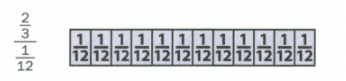
Count the twelfths that fit within \({2}{3}\) of the above equation
There are 12 number of \(\frac{1}{12}\)‘s are there.
Thus , \(\frac{2}{3}\) rd of the are
\(\frac{2}{3}\) ×12 = 2 × 4 = 8
The result of the given complex fraction is
\(\frac{\frac{2}{3}}{\frac{1}{12}}\)= \(\frac{2}{3}\)×\(\frac{12}{1}\)
= \(\frac{2}{1}\)×\(\frac{4}{1}\)
= 8
Thus, both are the same. Hence, this statement is correct.
Count the twelfths that fit within \(\frac{2}{3}\). This statement explains how to use the model to simplify the complex fraction.
Glencoe Math Course 2 Volume 1 Page 23 Exercise 20 Problem 6
The objective is to Simplify the value of \(\frac{12}{\frac{3}{5}}\)
We will use the definition.
Given is \(\frac{12}{\frac{3}{5}}\)
Simplifying it, we get
\(\frac{12}{\frac{3}{5}}\) = 12 ÷ \(\frac{3}{5}\)
= 12 × \(\frac{5}{3}\)
= 4 × 5
= 20
The value of \(\frac{12}{\frac{3}{5}}\) = 20
Step-By-Step Guide For Glencoe Math Practice Exercise 1.2 Chapter 1 Problems Page 23 Exercise 21 Problem 7
We are given \( \frac{\frac{9}{10}}{9}\)
To Find: The objective is to simplify the given fraction \( \frac{\frac{9}{10}}{9}\)
Given is \( \frac{\frac{9}{10}}{9}\)
Simplifying it, we get
\( \frac{\frac{9}{10}}{9}\) = \(\frac{9}{10}\)÷ 9
= \(\frac{9}{10}\) × \(\frac{1}{9}\)
= \(\frac{1}{10}\)
The value of \( \frac{\frac{9}{10}}{9}\)= \(\frac{1}{10}\)
Exercise 1.2 practice solutions for Glencoe Math Course 2 Chapter 1 Ratios And Proportional Reasoning Page 23 Exercise 22 Problem 8
Simplify the value of \(\frac{\frac{1}{2}}{\frac{1}{4}}\)
Given is \(\frac{\frac{1}{2}}{\frac{1}{4}}\)
Simplifying it, we get
\(\frac{\frac{1}{2}}{\frac{1}{4}}\)= \(\frac{1}{2}\) × \(\frac{4}{1}\)
= \(\frac{4}{2}\)
= 2
The value of \(\frac{\frac{1}{2}}{\frac{1}{4}}\)= 2
Glencoe Math Course 2 Volume 1 Page 23 Exercise 23 Problem 9
The objective is to Simplify the value of \(\frac{\frac{1}{12}}{\frac{5}{6}}\)
We will use the Definition.
Given \(\frac{\frac{1}{12}}{\frac{5}{6}}\)
Simplifying it, we get
\(\frac{\frac{1}{12}}{\frac{5}{6}}\)= \(\frac{1}{12}\) × \(\frac{6}{5}\)
= \(\frac{1}{2}\) × \(\frac{1}{5}\)
= \(\frac{1}{10}\)
Hence, The value of \(\frac{\frac{1}{12}}{\frac{5}{6}}\) = \(\frac{1}{10}\)
Common Core Practice Exercise 1.2 Ratios and Proportional Reasoning Glencoe Math Course 2 Page 23 Exercise 24 Problem 10
Simplify the value of \(\frac{\frac{5}{6}}{\frac{5}{9}}\)
Given is \(\frac{\frac{5}{6}}{\frac{5}{9}}\)
Simplifying it, we get
\(\frac{\frac{5}{6}}{\frac{5}{9}}\) = \(\frac{5}{6}\)× \(\frac{9}{5}\)
= \(\frac{9}{6}\)
= \(\frac{3}{2}\)
The value of \(\frac{\frac{5}{6}}{\frac{5}{9}}\) = \(\frac{3}{2}\)
Examples Of Problems From Practice Exercise 1.2 Ratios And Proportional Reasoning Chapter 1 Glencoe Math Page 23 Exercise 25 Problem 11
Given that, Mrs. Frasier is making costumes for the school play. Each costume requires 0.75 yards of fabric. She bought 6 yards of fabric.
We need to determine how many costumes Mrs. Frasier can make.
The number of yards needed to make one costume = 0.75
Total yards of fabric bought = 6
The ratio is, \(\frac{6}{0.75}\)
= 8
She can make eight costumes out of it.
Hence, Mrs. Frasier can make 8 costumes.
Glencoe Math Course 2 Volume 1 Page 23 Exercise 26 Problem 12
Given that, A lawn company advertises that they can spread 7,500 square feet of grass seed in 2\(\frac{1}{2}\) hours.
We need to determine the number of square feet of grass seed that can be spread per hour.
Given that
Square feet of grass that they can spread = 7500
Time taken = 2\(\frac{1}{2}\)
The unit rate is
Unite rate \( = \frac{7500}{2 \frac{1}{2}} \)
= \(\frac{7500}{\frac{5}{2}}\)
= 7500 × \(\frac{2}{5}\)
= 1500 × 2
= 3000
Hence, The number of square feet of grass seed that can be spread per hour is 3000 square feet.
Glencoe Math Student Edition Chapter 1 Practice Exercise 1.2 Answers Guide Page 23 Exercise 28 Problem 13
Given that, the percent is 7 \(\frac{3}{4}\)%
We need to write the given percent as a fraction and simplify it.
Given percent is 7 \(\frac{3}{4}\)%
Converting the given mixed fraction into an improper fraction, we get
7 \(\frac{3}{4}\) = \(\frac{31}{4}\)%
Thus, the percent becomes
\(\frac{31}{4}\) percent = \(\frac{31}{4}\) ÷ \(\frac{100}{1}\)
Multiply it by the reciprocal of \(\frac{100}{1}\) , we get
\(\frac{31}{4}\) percent = \(\frac{31}{4}\) ÷ \(\frac{100}{1}\)
\(\frac{31}{4}\) percent = \(\frac{31}{4}\)×\(\frac{100}{1}\) we, get
= \(\frac{31}{400}\)
The given percent 7\(\frac{3}{4}\)% as a fraction in the simplest form is \(\frac{31}{400}\)
Glencoe Math Course 2 Volume 1 Page 23 Exercise 30 Problem 14
The value of a certain stock increased by 1 \(\frac{1}{4}\)%
We need to explain how to write it as a fraction in the simplest form
Given percent is 1\(\frac{1}{4}\)%
Converting it into fractions, we get
1\(\frac{1}{4}\) percent = \(\frac{5}{4}\)percent
= \(\frac{\frac{5}{4}}{100}\)
= \(\frac{5}{4}\)×\(\frac{1}{100}\)
= \(\frac{1}{4}\) × \(\frac{1}{20}\)
= \(\frac{1}{80}\)
Hence, The value of \(\frac{1}{4}\) percent = \(\frac{1}{80}\)
Chapter 1 Practice Exercise 1.2 Glencoe Math Course 2 Step-By-Step Solutions Page 24 Exercise 31 Problem 15
Given that, Debra can run 20\(\frac{1}{2}\) miles in 2 \(\frac{1}{4}\)
We need to determine how many miles per hour she can run.
Given that = 20\(\frac{1}{2}\)
= \(\frac{41}{2}\) miles
Time taken = 2 \(\frac{1}{4}\)
= \(\frac{9}{4}\)
The unit rate is
Unite rate = \(\frac{\text { Number of miles }}{\text { Time taken }}\)
= \(\frac{\frac{41}{2}}{\frac{9}{4}}\)
= \(\frac{41}{2}\) × \(\frac{4}{9}\)
= 41 × \(\frac{2}{9}\)
= \(\frac{82}{9}\)
= 9 \(\frac{1}{9}\) miles per hour
She can run 9 \(\frac{1}{9}\) miles per hour
Page 24 Exercise 32 Problem 16
Among the given options.
We need to determine which of the given complex fraction is equivalent to the value
1) \(\frac{\frac{1}{4}}{\frac{1}{2}}\)= \(\frac{1}{4}\) × \(\frac{2}{1}\)
= \(\frac{2}{4}\)
= \(\frac{1}{2}\)
2) \(\frac{\frac{1}{2}}{\frac{1}{2}}\)= \(\frac{1}{2}\) × \(\frac{2}{1}\)
= \(\frac{2}{2}\)
= 1
3) \(\frac{\frac{1}{4}}{\frac{4}{1}}\)= \(\frac{1}{4}\) × \(\frac{4}{1}\)
= \(\frac{4}{4}\)
= 1
4) \(\frac{\frac{1}{8}}{\frac{1}{2}}\)= \(\frac{1}{8}\) × \(\frac{2}{1}\)
= \(\frac{2}{8}\)
= \(\frac{1}{4}\)
Here, Option (1) is equal to \(\frac{1}{2}\)
Hence, Option (1) \(\frac{\frac{1}{4}}{\frac{1}{2}}\) is equivalent to \(\frac{1}{2}\)
Glencoe Math Course 2 Volume 1 Page 24 Exercise 35 Problem 17
We need to determine how many inches does two feet measure using the equivalent customary measurement.
We will use the definitions
We know that the equivalent customary measurement of foot and inches will be
1 foot = 12 inches
We need to calculate how many inches are there for two feet.
Thus
2×1 foot = 2 × 12 inches
2 feet = 24 inches
Hence, 2 feet = 24 inches
Page 24 Exercise 37 Problem 18
We need to determine how many quarts does 8 gallons measure using the equivalent customary measurement.
We know that the equivalent customary measurement of gallons and quarts will be
1 gallon = 4.8038 quarts
We need to calculate how many quarts are there for 8 gallons.
Thus
8 × 1 gallon = 8 × 4.8038 quarts
8 gallons = 38.4304 quarts
8 gallons = 38.4304 quarts
Page 24 Exercise 40 Problem 19
We need to determine how many grams does one-kilogram measures using the equivalent metric measurement.
We need to calculate how many grams are there in one kilogram.
We know that kilo refers to the number 1000
According to the equivalent metric measurement of kilograms and grams
1 kilogram = 1000 grams
1 kilogram = 1000 grams
Glencoe Math Course 2 Volume 1 Page 24 Exercise 40 Problem 20
We need to determine how many grams does one-kilogram measures using the equivalent metric measurement.
We need to calculate how many grams are there in one kilogram.
We know that kilo refers to the number 1000
According to the equivalent metric measurement of kilograms and grams
1 kilogram = 1000 grams
1 kilogram = 1000 grams