
Glencoe Math Course 2 Volume 1 Common Core Chapter 4 Rational Numbers
Glencoe Math Course 2 Volume 1 Chapter 4 Rational Numbers Exercise Solutions Page 257 Exercise 1 Problem 1
When we add fractions with the same denominator, we add only the numerators.
To add fractions with unlike denominators, rename the fractions with a common denominator by finding the “Least common multiple”(LCM)
For example: \(\frac{1}{4}\)+\(\frac{2}{4}\)=\(\frac{3}{4}\)
To subtract fractions with like denominators, subtract the numerators, and write the difference over the denominator.
To subtract fractions with unlike denominators, rename the fractions with a common denominator by finding the “Least common multiple”(LCM)
For example: \(\frac{4}{2}\)–\(\frac{1}{2}\)=\(\frac{3}{2}\)
The numerators of both fractions are to be multiplied first, followed by the multiplication of the denominators.
Then, the resultant fraction is simplified to its lowest terms, if needed.
For example: \(\frac{1}{2}\)×\(\frac{1}{5}\)=\(\frac{1}{10}\)
Read and Learn More Glencoe Math Course 2 Volume 1 Common Core Student Edition Solutions
Dividing two fractions is the same as multiplying the first fraction by the reciprocal of the second fraction.
The first step to dividing fractions is to find the reciprocal (Reverse the numerator and denominator) of the second fraction.
Next, multiply the two numerators. Then, multiply the two denominators.
For example: \(\frac{\frac{1}{2}}{\frac{3}{2}}\)=\(\frac{1}{2}\)×\(\frac{2}{3}\)
= \(\frac{1}{3}\)
When we add, subtract, multiply, or divide fractions, a new fraction is obtained.
Common Core Chapter 4 Rational Numbers Exercise Answers Glencoe Math Course 2 Page 260 Exercise 1 Problem 2
Given: Here it is
∴ \(\frac{24}{36}\)
To find- Write each fraction in simplest form.
Here it is given that
\(\frac{24}{36}\) ÷ 12 = \(\frac{2}{3}\)
= \(\frac{2}{3}\)
∴ \(\frac{24}{36}\) = \(\frac{2}{3}\)
Therefore, The simplest form of the fraction is \(\frac{24}{36}\) = \(\frac{2}{3}\)
Step-By-Step Solutions For Chapter 4 Rational Numbers Exercises In Glencoe Math Course 2 Page 260 Exercise 2 Problem 3
Given: \(\frac{45}{50}\)
To find- Write each fraction in simplest form.
∴ \(\frac{45}{50}\)
Find the Greatest Common Factor (GCF) of 45 and 50, if it exists, and reduce our fraction by dividing both the numerator and denominator by it.
GCF = 5, and getting our simplified answer
\(\frac{45}{50}\) ÷ 5 = \(\frac{9}{10}\)
= \(\frac{9}{10}\)
Therefore, The simplest form of the fraction is\(\frac{45}{50}\) = \(\frac{9}{10}\)
Exercise Solutions For Chapter 4 Rational Numbers Glencoe Math Course 2 Volume 1 Page 260 Exercise 3 Problem 4
Given:
\(\frac{88}{121}\)To find – Write each fraction in simplest form.
⇒ \(\frac{88}{121}\)
Find the Greatest Common Factor (GCF) of 88 and 121, if it exists, and reduce our fraction by dividing both the numerator and denominator by it.
GCF = 11 and getting our simplified answer
\(\frac{88}{121}\)÷11= \(\frac{8}{11}\)
= \(\frac{8}{11}\)
Therefore, The simplest form of the fraction is \(\frac{88}{121}\) = \(\frac{8}{11}\)
Examples Of Problems From Chapter 4 Rational Numbers Exercises In Glencoe Math Course 2 Page 260 Exercise 4 Problem 5
Given:
Graphing graph each fraction or mixed number on the number line below. \(\frac{1}{2}\)
To graph the fraction.
To find – The two whole numbers between which
0<\(\frac{1}{2}\)<1
Since the denominator is 2, divide each space into 2 sections.
Draw a dot at \(\frac{1}{2}\)
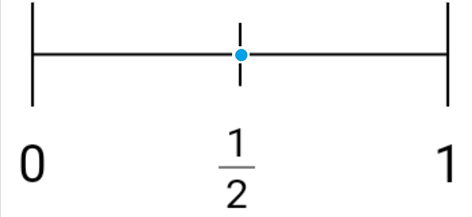
Finally, we conclude that the graph has been plotted.
Student Edition Glencoe Math Course 2 Chapter 4 Rational Numbers Exercise Solutions Guide Page 260 Exercise 5 Problem 6
Given:
Graphing graph each fraction or mixed number on the number line below.\(\frac{3}{4}\)
To graph the fraction.
To find – The two whole numbers between which line below.\(\frac{3}{4}\)
0<\(\frac{3}{4}\)<1
Since the denominator is 4, divide each space into 4 sections.
Draw a dot at \(\frac{3}{4}\)
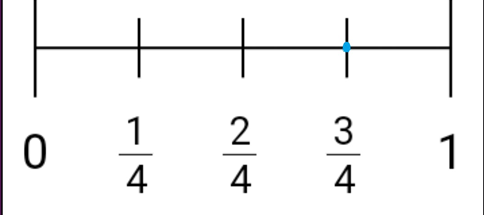
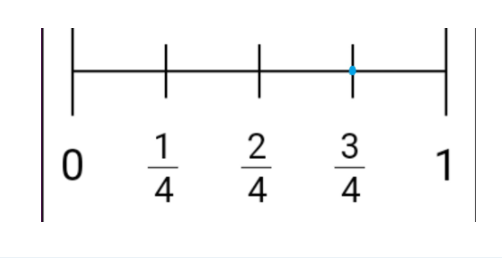
The graph for the given fraction \(\frac{3}{4}\) is
Step-By-Step Guide For Chapter 4 Rational Numbers Exercises In Glencoe Math Course 2 Volume 1 Page 260 Exercise 6 Problem 7
Given:
Graphing graph each fraction or mixed number on the number line below.
1\(\frac{1}{4}\)
To graph the fraction.
To find – The two whole numbers between which 1\(\frac{1}{4}\)
1<1\(\frac{1}{4}\)<2
Since the denominator is 4, divide each space into 4 sections.
Draw a dot at 1\(\frac{1}{4}\)
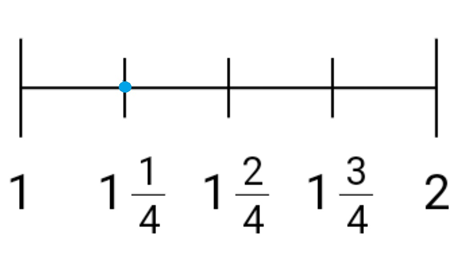
Finally, we conclude that the graph has been plotted.
Page 260 Exercise 7 Problem 8
Given:
Graphing graph each fraction or mixed number on the number line below.
2\(\frac{1}{2}\)
To graph the fraction
To find – The two whole numbers between which 2\(\frac{1}{2}\)
2<2\(\frac{1}{2}\)<3
Since the denominator is 2, divide each space into 2 sections.
Draw a dot at 2 \(\frac{1}{2}\)
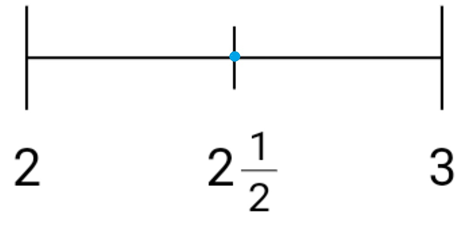
Finally, we conclude that the graph has been plotted.
Page 262 Exercise 1 Problem 9
Given:
Graph each fraction on a number line. Use a bar diagram if needed. \(\frac{3}{8}\)
To graph the fraction.
To find – The two whole numbers between which −\(\frac{3}{8}\) lies
−1<−\(\frac{3}{8}\)<0
Since the denominator is 8, divide each space into 8 sections.
Draw a dot at −\(\frac{3}{8}\)
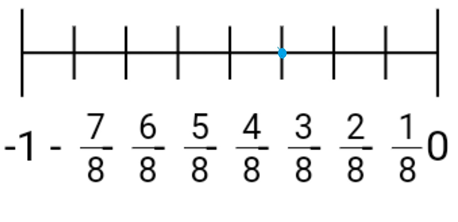
Finally, we conclude that the graph has been plotted.
Page 262 Exercise 2 Problem 10
Given:
Graph each fraction on a number line. Use a bar diagram if needed.
−1\(\frac{2}{5}\)
Analyze the given and then graph the fraction.
To find – The two whole numbers between which −1\(\frac{2}{5}\) lies
−2<−1\(\frac{2}{5}\)<−1
Since the denominator is 5, divide each space into 5 sections.
Draw a dot at −1\(\frac{2}{5}\)

The graph for −1\(\frac{2}{5}\) has been plotted:

Page 262 Exercise 3 Problem 11
Given:
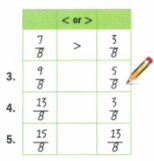
Use the number line and complete with < or >,
Plot the given fractions and Analyze the number line to complete the table
To find- The greater one, first, we have to check whether the denominators are the same.
\(\frac{9}{8}\) and \(\frac{5}{8}\)
Both fractions have the same denominator.
Then check the signs.
In this case, both numbers are positive.
When comparing positive numbers, the larger number is greater.
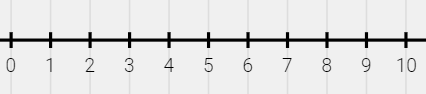
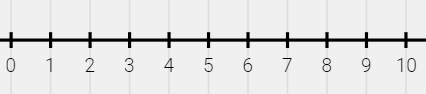
Hence, it is clear that \(\frac{9}{8}\)> \(\frac{5}{8}\)
The solution is \(\frac{9}{8}\)> \(\frac{5}{8}\)
Page 262 Exercise 4 Problem 12
Given:
Work with a partner to complete each table. Use the number if needed.
\(\frac{13}{8}\)>\(\frac{3}{8}\)
To complete with < or >.
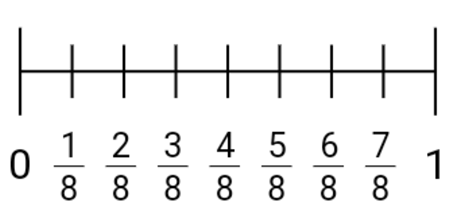
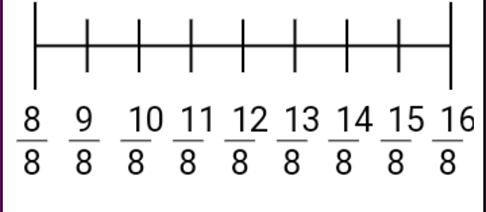
Hence, it is clear that \(\frac{13}{8}\)>\(\frac{3}{8}\)
Finally, we conclude that the solution is \(\frac{13}{8}\)>\(\frac{3}{8}\)
Page 262 Exercise 5 Problem 13
Given:
Work with a partner to complete each table .Use a number if needed.
\(\frac{15}{8}\)>\(\frac{13}{8}\)
To complete with < or >
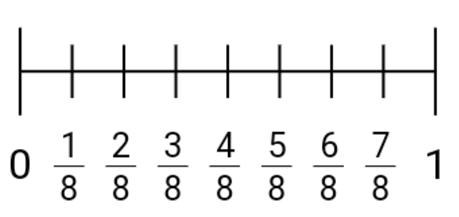
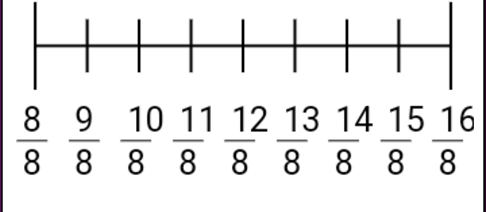
Hence, it is clear that \(\frac{15}{8}\)>\(\frac{13}{8}\)
Finally, we conclude that the solution is \(\frac{15}{8}\)>\(\frac{13}{8}\)
Page 262 Exercise 6 Problem 14
Given:
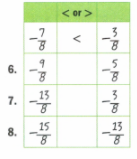
Use the number line and complete with < or >.
Plot the given fractions and To find the greater one, first, we have to check whether the denominators are the same.
If we have both denominators.
Then check the signs.
In this case, both numbers are negative.
When comparing negative numbers, the larger number farther from zero is less.
Here −9 is farther from zero. It is less.

Hence, it is clear that −\(\frac{9}{8}\)<−\(\frac{5}{8}\)
The solution is −\(\frac{9}{8}\) <− \(\frac{5}{8}\)

Page 262 Exercise 9 Problem 15
Given:
Identify repeated reasoning compare and contrast the information in the tables.
To compare and contrast
From the table, we can understand that the positive numbers are plotted on the right of the zero on a number line and the negative numbers are plotted on the left side of the zero on a number line.
Also, the positive number values are going on increasing
= \(\frac{7}{8}\)<\(\frac{9}{8}\)
The negative number values are goes on decreasing, ⇒ −\(\frac{7}{8}\)>\(\frac{9}{8}\)
Finally, the information in the table has been explained.
Page 262 Exercise 10 Problem 16
Given:
Reason inductively how does graphing −\(\frac{3}{4}\) differ from graphing \(\frac{3}{4}\)
We know that, that the positive numbers are plotted on the right of the zero on a number line and the negative numbers are plotted on the left side of the zero on a number line.
Hence,-\(\frac{3}{4}\)is to be plotted on the left of the zero on a number line.
\(\frac{3}{4}\) is to be plotted on the right of the zero on a number line.
Finally, we can conclude that − \(\frac{3}{4}\) is to be plotted on the left of the zero on a number line. \(\frac{3}{4}\) is to be plotted on the right of the zero on a number line, this is the difference in their graphing.
Page 262 Exercise 11 Problem 17
Given:
How can you graph the negative fractions on the number line? To explain.
The negative numbers are plotted on the left side of the zero on a number line instead of moving right.
For example: To plot −\(\frac{7}{8}\)
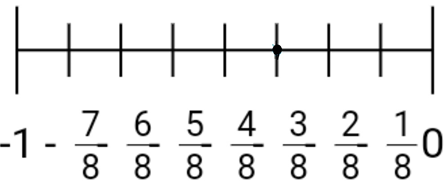
Finally, we can conclude that the negative numbers are plotted on the left side of the zero on a number line.